#AirWarVietnam – Making a MiG-Killer: Technology and Signals Intelligence for Air-to-Air Combat in Vietnam

#AirWarVietnam – Making a MiG-Killer: Technology and Signals Intelligence for Air-to-Air Combat in Vietnam

By Dr Mike Hankins

Editorial Note: During 2019, From Balloons to Drones is running a series of articles looking at various aspects of the air war over Vietnam from the French-Indochina War through to the end of the Vietnam War. In this article, Dr Mike Hankins discusses the use of signals intelligence via Project Teaball that helped to improve the air-to-air combat ratios of the United States Air Force during the Vietnam War. If you would like to contribute to the series, then please email our editor, Dr Ross Mahoney, at airpowerstudies@gmail.com or via our contact page here. The official call for papers is here.

Air-to-air combat in the Vietnam War has long been a sore subject for some observers.[1] Sources vary, but U.S. forces overall killed approximately 200 MiGs while losing about 90 planes to them, for a ratio of about 2.2:1.[2] Robert Wilcox, in his history of the Top Gun program, calls this ‘embarrassingly low.’[3] Looking just at 1968, the picture is even bleaker. The US Navy was disappointed with its 3:1 ratio and the US Air Force (USAF) traded McDonnell Douglas F-4 Phantoms for MiGs at nearly a 1:1 rate. During the bombing halt between 1968 and 1972, both services sought to upgrade their technology and training, including the creation of the US Navy Fighter Weapons School, also known as ‘Top Gun.’ In 1972 when the LINEBACKER bombing campaign began, the US Navy’s air-to-air record jumped to 6:1. The USAF struggled in the early months of LINEBACKER, earning a negative kill ratio for the first time in the war and perhaps in its existence.[4]

The US Navy is often praised for their changes to training procedures (even though Top Gun initially had little support from US Navy leaders) while the USAF is often criticised for over-reliance on technological solutions.[5] However, the most significant improvement in air-to-air combat for the USAF was the result of a technological system: Project Teaball – a Ground Controlled Intercept (GCI) system that allowed analysts on the ground to track enemy planes in real-time and communicate that information to pilots in the air.

‘Teaball’ was just as critical to the USAF’s air combat success during the LINEBACKER campaigns as Top Gun was for the US Navy. It demonstrated that the USAF was open to change and adapted its technological culture to meet new challenges. This is not to take away from the undeniable success of the Top Gun program, nor to diminish the importance the USAF’s effective RED FLAG program that began shortly afterwards. In the last throes of the Vietnam War, both technology and training worked in tandem.

Web of Confusion

North Vietnamese pilots had long relied on GCI to direct their movements – ground controllers used their extensive radar coverage of the area to track aircraft and give detailed second-by-second instructions to MiG pilots.[6] American forces were different. They tended to rely more on the initiative and skill of individual pilots, but they also had far less radar coverage of the areas they flew over in North Vietnam. Complicating, this was the fact that US radar stations were not well integrated, creating a confusing web of systems competing for pilots’ attention.
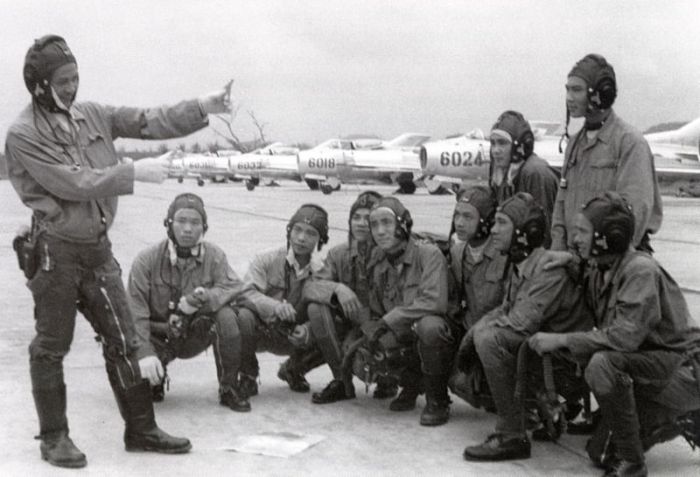
NVAF MiG-19 pilots of the 925th fighter squadron discussing tactics in 1971
North Vietnamese MiG-19 pilots discuss air-to-air combat tactics (Source: US Air Force)

The USAF operated a ground radar covering the southeast at Da Nang. Another radar further north at Dong Ha known as ‘Waterboy’ covered the lowest reaches of North Vietnam, although few air-to-air engagements occurred there. For further coverage, USAF flew a Lockheed EC-121 known as ‘College Eye,’ which was excellent over water but was less accurate over land. Other radar stations existed in Thailand, including ‘Brigham,’ at Udorn, and ‘Invert,’ at Nakon Phanom. These stations contributed ground control and navigational assistance, although their short-range provided almost no coverage of North Vietnam itself.
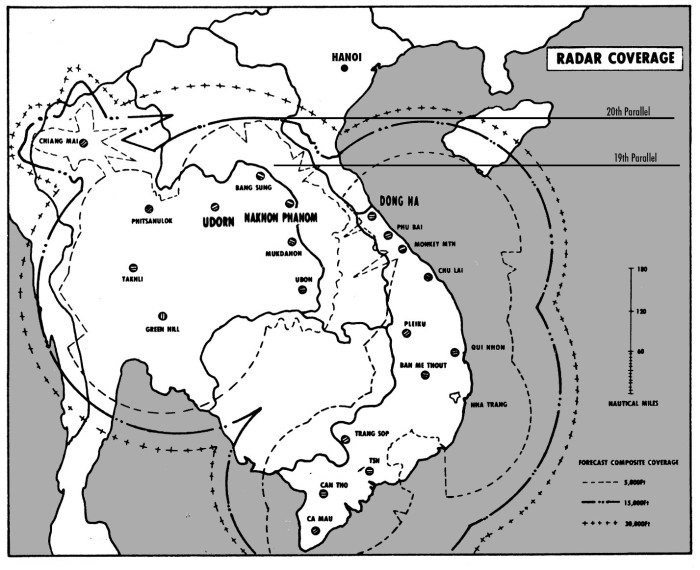
Hankins Radar Map
This map shows the radar coverage of systems prior to Project Teaball. Note that coverage above the 20th parallel, where air combat was much more likely, was almost nonexistent.

The US Navy used a system called ‘Red Crown,’ a ship-based radar located in the Gulf of Tonkin, to provide early warning of approaching MiGs. There was some limited cooperation between ‘Red Crown’ and ‘College Eye’ during Operation ROLLING THUNDER. The bottom line for all these radar systems was that none of them was effective for strikes further North than the 19th parallel, where air combat was more likely, and some of these systems, such as ‘Red Crown,’ could not effectively track planes below 10,000 feet, where MiGs often flew.[7]

However, radar was only one way to gain situational awareness of enemy MiGs. Communications surveillance, or signals intelligence (SIGINT), could track enemy movements and plans. In 1967, the USAF brought in new EC-121s known as ‘Rivet Top; to do just that: Intercept North Vietnamese communications and pass on vital information to American pilots. ‘Rivet Top’ was a success. In its limited time of employment, American forces claimed 20 MiG kills, 13 of which received direct contributions from ‘Rivet Top.’[8] However, the ROLLING THUNDER campaign ended before they could make a more significant contribution. At the beginning of the LINEBACKER Campaign, the US Navy’s ‘Red Crown’ ship returned, and the USAF instituted a system known as ‘Disco,’ essentially a slightly upgraded version of ‘College Eye.’ Under ‘Disco,’ multiple EC-121s provided a larger area of radar coverage and continued the SIGINT role provided by the ‘Rivet Top’ equipment, although the system suffered many of the same problems that plagued the ‘College Eye’ system, such as a limited range, limited crew and equipment capacity, and the need to stay in slow, controlled orbits.[9]

Both sides found that GCI was key to air-to-air victory. General John Vogt, Director of the Joint Staff and later commander of the Seventh Air Force, argued that MiG successes were attributable entirely to how their radar systems connected to their command and control practices.[10] USAF Ace fighter pilot Richard ‘Steve’ Ritchie went so far as to state that flying a protective escort without GCI warning of incoming MiGs was ‘useless,’ and that employment of US GCI ‘was one of the primary reasons that we were able to engage MiGs and effect kills.’[11] Yet the limited range, communications problems, and frequent technical failures limited US GCI efforts.
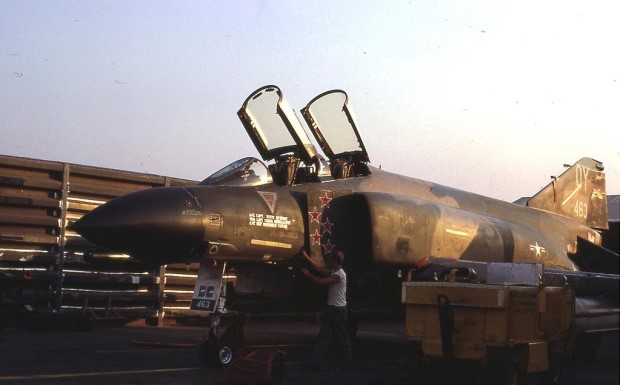
Ritche
The F-4D flown by Captains Richard S. Ritchie and Charles B. DeBellevue at Udorn AFB in 1972. This aircraft is currently on display at the Air Force Academy. (Source: US Air Force)

Green Door Syndrome

An equally serious bureaucratic problem aggravated these technological difficulties. Unknown to most fighter pilots, the National Security Agency (NSA) frequently intercepted North Vietnamese communications – including information about MiG flights. Some NSA analysts, such as Delmar Lang, had previously advocated combining these intercepts with GCI to provide a more accurate picture of enemy locations and movements. Lang had developed such a system in the Korean War, contributing to the success of North American F-86 Sabre pilots. Lang had offered to create a similar program in Vietnam, but both NSA and USAF leaders, particularly Major General George Keegan, Director of Air Force Intelligence, repeatedly turned him down.[12] Interception of North Vietnamese transmissions was classified, and American pilots did not have proper security clearance. This policy was not unfounded. Using these intercepts could undoubtedly aid American pilots but using them too frequently risked alerting the North Vietnamese that the US was intercepting their signals.[13]

This was a dilemma for American planners who needed to balance using the data with keeping its existence secret. However, USAF leaders such as Keegan simply refused to pass on any information to American pilots in combat. This created a sense of ill will between pilots and intelligence agents. As former USAF intelligence officer, Gilles Van Nederveen noted, ‘US pilots, already frustrated by the small amount of data provided to them, felt betrayed when they learned that some losses over Vietnam could have been prevented if intelligence data had been shared with them.’ This animosity grew so prevalent that it received a name: ‘green door syndrome,’ so labelled because, in many combat wing bases in the theatre, classified information was kept in vaults usually behind a green door.[14]

LINEBACKER and Project Teaball

When bombing (and air-to-air combat) resumed in earnest with the LINEBACKER campaign in May 1972, the US, particularly the USAF, received what Colonel Russ Everts, an F-4 Pilot, generously called ‘an old fashioned butt kicking, pure and simple.’[15] After some initial successes that May, in June and July, USAF F-4 Phantoms claimed 8 MiGs, with the US Navy shooting down only 3. While the US Navy only lost one F-4, USAF lost 13.[16] The US Navy could still claim their previous 3:1 ratio; the USAF had sunk to its lowest ratio during the war, 0.6:1. For the first time in the war, the kill ratios favoured the North Vietnamese.

These reversals rippled through USAF quickly, prompting investigations into the quality of fighter pilots. General William Momyer, then commander of Tactical Air Command (TAC), who had previously resisted any alterations to training procedures, changed his mind and recommended the creation of an ‘Aggressor’ squadron to simulate MiGs in air combat training (building on a program at Nellis run by Major Roger Wells). Although Chief of Staff of the Air Force General John Ryan approved the Aggressor concept at that time, the program did not begin until after the war was over and thus it had no effect on air combat in Vietnam.[17]

However, one element the USAF could fix in time to make a difference was their GCI system. The summer’s heavy losses, increasing concern from Vogt about the shortcomings of American GCI, and pressure from eager NSA analysts and USAF pilots all overrode earlier concerns with sharing classified intelligence and pushed the issue higher up the chain of command. Ryan directly contacted the head of the NSA, Admiral Noel Gayler – himself a former US Navy aviator – and requested the creation of an improved early warning system to alert pilots to approaching MiGs. With Ryan and Gayler’s approval, General Vogt worked with Delmar Lang and Lieutenant Colonel William Kirk to establish Project Teaball at Nakhom Phanom Air Force Base in Thailand in August 1972.[18]
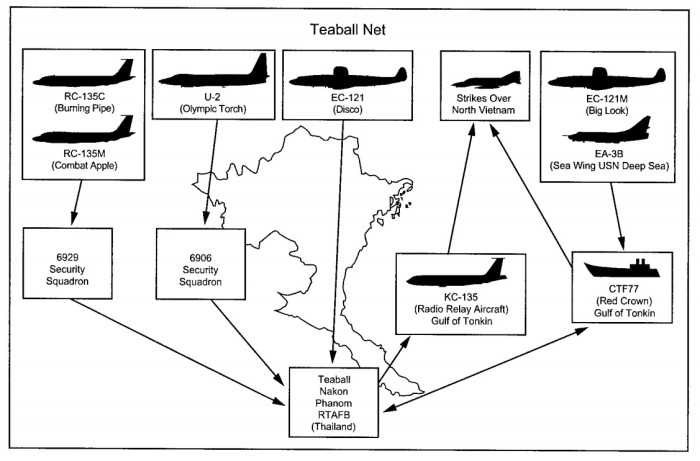
Teaball 1
The flow of information from various radar and SIGINT sources, to the Teaball center that was eventually disseminated to pilots. (Source: Nederveen, ‘Wizardry’)

‘Teaball’ took the classified NSA intercepts and combined them with other US radar sources. These included the radio calls sent from North Vietnamese pilots to their ground controllers and vice versa, revealing precise locations and vectors for their MiGs. This information was fed into a computer known as ‘Iron Horse’ that took data from these sources and quickly synthesised it into a composite display showing a near real-time picture of the location of all friendly and enemy aircraft over North Vietnam.[19] ‘Teaball’ operators then sent this information directly to pilots via Ultra-High Frequency (UHF) radio signals relayed through a Boeing KC-135 aircraft code-named ‘Luzon.’

There was still tension between some pilots and the intelligence community. Kirk worked to build trust between the two groups and overcome ‘green door syndrome’ by personally visiting every single wing in the theatre to brief them on ‘Teaball’s’ capabilities, the accuracy of its data, and the methods he used to contact pilots directly.[20] Finally, US pilots could have situational awareness of the aerial battlefield and early warning of MiG threats. However, ‘Teaball’s’ implementation differed from the authoritarian North Vietnamese GCI system and simply provided information to pilots. The American ground controllers often suggested courses of action, but individual pilots handled threats at their discretion.

The Best Show We’ve Had

‘Teaball’ was only active from August 1972 until the end of LINEBACKER operations in October. In that time, USAF F-4’s shot down 21 MiGs with only six losses. Of those kills, 13 were a direct result of vectoring from ‘Teaball.’[21] Of those losses, five of the six occurred when ‘Teaball’ was down due to technical failure, demonstrating just how critical the system was to the USAF effort. When examining only MiGCAP flights, USAF F-4s claimed 18 kills with five losses, a nearly 6:1 ratio.[22] During that same timespan, the US Navy got two kills but lost two Phantoms.[23] General Vogt extolled the program’s success:

This is the most effective show we’ve had during the entire war with the battle against the MiGs […] This proved one thing – if you can show the American fighter pilot where [the enemy] is in sufficient time, he’ll shoot him down.[24]

Vogt went on to say:

Same airplane, same environment, same situation, same tactics; largely [the] difference [was] Teaball. It was one of the most impressive developments we’ve had out here.[25]

Pilots praised ‘Teaball’ as well. One mission report stated: ‘A good GCI capability made the difference, and will in the future.’ Another echoed: ‘Computerized real-time intelligence will get more kills than all the fighter sweeps we can put together.’[26]

No matter how well-trained a pilot is, if they do not realise they’re under attack, they cannot use their training. ‘Teaball’ gave them that warning, preventing further losses. ‘Teaball’ also provided more accurate visual recording of encounters than the memory of pilots could provide, enabling both a better study of enemy tactics and a useful training tool. It was also invaluable for search and rescue efforts, as ‘Teaball’ data could pinpoint the location of downed aircrews, enabling rescue craft to arrive quickly.[27]

However, the program, literally operating out of the back of a van, was not without problems.[28] The ‘Iron Horse’ computer was powerful for its time, but processing the data of all the SIGINT and radar inputs took an average of two minutes – an eternity in a dogfight. For this reason, ‘Teaball’s’ role was limited to providing early warning only. Once combat began, most pilots relied on more timely information from ‘Disco’ or ‘Red Crown’ if in range.[29] Also, the UHF radio relays in F-4 cockpits were old and broke down frequently.[30]

Increased American success forced the North Vietnamese Air Force to scale back its operations, flying fewer missions and attempting to counter ‘Teaball’s’ tracking ability by turning off their IFF (Identify-Friend-or-Foe) signals. However, that separated North Vietnamese pilots from their GCI, their chief advantage to this point. They could run with radio silence, but that risked making them vulnerable to their surface-to-air missiles (SAMs). ‘Teaball’ operators could spot them as soon as they tried to alert their missile sites. The more common technique the North Vietnamese used to get around ‘Teaball’ was deception. Ground controllers sent messages pretending to be pilots, essentially creating ‘ghost MiGs.’ However, ‘Teaball’s’ operators could easily distinguish between these fake calls and authentic ones due to differences in the signal itself.[31]

When LINEBACKER ended, so did most air-to-air combat, but ‘Teaball’ stood ready when LINEBACKER II commenced on 18 December 1972. Lieutenant General Horace Wade, Vice Chief of Staff of the Air Force, was impressed enough with ‘Teaball’ to move it into a permanent facility at Nakom Phenom.[32] However, MiGs barely flew during the operation – only 26 were even sighted. USAF Phantoms took down four, the US Navy got one more, and B-52 gunners shot down two. USAF lost two Phantoms to MiGs. North Vietnamese sources claim that MiGs shot down two B-52s as well, but this is unconfirmed by the U.S.[33] This 3.5:1 is above average for the war, if not as impressive as when ‘Teaball’ was most active in LINEBACKER. However, the sample size for LINEBACKER II is incredibly small, and the operation was unique. In any case, although SAMs wreaked havoc on the B-52 fleet, MiGs did not pose a significant threat. By 28 December 1972, North Vietnam had exhausted its SAM supply and was incapable of defending itself from the B-52 raids. When Hanoi expressed its desire to renew serious negotiations, President Nixon halted all bombing north of the 20th parallel. With the signing of final settlements on 23 January 1973, air-to-air combat in the Vietnam War ended.[34]

Conclusion

The typical, perhaps romanticised narrative of air combat in Vietnam is that the US Navy used the ‘correct’ approach when creating the Top Gun program and that the USAF deserves criticism for its failure to produce a similar program and its adherence to technological chimeras. However, this story ignores that the US Navy also used technological improvements, including upgrades to their missiles and the jamming of enemy communications. It fails to note that the US Navy engaged fewer MiGs during the LINEBACKER period, with little contact with the more advanced MiG-21 Fishbed, so perhaps a direct comparison of each service’s kill counts is misleading.

Furthermore, this narrative fails to recognise that the USAF saw a more significant improvement in its effectiveness than did the US Navy in the same period owing to the systems-based, technological approach of Project Teaball. Top Gun worked, but ‘Teaball’ worked better. The role performed by ‘Teaball’ laid the foundation for the later role of Airborne Warning and Control Systems (AWACS) that has become an essential element of American air power strategy. In the final phase of the Vietnam War, the USAF demonstrated that technological solutions could be effective.

Dr Michael Hankins is the Curator of US Air Force History at the Smithsonian National Air and Space Museum. He is a former Professor of Strategy at the USAF Air Command and Staff College eSchool, and former Instructor of Military History at the U.S. Air Force Academy. He earned his PhD from Kansas State University in 2018 with his dissertation, ‘The Cult of the Lightweight Fighter: Culture and Technology in the U.S. Air Force, 1964-1991.’ He completed his master’s thesis at the University of North Texas in 2013, titled ‘The Phantom Menace: The F-4 in Air-to-Air Combat in the Vietnam War.’ He has a web page here and can be found on Twitter at @hankinstien.

Header Image: A U.S. Air Force Lockheed EC-121K ‘Rivet Top’ of the 552nd Airborne Early Warning & Control Wing, based at Korat Royal Thai Air Force Base, Thailand, in 1967-68. (Source: Wikimedia)

[1] This article is adapted from Michael Hankins, ‘The Teaball Solution: The Evolution of Air Combat Technology in Vietnam, 1968-1972,’ Air Power History, 63:3 (2016), pp. 7-24.

[2] John Correll, The Air Force in the Vietnam War, The Air Force Association (Arlington, VA: Aerospace Education Foundation, 2004), p. 17. See also Robert Futrell, et al., Aces and Aerial Victories: The United States Air Force in Southeast Asia, 1965-1973 (Maxwell Air Force Base, AL: Albert F. Simpson Historical Research Center, Air University, 1976); Chris Hobson, Vietnam Air Losses: United States Air Force Navy and Marine Corps Fixed-Wing Aircraft Losses in Southeast Asia 1961-1973 (England: Midland, 2001); and the Red Baron Reports, Volumes I, II, and III, Institute for Defense Analyses Systems Evaluation Division.

[3] Roger K. Wilcox, Scream of Eagles: The Dramatic Account of the US Navy’s Top Gun Fighter Pilots: How they Took Back the Skies over Vietnam (New York, NY: Pocket Books, 1992), p. xii.

[4] Red Baron II Vol. I, C-1–E-2, USAF Fighter Weapons Center, 1973; and Red Baron III, Vol. I, C-1–D-6, USAF Fighter Weapons Center, 1974.

[5] Wilcox, Scream of Eagles, 214-215; See for example Steven A. Fino, ‘Breaking the Trance: The Perils of Technological Exuberance in the US Air Force Entering Vietnam,’ Journal of Military History, 77:2 (2013), pp. 625-55.

[6] United States Air Force Oral History Program, Interview #K239.0512-630, Captain Richard S. Ritchie, 11 Oct 72 and 30 Oct 72, 1, pp. 74-5.

[7] William Momyer, Air Power in Three Wars (Washington D.C.: Office of Air Force History, 1978), pp. 150-5.

[8] Marshall Michel, Clashes: Air Combat Over North Vietnam, 1965-1972 (Annapolis, MD: Naval Institute Press, 1997), p. 114.

[9] Futrell, Aces, p. 14; Momyer, Air Power, p. 155; Michel, Clashes, p. 226.

[10] M. F. Porter, ‘Linebacker: Overview of the First 120 Days,’ Project CHECO Report, 27 Sept 1973, p. 48.

[11] Ritchie Interview, 37, 8.

[12] Thomas R. Johnson, American Cryptology During the Cold War, 1945-1989, Book II: Centralization Wins, 1960-1972 (Fort Meade, MD: Center for Cryptologic History, National Security Agency, 1995), p. 580.

[13] Michel, Clashes, p. 115; See also Walter J. Boyne, ‘The Teaball Tactic,’ Air Force Magazine (July 2008), p. 68; and Gilles Van Nederveen, ‘Wizardry for Air Campaigns: Signals Intelligence Support to the Cockpit’ (Research paper for the College of Aerospace Doctrine, Research, and Education, Airpower Research Institute, Maxwell: 2001), pp. 2-3.

[14] Nederveen, ‘Wizardry,’ 24.

[15] Quoted in Marshall Michel III, “The Revolt of the Majors: How the Air Force Changed After Vietnam” (PhD Thesis, Auburn University, 2006), p. 145.

[16] Red Baron III, C-1–D-6.

[17] Michel, ‘The Revolt,’ 146-52. See also, Brian D. Laslie, The Air Force Way of War: US Tactics and Training after Vietnam (Lexington, KY: University Press of Kentucky, 2015).

[18] Johnson, American Cryptology; Boyne, ‘The Teaball Tactic,’ p. 69; Nederveen, ‘Wizardry,’ p. 25. See also Calvin R. Johnson, ‘Linebacker Operations: September – December 1972,’ Project CHECO Report, 31 December 1978, p. 50.

[19] Author redacted, ‘TEABALL: Some Personal Observations of SIGINT at War,’ Cryptologic Quarterly, 9 (Winter 1991), p. 92.

[20] Quoted in Boyne, ‘The Teaball Tactic,’ pp. 69-70. See also Nederveen, ‘Wizardry,’ p. 25-6.

[21] Johnson, American Cryptology, p. 580. See also Johnson, ‘Linebacker Operations,’ p. 52.

[22] William Sayers, ‘The Red Baron Reports: What They Really Said,’ Air Power History, 52:3 (2005), p. 12, 39. See also Johnson, ‘Linebacker Operations,’ p. 52.

[23] Red Baron III, Vol. 1, C-1–D-6.

[24] Quoted in Porter, ‘Linebacker: Overview of the First 120 Days,’ pp. 46-7.

[25] Quoted in Johnson, ‘Linebacker Operations,’ pp. 52-4.

[26] Red Baron III, vol. III, C-29.

[27] Nederveen, ‘Wizardry,’ pp. 28-9.

[28] Johnson, American Cryptology, p. 579.

[29] Ibid., p. 31.

[30] Ibid., pp. 28-9; Ritchie Interview, p. 8.

[31] Author redacted, ‘TEABALL: Some Personal Observations,’ 94-5.

[32] Ibid., p. 95.

[33] Red Baron III, C-1–D-6. Roger Boniface, MiGs Over North Vietnam: The Vietnam People’s Air Force in Combat (Mechanicsburg, VA: Stackpole Books, 2010), p. 141, 145. See also, István Toperczer, Mig-21 Units of the Vietnam War and MiG-17 and MiG-19 Units of the Vietnam War, both from Osprey Press. Toperczer and Boniface each claimed to have examined North Vietnamese records, but make no mention or citation of specific documents, and their work has not been peer reviewed. Naturally their claims for NVAF victories are significantly higher that official US records. While their claims may have merit, this article has chosen to rely on official US records where possible, admitting that these are also not perfect.

[34] Mark Clodfelter, The Limits of Air Power: The American Bombing of North Vietnam (New York: The Free Press, 1989), pp. 188-9, 198-200.
The Strategic Triangle: The Air Corps Tactical School and Its Vision of Future Warfare

The Strategic Triangle: The Air Corps Tactical School and Its Vision of Future Warfare

By Dr Heather Venable

It is evil to approach war with fixed ideas; that is, without an open and flexible mind, but it is certain to lead to disaster to approach it with the inapplicable formulas of the past.[1]

To the U.S. Army’s Air Corps Tactical School’s (ACTS) Class of 1936, Major Harold George proclaimed, ‘[W]e are not concerned in fighting the past war;–that was done 18 years ago.’[2] Having dismissed much of the value of studying the First World War for insights into air power, George emphatically returned to this theme a few minutes later, reminding his students that they sought to ‘peer down the path of future warfare. We are not discussing the past.’[3] Similarly, Major Muir Fairchild emphasised the problems caused by the ‘lack of well established principles, developed from past experience, to guide the air force commander.’[4] Suggesting that little of value could be derived from a study of the First World War, it is no wonder that one monograph focusing on the impetus for the Royal Air Force and the U.S. Army Air Forces’ strategic bombardment campaign of the Second World War highlighted the inter-war period as a source of problematic thinking. Tami Davis Biddle’s Rhetoric and Reality in Air Warfare has stressed the ACTS motto as fittingly emblematic of its institutional culture: ‘we progress unhindered by tradition.’[5]

A_Concise_History_of_the_U.S._Air_Force_Page_14-1
Austin Hall at Maxwell AFB. Austin Hall was the home of the Air Corps Tactical School before the Second World War. (Source: Wikimedia)

Paradoxically, however, ACTS instructors struggled not to mine the First World War for historical lessons. Fairchild spent almost one-tenth of his lecture reading from the British official history of the First World War in the air, The War in the Air.[6] Similarly, George identified one historical lesson as central to future warfare: Germany had been defeated in the First World War not because its army had surrendered but because its people had crumbled.[7] As Lieutenant Colonel Donald Wilson explained, it was the ‘collapse of the German nation as a unit’ – largely because the people constituted the ‘weak link’ – that explained the war’s end (emphasis in original). As a result, ACTS ought to focus primarily on targeting civilian morale, albeit indirectly.[8]

Their vision can be modelled in order to depict how ACTS conceived of strategic bombardment and how these ideas changed as they began contemplating how to apply these ideas against Germany in the Second World War. Air War Plans Division (AWPD)-1 and AWPD-42, drafted in July of 1941 and August 1942, respectively, demonstrated important shifts in thinking about air power’s application. Moreover, they presaged a far more tactically minded employment of American air power in the Combined Bomber Offensive than has been recognised generally.[9]

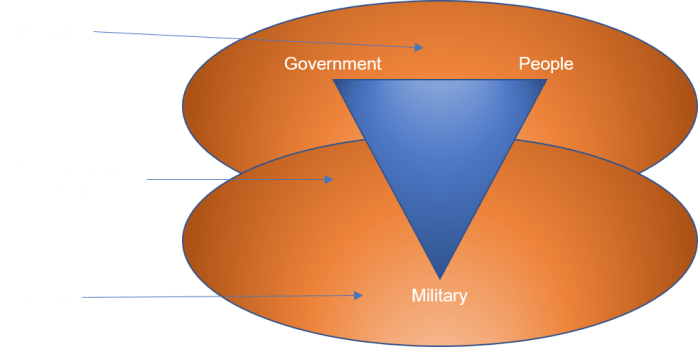
This model draws on a modern interpretation of Carl von Clausewitz’s famous triangle, which is often thought of today as consisting of the following three legs: the government, the people’s passions, and the military.[10] The ACTS model could be depicted as follows: air power is best used at the strategic level to bend the enemy’s will; thus it should focus on affecting an opponent’s government and people because this approach provides the most direct path to achieving one’s desired political ends. A tactical focus on fielded forces, by contrast, is far less desirable because it is fundamentally inefficient. On occasion, however, a focus on the military might have a significant strategic effect. In other cases, an effect on electricity, for example, might have a strategic effect on the government and people as well as a more tactical effect on the military.

Diagram 1 Venable

This thinking went beyond ideas of an ‘industrial web,’ which continue to dominate many scholars’ discussions of ACTS thinking.[11] By zeroing in on the concept of a national structure, ACTS worked to link kinetic effects on industrial targets to the military as well as to the population, thus helping to refresh some aspects of strategic thinking in the wake of the Industrial Revolution – albeit with critical flaws. This thinking can be seen in ten recently published lectures of ACTS edited by and commented upon by Phil Haun. Of the more than 60 lectures presented at ACTS, Haun has identified these ten as representing the school’s ‘most mature thinking’ while reaching the greatest number of officers.[12]

A kind of national structure potentially could make room for a wider array of effects than an industrial web theory could, even if it struggled to make causal links between effects and political ends. By 1936, for example, ACTS envisioned a strategy that targeted the ‘vulnerabilities’ of ‘modern industrial nations’ aimed primarily at one point of the triangle: the people, as reflected in two lectures by George and Captain Haywood Hansell.[13] These lecturers advocated the destruction of carefully selected points in societies to cause ‘moral collapse’ – or effects on the population – as the immediate effect of strategic bombardment. The nation’s ‘will to resist’ was ‘centered in the mass of the people,’ as Hansell explained. Attacks on ‘vital elements upon which modern social life is dependent’ allowed for a focus on an opponent’s will rather than the more circuitous and inefficient focus on its means.[14] Hansell struggled to connect the effect on the people to any ‘express[ion] through political government.’[15] In effect, he wished away the government leg of the triangle. George further reasoned that even if strategic bombardment failed to have the desired effect on the population, it could have a positive effect on the military leg of the triangle due to the abundant material requirements of industrialised warfare.[16]

As such, George’s lecture anticipated a more mature 1939 lecture by Fairchild, which better integrated the effects of selected industrial attacks on two legs: people and the military, with the hope of simultaneously:

[r]educing the capacity for war of the hostile nation, and of applying pressure to the population both at the same time and with equal efficiency and effectiveness.[17]

Fairchild’s carefully parsed assumption about equal effect is dubious; after all, airpower thinkers have been infamous for their promises to be able to quantify the effect. Moreover, again, the government leg of the triangle remains absent. His point that the enablers of industry such as electricity and oil are ‘joined at many vital points’ places these critical aspects within the triangle, thereby potentially affecting each point, at least in theory.[18] Fairchild reasoned regarding the importance of preventing one’s opponent from acquiring key materials, such as petroleum, as well as the transportation system and electricity.[19] Today it is common to describe ACTS as efficiently identifying key industrial bottlenecks, but such a characterisation falls short of Fairchild’s greater vision. He did not seek to attack industry so much as ‘national structure,’ as he described it.[20]

For Fairchild, this vision appealingly provided a convenient shortcut to waging war so common to advocates of strategic attack. The ‘resulting shock effect’ and the ‘degree of facility with which these installations may be destroyed’ lured airmen with the perennial promise of being home by Christmas.[21] In doing so, Fairchild made assumptions emblematic of ACTS thinking by envisioning a kind of paralysis complemented by efficient destruction.[22] These effects allowed the ‘maximum contribution toward the Allied aim in the war at that time,’ unlike what he regarded as a more ineffective and tactical focus on the fielded forces, which airmen viewed as synonymous with slow attrition.[23]

This theory came to life in AWPD-1, hurriedly envisioned over nine days in July of 1941 by former ACTS instructors such as Lieutenant Colonel Harold George, Lieutenant Colonel Kenneth Walker, Lieutenant Colonel Orvil Anderson, Major Haywood Hansell, Major Laurence Kuter, Major Hoyt Vandenberg, and Major Samuel Anderson. All but one of these officers had attended and/or taught at ACTS. The plan posited 154 targets of strategic attack to be destroyed in six months in the following priority:

  1. Electricity;
  2. Transportation;
  3. Oil;
  4. Aircraft factories;
  5. Aluminium sources;
  6. Magnesium
  7. Air support in joint operations.

In compiling this list, air planners claimed to adhere to the strategic vision of the U.S. Army and U.S. Navy’s War Plans ABC-1 and Rainbow 5, which in Europe required an air offensive designed to reduce German air and naval assets and material while preparing for a ground offensive. However, the planners did not set out a traditional air superiority campaign with an array of targets, including airdromes, aeroplanes, and factories. Rather, they adhered to Fairchild’s emphasis on national structure, relegating aeroplane assembly plants – the first hint of an air superiority campaign – to the fourth priority.[24]

The emphasis of ACTS continuing into AWPD-1 is modelled below, showing the split emphasis on the military and the people as two legs of the triangle, with the people receiving the primacy of focus. A plan focused on enablers such as electricity and oil doctrinally targeting national structure represented the most matured form of ACTS thinking, albeit with a problematic hope in the efficacy of strategic attack.

Diagram 2 VenableBy September of 1942, however, this vision underwent a substantial change in focus, as the emphasis shifted down the spectrum toward more tactical means. AWPD-42 prioritised the destruction of the Luftwaffe, albeit still attained primarily through industrial means in the form of attacks against aeroplane and engine factories. Regardless, such a change represented a significant change in thinking away from more general enablers such as electricity to war material itself that had a less immediate effect on society as a whole. Second, the US Army Air Forces needed to concentrate on submarine building yards, before finally turning its attention to transportation in order to sever the ‘vital link in the Germany military and industrial structure.’[25] Electricity, the epitome of a structural target, had dropped from first to fourth place.[26] In effect, AWPD-42 represented a more traditional and tactical focus, designed as it was to interdict material, though admittedly at its source, before seeking to paralyse the economy.[27] The model below reflects this distribution with more emphasis placed on the military rather than the people, as the general trend in thinking shifted toward destroying a military’s ability to meet its material requirements. Production to strike at the enemy’s fielded forces – rather than the dual enablers of the people’s will and military means – received the greatest focus in AWPD-42.

Diagram 3 Venable

The notion of a quick and easy path to victory through strategic attack proved a chimaera, as it has so often in history. Germany responded to attacks against its aircraft factories, for example, by dispersing them.[28] It also fully mobilised its economy in 1944, although it could do only so much to make up for poor strategic choices. Germany had a price to pay in reduced efficiency; but so too did the Allies in terms of the very kind of attrition that they sought to avoid in the first place. It was not enough to wage an air superiority campaign against factories. German fighters and American fighters and bombers battled each other well into 1945, especially during the Battle of the Bulge.[29]

Modelling and parsing out how ACTS envisioned strategic bombardment provides a historical case study in conceptualising strategic attack and changes in thinking over time. Doctrinally, the US Air Force continues to insist that air power used in strategic attack has the ‘potential to achieve decisive effects more directly without the need to engage enemy fielded forces.’ It cited several operations over the last 50 years in which the Air Force denied its opponents

[a]ccess to critical resources and infrastructure, defeat[ed] enemy strategies, and decisively influence[d] the enemy to end hostilities on terms favorable to US interests.[30]

Amidst the U.S. military’s reemphasis on great power conflict, it is useful to return to the fundamentals to consider how, exactly, a strategic attack might help to achieve its desired ends through a focus on the military, the people, and the government.

Dr Heather Venable is an Assistant Professor of Military and Security Studies at the U.S. Air Force’s Air Command and Staff College and teaches in the Department of Airpower. She has written a forthcoming book entitled How the Few Became the Proud: Crafting the Marine Corps Mystique, 1874-1918.

Header Image: A Boeing Y1B-17A in flight near Mount Rainier in Washington state, c. 1938. (Wikimedia)

[1] Quoted in Lieutenant Colonel Donald Wilson, ‘Principles of War’ in Phil Haun (ed. and commentator), Lectures of the Air Corps Tactical School and American Strategic Bombing in World War II (Lexington, KT: University Press of Kentucky, 2019), p. 71.

[2] Major Harold George, ‘An Inquiry into the Subject ‘War” in Haun, Lectures, p. 35.

[3] George, ‘Inquiry’ in Haun, Lectures, p. 37.

[4] Fairchild, ‘Air Power and Air Warfare’ in Haun, Lectures, p. 48. For another similar lecture opening, see Captain Haywood Hansell, ‘The Aim in War’ in Haun, Lectures, p. 73. This same tension between rejecting history yet almost immediately jumping to a discussion of historical examples can be seen in Major Frederick Hopkins, ‘Tactical Offense and Tactical Defense’ in Haun, Lectures, pp. 100-8. Hopkins also sought relevant lessons from the Spanish Civil War, for which Biddle has argued some airmen were too dogmatic to do. See Tami Davis Biddle, Rhetoric and Reality in Air Warfare: The Evolution of British and American Ideas about Strategic Bombing, 1914-1945 (Princeton, NJ: Princeton University Press, 2002), p. 171.

[5] Biddle, Rhetoric and Reality in Air Warfare, p. 138.

[6] Fairchild, ‘Air Power and Air Warfare’ in Haun, Lectures, pp. 52-4.

[7] George, ‘Inquiry’ in Haun, Lectures, pp. 40-1. George even concluded his lecture by returning to this theme. Ibid., p. 44. Also see Lieutenant Colonel Donald Wilson, ‘Principles of War’ in Haun, Lectures, p. 62 and Fairchild, ‘National Economic Structure’ in Haun, Lectures, p. 144. Also see Haun, ‘Introduction’ in Haun, Lectures, p. 8.

[8] Major Muir Fairchild, ‘National Economic Structure’ in Haun, Lectures, p. 140. Of course, one’s intent can differ from one’s effects, as occurred in the Second World War due to bad weather and the challenges of precision bombing. For this ethical discussion, see Douglas P. Lackey, ‘The Bombing Campaign: The USAAF’ in Igor Primoratz (ed.), The Bombing of German Cities in World War II (New York: Berghan Books, 2010), pp. 39-59.  Even with precision, indirect effects on civilians can be highly problematic. See Daniel T. Kuehl, ‘Airpower vs. Electricity: Electric Power as a Target for Strategic Air Operations,’ Journal of Strategic Studies, 18:1 (1995), pp. 237-266.  

[9] See, for example, Heather Venable, ‘The Strategic Bombardment Campaign that Wasn’t? The Army Air Forces in the European Theater of Operations, 1942-1945,’ The Strategy Bridge, 6 May 2019.

[10] For background on how those ideas are improperly attributed to Clausewitz, see Christopher Bassford and Edward J. Villacres, ‘Reclaiming the Clausewitzian Trinity.’ By contrast, Clausewitz himself set out elements of emotion, chance, and reason. See Christopher Bassford, ‘Teaching the Clausewitzian Trinity.’

[11] For this characterisation of an ‘industrial web theory,’ for example, see Scott D. West, ‘Warden and the Air Corps Tactical School: Déjà Vu’ (Thesis, School of Advanced Airpower Studies, 1999), p. v and 1.

[12] Haun, Lectures, p. xv.

[13] George, ‘An Inquiry’ in Haun, Lectures, p. 43.

[14] Hansell, ‘Aim in War’ in Haun, Lectures, p. 78, 81 and 84. Even as Hansell insisted this was the ‘primary strategic objective’ of Air Forces, he did not make this link for navies’ ability to blockade, instead taking the more Mahanian view that the primary role of the Navy was to destroy other navies. In this way, he highlighted his bias for air power as offering unique shortcuts. Ibid., p. 84.

[15] Hansell, ‘Aim in War’ in Haun, Lectures, p. 77.

[16] George, ‘An Inquiry’ in Haun, Lectures, p. 43. Fairchild similarly highlighted the importance of this military capacity. See Fairchild, ‘Primary Strategic Objectives of Air Forces’ in Haun, Lectures, pp. 188-9.

[17] Fairchild, ‘National Economic Structure’ in Haun, Lectures, p. 143.

[18] Fairchild, ‘Primary Strategic Objectives of Air Forces’ in Haun, Lectures, p. 189.

[19] Fairchild, ‘National Economic Structure’ in Haun, Lectures, pp. 152-7.

[20] Fairchild, ‘Primary Strategic Objectives of Air Forces’ in Haun, Lectures, p. 182.

[21] Ibid., p. 185.

[22] Fairchild, ‘National Economic Structure’ in Haun, Lectures, p. 166.

[23] Fairchild, ‘National Economic Structure’ in Haun, Lectures, p. 166. For the very rare recognition that ground operations occasionally could be decisive, see Fairchild, ‘Primary Strategic Objectives of Air Forces,’ p. 186.

[24] ‘Appendix 2: AWPD-1’ in Haun, Lectures, pp. 232-3.

[25] ‘Appendix 3: AWPD-42’ in Haun, Lectures, p. 258.

[26] ‘Appendix 1 – Trenchard Memo,’ p. 232 and ‘Appendix 3: AWPD-42,’ p. 258 in Haun, Lectures.

[27] While highlighting the more overt focus on supporting an invasion, Robert Futrell argued that the ‘strategic philosophy of the two studies was virtually the same.’ See Robert Futrell, Ideas, Concepts, Doctrine: Basic Thinking in the United States Air Force (Maxwell Air Force Base, AL: Air University Press, 1989), p. 131. For a discussion of strategic interdiction as compared to operational interdiction, see Robert Pape, Bombing to Win: Air Power and Coercion in War (Ithaca, NY: Cornell University Press, 1996), p. 75.

[28] Haun, Lectures, p. 3.

[29] See Danny S. Parker, To Win the Winter Sky: The Air War over the Ardennes, 1944-1945 (Conshohocken, PA: Combined Books, 1994), pp. 248-305.

[30] Curtis E. LeMay Center for Doctrine Development and Education, Annex 3-70 Strategic Attack, ‘Fundamentals of Strategic Attack,’ last reviewed 25 May 2017.

#AirWarVietnam – Contested Skies: A Brief Guide to the Historiography of the Air War in Vietnam

#AirWarVietnam – Contested Skies: A Brief Guide to the Historiography of the Air War in Vietnam

By Dr Michael Hankins

Editorial Note: During 2019, From Balloons to Drones will be running a series of articles looking at various aspects of the air war over Vietnam from the French-Indochina War through to the end of the Vietnam War. To kick off this series, Assistant Editor, Dr Michael Hankins, provides a brief overview of the historiography of the air war. While not conclusive, it does give an idea of the critical strands present in the historiography and highlights where there are some important omissions such as a scholarly examination of air power during the French-Indochina War. If you would like to be a part of that discussion by submitting your work to the series, please email our editor, Dr Ross Mahoney, at airpowerstudies@gmail.com or via our contact page here. The official call for papers is here.

Here at From Balloons to Drones, we are launching a series of articles on the air war in Vietnam. This is no easy task, as writing about the Vietnam War is akin to strolling into a minefield: There is a good chance of causing an explosion. Historian Robert Citino stated it best:

Anyone who tries to draw conclusions from the Vietnam War will almost certainly anger the legions of Americans who have already made up their minds about it.[1]

In the U.S. especially, the debate over the war rages in both public and academic spheres regarding what happened and what it means for American society.[2] As the war in its entirety remains controversial, the sub-field on the air wars has developed its own debates and tropes. This article is intended as a quick guide to some of that literature as well as an introduction to a few of the broader arguments and issues that loom over the entire field. If there is any single takeaway from a survey of the literature of the Vietnam War (and its air components in particular), it is that the war remains contested but relevant, and there is plenty of work for scholars left to do in deepening our understanding of the conflict.

VNAF_A-1E_Skyraiders_at_Bien_Hoa_c1965
A Vietnamese Air Force student pilot and a USAF instructor sit side by side in a VNAF Douglas A-1E Skyraider taxing to the runway at Bien Hoa air base, Vietnam, c. 1965. (Source: Wikimedia)

General Histories

Because there is less of a standing consensus regarding the Vietnam War than in some other conflicts, finding an entry point can be difficult. Perhaps the most middle-of-the-road overview of the entire conflict (written primarily from the American perspective) is still George C. Herring’s America’s Longest War: The United States and Vietnam, 1950–1975 (1979). Originally written in 1979, it is now in its fifth edition (released in 2013) as Herring continually updated it to incorporate new scholarship. Another useful overview is Where the Domino Fell: America and Vietnam 1945-2010 (2014) by James Olson and Randy Roberts. This is the sixth edition of a book initially published in 1991 and constantly updated. The book is still mostly from the American perspective but delves a little bit deeper into some of the backgrounds to the conflict regarding French colonialism and the ideology of Ho Chi Minh, which itself is highly contested.[3] Olson and Roberts are more pointed in their argument that the war was unwinnable for the U.S.

For a more traditional operational look, Phillip Davidson’s Vietnam at War: The History, 1946-1975 (1988) is a valuable in-depth examination of both the French and American phases of the war. For a contrasting, but still, mostly operational look at the war, the works of Gregory Daddis are perhaps the best place to start. It is fair to say that Daddis is the current leader of the field when it comes to military histories of the Vietnam War. His trilogy of books is useful and wide-ranging. No Sure Victory: Measuring U.S. Army Effectiveness and Progress in the Vietnam War (2011) examines the ways that U.S. forces measured progress and success, which led them to make many faulty assumptions. Westmoreland’s War: Reassessing American Strategy in Vietnam (2014) and Withdrawal: Reassessing America’s Final Years in Vietnam (2017) each examine the American strategic and operational approaches in the first and second half of the conflict respectively.

What these books do not address as much are the pacification programs (also known as ‘the other war’) and a perspective internal to South Vietnam. Thankfully, more historians are entering the field and producing exciting work in these areas. Jessica Chapman’s Cauldron of Resistance: Ngo Dinh Diem, the United States, and 1950s Southern Vietnam (2013) are one of the most exciting new books in the field, examining the Ngo Dinh Diem regime and the three organisations internal to South Vietnam that resisted it the most. Andrew Gawthorpe’s To Build as Well as Destroy: American Nation Building in South Vietnam (2018) is probably the best look at pacification so far, although it proves to be a promising topic that shows much room to grow.

It is important to note that a book such as Olsen’s and Robert’s (and to some degree Daddis’) are responding to an earlier strain of works that argued the opposite. This argument was that the war was winnable, but that American leaders (mostly civilian political leadership and some military leaders) fundamentally misunderstood the war and for one reason or another, snatched defeat from the jaws of victory. Perhaps the most widely-read work that takes that argument is Harry Summers’ On Strategy: A Critical Analysis of the Vietnam War (1982), which analyses the war through a particular interpretation of Clausewitz. Most works that take this tack posit that America could have won the war earlier by going with a more all-out, aggressive military strategy.

The Air War(s)

That more aggression could have produced victory was certainly the belief of many U.S. Air Force leaders. For example, speaking to Air Force Academy cadets in 1986, General Curtis LeMay was asked whether the U.S. could have won the war. He responded: ‘In any two-week period you care to mention.’[4] Many books on the air war take a similar approach, such as On Yankee Station: The Naval Air War Over Vietnam (1987) by John Nichols and Barrett Tilman. This argument is especially common among oral histories and memoirs. There are a plethora of such books, particularly by pilots eager to share their ‘There I was…’ stories and many of these works are very useful. The best is Airpower in Three Wars: World War II, Korea, Vietnam (1978) from the Commander of 7th Air Force, General William Momyer (pronounced Moe-Mye-er). Other notable entries in this category include Ed Rasimus’ Palace Cobra: A Fighter Pilot in the Vietnam Air War (2006), Robin Olds’ Fighter Pilot: The Memoirs of Legendary Ace Robin Olds (2010), Ken Bell’s 100 Missions North: A Fighter Pilot’s Story of the Vietnam War (1993), and Robert Wilcox’s oral history of the Top Gun program, Scream of Eagles: The Creation of Top Gun and the U.S. Air Victory in Vietnam (1990), to name a few.

However, most of the literature from historians regarding the air campaigns have argued the opposite: that a more aggressive bombing approach earlier in the war was not feasible for a variety of reasons. One of the earliest books to push for this line of thinking is Mark Clodfelter’s The Limits of Air Power: The American Bombing of North Vietnam (1989). This book is, in this author’s opinion, still the most important book on the air war in Vietnam and one of the most important works in the field of air power history in general. Other works have made similar or related arguments but in more specific areas. Earl Tilford’s Crosswinds: The Air Force’s Setup in Vietnam (1993) looks at the years leading up to the war and argues that the Air Force’s structure and doctrine did not lend itself to the type of fighting in Vietnam.[5] For an operational look at the air campaigns through this lens, the most useful works are Jacob Van Staaveren’s Gradual Failure: The Air War over North Vietnam, 1965-1966 (2002) and Wayne Thompson’s To Hanoi and Back: The United States Air Force and North Vietnam, 1966-1973 (2000) each of which focuses on a distinct time frame. The Linebacker II campaign sometimes called the ‘11-day war’ or ‘the Christmas bombing’ can be contentious. The best operational account of it so far is Marshall Michel’s The Eleven Days of Christmas: America’s Last Vietnam Battle (2001), which blames Air Force leaders rather than political leaders for the mission’s problems.

Many of the more popular memoirs deal with air-to-air aspect, although such encounters were rare, as the North Vietnamese Air Force tended to average thirty to forty operational fighters at any given time (compared to the thousands of aircraft the U.S. had in-theatre). There are some broader examinations of the air-to-air aspect. The most comprehensive is Marshall Michel’s Clashes: Air Combat over North Vietnam, 1965-1972 (1997), although Craig Hannah’s brief Striving for Air Superiority: The Tactical Air Command in Vietnam (2001) is also useful.[6] Because the war featured an expansion of tactical air power, many works deal with a diversity of air power roles, one of the best entry points is Donald Mrozek’s Air Power and the Ground War in Vietnam: Ideas and Actions (1988). Part of the problem with the use of tactical air power in Vietnam was the confusing command structures and service rivalries. Ian Horwood’s Interservice Rivalry and Airpower in the Vietnam War (2006) is perhaps the best text examining that issue and is a useful general exploration of tactical airpower in the south.

B-52D_approaching_U-Tapao_1972
A U.S. Air Force Boeing B-52D Stratofortress aircraft coming in for a landing at U-Tapao air base, Thailand, after a mission over Vietnam, 30 October 1972. (Source: Wikimedia)

The problems that the US military experienced in Vietnam led to a long period of change afterwards, as the various services all raced to reform themselves not to repeat the perceived mistakes of the war. However, the services disagreed (with each other and within themselves) about what precisely the mistakes were and how to solve them. The period following the war, from the late 1970s until 1991, was essentially a second ‘interwar period,’ similar in some ways to the 1920s and 1930s. The degree to which the Vietnam War was used as an impetus for change in the air power realm has been covered in many works. There are so many volumes on this subject that they would require a separate article on their own, although some useful starting places include Brian Laslie’s The Air Force Way of War: U.S. Tactics and Training after Vietnam (2015), Mike Worden’s The Rise of the Fighter Generals: The Problem of Air Force Leadership, 1945–1982 (1998), and C.R. Anderegg’s Sierra Hotel: Flying Fighters in the Decade After Vietnam (2001). You can find a historic book review of this latter title here.

Although many of the works listed here are of high quality, there are some inherent limitations to the field. Most of them are limited to studying a specific geographical area or timeframe (or both), and there are fewer works that take a comprehensive look at the entirety of the air wars. Some such works are forthcoming, but there is more room for more books that take this wider approach. Most works are written by people who have some tie to the military. Many are veterans of the war or have served in the time since. Many more are civilian employees of the military (of which this author is one as well, so take my recommendations with a grain of salt of course). Many of the books listed here are from government or military presses. None of this is to imply that they are of lesser quality or that they have any particular biases (indeed, much of the material from Air University Press can be interpreted as critical of the Air Force), but it does mean that the perspectives given are limited. Further limiting our view of the war is the paucity of books written by women and people of colour. The majority (although not all) of the books in the field are from the perspective of men, predominantly white – a limitation that is hopefully in the process of being alleviated as new and diverse scholars continue to enter the field.

There is a reason to believe that the field of Vietnam War histories is on the verge of a turning point, as the previous generation who remembers the war as a part of their lives is starting to give way to a new generation that has no personal memory of the war. New sources and new perspectives are beginning to emerge, as new and old scholars alike develop not only new answers to questions but new questions. It is an exciting time to be a historian of this era.

Conclusion

There is an overwhelming number of works about the air wars in Vietnam. This brief survey, focusing on significant monographs, is not meant to be comprehensive, but merely a guide to some of the more influential works and themes. There are many wonderful and useful works not mentioned here, and that is not meant as a slight against any of them. For more, any serious student of the Vietnam War must become quickly aware of the work of Dr Edward Moïse. Not only are his own works useful reading, but his website contains quite possibly the largest bibliography of works on the Vietnam War, many of which are annotated and organised into searchable categories. This is an invaluable resource.

Despite the large size of the field, there is much work left to be done. While there are many memoirs and oral histories of various aspects of the war, we still need scholarly monographs on the air wars in Laos and Cambodia, on Air America (the CIA’s air effort), on the defoliation operations, and on-air mobility both in terms of troop movements and airlift of supplies and humanitarian efforts. Many of the works mentioned do discuss air power used by the Army and Marines, but more works focusing on these aspects are needed. Perhaps the two most significant gaps in the field are a good scholarly analysis of the use of air power during the French-Indochina War and a discussion of the perspective of the North Vietnamese Air Force. Chinese involvement in terms of providing pilot training and providing some actual pilots could also be examined in more depth. Of course, there is always room for new interpretations of ideas that have been previously discussed. Several excellent books do exist on these topics, but there is room for scholars to expand our knowledge and understanding. This is just a tip of the iceberg of some of the exciting work left to be done in the field.

The Vietnam War is a conflict that will continue to be controversial as those involved on all sides continue to grapple with its legacy. We here at From Balloons to Drones hope that the upcoming series of articles from a variety of perspectives can help move that discussion forward.

Dr Michael Hankins is Professor of Strategy at the USAF Air Command and Staff College eSchool, and former Instructor of Military History at the U.S. Air Force Academy. He earned his PhD from Kansas State University in 2018 with his dissertation, ‘The Cult of the Lightweight Fighter: Culture and Technology in the U.S. Air Force, 1964-1991.’ He completed his master’s thesis at the University of North Texas in 2013, titled “The Phantom Menace: The F-4 in Air-to-Air Combat in the Vietnam War.” He has a web page here and can be found on Twitter at @hankinstien.

Header Image: A USAF Douglas A-26C Invader loaned to France during the Indochina War. This aircraft was loaned to France from March 1952 to November 1955. (Source: Wikimedia)

[1] Robert M. Citino, Blitzkrieg to Desert Storm: The Evolution of Operational Warfare (Lawrence, KS: The University of Kansas Press, 2004), 254.

[2] For insightful studies of the memory of the Vietnam-American War, see Christian G. Appy, American Reckoning: The Vietnam War and Our National Identity (New York: Viking Press, 2015); Patrick Hagopian, The Vietnam War in American Memory Veterans, Memorials, and the Politics of Healing (Amherst, MA: University of Massachusetts Press, 2012); and Gregory Daddis, ‘The Importance of the Vietnam War’s Tet Offensive,’ War on the Rocks, 29 January 2018.

[3] Determining whether Ho Chi Minh was primarily a nationalist or a communist has been a major point of contention in the literature. Olsen and Roberts argue that he was in fact both, and that for him, those concepts cannot be separated.

[4] See Earl Tilford, ‘Linebacker II: The Christmas Bombing,’ The VVA Veteran, January/February 2014. This quote from LeMay is widely cited in many works.

[5] An earlier form of this book is available as a free download from AU Press under the title Setup: What the Air Force Did and Why.

[6] On the subject of air-to-air combat in Vietnam, see the author’s MA Thesis, ‘The Phantom Menace: The F-4 in Air Combat in Vietnam’ (MA Thesis, University of North Texas, 2013).

Call for Submissions: Air War Vietnam

Call for Submissions: Air War Vietnam

From Balloons to Drones is seeking submissions for a series of articles that examines the varied use of air power during the conflict in Vietnam (1945-1975). Two thousand nineteen marks 50 years since the announcement of President Nixon’s policy of Vietnamization. This marked a significant turning point in a conflict that dated back to the end of the Second World War when France returned to Indochina to reclaim her colonial possessions. Throughout this long conflict in Vietnam – both during the French Indochina War and the Vietnam War – air power played a significant role. Themes to be explored might include, but are not limited to:

Roles | Operations | Strategy, Theory and Doctrine

Strategic and Operational Effect | Technological Developments

Organisation and Policy | Culture | Ethical and Moral Issues

National, International and Transnational Experiences

We are looking for articles of c. 2,500 words, though we will accept larger pieces and we reserve the right to publish them in parts. We welcome and encourage submissions from academics, policymakers, service personnel, and relevant professionals. We plan to begin running the series in May 2019, and it will continue for as long as we receive potential contributions.

Submissions should be submitted in Word format and emailed to the address below with ‘SUBMISSION – Air War Vietnam’ in the subject line. Also, please include a 50-100-word biography with your submission. References can be used, and please be careful to explain any jargon. However, if you are not sure if your idea fits our requirements, then please email us with ‘POTENTIAL SUBMISSION – Air War Vietnam’ in the subject line to discuss.

If you are interested in contributing, please email our editor, Dr Ross Mahoney, at airpowerstudies@gmail.com or via our contact page here.

Header Image: A USAF Douglas A-26C Invader loaned to France during the Indochina War. This aircraft was loaned to France from March 1952 to November 1955. (Source: Wikimedia)

#BookReview – Why Air Forces Fail: The Anatomy of Defeat

#BookReview – Why Air Forces Fail: The Anatomy of Defeat

By Dr Randall Wakelam

Robin Higham and Stephen J. Harris (eds.), Why Air Forces Fail: The Anatomy of Defeat, Revised and Expanded Edition. Lexington, KT: University Press of Kentucky, 2016. Images. Footnotes. Bibliography. Index. 454 pp.

Why Air Forces Fail

Editorial Note: In 2006, University Press of Kentucky published an edited volume that sought to examine the question of why air forces fail. Edited by the late Robin Higham and Stephen J. Harris, Why Air Forces Fail has become an essential volume as air power specialists seek to understand the reasons why some air forces are more successful than others. As one reviewer noted in the Journal of Military History regarding the first edition of this work, ‘one of the more interesting and better books on military aviation to appear in the last few years.’[1] As such, does this new edition add anything to the original volume?

When the first edition of Why Air Forces Fail was published in 2006, it immediately caught my attention. The title itself was intriguing for here was a work that was going to look not at why, or how, air forces succeed, but why air power at certain times and in certain places and circumstances has failed to deliver victory. Robin Higham was a greatly respected air power historian and had flown in the Royal Canadian Air Force (RCAF) in the Second World War, and Stephen Harris was and is the Director of History and Heritage for the Canadian Forces and had authored the Bomber Command section of the official history of the RCAF. It seemed that there were many good reasons in this Canadian reviewer’s mind for looking at the collection they had assembled.

PL 8096
A shot down Dornier ‘flying pencil.’ Two members of the German crew were killed, and two others were taken, prisoner. (Source: © IWM (PL 8096))

Higham’s introduction was particularly thought-provoking. He (1st Ed., p. 1) posited that ‘other things being equal’ it seemed that the best technology generally won. These other things included a series of complex factors which could however greatly impact the effectiveness of air power. Higham looked at and where necessary modified all of the factors upon which A.T. Mahan had conducted his analysis of sea power: national borders, a nation’s physical conformation, aircraft industry, size of the population, characteristics of the population, and nature of government. To these, he added:  location and sufficiency of air bases, the terrain being overflown during operations, capabilities of the aircraft and air weapons, and management of war decisions – ends, ways and means. Once these factors were explained to readers, Higham (1st Ed., p. 5) asked two central questions:

Did the loss of air superiority, if it ever existed, cause the collapse of the nation’s defenses?  And was that the sole cause [of the nation’s defeat]?

Higham drew his introduction to a close with an attempt to identify lessons or trends but did not attempt to present precise deductions. One had to turn to the conclusion of the collection for a summation of the editors’ thinking. There Higham and Harris posited that the simple presence of air assets does not, in fact, guarantee a victory. The last sentence (1st Ed., p. 354) of the book seems both appropriate and applicable to all nations and military services:

These [observations] suggest that the fall of an air force is the result of long-term failings, not an immediate failure ‘on the day’ by an air arm that is essentially ready for its allotted role.

Such was the first edition but what of this volume? Harris has related to me that Higham had negotiated the second edition, but that much of what he intended passed with him and as such there is little for those returning to the work to note that differs from the original. What the returning reader will find is two additional chapters, one by Harris dealing with RAF Bomber Command’s strategic operations against Germany. Harris focuses on the electronic warfare campaigns, including electronic countermeasures and electronic counter-countermeasures, waged by Bomber Command and by the Luftwaffe’s air defenders. This chapter shows that the RAF could not produce enough technicians to offset German capabilities. The second new chapter by Kenneth Werrell deals with the US services application of air power in the Vietnam conflict and how a range of factors prevented the American flying services from achieving the results sought by military and civilian leaders, particularly in the face of effective opposition. Other than these there is nothing new in the second edition other than two short commentaries on Harris’ and Werrell’s chapters. These remarks are added to the original conclusion along with two additional paragraphs commenting on the growing complexity of aircraft design and procurement in one case and the other the implicit failure of those involved in air power decisions to learn from history. Also, there is a very short, easily missed, dedication to Higham in the front piece of the volume. Why the publishers have taken this very understated approach to acknowledge Higham on the one hand, and the changes to the new edition on the other is baffling.

All this to say, I had hoped for more in this new edition. However, for those who have not read the first edition, this expanded version remains a valuable study of air power and of how and why it cannot guarantee success in conflict.

Dr Randall Wakelam teaches military and air power history at the Royal Military College of Canada. After graduating from RMC in 1975 he flew helicopters for the Army, becoming CO of 408 Tactical Helicopter Squadron in 1991. Along the way, he also had staff appointments in aircraft procurement and language training policy. Since 1993 he has been an educator, first in uniform at the Canadian Forces College in Toronto and now at RMC. His research and publishing focus on air power and military education.

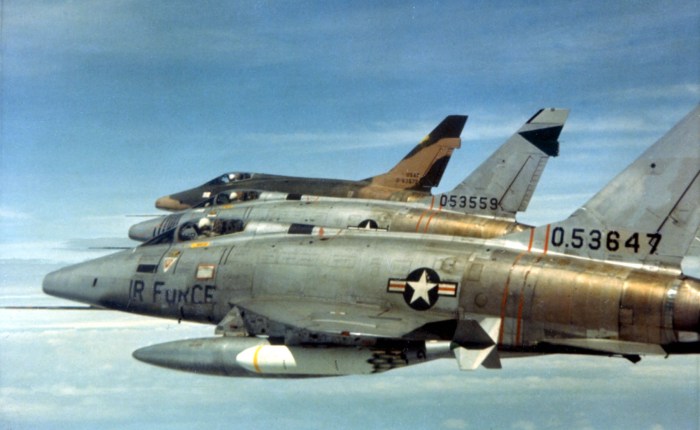
Header Image: F-100Ds of the 481st Tactical Fighter Squadron over South Vietnam in February 1966. Early F-100s were unpainted when they arrived in Southeast Asia like the foreground aircraft, but all eventually received camouflage paint like the aircraft in the back. (Source: National Museum of the US Air Force)

[1] Kenneth P. Werrell, ‘Book Review – Why Air Forces Fail,’ The Journal of Military History, 70:3 (2006), pp. 887-8.

#ResearchNote – Redefining the Modern Military: An Airman’s Perspective

#ResearchNote – Redefining the Modern Military: An Airman’s Perspective

By Dr Brian D. Laslie

Editorial Note: In this Research Note, Assistant Editor, Dr Brian Laslie reflects on his contribution to a new volume about military professionalism entitled Redefining the Modern Military: The Intersection of Profession and Ethics that has been edited by Ty Mayfield and Nathan Finney and published by Naval Institute Press.

In the Summer of 2015, I packed up some clothes and (a lot of) books and moved down to Montgomery, Alabama to attend the United States Air Force’s (USAF) Air Command and Staff College (ACSC). I had been selected along with about a dozen other civilians to attend the 10-month course. I looked upon those ten months in front of me as something of a sabbatical and a chance to research and write.

Redefining

On the back end of my time at ACSC, I received a call from Ty Mayfield, of The Strategy Bridge, about a book project he and a team of authors were working on. This forthcoming project, Redefining the Modern Military: The Intersection of Profession and Ethics, published by the phenomenal people at Naval Institute Press, was an effort by the team at The Strategy Bridge to push the ball forward on the discussion of professionalism, ethics, civil-military relations, and professional education in the modern U.S. military. Following in the footstep of Samuel Huntington, Ty and co-editor Nate Finney collected chapters from a group including international and American officers as well as six academics holding both college and professional military education (PME) positions. It was a robust group, especially considering that most of the chapter authors only knew each other through Twitter. It turns out, Ty and Nate had covered all of their bases except one. In the end, they had no one writing about the USAF, the air domain, or the Airmen’s perspective. Thus, the phone call to me.

It turns out Ty and Nate decided to reach out to me at a somewhat fortuitous time. Ty asked me if I had any thoughts about professionalism and the USAF. As a current student at a PME institution who had spent the better part of seven months pouring over USAF history, I had plenty to say. I titled my chapter, ‘Born of Insubordination: Culture, Professionalism, and Identity in the Air Arm,’ and I am somewhat taciturn that my chapter contribution turned into something of “Oh and ANOTHER THING!” ranting about problems of USAF PME and the Air Force writ large. Ty and Nate did not see it that way.

What I produced, at least the way Ty and Nate ended up describing it was a chapter about the:

particularities inherent in the air arm of the U.S. military. Born from a culture of insubordination, Laslie describes three case studies that display how the positive aspects of this trait, one he titles “pragmatic professionalism”, has shaped – and will continue to shape – the Air Force. Using a historical lens to show the USAF’s unique history, identity, and culture Laslie uses these contemporary case studies to demonstrate that while the Air Force has long suffered with an internal identity crisis amongst its officer corps, the “stovepipes” that developed over the course of the past 70 years are actually conduits for professional advancement in different career fields and not something that needs to torn down.

My chapter on the USAF is but one of twelve. Other chapters include: ‘Questioning Military Professionalism,’ by Pauline Shanks-Kaurin, ‘Professionals Know When to Break the Rules,’ by H.M. ‘Mike’ Denny, ‘Ethical Requirements of the Profession: Obligations of the Profession, the Professional, and the Client,’ by Rebecca Johnson, plus eight others as well as an introduction and conclusion from the editors.

The book proper opens with:

[t]he challenging task of self-assessment for the military profession going into the twenty-first century. Crafted by military officers with recent experience in modern wars, academics who have trained and educated this generation of combatants, and lawyers and civilians who serve side by side with the defense enterprise at all levels, this volume seeks to begin the process of reevaluation for the 21st century.’

While discussing professionalism is not our usual milieu here at From Balloons to Drones, we have been known to stray into the realm from time to time; for example, see our recent post on John Boyd. Indeed, we believe that self-examination in any organisation is an essential part of development and Mayfield, and Finney should be commended for seeing this project through to publication. (We would encourage anyone interested in writing about issues related to professionalism within the context of air arms – air force, naval or army – to get in contact. Ed.)

In the age of social media, we have an entire generation of company and field grade officers who are taking their professional military education into their own hands. Through mediums like The Strategy Bridge, the Military Writer’s Guild and From Balloons to Drones, younger officers are studying and communicating about their profession in new ways. Ty and Nate seized on this moment to produce, what I hope, is a book that will generate discussion across the services and the military establishment at large. My contribution is modest, but this book surely has something for everyone.  From company grade officers to flag and general officers, I hope it will do what it sets out to do, which is nothing less than ‘Redefine’ the modern military.

Dr Brian Laslie is a US Air Force Historian and currently the Deputy Command Historian at North American Aerospace Defense Command (NORAD) and United States Northern Command (USNORTHCOM). He is an Assistant Editor at From Balloons to Drones and a 2001 graduate of The Citadel and a historian of air power studies. He received his Masters’ from Auburn University Montgomery in 2006 and his PhD from Kansas State University in 2013. He is the author of Architect of Air Power: General Laurence S. Kuter and the Birth of the US Air Force (2017) and The Air Force Way of War (2015). The latter book was selected for the Chief of Staff of the Air Force’s 2016 professional reading list and the 2017 RAF Chief of the Air Staff’s reading list. He can be found on Twitter at @BrianLaslie.

Header Image: A flight of Aggressor F-15 Eagles and F-16 Fighting Falcons fly in formation, 5 June 2008, over the Nevada Test and Training Ranges. The jets are assigned to the 64th and 65th Aggressor Squadrons at Nellis Air Force Base. (Source: US Department of Defense)

#BookReview – Sovereignty and Command in Canada-US Continental Air Defence, 1940-1957

#BookReview – Sovereignty and Command in Canada-US Continental Air Defence, 1940-1957

By Dr Brian Laslie

Richard Goette, Sovereignty and Command in Canada-US Continental Air Defence, 1940-1957. Vancouver, BC: University of British Columbia Press, 2018. Illustrations. Appendices. Notes. Bibliography. Hbk. xvii + 295 pp.

Soverignty

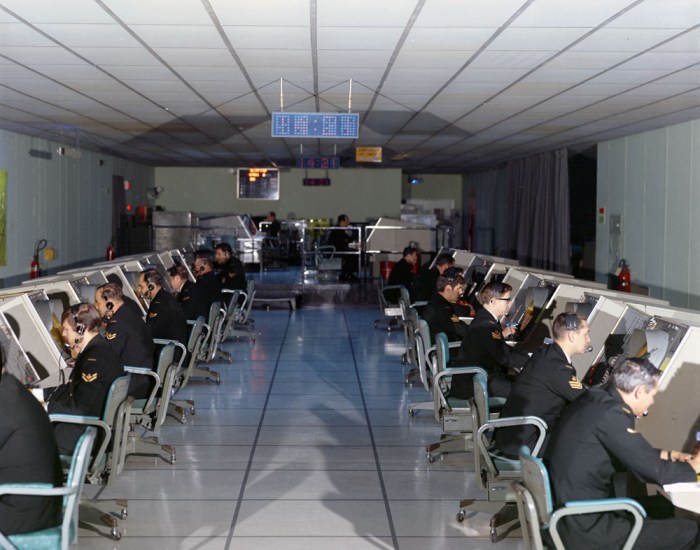
In case you missed it, the North American Aerospace Defense Command (NORAD) turned 60 this year. It was an easy thing to overlook. Most of the time when I mention that I work at NORAD, the first thing that comes to most people’s mind is that it is the organisation responsible for tracking Santa (and that is a job taken very seriously). However, the day to day focus on the command remains on the defence of the North American continent. It does so through three mission areas: aerospace warning, aerospace control and maritime warning. The most important concept to remember when discussing the history and operations of NORAD is that it is a binational command with shared responsibility between the United States and Canada.

Sixty years of shared defence

For more than sixty years now, Americans and Canadians have bi-nationally agreed to place the defence of the homeland in each other’s hands and entrust officers from both countries with commanding, directing, and controlling forces. To that end, Richard Goette’s new work Sovereignty and Command in Canada-US Continental Air Defence, 1940-1957, looks at the development of these relationships leading up to the creation of NORAD in September of 1957. Goette is an air power academic and Canadian air force historian as well as an Associate Professor in the Department of Defense Studies at the Canadian Forces College in Toronto, where he is Deputy Chair of the Department of Military Planning and Operations.

Looking back retrospectively, it is easy to believe that a close relationship between the two nations was a foregone conclusion; it seems difficult to imagine a world in which Canada and the US would not cooperate on matters of national defence. This was indeed not the case immediately following the First World War. One of the demonstrative statements in the book comes at the beginning of Chapter Three where Goette states that ‘[I]t was by no means preordained that Canada and the US would cooperate in the defense of North America.’ Both countries had active war plans for conflict with each other. As Goette shows, ‘[C]anadian military officials continued to consider the US a potential adversary and planned accordingly.’ Likewise, America’s war plan crimson dealt with a conflict against Canada as part of a likely larger fight against Great Britain (War Plan Red) (p. 71).

Slemon
Air Marshal Charles Roy Slemon, Chief of the Air Staff , RCAF, 1953-1957, and the first Deputy Commander-in-Chief of NORAD.(Source: Candian Department of Defence)

Throughout the 1940s and 1950s, this planning against the border nations morphed into cooperation between the two nations and eventually into a unique agreement where the defence of the two nations was shared. Goette (p. 23) aims to demonstrate ‘how Canadian and American officers debated and negotiated doctrinal definitions of command and control as the basis of the Canada-US continental air defence relationship from 1940-1957.’ Thus, Goette’s work pairs nicely with Joseph T. Jockel’s Canada in NORAD 1957-2007: A History. The author’s thesis (p. 5) is that the struggle from the Canadian perspective ‘was not control but command: command over Canadian air defense forces was the actual “acid test of Canadian sovereignty.”’

Sovereignty

Goette’s work is about sovereignty, particularly the sovereignty of Canada. ‘Sovereignty is a complex and contested concept without a universally accepted definition.’ (p. 27) Both countries had to find common ground and move from common conceptions of defence (working within services) towards bilateral (and later binational) defence. Nineteen-forty saw the earliest discussions held between the two nations with the US seeking both ‘strategic direction’ and ‘command,’ over Canadian forces, a clear problem for Canadian sovereignty and command of their forces. The calculus changed by the summer of 1941 and the new cooperative plan (ABC-22) saw that ‘each nation would retain strategic direction and command of its forces, which effectively recognized national sovereignty.’ More importantly, the groundwork was accomplished allowing the two nations to begin effectively working together with the goal of continental defence in mind (p. 81, 83).

The Second World War found the two nations working effectively together, and establishing relationships and procedures used during the war bore fruit in its aftermath. The post-war Basic Security Plan (BSP) was a combined effort aimed at continental defence that Goette (p. 116) shows ‘was a watershed in the Canada-US defence relationship.’ Between the acceptance of the BSP in 1946 and 1953, other plans and agreements between the two nations, particularly as they concerned cross-border intercepts strengthened the relationship between the two governments, but more importantly between the militaries. As the Cold War progressed, it became increasingly evident that the solution would be in a combined headquarters where US and Canadian personnel could work alongside each other. The problem, especially from the Canadian perspective, remained the spectre of American officers commanding Canadian forces. Interestingly, the ‘solution was avoiding the term “command” and using the principle of operational control.’ Thus, in 1957 the North American Air Defense Command (NORAD) began operations. Headed by an American four-star with a Canadian three-star deputy, each officer held ‘operational control.’ Day-to-day operations and ‘operational control’ were held by the American Commander-in-Chief NORAD, but in his absence, the Canadian Lieutenant General held control over the American officers. Administrative matters, punishment, and other matters of command remained sovereign, i.e. national and service responsibilities. This unique command structure remains in place today (p. 177).

e010858630-v8
The SAGE ‘Blue Room’ at the NORAD Underground Complex at Canadian Forces Base North Bay, Ontario, c. 1972. (Source: Library and Archives Canada)

There is really nothing to critique here, Goette has successfully produced a deeply researched work that is the first significant study of the development of Canadian-US continental defense in the post-Second World War era and, as such, it will remain the go-to book for those looking to understand the origins of this unique relationship for the foreseeable future. Sovereignty and Command will quickly find a following in the fields of history and air power studies but will also find a wide readership in the fields of political science, civil-military relations, and international relations. If you have an interest in how the homeland is defended this is a must-read and demonstrates the unique Canadian-US relationship that has stood the test of time for more than 60 years and looks to easily double that as the unique, nay special, binational relationship continues to evolve into the future.

Dr Brian Laslie is an Air Force Historian and currently the Deputy Command Historian at North American Aerospace Defense Command (NORAD) and United States Northern Command (USNORTHCOM). He is also an Assistant Editor at From Balloons to Drones. A 2001 graduate of The Citadel and a historian of air power studies, he received his PhD from Kansas State University in 2013. His first book The Air Force Way of War (2015) was selected for the Chief of Staff of the Air Force’s and the Royal Air Force’s Chief of the Air Staff professional reading lists. His recently published Architect of Air Power: General Laurence S. Kuter and the Birth of the US Air Force.  He lives in Colorado Springs. He can be found on Twitter at @BrianLaslie.

Header Image: A Royal Canadian Air Force Avro Canada CF-100 Canuck in flight with a Convair F-102 Delta Dagger, c. 1950s (Source: Royal Canadian Air Force)

If you would like to contribute to From Balloons to Drones, then visit our submissions page here to find out how.

A Discourse on John Boyd: A Brief Summary of the US Air Force’s Most Controversial Pilot and Thinker

A Discourse on John Boyd: A Brief Summary of the US Air Force’s Most Controversial Pilot and Thinker

By Dr Michael Hankins

In March 2018, Air University Press released a new edition of Colonel John Boyd’s A Discourse on Winning and Losing with a new introduction by Grant Hammond. On top of his heavy influence in designing the F-15 and F-16 fighters, Boyd was one of the most influential and often cited officers in the history of the US Air Force (USAF), but unlike most famous strategic thinkers, he published almost nothing. Thus, this new edition promises to be possibly the most widely disseminated and studied edition of Boyd’s intellectual output.

JohnBoyd_Pilot
John Boyd during his service in Korea. (Source: Wikimedia)

Boyd is, however, a controversial figure. Among USAF officers, Boyd is either loved or hated. Hammond’s introduction refers to him as ‘legendary,’ ‘a great original thinker,’ and ‘a paragon of virtue – loved by many […] for his character and integrity.’[1] On the other hand, former fighter pilot and USAF Chief of Staff General Merrill McPeak summarised the opposing view: ‘Boyd is highly overrated […] In many respects he was a failed officer and even a failed human being.’[2] Boyd was the type of person who challenged authority and fought for what he believed. He was also the kind of person that was so profoundly insecure that he stalked food courts to hunt down and physically assault people whom he perceived had not shown him proper respect.[3] However, many younger officers have never even heard of Boyd nor are they familiar with his ideas or character. With the recent release of the new edition of his work, it is worth taking time to briefly summarise Boyd’s significant contributions and provide some context as to why he is both so praised and so controversial.

First, we must deal with the notion of Boyd as – according to Hammond – ‘a premier fighter pilot.’ Some have referred to Boyd as the greatest fighter pilot who ever lived, and many press outlets mistakenly refer to him as an ace. Although Boyd did fly F-86 Sabres during a brief tour in the Korean War, he does not have a single air-to-air kill to his credit. He never fired his gun in a combat situation. This is not necessarily an indictment of his skills. The reason is that in those years, the USAF tended to fly in formations in which only the lead element was cleared to fire, while the wingmen provided protection. Boyd only ever flew in a wingman position, and never got in an opportunity to fire at enemy MiG-15s. Later, Boyd became a flight instructor at the USAF Fighter Weapons School, and he wrote a manual on dogfighting tactics. His reputation as a fighter pilot was built on his time as an instructor, during which he displayed a penchant for defeating incoming students in simulated dogfights (developing his claim that he could always do so within forty seconds). Fans of Boyd laud him for this, although his detractors often wonder why an instructor defeating his students using an oft-repeated manoeuvre is noteworthy, much less a point worth bragging about.

Boyd’s first significant contribution to USAF thinking was ‘Energy Maneuverability Theory’ (EMT) in the early-to-mid 1960s. This was an application of the principles of thermodynamics to aircraft metrics. Up until that point, the most important metrics for evaluating fighter planes tended to be wing loading ratios, top speed, and acceleration. Many fighter pilots tried to argue that agility and manoeuvrability were more important in a dogfight, but although wing loading could provide a rough idea of how well a craft could turn, it fell far short of an accurate description of a plane’s manoeuvrability. Boyd’s EMT instead analysed how well an aircraft could change energy states – involving speed, acceleration, kinetic and potential energy – essentially giving a numerical value to how well a plane could manoeuvre under various conditions. Charting this value on a graph corresponding to speed and altitude will give a curve of the aircraft’s manoeuvring capability. This method gave fighter pilots a way to talk to engineers in their ‘language,’ and describe dogfighting in mathematical terms, which had a significant influence on aircraft design. Beginning in the late 1960s, EMT became a significant factor in designing and evaluating American aircraft.

EMT.jpg
This chart, a typical example of the types of charts Boyd produced, compares the agility of an F-4 Phantom II and a MiG-21, but specifically under conditions of a 5g turn. (Source: USAF Academy Department of Aeronautics)

Although Boyd appears to have come up with these ideas independently, he was not the first to do so. A decade earlier, in 1954, an aerodynamics engineer working for Douglas named Edward Rutowski had the same concept. Rutowski’s work did not apply to dogfighting, but to calculating fuel ranges of various types of aircraft.[4] However, the equations – and the charts – are almost the same as Boyd’s, who later admitted to copying the charts after denying it for years.[5] One element that Boyd did add, however, was overlaying the EMT curve for one aircraft on top of another, to show where one aircraft had an advantage in manoeuvrability. These comparisons, first done in the late 1960s, showed that Soviet aircraft of that time might have a distinct advantage in dogfighting compared to the American fighters of the day (which, in that period, were mostly interceptors, not traditional fighters). Thus, while not necessarily completely original, Boyd did more to popularise the EMT concept and apply it to fighter design and tactics training, which then became part of a push within the USAF to design aircraft that were more specialised for air-to-air combat.

Boyd had a hand in the design of those planes. The first major USAF project to design a dedicated air superiority fighter was the F-X program, which eventually resulted in the F-15 Eagle. Boyd was brought in partway through this project and attempted to influence the design toward being more dedicated for dogfighting. To Boyd, this meant making it as small as possible and gutting it of sophisticated technologies, especially radar. The more massive the radar dome in a fighter’s nose, the larger the entire plane needed to be. Making the radar as small as possible (or, as Boyd advocated, eliminating it), could make the plane smaller and lighter. Boyd managed to have a significant influence on the design of the F-15, but he did not get everything he wanted. The plane was significantly more extensive and more sophisticated than he advocated, so in disgust, he turned to another project.[6]

f-15a_first_prototype_1
McDonnell Douglas F-15A (S/N 71-0280, the first F-15A prototype). Note the square wingtips and unnotched stabilator. (Source: Wikimedia)

Using a combination of subterfuge, connections with high-level decision-makers, stealing unauthorised time on USAF computers, and meeting with aircraft manufacturers in secret using coded language, Boyd pressured the Air Force to procure a smaller lightweight fighter. Boyd wrote the requirements for that plane, which happened to match almost identically the characteristics of a plane he had been secretly designing with General Dynamics’ Chief of Preliminary Design, Harry Hillaker. That plane eventually became the F-16 Fighting Falcon—his ideal true dedicated air-to-air dogfighter. However, Boyd was also disappointed by the modifications made to that aircraft. The USAF made it heavier and more sophisticated than he wanted, and so Boyd denounced it in disgust.[7] Indeed, although his vision for the F-16 was a pure dogfighter, the plane has rarely been used in air superiority missions by the USAF and has achieved zero air-to-air kills for the US.

YF-16_and_YF-17_in_flight
An air-to-air right side view of a YF-16 aircraft and a YF-17 aircraft, side-by-side, armed with AIM-9 Sidewinder missiles, c.1972. (Source: Wikimedia)

After his retirement in 1975, Boyd went back to work in the Pentagon as an analyst, and it was during this time that he completed most of the intellectual output in the recently released new volume. This began with a short essay entitled ‘Destruction and Creation,’ which argued that societies and systems only really change when they are destroyed and recreated, rather than reformed from within. In 1976, Boyd received a NASA grant to study the differences in pilot behaviour between simulators and reality. Instead of focusing on that, Boyd produced a study titled ‘Fast Transients Brief,’ which consisted of carefully picked historical examples with which Boyd argued that victory in war was the result of being quick, unpredictable, and agile, with the goal of producing confusing in the enemy. This brief was essentially the first draft of what became a larger briefing called ‘Patterns of Conflict,’ which Boyd continually expanded to include more historical examples of his point. This briefing continued to grow, including more examples, until it became the final form under the new title ‘A Discourse on Winning and Losing.’ In this form, it was a fourteen-hour briefing split into two days. Boyd refused to shorten his briefings or to distribute summaries or slides to those who did not attend, insisting on being given the full amount of time, or nothing.[8]

Also embedded in these briefings was his evolving idea of the OODA loop, which stands for ‘observe, orient, decide, act.’ This was Boyd’s description of the process by which decisions are made at all levels from the tactical to the strategic. Boyd argued that all combatants in a conflict are going through that cycle, and whoever can complete repetitive OODA cycles more quickly will always be the victor. Fans of this theory tend to argue that this insight is revolutionary and secures Boyd’s place alongside thinkers such as Clausewitz or Sun Tzu. Others claim that this idea is very simplistic and offers very little in the way of insight or practical application. Interpreting and applying Boyd’s theory to subjects ranging from warfare to business has become something of a cottage industry. The OODA loop is still taught at US professional military education institutions. Love him, hate him, or merely indifferent, one cannot deny that Boyd has left a legacy and influence.

One final component of Boyd’s life that one must be aware of is his involvement in ‘The Reform Movement.’ During his time in the USAF, he and his followers who pushed for lightweight, dedicated air-to-air combat planes began referring to themselves as the ‘Fighter Mafia,’ and saw themselves at odds with the US government – to the point of depicting themselves as participating in a guerilla war against a government that they deemed as corrupt and ineffective. After Boyd’s retirement, this group morphed into what became known as ‘The Reform Movement’ and moved away from just fighter planes to becoming politically active on broader defence issues. This effort included a litany of journalists, military officers, and politicians who went as far as to form their congressional caucus, as well as non-governmental organisations with the goal of lobbying for particular policies.

The group wanted all US military hardware to be cheap and ‘simple.’ Simple in this context meant technologically unsophisticated relative to the mid-1970s. They argued for cancelling expensive ‘complex’ weapons such as the F-15 and the M-1 Abrams tank and replacing them with cheaper, ‘simple’ alternatives, such as relying on the older M-60 Patton tank or replacing F-15s and F-16s with swarms of F-5 Tigers. ‘The Reform Movement’ was more political than the ‘Fighter Mafia,’ and although the movement attracted some moderates and left-leaning individuals such as James Fallows (journalist for The Atlantic) and Senator Gary Hart (D-CO), it tended to skew conservative. Over time, it grew more conservative with the addition of politicians such as Nancy Kassebaum (R-KS), Newt Gingrich (R-GA), Dick Cheney (R-WY), and possibly its most prominent and active member (who coined the term ‘the Reformers’): self-proclaimed monarchist and white supremacist William Lind.[9] For this group, Boyd was seen as a messiah, and he was often discussed in religious terminology as a saviour preaching a new gospel.

Although this movement had an influential voice in the early 1980s, it had begun to stagnate by the end of that decade, and the 1991 Gulf War discredited many of their arguments.[10] However, despite that war demonstrating the effectiveness of all the weapons systems that the Reformers (and Boyd) had argued against, Boyd himself took sole credit for the success of that war. Boyd claimed he had been the actual author of the ground attack plan, which was not true, and that it would have been even more successful if his ideas had been implemented further.

Boyd is a complex figure, and his influence on the US military, especially the USAF, is impossible to deny. Although the bulk of his work has been floating around the internet for years, having a new edition of his work in an easily accessible and well-produced print edition is extremely useful and quite welcome.

Bibliographical Note

For more information on Boyd, the best place to start is most likely John Andreas Olsen’s 2016 article, ‘Boyd Revisited: A Great Mind with a Touch of Madness’ in Air Power History while the best examination of Boyd’s intellectual output is Frans Osinga’s Science, Strategy and War: The Strategic Theory of John Boyd (2007). Several authors further explore Boyd in Olsen’s edited work Airpower Reborn: The Strategic Concepts of John Warden and John Boyd (2015). A genuinely scholarly biography on Boyd’s life has yet to be written. Hammond’s brief biography, The Mind of War: John Boyd and American Security (2012) is a useful starting point but leans into praise for Boyd to a level that some readers might be uncomfortable with. Robert Coram’s popular biography Boyd: The Fighter Pilot Who Changed the Art of War (2002) has its uses but is little more than hagiography and should be read with a sceptical eye.

Dr Michael Hankins is Professor of Strategy at the USAF Air Command and Staff College eSchool, and and Assistant Editor at From Balloons to Drones. He is also a former Instructor of Military History at the US Air Force Academy. He earned his PhD from Kansas State University in 2018 with his dissertation, ‘The Cult of the Lightweight Fighter: Culture and Technology in the U.S. Air Force, 1964-1991.’ He completed his master’s thesis at the University of North Texas in 2013, titled “The Phantom Menace: The F-4 in Air-to-Air Combat in the Vietnam War.” He has a web page here and can be found on Twitter at @hankinstien.

Header Image: A USAF F-16 Fighting Falcon Block 40 aircraft after receiving fuel from a KC-135 Stratotanker aircraft during a mission over Iraq on 10 June 2008.  (Source: Wikimedia)

If you would like to contribute to From Balloons to Drones, then visit our submissions page here to find out how.

[1] Grant Hammond, ‘Introduction to “A Discourse on Winning and Losing” in Colonel John Boyd, A Discourse on Winning and Losing, edited and compiled by Grant Hammond (Maxwell AFB, AL: Air University Press, 2018), pp. 1-2.

[2] Carl Prine, ‘Q & A with Merrill ‘Tony’ McPeak,’ San Diego Union Tribune, 23 November 2017.

[3] See, for example, a story of Boyd seeking out a former colleague who had expressed doubt in Boyd’s ideas years before. Boyd put out his cigar on the man’s clothing, then began shoving him and shouting obscenities at him, all in public. Told in more detail in Robert Coram, Boyd: The Fighter Pilot Who Changed the Art of War (New York: Little, Brown, and Company, 2002), pp. 179-80.

[4] Edward S. Rutowski, ‘Energy Approach to the General Aircraft Performance Problem,’ Journal of the Aeronautical Sciences, 21 (1954), pp. 187-95.

[5] USAF Historical Research Agency, K239.0512-1066, John Boyd, Corona Ace Oral History Interview, 22 January 1977.

[6] For details on the development of the F-15, see Jacob Neufeld, The F-15 Eagle: Origins and Development, 1964-1972 (Washington DC: Office of Air Force History, 1974).

[7] On this issue, see: Grant Hammond, The Mind of War: John Boyd and American Security (Washington DC: Smithsonian Books, 2012).

[8] These briefings are most thoroughly explored in Frans Osinga, Science, Strategy and War: The Strategic Theory of John Boyd (New York: Routledge, 2007).

[9] For a brief summary of Lind’s extremism (he was known for keeping a portrait of fascist dictator Benito Mussolini in his office), see Bill Berkowitz, “Cultural Marxism’ Catching On,’ Southern Poverty Law Center, 15 August 15, 2003. Lind’s radical right-wing viewpoints are evident from his voluminous writing as the former Director of the Center for Cultural Conservatism, and his many columns in a variety of conservative websites and magazines. His 2014 novel Victoria not only celebrates a violent militia movement overthrowing the American government but glorifies deportations and executions of non-whites and other minorities he deems undesirable, including Jews, Muslims, the LGBTQ community, and it favorably depicts the use of nuclear weapons against African-American populations.

[10] For a summary of ‘The Reform Movement,’ see: John Correll, ‘The Reformers,’ Air Force Magazine (February 2008), pp. 40-4. To see them discuss their ideas in their own words, see: James Fallows, National Defense (New York: Vintage, 1984) and James Burton, The Pentagon Wars: Reformers Challenge the Old Guard (Annapolis, MD: Naval Institute Press, 1993).

#AirWarBooks – Dr Randall Wakelam

#AirWarBooks – Dr Randall Wakelam

Editorial Note: In the fourth instalment of ‘Air War Books,’ Dr Randall Wakelam discusses the ten books that have influenced and shaped his writing as an air power historian. If you are interested in contributing to this series or From Balloons to Drones more generally, find out how here.

Since joining the Air Force more than 45 years ago, I have found that professional education for those working with air power has not been a forte of Canada’s Air Force. Much of what I have learned, I have done so out of curiosity and by selecting graduate courses and by doing graduate research that allowed me to satisfy my curiosity and develop a better understanding of air power. While I am critical of this circumstance in Canada I do not think it is unique; there are too many editorials, op-eds and notes from chiefs of service that attempt to get aviators to read if not write.

Having taught air power at the Canadian Forces College and now at an undergraduate and graduate level to officer cadets and civilian students, I continue to learn. In this teaching, I think I am comfortable with the notion that air power concepts introduced a century ago have now reached maturity regarding what air power effects can be applied and how. What is constantly in flux is the larger Geopolitical context of why and when one wants to apply air power effects.

The one other factor that I would want to bring into the formulation of this list is my desire to get inside the thinking processes of those who have developed air power concepts and then applied them. Thus, several the titles that you will see below are either biographies or studies of the human condition. In the case of biographies, I fully recognise that looking at the life stories of some of these actors comes with risks. Case studies of human and personnel questions are perhaps less risky but not without risk.

And now to the list, which is most certainly too short to do justice to the many other works that I have found important to me.

Philip Meilinger (ed.), The Paths of Heaven: The Evolution of Airpower Theory (Maxwell AFB, AL: Air University Press, 1997). This volume is without question the one work that I keep going back to. Admittedly written from a United States Air Force (USAF) perspective I have found the work balanced and useful in seeing the ‘long duree’ of air power thought and its application. I first read the book just after it came out but even now, twenty years later, do not find it particularly dated. Of great value is I.B. Holley’s summary and commentary. His criticism that the work ignores naval aviation serves as a caution to readers that while highly valuable the volume does have its limitations.

John Andreas Olsen (ed.), A History of Air Warfare (Washington D.C.: Potomac, 2010). This work fills the void of the last two decades since Paths of Heaven was published and provides readers with a different treatment of many of the same ideas and events presented in the former. For that reason, I think it provides a solid bookend to balance the USAF compendium. Also, the reader gets a good dose, perhaps too good of the air campaigns of the post-Cold War decades and three useful studies of current and future themes, most importantly small wars and space. The penultimate chapter, by Martin van Creveld, balances Holley’s commentary and leaves the reader with the ultimate question: has the age of air power come and gone?

Allan D. English, Understanding Military Culture: A Canadian Perspective (Montreal: McGill-Queen’s University Press, 2004). When I reviewed English’s book about a decade ago, I wrote that it was, for me at least, a volume that captured essential ideas about military culture, ideas that I might have benefited from even from my first days in uniform. In a relatively short but well-focused study, English laid out the elements of culture, looked at them through the lens of the USAF and then from the perspective of the Canadian air arm. At that time there was no the Royal Canadian Air Force (RCAF), as there had been up to the 1960s and as there is again today. The absences of that organisational title and the emotional trappings of an independent air service were all the more reason to read English’s book at the time. The comings and goings of organisations, from squadron to air forces that continue in all nations made and makes this work incredibly insightful.

Henry Probert, Bomber Harris: His Life & Times (Aylesbury: Greenhill Books, 2001). For a long time, I wanted to attempt to understand the thinking of Marshal of the Royal Air Force Sir Arthur Harris. Was he the wanton killer of German civilians that he was accused of being? How did he apparently hold the loyalty of his aviators? Probert’s study of the man gave me the answers that others did not. Bullheaded to the point of obstinacy – certainly more than not – but he did set out to apply the concepts and technology available to him to accomplish the task set for Bomber Command. Moreover, in this, we see not bombast alone but also a sharp intellect and a degree of flexibility and accommodation (that I would not have expected) and above all a desire to save the lives of his crews, or at least make their sacrifices count. Probert showed me Harris’ strengths and weaknesses, giving me a good picture of what any operational level leader might look like, warts and all.

Denis Richards, Portal of Hungerford (Tintern, MON: William Heinemann, 1977). If Harris is a good case study in operational level leadership, then Denis Richards biography of Marshal of the Royal Air Force Viscount Portal makes a good companion. Few of us will ever get to work at or even observe the work of senior air force leaders or to have exposure to the sorts of institutional level challenges they face, both within their service and across governments and coalitions. This book gives us that access, and it allows us to put the better-known struggles of the Royal Air Force (RAF) in its formative years into a more personal context where, as in the case of Harris, personal strengths and weaknesses – the human factor – contribute to success or precipitates failure.

Dewitt S. Copp, A Few Great Captains: The Men and Events That Shaped the Development of U.S. Air Power (McLean, VA: EPM Publications, 1989). This work has been my only deep dive into the USAF, and as I began to think more about culture, doctrines and effects, it seemed to be important to study not just one man or a few, but rather the birth and evolution of an air power community. I believe I found that in this work. It looks at the people and their professional growth, ideas, experiences, small ‘P’ politics and larger organisational conflicts.

John J. Zentner, The Art of Wing Leadership and Aircrew Morale in Combat, CADRE Paper no. 11 (Maxwell AFB, AL: Air University Press, 2001). This set of case studies looks at leadership in a flying organisation, arguably one of the hardest notions to explain to army and naval officers who generally lead within plain sight of their followers. Moreover, to be honest, how one leads in the air is often hard to describe, or at least it was before the recent decades of air operations, to aviators. Effective leadership should promote high morale, and Zentner posited that that strong morale is linked to aircrew control over the tactics they are to use in the air. During a period of relative global calm, he set out to test his concept in three case studies. He looked at two fighter leaders, one German and one American in the Second World War, and for a third case flows the leadership of a B-52 Wing Commander during the Vietnam War.

Allan D. English, The Cream of the Crop: Canadian Aircrew, 1939-1945 (Montreal: McGill Queen’s University Press, 1996). This work is focused on the personnel issues of the RAF and the RCAF, and thus we find an investigation into an aspect of air warfare every bit as important as technologies. English sets out to explore and comment on the impact of what today we recognise as post-traumatic stress disorder on Bomber Command aircrew. To do this he looks at the Royal Flying Corps experiences of recruiting and training during the First World War and how these, and societal cultural norms were adopted by the RAF and to a lesser extent the RCAF in the Second World War. He shows the significant difference in the policy adopted by the RCAF and how rehabilitation of stress casualties rather than their banishment could safeguard critical human resources.

Robin Higham and Steven J. Harris (eds.), Why Air Forces Fail: The Anatomy of Defeat (Lexington, KT: The University Press of Kentucky, 2006). Not every air campaign is a success and not every air service ensures the security of its home nation. In studying failures Higham and Harris edited volume expose us to valuable experiences of things gone wrong. More important than the various well researched and presented case studies is the introduction where the editors lay down a simple truth: ‘other things being equal’ the better air power ‘should’ prevail. They then go on to look at the range of ‘other things’ and here is the true value of the collection: the reader soon realises, or should, that there are almost countless factors in play that can cripple an air force, often long before a conflict begins. To codify these factors, Higham adapts Mahan’s characteristics of a maritime nation to identify where and how air power nations can and have failed.

Robert Grattan, The Origins of Air War: The Development of Military Air Strategy in World War I  (London: IB Tauris, 2009). Grattan, an RAF navigator, turned business professor in his later years, presents a study of air arms in the First World War. He argues that the leaders, flyers and even politicians and industrialists had nothing to go on and so national air arms were sort of a ‘design build’ enterprise with rapid advancement through trial and error. He looks at aircraft, weapons, personnel and tactics studying the advancements of each in relation to the others. The use of the word ‘strategy’ in his title is a bit misleading; ‘air power concepts’ would more accurately describe his focus in my view.

Dr Randall Wakelam teaches military and air power history at the Royal Military College of Canada. After graduating from RMC in 1975 he flew helicopters for the Army, becoming CO of 408 Tactical Helicopter Squadron in 1991. Along the way, he also had staff appointments in aircraft procurement and language training policy. Since 1993 he has been an educator, first in uniform at the Canadian Forces College in Toronto and now at RMC. His research and publishing focus on air power and military education.

Header Image: A group of pilots of No. 1 Squadron RCAF, gather around one of their Hawker Hurricane Mark Is at Prestwick, Scotland, c. October 1940. The squadron’s commander, Squadron Leader E.A. McNab, stands fifth from the right, wearing a forage cap. (Source: © IWM (CH 1733))

If you would like to contribute to From Balloons to Drones, then visit our submissions page here to find out how.

SPACE FORCE: The Militarisation of United States Space Policy from Eisenhower to Trump

SPACE FORCE: The Militarisation of United States Space Policy from Eisenhower to Trump

By Bradley Galka

On 18 June 2018, President Donald J. Trump announced his intention to create a new branch of the United States armed forces. This new branch, the US Space Force, would be charged with controlling the nation’s military activities in space. The fact that the US would be involved in military activities in space in the first place should not be taken for granted. The US’ first military space policy was based on the principle that space ought to remain a ‘sanctuary’ from the sort of martial competition that was taking place on earth’s surface. Despite these peaceful beginnings, nearly every successive president has established a military space policy more aggressive than the last. The proposed establishment of the Space Force as a new branch of the US military represents the apex of this decades-long trend toward increased militarisation of space.[1]

0900168
President Eisenhower visiting the George C. Marshall Space Flight Centre in Huntsville, Alabama, 8 September 1960. (Source: NASA)

The US government’s first space policy was established during the presidency of Dwight Eisenhower. Eisenhower and the military saw the nation’s developing satellite program as a valuable tool in monitoring Soviet military concentrations and looked forward to developing the critical capacity of detecting hostile missile launches from space. The president’s views differed with military leaders in significant ways. While the military advocated the development of anti-satellite (ASAT) missile technology and other generally hostile technologies for use in space, Eisenhower was more interested in the scientific possibilities of the space program. Eisenhower established the National Aeronautics and Space Administration (NASA) on 29 July 1958, as a separate entity from the Department of Defense – one with a purely peaceful civilian mandate. Though he did green-light some early research into ASAT technology, the US never developed a functional ASAT capability during Eisenhower’s presidency.[2]

John F. Kennedy took the first steps toward a more militarised space policy by approving the full-scale development of the anti-satellite and anti-ballistic missile technologies first considered during Eisenhower’s tenure. Kennedy was concerned with the nuclear ‘missile gap’ that was said to be developing between the US and the Soviet Union and was alarmed by reports that the Soviets were seeking a capacity to place nuclear weapons in earth’s orbit. Ultimately, however, Kennedy chose not to increase tensions between the superpowers through military competition with the Soviets in space, but rather to seek a diplomatic agreement limiting or banning such hostile actions. Kennedy’s successor, Lyndon B. Johnson, brought about the successful culmination of these efforts with the signing of the United Nations’ Outer Space Treaty by the US and the Soviet Union in 1967. The terms of this treaty forbade the testing or positioning of nuclear weapons and other types of weapons of mass destruction in space, prohibited the construction of military installations or fortifications on the moon, and banned any military manoeuvres in earth’s orbit. The terms of the treaty stipulated that space would only be used for peaceful, scientific purposes.[3]

Richard Nixon’s presidency was not marked by significant changes in the US’ military space policy. Gerald Ford, however, set the US on a drastically new, and far more aggressive, course. During Ford’s presidency, a series of internal government review boards reported to the president that the US’ existing space policies were woefully insufficient to protect the nation’s important space assets from the threat of Soviet attack. Experts warned that deterrence was not enough. The US, they said, would need to develop not only substantial defences in space but would need to obtain potent offensive firepower as well. Ford acted on this advice by drafting a new military space policy. This policy declared that ‘the Soviets should not be allowed an exclusive sanctuary in space for critical military supporting satellites.’ The employment of non-nuclear anti-satellite technology, Ford declared, would enable the US to ‘selectively nullify certain militarily important Soviet space systems, should that become necessary.’ By the end of his presidency, Ford had put in place the US’ first outwardly aggressive military space policy, mandating that the nation obtain both offensive and defensive capabilities in space.[4]

Jimmy Carter followed in Ford’s footsteps by officially rescinding the US’ self-imposed prohibition on testing anti-satellite weaponry in space. In 1978 Carter promulgated a new space policy which affirmed the right of the US to ‘pursue activities in space in support of its right of self-defense.’ Regarding anti-satellite capability, Carter declared that the US would continue to seek a ‘verifiable ban’ on such technology but would continue its research and development ‘as a hedge against Soviet breakout.’ In other words, the Carter administration sought to obtain a ban on ASAT technology but was unwilling to let the US fall behind if the Soviets refused to cooperate or broke the terms of any prospective treaty.[5]

Excalibur_firing
Project Excalibur was a proposed x-ray laser based anti-missile technology. It used a nuclear warhead surrounded by a number of metal rods that acted to focus the output of the explosion into narrow beams that would be aimed at nuclear missiles and their warheads. (Source: Wikimedia)

When Ronald Reagan assumed the presidency in 1981 the US upped-the-ante yet again. One of the most notable products of Reagan’s whole presidency was his famous Strategic Defense Initiative (SDI), known popularly as the ‘Star Wars’ program. The nature of SDI changed significantly over time but was a program designed to give the US the capacity to intercept and destroy a massive Soviet missile barrage en-route to the US or its allies using space-based weapons platforms. Though regarded by most now and many in his own time as wildly unrealistic given the technology of the day, Reagan’s intention of stationing military weapons in space capable of defeating Soviet attacks on earth was far beyond anything the US had been willing to attempt before. This technological program was coupled with Reagan’s stated unwillingness to continue negotiating with the Soviet Union over any form of disarmament which he believed would interfere with American prerogatives or American interests.[6]

Following the breakup of the Soviet Union in 1991 the ambitious nature of Reagan’s SDI program was scaled back under George H.W. Bush from a massive global missile shield to a smaller, regional defensive program capable of interdicting missiles in smaller numbers but with higher accuracy, reflecting the new realities of a post-Cold War world. Both H.W. Bush and Bill Clinton maintained the US’ stated willingness to both attack and defend military assets in outer space, but the post-Cold War world saw a marked decrease in the perceived importance of military space readiness. Bill Clinton was notable for his administration’s desire to open up the US’ space technology for the benefit of civil and commercial interests around the world. GPS, the global positioning system which serves as the basis of modern satellite-directed navigation, was initially a military asset unavailable to the public until Clinton opened access to the program in the 1990s.[7]

030319-N-4142G-020
US Navy Ordnance handlers assemble Joint Direct Attack Munition (JDAM) bombs in the forward mess decks before putting them on elevators headed for aircraft on the flight deck aboard USS Constellation, c. 2003. JDAM’s are guidance kits that convert existing unguided bombs into precision-guided ‘smart’ munitions. The tail section contains an inertial navigational system and a global positioning system. JDAM improves the accuracy of unguided bombs in any weather condition. (Source: Wikimedia)

The advent of the Global War on Terror and the protracted conflicts in the Middle East has reinvigorated the government’s concern with space policy in recent years. George W. Bush took steps to limit the free access to GPS established by Bill Clinton claiming the nation’s enemies – whether conventional military, insurgent groups or terrorist organisations – could use GPS as a useful tool against US interests. Perhaps the most notable use of military satellite technology, however, has been the drone program. Satellite-enabled drone reconnaissance and bombing missions have been central to US military operations around the world since the 1990s and have only grown in importance. George W. Bush and Barack Obama each found space assets to be indispensable in the conduct of their military missions abroad and have each affirmed the importance of space in their iterations of national space policy.[8]

In his 2006 exposition of US space policy, George W. Bush declared:

In this new century, those who effectively utilize space will enjoy added prosperity and security and will hold a substantial advantage over those who do not. Freedom of action in space is as important to the United States as air power and sea power. In order to increase knowledge, discovery, economic prosperity, and to enhance the national security, the United States must have robust, effective, and efficient space capabilities.[9]

By declaring that space is just as crucial to the modern military as air power and sea power Bush seems to have prefigured the seminal development in US space policy that incumbent President Trump announced in 2018: the planned establishment of the US Space Force.

In the six decades between Eisenhower’s first military space policy and the space policy of Trump, the US has gone from a purely peaceful conception of space to a grudging acceptance of defensive militarisation to a modern policy in which an aggressive militarisation of space is regarded as essential to national defence. The elevation of space activities from auxiliary status to an independent branch of the armed forces not only solidifies the importance of space in the modern US military but represents the next logical step in a pattern of increasingly aggressive military space policy established since the earliest days of the US space program.

Bradley Galka obtained his Master of Arts degree in history from Kansas State University in 2017. He is currently pursuing a PhD at Kansas State. His research focuses on the relationship between politics and the military in the United States, particularly regarding fascism and the U.S. military during the inter-war period.

Header Image: The launch of the STS-74 mission aboard the space shuttle Atlantis from NASA’s Kennedy Space Center. (Source: NASA)

[1] Namrata Goswami, ‘The US Space Force and Its Implications,’ The Diplomat, 22 June 2018.

[2] Nelson Rockefeller, National Security Council, ‘US Scientific Satellite Program,’ NSC-5520, 20 May 1955; Dwight D. Eisenhower Presidential Library and Museum, Abilene, KS, S. DDE’s Papers as President, NSC Series, Box 9, 357th Meeting of the NSC, NAID#: 12093099, Everett Gleason, National Security Council, ‘US Objectives in Space Exploration and Science,’ March 1958; Eisenhower Presidential Library, DDE’s Papers as President, NSC Series, Box 9, 339th Meeting of the NSC, NAID#: 12093096, S. Everett Gleason, National Security Council, ‘Implications of Soviet Earth Satellite for US Security,’ 10 October 1957.

[3] George C. Marshall Institute, Presidential Decisions: NSC Documents from the Kennedy Administration National Security Council, ‘Certain Aspects of Missile and Space Programs,’ NSC-6108, 18 January 1961; George C. Marshall Institute, Presidential Decisions: NSC Documents from the Johnson Administration, Lyndon B. Johnson, ‘Cooperation with the USSR on Outer Space,’ NSAM-285, 3 March 1964; United Nations General Assembly, ‘Treaty on Principles Governing the Activities of States in the Exploration and Use of Outer Space, Including the Moon and Other Celestial Bodies, 27 January 27, 1967.

[4] George C. Marshall Institute, Presidential Decisions: NSC Documents from the Ford Administration, Brent Scowcroft, National Security Council, ‘Enhanced Survivability of Critical US Military and Intelligence Space Systems,’ National Security Decision Memorandum 333, 7 July 1976; George C. Marshall Institute,  Presidential Decisions: NSC Documents from the Ford Administration, Brent Scowcroft, National Security Council, ‘US Anti-Satellite Capabilities,’ National Security Decision Memorandum 345, 18 January 1977.

[5] George C. Marshall Institute, Presidential Decisions: NSC Documents from the Carter Administration, Jimmy Carter, Presidential Review Memorandum – NSC 23, ‘A Coherent US Space Policy,’ 28 March 1977; George C. Marshall Institute, Presidential Decisions: NSC Documents from the Carter Administration, Jimmy Carter, Presidential Directive/NSC 33, ‘Arms Control for Anti-Satellite (ASAT) Systems,’ 10 March 1978; The Jimmy Carter Presidential Library and Museum, Atlanta, GA, Presidential Directives, Jimmy Carter, Presidential Directive/NSC-37, ‘National Space Policy,’ 11 May 1978, pp. 1-2.

[6] George C. Marshall Institute, Presidential Decisions: NSC Documents from the Reagan Administration, Ronald Reagan, National Security Decision Directive Number 42, ‘National Space Policy,’ 4 July 1982.

[6] George C. Marshall Institute, Presidential Decisions: NSC Documents from the Reagan Administration, Ronald Reagan, National Security Decision Directive Number 85, ‘Eliminating the Threat from Ballistic Missiles,’ 25 March 1983; Ronald Reagan Presidential Library, Simi Valley, CA, Office of the Press Secretary, ‘White House Announcement on the Development of a Defensive System Against Nuclear Ballistic Missiles,’ 25 March 1983; George C. Marshall Institute, Presidential Decisions: NSC Documents from the Reagan Administration, Ronald Reagan, National Security Decision Directive Number 119, ‘Strategic Defense Initiative,’ 6 January 1984; George C. Marshall Institute, Presidential Decisions: NSC Documents from the Reagan Administration, Ronald Reagan, National Security Decision Directive Number 195, ‘The US Position: Nuclear and Space Talks,’ 30 October 1985.

[7] George C. Marshall Institute, Presidential Decisions: NSC Documents from the George H.W. Bush Administration, George H.W Bush, NSD-30, NSDP-1, ‘National Space Policy,’ 2 November 1989, p. 3; George C. Marshall Institute,  Presidential Decisions: NSC Documents from the Clinton Administration, Office of the Press Secretary, PDD/NSC-23, ‘Statement on Export of Satellite Imagery and Imaging Systems,’ 10 March 1994; George C. Marshall Institute, Presidential Decisions: NSC Documents from the Clinton Administration, William Clinton, PDD/NSTC-2, ‘Convergence of US-Polar-Orbiting Operational Environmental Satellite Systems,’ 5 May 1994; George C. Marshall Institute, Presidential Decisions: NSC Documents from the Clinton Administration, Office of the Press Secretary, ‘Fact Sheet: US Global Positioning System Policy,’ 29 March 1996.

[8] George C. Marshall Institute, Presidential Decisions: NSC Documents from the George W. Bush Administration, George W. Bush, ‘US National Space Policy,’ 31 August 2006; George C. Marshall Institute, Presidential Decisions: NSC Documents from the Obama Administration, Barack Obama, ‘National Space Policy of the United States of America,’ 28 June 2010.

[9] George W. Bush, ‘US National Space Policy,’ 31 August 2006.