By Lieutenant General David A. Deptula, USAF (Ret.)
Editorial Note: 2021 marks the 30th anniversary of Operation DESERT STORM. To mark this anniversary, during 2021, From Balloons to Drones will be publishing a series of articles that examine various aspects of DESERT STORM’s air campaign. We will be publishing pieces throughout 2021, and if you would like to contribute to the series, please contact our Editor-in-Chief, Dr Ross Mahoney, at airpowerstudies@gmail.com or via our contact page here. The official call for submissions can be found here.
Over the coming weeks, From Balloons to Drones is pleased to be working in conjunction with the Mitchell Institute for Aerospace Studies to publish a series of articles on various aspects of the DESERT STORM air campaign. These articles were initially published as part of a Mitchell Institute of Aerospace Studies special report, Desert Storm: 30 Years Later – Lessons from the 1991 Air Campaign in the Persian Gulf War. You can download the report here.
In this latest instalment, we are pleased to present a piece by Lieutenant General David A. Deptula, USAF (Ret.) on the planning and execution of the DESERT STORM air campaign. Deptula was the principal attack planner for the air campaign, and in this article, he provides valuable insights into some of the issues and challenges that affected the conduct of the air campaign.
January 17, 2016, at 0239 Baghdad time marked the 25th anniversary of the start of Operation Desert Storm. Desert Storm was a turning point in the conduct of warfare as it set the conditions for modern warfare in five major ways: 1) it set expectations for low casualties – on both sides of the conflict; 2) it presaged precision in the application of force for all future conflicts; 3) it introduced prosecution of a combined/joint air campaign integrating all coalition/service air operations under the functional command of an airman, 4) it established desired effects as the focus of strategy and in the planning and conduct of operations, and 5) for the first time in history, airpower was used as the key force – or centerpiece – in the strategy and execution of a war.
Desert Storm was a 43-day war – airpower operated throughout the conflict from start to finish; ground forces acted as a blocking force for almost the entire war as airpower destroyed enemy forces and achieved desired effects against key systems from above. Only in the final days of the conflict were ground forces committed to combat and used to re-occupy Kuwait. In this respect, Desert Storm saw an inversion in the paradigm of traditional force application. Long-time military expert Dr Ben Lambeth has observed that today:
[t]he classic roles of airpower and land power have changed places in major combat […] Fixed-wing air power has, by now, proven itself to be far more effective than ground combat capabilities in creating the necessary conditions for rapid offensive success.
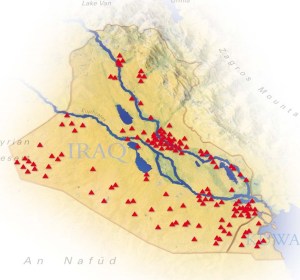
The opening attacks of Desert Storm signaled a radical departure in the conduct of war. Over 150 discrete targets – in addition to regular Iraqi Army forces and surface-to-air missile (SAM) sites – made up the master attack plan for the opening 24 hours. The war began with more targets attacked in one day than the total number of targets hit by all of the Eighth Air Force in 1942 and 1943 combined – that’s more separate targets attacked in less time than ever before in history.
Twenty-five years ago, those involved in the Desert Storm air campaign applied force not only across the entire breadth and depth of the country geographically, but also across all the key strategic and operational level centers of gravity. How was that accomplished? And what was different from previous conflicts?
Advances in technology, in conjunction with an effects-based approach to planning and execution, allowed us to institute a new concept of operations that has been described as ‘parallel’ war: the simultaneous application of force across the totality of the enemy system.
While simultaneous attack has always been a desired element of offensive warfare, it had never evolved into the parallel war demonstrated in Desert Storm for three reasons: one, the requirement for mass to compensate for a lack of precise weapons delivery; two, the large number of resources required to suppress enemy air defenses; and three, the absence of a focus on effects rather than destruction to achieve control over an opponent.
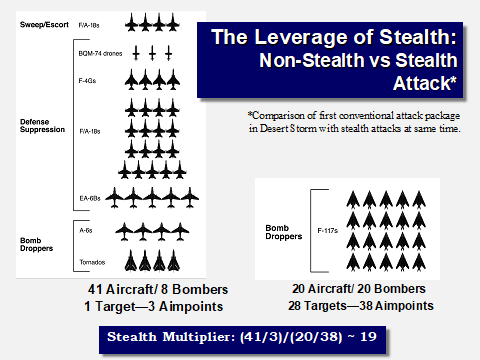
The first two challenges required technological solutions, and were simply not mature before the mid-1980s. Those two solutions were stealth and precision. To provide insight into the significance of those two elements, in the first 24 hours of Desert Storm stealth, precision, and effects-based planning allowed targeting 36 stealth aircraft armed with precision-guided munitions against more separate targets than the complete non-stealth/non-precision air and missile force launched from the entire complement of six aircraft carriers and all the other ships in the theater combined. The stealthy F-117 force flew less than 2 percent of the combat sorties, but struck over 40 percent of the fixed targets.
The leverage that stealth demonstrated in the first Gulf War is further illustrated by the following example that involves the first non-stealthy attack on one target with three aimpoints in the Basrah area – Shaiba Airfield to be exact. The attack package consisted of 4 US Navy A-6s dropping bombs, along with 4 Saudi Tornado bomb droppers: 5 US Marine EA-6Bs jamming acquisition radars; 4 US Air Force F-4Gs taking out one type of surface to air missile system; 17 US Navy F-18s taking out another; 4 F/A-18s as escort; and three drones to cause the enemy radars to radiate. That is a total of 41 aircraft – 8 dropping bombs, on 3 aimpoints, on one target.
At approximately the same time we had 20 F-117s all dropping bombs on 38 aim points on 28 separate targets. That is less than half the aircraft hitting over 12 times the number of aim points.
Stealth and precision facilitated the actualization of the third and perhaps most important component of that conflict: a concept of operations designed to achieve control over an enemy’s essential systems. This methodology recognizes that negating an adversary’s ability to operate as desired is ultimately as important – or even more so – than the destruction of the forces it relies on for conquest.
We built the air attack strategy of Desert Storm by treating Iraq and the Saddam regime as a system of systems, and designed the operation to achieve paralysis of Saddam’s strategic centers of gravity: leadership; key essential systems; infrastructure; information; and fielded military forces. The campaign had five key objectives in this regard:
Gain/Maintain Air Supremacy to Permit Unhindered Air Operations
Isolate and Incapacitate Hussein Regime
Destroy Iraqi Nuclear, Biological, and Chemical Warfare Capability
Eliminate Iraq’s Offensive Military Capability
Render the Iraqi Army in Kuwait Ineffective, Causing Its Collapse
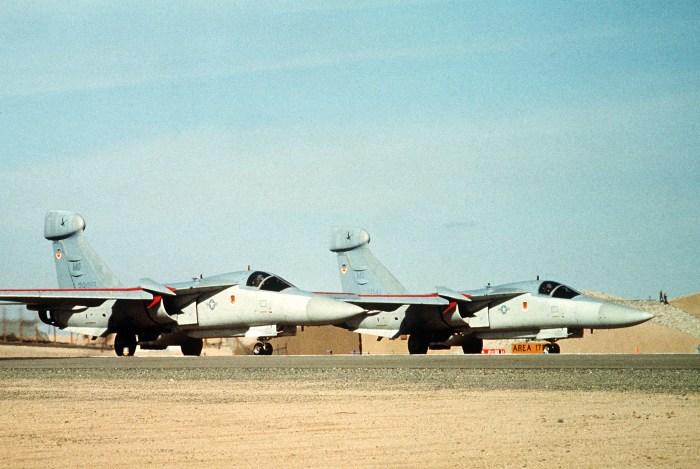
EF-111A Raven aircraft prepare to take off on a mission during Operation Desert Shield. (Source: Wikimedia)
These objectives were all achieved – rapidly, and decisively. The tenets that made Desert Storm such a success were:
Strong political will – a President who stated on 5 August 1990, ‘This will not stand’ in response to the invasion of Kuwait. President George H. W. Bush and his military commanders built a strategy; formed a coalition; deployed the forces required to execute that strategy; garnered United Nations backing; executed the strategy; and accomplished its declared objectives by February 28, 1991 – seven months from start to finish.
A comprehensive, coherent campaign plan that focused on dismantling the key centers of gravity – leadership; key essential systems; infrastructure; population perceptions; and military forces – that paralyzed Iraq as a state along with its military regime;
Putting a combined/joint force air component commander in charge of the air campaign, and treating each aircraft, missile, and air defense element according to the capability it brought to the campaign plan, regardless of which service or country from where it came;
Reversing the errors of Vietnam by replacing the gradualism of the ‘Rolling Thunder’ air campaign with the ‘Instant Thunder’ of the Desert Storm air campaign; and
Adopting a true combined/joint approach to the effort using the right force at the right place at the right time – not a traditional land-centric plan that singularly focused on fielded military forces.
Today, against the Islamic State, targets selected and ordnance employed go through a lengthy vetting process, and are approved or disapproved by ground commanders. According to a reported Air Force source on 26 August 2016 it, ‘take[s] an average of between 45 to 60 days before [targets] are vetted and approved.’ That is longer than the duration of Operation Desert Storm in its entirety. The excessive time factor in Operation Inherent Resolve target development due to of concern of unintended civilian casualties, allows critical Islamic State functions to continue to operate. By not rapidly striking them actually countenances the Islamic State to perpetuate its terror, atrocities, and murder.
What is the morality of a policy that restricts the use of airpower to avoid the possibility of collateral damage while allowing the certainty of the Islamic State’s crimes against humanity? Members of today’s coalition should enter into their casualty avoidance calculus how many of the Islamic State’s intentional murders of innocents would be avoided by rapidly collapsing the organizational elements that allow the Islamic State to function.
The current approach to the Islamic State is gradualist – over two years to date, and the prospect of years of continuance; it is an anemic approach – an average of only 6 US strike sorties a day over the first two years of operations; and it is without definition – no comprehensive and focused strategy has been identified to achieve the stated objectives of degrading and destroying the Islamic State. The result is an approach that is fragmented, less than optimal, and yields the advantage of time to the adversary resulting in expansion and export of its deleterious effects. The enemy, over time, learns how to deal effectively with the gradual use of airpower and grows stronger, while our allies and our citizens lose interest, and our military forces – our brave airmen, soldiers, sailors, and marines – tire of the endless rotations into and out of the fight. Our present is our past: not the swift, decisive past of Desert Storm but rather the quagmire that was Vietnam.
Today’s generation of airmen must renew the spirit of innovation and creativity enabled by exploiting the virtues of operating in air and space, as did the founders of our Air Force. Those characteristics delivered success in Desert Storm, and can do so again in the future. The innovative application of the tenets of aerospace power is what made Desert Storm such a success, and can be applied to the challenge of the Islamic State. Replace the current desert ‘drizzle’ with a ‘thunderstorm’ aimed not just at the hands and feet of the Islamic State but at its head and heart as well. It is the duty of every Air Force member to understand airpower, advocate and articulate its characteristics and capabilities, and educate those who do not understand. For if they don’t, no one else will. The Nation deserves to hear the options allowed by airpower, and will benefit from their proper application.
Lieutenant General David A. Deptula, USAF (Ret.) is the Dean of the Mitchell Institute for Aerospace Studies. He is a world-recognized leader and pioneer in conceptualizing, planning, and executing national security operations from humanitarian relief to major combat. He was the principal attack planner for the Operation Desert Storm air campaign; commander of no-fly-zone operations over Iraq in the late 1990s; director of the air campaign over Afghanistan in 2001; twice a joint task force commander; and was the air commander for the 2005 South Asia tsunami relief operations. He served on two congressional commissions charged with outlining America’s future defence posture. He is a fighter pilot with more than 3,000 flying hours – 400 in combat – Including multiple command assignments in the F-15. His last assignment was as the Air Force’s first deputy chief of staff for intelligence, surveillance, and reconnaissance (ISR), where he transformed America’s military ISR and drone enterprises—orchestrating the largest increase in drone operations in Air Force history. He retired from the Air Force in 2010 after more than 34 years of distinguished service. He has BA and ME degrees from the University of Virginia and a MS degree from National War College. In addition to his duties as Dean of the Mitchell Institute, he is the RisnerSenior Military Scholar at the US Air Force Academy; a board member at a variety of organizations; an independent consultant; and sought after commentator around the world as a thought leader on defence, strategy, and ISR.
Editorial Note: 2021 marks the 30th anniversary of Operation DESERT STORM. To mark this anniversary, during 2021, From Balloons to Drones will be publishing a series of articles that examine various aspects of DESERT STORM’s air campaign. We will be publishing pieces throughout 2021, and if you would like to contribute to the series, please contact our Editor-in-Chief, Dr Ross Mahoney, at airpowerstudies@gmail.com or via our contact page here. The official call for submissions can be found here.
In this first instalment, Dr Brain Laslie provides a review of one of the first memoirs to emerge after the end of the First Gulf War; She Went to War: The Rhonda Cornum Story. Rhonda Cornum’s story is interesting for several reasons. First, it provides an army view of the air war rather than the more common air force view. Second, much of its focus relates to the latter part of the conflict, and finally, and most importantly, the book provides an insight into the experience of female prisoners of war (POW) in wartime.
Rhonda Cornum with Peter Copeland, She Went to War: The Rhonda Cornum Story (30th Anniversary Edition). Cardiff, CA: Waterside Productions, 2020. Pbk. 240pp.
Reviewed by Dr Brian Laslie
This was it. This was life as a POW. This was my life for the near future. This room, those walls, that ceiling. My reality. (p. 168).
Major Rhonda Cornum was a member of the US Army’s 2-229th Attack Helicopter Battalion attached to the 101st Airborne Division (Air Assault) during Operation DESERT STORM. As a medical doctor, her job was to fly as a member of a UH-60 crew behind attacking AH-64 Apaches and provide medical support to any downed aircrew. On 27 February 1991 – the fourth day of the ground war – Cornum and the other members of her UH-60 crew diverted to become a search and rescue aircraft sent to pick up a downed F-16 pilot, Captain William F. Andrews. During the rescue mission, the UH-60 she was riding was shot down. Her subsequent ordeal is detailed in the book She Went to War: The Rhonda Cornum Story (with her co-author Peter Copeland). Originally published in 1992, Cornum’s book was one of the early personal reflections of service during DESERT STORM. The book has now been re-released as part of the 30th anniversary of DESERT STORM.
The crash resulted in the loss of Chief Warrant Officer Four Philip Garvey, Chief Warrant Officer Three Robert Godfrey, Sergeant 1st Class William Butts, Staff Sergeant Patbouvier Ortiz, and Sergeant Roger Brelinski. Only three crew members survived: Cornum, Staff Sergeant Daniel Stamaris, and Specialist Four Troy Dunlap. The three survivors were rapidly captured by the Iraqi military (pp. 12-3). Among the trio of survivors, Cornum was the most seriously injured. Her injuries sustained in the crash included ‘two broken arms, both at odd angels; a smashed finger […] a blown out knee and various lacerations and bruises’ (p. 79-80) and – as she later discovered – a bullet wound in her back (pp. 97-8).
Captured almost immediately Cornum was taken to a series of bunkers and one gets the sense that the Iraqi military was not entirely prepared to deal with her and other captured Americans preferring to shuttle them up the chain of command. This description harkens back to Everett Alvarez’s early days of captivity after he became the first POW during the Vietnam war and detailed in his autobiography Chained Eagle (1989).
Cornum, suffering from her severe wounds, also learned to deal with a myriad of other problems. These problems included boredom and the indeterminable waiting for something to happen (p.39, 41), a sexual assault at the hands of one of the guards, and the complete inability to do anything on her own from dressing to going to the bathroom. Cornum was forced to rely on her captors or a fellow POW to help her with her dressings and personal hygiene.
She Went to War certainly deserves to be included under the rubric of air power books coming out of DESERT STORM, but this particular book is essential for another reason as it is one of the few works that explore the experience of female POWs. Cornum and US Army Specialist Melissa Rathbun-Nealy were the only two female POWs taken prisoner during DESERT STORM. As such, Cornum’s insightful work adds something unique to the historiography of DESERT STORM; a female perspective. Indeed, arguably the critical work on POWs’ experience during DESERT STORM remains Tornado Down (1992), the account of Britain’s Flight Lieutenants John Peters and John Nichol who were shot down on the first day of the air campaign. As we enter into a period of historical reflection thirty years later, Cornum and Copeland’s book should enter the conversation as one of the great memoirs to come from DESERT STORM.
In 2021, From Balloons to Drones will run a series that examines the use of air power during Operation DESERT STORM in 1991.
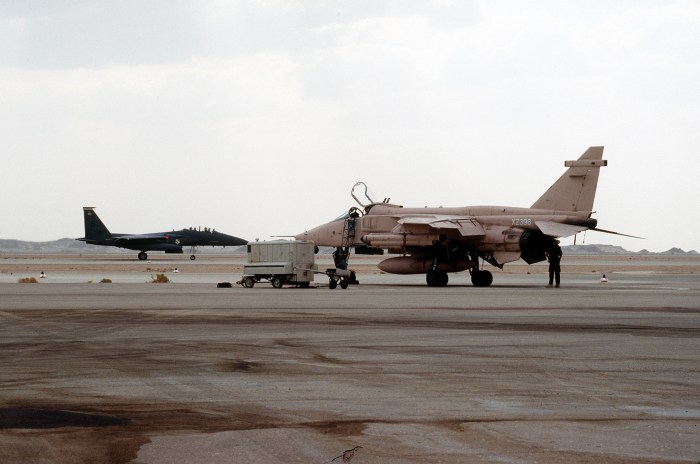
A Royal Air Force Jaguar aircraft is serviced on the flight line as a US Air Force F-15E Eagle aircraft taxis in the background during Operation Desert Shield. (Source: Wikimedia)
2021 is the 30th anniversary of Operation DESERT STORM, which sought to liberate Kuwait from Iraqi occupation. DESERT STORM has long been considered a significant turning point in the use of air power. As Richard Hallion reflected the 1990s, ‘[s]o profound [was] the change in warfare exemplified by what occurred in Desert Storm, that, for the United States, aerospace power [was] now de facto accepted as the natural and logical form of crisis intervention.’ In many respects, much of the rhetoric that had characterised air power thinking during the 20th century arguably coalesced in 1991. Nevertheless, the use and impact of air power both during the conflict and in the years afterwards, has remained controversial. As such, From Balloons to Drones is seeking submissions for a series of articles that examine the varied use of air power during DESERT STORM as well its impact on the conduct of military operations since 1991. Themes to be explored might include, but are not limited to:
Strategy, Theory and Doctrine| Organisation and Policy | Roles
Operations – Kinetic and Non-Kinetic | Tactics, Training and Procedures
Strategic and Operational Effect | Technological Developments
Ethical and Moral Issues | National, International and Transnational Experiences | Personal Experiences
We are looking for articles of between 500 to 4,000 words, though we will accept larger pieces and we reserve the right to publish them in parts. To understand the types of articles published by From Balloons to Drones, please visit our submissions page. As well as scholarly articles, we are keen to publish personal reflections on the use of air power by those who served during DESERT STORM. We would also be interested in potentially conducting interviews with veterans.
We plan to begin running the series in January 2021, and it will continue for as long as we receive potential contributions. We will also be looking at publishing extended versions of selected articles in an edited volume. We welcome and encourage submissions from academics, policymakers, service personnel, and relevant professionals. We also welcome submissions written from diverse academic disciplines.
Submissions should be submitted in Word format and emailed to the address below with ‘SUBMISSION – DESERT STORM Revisited’ in the subject line. Also, please include a 50-100-word biography with your submission. Footnotes can be used, and please be careful to explain any jargon. If you are not sure if your idea fits our requirements, then please email us with ‘POTENTIAL SUBMISSION – DESERT STORM Revisited’ in the subject line to discuss.
If you are interested in contributing, please email our Editor-in-Chief, Dr Ross Mahoney, at airpowerstudies@gmail.com or contact us via our contact page here.
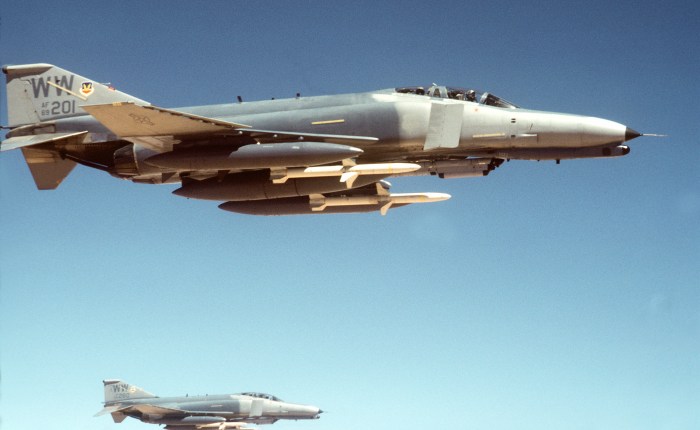
Header Image: Two US Air Force McDonnell Douglas F-4G Phantom II aircraft of the 35th Tactical Fighter Wing pass over the Saudi desert while on a training flight during Operation Desert Shield on 11 January 1991. The aircraft are carrying external fuel tanks on their outboard wing pylons and AGM-88 HARM high-speed anti-radiation missiles on their inboard wing pylons. (Source: Wikimedia)
What is air power? How do we study it? How do we use it? Do previous characterisations sufficiently capture the concept? Perhaps. This article contends that prior attempts to put meat on the bone towards a framework to study air power scholarship are insufficient.
Moreover, we must appreciate the richness of our inquiries if we – scholars and professionals, such as political scientists, historians, policymakers, practitioners and users – want to understand better the concept of air power to help answer important questions. These questions may be: how do civilian airline pilots and training schools contribute to a nation’s ‘air power?’ Can peacetime control of airspace access constitute a form of air power? To what extent does air information, such as weather, the electromagnetic environment, knowledge of space weather, constitute a form of air power? Furthermore, more, importantly, how do these questions and related concepts orient to each other. As such, this article argues that air power is the domain-agnostic admixture of personalities, outcomes, organisations, technologies, ideas and events to do or, that do, something in or for, the air.[1]
This definition is unique in that it explicitly and parsimoniously joins together the breadth of military and civilian endeavours. It highlights the ‘stickiness’ of related topics and contends that air power is not an inherently military pursuit, though its application almost always manifests as such. The definition provides more form to the general, varied ideas of military thinkers about essential elements of air power.[2] This article begins the discussion on the topic of how we structure air power studies across various academic fields and cordons a more robust dissection of the topic in future publications. Furthermore, this article details the constituent components of air power to clarify meaning. Then, it uses this perception of air power to explain its evolution throughout history. Finally, briefly, it discusses our current air power disposition to make sense of what component will drive innovation in the coming decades — organisations. So, how have we come to envisage this elusive thing we call air power?
Definition and Components of Air Power
In the Age of Airpower, Martin Van Creveld explored about 250 years of the concept. Among others, he highlighted the work of people with simple, yet elegant definitions of air power, such as that of Brigadier General William ‘Billy’ Mitchell who viewed it as doing ‘something in the air.’[3] Other writers such as Mark Clodfelter provided more angles: breaking the concept of air power into direct and indirect applications.[4] For Clodfelter, direct air power generally involves kinetic outcomes such as bombing and indirect presumes more non-kinetic capabilities, such as intelligence, surveillance and reconnaissance (ISR).
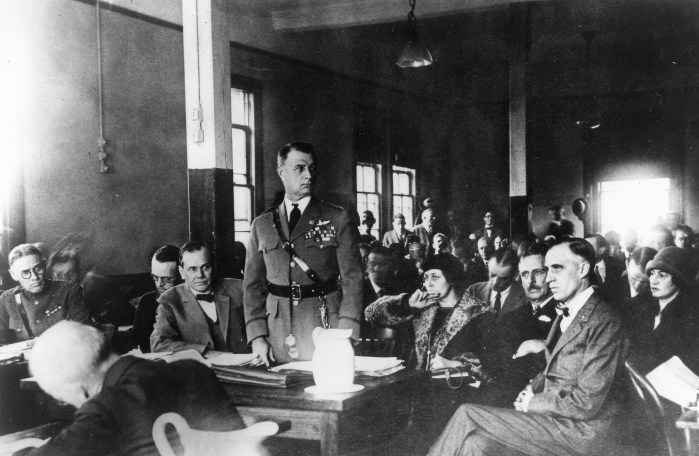
A scene from William ‘Billy’ Mitchell’s court-martial in 1925. (Wikimedia)
Meanwhile, organisations such as the US Air Force (USAF) define air power based on its organisational experience and conceptual refinement. The latest iteration of USAF Basic Doctrine defines the concept as ‘the ability to project military power or influence through the control and exploitation of air, space, and cyberspace to achieve strategic, operational, or tactical objectives.’[5] So, how do we break air power down for study?
While Mitchell’s definition is more parsimonious, adding a little complexity provides the explanatory muscle to how we think about air power and thus how we can consider the concept’s change over time. Foundationally, one should recognise that to do something in the air does not necessarily mean that the activity must originate in or from the air.[6] For instance, a ballistic missile launch originates from the land, traverses through the air and maybe space, and then strikes somewhere on land. This example demonstrates the potential of the agnosticism of the air domain. Furthermore, a more robust definition allows for careful, coordinated forecasting of future air power applications using clear and structured links within and across the subject’s elements. For instance, air power researchers studying C-17 humanitarian assistance capabilities may be linked to those studying procedurally based command and control organisations as well as those studying the political effects of humanitarian assistance to optimise future disaster response towards national priorities.
Conceiving of air power as an admixture of component concepts: each noteworthy, though not equal, in characterising the ability to do something in the air is vital for several reasons. One benefit is to have more structured research programs that allow thinkers to situate their contribution to the subject area. Another is to generalise debates on air power concepts that link military and civilian theory and application. A generalisation can help guard against what seems to be a tendency to overly militarise air power thought, evoking the coercive and persuasive elements of the concept. The benefits are similar to those of academic fields like history or political science though air power studies can best be described as an interdisciplinary subfield or topical field.
Importantly, to be useful, the components must be defined. First, personalities may be individuals or groups that have a profound impact on the development of the notion. For instance, Mitchell vocally and publicly advanced the idea of a separate US military service despite the misgivings of more senior leaders, including President Calvin Coolidge.[7] In part, the general’s 1925 court-martial resulted from agitation for a separate US air service. However, the spectacle thrust air power into America’s national dialogue. He challenged the US Army – then overseeing land-based air forces – stating that their leaders were negligent for not building an air service capable of national defence. Mitchell is credited by many as being the original maverick in pursuing an idea of independent military air power that was largely sidelined at the time. Mitchell’s persona, in part, catalysed the existence of organisations critical to the development of air power.
Mitchell’s calls for an independent air service bring us to the second component — organisations, which are administrative and operational systems that foster ideas, leverage people and exploit technologies towards some outcome. An exemplar is the USAF’s Strategic Air Command (SAC) under Major-General Curtis LeMay’s tutelage. SAC pursued the idea of ‘strategic’ air power, discussed later, towards its outcome of long-range conventional and nuclear bombing. SAC oversaw most of the US nuclear deterrent and development of bomber capabilities for the USAF. The organisation came to personify air power in the US and for much of the world during the Cold War.[8] Albeit an unfair approximation, civilians and military personnel alike were lent the idea of air power’s ability to render an outcome of total enemy devastation embodied by SAC’s long-range bombers and, later, ballistic missiles.[9]
In our context, outcomes are the effects, assessments and results by which military and civilian leaders come to associate air power. For instance, after the Second World War, both military and civilian leaders came to associate air power with the unconditional surrender of the enemy evoked by the use of nuclear weapons.[10] This idea created problems during the Korean and Vietnam Wars, where expectations outpaced the new reality of limited, non-nuclear warfare.[11] Limited warfare lends itself to more technical means — leaving technology to be the more tangible, driving component of air power.
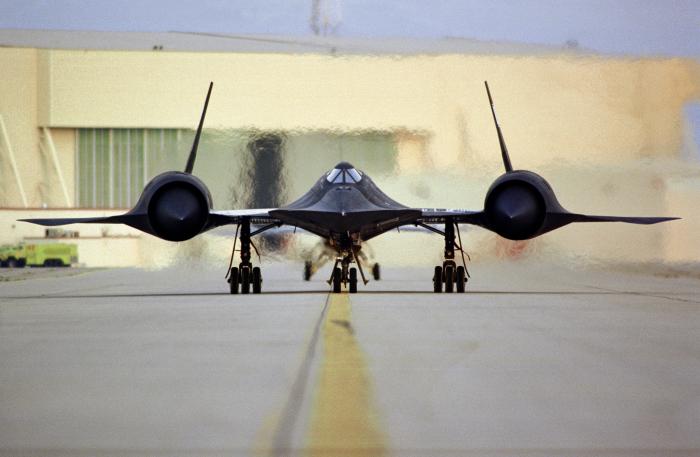
As a component, technology includes all the capabilities, research, design, development and testing that allow practitioners to do things in the air. For instance, a significant component of the US’ advancements in stealth technology originated with the Skunk Works team under Kelly Johnson’s orchestration, among others.[12] The team’s research and design techniques led to advances like the SR-71 Blackbird and the F-117 Nighthawk.[13] These technologies, along with other capabilities-related advances, influenced expectations such as those discussed above: enabling the limited, non-nuclear warfare that became characteristic of vast swaths of America’s recent history.[14] However, while technology is sometimes the easiest to translate as an air power component, though not always easy to grasp, it is ideas that sometimes generate change.
An SR-71 taxing on the ramp with engines powered up, c. 1995. (Source: Wikimedia)
Doctrine, strategy, theories, policies and politics combine to form air power’s conceptual component. These ideas embody how personalities can use other components. Reciprocally, all the other components can help thinkers conceive of new ways to conceptualise air power. To demonstrate, during Operation EL DORADO CANYON, President Reagan and his national security team viewed air power as a punitive instrument of national security policy.[15] Existent technologies in the 1980s allowed Reagan’s response to state-sponsored terrorism with a long-range, airstrike on targets tailored to the perceived offence.[16] Reagan’s team shepherded the technology component in a way that had not yet been explored to its fullest. They updated strategic attack doctrine; tested theories of international relations; set new international policies; and ignited the politics of air-driven limited, military interventions.
Events like Op EL DORADO CANYON also constitutes the last element of air power. Our understanding of past campaigns, battles and historical milestones enables a fuller appreciation of air power and the possibility of modifying its future use. Unfortunately, these so-called understandings can sometimes lead to misapplications of history and, ultimately, to disaster.[17] For instance, the counterinsurgency in Iraq that began almost immediately after the invasion in 2003 required a different application of air power than previously practised, but it would take multiple Secretaries of Defense to enforce this understanding upon the military, as evidenced by the explosion of unmanned technologies among others.[18] The components of air power – personalities, organisations, outcomes, technologies, ideas and events – provide the critical infrastructure for the study of air power. We can use this infrastructure to help us understand various aspects of the topic, like what elements may be more important at various times in history. This understanding can help us orient ourselves in history relative to the seemingly dominant feature of our time so that those who study, and practice air power can best allocate resources, whether academically or practically.
Epochs of Air Power
In this section, this article now considers the prominence of the above elements as determinants of historical periods in air power’s evolution. A short walkthrough of air power’s epochal changes rooted in the above-defined elements illuminates current and the future application of air power. Geoffrey Barraclough, in An Introduction to Contemporary History, provided an idea about ‘spots and jumps’ that define historical periods and transitions.[19] He used the timeframe 1880-1960 to discuss the shift between modern and contemporary history based primarily on economic and geopolitical factors.[20] Using a similar conception of eras punctuated by ‘spots and jumps,’ rooted in the components of air power to characterise the shifts, this section divides the evolution of air power into five timeframes. Importantly, during shifts between the timeframes, changes in predominant component concepts of air power led to changes in our concept of air power.
Before 1783 – The Age of Imagination
Air power before 1783 can be viewed as an ‘Age of Imagination’ or ideas. There were no bounds except those imposed by humanity’s evolving understanding of terrestrial physics. Some of the earliest human records depict mystical flying or lobbing objects through the air as weapons. In their way, our ancestors from around the world gave us our first concept of air power. They conceived of divinity by drawing and storytelling of gods that could defy gravity unassisted, a fruitless pursuit for mere mortals that dates to Greek, Roman and Chinese mythology. While ancient and pre-industrial humans did not themselves defy gravity, humankind created things to help defend themselves, such as arrows and trebuchet missiles. These weapons are essential to the study of air power because the idea of projectiles travelling large distances to destroy an enemy finds its roots here. These weapons emerged over thousands of years, sometimes a crowning achievement of empires such as Persia and the Mongols. Nonetheless, the wild-eyed dreams of fantasy came to a relatively abrupt end in 1783 when the Montgolfiers floated their first balloon. The brothers’ flights began the period of the ‘Origins of Air Power.’
1783 to 1903 – The Origins of Air Power
Between 1783 and 1903, changes in the concept of air power resulted from slow changes in technologies. For instance, a new class of ‘aeronauts’ proliferated workable ballooning technologies that ended up in the hands of Napoleon Bonaparte, though his use is not the first use on the battlefield. He used available technologies when and where he could to enhance reconnaissance and direct artillery strikes. In 1798 Bonaparte used balloons to try to overawe the Egyptians in a campaign to subdue the Middle East and North Africa. After an unsuccessful display, Napoleon ordered the balloon unit’s disbandment. Undoubtedly a balloon would have come in handy in 1815 when Napoleon looked for Grouchy to spot and crush Blucher’s flanking movement at Waterloo.[21] Nearly a half-century later, professionals continued to struggle with the concept of air power: conceiving of it as an unproven, unpredictable and unusable conglomeration of technologies and techniques, such as gas-producing machines for balloons, telegraphs and airborne mapmaking. Such was Thaddeus Lowe’s disposition in bringing air power to fruition during the American Civil War.[22] Thus, it would be until the turn of the twentieth century.
1903 to 1945 – The Douhetian Epoch
From 1903 to 1945, ‘strategic’ air power and its offshoots was the idea that drove changes in the conception of air power as something more than an observational or auxiliary tool for ground forces. The idea of independent air power came to full fruition in August 1945 with the dropping of the atomic bomb over Hiroshima, Japan. To begin, in December 1903 the Wright Brothers brought heavier-than-air flight to reality. Driving the science of aeronautics were ideas like those refined by Giulio Douhet in the early part of the 20th century. Theorists like Douhet opined that wars could be won by striking at city centres from the air to break the will of a people, forcing them to surrender.[23] Douhet’s original Italian publication in 1921 would not get immediately translated into English; however, people like Hugh Trenchard, the first Royal Air Force commander, articulated similar thoughts and organised, trained and equipped his military forces towards those ends.[24] Sir Arthur ‘Bomber’ Harris would make use of Trenchard’s advancements during the Second World War over German cities such as Hamburg, Dresden and Berlin.[25] Though it would take the American military time to adopt the British model of indiscriminate bombing, this idea came to epitomise air power for the period.
Importantly, this was also the timeframe during which commercial air travel in lighter- and heavier-than-air vessels took root. Though the ‘golden’ age of commercial air travel would come later, concepts like air routes, navigating via beacons, airports and other ideas began to solidify. These concepts had both military and civilian applications and technologies that enabled further development of the idea of air assets used over long distances. However, the military would continue to dominate ideas about air power as a ‘strategic’ concept even as these ideas came into contact with a significant theoretical challenge: limited warfare in an age of potentially unlimited destruction from thermonuclear weapons.
US Air Force Lockheed F-80C Shooting Star fighter-bombers from the 8th Fighter-Bomber Squadron during the Korean War in 1950-51. The aircraft are equipped with ‘Misawa’ long-range tanks. (Wikimedia)
1945 to 2001 – The Era of Immaculate Effects
The next era, roughly spanning 1945 to 2001 is the maturation of strategic bombing extremes enabled by high technology. Militarily, the era is marked by the rise of a more immaculate, precise warfare with limited aims to mitigate aircrew losses, fulfil more specific international obligations and for operational efficiency among other goals. There was a change in the concept of air power because of what it was perceived to have achieved during the Second World War and the idea that the same outcome could be realised even in the face of more limited warfare.[26] By the beginning of this timeframe, the USAF sidelined more tactically-minded airmen like Pete Quesada to ensure adoption of strategic bombing as a vehicle to solidify the association with air power.[27] In part because of his prestige as a tactical aviation adherent, the ‘bomber generals’ defanged Quesada and the organisation he led, Tactical Air Command, after WWII.[28] There was no room for anyone but true believers in the strategic attack mindset, but this would change after the experiences of Korea and Vietnam in the 1950s, 60s and 70s. Only later in the period would Quesada’s tactical aviation and more precise attack legacy permeate military circles.[29]
In civilian aviation, technology-fueled huge leaps in air power. National airspace, global navigation capabilities and air-containerised freight were concepts that would hold vast military and civilian applications. It is during this time that military and civilian aircraft started to compete for airspace for things like training, exercises and navigating various corridors. Another critical advance was the widespread implementation of the instrument landing system that allowed commercial aircraft to land in increasing levels of degraded atmospheric conditions. Again, precision enabled by technology characterised this era.
2000 and Beyond – Flexible Niche
The most recent period begins at around the turn of the millennium. This is the epoch as ‘Flexible Niche’ because it involved the use of existing or new technologies for a variety of activities dependent on how organisations are positioned to leverage them. Beginning in the late 1980s, formalisation of the contemporary Air Operations Center (AOC) is an early indicator of the present epoch. This organisation enabled the focused air campaign during Operations INSTANT THUNDER and DESERT STORM that, in part, led to ultimate victory for coalition forces in 1991. It was no longer enough to think of air power as just a capability or bringing about the strategic defeat of an enemy via the limits of destructive power or achieving national objectives with as few civilian casualties as possible. The organisation became the template for how to leverage air power across a wide area and from multiple sources. A contemporary view of air power considers the construct of how and which organisations best leverage technologies, ideas and people towards a given outcome, which may be a military one. There are a variety of concepts that the United States military is exploring, including the Multi-Domain Operations Center and Defense Innovation Unit, in addition to the standup of a Space Force among other initiatives.
Civil aviation is undergoing a similar bout with organisations, especially in the United States, as the Federal Aviation Administration (FAA) grapples with how best to control airspace with the rise of unmanned technologies, especially in congested metropolitan areas. Should the FAA continue to hold all the cards or is the organisation in need of decentralisation of authorities to states and localities? Technologies may forestall the organisational decision, but this era’s solutions seem to be organisationally related rather than technically.
For the new century and beyond, it will not necessarily be which countries and industries have the best technologies or smartest people or best ideas that define the development of air power: it will be the organisations that can best leverage the other components that will determine how we conceive of air power. To summarise, again, air power is the domain-agnostic ability to do something in the air resulting from an admixture of personalities, outcomes, organisations, technologies, ideas and events. These components, at various times, represent reasons why our concept of air power changes over time.
Conclusion
The use of epochs allows us to generally discuss how components of air power drive thinking and successful pursuits of the concept over time, which is why it is useful to develop a unified framework for their study. Moreover, as opposed to the more traditional commentary of air power, linking military and civilian advancements in the same epoch demonstrates that air power is not an inherently military concept. This article serves as an overview of the start of a more robust discussion about the development of air power and a characterisation of what will likely temper that development for the 21st century — organisations. Future topics will involve civilian efforts to deal with drones and swarms, the importance of civil aviation and commercial space efforts in air power development, and the exploration of the idea that organisations will be the defining issue of this era.
Given all of this, air power is the domain-agnostic admixture of personalities, outcomes, organisations, technologies, ideas and events to do or, that do, something in or for, the air. Moreover, these components at various times have influenced significant shifts in our conception of air power over at least five critical epochs. Scholars and professionals must acknowledge the military and civilian dimensions of air power to live up to the concept’s full potential. Hence, to conclude, there is a need for a unified framework for the study of air power to promote the integration of military and civilian issues with the field.
Major Jaylan M. Haley is a career USAF Intelligence Officer. Currently, he is a student at the USAF School of Advanced Air and Space Power Studies at Air University. Over 14 years, he served in a variety of intelligence-related positions from the strategic to the tactical levels. During Operations ENDURING FREEDOM and INHERENT RESOLVE, he served as an Intelligence, Surveillance and Reconnaissance Liaison Officer to multiple US Army Divisions and US Marine Expeditionary Forces in both Afghanistan and Iraq. Most recently he was an Air University Fellow, serving as an Instructor in the Department of International Security at the USAF Air Command and Staff College. He is a PhD Candidate in the Kansas State University Security Studies program with research focused on leverage air power as a tool of national policy.
Header Image: A US Navy Grumman F-14A Tomcat intercepts a Soviet Tupolev Tu-95 ‘Bear D’ reconnaissance-bomber over the Pacific Ocean on 21 November 1984. The F-14 was assigned to fighter squadron VF-51 aboard the USS Carl Vinson and was deployed to the Western Pacific and the Indian Ocean from 18 October 1984 to 24 May 1985. (Source: Wikimedia)
[1] Domains include air, space, cyberspace (or electromagnetic), land and sea. Domain agnosticism disregards a specific domain towards the application of a specific concept. For instance, intelligence collection is domain agnostic. This means that intelligence collection can come from any of the domains-air, space, cyberspace, land or sea.
[2] ‘Strategic Implications for the Aerospace Nation’ in Philip Meilinger (ed.), Air War: Essays on Its Theory and Practice (Abingdon: Franck Cass, 2003), pp. 217-30.
[3] Martin Van Creveld, Martin, The Age of Airpower (New York: PublicAffairs, 2011), p. 71; William Mitchell, Winged Defense: The Development and Possibilities of Modern Air Power (New York: Dover Publications, 1988), p. xii.
[4] Mark Clodfelter, The Limits of Air Power: The American Bombing of North Vietnam (Lincoln, NE: University of Nebraska Press, 1989), p. 213.
[5] United States Air Force, Core Doctrine, Volume 1 – Basic Doctrine (Maxwell AFB, LeMay Doctrine Center, 2015).
[6] Robert Smith, ‘Maneuver at Lightspeed: Electromagnetic Spectrum as a Domain,’Over the Horizon: Multi-Domain Operations & Strategy, 5 November 2018. Importantly, the so-called warfighting domains of air, space, land, navy and now cyber – or perhaps more aptly electromagnetic – all interface with the air domain and provide a medium through which something can happen in the air.
[7] Douglas Waller, A Question of Loyalty (New York: HarperCollins Publishers, 2004), pp. 21-2.
[8] Donald Mrozek, Air Power & the Ground War in Vietnam (Virginia, VA: Pergamon-Brassey’s International Defense Publishers, 1989), pp. 14-5.
[9] Conrad Crane, American Airpower Strategy in Korea: 1950-1953 (Lawrence, KS: University Press of Kansas, 2000), pp. 16-22.
[17] Richard Neustadt and Ernest May, Thinking in Time: The Uses of History for Decision Makers (New York: The Free Press, 1986), p. xv, 233-4.
[18] Robert Gates, Duty: Memoirs of a Secretary at War (New York: Alfred Knopf, 2014), pp. 128-9; Donald Rumsfeld, Known and Unknown: A Memoir (New York, Penguin Group, 2011), p. 648.
[19] Barraclough’s ideas about history are not universally accepted in the field of history.
[20] Geoffrey Barraclough, An Introduction to Contemporary History (Baltimore, Penguin Books, 1964), p. 11.
[22] Stephen Poleski, The Balloonist: The Story of T.S.C. Lowe: Inventor, Scientist, Magician and Father of the U.S. Air Force, (Savannah, GA: Frederic Beil, 2007).
[23] Guido Douhet, Command of the Air (Pickle Partners Publishing, 2014), p. 21.
[24] Tami Davis Biddle, Rhetoric and Reality in Air Warfare: The Evolution of British and American Ideas About Strategic Bombing, 1914-1945 (Princeton: Princeton University Press, 2002), pp. 73-4, 79.
[25] Richard Overy, The Bombers and the Bombed: Allied Air War Over Europe, 1940-1945 (New York: Penguin Books, 2013), 58.
[26] Crane, American Airpower Strategy in Korea, p. 184.
[27] Brian Laslie, The Air Force Way of War: U.S. Tactics and Training After Vietnam (Lexington, KY:, The University Press of Kentucky, 2015), p. 34.
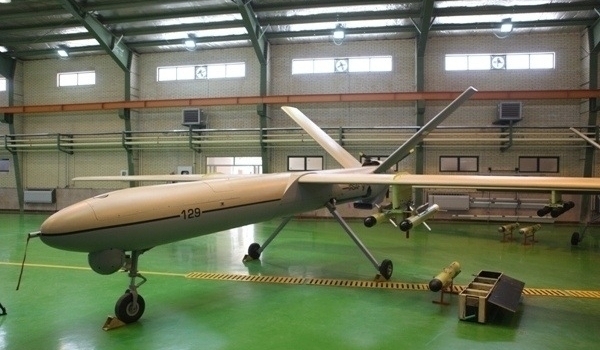
On 8 June 2017, a United States Air Force (USAF) F-15E Strike Eagle shot down an Iranian-produced Shahed 129 unmanned aerial vehicle (UAV) over Syria, followed just twelve days later by a second identical event. Earlier this year an Israeli fighter aircraft shot down a Hamas drone, just the most recent of at least half a dozen Israeli UAV kills occurring since October 2012. The face of aerial combat has changed in this era of UAVs, or ‘drones’ as they are commonly called. Aircrew are now more likely to engage UAVs than manned fighters in current and future aerial combat.
A Shahad-129 UAV.
The question of whether UAV kills should be counted as official aerial victories is unresolved and has recently been hotly debated on social media. In a small sampling of air power enthusiasts conducted by the author on Twitter, just 58% of respondents were in favour of counting UAVs as official kills that count towards ‘ace’ status (five aerial victories). Current USAF policy does not recognise UAV shoot downs as ‘kills,’ but it should. Aircrew should receive proper recognition for the destruction of an adversary’s air assets.
Based on the author’s discussion with current USAF pilots, operators, and air power historians and theorists, there are at least four clear arguments against counting UAV kills as official aerial victories that count towards ace status. First, shooting down a UAV does not require the skill associated with shooting down a manned aircraft. Second, UAVs cannot shoot back. Thus there is a limited risk in this type of engagement, a critical component of aerial combat. Third, and perhaps most importantly, there is not another pilot in the UAV, meaning the UAV cannot respond to adversary actions. Thus there is no ‘sport’ in the shoot down. Finally, there is a risk that allowing unmanned aircraft to count as official kills will open the floodgates to allow the destruction of all airborne objects to count as official aerial victories. I will provide counter-arguments to each of these points as part of my advocacy for modifying current USAF aerial victory criteria to include some classes of UAVs.
While UAVs may be relatively low and slow targets, shooting them down still requires skill and precise aerial employment. Detecting and engaging a UAV is not easy, its low altitude and speed can potentially cause problems for fighter pulsed-Doppler radars. The reduced radar cross section (RCS) of some UAVs also increases the difficulty of engagement. Shooting down a UAV requires detecting a small size and small RCS aircraft, positively identifying that aircraft (often difficult with small systems that do not emit many of the detectable signatures US aircraft typically use to identify adversary aircraft electronically), and guiding a weapon to kill the UAV. These functions; detecting, tracking, identifying, and guiding a weapon to the target are the same functions a fighter pilot would need to shoot down a MiG-29 FULCRUM or a Su-27 FLANKER. Based on my experience, most fighter pilots who have tried to engage a UAV in training or the real-world would agree that a significant amount of skill and tactical acumen is required to complete such a kill.
A USAF F-15E Strike Eagle receives fuel from a KC-135 Stratotanker over northern Iraq after conducting airstrikes in Syria, 23 September 2014. These aircraft were part of a large coalition strike package that was the first to strike ISIL targets in Syria. (Source: Wikimedia)
The second argument is based on the fact that most currently fielded UAVs are incapable of firing back at an adversary. Multiple arguments counter this point. First, an aircraft need not be able to return fire to be officially counted as an air-to-air kill. In Operation DESERT STORM, USAF F-15C pilot Greg ‘Dutch’ Masters was given credit for a kill on an Iraqi Air Force (IAF) IL-76 CANDID cargo aircraft. Second, most UAVs do have propelled munitions that could provide a limited ability to respond to an aerial attack. In 2002, a USAF MQ-1 PREDATOR fired an AGM-114 HELLFIRE air-to-ground missile (AGM) against an IAF MiG-25 FOXBAT, though the FOXBAT successfully shot down the PREDATOR. The Shahed 129s that were recently shot down were reportedly equipped with similar AGMs that could conceivably be used to fire on an adversary fighter aircraft. Lightly armed air-to-ground aircraft have always been counted towards official kill counts. In DESERT STORM, US aircraft shot down six helicopters and one aircraft armed with only limited air-to-ground munitions, and no dedicated air-to-air capability (three Mi-8 HIPs, one Mi-24 HIND, one Bo-105, and one Hughes 500 helicopters, and a PC-9 light attack aircraft).
The third argument is that UAVs do not have a pilot in the cockpit, and thus should not be counted as an aerial victory. Virtually all UAVs, even micro UAVs and drones, have an operator who is controlling the system; few UAVs simply fly a pre-programmed route without operator input. Most UAVs, especially the larger and more capable systems, also include a crew on the ground, typically a pilot and a sensor operator, who can build situational awareness of the operational environment, react to, avoid, and attempt to counter adversary attempts to shoot it down. Additionally, this argument ignores the changing face of aerial combat. The preponderance of air assets in future conflicts are likely to be unmanned in the future.
The final argument is that inclusion of UAVs into official kill criteria will risk widening the aperture of official aerial victories to include any airborne objects. Taken to its extreme, one could imagine the destruction of a mini drone or quadcopter being counted as an official kill. The simple solution to this problem is to specifically delineate the types of UAVs that will be considered official kills.
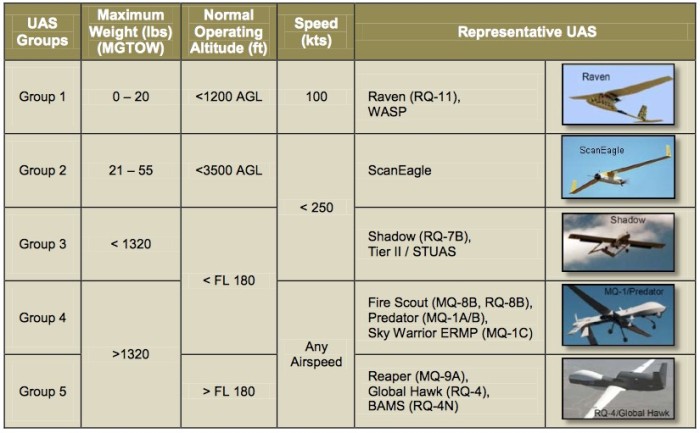
Not all UAV or drone kills should count as official air-to-air kills; the USAF should modify its existing kill criteria to include some classes of UAVs based on size and function of the system. The Department of Defense (DOD) has defined Unmanned Aircraft System (UAS) groups in their 2011 UAS Airspace Integration Plan. These groups are used to distinguish US classes of UAS’, but they also provide a useful method to make a distinction between adversary systems that should officially count as an air-to-air kill.
UAS Groups 1-3 are small airframes, have no or very limited ordnance, and are hand or catapult launched. These ‘micro UAVs’ and ‘drones’ should not officially count as a kill because of their limited ability to react or counter adversary actions, and to avoid the precedence of allowing all airborne assets to count for a kill (think about the ridiculousness of a silhouette of a remote-controlled quadcopter on the side of an F-15). UAS Groups 4 and 5, however, are UAVs that are typically operated by a pilot, are capable of medium-to-high altitude flight, longer range and endurance, beyond line-of-sight operations, and frequently carry propelled munitions that can conceivably be used for self-protection (as a frame of reference, the Shahed 129 would be classified as a Group 4 UAS). These capabilities mirror previous non-fighter aircraft which have been counted as official kills, such as heavily-armed but non-maneuverable balloons in World War I (5 of American ‘Ace of Aces’, Eddie Rickenbacker’s 26 WWI kills were balloons), cargo aircraft (IL-76 in DESERT STORM), and lightly armed helicopters (Bo-105 and Hughes 500 helicopters in DESERT STORM).
The US went 18 years between manned aircraft shoot downs, from the last MiG-29 kill of Operation ALLIED FORCE in 1999 to last week’s Su-22 FITTER kill. However, during this period UAVs have expanded exponentially in number and type, and recently have been targets for US aircrew flying over Syria defending coalition forces. It is time for the USAF, and DOD writ large, to recognise the changing character of aerial combat and designate kills on particular types of UAVs as official aerial victories. Such a decision would legitimately recognise tactical excellence in air combat and bring official aerial victory criteria up to date with changing character of 21st Century warfare.
Tyson Wetzel is a Major in the United States Air Force intelligence officer, a graduate of the United States Air Force Weapons School where he was also an instructor, and the US Marine Corps Command and Staff College. Tyson has deployed multiple times in support of Operations IRAQI FREEDOM, ENDURING FREEDOM, NEW DAWN, and NOBLE EAGLE. He is currently assigned to the Joint Staff at the Pentagon. He tweets @GetterWetzel.
Header Image: A pair of USAF F-15E Strike Eagles fly over northern Iraq early in the morning of 23 September 2014, after conducting airstrikes in Syria. These aircraft were part of a large coalition strike package that was the first to strike ISIL targets in Syria. (Source: Wikimedia)
Editor’s Note: In this two-part article, Dr Jyri Raitasalo considers what he argues are the two fundamental fallacies concerning the application of strategic air power by Western states in the modern era. In the first part, he examined the challenge of the use of military forces as a tool for solving political problems. In this second part, he examines the issue of ‘no casualty warfare.’
Fallacy 2: No casualty warfare
The second fallacy in Western air power paradigm touches on the notion of precision engagement with almost zero civilian casualties and no collateral damage. This narrative was formed in the aftermath of the 1991 Gulf War and has been maturing and strengthening ever since. Precision engagement has indeed become one of the game changers in warfare lately, but the Western narrative on pinpoint accuracy in warfare has become a strategic level hindrance to effective military operations.
The notion of no or little collateral damage developed into the Western air power paradigm little by little as political leaders since the early 1990s continuously decided to use military force actively for humanitarian purposes. It was a prerequisite that Western military operations do not cause civilian suffering or produce collateral damage in military operations (read: war) that are eventually humanitarian in nature. Focusing on the precise application of large-scale violence was thus a must for political purposes. It was needed for the legitimacy of these operations and to ‘sell’ these operations to domestic audiences within the Western world and internationally.
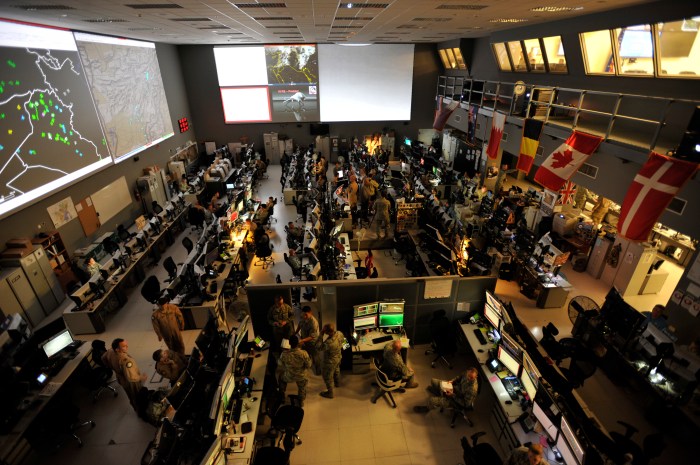
Combined Air and Space Operations Center at Al Udeid Air Base, Qatar, provides command and control of air power throughout Iraq, Syria, Afghanistan, and 17 other nations. The CAOC is comprised of a joint and Coalition team that executes day-to-day combined air and space operations and provides rapid reaction, positive control, coordination, and de-confliction of weapon systems. (Source: US Department of Defense via Wikimedia)
Also, as these humanitarian military missions had almost nothing to do with Western national interests or threats to Western states, it has been crystal clear from the start that force protection has been essential in these operations. Over time this has developed into a tradition of casualty-aversiveness, making Western soldiers ‘strategic assets’. Air power has facilitated safe military operations as practically all opponents during the post-Cold War era have had no functioning air forces of capable air defences. Relying on air power to fight humanitarian wars has been practically the only way that these operations have become possible in the first place. As President Bill Clinton explained: ‘I do not intend to put our troops in Kosovo to fight a war’. For the US the post-9/11 Global War on Terror changed this aversiveness to send troops to battle for a while.
What started as a way to ‘market’ humanitarian missions to voters and the general population has turned into a Western narrative on war, which accentuates the ability to strictly control the ‘dosing’ of violence in wars and being able to fight without civilian casualties and collateral damage. During the post-Cold War era, this guiding political principle and a semi-binding Western norm on warfare have led to Western militaries developing extremely expensive military systems to fight this ‘frictionless precision warfare’. This trend has been tremendously problematic for European states, as they in most cases do not have sufficient economic resources to develop their armed forces into credible military actors with even a modest number of usable high-tech military systems. When combining this trend with the post-Cold War era professionalisation of European militaries, most states in Europe today possess ‘Lilliputian militaries’ with little warfighting capability for large-scale conventional war against advanced state adversaries.
Final thoughts
Air power is important in warfare. Moreover, modern high-tech air forces can produce a decisive effect on the battlefield when used properly. ‘Unfortunately’ for some Western (mostly European) militaries, the post-Cold War era did not for more than 20 years pose any real military challenges that would have required sober analysis on what kind of missions the armed forces should be preparing against. Moreover, more importantly, as the existential threat evaporated quickly in the early 1990s, many Western political leaders filled the vacuum of security threats by turning their eyes towards out-of-area conflicts and stability throughout the globalising world.
In a cumulative 20-year long emergent process, Western states have become more and more interested in and reliant on applying air power actively in expeditionary operations because using military force throughout the international system has become possible. Political leader’s ‘trigger happiness’ in the West has increased during the post-Cold War era. On the tactical and operational levels of war, air power offers ‘easy solutions’ when there is the need to do something quickly and visibly – for example during large-scale atrocities committed by authoritarian leaders towards their citizen. On the strategic level, though, the results have been much more modest. Modern air power has not lifted the ‘fog of war’, nor has it produced many positive strategic results. Air power does not provide Western states with a ‘silver bullet’, nor has it changed the nature of war: war is still a duel of wills, which means that adaptive enemies will do their utmost to destabilise Western strengths and lead in military capability development. This can be done at the tactical, operational or strategic levels.
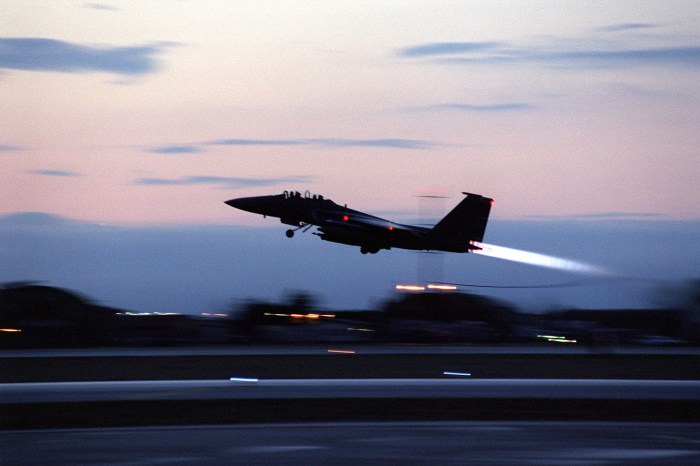
A USAF F-15E Strike Eagle takes off from Aviano Air Base, Italy, for an air strike mission in support of NATO Operation ALLIED FORCE on March 28, 1999. (Source: US Department of Defense via Wikimedia)
The use of large-scale military violence – waging war – needs to be taken seriously. Even if it is possible to cause pinpoint destruction and make targeted killings, one should remember that political problems can rarely be solved by killing all the opponents (from afar) or by punishing them severely. The active use of Western air power during the last 20 years has resulted in the lowering the threshold on the use of military force in the world. This could backfire in the future as China and Russia are increasing their military capabilities and great-power statuses.
Dr Jyri Raitasalo is a Lieutenant-Colonel in the Finnish military and a Senior Staff Officer at the Planning Unit (strategic planning) of the Finnish Ministry of Defence. He holds the title of Docent of strategy and security policy at the Finnish National Defence University. During his latest assignments, he has served as the Commanding Officer of the Helsinki Air Defence Regiment (Armoured Brigade), Head Lecturer of Strategy at the Finnish National Defence University, ADC to the Chief of Defence and Staff Officer (strategic planning) in the Finnish Defence Command (J5). Jyri Raitasalo is a called member of the Royal Swedish Academy of War Sciences.
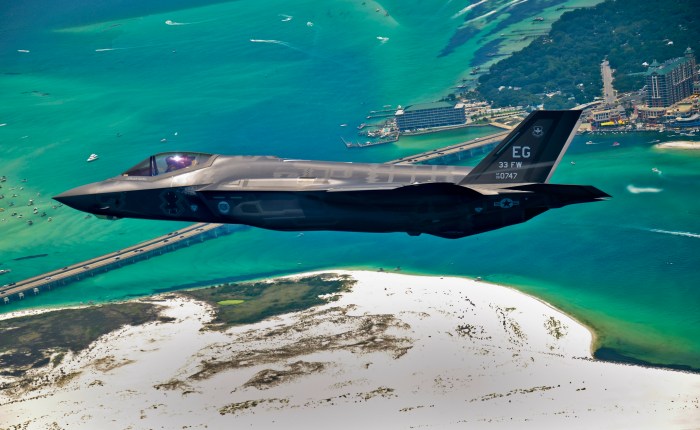
Header Image: The Department of Defense’s first U.S. Air Force F-35 Lightning II joint strike fighter (JSF) aircraft soars over Destin, before landing at its new home at Eglin Air Force Base, July 14, 2011. (Source: US Department of Defense via Wikimedia)
Editor’s Note: In this two-part article, Dr Jyri Raitasalo considers what he argues are the two fundamental fallacies concerning the application of strategic air power by Western states in the modern era. In this first part, he considers the challenge of the use of military forces as a tool for solving political problems. The second part of this article can be found here.
Ever since the 1991 Gulf War, the Western strategic discourse on air power has accentuated the role of high-tech precision-guided weapons together with good situational awareness and reliable command and control systems in solving modern conflicts. After the lessons learned from Operation DESERT STORM were drawn, one of the main tenets of western strategic thinking has been the (over-)reliance on the possibilities to solve political conflicts with modern weaponry – from the air. This notion did not emerge out of thin air. It was one answer to the many demands that Western statesmen – first and foremost among them the President of the United States – made immediately after the Cold War had ended. Since the early 1990s, the international security environment developed positively – at least from the western states’ perspective. However, the world was still infected with many low-level threats that rose in significance simultaneously as the Soviet threat evaporated.
The so-called Revolution in Military Affairs (RMA) has been expected to deliver positive outcomes to political crises with little risk to Western soldiers or national interests – whether in Bosnia (1995), Kosovo (1999), Afghanistan (2001), Iraq (2003) or Libya (2011). Many western ‘wars of choice’ – under the headings of ‘humanitarian interventions’, ‘military crisis management operations’ or ‘expeditionary missions’ have been made possible – and in some cases necessary – by the demands of the contemporary 24/7 media, high-tech ‘revolutionary’ warfighting capabilities and the fading of the existential threat posed by the Soviet Union.
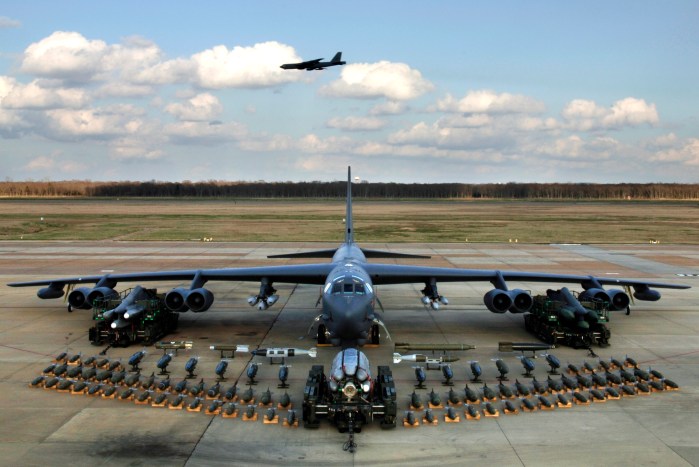
A US Air Force Boeing B-52H Stratofortress of the 2d Bomb Wing static display with weapons, at Barksdale Air Force Base, Louisiana, in 2006. (Source: Wikimedia)
During the 25 years of the post-Cold War era, Western air power ‘theory’ – based on the expectations of Western political leaders – has entertained the notion of strategic success in war just by deploying air assets against chosen adversaries. During this time we have witnessed the mystification of air power – the new ‘silver bullet’ – to epic proportions in a way that practical results from recent wars lend little support. Analysing recent western air wars from Bosnia (1995) to Libya (2011) one can easily detect that none of them has proved to be strategic successes for the west. Thus the ‘brand’ of contemporary Western air power is better than its actual track record. None of the often mentioned ‘successes’ have facilitated long-term positive outcomes.
The contemporary Western air war paradigm is based on two fallacies: the idea that high-tech military capabilities facilitate easy solving of political problems and the notion of almost casualty-free warfighting. Both of these should be subjected to strict scrutiny. It should be noted that it is not the militaries’ fault that political leaders have expressed repeated demands to the use of military force that are beyond the boundaries that existing military capabilities can deliver. However, to facilitate better strategies in the future, these fallacies will be elaborated next.
Fallacy 1: The use of military force is an effective tool to solve political problems
It is good to acknowledge that the number of armed conflicts – and the average number of people killed in these conflicts – has decreased during the post-Cold War era. As the Human Security Report Project noted in 2014, we have witnessed:
the rapid decline in international wars (anti-colonial wars are included in this category) over the past 60 odd years. The average number of international wars being fought every year per decade shrinks dramatically – from over six in the 1950s to less than one in the 2000s. […] From the early 1990s to the present day, overall conflict numbers have dropped by some 40 percent, while the deadliest conflicts, those that kill at least 1,000 people a year, have declined by more than half.
Despite the positive trend in warfare since the end of the Cold War, there have been many brutal cases where large-scale human suffering and damaged infrastructure have caused concern within the western security community. First of these instances was ‘born’ out of the result of the 1991 Gulf War: the predicament that the Kurds (in the north) and the Shia population (in the south) faced after Saddam Hussein was defeated – but remained in power. Moreover, many others have followed: from Somalia to Haiti, and from Timor-Leste to Kosovo.
The humanitarian suffering brought to our living rooms by the 24/7 media – and later by social media, smartphones and tablets – has become a new factor influencing western decisions in the use of military force in the world. Although most of the (air) wars that the West has waged during the post-Cold War era have almost nothing to do with Western national security directly, there has been the need to do something to ease humanitarian conditions and suffering around the world in the many crises that have been ongoing – from Iraq to Somalia and Haiti to Libya. Thus, the western approach to ‘humanitarian interventions’ and the ‘Responsibility to Protect’ (R2P) emerged to fill in the void that the end of the Cold War caused within the western threat perceptions.
Facing no existential threats, for the past 25 years, Western states have had the luxury of focusing on crises around the world where large masses of people have been violently oppressed. Moreover, the tools of the ongoing RMA – precision air strikes as the forerunner – seemed to propose a possibility to manage these humanitarian crises with little cost – in either blood or treasure. As was noted after the Gulf War:
A significant part of that edge [US’s edge versus Iraq] can be attributed to the revolutionary new military technology used by U.S. forces for the first time in Gulf War.
In other words, the lessons learned from the Gulf War – where Saddam Hussein’s big Army was easily defeated on the battlefield – have influenced the way that Western political leaders have been trying to solve violent political crises out-of-area.
However, the problem lies exactly here: the complex, violent crises around the world cannot be solved by precision bombing or by killing the ‘bad guys’. The politicisation of ethnicity and religion, the criminal elements involved and the contradictory political goals of multiple adversaries in most of the contemporary violent crises mean that externally imposed military solutions will not work. As has been noted in connection with the 2001 US-launched Global War on Terror, it is hard to kill enough terrorists without at the same time facilitating additional terrorist recruiting and providing additional PR for the terrorist cause.
It is understandable that political leaders resort to the use of military force relying on advanced weaponry to solve nasty crises around the world. The humane instincts of Western strategic decision-makers are understandable and praiseworthy. However, the sad part is that strategically, the use of military force has not been able to bring about political reconciliation or stability into ongoing conflict zones. On the contrary, the first ‘RMA air-war’ in history – the 1991 Gulf War – produced a political stalemate that resulted in a war of attrition against Iraq between 1991-2003. This attrition warfare manifested itself through the enforcement of no-fly zones and punitive air strikes against Iraq every time Saddam’s troops violated the rules imposed on them.
Even though the first Gulf War did not bring a politically favourable outcome vis-à-vis Iraq, the lessons drawn from that campaign at the operational level influenced how air power was used in Bosnia and Kosovo during the 1990s. The two air wars in Europe – in Bosnia 1995 and over Serbia in 1999 – have not till today produced lasting strategic outcomes that would be favourable to western states. Both are practically failed states, which can take a turn for the worse at any time. Also, in today’s tense international environment, the very unstable situation in Bosnia and Kosovo provide ample opportunities for Russia to manipulate the West.
It is noteworthy that immediately after the Kosovo air war, the US Secretary of Defense William Cohen noted that:
[…] what we were able to achieve through this [Kosovo] campaign reminds all of us that the revolution in military affairs is fundamentally changing the way in which we fight. […] In Operation Desert Storm, […], there were only a handful of sophisticated aircraft that could carry precision-guided munitions, […] In Kosovo, nearly all of our fighters could deliver these devastating weapons.
Cohen’s remarks are spot on when looked from tactical or operational perspectives. On the strategic level, however, the effects of “devastating weapons” do not automatically turn into political objectives.
To be fair, it must be noted that air power was eventually able to stop ethnic violence in the former Yugoslavia, but whether the level of violence increased because of the air wars or not, is still debatable. In any case, both Bosnia and Kosovo have shed light also on the negative impact of western air power: the mere existence of highly capable western (read: US) Air Forces – together with the global 24/7 media – facilitated the increase of violence both in Bosnia and Kosovo as the West was lured into these crises by attacks on the ground that aimed to escalate the conflict – not to end it. The Western humanitarian intervention approach was in its formative years, and the belligerents on the ground in Bosnia and Kosovo knew how to take advantage of it. After the terrible case of the Rwandan genocide in 1994, it was easy to exploit the willingness of the West to do more – even by escalating ethnic cleansing to draw the West into the conflict.
The second round of large-scale air warfare against Iraq took place through a campaign of ‘shock and awe’ in 2003. It was accompanied and followed by mechanised thrusts to destroy Saddam’s Army, a task that the United States and its allies succeeded to do. However, this operational success was not followed by the fulfilment of strategic goals. Air power was not able to solve the post-Saddam political crisis in Iraq – a fate also shared by the Army and the Marine Corps throughout the subsequent counter-insurgency (CI) operation, which resulted in the withdrawal of US troops after years of fighting and thousands of casualties. The breaking up of Iraq’s state structures, administrative routines and security forces also facilitated the birth of ISIL and the increase of violence and instability in the region. In all, the 2003 war in Iraq – and the chaos that has followed – has proved to be a strategic mistake of massive scale. The possibilities of quick high-tech warfare against much weaker traditional conventional army lured the US into a process that eventually became uncontrollable. This is the true essence of war – that competitive advantage in one sphere of war-fighting (e.g. technology) can be mitigated or even nullified by another (e.g. tactical asymmetry). There are no ‘silver bullets’ – at least not for long.
Two fully armed RAF Tornados from RAF Marham transit the Mediterranean Sea en-route to Libya as part of the UK’s Operation ELLAMY to enforce the UN no-fly zone in March 2011. (Source: Defence Imagery, MoD)
Finally, the air war against Muammar Gaddafi’s Libya in 2011 – NATO operation Unified Protector – helped to set in motion a crisis that will influence European security for years to come – negatively, not to mention the additional suffering to ordinary Libyans. Today Libya is a failed state with multiple armed forces fighting over power and economic benefits. Also, Libya has become one of the bases for extremist terrorism. Operation Unified Protector showed the might of advanced air power by destroying the Gaddafi regime, but the strategic consequences of the operation will haunt the West – and Europe particularly – for years to come.
Dr Jyri Raitasalo is a Lieutenant-Colonel in the Finnish military and a Senior Staff Officer at the Planning Unit (strategic planning) of the Finnish Ministry of Defence. He holds the title of Docent of strategy and security policy at the Finnish National Defence University. During his latest assignments, he has served as the Commanding Officer of the Helsinki Air Defence Regiment (Armoured Brigade), Head Lecturer of Strategy at the Finnish National Defence University, ADC to the Chief of Defence and Staff Officer (strategic planning) in the Finnish Defence Command (J5). Jyri Raitasalo is a called member of the Royal Swedish Academy of War Sciences.
Header Image: An F/A-18 Hornet of VFA-94 carrying out operations in support of Operation Enduring Freedom in 2001. Visible on the wing are two 500-pound Laser Guided Bomb Units (GBU-12) (left), and an AIM-9 Sidewinder air-to-air missile. (Source: Wikimedia)







 From Balloons to Drones


