Editorial Note: Led by Editor Dr Mike Hankins, From Balloons to Drones produces a monthly podcast that provides an outlet for the presentation and evaluation of air power scholarship, the exploration of historical topics and ideas, and provides a way to reach out to both new scholars and the general public. You can find our Soundcloud channel here. You can also find our podcast on Apple Podcasts and Google Podcasts.
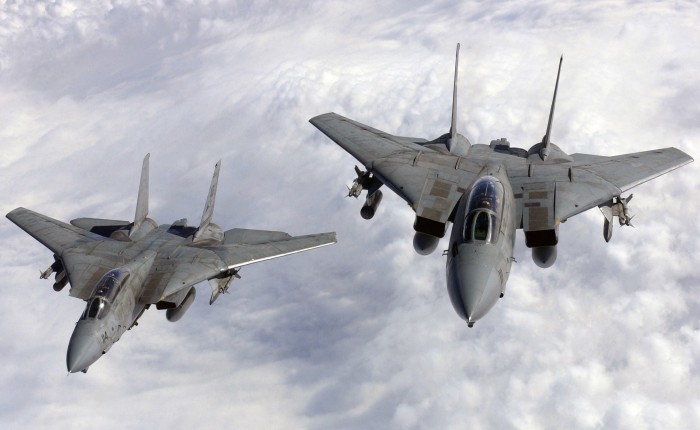
Our latest episode concerns the Grumann F-14 Tomcat and the McDonnell Douglas F-15 Eagle, two popular and historically significant aeroplanes. We arere joined by Dr Tal Tovy, senior lecturer at Bar-Ilan University in Israel and author of Tomcats and Eagles: The Development of the F-14 and F-15 in the Cold War (2022) from Naval Institute Press. Tovy gives us an up-close look at the motivation behind designing these aircraft and speaks to how the Israeli Air Force experience had a particular influence.
Dr Tal Tovy is a Senior Lecturer at Bar-Ilan University in Israel. He holds a PhD in history from the University of Haifa. A veteran of the Israel Defense Forces, Tovy has published extensively on various military history topics, including the influence of counterinsurgency theory upon American combat operations. His other fields of interest include Western military thought and U.S. military history. Tovy is the author of two previous books: The Changing Nature of Geostrategy 1900-2000: The Evolution of a New Paradigm and The Gulf of Tonkin: The United States and the Escalation in the Vietnam War.
Header image: A pair of US Navy Grumman F-14A Tomcats from VF-211 in flight over Iraq in December 2003. VF-211 was assigned to Carrier Air Wing 1 aboard the aircraft carrier USS Enterprise for a deployment to the Mediterranean Sea and the Indian Ocean from 28 August 2003 to 29 February 2004. (Source: Wikimedia)
Established in 2016, From Balloons to Drones is an online scholarly platform that analyses and debates air power history (including aviation history), theory, and contemporary operations in their broadest sense, including space and cyber power. To date, we have published over 250 articles on various air power-related subjects.
Since its emergence at the start of the 20th Century, air power has increasingly become the preferred form of military power for many governments. However, the application and development of air power are controversial and often misunderstood. To remedy this, From Balloons to Drones seeks to provide analysis and debate about air power through the publication of articles, research notes, commentaries, book reviews, and historic book reviews – see below for a description of the range of articles published.
The study of air power is to be understood broadly, encompassing not only the history of air warfare, including social and cultural aspects, but also incorporating contributions from related fields, such as archaeology, international relations, strategic studies, law and ethics. Possible subjects to be explored might include, but are not limited to:
Strategy, Theory and Doctrine | Organisation and Policy | Roles
Operations – Kinetic and Non-Kinetic | Tactics, Training and Procedures
Strategic and Operational Effect | Technological Developments
Ethical and Moral Issues | National, International and Transnational Experiences
Personal Experiences | Culture | Memory and Memorialisation
From Balloons to Drones welcomes and encourages potential submissions from postgraduates, academics, and practitioners involved in researching the subject of air power.
A US Air Force Fairchild C-119B Flying Boxcar air-dropping supplies near Chungju, Korea, in 1951. (Source: Wikimedia)
We publish:
Scholarly Articles
From Balloons to Drones publishes informative, peer-reviewed articles on air power that range from historical pieces to the analysis of contemporary challenges. These well-researched articles aim to bridge the gap between specialist and non-specialist readers. They should be around c. 3,000 words, though From Balloons to Drones will accept longer pieces. We reserve the right to publish them in parts.
Air War Books
From Balloons to Drones publishes a series of review articles that examine the top ten books that have influenced writers on air power. See more here.
Commentaries
From Balloons to Drones publishes opinion pieces on recent news on either contemporary or historical subjects. These should be no longer than c.1,000 words.
Research Notes
From Balloons to Drones publishes research notes on contributors’ current research projects. These take the form of more informal pieces and can be discussions of a source or notes on a recent research theme. These should be c.500 to 1,000 words.
Book Reviews
From Balloons to Drones publishes regular book reviews that aim to be an accessible collection of appraisals of recent publications about air power. If you are a publisher interested in having your publication reviewed, please contact us at the email address below. See more here.
Historic Book Reviews
From Balloons to Drones publishes occasional historic book reviews that aim to be an accessible collection of appraisals of critical historic publications about air power history, theory, and practice. See more here.
Submissions should be submitted in Word format and emailed to the address below with ‘SUBMISSION’ in the subject line. Also, please include a 50-100-word biography with your submission. References can be used, and please be careful to explain any jargon. However, if you are unsure if your idea fits our requirements, please email us with ‘POTENTIAL SUBMISSION’ in the subject line to discuss.
If you are interested in contributing, please email our Editor-in-Chief, Dr Ross Mahoney, at airpowerstudies@gmail.com or via our contact page here.
Header image: A Panavia Tornado GR4 of No. IX(B) Squadron on a training sortie in preparation for deployment to Afghanistan, c. 2012. (Source: Wikimedia)
Editorial Note: Led by Editor Dr Mike Hankins, From Balloons to Drones produces a monthly podcast that provides an outlet for the presentation and evaluation of air power scholarship, the exploration of historical topics and ideas, and provides a way to reach out to both new scholars and the general public. You can find our Soundcloud channel here. You can also find our podcast on Apple Podcasts and Google Podcasts.
50 years ago, in January 1973, the Paris Peace Accords were signed. This ended major U.S. combat operations in the Vietnam War. To look back on the air campaigns that were so crucial to that war, we talk with Dr Michael Weaver, assistant professor at the US Air Force’s Air Command and Staff College and author of The Air War in Vietnam from Texas Tech University Press. Join us as we look at the use of air power in Southeast Asia and talk about some of the legacies it leaves behind.
Dr Michael E. Weaver is an Associate Professor of History at the USAF Air Command and Staff College. He has authored five air power articles and a book on the 28th Infantry Division. His second book, The Air War in Vietnam, was published in 2022. Weaver received his doctorate from Temple University in 2002, where he studied under Russell Weigley.
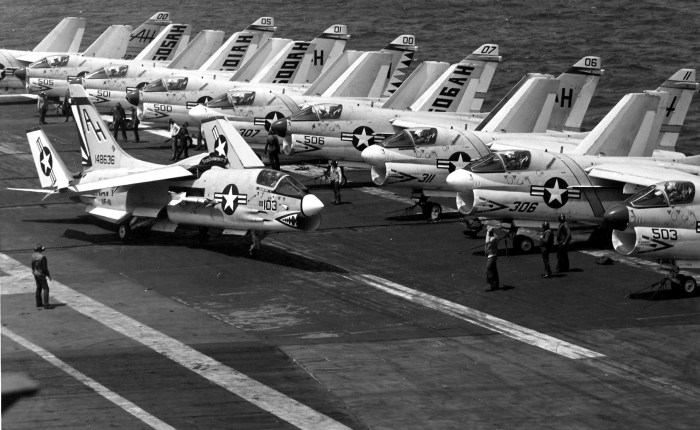
Header image: View of the flight deck of the USS Ticonderoga (CVA-14) during her last deployment to Vietnam as an attack carrier between 1 February and 18 September 1969. Various aircraft of Carrier Air Wing 16 are visible on deck: a Vought F-8H Crusader of VF-111 ‘Sundowners,’ four LTV A-7B Corsair II of VA-87 ‘Golden Warriors,’ and five A-7Bs of VA-25 ‘Fist of the Fleet.’ (Source: Wikimedia)
Editorial Note: Led by our Editor Dr Mike Hankins, From Balloons to Drones produces a monthly podcast that provides an outlet for the presentation and evaluation of air power scholarship, the exploration of historical topics and ideas, and provides a way to reach out to both new scholars and the general public. You can find our Soundcloud channel here. You can also find our podcast on Apple Podcasts and Google Podcasts.
With the threat of nuclear war rising once again as tension among global powers increases, in our latest podcast, we talk to Professor Sean M. Maloney of the Royal Military College of Canada to look at what the nuclear war plans of the U.S. were during the early Cold War. We also discuss what a nuclear war might have looked like, and how it would have potentially been waged.
Dr Sean M. Maloney is a Professor of History at the Royal Military College and served as the Historical Advisor to the Chief of the Land Staff during the war in Afghanistan. He previously served as the historian for 4 Canadian Mechanized Brigade, the Canadian Army’s primary Cold War NATO commitment after the reunification of Germany and at the start of Canada’s long involvement in the Balkans. He is the author of numerous works, and his latest book is Emergency War Plan: The American Doomsday Machine, 1945–1960 (2021).
Header image: A Boeing B-47B undertaking a rocket-assisted take-off. The black smoke from engines indicates that water-methanol injection is in use. (Source: Wikimedia)
Editorial Note: Led by our Editor Dr Mike Hankins, From Balloons to Drones produces a monthly podcast that provides an outlet for the presentation and evaluation of air power scholarship, the exploration of historical topics and ideas, and provides a way to reach out to both new scholars and the general public. You can find our Soundcloud channel here. You can also find our podcast on Apple Podcasts and Google Podcasts.
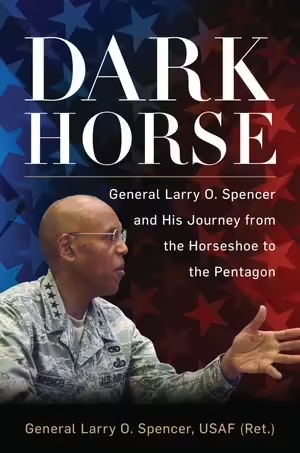
In our latest podcast, we are joined by General Larry O. Spencer, former Vice Chief of Staff of the U. S. Air Force. He recounts his journey from being raised in Southeast Washington, D. C. to enlisting in the U. S. Air Force and eventually rising through the ranks to become one of only nine African Americans to wear four stars. General Spencer’s background as a support officer in an organization that tends to favour pilots and aircrews brings a different lens through which to look at the USAF and the use of air power.
General (ret’d) Larry O. Spencer served as Vice Chief of Staff of the U.S. Air Force until his retirement in 2015. As VCSAF, he presided over the Air Staff and served as a member of the Joint Chiefs of Staff Requirements Oversight Council and Deputy Advisory Working Group. He assisted the Chief of Staff with organising, training, and equipping 664,000 active-duty, Guard, Reserve, and civilian forces serving in the United States and overseas. Spencer was born in Washington, D.C. He received his Bachelor of Science degree in industrial engineering technology from Southern Illinois University, Carbondale, and was commissioned through Officer Training School in 1980 as a distinguished graduate. Spencer has commanded a squadron, group and wing and was Vice Commander of the Oklahoma City Air Logistics Center. He was also the first Air Force officer to serve as Assistant Chief of Staff in the White House Military Office. In addition, he served as the Comptroller and then Director of Mission Support (A7) at a major command; and held positions within the Air Staff and Secretary of the Air Force. Before becoming VCSAF, Spencer was Director, Force Structure, Resources and Assessment, Joint Staff, the Pentagon, Washington, D.C.
Header image: General Larry O Spencer outside his family home in Washington DC, 30 July 2015 (Source: United States Air Force)
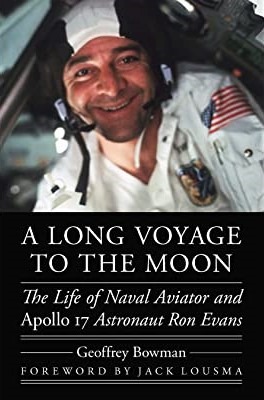
Geoffrey Bowman, A Long Voyage to the Moon: The Life of Naval Aviator and Apollo 17 Astronaut Ron Evans. Lincoln, NE: University Press of Nebraska, 2021. Foreword. Images. Sources. Hbk, 377 pp.
Reviewed by Dr Brian Laslie
Ronald E. Evans is not a household name. Names such as Alan Shepard, Gus Grissom, and Neil Armstrong remain more or less recognisable to the wider society. Indeed, even later Apollo astronauts, such as Pete Conrad, Alan Bean, Jim Lovell, or John Young, might still trigger images or recognition to a particular generation or those interested in the history of space flight. However, Evans has been significantly overlooked. That is what being the last person to do something will get you: obscurity. Evans was a member of Apollo 17, the last crewed mission to the moon. As such, he was the last Command Module Pilot to fly as part of the Apollo program. Evans also holds several other auspicious accolades. He holds the record for the most time spent in lunar orbit; he was the last man to orbit the moon alone and was the last man to conduct a deep space extravehicular activity. Indeed, Evans was one of only three individuals to have ever done a deep space extravehicular activity. In addition, he remains one of only 24 individuals to ever journey beyond Earth’s orbit into deep space and travel to another celestial body.
After reading the above, it should be apparent that being the last person to do something does not mean your name should end in relative obscurity, placed in a footnote, or known only to those with a passion for all things space. The omission of an Evans biography has finally been corrected by author Geoffrey Bowman and his recent book A Long Voyage to the Moon: The Life of Naval Aviator and Apollo 17 Astronaut Ron Evans which comes out of the University Press of Nebraska stables as part of their absolutely stellar Outward Odyssey Series.
The prime crew for the Apollo 17 lunar landing mission: Commander, Eugene A. Cernan (seated), Command Module pilot Ronald E. Evans (standing on right), and Lunar Module pilot, Harrison H. Schmitt, 10 October 1972. The Apollo 17 Saturn V Moon rocket is in the background. (Source: Wikimedia)
Bowman successfully highlights the contributions of Evans to the US Navy as he flew missions over North Vietnam before his selection to NASA and his steady progression as a member of various support crews and backup Command Module Pilot on Apollo 14 before landing in a prime spot as the Command Module Pilot for Apollo 17. Moreover, Evans is unique among the Apollo astronauts as the only ‘moon man’ and Vietnam combat veteran. Throughout the narrative, Bowman pulls together the words and remembrances of Evans’ fellow astronauts and the astronaut wives. The use of the recollections of astronaut’s wives is something missing in older histories of the Apollo program. One of the primary contributors to Bowman’s research was a series of interviews with Evan’s wife Jan, and the author makes excellent use of her perspective throughout the narrative. That being said, when Bowman settles into Evan’s training for and flying Apollo, the author’s ability takes flight. Bowman proves he is much more comfortable with who Evans is and his contributions to the Apollo program.
Much like Evans himself, Bowman has worked doggedly to produce this history, and the author and press should be proud of the result. However, as a historian more bent toward academic endnotes, the lack of sourcing continues to be a problem in an otherwise magnificent series. While the Outward Odyssey series is the single best multi-volume series on the complete history of crewed spaceflight, it is sometimes frustrating not to know where a particular quote came from, but that is a relatively minor gripe. As I own all the books in this series, it has clearly not stopped me from continuing to purchase these books.
Ultimately, this work will appeal to those who simply cannot read enough about the history of crewed space flight. We should all be thankful that Bowman has written this book and shined a light on this historic aviator and space traveller.
Dr Brian Laslie is an Air Force Historian and currently the Command Historian at the United States Air Force Academy. A 2001 graduate of The Citadel and a historian of air and space power studies, he received his PhD from Kansas State University in 2013. His first book, The Air Force Way of War (2015), was selected for the Chief of Staff of the Air Force’s and the Royal Air Force’s Chief of the Air Staff professional reading lists. He is also the author of several books on air force and air power history. He lives in Colorado Springs. He can be found on Twitter at @BrianLaslie.
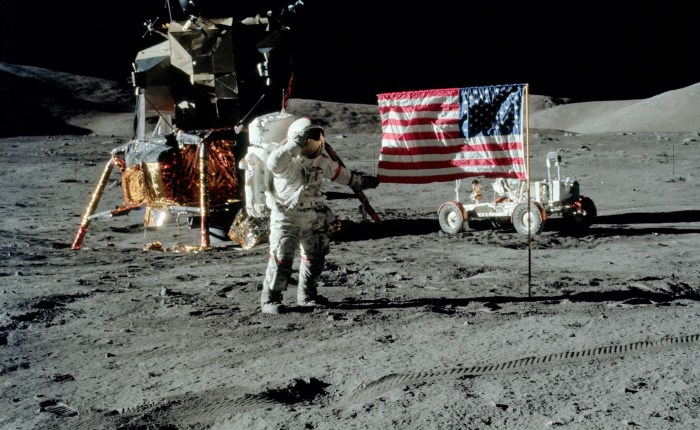
Header image: Eugene Cernan on the Moon during the Apollo 17 mission, 12 December 1972. (Source: Wikimedia)
Michael Napier, Korean Air War: Sabres, Migs and Meteors, 1950-53. Oxford: Osprey Publishing, 2021. Images. Notes. Bibliography. Glossary. Appendices. Index. Hbk. 320pp.
Reviewed by Dr Ross Mahoney
In the western world, the Korean War is often thought of as the forgotten war of the early Cold War. This was, at least from an American perspective, because ‘[l]ike the proverbial shrimp caught between two whales, the Korean War [was] trapped between World War II and the Vietnam War.’[1] Furthermore, from a British and French perspective, the war does not easily fit into national narratives surrounding their ‘retreat’ from empires in Southeast Asia, namely the Malayan Emergency and the French-Indochina War. The Korean War did, however, significantly impact the Cold War’s early course, particularly strengthening the recently established North Atlantic Treaty Organisation.
From the perspective of the application and development of air power, the Korean War was also significant. Specifically, it was the first time jet fighters met in combat. Furthermore, the war also saw a wide range of air power capabilities deployed over Korea, including discussions throughout the conflict about the potential delivery of nuclear weapons.[2] This has meant that, despite the unfortunate epithet of being a forgotten war, several important works, such as Conrad Crane’s American Airpower Strategy in Korea (2000), have appeared and examined the use of air power over the Korean peninsula.
Michael Napier, a retired Royal Air Force fast-jet pilot and author, comes into this mix with his 2021 volume, Korean Air War. In just over 300 pages, Napier systematically describes the course of the air war over Korea. The book, chronologically laid out, deals with the air war in seven chapters plus a retrospective to finish the volume. There are also two appendices included. The chapters follow the broad course of the main phases of the Korean War. For example, Chapter Three deals with the period of the offensive by United Nations (UN) forces between August and October 1950 (pp. 72-113). This is then followed up by a chapter that looks at the period of the Chinese offensives (pp. 114-55) against UN forces that forced them back to roughly the 38th Parallel. Within these chapters, Napier details the various uses of air power by both sides during the war. This includes the use of tactical and strategic air power as well as naval air power. Napier also does a good job of describing the coalition character of the air war for both sides. However, his attempt to highlight the British contribution can sometimes be overstated.
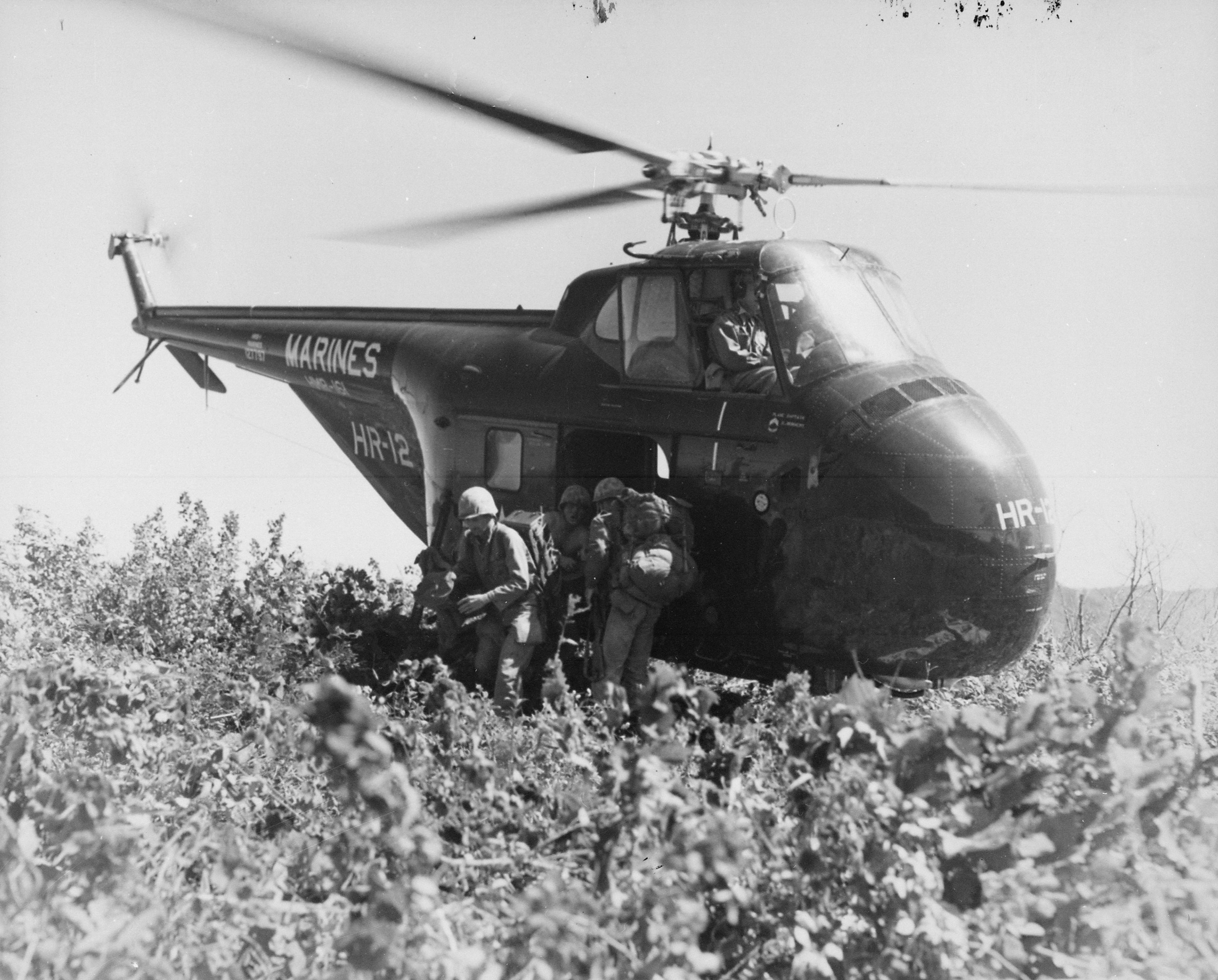
US Marines of the First Marine Division Reconnaissance Company make the first helicopter invasion on Hill 812, to relieve the Republic of Korea 8th Division, during the renewed fighting in Korea, 20 September 1951. (Source: Wikimedia)
While the book comprehensively deals with the air war over Korea, readers should not expect an academic examination of the use of air power between 1950 and 1953. That is not what this book is. However, this is not a criticism per se. Instead, the book has been written with a specific audience in mind – the general reader looking for an introduction to the subject. This is highlighted by Napier’s choice to examine the war chronologically (p. 6). This is a choice that makes it easier for the lay reader to understand what was a complex and contested operating environment. Ultimately, therefore, we end up with a very useful narrative of the course of the air war that introduces readers to the subject matter.
One area, however, where the book does fall down is in its use of sources. Regarding primary sources, Napier has overwhelmingly relied on files in British archival institutions, notably The National Archives and the Royal Air Force Museum. While perhaps a pragmatic decision given the author’s location and the character of this book as a popular account of the air war, it does, nonetheless, skew the author’s interpretation. Furthermore, at least from the perspective of UN forces deployed, most of the air power deployed in support of the war effort came from the US. As such, one would expect more attention to be given to the records produced by those forces involved. Finally, given the above issue, Napier relies on secondary sources to fill in the gaps despite arguing that published accounts of the air war over Korea were less than ‘objective’ (p. 6) in their analysis. However, it appears from the notes and bibliography that Napier did not consult important, more ‘objective’ works such as Crane’s noted above and others.[3] The use of such works would have further enriched Napier’s narrative
Overall, despite the above criticism, Napier has done an excellent job of writing a comprehensive introductory narrative to the air war over Korea. In particular, Napier does a good job of weaving together a narrative that tells the story of both sides of the air war over Korea. The book is lavishly supported by high-quality imagery and maps that help support the text.
Dr Ross Mahoney is the Editor-in-Chief of From Balloons to Drones and is an independent scholar specialising in air power and the history of air warfare. He is currently the Senior Historian within the City Architecture and Heritage Team at Brisbane City Council in Australia. He has over 15 years of experience within the heritage and education sectors in Australia and the United Kingdom. He was the inaugural Historian at the Royal Air Force Museum in the UK. In Australia, he has worked as a Historian for the Department of Veterans’ Affairs and taught at the Strategic and Defence Studies Centre at The Australian National University based at the Australian War College. His research interests are focused on military history, with a specific focus on the history of air warfare, transport history, and urban history. He has published several chapters and articles, edited two books, and delivered papers on three continents. He has a website here and can be found on Twitter at @airpowerhistory.
Header image: Four US Air Force North American F-86E Sabre fighters over Korea in November 1952. (Source: Wikimedia)
[1] Allan Millett, The War for Korea, 1945-1950: A House Burning (Lawrence, KS: University Press of Kansas, 2005), p. 1.
[2] Daniel Calingaert, ‘Nuclear weapons and the Korean War,’ Journal of Strategic Studies 11, no. 2 (1988), pp. 177-202.
[3] Other works of note not cited include: Eduard Mark, Aerial Interdiction: Air Power and the Land Battle in Three American Wars (Washington DC: Office of Air Force History, 1994); John Sherwood, Officers in Flight Suits: The Story of American Air Force Fighter Pilots in the Korean War (New York, NY: New York University Press, 1998); Jacob Neufeld, Coalition Air Warfare in the Korean War 1950–1953 (Washington DC: U.S. Air Force History and Museums Program, 2005); Roger Horky, ‘Clipping the Eagle’s Wings: The Limiting of the Korean Air War, 1950-1953’ (PhD Thesis, Texas A&M University, 2013).
Editorial Note: Led by our Editor Dr Mike Hankins, From Balloons to Drones produces a monthly podcast that provides an outlet for the presentation and evaluation of air power scholarship, the exploration of historical topics and ideas, and provides a way to reach out to both new scholars and the general public. You can find our Soundcloud channel here. You can also find our podcast on Apple Podcasts and Google Podcasts.
In the years after the Second World War, the US shifted its strategy to one focused on air power and delivery of nuclear weapons–but why and how did this happen? Dr John Curatola, the Military Historian for the Center for War and Democracy at the National World War II Museum, takes us through the fierce rivalry between the US Air Force and Navy, the scandalous ‘Revolt of the Admirals,’ and the development of thermonuclear weapons.
Dr John Curatola is the Military Historian for the Center for War and Democracy at the National World War II Museum. He was formerly a Professor of Military History at the US Army School of Advanced Military Studies at Fort Leavenworth, Kansas. Curatola is a retired Marine Officer of 22 years with a Doctorate from the University of Kansas. In addition to his published works, he has lectured extensively on airpower and early Cold War topics at the National Archives, C-SPAN, and international venues. His latest book is Autumn of Our Discontent: Fall 1949 and the Crises in American National Security (2022).
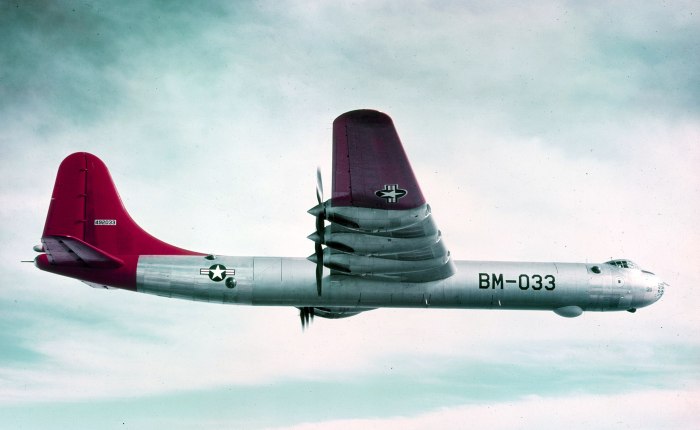
Header image: A US Air Force Convair B-36B Peacemaker of the 7th Bombardment Wing in flight, in 1949. (Source: Wikimedia)
Editorial Note: Led by our Editor Dr Mike Hankins, From Balloons to Drones produces a monthly podcast that provides an outlet for the presentation and evaluation of air power scholarship, the exploration of historical topics and ideas, and provides a way to reach out to both new scholars and the general public. You can find our Soundcloud channel here. You can also find our podcast on Apple Podcasts and Google Podcasts.
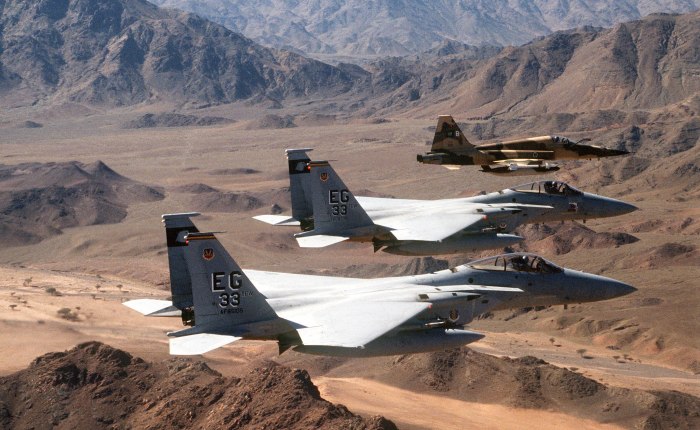
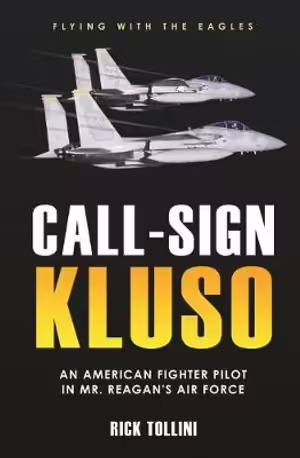
In our latest episode, we interview F-15 pilot and MiG-killer Rick Tollini. We discuss his new book, Call-Sign Kluso and he tells us all about the harrowing missions flown in the opening of the 1991 Gulf War.
Rick Tollini, call-sign Kluso, is a freelance writer, live performer, former United States Air Force F-15C Fighter Weapons Officer, and current F-15C flight simulator contract instructor pilot. Tollini is recognised as an expert in the field of air superiority operations and tactics. He has also worked as a feature writer for Pacific Star and Stripes weekly journal, CNN Travel contributor, and has recorded and published over 30 original songs.
Header image: An air-to-air view of two US Air Force F-15C Eagles of the 33rd Tactical Fighter Wing and a Royal Saudi Air Force F-5E Tiger II fighter aircraft during a mission in support of Operation Desert Storm. (Source: Wikimedia).
Editorial Note: Led by our Editor Dr Mike Hankins, From Balloons to Drones produces a monthly podcast that provides an outlet for the presentation and evaluation of air power scholarship, the exploration of historical topics and ideas, and provides a way to reach out to both new scholars and the general public. You can find our Soundcloud channel here. You can also find our podcast on Apple Podcasts and Google Podcasts.
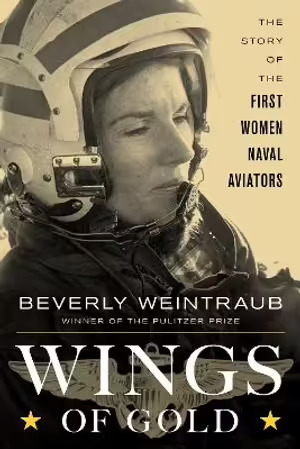
After the Second World War, women were not allowed to fly in military aviation roles in the US. That began to change in the 1970s. Pulitzer Prize-winning journalist Beverly Weintraub tells us about the story of six women US Naval aviators from her book: Wings of Gold: The Story of the First Women Naval Aviators from Lyons Press.
Beverly Weintraub is a Pulitzer Prize-winning journalist whose coverage of aviation, education and social services has appeared in the New York Daily News and the Washington Post. She served for 10 years on the Daily News Editorial Board, winning the Pulitzer with several colleagues for editorials examining the illnesses afflicting 9/11 first responders. She is currently executive editor at The 74, a K-12 education news site. An instrument-rated private pilot, Weintraub is a member of the Ninety-Nines, International Organization of Women Pilots; serves on the board of directors of the Air Race Classic, the annual all-women cross-country aeroplane race; and is a five-time ARC racer.
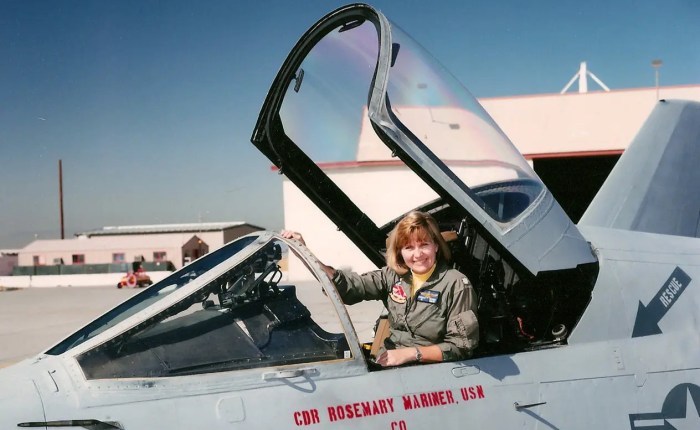
Header image: Captain Rosemary Mariner, the commander of VAQ-34 in the early 1990s. (Source: US Naval History and Heritage Command)


 Dr Michael E. Weaver is an Associate Professor of History at the USAF Air Command and Staff College. He has authored five air power articles and a book on the 28th Infantry Division. His second book, The Air War in Vietnam, was published in 2022. Weaver received his doctorate from Temple University in 2002, where he studied under Russell Weigley.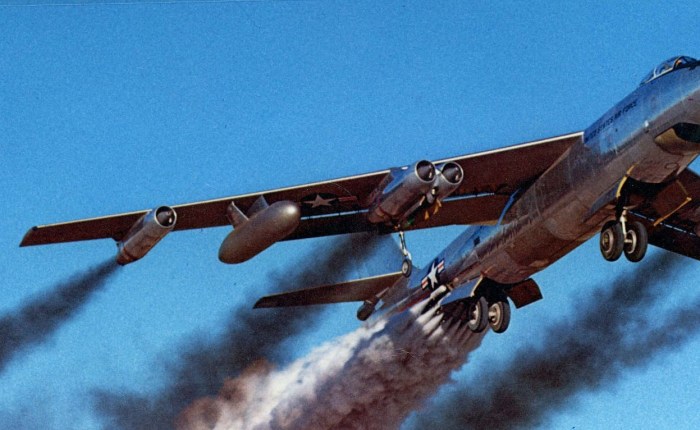





 From Balloons to Drones