By Lieutenant Colonel Michael H Taint, United States Air Force (Ret’d)
Editorial note: In this two-part article, Michael Taint re-evaluates the conduct of Colonel Edward Deeds in the management of the US Army’s First World War aircraft production program and the overall aeroplane production program itself. In this second part, he examines Deeds’ conduct and evaluates the management of aircraft in the United States during the First World War. The first part can be found here.
The first part of this article described the low state of readiness of American military air power as the country entered the First World War in 1917. Congress addressed this with an enormous $640M appropriation for a fleet of aircraft. However, the automobile industry, not the aviation industry, dominated the Government body overseeing aeroplane acquisitions, the Aircraft Production Board, specifically in the person of Edward A. Deeds, who was directly commissioned a full Colonel in the US Army Air Service and placed in charge of procurement.
Colonel Deeds and the Aircraft Procurement Program
The American aircraft production program began, as large initiatives often do, with boundless optimism. After all, at the beginning of the First World War, the American automotive industry was an industrial marvel, mass-producing approximately 1.5 million automobiles per year – this made the goal of 22,000 aircraft possible. Minutes taken at an early meeting of the Aircraft Production Board capture this sentiment perfectly: ‘If the automotive industry of this country can produce 100,000 automobile engines a month, as it now does, we can see no logical reason it cannot produce 3,000 aircraft engines per month.’[1] Colonel T. Milling of the US Army Air Service summed up this optimism when he stated that the ‘idea that has always seemed to exist in the United States, namely, that money can do anything.’[2]
Deeds’ US Army Air Service Equipment Division wasted no time awarding contracts to get the work underway. On 7 September 1917, just weeks after Deeds’ commissioning, the Dayton Wright Airplane Company, then in its sixth month of existence, received a cost-plus contract to build 4,000 De Havilland DH-9 (soon after modified to DH-4) light bombers. Curtiss Aircraft and Fischer Body (later to become part of General Motors) received contracts of equivalent size. In addition to the DH-4 contract, Dayton Wright was also issued a fixed price contract for 400 ‘Standard J’ training planes; altogether, Deeds’ Equipment Division issued almost $35,000,000 in contracts to his former company in Dayton.[3]
In 1920, in a report of the House of Representatives Select Committee on Aviation’s judgment on Deeds’ conduct is truly clear:
But the fact remains that from practically the inception of the Government’s aviation activity in connection with the war, and within the sphere of Colonel Deeds’s important if not commanding influence his former business associates were placed at once through Government contracts to a position where they had the assurance of very large profits upon a relatively small investment of their own money and in addition were able to secure generous salaries which they charged against the Government as part of the cost of manufacture. That Deeds, Kettering and Talbot continued to be on the most intimate and confidential footing in the prosecution of Government work by the Dayton-Wright Airplane Company is apparent from their correspondence.[4]
Particularly damning were two telegrams sent by Deeds to Henry Talbot, the business manager and co-founder of Dayton-Wright Airplane Company, in August and September 1917. In the first, Deeds tells Talbot that all confidential telegrams from his Government office will be addressed directly to Talbot, not the Dayton Wright Airplane Company (a highly irregular practice for Government correspondence that Deeds later defended as merely a convenience, then later a security measure). In the second, Deeds told Talbot that the Government was able to select a source without price competition, and that price would not be a determining factor. And if the price were not a determinant, the cost could be high:
For your personal information as coming from your local attorney. Judge Advocate General has ruled it legal for the Government to select one, contractor one, and the two a third [sic], as market appraisers of market value of plant at contract expiration.[5]
Deeds also gave Dayton Wright a tremendous advantage over other US aeroplane manufacturers – the only actual DH-4 aircraft in the country. The procurement strategy the Aircraft Procurement Board had endorsed was not to design an entirely new American aeroplane but ‘build to print’ from an existing, in this case British, design that had flown and proven reliable. Unfortunately, the British either lacked or failed to give the US a complete technical package of drawings and specifications for the DH-4. All the Americans had been a few top-level diagrams. Instead, in late July, an actual DH-4 was shipped to Washington, which American industry could reverse-engineer and copy. However, even that was incomplete, with missing armament and landing gear. These were parts that needed to illustrate how the whole system was constructed and worked together. Deeds, however, immediately had it shipped to Dayton Wright instead of keeping it at a Government location, where all industries would have equal access.[6] This gave Dayton Wright an enormous head start over the other contractors because they had sole access to the only artifact documenting the detailed design. Dayton Wright immediately began ‘reverse engineering’ detailed blueprints and drawings to enable mass production, and within three months, had hand-built a ‘duplicate’ (more accurately, an American version) equipped with a prototype new US-built Liberty engine. This was impressive initial progress, but mass production proved far more challenging.
As the fall of 1917 progressed into winter, the problems of creating a new American aviation industry became evident, as the much-ballyhooed deliveries of initial production aircraft failed to materialise. The problems began with the most fundamental issues – a lack of knowledge in the manufacturing process, and a supply chain of necessary materials. Though the automotive executives in charge, such as Deeds, had assumed that automobiles and aircraft were comparable in complexity, it was soon discovered that the aeroplanes, particularly the ones made in Europe, required far more ‘touch labor’ by craftsmen than the mass-produced automobile, built by general labour that typically only performed one function on the assembly line.[7] This lack of aviation production knowledge hindered the startup effort, but the American aviation industry eventually learned and adapted.
Material was also a significant issue. America had enormous timber resources, but only certain types of wood were suitable for constructing aeroplanes. Strong, light, and straight-grained beams long enough to form the wings and body of an aeroplane were required, and only spruce met those requirements. Eventually, the lumber industry learned to cut spruce trees for the correct finished piece, but early in the spruce program, as much as 5,000 feet of rough spruce was required for a single aircraft.[8] Labour troubles caused by the lumbering program’s crash erupted in the Pacific Northwest; in November 1917, the US Army Signal Corps created a Spruce Production Division, headed by Colonel Brice Disque, to resolve the issues and maintain a steady supply of high-quality spruce material.[9]
Another significant component of the aircraft was linen. At first, the US attempted to procure this material from the original De Havilland Company source, an Irish supplier, but they were unable to meet the demand. This forced the US Army Signal Corps to experiment and find an acceptable substitute, cotton, which they procured (15,000 bales worth) on the open market to provide to the aircraft manufacturers. Even special aviation varnish (‘dope’ in the vernacular of 1917) had to be developed by the US Army Signal Corps to support private production.[10]
These issues would surely have occurred regardless of who led the aircraft procurement program, but there were also problems internal to the Equipment Division. The scope and size of the aircraft production challenge in the First World War were precisely why men such as Deeds, with expertise in running large manufacturing enterprises, were brought into the US Army. Unfortunately, they failed to create an efficient organisation to administer the work. As a Congressional investigation report noted after the war:
The duty of providing an adequate organization for aircraft production was left to the Signal Corps. It is quite clear that this undertaking was beyond the competency of the Chief Signal Officer [General Squier], who had neither the training nor experience for such a large industrial enterprise, and those who were brought to the task in his department failed to produce an organization which was adapted to meet the exigency. (emphasis added)[11]
Specific issues identified were a lack of accountability, unclear lines of authority, and redundancy of effort. These issues, plus rising public criticism of the entire aircraft program, led to a change in the US Army Signal Corps’ organisational structure in February 1918. Deeds was relieved of his position as Chief of the Equipment Division and moved to the newly created position of ‘Senior Industrial Executive’, reporting directly to General Squier, with no apparent line authority. Nevertheless, Deeds continued to exert significant control over the aircraft program, according to the report of Charles Evans Hughes issued in October 1918 and discussed in more detail below.
Another set of issues was changes in the DH-4 configuration caused by American manufacturing. The most notable of these was the Liberty engine, one of the war’s most significant American production successes, in which Deeds played an important role. Unlike other technical aspects of American aircraft production, Deeds took a personal interest in the development of the new American engine. As Benedict Crowell recounted in his official report after the war:
Colonel Deeds had been the man of broad vision who […] determined that America could best make a contribution to the aviation program by producing her own engine […] persuaded Messrs. Hall and Vincent [two Signal Corps officers in the rank of major responsible for engine production] to forego further efforts on their individual developments and devote their combined skill and experience to the creation of an all-American engine.[12]
While there were good reasons to create the new American Liberty engine instead of attempting to adapt hand-crafted European engines to American factories, Deeds also had a very personal business interest in the Liberty. Each of the 20,000 Liberty engines used a Delco electronic ignition system and not the magneto ignition system used in Europe, so he profited from each engine sold. Deeds was careful not to sign the directive requiring the use of the Delco ignition, instead having his subordinate, Major Gray, sign it. However, as the Congressional investigation after the war found, ‘there is no satisfactory evidence that Colonel Deeds signed, prepared or directed the use of the Delco ignition, though it cannot be doubted that he desired the system to be used.’[13] Unfortunately, the change in a central aircraft subsystem such as this required a significant number of changes to other interfaces, resulting in further delays. These changes were particularly problematic as the Liberty engine evolved in many configurations.[14]
By November 1917, seven months into the war, the first significant block of DH-4 aircraft (154 planes) was supposed to be delivered; however, the total delivered was zero. The United States did not deliver its first batch of home-produced aircraft until February 1918, which consisted of only nine aircraft.[15] Critics from the small core of aviation experts and enthusiasts saw this as the natural outcome of their industry being overtaken by the ‘Detroit Conspiracy.’ Their criticisms soon found a most unusual voice.
John Gutzon Borglum: Sculptor and Aviation Enthusiast

John Gutzon Borglum, a sculptor, was busy working on the Stone Mountain commemoration of Confederate Civil War leaders in Georgia when the US declared war in 1917 (after the war, he would take on the far more famous Mount Rushmore project). An early aviation enthusiast, Borglum was a founding member of the New York Aero Club and also witnessed the acceptance testing in 1908 of the first Wright Flyer bought by the US Army.[16] In 1913, prominent Daytonians, including Deeds, contacted Borglum about sculpting a memorial to the Wright brothers; however, he enormous Dayton flood that year made financing the project impossible. Deeds remembered Borglum, however, and commissioned the sculptor to do a bust of his son, who tragically died of illness. Borglum completed this composition and took things further, proposing an elaborate mausoleum for the entire Deeds family. Deeds never responded to this proposal, and this rejection was later cited as the cause of Borglum’s particular animus toward Deeds in the aeroplane procurement controversy.[17]
One thing was sure: in terms of temperament, Borglum was as far from Deeds as imaginable. Where Deeds was genial, low-key, and personable, Borglum was truculent, loud, and abrasive, truly over the top. Unafraid of making attacks on Deeds that were personal and sometimes outlandish, Borglum claimed that Deeds ‘real name’ was really ‘Dietz’ and that he had strong pro-German sympathies – a political hot-button in America in 1917. ‘Deeds powerful Teutonic personality seems to have completely hypnotised the trusting, scientific mind of General Squier, ’ posited Borglum, explaining how the aircraft program under a highly respected US Army officer had so underperformed expectations.[18] Overblown rhetoric aside, Borglum had suspicions about Deeds’ business motivations, which eventually proved well-founded. Convinced that the aircraft procurement plan led by Deeds was a scam, he handled it in typical Borglum style – he took it right to the top, writing the President of the United States’ secretary, Joseph Tumulty, and alleging gross mismanagement and waste in the aircraft program. After discussing with Secretary of War Newton Baker, Wilson wrote back on 2 January 1918. He gave Borglum carte blanche to investigate his allegations, including permission to visit various manufacturing plants, a War Department employee to act as Borglum’s assistant and an office in the War Department itself. Borglum attempted to interview the principals involved in the affair, including General Squier, but found them unresponsive.[19] Undeterred, on 21 January 1918, Borglum sent his report to Wilson with a letter stating that he had ‘been able to connect the broken links of a chain of dishonesty and disorder that runs through our production department.’[20] By now, Borglum was not the only voice of dissent. A report from the respected Aeronautical Society of America stated that the aircraft program was devised by ‘men who know next to nothing about the art of flying or the production of flying machines.’ Numerous newspapers throughout America in the next few months began calling for an investigation into the aeroplane program; typical of these is the St. Louis Star’s observation that ‘if things are wrong they must be righted and if they are not wrong then the men responsible must be cleared of odium’ and the Philadelphia North American’s ‘the American people are sick of false promises and alluring deceptions; what they want is battle-planes on the front.’[21]
Secretary of War Baker’s response to President Wilson on Borglum showed a clear understanding of the potential political volatility of the situation:
My general impression of Mr. Borglum’s report is that it contains no facts beyond those frankly admitted by Government departments with reference to delays […] The charges against Colonel Deeds are unsupported by evidence. Nevertheless, I consider it would be well, in view of the charges, to have a full examination of Colonel Deeds’ record made as a matter of justice to him and the Department.[22]
Whatever plans Baker had for an internal review were quickly superseded by actions by Congress and Wilson himself. Wilson backpedalled, sending Borglum a letter claiming he had not appointed him as an official investigator but merely as an interested citizen (though interested citizens are generally not provided a full-time War Department aid plus an office).[23]
Borglum was making the newspapers almost daily as he blew the whistle as loudly as possible. By early May 1918, both houses of Congress expressed outrage and demanded a full investigation. Senator Thomas of Colorado, on 9 May 1918, stated that the aeroplane manufacturers were responsible for ‘huge profiteering’ and wanted those contracts cancelled. However, the next day, the same Senator dropped a bombshell on the Senate floor, effectively ending Borglum’s role as an aircraft program critic. An affidavit from Mr. Kenyon W. Mix, Jr., whose father held the controlling interest in the Dodge Manufacturing Company, was presented to the Senate. It stated that Mix and another aeroplane engineer, who supposedly had ties to the British Embassy, Hugo C. Gibson, had met Borglum on a train trip (whether planned or accidental is unknown), and Gibson had told him that European designs, far superior to American ones, were available for manufacture. Borglum boasted of his close personal ties with President Wilson, ties that could readily lead to a fat aeroplane production contract. Mix, suspicious, then decided to raise the issue through appropriate channels – so he forwarded the concern to Aircraft Production Board chair Howard Coffin, who in turn shared it with other Board members, including Squier and Deeds. In turn, on 20 January 1918, they raised the issue with Vice President Marshall, who notified Secretary Baker; presumably, Baker passed this on to Senator Thomas.[24] The implication was clear – Borglum was doing precisely what he accused Deeds of doing – pursuing an aircraft procurement program profitable to himself. Having placed the affidavit before the Senate, Senator Thomas ended his floor time with the stark conclusion: ‘This shows Mr. Borglum’s criticism of the airplane program to be entirely without merit.’[25] Borglum, naturally, vehemently denied all this.
Of course, this testimony from Mix did not prove that Borglum’s criticism was without merit; it simply suggested that Borglum might be a hypocrite, attempting to do precisely what he accused Deeds of doing.[26] However, another possibility is revealed by a front-page story on 11 May 1918 in the Washington Herald:
Officials for the British Embassy and the British War Mission here state that no one in the name of Hugo C Gibson has been in the employ of the British Government in this country. It is believed that Mr. Borglum may have been the victim of a confidence man who sought membership in any corporation that might be formed and put forward false claims in order to win the confidence of the sculptor.[27]
Borglum’s response to the Senate was simple – ‘a frame up, deliberately planned.’[28] No one at the time (and for that matter, any historian later) appears to have taken that answer seriously, however. Borglum, utterly discredited, was effectively silenced. Certainly, powerful business interests and senior officers such as Deeds in the Equipment Division had strong motivations to stop Borglum. The Mix affidavit was never further scrutinised and Mix himself never called to testify. Borglum may have been personally silenced, but the calls for serious investigation had such momentum from Borglum’s polemics that they could not be stopped.
Charles Evans Hughes: Justice becomes Investigator

Former Associate Justice Charles Evans Hughes had lost a close election (23 electoral votes) to President Woodrow Wilson just the year before. In December 1917, he paid a courtesy call on his former rival at the White House. Hughes had come to Washington not to meet the President but to argue a case before the Supreme Court, the first time since he resigned from it to run for the White House. Hughes offered at that meeting – probably just a formality – to accept any wartime assignment that Wilson might wish. On 13 May 1918, just a few days after the Borglum debacle on the Senate floor, Wilson took Hughes up on the offer. Wilson believed that Hughes, a respected jurist and political opponent, would be able to make any necessary recommendations and remain above any charges of whitewashing. Wilson asked Hughes to investigate the growing political crisis of the army aircraft program, and Hughes immediately accepted.[29]
Though Wilson gave his former rival a free hand to look wherever he wished, he would do so under supervision from Attorney General Gregory or Solicitor General Frierson. One of these men always accompanied Hughes on every interview or fact-finding mission. Hughes picked Meier Steinbrink, an up-and-coming lawyer who was eventually elevated to the New York State Supreme Court, as his personal assistant. Together they investigated the entire aircraft program from mid-May until early November 1918, conducting all their interviews and actions in private to avoid creating another Borglum-like circus.[30]
Hughes’s first task was to uncover as many facts as possible about the actual aircraft production program – specifically, how many aircraft were built and shipped to Europe, how much money had been obligated and spent on domestic contracts, and how much had been obligated and paid on the Allies. Obtaining this data proved to be far more difficult than anticipated. It became the first indication that the entire aircraft production procurement bureaucracy lacked the proper centralised control necessary for effective decision-making. Hughes and Steinbrink eventually interviewed 280 witnesses, reviewed 17,000 pages of documentation, and visited contractor facilities in Dayton, Detroit, Buffalo, and New Brunswick. At each site visit, he examined the contractors’ financial records (cost-plus type contracts require all such data to be available to the Government) and facilities and interviewed key executives. In Dayton, these interviews included Deeds and Henry Talbot Jr., President of the Dayton Wright Airplane Company.[31]
During this visit, Hughes uncovered unmistakable evidence of Deeds’ illicit communications with his former company. From the information reviewed before their site visit and the evasive answers Talbot gave to specific questions from Hughes, both investigators suspected a secret back channel had been established. Steinbrink evaluated this idea.
While Hughes was plying the witness [Talbot Jr.] with questions, Steinbrink walked over to the plant’s filing room and told a clerk that Mr. Talbot would like to have the confidential file. The clerk yielded it without question, and the attorney [Steinbrink], opening it to “Deeds” and “Talbott”, found telegrams that established a confidential relationship between the two men after Deeds had taken charge of the aircraft production program for the Army.[32]
This would form a key part of the final 104-page report by Hughes, which was completed at the end of October and submitted to President Wilson through the Attorney General on 25 October. It was released publicly on 31 October 1918, just over two weeks before the Armistice.[33]
Hughes’ Report is impressively comprehensive and delves deeply into every issue that plagued the startup of the American aircraft industry, from the large numbers of Government actors and private firms involved down to the fine points of cutting the proper amounts of spruce and mahogany. Numbers and types of aircraft and aircraft engines built and delivered are tabulated, along with contract dollars obligated and spent, as well as the selection process for contractors. Hughes had discharged his duties well, untangling an overly complex procurement program in a few short months, despite neither he nor his assistant having any background in it.
The final report’s cover letter to the Attorney General mentions explicitly investigating ‘the activities relevant to Edward A. Deeds and his former business associates,’ noteworthy because Deeds is the only person called out by name in the cover letter.[34] Hughes intended to draw attention to Deeds, particularly senior administration officials who were likely only to read the cover letter. In addition to the unethical communications with Dayton Wright Airplane Company, the investigation uncovered other questionable conduct on Deeds’ part.
One of these was purchasing land for McCook Field, located just north of Dayton. Deeds had bought the land – after being advised by Wilbur Wright that it would make an ideal airfield. As Deeds he ‘importuned’ another US Army Air Service office to purchase the land; he no longer owned it but had sold it to his long-term business partner (and co-founder of Dayton Wright Airplane Company) Charles Kettering. Deeds also pressed for establishing other permanent facilities, such as Wilbur Wright Field in Dayton. Although he had no immediate business connection to this deal, it would surely be helpful in his post-war aviation business ventures.[35]
Hughes found still more irregularities in Deeds, such as a $104,000 payment to a Liberty engine contractor (the Packard Company) – even though no contract existed between the Government and Packard at the time.[36] On 21 February 1918, Deeds made a significant announcement through the War Department that the first ‘service’ (tactical combat) aircraft were finally on their way to France, an important milestone that the entire nation had anxiously awaited. Nothing had been shipped to France, only a handful of DH-4s to other airfields in America for testing; ‘Actual production in quantity did not begin until May.’[37] This revelation proved a severe embarrassment to the Wilson Administration, and Congressional inquiries grilled Secretary of War Newton Baker about this deception. Besides benefiting from insider Government information, executives of the Dayton Wright Airplane Company had charged exorbitant salaries since August 1, 1917, under the government’s cost-plus contracts. Deeds claimed he knew nothing about the wages (over $100,000 total) being received by some of his closest friends.[38]
Finally, in his single-page ‘General Conclusions and Recommendations, ’ Hughes blasted the US Army Signal Corps officers in charge (Squier and Deeds) for incompetence and mismanagement of the aircraft program, resulting in tremendous inefficiencies and waste. He also noted that the newly created Bureau of Aircraft Production, with entirely new leadership, had already rectified the significant problems reported. Concerning Deeds:
The evidence discloses conduct, which although of a reprehensible character, cannot be regarded as sufficient for charges under existing statutes […] The evidence against Colonel Edward A Deeds should be presented to the Secretary of War to the end that Colonel Deeds may be tried by court martial under Articles 95 and 96 of the Articles of War.[39]
The remaining points in the summary recommended criminal prosecutions for several other army officers (not named) who retained company commercial interests and suggested the Justice Department continue audits of the aircraft industry. Hughes was released from Government duty a few weeks later and never had more to say about the whole affair, resuming his distinguished career as a politician and jurist by serving as Secretary of State under the next President and eventually returning to the US Supreme Court. This time, as Chief Justice, in 1930.
Secretary of War Newton D. Baker and Court Martial
News of the Hughes report appeared in the newspapers on 1 November 1918, and 10 days later, the Armistice was signed. American war planners who had expected the war to end only after a massive spring offensive planned for 1919 suddenly found themselves superfluous. Other residual tasks remained, along with negotiating the peace treaty and demobilising the army. One of these was the Deeds court martial.
With the Armistice, work stopped on all military production contracts almost immediately. The War Department undoubtedly wanted to put the embarrassing affair behind them as quickly as possible. Simply ignoring the Hughes Report was not an option – there was too much interest from both houses of Congress. Secretary of War Newton Baker decided to take the highly irregular step of not immediately court-martialing Deeds, instead having a board of review examine the allegations in the Hughes Report and determine whether a court-martial was required.
This move was itself highly irregular. Boards of Review served as the military equivalent of appellate courts. They review cases already decided in a lower court, and do not decide whether trials are necessary. Baker knew full well that there was plenty of evidence to warrant charges against Deeds, especially against the two Articles of War specified by Hughes, Article 95 (Conduct Becoming an Officer) and Article 96 (General Misconduct), which have unusually broad and extensive application.
The Board of Review, consisting of three-judge advocate officers selected by the army’s acting judge advocate general, examined the Hughes Report and took testimony from Deeds and his associates, allowing them to refute or clarify the issues Hughes raised. Neither Hughes nor Meier Steinbrink, his assistant, was ever called before the board or allowed to examine the testimony the review board heard. The army judge advocate’s report, released on 26 December 1918 (when it would garner the least attention, as Washington would be deserted after Christmas), decided that a court-martial was unnecessary. It found that the Deeds had not intended to deceive or defraud the Government and had released no confidential information.
The report begins with several glaring factual errors, most likely stemming from Deeds’ testimony, as they contradicted Hughes’ report. Deeds was selected for his Government position because he was ‘well known in the field of aircraft development’ and Dayton Wright Airplane Company was ‘taking over the Orville Wright Airplane Company.’[40] Deeds explained away the whole issue of direct private telegrams to his former company’s President, H. Talbot Jr, by claiming fear of German sympathisers who might gather confidential information. Had the board allowed cross-examination by Hughes, they would have learned that this was not standard operating procedure between the Army Equipment Board and contractors and only extended to Dayton Wright. As far as Deeds’ subsequent telegram to Talbot, providing key information about the Government’s aircraft procurement strategy, the board conceded Deeds’ assertion to Talbot to take the provided information as ‘coming from your local attorney’ was ‘difficult to understand’ but decided that since Deeds was not a lawyer and simply trying to expedite the award of Government contracts (that being true) it was acceptable.[41] They did not consider the information in the telegram, that a price competition was not required to award a contract, to be confidential to the government.[42] Had Hughes been present, he surely would have explained to the board that this information gave Dayton Wright carte blanche to charge the Government as much as it wished. What impressed the Board was that Deeds had sacrificed a large corporate salary (approximately $85,000 annually) to become a US Army officer and had been commended for his hard work by the Aircraft Production Board.[43]
Secretary of War Newton Baker released the Board’s results, with his concurrence, on 16 January 1919. The board, he claimed, ‘systematically examined all this evidence [the Hughes Report] and obtained all possible additional facts’ and was therefore superior to the Hughes Report in its conclusions.[44] Hughes had not been consulted or questioned by the Board, even once, on this overly complex procurement matter. The Board had not visited a single contractor facility anywhere, interviewed any other sources, or consulted any technical experts as Hughes did. Secretary Baker’s own ‘conclusion’ about what caused the Deeds scandal was not even consistent with the Board’s findings and has the distinct ring of a judgment made well before the board result:
This record undoubtedly shows that Colonel Deeds, absorbed in the activities of Aircraft Production, neglected to give personal attention to transactions involving his personal affairs, and this neglect on his part gave rise to appearances which required painstaking investigation in order to show their true character.[45]
And to make certain there was no mistaking Baker’s position on the matter, he ended with:
Inasmuch as Judge Hughes’ suggestion has been accomplished, I have directed that all records in this matter be filed in the War Department and the case be considered closed.[46]
With this, the War Department had finally put the last of the aircraft procurement scandal behind it. On 4 December 1918, President Wilson, following recommendations from Baker himself, issued full pardons to the other two army officers found by Hughes to have violated criminal statutes.[47]
Conclusion: Reassessing Deeds and the Aircraft Production Program
Readers of The Dayton Daily News opened their morning newspapers on 17 January 1919, to find the front-page story ‘ALL CHARGES VANISH UNDER LIGHT OF DAY’. The Board of Review had cleared entirely the Dee, and few locals seemed interested in a story with convoluted telegrams and company ownership details. Deeds soon received a deluge of telegrams from important Government officials such as the War Department’s Director of Munitions, Benedict Crowell, and industrialists like Henry Ford, congratulating him on the outstanding accomplishments of the aircraft production program. Feted in Dayton with banquets and other commemorations, including an ‘Ode to the Colonel’ written by his former military deputy, Deeds’ reputation suffered no lasting harm. To help ensure this, he had a July 1921 editorial from the popular business magazine The World’s Work entitled ‘The Vindication of Squier and Deeds, What Really Happened to the Billion Dollar Aircraft Appropriation’ reprinted in booklet form and distributed around the city.[48] Deeds were returned to senior management at Delco and NCR, and they continued to expand into new business ventures, such as creating a large conglomerate from various small sugar companies in Cuba. Upon his death, he bequeathed a historical park featuring a modern carillon tower that bears his name; the latter has become the de facto icon of Dayton.
Without question, Deeds made some significant contributions to the industry and the public. Still, his actual military conduct during the war is more accurately assessed by Borglum’s and Hughes’ criticisms than by Secretary of War Baker’s excuses. All the tributes he received after the war mention his extraordinary accomplishments as head of the aircraft production program – yet fail to mention any specifics other than the Liberty engine, which was indeed a resounding success. So, what precisely did Deeds do? He did not decide which aircraft types to build (that was the Bolling Commission’s responsibility) or design or innovate any technical aspects – his days as a design engineer were long over. His primary accomplishments in uniform seem to be awarding many aircraft production contracts in the fall of 1917 and developing an American internal combustion engine for these aircraft that is more amenable to mass production.
Neither of these accomplishments is especially impressive. Awarding contracts in 1917 was a simple matter –no research to determine the best industrial sources (no industry, after all), and no technical or cost proposals to evaluate and select. Deeds’ Equipment Division decided which companies should be given contracts and awarded them; even costs were ignored. One of the first contracts, worth $35,000,000, was awarded to Dayton Wright Airplane Company, which Deeds himself co-founded just a few months before to win new war contracts, a company that had never built a single aeroplane. Deeds never seem to have been considered, even for a moment, in recusing himself from that particular contract award on the apparent conflict of interest grounds. Not only did he not recuse himself, but he also sent a confidential telegram to his old company’s president, which, in effect, told them that price would not be a determinant, almost encouraging them to price-gouge the government. Favouritism for the Dayton Wright Airplane Company did not end there. There were no government plans to ensure that one sample DH-4 aircraft was equally available to all contractors; Deeds had it shipped to Dayton and kept it under his former company’s lock and key, giving them a huge schedule advantage over other manufacturers. Exorbitant salaries were allowed under Government contracts for his old company’s executives; salaries Deeds must have been aware of, as they were his closest personal associates. Much was made later of Deeds ‘divesting’ himself of company stock and salary, but the reality was this was small beer; Deeds was farsighted enough to realize that by building a large new aircraft enterprise – constructed almost entirely with Government funds with virtually no financial risk of his own – he would have yet another large salary stream to draw from when his year or two of military service was over. He returned to his friends in Dayton.
The Liberty engine program was one of the war’s great successes, and indeed, Deeds deserves credit here. Still, one must remember that by 1917, America had already built millions of internal combustion engines. The differences required for automotive and aviation applications were comparatively small. It was pretty evident that building a new engine for mass production was the better choice over replicating a European, handcrafted one. Even here, Deeds ensured his financial interest was addressed by requiring the Delco electronic ignition to be mandated for each Liberty, as opposed to the traditional aircraft magneto system.
Simply put, Edward Deeds always ensured the best interests of the United States, and his best interests coincided. And he never stopped. ‘Let us not in any way commercialise our experience [in the army] here. It is quite enough that we have been able to be of some service to our country without advertising the fact’ Deeds said in a speech in Dayton after the war – yet he insisted for the rest of his life on being called ‘Colonel Deeds.’[49]
Ethical issues aside, the larger question is Deeds’s role as head of the Equipment Division in the ‘failure’ of the American aircraft production program. Certainly, he played a critical role in creating unrealistic expectations with absurdly optimistic production schedules that the nascent American aircraft industry could not have met. Deeds compounded this mistake by making frequent and overly optimistic public statements throughout 1917, thereby reinforcing the false optimism. For example, an early production plan known as ’Production Plan II’ called for 16,500 tactical combat planes (DH-4s) to be delivered by 30 June 1918, to the front (to be powered by the new Liberty engine, which had not even been designed yet); actual numbers never came remotely close to this plan.[50]
The ‘failure’ was a plan by Deeds and the Equipment Division based on a false assumption – that building a tactical aeroplane was comparable to creating one of the million-plus automobiles rolling off the assembly lines in Detroit. The reality was that building an aeroplane was far more complex. The wood needed for the airframe had to be a continuous piece of spruce, obtainable only in the Pacific Northwest, and from lumberjacks currently on strike. Wings required a special linen spun only in Ireland. Even the varnish (‘dope’) needed for aeronautical use required special development. Tolerances for fitting parts in aircraft, which had to withstand wind and vibration forces unlike those in automobiles, required a far higher level of craftsmanship and attention to detail than the Detroit assembly lines. The ‘automobile crowd’ that ran the aircraft program was unaware of this when they began, a fact that no one disputed by the war’s end. All these challenges were overcome in time, but it took a precious amount of time. The American public and Congress asked in 1918 why reality lagged so far behind what was promised just six months earlier.
The American aircraft program in the First World War was far from a failure. Showing remarkable resilience and ingenuity, the new industry overcame a myriad of design and supply chain issues and, given a reasonable production curve, began producing combat aircraft in just over a year, just as the original Bolling Commission had expected when it recommended awarding the French the 5,875 aeroplanes contract the year before. During the war’s last three months, DH-4 production in America was 653 in September, 1,097 in October, and 1,036 in November.[51] Production year. Had the war continued into 1919 as expected, aircraft production may have been regarded as one of America’s significant contributions to the ultimate victory.
Lieutenant Colonel Michael Taint, United States Air Force (ret’d) is an independent historian. He retired after a 21-year military career in the US Air Force, which included tours of duty in missile and space operations, acquisition management and headquarters staff. He also spent 15 years in the defence industry as a project manager. He received a BA in History with a specialisation in Military History from Norwich University, an MA in Political Science from Wichita State University, and an MS in Computer Science from the University of Dayton.
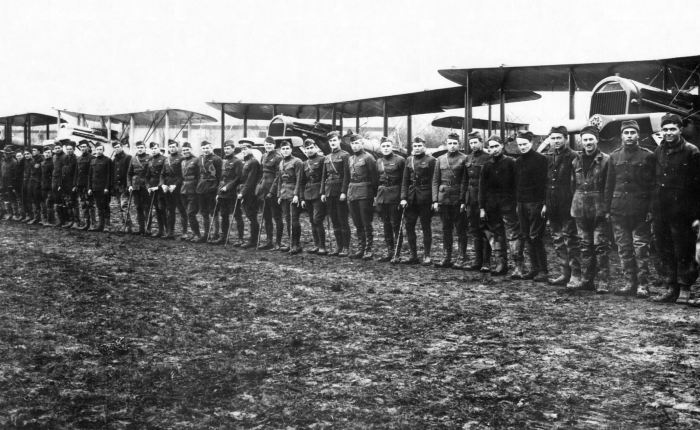
Header image: US Army 166th Aero Squadron personnel standing in front of licence-produced Airco DH4s, November 1918. (Source: Wikimedia)
[1] Robert J. Neal, A Technical and Operational History of the Liberty Engine (North Branch, MN: Specialty Press, 2009), p. 73.
[2] John H. Morrow, The Great War in the Air: Military Aviation from 1909 to 1921 (Tuscaloosa, AL: University of Alabama Press, 2009), p. 268.
[3] United States House of Representatives, Hearings Before Subcommittee 1 (Aviation), Select Committee on Expenditures in the War Department, Volume 3 (Washington, DC: United States Government Printing Office, 1920), p. 3882.
[4] Ibid., p. 3883.
[5] Ibid., p. 3884.
[6] Isaac F. Marcosson, Colonel Deeds Industrial Builder (New York: Dodd, Mead and Company, 1947). p. 227.
[7] Neal, A Technical and Operational History of the Liberty Engine, p 77.
[8] Benedict Crowell, America’s Munitions 1917-1918: Report of Benedict Crowell, Director of Munitions (Washington, DC: US Government Printing Office, 1919), pp. 240-41. Improvements in logging reduced this to about a thousand feet.
[9] Ibid. The spruce industry in the Northwest was placed under military supervision for most of the war.
[10] Ibid., pp. 247-48.
[11] Hearings Before Subcommittee 1 (Aviation), Select Committee on Expenditures in the War Department, Vol. 3, p 3929.
[12] Crowell, America’s Munitions, 1917-1918, p. 269.
[13] Hearings Before Subcommittee 1 (Aviation), Select Committee on Expenditures in the War Department, Vol. 3, p. 3886.
[14] See Neal, A Technical and Operational History of the Liberty Engine, for a comprehensive discussion of the various Liberty configurations.
[15] Colonel Edgar S. Gorrell, The Measure of America’s World War Aeronautical Effort (Northfield, VT: Norwich University, 1940), p. 34.
[16] Ann Honious, National Park Service. What Dreams We Have: The Wright Brothers and Their Hometown of Dayton, OH. 2003. https://www.nps.gov/parkhistory/online_books/daav/chap12.htm (accessed September 18, 2018), Chapter 12.
[17] Isaac F. Marcosson, Colonel Deeds Industrial Builder (New York: Dodd, Mead and Company, 1947). pp 255-57.
[18] Ibid., p. 260
[19] Who, in fact, had nothing to do with the actual procurement actions, save for appointing Deeds as head of the Equipment Division.
[20]’Getting the Facts About Aircraft,’ The Literary Journal, 25 May 1925, pp. 9-10.
[21] Ibid.
[22] Marcosson, Colonel Deeds Industrial Builder, p. 261.
[23] Ibid., p. 262.
[24] Douglas Waldrop, ‘Senate and Justice Department Investigating Aircraft Situation,’ Aerial Age Weekly, 20 May 1918, p. 510.
[25] Ibid., pp. 489-510.
[26] However, Deeds’ proponents were quick to use this quotation to discredit not only Borglum but also any critic of Deeds and the aircraft program. See Deeds’ biographer Marcosson.
[27] ‘Senate Hears Army Critic Under Fire,’ The Washington Herald, 11 May 1918, p. 1.
[28] Waldrop, ‘Senate and Justice Department Investigating Aircraft Situation,’ p. 511.
[29] Merlo J. Pusey, Charles Evans Hughes, Volume I, (New York City: MacMillan and Co.,1951), pp. 374-75.
[30] Charles Evans Hughes, Autobiographical Notes, edited by Joseph S. Tulchin and David J Danelski (Cambridge, MA: Harvard University Press, 1973), p. 1190.
[31] Pusey, Charles Evans Hughes, Vol. I, pp.376-77.
[32] Ibid., p. 378. Biographer Pusey obtained this information from a personal interview with Steinbrink on 24 July 1947. These are the telegrams mentioned earlier discussing the Government’s internal contracting strategy.
[33] Hearings Before Subcommittee 1 (Aviation), Select Committee on Expenditures in the War Department, Vol 3. The Hughes Report is Exhibit J.
[34] Hearings Before Subcommittee 1 (Aviation), Select Committee on Expenditures in the War Department, Vol. 3, p. 3868.
[35] Ibid., pp. 3895-7.
[36] Ibid., p. 3901.
[37] Ibid., pp. 3928-9.
[38] Ibid., p. 3950.
[39] Ibid., p. 3962.
[40] Waldrop, ‘Senate and Justice Department Investigating Aircraft Situation,’ p. 980.
[41] Ibid., p. 997.
[42] Ibid.
[43] Ibid., p. 1009.
[44] Ibid., p. 980.
[45] Ibid.
[46] Ibid.
[47] Neal, A Technical and Operational History of the Liberty Engine, p. 81.
[48] John K. Barnes, ‘The Vindication of Squier and Deeds, What Really Happened to the Billion Dollar Aircraft Appropriation,’ The World’s Work, July 1921.
[49] Marcosson, Colonel Deeds: Industrial Builder, p. 287.
[50] Neal, A Technical and Operational History of the Liberty Engine, p. 72.
[51] Crowell, America’s Munitions 1917-1918, pp 255.




 From Balloons to Drones