OODA Loop or Coffee Break? Erich Hartmann and the Forgotten German ‘Decision Cycle’

OODA Loop or Coffee Break? Erich Hartmann and the Forgotten German ‘Decision Cycle’

By Stephen Robinson

There was not too much dogfighting for us. It requires a large area and is absolutely defensive.[1]

Erich Hartmann

Colonel John R. Boyd flew F-86 Sabres during the Korean War and later theorised the Observation-Orientation-Decision-Action (OODA) loop, initially focused on air-to-air combat. At first, Boyd considered the tactical requirements of test flight dogfights between the YF-16 and YF-17 prototypes in 1974 before analysing Sabre and MiG-15 combat in Korea. He expressed the basic idea of the OODA loop in a United States Air Force (USAF) oral history in 1977, although it was not fully formed with its familiar four stages.[2] However, it is not commonly known that another F-86 pilot had theorised a four-stage air-to-air combat ‘decision cycle’ in the 1940s – Luftwaffe pilot Erich Hartmann.
FRE_015069
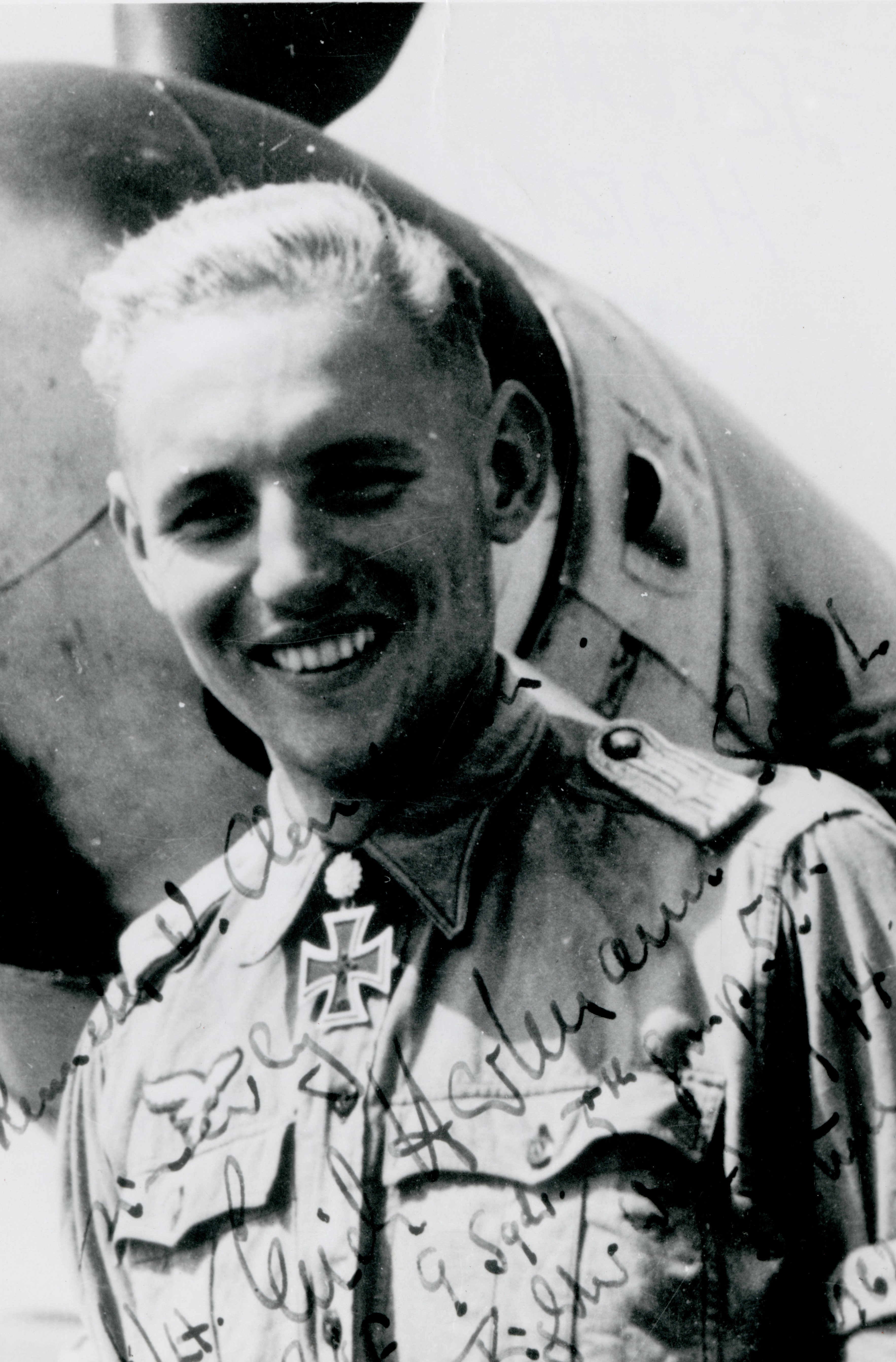
A signed copy of a photo of Erich Hartmann during the Second World War. (Source: Imperial War Museum)

During the Second World War, Hartmann flew 1,404 combat missions, participated in 825 air-to-air engagements and became history’s highest-scoring ace with 352 official kills, mainly over the Eastern Front.[3] During the Cold War, he later commanded West Germany’s first Sabre wing Jagdgeschwader 71 ‘Richthofen.’[4] Hartmann theorised the ‘Coffee Break’ concept, abbreviated as See-Decide-Attack-Break (SDAB). Writets Trevor J. Constable and Raymond F. Toliver articulated the idea in their bestseller The Blond Knight of Germany (1970), the first Hartmann biography, almost half a decade before the OODA loop emerged. Although their book romanticises the German military and fails to address Hartmann’s relationship with National Socialism adequately, it accurately depicts air combat tactics. In contrast, historian Erik Schmidt’s Black Tulip: The Life and Myth of Erich Hartmann, the World’s Top Fighter Ace (2020) thoroughly examines Hartmann’s role in the Third Reich and his fighter pilot career, which makes his book essential reading.

Hartmann and Boyd, in addition to flying Sabres and developing ‘decision cycles’, had much else in common. They were both aggressive fighter pilots with maverick independent streaks who declared war on their hierarchy late in their careers. Hartmann rebelled by opposing the F-104 Starfighter, which he considered unsafe, while Boyd went outside his chain of command to develop the unwanted Lightweight Fighter project.[5] Both men also retired as colonels in the 1970s.

At first glance, the SDAB cycle and the OODA loop are hard to distinguish. As John Stillion expressed: ‘Hartmann’s air combat procedure is strikingly similar to USAF Colonel John Boyd’s famous Observe, Orient, Decide, Act, or “OODA” loop.’[6] However, there is a critical difference. In an air combat context, the OODA loop is about winning dogfights, while the SDAB cycle is all about avoiding them. Additionally, Boyd’s OODA loop theory evolved from air combat to include land combat and then conflict in general before becoming a cognitive model explaining the mind’s relationship with reality. Hartmann’s method, as Schmidt concluded, is not ‘really a dogfighting strategy per se. It was more of an anti-dogfighting strategy.’[7]

Take a Coffee Break

Hartmann enlisted in the Luftwaffe in 1940 and joined Jagdgeschwader 52 in October 1942, flying Messerschmitt Bf 109 fighters. He initially became a wingman for Edmund Rossmann, who mentored the novice pilot. Rossmann had already been credited with over 80 kills, giving his advice considerable merit.[8] Hartmann learned that Rossmann had a wounded arm that prevented him from flying highly manoeuvrable dogfights, but he compensated for this injury by developing a specific tactic. After spotting the enemy, Rossmann patiently assessed the situation before deciding whether to attack. If he decided that surprise could be achieved, he would attack, which differed from the standard practice of immediately attacking a seen enemy.[9] Hartmann later reflected that Rossmann ‘taught me the basic technique of the surprise attack, without which I am convinced I would have become just another dogfighter.’[10] What Rossmann did out of necessity, Hartmann would soon do out of choice.

Hartmann scored his first aerial victory on 5 November 1942 by shooting down an Il-2 Sturmovik. However, shrapnel from the kill damaged his engine, forcing him to crash. While recovering in the hospital, Hartmann began to formulate his conception of air combat after reflecting that he should have approached closer before opening fire and disengaged quicker to prevent shrapnel from hitting his engine. Hartmann later recalled: ‘I learned two things that day: Get in close and shoot, and break away immediately after scoring the kill.’[11] Hartmann later formulated his trademark method, as Constable and Raymond explained:

The magical four steps were: “See – Decide – Attack – Reverse, or ‘Coffee Break’.” In lay terms, spot the enemy, decide if he can be attacked and surprised, attack him and break away immediately after striking; or if he spots you before you strike, take a “coffee break” – wait – pull off the enemy and don’t get into a turning battle with a foe who knows you are there.[12]

In a USAF interview in 1985, Hartmann was asked, “How did you develop your tactics of See, Decide, Attack, Reverse, or Coffee Break?” He answered:

I developed my tactics by watching my leader. My first leader, MSgt Eduard Rossmann, was always cautious. He said he didn’t like to pull a lot of Gs because of a bad shrapnel wound in his arm. He would look over each fight and decide if he would enter. When he did enter, it was always straight through – no turns – and he usually came home with a kill. My next leader, Sgt Hans Dammers, liked to turn and fly in the circus. The next man, 1st Lt Josef Swernemann was somewhere in between the two. He would be patient for a while, but then would get into a turning fight when he got frustrated. This is when I realized you must fight with your head, not your muscle.[13]

Hartmann rejected dogfighting as he considered it pointless and risky: ‘I also decided against aerial acrobatics, against what traditional pilots would call dog-fighting […] Acrobatics are a waste of time and therefore dangerous.’[14] Hartmann would always try to break contact after a pass before deciding if another pass was warranted and, as Constable and Raymond explained, ‘[e]ach pass was a repetition of the “See – Decide – Attack – Break” cycle.’[15]

Hartmann’s method was essentially hit-and-run tactics. As social scientists C. Hind and A. Nicolaides explained: ‘Hartmann became the ultimate and leading exponent of the stalk-and-ambush tactics, and he favoured the tactic of ambushing enemy aircraft and firing at them from very close range, about 20 m, rather than becoming involved in challenging and unnecessary dogfights.’[16]

The SDAB cycle is usually only mentioned in popular military aviation histories and is rarely referred to in scholarship. Edward E. Eddowes, who worked at the Air Force Human Resources Laboratory, submitted a paper to the First Symposium on Aviation Psychology in 1981. He declared: ‘Each engagement involves repetitions of the see, decide, attack, break discrimination-decision sequence. Like many of his predatory predecessors, Hartmann found turning contests hazardous and avoided them.’[17]

In another example, Captain James H. Patton, Jr., a retired naval officer, in his article ‘Stealth is a Zero-Sum Game: A Submariner’s View of the Advanced Tactical Fighter’ considered the SDAB cycle in 1991:

Top Gun instructors interpreted that terse guidance – based on interviews with Hartmann – to mean that a pilot should attempt to detect without being detected, judge whether he can attack covertly, close to a point that would almost assure a kill, and then disengage rapidly to repeat the process, rather than hang around in what submariners call a melee, and fighter pilots term the visual fur ball.[18]

Mikel D. Petty and Salvador E. Barbosa conducted an interesting air simulation experiment. They noted that USAF instructors supervise trainees undergoing virtual simulation-based training.[19] However, given the limited availability of instructors, they devised a means of testing a self-study-based training approach through simulation by following the progress of one test subject over eight years. The virtual pilot flew 2,950 missions in 138 campaigns using seven types of aircraft set in Europe in 1943-45 using Microsoft Combat Flight Simulator 3 (CFS3). The experiment required the subject to read air combat literature before applying the described tactics in the simulation. The study material included The Blond Knight of Germany, which outlined the SDAB cycle.[20] Petty and Barbosa confirmed the effectiveness of the SDAB cycle as ‘maneuvers and tactics described as effective in WWII air combat in the literature, e.g., those in Franks (1998) and Toliver and Constable (1970), were found by the subject to be very effective in CFS3 as well, if performed correctly.’[21]

The SDAB cycle has limitations, and Schmidt correctly concluded that it was well-suited to the Eastern Front but had less utility in Western Europe: ‘Hartmann’s Soviet enemies were, generally, less capable than the British and American pilots on the Western Front, which meant not only that they were easier to shoot down, but also that they were easier to evade and disengage from if the odds weren’t right.’[22] Therefore, applying SDAB cycles consistently in practice is impossible, and some dogfighting is inevitable, making the OODA loop relevant.

The OODA Loop

Boyd was familiar with Hartmann and mentioned him once in the 1977 USAF oral history stating that ‘[A]nd so, in that sense, a guy like Hartmann or a guy like Bong [Maj Richard I.] and some of these other good American aces – I could name others from other countries – they kind of knew they were going to win anyway. Maybe not in the beginning, but they built up that certain confidence and they had the desire.’[23] However, it is unclear if he read The Blond Knight of Germany or other references to the SDAB cycle, so we do not know if Hartmann influenced the OODA loop.[24] In any case, both models are opposites, so there is no suggestion of plagiarism. The basic idea of the OODA loop is to move faster than the enemy through a four-stage cycle, as military analyst Franklin C. Spinney, a close acolyte of Boyd, explained:

He [Boyd] thought that any conflict could be viewed as a duel wherein each adversary observes (O) his opponent’s actions, orients (O) himself to the unfolding situation, decides (D) on the most appropriate response or countermove, then acts (A). The competitor who moves through this OODA-loop cycle the fastest gains an inestimable advantage by disrupting his enemy’s ability to respond effectively.[25]

The victor, moving faster, seizes the initiative while the loser becomes paralysed by disorientation and panic.[26] The winner gets inside the loser’s OODA loop, which allows the pilot to manoeuvre into a winning firing position during a dogfight.[27] The OODA loop requires both pilots to dogfight long enough and complete enough loops for the winner to gain a relative speed advantage, which begins to sow disorientation and panic in the loser’s mind. More specifically, the pilots must complete enough OODA loops for the winner’s relative speed advantage to result in an action that changes the overall situation.[28] When this occurs, the loser’s actions, based upon the superseded earlier situation, fail to achieve the intended result, and they become confused as negative feedback overloads their brain. A pilot simply shooting down an enemy Hartmann-style before a clash of opposing OODA loops can occur is not applying Boyd’s model. If the OODA loop involved surprise and winning before the opponent reacts, there would be nothing original about the idea or way to distinguish it from the earlier SDAB cycle meaningfully.

The key difference between Hartmann and Boyd is that the SDAB cycle avoids dogfighting while the OODA loop requires dogfighting. Boyd was fixated on dogfighting as Frans P.B. Osinga explained: ‘[H]e [Boyd] developed the ability to see air combat as a contest of moves and countermoves in time, a contest in which a repertoire of moves and the agility to transition from one to another quickly and accurately in regard [to] the opponent’s options was essential.’[29]

Boyd’s manual Aerial Attack Study (1964), first published in 1960, explained all possible dogfighting manoeuvres without prescribed solutions.[30] Osinga concluded that Boyd ‘wanted to show people various moves and countermoves, and the logic of its dynamic.’[31] Aerial Attack Study reads like a chess strategy book. It is undoubtedly valuable, as Grant Hammond explained: ‘[M]any a fighter pilot, whether he knows it or not, owes his life to Boyd and the development of the tactics and manoeuvres explained in that manual.’[32] Former students who fought in Vietnam credit Boyd’s teaching for getting them out of danger. For example, on 4 April 1965, Major Vernon M. Kulla engaged North Vietnamese MiG-17s while flying an F-105 Thunderchief. Before the MiG-17 could open fire, Kulla successfully conducted a snap roll that he learned from Boyd, forcing the communist pilot to overshoot.[33] Therefore, Boyd certainly taught useful air-to-air tactical skills.

Despite Boyd’s obsession with dogfighting, it is rarer than many assume. Historically speaking, in most cases, victory goes to the pilot, who spots the enemy first and wins before the opponent can react. As Barry D. Watts explained:

To start with historical combat data, combat experience going at least back to World War II suggests that surprise in the form of the unseen attacker has been pivotal in three-quarters or more of the kills. For example, P-38 pilot Lieutenant Colonel Mark Hubbard stressed that, in his experience over northern Europe with the U.S. Eighth Air Force, “90% of all fighters shot down never saw the guy who hit them.” Similarly, the German Me-109 pilot Erich Hartmann […] has stated that he was “sure that eighty percent” of his kills “never knew he was there before he opened fire.”[34]

This trend continued during the Vietnam War from April 1965 to January 1973, as approximately 80 per cent of personnel shot down from both sides never saw the other aircraft or had insufficient time to make a countermove.[35] Accordingly, Watts concluded: ‘[W]hat historical air combat experience reveals, therefore, is that upwards of 80 per cent of the time, those shot down were unaware that they were under attack until they either were hit or did not have time to react.’[36]

Most air-to-air kills did not involve dogfighting and, consequently, clashes of opposing OODA loops involving sequences of moves and countermoves. Most air-to-air engagements end before the loser has time to act. Even when dogfighting occurs, it can be over in seconds, as Schmidt explained:

Amazingly, the whole dance of a dogfight could take place over the course of just a few seconds. The famed American pilot Robin Olds, who flew P-38s and P-51s in World War II and F-4 Phantoms in Vietnam, said: “Usually in the first five seconds of a dogfight, somebody dies. Somebody goes down. You want to make sure it’s the other guy.”[37]

Therefore, the OODA loop is not always applicable in dogfights because other factors often decide the outcome before the winner’s faster speed can generate negative feedback in the loser’s mind, which is a more gradual process involving moves and countermoves.

Boyd, without intending to, contradicted the essence of the OODA loop by expressing a sentiment identical to the SDAB cycle:

So that’s why he [the fighter pilot] wants to pick and choose engagement opportunities. He wants to get in, get out, get in, and get out. Why does he want to do that? Because it’s not just one-to-one air-to-air combat up here. It’s what the pilots like to say, many-upon-many. In other words, if you’re working over one guy, somebody else is going come in and blindside you. So you want to spend as little time with a guy as possible. You need to get in, gun him, and get the hell out.[38]

Ironically, Boyd preferred the hit-and-run essence of the SDAB cycle, as picking and choosing engagement opportunities and cycles of getting in and out to avoid danger sounds just like Hartmann. Therefore, engaging in an elongated OODA loop duel with another pilot is inherently risky due to the possible presence of other enemy fighters. However, there is still a critical difference as Boyd believed that the best way to break contact was by conducting a ‘fast transient’ – a rapid transition from one manoeuvre to another that allows a pilot to kill before quickly disengaging.[39] However, a pilot can only conduct a ‘fast transient’ if they are already in a dogfight. Hartmann instead preferred to dive at an unsuspecting enemy using superior speed in a single pass and then to use the momentum gained to break contact without any acrobatics, dogfighting or ‘fast transients’.

Boyd also stressed: ‘[T]hink of it in space and time. In space, you’re trying to stay inside his manoeuvre; in time, you want to do it over a very short period of time, otherwise you’re going to become vulnerable to somebody else.’[40] Therefore, Boyd advocated elongated OODA loop duels to gradually generate negative feedback while inconsistently wanting to restrict engagements to minimal periods due to the risk of other enemy fighters. Ultimately, Boyd failed to reconcile the need to rapidly break contact after an attack to avoid danger with the time required for enough OODA loop cycles to generate disorientation and panic in the loser’s mind.

Aces and Iteration

The key advantage of the SDAB cycle is that it minimises risk. However, a pilot intending a surgical hit-and-run strike may inadvertently find themselves in a dogfight, and then the logic of the OODA loop might become paramount. Nevertheless, engaging in an OODA loop contest inherently makes one vulnerable. As Jim Storr explained: ‘[T]here is considerable advantage in reacting faster than one’s opponent, but the OODA Loop does not adequately describe the process. It places undue emphasis on iteration instead of tactically decisive action.’[41] After attacking, Hartmann would break contact to prevent iteration and only committed to further passes in favourable conditions. The avoidance of iteration is also evident in the tactical methods of other aces, and Storr stressed that ‘biographies of aces […] show almost no trace of iterative behaviour in combat.’[42] Hartmann’s tactics worked because he avoided dogfighting. As Storr similarly expressed:

Critically, aces scarcely ever dogfight. They usually destroy enemy aircraft with a single pass, and expend very little ammunition per aircraft shot down. Their effectiveness centres on rapid, decisive decision and action. It is based on superlative, largely intuitive, situational awareness. Aces do display some significant characteristics – their eyesight is usually exceptional and their shooting phenomenal. They also have catlike reactions. However, expert fighter combat is fundamentally not iterative. It is sudden, dramatic and decisive.[43]

Boyd valued manoeuvrability over speed, while Hartmann preferred speed over manoeuvrability. Neither is right or wrong, and there is undoubtedly a degree of pilot preference. Hartmann’s approach was only made possible by exceptional eyesight, which allowed him to apply successful SDAB cycles consistently. Understandably, pilots with poorer eyesight might prefer manoeuvrability. After all, most pilots never become aces, so there is value in applying lessons from both Hartmann and Boyd’s approaches.

Conclusion

Boyd advocated getting inside the enemy’s OODA loop to disrupt their decision-making process and force them to make defeat-inducing inappropriate actions. In contrast, Hartmann had no intention of getting inside the enemy’s ‘decision cycle’. He usually won before the enemy knew of his presence or had time to act. There is no need to disrupt the enemy’s decision-making process if they have no time or opportunity to make decisions, and in such circumstances, the OODA loop is redundant. As such, Boyd neglected the importance of who spots who first and the corresponding likelihood that most engagements will be decided before sequences of moves and countermoves can occur.

Of course, manoeuvrable dogfighting cannot always be avoided, so the OODA loop certainly has merit. For example, an F-35 Lightning II would ideally only shoot down unsuspecting enemy fighters with long-range missiles beyond visual range. However, it is armed with 25mm cannons just in case dogfighting occurs. Nevertheless, air-to-air engagements have declined since the Vietnam War, while situational awareness has dramatically increased due to improved radar and airborne early warning and control (AEW&C) platforms. Therefore, the ratio of air-to-air kills occurring beyond visual range will likely continue to increase. Consequently, the future of OODA loop-style dogfighting is uncertain but becoming increasingly rare. At the same time, the core of Hartmann’s method remains valid. Pilots can now ‘see’ at great range with radar and ‘decide’ whether to ‘attack’ with the assistance of AEW&C. However, there may be no need for a clean ‘break’ since pilots no longer must get close thanks to long-range missiles.

The OODA loop depicts air-to-air combat as a duel between two minds going through cycles in which both pilots have a ‘sporting chance’, which reflects the ‘Knights of the Air’ myth from the First World War.[44] In contrast, Hartmann was like a sniper, describing his preferred tactic as ‘[C]oming out of the sun and getting close; dog-fighting was a waste of time. The hit and run with the element of surprise served me well, as with most of the high scoring pilots.’[45] Boyd, in contrast, is like a chess enthusiast who loves the moves and countermoves of the game. However, OODA loop-like dogfights only occur in a minority of air-to-air encounters. Therefore, Boyd’s model only has limited utility in air combat.

The SDAB cycle demonstrates that the OODA loop is not the only ‘decision cycle’. Despite its impeccable origins in combat experience, Hartmann’s tactical method is not well-known today partly because he never transformed the SDAB cycle into a general theory of conflict. In contrast, Boyd considered the more abstract OODA loop to be a universal guide to military success, applicable beyond the air domain at all levels of conflict. Boyd also believed that the OODA loop explained any competitive endeavour – such as politics, business, and sports – as well as human cognitive processes and behaviour in general. As Osinga explained concerning Boyd’s final version of the OODA loop: ‘[I]t is a model of individual and organizational-level learning and adaptation processes, or – to use Boyd’s own terms – a meta-paradigm of mind and universe, a dialectic engine, an inductive-deductive engine of progress, a paradigm for survival and growth, and a theory of intellectual evolution.’[46] Hartmann never transformed his straightforward air-to-air tactic into something grander. Another reason the SDAB cycle is not well-known is that Hartmann did not devote his retirement to promoting the concept: ‘I instructed and flew at a few air clubs, and flew in an aerobatics team with Dolfo Galland. Later I just decided to relax and enjoy life.’[47] In contrast, Boyd spent much of his retirement expanding, refining and disseminating his theories, including the OODA loop.

Boyd considered the OODA loop a universal and unchangeable fact of life – we have OODA loops whether we like it or not, and that is the model that best explains our relationship with reality.[48] Therefore, Boyd became imprisoned by totalising thinking while Hartmann didn’t, primarily because he never overanalysed his model. The SDAB cycle was an artificial way of thinking based on experience and circumstance. Hartmann demonstrates that we can manufacture our own ‘decision cycles’ through trial and error, tailoring them to meet specific needs and requirements. He also reminds us that ‘decision cycles’ do not have to be grand cognitive models. Above all, we are free to choose and experiment as Hartmann did. Numerous ‘decision cycles’ can coexist with different strengths and weaknesses. Therefore, it makes no sense to select one model for every situation.

Although the OODA loop (dogfighting) and the SDAB cycle (anti-dogfighting) are opposites, they can be complementary when synthesized. The OODA loop and the SDAB cycle become the opposite ends of a broad spectrum of options between those extremes. Most pilots probably operate somewhere between those two poles, taking their talents, aircraft characteristics, and specific circumstances into account. Boyd would favour synthesising the OODA loop and the SDAB cycle because doing so precisely aligns with the dialectical logic he expressed in his enlightening article Destruction and Creation (1976).[49] He also championed synthesis through his snowmobile allegory in his remarkable briefing, The Strategic Game of ? and ?.[50] The allegory is a thought experiment involving the image of a skier, a motorboat, a bicycle and a toy tractor. All these concepts can be broken down into sub-components through a destructive process, resulting in skis, motorboat engines, bicycle handlebars and rubber treads. These useful sub-components from different origins can then be reassembled into something new through a creative process, resulting in a new concept – a snowmobile. Boyd never stated that his ideas are exempt from the dialectical logic of destruction and creation. Therefore, subjecting the OODA loop to destruction and creation is inherently positive and can offer new insights into air combat.

Stephen Robinson is an officer in the Australian Army Reserve currently serving in the Australian Army History Unit. He is the author of False Flags: Disguised German Raiders of World War II (2016), Panzer Commander Hermann Balck: Germany’s Master Tactician (2019), The Blind Strategist: John Boyd and the American Art of War (2021) and Eight Hundred Heroes: China’s Lost Battalion and the Fall of Shanghai (2022).

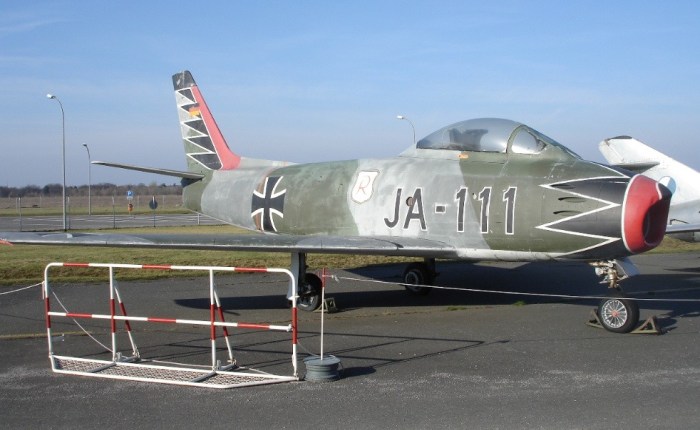
Header image: A Canadair Sabre at the Militärhistorisches Museum der Bundeswehr – Flugplatz Berlin-Gatow in Hartmann markings from when he commanded JG71, c. 2007 (Source: Wikimedia)

[1] Quoted in Edward H. Sims, Fighter Tactics and Strategy 1914-1970 (New York: Harper and Row, 1972), p. 208.

[2] Boyd referred to the ‘observation-decision-action time scale’ in the interview, which is not yet the familiar OODA loop since it lacks the orientation stage. United States Air Force Historical Research Center, U.S. Air Force Oral History Interview, K239.0512-1066, Colonel John R. Boyd, Corona Ace, 28 January 1977, p. 132.

[3] Erik Schmidt, Black Tulip: The Life and Myth of Erich Hartmann, the World’s Top Fighter Ace (Philadelphia, PA: Casemate Publishers, 2020), p. xiii.

[4] Schmidt, Black Tulip, p. 130.

[5] Schmidt, Black Tulip, p. 134; Robert Coram, Boyd: The Fighter Pilot Who Changed the Art of War (New York: Hachette Book Group, 2002), p. 244.

[6] John Stillion, Trends in Air-to-Air Combat: Implications for Future Air Superiority (Washington DC: Center for Strategic and Budgetary Assessments, 2015), p. 6.

[7] Schmidt, Black Tulip, p. 64.

[8] Philip Kaplan, Fighter Aces of the Luftwaffe in World War II (Barnsley: Pen and Sword Books, 2007), p. 192.

[9] Trevor J. Constable and Raymond F. Toliver, The Blond Knight of Germany (New York: Ballantine Books, New York, 1970), pp. 43-4.

[10] Quoted in Kaplan, Fighter Aces of the Luftwaffe in World War II, p. 195.

[11] Colin D. Heaton, ‘Final Thoughts of the Blond Knight,’ World War II 17, no. 3 (2002), p. 33.

[12] Constable and Toliver, The Blond Knight of Germany, p. 55.

[13] Rich Martindell and Bill Mims, ‘An Interview with Erich Hartmann, the Ace of Aces,’ in Tac Attack (Washington DC: Department of the Air Force, 1985), p. 23.

[14] Quoted in William Tuohy, ‘German Pilot Reported 352 Kills Hope of Top WWII Flier: No Need for New Air Aces,’ Los Angeles Times, 3 January 1986.

[15] Constable and Toliver, The Blond Knight of Germany, p. 86.

[16] C. Hind and A. Nicolaides, ‘Ace of Aces: Erich Hartmann the Blond Knight of Germany,’ Open Journal of Social Sciences 8 (2020), pp. 388-9.

[17] Edward E. Eddowes, ‘Measuring Pilot Air Combat Maneuvering Performance’ in First Symposium on Aviation Psychology (The Ohio State University Columbus: The Aviation Psychology Laboratory, 1981), p. 340.

[18] James H. Patton, Jr., ‘Stealth is a Zero-Sum Game: A Submariner’s View of the Advanced Tactical Fighter,’ Airpower Journal 5, no. 1 (1991), p. 7.

[19] Mikel D. Petty and Salvador E. Barbosa, ‘Improving Air Combat Maneuvering Skills Through Self-Study and Simulation-Based Practice,’ Simulation & Gaming 47, no. 1 (2016), p. 105.

[20] Petty and Barbosa, ‘Improving Air Combat Maneuvering Skills,’ p. 111.

[21] Petty and Barbosa, ‘Improving Air Combat Maneuvering Skills,’ p. 123.

[22] Schmidt, Black Tulip, p. 64.

[23] U.S. Air Force Oral History Interview, p. 240.

[24] In addition to The Blond Knight of Germany, Boyd may have read Edward H. Sims’ Fighter Tactics and Strategy 1940-1970 (1972), which also explained the SDAB cycle before the OODA loop emerged. Sims, Fighter Tactics and Strategy, 204-5

[25] Franklin C. Spinney, ‘Genghis John,’ Proceedings 123 (1997).

[26] Boyd advised in ‘Organic Design for Command and Control’ to operate inside enemy OODA loops ‘to enmesh adversary in a world of uncertainty, doubt, mistrust, confusion, disorder, fear, panic chaos.” Boyd also added in ‘The Strategic Game of ? and ?’: “Operating inside their OODA loops will accomplish just this by disorienting or twisting their mental images so that they can neither appreciate nor cope with what’s really going on.’ John R. Boyd, ‘Organic Design for Command and Control’ and ‘The Strategic Game of ? and ?,’ in Grant T. Hammond (ed), A Discourse on Winning and Losing (Maxwell AFB: Air University Press, 2018), p. 224 and 302.

[27] Boyd, towards the end of his life, refined the OODA loop into a vastly more complex idea involving multiple feedback loops and different relationships and pathways between the four stages. However, the idea of getting inside the enemy’s OODA loop and gaining a relative speed advance is evident in the earlier basic OODA loop and the final complex OODA loop. This key idea remained constant during the OODA loop’s evolution. Therefore, when referring to the OODA loop in this article, all versions of the OODA loop are referred to unless otherwise specified.

[28] U.S. Air Force Oral History Interview, p. 134.

[29] Frans P.B. Osinga, Science, Strategy and War: The Strategic Theory of John Boyd (New York: Routledge, 2006), p. 28.

[30] John R. Boyd, Aerial Attack Study, 50-10-6C, 1964.

[31] Osinga, Science, Strategy and War, p. 22.

[32] Grant Hammond, The Mind of War: John Boyd and American Security (Washington DC: Smithsonian Books, 2001), p. 80.

[33] Thomas McKelvey Cleaver, Going Downtown: The US Air Force over Vietnam, Laos and Cambodia, 1961-75 (Oxford: Osprey Publishing, 2022), p. 102.

[34] Barry D. Watts, Doctrine, Technology, and War, Air & Space Doctrinal Symposium Maxwell AFB, Montgomery, Alabama 30 April-1 May 1996.

[35] Watts, Doctrine, Technology, and War.

[36] Watts, Doctrine, Technology, and War.

[37] Schmidt, Black Tulip, p. 69.

[38] John R. Boyd, ‘Patterns of Conflict (Transcript),’ in Discourse on Winning and Losing, Marine Corps University, Quantico, 25 April, 2 May, 3 May 1989, p. 10.

[39] Boyd, ‘Patterns of Conflict (Transcript),’ p. 10.

[40] Boyd, ‘Patterns of Conflict (Transcript),’ p. 10.

[41] Jim Storr, The Human Face of War (London: Bloomsbury Publishing 2009), p. 13.

[42] Storr, The Human Face of War, p. 13.

[43] Storr, The Human Face of War, p. 13.

[44] For a comprehensive analysis of Boyd’s relationship with the ‘Knights of the Air’ myth, see Michael W. Hankins, Flying Camelot: The F-15, the F-16, and the Weaponization of Fighter Pilot Nostalgia (Ithaca, NY: Cornell University Press, 2021).

[45] Heaton, ‘Final Thoughts of the Blond Knight,’ p. 33.

[46] Frans P. B. Osinga, ‘The Enemy as a Complex Adaptive System: John Boyd and Airpower in the Postmodern Era,’ in John Andreas Olsen (ed.), Airpower Reborn: The Strategic Concepts of John Warden and John Boyd (Annapolis, MD: Naval Institute Press, 2015), p. 74.

[47] Heaton, ‘Final Thoughts of the Blond Knight,’ p. 85.

[48] Boyd explained in Patterns of Conflict: ‘It doesn’t make any difference whether you’re a Russian, you’re an Englishman, an American, Chinese or what. You have to observe what the hell’s going on here. Then you have to, as a result of that, looking at the world, you generate images, views, and impressions in your mind. That’s what you call orientation. Then as a result of those images, views, and impressions, you’re going have to make a selection, what you’re going to do or what you’re going to do, that’s a decision. And then you’re going to have to implement or take the action.’ Boyd, ‘Patterns of Conflict (Transcript),’ p. 11.

[49] John R. Boyd, Destruction and Creation (Paper), 3 September 1976, pp. 2-3.

[50] Boyd, ‘The Strategic Game of ? And ?,’ pp. 261-5.

Air Vice-Marshal Professor R.A. ‘Tony’ Mason – A Reflection

Air Vice-Marshal Professor R.A. ‘Tony’ Mason – A Reflection

By Dr Ross Mahoney

Editorial note: This piece was originally drafted not long after the passing of Air Vice-Marshal Mason. However, several personal reasons led to a delay in its publication. 

On 12 November 2023, Air Vice-Marshal Professor R.A. Mason, one of the doyens of air power studies, sadly passed away. Known as Tony by most who knew him personally and professionally, Mason can be considered one of the fathers of air power studies in the UK. As I have argued elsewhere, Mason was arguably the critical British air power thinker of the late 20th Century. From being the Royal Air Force’s (RAF) first Director of Defence Studies (DDefS) to his writing and commentary work, Mason was consistently at the forefront of the field until the 2010s. Indeed, his consistent commitment to the field and the length of his career made him stand out. He was also generous with his time and knowledge and always happy to share material with those who shared his interests.

Mason joined the RAF in 1956 and entered the Education Branch. He gradually rose through the ranks in his branch and undertook various assignments, including attending King’s College London, the United States Air War College and the RAF Staff College. Eventually, in 1976, Mason was informed that he would be the RAF’s first DDefS. Mason took up the role at the start of 1977. The position of DDefS was established due to the perceived state of thinking on air power within the RAF and public awareness of the Service’s role. In a letter to Air Officer Commanding-in-Chief Support Command, Air Marshal Sir Reginald Harland, Chief of the Air Staff, Air Chief Marshal Sir Neil Cameron noted that the position was being established ‘to help provide a new stimulus to air power thinking’ throughout the RAF.[1] This point was also emphasised in the terms of reference for the DDefS post, as there was a need to ‘write on air power and defence issues,’ which was to be encouraged.[2]

The establishment of the post of DDefS at the RAF Staff College at Bracknell and Mason’s perceived suitability for the role caused some debate. While this is not the place to consider that debate, the view of Mason’s successor, Group Captain Timothy Garden, is worth noting. Garden, a pilot and later Air Marshal Baron Garden, noted in 1982 in Air Clues that a colleague had questioned why he would want to take over what was perceived by 1982 as an ‘admin branch’ role. Garden reflected that the most appropriately qualified person should essentially hold the post to achieve its aims and that it ‘should not be the prerogative of any branch.’[3] That Garden, as a pilot, viewed the post in such a way was as much down to Mason’s hard work in the role as it was to the importance of the RAF’s intellectual development.

0001

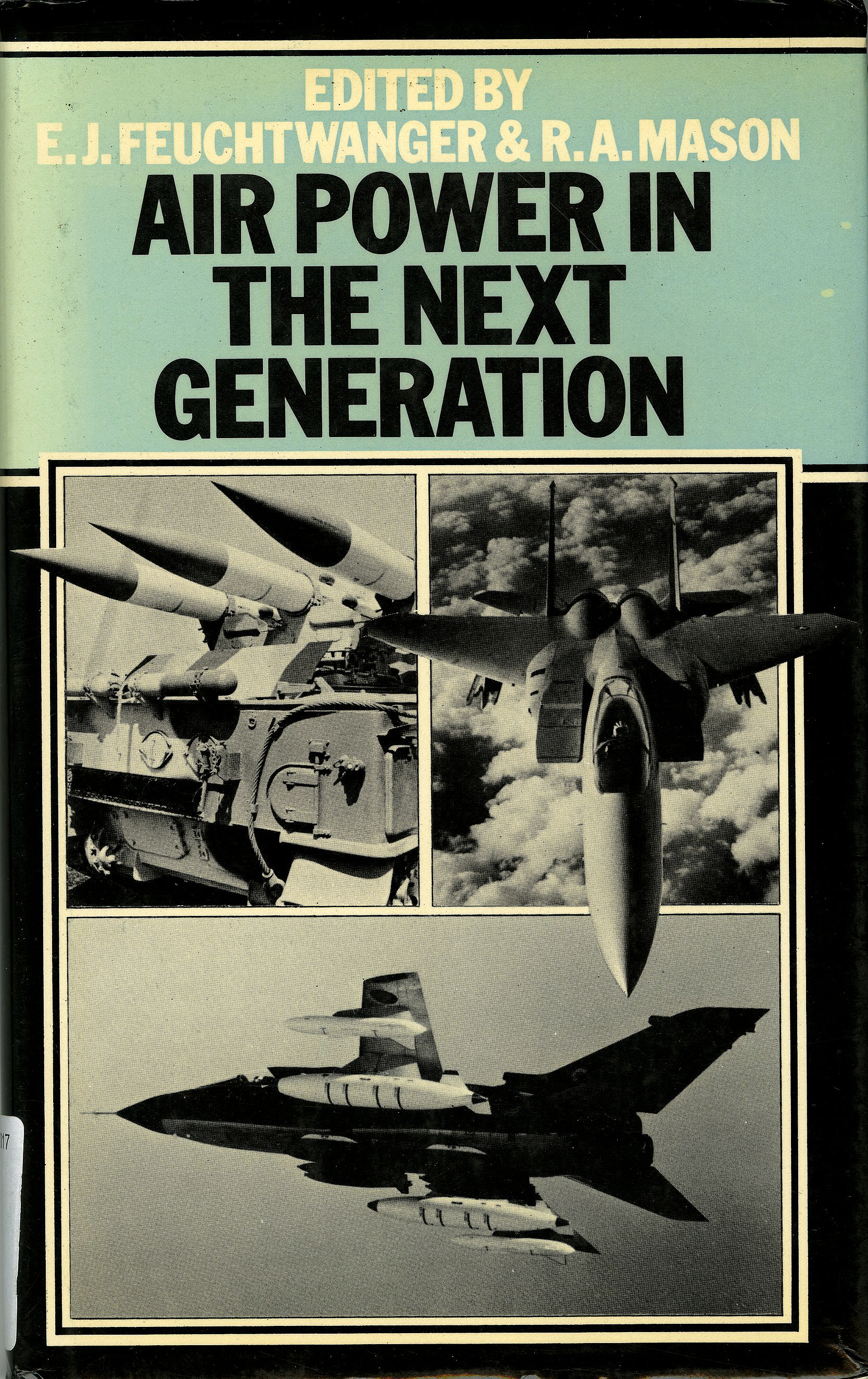
Mason nonetheless quickly sought to encourage discussion and debate and discussion about the role of air power within the service on taking up the role of DDefS. Despite the demise of the RAF Quarterly in 1977, Mason regularly contributed to Air Clues, which, up to the 1970s, had primarily been a technical publication for the RAF. In 1980, he established the Air Power Supplement to Air Clues, the spiritual ancestor to the RAF’s current professional flagship journal, Air and Space Power Review.[4] He also regularly contributed to other publications, such as The RUSI Journal. Perhaps his critical success in this period was organising an academic symposium in his first year in post. This symposium was entitled ‘Air Power in the Next Generation.’ It was well attended and laid the basis for similar endeavours by his successors. It was also published as Air Power in the Next Generation, co-edited with Edgar Feuchtwanger and published by The Macmillan Press in 1979. The book included contributions from the senior USAF, Luftwaffe, and Israeli officers, as well as civilian academics such as John Erickson. Much of Mason’s work started a process whereby his successors have continued to contribute to the collegiate intellectual development of the RAF through various schemes such as publications, conferences, and the management of defence fellowships.[5] Many former post-holders, such as Air Commodore (ret’d) Professor Peter Gray, are also notable for their contribution to developing British air power thinking through their engagement with academia after leaving the post of DDefS and the RAF.

978-1-349-17964-0

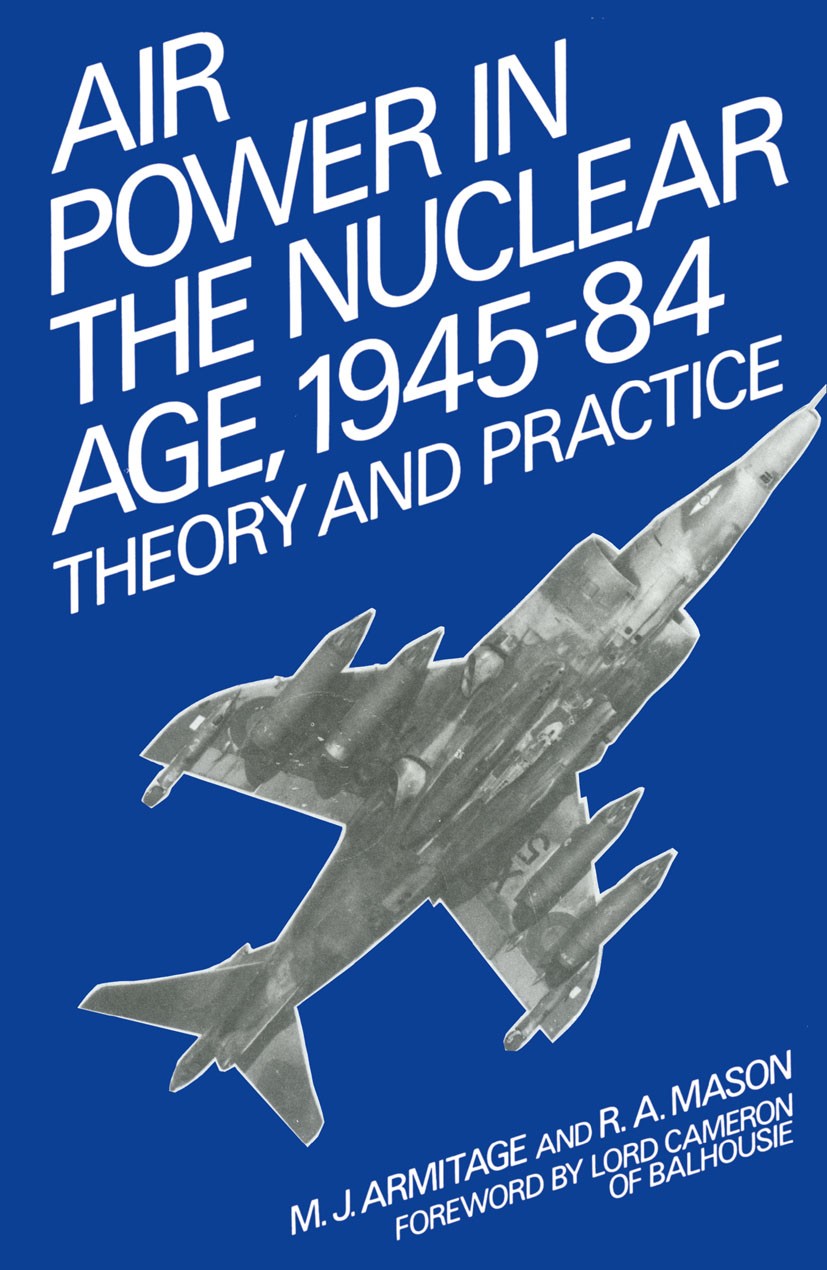
Mason’s contributions to air power studies continued after moving on from the DDefS role. In 1983, Mason published Air Power in the Nuclear Age in conjunction with Air Marshal Michael Armitage. This publication helped cement Mason’s position as a leading air power thinker. As Marshal of the Royal Air Force Lord Cameron noted in the foreword to the book, ‘[t]he joint authors of this book are advanced and enlightened thinkers about the doctrine of air power as a vital and perhaps the most important element of modern and future warfare.’[6] This view was not hyperbole. For example, in his 1984 overview of air power literature, historian Richard Hallion described the book as an ‘excellent survey’ of the development of air power during the Cold War.[7] The book was updated as a second edition in 1985. Mason’s other notable works in this period were the edited book War in the Third Dimension and the establishment of the Brassey’s Air Power: Aircraft, Weapons Systems and Technology Series. This latter series was interesting because it was explicitly directed at developing an awareness of air power amongst junior military personnel.

After retiring from the RAF in 1989, Mason moved into academia. He became the Leverhulme Air Power Research Director for the Foundation for International Security and took up a post as a Senior Research Fellow at the Centre for Studies in Security and Diplomacy at the University of Birmingham, where he was director. In 1996, he was made an Honorary Professor of Aerospace Policy at the University of Birmingham.

414K44MP5EL._AC_UF894,1000_QL80_

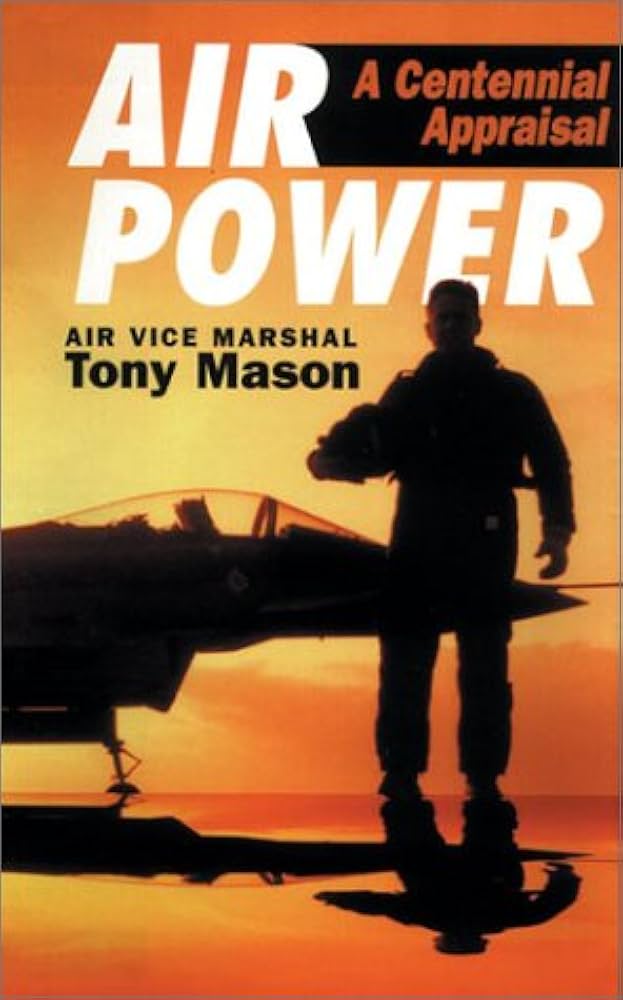
In 1994, Mason published what might be considered his magnum opus, Air Power: A Centennial Appraisal. This book confirmed Mason’s place as one of Britain’s leading air power thinkers. In this book, Mason examined the development of air power between 1989 and 1994. In doing so, he took a historical approach to examine how air power developed in the years up to this period. Mason then conceptualised the period 1989 to 1994, focusing on several key themes, such as the place of air power in arms control. Notably, he sought to contextualise much of the then-contemporary debate about the role of air power in the First Gulf War. Perhaps the most significant aspect of the book lay in Mason’s conceptualisation of what he called ‘differential air power.’[8] In short, Mason argued that while many nations shared ideas around the implementation of air power, only one in 1994 might be able to fully apply the advantages afforded by air power – the US. Using the idea of differential air power, Mason explored why the US stood out as a unique user of air power capabilities. These were important views for the time; however, while the book remains a significant contribution to air power studies, given factors such as the rise of China in the 21st Century and the distributed use of off-the-shelf technology such as drones, it remains to be seen whether his view remains applicable. Nevertheless, Mason concluded that:

One enduring concept underlay all air power thinking and all operations from the first day of the century to the last, and will continue to do so. Any nation intent on going to war to pursue an interest or defend a principle must first secure the air above it.[9]

Mason’s book was well received at publication and has become a commonly cited work. In his 1995 review in The RUSI Journal, Garden described the book as ‘excellent [and] thought-provoking.’[10] Thomas Keaney, who had worked on the Gulf War Air Power Survey, noted that the book made an ‘important contribution to any discussion on the future of airpower in the United States or elsewhere’ in a 1996 review for the US Joint Forces Quarterly.[11] However, historian Philip Sabin, reviewing the book in the Journal of Strategic Studies in 1995, offered a more tempered view. While recognising that the book had certain strengths, particularly Mason’s ‘balanced insights into many of the controversial issues regarding air power,’ Sabin also highlighted the challenge of reading a book that was ‘dense and difficult to follow without careful reading.’[12]

After the publication of Air Power, Mason continued to contribute to both the public’s and the RAF’s understanding of air power through his continued contribution to publications.[13] He also served as an expert member of the House of Commons Defence Committee in the early 2000s and helped inform British defence policy. He was also an inveterate media commentator and was often called to provide expert opinion. Mason’s contribution to air power studies was wide-ranging. While he had retired several years before his passing, his expertise will undoubtedly be sorely missed by many air power scholars for decades to come.

Dr Ross Mahoney is an independent scholar specialising in the history of war with particular reference to the use of air power and the history of air warfare. He is currently the Senior Historian within the Heritage Policy team at Brisbane City Council in Australia. He has nearly 20 years of experience in the education, museum and heritage sectors in Australia and the United Kingdom. Between 2013 and 2017, he was the inaugural Historian at the Royal Air Force Museum in the UK. In Australia, he has worked as a Historian for the Department of Veterans’ Affairs and taught at the Strategic and Defence Studies Centre at The Australian National University based at the Australian War College. His research interests are focused on the history of war, specifically on the history of air power and air warfare, military leadership and command, military culture, and the history and development of professional military education. He also maintains an interest in transport history. He has published numerous articles, chapters and encyclopedia entries, edited two books, and delivered papers on three continents. His website is here, and he can be found on Twitter at @airpowerhistory.

Header image: Ramslade House, the home of the RAF Staff College in Bracknell when Mason took up the role of Director of Defence Studies. (Source: Wikimedia)

[1] Author’s Personal Collection, Letter from the Chief of the Air Staff to AOC-in-C Support Command, 2 November 1976. I am grateful to the late Air Vice-Marshal Professor R.A. Mason for a copy of this and other documents linked to the establishment of the DDefS post.

[2] Author’s Personal Collection, Terms of Reference for Director of Defence Studies appended to a Letter from the Chief of the Air Staff to AOC-in-C Support Command, 2 November 1976, p. 1.

[3] Group Captain Timothy Garden, ‘Why don’t we forget Defence Studies and get on with the job?’ Air Clues 36, no 10 (1982), p. 364.

[4] Air Vice-Marshal Tony Mason, ‘Air Power Review’s Place in RAF History,’ Air Power Review 21, no. 1 (2018), p. 10.

[5] For a variety of publications produced under the guidance of DDefS, see: Andrew Lambert and Arthur C. Williamson (eds.), The Dynamics of Air Power (London: HMSO, 1996); Stuart Peach (ed.), Perspectives on Air Power: Air Power in its Wider Context (London: The Stationary Office: 1998); Peter W. Gray (ed.), Air Power 21: Challenges for the New Century (London: The Stationary Office, 2000); Peter W. Gray and Sebastian Cox (eds.), Air Power Leadership: Theory and Practice (London: The Stationary Office, 2002).

[6] Marshal of the Royal Air Force Lord Cameron, ‘Foreword’ in M’J’ Armitage and R.A. Mason, Air Power in the Nuclear Age: Theory and Practice, Second Edition (Basingstoke: The Macmillan Press, 1985), p. vii.

[7] Richard Hallion, The Literature of Aeronautics, Astronautics, and Air Power (Washington DC: Office of Air Force History, 1984), p. 36.

[8] Tony Mason, Air Power: A Centennial Appraisal (London: Brassey’s, 1994), pp. 235-278.

[9] Mason, Air Power, p. 278.

[10] Timothy Garden, ‘Book Reviews – Air Power: A Centennial Appraisal,’ The RUSI Journal 140, no. 3 (1995), p. 60.

[11] Thomas Keaney, ‘A Jubilee for Airmen: A Book Review,’ Joint Forces Quarterly 11 (1996), p. 134

[12] Philip Sabin, ‘Book Review – Air Power: A Centennial Appraisal,’ Journal of Strategic Studies 18, no. 4 (1995), pp. 141-2.

[13] For example, see: Tony Mason, ‘British Air Power’ in John Andreas Olsen (ed.), Global Air Power (Dulles, VA: Potomac Books, 2011), 7-62; R.A. Mason, ‘The Response to Uncertainty’ in John Andreas Olsen (ed.), European Air Power: Challenges and Opportunities (Dulles, VA: Potomac Books, 2014), pp. 215-30; Mason, ‘Air Power Review’s Place in RAF History,’ pp. 10-1.

#ResearchResources – Recent Articles and Books (March 2022)

#ResearchResources – Recent Articles and Books (March 2022)

Editorial note: In this series, From Balloons to Drones highlights research resources available to researchers. Contributions range from discussions of research at various archival repositories to highlighting new publications. As part of this series, we are bringing you a monthly precis of recent articles and books published in air power history. This precis will not be exhaustive but will highlight new works published in the preceding month. Publication dates may vary around the globe and are based on those provided on the publisher’s websites. If you would like to contribute to the series, please contact our Editor-in-Chief, Dr Ross Mahoney, at airpowerstudies@gmail.com or via our contact page here.

Articles

Malcolm Abbott, ‘Maintaining Aircraft Manufacturing through Government Purchases: Australia and Canada from the End of the Second World War until the 1970s,’ The Journal of Transport History (2022), doi:10.1177/00225266221086791.

In this article, a comparison is provided of the alternative Australian and Canadian government procurement policies for military aircraft in the post-Second World War period. Procurement was used by both governments to maintain manufacturing capacity that was established in the Second World War. By undertaking this analysis, the differing characteristics of the two policies are highlighted. In both cases procurement policies promoted the maintenance of aircraft manufacturing industries, however, the resulting industries were quite different in nature, a result partly of the differing natures of the policies, and different to some degree to the results of the policy in other Western countries.

Dagvin Anderson and Jason Hinds, ‘Joint Task Force Quartz: Through and Airpower Lens,’ Æther: A Journal of Strategic Airpower and Spacepower 1, no. 1 (2022).

Joint Task Force Quartz gave Airmen an opportunity to develop, establish, lead, execute, and debrief a Joint task force during combat operations. The operational context required the development of a synchronized and integrated scheme of maneuver bringing together information operations, combat aircraft, combat support, and logistics for each night’s air tasking order. As the Air Force develops new operational concepts, the command relationships must be built upon centralized command, distributed control, and decentralized execution all under the art of mission command.

JoAnne Bass, ‘A New Kind of War,’ Æther: A Journal of Strategic Airpower and Spacepower 1, no. 1 (2022).

The more Airmen recognize that influence operations have affected them, the faster we can recover and rebuild our defense against these attacks. Information warfare is not new; what has changed are the tactics our adversaries are using to conduct these operations at scale. We must empower our Airmen to recognize and actively combat this threat.

C.Q. Brown, ‘Ready to Meet the Moment,’ Æther: A Journal of Strategic Airpower and Spacepower 1, no. 1 (2022).

The task of preparing the Air Force to accelerate change is solidly rooted in the service’s brief but noteworthy history. The US Air Force went from propellers to jet-powered aircraft in the blink of the eye. In the 1950s, the service rapidly developed intercontinental ballistic missiles, the world’s greatest nuclear deterrent. From there, the Air Force mastered stealth and precision weapons. The next few chapters in the Air Force story are likely to be as challenging as anything we’ve ever done. But change ensures the service remains ready, as always, to meet the moment.

Mark Clodfelter, ‘Rethinking ‘Airpower versus Asymmetric Enemies,” Æther: A Journal of Strategic Airpower and Spacepower 1, no. 1 (2022).

Airpower’s effectiveness against any type of enemy depends on how well it supports the positive political goals without risking the achievement of the negative ones. The framework presented, which includes a distinctive terminology categorizing various airpower applications with those categories helping to ascertain how effectively an application supports a political goal, offers no guarantee of success or failure, nor is it a predictor of the future. But it does charge those leaders who might apply airpower to think carefully before making that decision.

David Deptula, ‘A New Battle Command Architecture for Joint All-Domain Operations,’ Æther: A Journal of Strategic Airpower and Spacepower 1, no. 1 (2022).

To achieve the objectives of JADC2, the US Air Force must deliver information to warfighters at the edge of the battlespace. The service must rapidly evolve beyond the large, centralized combined air and space operations centers of today—hundreds of people in stovepiped divisions around segregated mission areas—to a much more agile and dispersible set of processes and command-and-control structures. This new architecture must adapt to the air battle management system and JADC2 developments. But given the slow evolution of these programs, the Air Force cannot wait to begin changing the architecture for command and control of aerospace forces.

Everett Dolman, ‘Space is a Warfighting Domain,’ Æther: A Journal of Strategic Airpower and Spacepower 1, no. 1 (2022).

The Space Capstone Publication opens with the declaration that space is a warfighting domain. This assertion has tremendous repercussions for force structure, budget decisions, public and international perceptions, and, perhaps most significantly, for the culture of the newest military service. The capstone publication sets a tone for military space responsibility that is long overdue.

Ron Gurantz, ‘Does punishment work? Selection effects in air power theory,’ Comparative Strategy 41, no. 2 (2022).

Air power theory initially proposed that punitive attacks against civilian targets could force enemies to surrender. The current literature, however, has largely concluded that conventional bombing is ineffective as punishment. I argue that this is the result of a selection effect. By focusing only on high-profile bombing campaigns, the theory has drawn its conclusions from cases where punishment is likely to fail. This contrasts with deterrence theory, which has analyzed diplomacy in the shadow of nuclear punishment. Air power theory should follow this model by examining how the threat of bombing has influenced diplomacy and broader patterns of international politics.

Karen Guttieri, ‘Accelerate Change: Or Lose the Information War,’ Æther: A Journal of Strategic Airpower and Spacepower 1, no. 1 (2022).

The United States Air Force must accelerate change or lose an information-cyber war that is already hot and holds at risk American social, economic, and political cohesion. The Air Force has launched promising organizational and technological initiatives including an “integration imperative” recognizing the interdisciplinary, techno-sociological character of information warfare. At the same time, the Air Force has removed cyber from its mission statement. Moreover, force development does not progress past digital literacy, cyber hygiene, and information technology training. To win, the Air Force must develop and promote strategists to overcome vulnerabilities and seize opportunities in the cyberspace domain and information environment.

Clinton Hinote, ‘After Defeat: A Time to Rebuild,’ Æther: A Journal of Strategic Airpower and Spacepower 1, no. 1 (2022).

We lost people, we lost aircraft, we lost a campaign, we lost prestige, but we did not lose forever. It is time to look beyond the sense of finality that comes with defeat. We can decide not to lose. After suffering tremendous moral and physical attrition, it is time to rebuild. We cannot waste this crisis. We must implement the necessary changes to be victorious, next time.

Jacqueline van Ovost, ‘75 Years of Mobility Operations: Evolving for the Next 75,’ Æther: A Journal of Strategic Airpower and Spacepower 1, no. 1 (2022).

Operation Allies Refuge, certain to be studied for generations to come, unmistakably demonstrated the resolve of the logistics enterprise. But we cannot become complacent; the complex and dynamic nature of tomorrow’s challenges to US national security require an agile US Transportation Command, flexible, fully integrated, and responsive enough to meet the volume and tempo of warfighters’ demands. The command must place renewed emphasis on maneuver and evolve how the concept is applied across domains.

Robert Pape, ‘Hammer and Anvil: Coercing Rival States, Defeating Terrorist Groups, and Bombing to Win,’ Æther: A Journal of Strategic Airpower and Spacepower 1, no. 1 (2022).

The power of airpower lies in its supreme ability to match the use of force to decisive weaknesses in an opponent’s military strategy. This power lies not so much in technology, the balance of forces between coercer and opponent, civil-military relations, or professional command and control over military forces, although each of these is critical to the successful use of coercive airpower that achieves vital political objectives without inflicting harm to no purpose. Effective airpower instead turns, fundamentally, on understanding the enemy.

John Shaw et al., ‘Sailing the New Wine-Dark Sea: Space as a Military Area of Responsibility,’ Æther: A Journal of Strategic Airpower and Spacepower 1, no. 1 (2022).

The designation of a new military area of responsibility is highly significant change, denoting the major structural and functional differences between the current US Space Command and its predecessor, which existed between 1985 and 2002. A few propositions can guide our approach to accomplishing the command’s Unified Command Plan responsibilities: the area NOT in the US Space Command AOR is the most special place in the cosmos; the word “global” cannot adequately describe the political/military range of national security considerations; the concept of key terrain must be reimagined in the domain; and the military space AOR has relevance for everyone.

Johnny Stringer, ‘Air Power, 2010-2020: From Helmand to Hypersonics,’ Æther: A Journal of Strategic Airpower and Spacepower 1, no. 1 (2022).

An examination of air power employment over the last decade yields lessons and deductions from some exceptionally challenging operations in deeply complex environments: geographical, political and informational, but also increasingly shaped by the information environment, and with multiple audiences, actors, and adversaries. The West and its allies are at an inflection point in the employment and utility of air and space power; we no longer own nor can dictate all the terms of the debate.

Marybeth Ulrich, ‘The USAF at 75: Renewing our Democratic Ethos,’ Æther: A Journal of Strategic Airpower and Spacepower 1, no. 1 (2022).

Countering threats to American democracy is a vital national interest. Civics literacy and the development of a democratic ethos must be fostered in Americans beginning in early childhood, but the military plays a role in national democratic renewal as well. On the occasion of its 75th birthday, the US Air Force must draw upon its heritage, renewing a commitment to a democratic ethos that preferences service members’ obligation to the Oath of Office above partisan or personal interests.

Heather Venable, ‘Accelerate Change and Still Lose?: Limits of Adaptation and Innovation,’ Æther: A Journal of Strategic Airpower and Spacepower 1, no. 1 (2022).

Achieving air dominance requires more than technology. History reveals that technological solutions do not always offer the surest path to success. In this vein, calls for change provide terse nods to concepts and ideas, such as potential competitors’ “theories of victory,” while privileging more technological solutions. The services need a sound strategy to answer the requisite preliminary question of innovation or adaptation: we can, but should we? And, if we pursue innovation or adaptation in one area, what other area must be neglected because of that choice?

John Warden, ‘Winning a Peer War,’ Æther: A Journal of Strategic Airpower and Spacepower 1, no. 1 (2022).

A war with a peer is very unlikely to start tomorrow. If it did, however, the United States would be forced to fight with the ideas and the equipment that currently exist. America might in the final analysis prevail, but the challenge would be extreme and the cost likely to be high before victory was attained. On the other hand, if the war does not start for a decade or more, the United States has the opportunity to prepare well to win at an affordable price in a reasonable period of time. America’s survival, and that of the West writ large, demands we find the solutions that will lead to victory in a war with a peer opponent. The United States cannot afford to gamble that there will not be a serious peer war in a foreseeable future.

Books

Bojan Dimitrijevic and Jovica Draganić, Operation ALLIED FORCE – Volume 2: Air War over Serbia 1999 (Warwick: Helion and Company, 2022).

On 24 March 1999, the North Atlantic Treaty Organisation (NATO) launched Operation Allied Force against Serbia, claiming that Serb forces in Kosovo were engaged in ethnic cleansing and gross violations of human rights. Serbia, in turn, claimed to be fighting against an insurgency. This would be the last war in Europe during the 20th century.

The second volume of Operation Allied Force provides in depth analyses of the operation. The authors have analysed the experiences of both sides, starting from the command chain of the aviation of both air forces and the operations of the Yugoslav/Serb air defences.

This book explains many “firsts” that occurred in Operation Allied Force: the use of B-2A stealth bombers, new SEAD aviation tactics, and new munitions ranging from JDAM and JSOW to Graphite bombs. It also examines the tactics of Serbian air defences to minimize the effects of the air strikes, by adopting movement and improvisation. Finally, the authors reveal the level of damage and casualties on the FR Yugoslavia side and comments upon the aircraft losses on both sides.

The analyses are based upon original data as the authors, both the members of the joint Serbian Air Force/USAFE team which analysed Operation Allied Force in 2005–2006, received the opportunity to compare the experiences of both sides.

Operation Allied Force, Volume 2 is illustrated in full colour with photographs, diagrams and other illustrations from the FRY/Serbian Air Force, official USAF/NATO photographs from the US National Archives and original colour artworks commissioned for this project.

Raymond O’Mara, Rise of the War Machines: The Birth of Precision Bombing in World War II (Annapolis, MD: Naval Institute Press, 2022).

Rise of the War Machines: The Birth of Precision Bombing in World War II examines the rise of autonomy in air warfare from the inception of powered flight through the first phase of the Combined Bomber Offensive in World War II. Raymond P. O’Mara builds a conceptual model of humans, machines, and doctrine that demonstrates a distinctly new way of waging warfare in human-machine teams. Specifically, O’Mara examines how the U.S. Army’s quest to control the complex technological and doctrinal system necessary to execute the strategic bombing mission led to the development off automation in warfare.

Rise of the War Machines further explores how the process of sharing both physical and cognitive control of the precision bombing system established distinct human-machine teams with complex human-to- human and human-to-machine social relationships. O’Mara presents the precision bombing system as distinctly socio-technical, constructed of interdependent specially trained roles (the pilot, navigator, and bombardier); purpose-built automated machines (the Norden bombsight, specialized navigation tools, and the Minneapolis-Honeywell C-1 Autopilot); and the high-altitude, daylight bombing doctrine, all of which mutually shaped each other’s creation and use.

William Pyke, Air Power Supremo: A Biography of Marshal of the Royal Air Force Sir John Slessor (Barnsley: Pen and Sword, 2022).

Sir John Slessor was one of the twentieth century’s most distinguished wartime commanders and incisive military thinkers, and William Pyke’s comprehensive new biography reveals how he earned this remarkable reputation.

Slessor, a polio victim who always walked with a stick, became a First World War pilot in the Sudan and on the Western Front and a squadron and wing commander in India between the wars. When aerial warfare was still a new concept, he was one of the first to develop practical tactics and strategies in its application. In the Second World War, as the Commander-in-Chief of Coastal Command during the Battle of the Atlantic and the RAF in the Mediterranean during the Italian and Balkan campaigns, he made a remarkable contribution to the success of Allied air power. Then, after the war, as a senior commander he established himself as one of the foremost experts on strategic bombing and nuclear deterrence. That is why this insightful biography of a great British airman and his achievements is so timely and important as we enter a new era of strategic doubts and deterrence at the beginning of the twenty-first century.

William Pyke follows each stage of Slessor’s brilliant career as a pilot and commander in vivid detail. In particular he concentrates on Slessor’s writings, from his treatise on the application of air power in support of land armies to his thinking on nuclear deterrence and Western strategy.

#ResearchResources – Recent Articles and Books (July 2021)

#ResearchResources – Recent Articles and Books (July 2021)

Editorial note: In this series, From Balloons to Drones highlights research resources available to researchers. Contributions range from discussions of research at various archival repositories to highlighting new publications. As part of this series, we are bringing you a monthly precis of recent articles and books published in air power history. This precis will not be exhaustive but will highlight new works published in the preceding month. Publication dates may vary around the globe and are based on those provided on the publisher’s websites. If you would like to contribute to the series, please contact our Editor-in-Chief, Dr Ross Mahoney, at airpowerstudies@gmail.com or via our contact page here.

Articles

Phil Haun, ‘Winged Victory: How the Great War Ended: The Evolution of Giulio Douhet’s Theory of Strategic Bombing,’ War in History (2021). doi:10.1177/09683445211027596.

A war’s conclusion can impact strategic thinking even when the outcome is misinterpreted or an outlier. For a century, Giulio Douhet in Command of the Air, 1921 and a 1926 revision, has been the prophet for the utilitarian morality of bombing cities to gain decisive victory. His earlier work, Winged Victory: How the Great War Ended, written in 1918, has been ignored where he argued for the interdiction of enemy lines of communication. His theory changes by how the Great War ends with the collapse of the German population’s will. Had it ended differently, he could have reached a different conclusion that could have impacted the development of air power theory in the twentieth century.

Colin Tucker, ‘The Effect of Aerial Bombardment on Insurgent Civilian Victimization,’ Security Studies (2021), DOI: 10.1080/09636412.2021.1951834

Little is known about how air strikes influence insurgent behavior toward civilians. This study provides evidence that air strikes against the Islamic State of Iraq and Syria (ISIS) by counterinsurgency forces were a contributing factor in its civilian victimization. I theorize that air strikes expanded the distribution of insurgent fatalities to include higher-echelon membership and, at the same time, imposed psychological impairments on its fighters. As a consequence, these changes relaxed restraints on civilian abuse at the organizational and individual levels. This theory is informed by interviews of ISIS defectors and translations of ISIS documents and tested through a statistical analysis of granular-level data on air strikes and one-sided violence during ISIS’s insurgency. These findings contribute to our knowledge of insurgent behavior and provide important policy implications in the use of air strikes as a counterinsurgency (COIN) tool.

Books

James Corum, Norway 1940: The Luftwaffe’s Scandinavian Blitzkrieg (Oxford: Osprey Publishing, 2021).

The Campaign for Norway in 1940 was a pivotal moment in modern warfare. It was the first modern joint campaign that featured not only ground and naval operations, but also airpower as an equal element of all operations. Indeed, Norway was the first campaign in history where air superiority, possessed by the Germans, was able to overcome the overwhelming naval superiority, possessed by the British. German success in Norway was not pre-ordained. At several times in the opening weeks of the campaign the Norwegian and Allied forces could have inflicted a major defeat on the Germans if their operations had been effectively supported. It was, in fact, the superior German use of their air force that gave the Germans the decisive margin of victory and ensured the failure of the Allied counteroffensive in central Norway in April and May of 1940.

The Norwegian campaign featured some firsts in the use of airpower including the first use of paratroops to seize key objectives and the first sinking of a major warship by dive bombers. All aspects of airpower played important roles in the campaign, from air reconnaissance to strategic bombing and ground-based air defenses. The British employed their Bomber Command in long-distance strikes to disrupt the German air and naval bases and the Germans used their bomber force to carry out long-range support of their ground forces. The German ability to transport large numbers of troops by air and the ability to supply their ground and air forces over great distances gave the Germans their first major campaign victory over the Western Allies.

Covering the first true joint campaign in warfare, this book provides a complete view of a compelling turning point in World War II. Featuring an analysis of the cooperation of ground, naval and air forces, this book is intended to appeal to a broad range of readers interested in World War II, and specifically to those interested in the role airpower played in the strategic and operational planning of the Campaign for Norway.

Bill Norton, 75 Years of the Isreali Air Force – Volume 3: Training, Combat Support, Special Operations, Naval Operations, and Air Defences, 1948-2023 (Warwick: Helion and Company, 2021).

The Israeli Air Force grew from humble beginnings to one of the largest and most experienced air combat teams in the world. This came through several major and minor wars with its Arab neighbors, almost continuous military actions short of war, and preparation for power-projection operations unusual for so small a nation. The 75-year history of the Israeli Air Force is, then, a fascinating study of a relatively small military organization working to meet shifting obligations under multiple impediments while being repeatedly tested in combat. Many factors over the decades shaped the air fighting capability, not the least being the demands of the evolving battlefield, uncertain funding, available weapons, and quality of personnel. Tactics and doctrine were, in turn, shaped by government policies, international pressures, and confronting adversaries likewise evolving. When the trials in war or combat short of war came, success was a measure in relevance of the service’s weapons, adequacy of training, and experience of personnel.

As a companion to Volumes 1 and 2 giving the chronological history of the Israeli Air Force, this third volume details special topics underscoring the service’s capability growth. These richly illustrated topics are flight training, photo reconnaissance, aerial refueling, electronic warfare, support of Special Forces, support of the Navy, and the Air Defence Forces. A summary of aircraft that served with the Israeli Air Force is provided, with a photograph of each type and major models. A summary of all IAF air-to-air “kills” is also included. 

Written at a time of historical changes for the air force, and the Israel Defense Forces as a whole, this volume informs understanding of the service emerging and operating in future years. Backed by official and unofficial histories published in the last 20 years, and the unprecedented openness in the past few decades, the author has worked to make this account more accurate and complete than those of the past. It also stands apart from many other books in performing this examination in a more dispassionate and critical manner, without the common hyperbole.

Harry Raffal, Air Power and the Evacuation of Dunkirk: The RAF and Luftwaffe During Operation Dynamo, 26 May – 4 June 1940 (Bloomsbury Publishing: London, 2021).

The evacuation of Dunkirk has been immortalised in books, prints and films, narrated as a story of an outnumbered, inexperienced RAF defeating the battle-hardened Luftwaffe and protecting the evacuation. This book revives the historiography by analysing the air operations during the evacuation. Raffal draws from German and English sources, many for the first time in the context of Operation DYNAMO, to argue that both sides suffered a defeat over Dunkirk. 

This work examines the resources and tactics of both sides during DYNAMO and challenges the traditional view that the Luftwaffe held the advantage. The success that the Luftwaffe achieved during DYNAMO, including halting daylight evacuations on 1 June, is evaluated and the supporting role of RAF Bomber and Coastal Command is explored in detail for the first time. Concluding that the RAF was not responsible for the Luftwaffe’s failure to prevent the evacuation, Raffal demonstrates that the reasons lay elsewhere.

#BookReview – No Fly Zones and International Security: Politics and Strategy

#BookReview – No Fly Zones and International Security: Politics and Strategy

Reviewed By Dr Peter Layton

Stephen Wrage and Scott Cooper, No Fly Zones and International Security: Politics and Strategy. Abingdon: Routledge, 2019. Tables. Illustrations. Notes. Bibliography. Index. Hbk. xi + 166 pp.

51yFbrZlPhL._SX313_BO1,204,203,200_

This is an excellent little book on no-fly zones. No Fly Zones and International Security is arguably the seminal work on the subject, but it may be on a subject whose time has passed. The book may be both the first word and the last on this particular type of air power operation.

No Fly Zones and International Security falls within the genre of strategic studies but does not use any particular theoretical framework. Instead, the authors opt to integrate history, current affairs, technology and the operational level of war into a most comprehensive analysis. In this process, the two authors bring a wealth of knowledge and experience having been involved with no-fly zone issues and their study for decades. Stephen Wrage is a Professor at the US Naval Academy and specializes in American foreign policy and strategies. Scott Cooper flew EA-6Bs for the USMC including in most of the no-fly zone operations this book explores.

No-fly zones are explained as seizing another country’s airspace and applying to the airspace specific rules and regulations. So understood, no-fly zones are a form of occupation more akin to naval blockades or maritime exclusion zones than to the placing of ground forces in another country. This means no-fly zones are somewhat out of sight both to the population of the country impacted and to the country employing them. Their impact on the domestic politics of either country is accordingly somewhat muted, making their lifting less pressing; they can continue for many years. No-fly zones are a way of exerting military pressure, but they do so in a quasi-benign manner that places the onus to escalate to direct conflict on the state whose airspace has been seized. No-fly zones are then a soft form of coercive diplomacy, a military power tool or method that lies somewhere between economic sanctions and war in the conflict continuum.

The book initially delves into the doctrine, nature, types, tactics, strategies, and ethics of no-fly zones. This provides the background necessary for in-depth analysis and careful assessments of the no-fly zones in Iraq, Bosnia, and Libya. The Iraq chapter covers mostly Northern and Southern watch; the former when labelled Provide Comfort I was where no-fly zones originated. The Bosnia chapter is more expansive, moving from the short-lived 1992-93 Operation Sky Monitor to the major air campaign over Kosovo in 1999. Libya is even more so with the no-fly zone only fleetingly appearing before turning into a significant military intervention albeit conducted almost entirely by air.

The inclusion of much more discussion than solely about no-fly zones in the Bosnia and Libya sections does highlight that the history of no-fly zones is somewhat meagre. On the other hand, including such information directly related to air power helpfully places no-fly zones into context. The three history chapters also end with a useful lessons learned section that nicely summaries the issues for busy people and policymakers.

The book’s last chapter looks forward to whether no-fly zones have a future. As part of this, it also discusses no-fly zones that could have happened in Darfur and Syria and explains why they were not implemented. This highlights that the relationship between no-fly zones and strategy is worth exploring.

The book is at some pains to not claim no-fly zones are a strategy instead of seeing them as ‘an option, a tactic or a tool.’ As such, they offer states a relatively low-cost way to ‘do something’ without becoming deeply involved while retaining the ability to modulate air operations as necessary and withdraw very quickly if needs be. This brings to mind Eliot Cohen’s 1994 comment that ‘[a]ir power is an unusually seductive form of military strength, in part because, like modern courtship, it appears to offer gratification without commitment.’

F-15C_during_Operation_Deny_Flight
A US Air Force McDonnell Douglas F-15C Eagle from the 53rd Fighter Squadron is met by maintenance personnel at Aviano air base, Italy, after a mission over Bosnia to enforce the No-Fly Zone on 1 June 1993. (Source: Wikimedia)

In terms of gratification, the book makes it clear that no-fly zones by themselves can achieve little; they need to be part of a much larger and aggressive joint campaign to have a decisive impact. In this, no-fly zones can realistically have no real strategic objective in and of themselves. At best, they can be a conflict management tool that freezes in place the status quo. At least so far, they have been used only in intra-state conflicts.

In intra-state conflicts, no-fly zones arose and have been used mainly for humanitarian protection purposes. This cuts back to the ‘do something’ imperative liberal states feel when the global media discerns significant human rights violations occurring. Since Iraq and then Afghanistan, military interventions by Western powers have become less appealing, but this has not made doing nothing in the face of genocide and mass atrocities suddenly attractive. States still feel a moral obligation, and under the Responsibility to Protect (R2P) norm, some international pressure, to respond. No-fly zones can signal an interest in an issue, but as the book makes clear, they do not in themselves prevent or stop humanitarian disasters.

R2P is starting to appear as a rather quaint notion of a gentler, kinder time. No-fly zones were an American idea carried out with allied support to mildly enforce particular Western rules, albeit the United Nations generally endorsed these. Rising great power China is unattracted to supporting such humanitarian interventions as they involve intervening against authoritarian governments mistreating their people. China under Xi Jinping is increasingly more likely to aid authoritarian governments than stop them committing human rights abuses as its endorsement of Syria’s Assad regime reveals.

Russia, the perennial troublemaker of the modern era, is similarly inclined. Indeed, had a Syrian no-fly zone been implemented, Russia would have been one of the nations it would have been directed against. No-fly zones may now simply be an anachronistic artifact of a liberal rules-based order that has crumbled.

The book concludes on a sombre note in arguing that the Russian use of surface-to-air missiles systems in the Donbass in shooting down Malaysian Airlines flight MH17 and 19 Ukrainian military aircraft created and then policed a no-fly zone, that has since been ratified under a cease-fire agreement. China has now extended this innovation by installing similar missile systems on its newly created islands in the South China Sea. There are now effectively no-fly zones above and for 12 nautical miles (the claimed territorial limit) around these new artificial constructs.

No-fly zones started out as a device associated with humanitarian protection during civil wars. They may now be morphing into a device whereby authoritarian states can make territorial land grabs.

No Fly Zones and International Security makes an outsized contribution to what is admittedly a small field and not just in terms of discussing no-fly zones. It is one of the few books discussing in a comprehensive, balanced, insightful and well-argued way the application of contemporary air power. The book offers much for military professionals, academics and all concerned with deeply understanding the business of applying air power in the modern world.

Dr Peter Layton is a Visiting Fellow at the Griffith Asia Institute, Griffith University. His PhD is in grand strategy, and he has taught on this at the US National Defense University. He is the author of the book Grand Strategy.

Header Image: A US Air Force EF-111 Raven from the 429th Electronic Combat Squadron flies over the Alps of Northern Italy while on a mission during Operation DENY FLIGHT in 1995. (Source: Wikimedia)

#BookReview – Lectures of the Air Corps Tactical School and American Strategic Bombing in World War II

#BookReview – Lectures of the Air Corps Tactical School and American Strategic Bombing in World War II

Reviewed by Group Captain Jo Brick

Phil Haun (ed.), Lectures of the Air Corps Tactical School and American Strategic Bombing in World War II. Lexington: The University Press of Kentucky, 2019. Illustrations. Appendices. Notes. Bibliography. Index. Notes. xvi + 297 pp.

Let us not be zealots. Let us not plunge thoughtlessly from the old and known to the new and untried. Let us not claim that the airplane has outmoded all other machines of war. Rather, let us be content with an evident truth: The air force has introduced a new and different means of waging war. (p. 85)

Haywood Hansell

41sm64RGspL._SX331_BO1,204,203,200_As Hansell highlighted, air power revolutionised war by allowing the focusing of force on the enemy’s vulnerable areas without having to meet its forces ‘in the field’. There are now a few essential books on strategic bombardment that provide historical depth to its development primarily during the Second World War. Works such as Bombers and the Bombed – Allied Air War Over Europe by Richard Overy, Among the Dead Cities by A.C. Grayling, and Air Power and Warfare – A Century of Theory and History by Tami Davis Biddle provide a rich contextual background within which Phil Haun’s compilation sits.
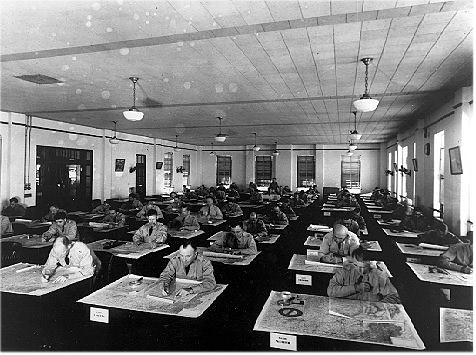
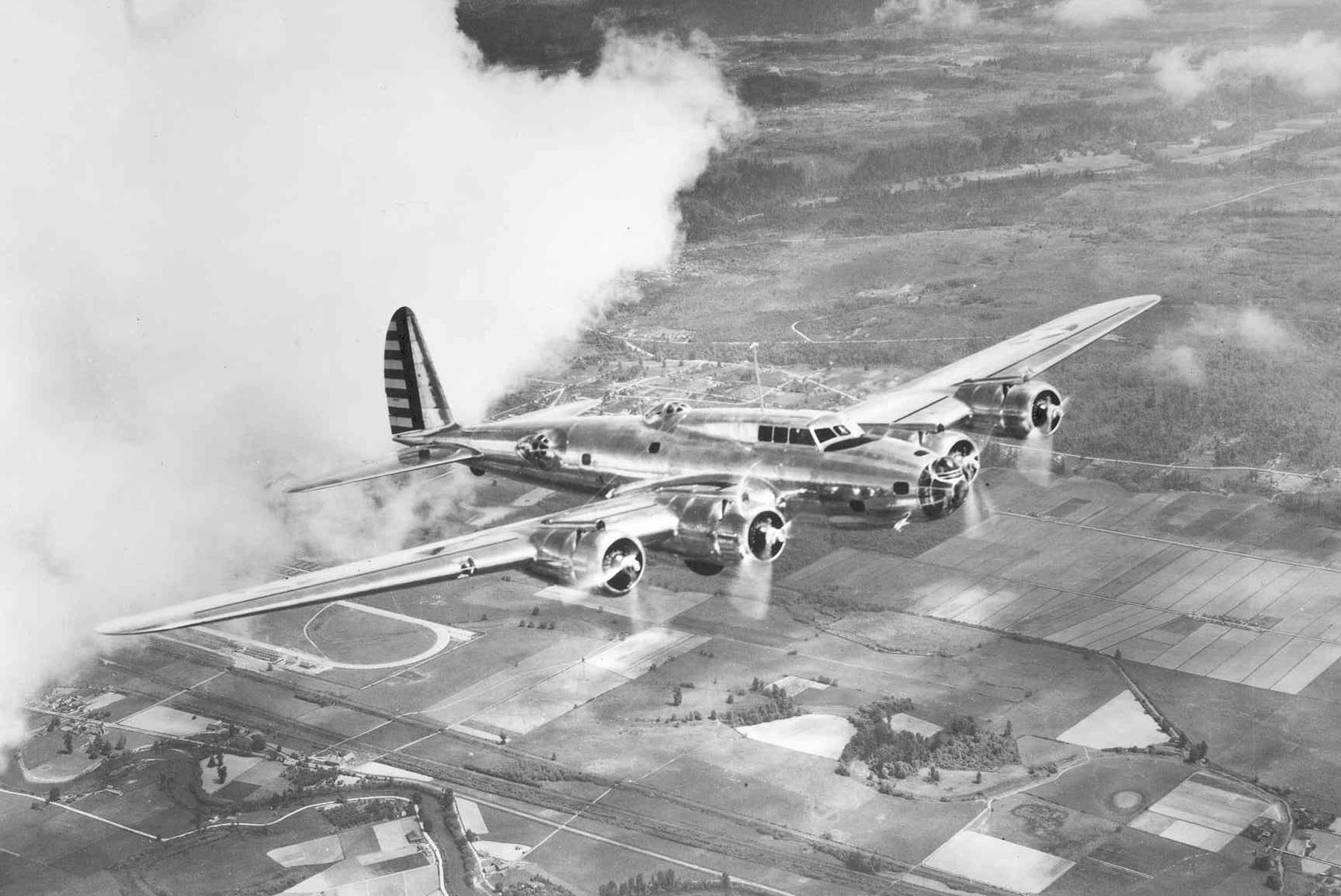
Phil Haun has compiled the lectures of the Air Corps Tactical School (ACTS) as a means of capturing some of the primary sources that led to the development of the American approach to strategic bombardment. The theories focused specifically on high altitude daylight precision bombing (HADPB). The lectures in Haun’s work were developed during the formative period of air power, following on from the landmark work, Command of the Air, by Giulio Douhet, which advocated for the use of air power for strategic bombardment of civilian populations and cities on the assumption that it would destroy morale and force populations to capitulate. Douhet’s work focused on the importance of gaining command of the air and the direction of air power to particular targets.

What makes Haun’s compilation compelling, and its most significant contribution to the study of air power is that it preserves nascent thinking about how to put novel theories into practice. The work also highlights the perennial struggle between the development of strategic air power – to ostensibly use air power as a means to victory on its own – or the development of air power capabilities that primarily support naval and land forces. Although the technology has developed beyond what the authors of these lectures could have imagined, their ideas and arguments have a direct link and relevance to conceptions of strategic strike, and bombardment in depth. For example, Major – later General – Muir Fairchild’s discussion of the ‘National Economic Structure’ (pp. 140-64) in his 5 April 1939 lecture to the ACTS finds resonance in the targeting of Daesh oil and cash stores during Operation INHERENT RESOLVE as a means to removing the economic support to its military operations in Iraq and Syria. This compilation of lectures is recommended for military professionals, and students of military history and air power, who want access to primary sources that demonstrate the fundamental ideas on strategic bombardment and how air power could be used independently as a means of forcing the rapid capitulation of the enemy.

The book is comprised of several lectures delivered at ACTS at Maxwell Field, Alabama, between 1936 and 1940, and demonstrates the development of American logic and assumptions regarding the best use of a new capability – aerial bombardment – to achieve strategic outcomes. In his ‘Notes on the Text’ (pp. xv-xvi), Haun explained the criteria he used to select the ten lectures published in the book. First, the lectures were the most quoted in subsequent publications on U.S. strategic bombardment and were therefore considered by Haun to be the most important. Second, the lectures demonstrated the most mature thinking on the theory of American strategic bombing before the entry of the United States into the Second World War in December 1941. Third, these lectures were delivered to the largest number of students at ACTS between 1938 and 1941. Fourth, the students mentioned above became the officers who planned and conducted bombardment in Germany and Japan. Fifth, there were the best-preserved lectures. Finally, and pragmatically, not all ACTS lectures could be physically included in a single volume work.

Air Corps Tactical School
The Air Corps Tactical School (created as the Air Service Field Officers School in 1920) went beyond its mandate of training officers to also become an engine for air power theory development in the interwar period. (Source: US Air Force Air University)

The lectures were delivered by officers who were experienced aviators, and some had tertiary qualifications, though only a few had combat experience. Only a few, such as Major – later Lieutenant-General – Harold George and Fairchild, had completed some professional military education. This does not distract from the utility of the lectures presented here, as they demonstrate a practitioner’s approach to wrestling with the dilemma of how to maximise the utility of a new weapon of war, and to avoid the protracted stalemate on the Western Front only 20 years before the time these lectures were written.

Haun’s introductory sections to the book provide an overview of the development of air power theory during the inter-war period. Aside from Douhet, the most important ideas that influenced the development of air power theory in the United Kingdom and the United States can be traced to a few individuals. Major-General Hugh Trenchard became the first Chief of the Air Staff of the newly established Royal Air Force in 1918. He influenced the development of British strategic bombardment theory, principally reference to attacking the enemy’s morale, which was not as blunt as Douhet’s advocacy for the bombing of the civilian population. Brigadier General William ‘Billy’ Mitchell proposed the creation of an independent air service alongside his ideas on strategic bombardment that focused on the selection of targets that would most quickly degrade the enemy’s capacity to fight and therefore shorten the war. The inter-war theorists minimised discussion about the effect of bombardment on the civilian population, with the practice of bombardment of cities by both sides in the Second World War. This culminated in dropping of the atomic bomb on Nagasaki and Hiroshima in 1945. The effectiveness of strategic bombardment of cities remains a subject of enduring controversy.[1]

The first two chapters provide an elucidation of the understanding of strategy, air power, and warfare as held by the lecturers. The enduring nature of war is discussed or mentioned in these chapters, such as Captain – later Major General – Haywood Hansell’s statement that:

War is a furtherance of national policy by violence. Since nations find the real fulfilment of their policies in peace, the real object of war is not the continuance of violence, but the establishment of a satisfactory peace.’ (p. 75)

The authors of these lectures also grappled with the industrialised nature of warfare that was so grimly demonstrated on the Western Front from 1914 to 1918. George, in ‘An Inquiry into the Subject of “War”,’ noted what he perceived to be the increased vulnerability of industrialised societies, due to their:

[s]usceptibility to defeat by the interruption of this economic web […] connected therewith is the industrial fabric which is absolutely essential for modern war. (p. 43)

This theme is continued and further examined by Fairchild’s lectures in chapters five and six.

Perhaps the least relevant lectures are those in chapter three, which are very technical and limited to the capabilities available at the time the lectures were written. Lieutenant – later Brigadier General – Kenneth Walker’s ‘Driving Home the Bombardment Attack’ discussed the tactics and formations that he considered the most effective for the bomber force to penetrate enemy air defence. They represent rudimentary ideas that were yet to be tested. Haun commented that Walker’s ideas proved to be right in that bomber formations successfully penetrated air defences, yet only focused on single raids rather than the cumulative effect of aerial attacks over time (p. 98). Major Frederick Hopkins’ lecture, ‘Tactical Offense and Tactical Defense’ considered the attrition rate of the bomber force and consequent ability to conduct offensive bomber operations. These lectures discuss the tactical viability of the bomber force and its impact on successful offensive bombing operations. However, they did not account for the development of radar, which had a dramatic impact on the effectiveness of bombardment, and was being developed at the time of their writing.

Captain – later General – Laurence Kuter’s lecture on the ‘Practical Bombing Probabilities’ considered several factors that determined the accuracy of delivery and effectiveness of bombardment. Kuter’s lecture was delivered in 1939 while the Norden bombsight continued in its development. Although the bombsight would not be used until the war, the concepts and ideas discussed by Kuter represented necessary rudimentary steps in thinking about bombardment accuracy. From the ‘Practical Bombing Probabilities Problem,’ we can draw a direct link to the development of elaborate weapons effects information, and other considerations that affect bombing accuracy. The factors that determine ‘how many bombs it takes to hit and sink a battleship’ or any other target are now answered by software such as the Joint Air-to-Surface Weaponeering System, and databases such as the Joint Munitions Effectiveness Manual. These targeting tools are essential for the planning of strike missions and are directed towards maximising accuracy while ensuring a high ‘probability of kill’ (Pk).

Boeing Y1B-17
A Boeing Y1B-17 in flight. This aircraft would eventually be developed B-17 Flying Fortress. (Source: Wikimedia)

Chapters five, six and seven covers the theories of Fairchild are perhaps the most useful lectures as they are still relevant today. Fairchild’s work provided insight into the dilemma of how to effectively use air power for strategic effect versus using air forces to support land and naval forces. As Haun highlighted, with the development of the Norden bombsight and the B-17 Flying Fortress, the next issue was to determine what targets could be struck to most effectively and rapidly result in victory (p. 139). Fairchild’s work is based on studies by Donald Wilson, who provided an analysis of America’s infrastructure and its vulnerability to attack because U.S. isolationism at the time prevented the collection of intelligence about the Germans and Japanese.

One of the more interesting aspects of Fairchild’s lecture ‘National Economic Structure’ (pp. 140-64) is his discussion of the effectiveness of attacking an enemy population’s morale versus the enemy’s war-making capacity. He concluded that because of the adaptability of ‘man’ the fear initially caused by strategic bombardment to becomes ineffective over time. This was certainly borne out by the evident ‘Blitz Spirit’ and resolve within British society as the result of bombardment by the Luftwaffe in 1941. Fairchild went on to state that a more humane – and certainly consistent with the laws of war – approach was to understand the target as a system. He said:

Complete information concerning the targets that comprise this objective is available and should be gathered during peace. Only by careful analysis – by painstaking investigation, will it be possible to select the line of action that will most efficiently and effectively accomplish our purpose, and provide the correct employment of the air force during war. It is a study for the economist – the statistician – the technical expert – rather than for the soldier. (p. 146)

This is precisely the function of ‘target systems analysis’ today, which is essential for understanding the vulnerabilities of a system in order to identify the components that can be affected to destroy or degrade the operation of the system. The United States Strategic Bombing Survey (USSBS) acknowledged that the factors of production identified by Fairchild – transportation, petroleum refineries, and electrical power stations – were indeed critical vulnerabilities in the German economy (p. 178).

The maturity of such a system was perhaps most evident in the command and control established to plan and execute the air war against Iraq in the 1991 Gulf War. Using the small planning cell established during the Cold War called ‘Checkmate’, Colonel John Warden III developed a plan to use air power to defeat Iraq by targeting it’s ‘centres of gravity’.[2] This included obtaining control of the air by destroying Iraq’s air defences to maximise freedom of manoeuvre by the U.S. and allied air forces to strike at command and control nodes, transportation, power and communications.[3]

Haun’s compilation of lectures certainly has contemporary utility by providing a good background to some of the ideas and theories that form the foundation of the practice of contemporary strategic strike. However, the book is limited by its focus on a very particular part of the development of U.S. strategic bombardment theory. Consequently, Haun’s work is a point in time reference that must be read alongside other works mentioned previously, and also with the reports of the United States Strategic Bombing Survey to provide a rich context and anchor for this work.

As Eliot Cohen once argued:

Air power is an unusually seductive form of military strength, in part because, like modern courtship, it appears to offer gratification without commitment.[4]

Air power has provided nations with the ability to coerce and deter others from acting in particular ways. Haun’s work ends with a summary of the perpetual struggle between the apportionment of air power resources towards strategic strike or to support other forces. The development of exquisite multi-role capabilities has alleviated the need to choose between these broad air power roles. Air power has also allowed nations to take swift and decisive action against others in a manner that does not commit it to long term ‘boots on the ground’, as Cohen’s words highlighted. The 1991 Gulf War demonstrated the effectiveness of strategic bombardment when planned and synchronised with the wider joint and combined campaign. So successful was the use of air power in the 1991 Gulf War, that it prompted the authors of Military Lessons of the Gulf War to proclaim:

[t]he inescapable conclusion […] that air power virtually brought Iraq to its knees, and the air war showed that air power may be enough to win some conflicts.[5]

The use of air power, however, must be much more discerning. In the information age, the simple targeting of physical infrastructure and systems are no longer solely effective. The prolonged and ongoing wars in Afghanistan and Iraq have perhaps demonstrated the limitations of the kinetic solutions offered by strategic bombardment. Ideologies that fuelled these conflicts cannot be simply ‘bombed’ into submission. The main effort is no longer necessarily fought with the bomber or fighter force, but rather in the memes and interactions on social media.[6] Perhaps the next evolution is to incorporate some ‘axiological targeting’ considerations – which requires understanding the human population as a system, including understanding what is of value to them.[7]

Relative to the conduct of war by land or sea, the use of the air for warfare is a little over one hundred years old. The utility of strategic strike continues to evolve and will present more opportunities and challenges. Many of the ideas developed and taught at ACTS lie at the foundation of the theories and practices in place today and form a humble yet essential contribution to the evolution of air power theory.

Group Captain Jo Brick is a Legal Officer in the Royal Australian Air Force. She is currently the Chief of Staff, Australian Defence College. She has served on a number of operational and staff appointments from the tactical to the strategic levels of the Australian Defence Force. Group Captain Brick is a graduate of the Australian Command and Staff Course. She holds a Master of International Security Studies (Deakin University), a Master of Laws (Australian National University) and a Master (Advanced) of Military and Defence Studies (Honours) (Australian National University). She is a Member of the Military Writers Guild, an Associate Editor for The Strategy Bridge, and an Editor for The Central Blue. She can be found on Twitter at @clausewitzrocks.

Header Image: Austin Hall at Maxwell AFB. Austin Hall was the home of the Air Corps Tactical School before the Second World War. (Source: Wikimedia)

[1] See Charles S. Maier, ‘Targeting the City: Debates and silences about aerial bombing of World War II’, International Review of the Red Cross, 87:859 (2005).

[2] Tom Clancy, with General Chuck Horner (ret’d), Every Man a Tiger – The Gulf War Air Campaign (New York: Berkley Book, 2000), pp. 256-7. See also Thomas A. Kearney and Eliot A. Cohen. Gulf War Air Power Survey – Summary Report, 1993.

[3] Clancy and Horner, Every Man, 372-3.

[4] Eliot Cohen, ‘The Mystique of US Air Power’, Foreign Affairs, (1994).

[5] Rod Alonso, ‘The Air War’ in Bruce W Watson, Bruce George MP, Peter Tsouras, and BL Cyr. Military Lessons of the Gulf War (London: Greenhill Books, 1991), p. 77.

[6] See P.W. Singer and Emerson T. Brooking, Like War – The Weaponization of Social Media (New York: Houghton Mifflin Harcourt Publishing Company, 2018).

[7] See Peter Wijninga and Richard Szafranski, ‘Beyond Utility Targeting: Toward Axiological Air Operations’, Aerospace Power Journal (Winter 2000).

A Unified Framework for Air Power Studies

A Unified Framework for Air Power Studies

By Major Jaylan Haley

What is air power? How do we study it? How do we use it? Do previous characterisations sufficiently capture the concept? Perhaps. This article contends that prior attempts to put meat on the bone towards a framework to study air power scholarship are insufficient.

Moreover, we must appreciate the richness of our inquiries if we – scholars and professionals, such as political scientists, historians, policymakers, practitioners and users – want to understand better the concept of air power to help answer important questions. These questions may be:  how do civilian airline pilots and training schools contribute to a nation’s ‘air power?’ Can peacetime control of airspace access constitute a form of air power? To what extent does air information, such as weather, the electromagnetic environment, knowledge of space weather, constitute a form of air power? Furthermore, more, importantly, how do these questions and related concepts orient to each other.  As such, this article argues that air power is the domain-agnostic admixture of personalities, outcomes, organisations, technologies, ideas and events to do or, that do, something in or for, the air.[1]

This definition is unique in that it explicitly and parsimoniously joins together the breadth of military and civilian endeavours. It highlights the ‘stickiness’ of related topics and contends that air power is not an inherently military pursuit, though its application almost always manifests as such. The definition provides more form to the general, varied ideas of military thinkers about essential elements of air power.[2] This article begins the discussion on the topic of how we structure air power studies across various academic fields and cordons a more robust dissection of the topic in future publications. Furthermore, this article details the constituent components of air power to clarify meaning. Then, it uses this perception of air power to explain its evolution throughout history. Finally, briefly, it discusses our current air power disposition to make sense of what component will drive innovation in the coming decades — organisations.  So, how have we come to envisage this elusive thing we call air power?

Definition and Components of Air Power

In the Age of Airpower, Martin Van Creveld explored about 250 years of the concept. Among others, he highlighted the work of people with simple, yet elegant definitions of air power, such as that of Brigadier General William ‘Billy’ Mitchell who viewed it as doing ‘something in the air.’[3] Other writers such as Mark Clodfelter provided more angles: breaking the concept of air power into direct and indirect applications.[4]  For Clodfelter, direct air power generally involves kinetic outcomes such as bombing and indirect presumes more non-kinetic capabilities, such as intelligence, surveillance and reconnaissance (ISR).

Billy_Mitchell_at_his_court-martial
A scene from William ‘Billy’ Mitchell’s court-martial in 1925. (Wikimedia)

Meanwhile, organisations such as the US Air Force (USAF) define air power based on its organisational experience and conceptual refinement. The latest iteration of USAF Basic Doctrine defines the concept as ‘the ability to project military power or influence through the control and exploitation of air, space, and cyberspace to achieve strategic, operational, or tactical objectives.’[5] So, how do we break air power down for study?

While Mitchell’s definition is more parsimonious, adding a little complexity provides the explanatory muscle to how we think about air power and thus how we can consider the concept’s change over time. Foundationally, one should recognise that to do something in the air does not necessarily mean that the activity must originate in or from the air.[6] For instance, a ballistic missile launch originates from the land, traverses through the air and maybe space, and then strikes somewhere on land. This example demonstrates the potential of the agnosticism of the air domain. Furthermore, a more robust definition allows for careful, coordinated forecasting of future air power applications using clear and structured links within and across the subject’s elements.  For instance, air power researchers studying C-17 humanitarian assistance capabilities may be linked to those studying procedurally based command and control organisations as well as those studying the political effects of humanitarian assistance to optimise future disaster response towards national priorities.

Conceiving of air power as an admixture of component concepts: each noteworthy, though not equal, in characterising the ability to do something in the air is vital for several reasons. One benefit is to have more structured research programs that allow thinkers to situate their contribution to the subject area. Another is to generalise debates on air power concepts that link military and civilian theory and application. A generalisation can help guard against what seems to be a tendency to overly militarise air power thought, evoking the coercive and persuasive elements of the concept. The benefits are similar to those of academic fields like history or political science though air power studies can best be described as an interdisciplinary subfield or topical field.

Importantly, to be useful, the components must be defined. First, personalities may be individuals or groups that have a profound impact on the development of the notion. For instance, Mitchell vocally and publicly advanced the idea of a separate US military service despite the misgivings of more senior leaders, including President Calvin Coolidge.[7] In part, the general’s 1925 court-martial resulted from agitation for a separate US air service. However, the spectacle thrust air power into America’s national dialogue. He challenged the US Army – then overseeing land-based air forces – stating that their leaders were negligent for not building an air service capable of national defence. Mitchell is credited by many as being the original maverick in pursuing an idea of independent military air power that was largely sidelined at the time.  Mitchell’s persona, in part, catalysed the existence of organisations critical to the development of air power.

Mitchell’s calls for an independent air service bring us to the second component — organisations, which are administrative and operational systems that foster ideas, leverage people and exploit technologies towards some outcome. An exemplar is the USAF’s Strategic Air Command (SAC) under Major-General Curtis LeMay’s tutelage. SAC pursued the idea of ‘strategic’ air power, discussed later, towards its outcome of long-range conventional and nuclear bombing. SAC oversaw most of the US nuclear deterrent and development of bomber capabilities for the USAF. The organisation came to personify air power in the US and for much of the world during the Cold War.[8] Albeit an unfair approximation, civilians and military personnel alike were lent the idea of air power’s ability to render an outcome of total enemy devastation embodied by SAC’s long-range bombers and, later, ballistic missiles.[9]

In our context, outcomes are the effects, assessments and results by which military and civilian leaders come to associate air power. For instance, after the Second World War, both military and civilian leaders came to associate air power with the unconditional surrender of the enemy evoked by the use of nuclear weapons.[10] This idea created problems during the Korean and Vietnam Wars, where expectations outpaced the new reality of limited, non-nuclear warfare.[11]  Limited warfare lends itself to more technical means — leaving technology to be the more tangible, driving component of air power.

As a component, technology includes all the capabilities, research, design, development and testing that allow practitioners to do things in the air. For instance, a significant component of the US’ advancements in stealth technology originated with the Skunk Works team under Kelly Johnson’s orchestration, among others.[12] The team’s research and design techniques led to advances like the SR-71 Blackbird and the F-117 Nighthawk.[13] These technologies, along with other capabilities-related advances, influenced expectations such as those discussed above: enabling the limited, non-nuclear warfare that became characteristic of vast swaths of America’s recent history.[14] However, while technology is sometimes the easiest to translate as an air power component, though not always easy to grasp, it is ideas that sometimes generate change.

SR-71_taxi_on_ramp_with_engines_powered_up
An SR-71 taxing on the ramp with engines powered up, c. 1995. (Source: Wikimedia)

Doctrine, strategy, theories, policies and politics combine to form air power’s conceptual component. These ideas embody how personalities can use other components. Reciprocally, all the other components can help thinkers conceive of new ways to conceptualise air power. To demonstrate, during Operation EL DORADO CANYON, President Reagan and his national security team viewed air power as a punitive instrument of national security policy.[15] Existent technologies in the 1980s allowed Reagan’s response to state-sponsored terrorism with a long-range, airstrike on targets tailored to the perceived offence.[16] Reagan’s team shepherded the technology component in a way that had not yet been explored to its fullest. They updated strategic attack doctrine; tested theories of international relations; set new international policies; and ignited the politics of air-driven limited, military interventions.

Events like Op EL DORADO CANYON also constitutes the last element of air power. Our understanding of past campaigns, battles and historical milestones enables a fuller appreciation of air power and the possibility of modifying its future use. Unfortunately, these so-called understandings can sometimes lead to misapplications of history and, ultimately, to disaster.[17] For instance, the counterinsurgency in Iraq that began almost immediately after the invasion in 2003 required a different application of air power than previously practised, but it would take multiple Secretaries of Defense to enforce this understanding upon the military, as evidenced by the explosion of unmanned technologies among others.[18]  The components of air power – personalities, organisations, outcomes, technologies, ideas and events – provide the critical infrastructure for the study of air power.  We can use this infrastructure to help us understand various aspects of the topic, like what elements may be more important at various times in history.  This understanding can help us orient ourselves in history relative to the seemingly dominant feature of our time so that those who study, and practice air power can best allocate resources, whether academically or practically.

Epochs of Air Power

In this section, this article now considers the prominence of the above elements as determinants of historical periods in air power’s evolution.  A short walkthrough of air power’s epochal changes rooted in the above-defined elements illuminates current and the future application of air power. Geoffrey Barraclough, in An Introduction to Contemporary History, provided an idea about ‘spots and jumps’ that define historical periods and transitions.[19] He used the timeframe 1880-1960 to discuss the shift between modern and contemporary history based primarily on economic and geopolitical factors.[20] Using a similar conception of eras punctuated by ‘spots and jumps,’ rooted in the components of air power to characterise the shifts, this section divides the evolution of air power into five timeframes. Importantly, during shifts between the timeframes, changes in predominant component concepts of air power led to changes in our concept of air power.

Before 1783 – The Age of Imagination

Air power before 1783 can be viewed as an ‘Age of Imagination’ or ideas. There were no bounds except those imposed by humanity’s evolving understanding of terrestrial physics. Some of the earliest human records depict mystical flying or lobbing objects through the air as weapons. In their way, our ancestors from around the world gave us our first concept of air power. They conceived of divinity by drawing and storytelling of gods that could defy gravity unassisted, a fruitless pursuit for mere mortals that dates to Greek, Roman and Chinese mythology. While ancient and pre-industrial humans did not themselves defy gravity, humankind created things to help defend themselves, such as arrows and trebuchet missiles. These weapons are essential to the study of air power because the idea of projectiles travelling large distances to destroy an enemy finds its roots here.  These weapons emerged over thousands of years, sometimes a crowning achievement of empires such as Persia and the Mongols. Nonetheless, the wild-eyed dreams of fantasy came to a relatively abrupt end in 1783 when the Montgolfiers floated their first balloon. The brothers’ flights began the period of the ‘Origins of Air Power.’

1783 to 1903 – The Origins of Air Power

Between 1783 and 1903, changes in the concept of air power resulted from slow changes in technologies. For instance, a new class of ‘aeronauts’ proliferated workable ballooning technologies that ended up in the hands of Napoleon Bonaparte, though his use is not the first use on the battlefield. He used available technologies when and where he could to enhance reconnaissance and direct artillery strikes. In 1798 Bonaparte used balloons to try to overawe the Egyptians in a campaign to subdue the Middle East and North Africa.  After an unsuccessful display, Napoleon ordered the balloon unit’s disbandment. Undoubtedly a balloon would have come in handy in 1815 when Napoleon looked for Grouchy to spot and crush Blucher’s flanking movement at Waterloo.[21] Nearly a half-century later, professionals continued to struggle with the concept of air power: conceiving of it as an unproven, unpredictable and unusable conglomeration of technologies and techniques, such as gas-producing machines for balloons, telegraphs and airborne mapmaking. Such was Thaddeus Lowe’s disposition in bringing air power to fruition during the American Civil War.[22]  Thus, it would be until the turn of the twentieth century.

1903 to 1945 – The Douhetian Epoch

From 1903 to 1945, ‘strategic’ air power and its offshoots was the idea that drove changes in the conception of air power as something more than an observational or auxiliary tool for ground forces. The idea of independent air power came to full fruition in August 1945 with the dropping of the atomic bomb over Hiroshima, Japan. To begin, in December 1903 the Wright Brothers brought heavier-than-air flight to reality. Driving the science of aeronautics were ideas like those refined by Giulio Douhet in the early part of the 20th century. Theorists like Douhet opined that wars could be won by striking at city centres from the air to break the will of a people, forcing them to surrender.[23] Douhet’s original Italian publication in 1921 would not get immediately translated into English; however, people like Hugh Trenchard, the first Royal Air Force commander, articulated similar thoughts and organised, trained and equipped his military forces towards those ends.[24] Sir Arthur ‘Bomber’ Harris would make use of Trenchard’s advancements during the Second World War over German cities such as Hamburg, Dresden and Berlin.[25] Though it would take the American military time to adopt the British model of indiscriminate bombing, this idea came to epitomise air power for the period.

Importantly, this was also the timeframe during which commercial air travel in lighter- and heavier-than-air vessels took root. Though the ‘golden’ age of commercial air travel would come later, concepts like air routes, navigating via beacons, airports and other ideas began to solidify. These concepts had both military and civilian applications and technologies that enabled further development of the idea of air assets used over long distances. However, the military would continue to dominate ideas about air power as a ‘strategic’ concept even as these ideas came into contact with a significant theoretical challenge:  limited warfare in an age of potentially unlimited destruction from thermonuclear weapons.

F-80Cs_8th_FBS_over_Korea_c1950
US Air Force Lockheed F-80C Shooting Star fighter-bombers from the 8th Fighter-Bomber Squadron during the Korean War in 1950-51. The aircraft are equipped with ‘Misawa’ long-range tanks. (Wikimedia)

1945 to 2001 – The Era of Immaculate Effects

The next era, roughly spanning 1945 to 2001 is the maturation of strategic bombing extremes enabled by high technology. Militarily, the era is marked by the rise of a more immaculate, precise warfare with limited aims to mitigate aircrew losses, fulfil more specific international obligations and for operational efficiency among other goals. There was a change in the concept of air power because of what it was perceived to have achieved during the Second World War and the idea that the same outcome could be realised even in the face of more limited warfare.[26] By the beginning of this timeframe, the USAF sidelined more tactically-minded airmen like Pete Quesada to ensure adoption of strategic bombing as a vehicle to solidify the association with air power.[27] In part because of his prestige as a tactical aviation adherent, the ‘bomber generals’ defanged Quesada and the organisation he led, Tactical Air Command, after WWII.[28] There was no room for anyone but true believers in the strategic attack mindset, but this would change after the experiences of Korea and Vietnam in the 1950s, 60s and 70s. Only later in the period would Quesada’s tactical aviation and more precise attack legacy permeate military circles.[29]


In civilian aviation, technology-fueled huge leaps in air power. National airspace, global navigation capabilities and air-containerised freight were concepts that would hold vast military and civilian applications. It is during this time that military and civilian aircraft started to compete for airspace for things like training, exercises and navigating various corridors. Another critical advance was the widespread implementation of the instrument landing system that allowed commercial aircraft to land in increasing levels of degraded atmospheric conditions. Again, precision enabled by technology characterised this era.

2000 and Beyond – Flexible Niche

The most recent period begins at around the turn of the millennium. This is the epoch as ‘Flexible Niche’ because it involved the use of existing or new technologies for a variety of activities dependent on how organisations are positioned to leverage them. Beginning in the late 1980s, formalisation of the contemporary Air Operations Center (AOC) is an early indicator of the present epoch. This organisation enabled the focused air campaign during Operations INSTANT THUNDER and DESERT STORM that, in part, led to ultimate victory for coalition forces in 1991. It was no longer enough to think of air power as just a capability or bringing about the strategic defeat of an enemy via the limits of destructive power or achieving national objectives with as few civilian casualties as possible. The organisation became the template for how to leverage air power across a wide area and from multiple sources. A contemporary view of air power considers the construct of how and which organisations best leverage technologies, ideas and people towards a given outcome, which may be a military one. There are a variety of concepts that the United States military is exploring, including the Multi-Domain Operations Center and Defense Innovation Unit, in addition to the standup of a Space Force among other initiatives.

Civil aviation is undergoing a similar bout with organisations, especially in the United States, as the Federal Aviation Administration (FAA) grapples with how best to control airspace with the rise of unmanned technologies, especially in congested metropolitan areas.  Should the FAA continue to hold all the cards or is the organisation in need of decentralisation of authorities to states and localities?  Technologies may forestall the organisational decision, but this era’s solutions seem to be organisationally related rather than technically.

For the new century and beyond, it will not necessarily be which countries and industries have the best technologies or smartest people or best ideas that define the development of air power: it will be the organisations that can best leverage the other components that will determine how we conceive of air power.  To summarise, again, air power is the domain-agnostic ability to do something in the air resulting from an admixture of personalities, outcomes, organisations, technologies, ideas and events. These components, at various times, represent reasons why our concept of air power changes over time.

Conclusion

The use of epochs allows us to generally discuss how components of air power drive thinking and successful pursuits of the concept over time, which is why it is useful to develop a unified framework for their study. Moreover, as opposed to the more traditional commentary of air power, linking military and civilian advancements in the same epoch demonstrates that air power is not an inherently military concept. This article serves as an overview of the start of a more robust discussion about the development of air power and a characterisation of what will likely temper that development for the 21st century — organisations. Future topics will involve civilian efforts to deal with drones and swarms, the importance of civil aviation and commercial space efforts in air power development, and the exploration of the idea that organisations will be the defining issue of this era.

Given all of this, air power is the domain-agnostic admixture of personalities, outcomes, organisations, technologies, ideas and events to do or, that do, something in or for, the air. Moreover, these components at various times have influenced significant shifts in our conception of air power over at least five critical epochs. Scholars and professionals must acknowledge the military and civilian dimensions of air power to live up to the concept’s full potential. Hence, to conclude, there is a need for a unified framework for the study of air power to promote the integration of military and civilian issues with the field.

Major Jaylan M. Haley is a career USAF Intelligence Officer. Currently, he is a student at the USAF School of Advanced Air and Space Power Studies at Air University. Over 14 years, he served in a variety of intelligence-related positions from the strategic to the tactical levels.  During Operations ENDURING FREEDOM and INHERENT RESOLVE, he served as an Intelligence, Surveillance and Reconnaissance Liaison Officer to multiple US Army Divisions and US Marine Expeditionary Forces in both Afghanistan and Iraq. Most recently he was an Air University Fellow, serving as an Instructor in the Department of International Security at the USAF Air Command and Staff College. He is a PhD Candidate in the Kansas State University Security Studies program with research focused on leverage air power as a tool of national policy.

Header Image: A US Navy Grumman F-14A Tomcat intercepts a Soviet Tupolev Tu-95 ‘Bear D’ reconnaissance-bomber over the Pacific Ocean on 21 November 1984. The F-14 was assigned to fighter squadron VF-51 aboard the USS Carl Vinson and was deployed to the Western Pacific and the Indian Ocean from 18 October 1984 to 24 May 1985. (Source: Wikimedia)

[1] Domains include air, space, cyberspace (or electromagnetic), land and sea. Domain agnosticism disregards a specific domain towards the application of a specific concept. For instance, intelligence collection is domain agnostic. This means that intelligence collection can come from any of the domains-air, space, cyberspace, land or sea.

[2] ‘Strategic Implications for the Aerospace Nation’ in Philip Meilinger (ed.), Air War: Essays on Its Theory and Practice (Abingdon: Franck Cass, 2003), pp. 217-30.

[3] Martin Van Creveld, Martin, The Age of Airpower (New York: PublicAffairs, 2011), p. 71; William Mitchell, Winged Defense: The Development and Possibilities of Modern Air Power (New York: Dover Publications, 1988), p. xii.

[4] Mark Clodfelter, The Limits of Air Power: The American Bombing of North Vietnam (Lincoln, NE: University of Nebraska Press, 1989), p. 213.

[5] United States Air Force, Core Doctrine, Volume 1 – Basic Doctrine (Maxwell AFB, LeMay Doctrine Center, 2015).

[6] Robert Smith, ‘Maneuver at Lightspeed: Electromagnetic Spectrum as a Domain,’ Over the Horizon: Multi-Domain Operations & Strategy, 5 November 2018. Importantly, the so-called warfighting domains of air, space, land, navy and now cyber – or perhaps more aptly electromagnetic – all interface with the air domain and provide a medium through which something can happen in the air.

[7] Douglas Waller, A Question of Loyalty (New York: HarperCollins Publishers, 2004), pp. 21-2.

[8] Donald Mrozek, Air Power & the Ground War in Vietnam (Virginia, VA: Pergamon-Brassey’s International Defense Publishers, 1989), pp. 14-5.

[9] Conrad Crane, American Airpower Strategy in Korea: 1950-1953 (Lawrence, KS: University Press of Kansas, 2000), pp. 16-22.

[10] Ibid, p. 23, 27.

[11] Ibid, pp. 175-9.

[12] Ben Rick and Leo Janos, Skunk Works: A Personal Memoir of My Years at Lockheed (Boston, MS: Little, Brown and Company, 1994), p. 7, 39.

[13] David Robarge, Archangel: CIA’s Supersonic A-12 Reconnaissance Aircraft (Washington, D.C., Center for the Study of Intelligence, 2012), p. 1.

[14] Reuben Brigety II, Ethics, Technology and the American Way of War (London: Routledge, 2007).

[15] Joseph Stanik, El Dorado Canyon: Reagan’s Undeclared War with Qaddafi (Annapolis, MD: Naval Institute Press, 2003), p. ix.

[16] Ibid.

[17] Richard Neustadt and Ernest May, Thinking in Time: The Uses of History for Decision Makers (New York: The Free Press, 1986), p. xv, 233-4.

[18] Robert Gates, Duty: Memoirs of a Secretary at War (New York: Alfred Knopf, 2014), pp. 128-9; Donald Rumsfeld, Known and Unknown: A Memoir (New York, Penguin Group, 2011), p. 648.

[19] Barraclough’s ideas about history are not universally accepted in the field of history.

[20] Geoffrey Barraclough, An Introduction to Contemporary History (Baltimore, Penguin Books, 1964), p. 11.

[21] Van Creveld, The Age of Airpower, p. 6.

[22] Stephen Poleski, The Balloonist: The Story of T.S.C. Lowe: Inventor, Scientist, Magician and Father of the U.S. Air Force, (Savannah, GA: Frederic Beil, 2007).

[23] Guido Douhet, Command of the Air (Pickle Partners Publishing, 2014), p. 21.

[24] Tami Davis Biddle, Rhetoric and Reality in Air Warfare: The Evolution of British and American Ideas About Strategic Bombing, 1914-1945 (Princeton: Princeton University Press, 2002), pp. 73-4, 79.

[25] Richard Overy, The Bombers and the Bombed: Allied Air War Over Europe, 1940-1945 (New York: Penguin Books, 2013), 58.

[26] Crane, American Airpower Strategy in Korea, p. 184.

[27] Brian Laslie, The Air Force Way of War: U.S. Tactics and Training After Vietnam (Lexington, KY:, The University Press of Kentucky, 2015), p. 34.

[28] Ibid.

[29] Ibid., p. 131.

Putting the Enemy Back in CAS: An Argument for Flexible Tactics in Close Proximity

Putting the Enemy Back in CAS: An Argument for Flexible Tactics in Close Proximity

By Major E. Aaron Brady

Boar 81, we’ve got approval to strike the convoy you found. This will be Type 2 control, single GBU-38s, 30-second spacing, attack from the north. Your target is a column of vehicles near coordinates 123 456. Nearest friendlies are 40 kilometres east. Expect weapons clearance on final…

Introduction

The situation described above is becoming increasingly common in US and NATO air operations. Aircrew found a legitimate target in an area in which risk of fratricide is nil, yet the strike is being closely controlled by ground personnel hundreds of kilometres away via satellite radio and using Close Air Support (CAS) procedures. The trouble with this example – based on an actual occurrence during Operation INHERENT RESOLVE – Is that it illustrates the US military’s misapplication of CAS procedures to situations for which those procedures were not designed. This issue largely stems from two factors: a continued inability to resolve tensions inherent in operational frameworks (how we divide battlespaces up for command and control purposes) and weaknesses within United States and European doctrine that cleaves all air-to-surface operations against enemy military capabilities into either Air Interdiction (AI) or Close Air Support (CAS) categories.

The framework issue is discussed often, and therefore largely ignored in this article.[1] However, the doctrine issue remains mostly unaddressed. The main notable exception is a 2005 RAND study entitled Beyond Close Air Support.[2] More importantly, the flaws in the doctrinal models reflect deeper issues with the theoretical foundation western militaries use to understand air-to-surface operations. This article attempts to resolve this issue by presenting a more nuanced theory of counterland operations by examining the differences between the CAS mission and CAS procedures as well as addressing why this difference matters.

Understanding the purpose of CAS and the intent of CAS tactics, techniques, and procedures (TTPs) as codified in US Joint Publication (JP) 3-09.3 Close Air Support helps one recognise that CAS TTPs are intended to mitigate the risk of fratricide. However, the CAS mission is focused entirely on affecting an enemy in close support of a friendly land force. This, in turn, suggests that while many air actions may fall under the purview of the CAS mission, only a subset of these missions require the level of control typically used. The current poor understanding will create significant issues if the US or NATO fights a peer adversary. Ground commanders, Tactical Air Control Parties (TACP), and aircrew should foster a culture of flexible TTP application based on risk assessment to enable a more effective tempo depending on the specific operational environment.

AR.2002.115
Nicknamed the ‘Hun,’ the F-100 Super Sabre was possibly the best-known USAF close air support aircraft in the Southeast Asia War. Here, a forward air controller in an OV-10 directs these two F-100s in accurately delivering firepower in support of the ground forces. (Source: National Museum of the United States Air Force)

Examining Definitions of CAS

Determining what defines CAS as a mission begins with JP 3-09.3 Close Air Support, which views CAS as an action by fixed-wing or rotary-wing aircraft against targets in close proximity to friendly forces which require detailed integration of each air mission with the fire and movement of those forces.[3] The two key phrases most often keyed upon by CAS-focused communities like the TACP and A-10 tribes in the US Air Force are ‘close proximity’ and ‘detailed integration.’

Interestingly, the NATO definition of CAS includes the same definition almost word for word but adds that TTPs are executed ‘for fratricide avoidance and targeting guidance performed by a […] Forward Air Controller.’[4] British air and space power doctrine does not include detailed integration in its most basic definition but notes that ‘intensive air-land integration and coordination’ is necessary for fratricide prevention and target identification.[5]  Most other American allies match either the NATO or US definition. The US and its allies, therefore, agree that the mission of CAS is airstrikes in close proximity to ground forces and that detailed integration is needed. However, most allied doctrine notes explicitly that the purpose of detailed integration is to either mitigate fratricide risk or enable target correlation.

Close proximity is clearly a subjective term. Close means one thing to an infantry unit defending urban terrain and something entirely different to an armoured formation attacking through a desert. Doctrine even describes close as situational.[6] Likewise, detailed integration may encompass entirely different issues depending on the situation. So, even though these two clauses are the cited hallmarks of CAS, one cannot easily list out the explicit characteristics required to meet the conditions because they are too situationally dependent. JP 3-09.3 even states that when deciding if a mission should be considered CAS or not, ‘the word ‘close’ does not imply a specific distance […] The requirement for detailed integration because of proximity, fires, or movement is the determining factor.’[7] Therefore, even though proximity is considered one of the two main factors, the emphasis for describing CAS is detailed integration.

Three main elements drive a need for detailed integration: proximity, fires, or movement. These elements are multifaceted in the ways they influence air-ground integration. Proximity presents the most obvious issue in CAS: risk of fratricide. There is also a risk to the aircraft due to their proximity to surface-based fires which requires mitigation. Proximity further mixes with fires and movement to suggest another theme not mentioned in any of the definitions. Airstrikes occurring within a land commander’s area of operations (AO) may have a considerable impact on future actions by the effect those strikes may have on the enemy, the terrain, or civilians. These effects might be long-term, such as the destruction of crucial infrastructure or critical damage to military equipment, or short-term like the psychological effect of a large airstrike on an enemy unit. In either case, the land commander must both approve the strikes – in a sense ‘buying’ the effects of the attack – and ensure that the effects facilitate the overall operation. Considering fires and movement, the intent of CAS is to strike targets that directly enable the land scheme of maneuver. Doctrine hints at some of these points. This discussion highlights a weakness prevalent in all the doctrinal definitions of CAS that feeds into the misunderstandings throughout the US and allied forces: the definitions describe what CAS is, not the purpose of CAS. This is due in no small part to the way that most doctrine organises the various missions of air power.

The Counterland Doctrinal Framework

Once again, there is a large degree of consensus between the US and its allies over air power’s mission structure. US JP 3-0 Joint Operations simply classifies most air power missions within the various joint functions; most of the subjects discussed in this essay naturally fall under fires. In contrast, NATO doctrine creates a hierarchy of air missions. Air attack encompasses most missions which directly influence an enemy. One subset of attack is counter-surface force operations, under which falls air power contribution to counterland operations, which in turn incorporates two missions: AI and CAS.

UK doctrine closely aligns with NATO thinking. The US Air Force theory lies between the US joint doctrine and European concepts. It describes all-action intended to influence an enemy’s land forces as counterland which includes just two sub-missions: AI and CAS. The US Marine Corps presents a slightly different perspective. Marine thinking classifies six functions of Marine aviation, one of which is offensive air support (OAS). OAS incorporates CAS and deep air support (DAS), which includes AI, armed reconnaissance, and strike coordination and reconnaissance (SCAR). Of note, Marine doctrine states explicitly that ‘detailed integration is accomplished using positive control’ and that ‘positive control is provided by terminal controllers [JTACs].’[8] This listing shows that, except for US joint and Marine Corps doctrine, militaries tend to organise CAS and AI under a broader counterland concept (see Figure 1). Therefore, most US and NATO service members view CAS as a subset of a counterland concept.

Doctrine Models (JPG)
Figure One

CAS, as shown earlier, occurs close enough to friendly land forces that strikes require detailed integration. AI – the other half of counterland operations – occurs far enough away that this level of integration is unnecessary. Adopting a more conceptual view, the larger counterland mission set is enemy-centric – any counterland mission focuses on affecting an enemy’s combat system. AI and CAS, though, are friendly-centric – the doctrinal difference between the two lies in the level of integration mandated by the proximity of friendly land forces. Harkening back to the earlier identification of fratricide risk as to the primary reason demanding detailed integration with target nomination as a close second, we arrive at the crux of the issue.

To solve these two problems, CAS is differentiated from AI in that while executing CAS, aircrew does not have weapons release authority. By mandating that the land force commander must approve target nomination and weapons release and because the land commander is the authority for expenditure of weapons in the assigned area of operations, the various systems seek to resolve the two critical issues associated with airstrikes near friendly land forces. This clarification enables one to define the purpose of the CAS mission while still acknowledging the characteristics that separate it from AI.

The Purpose of CAS: A Mission-Based Definition

CAS is an air mission flown in close support of land forces to disrupt, degrade, or destroy enemy forces. These enemy forces are in close enough proximity to friendly land forces that risk mitigation mandates detailed coordination between the air and land forces. This definition does not roll off the tongue as easily as the current definition in JP 3-09.3 but does address both what the CAS mission is in addition to its characteristics and requirements. By creating a definition that addresses the purpose of CAS, we introduced the key elements that form the basis for CAS procedures.

Evaluating CAS Tactics, Techniques, and Procedures

CAS TTPs intend to mitigate the risk of fratricide and integrate air effects into a larger fire support plan by efficiently nominating, correlating, and approving weapons release against targets. A process termed Terminal Attack Control accomplishes this goal, hence the name for the person that controls CAS strikes, the JTAC. Standardised communication – most notably the CAS Briefing, referred to as the 9-Line – and specific weapons release authorities and parameters combine to achieve the overall intent. Compared to defining the purpose of CAS, deducing what CAS TTPs intend to do is simple. However, two major presumptions within the CAS TTPs are not readily plain and may cause issues in a large-scale conflict. These concerns drive the overall conclusion that there is a disconnect between the intent of CAS and the procedures laid out in current doctrine.

First, CAS procedures are almost entirely reactive. One can argue that planned CAS is an exception to this, but two factors reduce the strength of this claim. In this author’s decade of experience practising CAS, preplanned missions were far and away the exception rather than the norm. Mike Benitez’s article ‘How Afghanistan Distorted CAS’ shows that my experience is typical. Further, unless the plan includes detailed restrictions and weapons release authority, TACP and aircrew must still resort to using the entirety of CAS TTPs even during a planned mission. Nevertheless, in my experience reactive TTPs are so ingrained that even when strikes are planned in detail, both the controllers and aircrew have difficulty merely executing the plan. Decades of experience in the Middle East created a sense within the minds of both parties that 9-Lines need to be passed and confirmed on the radio even if there are no changes to the plan.

In stark contrast to aircrew performing AI, there is a limited ability within this paradigm for CAS aircrew to exercise initiative during battle. Since CAS is doctrinally a form of fire support, at first, this seems reasonable. However, on closer inspection, it should cause concern for several reasons. None of the doctrinal models with the notable exception of JP 3-0 specifies CAS as a form of fire support – it is air attack against land forces near friendly forces. This suggests that either the doctrinal models are flawed or that CAS is a distinct mission that happens to provide fire support, not a fire support mission that happens to be conducted by aircraft. Putting that point aside, ground-based fire support may conduct any number of missions with some level of internal initiative. Artillery raids or counter-battery fire are two examples. Further, harkening back to the doctrinal model point, CAS is quite different from other forms of fire support.

If lethal fire support for land maneuver is broadly divided into the categories of CAS and artillery, note that virtually all forms of artillery employ indirectly. That is, the artillery crew aimed at a location derived and passed from another source. CAS aircrew, on the other hand, receives target information from the JTAC and aim or guide the munitions themselves. Apart from bombing on coordinates, a technique not commonly used, CAS aircrew perform the aerial equivalent of aiming a rifle at the assigned target. Thus, even though they might be dropping a bomb from several miles distant, the aircrew is employing a direct-fire system as compared to other, indirect forms of fire support.

This distinction is significant because it shows that in many cases aircrew, unlike artillery operators, have the capability to find their own targets independent of specific target nominations from a controller. In recent years, CAS practitioners even added guidance to the doctrine explaining how CAS aircrew could nominate a target to a JTAC then receive a nomination and weapons release authority for the same target.

Going back to the concept of reactivity, one should now see the first issue clearly. CAS procedures, as an adjunct of fire support procedures, are inherently reactive. However, aircrew, unlike artillery operators, can identify targets independently. Therefore, the possibility exists that CAS can be performed proactively, given the right circumstances and presuming risk to friendly forces is mitigated. This suggests that the doctrinal models are correct: CAS is a distinct counterland mission that has fire support characteristics but is not inherently a fire support mission that happens to be performed by aircraft. If one accepts this notion, then we necessarily come to the second presumption behind extant CAS doctrine.

The reactive nature of CAS rests on the idea that detailed integration and risk mitigation are best accomplished through the close control of individual targets and, in most cases, individual attacks. This may be proper in many cases. In some cases, though, a single target or target set may require multiple attacks. This notion is part of the rationale behind Type 3 control in current doctrine, in which the land force commander approves multiple strikes on the same target. This type of control is still inherently reactive. However, with enough planning and an appropriate command and control capability, forces may be able to conduct CAS with a level of initiative unheard of today. Therein lies the problem with the mindset prevalent in the US military today.

A-10 Aerial Refueling
A-10 Thunderbolt II aircraft conduct a combat air patrol mission over an undisclosed location in Southwest Asia, 21 September 2019. (Source: US Department of Defense)

The Grey Area between AI and CAS

While the earlier discussion showed that all counterland missions are inherently enemy-centric, but the difference between CAS and AI revolves around friendly land dispositions. AI is performed in areas in which the risk to friendly land forces is nil and therefore, only minimal integration is required. CAS, on the other hand, is performed in areas where the risk of fratricide exists and detailed integration into the land fires scheme is required. In practice, this means that battlespaces are cleanly divided into AI and CAS areas by the Fire Support Coordination Line (FSCL). Virtually any US doctrinal manual that discusses the FSCL conveys that the FSCL is not a dividing line between AI and CAS TTPs, but instead ‘delineates coordination requirements for the joint attack of surface targets.’[9] The line is closer to a command and control border than anything else. However, for all intents and purposes the mindset discussed at length that aircraft operating within a land component area of operations are conducting CAS, the FSCL becomes a border between AI and CAS areas. While joint doctrine attempts to negate this thinking.

Accepting the argument regarding CAS TTPs are inherently reactive, one sees how the FSCL creates a zone where aircraft can operate proactively and a second zone in which aircraft must function entirely reactively. The problem is the size of the second zone. During the major combat phase of Operation IRAQI FREEDOM, the US Army often placed the FSCL more than 100 kilometres from friendly troops.[10] Obviously, friendly forces were at basically zero risks of fratricide if aircraft struck targets that far away. Additionally, most surface-to-surface fires were shot at targets well short of that distance.

Recent Warfighter exercises indicate that FSCLs today are often placed about thirty to 40 kilometres from the friendly lines.[11] Even in this battlefield geometry, there is still a sizeable portion of the battlespace between the friendly front and the FSCL in which the risk of aircraft causing fratricide is minimal. This article does not address the operational framework concerns raised by this example, i.e., where should the line be, or should there be other coordination lines? Instead, this author posits that regardless of how a force organises a battlespace there will be a grey area.

This grey area is entirely subjective and based on the context of each individual battlespace. When analysing a battlefield, one can usually clearly lay out the areas near friendly troops where CAS procedures must be used to mitigate risk to friendly forces and integrate air strikes into the larger fires plan. One can also clearly see the areas in which no risk is present to friendly troops and the need for detailed integration into the fires plan is nil – the AI area. However, there will be many areas on the map that do not fit neatly into either category. These areas might be far enough away from friendly troops that fratricide risk is low but still close enough that detailed integration is required to deconflict aircraft with surface-to-surface fires.

Alternatively, there might be areas that, due to the nature of the terrain or the friendly scheme of maneuver, are relatively close on the map (say within a few kilometres) but the risk of fratricide is nevertheless quite low. These two simple examples illustrate the notion that between CAS and AI is a nebulous area that can be found in many battlespaces. The pressing concern for US and NATO CAS practitioners is to learn to conduct proactive CAS in these grey areas to achieve the purpose of CAS while retaining enough control to accomplish the intent of current CAS TTPs.

Finding Solutions to Enable Proactive CAS

The extant CAS paradigm relies on the idea that CAS fires must be reactive. A reactive mindset, however, is not conducive to success in a modern battlespace in which the speed of decision-making is paramount. The paradigm should allow for aircrew to proactively achieve the purpose of CAS – disrupting, degrading, and destroying enemy forces per a land maneuver commander’s intent and with minimal risk to friendly forces. The 2019 US JP 3-09 Joint Fire Support identifies the criticality of fast-paced decision-making in modern combat, emphasising that joint fire effects are best achieved through ‘decentralized execution based on mission-type orders.’[12] A myriad of options to do this is already within US doctrine.

The joint force could incorporate the US Marine Corps concept of the Battlefield Coordination Line into joint doctrine. This line allows land commanders to simply denote where the risk to friendly forces is low enough to justify AI TTPs. Whether land commanders and TACP utilise preplanned 9-Lines with Type 3 control, engagement areas with specific restrictions attached, or even restricted fire areas, the possibilities for enabling initiative to abound. If targets appear outside those areas, or the ground situation changes, then switch to close control of individual attacks. Nonetheless, in large conflicts, allow CAS aircrew to achieve the intent of CAS by providing enough freedom of action to enable initiative. US forces should foster a mindset that emphasises the concepts of mission command and decentralised execution – delegate decision-making authority to the lowest appropriate level. The simple fact is that US forces in all domains must make decisions faster than the enemy. A reactive CAS mindset virtually ensures a slow decision cycle. A proactive perspective, with proper risk mitigation, allows for thinking aircrew to engage the enemy faster with commensurate effects on the enemy’s tempo.

Conclusion

In summary, let’s review the key takeaways. First, counterland missions affect an enemy’s land military capabilities and consist of AI and CAS subsets. The only difference between these two is that CAS is executed in close proximity to friendly forces while AI is distant enough that detailed integration is not needed. Second, the purpose of CAS TTPs is to facilitate target nomination and mitigate risk to friendly ground troops. Third, the current US mindset is that a CAS mission must be controlled using individual 9-Lines for every target regardless of actual risk to friendly forces. The disconnect between the first two points and the third point creates a potentially dangerous concoction for CAS effectiveness during future major conflicts.

Land commanders, TACP, and CAS aircrew should train now to using various control methods to enable initiative on the part of aircrew. Whether that means more sophisticated uses of fire support coordination measures or learning to transition between CAS and AI TTP control methods flexibly is irrelevant. The point is to learn now, on bloodless training grounds, how to delegate initiative to the lowest levels to make decisions as rapidly as possible. The lessons learned today at Combat Training Centers and countless air-to-surface ranges around North American and Europe concerning how to conduct proactive CAS missions will pay dividends in a potential future conflict.

Major E. Aaron ‘Nooner’ Brady is a student at the US Army’s School of Advanced Military Studies. He graduated from the US Air Force Academy with a BS in History in 2006. He is a graduate of the US Air Force Weapons School A-10 course and is a senior pilot with more than 1,800 hours including more than 360 combat hours.

Header Image: A US Air Force A-10 Thunderbolt II maneuvers through the air during Red Flag-Alaska 19-2 at Eielson Air Force Base, Alaska, June 17, 2019. The exercise provides counter-air, interdiction and close air support training in a simulated combat environment. (Source: US Department of Defense)

[1] Mike Benitez, ‘How Afghanistan Distorted Close Air Support and Why it Matters,’ War on the Rocks, 29 June 2016; Clay Bartels, Tim Tormey, Jon Hendrickson, ‘Multidomain Operations and Close Air Support: A Fresh Perspective,’ Military Review, 97:2 (2017), pp. 70-9.

[2] Bruce R. Pirnie, Alan Vick, Adam Grissom, Karl P. Mueller, David T. Orletsky, Beyond Close Air Support: Forging a New Air-Ground Partnership (Santa Monica, CA: RAND Corporation, 2005).

[3] Joint Publication (JP) 3-09.3 – Close Air Support (Washington DC, US Joint Staff: Department of Defense, 2019), p. I-1.

[4] Allied Joint Publication 3.3(B) – Allied Joint Doctrine for Air and Space Operations (North Atlantic Treaty Organization, Standardization Office, 2017), p. 1-11.

[5] Joint Doctrine Publication (JDP) 0-30 – UK Air and Space Power, Second Edition (Shrivenham: Defence Concepts and Doctrine Centre, 2017) p. 34

[6] JP 3-09.3, p. I-2.

[7] Ibid.

[8] Marine Corps Reference Publication 1-10.1 – Organization of the United States Marine Corps (Washington DC:, Department of the Navy, 2016), p. 6-1.

[9] JP 3-09, Joint Fire Support (Washington DC: Department of Defense, 2019), p. A-5.

[10] Pirnie et al, Beyond Close Air Support, p. 68.

[11] Travis Robison and Alex Moen, ‘Reinventing the Wheel: Operational Lessons Learned by the 101st Division Artillery during Two Warfighter Exercises,’ Military Review, 96:4 (July-August 2016), p. 75.

[12] JP 3-09, Joint Fire Support, p. IV-1.

Call for Submissions: Bombing to Win Revisited

Call for Submissions: Bombing to Win Revisited

In 2020, From Balloons to Drones will run a series of articles that examine the use and development of air strikes from the earliest use of air power through to today.

The use of air power to achieve an effect on the ground and at sea remains controversial. For example, with regards to strategic bombing, Robert Pape argued in Bombing to Win that it ‘did not work’ as a military strategy. Moreover, since the inception of air power, there have been ongoing legal and ethical debates about the use of air strikes in various spheres of military activity. As such, From Balloons to Drones is seeking submissions for a series of articles that examine the varied use of air strikes, both kinetic and non-kinetic, at the tactical, operational and strategic levels of war. Themes to be explored might include, but are not limited to:

Strategy, Theory and Doctrine | Organisation and Policy | Roles

Operations – Kinetic and Non-Kinetic | Tactics, Training and Procedures

Strategic and Operational Effect | Technological Developments

Culture | Ethical and Moral Issues

National, International and Transnational Experiences

We are looking for articles of c. 3,000 words, though we will accept larger pieces and we reserve the right to publish them in parts. We welcome and encourage submissions from academics, policymakers, service personnel, and relevant professionals. We also welcome submissions written from diverse academic disciplines.

We plan to begin running the series in January 2020, and it will continue for as long as we receive potential contributions. We will also be looking at publishing extended versions of selected articles in an edited volume.

Submissions should be submitted in Word format and emailed to the address below with ‘SUBMISSION – Bombing to Win Revisited’ in the subject line. Also, please include a 50-100-word biography with your submission. Footnotes can be used, and please be careful to explain any jargon. However, if you are not sure if your idea fits our requirements, then please email us with ‘POTENTIAL SUBMISSION – Bombing to Win Revisited’ in the subject line to discuss.

If you are interested in contributing, please email our editor, Dr Ross Mahoney, at airpowerstudies@gmail.com or via our contact page here.

Header Image: B-52Ds from the Strategic Air Command line up for takeoff as they prepare for strikes over Hanoi and Haiphong, North Vietnam, during Operation LINEBACKER. (Source: National Museum of the USAF)

The Strategic Triangle: The Air Corps Tactical School and Its Vision of Future Warfare

The Strategic Triangle: The Air Corps Tactical School and Its Vision of Future Warfare

By Dr Heather Venable

It is evil to approach war with fixed ideas; that is, without an open and flexible mind, but it is certain to lead to disaster to approach it with the inapplicable formulas of the past.[1]

To the U.S. Army’s Air Corps Tactical School’s (ACTS) Class of 1936, Major Harold George proclaimed, ‘[W]e are not concerned in fighting the past war;–that was done 18 years ago.’[2] Having dismissed much of the value of studying the First World War for insights into air power, George emphatically returned to this theme a few minutes later, reminding his students that they sought to ‘peer down the path of future warfare. We are not discussing the past.’[3] Similarly, Major Muir Fairchild emphasised the problems caused by the ‘lack of well established principles, developed from past experience, to guide the air force commander.’[4] Suggesting that little of value could be derived from a study of the First World War, it is no wonder that one monograph focusing on the impetus for the Royal Air Force and the U.S. Army Air Forces’ strategic bombardment campaign of the Second World War highlighted the inter-war period as a source of problematic thinking. Tami Davis Biddle’s Rhetoric and Reality in Air Warfare has stressed the ACTS motto as fittingly emblematic of its institutional culture: ‘we progress unhindered by tradition.’[5]

A_Concise_History_of_the_U.S._Air_Force_Page_14-1
Austin Hall at Maxwell AFB. Austin Hall was the home of the Air Corps Tactical School before the Second World War. (Source: Wikimedia)

Paradoxically, however, ACTS instructors struggled not to mine the First World War for historical lessons. Fairchild spent almost one-tenth of his lecture reading from the British official history of the First World War in the air, The War in the Air.[6] Similarly, George identified one historical lesson as central to future warfare: Germany had been defeated in the First World War not because its army had surrendered but because its people had crumbled.[7] As Lieutenant Colonel Donald Wilson explained, it was the ‘collapse of the German nation as a unit’ – largely because the people constituted the ‘weak link’ – that explained the war’s end (emphasis in original). As a result, ACTS ought to focus primarily on targeting civilian morale, albeit indirectly.[8]

Their vision can be modelled in order to depict how ACTS conceived of strategic bombardment and how these ideas changed as they began contemplating how to apply these ideas against Germany in the Second World War. Air War Plans Division (AWPD)-1 and AWPD-42, drafted in July of 1941 and August 1942, respectively, demonstrated important shifts in thinking about air power’s application. Moreover, they presaged a far more tactically minded employment of American air power in the Combined Bomber Offensive than has been recognised generally.[9]

This model draws on a modern interpretation of Carl von Clausewitz’s famous triangle, which is often thought of today as consisting of the following three legs: the government, the people’s passions, and the military.[10] The ACTS model could be depicted as follows: air power is best used at the strategic level to bend the enemy’s will; thus it should focus on affecting an opponent’s government and people because this approach provides the most direct path to achieving one’s desired political ends. A tactical focus on fielded forces, by contrast, is far less desirable because it is fundamentally inefficient. On occasion, however, a focus on the military might have a significant strategic effect. In other cases, an effect on electricity, for example, might have a strategic effect on the government and people as well as a more tactical effect on the military.

Diagram 1 Venable

This thinking went beyond ideas of an ‘industrial web,’ which continue to dominate many scholars’ discussions of ACTS thinking.[11] By zeroing in on the concept of a national structure, ACTS worked to link kinetic effects on industrial targets to the military as well as to the population, thus helping to refresh some aspects of strategic thinking in the wake of the Industrial Revolution – albeit with critical flaws. This thinking can be seen in ten recently published lectures of ACTS edited by and commented upon by Phil Haun. Of the more than 60 lectures presented at ACTS, Haun has identified these ten as representing the school’s ‘most mature thinking’ while reaching the greatest number of officers.[12]

A kind of national structure potentially could make room for a wider array of effects than an industrial web theory could, even if it struggled to make causal links between effects and political ends. By 1936, for example, ACTS envisioned a strategy that targeted the ‘vulnerabilities’ of ‘modern industrial nations’ aimed primarily at one point of the triangle: the people, as reflected in two lectures by George and Captain Haywood Hansell.[13] These lecturers advocated the destruction of carefully selected points in societies to cause ‘moral collapse’ – or effects on the population – as the immediate effect of strategic bombardment. The nation’s ‘will to resist’ was ‘centered in the mass of the people,’ as Hansell explained. Attacks on ‘vital elements upon which modern social life is dependent’ allowed for a focus on an opponent’s will rather than the more circuitous and inefficient focus on its means.[14] Hansell struggled to connect the effect on the people to any ‘express[ion] through political government.’[15] In effect, he wished away the government leg of the triangle. George further reasoned that even if strategic bombardment failed to have the desired effect on the population, it could have a positive effect on the military leg of the triangle due to the abundant material requirements of industrialised warfare.[16]

As such, George’s lecture anticipated a more mature 1939 lecture by Fairchild, which better integrated the effects of selected industrial attacks on two legs: people and the military, with the hope of simultaneously:

[r]educing the capacity for war of the hostile nation, and of applying pressure to the population both at the same time and with equal efficiency and effectiveness.[17]

Fairchild’s carefully parsed assumption about equal effect is dubious; after all, airpower thinkers have been infamous for their promises to be able to quantify the effect. Moreover, again, the government leg of the triangle remains absent. His point that the enablers of industry such as electricity and oil are ‘joined at many vital points’ places these critical aspects within the triangle, thereby potentially affecting each point, at least in theory.[18] Fairchild reasoned regarding the importance of preventing one’s opponent from acquiring key materials, such as petroleum, as well as the transportation system and electricity.[19] Today it is common to describe ACTS as efficiently identifying key industrial bottlenecks, but such a characterisation falls short of Fairchild’s greater vision. He did not seek to attack industry so much as ‘national structure,’ as he described it.[20]

For Fairchild, this vision appealingly provided a convenient shortcut to waging war so common to advocates of strategic attack. The ‘resulting shock effect’ and the ‘degree of facility with which these installations may be destroyed’ lured airmen with the perennial promise of being home by Christmas.[21] In doing so, Fairchild made assumptions emblematic of ACTS thinking by envisioning a kind of paralysis complemented by efficient destruction.[22] These effects allowed the ‘maximum contribution toward the Allied aim in the war at that time,’ unlike what he regarded as a more ineffective and tactical focus on the fielded forces, which airmen viewed as synonymous with slow attrition.[23]

This theory came to life in AWPD-1, hurriedly envisioned over nine days in July of 1941 by former ACTS instructors such as Lieutenant Colonel Harold George, Lieutenant Colonel Kenneth Walker, Lieutenant Colonel Orvil Anderson, Major Haywood Hansell, Major Laurence Kuter, Major Hoyt Vandenberg, and Major Samuel Anderson. All but one of these officers had attended and/or taught at ACTS. The plan posited 154 targets of strategic attack to be destroyed in six months in the following priority:

  1. Electricity;
  2. Transportation;
  3. Oil;
  4. Aircraft factories;
  5. Aluminium sources;
  6. Magnesium
  7. Air support in joint operations.

In compiling this list, air planners claimed to adhere to the strategic vision of the U.S. Army and U.S. Navy’s War Plans ABC-1 and Rainbow 5, which in Europe required an air offensive designed to reduce German air and naval assets and material while preparing for a ground offensive. However, the planners did not set out a traditional air superiority campaign with an array of targets, including airdromes, aeroplanes, and factories. Rather, they adhered to Fairchild’s emphasis on national structure, relegating aeroplane assembly plants – the first hint of an air superiority campaign – to the fourth priority.[24]

The emphasis of ACTS continuing into AWPD-1 is modelled below, showing the split emphasis on the military and the people as two legs of the triangle, with the people receiving the primacy of focus. A plan focused on enablers such as electricity and oil doctrinally targeting national structure represented the most matured form of ACTS thinking, albeit with a problematic hope in the efficacy of strategic attack.

Diagram 2 VenableBy September of 1942, however, this vision underwent a substantial change in focus, as the emphasis shifted down the spectrum toward more tactical means. AWPD-42 prioritised the destruction of the Luftwaffe, albeit still attained primarily through industrial means in the form of attacks against aeroplane and engine factories. Regardless, such a change represented a significant change in thinking away from more general enablers such as electricity to war material itself that had a less immediate effect on society as a whole. Second, the US Army Air Forces needed to concentrate on submarine building yards, before finally turning its attention to transportation in order to sever the ‘vital link in the Germany military and industrial structure.’[25] Electricity, the epitome of a structural target, had dropped from first to fourth place.[26] In effect, AWPD-42 represented a more traditional and tactical focus, designed as it was to interdict material, though admittedly at its source, before seeking to paralyse the economy.[27] The model below reflects this distribution with more emphasis placed on the military rather than the people, as the general trend in thinking shifted toward destroying a military’s ability to meet its material requirements. Production to strike at the enemy’s fielded forces – rather than the dual enablers of the people’s will and military means – received the greatest focus in AWPD-42.

Diagram 3 Venable

The notion of a quick and easy path to victory through strategic attack proved a chimaera, as it has so often in history. Germany responded to attacks against its aircraft factories, for example, by dispersing them.[28] It also fully mobilised its economy in 1944, although it could do only so much to make up for poor strategic choices. Germany had a price to pay in reduced efficiency; but so too did the Allies in terms of the very kind of attrition that they sought to avoid in the first place. It was not enough to wage an air superiority campaign against factories. German fighters and American fighters and bombers battled each other well into 1945, especially during the Battle of the Bulge.[29]

Modelling and parsing out how ACTS envisioned strategic bombardment provides a historical case study in conceptualising strategic attack and changes in thinking over time. Doctrinally, the US Air Force continues to insist that air power used in strategic attack has the ‘potential to achieve decisive effects more directly without the need to engage enemy fielded forces.’ It cited several operations over the last 50 years in which the Air Force denied its opponents

[a]ccess to critical resources and infrastructure, defeat[ed] enemy strategies, and decisively influence[d] the enemy to end hostilities on terms favorable to US interests.[30]

Amidst the U.S. military’s reemphasis on great power conflict, it is useful to return to the fundamentals to consider how, exactly, a strategic attack might help to achieve its desired ends through a focus on the military, the people, and the government.

Dr Heather Venable is an Assistant Professor of Military and Security Studies at the U.S. Air Force’s Air Command and Staff College and teaches in the Department of Airpower. She has written a forthcoming book entitled How the Few Became the Proud: Crafting the Marine Corps Mystique, 1874-1918.

Header Image: A Boeing Y1B-17A in flight near Mount Rainier in Washington state, c. 1938. (Wikimedia)

[1] Quoted in Lieutenant Colonel Donald Wilson, ‘Principles of War’ in Phil Haun (ed. and commentator), Lectures of the Air Corps Tactical School and American Strategic Bombing in World War II (Lexington, KT: University Press of Kentucky, 2019), p. 71.

[2] Major Harold George, ‘An Inquiry into the Subject ‘War” in Haun, Lectures, p. 35.

[3] George, ‘Inquiry’ in Haun, Lectures, p. 37.

[4] Fairchild, ‘Air Power and Air Warfare’ in Haun, Lectures, p. 48. For another similar lecture opening, see Captain Haywood Hansell, ‘The Aim in War’ in Haun, Lectures, p. 73. This same tension between rejecting history yet almost immediately jumping to a discussion of historical examples can be seen in Major Frederick Hopkins, ‘Tactical Offense and Tactical Defense’ in Haun, Lectures, pp. 100-8. Hopkins also sought relevant lessons from the Spanish Civil War, for which Biddle has argued some airmen were too dogmatic to do. See Tami Davis Biddle, Rhetoric and Reality in Air Warfare: The Evolution of British and American Ideas about Strategic Bombing, 1914-1945 (Princeton, NJ: Princeton University Press, 2002), p. 171.

[5] Biddle, Rhetoric and Reality in Air Warfare, p. 138.

[6] Fairchild, ‘Air Power and Air Warfare’ in Haun, Lectures, pp. 52-4.

[7] George, ‘Inquiry’ in Haun, Lectures, pp. 40-1. George even concluded his lecture by returning to this theme. Ibid., p. 44. Also see Lieutenant Colonel Donald Wilson, ‘Principles of War’ in Haun, Lectures, p. 62 and Fairchild, ‘National Economic Structure’ in Haun, Lectures, p. 144. Also see Haun, ‘Introduction’ in Haun, Lectures, p. 8.

[8] Major Muir Fairchild, ‘National Economic Structure’ in Haun, Lectures, p. 140. Of course, one’s intent can differ from one’s effects, as occurred in the Second World War due to bad weather and the challenges of precision bombing. For this ethical discussion, see Douglas P. Lackey, ‘The Bombing Campaign: The USAAF’ in Igor Primoratz (ed.), The Bombing of German Cities in World War II (New York: Berghan Books, 2010), pp. 39-59.  Even with precision, indirect effects on civilians can be highly problematic. See Daniel T. Kuehl, ‘Airpower vs. Electricity: Electric Power as a Target for Strategic Air Operations,’ Journal of Strategic Studies, 18:1 (1995), pp. 237-266.  

[9] See, for example, Heather Venable, ‘The Strategic Bombardment Campaign that Wasn’t? The Army Air Forces in the European Theater of Operations, 1942-1945,’ The Strategy Bridge, 6 May 2019.

[10] For background on how those ideas are improperly attributed to Clausewitz, see Christopher Bassford and Edward J. Villacres, ‘Reclaiming the Clausewitzian Trinity.’ By contrast, Clausewitz himself set out elements of emotion, chance, and reason. See Christopher Bassford, ‘Teaching the Clausewitzian Trinity.’

[11] For this characterisation of an ‘industrial web theory,’ for example, see Scott D. West, ‘Warden and the Air Corps Tactical School: Déjà Vu’ (Thesis, School of Advanced Airpower Studies, 1999), p. v and 1.

[12] Haun, Lectures, p. xv.

[13] George, ‘An Inquiry’ in Haun, Lectures, p. 43.

[14] Hansell, ‘Aim in War’ in Haun, Lectures, p. 78, 81 and 84. Even as Hansell insisted this was the ‘primary strategic objective’ of Air Forces, he did not make this link for navies’ ability to blockade, instead taking the more Mahanian view that the primary role of the Navy was to destroy other navies. In this way, he highlighted his bias for air power as offering unique shortcuts. Ibid., p. 84.

[15] Hansell, ‘Aim in War’ in Haun, Lectures, p. 77.

[16] George, ‘An Inquiry’ in Haun, Lectures, p. 43. Fairchild similarly highlighted the importance of this military capacity. See Fairchild, ‘Primary Strategic Objectives of Air Forces’ in Haun, Lectures, pp. 188-9.

[17] Fairchild, ‘National Economic Structure’ in Haun, Lectures, p. 143.

[18] Fairchild, ‘Primary Strategic Objectives of Air Forces’ in Haun, Lectures, p. 189.

[19] Fairchild, ‘National Economic Structure’ in Haun, Lectures, pp. 152-7.

[20] Fairchild, ‘Primary Strategic Objectives of Air Forces’ in Haun, Lectures, p. 182.

[21] Ibid., p. 185.

[22] Fairchild, ‘National Economic Structure’ in Haun, Lectures, p. 166.

[23] Fairchild, ‘National Economic Structure’ in Haun, Lectures, p. 166. For the very rare recognition that ground operations occasionally could be decisive, see Fairchild, ‘Primary Strategic Objectives of Air Forces,’ p. 186.

[24] ‘Appendix 2: AWPD-1’ in Haun, Lectures, pp. 232-3.

[25] ‘Appendix 3: AWPD-42’ in Haun, Lectures, p. 258.

[26] ‘Appendix 1 – Trenchard Memo,’ p. 232 and ‘Appendix 3: AWPD-42,’ p. 258 in Haun, Lectures.

[27] While highlighting the more overt focus on supporting an invasion, Robert Futrell argued that the ‘strategic philosophy of the two studies was virtually the same.’ See Robert Futrell, Ideas, Concepts, Doctrine: Basic Thinking in the United States Air Force (Maxwell Air Force Base, AL: Air University Press, 1989), p. 131. For a discussion of strategic interdiction as compared to operational interdiction, see Robert Pape, Bombing to Win: Air Power and Coercion in War (Ithaca, NY: Cornell University Press, 1996), p. 75.

[28] Haun, Lectures, p. 3.

[29] See Danny S. Parker, To Win the Winter Sky: The Air War over the Ardennes, 1944-1945 (Conshohocken, PA: Combined Books, 1994), pp. 248-305.

[30] Curtis E. LeMay Center for Doctrine Development and Education, Annex 3-70 Strategic Attack, ‘Fundamentals of Strategic Attack,’ last reviewed 25 May 2017.