With an abiding interest in how air power has been presented and written about, I, like many others, am an inveterate buyer of second-hand books. I recently added to my library a volume entitled Air Power: An Overview of Roles by R.A. ‘Tony’ Mason, published in 1987. Mason is arguably the key British air power thinker of the late-20th Century. He was appointed the Royal Air Force’s (RAF) first Director of Defence Studies (DDefS) in 1977. Since then, he has widely commented on, lectured, and written about air power. When he wrote this book, Mason, an Air Vice-Marshal, served as Air Secretary.
The book formed part of a series published by Brassey’s Defence Publishers, consisting of 11 titles – see the list below. I have read several of these during my career, including Mason’s title. However, I had not realised several interesting aspects of this series until now. Namely, these volumes were written for a specific audience and authored by serving RAF officers.
Dealing with the first issue, the series outline in the book’s frontmatter noted that ‘[t]his new series […] is aimed at the international officer cadet or junior officer level.’ Thus, the series had a specific pedagogical aim in mind. The series was designed to provide the knowledge that new officers joining an air force needed regarding the use and development of air power. In the case of the RAF, it was clearly aimed at those attending the RAF College at Cranwell and junior officers undertaking staff education. It would be interesting to find out whether the books ended up on the reading lists for these institutions and whether they were used as part of the curriculum. More research…
This leads to the second interesting aspect of this series, namely that they were all written by serving RAF officers. Indeed, many, such as Mason, Armitage, Knight, and Walker, were officers holding Air Rank. As noted, Mason was an Air Vice-Marshal when writing this book – he retired at this rank. Sir Michael Armitage was an Air Chief Marshal, and at the time his book was published, he had been appointed Commandant of the Royal College of Defence Studies. Knight was an Air Chief Marshal at the time of publication, while John Walker was an Air Vice-Marshal – he retired as an Air Marshal. Moreover, many of these officers were regular writers on air power at the time. Aside from Mason’s own outputs, which included editing Air Power in the Next Generation (1979) and War in the Third Dimension (1986), Armitage had, by this time, co-written Air Power in the Nuclear Age (1983) with Mason. Similarly, Walker had edited a collection for the Royal United Services Institute entitled The Future of Air Power (1986), to which Armitage also contributed.
What is interesting about the choice of officers is that the views presented in these books constitute an RAF view of air power and its employment in the late-1980s and early-1990s despite the series being ostensibly aimed at an international market. More interesting is that, taken as a whole, these books can be considered a source of informal or implicit doctrine. In essence, this is a form of doctrine not codified in formal manuals and helps explore the changing debates surrounding the use of military force, in this case, air power. This is especially important given that when the first volumes of this series were published, the RAF did not have its own formal, explicit environmental capstone doctrine – it was using NATO doctrine to guide operations. Furthermore, the final edition of AP1300 was declared obsolete in the 1970s, and the first edition of AP3000 would not be published until 1990. As such, this series should not be separated from the broader context of the RAF’s re-engagement with formal doctrine.
Finally, the publication of this series, through its choice of authors, shows that despite operating in a doctrinal lacuna, the RAF of the 1980s was still a thinking organisation that thought about the role of air power in war. Critical in that process was the establishment of the DDefS position in 1977. Mason, both as DDefS and in subsequent roles, published works on air power that can be seen as informal doctrine. This started with Air Power and the Next Generation and continued through the 1980s and 1990s. Moreover, this form of publishing informal doctrine would be formalised in the 1990s when the Chief of the Air Staff, Air Chief Marshal Sir Michael Graydon, established the CAS Air Power Workshop, led by DDefS. Over time, the Air Power Workshop has published several significant edited volumes on air power that can be viewed as informal doctrine. The first publication from the Air Power Workshop was The Dynamics of Air Power (1996), edited by DDefS, Group Captain Andrew Lambert and Arthur Williamson. These publications were an essential adjunct to the RAF’s formal doctrine, AP3000. Indeed, the volumes published in the late-1990s under the auspicious of the Air Power Workshop were significant because of the time taken to publish the various editions of AP3000. Put simply, informal doctrine could discuss and debate issues that took time to filter into formal codified doctrine.
Given this, the various DDefS’ have invariably played an essential role in developing British air power thinking, both formal and informal, since the establishment of the post. Moreover, the personalities who have held this role have been influential in that process. While Mason is a prominent name to cite to highlight the role’s importance, it is possible to note several other officers who held the post of DDefS and have played a role in developing British air power thinking inside the RAF and externally within academia and the broader public. These have included Air Marshal (ret’d) Timothy Garden, Air Vice-Marshal (ret’d) Andrew Vallance, Air Commodore (ret’d) Andrew Lambert, Air Chief Marshal Sir Stuart Peach, Air Commodore (ret’d) Professor Peter Gray and Air Commodore (ret’d) Dr Neville Parton.
Brassey’s Air Power: Aircraft, Weapons Systems and Technology Series
Mason, R.A., Air Power: An Overview of Roles (London: Brassey’s Defence Publishers, 1987).
Dutton, L. et al., Military Space (London: Brassey’s Defence Publishers, 1990).
Laite, B.C., Maritime Air Operations (London: Brassey’s Defence Publishers, 1991).
Dr Ross Mahoney is an independent scholar specialising in the history of war with particular reference to the use of air power and the history of air warfare. He is currently the Senior Historian within the City Architecture and Heritage Team at Brisbane City Council in Australia. He has over 15 years of experience in the heritage and education sectors in Australia and the United Kingdom. Between 2013 and 2017, he was the inaugural Historian at the Royal Air Force Museum in the UK. In Australia, he has worked as a Historian for the Department of Veterans’ Affairs and taught at the Strategic and Defence Studies Centre at The Australian National University based at the Australian War College. His research interests are focused on the history of war, specifically on the history of air warfare, transport history, and urban history. He has published several chapters and articles, edited two books, and delivered papers on three continents. His website is here, and he can be found on Twitter at @airpowerhistory.
Header image: A Royal Air Force SEPECAT Jaguar GR1 of No. 2 Squadron RAF parked on the flight line during Tactical Air Meet ’78 at RAF Wildenrath, 15 May 1978. (Source: Wikimedia)
Editorial Note: Led by Editor Dr Mike Hankins, From Balloons to Drones produces a monthly podcast that provides an outlet for the presentation and evaluation of air power scholarship, the exploration of historical topics and ideas, and provides a way to reach out to both new scholars and the general public. You can find our Soundcloud channel here. You can also find our podcast on Apple Podcasts and Google Podcasts.
Amidst the news of classified intelligence leaks, it’s a great time to look back at the US Air Force (USAF) Security Service – the USAF’s own intelligence agency that gathered critical intelligence throughout the Cold War. From using surveillance aircraft to spy on potential threats to helping fighter pilots shoot down MiGs over the skies of Vietnam, Philip Shackelford takes us through the story of this mysterious organization, as he details in his new book: Rise of the Mavericks from Naval Institute Press.
Philip C. Shackelford is the library director at South Arkansas Community College in El Dorado, Arkansas. He has served as President of the Arkansas Library Association and was named an Emerging Leader by the American Library Association in 2019. Shackelford’s academic focus is on communications intelligence in the U.S. Air Force. He is also interested in national security, strategy, intelligence, and organizational culture.
Header image: A Boeing RB-29 of the 31st Reconnaissance Squadron, somewhere over Korea, c. 1952. (Source: Wikimedia).
Editorial Note: Led by Editor Dr Mike Hankins, From Balloons to Drones produces a monthly podcast that provides an outlet for the presentation and evaluation of air power scholarship, the exploration of historical topics and ideas, and provides a way to reach out to both new scholars and the general public. You can find our Soundcloud channel here. You can also find our podcast on Apple Podcasts and Google Podcasts.
Our latest episode concerns the Grumann F-14 Tomcat and the McDonnell Douglas F-15 Eagle, two popular and historically significant aeroplanes. We arere joined by Dr Tal Tovy, senior lecturer at Bar-Ilan University in Israel and author of Tomcats and Eagles: The Development of the F-14 and F-15 in the Cold War (2022) from Naval Institute Press. Tovy gives us an up-close look at the motivation behind designing these aircraft and speaks to how the Israeli Air Force experience had a particular influence.
Dr Tal Tovy is a Senior Lecturer at Bar-Ilan University in Israel. He holds a PhD in history from the University of Haifa. A veteran of the Israel Defense Forces, Tovy has published extensively on various military history topics, including the influence of counterinsurgency theory upon American combat operations. His other fields of interest include Western military thought and U.S. military history. Tovy is the author of two previous books: The Changing Nature of Geostrategy 1900-2000: The Evolution of a New Paradigm and The Gulf of Tonkin: The United States and the Escalation in the Vietnam War.
Header image: A pair of US Navy Grumman F-14A Tomcats from VF-211 in flight over Iraq in December 2003. VF-211 was assigned to Carrier Air Wing 1 aboard the aircraft carrier USS Enterprise for a deployment to the Mediterranean Sea and the Indian Ocean from 28 August 2003 to 29 February 2004. (Source: Wikimedia)
Since the establishment of the National Advisory Committee for Aeronautics (NACA) in 1915, it had worked closely with the United States Navy. Not only had the US Navy partnered with NACA, but the creation of the latter was also a rider to the former’s funding bill.[1] This history of NACA has been overshadowed by its successor, the National Aeronautics and Space Administration (NASA), into which the former was absorbed in 1958. Thus, much of the critical work by NACA has been overlooked. Indeed, if NACA is remembered at all, it is for using wind tunnels in aeronautical research, but there was much more that it was responsible for. This article redresses this deficit by examining how NACA used water tanks in seaplanes’ aeronautical and hydronautical advancements after the First World War. It also highlights the people and agencies involved in the research and the means of conducting the research.
The United States Navy, Seaplanes, and the First World War
The US Navy, realising that aircraft would play a vital role in any future war, recognised that something had to be done to improve its readiness and improve its fleet of seaplanes The US Navy partnered with NACA to investigate and perform research on its aircraft, including seaplanes and flying boats. These planes would be critical in defence and coastal patrols. As a part of the first line of defence against German U-boats, the seaplanes would be a priority for the US Navy. The seaplane was considered a fixed-wing aircraft with a fuselage designed for floatation and containing a hull.[2] However, because it realised that aviation was still a technology in its infancy, the US Navy requested that NACA help make the naval seaplanes as efficient as possible. NACA, in supporting the tasking of the US Navy through its work on seaplanes, ensured a long and productive close bond with the Navy.
By the end of the First World War, the US Navy had several seaplanes with varying hulls, float types, and missions. These seaplanes operated from bases on shores because the US Navy did not have aircraft carriers or capital ships to launch such craft. The prevailing view then was that if the enemy were to attack, it would be by submarine, so it made sense to send patrols out from the shore to search for submarines. Several kinds of seaplanes were designed and used by the US Navy during the First World War. In 1919, Commander H.C. Richardson, the Superintending Constructor of Naval Aircraft for the US Naval Buffalo district in Buffalo, New York, who had also been Secretary to NACA’s main committee on formation in 1915, explained that:
[t]he principal work was done with two types of seaplanes, namely, the HS-2, the single-motored plane developed from the HS-1, and the H-16, a copy of an English seaplane.[3]
These two seaplanes were used because they were the most readily available. This shows how poorly the US Navy seaplane fleet was in 1919. However, according to Richardson:
The Navy Department fully appreciate[d] the desirability of experimenting to improve existing types and the development of new types of seaplanes and airplanes, directed to the solution of those problems which have arisen in the war and, more particularly, to the development of seaplanes or airplanes for operation with the fleet.[4]
Richardson was an active proponent of seaplanes for the US Navy. Therefore, because of the efforts of those such as Richardson, the US Navy was on track to update its seaplane fleet.
Unfortunately, the seaplanes of this period were unscientifically constructed. Their range was not that far, and their stability in flight left much to be desired. Actual aerodynamic testing was needed to ensure that any aircraft was worthy of combat and that the seaplanes were no exception. Richardson wrote in 1919 that:
[t]he problem confronting the Navy was largely determined at the time the United States entered the war [1917] by the fact that the operations of the German and Austrian fleets had been reduced principally to minor raids […] and the only real sea-going operations comprised the activity of submarines.[5]
This would be the primary mission of the seaplanes for many years: the patrol of waters in search of submarines. The submarines’ effect in the First and Second World Wars should not be taken lightly. The amount of cargo tonnage that could be destroyed by an undetected submarine could be immense.
Richardson’s 1919 article is crucial as he addressed the US Navy’s needs and how the seaplanes could aid it. His outline reads almost like a ‘wish list’ that NACA would eventually find itself working on. First, Richardson felt that performance, first and foremost, relied upon horsepower. He argued that:
[t]he performance in power flight is determined by the horsepower required and the horsepower available, and of course, the latter must always exceed the former or power flight is not attainable.[6]
Considering that Richardson wrote this in 1919, he seems to have firmly grasped the needs of seaplanes. However, the power plants of any aircraft currently were still in an age of infancy. As such, Richardson’s idea that seaplanes were reliant on horsepower was unfortunately ahead of the technology that would make the machines efficient.
Richardson also understood that lift was an essential component of flight. He explained that:
[t]he lift of an airplane surface and its resistance to advance are determined by the lift and drift factors, which vary with the type of section used and also with the angle of attack at which the surface is presented to the relative stream of air.[7]
The US Navy realised, however, as much as Richardson showed advanced thought on the subject, that the research involved was outside the Service’s scope. NACA, set up as an agency that was available to help government and civil agencies in aeronautics research, would be the agency to help the US Navy address the fundamental science of seaplane aeronautical research.
A Curtiss H-16 at the Langley Aeronautical Laboratory at Hampton, Virginia, c. 1929. (Source: Wikimedia)
The Importance of NACA’s Research
While often overshadowed by NASA, the work of NACA deserves examination because of the enormity of its contribution to aeronautics. As NASA historian James Schultz explained:
[t]hroughout its history, with research and applied engineering, the Center [Langley] has been responsible for some of the 20th century’s fundamental aeronautical and aerospace breakthroughs. The Nation’s first streamlined aircraft engine cowling was developed at Langley Laboratory […] the tricycle landing gear; techniques involving low drag-producing flush riveting; [and the] development of the sweptback wing.[8]
Similarly, historian Michael Gorn asserted:
[t]he proliferation of wind tunnels [about thirty had been built at Langley up to the 1950s] reflected the NACA’s true institutional identity: it concentrated on aeronautics.[9]
While Gorn is correct, NACA could not have focused solely on aerodynamics and prospered. Aerodynamics was just one piece of what NACA did. It was established to investigate all flight modes, and hydrodynamics was a crucial part of NACA’s work. While not as aerodynamically sophisticated as land planes, seaplanes and flying boats needed hydrodynamical studies to meet the needs of the US Navy. It is a mistake to overlook this field that so many within NACA worked on.
Once NACA started its research on hydrodynamics, it did so without any presumptions and began its research by looking at the fundamentals of the aircraft. George W. Gray, in his early history of NACA, explained this adeptly. He stated that:
[a] large part of the effort of the hydrodynamic staff at Langley has been expended upon the twin problems: trying to effect a seaplane body that will combine low water resistance with low air drag.[10]
Even before this, however, the question was whether seaplanes could even take flight. Then, again, the problem was that of power plants. As Gray pointed out, the studies:
[h]ad yielded some disappointing surprises: new designs that would not take off at the speeds planned or that would not lift the desired loads at any attainable take-off speed.[11]
With the water tanks of NACA, however, the guesswork was taken out of the equation. However, none of this would have been possible, at least in a reasonable amount of time, without some organisation to make it happen.
Langley and the Water Tanks
Langley, located at Hampton Virginia, was NACA’s research centre, established in 1917. It focused primarily on aeronautical research but would eventually be used to test space equipment such as the Apollo lunar module. However, the first ten years at Langley comprised only the testing of aeroplanes. There was no work at all done on seaplanes. To do this work, NACA had to have something other than a wind tunnel to test the seaplanes.[12]
The drag tank also called a tow tank, drag tunnel, or even the drag basin, was the solution to the research needed. Gray stated that:
[m]any of the studies in wind tunnels were applicable to seaplanes, and they in common with landplanes benefited from improvements in wings, propellers, engine cowlings, and other developments of the 1920s.[13]
The study variables were applicable, but these were still seaplanes, and there was a need to test them in water. Gray elaborated that NACA knew that it needed a better way to test the seaplanes:
[i]t was recognised that the airplane on the water has problems that are not shared by the airplane in the air or on the landing strip, and in 1929 the Committee in Washington decided to enlarge the organisation and equipment at Langley to provide for research in hydrodynamics.[14]
It was then that hydrodynamic research began at Langley.
Langley constructed two tanks: tank number one and tank number two. Tank number one became operational on 27 May 1931 for $649,000.[15] Its purpose was ‘to study the hydrodynamic resistance and other performance features of water-based aircraft.’[16] A vital design team member was Starr Truscott, who published numerous studies based on research from tank one. A few additions were made to the tank, including a new higher-speed (80-MPH) carriage (a rail that the aircraft being tested sits on) installed in 1936-1937 and a tank extension of 900 feet to 2,960 feet in 1936.[17] Eventually, the need for another tank would arise, leading to the construction of tank two.
Tank number two, operational on 18 December 1942, again had Truscott, along with John B. Parkinson and John R. Dawson, on the design team.[18] The basin was 1,800 feet long by 18 feet wide and 6 feet deep. It also had a 60-MPH carriage.[19] The express purpose of tank number two was ‘to test models of floats for seaplanes and hulls for flying boats by dragging them through seawater.’[20] According to Gray, the significance of tank two was that:
[r]esearchers experimented with radical departures from accepted hull design, trying to find the specifications for a seaplane body that would combine freedom from porpoising and skipping, low water resistance, and superior performance in the air. Out of these experiments came a novel design known as the hull with a planing tail.[21]
Every step in the building of the tanks, from the basin to the tires on the towing carriage, had to be carefully thought out to ensure the best product for research use. Truscott, one of the designers of both tanks, realised that using NACA tanks required certain necessary features solely for use with the seaplanes.[22]
Truscott related that the tank located at Langley was:
[o]f the Froude type; that is, the model which is being tested is towed through still water at successive constant speeds from a carriage spanning the tank. At each constant speed, the towing pull is measured, the trim and the rise, or change of draft, are recorded and, if the model is being towed at a fixed trim, the moment required to hold it there is measured and recorded.[23]
The tank itself was covered by an enclosure meant to protect it from the water itself (so that turbulent water after a test could settle more quickly), wind, and the weather, rather than to provide any comfort to the engineers.[24]
Pneumatic tires were installed and were ‘each driven by an independent electric motor through a single-reduction herringbone pinion and gear. The […] tires are high-speed bus or truck tires, with smooth treads.’[25] The carriage had to have the means to propel itself, which was achieved using ‘our electric motors propelling the car […] nominally of 75 horsepower, but for short periods they may be safely called upon to deliver 220 horsepower each.’[26] ‘Finally, the device used electrical braking to break the current for regenerative braking.’[27]
Given the construction of the tanks, much work had to come together to test seaplanes. Of course, the whole purpose was to test the seaplanes for fundamental problems that could inhibit the aircraft’s performance. Resistance, porpoising, skipping, and performance were why the tanks existed. Solutions to these problems were needed for a more efficient aircraft. NACA engineers sought to reduce resistance; the force encountered when a plane is in the air moving forward or a seaplane in water, to help with take-off and landing.
Porpoising, a dangerous event that often occurs in the water, is something that NACA was tasked to find a solution to. According to Kenneth Davidson and F. W. S. Locke, Jr., writing for the Stevens Institute of Technology in 1943:
[p]orpoising is a self-sustaining oscillatory motion in the vertical longitudinal plane [… ] and can originate in an instability of the uniform longitudinal motion in smooth water […] in the words of one test pilot, it is always unpleasant and it may be catastrophic.[28]
Essentially a seaplane will move up and down in the water out of control of the pilot. So it is easy to understand why the US Navy was interested in the dynamics of porpoising and what needed to be done to eliminate it. If left unchecked, not only could the seaplane not fly, but it could also be damaged, or worse yet, the pilot injured or killed.
Performance was made up of several things. Engine performance, aerodynamics, and propellers were factors in all aircraft, but with the seaplane, there was a demanding service life on the water. In addition, s were composed of thousands of rivets, so corrosion was a considerable fear. It could be disastrous if the corrosion worked through a rivet at the wrong time. The hull of the seaplane was another vital factor. The construction, what it was made of, the aerodynamics, and how to prevent porpoising and skipping of the aircraft were things that NACA still needed to work out.
With the tow tanks available, miniature models could be constructed of the hulls or floats of the seaplanes, put upon the carriage, and pulled at the desired speed. If the results did not achieve the desired results, costly mistakes could be prevented. This opened new doors for aeronautical research that paid huge dividends in the coming years. While NACA was still beginning its seaplane research, progress would come more rapidly with the tow tanks at hand.
Fundamental Research
In 1935, NACA found itself in a position to make future research easier. Engineer Antonio Eula performed tank tests on seventeen different hulls and floats.[29] Eula purposely picked a random number of floats that had been tested in the laboratory over the last few years. He did this because:
[i]t affords an opportunity to draw some general conclusions regarding seaplane floats of given weight, given wing structure, any given position of the center of gravity.[30]
Another reason is that not much data existed to make work easier for future engineers. His most important conclusion drawn from the tests was that ‘the best models have a maximum relative resistance not exceeding 20 percent of the total weight.’[31] Just that information itself was enough to help any future engineers working with the drag tanks to give them a starting point from which to work.
Along with porpoising, skipping continued to be a problem with seaplanes. During the Second World War, the problem of skipping was considered a significant enough problem that needed further research. In 1943, John B. Parkinson at NACA addressed the problem. He began by defining just what skipping was. He reported that ‘skipping is a form of instability encountered in water take-offs and landings, so-called because of the resemblance of the motions of the seaplane to those of a skipping stone.’[32] Rising out of the water before the seaplane achieved flight was hazardous. A plane entirely out of the pilot’s control can lead to injuries, if not death.
One of the critical problems with the testing up to this point was that scientific testing had not occurred. Parkinson explains that ‘investigations of skipping have been mainly qualitative and the data have been based on the impressions of pilots or observers.’[33] Using models and even full-size aircraft for testing, Parkinson established that instability caused most problems. Using measurements taken from the fore and aft of the step-in hull helped determine where the problem for each type of seaplane was located. Once that was established, the engineers could make the corrections. Of course, it could never eliminate all problems because any seaplane on the water is prone to unpredictable water. However, it did go far in helping establish methods to solve the skipping problems.
It was realised that the research had to be compiled to make it easier for future engineers to find the information they were looking for. So, in September 1945, engineers James M. Benson and Jerold M. Bidwell released a bibliography containing information about seaplanes.[34] In this bibliography, many details covering everything from conventional hulls and floats to floating and handling were written about in a way that compiled the common information in past reports. Not only would this make it easier for future researchers, but the bibliography also pointed out areas in which more work needed to be done. Examples such as this are one of the reasons that NACA was able to achieve the success that it had.
A US Navy Consolidated PB2Y-3R Coronado transport aircraft loads cargo at the Pan American Airways dock, Treasure Island, California in January 1943. (Source: Wikimedia)
NACA Water Tank Research and its Impact on Second World War Seaplanes
The Consolidated PB2Y Coronado is an example of how this research aided in Seaplane use during the war. In its original design, when fuelled for a long-range mission, this seaplane had a gross weight of 46,000 pounds of which 3,000 pounds was the payload. The US Navy wished to increase the payload.[35] Using models of the Coronado in Tank No. 1, the NACA changed the line of the step of the hull and installed ducts for ventilating the bottom area aft of the step. This increased the gross weight to 68,000 pounds, of which 12,000 pounds was payload. It’s stability was so assured that the plane, during its war service in the Pacific Islands was repeatedly used to make landings on dark nights when the seeing is poor, and the craft must descend on a steady glide path until water is touched, a more hazardous procedure than daylight landing.[36]
Conclusion
The success of NACA was based on hard work and dedication to research. Working alongside government agencies such as the US Navy and even civilian aircraft manufacturers, NACA helped the United States evolve from a country far behind Europe in aeronautical research to the world’s leader in aeronautical research. The research conducted on seaplanes, long overlooked, helped refine the seaplanes, and even today, seaplanes are still in use.
Jay C. Shaw graduated with a bachelor’s in history from Columbia College in Columbia, Missouri, in 2016. He began work on his PhD in History with the University of Missouri – Columbia in 2022. He retired in 2016 from the US Air Force as an Aerospace Ground Equipment Craftsman in support of both the C-130 Hercules and the B-1B Lancer airframes. He volunteered at the Army Engineer School History Office at Fort Leonard Wood for over a year, where he worked more than 350 hours proofing sources for a book on the history of the Army Engineer School.
Header image: Digging the channel for Tank No. 1. In the late 1920s, the NACA decided to investigate the aero/hydro dynamics of floats for seaplanes. A Hydrodynamics Branch was established in 1929 and a special towing basin was authorized in March of that same year. (Source: Wikimedia)
[2] While modern definitions of seaplanes, flying boats and float plane are more clearly defined. At the time NACA was formed, the language used was less clearly defined. As evidence by Richardson’s article cited beloew, it is clear that the types of aeroplanes discussed would, by modern defintion be considered flying boats. However, he refers to them as seaplanes.
[3] H. C. Richardson, ‘Airplane and Seaplane Engineering,’ SAE Transactions 14 (1919), p. 334.
[4] Richardson, ‘Airplane and Seaplane Engineering,’ p. 365.
[5] Richardson, ‘Airplane and Seaplane Engineering,’ pp. 333-4.
[6] Richardson, ‘Airplane and Seaplane Engineering,’ p. 338.
[7] Richardson, ‘Airplane and Seaplane Engineering,’ p. 338.
[8] James Schultz, Crafting Flight: Aircraft Pioneers and the Contributions of the Men and Women of NASA Langley Research Center (Washington, D.C.: National Aeronautics and Space Administration, 2003), p. 25.
[9] Michael H. Gorn, ‘The N.A.C.A. and its Military Patrons during the Golden Age of Aviation, 1915-1939,’ Air Power History 58, no. 2 (2011), p. 25.
[10] George W. Gray. Frontiers of Flight (New York: Knopf, 1948), p. 67.
[15] James, R. Hansen, Engineer in Charge: A History of the Langley Aeronautical Laboratory, 1917-1958 (Washington, D.C.: National Aeronautics and Space Administration, 1987), p. 450.
Established in 2016, From Balloons to Drones is an online scholarly platform that analyses and debates air power history (including aviation history), theory, and contemporary operations in their broadest sense, including space and cyber power. To date, we have published over 250 articles on various air power-related subjects.
Since its emergence at the start of the 20th Century, air power has increasingly become the preferred form of military power for many governments. However, the application and development of air power are controversial and often misunderstood. To remedy this, From Balloons to Drones seeks to provide analysis and debate about air power through the publication of articles, research notes, commentaries, book reviews, and historic book reviews – see below for a description of the range of articles published.
The study of air power is to be understood broadly, encompassing not only the history of air warfare, including social and cultural aspects, but also incorporating contributions from related fields, such as archaeology, international relations, strategic studies, law and ethics. Possible subjects to be explored might include, but are not limited to:
Strategy, Theory and Doctrine | Organisation and Policy | Roles
Operations – Kinetic and Non-Kinetic | Tactics, Training and Procedures
Strategic and Operational Effect | Technological Developments
Ethical and Moral Issues | National, International and Transnational Experiences
Personal Experiences | Culture | Memory and Memorialisation
From Balloons to Drones welcomes and encourages potential submissions from postgraduates, academics, and practitioners involved in researching the subject of air power.
A US Air Force Fairchild C-119B Flying Boxcar air-dropping supplies near Chungju, Korea, in 1951. (Source: Wikimedia)
We publish:
Scholarly Articles
From Balloons to Drones publishes informative, peer-reviewed articles on air power that range from historical pieces to the analysis of contemporary challenges. These well-researched articles aim to bridge the gap between specialist and non-specialist readers. They should be around c. 3,000 words, though From Balloons to Drones will accept longer pieces. We reserve the right to publish them in parts.
Air War Books
From Balloons to Drones publishes a series of review articles that examine the top ten books that have influenced writers on air power. See more here.
Commentaries
From Balloons to Drones publishes opinion pieces on recent news on either contemporary or historical subjects. These should be no longer than c.1,000 words.
Research Notes
From Balloons to Drones publishes research notes on contributors’ current research projects. These take the form of more informal pieces and can be discussions of a source or notes on a recent research theme. These should be c.500 to 1,000 words.
Book Reviews
From Balloons to Drones publishes regular book reviews that aim to be an accessible collection of appraisals of recent publications about air power. If you are a publisher interested in having your publication reviewed, please contact us at the email address below. See more here.
Historic Book Reviews
From Balloons to Drones publishes occasional historic book reviews that aim to be an accessible collection of appraisals of critical historic publications about air power history, theory, and practice. See more here.
Submissions should be submitted in Word format and emailed to the address below with ‘SUBMISSION’ in the subject line. Also, please include a 50-100-word biography with your submission. References can be used, and please be careful to explain any jargon. However, if you are unsure if your idea fits our requirements, please email us with ‘POTENTIAL SUBMISSION’ in the subject line to discuss.
If you are interested in contributing, please email our Editor-in-Chief, Dr Ross Mahoney, at airpowerstudies@gmail.com or via our contact page here.
Header image: A Panavia Tornado GR4 of No. IX(B) Squadron on a training sortie in preparation for deployment to Afghanistan, c. 2012. (Source: Wikimedia)
Editorial Note: Led by Editor Dr Mike Hankins, From Balloons to Drones produces a monthly podcast that provides an outlet for the presentation and evaluation of air power scholarship, the exploration of historical topics and ideas, and provides a way to reach out to both new scholars and the general public. You can find our Soundcloud channel here. You can also find our podcast on Apple Podcasts and Google Podcasts.
50 years ago, in January 1973, the Paris Peace Accords were signed. This ended major U.S. combat operations in the Vietnam War. To look back on the air campaigns that were so crucial to that war, we talk with Dr Michael Weaver, assistant professor at the US Air Force’s Air Command and Staff College and author of The Air War in Vietnam from Texas Tech University Press. Join us as we look at the use of air power in Southeast Asia and talk about some of the legacies it leaves behind.
Dr Michael E. Weaver is an Associate Professor of History at the USAF Air Command and Staff College. He has authored five air power articles and a book on the 28th Infantry Division. His second book, The Air War in Vietnam, was published in 2022. Weaver received his doctorate from Temple University in 2002, where he studied under Russell Weigley.
Header image: View of the flight deck of the USS Ticonderoga (CVA-14) during her last deployment to Vietnam as an attack carrier between 1 February and 18 September 1969. Various aircraft of Carrier Air Wing 16 are visible on deck: a Vought F-8H Crusader of VF-111 ‘Sundowners,’ four LTV A-7B Corsair II of VA-87 ‘Golden Warriors,’ and five A-7Bs of VA-25 ‘Fist of the Fleet.’ (Source: Wikimedia)
After the Wright Brothers made their first flight in December 1903, it took the US Army several years to start paying attention to heavier-than-air aviation.[1] While lighter-than-air platforms, in the form of observation balloons, had been in use with the US military since the US Civil War, the novelty of heavier-than-air aviation in the form of aeroplanes eventually engaged the minds of military thinkers around the United States and all three combat arms – infantry, cavalry, and the field artillery.[2] Officers from these combat arms offered similar but often diverging takes on the new invention. By examining articles published in professional journals of the period, this article considers how the US Army received and thought about the aeroplane’s application before the outbreak of the First World War.
The Infantry
For the infantry branch, the aeroplane introduced the possibility of lifting the fog of war from the battlefield in the form of easier, faster, and more reliable scouting opportunities. In 1909, Captain John R.M. Taylor, an infantry officer and prolific military theorist of the period, wrote in the Journal of the United States Infantry Association – later the Infantry Journal – that combat had changed little since the US Civil War two generations earlier. Primarily, artillery still functioned as artillery, cavalry as cavalry, and infantry as infantry. Ranges and lethality had increased, but the overall way wars were fought had, he argued, largely remained similar – American theorists at this time tended to look to the experience of the US Civil War as the first modern war, excluding European definitions, which often included the Crimean War and the Franco-Prussian War.[3] However, the aeroplane offered a third dimension to the battlefield in the way that ground-based scouts – be it a group of skirmishers or a cavalry troop – could not replicate.[4]
Taylor’s article, using a counterfactual based on Major-General George McClellan’s campaigns in 1862, suggested that the former might have won the war if he had had reconnaissance aeroplanes. Taylor believed that while the aeroplane was still in its infancy, the same had been said about the automobile a decade prior. Moreover, he envisioned the aeroplane and the airship taking their place in the order of battle as soon as the next great war alongside automobiles in the aid and support of the three combat arms as screening and attack forces.[5]
While Taylor theorised about mechanised warfare broadly, the Massachusetts National Guard experimented with its application during their manoeuvres in 1909. Importantly, as Captain John Sherburne reported in the Infantry Journal’s pages, the Massachusetts National Guard improvised the use of ‘two automobile trucks as mounts for two light guns of naval type.’[6] Moreover, these were used as part of an ‘auto truck platoon’ by one opposing force during the manoeuvres. These experiences led Sherburne to hypothesise about the possibility of guns on such vehicles as potential anti-air assets, thus showing how even in the early years of aviation, officers were already thinking through the challenge of countering the threat from the air.[7]
In 1910 and 1912, respectively, Captain G.L. Townsend, a career infantry officer, and Captain Paul W. Beck, one of the US Army’s first pilots, summed up the mood in the infantry in the pages of the Infantry Journal by arguing for a compromise between enthusiasts and critics of early aviation. They argued that while aeroplanes and airships had not yet matured as platforms, it was the job of the peacetime army to pay attention to new developments and create doctrine and institutions. This was so that aeroplanes might be used in war both through trial and error and through observations of potentially hostile nations’ use of aviation, with particular attention paid to the zeppelins of Imperial Germany even as they remained in their infancy.[8]
The Infantry Journal’s editorial board, presided over by US Civil War veteran and former US Army Chief of Staff Lieutenant General John C. Bates and made up of reform-minded career officers who wished to modernise and professionalise the Army, broadly agreed with the ideas and proposals of these Townsend and Beck. Moreover, they believed that once fully developed, the aeroplane would become a great asset to infantry soldiers as a scouting force where cavalry could not reach. Nevertheless, they tempered the mood of aviation enthusiasts by recommending that any work on aviation be postponed to a time when war would be on the horizon. Aviation, as they argued, was too costly at the time. In the end, it all came down to funding. For the price of a squadron of aeroplanes or airships, machinery operating on the bleeding edge of technological progress, the US Army could fund and outfit several regiments or even divisions of infantry:
In the time required for us to create a field army after the declaration of war, and until such an army were in readiness both aeroplanes and aeroplanists would be useless, we should have time to build more aeroplanes and train more aeroplanists than probably any nation will ever use in war. The aeroplane can do us no greater military harm than driving out of mind again that our need now is the same as always — merely men, not machines, even though they be new machines with all the fancied terrors that superstition and ignorance give to things unknown. The invention of gunpowder was once expected to end war (as were the torpedo and the submarine).[9]
Given this attitude, the infantry, always searching for more funding, applied the same logic to aeroplanes as critics of standing armies had done to the infantry: aviation units did not require costly training. They could be raised at a moment’s notice. This obfuscated the real reason: the US Army had no money to investigate the potential of aviation.[10] Despite being stretched thin in manpower and funding; numerous infantry officers had become advocates for aviation. First among them was First Lieutenant Benjamin Foulois, the US Army’s first official aviator and a lifelong air power advocate and pioneer, who wrote in 1908 that in ‘all future warfare, we can expect to see engagements in the air between hostile aerial fleets.’[11]
Signal Corps No. 1 in front of its hanger at Fort Sam Houston in 1910. (Source: United States Air Force)
The Cavalry
The cavalry, by contrast, saw its role as the US Army’s eyes and ears threatened by the invention of the aeroplane. Having already acknowledged that its days of charging enemy positions and dispersing troops were long over, the American cavalry had reinvented itself first as a frontier constabulary, a scouting force, and, in its current iteration, a force of mounted infantry ready to fight as infantry, to protect the flanks of the advancing army, and to chase fleeing enemy infantry.[12] Already criticised by the infantry and artillery branches who doubted the viability of horse cavalry against modern weapon systems, the cavalry were determined to keep their role as scouting and routing forces. It was no wonder that in the Journal of the United States Cavalry Association in 1909, the well-respected horsemanship expert Edward L. Anderson dubbed the Wright Brothers’ aeroplane and automobiles as abominations.’[13]
In a 1911 article in the Journal of the United States Cavalry Association on the reorganisation of the cavalry branch, Brigadier General Walter Schuyler, a long-serving cavalry commander since the American Indian Wars, saw the aeroplane and any other form of modern technology like the radio or the automobile as auxiliary forces that would help the cavalry increase its reaction time on the battlefield.[14] However, on the other hand, others, such as retired officer E.L. Gilpin saw the cavalry as more than capable of taking on the aeroplane in single combat, believing that while the aeroplane might offer a bird’s eye view of the battlefield, the horse cavalry was the superior scout for detailed information even as they used their carbines to shoot down reconnaissance aeroplanes with superior marksmanship.[15] Even the supporters of the aeroplane among the cavalry belittled aviation enthusiasts as having a ‘child-like faith.’[16] They believed that the maturation of the technology would, eventually, lead to it becoming a great support system. Nevertheless, like its peer, the infantry, the cavalry could not – and would not – see the aeroplane as revolutionary in its current state.[17]
The Artillery
The artillery, meanwhile, precisely saw that. Colonel John P. Wisser, a coastal artillery officer and an accomplished West Point educator and military attaché, became a staunch supporter of the aeroplane, as did many other artillery officers at the time. Reviewing the events of the Russo-Japanese War, Wisser echoed many views held by the infantry’s Taylor. He also believed that the US Army’s overall make-up had not changed since the US Civil War except for longer ranges and increased firepower. By contrast, aviation was still advancing exponentially to the point that an army fighting in the 1910s would have identical infantry and cavalry assets to the previous decade. However, its aviation assets would set it apart from any army of the last 50 years.[18] By 1912, the artillery community concurred with Wisser’s original conjecture and believed they had found in aviation the best tool for mastering indirect artillery fire.
It was also an artillery officer, Isaac Lewis, whose light machine gun, the Lewis Gun, was first tested by the US Army as an aircraft-mounted weapons system. In 1912, Captain Charles Chandler and Lieutenant Roy Kirtland took a Wright Model B Flyer up in the sky. They tested the Lewis Gun as an air-to-ground weapon, scoring adequate hits against paper targets and collecting valuable data about air-to-air and air-to-ground combat.[19]
While the artillery arm welcomed the aeroplane and the airship most enthusiastically among the three combat arms, this was likely due to its position as a largely technical and engineering-driven arm that was not in direct competition with the changes military aviation later brought to the battlefield. Indeed, artillery was already seen as an auxiliary to cavalry and infantry operations and relied on accurate reconnaissance to provide just that. While the infantry could not justify the cost at the time and the cavalry felt threatened in its role as the reconnaissance arm of the US Army, the field artillery accepted the aeroplane as another tool that would help them accomplish their mission more quickly as well as more precisely.[20]
Conclusion
US Army aviation remained in its infancy after the outbreak of the First World War. While military aviation faced criticism as a novelty across the US Army, it largely enjoyed at least some measure of support across all combat arms who saw in it a valuable new tool for scouting, transportation, and even what would eventually be called close air support. The American military was quick to experiment with arming aeroplanes and creating ad-hoc anti-aircraft guns, showing they were quick to comprehend, use, and adapt to modern technology. However, fear of change and budgetary concerns remained, sabotaging efforts to experiment with aviation to its fullest extent. Additionally, the combat arms essentially saw aviation as a support arm, severely limiting the military theory that could be developed around the new invention.
Alexander Reineke is a PhD candidate in the North American History Department at Ruhr University Bochum. His thesis, provisionally entitled, ‘Prussia Envy? Alienation and War Preparedness in the Peacetime US Army, 1900-1941, focuses on the peacetime US Army before and after the First World War. He received his MA in History from Ruhr University Bochum in 2019. Since 2020, he has been a member of the editorial staff at AKM Portal für Militärgeschichte.
Header image: A Wight Model A arrives at Fort Myer, Virginia aboard a wagon for testing by the US Army, attracting the attention of children and adults, 1 September 1908. (Source: Wikimedia)
[1] On the development of US Army aviation in this period, see: Herbert A. Johnson, Wingless Eagle: US Army Aviation through World War I (Chapel Hill, NC: The University of North Carolina Press, 2001); Laurence Burke II, At the Dawn of Airpower: The U.S. Army, Navy, and Marine Corps’ Approach to the Airplane, 1907-1917 (Baltimore, MD: Naval Institute Press, 2022).
[2] F. Stansbury Haydon, Military Ballooning during the Early Civil War (Baltimore, MD: Johns Hopkins University Press, 2000), passim. First published in 1941 as Aeronautics in the Union and Confederate Armies: With a Survey of Military Aeronautics Prior to 1861 by Johns Hopkins University Press.
[3] A.D. Harvey, ‘Was the American Civil War the First Modern War?’ History 97, no. 2 (2012), pp. 272-280.
[4] Captain John R.M. Taylor, ‘Cavalry and the Aeroplane,’ Journal of the United States Infantry Association VI, no. 1 (1909), p. 84; Lori Henning, Harnessing the Aeroplane: American and British Responses to a New Technology, 1903-1939 (Norman, OK: Oklahoma University Press, 2019), p. 35.
[5] Taylor, ‘Cavalry and the Aeroplane,’ pp. 85-7.
[6] Captain John H. Sherburne, ‘Automobile Guns in the Massachusetts Maneuvers,’ Journal of the United States Infantry Association VI, no. 3 (1909), p. 375.
[7] Sherburne, ‘Automobile Guns in the Massachusetts Maneuvers,’ pp. 380-81.
[8] Captain G.L. Townsend, ‘The Use and Effect of Flying Machines on Military Operations,’ Infantry Journal VII, no. 2 (1910), pp. 246-55; Captain Paul W. Beck, ‘Military Aviation in America. Its Needs,’ Infantry Journal VIII, no. 6 (1912), pp. 796-817.
[9] Anonymous, ‘Concerning Aeroplanes for the Army,’ Infantry Journal VII, no. 3 (1910), p.461.
[10] First Lieutenant Benjamin D. Foulois, ‘Military Aviation and Aeronautics,’ Infantry Journal IX, no. 3 (1912), pp. 314-6; Harvey M. Spaolsky et al., U.S. Defense Politics. The Origins of Security Policy (Abingdon: Routledge, 2010), p. 116.
[11] Benjamin D. Foulois with Carroll V. Glines, From the Wright Brothers to the Astronauts. The Memoirs of Major General Benjamin D. Foulois (New York: McGraw-Hill Book Company 1968), p. 44.
[12] Louis A. DiMarco, War Horse. A History of the Military Horse and Rider (Westholme, PA: Yardley 2008), pp. 289-298.
[13] See Anonymous, ‘Editorial,’ Infantry Journal I, no. 3 (1905), pp. 174-81 and similar analyses of the use of cavalry in the Russo-Japanese War published in the service journals between 1904 and 1906. Edward L. Anderson, ‘Horses and Riding,’ Journal of the United States Cavalry Association XIX, no. 72 (1909), p. 729.
[14] ‘Cavalry Reorganization,’ Journal of the United States Cavalry Association, Vol. XXII, No. 85, p. 23; Henning, Harnessing the Aeroplane, pp. 33-4.
[15] E.H. Gilpin, ‘Armament and Equipment of the Cavalryman,’ Journal of the United States Cavalry Association XXII, no. 85 (1911), p. 82.
[16] First Lieutenant Daniel L. Roscoe, ’The Effect of Aeroplanes Upon Cavalry Tactics,’ Journal of the United States Cavalry Association XXIV, no. 101 (1914), p. 856.
[17] Roscoe, ’The Effect of Aeroplanes Upon Cavalry Tactics,’ p. 857.
[18] Colonel John P. Wisser, ‘German Ideas on Tactics,’ Infantry Journal VII, no. 3 (1910), pp. 377-80.
[19] C.H. Powell, ‘The Lewis Automatic Gun,’ Infantry Journal IX, no. 1 (1912), p. 44.
[20] Colonel John P. Wisser, ‘The Tactical and Strategical Use of Dirigible Balloons and Aeroplanes,’ Cavalry Journal XXI, no. 81 (1910), p. 414.
James M. Scott, Black Snow: Curtis LeMay, the Firebombing of Tokyo, and the Road to the Atomic Bomb. W.W. Norton: New York, NY, 2022. Hbk. 420 pp.
Reviewed by Dr Brian Laslie
There will always be an inevitable struggle between popular historians writing for the general public and academic authors whose writing is often aimed at those working in the so-called ‘ivory tower’ of academia. However, the work of academic historians inform that of popular historians whose work reaches a wider audience of readers, some of whom are thus, in turn, inspired to become academics. This was certainly how I became interested in the profession of being a historian. Nevertheless, every so often, an author comes along who is that rarest of creatures: the unicorn, or that rare writer who blends academic credentials and methodology and the ability to spin a readable tale. James Scott is that unicorn with his new book, Black Snow: Curtis LeMay, the Firebombing of Tokyo, and the Road to the Atomic Bomb. Scott, a journalist and former Nieman Fellow at Harvard University, is the author of several best-selling history books, including Rampage: MacArthur, Yamashita, and the Battle of Manila and Target Tokyo: Jimmy Doolittle and the Raid That Avenged Pearl Harbor, which was a finalist for the Pulitzer Prize in history.
The history of America’s strategic bombing during the Second World War has recently been sensationalized with the publication of Malcolm Gladwell’s The Bomber Mafia (2021). However, Black Snow is, in reality, the Bomber Mafia book you have wanted to read. Indeed, if Gladwell’s book was an appetizer, then this is the main course and dessert. Scott more fully explores the background and motivations of Generals Haywood Hansell and Curtis LeMay and, given the length of Scott’s work, produces a much more coherent explanation of how and why each man acted in accordance with their desires to end the war. Black Snow, focusing on the experience of Japan’s civilian population on the ground, is also reminiscent of Stephen Bourque’s Beyond the Beach (2018) and Richard Overy’s The Bombers and the Bombed (2014). Each of these volumes provides well-needed reminders of the horrific suffering faced by those on the receiving end of bombings. Moreover, Scott is at his best when describing the situation on the ground from the perspective of the Japanese who lived through the bombing. To achieve that end, Scott interviewed 11 survivors and spent research time at archives in the United States and the Center for the Tokyo Air Raids and War Damage, the Kyoto Museum for World Peace, and other institutions in Japan.
A cockpit view of two 39th Bomb Group B-29s out of North Field (Andersen) on a mission to Hiratsuka, Japan, 16 July 1945. (Source: Wikimedia)
While other books have focused on the strategic bombing campaigns against Japan, such as Herman S. Wolk’s Cataclysm (2010), Barrett Tillman’s Whirlwind (2010), Daniel Schwabe’s Burning Japan (2015), and Kenneth Werrell’s Blankets of Fire (1996), few have done as well as Scott has in presenting a comprehensive treatment. Once again, Scott’s focus on those on the ground is where this book truly adds to the conversation and the historical record. While the morality of the bombing of Japan is not the subject of this review, and there is, again, a wide literature on the subject, Scott’s ability to detail and compare the actions of some of Japan’s citizens against those wing commander – and future commander of the United States Air Force’s Strategic Air Command – Thomas Power is thought-provoking rather one is an expert in the field or coming to this area fresh. Power called the bombing of Japan ‘the greatest show on earth’ (p. 248).
Black Snow is geared towards a wide audience and not for the expert in the field. Given this, one area where the book may be seen to fall down to those with more detailed knowledge of the subject is in the book’s biographies of Generals Henry “Hap” Arnold (pp. 13-9) and LeMay (pp. 97-109). These are slightly overextended to someone who is not approaching the subject for the first time. However, this is really a minor critique.
Overall, Black Snow is a terrific addition to the historiography of the use of air power in the Pacific War of the Second World Ward. As mentioned, the work will appeal to both buffs and scholars alike, and both will find much to engage within these pages. Black Snow is a needed addition to the conversation of what air power can and cannot do, but more importantly, what air power can do when restraints are removed and why the United States must guard against unrestricted aerial warfare in future conflicts.
Dr Brian Laslie is a US Air Force Historian and is the Command Historian at the United States Air Force Academy. Formerly he was the Deputy Command Historian at North American Aerospace Defense Command (NORAD) and United States Northern Command (USNORTHCOM). A 2001 graduate of The Citadel and a historian of air power studies, he received his Masters’ from Auburn University Montgomery in 2006 and his PhD from Kansas State University in 2013. He is the author of Air Power’s Lost Cause: The American Air Wars of Vietnam (2021), Architect of Air Power: General Laurence S. Kuter and the Birth of the US Air Force (2017) and The Air Force Way of War (2015). The latter book was selected for the Chief of Staff of the Air Force’s 2016 professional reading list and the 2017 RAF Chief of the Air Staff’s reading list. He can be found on Twitter at @BrianLaslie.
Header image: A Boeing B-29A Superfortress of the 6th Bombardment Group on a mission to Osaka, Japan, 1 June 1945. (Source: Wikimedia)
Iraqi forces stormed into Kuwait on 2 August 1990 and, after a seven-month occupation of its southern neighbour, was defeated by the United States-led coalition forces consisting of troops from 39 countries. A five-week air offensive preceded the ground offensive on 24 February 1991 to put down the Iraqi air defences and prepare the battlefield for a ground offensive. The air war during DESERT STORM is generally considered a resounding success, with the Iraqi air defences failing to offer any significant opposition. Thomas Withington’s recent insightful article ‘Electric Avenue: Electronic Warfare and the battle against Iraq’s air defences during Operation Desert Storm’ is similar but misses out on some crucial aspects.
This article aims to offer a counter view to Withington’s and put the performance of Iraqi air defences in perspective. It also must be noted that Iraq had the sixth largest air force globally, with about 915 aircraft.[1] However, it put up only minimal opposition, and only the ground-based air defences (GBAD) offered any real resistance to the coalition air forces. This article thus focuses mainly on GBAD and discusses three fundamental issues. First, were Iraqi air defences as lethal and effective as projected before the war? Second, how effective were the suppression of enemy air defences (SEAD) operations conducted by the coalition air forces and did they achieve the stated goal(s)? Finally, how did the Iraqi air defences perform during the war?
The commonly held view is that the Iraqi air defences were lethal and ‘potentially ferocious.’[2] This was echoed in Withington’s article, who quoted the following from an official report by the US Department of Defence on DESERT STORM:
The multi-layered, redundant, computer-controlled air defence network around Baghdad was denser than that surrounding most Eastern European cities during the Cold War, and several orders of magnitude greater than that which had defended Hanoi during the later stages of the Vietnam War.
This claim about the lethality and ferocity of Iraqi air defences needs to be analysed to see if it has any merit. The Iraqi integrated air defence system (IADS) comprised a mix of Soviet and Western air defence systems. While the surface-to-air missiles (SAMs) were predominantly of Soviet origin, the heart of the IADS, called KARI, was built by the French defence contractor, Thomson-CSF. It was designed primarily to provide air defence against Israel and Iran and had a severe limitation: it could only manage 20 to 40 hostile aircraft. Iraq had over 500 radars located at about 100 sites, but the radar layout did not afford comprehensive coverage with a bias toward east and west. Most radars could not detect stealth aircraft barring the limited capability of the P-12 and P-18 radars and the six Chinese (Nanjing) low-frequency radars.[3]
Iraqi GBAD included SAM and anti-aircraft artillery (AAA) guns. The missiles included the Soviet SA-2, SA-3, SA-6 and SA-8 and the Franco-German Roland I/II missiles. With a range limitation of about 40km, even SA-2s and SA-3s cannot be considered strategic air defence systems, while the SA-8s and the Rolands were purely tactical SAM systems. The SA-6 was used for the tactical role and to fill gaps in the strategic SAM layout. The 58 SAM batteries notwithstanding, Iraq had no strategic SAM system, and with the available SAM batteries, it was capable of limited and thin air defence cover over its strategic targets.
(Source: Barry Watts and Thomas Keaney ‘Effects and Effectiveness in Gulf War Air Power Survey – Volume II: Operations and Effects and Effectiveness (Washington DC: Department of the Air Force, 1993), p. 134.)
With the country’s material assets widely dispersed; no attempt was made to defend all of them. Instead, the SAMs and AAA were concentrated on defending selected areas or sectors like Baghdad, Basra, the Scud-launching sites in western Iraq, and the northern oil fields only, with the defence of the capital given the foremost priority. With a concentration of the SAMs and AAA in select areas, Iraq had adopted a point defence system.
Fifty-eight SAM batteries, almost half the total 120 batteries, were deployed to defend Baghdad alone and 1,300 AA guns. The other areas with these missile systems were Basra with fifteen and Mosul/Kirkuk with sixteen batteries. In addition, the airfield complex of H-2/H-3 had 13 SAM batteries, and the Talil/Jalibah complex had three.[4]
Location
SA-2
SA-3
SA-6
SA-8
Roland
Total
Mosul/Kirkuk
1
12
0
1
2
16
H-2/H-3
1
0
6
0
6
13
Talil/Jalibah
1
0
0
0
2
3
Basrah
2
0
8
0
5
15
Baghdad
10
16
8
15
9
58
(Source: Williamson Murray, ‘Operations’ in Gulf War Air Power Survey – Volume II: Operations and Effects and Effectiveness (Washington DC: Department of the Air Force, 1993), p. 82.)
Even in Baghdad, the defence systems did not necessarily protect downtown Baghdad at a higher threat level than the rest of the overall metropolitan area, as the SAM sites were dispersed throughout the Baghdad area. The United States Air Force (USAF)’s claim that downtown Baghdad was where air defences are uniquely dense or severe was thus without merit.[5]
The SA-2s and SA-3s, being vintage missiles, were supplemented by the newer SA-6s with a battery deployed at essential sites. Although the presence of SA-6s at selected locations beefed up the air defences, it had an unintended effect that with the SA-6s moving back from the front-line units, the forward army units were left devoid of the most effective SAM in the inventory. The Iraqis captured several examples of the US HAWK missile system when they invaded Kuwait. The HAWK missile, with a comparable range, would have been an effective deterrent, but as the Iraqis did not have the technical expertise to operate it, it was never not used.[6] Another drawback of the Iraqi IADS was that the 8,000 or so anti-aircraft guns were reportedly not integrated with the overall air defence system and were designed to operate independently.[7]
(Source: Barry Watts and Thomas Keaney ‘Effects and Effectiveness’ in Gulf War Air Power Survey – Volume II: Operations and Effects and Effectiveness (Washington DC: Department of the Air Force, 1993), p. 132.)
The air defence network was thus far from lethal and was not designed to work against a massive air assault as it was subjected to during DESERT STORM. Instead, it had limited capabilities and was optimised only to take on threats from two axes. These were from Iran to the east or from Israel to the west and did not cater for any significant threat from the south or the north. Notably, only the overall assessment of the Iraqi IADS by the US Navy’s Strike Projection Evaluation and Anti-Air Research (SPEAR) Department was more realistic than other claims as it stated that:
[t]he command elements of the Iraqi air defence organisation (the interceptor force, the IADF [Iraqi Air defence Force], as well as Army air defence) are unlikely to function well under the stress of a concerted air campaign.[8]
The coalition forces launched DESERT STORM at 2:38 on 17 January 1991 when Task Force Normandy struck the two Iraqi radars codenamed Nebraska and Oklahoma, firing 27 Hellfire missiles, 100 rockets and 4,000 rounds of 30mm ammunition. A corridor 30 kilometres wide was now available for the follow-on missions. Next were the eight USAF F-15E Strike Eagles that targeted the local air defence command and control centre, further degrading the network and facilitating the strike by the F-117s preceded by three EF-111 Ravens. Seventeen F-117s were tasked to deliver 27 laser-guided bombs on 15 Iraqi air defence system-related targets. Contrary to initial claims related to the effectiveness of the F-117, only nine of the 15 targets were hit, and eight remained operational even after the air strikes.[9] One of the main targets, Baghdad’s central air defence operations centre was not damaged and remained operational.[10] The F/A-18 Hornets armed with AGM-88 high-speed anti-radar missiles (HARMs) fared not much better as about half of the 75 HARMs fired hit their targets.[11]
The performance of Iraq’s air defence system was effective on Day 1 as they shot down six aircraft: all except one by GBAD. The AAA shot down two aircraft (one F-15 and a Royal Air Force (RAF) Tornado GR.1) while the SAMs claimed three. An Iraqi MiG-25 shot down one F/A-18.[12] GBAD damaged a dozen more aircraft.
The Coalition air forces lost three aircraft to ground fire over 2,250 sorties on Day 2 as one aircraft each was claimed by AAA (a US Navy A-6) and SAM (a US Marine Corps OV-10), while the cause of loss of an Italian Tornado GR.1 could not be ascertained.[13] The next day, several missions were called off due to bad weather though the strikes against Scud launchers continued during the day. The Iraqi SAMs shot down two United States F-16s over Baghdad and another F-15. The RAF and Royal Saudi Air Force each lost two Tornadoes, while a USAF F-4 crashed after being hit by AAA. The air operations on 20 January were scaled down due to continued bad weather, and with losses mounting, especially to AAA, the USAF imposed a minimum altitude to reduce attrition. The Iraqi air defences, for their part, shot down two Coalition aircraft; a United States Navy F-14, downed by an SA-2 and an RAF Tornado, besides damaging three more. The RAF lost a Tornado to ground fire, with a USAF F-15 also being hit by a SAM.
On 23 January, coalition air forces claimed to have destroyed 19 Iraqi aircraft thus far and achieved air superiority over Iraq. The losses to Iraqi air defences were 15 aircraft, and AAA and hand-held SAMs’ unexpected intensity of ground fire forced Coalition aircraft to adopt higher-altitude delivery tactics. During the second week, the Iraqi air defences could not put up any concerted opposition. It was not until 28 January that they claimed their next kill when a SAM shot down a US Marine Corps AV-8B, although several Coalition aircraft was hit by AAA fire. KARI was badly fragmented by the end of week two, and only three of 16 Intercept Operations Centres (IOCs) were reported to be fully operational. Coalition losses during week three were again relatively low, with only three aircraft (an A-10, an AC-130 and an A-6E) lost to Iraqi air defences. The following week, Iraqi air defences shot down only three Coalition aircraft – two AV-8Bs and a Saudi F-5E.
The radar-guided SAMs had been targeted repeatedly, but the Iraqis sparingly continued to launch them. In one such instance, an SA-3 shot down an RAF Tornado GR.1 on 14 February. The Iraqis managed to shoot down five aircraft during week five, including two A-10s on the same day (15 February) by SA-13s. This forced the restricted use of A-10s in high-threat areas. As the war entered its final phase with the Coalition aircraft attacking from lower altitudes, the losses went up with Iraqi air defences shooting down eight aircraft during this last week of the war: three AV-8Bs, one OV-10, one OA-10, one A-10, and two F-16s.[14] This marked the second-highest weekly loss rate since the beginning of the war.
During the ground offensive, Iraqi air defences did not fight as they folded up tamely against the coalition air forces. During the whole campaign, a total of 38 coalition aircraft were lost to Iraqi air defences. At the same time, a further 48 aircraft were damaged in combat, totalling 86 combat casualties. Most losses were to infra-red guided SAMs, which claimed 13 aircraft and damaged 15 more, while the radar-guided SAMs shot down ten aircraft and damaged four. AAA caused the lowest losses at nine aircraft, although it damaged 24 more. The remaining losses were to accidents or technical reasons, including, for example, electrical malfunction. Considering the ‘lost’ and ‘damaged’ aircraft, the maximum casualties were due to AAA as it claimed 33 aircraft (38 per cent of the total losses), with the infra-red guided SAMs accounting for 28 aircraft (31 per cent). Only 16 per cent of the casualties were attributed to radar-guided SAMs.
The low kill rate by the radar SAMs is attributable to several factors, the primary one being the SEAD missions conducted by Coalition air forces which forced the radar SAMs to shut down most of the operations. In addition, all the radar SAMs held by Iraq were vintage Soviet-era missiles that had been used in combat earlier – there were no new weapons, like the SA-6s in the Yom Kippur War, which could have posed difficulties for the Coalition air forces.
A close-up view of a damaged section of an A-10A Thunderbolt II of the 23rd Tactical Fighter Wing. The aircraft sustained damaged when an SA-16 missile exploded near it during Operation DESERT STORM, 15 February 1991. (Sorce: Wikimedia)
There was a significantly higher daily casualty rate in the first five days of the war, during which 31 aircraft casualties occurred (36 per cent of the total and an average of 6.2 per day), compared to the following 38 days, with a total of 55 more casualties (an average of 1.45 per day). Losses to radar-guided SAMs fell to nearly zero after day five, accounting for 29 per cent (nine out of 31) of total casualties by then. They accounted for just nine per cent (five out of 55) of all aircraft casualties in the remainder of the war. It is apparent, therefore, that by the end of day five of the air campaign, radar SAMs had mainly been eliminated as an effective threat to coalition aircraft. Moreover, in the first three days of the war, some aircraft (B-52s, A-6Es, GR-1s, and F-111Fs) attacked at very low altitudes, where they were more vulnerable to low-altitude defences. After the imposition of a minimum attack level of about 12,000 feet, the losses reduced, resulting in much less accuracy with unguided weapons.
Iraq managed to maintain a fair degree of air defence capability throughout the war. The primary reason for this was KARI, which expanded the responsibilities of various nodes and developed local back-up air-defence networks using different communication networks over combat phone lines and wire between multiple stations. These back-up networks could control local air defences, even when the communication to the central network was down. These back-up systems used ground observers passing information over voice and data channels for information on Coalition aircraft. Radars associated with the Roland or SA-8 would be used to gain information about the altitude of inbound aircraft. The radars would be brought online for short 15-second bursts to ensure survivability in a hostile environment. The SAMs were sometimes fired without using the target-tracking radars to prevent being targeted by the anti-radar missiles. Optical tracking mode was also used while firing the SAMs.
At the war’s end, Iraq’s air defence was far from finished. According to Anthony Cordesman of Washington’s Center for Strategic and International Studies, Iraq retained at least 380 Soviet-made surface-to-air missile launchers, about 80 French-made Roland units and ‘large numbers’ of portable Soviet-made anti-aircraft systems, not counting the hundreds of AA guns.[15] After initially claiming almost the complete destruction of the Iraqi air defence network, the claims were revised as the operations progressed. As USAF Colonel David Deptula, one of the architects of the air campaign, put it in 1996, ‘We didn’t go in there to eviscerate the whole network. The aim was to suppress their defences.’[16]
The Soviet reaction to the Gulf War was significant as the entire Iraqi IADS consisted of Soviet SAMs. In an understatement, Marshal Dmitri Yazov, the Soviet Minister of Defence, admitted that Iraq’s air defences ‘failed in most cases.’[17] Commenting on the initial attack on the IADS, Lieutenant General V. Gorbachev, Dean of the faculty at the General Staff Academy, opined that:
‘The Iraqi air defence system was paralysed by powerful electronic warfare devices. Command and control of troops was overwhelmed in the first few minutes.’[18]
Gorbachev also added:
[a]s far as Soviet equipment is concerned, it is not so much a problem, I think, as the people operating it. Iraqi military professionalism is not, as we can see, up to the mark.’[19]
Reinforcing this view, the Soviets believed that, as the air defence systems employed by the Iraqis were able to down most types of Coalition aircraft used, it suggested that the problem was more one of staffing than technology. It also reinforced an emerging view that modern wars demand well-trained professional soldiers to man and maintain it, not a large conscript army.[20]
After DESERT STORM, Iraq’s air defence system continued to harass the Coalition aircraft, defying the restrictions imposed by the no-fly zone. During Operation DESERT FOX, Iraq engaged Coalition aircraft more than 1,000 times over three years and fired nearly 60 SAMs.[21] The Iraqis even fired unguided rockets at the aircraft to harass them. The Iraqi IADS remained operational throughout and was never ‘put down.’
The Iraqi IADS had limited capabilities and was not as lethal or effective as initially projected; however, its capabilities had been exaggerated in most of the assessments conducted before DESERT STORM. Considering its limited capabilities against a modern air force, aggravated by poor training standards, it performed reasonably well and inflicted a fair amount of attrition. On the other hand, the SEAD operations by coalition air forces were not as effective as claimed during the operations. Even as the surveillance network and radar-guided SAMs were suppressed, the Iraqi IADS continued to function, albeit with reduced efficiency and continued to attrite. It must be remembered that GBAD cannot be suppressed entirely and will continue to inflict losses. It was so during DESERT STORM and will remain so in future conflicts.
Colonel Mandeep Singh, a veteran air defence gunner, has a Masters in Defence and Strategic Studies. He has contributed several articles on air power and air defence for specialist journals. His books include Air Defence Artillery in Combat, 1972 to the Present: The Age of the Surface-to-Air Missiles (2020) published by Air World.
Header image: An Iraqi SA-6 Gainful low-to-medium altitude surface-to-air-missiles on its transporter-erector-launcher. This system was captured by US forces in 2006; however, during the first Gulf War, Iraq operated a number of these systems. (Source: Wikimedia)
[1] The Iraqi Air Force had a mix of combat aircraft, ranging from 190 advanced Mirages, MiG-25s, MiG-29s, and Su-24s to about 300 moderate-quality MiG-23s, Su-7s, Su-25s, Tu-16s and Tu-22s. Most of the air force however comprised of older aircraft like the MiG-17s and MiG-21s.
[2] ‘Conduct of the Persian Gulf War,’ Final Report to the Congress (Washington, DC : Dept. of Defense, 1992), p. 15.
[3] The P-18 radar, which uses metre-length waves in the Very High Frequency (VHF) bandwidth, can detect targets at a greater range than centimetre or millimetre wave radar which stealth aircraft are optimised against. It was a P-18 radar of the Yugoslav Army that detected an F-117 Nighthawk during the Kosovo air war, which led to its shooting down by an SA-3 missile. Similarly, P-12 radar also operates in VHF and can detect stealth aircraft. Kenneth Werrell, in his book Archie to SAM, mentions that Iraq had low-frequency radars though this is not mentioned by any other source. See, Kenneth Werrell, Archie to SAM: A Short Operational History of Ground-Based Air Defense, second edition (Maxwell, AL: Air University Press, 2005), p. 218. Michael Gordon and Bernard Trainor, The Generals’ War: The Inside Story of the Conflict in the Gulf (New York: Little Brown, 1995), p. 105; Williamson Murray, ‘Operations’ in Gulf War Air Power Survey – Volume II: Operations and Effects and Effectiveness (Washington DC: Department of the Air Force, 1993), pp. 77-82.
[4] Iraq had 7,000 SAM and 6,000 AA Guns with the Republican Guard had its own air defence System with about 3,000 AA Guns and 60 SAM Batteries. See: Anthony Tucker-Jones, The Gulf War: Operation Desert Storm 1990-1991 (Barnsley: Pen & Sword Books, 2014), p. 40.
[5] United States Air Force, ‘Reaching Globally, Reaching Powerfully: The United States Air Forces in the Gulf War’ (United States Air Force, 1991), p. 5.
[6] Richard Blanchfield et al, Part I – Weapons, Tactics, and Training’ in Gulf War Air Power Survey – Volume IV: Weapons, Tactics, and Training and Space Operations, directed by Eliot Cohen (Washington DC: Department of the Air Force, 1993), p. 15.
[16] Graham, ‘Gulf War left Iraqi Air Defence Beaten, Not Bowed.’
[17] Quoted in ‘Outgunned Weaponry is Under Fire in Kremlin,’ The Irish Independent, 2 March 1991, p. 6. See also Alexander Velovich, ‘USSR Demands Post-Gulf Air Defense Review,’ Flight International, 13-19 March 1991, p. 5.
[18] Benjamin S. Lambeth, ‘Desert Storm and Its Meaning: The View from Moscow,’ A RAND Report (Santa Monica, CA: RAND Corporation, 1992), p. 23.
[19] Lambeth, ‘Desert Storm and Its Meaning,’ pp. 23-4, fn. 10.
[20] Daniel Sneider, ‘Soviets Assess Their Arsenal After Iraq’s Defeat in Gulf,’ The Christian Science Monitor, 8 March, 1991, p. 1.
Editorial Note: Led by our Editor Dr Mike Hankins, From Balloons to Drones produces a monthly podcast that provides an outlet for the presentation and evaluation of air power scholarship, the exploration of historical topics and ideas, and provides a way to reach out to both new scholars and the general public. You can find our Soundcloud channel here. You can also find our podcast on Apple Podcasts and Google Podcasts.
In our latest podcast, we are joined by General Larry O. Spencer, former Vice Chief of Staff of the U. S. Air Force. He recounts his journey from being raised in Southeast Washington, D. C. to enlisting in the U. S. Air Force and eventually rising through the ranks to become one of only nine African Americans to wear four stars. General Spencer’s background as a support officer in an organization that tends to favour pilots and aircrews brings a different lens through which to look at the USAF and the use of air power.
General (ret’d) Larry O. Spencer served as Vice Chief of Staff of the U.S. Air Force until his retirement in 2015. As VCSAF, he presided over the Air Staff and served as a member of the Joint Chiefs of Staff Requirements Oversight Council and Deputy Advisory Working Group. He assisted the Chief of Staff with organising, training, and equipping 664,000 active-duty, Guard, Reserve, and civilian forces serving in the United States and overseas. Spencer was born in Washington, D.C. He received his Bachelor of Science degree in industrial engineering technology from Southern Illinois University, Carbondale, and was commissioned through Officer Training School in 1980 as a distinguished graduate. Spencer has commanded a squadron, group and wing and was Vice Commander of the Oklahoma City Air Logistics Center. He was also the first Air Force officer to serve as Assistant Chief of Staff in the White House Military Office. In addition, he served as the Comptroller and then Director of Mission Support (A7) at a major command; and held positions within the Air Staff and Secretary of the Air Force. Before becoming VCSAF, Spencer was Director, Force Structure, Resources and Assessment, Joint Staff, the Pentagon, Washington, D.C.
Header image: General Larry O Spencer outside his family home in Washington DC, 30 July 2015 (Source: United States Air Force)
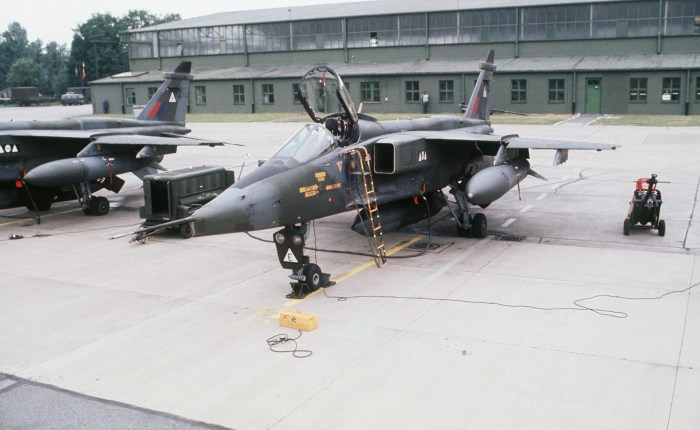
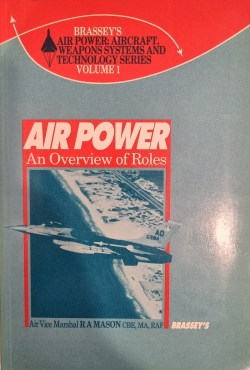


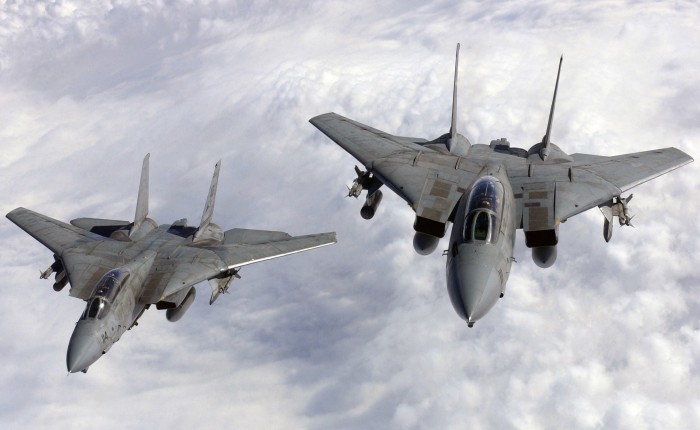


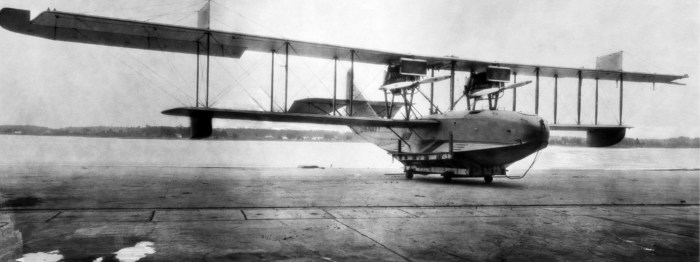


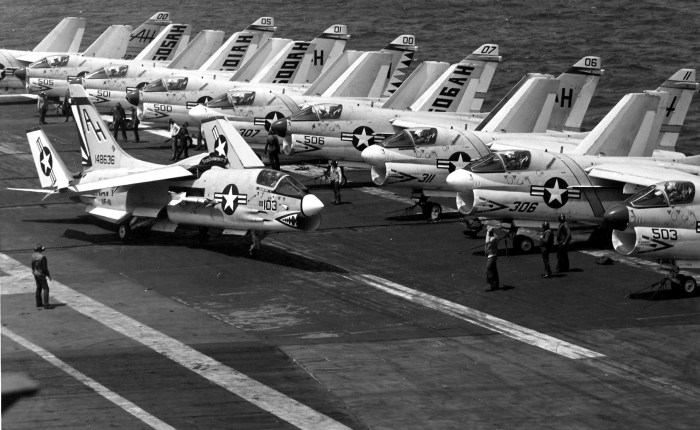
 Dr Michael E. Weaver is an Associate Professor of History at the USAF Air Command and Staff College. He has authored five air power articles and a book on the 28th Infantry Division. His second book, The Air War in Vietnam, was published in 2022. Weaver received his doctorate from Temple University in 2002, where he studied under Russell Weigley.

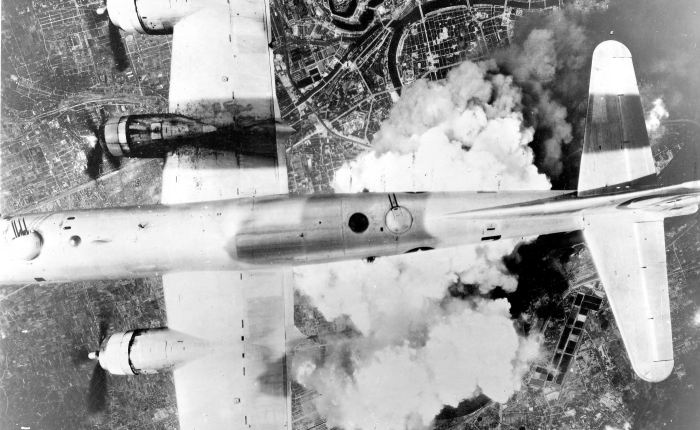

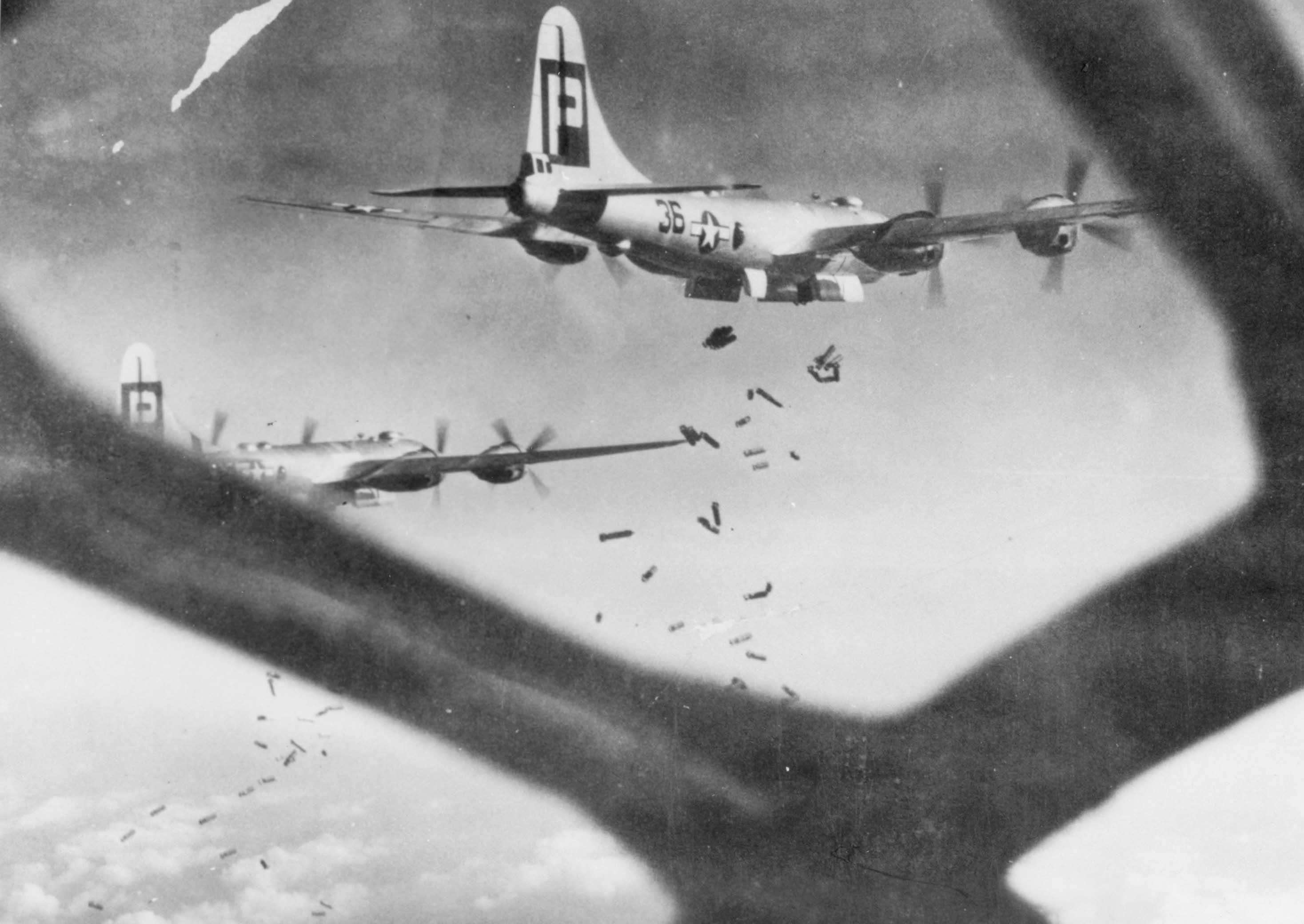
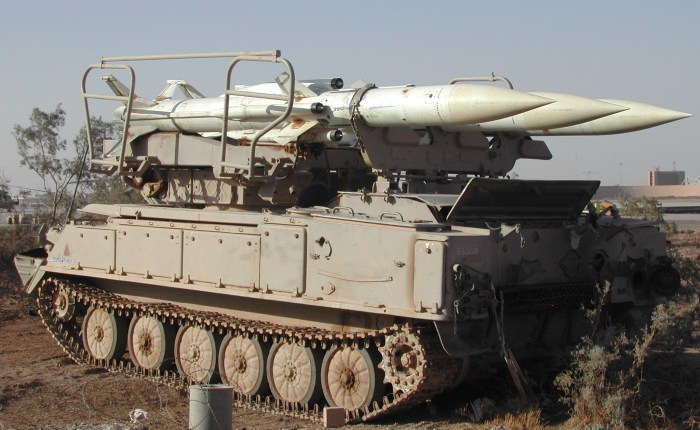
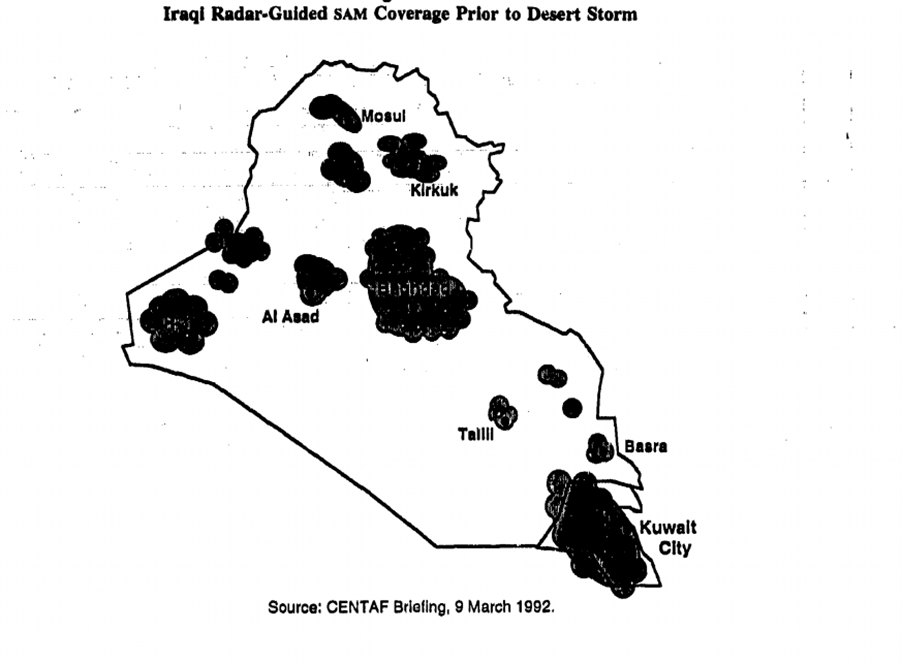
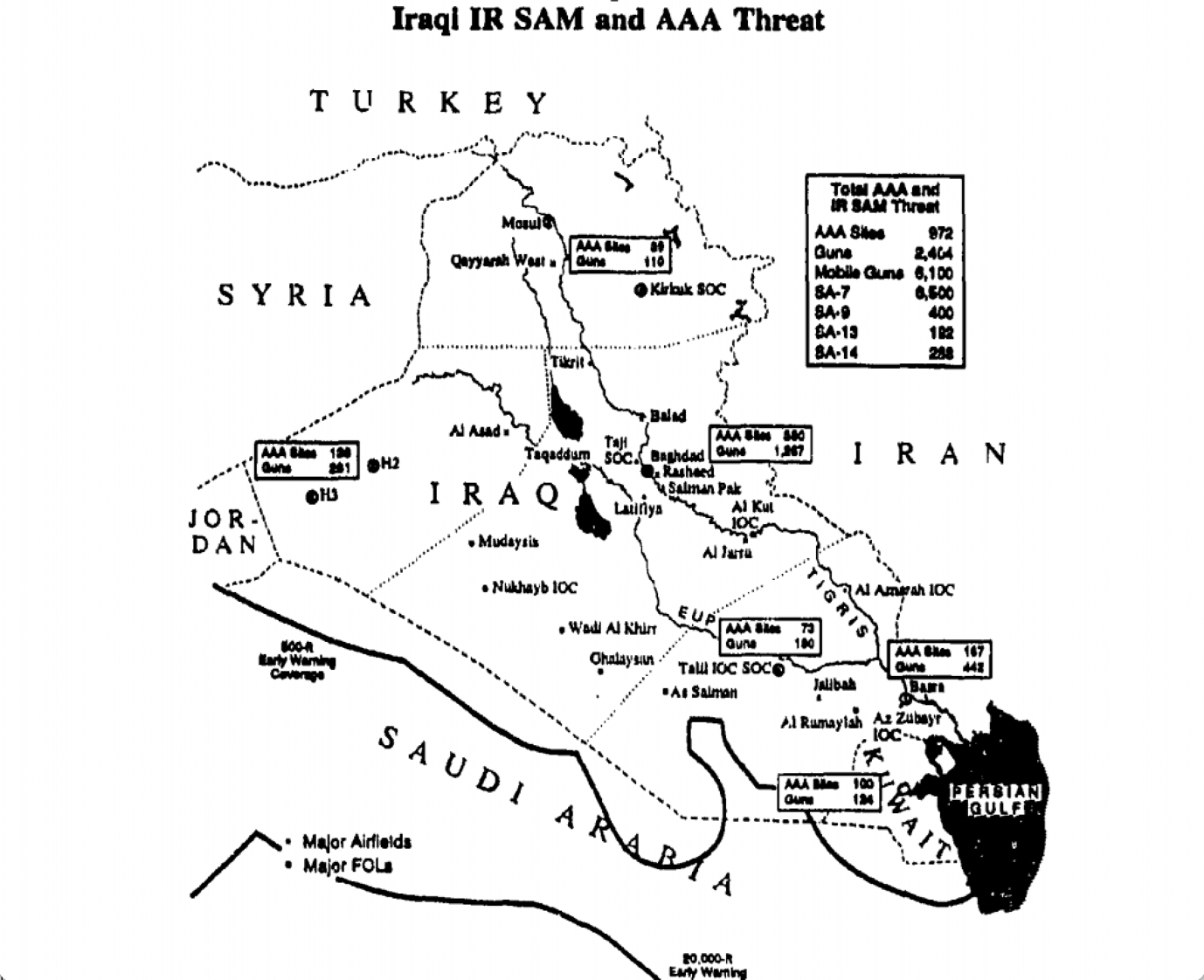
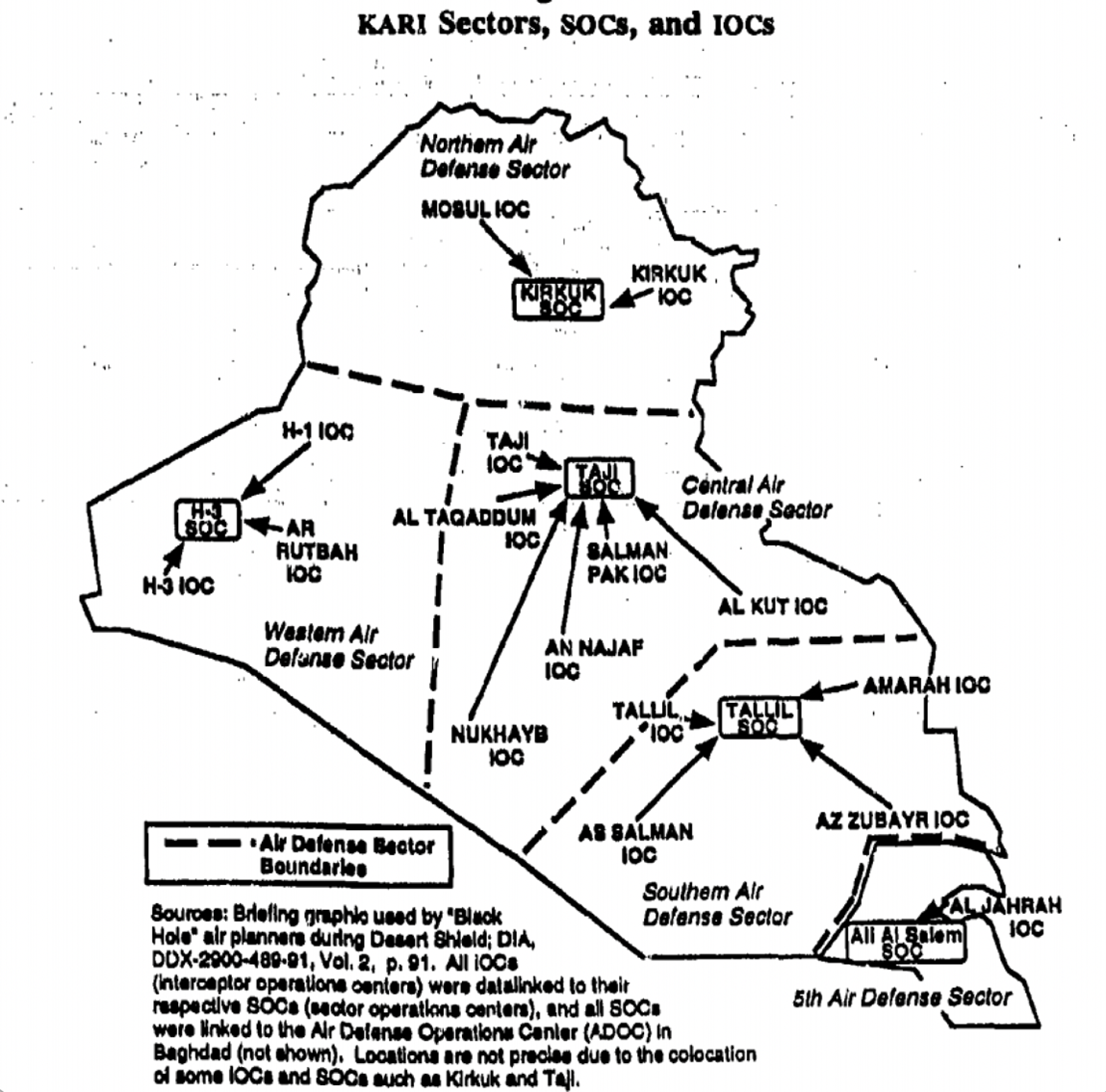
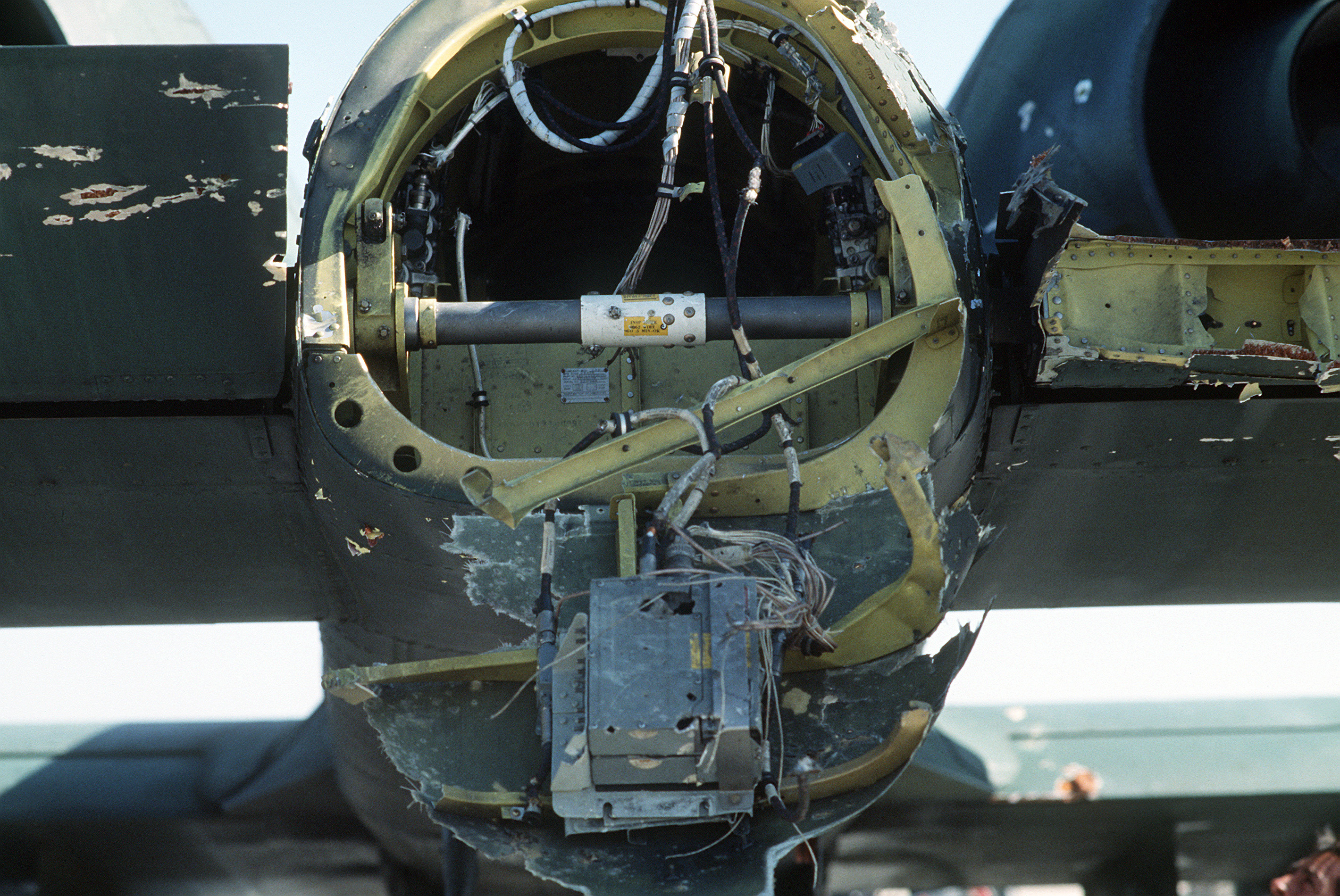

 From Balloons to Drones