The Allied invasion of Sicily, Operation HUSKY, is often viewed as a logical progression from the North Africa campaign (TORCH) through Sicily and on into Italy. It is one of the ‘Big Four’ operations in the European and Mediterranean theatres of operations, which culminated in the invasion of Normandy. Sicily has often been either overlooked entirely or seen through a more ground-centric lens (think of the movie Patton). That being said, there has been some excellent historical work in recent years on the invasion and even some very good historical-fiction by, for example, Jeff Sharra. Perhaps overlooked is too strong a word. Overshadowed is perhaps apter and nowhere is the invasion of Sicily more overshadowed than in the realm of air power. True, there is Robert S. Ehlers excellent work The Mediterranean Air War (2015), which covers the entirety of the theatre, but a singular focus on the air war exclusively over Sicily has been missing.
Alexander Fitzgerald-Black seeks not only to bring HUSKY back into focus but seeks to delve into the often-overlooked role of air power in the Mediterranean theatre, particularly over the skies of Sicily and does so by linking the tactical to the strategic. Fitzgerald-Black (p. xxii) states that:
This work reconnects the role of the Allied air forces in the Battle for Sicily to the wider narrative of the air war and to the crucial Allied strategy for engaging Axis forces in the Mediterranean Theater during the Summer of 1943.
Air power itself has been viewed through various lenses, but the most notable narrative through HUSKY was that Allied air power did not live up to the promises it made – Fitzgerald-Black singles out Carlo D’Este for holding this interpretation. The author seeks to turn this traditional narrative on its head, and Fitzgerald-Black argues persuasively that some authors have focused too myopically on the tactical missteps and therefore, missed the greater strategic narrative. Fitzgerald-Black (p. xxiii) argues that ‘Allied strategic success in Sicily and the Mediterranean in mid-1943 mattered far more than the failure to prevent German forces on the island from escaping.’ Allied air power forced the Luftwaffe to pay a heavy toll for defending not an only island but the theatre writ large. Also, attacks against the Italian mainland helped drive Italy from the war entirely.
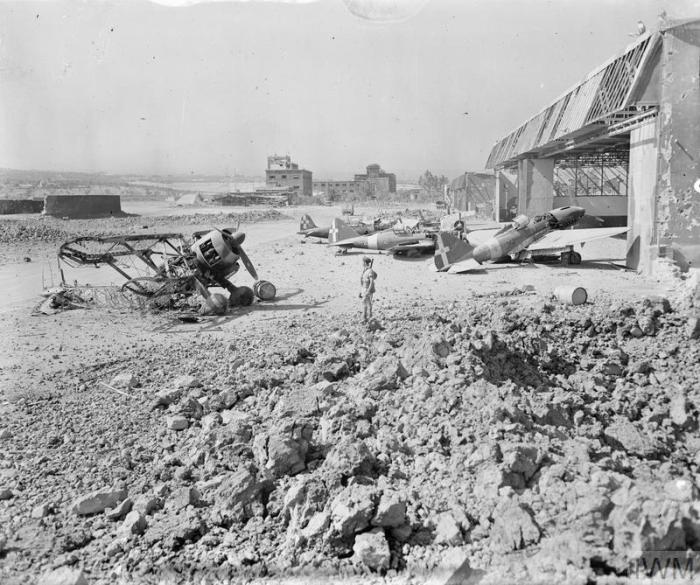
In the buildup to the landings, German and Italian air power was systematically, but not entirely, destroyed. Some authors have pointed this out as a failure of air power showing their preference for a Clausewitzian decisive battle that rarely appears. The Luftwaffe, under the direction Wolfram von Richthofen removed their bombers to the Italian mainland, believing Sicily to be untenable. Attacks on German and Italian bases gained enough air superiority that the invasion took place without prohibitive interference from the Luftwaffe or Regia Aeronautica. The simple fact was that Allied air power forced the Luftwaffe and Regia Aeronautica to react in ways it did not want to. Some might say Allied leaders had got inside their enemy’s OODA loop (p. 54, 63).
Again, there exist critiques of Allied air power on the day of the landings, but as Fitzgerald-Black demonstrates, the Germans and the Italians seemed to be to some degree husbanding their resources. Even in doing so, it was difficult for the Luftwaffe to contest control of the skies seriously. Where engagements did occur, the author shows that ‘[E]ffectiveness cannot only be measured by casualties inflicted upon Axis aircraft.’ There were occasions (p. 83) where ‘USAAF and RAF fighters broke up enemy formations and/or forced the bombers to jettison their payloads prematurely […].’ Fitzgerald-Black does an excellent job of interweaving his analysis and engaging prose with numerous first-person accounts from both sides of the conflict. His use of Johannes Steinhoff’s remembrances adds a level of balance to the work, wherein the points and actions of both sides are brought forth. Looking at the battle in retrospect, ‘The success of the German tactical withdrawal pales in comparison to the strategic victory the Allies won in Sicily during the Summer of 1943.’ Italy was knocked out of the war and Germany was now forced to defend Europe on two fronts that soon turned into three with the invasion of Normandy in June of 1944 (p. 159).
One final point worth mentioning, and this is more a press decision than a note on the author’s work, but the use footnotes versus endnotes is a welcome change making it significantly easier to check the author’s sources at a quick glance. In the end, Fitzgerald-Black has done an outstanding job of refocusing attention on the air war over Sicily and has contributed to the study of air power history. His work resides alongside Chris Rein and Robert Ehlers in broadening our understanding of the Mediterranean theatre during the Second World War. His expert linking of tactical, operational, and strategic in a clear narrative allows all readers to understand that while one area of a campaign might be deemed a tactical misstep, the overarching importance of the strategic victory cannot be taken for granted.
Dr Brian Laslie is an Air Force Historian and currently the Deputy Command Historian at North American Aerospace Defense Command (NORAD) and United States Northern Command (USNORTHCOM). He is also an Assistant Editor at From Balloons to Drones. A 2001 graduate of The Citadel and a historian of air power studies, he received his PhD from Kansas State University in 2013. His first book The Air Force Way of War (2015) was selected for the Chief of Staff of the Air Force’s and the Royal Air Force’s Chief of the Air Staff professional reading lists. His recently published Architect of Air Power: General Laurence S. Kuter and the Birth of the US Air Force. He lives in Colorado Springs. He can be found on Twitter at @BrianLaslie.
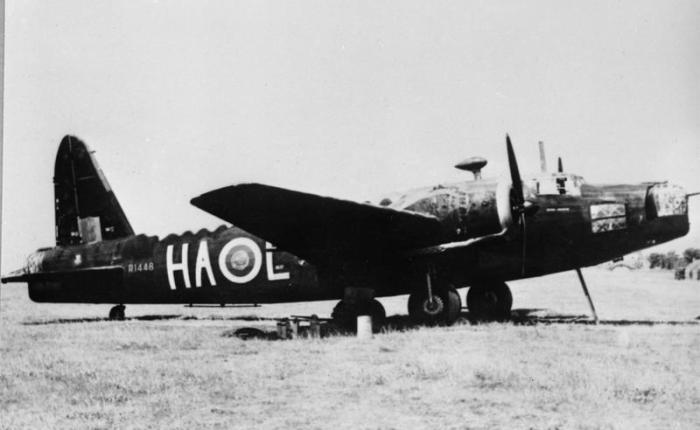
The weather was mild for early December as scattered showers, and high winds continued to visit RAF Gransden Lodge near Cambridge.[1] It was a shade after 02:00 on the morning of 2 December 1942 when Flight Sergeant Edwin Paulton (Royal Canadian Air Force/RCAF) gently rotated the yoke causing the Vickers Wellington Mk1C of the Royal Air Force’s (RAF) No. 1474 (Special Duties) Flight to unstick from the runway and climb into the East Anglian night.[2] Paulton’s sortie that autumnal evening was part of the RAF’s response to the growing intensity of the Luftwaffe’s defensive effort against Bomber Command’s attacks on targets in Germany.
Emil-Emil
With most of Western Europe’s occupation now complete, and the invasion of the UK postponed indefinitely by Adolf Hitler in September 1940 following the Battle of Britain, the German high command turned its attention towards bolstering the country’s defences against RAF Bomber Command.[3] Even with the commencement of the Axis invasion of the Soviet Union on 22 June 1941, which involved a significant effort by the Luftwaffe, this did not deprive Germany of fighter defences to resist the Command’s efforts.[4] These fighters were able to exact heavy losses and between July 1942 when the RAF commenced recording aircraft loss and damage to separate causes, and December 1942 Bomber Command lost 305 aircraft to fighters during the day and night operations; 2.3 per cent of all sorties despatched.[5]
It was imperative for Bomber Command to staunch the bleeding. By late August 1942 Bomber Command understood the workings of the Luftwaffe’s integrated air defence system. The initial detection of incoming bombers was performed by a chain of FuMG-80 Freya ground-based air surveillance radars. A defensive ‘belt’ known as the Kammhuber Line, named after Generalleutnant Josef Kammhuber, the head of the Luftwaffe’s XII Fliegerkorps, stretched from Kiel in northern Germany southwest past Luxembourg. Behind this line lay all of Germany’s major cities and industrial centres including Cologne, Düsseldorf, Frankfurt, Hamburg, Hanover, and Stuttgart. Quite simply it was almost impossible for bombers to approach their targets without crossing this line. The line was subdivided into separate ‘boxes’ each covering 247 square miles (640 square kilometres). Within each box were two FuMG-62D Würzburg ground-controlled interception radars. One of these radars would hold the fighter in its gaze while another would search the box for a bomber. A ground controller would coordinate the interception seeing the position of the fighter and bomber on his radar screens. He would then bring these two together. Once the fighter was just short of one nautical mile/nm (1.8 kilometres/km) from the bomber, the ground controller would hand over the interception to the fighter. The crew would activate their Lichtenstein-BC airborne interception radar to locate the bomber and then press home their attack. All the while the fighter and the ground controller would remain in radio contact.[6]
The British Air Ministry issued a report in July 1942 which stated that Signals Intelligence (SIGINT) had revealed that from early 1942 the Luftwaffe’s night fighters had been using a device codenamed ‘Emil-Emil’. Little was known about this beyond the fact that it seemed to assist interceptions and may have used either radar or infrared technology to do so. Initially, this equipment appeared to be used exclusively by night fighters near Vlissingen on the Netherlands’ west coast. Further investigations revealed that by October 1942 Emil-Emil appeared to be in widespread service elsewhere in the night fighter force. Such was the discipline of Luftwaffe fighter crews and their ground controllers that the purpose of Emil-Emil was not betrayed in radio chatter.[7]
Experts from the Telecommunications Research Establishment (TRE), tasked with developing and producing electronic countermeasures for the British armed forces, collected radio signals on the East Coast which revealed transmissions on a 491 megahertz/MHz frequency strongly suspected of being transmitted by Emil-Emil.[8] This information was a breakthrough, but the relationship of these transmissions to Emil-Emil had to be confirmed. The only way to do so would be to fly one of the RAF’s SIGINT gathering aircraft from No. 1474 Flight into hostile airspace where there was a high chance that enemy fighters would be encountered. The rationale was to use the aircraft for two interrelated tasks. First, entice a night fighter into an attack and then record the characteristics of any hostile radio signals it transmitted. By doing this, it would be possible to determine whether Emil-Emil was an airborne interception radar. As always in electronic warfare, once it was discerned that the enemy was using a particular type of radar in a particular way, it would be possible to devise means to jam it.
Paulton and his crew were tasked with collecting SIGINT across an area stretching from the French north coast to Frankfurt in central Germany.[9] The specifics of the mission called for the Wellington, which was equipped with a radio receiver, to lure a fighter into an interception. The aircraft would then record the radio signals transmitted by the fighter. So far No. 1474 Flight had performed 17 sorties, but none resulted in the desired interception. Finally, on the night of 2 December, the Luftwaffe would cooperate, although this would almost cost the Wellington’s crew their lives.
Against All Odds
At 04:31, two-and-a-half hours into the flight, the aircraft was northeast of the Luftwaffe airfield at Pferdsfeld in southeast Germany. Paulton set a course to fly north. As he turned Pilot Officer Harold Jordan, the aircraft’s ‘Special Operator’ tasked with the SIGINT collection, began receiving signals which seemed to match those the crew were tasked to investigate. As the Wellington flew north, the signals became stronger. Jordan warned the crew that a fighter attack was likely. As Jordan received signals, he was passing this information to wireless operator Flight Sergeant Bill Bigoray (RCAF) who coded and transmitted them back to the UK. Ten minutes later the aircraft turned west to head for home while the signals received by Jordan were getting stronger still. At that moment cannon fire from a Junkers Ju-88 fighter slammed into the Wellington. Paulton immediately put the aircraft into a violent corkscrew turn in a bid to shake off the fighter. Jordan was hit in the arm but realised that the signals he was receiving were correct with Bigoray relaying this information back to base. Despite Jordan’s injuries he continued to record the transmissions while Bigoray continued to send coded messages, having received no ‘R’ transmission from base to indicate their reception. Unbeknownst to Bigoray, they had been received at 05.05. Flight Sergeant Everitt Vachon (RCAF), the Wellington’s rear gunner, managed to fire almost 1000 rounds at the Ju-88 but his turret was hit and rendered unserviceable, with Vachon wounded in the shoulder.[10]
The Ju-88 manoeuvred for another attack. This hit Jordan in the jaw but did not stop him operating his equipment and telling Paulton from which side the next attack would occur. Along with Jordan Flight Sergeant Grant, the front turret gunner was hit, as was Bigoray who was injured in both legs as he tried to free Grant from the turret. Grant was eventually being extricated by the navigator Pilot Officer Alexander Barry (RCAF). The third attack hit Jordan again, this time in the eye. Try as he might, he could no longer operate his radio receiver. Instead, he struggled forward to find Barry to show him how to operate the receiver so that the signals collection could continue. Nonetheless, now almost blinded this proved an impossible task.[11]
While Jordan had been trying in vain to instruct Barry Vachon had managed to free himself from the rear turret. He went into the aircraft’s Astrodome to provide a running commentary on the Ju-88’s position. Vachon was hit once again, this time in the hand, and Barry took over. Throughout the engagement, those in the aircraft had been thrown around like ragdolls as Paulton’s evasive actions saw the aircraft descend from 14,000ft to a mere 500ft. The Wellington suffered twelve attacks in total; six of which may have been successful. The damage to the aircraft was extensive: The port and starboard engine throttles were jammed. The front and rear turrets were unserviceable along with the starboard ailerons and trim tabs. The starboard fuel tank was holed and the hydraulics useless, causing both engines to run erratically. The aircraft’s pitot heads were also damaged preventing the airspeed indicator showing the plane’s velocity.[12]
Despite the Wellington’s near-mortal damage Paulton managed to reach 5,000ft altitude and crossed the coast ten miles northeast of Dunkirk at 06:45. Being mistaken for a hostile aircraft was an ever-present danger when RAF planes were returning from operations over the continent. Bigoray switched the aircraft’s IFF (Identification Friend or Foe) Mk.3 transmitter to squawk that the plane was friendly and sent out a mayday message. Deciding to ditch in daylight after realising that the Wellington’s landing light was insufficient to perform a safe water landing, Paulton asked the crew if anyone wanted to bail out. Bigoray asked to do so concerned that his leg would stiffen up so much that he would be unable to leave the aircraft once it was in the water. As he was about to jump, he realised he had not secured the transmission key of his radio to prevent it accidentally retransmitting. Moving back into the fuselage and in much pain, he secured the key and jumped landing near Ramsgate on the Kent coast. Paulton finally ditched the Wellington in the channel near Walmer beach, south of Deal. Even the aircraft’s dingy, packed for such eventualities, was a casualty and despite a valiant attempt by Jordan to plug some of the holes, it was unusable. Instead, the crew climbed on top of the Wellington, being rescued by a small boat some moments later.[13]
Results
The intelligence Paulton and his crew gathered on that fateful December night had implications for the rest of the war. Their actions enabled the TRE ‘boffins’ to not only confirm that the Emil-Emil device was the Lichtenstein-BC radar but also to divine the radar’s characteristics. Once these were known it was possible to develop an Electronic Countermeasure (ECM) in the form of the Ground Grocer jammer. This was installed at Dunwich on the Suffolk coast commencing operations on 26 April 1943.[14] The jammer would blast electronic noise at the Lichtenstein-BC across a waveband of 486MHz to 501MHz. Even for Luftwaffe fighters flying 120nm (222 kilometres) distant from the transmitter could have their radar ranges reduced to 1500ft (457 metres) from their usual range of four nautical miles (eight kilometres). This forced the fighter to come closer to the bomber to detect it in darkness; greatly increasing the chances of the bomber crew hitting the fighter as it commenced its attack.[15] Nonetheless, Ground Grocer was not bereft of imperfections: It tended to work best when a fighter was flying towards the transmitter and was generally used to protect bombers on their outward and return journeys. The official record notes that by the end of June 1943 Ground Grocer had caused six of the seven cases of radar interference reported by Luftwaffe fighter crews to their ground controllers.[16]
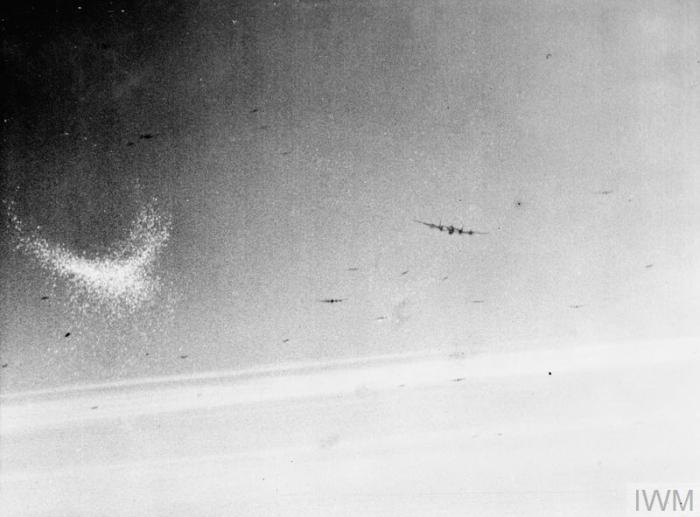
Ground Grocer was not the only ECM developed because of the intelligence obtained by the Wellington. By gathering details on the Lichtenstein-BC’s characteristics, the TRE was able to develop several versions of Window, arguably the most famous countermeasure of the Second World War, capable of jamming this radar. Window consisted of millions of metal foil strips cut to precisely half the wavelength of the radar they were intended to jam. The TRE also developed a system known as Serrate based on the same intelligence. This was one of the RAF’s most successful electronic systems of the war. Serrate was installed on De Havilland Mosquito fighters, entering service in September 1943. It detected transmissions from the Lichtenstein-BC allowing Serrate-equipped aircraft to find and attack fighters using the radar. Serrate was employed extensively over enemy territory contributing to the 242 Luftwaffe fighters that the Mosquitoes of Bomber Command’s No. 100 Group shot down following its introduction.[17] Moreover Ground Grocer, Window and Serrate may have hastened the withdrawal of the Lichtenstein-BC which was all but phased out of service by April 1944 in favour of new radars with improved resistance to such countermeasures.[18]
The Legacy
The endeavours of Paulton and his crew were relayed to the Chief of the Air Staff, Air Chief Marshal Sir Charles Portal who told them: ‘I have just read report of your investigation flight […] and should like to congratulate you all on a splendid performance.’[19] Their deeds were recognised with the award of a Distinguished Flying Cross for Barry and Paulton, Distinguished Service Order for Jordan and Distinguished Flying Medals for Bigoray and Vachon. It is miraculous that the Wellington returned to the UK yet the actions of Paulton and his crew helped pave the way for the development of ECMs which undoubtedly saved Bomber Command lives. Their legacy can still be seen today. Radar jammers are now standard equipment on most military aircraft venturing in harm’s way, illustrating how one sortie on a cold December night would have implications for airpower which are still felt today.
Dr Thomas Withington specialises in contemporary and historical electronic warfare, radar, and military communications, and has written numerous articles on these subjects for a range of general and specialist publications. He holds a PhD from the University of Birmingham.
[2] The National Archives (TNA), AIR 50/503, No. 1474 Flight, December 1942.
[3] TNA, AIR 20/8962, War in the Ether: Europe 1939 to 1945: Radio Countermeasures in Bomber Command: An Historical Note (High Wycombe: Signals Branch, Headquarters Bomber Command, October 1945), p. 6.
[5] Charles Webster and Noble Frankland, The Strategic Air Offensive Against Germany 1939-1945: Volume IV, Annexes and Appendices (Uckfield: Naval and Military Press, 2006), pp. 429-39.
[7] Air Historical Branch, The Second World War 1939-1945 – Royal Air Force Signals, Volume VII: Radio Countermeasures (London: Air Ministry, 1950), p. 151.
[14] Air Historical Branch, The Second World War 1939-1945, p. 153.
[15] TNA, AIR 20/8070, Glossary of Code Names and Other Terms Used in Connection with RCM; AIR 20/8070, Ground Grocer.
[16] Air Historical Branch, The Second World War 1939-1945, p. 154.
[17] M.W. Bowman and T. Cushing, Confounding the Reich: The RAF’s Secret War of Electronic Countermeasures in World War Two (Barnsley: Pen and Sword, 2004), pp. 235-42.
[18] Air Historical Branch, The Second World War 1939-1945, p.154.
In June 1943 a staff officer with 1st Canadian Infantry Division examined planning documents for Operation Husky, the invasion of Sicily. The operation to begin the Allied assault on Festung Europa’s soft underbelly was just weeks away. During his preparations, the officer came across an air staff memorandum. It read:
Owing to the small size of Malta which limits the number of fighter squadrons which can be based there, and the distance from the beaches, it will not be possible to maintain standing patrols over the assault areas except for the first few hours after the battle starts.
The large number of Air Forces taking part in the operation […] will be employed in bombing and “sweeping” enemy airfields and communications in order to gain air supremacy and prevent Axis aircraft from interfering with our assault forces. It is probable, therefore, that few friendly aircraft will be seen by our forces on the beaches after the first few hours and the reason for this should be carefully explained to assaulting troops […] it should be made clear that, although few Allied aircraft are visible immediately over their heads, considerable air forces are, in fact, operating continually in support of them.[1]
The Canadian division was entering combat for the first time. However, it was to fight as part of British Eighth Army, famous for its victory at El Alamein under Lieutenant-General Bernard Montgomery. Years of fighting the Germans and Italians in the desert had allowed the Royal Air Force (RAF) to hone its support for land campaigns. Air Commodore Raymond Collishaw and Air Vice-Marshal Arthur Coningham put into practice an air support doctrine that privileged concentration of force.[2] The priority for an air force supporting the army (or navy) was to secure air superiority. The second was to disrupt the enemy movement of reinforcements and supplies behind the lines. Close air support of ground troops in combat with the enemy was third, much to many army commanders’ dismay.
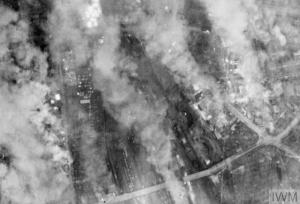
Italy’s Aerodromes and Railways (Source: Dr Mike Bechthold)
Many (but not all) British Army commanders felt that this order was incorrect. Instead, they desired control of their own air force in support of ground operations and an air umbrella that would protect their advancing forces. The British Army had tried this approach and failed in the Western Desert. During the attempt to relieve Tobruk in Operation BATTLEAXE the British Army demanded that the RAF establish an air umbrella over the battlefield. Under Air Marshal Arthur Tedder, the RAF caved to the British Army’s requests, even though they believed this to be a highly inefficient use of resources. This decision ultimately contributed to BATTLEAXE’s failure.[3]
From then on, the RAF in the Mediterranean guarded against the tendency of army commanders to request for what senior airmen called ‘penny packets,’ smaller groups of aircraft assigned to a ground commander. They also endeavoured to convince their army counterparts that the RAF’s optimal use in support of ground forces was as long-range artillery. This explains why the Air Staff memorandum included in planning documents issued to the assault forces. Aircraft should be concentrated against Axis airfields, ports, transportation networks, or shipping beyond the reach of land or sea forces to stop or limit the enemy’s ability to interfere with the land operation. During Operation HUSKY, Air Chief Marshal Sir Arthur Tedder, commander of all Allied air forces, used his air forces effectively according to the priorities set out above.
This photograph provides an excellent visualisation of concentrated targets in Naples, Italy. Numbers 1 to 5, 7, and 8 indicate wrecked or damaged vessels at the docks, while numbers 6 and 9 indicate a grain elevator and airframe works respectively. The railway yard is immediately above the airframe works (Source: US Air Force photo 27493 AC)
I have discussed the air superiority and close air support functions in previous posts. The remainder of this article will focus on the role of interdiction strikes in support of the army and its purpose in Sicily.
Why were the Allies landing in Sicily? At the Casablanca Conference in early 1943 superior British staff work and arguments led to the decision to invade Sicily once the Allies secured North Africa. General George C. Marshall, America’s top soldier, argued for Operation ROUNDUP, a cross-Channel invasion from the United Kingdom in spring 1943. He felt that this was the best way to ease pressure on the Soviets in the east. Marshall’s British counterpart, General Sir Alan Brooke, had a different assessment. There were 42 German divisions in France, more than enough to contain whatever force the Anglo-Americans could get across the Channel in 1943.[4] The Eastern Front would benefit little from Marshall’s plan. However, what if the Allies knocked Italy out of the war in 1943? The Italians had some 54 divisions, 2,000 aircraft, and the still-formidable Italian navy.[5] If Italy surrendered, it was logical to expect that the Germans would replace these losses with their forces. Nazi Germany had already shown a willingness to send forces to the Mediterranean in a crisis. They had done it in the Balkans and the Western Desert in 1941 and Tunisia in late 1942. Forces defending southern Europe could not support operations on the Eastern Front. Nor could they stand watch on or behind the Atlantic Wall waiting for the inevitable cross-Channel invasion. This was the plan the Allied air forces supported.
As news filtered in about the success of Allied landings in Sicily (under temporary air umbrellas established by fighters based in Malta, Gozo, Pantelleria, and even Tunisia), Tedder was already looking ahead to future operations in support of the Allied strategy. He wrote to his superiors in London:
Should the next week’s operations go well, I have been considering possibility of staging really heavy blows at, say, three vital centres in Italy. The whole of the Liberator force on Naples before it has to stand off to train for Tidalwave, the whole B.17 force on Rome, and if possible Harris’s Lanchester force on another shuttle service attack on suitable targets in N. Italy. All attacks simultaneous. Feel moral effect of such operations might be vital, especially if attack by shuttle service included [sic].[6]
With the landing force firmly ensconced in Sicily, Tedder unleashed his strategic bombers in another round of attacks. He hoped that Italy – tired of three years of war, having suffered massive casualties at Stalingrad and Tunis, and with Allied forces on their doorstep – was ripe for capitulation. Allied bombers in North Africa targeted Naples and Rome in particular. Both were significant as transport hubs, but Rome had the added prestige of being an Axis capital.
The Allied air forces had already paralysed the Sicilian railway system; now their focus shifted to the mainland. Naples was southern Italy’s most important railway junction. From 15 to 18 July 1943 the city suffered bombardments from United States Army Air Force B-17s, B-25s, and B-26s by day and RAF Wellingtons by night. Some RAF Boston light bombers even acted as pathfinders for a force of American B-25s, operating at night. The raids targeted the city’s marshalling yards, war industries, and nearby aerodromes.[7] According to a report by Solly Zuckerman’s Bombing Survey Unit using evidence assembled after the Allies took the city in October, ‘Naples was wiped out as a railway centre after the July attacks.’[8]
On 19 July the skies darkened over Rome as a combined force of nearly 600 medium and heavy bombers struck railway yards, war industry, and aerodromes within or near the city. Realizing the enormous political ramifications of this raid, the American aircrews were thoroughly briefed. They were to avoid targeting the Vatican, and the raid was preceded by dropping leaflets to warn the local population of the pending attack. Despite these and other efforts to prevent civilian casualties the bombers still killed between 1,700 and 2,000 people.[9] The raids effected a 200-mile gap in the railway system from Rome to Naples for 48 hours and contributed to the wider campaign of paralysing the Italian railway system by destroying rolling stock, locomotives, and their repair facilities. The trains were no longer running on time in Italy.[10]
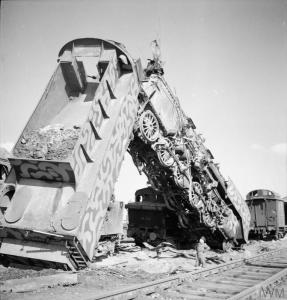
Wrecked rolling stock at the Littorio Rail Yards near Rome, Italy (Source: US Air Force photo B-62176 AC)
More importantly, the raid on Rome helped to drive the Italians out of the war. At the time of the raid, Benito Mussolini was meeting Adolf Hitler at Feltre in northern Italy. Mussolini’s task for this meeting was to secure his country’s removal from the war. He failed as an irate Hitler shouted him down, complaining about the failure of the Italians to provide adequate bases for the Luftwaffe and the resulting heavy losses the Germans had suffered defending Sicily.[11] Mussolini returned to Rome when he heard about the raid and less than a week later King Victor Emmanuel III replaced him with Marshal Pietro Badoglio. The new government set about contacting the Allies to sign a separate armistice, which they did on 3 September 1943.
Popular accounts feature Hitler’s response in the form of the operation to rescue Mussolini. What is more critical is Operation Achse. This was a plan for German forces to disarm Italian forces in Italy, the Balkans, and southern France in the event of an Italian defection or surrender. In addition to the four German divisions fighting in Sicily, a further ten were already on their way to Italy or had just arrived.[12] The German force in Italy would grow to nearly 25 divisions at the time of the invasion of Normandy.[13] Even without counting the German forces arrayed in southern France and against Tito’s Partisans in the Balkans, the Allied strategy set out at Casablanca had worked.
The Allied aims for Operation HUSKY were to open the central Mediterranean to Allied shipping, topple Italian fascism, force the Nazi high command to defend southern Europe on its own, and secure bases from which to continue the war in Italy. The American, British, and Canadian armies fighting in Sicily played their role in this mission with the support of the Northwest African Tactical Air Force, capturing the island by 17 August 1943. However, so too did the Strategic Air Force. Their raids on mainland Italian railway transport made Axis resupply efforts difficult and forced the enemy to use other less efficient methods to move their forces and supplies. This approach would later become the basis for the Transport Plan in support of Operation OVERLORD in 1944.[14] These same raids brought pressure on the Italian state to shed Fascism and change sides in the war. In this way, the strategic mission of the Allied soldiers and the Allied airmen (even those flying missions hundreds of miles away from the front) were one in the same.
Author’s note: As an aside, while the Allied air forces managed to paralyse the Sicilian and southern Italian railway systems in mid-1943, they were also unable to stop the Axis evacuation of Sicily in August. Should air commanders be held to account for failing to prevent the successful Axis evacuations across the Strait? I will save this topic for a future post, but you can always read Eagles over Husky to examine my answer.
Alexander Fitzgerald-Black is an Assistant Editor at From Balloons to Drones. He has a Master of Arts in Military History from the University of New Brunswick and is a Master of Arts in Public History candidate at the University of Western Ontario. Alex’s first book, Eagles over Husky: The Allied Air Forces and the Sicilian Campaign, 14 May to 17 August 1943, was published in early 2018. His research interests include air power in the Second World War, with a particular focus on the Mediterranean, and Canadian military history. He operates a blog at alexfitzblack.wordpress.com and can be reached on Twitter @AlexFitzBlack.
If you would like to contribute to From Balloons to Drones, then visit our submissions page here to find out how.
[1] Library and Archives Canada, R112-104-3 Kardex System, Vol. 10868, War Diaries Canadian Planning Staff Files, March to June 1943, Air Staff Memorandum.
[2] For a new interpretation that gives Collishaw proper credit for these developments, see: Mike Bechthold, Flying to Victory: Raymond Collishaw and the Western Desert Campaign, 1940-1941 (Norman, OK: University of Oklahoma Press, 2017), p. 4.
[4] Mike Peters, Glider Pilots in Sicily (Barnsley: Pen & Sword Books, 2012), p. 3.
[5] Douglas Porch, The Path to Victory: The Mediterranean Theater in World War II (New York, NY: Farrar, Straux and Giroux, 2004), p. 417.
[6] The National Archives (TNA), Kew, UK, AIR 20/3372, Cypher telegram from Air Chief Marshal Sir Arthur Tedder to Air Chief Marshal Sir Charles Portal, 10 July 1943. There had been earlier shuttle runs using Avro Manchester and Lancaster bomber aircraft. These runs were deemed logistically unsound and Bomber Command settled for attacking the industrial cities of northern Italy from bases in the United Kingdom.
[7] TNA, AIR 23/6325, Northwest African Air Force operation ‘Husky’ report, Part A: The Invasion and Conquest of Sicily, pp. 9-10.
[8] The Solly Zuckerman Archive, University of East Anglia, Bombing Survey Unit/6/7, Air Attacks on Raid and Road Communications, Appendix II, Part 3.1: Naples pp.98-99.
[9] Richard Overy, The Bombing War: Europe 1939-1945 (London: Penguin Books, 2014), p. 524.
[10] Alexander Fitzgerald-Black, Eagles over Husky: The Allied Air Forces and the Sicilian Campaign, 14 May to 17 August 1943 (Solihull: Helion & Company, 2018) pp. 112-6.
[11] Albert N. Garland & Howard McGraw Smyth, The United States Army in World War II: The Mediterranean Theater of Operations: Sicily and the Surrender of Italy (Washington, DC: Office of the Chief of Military History, 1965) p. 243.
[12] List compiled from Ibid., P. 248 and 293, and Helmut Heiber & David M. Glantz (eds.), Hitler and His Generals: Military Conferences 1942-1945 (New York, NY: Enigma Books, 2004).
I do not consider myself superstitious. Being a Historian is not a career field where one feels the need to be ‘lucky.’ That being said, I will admit to having more than a few sports shirts and hats that I consider lucky. I also admit to wearing a ‘rally cap’ from time to time, you know when I need the baseball gods to allow a game-winning hit. These instances, in reality, do not matter. I do not (nor should I) consider them life and death issues. However, I can think of instances where being superstitious seems completely warranted. S.P. MacKenzie’s new work Flying Against Fate: Superstition and Allied Aircrews in World War II is a concise and laser-focused study that delves into the steps taken by allied aircrews (British and American) to ensure their survival using methods that MacKenzie calls ‘magical thinking,’ what is recognised universally as superstition.
MacKenzie breaks his examination of aircrew superstition into asking for miracles (religion), Talismans and Mascots, Incantations and rituals, Jinxes and Jonahs, and Numbers and symbols. MacKenzie’s work goes a step further than many other works that look at the motivations of soldiers, sailors, airmen or marines. It is often said, aircrews and soldiers on the ground fought for each other, but what motivated them as individuals? What made them capable of climbing into their aircraft despite the overwhelming sense of fear or dread and the knowledge that the chance of death was weighted heavily against their survival? MacKenzie points to the belief that a ritual, charm, or item protected them from harm.
MacKenzie shows that between training accidents, accidents in theatre, and actual combat the chances for survival among allied aircrews was low.
In practice this meant tours in which statistically speaking, the chances of being killed, wounded, or taken prisoner usually exceeded those of emerging unscathed. (p. 6)
Over the course of hours flown or combat missions completed, ‘only 25 percent of heavy-bomber crewmen were emerging unscathed from their twenty-five mission combat tours.’ (p. 7) Though the number of tours increased throughout the war and with death so nearby, it was no wonder these men turned towards a power beyond their control. The logical fallacy of Post hoc ergo propter hoc (after this, therefore because of this) often played into the beginnings or creation of superstitious aspects of flying during the war. Perhaps a coin or photograph discovered in a pocket after a particularly harrowing mission or a gift of a lucky rabbit’s foot by a friend. It seems almost anything could take on special meaning to a flyer.
On the importance of religion, MacKenzie demonstrates that American crew members were more likely to attend either a service or speak with a religious figure than their British colleagues. Church attendance declined in England in the first half of the century (perhaps because of the impact of First World War) while it increased in America, but religious aspect aside both nation’s aircrews put plenty of stock in other aspects of ritual and talisman to ensure their safety. If not religion, then aircrews turned to items or rituals, anything they believed gave them against the death that was surely coming for them. Magical thinking was not limited to junior officers or line pilots. Towards the end of his work, MacKenzie also lists several very senior air commanders who each held their own superstitions. It seems rank or position provided no hindrance to the necessity of using magical thinking to protect one’s place on the Earth during the Second World War.
While MacKenzie adds that this magical thinking was not universal, it did play a role in many of the aircrew’s lives throughout the war. In the closing pages of Flying Against Fate, Mackenzie states:
The place of magical thinking in other professions where skill cannot fully substitute for luck – notably sports – continues to be subject to academic research and interpretation’ (p. 103).
Indeed, if there is a critique of this work, it is that the link between superstition and high-performance activities, war and sports should have been made earlier and with more emphasis. MacKenzie’s study partners well with Mark Wells’ Courage and Air Warfare.[1] MacKenzie also admits to looking only at British and American aircrews and a study that the role of magical thinking and superstition played in the Axis powers, or other allied nations would undoubtedly bring further clarity to the roles and actions of airmen during the Second World War writ large.
Although a relatively short work, MacKenzie has created an indispensable book for those interested in the motivations of allied aircrews who looked for any means necessary to ensure their survival. The author mastered telling his story in a concise and yet heavily researched material that prevents both sources and a heavy dose of first-person accounts. This appeals not only to those interested in aviation history or air power in the Second World War but those interested in the mechanisms used to cope through Total War. As such historians and those interested in the psychology of the military and professionalism in the force will find much to consider.
Dr Brian Laslie is an Assistant Editor at From Balloons to Drones. He is also a US Air Force Historian and currently the Deputy Command Historian at North American Aerospace Defense Command (NORAD) and United States Northern Command (USNORTHCOM). A 2001 graduate of The Citadel and a historian of air power studies, he received his Masters’ from Auburn University Montgomery in 2006 and his PhD from Kansas State University in 2013. He is the author of Architect of Air Power: General Laurence S. Kuter and the Birth of the US Air Force (2017) and The Air Force Way of War (2015). The latter book was selected for the Chief of Staff of the Air Force’s 2016 professional reading list and the 2017 RAF Chief of the Air Staff’s reading list. He can be found on Twitter at @BrianLaslie.
Editorial Note: In the first part of a two-part article, Dr Peter Layton explores the evolution of the armed unmanned aircraft from its first use in the Second World War through to the First Gulf War.
In the Solomon Islands off Australia’s northern shores, on the 19 October 1944, a US Navy flown, Interstate Aircraft-built TDR-1 dropped a mix of ten 100lb and 500lb bombs against Japanese gun emplacements on Ballale Island. This was the first operational armed unmanned aircraft attack in history.
The twin-engined unmanned aircraft involved was just one of some fifty sent into combat in late 1944 with Special Task Air Group One. The armed unmanned aircraft took off under radio control that was then transferred to accompanying manned TBM-1C Avenger control aircraft for the long transit to the target area. The control aircraft remained some 8-12 kilometres outside of the ground defences while using a data linked real-time video picture displayed on a cockpit mounted television screen for close-in guidance. Few of the Air Group personnel involved had even seen a television set before they joined the unit. Their feats would not be replicated until early in the 21st century.
In truth, while after 1944-armed unmanned aircraft continued to attract considerable interest and at times funding, the technology available was too immature. The crucial issue was to find technological solutions that could overcome the many problems arising from not having a person in the aircraft. Finding the right blend of complex technological solutions took several decades, but this was not enough to see armed unmanned aircraft fly again in combat. There had to be a compelling operational need only they could best meet.
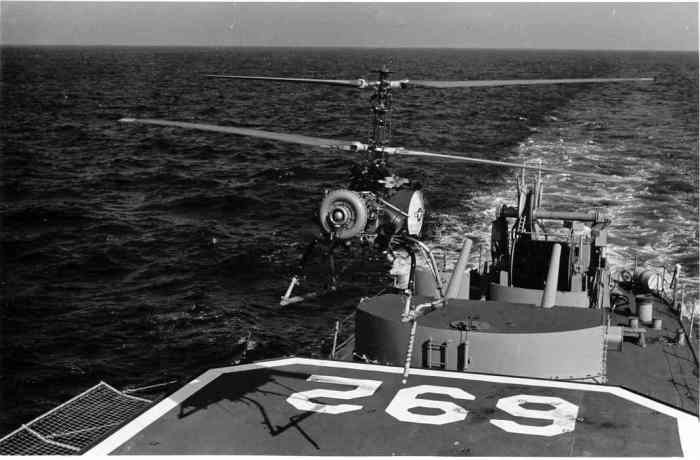
Curiously enough, the next armed unmanned aircraft was again operated by the US Navy. In the 1950s, the US Navy was concerned that the Soviets were building submarines faster than it could build anti-submarine warfare (ASW) destroyers. The solution was to upgrade a large number of old Second World War vessels, but these were too small to operate manned ASW helicopters from. Soviet submarines of the time could fire on ASW destroyers at longer ranges than the destroyers could fire back. A helicopter that could drop homing torpedoes was necessary to allow them to engage first. The answer was the small QH-50 Drone Anti-Submarine Helicopter controlled by the ship’s crew through a line-of-sight data link and able to deliver two MK-44 ASW homing torpedoes where and when required. There were numerous problems and many crashes, but hundreds were built and saw service throughout the 1960s.
QH-50 enthusiasts consider the more pressing operational demands arising from the worsening Vietnam War prematurely killed the unmanned helicopter off, and in this, they may be right. In the second half of the 1960s, there was a significant air war almost daily over North Vietnam. Attacking US Air Force (USAF) and US Navy strike aircraft were pitched against a continually improving Soviet-equipped integrated air defence system featuring the latest SA-2 and SA-3 Surface-to-Air Missile systems. Bomb damage assessment was a real problem; bad weather and the heavy defences made manned aircraft reconnaissance problematic.
A QH-50C anti-submarine drone hovers over the destroyer USS Allen M. Sumner during a deployment to the Mediterranean Sea in 1969. (Source: Wikimedia)
The solution was a fast jet, unmanned aircraft and again hundreds were built, and thousands of sorties flown. These Ryan Lightning Bugs were launched from modified C-130 transport aircraft, flew pre-planned missions and were then recovered using a parachute that was caught in mid-air by a large helicopter. This was an inflexible and expensive way to do business that only fitted the oddities of the Vietnam air environment. With the war’s end in 1975, interest also faded albeit after some trials of armed unmanned aircraft carrying bombs and missiles.
The USAF’s focus shifted to the European Central front then characterised by strong air defences, long-range fighters, a harsh electromagnetic environment and extensive jamming. Launching and recovering unmanned aircraft using slow, vulnerable C-130 transports and CH-53 helicopters in such a hostile air environment looked both very unappealing and most probably operationally ineffective.
The need that drove TDR-1 development however remained. When attacking well-defended targets in a significant war, aircrew survivability was still a real concern. In the late 1970s, the aircrew losses in a new major European War looked as though they would be exceptionally heavy, but there would not be time to bring newly trained aircrews into service as in the Second World War: what should be done? Could armed unmanned aircraft meet the need? After much thought and numerous experiments, the answer adopted instead was to invest sizable funds into high performance manned aircraft equipped with stand-off precision-guided weapons that lowered the sortie numbers required to inflict the necessary damage, field a fleet of electronic warfare attack aircraft able to defeat hostile SAM systems and build secret stealth bombers, the F-117 fleet. This approach was stunningly validated in the short very successful air campaign of the 1991 Gulf War.
Unmanned aircraft lost out not because of aviator biases as some assume but because of their technological immaturity, their relative operational ineffectiveness and their prohibitive costs. Other systems were just plain better. Unmanned aircraft were left as a potential solution in search of a mission. However, the world was about to change.
Dr Peter Layton is a Visiting Fellow at the Griffith Asia Institute, Griffith University. His PhD is in grand strategy, and he has taught on this at the US National Defense University. He is the author of the book Grand Strategy.
Header Image: An Interstate TDR-1 at the National Museum of Naval Aviation, Pensacola, Florida. (Source: Wikimedia)
If you would like to contribute to From Balloons to Drones, then visit our submissions page here to find out how.
Editorial Note: Between February and April 2018, The Central Blue and From Balloons to Drones, will be publishing a series of articles that examine the requirements of high-intensity warfare in the 21st Century. These articles provide the intellectual underpinnings to a seminar on high-intensity warfare being held on 22 March by the Williams Foundation in Canberra, Australia. In this article, Sean Carwardine describes the development of Royal Australian Air Force (RAAF) airfield defence policy and questions the adequacy of current policy in preparing the Air Force to defend its bases in a #highintensitywar situation.
Air power is generated from air bases. Therefore, in a high-intensity conflict, air forces should expect that their adversary will target their bases. Unfortunately, airfield protection in a high-intensity conventional conflict has attracted little attention in the development of the RAAF’s fifth-generation force. This article looks at the history of RAAF airfield defence, and in consideration of lessons learned, will propose critical questions for future tasking, capabilities, equipment, command and control, training, planning, scale, interoperability, and security force influence on the air domain.
Since 1929, the RAAF has had a single-service policy towards airfield defence, involving airmen providing low-level anti-aircraft and machine gun ground defence. Past RAAF airfield defence policy worked on the assumption of RAAF involvement in small localised, asymmetric or low-intensity warfare in a joint environment. The policy has developed in the context of operations involving rapidly deployed aircraft operating from forward bases secured by allied nations supplying the bulk of force protection. These bases have been in relatively secure rear-areas of sanctuary, with security focusing only on countering the threat of small incursions. In a modern high-intensity war situation, these sanctuaries may no longer provide a guarantee of safety or security. Accordingly, the RAAF and its airfield defence policy must evolve. RAAF airfield defence policy must consider force protection in a high-threat environment, and possibly without significant assistance from major allies.
The RAAF has never been in a position, apart from five months in the Second World War, to provide full airfield defence for its bases in a high-intensity war situation; it has been partly or wholly reliant on allied forces.
Three Aerodrome Defence personnel of No. 79 (Spitfire) Squadron RAAF digging gun pits for their tripod mounted .303 Vickers machine guns for firing at low flying Japanese attackers on Vivigani airfield. Boxes of ammunition for the guns can be seen on the right and in the background. (Source: Australian War Memorial)
During the Second World War, RAAF policy focused on the Australian Army providing low to high-level anti-aircraft defence and ground defence outside the wire. Within the wartime RAAF, there was a clear divide between RAAF Headquarters (the RAAF’s administrative command) and RAAF Command (the RAAF’s operational command) as to the workforce and organisation of airfield defence in the RAAF. The former believed small sections of Guards (20-30) could protect RAAF assets with technical airmen acting in the role as a secondary duty (a reactive defence). For RAAF Headquarters there was no requirement for a specific organisation to provide airfield defence. RAAF Command was against this ‘penny pinching’ policy and promoted a ‘RAAF Regiment’ of guards so that specialists focused on protection, and technical airmen focused on keeping aircraft in the air.
By 1945, the RAAF had the equivalent of five squadrons worth of guards (1,042 guards) in No. 2 Airfield Defence Squadron of the First Tactical Air Force (First TAF), five squadrons worth in the Northern Command (723 guards), four squadrons worth in Security Guard Unit/No. 1 Airfield Defence Squadron (570 guards) in the North-Western Area Command. Approximately, 1,900 guards (some cross-trained as war dog handlers and guard gunners) were also allocated to every aerodrome, inland fuel storage, radar/radio station, wharf/dock, RAAF chemical warfare storage, bomb and ammunition storage, civilian aerodromes and squadron in southern Australia. In addition to the guards, the Service Police had small units in every capital and small numbers on stations and in some squadrons. These forces provided the full scope of air base defence requirements for the RAAF.
At the end of the Second World War, the Chief of the Air Staff (CAS) removed airfield defence from the RAAF, six months before the official disbandment dates. RAAF Service Police strength was also reduced to fewer than 100 airmen across the nation. CAS stated, ‘I am not prepared to agree to any more of these specialised units.’[1] However, senior airmen argued against this. In 1945/46 senior officers such as Air Commodore Frank Bladin (Deputy Chief of the Air Staff), Air Commodore Frederick Scherger (Commander of First TAF), Air Vice-Marshal William Bostock (Air Officer Commanding RAAF Command) and Air Commodore John McCauley supported a proposal for a new airfield defence policy and the formation of an RAAF Regiment as put forward by Wing Commander George Mocatta.
Mocatta was Operation Staff Officer – Defence for the RAAF Command Headquarters Allied Air Force, a post which he held since 1942. He was a graduate of the Royal Air Force’s (RAF) Defence Officer course, and in 1944/45 Mocatta had studied the ground defence of airfields by the RAF Regiment in Europe and the Far East.
Mocatta’s proposal argued that the formation of a RAAF Regiment would see a reduction to around 2,000 guards and 300 police but would provide a full-time airfield defence force that included a ground fighting force, low level anti-aircraft force, airfield engineers, explosive ordnance disposal, mortars and armoured vehicles. Mocatta’s proposal was not progressed; it stayed in RAAF Headquarters un-actioned until the file was closed in 1949.
During the 1950’s, under the National Service Scheme, two aerodrome defence squadrons were formed to train reserve airmen as Ground Gunners. Early in the 1950’s a total of four Aerodrome Defence Officers, 25 Guards and a small number of Service Police were sent to Japan and Korea to provide squadron guard duty and security. Although low-level ground base air defence was considered a RAAF responsibility, the RAAF provided no ground-based air defence of any type on operations in Korea.
Between 1952 and 1955, the Air Staff Policy Memorandum No. 15 RAAF Ground Defence Policy (ASPM 15) highlighted the possibility of a conflict on a global scale against Communist forces. This possibility of high-intensity war would force the RAAF to establish its light anti-aircraft (LAA) defence units, thus releasing the Australian Army from this duty. The policy also raised the possibility of an attack by Communist ground forces, in either large-scale commando style or clandestine attacks. Under ASPM 15 active and passive defence of RAAF assets would be undertaken by six Rifle Squadrons, one Armoured Squadron and three LAA Squadrons of Guards or Ground Gunner reservists.
The 1950s saw another push for the formation of a single permanent Airfield Defence Squadron. The idea this time was similar to Mocatta’s 1945 proposal; however, this time the proposal focused on a single peacetime squadron as a nucleus for a war-time RAAF Regiment. Then in the late 1950’s, the RAAF Ground Defence Policy Chapter of Air Staff Doctrine listed no requirement for ground defence units and highlighted only the need for a few Ground Defence Officer’s, Aerodrome Defence Instructor’s and Guards, with National Service airmen training as Ground Gunners in the reserve.
By 1957, the policy of RAAF airfield defence changed in response to the evolving strategic situation. No major global war was foreseen. Therefore, there was no need for RAAF ground defence forces. The policy was that under an inter-service agreement, the Australian Army would provide all active and passive defence for RAAF assets. The only time the RAAF would require its active defence was when units were overseas, operationally deployed away from land forces or in an emergency. Also, RAAF commanders would initiate their ground defence force from airmen within their unit.
In the early 1960’s the RAAF trained Aircraft Hand/General Duty airmen and RAAF Service Police in infantry tactics to perform airfield defence for duty in Thailand. By 1965 the RAAF created a new mustering for airfield defence and guard duty; the Airfield Defence Guards (ADGs) were formed. Again, the idea of a RAAF Defence Squadron equipped with low-level air defence capability emerged, resulting in the acquisition of eight 40mm Bofors Anti-Aircraft Guns and 140 Oerlikon 20mm cannons for the proposed formation of a peace-time airfield defence squadron. Interestingly, in the files, a staff officer queried this policy asking, ‘who are we going to shoot them at?’[2] The Bofors ultimately went to the Australian Army, and the Oerlikons stayed in storage.[3] The RAAF then introduced the Bloodhound missile defence program, by 1968 the system was outdated, and the project ended.
Throughout the 1960’s and 1970’s, RAAF policy on ground defence focused on limited war. Unsurprisingly, the ground defence policy for Vietnam focused on low-intensity warfare with an allocation of a 30-man flight of ADGs. At the time, RAAF Ground Defence policy (AAP 938) highlighted the RAAF’s responsibility to provide its own ground-based air defence units using equipment such as 20mm cannons and surface-to-air missile systems. One paragraph in AAP 938 indicates the RAAF did not have any of these systems and would have to acquire them from Britain, ‘when the war starts’.[4] This raises the concern that in a high-intensity conflict, waiting for equipment would be too late. By 1973, the RAAF officially removed anti-aircraft defence from RAAF capabilities, instead relying on the Australian Army’s ground-based air defence (GBAD) systems or aircraft to provide air defence.
The 1980’s and 1990’s saw separate Rifle Flights of ADGs around the country, undertaking guard duty and exercises. During this period, however, the reformation of No. 2 Airfield Defence Squadron and eventually combined all Rifle Flights into one squadron in one location. Operation Warden, the Australian-led intervention in East Timor, in 1999 highlighted the capabilities and the benefits of having a dedicated, air-minded, air force security force in a low-intensity environment. However, having one full time and one partly-staffed reserve unit (No. 1 Airfield Defence Squadron), demonstrated the need for a force protection restructure.
In the subsequent shift to the asymmetric conflicts of Iraq and Afghanistan, RAAF security forces have integrated with Australian Army units and law enforcement agencies to protect aircraft in Aircraft Security Operations, protect air force detachments and take responsibility for the defence of international airfield defence duties. This is the basis of airfield defence policy that still defines RAAF Security Force approach.
Group Captain Jeremy Parkinson, an RAF officer from NATO’s Joint Air Power Competence Centre stated ‘Firstly, because of a lack of understanding of how [Force Protection] is provided, it is all too often seen in capitals and headquarters as little more than a static guarding task and as such is not perceived as contributing to the actual delivery of the mission’.[5] He also stated, commanders, have a lack of understanding of how complex and resource intensive force protection is, and one should not assume that ‘the host nation will provide’ airfield protection for deployed forces.[6] Considering Parkinson’s statement, it is fair to ask: does the current RAAF Security Force structure cater for all air base defence requirements, does it have an absolute, definite intent of potential operational tasking?
In a high-intensity conflict in the future, it is likely the Australian Army would deploy a brigade, which would likely include GBAD for the field force. The RAAF would deploy an Air Task Group to operate from a coalition airfield. What is unclear is if deploying as part of a coalition force, and with US or NATO units in place, would Australia be required to supply a Security Force Squadron? Would Australian GBAD systems automatically attach to the forward air base as stated in the 2016 White Paper? What capability does a current RAAF Security Force bring to the table?
I believe that the RAAF has been guilty of turning a ‘Nelsonian blind eye’ to the need for its own air base defence capability. History shows the RAAF has a lack of understanding of the specialist nature of all air base protection as it has developed a reliance on others, an aversion to committing fully to the airfield defence role and does not appropriately resource airfield defence. Are we learning from history, or following it?
Some questions need to be asked if the RAAF is to prepare to defend its operating bases in a high-intensity conflict. Does the RAAF insist Australian Army GBAD systems be permanently on every air base or will they be allocated to the RAAF after the start of combat operations? Does the RAAF have dispersed hardened or underground shelters, its own air-minded specialist protection force, or does current policy remain extant and we will rely on allies or host nations for our protection?
Analysts will discuss the pros and cons of the Australian Defence Force being a versatile and flexible force that can fight in low and high-intensity conflicts. However, the current legacy RAAF Security Force Squadrons remain established as a ‘small-war’ force, ill-equipped and lacking ground intelligence capabilities to protect air bases, overseas and at home, in a future high-intensity war?
Australia needs a RAAF specialist security protection force that is equipped and trained to respond across the spectrum of future conflict scenarios. A fifth-generation air force must be able to defend the bases that generate its air power.
Sean Carwardine joined the RAAF in 1986 as an Airfield Defence Guard and retired in 2007. Sean served at No. 2 Airfield Defence Squadron, No. 1 Central Ammunition Depot, RAAF Base Richmond, Australian Defence Force Academy, RAAF Base Amberley, Headquarters Airfield Defence Wing. Sean also served on operations in Indonesia 1992, Timor 1999/2000, Afghanistan 2002 and Iraq 2003/04. Sean has completed a Bachelor of Education (University of Southern Queensland), Master of History (Airfield Defence) and is the final year of a PhD – History and Analysis of Airfield Defence Policy in the RAAF (University of New England). Sean has published two articles on RAAF airfield defence, lectured at RAAF Security and Fire School, Security Forces Squadrons (SECFOR) and SECFOR Conference.
Header Image: Leading Aircraftman Joel Sitkiewicz from No. 1 Security Force and Military Working Dog ‘Lucky’, patrol the F/A-18F Super Hornet flight line during Exercise Aces North 2015. (Source: Australian Department of Defence)
[1] National Archives of Australia (NAA), A1196, 15/501/258 PART 2.
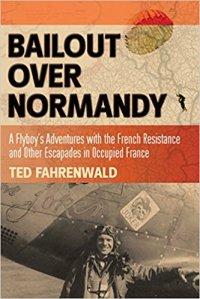
The Second World War is littered with stories of downed airmen and their experiences behind enemy lines. Throughout the European air war, thousands of Americans found themselves on the run in German-occupied territory. Each of their experiences provides an opportunity to analyse these cross-cultural interactions. Ted Fahrenwald’s account as a downed American fighter pilot in occupied France gives historians an insight into many of the experiences of an American airman on the run. Fahrenwald, who was shot down and later rescued by the French resistance, or the Maquis. Later, German soldiers captured Fahrenwald as he tried to make his way back to the American lines. Before being sent to a prison camp, the downed fighter pilot escaped and once again found himself on the run. Eventually, American troops of the US Third Army found Fahrenwald after he had taken up residence in the home of a French family.
Readers are introduced to Fahrenwald as a fighter pilot. He jumps right into the action and describes the daily grind of flying missions as a part of the US Eighth Air Force. Each of his daily briefings takes place long before sunrise. Fahrenwald is frank in his descriptions of his combat experience shortly before he was shot down. The author describes himself as a pilot who had been exhausted by the greater demands of supporting the Normandy landings on 6 June 1944. Before one take off, his ‘fingers had developed a tremor.’ (p. 13) The wear and tear of his previous ninety-nine missions are prevalent throughout the first pages of the book.
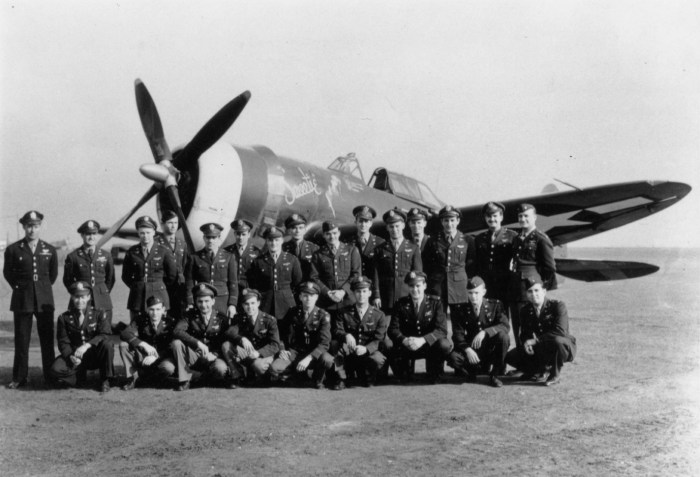
Pilots of the 486th Fighter Squadron, 352nd Fighter Group, in front of a P-47 Thunderbolt named “Sweetie” at Bodney air base in March 1944. Left to right, top row: Lieutenant Woodrow W. Anderson, Lieutenant Stanley G. Miles, Lieutenant Frank A. Cutler, Lieutenant Martin E. Corcoran, Lieutenant Donald Y. Whinnem. Left to right, middle row: Lieutenant-Colonel Luther H. Richmond, Captain Stephen W. Andrew, Lieutenant Thomas W. Colby, Lieutenant Henry J. Miklajyck, Captain Edward J. Gignac, Lieutenant Alfred L. Marshall, Lieutenant Alton J. Wallace, Lieutenant Robert C. Frascotti, Lieutenant Donald H. Higgins, Major Willie O. Jackson. Left to right, front row: Lieutenant Lloyd A. Rauk, Lieutenant Warren H. Brashear, Captain Franklyn N. Green, Lieutenant Donald W. McKibben, Lieutenant Theodore P. Fahrenwald, Lieutenant Robert C. MacKean, Lieutenant Edwin L. Heller, Lieutenant Joseph L. Gerst. (Source: (c) IWM (FRE 333))
Throughout the text, we see Fahrenwald rapidly adapt to his surroundings. Fahrenwald’s relationship with the Maquis evolves from that of a foreigner to a full-fledged member of the group. After he bailed out a family took Fahrenwald in and gave him clothes. He admits during this time that he spoke little French and had difficulty understanding those who were helping him (p. 25). After he was sent to the Maquis, he began to assimilate. Weeks later when American soldiers discovered Fahrenwald at the home of another family, the soldiers mistook him for a French citizen. Fahrenwald spoke, dressed, and acted French. After several minutes he informed the American soldiers who he was in English. Still not convinced, he was interrogated by a ‘Captain Ford’ of the 90th Infantry Division. After successfully answering several questions to prove he was not a spy, Ford sent Fahrenwald back to the American camp (p.258-60). In a matter of weeks, Fahrenwald had successfully adapted to his new environment.
Fahrenwald also noted the distrust of outsiders amongst the Maquis. Despite aiding him, there are several points at which his loyalties are questioned. In one instance Fahrenwald stated that one Frenchman, Canoe, believed Fahrenwald to be a German in disguise. He said that Fahrenwald ‘was too thin and too blond’ to be an American (p. 35). Over time members of the Maquis began to trust Fahrenwald. Once other downed pilots joined his group, the relationship soured. He wrote, ‘[N]ow, instead of being one of them as of old, I was one of a tight little clique of English-speaking fliers’ (p. 73). After his escape from a German prisoner camp, he hid with a family that had ties to the Maquis. One of the members, Robert, yelled at Fahrenwald about a failed supply drop that cost him most of the members of his group (p. 229). While willing to help, French fighters preferred to keep their distance from Fahrenwald and other outsiders.
P-51 Mustangs of the 486th Fighter Squadron, 352nd Fighter Group, come to Debden to fly with the 4th fighter Group the following day on the first 8th Air Force ‘Frantic’ mission – England to Russia, and return via Italy. 20 June 1944. (Source: (c) IWM (UPL 14325))
While Fahrenwald provided a detailed account of his time in France, these memoirs are incomplete. The author writes very little about his missions before when he was shot down. This book begins with Fahrenwald’s final missions as a fighter pilot. He left out his training and months of flying as a fighter escort prior. Readers and historians alike miss out on valuable information such as the learning curve from training into combat. Readers are also left to speculate as to Fahrenwald’s interactions with civilians in the United Kingdom. As a fighter pilot based in the United Kingdom, he spent more time interacting with British civilians than time with the French. This likely had some effect on his experiences while he was on the run in France. By jumping right into the action, the author left out elements that detract from the book and leave the reader wondering.
Historians will find this text useful as a primary source. Fahrenwald examined his time with the Maquis as a foreigner. Those writing about the Maquis during Operation OVERLORD should examine this book. The author records both the actions and the thoughts of the Maquis well during this period. Fahrenwald’s account also adds to the history of the air war. He provides an excellent first-hand account of his time escaping and invading capture. Historians will find Fahrenwald’s account useful as a primary source.
Luke Truxal is a doctoral candidate at the University of North Texas. He is currently writing his dissertation ‘Command Unity and the Air War Against Germany.’ Truxal completed his master’s thesis at the University of North Texas titled ‘The Failed Bomber Offensive: A Reexamination of the Combined Bomber Offensive in 1943’ in 2011. His current research focuses on the command relationships between the British and Americans during the air war in Europe from 1942 to 1944. Truxal is currently teaching at Columbia State Community College in Columbia, TN. He can be reached on Twitter at @Luke_Truxal.
Header Image: Ground crew stand beside a P-47 Thunderbolt named “Sneezy”. This aircraft was flown by Lieutenant Donald McKibben of the 486th Fighter Squadron, 352nd Fighter Group. Source: (c) IWM (FRE 327))
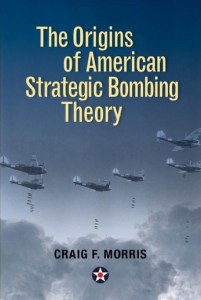
The strategic bomber has stood as one pillar of American military strength since the Second World War, and even today, the deployment of B-1s, B-2s and B-52s to forward bases across the globe sends a strong message to potential adversaries. Serving as a true ‘Book of Genesis’ chapter to this capability, The Origins of American Strategic Bombing Theory by Craig F. Morris covers the period of 1916 to 1942 and explores the growth of an idea within the United States Army, rather than deal primarily in technology or personalities. By recounting how air power theory matured (and was withheld) within the United States Army, he also delivers an excellent case study on how an organisation reacts to disruptive technology.
There is a stark comparison in air power capability that comes early from Morris. The book’s introduction begins with the arrival of United States Army Air Force B-17s in England in 1942. Operationally untested, their existence still spoke of the maturity of America’s investment in technology, organisation, and air power doctrine during the interwar period. Contrast that scene with the experience of the United States Army’s 1st Aero Squadron in Mexico in 1916, which Morris covers in his first chapter. There is obviously no suggestion that the 1st Aero Squadron’s Curtis JN-3 biplanes were to be used as bombers against Mexican revolutionary Pancho Villa; what Morris does is illustrate the lack of intellectual depth the United States Army had with its heavier-than-air aviation capability. While the technology was relatively new, that lack of innovation remains surprising considering how the First World War had quickly illustrated the utility of aviation.
The Mexican adventure serves another purpose – it introduces several personalities from the 1st Aero Squadron who were sent to Europe when the United States entered the First World War. The most significant focus of The Origins of American Strategic Bombing Theory falls on 1917 to 1919, which stands to reason – it is here that the Aviation Section of the American Expeditionary Force (AEF) first encountered the idea of strategic bombing from the Allied (and Central) powers. This transfer of ideas is explored mainly through the experiences of Edgar S. Gorrell, a veteran of the 1st Aero Squadron in Mexico who was sent to Europe to study how the United States would grow its aviation forces in the First World War. The AEF ground commanders wanted aviation to provide the battlefield reconnaissance and air defence, but Gorrell’s exposure to Allied air power theory led him to become a proponent of using bombers to open a ‘new front’ on an enemy’s warfighting infrastructure, effectively bypassing the war in the trenches on the Western Front.
Lieutenant Edgar S. Gorrell studied aeronautical engineering at MIT following the Mexican campaign of 1916. (Source: US Air Force Historical Research Agency)
Gorrell is the personality most consistently covered in The Origins of American Strategic Bombing Theory, which is arguably a testament to the aviator’s recordkeeping and his early advocacy of strategic bombing. The First World War ended before Gorrell could successfully argue the case for an American strategic bomber force, but the Armistice allowed him to leave two critical legacies to the future of air power development. Gorrell was tasked with organising the official history of the AEF, an assignment which allowed him to draw together air power lessons from the AEF and Allied into an official post-War record. On top of this, he drove a post-war bombing survey that examined what impact Allied bombing made on Germany’s warfighting effort.
When dealing with the events of 1919 to 1942, The Origins of American Strategic Bombing Theory does not enjoy the singular narrative focus that Gorrell’s experiences during the First World War afforded it (Gorrell left the military as a Colonel in 1920 at the age of 28, worked in the motoring industry, and died in March 1945). In Morris’ defence, strategic bombing theory in the interwar period was driven by complex variables, from personalities such as Billy Mitchell and rapidly growing aviation technology; through to economic resources (like the Great Depression), along with shifting strategic and foreign policy. The main conflict affecting strategic bombing theory (and the introduction of a supporting capability) was between the US Army’s General Staff, and aviation proponents within the Air Corps, as the Air Service had become in 1926. As aviation technology grew and the Air Corps Tactical School developed its ideas for air power, the Army General Staff were justifiably worried that a strategic bombing capability would lead to an independent Air Force, and a competitor for government funding.
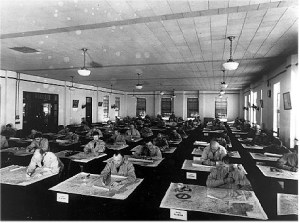
The Air Corps Tactical School (created as the Air Service Field Officers School in 1920) went beyond its mandate of training officers to also become an engine for air power theory development in the interwar period. (Source: US Air Force Air University)
The examination of this conflict makes The Origins of American Strategic Bombing Theory an excellent study in how organisations react to disruptive technology (both positively and negatively). The parallels to modern disruptive technologies (for example, autonomous systems, or space-based systems) do not feel completely analogous, given the purely historical lens of this book. That being said, it gives numerous examples of both innovative and misguided thinking at different levels within the United States Army in dealing with aviation. While history arguably vindicated the strategic bomber concept, Morris does well explain Army’s reservations with this new field.
One of the most significant qualities of The Origins of American Strategic Bombing Theory is also the chief criticism – by covering 25 years in 207 pages, it is very concise. The narrative is clear, comprehensive, and does not feel like any essential facts have been left out. However, the quality of Morris’ writing would comfortably permit this to be a longer work, and the narrative could afford to provide further exposition to selected events, technologies and personalities (beyond Gorrell), that shaped and developed air power theory. On several occasions, this reviewer found himself looking for other resources to further his appreciation of the events in this book – especially about the limited performance of bomber aircraft during the First World War.
While remaining engaging to read, Morris’ work is academically well-presented. It both recounts history as well as briefly discussing the views of academics and historians on the subject matter where relevant. There is considerable inertia when it comes to people’s understanding of events from a century ago, and Morris is clear when he debates, debunks or reaffirms the established narratives of other authors. The introduction specifically accounts for early air power studies into strategic bombing by historians/academics including Mark Clodfelter, Stephen McFarland, I.B. Holley, and Maurer Maurer.
First flown in 1932, the Martin B-10 was a revolutionary bomber not only for the United States Army Air Corps, but for the world. Design features such as all-metal construction, enclosed cockpit with rotating gun turrets, full engine cowlings and retractable landing gear would be standard design features for bombers over the next decade. (Source: National Museum of United States Air Force)
Overall, The Origins of American Strategic Bombing Theory is clear and well-sourced and can be easily approached by anyone with no depth of knowledge of the central subject matter. This reader found it to be enjoyable and informative, providing a good account of early strategic bombing theory and American air power development. While being a self-contained work, it is likely to whet the reader’s appetite for reading works covering related subject matters.
Eamon Hamilton graduated from the University of Western Sydney with a Bachelor of Communications (Journalism). He works as a Public Affairs Officer for the Royal Australian Air Force. He lives in Sydney. He runs the Rubber-Band Powered Blog and can be found on Twitter @eamonhamilton.
Header Image: A Boeing Y1B-17 in flight. This aircraft would eventually be developed B-17 Flying Fortress. (Source: Wikimedia)
With Architect of Air Power Brian D. Laslie, Deputy Command Historian at NORAD and US Northern Command and an Adjunct Professor at the US Air Force Academy had two mutually supporting goals. The first is to offer readers a biography of General Laurence S. Kuter, one of the select few US Air Force (USAF) officers to serve the majority of his 35-year career as a general officer (the others were Generals Curtis LeMay, Lauris Norstad, and Hoyt Vandenberg). The second is to acknowledge that Kuter’s
[c]areer dovetailed with the rise of an adolescent air power and ended with a fully grown and mature air force capable of global monitoring and response. (p. xi)
In other words, Kuter was an architect of the USAF. Many of the modern USAF’s principles and methods owe their origins to his work.
The biography is organised chronologically, beginning with Kuter’s adolescence and time at West Point and ending with his service as a four-star general commanding the Pacific Air Forces (PACAF) and North American Air Defense Command (NORAD), retirement, and passing. Laslie has assembled an impressive array of sources to discuss Kuter’s life and career. He draws on Kuter’s incomplete autobiography, collections at the USAF Academy library (including Kuter’s papers and those of several his contemporaries), oral histories, diaries, and letters. One highlight of the book is how Laslie captures Kuter’s relationship with his high school sweetheart and wife, Ethel Kuter (née Lyddon). Ethel’s diary was slowly overtaken by references to Kuter beginning in 1922, and the pair wrote over 1,000 letters to each other during his time at West Point.
Laslie takes his readers on a mission to understand why so little has been written about Kuter. One reason is that Kuter did not make a name for himself with flying exploits or by leading air formations into battle. Kuter did not join the US Army Air Corps because of romantic visions of flight. Instead, he joined to be a better artillery officer. Only later did he become fully immersed in exploring a new kind of warfare – mainly at the operational rather than tactical level. In August 1941, Kuter became one of the authors of AWPD-1, the first comprehensive plan for winning the war against Germany through aerial bombardment. In the early months of America’s Second World War, Brigadier General Kuter (one of the youngest general officers in the US Army) was a go-between for General George C. Marshall and Lieutenant General Henry H. Arnold. He also had a significant hand in setting up the latter’s Air Staff as the US Army Air Forces achieved autonomy. Kuter made a name for himself with his organisational skills rather than his combat command ability.
Recognising this, Arnold sent Kuter to Europe in late 1942 to gather command experience. Kuter commanded the Eighth Air Force’s 1st Bombardment Wing under Brigadier General Ira Eaker. One of Eaker’s assistants, James Parton, later claimed that Eaker had fired Kuter for declining to fly on combat missions. Laslie has proven these accusations to be unquestionably false. In fact, while Eaker gave Kuter the worst performance reviews of his career, he also tried to retain Kuter’s services. Laslie believes Eaker did this to provide Kuter with more time to prove himself; he had served under Eaker for only five weeks.
This is another of the reasons for the lack of attention afforded Kuter. He never stayed in one place long enough to make a name for himself. Kuter’s next stop was North Africa. He would serve as the deputy to Air Marshal Sir Arthur Coningham, commander of the Northwest African Tactical Air Force. He served in this position for only four months, but he still made immense contributions to the war effort and the future of the US air power. Kuter’s brainchild was FLAX, a well-planned and executed operation to destroy the Axis air bridge between Sicily and Tunisia. He also learned how to implement a proper ground support system in the field. When he returned to Washington to work under Arnold his experiences in North Africa were codified in Field Manual 100-20. This document is considered both the air force’s ‘declaration of independence’ and the basis for the USAF’s tactical air power concepts to this day.
Kuter’s next command opportunity overseas was in the Pacific. Now a Major General, Kuter was quickly replaced in a reshuffling of officers following the defeat of Nazi Germany in May 1945. He then moved to Air Transport Command, where he supported General Douglas MacArthur’s buildup in Japan following the island nation’s surrender. After less than a month, Kuter once again returned to Washington. As Laslie notes, ‘as soon as [Kuter] established and organized the flow of men and material, he was pulled from the theater.’ (p. 122)
Another reason Laslie offers us for Kuter’s relative obscurity is the man’s level-headedness. People want to write about innovators and controversial figures, not respectable architects. Laslie makes this observation early in the book: ‘If the famous early aviators – men like Curtis LeMay and Jimmy Doolittle – were cowboys, then Kuter represented the first-generation lawman who came to town to impose order.’ (p. 18) One of the arduous tasks Kuter had to handle while working under Arnold in 1942 were the requests from various theatre commanders for more and better aircraft and properly trained crews. At the time, there just were not enough aircraft to train crews in the United States and supply US Army Air Forces in Europe, North Africa, and the Pacific. President Roosevelt had also promised the Royal Air Force a share of American aircraft production. This added strain was worth it since many British Commonwealth pilots already had combat experience. Although the theatre commanders could be quite forceful in their requests, Kuter never let it get the better of him, and his level-headedness set him apart from many of his contemporaries. Perhaps, therefore, when Arnold could not attend the Yalta Conference in February 1945, Kuter attended in his place. In doing so, Kuter jumped the queue in front of three-star generals.
Continental defense warning systems of the North America. (Source: Wikimedia)
Kuter’s Cold War career is equally fascinating. He never held or coveted the positions of Chief of Staff or Vice Chief of Staff of the USAF (perhaps another factor in his relative obscurity). His work establishing the USAF Academy and achieving accreditation for the Air University were architectural moves that produce new generations of air force officers that continue to mould the modern USAF. As a four-star general, Kuter commanded America’s aviation in the Pacific theatre, consolidating these forces under one command: PACAF. He also oversaw NORAD as it dealt with growing Soviet missile offensive capability in the late 1950s and early 1960s.
In his preface, Laslie notes the difficulty associated with writing biography suggesting that:
Historians must tread the perilous course of being objective while at the same time proclaiming why subject needs individual attention in the first place. (p. xi)
Laslie has played this balancing act marvellously. He pulls no punches, willingly calling out Kuter when his ideas or actions were wrong, especially his belief in strategic air bombardment as a war-winning approach. Laslie carefully provides the reader with enough context so that he or she may understand why Kuter made these errors. In fact, it is these very moments, so well captured by Laslie, that make Kuter and the history of the USAF such a fascinating subject.
Alexander Fitzgerald-Black has a Master of Arts in Military History from the University of New Brunswick and is a Master of Arts in Public History candidate at the University of Western Ontario. Alex’s first book, Eagles over Husky: The Allied Air Forces and the Sicilian Campaign, 14 May to 17 August 1943, will be published in early 2018. His research interests include air power in the Second World War, with a particular focus on the Mediterranean, and Canadian military history. He operates his blog at alexfitzblack.wordpress.com and can be reached on Twitter @AlexFitzBlack.
Header Image: Republic of Korea Air Force Lieutenant General Cho Won Kun flies with the 35th Fighter Squadron out of Kunsan Air Base, c. 2009. The 35th Fighter Squadron forms part of the 8th Operations Group of the 8th Fighter Wing. The 8th Fighter Wing is assigned to the Seventh Air Force, which reports to PACAF. (Source: Wikimedia)
Since the end of the Cold War, the West’s militaries have been engaged in a series of protracted and persistent low-intensity counterinsurgency campaigns. For air forces, this has broadly meant involvement in campaigns where there have been few serious challenges to control of the air and air dominance was assumed. However, as we move further into the twenty-first century, that scenario is likely to change with the likelihood of peer-on-peer high-intensity conflict increasing. In such conflicts, air dominance will have to be fought for, and maintained, to utilise the full spectrum of capabilities afforded by the exploitation of the air domain.
Aim
The Central Blue and From Balloons to Drones seeks to commission a series of articles that examine critical themes related to the challenge of preparing modern air forces for the possibility of high-intensity conflict as they transform into 5th generation forces. As well as informing broader discussions on the future of conflict, these articles will provide the intellectual underpinnings for a Williams Foundation seminar on the subject of the requirement of high-intensity conflict to be held in Canberra, Australia in March 2018.
Themes
The editors seek contributions that provide a variety of perspectives on the following key themes:
Strategy and Theory | Future Roles | Emerging Threats | Air Force Culture
Force Structure | Technology and Capabilities | Ethical and Moral Challenges
Doctrinal Trends | Education | Training
Articles can range from historical discussions of the above themes through to contemporary perspectives. Perspectives can also come from a number of related disciplines including history, strategic studies, international relations, law, and ethics.
Submission Guidelines
Articles framed around one of the above themes should be c. 2,000 words. Submissions should be submitted in Word format and emailed to the addresses below with ‘SUBMISSION – HIGH-INTENSITY WARFARE’ in the subject line. Also, please include a 50-100-word biography with your submission. Please be careful to explain any jargon. Publication will be entirely at the discretion of the editors. These articles will appear on the websites of The Central Blue and From Balloons to Drones simultaneously. We will be publishing articles from the middle of February 2018 onwards.
Keen to write but need some guidance? Email us, and we can link you up with a mentor-editor who can assist you before formal submission.