Editorial note: This article first appeared on the author’s website. It has been reproduced here with permission.
On 25 June 1950 local time, forces of the Democratic People’s Republic of Korea (North Korea) crossed the 38th Parallel and invaded the Republic of Korea (South Korea). Launching Operation Pokpung, North Korea quickly moved south and by 28 June had occupied the capital of South Korea, Seoul. In response to this act of aggression, on 25 June 1950, in New York, the United Nations passed Resolution 82, which condemned the invasion, called for a cessation of hostilities, and demanded the withdrawal of forces beyond the 38th Parallel. Failure to comply with the resolution led to the adoption of Resolution 83, which recommended that UN members provide military forces to support South Korea and restore peace.
Korea, after 35 years of occupation by the Japanese, was split into two zones of occupation in 1945. The Soviet Union occupied the north, while the United States occupied the south. While the intention had been to unify the Korean Peninsula, problems arose between the communist North and the nationalist South. The failure of the Communist Party (the Workers’ Party of North Korea) to participate in the 1948 elections, combined with the abstention of several South Korean politicians, led to the eventual development of two distinct systems of government.[1] After the communist victory in the Chinese Civil War in 1949 and after receiving tacit support from Joseph Stalin, North Korea prepared to invade South Korea.
Australia’s response to Resolution 83 was to support the UN. At this time, the Australian military was providing forces to the British Commonwealth Occupation Force (BCOF) in Japan. Shortly after the passage of Resolution 83, the Department of External Affairs received communications from the Americans regarding the support Australia was willing to provide.[2] Initially, the Royal Australian Navy vessels (RAN) HMAS Shoalhaven and Bataan (the latter en route to Japanese waters to relieve the former) were tasked with supporting the withdrawal of nationals from South Korea; however, by 29 June, they were tasked with assisting American operations.[3] In cabling this news to the Australian Ambassador to the United States, Norman Makin, the Minister for External Affairs, Percy Spender, noted the presence of No. 77 Squadron, Royal Australian Air Force (RAAF), in Japan. However, he stressed it represented ‘practically the whole of our effective operational fighter strength in Australia or elsewhere.’[4]
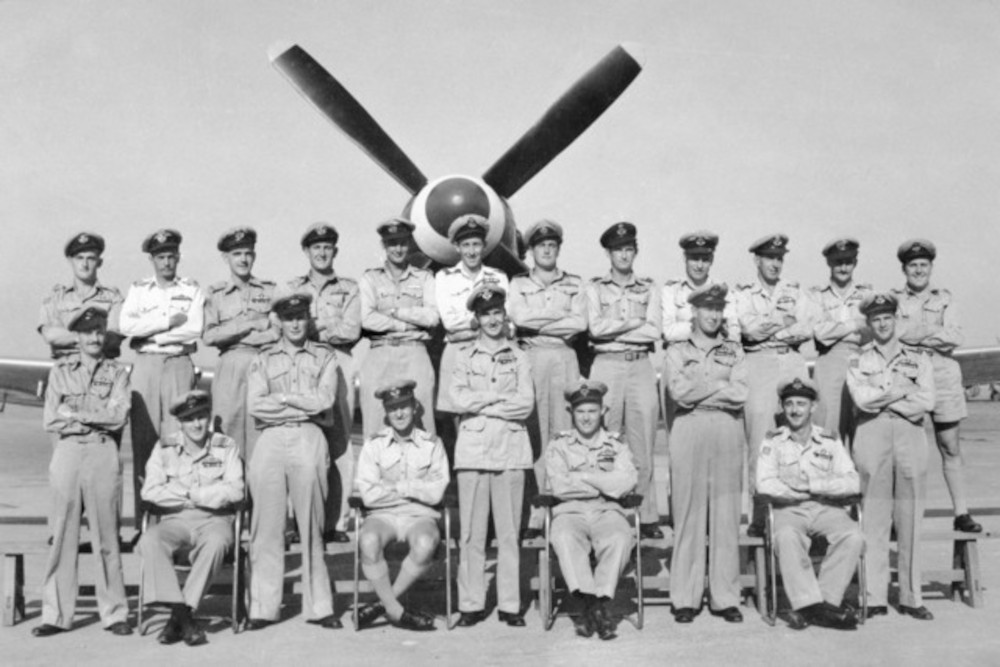
Group portrait of No. 77 Fighter Squadron, RAAF, 26 September 1948. Identified, left to right, back row: Warrant Officer (WO) Jim Flemming; WO W. Michelson; Flying Officer (FO) W. Horsman; WO M. Garroway; WO W. Rivers; Flight Lieutenant (Flt Lt) C.R. Noble; WO Fairweather; Flt Lt J. Grey; FO K. McLeod; WO B. Nichols; Flt Lt T. Murphy. Front row: FO W.O.K. Hewett; Flt Lt R. Hill; Flt Lt W. Ives; Flt Lt C. Butcher; Flt Lt S. Bradford; Squadron Leader F. Lawrenson; Flt J.I. Adams; Flt Lt G. Strout; Flt Lt K. Godfrey. (Source: Australian War Memorial)
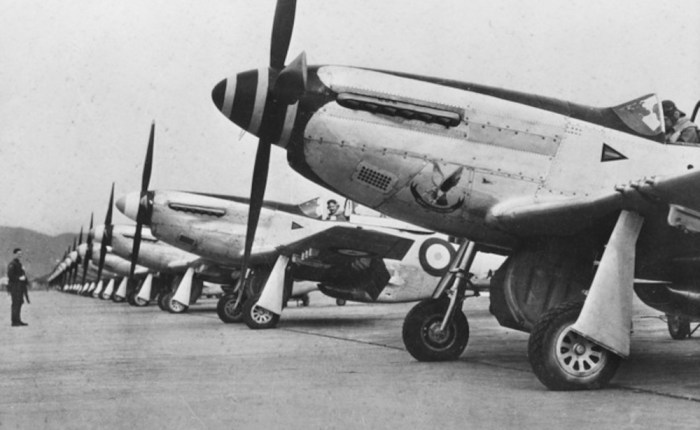
No. 77 Squadron had deployed to Japan as part of BCOF in 1946 as part of No. 81 Wing. In 1948, it was transferred to Iwakuni Air Base in Yamaguchi Prefecture, on the island of Honshu. The squadron had been re-equipped after the end of the Second World War with the North American P-51D Mustang. By June 1950, No. 77 Squadron was amid preparations to return to Australia, it having been announced in April that the remaining Australian forces in Japan would be repatriated. However, events overtook these preparations.
On 29 June, the same day the Australian Government contributed the RAN to the war in Korea, the Supreme Commander of the Allied Powers in Japan, General Douglas MacArthur, requested No. 77 Squadron for operations over the Korean Peninsula. He had been informed by his principal air commander, Commander of the Far East Air Forces (FEAF), Lieutenant General George Stratemeyer, that he was in desperate need of long-range ground attack aircraft. As the Australian Official Historian of the Korean War, Robert O’Neill related, MacArthur had cabled the Commander of BCOF, Lieutenant General Sir Horace Robertson, to request the use of No. 77 Squadron. However, he had sent the message uncoded and not kept it from the entourage of reporters that he had taken with him on his tour of South Korea.[5] Stratemeyer embellished MacArthur’s position by heaping praise on No. 77 Squadron. While the praise was not unwarranted, it was clearly designed for effect. Indeed, Stratemeyer and his planners at FEAF had, in the words of the United States Air Force’s official history of air operations over Korea, ‘cast covetous glances’ at No 77 Squadron and its P-51 Mustangs.[6] MacArthur’s request for the deployment of No. 77 Squadron was widely reported in the Australian media alongside Stratemeyer’s praise for the unit before the Australian Government had a chance to respond.[7]
MacArthur’s request put the Australian Government in a challenging position. They still hoped to send No. 77 Squadron back to Australia, but alliance politics took centre stage, and by 30 June it was announced that the squadron would be committed to operations.[8] MacArthur had got his way. However, while No. 77 Squadron was committed to action, it operated from Iwakuni and would operate over Korea, but not be deployed to the peninsula. Moreover, due to poor weather, it would take several days for No. 77 Squadron to undertake its first sorties.
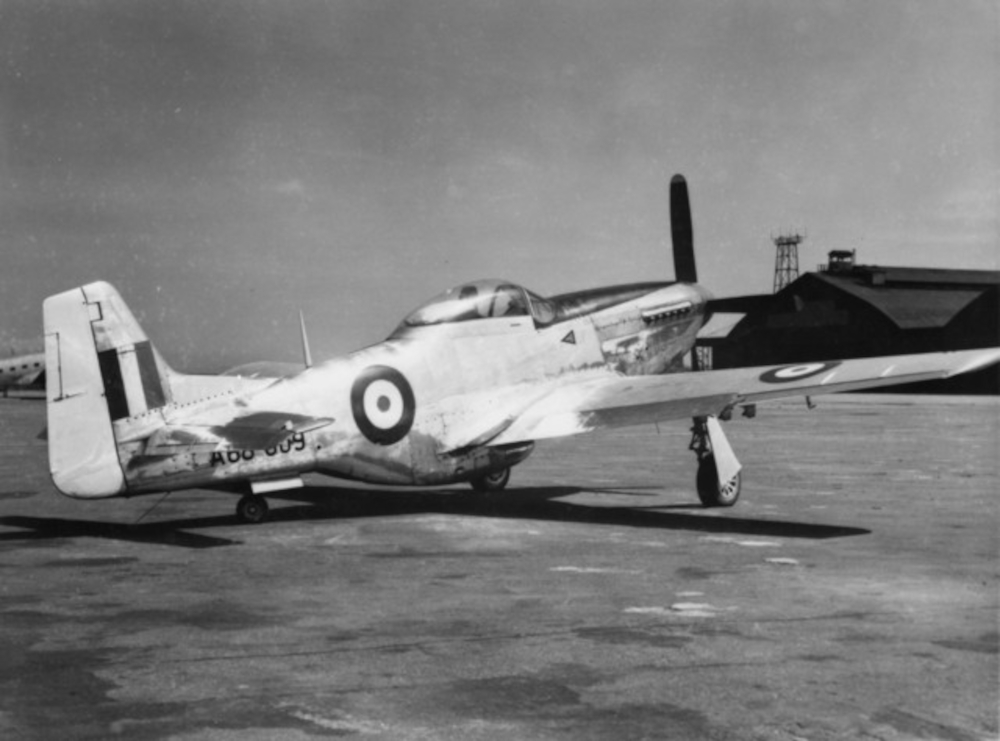
The North American P-51D Mustang aircraft A68-809, flown by Wing Commander Lou Spence DFC, when commanding No. 77 Squadron, RAAF, in Korea. Spence flew this aeroplane on 2 July when leading the second mission of the day. (Source: Australian War Memorial)
On 2 July, No. 77 Squadron undertook three sorties. The first was an ‘armed escort’ of four P-51s led by Squadron Leader Graham Strout for US Douglas C-47 Dakotas evacuating wounded soldiers from ‘Taijon’ (Daejeon) in Korea to Japan. One P-51 (A68-799) had to return to Iwakuni due to being unserviceable after take-off. The second sortie was a ‘close-armed escort’ mission led by the squadron commander, Wing Commander Lou Spence. The mission was to escort a group of US Douglas B-26 Invaders who attacked two bridges south of Seoul. One P-51 (A68-757) had to return due to unserviceability. The final mission saw six P-51s provide ‘armed escort’ to US Boeing B-29 Superfortresses who were attacking Yonpo airfield at Hamhung.[9] Despite the return of two aeroplanes to Iwakuni due to unserviceability, the sorties were relatively uneventful, despite several newspapers reporting that No. 77 Squadron downed one or two Yakovlev Yak-9 fighters.[10] No enemy aeroplanes were recorded as being encountered, and only in the two final sorties was any form of anti-aircraft fire encountered, though they caused no problem for the squadron. After a relatively inauspicious start, No. 77 Squadron would soon turn its attention to offensive operations, launching its first ‘armed attack’ with eight P-51s armed with rockets, attacking a convoy on a stretch of road between Heitaku and Suwon on 3 July. The attack claimed two locomotives, one truck, two staff cars, four other vehicles, and a bridge.[11]
The significance of No. 77 Squadron’s deployment over Korea came not in what the squadron physically achieved but in what its presence represented to alliance politics. The squadron’s first operations were widely reported both in Australia and abroad. In Australia, No. 77 Squadron’s first operation was reported in a typically functional manner, with many newspapers simply reporting on the character of the sorties. Nevertheless, some newspapers reported on the significance of the sorties in terms of Australian strategic policy, both foreign and domestic. For example, on 3 July, the Brisbane Telegraph noted that while the deployment of small-scale RAAF and RAN forces to support the effort in Korea was warranted to ‘honour Australian commitments to the United Nations’, any larger-scale deployment would need parliamentary agreement.[12] However, as an editorial in The Canberra Times reported, the rapid deployment highlighted ‘[t]wo extremes in the making of major decisions on policy have been illustrated by the reactions of the Government and of the Labour Party to the outbreak of hostilities in Korea.’[13] In short, the Australian Government acted quickly. At the same time, the Labor Party could ‘even comment on the situation until a meeting is held in Sydney next Wednesday [5 July], at which the policy will be decided.’[14] Perhaps unsurprisingly, it was reported that the Australian Communist Party had condemned the use of the RAAF, describing their deployment as a ‘scandal and a disgrace’ and demanding ‘the withdrawal of the R.A.A.F, from Korea.’[15]
More significantly, in the US, the rapid response of the Australian Government was noted. On 2 September, the Washington Evening Star reported on that ‘[t]he first combat mission of the Australians […] had a political significance. It made the air war a United Nations show […] No longer was the United States conducting any part of the Korean “police action” alone.’[16] That the term ‘political significance’ was used would not have been lost on readers, and a copy of this article was provided to the Department of External Affairs, as it aligned with Australian views on alliance politics.[17] Indeed, on 27 June, Makin had cabled Canberra to note that ‘the war had created a useful opportunity for putting to the State Department’ the creation of a ‘regional arrangement […] might help meet further crises.’[18] Thus, the failure to deploy No. 77 Squadron would have been inopportune and also demonstrated that, while a small contribution to the war effort, it had a significant political impact.
Thus ended the first day of operations for No. 77 Squadron over Korea. The squadron would deploy to Korea in October 1950 and eventually be re-equipped with the Gloster Meteor F.8. It would serve in Korea until October 1954, when it would transfer back to Japan and subsequently to Australia.
Dr Ross Mahoney is an independent scholar specialising in the history of war, with a particular focus on the use of air power and the history of air warfare. He is the Editor-in-Chief of From Balloons to Drones and currently the Senior Historian within the Heritage Policy team at Brisbane City Council in Australia. He has nearly 20 years of experience in the education, museum and heritage sectors in Australia and the United Kingdom, including serving as the inaugural Historian at the Royal Air Force Museum between 2013 and 2017. His other research interests are military leadership and command, military culture, and the history and development of professional military education. He also maintains an interest in transport history. He has published numerous articles, chapters and encyclopedia entries, edited two books, and delivered papers on three continents. His website is here.
Header image: North American P-51D Mustangs of 77 Squadron RAAF, lined up on the tarmac at Iwakuni air base, Japan, c. 1950. (Source: Australian War Memorial)
[1] This is an overly simplified description of the development of the two Koreas in the period after the Second World War. For more detail, see: Allan Millett, The War for Korea, 1945-1950: A House Burning (Lawrence, KS: University Press of Kansas, 2005).
[2] Robert O’Neill, Australia in the Korean War, 1950-53 – Volume 1: Strategy and Diplomacy (Canberra, ACT: The Australian War Memorial and the Australian Government Publishing Service, 1981), p. 49.
[3] National Archives of Australia (NAA), A1838, 3123/7/3/4 PART 1, Statement by the Prime Minister, 29 June 1950; ‘Australia Backs U.N.,’ The Herald, 29 June 1950, p. 1; ‘Australian Units for Korea, Ships and Planes,’ Lithgow Mercury, 29 June 1950, 2.
[4] O’Neill, Australia in the Korean War, 1950-53 – Volume 1, p. 51.
[5] O’Neill, Australia in the Korean War, 1950-53 – Volume 1, pp. 51-2. On the repercussions, or lack thereof, of MacArthur’s ‘leak,’ see: O’Neill, Australia in the Korean War, 1950-53 – Volume 1, p. 54. Cameron Forbes claimed MacArthur told Australian Roy Macartney, who was Chief of the AAP-Reuters office in Tokyo. See: Cameron Forbes, ‘Fighting in the Giants’ Playground: Australians in the Korean War’ in John Blaxland, Micheal Kelly and Liam Brewin Higgins (eds.), In from the Cold: Reflections on Australia’s Korean War (Canberra, ACT, ANU Press, 2020), p. 89. Macartney certainly filed a story that was picked up by several newspapers. For example, see: ‘Australian Fighters Sought by MacArthur,’ The Canberra Times, 30 June 1950, p. 1; ‘MacArthur Seeks Use of Australian Fighters in Korea,’ Border Morning Mail, 30 June 1950, p. 1; ‘MacArthur Wants Australian Fighter Planes,’ Daily Advertiser, 30 June 1950, p. 1. O’Neill noted the presence of Macartney of MacArthur’s aeroplane but does not explicitly note that the latter told the former that he wanted No. 77 Squadron. O’Neill, Australia in the Korean War, 1950-53 – Volume 1, p. 51.
[6] Robert Futrell, The United States Air Force in Korea, 1950-1953 (New York, NY: Duell, Sloan and Pearce, 1961), p. 64.
[7] “R.A.A.F. Fighters Sought for South Korea,’ The Sydney Morning Herald, 30 June 1950, p. 1; ‘RAAF asked to Fight with U.S.,’ Daily Mirror, 30 June 1950, p. 1; ‘MacArthur Back; Wants to Use R.A.A.F.,’ Illawarra Daily Mercury, 30 June 1950, p. 1; ‘Mac Arthur asks for the R.A.A.F.,’ The Courier-Mail, 30 June 1950, p. 1; “Wants R.A.A.F. for Korea,’ The Mercury, 30 June 1950, p. 1.
[8] NAA, A1838, 3123/7/3/4 PART 1, Statement by the Prime Minister, 30 June 1950.
[9] NAA, A9186, 103, Detail of Operations, No. 77 Squadron, Operations Record Book, 2 July 1950.
[10] ‘RAAF Mustangs Escort Bombers,’ The Herald, 3 July 1950, p. 3; ‘RAAF Mustangs in a Mission which downs a Red,’ The Daily News, 3 July 1950, p. 1.
[11] NAA, A9186, 103, Detail of Operations, No. 77 Squadron, Operations Record Book, 3 July 1950.
[12] ‘Emergency Call to Parlt.,’ Brisbane Telegraph, 3 July 1950, p. 2
[13] ‘Policies on Korea,’ The Canberra Times, 3 July 1950, p. 4.
[14] ‘Policies on Korea,’ The Canberra Times, 3 July 1950, p. 4.
[15] ‘Communists in Stoney Attack Prime Minister,’ The Canberra Times, 3 July 1950, p. 1.
[16] NAA, A1838, 3123/7/3/4 PART 1, Brooks McClure, ‘Aussies Make Quick Contribution to War,’ Washington Evening Star, 2 September 1950. McClure’s article also noted the importance of the deployment of RAN ships.
[17] NAA, A1838, 3123/7/3/4 PART 1, Memorandum to the Secretary, Department of External Affairs, 5 September 1950.
[18] O’Neill, Australia in the Korean War, 1950-53 – Volume 1, p. 53.
Editorial note: This article first appeared on the author’s website. It has been reproduced here with permission.
The Korean War is often described as the ‘Forgotten War’ due to it being sandwiched between the more commonly known Second World War and the Vietnam War. Furthermore, a debate persists over its character, with some referring to it as ‘police action.’ Despite this, the Korean War has received its fair share of examination by historians since the conflict ended. Arguably, the most comprehensive history in the English language is Allan Millett’s history of the conflict. So far, two volumes of The War for Korea (2005 and 2010) out of a projected three have been published, covering the period up to 1951. From an Australian perspective, the late Jeffrey Grey’s work on the role of British Commonwealth armies, The Commonwealth Armies and the Korean War (1988), remains a key work.
In addition to Grey’s work, the key source on Australia’s involvement in the Korean War remains the two-volume official history written by Robert O’Neill. Starting research in 1970, O’Neill’s two-volume history dealt with strategy and diplomacy in its first volume, while the second volume covered the combat operations of the military forces deployed, including the experience of the Royal Australian Air Force (RAAF). While the first volume has generally been praised, the second volume has been described by at least one critic as a ‘regimental history.[1] Indeed, with specific reference to the RAAF’s contribution, Glen St John Barclay questioned the validity of volume two, arguing ‘if one is not going to make even a passing reference to the aviators of the US Air Force and Navy who achieved total command of the skies for the United Nations Forces in Korea. This is Hamlet without the Prince of Denmark, indeed.’[2]
O’Neill’s appointment nevertheless marked a significant departure from previous official historians, who were journalists by background. Here, the Australian Government made a conscious decision to appoint an academic – O’Neill also served as the Head of the Australian National University’s Strategic and Defence Studies Centre at the time he researched and wrote the official history. Since O’Neill’s appointment, the subsequent official histories published in Australia have adopted a significantly more academic tone. Moreover, as Peter Edwards, the Official Historian of Australia’s involvement in Southeast Asian Conflicts, 1948-1975 has written, O’Neill ‘pioneered the coverage in official histories of the strategic and diplomatic policy-making that led Australian forces to be involved in conflicts, with the same precision and authority as had always been given to the experience of those forces.’ [3]
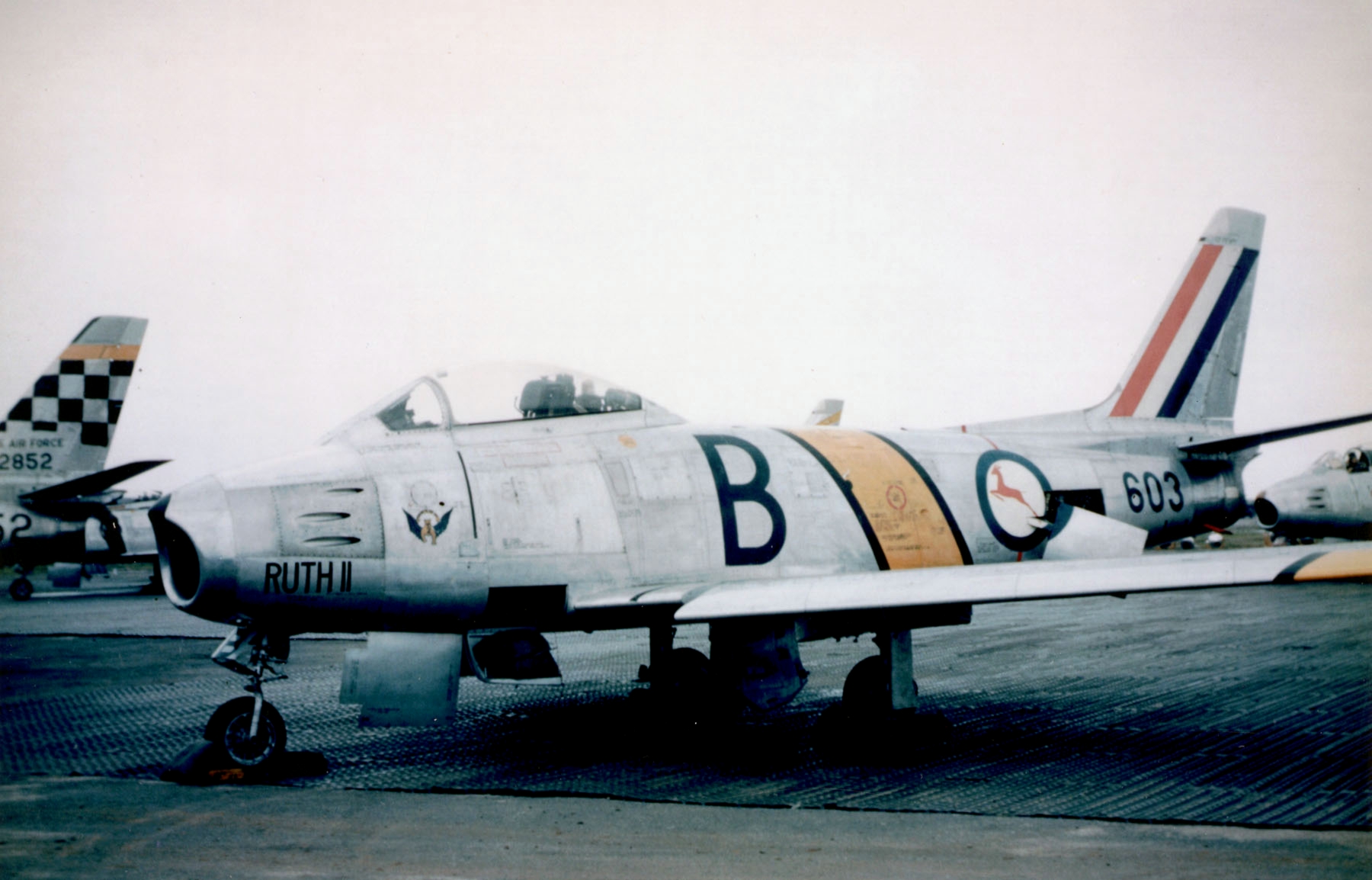
A South African Air Force North American F-86F Sabre from No. 2 Squadron at Tsuiki air base, Japan, in 1953. No. 2 Squadron SAAF was attached to the US Air Force 18th Fighter-Bomber Wing during the Korean War. (Source: Wikimedia)
Returning to air power, the historiography is generally dominated by accounts detailing the role of primarily the United States Air Force, with some attention paid to US naval air power and the role of US Marine Corps aviation. Key amongst these is Conrad Crane’s American Airpower Strategy in Korea (2000). Crane is critical of the USAF’s official history published by Robert Futrell in the 1960s, noting that The United States Air Force in Korea, 1950-1953 (1961) ‘emphasizes the success of air power in Korea and not the air force’s failure to learn enough from that ordeal.’[4] The role of naval aviation is dealt with in Richard Hallion’s 1986 work, The Naval Air War in Korea. Xiaoming Zhang’s 1998 article in The Journal of Military History and his 2002 book Red Wings over the Yalu remain the key works in the English language that examine the Chinese and Soviet use of air power over Korea.[5] Of interest is John Sherwood’s 1996 cultural history of US pilots during the Korean War, Officers in Flight Suits: The Story of American Air Force Fighter Pilots in the Korean War. In addition to these works, a useful general introduction to the subject can be found in Michael Napier’s 2021 history, Korean Air War.
Dealing with Australian air power, writing on the experience of the RAAF began even before the war had ended when George Odgers published Across the Parallel in 1952. Odgers had served as a public relations officer for the RAAF in Korea and had access to No. 77 Squadron that would have been hitherto unheard of for other writers of the time. The work was generally well received at the time of its publication, although it is now somewhat dated. Odgers would later write a biography of Wing Commander Richard Cresswell, Mr Double Seven (2008), who commanded No. 77 Squadron during 1951. Few personnel accounts of the RAAF’s involvement in the air war over Korea have been published. A notable exception is Colin King’s Luck is No Accident (2001).
Little was published on the RAAF’s operations in Korea until the arrival in 1994 of David Wilson’s Lion Over Korea. The RAAF’s role in Korea was discussed by Alan Stephens in the second volume of the Air Force’s official history, Going Solo, in 1995. Stephens’ work is arguably the most comprehensive treatment of the campaign, despite the experience in Korea warranting only a single chapter. The volume, however, situates the deployment in context and links it to other ongoing issues in the history of the RAAF at the time. Then, at the turn of the 21st Century, Doug Hurst published The Forgotten Few (2000) while more recently Owen Zupp has published an account of Australia’s contribution to the air war (2024).
Despite the lack of personal accounts and Hurst’s contention that the No. 77 Squadron represented a ‘forgotten few,’ there has been a surprising amount published for what was ostensibly a small contribution to the war effort. Nevertheless, there are problems. While it might be argued that much has been written about the RAAF’s contribution to the air war, their contribution can still be overlooked. For example, In from the Cold, a 2020 edited collection reflecting on Australia’s contribution to the Korean War, did not include a chapter on the RAAF. Based on a 2011 conference at the Australian War Memorial, the event featured chapters on the Australian Army and the Battle of Maryang San, as well as the four-month deployment of the Royal Australian Navy’s aircraft carrier, HMAS Sydney. However, the closest we see the RAAF discussed is in a chapter on coalition air operations by Richard Hallion.[6]
Additionally, apart from Stephens’ work, the cited works above primarily focus on the experience of No. 77 Squadron. Little attempt is made to link expertise back to the development and operations of the RAAF in Australia and other places such as Malaya. Indeed, any consideration of Australian air power strategy in this period cannot separate Korea from Malaya, as the two campaigns were clearly linked in the mind of the Australian government.[7]
Dr Ross Mahoney is an independent scholar specialising in the history of war, with a particular focus on the use of air power and the history of air warfare. He is the Editor-in-Chief of From Balloons to Drones and currently the Senior Historian within the Heritage Policy team at Brisbane City Council in Australia. He has nearly 20 years of experience in the education, museum and heritage sectors in Australia and the United Kingdom, including serving as the inaugural Historian at the Royal Air Force Museum between 2013 and 2017. His other research interests are military leadership and command, military culture, and the history and development of professional military education. He also maintains an interest in transport history. He has published numerous articles, chapters and encyclopedia entries, edited two books, and delivered papers on three continents. His website is here.
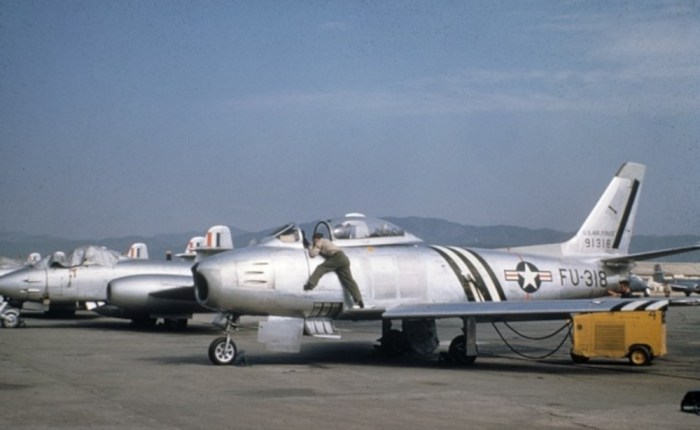
Header image: A United States Air Force North American F-86 Sabre parked alongside Gloster Meteor Mk8s on No. 77 Squadron of the Royal Australian Air Force at Iwakuni in Japan, June 195. (Source: Australian War Memorial)
[1] Glen St John Barcley, ‘Australian Historians and the Study of War, 1975-88,’ Australian Journal of Politics & History 41, no. 1 (1995), p. 241.
[2] Barclay, ‘Australian Historians and the Study of War,’ p. 241.
[3] Peter Edwards, ‘Robert O’Neill and the Australian Official War Histories: Policy and Diplomacy’ in Daniel Marston and Tamara Leahy (eds.), War, Strategy and History: Essays in Honour of Professor Robert O’Neill (Canberra, ACT: ANU Press, 2016), p. 71.
[4] Wayne Thompson, ‘Book Review – American Airpower Strategy in Korea, 1950-1953 by Conrad Crane,’ Journal of American History 87, no. 4 (2001), p. 1565.
[5] Xiaoming Zhang, ‘China and the Air War in Korea, 1950-1953,’ The Journal of Military History 62, no. 2, (1998), pp. 335–70.
[6] Richard Hallion, ‘The Air War in Korea: Coalition Air Power in the Context of Limited War’ in John Blaxland, Michael Kelly and Brewin Higgins (eds.), In from the Cold: Reflections of Australia’s Korean War (Canberra, ACT: ANU Press, 2020), p. 129, 141.
[7] Mark Lax, Malayan Emergency and Indonesian Confrontation, 1950 to 1966 (Newport, NSW: Big Sky Publishing, 2021), p. 75.
The United States Air Force (USAF) Colonel John R. Boyd’s most enduring idea is his Observation-Orientation-Decision-Action (OODA) loop theory. For example, Antulio J. Echevarria concluded that it ‘became the most memorable aspect of Boyd’s legacy.’[1] The basic idea is to move faster than the enemy through a four-stage cycle.[2] With a relative speed advantage, the victor seizes the initiative while the loser becomes paralysed by disorientation and panic.[3] The winner gets inside their adversary’s OODA loop, and, as Martin van Creveld explained, the loser is in a situation ‘comparable to that of a chess player who is allowed to make only one move for every two made by his opponent.’[4] Towards the end of his life, Boyd refined the OODA loop into a vastly more complex idea involving multiple feedback loops and different pathways between the four stages.[5] While the final version has had little influence, the same cannot be said of the earlier concept.
The OODA loop is applicable outside the military; as Frans P. B. Osinga explained, it ‘has spread like a meme beyond military organizations, infecting business consultants, psychiatrists, pedagogues, and sports instructors.’[6] Why did the OODA loop spread like a meme? What convinced so many that the idea had merit? As Michael W. Hankins explained, ‘something about Boyd’s expression of the OODA loop resonated with a certain audience in a powerful way.’[7] There is one prominent example that may explain this trend. In the early days of his Patterns of Conflict briefing, Boyd used his emerging, but not fully formed, OODA loop idea to explain the remarkable kill ratio F-86 Sabres achieved against MiG-15s during the Korean War (usually given as 10:1).
The example of Sabre versus MiG-15 combat in Korea was a decisive factor in the OODA loop spreading like a meme because it is usually the most prominent and compelling evidence provided in literature advocating the theory. The Korean War air combat example also benefitted from a certain mystique as it touched upon Boyd’s personal experience as an F-86 pilot during that conflict.
In my book The Blind Strategist: John Boyd and the American Art of War (2021), I claimed the OODA loop explained the remarkable 10:1 kill ratio and the air war in Korea.[8] However, I thank Hankins for correcting my error since ‘this “famous” ratio is almost certainly wrong’ and it ‘was more likely much lower, although still in the US’s favor.’[9] I did not realise that the 10:1 kill ratio had been convincingly debunked. Therefore, the relationship between air combat in Korea and the OODA loop must be reconsidered.
The Anomaly
The final Far East Air Forces report from the Korean War stated that ‘it is believed the ten to one victory ratio of the F-86 over the MiG-15 was gained by superior tactics, well-trained, experienced and aggressive pilots, and a superior armament and fire-control system.’[10] Nevertheless, that result seemed odd since both aircraft were roughly equal from a technical perspective and even when acknowledging superior American skill, the level of Sabre success seemed strangely high.
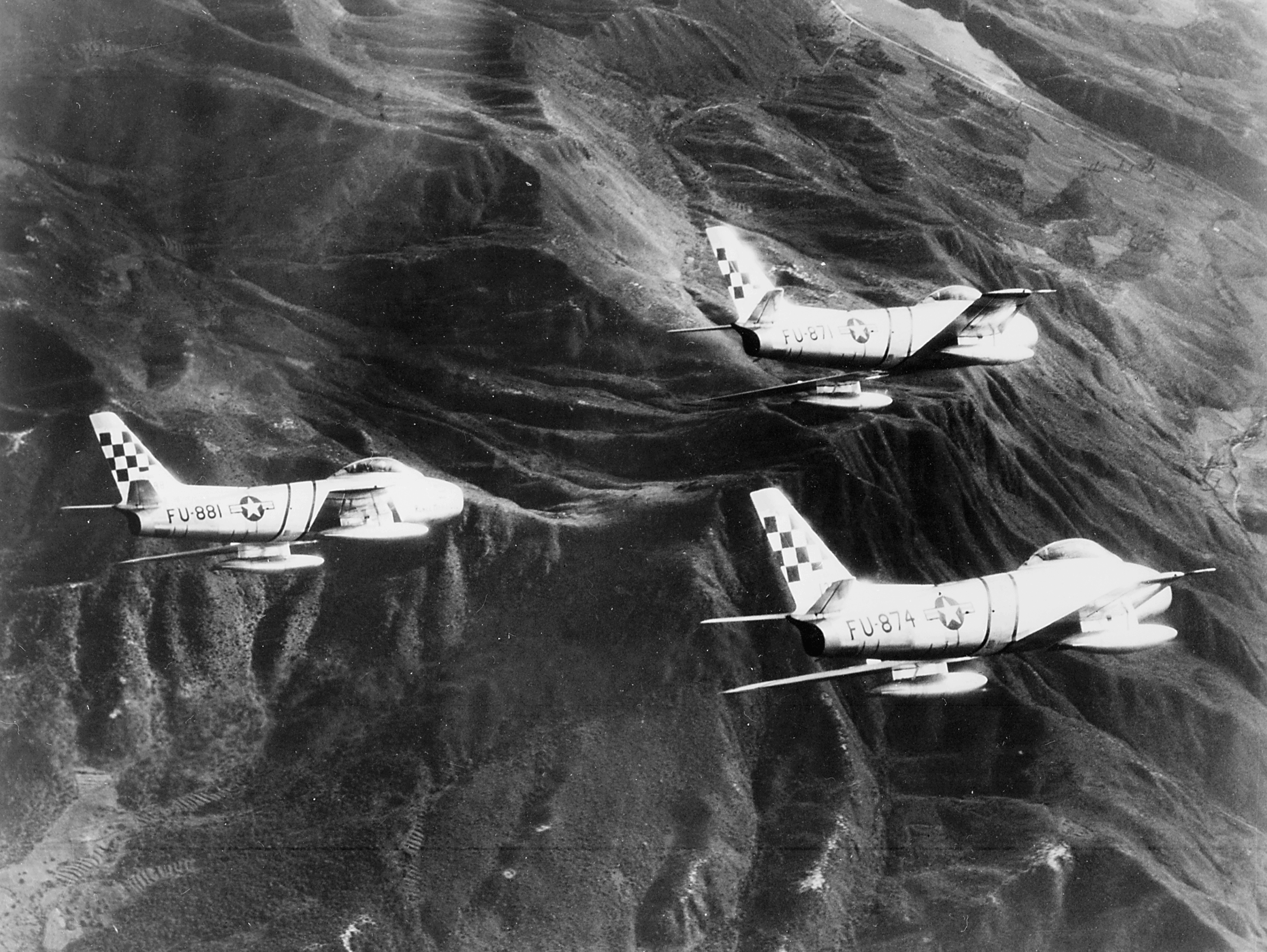
Three US Air Force North American F-86F Sabre fighters of the 51st Fighter Interceptor Wing over Korea, c. 1953. (Source: Wikimedia)
To Boyd, the 10:1 kill ratio was an intriguing anomaly since MiG-15s were faster and could operate at a higher ceiling and make tighter turns.[11] ‘The MiG,’ as he explained, ‘could out-climb, out-accelerate the F-86, throughout the entire envelope, accelerate quite a bit better. Its sustained turn was better, its instantaneous turn in some areas it was better, in other areas it wasn’t as good.’[12] Boyd also noted that the Sabre’s bubble canopy offered pilots superior observation while its hydraulic flight controls made it more responsive ‘just like power steering in a car’.[13] When all those factors were considered, both planes were roughly equal on paper, and a more even result should have occurred.[14] Although American pilots were generally better trained and had greater experience, Boyd did not consider that sufficient to explain the kill ratio.[15] According to Robert Coram in Boyd: The Fighter Pilot Who Changed the Art of War, ‘Boyd made a list of attributes of the MiG and the F-86. For days he went into frequent trances as he groped for the answer.’[16]
Boyd concluded that the F-86’s bubble canopy gave American pilots superior ‘observation’ and ‘orientation’. At the same time, its hydraulic flight controls allowed rapid transition from one manoeuvre to another, making it easier to translate a ‘decision’ into an ‘action’.[17] Therefore, Boyd concluded that American pilots completed OODA loops faster than communist pilots, who accordingly became disoriented and paralysed as they could not keep up. Before this insight, Sabre pilots knew that its bubble canopy and hydraulic flight controls gave them advantages.[18] However, Boyd uniquely explained that these advantages allowed F-86 pilots to achieve OODA loop domination. Superior observation resulted in faster orientation, and hydraulic flight controls resulted in quicker actions that collectively meant faster American OODA loops. In this way, Boyd explained the curious anomaly – or so it seemed at the time. However, with the benefit of hindsight, the anomaly is more convincingly resolved by lowering the inflated kill ratio.
The OODA Loop and the Kill Ratio
In 1977, in the USAF oral history, Boyd stated: ‘We had [an] 11 to 1 exchange rate of 86 over MiG-15; somewhere between 10 and 14 to one rounded off to 11 to 1 – very high.’[19] One year later, during a Patterns of Conflict briefing, he stated that the kill ratio was ‘11 to 1 or somewhere between 10 to 14.’[20] During that briefing, Boyd’s most prominent example of the effectiveness of the ‘observation-decision-action loop’ was Korean War air combat as he explained ‘observation’ concerning the Sabre’s bubble canopy and ‘decision-action’ through its hydraulic flight controls.[21] Therefore, the F-86 versus MiG-15 combat example would have influenced the audience’s mind.
James Fallows’ article ‘The Muscle-Bound Super Power’, published in Atlantic Monthly in 1979, argued that Boyd’s ‘observation-decision-action cycles’ explained why ‘F-86s had consistently gunned down Russian MiG-15s, even though the MiGs were “better” planes.’[22] That example of air combat was his article’s most prominent example of the OODA loop’s effectiveness. Two years later, in National Defense, Fallows insisted that ‘F-86s consistently destroyed the MiGs.’[23] No kill ratios were given in both cases, but his words ‘consistently gunned down’ and ‘consistently destroyed’ indicated a large margin of success.
Rodger Spiller from the United States Army’s Command and Staff College questioned Boyd’s analysis of the Korean air war in an unpublished critique in the early 1980s and sent a copy to Boyd. After Spiller explained that the ‘foundation of the OODA loop is to be found in the aerial combat of the Korean War between the MIG-15 and the F-86,’ he concluded:
The basic data that gave rise to the OODA loop hypothesis has never been openly challenged; however, there apparently is classified information that may call these conclusions to question. During our conversation, Boyd indicated that he was aware of this information, and he discounted the possibility of its adverse impact on his view.[24]
In response, Boyd commented, ‘No – OODA loop came from work and anomalies associated with evolution and flight tests of YF-16/17 [prototypes].’[25] Nevertheless, Boyd knew that people with access to classified information were questioning his ‘basic data’ regarding F-86 versus MiG-15 combat. By ‘basic data’ Spiller may have meant the kill ratio. Boyd did not challenge Spiller’s assessment concerning the ‘basic data,’ and he noted: ‘Information I was referring to were the U[niversity] of Chicago[’s] work on the Korean War.’[26]
Boyd may have meant a report written by John Wester titled ‘Effectiveness of the Gunsight,’ published by the University of Chicago’s Institute for Air Weapons Research in 1954.[27] The F-86E and F-86F variants included new radar-ranging A-1C(M) gunsights, and during the last six months of the war, many Sabre pilots credited the device with helping them shoot down MiG-15s. However, many other pilots considered the gunsight too complex and unreliable to be practical while adding useless extra weight. As Steven A. Fino explained, ‘we see clearly two narratives emerging: one of a “great machine” that incorporates cosmic technologies to simplify pilots’ tasks; the other of a “great pilot” who somehow triumphs in spite of the new and poorly designed machinery.’[28] As Boyd did not praise the gunsight in his briefing and since his Fighter Mafia and Reformers movements preferred simplicity over complex gadgets that reduced manoeuvrability, he almost certainly was in the latter category of sceptical pilots.[29]
Furthermore, Brigadier General Benjamin N. Bellis, head of the F-X project, Boyd ‘hated the complexity and sophistication of an on-board fire control system (radar)’ in the F-15 Eagle.[30] Therefore, it is likely that Boyd also opposed the A-1C(M) gunsight in Sabres. Although the gunsight was not fully automated, pilots who carefully studied its manual and took the time to learn how to incorporate it into their manual processes improved their efficiency in what Fino referred to as ‘a more effective human-machine system.’[31]
Boyd and Spiller may also have discussed Dennis Strawbridge and Nannette Kahn’s ‘Fighter Pilot Performance in Korea’ published in 1955 by the University of Chicago’s Institute for Air Weapons Research. Although this report noted the 10:1 kill ratio, it stressed that many MiG-15 kills were attributed to Sabre pilots who never opened fire, as enemy pilots had lost control and either crashed or bailed out.[32] Therefore, Boyd and Spiller may have discussed the pros and cons of the A-1C(M) gunsight or MiG-15 losses not involving Sabres opening fire. In any case, Boyd knew that Spiller was scrutinising his claims regarding air combat during the Korean War.
In 1985, Lieutenant Colonel Walter Kross, a USAF officer, challenged the kill ratio in Military Reform: The High-Tech Debate in Tactical Air Forces:
The F-86’s 10-to-1 kill ratio also should be examined more closely, say TACAIR [Tactical Air] Planners. In the first part of the war (June 1950–December 1952), when Russian “Honchos” flew with the North Korean MiGs, the kill ratio was only 4.9-to-1 in favour of the F-86. When the Russian pilots were pulled out in January 1953, the kill ratio soared to 20-to-1 in the last six months of the war.[33]
As Kross was a high-profile critic, Boyd probably knew that Kross and TACAIR were questioning the kill ratio. Nevertheless, they were voices in the wilderness, and commentators advocating the OODA loop theory continued to use the 10:1 kill ratio.
Boyd’s acolyte William S. Lind, in his 1985 Maneuver Warfare Handbook, gave the kill ratio as 10:1.[34] Lind repeated that figure a year later in America Can Win: The Case for Military Reform, a book he wrote with Senator Gary Hart.[35] In both books, just before the OODA loop is introduced, the air war in Korea is the most prominent example used to explain Boyd’s conflict theory, as expressed in Patterns of Conflict.
During the 1980s, Boyd stopped citing a kill ratio. For example, in a Patterns of Conflict briefing from the early-to-mid 1980s, he stated:
Now typically today many people or until very recently, people thought the MiG-15 was a more manoeuvrable airplane than the -86 […] I will dispel that myth. I will show you why and make it very compelling and convincing. For one thing we have a new frame of reference with which we can compare those aircraft. We have the OODA loop.[36]
Although Boyd did not cite a kill ratio, he implied that the Sabres achieved remarkable success against MiG-15s.[37] He similarly stated in a 1989 briefing that ‘in a sense the -86 was a better airplane, particularly if you examine them through the OODA loop.’[38] Boyd again implied that Sabres achieved an undefined high level of success without mentioning a kill ratio.[39] Boyd may have been aware that the 10:1 kill ratio was inaccurate. In any case, with the information available in his lifetime, he could not possibly have guessed how far the kill ratio would eventually decline. But before that correction occurred, the 10:1 kill ratio or words indicating remarkable success, continued to be used by others promoting the OODA loop.
In 1994, in The Art of Maneuver: Maneuver Warfare Theory and AirLand Battle, Robert Leonard stated that Boyd ‘had been investigating why American fighter pilots had been consistently able to best enemy pilots in dogfights [in Korea].’[40] F-86 versus MiG-15 combat is the only example he used when explaining the ‘Boyd cycle’.[41] After Boyd died in 1997, the close acolyte of Boyd and defence analyst Franklin C. Spinney, in his tribute ‘Genghis John’, cited the 10:1 kill ratio and air combat in Korea as the most prominent example supporting the ‘observation-decision-action cycle’.[42] In 2001, in The Mind of War: John Boyd and American Security, Grant Hammond similarly gave the kill ratio as 10:1, but it did fluctuate ‘wildly (from 4.9:1 when Russian pilots flew the MiGs to 20:1 in the last six months of the war after the Russian pilots were pulled out in January 1953).’[43]
Although Coram in Boyd questioned the 10:1 kill ratio, he had no basis to challenge it as ‘the ten to one kill ratio remains the number published in histories of Korea.’[44] In Certain to Win: The Strategy of John Boyd, Applied to Business, Chet Richards stated that the ‘Americans won ten air battles for every one they lost’ during the Korean War.[45] Osinga, in Science, Strategy and War: The Strategic Theory of John Boyd, agreed that ‘the kill ratio was 10:1 in favor of the F-86 during the Korean War.’[46] More recently, in 2018, Ian T. Brown noted in A New Conception of War: John Boyd, the U.S. Marines, and Maneuver Warfare that the ‘F-86 had regularly outperformed its MiG-15 counterpart.’[47] Although Brown did not cite a kill ratio, his words indicated an impressive margin of success. Brown also stressed the importance of Boyd’s F-86 versus MiG-15 combat analysis to his theory of conflict because ‘the contrast in performance between Soviet and American fighter aircraft resonated with him, and he would revisit it later as he developed his warfighting theory.’[48]
The kill ratio was also an essential consideration in Colin S. Gray’s endorsement of the OODA loop as a strategic concept in Modern Strategy:
As a fighter pilot and subsequent investigator of the reasons why USAF F-86 Sabre jets achieved such remarkably favourable kill ratios in combat against MiG-15s over North Korea (10 to 1), Boyd found in the OODA loop the essential logic of success in battle […] The OODA loop may appear too humble to merit categorization as grand theory, but that is what it is. It has an elegant simplicity, an extensive domain of applicability, and contains a high quality of insight about strategic essentials, such that its author merits honourable mention as an outstanding general theorist of strategy.[49]
Despite such statements, the famous kill ratio would dramatically deflate.
What was the actual Kill Ratio?
In Red Devils over the Yalu: A Chronicle of Soviet Aerial Operations in the Korean War 1950‑53, the Russian historian Igor Seidov disputed the 10:1 kill ratio. He noted the official USAF claim that of the 224 Sabres lost, only 110 were caused by enemy action before concluding: ‘Isn’t the figure for non-combat losses suspiciously high?’[50] Stuart Britton supported Seidov’s argument, explaining that ‘since the war, the number of USAF MiG-15 claims has been steadily revised downwards, while its admitted losses of F-86s have slowly increased.’[51] Similarly, in Red Wings Over the Yalu: China, the Soviet Union, and the Air War in Korea, the Chinese historian Xiaoming Zhang questioned the ‘astonishing 7:1 kill ratio’ and concluded that American histories tend to ignore or dismiss Chinese sources ‘because American analysts have a tendency to view the other side’s story through their own myths and values.’[52] In Sabres Over MiG Alley: The F-86 and the Battle for Air Superiority in Korea, Kenneth P. Werrell reduced the kill ratio to 8.2:1 but noted that in 1953, it was 13:1.[53]
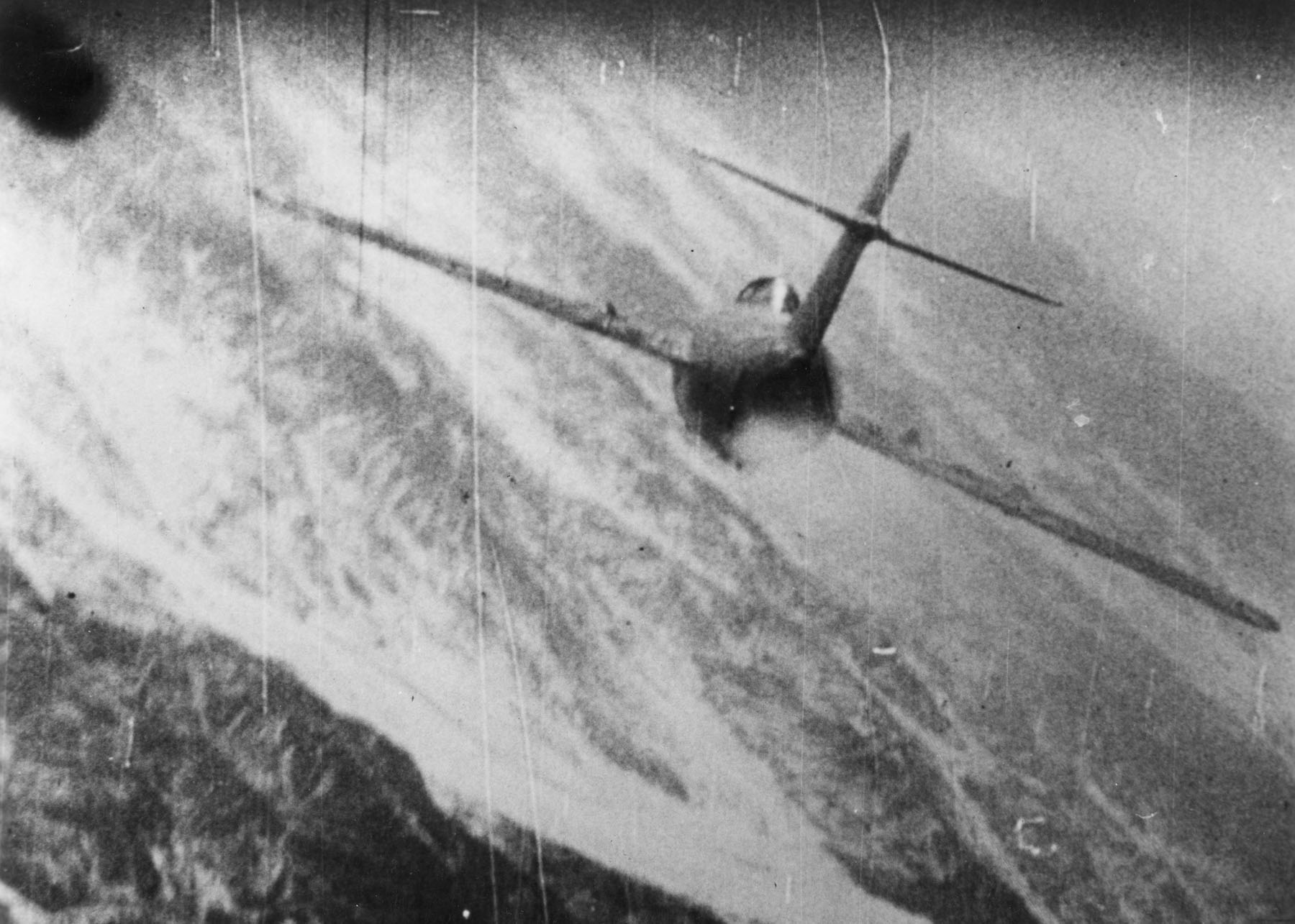
Gun camera photo of a Mikoyan Gurevich MiG-15 being attacked by US Air Force North American F-86 Sabre over Korea in 1952-53, piloted by Captain Manuel ‘Pete’ Fernandez, 334th Fighter-Interceptor Squadron, 4th Fighter-Interceptor Wing. (Source: Wikimedia)
In F-86 Sabre vs MiG-15: Korea 1950-53, Douglas C. Dildy and Warren Thompson concluded that kills tend to be awarded based on political and propaganda needs, while logistics records tend to be more accurate given the necessity of documenting equipment losses.[54] They estimated ‘an overall “kill ratio” of 5.835 MiG-15s destroyed for each Sabre lost.’[55] However, they noted that the F-86s only achieved a 1.4:1 kill ratio against the elite Soviet 303rd and 324th Fighter Aviation Divisions. However, against other Soviet, Chinese, and North Korean MiG-15s, the Sabres achieved a 9.07:1 kill ratio – highlighting the importance of training and experience.[56]
Colonel Walter J. Boyne, a former USAF pilot and historian, frankly stated in his foreword to Thomas McKelvey Cleaver’s MiG Alley: The US Air Force in Korea, 1950-53: ‘Much of what has been recorded as “official history” of the Air Force in the Korean War is little more than recycled wartime propaganda.’[57] Cleaver agreed that the 10:1 kill ratio was ‘propaganda’ and concluded: ‘The “MiG kill” number became the measure of success for commanders of the USAF fighter units in Korea, like the “body count” in Vietnam. As a result, the numbers were increased by lowering the standards for measuring success.’[58] For example, he explained that ‘since any airplane that returned to base, no matter how badly damaged in combat and no matter that it never flew again, was not recorded as a “combat loss”.’[59] He added: ‘By 1952, gun camera film of aircraft not seen to go down, explode, disintegrate, or where the pilot ejected, was accepted as evidence of a “kill” regardless.’[60] Cleaver concluded that the overall kill ratio the Sabres achieved was somewhere between 1.1:1 and 1.5:1.[61] In Korean Air War: Sabres, MiGs and Meteors, 1950-53, Michael Napier agreed that the 10:1 kill ratio ‘does not stand up to scrutiny.’[62] The more recent scholarship cited above demonstrates that Sabre versus MiG-15 combat was attritional, with Sabre pilots achieving a slightly better overall result. However, the OODA loop model does not address many factors contributing to instances of Sabre success.
Beyond OODA Loops
At times, MiG-15s experienced instability at extremely high speeds that the Russians called valezhka, during which the aircraft would flip and go into a dangerous spin. Some Sabre pilots shooting at MiG-15s, experiencing valezhka, likely assumed that their bullets were responsible for the enemy’s demise.[63] The valezhka phenomenon probably explains many of the cases that Strawbridge and Kahn noted of Sabre kills not involving American pilots opening fire. In any case, MiG-15 losses caused by valezhka had nothing to do with OODA loops because they resulted from a design flaw, not communist pilots becoming disoriented or paralysed.
According to Seidov, almost half the MiG-15 losses experienced by the 97th and 190th Fighter Aviation Divisions occurred between January and August 1952 while the aircraft took off or landed.[64] Zhang also made a similar claim regarding MiG-15s taking off and landing, concluding: ‘Many Soviet pilots died before they had a real opportunity to engage their opponents.’[65] Although F-86 pilots could enter Chinese airspace during pursuits in 1952, many pilots exceeded the rules by ‘hawking’ the skies above airfields to swoop down and ambush vulnerable enemy aircraft during takeoffs and landings.[66] The Soviets even withdrew two MiG-15 regiments to rear airfields to provide combat air patrols over the forward airfields as protection against ‘hawking’.[67] As Napier explained, ‘hawking’ increased Sabre success, but ‘it is hardly indicative of the relative performance of aircraft and pilots in air combat.’[68] Therefore, ‘hawking’ had nothing to do with the moves and countermoves of OODA loop-like dogfights, with the loser experiencing psychological defeat.[69]
American pilots were generally more experienced than MiG-15 pilots.[70] However, another factor was Russian unit rotation rather than individual pilot rotation. In early 1952, the elite 324th and 303rd Fighter Aviation Divisions were replaced by the inexperienced 97th and 190th Divisions. The new pilots had to learn the hard way without the benefit of experienced veterans, dramatically reducing combat effectiveness.[71] Werrell also concluded that superior American equipment, such as the A-1C(M) gunsight, flight helmets and “g” suits, contributed to Sabre’s success.[72]
The secrecy of Soviet participation in the conflict prevented their pilots from crossing the coastline or approaching too close to the frontline due to the risk of capture.[73] Therefore, Russian pilots could not chase Sabres over the sea or too far south. ‘A great number of damaged US aircraft,’ Seidov explained, ‘taking advantage of this circumstance, escaped MiG pursuit by crossing the coastline out to sea, and if this restriction hadn’t been in place, then I’m sure the American combat losses would have increased sharply.’[74]
Boyd arrived in Korea on 27 March 1953, four months before the end of the war. Therefore, he had a personal experience that was quite different from earlier F-86 pilots who experienced a far deadlier attritional struggle, such as Captain Dick Becker in 1951:
There was no 14-to-1 kill ratio when I was there. The guys we flew against were good, and they were as committed as we were. Every fight that I was in was decided by the guy in the cockpit who was better able to take advantage of the moments presented by luck. The MiG-15 was a dangerous opponent. We were very evenly matched and I am certain that overall in that first year, we fought them to a draw.[75]
In March 1952, James Jabara, the highest-scoring Sabre ace, stated in a lecture to the Royal Air Force that, on average, one American jet was lost for every MiG-15 shot down.[76] Just before Boyd arrived, F-86 numbers dramatically increased, which helped the pilots gain air superiority.[77] Russian pilots had also become far less aggressive. Following Stalin’s death on 5 March 1953, ceasefire negotiations reopened, and the Soviets began withdrawing MiG-15s. According to MiG-15 ace Nikolay Ivanov, this resulted in the remaining pilots tending ‘to be evasive in their encounters with enemy airplanes to avoid casualties’ as ‘no one wanted to be the last to be killed in action.’[78] Boyd completed 29 missions, roughly one-third of the typical experience of 100 missions. Therefore, given his more limited exposure during a time of Sabre numerical superiority and low communist aggression, his subjective experience did not cause him to question the 10:1 kill ratio. If Boyd had flown 100 missions earlier with Becker or Jabara, he probably would have realised the kill ratio was propaganda. Consequently, he would have had no reason to investigate or explain an intriguing anomaly.
A Wider Lens
Although Napier rejected the 10:1 kill ratio, he decided against offering a corrected figure because doing so would perpetuate a distorted view of the air war as ‘a direct comparison between MiG-15 and F-86 is akin to comparing apples to pears.’[79] Therefore, he looked for a more holistic answer: ‘While the F-86 exclusively fought against the MiG-15, the MiG‑15 fought against the F-51, F-80, F-84, F-86, F-94, Corsair, Banshee, Panther, Skyknight, B-26 and B-29, thus any comparison of air-to-air kills must include these types.’[80] After evaluating the entire air war, Napier concluded ‘almost parity’ existed between United Nations Command and Soviet fighters, while success was greater against Chinese pilots.[81]
Boyd never truly placed himself in the minds of MiG-15 pilots. Therefore, he never considered what they were trying to achieve. Their mission was to defend airspace against air-to-ground strikes by intercepting bombers.[82] Hence, seeking combat with Sabres was not a priority; they could achieve their mission while avoiding Sabres. As Fino explained, ‘Despite the abundance of MiGs in the sky and their occasional bouts of aggressive, offensive action, most days the MiGs chose not to battle the Sabres.’[83]
The Korean War ended in a stalemate, and both sides can claim victory in the air based upon different criteria.[84] The Americans can insist that their pilots achieved air superiority and enemy aircraft, as Werrell pointed out, ‘did not venture far south of the Yalu River.’[85] On the other hand, MiG-15s disrupted bombing operations, as Cleaver concluded: ‘The Soviets sent their units to Manchuria for air defence, and their goal was to deny to the enemy the ability to bomb at will throughout North Korea, as had been the situation for the first nine months of the war. In this, they were successful.’[86]
Mao’s strategy in sending MiG-15s to Korea was not just to affect the outcome of the war – it was also a means of building the People’s Liberation Army Air Force (PLAAF) that would ‘gain live combat experience’ while noting that ‘there will be some losses in combat’.[87] In that way, the Chinese leadership, as Napier explained, ‘sacrificed short-term tactical success for longer-term strategic gain: by rotating all the MiG-15 units through the combat zone, they exposed the maximum number of pilots to combat flying.’[88] That policy allowed the PLAAF to grow from a small force of trainees in 1949 to a large jet-equipped force within four years.[89] Therefore, even when Chinese pilots lost tactically against the Sabres, they were winning strategically.
Conclusion
As is evident in key Boyd-related literature previously mentioned, belief in outstanding Sabre success against MiG-15s, usually quantified as the 10:1 kill ratio, was likely a critical factor in establishing the credibility of OODA loop theory in the minds of prominent commentators. Given the OODA loop’s influence in military and non-military contexts, the perception of outstanding Sabre success was probably a paramount factor in the theory spreading like a meme. However, the 10:1 kill ratio originated from wartime propaganda that was just as dubious as the infamous Vietnam War body count – a metric that Boyd despised.[90]
The myth of the 10:1 kill ratio did have an unintended positive benefit because it was used as a measure to assess air-to-air performance in the Vietnam War. For example, Hammond contrasted the kill ratios of Korea and Vietnam:
The loss ratios against both North Vietnamese and Soviet pilots were not good. In fact, they began at 1:1 in 1965 and overall were far less than the 10:1 ratio in Korea. From 1 April 1965 to 1 March 1968, despite some interludes of great success, the United States had an exchange ratio in air-to-air combat of 2.4:1. Why were U.S. planes and pilots performing so poorly?[91]
Osinga declared: ‘While loss ratios over Korea were 10:1, in the skies over Vietnam F-100, F-105 and F-4 aircraft scored dismal ratios of 1:1, sometimes peaking at 2.4:1.’[92] Of course, we now know that the Korea and Vietnam kill ratios were quite similar. However, the belief that American air-to-air performance had drastically declined resulted in active measures designed to improve performance to restore what was perceived to be lost. The USAF’s Red Flag exercises and the United States Navy’s Top Gun program improved pilot training and combat performance in this context. The post-Vietnam generation fighters – the F-15 Eagle, F-16 Falcon, F-14 Tomcat and F-18 Hornet – have all achieved outstanding success, gaining air superiority with genuinely lopsided kill ratios.[93]
The collapse of the 10:1 kill ratio’s credibility has implications for the OODA loop theory. If the model genuinely reflects the reality of air combat, why did Sabre pilots not achieve ‘decision cycle’ superiority and a lopsided kill ratio in Korea? Why did the F-86’s bubble canopy and hydraulic flight controls not translate into American pilots achieving decisively faster OODA loops? It is important to note that in the more recent histories, Werrell, Dildy, Thompson, Cleaver and Napier do not mention the OODA loop in their detailed studies of Sabre versus MiG-15 combat, which indicates the theory lacks utility in that context. Although the OODA loop is not an adequate model to explain F-86 versus MiG-15 air combat outcomes, it is nevertheless valuable despite its flaws. As Hankins explained: ‘Many fighter pilots, among others, continue to use the OODA loop as a useful tool.’[94] Therefore, as we reevaluate the OODA loop, we should not throw the baby out with the bathwater. However, we need a much wider analytical lens to ensure victory in the air.
Stephen Robinson is an officer in the Australian Army Reserve, currently serving in the Australian Army History Unit. He is the author of False Flags: Disguised German Raiders of World War II (2016), Panzer Commander Hermann Balck: Germany’s Master Tactician (2019), The Blind Strategist: John Boyd and the American Art of War (2021) and Eight Hundred Heroes: China’s Lost Battalion and the Fall of Shanghai (2022).
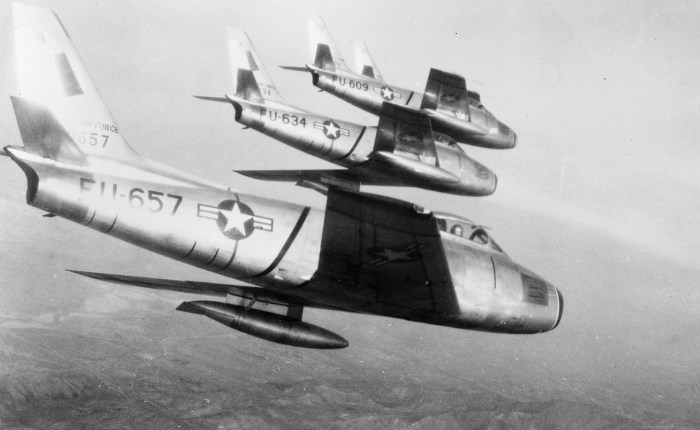
Header image: Four U.S. Air Force North American F-86E Sabre fighters over Korea in November 1952. Note that the first plane carries only a single drop tank. (Source: Wikimedia)
[1] Antulio J. Echevarria, War’s Logic: Strategic Thought and the American Way of War (Cambridge: Cambridge University Press, 2021), p. 177.
[3] John R. Boyd, ‘Organic Design for Command and Control’ and ‘The Strategic Game of ? and ?,’ in Grant T. Hammond (ed.), A Discourse on Winning and Losing (Maxwell AFB: Air University Press, 2018), pp. 224 and 302.
[4] Martin van Creveld, Air Power and Maneuver Warfare (Maxwell AFB: Air University Press, 1994), p. 3.
[5] Grant T. Hammond, ‘Appendix – The OODA Loop,’ in A Discourse on Winning and Losing, pp. 383-5.
[6] Frans P. B. Osinga, ‘The Enemy as a Complex Adaptive System: John Boyd and Airpower in the Postmodern Era’ in John Andreas Olsen (ed.), Airpower Reborn: The Strategic Concepts of John Warden and John Boyd (Annapolis, MD: Naval Institute Press, 2015), p. 50.
[7] Michael W. Hankins, Flying Camelot: The F-15, the F-16, and the Weaponization of Fighter Pilot Nostalgia (Ithaca, NY: Cornell University Press, 2021), p. 229.
[8] Stephen Robinson, The Blind Strategist: John Boyd and the American Art of War (Dunedin: Exisle Publishing, 2021), pp. 11 and 30.
[9] Email to author from Michael W. Hankins, 26 July 2023. Hankins also recommended that I read Xiaoming Zhang’s Red Wings over the Yalu: China, the Soviet Union, and the Air War in Korea (College Station, TX: Texas A&M University Press, 2002). I am incredibly grateful for this advice as it was the catalyst for this article. For further consideration regarding the kill ratio, the essential books to read also include Douglas C. Dildy and Warren Thompson’s F-86 Sabre vs MiG-15: Korea 1950-53 (Oxford: Osprey Publishing, 2012), Thomas McKelvey Cleaver’s MiG Alley: The US Air Force in Korea, 1950-53 (Oxford: Osprey Publishing, 2019) and Michael Napier’s Korean Air War: Sabres, MiGs and Meteors, 1950-53 (Oxford: Osprey Publishing, 2021).
[10] Quoted in Kenneth P. Werrell, ‘Aces and -86s: The Fight for Air Superiority during the Korean War,’ in Jacob Neufeld and George M. Watson, Jr. (eds.), Coalition Air Warfare in the Korean War 1950-1953 (Washington DC: US Air Force History and Museums Program, 2005), p. 62.
[11] Grant T. Hammond, The Mind of War: John Boyd and American Security (Washington DC: Smithsonian Books, 2001), pp. 65-6 and Frans P.B. Osinga, Science, Strategy and War: The Strategic Theory of John Boyd (Abingdon: Taylor and Francis, 2006), p. 21. Notably, the F-86F Sabre variant had considerable flight capability improvements over the earlier variants. Therefore, generalising Sabre flight characteristics without reference to specific variants is problematic. Dildy and Thompson, F-86 Sabre vs MiG-15, pp. 140-3.
[12] John R. Boyd, ‘Patterns of Conflict (Transcript),’ in Discourse on Winning and Losing, Marine Corps University, Quantico, 25 April/2 May/3 May 1989, p. 13.
[13] Boyd, ‘Patterns of Conflict (Transcript),’ p. 13.
[15] United States Air Force Historical Research Center, US Air Force Oral History Interview, K239.0512-1066, Colonel John R. Boyd, Corona Ace, 28 January 1977, p. 143.
[16] Robert Coram, Boyd: The Fighter Pilot Who Changed the Art of War (New York: Hachette, 2002), p. 255.
[17] John R. Boyd, ‘Patterns of Conflict (Delivered on 26 May 1978)’, in Proceedings of Seminar on Air Antitank Warfare, Battelle Columbus Laboratories, Columbus, 1978, pp. 7-8; Boyd, ‘Patterns of Conflict (Transcript) ’, pp. 13-4.
[18] The F-86E and F-86F variants had a new flight control system and hydraulics system without a manual backup, which made these models more responsive than the earlier and more common F-86A variant. Therefore, generalising Sabre agility is problematic as different Sabre variants had different hydraulic flight controls. Steven A. Fino, Tiger Check: Automating the US Air Force Fighter Pilot in Air-To-Air Combat, 1950-1980 (Baltimore, MD: Johns Hopkins University Press, 2017), pp. 84-5 and 533-4; Dildy and Thompson, F-86 Sabre vs MiG-15, pp. 35-6.
[19]U.S. Air Force Oral History Interview, p. 141.
[20] Boyd, ‘Patterns of Conflict (Delivered on 26 May 1978),’ p. 8.
[21] Boyd, ‘Patterns of Conflict (Delivered on 26 May 1978),’ pp. 6-8.
[23] James Fallows, National Defense (New York: Random House, 1981), p. 28.
[24] Quoted in Ian T. Brown, A New Conception of War: John Boyd, the U.S. Marines, and Maneuver Warfare (Quantico: Marine Corps University Press, 2018), p. 283.
[25] Quoted in Brown, A New Conception of War, p. 283.
[26] Quoted in Brown, A New Conception of War, p. 283.
[29] Hankins in Flying Camelot provided a comprehensive overview of the Fighter Mafia and Reformers movements and their opposition to ‘an overreliance on complex, expensive weapons.’ Hankins, Flying Camelot, p. 24.
[32] Michael W. Ford, Air-to-Air Combat Effectiveness of Single-Role and Multi-Role Fighter Forces (MA Thesis, US Army Command and General Staff College, 1984), pp. 51-2 and 121.
[33] Walter Kross, Military Reform: The High-Tech Debate in Tactical Air Forces (Washington DC: National Defence University Press, 1985), p. 97.
[34] William S. Lind, Maneuver Warfare Handbook (Boulder, CO: Westview Press, 1985), p. 4.
[35] Gary Hart and William S. Lind, America Can Win: The Case for Military Reform (Maryland: Adler and Adler, 1986), pp. 5-6.
[36] John R. Boyd, Patterns of Conflict Part 2. Ian Brown concluded that this version of ‘Patterns of Conflict’ available on YouTube dated from the early to mid-1980s: ‘Based on the sign in the background, this version of the brief dates to early-mid 1980s, when Rep. Jim Lightfoot would have been in office.’ Ian Brown, The John Boyd Primer, 25 September 2021.
[49] Colin S. Gray, Modern Strategy (Oxford: Oxford University Press, 1999), p. 91.
[50] Igor Seidov, Red Devils over the Yalu: A Chronicle of Soviet Aerial Operations in the Korean War 1950-53 (Solihull: Helion and Company, 2014), pp. 27-8.
[51] Stuart Britton, ‘Editor’s Note,’ in Seidov, Red Devils over the Yalu, p. 20.
[53] Kenneth P. Werrell, Sabres Over MiG Alley: The F-86 and the Battle for Air Superiority in Korea (Annapolis, MD: Naval Institute Press, 2005), p. 92.
[54] Dildy and Thompson, F-86 Sabre vs MiG-15, p .148.
[55] Dildy and Thompson, F-86 Sabre vs MiG-15, p. 152.
[56] Dildy and Thompson, F-86 Sabre vs MiG-15, p. 152.
[57] Walter J. Boyne, ‘Foreword,’ in Cleaver, MiG Alley, p. 8.
[61] Cleaver concluded: ‘The USAF policy of “fudging the figures” regarding combat losses makes it difficult to come to a firm number of actual victories versus losses. In fact, for the entire war, researchers now believe that the “victory total” favors the USAF by something between 1.3 and 1.5 to one.’ Cleaver, MiG Alley, p. 14. Cleaver also stated: ‘While the majority of MiG pilots who opposed the Sabres were less-experienced Chinese, a victory/loss ratio of 10:1 as claimed after the war by the US Air Force, which was uncontradicted by information from the other side for 40 years, is not realistic. Researchers believe the figure was between 1.1:1–1.3:1 in favor of the Sabres’. Cleaver, MiG Alley, p. 230.
[69] Osinga explained that Boyd perceived ‘air combat as a contest of moves and countermoves in time, a contest in which a repertoire of moves and the agility to transition from one to another quickly and accurately in regard [to] the opponent’s options was essential.’ Osinga, Science, Strategy and War, p. 28.
[90] Boyd condemned the Vietnam War ‘body count’: ‘They were thinking body count, attrition. That’s what they were thinking. I know exactly what they were thinking.’ Boyd, ‘Patterns of Conflict (Transcript),’ p. 43.
[93] F-15 Eagles have been credited with 104 ‘kills’ without suffering any aerial combat losses. John T. Correll, ‘The Reformers,’ Air Force Magazine (2008), p. 44. F-16 Falcons have tallied 72 ‘kills’ without any air-to-air losses. Michael Sanibel and Dick Smith, ‘Quest to Build a Better Fighter,’ Aviation History, Vol. 21 no. 3 (2011), pp. 48-53.
Established in 2016, From Balloons to Drones is an online scholarly platform that analyses and debates air power history (including aviation history), theory, and contemporary operations in their broadest sense, including space and cyber power. To date, we have published over 250 articles on various air power-related subjects.
Since its emergence at the start of the 20th Century, air power has increasingly become the preferred form of military power for many governments. However, the application and development of air power are controversial and often misunderstood. To remedy this, From Balloons to Drones seeks to provide analysis and debate about air power through the publication of articles, research notes, commentaries, book reviews, and historic book reviews – see below for a description of the range of articles published.
The study of air power is to be understood broadly, encompassing not only the history of air warfare, including social and cultural aspects, but also incorporating contributions from related fields, such as archaeology, international relations, strategic studies, law and ethics. Possible subjects to be explored might include, but are not limited to:
Strategy, Theory and Doctrine | Organisation and Policy | Roles
Operations – Kinetic and Non-Kinetic | Tactics, Training and Procedures
Strategic and Operational Effect | Technological Developments
Ethical and Moral Issues | National, International and Transnational Experiences
Personal Experiences | Culture | Memory and Memorialisation
From Balloons to Drones welcomes and encourages potential submissions from postgraduates, academics, and practitioners involved in researching the subject of air power.
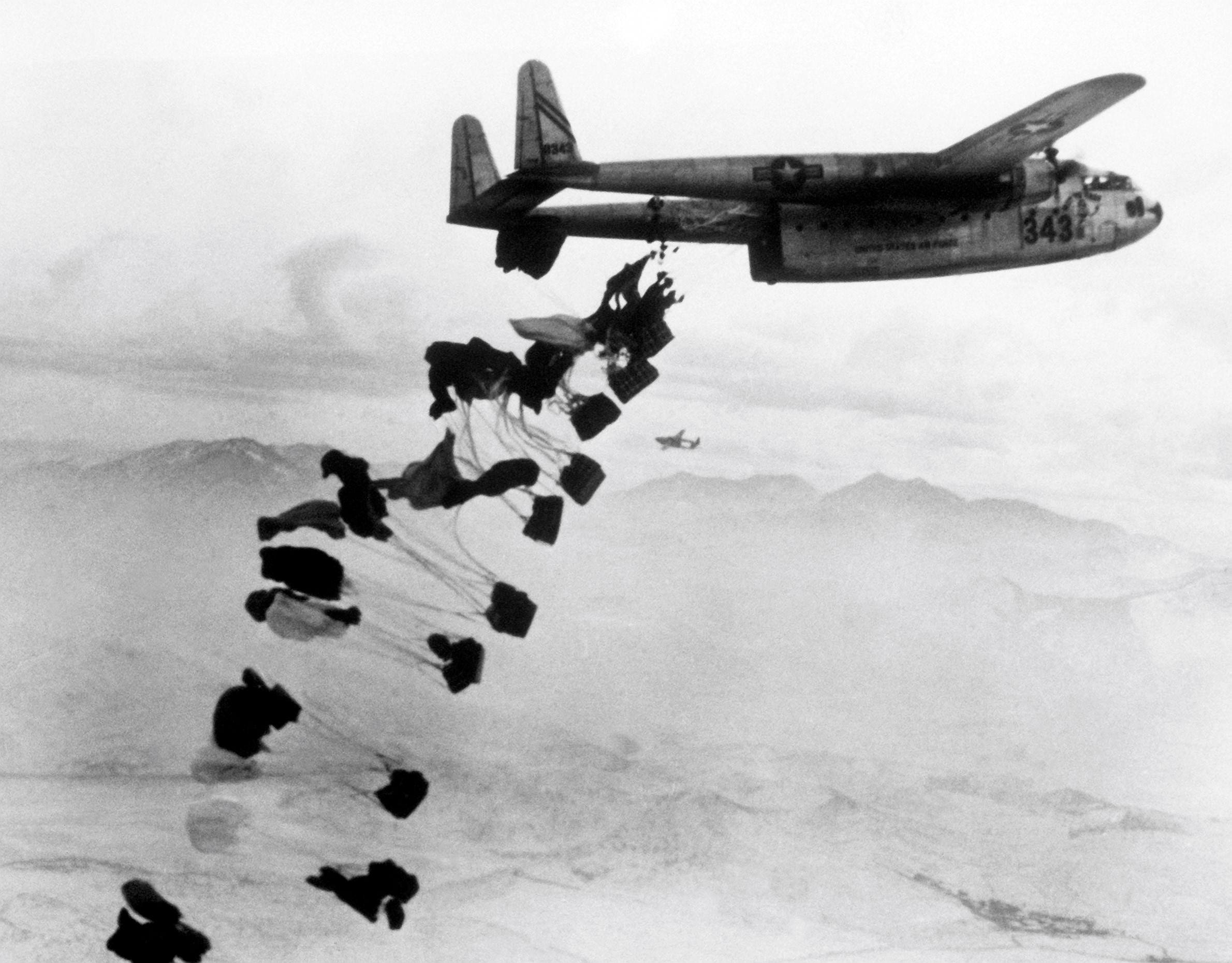
A US Air Force Fairchild C-119B Flying Boxcar air-dropping supplies near Chungju, Korea, in 1951. (Source: Wikimedia)
We publish:
Scholarly Articles
From Balloons to Drones publishes informative, peer-reviewed articles on air power that range from historical pieces to the analysis of contemporary challenges. These well-researched articles aim to bridge the gap between specialist and non-specialist readers. They should be around c. 3,000 words, though From Balloons to Drones will accept longer pieces. We reserve the right to publish them in parts.
Air War Books
From Balloons to Drones publishes a series of review articles that examine the top ten books that have influenced writers on air power. See more here.
Commentaries
From Balloons to Drones publishes opinion pieces on recent news on either contemporary or historical subjects. These should be no longer than c.1,000 words.
Research Notes
From Balloons to Drones publishes research notes on contributors’ current research projects. These take the form of more informal pieces and can be discussions of a source or notes on a recent research theme. These should be c.500 to 1,000 words.
Book Reviews
From Balloons to Drones publishes regular book reviews that aim to be an accessible collection of appraisals of recent publications about air power. If you are a publisher interested in having your publication reviewed, please contact us at the email address below. See more here.
Historic Book Reviews
From Balloons to Drones publishes occasional historic book reviews that aim to be an accessible collection of appraisals of critical historic publications about air power history, theory, and practice. See more here.
Submissions should be submitted in Word format and emailed to the address below with ‘SUBMISSION’ in the subject line. Also, please include a 50-100-word biography with your submission. References can be used, and please be careful to explain any jargon. However, if you are unsure if your idea fits our requirements, please email us with ‘POTENTIAL SUBMISSION’ in the subject line to discuss.
If you are interested in contributing, please email our Editor-in-Chief, Dr Ross Mahoney, at airpowerstudies@gmail.com or via our contact page here.
Header image: A Panavia Tornado GR4 of No. IX(B) Squadron on a training sortie in preparation for deployment to Afghanistan, c. 2012. (Source: Wikimedia)
Michael Napier, Korean Air War: Sabres, Migs and Meteors, 1950-53. Oxford: Osprey Publishing, 2021. Images. Notes. Bibliography. Glossary. Appendices. Index. Hbk. 320pp.
Reviewed by Dr Ross Mahoney
In the western world, the Korean War is often thought of as the forgotten war of the early Cold War. This was, at least from an American perspective, because ‘[l]ike the proverbial shrimp caught between two whales, the Korean War [was] trapped between World War II and the Vietnam War.’[1] Furthermore, from a British and French perspective, the war does not easily fit into national narratives surrounding their ‘retreat’ from empires in Southeast Asia, namely the Malayan Emergency and the French-Indochina War. The Korean War did, however, significantly impact the Cold War’s early course, particularly strengthening the recently established North Atlantic Treaty Organisation.
From the perspective of the application and development of air power, the Korean War was also significant. Specifically, it was the first time jet fighters met in combat. Furthermore, the war also saw a wide range of air power capabilities deployed over Korea, including discussions throughout the conflict about the potential delivery of nuclear weapons.[2] This has meant that, despite the unfortunate epithet of being a forgotten war, several important works, such as Conrad Crane’s American Airpower Strategy in Korea (2000), have appeared and examined the use of air power over the Korean peninsula.
Michael Napier, a retired Royal Air Force fast-jet pilot and author, comes into this mix with his 2021 volume, Korean Air War. In just over 300 pages, Napier systematically describes the course of the air war over Korea. The book, chronologically laid out, deals with the air war in seven chapters plus a retrospective to finish the volume. There are also two appendices included. The chapters follow the broad course of the main phases of the Korean War. For example, Chapter Three deals with the period of the offensive by United Nations (UN) forces between August and October 1950 (pp. 72-113). This is then followed up by a chapter that looks at the period of the Chinese offensives (pp. 114-55) against UN forces that forced them back to roughly the 38th Parallel. Within these chapters, Napier details the various uses of air power by both sides during the war. This includes the use of tactical and strategic air power as well as naval air power. Napier also does a good job of describing the coalition character of the air war for both sides. However, his attempt to highlight the British contribution can sometimes be overstated.
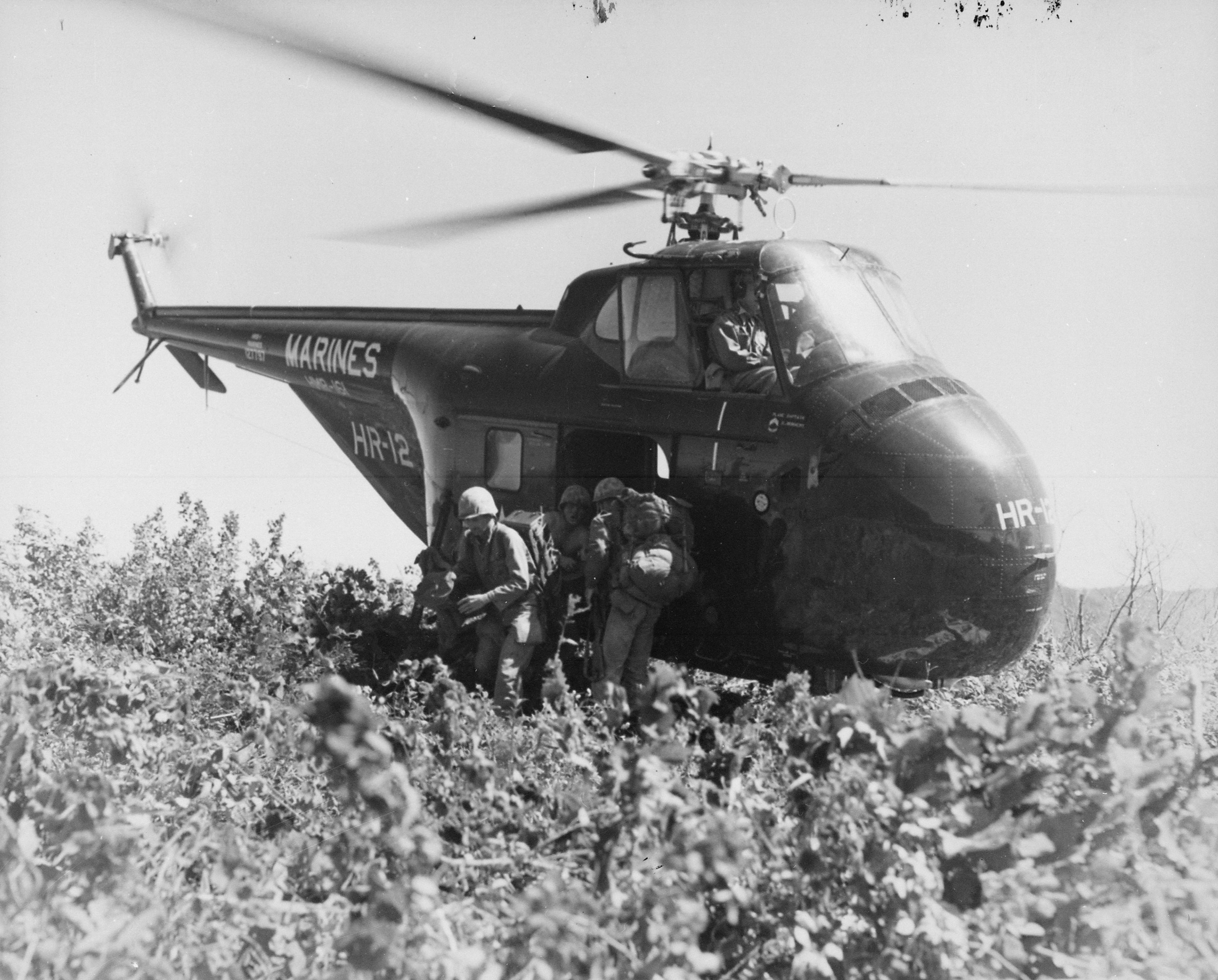
US Marines of the First Marine Division Reconnaissance Company make the first helicopter invasion on Hill 812, to relieve the Republic of Korea 8th Division, during the renewed fighting in Korea, 20 September 1951. (Source: Wikimedia)
While the book comprehensively deals with the air war over Korea, readers should not expect an academic examination of the use of air power between 1950 and 1953. That is not what this book is. However, this is not a criticism per se. Instead, the book has been written with a specific audience in mind – the general reader looking for an introduction to the subject. This is highlighted by Napier’s choice to examine the war chronologically (p. 6). This is a choice that makes it easier for the lay reader to understand what was a complex and contested operating environment. Ultimately, therefore, we end up with a very useful narrative of the course of the air war that introduces readers to the subject matter.
One area, however, where the book does fall down is in its use of sources. Regarding primary sources, Napier has overwhelmingly relied on files in British archival institutions, notably The National Archives and the Royal Air Force Museum. While perhaps a pragmatic decision given the author’s location and the character of this book as a popular account of the air war, it does, nonetheless, skew the author’s interpretation. Furthermore, at least from the perspective of UN forces deployed, most of the air power deployed in support of the war effort came from the US. As such, one would expect more attention to be given to the records produced by those forces involved. Finally, given the above issue, Napier relies on secondary sources to fill in the gaps despite arguing that published accounts of the air war over Korea were less than ‘objective’ (p. 6) in their analysis. However, it appears from the notes and bibliography that Napier did not consult important, more ‘objective’ works such as Crane’s noted above and others.[3] The use of such works would have further enriched Napier’s narrative
Overall, despite the above criticism, Napier has done an excellent job of writing a comprehensive introductory narrative to the air war over Korea. In particular, Napier does a good job of weaving together a narrative that tells the story of both sides of the air war over Korea. The book is lavishly supported by high-quality imagery and maps that help support the text.
Dr Ross Mahoney is the Editor-in-Chief of From Balloons to Drones and is an independent scholar specialising in air power and the history of air warfare. He is currently the Senior Historian within the City Architecture and Heritage Team at Brisbane City Council in Australia. He has over 15 years of experience within the heritage and education sectors in Australia and the United Kingdom. He was the inaugural Historian at the Royal Air Force Museum in the UK. In Australia, he has worked as a Historian for the Department of Veterans’ Affairs and taught at the Strategic and Defence Studies Centre at The Australian National University based at the Australian War College. His research interests are focused on military history, with a specific focus on the history of air warfare, transport history, and urban history. He has published several chapters and articles, edited two books, and delivered papers on three continents. He has a website here and can be found on Twitter at @airpowerhistory.
Header image: Four US Air Force North American F-86E Sabre fighters over Korea in November 1952. (Source: Wikimedia)
[1] Allan Millett, The War for Korea, 1945-1950: A House Burning (Lawrence, KS: University Press of Kansas, 2005), p. 1.
[2] Daniel Calingaert, ‘Nuclear weapons and the Korean War,’ Journal of Strategic Studies 11, no. 2 (1988), pp. 177-202.
[3] Other works of note not cited include: Eduard Mark, Aerial Interdiction: Air Power and the Land Battle in Three American Wars (Washington DC: Office of Air Force History, 1994); John Sherwood, Officers in Flight Suits: The Story of American Air Force Fighter Pilots in the Korean War (New York, NY: New York University Press, 1998); Jacob Neufeld, Coalition Air Warfare in the Korean War 1950–1953 (Washington DC: U.S. Air Force History and Museums Program, 2005); Roger Horky, ‘Clipping the Eagle’s Wings: The Limiting of the Korean Air War, 1950-1953’ (PhD Thesis, Texas A&M University, 2013).



 From Balloons to Drones