#BookReview – Balloon Ace: The Life of an Early Airpower Visionary

#BookReview – Balloon Ace: The Life of an Early Airpower Visionary

Reviewed by Ray Ortensie

Charles D. Dusch Jr., Balloon Ace: The Life of an Early Airpower Visionary. Lexington, KY: The University Press of Kentucky, 2025. Illustrations. Notes. Bibliography. Index. Pbk. 269 pp.

Charles D. Dusch Jr.’s Balloon Ace: The Life of an Early Airpower Visionary chronicles the brief, heroic, and influential life of Louis Bennett Jr., a figure who sought to revolutionise American military aviation during the First World War. Dusch skilfully integrates Bennett’s personal history, familial pressures, military ambitions, and spectacular combat achievements with the broader cultural and military history of the Great War, resulting in a biography that is both insightful into early air power concepts and profoundly moving in its examination of wartime loss and subsequent commemoration. The book’s comprehensive scope, spanning from Bennett’s Southern upbringing to his mother’s tireless post-war efforts, illuminates how one young man’s vision anticipated future air power strategy and how the ensuing grief shaped public memory.

The narrative begins by establishing Bennett’s complex heritage. Born into a prominent Southern family with service in the Confederate Army during the Civil War, his identity was heavily influenced by the narrative of the Lost Cause. His family was related by marriage to Thomas J. ‘Stonewall’ Jackson, a figure elevated to the pantheon of Confederate heroes and Bennett was taught by his mother to embrace the Lost Cause mythology and recognise that he had ‘big shoes to fill.’ Despite this powerful heritage, as a student at Yale University on the eve of the Great War, Bennett intended to be ‘his own man’ and forge his own path, perhaps spurred by this very Civil War legacy.

Bennett and his classmates followed newspaper accounts that dramatically romanticised the war, particularly focusing on the new air weapon, often casting aviators as ‘medieval knights, jousting high above the clouds.’ (p. 24) This glamour, coupled with the speed of aviation, appealed greatly to Bennett. He became an early advocate for military flying, joining the Aero Club of America in 1915. While many Yale students debated the war or joined the Connecticut National Guard, Bennett focused on flying, securing a summer job at an aircraft factory in Marblehead, Massachusetts, in 1916 to learn how aircraft were assembled – a pursuit he deemed a ‘good healthy job’ and ‘quite a science.’ (p. 38)

Upon America’s entry into the war in April 1917, Bennett, a senior at Yale, departed mid-semester. He purchased a Curtiss aeroplane and immediately pursued his most significant, yet ultimately unrealised, vision: the creation of the West Virginia Flying Corps (WVFC). Bennett sought to form a state aerial militia, as outlined in his ‘West Virginia Aerial Reserve Unit’ sketch, to train 15 aviators. The unit’s goal was to establish ‘aerial efficiency in this section of the country.’ Bennett’s expansive concept went beyond West Virginia, where he envisioned a national aviation reserve system with a decentralised network of airfields and repair stations. Dusch notes that this systematic approach made practical sense, especially given the unprepared state of American aviation technology and industry, which lagged well behind Europe. Furthermore, Bennett’s idea closely resembled the air power arguments William ‘Billy’ Mitchell put forth in 1925.

To ensure the unit’s sustainability, Bennett incorporated the WVFC and established the West Virginia Aircraft Factory in Warwood, West Virginia, along the Pennsylvania Railroad line. This factory later produced spare parts and Curtiss JN-4D airframes for the Army, valued at about $1 million. Crucially, Bennett hired Captain E.A. Kelly, an officer on leave from the British Royal Flying Corps (RFC), as an instructor, ensuring his cadets would learn modern combat tactics, which few available US Army aviators were qualified to teach.

Despite his patriotic efforts, the War Department resisted Bennett’s efforts to create an elite, independent unit. General George Squier, head of the US Army’s Signal Corps, advised Bennett that the government was reluctant to recognise individual units because doing so would restrict the stationing of officers. Secretary of War Newton D. Baker appreciated the WVFC’s patriotism but asserted that military aviation demanded far more than mere flying skills, requiring training in ‘radio telegraphy, aerial combat, and reconnaissance, machine guns, topography, etc..’ Baker recommended that WVFC members apply for regular US Army training. Discouraged by the US Army’s refusal and aware of the logistical ‘growing pains’ and production delays plaguing the fledgling US Army Air Service, Bennett made a realistic choice: the ‘quickest and most direct route’ to active combat was through the RFC in Canada. (p. 87) This decision was upsetting to his father, who questioned Bennett’s choice of Canadian service over American service once the US declared war.

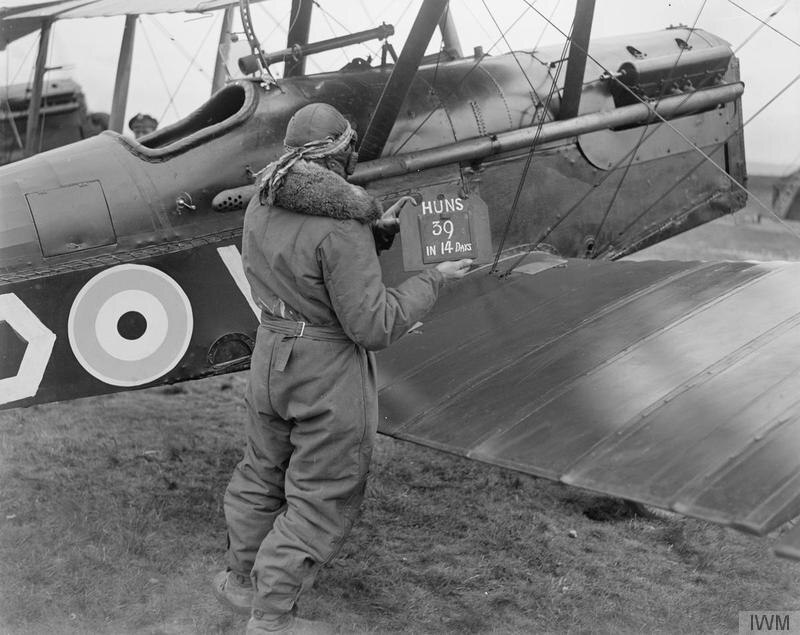
A Royal Air Force pilot affixing to his Royal Aircraft Factory S.E.5a biplane a notice reading: ‘Huns: 39 in 14 Days.’ Saint-Omer Aerodrome, 21 June 1918. This was the same type of aircraft flown by No. 40 Squadron during 1918. (Source: IWM)

Bennett was commissioned as a second lieutenant in the RFC in January 1918. After primary training, he progressed rapidly through advanced aircraft in England, moving from the Avro 504 to the beloved Sopwith Pup. He then trained on the highly manoeuvrable but notoriously tricky Sopwith Camel and the Sopwith Dolphin. Dusch expertly discusses the deadly instability of the rotary-powered Camel, which was known for killing new pilots.

Posted to France around 21 July 1918, Bennett joined No. 40 Squadron of the Royal Air Force (RAF) the following day, replacing Lieutenant Indra ‘Laddie’ Roy, an ace from India recently killed in combat. Placed in ‘C Flight’ under Captain George E.H. ‘McIrish’ McElroy, one of Britain’s leading aces, whose reputation for ‘great determination, reckless bravery and abandonment’ galvanised the squadron. Bennett was thrilled, believing he would learn more from the experienced flight commander. (p. 114) Bennett’s combat career was intensive but brief, occurring during the great Allied counteroffensive of summer 1918. His first combat sortie was disastrous; on 31 July, his commander, McElroy, was shot down and killed by ground fire. This high rate of attrition was sobering; one pilot estimated the average life expectancy of a pursuit pilot was just three weeks.

Bennett soon became known as a highly effective ‘balloon buster,’ targeting German observation balloons (Drachen). Dusch emphasises the strategic importance of these attacks: balloons and observation aircraft provided the necessary aerial observation for accurate artillery fire, which accounted for approximately 75 per cent of First World War casualties. Neutralising these platforms was key to achieving air superiority, thereby protecting Allied soldiers and blinding enemy commanders.

Bennett scored his first confirmed air victory on 15 August, sending a German Fokker DVII down out of control. Later that same day, he destroyed his first balloon near Merville using Buckingham incendiary ammunition. On 19 August, demonstrating unusual courage, Bennett took off alone after being delayed by engine trouble and dove on an easterly balloon, setting it ablaze instantly. Emboldened, he took off again that afternoon, destroying two more balloons near Merville and Hantay. In just four hours, he destroyed four German targets. On 23 August, he destroyed two more balloons in a single sortie, bringing his confirmed score to seven.

However, on 24 August 1918, Bennett was reported missing. Later accounts from villagers and German Lieutenant Emil Merkelbach confirmed his final heroic actions. Bennett was shot down after successfully attacking German balloons. He had pursued the balloonists fiercely, despite being low to the ground and facing intense anti-aircraft fire, a risk he willingly took. Wounded by a bullet to the head and suffering severe burns and two broken legs, he died that evening in the German field hospital at Wavrin without regaining consciousness. He was buried the next day with full military honours by his German captors.

Dusch spends the concluding section of the book discussing the legacy established by Bennett’s mother, Sallie Maxwell Bennett, a woman driven by intense, personal bereavement. Dusch frames Sallie’s actions within the larger context of First World War grief, noting that the absence of identifiable bodies caused acute psychological suffering for families, linking the experience back to the American Civil War. Sallie, already mourning the death of her husband earlier that August, immediately began a tireless quest to find her only son. Despite being initially denied a passport by the US government, she prevailed by becoming a correspondent for the Wheeling Register.

Once in France, Sallie overcame bureaucratic obstacles and conflicting reports about the location of her son’s grave. With assistance from Major General Mason Patrick and local French villagers, she eventually located his grave in the Wavrin cemetery. Her efforts soon expanded beyond her son; profoundly moved by the devastation and the grief of other mothers, Sallie undertook a ‘private quest’ to find, visit, photograph, and map the graves of other fallen American servicemen for their families back home. She overcame French governmental resistance to repatriation and, in April 1920, successfully arranged for Bennett’s remains to be returned secretly to Weston, West Virginia, where he was buried next to his father.

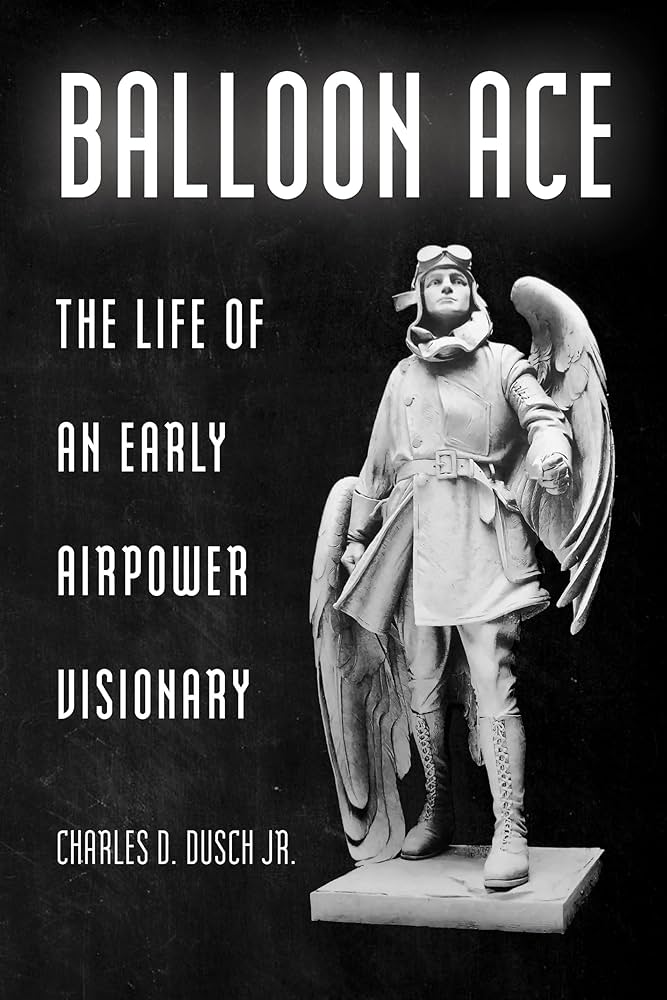
Sallie ensured Bennett’s legacy through perpetual memorials. She dedicated the family home in Weston as the Louis Bennett Jr. War Memorial and Public Library. More globally, she commissioned a stained-glass window in Westminster Abbey to guard the Tomb of the Unknown Warrior, dedicating it to ‘all flying men.’ In a unique blending of collective and personal memory, the artist used Bennett’s image as the model for the angel holding the shield of Faith within the window. Her final major endeavour was commissioning the statue of ‘The Aviator,’ designed to inspire the nation’s youth with his example of ‘able courage.’ This statue was ultimately dedicated at Linsly Military Institute in Wheeling, strategically positioned along the National Road to be seen continually by the American public.

Dusch’s Balloon Ace paints a comprehensive portrait of Louis Bennett Jr., not merely as a combat hero, but as an insightful, if ultimately thwarted, early air power visionary whose innovative ideas predated official policy. Furthermore, the detailed account of Sallie Bennett’s unrelenting efforts provides a powerful case study of maternal grief and the profound role of women in shaping national commemoration during the tumultuous post-war years. Balloon Ace: The Life of an Early Airpower Visionary convincingly demonstrates how Bennett’s story, though tragic and brief, became a foundational part of America’s public memory of the First World War.

Ray Ortensie is the Command Historian for Headquarters Air Force Materiel Command, based at Wright-Patterson Air Force Base, Dayton, Ohio, giving command oversight and support to 13 field-level history offices and four field-level museums. He is also an adjunct professor at American Public University System and Southern New Hampshire University, teaching undergraduate and upper-level graduate courses in U.S. history. His research focuses on aviation depots and Civil War guerrilla warfare. Ray received his master’s from Purdue University in 2004 and started working as an Air Force Historian shortly afterwards.

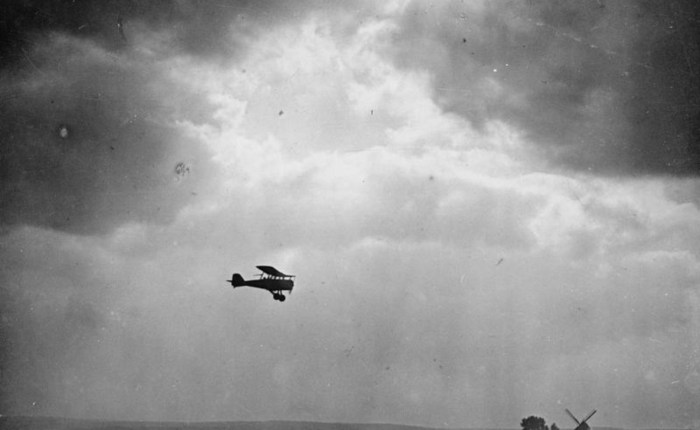
Header image: A Royal Aircraft Factory S.E.5 returning to St Omer aerodrome in the evening, 26 June 1918. This was the same type of aircraft flown by Bennett when he served with No. 40 Squadron RAF in 1918. (Source: IWM)

The Colonel, the Sculptor, and the Supreme Court Justice: Assessing the Failure of American Aircraft Production in the First World War – Part Two

The Colonel, the Sculptor, and the Supreme Court Justice: Assessing the Failure of American Aircraft Production in the First World War – Part Two

By Lieutenant Colonel Michael H Taint, United States Air Force (Ret’d)

Editorial note: In this two-part article, Michael Taint re-evaluates the conduct of Colonel Edward Deeds in the management of the US Army’s First World War aircraft production program and the overall aeroplane production program itself. In this second part, he examines Deeds’ conduct and evaluates the management of aircraft in the United States during the First World War. The first part can be found here.

The first part of this article described the low state of readiness of American military air power as the country entered the First World War in 1917. Congress addressed this with an enormous $640M appropriation for a fleet of aircraft. However, the automobile industry, not the aviation industry, dominated the Government body overseeing aeroplane acquisitions, the Aircraft Production Board, specifically in the person of Edward A. Deeds, who was directly commissioned a full Colonel in the US Army Air Service and placed in charge of procurement.

Colonel Deeds and the Aircraft Procurement Program

The American aircraft production program began, as large initiatives often do, with boundless optimism. After all, at the beginning of the First World War, the American automotive industry was an industrial marvel, mass-producing approximately 1.5 million automobiles per year – this made the goal of 22,000 aircraft possible. Minutes taken at an early meeting of the Aircraft Production Board capture this sentiment perfectly: ‘If the automotive industry of this country can produce 100,000 automobile engines a month, as it now does, we can see no logical reason it cannot produce 3,000 aircraft engines per month.’[1] Colonel T. Milling of the US Army Air Service summed up this optimism when he stated that the ‘idea that has always seemed to exist in the United States, namely, that money can do anything.’[2]

Deeds’ US Army Air Service Equipment Division wasted no time awarding contracts to get the work underway. On 7 September 1917, just weeks after Deeds’ commissioning, the Dayton Wright Airplane Company, then in its sixth month of existence, received a cost-plus contract to build 4,000 De Havilland DH-9 (soon after modified to DH-4) light bombers. Curtiss Aircraft and Fischer Body (later to become part of General Motors) received contracts of equivalent size. In addition to the DH-4 contract, Dayton Wright was also issued a fixed price contract for 400 ‘Standard J’ training planes; altogether, Deeds’ Equipment Division issued almost $35,000,000 in contracts to his former company in Dayton.[3]

In 1920, in a report of the House of Representatives Select Committee on Aviation’s judgment on Deeds’ conduct is truly clear:

But the fact remains that from practically the inception of the Government’s aviation activity in connection with the war, and within the sphere of Colonel Deeds’s important if not commanding influence his former business associates were placed at once through Government contracts to a position where they had the assurance of very large profits upon a relatively small investment of their own money and in addition were able to secure generous salaries which they charged against the Government as part of the cost of manufacture. That Deeds, Kettering and Talbot continued to be on the most intimate and confidential footing in the prosecution of Government work by the Dayton-Wright Airplane Company is apparent from their correspondence.[4]  

Particularly damning were two telegrams sent by Deeds to Henry Talbot, the business manager and co-founder of Dayton-Wright Airplane Company, in August and September 1917. In the first, Deeds tells Talbot that all confidential telegrams from his Government office will be addressed directly to Talbot, not the Dayton Wright Airplane Company (a highly irregular practice for Government correspondence that Deeds later defended as merely a convenience, then later a security measure). In the second, Deeds told Talbot that the Government was able to select a source without price competition, and that price would not be a determining factor. And if the price were not a determinant, the cost could be high:

For your personal information as coming from your local attorney. Judge Advocate General has ruled it legal for the Government to select one, contractor one, and the two a third [sic], as market appraisers of market value of plant at contract expiration.[5]

Deeds also gave Dayton Wright a tremendous advantage over other US aeroplane manufacturers – the only actual DH-4 aircraft in the country. The procurement strategy the Aircraft Procurement Board had endorsed was not to design an entirely new American aeroplane but ‘build to print’ from an existing, in this case British, design that had flown and proven reliable. Unfortunately, the British either lacked or failed to give the US a complete technical package of drawings and specifications for the DH-4. All the Americans had been a few top-level diagrams. Instead, in late July, an actual DH-4 was shipped to Washington, which American industry could reverse-engineer and copy. However, even that was incomplete, with missing armament and landing gear. These were parts that needed to illustrate how the whole system was constructed and worked together. Deeds, however, immediately had it shipped to Dayton Wright instead of keeping it at a Government location, where all industries would have equal access.[6]  This gave Dayton Wright an enormous head start over the other contractors because they had sole access to the only artifact documenting the detailed design. Dayton Wright immediately began ‘reverse engineering’ detailed blueprints and drawings to enable mass production, and within three months, had hand-built a ‘duplicate’ (more accurately, an American version) equipped with a prototype new US-built Liberty engine. This was impressive initial progress, but mass production proved far more challenging. 

As the fall of 1917 progressed into winter, the problems of creating a new American aviation industry became evident, as the much-ballyhooed deliveries of initial production aircraft failed to materialise. The problems began with the most fundamental issues – a lack of knowledge in the manufacturing process, and a supply chain of necessary materials. Though the automotive executives in charge, such as Deeds, had assumed that automobiles and aircraft were comparable in complexity, it was soon discovered that the aeroplanes, particularly the ones made in Europe, required far more ‘touch labor’ by craftsmen than the mass-produced automobile, built by general labour that typically only performed one function on the assembly line.[7] This lack of aviation production knowledge hindered the startup effort, but the American aviation industry eventually learned and adapted.

Material was also a significant issue. America had enormous timber resources, but only certain types of wood were suitable for constructing aeroplanes. Strong, light, and straight-grained beams long enough to form the wings and body of an aeroplane were required, and only spruce met those requirements. Eventually, the lumber industry learned to cut spruce trees for the correct finished piece, but early in the spruce program, as much as 5,000 feet of rough spruce was required for a single aircraft.[8] Labour troubles caused by the lumbering program’s crash erupted in the Pacific Northwest; in November 1917, the US Army Signal Corps created a Spruce Production Division, headed by Colonel Brice Disque, to resolve the issues and maintain a steady supply of high-quality spruce material.[9]

Another significant component of the aircraft was linen. At first, the US attempted to procure this material from the original De Havilland Company source, an Irish supplier, but they were unable to meet the demand. This forced the US Army Signal Corps to experiment and find an acceptable substitute, cotton, which they procured (15,000 bales worth) on the open market to provide to the aircraft manufacturers. Even special aviation varnish (‘dope’ in the vernacular of 1917) had to be developed by the US Army Signal Corps to support private production.[10]

These issues would surely have occurred regardless of who led the aircraft procurement program, but there were also problems internal to the Equipment Division. The scope and size of the aircraft production challenge in the First World War were precisely why men such as Deeds, with expertise in running large manufacturing enterprises, were brought into the US Army. Unfortunately, they failed to create an efficient organisation to administer the work. As a Congressional investigation report noted after the war:

The duty of providing an adequate organization for aircraft production was left to the Signal Corps. It is quite clear that this undertaking was beyond the competency of the Chief Signal Officer [General Squier], who had neither the training nor experience for such a large industrial enterprise, and those who were brought to the task in his department failed to produce an organization which was adapted to meet the exigency. (emphasis added)[11]

Specific issues identified were a lack of accountability, unclear lines of authority, and redundancy of effort. These issues, plus rising public criticism of the entire aircraft program, led to a change in the US Army Signal Corps’ organisational structure in February 1918. Deeds was relieved of his position as Chief of the Equipment Division and moved to the newly created position of ‘Senior Industrial Executive’, reporting directly to General Squier, with no apparent line authority. Nevertheless, Deeds continued to exert significant control over the aircraft program, according to the report of Charles Evans Hughes issued in October 1918 and discussed in more detail below.

Another set of issues was changes in the DH-4 configuration caused by American manufacturing. The most notable of these was the Liberty engine, one of the war’s most significant American production successes, in which Deeds played an important role. Unlike other technical aspects of American aircraft production, Deeds took a personal interest in the development of the new American engine. As Benedict Crowell recounted in his official report after the war:

Colonel Deeds had been the man of broad vision who […] determined that America could best make a contribution to the aviation program by producing her own engine […] persuaded Messrs. Hall and Vincent [two Signal Corps officers in the rank of major responsible for engine production] to forego further efforts on their individual developments and devote their combined skill and experience to the creation of an all-American engine.[12]

While there were good reasons to create the new American Liberty engine instead of attempting to adapt hand-crafted European engines to American factories, Deeds also had a very personal business interest in the Liberty. Each of the 20,000 Liberty engines used a Delco electronic ignition system and not the magneto ignition system used in Europe, so he profited from each engine sold. Deeds was careful not to sign the directive requiring the use of the Delco ignition, instead having his subordinate, Major Gray, sign it. However, as the Congressional investigation after the war found, ‘there is no satisfactory evidence that Colonel Deeds signed, prepared or directed the use of the Delco ignition, though it cannot be doubted that he desired the system to be used.’[13] Unfortunately, the change in a central aircraft subsystem such as this required a significant number of changes to other interfaces, resulting in further delays. These changes were particularly problematic as the Liberty engine evolved in many configurations.[14]

By November 1917, seven months into the war, the first significant block of DH-4 aircraft (154 planes) was supposed to be delivered; however, the total delivered was zero. The United States did not deliver its first batch of home-produced aircraft until February 1918, which consisted of only nine aircraft.[15] Critics from the small core of aviation experts and enthusiasts saw this as the natural outcome of their industry being overtaken by the ‘Detroit Conspiracy.’ Their criticisms soon found a most unusual voice.

John Gutzon Borglum: Sculptor and Aviation Enthusiast

John Gutzon Borglum, c. 1919. (Source: Wikimedia)

John Gutzon Borglum, a sculptor, was busy working on the Stone Mountain commemoration of Confederate Civil War leaders in Georgia when the US declared war in 1917 (after the war, he would take on the far more famous Mount Rushmore project). An early aviation enthusiast, Borglum was a founding member of the New York Aero Club and also witnessed the acceptance testing in 1908 of the first Wright Flyer bought by the US Army.[16]  In 1913, prominent Daytonians, including Deeds, contacted Borglum about sculpting a memorial to the Wright brothers; however, he enormous Dayton flood that year made financing the project impossible. Deeds remembered Borglum, however, and commissioned the sculptor to do a bust of his son, who tragically died of illness. Borglum completed this composition and took things further, proposing an elaborate mausoleum for the entire Deeds family. Deeds never responded to this proposal, and this rejection was later cited as the cause of Borglum’s particular animus toward Deeds in the aeroplane procurement controversy.[17]

One thing was sure:  in terms of temperament, Borglum was as far from Deeds as imaginable. Where Deeds was genial, low-key, and personable, Borglum was truculent, loud, and abrasive, truly over the top. Unafraid of making attacks on Deeds that were personal and sometimes outlandish, Borglum claimed that Deeds ‘real name’ was really ‘Dietz’ and that he had strong pro-German sympathies – a political hot-button in America in 1917. ‘Deeds powerful Teutonic personality seems to have completely hypnotised the trusting, scientific mind of General Squier, ’ posited Borglum, explaining how the aircraft program under a highly respected US Army officer had so underperformed expectations.[18] Overblown rhetoric aside, Borglum had suspicions about Deeds’ business motivations, which eventually proved well-founded. Convinced that the aircraft procurement plan led by Deeds was a scam, he handled it in typical Borglum style – he took it right to the top, writing the President of the United States’ secretary, Joseph Tumulty, and alleging gross mismanagement and waste in the aircraft program. After discussing with Secretary of War Newton Baker, Wilson wrote back on 2 January 1918. He gave Borglum carte blanche to investigate his allegations, including permission to visit various manufacturing plants, a War Department employee to act as Borglum’s assistant and an office in the War Department itself. Borglum attempted to interview the principals involved in the affair, including General Squier, but found them unresponsive.[19]  Undeterred, on 21 January 1918, Borglum sent his report to Wilson with a letter stating that he had ‘been able to connect the broken links of a chain of dishonesty and disorder that runs through our production department.’[20] By now, Borglum was not the only voice of dissent. A report from the respected Aeronautical Society of America stated that the aircraft program was devised by ‘men who know next to nothing about the art of flying or the production of flying machines.’ Numerous newspapers throughout America in the next few months began calling for an investigation into the aeroplane program; typical of these is the St. Louis Star’s observation that ‘if things are wrong they must be righted and if they are not wrong then the men responsible must be cleared of odium’ and the Philadelphia North American’s ‘the American people are sick of false promises and alluring deceptions; what they want is battle-planes on the front.’[21]  

Secretary of War Baker’s response to President Wilson on Borglum showed a clear understanding of the potential political volatility of the situation: 

My general impression of Mr. Borglum’s report is that it contains no facts beyond those frankly admitted by Government departments with reference to delays […] The charges against Colonel Deeds are unsupported by evidence. Nevertheless, I consider it would be well, in view of the charges, to have a full examination of Colonel Deeds’ record made as a matter of justice to him and the Department.[22]

Whatever plans Baker had for an internal review were quickly superseded by actions by Congress and Wilson himself. Wilson backpedalled, sending Borglum a letter claiming he had not appointed him as an official investigator but merely as an interested citizen (though interested citizens are generally not provided a full-time War Department aid plus an office).[23]

Borglum was making the newspapers almost daily as he blew the whistle as loudly as possible. By early May 1918, both houses of Congress expressed outrage and demanded a full investigation. Senator Thomas of Colorado, on 9 May 1918, stated that the aeroplane manufacturers were responsible for ‘huge profiteering’ and wanted those contracts cancelled. However, the next day, the same Senator dropped a bombshell on the Senate floor, effectively ending Borglum’s role as an aircraft program critic. An affidavit from Mr. Kenyon W. Mix, Jr., whose father held the controlling interest in the Dodge Manufacturing Company, was presented to the Senate. It stated that Mix and another aeroplane engineer, who supposedly had ties to the British Embassy, Hugo C. Gibson, had met Borglum on a train trip (whether planned or accidental is unknown), and Gibson had told him that European designs, far superior to American ones, were available for manufacture. Borglum boasted of his close personal ties with President Wilson, ties that could readily lead to a fat aeroplane production contract. Mix, suspicious, then decided to raise the issue through appropriate channels – so he forwarded the concern to Aircraft Production Board chair Howard Coffin, who in turn shared it with other Board members, including Squier and Deeds. In turn, on 20 January 1918, they raised the issue with Vice President Marshall, who notified Secretary Baker; presumably, Baker passed this on to Senator Thomas.[24] The implication was clear – Borglum was doing precisely what he accused Deeds of doing – pursuing an aircraft procurement program profitable to himself. Having placed the affidavit before the Senate, Senator Thomas ended his floor time with the stark conclusion: ‘This shows Mr. Borglum’s criticism of the airplane program to be entirely without merit.’[25] Borglum, naturally, vehemently denied all this.

Of course, this testimony from Mix did not prove that Borglum’s criticism was without merit; it simply suggested that Borglum might be a hypocrite, attempting to do precisely what he accused Deeds of doing.[26] However, another possibility is revealed by a front-page story on 11 May 1918 in the Washington Herald:

Officials for the British Embassy and the British War Mission here state that no one in the name of Hugo C Gibson has been in the employ of the British Government in this country. It is believed that Mr. Borglum may have been the victim of a confidence man who sought membership in any corporation that might be formed and put forward false claims in order to win the confidence of the sculptor.[27]

Borglum’s response to the Senate was simple – ‘a frame up, deliberately planned.’[28]  No one at the time (and for that matter, any historian later) appears to have taken that answer seriously, however. Borglum, utterly discredited, was effectively silenced. Certainly, powerful business interests and senior officers such as Deeds in the Equipment Division had strong motivations to stop Borglum. The Mix affidavit was never further scrutinised and Mix himself never called to testify. Borglum may have been personally silenced, but the calls for serious investigation had such momentum from Borglum’s polemics that they could not be stopped.

Charles Evans Hughes: Justice becomes Investigator

Charles Evans Hughes campaigning in Winona, Minnesota, on the Milwaukee Road’s Olympian, 10 August 1916. (Source: Wikimedia)

Former Associate Justice Charles Evans Hughes had lost a close election (23 electoral votes) to President Woodrow Wilson just the year before. In December 1917, he paid a courtesy call on his former rival at the White House. Hughes had come to Washington not to meet the President but to argue a case before the Supreme Court, the first time since he resigned from it to run for the White House. Hughes offered at that meeting – probably just a formality – to accept any wartime assignment that Wilson might wish. On 13 May 1918, just a few days after the Borglum debacle on the Senate floor, Wilson took Hughes up on the offer. Wilson believed that Hughes, a respected jurist and political opponent, would be able to make any necessary recommendations and remain above any charges of whitewashing. Wilson asked Hughes to investigate the growing political crisis of the army aircraft program, and Hughes immediately accepted.[29]

Though Wilson gave his former rival a free hand to look wherever he wished, he would do so under supervision from Attorney General Gregory or Solicitor General Frierson. One of these men always accompanied Hughes on every interview or fact-finding mission. Hughes picked Meier Steinbrink, an up-and-coming lawyer who was eventually elevated to the New York State Supreme Court, as his personal assistant. Together they investigated the entire aircraft program from mid-May until early November 1918, conducting all their interviews and actions in private to avoid creating another Borglum-like circus.[30]

Hughes’s first task was to uncover as many facts as possible about the actual aircraft production program – specifically, how many aircraft were built and shipped to Europe, how much money had been obligated and spent on domestic contracts, and how much had been obligated and paid on the Allies. Obtaining this data proved to be far more difficult than anticipated. It became the first indication that the entire aircraft production procurement bureaucracy lacked the proper centralised control necessary for effective decision-making. Hughes and Steinbrink eventually interviewed 280 witnesses, reviewed 17,000 pages of documentation, and visited contractor facilities in Dayton, Detroit, Buffalo, and New Brunswick. At each site visit, he examined the contractors’ financial records (cost-plus type contracts require all such data to be available to the Government) and facilities and interviewed key executives. In Dayton, these interviews included Deeds and Henry Talbot Jr., President of the Dayton Wright Airplane Company.[31]

During this visit, Hughes uncovered unmistakable evidence of Deeds’ illicit communications with his former company. From the information reviewed before their site visit and the evasive answers Talbot gave to specific questions from Hughes, both investigators suspected a secret back channel had been established. Steinbrink evaluated this idea.

While Hughes was plying the witness [Talbot Jr.] with questions, Steinbrink walked over to the plant’s filing room and told a clerk that Mr. Talbot would like to have the confidential file. The clerk yielded it without question, and the attorney [Steinbrink], opening it to “Deeds” and “Talbott”, found telegrams that established a confidential relationship between the two men after Deeds had taken charge of the aircraft production program for the Army.[32]

This would form a key part of the final 104-page report by Hughes, which was completed at the end of October and submitted to President Wilson through the Attorney General on 25 October. It was released publicly on 31 October 1918, just over two weeks before the Armistice.[33]

Hughes’ Report is impressively comprehensive and delves deeply into every issue that plagued the startup of the American aircraft industry, from the large numbers of Government actors and private firms involved down to the fine points of cutting the proper amounts of spruce and mahogany.  Numbers and types of aircraft and aircraft engines built and delivered are tabulated, along with contract dollars obligated and spent, as well as the selection process for contractors. Hughes had discharged his duties well, untangling an overly complex procurement program in a few short months, despite neither he nor his assistant having any background in it.

The final report’s cover letter to the Attorney General mentions explicitly investigating ‘the activities relevant to Edward A. Deeds and his former business associates,’ noteworthy because Deeds is the only person called out by name in the cover letter.[34] Hughes intended to draw attention to Deeds, particularly senior administration officials who were likely only to read the cover letter. In addition to the unethical communications with Dayton Wright Airplane Company, the investigation uncovered other questionable conduct on Deeds’ part.

One of these was purchasing land for McCook Field, located just north of Dayton. Deeds had bought the land – after being advised by Wilbur Wright that it would make an ideal airfield. As Deeds he ‘importuned’ another US Army Air Service office to purchase the land; he no longer owned it but had sold it to his long-term business partner (and co-founder of Dayton Wright Airplane Company) Charles Kettering. Deeds also pressed for establishing other permanent facilities, such as Wilbur Wright Field in Dayton. Although he had no immediate business connection to this deal, it would surely be helpful in his post-war aviation business ventures.[35]

Hughes found still more irregularities in Deeds, such as a $104,000 payment to a Liberty engine contractor (the Packard Company) – even though no contract existed between the Government and Packard at the time.[36] On 21 February 1918, Deeds made a significant announcement through the War Department that the first ‘service’ (tactical combat) aircraft were finally on their way to France, an important milestone that the entire nation had anxiously awaited. Nothing had been shipped to France, only a handful of DH-4s to other airfields in America for testing; ‘Actual production in quantity did not begin until May.’[37] This revelation proved a severe embarrassment to the Wilson Administration, and Congressional inquiries grilled Secretary of War Newton Baker about this deception. Besides benefiting from insider Government information, executives of the Dayton Wright Airplane Company had charged exorbitant salaries since August 1, 1917, under the government’s cost-plus contracts. Deeds claimed he knew nothing about the wages (over $100,000 total) being received by some of his closest friends.[38]

Finally, in his single-page ‘General Conclusions and Recommendations, ’ Hughes blasted the US Army Signal Corps officers in charge (Squier and Deeds) for incompetence and mismanagement of the aircraft program, resulting in tremendous inefficiencies and waste. He also noted that the newly created Bureau of Aircraft Production, with entirely new leadership, had already rectified the significant problems reported. Concerning Deeds:

The evidence discloses conduct, which although of a reprehensible character, cannot be regarded as sufficient for charges under existing statutes […] The evidence against Colonel Edward A Deeds should be presented to the Secretary of War to the end that Colonel Deeds may be tried by court martial under Articles 95 and 96 of the Articles of War.[39]

The remaining points in the summary recommended criminal prosecutions for several other army officers (not named) who retained company commercial interests and suggested the Justice Department continue audits of the aircraft industry. Hughes was released from Government duty a few weeks later and never had more to say about the whole affair, resuming his distinguished career as a politician and jurist by serving as Secretary of State under the next President and eventually returning to the US Supreme Court. This time, as Chief Justice, in 1930. 

Secretary of War Newton D. Baker and Court Martial

Secretary of War Newton D. Baker on 6 December 1918. (Source: Wikimedia)

News of the Hughes report appeared in the newspapers on 1 November 1918, and 10 days later, the Armistice was signed. American war planners who had expected the war to end only after a massive spring offensive planned for 1919 suddenly found themselves superfluous. Other residual tasks remained, along with negotiating the peace treaty and demobilising the army. One of these was the Deeds court martial.

With the Armistice, work stopped on all military production contracts almost immediately. The War Department undoubtedly wanted to put the embarrassing affair behind them as quickly as possible. Simply ignoring the Hughes Report was not an option – there was too much interest from both houses of Congress. Secretary of War Newton Baker decided to take the highly irregular step of not immediately court-martialing Deeds, instead having a board of review examine the allegations in the Hughes Report and determine whether a court-martial was required.

This move was itself highly irregular. Boards of Review served as the military equivalent of appellate courts. They review cases already decided in a lower court, and do not decide whether trials are necessary. Baker knew full well that there was plenty of evidence to warrant charges against Deeds, especially against the two Articles of War specified by Hughes, Article 95 (Conduct Becoming an Officer) and Article 96 (General Misconduct), which have unusually broad and extensive application.

The Board of Review, consisting of three-judge advocate officers selected by the army’s acting judge advocate general, examined the Hughes Report and took testimony from Deeds and his associates, allowing them to refute or clarify the issues Hughes raised. Neither Hughes nor Meier Steinbrink, his assistant, was ever called before the board or allowed to examine the testimony the review board heard. The army judge advocate’s report, released on 26 December 1918 (when it would garner the least attention, as Washington would be deserted after Christmas), decided that a court-martial was unnecessary. It found that the Deeds had not intended to deceive or defraud the Government and had released no confidential information. 

The report begins with several glaring factual errors, most likely stemming from Deeds’ testimony, as they contradicted Hughes’ report. Deeds was selected for his Government position because he was ‘well known in the field of aircraft development’ and Dayton Wright Airplane Company was ‘taking over the Orville Wright Airplane Company.’[40] Deeds explained away the whole issue of direct private telegrams to his former company’s President, H. Talbot Jr, by claiming fear of German sympathisers who might gather confidential information. Had the board allowed cross-examination by Hughes, they would have learned that this was not standard operating procedure between the Army Equipment Board and contractors and only extended to Dayton Wright. As far as Deeds’ subsequent telegram to Talbot, providing key information about the Government’s aircraft procurement strategy, the board conceded Deeds’ assertion to Talbot to take the provided information as ‘coming from your local attorney’ was ‘difficult to understand’ but decided that since Deeds was not a lawyer and simply trying to expedite the award of Government contracts (that being true) it was acceptable.[41]  They did not consider the information in the telegram, that a price competition was not required to award a contract, to be confidential to the government.[42] Had Hughes been present, he surely would have explained to the board that this information gave Dayton Wright carte blanche to charge the Government as much as it wished. What impressed the Board was that Deeds had sacrificed a large corporate salary (approximately $85,000 annually) to become a US Army officer and had been commended for his hard work by the Aircraft Production Board.[43]

Secretary of War Newton Baker released the Board’s results, with his concurrence, on 16 January 1919. The board, he claimed, ‘systematically examined all this evidence [the Hughes Report] and obtained all possible additional facts’ and was therefore superior to the Hughes Report in its conclusions.[44] Hughes had not been consulted or questioned by the Board, even once, on this overly complex procurement matter. The Board had not visited a single contractor facility anywhere, interviewed any other sources, or consulted any technical experts as Hughes did. Secretary Baker’s own ‘conclusion’ about what caused the Deeds scandal was not even consistent with the Board’s findings and has the distinct ring of a judgment made well before the board result:

This record undoubtedly shows that Colonel Deeds, absorbed in the activities of Aircraft Production, neglected to give personal attention to transactions involving his personal affairs, and this neglect on his part gave rise to appearances which required painstaking investigation in order to show their true character.[45]

And to make certain there was no mistaking Baker’s position on the matter, he ended with:

Inasmuch as Judge Hughes’ suggestion has been accomplished, I have directed that all records in this matter be filed in the War Department and the case be considered closed.[46]

With this, the War Department had finally put the last of the aircraft procurement scandal behind it. On 4 December 1918, President Wilson, following recommendations from Baker himself, issued full pardons to the other two army officers found by Hughes to have violated criminal statutes.[47]

Conclusion: Reassessing Deeds and the Aircraft Production Program

Readers of The Dayton Daily News opened their morning newspapers on 17 January 1919, to find the front-page story ‘ALL CHARGES VANISH UNDER LIGHT OF DAY’. The Board of Review had cleared entirely the Dee, and few locals seemed interested in a story with convoluted telegrams and company ownership details. Deeds soon received a deluge of telegrams from important Government officials such as the War Department’s Director of Munitions, Benedict Crowell, and industrialists like Henry Ford, congratulating him on the outstanding accomplishments of the aircraft production program. Feted in Dayton with banquets and other commemorations, including an ‘Ode to the Colonel’ written by his former military deputy, Deeds’ reputation suffered no lasting harm. To help ensure this, he had a July 1921 editorial from the popular business magazine The World’s Work entitled ‘The Vindication of Squier and Deeds, What Really Happened to the Billion Dollar Aircraft Appropriation’ reprinted in booklet form and distributed around the city.[48] Deeds were returned to senior management at Delco and NCR, and they continued to expand into new business ventures, such as creating a large conglomerate from various small sugar companies in Cuba. Upon his death, he bequeathed a historical park featuring a modern carillon tower that bears his name; the latter has become the de facto icon of Dayton. 

Without question, Deeds made some significant contributions to the industry and the public. Still, his actual military conduct during the war is more accurately assessed by Borglum’s and Hughes’ criticisms than by Secretary of War Baker’s excuses. All the tributes he received after the war mention his extraordinary accomplishments as head of the aircraft production program – yet fail to mention any specifics other than the Liberty engine, which was indeed a resounding success. So, what precisely did Deeds do? He did not decide which aircraft types to build (that was the Bolling Commission’s responsibility) or design or innovate any technical aspects – his days as a design engineer were long over. His primary accomplishments in uniform seem to be awarding many aircraft production contracts in the fall of 1917 and developing an American internal combustion engine for these aircraft that is more amenable to mass production.

Neither of these accomplishments is especially impressive. Awarding contracts in 1917 was a simple matter –no research to determine the best industrial sources (no industry, after all), and no technical or cost proposals to evaluate and select. Deeds’ Equipment Division decided which companies should be given contracts and awarded them; even costs were ignored. One of the first contracts, worth $35,000,000, was awarded to Dayton Wright Airplane Company, which Deeds himself co-founded just a few months before to win new war contracts, a company that had never built a single aeroplane. Deeds never seem to have been considered, even for a moment, in recusing himself from that particular contract award on the apparent conflict of interest grounds. Not only did he not recuse himself, but he also sent a confidential telegram to his old company’s president, which, in effect, told them that price would not be a determinant, almost encouraging them to price-gouge the government. Favouritism for the Dayton Wright Airplane Company did not end there. There were no government plans to ensure that one sample DH-4 aircraft was equally available to all contractors; Deeds had it shipped to Dayton and kept it under his former company’s lock and key, giving them a huge schedule advantage over other manufacturers. Exorbitant salaries were allowed under Government contracts for his old company’s executives; salaries Deeds must have been aware of, as they were his closest personal associates. Much was made later of Deeds ‘divesting’ himself of company stock and salary, but the reality was this was small beer; Deeds was farsighted enough to realize that by building a large new aircraft enterprise – constructed almost entirely with Government funds with virtually no financial risk of his own – he would have yet another large salary stream to draw from when his year or two of military service was over. He returned to his friends in Dayton. 

The Liberty engine program was one of the war’s great successes, and indeed, Deeds deserves credit here. Still, one must remember that by 1917, America had already built millions of internal combustion engines. The differences required for automotive and aviation applications were comparatively small. It was pretty evident that building a new engine for mass production was the better choice over replicating a European, handcrafted one. Even here, Deeds ensured his financial interest was addressed by requiring the Delco electronic ignition to be mandated for each Liberty, as opposed to the traditional aircraft magneto system. 

Simply put, Edward Deeds always ensured the best interests of the United States, and his best interests coincided. And he never stopped. ‘Let us not in any way commercialise our experience [in the army] here. It is quite enough that we have been able to be of some service to our country without advertising the fact’ Deeds said in a speech in Dayton after the war – yet he insisted for the rest of his life on being called ‘Colonel Deeds.’[49]

Ethical issues aside, the larger question is Deeds’s role as head of the Equipment Division in the ‘failure’ of the American aircraft production program. Certainly, he played a critical role in creating unrealistic expectations with absurdly optimistic production schedules that the nascent American aircraft industry could not have met. Deeds compounded this mistake by making frequent and overly optimistic public statements throughout 1917, thereby reinforcing the false optimism. For example, an early production plan known as ’Production Plan II’ called for 16,500 tactical combat planes (DH-4s) to be delivered by 30 June 1918, to the front (to be powered by the new Liberty engine, which had not even been designed yet); actual numbers never came remotely close to this plan.[50]

The ‘failure’ was a plan by Deeds and the Equipment Division based on a false assumption – that building a tactical aeroplane was comparable to creating one of the million-plus automobiles rolling off the assembly lines in Detroit. The reality was that building an aeroplane was far more complex. The wood needed for the airframe had to be a continuous piece of spruce, obtainable only in the Pacific Northwest, and from lumberjacks currently on strike. Wings required a special linen spun only in Ireland. Even the varnish (‘dope’) needed for aeronautical use required special development. Tolerances for fitting parts in aircraft, which had to withstand wind and vibration forces unlike those in automobiles, required a far higher level of craftsmanship and attention to detail than the Detroit assembly lines. The ‘automobile crowd’ that ran the aircraft program was unaware of this when they began, a fact that no one disputed by the war’s end. All these challenges were overcome in time, but it took a precious amount of time. The American public and Congress asked in 1918 why reality lagged so far behind what was promised just six months earlier.

The American aircraft program in the First World War was far from a failure. Showing remarkable resilience and ingenuity, the new industry overcame a myriad of design and supply chain issues and, given a reasonable production curve, began producing combat aircraft in just over a year, just as the original Bolling Commission had expected when it recommended awarding the French the 5,875 aeroplanes contract the year before. During the war’s last three months, DH-4 production in America was 653 in September, 1,097 in October, and 1,036 in November.[51] Production year. Had the war continued into 1919 as expected, aircraft production may have been regarded as one of America’s significant contributions to the ultimate victory.

Lieutenant Colonel Michael Taint, United States Air Force (ret’d) is an independent historian.  He retired after a 21-year military career in the US Air Force, which included tours of duty in missile and space operations, acquisition management and headquarters staff. He also spent 15 years in the defence industry as a project manager. He received a BA in History with a specialisation in Military History from Norwich University, an MA in Political Science from Wichita State University, and an MS in Computer Science from the University of Dayton.

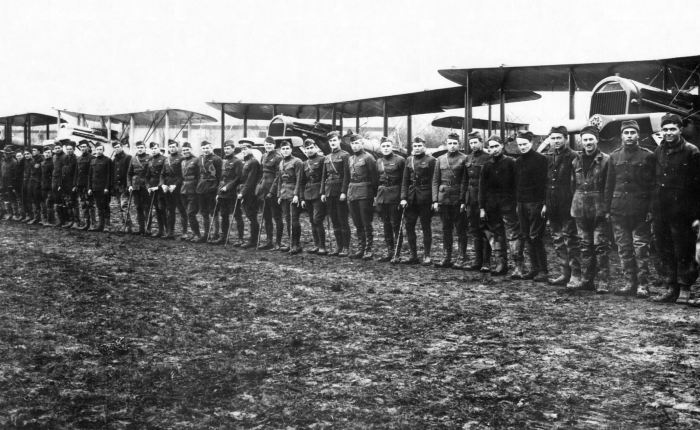
Header image: US Army 166th Aero Squadron personnel standing in front of licence-produced Airco DH4s, November 1918. (Source: Wikimedia)

[1] Robert J. Neal, A Technical and Operational History of the Liberty Engine (North Branch, MN: Specialty Press, 2009), p. 73.

[2] John H. Morrow, The Great War in the Air: Military Aviation from 1909 to 1921 (Tuscaloosa, AL: University of Alabama Press, 2009), p. 268.

[3] United States House of Representatives, Hearings Before Subcommittee 1 (Aviation), Select Committee on Expenditures in the War Department, Volume 3 (Washington, DC: United States Government Printing Office, 1920), p. 3882.

[4] Ibid., p. 3883.

[5] Ibid., p. 3884.

[6] Isaac F. Marcosson, Colonel Deeds Industrial Builder (New York: Dodd, Mead and Company, 1947). p. 227.

[7] Neal, A Technical and Operational History of the Liberty Engine, p 77.

[8] Benedict Crowell,  America’s Munitions 1917-1918: Report of Benedict Crowell, Director of Munitions (Washington, DC: US Government Printing Office, 1919), pp. 240-41. Improvements in logging reduced this to about a thousand feet.

[9] Ibid. The spruce industry in the Northwest was placed under military supervision for most of the war.

[10] Ibid., pp. 247-48.

[11] Hearings Before Subcommittee 1 (Aviation), Select Committee on Expenditures in the War Department, Vol. 3, p 3929.

[12] Crowell, America’s Munitions, 1917-1918, p. 269.

[13] Hearings Before Subcommittee 1 (Aviation), Select Committee on Expenditures in the War Department, Vol. 3, p. 3886.

[14] See Neal, A Technical and Operational History of the Liberty Engine, for a comprehensive discussion of the various Liberty configurations.

[15] Colonel Edgar S. Gorrell, The Measure of America’s World War Aeronautical Effort (Northfield, VT: Norwich University, 1940), p. 34.

[16] Ann Honious, National Park Service. What Dreams We Have: The Wright Brothers and Their Hometown of Dayton, OH. 2003. https://www.nps.gov/parkhistory/online_books/daav/chap12.htm (accessed September 18, 2018), Chapter 12.

[17] Isaac F. Marcosson, Colonel Deeds Industrial Builder (New York: Dodd, Mead and Company, 1947). pp 255-57.

[18] Ibid., p. 260

[19] Who, in fact, had nothing to do with the actual procurement actions, save for appointing Deeds as head of the Equipment Division.

[20]’Getting the Facts About Aircraft,’ The Literary Journal, 25 May 1925, pp. 9-10.

[21] Ibid.

[22] Marcosson, Colonel Deeds Industrial Builder, p. 261.

[23] Ibid., p. 262.

[24] Douglas Waldrop, ‘Senate and Justice Department Investigating Aircraft Situation,’ Aerial Age Weekly, 20 May 1918, p. 510.

[25] Ibid., pp. 489-510.

[26] However, Deeds’ proponents were quick to use this quotation to discredit not only Borglum but also any critic of Deeds and the aircraft program. See Deeds’ biographer Marcosson.

[27] ‘Senate Hears Army Critic Under Fire,’ The Washington Herald, 11 May 1918, p. 1.

[28] Waldrop, ‘Senate and Justice Department Investigating Aircraft Situation,’ p. 511.

[29] Merlo J. Pusey, Charles Evans Hughes, Volume I, (New York City: MacMillan and Co.,1951), pp. 374-75.

[30] Charles Evans Hughes, Autobiographical Notes, edited by Joseph S. Tulchin and  David J Danelski (Cambridge, MA: Harvard University Press, 1973), p. 1190.

[31] Pusey, Charles Evans Hughes, Vol. I, pp.376-77.

[32] Ibid., p. 378. Biographer Pusey obtained this information from a personal interview with Steinbrink on 24 July 1947. These are the telegrams mentioned earlier discussing the Government’s internal contracting strategy.

[33] Hearings Before Subcommittee 1 (Aviation), Select Committee on Expenditures in the War Department, Vol 3. The Hughes Report is Exhibit J.

[34] Hearings Before Subcommittee 1 (Aviation), Select Committee on Expenditures in the War Department, Vol. 3, p. 3868.

[35] Ibid., pp. 3895-7.

[36] Ibid., p. 3901.

[37] Ibid., pp. 3928-9.

[38] Ibid., p. 3950.

[39] Ibid., p. 3962.

[40] Waldrop, ‘Senate and Justice Department Investigating Aircraft Situation,’ p. 980.

[41] Ibid., p. 997.

[42] Ibid.

[43] Ibid., p. 1009.

[44] Ibid., p. 980.

[45] Ibid.

[46] Ibid.

[47] Neal, A Technical and Operational History of the Liberty Engine, p. 81.

[48] John K. Barnes, ‘The Vindication of Squier and Deeds, What Really Happened to the Billion Dollar Aircraft Appropriation,’ The World’s Work, July 1921.

[49] Marcosson, Colonel Deeds: Industrial Builder, p. 287.

[50]  Neal, A Technical and Operational History of the Liberty Engine, p. 72.

[51] Crowell,  America’s Munitions 1917-1918, pp 255.

The Colonel, the Sculptor, and the Supreme Court Justice: Assessing the Failure of American Aircraft Production in the First World War – Part One

The Colonel, the Sculptor, and the Supreme Court Justice: Assessing the Failure of American Aircraft Production in the First World War – Part One

By Lieutenant Colonel Michael H. Taint, United States Air Force (ret’d)

Editorial note: In this two-part article, Michael Taint re-evaluates the conduct of Colonel Edward Deeds in the management of the US Army’s First World War aircraft production program and the overall aeroplane production program itself. In this first part, he sets the scene to be explored in the second part.

The US Army was the first military in the world to procure an aeroplane. However, when the United States entered the First World War in the spring of 1917, its military aviation program lagged pitifully behind other belligerents. The expectation of the US government, the American public and its new allies was that American industrial might would quickly create an air force so enormous as to ‘permanently cloud  Germany’s place in the sun’ according to Major General George Owen Squier, Chief Signal Officer (the Signal Corps included all military aviation unit at that time).[1] In July 1917 – after a mere 40-minute debate – Congress appropriated an unprecedented $640 million for this purpose, with a production goal of 22,635 aeroplanes and 45,250 engines. However, at the end of the First World War, despite the benefit of having a build-to-print design for an existing aeroplane, a mere 196 aeroplanes were delivered for combat action at the front, an embarrassing failure.[2]  

The ensuing political fallout caused President Woodrow Wilson to request an informal inquiry by aviation enthusiast and artist Gutzon Borglum (better known as the sculptor of Mount Rushmore and Stone Mountain). Borglum’s accusations of impropriety, particularly against Edward Deeds, a Dayton industrialist directly commissioned Colonel in the US Army Air Service, spurred further Congressional scrutiny. Eventually, Wilson directed a formal investigation led by Charles Evans Hughes, his opponent in the 1916 presidential campaign and future Chief Justice of the Supreme Court. Hughes recommended Deeds’ court-martial; a court martial that never occurred. This paper re-evaluates Deeds’ conduct in the First World War aircraft production program and the overall aeroplane production program. Though often characterised as a failure, American aeroplane production in 1917-18 was more a victim of unrealistic expectations than a lack of competence.

The Pre-Bellum State of American Aviation: The Bolling Commission

Mimicking the experience of the US Army, American military aviation in April 1917 was underdeveloped due to a lack of investment. Although a few officers, such as Squier, had been advocating the potential revolutionary capabilities of military aviation for nearly a decade (Squier himself wrote the technical specification for the US Army’s first purchase of the Wright Flyer), the rest of the US Army and Congress remained sceptical, and funding reflected that scepticism. On active duty, the Aviation Section of the US Army’s Signal Corps consisted of only 52 officers (26 of whom were fully qualified pilots), 1,100 civilian and enlisted personnel, and the air fleet that consisted of 165 aeroplanes – none of which could undertake the type of aerial combat that was occurring over the Western Front – stationed at two flying fields.[3] 

Unlike America’s entry into the next world war, which had issues, at the declaration of hostilities, the USA in 1917 was no great ‘Arsenal of Democracy.’ The US aircraft industry employed only about 10,000 workers, total, at a half dozen firms, and the two largest firms, Curtiss and Wright-Martin, despite bearing the names of America’s foremost aviation pioneers, were controlled by the automotive industry, most notably Howard Coffin of Hudson and Packard’s Sydney Waldon.[4] With limited military interest (except for an order of 800 training planes the Allies placed in 1916), no airline industry, and no airmail, there was insufficient demand to motivate manufacturers. Intellectual property issues were another significant deterrent to the aviation industry’s growth. The Wright Brothers’ invention of ‘wing warping,’ which allowed an aeroplane to roll (turn) left or right, was ruled in 1914 to apply to all flight controls on all aircraft types – in other words, to anyone who built an aeroplane that did anything but fly in a straight line. The Wrights demanded a heavy licensing fee for this technology, adding significant costs and further discouraging start-up efforts.[5] The remedy was an industry steering group and forum that could wrest control of aircraft design and manufacturing from these proprietary interests. So Coffin and Waldon, among others, founded the Aircraft Manufacturers Association (AMA), modelled after the highly successful Society for Automotive Engineers (where Coffin and Waldon were also leaders). The AMA was designed to address issues plaguing early aeroplane manufacturing: intellectual property deterrents and custom parts and interfaces, to make mass production possible, just as they had for automobiles.

The creation of the AMA was timely, as once America declared war on Germany, Europeans besieged the US Government’s official steering body, the Aircraft Production Board, for more aeroplanes. Benedict Crowell, Assistant Secretary of War and Director of Munitions, wrote in the US Army’s official history:

France and Italy had both adopted the policy of depending upon the private development of designs for their supplies of airplanes […] the United States would have to pay considerable royalties for the use of any of these European devices. As to the relative merits of types and designs, it was soon apparent that no intelligent decision could be reached in Washington or anywhere but Europe.[6] (emphasis added)

To make recommendations for this decision, Major Raynal Bolling, a corporate (US Steel) lawyer, National Guard officer, and pilot, was tasked to lead a fact-finding team that became known as the ‘Bolling Commission.’ The Bolling Commission included 12 military and aeroplane experts, plus 93 production specialists from various American factories – the cadre of the future American aviation industry.[7] The Bolling Commission arrived in Britain on 17 June 1917 and visited French, Italian and British aeroplane factories during an intensive 5-week trip and determined in its 30 July report that a handful of specific Allied aircraft, including the De Havilland DH-4, were the best candidates for American domestic production. For the coming year, however, the Bolling Commission recommended US materiel and funding be prioritised to French factories already in production while America ramped up its infant aviation industrial base. They planned for American factories to produce 22,000 tactical aircraft plus training aeroplanes.[8] Consequently, the US Army Air Service awarded a contract for delivery by 1 July 1918 of 5,875 planes manufactured in France but with mostly American materials. Almost all-American airmen flew aircraft produced by this contract.

On 18 October 1917, the DH-4, a 2-seat reconnaissance and day bombing aircraft initially designed by Geoffrey de Havilland in the UK and introduced into service the year before, was selected for American production.[9] The most recent version of this light bomber, the DH-9, was chosen. However, when production started a few months later only the older DH-4 was available to be shipped to America and a production sample – so it was used instead.

Not everyone, however, such as Colonel (later Brigadier General) Billy Mitchell, agreed with the selection of this aircraft. Bolling chose a light bomber rather than a pursuit plane because the latter needed design updates every six months to remain combat-ready; at any one time, 60 per cent of the Allied combat aircraft at the Front were considered obsolete. To all American manufacturers, the DH-4 certainly had another advantage. Unlike the French and Italian aircraft designed by private firms with heavy licensing (intellectual property) fees, the DH-4 was provided by the British government license-free.[10] However, not everyone agreed that aircraft production in America was a good idea, either. Mitchell, then commander of all American aviation forces stationed in France, had toured French factories extensively and was convinced of their superiority in capability and product. Mitchell viewed sending American materials and men to expand existing French manufacturers as the quickest way to victory. As Mitchell recalled with his characteristic bluntness:

It was the beginning of a series of blunders by those directing aviation in Washington, which culminated later in that department being virtually removed from the authority of the War Department and put into the hands of businessmen […- I am referring to the De Havilland airplane and the Liberty engine […] this one decision held up delivery of equipment to American air forces for an entire year, and constituted one of the most serious blunders.[11]

However, those businessmen in charge of aviation in the summer of 1917 had a hugely different view.

The Businessman becomes a Colonel – Edward Deeds of Drayton

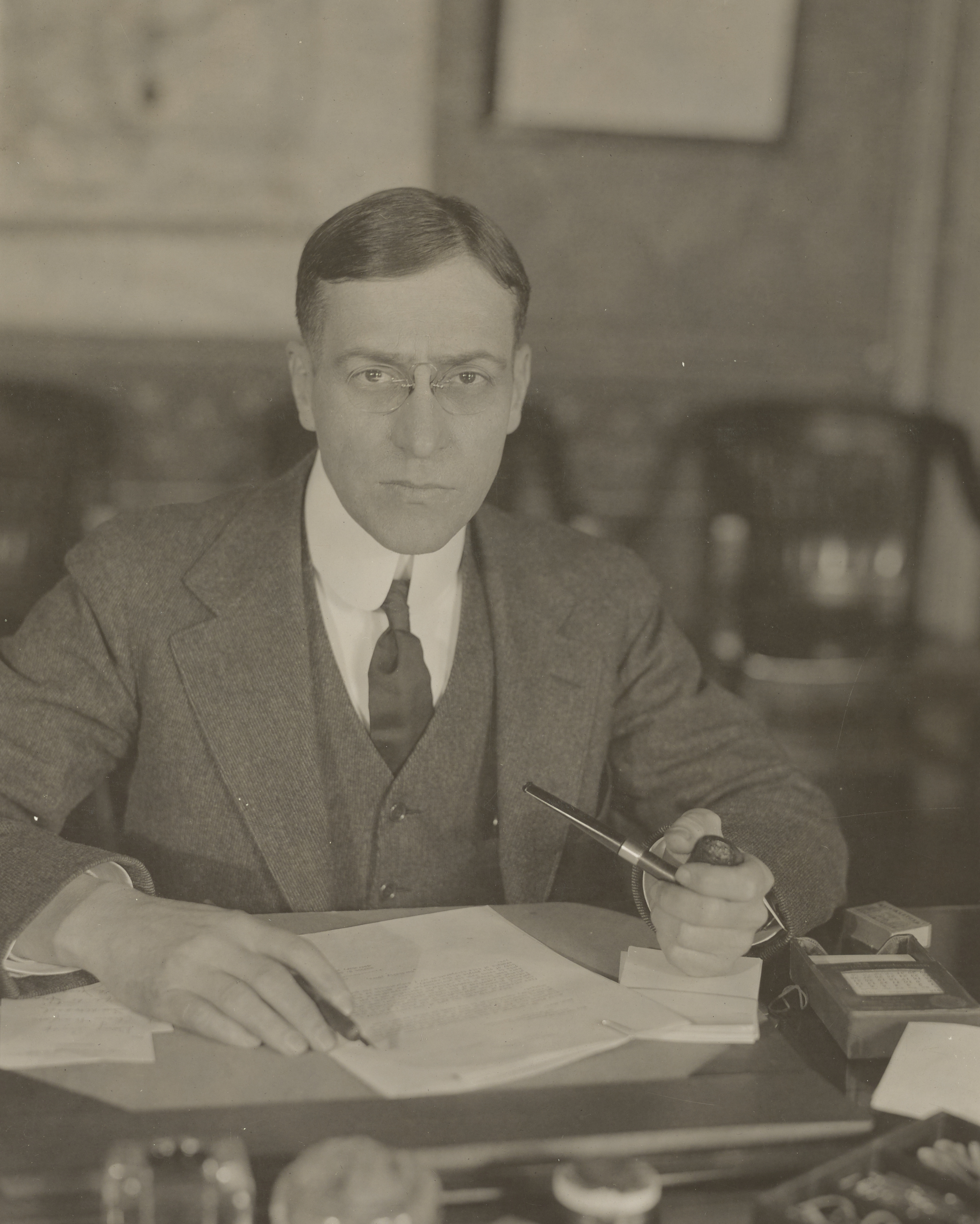
Colonel Edward Deeds, c. 1917. (Source: US Library of Congress)

When the United States declared war, Edward Deeds was a wealthy 43-year-old industrialist and prominent citizen of Dayton, Ohio. Starting as an electrical engineer designing motors for cash registers with the National Cash Register (NCR) company in Dayton, Ohio, Deeds eventually rose to vice president and general manager. His pleasant personality and charm were undoubtedly key to his business success. His most famous hire was another engineer, Charles Kettering. The two became lifelong friends and business partners, often tinkering in Deeds’ barn, where Kettering invented the first automotive electronic ignition system. The enormous success of this invention led Deeds and Kettering to form another company, the Dayton Electronics Company (DELCO), in 1908, a powerhouse in the rapidly expanding automotive industry; Kettering served as chief technical officer, and Deeds focused primarily on business affairs.[12]

Deeds was well into this second successful business venture when his first one caught up with him in a shocking way. NCR had cornered over 95% of the cash register market, but not always through ethical or legal business practices. In February 1913, along with John Patterson and future IBM chief executive Thomas J Watson, Deeds was convicted in the Federal district court in Cincinnati of the first criminal violation of the Sherman Antitrust Act in US history. Along with a $5,000 fine, each man was sentenced to a year in prison. Their careers appeared ruined, but fate intervened. Waiting on appeal, the NCR executives were redeemed in the public’s eye by their extraordinary response to the Great Dayton Flood that nearly destroyed the city a few months later.[13] By marshalling all their company’s resources, Patterson and Deeds provided food and shelter, as well as a small flotilla of rescue boats that saved hundreds of lives. Two years later, on 13 March 1915, an Appeals court overturned all the convictions and ordered a retrial. However, by then, the retrial of these local heroes was politically impossible, and all charges were dropped.

By 1917, just days after the US declaration of war, Deeds and Kettering saw yet another business opportunity, yet another chance to ‘get in on the ground floor’ as they had with electronic ignition in automobiles. They met with Dayton financier H.E. Talbot and his son in the senior Talbot’s suburban Dayton home. Also present were a few original Wright Airplane Company employees, including pilot and aeroplane designer Grover Loening. Deeds and Kettering, with additional financial backing from the Talbots, proposed creating a new aeroplane company called the Dayton Wright Airplane Company, specifically to compete for the substantial number of aeroplane orders that would undoubtedly be coming from the War Department. Orville Wright would be included as a ‘non-working’ director, allowing the new company to capitalise on the prestige and credibility the Wright name would bring (Wright only rarely participated in the actual business, usually as a technical consultant). Deeds proposed that engines from the booming American automotive industry (using the electronic ignition system built by his DELCO Company) would be mated with build-to-print designs from proven European tactical aircraft (since everyone knew America had no design expertise). The solution to the aeroplane production problem would be at hand, with handsome profits. The company’s incorporators needed but $500,000 to begin operations; within a few months, large aircraft contracts would be a massive payback on their investment.[14] The one true aeronautical expert there, Grover Loening, confessed to being ‘astonished’ at these bold plans, which he considered ’shady.’[15] After the First World War, in a section of his memoirs entitled ‘The Detroit Conspiracy’ Loening noted:

the way step after step led the automobile crowd in Detroit to the ownership, control, direction and parceling out of all aircraft and aircraft-motor business, by the time we entered the war in 1917, is a pattern that much too beautifully fit together to be accidental […] Our able and efficient automobile manufacturers in Detroit, foreseeing a war production era, apparently picked on aviation as a likely field to fill their plants […] They absolutely butted into the aircraft business. Not a single one of them had any previous experience along this line […] all of this work was done at cost plus 10% or more; so one can be sure none of the automobile group lost much.[16]

Subsequent events show that Deeds’ vision from that evening in April 1917 happened largely as planned. 

Deeds’ plans progressed rapidly, starting with his appointments to several critical Government advisory and procurement boards. Through his connection with Howard Coffin, a fellow automobile executive (Vice President of the Hudson Motor Car Company), Deeds was offered a position on the Munitions Standards Board dealing with ‘matters relating to the procurement of munitions and supplies’; when that Board was disbanded shortly afterwards, Coffin persuaded him to join a new steering committee to oversee military aircraft, the Aircraft Production Board, chaired by Coffin himself.[17] Deeds considered and eventually accepted.[18] Also on the board was the US Army’s Chief Signal Officer and its foremost aviation proponent, Major General George Owen Squier. Though it had no direct procurement authority, the Aircraft Production Board was the preeminent body in making critical policies that determined which engineering specifications and standards were adopted, how and where pilot training was conducted, and even which supply depots for logistics support and flying fields were to be established. It was tasked with the creation of an American aviation industry. Far from being merely another committee, it became ‘foremost in the war program of the country.’[19] Deeds, the founder of the Dayton Wright Airplane Company in April, was, by July, on the executive steering committee for creating the new industry. And he was not done yet. 

On 15 August, scarcely a month later, Edward Deeds – with no military training or experience of any kind – became Colonel Edward Deeds, chief of the US Army’s Signal Corps Aviation Equipment Division, responsible for the procurement of all Army aviation hardware, including aeroplanes, aircraft armament, spare parts and engines. Supervising between 4,000 and 5,000 personnel, Deeds’ new division was expected to obligate over $500,000,000 in government funds over the next 9 months.[20] Though direct commissions of civilian executives were not unknown during the war, Deeds’ situation was unusual;  he was commissioned in the high grade of full colonel, and even more so, he received a Regular Army, not a Reserve (‘temporary’) commission. This was all accomplished through the intervention of Squier, chief of the Army aviation section and soon to be Chief Signal Officer of the entire Army. In the latter position, Squier had the enormous responsibility of providing all transatlantic communications and in-theatre military communications in France, plus the US Army’s whole air effort. Though highly trained as an engineer (the first army officer to earn a PhD in the field), he did not have the time to translate the $640,000,000 Congressional aeroplane appropriation into actual hardware. That enormous task was Deeds’.

Deeds later made it clear to government service that he had divested himself entirely from his recently established business interest in the Dayton Wright Airplane Company. However, this divestiture consisted only of resigning from the company, as Deeds was the only incorporator of Dayton Wright, who did not take any of the new company’s 5,000 shares of stock, an oddity for which remains unexplained.[21]  Of course, it is possible Deeds had no interest in stock because he planned to obtain an influential position in the Government all along to facilitate Dayton Wright Airplane’s growth, which would benefit him greatly when he re-joined the company after the war. Deeds flatly denied he had been promised any such quid pro quo.

Lieutenant Colonel Michael Taint, United States Air Force (ret’d) is an independent historian.  He retired after a 21-year military career in the US Air Force, which included tours of duty in missile and space operations, acquisition management and headquarters staff. He also spent 15 years in the defence industry as a project manager. He received a BA in History with a specialisation in Military History from Norwich University, an MA in Political Science from Wichita State University, and an MS in Computer Science from the University of Dayton.

Header image: US Army 166th Aero Squadron personnel standing in front of licence-produced Airco DH4s, November 1918. (Source: Wikimedia)

[1] John H. Morrow, The Great War in the Air: Military Aviation from 1909 to 1921 (Tuscaloosa: Univerity of Alabama Press, 2009), p. 266.

[2] Colonel Edgar S. Gorrell, The Measure of America’s World War Aeronautical Effort (Northfield, VT: Norwich University, 1940), pp. 7-9. A build-to-print design is one where (theoretically at least) detailed blueprints and specifications allow another organization to manufacture the item.

[3] Ibid, p. 2. Other authors have slightly higher numbers, but Gorrell’s data comes from reviewing 60 volumes of raw data – he was also an active-duty Air Service staff officer at the time of the events.

[4] Morrow, The Great War in the Air, pp. 265-66.

[5] Ibid.

[6] Benedict Crowell, America’s Munitions 1917-1918: Report of Benedict Crowell, Director of Munitions (Washington, DC: US Government Printing Office, 1919), pp. 240-41.

[7] Gorrell, The Measure of America’s World War Aeronautical Effort, p. 3. Gorrell himself, then a captain, was a member of the Commission.

[8] Ibid, p. 5.

[9] Ibid, p. 3-4.

[10] Judy Rummerman, https://www.centennialofflight.net/essay/Aerospace/WWi/Aero5.htm.

[11] Major Michael A.Macwilliam, The Development and Emergence of the American De Havilland Aeroplane (Air Command and Staff College Thesis, Maxwell AFB, AL: Air Command and Staff College, 1997), p. 11, citing Mitchell Memoirs.

[12] Isaac F. Marcosson, Colonel Deeds Industrial Builder (New York: Dodd, Mead and Company, 1947).

[13] Lisa Rickey, The court decision in John H. Patterson’s case was announced…..

[14] United States House of Representatives,  Hearings Before Subcommittee 1 (Aviation), Select Committee on Expenditures in the War Department, Vol 3 (Washington: United States Government Printing Office, 1920), p. 3883.

[15] Lieutenant Colonel W. R. Laidlaw, MSS from Lt Colonel Laidlaw to Mr Charles Kettering Dec 7, 1957, (Unpublished).

[16] Grover Loening, Our Wings Grow Faster  (Garden City, NY: Doubleday, Doran and Co., 1935), pp 69-84. ‘Cost plus’ refers to the type of contract used – the aeroplane contractors were reimbursed for all their costs, plus given an additional 10% or more as profit – so in actuality a business loss was impossible.

[17] Marcosson, Colonel Deeds Industrial Builder, p. 267.

[18] Ibid, pp 216-218. Deeds’ biographer claims that Deeds initially refused to join the Aircraft Production Board, then reconsidered because of the ‘opportunity to stimulate the air program.’

[19] ‘US Aircraft Production Board: Body Which is Entrusted with Making America Supreme in the Air,’ Motor Age, 12 July 1917, p. 20.

[20] ‘E.A. Deeds Now Colonel in Regular army of the US,’ Dayton Daily News, 29 August 29 1917, p. 1.

[21] United States House of Representatives, Hearings Before Subcommittee 1 (Aviation), Select Committee on Expenditures in the War Department, Vol 3 (Washington: United States Government Printing Office, 1920), p. 3882.

Eleftherios Venizelos and the Evolution of Greek Military and Naval Aviation, 1909-1918

Eleftherios Venizelos and the Evolution of Greek Military and Naval Aviation, 1909-1918

By Manolis Peponas

Greek military and naval aviation development would have been delayed if Eleftherios Venizelos had not become Prime Minister of Greece in 1910. Venizelos’ rise to power resulted from Greece’s failures in several areas. Greece, in 1909, was facing several issues, including financial problems, continuous military failures, especially the humiliating defeat in the Greco-Turkish War of 1897and the incapability of the political elite to respond to the masses’ demands, including better preparation of the armed forces, reduction of taxes, and financial stabilisation. Also, in the early 20th Century, Greece remained concerned about the intentions of the Ottoman Empire, especially after the reforms introduced in the wake of the Young Turk Revolution of 1908. These events provided the context and motivation for the early development of Greek air power.

The Goudi Coup and Eleftherios Venizelos

In October 1908, junior Greek Army officers who felt disappointed in the military policy of the Greek government, especially the lack of preparation that had led to defeat in the Greco-Turkish War of 1897, formed the Military League. Their key demand was an increased military budget and modernisation of the Greek Army. Rapidly, the organisation became very powerful, largely due to frustrations within the Greek Army and society. Despite the lack of overt political ambition and a desire to focus on military affairs, the young officers gained the support of the people of Athens. So, on 15 August 1909, the Military League organised a coup that began in Goudi barracks. Prime Minister Dimitrios Rallis resigned on the same day, and his successor, Kyriakoulis Mavromichal, began negotiating with the rebels. Despite the success of the coup, the country’s social problems remained unsolved.[1]

The months after the coup passed without any progress. On the one hand, while the Military League was powerful, it did not wish to create a military junta. However, the government had minimal freedom to act. Also, social problems, such as poverty, lack of education, and social inequalities, presented substantial obstacles, and few politicians could handle them. One who could handle them was Venizelos, a little-known lawyer who lived in Crete, then an autonomous region under the authority of the Sultan of the Ottoman Empire. The revolutionary officers – several of whom were Cretans – called him in Athens on 28 December 1909. There, Venizelos crafted a compromise between the Military League and the politicians to create a prudent political program for his regime. After that, on 15 March 1910, the Military League dissolved itself, expressing the opinion that there was no longer a need to exist. Some months after that, on 6 October 1910, Venizelos was elected Prime Minister.[2] Venizelos dominated Greek politics, serving as Prime Minister seven times before he died in exile in 1936.

Soon after his election, Venizelos, viewed as a man of action rather than an intellectual, aimed to transform Greece into a modern European state.[3] The new parliament passed several laws to improve education, protect individual freedoms, secure civil rights, and boost the economy. Also, realising that a new conflict against the Ottoman Empire was approaching, Venizelos sought to reorganise the Greek military. He held the portfolios of the Military and Naval Ministries. One of his first decisions was to invite a French delegation under General Joseph-Paul Eydoux and a British one under Rear-Admiral Lionel Grant Tufnell. Eydoux led the French Military Mission that arrived in Greece in January 1911 to oversee changes in the Greek Army, including improvements in organisation and tactics, training, and procedures. Grant led the British Naval Mission, which undertook similar work with the Greek Navy. Furthermore, in February 1912, the Greek parliament approved a new bill that divided Greece into four military regions. Each region could generate two divisions in wartime.[4]

The First Greek Pilots

As early as 1909, Russian aviator Simon Utoskin appeared in Greece and flew with his Farman aircraft in the Palaio Faliro region. However, this effort had no connection to official Greek policy.[5] The first flight in Greece was carried out by businessman Emmanouil Argyropoulos, who arrived in Athens with a Nieuport IV.G plane in January 1912. On 8 February, he took off from Rouf aerodrome in the presence of King George I and Venizelos. The Prime Minister followed Argiropoulos on his second flight and baptised his plane, Alkyon).

The arrival of the French Military Mission in 1911 was the key driver in establishing military aviation in Greece. Eydoux, a École Supérieure de Guerre graduate, was a passionate man with progressive ideas about how to modernise the Greek Army. In cooperation with Venizelos, Eydoux examined the possibility of establishing a Hellenic Air Service for the Greek Army that followed the standards of the French Army, which had formed its air service in 1909. Venizelos supported the idea and permitted the young officers to go to France for flying training. First Lieutenant Dimitrios Kamperos, First Lieutenant Michail Moutousis, and Second Lieutenant Christos Adamidis arrived there in the last months of 1911. They formed the nucleus of the Hellenic Air Service established in 1911, and they were trained at Henri Farman’s flying school at the Etampes aerodrome. At the same time, the Greek government ordered some of its first MF.7 Longhorns, which arrived in Athens some months later.[6]

The MF.7, a two-seater aeroplane, was designed and built by Maurice Farman in 1910. It was almost 12 meters long, with a wingspan of 15 meters. It used a 70hp Renault 8C V-8 air-cooled piston engine and could reach a speed of 95 kilometres per hour. Its service ceiling was 4,000 meters. Farman used the prototypes initially for training purposes in his flying school. Furthermore, he and other experienced pilots like Maurice Tabateau, Eugène Renaux, and Farman won several Michelin Prizes flying this aircraft type. France, Greece, Great Britain, Australia, Italy, Spain, Mexico, Belgium, Norway, Japan, Denmark, and Russia operated them during the First World War.[7]

Dimitrios_Kamberos
First Lieutenant Dimitrios Kamperos, the first military aviator in Greek history, c. 1912. (Wikimedia)

Kamperos was the first military aviator to return to Greece after the first phase of his training in France. On 13 May 1912, he performed his first flight in Greece during the military exercises before the First Balkan War broke out. Two days later, he flew at a height of approximately 1,000 meters, performing reconnaissance missions in nearby lands of Attica region. Both Eydoux and Venizelos watched his landing. The latter constantly expressed a great interest in the Hellenic Air Service, communicating personally with the pilots and trying to cover their training demands. On 27 May, Venizelos baptised the first four planes that arrived in Greece, giving them the names Dedalus, Aetos (Eagle), Gyps (Vulture), and Ierax (Hawk). The public celebrated the ritual, and several wealthy businesspeople were willing to purchase planes.[8]

Kamperos stayed in Athens for three months; in August, he had to return to France for the second training phase. That period was enough for him to perform several daring flights. Also, in June 1912, he modified a Farman plane into a seaplane and landed it without difficulties in front of Venizelos and other officials. Simultaneously, Kamperos’ colleagues continued their training in France. The detachment numbered six pilots: Moutousis, Second Lieutenant Panoutsos Notaras, Adamidis, First Lieutenant Loukas Papaloukas, First Lieutenant Markos Drakos, and Kamperos. The process was interrupted in September because Greece entered the First Balkan War, and the aviators were obligated to return to their motherland.

Greek Military Aviation and The Balkan Wars

In 2011, historian Marc Biondich described the diplomatic and military history of the Balkans as a product of:

The complex multicultural and ethnolinguistic mosaic, which was produced over the centuries by a combination of geography and political history, has come under astonishing duress over the past two hundred years. Indeed, the Balkans as a term and spatial category were born in the modern era, conceived in the nineteenth century as a post-imperial space and legacy of Ottoman decline emerging from the confluence of revolution, war, and Great Power fiat.[9]

During the 19th Century, several national movements developed in the Balkans to challenge the domination of the Ottoman Empire. The creation of small nation-states in the region did not appease their ambitious leaders, including Eleftherios Venizelos, who desired to expand their countries’ borders. This ambition led to the Balkan Wars of 1912-1913, a series of conflicts that significantly reshaped the map of the region. During the Balkan Wars, Greek pilots had the opportunity to gain experience and show their skills.

In September 1912, the four Greek pilots who remained in France were ordered to return to Greece. They formed the nucleus of the recently established Aviation Company based in Larissa. This unit reported to the Hellenic Air Service. Having initially only four Henry Farman aircraft, the Aviation Company conducted mainly reconnaissance missions. In one of them, Kamperos threw hand grenades at his enemies, although he did not manage to cause any casualty. At the same time, new personnel arrived in Larissa because the government allowed civilians with a pilot diploma to enlist in the Aviation Company. The most significant was Argyropoulos, one of Greece’s few experienced aviators. The government also ordered new Maurice Farman aircraft from France. These decisions helped increase the efficiency of the Aviation Company.

The Greek Army occupied Macedonia’s most significant city, Thessaloniki, on 26 October 1912. That caused the pause of the air operations. However, the Aviation Company moved to Epirus in December to participate in the siege of Ioannina. There, the Greek pilots did not limit their action to reconnaissance missions; they also bombed the Turkish positions and provided supplies to their isolated fellow soldiers. After the liberation of Ioannina, Adamidis landed inside the city, highlighting the successful service of the Aviation Company.[10]

Velos-_24_January_1913
The Greek Destroyer Velos collects the Henry Farman aircraft of First Lieutenant Michael Moutoussis and Lieutenant Aristeidis Moraitinis after the first air-naval operation, c. 1913. (Source: Wikimedia)

Overall, the Balkan Wars significantly impacted Greek military policy regarding aviation. Notably, after the signing of the Treaty of Bucharest in 1913, which ended the Balkan Wars, the efforts to reinforce Greek military aviation continued. Venizelos and the other leading members of his government took the opportunity to understand better the potential of a well-organised Hellenic Air Service with modern aircraft and experienced pilots. It is also noteworthy that Venizelos did not lose his heart when Argyropoulos died in a crash in the Lagadas region on 4 April 1913. This was the Aviation Company’s first loss. Finally, at the beginning of 1913, Moutousis moved to Limnos, where, with Lieutenant Aristides Moraitinis, he organised and experimented with a recently purchased French seaplane for several missions.

Greek Military and Naval Aviation in the First World War

When the First World War began, Greece was politically divided. On the one hand, Venizelos believed the country should be allied with Britain and France because it would allow it to expand Greece’s borders further. On the other side, King Constantine I expressed the opinion that Greece should be neutral, securing whatever it had gained after the recent Balkan Wars. This dispute led to a ‘quiet’ civil war that ended with the deposition of King Constantine I in 1917. After that, Venizelos, supported by Britain and France, declared war on the Central Powers.[11]Meanwhile, Kamperos continued his hard work. He led the Hellenic Air Service, which managed the logistics of military aviation, including the financial administration and the training of the pilots. Also, operationally, an Aviation Company and squadron based in Palaio Faliro, near Athens, reported to the Hellenic Air Service. However, both operational units lacked personnel, aircraft, and fuel. The same thing happened at the Hellenic Naval Air Service until 1917.

In Thessaloniki, where he had organised a rebel government in 1916-1917, Venizelos attempted to merge the air services of the Greek Army and Greek Navy; however, he was unable to achieve his aims due to the backlash of many officers who were afraid that they would lose their autonomy. Nevertheless, Venizelos reorganised the Hellenic Air Service. In September 1917, a specific department was established within the Army Ministry to improve the efficiency of the Hellenic Air Service by undertaking the bureaucratic tasks previously undertaken by the later. There, experienced French personnel supported the Greeks in developing the Greek Army’s aviation capabilities, while an aircraft manufactory was also created. From December 1917 to June 1918, three squadrons were established.[12] These were 531, 532 and 533 Squadron. The former was a fighter unit equipped with Nieuport 24bis and Spad VII/XIIIBreguet 14A2/Β2, while the latter two were bomber-reconnaissance units equipped with Breguet 14A2/Β2.

The Hellenic Air Service participated in several confrontations during the First World War. At the Battle of Skra in 1918, Greek pilots located Bulgarian artillery batteries and guided Greek artillery fire, including counter-battery operations. Additionally, the 531 Squadron, equipped with Spad VII/XIII aircraft, participated in several dogfights against the more experienced Germans to battle for control of the air. However, the most significant role of the army’s squadrons was its participation in fruitful reconnaissance missions and the escort of Entente’s (mainly British) bombers that operated against the Ottoman coasts.[13]

Between 1917 and 1918, the Hellenic Naval Air Service, which had been established in 1915, developed rapidly under the command of Moraitinis, a pro-Venizelist officer who had not hesitated to offer his service to the British in 1916, long before King Constantine I was deposed. The Hellenic Naval Air Service simultaneously trained and took part in several missions, something beneficial for its pilots. One of the most notable moments of the Hellenic Naval Air Service came on 21 March 1917, when Moraitinis bombed the German airdrome of Drama. Moraitinis impressed even his opponents, who witnessed his tremendous action. Moraitinis and his peers also bombed Bulgarian logistical hubs storing food several times and conducted numerous reconnaissance missions. Notably, most of those activities were executed at night under challenging circumstances.

In 1918, the Hellenic Naval Air Service cooperated several times with the British Royal Navy, escorting the latter’s ships operating in the region. One of those missions was the last for Sublieutenant Spyridon Hampas, who had the misfortune of facing the German ace Lieutenant Emil Meinecke. Meinecke had at least seven aerial victories while also training the Turkish pilots. The Germans buried his victim, Hampas, with military honours at the British Chanak Consular Cemetery. He was one of the 18 members of the Corps who lost their lives during the conflict.[14]

At the end of the First World War, four Hellenic Naval Air Service planes flew into Istanbul on 4 November 1918 under the command of Moraitinis. It was a great honour for the Greek airmen because the city was centuries ago the capital city of the Byzantine Empire. After landing at Saint Stefanos’s airdrome, they continued their flight, demonstrating a Greek flag. Unfortunately, that was one of Moraitinis’ last missions as on 22 December 1918, the Breguet 14 he was piloting crashed accidentally near Mount Olympus. He was only 27 years old.[15]

Venizelos_WWI_1918
Venizelos reviews a section of the Greek army on the Macedonian front during the First World War in 1918. He is accompanied by Admiral Pavlos Koundouriotis (left) and French General Maurice Sarrail (right). (Wikimedia)

Conclusion

Moraitinis and, before him, Argyropoulos were two of the most notable Greek airmen who died during their service. However, these losses did not stop the evolution of Greek military and naval aviation. All Greek politicians, including Venizelos, envisioned that their country should dominate in the air. Greek pilots had proved their merit during and before the First World War, operating under difficult circumstances. For example, Greek military and naval aviators operated under challenging operational and organisational circumstances, faced more experienced German aviators and executed dangerous missions. Fortunately, some aviators, such as Kamperos and Moutousis, remained in the Hellenic Air Service and Hellenic Naval Air Service, training their successors.

The question remains, however, as to why Greek military and naval aviation succeeded. First, there was the charisma of the Hellenic Air Service and Hellenic Naval Air Service personnel. Men like Kamperos were both soldiers and leaders who loved danger. So, the other pilots admired them and were ready to obey their orders. More importantly, however, Greek politicians, especially Venizelos, showed an early interest in developing Greek military and naval aviation – Venizelos could be considered the real ‘father’ of Greek military aviation. Notably, Venizelos’ decision to request French and British military advisors was an essential step in developing Greek military aviation. Finally, through Greece’s participation in various wars of the 1910s, Greek pilots learned how to fly and manage an air service under wartime conditions: the theatres of the Balkan Wars and the First World War could be considered the real training schools for them.

Emmanouil (Manolis) Peponas is a PhD candidate at the Department of History and Archaeology, National and Kapodistrian University of Athens. He completed his BA and MA studies with honours at the University of Ioannina. As an experienced freelancer, he has worked for remarkable institutions and publishing companies. He is the author of seven books and several articles. His research interests focus on the contemporary military, social and diplomatic history of the Balkans.

Header image: Greek aviators of the Hellenic Naval Air Service at San Stefano aerodrome after the capitulation of the Ottoman Empire, 1918. (Source: Wikimedia)

[1] Mark Mazower, ‘The Messiah and the Bourgeoisie: Venizelos and Politics in Greece, 1909–1912,’ The Historical Journal 35, no.4) (1992), pp. 885-904.

[2] Mazower, ‘The Messiah and the Bourgeoisie.’

[3] Mazower, ‘The Messiah and the Bourgeoisie,’ p. 904.

[4] Thanos Veremis, Military Interventions in Greek Politics, 1916-1936 [Οι επεμβάσεις του στρατού στην ελληνική εξωτερική πολιτική 1916-1936] (Athens: Alexandria, 2018), p. 39.

[5] ‘Hellenic Air Force History: First Steps,’ Hellenic Air Force.

[6] Konstantinos Topalidis, ‘The History of the Air Force in Greece, 1919-1940’ [‘Η ιστορία της Πολεμικής Αεροπορίας στην Ελλάδα, 1919-1940’] (MA thesis, University of Macedonia, 2016), p. 14.

[7] ‘The Maurice Farman Biplane.’ Flight IV, no. 27 (6 July 1912), pp. 603-6.

[8] Topalidis, ‘The History of the Air Force in Greece,’ p. 15.

[9] Mark Biondich, The Balkans: Revolution, War, and Political Violence since 1878 (Oxford: Oxford University Press, 2011), p. 1.

[10] Topalidis, ‘The History of the Air Force in Greece,’ pp. 16-20.

[11] George Kaloudis, ‘Greece and The Road to World War I: To What End?,’ International Journal on World Peace 31, no. 4 (2014), pp. 9-47.

[12] Topalidis, ‘The History of the Air Force in Greece,’ pp. 28-29.

[13] Douglas Dakin, The Unification of Greece 1770-1923 (London: Ernest Benn, 1972), p. 218.

[14] Topalidis, ‘The History of the Air Force in Greece,’ pp. 30-2.

[15] Jon Guttman, ‘Air Attack Over the Dardanelles,’ historynet.com, 23 September 1998.

Hulls, Hydrofoils, and Float Tests in the NACA Tanks, 1915 to 1945

Hulls, Hydrofoils, and Float Tests in the NACA Tanks, 1915 to 1945

By Jay Shaw

Since the establishment of the National Advisory Committee for Aeronautics (NACA) in 1915, it had worked closely with the United States Navy. Not only had the US Navy partnered with NACA, but the creation of the latter was also a rider to the former’s funding bill.[1] This history of NACA has been overshadowed by its successor, the National Aeronautics and Space Administration (NASA), into which the former was absorbed in 1958. Thus, much of the critical work by NACA has been overlooked. Indeed, if NACA is remembered at all, it is for using wind tunnels in aeronautical research, but there was much more that it was responsible for. This article redresses this deficit by examining how NACA used water tanks in seaplanes’ aeronautical and hydronautical advancements after the First World War. It also highlights the people and agencies involved in the research and the means of conducting the research.

The United States Navy, Seaplanes, and the First World War

The US Navy, realising that aircraft would play a vital role in any future war, recognised that something had to be done to improve its readiness and improve its fleet of seaplanes The US Navy partnered with NACA to investigate and perform research on its aircraft, including seaplanes and flying boats. These planes would be critical in defence and coastal patrols. As a part of the first line of defence against German U-boats, the seaplanes would be a priority for the US Navy. The seaplane was considered a fixed-wing aircraft with a fuselage designed for floatation and containing a hull.[2] However, because it realised that aviation was still a technology in its infancy, the US Navy requested that NACA help make the naval seaplanes as efficient as possible. NACA, in supporting the tasking of the US Navy through its work on seaplanes, ensured a long and productive close bond with the Navy.

By the end of the First World War, the US Navy had several seaplanes with varying hulls, float types, and missions. These seaplanes operated from bases on shores because the US Navy did not have aircraft carriers or capital ships to launch such craft. The prevailing view then was that if the enemy were to attack, it would be by submarine, so it made sense to send patrols out from the shore to search for submarines. Several kinds of seaplanes were designed and used by the US Navy during the First World War. In 1919, Commander H.C. Richardson, the Superintending Constructor of Naval Aircraft for the US Naval Buffalo district in Buffalo, New York, who had also been Secretary to NACA’s main committee on formation in 1915, explained that:

[t]he principal work was done with two types of seaplanes, namely, the HS-2, the single-motored plane developed from the HS-1, and the H-16, a copy of an English seaplane.[3]

These two seaplanes were used because they were the most readily available. This shows how poorly the US Navy seaplane fleet was in 1919. However, according to Richardson:

The Navy Department fully appreciate[d] the desirability of experimenting to improve existing types and the development of new types of seaplanes and airplanes, directed to the solution of those problems which have arisen in the war and, more particularly, to the development of seaplanes or airplanes for operation with the fleet.[4]

Richardson was an active proponent of seaplanes for the US Navy. Therefore, because of the efforts of those such as Richardson, the US Navy was on track to update its seaplane fleet.

Unfortunately, the seaplanes of this period were unscientifically constructed. Their range was not that far, and their stability in flight left much to be desired. Actual aerodynamic testing was needed to ensure that any aircraft was worthy of combat and that the seaplanes were no exception. Richardson wrote in 1919 that:

[t]he problem confronting the Navy was largely determined at the time the United States entered the war [1917] by the fact that the operations of the German and Austrian fleets had been reduced principally to minor raids […] and the only real sea-going operations comprised the activity of submarines.[5]

This would be the primary mission of the seaplanes for many years: the patrol of waters in search of submarines. The submarines’ effect in the First and Second World Wars should not be taken lightly. The amount of cargo tonnage that could be destroyed by an undetected submarine could be immense.

Richardson’s 1919 article is crucial as he addressed the US Navy’s needs and how the seaplanes could aid it. His outline reads almost like a ‘wish list’ that NACA would eventually find itself working on. First, Richardson felt that performance, first and foremost, relied upon horsepower. He argued that:

[t]he performance in power flight is determined by the horsepower required and the horsepower available, and of course, the latter must always exceed the former or power flight is not attainable.[6]

Considering that Richardson wrote this in 1919, he seems to have firmly grasped the needs of seaplanes. However, the power plants of any aircraft currently were still in an age of infancy. As such, Richardson’s idea that seaplanes were reliant on horsepower was unfortunately ahead of the technology that would make the machines efficient.

Richardson also understood that lift was an essential component of flight. He explained that:

[t]he lift of an airplane surface and its resistance to advance are determined by the lift and drift factors, which vary with the type of section used and also with the angle of attack at which the surface is presented to the relative stream of air.[7]

The US Navy realised, however, as much as Richardson showed advanced thought on the subject, that the research involved was outside the Service’s scope. NACA, set up as an agency that was available to help government and civil agencies in aeronautics research, would be the agency to help the US Navy address the fundamental science of seaplane aeronautical research.

Curtiss_(NAF)_H-16_at_NACA_Langley_in_1929
A Curtiss H-16 at the Langley Aeronautical Laboratory at Hampton, Virginia, c. 1929. (Source: Wikimedia)

The Importance of NACA’s Research

While often overshadowed by NASA, the work of NACA deserves examination because of the enormity of its contribution to aeronautics. As NASA historian James Schultz explained:

[t]hroughout its history, with research and applied engineering, the Center [Langley] has been responsible for some of the 20th century’s fundamental aeronautical and aerospace breakthroughs. The Nation’s first streamlined aircraft engine cowling was developed at Langley Laboratory […] the tricycle landing gear; techniques involving low drag-producing flush riveting; [and the] development of the sweptback wing.[8]

Similarly, historian Michael Gorn asserted:

[t]he proliferation of wind tunnels [about thirty had been built at Langley up to the 1950s] reflected the NACA’s true institutional identity: it concentrated on aeronautics.[9]

While Gorn is correct, NACA could not have focused solely on aerodynamics and prospered. Aerodynamics was just one piece of what NACA did. It was established to investigate all flight modes, and hydrodynamics was a crucial part of NACA’s work. While not as aerodynamically sophisticated as land planes, seaplanes and flying boats needed hydrodynamical studies to meet the needs of the US Navy. It is a mistake to overlook this field that so many within NACA worked on.

Once NACA started its research on hydrodynamics, it did so without any presumptions and began its research by looking at the fundamentals of the aircraft. George W. Gray, in his early history of NACA, explained this adeptly. He stated that:

[a] large part of the effort of the hydrodynamic staff at Langley has been expended upon the twin problems: trying to effect a seaplane body that will combine low water resistance with low air drag.[10]

Even before this, however, the question was whether seaplanes could even take flight. Then, again, the problem was that of power plants. As Gray pointed out, the studies:

[h]ad yielded some disappointing surprises: new designs that would not take off at the speeds planned or that would not lift the desired loads at any attainable take-off speed.[11]

With the water tanks of NACA, however, the guesswork was taken out of the equation. However, none of this would have been possible, at least in a reasonable amount of time, without some organisation to make it happen.

Langley and the Water Tanks

Langley, located at Hampton Virginia, was NACA’s research centre, established in 1917. It focused primarily on aeronautical research but would eventually be used to test space equipment such as the Apollo lunar module. However, the first ten years at Langley comprised only the testing of aeroplanes. There was no work at all done on seaplanes. To do this work, NACA had to have something other than a wind tunnel to test the seaplanes.[12]

The drag tank also called a tow tank, drag tunnel, or even the drag basin, was the solution to the research needed. Gray stated that:

[m]any of the studies in wind tunnels were applicable to seaplanes, and they in common with landplanes benefited from improvements in wings, propellers, engine cowlings, and other developments of the 1920s.[13]

The study variables were applicable, but these were still seaplanes, and there was a need to test them in water. Gray elaborated that NACA knew that it needed a better way to test the seaplanes:

[i]t was recognised that the airplane on the water has problems that are not shared by the airplane in the air or on the landing strip, and in 1929 the Committee in Washington decided to enlarge the organisation and equipment at Langley to provide for research in hydrodynamics.[14]

It was then that hydrodynamic research began at Langley.

Langley constructed two tanks: tank number one and tank number two. Tank number one became operational on 27 May 1931 for $649,000.[15] Its purpose was ‘to study the hydrodynamic resistance and other performance features of water-based aircraft.’[16] A vital design team member was Starr Truscott, who published numerous studies based on research from tank one. A few additions were made to the tank, including a new higher-speed (80-MPH) carriage (a rail that the aircraft being tested sits on) installed in 1936-1937 and a tank extension of 900 feet to 2,960 feet in 1936.[17] Eventually, the need for another tank would arise, leading to the construction of tank two.

Tank number two, operational on 18 December 1942, again had Truscott, along with John B. Parkinson and John R. Dawson, on the design team.[18] The basin was 1,800 feet long by 18 feet wide and 6 feet deep. It also had a 60-MPH carriage.[19] The express purpose of tank number two was ‘to test models of floats for seaplanes and hulls for flying boats by dragging them through seawater.’[20] According to Gray, the significance of tank two was that:

[r]esearchers experimented with radical departures from accepted hull design, trying to find the specifications for a seaplane body that would combine freedom from porpoising and skipping, low water resistance, and superior performance in the air. Out of these experiments came a novel design known as the hull with a planing tail.[21]

Every step in the building of the tanks, from the basin to the tires on the towing carriage, had to be carefully thought out to ensure the best product for research use. Truscott, one of the designers of both tanks, realised that using NACA tanks required certain necessary features solely for use with the seaplanes.[22]

Truscott related that the tank located at Langley was:

[o]f the Froude type; that is, the model which is being tested is towed through still water at successive constant speeds from a carriage spanning the tank. At each constant speed, the towing pull is measured, the trim and the rise, or change of draft, are recorded and, if the model is being towed at a fixed trim, the moment required to hold it there is measured and recorded.[23]

The tank itself was covered by an enclosure meant to protect it from the water itself (so that turbulent water after a test could settle more quickly), wind, and the weather, rather than to provide any comfort to the engineers.[24]

Pneumatic tires were installed and were ‘each driven by an independent electric motor through a single-reduction herringbone pinion and gear. The […] tires are high-speed bus or truck tires, with smooth treads.’[25] The carriage had to have the means to propel itself, which was achieved using ‘our electric motors propelling the car […] nominally of 75 horsepower, but for short periods they may be safely called upon to deliver 220 horsepower each.’[26] ‘Finally, the device used electrical braking to break the current for regenerative braking.’[27]

Given the construction of the tanks, much work had to come together to test seaplanes. Of course, the whole purpose was to test the seaplanes for fundamental problems that could inhibit the aircraft’s performance. Resistance, porpoising, skipping, and performance were why the tanks existed. Solutions to these problems were needed for a more efficient aircraft. NACA engineers sought to reduce resistance; the force encountered when a plane is in the air moving forward or a seaplane in water, to help with take-off and landing.

Porpoising, a dangerous event that often occurs in the water, is something that NACA was tasked to find a solution to. According to Kenneth Davidson and F. W. S. Locke, Jr., writing for the Stevens Institute of Technology in 1943:

[p]orpoising is a self-sustaining oscillatory motion in the vertical longitudinal plane [… ] and can originate in an instability of the uniform longitudinal motion in smooth water […] in the words of one test pilot, it is always unpleasant and it may be catastrophic.[28]

Essentially a seaplane will move up and down in the water out of control of the pilot. So it is easy to understand why the US Navy was interested in the dynamics of porpoising and what needed to be done to eliminate it. If left unchecked, not only could the seaplane not fly, but it could also be damaged, or worse yet, the pilot injured or killed.

Performance was made up of several things. Engine performance, aerodynamics, and propellers were factors in all aircraft, but with the seaplane, there was a demanding service life on the water. In addition, s were composed of thousands of rivets, so corrosion was a considerable fear. It could be disastrous if the corrosion worked through a rivet at the wrong time. The hull of the seaplane was another vital factor. The construction, what it was made of, the aerodynamics, and how to prevent porpoising and skipping of the aircraft were things that NACA still needed to work out.

With the tow tanks available, miniature models could be constructed of the hulls or floats of the seaplanes, put upon the carriage, and pulled at the desired speed. If the results did not achieve the desired results, costly mistakes could be prevented. This opened new doors for aeronautical research that paid huge dividends in the coming years. While NACA was still beginning its seaplane research, progress would come more rapidly with the tow tanks at hand.

Fundamental Research

In 1935, NACA found itself in a position to make future research easier. Engineer Antonio Eula performed tank tests on seventeen different hulls and floats.[29] Eula purposely picked a random number of floats that had been tested in the laboratory over the last few years. He did this because:

[i]t affords an opportunity to draw some general conclusions regarding seaplane floats of given weight, given wing structure, any given position of the center of gravity.[30]

Another reason is that not much data existed to make work easier for future engineers. His most important conclusion drawn from the tests was that ‘the best models have a maximum relative resistance not exceeding 20 percent of the total weight.’[31] Just that information itself was enough to help any future engineers working with the drag tanks to give them a starting point from which to work.

Along with porpoising, skipping continued to be a problem with seaplanes. During the Second World War, the problem of skipping was considered a significant enough problem that needed further research. In 1943, John B. Parkinson at NACA addressed the problem. He began by defining just what skipping was. He reported that ‘skipping is a form of instability encountered in water take-offs and landings, so-called because of the resemblance of the motions of the seaplane to those of a skipping stone.’[32] Rising out of the water before the seaplane achieved flight was hazardous. A plane entirely out of the pilot’s control can lead to injuries, if not death.

One of the critical problems with the testing up to this point was that scientific testing had not occurred. Parkinson explains that ‘investigations of skipping have been mainly qualitative and the data have been based on the impressions of pilots or observers.’[33] Using models and even full-size aircraft for testing, Parkinson established that instability caused most problems. Using measurements taken from the fore and aft of the step-in hull helped determine where the problem for each type of seaplane was located. Once that was established, the engineers could make the corrections. Of course, it could never eliminate all problems because any seaplane on the water is prone to unpredictable water. However, it did go far in helping establish methods to solve the skipping problems.

It was realised that the research had to be compiled to make it easier for future engineers to find the information they were looking for. So, in September 1945, engineers James M. Benson and Jerold M. Bidwell released a bibliography containing information about seaplanes.[34] In this bibliography, many details covering everything from conventional hulls and floats to floating and handling were written about in a way that compiled the common information in past reports. Not only would this make it easier for future researchers, but the bibliography also pointed out areas in which more work needed to be done. Examples such as this are one of the reasons that NACA was able to achieve the success that it had.

Consolidated_PB2Y-3R_Coronado_loads_cargo_at_the_Pan_American_Airways_dock,_Treasure_Island,_California_(USA),_in_January_1943_(80-G-K-1149)
A US Navy Consolidated PB2Y-3R Coronado transport aircraft loads cargo at the Pan American Airways dock, Treasure Island, California in January 1943. (Source: Wikimedia)

NACA Water Tank Research and its Impact on Second World War Seaplanes

The Consolidated PB2Y Coronado is an example of how this research aided in Seaplane use during the war. In its original design, when fuelled for a long-range mission, this seaplane had a gross weight of 46,000 pounds of which 3,000 pounds was the payload. The US Navy wished to increase the payload.[35] Using models of the Coronado in Tank No. 1, the NACA changed the line of the step of the hull and installed ducts for ventilating the bottom area aft of the step. This increased the gross weight to 68,000 pounds, of which 12,000 pounds was payload. It’s stability was so assured that the plane, during its war service in the Pacific Islands was repeatedly used to make landings on dark nights when the seeing is poor, and the craft must descend on a steady glide path until water is touched, a more hazardous procedure than daylight landing.[36] 

Conclusion

The success of NACA was based on hard work and dedication to research. Working alongside government agencies such as the US Navy and even civilian aircraft manufacturers, NACA helped the United States evolve from a country far behind Europe in aeronautical research to the world’s leader in aeronautical research. The research conducted on seaplanes, long overlooked, helped refine the seaplanes, and even today, seaplanes are still in use.

Jay C. Shaw graduated with a bachelor’s in history from Columbia College in Columbia, Missouri, in 2016. He began work on his PhD in History with the University of Missouri – Columbia in 2022. He retired in 2016 from the US Air Force as an Aerospace Ground Equipment Craftsman in support of both the C-130 Hercules and the B-1B Lancer airframes. He volunteered at the Army Engineer School History Office at Fort Leonard Wood for over a year, where he worked more than 350 hours proofing sources for a book on the history of the Army Engineer School.

Header image: Digging the channel for Tank No. 1. In the late 1920s, the NACA decided to investigate the aero/hydro dynamics of floats for seaplanes. A Hydrodynamics Branch was established in 1929 and a special towing basin was authorized in March of that same year. (Source: Wikimedia)

[1] University of North Texas (UNT), UNT Digital Library, Annual Report of the National Advisory Committee for Aeronautics, Administrative Report Including Technical Reports Nos. 1 to 7, 1915.

[2] While modern definitions of seaplanes, flying boats and float plane are more clearly defined. At the time NACA was formed, the language used was less clearly defined. As evidence by Richardson’s article cited beloew, it is clear that the types of aeroplanes discussed would, by modern defintion be considered flying boats. However, he refers to them as seaplanes.

[3] H. C. Richardson, ‘Airplane and Seaplane Engineering,’ SAE Transactions 14 (1919), p. 334.

[4] Richardson, ‘Airplane and Seaplane Engineering,’ p. 365.

[5] Richardson, ‘Airplane and Seaplane Engineering,’ pp. 333-4.

[6] Richardson, ‘Airplane and Seaplane Engineering,’ p. 338.

[7] Richardson, ‘Airplane and Seaplane Engineering,’ p. 338.

[8] James Schultz, Crafting Flight: Aircraft Pioneers and the Contributions of the Men and Women of NASA Langley Research Center (Washington, D.C.: National Aeronautics and Space Administration, 2003), p. 25.

[9] Michael H. Gorn, ‘The N.A.C.A. and its Military Patrons during the Golden Age of Aviation, 1915-1939,’ Air Power History 58, no. 2 (2011), p. 25.

[10] George W. Gray. Frontiers of Flight (New York: Knopf, 1948), p. 67.

[11] Gray, Frontiers of Flight, p. 67.

[12] UNT, UNT Digital Library, Starr Truscott, The N.A.C.A. Tank: A High-Speed Towing Basin for Testing Models of Seaplane Floats, Technical Report, June 9, 1933, p. 4.

[13] Gray, Frontiers of Flight, p. 65.

[14] Gray, Frontiers of Flight, 65.

[15] James, R. Hansen, Engineer in Charge: A History of the Langley Aeronautical Laboratory, 1917-1958 (Washington, D.C.: National Aeronautics and Space Administration, 1987), p. 450.

[16] Hansen, Engineer in Charge, p. 450.

[17] Hansen, Engineer in Charge, p. 450.

[18] Hansen, Engineer in Charge, p. 466.

[19] Hansen, Engineer in Charge, p. 466.

[20] Hansen, Engineer in Charge. P. 466.

[21] Gray, Frontiers of Flight, p. 80.

[22] UNT, UNT Digital Library, Truscott, The N.A.C.A. Tank, p. 5.

[23] UNT, UNT Digital Library, Truscott, The N.A.C.A. Tank, p. 5.

[24] UNT, UNT Digital Library, Truscott, The N.A.C.A. Tank, p. 5.

[25] UNT, UNT Digital Library, Truscott, The N.A.C.A. Tank, p. 5.

[26] UNT, UNT Digital Library, Truscott, The N.A.C.A. Tank, p. 5.

[27] UNT, UNT Digital Library, Truscott, The N.A.C.A. Tank, p. 5.

[28] Kenneth S.M. Davidson and F.W.S. Locke, ‘Some Systematic Model Experiments on the Porpoising Characteristics of Flying-Boat Hulls,’ NASA, June 1943.

[29] UNT, UNT Digital Library, Antonio Eula, Hydrodynamic Tests of Models of Seaplane Floats, Technical Memorandum, May 1935, p. 1.

[30] UNT, UNT Digital Library, Eula, Hydrodynamic Tests of Models of Seaplane Floats, p. 1.

[31] UNT, UNT Digital Library, Eula, Hydrodynamic Tests of Models of Seaplane Floats, p. 1.

[32] UNT, UNT Digital Library, John B. Parkinson, Notes on the Skipping of Seaplanes, Wartime Report, September 1943, p. 1.

[33] UNT, UNT Digital Library, Parkinson, Notes on the Skipping of Seaplanes, p. 2.

[34] UNT, UNT Digital Library, James M. Benson and Jerold M. Bidwell, Bibliography and Review of Information Relating to the Hydrodynamics of Seaplanes, Wartime Report, September 1945, p. 1.

[35] Gray, Frontiers of Flight, p. 74.

[36] Gray, p. 74.

Call for Submissions – From Balloons to Drones

FeaturedCall for Submissions – From Balloons to Drones

Established in 2016, From Balloons to Drones is an online scholarly platform that analyses and debates air power history (including aviation history), theory, and contemporary operations in their broadest sense, including space and cyber power. To date, we have published over 250 articles on various air power-related subjects.

Since its emergence at the start of the 20th Century, air power has increasingly become the preferred form of military power for many governments. However, the application and development of air power are controversial and often misunderstood. To remedy this, From Balloons to Drones seeks to provide analysis and debate about air power through the publication of articles, research notes, commentaries, book reviews, and historic book reviews – see below for a description of the range of articles published.

The study of air power is to be understood broadly, encompassing not only the history of air warfare, including social and cultural aspects, but also incorporating contributions from related fields, such as archaeology, international relations, strategic studies, law and ethics. Possible subjects to be explored might include, but are not limited to:

Strategy, Theory and Doctrine | Organisation and Policy | Roles

Operations – Kinetic and Non-Kinetic | Tactics, Training and Procedures

Strategic and Operational Effect | Technological Developments

Ethical and Moral Issues | National, International and Transnational Experiences

Personal Experiences | Culture | Memory and Memorialisation

From Balloons to Drones welcomes and encourages potential submissions from postgraduates, academics, and practitioners involved in researching the subject of air power.

C-119B_Flying_Boxcar_drops_supplies_near_Chungju_1951
A US Air Force Fairchild C-119B Flying Boxcar air-dropping supplies near Chungju, Korea, in 1951. (Source: Wikimedia)

We publish:

Scholarly Articles

From Balloons to Drones publishes informative, peer-reviewed articles on air power that range from historical pieces to the analysis of contemporary challenges. These well-researched articles aim to bridge the gap between specialist and non-specialist readers. They should be around c. 3,000 words, though From Balloons to Drones will accept longer pieces. We reserve the right to publish them in parts.

Air War Books

From Balloons to Drones publishes a series of review articles that examine the top ten books that have influenced writers on air power. See more here.

Commentaries

From Balloons to Drones publishes opinion pieces on recent news on either contemporary or historical subjects. These should be no longer than c.1,000 words.

Research Notes

From Balloons to Drones publishes research notes on contributors’ current research projects. These take the form of more informal pieces and can be discussions of a source or notes on a recent research theme. These should be c.500 to 1,000 words.

Book Reviews

From Balloons to Drones publishes regular book reviews that aim to be an accessible collection of appraisals of recent publications about air power. If you are a publisher interested in having your publication reviewed, please contact us at the email address below. See more here.

Historic Book Reviews

From Balloons to Drones publishes occasional historic book reviews that aim to be an accessible collection of appraisals of critical historic publications about air power history, theory, and practice. See more here.

Submissions should be submitted in Word format and emailed to the address below with ‘SUBMISSION’ in the subject line. Also, please include a 50-100-word biography with your submission. References can be used, and please be careful to explain any jargon. However, if you are unsure if your idea fits our requirements, please email us with ‘POTENTIAL SUBMISSION’ in the subject line to discuss.

If you are interested in contributing, please email our Editor-in-Chief, Dr Ross Mahoney, at airpowerstudies@gmail.com or via our contact page here.

Header image: A Panavia Tornado GR4 of No. IX(B) Squadron on a training sortie in preparation for deployment to Afghanistan, c. 2012. (Source: Wikimedia)

#ResearchResources – Recent Articles and Books

#ResearchResources – Recent Articles and Books

Editorial note: In this series, From Balloons to Drones highlights research resources available to researchers. Contributions range from discussions of research at various archival repositories to highlighting new publications. As part of this series, we are bringing you a monthly precis of recent articles and books published in air power history. This precis will not be exhaustive but will highlight new works published in the preceding month. Publication dates may vary around the globe and are based on those provided on the publisher’s websites. If you would like to contribute to the series, please contact our Editor-in-Chief, Dr Ross Mahoney, at airpowerstudies@gmail.com or via our contact page here.

Articles

Kristen Alexander and Kate Ariotti, ‘Mourning the Dead of the Great Escape: POWs, Grief, and the Memorial Vault of Stalag Luft III,’ Journal of War & Culture Studies (2022), DOI: 10.1080/17526272.2022.2097774.

In March 1944 seventy-six Allied prisoners of war escaped from Stalag Luft III. Nearly all were recaptured; fifty were later shot. This article examines what happened in the period between recapture and the interment of the dead prisoners’ cremated remains at Stalag Luft III. It positions what came to be known as ‘the Great Escape’ as an event of deep emotional resonance for those who grieved and reveals the dual narrative they constructed to make sense of their comrades’ deaths. In discussing the iconography of the vault constructed by the camp community to house the dead POWs’ ashes, this article also suggests a dissonance in meaning between that arising from personal, familial grief and the Imperial War Graves Commission’s standardised memorial practice. Focusing on the Great Escape’s immediate aftermath from the perspective of the POWs themselves provides a more nuanced understanding of the emotional impact of this infamous event.

Susan Allen, Sam Bell and Carla Machain, ‘Air Power, International Organizations, and Civilian Casualties in Afghanistan,’ Armed Forces & Society (2022), doi:10.1177/0095327X221100780.

Can the presence of international organizations reduce civilian deaths caused by aerial bombing? This commentary examines this question in the specific context of the U.S.-led war in Afghanistan. We evaluate this based on interviews conducted with members of international organizations that were present in Afghanistan during the conflict, existing intergovernmental organizations, nongovernmental organizations, and government reports, and with quantitative data on civilian casualties between 2008 and 2013. We conclude that there is tentative evidence from Afghanistan that international organizations can in fact reduce the severity of civilian killings that result from the use of air power. However, there is much need for greater data sharing to more fully answer this important question.

Derek Lutterbeck, ‘Airpower and Migration Control,’ Geopolitics (2022), DOI: 10.1080/14650045.2022.2094776.

Migration scholarship has thus far largely neglected the role of aircraft in both (irregular) migration and state policies aimed at controlling migration. Drawing inspiration from the field of strategic studies, where ‘airpower’ has been a key theoretical concept, this article explores the role of aerial assets in states’ migration control efforts. The article discusses three main dimensions of the use of airpower in controlling migration: the increasing resort to aircraft for border enforcement purposes – or what can be referred to as ‘vertical border policing’ –, states’ tight monitoring of the aerial migration infrastructure, and the use of aircraft in migrant return operations. As a core element of state power, it is airpower’s key features of reach, speed and height which have made it a particularly useful migration control instrument.

Priya Mirza “Sovereignty of the air’: The Indian princely states, the British Empire and carving out of air-space (1911–1933),’ History and Technology (2022), DOI: 10.1080/07341512.2022.2079370.

Who owns the skies? Under British colonialism, the ownership of the skies of India was a contested matter. The onset of aviation presented a challenge to the territorial understanding between the British and semi-sovereign Indian princes, Paramountcy (1858–1947). Technology itself was a tricky area: roadways, railways, telegraphs, and the wireless were nibbling away at the sovereign spheres which Paramountcy had put in place. This paper looks at the history of aviation in princely India, from aviation enthusiasts such as the rulers of Kapurthala, Jodhpur and Bikaner to subversive princes like the Maharaja of Patiala who worked towards a military air force. The paper tracks the three stages of the journey of aviation in princely India, from individual consumption, to the historical context of World War One which aided its access and usage, and finally, the collective princely legal assertion over the vertical air above them in the position, ‘sovereignty of air’. The government’s civil aviation policy in India remained ambiguous about the princes’ rights over the air till 1931 when their sovereignty of the sky was finally recognised. The paper focuses on the Indian princes varied engagement with aviation, modernity and their space in the world.

Ayodeji Olukoju ‘Creating ‘an air sense:’ Governor Hugh Clifford and the beginnings of civil aviation in Nigeria, 1919-1920,’ African Identities (2022), DOI: 10.1080/14725843.2022.2096566.

This paper focuses on the neglected subject of the beginnings of civil aviation in Nigeria in the aftermath of World War I. Until now, the literature on civil aviation in British colonial Africa had focused largely on Kenya, Central and South Africa and on post-World War II West Africa. This paper, relying on previously unexploited archival material, examines policy debates and options considered by the Colonial Office, the Air Ministry and the Nigerian colonial government. The unique, pioneering aviation drive of Nigeria’s Governor Hugh Clifford took place in the context of immediate post-World War I dynamics: economic vicissitudes, Anglo-French rivalry in West Africa and the policy interface between London and the colonies. This paper demonstrates that aviation development in Nigeria had roots in the early 1920s, and that the initiative was not a metropolitan monopoly, thereby illustrating the extent of colonial gubernatorial autonomy vis-à-vis London.

S. Seyer, ‘An Industry Worth Protecting? The Manufacturers Aircraft Association’s Struggle against the British Surplus, 1919–1922,’ Journal of Policy History 34, no. 3 (2022), pp. 403-39.

The American aircraft industry’s important role in the economic, military, and cultural expansion of the United States over the past one hundred years has been well documented by historians. But America’s twentieth century aerial dominance was not preordained. After World War I, the nascent American aircraft industry faced a concerted British effort to dump thousands of war surplus machines on the U.S. market. With aircraft outside of the nation’s tariff regime, members of the Manufacturers Aircraft Association turned to Congress for emergency protections in the face of what they considered an existential threat. Despite efforts to equate a strong industrial base for aviation with the national defense, aircraft antidumping legislation became mired in partisan debates over tariff policy and accusations of wartime corruption. In the absence of relief from Congress, the Wright patent served as a barrier against the importation of foreign surplus machines.

Ameya Tripathi, ‘Bombing Cultural Heritage: Nancy Cunard, Art Humanitarianism, and Primitivist Wars in Morocco, Ethiopia, and Spain,’ Modernist Cultures 17, no. 2 (2022), pp. 191-220.

This article examines Nancy Cunard’s later writing on Spain as a direct legacy of her previous projects as a modernist poet, publisher and black rights activist. Cunard was a rare analyst of the links between total war, colonial counter-insurgency, and cultural destruction. Noting the desire of both the air power theorist and art collector to stereotype peoples, from Morocco to Ethiopia to Spain, as ‘primitive’, the article brings original archival materials from Cunard’s notes into dialogue with her journalism, and published and unpublished poetry, to examine how she reclaimed and repurposed primitivism. Her poems devise a metonymic and palimpsestic literary geopolitics, juxtaposing fragments from ancient cultures atop one another to argue, simultaneously, for Spain’s essential dignity as both a primitive and a civilised nation. Cunard reconciles Spain’s liminal status, between Africa and Europe, to argue for Spain’s art, and people, as part of a syncretic, universal human cultural heritage, anticipating the art humanitarianism of organisations such as UNESCO.

Books

Stephen Bourque, D-Day 1944: The Deadly Failure of Allied Heavy Bombing on June 6 (Osprey: Osprey Publishing, 2022).

D-Day is one of the most written-about events in military history. One aspect of the invasion, however, continues to be ignored: the massive pre-assault bombardment by the Allied Expeditionary Air Force (AEAF), reinforced by RAF Bomber Command and the US Eighth Air Force on June 6 which sought to neutralize the German defenses along the Atlantic Wall. Unfortunately, this failed series of attacks resulted in death or injury to hundreds of soldiers, and killed many French civilians.

Despite an initial successful attack performed by the Allied forces, the most crucial phase of the operation, which was the assault from the Eighth Air Force against the defenses along the Calvados coast, was disastrous. The bombers missed almost all of their targets, inflicting little damage to the German defenses, which resulted in a high number of casualties among the Allied infantry. The primary cause of this failure was that planners at Eighth Air Force Headquarters had changed aircraft drop times at the last moment, to prevent casualties amongst the landing forces, without notifying either Eisenhower or Doolittle.

This book examines this generally overlooked event in detail, answering several fundamental questions: What was the AEAF supposed to accomplish along the Atlantic Wall on D-Day and why did it not achieve its bombardment objectives? Offering a new perspective on a little-known air campaign, it is packed with illustrations, maps and diagrams exploring in detail the features and ramifications of this mission.

Laurence Burke II, At the Dawn of Airpower: The U.S. Army, Navy and Marine Corps’ Approach to the Airplane 1907–1917 (Annapolis, MD: Naval Institute Press, 2022).

At the Dawn of Airpower: The U.S. Army, Navy, and Marine Corps’ Approach to the Airplane, 1907-1917 examines the development of aviation in the U.S. Army, Navy, and Marine Corps from their first official steps into aviation up to the United States’ declaration of war against Germany in April, 1917. Burke explains why each of the services wanted airplanes and show how they developed their respective air arms and the doctrine that guided them.   His narrative follows aviation developments closely, delving deep into the official and personal papers of those involved and teasing out the ideas and intents of the early pioneers who drove military aviation   Burke also closely examines the consequences of both accidental and conscious decisions on the development of the nascent aviation arms.  

Certainly, the slow advancement of the technology of the airplane itself in the United States (compared to Europe) in this period affected the creation of doctrine in this period.  Likewise, notions that the war that broke out in 1914 was strictly a European concern, reinforced by President Woodrow Wilson’s intentions to keep the United States out of that war, meant that the U.S. military had no incentive to “keep up” with European military aviation.  Ultimately, however, he concludes that it was the respective services’ inability to create a strong, durable network connecting those flying the airplanes regularly (technology advocates) with the senior officers exercising control over their budget and organization (technology patrons) that hindered military aviation during this period.

Jim Leeke, Turtle and the Dreamboat: The Cold War Flights That Forever Changed the Course of Global Aviation (Dulles, VA: Potomac Books, 2022).

The Turtle and the Dreamboat is the first detailed account of the race for long-distance flight records between the U.S. Army and U.S. Navy less than fourteen months after World War II. The flights were risky and unprecedented. Each service intended to demonstrate its offensive capabilities during the new nuclear age, a time when America was realigning its military structure and preparing to create a new armed service – the United States Air Force.

The first week of October 1946 saw the conclusion of both record-breaking, nonstop flights by the military fliers. The first aircraft, a two-engine U.S. Navy P2V Neptune patrol plane nicknamed the Truculent Turtle, flew more than eleven thousand miles from Perth, Western Australia, to Columbus, Ohio. The Turtle carried four war-honed pilots and a young kangaroo as a passenger. The second plane, a four-engine U.S. Army B-29 Superfortress bomber dubbed the Pacusan Dreamboat, flew nearly ten thousand miles from Honolulu to Cairo via the Arctic. Although presented as a friendly rivalry, the two flights were anything but collegial. These military missions were meant to capture public opinion and establish aviation leadership within the coming Department of Defense.

Both audacious flights above oceans, deserts, mountains, and icecaps helped to shape the future of worldwide commercial aviation, greatly reducing the length and costs of international routes. Jim Leeke provides an account of the remarkable and record-breaking flights that forever changed aviation.

Micheal Napier, Flashpoints: Air Warfare in the Cold War (Oxford: Osprey Publishing, 2022).

The Cold War years were a period of unprecedented peace in Europe, yet they also saw a number of localised but nonetheless very intense wars throughout the wider world in which air power played a vital role. Flashpoints describes eight of these Cold War conflicts: the Suez Crisis of 1956, the Congo Crisis of 1960-65, the Indo-Pakistan Wars of 1965 and 1971, the Arab-Israeli Wars of 1967 and 1973, the Falklands War of 1982 and the Iran-Iraq War of 1980-88. In all of them both sides had a credible air force equipped with modern types, and air power shaped the final outcome.

Acclaimed aviation historian Michael Napier details the wide range of aircraft types used and the development of tactics over the period. The postwar years saw a revolution in aviation technology and design, particularly in the fields of missile development and electronic warfare, and these conflicts saw some of the most modern technology that the NATO and Warsaw Pact forces deployed, alongside some relatively obscure aircraft types such as the Westland Wyvern and the Folland Gnat.

Highly illustrated, with over 240 images and maps, Flashpoints is an authoritative account of the most important air wars of the Cold War.

David Nicolle and Gabr Ali Gabr, Air Power and the Arab World – Volume 6: World in Crisis, 1936-March 1941 (Warwick: Helion and Company, 2022).

Volume 6 of the Air Power and the Arab World mini-series continues the story of the men and machines of the first half century of military aviation in the Arab world. These years saw the Arab countries and their military forces caught up in the events of the Second World War.

For those Arab nations which had some degree of independence, the resulting political, cultural and economic strains had a profound impact upon their military forces. In Egypt the Army generally remained quiet, continuing with its often unglamorous and little appreciated duties. Within the Royal Egyptian Air Force (REAF), however, there were a significant number of men who wanted to take action in expectation of what they, and many around the world, expected to be the defeat of the British Empire.

The result was division, widespread mistrust, humiliation, and for a while the grounding of the entire REAF. In Iraq the strains of the early war years sowed the seeds of a yet to come direct armed confrontation with the British.

Volume 6 of Air Power and the Arab World then looks at the first efforts to revive both the REAF and the Royal Iraqi Air Force (RIrAF), along with events in the air and on the ground elsewhere in the Arab world from 1939 until March 1941.

This volume is illustrated throughout with photographs of the REAF, RIrAF and RAF and a selection of specially commissioned colour artworks.

Adrian Phillips, Rearming the RAF for the Second World War: Poor Strategy and Miscalculation (Barnsley: Pen and Sword, 2022).

When the RAF rearmed to meet the growing threat from Nazi Germany’s remorseless expansion in the late 1930s, it faced immense challenges. It had to manage a huge increase in size as well as mastering rapid advances in aviation technology. To protect Britain from attack, the RAF’s commanders had to choose the right strategy and the right balance in its forces. The choices had to be made in peacetime with no guidance from combat experience. These visions then had to be translated into practical reality. A shifting cast of government ministers, civil servants and industrialists with their own financial, political and military agendas brought further dynamics into play. The RAF’s readiness for war was crucial to Britain’s ability to respond to Nazi aggression before war broke out and when it did, the RAF’s rearmament was put to the acid test of battle. Adrian Phillips uses the penetrating grasp of how top level decisions are made that he honed in his inside accounts of the abdication crisis and appeasement, to dissect the process which shaped the RAF of 1940. He looks beyond the familiar legends of the Battle of Britain and explores in depth the successes and failures of a vital element in British preparations for war.

John Quaife, Battle of the Atlantic: Royal Australian Air Force in Coastal Command 1939-1945 (Newport, NSW: Big Sky Publishing, 2022).

At the outbreak of World War II, somewhat by accident — and just as the first shots of the war were fired — young Australian airmen from the Royal Australian Air Force were engaged in operations that would become known collectively as the Battle of the Atlantic. Arguably lesser-known than air campaigns in other theatres, large numbers of Australians who volunteered for service with Royal Australian Air Force, found themselves fighting in this battle. Australians were there at the outbreak and many would go on to fly some of the final missions of the war in Europe.

This book captures some of the experiences of the Royal Australian Air Force members who served with Coastal Command and, through the weight of numbers alone, stories of the Sunderland squadrons and the Battle of the Atlantic dominate the narrative. Being critical to Britain’s survival, the battle also dominated Coastal Command throughout the war but Australians served in a surprising variety of other roles. The nature of many of those tasks demanded persistence that could only be achieved by large numbers of young men and women being prepared to ‘do what it took’ to get a tedious and unrewarding job done. Over 400 did not come home.

Steven Zaloga, The Oil Campaign 1944–45: Draining the Wehrmacht’s Lifeblood (Oxford: OIsprey Publishing, 2022).

With retreating German forces losing their oilfields on the Eastern Front, Germany was reliant on its own facilities, particularly for producing synthetic oil from coal. However, these were within range of the increasingly mighty Allied air forces. In 1944 the head of the US Strategic Air Forces, General Carl Spaatz was intent on a new campaign that aimed to cripple the German war machine by depriving it of fuel.

The USAAF’s Oil Campaign built up momentum during the summer of 1944 and targeted these refineries and plants with its daylight heavy bombers. Decrypted German communications made it clear that the Oil Campaign was having an effect against the Wehrmacht. Fuel shortages in the autumn of 1944 forced the Luftwaffe to ground most of its combat units except for fighters involved in the defense of the Reich. Fuel shortages also forced the Kriegsmarine to place most of its warships in harbor except for the U-boats and greatly hampered German army campaigns such as the Battle of the Bulge in December 1944-45.

This fascinating book packed with key photos and illustrations examines the controversies and debates over the focus of the US bombing campaign in the final year of the war, and the impact it had on the war effort overall.

#AirWarBooks – Dr Michael Hankins

#AirWarBooks – Dr Michael Hankins

Editorial Note: In the next instalment of our Air War Books series, our Podcast Editor, Dr Michael Hankins, discusses the ten books that have influenced and shaped his writing as an air power historian.

Before I became a historian, I was a professional musician, and one of the most fun things that musicians do is sit around and talk about their influences. What did you listen to over the years that made you play the way that you play and compose music the way you do? The #AirWarBooks series here is a similar opportunity for us air power historians to talk about what books influenced us most. But, of course, the way any historian interrogates the past is rooted in many things, not just what books they read, but also their values, beliefs, background, and maybe even what kind of music they like.

That said, here are ten books that influenced my approach to studying and writing about air power history and technology. Not all of them are about aviation, but they shaped my approach to history in key ways. I’ll discuss the non-aviation books first:

soldiers-and-ghosts

J.E. Lendon, Soldiers and Ghosts: A History of Battle in Classical Antiquity (New Haven, CT: Yale University Press, 2006). So why is a book about Greco-Roman Warfare on my list of military aviation books? Because Lendon’s amazing work links culture and memory to the practice of warfare in specific and compelling ways. He argues that the Greeks and the Romans looked to the past – a culturally constructed, imagined past—to inform what they thought warfare should look like. I noticed some similar trends when I studied fighter pilot culture and began working on my first book, Flying Camelot. I don’t think I could have written that book without Lendon’s influence.

David Nye, America as Second Creation: Technology and Narratives of New Beginnings (Boston, MS: MIT Press, 2003). This book is not about aircraft specifically, but it is about the cultural power of technology. I’ve been deeply influenced by Nye’s examination of how specific technologies came to symbolize cultural narratives about the origins and evolution of the United States. The idea that a piece of technology could be a symbol that tells a specific story to a specific culture, almost defining their sense of identity in a way, is an idea that continues to define my own work.

Jill Lepore, The Name of War: King Philip’s War and the Origins of American Identity (New York: Vintage, 1998). There may not have been any aircraft in King Phillip’s War, but what I found so compelling about Lepore’s work here is the power of how people talk about the past. This book is less about the war and more about how it came to be remembered by the opposing sides, and how the language used to describe the past can create whole systems of meaning that shape the future. This idea, so powerfully explored here, has shaped my approach to studying later conflicts from the Korean and Vietnam Wars to the Gulf War and beyond.

1799111

Mark Clodfelter, The Limits of Air Power: The American Bombing of North Vietnam (New York: Free Press, 1989). Finally, some aeroplanes! There is a rich literature about air power in the Vietnam War, but I still think Clodfelter’s classic holds up as one of the most important. Even over 30 years later, his argument is still controversial: that strategic bombing in Vietnam was not effective, that air power, although very important, has limits. Nevertheless, his explanation and comparison of the different goals, limits, and methods of the Johnson and Nixon administrations’ approaches to bombing is still useful and insightful. Even for those who disagree with it, this book remains a giant in the field for a reason.

John Flanagan, Vietnam Above the Treetops: A Forward Air Controller Reports (New York: Praeger Publishers, 1992). There are a lot of pilot and aircrew memoirs from Vietnam, and many of them are very good. But, for some reason, Flanagan’s tale of flying O-1 Bird Dogs on the incredibly dangerous low-and-slow FAC missions in Southeast Asia has stuck with me much more than any other pilot memoirs I’ve read. Starting at the USAF Academy, Flanagan was a deeply principled man who was surprised at how the military handled itself in Vietnam. His story includes the way he wrestled with himself about the war and described in detail the brutal missions and the horrific things he saw. His story also includes a detailed look at how the US brought South Korean troops into the war – something not covered much in other works. There are many great memoirs to read, but if you can only read one, this would be my pick.

Tami Davis Biddle, Rhetoric and Reality in Air Warfare: The Evolution of British and American Ideas about Strategic Bombing, 1914-1945 (Princeton, NJ: Princeton University Press, 2004). Of all the books on bombing in the Second World War (and there are seemingly too many to count), Biddle’s work is one of the best. She highlights one of major themes in air power history: the disconnect between the promises of air power and its actual results on the battlefield. This work is a wonderful look at the evolution of an idea – how strategic bombing theory grew and changed over time, and how that idea and the assumptions that grew to accompany it influenced air power leaders on both sides of the Atlantic to interpret the air war in particular ways. This mode of analysing not only what happened, but what people thought about what happened, is something I’ve tried to carry through in my own work.

Steven Fino, Tiger Check: Automating the US Air Force Fighter Pilot in Air-to-Air Combat, 1950–1980 (Baltimore, MD: Johns Hopkins University Press, 2017). Fino’s study of the evolution of fighter pilot cockpits, detailing the F-86 Sabre, F-4 Phantom, and F-15 Eagle, is still one of my favourite histories of technology. That’s not just because it’s about three of my favourite aircraft, but because of how deftly Fino – himself a former Eagle driver – connects that technology to the people using it. He illustrates the complex interactions between human and machine in the high-stress combat situation of flying fighters, and how the culture of fighter pilots evolved along with the technology. I’ve also never seen another book be so technically detailed while remaining so accessible.

Linda Robertson, The Dream of Civilized Warfare: World War I Flying Aces and the American Imagination (Minneapolis, MN: University of Minnesota Press, 2005). As a Professor of Media as opposed to a historian, Robertson comes at this study of First World War pilots with a fresh perspective. She examines how the image of the knights of the air (inaccurate as it is) was constructed and took such a grip on the public and the flyers themselves. It’s a study of the public perception of the war and of flying and expands the literature on the First World War in interesting ways.

Beyond

Stephen Bourque, Beyond the Beach: The Allied War Against France (Annapolis, MD: Naval Institute Press, 2018). Books about bombing during the Second World War are plenty, but few of them critique the allied effort in quite the way that Bourque does here. By travelling across France and consulting local archives, then comparing them to the official USAAF records, Bourque demonstrates the horrific true costs of the allied bombing campaign for French civilians. Almost as a companion piece to Tami Davis Biddle’s work, Bourque shows the human, emotional, and deeply personal costs of inaccurate bombing attacks, which wreaked destruction over France, killing tens of thousands of civilians. I read many books about bombing theory and doctrine, but this book makes those things real on a human level and made me look in a new way at a historical event that I thought I understood.

C.R. Anderegg, Sierra Hotel: Flying Air Force Fighters in the Decade After Vietnam (Washington DC: Air Force History and Museums Program, 2001). I’m not sure what it is about this book that keeps drawing me back. It’s a short volume about the transition from the Vietnam-era fighters like the F-4 Phantom, to the more advanced F-15 Eagle fighters of the 70s and 80s, and the suite of other changes that accompanied that shift, from more advanced air-to-air missiles like the AIM-9L to the changing nature of pilot culture, tactics, and training practices. Nevertheless, Anderegg’s approach – part history, part memoir – makes for very compelling, engaging reading about a fascinating topic. Maybe it’s that the subject matter is what my work focuses on, or maybe it’s the engaging writing style and interesting anecdotes, but I keep finding myself returning to this one again and again.

Dr Michael Hankins is the Curator for US Air Force, Navy, and Marine Corps post-World War II Aviation at the Smithsonian National Air and Space Museum and the author of Flying Camelot: The F-15, the F-16, and the Weaponization of Fighter Pilot Nostalgia (2021). He is a former Professor of Strategy at the USAF Air Command and Staff College eSchool, and former Instructor of Military History at the US Air Force Academy. He earned his PhD in history from Kansas State University in 2018 and his master’s in history from the University of North Texas in 2013. He has a web page here and can be found on Twitter at @hankinstien.

Header image: A US Air Force F-16 Fighting Falcon aircraft assigned to the 18th Aggressor Squadron takes off during Red Flag-Alaska 12-3 at Eielson Air Force Base, Alaska, 6 August 2012. Red Flag-Alaska is a series of Pacific Air Forces commander-directed field training exercises for US and partner nation forces, providing combined offensive counter-air, interdiction, close air support, and large force employment training in a simulated combat environment. (Source: Wikimedia)

#ResearchResources – Recent Articles and Books (July 2021)

#ResearchResources – Recent Articles and Books (July 2021)

Editorial note: In this series, From Balloons to Drones highlights research resources available to researchers. Contributions range from discussions of research at various archival repositories to highlighting new publications. As part of this series, we are bringing you a monthly precis of recent articles and books published in air power history. This precis will not be exhaustive but will highlight new works published in the preceding month. Publication dates may vary around the globe and are based on those provided on the publisher’s websites. If you would like to contribute to the series, please contact our Editor-in-Chief, Dr Ross Mahoney, at airpowerstudies@gmail.com or via our contact page here.

Articles

Phil Haun, ‘Winged Victory: How the Great War Ended: The Evolution of Giulio Douhet’s Theory of Strategic Bombing,’ War in History (2021). doi:10.1177/09683445211027596.

A war’s conclusion can impact strategic thinking even when the outcome is misinterpreted or an outlier. For a century, Giulio Douhet in Command of the Air, 1921 and a 1926 revision, has been the prophet for the utilitarian morality of bombing cities to gain decisive victory. His earlier work, Winged Victory: How the Great War Ended, written in 1918, has been ignored where he argued for the interdiction of enemy lines of communication. His theory changes by how the Great War ends with the collapse of the German population’s will. Had it ended differently, he could have reached a different conclusion that could have impacted the development of air power theory in the twentieth century.

Colin Tucker, ‘The Effect of Aerial Bombardment on Insurgent Civilian Victimization,’ Security Studies (2021), DOI: 10.1080/09636412.2021.1951834

Little is known about how air strikes influence insurgent behavior toward civilians. This study provides evidence that air strikes against the Islamic State of Iraq and Syria (ISIS) by counterinsurgency forces were a contributing factor in its civilian victimization. I theorize that air strikes expanded the distribution of insurgent fatalities to include higher-echelon membership and, at the same time, imposed psychological impairments on its fighters. As a consequence, these changes relaxed restraints on civilian abuse at the organizational and individual levels. This theory is informed by interviews of ISIS defectors and translations of ISIS documents and tested through a statistical analysis of granular-level data on air strikes and one-sided violence during ISIS’s insurgency. These findings contribute to our knowledge of insurgent behavior and provide important policy implications in the use of air strikes as a counterinsurgency (COIN) tool.

Books

James Corum, Norway 1940: The Luftwaffe’s Scandinavian Blitzkrieg (Oxford: Osprey Publishing, 2021).

The Campaign for Norway in 1940 was a pivotal moment in modern warfare. It was the first modern joint campaign that featured not only ground and naval operations, but also airpower as an equal element of all operations. Indeed, Norway was the first campaign in history where air superiority, possessed by the Germans, was able to overcome the overwhelming naval superiority, possessed by the British. German success in Norway was not pre-ordained. At several times in the opening weeks of the campaign the Norwegian and Allied forces could have inflicted a major defeat on the Germans if their operations had been effectively supported. It was, in fact, the superior German use of their air force that gave the Germans the decisive margin of victory and ensured the failure of the Allied counteroffensive in central Norway in April and May of 1940.

The Norwegian campaign featured some firsts in the use of airpower including the first use of paratroops to seize key objectives and the first sinking of a major warship by dive bombers. All aspects of airpower played important roles in the campaign, from air reconnaissance to strategic bombing and ground-based air defenses. The British employed their Bomber Command in long-distance strikes to disrupt the German air and naval bases and the Germans used their bomber force to carry out long-range support of their ground forces. The German ability to transport large numbers of troops by air and the ability to supply their ground and air forces over great distances gave the Germans their first major campaign victory over the Western Allies.

Covering the first true joint campaign in warfare, this book provides a complete view of a compelling turning point in World War II. Featuring an analysis of the cooperation of ground, naval and air forces, this book is intended to appeal to a broad range of readers interested in World War II, and specifically to those interested in the role airpower played in the strategic and operational planning of the Campaign for Norway.

Bill Norton, 75 Years of the Isreali Air Force – Volume 3: Training, Combat Support, Special Operations, Naval Operations, and Air Defences, 1948-2023 (Warwick: Helion and Company, 2021).

The Israeli Air Force grew from humble beginnings to one of the largest and most experienced air combat teams in the world. This came through several major and minor wars with its Arab neighbors, almost continuous military actions short of war, and preparation for power-projection operations unusual for so small a nation. The 75-year history of the Israeli Air Force is, then, a fascinating study of a relatively small military organization working to meet shifting obligations under multiple impediments while being repeatedly tested in combat. Many factors over the decades shaped the air fighting capability, not the least being the demands of the evolving battlefield, uncertain funding, available weapons, and quality of personnel. Tactics and doctrine were, in turn, shaped by government policies, international pressures, and confronting adversaries likewise evolving. When the trials in war or combat short of war came, success was a measure in relevance of the service’s weapons, adequacy of training, and experience of personnel.

As a companion to Volumes 1 and 2 giving the chronological history of the Israeli Air Force, this third volume details special topics underscoring the service’s capability growth. These richly illustrated topics are flight training, photo reconnaissance, aerial refueling, electronic warfare, support of Special Forces, support of the Navy, and the Air Defence Forces. A summary of aircraft that served with the Israeli Air Force is provided, with a photograph of each type and major models. A summary of all IAF air-to-air “kills” is also included. 

Written at a time of historical changes for the air force, and the Israel Defense Forces as a whole, this volume informs understanding of the service emerging and operating in future years. Backed by official and unofficial histories published in the last 20 years, and the unprecedented openness in the past few decades, the author has worked to make this account more accurate and complete than those of the past. It also stands apart from many other books in performing this examination in a more dispassionate and critical manner, without the common hyperbole.

Harry Raffal, Air Power and the Evacuation of Dunkirk: The RAF and Luftwaffe During Operation Dynamo, 26 May – 4 June 1940 (Bloomsbury Publishing: London, 2021).

The evacuation of Dunkirk has been immortalised in books, prints and films, narrated as a story of an outnumbered, inexperienced RAF defeating the battle-hardened Luftwaffe and protecting the evacuation. This book revives the historiography by analysing the air operations during the evacuation. Raffal draws from German and English sources, many for the first time in the context of Operation DYNAMO, to argue that both sides suffered a defeat over Dunkirk. 

This work examines the resources and tactics of both sides during DYNAMO and challenges the traditional view that the Luftwaffe held the advantage. The success that the Luftwaffe achieved during DYNAMO, including halting daylight evacuations on 1 June, is evaluated and the supporting role of RAF Bomber and Coastal Command is explored in detail for the first time. Concluding that the RAF was not responsible for the Luftwaffe’s failure to prevent the evacuation, Raffal demonstrates that the reasons lay elsewhere.

#ResearchResources – Recent Articles and Books (June 2021)

#ResearchResources – Recent Articles and Books (June 2021)

Editorial note: In this series, From Balloons to Drones highlights research resources available to researchers. Contributions range from discussions of research at various archival repositories to highlighting new publications. As part of this series, we are bringing you a monthly precis of recent articles and books published in air power history. This precis will not be exhaustive but will highlight new works published in the preceding month. Publication dates may vary around the globe and are based on those provided on the publisher’s websites. If you would like to contribute to the series, please contact our Editor-in-Chief, Dr Ross Mahoney, at airpowerstudies@gmail.com or via our contact page here.

Articles

Cynthia Buchanan, ‘Mexicans in World War II: America’s Ally of the Air,’ Air Power History 68, no. 2 (2021).  

No abstract available.

William Cahill, ‘Fly High, Fly Low: SAC Photographic Reconnaissance in Southeast Asia,’ Air Power History 68, no. 2 (2021). 

No abstract available.

Yin Cao, ‘The Last Hump: The Lahore Elementary Flying Training School, the Chinese Civil War, and the final days of the British Raj,’ Modern Asian Studies (2021). doi: 10.1017/S0026749X21000081.

This article centres on the evacuation of the Lahore Elementary Flying Training School, which was built in 1943 to train Chinese pilots and mechanics. It details the British and Chinese authorities’ concerns over the school and how the chaotic situation in India during the final days of the British Raj influenced its evacuation back to China. This article locates the story within the broad context of the British withdrawal from India and the Chinese Civil War, and it uses this case to uncover the links between the two most significant events in the history of modern India and China. In so doing, it puts forward an integrated framework for studying modern Indian and Chinese history.

Jonna Doolittle Hoppes, ‘Gene Deatrick: An Appreciation,’ Air Power History 68, no. 2 (2021).

No abstract available.

James Greenhalgh, ‘The Long Shadow of the Air War: Composure, Memory and the Renegotiation of Self in the Oral Testimonies of Bomber Command Veterans since 2015,’ Contemporary British History (2021), DOI: 10.1080/13619462.2021.1906654

The following article examines oral testimonies collected by the International Bomber Command Centre project since 2015. The study considers the challenges posed by post-war discourses that contest the morality of bombing and contemporary constructions of Britishness to Bomber Command veterans making account of their lives. The contested nature of bombing’s position within narratives of the Second World War creates a discursive environment where veterans struggle to assemble satisfying life stories. Despite using a set of similar narrative frameworks to counter questions concerning the morality or purpose of bombing, veterans found limited opportunities to demonstrate personal agency or achieve emotional composure. The interviews illustrate unresolved and challenging feelings stemming from a discourse that has proved inimical to creating satisfying selfhoods. In addition, the difficulty of integrating the story of Bomber Command into narratives of Britain’s wartime myth proved to be a source of considerable discomfort for the interviewees. In their attempts to situate themselves within longer trajectories of Britain and its military in the twenty-first century, the testimonies are thus revealing of the importance to Britain of its wartime past in forming current identities and the ongoing conflict in how Britishness should confront more complex versions of its history.

K.A. Grieco and J.W. Hutto, ‘Can Drones Coerce? The Effects of Remote Aerial Coercion in Counterterrorism,’ International Politics (2021). https://doi.org/10.1057/s41311-021-00320-5

Weary of costly on-the-ground military interventions, Western nations have increasingly turned to “Remote Warfare” to address the continued threat of terrorism. Despite the centrality of drone strikes to the practice of Remote Warfare, we still know relatively little about their effectiveness as instruments of coercion. This article offers a conceptual framework for assessing their coercive efficacy in counterterrorism. We argue that remote control drones are fundamentally different from traditional airpower, owing to changes in persistence, lethality, and relative risk. Critically, these technological characteristics produce weaker coercive effects than often assumed. While persistent surveillance combined with lethal, low-risk strikes renders armed drones highly effective at altering the cost–benefit calculations of terrorists, these same technological attributes cause them to be less effective at clear communication, credibility, and assurance—other key factors in coercion success. Overall, drone strikes are poor instruments of coercion in counterterrorism, underscoring some potential limitations of Remote Warfare.

Ron Gurantz, ‘Was Airpower “Misapplied” in the Vietnam War? Reassessing Signaling in Operation Rolling Thunder,’ Security Studies (2021). DOI: 10.1080/09636412.2021.1915585.

Operation Rolling Thunder’s failure has been widely blamed on the strategy of using force to send “signals.” It discredited the associated theory of coercion among a generation of military officers and scholars. In this paper I show that, whatever its other failures, Operation Rolling Thunder did successfully signal a threat. I rely on the latest research to demonstrate that Hanoi believed the bombing would eventually inflict massive destruction. I also show that Washington accurately ascribed the failure of the threat to North Vietnam’s resolve and continued the operation for reasons other than signaling. These findings show that Operation Rolling Thunder can be productively understood as an exercise in both signaling and countersignaling. Rather than discrediting the theory of coercion, these findings modify it. They show that failed threats can be informative and that coercive campaigns can become prolonged for reasons other than a lack of credibility.

Heather Hughes, ‘Memorializing RAF Bomber Command in the United Kingdom,’ Journal of War & Culture Studies (2021), DOI: 10.1080/17526272.2021.1938840

This article traces the ways in which RAF Bomber Command has been memorialized in the UK since the 1940s, focusing on those who have organized memorials and associated commemorations. Distinct phases can be identified. Until the 1970s, the Command was accorded a prominent role in official memorial and ceremonial activities. Veterans’ activities reflected this acknowledgement. From the 1980s, in the face of debates about the morality of area bombing of German cities, however, veterans’ organizations and families began to articulate the view that Bomber Command’s wartime contribution had been overlooked. In consequence, they embarked upon activities to revise official memory. This included distinctive forms of memorial activity on the part of veterans and the postmemory generation, including the widespread appearance of ‘small memorials’ and, in the twenty-first century, two large-scale memorial sites, in London and in Lincoln.

John A. Schell, ‘The SA-2 and U-2: Secrets Revealed,’ Air Power History 68, no. 2 (2021). 

No abstract available.

James Shelley, ‘The Germans and Air Power at Dieppe: The Raid and its Lessons from the ‘Other Side of the Hill,’ War in History (2021), DOI: 10.1177/0968344521995867

Despite the vast academic and popular interest in the Dieppe raid of 19 August 1942, there remains a curious oversight of the German side of the story. This contribution interrogates German sources in order to explore the Dieppe air battle and its consequences from the perspective of the German armed forces. The paper ultimately demonstrates that the Germans learnt much about the role of air power in coastal defence from their experiences at Dieppe, but that the implementation of those lessons was lacking.

Samuel Zilincik, ‘Technology is awesome, but so what?! Exploring the Relevance of Technologically Inspired Awe to the Construction of Military Theories,’ Journal of Strategic Studies (2021), DOI: 10.1080/01402390.2021.1923919.

Military theories are thoughts explaining how armed forces are to be used to achieve objectives. These thoughts are often influenced by emotions, yet the influence of emotions on military theory-crafting remains underexplored. This article fills the gap by exploring how awe influences military theorising. Awe is an emotion associated with the feeling of transcendence. Several military theorists felt that way about the technologies of air power, nuclear power and cyber power, respectively. Consequently, their theories became narrowly focused, technocentric and detached from the previous theories and military history. Understanding these tendencies can help improve military theorising in the future.

Books

Bojan Dimitrijevic and Jovica Draganić, Operation ALLIED FORCE: Air War over Serbia 1999 – Volume 1 (Warwick: Helion and Company, 2021).

On 24 March 1999, the North Atlantic Treaty Organisation (NATO) launched Operation Allied Force against Serbia.

Lasting 78 days, this was an unusual conflict fought at several levels. The campaign was fought at the negotiation tables, in the media, and via cyber warfare. In the air, NATO sought to destroy or at least minimise the capability of the Serbian forces, while on the ground the Serbian forces fought the Kosovo-Albanian insurgency. It had an unusual outcome, too: without NATO losing a single soldier in direct action, they still forced the Serbian authorities and armed forces to withdraw from Kosovo, which in 2008 then proclaimed its independence. In turn, the war inflicted serious human and material losses upon the Serbian’s and the air force was particularly devastated by air strikes on its facilities. Nevertheless, many within NATO subsequently concluded that the skies over Serbia were as dangerous on the last night of this conflict as they were on its first.

Largely based on cooperation with the joint commission of the Serbian Air Force and the U.S. Air Force in Europe (USAFE), Volume 1 of Operation Allied Force provides a detailed overview of NATO’s aerial campaign, including reconstructions of operations by ‘stealth’ aircraft such as the F-117A and B-2A, and the only loss of an F-117A in combat. Volume 1 of Operation Allied Force also offers a detailed reconstruction of the planning and conduct of combat operations by the Serbian Air Force and Air Defence (Ratno vazduhoplovstvo i protivvazdušna odbrana, RV i PVO) with a special emphasis on the attempts of its sole MiG-29 squadron and its surface to air missile batteries to challenge enemy strike packages.

Adrien Fontanellaz, Tom Cooper, and José Augusto Matos, War of Intervention in Angola – Volume 4: Angolan and Cuban Air Forces, 1985-1987 (Warwick: Helion and Company, 2021).

War of Intervention in Angola, Volume 4, continues the coverage of the operational history of the Angolan Air Force and Air Defence Force (FAPA/DAA) as told by Angolan and Cuban sources, in the period 1985-1987.

Many accounts of this conflict – better known in the West as the ‘Border War’ or the ‘Bush War’, as named by its South African participants – consider the operations of the FAPA/DAA barely worth commentary. At most, they mention a few air combats involving Mirage F.1 interceptors of the South African Air Force (SAAF) in 1987 and 1988, and perhaps a little about the activity of the FAPA/DAA’s MiG-23s. However, a closer study of Angolan and Cuban sources reveals an entirely different image of the air war over Angola in the 1980s: indeed, it reveals the extent to which the flow of the entire war was dictated by the availability – or the lack – of air power. These issues strongly influenced the planning and conduct of operations by the commanders of the Angolan and Cuban forces.

Based on extensive research with the help of Angolan and Cuban sources, War of Intervention in Angola, Volume 4, traces the Angolan and Cuban application of air power between 1985-1987 – during which it came of age – and the capabilities, intentions, and the combat operations of the air forces in support of the major ground operations Second Congress and Salute to October.

Alexander Howlett, The Development of British Naval Aviation, 1914–1918 (London: Routledge, 2021).

The Royal Naval Air Service (RNAS) revolutionized warfare at sea, on land, and in the air. This little-known naval aviation organization introduced and operationalized aircraft carrier strike, aerial anti-submarine warfare, strategic bombing, and the air defence of the British Isles more than 20 years before the outbreak of the Second World War. Traditionally marginalized in a literature dominated by the Royal Flying Corps and the Royal Air Force, the RNAS and its innovative practitioners, nevertheless, shaped the fundamentals of air power and contributed significantly to the Allied victory in the First World War. The Development of British Naval Aviation utilizes archival documents and newly published research to resurrect the legacy of the RNAS and demonstrate its central role in Britain’s war effort.

David Nicolle and Gabr Ali Gabr, Air Power and the Arab World, 1909-1955 – Volume 4: The First Arab Air Forces, 1918-1936 (Warwick: Helion and Company, 2021).

Volume 4 of Air Power and the Arab World, 1918-1936, continues the story of the men and machines of the first half century of military aviation in the Arab world.  The earliest of the Arab air forces to be established trace their histories back to the 1920s and 1930s when the overwhelming majority of Arab countries, and an even larger majority of the Arabic-speaking people, were ruled or dominated by four European powers.  This volume continues with the story of the period from 1918 to 1936.

The role, organisational structure and activities of the first Arab air forces are described based on decades of consistent research, newly available sources in Arabic and various European languages, and is richly illustrated with a wide range of authentic photography.  These air forces ranged from dreams which never got off the ground, to small forces which existed for a limited time then virtually disappeared, to forces which started very small then grew into something more significant. Even so, the successful air forces of Iraq and Egypt would only have a localised impact within the frontiers of their own states.