Following the disruption at Gatwick airport, it is unsurprising that the potential dangers and disruptions that private drones can cause have come sharply into focus. For many experts, the use of a small, readily available, and easily affordable drone to achieve the disruption witnessed at Gatwick was not unforeseen. Instead, there have been increasing warnings from security advisors, financial service experts and even the United States Secretary of Homeland Security, Kirstjen Nielsen, regarding the emerging risk exposures created by the recreational use of drones. The use of commercially available Drones to disrupt civil aviation has been one of the most apparent consequences of allowing the huge proliferation of these devices without ensuring there are relevant safeguards in place first. The prospect of a drone temporarily putting a major airport out of action was a threat which was predicted and reflected the lower end of warnings regarding ‘the potential for catastrophic damage.’ The question must surely be to ask why it has taken so long for this danger to be taken seriously by the government and aviation authorities.
There have been warning signs that drones while offering potentially enormous economic advantages, will be used by those with malign interests. In 2018 alone Drones have been involved in near-misses with RAF jets; caused low-level disruption at numerousairports; been used in an attempted attack on the Venezuelan President; they have also delayed and imperilled aircraft and helicopters involved in fire-fighting efforts. In Syria, the use of Commercially available drones by non-state forces is commonplace, and Kurdish forces released evidence of what they claimed was an ISIS Drone factory in July 2017.
The challenge of countering Drones without sufficient preparation is enormously difficult if the perpetrators are intent on causing disruption. During events at Gatwick, many observers may ask why such drones could not merely be shot down. It is difficult for those not familiar with military topics to immediately conceive that firing high-powered rifle bullets at a target can have potentially lethal collateral consequences if that target is missed – no small possibility when the target is a small, fast and agile Drone in flight. As the UK Security Minister, Ben Wallace stated following the disruption at Gatwick ‘the challenges of deploying military counter measures into a civilian environment, means there are no easy solutions.’
This is not to say that there are no devices capable of disabling Drones, there are. Point-and-shoot ‘drone killers’ exist. These ‘drone killers’ use software-defined radio to jam the specific frequency a drone is operating on causing them to crash. Alternatively, for more sophisticated models, such ‘drone killers’ can force drones to land on auto-pilot. Even minimal preparation at UK airports would have ensured the capacity to detect the frequency a drone was operating on, and the use of a higher-powered transmitter would have provided the capacity to deal with the threat from commercially available Drones which do not possess the capacity to ‘channel hop’. Elsewhere, some thought has been given to counter the dangers posed by commercially available Drones. However, until the three days of disruption at Gatwick, there had not been any systematic preparations or hardening of vulnerable targets in the UK.
The future development of micro- and nano-drones, and their potential use in the civil environment brings with it the possibility of further disruption and dangers. The recent regulations which among other things have set height restrictions and, from November 2019, will require users of devices heavier than 250g to register with the authorities provide limited protection against those intent on the criminal use of drones. What is required is forethought and preparation to ensure that we are not discussing, in the not-too-distant future, why authorities were unprepared to deal with ‘swarms’ of these devices.
Harry Raffal is the Historian at the Royal Air Force Museum and has recently completed his PhD thesis on the RAF and Luftwaffe during Operation DYNAMO, the evacuation of the Dunkirk in 1940 at the University of Hull. Harry has previously published research on the online development of the Ministry of Defence and British Armed Forces and presented papers at several conferences and events including the RAF Museum’s Trenchard lecture series, and the 2017 Research Infrastructure for the Study of Archived Web Materials conference. His research has been funded through bursaries and educational grants from the Royal Historical Society, the 2014 Big UK Domain Data for the Arts and Humanities research grant, the Princess Royal Trust, the University of Hull, the Sir Richard Stapley Trust and the RAF Museum PhD bursary.
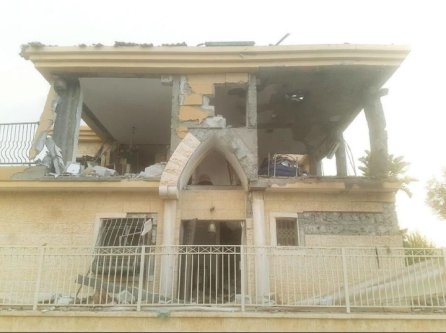
At 3:30 in the morning on Wednesday, a single mother of three boys, Miri Tamano woke up in Beersheva to a missile defence warning siren. In under a minute, she woke up her children and rushed them to a safe room just before the house was destroyed by a direct hit from a Gazan rocket.[1] The strike against the Tamano house was the last straw after days of escalating tensions along the Gaza border and the Israeli Air Force (IAF) retaliated by launching twenty strikes against Hamas affiliated targets in the Gaza Strip.[2] At first glance, this use of the IAF may seem similar to the many similar strikes Israel launched over the last decade. However, it may also be the beginning of a new air-centric response to Hamas rockets. What is most interesting about this potential change in approach is not the change in and of itself but rather the forces that drove it. Unlike many changes to operational approach, this one is not driven primarily by changes in the military operational environment or international political realities. Instead, the possible shift towards a new air-based approach and the new emphasis on the employment of the IAF stems from domestic politics and frustration with recent approaches to the problem of Gaza.
The home of Miri Tamano in Beersheba, damaged by rocket fire from Gaza. (Source: @IDFSpokesperson)
The IAF has always had a role in Israel Defence Force’s (IDF) retaliatory and deterrence operations. In the pre-1967 period, the IAF served as part of joint operations against Syria. In one famous incident on April 7th 1967, Syrian artillery strikes and small arms fires led to an escalation which eventually brought the IAF in to bomb Syrian positions and IAF fighters to clear the skies of Syrian aircraft. The goal of this operation was to establish deterrence along the Northern border. Here the IAF acted in concert and in support of ground force. Similar in 1970, the IDF called on the IAF to launch a major operation targeting Soviet Air Force units in Egypt. This operation followed a series of ground operations and sought to achieve a decisive blow ending the War of Attrition. This pattern continued through the 1980s when the IDF launched Operation Peace to the Galilee which sought (and to an extent achieved) a decisive defeat of the Palestine Liberation Organization (PLO) in Lebanon. Here again, Israel used air power in support of the ground offensive. In these instances and many others, IAF served as one aspect of joint retaliatory operations. More significantly the retaliatory operations either anticipated the coming of a decisive engagement (e.g. the 1967 War) or sought to be decisive by themselves – at the very least restoring credible deterrence.
Although, since the outbreak of the Syrian Civil War something resembling the classic pattern of deterrence operations continues on the Syrian border, the withdrawal from the Gaza Strip in 2005 changed the primary Israeli approach to establishing deterrence and seeking decisive victory. Since leaving Gaza as part of disengagement, the IDF has pursued a strategy of countering the hybrid threat through a concept often referred to as ‘mowing the grass.’ This concept has led Israel to five major ground operations in Gaza since 2006. At its heart mowing the grass is a concept for conflict management which buys time for an eventual political solution. Mowing the grass centres on the creation of deterrence and periods of quiet. In the concept when the adversary decides to escalate its level of violence Israel responds with restraint. As the adversary further escalates, Israel escalates its response. Eventually, the adversary crosses the threshold of tolerable violence, and Israel launches a major ground operation to severely punish the adversary and degrade adversary capabilities. This buys a period of calm which may last anywhere from several months to several years. However, almost invariably the same pressures which caused the adversary to escalate in the first place cause another escalation and the process repeats. In Gaza, this process has repeated itself several times resulting in Operation Summer Rains in 2006, Operation Hot Winter in 2008, Operation Cast Lead in 2008-2009, Operation Pillar of Defence in 2012, Operation Protective Edge in 2014, and it is now leading to a potential conflict in 2018.
Sites in the Gaza Strip targeted by the IAF on October 17, 2018. (Source: @IAFsite)
As a concept, mowing the grass recognises that defeating the enemy is next to impossible. In Gaza, Hamas is intertwined with Palestinian society and governance. For military planners mowing the grass means that there can be no decisive outcome. Hamas remained in government, the communities near Gaza could enjoy some calm, but invariably the threat would return, and the process would repeat. In Gaza, once escalation began, Israel would respond with warnings to Hamas, followed by more escalation and limited air strikes. This, in turn, would be followed by more escalation from Hamas and more significant air and artillery strikes by the IDF. As Hamas escalation continued, the IDF would build up ground forces near the Gaza border. Eventually, this process would lead to a limited incursion and then major ground operation by the IDF.
In the early stages of the escalation, the IAF played a messaging role indicating the seriousness of Israel’s intent and the willingness to escalate. As escalation continued the role of the IAF became a facet of joint operations aimed at reducing Hamas capabilities but never seeing a decisive victory. The final phase of these operations carries multiple political costs, both domestically and internationally. This phase inevitably causes more significant civilian and combatant casualties among the Palestinian population in Gaza which can be ‘expensive’ to Israel in the international community. The IDF has increasingly worked to distinguish between the two on the international stage, resulting in an associated media strategy that provides almost real-time footage of some parts of major Gaza operations.[3] To an Israeli domestic audience, mowing the grass is an acknowledgement of the inability of the IDF to bring victory or create lasting deterrence and the Israeli Government to achieve a lasting end state. Essentially as long as mowing the grass remained the central method of military response to the situation in Gaza, the Israeli public knew that every operation and the lives it cost only bought time until the next one required the same sacrifices.
Mowing the grass relies on a lawnmower powered by patience and societal tolerance for the costs associated with the approach. The capacity of the Israeli public to absorb the costs associated with mowing the grass also constrains Israel’s policymakers. As a conscript army that draws upon a relatively small civilian population, IDF casualties are seen by the majority of Israeli society as ‘our children,’ a notable departure from earlier Israeli generations’ perspective of seeing them as ‘a silver platter upon which the country was borne’ – a tragic but unpreventable loss for a greater good.[4]
Traditionally, as in the Four Mothers campaign to pull out of Lebanon in the mid-nineties, concern with casualties as a justification for limitation of military action was the province of Israeli left-wing political parties. The right-wing parties, like Prime Minister Benjamin Netanyahu’s Likud, also venerated soldiers but did not use the potential loss of life as a justification for reducing normative tactical options. Instead, right-wing politicians tended to emphasise the IDF’s role as protector of civilian life; frequently, centrist and right-wing governments were drawn into Gaza operations following public frustration with repeated terror strikes launched from within Gaza. Instead, Netanyahu is facing pressure from a different angle. The Israeli right-wing has grown stronger and particularly more popular with younger voters in the past two decades, and Netanyahu faces challenges from the right both in his own parties as well as from other right-wing parties that are natural and necessary allies in his ruling coalition. In the parliamentary system, a lack of confidence from within the coalition can collapse a government and bring about early elections that reshuffle the political balance of power.
One voice of opposition, former MK Moshe Feiglin signalled that Netanyahu’s right-wing might be losing patience with the ‘mowing the grass’ strategy. In an open statement to the press Wednesday, Feiglin wrote that ‘Victory is unconditional surrender! Don’t send a single soldier to his death for anything less than that.’[5] Feiglin went on to complain that as long as the government is ‘once again planning us a glorious defeat, just like previous iterations, a defeat that in the end leaves Beersheba a prisoner of Hamas,’ Feiglin’s faction will oppose any Gazan incursion ‘and the unnecessary risk to IDF soldiers.’[6] Feiglin’s comments reflect a growing frustration with what many Israelis see as a lose-lose strategy. The limited scale of the ‘mowing’ operations does not disable Hamas in the medium let alone long-term, meaning that Israeli civilians continue to live under the constant threat of rocket fire. While not entirely preventing rocket fire into Israel, Gaza incursion operations also incur high casualties from an Israeli perspective; 67 IDF soldiers were killed in Operation Protective Edge, a number surpassed this century only by the Second Lebanon War.[7]
Under these circumstances, air power seems like one of the only choices available to politically navigate the public expectation of responding to rocket strikes while also avoiding the lose-lose dynamic of the mowing-rocket cycle. Feiglin intimated as much, calling on the prime minister to avoid ‘once again sending soldiers to die in the alleyways of Gaza for a political performance of war.’[8] Should the escalation from Gaza continue, the domestic political situation provides Netanyahu few choices. He could continue with the old pattern of operations in which the IAF serves to signal escalation and then as part of the combined operation, but this would risk significant domestic fallout. The Prime Minister could seek a decisive engagement in Gaza in which the IAF would act to support the land campaign, but this would be militarily and diplomatically extremely difficult. Finally, he could find an option that achieves the effect of mowing the grass without the human cost. In other words, he could turn the main effort of the response to the IAF, with supporting effects provided by the navy and ground forces outside of Gaza.
Israelis view air power as relatively risk-free, and in fact, only one IAF plane and one helicopter have been shot down in combat in the last 20 years, resulting in five deaths and two injuries. By relying more heavily on an air response, Netanyahu can avoid criticism for ‘wasting’ IDF soldiers on an operation that yields little clear take-home in the eyes of his voters. This changes the balance between the IAF and the other tools of military power and may drive Israeli engagement to air-centric approach. For this to work, the IAF will have to launch more strikes than in previous engagements. No longer part of a joint plan, the IAF will shoulder the responsibility for inflicting most of the cost on Hamas. By attempting to win an operation through the air alone, the IAF returns to an almost Douhetian concept of operations. As Israel, discovered in the 2006 Lebanon War this approach is not without problems. Among other challenges, it encounters questions as to what happens if the IAF completes its target list without achieving the war aims. The presence of ground forces has traditionally stimulated the exposure of new targets for the IAF allowing it to increase the efficacy of its strikes. Without such multi-domain cooperation, the target list may be far more limited.
What is significant then about the potential turn towards an air-centric approach is that it stems not from military or operational necessity but from domestic politics. This may be familiar to US and European states, but it is new for Israel. Even if this current period of increased conflict in Gaza ends with a ground operation or before one is necessary the change in the conversation on such operations will have a dramatic effect on the IAF and Israel’s thought about air power. For Netanyahu or any subsequent Prime Minister, until Israel develops a new approach to Gaza, an IAF centric approach will be at the forefront of consideration. This pushes the IAF into a new concept of operations and turns it from a critical supporting aspect of the IDFs total war package into the lawn mower of choice.
Dr Rebecca Shimoni-Stoil is a former NCO in the Israel Defense Forces, where she served as a combat medic and medical platoon deputy commander in the 9th Battalion of the Armored Corps. As a reservist, Shimoni-Stoil was a heavy search and rescue medic with the Home Front Command, mobilising in the Northern Sector during the Second Lebanon War. In her military capacity, she served in and around Gaza. After leaving her regular service, Shimoni-Stoil was hired by the Jerusalem Post and served in several capacities eventually being appointed the newspaper’s Internal Security correspondent. It was in this position that she covered both the increase in tensions and rocket attacks along Israel’s southern border with Gaza as well as the opening weeks of the Second Lebanon War. She later served as the Knesset [Parliamentary] Correspondent before becoming the Washington Correspondent for Times of Israel. Dr Shimoni-Stoil is now a lecturer in history at the Loyola University of Maryland. She has appeared as a commentator on radio and television channels worldwide and written for 538.com. She can be followed on twitter @RebeccaStoil.
Dr Jacob Stoil is an Assistant Professor of Military History at the US Army School of Advanced Military Studies where he serves as the author for the course ‘Anticipating the Future’. He is the Deputy Director of the Second World War Research Group for North America. Stoil holds a PhD from the University of Oxford, and an MA and BA from the Department of War Studies at King’s College London. He has research experience carrying out fieldwork in both Israel and the Horn of Africa. His most recent publications include ‘Command and Irregular Indigenous Combat Forces in the Middle East and Africa’ in the Marine Corps University Journal, and ‘Martial Race and Indigenous Forces’ in Rob Johnson (ed.), The British Indian Army: Virtue and Necessity (2014). Additionally, he has authored analysis of contemporary operations and policy for the Journal of Military Operations, War on the Rocks, and From Balloons to Drones. Most recently he published an article on the spread of vehicle ramming attacks through West Point’s Modern War Institute and has a forthcoming in Le Vingtième Siècle article on indigenous forces in Palestine Mandate. He can be reached on twitter @JacobStoil.
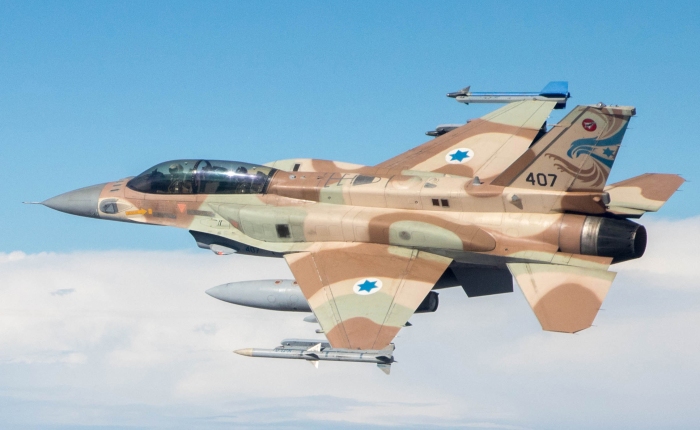
Header Image: Israeli Air Force F-16I (Source: Wikimedia)
Disclaimer: The opinions and conclusions expressed herein are those of the authors and do not necessarily represent the views of the U.S. Army Command and General Staff College, any other government agency, or any institution.
If you would like to contribute to From Balloons to Drones, then visit our submissions page here to find out how.
From the British conception of air policing to the myriad of coalition air assets deployed as part Operation Inherent Resolve, counterinsurgents have enjoyed their ability to be the sole force in skies and the plethora of benefits that brings. Throughout late 20th and early 21st century, there have been rare instances where insurgents have tried to either contest this or at the very least exploit the air domain for their operations. These include the development and deployment of the ‘Air Tigers’ of the Liberation Tigers of Tamil and Eelam (LTTE) and the more recent use of small unmanned aerial vehicles (UAVs) and unmanned combat aerial vehicles (UCAVs) by a host of actors including ISIS and Hezbollah. LTTE’s attempts were largely ineffective, and ISIS’s small UAVs have been only deployed for tactical effects. Assumedly developing a counter to this ISIS threat will be part of the broader effort to deal with the UAV threat writ large. In Gaza, Hamas has developed something different and is going back in time technologically to exploit the hybrid space and launch an air campaign.
In late May 2018 Israeli security forces identified an explosive-laden UAV launched by one of the militant groups from the Gaza strip. In the same month, the Israeli Air Force (IAF) destroyed a Hamas base containing unmanned underwater vehicles. Both these capabilities while impressive represent an evolution of what combatants have already observed the world over. Militant groups increasingly have the capabilities to employ low-cost unmanned systems in a variety of domains. The interesting evolution out of Gaza strip is not the use of advanced technology by militant groups but a return to simple and cheap solutions.
Over the past month, militants in Gaza have launched numerous strikes using incendiary devices attached to kites and balloons. These devices come in several forms; some are kites released on to the wind current carrying flaming material and accelerant dangling from a rope. Others are helium balloons (or helium-filled condoms) with trailing flaming materials and accelerant. Although there are variations most of these carry metallic mesh pouches contacting burning oil-soaked rags or coal. These take advantage of the dry summer conditions in Southern Israel to spark fires out of proportion to the amount of accelerant. In addition to these, there are varieties with small impact based explosive devices attached and more recently explosive devices designed to litter the ground.
This is the past returning. During the Second World War, the Japanese military was unable to bomb the mainland US and turned to balloons with incendiary devices as an attempt at a solution. By 20 June 2018, 75 days of balloon and kite attacks had seen over 700 attacks which burned over 6,100 acres of primarily agricultural land causing millions of dollars of damage. For Israel damage to its agricultural sector presents a serious threat given the relatively small amount of arable and pasturable land.
An Iron Dome battery at Ashkelon, c. 2011 (Source: Wikimedia)
The balloon and kite launched devices present significant challenges to the Israeli military (IDF). Due to their low signature, they are harder to detect than UCAVs. Unlike rockets and mortars, they do not follow a set trajectory making counter battery fire more difficult. They are cheap and therefore employing short-range air defence such as Iron Dome makes little sense. The helium-filled condoms which trail burning liquids or rags may only cost as much as the helium (condoms are distributed in Gaza by the Palestinian Authority and international NGOs) while Iron Dome costs near $100,000 per launch. Other forms of Counter Rocket Artillery and Mortar systems rely on a more prominent radar profile and are designed for point defence not protecting a whole broader.
The biggest challenge they pose may result from their place in the narrative domain. Often launched by teams including children, balloons and kites do not seem as threatening as other, more significant, more conventional types of attacks. Targeting those who launch them with lethal force would likely play poorly in the media and the international community overall. Unlike rockets and mortars, kites, and balloons – no matter the threat they may pose – are not often thought of within the panoply of tools of war. In this way, they are emblematic of an entire strategy – namely causing as much strategic threat as possible while remaining below the threshold of escalation. In his 1991 book The Transformation of War, Martin van Creveld identified the challenge this strategy poses to conventional state militaries stating: ‘Since fighting the weak is sordid by definition, over time the effect of such a struggle is to put the strong into an intolerable position.’[1] The kite and balloon attacks represent a new form of air power for insurgent groups which takes advantage of exactly this dynamic. As of now these attacks also provide a narrative victory to the militant groups allowing them to showcase in video and photo their ability to reach out and attack Israel. If the success of the balloon and kite attacks continues, we can safely assume they will spread. The more they are featured in regional media and militant media the more likely this is to happen.
So what options exist to counter this counter this new aerial threat? Thus far the IDF has looked to technological solutions deploying cheap commercial UAVs to bring down the kites and the balloons through physical contact. The Israeli public broadcaster Kan reported that this has had mixed results. The IDF has recently deployed a new system called Sky Spotter. The IDF employs this electro-optical system, to identify and provide an alert of incoming attacks mitigating the damage caused. Sky Spotter also serves to guide defenders to the incoming targets. There are plans to equip Sky Spotter with a laser system or to the ability to autonomously vector mini-UAVs. In the meantime, with an increase in the threat, some Israeli officials have suggested targeting those launching the attacks, and the IAF has begun firing warning strikes near those launching the attacks. As previously noted this tactic is rife with problems.
Another possible solution might be retaliating against targets and in doing so establishing deterrence. Although this might work in the unique operating environment of Gaza it is doubtful it would be as possible if another insurgency adopts this new use of air power globally. Just as lookouts may be more useful for identifying incoming attacks from balloons and kites than more high-tech radar, so too might defeating the threat requiring an examination of the past for inspiration. In the past, the best air defence consisted of layers of surface to air missiles (SAMs) and gun systems. These balloon and kite attacks exploit the intellectual and perhaps, even technical space, below the threshold for the employment of SAMs. Kites and balloons are vulnerable to gunfire and integrating rapid firing weapons aimed and operated by humans might provide a solution to this threat. Even this is not without problems as it potentially risks causing inadvertent casualties due to inaccuracy. Regardless, until a solution is found, it is likely insurgents will continue to exploit the air domain not only by developing drones but by evolving from drones to balloons.
Dr Jacob Stoil is an Assistant Professor of Military History at the US Army School of Advanced Military Studies where he serves as the author for the course ‘Anticipating the Future’. He is the Deputy Director of the Second World War Research Group for North America. Stoil holds a PhD from the University of Oxford, and an MA and BA from the Department of War Studies at King’s College London. He has research experience carrying out fieldwork in both Israel and the Horn of Africa. His most recent publications include ‘Command and Irregular Indigenous Combat Forces in the Middle East and Africa’ in the Marine Corps University Journal, and ‘Martial Race and Indigenous Forces’ in Rob Johnson (ed.), The British Indian Army: Virtue and Necessity (2014). Additionally, he has authored analysis of contemporary operations and policy for the Journal of Military Operations, War on the Rocks, and From Balloons to Drones. Most recently he published an article on the spread of vehicle ramming attacks through West Point’s Modern War Institute and has a forthcoming in Le Vingtième Siècle article on indigenous forces in Palestine Mandate.
Header Image: A missile from an Israeli Iron Dome, launched during the Operation Pillar of Defense to intercept a missile coming from the Gaza strip, c. 2012. (Source: Wikimedia)
Disclaimer: The views presented here do not represent those of any contributors employer, funder, or government body.
If you would like to contribute to From Balloons to Drones, then visit our submissions page here to find out how.
[1] Martin van Creveld, The Transformation of War (New York: The Free Press, 1991), p. 176.
With eyes pinned on Europe´s eastern frontier, it has never been more critical to have the means to reduce tensions between key NATO allies and Russia. Are there ways to help lessen costs that come with such an undertaking?
An air-to-air image taken over Baltic airspace by the crew of an RAF Typhoon, intercepting Russian Mikoyan MiG-31 aircraft. (Source: Defence Imagery MoD) As part of NATOs ongoing mission to police Baltic airspace, RAF Typhoons intercepted 10 Russian aircraft during a single Baltic Air Patrol, QRA (Quick Reaction Alert) mission.
According to reports, Russian aerial platforms increasingly violate the airspace of its western neighbours, which is generating considerable unease. While NATO is responding routinely by intercepting the invading aeroplanes and increasing the presence of its combat troops on its eastern flank (four battalions stretching from Poland to the Baltic), a question has arisen over whether or not it is possible to beef up defences in Eastern Europe, while de-escalating tensions. Russian officials consistently say that NATO was responsible for openly displaying its anti-Russian intentions by deploying forces in Poland and the Baltic States.
However, NATO’s recent creation of a new Atlantic command and logistics command, with additional reports showing that since the end of the Cold War the alliance has never actually prepared for the deployment of combat troops on its eastern flank, is thus an implicit admission that NATO is not in a position to deploy large-scale forces the way Russia can. In particular, Russia is paying close attention to the defence of its airspace and has made plans to increase its air defence capabilities, to prevent violations. Meanwhile, NATO lacks both combat aircraft and short-range air defences. According to a report issued by the RAND Corporation, If Mr Putin opts to launch a land grab against the Baltic States, his forces could occupy at least two Baltic capitals within 60 hours.
Although the utmost effort should be taken to de-escalate and resolve the current crisis, preparations are necessary to maintain a state of deterrence against Russia, while also reassuring ‘front-line’ members, i.e. Poland, Estonia, Latvia and Lithuania. Deploying squadrons of UAVs (unmanned aerial vehicles) provide several key benefits: They offer credible ISTAR (information, surveillance, target acquisition, and reconnaissance) and strike capabilities, which help maintain a level of deterrence, but will not pose a threat or spark offensive actions by the Russians.
Drawing upon a study that examined among other things, the rapid expansion of Israeli Air Force (IAF) squadrons in response to unforeseen needs following the outbreak of the Second Intifada, a committed effort by NATO to amass six to eight armed UAV squadrons (each with 20-24 platforms) over a period of two years should be both feasible and more cost-effective than deploying conventional forces. The recent difficulties in mobilising and deploying a mere 4,500 troops to NATO’s eastern flank indicates that the alliance has a shortage of both combat troops and political capital to enhance recruitment among member states.
An RAF Reaper at Kandahar Air Base, Afghanistan, c. 2014 (Source: Defence Imagery MoD)
In contrast, turning to unmanned, increasingly autonomous platforms as the first line of defence could not only (at least in the first instance) rely on existing infrastructure (e.g. air force bases, communication infrastructure etc.) but would also sit better with electorates reluctant to send troops to allies in Eastern Europe. Politically, member states probably would be far more willing to finance the acquisition and maintenance of UAVs squadrons by local teams. This would also help solve the issue of mobilisation as was demonstrated with NATO’s brigades. UAVs can help realistically build deterrence and even if there are failures, or even if half of the squadrons are destroyed, no lives, i.e. aircrews, would be lost.
Relations between Russia and the West are in a poor state, and tensions continue to escalate. Those member states who oppose the increased deployment of combat troops and the build-up of more offensive capabilities (e.g. tanks or jet fighters), could be more receptive to opting for cheaper solutions, which negates the need to deploy military personnel. The fact remains that Europe needs better deterrence in the face of Russian aggression. Therefore investing in unmanned autonomous systems, would go some way in providing, the security and surveillance that will be crucial in the years to come.
Emily Boulter is a writer based in Switzerland. She is the creator of the current affairs blog ‘From Brussels to Beirut.’ From 2010 to 2014 she worked as an assistant to the Vice-chair of the Foreign Affairs Committee in the European Parliament. She is a frequent contributor to Global Risk Insights.
It has just been over a year since From Balloons to Drones was established as a platform for the discussion of air power broadly defined. Since our first post, we have published 40 pieces on a variety of subjects ranging from the historical to the contemporary. We have had articles dealing with issues related to the efficacy of air power, the topic of military education and the future of air power. We have also recently started a new series, Air War Books, that explores the books that have influenced air power writers. Contributors have come from around the globe including contributions from Finland and Australia. I am grateful to those who have contributed to the site. Without them, there would not be much here. However, most of all, we have received regular traffic from people interested in reading what we have written, and for that we are grateful.
Just as a bit of fun, here are the top five posts by views:
These are just a selection of the articles that have appeared over the past year, and we look forward to adding regular content as we continue to develop. To do this, we need to expand our list of contributors continually and if you are interested in writing about air power issues – both historical and contemporary – then you can find out how here. If you have any questions, then please leave a comment here or emails us at airpowerstudies@gmail.com.
Header Image: English Electric Lightnings of No. 56 Squadron RAF during an Armament Practice Camp at Akrotiri, c.1963. In the foreground, a technician is preparing a Firestreak missile for loading. (Source: Defence Imagery MoD)
Reports in the Sunday Times and other newspapers this weekend have highlighted a number of familiar issues in defence acquisition. Tales of gold-plated requirements, service chiefs ‘gaming’ the system to get preferred projects funded, and delays are familiar ones stretching back over decades.
While some of these issues raised in the press reflect aspects of reality, a vital part of the story is missing. This is the withering away of the vital ability of the services and industry to work together on a project using the language of design. This stretches back to the mid-1980s, when Michael Heseltine brought an industrial figure, Peter Levene, into the Ministry of Defence to head its procurement division. This was seen as a radical challenge to the defence establishment at the time, in line with the Thatcher government’s policy of bringing entrepreneurs from the private sector into government to gain efficiency savings.
There is a history of private business people attempting to shake up defence acquisition. In the 1960s, the Kennedy administration brought Robert McNamara in from the Ford Motor Company as United States Secretary of Defense. In the 1970s and 1980s, David Packard, of Hewlett-Packard fame, was similarly used to introduce private sector practices to the US Department of Defense’s acquisition projects.
This approach has a mixed track record on both sides of the Atlantic. The introduction of competition and a reduction in single-service projects saw some benefits in the US and the UK. However, the introduction of taut, arms-length contracts and competition broke the links that allowed design teams in industry to speak openly to the military requirements writers. Allied to the privatisation of the state-run research establishments, which provided advice and assessment on requirements and designs, this led to a lack of communication across the acquisition process. A taut contract is no replacement for informed dialogue.
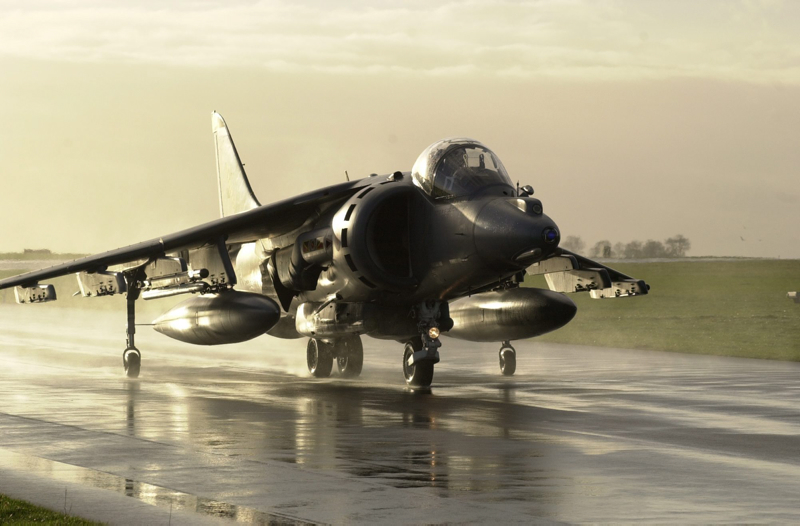
A British Aerospace Harrier GR7 as used by the RAF. (Source: Defence Imagery, MoD)
A good example of how this dialogue leads to success is the Harrier ‘jump jet’, a highly risky technical concept. Starting as a private design by industry in the 1950s, it was refined with support from the research establishments before it was adopted for service by the UK and US armed forces. Flying prototypes before a final requirement was written meant that when it entered service, the project was on time, on cost and met almost all specifications; one small shortfall in manoeuvrability was discussed as not worth the cost to fix. The success of the Harrier in the Falklands in 1982 showed that this was the right decision. The shared language of design, spoken openly between MOD and industry, led to the Harrier’s success.
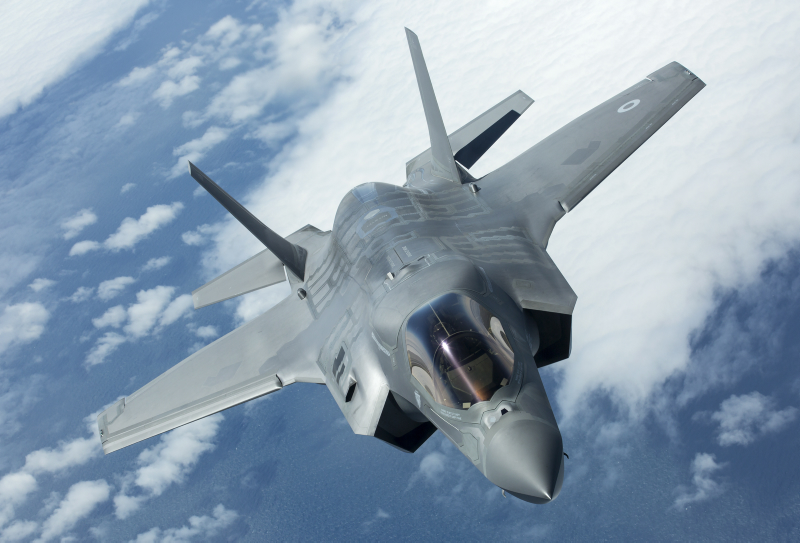
The first of the UK’s F-35B Lightning II jets to be flown to the UK in 2016. (Source: Defence Imagery, MoD)
In 1985, the Harrier’s original designer, Ralph Hooper, retired, the same year that the Levene reforms started to end the ability of designers to develop new projects while talking openly to requirements writers and technical experts. Instead, a contract that defines roles and responsibilities is expected to lead to success. However, it is hard to see any examples of this working in the years since – for example, the Harrier’s successor, the F-35B Lightning II, has yet to replicate its record of delivery on time or cost.
Ralph Hooper originated the Harrier design out of a sense of idle interest. The project was, as he says, the product of a lot of people. The first contract for the aircraft came when the prototypes were being built, having proceeded with a ‘nod and a wink’ from the government. The trust engendered by having all those involved in designing a complex system in industry, the services and the government able to discuss design openly are a continuing need for successful defence acquisition. That we no longer do this, due to competition and contracts, lies at the heart of the issues reported in the press over many years, not just one weekend.
Dr Michael Pryce is a Lecturer in Defence Acquisition at Cranfield University. He leads the Low Cost by Design research network that explores the role of good design in defence acquisition.
Header Image: Harriers from Joint Force Harrier lined up following a ceremony to mark the retirement of the famous aircraft after 41 years of service. (Source: Defence Imagery, MoD)
In the past couple of days, several sources have reported on the fact that in 1986, the US President, Ronald Reagan, offered Britain the opportunity to co-operate on stealth technology and purchase the Lockheed F-117 Nighthawk. Details of the project, codenamed MOONFLOWER, have become known through the recent release of files by the British National Archives. This release is part of the material coming out of the Prime Minister’s files for the 1980s and the specific reference for MOONFLOWER is PREM 19/1844. An important issue to note with these files is that they have not been digitised and were opened just before the New Year. This is an important consideration when reading many of the reports on the internet as it is probable that the one in The Guardian – from which most derive – has only cited certain parts of the file. Indeed, I have not read the file yet.
The F-117 remains one of the most iconic aircraft of the latter part of the Cold War. Publically announced in 1988, the F-117 emerged from Lockheed’s Have Blue project and was developed by the company’s Skunk Works division. The F-117 was first operationally used in the US invasion of Panama in 1989, but it was during Operation DESERT STORM that it rose to prominence. During the 1990s and 2000s, the F-117 was used in other conflicts, and one was shot down in 1999 during Operation ALLIED FORCE, and it was eventually retired in 2008.
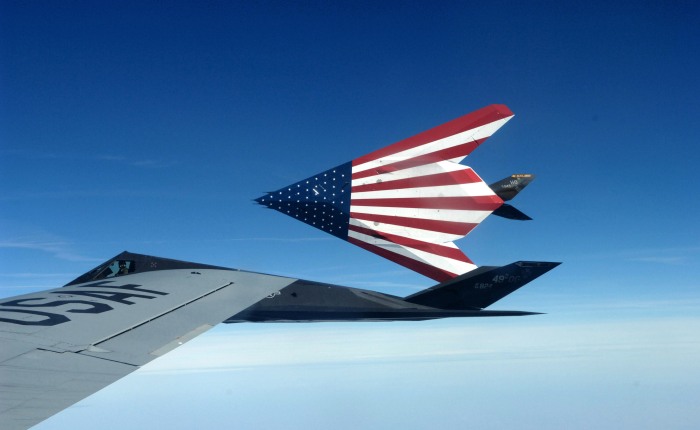
A USAF F-117A Nighthawk flies over Nellis Air Force Base during the joint service experimentation process dubbed Millennium Challenge 2002. (Source: Wikimedia)
What appears to have got people talking is the fact that Britain was offered the F-117 at a time when it was still officially a ‘black’ project i.e. before it existence was officially acknowledged. Moreover, according to the various reports, the key reason that Britain did not pursue purchasing the F-117 was for this very reason. However, while this may be one reason for rejecting the F-117, it should be noted that while the release of British files is interesting, this is not strictly a new story, though it is potentially a new dimension. Several histories of the F-117 cite the fact that in 1986, several Royal Air Force (RAF) test pilots were sent to fly the aircraft. For example, Paul Crickmore reflected that the RAF ‘had its chance to evaluate the F-117’ as a thank you for British support of Operation EL DORADO CANYON.[1] However, what these secondary sources lack is the archival evidence to understand why the evaluation took place. It is probably – though I would not like to say for certain until I see the file – that this assessment formed part of this project.
As already noted, the reason cited in the reports for the RAF not purchasing the F-117 was the ‘black’ character of the project; however, I have to wonder how well this aircraft would have fitted into the Service’s force structure and concept of operations in the 1980s. Moreover, it will be interesting to see if anything more is mentioned in the file as to why the F-117 was not purchased. Nevertheless, a few issues come to mind that may have been challenges. First, the RAF operated at low-level in small packages, and I am unclear how the F-117 would have fitted into this concept of operations. Second, by 1986, the RAF was in the middle of purchasing the Panavia Tornado that had been designed for the low-level role, as such; again, what additional capability the purchase of the F-117 would have added to the RAF at this point remains unclear. Finally, there is the issue of numbers. The F-117 was never built in significant numbers, and it seems unlikely that the RAF would have bought more than the United States Air Force, as such, again, what additional capability would the addition of a highly complex piece of equipment have added to the RAF? Yes, it would have added a stealth capability but this needs to match a concept of operations, and in my mind, this remains a murky area. As such, this is more an interesting example of the so-called ‘special relationship’ rather than a significant ‘What-If’ for the RAF.
This is not, however, where the story ends as in 1995, Lockheed once again tried to sell the RAF an improved F-117 that included locally produced content, such as GEC-Marconi supplied avionics.[2] This approach was in response to the RAF’s Staff Target (Air) 425 that had began the process of looking at replacing the GR4 variant of the Tornado, which became known as the Future Offensive Air System (FOAS). FOAS closed down in 2005 and aspects were rolled into Future Joint Combat Aircraft project that has seen the purchase of the Lockheed Martin F-35 Lightning II – an aircraft with a stealth capability.[3]
Dr Ross Mahoney is an independent historian and defence specialist based in Australia. Between 2013 and 2017, he was the resident Historian at the Royal Air Force Museum, and he is a graduate of the University of Birmingham (MPhil and PhD) and the University of Wolverhampton (PGCE and BA). His research interests include the history of war in the twentieth and twenty-first centuries, air power and the history of air warfare, and the social and cultural history of armed forces. To date, he has published several chapters and articles, edited two books, and delivered papers on three continents. He is a member of the Royal Historical Society and is an Assistant Director of the Second World War Research Group. He is a member of the Royal Historical Society and an Assistant Director of the Second World War Research Group. He can be found on Twitter at @airpowerhistory.
Header Image: A pair of specially painted F-117 Nighthawks fly off from their last refueling by the Ohio National Guard’s 121st Air Refueling Wing, c. 2008. (Source: Wikimedia)
[1] Paul F. Crickmore, Lockheed F-117 Nighthawk Stealth Fighter (Oxford: Osprey Publishing, 2014), p. 26.
[2] Guy Norris, ‘Lockheed Martin targets RAF and USAN for F-117,’ Flight International, (28 June to 4 July 1995), p. 4.
[3] Louisa Brooke-Holland, ‘The UK’s F-25 Lightning II Joint Strike Fighter,’ Standard Note (SN06278) UK House of Commons Library, (6 February 2015), pp. 5-6.
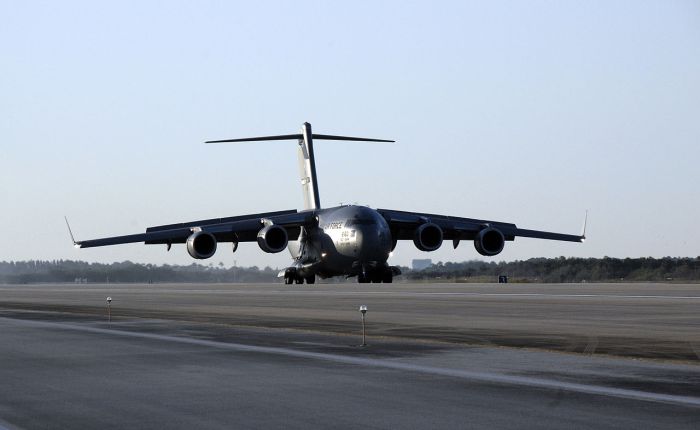
In airlift terms, the C-17A Globemaster III has arguably made the biggest single impact to Western Air Forces in the 21st Century thus far – and will likely hold this claim for the next decade. While it was conceived for the United States Air Force in the 1980s and introduced to service in the 1990s, its acquisition by nations including Canada, Australia, and the United Kingdom has given Western Air Forces its first real appreciation of modern strategic airlift. For the USAF, which arguably wrote the book on strategic military airlift, has also benefited significantly from the C-17A’s tactical airlift talents. Elsewhere, the aircraft has been capitalised upon by NATO, India, the UAE, Qatar, and Kuwait.
A big jet that can fly from little airfields (Source: RAAF)
With the production line closing in 2015, it is unlikely that we will ever see new Globemaster airframes constructed beyond the 279 that were delivered by McDonnell Douglas/Boeing (and indeed, a small number have been relegated to a museum or lost in an accident). This is not to say that we will not see new C-17 variants, especially if the Globemaster lives to see service past 2040, half a century after its first flight. Getting the airframe to that point (and beyond) however, will require careful attention and development.
Certainly, the C-17A has been no stranger to being developed over its 25-year history thus far. With a production spanning 15 years, older C-17As have been upgraded to match their newer kin with radios, weather radar, and combat lighting. A centre wing fuel tank was fitted to C-17As constructed after 2001 to extend the aircraft’s range, and in recent years, aircraft have been equipped with Large Aircraft Infrared Countermeasures and improved communications systems. Early Block Upgrades to the C-17A addressed design flaws in the original production aircraft – more recent ones have addressed issues of obsolescent aircraft systems and ensured fleet commonality.
How else might we see the C-17A mature in the next 30 years?
Minimalist Change
Numerous aircraft go through their service career with modest increases in capability to allow them to continue in their intended role. Indeed, it is arguable that the C-17A has maintained this track to date with the changes it has undergone thus far. The purpose of such upgrades are not so much to advance the aircraft beyond the original design intent, but more to ensure it remains compatible with current/immediate operating practices and airborne environments. Compatibility with any new Identification Friend or Foe (IFF) or battlespace networking systems, or global air traffic control management systems, are examples of this.
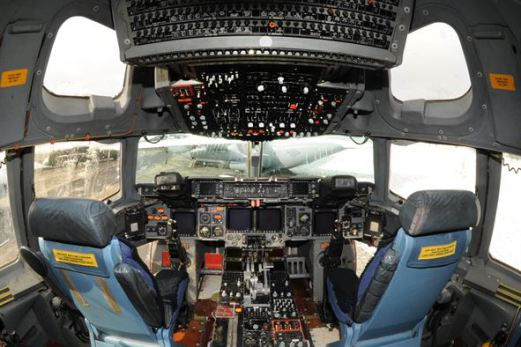
An office from a simpler time. (Source: USAF)
The aircraft’s cockpit ergonomics are still reminiscent of its early 1990s design, so it is not unreasonable to expect a countermeasures Mid-Life Update program that would improve the quality of cockpit displays, communications management, and other avionics. Newer airlifters such as the C-130J and A400M are equipped with larger HUD units and displays that can incorporate digimaps or other navigational data. A precedent for upgrading the C-17A exists, whereby old air mobility platforms (including the C-130H, KC-135 and C-5) have replaced their ‘steam gauge’ instruments and analogue controls with LCD screens and digital displays. Replacing these systems means eliminating obsolescence and ensuring the cockpit ergonomics have greater commonality with the wider air mobility and training fleet, and potentially improving the ease with which software updates can be applied to the aircraft.
Slightly More Ambitious Options….
The upgrades mentioned above were in large part to ensure the C-17A maintained pace with its operating environment. More ambitious upgrades, however, would provide new ways of performing its current mission. Evidence exists within existing air mobility platforms like the KC-135, which has been upgraded with navigation systems that now allow the aircraft to operate without a Navigator.
How could this apply to the C-17A? It is hard to judge this, as it is largely contingent on the technology that will be available to us in the next 15 years. It is easy to imagine a technology that has been applied to the A400M and C-130J being rolled out on the C-17A. It is harder to imagine the impact that newer and emerging technology – such as helmet-mounted displays, external sensors, and personal devices – will have. New tactical airlifters benefit from infrared cameras that allow landings to be comfortably made of poor visibility conditions. Whether such technology has an application on the C-17A remains to be seen.
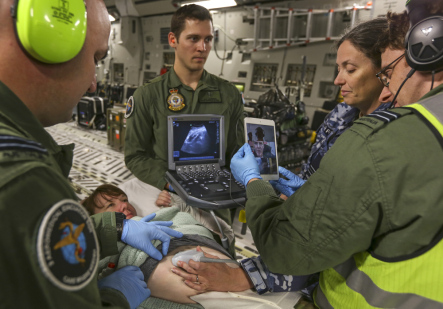
Technology is finding its way on board, regardless. (Source: RAAF)
Likewise, the C-17A was revolutionary for its time by its use of a dedicated loadmaster station inside the cargo hold, a feature which has been capitalised by other airlifters. A future C-17A upgrade might extend on this further, allowing the loadmaster to control environmental conditions and cargo locks in the cargo hold with a personal electronic device, or direct automated aircraft loading equipment.
The High-End Option
High-end changes are easy to debate, being linked to systems on the aircraft that will become wholly inefficient or unsustainable during the aircraft’s life-of-type. These changes would be sufficient to mean the end of the C-17A as we know it today, delivering us a noticeably different aircraft – a C-17B or C-17C, for example.
Again, existing examples allow us to make educated guesses about the future, not only about the systems that are applied and upgraded but the causes for doing so. The C-5M Super Galaxy is the product of a program upgrade older C-5As and Bs with new engines, new avionics, improved cargo ergonomics, and most importantly, greater aircraft reliability. It essentially brings an aircraft design whose systems have their roots in the late 1960s and gives a 21st-century solution. The net result is a Galaxy with a shorter take-off distance and better climb rate, as well as extended range. While the C-17A is reliable now, we can expect to question its relative performance in the future, especially if the expectation is for the aircraft to beyond a 30-year lifespan. Upgrading the C-17A could prove less expensive than embarking upon an all-new airlift replacement, too.
Achieving this could take some paths. Replacing the engines on the aircraft, especially in light of advances in civilian airliner power plants, would be the most obvious choice. It could yield a Globemaster that is more fuel-efficient or carries heavier payloads, and the C-17A’s existing power plant – the Pratt & Whitney F117 – is a militarised version of the turbofan that powers Boeing 757s. One issue here, however, is that C-17A engines are required to perform across a different spectrum than a stock civilian airliner. This means a simple transplant of a civilian power plant will not likely address the C-17A’s performance needs.
Another potential upgrade could be to the C-17A’s winglets, which were revolutionary for their time in 1991. This feature improves the wing’s performance, reducing drag and improving fuel efficiency in a cruise. Today, the C-17A’s winglets appear clunky in comparison to modern airliners which possess ‘blended winglets’ that enhance fuel burn. Ensuring the Globemaster can cruise efficiently, extending its range and lowering its operating costs, are likely to be a significant consideration for how the aircraft is upgraded into the future.
Other considerations for a potentially major upgrade to the Globemaster might include those options put forward by Boeing during the late 2000s to improve the aircraft’s tactical performance. Considerations for the ‘C-17B’ including a new higher thrust powerplant, double-slotted flaps, additional centre-line landing gear, and precision landing systems. Arguably, the additional weight of some of these systems would come at a cost to the aircraft’s range and cruise efficiency. On the other hand, a sub-fleet of C-17s optimised for tactical performance to deliver payloads that can not be accommodated in a C-130 (and are unable to be transported over long ranges by future heavy vertical lift)
A C-17 performs evasive counter measures by launching flares during a Mobility Air Forces Exercise over the Nevada Test and Training Range on 16 November 2011, (Source: Wikimedia)
Examining options for the Globemaster’s future may see it called to perform roles that are well outside the traditional airlift roles that the aircraft performs today. Few would argue that the C-17A’s talents are best applied to providing dedicated strategic and tactical airlift. The external surfaces of a C-17A, however, provide significant ‘real estate’ for discrete sensors and antennas, and the aircraft’s interior likewise has space that would allow it to fulfil support functions for C4I and ISR – especially if the terminals for such roles are significantly smaller and modularised, contrasting with the fixed workstations that fill C-135 and Boeing 707 variants operated by the USAF. Today, other platforms (such as those based on commercial airliners) might conceivably fulfil this role more efficiently and effectively than a Globemaster. However, future requirements – especially those that call for an aircraft to deliver personnel and vehicles, then remain near provide immediate support – might dictate that the C-17 is the aircraft for the job.
The last consideration for the Globemaster receiving a ‘high-end’ upgrade is that it might pick up new roles not even in service today. The aircraft has been mooted as a potential ‘Drone Mothership’ in a battlespace, deploying them to perform a range of ISR, attack, and strike missions. Alternatively, the C-17A’s cargo bay has considerable space for batteries and other systems that would employ high-energy weapons.
Where the Globemaster ultimately fulfils any of these roles is anyone’s guess – while the technology is being developed, it is by no means about to be applied to the C-17A. Once said technology is mature, there are no guarantees that the C-17A will be the best jet for the job.
The Likely Options
At a minimum, progressive upgrades will need to be applied in the future to ensure the C-17A can continue to be operated. The crew stations are likely to be developed over time, as are the aircraft’s avionics, communications and networking systems. Foreign operators should bear these developments in mind – on the one hand, the upgrading of their aircraft is likely to have a greater impact on the number of aircraft they have available. On the other hand, such programs are an avenue for them to suggest development roadmaps that can be shouldered by Boeing and USAF. Exploring these avenues, however, would have to be a modest process. However, it is unlikely that an entirely new C-17 variant will be developed if only one smaller operator is guaranteed to require it.
With that in mind, the Globemaster’s future development is likely to be informed by three things – keeping the airframe viable, the USAF’s appetite to embark on upgrade programs, and Boeing’s willingness to provide options. Lockheed Martin’s C-5M program provides an excellent example of where the C-17A can go with such updates, replacing aircraft structures and systems that have become tired and unreliable while also meeting demands of the customer to capitalise on generational changes in engine, avionics, and ergonomic technology. Indeed, the C-5M in some respects feels like it carries some of the best features of a C-17A (except the HUD and fighter control stick).
Everyone has an embarrassing childhood photo. (Source: USAF)
Strategic airlift development, however, emphasises the importance of cruise efficiency and performance, which is often largely dependent on reductions in the aircraft’s weight and improvements in a power plant. Such upgrades are easy to forecast in the C-17A’s future. The more ‘creative’ upgrades for the Globemaster will be in how it is required to perform tactical roles in future – or approach brand new problems.
Eamon Hamilton graduated from the University of Western Sydney with a Bachelor of Communications (Journalism). He works as a Public Affairs Officer for the Royal Australian Air Force. He lives in Sydney. He runs the Rubber-Band Powered Blog and can be found on Twitter @eamonhamilton.
Header Image: A C-17 arrives with GEOS-O on board at the Shuttle Landing Facility. (Source: Wikimedia)
In a recent piece for The Central Blue, the blog of the Sir Richard Williams Foundation in Australia, Robbin Laird has suggested that rather than describing the F-35 Lightning II as a 5th Generation aircraft, we must think of it as ‘a first generation information and decision making superiority “flying combat system”.’[1] (Emphasis in original)
Arguably, this is an important shift in how we think about the capabilities of this new platform and the implications this has regarding how we think about air power. However, this labelling of platforms and capabilities raises several interesting observations and what follows are some personal opinions on the issue of ‘labels.’
First, and while we should always be careful of generating faulty parallels, as a historian, I am quite certain I have heard similar phrases before namely Giulio Douhet’s ‘battleplane’ concept. In short, in the second edition of his seminal work Command of the Air, written in 1926, Douhet argued that the roles of combat and bombing should be combined with a single type of aircraft, the ‘battleplane.’ This was a move away from his thinking outlined in the 1921 edition of Command of the Air, but as Thomas Hippler has noted, at a conceptual level, the ‘battleplane’ was important because it allowed Douhet to reconcile the ideas of war in the air and war from the air.[2] For Douhet, both were synonymous and one, though whether this proposed platform would have solved that challenge remains debatable. This was clearly a lesson derived from Douhet’s views of the First World War. Nevertheless, the problem with the ‘battleplane’ idea is that it was a solution to one set of circumstances and would not have applied to all situations where the use of air power might have been called upon. Could we end up in the same situation if we think of the F-35 in a similar vein?
Second, a broader issue with Laird’s description is that of buzzwords or phrases. Buzzwords tend to be created to support someone’s vision of the future, and they are unhelpful if not grounded in some form of intellectual rigour. Indeed, buzzwords and phrases are certainly not something limited to air forces but pervade the military more broadly. For example, in the last few days, it has been reported that the US Navy’s Chief of Naval Operations has decided to shelve the use of Anti-Access/Area-Denial as a ‘stand-alone acronym’ primarily because it ‘can mean all things to all people or anything to anyone.’[3] This is an important point, and the same can be said of effects-based operations, which was fashionable in the late 1990s and early 2000s.[4] Both of these strategies are ideas that have history, and we should be careful about trying to re-invent the wheel. As I recently heard from one colleague, if you want a new idea, read an old book. As such, is the description being applied to the F-35 helpful when thinking about the application of air power? It is indeed being linked to the idea of 5th generation strategy, but we must continually ask the question within the question and seek to understand what is underpinning such statements. For example, is the platform important or the ideas about their use? Also, should we be careful about linking platforms to strategy?
Nevertheless, while I would advocate the need to critique statements, such as Laird’s, there is certainly always a case to build new language and ideas to explain future challenges. This is particularly important for air power because, since the end of the Cold War, it has become, arguably, the West’s preferred way of war.[5] Nevertheless, as Tony Mason reflected, ‘while our technology is lifting us into the 21st century, our formative concepts remain rooted in a bygone age.[6] This comment remains as relevant today as it did in 1998. While today’s core air power roles can be identified in the activities of the First World War, it is perhaps an axiom that as with any field of human endeavour, the language and ideas about the use of military aviation should and must evolve as time goes by and situations change.
This, however, raises my third point of how we improve and encourage the conceptual thinking that underpins many of the statements made by commentators and practitioners. It is ok to have opinions and advocate them; however, they must be derived from the intellectual study of the field. Indeed, while advocacy can create friction, that friction, in turn, can generate innovation, which is important if organisations are to adapt to changing strategic, operational and organisational shifts. However, it should also be recognised and understood that such friction needs to be managed so that it does not become divisive as it arguably did at the strategic level between the RAF and Royal Navy in the inter-service debates of the 1920s. This is clearly an issue of education, and how that process is utilised and retained by air forces. This is difficult for western air forces primarily because they have been involved in sustained operations for at least the past decade. This has not given air forces significant time to think and reflect on their craft as their focus has been elsewhere. Nevertheless, air forces have, where possible promoted thinking. For example, the modern RAF runs a fellowship to encourage study and expand the Service’s ‘intellectual capacity.’[7] However, this intellectualising of air power needs to filter back into the development of thinking, policy and doctrine and refresh the lexicon while providing the necessary foundations to attempts to redraw conceptual boundaries.
Just to conclude, this is clearly a thought piece and does not propose any solutions to the challenges of today; however, we should be very careful about the labels we apply to platforms, capabilities and concepts. Terminology, as the discussion section of Laird’s piece, illustrated, matters and has a tendency to carry cultural baggage. In developing effective thinking about the application of air power as part of the solution to strategic challenges, air forces need to think about their place in the pantheon of options open to policy makers. I would argue that in an age of austerity and uncertainty, this requires air forces an investment in the organisation’s human element to generate the capacity to think effectively about the conceptual component.
Dr Ross Mahoney is an independent historian and defence specialist based in Australia. Between 2013 and 2017, he was the resident Historian at the Royal Air Force Museum, and he is a graduate of the University of Birmingham (MPhil and PhD) and the University of Wolverhampton (PGCE and BA). His research interests include the history of war in the twentieth and twenty-first centuries, air power and the history of air warfare, and the social and cultural history of armed forces. To date, he has published several chapters and articles, edited two books, and delivered papers on three continents. He is a member of the Royal Historical Society and is an Assistant Director of the Second World War Research Group. He is a member of the Royal Historical Society and an Assistant Director of the Second World War Research Group. He blogs at Thoughts on Military History, and can be found on Twitter at @airpowerhistory.
Header Image: An F-35 Lightning II Joint Strike Fighter test aircraft banks over the flight line at Eglin Air Force Base, 23 April 2009. (Source: Wikimedia)
[2] Thomas Hippler, Bombing the People: Giulio Douhet and the Foundation of Air-Power Strategy, 1884-1939 (Cambridge: Cambridge University Press, 2013), p. 147. There is a question over the correct date for Douhet’s second edition. Hippler consistently refers to it being produced in 1926 while the most recent imprint of Dino Ferrari’s 1942 translation describes it as the 1927 edition, see: Hippler, Bombing the People, p. 144; Thomas Hippler, ‘Democracy and War in the Strategic Thought of Guilio Douhet’ in Hew Strachan and Sibylle Scheipers (eds.), The Changing Character of War (Oxford: Oxford University Press, 2011), p. 181, fn. 13; Guilio Douhet, Command of the Air, translated by Dino Ferrari (Washington DC: Air Force History and Museums Program, 1998), p. x. It is clear, however, from the original Italian that while published in 1927, the second edition was written in 1926.
[4] For a useful discussion of effects-based warfare that takes account of historical and contemporary views as well as a multi-domain approach, see: Christopher Finn (ed.) Effects Based Warfare (London: The Stationary Office, 2002).
[5] For useful views on future air power thinking, see: John Andreas Olsen (ed.), Airpower Reborn: The Strategic Concepts of John Warden and John Boyd (Annapolis, MD: Naval Institute Press, 2015).
[6] Air Vice-Marshal Professor Tony Mason, ‘The Future of Air Power,’ RAF Air Power Review, 1(1) (1998), p. 42.
Ten years after its first flight and nine years after Detective John McClane brought one down in Live Free or Die Hard, it seems the Lockheed Martin F-35 Lightning II is finally here. Well, at least the U.S. Air Force and Marine Corps versions. Love it or hate it, it is here to stay. I do not want to get off into the discussion of what the F-35 can or cannot do, and we all know it is being asked to do a lot. Per Lockheed Martin’s website the F-35 is supposed to provide: ‘electronic attack, Air-to-Surface, Air-to-Air, Intelligence, Surveillance, and Reconnaissance (ISR), Stealth, Interoperability, and Full Mission Systems Coverage’ (whatever that last one is). That is many missions to cram into one airframe. We are all familiar with the Close Air Support (CAS) debates on the F-35 versus the A-10, and we have all followed the slow, arduous, and downright sloth-like advancement of the F-35 until this point. I have been known to walk both sides of the argument with the F-35.
A F-35B, assigned to the Marine Fighter Attack Squadron 121 out of Marine Corps Air Station Yuma, Arizona, flies level as a F-16 Fighting Falcon from the 177th Fighter Squadron from the New Jersey Air National Guard, banks hard during approach July 15, 2016 at Nellis Air Force Base, Nevada (Source: US Air Force)
I get it, it is behind schedule, and it is over budget, but so are all of my home improvement projects. I am not sold that it can effectively do everything it is billed to do, but I am also willing to give it a fighting chance in the coming years. For those that have followed the military aircraft industry for a few decades, you will know that every airframe has had its initial struggles: the F-22, F-16, F-15, each and every one of them were plagued by issues. The F-35 is no different with perhaps the one exception that we can all take to Twitter to complain about it. I would rather focus on something entirely different.
All, the F-35 is conducting missions. No, it is not dropping bombs on IS (yet), nor is it providing CAS sorties in Afghanistan. No, it is not even deployed overseas in-theater, but that will come with time as well. However, it is creeping ever closer. Last week, USMC F-35s of VMFA-121 participated in the USAF’s Red Flag exercise. This is a big deal. If you have followed me for more than a hot minute, you know that Red Flag is near and dear to my heart. I have written extensively about, most notably here.
Participating at Red Flag is a major step forward for the entire F-35 program. You can think of Red Flag in some different ways. First, it helps to ‘season’ inexperienced pilots. USAF created Red Flag in 1975 to give its fighter pilots exposure to their first ten ‘combat’ missions. The entire purpose of the exercise was to simulate combat in a realistic training environment. Reports after Vietnam, most notably the Red Baron Reports, indicated that a pilot’s chance for survival increased exponentially after the first ten missions. Second, it exposes units and aircrew to other units and aircrews. Across the spectrum of aerial operations units have to integrate and work together to accomplish the mission. An F-22 pilot of the 1st Fighter Wing at Langley Air Force Base, VA., does not have the opportunity to fly against US Navy, USMC, and other USAF fighters on a daily basis; Red Flag provides that opportunity. The participation of VMFA-121 is as important for the F-35 and its flyers as it is for every other participant in the exercise. This is the first chance for many of these aircrews to see what the F-35 is capable of during mission parameters. This particular Red Flag exercise will see the F-35 integrate with F-22s, F-16s, F-18s and other support aircraft. Finally, Red Flag has traditionally been an exercise used to integrate new aircraft and capabilities with existing missions and platforms. This was true of the F-15 in the 1970s and the F-22 in the 2000s, and it remains true for the F-35 in 2016.
Weapons schools will continue to push the bounds of what the F-35 can do, and we can continue to argue over that, but exercising the F-35 at Red Flag allows other members of the armed forces to see what the F-35 does do.
Dr Brian Laslie is an Air Force Historian and currently the Deputy Command Historian at North American Aerospace Defense Command (NORAD) and United States Northern Command (USNORTHCOM). A 2001 graduate of The Citadel and a historian of air power studies, he received his Masters’ from Auburn University Montgomery in 2006 and his PhD from Kansas State University in 2013. His first book The Air Force Way of War (2015) was selected for the Chief of Staff of the Air Force’s 2016 professional reading list. He lives in Colorado Springs. He can be found on Twitter at @BrianLaslie.
Header Image: F-35Bs, assigned to the 3rd Marine Aircraft Wing, Marine Corps Air Station Yuma, Az., sit on the flight line during Red Flag 16-3 at Nellis Air Force Base, Nev on July 12, 2016. (Source: US Air Force Photo)








 From Balloons to Drones


