Wings over Lebanon: Local Ingenuity and American Assistance in the War against the Islamic State

Wings over Lebanon: Local Ingenuity and American Assistance in the War against the Islamic State

By Lieutenant Colonel Daniel Jackson, PhD, USAF, and Major (ret) Wael al-Taki, LAF

2 August 2014: Hundreds of Islamic State and al-Nusra Front militants stormed Lebanese Army positions in the Bekaa Valley, fifty miles east-northeast of Beirut. Under relentless fire, Lebanese troops conducted a fighting withdrawal, calling frantically for reinforcements. Amid the chaos, the militants captured 36 soldiers, brutally executing at least four.

High overhead, 1st Lieutenant Wael al-Taki peered through the infrared camera on a Cessna 208B Grand Caravan – the same single-engine turboprop used by FedEx for rural package delivery. The Lebanese Air Force operated two such aircraft, both modified with surveillance gear. Only one, however, could carry a pair of AGM-114 Hellfire missiles – the same laser-guided missiles used by Apache attack helicopters and Predator and Reaper drones.

The Cessna required a crew of three: two pilots and a mission systems operator (MSO). Yet shortages of trained personnel forced al-Taki to act as both pilot and MSO, moving to the back of the aircraft after take-off to operate the mission systems while Lieutenant C.Y. took the controls.[1] A brigadier general from the operations staff took the other pilot’s seat, relaying strike approvals from the operations centre in Beirut.

Below, the militants surrounded a company of Lebanese troops, their withering fire wounding several soldiers, including the deputy commander. The Cessna banked toward the firefight. Al-Taki gripped the hand controller, aligning the crosshairs with the enemy fighters. He fired the laser designator. He had never fired a laser-guided missile before. In fact, no one in the Lebanese Air Force had ever fired one in combat. “I was just thinking of the guys down there, that someone should save them,” he later recounted. He stole a quick glance out the window as C.Y. jammed his thumb down on the firing button. With a flash, the Hellfire streaked off the launch rail – and into history.[2]

Lieutenant al-Taki’s Hellfire was the opening shot in Lebanon’s three-year air campaign against the Islamic State, culminating in Operation Fajr al-Jaroud, or ‘Dawn of the Hills,’ in August 2017. During that same period, Operation Inherent Resolve, the US-led coalition’s campaign in Iraq and Syria, hammered the Islamic State and other militant groups with over 24 thousand airstrikes from hundreds of the world’s most advanced warplanes, including fourth- and fifth-generation fighters, unmanned aerial vehicles (UAVs), and stealth bombers.[3] The Lebanese air campaign was exceedingly modest by comparison, yet it successfully rolled back the Islamic State’s western flank. Ultimately, Fajr al-Jaroud continued a pattern established over the previous two decades: modest US security assistance, combined with the ingenuity of Lebanese aviators, enabled the Lebanese Air Force to prevail under challenging battles against violent extremist groups.
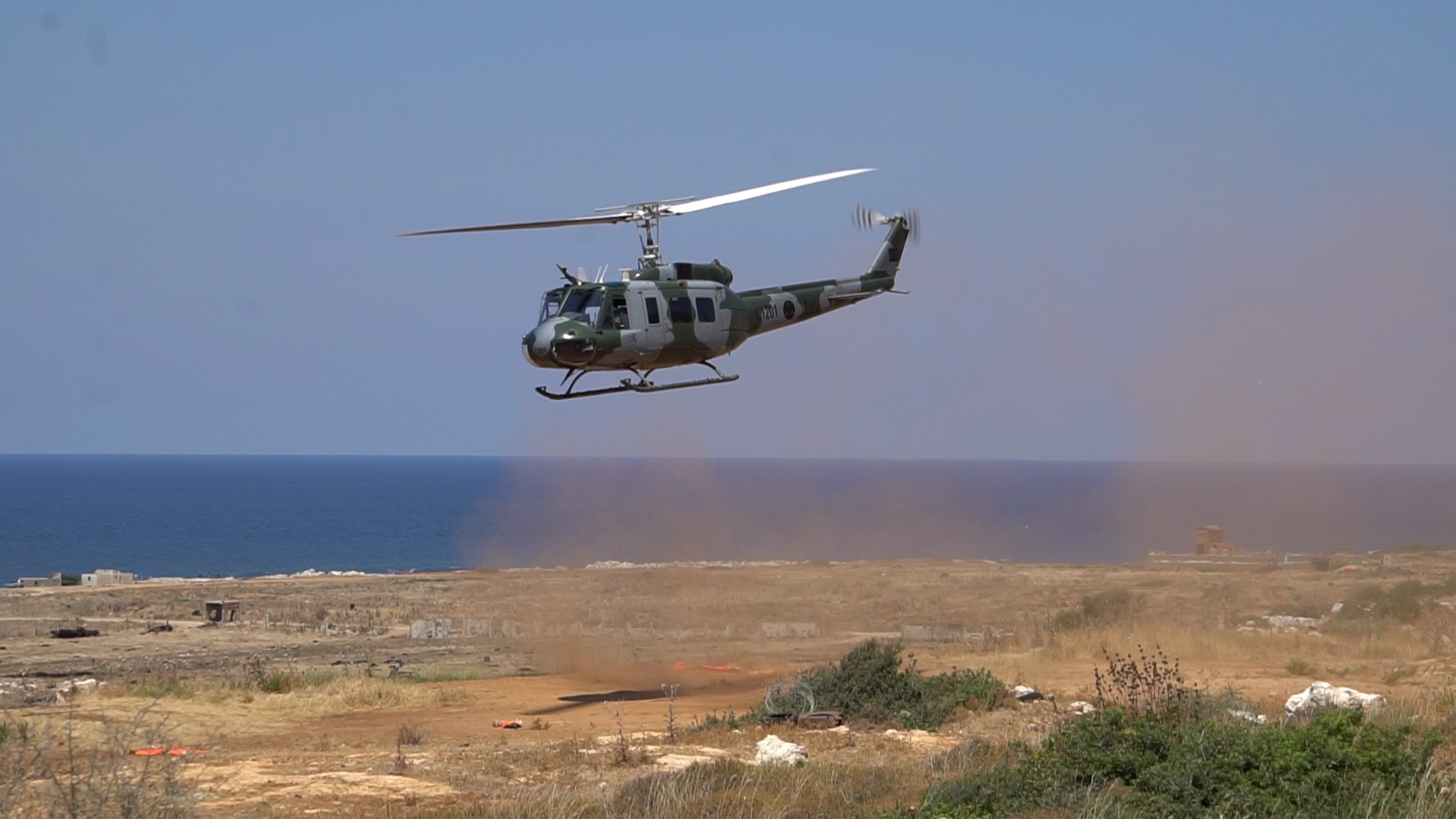
A Bell UH-1H Huey II from the 11th Squadron participates in an exercise on the Hannoush Range. (Source: Author)

Rebuilding the Lebanese Air Force

Founded in 1949, the Lebanese Air Force once operated modern jet aircraft, including the de Havilland Vampire, Hawker Hunter, and Dassault Mirage III. American assistance began during the Cold War, with the US Military Assistance Program delivering six Hawker Hunters in 1963. However, a brutal sectarian civil war from 1975 to 1990 left the air force in ruins, forcing the reconciled government to rebuild it from scratch.[4]

Lebanon occupies strategic – and treacherous – terrain, wedged between Syria and Israel. Though the civil war ended in 1990, Syrian troops continued to occupy much of the country’s north until 2005. Israel invaded four times between 1978 and 2024, occupying southern Lebanon from 1982 to 2000.

The US had straightforward goals for supporting the Lebanese Armed Forces (LAF) after the civil war: building a non-sectarian national military would strengthen national cohesion and counter the influence of sectarian militias like Hezbollah. ‘The LAF is a key institution of Lebanese statehood,’ declared US Ambassador Elizabeth Richards in 2016. ‘It is Lebanon’s sole legitimate defense force and an essential element in exerting the state’s authority throughout all of Lebanon’s territory.’[5]

Between 1996 and 2001, Lebanon acquired 24 Bell UH-1H Huey helicopters from the US, most of which had been in storage since the end of the Vietnam War. Initially relying on pilots who had trained in the US in the 1980s, the Lebanese Air Force assigned 12 of the helicopters to the 11th Squadron at Beirut Air Base, eight to the 10th Squadron at Klayaat Air Base, 55 miles north-northeast of Beirut near the Syrian border, and four to the 14th Squadron at Rayak Air Base, in the Bekaa Valley, 30 miles east of Beirut. These simple utility helicopters became the backbone of the Lebanese Air Force – and its only combat aircraft – until 2007.[6]

The first battle for the rebuilt air force erupted on 31 December 2000, in the rural Dinniyeh region near Lebanon’s northern border with Syria. Approximately 150 militants from the al-Qaeda-aligned group Takfir wal-Hijra attacked a military checkpoint, killing four soldiers and capturing two. The LAF immediately launched an operation to rescue the captives and eliminate the militants.[7]

Brigadier General S.Y., then a major in the 11th Squadron, recalled first learning of the attack while at a New Year’s Eve party with his squadron in Beirut. The festivities had begun winding down at four o’clock in the morning when the commander of the air force suddenly burst in, his face pale. “Return to base immediately!” he ordered. The men thought he was joking—or drunk. Frustrated, he bellowed for them to obey his orders at once. “We learned the hard way that he meant business,” S.Y. said.[8]

Two hours later, the major lifted off from Beirut, leading four Hueys north along the Mediterranean coast to reinforce the 10th Squadron at Klayaat Air Base, closer to the scene of the action. Upon arrival, they found the base buzzing with activity: Two companies from Lebanon’s elite Ranger Regiment had already arrived, along with two mechanised infantry companies and an armoured platoon. The LAF planned to deploy the Rangers to assault the militants’ mountain stronghold, while the mechanised infantry and armour secured Klayaat.

The helicopter force split into an assault group of eight and a reserve group of two, the latter consisting of one aircraft for medical evacuation (MEDEVAC) and another equipped with two 7.62-millimetre door guns for armed reconnaissance. In the afternoon, two 14th Squadron Hueys arrived from Rayak to reinforce the reserve group.

At nine o’clock in the morning, with temperatures hovering just below freezing, the assault group launched for the target area. Situated 5,200 feet above sea level, the high-altitude landing zones limited each helicopter to carrying only seven Rangers with their heavy gear, instead of the usual eleven. “Navigation to the landing zones was the hardest part, as the air force still used primitive methods in those days,” recalled S.Y. “Our best navigational equipment were the terrain maps provided by the directorate of geographic affairs.”

The assault group split into two elements, each led by a 10th Squadron pilot familiar with the terrain. “We flew nap of the earth,” said S.Y., “using the deep valleys and low terrain features to remain hidden from enemy observation.” The first element landed to the south and southwest of the target, while the second landed to the north. The Hueys then returned to Klayaat for another load. In total, they lifted approximately 200 soldiers onto the battlefield. The rapid encirclement enabled by air power allowed the Rangers to crush the militants in just forty-eight hours. The Lebanese Army lost 11 soldiers killed in action, including one of the men taken captive during the initial checkpoint attack.[9]

The Lebanese Air Force Adapts

The Hueys played a significant role in the LAF’s next major battle a little over six years later. On 19 May 2007, four armed men from the Sunni militant group Fateh al-Islam robbed a bank in the town of Amyoun, thirty miles north-northeast of Beirut, making off with $125,000 in cash. Lebanese paramilitary police quickly identified the militants and tracked them to a house ten miles to the north in Tripoli. A firefight erupted, soon spreading to the nearby Nahr al-Bared Palestinian refugee camp, which served as Fateh al-Islam’s headquarters. Hundreds of militants stormed LAF military posts and checkpoints in the area, killing thirty-two soldiers, most of whom were asleep in their barracks. The LAF launched an all-out effort to secure Nahr al-Bared and neutralise the militants, leading to a nightmare scenario of urban combat amid the camp’s ramshackle buildings and narrow alleyways.[10]

The Lebanese Air Force initially restricted its support to MEDEVAC and overhead surveillance. However, just two months before the battle, Lebanon had acquired nine Aérospatiale SA.342L Gazelle light attack helicopters for the newly established 8th Squadron. Armed with 68-millimetre unguided rockets, HOT guided antitank missiles, and .50-calibre machine guns, the Gazelles provided Lebanese ground troops with close air support for the first time.

The urban assault bogged down around the militants’ final position, a veritable fortress of concrete rubble. The Gazelles’ light weapons proved ineffective. With casualties mounting, the Lebanese Air Force adapted by jury-rigging three of its Huey utility helicopters as bombers.

The Lebanese Air Force had a stockpile of 500- and 1,000-pound bombs left over from the 1960s. Mechanics cannibalised bomb shackles and pylons from scrapped Mirage fighter jets and attached them to a steering rod from a decommissioned navy ship. To evenly distribute the weight across the cabin floor, they mounted the rig on an armoured plate salvaged from an inoperative M-113 armoured personnel carrier. Each heli-bomber could carry a single 1,000-pound bomb slung between the landing skids or a 500-pound bomb on either side. Mechanics lengthened the landing skids to ensure sufficient ground clearance.

The heli-bombers went into action on 9 August 2007. Using civilian Garmin 295 handheld GPS units to pinpoint their release points, the crews dropped dozens of bombs, blasting a path for the ground troops. The innovative air support helped bring the battle to an end on 7 September.[11]

The siege of Nahr al-Bared proved a formative experience for the LAF, underscoring the need to modernise the air force with fixed-wing aircraft capable of providing intelligence, surveillance, and reconnaissance (ISR), target designation, strike coordination, and close air support. This set of requirements roughly aligned with what the US Air Force (USAF) defined as light attack armed reconnaissance (LAAR). The US government offered to assist in this effort, eager to prevent Lebanon from becoming another active battlefront in the Global War on Terrorism.[12]

In 2009, the USAF provided Lebanon with a Cessna 208B Grand Caravan, funded through grant aid. Orbital ATK (later acquired by Northrop Grumman) reconfigured the Caravan as an AC-208 Eliminator, equipping it with a Wescam MX-15 electro-optical/infrared camera system, a microwave broadcast system for real-time video transmission, a weapons-grade laser designator, an infrared laser pointer, a flare dispenser, and launch rails to carry an AGM-114 Hellfire missile under each wing. A second aircraft arrived on 6 November 2013, configured solely for reconnaissance and lacking missile rails. A third aircraft, featuring a more powerful engine and a digital glass cockpit, arrived on 19 December 2016. The Cessnas were assigned to the 4th Squadron at Beirut Air Base.[13]

The Lebanese Air Force still had a handful of senior fixed-wing pilots who had flown Mirages and Hunters. However, without a fixed-wing pilot training program, it sent young lieutenants abroad to Saudi Arabia, the United Arab Emirates, and the United States for flight training. Upon their return to Lebanon, they completed a short Cessna training course provided by Orbital ATK. According to US Ambassador Elizabeth Richard, these pilots built a solid reputation. “The LAF is recognized in the US for the quality of the officers and soldiers it sends to our training and education programs,” she said. “Lebanese students routinely finish at the top of their classes, earning ‘honor graduate’ recognition.”[14]

In addition to the grant aid, the US embassy facilitated $1.9 billion in foreign military sales (FMS) to Lebanon between 2014 and 2020, including the purchase of six RQ-11 Raven small, hand-launched UAVs and 1,000 Hellfire missiles – items paid for with Lebanon’s own funds.[15] The Lebanese Air Force also bolstered its rotary-wing fleet, acquiring 24 additional UH-1H Huey IIs from the US and nine Aérospatiale SA.330 Super Puma utility helicopters, license-built in Romania by Industria Aeronautica Romana. The Super Pumas were assigned to the 9th Squadron at Hamat Air Base, located 30 miles north of Beirut.[16]
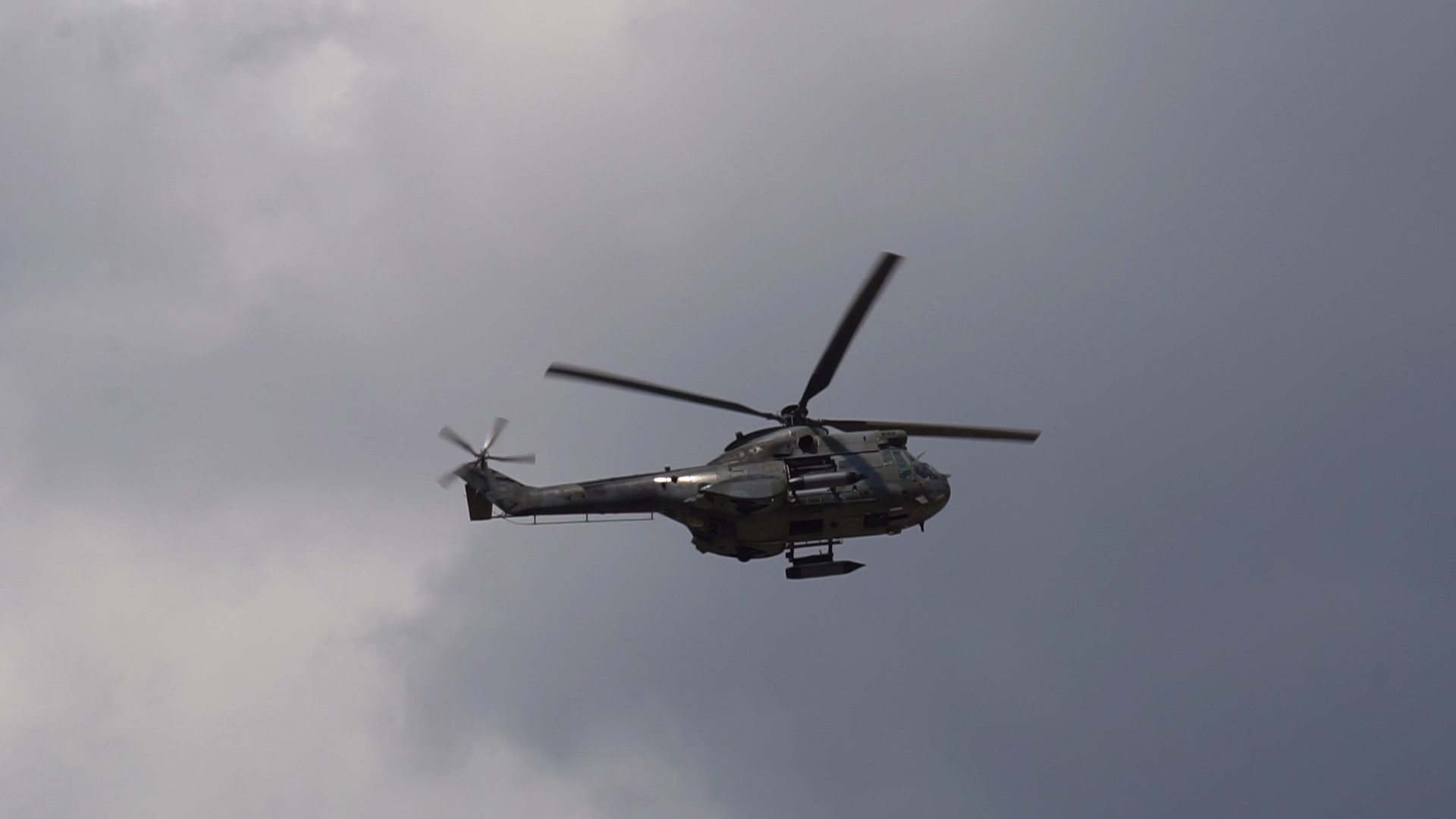
An Aérospatiale/IAR SA.330 Super Puma modified as a heli-bomber completes a rocket pass on the Hannoush Range. (Source: Author)

The Long Campaign

These modest modernisation efforts took place as neighbouring Syria spiralled into chaos. Protests against dictator Bashar al-Assad escalated into civil war and eventually gave rise to the Islamic State. More than one million Syrian refugees poured across the border into Lebanon, with at least 137,000 settling in camps within the Baalbek-Hermel Governate, Lebanon’s northeastern-most region. The town of Arsal, perched above the Bekaa Valley on the slopes of the Qalamoun Mountains, had the highest concentration of Syrian refugees of any municipality in Lebanon, with 39,300 registered in four camps.[17] On 1 February 2013, a patrol from Strike Force, Lebanon’s elite counterterrorism regiment, came under attack while chasing a wanted terrorist near the outskirts of the town. The ambush killed Captain Pierre Bachaalani and 1st Sergeant Ibrahim Zahrman and wounded many others.[18]

The LAF found it increasingly challenging to operate near Arsal. Al-Nusra Front, al Qaeda’s Syrian affiliate, used the town as a base for smuggling men, weapons, and equipment into Syria. The group began expanding its reach into the Bekaa Valley through a relentless series of deadly suicide car bombings and mortar and rocket attacks. Meanwhile, the Islamic State took control of the mountainous region east of Ras Baalbek and al-Qaa.[19]

On 2 August 2014, al-Nusra Front launched an attack on the 8th Mechanized Infantry Brigade’s positions near Arsal. Over the next five days, roughly 700 militants from al-Nusra and the Islamic State joined the battle, resulting in the deaths of 19 soldiers, the wounding of 86, and the capture of 36. Special operations forces from the Ranger and Air Assault Regiments quickly deployed to reinforce the embattled Lebanese troops.[20]

Stationed 30 miles southeast at Rayak, the 8th Squadron launched its Gazelle attack helicopters to assist, relying on satellite imagery printed from Google Earth to orient themselves to the battlefield. The commander of the air wing at Rayak led the first mission, his helicopter armed with two .50-calibre machine guns. “When we arrived in the area, we did not know which military positions had fallen and the extent of the enemy’s penetration,” recalled his copilot, Captain M.B.[21]

Spotting a group of armed men, but unsure of their identity, the wing commander dove in for a closer look. Bullets from a Russian-built PK machine gun raked the helicopter. A round tore through the cockpit, destroying the collective lever and spearing through M.B.’s left hand. “I started bleeding, losing large amounts of blood,” he recounted. The wing commander took control of the helicopter and flew straight to the Dar al-Amal Hospital near Baalbek, where M.B. received emergency medical care. The wing commander then returned to Rayak, only to find that he could not shut down the engine. A bullet had damaged the fuel controls, forcing him to wait for the helicopter’s fuel tank to run dry before it finally shut down.[22]

Meanwhile, at Beirut Air Base, 1st Lieutenant C.Y., a Cessna pilot with the 4th Squadron, received an urgent call from base operations ordering him to prepare his aircraft and crew—himself as pilot, Lieutenant al-Taki as pilot and mission systems operator, and a brigadier general from the operations staff to coordinate with the operations center. “A few minutes later, we were ordered to take off, destined for the outskirts of Arsal,” he recalled. Lieutenant C.Y. was already well-acquainted with the area, having frequently surveilled it since the ambush on the Strike Force patrol the previous year. Yet amid the chaos of the mass attack, the fog of war had set in. “The attack on the military centers happened suddenly,” said C.Y. “We did not have all the information on the disposition of military forces, especially after several fell into the hands of the terrorists.”[23]

Establishing radio contact with the ground troops, C.Y. and his crew began scanning the battlefield through their camera, watching as militants overran one post after another. The defenders executed a fighting withdrawal, buying time until reinforcements could arrive. In the summer of 2014, the 4th Squadron had only two Cessna 208s, and the second aircraft had yet to be retrofitted to carry Hellfire missiles. That meant C.Y. and his crew were flying the only armed fixed-wing aircraft in the country. While the United States classified the AC-208 as an inexpensive armed tactical reconnaissance aircraft, for Lebanon, it was a strategic asset. It would take more than an hour to land, rearm, and return to the target area, so they had to carefully balance their ability to deliver aerial firepower with the need to maintain continuous ISR coverage. “Our plane was equipped with two Hellfire missiles,” said C.Y. “We were careful not to use them unless absolutely necessary.”[24]

That moment came when the militants encircled a company of Lebanese troops, wounding several with their relentless fire. “We saw through the surveillance camera a group of about ten armed men preparing to storm the center from the rear,” C.Y. recalled, “so we decided to intervene.” Watching the Cessna’s live video feed from the operations center, the LAF director of operations, along with the army and air force commanders, gave the green light for a strike. It would be the first precision airstrike in Lebanon’s history.

C.Y. recounted what happened next: “We turned toward the target and launched the first missile, which took fifty-eight seconds to reach its mark, striking with precision and inflicting heavy losses on the attacking force.” The militants retreated into a nearby house. Circling overhead, C.Y.’s crew waited for them to regroup before launching the second missile. “We deliberately waited for all the terrorists to enter the building before firing,” he explained. “The Hellfire missile is most effective in enclosed spaces – such as rooms, buildings, and fortifications – rather than open areas.”[25]

The missile streaked off the launch rail, and one minute and twenty seconds later, it slammed into the house. The cement walls collapsed, and the house erupted in flames, fuelled by secondary explosions from ammunition stored inside. No one emerged from the inferno. The airstrike reversed the tide of the battle, forcing the militants to withdraw from around the besieged company.[26]

The combat debut of the AC-208 in August 2014 marked the LAF’s first use of precision-guided munitions and the first real-time broadcast of battlefield surveillance video. Meanwhile, the Hueys and Super Pumas transported troops and flew MEDEVAC missions, while Raven UAVs and the Cessnas provided ISR, and Gazelles and the AC-208 delivered close air support. These efforts helped halt the militant advance, but the LAF could not yet push them back, and a three-year stalemate ensued. Of the 36 Lebanese soldiers captured in the battle, the militants executed four, released seven, and exchanged 16 for thirteen jailed militants in a prisoner swap. Nine remained unaccounted for, presumably still held by the Islamic State.[27]

According to Captain G.A., another Cessna pilot in the 4th Squadron, “Our squadron participated in continual military operations from 2014 to 2017. The unrelenting bombing over such a long period of time helped to exhaust and demoralize the militants, as well as to destroy their logistical capabilities and their command-and-control centers.” In addition to Hellfire strikes, the Cessna crews provided observation and adjustment for artillery fire. According to G.A., “The targets we attacked varied from command-and-control centers and logistical points […] to tunnels dug in the mountains […] bulldozers used in digging tunnels and fortifying fighting positions […] and on one occasion, we targeted an Army M-113 armored vehicle which the militants had captured.” While they typically struck preplanned targets, the crews also often searched for targets of opportunity.[28]

In the summer of 2016, the Lebanese Air Force launched its largest coordinated airstrike on militant positions – an operation they viewed as their own miniature version of Desert Storm’s high-tech ‘Instant Thunder’ air campaign. “The raid lasted for about forty minutes,” recalled Colonel A.M., who helped plan the operation. The Cessna fired the opening salvo, striking the first two of eight preplanned targets: an Islamic State field command headquarters and a house sheltering a high-value target. Both missiles hit with precision. “No one left the targeted buildings,” A.M. stated, “so we considered the casualties as confirmed.”[29]

Follow-on attacks targeted enemy infrastructure, including lodging, water tanks, ammunition dumps, and vehicle yards. To bolster the air force’s limited firepower, mechanics from the 9th Squadron modified a Super Puma into a heli-bomber – similar to the Huey bomber experiment nine years earlier. They rigged a pair of steel I-beams through the cabin and mounted bombs or rocket pods on either side, creating a makeshift but effective strike platform.[30]

After the initial Hellfire strikes, the Cessna used its infrared laser pointer to mark targets for the helicopters and served as a tactical air coordinator, sequencing their attacks. The Puma dropped two 250-kilogram bombs, followed by the Gazelles strafing militants fleeing the bombing with .50-calibre machine guns and 68-millimetre rockets. Once the helicopters cleared the area, the Cessna called in artillery fire to finish the job. Throughout the operation, the Cessna and Raven UAVs provided continuous surveillance of the target area.[31]

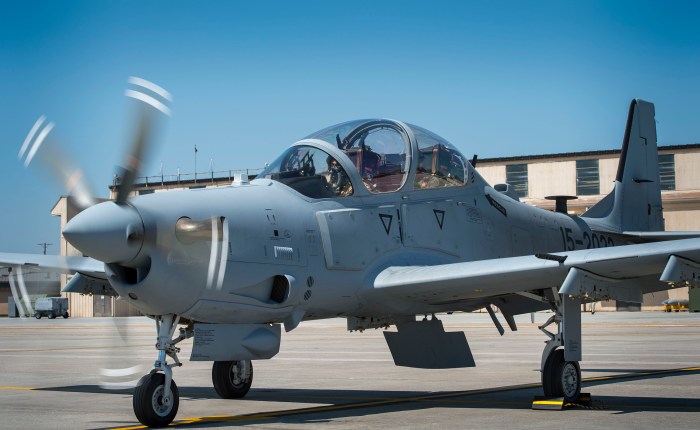
While the LAF managed to contain the Islamic State and al-Nusra incursions into the Bekaa Valley, military and political leaders collaborated with their American counterparts to secure new equipment and training for a decisive operation to expel them entirely. For the air force, this included six Embraer A-29B Super Tucano light attack aircraft, which would equip the newly formed 7th Squadron. The Lebanese Air Force identified twelve of its top pilots to train on the Super Tucano at Moody Air Force Base, Georgia, under the USAF’s 81st Fighter Squadron. The first group of pilots departed Lebanon in February 2017, with the first two A-29s scheduled for delivery in October and the remaining four the following June. USAF Special Operations Command also planned to deploy a team of combat aviation advisors to Lebanon in 2018.[32] Meanwhile, in January 2017, al-Nusra Front merged with four other militant groups to form Hayat Tahrir al-Sham (HTS), which dubiously claimed to have severed its ties with al-Qaeda.[33]

It remains a point of contention whether Lebanon’s ingrained political paralysis or a strategic decision to wait for new capabilities like the Super Tucanos delayed a decisive operation against the Islamic State. On 20 July 2017, the Iranian-backed Shia militia Hezbollah pre-empted the LAF by launching its own campaign to retake Arsal.[34]

For at least six years, Hezbollah had been deploying fighters to Syria as part of Iran’s efforts to bolster Bashar al-Assad’s dictatorial regime. A successful operation to expel HTS from Lebanon would not only serve Iran’s strategic interests but also undermine the LAF’s position as the nation’s principal security provider. From 21 to 24 July, Hezbollah seized more than 60 per cent of HTS-held territory, leading to a ceasefire on 27 July that allowed the remaining HTS fighters to withdraw into Syria. Hezbollah’s sophisticated propaganda apparatus flooded media channels with battlefield updates, maps, and footage highlighting combined arms operations involving infantry, artillery, and rockets. Press reports estimated that more than twenty Hezbollah fighters and 150 HTS militants were killed in the operation.[35]

The Lebanese government had no choice but to order an immediate offensive against the Islamic State positions north of Arsal – a far more challenging task given the rugged, defensible mountainous terrain – or risk appearing impotent compared to Hezbollah. The LAF assembled a frontline strength of 4,300 troops in the eastern Bekaa Valley, including the 6th Mechanized Infantry Brigade, the 1st Intervention Regiment, the Air Assault Regiment, one company from the 4th Intervention Regiment, and one company from the Moukafaha, a special operations unit under the Directorate of Military Intelligence. Another 4,250 personnel provided support, including elements of the 1st and 2nd Artillery Regiments with 36 155-millimetre howitzers.[36]

On 14 August 2017, the LAF initiated its opening manoeuvres, officially launching Operation Fajr al-Jaroud, or ‘Dawn of the Hills,’ on 19 August. That same day, Hezbollah and the Syrian Arab Army announced their own offensive on the Syrian side of the border, once again attempting to upstage the LAF. The simultaneous operations fuelled speculation of collusion between the LAF and Hezbollah. However, LAF leadership firmly denied such claims, emphasising that their only interaction with Hezbollah was limited to a deconfliction policy not unlike the one between US and Russian forces in Syria.[37]

Lebanese ground forces encountered improvised explosive devices (IEDs), fortified fighting positions, and suicide bombers, but years of sustained operations had already hollowed out the Islamic State’s defences. A steady barrage of air and artillery fire paved the way for the advancing troops. Over 11 days, the Lebanese Air Force flew 141 hours of combat missions. One of the seventy US military advisors in the country, observing the LAF’s coordinated use of ISR, precision air strikes, artillery, infantry, armour, and special operations forces, described the campaign as ‘twenty-first century maneuver warfare by a modern military.’[38]

Though delivery of the first two A-29s was still two months away, the 4th Squadron had received its third Cessna in December 2016, and all three aircraft were now configured to carry Hellfires. Additionally, the Lebanese Army fielded a game-changing new weapon it had received several years earlier from the Americans: M712 ‘Copperhead’ 155-millimetre laser-guided artillery rounds. Flying parallel to the gun-target line, the Cessna could use its laser designator to guide in round after round with deadly precision. During Fajr al-Jaroud, the Lebanese Army fired 130 Copperhead rounds, including a blistering thirty-three in just thirty minutes at the operation’s climax.[39]

The Islamic State’s position collapsed in mere days, shrinking to a pocket of just twenty square kilometres by 27 August – down from the 120 square kilometres it had occupied at the outset. However, the LAF never launched a final assault; with the operation proving a stunning success, an alarmed Hezbollah quickly intervened to negotiate a ceasefire, allowing the remaining Islamic State fighters to retreat into Syria in exchange for information on the nine LAF soldiers captured three years earlier. Though all nine had been killed, the deal allowed the LAF to recover their bodies. On 28 August, approximately four hundred Islamic State fighters and camp followers departed on buses for eastern Syria.[40]

Operation Fajr al-Jaroud killed more than 50 Islamic State fighters, at the cost of nine LAF soldiers killed and 100 wounded. For the first time since the civil war, the LAF successfully conducted a theatre-level joint operation, demonstrating its ability to effectively utilise US security assistance.[41] Yet, the success owed to more than just the two-week operation. “When the battle is discussed, many people marvel at the short period of time that it was limited to,” said Colonel A.M. “They do not realize that it came as a result of three years of continuous targeting that exhausted the terrorists’ infrastructure and killed many of them.”[42]
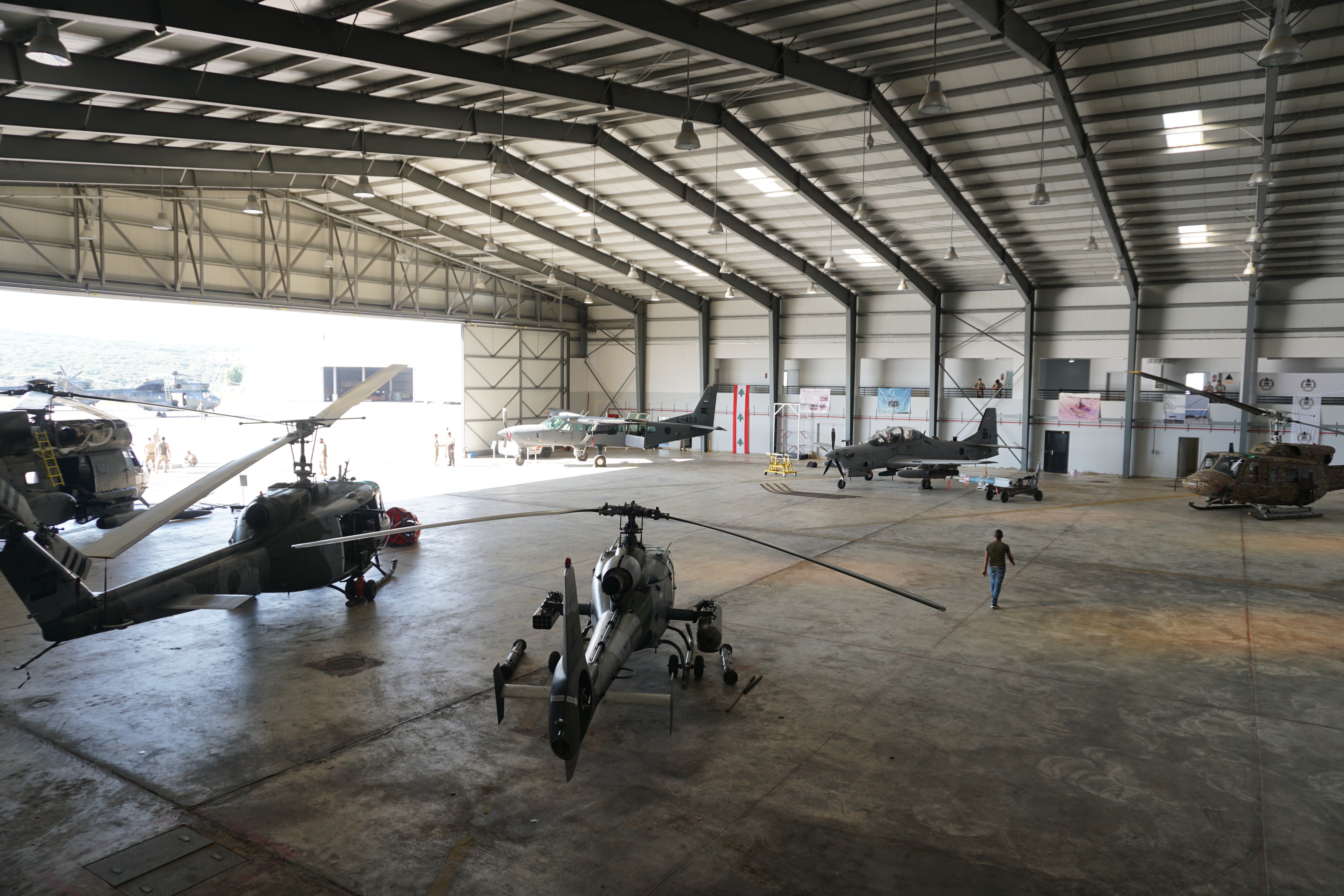
Lebanese Air Force aircraft in the hangar at Hamat Air Base, foreground, left to right: SA.330 Super Puma, UH-1H Huey II, SA.342L Gazelle; background, left to right: AC-208 Eliminator, A-29B Super Tucano, Bell 212. (Source: Author)

Conclusion

Hezbollah’s efforts to undermine and overshadow the LAF failed to erode its legitimacy as Lebanon’s principal source of security. The success of the joint operation against the Islamic State spoke for itself.[43] Despite limited resources, the Lebanese Air Force played a decisive role. From the Dinniyeh operation in 2000 to the heli-bombers over Nahr al-Bared in 2007 and the precision airstrikes in the Bekaa Valley from 2014 to 2017, Lebanese aviators found ways – often audacious improvisations – to mobilise air power against violent extremist organisations. What began as a force rebuilt around hand-me-down Hueys gradually evolved into a capable mix of helicopters, crewed fixed-wing aircraft, and UAVs performing ISR, light-attack, and mobility missions. This transformation depended on steady but limited US security assistance: surplus aircraft, grant-funded upgrades, foreign military sales, and training programs that produced a new generation of skilled aviators.

Yet US assistance alone cannot account for the LAF’s battlefield performance. At every stage, Lebanese officers, NCOs, and technicians adapted faster than their inventory changed. They welded together heli-bombers when they lacked aircraft capable of striking hardened urban positions. They mastered precision weapons that they had never fired in training. They built tactics around a single missile-toting Cessna, rationing its firepower while keeping it on station as the country’s only persistent ISR asset. They overcame shortages in personnel, spare parts, and navigational equipment through ingenuity, improvisation, and a deep sense of obligation to the soldiers fighting below.

By the time the Islamic State threatened Lebanon’s northeastern frontier, the Lebanese Air Force had become something unexpected: not a conventional air force in the American sense, but an adaptable, hybrid force optimised for Lebanon’s terrain, politics, and threats. Its air campaign from 2014 to 2017, though modest by comparison with the coalition’s industrial-scale air power in Operation Inherent Resolve, proved decisive along the Islamic State’s western flank, steadily degrading militant capabilities until Operation Fajr al-Jaroud finally drove them from Lebanese territory.

From its rebirth in the 1990s through its campaign against the Islamic State, the history of Lebanese air power demonstrates that modest US security assistance, when paired with Lebanese ingenuity, produced an outsized strategic effect. The Lebanese Air Force did not win battles because it possessed the most technologically advanced equipment, the largest fleet, or the most refined doctrine. It won because Lebanese aviators extracted maximum value from every aircraft, every munition, and every training opportunity. In doing so, they provided the Lebanese Army with the air support it needed to survive, adapt, and prevail against some of the most dangerous violent extremist groups in the world.

Lieutenant Colonel Daniel Jackson PhD is an Assistant Professor of History at the US Air Force Academy. He served as a U-28A instructor pilot, Combat Aviation Advisor, and Adaptive Precision Strike evaluator pilot in Air Force Special Operations Command, flying 236 combat missions and 125 combat support missions in support of Operations Inherent Resolve, Freedom Sentinel, Enduring Freedom, Enduring Freedom-Philippines, and Damiyan. He holds a PhD in history from the University of Wisconsin-Madison. He is the author of Fallen Tigers: The Fate of America’s Missing Airmen in China during World War II (2021).

Wael Nawaf al-Taki is the manager of Strategic Defense Solutions, Ltd. He served as Chief of the Lebanese Air Force Operations Room and as an A-29 Super Tucano instructor pilot and squadron commander. In addition to flying more than 200 hours in combat operations, he spearheaded organisational and tactical reforms that enhanced air-ground integration within the Lebanese Armed Forces.

Header image: A Lebanese Air Force student prepares to fly the Embraer A-29B Super Tucano for the first time at Moody Air Force Base, Georgia (Source: US Air Force)

[1] The names of most Lebanese military officers have been withheld for security reasons.

[2] Major Wael al-Taki, oral history interview by Daniel Jackson, February 27, 2025.

[3] Department of Defense, ‘Operation Inherent Resolve: Targeted Operations to Defeat ISIS,’ Operation Inherent Resolve, 9 August 2017.

[4] National Archives and Records Administration, Record Group 330, Military Assistance Program 1000 System Master File, 1986.

[5] US Embassy in Lebanon, ‘US Ambassador Delivers Cessna Aircraft to Lebanese Armed Forces,’ 19 December 2016,.

[6] Brigadier General S.Y., oral history interview by Wael al-Taki, 3 August 2022.

[7] Lebanese Armed Forces, Air Force Operations, Beirut, 2021.

[8] Brigadier General S.Y., oral history interview by Wael al-Taki.

[9] Ibid.

[10] Lebanese Armed Forces, Air Force Operations.

[11] Ibid.: Riad Kahwaji, ‘The victory – Lebanon developed helicopter bombers,’ Skyscraper City, 3 September 2007.

[12] Lebanese Armed Forces, Air Force Operations.

[13] Orbital ATK, Mission Systems Operators Manual: Lebanon Armed Caravan SN1239, 02TMAOP-002, Fort Worth, 2016; Stephen Trimble, ‘USAF orders 2nd Cessna Caravan for Lebanon,’ FlightGlobal, 18 January 2012.

[14] US Embassy in Lebanon, ‘The United States Delivers Four A-29 Super Tucano Aircraft to the LAF,’ 12 June 2018.

[15] Department of State, Bureau of Political-Military Affairs, ‘US Security Cooperation with Lebanon,’ Fact Sheet, 20 January 2025.

[16] Defense Security Cooperation Agency, ‘Lebanon – Huey II Helicopters,’ Transmittal No. 12-07, 20 July 2012; Defense Security Cooperation Agency, ‘Lebanon—Huey II Rotary Wing Aircraft and Support,’ Transmittal No. 14-20, 19 September  2014; Defense Security Cooperation Agency, ‘Lebanon—AGM-114 Hellfire II Missiles,’ Transmittal No. 15-29, 4 June 2015.

[17] Aram Nerguizian, The Lebanese Armed Forces, Hezbollah, and Military Legitimacy, Draft, (Washington, DC: Center for Strategic & International Studies, 2017), p. 9.

[18] Lebanese Armed Forces, Air Force Operations.

[19] Nicholas Blanford, ‘The Lebanese Armed Forces and Hezbollah’s Competing Summer Offensives Against Sunni Militants,’ CTC Sentinel 10, no. 8 (2007), p. 27.

[20] Nerguizian, The Lebanese Armed Forces, Hezbollah, and Military Legitimacy, p. 11.

[21] Captain M.B., oral history interview by Wael al-Taki, 6 August 2021.

[22] Ibid.

[23] Captain C.Y., oral history interview by Wael al-Taki, 6 August 2021.

[24] Ibid.

[25] Ibid.

[26] Ibid.

[27] Blanford, ‘The Lebanese Armed Forces and Hezbollah’s Competing Summer Offensives Against Sunni Militants,’ p. 27.

[28] Captain G.A., oral history interview by Wael al-Taki, 10 August 2021.

[29] Colonel A.M., oral history interview by Wael al-Taki, 10 August 2021.

[30] The author inspected this aircraft himself and spoke with the maintenance officer who oversaw the modifications while in Lebanon in 2020.

[31] Ibid.

[32] Defense Security Cooperation Office, ‘Lebanon—A-29 Super Tucano Aircraft,’ Transmittal No. 15-13, 9 June 2015; Sierra Nevada Corporation, ‘SNC, Embraer Complete Early Delivery of A-29 Super Tucano Aircraft to Lebanese Air Force for Close Air Support Role,’ Press Release, 12 June 2018.

[33] Thomas Joscelyn, ‘Al Qaeda and allies announce ‘new entity’ in Syria,’ Long War Journal, 28 January 2017

[34] Nerguizian, The Lebanese Armed Forces, Hezbollah, and Military Legitimacy, p. 15.

[35] Ibid., pp. 15-6.

[36] Ibid., p. 20, 22.

[37] Ibid., p. 16, 23.

[38] Ibid., p. 24.

[39] Lebanese Armed Forces, Air Force Operations.

[40] Blanford, ‘The Lebanese Armed Forces and Hezbollah’s Competing Summer Offensives Against Sunni Militants,’, p. 29.

[41] Nerguizian, The Lebanese Armed Forces, Hezbollah, and Military Legitimacy, p. 24, 27.

[42] Colonel A.M., oral history interview by Wael al-Taki, 10 August 2021.

[43] Nerguizian, The Lebanese Armed Forces, Hezbollah, and Military Legitimacy, p. 5.
The Colonel, the Sculptor, and the Supreme Court Justice: Assessing the Failure of American Aircraft Production in the First World War – Part One

The Colonel, the Sculptor, and the Supreme Court Justice: Assessing the Failure of American Aircraft Production in the First World War – Part One

By Lieutenant Colonel Michael H. Taint, United States Air Force (ret’d)

Editorial note: In this two-part article, Michael Taint re-evaluates the conduct of Colonel Edward Deeds in the management of the US Army’s First World War aircraft production program and the overall aeroplane production program itself. In this first part, he sets the scene to be explored in the second part.

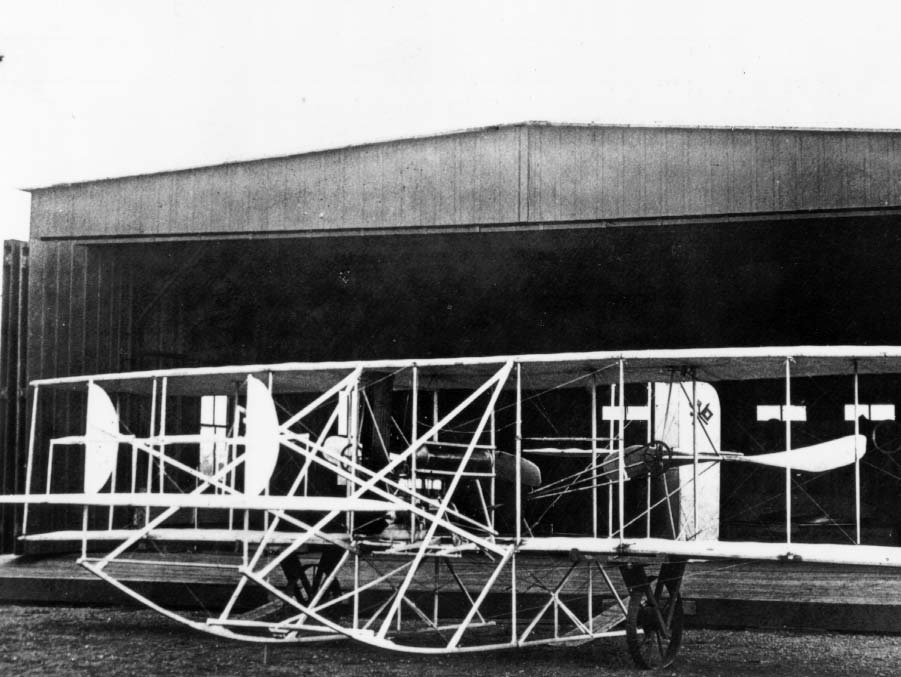
The US Army was the first military in the world to procure an aeroplane. However, when the United States entered the First World War in the spring of 1917, its military aviation program lagged pitifully behind other belligerents. The expectation of the US government, the American public and its new allies was that American industrial might would quickly create an air force so enormous as to ‘permanently cloud  Germany’s place in the sun’ according to Major General George Owen Squier, Chief Signal Officer (the Signal Corps included all military aviation unit at that time).[1] In July 1917 – after a mere 40-minute debate – Congress appropriated an unprecedented $640 million for this purpose, with a production goal of 22,635 aeroplanes and 45,250 engines. However, at the end of the First World War, despite the benefit of having a build-to-print design for an existing aeroplane, a mere 196 aeroplanes were delivered for combat action at the front, an embarrassing failure.[2]  

The ensuing political fallout caused President Woodrow Wilson to request an informal inquiry by aviation enthusiast and artist Gutzon Borglum (better known as the sculptor of Mount Rushmore and Stone Mountain). Borglum’s accusations of impropriety, particularly against Edward Deeds, a Dayton industrialist directly commissioned Colonel in the US Army Air Service, spurred further Congressional scrutiny. Eventually, Wilson directed a formal investigation led by Charles Evans Hughes, his opponent in the 1916 presidential campaign and future Chief Justice of the Supreme Court. Hughes recommended Deeds’ court-martial; a court martial that never occurred. This paper re-evaluates Deeds’ conduct in the First World War aircraft production program and the overall aeroplane production program. Though often characterised as a failure, American aeroplane production in 1917-18 was more a victim of unrealistic expectations than a lack of competence.

The Pre-Bellum State of American Aviation: The Bolling Commission

Mimicking the experience of the US Army, American military aviation in April 1917 was underdeveloped due to a lack of investment. Although a few officers, such as Squier, had been advocating the potential revolutionary capabilities of military aviation for nearly a decade (Squier himself wrote the technical specification for the US Army’s first purchase of the Wright Flyer), the rest of the US Army and Congress remained sceptical, and funding reflected that scepticism. On active duty, the Aviation Section of the US Army’s Signal Corps consisted of only 52 officers (26 of whom were fully qualified pilots), 1,100 civilian and enlisted personnel, and the air fleet that consisted of 165 aeroplanes – none of which could undertake the type of aerial combat that was occurring over the Western Front – stationed at two flying fields.[3] 

Unlike America’s entry into the next world war, which had issues, at the declaration of hostilities, the USA in 1917 was no great ‘Arsenal of Democracy.’ The US aircraft industry employed only about 10,000 workers, total, at a half dozen firms, and the two largest firms, Curtiss and Wright-Martin, despite bearing the names of America’s foremost aviation pioneers, were controlled by the automotive industry, most notably Howard Coffin of Hudson and Packard’s Sydney Waldon.[4] With limited military interest (except for an order of 800 training planes the Allies placed in 1916), no airline industry, and no airmail, there was insufficient demand to motivate manufacturers. Intellectual property issues were another significant deterrent to the aviation industry’s growth. The Wright Brothers’ invention of ‘wing warping,’ which allowed an aeroplane to roll (turn) left or right, was ruled in 1914 to apply to all flight controls on all aircraft types – in other words, to anyone who built an aeroplane that did anything but fly in a straight line. The Wrights demanded a heavy licensing fee for this technology, adding significant costs and further discouraging start-up efforts.[5] The remedy was an industry steering group and forum that could wrest control of aircraft design and manufacturing from these proprietary interests. So Coffin and Waldon, among others, founded the Aircraft Manufacturers Association (AMA), modelled after the highly successful Society for Automotive Engineers (where Coffin and Waldon were also leaders). The AMA was designed to address issues plaguing early aeroplane manufacturing: intellectual property deterrents and custom parts and interfaces, to make mass production possible, just as they had for automobiles.

The creation of the AMA was timely, as once America declared war on Germany, Europeans besieged the US Government’s official steering body, the Aircraft Production Board, for more aeroplanes. Benedict Crowell, Assistant Secretary of War and Director of Munitions, wrote in the US Army’s official history:

France and Italy had both adopted the policy of depending upon the private development of designs for their supplies of airplanes […] the United States would have to pay considerable royalties for the use of any of these European devices. As to the relative merits of types and designs, it was soon apparent that no intelligent decision could be reached in Washington or anywhere but Europe.[6] (emphasis added)

To make recommendations for this decision, Major Raynal Bolling, a corporate (US Steel) lawyer, National Guard officer, and pilot, was tasked to lead a fact-finding team that became known as the ‘Bolling Commission.’ The Bolling Commission included 12 military and aeroplane experts, plus 93 production specialists from various American factories – the cadre of the future American aviation industry.[7] The Bolling Commission arrived in Britain on 17 June 1917 and visited French, Italian and British aeroplane factories during an intensive 5-week trip and determined in its 30 July report that a handful of specific Allied aircraft, including the De Havilland DH-4, were the best candidates for American domestic production. For the coming year, however, the Bolling Commission recommended US materiel and funding be prioritised to French factories already in production while America ramped up its infant aviation industrial base. They planned for American factories to produce 22,000 tactical aircraft plus training aeroplanes.[8] Consequently, the US Army Air Service awarded a contract for delivery by 1 July 1918 of 5,875 planes manufactured in France but with mostly American materials. Almost all-American airmen flew aircraft produced by this contract.

On 18 October 1917, the DH-4, a 2-seat reconnaissance and day bombing aircraft initially designed by Geoffrey de Havilland in the UK and introduced into service the year before, was selected for American production.[9] The most recent version of this light bomber, the DH-9, was chosen. However, when production started a few months later only the older DH-4 was available to be shipped to America and a production sample – so it was used instead.

Not everyone, however, such as Colonel (later Brigadier General) Billy Mitchell, agreed with the selection of this aircraft. Bolling chose a light bomber rather than a pursuit plane because the latter needed design updates every six months to remain combat-ready; at any one time, 60 per cent of the Allied combat aircraft at the Front were considered obsolete. To all American manufacturers, the DH-4 certainly had another advantage. Unlike the French and Italian aircraft designed by private firms with heavy licensing (intellectual property) fees, the DH-4 was provided by the British government license-free.[10] However, not everyone agreed that aircraft production in America was a good idea, either. Mitchell, then commander of all American aviation forces stationed in France, had toured French factories extensively and was convinced of their superiority in capability and product. Mitchell viewed sending American materials and men to expand existing French manufacturers as the quickest way to victory. As Mitchell recalled with his characteristic bluntness:

It was the beginning of a series of blunders by those directing aviation in Washington, which culminated later in that department being virtually removed from the authority of the War Department and put into the hands of businessmen […- I am referring to the De Havilland airplane and the Liberty engine […] this one decision held up delivery of equipment to American air forces for an entire year, and constituted one of the most serious blunders.[11]

However, those businessmen in charge of aviation in the summer of 1917 had a hugely different view.

The Businessman becomes a Colonel – Edward Deeds of Drayton

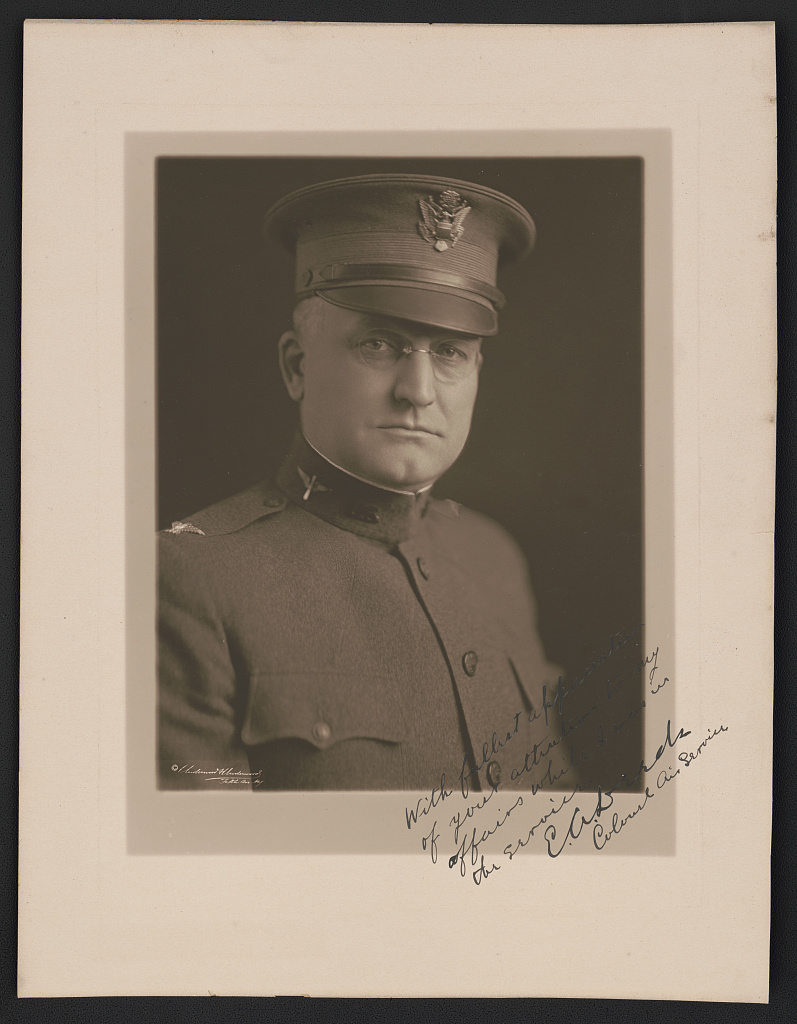
Colonel Edward Deeds, c. 1917. (Source: US Library of Congress)

When the United States declared war, Edward Deeds was a wealthy 43-year-old industrialist and prominent citizen of Dayton, Ohio. Starting as an electrical engineer designing motors for cash registers with the National Cash Register (NCR) company in Dayton, Ohio, Deeds eventually rose to vice president and general manager. His pleasant personality and charm were undoubtedly key to his business success. His most famous hire was another engineer, Charles Kettering. The two became lifelong friends and business partners, often tinkering in Deeds’ barn, where Kettering invented the first automotive electronic ignition system. The enormous success of this invention led Deeds and Kettering to form another company, the Dayton Electronics Company (DELCO), in 1908, a powerhouse in the rapidly expanding automotive industry; Kettering served as chief technical officer, and Deeds focused primarily on business affairs.[12]

Deeds was well into this second successful business venture when his first one caught up with him in a shocking way. NCR had cornered over 95% of the cash register market, but not always through ethical or legal business practices. In February 1913, along with John Patterson and future IBM chief executive Thomas J Watson, Deeds was convicted in the Federal district court in Cincinnati of the first criminal violation of the Sherman Antitrust Act in US history. Along with a $5,000 fine, each man was sentenced to a year in prison. Their careers appeared ruined, but fate intervened. Waiting on appeal, the NCR executives were redeemed in the public’s eye by their extraordinary response to the Great Dayton Flood that nearly destroyed the city a few months later.[13] By marshalling all their company’s resources, Patterson and Deeds provided food and shelter, as well as a small flotilla of rescue boats that saved hundreds of lives. Two years later, on 13 March 1915, an Appeals court overturned all the convictions and ordered a retrial. However, by then, the retrial of these local heroes was politically impossible, and all charges were dropped.

By 1917, just days after the US declaration of war, Deeds and Kettering saw yet another business opportunity, yet another chance to ‘get in on the ground floor’ as they had with electronic ignition in automobiles. They met with Dayton financier H.E. Talbot and his son in the senior Talbot’s suburban Dayton home. Also present were a few original Wright Airplane Company employees, including pilot and aeroplane designer Grover Loening. Deeds and Kettering, with additional financial backing from the Talbots, proposed creating a new aeroplane company called the Dayton Wright Airplane Company, specifically to compete for the substantial number of aeroplane orders that would undoubtedly be coming from the War Department. Orville Wright would be included as a ‘non-working’ director, allowing the new company to capitalise on the prestige and credibility the Wright name would bring (Wright only rarely participated in the actual business, usually as a technical consultant). Deeds proposed that engines from the booming American automotive industry (using the electronic ignition system built by his DELCO Company) would be mated with build-to-print designs from proven European tactical aircraft (since everyone knew America had no design expertise). The solution to the aeroplane production problem would be at hand, with handsome profits. The company’s incorporators needed but $500,000 to begin operations; within a few months, large aircraft contracts would be a massive payback on their investment.[14] The one true aeronautical expert there, Grover Loening, confessed to being ‘astonished’ at these bold plans, which he considered ’shady.’[15] After the First World War, in a section of his memoirs entitled ‘The Detroit Conspiracy’ Loening noted:

the way step after step led the automobile crowd in Detroit to the ownership, control, direction and parceling out of all aircraft and aircraft-motor business, by the time we entered the war in 1917, is a pattern that much too beautifully fit together to be accidental […] Our able and efficient automobile manufacturers in Detroit, foreseeing a war production era, apparently picked on aviation as a likely field to fill their plants […] They absolutely butted into the aircraft business. Not a single one of them had any previous experience along this line […] all of this work was done at cost plus 10% or more; so one can be sure none of the automobile group lost much.[16]

Subsequent events show that Deeds’ vision from that evening in April 1917 happened largely as planned. 

Deeds’ plans progressed rapidly, starting with his appointments to several critical Government advisory and procurement boards. Through his connection with Howard Coffin, a fellow automobile executive (Vice President of the Hudson Motor Car Company), Deeds was offered a position on the Munitions Standards Board dealing with ‘matters relating to the procurement of munitions and supplies’; when that Board was disbanded shortly afterwards, Coffin persuaded him to join a new steering committee to oversee military aircraft, the Aircraft Production Board, chaired by Coffin himself.[17] Deeds considered and eventually accepted.[18] Also on the board was the US Army’s Chief Signal Officer and its foremost aviation proponent, Major General George Owen Squier. Though it had no direct procurement authority, the Aircraft Production Board was the preeminent body in making critical policies that determined which engineering specifications and standards were adopted, how and where pilot training was conducted, and even which supply depots for logistics support and flying fields were to be established. It was tasked with the creation of an American aviation industry. Far from being merely another committee, it became ‘foremost in the war program of the country.’[19] Deeds, the founder of the Dayton Wright Airplane Company in April, was, by July, on the executive steering committee for creating the new industry. And he was not done yet. 

On 15 August, scarcely a month later, Edward Deeds – with no military training or experience of any kind – became Colonel Edward Deeds, chief of the US Army’s Signal Corps Aviation Equipment Division, responsible for the procurement of all Army aviation hardware, including aeroplanes, aircraft armament, spare parts and engines. Supervising between 4,000 and 5,000 personnel, Deeds’ new division was expected to obligate over $500,000,000 in government funds over the next 9 months.[20] Though direct commissions of civilian executives were not unknown during the war, Deeds’ situation was unusual;  he was commissioned in the high grade of full colonel, and even more so, he received a Regular Army, not a Reserve (‘temporary’) commission. This was all accomplished through the intervention of Squier, chief of the Army aviation section and soon to be Chief Signal Officer of the entire Army. In the latter position, Squier had the enormous responsibility of providing all transatlantic communications and in-theatre military communications in France, plus the US Army’s whole air effort. Though highly trained as an engineer (the first army officer to earn a PhD in the field), he did not have the time to translate the $640,000,000 Congressional aeroplane appropriation into actual hardware. That enormous task was Deeds’.

Deeds later made it clear to government service that he had divested himself entirely from his recently established business interest in the Dayton Wright Airplane Company. However, this divestiture consisted only of resigning from the company, as Deeds was the only incorporator of Dayton Wright, who did not take any of the new company’s 5,000 shares of stock, an oddity for which remains unexplained.[21]  Of course, it is possible Deeds had no interest in stock because he planned to obtain an influential position in the Government all along to facilitate Dayton Wright Airplane’s growth, which would benefit him greatly when he re-joined the company after the war. Deeds flatly denied he had been promised any such quid pro quo.

Lieutenant Colonel Michael Taint, United States Air Force (ret’d) is an independent historian.  He retired after a 21-year military career in the US Air Force, which included tours of duty in missile and space operations, acquisition management and headquarters staff. He also spent 15 years in the defence industry as a project manager. He received a BA in History with a specialisation in Military History from Norwich University, an MA in Political Science from Wichita State University, and an MS in Computer Science from the University of Dayton.

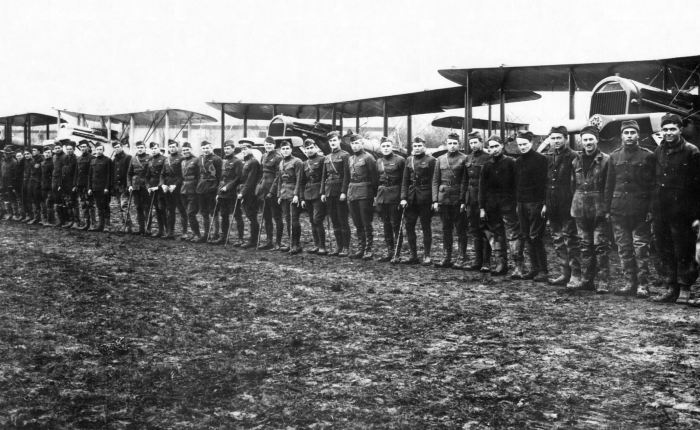
Header image: US Army 166th Aero Squadron personnel standing in front of licence-produced Airco DH4s, November 1918. (Source: Wikimedia)

[1] John H. Morrow, The Great War in the Air: Military Aviation from 1909 to 1921 (Tuscaloosa: Univerity of Alabama Press, 2009), p. 266.

[2] Colonel Edgar S. Gorrell, The Measure of America’s World War Aeronautical Effort (Northfield, VT: Norwich University, 1940), pp. 7-9. A build-to-print design is one where (theoretically at least) detailed blueprints and specifications allow another organization to manufacture the item.

[3] Ibid, p. 2. Other authors have slightly higher numbers, but Gorrell’s data comes from reviewing 60 volumes of raw data – he was also an active-duty Air Service staff officer at the time of the events.

[4] Morrow, The Great War in the Air, pp. 265-66.

[5] Ibid.

[6] Benedict Crowell, America’s Munitions 1917-1918: Report of Benedict Crowell, Director of Munitions (Washington, DC: US Government Printing Office, 1919), pp. 240-41.

[7] Gorrell, The Measure of America’s World War Aeronautical Effort, p. 3. Gorrell himself, then a captain, was a member of the Commission.

[8] Ibid, p. 5.

[9] Ibid, p. 3-4.

[10] Judy Rummerman, https://www.centennialofflight.net/essay/Aerospace/WWi/Aero5.htm.

[11] Major Michael A.Macwilliam, The Development and Emergence of the American De Havilland Aeroplane (Air Command and Staff College Thesis, Maxwell AFB, AL: Air Command and Staff College, 1997), p. 11, citing Mitchell Memoirs.

[12] Isaac F. Marcosson, Colonel Deeds Industrial Builder (New York: Dodd, Mead and Company, 1947).

[13] Lisa Rickey, The court decision in John H. Patterson’s case was announced…..

[14] United States House of Representatives,  Hearings Before Subcommittee 1 (Aviation), Select Committee on Expenditures in the War Department, Vol 3 (Washington: United States Government Printing Office, 1920), p. 3883.

[15] Lieutenant Colonel W. R. Laidlaw, MSS from Lt Colonel Laidlaw to Mr Charles Kettering Dec 7, 1957, (Unpublished).

[16] Grover Loening, Our Wings Grow Faster  (Garden City, NY: Doubleday, Doran and Co., 1935), pp 69-84. ‘Cost plus’ refers to the type of contract used – the aeroplane contractors were reimbursed for all their costs, plus given an additional 10% or more as profit – so in actuality a business loss was impossible.

[17] Marcosson, Colonel Deeds Industrial Builder, p. 267.

[18] Ibid, pp 216-218. Deeds’ biographer claims that Deeds initially refused to join the Aircraft Production Board, then reconsidered because of the ‘opportunity to stimulate the air program.’

[19] ‘US Aircraft Production Board: Body Which is Entrusted with Making America Supreme in the Air,’ Motor Age, 12 July 1917, p. 20.

[20] ‘E.A. Deeds Now Colonel in Regular army of the US,’ Dayton Daily News, 29 August 29 1917, p. 1.

[21] United States House of Representatives, Hearings Before Subcommittee 1 (Aviation), Select Committee on Expenditures in the War Department, Vol 3 (Washington: United States Government Printing Office, 1920), p. 3882.

OODA Loop or Coffee Break? Erich Hartmann and the Forgotten German ‘Decision Cycle’

OODA Loop or Coffee Break? Erich Hartmann and the Forgotten German ‘Decision Cycle’

By Stephen Robinson

There was not too much dogfighting for us. It requires a large area and is absolutely defensive.[1]

Erich Hartmann

Colonel John R. Boyd flew F-86 Sabres during the Korean War and later theorised the Observation-Orientation-Decision-Action (OODA) loop, initially focused on air-to-air combat. At first, Boyd considered the tactical requirements of test flight dogfights between the YF-16 and YF-17 prototypes in 1974 before analysing Sabre and MiG-15 combat in Korea. He expressed the basic idea of the OODA loop in a United States Air Force (USAF) oral history in 1977, although it was not fully formed with its familiar four stages.[2] However, it is not commonly known that another F-86 pilot had theorised a four-stage air-to-air combat ‘decision cycle’ in the 1940s – Luftwaffe pilot Erich Hartmann.

FRE_015069
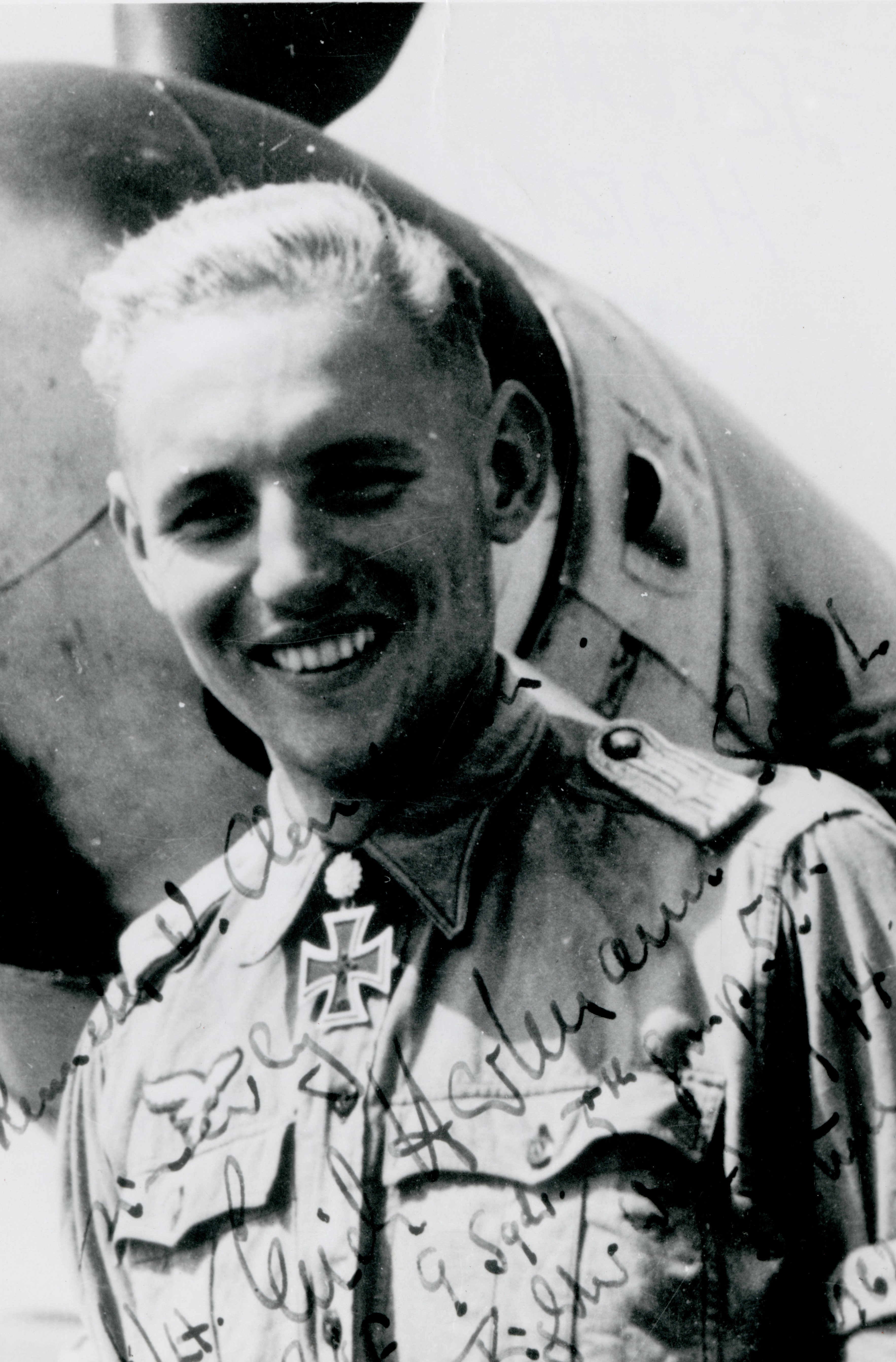
A signed copy of a photo of Erich Hartmann during the Second World War. (Source: Imperial War Museum)

During the Second World War, Hartmann flew 1,404 combat missions, participated in 825 air-to-air engagements and became history’s highest-scoring ace with 352 official kills, mainly over the Eastern Front.[3] During the Cold War, he later commanded West Germany’s first Sabre wing Jagdgeschwader 71 ‘Richthofen.’[4] Hartmann theorised the ‘Coffee Break’ concept, abbreviated as See-Decide-Attack-Break (SDAB). Writets Trevor J. Constable and Raymond F. Toliver articulated the idea in their bestseller The Blond Knight of Germany (1970), the first Hartmann biography, almost half a decade before the OODA loop emerged. Although their book romanticises the German military and fails to address Hartmann’s relationship with National Socialism adequately, it accurately depicts air combat tactics. In contrast, historian Erik Schmidt’s Black Tulip: The Life and Myth of Erich Hartmann, the World’s Top Fighter Ace (2020) thoroughly examines Hartmann’s role in the Third Reich and his fighter pilot career, which makes his book essential reading.

Hartmann and Boyd, in addition to flying Sabres and developing ‘decision cycles’, had much else in common. They were both aggressive fighter pilots with maverick independent streaks who declared war on their hierarchy late in their careers. Hartmann rebelled by opposing the F-104 Starfighter, which he considered unsafe, while Boyd went outside his chain of command to develop the unwanted Lightweight Fighter project.[5] Both men also retired as colonels in the 1970s.

At first glance, the SDAB cycle and the OODA loop are hard to distinguish. As John Stillion expressed: ‘Hartmann’s air combat procedure is strikingly similar to USAF Colonel John Boyd’s famous Observe, Orient, Decide, Act, or “OODA” loop.’[6] However, there is a critical difference. In an air combat context, the OODA loop is about winning dogfights, while the SDAB cycle is all about avoiding them. Additionally, Boyd’s OODA loop theory evolved from air combat to include land combat and then conflict in general before becoming a cognitive model explaining the mind’s relationship with reality. Hartmann’s method, as Schmidt concluded, is not ‘really a dogfighting strategy per se. It was more of an anti-dogfighting strategy.’[7]

Take a Coffee Break

Hartmann enlisted in the Luftwaffe in 1940 and joined Jagdgeschwader 52 in October 1942, flying Messerschmitt Bf 109 fighters. He initially became a wingman for Edmund Rossmann, who mentored the novice pilot. Rossmann had already been credited with over 80 kills, giving his advice considerable merit.[8] Hartmann learned that Rossmann had a wounded arm that prevented him from flying highly manoeuvrable dogfights, but he compensated for this injury by developing a specific tactic. After spotting the enemy, Rossmann patiently assessed the situation before deciding whether to attack. If he decided that surprise could be achieved, he would attack, which differed from the standard practice of immediately attacking a seen enemy.[9] Hartmann later reflected that Rossmann ‘taught me the basic technique of the surprise attack, without which I am convinced I would have become just another dogfighter.’[10] What Rossmann did out of necessity, Hartmann would soon do out of choice.

Hartmann scored his first aerial victory on 5 November 1942 by shooting down an Il-2 Sturmovik. However, shrapnel from the kill damaged his engine, forcing him to crash. While recovering in the hospital, Hartmann began to formulate his conception of air combat after reflecting that he should have approached closer before opening fire and disengaged quicker to prevent shrapnel from hitting his engine. Hartmann later recalled: ‘I learned two things that day: Get in close and shoot, and break away immediately after scoring the kill.’[11] Hartmann later formulated his trademark method, as Constable and Raymond explained:

The magical four steps were: “See – Decide – Attack – Reverse, or ‘Coffee Break’.” In lay terms, spot the enemy, decide if he can be attacked and surprised, attack him and break away immediately after striking; or if he spots you before you strike, take a “coffee break” – wait – pull off the enemy and don’t get into a turning battle with a foe who knows you are there.[12]

In a USAF interview in 1985, Hartmann was asked, “How did you develop your tactics of See, Decide, Attack, Reverse, or Coffee Break?” He answered:

I developed my tactics by watching my leader. My first leader, MSgt Eduard Rossmann, was always cautious. He said he didn’t like to pull a lot of Gs because of a bad shrapnel wound in his arm. He would look over each fight and decide if he would enter. When he did enter, it was always straight through – no turns – and he usually came home with a kill. My next leader, Sgt Hans Dammers, liked to turn and fly in the circus. The next man, 1st Lt Josef Swernemann was somewhere in between the two. He would be patient for a while, but then would get into a turning fight when he got frustrated. This is when I realized you must fight with your head, not your muscle.[13]

Hartmann rejected dogfighting as he considered it pointless and risky: ‘I also decided against aerial acrobatics, against what traditional pilots would call dog-fighting […] Acrobatics are a waste of time and therefore dangerous.’[14] Hartmann would always try to break contact after a pass before deciding if another pass was warranted and, as Constable and Raymond explained, ‘[e]ach pass was a repetition of the “See – Decide – Attack – Break” cycle.’[15]

Hartmann’s method was essentially hit-and-run tactics. As social scientists C. Hind and A. Nicolaides explained: ‘Hartmann became the ultimate and leading exponent of the stalk-and-ambush tactics, and he favoured the tactic of ambushing enemy aircraft and firing at them from very close range, about 20 m, rather than becoming involved in challenging and unnecessary dogfights.’[16]

The SDAB cycle is usually only mentioned in popular military aviation histories and is rarely referred to in scholarship. Edward E. Eddowes, who worked at the Air Force Human Resources Laboratory, submitted a paper to the First Symposium on Aviation Psychology in 1981. He declared: ‘Each engagement involves repetitions of the see, decide, attack, break discrimination-decision sequence. Like many of his predatory predecessors, Hartmann found turning contests hazardous and avoided them.’[17]

In another example, Captain James H. Patton, Jr., a retired naval officer, in his article ‘Stealth is a Zero-Sum Game: A Submariner’s View of the Advanced Tactical Fighter’ considered the SDAB cycle in 1991:

Top Gun instructors interpreted that terse guidance – based on interviews with Hartmann – to mean that a pilot should attempt to detect without being detected, judge whether he can attack covertly, close to a point that would almost assure a kill, and then disengage rapidly to repeat the process, rather than hang around in what submariners call a melee, and fighter pilots term the visual fur ball.[18]

Mikel D. Petty and Salvador E. Barbosa conducted an interesting air simulation experiment. They noted that USAF instructors supervise trainees undergoing virtual simulation-based training.[19] However, given the limited availability of instructors, they devised a means of testing a self-study-based training approach through simulation by following the progress of one test subject over eight years. The virtual pilot flew 2,950 missions in 138 campaigns using seven types of aircraft set in Europe in 1943-45 using Microsoft Combat Flight Simulator 3 (CFS3). The experiment required the subject to read air combat literature before applying the described tactics in the simulation. The study material included The Blond Knight of Germany, which outlined the SDAB cycle.[20] Petty and Barbosa confirmed the effectiveness of the SDAB cycle as ‘maneuvers and tactics described as effective in WWII air combat in the literature, e.g., those in Franks (1998) and Toliver and Constable (1970), were found by the subject to be very effective in CFS3 as well, if performed correctly.’[21]

The SDAB cycle has limitations, and Schmidt correctly concluded that it was well-suited to the Eastern Front but had less utility in Western Europe: ‘Hartmann’s Soviet enemies were, generally, less capable than the British and American pilots on the Western Front, which meant not only that they were easier to shoot down, but also that they were easier to evade and disengage from if the odds weren’t right.’[22] Therefore, applying SDAB cycles consistently in practice is impossible, and some dogfighting is inevitable, making the OODA loop relevant.

The OODA Loop

Boyd was familiar with Hartmann and mentioned him once in the 1977 USAF oral history stating that ‘[A]nd so, in that sense, a guy like Hartmann or a guy like Bong [Maj Richard I.] and some of these other good American aces – I could name others from other countries – they kind of knew they were going to win anyway. Maybe not in the beginning, but they built up that certain confidence and they had the desire.’[23] However, it is unclear if he read The Blond Knight of Germany or other references to the SDAB cycle, so we do not know if Hartmann influenced the OODA loop.[24] In any case, both models are opposites, so there is no suggestion of plagiarism. The basic idea of the OODA loop is to move faster than the enemy through a four-stage cycle, as military analyst Franklin C. Spinney, a close acolyte of Boyd, explained:

He [Boyd] thought that any conflict could be viewed as a duel wherein each adversary observes (O) his opponent’s actions, orients (O) himself to the unfolding situation, decides (D) on the most appropriate response or countermove, then acts (A). The competitor who moves through this OODA-loop cycle the fastest gains an inestimable advantage by disrupting his enemy’s ability to respond effectively.[25]

The victor, moving faster, seizes the initiative while the loser becomes paralysed by disorientation and panic.[26] The winner gets inside the loser’s OODA loop, which allows the pilot to manoeuvre into a winning firing position during a dogfight.[27] The OODA loop requires both pilots to dogfight long enough and complete enough loops for the winner to gain a relative speed advantage, which begins to sow disorientation and panic in the loser’s mind. More specifically, the pilots must complete enough OODA loops for the winner’s relative speed advantage to result in an action that changes the overall situation.[28] When this occurs, the loser’s actions, based upon the superseded earlier situation, fail to achieve the intended result, and they become confused as negative feedback overloads their brain. A pilot simply shooting down an enemy Hartmann-style before a clash of opposing OODA loops can occur is not applying Boyd’s model. If the OODA loop involved surprise and winning before the opponent reacts, there would be nothing original about the idea or way to distinguish it from the earlier SDAB cycle meaningfully.

The key difference between Hartmann and Boyd is that the SDAB cycle avoids dogfighting while the OODA loop requires dogfighting. Boyd was fixated on dogfighting as Frans P.B. Osinga explained: ‘[H]e [Boyd] developed the ability to see air combat as a contest of moves and countermoves in time, a contest in which a repertoire of moves and the agility to transition from one to another quickly and accurately in regard [to] the opponent’s options was essential.’[29]

Boyd’s manual Aerial Attack Study (1964), first published in 1960, explained all possible dogfighting manoeuvres without prescribed solutions.[30] Osinga concluded that Boyd ‘wanted to show people various moves and countermoves, and the logic of its dynamic.’[31] Aerial Attack Study reads like a chess strategy book. It is undoubtedly valuable, as Grant Hammond explained: ‘[M]any a fighter pilot, whether he knows it or not, owes his life to Boyd and the development of the tactics and manoeuvres explained in that manual.’[32] Former students who fought in Vietnam credit Boyd’s teaching for getting them out of danger. For example, on 4 April 1965, Major Vernon M. Kulla engaged North Vietnamese MiG-17s while flying an F-105 Thunderchief. Before the MiG-17 could open fire, Kulla successfully conducted a snap roll that he learned from Boyd, forcing the communist pilot to overshoot.[33] Therefore, Boyd certainly taught useful air-to-air tactical skills.

Despite Boyd’s obsession with dogfighting, it is rarer than many assume. Historically speaking, in most cases, victory goes to the pilot, who spots the enemy first and wins before the opponent can react. As Barry D. Watts explained:

To start with historical combat data, combat experience going at least back to World War II suggests that surprise in the form of the unseen attacker has been pivotal in three-quarters or more of the kills. For example, P-38 pilot Lieutenant Colonel Mark Hubbard stressed that, in his experience over northern Europe with the U.S. Eighth Air Force, “90% of all fighters shot down never saw the guy who hit them.” Similarly, the German Me-109 pilot Erich Hartmann […] has stated that he was “sure that eighty percent” of his kills “never knew he was there before he opened fire.”[34]

This trend continued during the Vietnam War from April 1965 to January 1973, as approximately 80 per cent of personnel shot down from both sides never saw the other aircraft or had insufficient time to make a countermove.[35] Accordingly, Watts concluded: ‘[W]hat historical air combat experience reveals, therefore, is that upwards of 80 per cent of the time, those shot down were unaware that they were under attack until they either were hit or did not have time to react.’[36]

Most air-to-air kills did not involve dogfighting and, consequently, clashes of opposing OODA loops involving sequences of moves and countermoves. Most air-to-air engagements end before the loser has time to act. Even when dogfighting occurs, it can be over in seconds, as Schmidt explained:

Amazingly, the whole dance of a dogfight could take place over the course of just a few seconds. The famed American pilot Robin Olds, who flew P-38s and P-51s in World War II and F-4 Phantoms in Vietnam, said: “Usually in the first five seconds of a dogfight, somebody dies. Somebody goes down. You want to make sure it’s the other guy.”[37]

Therefore, the OODA loop is not always applicable in dogfights because other factors often decide the outcome before the winner’s faster speed can generate negative feedback in the loser’s mind, which is a more gradual process involving moves and countermoves.

Boyd, without intending to, contradicted the essence of the OODA loop by expressing a sentiment identical to the SDAB cycle:

So that’s why he [the fighter pilot] wants to pick and choose engagement opportunities. He wants to get in, get out, get in, and get out. Why does he want to do that? Because it’s not just one-to-one air-to-air combat up here. It’s what the pilots like to say, many-upon-many. In other words, if you’re working over one guy, somebody else is going come in and blindside you. So you want to spend as little time with a guy as possible. You need to get in, gun him, and get the hell out.[38]

Ironically, Boyd preferred the hit-and-run essence of the SDAB cycle, as picking and choosing engagement opportunities and cycles of getting in and out to avoid danger sounds just like Hartmann. Therefore, engaging in an elongated OODA loop duel with another pilot is inherently risky due to the possible presence of other enemy fighters. However, there is still a critical difference as Boyd believed that the best way to break contact was by conducting a ‘fast transient’ – a rapid transition from one manoeuvre to another that allows a pilot to kill before quickly disengaging.[39] However, a pilot can only conduct a ‘fast transient’ if they are already in a dogfight. Hartmann instead preferred to dive at an unsuspecting enemy using superior speed in a single pass and then to use the momentum gained to break contact without any acrobatics, dogfighting or ‘fast transients’.

Boyd also stressed: ‘[T]hink of it in space and time. In space, you’re trying to stay inside his manoeuvre; in time, you want to do it over a very short period of time, otherwise you’re going to become vulnerable to somebody else.’[40] Therefore, Boyd advocated elongated OODA loop duels to gradually generate negative feedback while inconsistently wanting to restrict engagements to minimal periods due to the risk of other enemy fighters. Ultimately, Boyd failed to reconcile the need to rapidly break contact after an attack to avoid danger with the time required for enough OODA loop cycles to generate disorientation and panic in the loser’s mind.

Aces and Iteration

The key advantage of the SDAB cycle is that it minimises risk. However, a pilot intending a surgical hit-and-run strike may inadvertently find themselves in a dogfight, and then the logic of the OODA loop might become paramount. Nevertheless, engaging in an OODA loop contest inherently makes one vulnerable. As Jim Storr explained: ‘[T]here is considerable advantage in reacting faster than one’s opponent, but the OODA Loop does not adequately describe the process. It places undue emphasis on iteration instead of tactically decisive action.’[41] After attacking, Hartmann would break contact to prevent iteration and only committed to further passes in favourable conditions. The avoidance of iteration is also evident in the tactical methods of other aces, and Storr stressed that ‘biographies of aces […] show almost no trace of iterative behaviour in combat.’[42] Hartmann’s tactics worked because he avoided dogfighting. As Storr similarly expressed:

Critically, aces scarcely ever dogfight. They usually destroy enemy aircraft with a single pass, and expend very little ammunition per aircraft shot down. Their effectiveness centres on rapid, decisive decision and action. It is based on superlative, largely intuitive, situational awareness. Aces do display some significant characteristics – their eyesight is usually exceptional and their shooting phenomenal. They also have catlike reactions. However, expert fighter combat is fundamentally not iterative. It is sudden, dramatic and decisive.[43]

Boyd valued manoeuvrability over speed, while Hartmann preferred speed over manoeuvrability. Neither is right or wrong, and there is undoubtedly a degree of pilot preference. Hartmann’s approach was only made possible by exceptional eyesight, which allowed him to apply successful SDAB cycles consistently. Understandably, pilots with poorer eyesight might prefer manoeuvrability. After all, most pilots never become aces, so there is value in applying lessons from both Hartmann and Boyd’s approaches.

Conclusion

Boyd advocated getting inside the enemy’s OODA loop to disrupt their decision-making process and force them to make defeat-inducing inappropriate actions. In contrast, Hartmann had no intention of getting inside the enemy’s ‘decision cycle’. He usually won before the enemy knew of his presence or had time to act. There is no need to disrupt the enemy’s decision-making process if they have no time or opportunity to make decisions, and in such circumstances, the OODA loop is redundant. As such, Boyd neglected the importance of who spots who first and the corresponding likelihood that most engagements will be decided before sequences of moves and countermoves can occur.

Of course, manoeuvrable dogfighting cannot always be avoided, so the OODA loop certainly has merit. For example, an F-35 Lightning II would ideally only shoot down unsuspecting enemy fighters with long-range missiles beyond visual range. However, it is armed with 25mm cannons just in case dogfighting occurs. Nevertheless, air-to-air engagements have declined since the Vietnam War, while situational awareness has dramatically increased due to improved radar and airborne early warning and control (AEW&C) platforms. Therefore, the ratio of air-to-air kills occurring beyond visual range will likely continue to increase. Consequently, the future of OODA loop-style dogfighting is uncertain but becoming increasingly rare. At the same time, the core of Hartmann’s method remains valid. Pilots can now ‘see’ at great range with radar and ‘decide’ whether to ‘attack’ with the assistance of AEW&C. However, there may be no need for a clean ‘break’ since pilots no longer must get close thanks to long-range missiles.

The OODA loop depicts air-to-air combat as a duel between two minds going through cycles in which both pilots have a ‘sporting chance’, which reflects the ‘Knights of the Air’ myth from the First World War.[44] In contrast, Hartmann was like a sniper, describing his preferred tactic as ‘[C]oming out of the sun and getting close; dog-fighting was a waste of time. The hit and run with the element of surprise served me well, as with most of the high scoring pilots.’[45] Boyd, in contrast, is like a chess enthusiast who loves the moves and countermoves of the game. However, OODA loop-like dogfights only occur in a minority of air-to-air encounters. Therefore, Boyd’s model only has limited utility in air combat.

The SDAB cycle demonstrates that the OODA loop is not the only ‘decision cycle’. Despite its impeccable origins in combat experience, Hartmann’s tactical method is not well-known today partly because he never transformed the SDAB cycle into a general theory of conflict. In contrast, Boyd considered the more abstract OODA loop to be a universal guide to military success, applicable beyond the air domain at all levels of conflict. Boyd also believed that the OODA loop explained any competitive endeavour – such as politics, business, and sports – as well as human cognitive processes and behaviour in general. As Osinga explained concerning Boyd’s final version of the OODA loop: ‘[I]t is a model of individual and organizational-level learning and adaptation processes, or – to use Boyd’s own terms – a meta-paradigm of mind and universe, a dialectic engine, an inductive-deductive engine of progress, a paradigm for survival and growth, and a theory of intellectual evolution.’[46] Hartmann never transformed his straightforward air-to-air tactic into something grander. Another reason the SDAB cycle is not well-known is that Hartmann did not devote his retirement to promoting the concept: ‘I instructed and flew at a few air clubs, and flew in an aerobatics team with Dolfo Galland. Later I just decided to relax and enjoy life.’[47] In contrast, Boyd spent much of his retirement expanding, refining and disseminating his theories, including the OODA loop.

Boyd considered the OODA loop a universal and unchangeable fact of life – we have OODA loops whether we like it or not, and that is the model that best explains our relationship with reality.[48] Therefore, Boyd became imprisoned by totalising thinking while Hartmann didn’t, primarily because he never overanalysed his model. The SDAB cycle was an artificial way of thinking based on experience and circumstance. Hartmann demonstrates that we can manufacture our own ‘decision cycles’ through trial and error, tailoring them to meet specific needs and requirements. He also reminds us that ‘decision cycles’ do not have to be grand cognitive models. Above all, we are free to choose and experiment as Hartmann did. Numerous ‘decision cycles’ can coexist with different strengths and weaknesses. Therefore, it makes no sense to select one model for every situation.

Although the OODA loop (dogfighting) and the SDAB cycle (anti-dogfighting) are opposites, they can be complementary when synthesized. The OODA loop and the SDAB cycle become the opposite ends of a broad spectrum of options between those extremes. Most pilots probably operate somewhere between those two poles, taking their talents, aircraft characteristics, and specific circumstances into account. Boyd would favour synthesising the OODA loop and the SDAB cycle because doing so precisely aligns with the dialectical logic he expressed in his enlightening article Destruction and Creation (1976).[49] He also championed synthesis through his snowmobile allegory in his remarkable briefing, The Strategic Game of ? and ?.[50] The allegory is a thought experiment involving the image of a skier, a motorboat, a bicycle and a toy tractor. All these concepts can be broken down into sub-components through a destructive process, resulting in skis, motorboat engines, bicycle handlebars and rubber treads. These useful sub-components from different origins can then be reassembled into something new through a creative process, resulting in a new concept – a snowmobile. Boyd never stated that his ideas are exempt from the dialectical logic of destruction and creation. Therefore, subjecting the OODA loop to destruction and creation is inherently positive and can offer new insights into air combat.

Stephen Robinson is an officer in the Australian Army Reserve currently serving in the Australian Army History Unit. He is the author of False Flags: Disguised German Raiders of World War II (2016), Panzer Commander Hermann Balck: Germany’s Master Tactician (2019), The Blind Strategist: John Boyd and the American Art of War (2021) and Eight Hundred Heroes: China’s Lost Battalion and the Fall of Shanghai (2022).

Header image: A Canadair Sabre at the Militärhistorisches Museum der Bundeswehr – Flugplatz Berlin-Gatow in Hartmann markings from when he commanded JG71, c. 2007 (Source: Wikimedia)

[1] Quoted in Edward H. Sims, Fighter Tactics and Strategy 1914-1970 (New York: Harper and Row, 1972), p. 208.

[2] Boyd referred to the ‘observation-decision-action time scale’ in the interview, which is not yet the familiar OODA loop since it lacks the orientation stage. United States Air Force Historical Research Center, U.S. Air Force Oral History Interview, K239.0512-1066, Colonel John R. Boyd, Corona Ace, 28 January 1977, p. 132.

[3] Erik Schmidt, Black Tulip: The Life and Myth of Erich Hartmann, the World’s Top Fighter Ace (Philadelphia, PA: Casemate Publishers, 2020), p. xiii.

[4] Schmidt, Black Tulip, p. 130.

[5] Schmidt, Black Tulip, p. 134; Robert Coram, Boyd: The Fighter Pilot Who Changed the Art of War (New York: Hachette Book Group, 2002), p. 244.

[6] John Stillion, Trends in Air-to-Air Combat: Implications for Future Air Superiority (Washington DC: Center for Strategic and Budgetary Assessments, 2015), p. 6.

[7] Schmidt, Black Tulip, p. 64.

[8] Philip Kaplan, Fighter Aces of the Luftwaffe in World War II (Barnsley: Pen and Sword Books, 2007), p. 192.

[9] Trevor J. Constable and Raymond F. Toliver, The Blond Knight of Germany (New York: Ballantine Books, New York, 1970), pp. 43-4.

[10] Quoted in Kaplan, Fighter Aces of the Luftwaffe in World War II, p. 195.

[11] Colin D. Heaton, ‘Final Thoughts of the Blond Knight,’ World War II 17, no. 3 (2002), p. 33.

[12] Constable and Toliver, The Blond Knight of Germany, p. 55.

[13] Rich Martindell and Bill Mims, ‘An Interview with Erich Hartmann, the Ace of Aces,’ in Tac Attack (Washington DC: Department of the Air Force, 1985), p. 23.

[14] Quoted in William Tuohy, ‘German Pilot Reported 352 Kills Hope of Top WWII Flier: No Need for New Air Aces,’ Los Angeles Times, 3 January 1986.

[15] Constable and Toliver, The Blond Knight of Germany, p. 86.

[16] C. Hind and A. Nicolaides, ‘Ace of Aces: Erich Hartmann the Blond Knight of Germany,’ Open Journal of Social Sciences 8 (2020), pp. 388-9.

[17] Edward E. Eddowes, ‘Measuring Pilot Air Combat Maneuvering Performance’ in First Symposium on Aviation Psychology (The Ohio State University Columbus: The Aviation Psychology Laboratory, 1981), p. 340.

[18] James H. Patton, Jr., ‘Stealth is a Zero-Sum Game: A Submariner’s View of the Advanced Tactical Fighter,’ Airpower Journal 5, no. 1 (1991), p. 7.

[19] Mikel D. Petty and Salvador E. Barbosa, ‘Improving Air Combat Maneuvering Skills Through Self-Study and Simulation-Based Practice,’ Simulation & Gaming 47, no. 1 (2016), p. 105.

[20] Petty and Barbosa, ‘Improving Air Combat Maneuvering Skills,’ p. 111.

[21] Petty and Barbosa, ‘Improving Air Combat Maneuvering Skills,’ p. 123.

[22] Schmidt, Black Tulip, p. 64.

[23] U.S. Air Force Oral History Interview, p. 240.

[24] In addition to The Blond Knight of Germany, Boyd may have read Edward H. Sims’ Fighter Tactics and Strategy 1940-1970 (1972), which also explained the SDAB cycle before the OODA loop emerged. Sims, Fighter Tactics and Strategy, 204-5

[25] Franklin C. Spinney, ‘Genghis John,’ Proceedings 123 (1997).

[26] Boyd advised in ‘Organic Design for Command and Control’ to operate inside enemy OODA loops ‘to enmesh adversary in a world of uncertainty, doubt, mistrust, confusion, disorder, fear, panic chaos.” Boyd also added in ‘The Strategic Game of ? and ?’: “Operating inside their OODA loops will accomplish just this by disorienting or twisting their mental images so that they can neither appreciate nor cope with what’s really going on.’ John R. Boyd, ‘Organic Design for Command and Control’ and ‘The Strategic Game of ? and ?,’ in Grant T. Hammond (ed), A Discourse on Winning and Losing (Maxwell AFB: Air University Press, 2018), p. 224 and 302.

[27] Boyd, towards the end of his life, refined the OODA loop into a vastly more complex idea involving multiple feedback loops and different relationships and pathways between the four stages. However, the idea of getting inside the enemy’s OODA loop and gaining a relative speed advance is evident in the earlier basic OODA loop and the final complex OODA loop. This key idea remained constant during the OODA loop’s evolution. Therefore, when referring to the OODA loop in this article, all versions of the OODA loop are referred to unless otherwise specified.

[28] U.S. Air Force Oral History Interview, p. 134.

[29] Frans P.B. Osinga, Science, Strategy and War: The Strategic Theory of John Boyd (New York: Routledge, 2006), p. 28.

[30] John R. Boyd, Aerial Attack Study, 50-10-6C, 1964.

[31] Osinga, Science, Strategy and War, p. 22.

[32] Grant Hammond, The Mind of War: John Boyd and American Security (Washington DC: Smithsonian Books, 2001), p. 80.

[33] Thomas McKelvey Cleaver, Going Downtown: The US Air Force over Vietnam, Laos and Cambodia, 1961-75 (Oxford: Osprey Publishing, 2022), p. 102.

[34] Barry D. Watts, Doctrine, Technology, and War, Air & Space Doctrinal Symposium Maxwell AFB, Montgomery, Alabama 30 April-1 May 1996.

[35] Watts, Doctrine, Technology, and War.

[36] Watts, Doctrine, Technology, and War.

[37] Schmidt, Black Tulip, p. 69.

[38] John R. Boyd, ‘Patterns of Conflict (Transcript),’ in Discourse on Winning and Losing, Marine Corps University, Quantico, 25 April, 2 May, 3 May 1989, p. 10.

[39] Boyd, ‘Patterns of Conflict (Transcript),’ p. 10.

[40] Boyd, ‘Patterns of Conflict (Transcript),’ p. 10.

[41] Jim Storr, The Human Face of War (London: Bloomsbury Publishing 2009), p. 13.

[42] Storr, The Human Face of War, p. 13.

[43] Storr, The Human Face of War, p. 13.

[44] For a comprehensive analysis of Boyd’s relationship with the ‘Knights of the Air’ myth, see Michael W. Hankins, Flying Camelot: The F-15, the F-16, and the Weaponization of Fighter Pilot Nostalgia (Ithaca, NY: Cornell University Press, 2021).

[45] Heaton, ‘Final Thoughts of the Blond Knight,’ p. 33.

[46] Frans P. B. Osinga, ‘The Enemy as a Complex Adaptive System: John Boyd and Airpower in the Postmodern Era,’ in John Andreas Olsen (ed.), Airpower Reborn: The Strategic Concepts of John Warden and John Boyd (Annapolis, MD: Naval Institute Press, 2015), p. 74.

[47] Heaton, ‘Final Thoughts of the Blond Knight,’ p. 85.

[48] Boyd explained in Patterns of Conflict: ‘It doesn’t make any difference whether you’re a Russian, you’re an Englishman, an American, Chinese or what. You have to observe what the hell’s going on here. Then you have to, as a result of that, looking at the world, you generate images, views, and impressions in your mind. That’s what you call orientation. Then as a result of those images, views, and impressions, you’re going have to make a selection, what you’re going to do or what you’re going to do, that’s a decision. And then you’re going to have to implement or take the action.’ Boyd, ‘Patterns of Conflict (Transcript),’ p. 11.

[49] John R. Boyd, Destruction and Creation (Paper), 3 September 1976, pp. 2-3.

[50] Boyd, ‘The Strategic Game of ? And ?,’ pp. 261-5.

Air Vice-Marshal Professor R.A. ‘Tony’ Mason – A Reflection

Air Vice-Marshal Professor R.A. ‘Tony’ Mason – A Reflection

By Dr Ross Mahoney

Editorial note: This piece was originally drafted not long after the passing of Air Vice-Marshal Mason. However, several personal reasons led to a delay in its publication. 

On 12 November 2023, Air Vice-Marshal Professor R.A. Mason, one of the doyens of air power studies, sadly passed away. Known as Tony by most who knew him personally and professionally, Mason can be considered one of the fathers of air power studies in the UK. As I have argued elsewhere, Mason was arguably the critical British air power thinker of the late 20th Century. From being the Royal Air Force’s (RAF) first Director of Defence Studies (DDefS) to his writing and commentary work, Mason was consistently at the forefront of the field until the 2010s. Indeed, his consistent commitment to the field and the length of his career made him stand out. He was also generous with his time and knowledge and always happy to share material with those who shared his interests.

Mason joined the RAF in 1956 and entered the Education Branch. He gradually rose through the ranks in his branch and undertook various assignments, including attending King’s College London, the United States Air War College and the RAF Staff College. Eventually, in 1976, Mason was informed that he would be the RAF’s first DDefS. Mason took up the role at the start of 1977. The position of DDefS was established due to the perceived state of thinking on air power within the RAF and public awareness of the Service’s role. In a letter to Air Officer Commanding-in-Chief Support Command, Air Marshal Sir Reginald Harland, Chief of the Air Staff, Air Chief Marshal Sir Neil Cameron noted that the position was being established ‘to help provide a new stimulus to air power thinking’ throughout the RAF.[1] This point was also emphasised in the terms of reference for the DDefS post, as there was a need to ‘write on air power and defence issues,’ which was to be encouraged.[2]

The establishment of the post of DDefS at the RAF Staff College at Bracknell and Mason’s perceived suitability for the role caused some debate. While this is not the place to consider that debate, the view of Mason’s successor, Group Captain Timothy Garden, is worth noting. Garden, a pilot and later Air Marshal Baron Garden, noted in 1982 in Air Clues that a colleague had questioned why he would want to take over what was perceived by 1982 as an ‘admin branch’ role. Garden reflected that the most appropriately qualified person should essentially hold the post to achieve its aims and that it ‘should not be the prerogative of any branch.’[3] That Garden, as a pilot, viewed the post in such a way was as much down to Mason’s hard work in the role as it was to the importance of the RAF’s intellectual development.

0001

Mason nonetheless quickly sought to encourage discussion and debate and discussion about the role of air power within the service on taking up the role of DDefS. Despite the demise of the RAF Quarterly in 1977, Mason regularly contributed to Air Clues, which, up to the 1970s, had primarily been a technical publication for the RAF. In 1980, he established the Air Power Supplement to Air Clues, the spiritual ancestor to the RAF’s current professional flagship journal, Air and Space Power Review.[4] He also regularly contributed to other publications, such as The RUSI Journal. Perhaps his critical success in this period was organising an academic symposium in his first year in post. This symposium was entitled ‘Air Power in the Next Generation.’ It was well attended and laid the basis for similar endeavours by his successors. It was also published as Air Power in the Next Generation, co-edited with Edgar Feuchtwanger and published by The Macmillan Press in 1979. The book included contributions from the senior USAF, Luftwaffe, and Israeli officers, as well as civilian academics such as John Erickson. Much of Mason’s work started a process whereby his successors have continued to contribute to the collegiate intellectual development of the RAF through various schemes such as publications, conferences, and the management of defence fellowships.[5] Many former post-holders, such as Air Commodore (ret’d) Professor Peter Gray, are also notable for their contribution to developing British air power thinking through their engagement with academia after leaving the post of DDefS and the RAF.

978-1-349-17964-0

Mason’s contributions to air power studies continued after moving on from the DDefS role. In 1983, Mason published Air Power in the Nuclear Age in conjunction with Air Marshal Michael Armitage. This publication helped cement Mason’s position as a leading air power thinker. As Marshal of the Royal Air Force Lord Cameron noted in the foreword to the book, ‘[t]he joint authors of this book are advanced and enlightened thinkers about the doctrine of air power as a vital and perhaps the most important element of modern and future warfare.’[6] This view was not hyperbole. For example, in his 1984 overview of air power literature, historian Richard Hallion described the book as an ‘excellent survey’ of the development of air power during the Cold War.[7] The book was updated as a second edition in 1985. Mason’s other notable works in this period were the edited book War in the Third Dimension and the establishment of the Brassey’s Air Power: Aircraft, Weapons Systems and Technology Series. This latter series was interesting because it was explicitly directed at developing an awareness of air power amongst junior military personnel.

After retiring from the RAF in 1989, Mason moved into academia. He became the Leverhulme Air Power Research Director for the Foundation for International Security and took up a post as a Senior Research Fellow at the Centre for Studies in Security and Diplomacy at the University of Birmingham, where he was director. In 1996, he was made an Honorary Professor of Aerospace Policy at the University of Birmingham.

414K44MP5EL._AC_UF894,1000_QL80_

In 1994, Mason published what might be considered his magnum opus, Air Power: A Centennial Appraisal. This book confirmed Mason’s place as one of Britain’s leading air power thinkers. In this book, Mason examined the development of air power between 1989 and 1994. In doing so, he took a historical approach to examine how air power developed in the years up to this period. Mason then conceptualised the period 1989 to 1994, focusing on several key themes, such as the place of air power in arms control. Notably, he sought to contextualise much of the then-contemporary debate about the role of air power in the First Gulf War. Perhaps the most significant aspect of the book lay in Mason’s conceptualisation of what he called ‘differential air power.’[8] In short, Mason argued that while many nations shared ideas around the implementation of air power, only one in 1994 might be able to fully apply the advantages afforded by air power – the US. Using the idea of differential air power, Mason explored why the US stood out as a unique user of air power capabilities. These were important views for the time; however, while the book remains a significant contribution to air power studies, given factors such as the rise of China in the 21st Century and the distributed use of off-the-shelf technology such as drones, it remains to be seen whether his view remains applicable. Nevertheless, Mason concluded that:

One enduring concept underlay all air power thinking and all operations from the first day of the century to the last, and will continue to do so. Any nation intent on going to war to pursue an interest or defend a principle must first secure the air above it.[9]

Mason’s book was well received at publication and has become a commonly cited work. In his 1995 review in The RUSI Journal, Garden described the book as ‘excellent [and] thought-provoking.’[10] Thomas Keaney, who had worked on the Gulf War Air Power Survey, noted that the book made an ‘important contribution to any discussion on the future of airpower in the United States or elsewhere’ in a 1996 review for the US Joint Forces Quarterly.[11] However, historian Philip Sabin, reviewing the book in the Journal of Strategic Studies in 1995, offered a more tempered view. While recognising that the book had certain strengths, particularly Mason’s ‘balanced insights into many of the controversial issues regarding air power,’ Sabin also highlighted the challenge of reading a book that was ‘dense and difficult to follow without careful reading.’[12]

After the publication of Air Power, Mason continued to contribute to both the public’s and the RAF’s understanding of air power through his continued contribution to publications.[13] He also served as an expert member of the House of Commons Defence Committee in the early 2000s and helped inform British defence policy. He was also an inveterate media commentator and was often called to provide expert opinion. Mason’s contribution to air power studies was wide-ranging. While he had retired several years before his passing, his expertise will undoubtedly be sorely missed by many air power scholars for decades to come.

Dr Ross Mahoney is an independent scholar specialising in the history of war with particular reference to the use of air power and the history of air warfare. He is currently the Senior Historian within the Heritage Policy team at Brisbane City Council in Australia. He has nearly 20 years of experience in the education, museum and heritage sectors in Australia and the United Kingdom. Between 2013 and 2017, he was the inaugural Historian at the Royal Air Force Museum in the UK. In Australia, he has worked as a Historian for the Department of Veterans’ Affairs and taught at the Strategic and Defence Studies Centre at The Australian National University based at the Australian War College. His research interests are focused on the history of war, specifically on the history of air power and air warfare, military leadership and command, military culture, and the history and development of professional military education. He also maintains an interest in transport history. He has published numerous articles, chapters and encyclopedia entries, edited two books, and delivered papers on three continents. His website is here, and he can be found on Twitter at @airpowerhistory.

Header image: Ramslade House, the home of the RAF Staff College in Bracknell when Mason took up the role of Director of Defence Studies. (Source: Wikimedia)

[1] Author’s Personal Collection, Letter from the Chief of the Air Staff to AOC-in-C Support Command, 2 November 1976. I am grateful to the late Air Vice-Marshal Professor R.A. Mason for a copy of this and other documents linked to the establishment of the DDefS post.

[2] Author’s Personal Collection, Terms of Reference for Director of Defence Studies appended to a Letter from the Chief of the Air Staff to AOC-in-C Support Command, 2 November 1976, p. 1.

[3] Group Captain Timothy Garden, ‘Why don’t we forget Defence Studies and get on with the job?’ Air Clues 36, no 10 (1982), p. 364.

[4] Air Vice-Marshal Tony Mason, ‘Air Power Review’s Place in RAF History,’ Air Power Review 21, no. 1 (2018), p. 10.

[5] For a variety of publications produced under the guidance of DDefS, see: Andrew Lambert and Arthur C. Williamson (eds.), The Dynamics of Air Power (London: HMSO, 1996); Stuart Peach (ed.), Perspectives on Air Power: Air Power in its Wider Context (London: The Stationary Office: 1998); Peter W. Gray (ed.), Air Power 21: Challenges for the New Century (London: The Stationary Office, 2000); Peter W. Gray and Sebastian Cox (eds.), Air Power Leadership: Theory and Practice (London: The Stationary Office, 2002).

[6] Marshal of the Royal Air Force Lord Cameron, ‘Foreword’ in M’J’ Armitage and R.A. Mason, Air Power in the Nuclear Age: Theory and Practice, Second Edition (Basingstoke: The Macmillan Press, 1985), p. vii.

[7] Richard Hallion, The Literature of Aeronautics, Astronautics, and Air Power (Washington DC: Office of Air Force History, 1984), p. 36.

[8] Tony Mason, Air Power: A Centennial Appraisal (London: Brassey’s, 1994), pp. 235-278.

[9] Mason, Air Power, p. 278.

[10] Timothy Garden, ‘Book Reviews – Air Power: A Centennial Appraisal,’ The RUSI Journal 140, no. 3 (1995), p. 60.

[11] Thomas Keaney, ‘A Jubilee for Airmen: A Book Review,’ Joint Forces Quarterly 11 (1996), p. 134

[12] Philip Sabin, ‘Book Review – Air Power: A Centennial Appraisal,’ Journal of Strategic Studies 18, no. 4 (1995), pp. 141-2.

[13] For example, see: Tony Mason, ‘British Air Power’ in John Andreas Olsen (ed.), Global Air Power (Dulles, VA: Potomac Books, 2011), 7-62; R.A. Mason, ‘The Response to Uncertainty’ in John Andreas Olsen (ed.), European Air Power: Challenges and Opportunities (Dulles, VA: Potomac Books, 2014), pp. 215-30; Mason, ‘Air Power Review’s Place in RAF History,’ pp. 10-1.

#1944Revisited – Locating Japanese Radars: The First Dedicated Radar Countermeasures Units in the US Navy

#1944Revisited – Locating Japanese Radars: The First Dedicated Radar Countermeasures Units in the US Navy

By Thomas Wildenberg

Editor’s note: In 2024, From Balloons to Drones will publish a series of articles that seek to provide a new perspective on the air war in 1944. If you are interested in contributing, please see our call for submissions here.

The US Navy was unprepared for electronic warfare when the Second World War started. After the US Marines landed on Guadalcanal in August 1942, they were surprised to discover the presence of a Japanese early warning radar, something the US Navy was unaware of. Although several radar countermeasures (primarily radar receivers designed to detect enemy radars) were quickly devised by the Naval Research Laboratory, little or no provision was made for installing the gear in the US Navy’s aeroplanes. It was done on an ad hoc basis. It took two years of trial and error before the US Navy realised that to conduct radar countermeasures (RCM) effectively, it needed aeroplanes specifically outfitted for this purpose with crews that were trained in the use of the latest equipment. This article explores that experience of learning. Once this was achieved, the US Navy could locate and plot the enemy’s early warning radars. This enabled attacking aeroplanes to avoid them, thus reducing the likelihood of their interception from Japanese fighters. Though the equipment supplied to these aeroplanes was never intended for use in air-to-air encounters (radar-equipped night fighters had their own specialised equipment), the well-equipped, well-trained crews of the RCM Consolidated PB4Y-1 Liberators that began arriving in the Pacific towards the end of 1944 discovered that they could use their RCM receivers to guide them to enemy aeroplanes also equipped with radar allowing it to be intercepted and shot down.[1]

Consolidated_PB4Y-1_Liberator_takes_off_from_Eniwetok_Airfield_on_16_April_1944_(80-G-K-1690)
A US Navy Consolidated PB4Y-1 Liberator patrol bomber taking off from Eniwetok Airfield (Stickell Field), 16 April 1944. (Source: Wikimedia)

VP-104 and Learning Lessons

In the spring of 1943, Lieutenant Lawrence Heron, one of several newly trained naval officers in the use and maintenance of the ARC-1 radar receiver (the primary RCM equipment available at that time), was sent to Guadalcanal and assigned to join VP-104 operating PB4Y-1 Liberators out of Carney Field (also known as Bomber 2). When Heron arrived in Guadalcanal, none of the PB4Y-1s were equipped with any RCM equipment. He had to figure out how to install the only radar receiver to transfer it from aeroplane to aeroplane. He solved this problem by mounting the ARC-1 receiver (the US Navy version of the US Army SCR-587) and its power supply on pieces of sawn plywood sized to fit through the aeroplane hatches. These were fastened to a table in the aeroplane interior, and a power cable was connected to the electric power system. He flew twenty missions to such places as Truk, Kapingamarangi in the Caroline Islands, and Rabaul – the latter particularly harrowing as it was so heavily defended.[2]

Forming Field Unit No. 3

By April 1944, it was clear to the leadership in the Southwest Pacific Command that permanently modified aeroplanes, such as the US Army Air Force’s Ferrets (modified aeroplanes such as the Boeing B-17 Flying Fortress and Consolidated B-24 Liberator) flown by crews to intercept radar signals, were far more effective in finding enemy radars than the makeshift radar receiver installations on US Navy bomber and reconnaissance aeroplanes operated by ‘gypsy’ crewman like Heron and his predecessors in Cast Mike 1 (the first US Navy RCM unit deployed to the Pacific Theatre in September 1942). Recognising this shortcoming, the Command’s headquarters was directed to form a dedicated airborne US Navy RCM unit. Lieutenant Heron was sent to the seaplane base at Palm Island near Townsville, Australia, with orders to establish and command Field Unit No. 3, a US Navy RCM unit using two PBYs specifically modified for this purpose.[3]

After arriving in Palm Island, Heron had no difficulty installing the ARC-1 receivers, but no direction-finding antennae were available. He solved the problem by having his men make their own from aluminium tubing. They melted the insulation from spare coaxial for the mount, machining it after it had hardened. The rotating antenna was mounted in the bottom of the flying boat’s fuselage behind the rear tunnel gun hatch and had to be attached after the aeroplane was airborne. As Heron recalled:

I would go back to the tunnel hatch of the aircraft – I wouldn’t ask an enlisted man to do it – and put on a safety belt fastened with a steel cable to the frame of the aircraft, then, with one of the enlisted men holding my feet, I would hang out the bottom of the airplane and fasten the antenna with wing nuts on the bottom of the fuselage. There were lots of occasions when I dropped wing nuts into the water 700 or 1,000 feet below. It wasn’t very pleasant […] Once the antenna was in place, somebody had to sit over the open tunnel hatch and operate the handle which rotated the dipole, using the interphone to coordinate with the RCM operator to get bearing information.[4]

When the modifications to Heron’s PBYs were complete, he took the unit to New Guinea and began flying RCM missions from seaplane bases at Port Moresby and the Samarai Islands. Although the jury-rigged direction-finding antenna gave satisfactory results, installing it was an extremely hazardous operation. During one flight, Heron’s aeroplane came under friendly ground fire. As the pilot maneuvered wildly to avoid being hit, Heron was thrown out of the hatch and back again several times. “If it hadn’t been for the steel safety cable,” he said, “I would probably be somewhere at the bottom of the ocean.”[5]

As the US Navy’s island-hopping campaign advanced toward Japan, RCM operations (today called electronic intelligence or ELINT) were organised from newly established bases on the captured islands. When Enewetak Atoll was secured on 20 February 1944, control of the Marshall Islands, which had been in Japanese hands since 1914, passed to the United States. Within a week, engineers from the US Army’s 110th Battalion were hard at work constructing a bomber airstrip, later named Stickel Field. When completed in March, it had a 400-foot-wide, 6,800-foot-long runway with two taxiways, facilities for major engine overhaul, and Quonset huts for housing personnel.

VPB-116 and Operations in the South Pacific

On 7 July 1944, PB4Y-1 Liberators of VPB-116, under the command of Commander Donald G. Gumz, began arriving on Enewetak. At least three of the planes in the squadron were equipped with specialised radar receivers and search radar. However, they were not equipped with the new APR-5 receiver, which would have greatly simplified the task of locating enemy radars. The squadron commenced operational patrols and sector searches on 12 July and was conducting missions against Truk, Japan’s main naval base in the South Pacific, by the first week in August. By then, the US Navy was aware of the shore-based air-search radars the Imperial Japanese Navy deployed. It had developed techniques for locating them with RCM aeroplanes to minimise their effectiveness. Although Truk had been pounded in February, its airfields continued to be a threat to US forces in the area, so bombings of the atoll continued. To ensure the attacking forces’ safety, the US Navy air force commander in the forward area asked Gumz to attempt to pinpoint the location of the Japanese radar equipment on Truk. Unbeknownst to Gumz or the higher authorities in the US Navy, there were no less than nine enemy air-search radars installed at various locations around the atoll.[6]

Gumz quickly discovered that getting a bearing on the Japanese radar transmissions operating below or just above the 100 MHz minimum range of the ARC-1 receiver was very difficult. To locate the radars, Gumz produced a plan to search for holes in the enemy’s radar screen using three RCM planes simultaneously running concentric circles around Truk lagoon at different altitudes. It took six-night sorties and a low-level morning strike on shipping to locate the radar source on Moen Island and the radar shadows created by certain islands. The information gained during this and other ELINT flights in the area allowed for follow-on raids to be planned so that the Japanese radars would provide minimum warning of the attacking forces’ approach.

An Air-to-Air Engagement

On 1 November 1944, one of the most remarkable air-to-air engagements of the Second World War occurred between an RCM PB4Y-1 under the command of Lieutenant Guy Thompson and a Japanese Kawanishi H8K Emily flying boat. It was also the first time in the history of electronic warfare that ELINT was used to locate and identify an enemy aeroplane so that it could be engaged and shot down by the sensing aeroplane.

Thompson took off that morning from Stickel Field on a mission to escort the submarine USS Salmon (SS-182), which could not submerge after severe damage and was making its way to Saipan. Tompson’s PB4Y-1 was equipped with an APS-15 search radar, which replaced the bottom gun turret, and the newest radar receivers and analysers, including the APR-5 radar receiver that picked up signals in the S-band used by search and early warning radars. On the way to the estimated location of the Salmon, at approximately 1100 hours, Aviation Chief Radio Technician W.T. Kane, monitoring the RCM gear, intercepted an enemy radar transmission that he estimated to be 75 to 90 miles away. The signal received on his instruments indicated that the emissions were not coming from a rotating antenna, as used in ground-based early warning radars, indicating that it was coming from another aeroplane.[7]

As the PB4Y-1 headed towards the emission source, Aviation Chief Radioman E.F. Bryant, operating the APS-15 radar, began searching for the enemy aeroplane. Thirty minutes after the initial contact, the radar screen revealed a contact nine-and-a-half miles distant at 1:30 o’clock low. As Bryant reported the contact, another crew member called out a visual sighting. Thompson let the Japanese plane pass to starboard before initiating a 180-degree turn to come in behind the flying boat, nosed over into a glide to pick up speed, and began closing the gap to the enemy plane below him. To catch the enemy plane, which had picked up speed, “Thompson put on more power and went into a steeper dive, building his sped up to 299 mph and closing to a point 2,000 feet behind and 500 feet above the Emily.” Thompson’s bow turret gunner immediately opened fire, initiating a dogfight that saw both flying boats wildly manoeuvring as Thompson fought to bring all the PB4Y-1’s guns to bear. At the same time, the enemy tried to evade. To gain speed, both aeroplanes dropped their depth bombs. Thompson’s gunners rake the Emily from point plane range, setting both engines on fire. Moments later, its starboard wing float hit the water, tearing off the wing and sending the flying boat cartwheeling into the ocean.[8]

Conclusion

As the US Navy advanced across the Pacific, new radar countermeasures units arrived in the theatre, providing detailed maps showing the location of all the Japanese radars, such as the one below.

Radar map
Japanese radar coverage of the Philippines (Source: Author’s Collection)

This information allowed attacking raids to follow flight plans that would provide a minimum warning to the Japanese. By the end of the Second World War, 18 land-based US Navy patrol squadrons had been modified to carry improved radar receivers and one of the three airborne jammers the Radar Research Laboratory developed.[9] These units were built upon the experience and lessons learned by Heron and Gumz in 1943 and 1944.

Thomas Wildenberg is an award-winning scholar with special interests in aviators, naval aviation, and technological innovation in the military. He is the author of several books on various naval topics and biographies of Joseph Mason Reeves, Billy Mitchell, and Charles Stark Draper.

Header image: A US Navy Consolidated PB4Y-1 Liberator patrol bomber taking off from Eniwetok Airfield (Stickell Field), 13 April 1944. The photo was taken from the top of the observation tower. (Source: Wikimedia)

[1] For more on this topic see: Thomas Wildenberg, Fighting in the Electromagnetic Spectrum: U.S. Navy and Marine Corps Electronic Warfare Aircraft, Operations, and Equipment (Annapolis, MD: Naval Institute Press, 2023), pp. 9-19.

[2] Alfred W. Price, The History of U.S. Electronic Warfare – Volume I: The Years of Innovation—Beginnings to 1946 (Arlington, VA: Association of Old Crows, 1984), pp. 137-8; Craig A. Bellamy, ‘The Beginnings of the Secret Australian Radar Countermeasures Unit During the Pacific War’ (PhD Thesis, Charles Darwin University, 2020), p. 192.

[3] Price, The History of U.S. Electronic Warfare – Volume I, p. 138.

[4] Lawrence Heron, cited by Price, The History of U.S. Electronic Warfare – Volume I, pp. 145-7.

[5] Price, The History of U.S. Electronic Warfare – Volume I, p. 147.

[6] Michel D. Roberts, Dictionary of American Naval Squadrons – Volume I: The History of VA, VAH, VAK, VAL, VAP and VFA Squadrons (Washington DC: Naval Historical Center, 1995), p. 623; Price, The History of U.S. Electronic Warfare – Volume I, p. 144.

[7] Edward M. Young, H6K “Mavis”/H8K “Emily VS PB4Y-1/2 Liberator/Privateer Pacific Theater 1943-45 (London: Osprey Publishing, 2023).

[8] Young, H6K “Mavis”/H8K “Emily VS PB4Y-1/2 Liberator/Privateer Pacific Theater 1943-45.

[9] Thomas Wildenberg, ‘Fighting in the Electromagnetic Spectrum: U.S. Navy and Marine Corps Electronic Warfare Aircraft, Missions, and Equipment,’ lecture given at the Johns Hopkins Applied Physics Laboratory, 14 June 2024.

Eleftherios Venizelos and the Evolution of Greek Military and Naval Aviation, 1909-1918

Eleftherios Venizelos and the Evolution of Greek Military and Naval Aviation, 1909-1918

By Manolis Peponas

Greek military and naval aviation development would have been delayed if Eleftherios Venizelos had not become Prime Minister of Greece in 1910. Venizelos’ rise to power resulted from Greece’s failures in several areas. Greece, in 1909, was facing several issues, including financial problems, continuous military failures, especially the humiliating defeat in the Greco-Turkish War of 1897and the incapability of the political elite to respond to the masses’ demands, including better preparation of the armed forces, reduction of taxes, and financial stabilisation. Also, in the early 20th Century, Greece remained concerned about the intentions of the Ottoman Empire, especially after the reforms introduced in the wake of the Young Turk Revolution of 1908. These events provided the context and motivation for the early development of Greek air power.

The Goudi Coup and Eleftherios Venizelos

In October 1908, junior Greek Army officers who felt disappointed in the military policy of the Greek government, especially the lack of preparation that had led to defeat in the Greco-Turkish War of 1897, formed the Military League. Their key demand was an increased military budget and modernisation of the Greek Army. Rapidly, the organisation became very powerful, largely due to frustrations within the Greek Army and society. Despite the lack of overt political ambition and a desire to focus on military affairs, the young officers gained the support of the people of Athens. So, on 15 August 1909, the Military League organised a coup that began in Goudi barracks. Prime Minister Dimitrios Rallis resigned on the same day, and his successor, Kyriakoulis Mavromichal, began negotiating with the rebels. Despite the success of the coup, the country’s social problems remained unsolved.[1]

The months after the coup passed without any progress. On the one hand, while the Military League was powerful, it did not wish to create a military junta. However, the government had minimal freedom to act. Also, social problems, such as poverty, lack of education, and social inequalities, presented substantial obstacles, and few politicians could handle them. One who could handle them was Venizelos, a little-known lawyer who lived in Crete, then an autonomous region under the authority of the Sultan of the Ottoman Empire. The revolutionary officers – several of whom were Cretans – called him in Athens on 28 December 1909. There, Venizelos crafted a compromise between the Military League and the politicians to create a prudent political program for his regime. After that, on 15 March 1910, the Military League dissolved itself, expressing the opinion that there was no longer a need to exist. Some months after that, on 6 October 1910, Venizelos was elected Prime Minister.[2] Venizelos dominated Greek politics, serving as Prime Minister seven times before he died in exile in 1936.

Soon after his election, Venizelos, viewed as a man of action rather than an intellectual, aimed to transform Greece into a modern European state.[3] The new parliament passed several laws to improve education, protect individual freedoms, secure civil rights, and boost the economy. Also, realising that a new conflict against the Ottoman Empire was approaching, Venizelos sought to reorganise the Greek military. He held the portfolios of the Military and Naval Ministries. One of his first decisions was to invite a French delegation under General Joseph-Paul Eydoux and a British one under Rear-Admiral Lionel Grant Tufnell. Eydoux led the French Military Mission that arrived in Greece in January 1911 to oversee changes in the Greek Army, including improvements in organisation and tactics, training, and procedures. Grant led the British Naval Mission, which undertook similar work with the Greek Navy. Furthermore, in February 1912, the Greek parliament approved a new bill that divided Greece into four military regions. Each region could generate two divisions in wartime.[4]

The First Greek Pilots

As early as 1909, Russian aviator Simon Utoskin appeared in Greece and flew with his Farman aircraft in the Palaio Faliro region. However, this effort had no connection to official Greek policy.[5] The first flight in Greece was carried out by businessman Emmanouil Argyropoulos, who arrived in Athens with a Nieuport IV.G plane in January 1912. On 8 February, he took off from Rouf aerodrome in the presence of King George I and Venizelos. The Prime Minister followed Argiropoulos on his second flight and baptised his plane, Alkyon).

The arrival of the French Military Mission in 1911 was the key driver in establishing military aviation in Greece. Eydoux, a École Supérieure de Guerre graduate, was a passionate man with progressive ideas about how to modernise the Greek Army. In cooperation with Venizelos, Eydoux examined the possibility of establishing a Hellenic Air Service for the Greek Army that followed the standards of the French Army, which had formed its air service in 1909. Venizelos supported the idea and permitted the young officers to go to France for flying training. First Lieutenant Dimitrios Kamperos, First Lieutenant Michail Moutousis, and Second Lieutenant Christos Adamidis arrived there in the last months of 1911. They formed the nucleus of the Hellenic Air Service established in 1911, and they were trained at Henri Farman’s flying school at the Etampes aerodrome. At the same time, the Greek government ordered some of its first MF.7 Longhorns, which arrived in Athens some months later.[6]

The MF.7, a two-seater aeroplane, was designed and built by Maurice Farman in 1910. It was almost 12 meters long, with a wingspan of 15 meters. It used a 70hp Renault 8C V-8 air-cooled piston engine and could reach a speed of 95 kilometres per hour. Its service ceiling was 4,000 meters. Farman used the prototypes initially for training purposes in his flying school. Furthermore, he and other experienced pilots like Maurice Tabateau, Eugène Renaux, and Farman won several Michelin Prizes flying this aircraft type. France, Greece, Great Britain, Australia, Italy, Spain, Mexico, Belgium, Norway, Japan, Denmark, and Russia operated them during the First World War.[7]

Dimitrios_Kamberos
First Lieutenant Dimitrios Kamperos, the first military aviator in Greek history, c. 1912. (Wikimedia)

Kamperos was the first military aviator to return to Greece after the first phase of his training in France. On 13 May 1912, he performed his first flight in Greece during the military exercises before the First Balkan War broke out. Two days later, he flew at a height of approximately 1,000 meters, performing reconnaissance missions in nearby lands of Attica region. Both Eydoux and Venizelos watched his landing. The latter constantly expressed a great interest in the Hellenic Air Service, communicating personally with the pilots and trying to cover their training demands. On 27 May, Venizelos baptised the first four planes that arrived in Greece, giving them the names Dedalus, Aetos (Eagle), Gyps (Vulture), and Ierax (Hawk). The public celebrated the ritual, and several wealthy businesspeople were willing to purchase planes.[8]

Kamperos stayed in Athens for three months; in August, he had to return to France for the second training phase. That period was enough for him to perform several daring flights. Also, in June 1912, he modified a Farman plane into a seaplane and landed it without difficulties in front of Venizelos and other officials. Simultaneously, Kamperos’ colleagues continued their training in France. The detachment numbered six pilots: Moutousis, Second Lieutenant Panoutsos Notaras, Adamidis, First Lieutenant Loukas Papaloukas, First Lieutenant Markos Drakos, and Kamperos. The process was interrupted in September because Greece entered the First Balkan War, and the aviators were obligated to return to their motherland.

Greek Military Aviation and The Balkan Wars

In 2011, historian Marc Biondich described the diplomatic and military history of the Balkans as a product of:

The complex multicultural and ethnolinguistic mosaic, which was produced over the centuries by a combination of geography and political history, has come under astonishing duress over the past two hundred years. Indeed, the Balkans as a term and spatial category were born in the modern era, conceived in the nineteenth century as a post-imperial space and legacy of Ottoman decline emerging from the confluence of revolution, war, and Great Power fiat.[9]

During the 19th Century, several national movements developed in the Balkans to challenge the domination of the Ottoman Empire. The creation of small nation-states in the region did not appease their ambitious leaders, including Eleftherios Venizelos, who desired to expand their countries’ borders. This ambition led to the Balkan Wars of 1912-1913, a series of conflicts that significantly reshaped the map of the region. During the Balkan Wars, Greek pilots had the opportunity to gain experience and show their skills.

In September 1912, the four Greek pilots who remained in France were ordered to return to Greece. They formed the nucleus of the recently established Aviation Company based in Larissa. This unit reported to the Hellenic Air Service. Having initially only four Henry Farman aircraft, the Aviation Company conducted mainly reconnaissance missions. In one of them, Kamperos threw hand grenades at his enemies, although he did not manage to cause any casualty. At the same time, new personnel arrived in Larissa because the government allowed civilians with a pilot diploma to enlist in the Aviation Company. The most significant was Argyropoulos, one of Greece’s few experienced aviators. The government also ordered new Maurice Farman aircraft from France. These decisions helped increase the efficiency of the Aviation Company.

The Greek Army occupied Macedonia’s most significant city, Thessaloniki, on 26 October 1912. That caused the pause of the air operations. However, the Aviation Company moved to Epirus in December to participate in the siege of Ioannina. There, the Greek pilots did not limit their action to reconnaissance missions; they also bombed the Turkish positions and provided supplies to their isolated fellow soldiers. After the liberation of Ioannina, Adamidis landed inside the city, highlighting the successful service of the Aviation Company.[10]

Velos-_24_January_1913
The Greek Destroyer Velos collects the Henry Farman aircraft of First Lieutenant Michael Moutoussis and Lieutenant Aristeidis Moraitinis after the first air-naval operation, c. 1913. (Source: Wikimedia)

Overall, the Balkan Wars significantly impacted Greek military policy regarding aviation. Notably, after the signing of the Treaty of Bucharest in 1913, which ended the Balkan Wars, the efforts to reinforce Greek military aviation continued. Venizelos and the other leading members of his government took the opportunity to understand better the potential of a well-organised Hellenic Air Service with modern aircraft and experienced pilots. It is also noteworthy that Venizelos did not lose his heart when Argyropoulos died in a crash in the Lagadas region on 4 April 1913. This was the Aviation Company’s first loss. Finally, at the beginning of 1913, Moutousis moved to Limnos, where, with Lieutenant Aristides Moraitinis, he organised and experimented with a recently purchased French seaplane for several missions.

Greek Military and Naval Aviation in the First World War

When the First World War began, Greece was politically divided. On the one hand, Venizelos believed the country should be allied with Britain and France because it would allow it to expand Greece’s borders further. On the other side, King Constantine I expressed the opinion that Greece should be neutral, securing whatever it had gained after the recent Balkan Wars. This dispute led to a ‘quiet’ civil war that ended with the deposition of King Constantine I in 1917. After that, Venizelos, supported by Britain and France, declared war on the Central Powers.[11]Meanwhile, Kamperos continued his hard work. He led the Hellenic Air Service, which managed the logistics of military aviation, including the financial administration and the training of the pilots. Also, operationally, an Aviation Company and squadron based in Palaio Faliro, near Athens, reported to the Hellenic Air Service. However, both operational units lacked personnel, aircraft, and fuel. The same thing happened at the Hellenic Naval Air Service until 1917.

In Thessaloniki, where he had organised a rebel government in 1916-1917, Venizelos attempted to merge the air services of the Greek Army and Greek Navy; however, he was unable to achieve his aims due to the backlash of many officers who were afraid that they would lose their autonomy. Nevertheless, Venizelos reorganised the Hellenic Air Service. In September 1917, a specific department was established within the Army Ministry to improve the efficiency of the Hellenic Air Service by undertaking the bureaucratic tasks previously undertaken by the later. There, experienced French personnel supported the Greeks in developing the Greek Army’s aviation capabilities, while an aircraft manufactory was also created. From December 1917 to June 1918, three squadrons were established.[12] These were 531, 532 and 533 Squadron. The former was a fighter unit equipped with Nieuport 24bis and Spad VII/XIIIBreguet 14A2/Β2, while the latter two were bomber-reconnaissance units equipped with Breguet 14A2/Β2.

The Hellenic Air Service participated in several confrontations during the First World War. At the Battle of Skra in 1918, Greek pilots located Bulgarian artillery batteries and guided Greek artillery fire, including counter-battery operations. Additionally, the 531 Squadron, equipped with Spad VII/XIII aircraft, participated in several dogfights against the more experienced Germans to battle for control of the air. However, the most significant role of the army’s squadrons was its participation in fruitful reconnaissance missions and the escort of Entente’s (mainly British) bombers that operated against the Ottoman coasts.[13]

Between 1917 and 1918, the Hellenic Naval Air Service, which had been established in 1915, developed rapidly under the command of Moraitinis, a pro-Venizelist officer who had not hesitated to offer his service to the British in 1916, long before King Constantine I was deposed. The Hellenic Naval Air Service simultaneously trained and took part in several missions, something beneficial for its pilots. One of the most notable moments of the Hellenic Naval Air Service came on 21 March 1917, when Moraitinis bombed the German airdrome of Drama. Moraitinis impressed even his opponents, who witnessed his tremendous action. Moraitinis and his peers also bombed Bulgarian logistical hubs storing food several times and conducted numerous reconnaissance missions. Notably, most of those activities were executed at night under challenging circumstances.

In 1918, the Hellenic Naval Air Service cooperated several times with the British Royal Navy, escorting the latter’s ships operating in the region. One of those missions was the last for Sublieutenant Spyridon Hampas, who had the misfortune of facing the German ace Lieutenant Emil Meinecke. Meinecke had at least seven aerial victories while also training the Turkish pilots. The Germans buried his victim, Hampas, with military honours at the British Chanak Consular Cemetery. He was one of the 18 members of the Corps who lost their lives during the conflict.[14]

At the end of the First World War, four Hellenic Naval Air Service planes flew into Istanbul on 4 November 1918 under the command of Moraitinis. It was a great honour for the Greek airmen because the city was centuries ago the capital city of the Byzantine Empire. After landing at Saint Stefanos’s airdrome, they continued their flight, demonstrating a Greek flag. Unfortunately, that was one of Moraitinis’ last missions as on 22 December 1918, the Breguet 14 he was piloting crashed accidentally near Mount Olympus. He was only 27 years old.[15]

Venizelos_WWI_1918
Venizelos reviews a section of the Greek army on the Macedonian front during the First World War in 1918. He is accompanied by Admiral Pavlos Koundouriotis (left) and French General Maurice Sarrail (right). (Wikimedia)

Conclusion

Moraitinis and, before him, Argyropoulos were two of the most notable Greek airmen who died during their service. However, these losses did not stop the evolution of Greek military and naval aviation. All Greek politicians, including Venizelos, envisioned that their country should dominate in the air. Greek pilots had proved their merit during and before the First World War, operating under difficult circumstances. For example, Greek military and naval aviators operated under challenging operational and organisational circumstances, faced more experienced German aviators and executed dangerous missions. Fortunately, some aviators, such as Kamperos and Moutousis, remained in the Hellenic Air Service and Hellenic Naval Air Service, training their successors.

The question remains, however, as to why Greek military and naval aviation succeeded. First, there was the charisma of the Hellenic Air Service and Hellenic Naval Air Service personnel. Men like Kamperos were both soldiers and leaders who loved danger. So, the other pilots admired them and were ready to obey their orders. More importantly, however, Greek politicians, especially Venizelos, showed an early interest in developing Greek military and naval aviation – Venizelos could be considered the real ‘father’ of Greek military aviation. Notably, Venizelos’ decision to request French and British military advisors was an essential step in developing Greek military aviation. Finally, through Greece’s participation in various wars of the 1910s, Greek pilots learned how to fly and manage an air service under wartime conditions: the theatres of the Balkan Wars and the First World War could be considered the real training schools for them.

Emmanouil (Manolis) Peponas is a PhD candidate at the Department of History and Archaeology, National and Kapodistrian University of Athens. He completed his BA and MA studies with honours at the University of Ioannina. As an experienced freelancer, he has worked for remarkable institutions and publishing companies. He is the author of seven books and several articles. His research interests focus on the contemporary military, social and diplomatic history of the Balkans.

Header image: Greek aviators of the Hellenic Naval Air Service at San Stefano aerodrome after the capitulation of the Ottoman Empire, 1918. (Source: Wikimedia)

[1] Mark Mazower, ‘The Messiah and the Bourgeoisie: Venizelos and Politics in Greece, 1909–1912,’ The Historical Journal 35, no.4) (1992), pp. 885-904.

[2] Mazower, ‘The Messiah and the Bourgeoisie.’

[3] Mazower, ‘The Messiah and the Bourgeoisie,’ p. 904.

[4] Thanos Veremis, Military Interventions in Greek Politics, 1916-1936 [Οι επεμβάσεις του στρατού στην ελληνική εξωτερική πολιτική 1916-1936] (Athens: Alexandria, 2018), p. 39.

[5] ‘Hellenic Air Force History: First Steps,’ Hellenic Air Force.

[6] Konstantinos Topalidis, ‘The History of the Air Force in Greece, 1919-1940’ [‘Η ιστορία της Πολεμικής Αεροπορίας στην Ελλάδα, 1919-1940’] (MA thesis, University of Macedonia, 2016), p. 14.

[7] ‘The Maurice Farman Biplane.’ Flight IV, no. 27 (6 July 1912), pp. 603-6.

[8] Topalidis, ‘The History of the Air Force in Greece,’ p. 15.

[9] Mark Biondich, The Balkans: Revolution, War, and Political Violence since 1878 (Oxford: Oxford University Press, 2011), p. 1.

[10] Topalidis, ‘The History of the Air Force in Greece,’ pp. 16-20.

[11] George Kaloudis, ‘Greece and The Road to World War I: To What End?,’ International Journal on World Peace 31, no. 4 (2014), pp. 9-47.

[12] Topalidis, ‘The History of the Air Force in Greece,’ pp. 28-29.

[13] Douglas Dakin, The Unification of Greece 1770-1923 (London: Ernest Benn, 1972), p. 218.

[14] Topalidis, ‘The History of the Air Force in Greece,’ pp. 30-2.

[15] Jon Guttman, ‘Air Attack Over the Dardanelles,’ historynet.com, 23 September 1998.

Flipping the Script: How Getting Remotely Piloted Aircrew out of Combat Improves Operational Flying

Flipping the Script: How Getting Remotely Piloted Aircrew out of Combat Improves Operational Flying

By Major James Schmitt

For almost a decade, the US Air Force (USAF) has recognised the need for remotely piloted aircraft (RPA) aircrew to conduct ‘dwell.’ [1] Dwell is the Department of Defense (DoD) term for the time between deployments, typically used to restore unit cohesion, conduct training, and support servicemembers’ requirements. Operational experience and research showed that RPA squadrons, despite not physically leaving their home station during combat, also required time in dwell. However, the studies advocating RPA dwell focused on the benefits of time spent out of combat, with few authors studying combat performance. As a result, the studies missed a key point: continual combat operations, even with brief respites, force RPA squadrons and aircrew to divide their attention between traditional peacetime and wartime duties.

An unfocused squadron cannot mission plan with partners, fly operational missions, or conduct high-end training or rehearsals, leaving RPA squadrons persistently underperforming in combat. While RPA aircrew may reap some peacetime benefits from short dwell cycles, the RPA enterprise will only improve operations by adopting the same dwell model as the rest of the USAF.

A Brief History of RPA and Dwell

In 2015, the USAF conducted a wide-ranging study into the morale and retention problems in the RPA community, focusing on aircrew flying the MQ-1 Predator and MQ-9 Reaper. Known as the Culture and Process Improvement Program (CPIP), the study revealed that RPA morale was most affected by continuous combat operations, preventing time away for personal and professional reasons. Unbounded combat operations and the associated rotating work and sleep schedules damaged the health of RPA aircrew, dramatically increasing fatigue, alcohol usage, and medication compared to other USAF career fields.[2] Accepting the CPIP results, the USAF agreed to implement a combat-to-dwell cycle by 2024 for its RPA aircrew.[3]

The study’s mandate to focus on morale biased its recommendations. CPIP recommendations focused on improving aircrew welfare instead of operational performance, a conclusion that also affected follow-on civilian research. For example, a recent Government Accountability Office report on RPA staffing and dwell cited 21 articles; 17 were related to psychological health or well-being, while only one focused on operational effectiveness.[4] In both military and research circles, a consensus developed that aircrew needed a ‘break,’ causing leaders to eschew traditional dwell models and leave RPA aircrew with far too little time out of combat.

Traditional platforms have an established dwell model based on when a unit deploys. DoD policy sets a goal of a 1:3 deploy-to-dwell ratio; in other words, for every month a unit spends deployed, it should spend at least three months in dwell. The USAF expanded on DoD guidance with its Force Generation Model, which formalised a 24-month model with a maximum of 6 months in combat. RPA aircrew, who conduct combat missions from their home stations, fell into a grey area in both policies. The lack of specific guidance presented a problem in managing combat deployments for RPA aircrew.

An_MQ-9_Reaper_sits_on_the_361_Expeditionary_Attack_Squadron_flightline_at_an_undisclosed_location,_Aug._6,_2022
An MQ-9 Reaper sits on the 361st Expeditionary Attack Squadron flightline at an undisclosed location, 6 August 2022. The 361st Expeditionary Attack Squadron operates the aircraft in support of Operation INHERENT RESOLVE. (Source: Wikimedia)

Initial Implementation

On 1 October 2020, the 20th Attack Squadron at Whiteman Air Force Base entered a 60-day reconstitution period, the first-ever protected dwell time for an RPA unit. Colonel Timothy Monroe, the 25th Attack Group commander, wrote that dedicated time out of combat was a ‘paradigm shift’ that would ‘have a significant impact to an adversary’s calculus.’ He was quickly proven correct when the hard work of squadrons in reconstitution set up equally unprecedented MQ-9 deployments in Romania and Japan over the next three years. Even with a short amount of time in dwell, MQ-9 units executed a paradigm shift from counterterrorism in the Middle East and Africa to strategic competition in Europe and the Pacific.

While the first MQ-9 dwell programs have shown impressive results, they have limited goals – rotating four squadrons implies a deploy-to-dwell ratio of 1:0.3, well below the DoD and USAF deploy-to-dwell goal of 1:3. A lower ratio means less training. Before a 6-month deployment, a fighter squadron receives a minimum of 18 months of training. An MQ-9 squadron starting the same 6-month deployment gets only two months of training – about one-tenth the time to complete similar training requirements. The unusually short training period also created new challenges and amplified existing structural problems in the RPA community.

Before initial dwell implementation, MQ-9 pilots and sensor operators completed mission qualification training and did not train again until they became instructors – one of the most underappreciated facts about RPA aircrew. Additionally, most mobility and big-wing aircraft have an aircraft commander that can debrief co-pilots, and most fighter aircraft has a flight lead that can debrief wingmen; MQ-9 aircrew have neither. When entering dwell, the lack of training experience and a senior/junior crew model forces squadrons to task their instructors to oversee every dwell sortie. As a result, MQ-9 instructor pilots and sensor operators are severely overtasked during dwell, leading to burnout, low morale, and poor training quality.

Flipping the Script 1
Depiction of deploy-to-dwell ratios (Source: Author)

Finding the Right Ratio

One barrier to decreasing MQ-9 deploy-to-dwell ratios is that dwell is normally justified in keeping US military members at home. DoD dwell policy explains a 1:3 deploy-to-dwell goal in part to ensure that servicemembers ‘do not spend extended periods of time away from their homeport, station, or base.’ MQ-9 aircrew never leave their base and return to their homes after each day of flying. Further, other communities (such as special operations forces) are chronically over-deployed. Even if studies continually demonstrate the need for RPA dwell, the lack of a physical departure from home stations challenges improved deploy-to-dwell ratios.

The requirement for traditional deploy-to-dwell ratios is evident in a day in the life of RPA aircrew. Today, pilots and sensor operators show up to work with many responsibilities. First, they fly for at least some portion of the day, conducting operational and combat missions globally. Second, they fulfil administrative responsibilities; all but the most junior aircrew have additional duties, from supervising airmen to administering annual evaluations to planning the squadron holiday party. Third, the aircrew accomplishes their training requirements. Because squadrons spend almost all their time in active operations, they must conduct basic combat training, training to make new instructors, and training on emerging tactics and technology while in combat. Fourth, the aircrew participates in mission planning, briefs, and debriefs internally and with outside agencies. To be clear, when RPA aircrew are flying, they do not do other work. Nevertheless, as soon as they leave the cockpit, their attention is pulled in three different directions.

Extensive research demonstrates the challenges of this type of multitasking. On the individual level, multitasking increases stress, decreases productivity, and increases the number of errors in completed work; one study demonstrated that multitasking functionally lowered workers’ IQ by ten percentage points.[5] Organisational multitasking, in which an organisation’s focus is split between multiple critical tasks, has similar effects. Research demonstrates that multitasking organisations deliver results slower, less consistently, and of lower quality than their focused counterparts.[6] The structure of RPA squadrons makes this problem more challenging; with a 24/7 mission, most of the squadron is divided into three shifts and rotating workweeks that prevent clear delineation of administrative, training, and combat duties. As a result, RPA squadron constructs that attempt to do all things at once are structured to underperform continually. Studies even demonstrate that RPA aircrew weigh their ‘deployed in-garrison status’ and ‘extra duties/administrative tasks’ (i.e., multitasking peacetime and wartime responsibilities) as higher operational stressors than combat and weapons employment.[7]

To return a squadron’s attention to its combat or operational mission, future RPA dwell programs must provide enough time out of combat to accomplish peacetime responsibilities. Before a manned squadron deploys, its members take the time to complete most training, administrative responsibilities, and professional requirements. RPA aircrew must do the same before beginning a ” deployment into operational flying. There is no data on how long this would take RPA aircrew, but it is reasonable to assume that it will be roughly the same as their manned counterparts.

With non-flying responsibilities accomplished outside combat missions, RPA squadrons could re-focus on combat operations. That same RPA pilot or sensor operator with four responsibilities in the legacy model would now have two: mission planning or execution. No key squadron personnel would conduct offsite development during high-priority operations. No pilots would be worrying about getting off shift in time to catch a flight to their wedding in four days.[8] In short, the RPA enterprise would flip its most important script: while combat operations are normal and training is abnormal today, the future must make training normal and combat a critical exception.

Flipping the Script 2
Depiction of RPA squadron responsibilities (Source: Author)

Conclusion – The Way Forward

Integrating RPA into a 1:3 deploy-to-dwell cycle faces serious but surmountable challenges. There are only three ways to improve a deploy-to-dwell cycle: create more squadrons, increasing the number of personnel out of combat; re-task (i.e., ‘redeploy’) some MQ-9 units from combat to training; or restructure squadrons to reduce overhead and free up personnel for training. Each of these three approaches poses its own challenges, as resources are limited, demand for MQ-9s is already more than the USAF can produce, and adjusting well-established personnel constructs carries risk. However, the idea that ‘risk is rarely mitigated, just transferred’ applies here. The RPA enterprise transfers risk to combat missions by not accepting risk in resourcing dwell.

Increasing time in dwell also increases the demand for training resources. More time in training means more flying hours at home, which requires more aircraft, cockpits, and (most importantly) maintainers. Even relatively banal problems like a chronic lack of desks and computers become acute when aircrew are in cockpits less and in offices more. The USAF is looking to save money in the MQ-9 program, but the relatively small costs of properly equipping its aircrew will pay returns in the long run.

Innovative solutions to resourcing dwell could be an entire article; the more critical starting point for the discussion is setting a requirement. As long as RPA aircrew are attempting to conduct missions while distracted by administrative responsibilities, if they are hampered by missing key personnel, and as long as they attempt to execute two important tasks simultaneously, they will not perform at the level expected of USAF aviators. The RPA enterprise must make another paradigm shift by integrating into the USAF dwell model, focusing on combat, and improving its performance just as the United States has faced its greatest strategic challenge since the end of the Cold War.

Major James ‘Hot’ Schmitt is a senior remote pilot in the United States Air Force with more than 2,500 combat and combat support hours in the MQ-1 and MQ-9. He has supported operations in Iraq, Syria, Afghanistan, and elsewhere, including a recent deployment as the Chief of Weapons and Tactics for Air Forces Central at Al Udeid Air Base, Qatar. He is a graduate of the US Air Force Weapons School and currently works on the Deputy Chief of Staff for Operations staff at Headquarters Air Force.

Header image: An General Atomics MQ-9 Reaper unmanned aerial vehicle flies a combat mission over southern Afghanistan. (Source: Wikimedia)

[1] RPA is the USAF term for large, medium-altitude uncrewed aerial systems, sometimes also referred to as UAS or drones, to emphasise the role of the remote crew flying the aircraft.

[2] Chappelle, Wayne et al., ‘Reassessment of Occupational Health Among U.S. Air Force Remotely Piloted Aircraft

(Drone) Operators,’ Final Report, Air Force Research Laboratory (April 2017), p. 36.

[3] United States Government Accountability Office, ‘UNMANNED AERIAL SYSTEMS: Air Force Should Take Additional Steps to Improve Aircrew Staffing and Support’ (June 2020), p. 2.

[4] GAO, UMANNED AERIAL SYSTEMS, pp. 49-52.

[5] Molly Russ and Derek Crews, ‘A Survey of Multitasking Behaviors in Organizations,’ International Journal of Human Resource Studies 4, no. 1 (2014), p. 139.

[6] Janice Alquizar, ‘Multitasking of Teachers in the Contemporary Settings: Boon or Bane?” (Dec 2018), p. 35.

[7] Wayne Chappelle et al., ‘Symptoms of Psychological Distress and Post-Traumatic Stress Disorder in United States Air Force “Drone” Operators,’ Military Medicine 179, no. 8 (2014), p. 67.

[8] Author’s unpleasant experience.

Hulls, Hydrofoils, and Float Tests in the NACA Tanks, 1915 to 1945

Hulls, Hydrofoils, and Float Tests in the NACA Tanks, 1915 to 1945

By Jay Shaw

Since the establishment of the National Advisory Committee for Aeronautics (NACA) in 1915, it had worked closely with the United States Navy. Not only had the US Navy partnered with NACA, but the creation of the latter was also a rider to the former’s funding bill.[1] This history of NACA has been overshadowed by its successor, the National Aeronautics and Space Administration (NASA), into which the former was absorbed in 1958. Thus, much of the critical work by NACA has been overlooked. Indeed, if NACA is remembered at all, it is for using wind tunnels in aeronautical research, but there was much more that it was responsible for. This article redresses this deficit by examining how NACA used water tanks in seaplanes’ aeronautical and hydronautical advancements after the First World War. It also highlights the people and agencies involved in the research and the means of conducting the research.

The United States Navy, Seaplanes, and the First World War

The US Navy, realising that aircraft would play a vital role in any future war, recognised that something had to be done to improve its readiness and improve its fleet of seaplanes The US Navy partnered with NACA to investigate and perform research on its aircraft, including seaplanes and flying boats. These planes would be critical in defence and coastal patrols. As a part of the first line of defence against German U-boats, the seaplanes would be a priority for the US Navy. The seaplane was considered a fixed-wing aircraft with a fuselage designed for floatation and containing a hull.[2] However, because it realised that aviation was still a technology in its infancy, the US Navy requested that NACA help make the naval seaplanes as efficient as possible. NACA, in supporting the tasking of the US Navy through its work on seaplanes, ensured a long and productive close bond with the Navy.

By the end of the First World War, the US Navy had several seaplanes with varying hulls, float types, and missions. These seaplanes operated from bases on shores because the US Navy did not have aircraft carriers or capital ships to launch such craft. The prevailing view then was that if the enemy were to attack, it would be by submarine, so it made sense to send patrols out from the shore to search for submarines. Several kinds of seaplanes were designed and used by the US Navy during the First World War. In 1919, Commander H.C. Richardson, the Superintending Constructor of Naval Aircraft for the US Naval Buffalo district in Buffalo, New York, who had also been Secretary to NACA’s main committee on formation in 1915, explained that:

[t]he principal work was done with two types of seaplanes, namely, the HS-2, the single-motored plane developed from the HS-1, and the H-16, a copy of an English seaplane.[3]

These two seaplanes were used because they were the most readily available. This shows how poorly the US Navy seaplane fleet was in 1919. However, according to Richardson:

The Navy Department fully appreciate[d] the desirability of experimenting to improve existing types and the development of new types of seaplanes and airplanes, directed to the solution of those problems which have arisen in the war and, more particularly, to the development of seaplanes or airplanes for operation with the fleet.[4]

Richardson was an active proponent of seaplanes for the US Navy. Therefore, because of the efforts of those such as Richardson, the US Navy was on track to update its seaplane fleet.

Unfortunately, the seaplanes of this period were unscientifically constructed. Their range was not that far, and their stability in flight left much to be desired. Actual aerodynamic testing was needed to ensure that any aircraft was worthy of combat and that the seaplanes were no exception. Richardson wrote in 1919 that:

[t]he problem confronting the Navy was largely determined at the time the United States entered the war [1917] by the fact that the operations of the German and Austrian fleets had been reduced principally to minor raids […] and the only real sea-going operations comprised the activity of submarines.[5]

This would be the primary mission of the seaplanes for many years: the patrol of waters in search of submarines. The submarines’ effect in the First and Second World Wars should not be taken lightly. The amount of cargo tonnage that could be destroyed by an undetected submarine could be immense.

Richardson’s 1919 article is crucial as he addressed the US Navy’s needs and how the seaplanes could aid it. His outline reads almost like a ‘wish list’ that NACA would eventually find itself working on. First, Richardson felt that performance, first and foremost, relied upon horsepower. He argued that:

[t]he performance in power flight is determined by the horsepower required and the horsepower available, and of course, the latter must always exceed the former or power flight is not attainable.[6]

Considering that Richardson wrote this in 1919, he seems to have firmly grasped the needs of seaplanes. However, the power plants of any aircraft currently were still in an age of infancy. As such, Richardson’s idea that seaplanes were reliant on horsepower was unfortunately ahead of the technology that would make the machines efficient.

Richardson also understood that lift was an essential component of flight. He explained that:

[t]he lift of an airplane surface and its resistance to advance are determined by the lift and drift factors, which vary with the type of section used and also with the angle of attack at which the surface is presented to the relative stream of air.[7]

The US Navy realised, however, as much as Richardson showed advanced thought on the subject, that the research involved was outside the Service’s scope. NACA, set up as an agency that was available to help government and civil agencies in aeronautics research, would be the agency to help the US Navy address the fundamental science of seaplane aeronautical research.

Curtiss_(NAF)_H-16_at_NACA_Langley_in_1929
A Curtiss H-16 at the Langley Aeronautical Laboratory at Hampton, Virginia, c. 1929. (Source: Wikimedia)

The Importance of NACA’s Research

While often overshadowed by NASA, the work of NACA deserves examination because of the enormity of its contribution to aeronautics. As NASA historian James Schultz explained:

[t]hroughout its history, with research and applied engineering, the Center [Langley] has been responsible for some of the 20th century’s fundamental aeronautical and aerospace breakthroughs. The Nation’s first streamlined aircraft engine cowling was developed at Langley Laboratory […] the tricycle landing gear; techniques involving low drag-producing flush riveting; [and the] development of the sweptback wing.[8]

Similarly, historian Michael Gorn asserted:

[t]he proliferation of wind tunnels [about thirty had been built at Langley up to the 1950s] reflected the NACA’s true institutional identity: it concentrated on aeronautics.[9]

While Gorn is correct, NACA could not have focused solely on aerodynamics and prospered. Aerodynamics was just one piece of what NACA did. It was established to investigate all flight modes, and hydrodynamics was a crucial part of NACA’s work. While not as aerodynamically sophisticated as land planes, seaplanes and flying boats needed hydrodynamical studies to meet the needs of the US Navy. It is a mistake to overlook this field that so many within NACA worked on.

Once NACA started its research on hydrodynamics, it did so without any presumptions and began its research by looking at the fundamentals of the aircraft. George W. Gray, in his early history of NACA, explained this adeptly. He stated that:

[a] large part of the effort of the hydrodynamic staff at Langley has been expended upon the twin problems: trying to effect a seaplane body that will combine low water resistance with low air drag.[10]

Even before this, however, the question was whether seaplanes could even take flight. Then, again, the problem was that of power plants. As Gray pointed out, the studies:

[h]ad yielded some disappointing surprises: new designs that would not take off at the speeds planned or that would not lift the desired loads at any attainable take-off speed.[11]

With the water tanks of NACA, however, the guesswork was taken out of the equation. However, none of this would have been possible, at least in a reasonable amount of time, without some organisation to make it happen.

Langley and the Water Tanks

Langley, located at Hampton Virginia, was NACA’s research centre, established in 1917. It focused primarily on aeronautical research but would eventually be used to test space equipment such as the Apollo lunar module. However, the first ten years at Langley comprised only the testing of aeroplanes. There was no work at all done on seaplanes. To do this work, NACA had to have something other than a wind tunnel to test the seaplanes.[12]

The drag tank also called a tow tank, drag tunnel, or even the drag basin, was the solution to the research needed. Gray stated that:

[m]any of the studies in wind tunnels were applicable to seaplanes, and they in common with landplanes benefited from improvements in wings, propellers, engine cowlings, and other developments of the 1920s.[13]

The study variables were applicable, but these were still seaplanes, and there was a need to test them in water. Gray elaborated that NACA knew that it needed a better way to test the seaplanes:

[i]t was recognised that the airplane on the water has problems that are not shared by the airplane in the air or on the landing strip, and in 1929 the Committee in Washington decided to enlarge the organisation and equipment at Langley to provide for research in hydrodynamics.[14]

It was then that hydrodynamic research began at Langley.

Langley constructed two tanks: tank number one and tank number two. Tank number one became operational on 27 May 1931 for $649,000.[15] Its purpose was ‘to study the hydrodynamic resistance and other performance features of water-based aircraft.’[16] A vital design team member was Starr Truscott, who published numerous studies based on research from tank one. A few additions were made to the tank, including a new higher-speed (80-MPH) carriage (a rail that the aircraft being tested sits on) installed in 1936-1937 and a tank extension of 900 feet to 2,960 feet in 1936.[17] Eventually, the need for another tank would arise, leading to the construction of tank two.

Tank number two, operational on 18 December 1942, again had Truscott, along with John B. Parkinson and John R. Dawson, on the design team.[18] The basin was 1,800 feet long by 18 feet wide and 6 feet deep. It also had a 60-MPH carriage.[19] The express purpose of tank number two was ‘to test models of floats for seaplanes and hulls for flying boats by dragging them through seawater.’[20] According to Gray, the significance of tank two was that:

[r]esearchers experimented with radical departures from accepted hull design, trying to find the specifications for a seaplane body that would combine freedom from porpoising and skipping, low water resistance, and superior performance in the air. Out of these experiments came a novel design known as the hull with a planing tail.[21]

Every step in the building of the tanks, from the basin to the tires on the towing carriage, had to be carefully thought out to ensure the best product for research use. Truscott, one of the designers of both tanks, realised that using NACA tanks required certain necessary features solely for use with the seaplanes.[22]

Truscott related that the tank located at Langley was:

[o]f the Froude type; that is, the model which is being tested is towed through still water at successive constant speeds from a carriage spanning the tank. At each constant speed, the towing pull is measured, the trim and the rise, or change of draft, are recorded and, if the model is being towed at a fixed trim, the moment required to hold it there is measured and recorded.[23]

The tank itself was covered by an enclosure meant to protect it from the water itself (so that turbulent water after a test could settle more quickly), wind, and the weather, rather than to provide any comfort to the engineers.[24]

Pneumatic tires were installed and were ‘each driven by an independent electric motor through a single-reduction herringbone pinion and gear. The […] tires are high-speed bus or truck tires, with smooth treads.’[25] The carriage had to have the means to propel itself, which was achieved using ‘our electric motors propelling the car […] nominally of 75 horsepower, but for short periods they may be safely called upon to deliver 220 horsepower each.’[26] ‘Finally, the device used electrical braking to break the current for regenerative braking.’[27]

Given the construction of the tanks, much work had to come together to test seaplanes. Of course, the whole purpose was to test the seaplanes for fundamental problems that could inhibit the aircraft’s performance. Resistance, porpoising, skipping, and performance were why the tanks existed. Solutions to these problems were needed for a more efficient aircraft. NACA engineers sought to reduce resistance; the force encountered when a plane is in the air moving forward or a seaplane in water, to help with take-off and landing.

Porpoising, a dangerous event that often occurs in the water, is something that NACA was tasked to find a solution to. According to Kenneth Davidson and F. W. S. Locke, Jr., writing for the Stevens Institute of Technology in 1943:

[p]orpoising is a self-sustaining oscillatory motion in the vertical longitudinal plane [… ] and can originate in an instability of the uniform longitudinal motion in smooth water […] in the words of one test pilot, it is always unpleasant and it may be catastrophic.[28]

Essentially a seaplane will move up and down in the water out of control of the pilot. So it is easy to understand why the US Navy was interested in the dynamics of porpoising and what needed to be done to eliminate it. If left unchecked, not only could the seaplane not fly, but it could also be damaged, or worse yet, the pilot injured or killed.

Performance was made up of several things. Engine performance, aerodynamics, and propellers were factors in all aircraft, but with the seaplane, there was a demanding service life on the water. In addition, s were composed of thousands of rivets, so corrosion was a considerable fear. It could be disastrous if the corrosion worked through a rivet at the wrong time. The hull of the seaplane was another vital factor. The construction, what it was made of, the aerodynamics, and how to prevent porpoising and skipping of the aircraft were things that NACA still needed to work out.

With the tow tanks available, miniature models could be constructed of the hulls or floats of the seaplanes, put upon the carriage, and pulled at the desired speed. If the results did not achieve the desired results, costly mistakes could be prevented. This opened new doors for aeronautical research that paid huge dividends in the coming years. While NACA was still beginning its seaplane research, progress would come more rapidly with the tow tanks at hand.

Fundamental Research

In 1935, NACA found itself in a position to make future research easier. Engineer Antonio Eula performed tank tests on seventeen different hulls and floats.[29] Eula purposely picked a random number of floats that had been tested in the laboratory over the last few years. He did this because:

[i]t affords an opportunity to draw some general conclusions regarding seaplane floats of given weight, given wing structure, any given position of the center of gravity.[30]

Another reason is that not much data existed to make work easier for future engineers. His most important conclusion drawn from the tests was that ‘the best models have a maximum relative resistance not exceeding 20 percent of the total weight.’[31] Just that information itself was enough to help any future engineers working with the drag tanks to give them a starting point from which to work.

Along with porpoising, skipping continued to be a problem with seaplanes. During the Second World War, the problem of skipping was considered a significant enough problem that needed further research. In 1943, John B. Parkinson at NACA addressed the problem. He began by defining just what skipping was. He reported that ‘skipping is a form of instability encountered in water take-offs and landings, so-called because of the resemblance of the motions of the seaplane to those of a skipping stone.’[32] Rising out of the water before the seaplane achieved flight was hazardous. A plane entirely out of the pilot’s control can lead to injuries, if not death.

One of the critical problems with the testing up to this point was that scientific testing had not occurred. Parkinson explains that ‘investigations of skipping have been mainly qualitative and the data have been based on the impressions of pilots or observers.’[33] Using models and even full-size aircraft for testing, Parkinson established that instability caused most problems. Using measurements taken from the fore and aft of the step-in hull helped determine where the problem for each type of seaplane was located. Once that was established, the engineers could make the corrections. Of course, it could never eliminate all problems because any seaplane on the water is prone to unpredictable water. However, it did go far in helping establish methods to solve the skipping problems.

It was realised that the research had to be compiled to make it easier for future engineers to find the information they were looking for. So, in September 1945, engineers James M. Benson and Jerold M. Bidwell released a bibliography containing information about seaplanes.[34] In this bibliography, many details covering everything from conventional hulls and floats to floating and handling were written about in a way that compiled the common information in past reports. Not only would this make it easier for future researchers, but the bibliography also pointed out areas in which more work needed to be done. Examples such as this are one of the reasons that NACA was able to achieve the success that it had.

Consolidated_PB2Y-3R_Coronado_loads_cargo_at_the_Pan_American_Airways_dock,_Treasure_Island,_California_(USA),_in_January_1943_(80-G-K-1149)
A US Navy Consolidated PB2Y-3R Coronado transport aircraft loads cargo at the Pan American Airways dock, Treasure Island, California in January 1943. (Source: Wikimedia)

NACA Water Tank Research and its Impact on Second World War Seaplanes

The Consolidated PB2Y Coronado is an example of how this research aided in Seaplane use during the war. In its original design, when fuelled for a long-range mission, this seaplane had a gross weight of 46,000 pounds of which 3,000 pounds was the payload. The US Navy wished to increase the payload.[35] Using models of the Coronado in Tank No. 1, the NACA changed the line of the step of the hull and installed ducts for ventilating the bottom area aft of the step. This increased the gross weight to 68,000 pounds, of which 12,000 pounds was payload. It’s stability was so assured that the plane, during its war service in the Pacific Islands was repeatedly used to make landings on dark nights when the seeing is poor, and the craft must descend on a steady glide path until water is touched, a more hazardous procedure than daylight landing.[36] 

Conclusion

The success of NACA was based on hard work and dedication to research. Working alongside government agencies such as the US Navy and even civilian aircraft manufacturers, NACA helped the United States evolve from a country far behind Europe in aeronautical research to the world’s leader in aeronautical research. The research conducted on seaplanes, long overlooked, helped refine the seaplanes, and even today, seaplanes are still in use.

Jay C. Shaw graduated with a bachelor’s in history from Columbia College in Columbia, Missouri, in 2016. He began work on his PhD in History with the University of Missouri – Columbia in 2022. He retired in 2016 from the US Air Force as an Aerospace Ground Equipment Craftsman in support of both the C-130 Hercules and the B-1B Lancer airframes. He volunteered at the Army Engineer School History Office at Fort Leonard Wood for over a year, where he worked more than 350 hours proofing sources for a book on the history of the Army Engineer School.

Header image: Digging the channel for Tank No. 1. In the late 1920s, the NACA decided to investigate the aero/hydro dynamics of floats for seaplanes. A Hydrodynamics Branch was established in 1929 and a special towing basin was authorized in March of that same year. (Source: Wikimedia)

[1] University of North Texas (UNT), UNT Digital Library, Annual Report of the National Advisory Committee for Aeronautics, Administrative Report Including Technical Reports Nos. 1 to 7, 1915.

[2] While modern definitions of seaplanes, flying boats and float plane are more clearly defined. At the time NACA was formed, the language used was less clearly defined. As evidence by Richardson’s article cited beloew, it is clear that the types of aeroplanes discussed would, by modern defintion be considered flying boats. However, he refers to them as seaplanes.

[3] H. C. Richardson, ‘Airplane and Seaplane Engineering,’ SAE Transactions 14 (1919), p. 334.

[4] Richardson, ‘Airplane and Seaplane Engineering,’ p. 365.

[5] Richardson, ‘Airplane and Seaplane Engineering,’ pp. 333-4.

[6] Richardson, ‘Airplane and Seaplane Engineering,’ p. 338.

[7] Richardson, ‘Airplane and Seaplane Engineering,’ p. 338.

[8] James Schultz, Crafting Flight: Aircraft Pioneers and the Contributions of the Men and Women of NASA Langley Research Center (Washington, D.C.: National Aeronautics and Space Administration, 2003), p. 25.

[9] Michael H. Gorn, ‘The N.A.C.A. and its Military Patrons during the Golden Age of Aviation, 1915-1939,’ Air Power History 58, no. 2 (2011), p. 25.

[10] George W. Gray. Frontiers of Flight (New York: Knopf, 1948), p. 67.

[11] Gray, Frontiers of Flight, p. 67.

[12] UNT, UNT Digital Library, Starr Truscott, The N.A.C.A. Tank: A High-Speed Towing Basin for Testing Models of Seaplane Floats, Technical Report, June 9, 1933, p. 4.

[13] Gray, Frontiers of Flight, p. 65.

[14] Gray, Frontiers of Flight, 65.

[15] James, R. Hansen, Engineer in Charge: A History of the Langley Aeronautical Laboratory, 1917-1958 (Washington, D.C.: National Aeronautics and Space Administration, 1987), p. 450.

[16] Hansen, Engineer in Charge, p. 450.

[17] Hansen, Engineer in Charge, p. 450.

[18] Hansen, Engineer in Charge, p. 466.

[19] Hansen, Engineer in Charge, p. 466.

[20] Hansen, Engineer in Charge. P. 466.

[21] Gray, Frontiers of Flight, p. 80.

[22] UNT, UNT Digital Library, Truscott, The N.A.C.A. Tank, p. 5.

[23] UNT, UNT Digital Library, Truscott, The N.A.C.A. Tank, p. 5.

[24] UNT, UNT Digital Library, Truscott, The N.A.C.A. Tank, p. 5.

[25] UNT, UNT Digital Library, Truscott, The N.A.C.A. Tank, p. 5.

[26] UNT, UNT Digital Library, Truscott, The N.A.C.A. Tank, p. 5.

[27] UNT, UNT Digital Library, Truscott, The N.A.C.A. Tank, p. 5.

[28] Kenneth S.M. Davidson and F.W.S. Locke, ‘Some Systematic Model Experiments on the Porpoising Characteristics of Flying-Boat Hulls,’ NASA, June 1943.

[29] UNT, UNT Digital Library, Antonio Eula, Hydrodynamic Tests of Models of Seaplane Floats, Technical Memorandum, May 1935, p. 1.

[30] UNT, UNT Digital Library, Eula, Hydrodynamic Tests of Models of Seaplane Floats, p. 1.

[31] UNT, UNT Digital Library, Eula, Hydrodynamic Tests of Models of Seaplane Floats, p. 1.

[32] UNT, UNT Digital Library, John B. Parkinson, Notes on the Skipping of Seaplanes, Wartime Report, September 1943, p. 1.

[33] UNT, UNT Digital Library, Parkinson, Notes on the Skipping of Seaplanes, p. 2.

[34] UNT, UNT Digital Library, James M. Benson and Jerold M. Bidwell, Bibliography and Review of Information Relating to the Hydrodynamics of Seaplanes, Wartime Report, September 1945, p. 1.

[35] Gray, Frontiers of Flight, p. 74.

[36] Gray, p. 74.

Call for Submissions – From Balloons to Drones

FeaturedCall for Submissions – From Balloons to Drones

Established in 2016, From Balloons to Drones is an online scholarly platform that analyses and debates air power history (including aviation history), theory, and contemporary operations in their broadest sense, including space and cyber power. To date, we have published over 250 articles on various air power-related subjects.

Since its emergence at the start of the 20th Century, air power has increasingly become the preferred form of military power for many governments. However, the application and development of air power are controversial and often misunderstood. To remedy this, From Balloons to Drones seeks to provide analysis and debate about air power through the publication of articles, research notes, commentaries, book reviews, and historic book reviews – see below for a description of the range of articles published.

The study of air power is to be understood broadly, encompassing not only the history of air warfare, including social and cultural aspects, but also incorporating contributions from related fields, such as archaeology, international relations, strategic studies, law and ethics. Possible subjects to be explored might include, but are not limited to:

Strategy, Theory and Doctrine | Organisation and Policy | Roles

Operations – Kinetic and Non-Kinetic | Tactics, Training and Procedures

Strategic and Operational Effect | Technological Developments

Ethical and Moral Issues | National, International and Transnational Experiences

Personal Experiences | Culture | Memory and Memorialisation

From Balloons to Drones welcomes and encourages potential submissions from postgraduates, academics, and practitioners involved in researching the subject of air power.

C-119B_Flying_Boxcar_drops_supplies_near_Chungju_1951
A US Air Force Fairchild C-119B Flying Boxcar air-dropping supplies near Chungju, Korea, in 1951. (Source: Wikimedia)

We publish:

Scholarly Articles

From Balloons to Drones publishes informative, peer-reviewed articles on air power that range from historical pieces to the analysis of contemporary challenges. These well-researched articles aim to bridge the gap between specialist and non-specialist readers. They should be around c. 3,000 words, though From Balloons to Drones will accept longer pieces. We reserve the right to publish them in parts.

Air War Books

From Balloons to Drones publishes a series of review articles that examine the top ten books that have influenced writers on air power. See more here.

Commentaries

From Balloons to Drones publishes opinion pieces on recent news on either contemporary or historical subjects. These should be no longer than c.1,000 words.

Research Notes

From Balloons to Drones publishes research notes on contributors’ current research projects. These take the form of more informal pieces and can be discussions of a source or notes on a recent research theme. These should be c.500 to 1,000 words.

Book Reviews

From Balloons to Drones publishes regular book reviews that aim to be an accessible collection of appraisals of recent publications about air power. If you are a publisher interested in having your publication reviewed, please contact us at the email address below. See more here.

Historic Book Reviews

From Balloons to Drones publishes occasional historic book reviews that aim to be an accessible collection of appraisals of critical historic publications about air power history, theory, and practice. See more here.

Submissions should be submitted in Word format and emailed to the address below with ‘SUBMISSION’ in the subject line. Also, please include a 50-100-word biography with your submission. References can be used, and please be careful to explain any jargon. However, if you are unsure if your idea fits our requirements, please email us with ‘POTENTIAL SUBMISSION’ in the subject line to discuss.

If you are interested in contributing, please email our Editor-in-Chief, Dr Ross Mahoney, at airpowerstudies@gmail.com or via our contact page here.

Header image: A Panavia Tornado GR4 of No. IX(B) Squadron on a training sortie in preparation for deployment to Afghanistan, c. 2012. (Source: Wikimedia)

Love At First Sight? US Army Aviation before the First World War

Love At First Sight? US Army Aviation before the First World War

By Alexander Reineke

After the Wright Brothers made their first flight in December 1903, it took the US Army several years to start paying attention to heavier-than-air aviation.[1] While lighter-than-air platforms, in the form of observation balloons, had been in use with the US military since the US Civil War, the novelty of heavier-than-air aviation in the form of aeroplanes eventually engaged the minds of military thinkers around the United States and all three combat arms – infantry, cavalry, and the field artillery.[2] Officers from these combat arms offered similar but often diverging takes on the new invention. By examining articles published in professional journals of the period, this article considers how the US Army received and thought about the aeroplane’s application before the outbreak of the First World War.

The Infantry

For the infantry branch, the aeroplane introduced the possibility of lifting the fog of war from the battlefield in the form of easier, faster, and more reliable scouting opportunities. In 1909, Captain John R.M. Taylor, an infantry officer and prolific military theorist of the period, wrote in the Journal of the United States Infantry Association – later the Infantry Journal – that combat had changed little since the US Civil War two generations earlier. Primarily, artillery still functioned as artillery, cavalry as cavalry, and infantry as infantry. Ranges and lethality had increased, but the overall way wars were fought had, he argued, largely remained similar – American theorists at this time tended to look to the experience of the US Civil War as the first modern war, excluding European definitions, which often included the Crimean War and the Franco-Prussian War.[3] However, the aeroplane offered a third dimension to the battlefield in the way that ground-based scouts – be it a group of skirmishers or a cavalry troop – could not replicate.[4]

Taylor’s article, using a counterfactual based on Major-General George McClellan’s campaigns in 1862, suggested that the former might have won the war if he had had reconnaissance aeroplanes. Taylor believed that while the aeroplane was still in its infancy, the same had been said about the automobile a decade prior. Moreover, he envisioned the aeroplane and the airship taking their place in the order of battle as soon as the next great war alongside automobiles in the aid and support of the three combat arms as screening and attack forces.[5]

While Taylor theorised about mechanised warfare broadly, the Massachusetts National Guard experimented with its application during their manoeuvres in 1909. Importantly, as Captain John Sherburne reported in the Infantry Journal’s pages, the Massachusetts National Guard improvised the use of ‘two automobile trucks as mounts for two light guns of naval type.’[6] Moreover, these were used as part of an ‘auto truck platoon’ by one opposing force during the manoeuvres. These experiences led Sherburne to hypothesise about the possibility of guns on such vehicles as potential anti-air assets, thus showing how even in the early years of aviation, officers were already thinking through the challenge of countering the threat from the air.[7]

In 1910 and 1912, respectively, Captain G.L. Townsend, a career infantry officer, and Captain Paul W. Beck, one of the US Army’s first pilots, summed up the mood in the infantry in the pages of the Infantry Journal by arguing for a compromise between enthusiasts and critics of early aviation. They argued that while aeroplanes and airships had not yet matured as platforms, it was the job of the peacetime army to pay attention to new developments and create doctrine and institutions. This was so that aeroplanes might be used in war both through trial and error and through observations of potentially hostile nations’ use of aviation, with particular attention paid to the zeppelins of Imperial Germany even as they remained in their infancy.[8]

The Infantry Journal’s editorial board, presided over by US Civil War veteran and former US Army Chief of Staff Lieutenant General John C. Bates and made up of reform-minded career officers who wished to modernise and professionalise the Army, broadly agreed with the ideas and proposals of these Townsend and Beck. Moreover, they believed that once fully developed, the aeroplane would become a great asset to infantry soldiers as a scouting force where cavalry could not reach. Nevertheless, they tempered the mood of aviation enthusiasts by recommending that any work on aviation be postponed to a time when war would be on the horizon. Aviation, as they argued, was too costly at the time. In the end, it all came down to funding. For the price of a squadron of aeroplanes or airships, machinery operating on the bleeding edge of technological progress, the US Army could fund and outfit several regiments or even divisions of infantry:

In the time required for us to create a field army after the declaration of war, and until such an army were in readiness both aeroplanes and aeroplanists would be useless, we should have time to build more aeroplanes and train more aeroplanists than probably any nation will ever use in war. The aeroplane can do us no greater military harm than driving out of mind again that our need now is the same as always — merely men, not machines, even though they be new machines with all the fancied terrors that superstition and ignorance give to things unknown. The invention of gunpowder was once expected to end war (as were the torpedo and the submarine).[9]

Given this attitude, the infantry, always searching for more funding, applied the same logic to aeroplanes as critics of standing armies had done to the infantry: aviation units did not require costly training. They could be raised at a moment’s notice. This obfuscated the real reason: the US Army had no money to investigate the potential of aviation.[10] Despite being stretched thin in manpower and funding; numerous infantry officers had become advocates for aviation. First among them was First Lieutenant Benjamin Foulois, the US Army’s first official aviator and a lifelong air power advocate and pioneer, who wrote in 1908 that in ‘all future warfare, we can expect to see engagements in the air between hostile aerial fleets.’[11]

110303-D-LN615-005
Signal Corps No. 1 in front of its hanger at Fort Sam Houston in 1910. (Source: United States Air Force)

The Cavalry

The cavalry, by contrast, saw its role as the US Army’s eyes and ears threatened by the invention of the aeroplane. Having already acknowledged that its days of charging enemy positions and dispersing troops were long over, the American cavalry had reinvented itself first as a frontier constabulary, a scouting force, and, in its current iteration, a force of mounted infantry ready to fight as infantry, to protect the flanks of the advancing army, and to chase fleeing enemy infantry.[12] Already criticised by the infantry and artillery branches who doubted the viability of horse cavalry against modern weapon systems, the cavalry were determined to keep their role as scouting and routing forces. It was no wonder that in the Journal of the United States Cavalry Association in 1909, the well-respected horsemanship expert Edward L. Anderson dubbed the Wright Brothers’ aeroplane and automobiles as abominations.’[13]

In a 1911 article in the Journal of the United States Cavalry Association on the reorganisation of the cavalry branch, Brigadier General Walter Schuyler, a long-serving cavalry commander since the American Indian Wars, saw the aeroplane and any other form of modern technology like the radio or the automobile as auxiliary forces that would help the cavalry increase its reaction time on the battlefield.[14] However, on the other hand, others, such as retired officer E.L. Gilpin saw the cavalry as more than capable of taking on the aeroplane in single combat, believing that while the aeroplane might offer a bird’s eye view of the battlefield, the horse cavalry was the superior scout for detailed information even as they used their carbines to shoot down reconnaissance aeroplanes with superior marksmanship.[15] Even the supporters of the aeroplane among the cavalry belittled aviation enthusiasts as having a ‘child-like faith.’[16] They believed that the maturation of the technology would, eventually, lead to it becoming a great support system. Nevertheless, like its peer, the infantry, the cavalry could not – and would not – see the aeroplane as revolutionary in its current state.[17]

The Artillery

The artillery, meanwhile, precisely saw that. Colonel John P. Wisser, a coastal artillery officer and an accomplished West Point educator and military attaché, became a staunch supporter of the aeroplane, as did many other artillery officers at the time. Reviewing the events of the Russo-Japanese War, Wisser echoed many views held by the infantry’s Taylor. He also believed that the US Army’s overall make-up had not changed since the US Civil War except for longer ranges and increased firepower. By contrast, aviation was still advancing exponentially to the point that an army fighting in the 1910s would have identical infantry and cavalry assets to the previous decade. However, its aviation assets would set it apart from any army of the last 50 years.[18] By 1912, the artillery community concurred with Wisser’s original conjecture and believed they had found in aviation the best tool for mastering indirect artillery fire.

It was also an artillery officer, Isaac Lewis, whose light machine gun, the Lewis Gun, was first tested by the US Army as an aircraft-mounted weapons system. In 1912, Captain Charles Chandler and Lieutenant Roy Kirtland took a Wright Model B Flyer up in the sky. They tested the Lewis Gun as an air-to-ground weapon, scoring adequate hits against paper targets and collecting valuable data about air-to-air and air-to-ground combat.[19]

While the artillery arm welcomed the aeroplane and the airship most enthusiastically among the three combat arms, this was likely due to its position as a largely technical and engineering-driven arm that was not in direct competition with the changes military aviation later brought to the battlefield. Indeed, artillery was already seen as an auxiliary to cavalry and infantry operations and relied on accurate reconnaissance to provide just that. While the infantry could not justify the cost at the time and the cavalry felt threatened in its role as the reconnaissance arm of the US Army, the field artillery accepted the aeroplane as another tool that would help them accomplish their mission more quickly as well as more precisely.[20]

Conclusion

US Army aviation remained in its infancy after the outbreak of the First World War. While military aviation faced criticism as a novelty across the US Army, it largely enjoyed at least some measure of support across all combat arms who saw in it a valuable new tool for scouting, transportation, and even what would eventually be called close air support. The American military was quick to experiment with arming aeroplanes and creating ad-hoc anti-aircraft guns, showing they were quick to comprehend, use, and adapt to modern technology. However, fear of change and budgetary concerns remained, sabotaging efforts to experiment with aviation to its fullest extent. Additionally, the combat arms essentially saw aviation as a support arm, severely limiting the military theory that could be developed around the new invention.

Alexander Reineke is a PhD candidate in the North American History Department at Ruhr University Bochum. His thesis, provisionally entitled, ‘Prussia Envy? Alienation and War Preparedness in the Peacetime US Army, 1900-1941, focuses on the peacetime US Army before and after the First World War. He received his MA in History from Ruhr University Bochum in 2019. Since 2020, he has been a member of the editorial staff at AKM Portal für Militärgeschichte.

Header image: A Wight Model A arrives at Fort Myer, Virginia aboard a wagon for testing by the US Army, attracting the attention of children and adults, 1 September 1908. (Source: Wikimedia)

[1] On the development of US Army aviation in this period, see: Herbert A. Johnson, Wingless Eagle: US Army Aviation through World War I (Chapel Hill, NC: The University of North Carolina Press, 2001); Laurence Burke II, At the Dawn of Airpower: The U.S. Army, Navy, and Marine Corps’ Approach to the Airplane, 1907-1917 (Baltimore, MD: Naval Institute Press, 2022).

[2]  F. Stansbury Haydon, Military Ballooning during the Early Civil War (Baltimore, MD: Johns Hopkins University Press, 2000), passim. First published in 1941 as Aeronautics in the Union and Confederate Armies: With a Survey of Military Aeronautics Prior to 1861 by Johns Hopkins University Press.

[3] A.D. Harvey, ‘Was the American Civil War the First Modern War?’ History 97, no. 2 (2012), pp. 272-280.

[4] Captain John R.M. Taylor, ‘Cavalry and the Aeroplane,’ Journal of the United States Infantry Association VI, no. 1 (1909), p. 84; Lori Henning, Harnessing the Aeroplane: American and British Responses to a New Technology, 1903-1939 (Norman, OK: Oklahoma University Press, 2019), p. 35.

[5] Taylor, ‘Cavalry and the Aeroplane,’ pp. 85-7.

[6] Captain John H. Sherburne, ‘Automobile Guns in the Massachusetts Maneuvers,’ Journal of the United States Infantry Association VI, no. 3 (1909), p. 375.

[7] Sherburne, ‘Automobile Guns in the Massachusetts Maneuvers,’ pp. 380-81.

[8]  Captain G.L. Townsend, ‘The Use and Effect of Flying Machines on Military Operations,’ Infantry Journal VII, no. 2 (1910), pp. 246-55; Captain Paul W. Beck, ‘Military Aviation in America. Its Needs,’ Infantry Journal VIII, no. 6 (1912), pp. 796-817.

[9] Anonymous, ‘Concerning Aeroplanes for the Army,’ Infantry Journal VII, no. 3 (1910), p.461.

[10] First Lieutenant Benjamin D. Foulois, ‘Military Aviation and Aeronautics,’ Infantry Journal IX, no. 3 (1912), pp. 314-6; Harvey M. Spaolsky et al., U.S. Defense Politics. The Origins of Security Policy (Abingdon: Routledge, 2010), p. 116.

[11] Benjamin D. Foulois with Carroll V. Glines, From the Wright Brothers to the Astronauts. The Memoirs of Major General Benjamin D. Foulois (New York: McGraw-Hill Book Company 1968), p. 44.

[12] Louis A. DiMarco, War Horse. A History of the Military Horse and Rider (Westholme, PA: Yardley 2008), pp. 289-298.

[13]  See Anonymous, ‘Editorial,’ Infantry Journal I, no. 3 (1905), pp. 174-81 and similar analyses of the use of cavalry in the Russo-Japanese War published in the service journals between 1904 and 1906. Edward L. Anderson, ‘Horses and Riding,’ Journal of the United States Cavalry Association XIX, no. 72 (1909), p. 729.

[14] ‘Cavalry Reorganization,’ Journal of the United States Cavalry Association, Vol. XXII, No. 85, p. 23; Henning, Harnessing the Aeroplane, pp. 33-4.

[15] E.H. Gilpin, ‘Armament and Equipment of the Cavalryman,’ Journal of the United States Cavalry Association XXII, no. 85 (1911), p. 82.

[16] First Lieutenant Daniel L. Roscoe, ’The Effect of Aeroplanes Upon Cavalry Tactics,’ Journal of the United States Cavalry Association XXIV, no. 101 (1914), p. 856.

[17] Roscoe, ’The Effect of Aeroplanes Upon Cavalry Tactics,’ p. 857.

[18] Colonel John P. Wisser, ‘German Ideas on Tactics,’ Infantry Journal VII, no. 3 (1910), pp. 377-80.

[19] C.H. Powell, ‘The Lewis Automatic Gun,’ Infantry Journal IX, no. 1 (1912), p. 44.

[20] Colonel John P. Wisser, ‘The Tactical and Strategical Use of Dirigible Balloons and Aeroplanes,’ Cavalry Journal XXI, no. 81 (1910), p. 414.