#ResearchNote – The Forgotten Command: Air Defense Command and the Defense of North America

#ResearchNote – The Forgotten Command: Air Defense Command and the Defense of North America

By Dr Brian D. Laslie

I was recently perusing an article by Robert Farley, author of Grounded: The Case for Abolishing the United States Air Force when I came across something that made me stop and pause. Now, before we go any further, I want to note that I consider Farley a colleague and friend of mine. We may disagree on certain roles and missions of air power, but we get along swimmingly, right Rob? Anyway, on to my pause. In his recent article ‘The Worst Fighter Aircraft of all time’ published on War is Boring, Farley stated that:

Tactical Air Command tried to resolve this problem by making itself as “strategic” as possible, focusing on interceptors that could catch and kill Soviet bombers, and also on fighters heavy enough to deliver nuclear weapons.

Farley is not entirely wrong, but he does miss one key – some might say pedantic – piece. Tactical Air Command (TAC) did build itself as a mini-Strategic Air Command (SAC), something I mentioned in my book, but it was the responsibility of Air Defense Command (ADC) to intercept Soviet bombers as they came across the North Pole.

It seems that this was more omission than a mistake, because ADC has, in a way, become the forgotten command. When Cold War air power in the United States is discussed, it focuses almost exclusively on TAC and SAC (what we might call Air Combat Command and Global Strike Command today, but that is a different argument).[1] When the Cold War kicked off, or gradually escalated as the case may be, the American military, and the newly minted United States Air Force (USAF), in particular, started planning for and developing a ‘defensive air shield,’ to be used to locate, track, target, and destroy the incoming Soviet bombers.[2] When USAF celebrated its Independence Day in September 1947, as a separate service, it was understood that the new service would take the lead in defending the homeland from aerial bombardment.

Thus enters ADC; its history predates USAF. The command was established in 1946, and it became a wholly separate and equal Major Command in 1951 at Ent Air Force Base, Colorado. Subordinate USAF units were divided into different regions, each with a section of the United States to protect.[3] In 1954, the other military services were brought into the fold, and a new a multi-service unified command was created: the Continental Air Defense Command (CONAD), but ADC continued to act as the Air Force arm of this new joint command, or what is known in 2016 as a Geographic Combatant Command (GCC). Included in the CONAD mix were Army Anti-Aircraft Command, and Naval Forces CONAD. The late 1950s also saw the United States and Canada working closely together in the realm of air defence of North America leading to the creation of the North American Air Defense Command (NORAD) in 1958. The two countries, united by the NORAD agreement, integrated their headquarters and operated together but both CONAD in the United States and the Royal Canadian Air Force Air Defense Command remained independent commands. The Commander-in-Chief of NORAD (CINCNORAD) was also the commander of CONAD.
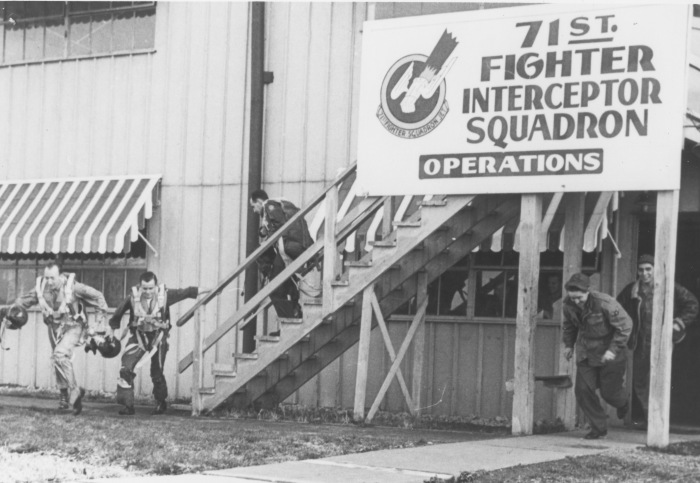
71st-fighter-interceptor-squadron-scramble-before-1971
Scramble by the 71st Fighter Interceptor Squadron c. 1960s (Source: United States Air Force)

USAF leaders, most notably Generals Benjamin Chidlaw and Earle Partridge, guided the planning and programs during the mid-1950s and were largely responsible for how the ADC operated. USAF provided the interceptor aircraft and planned the upgrades needed over the years. USAF also developed and operated the extensive early warning radar sites and systems which acted as ‘tripwire’ against air attack. In addition to the radar sites in Canada, the US Navy element, now Naval Forces NORAD, operated radars and picket ships on both the East and West coast. The complexity of the NORAD mission would eventually be controlled from inside the Cheyenne Mountain Air Force Station. In a theoretical scenario, Soviet bombers would be detected by one of the early warning lines or picket ships and the interceptors launched.
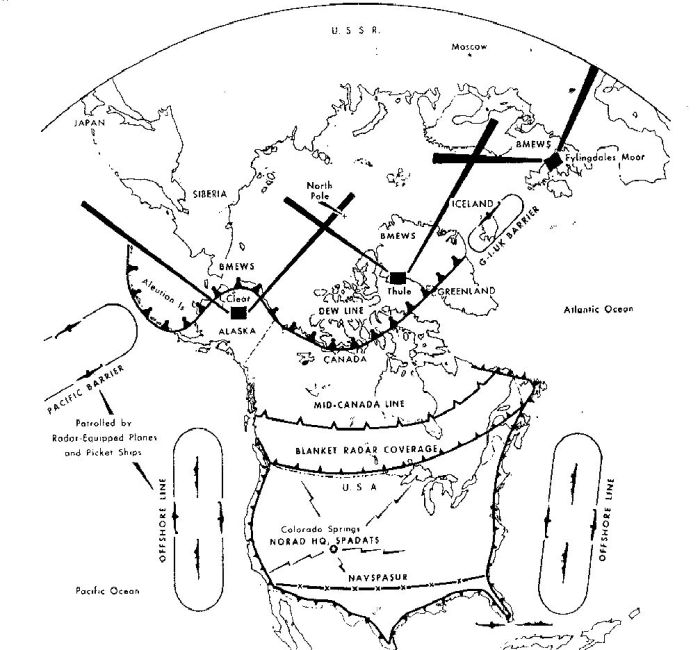
norad-map-1960s
Map illustrating the coverage provided by NORAD in the 1960s (Source: United States Air Force)

These aircraft came in many forms, most notably the famed (infamous) Century Series: North American F-100 Super Sabre (more commonly called the Hun), Mcdonnell F-101 Voodoo, Convair F-102 Delta Dagger, Lockheed F-104 Starfighter, Republic F-105 Thunderchief (the Thud), and the Convair F-106 Delta Dart. This entire series of aircraft were a mix of Fighter-Bomber and interceptors. TAC used these aircraft (mainly in Europe) as nuclear delivery vehicles: the F-100, F-101, F-105, but it was ADC that used the F-101, F-102, F-104, and F-106 as interceptors to stop the Soviet bombers. They were designed to take-off and be guided by ground control to Soviet bombers, which they would engage and destroy by air-to-air missile or the air-to-air Genie nuclear missile to take out entire bomber streams.

Of course, no series of fighter intercepts was going to be perfect and the interceptor force was back dropped by a heavy integrated air defense system (IADS) from both USAF Bomarc missiles (fired in advance of the interceptors) and the re-designated Army Air Defense Command of Nike and Zeus surface-to-air missiles surrounding government and military sites throughout the United States. While we normally attribute IADS as a Soviet way of defence, it was used extensively throughout the United States in the 1950s and 1960s.

It is not surprising that on Farley’s list of best and worst aircraft, none of these interceptors (F-101, 102, 104, 106) is to be found; they are not really fighters and were never meant to dogfight. It is almost as if an entire generation of aircraft and a whole command have been relegated to the trivial pursuit section of history. If this interests you and you have got thirty minutes to waste, enjoy this Army Air Defense Command (ARADCOM) instructional video from 1961 and if you have not had your fill of Air Defense and Freedom, there is also 1963’s The Shield of Freedom. ADC, by then the Aerospace Defense Command, finally inactivated on March 31, 1980.[4]

Dr Brian Laslie is an Air Force Historian and currently the Deputy Command Historian at North American Aerospace Defense Command (NORAD) and United States Northern Command (USNORTHCOM). A 2001 graduate of The Citadel and a historian of air power studies, he received his Masters’ from Auburn University Montgomery in 2006 and his PhD from Kansas State University in 2013. His first book The Air Force Way of War (2015) was selected for the Chief of Staff of the Air Force’s 2016 professional reading list. He lives in Colorado Springs. He can be found on Twitter at @BrianLaslie.

Header Image: Convair F-106A Delta Dart firing a Douglas AIR-2 Genie missile (Source: United States Air Force)

[1] According to the Air Force Historical Research Agency, the USAF currently has 14 inactivated major commands, http://www.afhra.af.mil/Information/Organizational-Records/Major-Commands/

[2] NORAD and US Northern Command Office of History, ‘A Brief History of NORAD,’ p. 4

[3] Lineage and honours of ADC can be found at the AFHRA: http://www.afhra.af.mil/About-Us/Fact-Sheets/Display/Article/433912/air-defense-command/

[4] The USAF does not ‘deactivate’ commands, rather they are ‘inactivated’ should the need ever arise for them to be reactivated.
Remembering The F-4 Phantom – Part 2: Orchestrated Confusion

Remembering The F-4 Phantom – Part 2: Orchestrated Confusion

By Mike Hankins

Previously, we looked at how McDonnell lost a significant contract with the US Navy after their upgraded F3H Demon failed a fly off competition against their competitor, Chance-Vought’s entry which became the F-8U Crusader.

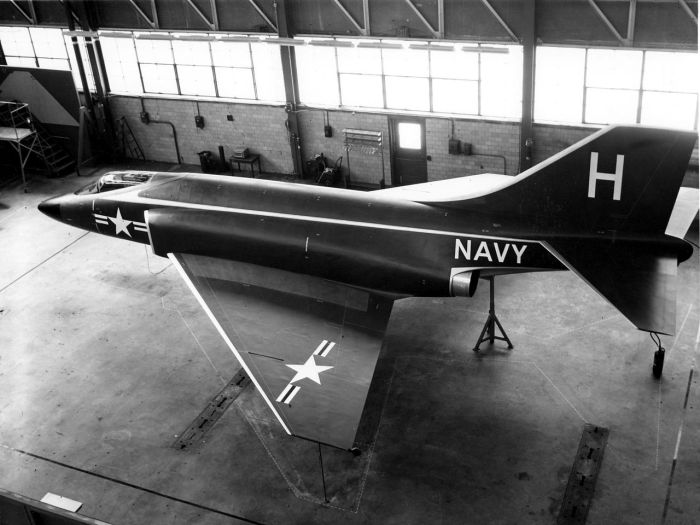
1280px-mcdonnell_f3h-g_mockup_in_1954
An early mockup of a modified F3H which is beginning to show some familiar visual characteristics of the F-4. (Source: US Navy National Museum of Naval Aviation)

McDonnell engineer Herman Barkley took the Demon’s rejection as a personal challenge and immediately began designing an unsolicited new aircraft initially without military funding.[1] Original sketches for the new craft consisted of yet another version of the Demon, similar to the design that had already failed against Vought’s F-8U. The US Navy had a vested interest in allowing McDonnell to experiment with the design. It could keep McDonnell afloat, enabling it to remain a valuable supplier, and perhaps reap some return on the initial investment they had both placed in the failed F3H. Upon review of these sketches, The US Navy did support the project, but gave no stated mission requirements for the plane, encouraging McDonnell to experiment on the drawing board. According to J. S. McDonnell himself:

All we had to work with in the beginning [of F-4 Phantom II Development] was a gleam in the customer’s eye […] What followed was two years […] of orchestrated confusion.

The US Navy, because of their doctrinal assumptions, wanted to focus on high-speed interceptors but was purposefully vague about communicating this, hoping McDonnell would reach in new and unexpected directions. This lack of specificity and a desire to maximise profits by designing a versatile plane that functioned in many contexts led McDonnell to develop a multi-role aircraft not optimised for the air-to-air mission.[2]

The confusion continued until Spring of 1955 when Commander Francis X. Timmes (newly in charge of the project) emphasised the high-speed interceptor role and stressed adaptability. Those concepts required that the plane to have two seats, two engines, and an armament of only missiles. The plane thus featured eleven hardpoints for carrying bombs or missiles, the most ever designed on an airframe at that time. The homogenous armament and dual-pilot setup both theoretically enhanced adaptability, since dogfighting was (allegedly) unnecessary, the lack of guns made the plane lighter (thus faster), and pilot duties could be split between two people. In July 1955, the US Navy rewarded McDonnell’s efforts with a contract for the production of seven prototypes.

The Phantom’s unique look was the result of over 5,300 hours of wind tunnel tests, which revealed a significant problem in supersonic flight. The plane was susceptible to ‘roll coupling,’ which is a technical way of saying the plane became uncontrollable – a condition from which pilots were trained to eject immediately. The angled wingtips and tail decreased the chances of this occurring. To add to stability concerns without sacrificing speed, the Phantom was given the ‘Stab Aug’ system that could sense unstable flight paths and automatically correct for them quicker than a pilot could manually. Computer controlled intake ramps to control air flow into the engines also increased the plane’s top speed. Another computerised system, ‘Boundary Layer Control,’ sent excess air from the engines over the wings to generate more lift and increase speed and acceleration. [3]

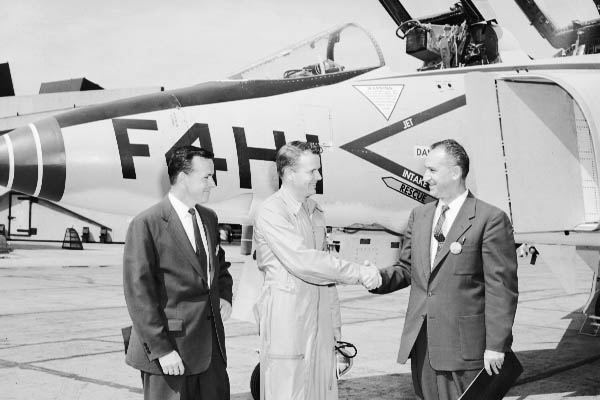
f4h-1_leadership
Herman Barkley (left) with test pilot Robert Little(center) and fellow engineer David Lewis (right) in front of a prototype of the F-4. (Source: Wikimedia)

Though the bond between the US Navy and its developers was strong, the military was loathed to place all its eggs in one basket. Timmes solicited other designs to fit the same roles as the Phantom in August 1955. The company that stepped up to the plate was none other than McDonnell’s old nemesis: Chance-Vought. Vought had developed an upgraded version of their successful F-8U Crusader, the very plane that had beaten McDonnell’s F3H Demon. Both new designs were set to compete in an unofficial fly off beginning on 15 September 1958. The tests emphasised the assumptions of the time, focusing on maximum speed and climbing rates. The assessments did not include manoeuvrability, gunnery, or other metrics pertinent to air-to-air combat.

In every tested category, the F8U-3 Crusader proved superior. It even had better fuel mileage. Its only drawbacks were a lower payload and time-consuming maintenance requirements. Despite this, George Spandenberg, then the director of Bureau of Aeronautics’ Evaluation Division, thought that single-seat, single-engine planes were inherently unreliable and argued that a two-seat plane would boost morale. Thus he boldly asserted, ‘The single-seat fighter era is dead.’ Advocates of the F-4 often claim the Phantom ‘won’ the contest (since it did win the US Navy contract after all), although a close look at the fly off reveals the upgraded Crusader had clear performance advantages in every category.[4]

Despite the Phantom’s lacklustre performance at the fly off, it was still an impressive aircraft in many respects. Between December 1959 and April 1962, the F-4 set over a dozen world records, the most coveted (and revealing of the plane’s doctrinal design focus) of which was that of absolute top speed: 1,606.3 miles per hour.[5] The F-4 also possessed many problems that came back to haunt the military over the jungles of Vietnam, and that appear almost negligent in retrospect. Aside from the stability issue (which caused ‘departure’ or ‘the adverse yaw effect,’ terms for when the plane loses control during maneuvers), the almost non-existent rear-visibility was a problem, as were the giant plumes of black smoke produced by the engines that gave away the location and heading of every Phantom. The plane was also quite vulnerable to ground fire because its hydraulic lines were delicate and devoid of redundancy. Indeed, ground fire downed more F-4s in Vietnam than any other single threat. Across US Air Force (USAF), the US Navy and the US Marine Corps combined, from January 1962 to January 1973, 930 planes were lost to small arms ground fire, or, 45% of losses by known causes. AAA claimed 632; SAMs shot down 191; MiGs destroyed 79, and friendly fire claimed 25.

The USAF observed these record-setting demonstrations and grew interested in the plane’s usefulness as a strategic bomber and interceptor.[6] After a series of tests, USAF eventually ordered more than triple the number of Phantoms as the Navy. McDonnell finally created four new models of the Phantom to USAF specifications, the first and most significant of which was the F-4C.[7]

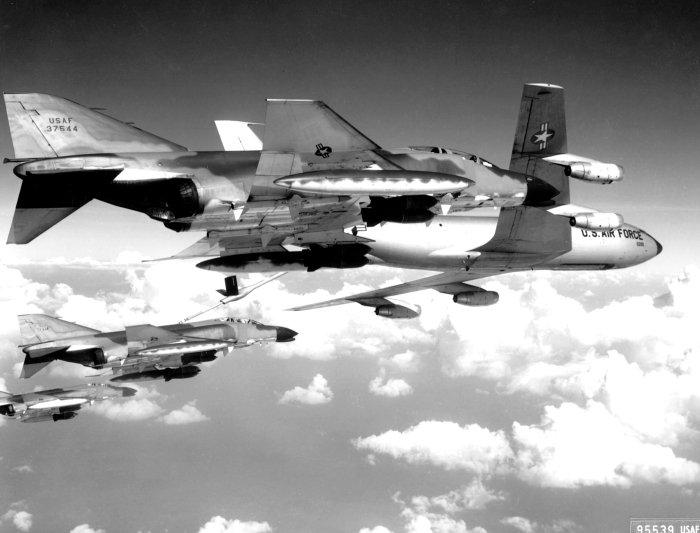
U.S._Air_Force_McDonnell_F-4C_Phantom_II_fighters_refuel
A flight of US Air Force McDonnell F-4C Phantom II fighters refuel from a Boeing KC-135A Stratotanker aircraft before making a strike against targets in North Vietnam. The Phantoms are loaded with six 750 pound general purpose bombs, four AIM-7 Sparrow air to air missles, and 370 gallon external fuel tanks on the outboard pylons. (Source: Wikimedia)

Although the Phantom would undoubtedly have performed extremely well in its designed role of intercepting enemy bombers, it ironically never had to. Instead of saving the world from nuclear Armageddon in the hypothetical World War III, the F-4 instead flew in a limited war over the jungles of a tiny third world country that many Americans had trouble locating on a map. The enemies it faced were not large lumbering bombers threatening nuclear annihilation, but missiles, ground fire, and manoeuvrable MiG fighters much more adept at air combat. Statistically, the deadliest enemy for the Phantom, one of the most powerful and expensive planes in US history to that point, was an individual on the ground with a machine gun. Similar to the doctrine that spawned it, the F-4 was the right plane for the wrong war.

The F-4 Phantom II was a fighter plane possessing few characteristics of traditional fighters. It was large, cumbersome, and built around the concept of long range attacks, sacrificing the agility and armament necessary of true air superiority craft. Originally conceived as an interceptor and soon burdened by ‘mission creep’ that insisted it handle multiple roles, the plane was the poster child for pre-Vietnam USAF doctrine, namely, the quasi-religious devotion to strategic bombing that minimised all other roles of air power.

Part One of this article can be found here.

Mike Hankins is a doctoral candidate at Kansas State University, where he teaches World History, the History of Airpower, and the History of Comic Books, and he is currently working on his dissertation, ‘Sources of Innovation: The Cultural and Technological Origins of Fourth Generation Fighter Aircraft, 1964-1991.’ He completed his master’s thesis at the University of North Texas in 2013, titled ‘The Phantom Menace: The F-4 in Air-to-Air Combat in the Vietnam War. He has a web page and can be found on Twitter at @hankinstien.

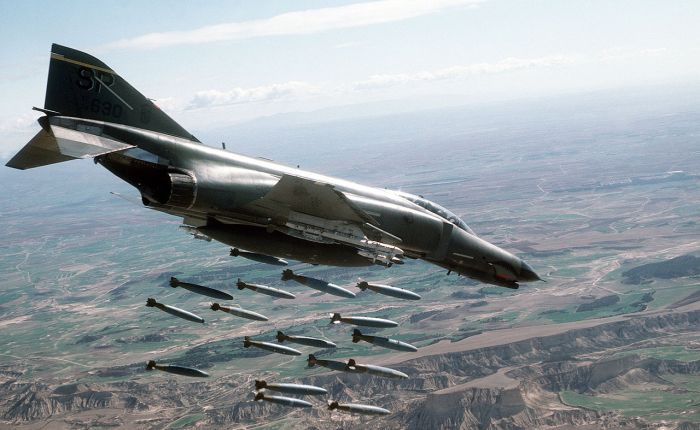
Header Image: A USAF McDonnell Douglas F-4E Phantom II from the 81st Tactical Fighter Squadron, 52nd Tactical Wing, releasing 18 Mark 82 227 kg bombs over the Bardenas Reales Gunnery Range, Spain, 25 March 1986. (Source: Wikimedia)

[1] Enzo Angelucci and Peter Bowers, The American Fighter (New York: Orion, 1987), p. 451, 310. Larry Davis, F-4 Phantom II in Action (Carrollton, TX: Squadron/Signal Publications, 1984), p 4.

[2] Glenn E. Bugos, Engineering the F-4 Phantom II: Parts Into Systems (Annapolis: Naval Institute Press, 1996)p.  23, 9, pp. 13-14.

[3] Ibid, p. 20, pp. 25-28, 37-40, 51-2.

[4] Peter E. Davies,  USN F-4 Phantom II vs VPAF MiG 17/19: Vietnam 1965-73 (Oxford: Osprey Publishing, 2011), p. 16; Lou Drendel, F-4 Phantom II in Action (Warren, MI: Squadron/Signal Publications, 1972), p. 6; Bugos, Engineering the F-4, pp. 95-9.

[5] Mick Spick, All-Weather Warriors: The Search for the Ultimate Fighter Aircraft (London: Arms and Armour Press, 1994), p. 131; Enzo Angelucci with Peter Bowers, The American Fighter: The Definitive Guide to American Fighter Aircraft from 1917 to the Present (London: G.T. Foulis, 1987), pp. 310-1.

[6] Bugos, Engineering the F-4, p. 104.

[7] Anthony M. Thornborough, USAF Phantoms: Tactics, Training, and Weapons (New York: Arms & Armour Press, 1988), pp. 11-12; Bugos, Engineering the F-4, p. 115.

Remembering the F-4 Phantom – Part 1: A Product of Its Time

Remembering the F-4 Phantom – Part 1: A Product of Its Time

By Mike Hankins

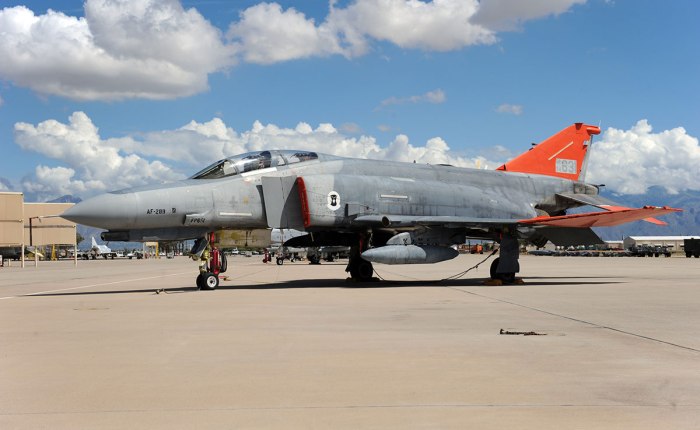
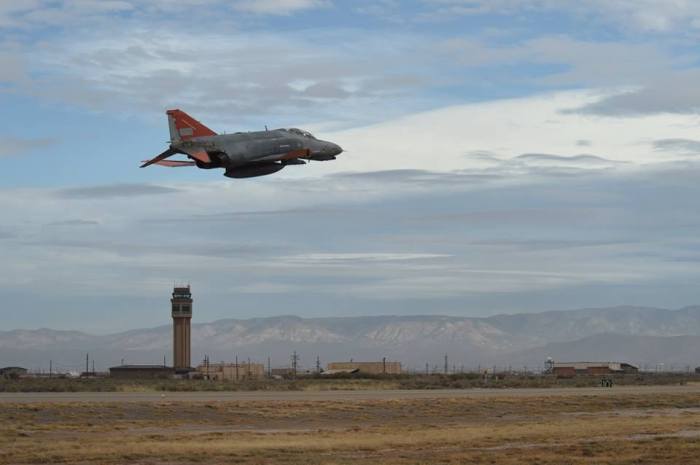
A few weeks ago, on August 17, 2016, the QF-4 Phantom flew its final unmanned mission for the United States Air Force (USAF). Although the Phantom was officially retired from combat use in 1996, USAF has been using unmanned, remote-controlled versions of the F-4 as target drones in training exercises. As the QF-4 completes its final flight, it feels like the end of an era. With over 5,000 built, the F-4 was one of (if not the) most ubiquitous aircraft of the Vietnam War and formed the backbone of the USAF in that period.

Final flight farewells Phantom
Airmen from the 82nd Aerial Target Squadron, Det. 1 at Holloman Air Force Base hosted the final manned flight of the QF-4 Phantom as part of the Phinal Phlight Ceremony on 21 December 2016. The ceremony commemorated and retired the QF-4 Phantom after 53 years of service in the US  Air Force.  Over its many years at Holloman, the QF-4 flew 145 unmanned missions and 70 aircraft were destroyed in service. It flew its last unmanned mission in August 2016 and was replaced by the QF-16 in 2017. (Source: Wikimedia)

In many ways, the F-4 was the last representative of an earlier era in USAF thinking — its design (emphasising speed, interception, and multi-role capability) reflected the doctrines and assumptions of the early Cold War. During the Vietnam War, those assumptions began to be overturned, and the Air Force eventually turned to a new generation of fighters in planes like the F-15 Eagle and F-16 Falcon. As the Phantom has now officially passed out of use in the US, it is worth taking some time to look back at the Phantom’s design, what that tells us about previous modes of thinking in the Air Force, and what that might mean for the future.

After World War II, USAF, and indeed the entire US military was dominated by Strategic Air Command (SAC), which maintained a fleet of nuclear bombers. The assumption was that a potential “next war” would involve the US and the Soviet Union launching atomic bombs at each other. Thus, national security rested on the idea of being able to drop nukes on Soviet vital centres, while also being able to intercept any Soviet bombers that attempted to do the same.</p

Century_series_fighters_NACA_1957
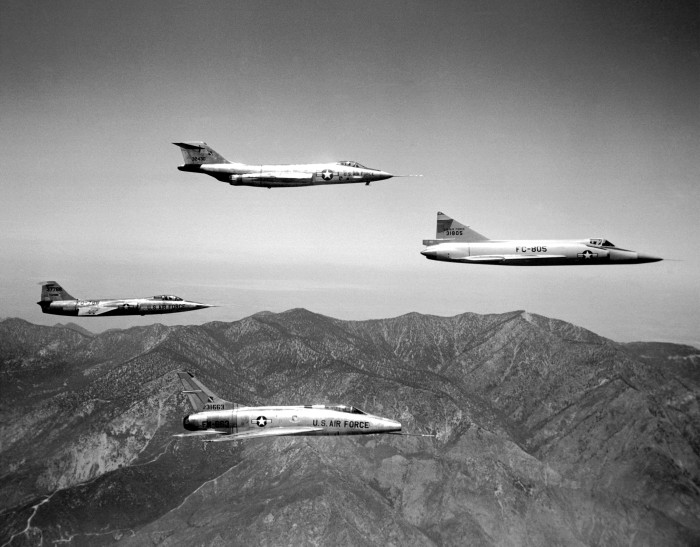
Four US Air Force Century-series fighters in flight in 1957. These supersonic fighters were tested by the NACA Dryden Flight Research Center at Edwards Air Force Base. The aircraft visible are: McDonnell F-101A-5-MC Voodoo (top), Lockheed XF-104A Starfighter )left). This latter aircraft crashed on 11 July 1957 due to an uncontrollable tail flutter. The pilot, Bill Park, ejected safely. A Convair F-102A-20-CO Delta Dagger (right), North American F-100A-20-NA Super Sabre (bottom). (Source: Wikimedia)

Other tactical missions like air superiority, ground support, or supply interdiction, became irrelevant. The age of fighter escorts, dogfights, and close air support against fielded enemy ground forces was over. In those early years of the Cold War, despite a few small voices of criticism, the USAF devoted less than 6 percent of its research and development resources into tactical and fighter roles. As a result, several tactical fighter wings disappeared in the late 1950s. Tactical Air Command was responsible for these functions and quickly found that the best way to retain relevance (and budget dollars) was to make a case that they too could contribute to SAC’s nuclear mission. They thus focused on developing fighter/bombers and interceptors that emphasised speed (at the expense of manoeuvrability) to either quickly deliver a nuclear warhead, or to intercept an enemy bomber and shoot it down in one pass – not with guns, but with guided missiles. This approach was exemplified in their ‘Century Series’ of interceptors. [1]

The US Navy also came to the same conclusion – that maintaining their budget and relevance necessitated that they participate in the nuclear mission, especially once atomic warheads became small enough to mount to carrier-based aircraft. New US Navy aeroplane designs focused on delivery of tactical nukes and interception of enemy bombers, and although the US Navy did not abandon air superiority to the degree that USAF did, the role of US Navy fighters certainly diminished in the post-war period. For example, the Fleet Air Gunner Unit, which trained weapons officers on US Navy planes, closed in 1960 and new training syllabi excised air-to-air combat.[2]

These assumptions and trends are key to understanding the development of the F-4 Phantom, but one the other main factor was the system of the ‘Military-Industrial Complex.’ Few defence contractors existed in the early Cold War, and the vast sums involved in contract awards and losses could make or break companies quickly. To keep options open, the military had a strong incentive to maintain their contractors afloat, sometimes making purchases regardless of actual needs. The military also encouraged these companies to push the envelope of cutting-edge technology, at times guided by strict mission parameters, on other occasions without many guidelines at all. Thus, a strong paternal bond developed between the military and its industrial suppliers, creating an environment that encouraged companies to experiment and take risks without fear of a total company failure.[3]

xf3h_demon_on_uss_coral_sea_28cva-4329_in_1953
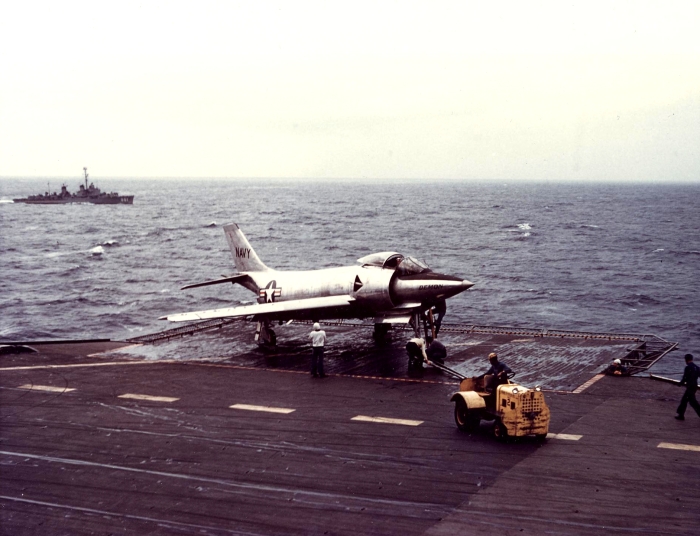
A US Navy McDonnell XF3H-1N Demon on the elevator of the aircraft carrier USS Coral Sea, in 1953. (Source: Wikimedia)

This bond came into play in September 1952, when the US Navy Bureau of Aeronautics invited proposals for a new fighter plane dedicated to the (redefined) air superiority and interception missions. The US Navy eventually awarded this contract to McDonnell’s rival firm Chance-Vought, whose entry became the F-8U Crusader. McDonnell’s losing design in this competition was a version of the F3H Demon upgraded with a dual-engine and a missile armament. In 1954, the losses from this project nearly destroyed McDonnell. The US Navy had much to lose if its weapons manufacturers closed and viewed these defence contractors as too big to fail.[4]

Next time, we will look at McDonnell’s response to this loss, and how it led to one of the most ubiquitous aircraft of all time.

Part Two of this article can be found here.

Mike Hankins is a doctoral candidate at Kansas State University, where he teaches World History, the History of Airpower, and the History of Comic Books, and he is currently working on his dissertation, ‘Sources of Innovation: The Cultural and Technological Origins of Fourth Generation Fighter Aircraft, 1964-1991.’ He completed his master’s thesis at the University of North Texas in 2013, titled ‘The Phantom Menace: The F-4 in Air-to-Air Combat in the Vietnam War. He has a web page and can be found on Twitter at @hankinstien.

Header Image: The unmanned QF-4 target drone (Source: http://www.military.com/equipment/qf-4-aerial-target)

[1] Earl H.Tilford, Crosswinds: The Air Force’s Setup in Vietnam (College Station: Texas A&M University Press, 1993), pp. 20-22; Craig C. Hannah, Striving for Air Superiority (College Station: Texas A&M University Press, 2002), p. 28; Caroline F. Ziemke, ‘In The Shadow of the Giant: USAF Tactical Air Command in the Era of Strategic Bombing, 1945-1955’ (PhD Thesis, The Ohio State University, 1989), p. 7.

[2] George W. Baer, One Hundred Years of Sea Power: The U. S. Navy, 1890-1990 (Stanford: Stanford University Press, 1994), P. 334.; Robert W. Love, Jr., History of the United States Navy, Vol. 2 (Harrisburg: Stackpole Books, 1992), pp. 375-6.

[3] Glenn E. Bugos, Engineering the F-4 Phantom II: Parts Into Systems (Annapolis: Naval Institute Press, 1996), p. 23.

[4] Bugos, Engineering the F-4, pp. 15-17.

#ResearchNote – Operation HUSKY’s Air Battle by the Numbers

#ResearchNote – Operation HUSKY’s Air Battle by the Numbers

By Alexander Fitzgerald-Black

In 1991, Samuel W. Mitcham Jr. and Fredrich von Stauffenberg published The Battle of Sicily: How the Allies Lost Their Chance for Total Victory. In it, they offered a scathing review of the performance of the Allied militaries in Operation HUSKY, the 1943 invasion of Sicily. Theirs is the standard interpretation about the battle for Sicily: the Allies bungled total victory through national squabbles which allowed the Germans to mount a skilful withdrawal even against complete Allied air and naval supremacy while outnumbered by Allied armies by factors of up to 8:1.[1]

Part of their critique is the effectiveness of the Allied air forces. They called into question claims Allied commanders made at finding 1,100 Axis aircraft littering aerodromes and landing grounds across the island. According to Colonel Lioy of the Italian Air Force historical division, Allied claims vastly overstated the reality as the island had long harboured aircraft cemeteries from previous battles. He believed that the Allied bomber offensive only accounted for 100. Lioy pegged total Axis aircraft losses from 3 July to 17 August at not over 200. Finally, Mitcham and von Stauffenberg noted that Axis statistics they consulted show that the Germans and Italians lost 225 and 95 aircraft respectively to all causes between 1 July and 5 September 1943.[2]

large1
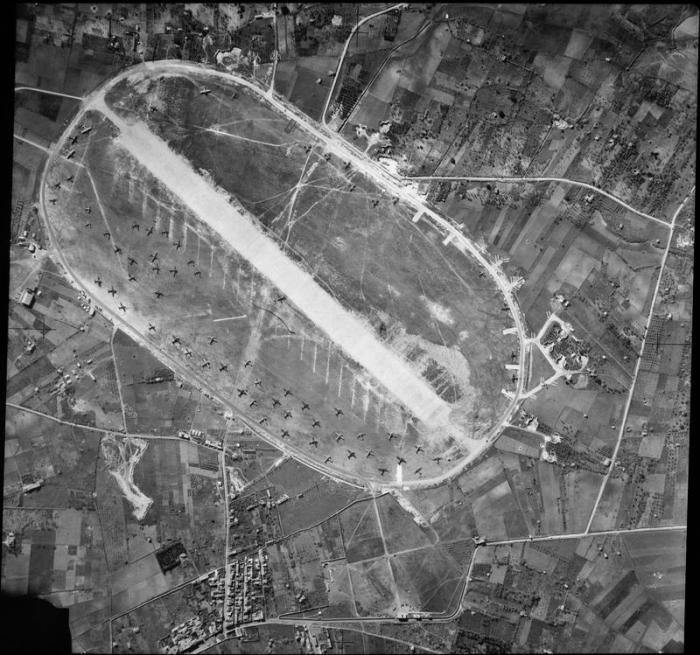
Vertical aerial reconnaissance view of Castelvetrano airfield, Sicily, the day before a successful attack was made on it by Malta-based Bristol Blenheims of Nos. 18 and 107 Squadrons RAF. A number of Junkers Ju 52 and Savoia Marchetti SM 82 transport aircraft, many of which were destroyed during the raid, can be seen parked around the airfield perimeter. (Source: © IWM (C 4183))

These figures do not stand up to the scrutiny of other sources. First, Williamson Murray’s excellent study of the Luftwaffe: Strategy for Defeat, cited reliable quartermaster general figures for German losses throughout the war. German losses in the May to August period in the Mediterranean Theatre stood at 1,600, matching those of the other major fronts. This number included 711 German aircraft lost in July 1943 alone, a figure 27 percent higher than that of the 558 German aircraft lost on the Eastern Front during the massive battles of Kursk-Orel in July.[3]

Second, Adolf Hitler’s own figures are at variance with Mitcham and von Stauffenberg’s statistics. Hitler was particularly displeased with the ground organisation in Sicily and southern Italy. On 13 July, he sent a message to Benito Mussolini complaining of ‘more than 320 fighters destroyed on the ground as the result of Allied aerial attack in the last three weeks.’ When the two dictators met at Feltre on 19 July, Hitler further noted that between 300 and 400 aircraft out of 500 to 600 were destroyed on the ground in the recent Allied air offensive.[4]

Perhaps Hitler was particularly upset with a 15 July raid on Vibo Valentia, where the bulk of the remainder of the German fighter force had settled after withdrawing from Sicily. A force of 117 B-25 Mitchells and B-26 Marauders apparently caught Jagdgruppe Vibo on the ground. Lieutenant Köhler, a German ace with over 20 victories to his credit, wrote:

Toward noon 105 [sic] bombers came and destroyed the Jagdgruppe Vibo Valentia, which had about 80 aircraft. Not a machine was left intact, not even the [Junkers] which had just landed. Fuel trucks, hangars, aircraft, autos, everything was burning. The German fighters in Italy have been wiped out.[5]

Specifically, the raid eliminated Steinhoff’s JG 77, I/JG 53 (which lost 20 aircraft), and much of II/JG 27. After the raid, only survivors of II and III/JG 27 remained operational in southern Italy.

large2
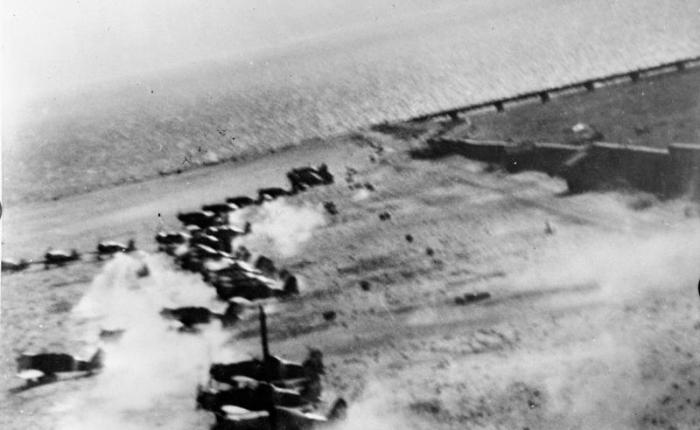
Wrecked and damaged Italian fighters outside bomb-shattered hangars at Catania, Sicily, under the scrutiny of an airman, shortly after the occupation of the airfield by the RAF. (Source: © IWM (CNA 1352)

The weight of evidence seems to go against Mitcham and von Stauffenberg’s conclusions. Furthermore, while it is true that many of the 1,100 aircraft abandoned on Sicily were from previous battles, the Allies still denied their use to Axis salvage details. Italian losses during the campaign are less easy to come by. However, one source noted that they may have been as high as 800 aircraft over two months – although the same source lowballs the German figure at 586.[6]

The Mediterranean was a meat grinder of Axis aviation. For the war, Axis aircraft losses in the Mediterranean stand at 17,750, much higher than the 11,000 on the Eastern Front, and closer to the 20,419 on the Western Front than one might assume.[7] The air superiority battles around and above Operation HUSKY in the summer of 1943 were a significant milestone in the air war against the European Axis. Indeed, Murray described Sicily as ‘the greatest air battle of the Mediterranean war’ based on the scale of German losses.[8] This result was achieved by an efficient Allied air force that has often been denied the credit it so rightfully earned.

large3
Supermarine Spitfire Mark Vs of No. 243 Squadron RAF undergo maintenance at Comiso, Sicily. Photographed over the tail section of an abandoned Messerschmitt Bf 109G of 6/JG53. (Source: © IWM (CNA 1029))

Alexander Fitzgerald-Black completed his MA thesis, ‘Eagles over Husky: The Allied Air Forces and the Sicilian Campaign, 14 May to 17 August 1943,’ with The Gregg Centre for the Study of War and Society, University of New Brunswick in 2014. He is in the process of turning this work into a manuscript for publication with Helion & Company. Alex lives with his wife in Moncton, Canada. He operates his own blog at alexfitzblack.wordpress.com and can be reached on Twitter @AlexFitzBlack.

Header Image: A line of Macchi MC200 fighters on Reggio di Calabria airfield under attack by cannon fire from two Bristol Beaufighter Mark ICs of No. 272 Squadron RAF Detachment flying from Luqa, Malta. (Source: © IWM (CM 1298))

[1] See Lee Windsor, “The Eyes of All Fixed on Sicily’: Canada’s Unexpected Victory, 1943,’ Canadian Military History, 22:3 (2013), pp. 6-7 for a summary of this literature. General Max Ulrich, commander of the 29th Panzer Grenadier Division offered the 8:1 ratio when comparing the odds his forces faced.

[2] Samuel W. Mitcham Jr. and Fredrich von Stauffenberg, The Battle of Sicily: How the Allies Lost Their Chance for Total Victory (Mechanicsburg, PA: Stackpole Books, 2007 [1991]), p. 305.

[3] Williamson Murray, Strategy for Defeat: The Luftwaffe, 1933-1945 (Maxwell AFB, Alabama: Air University Press, 1983), “Table XXX”, p. 148.

[4] Albert N. Garland and Howard M. Smyth, The United States Army in World War II, The Mediterranean Theatre of Operations: Sicily and the Surrender of Italy (Washington, D.C.: US Army Centre of Military History, 1993[1965]), p. 240 and p. 243.

[5] Brian Cull with Nicola Malizia and Frederick Galea, Spitfires over Sicily: The Crucial Role of the Malta Spitfires in the Battle of Sicily, January – August 1943 (London: Grub Street, 2000), p. 166.

[6] Hans Werner Neulen, In the Skies of Europe: Air forces allied to the Luftwaffe, 1939-1945 (Ramsbury, Marlborough: The Crowood Press Ltd., 2005), p. 72.

[7] Robert S. Ehlers, The Mediterranean Air War: Airpower and Allied Victory in World War II (Lawrence, KS: University Press of Kansas, 2015), 403.

[8] Murray, Strategy for Defeat, p. 164.

#Commentary – The F-35 is here!

#Commentary – The F-35 is here!

By Dr Brian D. Laslie

Ten years after its first flight and nine years after Detective John McClane brought one down in Live Free or Die Hard, it seems the Lockheed Martin F-35 Lightning II is finally here. Well, at least the U.S. Air Force and Marine Corps versions. Love it or hate it, it is here to stay. I do not want to get off into the discussion of what the F-35 can or cannot do, and we all know it is being asked to do a lot. Per Lockheed Martin’s website the F-35 is supposed to provide: ‘electronic attack, Air-to-Surface, Air-to-Air, Intelligence, Surveillance, and Reconnaissance (ISR), Stealth, Interoperability, and Full Mission Systems Coverage’ (whatever that last one is).  That is many missions to cram into one airframe. We are all familiar with the Close Air Support (CAS) debates on the F-35 versus the A-10, and we have all followed the slow, arduous, and downright sloth-like advancement of the F-35 until this point. I have been known to walk both sides of the argument with the F-35.

Operations continue at Red Flag 16-3
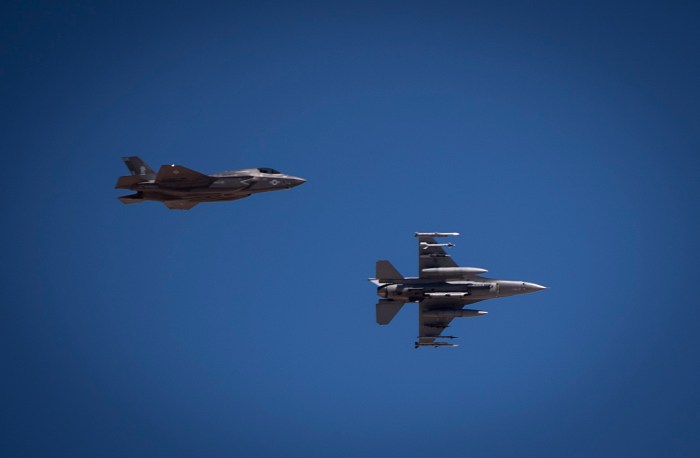
A F-35B, assigned to the Marine Fighter Attack Squadron 121 out of Marine Corps Air Station Yuma, Arizona, flies level as a F-16 Fighting Falcon from the 177th Fighter Squadron from the New Jersey Air National Guard, banks hard during approach July 15, 2016 at Nellis Air Force Base, Nevada (Source: US Air Force)

I get it, it is behind schedule, and it is over budget, but so are all of my home improvement projects. I am not sold that it can effectively do everything it is billed to do, but I am also willing to give it a fighting chance in the coming years. For those that have followed the military aircraft industry for a few decades, you will know that every airframe has had its initial struggles: the F-22, F-16, F-15, each and every one of them were plagued by issues. The F-35 is no different with perhaps the one exception that we can all take to Twitter to complain about it. I would rather focus on something entirely different.

All, the F-35 is conducting missions. No, it is not dropping bombs on IS (yet), nor is it providing CAS sorties in Afghanistan. No, it is not even deployed overseas in-theater, but that will come with time as well. However, it is creeping ever closer. Last week, USMC F-35s of VMFA-121 participated in the USAF’s Red Flag exercise. This is a big deal. If you have followed me for more than a hot minute, you know that Red Flag is near and dear to my heart. I have written extensively about, most notably here.

Participating at Red Flag is a major step forward for the entire F-35 program. You can think of Red Flag in some different ways. First, it helps to ‘season’ inexperienced pilots. USAF created Red Flag in 1975 to give its fighter pilots exposure to their first ten ‘combat’ missions. The entire purpose of the exercise was to simulate combat in a realistic training environment. Reports after Vietnam, most notably the Red Baron Reports, indicated that a pilot’s chance for survival increased exponentially after the first ten missions. Second, it exposes units and aircrew to other units and aircrews. Across the spectrum of aerial operations units have to integrate and work together to accomplish the mission. An F-22 pilot of the 1st Fighter Wing at Langley Air Force Base, VA., does not have the opportunity to fly against US Navy, USMC, and other USAF fighters on a daily basis; Red Flag provides that opportunity. The participation of VMFA-121 is as important for the F-35 and its flyers as it is for every other participant in the exercise. This is the first chance for many of these aircrews to see what the F-35 is capable of during mission parameters. This particular Red Flag exercise will see the F-35 integrate with F-22s, F-16s, F-18s and other support aircraft. Finally, Red Flag has traditionally been an exercise used to integrate new aircraft and capabilities with existing missions and platforms. This was true of the F-15 in the 1970s and the F-22 in the 2000s, and it remains true for the F-35 in 2016.

Weapons schools will continue to push the bounds of what the F-35 can do, and we can continue to argue over that, but exercising the F-35 at Red Flag allows other members of the armed forces to see what the F-35 does do.

Dr Brian Laslie is an Air Force Historian and currently the Deputy Command Historian at North American Aerospace Defense Command (NORAD) and United States Northern Command (USNORTHCOM). A 2001 graduate of The Citadel and a historian of air power studies, he received his Masters’ from Auburn University Montgomery in 2006 and his PhD from Kansas State University in 2013. His first book The Air Force Way of War (2015) was selected for the Chief of Staff of the Air Force’s 2016 professional reading list. He lives in Colorado Springs. He can be found on Twitter at @BrianLaslie.

Header Image: F-35Bs, assigned to the 3rd Marine Aircraft Wing, Marine Corps Air Station Yuma, Az., sit on the flight line during Red Flag 16-3 at Nellis Air Force Base, Nev on July 12, 2016. (Source: US Air Force Photo)

#ResearchNote – J.M. Spaight after the Second World War

#ResearchNote – J.M. Spaight after the Second World War

By Dr Ross Mahoney

In 2004, War in History published an article by Alaric Searle that posed the question ‘Was there a ‘Boney’ Fuller after the Second World War?’.[1] In short, Searle concluded that Major-General J.F.C. Fuller’s theoretical writing continued after 1945 alongside his historical writing and was not simply a ‘footnote to [his] biography.’[2] Searle’s question is an interesting one and could easily be applied to James Malony Spaight. In the inter-war years, Spaight, who was a trained jurist and, as a civilian, served in the Air Ministry, produced several notable volumes on air warfare with particular reference to issues such as its legality. As Robin Higham reflected:

No survey of British airpower theorists in the interwar years would be complete without mention of […] Spaight.[3]

Furthermore, Peter Gray noted that Spaight’s influence, due to his work within the Air Ministry, went further than just being ‘Trenchard’s good friend,’ as Higham suggested.[4] As Gray noted:

Spaight’s work was a readily available source of legal advice for his colleagues in the Air Ministry, and those who were likely to become staff officers having attended the Staff College at Andover.[5]

Before the Second World War, Spaight was clearly a critical influence on the development of air power thinking in Britain.

Despite his pre-war influence, what happened after the Second World War? Spaight retired from the Air Ministry in 1937, but continued writing during the Second World War, for example, in 1944 he published Bombing Vindicated in which he argued ‘that the line between military and civilian objectives’ was blurred.[6] Higham and Philip Meilinger in his Oxford Dictionary of National Biography entry noted the important books that he published after the Second World War.[7] Specifically, these were the third edition of Air Power and War Rights (1947), The Atomic Problem (1948) and Air Power Can Disarm (1948).

However, what else was written? Before the Second World War, Spaight had contributed to journals such as The Royal Air Force Quarterly and the Journal of the Royal United Services Institution. Both are important sources as they were read by officers who emerged into senior positions and thus they would, possibly, have been one influence on their thinking and leadership development. Simply put, after the Second World War, Spaight continued publishing in these journals. This reinforces the idea that Spaight’s writings were not only important in a general sense that he was still writing but, given where these articles were published, they, potentially, helped shape the discourse of air power in the early-Cold War years. However, while Spaight published, what is needed is an examination of the content of these articles so that we can bridge the narrative between his pre-Second World War writings and those produced after. Only by doing this can we consider how, or if, Spaight’s views changed. Broadly speaking the post-war articles are a cross-section of comments on the role of air power in the Second World War, air power’s future role in the nuclear age and the international affairs.

So far I have identified the following articles:

  1. ‘The Covenant of 1919 and the Charter of 1945,’ The Royal Air Force Quarterly, 17 (1945-46);
  2. ‘Strategic Air Bombardment, 1943-45,’ The Royal Air Force Quarterly and Empire Air Force Journal, 18 (3) (1947);
  3. ‘Strategic Air Bombardment (continued),’ The Royal Air Force Quarterly and Empire Air Force Journal, 18 (4) (1947);
  4. ‘Strategic Air Bombardment (continued),’ The Royal Air Force Quarterly and Empire Air Force Journal, 19 (1) (1948);
  5. ‘The Rio and Brussels Treaties,’ Journal of the Royal United Services Institution, 93 (570) (1948);
  6. ‘Sea and Air Power,’ Journal of the Royal United Services Institution, 93 (572) (1948);
  7. ‘That Next War,’ The RAF Quarterly and Commonwealth Air Forces Journal, 1 (1) (1949);
  8. ‘Target for To-morrow,’ Journal of the Royal United Services Institution, 94 (576) (1949);
  9. ‘The Ghost of Douhet,’ The RAF Quarterly and Commonwealth Air Forces Journal, 2 (2) (1950);
  10. ‘Trans-Polar War,’ The RAF Quarterly and Commonwealth Air Forces Journal, 2 (3) (1950);
  11. ‘Korea and Aggression,’ The RAF Quarterly and Commonwealth Air Forces Journal, 2 (4) (1950);
  12. ‘Korea and the Atom Bomb,’ Journal of the Royal United Services Institution, (95) (580) (1950);
  13. ‘The End of a Dream,’ The RAF Quarterly and Commonwealth Air Forces Journal, 3 (2) (1951);
  14. ‘Morale as Objective,’ The RAF Quarterly and Commonwealth Air Forces Journal, 3 (4) (1951);
  15. ‘Pax Atlantica,’ Journal of the Royal United Services Institution, 96 (583) (1951);
  16. ‘Limited and Unlimted War,’ The RAF Quarterly and Commonwealth Air Forces Journal, 4 (1) (1952)
  17. ‘Why Stalin Waits,’ The RAF Quarterly and Commonwealth Air Forces Journal, 4 (3) (1952);
  18. ‘Napalm,’ Journal of the Royal United Services Institution, 98 (589) (1953);
  19. ‘Weapons of Mass Destruction,’ Journal of the Royal United Services Institution, 99 (593) (1954);
  20. ‘Cities as Battlefields,’ Air Power: Incorporating The RAF Quarterly and Commonwealth Air Forces Journal, 2 (3) (1955).

I would be keen to know of anymore articles by Spaight in this period.

This post first appeared at Thoughts on Military History.

Dr Ross Mahoney is an independent historian and defence specialist based in Australia. Between 2013 and 2017, he was the resident Historian at the Royal Air Force Museum, and he is a graduate of the University of Birmingham (MPhil and PhD) and the University of Wolverhampton (PGCE and BA). His research interests include the history of war in the twentieth and twenty-first centuries, air power and the history of air warfare, and the social and cultural history of armed forces. To date, he has published several chapters and articles, edited two books, and delivered papers on three continents. He is a member of the Royal Historical Society and is an Assistant Director of the Second World War Research Group. He is a member of the Royal Historical Society and an Assistant Director of the Second World War Research Group. He blogs at Thoughts on Military History, and can be found on Twitter at @airpowerhistory.

Header Image: The aftermath of the dropping of the atomic bomb on Hiroshima. (Source: © IWM (MH 29447))

[1] Alaric Searle, ‘Was there a ‘Boney’ Fuller after the Second World War? Major-General J.F.C. Fuller as Military Theorist and Commentator, 1945-1966’, War in History, 11 (3) (2004), pp. 327-57.

[2] Ibid, p. 357.

[3] Robin Higham, The Military Intellectuals in Britain, 1918-1939 (New Brunswick, NJ: Rutgers University Press, 1966), p. 230.

[4] Ibid; Peter Gray, The Leadership, Direction and Legitimacy of the RAF Bomber Offensive from Inception to 1945 (London: Continuum, 2012), pp. 54-7.

[5] Gray, Leadership, p. 56.

[6] Phillip S. Meilinger, ‘Spaight, James Molony (1877–1968)’, Oxford Dictionary of National Biography, Oxford University Press, 2004 [http://www.oxforddnb.com/view/article/58055, accessed 5 Jan 2016].

[7] Ibid; Higham, Military Intellectuals, p. 233.

Hammer and Anvil: Catching the Axis in a Catch-22

Hammer and Anvil: Catching the Axis in a Catch-22

By Alexander Fitzgerald-Black

“That’s some catch, that Catch-22.”

USAAF Captain John Yossarian, fictional protagonist, Catch-22 by Joseph Heller

Political Scientist Robert A. Pape published Bombing to Win in 1996.[1] In that work, Pape argued that air power be of limited effectiveness when attacking purely strategic targets such as the enemy’s morale, leadership, or communications. Instead, the most effective use of air power is alongside ground forces in a ‘hammer and anvil’ approach.

large3
Four Curtiss Kittyhawk Mark IIIs of No. 112 Squadron RAF based at Agnone, Sicily, in stepped line-astern formation, flying south along the Gulf of Catania. (Source: © IWM (CNA 1136))

The air force acts as the hammer while the field force serves as the anvil. Theoretically, any army confronted by an air force with air superiority and an opposing army is in a predicament. The commander can choose to concentrate his forces, leaving them open to the hammer – tactical air power. Alternatively, he can disperse his troops, at which point the anvil – the opposing army – can isolate and destroy these smaller units in a piecemeal fashion.[2] This is what makes air superiority so tantalising in modern warfare. It forces one side into a catch-22. The fundamental principle is that air superiority denies the opposing force freedom of movement. It does not always work out as cleanly as the hammer and anvil concept suggests (and as the below examples illustrate), but removing the opposing force’s freedom of movement is a sure way to win a battle or, perhaps, a war.

The Allies caught the Axis armies in a hammer and anvil catch-22 in Sicily in 1943. The successful Allied landings in Operation HUSKY and the ensuring air battles won the Allies air superiority over the island. Heavy losses in the invasion’s first days and the threat the well-positioned landings posed to their airfields forced the German and Italian air forces to withdraw from the island days into the battle. Field Marshal Albert Kesselring had to rely on ground troops to hold the island and keep Italy in the war as long as possible. To achieve their aim, the Allies needed to secure the island and use it as an advanced staging ground to force Italy from the war.

Some of the heaviest fighting occurred in the island’s centre, on the inland hinge of the Etna Line. Kesselring hoped to hold the Allies at bay using a mountainous ring around Sicily’s active volcano, Mount Etna. 1st Canadian Division, undergoing its baptism of fire in this war, drew the task of punching a hole in the Axis line alongside their counterparts in 1st US Division, the Big Red One.

large1
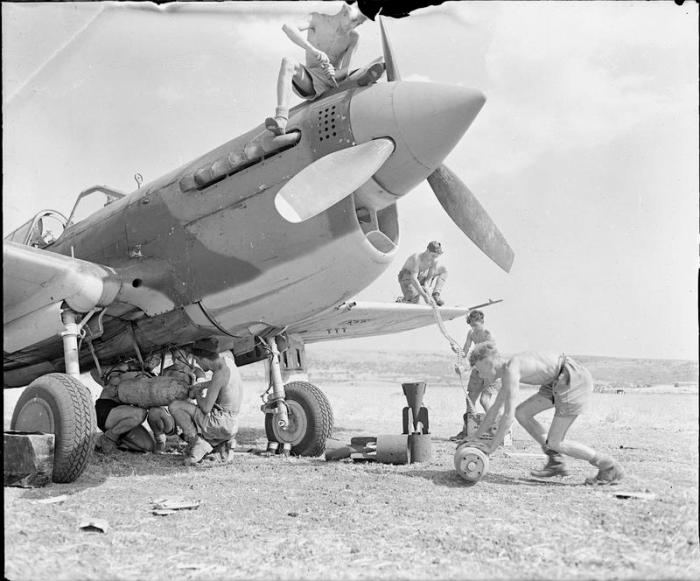
Armourers load a Curtiss Kittyhawk Mark III of No. 239 Wing RAF with 250-lb GP bombs and re-arm the machine guns in the wings, at Agnone, Sicily, for a forthcoming sortie against enemy positions in the foothills of Mount Etna. (Source: © IWM (CNA 1134))

As the Americans engaged in heavy fighting near Troina to the north, the Canadians advanced on Regalbuto to the south. In this attack, the Canadians leant heavily on artillery and air support. Air power was to focus primarily on reaching beyond the range of artillery where Allied intelligence expected much enemy traffic movement:

[i]t was believed that the enemy would withdraw when the assault developed, and it was hoped that the air attack would pin him down to the ground and prevent this operation.[3]

Allied intelligence also believed that the Germans were using the town as a motor pool for their vehicles and guns.

The Canadian anvil struck as the hammer waited overhead. Allied fighter-bombers claimed over 40 enemy motor vehicles destroyed on 2 August between Regalbuto and Adrano.[4] Between the fighting in and around Regalbuto and losses sustained during their withdrawal on Highway 121, the Hermann Göring Division’s panzer engineer battalion was effectively ‘eliminated as a combat force.’[5] The Allies successfully flushed the Germans from their positions after a gruelling attritional struggle. They forced the Germans to use the roads in large numbers, increasing already heavy casualties.

large2
A German Mk III tank knocked out during the fierce street fighting in Centuripe during the drive on Messina. (Source: © IWM (NA 5389))

A similar situation developed in the Battle of Troina. This time, however, the Germans made a much longer stand. Between 31 July and 6 August 1943, 15th Panzer Grenadier Division lost 1,600 men; 10 percent of the division’s strength or 40 percent of the fighting troops. The German commander, General Eberhard Rodt, later noted that losses from heavy artillery fire and massive carpet bombings on the hills and firing positions around the town were very high.[6] Allied aircraft caught a large amount of Axis motor transport on Highway 120 between Troina and Randazzo. Fighter-bombers claimed 50 vehicles strafed and bombed near Cesaro on 2 August.[7] It is possible that this was a reinforcement or supply column for the Troina garrison. Finally, Rodt notes that while his men were able to break contact with the Americans, they were often attacked and suffered losses from low-level aircraft while moving from Troina towards Bronte and Randazzo. Again, the Allies forced an Axis withdrawal to occur in daylight, adding to losses from the earlier attritional struggle.[8]

The German Army was just starting to get used to fighting with minimal support from the Luftwaffe. Air superiority over Sicily enabled the Allies to make use of this hammer and anvil to significant effect. Although elements of four German divisions escaped across the Strait of Messina in mid-August, those units were hollow shells of their former selves.[9] Air power and the catch-22 Allied air superiority forced the Axis into played a significant role in this outcome. The loss of Sicily opened the Mediterranean to Allied shipping, supported the Russians on the Eastern Front, and drove Italy ever closer to surrender.

large4
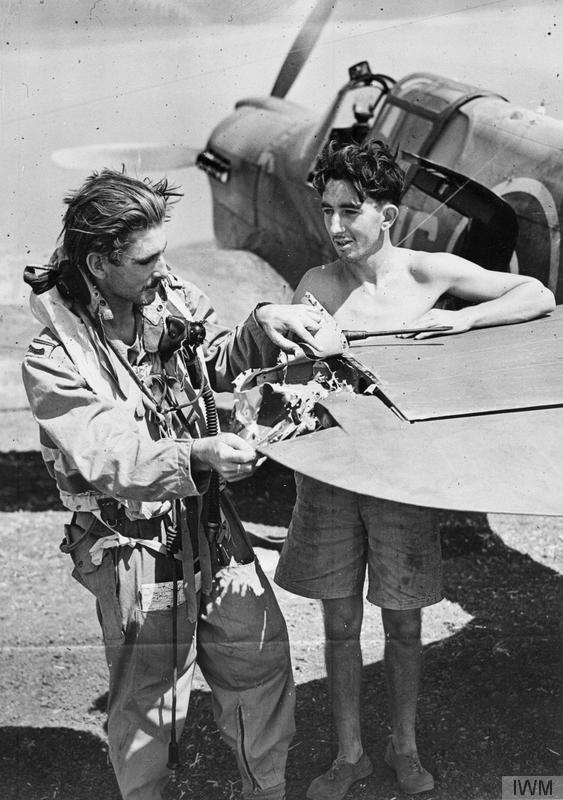
Flying Officer Colin Edmends from Australia and his fitter, D. McMinnemy, inspect the tail of his Curtiss Kittyhawk after it was damaged during a sortie over Catania. (Source: © IWM (CNA 1139))

Robert Pape’s writing on air power remains fairly controversial. Other air power theorists argue that the opposing force’s command and control, specifically regarding leadership and communications, are ideal targets. Foremost among these advocates is Colonel (Ret.) John Warden III, who wrote The Air Campaign, while he was at the National War College in the mid-1980s. However, in the estimation of this author, due to the case study examined above, Pape’s hammer and anvil approach have merit. As Philips Payson O’Brien notes in How the War Was Won, ‘except for killing every one of the combatants fighting against you, the only way to “win” a war is to stop your enemy from moving.’[10] Both theories advocate a solution to this problem. The difference is that one gives air power a complimentary role while the other affords it the leading role. In the Second World War, the debate was between the theatre air power school and the victory through air power school. The RAF and USAAF each had advocates for both of these approaches. This debate continues to this day.

Alexander Fitzgerald-Black completed his MA thesis, ‘Eagles over Husky: The Allied Air Forces and the Sicilian Campaign, 14 May to 17 August 1943,’ with The Gregg Centre for the Study of War and Society, University of New Brunswick in 2014. He is in the process of turning this work into a manuscript for publication with Helion & Company. Alex lives with his wife in Moncton, Canada. He operates his own blog at alexfitzblack.wordpress.com and can be reached on Twitter @AlexFitzBlack.

Header Image: A Martin Baltimore of the Tactical Bomber Force of the North West African Air Forces, flying over its target by a road in Sicily, while bombing retreating German forces heading for Messina, August 1943. (Source: © IWM (C 3772))

[1] Robert A. Pape, Bombing to Win: Air Power and Coercion in War (Ithaca, NY: Cornell University Press, 1996).

[2] Robert A. Pape, ‘The True Worth of Air Power,’ Foreign Affairs, 83:2 (2004), p. 119.

[3] Directorate of History and Heritage [DHH], Canadian Military Headquarters [CMHQ] Report No. 135, ‘Canadian Operations in Sicily, Part II Section 2, The Pursuit of the Germans from Vizzini to Adrano, 15 July to 6 August,’ p. 92.

[4] DHH, CMHQ Report No. 135, p. 92.

[5] Samuel W. Mitcham Jr. and Friedrich von Stauffenberg, The Battle of Sicily: How the Allies Lost Their Chance for Total Victory (Mechanicsburg, PA: Stackpole Books, 2007), p. 254.

[6] US Army Military History Institute, D.739.F6713, Foreign Military Studies [FMS] C-077, ‘15th Panzer Grenadier Division in Sicily,’ report by Eberhard Rodt and staff, 18 June 1951, p. 25.

[7] DHH, CMHQ Report No. 135, p. 92.

[8] Rodt FMS C-077, p.26.

[9] Lee Windsor, “The Eyes of All Fixed on Sicily’: Canada’s Unexpected Victory, 1943,’ Canadian Military History, 22:3 (Summer 2013), p. 31.

[10] Philips Payson O’Brien, How the War Was Won: Air-Sea Power and Allied Victory in World War II (Cambridge: Cambridge University Press, 2015), pp. 487-488.

#BookReview – How the War Was Won: Air-Sea Power and Allied Victory in World War II

#BookReview – How the War Was Won: Air-Sea Power and Allied Victory in World War II

By Alexander Fitzgerald-Black

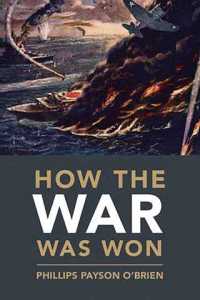
Phillips Payson O’Brien, How the War Was Won: Air-Sea Power and Allied Victory in World War II. Cambridge: Cambridge University Press, 2015. Figures. Maps. Tables. Illustrations. Notes. Bibliography. Hbk. xix + 626 pp.

how-the-war-was-won-by-phillips-payson-obrien

The Second World War is known for its decisive battles. The Battle of Britain, the Battle of Stalingrad, the Battle of Midway, and the Battle of Normandy are among the most popular. However, what if there was no such thing as a decisive battle in the greatest conflict in human history? This is what Dr. Phillips Payson O’Brien of the University of Glasgow argues in How the War Was Won: Air-Sea Power and Allied Victory in World War II, a monograph in the making for at least a decade and a half.

O’Brien seeks to contest the now standard argument that the Soviet Union bore the brunt of the German onslaught. The Red Army broke the back of German power while the Western Allies played a relatively modest role according to this view. This is one of the main themes in Richard Overy’s Why the Allies Won, a well-reputed study of the war from the mid-1990s. Western access to Russian archives emerged as the Cold War ended. Overy and other scholars took the opportunity to learn more about the war from Russia’s perspective. What emerged was a significant criticism of Western scholarship for downplaying the USSR’s role in the victory over Nazi Germany.

O’Brien’s analysis turns this thinking on its head. Those who laud the Soviet contribution do so within a paradigm that understands the contribution to victory through manpower. O’Brien cannot deny that the USSR engaged a larger percentage of the Wehrmacht than the Western Allies. His argument is that the Second World War was primarily a mechanized war. The production and destruction of equipment are what decided the war in spite of the human cost of 70 million dead (civilians included).

The production of air and sea weaponry far outstripped that of land weaponry. As such, O’Brien argues that the air-sea war was more significant than the fight on the ground. For instance, the German Army received only between 30-35% of production when it was lucky. A plurality of production effort was generally aimed at air weaponry. For instance, in May 1943 40% of German production efforts were spent on aircraft. American, British, and Japanese production efforts were similar, with the UK spending approximately one-half of its production efforts on aircraft from 1940 onwards. Naval production for each of these four nations also typically outstripped that of armoured fighting vehicles (AFVs) associated with the great land battles.

Air and sea power allowed for the most efficient destruction of Axis equipment. This destruction could be achieved in three phases. ‘Pre-production’ destruction prevented the Germans and Japanese from producing weaponry in the first place by damaging factories and destroying or preventing the arrival of raw materials. ‘Production’ destruction meant destroying equipment as it was being assembled in the factories. ‘Deployment’ destruction refers to equipment lost as it was in transit from assembly plants to the front lines. The Western Allies – mainly Great Britain and the United States – were primarily responsible for these equipment losses. The Russians did not maintain a very large navy, nor did they invest in many large, four-engined bombers to strike at the German economy.

The great land battles were not decisive. The incredible attrition sustained by the German and Japanese war machines on a daily basis was decisive. O’Brien’s argument is that this super-battlefield of air and sea weaponry mattered most. Few battles were decisive regarding equipment destroyed. German AFV losses at the Battle of Kursk, commonly lauded as the greatest tank battle of the war, were a meagre 0.2 percent of German armaments production in 1943; German AFV losses at the great British victory at El Alamein were a paltry 0.1 percent of 1942 armaments production. O’Brien does note an exception to this: the Battle of Midway. At that near-decisive naval engagement, the Imperial Japanese Navy lost four aircraft carriers, vessels that could not be replaced for some years. Consequently, it is little surprise that an image of Japanese carriers under attack at Midway graces the cover of the book.

O’Brien does leave some unanswered questions. He does not discuss the role – real or imagined – of initiative in the conflict. Battles are often considered decisive, not only for the casualties or equipment losses they incurred but for their role in shifting perceptions of how the war was going. His assessments of certain Eighth Air Force raids over Germany in 1943 may also be open to some criticism. He notes the efficiency of the air-sea war, but the losses sustained on these raids were anything but efficient. More salient to my research is his mixed treatment of the Mediterranean Theatre of Operations. O’Brien acknowledges the significant attrition imposed on Axis air forces there but laments that this was not a more integral part of the Allied strategy. He opposes the Allied decision to focus on the Mediterranean in 1943 instead of mounting the invasion of France.

How the War Was Won is an excellent read for those interested in how the interaction between production, logistics, and combat decided the war against Germany and Japan. This is its greatest contribution to the Second World War’s expansive historiography.

This post first appeared at Fighter-Bombers Blog.

Alexander Fitzgerald-Black completed his MA thesis, ‘Eagles over Husky: The Allied Air Forces and the Sicilian Campaign, 14 May to 17 August 1943,’ with The Gregg Centre for the Study of War and Society, University of New Brunswick in 2014. He is in the process of turning this work into a manuscript for publication with Helion & Company. Alex lives with his wife in Moncton, Canada. He operates his own blog at alexfitzblack.wordpress.com and can be reached on Twitter @AlexFitzBlack.

Header Image: A low-level oblique photograph showing incendiary bombs dropped by Lockheed Venturas of No. 2 Group, RAF Bomber Command, during Operation OYSTER, the daylight attack on the Philips radio and valve works at Emmasingel, Holland, 6 December 1942. (Source: © IWM (C 3268))

#ResearchNote – Air Power in the Next Generation

#ResearchNote – Air Power in the Next Generation

By Dr Ross Mahoney

0001

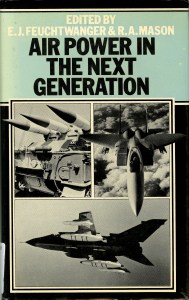
In 1979, The Macmillan Press published Air Power in the Next Generation that E.J. Feuchtwanger and Group Captain R.A. Mason edited. For me, and my current research trajectory on command and staff training in the RAF, what is remarkable about this book is that it was the first significant output from a newly established post for the Service, that of Director of Defence Studies (DDefS).

In 1977, Mason, who retired as an Air Vice-Marshal and was a professor at the University of Birmingham, became the first incumbent to the DDefS post at the RAF Staff College at Bracknell. The position of DDefS was established due to the perceived state of thinking on air power within the RAF as well as public awareness of the Service’s role. In a letter to AOC-in-C Support Command, Air Marshal Sir Reginald Harland, CAS, Air Chief Marshal Sir Neil Cameron, noted that the position was being established ‘to help provide a new stimulus to air power thinking’ throughout the RAF.[1] This point was also emphasised in the terms of reference for the DDefS post as was the need to ‘write on air power and defence issues,’ which was to be encouraged.[2]

While there was some controversy over the establishment of the DDefS position, Mason was well qualified for the job, and despite an initial lack of resources, he quickly got to work. In April 1977, a symposium was held at the University of Southampton, which formed the basis for Air Power in the Next Generation. Mason was undoubtedly supported in his early efforts by the degree of top cover he was afforded by CAS and other officers interested in the discussion of air power, such as the Director-General of Training, Air Vice-Marshal Frederick Sowrey.[3] Indeed, Cameron long had an interest in the study of air power and, as Group Captain J.A.G. Slessor, son of the former CAS, reflected, he was the only Chief to come to discuss the subject with his father.[4]

What of the book? It consists of 10 chapters based on the presentations delivered at the symposium. The opening chapter builds on Cameron’s opening presentation and reinforces the importance of protection by senior leaders. Had Cameron not been interested in both the subject matter and the importance of establishing a post to advocate for thinking about air power, it is hard to imagine that the position would have been created. Even if it had, it probably would have taken a very distinct direction to the one that it has. Other contributions came from a number senior serving or retired officers from not just the RAF but also the USAF, Luftwaffe and the Isreali Air Force. There were also contributions from academics such as John Erickson, who covered the expansion of Soviet Air Power. The conclusion from Major-General Lloyd R. Leavitt Jr. of the USAF on the ‘Lessons from South East Asia’ is particularly apropos for the current era as well as the 1970s. Leavitt, who retired as a Lieutenant-General, concluded that there was a need to enunciate and educate the body politic about the relevance of the system they were investing in noting that:

[…] in order to achieve the understanding and support of the people who have to pay the bills, the taxpayers and their elected representatives, we must go to the people and go through the press to the people with logical clear explanations about the involvements of air power – why the air force needs things, why this system is needed, and why that system is needed.[5]

Apart from the contents of the book, what is the significance of the establishment of the DDefS post? It is hard to assess, and hopefully, more answers will emerge as I continue to research the subject. However, a few tentative thoughts are warranted. First, the RAF at least recognised the challenge of its predicament in the 1970s and established a post to try and encourage the Service to discuss taxing questions over its role and employment. This was essential in the decade after the RAF handed over the strategic nuclear deterrent to the Royal Navy. This had been the RAF’s focal point during the early Cold War, and the Service needed to try and enunciate its relevance in a changing defence landscape. Whether it was successful in doing that is not to be discussed here. However, the post has offered a focal point for thinking about the RAF’s role, and individual DDefS’ have made a contribution to British air power thinking with publications similar to Air Power in the Next Generation being produced on important themes as well as the postholders numerous individual contributions on the subject of air power. These have become essential sources of informal doctrine, but they have, by dint of circumstances, varied regarding when they were produced and what they covered. Indeed, at the moment, I am trying to map the various outputs generated by DDefS’ both during their time in post and after to seek to contextualise what they wrote, when they wrote it and their impact. Some DDefS’ have produced more than others, in part, due to operational circumstances though there may be other factors at play. This latter aspect will be difficult to measure, but one thing that is already clear is that context is critical.

This post first appeared at Thoughts on Military History.

Dr Ross Mahoney is an independent historian and defence specialist based in Australia. Between 2013 and 2017, he was the resident Historian at the Royal Air Force Museum, and he is a graduate of the University of Birmingham (MPhil and PhD) and the University of Wolverhampton (PGCE and BA). His research interests include the history of war in the twentieth and twenty-first centuries, air power and the history of air warfare, and the social and cultural history of armed forces. To date, he has published several chapters and articles, edited two books, and delivered papers on three continents. He is a member of the Royal Historical Society and is an Assistant Director of the Second World War Research Group. He is a member of the Royal Historical Society and an Assistant Director of the Second World War Research Group. He blogs at Thoughts on Military History, and can be found on Twitter at @airpowerhistory.

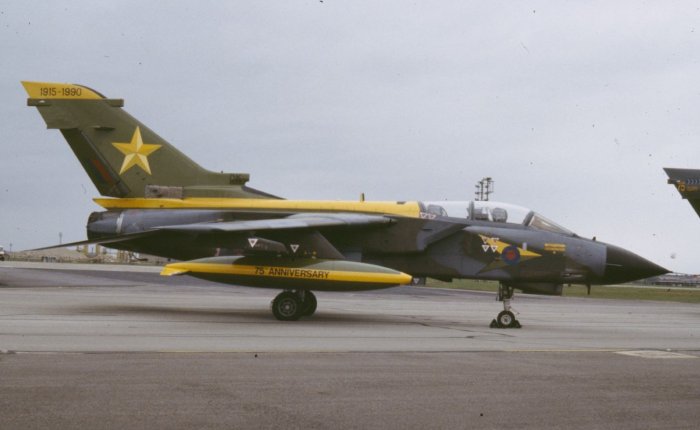
Header Image: Panavia Tornado GR1 of No. 31 Squadron at RAF Fairford, c. 1990 (Source: Wikimedia Commons)

[1] Author’s Personal Collection, Letter from the Chief of the Air Staff to AOC-in-C Support Command, 2 November 1976. I am grateful to Air Vice-Marshal Professor R.A. Mason for a copy of this and other documents linked to the establishment of the DDefS post.

[2] Author’s Personal Collection, Terms of Reference for Director of Defence Studies appended to a Letter from the Chief of the Air Staff to AOC-in-C Support Command, 2 November 1976, p. 1.

[3] Graham Pitchfork, The Sowreys: A Unique and Remarkable Record of One Family’s Sixty-Five Years of Distinguished RAF Service (London: Grub Street, 2012), p. 216.

[4] Marshal of the Royal Air Force Lord Cameron of Balhousie, In the Midst of Things (London: Hodder and Stoughton, 1986), pp. 106-8, 194-5, p. 200, fn9.

[5] Major-General Lloyd R. Leavitt Jr., ‘Lessons from South East Asia,’ in E.J. Feuchtwanger and Group Captain R.A. Mason (eds.), Air Power in the Next Generation (London: The Macmillan Press, 1979), p. 85.


#BookReview – The Mediterranean Air War: Airpower and Allied Victory in World War II

#BookReview – The Mediterranean Air War: Airpower and Allied Victory in World War II

By Alexander Fitzgerald-Black

Robert S. Ehlers Jr., The Mediterranean Air War: Airpower and Allied Victory in World War II. Lawrence, KS: University Press of Kansas, 2015. Notes. Bibliography. Index. Hbk. 536 pp.

9780700620753

The Second World War’s Mediterranean Theatre of Operations was a sideshow, right? The road to defeating Nazi Germany where the Western Allies were concerned lay through Normandy, not North Africa. The Allies launched their great Combined Bomber Offensive from the United Kingdom as this incredible animation from the American Air Museum shows. Other efforts were relatively unimportant and sapped resources from where the real air battle took place. Alternatively, were they?

Robert S. Ehlers Jr.’s The Mediterranean Air War: Airpower and Allied Victory in World War II offers a valuable counter-narrative. The Mediterranean was not a sideshow. In fact, it was a critical theatre for Allied victory. Adolf Hitler committed the Wehrmacht to the Mediterranean in 1941 to support Benito Mussolini’s faltering armies in Greece and North Africa. Four years later the consequence of this simple plan was 400,000 Italian and 730,000 German casualties. However, human casualties only tell part of the tale. The European Axis lost 42 percent of its merchant shipping in the Mediterranean. The Allies all but destroyed the Regia Aeronautica by mid-1943 while the Luftwaffe lost 17,750 aircraft in the Mediterranean throughout the war. By comparison, the Germans lost 20,419 aircraft on the Western Front while losing only 11,000 on the Eastern Front.

This is just the strategic picture. Ehlers’s work also talks logistics. Historians have often highlighted the importance of tank strength in the Western Desert. The side that could field the most tanks had the advantage. Since both sides had to maintain their forces across long supply chains the ability to retrieve and repair damaged battlefield equipment was crucial. The same was true for aircraft. The Royal Air Force created an efficient system for repair and salvage early in the campaign. Air Vice-Marshal Graham Dawson, the RAF’s Chief Maintenance Officer in the Mediterranean, organized the effort. Dawson was a Battle of Britain veteran who received a Mention in Dispatches for superb engine repair efforts in 1940. He coordinated his crews’ efforts with local Egyptian shops that could repair and manufacturer parts. Dawson’s command was innovative. It created modifications that allowed Hurricane fighters to engage high-flying Junkers Ju 86P photo reconnaissance aircraft. The aircraft’s service ceiling was 36,000 feet, yet the modified version achieved its first victory over the Nile at 49,000 feet.

large2
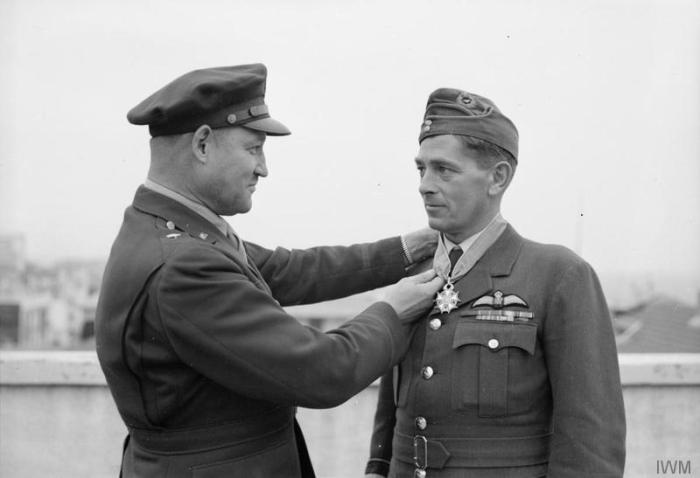
Air Vice-Marshal Graham Dawson, Director of Maintenance and Supply, Mediterranean Allied Air Forces, is presented with the American Legion of Merit in the degree of Commander, by Brigadier-General Harold A. Barton, Commanding General of the USAAF Service Command, Mediterranean Theatre of Operations, during a parade at Algiers. (Source: © IWM (CNA 2721))

The Mediterranean was ultimately a battle for sea lines of communication or SLOCs. Air superiority was essential to winning this and other battles. With the war in North Africa won, Ehlers argues that the Western Allies were right to take the war to Sicily and then on to mainland Italy. After securing air superiority, the Allied air forces were free to expand their cooperation with Allied armies. The Allies produced great results when the services coordinated their efforts. In the first half of 1944, Operations STRANGLE and DIADEM sought to defeat German forces barring the way to Rome. STRANGLE was an air campaign aimed at depriving the Germans of supplies while DIADEM was a large-scale ground offensive with air support. On its own, air power’s effectiveness was limited. The Germans lost 20 trucks per day during STRANGLE, but that number rose to 100 per day during DIADEM. Pressure from the army kept enemy transports on the road in large numbers, making them easier prey for prowling fighter-bombers. Together these operations cost the Germans Rome and 80,000 casualties.

Ehlers convincingly argues that the final air campaigns flown from bases in Italy shortened the war and saved lives. Targets included the Luftwaffe, the German oil industry, and German lines of communication to the Eastern Front. Instructors who seek to offer their students a fresh perspective on the Mediterranean Theatre of Operations will do well to include this book on their reading lists.

This post first appeared at Fighter-Bomber’s Blog.

Alexander Fitzgerald-Black completed his MA thesis, ‘Eagles over Husky: The Allied Air Forces and the Sicilian Campaign, 14 May to 17 August 1943,’ with The Gregg Centre for the Study of War and Society, University of New Brunswick in 2014. He is in the process of turning this work into a manuscript for publication with Helion & Company. Alex lives with his wife in Moncton, Canada. He operates his own blog at alexfitzblack.wordpress.com and can be reached on Twitter @AlexFitzBlack.

Header Image: A formation of five Blenheim Mark IVs of No. 14 Squadron RAF in flight over the Western Desert. A Curtiss Kittyhawk, one of the escorting fighters, can be seen on the far right (Source: © IWM (CM 3108))