Rebecca Siegel, To Fly Among The Stars: The Hidden Story of the Fight for Women Astronauts. New York, NY: Scholastic Focus, 2020. Bibliography. Hbk. 340 pp.
Academic book reviews, at least those found in the back two-thirds of academic journals, tend to follow a predictable pattern. The good: ‘The author deftly demonstrates…’ Followed by the not so good: ‘What the author misses though is…’ Finally, the wrap up: ‘In the end, this work…’ It is, to a certain degree, the nature of the ‘business’ of academia, the manner in which one professional must praise and critique the work of a peer to the wider audience of colleagues. Removed from this predictable outline of reviews are more personal opinions. One will likely not find the phrase, ‘I enjoyed….’ I have often lamented to friends that nothing will ruin your love of history like the professional study of it. So, it is with great pleasure that every so often a book lands on my desk that is at the same time a well-written history and a thoroughly enjoyable book. Rebecca Siegel’s To Fly Among the Stars: The Hidden Story of the Fight for Women Astronauts is just such a book. For something a bit different here at From Balloons to Drones, I will follow the predictable pattern not so often found on blog posts.
The Good. The author deftly demonstrates that the search (and desire) for women astronauts has been almost entirely overlooked. In this book, written for the upper Middle Grade to Young Adult audience, Siegel weaves the well-known story of the Mercury 7 alongside the contemporaneous story of the virtually unknown ‘Mercury 13’ – the moniker was never official and added much later. This is not to say that the study of these pioneers has been entirely overlooked, and I would encourage our readers to get their hands on the following works: Martha Ackmann’s The Mercury 13: The True Story of Thirteen Women and the Dream of Space Flight and Margaret A. Weitkamp’s Right Stuff, Wrong Sex: America’s First Women in Space Program. Do not allow the fact that this is a book written for a younger audience, dissuade you from its importance and what will surely be great impact. For starters, this is a good book. Even scholars of the field will likely find something new – and dare I say something to enjoy – in these pages. Siegel has not only done her homework, but she provides avenues for a new generation to do theirs: her bibliography, the place where the next generation scholars and scientists will turn, is diverse and exhaustive. Considering, the age group this book is intended for, the bibliography is the equal of scholarship on the subject.
The not so good. What the author misses though is…not much. Weaving the familiar with the lesser-known demonstrates the state of cultural and gender backwardness that was accepted as normal practice in the latter half of the 20th Century. Siegel presents a refreshing take on a familiar space story. Most female pilots struggled to find work and acceptance in the air, but for a select few being a pilot was not enough. While the names Shepard, Grissom, Glenn, Carpenter, Cooper, Slayton, Schirra remain (more or less) recognisable, the names Cobb, Dietrich, Steadman, Sloan, Funk and others are not. Siegel’s timely work coincides not only with the 50th anniversaries of the Apollo flights but with a modern NASA seeking to inspire an American public as it sets its sights once again on deep space travel. It was only 37 years ago that the first American female astronaut launched into space, the first female shuttle pilot 25 years ago, and the first female shuttle commander 21 years ago. In the 60+ year history of crewed American spaceflight, these exploits and successes were built upon lesser-known figures whom Siegel brings to light for a younger audience.
In the end, this work will appeal to a wide audience: across specialties, across interests, across genders and across generations. To steal from another space-themed genre, this work will be the spark that lights the fire in the next generation of space explorers. We are all better for this book having been written.
Dr Brian Laslie is a US Air Force Historian and currently the Deputy Command Historian at North American Aerospace Defense Command (NORAD) and United States Northern Command (USNORTHCOM). A 2001 graduate of The Citadel and a historian of air power studies, he received his PhD from Kansas State University in 2013. His first book The Air Force Way of War (2015) was selected for the Chief of Staff of the Air Force’s and the Royal Air Force’s Chief of the Air Staff professional reading lists. His second book was Architect of Air Power: General Laurence S. Kuter and the Birth of the US Air Force. He lives in Colorado Springs. He can be found on Twitter at @BrianLaslie.
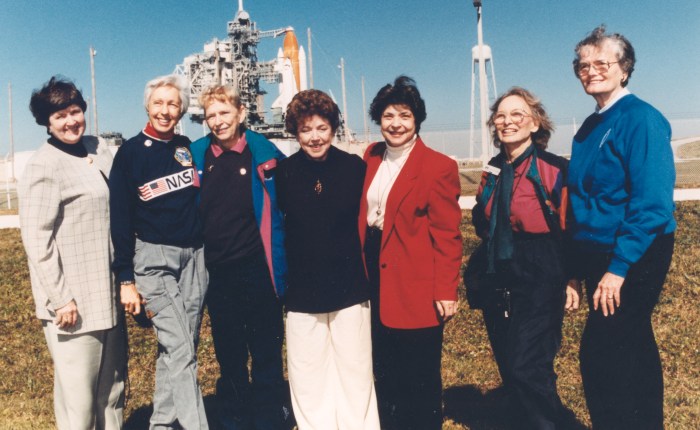
Header Image: Exuberant and thrilled to be at the Kennedy Space Center, seven women who once aspired to fly into space stand outside Launch Pad 39B neat the Space Shuttle Discovery, poised for liftoff on the first flight of 1995. They are members of the First Lady Astronaut Trainees (FLATs, also known as the ‘Mercury 13’), a group of women who trained to become astronauts for Americas first human spaceflight program back in the early 1960s. Although this FLATs effort was never an official NASA program, their commitment helped pave the way for the milestone Eileen Collins set: becoming the first female Shuttle pilot. Visiting the space center as invited guests of STS-63 Pilot Eileen Collins are (from left): Gene Nora Jessen, Wally Funk, Jerrie Cobb, Jerri Truhill, Sarah Rutley, Myrtle Cagle and Bernice Steadman. (Source: Wikimedia)
Hindsight tends to make the contingent seem predestined. This is why reading history is essential for those responsible for planning for the future. When military professionals engage with history to try and understand how decisions, events, and circumstances – many of which lie beyond their control – shaped the present, they better appreciate that future planning is not about prediction; it is about preparing for adaptation. This is the lesson I took from Lieutenant Colonel Dr Tyler Morton’s book From Kites to Cold War, published by the United States Naval Institute Press in 2019.
This may not have been the insight that Morton intended for his readers. The book is the published version of Morton’s 2016 USAF Air University PhD thesis, which aimed to educate airmen on how airborne intelligence, surveillance, and reconnaissance (ISR) evolved rapidly from novelty to necessity. Although Morton claimed that the book ‘is a unique account spanning two millennia of manned airborne reconnaissance history’ (p. 9), the book’s six chapters cover less than 200 years: from the Montgolfier brothers’ hot-air-balloon demonstration in 1783 to the Linebacker air campaign over North Vietnam in 1972. This is not a criticism of Morton; his treatment of those 200 years is detailed and engaging and lives up to the promise of providing a unique insight into the development of a capability that is now a cornerstone of modern military operations. Morton’s 200-year story of airborne reconnaissance is one of vision, innovation, hype, misstep, and adaptation. This is a story whose beginning and early evolution has interesting parallels to what is occurring today with a range of emerging technologies.
Most histories of air power begin at the turn of the 20th century with the development of dirigibles and heavier-than-air flight. Those seeking to establish a longer pedigree for military aviation may refer to the French use of balloons at the Battle of Fleurus in 1794. Morton’s first chapter covering the Montgolfier’s 1783 balloon demonstration through to the end of the Spanish-American War in 1898, therefore, fills a gap in air power’s historical narrative.
As Morton describes it, the 19th century was a period of civilian-led experimentation that enjoyed ambivalent support from militaries in Europe and the United States. Though contemporary militaries saw the potential for balloons to contribute to their armies’ situational awareness, many believed resources were better spent on more established capabilities. Using examples from the French Revolutionary period and the American Civil War, Morton shows how the tension between inventors, scientists, and entrepreneurs who demonstrated, but also oversold, the possibilities of airborne reconnaissance, and military leaders who needed to balance innovation with operational necessities shaped initial development efforts. The opportunity cost of an experimental technology versus tried-and-tested during a time of war hindered the military employment of balloons until the end of the 19th century.
It was during the first 15 years of the 20th century, the focus of chapter two, that the perceived benefits of military air power began to exceed the cost. Practical and operational demonstrations of airships and heavier-than-air machines sparked interest in militaries in Europe and the United States, leading to a growing acceptance of aviation’s future military role. Morton’s analysis of this period draws attention to the increasingly important role of empowered officers who drove progress in airborne reconnaissance. Officers such as then-Lieutenant Benjamin Foulois who envisaged the development of airborne reconnaissance as a system requiring the development of new technology and skill-sets beyond those associated with the aircraft itself, and who were empowered to drive the capability forward. Foulois’ career – on operations, as a member of the critical aeronautical boards before and after the First World War, and as Chief of the Air Corps – provided him with the opportunities within the military establishment to translate his vision into reality. His demonstrations of air-to-ground communications and aerial photography in support of US operations during the Mexican Revolution established the utility of airborne reconnaissance for key US Army leadership. In Foulois’ own words (p. 67), the Mexican operations ‘had proven beyond dispute […] that aviation was no longer experimental or freakish.’
Growing awareness in Europe and the United States of the military utility of airborne reconnaissance opened the door for the capability advocates when war came. It would not take long for the capability to prove its worth. Airborne reconnaissance enabled operational success on both sides of the First World War from the earliest stages of the war. It provided Allied commanders with intelligence on German manoeuvres that enabled the so-called ‘Miracle of the Marne.’ On the Eastern Front, German air reconnaissance of Russian force dispositions played a vital role in the German victory at Tannenberg; according to Field Marshal Hindenburg (p. 85): ‘Without the airplane there is no Tannenberg.’ Morton’s discussion of developments during the war in chapter three provides the reader with an appreciation of how the capability developed as a system comprising the air platform, cameras, communications, and the processing, exploitation, and dissemination (PED) of information. This was a logical progression of the pre-war developments, but, as Morton highlights, it was the character of First World War trench warfare (p. 86) that ‘gave aviation the chance it needed to solidify further its value as a force enhancer.’ The reduced mobility of ground forces created an intelligence gap which air power advocates and innovators ably filled. It was the development under real-world operational conditions that made airborne reconnaissance effective as it ensured the system evolved to meet requirements. This also had the effect of removing any lingering doubt about whether the capability had a place in future force structure. With its future assured, the next challenge was determining the exact form and function of that future capability. As the final three chapters highlight, this was not easy.
In chapter four, Morton covers the interwar period and the Second World War – a 26-year period during which there were significant advances in technology, concepts, and operational experience – in one page more than he covers the five years of the First World War. Surprisingly, this does not reduce the quality of the insights he provides. Morton focuses on two main areas during this period: the relative neglect of airborne reconnaissance into the 1930s as air power’s advocates struggled to define its role; and the wartime expansion of the reconnaissance role from imagery intelligence (IMINT) into signals intelligence (SIGINT). Opportunity cost remerged as a significant factor driving air power development during the interwar period. Ironically, as militaries and air power advocates struggled to clarify the role of air power, the tried-and-tested capability of airborne reconnaissance was neglected as investment flowed into more experimental and conceptual areas such as strategic bombing, a reversal of situation Morton describes in chapter one. However, new technologies and the character of operations during the Second World War created opportunities for innovative airmen and their adaptable organisations to consolidate and expand the role of airborne reconnaissance. The ubiquity of radar and radios increased the opportunities and requirement for collection against new sources; Morton does an excellent job describing the resulting emergence of SIGINT across all theatres. By 1945 the major disciplines of modern airborne reconnaissance were firmly established, but the challenge of prioritisation would continue to shape its development well into the Cold War.
Morton takes a different approach to deal with the Cold War. Rather than dividing the period arbitrarily into different time periods, he opts for a thematic approach. Chapter five explores ‘airborne reconnaissance as a strategic political instrument’. While chapter six, the book’s final chapter, examines airborne reconnaissance in the ‘hot wars’ in Korea, Cuba, and Vietnam. Of note, unlike previous chapters that have examined the developments internationally, the final two chapters focus solely on airborne reconnaissance in the United States. The unstated premise is that whereas previously the ideas and experiences of the other great powers had exerted an influence on the evolution of the capability this ceased to be the case after the end of the Second World War. Whether or not this is true is open for debate, but Morton’s discussion of the period does make a compelling, though implied, case.
In chapter five, Morton describes a period of consistent investment in and development of ‘strategic aerial reconnaissance’. The need to maintain awareness of Soviet capabilities to strike the United States and develop intelligence for targeting of US strategic strikes against the Soviet Union drove these developments. Soviet responses also played a role. As superpower competition grew and the Soviet’s began actively targeting US collection assets, political concerns began to impact the requirement for US reconnaissance capabilities directly. Morton describes how this interplay between collection requirements and political considerations drove improvements to sensor capabilities, giving rise to the Big Safari program, and the survivability of the collection platforms, leading to the A-12 Oxcart/SR-71 Blackbird, and the U-2. These were strategically significant capability improvements that were vital to the success of the US deterrence strategy.
While the United States focused its reconnaissance efforts on strategic requirements, the ability to meet tactical the demands for reconnaissance was neglected. In the book’s final chapter Morton describes how the United States adapted its strategic reconnaissance capabilities, and rapidly developed and implemented new tactical systems to meet the requirements of Korea, the Cuban Missile Crisis, and the Vietnam War. The most interesting aspect of this final chapter is not the technology, but the processes that were developed. In Korea, Colonel Karl Polifka implemented a tactical reconnaissance management system that deconflicted the multitude of requests coming into the 5th Air Force and tracked the status of the product; a process that sounds remarkably similar to today’s collection management process. During Vietnam, the integration of technology and process as part of the Teaball project – a system that enabled highly-classified SIGINT to provide near-real-time intelligence into USAF fighter cockpits over North Vietnam – contributed to an increase in the USAF’s kill ratio from 0.47:1 to 4:1. In the words of General John Vogt, then-Commander of the 7th Air Force (p. 204):
During Linebacker we were shooting down the enemy at a rate of four to one […] Same airplane, same environment, same tactics; largely [the] difference [was] Teaball.
Teaball is an appropriate way for Morton to end his history of airborne reconnaissance. The progress made technologically, organizationally, and procedurally from 1783 to 1972 is impressive; when you shift timescale from 1914 to 1972, that progress is even more spectacular. As Morton reflects when discussing the 1965 introduction of the communication-intelligence-equipped EC-121D Warning Star into the Vietnam conflict (p. 200):
In scarcely fifty years, airmen went from using smoke signals and dropped messages to a fully integrated communications capability delivering near-real-time SIGINT data directly to air and ground warfighters.
This progress was not smooth, nor was it predestined, it was the result of the creativity, vision, and perseverance of inventors, engineers, airmen, and military commanders who were able to adapt emerging capabilities to meet operational and strategic requirements.
From Kites to Cold War is an essential read for anyone involved in the present or future of airborne ISR. Morton’s well-written history of the first 200 years of airborne reconnaissance provides an appreciation of how the capability evolved into its modern form, particularly how the vision and adaptability of airborne reconnaissance advocates were crucial to progress. For the same reason, this book is also a useful read for those in the innovation game or involved in future force design. Although Morton’s aim was not to write a book on military innovation, this is essentially what it is. It is an instructive tale of vision, hype, experimentation, and adaptation that provides useful points of discussion and debate for those charged with integrating experimental technologies and ideas into future force structure.
Wing Commander Travis Hallen is a Royal Australian Air Force officer with a background in maritime patrol operations, and a co-editor of The Central Blue. He has had a long-term interest in the development and improvement of airborne ISR having conducted multiple operational deployments in that role. He is a graduate of the USAF School of Advanced Air and Space Studies. Wing Commander Hallen is currently in Washington, DC.
Header Image: After Francis Gary Powers was shot down over the Soviet Union during a CIA spy flight on May 1. 1960, NASA issued a press release with a cover story about a U-2 conducting weather research that may have strayed off course after the pilot reported difficulties with his oxygen equipment. To bolster the cover-up, a U-2 was quickly painted in NASA markings, with a fictitious NASA serial number, and put on display for the news media at the NASA Flight Research Center at Edwards Air Force Base on May 6, 1960. The U-2 cover story in 1956 was that it was a NASA plane to conduct high-altitude weather research. But various observers doubted this story from the beginning. Certainly the Soviets did not believe it once the aircraft began overflying their territory. The NASA cover story quickly blew up in the agency’s face when both Gary Powers and aircraft wreckage were displayed by the Soviet Union, proving that it was a reconnaissance aircraft. This caused embarrassment for several top NASA officials. (Source: Wikimedia)
The advent of flying craft was, without doubt, a threat to the long-established roles of ground forces. Most historians are familiar with the intra- and inter-service battles that raged during the early days of aviation, but rare are the works that dive into specific details within the various army branches. Seeking to fill that historiographical gap, Lori Henning’s meticulously researched book does just that.
Harnessing the Airplane tells the story of how cavalrymen in the United States (US) and the United Kingdom (UK) dealt with the integration of aircraft – and to a lesser degree, the tank – into their branch. Analysing the first four decades following the aircraft’s invention, Henning shows that cavalrymen generally accepted the new technology, but were cautious about relinquishing the cavalry’s reconnaissance mission too hastily. Instead, the cavalry sought to experiment with aircraft to find ways to improve the reconnaissance service they provided to ground commanders.
Chapter one, ‘State of Affairs,’ sets the stage for the following analysis. In this chapter, Henning provides brief histories of the US and British cavalries. This baseline helps explain why both services saw the integration of the aircraft differently. The US cavalry embraced a wide range of missions and used the horse primarily for mobility purposes. This view of how to use horses led to strong resistance against aircraft as the US Cavalry viewed ground reconnaissance as one of its most essential functions. The British used the cavalry primarily for mounted combat and the pursuit of retreating enemy forces and this view allowed the British cavalry to be somewhat more accepting of aircraft.
Chapter two, ‘Early Response to Heavier-Than-Air-Flight,’ highlights the natural connection between aircraft and the cavalry. With reconnaissance being the first purpose of aircraft, cavalry reconnaissance was not surprisingly one of the first missions the aircraft sought to assume. In the earliest days, both nations’ cavalries acknowledged the potential of aircraft, but concluded that the technology was not sufficient; as Henning stated (p. 32):
The general consensus was that aviation would support the cavalry in the field as an auxiliary service and not replace mounted forces.
Chapter three, ‘Developing a Relationship in the 1920s,’ explores how both nations’ evaluated the First World War and the effectiveness of the new technologies that were introduced in that conflict. In the First World War, aircraft played a significant role while both cavalries were effectively absent. The public sentiment that the cavalry had become obsolete increased and cavalrymen in both nations had to defend their branch and find ways to justify its continued existence.
Chapter four, ‘National Economy,’ looks at the factor that may have been more damning to the cavalry than its poor performance in the First World War. In examining the financial arguments favouring aircraft over the cavalry, Henning provides a glimpse into reality. This was that the US and UK sought ways to decrease military expenditures and the aircraft’s proponents were more vociferous and persuasive in making this case than the proponents of cavalry.
Chapter five, ‘Autogiros and Mechanization,’ examines how cavalrymen continued to seek ways to work with the air forces to maximise both services’ effectiveness. By the 1930s, the relationship between air forces and cavalry had stabilised, but as time passed, airmen sought independence and increasingly focused on the strategic vice tactical use of aircraft. Both the British and American cavalry branches realised the need for its own air support, and as such, they turned to a new type of aircraft – the autogiro – to provide the airborne reconnaissance they needed.
Henning’s concluding chapter reminds us of the folly of abandoning functioning capabilities without first providing suitable replacements. Cavalrymen instantly recognised the potential of aircraft and tanks but approached their integration into the army from a cautious view. Despite being labelled as ‘backwards,’ the cavalrymen prudently sought ways to integrate the aircraft as its capabilities increased slowly. In telling this story, Harnessing the Airplane captures the essence of how organisations incorporate new technologies. Henning’s expert analysis highlights the challenge leaders face when presented with the next ‘game-changing technology.’ As she demonstrates, often, many are eager to go all-in without first ensuring that the ‘new’ can replace the ‘old.’ As we now stand at another technological crossroads with continual talk of replacing soldiers with robots, manned aircraft with drones, and analysts with artificial intelligence, this work highlights the rational approach of the early 20th century cavalrymen and provides a case study for today’s military thinkers to consider.
Dr Tyler Morton is currently a fellow at the Woodrow Wilson International Center for Scholars in Washington, DC. He is an active duty US Air Force officer who holds a PhD in Military Strategy from the Air University. He is the author of From Kites to Cold War: The Evolution of Manned Airborne Reconnaissance(2019). He can be found on Twitter at @ty_morto.
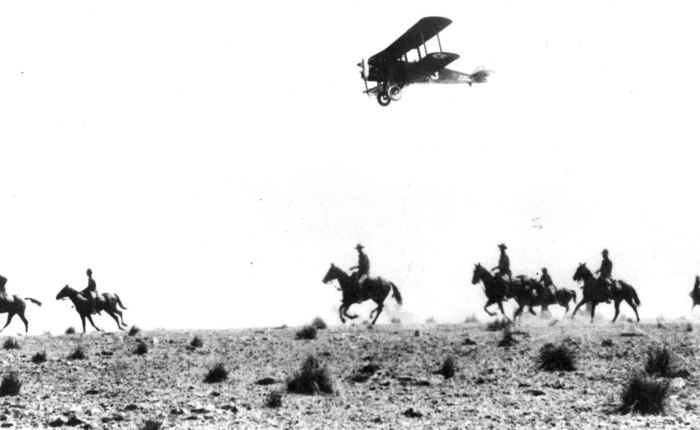
Header Image: Dayton-Wright DH-4s of the US 12th Aero Squadron flying liaison with US Army cavalry on patrol on the United States/Mexico border, c. 1920. (Source: Wikimedia)
Editorial Note: From Balloons to Drones is pleased to announce our new podcast series. Led by Assistant Editor Dr Mike Hankins, the series builds on the success of From Balloons to Drones, and it provides an outlet for the presentation and evaluation of air power scholarship, the exploration of historical topics and ideas, and provides a way to reach out to both new scholars and the general public. You can find our Soundcloud channel here.
In our latest podcast, we interview Dr Stephen Bourque, author of Beyond the Beach: The Allied War Against France, to talk about the allied bombing of occupied France in 1944. Through a detailed look at local French sources, combined with official US sources, Bourque provides as thorough – and possibly controversial – assessment of General Dwight Eisenhower’s use of air power.
Dr Stephen A. Bourque served in the US Army for 20 years after which he obtained his PhD at Georgia State University. He has taught history at several military and civilian schools and universities, including the US Army’s School of Advanced Military Studies, and Command and General Staff College, where he is professor emeritus.
As we come to the end of 2019, it is time to take stock of what has happened and what is to come in 2020.
Twenty-nineteen has been another year of growth for From Balloons to Drones. We have expanded our editorial team, our list of contributors, and we have moved into new areas of engagement with you, our readers.
In terms of our editorial team, we were pleased to welcome Victoria Taylor onto the team. Victoria is a British based PhD student looking at the Nazification of the Luftwaffe. In 2020, Victoria will be increasingly taking over at the helm of our social media accounts. We also became more organised with how we manage content with Dr Brian Laslie taking over responsibility for our book review processes and Dr Mike Hankins overseeing our new podcast series. Alexander Fitzgerald-Black oversaw the development of our new logo, which I am sure all of you will agree is very attractive!
Personally, I am grateful to all the members of the From Balloons to Drones editorial team for their hard work. While we do not peer-review material per se, we do read and comment on all the article submissions that we receive, and this is done in addition to the work noted above.
We also reached the 80,000-hit mark. This was a nice milestone to reach. We recognise that in terms of both the military history and professional military education ecosystems that we offer a niche product. However, it is good to see that people are taking the time to read and engage with the material that our contributors write.
Over the year we have published around 35 pieces at From Balloons to Drones. These have ranged from articles through our ongoing book review series to our newly launched podcast series.
During the year we have published two themed series of posts. In the first series, Assistant Editor, Dr Brian Laslie produced a series of book reviews to coincide with the 50th anniversary of the launch of the Apollo 11. This was an excellent series of reviews, and we are grateful to Brian for taking the time to produce these insightful reviews.
The second series was our themed #AirWarVietnam series. While we did not publish as many articles as we had hoped, we did receive some fascinating contributions. It was particularly pleasing to receive articles that looked at the role of helicopters in war. It is important to remember that the history of air power, and its application in war, is not just about fighters and bombers. A particular favourite of mine in this series was Hayley Hasik’s article on the cultural iconography of the helicopter during the Vietnam War.
The most significant development to occur in 2019 was the launch of our new podcast series. Assistant Editor Dr Mike Hankins manages this series. The podcast series aims to build on the success of From Balloons to Drones, and it provides an outlet for the presentation and evaluation of air power scholarship, the exploration of historical topics and ideas, and provides a way to reach out to both new scholars and the general public. So far, we have released four interviews with more lined up for 2020. You can find the podcasts at our SoundCloud channel here.
Finally, but certainly not least, here are the top five most-read posts of 2019.
So, what about 2020? More of the same but better. We will aim to continue to refine what we offer in terms of content and build on the success of this year’s developments. If you are interested in contributing to From Balloons to Drones, then you can find out how here. Also, we have already put out a call for submissions for a series of themed articles to be published in 2020. The ‘Bombing to Win Revisited’ series will aim to explore the varied use of air strikes, both kinetic and non-kinetic, at the tactical, operational, and strategic levels of war. We also have more podcasts coming in 2020 as well as more book reviews, which will, of course, be added to our ever-expanding ‘Air Power Reading List.’ We are also looking at what anniversaries our coming up and what we might publish to coincide with these.
Finally, again, we would like to thank our contributors and you, our readers, for taking the time to read and engage with what we have published throughout the year. See you in 2020!
Header Image: A US Navy Grumman F4F-3 in non-specular blue-grey over the light-grey scheme in early 1942. (Source: Wikimedia)
Editorial Note: From Balloons to Drones is pleased to announce our new podcast series. Led by Assistant Editor Dr Mike Hankins, this series aims to build on the success of From Balloons to Drones and provide an outlet for the presentation and evaluation of air power scholarship, the exploration of historical topics and ideas, and a way to reach out to both new scholars and the general public. You can find our Soundcloud channel here.
In our latest podcast, we interview Dr Roger Launius about the history, legacy, and memory of the Apollo program and the moon landing, at the 50th anniversary of Armstrong’s famous steps for all mankind. Looking back after all this time, what does the Apollo program mean for us today?
Dr Roger Launius retired from the Smithsonian National Air and Space Museum in 2016 as Associate Director for Collections and Curatorial Affairs having previously served in several other positions. Before that, he had been Chief Historian for NASA. As well as being a specialist in the history of air and space power, he has also written on 19th century American history. You can find his website here.
Header Image: A photograph of the Apollo 11 crew just after they had been selected for the mission. Left to right, are Edwin E. Aldrin Jr., the lunar module pilot; Neil A. Armstrong, commander; and Michael Collins, command module pilot. They were photographed in front of a lunar module mock-up beside Building 1 following a press conference in the MSC Auditorium, c. January 1969. (Source: NASA)
In the 1990s there was a plethora of published material on D-Day and the Second World War writ large. For example, Stephen Ambrose’s Band of Brothers was published in 1992. The service members who served during that conflict were in their 70s and sought to tell their stories. Comparatively speaking, the veterans of the Vietnam War were in their 40s at the time; however, time marches on. In 2019, we are where we were in the 1990s, but this time it is the veterans of the Vietnam War who are now in the 70s, and a fresh new wave of scholarship and memoirs are being published on that most confusing of conflicts.
Into the mix comes, Gaillard R. Peck, Jr.’s Sherman Lead: Flying the F-4D Phantom II in Vietnam. Peck admitted early on that his mission here is not to rehash politics or make sweeping judgments, ‘It is not my intent to go into details as to how the war was fought. Nor will I delve into policy.’ This book is simply, and excellently presented. It provides one pilot’s perspective, through his own window on the world about his time flying during the Vietnam War. Peck’s work joins other recent accounts including David R. Honodel’s The Phantom Vietnam War (2018) and Terry L. Thorsen’s Phantom in the Sky (2019), as well as Dan Pederson’s TOP GUN: An American Story (2019).
Readers might recognise Peck’s name as he was also one of the commanders of the famed MiG-flying Red Eagles squadron and author of America’s Secret MiG Squadron: The Red Eagles of Project CONSTANT PEG (2012) that was also published by Osprey. Peck now turns his attention to his time as a young pilot flying and fighting in the F-4 Phantom II in 1968-1969. ‘Evil’ as he has been known to generations of fighter-pilots at Nellis Air Force Base has decided to add prolific writer to an already fantastic resume. Peck is something of a legend in the US Air Force’s Fighter community, as he has been a staple at the F-15 and F-22 Weapon’s School for decades.
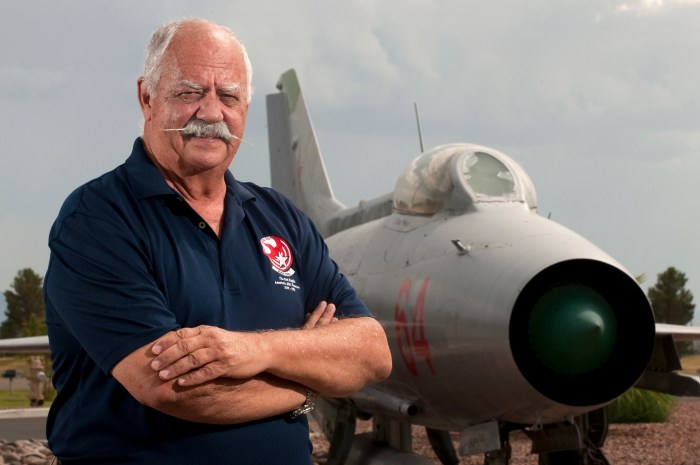
Colonel Gail Peck in front of a Soviet MiG-21 he flew as commander of the Red Eagles in Operation Constant Peg, Nellis AFB, Nevada.(Source: Smithsonian Institution)
Sherman Lead is ostensibly about flying the F-4 in combat, but this work is much richer than just that. Peck included the social side of life for American aircrews flying out of Thailand, something missing in other works. Peck also deftly included aspects of flying left out of so many books. This included the process and importance of mid-air refuelling, a nice tip of the hat to the tanker community.
The book generally follows his training progression, from learning to not only flying fighters but also how to employ them. Peck also deftly demonstrated how the training at an air-to-ground gunnery range was accomplished as well as the physics and geometry of putting bombs on a target. By using both the training environment as well as his experiences employing munitions in North Vietnam, Laos, and Cambodia, the reader gets the sense that there is a genuine difference between precision-guided munitions and the precision-employment of munitions. Peck adroitly described all of these without being overly technical; thus the book can be enjoyed by the professional and the enthusiast alike.
Of course, the real effort of the book is to be found in his operations flying out of Ubon Royal Thai Air Base, Thailand and his missions over North Vietnam as part of Operation ROLLING THUNDER or over Laos as part of Operation STEEL TIGER. Perhaps the most significant contribution Peck has made to our understanding of the Vietnam War is that this is a dual ‘biography’ in that it is a memoir of himself, but it is also the biography of the F-4 Phantom II. This book is as much about how the war changed man as it is about how the war changed the machine.
Sherman Lead is destined to join the other classic memoirs on air power in Vietnam, including Jack Broughton’s Thud Ridge (1969) and Rick Newman and Don Shepperd’s Bury Us Upside Down (2006). Historians of air power and the history of the US Air Force will especially enjoy this book, but it will also find a wider audience in those seeking to understand individual and unique perspectives on America’s participation in the war in Vietnam.
Dr Brian Laslie is a US Air Force Historian and currently the Deputy Command Historian at North American Aerospace Defense Command (NORAD) and United States Northern Command (USNORTHCOM). A 2001 graduate of The Citadel and a historian of air power studies, he received his PhD from Kansas State University in 2013. His first book The Air Force Way of War (2015) was selected for the Chief of Staff of the Air Force’s and the Royal Air Force’s Chief of the Air Staff professional reading lists. His recently published Architect of Air Power: General Laurence S. Kuter and the Birth of the US Air Force. He lives in Colorado Springs. He can be found on Twitter at @BrianLaslie.
Header Image: An image of an F-4 Phantom II being refuelled during Operation ROLLING THUNDER. Aerial refuelling permitted tactical aircraft to operate in the northern part of North Vietnam, something noted in Peck’s memoir. (Source: National Museum of the United States Air Force)
Editorial Note: From Balloons to Drones is pleased to announce our new podcast series. Led by Assistant Editor Dr Mike Hankins, this series aims to build on the success of From Balloons to Drones and provide an outlet for the presentation and evaluation of air power scholarship, the exploration of historical topics and ideas, and a way to reach out to both new scholars and the general public. You can find our Soundcloud channel here.
In our latest podcast, we interview Dr Melvin Deaile of the US Air Force Air Command and Staff College. In this episode we discuss Deaile’s recent book Always at War. We discuss the early days of USAF’s Strategic Air Command and its culture, as well as the controversies surrounding General Curtis LeMay.
Dr Melvin Deaile is Director of the School of Advanced Nuclear Deterrence Studies at the USAF Air Command and Staff College. His book, Always at War: Organizational Culture in Strategic Air Command, 1946-62 was published by Naval Institute Press in 2018. Deaile is a retired USAF Colonel, with a PhD in American History from UNC-Chapel Hill, who flew the B-52 Stratofortress and the B-2 Spirit. He has flown combat operations as part of Operations Desert Storm and Enduring Freedom, including a record-setting 44.3-hour combat mission. Deaile is the recipient of the Distinguished Flying Cross and is a distinguished graduate of the USAF Weapon School.
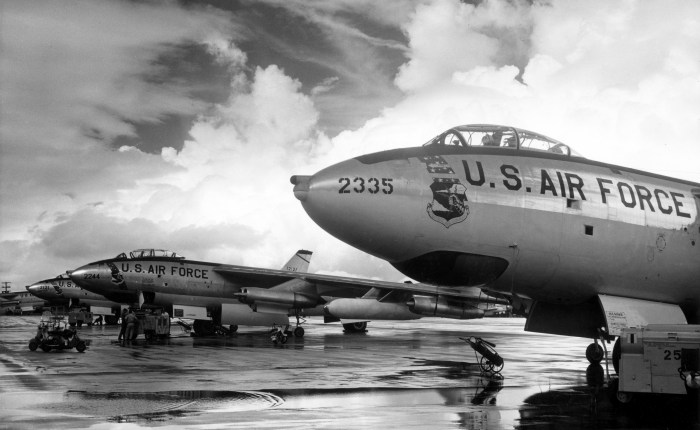
Header Image: Boeing B-47 Stratojet bombers of the USAF’s Strategic Air Command, c. the 1950s. The B-47 was the world’s first swept-wing bomber. The B-47 normally carried a crew of three; pilot, copilot (who operated the tail turret by remote control), and an observer who also served as navigator, bombardier and radar operator. (Source: Wikimedia)
Editorial Note: During 2019, From Balloons to Drones is running a series of articles looking at various aspects of the air war over Vietnam from the French-Indochina War through to the end of the Vietnam War. In this article, Dr Robert Kodosky discusses the differing attitudes towards armed helicopters between the US Army and US Marine Corps as they entered the Vietnam War. If you would like to contribute to the series, then please email our editor, Dr Ross Mahoney, at airpowerstudies@gmail.com or via our contact page here. The official call for papers is here.
In Vietnam, the US Army utilised helicopters according to its thinking about conventional warfare during the previous decade. Without the ‘helicopter in Vietnam,’ US Army officials concluded that America and its allies in Vietnam ‘would not have been able to outmanoeuvre the enemy nor exercise their superior firepower.’[1] While accurate, this observation adhered to the assumption that these tactics aligned to an effective counterinsurgency strategy. As one wartime study commissioned by the Department of Defense contended, ‘the crude use of overwhelming firepower seems more appropriate to total war.’[2]
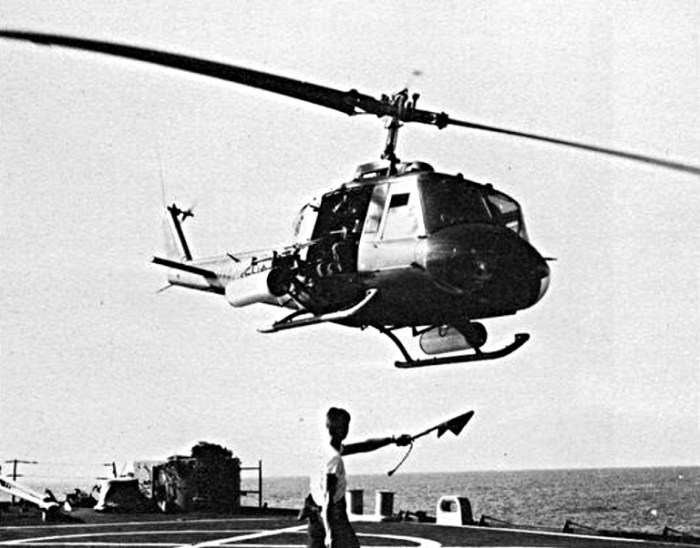
The US Army appropriated helicopters to fight the war it wanted in Vietnam, one of attrition. In comparison, Marines employed rotary craft to fight the war they got. The US Marine Corps (USMC) weaponised helicopters to align with counterinsurgency goals and remained cautious about the firepower they delivered. In July 1967, for example, the commander of Fleet Marine Forces, Pacific, General Charles Krulak noted that armed helicopters carried out two-thirds of all USMC UH-1E flights in Vietnam during the previous year. He found this unacceptable. More arms, Krulak observed, denied the USMC ‘the eyes which are so urgently needed over the jungle environment.’ He suggested that the USMC had erred in putting ‘too many rocket pods’ on UH-1Es and had ‘unconsciously encouraged their misuse.’[3]
USMC UH-1E helicopters touch down with their loads at Fire Support Base Cunningham. Artillerymen of the 12th Marines at Cunningham are supporting elements of the 9th Marines conducting search and clear operations, c. 1969. (Source: Wikimedia)
This example, set by the USMC in Vietnam, remains vital today. Despite ‘deliberate application of COIN [counterinsurgency] practices in Iraq and Afghanistan,’ some aviators have remained ‘focused on killing insurgents.’ One AH-64 Apache battalion commander deployed to Iraq cited ‘winning hearts and minds’ as ‘ground-guy stuff.’[4]
As such, this article explores foundational thinking surrounding the decision to weaponise helicopters in both the US Army and the USMC. Each initially conceptualised weaponising helicopters to wage a conventional war, whether as weapons platforms to combat tanks or to facilitate amphibious landings. This resulted in experimentation in ways to arm helicopters to deliver indiscriminate firepower. While the US Army remained on this path, the USMC deviated from it, based on their observations of the French effort to quell insurgents in Algeria and their own early experience in Vietnam. The USMC then decided to weaponise helicopters in Vietnam because they perceived them better able to deliver discriminate firepower than fixed-wing craft.
Blitzkrieg from Above
Contemporary observers largely concurred that the Vietnam War provided the ‘crucible for the helicopter.’[5] Military officials reaffirmed this view afterwards, citing helicopters as counterinsurgency tools essential for ‘mobility, rapid deployment of troops and logistics support.’[6] The US Army declared that helicopters ‘represented the most revolutionary change in warfare since the blitzkrieg.’[7]
This view found widespread acceptance. According to US Army General William C. Westmoreland, commander of Military Assistance Command, Vietnam between 1964 and 1968, America ‘achieved the ability to use the helicopter and employ the tactics of air mobility.’ This reflected the US Army’s view that its efforts during the Korean War suffered from doctrinal and technological limitations that prohibited employing rotorcraft to gain the initiative by enabling mobility. In Korea, this resulted in a deadlock. Westmoreland observed that the Vietnam War readied America’s use of helicopters to ‘take off.’ This ‘is not the end,’ he advised, it ‘is only the beginning.’[8]
This proved prescient. In 2004, the US Army alone deployed more than 500 helicopters to Afghanistan and Iraq. In counterinsurgency missions especially, the helicopter played ‘a key role.’ It continues to do so. There exists an ‘intensive use of rotary wing aircraft,’ rendering the helicopter as ‘omnipresent across a large spectrum of defense missions.’[9]
There exists good cause, however, to explore the centrality of helicopters critically in the execution of counterinsurgency operations. A recent study concerned with American involvement in Vietnam, Soviet engagement in Afghanistan and French participation in Algeria argues that helicopters proved ‘indecisive or bad at enabling legitimacy, population control, and isolation, key tenets of successful COIN.’[10]
This view is reflected by commentary offered by a counterinsurgency veteran to the Armed Forces Journal. It cited the proclivity of AH-64 Apache and OH-58D operators for flying low to the ground. While this proved ‘occasionally fruitful in detecting enemy activity,’ it observed that helicopters ‘can only scatter a farmer’s sheep so many times before he sees coalition forces as an annoyance rather than an ally.’[11]
Such criticism is not new. Sir Robert Thompson, who directed the British Advisory Mission to the Republic of Vietnam between 1961-1965, became an outspoken critic of America’s strategy in Vietnam. Thompson was a widely respected expert on counterinsurgency based on his experience in Malaya. Thompson labelled attrition, using the number of Vietnamese communists killed as a metric of success, as an ‘error.’ The ‘main contributing factor to this,’ he contended, ‘was the helicopter.’[12]
The Army Way – Cavalry Without Horses
The development of the US Army’s thinking about the use of helicopters as air cavalry capable of aerial assault originated during the Korean War. In July 1952, the US Army’s 6th Transportation Company (Helicopter) received the H-19 Chickasaw. Capable of faster and farther travel than the H-13, the Chickasaw constituted the US Army’s first true cargo and transport helicopter. While used to assist medical evacuation and resupply efforts, the H-19 executed the US Army’s first air assault combat missions, shaping Army thinking about helicopters after the war.
Troops boarding a US Army H-19 Chicksaw of the 6th Transportation Company in Korea, c. 1953. (Source: Wikimedia)
In 1955, Redstone Rocket likened helicopter performance favourably in Korea to fixed-wing operations during the Second World War. It framed the helicopter’s potential within conventional missions such as ‘smoke laying’ and ‘armor column control.’ It observed that helicopters took with them ‘two American military traditions: To get there ‘fustest with the mostest’ and to ‘hit ‘em where they ain’t.’”[13]
James M. Gavin, a veteran of the Second World War and later a Lieutenant-General in the US Army of the 1950s, introduced his concept of airborne armoured cavalry in ‘The Future of Armor,’ an article that appeared in the US Army’s Infantry Journal in 1948. He argued that ‘striking at high speed by air’ and ‘entering ground combat’ enabled ‘mobility and the retention of the initiative.’ Armoured cavalry offered this potential, Gavin contended, rendering it uniquely able to ‘play the decisive role in future airborne combat.’[14]
Gavin expanded on his idea over the next 15 years, including in an article for Harper’s Magazine, published in 1954. In ‘Cavalry, and I Don’t Mean Horses,’ Gavin suggested that the US 8th Army in Korea suffered from a lack of airmobile cavalry. He pressed for the return of a ‘mobility differential,’ one that could make a difference for American commanders in Korean-style conflicts and any war waged directly against the Soviet Union.
Mobility comprised more than speed, Gavin clarified, it included the capability to deliver superior firepower.[15] The Second World War informed Gavin’s thinking and influenced the US Army’s development of its air assault concept. During the Second World War, in addition to its functions of target acquisition and artillery fire observation, organic US Army aviation ‘provided highly responsive capabilities.’[16]
Gavin served in President Dwight Eisenhower’s administration as Assistant Chief of Staff for Operations (G-3) and was a critic of the President’s ‘New Look’ national security policy that prioritised massive nuclear retaliation. Gavin advocated the need for force readiness, ‘based on his concepts of mobility, firepower and control derived from his experience in World War II.’ He cited helicopters as able to ‘provide the mobility advantage that U.S. forces needed.’ These fulfilled the traditional cavalry missions of ‘reconnaissance, screening and exploitation.’[17]
Gavin’s notions about air mobility became those of the US Army. General Hamilton Howze, appointed by Gavin as the first Director of Army Aviation in 1955, instituted them. In this capacity, Howze ‘saw to it that every imaginable weapon was strapped onto a US-1 (Huey).’[18] Also a veteran of the Second World War, Howze envisioned the utility of air mobility within conventional thinking about linear warfare against a mechanised adversary.
By the winter of 1961, with ‘the Army’s aviation resources suddenly in high demand’ due to America’s increasing commitment in Vietnam, Secretary of Defense for the President John F. Kennedy’s administration, Robert S. McNamara, grew ‘sharply critical of the Army’s conservative approach’ to improve air mobility.
Kennedy had shifted national defence from the massive retaliation endorsed by Eisenhower’s New Look. He called for ‘Flexible Response.’ This aimed to counter Soviet aggression using proxies throughout the world. It emphasised a rebuilt conventional force with the capacity to deploy quickly. McNamara pressed the military for ‘maximum mobility.’ He tasked the US Army with figuring out how to achieve this, within ‘an atmosphere divorced from traditional viewpoints and past policies.’[19] Howze, McNamara suggested, stood capable of creating such a climate.
The Howze Board
The US Army’s Tactical Mobility Requirements Board convened under Howze’s direction in May 1962. Its membership included 200 officers and 41 enlisted personnel from the Army, along with 53 civilians. The US Air Force (USAF) observed the Board’s work, carried out from May until the end of July. Testing utilised 125 helicopters and 25 fixed-wing aircraft to log over 11,000 hours of flight time. Conditions simulated a variety of scenarios, from Lieutenant-General Walton Walker’s withdrawal to Pusan in 1950 to counter-guerrilla exercises.
It all constituted ‘tactical experimentation’ with considerable attention provided to wargaming against the Soviet Union and an emphasis on the potential to deliver ‘heavy firepower.’ One ‘suggestive scenario’ featured in the Board’s final report, for example, simulated a Soviet incursion in Iran through the Zagros mountains.[20]
Howze briefed the Pentagon in 1957 about the potential of air mobility to defend against a Soviet attack. Only the terrain shifted between then and 1962 as the earlier simulation situated the campaign in Bavaria. The interest in maximising the firepower of helicopters remained unabated.
As Director of Army Aviation, Howze worked ‘to prove that the helicopter’ constituted a ‘superior weapons platform.’[21] In 1958 the US Army successfully tested an H-34 loaded with 40 2.75- and 2.5-inch rockets, nine machine guns and two 20mm cannon.[22]
For McNamara, the Howze Board staged a full field demonstration which featured four gunship helicopters attacking fortifications with machine guns and 2.75-inch rockets. It all climaxed with 30 Hueys ‘flying low, from behind the grandstands, at 110 miles per hour.’ Loaded with infantry, the helicopters landed in the smoke where soldiers dismounted and attacked. It all took two minutes.[23]
The Howze Board sought out information about Southeast Asia by dispatching a team to visit Military Advisory Assistance Groups in Vietnam, Laos, Thailand, Cambodia, and Marine Task Force 116 Headquarters at Udorn, Thailand. Since the middle of 1962, a UH-1 Tactical Transport Helicopter Company armed with machine guns and 2.75-inch rockets operated in Vietnam to escort CH-21 helicopters. Nevertheless, the visiting Board members reported back that there existed resistance to arming helicopters from the USAF.
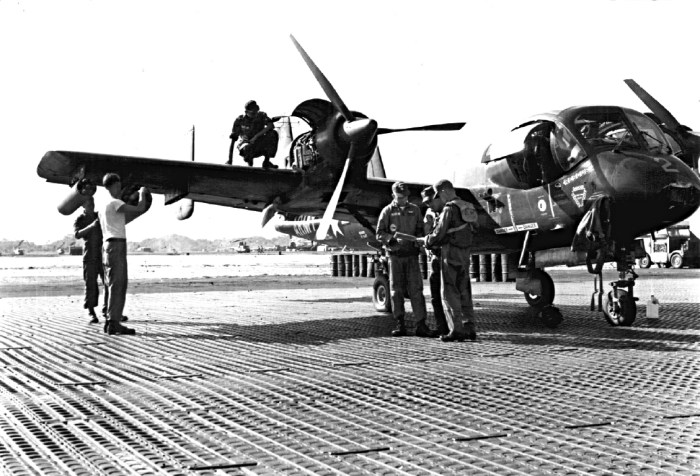
US Army pilot, crew, and ground crew with a Grumman OV-1 Mohawk in Vietnam. (Source: Wikimedia)
This only intensified with the Board’s recommendation for US Army air mobility, to include weaponised helicopters. A USAF Board headed by Lieutenant-General Gabriel Disosway issued a four-volume rebuttal to the Howze findings. It criticised weaponising helicopters, utilising an OV-1 Mohawk as a close-support aircraft and argued that USAF fighter-bombers provided better support.
This resulted in the decision to further test the airmobile concept by activating the 11th Air Assault Division (Test) at Fort Benning in 1963. Eighteen months of tests and exercises brought approval from all members of the Joint Chiefs of Staff except USAF General John McConnell who maintained his services’ opposition. For the USAF, the fundamental issue remained ‘centralised versus decentralised aircraft management and command.[24]
Ultimately, the USAF won the battle, but it lost the war. The US Army relinquished the 24-armed Mohawks recommended by Howze. It activated the 1st Cavalry Division, however, in July 1965. By the 3 October 1965, the entire division reached its base area at An Khe in Vietnam’s Central Highlands. Its orders to seek out and destroy a North Vietnamese force building up in the area culminated in the Battle of Ia Drang in November.
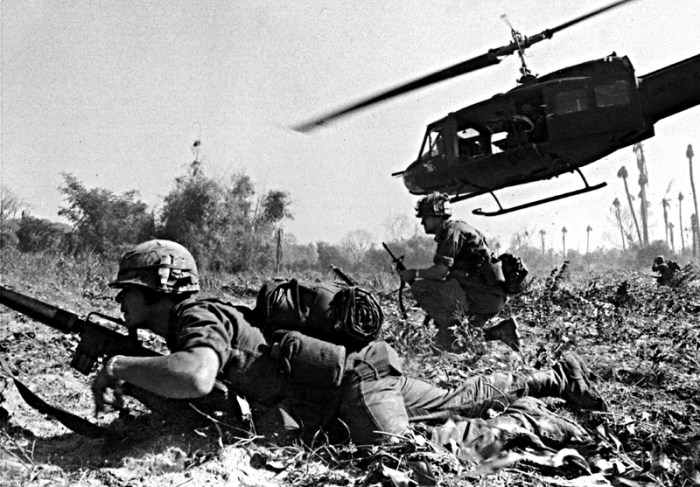
Operations during the Battle of the Ia Drang Valley in November 1965. Major Bruce Crandall’s UH-1D helicopter climbs skyward after discharging a load of infantrymen on a search and destroy mission. (Source: Wikimedia)
The US Marine Corps Mantra – Tolerance, Sympathy and Kindness,
The USMC had long expressed interest in the idea of weaponising helicopters. As far back as 1949 they ‘envisioned that the supporting tactics’ of helicopters ‘might include the use of covering artillery fire’ to ‘neutralize anti-aircraft weapons’ and tanks.[25] The limited lift capability and the instability of helicopters at the time rendered it unworkable. The idea remained, however, and the war in Vietnam reinvigorated it.
Lieutenant Colonel Victor J. Croizat served as the first USMC advisor to the Army of the Republic of Vietnam (ARVN). An authority on French military matters, Croizat visited Algeria where the French faced an insurgency. Accompanied by Major David Riley, Croizat reported their observations to Washington in July 1957.
The French employed helicopters judiciously, in support of ground elements, only until these became ‘capable of self-support with organic weapons.’ While obsolete helicopters ‘hampered’ French efforts, Croizat recommended that the USMC remain ‘abreast of the French experiences.’ As the USMC did that, the Division of Aviation cited that ‘the basic problem [still remaining] is that of determining whether or not Marine Corps Helicopters should be armed.’[26]
There existed a few reasons for opposing armed helicopters in the USMC. These included the inadequacy of rotary-wing aircraft to serve as weapons platforms and the perceived inferiority of helicopter pilots. The most substantial objection, however, stemmed from fears of helicopters replacing fixed-wing to protect helicopter transports.
This necessitated a ‘major change of concept’ while threatening the identity of the USMC. According to Major General Norman J. Anderson, planners foresaw that ‘sacrificing fixed wing capabilities to helicopters’ risked the USMC losing its primary distinction from the US Army; ‘its combination of ground and air combat power.’[27]
By April 1962, a USMC medium helicopter squadron had deployed to Vietnam. Marine Medium Helicopter Squadron 362 (HMM-362) constituted the second element of task unit SHUFLY which occupied an old Japanese landing strip near Soc Trang, 85 miles south of Saigon. It operated in support of ARVN forces throughout southern Vietnam.
Unlike US Army helicopters already operating in other parts of South Vietnam, the USMC HUS-ls remained unarmed. USMC commanders reasoned that weapons mounted in the cargo hatch mitigated against efficient loading and unloading in landing zones. Moreover, armed aircraft presented hostile appearance to Vietnamese civilians. They acknowledged this as counterproductive to counterinsurgency by providing fodder for insurgent propaganda.[28]
US Marine Corps Sikorsky HUS-1 (UH-34D) Seahorse helicopters of Marine medium helicopter transport squadron HMM-362 in Vietnam, 1962.
The USMC began devising counterinsurgency-specific roles for helicopters. For example, they soon observed that during large engagements, small numbers of insurgents peeled away to escape into covered areas. The USMC instituted ‘Eagle Flights’ aimed to thwart such escapes in which four helicopters loaded with ARVN troops circled over contested areas and timed landing to cut off any attempted escapes.
The USMC quickly deduced the ‘unique links’ between the ‘political and military aspects of the struggle in Vietnam.’[29] By August 1962, the US marines at Soc Trang began arming their helicopters by mounting M-60 machine guns inside the cargo hatch. While this constituted a radical change, one that realised fears of surrendering fixed-wing capabilities to rotary craft, the USMC adopted it as a defensive tactic, one compliant with the counterinsurgency they sought to execute. The M-60s served as protection for landing and only fired at clearly identified enemies. The USMC refrained from their use in the Mekong Delta’s heavily populated areas.[30]
The US marines who served at Soc Trang became the most vocal advocates of weaponising helicopters. Their argument, however, derived from their conviction, gained from experience. That argument was that counterinsurgency success hinged on a discriminate application of firepower. The early operational experience gained by the US marines that served at Soc Tran convinced them that helicopters could operate with restraint better than fixed-wing aircraft. They sought to explain that in the densely populated areas where helicopter assaults transpired, the application of firepower required ‘almost surgical precision.’
While 500-pound bombs delivered by fixed-wing aircraft ‘might indeed suppress fire,’ this would ‘hardly win the ‘hearts and minds’ of the frightened or uncommitted residents.’[31] According to Colonel Noah C. New, the USMC ‘learned early’ the incompatibility of helicopters and jets in Vietnam. Because there ‘were so few Marines involved, at Soc Trang’ however, making a ‘convincing argument’ to others that the war in Southeast Asia required ‘new approaches’ proved difficult.[32]
General Wallace M. Greene, Commandant of the USMC between 1964 and 1967, grasped the problem. In May 1965, six-armed Marine UH-1Es arrived at Da Nang. Greene explained this to the press, attributing the development to the ‘peculiar circumstances’ that the USMC confronted. He rationalised it as a counterinsurgency imperative, noting that ‘tactical fixed wing aircraft have not been available because of political considerations.’ The armed helicopter, Greene insisted, represented an appropriate tool for the USMC ‘in the environment of political-military artificialities which exist in the Republic of Vietnam.’[33]
An armed US Marine Corps Bell UH-1E Huey takes off from guided missile cruiser USS Topeka (CLG-8) off Vietnam, in 1966. (Source: Wikimedia)
The decision by the USMC to weaponise helicopters exhibited recognition of the Vietnam War’s nature. It derived from the early experience at Soc Trang but also profited from the USMC’s experience in waging America’s ‘small wars’ in the early twentieth century.[34] This is evident through the efforts initiated by USMC General Lew Walt. He commanded Marine Amphibious Force III that operated in I Corps, the tactical zone that included South Vietnam’s five northernmost provinces.
Walt, a veteran of both the Second World War and the Korean War, identified the conflict in Vietnam as something different. It resembled the kinds of engagements he heard about as a young officer ‘from men who fought Sandino in Nicaragua or Charlemagne in Haiti.’ Walt understood the USMC mission in Vietnam as framed by ‘sympathy, understanding, regard for the people.’[35] This echoed advice from the Small Wars Manual of 1940 that noted that ‘tolerance, sympathy and kindness should be the keynote of our relationship with the mass of the population.’[36] That insight informed the decision made by the Marines to weaponise helicopters in Vietnam.
Conclusion
In contrast to the US Army, the USMC sought to apply firepower discriminately. They also recognised the value of helicopters to provide reconnaissance, a critical task of counterinsurgency as ‘the enemy relies on stealth instead of mass.’[37] According to Major General William Gayler, commander of the US Army’s Aviation Center of Excellence, ‘the most critical gap for the Army is a light armed reconnaissance helicopter.’ One with the ability ‘to fight for information about terrain and enemy, that enables ground force commanders, that gives decision space, manoeuvre room and reaction time.’[38] Superior eyesight is sometimes more important than superior firepower. In Vietnam, the USMC understood this well. As military officials contemplate the use of helicopters in contemporary counterinsurgencies, ones where ‘hearts and minds’ remain as vital to secure as they did in Vietnam, the history of thinking within both the USMC and the US Army about weaponising helicopters for use in Vietnam offers valuable lessons.
Dr Robert J. Kodosky chairs the history department at West Chester University and advises the Student Veteran Group. He is the author of Psychological Operations American Style (2007), numerous articles about the Vietnam War and the forthcoming Tuskegee in Philadelphia: Rising to the Challenge (2020).
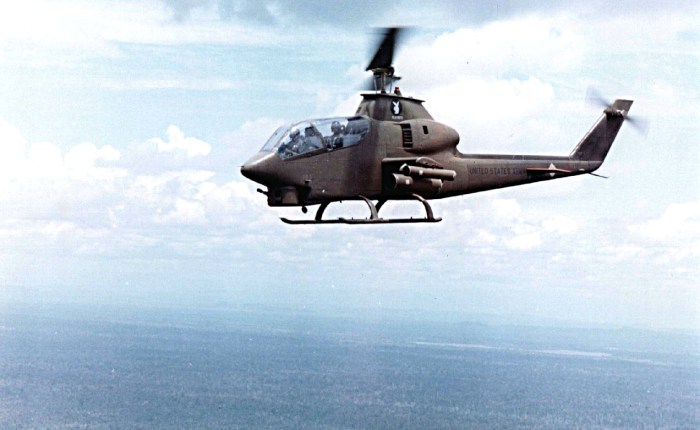
Header Image: An AH-1G Cobra gunship helicopter of the 334th Helicopter Company, 145th Aviation Battalion over Vietnam in 1969. (Source: Wikimedia)
[1] Lieutenant General John H. Hay, Jr., Vietnam Studies: Tactical and Materiel Innovations (Washington, DC: US Government Printing Office, 1974), p. 6.
[2] Raymond D. Gastil, Toward the Development of More Acceptable Limits for Counterinsurgency (New York: Hudson Institute, 1967), pp. IV-15.
[3] Lieutenant Colonel William R. Fails, Marines and Helicopters, 1962-1973 (Washington, DC: History and Museums Division, US Marine Corps, 1978), p. 111.
[5] The Virtual Vietnam Archive, Texas Tech University (VVA-TTU), John T. Wheeler, ‘Copter Warfare: How it Evolved,’ Associated Press, 9 March 1969, Associated Press.
[6] Colonel Achid Muchlas, ‘The Role of Airpower in Counterinsurgency Operations’ (USAF Air War College Report, 1988).
[8] ‘Lessons U.S. Has Learned in the Helicopter War,’ US News and World Report, 23 November 1970, p. 50.
[9] Etienne de Durand, BenoÎt Michel and Elie Tenenbaum, Helicopter Warfare: The Future of Airmobility and Rotary Wing Combat (Paris: Laboratoire de Recherche sur la Défense, 2012), p. 32.
[10] Major Beau G. Rollie, ‘Helicopters in Irregular Warfare: Algeria, Vietnam and Afghanistan’ (MA Thesis, US Army Command and General Staff College, 2013), p. ii.
[19] VVA-TTU, Douglas Pike Collection, Unit 01 – Assessment and Strategy, Proposed Army Aviation Program Subjected to Thorough and Critical Examination by McNamara’s Staff, 1962.
[28] Captain Robert H. Whitlow, U.S. Marines in Vietnam: The Advisory and Combat Assistance Era, 1954-1964 (Washington, DC: Government Printing Office, 1977), p. 65.
[34] On the use of USMC aviation in the small wars between the First and Second World War, see: Wray Johnson, Biplanes at War: US Marine Corps Aviation in the Small Wars Era, 1915-1934 (Lexington, KY: University Press of Kentucky, 2019).
Editorial Note: From Balloons to Drones is pleased to announce our new podcast series. Led by Assistant Editor Dr Mike Hankins, this series aims to build on the success of From Balloons to Drones and provide an outlet for the presentation and evaluation of air power scholarship, the exploration of historical topics and ideas, and a way to reach out to both new scholars and the general public. You can find our Soundcloud channel here.
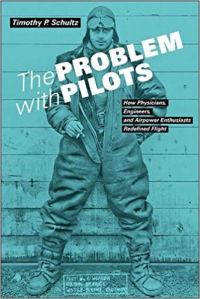
In our first podcast, Dr Mike Hankins and Dr Brian Laslie interview Dr Tim Schultz of the US Naval War College. They discuss Schultz’s new book The Problem with Pilots and explore some of the principal issues that emerged from his important research. He takes us on a journey through how military aviation technology evolved in the early years of flight in order to respond to the limits of the human body.
Dr Timothy Schultz joined the faculty of the US Naval War College in 2012 as an Air Force colonel and became the Associate Dean of Academics for Electives and Research in 2014. He previously served as the Dean of the US Air Force’s School of Advanced Air and Space Studies. Schultz’s research interests include the transformative role of automation in warfare and the impact of technological change on institutions, society, and military strategy. John Hopkins University Press published his book The Problem with Pilots: How Physicians, Engineers, and Airpower Enthusiasts Redefined Flight in 2018. He spent much of his aviation career as a U-2 pilot enjoying the view over interesting regions of the globe.
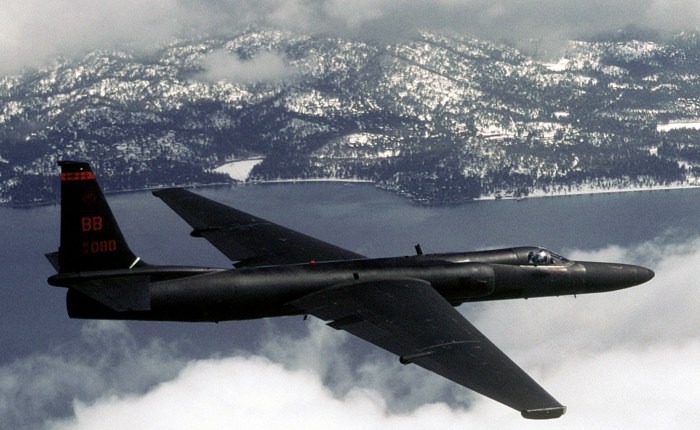
Header Image: A Lockheed U-2 ‘Dragon Lady’ high-altitude reconnaissance aircraft in flight. (Source: Wikimedia)








 From Balloons to Drones