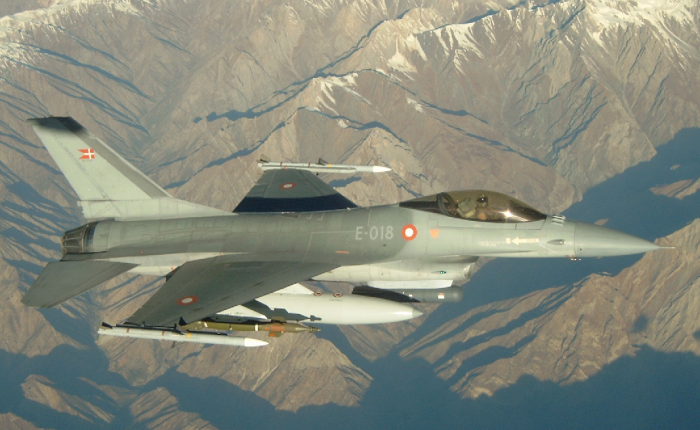
From Defence of the Baltic to the Airspace above Kosovo: The Transformation of the Royal Danish Air Force, 1989-1999

From Defence of the Baltic to the Airspace above Kosovo: The Transformation of the Royal Danish Air Force, 1989-1999

By Dr Søren Nørby

The 30th of May 1999 is an important date in the history of the Royal Danish Air Force (RDAF). On this day, Danish General Dynamics F-16s dropped bombs against a hostile target for the first time in its history. The target was in Serbia; a country located more than 1,500 kilometres from Denmark, and with which Denmark was not legally at war. Instead, what the RDAF participated in was a ‘humanitarian intervention’ that was supposed to stop a potential Serbian genocide in the province of Kosovo.

RDAF participation in the intervention against Serbia in 1999 was the end of a period fundamental transformations of the Air Force after the end of the Cold War. In this period, almost every aspect of the RDAF began to change – its doctrine, technology, and central mission. This article explores those changes by looking at the role of the RDAF during the post-Cold War conflicts in Yugoslavia between 1992-1995 and Serbia in 1999.[1]

In 1989, the RDAF was small but versatile. It consisted of more than 100 aircraft, a force of ground-based air defence centred around eight mobile missile batteries (I-HAWKs), seven large airbases, and a well-developed command-and-control-system that maintained a constant aerial picture of Denmark and the surrounding area. Its peacetime force was approximately 8,200 personnel, which could be increased to 17,500 in wartime. The RDAF was well integrated into NATO, and its main task was the defence of the western part of the Baltic Sea in case of an attack from the Warsaw Pact.[2] This was a role the RDAF undertook in conjunction with other NATO partners.

From ‘Peace-dividends’ to the Civil War in Yugoslavia

The fall of the Berlin Wall in November 1989 was one of the most momentous events in the modern history of the Danish defence policy. It prompted a shift away from the low-profile approach that had been the cornerstone of Danish policy since the end of the Second World War. In September 1990 the Danish government deployed the corvette, Olfert Fischer, as part of Operation DESERT SHIELD, the United Nations (UN) sanctioned military operation against Iraq, following the occupation of Kuwait. This deployment illustrated to Danish politicians that there was political capital to be gained from participating in such operations, far from Danish shores. At the same time, the Danish Defence Command, which coordinated and controlled the Danish military, realised that operations far from Denmark were a way to stay relevant and to avoid the hard cuts to the defence budget that some Danish politicians wanted, now that the enemy – the Warsaw Pact – had disappeared.

In 1992, the UN set up a peacekeeping force for the civil war in the former Yugoslavia. The Danish government decided to participate with approximately 940 soldiers – a large contingent by Danish standards. Initial problems with recruiting the needed number of soldiers resulted in a change in Danish military law that now stipulated that members of the Danish military were required to accept participating in missions outside Denmark’s borders. Approximately five per cent of the men and women employed by the Royal Danish Army, the Royal Danish Navy and RDAF chose not to accept this and left the military.[3]

In 1993, the Danish government strengthened the Danish contribution to the UN operation in Yugoslavia by deploying ten main battle tanks. Denmark thus became the first country to deploy such heavy weapons in a UN operation. When Danish politicians voiced concern that the deployment of the Danish tanks would be perceived as a dramatic escalation of UN involvement in the civil war in Yugoslavia, the Danish Armed Forces decided that the tanks should be painted white, giving them the nickname ‘The Snow Leopards.’
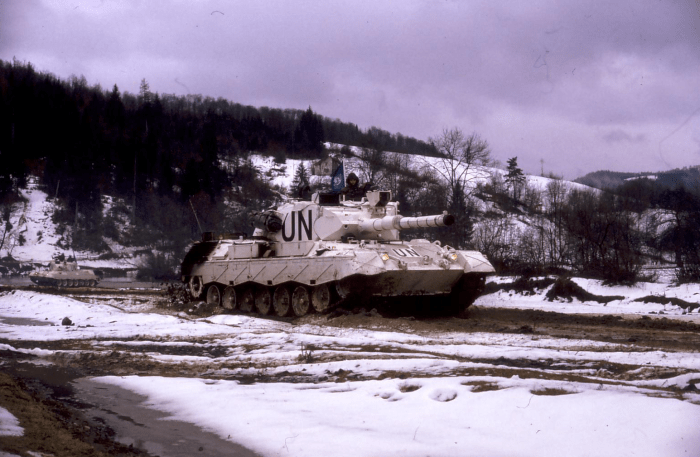
The deployment of Danish Leopard 1 tanks to the Former Yugoslavia in 1992 marked an important turning point in Denmark’s defence policy. (Source: Author)

Pressure from International Organisations

The RDAF was initially not deployed on the international stage, other than a single Lockheed C-130 Hercules, which in 1992 flew ten trips as part of the emergency assistance provided to the Yugoslav city of Sarajevo.[4] The pressure to change the RDAF contribution came from NATO, which had begun its transformation towards a smaller, but more flexible organisation, capable of faster response times. This process had already begun before the fall of the Berlin Wall, but it gained further momentum in the 1990s.

In 1991, NATO created two new forces: the Immediate Reaction Forces (IRF), capable of deploying within a few days, and the Rapid Reaction Forces (RRF) with a deployment time of a few weeks. Here the Danish government decided that that the RDAF’s Squadron 730 should be Denmark’s contribution to the IRF.[5]

The contribution of Squadron 730 to NATO’s IRF marked a shift in focus for the RDAF. During the Cold War era, NATO-planning envisaged that British and American squadrons would reinforce the RDAF.[6] NATO had planned to reinforce the RDAF with one Royal Air Force squadron of Hawker Harriers and two squadrons of SEPECAT Jaguars. United States Air Force (USAF) reinforcements were to consist of one squadron of McDonnel-Douglas F-15s, three F-16 squadrons, and one squadron of Republic A-10 Thunderbolts.

The 1990s, however, saw the RDAF shift to an expeditionary role whereby it contributed to the safety of others outside of Denmark’s borders. As such, the importance of making Squadron 730 available for NATO’s IRF cannot be overstated. Squadron 730 became the ‘flagship’ unit of the RDAF.

NATO’s involvement in the Civil War in Yugoslavia

In parallel with the above developments, during the first years of the 1990s, NATO became increasingly involved in the civil war in Yugoslavia. A UN ordered No Fly Zone had to be enforced by NATO, and in February 1994, this led to aircraft from the Alliance coming into action for the first time when US aircraft downed four Bosnian-Serbian fighter jets over Bosnia-Herzegovina.

A Royal Danish Air Force F-35 Drakken aircraft taxis into takeoff position during Exercise OKSBOEL ’86. (Source: Wikimedia)

On several occasions, the Danish government considered contributing Danish aircraft to NATO operations over Yugoslavia. Such a move was, however, hampered by Danish politicians, who in 1991 had decided to scrap all of the RDAF’s Saab Draken aircraft. This meant that the Air Force’s ability to perform close air support had been downgraded to the degree that meant that Danish aircraft was unfit to perform their intended tasks over Yugoslavia. Therefore, despite pressure from NATO, the Danish government had to decline NATO’s request to deploy Danish aircraft over Yugoslavia. This was embarrassing for the Danish government and meant an increased focus on the close air support task. This meant procuring new equipment, such as the Low Altitude Navigation Targeting Infrared for Night laser targeting pods (LANTIRN) that would eventually enable the RDAF’s F-16s to use precision-guided munitions (PGM). However, the acquisition and introduction of such equipment was a long process, and the LANTIRNs were not operational until 2001.

In the Line of Fire – Yugoslavia

On 29 April 1994, while the debate over a possible deployment of RDAF F-16s was ongoing, a Danish tank force became involved in combat operations against Serbian forces near Tuzla in Bosnia and Herzegovina. The Danish tanks were ambushed, resulting in a firefight lasting approximately 45 minutes. The episode was the first time since 1943 that troops under the Danish flag had fought in battle. While the Danes did not suffer any losses, the Bosnian Serbs subsequently acknowledged that they had nine killed and 15 wounded. The battle, known under the name Operation Bøllebank (Operation Hooligan Bashing), became just as important to the Danish military as the deployment of the Olfert Fischer four years earlier. It showed that Danish soldiers were ready to put military power behind international engagement and were able to fight.

Bøllebank also showed the soldiers, airmen and sailors in the Danish military that post-Cold War UN-operations were fundamentally different from the peaceful UN-missions that Denmark had participated in before 1989. It became clear to the Danish military that personnel deployed on such a mission could be called on to undertake combat operations. Finally, Bøllebank also illustrated a high degree of political and popular support for the Danish participation in the UN-operations, which subsequently helped to expand the Armed Forces’ maneuvering room in connection with these operations.[7]

RDAF Pressure for Change

During the 1990s the RDAF tried on numerous occasions to convince Danish politicians to deploy Danish planes to the civil war in Yugoslavia. This was driven by a fear that the RDAF’s lack of an international profile would make it difficult to secure funding for new equipment. The various professional heads of the RDAF in this period all wanted to make the entire Air Force deployable, including such elements as the Hawk missile system and radars. Following recommendations from the Danish Defence Command, Danish politicians decided to invest much money in new and more mobile equipment, and the RDAF’s Hercules and Gulfstream transport aircraft were equipped with, among other things, missile warning equipment to enable them to operate in dangerous areas.[8]

The RDAF also devoted resources to developing a Danish doctrine for the operational use of air power. The RDAF was inspired by USAF Colonel John Warden’s theories regarding the strategic use of air power, especially his 5-ring model of the enemy as a system. These ideas were used to set the direction for the development of the RDAF and to provide inspiration for how Danish aircraft could be used in the event of a conflict.[9]

From Operation DELIBERATE FORCE to Operation ALLIED FORCE

Following Operation DELIBERATE FORCE, the NATO air campaign over Bosnia and Herzegovina between 30 August and 20 September 1995, the civil war in Bosnia was stopped with the so-called Dayton Agreement. This peace deal ended a civil war that had cost more than 100,000 lives and driven more than four million people from their homes. Thanks to the deployment of a UN peacekeeping force of 60,000 personnel, Bosnia and Croatia have since been mostly peaceful.[10]

In the shadow of the civil war, however, another conflict lurked. Within the Federal Republic of Yugoslavia, which after 1995 consisted of Serbia and Montenegro, a significant minority of ethnic Albanians constituted much of the population of the southern Serbian province of Kosovo. The conflict between the ethnic Serbs minority and the ethnic-Albanian majority in Kosovo dated back hundreds of years but escalated in 1989 when Yugoslav President Slobodan Milosevic deprived Kosovo of the expanded autonomy enjoyed by the region since 1974.

During the 1990s, the political environment in Kosovo gradually grew worse, and by 1998 large parts of the province were no longer under Serbian control. The Serbian military and police, therefore, initiated a particularly hard-fought effort in Kosovo to restore control of the province – preferably by cleansing the province of ethnic Albanians.[11]

Among other things, because of the experience of the Srebrenica massacre in 1995, the world community could not let the Serbs pursue a campaign of ethnic cleansing in Albania. An American-led attempt to find a peaceful solution was therefore made, and the American diplomat Richard Holbrooke was given the task of trying to negotiate a solution.

Operation DETERMINED FALCON

To put pressure on the Serbian president, on 14 June 1998, NATO gathered a force of approximately 80 fighter jets from 12 countries. In Operation DETERMINED FALCON, these aircraft flew along the Serbian border and illustrated to the Serbian President that NATO was ready to use military power if the Serbs did not halt the ethnic cleansing in Kosovo.

For this operation, Denmark provided three F-16 aircraft (two plus one in reserve) at just two days’ notice. At 17:30 on 15 June 1998, Danish F-16s, together with a C-130 Hercules carrying support personnel and ammunition, flew to the Italian airbase at Villafranca. The next morning two Danish F-16s took part in the operation along the southern Serbian border to Macedonia and Albania. After a successful operation, the Danish aircraft returned to Denmark.[12]

During the summer of 1998, Richard Holbrooke managed to reach an agreement including the withdrawal of some Serbian forces from Kosovo. Whether DETERMINED FALCON played a role in that agreement or not is unclear.[13] However, the agreement did not last, and in September 1998, up to 300,000 Kosovo Albanians were once again on the run in Kosovo. These refugees threatened to destabilise the entire region and create a flow of refugees in Europe, such as those the world had witnessed during the 1997 collapse of Albania. The European authorities were very aware of this, and the European Union put much effort into stopping the Serbian cleansing of the ethnic Albanian population of Kosovo.

Towards Operation ALLIED FORCE

Concurrent with this process, NATO began planning a military operation. On the 8 October 1998, the Danish government made available six F-16s (four operational plus two reserve aircraft) and support personnel, totalling 120 men, for a NATO operation named OPLAN 10601 ALLIED FORCE. This operation was designed to compel the Serbs to return to the negotiating table and ensure that the Serbian forces left Kosovo by the 16 October.
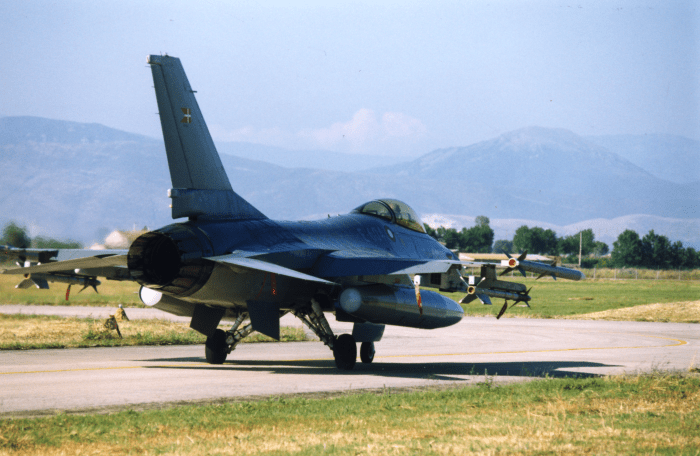
One of the six RDAF F-16s deployed as part of Operation ALLIED FORCE in 1999. (Source: Author)

The Danish F-16s and most of the personnel initially came from Squadron 730. At the time, however, the RDAF had only 36 pilots with current operational experience on the F-16 aircraft. This figure included pilots serving at the RDAF headquarters as staff officers. The Danish contribution to ALLIED FORCE required six pilots in Italy, six on standby in Denmark and six for other operations, including those on leave at home in Denmark. The deployment thus required half of the RDAF’s available F-16 pilots. This problem was further exacerbated by the fact that all the deployed pilots had to be certified for the weapons systems that were expected to be used during the operation.

ALLIED FORCE, therefore, put much pressure on the entire fighter structure and operations of the RDAF. This pressure meant that all tasks that did not directly relate to air policing the skies over Denmark or ALLIED FORCE were discontinued. For example, among other things, Squadron 727 suspended the training of new pilots, while most of its pilots were deployed to Italy. In the long run, this would ultimately have an impact on the RDAF’s ability to meet its readiness level.[14]

Thanks to political and military pressure, in February 1999, it proved possible to persuade both representatives of the Kosovar rebel movement Kosovo Liberation Army and the Serbian government to initiate negotiations about the future of Kosovo. These took place at the French president’s summer residence at Chateau de Rambouillet, southwest of Paris. On the 18 March, however, it became clear that the negotiations would not lead to a deal, and with the negotiation options exhausted, NATO Secretary-General Javier Solana had no other options than on the 23 March to initiate Operation Allied Force. At 19:00 the following night, NATO began launching airstrikes against Serbian targets in Kosovo and Serbia.

The Danish Experience

RDAF F-16s participated in ALLIED FORCE from day one; however, the operation came at an unfortunate time. In addition to the aforementioned pilot issue, the RDAF was in the middle of a midlife update of its F-16s, and the number of operational aircraft was significantly reduced. Initially, the RDAF only had 14 F-16s capable of participating in the air campaign. This meant that the aircraft deployed during the air campaign worked up so many flight hours that had they operated in peacetime they would have had to be sent home to Denmark for inspection. To alleviate this issue, the RDAF’s Tactical Command issued exemptions from the rules to keep the aircraft flying.

For most of the air campaign, Danish F-16s operated in the defensive role. This was a necessary part of ALLIED FORCE. The Air Force of Yugoslavia – even though most of its fighter jets were of an older design – posed a potential threat to NATO had they chosen to resist the Alliance’s attack. However, after having lost four jets during the first days, the Air Force of Yugoslavia chose to keep most of its aircraft on the ground. Nevertheless, political demands from NATO-member states meant that approximately 33 per cent of Alliance aircraft were devoted to the air defence role against potential attacks by the Air Force of Yugoslavia.[15]

On these combat air patrols, Danish F-16s operated in pairs. Initially, their patrol zones were located over the Adriatic Sea, where the essential air tankers operated. As NATO became more confident that Serbian forces would not try to counter NATO operations, the patrol zones moved to the area over Albania and Macedonia and later also Hungary. This allowed the American jets, which had until then patrolled these areas, to be transferred to offensive operations.

Since Danish F-16 pilots were not equipped with night-vision-goggles, they were used in daylight operations. During one patrol over Kosovo, a Danish F-16 was fired at by a Serbian ground-to-air missile, which did not, however, successfully hit its intended target.[16]

Danish Offensive Air Power

While Danish F-16s primarily focused on the air defence role, in the final days of the air campaign, the RDAF aircraft became involved in offensive operations against Serbian targets.

The first Danish bombs were dropped on the 30 May. The details of the attack are still classified, but what is known is that the target was a radio mast in northern Kosovo and that the two F-16s each dropped six MK-82 bombs. From an altitude of 11,000 feet, the pilots visually observed the bombs hitting the target area. For the attack, the Danish planes used ‘dumb’ bombs. The primary reason for this was that it was not necessary to use a more expensive laser-guided bomb (LGB) on the target. Secondly, an attack with an LGB would have required ‘buddy’ lasing. This technique involved one aircraft illuminating the target with a laser and guiding the LGB, dropped from a second aircraft, towards the target. As well as the above, there was also uncertainty about which pilot was responsible for the bomb if it caused collateral damage. The RDAF, therefore, chose to use dumb bombs where there was no doubt that the Danish F-16s were fully responsible for weapons released.

According to one of the pilots involved in the 30 May attack, the target area had visible bomb damage before the Danish attack. The Danish bombs hit close to the target, but due to the uncertainty about the target’s condition before the attack, the military value of the attack was uncertain. For the RDAF, however, the attack was a significant event as it was the first time Danish aircraft had dropped bombs on an adversary.[17]

For the RDAF, its participation in ALLIED FORCE was a test of whether the Air Force had achieved the transformation that the leaders of the Air Force had wanted. The RDAF’s goal in the 1990s had been to create an air force capable of participating in an air campaign alongside its NATO-allies as well as executing the same type of missions as the USAF or the RAF. The RDAF’s conclusion following ALLIED FORCE was that this goal had not been met.

While participation in ALLIED FORCE was historic, with Danish aircraft bombing hostile targets for the first time in its history, the air campaign showed that the RDAF had fallen behind technologically when compared with Denmark’s NATO allies and especially the United States. The RDAF therefore, subsequently initiated a process to catch up with these technological deficiencies. Thus, ALLIED FORCE accelerated the RDAF’s transformation into an ‘expeditionary air force’ tailored for international operations.

A critical element of this transformation was a focus on precision-guided munitions to avoid collateral damage. The effect of participation in ALLIED FORCE was the acceleration in the acquisition of new equipment, such as LANTIRN, and ammunition for the Danish F-16s. When the RDAF deployed in support of US forces in Afghanistan following the terrorist attacks on the 11 September 2001, the Air Force’s technology level had been significantly improved.

Conclusion – From Defense of the Baltic to Global Reach

The transformation described in this article meant that the RDAF in 2000, compared with 1989, had been reduced by the following: a 50 per cent reduction in air stations; a 50 per cent reduction in fighter pilots; the number of Hawk squadrons had been reduced by 25 per cent; and the number of fighter aircraft in the RDAF inventory had reduced by 35 per cent. Similarly, the peacetime force had been reduced by 17 per cent to approximately 7,900, while the wartime force had been reduced by 26 per cent to 14,800. These cuts had not only hit the RDAF, but the overall number of personnel in the Danish armed forces had been reduced from 39,000 to 33,200, while the wartime force had fallen from 103,000 to 81,200.

The RDAF had, however, at the same time managed to survive the loss of the Warsaw Pact as its enemy, and had shown Danish politicians that improvements in the RDAF’s capabilities allowed it to participate in international operations far from Denmark. The lack of success in the skies above Kosovo in 1999 was therefore not seen as a failure for the RDAF but as evidence that the Danish politicians needed to spend more money on the Air Force in order to reap the benefits of participating in international operations. This policy eventually showed its merit during the air war over Libya in 2011-2012, where Danish F-16s dropped 923 bombs on Gadhafi’s military forces and showed that they were able to work closely together with the USAF and other allies – a prerequisite today for being on the front line during international missions.

Dr Søren Nørby is a researcher and lecturer at the Royal Danish Defense College in Copenhagen. He earned his PhD from Syddansk Universitet in 2018. He specialises in naval history and is the author of 25 books and more than 50 articles. For more information see www.noerby.net.

Header Image: Based on the experience of the operations over the former Yugoslavia during the 1990s, the RDAF underwent a number of critical transformations. One of these transformations was the introduction of new technologies to improve capabilities, such as the LANTIRN pod for use of on the F-16 that came into service in 2001. (Source: Author)

[1] This article is based on the author’s book Når Fjenden Forsvinder. Det danske flyvevåbens udvikling 1989 – 1999 (When the enemy disappears. The transformation of the Danish Air Force 1989-1999) (Odense, 2019).

[2] ’Fakta om Forsvaret 1990,’ København, 1990.

[3] Forsvarskommandoen, Ved Forenede Kræfter (Vedbæk, 2000), p. 210; H. Hækkerup, På Skansen. Dansk forsvarspolitik fra Murens fald til Kosovo (København 2002), p.. 103.

[4] ’Rapport fra Udvalget vedrørende forsvarets materiel’, København 1998, p. 164.

[5] Ringsmose, Danmarks NATO-omdømme. Fra Prügelknabe til duks (Dansk Institut for Militære Studier 2007), p. 19; ‘Årlig Redegørelse 2004’, København 2005, pp. 34-5.

[6] Ved Forenede Kræfter, p. 171.

[7] L. Møller, Det danske Pearl Harbor. Forsvaret på randen af sammenbrud (København, 2008), p. 57; R. Petersen, ’Den bedste ambassadør – civil-militære relationer og demokratisk kontrol i Danmark 1991-2011’ (Phd Thesis, Roskilde Universitet, 2012), p. 207ff; R. Petersen, ’Danske sneleoparder i Bosnien,’ Militært Tidsskrift, 2010; P.V. Jakobsen, Fra ferie til flagskib. Forsvaret og de internationale operationer (København, 2009), p. 9; P.V. Jakobsen, ’The Danish Libya campaign: Out in front in pursuit of pride, praise and position,’ Upubliceret artikel, 2016, p. 195; K.S. Kristensen, Danmark i krig: Demokrati, politik og strategi i den militære aktivisme (København, 2013), p. 38; L. From, ’Da et kampvognsslag ændrede danskernes syn på krig,’ Jyllands-Posten, 3 May 2015; ’Balkan har reddet det danske forsvar,’ FOV Nyhedsbrev 7/2002.

[8] S. Hartov and J.E. Larsen, Forsvarets fly efter 1945 (Flyvevåbnets Specialskole, 1995),  p. 36ff.

[9] John Warden III, The Air Campaign. Planning for Combat (Washington 1988).

[10] M.O. Beale, ‘Bombs over Bosnia. The role of airpower in Bosnia-Herzegovina’ (Thesis, USAF School of Advanced Airpower Studies, 1997), pp. 33-4; Christian Anrig, The quest for relevant air power: continental European Responses to the air power challenges of the post-cold war era (Maxwell, AL, 2011), p.. 32, 179; M. Juul and S.W. Nielsen, 12 år på Balkan (København 2004), p. 46; John Olsen (ed.), Air Commanders (Dulles, VA, 2013), p. 356ff; C. Axboe, Vi troede ikke, det kunne ske her – Jugoslaviens sammenbrud 1991-1999 (København, 2018), p. 227-53.

[11] Axboe (2018), p. 275.

[12] I. Daalder and M. O’Hanlon, Winning Ugly. NATO’s War to Save Kosovo (Brookings Institution Press, 2001), pp. 32-3; G. Schaub, Learning from the F-16 (København, 2015), p. 19ff.; M. Vilhelmsen, ’Operation Allied Force (AOF): Da Flyvevåbnet med voksent,’ Upubliceret. Vojens, 2010, p.. 2; ’Rapport vedr. dansk flyvevåben deltagelse i Operation Allied Force,’ 12 november 1999, B2-B3; Årlig Redegørelse 1998, pp.. 33-6.

[13] Nørby (2019), p. 131-7.

[14] Hammerkasterne: Historien om Eskadrille 727 gennem 50 Ar (Skrydstrup, 2005), p. 162-3; ’Flugten er stoppet – men stadig mangel på F-16 piloter,’ Berlingske Tidende, 7 May 1999; ’Rapport vedr. dansk flyvevåben deltagelse i Operation Allied Force,’ 12 November 1999, p.. B-11 og D-10. TTJ og ’F-16 planlægningsmøde vedr. evt. overgang til anvendelse af F-16 MLU i f.m. Flyvevåbnets deltagelse i Operation Allied Force,’ 8 March 1999.

[15] Olsen (2010), p. 233.

[16] Forsvarskommandoens Presse- og Informationssektion 2001, pp. 12-5.

[17] Schaub (2015), p. 10: Vilhelmsen (2010), pp.. 3-4; ’Danske jagere bomber Milosevic,’ Ekstra Bladet, 28. May 1999; T. Kristensen, Kysser Himlen (København, 2017), pp. 179-180.

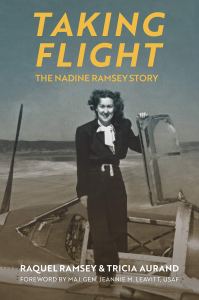
#BookReview – Taking Flight: The Nadine Ramsey Story

#BookReview – Taking Flight: The Nadine Ramsey Story

Reviewed by Dr Brian Laslie

Raquel Ramsey and Tricia Aurand, Taking Flight: The Nadine Ramsey Story. Lawrence, KS: University Press of Kansas, 2020. Images. Notes. Bibliography. Hbk. 320 pp.

As an air power historian, I sometimes wonder what histories and stories have been over told and which have not been told enough. There are times where I feel like certain aspects of air force or air power history which have been given enough treatment, and then there are those stories that are clearly due more attention. This book falls decidedly into the latter category.

Not every member of the Women Airforce Service Pilots (WASP) has had their story told, but every one of them is worthy of a telling. Nadine Ramsay was one of over 1,000 women who answered America’s call to serve their country as pilots during the Second World War, whose history was virtually ignored until the early 2000s when memoirs, biographies and original research into their story began to appear more heavily in print. It took from the end of the war until the 1970s for these women to even be accorded the status of a veteran. Taking Flight is the story of Nadine Ramsey and, more broadly, her family during the Second World War.

In general, women who learned to fly before America entered into the Second World War had certain advantages. Most were middle or upper-middle-class with access to enough spare funds in the 1930s to learn how to fly. These women were lucky enough to stand on the shoulders of the giants of women in aviation, including Amelia Earhart and Jackie Cochran. Thus, when America entered the war, and it became apparent that more pilots were needed, it was not entirely out of the question that women could be called upon to serve and fly. It took likes of Jackie Cochran and Nancy Love to turn this dream into a reality.

Still, the programs created to bring women into their countries service was not met with enthusiastic support, ‘The public had mixed reaction to women pilots.  From the beginning they were under intense scrutiny’ (p. 84). The women who chose to fly faced sexism and discrimination, but through every adversity, they proved beyond a conclusive doubt that they were not only capable of delivering aircraft but that often the ‘women pilots could do the job, usually faster and more safely than the men’ (p. 83).

President Barack Obama signed S.614 in the Oval Office on 1 July 2009. The bill awarded a Congressional Gold Medal to Women Airforce Service Pilots. Source: Wikimedia)

However, this is Nadine’s story rather than that of the WASPs more generally. It becomes clear throughout these pages that Ramsey was a ‘bright, glamorous comet’ (p. 178) and not just during her time in service. Of course, her time as a WASP serves as the linchpin of the book. Ramsey, like so many others of her generation, was inexplicably drawn towards aviation. Hers was not the most direct route to becoming a pilot, but Ramsey’s ‘ready for anything personality’ found her learning to fly in the sky of Wichita, Kansas, in the mid-1030s (p. 28). By the start of the war, she was a reasonably well-known aviatrix and, although again not through a direct route; she joined the women flyers of the Second World War. During her training, Ramsey lost a close friend, Helen Jo Severson, which is deftly demonstrated in these pages and is an incredibly moving passage as Ramsey struggles with this loss. Severson became one of 38 WASPs to lose their lives in service to their country (p. 87, 92).

Ramsey ferried aircraft, learned to fly fighters, and moved these aircraft, including P-51s and P-38s from their factories to their ports of embarkation. After the war, Ramsey, unlike so many of the other WASPs did not give up on flying, going so far as to purchase her own P-38, but I will leave those details for the reader to enjoy.

Taking Flight is an incredibly personal and poignant account of one family’s successes and sacrifices during the Second World War. This book should find a home on the shelves of air power scholars, but a much wider audience will also enjoy it. Ramsey’s story might be hers alone, but it is indicative of all the women whose service to the US and broader Allied war effort should not be overlooked. Instead, it should be embraced by a grateful nation. While writing a book review, I try to attempt to convey what makes the subject matter appealing or why the reader might want to purchase this book. In reading Taking Flight, I was continually struck by one thought, I wish I had known Ramsey.

If you are interested in further reading about the WASPs after reading Ramsey’s story, then the following books are a great place to start. The most recent being Katherine Sharp Landdeck’s superb The Women with Silver Wings (2020) (you can also catch Lanndeck in a future From Balloons to Drones podcast). There is also Molly Merryman’s Clipped Wings: The Rise and Fall of the Women Airforce Service Pilots (WASPS) of World War II (1998). Everything by Sarah Byrn Rickman is worth reading, but perhaps the best is WASP of the Ferry Command: Women Pilots, Uncommon Deeds, The Originals: The Women’s Auxiliary Ferrying Squadron of World War II (2016), and Nancy Love and the WASP Ferry Pilots of World War II (2019). The University of Florida Press also has an excellent (and balanced) biography of the famous aviatrix Jackie Cochran: Pilot in the Fastest Lane by Doris Rich (2007). For a more general history, there is Deborah G. Douglas’ American Women and Flight since 1940 (2004).

Dr Brian Laslie is an Editor at From Balloons to Drones and an US Air Force Historian. He is currently the Deputy Command Historian at North American Aerospace Defense Command (NORAD) and United States Northern Command (USNORTHCOM). A 2001 graduate of The Citadel and a historian of air power studies, he received his PhD from Kansas State University in 2013. His first book The Air Force Way of War (2015) was selected for the Chief of Staff of the Air Force’s and the Royal Air Force’s Chief of the Air Staff professional reading lists. He is also the author of Architect of Air Power: General Laurence S. Kuter and the Birth of the US Air Force.  He lives in Colorado Springs. He can be found on Twitter at @BrianLaslie and at www.brianlaslie.com.

Header Image: WASPs on the flight line at Laredo AAF, Texas, 22 January 1944. (Source: Wikimedia)

#BookReview – Stealth: The Secret Contest to Invent Invisible Aircraft

#BookReview – Stealth: The Secret Contest to Invent Invisible Aircraft

Reviewed by Dr Mike Hankins

Peter Westwick, Stealth: The Secret Contest to Invent Invisible Aircraft. New York: Oxford University Press, 2020. Illustrations. Glossary. Notes. Index. Hbk. 251 pp.

The advent of stealth technology – making aircraft nearly invisible to radar detection – in the 1970s was one of those rare moments in the history of military aircraft technology that seemed to shape much of the development that followed it. Over 40 years later, most new aircraft designed around the world incorporate stealth characteristics in some way or another. Taking a sweeping look at the advent and early development of stealth aircraft within a broad context is the aim of Stealth: The Secret Contest to Invent Invisible Aircraft by Peter Westwick, director of the University of Southern California’s Aerospace History Project. The book is a fascinating look at two companies, Lockheed, and Northrop, that continually competed for stealth projects – each coming at the technology from very different perspectives and methodologies. With this comparative lens, Westwick explores the ways that culture shaped each company’s differing solutions to similar technological problems.

The most significant limitation for any book about stealth is the lack of unclassified sources, and this book is no exception. While much of the material here will be familiar to stealth aficionados, Westwick has conducted a large number of new interviews that shed new light on some familiar events, and reveal new, fresh stories, many that speak to the unique personal experiences of those involved in stealth development.

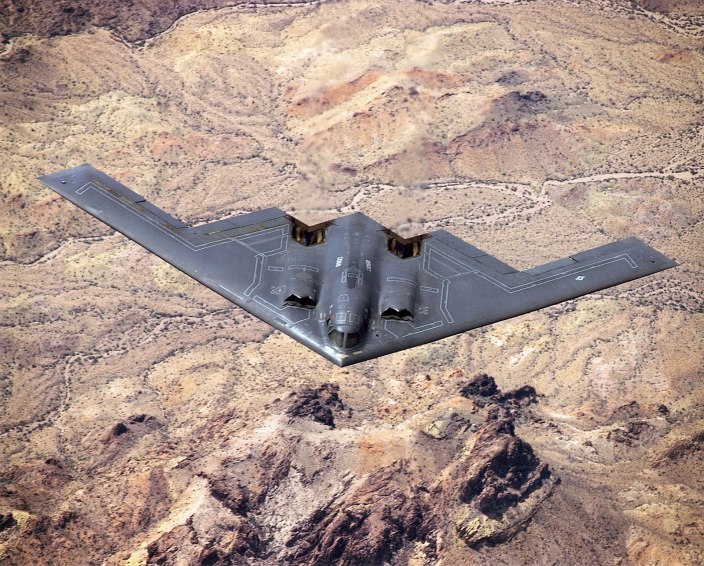
The Northrop B-2 Spirit stealth bomber on its first flight in 1989. (Source: US Air Force)

Westwick emphasises that Lockheed’s approach to stealth relied extensively on computer modelling, which was a significant shift for the firm at the time. For decades, successful designs from Lockheed, including the A-12 and SR-71 Blackbird, which each incorporated stealth characteristics, had been grounded in Chief Executive Officer, Clarence ‘Kelly’ Johnson’s adage that planes that look beautiful fly beautiful. When Johnson retired, his replacement Ben Rich allowed radar experts to have a more significant say in the design process. Their creation of powerful computer programs that could calculate radar returns from a variety of shapes fueled their design process. Nevertheless, the limitations of the program influenced the team to rely on flat, faceted surfaces – an approach that was quite successful, winning the company that contract for the aircraft that became the F-117 Nighthawk.

Lockheed’s programs made use of Soviet research that, ironically, had been requested for translation by engineers at Northrop. Although Northrop also incorporated this research and made similar computer modelling programs, their engineers combined them with a more intuitive approach. Northrop designers used their extensive knowledge of radar theory in a more hands-on way, often literally through iterative modelling and moulding. One of the more dramatic moments of Westwick’s narrative involves Northrop engineer Fred Oshiro visiting Disneyland and sitting outside the Tea Cup ride playing with a lump of modelling clay – a common practice at Northrop – until he intuitively developed the idea of using complex curves to minimize radar returns. The Tea Party ride had been designed by Lockheed engineer and stealth pioneer Richard Sherrer.

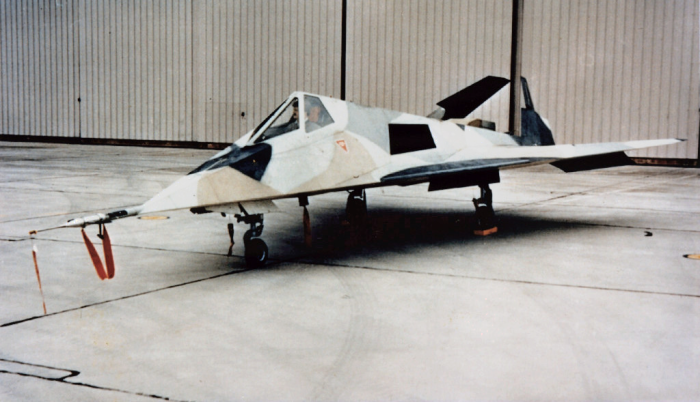
The Lockheed Have Blue prototype that eventually led to the F-117 Nighthawk stealth fighter. (Source: US Air Force)

This tale of two engineering houses, each with different cultural approaches to designing stealth, forms the backbone of the story, which traces the development of the Have Blue, F-117, Tacit Blue, and B-2 programs. Along the way, Westwick dispels some prevalent misconceptions that frequently crop up in discussions of stealth. For example, some readers might assume that Northrop’s B-2 design was a ‘flying wing’ conception because the company was founded by Jack Northrop, who was obsessed with flying wings and designed several himself. However, Westwick reveals the company had completely abandoned the idea for decades, and only adopted it after Lockheed had submitted their flying wing bomber concept. Another of the more dramatic moments in the book involves the aging Jack Northrop’s heartwarming response to seeing the B-2 designs, which I will not spoil in this review.

Westwick goes beyond the analysis of these companies and attempts to place the development of stealth in a larger context in terms of culture, strategy, and Cold War geopolitics. This includes implying that the inherent creativity around the ‘[i]magineering’ culture of Disney that pervaded California in the 1960s and 70s was a contributing factor to stealth development. On a broader scale, Westwick goes as far as to say that stealth provided an alternative to nuclear deterrence, in some ways making nuclear weapons obsolete. He argues that stealth delivered what President Ronald Reagan’s fanciful Strategic Defense Initiative could only promise. With the ability to essentially defeat the Soviet Union’s massive investment into radar-based air defence networks, stealth broke the foundation of Cold War deterrence theory, and, according to Westwick, pressed the Soviet Union into an unsustainable increase in defence spending that contributed to the nation’s collapse. These ideas are interesting and worthy of consideration, but Westwick’s presentation of them is far too brief; these ideas are not nearly as fully developed as they could be. That does not take anything away from the book as it is. To really make these larger points hit home would probably require a different type of book with a different focus. However, this type of overarching analysis is welcome and thought-provoking, perhaps pointing to further research directions on how stealth technology contributed to the end of the Cold War in specific ways.

Overall, the book is an excellent addition to any air power or history bookshelf. This book manages to be the best starting point for those new to the topic of stealth while also providing new insights and details for the already initiated. Even more impressive, Westwick delivers these contributions while writing in an engaging and personal style that is great to read and sure to be enjoyed by scholars and still easily accessible for enthusiasts and general readers.

Dr Michael Hankins is the Curator of US Air Force History at the Smithsonian National Air and Space Museum. He is a former Professor of Strategy at the USAF Air Command and Staff College eSchool, and former Instructor of Military History at the U.S. Air Force Academy. He earned his PhD from Kansas State University in 2018 with his dissertation, ‘The Cult of the Lightweight Fighter: Culture and Technology in the U.S. Air Force, 1964-1991.’ He completed his master’s thesis at the University of North Texas in 2013, titled ‘The Phantom Menace: The F-4 in Air-to-Air Combat in the Vietnam War.’ He has a web page here and can be found on Twitter at @hankinstien.

Header Image: The Lockheed F-117 Nighthawk stealth fighter flying over Nellis Air Force Base in 2002. (Source: US Air Force)


Cold War Nuclear-Powered Aircraft: A Step Too Far

Cold War Nuclear-Powered Aircraft: A Step Too Far

By Dr Peter Layton[1]

Birds and aircraft have a fundamental problem: their range and endurance are limited. To remain aloft requires the expenditure of energy. Eventually, birds must land and rest, and aircraft must refuel. The invention of nuclear power in the 1940s appeared to offer a way to cut this Gordian knot. A nuclear-powered aircraft could, it seemed, provide dramatically improved range and endurance compared to chemically fuelled powered aircraft.

Such ambitions were strengthened as the Cold War between the US and the USSR worsened. The Cold War released immense funding for military purposes while providing an operational rationale: a requirement for very long-range bombers able to strike military-industrial complexes deep in the Soviet heartland. The generous funding now available meant numerous new high technology possibilities could be considered, built, trialled and if successful enter mass production. An obvious candidate to research and investigate seemed nuclear-powered aircraft.

The original ideas about using nuclear power for aircraft propulsion had appeared around 1944. These led to a minor research program, the Nuclear Energy for the Propulsion of Aircraft study, beginning in mid-1946. Undertaken by Fairchild, this examined reactor technologies and engine transfer systems. These studies proved encouraging and so in 1951, with the Cold War deepening, the United States Air Force (USAF) proposed to begin actively developing manned aircraft nuclear propulsion. Contracts were let for three main elements: two X-6 prototype test aircraft, a nuclear propulsion system (reactor and turbojets) and an NB-36H reactor flight-test aircraft.

NB-36H_with_B-50,_1955_-_DF-SC-83-09332
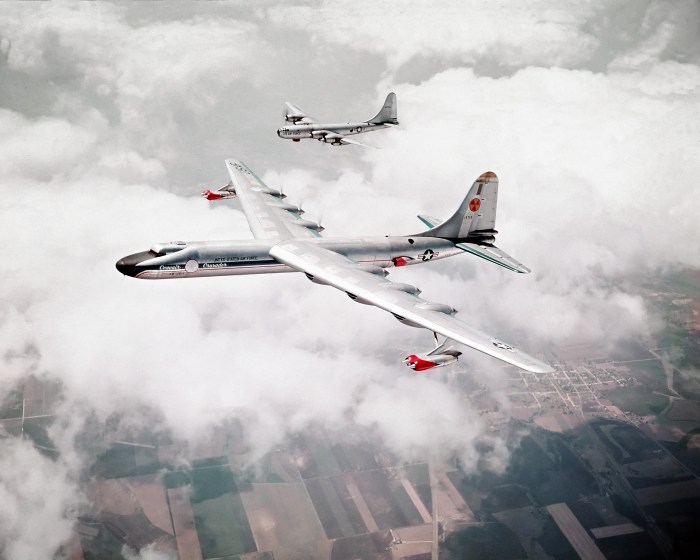
An air-to-air view of the Convair NB-36H Peacemaker experimental aircraft and a Boeing B-50 Superfortress chase plane during research and development taking place at the Convair plant at Forth Worth, Texas. This plane was called the Nuclear Test Aircraft (NTA) and was redesignated XB-36H, then NB-36H. The NTA completed 47 test flights and 215 hours of flight time (during 89 of which the reactor was operated) between July 1955 and March 1957 over New Mexico and Texas. (Source: Wikimedia)

Convair received the X-6 contract. The aircraft was envisaged as being of comparable size to the company’s B-36 Peacemaker bomber with a length of 50m, a wingspan of 70m and an empty weight of some 100 tonnes. The X-6 was planned to have 12 turbojets; eight conventionally fuelled used for take-off and landing, and four nuclear-powered used during in-flight trials. This was an ambitious but expensive test program and was cancelled by the incoming Eisenhower administration in 1953 on budgetary grounds. However, the other two elements continued.[2]

General Electric was awarded the propulsion contract, progressively developing across 1955-1961 three direct-cycle nuclear power plants under the ground-based Heat Transfer Reactor Experiment (HTRE) test-rig program. The final HTRE-3 propulsion system featured a solid moderator using lightweight hybrided (sic) zirconium instead of water, a horizontal reactor to meet aircraft carriage requirements and produced sufficient heat to power two X-39-5 (modified J-47) turbojets simultaneously. HTRE-3 had several firsts including demonstrating an all-nuclear turbojet start, having a primary shield able to handle radiation levels expected in flight and in being designed for in-flight stresses, air pressures, temperatures, and G loadings.[3]

The third element was to flight test a reactor. In mid-1952, Convair was contracted to modify two B-36 aircraft: one for a ground test, the other for flight test and designated as the NB-36H. The major modifications involved firstly, the crew compartment and avionic cabin being replaced by an 11-tonne nose section lined with lead and rubber to protect against reactor radiation and secondly, the rear internal bomb bay being altered to allow fitment of the 16-tonne reactor. Less apparent were the cockpit glass transparencies being some 30cm thick and nine water-filled shield tanks in the fuselage to absorb any escaping radiation.[4]

In the meantime, the USAF was firming up its requirements. In March 1955, General Operational Requirement (GOR) No. 81 was issued seeking a nuclear-powered weapon system, WS-125A. Aspirations included a range of about 10,000nm, an operating altitude of 60,000-75,000ft and an endurance of perhaps more than a week airborne.[5]  WS-125A was to have a cruise speed of at least Mach 0.9, desirably offer supersonic dash in the target area and enter service with operational units in 1963.[6]  Realising such high ambitions was to prove problematic.

In July 1955, the NB-36H began flight test with the reactor going critical in flight for the first time in September. The reactor did not power the aircraft, instead of being tested to verify the feasibility of a safe, sustained nuclear reaction on a moving platform. For each NB-36 flight, the one-megawatt reactor was winched up into the bomb bay at a dedicated pit at Convair’s Fort Worth plant and then removed again after landing.[7] When in flight, the aircraft was accompanied by a radiation-monitoring B-50 (a slightly updated B-29) and a C-119 transport aircraft carrying paratroopers able to be dropped to secure any crash site and limit bystander exposure to radiation.[8] In total, the NB-36H made 47 flights, ceasing flying in March 1957.

The results of the nuclear propulsion tests and the NB-36H were mixed. HTRE-3 had proven nuclear-power turbojet feasible and that a flyable propulsion unit could be built albeit technical challenges remained. The major problem was that it was hard to build a nuclear reactor small enough to fit into aircraft, but which produced the operationally significant energy output required. It seemed that using contemporary technology would mean nuclear-powered aircraft were relatively slow. For a time, concepts of ‘nuclear cruise, chemical dash’ were investigated; supplemental aviation fuel would allow supersonic dash in the target area.[9]

Moreover, the NB-36H flight programme highlighted the hazards associated with operating such nuclear-powered aircraft. While well-shielded aircraft would not normally pose radiation dangers to air or ground crew, there were worries that accidents and crashes might release fission products from the reactors, and about the dosage from prolonged human exposure to leakage radioactivity.[10] In this, the test flights mainly served to draw attention to the real difficulties that would arise in working with nuclear fuel in operational service conditions.[11]

WS-125A was accordingly cancelled in early 1957. However, there remained occasional flickers of renewed interest in nuclear-powered aircraft into the early 1960s. The Continuously Airborne Missile Air Launcher (CAMAL) concept called for a nuclear-powered strike aircraft able to stay aloft on airborne alert for 2-5 days. This led into Dromedary, a turboprop design capable of an airborne alert for 70-100 hours and able to stand-off outside hostile territory and launch the 600-1000nm Skybolt ballistic missile.[12] These ideas meant research into aircraft nuclear propulsion continued although in only a fairly desultory fashion. This finally ended in 1961 when the new Kennedy administration reallocated funding.

The US Navy had also occasionally expressed interest in nuclear-powered turboprop flying boats. In April 1955, Operational Requirement CA-01503 sought a nuclear-powered seaplane capable of high subsonic speeds primarily for the attack of ports and warships using conventional and nuclear weapons with the secondary roles of mining and reconnaissance. The USN desired to have a prototype available for its evaluation no later than 1961. By mid-1956 the Navy had decided a solely-USN power plant was unjustifiable and that the Navy’s aircraft would use the USAF’s WS-125A power plant. The cancellation of the WS-125A thus terminated the USN’s plans as well.[13]  At one stage, it seemed the UK might sell three mothballed Princess-class flying boats to the USN for nuclear-power trials, but funding oscillated and eventually was not forthcoming.[14]

Further afield, the USSR was also busy. In the late 1950s Tupolev designed but did not build two nuclear-powered bombers: the subsonic Tu-119 and supersonic Tu-120. The Soviet leadership thought the projected payloads and speed were inadequate for the costs involved. Tupolev was though authorised to continue research on nuclear aircraft.[15] Accordingly, a Tu-95 turboprop bomber was modified at a nuclear complex near Semipalatinsk in Kazakhstan to allow flying a nuclear reactor, becoming the Tu-95LAL (Letayushchaya atomnaya laboratorya – flying atomic laboratory).[16] Mirroring the NB-36H trails, some 34 Tu-95LAL flights were undertaken in 1961 with the reactor on board but without providing propulsion. The tests similarly revealed that a nuclear-powered aircraft was impractical with the technology of the time. The gain in performance from not carrying chemical fuel was consumed by the heavy reactor and shields and so Soviet interest in nuclear-powered aircraft declined.[17]

Tu119side
The Tu-95LAL test aircraft. The bulge in the fuselage aft of the wing covers the reactor.(Source: Wikimedia)

In the end, a better technological solution won out. For both the US and the USSR, the ICBM fitted with lightweight thermonuclear warheads offered a much better answer to the problem of a long-range, highly survivable nuclear strike. The considerable effort and funds expended in investigating nuclear-powered manned aircraft yielded much technical information and engineering expertise but ultimately little else. This was not for lack of interest in the defence aerospace industry. At the time, Kelly Johnson of Lockheed’s Skunk Works fame wrote:

After a half century of striving to make aircraft carry reasonable loads farther and farther, the advent of a [nuclear] power plant that will solve the range problem is of the utmost importance […] this unique characteristic is one to be greeted enthusiastically.[18]

Dr Peter Layton is a Visiting Fellow at the Griffith Asia Institute, Griffith University. His PhD is in grand strategy, and he has taught on this at the US National Defense University. He is the author of the book Grand Strategy.

Header Image: An NB-36H producing contrails in flight. (Source: Wikimedia)

[1] This post partly draws on the author’s Chapter in Michael Spencer (ed.), Nuclear Engine Air Power (Canberra: Air Power Development Centre, 2019). This book discusses contemporary nuclear-powered propulsion systems for aircraft and missiles.

[2].  Jay Miller, The X-Planes: X-1 to X-31 (Arlington: Aerofax, 1988), pp. 69-73.

[3].  F.C. Linn, Heat Transfer Reactor Experiment No.3: Comprehensive Technical report, General Electric Direct-Air Cycle Aircraft Nuclear Propulsion Program (Cincinnati: General Electric Company, 1962), pp. 15-18.

[4].  Raul Colon, Flying on Nuclear: The American Effort to Built a Nuclear Powered Bomber.

[5].  Theo Farrell, ‘Waste in weapons acquisition: How the Americans do it all wrong,’ Contemporary Security Policy, 16:2 (1995), p. 194; ‘Thoughts on WS-110A,’ Flight, 10 January 1958, p. 44.

[6].  Comptroller General of the United States, Review of the Manned Aircraft Nuclear Propulsion Program of the Atomic Energy Commission and the Department of Defense, B-146749, 28 February 1963, p. 133

[7].  Colon, Flying on Nuclear.

[8].  Miller, The X-Planes., p. 210.

[9]Ibid., p. 73.

[10].  Brian D. Bikowicz, The Decay of the Atomic Powered Aircraft Program, 12 Nov 1992.

[11].  Bruce Astridge, ‘Propulsion,’ in Phillip Jarrett (ed.), Faster, further, higher: leading-edge aviation technology since 194 (London: Putnam, 2002), p. 134.

[12].  Peter J. Roman, ‘Strategic bombers over the missile horizon, 1957–1963,’ Journal of Strategic Studies, 18:1 (1995), pp. 208-13.

[13].  Comptroller General, Review of the Manned Aircraft Nuclear Propulsion Program, pp. 134-40.

[14].  Raymond L. Garthoff, ‘The Swallow and Caspian Sea Monster vs. the Princess and the Camel: The Cold War Contest for a Nuclear-Powered Aircraft,’ Studies in Intelligence, 60:2 (2016), p. 3.

[15].  Arthur J. Alexander, ‘Decision-Making in Soviet Weapons Procurement,’ Adelphi Papers, 18:147-148, (1978), p.32.

[16].  Garthoff, ‘The Swallow and Caspian Sea Monster vs. the Princess and the Camel,’ p. 2.

[17].  Piotr Butowski, ‘Steps Towards Blackjack,’ Air Enthusiast, 73 (1998), p. 40.

[18].  F.A. Cleveland and Clarence L. Johnson, ‘Design of Air Frames for Nuclear Power’, quoted in Bikowicz, Decay.

#BookReview – John Houbolt: The Unsung Hero of the Apollo Moon Landings

#BookReview – John Houbolt:  The Unsung Hero of the Apollo Moon Landings

Reviewed by Dr Brian Laslie

William F. Causey, John Houbolt:  The Unsung Hero of the Apollo Moon Landings. West Lafayette, Indiana: Purdue University Press, 2020. Notes. Bibliography. Index. Hbk. 347 pp.

81lFIEb7VBL

There has been no cooling in the publication of space-related material in the aftermath of the Apollo 11 50th Anniversary. Partially in response to NASA’s returning astronauts to space from American soil this year and partially in response to an undeniable zeitgeist, NASA is enjoying renewed popular support. This provides an excellent opportunity for the publication of further scholarship about the history of the organisation. Academic presses (Florida, Nebraska, and Purdue) have been working hard to expand, and further our understanding of not only crewed exploration of the cosmos, but also the choices made in advance of rockets leaving the launch pad. To that end, Purdue University has recently published John Houbolt:  The Unsung Hero of the Apollo Moon Landings by William F. Causey. Causey’s Houbolt examines NASA’s decision-making process through the lens of an individual. This approach places emphasis on the members of NASA–this is their story and not the story of the astronauts riding rockets. That being said, Causey’s book is no less amazing than the stories of the astronauts themselves and by pulling back the curtain, Causey deftly reveals the backstory and offers a fresh look at how NASA ultimately decided the method that would lead to footprints on the moon.

My introduction to the mind of John Houbolt, and I would wager some our readers as well, came in the form of the HBO mini-series From the Earth to the Moon (based in part off the book A Man on the Moon: The Voyages of the Apollo Astronauts by Andrew Chaikin). In the episode ‘Spider,’ Houbolt is shown as the ‘voice in the wilderness’ who bravely stood against senior NASA leaders to preach the gospel of Lunar Orbit Rendezvous (LOR) as the preferred method of sending astronauts to the moon.

Causey’s work demonstrates that the history of LOR is richer than just Houbolt’s contributions and the entire work is as much a history of NASA’s early years and its decision-making process as it is about Houbolt himself. This is a book about how we got to the moon, or rather, about how NASA decided how we would get to the moon. Causey’s work covers the period from roughly 1957 to 1963 and represents a comprehensive and readable history of NASA’s early years, but one that still brings a fresh and nuanced perspective to a familiar story.

3-john_c._houbolt_-_gpn-2000-001274b
On 24 July 1962, Dr John Houbolt explained his lunar orbit rendezvous concept for landing on the Moon. His approach called for a separate lander which saved weight from the ‘direct ascent’ design in which the entire spacecraft landed on the lunar surface. (Source: NASA)

This is a vital book as it refocuses attention on the thousands of people who aided our ascension to deep space for the first time. While the written record has generally favoured the importance of the astronauts themselves in numerous books, biographies, and autobiographies, the recent trend in focus on the individuals behind the scenes has improved our understanding of the golden age of NASA and crewed spaceflight. Causey’s biography of Houbolt now sits alongside other recent publications including Sonny Tsiao’s Piercing the Horizon: The Story of Visionary NASA Chief Tom Paine, Richard Jurek’s The Ultimate Engineer: The Remarkable Life of NASA’s Visionary Leader George M. Low and Rick Houston and Milt Heflin’s Go, Flight! The Unsung Heroes of Mission Control, 1965-1992. This is important for several reasons, but perhaps most of all because these books continue to expand our understanding of NASA as an organisation composed of thousands and not as one whose principal employees are those at the end of propellant-fueled rockets.

Causey writes with a deftness and a flair that keeps the narrative moving forward even when the subject matter is the Space Task Group, the Goett Committee, the New Projects Panel or any number of other bureaucratic organisations in the NASA hierarchy. This work never feels like you are reading the history of an organisational board meeting, but adroitly describes how the workers at the various levels of NASA made the important decisions necessary that made the entire Apollo program possible. If you are picking up this work, there stands a good chance you have more than a passing understanding of NASA’s history and organisation, and while you might be familiar with the LOR story, Causey’s telling through the lens of Houbolt is worth a read even if you think you have read it all already and neither the scholar nor the buff will be disappointed. This is an essential and much-needed addition to the history of the Apollo Program. Causey’s John Houbolt:  The Unsung Hero of the Apollo Moon Landings is a critical and stimulating look at the individual of John Houbolt, but also at NASA writ large.

Dr Brian Laslie is a US Air Force Historian and currently the Deputy Command Historian at North American Aerospace Defense Command (NORAD) and United States Northern Command (USNORTHCOM). A 2001 graduate of The Citadel and a historian of air power studies, he received his PhD from Kansas State University in 2013. His first book The Air Force Way of War (2015) was selected for the Chief of Staff of the Air Force’s and the Royal Air Force’s Chief of the Air Staff professional reading lists. He is also the author of Architect of Air Power: General Laurence S. Kuter and the Birth of the US Air Force.  He lives in Colorado Springs. He can be found online at www.BrianLaslie.com

Header Image: A view of the Apollo 11 lunar module Eagle as it returned from the surface of the moon to dock with the command module Columbia. A smooth mare area is visible on the Moon below and a half-illuminated Earth hangs over the horizon. The lunar module ascent stage was about 4 meters across. (Source: NASA)

#BookReview – Through Adversity: Britain and the Commonwealth’s War in the Air 1939-1945 – Volume 1

#BookReview – Through Adversity: Britain and the Commonwealth’s War in the Air 1939-1945 – Volume 1

Reviewed by Alexander Fitzgerald-Black 

Ben Kite, Through Adversity: Britain and the Commonwealth’s War in the Air 1939-1945 – Volume 1. Warwick: Helion & Company Limited, 2019. Maps. Figures. Photographs. Annexes. Notes. Bibliography. Index. Hbk. 492 pp.

helion1000901

Most military historians take a narrative approach in their works. Even when they seek to prove a specific thesis, they offer the evidence to the reader in chronological order. There are, of course, exceptions – and Ben Kite is a notable one. In 2014, he produced Stout Hearts: The British and Canadians in Normandy 1944, a work that focused not on the narrative of the battles in Normandy, but rather how British and Canadian armies (and air forces) operated there. The result was an outstanding reference work for historians, history buffs, and especially those seeking to understand what it was like for their Commonwealth ancestors who fought there.

In Through Adversity: Britain and the Commonwealth’s War in the Air 1939-1945 Kite has turned his focus to the skies. His primary aim is ‘to capture the main themes and strands of the war in the air as fought by the British Commonwealth’ (p. xiii). Volume 1 includes 20 chapters spread over four parts, each containing one of these themes or strands. These are usually mission types performed by the air force. In each part, Kite takes particular care to explain changes in the Royal Air Force’s (RAF) tactics and operational techniques along with the advancement of technology. He is more interested in how airmen planned and executed missions than in the role of senior commanders and overarching narratives. As such, this book is not a repeat of John Terraine’s The Right of the Line. Consequently, the experiences of aircrew fighting a deadly war in skies across the globe stand out.

In part one, Kite offers readers a background on pre-war RAF policy and preparations for war. He notes that although the 1920s were lean years, the RAF did receive significant investments in the late 1930s due to fears of the growing Luftwaffe in Nazi Germany. Ironically, although RAF doctrine focused on the bomber, the British bomber fleet was ill-prepared to strike at the German war industry. Much would have to change if the force were to have a chance of inflicting the knock-out blow advocated by influential interwar air power theorists Giulio Douhet and the RAF’s own Hugh Trenchard.

The second chapter of part one examines how the RAF mobilized and trained its manpower. Some readers will find this section a little disappointing since it offers a pretty standard focus on the path of pilots (and observers) through the Empire Air Training Scheme. There is comparatively little about the training regimes of other aircrew positions or the ground crew.

As the prerequisite for successful air operations of all types, Kite begins his examination of air combat with air superiority. The author takes a campaign-centric approach after beginning with the pre-war development of RAF Fighter Command. In northwest Europe, he examines the Battle of Britain, the uneconomical Fighter Command air offensive over Fortress Europe, and defence against German night raiders and V-weapons. Kite samples the battles for air superiority in the Mediterranean through the siege of Malta. Finally, he concludes the section with a pair of chapters featuring the rapid loss of air superiority in the Far East and the effort to turn the tide.

IWM K 1117
A Consolidated Catalina MkI of No. 205 Squadron RAF taxies past another aircraft of the Squadron moored in the Strait of Johore off Seletar, Singapore (Source: © IWM K 1117).

The chapter that stands out in part two takes the reader through a Fighter Command mission during the Battle of Britain. Kite takes an end-to-end approach here. He begins with how pilots began their mornings at airfields across Britain and finishes with sortie debriefings by intelligence officers. It was their job to understand what had happened in the air, including the difficult task of sorting victory claims. Kite affords the relatively unsung role of the fighter controller prominent attention, reminding readers the might of the many backed ‘the Few’ at the sharp end. This effectively illustrates the importance of ‘a good early warning capability and an efficient command and control system’ (p. 193) for effective air defence.

From air superiority, the book moves on to discuss Bomber Command’s role in striking back at Nazi Germany. Kite organizes this section into four chapters. The first offers the reader a general overview of how the offensive developed from unescorted, anti-shipping raids suffering unsustainable losses to night bomber raids of growing strength and sophistication. The chapter focuses on Bomber Command strategy and policy, including the creation of No. 6 Group Royal Canadian Air Force (RCAF) in early 1943.

No. 6 Group owed its existence to a desire for a highly visible Canadian air effort in the war. Kite outlines the many unintended disadvantages of forming a separate national group within Bomber Command. Unfortunately, this is where Kite ends the story of 6 Group. Although the group faltered in 1943, 1944 was a much better year. New leadership, the shift from targets deep inside Germany to support the Normandy landings, and the arrival of better aircraft ‘enabled No. 6 Group to exceed the performance of comparable bomber groups in the air and on the ground.’ In fact, according to the RCAF official history, from September 1944 until May 1945 ‘the Canadian group could claim as good an operational record as any.’[1]

Despite Kite’s treatment of No. 6 Group, he does well by Bomber Command as a whole. Kite takes the reader through an end-to-end Bomber Command mission in two chapters. The first chapter covers the route to the target, beginning with the role of armourers in loading the aircraft while the aircrew underwent specialized and team briefings. Crew roles, navigation equipment, the aircraft, and German defences all receive attention. The second chapter takes the reader from the run into the target and through the return leg. Except for memoirists explaining their personal slide of the air war, few resources so comprehensively relate the bomber crew experience.

The concluding strike chapter outlines the development of a precision bombing capability within Bomber Command and No. 2 Group, which operated light and medium bombers over Nazi-occupied Europe.

The final part of volume one covers the war at sea fought by RAF Coastal Command and the Royal Navy’s (RN) Fleet Air Arm (FAA). The first two chapters examine anti-submarine operations during the Battle of the Atlantic. Kite highlights the importance of cooperation between the RN and Coastal Command in intelligence sharing and winning the battle of improving tactics and technology. He concludes that while the Allies heavily reduced the U-boat threat by 1943, the RAF senior leadership’s failure to afford a greater priority to Coastal Command ‘nearly cost the Allies the war.’ (p. 321) This criticism mainly revolves around the delay in giving Coastal Command priority for Very Long-Range aircraft. These aircraft could patrol the mid-Atlantic gap, where U-boats operated beyond the range of most land-based aircraft.

Kite concludes the RAF’s role in the volume with two chapters on anti-shipping operations. He begins with early operations from the United Kingdom, especially those focused on the Dutch and Norwegian coasts. In the war’s early years, strikes were effective against enemy merchant shipping. Coastal Command needed better aircraft, tactics, and armour-piercing bombs to achieve success against the German surface fleet. RAF anti-shipping operations matured over time and in parallel with developments in the Mediterranean and the Far East. Missing from Kite’s history of the RAF’s war at sea are the anti-submarine and anti-shipping efforts that went into supporting the Normandy landings in June 1944. It is unclear whether these elements will appear in Volume 2, which promises to cover air support for the army in detail.

Many readers will be pleased that Kite wrote two chapters on the Fleet Air Arm. Some authors would have left the role of naval aviation out of scope, and it is commendable that Kite has included their experiences.

One general critique is the author’s tendency to rely on lengthy quotations from memoirs and diaries. Letting the veterans speak for themselves is a noble effort, but it also means relying on the quality of another’s writing to tell the story. Kite’s retelling of a harrowing anti-submarine patrol by a Sunderland flying boat crew over the Bay of Biscay was outstanding (p. 309-314). I sometimes found myself wishing that Kite had taken this approach more often rather than relying on lengthy and raw veteran’s accounts.

Through Adversity is a treasure trove of information for its readers. Twenty-five appendices or annexes (with source attributions) offer the reader great quick-reference material. The book is exceptionally well illustrated with thoughtful captions. These captions often include the identity and fate of both the aircraft and its crew, closing an otherwise open loop. Finally, Kite’s use of squadron mottos for most of the chapter titles is a nice touch that adds character to the book.

Overall, Volume 1 of Ben Kite’s work on the British Commonwealth’s war in the air is a great achievement. In the 1980s, John Terraine’s The Right of the Line afforded readers an excellent top-down narrative study of the RAF in the Second World War. Kite’s contribution is to capture the airman’s experience within that broader context. Through Adversity is the first half of an excellent reference work for historians, history buffs, and especially those seeking to understand what the air war was like for their Commonwealth ancestors in skies and at airfields across the world. The military aviation community anxiously awaits the publication of Undaunted: Britain and the Commonwealth’s War in the Air – Volume 2.

Alex Fitzgerald-Black has a Master of Arts in Military History from the University of New Brunswick and a Master of Arts in Public History from the University of Western Ontario. Alex’s research interests include air power in the Second World War, with a particular focus on the Mediterranean, and Canadian military history. He is the author of Eagles over Husky: The Allied Air Forces and the Sicilian Campaign, 14 May to 17 August 1943. Alex operates his blog at alexfitzblack.wordpress.com and can be reached on Twitter @AlexFitzBlack.

Header Image: In the shadow of their Handley Page Halifax, ‘Pride of the Porcupines’ aircrew and groundcrew members of No. 433 ‘Porcupine’ Squadron, No. 6 Group RCAF gang up on the miniature English automobile owned by one of the aircrew members. (Source: DND / LAC / PL-29380)

[1] Greenhous et al., The Crucible of War, 1939-1945: The Official History of the Royal Canadian Air Force Volume III (University of Toronto Press, 1994), pp. 526-7.

#BookReview – No Fly Zones and International Security: Politics and Strategy

#BookReview – No Fly Zones and International Security: Politics and Strategy

Reviewed By Dr Peter Layton

Stephen Wrage and Scott Cooper, No Fly Zones and International Security: Politics and Strategy. Abingdon: Routledge, 2019. Tables. Illustrations. Notes. Bibliography. Index. Hbk. xi + 166 pp.

51yFbrZlPhL._SX313_BO1,204,203,200_

This is an excellent little book on no-fly zones. No Fly Zones and International Security is arguably the seminal work on the subject, but it may be on a subject whose time has passed. The book may be both the first word and the last on this particular type of air power operation.

No Fly Zones and International Security falls within the genre of strategic studies but does not use any particular theoretical framework. Instead, the authors opt to integrate history, current affairs, technology and the operational level of war into a most comprehensive analysis. In this process, the two authors bring a wealth of knowledge and experience having been involved with no-fly zone issues and their study for decades. Stephen Wrage is a Professor at the US Naval Academy and specializes in American foreign policy and strategies. Scott Cooper flew EA-6Bs for the USMC including in most of the no-fly zone operations this book explores.

No-fly zones are explained as seizing another country’s airspace and applying to the airspace specific rules and regulations. So understood, no-fly zones are a form of occupation more akin to naval blockades or maritime exclusion zones than to the placing of ground forces in another country. This means no-fly zones are somewhat out of sight both to the population of the country impacted and to the country employing them. Their impact on the domestic politics of either country is accordingly somewhat muted, making their lifting less pressing; they can continue for many years. No-fly zones are a way of exerting military pressure, but they do so in a quasi-benign manner that places the onus to escalate to direct conflict on the state whose airspace has been seized. No-fly zones are then a soft form of coercive diplomacy, a military power tool or method that lies somewhere between economic sanctions and war in the conflict continuum.

The book initially delves into the doctrine, nature, types, tactics, strategies, and ethics of no-fly zones. This provides the background necessary for in-depth analysis and careful assessments of the no-fly zones in Iraq, Bosnia, and Libya. The Iraq chapter covers mostly Northern and Southern watch; the former when labelled Provide Comfort I was where no-fly zones originated. The Bosnia chapter is more expansive, moving from the short-lived 1992-93 Operation Sky Monitor to the major air campaign over Kosovo in 1999. Libya is even more so with the no-fly zone only fleetingly appearing before turning into a significant military intervention albeit conducted almost entirely by air.

The inclusion of much more discussion than solely about no-fly zones in the Bosnia and Libya sections does highlight that the history of no-fly zones is somewhat meagre. On the other hand, including such information directly related to air power helpfully places no-fly zones into context. The three history chapters also end with a useful lessons learned section that nicely summaries the issues for busy people and policymakers.

The book’s last chapter looks forward to whether no-fly zones have a future. As part of this, it also discusses no-fly zones that could have happened in Darfur and Syria and explains why they were not implemented. This highlights that the relationship between no-fly zones and strategy is worth exploring.

The book is at some pains to not claim no-fly zones are a strategy instead of seeing them as ‘an option, a tactic or a tool.’ As such, they offer states a relatively low-cost way to ‘do something’ without becoming deeply involved while retaining the ability to modulate air operations as necessary and withdraw very quickly if needs be. This brings to mind Eliot Cohen’s 1994 comment that ‘[a]ir power is an unusually seductive form of military strength, in part because, like modern courtship, it appears to offer gratification without commitment.’

F-15C_during_Operation_Deny_Flight
A US Air Force McDonnell Douglas F-15C Eagle from the 53rd Fighter Squadron is met by maintenance personnel at Aviano air base, Italy, after a mission over Bosnia to enforce the No-Fly Zone on 1 June 1993. (Source: Wikimedia)

In terms of gratification, the book makes it clear that no-fly zones by themselves can achieve little; they need to be part of a much larger and aggressive joint campaign to have a decisive impact. In this, no-fly zones can realistically have no real strategic objective in and of themselves. At best, they can be a conflict management tool that freezes in place the status quo. At least so far, they have been used only in intra-state conflicts.

In intra-state conflicts, no-fly zones arose and have been used mainly for humanitarian protection purposes. This cuts back to the ‘do something’ imperative liberal states feel when the global media discerns significant human rights violations occurring. Since Iraq and then Afghanistan, military interventions by Western powers have become less appealing, but this has not made doing nothing in the face of genocide and mass atrocities suddenly attractive. States still feel a moral obligation, and under the Responsibility to Protect (R2P) norm, some international pressure, to respond. No-fly zones can signal an interest in an issue, but as the book makes clear, they do not in themselves prevent or stop humanitarian disasters.

R2P is starting to appear as a rather quaint notion of a gentler, kinder time. No-fly zones were an American idea carried out with allied support to mildly enforce particular Western rules, albeit the United Nations generally endorsed these. Rising great power China is unattracted to supporting such humanitarian interventions as they involve intervening against authoritarian governments mistreating their people. China under Xi Jinping is increasingly more likely to aid authoritarian governments than stop them committing human rights abuses as its endorsement of Syria’s Assad regime reveals.

Russia, the perennial troublemaker of the modern era, is similarly inclined. Indeed, had a Syrian no-fly zone been implemented, Russia would have been one of the nations it would have been directed against. No-fly zones may now simply be an anachronistic artifact of a liberal rules-based order that has crumbled.

The book concludes on a sombre note in arguing that the Russian use of surface-to-air missiles systems in the Donbass in shooting down Malaysian Airlines flight MH17 and 19 Ukrainian military aircraft created and then policed a no-fly zone, that has since been ratified under a cease-fire agreement. China has now extended this innovation by installing similar missile systems on its newly created islands in the South China Sea. There are now effectively no-fly zones above and for 12 nautical miles (the claimed territorial limit) around these new artificial constructs.

No-fly zones started out as a device associated with humanitarian protection during civil wars. They may now be morphing into a device whereby authoritarian states can make territorial land grabs.

No Fly Zones and International Security makes an outsized contribution to what is admittedly a small field and not just in terms of discussing no-fly zones. It is one of the few books discussing in a comprehensive, balanced, insightful and well-argued way the application of contemporary air power. The book offers much for military professionals, academics and all concerned with deeply understanding the business of applying air power in the modern world.

Dr Peter Layton is a Visiting Fellow at the Griffith Asia Institute, Griffith University. His PhD is in grand strategy, and he has taught on this at the US National Defense University. He is the author of the book Grand Strategy.

Header Image: A US Air Force EF-111 Raven from the 429th Electronic Combat Squadron flies over the Alps of Northern Italy while on a mission during Operation DENY FLIGHT in 1995. (Source: Wikimedia)

#BookReview – Lectures of the Air Corps Tactical School and American Strategic Bombing in World War II

#BookReview – Lectures of the Air Corps Tactical School and American Strategic Bombing in World War II

Reviewed by Group Captain Jo Brick

Phil Haun (ed.), Lectures of the Air Corps Tactical School and American Strategic Bombing in World War II. Lexington: The University Press of Kentucky, 2019. Illustrations. Appendices. Notes. Bibliography. Index. Notes. xvi + 297 pp.

Let us not be zealots. Let us not plunge thoughtlessly from the old and known to the new and untried. Let us not claim that the airplane has outmoded all other machines of war. Rather, let us be content with an evident truth: The air force has introduced a new and different means of waging war. (p. 85)

Haywood Hansell

41sm64RGspL._SX331_BO1,204,203,200_As Hansell highlighted, air power revolutionised war by allowing the focusing of force on the enemy’s vulnerable areas without having to meet its forces ‘in the field’. There are now a few essential books on strategic bombardment that provide historical depth to its development primarily during the Second World War. Works such as Bombers and the Bombed – Allied Air War Over Europe by Richard Overy, Among the Dead Cities by A.C. Grayling, and Air Power and Warfare – A Century of Theory and History by Tami Davis Biddle provide a rich contextual background within which Phil Haun’s compilation sits.

Phil Haun has compiled the lectures of the Air Corps Tactical School (ACTS) as a means of capturing some of the primary sources that led to the development of the American approach to strategic bombardment. The theories focused specifically on high altitude daylight precision bombing (HADPB). The lectures in Haun’s work were developed during the formative period of air power, following on from the landmark work, Command of the Air, by Giulio Douhet, which advocated for the use of air power for strategic bombardment of civilian populations and cities on the assumption that it would destroy morale and force populations to capitulate. Douhet’s work focused on the importance of gaining command of the air and the direction of air power to particular targets.

What makes Haun’s compilation compelling, and its most significant contribution to the study of air power is that it preserves nascent thinking about how to put novel theories into practice. The work also highlights the perennial struggle between the development of strategic air power – to ostensibly use air power as a means to victory on its own – or the development of air power capabilities that primarily support naval and land forces. Although the technology has developed beyond what the authors of these lectures could have imagined, their ideas and arguments have a direct link and relevance to conceptions of strategic strike, and bombardment in depth. For example, Major – later General – Muir Fairchild’s discussion of the ‘National Economic Structure’ (pp. 140-64) in his 5 April 1939 lecture to the ACTS finds resonance in the targeting of Daesh oil and cash stores during Operation INHERENT RESOLVE as a means to removing the economic support to its military operations in Iraq and Syria. This compilation of lectures is recommended for military professionals, and students of military history and air power, who want access to primary sources that demonstrate the fundamental ideas on strategic bombardment and how air power could be used independently as a means of forcing the rapid capitulation of the enemy.

The book is comprised of several lectures delivered at ACTS at Maxwell Field, Alabama, between 1936 and 1940, and demonstrates the development of American logic and assumptions regarding the best use of a new capability – aerial bombardment – to achieve strategic outcomes. In his ‘Notes on the Text’ (pp. xv-xvi), Haun explained the criteria he used to select the ten lectures published in the book. First, the lectures were the most quoted in subsequent publications on U.S. strategic bombardment and were therefore considered by Haun to be the most important. Second, the lectures demonstrated the most mature thinking on the theory of American strategic bombing before the entry of the United States into the Second World War in December 1941. Third, these lectures were delivered to the largest number of students at ACTS between 1938 and 1941. Fourth, the students mentioned above became the officers who planned and conducted bombardment in Germany and Japan. Fifth, there were the best-preserved lectures. Finally, and pragmatically, not all ACTS lectures could be physically included in a single volume work.

Air Corps Tactical School
The Air Corps Tactical School (created as the Air Service Field Officers School in 1920) went beyond its mandate of training officers to also become an engine for air power theory development in the interwar period. (Source: US Air Force Air University)

The lectures were delivered by officers who were experienced aviators, and some had tertiary qualifications, though only a few had combat experience. Only a few, such as Major – later Lieutenant-General – Harold George and Fairchild, had completed some professional military education. This does not distract from the utility of the lectures presented here, as they demonstrate a practitioner’s approach to wrestling with the dilemma of how to maximise the utility of a new weapon of war, and to avoid the protracted stalemate on the Western Front only 20 years before the time these lectures were written.

Haun’s introductory sections to the book provide an overview of the development of air power theory during the inter-war period. Aside from Douhet, the most important ideas that influenced the development of air power theory in the United Kingdom and the United States can be traced to a few individuals. Major-General Hugh Trenchard became the first Chief of the Air Staff of the newly established Royal Air Force in 1918. He influenced the development of British strategic bombardment theory, principally reference to attacking the enemy’s morale, which was not as blunt as Douhet’s advocacy for the bombing of the civilian population. Brigadier General William ‘Billy’ Mitchell proposed the creation of an independent air service alongside his ideas on strategic bombardment that focused on the selection of targets that would most quickly degrade the enemy’s capacity to fight and therefore shorten the war. The inter-war theorists minimised discussion about the effect of bombardment on the civilian population, with the practice of bombardment of cities by both sides in the Second World War. This culminated in dropping of the atomic bomb on Nagasaki and Hiroshima in 1945. The effectiveness of strategic bombardment of cities remains a subject of enduring controversy.[1]

The first two chapters provide an elucidation of the understanding of strategy, air power, and warfare as held by the lecturers. The enduring nature of war is discussed or mentioned in these chapters, such as Captain – later Major General – Haywood Hansell’s statement that:

War is a furtherance of national policy by violence. Since nations find the real fulfilment of their policies in peace, the real object of war is not the continuance of violence, but the establishment of a satisfactory peace.’ (p. 75)

The authors of these lectures also grappled with the industrialised nature of warfare that was so grimly demonstrated on the Western Front from 1914 to 1918. George, in ‘An Inquiry into the Subject of “War”,’ noted what he perceived to be the increased vulnerability of industrialised societies, due to their:

[s]usceptibility to defeat by the interruption of this economic web […] connected therewith is the industrial fabric which is absolutely essential for modern war. (p. 43)

This theme is continued and further examined by Fairchild’s lectures in chapters five and six.

Perhaps the least relevant lectures are those in chapter three, which are very technical and limited to the capabilities available at the time the lectures were written. Lieutenant – later Brigadier General – Kenneth Walker’s ‘Driving Home the Bombardment Attack’ discussed the tactics and formations that he considered the most effective for the bomber force to penetrate enemy air defence. They represent rudimentary ideas that were yet to be tested. Haun commented that Walker’s ideas proved to be right in that bomber formations successfully penetrated air defences, yet only focused on single raids rather than the cumulative effect of aerial attacks over time (p. 98). Major Frederick Hopkins’ lecture, ‘Tactical Offense and Tactical Defense’ considered the attrition rate of the bomber force and consequent ability to conduct offensive bomber operations. These lectures discuss the tactical viability of the bomber force and its impact on successful offensive bombing operations. However, they did not account for the development of radar, which had a dramatic impact on the effectiveness of bombardment, and was being developed at the time of their writing.

Captain – later General – Laurence Kuter’s lecture on the ‘Practical Bombing Probabilities’ considered several factors that determined the accuracy of delivery and effectiveness of bombardment. Kuter’s lecture was delivered in 1939 while the Norden bombsight continued in its development. Although the bombsight would not be used until the war, the concepts and ideas discussed by Kuter represented necessary rudimentary steps in thinking about bombardment accuracy. From the ‘Practical Bombing Probabilities Problem,’ we can draw a direct link to the development of elaborate weapons effects information, and other considerations that affect bombing accuracy. The factors that determine ‘how many bombs it takes to hit and sink a battleship’ or any other target are now answered by software such as the Joint Air-to-Surface Weaponeering System, and databases such as the Joint Munitions Effectiveness Manual. These targeting tools are essential for the planning of strike missions and are directed towards maximising accuracy while ensuring a high ‘probability of kill’ (Pk).

Boeing Y1B-17
A Boeing Y1B-17 in flight. This aircraft would eventually be developed B-17 Flying Fortress. (Source: Wikimedia)

Chapters five, six and seven covers the theories of Fairchild are perhaps the most useful lectures as they are still relevant today. Fairchild’s work provided insight into the dilemma of how to effectively use air power for strategic effect versus using air forces to support land and naval forces. As Haun highlighted, with the development of the Norden bombsight and the B-17 Flying Fortress, the next issue was to determine what targets could be struck to most effectively and rapidly result in victory (p. 139). Fairchild’s work is based on studies by Donald Wilson, who provided an analysis of America’s infrastructure and its vulnerability to attack because U.S. isolationism at the time prevented the collection of intelligence about the Germans and Japanese.

One of the more interesting aspects of Fairchild’s lecture ‘National Economic Structure’ (pp. 140-64) is his discussion of the effectiveness of attacking an enemy population’s morale versus the enemy’s war-making capacity. He concluded that because of the adaptability of ‘man’ the fear initially caused by strategic bombardment to becomes ineffective over time. This was certainly borne out by the evident ‘Blitz Spirit’ and resolve within British society as the result of bombardment by the Luftwaffe in 1941. Fairchild went on to state that a more humane – and certainly consistent with the laws of war – approach was to understand the target as a system. He said:

Complete information concerning the targets that comprise this objective is available and should be gathered during peace. Only by careful analysis – by painstaking investigation, will it be possible to select the line of action that will most efficiently and effectively accomplish our purpose, and provide the correct employment of the air force during war. It is a study for the economist – the statistician – the technical expert – rather than for the soldier. (p. 146)

This is precisely the function of ‘target systems analysis’ today, which is essential for understanding the vulnerabilities of a system in order to identify the components that can be affected to destroy or degrade the operation of the system. The United States Strategic Bombing Survey (USSBS) acknowledged that the factors of production identified by Fairchild – transportation, petroleum refineries, and electrical power stations – were indeed critical vulnerabilities in the German economy (p. 178).

The maturity of such a system was perhaps most evident in the command and control established to plan and execute the air war against Iraq in the 1991 Gulf War. Using the small planning cell established during the Cold War called ‘Checkmate’, Colonel John Warden III developed a plan to use air power to defeat Iraq by targeting it’s ‘centres of gravity’.[2] This included obtaining control of the air by destroying Iraq’s air defences to maximise freedom of manoeuvre by the U.S. and allied air forces to strike at command and control nodes, transportation, power and communications.[3]

Haun’s compilation of lectures certainly has contemporary utility by providing a good background to some of the ideas and theories that form the foundation of the practice of contemporary strategic strike. However, the book is limited by its focus on a very particular part of the development of U.S. strategic bombardment theory. Consequently, Haun’s work is a point in time reference that must be read alongside other works mentioned previously, and also with the reports of the United States Strategic Bombing Survey to provide a rich context and anchor for this work.

As Eliot Cohen once argued:

Air power is an unusually seductive form of military strength, in part because, like modern courtship, it appears to offer gratification without commitment.[4]

Air power has provided nations with the ability to coerce and deter others from acting in particular ways. Haun’s work ends with a summary of the perpetual struggle between the apportionment of air power resources towards strategic strike or to support other forces. The development of exquisite multi-role capabilities has alleviated the need to choose between these broad air power roles. Air power has also allowed nations to take swift and decisive action against others in a manner that does not commit it to long term ‘boots on the ground’, as Cohen’s words highlighted. The 1991 Gulf War demonstrated the effectiveness of strategic bombardment when planned and synchronised with the wider joint and combined campaign. So successful was the use of air power in the 1991 Gulf War, that it prompted the authors of Military Lessons of the Gulf War to proclaim:

[t]he inescapable conclusion […] that air power virtually brought Iraq to its knees, and the air war showed that air power may be enough to win some conflicts.[5]

The use of air power, however, must be much more discerning. In the information age, the simple targeting of physical infrastructure and systems are no longer solely effective. The prolonged and ongoing wars in Afghanistan and Iraq have perhaps demonstrated the limitations of the kinetic solutions offered by strategic bombardment. Ideologies that fuelled these conflicts cannot be simply ‘bombed’ into submission. The main effort is no longer necessarily fought with the bomber or fighter force, but rather in the memes and interactions on social media.[6] Perhaps the next evolution is to incorporate some ‘axiological targeting’ considerations – which requires understanding the human population as a system, including understanding what is of value to them.[7]

Relative to the conduct of war by land or sea, the use of the air for warfare is a little over one hundred years old. The utility of strategic strike continues to evolve and will present more opportunities and challenges. Many of the ideas developed and taught at ACTS lie at the foundation of the theories and practices in place today and form a humble yet essential contribution to the evolution of air power theory.

Group Captain Jo Brick is a Legal Officer in the Royal Australian Air Force. She is currently the Chief of Staff, Australian Defence College. She has served on a number of operational and staff appointments from the tactical to the strategic levels of the Australian Defence Force. Group Captain Brick is a graduate of the Australian Command and Staff Course. She holds a Master of International Security Studies (Deakin University), a Master of Laws (Australian National University) and a Master (Advanced) of Military and Defence Studies (Honours) (Australian National University). She is a Member of the Military Writers Guild, an Associate Editor for The Strategy Bridge, and an Editor for The Central Blue. She can be found on Twitter at @clausewitzrocks.

Header Image: Austin Hall at Maxwell AFB. Austin Hall was the home of the Air Corps Tactical School before the Second World War. (Source: Wikimedia)

[1] See Charles S. Maier, ‘Targeting the City: Debates and silences about aerial bombing of World War II’, International Review of the Red Cross, 87:859 (2005).

[2] Tom Clancy, with General Chuck Horner (ret’d), Every Man a Tiger – The Gulf War Air Campaign (New York: Berkley Book, 2000), pp. 256-7. See also Thomas A. Kearney and Eliot A. Cohen. Gulf War Air Power Survey – Summary Report, 1993.

[3] Clancy and Horner, Every Man, 372-3.

[4] Eliot Cohen, ‘The Mystique of US Air Power’, Foreign Affairs, (1994).

[5] Rod Alonso, ‘The Air War’ in Bruce W Watson, Bruce George MP, Peter Tsouras, and BL Cyr. Military Lessons of the Gulf War (London: Greenhill Books, 1991), p. 77.

[6] See P.W. Singer and Emerson T. Brooking, Like War – The Weaponization of Social Media (New York: Houghton Mifflin Harcourt Publishing Company, 2018).

[7] See Peter Wijninga and Richard Szafranski, ‘Beyond Utility Targeting: Toward Axiological Air Operations’, Aerospace Power Journal (Winter 2000).

#Podcast – From Kites to Cold War: An Interview with Dr Tyler Morton

#Podcast – From Kites to Cold War: An Interview with Dr Tyler Morton

Editorial Note: From Balloons to Drones is pleased to announce our new podcast series. Led by Assistant Editor Dr Mike Hankins, the series builds on the success of From Balloons to Drones, and it provides an outlet for the presentation and evaluation of air power scholarship, the exploration of historical topics and ideas, and provides a way to reach out to both new scholars and the general public. You can find our Soundcloud channel here.

In our latest podcast, we interview Dr Tyler Morton to discuss his new book From Kites to Cold War: The Evolution of Manned Airborne Reconnaissance. Not only do we get some incredible stories about aerial surveillance (especially from the WW2-era), but we have a blast talking about our biggest “nerd moments” from the archives, and why that type of work is so powerful and exciting!

You can find a review of Tyler’s new book here.

811-jEbGabLDr Tyler Morton is currently a fellow at the Woodrow Wilson International Center for Scholars in Washington, DC. He is an active duty US Air Force officer who holds a PhD in Military Strategy from the Air University. He is the author of From Kites to Cold War: The Evolution of Manned Airborne Reconnaissance (2019). He can be found on Twitter at @ty_morto.

Header Image: A U-2C painted in a gray camouflage pattern called the ‘Sabre’ scheme in 1975. The camouflage replaced the usual black finish to ease British concerns about ‘spy planes’ operating from the UK. In Europe, this U-2 tested equipment to locate and suppress enemy surface-to-air missiles. (Source: National Museum of the United States Air Force)

A Unified Framework for Air Power Studies

A Unified Framework for Air Power Studies

By Major Jaylan Haley

What is air power? How do we study it? How do we use it? Do previous characterisations sufficiently capture the concept? Perhaps. This article contends that prior attempts to put meat on the bone towards a framework to study air power scholarship are insufficient.

Moreover, we must appreciate the richness of our inquiries if we – scholars and professionals, such as political scientists, historians, policymakers, practitioners and users – want to understand better the concept of air power to help answer important questions. These questions may be:  how do civilian airline pilots and training schools contribute to a nation’s ‘air power?’ Can peacetime control of airspace access constitute a form of air power? To what extent does air information, such as weather, the electromagnetic environment, knowledge of space weather, constitute a form of air power? Furthermore, more, importantly, how do these questions and related concepts orient to each other.  As such, this article argues that air power is the domain-agnostic admixture of personalities, outcomes, organisations, technologies, ideas and events to do or, that do, something in or for, the air.[1]

This definition is unique in that it explicitly and parsimoniously joins together the breadth of military and civilian endeavours. It highlights the ‘stickiness’ of related topics and contends that air power is not an inherently military pursuit, though its application almost always manifests as such. The definition provides more form to the general, varied ideas of military thinkers about essential elements of air power.[2] This article begins the discussion on the topic of how we structure air power studies across various academic fields and cordons a more robust dissection of the topic in future publications. Furthermore, this article details the constituent components of air power to clarify meaning. Then, it uses this perception of air power to explain its evolution throughout history. Finally, briefly, it discusses our current air power disposition to make sense of what component will drive innovation in the coming decades — organisations.  So, how have we come to envisage this elusive thing we call air power?

Definition and Components of Air Power

In the Age of Airpower, Martin Van Creveld explored about 250 years of the concept. Among others, he highlighted the work of people with simple, yet elegant definitions of air power, such as that of Brigadier General William ‘Billy’ Mitchell who viewed it as doing ‘something in the air.’[3] Other writers such as Mark Clodfelter provided more angles: breaking the concept of air power into direct and indirect applications.[4]  For Clodfelter, direct air power generally involves kinetic outcomes such as bombing and indirect presumes more non-kinetic capabilities, such as intelligence, surveillance and reconnaissance (ISR).

Billy_Mitchell_at_his_court-martial
A scene from William ‘Billy’ Mitchell’s court-martial in 1925. (Wikimedia)

Meanwhile, organisations such as the US Air Force (USAF) define air power based on its organisational experience and conceptual refinement. The latest iteration of USAF Basic Doctrine defines the concept as ‘the ability to project military power or influence through the control and exploitation of air, space, and cyberspace to achieve strategic, operational, or tactical objectives.’[5] So, how do we break air power down for study?

While Mitchell’s definition is more parsimonious, adding a little complexity provides the explanatory muscle to how we think about air power and thus how we can consider the concept’s change over time. Foundationally, one should recognise that to do something in the air does not necessarily mean that the activity must originate in or from the air.[6] For instance, a ballistic missile launch originates from the land, traverses through the air and maybe space, and then strikes somewhere on land. This example demonstrates the potential of the agnosticism of the air domain. Furthermore, a more robust definition allows for careful, coordinated forecasting of future air power applications using clear and structured links within and across the subject’s elements.  For instance, air power researchers studying C-17 humanitarian assistance capabilities may be linked to those studying procedurally based command and control organisations as well as those studying the political effects of humanitarian assistance to optimise future disaster response towards national priorities.

Conceiving of air power as an admixture of component concepts: each noteworthy, though not equal, in characterising the ability to do something in the air is vital for several reasons. One benefit is to have more structured research programs that allow thinkers to situate their contribution to the subject area. Another is to generalise debates on air power concepts that link military and civilian theory and application. A generalisation can help guard against what seems to be a tendency to overly militarise air power thought, evoking the coercive and persuasive elements of the concept. The benefits are similar to those of academic fields like history or political science though air power studies can best be described as an interdisciplinary subfield or topical field.

Importantly, to be useful, the components must be defined. First, personalities may be individuals or groups that have a profound impact on the development of the notion. For instance, Mitchell vocally and publicly advanced the idea of a separate US military service despite the misgivings of more senior leaders, including President Calvin Coolidge.[7] In part, the general’s 1925 court-martial resulted from agitation for a separate US air service. However, the spectacle thrust air power into America’s national dialogue. He challenged the US Army – then overseeing land-based air forces – stating that their leaders were negligent for not building an air service capable of national defence. Mitchell is credited by many as being the original maverick in pursuing an idea of independent military air power that was largely sidelined at the time.  Mitchell’s persona, in part, catalysed the existence of organisations critical to the development of air power.

Mitchell’s calls for an independent air service bring us to the second component — organisations, which are administrative and operational systems that foster ideas, leverage people and exploit technologies towards some outcome. An exemplar is the USAF’s Strategic Air Command (SAC) under Major-General Curtis LeMay’s tutelage. SAC pursued the idea of ‘strategic’ air power, discussed later, towards its outcome of long-range conventional and nuclear bombing. SAC oversaw most of the US nuclear deterrent and development of bomber capabilities for the USAF. The organisation came to personify air power in the US and for much of the world during the Cold War.[8] Albeit an unfair approximation, civilians and military personnel alike were lent the idea of air power’s ability to render an outcome of total enemy devastation embodied by SAC’s long-range bombers and, later, ballistic missiles.[9]

In our context, outcomes are the effects, assessments and results by which military and civilian leaders come to associate air power. For instance, after the Second World War, both military and civilian leaders came to associate air power with the unconditional surrender of the enemy evoked by the use of nuclear weapons.[10] This idea created problems during the Korean and Vietnam Wars, where expectations outpaced the new reality of limited, non-nuclear warfare.[11]  Limited warfare lends itself to more technical means — leaving technology to be the more tangible, driving component of air power.

As a component, technology includes all the capabilities, research, design, development and testing that allow practitioners to do things in the air. For instance, a significant component of the US’ advancements in stealth technology originated with the Skunk Works team under Kelly Johnson’s orchestration, among others.[12] The team’s research and design techniques led to advances like the SR-71 Blackbird and the F-117 Nighthawk.[13] These technologies, along with other capabilities-related advances, influenced expectations such as those discussed above: enabling the limited, non-nuclear warfare that became characteristic of vast swaths of America’s recent history.[14] However, while technology is sometimes the easiest to translate as an air power component, though not always easy to grasp, it is ideas that sometimes generate change.

SR-71_taxi_on_ramp_with_engines_powered_up
An SR-71 taxing on the ramp with engines powered up, c. 1995. (Source: Wikimedia)

Doctrine, strategy, theories, policies and politics combine to form air power’s conceptual component. These ideas embody how personalities can use other components. Reciprocally, all the other components can help thinkers conceive of new ways to conceptualise air power. To demonstrate, during Operation EL DORADO CANYON, President Reagan and his national security team viewed air power as a punitive instrument of national security policy.[15] Existent technologies in the 1980s allowed Reagan’s response to state-sponsored terrorism with a long-range, airstrike on targets tailored to the perceived offence.[16] Reagan’s team shepherded the technology component in a way that had not yet been explored to its fullest. They updated strategic attack doctrine; tested theories of international relations; set new international policies; and ignited the politics of air-driven limited, military interventions.

Events like Op EL DORADO CANYON also constitutes the last element of air power. Our understanding of past campaigns, battles and historical milestones enables a fuller appreciation of air power and the possibility of modifying its future use. Unfortunately, these so-called understandings can sometimes lead to misapplications of history and, ultimately, to disaster.[17] For instance, the counterinsurgency in Iraq that began almost immediately after the invasion in 2003 required a different application of air power than previously practised, but it would take multiple Secretaries of Defense to enforce this understanding upon the military, as evidenced by the explosion of unmanned technologies among others.[18]  The components of air power – personalities, organisations, outcomes, technologies, ideas and events – provide the critical infrastructure for the study of air power.  We can use this infrastructure to help us understand various aspects of the topic, like what elements may be more important at various times in history.  This understanding can help us orient ourselves in history relative to the seemingly dominant feature of our time so that those who study, and practice air power can best allocate resources, whether academically or practically.

Epochs of Air Power

In this section, this article now considers the prominence of the above elements as determinants of historical periods in air power’s evolution.  A short walkthrough of air power’s epochal changes rooted in the above-defined elements illuminates current and the future application of air power. Geoffrey Barraclough, in An Introduction to Contemporary History, provided an idea about ‘spots and jumps’ that define historical periods and transitions.[19] He used the timeframe 1880-1960 to discuss the shift between modern and contemporary history based primarily on economic and geopolitical factors.[20] Using a similar conception of eras punctuated by ‘spots and jumps,’ rooted in the components of air power to characterise the shifts, this section divides the evolution of air power into five timeframes. Importantly, during shifts between the timeframes, changes in predominant component concepts of air power led to changes in our concept of air power.

Before 1783 – The Age of Imagination

Air power before 1783 can be viewed as an ‘Age of Imagination’ or ideas. There were no bounds except those imposed by humanity’s evolving understanding of terrestrial physics. Some of the earliest human records depict mystical flying or lobbing objects through the air as weapons. In their way, our ancestors from around the world gave us our first concept of air power. They conceived of divinity by drawing and storytelling of gods that could defy gravity unassisted, a fruitless pursuit for mere mortals that dates to Greek, Roman and Chinese mythology. While ancient and pre-industrial humans did not themselves defy gravity, humankind created things to help defend themselves, such as arrows and trebuchet missiles. These weapons are essential to the study of air power because the idea of projectiles travelling large distances to destroy an enemy finds its roots here.  These weapons emerged over thousands of years, sometimes a crowning achievement of empires such as Persia and the Mongols. Nonetheless, the wild-eyed dreams of fantasy came to a relatively abrupt end in 1783 when the Montgolfiers floated their first balloon. The brothers’ flights began the period of the ‘Origins of Air Power.’

1783 to 1903 – The Origins of Air Power

Between 1783 and 1903, changes in the concept of air power resulted from slow changes in technologies. For instance, a new class of ‘aeronauts’ proliferated workable ballooning technologies that ended up in the hands of Napoleon Bonaparte, though his use is not the first use on the battlefield. He used available technologies when and where he could to enhance reconnaissance and direct artillery strikes. In 1798 Bonaparte used balloons to try to overawe the Egyptians in a campaign to subdue the Middle East and North Africa.  After an unsuccessful display, Napoleon ordered the balloon unit’s disbandment. Undoubtedly a balloon would have come in handy in 1815 when Napoleon looked for Grouchy to spot and crush Blucher’s flanking movement at Waterloo.[21] Nearly a half-century later, professionals continued to struggle with the concept of air power: conceiving of it as an unproven, unpredictable and unusable conglomeration of technologies and techniques, such as gas-producing machines for balloons, telegraphs and airborne mapmaking. Such was Thaddeus Lowe’s disposition in bringing air power to fruition during the American Civil War.[22]  Thus, it would be until the turn of the twentieth century.

1903 to 1945 – The Douhetian Epoch

From 1903 to 1945, ‘strategic’ air power and its offshoots was the idea that drove changes in the conception of air power as something more than an observational or auxiliary tool for ground forces. The idea of independent air power came to full fruition in August 1945 with the dropping of the atomic bomb over Hiroshima, Japan. To begin, in December 1903 the Wright Brothers brought heavier-than-air flight to reality. Driving the science of aeronautics were ideas like those refined by Giulio Douhet in the early part of the 20th century. Theorists like Douhet opined that wars could be won by striking at city centres from the air to break the will of a people, forcing them to surrender.[23] Douhet’s original Italian publication in 1921 would not get immediately translated into English; however, people like Hugh Trenchard, the first Royal Air Force commander, articulated similar thoughts and organised, trained and equipped his military forces towards those ends.[24] Sir Arthur ‘Bomber’ Harris would make use of Trenchard’s advancements during the Second World War over German cities such as Hamburg, Dresden and Berlin.[25] Though it would take the American military time to adopt the British model of indiscriminate bombing, this idea came to epitomise air power for the period.

Importantly, this was also the timeframe during which commercial air travel in lighter- and heavier-than-air vessels took root. Though the ‘golden’ age of commercial air travel would come later, concepts like air routes, navigating via beacons, airports and other ideas began to solidify. These concepts had both military and civilian applications and technologies that enabled further development of the idea of air assets used over long distances. However, the military would continue to dominate ideas about air power as a ‘strategic’ concept even as these ideas came into contact with a significant theoretical challenge:  limited warfare in an age of potentially unlimited destruction from thermonuclear weapons.

F-80Cs_8th_FBS_over_Korea_c1950
US Air Force Lockheed F-80C Shooting Star fighter-bombers from the 8th Fighter-Bomber Squadron during the Korean War in 1950-51. The aircraft are equipped with ‘Misawa’ long-range tanks. (Wikimedia)

1945 to 2001 – The Era of Immaculate Effects

The next era, roughly spanning 1945 to 2001 is the maturation of strategic bombing extremes enabled by high technology. Militarily, the era is marked by the rise of a more immaculate, precise warfare with limited aims to mitigate aircrew losses, fulfil more specific international obligations and for operational efficiency among other goals. There was a change in the concept of air power because of what it was perceived to have achieved during the Second World War and the idea that the same outcome could be realised even in the face of more limited warfare.[26] By the beginning of this timeframe, the USAF sidelined more tactically-minded airmen like Pete Quesada to ensure adoption of strategic bombing as a vehicle to solidify the association with air power.[27] In part because of his prestige as a tactical aviation adherent, the ‘bomber generals’ defanged Quesada and the organisation he led, Tactical Air Command, after WWII.[28] There was no room for anyone but true believers in the strategic attack mindset, but this would change after the experiences of Korea and Vietnam in the 1950s, 60s and 70s. Only later in the period would Quesada’s tactical aviation and more precise attack legacy permeate military circles.[29]


In civilian aviation, technology-fueled huge leaps in air power. National airspace, global navigation capabilities and air-containerised freight were concepts that would hold vast military and civilian applications. It is during this time that military and civilian aircraft started to compete for airspace for things like training, exercises and navigating various corridors. Another critical advance was the widespread implementation of the instrument landing system that allowed commercial aircraft to land in increasing levels of degraded atmospheric conditions. Again, precision enabled by technology characterised this era.

2000 and Beyond – Flexible Niche

The most recent period begins at around the turn of the millennium. This is the epoch as ‘Flexible Niche’ because it involved the use of existing or new technologies for a variety of activities dependent on how organisations are positioned to leverage them. Beginning in the late 1980s, formalisation of the contemporary Air Operations Center (AOC) is an early indicator of the present epoch. This organisation enabled the focused air campaign during Operations INSTANT THUNDER and DESERT STORM that, in part, led to ultimate victory for coalition forces in 1991. It was no longer enough to think of air power as just a capability or bringing about the strategic defeat of an enemy via the limits of destructive power or achieving national objectives with as few civilian casualties as possible. The organisation became the template for how to leverage air power across a wide area and from multiple sources. A contemporary view of air power considers the construct of how and which organisations best leverage technologies, ideas and people towards a given outcome, which may be a military one. There are a variety of concepts that the United States military is exploring, including the Multi-Domain Operations Center and Defense Innovation Unit, in addition to the standup of a Space Force among other initiatives.

Civil aviation is undergoing a similar bout with organisations, especially in the United States, as the Federal Aviation Administration (FAA) grapples with how best to control airspace with the rise of unmanned technologies, especially in congested metropolitan areas.  Should the FAA continue to hold all the cards or is the organisation in need of decentralisation of authorities to states and localities?  Technologies may forestall the organisational decision, but this era’s solutions seem to be organisationally related rather than technically.

For the new century and beyond, it will not necessarily be which countries and industries have the best technologies or smartest people or best ideas that define the development of air power: it will be the organisations that can best leverage the other components that will determine how we conceive of air power.  To summarise, again, air power is the domain-agnostic ability to do something in the air resulting from an admixture of personalities, outcomes, organisations, technologies, ideas and events. These components, at various times, represent reasons why our concept of air power changes over time.

Conclusion

The use of epochs allows us to generally discuss how components of air power drive thinking and successful pursuits of the concept over time, which is why it is useful to develop a unified framework for their study. Moreover, as opposed to the more traditional commentary of air power, linking military and civilian advancements in the same epoch demonstrates that air power is not an inherently military concept. This article serves as an overview of the start of a more robust discussion about the development of air power and a characterisation of what will likely temper that development for the 21st century — organisations. Future topics will involve civilian efforts to deal with drones and swarms, the importance of civil aviation and commercial space efforts in air power development, and the exploration of the idea that organisations will be the defining issue of this era.

Given all of this, air power is the domain-agnostic admixture of personalities, outcomes, organisations, technologies, ideas and events to do or, that do, something in or for, the air. Moreover, these components at various times have influenced significant shifts in our conception of air power over at least five critical epochs. Scholars and professionals must acknowledge the military and civilian dimensions of air power to live up to the concept’s full potential. Hence, to conclude, there is a need for a unified framework for the study of air power to promote the integration of military and civilian issues with the field.

Major Jaylan M. Haley is a career USAF Intelligence Officer. Currently, he is a student at the USAF School of Advanced Air and Space Power Studies at Air University. Over 14 years, he served in a variety of intelligence-related positions from the strategic to the tactical levels.  During Operations ENDURING FREEDOM and INHERENT RESOLVE, he served as an Intelligence, Surveillance and Reconnaissance Liaison Officer to multiple US Army Divisions and US Marine Expeditionary Forces in both Afghanistan and Iraq. Most recently he was an Air University Fellow, serving as an Instructor in the Department of International Security at the USAF Air Command and Staff College. He is a PhD Candidate in the Kansas State University Security Studies program with research focused on leverage air power as a tool of national policy.

Header Image: A US Navy Grumman F-14A Tomcat intercepts a Soviet Tupolev Tu-95 ‘Bear D’ reconnaissance-bomber over the Pacific Ocean on 21 November 1984. The F-14 was assigned to fighter squadron VF-51 aboard the USS Carl Vinson and was deployed to the Western Pacific and the Indian Ocean from 18 October 1984 to 24 May 1985. (Source: Wikimedia)

[1] Domains include air, space, cyberspace (or electromagnetic), land and sea. Domain agnosticism disregards a specific domain towards the application of a specific concept. For instance, intelligence collection is domain agnostic. This means that intelligence collection can come from any of the domains-air, space, cyberspace, land or sea.

[2] ‘Strategic Implications for the Aerospace Nation’ in Philip Meilinger (ed.), Air War: Essays on Its Theory and Practice (Abingdon: Franck Cass, 2003), pp. 217-30.

[3] Martin Van Creveld, Martin, The Age of Airpower (New York: PublicAffairs, 2011), p. 71; William Mitchell, Winged Defense: The Development and Possibilities of Modern Air Power (New York: Dover Publications, 1988), p. xii.

[4] Mark Clodfelter, The Limits of Air Power: The American Bombing of North Vietnam (Lincoln, NE: University of Nebraska Press, 1989), p. 213.

[5] United States Air Force, Core Doctrine, Volume 1 – Basic Doctrine (Maxwell AFB, LeMay Doctrine Center, 2015).

[6] Robert Smith, ‘Maneuver at Lightspeed: Electromagnetic Spectrum as a Domain,’ Over the Horizon: Multi-Domain Operations & Strategy, 5 November 2018. Importantly, the so-called warfighting domains of air, space, land, navy and now cyber – or perhaps more aptly electromagnetic – all interface with the air domain and provide a medium through which something can happen in the air.

[7] Douglas Waller, A Question of Loyalty (New York: HarperCollins Publishers, 2004), pp. 21-2.

[8] Donald Mrozek, Air Power & the Ground War in Vietnam (Virginia, VA: Pergamon-Brassey’s International Defense Publishers, 1989), pp. 14-5.

[9] Conrad Crane, American Airpower Strategy in Korea: 1950-1953 (Lawrence, KS: University Press of Kansas, 2000), pp. 16-22.

[10] Ibid, p. 23, 27.

[11] Ibid, pp. 175-9.

[12] Ben Rick and Leo Janos, Skunk Works: A Personal Memoir of My Years at Lockheed (Boston, MS: Little, Brown and Company, 1994), p. 7, 39.

[13] David Robarge, Archangel: CIA’s Supersonic A-12 Reconnaissance Aircraft (Washington, D.C., Center for the Study of Intelligence, 2012), p. 1.

[14] Reuben Brigety II, Ethics, Technology and the American Way of War (London: Routledge, 2007).

[15] Joseph Stanik, El Dorado Canyon: Reagan’s Undeclared War with Qaddafi (Annapolis, MD: Naval Institute Press, 2003), p. ix.

[16] Ibid.

[17] Richard Neustadt and Ernest May, Thinking in Time: The Uses of History for Decision Makers (New York: The Free Press, 1986), p. xv, 233-4.

[18] Robert Gates, Duty: Memoirs of a Secretary at War (New York: Alfred Knopf, 2014), pp. 128-9; Donald Rumsfeld, Known and Unknown: A Memoir (New York, Penguin Group, 2011), p. 648.

[19] Barraclough’s ideas about history are not universally accepted in the field of history.

[20] Geoffrey Barraclough, An Introduction to Contemporary History (Baltimore, Penguin Books, 1964), p. 11.

[21] Van Creveld, The Age of Airpower, p. 6.

[22] Stephen Poleski, The Balloonist: The Story of T.S.C. Lowe: Inventor, Scientist, Magician and Father of the U.S. Air Force, (Savannah, GA: Frederic Beil, 2007).

[23] Guido Douhet, Command of the Air (Pickle Partners Publishing, 2014), p. 21.

[24] Tami Davis Biddle, Rhetoric and Reality in Air Warfare: The Evolution of British and American Ideas About Strategic Bombing, 1914-1945 (Princeton: Princeton University Press, 2002), pp. 73-4, 79.

[25] Richard Overy, The Bombers and the Bombed: Allied Air War Over Europe, 1940-1945 (New York: Penguin Books, 2013), 58.

[26] Crane, American Airpower Strategy in Korea, p. 184.

[27] Brian Laslie, The Air Force Way of War: U.S. Tactics and Training After Vietnam (Lexington, KY:, The University Press of Kentucky, 2015), p. 34.

[28] Ibid.

[29] Ibid., p. 131.