Air Vice-Marshal Professor R.A. ‘Tony’ Mason – A Reflection

Air Vice-Marshal Professor R.A. ‘Tony’ Mason – A Reflection

By Dr Ross Mahoney

Editorial note: This piece was originally drafted not long after the passing of Air Vice-Marshal Mason. However, several personal reasons led to a delay in its publication. 

On 12 November 2023, Air Vice-Marshal Professor R.A. Mason, one of the doyens of air power studies, sadly passed away. Known as Tony by most who knew him personally and professionally, Mason can be considered one of the fathers of air power studies in the UK. As I have argued elsewhere, Mason was arguably the critical British air power thinker of the late 20th Century. From being the Royal Air Force’s (RAF) first Director of Defence Studies (DDefS) to his writing and commentary work, Mason was consistently at the forefront of the field until the 2010s. Indeed, his consistent commitment to the field and the length of his career made him stand out. He was also generous with his time and knowledge and always happy to share material with those who shared his interests.

Mason joined the RAF in 1956 and entered the Education Branch. He gradually rose through the ranks in his branch and undertook various assignments, including attending King’s College London, the United States Air War College and the RAF Staff College. Eventually, in 1976, Mason was informed that he would be the RAF’s first DDefS. Mason took up the role at the start of 1977. The position of DDefS was established due to the perceived state of thinking on air power within the RAF and public awareness of the Service’s role. In a letter to Air Officer Commanding-in-Chief Support Command, Air Marshal Sir Reginald Harland, Chief of the Air Staff, Air Chief Marshal Sir Neil Cameron noted that the position was being established ‘to help provide a new stimulus to air power thinking’ throughout the RAF.[1] This point was also emphasised in the terms of reference for the DDefS post, as there was a need to ‘write on air power and defence issues,’ which was to be encouraged.[2]

The establishment of the post of DDefS at the RAF Staff College at Bracknell and Mason’s perceived suitability for the role caused some debate. While this is not the place to consider that debate, the view of Mason’s successor, Group Captain Timothy Garden, is worth noting. Garden, a pilot and later Air Marshal Baron Garden, noted in 1982 in Air Clues that a colleague had questioned why he would want to take over what was perceived by 1982 as an ‘admin branch’ role. Garden reflected that the most appropriately qualified person should essentially hold the post to achieve its aims and that it ‘should not be the prerogative of any branch.’[3] That Garden, as a pilot, viewed the post in such a way was as much down to Mason’s hard work in the role as it was to the importance of the RAF’s intellectual development.

0001

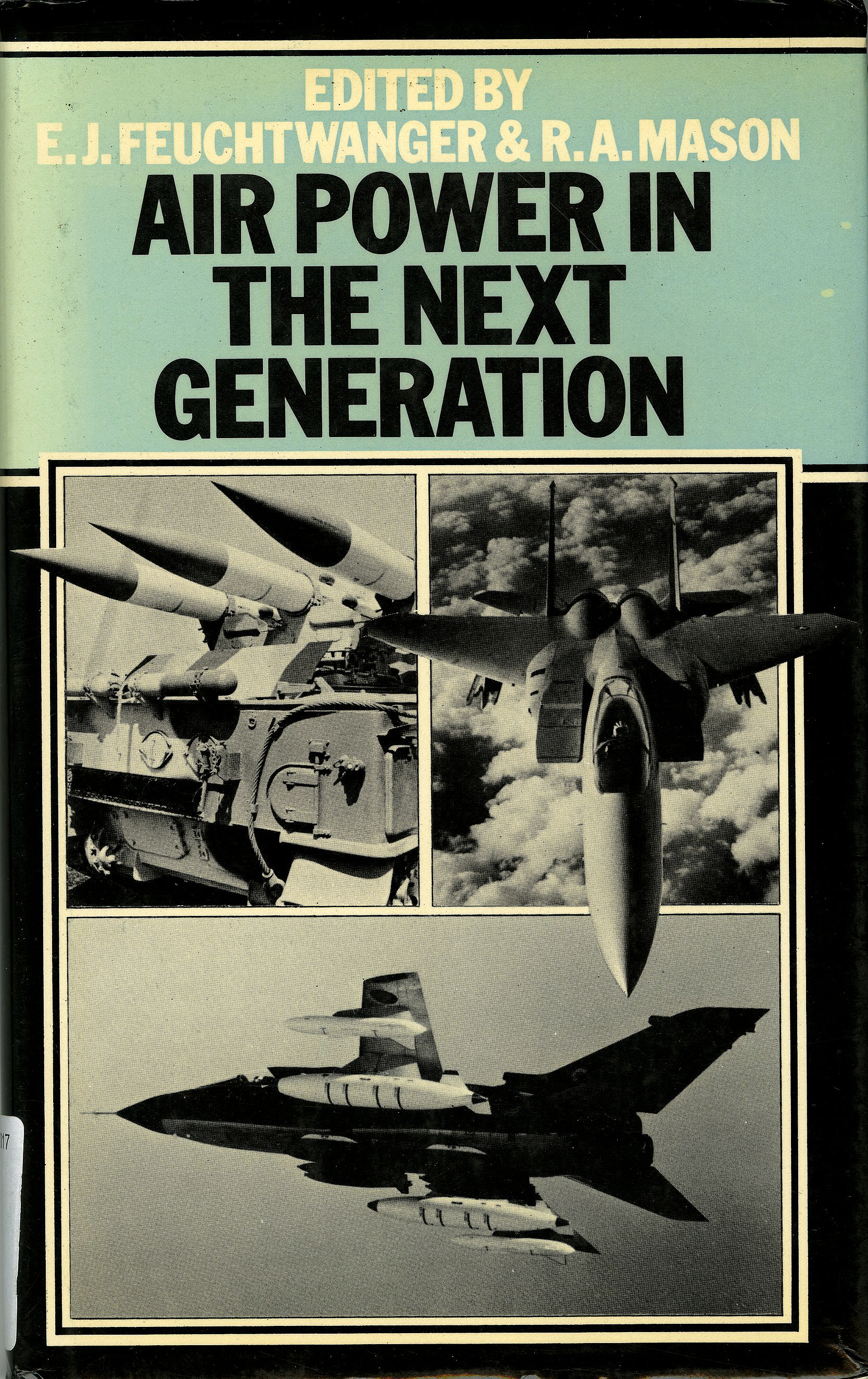
Mason nonetheless quickly sought to encourage discussion and debate and discussion about the role of air power within the service on taking up the role of DDefS. Despite the demise of the RAF Quarterly in 1977, Mason regularly contributed to Air Clues, which, up to the 1970s, had primarily been a technical publication for the RAF. In 1980, he established the Air Power Supplement to Air Clues, the spiritual ancestor to the RAF’s current professional flagship journal, Air and Space Power Review.[4] He also regularly contributed to other publications, such as The RUSI Journal. Perhaps his critical success in this period was organising an academic symposium in his first year in post. This symposium was entitled ‘Air Power in the Next Generation.’ It was well attended and laid the basis for similar endeavours by his successors. It was also published as Air Power in the Next Generation, co-edited with Edgar Feuchtwanger and published by The Macmillan Press in 1979. The book included contributions from the senior USAF, Luftwaffe, and Israeli officers, as well as civilian academics such as John Erickson. Much of Mason’s work started a process whereby his successors have continued to contribute to the collegiate intellectual development of the RAF through various schemes such as publications, conferences, and the management of defence fellowships.[5] Many former post-holders, such as Air Commodore (ret’d) Professor Peter Gray, are also notable for their contribution to developing British air power thinking through their engagement with academia after leaving the post of DDefS and the RAF.

978-1-349-17964-0

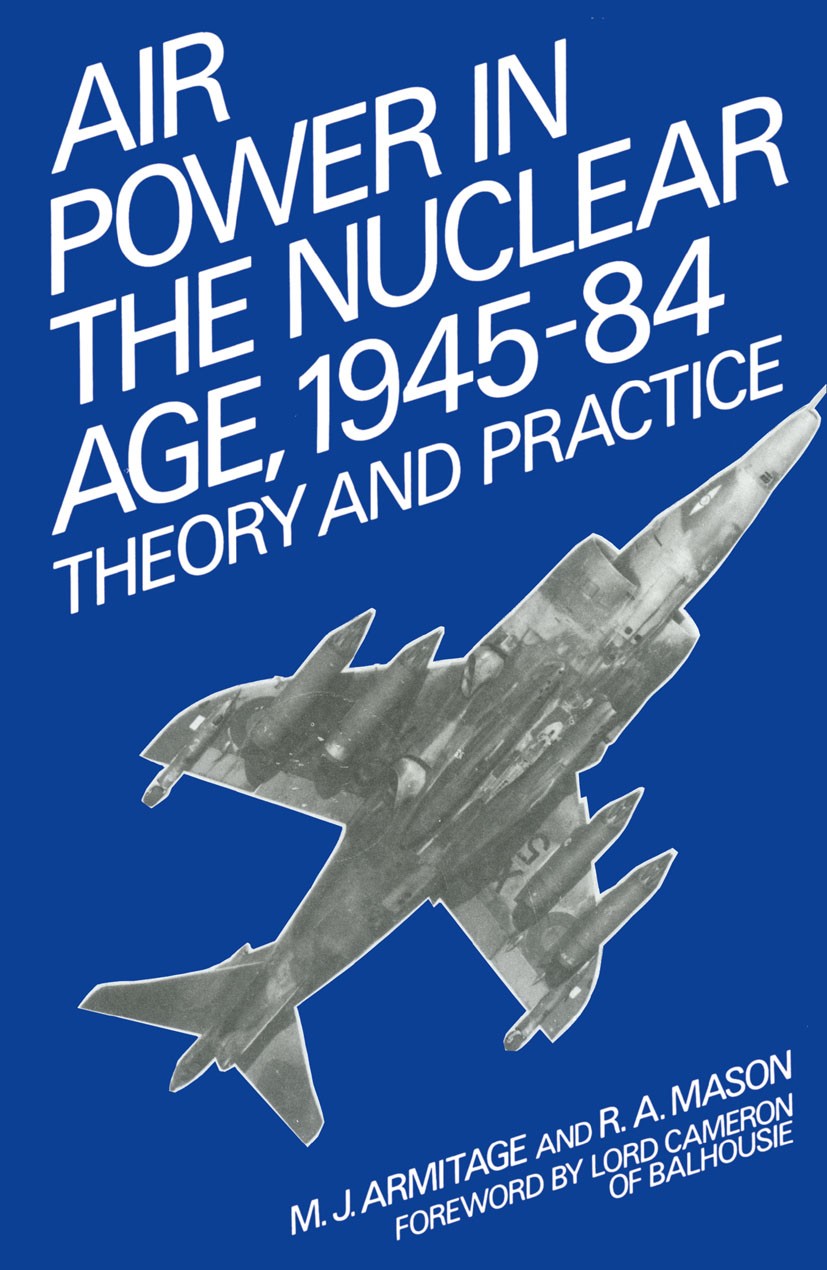
Mason’s contributions to air power studies continued after moving on from the DDefS role. In 1983, Mason published Air Power in the Nuclear Age in conjunction with Air Marshal Michael Armitage. This publication helped cement Mason’s position as a leading air power thinker. As Marshal of the Royal Air Force Lord Cameron noted in the foreword to the book, ‘[t]he joint authors of this book are advanced and enlightened thinkers about the doctrine of air power as a vital and perhaps the most important element of modern and future warfare.’[6] This view was not hyperbole. For example, in his 1984 overview of air power literature, historian Richard Hallion described the book as an ‘excellent survey’ of the development of air power during the Cold War.[7] The book was updated as a second edition in 1985. Mason’s other notable works in this period were the edited book War in the Third Dimension and the establishment of the Brassey’s Air Power: Aircraft, Weapons Systems and Technology Series. This latter series was interesting because it was explicitly directed at developing an awareness of air power amongst junior military personnel.

After retiring from the RAF in 1989, Mason moved into academia. He became the Leverhulme Air Power Research Director for the Foundation for International Security and took up a post as a Senior Research Fellow at the Centre for Studies in Security and Diplomacy at the University of Birmingham, where he was director. In 1996, he was made an Honorary Professor of Aerospace Policy at the University of Birmingham.

414K44MP5EL._AC_UF894,1000_QL80_

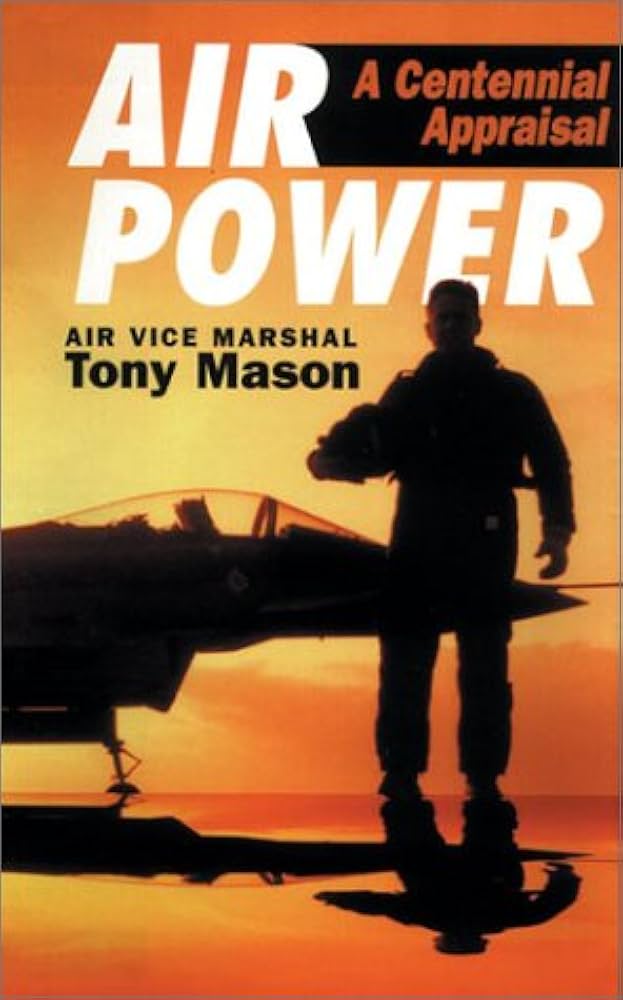
In 1994, Mason published what might be considered his magnum opus, Air Power: A Centennial Appraisal. This book confirmed Mason’s place as one of Britain’s leading air power thinkers. In this book, Mason examined the development of air power between 1989 and 1994. In doing so, he took a historical approach to examine how air power developed in the years up to this period. Mason then conceptualised the period 1989 to 1994, focusing on several key themes, such as the place of air power in arms control. Notably, he sought to contextualise much of the then-contemporary debate about the role of air power in the First Gulf War. Perhaps the most significant aspect of the book lay in Mason’s conceptualisation of what he called ‘differential air power.’[8] In short, Mason argued that while many nations shared ideas around the implementation of air power, only one in 1994 might be able to fully apply the advantages afforded by air power – the US. Using the idea of differential air power, Mason explored why the US stood out as a unique user of air power capabilities. These were important views for the time; however, while the book remains a significant contribution to air power studies, given factors such as the rise of China in the 21st Century and the distributed use of off-the-shelf technology such as drones, it remains to be seen whether his view remains applicable. Nevertheless, Mason concluded that:

One enduring concept underlay all air power thinking and all operations from the first day of the century to the last, and will continue to do so. Any nation intent on going to war to pursue an interest or defend a principle must first secure the air above it.[9]

Mason’s book was well received at publication and has become a commonly cited work. In his 1995 review in The RUSI Journal, Garden described the book as ‘excellent [and] thought-provoking.’[10] Thomas Keaney, who had worked on the Gulf War Air Power Survey, noted that the book made an ‘important contribution to any discussion on the future of airpower in the United States or elsewhere’ in a 1996 review for the US Joint Forces Quarterly.[11] However, historian Philip Sabin, reviewing the book in the Journal of Strategic Studies in 1995, offered a more tempered view. While recognising that the book had certain strengths, particularly Mason’s ‘balanced insights into many of the controversial issues regarding air power,’ Sabin also highlighted the challenge of reading a book that was ‘dense and difficult to follow without careful reading.’[12]

After the publication of Air Power, Mason continued to contribute to both the public’s and the RAF’s understanding of air power through his continued contribution to publications.[13] He also served as an expert member of the House of Commons Defence Committee in the early 2000s and helped inform British defence policy. He was also an inveterate media commentator and was often called to provide expert opinion. Mason’s contribution to air power studies was wide-ranging. While he had retired several years before his passing, his expertise will undoubtedly be sorely missed by many air power scholars for decades to come.

Dr Ross Mahoney is an independent scholar specialising in the history of war with particular reference to the use of air power and the history of air warfare. He is currently the Senior Historian within the Heritage Policy team at Brisbane City Council in Australia. He has nearly 20 years of experience in the education, museum and heritage sectors in Australia and the United Kingdom. Between 2013 and 2017, he was the inaugural Historian at the Royal Air Force Museum in the UK. In Australia, he has worked as a Historian for the Department of Veterans’ Affairs and taught at the Strategic and Defence Studies Centre at The Australian National University based at the Australian War College. His research interests are focused on the history of war, specifically on the history of air power and air warfare, military leadership and command, military culture, and the history and development of professional military education. He also maintains an interest in transport history. He has published numerous articles, chapters and encyclopedia entries, edited two books, and delivered papers on three continents. His website is here, and he can be found on Twitter at @airpowerhistory.

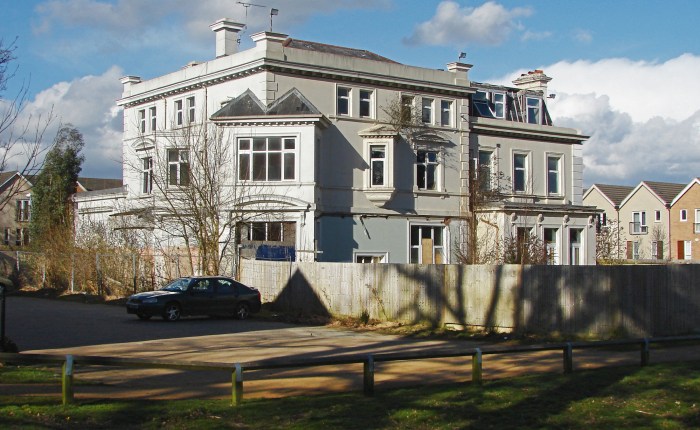
Header image: Ramslade House, the home of the RAF Staff College in Bracknell when Mason took up the role of Director of Defence Studies. (Source: Wikimedia)

[1] Author’s Personal Collection, Letter from the Chief of the Air Staff to AOC-in-C Support Command, 2 November 1976. I am grateful to the late Air Vice-Marshal Professor R.A. Mason for a copy of this and other documents linked to the establishment of the DDefS post.

[2] Author’s Personal Collection, Terms of Reference for Director of Defence Studies appended to a Letter from the Chief of the Air Staff to AOC-in-C Support Command, 2 November 1976, p. 1.

[3] Group Captain Timothy Garden, ‘Why don’t we forget Defence Studies and get on with the job?’ Air Clues 36, no 10 (1982), p. 364.

[4] Air Vice-Marshal Tony Mason, ‘Air Power Review’s Place in RAF History,’ Air Power Review 21, no. 1 (2018), p. 10.

[5] For a variety of publications produced under the guidance of DDefS, see: Andrew Lambert and Arthur C. Williamson (eds.), The Dynamics of Air Power (London: HMSO, 1996); Stuart Peach (ed.), Perspectives on Air Power: Air Power in its Wider Context (London: The Stationary Office: 1998); Peter W. Gray (ed.), Air Power 21: Challenges for the New Century (London: The Stationary Office, 2000); Peter W. Gray and Sebastian Cox (eds.), Air Power Leadership: Theory and Practice (London: The Stationary Office, 2002).

[6] Marshal of the Royal Air Force Lord Cameron, ‘Foreword’ in M’J’ Armitage and R.A. Mason, Air Power in the Nuclear Age: Theory and Practice, Second Edition (Basingstoke: The Macmillan Press, 1985), p. vii.

[7] Richard Hallion, The Literature of Aeronautics, Astronautics, and Air Power (Washington DC: Office of Air Force History, 1984), p. 36.

[8] Tony Mason, Air Power: A Centennial Appraisal (London: Brassey’s, 1994), pp. 235-278.

[9] Mason, Air Power, p. 278.

[10] Timothy Garden, ‘Book Reviews – Air Power: A Centennial Appraisal,’ The RUSI Journal 140, no. 3 (1995), p. 60.

[11] Thomas Keaney, ‘A Jubilee for Airmen: A Book Review,’ Joint Forces Quarterly 11 (1996), p. 134

[12] Philip Sabin, ‘Book Review – Air Power: A Centennial Appraisal,’ Journal of Strategic Studies 18, no. 4 (1995), pp. 141-2.

[13] For example, see: Tony Mason, ‘British Air Power’ in John Andreas Olsen (ed.), Global Air Power (Dulles, VA: Potomac Books, 2011), 7-62; R.A. Mason, ‘The Response to Uncertainty’ in John Andreas Olsen (ed.), European Air Power: Challenges and Opportunities (Dulles, VA: Potomac Books, 2014), pp. 215-30; Mason, ‘Air Power Review’s Place in RAF History,’ pp. 10-1.

#ResearchNote – The RAF Staff College and ‘Learning’ from the French

#ResearchNote – The RAF Staff College and ‘Learning’ from the French

By Dr Ross Mahoney

Editorial note: Defence-in-Depth, the blog of King’s College London’s Defence Studies Department based at the Joint Services Command and Staff College and The Wavell Room have been running a series of interesting articles about military education. The author has read these articles with some interest given his interest in the education of air forces. This research note covers an interesting episode in the process of the establishment of the Royal Air Force (RAF) Staff College in the early 1920s.

The opening of the RAF Staff College at Andover in 1922 marked a crucial step in the early development of the RAF. Andover gave the RAF its own institution that provided higher education tailored towards the needs of the Service. However, many historians have been critical of Andover. For example, Tony Mason, the RAF’s first Director of Defence Studies, suggested that Andover ‘lamentably failed’ in providing a developed air power theory for the RAF while Vincent Orange argued that the Staff College served, ‘as a disseminating station for approved doctrine, seasoned by essays on riding, hunting and how to cope with the bazaars of Baghdad.’[1]

However, one aspect not often considered is how the RAF went about preparing for the Staff College’s formation. Key to this is the role played by its first Commandant, Air Commodore Robert Brooke-Popham who was adamant that the RAF should learn from the teaching methods used by both the British Army and Royal Navy at their Staff Colleges at Camberley and Greenwich.[2] Brooke-Popham was a pre-First World War graduate of Camberley, and it is clear that this educational experience played a role in how he approached his position as Commandant. More broadly, before the opening of Andover, it was to the Army and Royal Navy that the RAF looked to provide a staff college education for nurtured officers. Indeed, it is significant that, apart from Group Captain Robert Clark-Hall, the initial Directing Staff – Wing Commanders Philip Joubert de la Ferte, Wilfrid Freeman and C.H.K. Edmonds and Squadron Leader Bertine Sutton – were all graduates of Camberley or Greenwich. However, while the British experience of higher military education was a significant influence, it was not the only source of information.

LD 764
A half-length portrait of Air Marshal Sir Philip Joubert de la Ferté in uniform by James Gunn, c. 1940 (Source: © IWM (Art.IWM ART LD 764))

More interesting is that Brooke-Popham also considered whether anything could be learnt from the methods utilised by the French Army at the Écoles Supérieures de Guerre in Paris, which in the early 1920s was commanded by General Marie Debeney.[3] Before the opening of Andover, Brooke-Popham and Joubert visited Paris to examine French pedagogical methods, and the critical source concerning this visit comes in the latter’s 1952 autobiography The Fated Sky.[4] Joubert’s recollections provide an insight into the teaching methods at the Écoles Supérieures de Guerre. However, it is clear that he was not impressed with the quality of education present although, as he recalled, the Écoles Supérieures de Guerre was considered, ‘the centre of all military knowledge.’[5]

Joubert’s criticisms fell broadly into three categories. First, Joubert was critical of the lack of cooperation with the French Navy and their equivalent school for higher education. Second, instructors lacked familiarity with the students they were teaching. Finally, Joubert was not impressed with the formality of the lectures and lack of what in modern teaching is often referred to as ‘white space’ in the timetable to allow for reflections and questions.[6]

Joubert’s criticisms raise several interesting observations about the differences between the British and French militaries in this period. Notably, the lack of co-operation between the French Army and Navy at the staff college level maps to many of the problems that plagued the French military in the interwar period. Joubert recalled Debeney’s ‘look of blank amazement’ when asked about co-operation with his naval counterpart.[7] Conversely, while there were definite problems at the strategic level, the British military regularly co-operated via combined operations exercises at the staff colleges that Joubert himself described as ‘one of the most pleasant periods’ of his time at Camberley, which he attended in 1920.[8] This perhaps suggests something about Britain’s pragmatic military culture in this period. Individual service cultures certainly existed, but when co-operation was required, the British military appeared to be able to do this.

Furthermore, Joubert recalled of his time at Camberley that while heated discussions between students occurred, ‘it was always possible to come to an agreement over a round of pink gins in the Mess’ thus highlighting the importance of socialisation between the services as means of breeding understanding between them.[9] It also seems clear that Joubert’s perception of the lack of formality in British Staff Colleges bred a willingness to question accepted views while the French military maintained a ‘Maginot’ mentality for much of this period. However, even this must be understood within the context of differing service cultures. Joubert himself reflected on these differences when he wrote that:

Naval officers would discuss Naval affairs freely amongst themselves and before members of another service and would unhesitatingly attack any ideas which they thought themselves were wrong. But let an outsider in the audience offer a criticism and Naval ranks closed up solidly. The Army seldom, if ever, discussed their problems in the open. If they were asked for a statement of policy Field Service Regulations and Army Council Instructions were solemnly quoted. As for the Air Force, they would fight amongst themselves in private and in the open, and would quite ruthlessly disagree with their instructors before a mixed audience. Nothing was sacrosanct.[10]

The final criticism of the lack of ‘white space’ in the timetable is significant as this is considered a crucial element of the pedagogical process and differentiates higher education from training. The lack of this ‘white space’ in the French Staff College system suggested an unwillingness to allow French officers to think more broadly about their place within the profession of arms and the conduct of war more generally. This raises fundamental questions concerning leadership development within the French Army such as whether the French system was developing senior leaders or staff officers. Moreover, it is clear that the French system differed from the British with the existence of the Centre des Hautes Études; a war college, which existed to educate senior Colonels and Brigadiers.[11] A ‘war college’ was something the RAF lacked, and as such an exact comparison between the two systems is fraught with challenges.

While Joubert’s recollection should, as with any autobiography, be treated with some care, from the perspective of the provision and development of military education in the RAF they are useful. This is primarily because of Joubert’s affiliation with education in the RAF. As noted, he attended Camberley and was Directing Staff at Andover. However, he would also go on to be the first RAF member of the Directing Staff at the Imperial Defence College as well as going on to being Commandant at Andover in the early 1930s. As such, he was well placed to comment on such issues.

In conclusion, this episode shows that the RAF was willing to move outside of national confines to learn lessons for what was the world’s first air force Staff College. However, that the methods examined in France were not adopted also highlights issues related to how militaries perceive themselves. As Joubert himself noted, ‘[i]n the event we did not adopt […] the French Staff College methods [and] [w]e went our own perfectly normal and unspectacular British Way.’[12] This reflection says as much about the RAF and its culture as it does the perceived failings of the French system of higher military education. The final important point is that in looking to other Staff Colleges, whether in Britain or France, the RAF were looking to similar institutions with similar objectives – the education and nurturing of future senior leaders – but axiomatically these educational establishments were not similar. Putting aside national proclivities, the critical difference was the military service these institutions served. The Écoles Supérieures de Guerre served the French Army, not an air force, though of course at this time, the French air service formed part of the army. Similarly, Camberley and Greenwich served the British Army and Royal Navy respectively. As such, while the RAF could, and did learn from their counterparts, it still had specific service challenges that it would have to solve on its terms. Indeed, the focus of Brooke-Popham and Joubert’s visit to Paris was more on ‘how’ to teach rather than ‘what.’

Dr Ross Mahoney is a contract Historian at the Departments of Veterans’ Affairs in Australia as well as the owner and Editor of From Balloons to Drones. He is a graduate of the University of Birmingham (MPhil and PhD) and the University of Wolverhampton (PGCE and BA). His research interests include the history of war in the twentieth and twenty-first centuries, air power and the history of air warfare, and the social and cultural history of armed forces. To date, he has published several chapters and articles, edited two books, and delivered papers on three continents. He is a member of the Royal Historical Society and a Vice-President of the Second World War Research Group. He can be found on Twitter at @airpowerhistory.

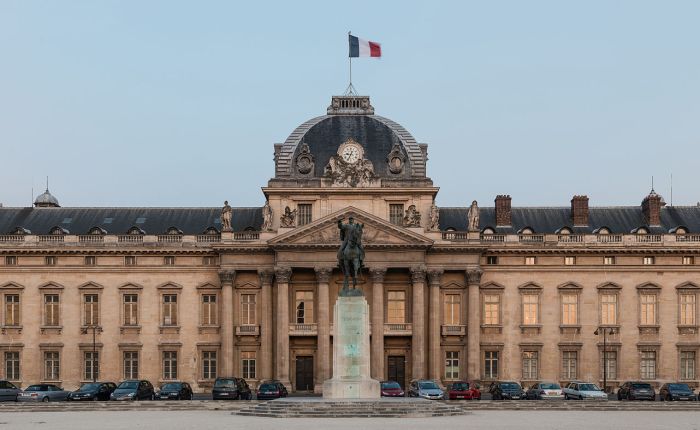
Header image: The modern day Ecole Militaire, which previously housed the Écoles Supérieures de Guerre (Source: Wikimedia)

[1] Tony Mason, ‘British Air Power’ in John Andreas Olsen, Global Air Power (Washington D C: Potomac Books, 2011), pp. 26-27; Vincent Orange, Churchill and his Airmen: Relationships, Intrigue and Policy Making, 1914-1945 (London: Grub Street, 2013), p. 87.

[2] Air Chief Marshal Sir Robert Brooke-Popham, ‘The Formation of The Royal Air Force Staff College,’ The Hawk, 12 (1950), p. 19.

[3] For a British overview of the Écoles Supérieures de Guerre, see: ‘The “Ecole Superieure De Guerre,” Paris,’ Journal of the Royal United Services Institution, 70:477 (1925), pp. 1-7.

[4] Sir Philip Joubert de la Ferte, The Fated Sky: An Autobiography (London: Hutchinson, 1952), pp. 87-88. Joubert also recollected that Brooke-Popham also considered ‘Madam Montessori’s ideas.

[5] Ibid., pp. 87

[6] Ibid., pp. 87-88

[7] Ibid., p. 87.

[8] Ibid., p. 84.

[9] Ibid., p. 83.

[10] Ibid., p. 88.

[11] ‘The “Ecole Superieure De Guerre,” Paris,’ p. 1.

[12] Joubert, The Fated Sky, p. 88.

#ResearchNote – RAF Centre for Air Power Studies Interviews

#ResearchNote – RAF Centre for Air Power Studies Interviews

By Dr Ross Mahoney

Oral history is challenging. It is challenging to conduct and to use as a source. It takes a skilled oral historian, such as Peter Hart, to conduct an interview that brings the best out of an interviewee. Much of this has to do with the ability of the interviewer to put the interviewee at ease to allow them to discuss their experiences as openly as possible as well as having an understanding and empathy for the subject matter. As a source, arguably, the principal criticism of oral history remains the charge of viewing the past through ‘rose-tinted glasses.’ In short, the passage of time can distort the remembrance of the past; however, as someone with an interest in military culture, this is also a strength. Culture has as much to do with perception as it does with the archival record of the time so how people remember and reflect on their service is just as important as what happened at the time.

As such, it is great to see that the RAF Centre for Air Power Studies is currently making available a number of interviews that were conducted from the 1970s onwards. The first two were conducted at the RAF Staff College at Bracknell in the early 1990s. It was not unusual to have after-dinner speakers at Bracknell, and it formed part of the pedagogical process at the Staff College. In these cases, the interviewees were Group Captain Sir Hugh Dundas and Wing Commander Roland Beamont. The final interview was conducted in 1978 by the RAF’s first Director of Defence Studies Group Captain Tony Mason. The interviewee was Group Captain Leonard Cheshire, and this talk formed part of a series conducted by Mason, which included an interview with Marshal of the Royal Air Force Sir Arthur Harris. The unifying theme of the videos is leadership through the participants experience of their service in the RAF.

Here are the videos with their respective descriptions:

In this interview, Wing Commander Roland Prosper “Bee” Beamont, CBE, DSO*, DFC* talks about his experiences during the Second World War with Group Captain (Retd) J P (Phil) Dacre MBE DL RAF at the RAF Staff College, Bracknell (April 1991). Wing Commander Beamont served as a fighter pilot with Fighter Command from the start of the War until he was shot down and captured in October 1944 on his 492nd operational mission. After the War, Wing Commander Beamont went on to become a leading test pilot on aircraft such as the Meteor, Vampire, Canberra and Lightning as well as writing several books.

In the second of the RAF Centre for Air Power Studies rarely-seen before historic ‘leadership’ themed videos, Battle of Britain legend Group Captain Sir Hugh ‘Cocky’ Dundas CBE DSO* DFC presents his thoughts on ‘Leadership in War’ followed by an informal question and answer session at an after-dinner speech given circa 1991 at the RAF Staff College, Bracknell. Group Captain Sir Hugh Dundas joined the Auxiliary Air Force as an acting pilot officer in 1938 before being called up to active service early in the war. Initially, he served on 616 Squadron flying Spitfires during the Battle of Britain fighting ‘hard and fiercely’ throughout. He went on to serve as a squadron commander and then subsequently as wing leader and had, by 1944, become one of the youngest Group Captains the RAF at the age of just 24. He left the RAF in 1947 to pursue a successful career in the media. His autobiography, Flying Start: A Fighter Pilot’s War Years, describes his wartime experiences in more detail.

In the third of the RAF Centre for Air Power Studies rarely-seen before historic ‘leadership’ themed videos, inspirational wartime leader and world-renowned humanitarian, Group Captain Leonard Cheshire, Baron Cheshire VC OM DSO** DFC is interviewed by Group Captain (later Air Vice-Marshal) Tony Mason CB CBE DL at the RAF Staff College, Bracknell, February 1978. During the interview Group Captain Cheshire discusses his now legendary record of achievements throughout his service during WWII.

Group Captain Cheshire received a commission as a pilot officer in the Royal Air Force Volunteer Reserve on 16 November 1937. Although he demonstrated considerable prowess in training as a single seat pilot, by a vagary of the system he was destined to be posted to Bomber Command. During the War, his command appointments included 76 Squadron, 617 Squadron, and RAF Marston Moor and he was, at one time, the youngest group captain in the RAF. By July 1944 he had completed a total of 102 missions, for which he was awarded the Victoria Cross. His citation simply states: ‘Cheshire displayed the courage and determination of an exceptional leader’. After the war, Cheshire founded the charity Leonard Cheshire Disability and devoted the remainder of his life to pursuing humanitarian ideals. His obituary in the Independent (1992) declares that ‘LEONARD CHESHIRE was one of the most remarkable men of his generation, perhaps the most remarkable’.

Dr Ross Mahoney is an independent historian and defence specialist based in Australia. Between 2013 and 2017, he was the resident Historian at the Royal Air Force Museum, and he is a graduate of the University of Birmingham (MPhil and PhD) and the University of Wolverhampton (PGCE and BA). His research interests include the history of war in the twentieth and twenty-first centuries, air power and the history of air warfare, and the social and cultural history of armed forces. To date, he has published several chapters and articles, edited two books, and delivered papers on three continents. He is a member of the Royal Historical Society and is an Assistant Director of the Second World War Research Group. He is a member of the Royal Historical Society and an Assistant Director of the Second World War Research Group. He blogs at Thoughts on Military History, and can be found on Twitter at @airpowerhistory.

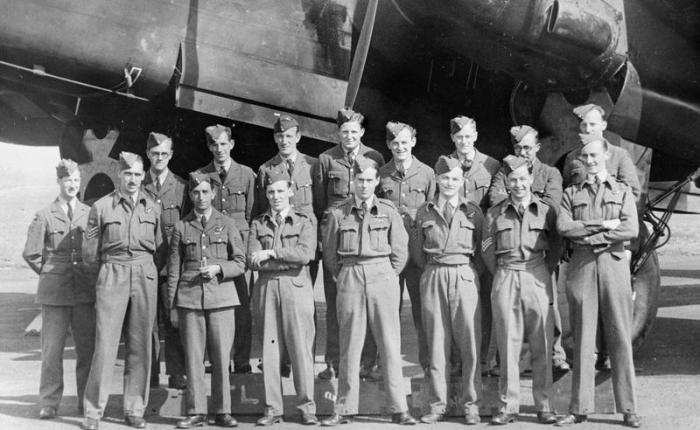
Header Image: Flying Officer Leonard Cheshire, while serving his second tour of operations with No. 35 Squadron RAF, stands with his air and ground crews in front of a Handley Page Halifax at Linton-on-Ouse, Yorkshire. (Source: © IWM (CH 6373))