OODA Loop or Coffee Break? Erich Hartmann and the Forgotten German ‘Decision Cycle’

OODA Loop or Coffee Break? Erich Hartmann and the Forgotten German ‘Decision Cycle’

By Stephen Robinson

There was not too much dogfighting for us. It requires a large area and is absolutely defensive.[1]

Erich Hartmann

Colonel John R. Boyd flew F-86 Sabres during the Korean War and later theorised the Observation-Orientation-Decision-Action (OODA) loop, initially focused on air-to-air combat. At first, Boyd considered the tactical requirements of test flight dogfights between the YF-16 and YF-17 prototypes in 1974 before analysing Sabre and MiG-15 combat in Korea. He expressed the basic idea of the OODA loop in a United States Air Force (USAF) oral history in 1977, although it was not fully formed with its familiar four stages.[2] However, it is not commonly known that another F-86 pilot had theorised a four-stage air-to-air combat ‘decision cycle’ in the 1940s – Luftwaffe pilot Erich Hartmann.
FRE_015069
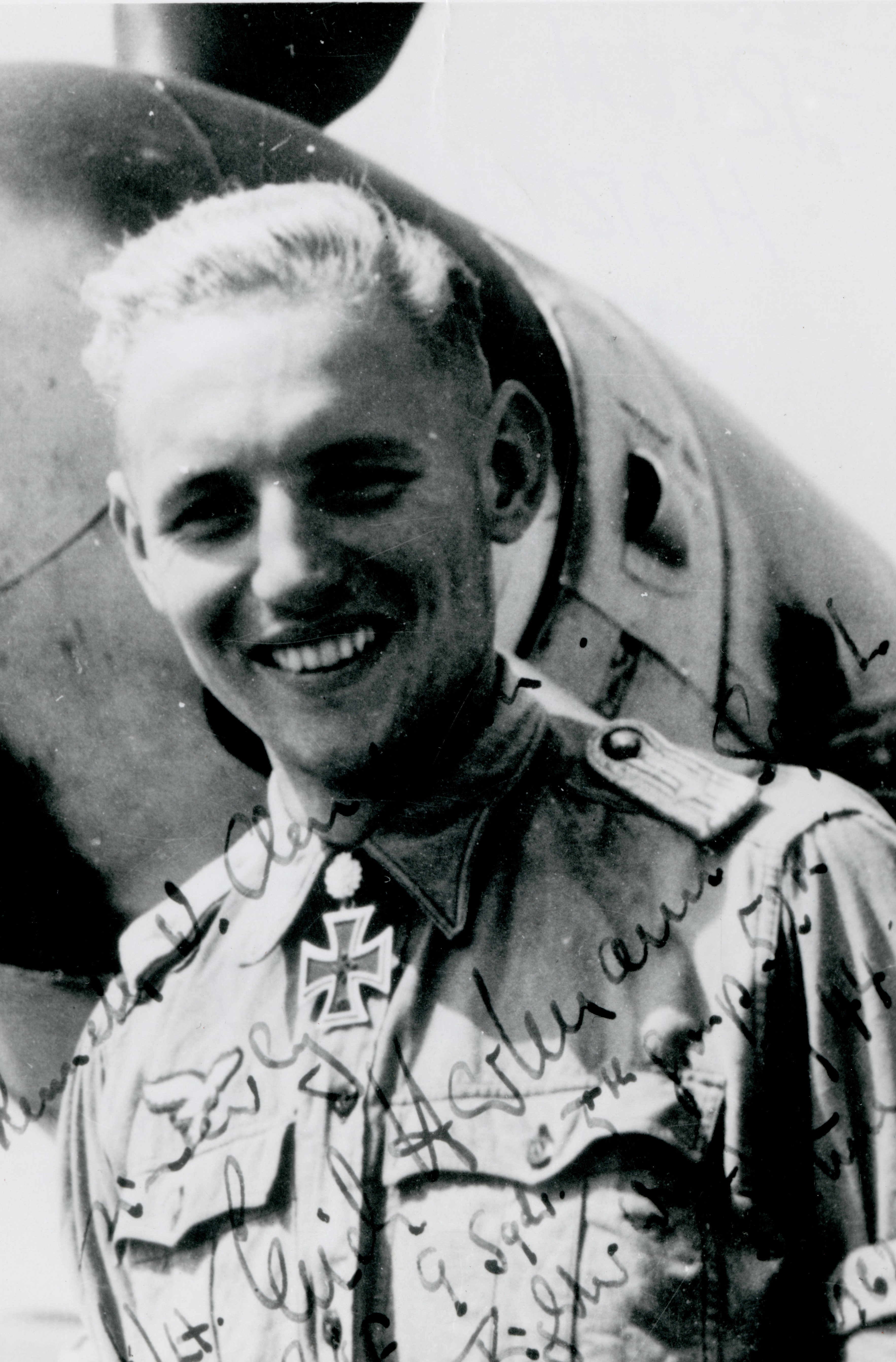
A signed copy of a photo of Erich Hartmann during the Second World War. (Source: Imperial War Museum)

During the Second World War, Hartmann flew 1,404 combat missions, participated in 825 air-to-air engagements and became history’s highest-scoring ace with 352 official kills, mainly over the Eastern Front.[3] During the Cold War, he later commanded West Germany’s first Sabre wing Jagdgeschwader 71 ‘Richthofen.’[4] Hartmann theorised the ‘Coffee Break’ concept, abbreviated as See-Decide-Attack-Break (SDAB). Writets Trevor J. Constable and Raymond F. Toliver articulated the idea in their bestseller The Blond Knight of Germany (1970), the first Hartmann biography, almost half a decade before the OODA loop emerged. Although their book romanticises the German military and fails to address Hartmann’s relationship with National Socialism adequately, it accurately depicts air combat tactics. In contrast, historian Erik Schmidt’s Black Tulip: The Life and Myth of Erich Hartmann, the World’s Top Fighter Ace (2020) thoroughly examines Hartmann’s role in the Third Reich and his fighter pilot career, which makes his book essential reading.

Hartmann and Boyd, in addition to flying Sabres and developing ‘decision cycles’, had much else in common. They were both aggressive fighter pilots with maverick independent streaks who declared war on their hierarchy late in their careers. Hartmann rebelled by opposing the F-104 Starfighter, which he considered unsafe, while Boyd went outside his chain of command to develop the unwanted Lightweight Fighter project.[5] Both men also retired as colonels in the 1970s.

At first glance, the SDAB cycle and the OODA loop are hard to distinguish. As John Stillion expressed: ‘Hartmann’s air combat procedure is strikingly similar to USAF Colonel John Boyd’s famous Observe, Orient, Decide, Act, or “OODA” loop.’[6] However, there is a critical difference. In an air combat context, the OODA loop is about winning dogfights, while the SDAB cycle is all about avoiding them. Additionally, Boyd’s OODA loop theory evolved from air combat to include land combat and then conflict in general before becoming a cognitive model explaining the mind’s relationship with reality. Hartmann’s method, as Schmidt concluded, is not ‘really a dogfighting strategy per se. It was more of an anti-dogfighting strategy.’[7]

Take a Coffee Break

Hartmann enlisted in the Luftwaffe in 1940 and joined Jagdgeschwader 52 in October 1942, flying Messerschmitt Bf 109 fighters. He initially became a wingman for Edmund Rossmann, who mentored the novice pilot. Rossmann had already been credited with over 80 kills, giving his advice considerable merit.[8] Hartmann learned that Rossmann had a wounded arm that prevented him from flying highly manoeuvrable dogfights, but he compensated for this injury by developing a specific tactic. After spotting the enemy, Rossmann patiently assessed the situation before deciding whether to attack. If he decided that surprise could be achieved, he would attack, which differed from the standard practice of immediately attacking a seen enemy.[9] Hartmann later reflected that Rossmann ‘taught me the basic technique of the surprise attack, without which I am convinced I would have become just another dogfighter.’[10] What Rossmann did out of necessity, Hartmann would soon do out of choice.

Hartmann scored his first aerial victory on 5 November 1942 by shooting down an Il-2 Sturmovik. However, shrapnel from the kill damaged his engine, forcing him to crash. While recovering in the hospital, Hartmann began to formulate his conception of air combat after reflecting that he should have approached closer before opening fire and disengaged quicker to prevent shrapnel from hitting his engine. Hartmann later recalled: ‘I learned two things that day: Get in close and shoot, and break away immediately after scoring the kill.’[11] Hartmann later formulated his trademark method, as Constable and Raymond explained:

The magical four steps were: “See – Decide – Attack – Reverse, or ‘Coffee Break’.” In lay terms, spot the enemy, decide if he can be attacked and surprised, attack him and break away immediately after striking; or if he spots you before you strike, take a “coffee break” – wait – pull off the enemy and don’t get into a turning battle with a foe who knows you are there.[12]

In a USAF interview in 1985, Hartmann was asked, “How did you develop your tactics of See, Decide, Attack, Reverse, or Coffee Break?” He answered:

I developed my tactics by watching my leader. My first leader, MSgt Eduard Rossmann, was always cautious. He said he didn’t like to pull a lot of Gs because of a bad shrapnel wound in his arm. He would look over each fight and decide if he would enter. When he did enter, it was always straight through – no turns – and he usually came home with a kill. My next leader, Sgt Hans Dammers, liked to turn and fly in the circus. The next man, 1st Lt Josef Swernemann was somewhere in between the two. He would be patient for a while, but then would get into a turning fight when he got frustrated. This is when I realized you must fight with your head, not your muscle.[13]

Hartmann rejected dogfighting as he considered it pointless and risky: ‘I also decided against aerial acrobatics, against what traditional pilots would call dog-fighting […] Acrobatics are a waste of time and therefore dangerous.’[14] Hartmann would always try to break contact after a pass before deciding if another pass was warranted and, as Constable and Raymond explained, ‘[e]ach pass was a repetition of the “See – Decide – Attack – Break” cycle.’[15]

Hartmann’s method was essentially hit-and-run tactics. As social scientists C. Hind and A. Nicolaides explained: ‘Hartmann became the ultimate and leading exponent of the stalk-and-ambush tactics, and he favoured the tactic of ambushing enemy aircraft and firing at them from very close range, about 20 m, rather than becoming involved in challenging and unnecessary dogfights.’[16]

The SDAB cycle is usually only mentioned in popular military aviation histories and is rarely referred to in scholarship. Edward E. Eddowes, who worked at the Air Force Human Resources Laboratory, submitted a paper to the First Symposium on Aviation Psychology in 1981. He declared: ‘Each engagement involves repetitions of the see, decide, attack, break discrimination-decision sequence. Like many of his predatory predecessors, Hartmann found turning contests hazardous and avoided them.’[17]

In another example, Captain James H. Patton, Jr., a retired naval officer, in his article ‘Stealth is a Zero-Sum Game: A Submariner’s View of the Advanced Tactical Fighter’ considered the SDAB cycle in 1991:

Top Gun instructors interpreted that terse guidance – based on interviews with Hartmann – to mean that a pilot should attempt to detect without being detected, judge whether he can attack covertly, close to a point that would almost assure a kill, and then disengage rapidly to repeat the process, rather than hang around in what submariners call a melee, and fighter pilots term the visual fur ball.[18]

Mikel D. Petty and Salvador E. Barbosa conducted an interesting air simulation experiment. They noted that USAF instructors supervise trainees undergoing virtual simulation-based training.[19] However, given the limited availability of instructors, they devised a means of testing a self-study-based training approach through simulation by following the progress of one test subject over eight years. The virtual pilot flew 2,950 missions in 138 campaigns using seven types of aircraft set in Europe in 1943-45 using Microsoft Combat Flight Simulator 3 (CFS3). The experiment required the subject to read air combat literature before applying the described tactics in the simulation. The study material included The Blond Knight of Germany, which outlined the SDAB cycle.[20] Petty and Barbosa confirmed the effectiveness of the SDAB cycle as ‘maneuvers and tactics described as effective in WWII air combat in the literature, e.g., those in Franks (1998) and Toliver and Constable (1970), were found by the subject to be very effective in CFS3 as well, if performed correctly.’[21]

The SDAB cycle has limitations, and Schmidt correctly concluded that it was well-suited to the Eastern Front but had less utility in Western Europe: ‘Hartmann’s Soviet enemies were, generally, less capable than the British and American pilots on the Western Front, which meant not only that they were easier to shoot down, but also that they were easier to evade and disengage from if the odds weren’t right.’[22] Therefore, applying SDAB cycles consistently in practice is impossible, and some dogfighting is inevitable, making the OODA loop relevant.

The OODA Loop

Boyd was familiar with Hartmann and mentioned him once in the 1977 USAF oral history stating that ‘[A]nd so, in that sense, a guy like Hartmann or a guy like Bong [Maj Richard I.] and some of these other good American aces – I could name others from other countries – they kind of knew they were going to win anyway. Maybe not in the beginning, but they built up that certain confidence and they had the desire.’[23] However, it is unclear if he read The Blond Knight of Germany or other references to the SDAB cycle, so we do not know if Hartmann influenced the OODA loop.[24] In any case, both models are opposites, so there is no suggestion of plagiarism. The basic idea of the OODA loop is to move faster than the enemy through a four-stage cycle, as military analyst Franklin C. Spinney, a close acolyte of Boyd, explained:

He [Boyd] thought that any conflict could be viewed as a duel wherein each adversary observes (O) his opponent’s actions, orients (O) himself to the unfolding situation, decides (D) on the most appropriate response or countermove, then acts (A). The competitor who moves through this OODA-loop cycle the fastest gains an inestimable advantage by disrupting his enemy’s ability to respond effectively.[25]

The victor, moving faster, seizes the initiative while the loser becomes paralysed by disorientation and panic.[26] The winner gets inside the loser’s OODA loop, which allows the pilot to manoeuvre into a winning firing position during a dogfight.[27] The OODA loop requires both pilots to dogfight long enough and complete enough loops for the winner to gain a relative speed advantage, which begins to sow disorientation and panic in the loser’s mind. More specifically, the pilots must complete enough OODA loops for the winner’s relative speed advantage to result in an action that changes the overall situation.[28] When this occurs, the loser’s actions, based upon the superseded earlier situation, fail to achieve the intended result, and they become confused as negative feedback overloads their brain. A pilot simply shooting down an enemy Hartmann-style before a clash of opposing OODA loops can occur is not applying Boyd’s model. If the OODA loop involved surprise and winning before the opponent reacts, there would be nothing original about the idea or way to distinguish it from the earlier SDAB cycle meaningfully.

The key difference between Hartmann and Boyd is that the SDAB cycle avoids dogfighting while the OODA loop requires dogfighting. Boyd was fixated on dogfighting as Frans P.B. Osinga explained: ‘[H]e [Boyd] developed the ability to see air combat as a contest of moves and countermoves in time, a contest in which a repertoire of moves and the agility to transition from one to another quickly and accurately in regard [to] the opponent’s options was essential.’[29]

Boyd’s manual Aerial Attack Study (1964), first published in 1960, explained all possible dogfighting manoeuvres without prescribed solutions.[30] Osinga concluded that Boyd ‘wanted to show people various moves and countermoves, and the logic of its dynamic.’[31] Aerial Attack Study reads like a chess strategy book. It is undoubtedly valuable, as Grant Hammond explained: ‘[M]any a fighter pilot, whether he knows it or not, owes his life to Boyd and the development of the tactics and manoeuvres explained in that manual.’[32] Former students who fought in Vietnam credit Boyd’s teaching for getting them out of danger. For example, on 4 April 1965, Major Vernon M. Kulla engaged North Vietnamese MiG-17s while flying an F-105 Thunderchief. Before the MiG-17 could open fire, Kulla successfully conducted a snap roll that he learned from Boyd, forcing the communist pilot to overshoot.[33] Therefore, Boyd certainly taught useful air-to-air tactical skills.

Despite Boyd’s obsession with dogfighting, it is rarer than many assume. Historically speaking, in most cases, victory goes to the pilot, who spots the enemy first and wins before the opponent can react. As Barry D. Watts explained:

To start with historical combat data, combat experience going at least back to World War II suggests that surprise in the form of the unseen attacker has been pivotal in three-quarters or more of the kills. For example, P-38 pilot Lieutenant Colonel Mark Hubbard stressed that, in his experience over northern Europe with the U.S. Eighth Air Force, “90% of all fighters shot down never saw the guy who hit them.” Similarly, the German Me-109 pilot Erich Hartmann […] has stated that he was “sure that eighty percent” of his kills “never knew he was there before he opened fire.”[34]

This trend continued during the Vietnam War from April 1965 to January 1973, as approximately 80 per cent of personnel shot down from both sides never saw the other aircraft or had insufficient time to make a countermove.[35] Accordingly, Watts concluded: ‘[W]hat historical air combat experience reveals, therefore, is that upwards of 80 per cent of the time, those shot down were unaware that they were under attack until they either were hit or did not have time to react.’[36]

Most air-to-air kills did not involve dogfighting and, consequently, clashes of opposing OODA loops involving sequences of moves and countermoves. Most air-to-air engagements end before the loser has time to act. Even when dogfighting occurs, it can be over in seconds, as Schmidt explained:

Amazingly, the whole dance of a dogfight could take place over the course of just a few seconds. The famed American pilot Robin Olds, who flew P-38s and P-51s in World War II and F-4 Phantoms in Vietnam, said: “Usually in the first five seconds of a dogfight, somebody dies. Somebody goes down. You want to make sure it’s the other guy.”[37]

Therefore, the OODA loop is not always applicable in dogfights because other factors often decide the outcome before the winner’s faster speed can generate negative feedback in the loser’s mind, which is a more gradual process involving moves and countermoves.

Boyd, without intending to, contradicted the essence of the OODA loop by expressing a sentiment identical to the SDAB cycle:

So that’s why he [the fighter pilot] wants to pick and choose engagement opportunities. He wants to get in, get out, get in, and get out. Why does he want to do that? Because it’s not just one-to-one air-to-air combat up here. It’s what the pilots like to say, many-upon-many. In other words, if you’re working over one guy, somebody else is going come in and blindside you. So you want to spend as little time with a guy as possible. You need to get in, gun him, and get the hell out.[38]

Ironically, Boyd preferred the hit-and-run essence of the SDAB cycle, as picking and choosing engagement opportunities and cycles of getting in and out to avoid danger sounds just like Hartmann. Therefore, engaging in an elongated OODA loop duel with another pilot is inherently risky due to the possible presence of other enemy fighters. However, there is still a critical difference as Boyd believed that the best way to break contact was by conducting a ‘fast transient’ – a rapid transition from one manoeuvre to another that allows a pilot to kill before quickly disengaging.[39] However, a pilot can only conduct a ‘fast transient’ if they are already in a dogfight. Hartmann instead preferred to dive at an unsuspecting enemy using superior speed in a single pass and then to use the momentum gained to break contact without any acrobatics, dogfighting or ‘fast transients’.

Boyd also stressed: ‘[T]hink of it in space and time. In space, you’re trying to stay inside his manoeuvre; in time, you want to do it over a very short period of time, otherwise you’re going to become vulnerable to somebody else.’[40] Therefore, Boyd advocated elongated OODA loop duels to gradually generate negative feedback while inconsistently wanting to restrict engagements to minimal periods due to the risk of other enemy fighters. Ultimately, Boyd failed to reconcile the need to rapidly break contact after an attack to avoid danger with the time required for enough OODA loop cycles to generate disorientation and panic in the loser’s mind.

Aces and Iteration

The key advantage of the SDAB cycle is that it minimises risk. However, a pilot intending a surgical hit-and-run strike may inadvertently find themselves in a dogfight, and then the logic of the OODA loop might become paramount. Nevertheless, engaging in an OODA loop contest inherently makes one vulnerable. As Jim Storr explained: ‘[T]here is considerable advantage in reacting faster than one’s opponent, but the OODA Loop does not adequately describe the process. It places undue emphasis on iteration instead of tactically decisive action.’[41] After attacking, Hartmann would break contact to prevent iteration and only committed to further passes in favourable conditions. The avoidance of iteration is also evident in the tactical methods of other aces, and Storr stressed that ‘biographies of aces […] show almost no trace of iterative behaviour in combat.’[42] Hartmann’s tactics worked because he avoided dogfighting. As Storr similarly expressed:

Critically, aces scarcely ever dogfight. They usually destroy enemy aircraft with a single pass, and expend very little ammunition per aircraft shot down. Their effectiveness centres on rapid, decisive decision and action. It is based on superlative, largely intuitive, situational awareness. Aces do display some significant characteristics – their eyesight is usually exceptional and their shooting phenomenal. They also have catlike reactions. However, expert fighter combat is fundamentally not iterative. It is sudden, dramatic and decisive.[43]

Boyd valued manoeuvrability over speed, while Hartmann preferred speed over manoeuvrability. Neither is right or wrong, and there is undoubtedly a degree of pilot preference. Hartmann’s approach was only made possible by exceptional eyesight, which allowed him to apply successful SDAB cycles consistently. Understandably, pilots with poorer eyesight might prefer manoeuvrability. After all, most pilots never become aces, so there is value in applying lessons from both Hartmann and Boyd’s approaches.

Conclusion

Boyd advocated getting inside the enemy’s OODA loop to disrupt their decision-making process and force them to make defeat-inducing inappropriate actions. In contrast, Hartmann had no intention of getting inside the enemy’s ‘decision cycle’. He usually won before the enemy knew of his presence or had time to act. There is no need to disrupt the enemy’s decision-making process if they have no time or opportunity to make decisions, and in such circumstances, the OODA loop is redundant. As such, Boyd neglected the importance of who spots who first and the corresponding likelihood that most engagements will be decided before sequences of moves and countermoves can occur.

Of course, manoeuvrable dogfighting cannot always be avoided, so the OODA loop certainly has merit. For example, an F-35 Lightning II would ideally only shoot down unsuspecting enemy fighters with long-range missiles beyond visual range. However, it is armed with 25mm cannons just in case dogfighting occurs. Nevertheless, air-to-air engagements have declined since the Vietnam War, while situational awareness has dramatically increased due to improved radar and airborne early warning and control (AEW&C) platforms. Therefore, the ratio of air-to-air kills occurring beyond visual range will likely continue to increase. Consequently, the future of OODA loop-style dogfighting is uncertain but becoming increasingly rare. At the same time, the core of Hartmann’s method remains valid. Pilots can now ‘see’ at great range with radar and ‘decide’ whether to ‘attack’ with the assistance of AEW&C. However, there may be no need for a clean ‘break’ since pilots no longer must get close thanks to long-range missiles.

The OODA loop depicts air-to-air combat as a duel between two minds going through cycles in which both pilots have a ‘sporting chance’, which reflects the ‘Knights of the Air’ myth from the First World War.[44] In contrast, Hartmann was like a sniper, describing his preferred tactic as ‘[C]oming out of the sun and getting close; dog-fighting was a waste of time. The hit and run with the element of surprise served me well, as with most of the high scoring pilots.’[45] Boyd, in contrast, is like a chess enthusiast who loves the moves and countermoves of the game. However, OODA loop-like dogfights only occur in a minority of air-to-air encounters. Therefore, Boyd’s model only has limited utility in air combat.

The SDAB cycle demonstrates that the OODA loop is not the only ‘decision cycle’. Despite its impeccable origins in combat experience, Hartmann’s tactical method is not well-known today partly because he never transformed the SDAB cycle into a general theory of conflict. In contrast, Boyd considered the more abstract OODA loop to be a universal guide to military success, applicable beyond the air domain at all levels of conflict. Boyd also believed that the OODA loop explained any competitive endeavour – such as politics, business, and sports – as well as human cognitive processes and behaviour in general. As Osinga explained concerning Boyd’s final version of the OODA loop: ‘[I]t is a model of individual and organizational-level learning and adaptation processes, or – to use Boyd’s own terms – a meta-paradigm of mind and universe, a dialectic engine, an inductive-deductive engine of progress, a paradigm for survival and growth, and a theory of intellectual evolution.’[46] Hartmann never transformed his straightforward air-to-air tactic into something grander. Another reason the SDAB cycle is not well-known is that Hartmann did not devote his retirement to promoting the concept: ‘I instructed and flew at a few air clubs, and flew in an aerobatics team with Dolfo Galland. Later I just decided to relax and enjoy life.’[47] In contrast, Boyd spent much of his retirement expanding, refining and disseminating his theories, including the OODA loop.

Boyd considered the OODA loop a universal and unchangeable fact of life – we have OODA loops whether we like it or not, and that is the model that best explains our relationship with reality.[48] Therefore, Boyd became imprisoned by totalising thinking while Hartmann didn’t, primarily because he never overanalysed his model. The SDAB cycle was an artificial way of thinking based on experience and circumstance. Hartmann demonstrates that we can manufacture our own ‘decision cycles’ through trial and error, tailoring them to meet specific needs and requirements. He also reminds us that ‘decision cycles’ do not have to be grand cognitive models. Above all, we are free to choose and experiment as Hartmann did. Numerous ‘decision cycles’ can coexist with different strengths and weaknesses. Therefore, it makes no sense to select one model for every situation.

Although the OODA loop (dogfighting) and the SDAB cycle (anti-dogfighting) are opposites, they can be complementary when synthesized. The OODA loop and the SDAB cycle become the opposite ends of a broad spectrum of options between those extremes. Most pilots probably operate somewhere between those two poles, taking their talents, aircraft characteristics, and specific circumstances into account. Boyd would favour synthesising the OODA loop and the SDAB cycle because doing so precisely aligns with the dialectical logic he expressed in his enlightening article Destruction and Creation (1976).[49] He also championed synthesis through his snowmobile allegory in his remarkable briefing, The Strategic Game of ? and ?.[50] The allegory is a thought experiment involving the image of a skier, a motorboat, a bicycle and a toy tractor. All these concepts can be broken down into sub-components through a destructive process, resulting in skis, motorboat engines, bicycle handlebars and rubber treads. These useful sub-components from different origins can then be reassembled into something new through a creative process, resulting in a new concept – a snowmobile. Boyd never stated that his ideas are exempt from the dialectical logic of destruction and creation. Therefore, subjecting the OODA loop to destruction and creation is inherently positive and can offer new insights into air combat.

Stephen Robinson is an officer in the Australian Army Reserve currently serving in the Australian Army History Unit. He is the author of False Flags: Disguised German Raiders of World War II (2016), Panzer Commander Hermann Balck: Germany’s Master Tactician (2019), The Blind Strategist: John Boyd and the American Art of War (2021) and Eight Hundred Heroes: China’s Lost Battalion and the Fall of Shanghai (2022).

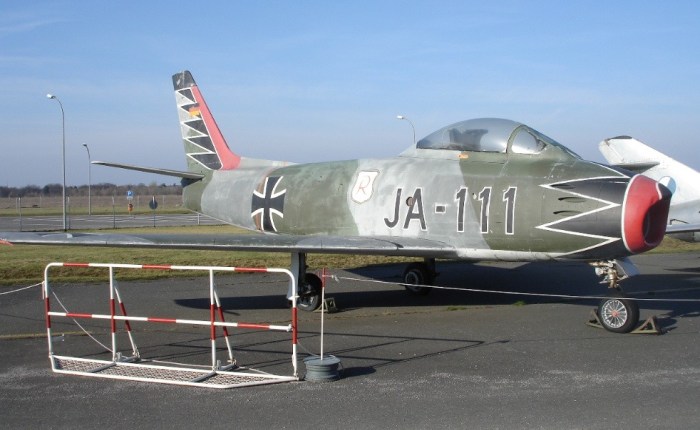
Header image: A Canadair Sabre at the Militärhistorisches Museum der Bundeswehr – Flugplatz Berlin-Gatow in Hartmann markings from when he commanded JG71, c. 2007 (Source: Wikimedia)

[1] Quoted in Edward H. Sims, Fighter Tactics and Strategy 1914-1970 (New York: Harper and Row, 1972), p. 208.

[2] Boyd referred to the ‘observation-decision-action time scale’ in the interview, which is not yet the familiar OODA loop since it lacks the orientation stage. United States Air Force Historical Research Center, U.S. Air Force Oral History Interview, K239.0512-1066, Colonel John R. Boyd, Corona Ace, 28 January 1977, p. 132.

[3] Erik Schmidt, Black Tulip: The Life and Myth of Erich Hartmann, the World’s Top Fighter Ace (Philadelphia, PA: Casemate Publishers, 2020), p. xiii.

[4] Schmidt, Black Tulip, p. 130.

[5] Schmidt, Black Tulip, p. 134; Robert Coram, Boyd: The Fighter Pilot Who Changed the Art of War (New York: Hachette Book Group, 2002), p. 244.

[6] John Stillion, Trends in Air-to-Air Combat: Implications for Future Air Superiority (Washington DC: Center for Strategic and Budgetary Assessments, 2015), p. 6.

[7] Schmidt, Black Tulip, p. 64.

[8] Philip Kaplan, Fighter Aces of the Luftwaffe in World War II (Barnsley: Pen and Sword Books, 2007), p. 192.

[9] Trevor J. Constable and Raymond F. Toliver, The Blond Knight of Germany (New York: Ballantine Books, New York, 1970), pp. 43-4.

[10] Quoted in Kaplan, Fighter Aces of the Luftwaffe in World War II, p. 195.

[11] Colin D. Heaton, ‘Final Thoughts of the Blond Knight,’ World War II 17, no. 3 (2002), p. 33.

[12] Constable and Toliver, The Blond Knight of Germany, p. 55.

[13] Rich Martindell and Bill Mims, ‘An Interview with Erich Hartmann, the Ace of Aces,’ in Tac Attack (Washington DC: Department of the Air Force, 1985), p. 23.

[14] Quoted in William Tuohy, ‘German Pilot Reported 352 Kills Hope of Top WWII Flier: No Need for New Air Aces,’ Los Angeles Times, 3 January 1986.

[15] Constable and Toliver, The Blond Knight of Germany, p. 86.

[16] C. Hind and A. Nicolaides, ‘Ace of Aces: Erich Hartmann the Blond Knight of Germany,’ Open Journal of Social Sciences 8 (2020), pp. 388-9.

[17] Edward E. Eddowes, ‘Measuring Pilot Air Combat Maneuvering Performance’ in First Symposium on Aviation Psychology (The Ohio State University Columbus: The Aviation Psychology Laboratory, 1981), p. 340.

[18] James H. Patton, Jr., ‘Stealth is a Zero-Sum Game: A Submariner’s View of the Advanced Tactical Fighter,’ Airpower Journal 5, no. 1 (1991), p. 7.

[19] Mikel D. Petty and Salvador E. Barbosa, ‘Improving Air Combat Maneuvering Skills Through Self-Study and Simulation-Based Practice,’ Simulation & Gaming 47, no. 1 (2016), p. 105.

[20] Petty and Barbosa, ‘Improving Air Combat Maneuvering Skills,’ p. 111.

[21] Petty and Barbosa, ‘Improving Air Combat Maneuvering Skills,’ p. 123.

[22] Schmidt, Black Tulip, p. 64.

[23] U.S. Air Force Oral History Interview, p. 240.

[24] In addition to The Blond Knight of Germany, Boyd may have read Edward H. Sims’ Fighter Tactics and Strategy 1940-1970 (1972), which also explained the SDAB cycle before the OODA loop emerged. Sims, Fighter Tactics and Strategy, 204-5

[25] Franklin C. Spinney, ‘Genghis John,’ Proceedings 123 (1997).

[26] Boyd advised in ‘Organic Design for Command and Control’ to operate inside enemy OODA loops ‘to enmesh adversary in a world of uncertainty, doubt, mistrust, confusion, disorder, fear, panic chaos.” Boyd also added in ‘The Strategic Game of ? and ?’: “Operating inside their OODA loops will accomplish just this by disorienting or twisting their mental images so that they can neither appreciate nor cope with what’s really going on.’ John R. Boyd, ‘Organic Design for Command and Control’ and ‘The Strategic Game of ? and ?,’ in Grant T. Hammond (ed), A Discourse on Winning and Losing (Maxwell AFB: Air University Press, 2018), p. 224 and 302.

[27] Boyd, towards the end of his life, refined the OODA loop into a vastly more complex idea involving multiple feedback loops and different relationships and pathways between the four stages. However, the idea of getting inside the enemy’s OODA loop and gaining a relative speed advance is evident in the earlier basic OODA loop and the final complex OODA loop. This key idea remained constant during the OODA loop’s evolution. Therefore, when referring to the OODA loop in this article, all versions of the OODA loop are referred to unless otherwise specified.

[28] U.S. Air Force Oral History Interview, p. 134.

[29] Frans P.B. Osinga, Science, Strategy and War: The Strategic Theory of John Boyd (New York: Routledge, 2006), p. 28.

[30] John R. Boyd, Aerial Attack Study, 50-10-6C, 1964.

[31] Osinga, Science, Strategy and War, p. 22.

[32] Grant Hammond, The Mind of War: John Boyd and American Security (Washington DC: Smithsonian Books, 2001), p. 80.

[33] Thomas McKelvey Cleaver, Going Downtown: The US Air Force over Vietnam, Laos and Cambodia, 1961-75 (Oxford: Osprey Publishing, 2022), p. 102.

[34] Barry D. Watts, Doctrine, Technology, and War, Air & Space Doctrinal Symposium Maxwell AFB, Montgomery, Alabama 30 April-1 May 1996.

[35] Watts, Doctrine, Technology, and War.

[36] Watts, Doctrine, Technology, and War.

[37] Schmidt, Black Tulip, p. 69.

[38] John R. Boyd, ‘Patterns of Conflict (Transcript),’ in Discourse on Winning and Losing, Marine Corps University, Quantico, 25 April, 2 May, 3 May 1989, p. 10.

[39] Boyd, ‘Patterns of Conflict (Transcript),’ p. 10.

[40] Boyd, ‘Patterns of Conflict (Transcript),’ p. 10.

[41] Jim Storr, The Human Face of War (London: Bloomsbury Publishing 2009), p. 13.

[42] Storr, The Human Face of War, p. 13.

[43] Storr, The Human Face of War, p. 13.

[44] For a comprehensive analysis of Boyd’s relationship with the ‘Knights of the Air’ myth, see Michael W. Hankins, Flying Camelot: The F-15, the F-16, and the Weaponization of Fighter Pilot Nostalgia (Ithaca, NY: Cornell University Press, 2021).

[45] Heaton, ‘Final Thoughts of the Blond Knight,’ p. 33.

[46] Frans P. B. Osinga, ‘The Enemy as a Complex Adaptive System: John Boyd and Airpower in the Postmodern Era,’ in John Andreas Olsen (ed.), Airpower Reborn: The Strategic Concepts of John Warden and John Boyd (Annapolis, MD: Naval Institute Press, 2015), p. 74.

[47] Heaton, ‘Final Thoughts of the Blond Knight,’ p. 85.

[48] Boyd explained in Patterns of Conflict: ‘It doesn’t make any difference whether you’re a Russian, you’re an Englishman, an American, Chinese or what. You have to observe what the hell’s going on here. Then you have to, as a result of that, looking at the world, you generate images, views, and impressions in your mind. That’s what you call orientation. Then as a result of those images, views, and impressions, you’re going have to make a selection, what you’re going to do or what you’re going to do, that’s a decision. And then you’re going to have to implement or take the action.’ Boyd, ‘Patterns of Conflict (Transcript),’ p. 11.

[49] John R. Boyd, Destruction and Creation (Paper), 3 September 1976, pp. 2-3.

[50] Boyd, ‘The Strategic Game of ? And ?,’ pp. 261-5.
#FilmReview – Masters of the Air, Episode Seven

#FilmReview – Masters of the Air, Episode Seven

By Dr Luke Truxal

Editorial note: On 26 January 2024, Apple TV+ launched the much-anticipated series Masters of the Air. This series follows the actions of the US 100th Bomb Group during the Combined Bomber Offensive in the Second World War. As the series is being aired, our Book Reviews Editor, Dr Luke Truxal, the author of Uniting against the Reich (2023), will critically review each episode.  

For the first time in the Masters of the Air television series, I was genuinely disappointed in an episode. There were two significant issues with this episode. The first major problem has now become a glaring problem for the show, which is the inability to tell a story outside the US 100th Bomb Group with the quality that it deserves. This is either because the show relies so heavily on veteran accounts that it cannot tell the larger story or because the show only half-heartedly covers the topic, like checking a box on an essay due at the end of class. The second major issue is that this episode wasted priceless minutes of television time covering stories and plots that, in the grand scheme of things, are not as important as other aspects of the air war. In many respects, this is likely a major reason why the show will do some more box-checking in the coming episodes. The series spends too much screen time on less critical plots and must condense more essential stories into the final two episodes.

For this review, I will not give an overview of the episode and jump straight into the problems because there is much to criticise. The first major issue that this episode, and the show more generally, struggle with is its treatment of those not members of the 100th Bomb Group. First, generals are written as blundering fools who do not care about their men. In the third episode, Colonel Curtis LeMay’s aggressiveness is blamed for the disaster of the Schweinfurt-Regensburg raid, even though he flew in the lead plane for the mission. Also, it left out the debates that US VIII Bomber Command struggled with in determining whether to send out the raid. This theme continued in this episode. While the episode did a good job of covering the aftermath of the 6 March 1944 Berlin raid well, during the planning and briefing of the 8 March raid, the writers decided to portray the commander of the US Eighth Air Force, Lieutenant General James Doolittle, and the commander of the United States Strategic Air Forces in Europe, Lieutenant General Carl Spaatz, as blundering fools who are using the same navigational route for back to back raids. As an audience member, it is hard to decide whether the showrunners want us to believe these men are unintelligent, lazy, or do not care. Most likely all the above. For perspective, the navigational route was chosen because it avoided flak concentrations and limited combat losses.[1]

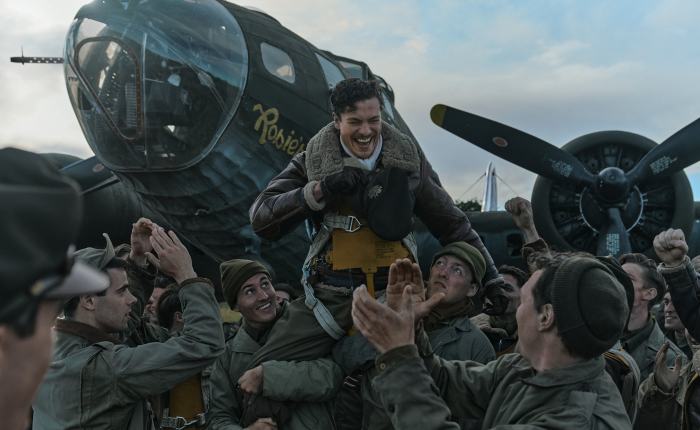
Masters_Of_The_Air_Photo_010707
Kai Alexander and Bailey Brook in Masters of the Air. (Source: Apple TV+)

The show did not stop there. At the end of this episode, the new commander of the 100th Bomb Group, Lieutenant Colonel John Bennett, lays out the latest air strategy for gaining air superiority at the end of the episode to Captain Robert Rosenthal. He states that the new strategy going into March and April 1944 will be to win the air war by using the bombers as bait for the fighters so that the newly arrived long-range escort fighters, the North American P-51 Mustangs, can shoot down the German fighters. There are so many ways in which that scene does an injustice to the strategic, operational, and tactical changes Spaatz and Doolittle implemented at the beginning of 1944. Starting with the strategic picture. Spaatz rightfully argued that Operation OVERLORD could not go forward if the air superiority had not been gained before troops began landing in Normandy. This was a huge point of contention between Spaatz and the commander of the Allied Expeditionary Air Forces, Air Chief Marshal Leigh-Mallory.[2] Spaatz went into 1944 to grind down the Luftwaffe through a large series of air battles carried out through the skilful concentration of all American air forces in the European and Mediterranean Theaters of Operations. Spaatz deserves much credit for bringing maximum pressure to bear on the Luftwaffe and degrading their combat effectiveness, starting with Big Week from 20 to 25 February 1944 and continuing through March and April 1944. Furthermore, the tactical changes implemented by the Eighth Air Force came from Doolittle. Doolittle changed the fighter tactics when he took over the Eighth Air Force from Lieutenant General Ira Eaker in January 1944. This came in two parts. First, American fighter pilots were no longer merely escorts as they were in 1943. Once engaged, American fighter pilots were to pursue German fighters even if it meant leaving the bomber stream. This was a more effective means to gain air superiority by prioritising shooting down German fighters. Additionally, Doolittle adopted the idea of using a bouncing fighter group, whose job was to roam the edges of the bomber formation in search of German fighters preparing to attack the bombers. These are well-known changes to scholars of the air war and can be easily told on screen to an audience. However, by stating that the generals wanted to use the bombers as bait, the show has given the impression to the audience that the American generals do not care about their losses and that this is simply a numbers game for the brass.

Another problem with this show is the anti-British bias that shows up. By this point, I wonder whether the showrunners think the British military can do anything well. While the criticisms of the British night bombing strategy in the second episode of the series were warranted, the scene did not convey the message well. I initially thought this was merely a poorly written-scene. At this point in the series, I think it is safe to say that whoever is writing the scenes regarding the British military holds them in contempt. It comes up again and again throughout the episodes. Sometimes in tiny doses. At other times, quite openly, as we saw in episodes two and six. In this episode, we get two more doses of British failures. While listening to the radio at Stalag Luft III, the Americans hear about the British failure to take Monte Casino in Italy. Later in the episode, there is the failure of the Great Escape, in which 76 British and Commonwealth prisoners escape the camp. Only three can evade captivity and get back home. Of the 73 that were captured, 50 were executed in retaliation. This is a significant moment for those living at Stalag Luft III and is a sign of British and Commonwealth prisoners continuing to wage war against the Germans using whatever means are at their disposal, including escape. Instead, it is portrayed as another British failure, and the consequences make life at the camp harder for the Americans of the 100th Bomb Group interred there. These are just two examples of the shortcomings of this show to tell the bigger picture. Where Band of Brothers (2001) and The Pacific (2010) did a much better job providing context, Masters of the Air has fallen dreadfully short by putting so much emphasis on the perspective of the airmen. There is no sugarcoating it: this show is bad at telling stories outside the 100th Bomb Group.

These problems pale in comparison to the poor use of screen time in this episode. Much of this episode was dedicated to two plots that did not serve a significant purpose and took away screen time to lay the groundwork for more critical plots. First, much of the plot at Stalag Luft III centred on maintaining some news of the outside world using a handmade radio that the airmen kept hidden. While this did indeed happen, the radio plot took away time that could have be en better spent. While at Stalag Luft III, Major John Egan handled security, and Major Buck Clevan oversaw education at the South Compound.[3] Telling these stories provides more insight into camp life than focusing on losing and rebuilding a radio. Furthermore, the show ended teasing that the Tuskegee airmen would first appear in the eighth or nine episodes. It would have been nice to use some of the time in this episode to show the challenges black airmen faced in their fight to serve their country as fighter pilots and help orchestrate significant civil rights changes in the military through their service. Instead, like with the film Red Tails, Masters of the Air has chosen to skip the crucial challenges faced during training in the United States. This was a big missed opportunity. This is why this episode is so bad. The US 332nd Fighter Group’s story deserves more than a token appearance in the television series. Either tell the story well or save that story for a different television series. Simply throwing this story in without telling the back story does not do the history or airmen justice. For a better portrayal of black fighter pilots’ challenges, see the film The Tuskegee Airmen (1995).

This episode was a disappointment. This review cannot do a proper recap and review that covers every issue with this episode. Instead, I highlighted major flaws and trends in the episode and series. The treatment of other nationalities fighting against the Axis and the treatment of high-ranking officers do this series and subject a disservice. These are symptoms of long-growing problems with this show. This specific episode wasted valuable screen time on less essential plots like Captain Harry Crosby’s fictional infidelity and the time spent fixing a radio. By spending valuable minutes on these storylines, the show missed great opportunities to tell important narratives. This will have grave consequences as the show tries to introduce new storylines and wrap up the show in the final two episodes. Unfortunately, this is where the show is headed. Masters of the Air seems determined to give token coverage to serious issues while wasting valuable time on less important topics. This is an unfortunate development for a show I have come to enjoy.

Dr Luke Truxal is an adjunct at Columbia State Community College in Tennessee. He completed his PhD in 2018 from the University of North Texas with his dissertation ‘Command Unity and the Air War Against Germany.’ His previous publications include ‘Bombing the Romanian Rail Network’ in the Spring 2018 issue of Air Power History. He also wrote ‘The Politics of Operational Planning: Ira Eaker and the Combined Bomber Offensive in 1943’ in the Journal of Military Aviation History. In addition, Truxal is researching the effectiveness of joint air operations between the Allied air forces in the Second World War. He can be reached on Twitter at @Luke_Truxal.

Header image: Nate Mann in Masters of the Air. (Source: Apple TV+)

[1]  Donald Caldwell and Richard Muller, The Luftwaffe Over Germany: Defense of the Reich (Barnsley: Frontline Books, 2014), p. 168.

[2] Luke Truxal, Uniting Against the Reich: The American Air War in Europe, (Lexington: University Press of Kentucky, 2023), p. 115-7.

[3] Donald Miller, Masters of the Air: America’s Bomber Boys Who Fought the Air War Against Nazi Germany (New York: Simon and Schuster, 2006), p. 389.

#FilmReview – Masters of the Air, Episode Six

#FilmReview – Masters of the Air, Episode Six

By Dr Luke Truxal

Editorial note: On 26 January 2024, Apple TV+ launched the much-anticipated series Masters of the Air. This series follows the actions of the US 100th Bomb Group during the Combined Bomber Offensive in the Second World War. As the series is being aired, our Book Reviews Editor, Dr Luke Truxal, the author of Uniting against the Reich (2023), will critically review each episode.  

Episode six of Masters of the Air was a transition episode. From now on, the television series will focus on the stories of three main characters and the stories around them. Additionally, the show is now trying to broaden its perspective from the US 100th Bomb Group to tell other stories related to the air war. Overall, this episode did a good job of setting up this new format, but whether the show will benefit from changing its approach to storytelling remains to be seen.

John Orloff’s thesis in episode six is about three men running from their fates. The show begins with Major John Egan trying to evade German police, military, and civilians. For the first time in the show, Egan faces the consequences of his actions as he encounters German civilians who either fear him or want to kill him in retaliation for the American air raids that are killing civilians as collateral damage in their bombing campaign or more directly trying to kill them to bring pressure on German morale as we saw in the last episode. There are several moments where it seems like Egan will escape his fate by evading his captors, but Egan is not so fortunate. He must face the brutal experience of being a prisoner of war at Stalag Luft III.

While Egan tried to escape capture, Lieutenant Robert Rosenthal attempted to run from the burden of leadership. During the episode, Rosenthal and his crew are sent to a ‘Flak Farm’ to recuperate after being the sole plane from the 100th Bomb Group to return from the 10 October 1943 Munster raid. Rosenthal spends much of the episode distancing himself from his crew. While Rosenthal makes it clear to those around him that he feels a deep sense of duty to continue flying and fighting the war, he is also reluctant to really engage with his men during this time off. Ultimately, Rosenthal comes to terms with the reality that he is not just a pilot fighting the war against Germany but also a crucial leader for his crew and the 100th Bomb Group. This is shown in Rosenthal’s final scene. He is standing at the door of his plane and gathering the inner strength to get inside one more time. This matters to his men, and the new crews witness someone who barely survived ‘Black Week’ going back into battle with a workman-like attitude.

Finally, Captain Harry Crosby spends the episode running away from his demon, survivor’s guilt. Crosby does not discuss losing his friend, Captain Joseph ‘Bubbles’ Payne. At the beginning of the episode, he is sent to attend a series of Oxford lectures designed to encourage greater cooperation amongst Allied personnel. During this episode, he meets Subaltern Alessandra Westgate. Her role in the war is never clear, but much speculation exists. Crosby spends much of the episode trying to bury his feelings about the loss of Payne by attending lectures and parties, but he finally unloads his guilt on Westgate. He questions why he survived, and Payne did not. Ultimately, Westgate reminds Crosby that this is not his fault. It is the fault of Germany for starting this war and bringing about the destruction that has affected so many lives as a result.

Masters_Of_The_Air_Photo_010606
Austin Butler in Masters of the Air. (Source: Apple TV+)

While a solid episode, some problems need to be discussed. First, the show has gone to great lengths to try and separate the Luftwaffe and the actions of the SS and Gestapo. This plays into the ‘clean Luftwaffe’ myth, which historians like Victoria Taylor are trying to debunk with their research. The head of the Luftwaffe, Reichsmarshall Herman Goering, was one of the early members of the Nazi Party and participated in the Beer Hall Putsch in Munich. He was one of the most senior-ranking members of the Nazi Party at this point in the war. The Luftwaffe that he created embraced the ideals of the Nazi Party. The show fails to show that the Luftwaffe interrogation techniques were different because the Luftwaffe believed that they were more effective at acquiring information from American airmen. Also, this is the same Luftwaffe that executed 50 British prisoners during the Great Escape. Donald Miller wrote about why the Luftwaffe used a different interrogation approach in his book Masters of the Air.[1] This is another instance where the show might have benefited more by adding a little bit more context, but unfortunately, it failed here.

Overall, this episode showed three new aspects of the air war through the attempts by Egan, Rosenthal, and Crosby to evade their own personal battles in the air war. We see ‘Flak Houses’ covered in decent detail, the struggle of those who question why they were left behind, and finally, through Egan, we know the experience of those who try to escape but are captured. While there are problems that historians will have with this episode regarding the treatment of the Luftwaffe, this episode does highlight more aspects of the air war for audiences less educated on the experience of American airmen. Like with the first three episodes, the show struggles to put the experiences of American airmen into a broader context that audiences and scholars could really benefit from. This was another good but not great episode.

Dr Luke Truxal is an adjunct at Columbia State Community College in Tennessee. He completed his PhD in 2018 from the University of North Texas with his dissertation ‘Command Unity and the Air War Against Germany.’ His previous publications include ‘Bombing the Romanian Rail Network’ in the Spring 2018 issue of Air Power History. He also wrote ‘The Politics of Operational Planning: Ira Eaker and the Combined Bomber Offensive in 1943’ in the Journal of Military Aviation History. In addition, Truxal is researching the effectiveness of joint air operations between the Allied air forces in the Second World War. He can be reached on Twitter at @Luke_Truxal.

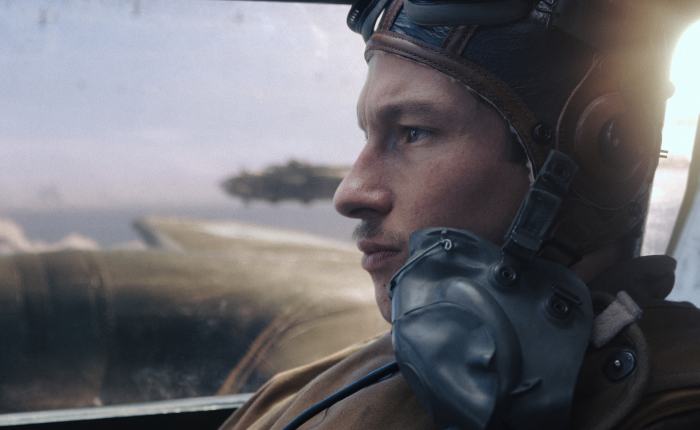
Header image: Callum Turner in Masters of the Air. (Source: Apple TV+)

[1] Donald Miller, Masters of the Air: America’s Bomber Boys Who Fought the Air War Against Nazi Germany (New York: Simon and Schuster, 2006), pp. 386-7.

#FilmReview – Masters of the Air, Episode Five

#FilmReview – Masters of the Air, Episode Five

By Dr Luke Truxal

Editorial note: On 26 January 2024, Apple TV+ launched the much-anticipated series Masters of the Air. This series follows the actions of the US 100th Bomb Group during the Combined Bomber Offensive in the Second World War. As the series is being aired, our Book Reviews Editor, Dr Luke Truxal, the author of Uniting against the Reich (2023), will critically review each episode.

At halfway through Masters of the Air, we finally reached the culmination point for the Americans during the 1943 air offensive, Black Week. There are a lot of essential storylines that the creators of Masters of the Air needed to nail with the exact right tone. For the first time in a televised depiction of the American air war against Germany, we get two new major themes the series tries to address. First, losing. Black Week, which lasted from 8 to 14 October 1943, was the final straw for the US Eighth Air Force. During the course of the week, American aircrew and bomber losses reached such a level that they could no longer maintain their air offensive. Films such as Twelve O’clock High (1949) and Memphis Belle (1990) depict the mounting casualties, but we never see the Americans lose at the end of the day. Even in Band of Brothers (2001) and The Pacific (2010), Americans perform quite well. The Market-Garden episode was the only episode amongst those previous works that depicted a setback, but it was only for a single episode. Masters of the Air has been building to this point since it began. Another major topic that the series addresses that usually gets overlooked on film is attacks on German civilians. Previous depictions of the air war typically avoid discussing the morality of the air war, but Masters of the Air takes it on. This episode breaks much ground in how the air war is depicted on film. For the first time, audiences are getting to see an American campaign end in a loss, and the United States shift towards attacks against civilians.

The episode begins with Major John Egan drinking in a B-17 Flying Fortress and struggling with losing his good friend, Major Gale Clevan. Egan has been hit hardest by the loss of his good friend. While the group is reeling, they do get some good news with the arrival of Captain Everett Blakely’s crew and navigator Second Lieutenant Harry Crosby. After everyone reconvenes at the bar, we soon learn that Crosby has been promoted to group navigator and Captain Joseph ‘Bubbles’ Payne has been demoted. Crosby is told to report to headquarters when the red light flashes to begin planning the next mission. On cue, the red light starts flashing, and viewers get a behind-the-curtain look at the chaos that occurs as the group plans for its next raid. It is not unheard of for those involved in planning to work nights and sleep during the day. Crosby mentions the stress of planning and briefing his fellow navigators. He feels the weight of the whole group on his shoulders and wonders if something he did wrong could lead to calamity.

During the briefing, the new mission and target are announced. It is Munster. The target is the marshalling yards in the city centre. During the briefing, it was also noted that the bombs would likely also hit German workers living next to the rail yards. The yards are next to the town cathedral, and the mission is flown on Sunday, 10 October 1943. This does not sit well with group members like the veteran Captain Charles Cruikshanks. He and Egan argue over the merits of attacking German civilians, including women and children. Egan argues that it will bring the war to an end earlier, but despite his words, this is really about revenge. As the conversation ends, Cruikshanks is still clearly unhappy with the tenor of the conversation and target selection. This great scene shows the divide among American airmen over the shift to area bombing during the war. American airmen knew attacking civilians through area bombing was both a war crime and morally wrong. Also, this was not how they were trained to prosecute their air offensive. Yet others, like Egan, thought it was a way to hasten the war’s end. It is a great scene that does not seek to justify area bombing but simultaneously exposes the divisions amongst the Americans over the switch in tactics. A lot of television series and movies would have punted on this topic. John Orloff, who wrote this episode, deserves much credit for tackling this subject and writing these scenes well.

Masters_of_the_Air__Photo_010503
Nate Mann in Masters of the Air, episode five. (Source: AppleTV+)

As the bombers take off, we learn that the 100th Bomb Group can only muster 17 B-17s for this raid, many of which are loaned to them by other groups. As the groups formed, we quickly learned that the 100th Bomb Group was too far behind the rest of the 14th Bombardment Wing. Making matters worse, four B-17s had to turn back due to aircraft malfunctions, leaving the strike force with only 13 B-17s. They are too far back from the other groups and short on aircraft. Egan notes that they are a perfect target for the Luftwaffe. As the bombers approached the target, German fighters attacked in massive head-on passes. One can understand why viewers might think this scene is an embellishment of the actual air battle, but it was not. Approximately 200 German fighters attacked the 14th Bombardment Wing, singling out the 100th Bomb Group in the rear of the formation. In a matter of minutes, veterans that we had come to love are shot down. Egan and Brady bail out, Cruikshanks falls out of formation, and his crew bail out, and finally, we see the B-17 with Bubbles on it take a direct hit and collide with another B-17, killing him in the explosion. The perspective has switched to Rosenthal’s aircraft and crew by this point. The combat is so fast and intense that Rosenthal and the viewers experience the same shock when they realize his ship is the last in the formation, still in the air. The music is great here to create a sense of both eeriness and fear as the aircrew comes to grips with the fact that an entire bomb group has been blasted out of the sky for the first time in the air war. During the historical raid, German fighters eliminated the 100th Bomb Group during the first 10 minutes of a 45-minute air battle.[1] The show does a great job of showing how fast and sudden these losses are.

Back at Thorpe Abbotts, everyone waits for the return of the bombers. The first sign that something is wrong occurs when a bomber from the 390th Bomb Group arrives at the airfield. Colonel Neil “Chic” Harding calls the bomber to ask what happened to his bombers and soon finds out that they are all gone. As this occurs, Rosenthal’s plane returns, giving some hope that more might have made it back. That hope is soon dashed as Rosenthal’s crew relates the mission’s events in interrogation. The mood is sombre. The episode ends with Crosby packing up his good friend Bubbles’ foot locker to send home to his family. This is where Crosby finally breaks down and cries. For many of the airmen and ground personnel in the 100th Bomb Group they have reached the end of the line for this campaign physically and emotionally. This is how the 1943 campaign ended for many other groups. This is where we leave the 100th Bomb Group in the next episode. Episodes four and five are the best of the series by far. We have seen the morality of the air war brought into question, and the Americans lost the air war in 1943. Those who worked on this project went on a limb in the last two episodes by depicting sides of the air war that scholars are familiar with but rarely make their way to the big screen. They have created two great episodes that audiences can absorb, and scholars can use to teach about the air war.

Dr Luke Truxal is an adjunct at Columbia State Community College in Tennessee. He completed his PhD in 2018 from the University of North Texas with his dissertation ‘Command Unity and the Air War Against Germany.’ His previous publications include ‘Bombing the Romanian Rail Network’ in the Spring 2018 issue of Air Power History. He also wrote ‘The Politics of Operational Planning: Ira Eaker and the Combined Bomber Offensive in 1943’ in the Journal of Military Aviation History. In addition, Truxal is researching the effectiveness of joint air operations between the Allied air forces in the Second World War. He can be reached on Twitter at @Luke_Truxal.

Header image: Callum Turner in Masters of the Air. (Source: Apple TV+)

[1] Donald Caldwell and Richard Muller, The Luftwaffe Over Germany: Defense of the Reich (Barnsley: Frontline Books, 2014), pp. 132-4.

Call for Submissions: Air Power and 1944 Revisited

Call for Submissions: Air Power and 1944 Revisited

In 2024, From Balloons to Drones will run a series of articles that examines the role of air power during the defining year of the Second World War – 1944.

The year 1944 was the defining year of the Second World War. Events such as the fall of Rome, the invasion of France and the destruction of Germany’s Army Group Centre on the Eastern Front defined the war in Europe. In the Pacific and Southeast Asia, events such as the Battles of Imphal and Kohima and the Battle of the Philippine Sea marked important points in the war. In the strategic air war, the Combined Bomber Offensive in Europe peaked. At the same time, the Boeing B-29 Superfortress was introduced in the Far East and Pacific as the US increased its strategic air operations in this theatre of operations.

2024 marks the 80th Anniversary of the critical events of 1944. At all levels of war, air power played an essential role in the various battles and campaigns of 1944. As such, From Balloons to Drones is seeking submissions for articles examining the varied use of air power in 1944. Articles might, for example, explore the strategic air campaigns of 1944, the use of tactical air power, or the use of carrier-based air power. Possible themes to be explored might include, but are not limited to:

Strategy, Theory and Doctrine | Organisation and Policy | Roles
Operations – Kinetic and Non-Kinetic | Tactics, Training and Procedures
Strategic and Operational Effect | Technological Developments | Ethical and Moral Issues
National, International and Transnational Experiences | Personal Experiences
Memory and Memorialisation

We are looking for articles of between 500 to 4,000 words, but we will accept larger pieces and reserve the right to publish them in parts. Please visit our submissions page for more information on the types of articles published by From Balloons to Drones.

We plan to begin running the series in March 2024, and it will continue for as long as we receive potential contributions. We welcome and encourage submissions from academics, policymakers, service personnel, and relevant professionals.

Submissions should be submitted in Word format and emailed to the email address below with ‘SUBMISSION – Air Power and 1944 Revisited’ in the subject line. Also, please include a 50-100-word biography with your submission. Footnotes can be used, and please be careful to explain any jargon. If you are unsure if your idea fits our requirements, please email us with ‘POTENTIAL SUBMISSION – Air Power and 1944 Revisited’ in the subject line to discuss.

If you are interested in contributing, please email our Editor-in-Chief, Dr Ross Mahoney, at airpowerstudies@gmail.com or contact us via our contact page here.

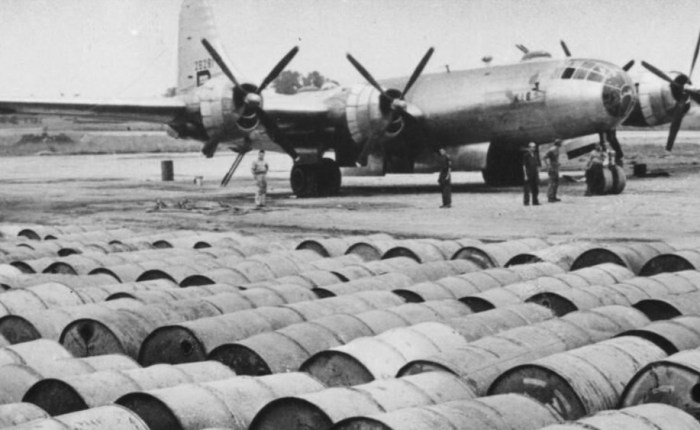
Header image: Rows of fuel tanks in front of a B-29 Superfortress of the 40th Bombardment Group assigned to the US Twentieth Air Force in China, c. 1944. (Source: Wikimedia)

#HistoricBookReview – The Air War, 1930-1945

#HistoricBookReview – The Air War, 1930-1945

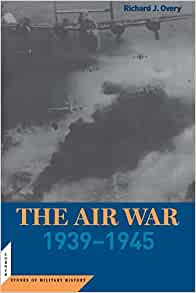
Richard J. Overy, The Air War, 1930-1945. Potomac Edition. Washington DC: Potomac Books, 2005. Appendices. Tables. Photographs. Notes. Bibliographic Note. Bibliography. Index. vii + 267 pp.

Reviewed by Ryan Clauser

41tfIOXZPWL._SY291_BO1,204,203,200_QL40_ML2_

Few historical works have altered the course of a field of study in the way Richard Overy’s The Air War, 1939-1945 did when it was first published in 1980. When the book was published initially, air power history, as a field of academic study, was in its infancy and had been mainly regarded as the ‘Cinderella’ of military history (p. 240). However, Overy’s work transformed the historiography of air power history with his comparative study of the most important air forces of the Second World War.

The importance of Overy’s The Air War is hard to overstate, especially as the book has been reprinted twice in 1987 and 2005. In the most recent edition, that under reviewe here, Overy, now an Honorary Professor at the University of Exeter in the UK, provided the reader with new additions in the form of new statistical figures, updated research, and notes from the author. These new additions illustrate Overy’s dedication to his work and has helped keep The Air War an essential source for historians and remains one of the premier air power history texts. Since the publication of the first edition of The Air War, Overy has continued to write extensively about air power history and the history of the Second World War, including works such as Why the Allies Won (1995), The Battle of Britain: Myth and the Reality (2001), Interrogations: The Nazi Elite in the Allied Hands, 1945 (2001), The Bombing War: Europe 1939-1945 (2013) and most recently Blood and Ruins: The Great Imperial War, 1931-1945 (2021). Potomac Books published the latest edition of The Air War as part of their Cornerstones of Military History collection.

Overy starts his work by proclaiming that ‘this is not a ‘blood and guts’ book about the air war’ (p. xiii), but rather a study that aims to compare and contrast the air forces of the warring nations along with their preparations, strategies, leadership, economics, and development. The Air War sought to provide a greater overview and understanding of the discrepancies between Allied and Axis air forces and fully explain air power’s role throughout the war.

Lancaster_B_MkI_44_Sqn_RAF_in_flight_1942
Three Avro Lancaster BMkIs of No. 44 Squadron, Royal Air Force based at Waddington in Lincolnshire, flying above the clouds, 29 September 1942. Left to right: W4125, ‘KM-W,’ being flown by Sergeant Colin Watt, Royal Australian Air Force; W4162, ‘KM-Y,’ flown by Pilot Officer T.G. Hackney (later killed while serving with No. 83 Squadron); and W4187, ‘KM-S,’ flown by Pilot Officer J.D.V.S. Stephens DFM, who was killed with his crew two nights later during a raid on Wismar. (Source: © IWM TR 197)

The Air War begins with an overview of each combatant nation’s preparations for war and their overall use of air power. Overy wrote that air power theory and doctrine had matured in the years leading up to and throughout the Second World War. These new ideas stated that air power could be used in many ways, such as: protecting naval power, close air support, strategic bombing, and air defence. For example, naval aviation was invaluable for Japan as the Imperial Japanese Navy used it to develop carrier strike forces. The development of Japanese naval air power sought to offset the advantages that western navies, such as the United States and Great Britain, held over Japan. However, for other Axis nations, naval air power was non-existent as Germany and Italy saw no merit in committing resources to build aircraft carriers. Instead, Germany and Italy subscribed to the theory that air power was best suited for a role in supporting their armies. However, the Allies crafted their air power doctrine more holistically to encompass all aspects of military aviation, including naval support, support of armies, strategic bombing, and aerial defence, all of which played critical roles in the Allied air war.

Overy breaks down the Second World War by year and the theatre of operation beginning with the early War in Europe spanning from 1939 to 1941. This section discusses Germany’s and the Axis’ initial success with close air support and air interdiction. However, Germany’s victories were quickly halted following the fall of France and the beginning of the Battle of Britain. Left as the only attacking force capable of striking the United Kingdom from occupied France, the Luftwaffe found itself in a role for which it was wholly unprepared. In contrast, the British utilised a far more general strategy to successfully defend their nation and launch a strategic bombing campaign of their own. Overy stated that, ‘the German rejection of a more general air strategy coincided with shifts in the war itself that made such a strategy more rather than less necessary’ (p. 37). While the air war was still an essential facet of the Second World War in its first two years, it had yet to fully mature on the battlefield.

For the rest of the war in Europe, 1941 to 1945, Overy explains how the allies’ general air strategy put them at a far more significant advantage in the air war compared to their Axis counterparts. As described by Overy, this generalist strategy allowed the allies to combine the many facets of air power, including aerial defence, ground and naval support, and strategic bombing, into one encompassing approach to the war in the air. This perspective also helped mature the Allies use of air power throughout the war. Further, the economics of the air war is also stressed. As Overy pointed out, the United States alone had seen a steady increase in aircraft production every year since 1942, and by 1944 they were outproducing Germany at a rate of nearly three to one in aircraft. Additionally, the Americans suffered less than half the losses of the Germans in the air throughout the war. These factors combined led the allies to victory in the air war and the war in general.

Zero_Akagi_Dec1941
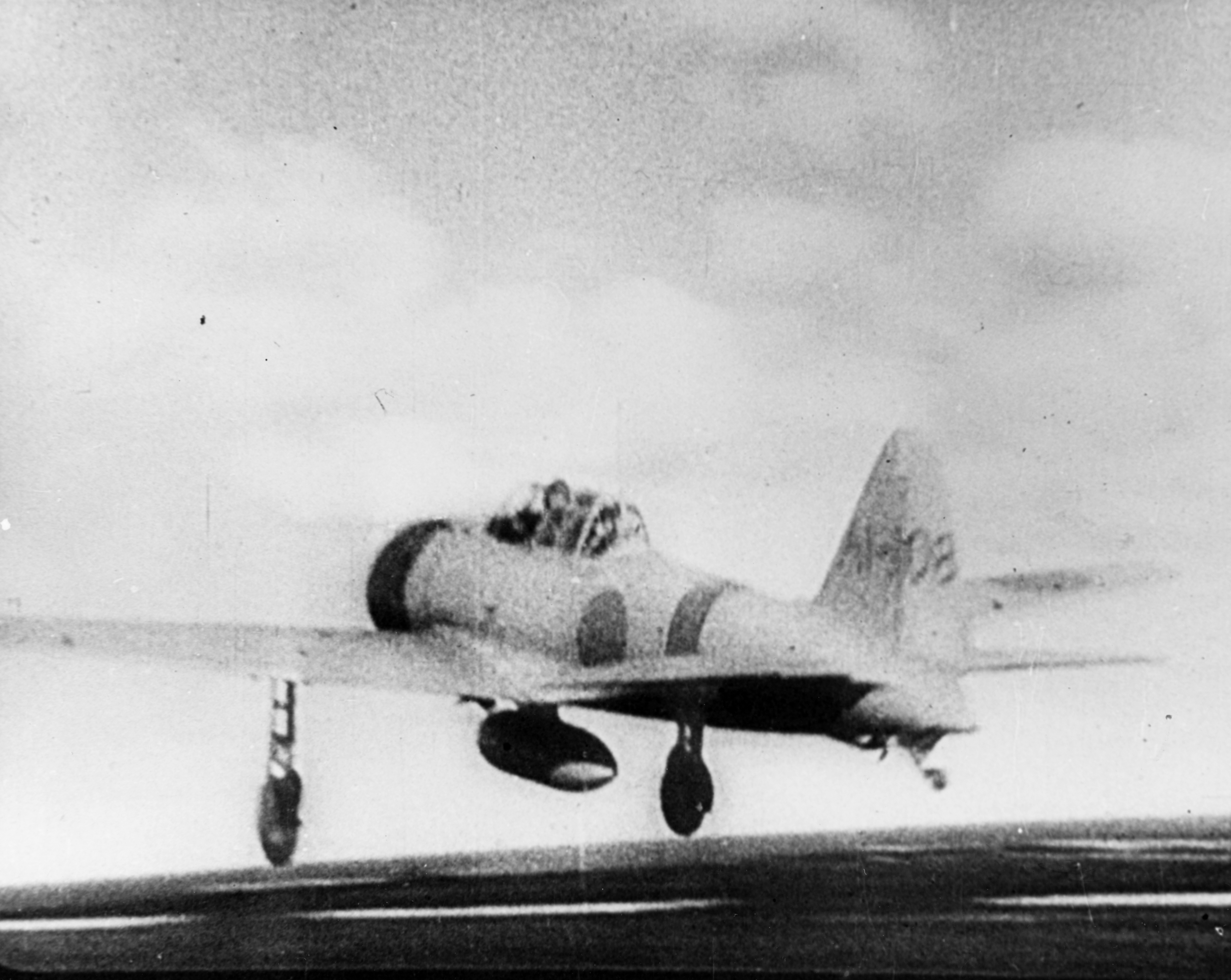
An Imperial Japanese Navy Mitsubishi A6M2 ‘Zero’ fighter takes off from the aircraft carrier ‘Akagi,’ on its way to attack Pearl Harbor during the morning of 7 December 1941. The aircraft was flown by PO2c Sakae Mori, 1st koku kantai, 1st koku sentai, and flew with the second wave. (Source: Wikimedia)

The war in the Pacific was strategically a much different conflict than the one in Europe. Japan’s approach to air power was to use it mainly as a supporting arm of its navy to create a multi-faceted naval strike force. Japan used their war with China to hone this strategy and their aviation technology. This early period of war for Japan allowed them to create a superior fighter aircraft in the Mitsubishi A6M Zero and allowed them to hold the upper hand for a time in their war against the United States and Great Britain following the attack on Pearl Harbor. As the war in the Pacific persisted, the Allies again found multiple roles for airpower and again committed to a generalist strategy in the east. Continuously, like the war in Europe, economics played an essential role in the Pacific, as even by 1941, Japan had begun realising that their economy was in short supply of the raw materials needed to fight a war. This hampered the Japanese war effort and nearly crippled its ability to produce aircraft. By the end of the war, Japan’s aircraft industry could barely replace what was being lost in combat, while the Americans kept producing increasingly better aircraft at staggeringly higher rates. Again, Overy emphasises that the Allied generalist strategies and superior economies were able to win the air war in the east.

While strategy and economics are at the heart of Overy’s work, he also delved into other aspects of the air war, including leadership, training, organisation, science, and research of each nation’s air force, all of which played a crucial role in the air war at large. Each of these additional factors was eventually influenced at some juncture in the war by the strategy and economics of each nation and how they chose to operate their air forces. Nonetheless, each of these additional factors played a significant role in the air war of the Second World War.

Throughout the course of Overy’s research, he relied heavily on official documents, public records, and memoirs of pilots, military commanders, and government officials. Overy was also fortunate to have access to various German records housed with the Imperial War Museum in London while researching the book in the 1970s. That said, while access to some sources was abundant, others, specifically those dealing with the Soviet Air Force, were scant at best and were limited to what the Soviet government saw fit to publish. Another issue in researching this project was the state of air power scholarship, which was in its infancy. Due to this, Overy was forced to depend on more general studies of aircraft, economics, and World War II for secondary sources. A problem that the publication of the book itself began to rectify. Overy also admits that he utilised fictional and popular publications to get a well-rounded perspective of the air war but did not include these works among his cited sources.

In this new edition, Overy has added a new preface in which he claims to have changed very little of his original text, but instead focused his edits on updating the charts and statistics. These illustrations show how economics influenced the air war and exhibit the discrepancies in how Allied and Axis powers produced aircraft. Also, in this newest edition, Overy included a valuable bibliographic note in which he evaluated the development of the historiography of air power and provided the authors and titles of works that have extrapolated further on the ideas laid out in the original Air War text such as tactics and leaderships and economics. Notably, among these works are Richard Davis’s Carl A. Spaatz and the Air War in Europe (1992), John Gooch’s collection of essays Airpower: Theory and Practice (1995), and John Buckley’s Air Power in the Age of Total War (1999). This section was not meant for Overy to vaunt his own influence on the field, but rather to provide readers with a greater historiographic picture of Second World War air power scholarship and show how the field has grown since 1980.

To describe The Air War as notable would be an understatement, as Overy took on the monumental task of comparing and contrasting the primary air forces of the Axis and Allied powers of the Second World War. Even from the outset of this book Overy admitted that he only spent paragraphs on what could be volumes worth of work, yet he was still somehow able to distil mass amounts of information and statistics into only 211 pages of content. From these pages, Overy concluded that the allies were able to gain the upper hand and win the air war largely because of their generalist strategic approach and superior economies. In totality, Overy’s The Air War is still among the preeminent air power works and should continue to be heralded for ushering air power history into the mainstream of academic study.

Ryan Clauser is an Adjunct Professor of History at DeSales University. He received his MA from East Stroudsburg University where he wrote his master’s thesis on restored airworthy Second World War aircraft as important pieces of historical memory that should be preserved as living monuments. He specialises in air power history and memory of the Second World War.

Header image: The Boeing B-29 Superfortress was the long range strategic bomber used be the United Sates to bomb Japan. It was the largest aircraft to have a significant operational role in the war, and remains the only aircraft in history to have ever used a nuclear weapon in combat. (Source: Wikimedia)

#ResearchResources – Recent Articles and Books (November 2021)

#ResearchResources – Recent Articles and Books (November 2021)

Editorial note: In this series, From Balloons to Drones highlights research resources available to researchers. Contributions range from discussions of research at various archival repositories to highlighting new publications. As part of this series, we are bringing you a monthly precis of recent articles and books published in air power history. This precis will not be exhaustive but will highlight new works published in the preceding month. Publication dates may vary around the globe and are based on those provided on the publisher’s websites. If you would like to contribute to the series, please contact our Editor-in-Chief, Dr Ross Mahoney, at airpowerstudies@gmail.com or via our contact page here.

Articles

John Alexander, ‘The Worsted Manufacturer, Roderick Hill and ‘the most courageous decision of the War’: The Decision to Reorganise Britain’s Air Defence to Counter the V-1 Flying Bomb,’ RAF Air and Space Power Review 23, no. 1 (2021).

The first four V-1 flying bombs crossed the Channel in the early hours of 13 June 1944, exactly one week after D-Day; none were engaged and one reached Bethnal Green killing four people. When overnight 15/16 June the German Air Force launched 244 V-1s against London, the long-planned British counter V-1 defences, consisting of fighter, gun and balloon belts, brought down only thirty-three V-1s, including eleven shot-down by anti-aircraft (AA) guns, and seventy landed on London. This paper explores the decision to reorganise Britain’s Air Defence during this crucial stage of the War.

Orazio Coco, ‘The Italian Military Aviation in Nationalist China: General Roberto Lordi and the Italian Mission in Nanchang (1933–1937),’ The International History Review (2021). DOI: 10.1080/07075332.2021.1984277

On 7 September 1933, military officers of the Italian Air Force led by Colonel Roberto Lordi departed from Naples to reach China with the task, agreed upon by Italian fascist and Chinese nationalist governments, of building a factory assembling Italian-made aircraft and training pilots for the Republic of China. The mission was stationed at Nanchang, in today’s Jiangxi province. The initiative was developed in competition with a similar American mission, which had operated since 1932 in Hankou, in the Hubei province, at the time led by Colonel John H. Jouett. The Italian government won Chiang’s attention with the agreement to use the military airfield and Italian aircraft against the Communist resistance, which pleased the expectations of the Generalissimo. In April 1934, the headquarters of the Chinese military aviation finally moved to Nanchang. The mission’s commander, Roberto Lordi, was promoted Brigadier General of the Italian Royal Air Force and appointed Chief of Staff of the Chinese Air Force. This article presents, through extensive use of unpublished private and public archive documents, the controversial history of the Italian military mission and unveils the circumstances that changed the fortune of that successful story, as well as the career and personal life of its commander.

Steven Paget, ‘The ‘Eeles Memorandum’: A Timeless Study of Professional Military Education,’ RAF Air and Space Power Review 23, no. 1 (2021).

Examinations of historical examples are an important element of the professional military education debate and demonstrate the enduring nature of some of the necessary considerations. Air Commodore Henry Eeles, the Commandant of Royal Air Force (RAF) College Cranwell between August 1952 and April 1956 wrote a prescient report in 1955. The military, political and social changes that were occurring have some parallels to the contemporary context, including expectations about access to higher education and the introduction of new technology, which was viewed as leading to an era of so-called ‘push button warfare’. Eeles was also cognisant of issues such as balance, time and life-long learning that are just as pertinent today as in 1955. The context and content of the report has ensured that it has enduring relevance for the RAF.

Matthew Powell, ‘Royalties, Patents and Sub-Contracting: The Curious Case of the Hawker Hart,’ RAF Air and Space Power Review 23, no. 1 (2021). 

Aircraft procurement by the Air Ministry in the inter-war period was beset by various problems, with numerous solutions proposed in an attempt to resolve them. One such potential solution was the proposal to sub-contract the production to other aircraft manufacturers within the Air Ministry’s ring of firms who were allocated firm orders. This action by the Air Ministry, it was believed, would spread the technical knowledge of aircraft production to a wider base that could be built upon in a time of national emergency or war. This approach was also a way of ‘artificially’ keeping firms alive where they had been unsuccessful in being awarded contracts. Such a scheme would, from the industry’s perspective, however, lead to less orders for firms successful in aircraft design and allow the potential sharing of industry secrets amongst direct competitors.

Richard Worrall, “Bumps along “The Berlin Road”’: Bomber Command’s forgotten Battle of Hanover, September-October 1943,’ RAF Air and Space Power Review 23, no. 1 (2021).

The many accounts on RAF Bomber Command follow the usual chronology of the ‘Main Offensive’ against Germany throughout 1943/4, with a linear progression from the Battle of the Ruhr, to the Battle of Hamburg, to the Battle of Berlin. Yet adopting this approach is problematic. The Battle of Berlin was halted by Harris in mid-September only to be recommenced in mid-November, but it, therefore, begs the simple question: what was Bomber Command doing during the interim ten weeks? Harris’ force was far from inactive during this time, in which the centrepiece was the ‘Battle of Hanover’ that comprised four heavy-attacks in twenty-six days. This article identifies what happened during this period of the ‘Main Offensive’, to suggest why this ‘bomber battle’ has remained forgotten, highlighting how Bomber Command’s experiences over Hanover revealed its limitations at this critical stage of the bombing war.

Books

Tony Fairbairn, The Mosquito in the USAAF: De Havilland’s Wooden Wonder in American Service (Barnsley: Pen and Sword, 2021).

On 20 April 1941, a group of distinguished Americans headed by the US Ambassador to the United Kingdom, John Winant, and which included Major General Henry ‘Hap’ Arnold, Chief of the US Army Air Corps, visited the de Havilland Aircraft Company’s airfield at Hatfield, England.

The party was there ostensibly to gain an insight into how various US aircraft supplied to Britain were performing, as well as to observe some of the latest British products being put through their paces. The eighteen types on display included both US and British bombers and fighters. But the star of the day was undoubtedly the de Havilland Mosquito.

Having first flown only a few months earlier, on 25 November 1940, the aircraft that was put through its paces was flown by none other than Geoffrey de Havilland. Striving to impress the trans-Atlantic visitors, de Havilland provided an outstanding display of speed and manoeuvrability. It was a routine that impressed the Americans and left them in no doubt as to the Mosquito’s abilities.

Though the visitors harboured doubts about an aircraft made of wood, they returned to the United States with full details of the design. The Mosquito had also caught the eye of Elliott Roosevelt, son of the US President and a serving officer in the USAAC. An early specialist in military aerial mapping and reconnaissance, ‘ER’ swiftly realized the value of the Mosquito in the reconnaissance role and began lobbying vigorously for its acquisition. The Air Ministry duly noted ‘ER’s’ interest and influence.

Following America’s entry into the war, formal requests for Mosquitoes began in earnest in 1942. Initial deliveries for evaluation purposes in the United States soon followed in June 1943, the aircraft initially being supplied by de Havilland Canada. From February 1944 a steady flow of the photographic reconnaissance version, from Hatfield, were provided to what would become the USAAF’s 25th Bomb Group at Watton, England. There they served with distinction in a variety of specialist roles, including day and night photography, weather reconnaissance, ‘chaff’ (Window) dropping, scouting for the bomber force, raid assessment, and filming of special weapons projects.

A number of these Mosquitoes, serving with the 492nd Bomb Group at Harrington, were involved in the so-called ‘Joan-Eleanor’ project, working with OSS secret agents on the Continent. Finally, in 1945, the USAAF received much-anticipated night fighter Mosquitoes which enjoyed combat success with the 416th Night Fighter Squadron in Italy.

In this highly illustrated work, the author explores the full story of why the Americans wanted Mosquitoes, how they went about obtaining them, and their noted success and popularity with USAAF units.

Michael Hankins, Flying Camelot: The F-15, the F-16, and the Weaponization of Fighter Pilot Nostalgia (Ithaca, NY: Cornell University Press, 2021).

Flying Camelot brings us back to the post-Vietnam era, when the US Air Force launched two new, state-of-the art fighter aircraft: the F-15 Eagle and the F-16 Fighting Falcon. It was an era when debates about aircraft superiority went public—and these were not uncontested discussions. Michael W. Hankins delves deep into the fighter pilot culture that gave rise to both designs, showing how a small but vocal group of pilots, engineers, and analysts in the Department of Defense weaponized their own culture to affect technological development and larger political change.

The design and advancement of the F-15 and F-16 reflected this group’s nostalgic desire to recapture the best of World War I air combat. Known as the “Fighter Mafia,” and later growing into the media savvy political powerhouse “Reform Movement,” it believed that American weapons systems were too complicated and expensive, and thus vulnerable. The group’s leader was Colonel John Boyd, a contentious former fighter pilot heralded as a messianic figure by many in its ranks. He and his group advocated for a shift in focus from the multi-role interceptors the Air Force had designed in the early Cold War towards specialized air-to-air combat dogfighters. Their influence stretched beyond design and into larger politicized debates about US national security, debates that still resonate today.

A biography of fighter pilot culture and the nostalgia that drove decision-making, Flying Camelot deftly engages both popular culture and archives to animate the movement that shook the foundations of the Pentagon and Congress.

Norman Ridley, The Role of Intelligence in the Battle of Britain (Barnsley: Pen and Sword, 2021).

The Battle of Britain was fought between two airborne military elites and was a classic example of pure attack against pure defence. Though it was essentially a ‘war of attrition’, it was an engagement in which the gathering, assessment and reaction to intelligence played a significant role on both sides.

In some respects, both the RAF and the Luftwaffe were hamstrung in their endeavours during the Battle of Britain by poor intelligence. The most egregious Luftwaffe blunder was its failure to appreciate the true nature of Fighter Command’s operational systems and consequently it made fundamental strategic errors when evaluating its plans to degrade them. This was compounded by the Luftwaffe’s Intelligence chief, Major Josef ‘Beppo’ Schmid, whose consistent underestimation of Fighter Command’s capabilities had a huge negative impact upon Reichsmarschall Göring’s decision-making at all stages of the conflict.

Both the Luftwaffe and the RAF lacked detailed information about each other’s war production capacity. While the Luftwaffe did have the benefit of pre-war aerial surveillance data it had been unable to update it significantly since the declaration of war in September 1939. Fighter Command did have an distinct advantage through its radar surveillance systems, but this was, in the early stages of the conflict at least, less than totally reliable and it was often difficult to interpret the data coming through due to the inexperience of many of its operators. Another promising source of intelligence was the interception of Luftwaffe communications.

It is clear that the Luftwaffe was unable to use intelligence as a ‘force multiplier’, by concentrating resources effectively, and actually fell into a negative spiral where poor intelligence acted as a ‘force diluter’, thus wasting resources in strategically questionable areas. The British, despite being essentially unable to predict enemy intentions, did have the means, however imperfect, to respond quickly and effectively to each new strategic initiative rolled out by the Luftwaffe.

The result of three years intensive research, in this book the author analyses the way in which both the British and German Intelligence services played a part in the Battle of Britain, thereby attempting to throw light on an aspect of the battle that has been hitherto underexposed to scrutiny.

Stephen Wynn, Hitler’s Air Defences (Barnsley: Pen and Sword, 2021).

The first Allied bombing raid on Berlin during the course of the Second World War, took place on 7 June 1940, when a French naval aircraft dropped 8 bombs on the German capital, but the first British raid on German soil took place on the night of 10/11 May 1940, when RAF aircraft attacked Dortmund.

Initially, Nazi Germany hadn’t given much thought about its aerial defences. being attacked in its ‘own back yard’ wasn’t something that was anticipated to be an issue. Germany had been on the offensive from the beginning of the war and Hitler believed that the Luftwaffe was the much stronger air force.

In addition, from 1939-1942, the Allied policy of aerial attacks on German soil was to hit targets with a distinct military purpose, such as munitions factories, airfields etc. This meant that the Germany military could focus where they placed their anti-aircraft batteries and had a very good idea of how many they would need.

However, Germany’s defensive capabilities were forced to improve as Allied raids on towns and cities increased in size and frequency. Fighter aircraft were included as part of anti-aircraft defences and flak units mastered the art of keeping attacking Allied aircraft at a specific height. This made it more difficult for them to identify their specific targets, and easier for German fighter aircraft to shoot them down before they could jettison their bomb loads.

With the Allied tactic of ‘area bombing’, Germany’s anti-aircraft capabilities became harder to maintain as demand increased. The longer the war went on, along with the increased Allied bombing raids, sometimes involving more than 1,000 bomber aircraft, so the worth and effectiveness of German air-defences dwindled.

#ResearchResources – Recent Articles and Books (September 2021)

#ResearchResources – Recent Articles and Books (September 2021)

Editorial note: In this series, From Balloons to Drones highlights research resources available to researchers. Contributions range from discussions of research at various archival repositories to highlighting new publications. As part of this series, we are bringing you a monthly precis of recent articles and books published in air power history. This precis will not be exhaustive but will highlight new works published in the preceding month. Publication dates may vary around the globe and are based on those provided on the publisher’s websites. If you would like to contribute to the series, please contact our Editor-in-Chief, Dr Ross Mahoney, at airpowerstudies@gmail.com or via our contact page here.

Books

David Axe, Drone War Vietnam (Barnsley: Pen and Sword, 2021)

While the use of drones is now commonplace in modern warfare, it was in its infancy during the Vietnam War, not to mention revolutionary and top secret. Drones would play an important – and today largely unheralded – role in the bloody, two-decade US air war over Vietnam and surrounding countries in the 1960s and ’70s. Drone aircraft spotted targets for manned US bombers, jammed North Vietnamese radars and scattered propaganda leaflets, among other missions.

This book explores that obscure chapter of history. DRONE WAR: VIETNAM is based on military records, official histories and published first-hand accounts from early drone operators, as well as on a close survey of existing scholarship on the topic.

In their fledgling efforts to send robots instead of human beings on the most dangerous aerial missions, US operators in South-East Asia in the 1960s and ’70s wrote the first chapter in the continuing tale of autonomous warfare.

Dmitry Degtev and Dmitry Zubov, Air Battle for Moscow 1941–1942 (Barnsley: Air World, 2021) 

In October 1941, Operation Typhoon and the battle for Moscow began. According to Hitler’s plan, it was to be the ‘last offensive’, after which nothing could stop Germany from conquering Britain and the rest of Europe – but first he had to overcome the Soviets and especially their air force.

Air Battle for Moscow is the first detailed description of one of the most vital, yet little known, air battles of the Second World War. The battle for Moscow opened with the flights of long-range reconnaissance aircraft, which photographed Moscow and the Kremlin. Then, on 22 July 1941, Operation Clara Zetkin, the Luftwaffe’s aerial assault on Moscow, began. But the Luftwaffe was opposed by the ‘Stalin’s Falcons’, the elite 6th Air Defence Corps, which defended the Soviet capital with a determination which saw bitter duels to the death and horrendous casualties on both sides.

The book presents new facts about this dramatic battle and describes in detail the actions of the aircrew on both sides. Yet this is not just the story or the air war. The authors also describe the lives of people during the war, of suppressed anti-Soviet opposition in Moscow, and of the bloodthirsty and inhuman actions of the Stalin regime. The book also tells of the fate of German pilots caught in Russian captivity, and the adventures of those who were able to survive and escape from the Russian executioners. Many myths concerning the battle are also challenged, such as the often-stated belief that Moscow’s anti-aircraft defences were the most powerful in the world and that it was the Soviets who were the finest pilots.

In this comprehensive account, details of losses, biographical outlines of the key individuals, analyses of the different aircraft and a full chronology of the battle are presented, as well as numerous exclusive photos, documents and drawings.

But it is the stories of those who fought in the Battle for Moscow that, undeniably, have the greatest impact. The harrowing tales of death and survival in conditions that are almost beyond description demonstrate just how important this conflict was to both Russia and the Third Reich and, ultimately, to the outcome of the Second World War.

Tim Jenkins, Flying Pantechnicons: The Story of the Assault Glider Trust (Warwick: Helion and Company, 2021)

In the summer of 2001 the Midlands Branch of the Glider Pilot Regiment identified a significant gap in the proud heritage of British aviation. Despite numerous preserved aircraft assemblages both in the United Kingdom and abroad the fact remained that there was no complete surviving example of a publicly accessible Airspeed Horsa assault glider to be found anywhere in the world. The Assault Glider Trust was formed in order to put the situation straight once and, very much, for all.

Between 2001 and 2014 a skilled team of aviation enthusiasts worked tirelessly on the manufacture, conservation and restoration of not only the Airspeed Horsa but a wider collection of aircraft in honour of all those associated with airborne forces during The Second World war. These included an American WACO CG-4A ‘Hadrian’, C-47 Dakota and a DH82a Tiger Moth.

‘Flying Pantechnicons’ is a fascinating miscellany charting the remarkable story of The Assault Glider Trust and the determination of an entirely charitable voluntary organisation in achieving a most ambitious aviation project. The book follows their incredible journey from original idea through acquisition, restoration and the final challenge of finding permanent locations for public display and interpretation.

The development of British Airborne Forces and their military application is contextualised alongside the engineering challenges faced in the physical construction of historic airframes. Consequently, this book provides a valuable contribution to both historical interpretation and the machinations of large-scale object conservation making it ideal for aviation enthusiasts and heritage professionals alike.  

Mikhail Maslov, King of Fighters: Nikolay Polikarpov and His Aircraft Designs, Volume 2 – The Monoplane Era (Warwick: Helion and Company, 2021)

In the century-long history of the conquest of the sky there have been a number of outstanding personalities. Among them is the name of designer Nikolay Polikarpov (1892-1944), who is inseparably associated with the best achievements of Russian and Soviet aviation.

His practical activity in the aircraft industry began upon graduation from the Petersburg Polytechnic Institute in 1916. Aged 25, Polikarpov was sent to the Russo-Baltic Wagon Factory (RBWF), where the four-engined Ilya Muromets bombers designed by Igor Sikorsky were being built at that time. Later, beginning in August 1918, he worked in Moscow at the Dux aircraft factory. For several years, he was engaged in improving products manufactured by the factory, and upgrading production aircraft to accommodate the available engines, equipment and materials. From 1922, Polikarpov focused his attention on fighter aircraft, creation of which was a priority for him during the following years. The first of them was the IL-400 monoplane, designated I-1 by the Air Force. The monoplane was followed by biplanes including the 2I-N1 (1925), the I-3 (1927), the D-2 (1928), and the I-6 (1929). It was specialization in fighter aircraft which, from then on, became his mission in life. At the peak of his career as a designer, Polikarpov was informally styled ‘the King of Fighters’, which was quite in line with the level of his merits and achievements.

In the 1930s, the TsKB-3 (I-15) and TsKB-12 (I-16) fighters were designed under Polikarpov’s supervision. These aircraft were the designer’s undoubtable success. They also were the main combat fighters in service with the Red Army Air Force. For the creation of the I-15 and the I-16 fighters, Polikarpov was awarded the Order of Lenin in 1935, and the Order of the Red Star a year later.

During the 1930s, Nikolay Polikarpov devised a lot of aircraft of various designs, the majority of which can be described as ‘advanced’ and ‘innovative’. In 1940, Polikarpov was granted the degree of the Doctor of Engineering and the title of the Chief Designer of the highest category. In the same year, he was awarded the title of the Hero of Socialist Labor. A year later, he became a recipient of the Stalin Prize.

This gifted Soviet engineer was destined to live only 52 years. On 30 July 1944, Nikolay Polikarpov died of a rapidly evolving cancer. To venerate his memory, the U-2 trainer has ever since been designated the Po-2 (Polikarpov-2).

This book describes all Polikarpov’s original projects, both those put into reality and unimplemented ones. It took the author many years to prepare for the creation of the book. The author studied materials on the respective topics in all Russian archives, and made use of the recollections of Polikarpov’s contemporaries, as well as publications by other researchers.

For purposes of clarity and in order to facilitate publication, the author split the book on Nikolai Polikarpov’s aircraft into two parts – the ‘Biplane Era’ and the ‘Monoplane Era’. Indeed, during the designer’s activity from 1918 through to 1932, he devoted himself predominantly to creating biplanes. For the 1920s, the biplanes were a preferable option; they were more common, more reliable, better studied, and even more desirable for the Red Army Air Force. The first design of the IL-400 (I-1) monoplane fighter appeared as early as 1923; however, it was through its novelty and unpredictability that the aircraft failed to achieve the deserved success. It should be noted that the U-2 (Po-2) and the R-5 biplanes, which were created during that period, became one of the best Polikarpov aircraft, and brought him recognition as a designer. In the 1930s, Nikolai Polikarpov’s activity reached its pinnacle. It was during that period that he created his advanced monoplanes such as the I-16, the I-17, the VIT-2, and others. He continued his fruitful and quite successful activity in the area of creating modern aircraft during the war of 1941—45 as well.

Volume 2 comprehensively covers Polikarpov’s monoplane designs.

Jerry Murland, The Schneider Trophy Air Races: The Development of Flight from 1909 to the Spitfire (Barnsley: Pen and Sword, 2021)

When Jacques Schneider devised and inaugurated the Coupe d’Aviation Maritime race for seaplanes in 1913, no-one could have predicted the profound effect the Series would have on aircraft design and aeronautical development, not to mention world history.

Howard Pixton’s 1914 victory in a Sopwith Tabloid biplane surprisingly surpassed the performance of monoplanes and other manufacturers turned back to biplanes. During The Great War aerial combat was almost entirely conducted by biplanes, with their low landing speeds, rapid climb rates and manoeuvrability.

Post-war the Races resumed in 1920. The American Curtiss racing aircraft set the pattern for the 1920s, making way for Harold Mitchell’s Supermarines in the 1930’s. Having won the 1927 race at Venice Mitchell developed his ground-breaking aircraft into the iconic Spitfire powered by the Rolls-Royce Merlin engine. This new generation of British fighter aircraft were to play a decisive role in defeating the Luftwaffe and thwarting the Nazis’ invasion plans.

This is a fascinating account of the air race series that had a huge influence on the development of flight.

Ryan Noppen, Holland 1940: The Luftwaffe’s First Setback in the West (Oxford: Osprey Publishing, 2021)

The German invasion of the Netherlands was meant to be a lightning-fast surgical strike, aimed at shoring up the right flank of the assault on France and Belgium. With a bold plan based largely on Luftwaffe air power, air-landing troops, and the biggest airborne assault yet seen, a Dutch surrender was expected within 24 hours.

But the Netherlands possessed Europe’s first fully integrated anti-aircraft network, as well as modern and competitive aircraft. On 10 May, the German attack was only partly successful, and the Dutch fought on for another four days. On the fifth day, with its original strategy having largely failed, the Luftwaffe resorted to terror-bombing Rotterdam to force a surrender.

Explaining the technical capabilities and campaign plans of the two sides, and charting how the battles were fought, this fascinating book reassesses this little-known part of World War II. Author Ryan K. Noppen argues that while the Holland campaign was a tactical victory for Germany, the ability of the well-prepared but outnumbered Dutch to inflict heavy losses was a warning of what would come in the Battle of Britain.

Russell Peart, From Lightnings to MiGs: A Cold War Pilot’s Operations, Test Flying & And Airspeed Record (Barnsley: Air World, 2021)

It was supposed to be just a training flight. The two Soviet-manufactured MiG 21s, each with two practice bombs and four air-to-ground rockets, were lined up on the runway in Bangladesh at the height of the Cold War, when air traffic control suddenly reported an incursion by Indian Air Force Jaguars. Though ill-equipped for combat, the two MiGs were scrambled.

One of the MiGs’ pilots was an RAF officer – Squadron Leader Russell Peart. On a seven-month loan to the Bangladeshi Air Force, Peart suddenly found himself at the centre of the simmering hostility between two neighbouring nations. By the time they reached the area that had been threatened by the Indian pilots, the Jaguars had gone. Later, when Squadron Leader Russell Peart spoke of the incident to the British High Commissioner, he was told not to shoot down any Jaguars as the Indians had still not paid for them!

Russell Peart flew many other aircraft in his varied career, including the MiG 19, and while a test pilot at Boscombe Down trialled such designs as the Tornado GR1. But it was whilst he was seconded to the Sultan of Oman’s Air Force, particularly during the so-called ‘Secret War’ in Dhofar, that he saw the most action. In that theatre the author flew some 200 operational sorties, 180 of which involved live fire, during which he was hit many times. He was also hit and wounded by a 75mm shell.

Russ Peart has written in detail of his exciting RAF career, from flying Lightnings in the Far East to winning the top prize in the International Tactical Bombing Competition against a handpicked team of United States Air Force fighter pilots and being awarded the Sultan Of Oman’s Distinguished Service Medal. Supplemented by a selection of previously unseen photographs, this uniquely original memoir throws new light on the operational flying undertaken by some RAF pilots during the tense years of the Cold War.

Kevin Wright, We Were Never There, Volume 1: CIA U-2 Operations over Europe, USSR, and the Middle East, 1956-1960 (Warwick: Helion and Company, 2021)

Devised by Kelly Johnson and initially operated by the CIA, the U-2 is the world’s most famous ‘spyplane.’ It flew at unprecedented altitudes and carried the most sophisticated sensors available, all in the greatest secrecy. Operating from remote locations and without markings, they often took-off before first light. Ostensibly operated by civilians flying meteorological research missions, their bold overflights took them far across Eastern Europe, the USSR, Middle and Far East. However, many details of the aircraft’s operational history remain vague and a considerable amount is still classified. Continuing national political sensitivities have meant that much about these early operations has still not been fully revealed even more than 60 years later.

This book utilises a large number of recently declassified documents to explore the remaining hidden details. It provides in-depth examinations of some missions not previously fully described and include more about Norway’s role in U-2 operations, and a breakdown of British U-2 overflights of the Middle East using recently released files from the British Ministry of Defence. It examines some of the U-2’s extensive efforts to collect intelligence on Soviet ballistic missile test launches and space programme, on ‘Fast Move’ staging operations and lots more from these missions up to May 1960.

Chapters explore some of the ground-breaking technology employed by the U-2 to photograph and eavesdrop on Soviet nuclear, military and industrial activities. These include revealing secrets of the Fili heavy bomber production plant, just five miles from the Kremlin. Overflights of the ‘Arzamas-16′ closed nuclear city, Vozrozhdeniya biological warfare centre in the Aral Sea and the mystery that was Mozhaysk. Over 90 photographs, maps and illustrations provide details of the aircraft, the cameras and electronic defensive and eavesdropping systems. The specialised nuclear fallout sampling role is explored and the ‘weather packs’ installed to substantiate the wafer-thin false cover story of the U-2’s role as a ‘meteorological research’ aircraft. Maps, most never been seen before, record the detailed routes flown by U-2 pilots deep into denied airspace to reveal the secrets of Soviet military, nuclear, scientific and industrial sites.

Clearing the Skies for the Red Army – Part One: Learning from Failure

Clearing the Skies for the Red Army – Part One: Learning from Failure

By Dr Luke Truxal

Editorial note: On 20 August 1944, the Soviet Union launched two army group sized formations, the Second and Third Ukrainian Fronts, against Axis Army Group South Ukraine. Army Group South Ukraine had been tasked with defending Romania. During this offensive, known as the Second Iași-Chișinău Offensive, the Soviets routed the Third and Fourth Romanian Armies and destroyed the German Sixth Army. By the end of the offensive on 29 August, the Romanian fascist government under Prime Minister Ion Antonescu was overthrown, and Romania defected to the Allies. In the first of a two-part series on the contribution of US air power to the conduct of the Second Iași-Chișinău Offensive, Dr Luke Truxal examines some of the lessons and issues that emerged from the First Iași-Chișinău Offensive between April and June 1944.

Few historians have delved deeply into the history of the Second Iași-Chișinău Offensive. Those who have written about the campaign typically only analyse the ground war. The foremost authority on the ground war on the Eastern Front, David Glantz, has covered the fighting in Romania in two of his books. In Red Storm Over the Balkans, Glantz analyses the First Iași-Chișinău Offensive. He also writes about the Second Iași-Chișinău Offensive in his overview of the fighting on the Eastern Front. Neither work referred to the air war that influenced the outcome of the fighting on the ground. Rob Citino, in his analysis of the fighting in Romania, excludes the air war.[1] Likewise, much of the historiography of the air war has overlooked the role of American air support provided to the Soviets during the invasion of Romania and focused more on the attacks against the Romanian oil industry. James Lea Cate and Wesley Frank Craven, in the official history of the United States Army Air Forces in the Second World War, focus strictly on the bombing of Romanian oil at the exclusion of the interdiction and air superiority campaigns. As a result, their narrative remained unchallenged for years.[2] In the 1990s, historians began to examine other aspects of the air war over Romania, including attacks against Romanian civilians and an air interdiction campaign.[3]

FRE_000860
Personnel of the 96th Bomb Group and the 452nd Bomb Group receive briefing against the wall of a bombed-out railway building in Poltava, Russia during Operation FRANTIC in summer 1944. (Source: IWM (FRE 860))

This first article examines the lessons learned from the First Iași-Chișinău Offensive and the Soviet-American planning that led to an aggressive air suppression campaign against Axis air forces in Romania.  As a result of this work, the US Fifteenth Air Force, under the command of Major General Nathan Twining, was able to execute a successful air superiority campaign that aided the Soviet advance into Romania in August 1944 during the Second Iași-Chișinău Offensive from 20 to 29 August 1944. The success of this air campaign was due to the considerable level of coordination between the Fifteenth Air Force and the Red Army before launching the offensive against the Luftwaffe. The architect of this coordination was none other than the commander of the United States Strategic Air Forces in Europe (USSTAF), Lieutenant General Carl Spaatz. In establishing air superiority over Romania, the Fifteenth Air Force ground down German and Romanian air assets from as high as 255 aircraft deployed in the Bucharest area in April 1944 to as low as 40 aircraft in that same area by August 1944.[4]

The unsuccessful first attempt to seize Romania came during the First Iași-Chișinău Offensive between 8 April to 6 June 1944. The Second and Third Ukrainian Fronts aggressively pressed forward after their success in Ukraine. Despite initial breakthroughs, the German and Romanian forces counter-attacked and held the frontier, then known as Bessarabia. Soviet forces suffered setbacks both on land and in the air.

Perhaps the only positive to come from the First Iași-Chișinău Offensive for the Allies was the establishment of a system to coordinate the operations of the Fifteenth Air Force with Soviet ground forces. The system, established over the course of March and April 1944, coordinated Fifteenth Air Force air operations through the Red Army General Staff in Moscow. This laid the groundwork for future coordination when the Soviets resumed their invasion of Romania. United States Army representative in Moscow, Major General John R. Deane, worked tirelessly during March and April to establish a system to coordinate Fifteenth Air Force operations with the Red Army. Ultimately, the Soviets only agreed to an indirect communication system through Moscow to the Second and Third Ukrainian Fronts. On 20 April, General Aleksei Antonov, Deputy Chief of Staff of the Soviet Armed Forces, made it clear to Deane that any such coordination had to be done through Moscow. Antonov went on to say that his superior, Field Marshal Aleksandr Vasilievsky, Chief of Staff of the Soviet Armed Forces, did not believe that the Soviet forces advancing into Romania needed an air liaison officer.[5] This created a slow process when it came to coordinating air attacks with Soviet forces. According to Deane, without the liaison officers, coordination passed from Spaatz to Deane. Afterwards, Deane scheduled a meeting with his counterpart, Major General N. V. Slavin, who then sought approval of the air attacks from his superior Antonov. Antoniv communicated with Soviet field commanders to determine if the American missions interfered with their operations. Antonov then relayed everything back through the same chain. This was not the ideal means of coordinating air missions with the Red Army.[6] Nevertheless, while deeply flawed, the system did allow for the Soviets and Americans to coordinate a bombing campaign in Romania.

Starting in June 1944, the Fifteenth Air Force began to carry out air support operations once again for the Red Army in Romania at the direction of Spaatz. The first area of focus was the Luftwaffe in Romania. One of the critical factors for German success in the First Iași-Chișinău Offensive was that German air power had checked the Red Air Force.  From May to June 1944, the Luftwaffe regained a level of air superiority in the skies over northern Romania. A series of intense air battles took place over the town of Iași between German and Soviet airmen for control of the skies. In Red Phoenix Rising, Von Hardesty and Ilya Grinberg state that the air battles over Iași were some of the most intense of the air war on the Eastern Front. Due to the strategic importance of the Romanian oil refineries, the Luftwaffe transferred some of their most experienced air units to aid in defence of Iași. On 28 April alone the Luftwaffe flew 807 sorties over Iași. The following day the Germans flew another 1,181 sorties against the Soviets. During the entire week, the Germans launched 4,000 sorties against Soviet troops located in the Iași sector. By comparison, the Soviets only carried out 1,970 sorties of their own during that same period. [7]

The Soviet Fifth Air Army tried to enlarge its own air operations to counter the Germans throughout May. Starting on 28 May, forward units of the Soviet Fifth Air Army attempted to reverse the gains made by the Luftwaffe. They attacked German and Romanian airfields located at Roman and Khushi. The goal was to destroy 200 Axis aircraft located at these two locations. Romanian and German forces located the attacking force. The raid only destroyed 35 German and Romanian aircraft. The Germans responded on 30 May. The Luftwaffe flew 2,082 sorties against the Second Ukrainian Front, countered by only 703 sorties flown by the Soviet Fifth Air Army. Throughout the fighting over Iasi, German fighters continued not only to carry out close air support missions of their own but also disrupted those of the Soviet Fifth Air Army.[8]

Operation Frantic
A Badly damaged US B-17 bomber and Russian soldiers in Poltava, Russia, on 22 June 1944 during Operation FRANTIC. (Source: National Museum of the USAF)

As this was happening, the Soviets relayed their struggles against Luftflotte IV to the Americans. On 13 May, the head of USSTAF intelligence, Colonel L.P. Weicker, and Red Air Force General D.D. Grendal met as a part of a conference between the USSTAF air staff and the Red Army to discuss the air war on the Eastern Front. The Soviets provided the Americans with their analysis of the deployment of the Luftwaffe on the Eastern Front. According to Soviet air intelligence, the Germans had concentrated 500 of their 900 bombers on the Eastern Front in the south-facing the Second and Third Ukrainian Front. Additionally, the Luftwaffe deployed 240 of its 650 fighters on the Eastern Front in the south. At the same time, approximately half of the German aerial reconnaissance aircraft were also deployed on the Soviet Southwest Front. In total, 970 of the 2,090 aircraft deployed on the Eastern Front were arrayed against the Soviet Second and Third Ukrainian Front. [9]  During the same meeting, Grendal informed the Americans that many German aircraft began operating from Romania after they retreated from the Ukraine. Those at the meeting recalled: ‘The Soviets estimate that at present the Germans have in excess of 1,000 aircraft on the Roumanian territory.’[10] With this information, the Soviets and Americans were now able to eliminate the threat that Luftflotte IV presented to ground operations.

One means of providing more direct aid to the Soviet advance was through shuttle bombing missions, codenamed Operation FRANTIC. During these missions, American bombers from bases either in the United Kingdom or Italy would fly attack a German target on the Eastern Front, then continue east and land at Soviet airfields. FRANTIC I’s planning and execution was designed to aid the Soviet air power in the Iasi-Chișinău sector. In the 22 May draft of FRANTIC I, the Americans contemplated ‘an operation from Foggia against airfields in the Galatz area, followed by 3 operations from Russian bases against targets selected by the Russians.’[11] The Americans believed that attacking Axis airfields in Romania could alleviate the pressure on the Second and Third Ukrainian Fronts. On 27 May, the commander of the Mediterranean Allied Air Force (MAAF), Lieutenant General Ira Eaker, laid out the proposed plan to Twining. He wrote: ‘Fifteenth Air Force will conduct its first FRANTIC bombing operation on the first day weather permits after June first. Force will consist of 130 B-17s and 70 P-51s.’ Eaker then briefed Twining on the preferred targets that the USSTAF wanted to strike, which included the Galatz airfields, an aircraft factory at Mieléc, and an aircraft factory at Riga.[12] While the factories at Mieléc and Riga were on the list, the Galatz airfields had a more immediate effect on air operations in Romania. According to a briefing memo dated 28 May 1944 for the Fifteenth Air Force: ‘The German Air Force in the Southeast, Luftflotte IV, has been forced to withdraw its aircraft to a small number of fields in the Foscani-Galatz area. While recent coverage of this area is not complete, latest photography indicates over 550 aircraft (principally fighters, ground support and bombers) on five fields in the area, of which 450 are on the two Foscani landing grounds and Zilistea.’[13] The primary objective of FRANTIC I was the destruction of these airfields.

On 2 June 1944, the Fifteenth Air Force carried out FRANTIC I. The 2nd, 97th, 99th, and 483rd Bomb Groups, struck the Debreczen marshalling yards before continuing to the Russian airfields located at Poltava in modern-day Ukraine. This had been a last-minute request by the Soviets. Therefore, the Americans added to their first mission as a part of FRANTIC I.[14] With the first leg complete, the Fifteenth Air Force then prepared to strike at the target that American and Soviet planners wanted to get in Romania, Axis air power.

Operation Frantic
Russian pilots and ground crew stand in front of a Petlyakov Pe-2 at Poltava, Russia, during Operation FRANTIC in June 1944. The American is Technical Sergeant Bernard J. McGuire of the 348th Bomb Squadron, 99th Bomb Group. (Source: National Museum of the USAF)

We can take two lessons away from the failures of the First Iași-Chișinău and the period afterwards. First, the Allies recognised the reasons for the shortcomings of the offensive in the air and on the ground. Remarkably, they were able to figure out what went wrong with the offensive in a matter of days and weeks. As a result, the Allies spent the following month, May 1944, working to fix the problem. That problem, the threat posed by Luftflotte IV, became the main topic of discussion when planning the FRANTIC shuttle missions between the Americans and the Soviets. At the end of these planning sessions, both sides agreed that the Fifteenth Air Force needed to pour more resources into defeating Luftflotte IV before the next major ground offensive. This set the stage for the air superiority campaign that would begin on 2 June 1944.

Dr Luke Truxal is an adjunct at Columbia State Community College in Tennessee. He completed his PhD in 2018 from the University of North Texas with his dissertation ‘Command Unity and the Air War Against Germany.’ His previous publications include ‘Bombing the Romanian Rail Network,’ in the Spring 2018 issue of Air Power History. He has also written ‘The Politics of Operational Planning: Ira Eaker and the Combined Bomber Offensive in 1943’ in the Journal of Military Aviation History. Truxal is currently researching the effectiveness of joint air operations between the Allied air forces in the Second World War. He can be reached on Twitter at: @Luke_Truxal.

Header Image: American and Russian soldiers in 1944 during Operation FRANTIC. In the background is a B-17 Flying Fortress bomber and a C-47 Dakota transport aircraft. (Source: Wikimedia)

[1] For a comprehensive history of the First Iasi-Chișinău Offensive, see David Glantz, Red Storm Over the Balkans: The Failed Soviet Invasion Spring 1944 (Lawrence, KS: University Press of Kansas, 2006), pp. 60-70, 76-100. Glantz is the first historian provide a detailed analysis of the Red Army’s failed first attempt to take Romania. He argues that the history of the campaign was forgotten because of its shortcomings. Glantz also covers the Second Iasi-Chișinău Offensive in David Glantz and Jonathan House, When Titans Clashed: How the Red Army Stopped Hitler (Lawrence, KS: University Press of Kansas, 1995), pp. 218-21. See also Rob Citino, The Wehrmacht’s Last Stand: The German Campaigns of 1944-1945 (Lawrence, KS: University Press of Kansas, 2017), pp. 307-12.

[2] Wesley F. Craven and James L. Cate (eds.), The Army Air Forces in World War II, Volume 6: Europe, Argument to VE Day, January 1944 to May 1945 (Chicago, IL: The University Press of Chicago, 1951), pp. 280-7. Examples of other historians who have also focused only on the oil bombing in Romania include Donald Miller, Masters of the Air: America’s Bomber Boys Who Fought the Air War Against Nazi Germany (New York: Simon and Schuster, 2006), pp. 312-21. While Miller is a popular historian, the influence of his book on the public at large has influenced how many outside the academic community view the air war against Romania. Tami Davis Biddle, Rhetoric and Reality in Air Warfare: The Evolution of British and American Ideas About Strategic Bombing, 1914-1945 (Princeton, NJ: Princeton University Press, 2002), pp. 236-43.

[3] For more scholarship that covers the bombing of Romania outside the spectrum of oil see Mark Conversino, Fighting with the Soviets: The Failure of Operation FRANTIC, 1944-1945 (Lawrence, KS: University Press of Kansas, 1997). For an analysis of the Mediterranean Allied Air Forces’ attacks against Romanian rail targets and the mining of the Danube see Robert S. Ehlers Jr., The Mediterranean Air War: Air Power and Allied Victory in World War II (Lawrence, KS: University Press of Kansas, 2009), p. 364 and pp. 373-7; Conrad Crane, Bombs, Cities, and Civilians: American Air Power Strategy in World War II (Lawrence, KS: University Press of Kansas, 1993), pp. 95-8. To date, the best analysis of the attacks against Romanian civilians is Richard Overy, Bombers and the Bombed: Allied Air War Over Europe, 1940-1945 (New York: Penguin Books, 2004), p. 8, 404, and 413. For further analysis of attacks against the Romanian infrastructure see Luke Truxal, ‘Bombing the Romanian Rail Network,’ Air Power History 65, no. 1 (2018). For a short summary of American and Soviet coordination during the Second Jassy-Chișinău Offensive see Luke Truxal, ‘Forgotten Fights: The Second Jassy-Chișinău Offensive and the Destruction of German Sixth Army,’ National World War II Museum, 14 September 2020.

[4] Ike Skelton Combined Arms Research Library Digital Library, US Army Command and General Staff College, Army Air Force Evaluation Board, ‘Army Air Force Evaluation Board Report VI: Ploesti,’ n.d., , p. 21.

[5] US Library of Congress, Personal Papers of General Carl Spaatz, 30 Mission Moscow to AFHQ, Combined Chiefs of Staff, and British Chiefs of Staff, 20 April 1944. See also Truxal, ‘Bombing the Romanian Rail Network,’ pp. 17-8.

[6] John R. Deane, The Strange Alliance (London: John Murray, 1947), pp. 127-8. See also Truxal, ‘Bombing the Romanian Rail Network,’ p. 18.

[7] Von Hardesty and Ilya Grinberg, Red Phoenix Rising: The Soviet Air Force in World War II (Lawrence, KS: University of Kansas Press, 2012), pp. 286-7.

[8] Hardesty and Grinberg, Red Phoenix Rising, pp. 287-9.

[9] United States Air Force Historical Research Agency (USAFHRA), Call 622.430-6, Fred Anderson to Carl Spaatz, ‘Report on visit to Russia by Mission of USSTAF Officers,’ Exhibit D. Williamson Murray places Luftflotte IV’s numbers at 390 ground attack aircraft, 160 single-engine fighters, and 45 twin-engine fighters. William Murray, Strategy for Defeat: The Luftwaffe, 1933-1945, (Montgomery, AL: Air University Press, 1983), p. 285.

[10] USAFHRA, Anderson to Spaatz, ‘Report on visit to Russia by Mission of USSTAF Officers,’ Exhibit B.

[11] USAFHRA, Call 622.430-6, To Spaatz, ‘Plan for Operation “Frantic,”’ 22 May 1944.

[12] USAFHRA, Call 622.430-6, Ira Eaker to Nathan Twining, 27 May 1944.

[13] USAFHRA, Call 622.430-6, 1. Headquarters Fifteenth Air Force, ‘Annex No. I Combat Operation Enroute Fifteenth Air Force Plan for Operation ‘Frantic Joe’ Part One,’ 28 May 1944.

[14] USAFHRA, Call 622.430-6, ‘Debreczen-Damage Assessment’; USAFHRA, Call 622.430-6, Headquarters Eastern Air Command, ‘Eastern Command Narrative of Operations: 1st Italy-Russia Shuttle Operation-2 June 1944.’

#ResearchResources – Recent Articles and Books (July 2021)

#ResearchResources – Recent Articles and Books (July 2021)

Editorial note: In this series, From Balloons to Drones highlights research resources available to researchers. Contributions range from discussions of research at various archival repositories to highlighting new publications. As part of this series, we are bringing you a monthly precis of recent articles and books published in air power history. This precis will not be exhaustive but will highlight new works published in the preceding month. Publication dates may vary around the globe and are based on those provided on the publisher’s websites. If you would like to contribute to the series, please contact our Editor-in-Chief, Dr Ross Mahoney, at airpowerstudies@gmail.com or via our contact page here.

Articles

Phil Haun, ‘Winged Victory: How the Great War Ended: The Evolution of Giulio Douhet’s Theory of Strategic Bombing,’ War in History (2021). doi:10.1177/09683445211027596.

A war’s conclusion can impact strategic thinking even when the outcome is misinterpreted or an outlier. For a century, Giulio Douhet in Command of the Air, 1921 and a 1926 revision, has been the prophet for the utilitarian morality of bombing cities to gain decisive victory. His earlier work, Winged Victory: How the Great War Ended, written in 1918, has been ignored where he argued for the interdiction of enemy lines of communication. His theory changes by how the Great War ends with the collapse of the German population’s will. Had it ended differently, he could have reached a different conclusion that could have impacted the development of air power theory in the twentieth century.

Colin Tucker, ‘The Effect of Aerial Bombardment on Insurgent Civilian Victimization,’ Security Studies (2021), DOI: 10.1080/09636412.2021.1951834

Little is known about how air strikes influence insurgent behavior toward civilians. This study provides evidence that air strikes against the Islamic State of Iraq and Syria (ISIS) by counterinsurgency forces were a contributing factor in its civilian victimization. I theorize that air strikes expanded the distribution of insurgent fatalities to include higher-echelon membership and, at the same time, imposed psychological impairments on its fighters. As a consequence, these changes relaxed restraints on civilian abuse at the organizational and individual levels. This theory is informed by interviews of ISIS defectors and translations of ISIS documents and tested through a statistical analysis of granular-level data on air strikes and one-sided violence during ISIS’s insurgency. These findings contribute to our knowledge of insurgent behavior and provide important policy implications in the use of air strikes as a counterinsurgency (COIN) tool.

Books

James Corum, Norway 1940: The Luftwaffe’s Scandinavian Blitzkrieg (Oxford: Osprey Publishing, 2021).

The Campaign for Norway in 1940 was a pivotal moment in modern warfare. It was the first modern joint campaign that featured not only ground and naval operations, but also airpower as an equal element of all operations. Indeed, Norway was the first campaign in history where air superiority, possessed by the Germans, was able to overcome the overwhelming naval superiority, possessed by the British. German success in Norway was not pre-ordained. At several times in the opening weeks of the campaign the Norwegian and Allied forces could have inflicted a major defeat on the Germans if their operations had been effectively supported. It was, in fact, the superior German use of their air force that gave the Germans the decisive margin of victory and ensured the failure of the Allied counteroffensive in central Norway in April and May of 1940.

The Norwegian campaign featured some firsts in the use of airpower including the first use of paratroops to seize key objectives and the first sinking of a major warship by dive bombers. All aspects of airpower played important roles in the campaign, from air reconnaissance to strategic bombing and ground-based air defenses. The British employed their Bomber Command in long-distance strikes to disrupt the German air and naval bases and the Germans used their bomber force to carry out long-range support of their ground forces. The German ability to transport large numbers of troops by air and the ability to supply their ground and air forces over great distances gave the Germans their first major campaign victory over the Western Allies.

Covering the first true joint campaign in warfare, this book provides a complete view of a compelling turning point in World War II. Featuring an analysis of the cooperation of ground, naval and air forces, this book is intended to appeal to a broad range of readers interested in World War II, and specifically to those interested in the role airpower played in the strategic and operational planning of the Campaign for Norway.

Bill Norton, 75 Years of the Isreali Air Force – Volume 3: Training, Combat Support, Special Operations, Naval Operations, and Air Defences, 1948-2023 (Warwick: Helion and Company, 2021).

The Israeli Air Force grew from humble beginnings to one of the largest and most experienced air combat teams in the world. This came through several major and minor wars with its Arab neighbors, almost continuous military actions short of war, and preparation for power-projection operations unusual for so small a nation. The 75-year history of the Israeli Air Force is, then, a fascinating study of a relatively small military organization working to meet shifting obligations under multiple impediments while being repeatedly tested in combat. Many factors over the decades shaped the air fighting capability, not the least being the demands of the evolving battlefield, uncertain funding, available weapons, and quality of personnel. Tactics and doctrine were, in turn, shaped by government policies, international pressures, and confronting adversaries likewise evolving. When the trials in war or combat short of war came, success was a measure in relevance of the service’s weapons, adequacy of training, and experience of personnel.

As a companion to Volumes 1 and 2 giving the chronological history of the Israeli Air Force, this third volume details special topics underscoring the service’s capability growth. These richly illustrated topics are flight training, photo reconnaissance, aerial refueling, electronic warfare, support of Special Forces, support of the Navy, and the Air Defence Forces. A summary of aircraft that served with the Israeli Air Force is provided, with a photograph of each type and major models. A summary of all IAF air-to-air “kills” is also included. 

Written at a time of historical changes for the air force, and the Israel Defense Forces as a whole, this volume informs understanding of the service emerging and operating in future years. Backed by official and unofficial histories published in the last 20 years, and the unprecedented openness in the past few decades, the author has worked to make this account more accurate and complete than those of the past. It also stands apart from many other books in performing this examination in a more dispassionate and critical manner, without the common hyperbole.

Harry Raffal, Air Power and the Evacuation of Dunkirk: The RAF and Luftwaffe During Operation Dynamo, 26 May – 4 June 1940 (Bloomsbury Publishing: London, 2021).

The evacuation of Dunkirk has been immortalised in books, prints and films, narrated as a story of an outnumbered, inexperienced RAF defeating the battle-hardened Luftwaffe and protecting the evacuation. This book revives the historiography by analysing the air operations during the evacuation. Raffal draws from German and English sources, many for the first time in the context of Operation DYNAMO, to argue that both sides suffered a defeat over Dunkirk. 

This work examines the resources and tactics of both sides during DYNAMO and challenges the traditional view that the Luftwaffe held the advantage. The success that the Luftwaffe achieved during DYNAMO, including halting daylight evacuations on 1 June, is evaluated and the supporting role of RAF Bomber and Coastal Command is explored in detail for the first time. Concluding that the RAF was not responsible for the Luftwaffe’s failure to prevent the evacuation, Raffal demonstrates that the reasons lay elsewhere.