#ResearchResources – Recent Articles and Books (December 2021)

#ResearchResources – Recent Articles and Books (December 2021)

Editorial note: In this series, From Balloons to Drones highlights research resources available to researchers. Contributions range from discussions of research at various archival repositories to highlighting new publications. As part of this series, we are bringing you a monthly precis of recent articles and books published in air power history. This precis will not be exhaustive but will highlight new works published in the preceding month. Publication dates may vary around the globe and are based on those provided on the publisher’s websites. If you would like to contribute to the series, please contact our Editor-in-Chief, Dr Ross Mahoney, at airpowerstudies@gmail.com or via our contact page here.

Articles

Donald Bishop and Erik R. Limpaecher, ‘Looking Bakc from the Age of ISR: US Observation Balloons in the First World War,’ Air Power History 68, no. 3 (2021).

No abstract provided.

Patrick Luiz Sullivan De Oliveira, ‘Transforming a Brazilian aeronaut into a French hero: Celebrity, spectacle, and technological cosmopolitanism in the turn-of-the-century Atlantic,’ Past & Present (2021). https://doi.org/10.1093/pastj/gtab011

This article explains how the Brazilian Alberto Santos-Dumont, who at the turn of the twentieth century became the first global celebrity aeronaut, operated as a symbol of ‘technological cosmopolitanism’ — a world view that ostensibly promoted a vision of global unity through technology-enabled exchanges while simultaneously reproducing a core-periphery imagined geography that threatened to erase marginalized populations. Technological cosmopolitanism fitted snugly within the rubric of the Third Republic’s aspiring universalism, which assumed that France offered a model to be emulated around the world, but it was not hegemonic. If for the French appropriating Santos-Dumont meant safeguarding France’s leadership in aeronautics and assuaging their claims of universality, for Brazilians the elision was marked by ambiguity. Brazil’s First Republic hungered for heroes, and authorities saw Santos-Dumont as a symbol of modernity that showed that its place in world history was more than peripheral, even though that very vision was shaped by a Paris-centric world view. But marginalized Afro-Brazilians also found ways to appropriate a white ‘Frenchified’ Brazilian and reimagine their place in a cosmopolitan order. Technological cosmopolitanism evoked a world united by transportation, communication and exchange, but imagining who got to construct and partake in that community was a process continuously marked by erasures and reinsertions.

A. Garcia, ‘The South African Air Force in Korea: an evaluation of 2 Squadron’s first combat engagement, 19 November until 2 December 1950,’ Historia 66, no. 2 (2021).

South African participation in the Korean War (1950–1953) in direct support of an international military offensive led by the United States of America demonstrated the National Party administration’s commitment to opposing Communism. This article details how the deployment of South African Air Force 2 Squadron achieved the strategic objectives of the South African government in supporting the anti-communist United States-led United Nations coalition in the Korean War. It evaluates the performance of South Africa’s Air Force in their first operational test since the Second World War. The combat operations discussed under the scope of this article include the first tactical engagement of 2 Squadron in support of the initial advance (19 November to 21 December) 1950 and then later, the retreat of the United Nations force.

William Head, ‘The Berlin Airlift: First Test of the U.S. Air Force,’ Air Power History 68, no. 3 (2021).

No abstract provided.

N.R. Jenzen-Jones and Jack Shanley, ‘Precision Strike,’ The RUSI Journal (2021) DOI: 10.1080/03071847.2021.2016208

This article examines the development of precision guided munitions (PGMs) from the earliest proto-PGMs of the late 18th century to the miniaturised, semi-autonomous forms in present service. N R Jenzen-Jones and Jack Shanley trace the history of these revolutionary weapons and examine how their battlefield roles and real-world use cases have evolved over time.

T.B. Kwan, ‘“The effects of our bombing efforts”: Allied Strategic Bombing of the Japanese Occupied Territories during World War II,’ Air Power History 68, no. 3 (2021).

No abstract provided.

Wyatt Lake, ‘Origins of American Close Air Support,’ Air Power History 68, no. 3 (2021).

No abstract provided.

John G. Terino Jr., ‘Cultivating Future Airpower Strategists: On “Developing Twenty-First-Century Airpower Strategists”,’ Strategic Studies Quarterly 15, no. 4 (2021).

In 2008, Major General R. Michael Worden forecast specific challenges for airpower strategists including emerging technology, transnational terrorist organizations, an explosion of information power, budgets, and resourcing. His predictions have borne out in what the Air Force faces today, and Air University is responding, providing the next generation of airpower strategists.

Joseph B. Piroch and Daniel A. Connelly, ‘Six Steps to the Effective Use of Airpower: On “The Drawdown Asymmetry: Why Ground Forces Will Depart Iraq but Air Forces Will Stay”,’ Strategic Studies Quarterly 15, no. 4 (2021).

Then-Lieutenant Colonel Clinton S. Hinote’s 2008 analysis of the Iraq drawdown and the continued role of airpower in that conflict serves as a foundation for six steps to the effective use of airpower today.

Thomas Wildenberg, ‘Col. Thomas L Thurlow and the Development of the A-10 Sextant,’ Air Power History 68, no. 3 (2021).

No abstract provided.

Books

Phil Haun, Colin Jackson, and Tim Schultz (eds.), Air Power in the Age of Primacy: Air Warfare since the Cold War (Cambridge: Cambridge University Press, 2021).

Since the end of the Cold War the United States and other major powers have wielded their air forces against much weaker state and non-state actors. In this age of primacy, air wars have been contests between unequals and characterized by asymmetries of power, interest, and technology.  This volume examines ten contemporary wars where air power played a major and at times decisive role. Its chapters explore the evolving use of unmanned aircraft against global terrorist organizations as well as more conventional air conflicts in Bosnia, Kosovo, Afghanistan, Iraq, Lebanon, Libya, Yemen, Syria, and against ISIS. Air superiority could be assumed in this unique and brief period where the international system was largely absent great power competition. However, the reliable and unchallenged employment of a spectrum of manned and unmanned technologies permitted in the age of primacy may not prove effective in future conflicts.

Mark Lardas, Truk 1944–45: The Destruction of Japan’s Central Pacific Bastion (Oxford: Osprey Publishing, 2021).

A fully illustrated history of how the US Navy destroyed Truk, the greatest Japanese naval and air base in the Pacific, with Operation Hailstone, and how B-29 units and the carriers of the British Pacific Fleet kept the base suppressed until VJ-Day.

In early 1944, the island base of Truk was a Japanese Pearl Harbor; a powerful naval and air base that needed to be neutralized before the Allies could fight their way any further towards Tokyo. But Truk was also the most heavily defended naval base outside the Japanese Home Islands and an Allied invasion would be costly. Long-range bombing against Truk intact would be a massacre so a plan was conceived to neutralize it through a series of massive naval raids led by the growing US carrier fleet. Operation Hailstone was one of the most famous operations ever undertaken by American carriers in the Pacific.

This book examines the rise and fall of Truk as a Japanese bastion and explains how in two huge raids, American carrier-based aircraft reduced it to irrelevance. Also covered is the little-known story of how the USAAF used the ravaged base as a live-fire training ground for its new B-29s — whose bombing raids ensured Truk could not be reactivated by the Japanese. The pressure on Truk was kept up right through 1945 when it was also used as a target for the 509th Composite Squadron to practise dropping atomic bombs and by the British Pacific Fleet to hone its pilots’ combat skills prior to the invasion of Japan.

David Nicolle and Gabr Ali Gabr, Air Power and the Arab World – Volume 5: The Arab Air Forces and the Road to War 1936-1939 (Warwick: Helion and Company, 2021).

The years immediately prior to the outbreak of the Second World War saw the earliest and the more recently established Arab Air Forces attempting to play a role on the regional if not yet on the world stage for the first time. It was a period when those Arab states which had real or merely theoretical independence were more or less allied with European countries that were gearing up to face the growing Fascist and Nazi threats. Unfortunately, these anti-Fascist and anti-Nazi countries were themselves the imperial powers, France and the United Kingdom, which were still seeking to maintain their domination of the greater part of the Arab World. To say that this complicated the situation, and strained the loyalties of the men of the newly emergent Arab air forces would be an understatement.

Volume 5 of the Air Power and the Arab World series, therefore, seeks to shed light on a difficult and widely misunderstood time.  It draws upon decades of research, including previously unpublished interviews with men now dead, archive sources than have never before been translated into a European language, and material which, though available in obscure Arabic publications, has been almost entirely neglected by aviation historians. 

This volume is richly illustrated with specially commissioned colour artworks illustrating the aircraft flown by the air forces in the Arab world during this dynamic period of time.

#AirWarBooks – Dr Michael Hankins

#AirWarBooks – Dr Michael Hankins

Editorial Note: In the next instalment of our Air War Books series, our Podcast Editor, Dr Michael Hankins, discusses the ten books that have influenced and shaped his writing as an air power historian.

Before I became a historian, I was a professional musician, and one of the most fun things that musicians do is sit around and talk about their influences. What did you listen to over the years that made you play the way that you play and compose music the way you do? The #AirWarBooks series here is a similar opportunity for us air power historians to talk about what books influenced us most. But, of course, the way any historian interrogates the past is rooted in many things, not just what books they read, but also their values, beliefs, background, and maybe even what kind of music they like.

That said, here are ten books that influenced my approach to studying and writing about air power history and technology. Not all of them are about aviation, but they shaped my approach to history in key ways. I’ll discuss the non-aviation books first:

soldiers-and-ghosts

J.E. Lendon, Soldiers and Ghosts: A History of Battle in Classical Antiquity (New Haven, CT: Yale University Press, 2006). So why is a book about Greco-Roman Warfare on my list of military aviation books? Because Lendon’s amazing work links culture and memory to the practice of warfare in specific and compelling ways. He argues that the Greeks and the Romans looked to the past – a culturally constructed, imagined past—to inform what they thought warfare should look like. I noticed some similar trends when I studied fighter pilot culture and began working on my first book, Flying Camelot. I don’t think I could have written that book without Lendon’s influence.

David Nye, America as Second Creation: Technology and Narratives of New Beginnings (Boston, MS: MIT Press, 2003). This book is not about aircraft specifically, but it is about the cultural power of technology. I’ve been deeply influenced by Nye’s examination of how specific technologies came to symbolize cultural narratives about the origins and evolution of the United States. The idea that a piece of technology could be a symbol that tells a specific story to a specific culture, almost defining their sense of identity in a way, is an idea that continues to define my own work.

Jill Lepore, The Name of War: King Philip’s War and the Origins of American Identity (New York: Vintage, 1998). There may not have been any aircraft in King Phillip’s War, but what I found so compelling about Lepore’s work here is the power of how people talk about the past. This book is less about the war and more about how it came to be remembered by the opposing sides, and how the language used to describe the past can create whole systems of meaning that shape the future. This idea, so powerfully explored here, has shaped my approach to studying later conflicts from the Korean and Vietnam Wars to the Gulf War and beyond.

1799111

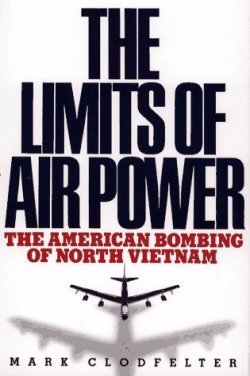
Mark Clodfelter, The Limits of Air Power: The American Bombing of North Vietnam (New York: Free Press, 1989). Finally, some aeroplanes! There is a rich literature about air power in the Vietnam War, but I still think Clodfelter’s classic holds up as one of the most important. Even over 30 years later, his argument is still controversial: that strategic bombing in Vietnam was not effective, that air power, although very important, has limits. Nevertheless, his explanation and comparison of the different goals, limits, and methods of the Johnson and Nixon administrations’ approaches to bombing is still useful and insightful. Even for those who disagree with it, this book remains a giant in the field for a reason.

John Flanagan, Vietnam Above the Treetops: A Forward Air Controller Reports (New York: Praeger Publishers, 1992). There are a lot of pilot and aircrew memoirs from Vietnam, and many of them are very good. But, for some reason, Flanagan’s tale of flying O-1 Bird Dogs on the incredibly dangerous low-and-slow FAC missions in Southeast Asia has stuck with me much more than any other pilot memoirs I’ve read. Starting at the USAF Academy, Flanagan was a deeply principled man who was surprised at how the military handled itself in Vietnam. His story includes the way he wrestled with himself about the war and described in detail the brutal missions and the horrific things he saw. His story also includes a detailed look at how the US brought South Korean troops into the war – something not covered much in other works. There are many great memoirs to read, but if you can only read one, this would be my pick.

Tami Davis Biddle, Rhetoric and Reality in Air Warfare: The Evolution of British and American Ideas about Strategic Bombing, 1914-1945 (Princeton, NJ: Princeton University Press, 2004). Of all the books on bombing in the Second World War (and there are seemingly too many to count), Biddle’s work is one of the best. She highlights one of major themes in air power history: the disconnect between the promises of air power and its actual results on the battlefield. This work is a wonderful look at the evolution of an idea – how strategic bombing theory grew and changed over time, and how that idea and the assumptions that grew to accompany it influenced air power leaders on both sides of the Atlantic to interpret the air war in particular ways. This mode of analysing not only what happened, but what people thought about what happened, is something I’ve tried to carry through in my own work.

Steven Fino, Tiger Check: Automating the US Air Force Fighter Pilot in Air-to-Air Combat, 1950–1980 (Baltimore, MD: Johns Hopkins University Press, 2017). Fino’s study of the evolution of fighter pilot cockpits, detailing the F-86 Sabre, F-4 Phantom, and F-15 Eagle, is still one of my favourite histories of technology. That’s not just because it’s about three of my favourite aircraft, but because of how deftly Fino – himself a former Eagle driver – connects that technology to the people using it. He illustrates the complex interactions between human and machine in the high-stress combat situation of flying fighters, and how the culture of fighter pilots evolved along with the technology. I’ve also never seen another book be so technically detailed while remaining so accessible.

Linda Robertson, The Dream of Civilized Warfare: World War I Flying Aces and the American Imagination (Minneapolis, MN: University of Minnesota Press, 2005). As a Professor of Media as opposed to a historian, Robertson comes at this study of First World War pilots with a fresh perspective. She examines how the image of the knights of the air (inaccurate as it is) was constructed and took such a grip on the public and the flyers themselves. It’s a study of the public perception of the war and of flying and expands the literature on the First World War in interesting ways.

Beyond

Stephen Bourque, Beyond the Beach: The Allied War Against France (Annapolis, MD: Naval Institute Press, 2018). Books about bombing during the Second World War are plenty, but few of them critique the allied effort in quite the way that Bourque does here. By travelling across France and consulting local archives, then comparing them to the official USAAF records, Bourque demonstrates the horrific true costs of the allied bombing campaign for French civilians. Almost as a companion piece to Tami Davis Biddle’s work, Bourque shows the human, emotional, and deeply personal costs of inaccurate bombing attacks, which wreaked destruction over France, killing tens of thousands of civilians. I read many books about bombing theory and doctrine, but this book makes those things real on a human level and made me look in a new way at a historical event that I thought I understood.

C.R. Anderegg, Sierra Hotel: Flying Air Force Fighters in the Decade After Vietnam (Washington DC: Air Force History and Museums Program, 2001). I’m not sure what it is about this book that keeps drawing me back. It’s a short volume about the transition from the Vietnam-era fighters like the F-4 Phantom, to the more advanced F-15 Eagle fighters of the 70s and 80s, and the suite of other changes that accompanied that shift, from more advanced air-to-air missiles like the AIM-9L to the changing nature of pilot culture, tactics, and training practices. Nevertheless, Anderegg’s approach – part history, part memoir – makes for very compelling, engaging reading about a fascinating topic. Maybe it’s that the subject matter is what my work focuses on, or maybe it’s the engaging writing style and interesting anecdotes, but I keep finding myself returning to this one again and again.

Dr Michael Hankins is the Curator for US Air Force, Navy, and Marine Corps post-World War II Aviation at the Smithsonian National Air and Space Museum and the author of Flying Camelot: The F-15, the F-16, and the Weaponization of Fighter Pilot Nostalgia (2021). He is a former Professor of Strategy at the USAF Air Command and Staff College eSchool, and former Instructor of Military History at the US Air Force Academy. He earned his PhD in history from Kansas State University in 2018 and his master’s in history from the University of North Texas in 2013. He has a web page here and can be found on Twitter at @hankinstien.

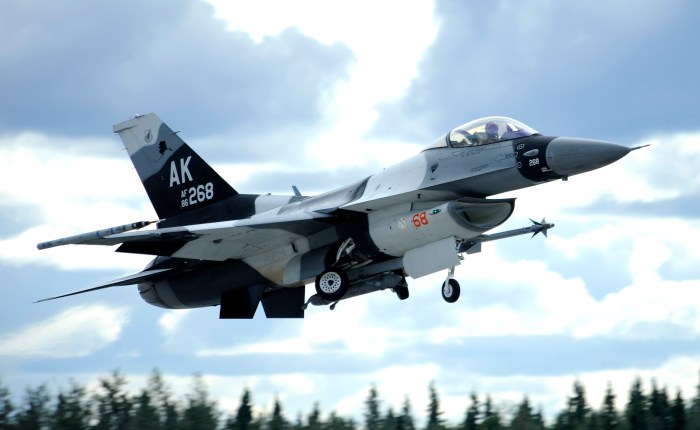
Header image: A US Air Force F-16 Fighting Falcon aircraft assigned to the 18th Aggressor Squadron takes off during Red Flag-Alaska 12-3 at Eielson Air Force Base, Alaska, 6 August 2012. Red Flag-Alaska is a series of Pacific Air Forces commander-directed field training exercises for US and partner nation forces, providing combined offensive counter-air, interdiction, close air support, and large force employment training in a simulated combat environment. (Source: Wikimedia)

#AirWarBooks – Ashleigh Brown

#AirWarBooks – Ashleigh Brown

Editorial Note: In the next instalment of our Air War Books series, Ashleigh Brown discusses the ten books that have influenced and shaped her writing as an air power historian.

Our Editor-in-Chief, Dr Ross Mahoney asked me to contribute my top ten air war books – those that have influenced and shaped my own approach to the topic. Catching me in the midst of PhD research, this list clearly shows that my interest primarily centres on the First World War.

9781743312698

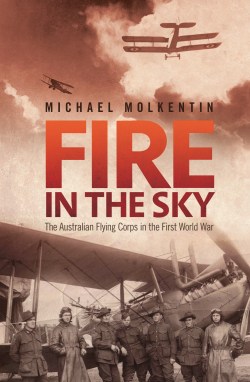
Michael Molkentin, Fire in the Sky: The Australian Flying Corps in the First World War (Crows Nest: Allen & Unwin, 2010). Michael Molkentin’s Fire in the Sky was the first military aviation book I ever read. In many ways, this book is responsible for moving my interest from the ground war to the air war, which ultimately led to my PhD research. In the first effort to revise Cutlack’s official history volume on the AFC, Molkentin presents a thoroughly researched and highly readable account of the efforts of Australians in the air during the First World War. Importantly, in doing so, Molkentin places the AFC in its rightful context within wider British air operations. This book, along with his centenary history volume, Australia and the War in the Air, is the authoritative account of the AFC

James Streckfuss, Eyes All Over: Aerial Reconnaissance in the First World War (Oxford: Casemate Publishers, 2016). Before the outbreak of the First World War, the predicted purpose of military aviation was reconnaissance. Accordingly, the focus in the opening years of war was reconnaissance, aerial combat being seen as necessary to ensure that this could be carried out uninhibited. Even with the creation of dedicated fighter squadrons, reconnaissance remained a core task for the air services throughout the war. James Streckfuss captures the importance of reconnaissance and details its progression by explaining early developments in Britain and the American perspective. This book expertly describes the intricacies and difficulties of carrying out aerial reconnaissance.

James Pugh, The Royal Flying Corps, the Western Front and the Control of the Air, 1914-1918 (New York: Routledge, 2017). The advantage found in having control of the air was recognised early in the First World War. The primary purpose of the RFC was to support ground forces through reconnaissance, photography, bombing missions, and artillery assistance; achieving superiority in the air was considered necessary to provide this support. James Pugh’s authoritative work discusses the development and application of air power over the Western Front, demonstrating the approach to obtaining and retaining aerial superiority (or control of the air). In doing so, Pugh rationally and expertly analyses the offensive policy (too often attributed solely to Hugh Trenchard), explaining how it was devised in conjunction with the French air services.

Malcolm Cooper, The Birth of Independent Air Power: British Air Policy in the First World War (London: Allen & Unwin, 1986). The high command of the RFC and RAF, and the political context of the air war, is complex, to say the least. Malcolm Cooper explains the various changes that took place at this level and details the development of the air war from this perspective. Cooper provides important context for understanding the execution of the air war, importantly contributing to the historiographical movement away from the view of First World War air power being exclusively a tactical concern.

Dennis Haslop, Early Naval Air Power: British and German Approaches (New York: Routledge, 2018). Dennis Haslop presents a comparative study of the Royal Naval Air Service and the Imperial German Naval Air Service, highlighting many striking similarities in the experiences of the two. This includes discussions of inter-service rivalry experienced by both the British and German air services and movements towards unification to create a single air service in each military. In other instances, discussions about the creation of the RAF from a naval perspective tend to present it as a hostile takeover of the RNAS rather than the amalgamation and unification of the two air services. Haslop avoids this, instead he presents a measured and factual account of this important part of Britain’s air power history. (N.B. You can read Ashleigh’s review of Haslop’s book here)

9780393357240

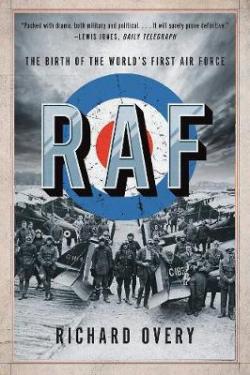
Richard Overy, RAF: The Birth of the World’s First Air Force (New York: Norton & Company, 2018). Richard Overy’s RAF provides an overview of Britain’s air war leading up to 1918, the events that led to the creation of the RAF, the process of achieving this, and the post-war struggle to keep it as a separate service. Although Overy does not engage with all the complexities of the air war in this relatively short book, he presents an excellent overview in the form of a very readable narrative.

Arthur Henry ‘Harry’ Cobby, High Adventure (Melbourne: Robertson & Mullens, 1943). In the years following the First World War, many pilots wrote memoirs detailing their war experience. Among those to do so was Australian pilot Arthur Henry – or Harry – Cobby. Cobby was the leading fighter ace of the AFC, boasting 29 victories during his time with No. 4 Squadron. In High Adventure, he presents a captivating account of his war in the air that I would recommend to anyone interested in how the AFC’s pilots fought the air war on a day-to-day basis.

Charles Rumney Samson, Fights and Flights: A Memoir of the Royal Naval Air Service in World War I (Nashville: The Battery Press, 1990). Continuing with the theme of memoirs, Air Commodore Charles Rumney Samson’s Fights and Flights details his experiences in positions of command in the RNAS. Among these was his involvement in the Gallipoli campaign, in which he led No. 3 Squadron RNAS which was responsible for reconnaissance over the Gallipoli peninsula and Dardanelles straits. Samson’s squadron operated over Gallipoli in the months leading up to the landing of ground forces, remained in support of the land campaign, and supported the eventual evacuation. Although only a portion of the book, this is an important account of the Gallipoli campaign from the air and captures the early contribution of the RNAS in the First World War.

Frederick Sykes, Aviation in Peace and War (London: E. Arnold & Co., 1922). Aviation in Peace and War details Frederick Sykes’ thoughts on the development and use of air power before, during, and after the First World War. Sykes discusses his pre-war thoughts on the potential use of aviation, the Military and Naval Wings of the RFC, technology and tactics, the offensive policy, and how he saw air power progressing after the war. Sykes is somewhat of a controversial character in the wartime RFC, particularly due to his strained relationship with David Henderson and Hugh Trenchard, and this book provides a valuable insight into his involvement in early British air power.

The-Bridge-to-Airpower

Peter Dye, The Bridge to Airpower: Logistic Support for Royal Flying Corps Operations on the Western Front, 1914-18 (Annapolis: Naval Institute Press, 2015). Peter Dye’s The Bridge to Airpower considers the evolution of First World War air power through a study of logistics on the Western Front. This thoroughly researched account allows for a greater understanding of the difficulties encountered in waging the air war, specifically due to problems sourcing airframes and aero-engines, both in sufficient amounts and of a high quality. Dye also discusses the changing logistic requirements in line with the changing nature of the air war and presents an impressive collection of statistics to show the evolution of British air power during the war.

Ashleigh Brown is the Social Media Editor at From Balloons to Drones and a PhD candidate at the University of New South Wales, Canberra. Her thesis focuses on aviation command in the British air arms during the First World War. It considers developments across the tactical, operational, and strategic levels of command, extending the learning curve theory to the air war. Ashleigh is a researcher for the Official History of Australian Operations in Iraq & Afghanistan and Australian Peacekeeping Operations in East Timor, where her focus is Australia’s commitment to Afghanistan between 2005 and 2010. Her research interests include the First World War, recent conflicts, air power, and military command. Ashleigh can be found on Twitter at: @ash__brown.

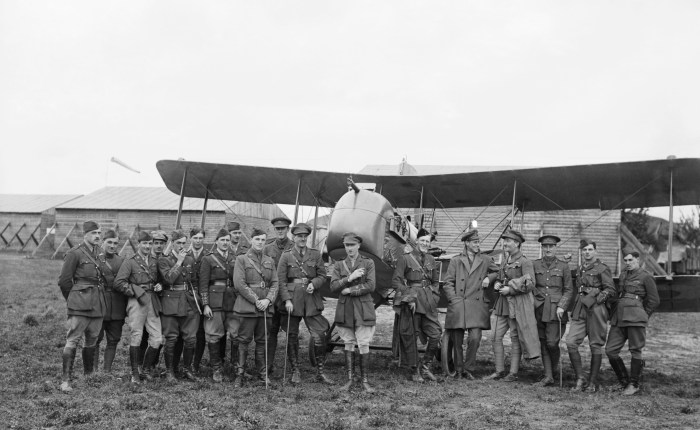
Header image: A group of pilots of No. 32 Squadron RFC at Beauval in 1916. Behind them is an Airco DH.2 biplane. (Source: Wikimedia)

#ResearchResources – Recent Articles and Books (June 2021)

#ResearchResources – Recent Articles and Books (June 2021)

Editorial note: In this series, From Balloons to Drones highlights research resources available to researchers. Contributions range from discussions of research at various archival repositories to highlighting new publications. As part of this series, we are bringing you a monthly precis of recent articles and books published in air power history. This precis will not be exhaustive but will highlight new works published in the preceding month. Publication dates may vary around the globe and are based on those provided on the publisher’s websites. If you would like to contribute to the series, please contact our Editor-in-Chief, Dr Ross Mahoney, at airpowerstudies@gmail.com or via our contact page here.

Articles

Cynthia Buchanan, ‘Mexicans in World War II: America’s Ally of the Air,’ Air Power History 68, no. 2 (2021).  

No abstract available.

William Cahill, ‘Fly High, Fly Low: SAC Photographic Reconnaissance in Southeast Asia,’ Air Power History 68, no. 2 (2021). 

No abstract available.

Yin Cao, ‘The Last Hump: The Lahore Elementary Flying Training School, the Chinese Civil War, and the final days of the British Raj,’ Modern Asian Studies (2021). doi: 10.1017/S0026749X21000081.

This article centres on the evacuation of the Lahore Elementary Flying Training School, which was built in 1943 to train Chinese pilots and mechanics. It details the British and Chinese authorities’ concerns over the school and how the chaotic situation in India during the final days of the British Raj influenced its evacuation back to China. This article locates the story within the broad context of the British withdrawal from India and the Chinese Civil War, and it uses this case to uncover the links between the two most significant events in the history of modern India and China. In so doing, it puts forward an integrated framework for studying modern Indian and Chinese history.

Jonna Doolittle Hoppes, ‘Gene Deatrick: An Appreciation,’ Air Power History 68, no. 2 (2021).

No abstract available.

James Greenhalgh, ‘The Long Shadow of the Air War: Composure, Memory and the Renegotiation of Self in the Oral Testimonies of Bomber Command Veterans since 2015,’ Contemporary British History (2021), DOI: 10.1080/13619462.2021.1906654

The following article examines oral testimonies collected by the International Bomber Command Centre project since 2015. The study considers the challenges posed by post-war discourses that contest the morality of bombing and contemporary constructions of Britishness to Bomber Command veterans making account of their lives. The contested nature of bombing’s position within narratives of the Second World War creates a discursive environment where veterans struggle to assemble satisfying life stories. Despite using a set of similar narrative frameworks to counter questions concerning the morality or purpose of bombing, veterans found limited opportunities to demonstrate personal agency or achieve emotional composure. The interviews illustrate unresolved and challenging feelings stemming from a discourse that has proved inimical to creating satisfying selfhoods. In addition, the difficulty of integrating the story of Bomber Command into narratives of Britain’s wartime myth proved to be a source of considerable discomfort for the interviewees. In their attempts to situate themselves within longer trajectories of Britain and its military in the twenty-first century, the testimonies are thus revealing of the importance to Britain of its wartime past in forming current identities and the ongoing conflict in how Britishness should confront more complex versions of its history.

K.A. Grieco and J.W. Hutto, ‘Can Drones Coerce? The Effects of Remote Aerial Coercion in Counterterrorism,’ International Politics (2021). https://doi.org/10.1057/s41311-021-00320-5

Weary of costly on-the-ground military interventions, Western nations have increasingly turned to “Remote Warfare” to address the continued threat of terrorism. Despite the centrality of drone strikes to the practice of Remote Warfare, we still know relatively little about their effectiveness as instruments of coercion. This article offers a conceptual framework for assessing their coercive efficacy in counterterrorism. We argue that remote control drones are fundamentally different from traditional airpower, owing to changes in persistence, lethality, and relative risk. Critically, these technological characteristics produce weaker coercive effects than often assumed. While persistent surveillance combined with lethal, low-risk strikes renders armed drones highly effective at altering the cost–benefit calculations of terrorists, these same technological attributes cause them to be less effective at clear communication, credibility, and assurance—other key factors in coercion success. Overall, drone strikes are poor instruments of coercion in counterterrorism, underscoring some potential limitations of Remote Warfare.

Ron Gurantz, ‘Was Airpower “Misapplied” in the Vietnam War? Reassessing Signaling in Operation Rolling Thunder,’ Security Studies (2021). DOI: 10.1080/09636412.2021.1915585.

Operation Rolling Thunder’s failure has been widely blamed on the strategy of using force to send “signals.” It discredited the associated theory of coercion among a generation of military officers and scholars. In this paper I show that, whatever its other failures, Operation Rolling Thunder did successfully signal a threat. I rely on the latest research to demonstrate that Hanoi believed the bombing would eventually inflict massive destruction. I also show that Washington accurately ascribed the failure of the threat to North Vietnam’s resolve and continued the operation for reasons other than signaling. These findings show that Operation Rolling Thunder can be productively understood as an exercise in both signaling and countersignaling. Rather than discrediting the theory of coercion, these findings modify it. They show that failed threats can be informative and that coercive campaigns can become prolonged for reasons other than a lack of credibility.

Heather Hughes, ‘Memorializing RAF Bomber Command in the United Kingdom,’ Journal of War & Culture Studies (2021), DOI: 10.1080/17526272.2021.1938840

This article traces the ways in which RAF Bomber Command has been memorialized in the UK since the 1940s, focusing on those who have organized memorials and associated commemorations. Distinct phases can be identified. Until the 1970s, the Command was accorded a prominent role in official memorial and ceremonial activities. Veterans’ activities reflected this acknowledgement. From the 1980s, in the face of debates about the morality of area bombing of German cities, however, veterans’ organizations and families began to articulate the view that Bomber Command’s wartime contribution had been overlooked. In consequence, they embarked upon activities to revise official memory. This included distinctive forms of memorial activity on the part of veterans and the postmemory generation, including the widespread appearance of ‘small memorials’ and, in the twenty-first century, two large-scale memorial sites, in London and in Lincoln.

John A. Schell, ‘The SA-2 and U-2: Secrets Revealed,’ Air Power History 68, no. 2 (2021). 

No abstract available.

James Shelley, ‘The Germans and Air Power at Dieppe: The Raid and its Lessons from the ‘Other Side of the Hill,’ War in History (2021), DOI: 10.1177/0968344521995867

Despite the vast academic and popular interest in the Dieppe raid of 19 August 1942, there remains a curious oversight of the German side of the story. This contribution interrogates German sources in order to explore the Dieppe air battle and its consequences from the perspective of the German armed forces. The paper ultimately demonstrates that the Germans learnt much about the role of air power in coastal defence from their experiences at Dieppe, but that the implementation of those lessons was lacking.

Samuel Zilincik, ‘Technology is awesome, but so what?! Exploring the Relevance of Technologically Inspired Awe to the Construction of Military Theories,’ Journal of Strategic Studies (2021), DOI: 10.1080/01402390.2021.1923919.

Military theories are thoughts explaining how armed forces are to be used to achieve objectives. These thoughts are often influenced by emotions, yet the influence of emotions on military theory-crafting remains underexplored. This article fills the gap by exploring how awe influences military theorising. Awe is an emotion associated with the feeling of transcendence. Several military theorists felt that way about the technologies of air power, nuclear power and cyber power, respectively. Consequently, their theories became narrowly focused, technocentric and detached from the previous theories and military history. Understanding these tendencies can help improve military theorising in the future.

Books

Bojan Dimitrijevic and Jovica Draganić, Operation ALLIED FORCE: Air War over Serbia 1999 – Volume 1 (Warwick: Helion and Company, 2021).

On 24 March 1999, the North Atlantic Treaty Organisation (NATO) launched Operation Allied Force against Serbia.

Lasting 78 days, this was an unusual conflict fought at several levels. The campaign was fought at the negotiation tables, in the media, and via cyber warfare. In the air, NATO sought to destroy or at least minimise the capability of the Serbian forces, while on the ground the Serbian forces fought the Kosovo-Albanian insurgency. It had an unusual outcome, too: without NATO losing a single soldier in direct action, they still forced the Serbian authorities and armed forces to withdraw from Kosovo, which in 2008 then proclaimed its independence. In turn, the war inflicted serious human and material losses upon the Serbian’s and the air force was particularly devastated by air strikes on its facilities. Nevertheless, many within NATO subsequently concluded that the skies over Serbia were as dangerous on the last night of this conflict as they were on its first.

Largely based on cooperation with the joint commission of the Serbian Air Force and the U.S. Air Force in Europe (USAFE), Volume 1 of Operation Allied Force provides a detailed overview of NATO’s aerial campaign, including reconstructions of operations by ‘stealth’ aircraft such as the F-117A and B-2A, and the only loss of an F-117A in combat. Volume 1 of Operation Allied Force also offers a detailed reconstruction of the planning and conduct of combat operations by the Serbian Air Force and Air Defence (Ratno vazduhoplovstvo i protivvazdušna odbrana, RV i PVO) with a special emphasis on the attempts of its sole MiG-29 squadron and its surface to air missile batteries to challenge enemy strike packages.

Adrien Fontanellaz, Tom Cooper, and José Augusto Matos, War of Intervention in Angola – Volume 4: Angolan and Cuban Air Forces, 1985-1987 (Warwick: Helion and Company, 2021).

War of Intervention in Angola, Volume 4, continues the coverage of the operational history of the Angolan Air Force and Air Defence Force (FAPA/DAA) as told by Angolan and Cuban sources, in the period 1985-1987.

Many accounts of this conflict – better known in the West as the ‘Border War’ or the ‘Bush War’, as named by its South African participants – consider the operations of the FAPA/DAA barely worth commentary. At most, they mention a few air combats involving Mirage F.1 interceptors of the South African Air Force (SAAF) in 1987 and 1988, and perhaps a little about the activity of the FAPA/DAA’s MiG-23s. However, a closer study of Angolan and Cuban sources reveals an entirely different image of the air war over Angola in the 1980s: indeed, it reveals the extent to which the flow of the entire war was dictated by the availability – or the lack – of air power. These issues strongly influenced the planning and conduct of operations by the commanders of the Angolan and Cuban forces.

Based on extensive research with the help of Angolan and Cuban sources, War of Intervention in Angola, Volume 4, traces the Angolan and Cuban application of air power between 1985-1987 – during which it came of age – and the capabilities, intentions, and the combat operations of the air forces in support of the major ground operations Second Congress and Salute to October.

Alexander Howlett, The Development of British Naval Aviation, 1914–1918 (London: Routledge, 2021).

The Royal Naval Air Service (RNAS) revolutionized warfare at sea, on land, and in the air. This little-known naval aviation organization introduced and operationalized aircraft carrier strike, aerial anti-submarine warfare, strategic bombing, and the air defence of the British Isles more than 20 years before the outbreak of the Second World War. Traditionally marginalized in a literature dominated by the Royal Flying Corps and the Royal Air Force, the RNAS and its innovative practitioners, nevertheless, shaped the fundamentals of air power and contributed significantly to the Allied victory in the First World War. The Development of British Naval Aviation utilizes archival documents and newly published research to resurrect the legacy of the RNAS and demonstrate its central role in Britain’s war effort.

David Nicolle and Gabr Ali Gabr, Air Power and the Arab World, 1909-1955 – Volume 4: The First Arab Air Forces, 1918-1936 (Warwick: Helion and Company, 2021).

Volume 4 of Air Power and the Arab World, 1918-1936, continues the story of the men and machines of the first half century of military aviation in the Arab world.  The earliest of the Arab air forces to be established trace their histories back to the 1920s and 1930s when the overwhelming majority of Arab countries, and an even larger majority of the Arabic-speaking people, were ruled or dominated by four European powers.  This volume continues with the story of the period from 1918 to 1936.

The role, organisational structure and activities of the first Arab air forces are described based on decades of consistent research, newly available sources in Arabic and various European languages, and is richly illustrated with a wide range of authentic photography.  These air forces ranged from dreams which never got off the ground, to small forces which existed for a limited time then virtually disappeared, to forces which started very small then grew into something more significant. Even so, the successful air forces of Iraq and Egypt would only have a localised impact within the frontiers of their own states.

#BookReview – The Royal Flying Corps, the Western Front and the Control of the Air, 1914-1918

#BookReview – The Royal Flying Corps, the Western Front and the Control of the Air, 1914-1918

James Pugh, The Royal Flying Corps, the Western Front and the Control of the Air, 1914-1918. Abingdon: Routledge, 2017. Figures. Charts. Bibliography. Index. Hbk. xviii + 190 pp.

Reviewed by Dr Heather Venable

41IVdzZMc4L._SX331_BO1,204,203,200_

The so-called Father of the Royal Air Force Lord Hugh Trenchard looms large in the historiography of air power, perhaps most infamously for his assertion – seemingly wrought out of thin air – that the moral effect of air power outweighed the material by a factor of twenty to one. To many students of air power, this statement epitomises how much the interwar pursuit of strategic bombardment rested on flights of fancy more than carefully reasoned analysis of the lessons of the First World War because airmen like Trenchard intended to have a moral effect on civilian populations in future wars.

By contrast, James Pugh’s The Royal Flying Corps, the Western Front and the Control of the Air, 1914-1918 pushes back at a significant portion of the historiography of First World War air power concerning the Royal Flying Corps (RFC). Unlike many other scholars, Pugh insists that before the First World War, British airmen anticipated how to use air power effectively and demonstrated creativity and flexibility in applying it during the war. Pugh’s revisionist approach depends on the compelling claim that historians have teleologically read aspects of the interwar period into the First World War experience. Pugh thus wants to rescue some airmen from unfair and overwrought reputations for dogmatism (p. 52). Perhaps most importantly, Pugh seeks to validate the RFC’s overwhelmingly offensive approach as fundamentally sound while showing change over time during the war concerning offensive air strategy. Pugh argues that the offensive approach taken by airmen primarily echoed that of the ground war. Moreover, airmen shifted from seeking decisiveness to pursuing attrition and pursued more sophisticated approaches to achieving control of the air during the First World War.

Q 4192
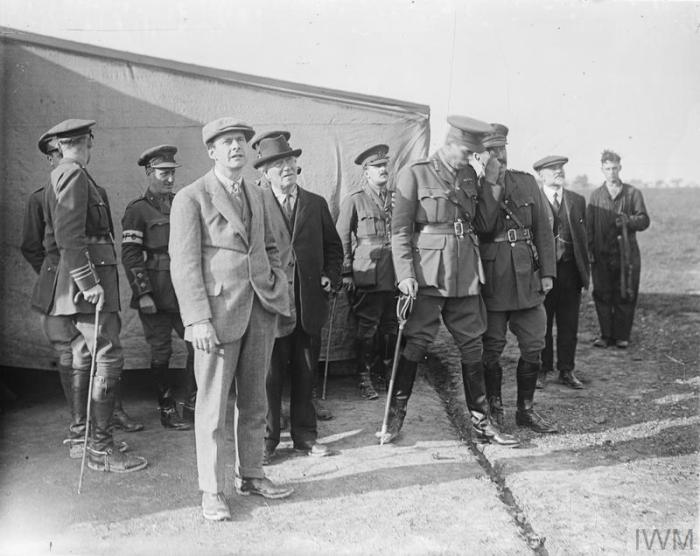
Prime Minister Herbert Asquith watches a squadron of aeroplanes returning to RFC Headquarters at Frevillers. With him is Major-General Hugh Trenchard, commander of the Royal Flying Corps. (Source: © IWM Q 4192)

Pugh’s first chapter establishes convincingly that airmen properly appreciated the importance of air superiority before the First World War. He also shows how vital missions, such as fostering battlefield communication and observing artillery fire, were anticipated before the First World War. However, limited technology and other factors impeded greater experimentation with these roles before the war (p. 33). These roles, moreover, reflected how aviators considered themselves to be part of the British Army. Their embrace of offensive thinking particularly reflected the powerful influence of British Army culture on the RFC. Pugh offers this helpful corrective in response to his belief that historians have traced the origins of airmen’s offensive proclivities too unilaterally to Trenchard (p. 14). Indeed, Pugh generally stresses the extent to which other airmen deserve more credit for developing air power thinking, continually deemphasising Trenchard (p. 51). In a similar vein, Pugh not only challenges widely held views on Trenchard’s emphasis on morale but also offers competing explanations for why the RFC stressed it so much. According to the author, the emphasis on diminishing an opponent’s morale owes much to the ‘fragility of aircraft’ (p. 24, 52). This point is not entirely convincing.

Still, Pugh argues that the RFC did not acquire ‘effective’ fighters until 1916, which were increasingly sent to the Western Front organised in squadrons responsible for different roles (p. 49). While awaiting improved aircraft, the RFC revised doctrine and improved organisational practices. When updated in 1915, RFC doctrine denoted reconnaissance as air power’s primary purpose, although it also increasingly recognised the requirement for ‘fight[ing]’ to obtain that information (p. 46), thereby placing more emphasis on controlling the air. Still, the RFC Training Manual diminished its emphasis on reconnaissance from 75 to 36% of the manual while increasing its coverage of artillery support most dramatically (p. 47).

‘Rules of the air – meeting another machine’. An air technical diagram of a Sopwith Dolphin and two Sopwith Camel biplanes meeting in the air and turn to the right. (Source: © IWM Q 67829)

The RFC’s views on how to control the air grew increasingly expansive, especially after learning valuable lessons about airpower employment at Verdun. Thus, the British now stressed seeking control of the air ‘far away’ from those aircraft providing direct support to the battlefield (p. 52) as well as reaffirming the importance of ‘maintaining an offensive posture’ (p. 56), which resulted in a theatre-wide emphasis as airmen sought to control the air in ‘breadth and depth’ (p. 81).

Pugh’s revisionist account largely depends on assuming the best about many of the airmen he describes, resulting in a somewhat Whiggish and rosy account of the RFC’s achievements in the First World War. Pugh valuably attempts to explode accepted thought in multiple areas. This approach is the work’s greatest benefit and failing. Regarding the extent to which airmen embraced an attrition-based strategy over the course of the war, for example, Pugh never fully makes an argument. Describing the phrase ‘relentless and incessant offensive’ as the ‘most profound evidence’ of this strategic shift ultimately falls short of proving one of the work’s key themes (p. 62). In a related vein, Pugh’s argument depends on separating out the rhetoric of airmen like Trenchard, who he claims made much of offensive air power for political reasons, meanwhile arguing that in actuality, airmen pursued an ‘increasingly nuanced and sophisticated approach to controlling the air’ (p. 71), such as using ‘concentrated and coordinated’ groups of fighters (p. 82). These contrasting interpretations cause the reader to wonder how Pugh determines when to accept evidence as rhetoric and when to accept it as representing airmen’s authentic thinking. These potential problems epitomise how Pugh is trying to do too much, such as when he mentions studies of First World War land power being importantly focused more systematically on ‘learning, transformation, or adaption’ yet preserves that approach for future airpower researchers (p. 91, 71). Using the methodology from some studies more systematically to explore British thinking about air control could offer more value.

Despite these critiques, all students of air power should read Pugh’s work for its argument-driven and revisionist analysis of the Royal Flying Corps. While adding significant complexity to widely accepted views of First World War airpower, Pugh ultimately concludes that the RFC’s offensive mindset represented the ‘most sensible course of action’ to pursue (p. 163). Even for those not necessarily interested in the RFC, his discussion of how to best employ air power will provide much of value to ponder for readers interested in any era of air power.

Dr Heather Venable is an Associate Professor in the Department of Airpower at the United States Air Force’s Air Command and Staff College. She received her PhD in Military History from Duke University. Venable’s first book, How the Few Became the Proud: Crafting the Marine Corps Mystique, 1874-1918, was published by Naval Institute Press in 2019.

Header image: A group of pilots of No. 32 Squadron RFC at Beauval in 1916. Behind them is an Airco DH.2 biplane. (Source: Wikimedia)

#ResearchResources – Recent Articles and Books

#ResearchResources – Recent Articles and Books

Editorial note: In this new series of posts, From Balloons to Drones plans to highlight research resources available to researchers. Contributions will range from discussions of research at various archival repositories through to highlighting new publications. As part of this series, we plan to bring you a monthly precis of new articles and books published in the field of air power history. This precis will not be exhaustive but will highlight key new works published in the preceding month. If you would like to contribute to the series, please contact our Editor-in-Chief, Dr Ross Mahoney, at airpowerstudies@gmail.com or via our contact page here.

Articles

Kwong Chi Man, “Debating ‘Douhetism’: Competing Airpower Theories in Republican China, 1928–1945,’ War in History 28, no. 1 (2021).

This article sheds lights on the difficulty faced by the minor powers when they were trying to build an effective air force during the interwar period (1919–1939) and the Second World War, using the experience of Chinese military aviation as an example. It argues that the Chinese were heavily influenced by the ideas of decisive action and strategic bombing, as well as similar ideas that were attributed (sometimes incorrectly) to the Italian General and air proponent Giulio Douhet. Only the harsh lessons of the war gradually persuaded the Chinese to adopt a more realistic approach to using air power.

Dan Ellin, ‘A ‘Lack of Moral Fibre’ in Royal Air Force Bomber Command and Popular Culture,’ British Journal for Military History 6, no. 3 (2020).

Royal Air Force aircrew endured mental and physical stresses during bombing operations. Their chances of completing a tour of operations unscathed were around one in four, and many were aware the chances were slim. Some who refused to fly were accused of ‘lacking moral fibre’ (LMF). Although this was not a medical diagnosis it is frequently viewed through the lens of mental health and reactions to trauma and it has become a powerful and important cultural phenomenon. This article re-examines LMF in the culture of the wartime Royal Air Force, before considering how and why LMF is remembered by veterans and in popular histories since the war.

James Halstead, ‘Air Power and Allenby’s Army: Arms in Palestine 1917–1918,’ War in History, (2020).

Historians have overlooked the important role played by airpower in combined arms during the Palestine Campaign, 1917–1918. This article argues the Egyptian Expeditionary Force adopted Western Front command structures, successfully integrating airpower within their command and control systems. Tactical and strategic airpower provided intelligence which allowed Corps and Army Headquarters to control the tempo of operations, while ground attack operations disrupted Ottoman command and control arrangements. This integration made a clear contribution to the success of the Egyptian Expeditionary Force at the crucial battles of Third Gaza and Megiddo.

William Head, ‘The Triangle of Iron and Rubber: Ground Actions and Airpower during Operation Attleboro,’ Air Power History 67, no. 4 (2020).

No abstract provided.

Christian Moldjord, Paal Frederiksen, and Larry Browning, ‘Fear and Pride Among Fighter Pilots: Combat Emotions During a Bombing Campaign,’ Armed Forces & Society, (2021), doi:10.1177/0095327X20986925.

This article analyzes the combat emotions of Royal Norwegian Air Force Fighter pilots (hereafter RNoAF) during their bombing campaign over Libya in 2011. Using grounded theory in our interviews with them, we identified 12 categories of their emotions and behaviors, with variations in pride and fear emerging as the two key themes. We show how those two emotions thread through the literature of emotions in combat, and show further how our data, and the resulting matrix from an analysis of it, both apply to and extend that literature. We also show how the high and low variations of pride and fear interact to both support and counter each other. Our findings thus make an important contribution to the combat emotions literature on the action and behavior of fighter pilots.

Samuel Oyewole, ‘Struck and killed in Nigerian Air Force’s campaigns: Assessment of airstrike locations, targets and impacts in internal security operations,’ African Security Review, (2021) DOI: 10.1080/10246029.2020.1859394

The involvement of the air force in a series of Joint Task Force (JTF) arrangements, which were initiated to neutralise various security threats, accounted for a growing record of air campaigns in Nigeria. Although there is growing public attention for airpower in Nigeria, its operational relevance and associated concerns have received inadequate academic attention. Accordingly, the understanding of recent developments in Nigeria’s air campaigns to neutralise targeted threats against security across the country remains largely limited and incoherent. This study, therefore, seeks to examine trends in air campaigns, with emphasis on cases, locations, targets and impacts of airstrike, in Nigeria. For this purpose, 241 cases of airstrike with 3,210 fatalities and 273 cases of air/land operations with 2,186 fatalities that were recorded across Nigeria in the last two decades were assessed. This is expected to contribute to a growing body of knowledge on air campaigns of the Nigerian Air Force (NAF) as well as their relevance to neutralise targeted threats and associated human rights concerns in internal security operations.

Matthew Powell, ‘Debate, Discussion, and Disagreement: A Reassessment of the Development of British Tactical Air Power Doctrine, 1919–1940,’ War in History 28, no. 1 (2021).

This article investigates the work conducted by the Royal Air Force (RAF) in the development of tactical air power in the interwar period. It analyses the RAF’s theoretical doctrinal thinking during the period along with exercises conducted on a joint Service basis to further develop these ideas in practice. It will argue that, rather than neglecting tactical air power during this period as is the accepted view, much good theoretical work was done that formed a theoretical and intellectual basis for the further development of tactical air power in the light of operational experience during the Second World War.

Theo Van Geffen, ‘The Air War against North Vietnam: the Thanh Hoa Railroad and Highway Bridge (Part 6, Conclusion),’ Air Power History 67, no. 4 (2020).

No abstract provided.

Darrel Whitcomb, ‘1972 – US Army Air Cavalry to the Rescue in Vietnam,’ Air Power History 67, no. 4 (2020).

No abstract provided.

James Young, ‘The U.S. Air Force’s Long Range Detection Program and Project MOGUL,’ Air Power History 67, no. 4 (2020).

No abstract provided.

Books

Frank Blazich, “An Honorable Place in American Air Power” Civil Air Patrol Coastal Patrol Operations, 1942–1943 (Maxwell, AL: Air University Press, 2020).

Author Frank Blazich has spent years researching and compiling disparate records of Civil Air Patrol’s short-lived–but influential–coastal patrol operations of World War II, which he synthesizes into the first scholarly monograph that cements the legacy of this unique and vital wartime civil-military cooperative effort.

Benjamin Lambeth, Airpower in the War against ISIS (Annapolis, MD: Naval Institute Press, 2020).

Airpower in the War against ISIS chronicles the planning and conduct of Operation Inherent Resolve by U.S. Central Command (CENTCOM) from August 2014 to mid-2018, with a principal focus on the contributions of U.S. Air Forces Central Command (AFCENT). Benjamin S. Lambeth contends that the war’s costly and excessive duration resulted from CENTCOM’s inaccurate assessment of the Islamic State in Iraq and Syria (ISIS), determining it was simply a resurrected Iraqi insurgency rather than recognizing it as the emerging proto-state that it actually was. This erroneous decision, Lambeth argues, saw the application of an inappropriate counterinsurgency strategy and use of rules of engagement that imposed needless restrictions on the most effective use of the precision air assets at CENTCOM’s disposal. The author, through expert analysis of recent history, forcefully argues that CENTCOM erred badly by not using its ample air assets at the outset not merely for supporting Iraq’s initially noncombat-ready ground troops but also in an independent and uncompromising strategic interdiction campaign against ISIS’s most vital center-of-gravity targets in Syria from the effort’s first moments onward.

Richard Mead, Dambuster-in-chief: The Life of Air Chief Marshal Sir Ralph Cochrane (Barnsley: Pen and Sword, 2020).

Ralph Cochrane was born in 1895 into a distinguished naval family. After joining the Royal Navy, he volunteered in 1915 to serve with the RNAS in airships and was an early winner of the Air Force Cross. In 1918 he transferred to the fledgling RAF and learnt to fly, serving in Iraq as a flight commander under ‘Bomber’ Harris. His inter-war career saw him as a squadron commander in Aden before he became the first Chief of Air Staff of the Royal New Zealand Air Force. During the Second World War he served mainly in Bomber Command and commanded 5 Group from early 1943. He formed 617 Squadron and was instrumental in planning the legendary Dambuster Raid, the most spectacular of the War, as well as the sinking of the battleship Tirpitz. An inspirational leader, he trained 5 Group in low level target marking skills. Post war Cochrane held a string of senior appointments commanding Transport Command, Flying Training Command and finally as Vice Chief of Air Staff, retiring in 1952. He died in 1977.

Steven Paget (ed.), Allies in Air Power: A History of Multinational Air Operations (Lexington, KT: The University Press of Kentucky, 2020).

In the past century, multinational military operations have become the norm; but while contributions from different nations provide many benefits — from expanded capability to political credibility — they also present a number of challenges. Issues such as command and control, communications, equipment standardization, intelligence, logistics, planning, tactics, and training all require consideration. Cultural factors present challenges as well, particularly when language barriers are involved.

In Allies in Air Power, experts from around the world survey these operations from the birth of aviation to the present day. Chapters cover conflicts including World War I, multiple theaters of World War II, the Korean War, the Vietnam War, the Gulf War, Kosovo, the Iraq War, and various United Nations peacekeeping missions. Contributors also analyze the role of organizations such as the UN, NATO, and so-called “coalitions of the willing” in laying the groundwork for multinational air operations.

While multinational military action has become commonplace, there have been few detailed studies of air power cooperation over a prolonged period or across multiple conflicts. The case studies in this volume not only assess the effectiveness of multinational operations over time, but also provide vital insights into how they may be improved in the future.

Randall Wakelam, David Varey, and Emanuele Sica (eds.), Educating Air Forces: Global Perspectives on Airpower Learning (Lexington, KT: The University Press of Kentucky, 2020).

Compared to armies and navies, which have existed as professional fighting services for centuries, the technology that makes air forces possible is much newer. As a result, these services have had to quickly develop methods of preparing aviators to operate in conditions ranging from peace or routine security to full-scale war. The first book to address the history and scope of air power professionalization through learning programs, Educating Air Forces offers valuable new insight into strategy and tactics worldwide.

Here, a group of international experts examine the philosophies, policies, and practices of air service educational efforts in the United States, France, Italy, Germany, Australia, Canada, and the UK. The contributors discuss the founding, successes, and failures of European air force learning programs between the Great War and World War II and explore how the tense Cold War political climate influenced the creation, curriculum, and results of various programs. They also consider how educational programs are adapting to soldiers’ needs and the demands of modern warfare.

Featuring contributions from eminent scholars in the field, this volume surveys the learning approaches globally employed by air forces in the past century and evaluates their effectiveness. Educating Air Forces reveals how experiential learning and formal education are not only inextricably intertwined, but also necessary to cope with advances in modern warfare.

Darrel Whitcomb, Moral Imperative: 1972, Combat Rescue, and the End of America’s War in Vietnam (Lawrence, KS: University Press of Kansas, 2021).

In 1972, America was completing its withdrawal from the long and divisive war in Vietnam. Air power covered the departure of ground forces, and search and rescue teams from all services and Air America covered the airmen and soldiers still in the fight. Day and night these military and civilian aircrews stood alert to respond to “Mayday” calls. The rescue forces were the answer to every mans prayer, and those forces brought home airmen, sailors, marines, and soldiers downed or trapped across the breadth and depth of the entire Southeast Asia theater. Moral Imperative relies on a trove of declassified documents and unit histories to tell their tales.

Focusing on 1972, Darrel Whitcomb combines stories of soldiers cut off from their units, advisors trapped with allied forces, and airmen downed deep in enemy territory, with the narratives of the US Air Force, Army, Navy, Marines, contract pilots, and special operations teams ready to conduct rescues in Laos, Cambodia, North Vietnam, and South Vietnam. All of these missions occur against the backdrop of our withdrawal from the war and our diplomatic efforts to achieve a lasting peace. In detail, Whitcomb shows how American rescue forces supported the military response to the North Vietnamese’s massive three-pronged invasion of South Vietnam, America’s subsequent interdiction operations against North Vietnam, and ultimately the strategic bombing of Linebacker II.
#BookReview – Armageddon and OKRA: Australia’s air operations in the Middle East a century apart

#BookReview – Armageddon and OKRA: Australia’s air operations in the Middle East a century apart

Reviewed by Dr Peter Layton

Lewis Frederickson, Armageddon and OKRA: Australia’s Air Operations in the Middle East a Century Apart. Newport, NSW: Big Sky Publishing, 2020. Tables. Illustrations. Bibliography, Index. Pbk. 231 pp.

Armageddon and OKRA is the first in a planned series about the Royal Australian Air Force’s (RAAF) air campaigns being compiled as part of the RAAF’s 100th-anniversary celebrations. The RAAF’s Chief of Air Force (CAF) intends for the series’ works to be ‘readable, well-illustrated, educative and enduring’ (p. 3). In the main, Armageddon and OKRA ably meets these ambitions.

The book though carries additional burdens in aiming not just to market the RAAF to the Australian public but also to contribute to the Air Force’s professional military education and be of interest to serious academic researchers. It would be difficult for any work to satisfy such a diverse audience completely. Given this split, this review discusses Armageddon and OKRA from both a reader’s viewpoint and a military organisational perspective.

Armageddon and OKRA is split into two main parts. Part one examines Australian air power during the First World War in the Middle East between 1915 and 1919. The principal focus is on the operations of No.1 Squadron of the Australian Flying Corps (AFC) during the British capture of Palestine and Syria from the Ottoman Turks in 1917-1918. ‘Armageddon’ in the title refers to the Battle of Megiddo in late September 1918 in which the No. 1 Squadron fought. This English language word comes from the Ancient Greek name for Mount Megiddo, subsequently used in the Christian Bible’s Old Testament.

Part two then moves forward a hundred years to 2014-2018 and the US-led coalition operations to support the Iraqi Government to defeat Islamic State (ISIS). Part two’s principal focus is the small RAAF Air Task Group deployed for this task as part of the larger Australian Defence Force’s Operation OKRA, and which involved (amongst others) No.1 Squadron again. This is a rather elegant symmetry that perhaps was not made as much use of as could have been.

The involvement of the RAAF and its predecessor, the AFC in these two periods was at the tactical level of war and accordingly, the book’s main focus centres around squadron operations. Part one provides a comprehensive overview that nicely relates the tactical to the strategic level, the air activities undertaken, the various aircraft Australian’s were trained on and flew in operations, maintenance aspects and the air-to-air and air-to-ground weapons used. In this part, No.1 Squadron’s use of the Bristol F.2b Fighter in 1918 features prominently, including the destruction of a large Turkish ground force that the unit trapped in the Wadi Fara gorge. Also notable is the attention paid to including the opposing German squadrons, particularly FA300, and how they impacted No.1 Squadron. Wars involve two sides, however; many histories overlook this interdependence.

No. 1 Squadron, Australian Flying Corps next to their Bristol FB1 fighters, at Mejdel. The officer in the foreground (with stick) is Lieutenant-Colonel R. Williams, D.S.O., commanding. (Source: Australian War Memorial)

Part two is somewhat different. Early on, there is a detailed examination of the command-and-control arrangements for OKRA. The naming protocols are quite arcane for the casual reader, not unsurprisingly as their origin lies in the demands of automated messaging systems not in easy human comprehension. This then moves into several short chapters that discuss the daily air operations as seen at the squadron-level by OKRA’s deployed air units. These units flew the F/A-18 ‘Classic’ Hornet fighter/bomber, the F/A-18F Super Hornet fighter/bomber, the E-7A Wedgetail airborne warning and control aircraft and the KC-30A air-to-air refuelling tanker.

By the time the reader reaches these final chapters, it is apparent that CAF’s aims to be ‘readable, well-illustrated, educative and enduring’ has been achieved. In Australia, the book is keenly priced while its excellent line drawings of aircraft and numerous photographs add to the overall appeal. Some may argue over ‘enduring,’ however, the second part of the book offers a level of detail of the RAAF’s part in OKRA that is presently unequalled. In particular, future historians of these air operations will value this book because it gives the reader an insight into the rhythm and grind of daily squadron life during operations.

On the other hand, in meeting CAF’s other dictum, the book falls a bit short for the professional or academic reader. It is not – nor was intended to be – a critical analysis of the RAAF’s air operations in these two periods. The book dwells on the positives and only rarely and rather briefly notes any possible negatives. There are also reoccurring lapses into hagiography. Of the two parts of the book, the second is the most impacted. There is room left for a definitive, comprehensive history of the RAAF during OKRA.

In thinking about future works, the elegant symmetry of parts one and two was noted earlier. In reading the book, the more critical reader might like to assess the similarities and differences between No.1 Squadron operating as part of the British Empire and then 100 years operating as part of the American ‘empire’. In the First World War, No. 1 Squadron and Australians were more broadly considered part of the British Empire; they were simply English people born offshore. It is unsurprising the future Air Marshal Sir Richard Williams, later the ‘father of the RAAF,’ ended the war commanding in battle the Royal Air Force’s 40 Wing, which was overwhelming a British entity.

During OKRA, there is a much greater separation between the Americans and their foreign air force partners; the later provide tactical level forces to use as the US determines. However, through its astute alliance management process, the American empire has shaped foreign air forces to be fully and immediately interoperable with US forces regarding doctrine, equipment, support, and training. In contrast, in the British Empire’s war, Australia provided people to Britain who needed to be trained, equipped and, later in battle, logistically supported. For Australian’s, the British Empire was more collegiate, but the modern-day American one is arguably shrewder. Armageddon and Okra’s author, Lewis Frederickson, has written a fine, relevant analysis on Australia’s First World War experience for those wishing to explore such issues further.[1]

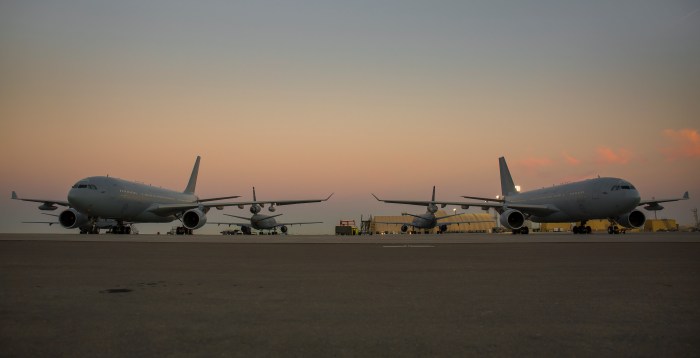
Two KC-30A Multi Role Tanker Transport aircraft sit together at the main air operating base in the Middle East Region on Operation OKRA. (Source: ADF)

Finally, it is worth discussing the book from a military organisational perspective. The book’s forward sets out CAF’s intentions for the series. These are not just laudable but noteworthy in breaking from the last 20 years of RAAF development. In these earlier periods, RAAF and other Australian Service chiefs stressed teamwork, and especially loyalty, over critical thinking.[2] This is a recognised problem for small professional military forces which lack the scale to be able to be ‘broad churches’ that can include disruptors.[3] In this series, and in his new Air Force Strategy, CAF now appears interested in setting off down this path.[4] If so, later books will need to be more analytical, including engaging in constructive criticism. It is uncertain if this will be possible or acceptable.

Armageddon and Okra is an excellent value read that makes a useful contribution to RAAF history. It is particularly important and valuable in breaking new ground on the RAAF’s participation in OKRA against ISIS. Overall Armageddon and Okra will be of interest to the general public, military enthusiasts and undergraduates undertaking strategic studies courses.

Dr Peter Layton is a Visiting Fellow at the Griffith Asia Institute, Griffith University and a RUSI (UK) Associate Fellow. His PhD is in grand strategy, and he has taught on this at the US National Defense University. Author of the book Grand Strategy, his posts, articles and papers may be read here. He was also once a navigator on No.1 Squadron RAAF flying F-111Cs.

Header Image: Centenary tail art on a  F/A-18F Super Hornet of No. 1 Squadron RAAF at the main air operating base in the Middle East Region during Operatyion OKRA. (Source: ADF)

[1] Lewis Frederickson, ‘The Development of Australian Infantry on the Western Front 1916-1918: An Imperial model of training, tactics and technology’ (PhD Thesis, UNSW Canberra, 2015)

[2] Peter Layton, ‘Does Australia need thinking ANZACs?,’ The Strategist,, 27 February 2014.

[3] Peter Roberts and Tony King, ‘Is the Era of Manoeuvre Warfare Dead?,’ Western Way of War: Episode 30, London: RUSI, 24 December 2020.

[4] Royal Australian Air Force, Air Force Strategy (Canberra: Department of Defence, 2020).

#Podcast – Airpower Over Gallipoli: An Interview with Dr Sterling Michael Pavelec

#Podcast – Airpower Over Gallipoli: An Interview with Dr Sterling Michael Pavelec

Editorial Note: From Balloons to Drones is pleased to announce our new podcast series. Led by our Editor Dr Mike Hankins, the series builds on the success of From Balloons to Drones, and provides an outlet for the presentation and evaluation of air power scholarship, the exploration of historical topics and ideas, and provides a way to reach out to both new scholars and the general public. You can find our Soundcloud channel here.

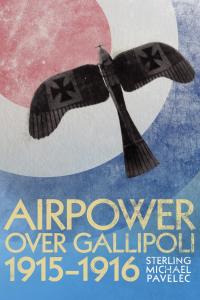
In this episode, we interview Dr Sterling Michael Pavelec of the USAF Air Command and Staff College. We discuss Pavelec’s new book Airpower Over Gallipoli and ask the question of whether the Gallipoli Campaign should be connected with the pioneering use of air power.

Dr Sterling Michael Pavelec is a Professor of Airpower History at the USAF Air Command and Staff College, Maxwell AFB, Alabama. He is the author of four previous books and a number of articles and book chapters on airpower, technology, space, and cyber warfare.

Header Image: Wing Commander Charles Rumney Samson of No. 3 Squadron RNAS about to start a sortie over the Ottoman lines during the Gallipoli campaign in 1915. (Source: © IWM Q 13542)

#Podcast – From Kites to Cold War: An Interview with Dr Tyler Morton

#Podcast – From Kites to Cold War: An Interview with Dr Tyler Morton

Editorial Note: From Balloons to Drones is pleased to announce our new podcast series. Led by Assistant Editor Dr Mike Hankins, the series builds on the success of From Balloons to Drones, and it provides an outlet for the presentation and evaluation of air power scholarship, the exploration of historical topics and ideas, and provides a way to reach out to both new scholars and the general public. You can find our Soundcloud channel here.

In our latest podcast, we interview Dr Tyler Morton to discuss his new book From Kites to Cold War: The Evolution of Manned Airborne Reconnaissance. Not only do we get some incredible stories about aerial surveillance (especially from the WW2-era), but we have a blast talking about our biggest “nerd moments” from the archives, and why that type of work is so powerful and exciting!

You can find a review of Tyler’s new book here.

811-jEbGabLDr Tyler Morton is currently a fellow at the Woodrow Wilson International Center for Scholars in Washington, DC. He is an active duty US Air Force officer who holds a PhD in Military Strategy from the Air University. He is the author of From Kites to Cold War: The Evolution of Manned Airborne Reconnaissance (2019). He can be found on Twitter at @ty_morto.

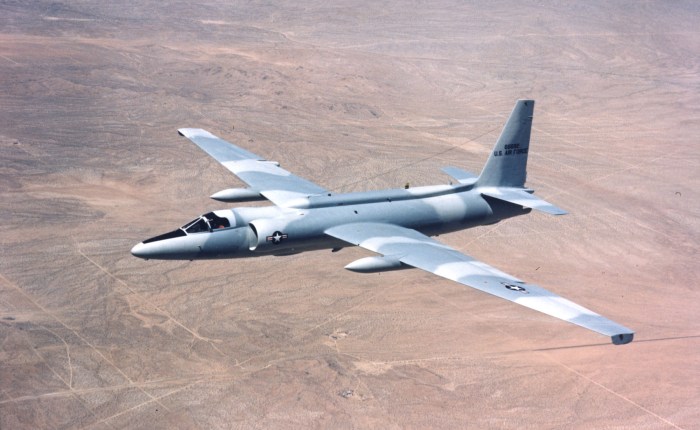
Header Image: A U-2C painted in a gray camouflage pattern called the ‘Sabre’ scheme in 1975. The camouflage replaced the usual black finish to ease British concerns about ‘spy planes’ operating from the UK. In Europe, this U-2 tested equipment to locate and suppress enemy surface-to-air missiles. (Source: National Museum of the United States Air Force)

A Unified Framework for Air Power Studies

A Unified Framework for Air Power Studies

By Major Jaylan Haley

What is air power? How do we study it? How do we use it? Do previous characterisations sufficiently capture the concept? Perhaps. This article contends that prior attempts to put meat on the bone towards a framework to study air power scholarship are insufficient.

Moreover, we must appreciate the richness of our inquiries if we – scholars and professionals, such as political scientists, historians, policymakers, practitioners and users – want to understand better the concept of air power to help answer important questions. These questions may be:  how do civilian airline pilots and training schools contribute to a nation’s ‘air power?’ Can peacetime control of airspace access constitute a form of air power? To what extent does air information, such as weather, the electromagnetic environment, knowledge of space weather, constitute a form of air power? Furthermore, more, importantly, how do these questions and related concepts orient to each other.  As such, this article argues that air power is the domain-agnostic admixture of personalities, outcomes, organisations, technologies, ideas and events to do or, that do, something in or for, the air.[1]

This definition is unique in that it explicitly and parsimoniously joins together the breadth of military and civilian endeavours. It highlights the ‘stickiness’ of related topics and contends that air power is not an inherently military pursuit, though its application almost always manifests as such. The definition provides more form to the general, varied ideas of military thinkers about essential elements of air power.[2] This article begins the discussion on the topic of how we structure air power studies across various academic fields and cordons a more robust dissection of the topic in future publications. Furthermore, this article details the constituent components of air power to clarify meaning. Then, it uses this perception of air power to explain its evolution throughout history. Finally, briefly, it discusses our current air power disposition to make sense of what component will drive innovation in the coming decades — organisations.  So, how have we come to envisage this elusive thing we call air power?

Definition and Components of Air Power

In the Age of Airpower, Martin Van Creveld explored about 250 years of the concept. Among others, he highlighted the work of people with simple, yet elegant definitions of air power, such as that of Brigadier General William ‘Billy’ Mitchell who viewed it as doing ‘something in the air.’[3] Other writers such as Mark Clodfelter provided more angles: breaking the concept of air power into direct and indirect applications.[4]  For Clodfelter, direct air power generally involves kinetic outcomes such as bombing and indirect presumes more non-kinetic capabilities, such as intelligence, surveillance and reconnaissance (ISR).

Billy_Mitchell_at_his_court-martial
A scene from William ‘Billy’ Mitchell’s court-martial in 1925. (Wikimedia)

Meanwhile, organisations such as the US Air Force (USAF) define air power based on its organisational experience and conceptual refinement. The latest iteration of USAF Basic Doctrine defines the concept as ‘the ability to project military power or influence through the control and exploitation of air, space, and cyberspace to achieve strategic, operational, or tactical objectives.’[5] So, how do we break air power down for study?

While Mitchell’s definition is more parsimonious, adding a little complexity provides the explanatory muscle to how we think about air power and thus how we can consider the concept’s change over time. Foundationally, one should recognise that to do something in the air does not necessarily mean that the activity must originate in or from the air.[6] For instance, a ballistic missile launch originates from the land, traverses through the air and maybe space, and then strikes somewhere on land. This example demonstrates the potential of the agnosticism of the air domain. Furthermore, a more robust definition allows for careful, coordinated forecasting of future air power applications using clear and structured links within and across the subject’s elements.  For instance, air power researchers studying C-17 humanitarian assistance capabilities may be linked to those studying procedurally based command and control organisations as well as those studying the political effects of humanitarian assistance to optimise future disaster response towards national priorities.

Conceiving of air power as an admixture of component concepts: each noteworthy, though not equal, in characterising the ability to do something in the air is vital for several reasons. One benefit is to have more structured research programs that allow thinkers to situate their contribution to the subject area. Another is to generalise debates on air power concepts that link military and civilian theory and application. A generalisation can help guard against what seems to be a tendency to overly militarise air power thought, evoking the coercive and persuasive elements of the concept. The benefits are similar to those of academic fields like history or political science though air power studies can best be described as an interdisciplinary subfield or topical field.

Importantly, to be useful, the components must be defined. First, personalities may be individuals or groups that have a profound impact on the development of the notion. For instance, Mitchell vocally and publicly advanced the idea of a separate US military service despite the misgivings of more senior leaders, including President Calvin Coolidge.[7] In part, the general’s 1925 court-martial resulted from agitation for a separate US air service. However, the spectacle thrust air power into America’s national dialogue. He challenged the US Army – then overseeing land-based air forces – stating that their leaders were negligent for not building an air service capable of national defence. Mitchell is credited by many as being the original maverick in pursuing an idea of independent military air power that was largely sidelined at the time.  Mitchell’s persona, in part, catalysed the existence of organisations critical to the development of air power.

Mitchell’s calls for an independent air service bring us to the second component — organisations, which are administrative and operational systems that foster ideas, leverage people and exploit technologies towards some outcome. An exemplar is the USAF’s Strategic Air Command (SAC) under Major-General Curtis LeMay’s tutelage. SAC pursued the idea of ‘strategic’ air power, discussed later, towards its outcome of long-range conventional and nuclear bombing. SAC oversaw most of the US nuclear deterrent and development of bomber capabilities for the USAF. The organisation came to personify air power in the US and for much of the world during the Cold War.[8] Albeit an unfair approximation, civilians and military personnel alike were lent the idea of air power’s ability to render an outcome of total enemy devastation embodied by SAC’s long-range bombers and, later, ballistic missiles.[9]

In our context, outcomes are the effects, assessments and results by which military and civilian leaders come to associate air power. For instance, after the Second World War, both military and civilian leaders came to associate air power with the unconditional surrender of the enemy evoked by the use of nuclear weapons.[10] This idea created problems during the Korean and Vietnam Wars, where expectations outpaced the new reality of limited, non-nuclear warfare.[11]  Limited warfare lends itself to more technical means — leaving technology to be the more tangible, driving component of air power.

As a component, technology includes all the capabilities, research, design, development and testing that allow practitioners to do things in the air. For instance, a significant component of the US’ advancements in stealth technology originated with the Skunk Works team under Kelly Johnson’s orchestration, among others.[12] The team’s research and design techniques led to advances like the SR-71 Blackbird and the F-117 Nighthawk.[13] These technologies, along with other capabilities-related advances, influenced expectations such as those discussed above: enabling the limited, non-nuclear warfare that became characteristic of vast swaths of America’s recent history.[14] However, while technology is sometimes the easiest to translate as an air power component, though not always easy to grasp, it is ideas that sometimes generate change.

SR-71_taxi_on_ramp_with_engines_powered_up
An SR-71 taxing on the ramp with engines powered up, c. 1995. (Source: Wikimedia)

Doctrine, strategy, theories, policies and politics combine to form air power’s conceptual component. These ideas embody how personalities can use other components. Reciprocally, all the other components can help thinkers conceive of new ways to conceptualise air power. To demonstrate, during Operation EL DORADO CANYON, President Reagan and his national security team viewed air power as a punitive instrument of national security policy.[15] Existent technologies in the 1980s allowed Reagan’s response to state-sponsored terrorism with a long-range, airstrike on targets tailored to the perceived offence.[16] Reagan’s team shepherded the technology component in a way that had not yet been explored to its fullest. They updated strategic attack doctrine; tested theories of international relations; set new international policies; and ignited the politics of air-driven limited, military interventions.

Events like Op EL DORADO CANYON also constitutes the last element of air power. Our understanding of past campaigns, battles and historical milestones enables a fuller appreciation of air power and the possibility of modifying its future use. Unfortunately, these so-called understandings can sometimes lead to misapplications of history and, ultimately, to disaster.[17] For instance, the counterinsurgency in Iraq that began almost immediately after the invasion in 2003 required a different application of air power than previously practised, but it would take multiple Secretaries of Defense to enforce this understanding upon the military, as evidenced by the explosion of unmanned technologies among others.[18]  The components of air power – personalities, organisations, outcomes, technologies, ideas and events – provide the critical infrastructure for the study of air power.  We can use this infrastructure to help us understand various aspects of the topic, like what elements may be more important at various times in history.  This understanding can help us orient ourselves in history relative to the seemingly dominant feature of our time so that those who study, and practice air power can best allocate resources, whether academically or practically.

Epochs of Air Power

In this section, this article now considers the prominence of the above elements as determinants of historical periods in air power’s evolution.  A short walkthrough of air power’s epochal changes rooted in the above-defined elements illuminates current and the future application of air power. Geoffrey Barraclough, in An Introduction to Contemporary History, provided an idea about ‘spots and jumps’ that define historical periods and transitions.[19] He used the timeframe 1880-1960 to discuss the shift between modern and contemporary history based primarily on economic and geopolitical factors.[20] Using a similar conception of eras punctuated by ‘spots and jumps,’ rooted in the components of air power to characterise the shifts, this section divides the evolution of air power into five timeframes. Importantly, during shifts between the timeframes, changes in predominant component concepts of air power led to changes in our concept of air power.

Before 1783 – The Age of Imagination

Air power before 1783 can be viewed as an ‘Age of Imagination’ or ideas. There were no bounds except those imposed by humanity’s evolving understanding of terrestrial physics. Some of the earliest human records depict mystical flying or lobbing objects through the air as weapons. In their way, our ancestors from around the world gave us our first concept of air power. They conceived of divinity by drawing and storytelling of gods that could defy gravity unassisted, a fruitless pursuit for mere mortals that dates to Greek, Roman and Chinese mythology. While ancient and pre-industrial humans did not themselves defy gravity, humankind created things to help defend themselves, such as arrows and trebuchet missiles. These weapons are essential to the study of air power because the idea of projectiles travelling large distances to destroy an enemy finds its roots here.  These weapons emerged over thousands of years, sometimes a crowning achievement of empires such as Persia and the Mongols. Nonetheless, the wild-eyed dreams of fantasy came to a relatively abrupt end in 1783 when the Montgolfiers floated their first balloon. The brothers’ flights began the period of the ‘Origins of Air Power.’

1783 to 1903 – The Origins of Air Power

Between 1783 and 1903, changes in the concept of air power resulted from slow changes in technologies. For instance, a new class of ‘aeronauts’ proliferated workable ballooning technologies that ended up in the hands of Napoleon Bonaparte, though his use is not the first use on the battlefield. He used available technologies when and where he could to enhance reconnaissance and direct artillery strikes. In 1798 Bonaparte used balloons to try to overawe the Egyptians in a campaign to subdue the Middle East and North Africa.  After an unsuccessful display, Napoleon ordered the balloon unit’s disbandment. Undoubtedly a balloon would have come in handy in 1815 when Napoleon looked for Grouchy to spot and crush Blucher’s flanking movement at Waterloo.[21] Nearly a half-century later, professionals continued to struggle with the concept of air power: conceiving of it as an unproven, unpredictable and unusable conglomeration of technologies and techniques, such as gas-producing machines for balloons, telegraphs and airborne mapmaking. Such was Thaddeus Lowe’s disposition in bringing air power to fruition during the American Civil War.[22]  Thus, it would be until the turn of the twentieth century.

1903 to 1945 – The Douhetian Epoch

From 1903 to 1945, ‘strategic’ air power and its offshoots was the idea that drove changes in the conception of air power as something more than an observational or auxiliary tool for ground forces. The idea of independent air power came to full fruition in August 1945 with the dropping of the atomic bomb over Hiroshima, Japan. To begin, in December 1903 the Wright Brothers brought heavier-than-air flight to reality. Driving the science of aeronautics were ideas like those refined by Giulio Douhet in the early part of the 20th century. Theorists like Douhet opined that wars could be won by striking at city centres from the air to break the will of a people, forcing them to surrender.[23] Douhet’s original Italian publication in 1921 would not get immediately translated into English; however, people like Hugh Trenchard, the first Royal Air Force commander, articulated similar thoughts and organised, trained and equipped his military forces towards those ends.[24] Sir Arthur ‘Bomber’ Harris would make use of Trenchard’s advancements during the Second World War over German cities such as Hamburg, Dresden and Berlin.[25] Though it would take the American military time to adopt the British model of indiscriminate bombing, this idea came to epitomise air power for the period.

Importantly, this was also the timeframe during which commercial air travel in lighter- and heavier-than-air vessels took root. Though the ‘golden’ age of commercial air travel would come later, concepts like air routes, navigating via beacons, airports and other ideas began to solidify. These concepts had both military and civilian applications and technologies that enabled further development of the idea of air assets used over long distances. However, the military would continue to dominate ideas about air power as a ‘strategic’ concept even as these ideas came into contact with a significant theoretical challenge:  limited warfare in an age of potentially unlimited destruction from thermonuclear weapons.

F-80Cs_8th_FBS_over_Korea_c1950
US Air Force Lockheed F-80C Shooting Star fighter-bombers from the 8th Fighter-Bomber Squadron during the Korean War in 1950-51. The aircraft are equipped with ‘Misawa’ long-range tanks. (Wikimedia)

1945 to 2001 – The Era of Immaculate Effects

The next era, roughly spanning 1945 to 2001 is the maturation of strategic bombing extremes enabled by high technology. Militarily, the era is marked by the rise of a more immaculate, precise warfare with limited aims to mitigate aircrew losses, fulfil more specific international obligations and for operational efficiency among other goals. There was a change in the concept of air power because of what it was perceived to have achieved during the Second World War and the idea that the same outcome could be realised even in the face of more limited warfare.[26] By the beginning of this timeframe, the USAF sidelined more tactically-minded airmen like Pete Quesada to ensure adoption of strategic bombing as a vehicle to solidify the association with air power.[27] In part because of his prestige as a tactical aviation adherent, the ‘bomber generals’ defanged Quesada and the organisation he led, Tactical Air Command, after WWII.[28] There was no room for anyone but true believers in the strategic attack mindset, but this would change after the experiences of Korea and Vietnam in the 1950s, 60s and 70s. Only later in the period would Quesada’s tactical aviation and more precise attack legacy permeate military circles.[29]


In civilian aviation, technology-fueled huge leaps in air power. National airspace, global navigation capabilities and air-containerised freight were concepts that would hold vast military and civilian applications. It is during this time that military and civilian aircraft started to compete for airspace for things like training, exercises and navigating various corridors. Another critical advance was the widespread implementation of the instrument landing system that allowed commercial aircraft to land in increasing levels of degraded atmospheric conditions. Again, precision enabled by technology characterised this era.

2000 and Beyond – Flexible Niche

The most recent period begins at around the turn of the millennium. This is the epoch as ‘Flexible Niche’ because it involved the use of existing or new technologies for a variety of activities dependent on how organisations are positioned to leverage them. Beginning in the late 1980s, formalisation of the contemporary Air Operations Center (AOC) is an early indicator of the present epoch. This organisation enabled the focused air campaign during Operations INSTANT THUNDER and DESERT STORM that, in part, led to ultimate victory for coalition forces in 1991. It was no longer enough to think of air power as just a capability or bringing about the strategic defeat of an enemy via the limits of destructive power or achieving national objectives with as few civilian casualties as possible. The organisation became the template for how to leverage air power across a wide area and from multiple sources. A contemporary view of air power considers the construct of how and which organisations best leverage technologies, ideas and people towards a given outcome, which may be a military one. There are a variety of concepts that the United States military is exploring, including the Multi-Domain Operations Center and Defense Innovation Unit, in addition to the standup of a Space Force among other initiatives.

Civil aviation is undergoing a similar bout with organisations, especially in the United States, as the Federal Aviation Administration (FAA) grapples with how best to control airspace with the rise of unmanned technologies, especially in congested metropolitan areas.  Should the FAA continue to hold all the cards or is the organisation in need of decentralisation of authorities to states and localities?  Technologies may forestall the organisational decision, but this era’s solutions seem to be organisationally related rather than technically.

For the new century and beyond, it will not necessarily be which countries and industries have the best technologies or smartest people or best ideas that define the development of air power: it will be the organisations that can best leverage the other components that will determine how we conceive of air power.  To summarise, again, air power is the domain-agnostic ability to do something in the air resulting from an admixture of personalities, outcomes, organisations, technologies, ideas and events. These components, at various times, represent reasons why our concept of air power changes over time.

Conclusion

The use of epochs allows us to generally discuss how components of air power drive thinking and successful pursuits of the concept over time, which is why it is useful to develop a unified framework for their study. Moreover, as opposed to the more traditional commentary of air power, linking military and civilian advancements in the same epoch demonstrates that air power is not an inherently military concept. This article serves as an overview of the start of a more robust discussion about the development of air power and a characterisation of what will likely temper that development for the 21st century — organisations. Future topics will involve civilian efforts to deal with drones and swarms, the importance of civil aviation and commercial space efforts in air power development, and the exploration of the idea that organisations will be the defining issue of this era.

Given all of this, air power is the domain-agnostic admixture of personalities, outcomes, organisations, technologies, ideas and events to do or, that do, something in or for, the air. Moreover, these components at various times have influenced significant shifts in our conception of air power over at least five critical epochs. Scholars and professionals must acknowledge the military and civilian dimensions of air power to live up to the concept’s full potential. Hence, to conclude, there is a need for a unified framework for the study of air power to promote the integration of military and civilian issues with the field.

Major Jaylan M. Haley is a career USAF Intelligence Officer. Currently, he is a student at the USAF School of Advanced Air and Space Power Studies at Air University. Over 14 years, he served in a variety of intelligence-related positions from the strategic to the tactical levels.  During Operations ENDURING FREEDOM and INHERENT RESOLVE, he served as an Intelligence, Surveillance and Reconnaissance Liaison Officer to multiple US Army Divisions and US Marine Expeditionary Forces in both Afghanistan and Iraq. Most recently he was an Air University Fellow, serving as an Instructor in the Department of International Security at the USAF Air Command and Staff College. He is a PhD Candidate in the Kansas State University Security Studies program with research focused on leverage air power as a tool of national policy.

Header Image: A US Navy Grumman F-14A Tomcat intercepts a Soviet Tupolev Tu-95 ‘Bear D’ reconnaissance-bomber over the Pacific Ocean on 21 November 1984. The F-14 was assigned to fighter squadron VF-51 aboard the USS Carl Vinson and was deployed to the Western Pacific and the Indian Ocean from 18 October 1984 to 24 May 1985. (Source: Wikimedia)

[1] Domains include air, space, cyberspace (or electromagnetic), land and sea. Domain agnosticism disregards a specific domain towards the application of a specific concept. For instance, intelligence collection is domain agnostic. This means that intelligence collection can come from any of the domains-air, space, cyberspace, land or sea.

[2] ‘Strategic Implications for the Aerospace Nation’ in Philip Meilinger (ed.), Air War: Essays on Its Theory and Practice (Abingdon: Franck Cass, 2003), pp. 217-30.

[3] Martin Van Creveld, Martin, The Age of Airpower (New York: PublicAffairs, 2011), p. 71; William Mitchell, Winged Defense: The Development and Possibilities of Modern Air Power (New York: Dover Publications, 1988), p. xii.

[4] Mark Clodfelter, The Limits of Air Power: The American Bombing of North Vietnam (Lincoln, NE: University of Nebraska Press, 1989), p. 213.

[5] United States Air Force, Core Doctrine, Volume 1 – Basic Doctrine (Maxwell AFB, LeMay Doctrine Center, 2015).

[6] Robert Smith, ‘Maneuver at Lightspeed: Electromagnetic Spectrum as a Domain,’ Over the Horizon: Multi-Domain Operations & Strategy, 5 November 2018. Importantly, the so-called warfighting domains of air, space, land, navy and now cyber – or perhaps more aptly electromagnetic – all interface with the air domain and provide a medium through which something can happen in the air.

[7] Douglas Waller, A Question of Loyalty (New York: HarperCollins Publishers, 2004), pp. 21-2.

[8] Donald Mrozek, Air Power & the Ground War in Vietnam (Virginia, VA: Pergamon-Brassey’s International Defense Publishers, 1989), pp. 14-5.

[9] Conrad Crane, American Airpower Strategy in Korea: 1950-1953 (Lawrence, KS: University Press of Kansas, 2000), pp. 16-22.

[10] Ibid, p. 23, 27.

[11] Ibid, pp. 175-9.

[12] Ben Rick and Leo Janos, Skunk Works: A Personal Memoir of My Years at Lockheed (Boston, MS: Little, Brown and Company, 1994), p. 7, 39.

[13] David Robarge, Archangel: CIA’s Supersonic A-12 Reconnaissance Aircraft (Washington, D.C., Center for the Study of Intelligence, 2012), p. 1.

[14] Reuben Brigety II, Ethics, Technology and the American Way of War (London: Routledge, 2007).

[15] Joseph Stanik, El Dorado Canyon: Reagan’s Undeclared War with Qaddafi (Annapolis, MD: Naval Institute Press, 2003), p. ix.

[16] Ibid.

[17] Richard Neustadt and Ernest May, Thinking in Time: The Uses of History for Decision Makers (New York: The Free Press, 1986), p. xv, 233-4.

[18] Robert Gates, Duty: Memoirs of a Secretary at War (New York: Alfred Knopf, 2014), pp. 128-9; Donald Rumsfeld, Known and Unknown: A Memoir (New York, Penguin Group, 2011), p. 648.

[19] Barraclough’s ideas about history are not universally accepted in the field of history.

[20] Geoffrey Barraclough, An Introduction to Contemporary History (Baltimore, Penguin Books, 1964), p. 11.

[21] Van Creveld, The Age of Airpower, p. 6.

[22] Stephen Poleski, The Balloonist: The Story of T.S.C. Lowe: Inventor, Scientist, Magician and Father of the U.S. Air Force, (Savannah, GA: Frederic Beil, 2007).

[23] Guido Douhet, Command of the Air (Pickle Partners Publishing, 2014), p. 21.

[24] Tami Davis Biddle, Rhetoric and Reality in Air Warfare: The Evolution of British and American Ideas About Strategic Bombing, 1914-1945 (Princeton: Princeton University Press, 2002), pp. 73-4, 79.

[25] Richard Overy, The Bombers and the Bombed: Allied Air War Over Europe, 1940-1945 (New York: Penguin Books, 2013), 58.

[26] Crane, American Airpower Strategy in Korea, p. 184.

[27] Brian Laslie, The Air Force Way of War: U.S. Tactics and Training After Vietnam (Lexington, KY:, The University Press of Kentucky, 2015), p. 34.

[28] Ibid.

[29] Ibid., p. 131.