#ResearchNote – The Royal Australian Air Force Goes to War over Korea

#ResearchNote – The Royal Australian Air Force Goes to War over Korea

By Dr Ross Mahoney

Editorial note: This article first appeared on the author’s website. It has been reproduced here with permission.

On 25 June 1950 local time, forces of the Democratic People’s Republic of Korea (North Korea) crossed the 38th Parallel and invaded the Republic of Korea (South Korea). Launching Operation Pokpung, North Korea quickly moved south and by 28 June had occupied the capital of South Korea, Seoul. In response to this act of aggression, on 25 June 1950, in New York, the United Nations passed Resolution 82, which condemned the invasion, called for a cessation of hostilities, and demanded the withdrawal of forces beyond the 38th Parallel. Failure to comply with the resolution led to the adoption of Resolution 83, which recommended that UN members provide military forces to support South Korea and restore peace.

Korea, after 35 years of occupation by the Japanese, was split into two zones of occupation in 1945. The Soviet Union occupied the north, while the United States occupied the south. While the intention had been to unify the Korean Peninsula, problems arose between the communist North and the nationalist South. The failure of the Communist Party (the Workers’ Party of North Korea) to participate in the 1948 elections, combined with the abstention of several South Korean politicians, led to the eventual development of two distinct systems of government.[1] After the communist victory in the Chinese Civil War in 1949 and after receiving tacit support from Joseph Stalin, North Korea prepared to invade South Korea.

Australia’s response to Resolution 83 was to support the UN. At this time, the Australian military was providing forces to the British Commonwealth Occupation Force (BCOF) in Japan. Shortly after the passage of Resolution 83, the Department of External Affairs received communications from the Americans regarding the support Australia was willing to provide.[2] Initially, the Royal Australian Navy vessels (RAN) HMAS Shoalhaven and Bataan (the latter en route to Japanese waters to relieve the former) were tasked with supporting the withdrawal of nationals from South Korea; however, by 29 June, they were tasked with assisting American operations.[3] In cabling this news to the Australian Ambassador to the United States, Norman Makin, the Minister for External Affairs, Percy Spender, noted the presence of No. 77 Squadron, Royal Australian Air Force (RAAF), in Japan. However, he stressed it represented ‘practically the whole of our effective operational fighter strength in Australia or elsewhere.’[4]

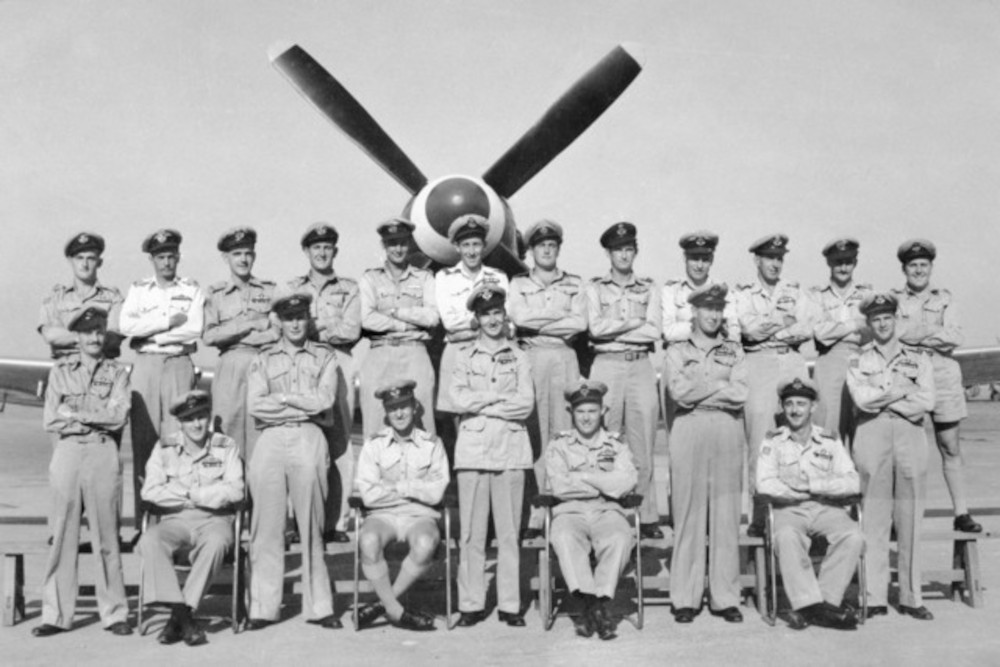
Group portrait of No. 77 Fighter Squadron, RAAF, 26 September 1948. Identified, left to right, back row: Warrant Officer (WO) Jim Flemming; WO W. Michelson; Flying Officer (FO) W. Horsman; WO M. Garroway; WO W. Rivers; Flight Lieutenant (Flt Lt) C.R. Noble; WO Fairweather; Flt Lt J. Grey; FO K. McLeod; WO B. Nichols; Flt Lt T. Murphy. Front row: FO W.O.K. Hewett; Flt Lt R. Hill; Flt Lt W. Ives; Flt Lt C. Butcher; Flt Lt S. Bradford; Squadron Leader F. Lawrenson; Flt J.I. Adams; Flt Lt G. Strout; Flt Lt K. Godfrey. (Source: Australian War Memorial)

No. 77 Squadron had deployed to Japan as part of BCOF in 1946 as part of No. 81 Wing. In 1948, it was transferred to Iwakuni Air Base in Yamaguchi Prefecture, on the island of Honshu. The squadron had been re-equipped after the end of the Second World War with the North American P-51D Mustang. By June 1950, No. 77 Squadron was amid preparations to return to Australia, it having been announced in April that the remaining Australian forces in Japan would be repatriated. However, events overtook these preparations. 

On 29 June, the same day the Australian Government contributed the RAN to the war in Korea, the Supreme Commander of the Allied Powers in Japan, General Douglas MacArthur, requested No. 77 Squadron for operations over the Korean Peninsula. He had been informed by his principal air commander, Commander of the Far East Air Forces (FEAF), Lieutenant General George Stratemeyer, that he was in desperate need of long-range ground attack aircraft. As the Australian Official Historian of the Korean War, Robert O’Neill related, MacArthur had cabled the Commander of BCOF, Lieutenant General Sir Horace Robertson, to request the use of No. 77 Squadron. However, he had sent the message uncoded and not kept it from the entourage of reporters that he had taken with him on his tour of South Korea.[5] Stratemeyer embellished MacArthur’s position by heaping praise on No. 77 Squadron. While the praise was not unwarranted, it was clearly designed for effect. Indeed, Stratemeyer and his planners at FEAF had, in the words of the United States Air Force’s official history of air operations over Korea, ‘cast covetous glances’ at No 77 Squadron and its P-51 Mustangs.[6] MacArthur’s request for the deployment of No. 77 Squadron was widely reported in the Australian media alongside Stratemeyer’s praise for the unit before the Australian Government had a chance to respond.[7]

MacArthur’s request put the Australian Government in a challenging position. They still hoped to send No. 77 Squadron back to Australia, but alliance politics took centre stage, and by 30 June it was announced that the squadron would be committed to operations.[8] MacArthur had got his way. However, while No. 77 Squadron was committed to action, it operated from Iwakuni and would operate over Korea, but not be deployed to the peninsula. Moreover, due to poor weather, it would take several days for No. 77 Squadron to undertake its first sorties.

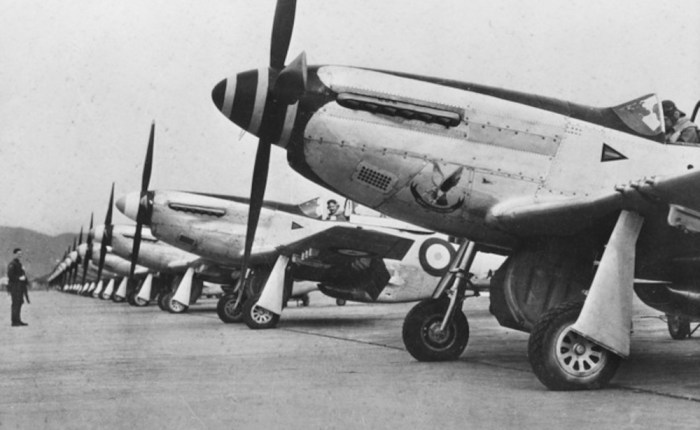
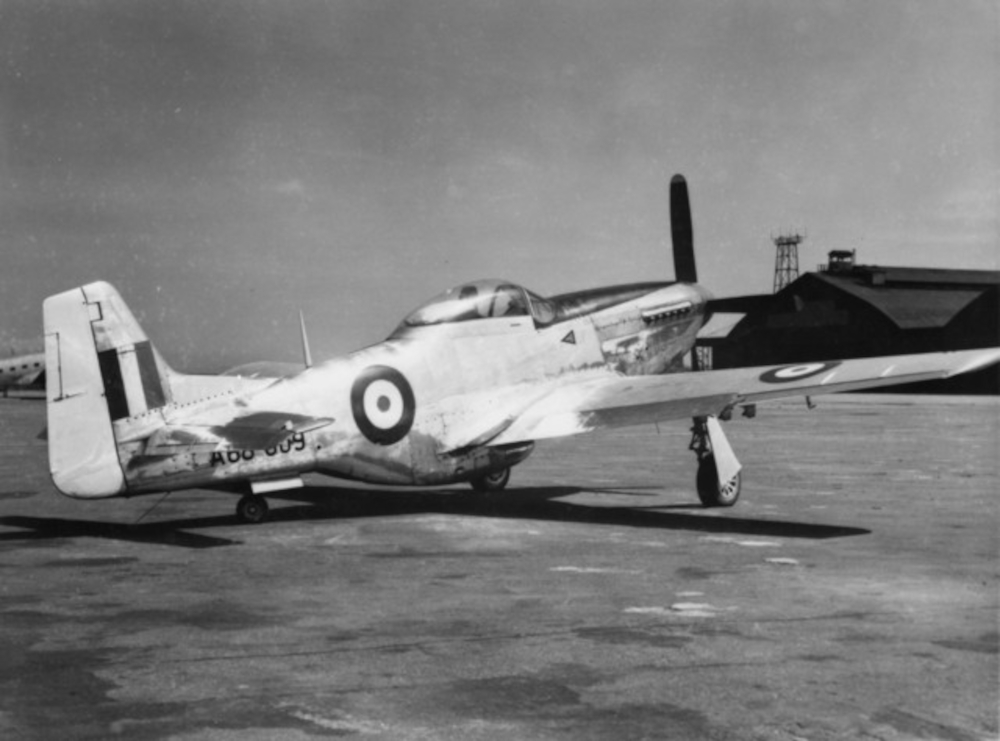
The North American P-51D Mustang aircraft A68-809, flown by Wing Commander Lou Spence DFC, when commanding No. 77 Squadron, RAAF, in Korea. Spence flew this aeroplane on 2 July when leading the second mission of the day. (Source: Australian War Memorial)

On 2 July, No. 77 Squadron undertook three sorties. The first was an ‘armed escort’ of four P-51s led by Squadron Leader Graham Strout for US Douglas C-47 Dakotas evacuating wounded soldiers from ‘Taijon’ (Daejeon) in Korea to Japan. One P-51 (A68-799) had to return to Iwakuni due to being unserviceable after take-off. The second sortie was a ‘close-armed escort’ mission led by the squadron commander, Wing Commander Lou Spence. The mission was to escort a group of US Douglas B-26 Invaders who attacked two bridges south of Seoul. One P-51 (A68-757) had to return due to unserviceability. The final mission saw six P-51s provide ‘armed escort’ to US Boeing B-29 Superfortresses who were attacking Yonpo airfield at Hamhung.[9] Despite the return of two aeroplanes to Iwakuni due to unserviceability, the sorties were relatively uneventful, despite several newspapers reporting that No. 77 Squadron downed one or two Yakovlev Yak-9 fighters.[10] No enemy aeroplanes were recorded as being encountered, and only in the two final sorties was any form of anti-aircraft fire encountered, though they caused no problem for the squadron. After a relatively inauspicious start, No. 77 Squadron would soon turn its attention to offensive operations, launching its first ‘armed attack’ with eight P-51s armed with rockets, attacking a convoy on a stretch of road between Heitaku and Suwon on 3 July. The attack claimed two locomotives, one truck, two staff cars, four other vehicles, and a bridge.[11]

The significance of No. 77 Squadron’s deployment over Korea came not in what the squadron physically achieved but in what its presence represented to alliance politics. The squadron’s first operations were widely reported both in Australia and abroad. In Australia, No. 77 Squadron’s first operation was reported in a typically functional manner, with many newspapers simply reporting on the character of the sorties. Nevertheless, some newspapers reported on the significance of the sorties in terms of Australian strategic policy, both foreign and domestic. For example, on 3 July, the Brisbane Telegraph noted that while the deployment of small-scale RAAF and RAN forces to support the effort in Korea was warranted to ‘honour Australian commitments to the United Nations’, any larger-scale deployment would need parliamentary agreement.[12] However, as an editorial in The Canberra Times reported, the rapid deployment highlighted ‘[t]wo extremes in the making of major decisions on policy have been illustrated by the reactions of the Government and of the Labour Party to the outbreak of hostilities in Korea.’[13] In short, the Australian Government acted quickly. At the same time, the Labor Party could ‘even comment on the situation until a meeting is held in Sydney next Wednesday [5 July], at which the policy will be decided.’[14] Perhaps unsurprisingly, it was reported that the Australian Communist Party had condemned the use of the RAAF, describing their deployment as a ‘scandal and a disgrace’ and demanding ‘the withdrawal of the R.A.A.F, from Korea.’[15]

More significantly, in the US, the rapid response of the Australian Government was noted. On 2 September, the Washington Evening Star reported on that ‘[t]he first combat mission of the Australians […] had a political significance. It made the air war a United Nations show […] No longer was the United States conducting any part of the Korean “police action” alone.’[16] That the term ‘political significance’ was used would not have been lost on readers, and a copy of this article was provided to the Department of External Affairs, as it aligned with Australian views on alliance politics.[17] Indeed, on 27 June, Makin had cabled Canberra to note that ‘the war had created a useful opportunity for putting to the State Department’ the creation of a ‘regional arrangement […] might help meet further crises.’[18] Thus, the failure to deploy No. 77 Squadron would have been inopportune and also demonstrated that, while a small contribution to the war effort, it had a significant political impact.

Thus ended the first day of operations for No. 77 Squadron over Korea. The squadron would deploy to Korea in October 1950 and eventually be re-equipped with the Gloster Meteor F.8. It would serve in Korea until October 1954, when it would transfer back to Japan and subsequently to Australia.

Dr Ross Mahoney is an independent scholar specialising in the history of war, with a particular focus on the use of air power and the history of air warfare. He is the Editor-in-Chief of From Balloons to Drones and currently the Senior Historian within the Heritage Policy team at Brisbane City Council in Australia. He has nearly 20 years of experience in the education, museum and heritage sectors in Australia and the United Kingdom, including serving as the inaugural Historian at the Royal Air Force Museum between 2013 and 2017. His other research interests are military leadership and command, military culture, and the history and development of professional military education. He also maintains an interest in transport history. He has published numerous articles, chapters and encyclopedia entries, edited two books, and delivered papers on three continents. His website is here.

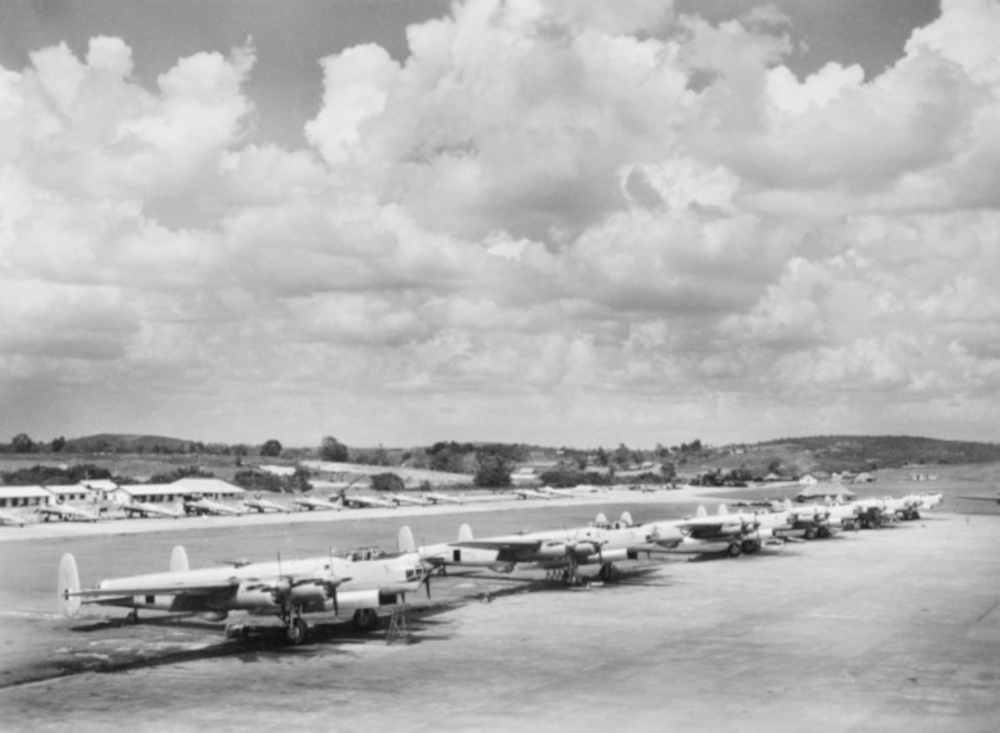
Header image: North American P-51D Mustangs of 77 Squadron RAAF, lined up on the tarmac at Iwakuni air base, Japan, c. 1950. (Source: Australian War Memorial)

[1] This is an overly simplified description of the development of the two Koreas in the period after the Second World War. For more detail, see: Allan Millett, The War for Korea, 1945-1950: A House Burning (Lawrence, KS: University Press of Kansas, 2005).

[2] Robert O’Neill, Australia in the Korean War, 1950-53 – Volume 1: Strategy and Diplomacy (Canberra, ACT: The Australian War Memorial and the Australian Government Publishing Service, 1981), p. 49.

[3] National Archives of Australia (NAA), A1838, 3123/7/3/4 PART 1, Statement by the Prime Minister, 29 June 1950; ‘Australia Backs U.N.,’ The Herald, 29 June 1950, p. 1; ‘Australian Units for Korea, Ships and Planes,’ Lithgow Mercury, 29 June 1950, 2.

[4] O’Neill, Australia in the Korean War, 1950-53 – Volume 1, p. 51.

[5] O’Neill, Australia in the Korean War, 1950-53 – Volume 1, pp. 51-2. On the repercussions, or lack thereof, of MacArthur’s ‘leak,’ see: O’Neill, Australia in the Korean War, 1950-53 – Volume 1, p. 54. Cameron Forbes claimed MacArthur told Australian Roy Macartney, who was Chief of the AAP-Reuters office in Tokyo. See: Cameron Forbes, ‘Fighting in the Giants’ Playground: Australians in the Korean War’ in John Blaxland, Micheal Kelly and Liam Brewin Higgins (eds.), In from the Cold: Reflections on Australia’s Korean War (Canberra, ACT, ANU Press, 2020), p. 89. Macartney certainly filed a story that was picked up by several newspapers. For example, see: ‘Australian Fighters Sought by MacArthur,’ The Canberra Times, 30 June 1950, p. 1; ‘MacArthur Seeks Use of Australian Fighters in Korea,’ Border Morning Mail, 30 June 1950, p. 1; ‘MacArthur Wants Australian Fighter Planes,’ Daily Advertiser, 30 June 1950, p. 1. O’Neill noted the presence of Macartney of MacArthur’s aeroplane but does not explicitly note that the latter told the former that he wanted No. 77 Squadron. O’Neill, Australia in the Korean War, 1950-53 – Volume 1, p. 51.

[6] Robert Futrell, The United States Air Force in Korea, 1950-1953 (New York, NY: Duell, Sloan and Pearce, 1961), p. 64.

[7] “R.A.A.F. Fighters Sought for South Korea,’ The Sydney Morning Herald, 30 June 1950, p. 1; ‘RAAF asked to Fight with U.S.,’ Daily Mirror, 30 June 1950, p. 1; ‘MacArthur Back; Wants to Use R.A.A.F.,’ Illawarra Daily Mercury, 30 June 1950, p. 1; ‘Mac Arthur asks for the R.A.A.F.,’ The Courier-Mail, 30 June 1950, p. 1; “Wants R.A.A.F. for Korea,’ The Mercury, 30 June 1950, p. 1.

[8] NAA, A1838, 3123/7/3/4 PART 1, Statement by the Prime Minister, 30 June 1950.

[9] NAA, A9186, 103, Detail of Operations, No. 77 Squadron, Operations Record Book, 2 July 1950.

[10] ‘RAAF Mustangs Escort Bombers,’ The Herald, 3 July 1950, p. 3; ‘RAAF Mustangs in a Mission which downs a Red,’ The Daily News, 3 July 1950, p. 1.

[11] NAA, A9186, 103, Detail of Operations, No. 77 Squadron, Operations Record Book, 3 July 1950.

[12] ‘Emergency Call to Parlt.,’ Brisbane Telegraph, 3 July 1950, p. 2

[13] ‘Policies on Korea,’ The Canberra Times, 3 July 1950, p. 4.

[14] ‘Policies on Korea,’ The Canberra Times, 3 July 1950, p. 4.

[15] ‘Communists in Stoney Attack Prime Minister,’ The Canberra Times, 3 July 1950, p. 1.

[16] NAA, A1838, 3123/7/3/4 PART 1, Brooks McClure, ‘Aussies Make Quick Contribution to War,’ Washington Evening Star, 2 September 1950. McClure’s article also noted the importance of the deployment of RAN ships.

[17] NAA, A1838, 3123/7/3/4 PART 1, Memorandum to the Secretary, Department of External Affairs, 5 September 1950.

[18] O’Neill, Australia in the Korean War, 1950-53 – Volume 1, p. 53.

#ResearchNote – Orders of Precedence Matters…

#ResearchNote – Orders of Precedence Matters…

By Dr Ross Mahoney

Editorial note: This post originally appeared on the author’s website and is cross-posted here with permission.

In 1922, an interesting episode in the history of the Royal Australian Air Force (RAAF) began. In October 1922, the Secretary to the Department of Defence, Thomas Trumble, wrote to the Secretary of the Prime Minister’s Department, noting that as the RAAF constituted an independent service, Air Board and Air Force members should be afforded representation at official functions.[1] Its precedence was to come after the Australian Army. The Prime Minister’s Department’s reply was straightforward, noting that:

[a]rrangements will be made for the inclusion of representatives of the Air Force in connection with any general function to be held by the Commonwealth Government.[2]

Such a straightforward administrative request should have ended, but it did not. In 1924, the Governor-General sent a memorandum to the Prime Minister, Stanley Bruce, that ‘no precedence was accorded’ to the First Air Member at the inaugural dinner of the Lord Mayor of Melbourne that he recently attended.[3] It was suggested that to solve this issue, changes should be made to the Commonwealth Table of Precedence, namely paragraph 10.

While the changes suggested were eventually made, this episode highlights several issues related to the status of the RAAF and its emerging place in Australia’s defence establishment. First, the RAAF appeared to have a clear ally in the form of the Governor-General, Lord Forster. While Forster had not served in the military, he saw air power as important to Australia’s defence. In his memorandum to the Prime Minister, he wrote:

In view of the great and growing importance of the Air Service […] it would be desirable that the head of the Air Force should in future receive definite recognition on such occasions.[4]

Given the status of the Air Board in Australian defence planning, this is an interesting comment.[5]

Second, the issue that happened and had to be raised by Lord Forster illustrates the place of the RAAF in Australian thinking more broadly. Despite this issue being raised more than two years previously, nothing appears to have been enacted. Thus, it can be suggested that despite gaining its independence in 1921, Australian thinking had yet to adjust to the idea of an independent air force.[6] Thus, while orders of precedence may seem a curious relic to the modern audience, such things matter to the military cultures, especially to new organisations such as air forces. They are a status issue and illustrate to the broader public where an organisation might fit within the government’s thinking. By not giving the proper order of precedence to the RAAF, it could be argued that a clear message was being presented to the Australian body politic – independent air power did not matter. But was that so?

Dr Ross Mahoney is the Editor-in-Chief of From Balloons to Drones and an independent scholar specialising in the history of war with particular reference to the use of air power and the history of air warfare. He is currently the Senior Historian within the Heritage Policy team at Brisbane City Council in Australia. He has nearly 20 years of experience in the education, museum and heritage sectors in Australia and the United Kingdom. Between 2013 and 2017, he was the inaugural Historian at the Royal Air Force Museum in the UK. In Australia, he has worked as a Historian for the Department of Veterans’ Affairs and taught at the Strategic and Defence Studies Centre at The Australian National University based at the Australian War College. His research interests are focused on the history of war, specifically on the history of air power and air warfare, military leadership and command, military culture, and the history and development of professional military education. He also maintains an interest in transport history. He has published numerous articles, chapters and encyclopedia entries, edited two books, and delivered papers on three continents.

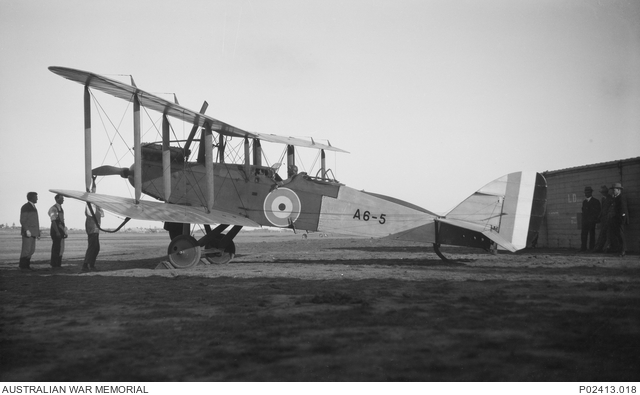
Header image: Port view of a RAAF De Havilland DH-9. This aeroplane was one of 128 gift aeroplanes presented by the British government to the newly formed RAAF, including thirty DH.9a (Source: Australian War Memorial)

[1] National Archives of Australia (NAA), A705, 4/1/35, Secretary, Department of Defence to the Secretary, Prime Minister’s Department, 14 October 1922.

[2] NAA, A705, 4/1/35, Secretary, Prime Minister’s Department to the Secretary, Department of Defence, 17 October 1922.

[3] NAA, A705, 4/1/35, Memorandum by the Governor-General to the Prime Minister, 11 November 1924.

[4] NAA, A705, 4/1/35, Memorandum by the Governor-General to the Prime Minister, 11 November 1924.

[5] John MacCarthy, Australia and Imperial Defence, 1918-39: A Study in Air and Sea Power (St Lucia, QLD: University of Queensland Press, 1976), p. 27.

[6] MacCarthy, Australia and Imperial Defence, pp. 34-43.

#ResearchNote – Top 10 Air Power History Books of this Generation

#ResearchNote – Top 10 Air Power History Books of this Generation

By Dr Ross Mahoney

Editorial note: This post was originally posted on my website and has been cross-posted here to generate further discussion. Minor editorial changes have been made to the post.

Ok, this post stems from a question I asked on BlueSky: ‘Who is the most significant air power historian of our generation? Discuss #airpowerhistory.’ The question stemmed from the call for contributors I posted last week and is related to my ongoing research into writing about air power. For the purpose here, ‘generation’ is to be considered to have been in the past 20-30 years. As such, the books listed here have been published since 1990.

In response, one poster asked me to list the top ten books I consider the most significant. I did a similar exercise for From Balloons to Drones back in 2017. The difference between the two lists is that the list produced in 2017 reflected those books that influenced and shaped my writing as an air power historian. In contrast, this list is more focused on those that I consider significant for their impact, though the list is still biased as I selected books from my library, and as such, they reflect my own research interests to some extent. I have also excluded edited books except for John Andreas Olsen and Philip Meilinger’s work for reasons I hope will be apparent. Other works, such as Tami Davis Biddle’s Rhetoric and Reality in Air Warfare (2002), would have made an expanded list. For an Air Power Reading list, visit the one from From Balloons to Drones.

Here is the list…

Tony Mason, Air Power: A Centennial Appraisal (London: Brassey’s, 1994). As I wrote here, Mason was one of the doyens of air power studies and undoubtedly crucial in developing the field in the UK. This work represented the culmination of his thinking, even though he would continue to write after its publication. He used history as a tool to explore the development of air power, and it is a significant volume and still requires reading to this day.

Philip Meilinger (ed.), The Paths of Heaven: The Evolution of Airpower Theory (Maxwell AFB, AL: Air University Press, 1997). One of the two edited works in this list. Written as a primer by the United States Air Force’s School of Advanced Airpower Studies faculty, this charts the evolution of air power theory and doctrine and is a necessary starting point for anyone researching the subject.

John Buckley, Air Power in the Age of Total War (London: UCL Press, 1999). Despite its age, this remains an excellent examination of the rise of air power in the first half of the 20th Century, and it is vital reading for anyone wanting an introduction to the subject.

Richard Hallion, Taking Flight: Inventing the Aerial Age from Antiquity through the First World War (Oxford: Oxford University Press, 2003). I could have selected any of Hallion’s work, for he is probably the United States’ preeminent air power historian. However, this book offers an excellent history of air power before the First World War.

John Andreas Olsen (ed.), A History of Air Warfare (Washington DC: Potomac Books, 2010). This edited book is listed for two reasons. One, Olsen is adept at bringing together leading air power scholars and any of his edited or single-authored books should be on your bookshelf. Second, the book is an excellent introduction to the use of air power in the major conflicts of the 20th and early 21st Centuries, written by leading experts such as Tony Mason, Richard Hallion, Richard Overy, John Morrow Jr, Alan Stephens, Benjamin Lambeth and Williamson Murray.

Richard Overy, The Bombing War: Europe, 1939-1945 (London: Allen Lane, 2013). The result of Overy’s voluminous research, this volume is required reading for anyone looking to understand the strategic bombing campaigns of the Second World War.

Thomas Hippler, Bombing the People: Giulio Douhet and the Foundations of Air-Power Strategy, 1884-1939 (Cambridge: Cambridge University Press, 2013). If one name is associated with the early development of air power thinking, it is the Italian Giulio Douhet. In this volume, Hippler does a thorough job of examining the evolution of Dohet’s strategic thought. It is necessary reading for anyone looking at the evolution of air power theory.

Peter Dye, The Bridge to Airpower: Logistics Support for the Royal Flying Corps on the Western Front, 1914-18 (Annapolis, MD: Naval Institute Press, 2015). This excellent work shows that air power history is not just about aeroplanes. Dye does a superb job of showing how logistics shaped the character of the air war over the Western Front and how the RFC/RAF’s system helped it prevail in 1918.

Phillips Payson O’Brien, How the War Was Won: Air-Sea Power and Allied Victory in World War II (Cambridge: Cambridge University Press, 2015). While not solely focused on air power, O’Brien’s work is essential in examining the role played by air power in conjunction with sea power in the Allied victory of the Second World War. The work challenges many preconceptions and should be required reading for anyone interested in the Second World War.

Peter Gray, Air Warfare: History, Theory and Practice (London: Bloomsbury, 2016). This book was the outgrowth of the old MA in Air Power run by Gray at the University of Birmingham. Gray gives an excellent overview of critical issues related to air power and is a necessary reading for those just getting into the subject.

What would you include? What would you remove?

Dr Ross Mahoney is an independent scholar specialising in the history of war with particular reference to the use of air power and the history of air warfare. He is currently the Senior Historian within the Heritage Policy team at Brisbane City Council in Australia. He has nearly 20 years of experience in the education, museum and heritage sectors in Australia and the United Kingdom. Between 2013 and 2017, he was the inaugural Historian at the Royal Air Force Museum in the UK. In Australia, he has worked as a Historian for the Department of Veterans’ Affairs and taught at the Strategic and Defence Studies Centre at The Australian National University based at the Australian War College. His research interests are focused on the history of war, specifically on the history of air power and air warfare, military leadership and command, military culture, and the history and development of professional military education. He also maintains an interest in transport history. He has published numerous articles, chapters and encyclopedia entries, edited two books, and delivered papers on three continents. His website is here, and he can be found on Twitter at @airpowerhistory.

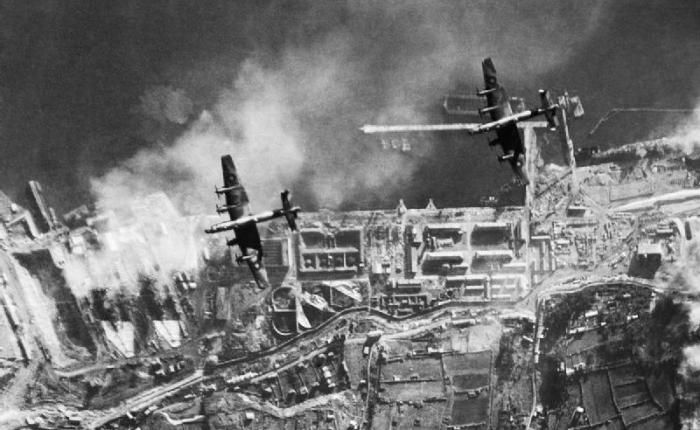
Header image: Vertical aerial photograph taken during a daylight attack on German warships docked at Brest, France. Two Handley Page Halifaxes of No. 35 Squadron RAF fly towards the dry docks in which the battlecruisers Scharnhorst and Gneisenau are berthed (right), and over which a smoke screen is rapidly spreading. (Source: Imperial War Museum)

#ResearchNote – The Royal Australian Air Force and the historiography of the ‘air wars’ over Vietnam

#ResearchNote – The Royal Australian Air Force and the historiography of the ‘air wars’ over Vietnam

By Dr Ross Mahoney

In 1970, the United States Air Force’s (USAF) Contemporary Historical Examination of Current Operations (CHECO) project, which produced around 250 volumes on various subjects, published a volume on the air operations of the RAAF over Vietnam.[1] The volume on the RAAF was one of several that examined non-US subjects; other air forces analysed included the Republic of Vietnam Air Force, the Royal Thai Air Force, and the Republic of Korea Air Force. Notably, the report on the RAAF, authored by James T. Bear, described the Australian effort over Southeast Asia as producing a ‘fruitful association’ with the USAF.[2] However, while the Americans, through the extensive distribution of this report to various commands, were aware of the views espoused by Project CHECO, the RAAF was not, as they were not included on the distribution list. As a result, this issue is often ignored by those using this source when writing on Australian air operations over Vietnam. For example, in a recent 2019 article in Sabretache, the journal of the Military Historical Society of Australia, Justin Chadwick made much of Bear’s report by describing its contents. However, Chadwick failed to address the distribution issue or whether the RAAF was aware of the report’s contents.[3] Nonetheless, Bear’s report, and others covering subjects pertinent to Australian air operations over Vietnam, were used by Chris Coulthard-Clark when researching and writing his volume on the RAAF in Vietnam as part of ‘The Official History of Australia’s Involvement in Southeast Asian Conflicts, 1948-1975.’ Moreover, the report is a valuable starting point for any discussion about Australia’s place in the air wars over Vietnam and the impact of the conflict on the RAAF.

More recently, however, air power historians have begun to discuss the air war over Vietnam more nuancedly. For example, in his 2021 history of the air war over Vietnam, Air Power’s Lost Cause, Brian Laslie, building on the work of scholars such as Mark Clodfelter, argued that the US fought six separate air wars during the conflict.[4] These campaigns included the strategic air campaign against North Vietnam; the battle for air superiority over North Vietnam; the USAF’s air war over South Vietnam; the US Navy’s air war over North and South Vietnam; air operations over Laos and Cambodia; and the US Army’s air mobility operations. However, while this classification helps describe US air operations over Vietnam, in excluding the experience of other nations involved in these ‘air wars,’ historians fail to tell a cohesive story about the use of air power over Vietnam.

Australian_soldiers_unloading_rations_from_a_9_Squadron_helicopter_in_1967
Rations and supplies are unloaded from a UH-1B Iroquois helicopter of No. 9 Squadron RAAF, by troops of 7th Battalion, The Royal Australian Regiment, near the village of Long Dien during Operation Ulmarra, August 1967. (Source: Wikimedia)

Two reasons explain why historians fail to tell a cohesive story of air operations over Vietnam. First, from an American perspective, Vietnam is viewed as an inherently US war, especially regarding military operations. As Andrew Weist has remarked, ‘[r]emainders of the Vietnam War litter the cultural landscape of the United States.’[5] These reminders and the associated issues of ownership over the experience of the Vietnam War are often reinforced by popular accounts of the war, such as Ken Burns and Lynn Novick’s 2017 documentary The Vietnam War and debates related to America supposedly repeating the mistakes of Vietnam in its recent operations in Iraq and Afghanistan.[6] This has led historians to focus solely on the American experience and not to fully incorporate the story of those other nations that fought in the Vietnam War. Where they are included, their experience is often viewed as a sideshow to the main American effort. Indeed, as Bear’s CHECO report on the Australians noted, in the view of the USAF, ‘only Australia played a significant role in the air war.’[7]

The second reason concerns how the history of the RAAF in Vietnam has been written. This relates to the state of Australian military historiography and, from the perspective of the RAAF, how the Air Force’s narrative has shaped the latter’s account.[8] Apart from Coulthard-Clark’s 1995 official history, The RAAF in Vietnam: Australian Air Involvement in the Vietnam War 1962-1975, the literature on the RAAF’s service in Vietnam has primarily been the preserve of either the Air Force’s official histories or popular accounts, including veterans’ memoirs.[9] This situation mirrors concerns highlighted by John Ferris in 1998 when he reflected that most writers on air power history more broadly tend to be:

[t]he children of airmen, have been military personnel themselves, and have been employed at a historical office or service school in Canada, Germany, the United Kingdom, or the United States.[10]

This is undoubtedly the case with the history of the RAAF over Vietnam. Indeed, the RAAF has shaped the narrative surrounding the Air Force’s operations over Vietnam in two ways. First, the RAAF has published two official histories that span the Vietnam War period. The first, Going Solo, covered the period from 1945 to 1972 and was written by Alan Stephens, the former RAAF Historian. The second volume, Taking the Lead, written by Mark Lax, a RAAF Air Commodore, covers the period from 1972 to 1996. Neither book focuses singularly on Australian air operations over Vietnam. However, given the importance of the conflict to the RAAF, the war is integral to their analysis, particularly in Stephens’ volume. While both Stephens and Lax served in the RAAF and were academically trained historians, they were well placed to write these histories, thereby enhancing the value of these books. Nonetheless, as official histories, these works are often regarded as providing a definitive account of their subject. However, official histories are often the first rather than the last word on their topic.

The second way the RAAF has influenced the narrative of its operation over Vietnam is that the first book on Australian air operations during the conflict, Mission Vietnam, was commissioned by the Air Force. Research for Mission Vietnam, written by George Odgers, the Director of Public Relations in the Department of Air, began in 1971 before Australian air operations in Vietnam ended in 1972.[11] The book appeared in 1974, the year before the RAAF deployed Detachment ‘S’. As such, it does not comprehensively capture all RAAF operations associated with the Vietnam War. On publication, the RAAF News was convinced that Odgers’ volume would have ‘widespread appeal’ while one 1974 review in The Canberra Times described it as ‘essential reading.’[12] Illustrative of its importance in shaping the narrative, Mission Vietnam will be republished by the RAAF’s History and Heritage branch.

Beyond these volumes, discussions of RAAF operations over Vietnam have typically been left to popular accounts or memoirs, including those published under the auspicious of the Air Force’s Air and Space Power Centre and the History and Heritage Branch.[13] For example, Jeff Pedrina’s account Wallaby Airlines was initially published in 2006 by the Air Power Development Centre (as ASPC was then known). It was recently reissued in 2023 as part of the Australian Air Campaign Series (AACS) produced by the History and Heritage Branch.[14] Similarly, as part of the AACS, in 2022, the History and Heritage Branch published an abridged version of Air Vice-Marshal Reed’s autobiography, Invited to a War.[15] Reed had served in Vietnam, flying Phantoms on exchange with the USAF. Many of these works represent what has invariably been described as Australia’s ‘democratic’ approach to military history, which focuses on the experiences of veterans.[16] In this sense, every participant’s views and recollections are equal and should be heard. There are, however, exceptions to this democratic approach. For example, Steven Paget’s recent examination of the operations of No. 2 Squadron over Vietnam usefully places the challenges the RAAF faced in achieving interoperability with the USAF into context.[17]

Aircraft_revetments_at_Phan_Rang_Air_Base_with_No._2_Squadrons_Canberras
Aerial view of the aircraft revetments at Phan Rang airbase in July 1967. No. 2 Squadron RAAF Canberra bombers are parked in the bays located in the immediate foreground. (Source: Australian War Memorial)

Given much of the above, how would a more integrated and cohesive account of Vietnam’s air wars look? First, from an Australian perspective, we need to move away from focusing solely on the Australian experience of the Vietnam War. As Thomas Richardson argued, such perspectives distort our view of Australia’s ‘success or failure’ in Vietnam.[18] This applies equally to the RAAF and the Australian Army. Second, with regard to the broader picture of air operations over Vietnam, consideration of the experience of non-US units would help inform wider discussions on the character and challenges of coalition air operations in this period by considering issues such as cooperation and friction. While official and authorised accounts address some of these challenges, their aim of foregrounding the Australian experience through a functional approach to history, based on the RAAF’s roles, limits how far they can analyse these issues.[19]

Some indication of how to produce such a history can be gleaned from Paget’s work on No. 2 Squadron operations. Paget rightly noted that the experience of No. 2 Squadron highlighted issues in command and control, standardisation, tactics, training and procedures, and the sustainment of operations. However, these themes can be further analysed through additional examples of Australia’s experience in Vietnam. For example, the experience of RAAF officers on secondment as airborne Forward Air Controllers offers a valuable opportunity to understand how lessons are learnt and shared between air forces. Similarly, before the deployment of No. 2 Squadron, No. 35 Squadron was already fully integrated into the USAF command-and-control apparatus. Moreover, unlike No. 2 Squadron, No. 35 Squadron operated an aircraft type that the US would not deploy to South Vietnam until later in the war. However, it appears that the USAF did not take the opportunity to study the RAAF’s use of the Caribou, which raises questions about why this might have been.[20] As such, understanding the experience of No. 35 Squadron would further enrich our understanding of the air wars over Vietnam by exploring cultural issues that either help or retard the lessons learnt process. Finally, we must consider what the deployment of RAAF air assets to Vietnam contributed to the overall war effort, given that, for example, during February 1968, at the height of the Tet Offensive, the Air Force accounted for only around one per cent of all attack sorties flown.[21] This was undoubtedly a significant effort for the RAAF. Still, it highlights the problem of deploying only single unit types rather than a cohesive operational package comprising several squadrons of the same type. As such, within the context of wider coalition operations, we must further question why the RAAF deployed the force it did and how it sought to influence and shape ongoing operations.

Dr Ross Mahoney is the Editor-in-Chief of From Balloons to Drones. He is an independent scholar specialising in the history of war with particular reference to the use of air power and the history of air warfare. He is currently the Senior Historian within the City Architecture and Heritage Team at Brisbane City Council in Australia. He has nearly 20 years of experience in the education, museum and heritage sectors in Australia and the United Kingdom. Between 2013 and 2017, he was the inaugural Historian at the Royal Air Force Museum in the UK. In Australia, he has worked as a Historian for the Department of Veterans’ Affairs and taught at the Strategic and Defence Studies Centre at The Australian National University based at the Australian War College. His research interests are focused on the history of war, specifically on the history of air power and air warfare, military leadership and command, military culture, and the history and development of professional military education. He also maintains an interest in transport history. He has published numerous articles, chapters and encyclopedia entries, edited two books, and delivered papers on three continents. His website is here, and he can be found on Twitter at @airpowerhistory.

Header image: DHC-4 Caribous of the RAAF Transport Flight arrived in South Vietnam in 1964 to work with the South Vietnamese and U.S. Air Forces to transport soldiers and supplies to combat areas in South Vietnam. (Source: Wikimedia)

[1] James T. Bear, ‘The RAAF in SEA’ (CHECO Division, 1970); Warren A. Trest, ‘Projects CHECO and Corona Harvest: Keys to the Air Force’s Southeast Asia Memory Bank,’ Aerospace Historian 33, no. 2 (1986), pp. 114-20; Major Daniel Hoadley, ‘What Just Happened? A Historical Evaluation of Project CHECO’ (MA Thesis, USAF School of Advanced Air and Space Studies, 2013).

[2] Bear, ‘The RAAF in SEA,’ p. 1. During the Vietnam War, the RAAF contributed significantly to the Australian effort in the conflict. While some flights had taken place in South Vietnam by a Dakota of No. 2 Squadron’s transport flight in 1963, the first significant deployment of RAAF assets took place in 1964 when six DHC-4 Caribous of the recently formed RAAF Transport Flight Vietnam – later renumbered as No. 35 Squadron in 1966 – were deployed as part of Australia’s early efforts in supporting the war. After the deployment of No. 35 Squadron, the RAAF’s primary involvement took the form of No. 9 Squadron equipped with Bell UH-1B Iroquois helicopters and No. 2 Squadron with GAF Canberra bombers. Notably, 36 fighter pilots served as airborne Forward Air Controllers with the USAF’s 19th and 20th Tactical Air Support Squadrons flying Cessna O-1 Bird Dogs, Cessna O-2 Skymasters, and Rockwell OV-10 Broncos. Additionally, six RAAF pilots flew USAF McDonnell F-4 Phantoms during the war as part of the 12th Tactical Fighter Wing. There were also those units – Nos. 36 and 37 Squadron – who maintained a strategic air bridge between Australia and Vietnam, including aeromedical evacuation. Lockheed Neptune maritime patrol aircraft regularly patrolled the sea lines of communication between Australia and Vietnam, such as during Operation Trimdon in 1965.  In addition to the deployed squadrons, various elements of the RAAF provided valuable ground support, including airfield construction, air defence guards, and medical personnel. Officially, RAAF operations over Vietnam ended in February 1972 when the last Caribous of No. 35 Squadron left the country. However, in 1975, as South Vietnam finally fell, the RAAF deployed Detachment ‘S’ to Vietnam to withdraw Australian national and embassy staff and distribute Red Cross aid.

[3] Justin Chadwick, “Nothing to diminish their glamour’: Project CHECO and the RAAF,’ Sabretache 60, no. 4 (2019), pp. 23-34.

[4] Brian Laslie, Air Power’s Lost Cause: The American Air Wars of Vietnam (Lanham, MD: Roman and Littlefield, 2021), p. 2; Mark Clodfelter, ‘The Limits of Airpower or the Limits of Strategy: The Air Wars in Vietnam and Their Legacies,’ Joint Forces Quarterly 78 (2015), pp. 111-24.

[5] Andrew Weist, ‘Introduction’ in Andrew Weist (ed.), Rolling Thunder in a Gentle Land: The Vietnam War Revisited (Oxford: Osprey Publishing, 200), p. 16.

[6]  Andrew Gawthorpe, ‘Ken Burns, the Vietnam War, and the Purpose of History,’ Journal of Strategic Studies 43, no. 1 (2020), pp. 154-69.

[7] Bear, ‘The RAAF in SEA,’ p. 1.

[8] Jeffrey Grey, ‘Cuckoo in the Nest? Australian Military Historiography: The State of the Field,’ History Compass 6, no. 2 (2008), pp. 455-68.

[9] Chris Coulthard-Clark, The RAAF in Vietnam: Australian Air Involvement in the Vietnam War, 1962-1975 (Sydney, NSW: Allen & Unwin in association with the Australian War Memorial, 1995). For the RAAF’s official histories, see: Alan Stephens, Going Solo: The Royal Australian Air Force, 1946-1971 (Canberra, ACT: AGPS Press, 1995); Lax, Taking the Lead. For memoirs and autobiographies, for example, see: Gary Cooper and Robert Hillier, Sock it to ‘em Baby: Forward Air Controller in Vietnam (Crows Nest, NSW: Allen and Unwin, 2006); David Evans, Down to Earth: The Autobiography of Air Marshal David Evans, AC, DSO, AFC (Canberra, ACT: Air Power Development Centre, 2011).

[10] John R. Ferris, ‘Review Article – The Air Force Brats’ View of History: Recent Writing and the Royal Air Force, 1918–1960,’ The International History Review 20, no. 1 (1998), p. 119.

[11] George Odgers, Mission Vietnam: Royal Australian Air Force Operations, 1964-1972 (Canberra, ACT: Australian Government Publishing Service, 1974); ‘History of War,’ The Canberra Times, 18 June 1971, p. 1.

[12] ‘“Mission Vietnam” sure to have widespread appeal,’ RAAF News, 1 August 1974, p. 3; “Written the Way it Was in Vietnam Air War,’ The Canberra Times, 16 August 1974, p. 9.

[13] Examples of books published under the auspicious of the RAAF’s Air and Space Power Centre that discuss Vietnam include: John Bennett, Highest Traditions: The History of No. 2 Squadron RAAF (Canberra, ACT:  Australian Government Publishing Service, 1995); Graham O’Brien, Always There: A History of Air Force Combat Support (Canberra, ACT: Air Power Development Centre, 2009); Chris Clark, The RAAF at Long Tan (Canberra, ACT: 2010); Evans, Down to Earth; Bob Howe, Dreadful Lady over the Mekong Delta: An Analysis of RAAF Canberra Operations in the Vietnam War (Canberra, ACT: Air Power Development Centre, 2016). For an example of a book produced in conjunction with the History and Heritage Branch, see: Bob Grandin, Answering the Call: Life of a Helicopter Pilot in Vietnam and Beyond (Newport, NSW: Big Sky Publishing, 2019).

[14] Jeff Pedrina, Wallaby Airlines: Twelve Months Caribou Flying in Vietnam (Tuggeranong, ACT: Air Power Development Centre, 2006). Pedrina, Wallaby Airlines: Twelve Months flying the Caribou in Vietnam (Newport, NSW: Big Sky Publishing, 2022).

[15] Air Vice Marshal Alan Reed, Invited to a War (Newport, NSW: Big Sky Publishing, 2002).

[16]  Thomas Richardson, Destroy and Build: Pacification in Phuc Tuy, 1966-72 (Melbourne, VIC: Cambridge University Press, 2017), p. 5.

[17] Steven Paget, ‘Magpies and Eagles: Number 2 Squadron, Royal Australian Air Force, and the Experience of Coalition Warfare in Vietnam’ in Steven Paget (ed.), Allies in Air Power: A History of Multinational Air Operations (Lexington, KT: The University Press of Kentucky, 2021), pp. 142-67.

[18] Richardson, Destroy and Build, p. 6.

[19] Coulthard-Clark, The RAAF in Vietnam, pp. xii.

[20] Bear, ‘The RAAF in SEA,’ p. 30.

[21] Bernard Nalty, Air War over South Vietnam, 1968-1975 (Washington DC: United States Air Force History and Museum Program, 2000), p. 19.

#Podcast – Best Aviation and Air Power Books of 2022: An Interview with Dr Ross Mahoney

#Podcast – Best Aviation and Air Power Books of 2022: An Interview with Dr Ross Mahoney

Editorial Note: Led by Editor Dr Mike Hankins, From Balloons to Drones produces a monthly podcast that provides an outlet for the presentation and evaluation of air power scholarship, the exploration of historical topics and ideas, and provides a way to reach out to both new scholars and the general public. You can find our Soundcloud channel here. You can also find our podcast on Apple Podcasts and Google Podcasts.

Our latest podcast discusses our favourite books of the year with Dr Ross Mahoney, Editor-in-Chief of From Balloons to Drones. Each of us discusses our top three reads of 2022, and we take a look forward at some topics we would really like to hear more about in the future.

The books discussed:

  1. Malayan Emergency and Indonesian Confrontation, 1950-1966 by Mark Lax
  2. Air Power in the Falklands Conflict: An Operational Level Insight into Air Warfare in the South Atlantic by John Shields
  3. Air Power Supremo: A Biography of Marshal of the Royal Air Force Sir John Slessor by William Pyke
  4. Black Snow: Curtis LeMay, the Firebombing of Tokyo, and the Road to the Atomic Bomb by James Scott – reviewed here.
  5. A Long Voyage to the Moon: The Life of Naval Aviator and Apollo 17 Astronaut Ron Evans by Geoffrey Bowman – reviewed here.
  6. Dark Horse: General Larry O. Spencer and His Journey from the Horseshoe to the Pentagon by General Larry O. Spencer, USAF (Ret.) – interviewed here.
  7. Wings of Gold: The Story of the First Women Naval Aviators by Beverly Weintraub – interviewed here.
  8. Tomcats and Eagles: The Development of the F-14 and F-15 in the Cold War by Tal Tovy
  9. Because Our Fathers Lied: A Memoir of Truth and Family, from Vietnam to Today by Craig McNamara.

Dr Ross Mahoney is an independent scholar specialising in the history of war, particularly concerning the use of air power and the history of air warfare. He is currently the Senior Historian within the City Architecture and Heritage Team at Brisbane City Council in Australia. He has over 15 years of experience in the heritage and education sectors in Australia and the United Kingdom. Between 2013 and 2017, he was the inaugural Historian at the Royal Air Force Museum in the UK. In Australia, he has worked as a Historian for the Department of Veterans’ Affairs and taught at the Strategic and Defence Studies Centre at The Australian National University based at the Australian War College. His research interests are focused on the history of war, specifically the history of air warfare, transport history, and urban history. To date, he has published several chapters and articles, edited two books, and delivered papers on three continents. He has a book review website here and can be found on Twitter at @airpowerhistory.

Header image: One of six FMA IA 58 Pucará’s destroyed on 15 May 1982 after a raid by the Special Air Service on Pebble Island during the Falklands War. (Source: Wikimedia) 

#BookReview – Korean Air War: Sabres, Migs and Meteors, 1950-53

#BookReview – Korean Air War: Sabres, Migs and Meteors, 1950-53

Michael Napier, Korean Air War: Sabres, Migs and Meteors, 1950-53. Oxford: Osprey Publishing, 2021. Images. Notes. Bibliography. Glossary. Appendices. Index. Hbk. 320pp.

Reviewed by Dr Ross Mahoney

41VxZr5jKnL

In the western world, the Korean War is often thought of as the forgotten war of the early Cold War. This was, at least from an American perspective, because ‘[l]ike the proverbial shrimp caught between two whales, the Korean War [was] trapped between World War II and the Vietnam War.’[1] Furthermore, from a British and French perspective, the war does not easily fit into national narratives surrounding their ‘retreat’ from empires in Southeast Asia, namely the Malayan Emergency and the French-Indochina War. The Korean War did, however, significantly impact the Cold War’s early course, particularly strengthening the recently established North Atlantic Treaty Organisation.

From the perspective of the application and development of air power, the Korean War was also significant. Specifically, it was the first time jet fighters met in combat. Furthermore, the war also saw a wide range of air power capabilities deployed over Korea, including discussions throughout the conflict about the potential delivery of nuclear weapons.[2] This has meant that, despite the unfortunate epithet of being a forgotten war, several important works, such as Conrad Crane’s American Airpower Strategy in Korea (2000), have appeared and examined the use of air power over the Korean peninsula.

Michael Napier, a retired Royal Air Force fast-jet pilot and author, comes into this mix with his 2021 volume, Korean Air War. In just over 300 pages, Napier systematically describes the course of the air war over Korea. The book, chronologically laid out, deals with the air war in seven chapters plus a retrospective to finish the volume. There are also two appendices included. The chapters follow the broad course of the main phases of the Korean War. For example, Chapter Three deals with the period of the offensive by United Nations (UN) forces between August and October 1950 (pp. 72-113). This is then followed up by a chapter that looks at the period of the Chinese offensives (pp. 114-55) against UN forces that forced them back to roughly the 38th Parallel. Within these chapters, Napier details the various uses of air power by both sides during the war. This includes the use of tactical and strategic air power as well as naval air power. Napier also does a good job of describing the coalition character of the air war for both sides. However, his attempt to highlight the British contribution can sometimes be overstated.

lossy-page1-3000px-U.S._Marines_of_the_First_Marine_Division_Reconnaissance_Company_make_the_first_helicopter_invasion_on_Hill_812,_to..._-_NARA_-_520805.tif
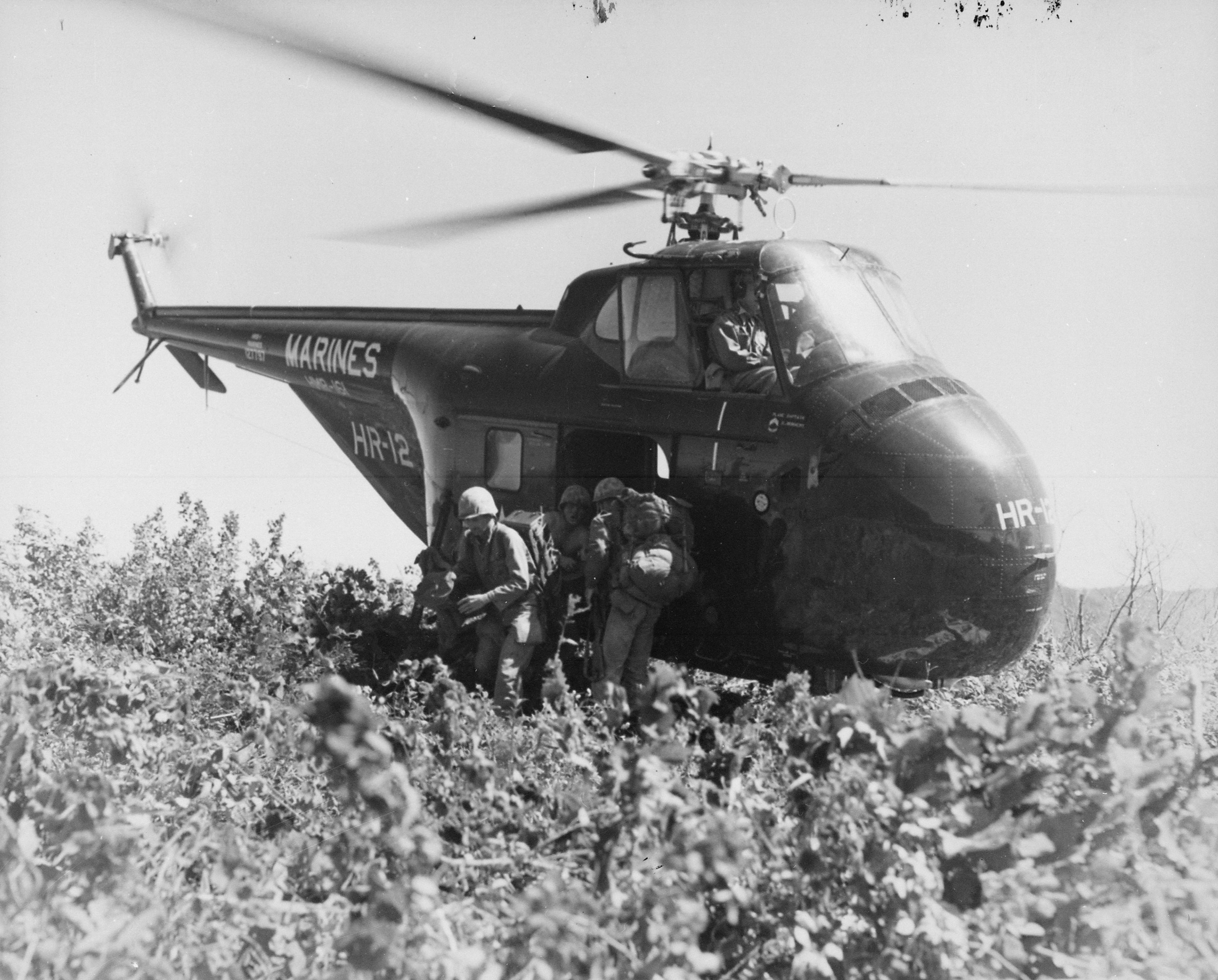
US Marines of the First Marine Division Reconnaissance Company make the first helicopter invasion on Hill 812, to relieve the Republic of Korea 8th Division, during the renewed fighting in Korea, 20 September 1951. (Source: Wikimedia)

While the book comprehensively deals with the air war over Korea, readers should not expect an academic examination of the use of air power between 1950 and 1953. That is not what this book is. However, this is not a criticism per se. Instead, the book has been written with a specific audience in mind – the general reader looking for an introduction to the subject. This is highlighted by Napier’s choice to examine the war chronologically (p. 6). This is a choice that makes it easier for the lay reader to understand what was a complex and contested operating environment. Ultimately, therefore, we end up with a very useful narrative of the course of the air war that introduces readers to the subject matter.

One area, however, where the book does fall down is in its use of sources. Regarding primary sources, Napier has overwhelmingly relied on files in British archival institutions, notably The National Archives and the Royal Air Force Museum. While perhaps a pragmatic decision given the author’s location and the character of this book as a popular account of the air war, it does, nonetheless, skew the author’s interpretation. Furthermore, at least from the perspective of UN forces deployed, most of the air power deployed in support of the war effort came from the US. As such, one would expect more attention to be given to the records produced by those forces involved. Finally, given the above issue, Napier relies on secondary sources to fill in the gaps despite arguing that published accounts of the air war over Korea were less than ‘objective’ (p. 6) in their analysis. However, it appears from the notes and bibliography that Napier did not consult important, more ‘objective’ works such as Crane’s noted above and others.[3] The use of such works would have further enriched Napier’s narrative

Overall, despite the above criticism, Napier has done an excellent job of writing a comprehensive introductory narrative to the air war over Korea. In particular, Napier does a good job of weaving together a narrative that tells the story of both sides of the air war over Korea. The book is lavishly supported by high-quality imagery and maps that help support the text.

Dr Ross Mahoney is the Editor-in-Chief of From Balloons to Drones and is an independent scholar specialising in air power and the history of air warfare. He is currently the Senior Historian within the City Architecture and Heritage Team at Brisbane City Council in Australia. He has over 15 years of experience within the heritage and education sectors in Australia and the United Kingdom. He was the inaugural Historian at the Royal Air Force Museum in the UK. In Australia, he has worked as a Historian for the Department of Veterans’ Affairs and taught at the Strategic and Defence Studies Centre at The Australian National University based at the Australian War College. His research interests are focused on military history, with a specific focus on the history of air warfare, transport history, and urban history. He has published several chapters and articles, edited two books, and delivered papers on three continents. He has a website here and can be found on Twitter at @airpowerhistory.

Header image: Four US Air Force North American F-86E Sabre fighters over Korea in November 1952. (Source: Wikimedia)

[1] Allan Millett, The War for Korea, 1945-1950: A House Burning (Lawrence, KS: University Press of Kansas, 2005), p. 1.

[2] Daniel Calingaert, ‘Nuclear weapons and the Korean War,’ Journal of Strategic Studies 11, no. 2 (1988), pp. 177-202.

[3] Other works of note not cited include: Eduard Mark, Aerial Interdiction: Air Power and the Land Battle in Three American Wars (Washington DC: Office of Air Force History, 1994); John Sherwood, Officers in Flight Suits: The Story of American Air Force Fighter Pilots in the Korean War (New York, NY: New York University Press, 1998); Jacob Neufeld, Coalition Air Warfare in the Korean War 1950–1953 (Washington DC: U.S. Air Force History and Museums Program, 2005); Roger Horky, ‘Clipping the Eagle’s Wings: The Limiting of the Korean Air War, 1950-1953’ (PhD Thesis, Texas A&M University, 2013).

From Balloons to Drones – 5 Years On

From Balloons to Drones – 5 Years On

By Dr Ross Mahoney

Five years ago, on 15 June 2016, From Balloons to Drones was launched. From Balloons to Drones was established with the simple vision of providing an open access online platform for the analysis and debate of air power history, theory, and contemporary operations in their broadest sense, including space and cyber power. Since establishing From Balloons to Drones, we have published 195 posts of various types ranging from articles to book reviews. More recently, in 2019, we started producing a popular podcast series with interviews with leading air power specialists. Overall, the site has received over 130,000 hits since 2016.

None of the above would have been achieved without the support of our editors, contributors, and readers. Personally, I am grateful to all the members of the From Balloons to Drones editorial team for their continuing hard work, especially as it is all done voluntarily. Indeed, when the site was established, it was run by one person, our Editor-in-Chief, Dr Ross Mahoney. However, over time, the editorial team has grown and evolved. In 2018, long-time contributors Dr Brian Laslie, Dr Michael Hankins, and Alex Fitzgerald-Black came onboard as editors. While Alex has moved on, we have continued to build and strengthen the editorial team with the addition of Victoria Taylor and Dr Luke Truxal to the team. As we look forward to the next five years of From Balloons to Drones, I am pleased to announce the addition of two new editors to the team: Dr Maria Burczynska and Ashleigh Brown. Maria is a Lecturer in Air Power Studies at the University of Wolverhampton in the UK, while Ashleigh, a PhD student at UNSW Canberra, is a researcher for the Official History of Australian Operations in Iraq & Afghanistan and Australian Peacekeeping Operations in East Timor. The addition of Maria and Ashleigh will help strengthen the team in several areas, and we are looking forward to what the future holds with them.

I am also grateful to all our contributors and readers. Without our contributors, there would be nothing to publish and, as such, no website. However, we are always on the lookout for new contributions either from established authors or from new and emerging scholars within the air power studies community. If you are interested in contributing, then visit our submissions page to find out how to contribute.

So, what about the future? More of the same but better. We still hold true to our original vision of providing an avenue for debate and discussion about air power. We will aim to continue to refine what we offer in terms of content and build on the success of the past five years. We have more articles, book reviews and podcasts in the pipeline. However, we are always keen to hear your views on what we publish. If there is an area of research that needs to be given more coverage, please let us know.

Finally, as a bit of fun to celebrate our fifth birthday, here are the top five most-read posts since our launch in 2016:

  1. Michael Hankins, ‘Inventing the Enemy: Colonel Toon and the Memory of Fighter Combat in Vietnam’
  2. Michael Hankins, ‘A Discourse on John Boyd: A Brief Summary of the US Air Force’s Most Controversial Pilot and Thinker’
  3. Liam Barnsdale, ‘Royal Air Force ‘wings’ Brevets in Second World War Propaganda’
  4. Justin Pyke, ‘Blinded by the Rising Sun? American Intelligence Assessments of Japanese Air Power, 1920-41: Part 1 – The 1920s’
  5. Jeff Schultz, ‘Supporting the Secret War: T-28s over Laos, 1964-1973 – Part 1: Training’

Header image: Pilatus PC-21A aircraft from No 4 Squadron based at RAAF Base Williamtown fly in formation on return from Sydney in support of an Air Force 2021 commemorative service held at the Anzac Memorial in Hyde Park. (Source: Australian Department of Defence)

#BookReview – Be Bold

#BookReview – Be Bold

By Dr Ross Mahoney

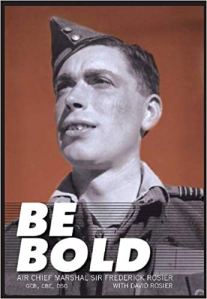
Air Chief Marshal Sir Frederick Rosier with David Rosier, Be Bold. London: Grub Street, 2011. Hbk. 256pp.

5125bvndQHL._SX343_BO1,204,203,200_

Air Chief Marshal Sir Frederick Rosier had a long and distinguished career in the Royal Air Force (RAF). Granted a short service commission in 1935 (p. 19), he was the last Air Officer Commander-in-Chief (AOC-in-C) of RAF Fighter Command before it merged with Bomber Command in 1968 to form Strike Command. This autobiography, written with his son David who finished it after his father’s death in 1998 (p. 10), highlights many interesting facets of service in the RAF during two pivotal events in twentieth-century history; the Second World War and the Cold War. Concerning the former, this book gives us a view from a rising junior officer who served in both frontline and staff positions during the Second World War. Regarding the latter, we have a view of the Cold War and its threats from the perspective of an officer rising to senior command. As such, it illustrates many of the challenges and ambiguities associated with senior leadership.

The genres of autobiographies and memoirs and the associated field of biography remain an ever popular and vital element of military history. While it is often easy to criticise biographers of hagiography and autobiographers of viewing the past through the prism of hindsight, they do offer valuable insight to the past. Indeed, biographies and memoirs/autobiographies are arguably the most commercially viable method of making military history accessible to wider audiences. Additionally, biographies and memoirs/autobiographies are an essential source for historians seeking to understand the period they study. More specifically, with regards to the RAF, there are too few accounts either by or about senior officers who served during the Cold War period. Indeed, for officers who served during the Cold War, we are unlikely to see the type of voluminous personal papers that we see with such former senior officers as Marshal of the Royal Air Force Viscount Trenchard and Admiral of the Fleet Earl Mountbatten. As such, it has become more critical that the service experience of these men be recorded. In this vein, memoirs and autobiographies offer a useful adjunct to the historians’ toolkit as they, just like oral history, can offer a personal view on many of the events that we read about in official archival sources. Thus, Rosier’s account is much welcomed.

Most interesting for this reviewer is that Rosier’s career offers an insight into his career progression and leadership development in the RAF. Rosier’s career illustrated that it was possible for suitable short service officers to be granted a permanent commission. This had been Trenchard’s expectation when the short service scheme had been established. After the Second World War, and granted a permanent commission, Rosier followed the typical route to senior command with attendance at both the RAF Staff College in 1946 (pp.156-162) and the Imperial Defence College (IDC) in 1957 (pp. 208-214). Rosier also spent time as Directing Staff at the recently opened Joint Services Staff College between 1950-52 (pp. 186-190). However, his reminisce about his time as a student at the RAF Staff College highlights a fundamental problem with autobiographies; the issue of confusion. Rosier lamented (p. 156) that the inter-war course at the RAF Staff College had been two years. However, this is inaccurate as they were only a year. As such, we must always be careful about what an auto-biographer recollects.

RAF-T 8374
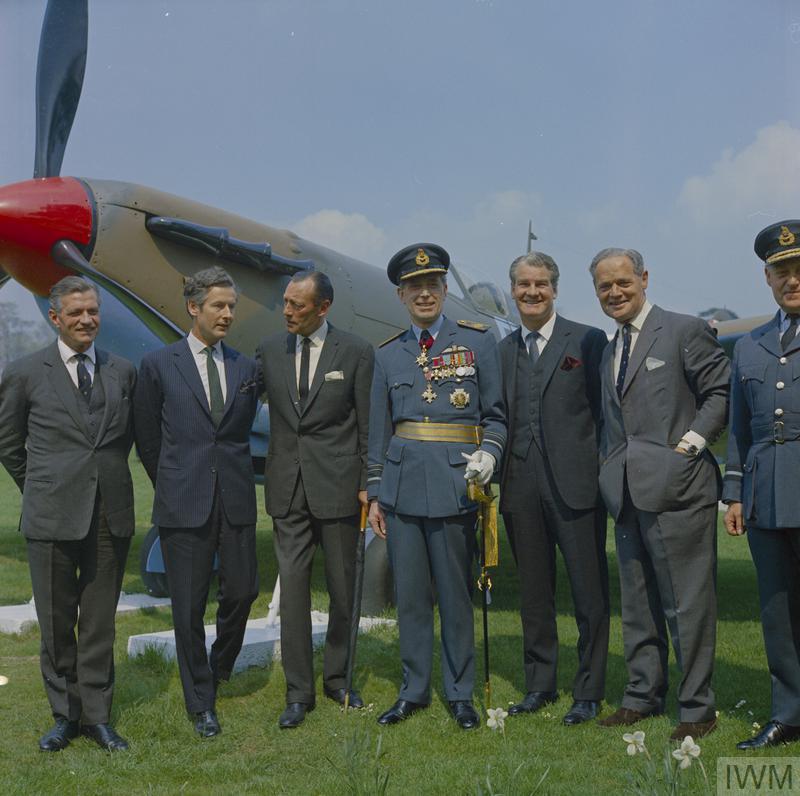
At the parade to mark the disbanding of RAF Fighter Command held at RAF Bentley Priory on 30 April 1968, Air Marshal Sir Frederick Rosier KCB CBE DSO ADC, the last Air Officer Commander in Chief of the command stands with several of the most famous Second World War aces, from left to right: Air Vice Marshal ‘Johnny’ Johnson CBE DSO** DFC*, Group Captain P.W. Townsend CVO DSO DFC*, Wing Commander R.R.S. Tuck DSO DFC** DFC (US), Air Commodore A.C. Deere OBE DSO DFC* DFC (US) and Group Captain Sir Douglas Bader CBE DSO* DFC*. (Source: © Crown Copyright. IWM (RAF-T 8374))

Rosier’s posting from the Central Fighter Establishment (CFE), to Fighter Command as Group Captain – Plans in 1954 (pp. 200-1) also highlights the process of career management in the RAF. It highlights the influence that seniors officers had in determining someone’s career. Rosier related that he had expected a posting as Group Captain – Operations at Fighter Command. However, this had been changed to a posting to the Royal Aircraft Establishment. This was not to the liking of the AOC-in-C of Fighter Command, Air Marshal Sir Dermot Boyle, who managed to have that posting changed to that of Group Captain – Plans. This was an unexpected turn of events as Rosier had not served in a plans position up to this point in his career.

Nonetheless, it is clear that this posting was designed to give Rosier further experience of working with the other services and with allies; an essential prerequisite for senior command. Rosier recorded (p. 204) of this period as one ‘of broadening my education.’ What is more, this section of this autobiography, and that describing his time at the IDC, comes in a chapter entitled ‘Climbing to the Top.’ Indeed, after his time at Fighter Command as Group Captain – Plans, Rosier went on to be Director of Plans in the Air Ministry in 1958 after having spent time at the IDC. Again, at the Air Ministry, Rosier served under Boyle who by now was Chief of the Air Staff. Importantly, periods of service in staff positions were an essential marker in an officers rise to senior command primarily because this experience not only insured that individuals came into contact with those who could nurture and shape one’s career but also that it further developed ones understanding of the organisation that they would, potentially, one day lead.

In addition to this vital period of staff work, Rosier inter-weaved his career with significant periods as an operational fighter commander. This notably included time in North Africa during the Second World War where he was, alongside the future Air Chief Marshal Sir Kenneth Cross, a key fighter leader in the Western Desert Air Force (pp. 63-114). During this period, he was awarded the Distinguished Service Order. Indeed, except for his time at the Air Ministry and a period as Senior Air Staff Officer at Transport Command, Rosier’s career was very much tied to either fighter aircraft or Fighter Command more specifically.

Finally, and importantly, in the context of the Cold War Rosier also spent time working within the coalition system. Between 1948 and 1950 he served on an exchange tour with the recently formed United States Air Force that also included time at the US Armed Forces Staff College (pp. 171-85). Rosier also served with the Central Treaty Organisation and his final command was as the Deputy Commander-in-Chief of Allied Forces Central Europe.

In conclusion, this is a very valuable autobiography of a senior RAF officer. In addition to the critical facets discussed above this book provides an excellent insight into life in the RAF in both war and peace. It also provides some excellent insights into the important personalities of the period. For example, Rosier recalled his visit to the Soviet Union in 1956 while he was at Fighter Command. His most notable recollection (pp. 205-6) was an incident during an open-air reception at the Kremlin where both Nikolai Bulganin and Nikita Khrushchev got drunk and related in their respective speeches how much they disliked each other. This book is recommended to anyone with an interest in the RAF.

Dr Ross Mahoney is a contract Historian at the Departments of Veterans’ Affairs in Australia as well as the owner and Editor of From Balloons to Drones. He is a graduate of the University of Birmingham (MPhil and PhD) and the University of Wolverhampton (PGCE and BA). His research interests include the history of war in the twentieth and twenty-first centuries, air power and the history of air warfare, and the social and cultural history of armed forces. To date, he has published several chapters and articles, edited two books, and delivered papers on three continents. He is a member of the Royal Historical Society and a Vice-President of the Second World War Research Group. He can be found on Twitter at @airpowerhistory.

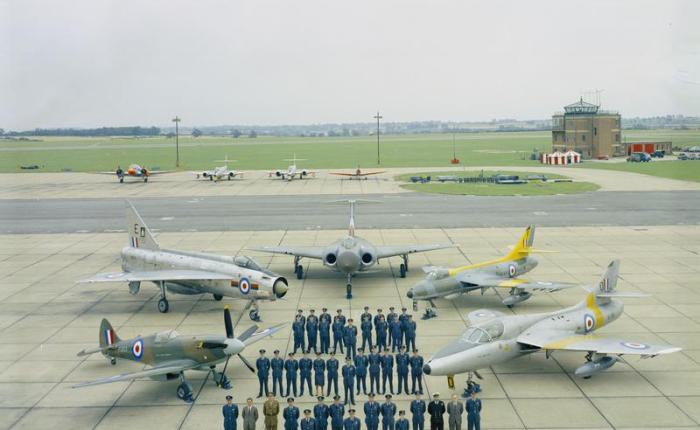
Header Image: Aircraft past and present of the Central Fighter Establishment at RAF West Raynham in October 1962, as the unit moved to RAF Binbrook in Lincolnshire. The aircraft pictured here represent the various aircraft used by the constituant organisations which merged to form the CFE. The aircraft are (left to right): Supermarine Spitfire (P5853) of the Central Fighter Establishment, English Electric Lightning F.1 (XM136) of the Air Fighting Development Squadron, Gloster Javelin, Hawker Hunter F.6 (XF515) and Hawker Hunter T.7 (XL595) both of Fighter Combat School. (Source: © IWM (RAF-T 3476))

#ResearchNote – The RAF Staff College and ‘Learning’ from the French

#ResearchNote – The RAF Staff College and ‘Learning’ from the French

By Dr Ross Mahoney

Editorial note: Defence-in-Depth, the blog of King’s College London’s Defence Studies Department based at the Joint Services Command and Staff College and The Wavell Room have been running a series of interesting articles about military education. The author has read these articles with some interest given his interest in the education of air forces. This research note covers an interesting episode in the process of the establishment of the Royal Air Force (RAF) Staff College in the early 1920s.

The opening of the RAF Staff College at Andover in 1922 marked a crucial step in the early development of the RAF. Andover gave the RAF its own institution that provided higher education tailored towards the needs of the Service. However, many historians have been critical of Andover. For example, Tony Mason, the RAF’s first Director of Defence Studies, suggested that Andover ‘lamentably failed’ in providing a developed air power theory for the RAF while Vincent Orange argued that the Staff College served, ‘as a disseminating station for approved doctrine, seasoned by essays on riding, hunting and how to cope with the bazaars of Baghdad.’[1]

However, one aspect not often considered is how the RAF went about preparing for the Staff College’s formation. Key to this is the role played by its first Commandant, Air Commodore Robert Brooke-Popham who was adamant that the RAF should learn from the teaching methods used by both the British Army and Royal Navy at their Staff Colleges at Camberley and Greenwich.[2] Brooke-Popham was a pre-First World War graduate of Camberley, and it is clear that this educational experience played a role in how he approached his position as Commandant. More broadly, before the opening of Andover, it was to the Army and Royal Navy that the RAF looked to provide a staff college education for nurtured officers. Indeed, it is significant that, apart from Group Captain Robert Clark-Hall, the initial Directing Staff – Wing Commanders Philip Joubert de la Ferte, Wilfrid Freeman and C.H.K. Edmonds and Squadron Leader Bertine Sutton – were all graduates of Camberley or Greenwich. However, while the British experience of higher military education was a significant influence, it was not the only source of information.

LD 764
A half-length portrait of Air Marshal Sir Philip Joubert de la Ferté in uniform by James Gunn, c. 1940 (Source: © IWM (Art.IWM ART LD 764))

More interesting is that Brooke-Popham also considered whether anything could be learnt from the methods utilised by the French Army at the Écoles Supérieures de Guerre in Paris, which in the early 1920s was commanded by General Marie Debeney.[3] Before the opening of Andover, Brooke-Popham and Joubert visited Paris to examine French pedagogical methods, and the critical source concerning this visit comes in the latter’s 1952 autobiography The Fated Sky.[4] Joubert’s recollections provide an insight into the teaching methods at the Écoles Supérieures de Guerre. However, it is clear that he was not impressed with the quality of education present although, as he recalled, the Écoles Supérieures de Guerre was considered, ‘the centre of all military knowledge.’[5]

Joubert’s criticisms fell broadly into three categories. First, Joubert was critical of the lack of cooperation with the French Navy and their equivalent school for higher education. Second, instructors lacked familiarity with the students they were teaching. Finally, Joubert was not impressed with the formality of the lectures and lack of what in modern teaching is often referred to as ‘white space’ in the timetable to allow for reflections and questions.[6]

Joubert’s criticisms raise several interesting observations about the differences between the British and French militaries in this period. Notably, the lack of co-operation between the French Army and Navy at the staff college level maps to many of the problems that plagued the French military in the interwar period. Joubert recalled Debeney’s ‘look of blank amazement’ when asked about co-operation with his naval counterpart.[7] Conversely, while there were definite problems at the strategic level, the British military regularly co-operated via combined operations exercises at the staff colleges that Joubert himself described as ‘one of the most pleasant periods’ of his time at Camberley, which he attended in 1920.[8] This perhaps suggests something about Britain’s pragmatic military culture in this period. Individual service cultures certainly existed, but when co-operation was required, the British military appeared to be able to do this.

Furthermore, Joubert recalled of his time at Camberley that while heated discussions between students occurred, ‘it was always possible to come to an agreement over a round of pink gins in the Mess’ thus highlighting the importance of socialisation between the services as means of breeding understanding between them.[9] It also seems clear that Joubert’s perception of the lack of formality in British Staff Colleges bred a willingness to question accepted views while the French military maintained a ‘Maginot’ mentality for much of this period. However, even this must be understood within the context of differing service cultures. Joubert himself reflected on these differences when he wrote that:

Naval officers would discuss Naval affairs freely amongst themselves and before members of another service and would unhesitatingly attack any ideas which they thought themselves were wrong. But let an outsider in the audience offer a criticism and Naval ranks closed up solidly. The Army seldom, if ever, discussed their problems in the open. If they were asked for a statement of policy Field Service Regulations and Army Council Instructions were solemnly quoted. As for the Air Force, they would fight amongst themselves in private and in the open, and would quite ruthlessly disagree with their instructors before a mixed audience. Nothing was sacrosanct.[10]

The final criticism of the lack of ‘white space’ in the timetable is significant as this is considered a crucial element of the pedagogical process and differentiates higher education from training. The lack of this ‘white space’ in the French Staff College system suggested an unwillingness to allow French officers to think more broadly about their place within the profession of arms and the conduct of war more generally. This raises fundamental questions concerning leadership development within the French Army such as whether the French system was developing senior leaders or staff officers. Moreover, it is clear that the French system differed from the British with the existence of the Centre des Hautes Études; a war college, which existed to educate senior Colonels and Brigadiers.[11] A ‘war college’ was something the RAF lacked, and as such an exact comparison between the two systems is fraught with challenges.

While Joubert’s recollection should, as with any autobiography, be treated with some care, from the perspective of the provision and development of military education in the RAF they are useful. This is primarily because of Joubert’s affiliation with education in the RAF. As noted, he attended Camberley and was Directing Staff at Andover. However, he would also go on to be the first RAF member of the Directing Staff at the Imperial Defence College as well as going on to being Commandant at Andover in the early 1930s. As such, he was well placed to comment on such issues.

In conclusion, this episode shows that the RAF was willing to move outside of national confines to learn lessons for what was the world’s first air force Staff College. However, that the methods examined in France were not adopted also highlights issues related to how militaries perceive themselves. As Joubert himself noted, ‘[i]n the event we did not adopt […] the French Staff College methods [and] [w]e went our own perfectly normal and unspectacular British Way.’[12] This reflection says as much about the RAF and its culture as it does the perceived failings of the French system of higher military education. The final important point is that in looking to other Staff Colleges, whether in Britain or France, the RAF were looking to similar institutions with similar objectives – the education and nurturing of future senior leaders – but axiomatically these educational establishments were not similar. Putting aside national proclivities, the critical difference was the military service these institutions served. The Écoles Supérieures de Guerre served the French Army, not an air force, though of course at this time, the French air service formed part of the army. Similarly, Camberley and Greenwich served the British Army and Royal Navy respectively. As such, while the RAF could, and did learn from their counterparts, it still had specific service challenges that it would have to solve on its terms. Indeed, the focus of Brooke-Popham and Joubert’s visit to Paris was more on ‘how’ to teach rather than ‘what.’

Dr Ross Mahoney is a contract Historian at the Departments of Veterans’ Affairs in Australia as well as the owner and Editor of From Balloons to Drones. He is a graduate of the University of Birmingham (MPhil and PhD) and the University of Wolverhampton (PGCE and BA). His research interests include the history of war in the twentieth and twenty-first centuries, air power and the history of air warfare, and the social and cultural history of armed forces. To date, he has published several chapters and articles, edited two books, and delivered papers on three continents. He is a member of the Royal Historical Society and a Vice-President of the Second World War Research Group. He can be found on Twitter at @airpowerhistory.

Header image: The modern day Ecole Militaire, which previously housed the Écoles Supérieures de Guerre (Source: Wikimedia)

[1] Tony Mason, ‘British Air Power’ in John Andreas Olsen, Global Air Power (Washington D C: Potomac Books, 2011), pp. 26-27; Vincent Orange, Churchill and his Airmen: Relationships, Intrigue and Policy Making, 1914-1945 (London: Grub Street, 2013), p. 87.

[2] Air Chief Marshal Sir Robert Brooke-Popham, ‘The Formation of The Royal Air Force Staff College,’ The Hawk, 12 (1950), p. 19.

[3] For a British overview of the Écoles Supérieures de Guerre, see: ‘The “Ecole Superieure De Guerre,” Paris,’ Journal of the Royal United Services Institution, 70:477 (1925), pp. 1-7.

[4] Sir Philip Joubert de la Ferte, The Fated Sky: An Autobiography (London: Hutchinson, 1952), pp. 87-88. Joubert also recollected that Brooke-Popham also considered ‘Madam Montessori’s ideas.

[5] Ibid., pp. 87

[6] Ibid., pp. 87-88

[7] Ibid., p. 87.

[8] Ibid., p. 84.

[9] Ibid., p. 83.

[10] Ibid., p. 88.

[11] ‘The “Ecole Superieure De Guerre,” Paris,’ p. 1.

[12] Joubert, The Fated Sky, p. 88.

Christmas #Airpower Reading List

Christmas #Airpower Reading List

By the From Balloons to Drones team

Merry Christmas and Happy Holidays from the team at From Balloons to Drones. It has been an excellent year for the advancement and study of air power, and it has been a remarkable year for the website as well. We added three co-editors to the site and surpassed our 50,000-hit mark!

As we enter the holiday season, we know that our readers either have some time off coming up or are looking for some recommendations to add to their holiday shopping lists. So, we thought it would be a good idea to have our editors put together a short list of their favourite books from our year of reading and reviewing. However, before we get onto the list here are the top five articles published by From Balloons to Drones during 2018:

  1. Michael Hankins, ‘Inventing the Enemy: Colonel Toon and the Memory of Fighter Combat in Vietnam’;
  2. Wing Commander André Adamson and Colonel Matthew Snyder, ‘The Challenges of Fifth-Generation Transformation’;
  3. Michael Hankins, ‘A Discourse on John Boyd: A Brief Summary of the US Air Force’s Most Controversial Pilot and Thinker’;
  4. Lieutenant Colonel Tyson Wetzel, ‘#HistoricBookReview – Sierra Hotel: Flying Fighters in the Decade After Vietnam’;
  5. Thomas Withington, ‘Bringing It All Back Home: How one sortie by the No. 1474 Flight RAF in December 1942 helped save the lives of countless aircrew.’

Now onto our Christmas air power reading list…

Dr Ross Mahoney

41IVdzZMc4L._SX331_BO1,204,203,200_

James Pugh, The Royal Flying Corps, the Western Front and the Control of the Air, 1914-1918 (Abingdon: Routledge, 2017). I must admit it has been a slow year for me reading wise and the titles here will be reviewed in the new year. However, onto my list and first up we have James Pugh’s excellent study of the Royal Flying Corps in the First World War and its understanding of the concept of control of the air. Control of the air remains a central tenant of modern air power thinking; however, the ideas surrounding this concept go back much further. In this study, Pugh provides an excellent analysis of the development of British thinking about control of the air with specific reference to the RFC and the war over the Western Front. It is a much-needed addition to the literature and worth a read.

Broken Wings

Stephen Renner, Broken Wings: The Hungarian Air Force, 1918-45 (Bloomington, IN: Indiana University Press, 2016). Ok, this one dates to 2016, but I have only just finished it after reading it on an off since it came out. However, this is an essential study for two reasons. First, small air forces tend to be overlooked in the literature concerning the early development of air power and secondly, there is little in English on-air forces from central and eastern Europe. As such, even for just these reasons, Renner’s book is a welcome addition to the literature. Furthermore, however, Renner provides an excellent study into the challenges faced by the Hungarians in this period, which makes for fascinating reading.

fearless_cvr4

Adam Claasen, Fearless: The Extraordinary Untold Story of New Zealand’s Great War Airmen (Auckland: Massey University Press, 2017). The First World War centenary has seen many books published of which some are good and some not so good. Many of the works on air power have remained firmly camped in the ‘Knights of the Air’ trope that has become so common. Thankfully, however, we have also seen works such as Claasen’s work on New Zealand airmen appear. In this book, Claasen’s firmly places the experience of the around 850 New Zealanders who served in Britain’s air services within their imperial context. In this respect, Claasen’s follows on from the work of S.F. Wise on the Canadians and Michael Molkentin’s more recent work on Australia and is a welcome addition to our understanding of the imperial composition of Britain’s air services in the early twentieth century.

Runner-up:

Hanbook of Air Power

John Andreas Olsen (ed.), Routledge Handbook of Air Power (Abingdon: Routledge, 2018).  I reviewed this one here, so I shall not say too much more apart from to reiterate that if you are looking for a good introductory overview about air power, then this is an excellent addition to the library. Olsen has, as usual, brought together an outstanding line-up of scholars to consider critical issues related to air power.

Alexander Fitzgerald-Black

One in a thousand

Graham Broad, One in A Thousand: The Life and Death of Captain Eddie McKay, Royal Flying Corps (Toronto: University of Toronto Press, 2017). The First World War centenary is behind us, but it has left great historiographical additions for us to pour over. Graham Broad’s excellent microhistory of one of Canada’s first aces is three books in one. It is also a how-to book of best practices for historical research and analysis as well as an insightful commentary on the philosophy of history. You will enjoy the author’s engaging narrative as he traces Captain McKay’s life from the rugby pitch to the Wright Brothers School of Aviation, to his fleeting fame and eventual death in the contested and deadly skies above the Western Front. History teachers, especially at the senior undergraduate and graduate level, will also find the book an exceptional resource for training the minds of budding historians.

Beyond

Stephen Bourque, Beyond the Beach: The Allied War Against France (Annapolis, MD: Naval Institute Press, 2018). I picked up this book for two reasons. First, I was recently hired at the Juno Beach Centre, Canada’s Second World War Museum on the D-Day beaches. Second, with the upcoming 75th anniversary of the invasion of Normandy, it was about time that we had a detailed English-language study of the cost suffered by the French people in that great invasion. Readers will appreciate Bourque’s approach in dealing with General Dwight Eisenhower and his air commanders’ lines of action (effort). These targets included everything from airfields and ports to French towns or cities and the bridges, marshalling yards, and factories therein. As we move into this anniversary, it is important to remember that while the Allies were on the right side of history, 60,000 French civilians paid a dear price for their country’s freedom.

Gooderson

Ian Gooderson, Air Power at the Battlefront: Allied Close Air Support in Europe, 1943-1945 (London: Frank Cass, 1998). This one is not recent, but I was thrilled to discover that my university library owns a copy. I was struck by just how comprehensive Gooderson’s analysis is, and I found some of his evidence and conclusions comfortably surprising. For instance, although the Allied air forces assumed armed reconnaissance to be safer than close air support, the opposite was true. At the same time, air support was probably of greater value beyond the battlefront (greater opportunity comes with greater danger). The book also impressed upon me the importance of timing air strikes carefully and air power’s psychological effects, for better or worse.

Runner-up:

Why Air Forces Fail

Robin Higham and Stephen J. Harris (eds.), Why Air Forces Fail: The Anatomy of Defeat, Revised and Expanded Edition (Lexington, KT: University Press of Kentucky, 2016). This was one of the first scholarly history books I ever read as a high school student. Its engaging chapters about how various air forces across the decades have failed to meet their objectives offer complex answers to a simple question: why did they fail? Although, as Randall Wakelam noted, he had hoped for more from the new edition, though newcomers will find the book a valuable addition to any aviation history library.

Dr Mike Hankins

AlwaysMelvin Deaile, Always at War: Organizational Culture in Strategic Air Command, 1946-62 (Annapolis, MD: Naval Institute Press, 2018). This book is not only an excellent summary of the formative years of Strategic Air Command during the early Cold War, but Deaile gives us a close look at what it felt like to be there. What was the culture like? What was the daily life like for these pilots? What made SAC so unique and such a key component of American defence during the Cold War? Moreover, why is General Curtis LeMay such a big deal? This book gives excellent, substantive answers to all these questions.

Problem

Timothy P. Schultz, The Problem with Pilots: How Physicians, Engineers, and Airpower Enthusiasts Redefined Flight (Baltimore, MD: Johns Hopkins University Press, 2018). Flying is hard–much harder than we give it credit for today. The capabilities of modern aircraft all came with difficult times of dangerous experimentation in the fields of medicine, engineering, and technology. The human body was not made to fly, and the limiting factor on advanced aircraft designs has always been humans. How we solved those problems and made complicated, advanced aircraft possible is the fascinating story of this book about integrating man and machine in increasingly sophisticated ways.

51nxvKRLhkL._SX329_BO1,204,203,200_

Steven A. Fino, Tiger Check: Automating the US Air Force Fighter Pilot in Air-To-Air Combat, 1950-1980 (Baltimore, MD: John Hopkins University Press, 2017). Fighter pilots are a strange breed–they have a unique culture all their own. However, how does that culture evolve when it is faced with new technologies that threaten to automate tasks that fighter pilots hold dear? Former F-15 pilot Steve Fino explores just that in this incredible book. Examining the F-86 Sabre, the F-4 Phantom II, and the F-15 Eagle, Fino explores the evolving relationship between man and machine in the cockpit of jet-age fighter planes. You can find my review of this book here.

Runner-up:

Bloody

Peter Fey, Bloody Sixteen: The USS Oriskany and Air Wing 16 during the Vietnam War (Lincoln, NE: Potomac Books, 2018). The USS Oriskany had the highest loss rates of any navy air unit in the Vietnam War. In addition to two massive fires, it was the boat from which Jim Stockdale and John McCain (among many others) became POWs for years. Peter Fey’s accessible, exciting narrative traces the Oriskany throughout its multiple tours and gives a palpable sense of what it was like to be on board and in the cockpit of the A-4 Skyhawks, F-8 Crusaders, and other planes the ship carried. The book is not perfect, but it is an engaging read especially aimed at a general audience.

Dr Brian Laslie

Origins of American Strategic Bombing Theory

Craig Morris, The Origins of American Strategic Bombing Theory (Annapolis, MD: Naval Institute Press, 2017). This book is ‘a twisting tale of individual efforts, organizational infighting, political priorities, and technological integration.’ It is also a book that places the development of American bombing theory firmly in the context of its time and rightly puts individuals into their proper place. Gone is the Billy Mitchell-centric view of air power development to be (rightly) replaced with an emphasis on Benjamin Foulois, Mason Patrick, William Sherman, Lord Tiverton, and others who worked tirelessly on the theories and doctrines of air power. In my opinion, the single best volume on American air power in the inter-war years.

aerial

Frank Ledwidge, Aerial Warfare: The Battle for the Skies (Oxford: Oxford University Press, 2018). I wrote about this book earlier in the year for The Strategy Bridge and called it ‘the single finest primer on air power covering every aspect from if you’ll excuse me, balloons to drones.’ I stand by that statement. This is the perfect primer for the history of air power. I cannot imagine someone interested in our profession not owning this book. I wish I had copies to serve as stocking stuffers…

Phantom

David R. Honodel, The Phantom Vietnam War: An F-4 Pilot’s Combat over Laos (Denton, TX: University of North Texas Press, 2018). This is a ‘there I was’ and ‘shoot the watch’ book, but it is also an amazingly poignant and honest look about learning to survive in a war the American people were unaware was occurring. It is in the best of its class at conveying the transformation a person can take in the crucible of a forgotten war over the skies of Laos. ‘Buff’ Honodel passed away earlier this year, and as I count my blessings this year, one of them will be for a man like Buff.

Runner-up:

Brooke-Popham

Peter Dye, “The Man Who Took the Rap”: Sir Robert Brooke-Popham and the Fall of Singapore (Annapolis, MD: Naval Institute Press, 2018). This one landed on my desk rather late in the year but intrigued me almost immediately. As someone who has recently written a biography of a relatively unknown figure myself, I was excited to dive into this one, and it does not disappoint. As air power scholarship continues to expand, it has become an enjoyable pastime of mine to read about lesser-known, but equally important contributors to air power development. This book also fills a void for me in expanding my knowledge and understanding of other nation’s air power efforts.

As well as providing you with our Christmas reading list, we would like to recognise the various presses and our social media friends who have been hard at work this year publishing the books above and some not strictly related to air power, but would make great gifts such as Redefining the Modern Military, edited by Tyrell Mayfield and Nathan Finney, and The Colour of Time: A New History of the World, 1850-1960 by Marina Amaral.

Our favourite military and air power related presses include Naval Institute Press and University Press of Kentucky who keeps on adding some excellent titles to their lists. Keep a lookout to the site in 2019 as we embark on expanding our writing on space power and space exploration a lot of which will be coming from the NASA Office of History and the University Press of Florida.

Finally, we would like to thank our contributors and readers. Without them, this site would not exist so thank you. If you want to write for us, then find out how to contribute here.

Header Image: A Royal Navy McDonnell Douglas Phantom FG.1 from 892 Naval Air Squadron aboard the aircraft carrier HMS Ark Royal (R09). (Source: Wikimedia)