#Commentary – Going Back to the Future with Insurgent Air Power

#Commentary – Going Back to the Future with Insurgent Air Power

By Dr Jacob Stoil

From the British conception of air policing to the myriad of coalition air assets deployed as part Operation Inherent Resolve, counterinsurgents have enjoyed their ability to be the sole force in skies and the plethora of benefits that brings. Throughout late 20th and early 21st century, there have been rare instances where insurgents have tried to either contest this or at the very least exploit the air domain for their operations. These include the development and deployment of the ‘Air Tigers’ of the Liberation Tigers of Tamil and Eelam (LTTE) and the more recent use of small unmanned aerial vehicles (UAVs) and unmanned combat aerial vehicles (UCAVs) by a host of actors including ISIS and Hezbollah. LTTE’s attempts were largely ineffective, and ISIS’s small UAVs have been only deployed for tactical effects. Assumedly developing a counter to this ISIS threat will be part of the broader effort to deal with the UAV threat writ large. In Gaza, Hamas has developed something different and is going back in time technologically to exploit the hybrid space and launch an air campaign.

In late May 2018 Israeli security forces identified an explosive-laden UAV launched by one of the militant groups from the Gaza strip. In the same month, the Israeli Air Force (IAF) destroyed a Hamas base containing unmanned underwater vehicles. Both these capabilities while impressive represent an evolution of what combatants have already observed the world over. Militant groups increasingly have the capabilities to employ low-cost unmanned systems in a variety of domains. The interesting evolution out of Gaza strip is not the use of advanced technology by militant groups but a return to simple and cheap solutions.

Over the past month, militants in Gaza have launched numerous strikes using incendiary devices attached to kites and balloons. These devices come in several forms; some are kites released on to the wind current carrying flaming material and accelerant dangling from a rope. Others are helium balloons (or helium-filled condoms) with trailing flaming materials and accelerant. Although there are variations most of these carry metallic mesh pouches contacting burning oil-soaked rags or coal. These take advantage of the dry summer conditions in Southern Israel to spark fires out of proportion to the amount of accelerant. In addition to these, there are varieties with small impact based explosive devices attached and more recently explosive devices designed to litter the ground.

This is the past returning. During the Second World War, the Japanese military was unable to bomb the mainland US and turned to balloons with incendiary devices as an attempt at a solution. By 20 June 2018, 75 days of balloon and kite attacks had seen over 700 attacks which burned over 6,100 acres of primarily agricultural land causing millions of dollars of damage. For Israel damage to its agricultural sector presents a serious threat given the relatively small amount of arable and pasturable land.

Iron_Dome_Battery_Deployed_Near_Ashkelon
An Iron Dome battery at Ashkelon, c. 2011 (Source: Wikimedia)

The balloon and kite launched devices present significant challenges to the Israeli military (IDF). Due to their low signature, they are harder to detect than UCAVs. Unlike rockets and mortars, they do not follow a set trajectory making counter battery fire more difficult. They are cheap and therefore employing short-range air defence such as Iron Dome makes little sense. The helium-filled condoms which trail burning liquids or rags may only cost as much as the helium (condoms are distributed in Gaza by the Palestinian Authority and international NGOs) while Iron Dome costs near $100,000 per launch. Other forms of Counter Rocket Artillery and Mortar systems rely on a more prominent radar profile and are designed for point defence not protecting a whole broader.

The biggest challenge they pose may result from their place in the narrative domain. Often launched by teams including children, balloons and kites do not seem as threatening as other, more significant, more conventional types of attacks. Targeting those who launch them with lethal force would likely play poorly in the media and the international community overall. Unlike rockets and mortars, kites, and balloons – no matter the threat they may pose – are not often thought of within the panoply of tools of war. In this way, they are emblematic of an entire strategy – namely causing as much strategic threat as possible while remaining below the threshold of escalation. In his 1991 book The Transformation of War, Martin van Creveld identified the challenge this strategy poses to conventional state militaries stating: ‘Since fighting the weak is sordid by definition, over time the effect of such a struggle is to put the strong into an intolerable position.’[1] The kite and balloon attacks represent a new form of air power for insurgent groups which takes advantage of exactly this dynamic. As of now these attacks also provide a narrative victory to the militant groups allowing them to showcase in video and photo their ability to reach out and attack Israel. If the success of the balloon and kite attacks continues, we can safely assume they will spread. The more they are featured in regional media and militant media the more likely this is to happen.

So what options exist to counter this counter this new aerial threat? Thus far the IDF has looked to technological solutions deploying cheap commercial UAVs to bring down the kites and the balloons through physical contact. The Israeli public broadcaster Kan reported that this has had mixed results. The IDF has recently deployed a new system called Sky Spotter. The IDF employs this electro-optical system, to identify and provide an alert of incoming attacks mitigating the damage caused. Sky Spotter also serves to guide defenders to the incoming targets. There are plans to equip Sky Spotter with a laser system or to the ability to autonomously vector mini-UAVs. In the meantime, with an increase in the threat, some Israeli officials have suggested targeting those launching the attacks, and the IAF has begun firing warning strikes near those launching the attacks. As previously noted this tactic is rife with problems.

Another possible solution might be retaliating against targets and in doing so establishing deterrence. Although this might work in the unique operating environment of Gaza it is doubtful it would be as possible if another insurgency adopts this new use of air power globally. Just as lookouts may be more useful for identifying incoming attacks from balloons and kites than more high-tech radar, so too might defeating the threat requiring an examination of the past for inspiration. In the past, the best air defence consisted of layers of surface to air missiles (SAMs) and gun systems. These balloon and kite attacks exploit the intellectual and perhaps, even technical space, below the threshold for the employment of SAMs. Kites and balloons are vulnerable to gunfire and integrating rapid firing weapons aimed and operated by humans might provide a solution to this threat. Even this is not without problems as it potentially risks causing inadvertent casualties due to inaccuracy. Regardless, until a solution is found, it is likely insurgents will continue to exploit the air domain not only by developing drones but by evolving from drones to balloons.

Dr Jacob Stoil is an Assistant Professor of Military History at the US Army School of Advanced Military Studies where he serves as the author for the course ‘Anticipating the Future’. He is the Deputy Director of the Second World War Research Group for North America. Stoil holds a PhD from the University of Oxford, and an MA and BA from the Department of War Studies at King’s College London. He has research experience carrying out fieldwork in both Israel and the Horn of Africa. His most recent publications include Command and Irregular Indigenous Combat Forces in the Middle East and Africa’ in the Marine Corps University Journal, and ‘Martial Race and Indigenous Forces’ in Rob Johnson (ed.), The British Indian Army: Virtue and Necessity (2014). Additionally, he has authored analysis of contemporary operations and policy for the Journal of Military Operations, War on the Rocks, and From Balloons to Drones. Most recently he published an article on the spread of vehicle ramming attacks through West Point’s Modern War Institute and has a forthcoming in Le Vingtième Siècle article on indigenous forces in Palestine Mandate.

Header Image: A missile from an Israeli Iron Dome, launched during the Operation Pillar of Defense to intercept a missile coming from the Gaza strip, c. 2012. (Source: Wikimedia)

Disclaimer: The views presented here do not represent those of any contributors employer, funder, or government body.

If you would like to contribute to From Balloons to Drones, then visit our submissions page here to find out how.

[1] Martin van Creveld, The Transformation of War (New York: The Free Press, 1991), p. 176.

2017 – A Year in Review

2017 – A Year in Review

As we come to the end of 2017, we also come to the end of the first full-year of operations for From Balloons to Drones. Established in the middle of 2016, From Balloons to Drones was created with the aim of providing a platform for the discussion of the air power history, theory, and contemporary operations in its broadest sense. In seeking to achieve this aim, in 2017, we have published around 30 articles ranging from a discussion of the contemporary challenges related the development of Ground-Based Air Defence and Integrated Air Defence Systems through to an analysis of the experience of aircrew as Prisoners of War during the Second World War. We are grateful to our group of contributors who have taken the time to write and publish via From Balloons to Drones.

The website has been visited around 18,000 times by 10,000 different visitors. While visitors from the US, UK, Canada, and Australia predominate, we have also had readers from around the globe including, for example, from South Korea, China and at least one from Tajikistan. We are grateful to those who take the time to read the articles and comment on them.

The ten most popular articles by visits for 2017 were:

  1. Changing the USAF’s Aerial ‘Kill’ Criteria;
  2. Blinded by the Rising Sun? American Intelligence Assessments of Japanese Air Power, 1920-41: Part 1 – The 1920s;
  3. Arrows from the Ground – Or how an incident on 17 March 2017 may change the relationship between ground and air forces;
  4. Commentary – The RAF and the F-117;
  5. Blinded by the Rising Sun? American Intelligence Assessments of Japanese Air Power, 1920-41: Part 2 – 1930-1937;
  6. Air War Books – Dr Brian Laslie;
  7. Blinded by the Rising Sun? American Intelligence Assessments of Japanese Air Power, 1920-41: Part 3 – 1937-41;
  8. Unseating the Lancer: North Korean Challenges in Intercepting a B-1B;
  9. ‘Integrating’ the Italian Air Force after the Armistice;
  10. It is Time to Demystify the Effects of ‘Strategic Western Air Power’ – Part 1.

Two honourable mentions must also go to Dr Matthew Powell’s article ‘A Forgotten Revolution? RAF Army Co-operation Command and Artillery Co-operation’ and Kristen Alexander’s ‘“For you the war is (not) over”: Active Disruption in the Barbed Wire Battleground.’ Both articles were published in December, and I suspect that had they appeared earlier in the year then they would have been in the top ten.

We have some new and exciting plans for 2018 including a series of articles to be published simultaneously and in conjunction with The Central Blue. We will also be publishing more book reviews while a steady stream of new articles, commentaries and research notes will appear over the year. Remember we can also be found on Facebook and Twitter.

Finally, From Balloons to Drones is always seeking to publish new and exciting perspectives on the subject of air power and we encourage contributions from academics, postgraduate students, policymakers, service personnel and relevant professionals. To find out how to contribute then please visit this page.

Header Image: A8-126 performs the last dump and burn in history on the final day of flying the F-111 by the Royal Australian Air Force. (Source: Australian Government)

#Commentary – UAVs: An Affordable Defence for Europe?

#Commentary – UAVs: An Affordable Defence for Europe?

By Dr Tamir Libel and Emily Boulter

With eyes pinned on Europe´s eastern frontier, it has never been more critical to have the means to reduce tensions between key NATO allies and Russia. Are there ways to help lessen costs that come with such an undertaking?

ROYAL AIR FORCE TYPHOONS INTERCEPT 10 RUSSIAN AIRCRAFT IN ONE MISSION
An air-to-air image taken over Baltic airspace by the crew of an RAF Typhoon, intercepting Russian Mikoyan MiG-31 aircraft. (Source: Defence Imagery MoD) As part of NATO’s ongoing mission to police Baltic airspace, RAF Typhoons intercepted 10 Russian aircraft during a single Baltic Air Patrol, QRA (Quick Reaction Alert) mission.

According to reports, Russian aerial platforms increasingly violate the airspace of its western neighbours, which is generating considerable unease. While NATO is responding routinely by intercepting the invading aeroplanes and increasing the presence of its combat troops on its eastern flank (four battalions stretching from Poland to the Baltic), a question has arisen over whether or not it is possible to beef up defences in Eastern Europe, while de-escalating tensions. Russian officials consistently say that NATO was responsible for openly displaying its anti-Russian intentions by deploying forces in Poland and the Baltic States.

However, NATO’s recent creation of a new Atlantic command and logistics command, with additional reports showing that since the end of the Cold War the alliance has never actually prepared for the deployment of combat troops on its eastern flank, is thus an implicit admission that NATO is not in a position to deploy large-scale forces the way Russia can. In particular, Russia is paying close attention to the defence of its airspace and has made plans to increase its air defence capabilities, to prevent violations. Meanwhile, NATO lacks both combat aircraft and short-range air defences. According to a report issued by the RAND Corporation, If Mr Putin opts to launch a land grab against the Baltic States, his forces could occupy at least two Baltic capitals within 60 hours.

Although the utmost effort should be taken to de-escalate and resolve the current crisis, preparations are necessary to maintain a state of deterrence against Russia, while also reassuring ‘front-line’ members, i.e. Poland, Estonia, Latvia and Lithuania. Deploying squadrons of UAVs (unmanned aerial vehicles) provide several key benefits: They offer credible ISTAR (information, surveillance, target acquisition, and reconnaissance) and strike capabilities, which help maintain a level of deterrence, but will not pose a threat or spark offensive actions by the Russians.

Drawing upon a study that examined among other things, the rapid expansion of  Israeli Air Force (IAF) squadrons in response to unforeseen needs following the outbreak of the Second Intifada, a committed effort by NATO to amass six to eight armed UAV squadrons (each with 20-24 platforms) over a period of two years should be both feasible and more cost-effective than deploying conventional forces. The recent difficulties in mobilising and deploying a mere 4,500 troops to NATO’s eastern flank indicates that the alliance has a shortage of both combat troops and political capital to enhance recruitment among member states.

Reaper Remotely Piloted Air System
An RAF Reaper at Kandahar Air Base, Afghanistan, c. 2014 (Source: Defence Imagery MoD)

In contrast, turning to unmanned, increasingly autonomous platforms as the first line of defence could not only (at least in the first instance) rely on existing infrastructure (e.g. air force bases, communication infrastructure etc.) but would also sit better with electorates reluctant to send troops to allies in Eastern Europe. Politically, member states probably would be far more willing to finance the acquisition and maintenance of UAVs squadrons by local teams. This would also help solve the issue of mobilisation as was demonstrated with NATO’s brigades. UAVs can help realistically build deterrence and even if there are failures, or even if half of the squadrons are destroyed, no lives, i.e. aircrews, would be lost.

Relations between Russia and the West are in a poor state, and tensions continue to escalate. Those member states who oppose the increased deployment of combat troops and the build-up of more offensive capabilities (e.g. tanks or jet fighters), could be more receptive to opting for cheaper solutions, which negates the need to deploy military personnel. The fact remains that Europe needs better deterrence in the face of Russian aggression. Therefore investing in unmanned autonomous systems, would go some way in providing, the security and surveillance that will be crucial in the years to come.

Emily Boulter is a writer based in Switzerland. She is the creator of the current affairs blog ‘From Brussels to Beirut.’ From 2010 to 2014 she worked as an assistant to the Vice-chair of the Foreign Affairs Committee in the European Parliament. She is a frequent contributor to Global Risk Insights.

Dr Tamir Libel has just finished a two-year Marie Curie COFUND fellowship at the Barcelona Institute of International Studies (IBEI). In early 2018 he will join the German Institute of Area and Global Studies (GIGA) as an associate fellow. He is the author of European Military Culture and Security Governance: Soldiers, Scholars and National Defence Universities (Routledge, 2016). He can be found at Twitter @drtamirlibel.

Header Image: A Russian SU-27 Flanker aircraft banks away with an RAF Typhoon in the background, 17 June 2014. (Source: Defence Imagery MoD)

From Balloons to Drones – One Year On

From Balloons to Drones – One Year On

By Dr Ross Mahoney

It has just been over a year since From Balloons to Drones was established as a platform for the discussion of air power broadly defined. Since our first post, we have published 40 pieces on a variety of subjects ranging from the historical to the contemporary. We have had articles dealing with issues related to the efficacy of air power, the topic of military education and the future of air power. We have also recently started a new series, Air War Books, that explores the books that have influenced air power writers. Contributors have come from around the globe including contributions from Finland and Australia. I am grateful to those who have contributed to the site. Without them, there would not be much here. However, most of all, we have received regular traffic from people interested in reading what we have written, and for that we are grateful.

Just as a bit of fun, here are the top five posts by views:

  1. ‘Changing the USAF’s Aerial ‘Kill’ Criteria’ by Major Tyson Wetzel;
  2. ‘Arrows from the Ground – Or how an incident on 17 March 2017 may change the relationship between ground and air forces’ by Dr Jacob Stoil and Lieutenant Colonel Kyle C. Burley;
  3. ‘Commentary – The RAF and the F-117’ by Dr Ross Mahoney;
  4. ‘Supporting the Secret War: T-28s over Laos, 1964-1973 – Part 1: Training’ by Jeff Schultz;
  5. ‘‘Integrating’ the Italian Air Force after the Armistice’ by Dr Ross Mahoney.

These are just a selection of the articles that have appeared over the past year, and we look forward to adding regular content as we continue to develop. To do this, we need to expand our list of contributors continually and if you are interested in writing about air power issues – both historical and contemporary – then you can find out how here. If you have any questions, then please leave a comment here or emails us at airpowerstudies@gmail.com.

Header Image: English Electric Lightnings of No. 56 Squadron RAF during an Armament Practice Camp at Akrotiri, c.1963. In the foreground, a technician is preparing a Firestreak missile for loading. (Source: Defence Imagery MoD)

#Commentary – Design and Defence Acquisition: The Missing Piece of the Jigsaw

#Commentary – Design and Defence Acquisition: The Missing Piece of the Jigsaw

By Dr Michael Pryce

Reports in the Sunday Times and other newspapers this weekend have highlighted a number of familiar issues in defence acquisition. Tales of gold-plated requirements, service chiefs ‘gaming’ the system to get preferred projects funded, and delays are familiar ones stretching back over decades.

While some of these issues raised in the press reflect aspects of reality, a vital part of the story is missing. This is the withering away of the vital ability of the services and industry to work together on a project using the language of design. This stretches back to the mid-1980s, when Michael Heseltine brought an industrial figure, Peter Levene, into the Ministry of Defence to head its procurement division. This was seen as a radical challenge to the defence establishment at the time, in line with the Thatcher government’s policy of bringing entrepreneurs from the private sector into government to gain efficiency savings.

There is a history of private business people attempting to shake up defence acquisition. In the 1960s, the Kennedy administration brought Robert McNamara in from the Ford Motor Company as United States Secretary of Defense. In the 1970s and 1980s, David Packard, of Hewlett-Packard fame, was similarly used to introduce private sector practices to the US Department of Defense’s acquisition projects.

This approach has a mixed track record on both sides of the Atlantic. The introduction of competition and a reduction in single-service projects saw some benefits in the US and the UK. However, the introduction of taut, arms-length contracts and competition broke the links that allowed design teams in industry to speak openly to the military requirements writers. Allied to the privatisation of the state-run research establishments, which provided advice and assessment on requirements and designs, this led to a lack of communication across the acquisition process. A taut contract is no replacement for informed dialogue.

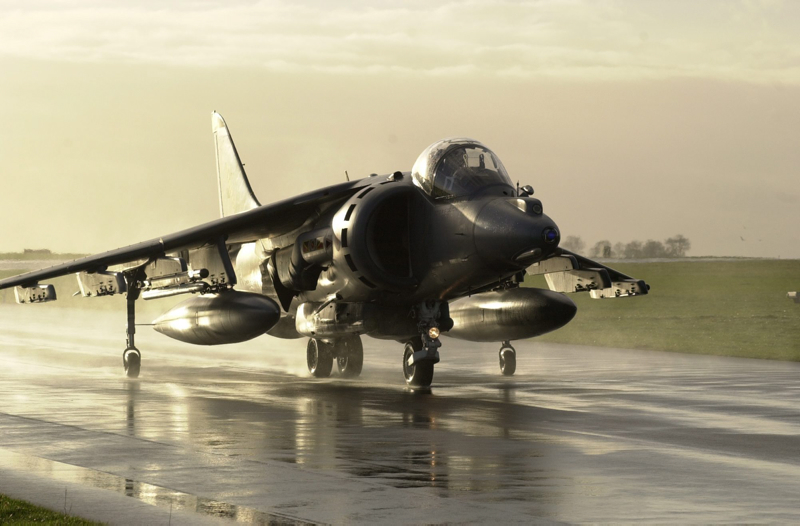
The British Aerospace Harrier is used by the RAF in the close air support role.
A British Aerospace Harrier GR7 as used by the RAF. (Source: Defence Imagery, MoD)

A good example of how this dialogue leads to success is the Harrier ‘jump jet’, a highly risky technical concept. Starting as a private design by industry in the 1950s, it was refined with support from the research establishments before it was adopted for service by the UK and US armed forces. Flying prototypes before a final requirement was written meant that when it entered service, the project was on time, on cost and met almost all specifications; one small shortfall in manoeuvrability was discussed as not worth the cost to fix. The success of the Harrier in the Falklands in 1982 showed that this was the right decision. The shared language of design, spoken openly between MOD and industry, led to the Harrier’s success.

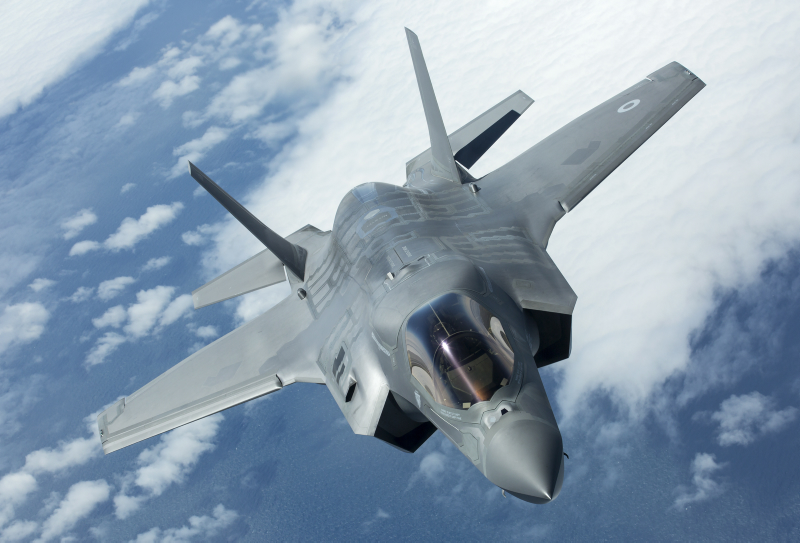
Pictured is the first of the UK’s F-35B Lightning II jets to be flown to the UK.
The first of the UK’s F-35B Lightning II jets to be flown to the UK in 2016. (Source: Defence Imagery, MoD) 

In 1985, the Harrier’s original designer, Ralph Hooper, retired, the same year that the Levene reforms started to end the ability of designers to develop new projects while talking openly to requirements writers and technical experts. Instead, a contract that defines roles and responsibilities is expected to lead to success. However, it is hard to see any examples of this working in the years since – for example, the Harrier’s successor, the F-35B Lightning II, has yet to replicate its record of delivery on time or cost.

Ralph Hooper originated the Harrier design out of a sense of idle interest. The project was, as he says, the product of a lot of people. The first contract for the aircraft came when the prototypes were being built, having proceeded with a ‘nod and a wink’ from the government. The trust engendered by having all those involved in designing a complex system in industry, the services and the government able to discuss design openly are a continuing need for successful defence acquisition. That we no longer do this, due to competition and contracts, lies at the heart of the issues reported in the press over many years, not just one weekend.

This post first appeared on the Cranfield University Blog.

Dr Michael Pryce is a Lecturer in Defence Acquisition at Cranfield University. He leads the Low Cost by Design research network that explores the role of good design in defence acquisition.

Header Image: Harriers from Joint Force Harrier lined up following a ceremony to mark the retirement of the famous aircraft after 41 years of service. (Source: Defence Imagery, MoD)

From Balloons to Drones – Top Posts of 2016

From Balloons to Drones – Top Posts of 2016

By Ross Mahoney

Happy New Year!

Now we have reached 2017, and that From Balloons to Drones has been up and running for around six months, it thought it would be worth posting our top five posts of 2016 based on views.

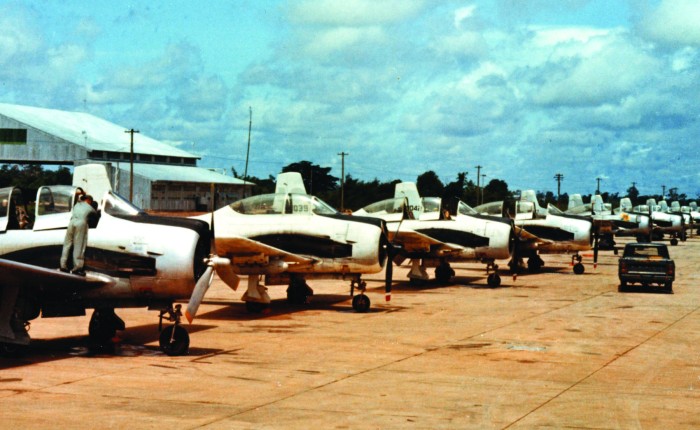
  1. At the head of the list is ‘Supporting the Secret War: T-28s over Laos, 1964-1973 – Part 1: Training.’ This is the first of a three-part article by Jeff Schultz that examines the use of the North American T-28 during the war in Laos in the 1970s. Parts two and three can be found here and here.
  2. In second place is my research note on ‘Air Power and the Challenge of Professional Military Education’ that was based on my thoughts on an excellent conference at the Royal Military College of Canada in November. An important subject that I hope to return to in 2017.
  3. In third is Brian Laslie’s commentary, ‘TheF-35 is here!’, which deals with some of the issues surrounding this program and the important role that training will play in developing the aircraft’s use.
  4. In fourth, and timed in conjunction with the types eventually retirement for the United States Air Force, Mike Hankins provided a timely discussion of the development of the McDonnell F-4 Phantom II in his piece ‘Remembering the F-4 Phantom – Part 1: A Product of Its Time.’ The second part of this article can be found here.
  5. Finally, but no means last, Alex Fitzgerald-Black’s research note ‘Operation HUSKY’s Air Battle by the Numbers’ provided a useful discussion of the importance of the air battles fought during the invasion of Sicily in 1943.

These are just a selection of the highlights of our half year in existence. We are keen to expand our list of contributors and if you are interested in writing about air power issues – both historical and contemporary – then you can find out how here. If you have any questions then please leave a comments here or emails us at airpowerstudies@gmail.com.

Header Image: A row of T-28s in Laos. (Source: USAF)

#Commentary – Buddha’s Next Incarnation: What does the future hold for the C-17A Globemaster?

#Commentary – Buddha’s Next Incarnation: What does the future hold for the C-17A Globemaster?

By Eamon Hamilton

In airlift terms, the C-17A Globemaster III has arguably made the biggest single impact to Western Air Forces in the 21st Century thus far – and will likely hold this claim for the next decade. While it was conceived for the United States Air Force in the 1980s and introduced to service in the 1990s, its acquisition by nations including Canada, Australia, and the United Kingdom has given Western Air Forces its first real appreciation of modern strategic airlift. For the USAF, which arguably wrote the book on strategic military airlift, has also benefited significantly from the C-17A’s tactical airlift talents. Elsewhere, the aircraft has been capitalised upon by NATO, India, the UAE, Qatar, and Kuwait.

Exercise Pitch Black 2016
A big jet that can fly from little airfields (Source: RAAF)

With the production line closing in 2015, it is unlikely that we will ever see new Globemaster airframes constructed beyond the 279 that were delivered by McDonnell Douglas/Boeing (and indeed, a small number have been relegated to a museum or lost in an accident). This is not to say that we will not see new C-17 variants, especially if the Globemaster lives to see service past 2040, half a century after its first flight. Getting the airframe to that point (and beyond) however, will require careful attention and development.

Certainly, the C-17A has been no stranger to being developed over its 25-year history thus far. With a production spanning 15 years, older C-17As have been upgraded to match their newer kin with radios, weather radar, and combat lighting. A centre wing fuel tank was fitted to C-17As constructed after 2001 to extend the aircraft’s range, and in recent years, aircraft have been equipped with Large Aircraft Infrared Countermeasures and improved communications systems. Early Block Upgrades to the C-17A addressed design flaws in the original production aircraft – more recent ones have addressed issues of obsolescent aircraft systems and ensured fleet commonality.

More upgrades are projected. The C-17A’s Heads-Up Display (HUD) dates back to the early 1990s, and in 2011, Elbit was announced as the winner of the project to deliver a replacement HUD (although no public announcements have emerged since then). Trials are underway to add airflow strakes to the aircraft’s fuselage as a means of decreasing drag. Options to add Link-16 and more advanced satellite communications antennas are also being explored.

How else might we see the C-17A mature in the next 30 years?

Minimalist Change

Numerous aircraft go through their service career with modest increases in capability to allow them to continue in their intended role. Indeed, it is arguable that the C-17A has maintained this track to date with the changes it has undergone thus far. The purpose of such upgrades are not so much to advance the aircraft beyond the original design intent, but more to ensure it remains compatible with current/immediate operating practices and airborne environments. Compatibility with any new Identification Friend or Foe (IFF) or battlespace networking systems, or global air traffic control management systems, are examples of this.

140415-f-io108-002
An office from a simpler time. (Source: USAF)

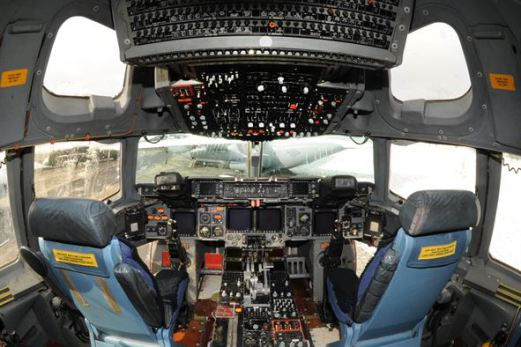
The aircraft’s cockpit ergonomics are still reminiscent of its early 1990s design, so it is not unreasonable to expect a countermeasures Mid-Life Update program that would improve the quality of cockpit displays, communications management, and other avionics. Newer airlifters such as the C-130J and A400M are equipped with larger HUD units and displays that can incorporate digimaps or other navigational data. A precedent for upgrading the C-17A exists, whereby old air mobility platforms (including the C-130H, KC-135 and C-5) have replaced their ‘steam gauge’ instruments and analogue controls with LCD screens and digital displays. Replacing these systems means eliminating obsolescence and ensuring the cockpit ergonomics have greater commonality with the wider air mobility and training fleet, and potentially improving the ease with which software updates can be applied to the aircraft.

Slightly More Ambitious Options….

The upgrades mentioned above were in large part to ensure the C-17A maintained pace with its operating environment. More ambitious upgrades, however, would provide new ways of performing its current mission. Evidence exists within existing air mobility platforms like the KC-135, which has been upgraded with navigation systems that now allow the aircraft to operate without a Navigator.

How could this apply to the C-17A? It is hard to judge this, as it is largely contingent on the technology that will be available to us in the next 15 years. It is easy to imagine a technology that has been applied to the A400M and C-130J being rolled out on the C-17A. It is harder to imagine the impact that newer and emerging technology – such as helmet-mounted displays, external sensors, and personal devices – will have. New tactical airlifters benefit from infrared cameras that allow landings to be comfortably made of poor visibility conditions. Whether such technology has an application on the C-17A remains to be seen.

C-17A AME Static Aircraft Communication Systems
Technology is finding its way on board, regardless. (Source: RAAF)

Likewise, the C-17A was revolutionary for its time by its use of a dedicated loadmaster station inside the cargo hold, a feature which has been capitalised by other airlifters. A future C-17A upgrade might extend on this further, allowing the loadmaster to control environmental conditions and cargo locks in the cargo hold with a personal electronic device, or direct automated aircraft loading equipment.

The High-End Option

High-end changes are easy to debate, being linked to systems on the aircraft that will become wholly inefficient or unsustainable during the aircraft’s life-of-type. These changes would be sufficient to mean the end of the C-17A as we know it today, delivering us a noticeably different aircraft – a C-17B or C-17C, for example.

Again, existing examples allow us to make educated guesses about the future, not only about the systems that are applied and upgraded but the causes for doing so. The C-5M Super Galaxy is the product of a program upgrade older C-5As and Bs with new engines, new avionics, improved cargo ergonomics, and most importantly, greater aircraft reliability. It essentially brings an aircraft design whose systems have their roots in the late 1960s and gives a 21st-century solution. The net result is a Galaxy with a shorter take-off distance and better climb rate, as well as extended range. While the C-17A is reliable now, we can expect to question its relative performance in the future, especially if the expectation is for the aircraft to beyond a 30-year lifespan. Upgrading the C-17A could prove less expensive than embarking upon an all-new airlift replacement, too.

Achieving this could take some paths. Replacing the engines on the aircraft, especially in light of advances in civilian airliner power plants, would be the most obvious choice. It could yield a Globemaster that is more fuel-efficient or carries heavier payloads, and the C-17A’s existing power plant – the Pratt & Whitney F117 – is a militarised version of the turbofan that powers Boeing 757s. One issue here, however, is that C-17A engines are required to perform across a different spectrum than a stock civilian airliner. This means a simple transplant of a civilian power plant will not likely address the C-17A’s performance needs.

Another potential upgrade could be to the C-17A’s winglets, which were revolutionary for their time in 1991. This feature improves the wing’s performance, reducing drag and improving fuel efficiency in a cruise. Today, the C-17A’s winglets appear clunky in comparison to modern airliners which possess ‘blended winglets’ that enhance fuel burn. Ensuring the Globemaster can cruise efficiently, extending its range and lowering its operating costs, are likely to be a significant consideration for how the aircraft is upgraded into the future.

Other considerations for a potentially major upgrade to the Globemaster might include those options put forward by Boeing during the late 2000s to improve the aircraft’s tactical performance. Considerations for the ‘C-17B’ including a new higher thrust powerplant, double-slotted flaps, additional centre-line landing gear, and precision landing systems. Arguably, the additional weight of some of these systems would come at a cost to the aircraft’s range and cruise efficiency. On the other hand, a sub-fleet of C-17s optimised for tactical performance to deliver payloads that can not be accommodated in a C-130 (and are unable to be transported over long ranges by future heavy vertical lift)

1280px-thumbnail
A C-17 performs evasive counter measures by launching flares during a Mobility Air Forces Exercise over the Nevada Test and Training Range on 16 November 2011, (Source: Wikimedia)

Examining options for the Globemaster’s future may see it called to perform roles that are well outside the traditional airlift roles that the aircraft performs today. Few would argue that the C-17A’s talents are best applied to providing dedicated strategic and tactical airlift. The external surfaces of a C-17A, however, provide significant ‘real estate’ for discrete sensors and antennas, and the aircraft’s interior likewise has space that would allow it to fulfil support functions for C4I and ISR – especially if the terminals for such roles are significantly smaller and modularised, contrasting with the fixed workstations that fill C-135 and Boeing 707 variants operated by the USAF. Today, other platforms (such as those based on commercial airliners) might conceivably fulfil this role more efficiently and effectively than a Globemaster. However, future requirements – especially those that call for an aircraft to deliver personnel and vehicles, then remain near provide immediate support – might dictate that the C-17 is the aircraft for the job.

The last consideration for the Globemaster receiving a ‘high-end’ upgrade is that it might pick up new roles not even in service today. The aircraft has been mooted as a potential ‘Drone Mothership’ in a battlespace, deploying them to perform a range of ISR, attack, and strike missions. Alternatively, the C-17A’s cargo bay has considerable space for batteries and other systems that would employ high-energy weapons.

Where the Globemaster ultimately fulfils any of these roles is anyone’s guess – while the technology is being developed, it is by no means about to be applied to the C-17A. Once said technology is mature, there are no guarantees that the C-17A will be the best jet for the job.

The Likely Options

At a minimum, progressive upgrades will need to be applied in the future to ensure the C-17A can continue to be operated. The crew stations are likely to be developed over time, as are the aircraft’s avionics, communications and networking systems. Foreign operators should bear these developments in mind – on the one hand, the upgrading of their aircraft is likely to have a greater impact on the number of aircraft they have available. On the other hand, such programs are an avenue for them to suggest development roadmaps that can be shouldered by Boeing and USAF. Exploring these avenues, however, would have to be a modest process. However, it is unlikely that an entirely new C-17 variant will be developed if only one smaller operator is guaranteed to require it.

With that in mind, the Globemaster’s future development is likely to be informed by three things – keeping the airframe viable, the USAF’s appetite to embark on upgrade programs, and Boeing’s willingness to provide options. Lockheed Martin’s C-5M program provides an excellent example of where the C-17A can go with such updates, replacing aircraft structures and systems that have become tired and unreliable while also meeting demands of the customer to capitalise on generational changes in engine, avionics, and ergonomic technology. Indeed, the C-5M in some respects feels like it carries some of the best features of a C-17A (except the HUD and fighter control stick).

120413-f-dw547-002
Everyone has an embarrassing childhood photo. (Source: USAF)

Strategic airlift development, however, emphasises the importance of cruise efficiency and performance, which is often largely dependent on reductions in the aircraft’s weight and improvements in a power plant. Such upgrades are easy to forecast in the C-17A’s future. The more ‘creative’ upgrades for the Globemaster will be in how it is required to perform tactical roles in future – or approach brand new problems.

This post first appeared at Rubber-Band Powered Blog.

Eamon Hamilton graduated from the University of Western Sydney with a Bachelor of Communications (Journalism). He works as a Public Affairs Officer for the Royal Australian Air Force. He lives in Sydney. He runs the Rubber-Band Powered Blog and can be found on Twitter @eamonhamilton.

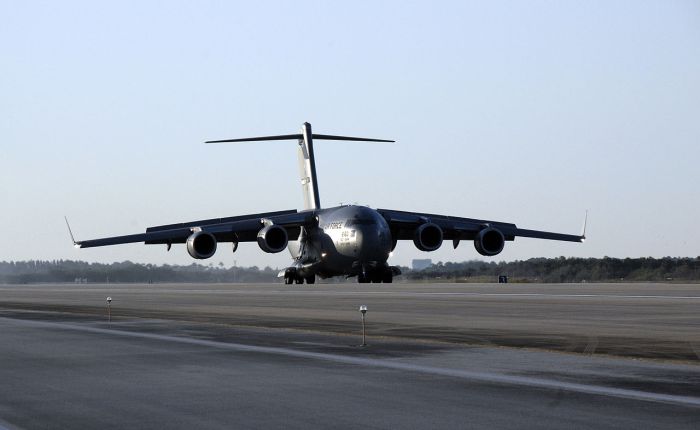
Header Image: A C-17 arrives with GEOS-O on board at the Shuttle Landing Facility. (Source: Wikimedia)