#ResearchResources – Recent Articles and Books (December 2021)

#ResearchResources – Recent Articles and Books (December 2021)

Editorial note: In this series, From Balloons to Drones highlights research resources available to researchers. Contributions range from discussions of research at various archival repositories to highlighting new publications. As part of this series, we are bringing you a monthly precis of recent articles and books published in air power history. This precis will not be exhaustive but will highlight new works published in the preceding month. Publication dates may vary around the globe and are based on those provided on the publisher’s websites. If you would like to contribute to the series, please contact our Editor-in-Chief, Dr Ross Mahoney, at airpowerstudies@gmail.com or via our contact page here.

Articles

Donald Bishop and Erik R. Limpaecher, ‘Looking Bakc from the Age of ISR: US Observation Balloons in the First World War,’ Air Power History 68, no. 3 (2021).

No abstract provided.

Patrick Luiz Sullivan De Oliveira, ‘Transforming a Brazilian aeronaut into a French hero: Celebrity, spectacle, and technological cosmopolitanism in the turn-of-the-century Atlantic,’ Past & Present (2021). https://doi.org/10.1093/pastj/gtab011

This article explains how the Brazilian Alberto Santos-Dumont, who at the turn of the twentieth century became the first global celebrity aeronaut, operated as a symbol of ‘technological cosmopolitanism’ — a world view that ostensibly promoted a vision of global unity through technology-enabled exchanges while simultaneously reproducing a core-periphery imagined geography that threatened to erase marginalized populations. Technological cosmopolitanism fitted snugly within the rubric of the Third Republic’s aspiring universalism, which assumed that France offered a model to be emulated around the world, but it was not hegemonic. If for the French appropriating Santos-Dumont meant safeguarding France’s leadership in aeronautics and assuaging their claims of universality, for Brazilians the elision was marked by ambiguity. Brazil’s First Republic hungered for heroes, and authorities saw Santos-Dumont as a symbol of modernity that showed that its place in world history was more than peripheral, even though that very vision was shaped by a Paris-centric world view. But marginalized Afro-Brazilians also found ways to appropriate a white ‘Frenchified’ Brazilian and reimagine their place in a cosmopolitan order. Technological cosmopolitanism evoked a world united by transportation, communication and exchange, but imagining who got to construct and partake in that community was a process continuously marked by erasures and reinsertions.

A. Garcia, ‘The South African Air Force in Korea: an evaluation of 2 Squadron’s first combat engagement, 19 November until 2 December 1950,’ Historia 66, no. 2 (2021).

South African participation in the Korean War (1950–1953) in direct support of an international military offensive led by the United States of America demonstrated the National Party administration’s commitment to opposing Communism. This article details how the deployment of South African Air Force 2 Squadron achieved the strategic objectives of the South African government in supporting the anti-communist United States-led United Nations coalition in the Korean War. It evaluates the performance of South Africa’s Air Force in their first operational test since the Second World War. The combat operations discussed under the scope of this article include the first tactical engagement of 2 Squadron in support of the initial advance (19 November to 21 December) 1950 and then later, the retreat of the United Nations force.

William Head, ‘The Berlin Airlift: First Test of the U.S. Air Force,’ Air Power History 68, no. 3 (2021).

No abstract provided.

N.R. Jenzen-Jones and Jack Shanley, ‘Precision Strike,’ The RUSI Journal (2021) DOI: 10.1080/03071847.2021.2016208

This article examines the development of precision guided munitions (PGMs) from the earliest proto-PGMs of the late 18th century to the miniaturised, semi-autonomous forms in present service. N R Jenzen-Jones and Jack Shanley trace the history of these revolutionary weapons and examine how their battlefield roles and real-world use cases have evolved over time.

T.B. Kwan, ‘“The effects of our bombing efforts”: Allied Strategic Bombing of the Japanese Occupied Territories during World War II,’ Air Power History 68, no. 3 (2021).

No abstract provided.

Wyatt Lake, ‘Origins of American Close Air Support,’ Air Power History 68, no. 3 (2021).

No abstract provided.

John G. Terino Jr., ‘Cultivating Future Airpower Strategists: On “Developing Twenty-First-Century Airpower Strategists”,’ Strategic Studies Quarterly 15, no. 4 (2021).

In 2008, Major General R. Michael Worden forecast specific challenges for airpower strategists including emerging technology, transnational terrorist organizations, an explosion of information power, budgets, and resourcing. His predictions have borne out in what the Air Force faces today, and Air University is responding, providing the next generation of airpower strategists.

Joseph B. Piroch and Daniel A. Connelly, ‘Six Steps to the Effective Use of Airpower: On “The Drawdown Asymmetry: Why Ground Forces Will Depart Iraq but Air Forces Will Stay”,’ Strategic Studies Quarterly 15, no. 4 (2021).

Then-Lieutenant Colonel Clinton S. Hinote’s 2008 analysis of the Iraq drawdown and the continued role of airpower in that conflict serves as a foundation for six steps to the effective use of airpower today.

Thomas Wildenberg, ‘Col. Thomas L Thurlow and the Development of the A-10 Sextant,’ Air Power History 68, no. 3 (2021).

No abstract provided.

Books

Phil Haun, Colin Jackson, and Tim Schultz (eds.), Air Power in the Age of Primacy: Air Warfare since the Cold War (Cambridge: Cambridge University Press, 2021).

Since the end of the Cold War the United States and other major powers have wielded their air forces against much weaker state and non-state actors. In this age of primacy, air wars have been contests between unequals and characterized by asymmetries of power, interest, and technology.  This volume examines ten contemporary wars where air power played a major and at times decisive role. Its chapters explore the evolving use of unmanned aircraft against global terrorist organizations as well as more conventional air conflicts in Bosnia, Kosovo, Afghanistan, Iraq, Lebanon, Libya, Yemen, Syria, and against ISIS. Air superiority could be assumed in this unique and brief period where the international system was largely absent great power competition. However, the reliable and unchallenged employment of a spectrum of manned and unmanned technologies permitted in the age of primacy may not prove effective in future conflicts.

Mark Lardas, Truk 1944–45: The Destruction of Japan’s Central Pacific Bastion (Oxford: Osprey Publishing, 2021).

A fully illustrated history of how the US Navy destroyed Truk, the greatest Japanese naval and air base in the Pacific, with Operation Hailstone, and how B-29 units and the carriers of the British Pacific Fleet kept the base suppressed until VJ-Day.

In early 1944, the island base of Truk was a Japanese Pearl Harbor; a powerful naval and air base that needed to be neutralized before the Allies could fight their way any further towards Tokyo. But Truk was also the most heavily defended naval base outside the Japanese Home Islands and an Allied invasion would be costly. Long-range bombing against Truk intact would be a massacre so a plan was conceived to neutralize it through a series of massive naval raids led by the growing US carrier fleet. Operation Hailstone was one of the most famous operations ever undertaken by American carriers in the Pacific.

This book examines the rise and fall of Truk as a Japanese bastion and explains how in two huge raids, American carrier-based aircraft reduced it to irrelevance. Also covered is the little-known story of how the USAAF used the ravaged base as a live-fire training ground for its new B-29s — whose bombing raids ensured Truk could not be reactivated by the Japanese. The pressure on Truk was kept up right through 1945 when it was also used as a target for the 509th Composite Squadron to practise dropping atomic bombs and by the British Pacific Fleet to hone its pilots’ combat skills prior to the invasion of Japan.

David Nicolle and Gabr Ali Gabr, Air Power and the Arab World – Volume 5: The Arab Air Forces and the Road to War 1936-1939 (Warwick: Helion and Company, 2021).

The years immediately prior to the outbreak of the Second World War saw the earliest and the more recently established Arab Air Forces attempting to play a role on the regional if not yet on the world stage for the first time. It was a period when those Arab states which had real or merely theoretical independence were more or less allied with European countries that were gearing up to face the growing Fascist and Nazi threats. Unfortunately, these anti-Fascist and anti-Nazi countries were themselves the imperial powers, France and the United Kingdom, which were still seeking to maintain their domination of the greater part of the Arab World. To say that this complicated the situation, and strained the loyalties of the men of the newly emergent Arab air forces would be an understatement.

Volume 5 of the Air Power and the Arab World series, therefore, seeks to shed light on a difficult and widely misunderstood time.  It draws upon decades of research, including previously unpublished interviews with men now dead, archive sources than have never before been translated into a European language, and material which, though available in obscure Arabic publications, has been almost entirely neglected by aviation historians. 

This volume is richly illustrated with specially commissioned colour artworks illustrating the aircraft flown by the air forces in the Arab world during this dynamic period of time.

#DesertStorm30 – On the Brink of Combat: The Women Aviators of DESERT SHIELD and DESERT STORM

#DesertStorm30 – On the Brink of Combat: The Women Aviators of DESERT SHIELD and DESERT STORM

By Eileen Bjorkman

At one minute past midnight on 17 January 1991, US Air Force Major Kathy Rambo-Cosand prepared to take off in a Lockheed C-141 Starlifter from Ramstein Air Base, Germany. It was snowing, and her aircraft was packed with 44,000 pounds of cluster bombs headed for Saudi Arabia. The aircraft was severely overweight: she was authorised to fly at ‘emergency war weights.’ If the C-141 lost an engine on take-off from Ramstein’s short runway, they would most likely crash. She worried about what the cluster bombs might do if that happened. Moreover, an accident was a realistic possibility: A Lockheed C-5 Galaxy had crashed, taking off from Ramstein just a few months earlier, killing 13 of the 17 people on board.

As Rambo-Cosand and her crew waited for their take-off clearance, a call came on the radio: “All missions are cancelled.” The airspace over Saudi Arabia had been shut down as coalition fighters and bombers kicked off Operation DESERT STORM, the coalition effort to remove Iraqi forces from Kuwait. Rambo-Cosand and her crew waited in their aircraft as planners decided what to do. Finally, at 2:30 a.m., she received the call to take off. With the C-5 crash and the enormity of her cargo weighing heavily on her, Rambo-Cosand pulled onto the runway and lumbered into the sky. Unfortunately, the most stressful take off of her career was for naught: when they arrived over Italy, they were turned back to Ramstein.[1]

At that point, Rambo-Cosand had been flying in and out of Saudi Arabia for the past four months, and it would be many more months before she finally returned home to her family. Indeed, the rapid build-up, sustainment, and eventual employment of forces in the Middle East as part of Operation DESERT SHIELD/STORM was only possible because of support aircraft that did everything from hauling cargo to communications jamming.[2] Moreover, it was these aircraft that women like Rambo-Cosand flew since they were not allowed to fly in combat; a provision within the Women’s Armed Services Integration Act passed by Congress in 1948 prohibited that. This article explores the experience of some of those women during DESERT SHIELD/STORM and details some of the challenges faced by US females operating in a combat environment.

Wells
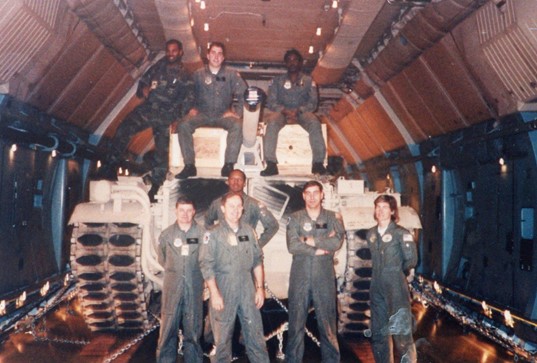
Major Stephanie Wells and her C-5 crew delivering tanks to Al Jubayl, Saudi Arabia on 19 January 1991 (Source: Stephanie Wells)

The Women Aviators of Operation DESERT SHIELD/DESERT STORM

Despite the combat restrictions, women soon arrived in Saudi Arabia. Some of the first women were pilots, like US Army Captain Victoria Calhoun, a Boeing CH-47 Chinook helicopter pilot at Fort Bragg, North Carolina, who deployed on 9 August, two days after Operation DESERT SHIELD began in response to the invasion of Kuwait by Iraq. Calhoun had asked to be stationed at Fort Bragg the previous year because she figured if any action happened, it would happen there. She was right, but shortly after arriving, her unit deployed to support the 1989 invasion of Panama, and her operations officer would not let her go, replacing her with a less-experienced male pilot. A year later, she feared the same thing might happen. However, when someone questioned her battalion commander about whether women would deploy to Saudi Arabia, he said, “They have to go. If they don’t go, we’re not mission capable as a unit!”

Calhoun arrived at Dhahran Air Base with an advance party to conduct reconnaissance and prepare the base for more arrivals. At first, there was not much flying for the Chinooks, mainly because the sand in Saudi Arabia caused maintenance nightmares. The missions Calhoun flew transported parts and supplies around to other units, a mission nicknamed “Desert Express.”[3]

Reserve units began activating on 24 August. All C-5 reserve squadrons were activated as the massive cargo aircraft hauled most of the Army’s tanks and larger helicopters to the theatre. Major Stephanie Wells, a C-5 pilot from Kelly Air Force Base, Texas, was activated on 29 August. She was thrilled to be part of the team: when she had initially called her unit on 6 August to inquire about deploying, she was told that women would not be allowed to go.[4] Nevertheless, Wells was soon flying C-5s all over the world. At first, she never knew where she would be going on any given day, but then things settled down, and she began flying missions out of Dover Air Force Base, Delaware.[5]

Technical Sergeant Donna Davis, a C-5 flight engineer in a reserve unit at Travis Air Force Base, California, soon wound up in Germany. When a crew landed, after eight hours of crew rest, Davis says they were normally assigned to an aircraft brought in by another crew. The crews stopped to rest, but the aeroplane kept going. The crews often pulled 24-hour shifts before going back into crew rest, and Davis found it hard to sleep more than about four hours at a time. She was not alone; most of the crews were exhausted all the time and, as she says, “Thank goodness for autopilot.”[6]

Wells 2
Major Stephanie Wells in the cockpit of a C-5 at the beginning of Operation DESERT STORM. (Source: Stephanie Wells)

As the initial troops and equipment flowed to Saudi Arabia, Rambo-Cosand, who was in a reserve unit at McGuire Air Force Base, New Jersey, debated what to do. She had met her husband when she had been one of the first ten women to attend US Air Force pilot training in 1976, and they had just settled with their two children into new quarters after a move to Honduras. She hated to leave her 2-year-old and 7-year-old at home, but she decided to volunteer to fly some missions, thinking that if enough reservists volunteered, her unit would not be activated. However, before she could arrive to begin her volunteer tour, her unit was activated on 9 September. Rambo-Cosand moved heaven and earth to get to McGuire in less than 24 hours, begging the US Embassy to get her on a 6:00 a.m. flight out of Honduras the following day. Even living overseas, she beat several airline pilots in her squadron to McGuire.

After arriving at McGuire, Rambo-Cosand flew first to Zaragoza, Spain, and then began flying shuttles to Saudi Arabia. Working 30-hour days, she and her crew flew 150 hours in 16 days compared to the normal 75 hours they might fly in a month. She recalls, “We were like zombies.” But like most pilots, Rambo-Cosand enjoyed what she was doing. She found aeromedical evacuation flights of wounded personnel to be the most special. Whenever she carried patients, she always went back to talk to them and hold their hand before returning to the cockpit, hoping they would make it.

By early October, enough forces were in place to defend Saudi Arabia should the Iraqis attack. An additional a build-up of forces began in early November to prepare for an offensive operation.[7] In November, the United Nations Security Council also set a deadline for Iraq to withdraw forces by 15 January 1991. The deadline passed, and the air war started on 17 January.

On the first day of the war, US Air Force Captain Sheila Chewing helped two McDonnell Douglas F-15 Eagle fighter pilots shoot down two Iraqi Mikoyan MiG-29 Fulcrums. She was a weapons controller onboard a Boeing E-3 Sentry, an Airborne Warning and Control System (AWACS) aircraft distinguished by a gigantic disc-shaped radar antenna mounted on top of the aircraft and used for tracking both friendly and enemy aircraft. She spotted the MiG-29s on her radar screen onboard the AWACS and then directed the F-15 pilots until their own radars could track the enemy aircraft and launch missiles at them. Chewing later said, “When that happened [bringing down an enemy plane], we really felt like we were doing our jobs.”[8]

While airlift crews shuttled endlessly among the US, Europe, and the Middle East, some women who flew refuelling tankers and other support aircraft settled at Incirlik Air Base in Turkey. Air Force Captain Christina Vance Halli, a Boeing KC-135 Stratotanker pilot, was happy to deploy to support DESERT STORM. She was tired of being at Minot Air Force Base, North Dakota, where she mostly sat alert with bomber crews and rarely flew. Instead, she and the rest of her crew flew as passengers to get to Incirlik. During a stop in Greece, it was obvious they were getting closer to the action: a man wearing a flak jacket met them at the aircraft and instructed them to low crawl across the ramp to his vehicle.

The aircraft that launched from Incirlik did so as part of a large strike package of tankers, communications jammers (EC-130s), tactical reconnaissance aircraft (RF-4Cs) and the fighter aircraft that would be striking targets deep into Iraq. For most missions, the slower Lockheed EC-130s launched first to get into position to provide jamming protection for the striking aircraft. At the same time or shortly after, McDonnell Douglas RF-4C Phantom aircraft took off and finally, the KC-135s departed, followed by the striking aircraft. A typical strike package had three to five tankers, each servicing four to eight fighters. The refuelling’s were a bit of an adventure, done in radio silence and mostly at night, but the skill of all crews involved prevented any mishaps. The fighters followed the tankers to Iraq’s northern border, refuelling as needed and getting a top-off before entering Iraq. At that point, the tankers did a U-turn and held in orbit, waiting for the strikers to return.[9]

In the meantime, the EC-130s orbited nearby to provide jamming support. Captain Amy Hermes Smellie was an EC-130 co-pilot. She recalls sometimes seeing anti-aircraft artillery in the distance as the strikers reached their targets; on other occasions, she wore night vision goggles look for targets. Unlike the other support aircraft that might carry one or two women aviators on a mission, the EC-130s were often packed with women linguists in the back of the aeroplane. Smellie says the linguists were the driving factor in EC-130s; the Air Force might have been able to fly EC-130 missions without women pilots, but they did not have enough male linguists.[10]

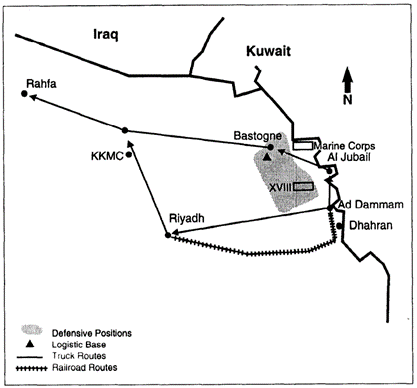
The ground campaign began on early 24 February. That day Major Marie Rossi, the company commander of one of Calhoun’s sister units, appeared on CNN, saying, “[T]his is the moment that everybody trains for – that I’ve trained for – so I feel ready to meet the challenge.”[11] To prepare for the assault, coalition ground forces had quietly moved hundreds of miles to the west, including Calhoun’s CH-47 unit, which moved from Dhahran to Rafha. Instead of flying to Rafha, Calhoun was put in charge of a convoy for the move. However, once at Rafha, she got in on the action. On the second day of the ground war, she flew Chinook missions to move elements of the US 101st Airborne Division to Forward Operating Base Cobra, 93 miles inside Iraq, to provide a logistics base for the 101st as they conducted their assault. Overall, Calhoun flew 22 hours of combat, flying into Iraq and coming within 90 miles of Baghdad.[12]

DS Map
Map depicting Army unit locations at Dhahran and Rafha; FOB Cobra is north of Rafha. (Source: Conduct of the Persian Gulf War: Final Report to Congress)

Offensive operations ended at 08:00 on 28 February, but that did not stop the danger. Marie Rossi, the pilot who had appeared on CNN, died on 1 March, the day after the cease-fire, when her helicopter hit an unlit radio tower.

US Navy women did not get as many opportunities to fly during the war as their Air Force and Army counterparts. A handful of women, mostly in helicopter combat support squadrons, carried personnel and equipment around the Persian Gulf and flew other support missions, including search and rescue.[13] Lieutenant Commander Lucy Young, who had qualified to fly Douglas A-4 Skyhawk strike aircraft and was the US Navy’s first female strike instructor, nevertheless was not allowed to fly in combat. By 1991, she had left the Navy and was in a reserve unit in Atlanta, flying McDonnell Douglas C-9s, a small cargo aircraft like the commercial DC-9. Young’s squadron was never activated, but she spent three weeks flying people and cargo around the Middle East during the build-up in September 1991 while male strike pilots she had trained headed for the war on aircraft carriers.[14]

Captain Peggy Phillips, a C-141 pilot in the reserves at McChord Air Force Base, Washington, says that the women transport pilots were the ‘first in and last out’ of the theatre. This was especially true of the reservists; many were activated in August or September of 1990 and not deactivated until May or June 1991. Another aspect of being an airlifter was that the crews received no parades or big welcomes when they returned home like many of the combat units, who deployed and returned as a group. Instead, the airlifters dribbled over and back, activating, and deactivating on individual timelines. Phillips had a two-day notice to deactivate. She quietly went home with no fanfare.[15]

The Dangers faced by Female Aviators

Going up against the fourth largest army in the world, planners expected the overall battle to be short but potentially very bloody, with as many as 30,000 casualties.[16] Given that the all-volunteer force in place since the mid-1970s was 15% female, at least some of those casualties were expected to be women.

Although the aircraft flown by women aviators largely kept them away from enemy fire, the missions weren’t risk-free. Tankers occasionally flew over hostile territory with their strike package. For example, Captain Ann Weaver Worster reportedly flew her tanker 250 miles inside Iraq on one mission.[17] In another instance, an SA-8 surface-to-air missile exploded above a KC-135 flying out of Incirlik.[18]

Once the Iraqis started launching SCUD missiles during Desert Storm, the transport and other support crews were vulnerable when they landed in Saudi Arabia. For example, Rambo-Cosand received word of a ‘black flag’ SCUD alert during one flight, and the crew donned their chemical warfare gear before landing. Once on the ground, the crew dashed to a bunker in their gear, where they stayed for several hours until their aircraft could be refuelled and reloaded for their return flight.[19]

In addition to dealing with hostile forces, the women aviators also dealt with a hostile environment from their hosts. For example, Saudi ground crews refused to take fuel orders from women crewmembers and women who stayed in Saudi Arabia overnight had to cover up if they wanted to go off base.[20]

Family Issues

Naysayers had predicted that women would become pregnant to avoid going to war. Some pregnant women could not deploy, but it was not only women who wanted to stay home for family reasons. Halli, the KC-135 pilot, recalled that her navigator did not want to deploy because his wife was pregnant; he was replaced with another navigator.[21]

During their deployments, men and women left behind families, including small children. For example, C-5 flight engineer Donna Davis left her son with her parents, although she made it home for Christmas.[22] Unlike crewmembers who lived near McGuire, Rambo-Cosand found it difficult to get home whenever she had a few extra days in the US, although she did make it back to her family in Honduras for a few days about every six weeks.[23] Sometimes childcare took creative juggling. For example, C-141 pilot Peggy Phillips had three small children and an airline pilot husband who was also an activated reservist. The couple served in the same unit at McChord, and their commander allowed them to work their schedules so that while one was flying on a trip, the other worked in the squadron.[24]

Conclusion – An Opportunity for Change

Carolyn Becraft, a significant player in the fight to overturn the archaic combat exclusion law, says activating the reserves had a huge impact on the public’s acceptance of women going into hostile territory. Unit activations turned into local stories, and people saw their neighbours, both men and women, heading to war.[25]

The women aviators in Desert Shield and Desert Storm and other women who served in the Middle East, collectively proved they could participate in combat. After legislation and a Presidential Commission to further study the issue, women aviators finally earned the right to fly combat aircraft on 28 April 1993. However, for most women who flew in Desert Storm, the change came too late in their careers. Tanker pilot Christina Vance Halli left the Air Force and applied to fly General Dynamics F-16s at the Air National Guard unit in Fresno, California. The unit seemed receptive, allowing her to go through a process of visits and interviews before turning her down. Their reason? She did not have any fighter experience.[26]

Eileen A. Bjorkman is a former flight test engineer in the USAF with more than thirty-five years of experience and over 700 hours in the cockpits of F-4s, F-16s, C-130s, and C-141s. Her most recent book is Unforgotten in the Gulf of Tonkin: A Story of the U.S. Military’s Commitment to Leave No One Behind (2020) She is also the author of The Propeller under the Bed: A Personal History of Homebuilt Aircraft and has published articles in the Smithsonian’s Air & Space MagazineAviation HistorySport Aviation, the Everett Daily Herald, and the Herald Business Journal.

Header image: Members of the US.’ Air Force disembark from a Lockheed C-141B Starlifter aircraft upon their arrival in support of Operation DESERT SHIELD. This is the type of aircraft flown by Major Kathy Rambo-Cosand and Captain Peggy Phillips as mentioned in this article. (Source: Wikimedia)

[1] Interview with Kathy Rambo-Cosand, 21 April 2021.

[2] Conduct of the Persian Gulf War: Final Report to Congress (Washington, D.C.: US Department of Defense, 1992), p. 45

[3] Interview with Victoria Calhoun, 2 May 2021.

[4] Jeanne Holm, Women in the Military: An Unfinished Revolution, Revised Edition (Novato, CA: Presidio Press, 1993), p. 450.

[5] Interview with Stephanie Wells, 29 April 2021.

[6] Interview with Donna Davis, 22 April 2021.

[7] Conduct of the Persian Gulf War, p. 83

[8] Joby Warrick, ‘AWACS Proves to be Gulf ‘Trump Card,” Air Force Times, 26 March 1991, p. 11, as quoted in Holm, Women in the Military, p. 452.

[9] Interview with Christina Vance Halli, 30 April 2021.

[10] Interview with Amy Hermes Smellie, 21 April 2021.

[11] Holm, Women in the Military, p. 460.

[12] Calhoun interview.

[13] Jean Ebbert and Marie-Beth Hall, Crossed Currents: Navy Women from WWI to Tailhook (McClean, VA: Brassey’s, 1993), p. 264.

[14] Interview with Lucy Young, 29 April 2021.

[15] Interview with Peggy Phillips, 2 May 2021.

[16] Conduct of the Persian Gulf War, p. ii; Richard P. Hallion, Storm over Iraq: Air Power and the Gulf War (Washington, D.C.: Smithsonian Institution Press, 1992), pp. 2-3.

[17] Holm, Women in the Military, p. 449.

[18] Conduct of the Persian Gulf War, pp. 234-235

[19] Rambo-Cosand interview.

[20] Multiple women mentioned these issues to me during interviews.

[21] Halli interview.

[22] Davis interview.

[23] Rambo-Cosand interview.

[24] Phillips’ interview.

[25] Interview with Carolyn Becraft, 21 April 2021.

[26] Halli interview.

Who Ruined the F-16? The Fighter Mafia’s Battle against the United States Air Force

Who Ruined the F-16? The Fighter Mafia’s Battle against the United States Air Force

By Dr Michael W. Hankins

Editorial note: This article is adapted from an excerpt from Flying Camelot: The F-15, the F16, and the Weaponization of Fighter Pilot Nostalgia, by Michael W. Hankins. Copyright (c) 2021 by Michael Wayne Hankins and Smithsonian Institution. Used by permission of the publisher, Cornell University Press.

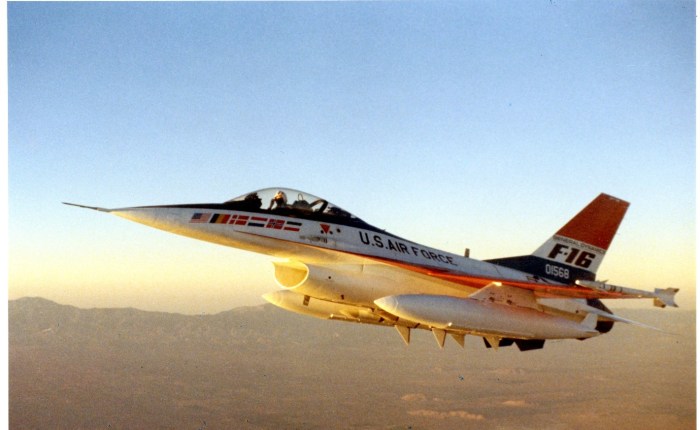
On January 20, 1974, test pilot Phil Oestricher began a high-speed taxi test of the General Dynamics YF-16 prototype. When the plane went into an oscillating roll that slammed the left-wing into the ground, he decided it was safer to just take off for what became the aircraft’s first flight. The YF-16 was a passion project for many people across the aerospace defense community, especially a group known as the ‘Fighter Mafia,’ led by US Air Force (USAF) Colonel John Boyd. The group also included General Dynamics engineer Harry Hillaker, analyst Pierre Sprey, fighter pilot Everest Riccioni, analyst Thomas Christie, among many others. The YF-16 was the realization of their dream of a lightweight, ultra-specialized dogfighter – what Oestricher called ‘a pure air-to-air fighter airplane […] the Camelot of aeronautical engineering.’[1]

Yet, when USAF began the process of turning the YF-16 into the production model F-16A Fighting Falcon, the Fighter Mafia became bitterly opposed to the process. Their extreme frustration with the changes to the airplane set the stage for later debates as the group expanded and morphed into the Defense Reform Movement.

YF-16_and_YF-17_in_flight
An air-to-air right side view of a YF-16 aircraft and a YF-17 aircraft, side-by-side, armed with AIM-9 Sidewinder missiles. (Source: Wikimedia)

After winning a flyoff competition in January 1975 against Northrop’s YF-17 Cobra, the F-16 design went to the Configuration Control Committee, headed by former fighter pilot General Alton Slay, to produce an operational version of the plane. The Fighter Mafia nicknamed this group the ‘Add-On Committee,’ assuming Slay’s role was to exact the Air Force’s revenge by making sure the F-16 did not threaten the F-15 Eagle program. That meant turning the Fighting Falcon into a multi-role craft emphasizing ground attack.[2]

Christie, and his subordinate Robert J. Croteau, tried to stop this process before it started with a memo to Leonard Sullivan, Jr., the Director of Defense Program Analysis and Evaluation. They warned that moving away from the focus on air superiority would ‘subvert the purpose of the entire LWF/ACF [Lightweight fighter/Air Combat Fighter] program.’ The radar was the largest point of contention. They argued that a small radar such as the APQ-153 used in the F-5 was plenty. They wanted a configuration ‘based on primary commitment of the ACF to intense high frequency dogfights.’[3]

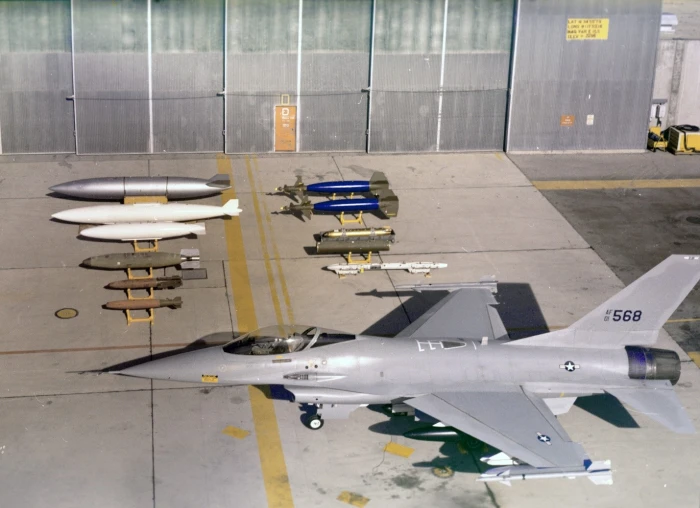
Instead, the production version of the F-16 put on almost 1,000 pounds. The landing gear was strengthened, the fuselage, wings, and tail area grew, and a tailhook was added. Chaff and flare systems and improved avionics also appeared. The production model added more pylons for ground-attack ordnance, with the existing pylons strengthened for heavier weapons. The loading capacity almost doubled, from 7,700 pounds to 15,200. Although the acceleration and agility of the operational F-16 was slightly less than the prototype YF-16, the production model did have increased range, thrust, and load factor, able to pull 9 Gs.[4]

The Air Force added a ground-looking, all-weather, night-capable, medium-range radar to the F-16, the Westinghouse AN/APG-66. The company maintained that this system was ‘The Fighter Pilot’s Radar,’ that would ‘allow the pilot to keep his head up and his hands on the throttle and stick throughout a dogfight engagement.’ With the flick of a switch, the radar provided ground mapping, improved with a Doppler beam, for both navigation and weapons delivery.[5] The avionics systems incorporated Boyd’s ‘Energy Maneuverability Theory’ into the cockpit via an ‘Energy-Maneuverability Display’ that gave pilots visual cues to indicate their current available energy, how to maximize their turn rates, the level of G-forces available, altitude and airspeed limits, and how to gain maneuvering energy quickly.[6]

Picture3
The YF-16 displayed alongside the ground attack armament it can carry, Edwards AFB, California, 12 February 1975 (Source: US Air Force)

Slay thought that the F-16 could complement the F-15 best if it was a multi-role aircraft. As he told the Senate in 1976:

The F-16 has a capability that the F-15 does not have, deliberately so. We did not choose to burden the F-15 radar with a significant air-to-ground capability. We have engineered the F-16 radar to have very good ground mapping [and] to do an extremely good job of air-to-ground missions.[7]

Slay appreciated the F-16’s maneuverability, noting ‘I almost had a heart attack watching the F-16 do a split ‘S’ from 2,700 feet. It was fantastic as far as maneuverability is concerned.’ He argued this made it useful in roles beyond dogfighting:

[t]he things that made [the F-16] good in an air-to-air role […] were extremely good in [an] air-to-ground context […] We got more than we paid for in having a multipurpose capable airplane.[8]

Boyd was unhappy with these changes and wrote to Slay several times in the opening months of 1975, arguing that ‘F-16 maneuvering performance has diminished significantly because of engineering necessity and conscious decisions that resulted in a substantial weight increase.’ Boyd said that the wing area, which had already been increased from 280 to 300 square feet, must be increased further to 320 to preserve the plane’s agility. This plan was rejected due to increased cost and a perception of increased risk with a larger wing.[9]

Boyd remained cordial in his correspondence with Slay, but privately, he and the rest of the Fighter Mafia seethed. Major Ray Leopold, Boyd’s assistant and mentee, described the group as worried that the F-16 would be ‘a disastrous compromise’ and ‘fall prey to the same vagrancies of the bureaucracy’ that the F-15 had. Leopold recalled Boyd complaining about the addition of armor plating, arguing that ‘it was mor[e] important to be maneuverable and less likely to get hit in the first place.’ He railed against the increase in bombing capacity, claiming that ‘the original concept of designing for energy maneuverability was compromised.’ Sprey was frustrated as well, claiming that the Air Force ‘degraded’ the F-16 more than they had the F-15 by increasing its size and adding equipment, most of all the radar.[10]

Hillaker, however, was not against some of the changes. Although he said that Boyd and Sprey’s frustration was reasonable, he recognized that the mafia’s original design was perhaps too limited: ‘If we had stayed with the original lightweight fighter concept,’ he explained, ‘that is, a simple day fighter, we would have produced only 300 F-16s.’[11]

On February 4, 1975, Croteau and Christie wrote to Sullivan, arguing that the changes to the F-16 were ‘unacceptable.’ They believed that the aircraft should have ‘a minimum of sophistication,’ that the additional avionics and radar capabilities were too complex and expensive, and that the added weight reduced performance in air combat. They charged: ‘Extensive air-to-ground capability of [the] proposed configuration compromises air-to-air capability.’ Croteau’s memo did present a potential design that offered the compromise of accepting some avionics, a radar, and limited ground-attack capability, but not including all the Air Force’s changes.[12] This model was not adopted.

By February 21, test pilot Chuck Myers sent a memo to Defense Secretary James Schlesinger’s special assistant, Martin Hoffman, arguing that the changes made to the plane made it ‘a far cry from the austere FIGHTER’ that the Fighter Mafia had envisioned, and that USAF needed to ‘restore the character of the airplane.’[13] He gave instructions for fixing the plane, titled ‘F-16 (LWF/ACF) PROGRAM RESTORATION.’ It excoriated the inclusion of ground attack and radar capability, then charged: ‘The expansion of mission spectrum is accomplished with an associated increases [sic] in weight, complexity, support burden and a loss of air combat maneuvering capability, the one mission for which the original design had been optimized.’ The paper concluded: ‘This mutilation of the character of the LWF through the ACF missionization process is a management travesty which cannot go unchallenged.’[14]

Members of the Fighter Mafia tended to assume that the changes made to the F-16 were retaliation for their challenges to the Air Staff. However, the Air Force had understandable reasons for adding additional capabilities to the F-16. The Air Staff argued that if the F-16 had no ground attack capability, then it could not truly replace the F-4 Phantom, which USAF wanted to phase out while preserving mission capabilities. If the F-16 conformed to the Fighter Mafia’s vision, then 30 percent of the Air Force inventory would be incapable of attacking ground targets. The Air Staff found that unacceptable. Although the F-16 could achieve air superiority, the aircraft would be useless once that superiority had been achieved in a conflict. By adding ground-attack functions, the Air Staff argued, the F-16 could be used in a ‘swing role’ to attack ground targets after air superiority had been won.[15]

An austere F-16 likely would have faced challenges without substantial radar capability. The inability to operate at night or in low-visibility weather conditions would render the aircraft problematic at best. Given that US planners expected a potential Soviet mass attack to occur in Europe, known for its often-cloudy weather conditions, deploying large numbers of such a clear sky, day-only fighter in that scenario would leave US forces particularly vulnerable. No amount of maneuverability could overcome the inability to see through clouds or in the dark against other aircraft that could. It is possible that some Air Force officials could have sought some sort of retaliation against the Fighter Mafia’s pet project, but the case for multi-role requirements had logical arguments behind it and came from a wide group.

Picture1
This cartoon from a 1977 General Dynamics briefing depicts the ‘myth’ that the F-16 production model had inferior performance to the original YF-16 prototype (Source: Lockheed Martin photo via Smithsonian National Air and Space Museum).

The F-16 modifications were a breaking point for Boyd and the Fighter Mafia. During the late 1970s, Boyd frequently gathered with his acolytes, complaining that the Air Force’s ‘goldplating’ was destroying the ‘pure’ fighter he had designed. After this point, Boyd focused entirely on his intellectual activities. He and others set their sights on different issues, sometimes regarding military hardware, but also doctrine, education, and procurement. These efforts expanded his movement. The Fighter Mafia soon took their arguments beyond the halls of the Pentagon and directly to the public.

Dr Michael Hankins is the Curator for US Air Force, Navy, and Marine Corps post-World War II Aviation at the Smithsonian National Air and Space Museum and the author of Flying Camelot: The F-15, the F-16, and the Weaponization of Fighter Pilot Nostalgia (2021). He is a former Professor of Strategy at the USAF Air Command and Staff College eSchool, and former Instructor of Military History at the US Air Force Academy. He earned his PhD in history from Kansas State University in 2018 and his master’s in history from the University of North Texas in 2013. He has a web page here and can be found on Twitter at @hankinstien.

[1] Quoted in Wade Scrogham, Combat Relevant Task: The Test & Evaluation of the Lightweight Fighter Prototypes (Edwards AFB: Air Force Test Center History Office, 2014), p. 67.

[2] James Fallows, National Defense (New York: Vintage, 1982), p 105; Grant Hammond, Mind of War: John Boyd and American Security (Washington, Smithsonian Books, 2001), p. 97.

[3] US Marine Corps Archives and Records Division, Quantico, VA, Robert Coram Personal Papers, Box 3 Folder 13, Robert J. Croteau, Memorandum for Mr. Sullivan, through Mr. Christie, ‘F-16 Air Combat Fighter DSARC II,’ January 27, 1975.

[4] Smithsonian National Air and Space Museum (NASM) Archives, General Dynamics F-16 Fighting Falcon Series, Briefing Packets, AG-033100-03. General Dynamics, ‘F-16 Program Summary,’ August 15, 1977, ASD 771456.

[5] NASM Archives, General Dynamics F-16 Fighting Falcon Series, Avionics Systems, AG-033100-02, Westinghouse Pamphlet, ‘AN/APG-68, The New Standard for Fighter Radar,’ no date; NASM Archives, General Dynamics F-16 Fighting Falcon Series, Avionics Systems, AG-033100-02, Westinghouse Public Relations Release, ‘Westinghouse Starts Full-Scale Development of the F-16 Radar,’ no date.

[6] NASM Archives, General Dynamics F-16 Fighting Falcon Series, Briefing Packets, AG-033100-02, General Dynamics, ‘F-16 Energy Management Displays,’ pamphlet, no date.

[7] Hearings before the Committee on Armed Services, United States Senate, 94th Congress, 2nd Session, S.2965, Part 6: Research and Development, February 25-26, March 2, 4, 9, 1976, 3739-3740.

[8] Ibid, Part 9: Tactical Airpower, March 8-12, 1976, 4896.

[9] US Marine Corps Archives and Records Division, John Boyd Personal Papers, Box 13 Folder 1, John Boyd, Memorandum for General Slay, ‘F-16 Wing Area Selection,’ March 31, 1975; US Marine Corps Archives and Records Division, Boyd Papers, Box 13 Folder 1, John Boyd, Memorandum for Maj Gen Slay, ‘F-16 Wing Area,’ March 4, 1975; US Marine Corps Archives and Records Division, Boyd Papers, Box 13 Folder 1, John Boyd, Memo to Major General Slay, ‘ACF Wing Area,’ January 23, 1975.

[10] US Marine Corps Archives and Records Division, Coram Papers, Box 6 Folder 7, Email, Thomas Christie to Robert Coram, February 5, 2001; US Marine Corps Archives and Records Division, Coram Papers, Box 6 Folder 7, Email, Ray Leopold to Robert Coram, January 31, 2001; US Marine Corps Archives and Records Division, Coram Papers, Box 5 Folder 1, Sprey Interview notes, August 2000.

[11] ‘Interview Part II: Harry Hillaker: Father of the F-16,’ Code One (July 1991), p. 9.

[12] President Gerald Ford Presidential Library, Martin R. Hoffman Papers, Box 21, folder ‘Lightweight Fighters (Navy & Air Force), 1974-75 (5),’ Memo, Robert J. Croteau, to Mr. Sullivan, through Mr. Christie, ‘F-16 DSARC II Position Recommendation,’ February 4, 1975, p. 1, 3.

[13] President Gerald Ford Presidential Library, Hoffman Papers, Box 21, folder ‘Lightweight Fighters (Navy & Air Force), 1974-75 (4),’ Chuck Myers, Memo to Hoffman, 21 February 1975.

[14] President Gerald Ford Presidential Library, Hoffman Papers, Box 21, folder ‘Lightweight Fighters (Navy & Air Force), 1974-75 (4),’ ‘F-16 (LWF/ACF) PROGRAM RESTORATION,’ Myers Memo to Hoffman, 21 February 1975, pp. 2-3.

[15] President Gerald Ford Presidential Library, Hoffman Papers, Box 21, folder ‘Lightweight Fighters (Navy & Air Force), 1974-75 (5),’ ‘Air Combat Fighter DSARC-II, General Counsel,’ 11 March 1975, ‘Air Force Response to the OSD List of Questions on ACF (F-16).’

#ResearchResources – Recent Articles and Books (September 2021)

#ResearchResources – Recent Articles and Books (September 2021)

Editorial note: In this series, From Balloons to Drones highlights research resources available to researchers. Contributions range from discussions of research at various archival repositories to highlighting new publications. As part of this series, we are bringing you a monthly precis of recent articles and books published in air power history. This precis will not be exhaustive but will highlight new works published in the preceding month. Publication dates may vary around the globe and are based on those provided on the publisher’s websites. If you would like to contribute to the series, please contact our Editor-in-Chief, Dr Ross Mahoney, at airpowerstudies@gmail.com or via our contact page here.

Books

David Axe, Drone War Vietnam (Barnsley: Pen and Sword, 2021)

While the use of drones is now commonplace in modern warfare, it was in its infancy during the Vietnam War, not to mention revolutionary and top secret. Drones would play an important – and today largely unheralded – role in the bloody, two-decade US air war over Vietnam and surrounding countries in the 1960s and ’70s. Drone aircraft spotted targets for manned US bombers, jammed North Vietnamese radars and scattered propaganda leaflets, among other missions.

This book explores that obscure chapter of history. DRONE WAR: VIETNAM is based on military records, official histories and published first-hand accounts from early drone operators, as well as on a close survey of existing scholarship on the topic.

In their fledgling efforts to send robots instead of human beings on the most dangerous aerial missions, US operators in South-East Asia in the 1960s and ’70s wrote the first chapter in the continuing tale of autonomous warfare.

Dmitry Degtev and Dmitry Zubov, Air Battle for Moscow 1941–1942 (Barnsley: Air World, 2021) 

In October 1941, Operation Typhoon and the battle for Moscow began. According to Hitler’s plan, it was to be the ‘last offensive’, after which nothing could stop Germany from conquering Britain and the rest of Europe – but first he had to overcome the Soviets and especially their air force.

Air Battle for Moscow is the first detailed description of one of the most vital, yet little known, air battles of the Second World War. The battle for Moscow opened with the flights of long-range reconnaissance aircraft, which photographed Moscow and the Kremlin. Then, on 22 July 1941, Operation Clara Zetkin, the Luftwaffe’s aerial assault on Moscow, began. But the Luftwaffe was opposed by the ‘Stalin’s Falcons’, the elite 6th Air Defence Corps, which defended the Soviet capital with a determination which saw bitter duels to the death and horrendous casualties on both sides.

The book presents new facts about this dramatic battle and describes in detail the actions of the aircrew on both sides. Yet this is not just the story or the air war. The authors also describe the lives of people during the war, of suppressed anti-Soviet opposition in Moscow, and of the bloodthirsty and inhuman actions of the Stalin regime. The book also tells of the fate of German pilots caught in Russian captivity, and the adventures of those who were able to survive and escape from the Russian executioners. Many myths concerning the battle are also challenged, such as the often-stated belief that Moscow’s anti-aircraft defences were the most powerful in the world and that it was the Soviets who were the finest pilots.

In this comprehensive account, details of losses, biographical outlines of the key individuals, analyses of the different aircraft and a full chronology of the battle are presented, as well as numerous exclusive photos, documents and drawings.

But it is the stories of those who fought in the Battle for Moscow that, undeniably, have the greatest impact. The harrowing tales of death and survival in conditions that are almost beyond description demonstrate just how important this conflict was to both Russia and the Third Reich and, ultimately, to the outcome of the Second World War.

Tim Jenkins, Flying Pantechnicons: The Story of the Assault Glider Trust (Warwick: Helion and Company, 2021)

In the summer of 2001 the Midlands Branch of the Glider Pilot Regiment identified a significant gap in the proud heritage of British aviation. Despite numerous preserved aircraft assemblages both in the United Kingdom and abroad the fact remained that there was no complete surviving example of a publicly accessible Airspeed Horsa assault glider to be found anywhere in the world. The Assault Glider Trust was formed in order to put the situation straight once and, very much, for all.

Between 2001 and 2014 a skilled team of aviation enthusiasts worked tirelessly on the manufacture, conservation and restoration of not only the Airspeed Horsa but a wider collection of aircraft in honour of all those associated with airborne forces during The Second World war. These included an American WACO CG-4A ‘Hadrian’, C-47 Dakota and a DH82a Tiger Moth.

‘Flying Pantechnicons’ is a fascinating miscellany charting the remarkable story of The Assault Glider Trust and the determination of an entirely charitable voluntary organisation in achieving a most ambitious aviation project. The book follows their incredible journey from original idea through acquisition, restoration and the final challenge of finding permanent locations for public display and interpretation.

The development of British Airborne Forces and their military application is contextualised alongside the engineering challenges faced in the physical construction of historic airframes. Consequently, this book provides a valuable contribution to both historical interpretation and the machinations of large-scale object conservation making it ideal for aviation enthusiasts and heritage professionals alike.  

Mikhail Maslov, King of Fighters: Nikolay Polikarpov and His Aircraft Designs, Volume 2 – The Monoplane Era (Warwick: Helion and Company, 2021)

In the century-long history of the conquest of the sky there have been a number of outstanding personalities. Among them is the name of designer Nikolay Polikarpov (1892-1944), who is inseparably associated with the best achievements of Russian and Soviet aviation.

His practical activity in the aircraft industry began upon graduation from the Petersburg Polytechnic Institute in 1916. Aged 25, Polikarpov was sent to the Russo-Baltic Wagon Factory (RBWF), where the four-engined Ilya Muromets bombers designed by Igor Sikorsky were being built at that time. Later, beginning in August 1918, he worked in Moscow at the Dux aircraft factory. For several years, he was engaged in improving products manufactured by the factory, and upgrading production aircraft to accommodate the available engines, equipment and materials. From 1922, Polikarpov focused his attention on fighter aircraft, creation of which was a priority for him during the following years. The first of them was the IL-400 monoplane, designated I-1 by the Air Force. The monoplane was followed by biplanes including the 2I-N1 (1925), the I-3 (1927), the D-2 (1928), and the I-6 (1929). It was specialization in fighter aircraft which, from then on, became his mission in life. At the peak of his career as a designer, Polikarpov was informally styled ‘the King of Fighters’, which was quite in line with the level of his merits and achievements.

In the 1930s, the TsKB-3 (I-15) and TsKB-12 (I-16) fighters were designed under Polikarpov’s supervision. These aircraft were the designer’s undoubtable success. They also were the main combat fighters in service with the Red Army Air Force. For the creation of the I-15 and the I-16 fighters, Polikarpov was awarded the Order of Lenin in 1935, and the Order of the Red Star a year later.

During the 1930s, Nikolay Polikarpov devised a lot of aircraft of various designs, the majority of which can be described as ‘advanced’ and ‘innovative’. In 1940, Polikarpov was granted the degree of the Doctor of Engineering and the title of the Chief Designer of the highest category. In the same year, he was awarded the title of the Hero of Socialist Labor. A year later, he became a recipient of the Stalin Prize.

This gifted Soviet engineer was destined to live only 52 years. On 30 July 1944, Nikolay Polikarpov died of a rapidly evolving cancer. To venerate his memory, the U-2 trainer has ever since been designated the Po-2 (Polikarpov-2).

This book describes all Polikarpov’s original projects, both those put into reality and unimplemented ones. It took the author many years to prepare for the creation of the book. The author studied materials on the respective topics in all Russian archives, and made use of the recollections of Polikarpov’s contemporaries, as well as publications by other researchers.

For purposes of clarity and in order to facilitate publication, the author split the book on Nikolai Polikarpov’s aircraft into two parts – the ‘Biplane Era’ and the ‘Monoplane Era’. Indeed, during the designer’s activity from 1918 through to 1932, he devoted himself predominantly to creating biplanes. For the 1920s, the biplanes were a preferable option; they were more common, more reliable, better studied, and even more desirable for the Red Army Air Force. The first design of the IL-400 (I-1) monoplane fighter appeared as early as 1923; however, it was through its novelty and unpredictability that the aircraft failed to achieve the deserved success. It should be noted that the U-2 (Po-2) and the R-5 biplanes, which were created during that period, became one of the best Polikarpov aircraft, and brought him recognition as a designer. In the 1930s, Nikolai Polikarpov’s activity reached its pinnacle. It was during that period that he created his advanced monoplanes such as the I-16, the I-17, the VIT-2, and others. He continued his fruitful and quite successful activity in the area of creating modern aircraft during the war of 1941—45 as well.

Volume 2 comprehensively covers Polikarpov’s monoplane designs.

Jerry Murland, The Schneider Trophy Air Races: The Development of Flight from 1909 to the Spitfire (Barnsley: Pen and Sword, 2021)

When Jacques Schneider devised and inaugurated the Coupe d’Aviation Maritime race for seaplanes in 1913, no-one could have predicted the profound effect the Series would have on aircraft design and aeronautical development, not to mention world history.

Howard Pixton’s 1914 victory in a Sopwith Tabloid biplane surprisingly surpassed the performance of monoplanes and other manufacturers turned back to biplanes. During The Great War aerial combat was almost entirely conducted by biplanes, with their low landing speeds, rapid climb rates and manoeuvrability.

Post-war the Races resumed in 1920. The American Curtiss racing aircraft set the pattern for the 1920s, making way for Harold Mitchell’s Supermarines in the 1930’s. Having won the 1927 race at Venice Mitchell developed his ground-breaking aircraft into the iconic Spitfire powered by the Rolls-Royce Merlin engine. This new generation of British fighter aircraft were to play a decisive role in defeating the Luftwaffe and thwarting the Nazis’ invasion plans.

This is a fascinating account of the air race series that had a huge influence on the development of flight.

Ryan Noppen, Holland 1940: The Luftwaffe’s First Setback in the West (Oxford: Osprey Publishing, 2021)

The German invasion of the Netherlands was meant to be a lightning-fast surgical strike, aimed at shoring up the right flank of the assault on France and Belgium. With a bold plan based largely on Luftwaffe air power, air-landing troops, and the biggest airborne assault yet seen, a Dutch surrender was expected within 24 hours.

But the Netherlands possessed Europe’s first fully integrated anti-aircraft network, as well as modern and competitive aircraft. On 10 May, the German attack was only partly successful, and the Dutch fought on for another four days. On the fifth day, with its original strategy having largely failed, the Luftwaffe resorted to terror-bombing Rotterdam to force a surrender.

Explaining the technical capabilities and campaign plans of the two sides, and charting how the battles were fought, this fascinating book reassesses this little-known part of World War II. Author Ryan K. Noppen argues that while the Holland campaign was a tactical victory for Germany, the ability of the well-prepared but outnumbered Dutch to inflict heavy losses was a warning of what would come in the Battle of Britain.

Russell Peart, From Lightnings to MiGs: A Cold War Pilot’s Operations, Test Flying & And Airspeed Record (Barnsley: Air World, 2021)

It was supposed to be just a training flight. The two Soviet-manufactured MiG 21s, each with two practice bombs and four air-to-ground rockets, were lined up on the runway in Bangladesh at the height of the Cold War, when air traffic control suddenly reported an incursion by Indian Air Force Jaguars. Though ill-equipped for combat, the two MiGs were scrambled.

One of the MiGs’ pilots was an RAF officer – Squadron Leader Russell Peart. On a seven-month loan to the Bangladeshi Air Force, Peart suddenly found himself at the centre of the simmering hostility between two neighbouring nations. By the time they reached the area that had been threatened by the Indian pilots, the Jaguars had gone. Later, when Squadron Leader Russell Peart spoke of the incident to the British High Commissioner, he was told not to shoot down any Jaguars as the Indians had still not paid for them!

Russell Peart flew many other aircraft in his varied career, including the MiG 19, and while a test pilot at Boscombe Down trialled such designs as the Tornado GR1. But it was whilst he was seconded to the Sultan of Oman’s Air Force, particularly during the so-called ‘Secret War’ in Dhofar, that he saw the most action. In that theatre the author flew some 200 operational sorties, 180 of which involved live fire, during which he was hit many times. He was also hit and wounded by a 75mm shell.

Russ Peart has written in detail of his exciting RAF career, from flying Lightnings in the Far East to winning the top prize in the International Tactical Bombing Competition against a handpicked team of United States Air Force fighter pilots and being awarded the Sultan Of Oman’s Distinguished Service Medal. Supplemented by a selection of previously unseen photographs, this uniquely original memoir throws new light on the operational flying undertaken by some RAF pilots during the tense years of the Cold War.

Kevin Wright, We Were Never There, Volume 1: CIA U-2 Operations over Europe, USSR, and the Middle East, 1956-1960 (Warwick: Helion and Company, 2021)

Devised by Kelly Johnson and initially operated by the CIA, the U-2 is the world’s most famous ‘spyplane.’ It flew at unprecedented altitudes and carried the most sophisticated sensors available, all in the greatest secrecy. Operating from remote locations and without markings, they often took-off before first light. Ostensibly operated by civilians flying meteorological research missions, their bold overflights took them far across Eastern Europe, the USSR, Middle and Far East. However, many details of the aircraft’s operational history remain vague and a considerable amount is still classified. Continuing national political sensitivities have meant that much about these early operations has still not been fully revealed even more than 60 years later.

This book utilises a large number of recently declassified documents to explore the remaining hidden details. It provides in-depth examinations of some missions not previously fully described and include more about Norway’s role in U-2 operations, and a breakdown of British U-2 overflights of the Middle East using recently released files from the British Ministry of Defence. It examines some of the U-2’s extensive efforts to collect intelligence on Soviet ballistic missile test launches and space programme, on ‘Fast Move’ staging operations and lots more from these missions up to May 1960.

Chapters explore some of the ground-breaking technology employed by the U-2 to photograph and eavesdrop on Soviet nuclear, military and industrial activities. These include revealing secrets of the Fili heavy bomber production plant, just five miles from the Kremlin. Overflights of the ‘Arzamas-16′ closed nuclear city, Vozrozhdeniya biological warfare centre in the Aral Sea and the mystery that was Mozhaysk. Over 90 photographs, maps and illustrations provide details of the aircraft, the cameras and electronic defensive and eavesdropping systems. The specialised nuclear fallout sampling role is explored and the ‘weather packs’ installed to substantiate the wafer-thin false cover story of the U-2’s role as a ‘meteorological research’ aircraft. Maps, most never been seen before, record the detailed routes flown by U-2 pilots deep into denied airspace to reveal the secrets of Soviet military, nuclear, scientific and industrial sites.

#AirWarBooks – Dr Michael Hankins

#AirWarBooks – Dr Michael Hankins

Editorial Note: In the next instalment of our Air War Books series, our Podcast Editor, Dr Michael Hankins, discusses the ten books that have influenced and shaped his writing as an air power historian.

Before I became a historian, I was a professional musician, and one of the most fun things that musicians do is sit around and talk about their influences. What did you listen to over the years that made you play the way that you play and compose music the way you do? The #AirWarBooks series here is a similar opportunity for us air power historians to talk about what books influenced us most. But, of course, the way any historian interrogates the past is rooted in many things, not just what books they read, but also their values, beliefs, background, and maybe even what kind of music they like.

That said, here are ten books that influenced my approach to studying and writing about air power history and technology. Not all of them are about aviation, but they shaped my approach to history in key ways. I’ll discuss the non-aviation books first:

soldiers-and-ghosts

J.E. Lendon, Soldiers and Ghosts: A History of Battle in Classical Antiquity (New Haven, CT: Yale University Press, 2006). So why is a book about Greco-Roman Warfare on my list of military aviation books? Because Lendon’s amazing work links culture and memory to the practice of warfare in specific and compelling ways. He argues that the Greeks and the Romans looked to the past – a culturally constructed, imagined past—to inform what they thought warfare should look like. I noticed some similar trends when I studied fighter pilot culture and began working on my first book, Flying Camelot. I don’t think I could have written that book without Lendon’s influence.

David Nye, America as Second Creation: Technology and Narratives of New Beginnings (Boston, MS: MIT Press, 2003). This book is not about aircraft specifically, but it is about the cultural power of technology. I’ve been deeply influenced by Nye’s examination of how specific technologies came to symbolize cultural narratives about the origins and evolution of the United States. The idea that a piece of technology could be a symbol that tells a specific story to a specific culture, almost defining their sense of identity in a way, is an idea that continues to define my own work.

Jill Lepore, The Name of War: King Philip’s War and the Origins of American Identity (New York: Vintage, 1998). There may not have been any aircraft in King Phillip’s War, but what I found so compelling about Lepore’s work here is the power of how people talk about the past. This book is less about the war and more about how it came to be remembered by the opposing sides, and how the language used to describe the past can create whole systems of meaning that shape the future. This idea, so powerfully explored here, has shaped my approach to studying later conflicts from the Korean and Vietnam Wars to the Gulf War and beyond.

1799111

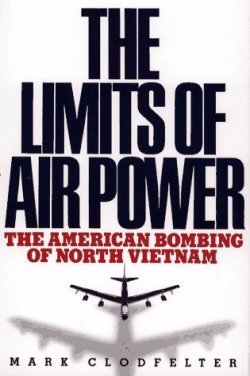
Mark Clodfelter, The Limits of Air Power: The American Bombing of North Vietnam (New York: Free Press, 1989). Finally, some aeroplanes! There is a rich literature about air power in the Vietnam War, but I still think Clodfelter’s classic holds up as one of the most important. Even over 30 years later, his argument is still controversial: that strategic bombing in Vietnam was not effective, that air power, although very important, has limits. Nevertheless, his explanation and comparison of the different goals, limits, and methods of the Johnson and Nixon administrations’ approaches to bombing is still useful and insightful. Even for those who disagree with it, this book remains a giant in the field for a reason.

John Flanagan, Vietnam Above the Treetops: A Forward Air Controller Reports (New York: Praeger Publishers, 1992). There are a lot of pilot and aircrew memoirs from Vietnam, and many of them are very good. But, for some reason, Flanagan’s tale of flying O-1 Bird Dogs on the incredibly dangerous low-and-slow FAC missions in Southeast Asia has stuck with me much more than any other pilot memoirs I’ve read. Starting at the USAF Academy, Flanagan was a deeply principled man who was surprised at how the military handled itself in Vietnam. His story includes the way he wrestled with himself about the war and described in detail the brutal missions and the horrific things he saw. His story also includes a detailed look at how the US brought South Korean troops into the war – something not covered much in other works. There are many great memoirs to read, but if you can only read one, this would be my pick.

Tami Davis Biddle, Rhetoric and Reality in Air Warfare: The Evolution of British and American Ideas about Strategic Bombing, 1914-1945 (Princeton, NJ: Princeton University Press, 2004). Of all the books on bombing in the Second World War (and there are seemingly too many to count), Biddle’s work is one of the best. She highlights one of major themes in air power history: the disconnect between the promises of air power and its actual results on the battlefield. This work is a wonderful look at the evolution of an idea – how strategic bombing theory grew and changed over time, and how that idea and the assumptions that grew to accompany it influenced air power leaders on both sides of the Atlantic to interpret the air war in particular ways. This mode of analysing not only what happened, but what people thought about what happened, is something I’ve tried to carry through in my own work.

Steven Fino, Tiger Check: Automating the US Air Force Fighter Pilot in Air-to-Air Combat, 1950–1980 (Baltimore, MD: Johns Hopkins University Press, 2017). Fino’s study of the evolution of fighter pilot cockpits, detailing the F-86 Sabre, F-4 Phantom, and F-15 Eagle, is still one of my favourite histories of technology. That’s not just because it’s about three of my favourite aircraft, but because of how deftly Fino – himself a former Eagle driver – connects that technology to the people using it. He illustrates the complex interactions between human and machine in the high-stress combat situation of flying fighters, and how the culture of fighter pilots evolved along with the technology. I’ve also never seen another book be so technically detailed while remaining so accessible.

Linda Robertson, The Dream of Civilized Warfare: World War I Flying Aces and the American Imagination (Minneapolis, MN: University of Minnesota Press, 2005). As a Professor of Media as opposed to a historian, Robertson comes at this study of First World War pilots with a fresh perspective. She examines how the image of the knights of the air (inaccurate as it is) was constructed and took such a grip on the public and the flyers themselves. It’s a study of the public perception of the war and of flying and expands the literature on the First World War in interesting ways.

Beyond

Stephen Bourque, Beyond the Beach: The Allied War Against France (Annapolis, MD: Naval Institute Press, 2018). Books about bombing during the Second World War are plenty, but few of them critique the allied effort in quite the way that Bourque does here. By travelling across France and consulting local archives, then comparing them to the official USAAF records, Bourque demonstrates the horrific true costs of the allied bombing campaign for French civilians. Almost as a companion piece to Tami Davis Biddle’s work, Bourque shows the human, emotional, and deeply personal costs of inaccurate bombing attacks, which wreaked destruction over France, killing tens of thousands of civilians. I read many books about bombing theory and doctrine, but this book makes those things real on a human level and made me look in a new way at a historical event that I thought I understood.

C.R. Anderegg, Sierra Hotel: Flying Air Force Fighters in the Decade After Vietnam (Washington DC: Air Force History and Museums Program, 2001). I’m not sure what it is about this book that keeps drawing me back. It’s a short volume about the transition from the Vietnam-era fighters like the F-4 Phantom, to the more advanced F-15 Eagle fighters of the 70s and 80s, and the suite of other changes that accompanied that shift, from more advanced air-to-air missiles like the AIM-9L to the changing nature of pilot culture, tactics, and training practices. Nevertheless, Anderegg’s approach – part history, part memoir – makes for very compelling, engaging reading about a fascinating topic. Maybe it’s that the subject matter is what my work focuses on, or maybe it’s the engaging writing style and interesting anecdotes, but I keep finding myself returning to this one again and again.

Dr Michael Hankins is the Curator for US Air Force, Navy, and Marine Corps post-World War II Aviation at the Smithsonian National Air and Space Museum and the author of Flying Camelot: The F-15, the F-16, and the Weaponization of Fighter Pilot Nostalgia (2021). He is a former Professor of Strategy at the USAF Air Command and Staff College eSchool, and former Instructor of Military History at the US Air Force Academy. He earned his PhD in history from Kansas State University in 2018 and his master’s in history from the University of North Texas in 2013. He has a web page here and can be found on Twitter at @hankinstien.

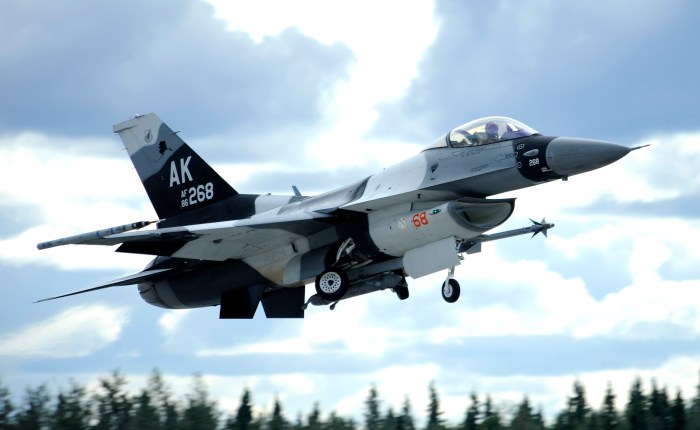
Header image: A US Air Force F-16 Fighting Falcon aircraft assigned to the 18th Aggressor Squadron takes off during Red Flag-Alaska 12-3 at Eielson Air Force Base, Alaska, 6 August 2012. Red Flag-Alaska is a series of Pacific Air Forces commander-directed field training exercises for US and partner nation forces, providing combined offensive counter-air, interdiction, close air support, and large force employment training in a simulated combat environment. (Source: Wikimedia)

#Podcast – The American Air Wars of Vietnam: An Interview with Dr Brian Laslie

#Podcast – The American Air Wars of Vietnam: An Interview with Dr Brian Laslie

Editorial Note: Led by our Editor Dr Mike Hankins, From Balloons to Drones produces a monthly podcast that provides an outlet for the presentation and evaluation of air power scholarship, the exploration of historical topics and ideas, and provides a way to reach out to both new scholars and the general public. You can find our Soundcloud channel here. You can also find our podcast on Apple Podcasts and Google Podcasts.

2022 will mark the 50th anniversary of the LINEBACKER campaigns – the last major bombing campaigns of the Vietnam War. As such, in our latest podcast, we interview Dr Brian Laslie about his latest book, Air Power’s Lost Cause: The American Air Wars of Vietnam and his evaluation of the legacy of air power’s contribution to the Vietnam War.

55870471

Dr Brian Laslie is a US Air Force Historian and currently the Deputy Command Historian at North American Aerospace Defense Command (NORAD) and United States Northern Command (USNORTHCOM). He is also the Book Reviews Editor at From Balloons to Drones. A 2001 graduate of The Citadel and a historian of air power studies, he received his Masters’ from Auburn University Montgomery in 2006 and his PhD from Kansas State University in 2013. He is the author of Architect of Air Power: General Laurence S. Kuter and the Birth of the US Air Force (2017) and The Air Force Way of War (2015). The latter book was selected for the Chief of Staff of the Air Force’s 2016 professional reading list and the 2017 RAF Chief of the Air Staff’s reading list. He can be found on Twitter at @BrianLaslie.

Header Image: 3/4 front view of a US Air Force RC-130A of the 1st Aerial Cartographic and Geodetic Squadron parked on aluminium matting at Tuy Hoa Airbase in South Vietnam in 1970. (Source: NARA)

#ResearchResources – Recent Articles and Books (June 2021)

#ResearchResources – Recent Articles and Books (June 2021)

Editorial note: In this series, From Balloons to Drones highlights research resources available to researchers. Contributions range from discussions of research at various archival repositories to highlighting new publications. As part of this series, we are bringing you a monthly precis of recent articles and books published in air power history. This precis will not be exhaustive but will highlight new works published in the preceding month. Publication dates may vary around the globe and are based on those provided on the publisher’s websites. If you would like to contribute to the series, please contact our Editor-in-Chief, Dr Ross Mahoney, at airpowerstudies@gmail.com or via our contact page here.

Articles

Cynthia Buchanan, ‘Mexicans in World War II: America’s Ally of the Air,’ Air Power History 68, no. 2 (2021).  

No abstract available.

William Cahill, ‘Fly High, Fly Low: SAC Photographic Reconnaissance in Southeast Asia,’ Air Power History 68, no. 2 (2021). 

No abstract available.

Yin Cao, ‘The Last Hump: The Lahore Elementary Flying Training School, the Chinese Civil War, and the final days of the British Raj,’ Modern Asian Studies (2021). doi: 10.1017/S0026749X21000081.

This article centres on the evacuation of the Lahore Elementary Flying Training School, which was built in 1943 to train Chinese pilots and mechanics. It details the British and Chinese authorities’ concerns over the school and how the chaotic situation in India during the final days of the British Raj influenced its evacuation back to China. This article locates the story within the broad context of the British withdrawal from India and the Chinese Civil War, and it uses this case to uncover the links between the two most significant events in the history of modern India and China. In so doing, it puts forward an integrated framework for studying modern Indian and Chinese history.

Jonna Doolittle Hoppes, ‘Gene Deatrick: An Appreciation,’ Air Power History 68, no. 2 (2021).

No abstract available.

James Greenhalgh, ‘The Long Shadow of the Air War: Composure, Memory and the Renegotiation of Self in the Oral Testimonies of Bomber Command Veterans since 2015,’ Contemporary British History (2021), DOI: 10.1080/13619462.2021.1906654

The following article examines oral testimonies collected by the International Bomber Command Centre project since 2015. The study considers the challenges posed by post-war discourses that contest the morality of bombing and contemporary constructions of Britishness to Bomber Command veterans making account of their lives. The contested nature of bombing’s position within narratives of the Second World War creates a discursive environment where veterans struggle to assemble satisfying life stories. Despite using a set of similar narrative frameworks to counter questions concerning the morality or purpose of bombing, veterans found limited opportunities to demonstrate personal agency or achieve emotional composure. The interviews illustrate unresolved and challenging feelings stemming from a discourse that has proved inimical to creating satisfying selfhoods. In addition, the difficulty of integrating the story of Bomber Command into narratives of Britain’s wartime myth proved to be a source of considerable discomfort for the interviewees. In their attempts to situate themselves within longer trajectories of Britain and its military in the twenty-first century, the testimonies are thus revealing of the importance to Britain of its wartime past in forming current identities and the ongoing conflict in how Britishness should confront more complex versions of its history.

K.A. Grieco and J.W. Hutto, ‘Can Drones Coerce? The Effects of Remote Aerial Coercion in Counterterrorism,’ International Politics (2021). https://doi.org/10.1057/s41311-021-00320-5

Weary of costly on-the-ground military interventions, Western nations have increasingly turned to “Remote Warfare” to address the continued threat of terrorism. Despite the centrality of drone strikes to the practice of Remote Warfare, we still know relatively little about their effectiveness as instruments of coercion. This article offers a conceptual framework for assessing their coercive efficacy in counterterrorism. We argue that remote control drones are fundamentally different from traditional airpower, owing to changes in persistence, lethality, and relative risk. Critically, these technological characteristics produce weaker coercive effects than often assumed. While persistent surveillance combined with lethal, low-risk strikes renders armed drones highly effective at altering the cost–benefit calculations of terrorists, these same technological attributes cause them to be less effective at clear communication, credibility, and assurance—other key factors in coercion success. Overall, drone strikes are poor instruments of coercion in counterterrorism, underscoring some potential limitations of Remote Warfare.

Ron Gurantz, ‘Was Airpower “Misapplied” in the Vietnam War? Reassessing Signaling in Operation Rolling Thunder,’ Security Studies (2021). DOI: 10.1080/09636412.2021.1915585.

Operation Rolling Thunder’s failure has been widely blamed on the strategy of using force to send “signals.” It discredited the associated theory of coercion among a generation of military officers and scholars. In this paper I show that, whatever its other failures, Operation Rolling Thunder did successfully signal a threat. I rely on the latest research to demonstrate that Hanoi believed the bombing would eventually inflict massive destruction. I also show that Washington accurately ascribed the failure of the threat to North Vietnam’s resolve and continued the operation for reasons other than signaling. These findings show that Operation Rolling Thunder can be productively understood as an exercise in both signaling and countersignaling. Rather than discrediting the theory of coercion, these findings modify it. They show that failed threats can be informative and that coercive campaigns can become prolonged for reasons other than a lack of credibility.

Heather Hughes, ‘Memorializing RAF Bomber Command in the United Kingdom,’ Journal of War & Culture Studies (2021), DOI: 10.1080/17526272.2021.1938840

This article traces the ways in which RAF Bomber Command has been memorialized in the UK since the 1940s, focusing on those who have organized memorials and associated commemorations. Distinct phases can be identified. Until the 1970s, the Command was accorded a prominent role in official memorial and ceremonial activities. Veterans’ activities reflected this acknowledgement. From the 1980s, in the face of debates about the morality of area bombing of German cities, however, veterans’ organizations and families began to articulate the view that Bomber Command’s wartime contribution had been overlooked. In consequence, they embarked upon activities to revise official memory. This included distinctive forms of memorial activity on the part of veterans and the postmemory generation, including the widespread appearance of ‘small memorials’ and, in the twenty-first century, two large-scale memorial sites, in London and in Lincoln.

John A. Schell, ‘The SA-2 and U-2: Secrets Revealed,’ Air Power History 68, no. 2 (2021). 

No abstract available.

James Shelley, ‘The Germans and Air Power at Dieppe: The Raid and its Lessons from the ‘Other Side of the Hill,’ War in History (2021), DOI: 10.1177/0968344521995867

Despite the vast academic and popular interest in the Dieppe raid of 19 August 1942, there remains a curious oversight of the German side of the story. This contribution interrogates German sources in order to explore the Dieppe air battle and its consequences from the perspective of the German armed forces. The paper ultimately demonstrates that the Germans learnt much about the role of air power in coastal defence from their experiences at Dieppe, but that the implementation of those lessons was lacking.

Samuel Zilincik, ‘Technology is awesome, but so what?! Exploring the Relevance of Technologically Inspired Awe to the Construction of Military Theories,’ Journal of Strategic Studies (2021), DOI: 10.1080/01402390.2021.1923919.

Military theories are thoughts explaining how armed forces are to be used to achieve objectives. These thoughts are often influenced by emotions, yet the influence of emotions on military theory-crafting remains underexplored. This article fills the gap by exploring how awe influences military theorising. Awe is an emotion associated with the feeling of transcendence. Several military theorists felt that way about the technologies of air power, nuclear power and cyber power, respectively. Consequently, their theories became narrowly focused, technocentric and detached from the previous theories and military history. Understanding these tendencies can help improve military theorising in the future.

Books

Bojan Dimitrijevic and Jovica Draganić, Operation ALLIED FORCE: Air War over Serbia 1999 – Volume 1 (Warwick: Helion and Company, 2021).

On 24 March 1999, the North Atlantic Treaty Organisation (NATO) launched Operation Allied Force against Serbia.

Lasting 78 days, this was an unusual conflict fought at several levels. The campaign was fought at the negotiation tables, in the media, and via cyber warfare. In the air, NATO sought to destroy or at least minimise the capability of the Serbian forces, while on the ground the Serbian forces fought the Kosovo-Albanian insurgency. It had an unusual outcome, too: without NATO losing a single soldier in direct action, they still forced the Serbian authorities and armed forces to withdraw from Kosovo, which in 2008 then proclaimed its independence. In turn, the war inflicted serious human and material losses upon the Serbian’s and the air force was particularly devastated by air strikes on its facilities. Nevertheless, many within NATO subsequently concluded that the skies over Serbia were as dangerous on the last night of this conflict as they were on its first.

Largely based on cooperation with the joint commission of the Serbian Air Force and the U.S. Air Force in Europe (USAFE), Volume 1 of Operation Allied Force provides a detailed overview of NATO’s aerial campaign, including reconstructions of operations by ‘stealth’ aircraft such as the F-117A and B-2A, and the only loss of an F-117A in combat. Volume 1 of Operation Allied Force also offers a detailed reconstruction of the planning and conduct of combat operations by the Serbian Air Force and Air Defence (Ratno vazduhoplovstvo i protivvazdušna odbrana, RV i PVO) with a special emphasis on the attempts of its sole MiG-29 squadron and its surface to air missile batteries to challenge enemy strike packages.

Adrien Fontanellaz, Tom Cooper, and José Augusto Matos, War of Intervention in Angola – Volume 4: Angolan and Cuban Air Forces, 1985-1987 (Warwick: Helion and Company, 2021).

War of Intervention in Angola, Volume 4, continues the coverage of the operational history of the Angolan Air Force and Air Defence Force (FAPA/DAA) as told by Angolan and Cuban sources, in the period 1985-1987.

Many accounts of this conflict – better known in the West as the ‘Border War’ or the ‘Bush War’, as named by its South African participants – consider the operations of the FAPA/DAA barely worth commentary. At most, they mention a few air combats involving Mirage F.1 interceptors of the South African Air Force (SAAF) in 1987 and 1988, and perhaps a little about the activity of the FAPA/DAA’s MiG-23s. However, a closer study of Angolan and Cuban sources reveals an entirely different image of the air war over Angola in the 1980s: indeed, it reveals the extent to which the flow of the entire war was dictated by the availability – or the lack – of air power. These issues strongly influenced the planning and conduct of operations by the commanders of the Angolan and Cuban forces.

Based on extensive research with the help of Angolan and Cuban sources, War of Intervention in Angola, Volume 4, traces the Angolan and Cuban application of air power between 1985-1987 – during which it came of age – and the capabilities, intentions, and the combat operations of the air forces in support of the major ground operations Second Congress and Salute to October.

Alexander Howlett, The Development of British Naval Aviation, 1914–1918 (London: Routledge, 2021).

The Royal Naval Air Service (RNAS) revolutionized warfare at sea, on land, and in the air. This little-known naval aviation organization introduced and operationalized aircraft carrier strike, aerial anti-submarine warfare, strategic bombing, and the air defence of the British Isles more than 20 years before the outbreak of the Second World War. Traditionally marginalized in a literature dominated by the Royal Flying Corps and the Royal Air Force, the RNAS and its innovative practitioners, nevertheless, shaped the fundamentals of air power and contributed significantly to the Allied victory in the First World War. The Development of British Naval Aviation utilizes archival documents and newly published research to resurrect the legacy of the RNAS and demonstrate its central role in Britain’s war effort.

David Nicolle and Gabr Ali Gabr, Air Power and the Arab World, 1909-1955 – Volume 4: The First Arab Air Forces, 1918-1936 (Warwick: Helion and Company, 2021).

Volume 4 of Air Power and the Arab World, 1918-1936, continues the story of the men and machines of the first half century of military aviation in the Arab world.  The earliest of the Arab air forces to be established trace their histories back to the 1920s and 1930s when the overwhelming majority of Arab countries, and an even larger majority of the Arabic-speaking people, were ruled or dominated by four European powers.  This volume continues with the story of the period from 1918 to 1936.

The role, organisational structure and activities of the first Arab air forces are described based on decades of consistent research, newly available sources in Arabic and various European languages, and is richly illustrated with a wide range of authentic photography.  These air forces ranged from dreams which never got off the ground, to small forces which existed for a limited time then virtually disappeared, to forces which started very small then grew into something more significant. Even so, the successful air forces of Iraq and Egypt would only have a localised impact within the frontiers of their own states.

#Podcast – Mercury Rising: An Interview with Jeff Shesol

#Podcast – Mercury Rising: An Interview with Jeff Shesol

Editorial Note: Led by our Editor Dr Mike Hankins, From Balloons to Drones produces a monthly podcast that provides an outlet for the presentation and evaluation of air power scholarship, the exploration of historical topics and ideas, and provides a way to reach out to both new scholars and the general public. You can find our Soundcloud channel here. You can also find our podcast on Apple Podcasts and Google Podcasts.

In the latest entry in our podcast series, we interview prolific and celebrated author Jeff Shesol about his latest book Mercury Rising: John Glenn, John Kennedy, and the New Battleground of the Cold War. In this episode Shesol talks about John Glenn, who captured the hearts and imagination of many Americans as the first US astronaut to orbit the earth. We not only talk about Glenn’s place in the history of the Cold War, but also in deeply personal terms.

mercury-rising

Jeff Shesol is the author of Mercury Rising, most recently, as well as Supreme Power: Franklin Roosevelt vs. the Supreme Court and Mutual Contempt: Lyndon Johnson, Robert Kennedy, and the Feud That Defined a Decade, both selected as New York Times Notable Books of the Year. He is a former speechwriter for President Bill Clinton and is a founding partner of West Wing Writers. A Rhodes Scholar, he holds degrees in history from Oxford University and Brown University and is a frequent contributor to the New York Times, the Washington Post, and The New Yorker News Desk.

Header image: The Mercury Seven astronauts with a NASA Langley Research Center Convair F-106B Delta Dart aircraft at Langley Air Force Base, 20 January 1961. From left to right: Scott Carpenter, Gordon Cooper, John Glenn, Gus Grissom, Wally Schirra, Alan Shepard and Deke Slayton. (Source: Wikimedia)

#ResearchResources – Recent Articles and Books (April 2021)

#ResearchResources – Recent Articles and Books (April 2021)

Editorial note: In this series, From Balloons to Drones highlights research resources available to researchers. Contributions range from discussions of research at various archival repositories to highlighting new publications. As part of this series, we are bringing you a monthly precis of recent articles and books published in air power history. This precis will not be exhaustive but will highlight new works published in the preceding month. Publication dates may vary around the globe and are based on those provided on the publisher’s websites. If you would like to contribute to the series, please contact our Editor-in-Chief, Dr Ross Mahoney, at airpowerstudies@gmail.com or via our contact page here.

Articles

Jayson Altieri, ‘Minutemen and Roentgens: A History of Civil Air Patrol’s Aerial Radiolomcal Monitoring Program,’ Air Power History 68, no. 1 (Spring, 2021).

When one thinks of U.S. Air Force Cold War era aircraft, images of the Strategic Air Command’s B–52 Stratofortress, B–58 Hustler, and B–36 Peacemaker, made famous by classic Hollywood films like Dr. Strangelove, Fail Safe, and Strategic Bomber Command, usually come quickly to mind. What is less well known are the roles that smaller aircraft like the Cessna L-19/0-1 Bird Dog, Cessna 172/T-41 Mescalero, and Stinson L-5 Sentinel played in helping prepare and respond to a possible nuclear attack on the American homeland by actively measuring radioactivity levels in roentgens, mostly through the efforts of the volunteers of the U.S. Air Force’s Auxiliary, known as the Civil Air Patrol (CAP). While today, CAPs primary operational missions concentrate on inland air search and rescue, aerial disaster assessment, and flight training for the organization’s Cadet program, CAP’s earlier roles following the Second World War involved supporting the nation’s Civil Defense through Aerial Radiological Monitoring (ARM) and post-attack damage assessments of cities and key economic infrastructures. Founded on December 1,1941, with the help of American airpower proponent Gill Rob Wilson, Texas Oilman David Harold Byrd, and New York Mayor Fiorello H. LaGuardia, the latter in his capacity as the Director of the Office of Civilian Defense, the CAP was originally formed to help supplement American military operations as an Auxiliary of the United States Army Air Forces in the early stages of the Second World War. Early in the war, as part of America’s Civil Defense coordinated by the Council of National Defense, civilian non-combatant volunteers were asked to help supplement local governments and military commands based across the country with Air Raid Wardens, Auxiliary Firemen, Road Repair Crews, and Civil Air Patrols along the U.S. Atlantic and Gulf Coasts. Initially using privately owned aircraft and equipment and operating from local private and publicly owned airfields, CAP volunteers became known as the Flying Minutemen, performing a number of wartime missions include Antisubmarine patrols, border patrols, target towing, and messenger services. By the end of the war and with the formation of an independent U.S. Air Force, President Harry Truman, signed in 1946 the congressionally approved Public Law 79-476 establishing the CAP as both a Federally charted corporation and later in 1948, Public Law 557 making CAP the U.S. Air Force’s Auxiliary. By this time, both the United States and CAP were now engaged in another war, though involving less actual conflict, none-the-less still presented an existential threat to the nation-The Cold War.

Troy Hallsell, ‘Building Malstrom’s Minuteman Missile Fields in Central Montana. 1960-1963,’ Air Power History 68, no. 1 (Spring, 2021).

In September of 1960, the Air Force Association held its 14th annual convention at the San Francisco Civic Auditorium in San Francisco, California. This grand event demonstrated to the American public (and the world) the best aerial hardware the Air Force had to offer. On display was a Bell X-1B rocket plane, North American Aviation’s Hound Dog air-launched standoff missile, a Titan intercontinental ballistic missile (ICBM), and the Thor-Able missile that promised to reach the moon. While this display of weaponry sought to allay Americans’ fears about a supposed missile gap in favor of the Soviet Union (USSR), the Air Force’s unveiling of the Minuteman ICBM was the main attraction. On September 22, at 7:00 PM Gen Thomas D. White, the Chief of Staff of the Air Force, San Francisco mayor George Christopher, and NBC producer Roy Neal took to the podium to introduce the United States’ newest weapon system. As General White pushed a button, the “gleaming dummy missile rose to a vertical static display, where it would remain through the weekend.” Never underestimating the power of an image, White understood that the Air Force had to convince the American public to embrace the Minuteman as the “ultimate deterrent force.” The future of missiles depended on their good graces.

This study explores why the Air Force deployed the Minuteman to Malmstrom AFB in central Montana, how the United States Army Corps of Engineers (USACE) and Air Force built the weapon system’s infrastructure, and their experience bringing the first flight of missiles to alert during the Cuban Missile Crisis. The Cold War was an international political contest that pitted the west, led by the United States, against the east as represented by the USSR. The ICBM emerged as an integral weapon system in waging the Cold War. While the Air Force trotted out the Atlas and Titan ICBMs, the Minuteman became the weapon system of the future. The Air Force selected Malmstrom AFB in central Montana as home for the first Minuteman strategic missile wing. Shortly after construction began in 1962, the U.S. and USSR engaged in the Cuban Missile Crisis following the Soviet Union’s installation of intermediate-range ballistic missiles in Cuba. During this confrontation Strategic Air Command (SAC) ordered the 341st Strategic Missile Wing (341 SMW) to bring its first flight of Minuteman ICBMs to alert and entered into an unprecedented state of readiness. In the nuclear posturing that followed, the USSR agreed to remove its missiles from Cuba as long as the U.S. made some concessions of its own.

Phil Haun, ‘Foundation Bias: The Impact of the Air Corps Tactical School on United States Air Force Doctrine,’ Journal of Military History 85, no. 2 (April 2021).

For over seventy years, the continued belief in the efficacy of strategic bombing has dominated United States Air Force thinking in times of war and peace. In addition, the core principles of air power articulated by the Air Corps Tactical School continue to reside in USAF doctrine. Despite the outcomes of the Korean, Vietnam, Iraq, and Afghanistan wars, which have all demonstrated the effectiveness of joint operations and the limitations of strategic bombing, the ACTS tenets remain embedded in the very DNA of airmen and continue to influence how the United States Air Force views the modern air, space, and cyber domains.

Bryan Hunt, ‘Lost in Space: The Defeat of the V-2 and Post- War British Exploitation of German Long-Range Rocket Technology,’ Air Power History 68, no. 1 (Spring, 2021).

Battle of London is over … sort of

On the evening of September 7, 1944, Duncan Sandys MP (1908-1987), chair of the government rocket and flying bomb countermeasures ‘CROSSBOW committee, confidently announced that the Battle of London, comprising the V-l flying bomb attacks, was now over and that the public could now relax, and because of Allied advances through northern France, discounted the apocalyptic predictions of ‘rocket’ (ballistic missile) attacks. The fear of these attacks had caused the Home Secretary, Herbert Morrison (1888-1965), grave concern because of alarmist intelligence assessments of the size of warheads and predicted scale of attacks. Starting in August 1943, Bomber Command and the U.S. Eighth Air Force had bombed research sites in Poland and dropped 120,000 tons of bombs on the monumentally large reinforced-concrete ‘large sites’ and ‘rocket projector’ sites on the Cherbourg Peninsula in northern France and in Belgium that were believed to be crucial to the operational deployment of long-range rockets. Allied forces had now overrun the distinctive, curved assembly and launch ‘ski site’ buildings where V-l flying bombs had been launched at Britain. The Chiefs of Staff Committee also believed that all potential rocket launch sites were now in Allied hands.

However, a scant 24 hours later on September 8, 1944, a mysterious explosion occurred in Chiswick, west London, killing three people and injuring a further 20. A second similar explosion occurred a few seconds later in Epping, though with no casualties. Described officially as ‘gas leaks’, these explosions heralded the first ballistic missile attack on the United Kingdom. The weapon was the A4, a 46 ft/14 m high single-stage liquid-fuelled rocket carrying a one ton high-explosive warhead. The A4 – Aggregat (experimental) Bombardment Rocket and later renamed by the Nazi Propaganda Ministry and universally known as the V-2 (Vergeltungswaffen – vengeance or retaliatory weapon) – had been launched from a mobile position in The Hague, in the occupied Netherlands. It took just under five minutes to travel the 200-odd nautical miles to southern England. Although the British Government maintained the story of gas leaks for two months on security grounds, it was recognised across Whitehall that this was the commencement of a ballistic missile (code word: ‘BIGBEN) bombardment that had been expected – and feared – from late 1943s.

David Messenger, ‘Local Government, Passive Defense and Aerial Bombardment in Barcelona during the Spanish Civil War, 1936–9,’ Journal of Contemporary History, (April 2021). doi:10.1177/0022009421997898

The bombardment of civilians from the air was a regular feature of the Spanish Civil War from 1936 to 1939. It is estimated some 15,000 Spaniards died as a result of air bombings during the Civil War, most civilians, and 11,000 were victims of bombing from the Francoist side that rebelled against the Republican government, supported by German and Italian aviation that joined the rebellion against the Republic. In Catalonia alone, some 1062 municipalities experienced aerial bombardments by the Francoist side of the civil war. In cities across Spain, municipal and regional authorities developed detailed plans for civilian defense in response to these air campaigns. In Barcelona, the municipality created the Junta Local de Defensa Passiva de Barcelona, to build bomb shelters, warn the public of bombings, and educate them on how to protect themselves against aerial bombardment. They mobilized civilians around the concept of ‘passive defense.’ This proactive response by civilians and local government to what they recognized as a war targeting them is an important and under-studied aspect of the Spanish Civil War.

Cole Resnik, ‘Silent Saviors: Gliders for American Resupply Operations in Normandy, June 1944,’ Air Power History 68, no. 1 (Spring, 2021).

Historians devote much attention to the glider assault missions on D-Day morning, but resupply missions thereafter contributed more to the success of the airborne divisions and require a closer evaluation. While awaiting the construction of airstrips or the arrival of armored reinforcements following the initial invasion of Normandy, the artillery pieces and ammunition delivered by combat gliders helped outgunned paratroopers of the 82nd Airborne Division hold the surrounding area of Sainte-Mere-Eglise. Airborne commanders trusted gliders more than airdrops in the aftermath of D-Day because of their ability to deliver heavier equipment behind enemy lines in a precise, cohesive, and timely manner. In the morning hours of June 6, the 82nd dropped in and around Sainte-Mere-Eglise. The average paratrooper landed with an M1 Garand, an M1911 pistol, a knife, extra ammunition, three days of rations, a few explosives, and other personal gear if their leg bag remained attached after the jump. Some dropped with mortar tubes and bazookas, but these soldiers lacked the firepower necessary to compete with an armored enemy on a consistent basis. The British glider could fly with 7,380 pounds stuffed in its fuselage. That equaled twenty-five infantrymen with gear, four motorcycles complete with eight troops and equipment, or a one-ton supply trailer attached to a quarter-ton Jeep. The resupply mission, nicknamed “Elmira,” was simple: the 176 gliders hooked to C-47s would depart England, fly to the coast of France, and disconnect from their tow planes near the beaches at Normandy.

#Podcast – Pulp Vietnam: An Interview with Dr Gregory Daddis

#Podcast – Pulp Vietnam: An Interview with Dr Gregory Daddis

Editorial Note: Led by our Editor Dr Mike Hankins, From Balloons to Drones produces a monthly podcast that provides an outlet for the presentation and evaluation of air power scholarship, the exploration of historical topics and ideas, and provides a way to reach out to both new scholars and the general public. You can find our Soundcloud channel here. You can also find our podcast on Apple Podcasts and Google Podcasts.

In the latest episode of our podcast series, we interview Dr Gregory Daddis about his latest book, Pulp Vietnam: War and Gender in Cold War Men’s Adventure Magazines (Cambridge University Press, 2021). Before and during the Vietnam War, some of the most popular magazines among those who served were pulp fiction men’s adventure magazines. In this interview, Daddis unpacks the relationship between fiction and reality, how we talk about wars and choose to remember them, and how constructions of gender really matter when we analyse war.

Dr Gregory A. Daddis is a Professor of History and the USS Midway Chair in Modern US Military History at San Diego State University. A retired US Army colonel, he has served in both Operations Desert Storm and Iraqi Freedom. He has authored four books, including Withdrawal: Reassessing America’s Final Years in Vietnam (2017).

Header image: Company E, 2/9 Marines, being re-supplied by a Sikorsky CH-34 during Operation Harvest Moon, 10 December 1965. (Source: Wikimedia)