Air Power and the Battle of Hamel

Air Power and the Battle of Hamel

By Dr Michael Molkentin

Editorial Note: The 4th of July 2018 represented that 100th Anniversary of the Battle of Le Hamel. While Hamel was important, its place as a model on which subsequent operations were based has been overplayed. Furthermore, notable popular Australian historians have also distorted the significance of the battle. Nevertheless, as Dr Michael Molkentin highlights in this article, Hamel was valuable in highlighting the evolution of, and the diverse roles played by, air power in support of land battles during the First World War.

In the historiography of the First World War, the Battle of Hamel (4 July 1918) has frequently been cited as an example of significant tactical innovation and a ‘model’ on which subsequent British offensive operations were planned. While neither interpretation bears up to scrutiny when the battle is viewed within the broader context of British Army operations on the Western Front, relative to its size the Australian Corps’ capture of Hamel integrated air power to a hitherto unprecedented extent and, in hindsight, provides a revealing case study of the varied, distinct and specialist air power roles that had evolved during the conflict.

The Australian Corps’ headquarters, commanded by the recently appointed Lieutenant-General Sir John Monash, planned the capture of the village of Hamel (located south of the Somme) as a line-straightening operation. Besides the troops of his own corps’ 4th Division, Monash had ten infantry companies from the US 33rd Division, 60 tanks from the British 5th Tank Brigade (including the new Mark V tank) and 639 artillery pieces. Monash planned to launch a surprise assault behind a creeping barrage and tank screen (much like British Third Army had done at Cambrai the previous November); he anticipated that his infantry could secure their objectives – two kilometres deep on a seven-kilometre wide front – within an hour and a half.

4083779
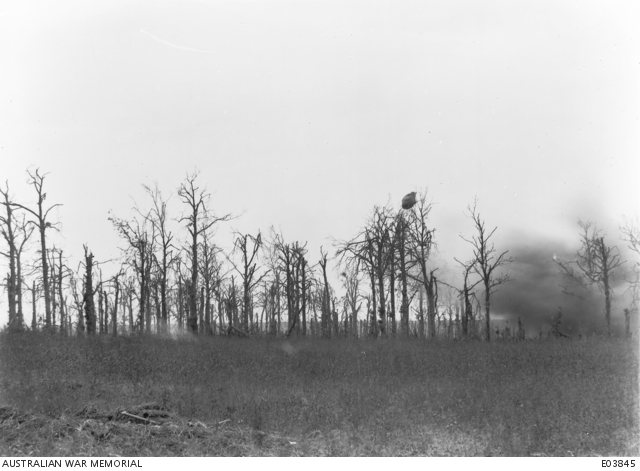
A unique photo of a disabled British RE8 aircraft diving towards earth during the 4th Australian Infantry Brigade attack at Vaire Wood in the Battle of Hamel. It was subsequently discovered that the machine had been hit by a presumably faulty shell. (Source: Australian War Memorial)

Monash’s staff also worked with the Royal Air Force’s (RAF) V Brigade to organise substantial and multi-layered air support for the operation. The Australian Corps’ corps squadron, No. 3 Squadron Australian Flying Corps (AFC), would conduct the ‘majority of the tactical work’ during the battle. Its airmen would maintain a continuous presence over and directly beyond the battlefield to follow the progress of the Australian infantry (contact patrols), watch for enemy counter-attacks (counter-attack patrols), identify and direct artillery fire onto active German batteries (artillery patrols) and to photograph the new front line once it had been secured. New maps would then be produced and issued to troops in the front line within a matter of hours.[1] Assisting No. 3 Squadron with providing tactical air support, the RAF’s No. 8 Squadron would co-operate with the tanks while No. 9 Squadron parachuted ammunition to troops at their objectives. The night-bombers of No. 101 Squadron flew above the staging area on the night before the battle to mask the noise of the tanks as they moved up to their starting line.

The squadrons of 22nd (Army) Wing were also assigned to support the land battle: three of its four fighter squadrons would fly ground-attack sorties while its Bristol Fighter unit watched roads, railways and debussing points as far east as Proyart (10 kilometres east of Hamel). The army wing’s two bomber squadrons would meanwhile raid known German bivouacs. This aspect of the air plan reflected the RAF’s preference for interdiction over ‘trench strafing’ – the belief being that it was better to harass German troops and artillery behind rather than on the battlefield itself.[2] GHQ allocated three additional fighter squadrons from, IX Brigade, the RAF’s strategic reserve, to provide air superiority and the neighbouring Third Army’s fighters extended their offensive patrols south to cover the rest of Fourth Army’s front.[3]

Probably no other division-sized operation of the war enjoyed the combined support of aircraft from three wings, that is, 13 squadrons, or 230-odd aircraft. As well as the multi-faceted and highly integrated function that air power had assumed by this stage, the air plan, devised by the Australian Corps’ BGGS in collaboration with V Brigade illustrates the British Army’s growing reliance on machinery and firepower to reduce casualties and compensate for dwindling manpower.[4]

As the plan dispensed with a preliminary bombardment, No. 3 Squadron’s artillery spotting began at zero hour. For the first few hours, airmen reported batteries neutralised by the barrage so that artillery commanders could switch their guns onto active targets. The plan also allocated five heavy batteries to answer zone calls, airmen being briefed on where the Germans might move batteries once the battle started.[5] No. 3 Squadron issued 80 zone calls and co-operated in the neutralisation of at least 17 batteries (‘in many cases’ airmen did not see the artillery’s response to zone calls).[6] Although not entirely preventing it, the Australian Corps counter-battery arrangements suppressed the German artillery’s response adequately during the advance and consolidation.[7]

Counter-attack patrols flew beyond the German lines to ‘an unheard of distance’ with instructions to transmit zone calls on concentrations of German troops and engage them with bombs and machine guns.[8] One crew reported a concentration of enemy infantry just before 0700 but otherwise, seeing no enemy counter-attacks the airmen, as Lieutenant Arthur Barrett put it, ‘bombed and machine gunned everything we saw.’ Crossing the line just after zero hour he and his pilot halted a train, silenced several machine gun positions and strafed a pair of limbered guns, overturning one. Descending below 300 feet, Barrett’s eyes ran from gas in the barrage.[9] 3rd Squadron’s airmen dropped 138 bombs and fired 9,500 rounds on 4 July 1918.[10] Combined with the record 54,000 rounds and 850 bombs expended by 22nd Wing’s fighter pilots, this had a considerable impact on such a narrow battlefront.[11] ‘Several’ prisoners attested to the ‘moral effect’ of air attacks and noted how:

[t]hey prevent men getting machine guns into action almost as effectively as a barrage […] it was almost impossible to look over the top without getting machine gunned from the air.[12]

Corroborating this is German Second Army orders that noted ‘heavy casualties caused by machine gun fire from low-flying enemy machines’ at Hamel and issued instructions for dealing with British aircraft.[13]

Although Australian infantry had been signalling to aircraft since operations at Poziéres in 1916, contact patrols represented a new role for 3rd Squadron at Hamel. Despite difficulties experienced during the 1916-17 campaigns, the general staff recognised that aircraft provided the shortest possible passage of information from the battlefield to corps (and, atypically at Hamel, divisional) headquarters.[14] Dropped by airmen returning from the line, contact patrol reports reached headquarters staff in 24 minutes on average – up to half the time taken by a wireless message and a third of that usually taken by carrier pigeon.[15] Experience indicated that staff needed to synchronise contact patrols with the infantry’s timetable carefully. At Hamel, No. 3 Squadron had instructions to call for flares on the objective at 90 minutes after zero.[16] No. 8 Squadron followed the tanks across the battlefield and ‘in one or two cases were able to give information as to those which had been put out of action.’[17] The infantry’s clockwork progress and minimal resistance at the objective allowed the infantry and tanks to respond ‘well’ when contact patrol pilots sounded their klaxon horns; the airmen delivered ‘exceedingly accurate’ reports.[18] It remained to be seen, however, how the system would cope during running battles and exploitation operations when it would be arguably more crucial for staff to keep track of their troops.

4090362
A parachute, used as an ammunition carrier, caught in the trees at Vaire Wood, during the Battle of Hamel on 4 July 1918, when the supply of ammunition to the infantry by means of parachutes was a feature of aircraft cooperation. The picture was taken the day following, during shelling by the enemy of newly won Australian positions. (Source: Australian War Memorial)

For the first time, at Hamel, the RAF organised battlefield resupply using equipment designed and built at No. 3 Squadron’s aerodrome under the direction of ‘B’ Flight’s commander, Captain Lawrence Wackett. The idea apparently came from the Luftstreitkräfte’s (German Air Service) attempts at dropping ammunition to troops on the battlefield during the spring offensives.[19] At Hamel a detachment from No. 9 Squadron carried out the work, dropping 111,600 rounds to Australian troops at their objectives and at dropping stations close behind the line.[20] Endorsing Wackett’s claim for a £1,000 inventor’s fee from the British government (he received £350), Monash declared the scheme ‘an unqualified success’, noting how it permitted the rapid resupply of troops in ‘isolated and exposed positions’ and saved casualties among carrying parties.[21] His subordinates, though more prosaic, also indicated the trial’s success. 4th Australian Infantry Brigade’s CO described it as working ‘satisfactorily’ while 6th Brigade’s commander noted how the scheme ‘worked very well,’ delivering ammunition within 10 yards of one machine gun position.[22] Though faster, aircraft lacked the carrying capacity of other transportation available to the Australian Corps: a single tank could deliver four times as much ammunition as each of No. 9 Squadron’s aircraft, plus 300 grenades, 450 litres of water and a vast quantity of food and other trench stores.[23] Employed in all subsequent British offensives (the RAF delivered 30-60,000 rounds each day during the Amiens offensive), ammunition drops by corps squadrons thus remained an ‘emergency’ adjunct to other forms of battlefield logistics.[24]

The RAF’s tactical support was enabled, to a substantial extent, by the air superiority that British airmen exercised over the battlefield. Throughout the day, the fighter squadrons of 22nd (Army) Wing and three additional fighter squadrons attached from IX Brigade, ranged east of the battlefield to intercept any German aircraft that attempted to interfere. It was RAF policy to employ air superiority patrols offensively, east of the lines, rather than as a protective screen or close escorts. The airmen of the Luftstreitkräfte made no sorties over the Hamel battlefield until 9.30am – some five hours after the Australian infantry had secured their objective line. German fighters after that became ‘fairly active’ over the area, and there were ten air-to-air combats. In the largest of these, the SE5as of No. 24 Squadron engaged a mixed formation of 20 Fokker DVIIs, Pfalz scouts and Albatros DVs over Cerisy, six kilometres east of Hamel. The British pilots claimed three enemy aircraft and lost none themselves.[25] It is noteworthy that No. 24 Squadron was one of the 22nd (Army) Wing fighter units allocated to bomb and strafe targets on the ground behind German lines – its involvement in this dogfight illustrates the integration of air superiority and interdiction roles that British airmen had begun to undertake at Third Ypres the previous year.

Altogether, of the hundreds of sorties flown by the RAF in support of the Hamel operation, only three resulted in the loss of an aircraft to air combat– and only one of these involved one of the aircraft involved in direct tactical support over the battlefield. All other British losses resulted from ground fire, to which the pilots of low-altitude contact patrols and ammunition drops, were considered vulnerable.[26] The RAF’s efforts to maintain air superiority, therefore, appear to have been overwhelmingly successful – although the woeful deficiencies in material (especially fuel) that the Luftstreitkräfte faced in the summer of 1918 need to be recognised when evaluating the success of the British air plan.

4093525
The remains of RE8 C4580, which was shot down at Hamel Wood, by the enemy, after it had succeeded in dropping ammunition to the forward troops by means of parachutes. This aircraft was flown by No. 9 Squadron RAF during the Battle of Hamel and used for ammunition drops to the forward troops. (Source: Australian War Memorial)

The Battle of Hamel, therefore, indicates the extent and sophistication to which the application of British air power in support of surface operations had evolved during the First World War. The efforts of British airmen to support of Monash’s troops were not only extensive but organised carefully, through a variety of distinct air power roles, to provide a range of tactical and operational-level services that, considering the aircrafts’ technical limitations, functioned effectively. Indeed, the operation represented the high-water mark of efficacy in air-ground cooperation in the British Expeditionary Force during the First World War. As a limited, set-piece battle, Hamel drew on structures, procedures and technologies that had evolved during four years of trench warfare. Subsequent British operations during the ‘Hundred Days’, in which exploitation and pursuit replaced carefully planned set pieces, would test this system of integrating air power with surface forces and in some respects undermine the efficacy of British close air support. The war’s final battles would, in some respects, force airmen to begin their ‘learning curve’ all over again.[27]

Dr Michael Molkentin is a head teacher at Shellharbour Anglican College and an adjunct lecturer at the University of New South Wales Canberra. He has a PhD in History from the University of New South Wales and is the author of three books, including Australia and the War in the Air (OUP, 2014). His next book, a biographical history of Sir Ross Macpherson Smith and the 1919 England to Australia air race will be published in 2019.

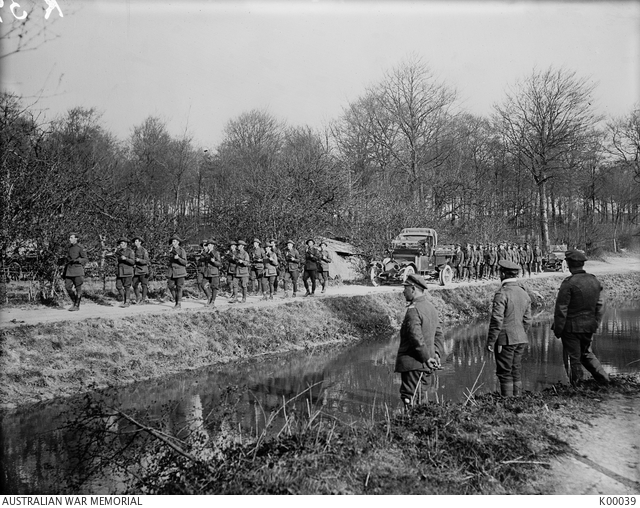
Header Image: An R.E.8 aircraft, serial number A3662, ‘J’, presented to the Australian Flying Corps by Mr H. Teesdale Smith of Adelaide, South Australia. This was the type of aircraft used by No. 3 Squadron AFC at the Battle of Hamel. (Source: Australian War Memorial)

If you would like to contribute to From Balloons to Drones, then visit our submissions page here to find out how.

[1] Australian War Memorial (AWM), Canberra, AWM4 8/6/19 Part 1, 3rd Squadron War Diary, 4 July 1918.

[2] For a clear expression of this idea, see the Royal Flying Corps’ plans for defence in the German spring offensives: H.A. Jones, The War in the Air: Being the Story of the Part played in the Great War by the Royal Air Force, Vol. IV, (Oxford: The Clarendon Press, 1934), p. 445.

[3] The National Archives (TNA), London, AIR1/677/21/13/1887, Air Historical Branch, The Western Front Air Operations, May-November 1918, pp. 54-5.

[4] TNA, AIR1/1592/204/83/17, Brigadier-General Thomas Blamey, BGGS Australian Corps to GOC 4th Australian Division and GOC V Brigade RAF, 29 June 1918; Gary Sheffield, Forgotten Victory: The First World War – Myths and Realities (London: Review, 2002), p. 236.

[5] AWM, AWM26 364/12, Counter-battery Australian Corps HA Operation Order No. 7, 1 July 1918.

[6] AWM, AWM4 8/6/19 Part 1, 3rd Squadron war diary, 4 July 1918; TNA, AIR1/1009/204/5/1289, RAF Headquarters, Notes on corps squadrons work on the First and Third Army fronts during recent operations, 14 September 1918.

[7] AWM, AWM4 1/48/28 Part 1, 4th Division general staff war diary, 4 July 1918. The divisional staff noted that enemy artillery was ‘not very active’ and that retaliation against the Australian barrage was ‘weak’.

[8] AWM, AWM 2DRL/0053, Lieutenant Arthur Barrett to mother, 30 August 1918.

[9] AWM, AWM 2DRL/0053, Barrett to mother, 30 August 1918.

[10] AWM, AWM4 8/6/19 Part 1, 3rd Squadron war diary, 4 July 1918.

[11] TNA, AIR1/1592/204/83/17, CO 22nd Wing RAF, ‘Summary of Operations’, 11 July 1918.

[12] TNA, AIR1/2124/207/74/3, Summary of air intelligence, 18 July 1918; AWM, AWM4 8/14/2, RAF Communiqué No. 15, 17 July 1918.

[13] TNA, AIR1/2124/207/74/3, Summary of air intelligence, 18 August 1918.

[14] General Staff, SS 205 – Notes on Observation from Aeroplanes (France: Army Printing and Stationary Services, February 1918), p. 10; AWM, AWM4 8/6/18, Captain Errol Knox, recording officer, 3rd Squadron to 3rd Squadron flight commanders, 3 July 1918.

[15] Jonathan Boff, ‘Air/land integration in the 100 Days: the case of Third Army’, RAF Air Power Review, 12:3 (2009), p. 82.

[16] AWM, AWM4 8/6/18, Knox to 3rd Squadron flight commanders, 3 July 1918.

[17] TNA, AIR1/677/21/13/1887, Air Historical Branch, Western Front air operations May-November 1918.

[18] AWM, AWM4 8/6/19 Part 1, 3rd Squadron war diary, 4 July 1918.

[19] F.M. Cutlack, Official History of Australia in the War of 1914-1918: Volume VIII – The Australian Flying Corps in the Western and Eastern Theatres of War, 1914-1918 (Sydney, NSW: Angus and Robertson, 1939 [1923], p. 272; EML Gorrell papers, Series M, Item 14, GHQ AEF, Summary of Air Information, No. 29, 19.6.18.

[20] AWM, AWM4 8/6/19 Part 1, 3rd Squadron war diary, 4 July 1918.

[21] AWM, AWM10 43/13, Lieutenant-General John Monash, GOC Australian Corps to The Royal Commission on Awards to Inventors, 13 May 1919.

[22] AWM, AWM4 23/4/34 Part 1, Fourth Australian Infantry Brigade Intelligence Summary, 6am 3.7.1918 to 6am 4.7.1918; AWM4 23/6/35 Part 1, Brigadier-General J. Paton, CO 6th Australian Infantry Brigade, Preliminary Report on Operations of 6th AI Brigade on 4-7-1918.

[23] AWM, AWM4 1/48/29 Part 3, Fourth Australian Division Report on Operations- August 7th to August 10th 1918.

[24] Jones, The War in the Air, Vol. VI (1937), p. 484; TNA, AIR1/1009/204/5/1289, RAF Headquarters, Notes on corps squadrons work on the First and Third Army fronts during recent operations, 14 September 1918; TNA, AIR1/1591/204/83/8, 15th Wing Operation Order No. 112, 17 September 1918.

[25] AWM, AWM4 8/14/2, Royal Air Force Communique No. 14, 10 July 1918.

[26] Trevor Henshaw, The Sky their Battlefield II: Air Fighting and Air Casualties of the Great War, (London: Fetubi Books, 2014), p. 187.

[27] This argument is expanded in Michael Molkentin, Australia and the War in the Air (Melbourne: Oxford University Press, 2014), pp. 196-206.

#BookReview – The Origins of American Strategic Bombing Theory

#BookReview – The Origins of American Strategic Bombing Theory

By Eamon Hamilton

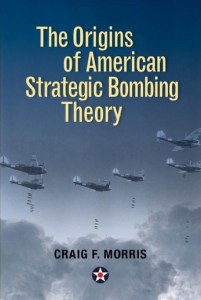
Craig F. Morris, The Origins of American Strategic Bombing Theory. Annapolis, MD: Naval Institute Press, 2017. Notes. Bibliography. Index. 272 pp.

Origins of American Strategic Bombing Theory

The strategic bomber has stood as one pillar of American military strength since the Second World War, and even today, the deployment of B-1s, B-2s and B-52s to forward bases across the globe sends a strong message to potential adversaries. Serving as a true ‘Book of Genesis’ chapter to this capability, The Origins of American Strategic Bombing Theory by Craig F. Morris covers the period of 1916 to 1942 and explores the growth of an idea within the United States Army, rather than deal primarily in technology or personalities. By recounting how air power theory matured (and was withheld) within the United States Army, he also delivers an excellent case study on how an organisation reacts to disruptive technology.

There is a stark comparison in air power capability that comes early from Morris. The book’s introduction begins with the arrival of United States Army Air Force B-17s in England in 1942. Operationally untested, their existence still spoke of the maturity of America’s investment in technology, organisation, and air power doctrine during the interwar period. Contrast that scene with the experience of the United States Army’s 1st Aero Squadron in Mexico in 1916, which Morris covers in his first chapter. There is obviously no suggestion that the 1st Aero Squadron’s Curtis JN-3 biplanes were to be used as bombers against Mexican revolutionary Pancho Villa; what Morris does is illustrate the lack of intellectual depth the United States Army had with its heavier-than-air aviation capability. While the technology was relatively new, that lack of innovation remains surprising considering how the First World War had quickly illustrated the utility of aviation.

The Mexican adventure serves another purpose – it introduces several personalities from the 1st Aero Squadron who were sent to Europe when the United States entered the First World War. The most significant focus of The Origins of American Strategic Bombing Theory falls on 1917 to 1919, which stands to reason – it is here that the Aviation Section of the American Expeditionary Force (AEF) first encountered the idea of strategic bombing from the Allied (and Central) powers. This transfer of ideas is explored mainly through the experiences of Edgar S. Gorrell, a veteran of the 1st Aero Squadron in Mexico who was sent to Europe to study how the United States would grow its aviation forces in the First World War. The AEF ground commanders wanted aviation to provide the battlefield reconnaissance and air defence, but Gorrell’s exposure to Allied air power theory led him to become a proponent of using bombers to open a ‘new front’ on an enemy’s warfighting infrastructure, effectively bypassing the war in the trenches on the Western Front.

Gorrell-Edgar-S (Harris & Ewing)
Lieutenant Edgar S. Gorrell studied aeronautical engineering at MIT following the Mexican campaign of 1916. (Source: US Air Force Historical Research Agency)

Gorrell is the personality most consistently covered in The Origins of American Strategic Bombing Theory, which is arguably a testament to the aviator’s recordkeeping and his early advocacy of strategic bombing. The First World War ended before Gorrell could successfully argue the case for an American strategic bomber force, but the Armistice allowed him to leave two critical legacies to the future of air power development. Gorrell was tasked with organising the official history of the AEF, an assignment which allowed him to draw together air power lessons from the AEF and Allied into an official post-War record. On top of this, he drove a post-war bombing survey that examined what impact Allied bombing made on Germany’s warfighting effort.

When dealing with the events of 1919 to 1942, The Origins of American Strategic Bombing Theory does not enjoy the singular narrative focus that Gorrell’s experiences during the First World War afforded it (Gorrell left the military as a Colonel in 1920 at the age of 28, worked in the motoring industry, and died in March 1945). In Morris’ defence, strategic bombing theory in the interwar period was driven by complex variables, from personalities such as Billy Mitchell and rapidly growing aviation technology; through to economic resources (like the Great Depression), along with shifting strategic and foreign policy. The main conflict affecting strategic bombing theory (and the introduction of a supporting capability) was between the US Army’s General Staff, and aviation proponents within the Air Corps, as the Air Service had become in 1926. As aviation technology grew and the Air Corps Tactical School developed its ideas for air power, the Army General Staff were justifiably worried that a strategic bombing capability would lead to an independent Air Force, and a competitor for government funding.

Air Corps Tactical School
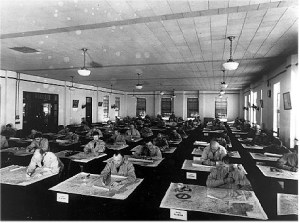
The Air Corps Tactical School (created as the Air Service Field Officers School in 1920) went beyond its mandate of training officers to also become an engine for air power theory development in the interwar period. (Source: US Air Force Air University)

The examination of this conflict makes The Origins of American Strategic Bombing Theory an excellent study in how organisations react to disruptive technology (both positively and negatively). The parallels to modern disruptive technologies (for example, autonomous systems, or space-based systems) do not feel completely analogous, given the purely historical lens of this book. That being said, it gives numerous examples of both innovative and misguided thinking at different levels within the United States Army in dealing with aviation. While history arguably vindicated the strategic bomber concept, Morris does well explain Army’s reservations with this new field.

One of the most significant qualities of The Origins of American Strategic Bombing Theory is also the chief criticism – by covering 25 years in 207 pages, it is very concise. The narrative is clear, comprehensive, and does not feel like any essential facts have been left out. However, the quality of Morris’ writing would comfortably permit this to be a longer work, and the narrative could afford to provide further exposition to selected events, technologies and personalities (beyond Gorrell), that shaped and developed air power theory. On several occasions, this reviewer found himself looking for other resources to further his appreciation of the events in this book – especially about the limited performance of bomber aircraft during the First World War.

While remaining engaging to read, Morris’ work is academically well-presented. It both recounts history as well as briefly discussing the views of academics and historians on the subject matter where relevant. There is considerable inertia when it comes to people’s understanding of events from a century ago, and Morris is clear when he debates, debunks or reaffirms the established narratives of other authors. The introduction specifically accounts for early air power studies into strategic bombing by historians/academics including Mark Clodfelter, Stephen McFarland, I.B. Holley, and Maurer Maurer.

Martin_B-10B_during_exercises (National Museum of USAF)
First flown in 1932, the Martin B-10 was a revolutionary bomber not only for the United States Army Air Corps, but for the world. Design features such as all-metal construction, enclosed cockpit with rotating gun turrets, full engine cowlings and retractable landing gear would be standard design features for bombers over the next decade.  (Source: National Museum of United States Air Force)

Overall, The Origins of American Strategic Bombing Theory is clear and well-sourced and can be easily approached by anyone with no depth of knowledge of the central subject matter. This reader found it to be enjoyable and informative, providing a good account of early strategic bombing theory and American air power development. While being a self-contained work, it is likely to whet the reader’s appetite for reading works covering related subject matters.

Eamon Hamilton graduated from the University of Western Sydney with a Bachelor of Communications (Journalism). He works as a Public Affairs Officer for the Royal Australian Air Force. He lives in Sydney. He runs the Rubber-Band Powered Blog and can be found on Twitter @eamonhamilton.

Header Image: A Boeing Y1B-17 in flight. This aircraft would eventually be developed B-17 Flying Fortress. (Source: Wikimedia)

Call for Contributions – High-Intensity Warfare in the 21st Century

Call for Contributions – High-Intensity Warfare in the 21st Century

Since the end of the Cold War, the West’s militaries have been engaged in a series of protracted and persistent low-intensity counterinsurgency campaigns. For air forces, this has broadly meant involvement in campaigns where there have been few serious challenges to control of the air and air dominance was assumed. However, as we move further into the twenty-first century, that scenario is likely to change with the likelihood of peer-on-peer high-intensity conflict increasing. In such conflicts, air dominance will have to be fought for, and maintained, to utilise the full spectrum of capabilities afforded by the exploitation of the air domain.

Aim

The Central Blue and From Balloons to Drones seeks to commission a series of articles that examine critical themes related to the challenge of preparing modern air forces for the possibility of high-intensity conflict as they transform into 5th generation forces. As well as informing broader discussions on the future of conflict, these articles will provide the intellectual underpinnings for a Williams Foundation seminar on the subject of the requirement of high-intensity conflict to be held in Canberra, Australia in March 2018.

Themes

The editors seek contributions that provide a variety of perspectives on the following key themes:

Strategy and Theory | Future Roles | Emerging Threats | Air Force Culture

Force Structure | Technology and Capabilities | Ethical and Moral Challenges

Doctrinal Trends | Education | Training

Articles can range from historical discussions of the above themes through to contemporary perspectives. Perspectives can also come from a number of related disciplines including history, strategic studies, international relations, law, and ethics.

Submission Guidelines

Articles framed around one of the above themes should be c. 2,000 words. Submissions should be submitted in Word format and emailed to the addresses below with ‘SUBMISSION – HIGH-INTENSITY WARFARE’ in the subject line. Also, please include a 50-100-word biography with your submission. Please be careful to explain any jargon. Publication will be entirely at the discretion of the editors. These articles will appear on the websites of The Central Blue and From Balloons to Drones simultaneously. We will be publishing articles from the middle of February 2018 onwards.

Keen to write but need some guidance? Email us, and we can link you up with a mentor-editor who can assist you before formal submission.

Contact Information

For more information, please contact Wing Commander Travis Hallen (Co-editor, The Central Bluecentralblue@williamsfoundation.org.au) or Dr Ross Mahoney (Editor, From Balloons to Dronesairpowerstudies@gmail.com).

Header Image: An RAF Harrier waits in a hangar at Kandahar, Afghanistan prior to departure, c. June 2009. (Source: Defence Imagery MoD)

A Forgotten Revolution? RAF Army Co-operation Command and Artillery Co-operation

A Forgotten Revolution? RAF Army Co-operation Command and Artillery Co-operation

By Dr Matthew Powell[1]

Jonathan Bailey wrote that the First World War was the time of a true revolution in military affairs about the development of artillery firing.[2] One of the first significant developments that took place was the creation and refinement of the ‘clock code’ system.[3] Using this system, a pilot of the Royal Flying Corps, the forerunner to the Royal Air Force (RAF), was able to correct the fall of shot of the artillery by passing to the artillery battery commander details of how far from the target the guns were. The pilot would correct the shooting of the artillery by pointing out how far away and in what direction the shells of the guns had landed. The distance would be passed on using numbers and the direction using the picture of a clock face. The target was placed in the middle of the clock face and shells that fell beyond the target and on a straight line to the target would be corrected with a call of twelve, if it fell short on the same line the call would be six, at ninety degrees left of the target nine and ninety degrees right three. Any other direction would be corrected by using the hour on the clock with which it corresponded. This system would prove to function perfectly well throughout the whole of the First World War and was the system with which the RAF went to war in 1939.

The system of correcting artillery fire remained unchanged until 1938. The Air Council were against making alterations to the clock code system as they felt that it was adequate to meet the needs that the army would face in future conflicts. They felt that light aircraft could not be kept in action close to artillery units, as had been the case in the First World War.[4] The Air Council were also fearful of introducing a new, untried, and unfamiliar system with the growing tensions in Europe at this time. The War Office was unimpressed with the Air Councils attitude and pushed for more to be done. The Air Ministry agreed to trials between the Air Officer Commanding No. 22 (Army Co-operation) Group and the Commandant of the School of Artillery in December 1938.[5] The results of these trials and further trials conducted to test aircraft as well as procedure. The results were that light aircraft over the battlefield could observe fire with the ‘clock code’ system.[6] Spitfires conducted mock attacks on the aircraft and the Taylorcraft light aircraft observing the artillery fire had a good chance of dodging the fire of a modern fighter.[7] There was, however, no training for pilots in registering targets for the artillery. If an artillery officer required an appraisal of a prospective target, the request would have to be sent along the command chain via an air liaison officer. When the artillery battery received the information, it was usually out of date.[8] There was also pressure from within the War Office to establish a Flying Observation Post (Flying OP) and to begin plans to train Gunner Officers to fly. A Flying OP was to work in conjunction with Ground Observation Post (Ground OP) in establishing targets to be engaged and operating deep behind their lines to be afforded the protection of friendly anti-aircraft guns.

H 27983
A Taylorcraft Auster Mark III of No. 655 Squadron dropping a message bag to a Royal Artillery wireless truck on the airfield at Fowlmere, Cambridgeshire, during Exercise SPARTAN. (Source:  © IWM (H 27983))

The first of these Flying OPs was established in February 1940.[9] This force was established to:

[d]etermine in the light of practical experience obtained under war conditions the possibilities and limitations of the Flying OP, the most suitable type of aircraft and the most suitable organization [sic].[10]

The tests were to be conducted in three parts. The first was an initial training period. The second a practical training with the French, and a final test in the French Army area in conditions of actual warfare including shoots against German targets it was at this time that the term Air Observation Post (Air OP) was adopted.[11] The flight was sent to France on 19 April 1940.[12] The first of the three tests were conducted after the flight had moved to the continent. The final of the three tests was due to be carried out in early May, and the forces were established ready to conduct the tests on 9 May 1940.[13] The following day the Germans began to implement Fall Gelb (Case Yellow): the invasion of France and the Low Countries.[14] The artillery designated for the tests were forced to move back to their formations leaving the Air OP Flight (D Flight) waiting for the campaign to stabilise when it was clear that this would not happen D Flight was recalled to England.[15]

One of the first official moves at changing artillery co-operation policy was a letter regarding the subject sent from the Director of Military Co-operation Air Commodore Victor Goddard to Barratt at Army Co-operation Command. In this letter, Goddard states that the Air Staff were against the formation of:

[s]pecial air units for artillery observation or reconnaissance, unless it can be clearly shown that there is an urgent requirement for such units which cannot be met by Army Co-operations squadrons.[16]

The School of Artillery recommended that a certain number of aircraft should specialise in artillery work and should be trained by the School of Artillery so that they had the same tactical knowledge and the same the understanding of gunnery as an artillery officer.[17] This was just one aspect of an idea by the School of Artillery to allow aircraft to have tactical control over the fire of artillery batteries. To facilitate this, the school further recommended that a multi-seater aircraft should be employed in this work to allow an artillery officer to conduct the shoot according to artillery methods without the need for the artillery officer learning to fly. Artillery officers were also to be seconded to army co-operation squadrons specifically for artillery work.[18] The co-operation between the School of Artillery and Army Co-operation Command is evident and is surprising given the general relations that existed between the army and RAF in the wake of the Battle of France and the fall out that it had caused between the two services.[19]

Barratt, in a letter to the Under-Secretary of State for Air, wrote that:

I consider that in order to get a true and undistorted picture of this problem, it is first desirable to set out the problem as the Army [sic] sees it, and to show in this picture what they conceive to be their requirements.[20]

Again the desire to see the problem from a view that would almost certainly be contradictory to the RAF shows that Barratt and his command were willing to adopt a different approach and attitude in co-operating with at least one part of the army. Barratt also voiced his concerns regarding the ability of the Air OP to operate in the face of enemy action. It was felt that ‘the Air OP must be entirely vulnerable to any enemy fighters which cares to shoot it down’.[21] Barratt’s concern over the safety of his pilots who may be conducting shoots using the Air OP system was to be a recurring issue in the development of artillery reconnaissance.

TR 242
Air Marshal Sir Arthur Barratt in battledress and flying gear beside a Hawker Hurricane. He often flew this aircraft when visiting airfields of RAF Army Co-operation Command, which he commanded at the time of this picture. (Source: © IWM (TR 242))

Barratt’s response to the trials was one of scepticism, and he considered ‘that body of experience gained in the late war and since has all pointed to the advantages of the ‘Clock Code’ system’.[22] Barratt’s belief in the ‘clock code’ system stemmed more from the fear of false conclusions being drawn from brief experiments than from any sense of conservatism about changing the system used for artillery reconnaissance.[23] This became a realisation when Barratt was forced to explain to the Under Secretary of State for Air about the lack of efficiency regarding artillery co-operation in Army Co-operation Squadrons. Barratt wrote that:

I feel that much of the falling off in efficiency in this part of the Army Co-operation Squadron task has been due to the propagation of rumour as to other and better methods than those shown in AP 1176.[24]

Further trials were conducted using the artillery method during April 1941, and the conclusions reached were similar to those seen previously. These were that the artillery methods of ranging by corrections to line and range are simpler, quicker, and more efficient than any method based on the ‘clock code’.

The failures of the ‘clock code’ system in France combined with further problems faced in the fighting in Libya led to a loss of confidence in the system in the army.[25] Barratt responded that the ‘clock code’ system was not at fault in these operations but that the aircraft employed in it were operating in the face of intense enemy opposition. He was concerned that the trials had been too few and were skewed in favour of a positive result by the School of Artillery.[26] While these concerns may be interpreted as merely blocking a new development that had been shown to work to preserve the autonomy of the RAF while conducting army co-operation work. The evidence of co-operation between Army Co-operation Command and the School of Artillery, shown above, leads more to the conclusion that Barratt felt that the procedure could not be successfully carried out, and wished to see more trials conducted before it would receive his approval.

The procedure for artillery reconnaissance first developed during the First World War was only suitable for the conditions of that war. The lack of fluidity and almost stable front lines allowed a system to develop, quickly, this system, however, was only suited to those conditions. This was very quickly discovered during the first major test of this procedure against the quicker and more mobile warfare of the German Wehrmacht in 1940. The attitudes of both the British Army and the RAF to co-operation during the inter-war period, in Britain at least, did little to improve the situation before the British Expeditionary Force was stationed in France. This left those charged with the responsibility of modifying the existing procedure with only the experience of the First World War to guide them and on which to base their expectations. Much co-operation between the School of Artillery and Nos. 70 and 71 Groups of Army Co-operation Command occurred, despite the general feeling of animosity still felt by both services in Britain.[27] This co-operation was the most that had been seen between the army and RAF since the formation of the RAF as an independent force in 1918. Barratt’s move to block the adoption of the new procedure that was being trialled during 1941 can be interpreted in several ways. His reasoning for doing so, however, appears to be that of confirming the results already achieved through more rigorous and testing trials to confirm the results. Through further testing at a higher level the procedure, as well as those responsible for carrying it out, would be exposed to more stress and so a greater degree of authenticity could be achieved. Trials of this nature would also confirm if the procedure could be implemented with ease by the majority of pilots whose responsibility would be increased from observing the fall of shot to conducting shoots, potentially in the face of enemy opposition. Barratt’s major concern with the new system appears to be its increased complexity, and he was rightly concerned after his experiences in France that pilots would be unable to conduct the shoot if they had to keep a lookout for enemy fighter activity continually.

Dr Matthew Powell is a Teaching Fellow at Portsmouth Business School at the Royal Air Force College, Cranwell. He holds a PhD in Modern History from the University of Birmingham. His thesis investigated the development of tactical air power in Britain during the Second World War through a study of the RAF’s Army Co-operation Command. His first book, based on the PhD, The Development of British Tactical Air Power, 1940-1943: A History of Army Co-operation Command was published in 2016 by Palgrave Macmillan. He has also published in Canadian Military History, Air Power Review and the British Journal for Military History. He is currently researching the relationship between the British aviation industry and the Air Ministry during the inter-war period. He can be found on Twitter at @tac_air_power.

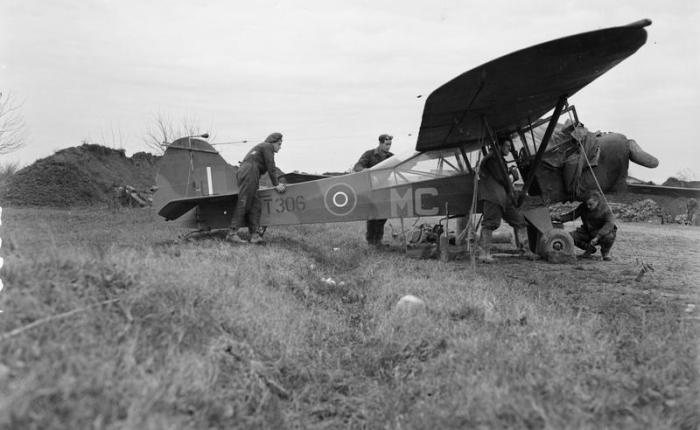
Header Image: An Auster Mark IV of an Air Observation Post squadron undergoes servicing at its base after being damaged by anti-aircraft fire while flying over the 8th Army Front in northern Italy. (Source: © IWM (CNA 3341))

[1] A longer version of this article can be found in Canadian Military History, 23:1 (2014), pp. 71-88.

[2] Jonathan Bailey, ‘Deep Battle 1914-1941: The Birth of the Modern Style of War,’ Field Artillery Journal, (1998), pp. 21-7.

[3] Ralph Barker, A Brief History of the Royal Flying Corps in World War I (London: Constable & Co., 2002), p. 63.

[4] H.J. Parham and E.M.G. Belfield, Unarmed into Battle: The Story of the Air Observation Post, Second Edition (Chippenham: Picton Publishing, 1986), p.14.

[5] Ibid.

[6] Ibid.

[7] Ibid

[8] Darrell Knight, Artillery Flyers at War: A History of the 664, 665, and 666 ‘Air Observation Post’ Squadrons of the Royal Canadian Air Force (Bennington, VT: Merriam Press, 2010), p. 27.

[9] Parham and Belfield, Unarmed into Battle, p.15.

[10] Ibid.

[11] Ibid.

[12] Ibid., p.16.

[13] Ibid.

[14] Karl-Heinz Freiser, The Blitzkrieg Legend: The 1940 Campaign in the West (Annapolis, MD: Naval Institute Press, 2005), p. 79.

[15] Parham and Belfield, Unarmed into Battle, 16.

[16] The National Archives (TNA), AIR 39/47, Letter from Air Commodore Goddard, Director of Military Co-operation to Barratt regarding Artillery Co-operation Policy, 8 December 1940.

[17] Ibid.

[18] Ibid.

[19] For more information on the army’s reaction to the Battle of France, see: TNA, CAB 106/220, Bartholomew Committee Final Report.

[20] TNA, AIR 39/47, Letter from Barratt to Under-Secretary of State for Air regarding co-operation with the Royal Artillery, 29 January 1941.

[21] Ibid., Appendix A, 29 January 1941.

[22] Ibid., Letter from Headquarters Army Co-operation Command to Headquarters No. 70 Group, Artillery Reconnaissance Trials, 12 April 1941.

[23] Ibid.

[24] Ibid., Letter from Barratt to Under Secretary of State for Air, 14 April 1941.

[25] Ibid., Letter from CGS on Artillery Reconnaissance, 5 May 1941.

[26] Ibid., Letter from Barratt to Major-General Otto Lund, GHQ Home Forces, in response from letter from CGS on Artillery Reconnaissance, 10 May 1941.

[27] For example, see: David Ian Hall, Strategy for Victory: The Development of British Tactical Air Power, 1919-1943 (Westport, CT: Praeger, 2008), pp. 89-103.

#AirWarBooks – Dr Michael Molkentin

#AirWarBooks – Dr Michael Molkentin

By Dr Michael Molkentin

Editorial Note: In the third instalment of ‘Air War Books,’ Dr Michael Molkentin discusses the ten books that have influenced and shaped his writing as an air power historian. If you are interested in contributing to this series or From Balloons to Drones more generally, find out how here.

After I wrote to Dr Ross Mahoney enthusiastically agreeing with several of his choices (always a bad idea!) and suggesting a few others, he promptly invited me to contribute my own ‘Top 10’. I had been saying I would write something for Balloons to Drones for a while and so now he had me cornered. What follows is a list of titles that have had a significant impact on the way I research and write aviation and air power history. As these titles clearly indicate, my area of interest primarily concerns the pre-Second World War period (military and civil) and the people and ideas, rather than the technology, of aviation. 

Denis Winter, The First of the Few: Fighter Pilots of the First World War (London: Allen Lane, 1982). Denis, unfortunately, went on to write a scandalously bad book on Haig that damaged his reputation as a historian. But before that, he produced a couple of genuinely very good ‘face of battle’ type histories of British servicemen in the Great War (the other being Death’s Men). I found The First of the Few in my high school library and later used it as a model for writing my honours thesis on Australian airmen in the Great War. It is a bit dated, relies almost entirely on published accounts and some of Winter’s statistics do not stand up to scrutiny. But it is what got me interested in the subject and stands as the best personal experience study of British airmen in the Great War. I had the pleasure of meeting Denis in Canberra in 2004. He was a kind and gracious man and, when I showed him my work, he encouraged me to keep writing.

Richard P. Hallion, Taking Flight: Inventing the Aerial Age, from Antiquity Through the First World War (New York: Oxford University Press, 2003). I might have included any of Richard’s numerous books on air power (Strike from the Sky, his history of ground attack is a close second) but this has probably been most useful and influential in my work. It is a model of highly readable, yet meticulously researched history. It is international in scope and provides some valuable analysis of the complex ways in which aviation emerged as a practical reality, in various parts of the world, before 1914.

S.F. Wise, The Official History of the Royal Canadian Air Force, Volume 1: Canadian Airmen and the First World War (Toronto: University of Toronto Press, 1980). Wise’s first volume of the Royal Canadian Air Force’s official history is, in my view, the best single volume history of British air power in the Great War. The ubiquity of Canadians in the British flying services (over 20,000 served) means that Wise needed to cover all aspects of air power in the conflict – maritime aviation, strategic bombing and home defence, army cooperation and even some brief surveys of the RFC/RAF in secondary theatres. While some of his conclusions about the conduct of the war on the Western Front have dated, in the main his conclusions stand and are thoroughly grounded in archival sources. My PhD thesis and the book that followed it used Wise’s book as a model to examine Australia’s part in the air war from political, strategic, operational and tactical perspectives.

E.R. Hooton, War over the Trenches: Air Power and the Western Front Campaigns 1916-1918 (Hersham: Midland Publishing, 2010). I have mixed feelings about his book. On the one hand, it makes a significant contribution to our understanding of air power on the Western Front by conducting a multi-force (French, German and British) analysis at the operational level- something nobody had previously attempted. Whereas previous studies of the subject have focused on the tactical level, Hooton uses a mass of statistical data (sorties flown, ordnance expended, losses, serviceability, etc.) to provide a much broader picture of how air power influenced the conflict and how its use evolved between 1916 and 1918. Unfortunately, the book is poorly written and (in the first edition at least) so badly type set that some of the data tables are almost unreadable. It is such an important contribution to the field: I only hope the publisher has the good sense to reissue a revised edition or that an aspiring PhD candidate will take his approach further.

John Buckley, Air Power in the Age of Total War (London: UCL Press, 1999). I am going to go with Ross here and say that, among the many air power surveys out there, this one is the best. It is clear, concise and, essentially for a book like this, gets the balance right between ideas and details. Giving his narrative cohesion is a compelling, convincing and delightfully ironic thesis: that total war first enabled air power but then, following the onset of the nuclear age, limited its functions.

Philip S. Meilinger, The Paths of Heaven: The Evolution of Airpower Theory (Maxwell AFB, AL: Air University Press, 1977). Besides Buckley, the other book I recommend students starting out in the field is Meilinger’s survey of air power thinking. It is a straightforward, textbook approach devoting a chapter to each of the twentieth century’s most influential air power theorists. It is not exactly a page turner but is absolutely essential reading for students of air power and a useful reference work to have within arm’s reach when writing.

Malcolm Cooper, The Birth of Independent Air Power: British Air Policy in the First World War (London: Allen and Unwin, 1986). Malcolm was one of the first scholars to use the Air Ministry’s declassified files after their transfer to the British National Archives (then the PRO) during his PhD candidature during the 1970s. Whereas accounts of British air power’s early days had, until then, been overwhelmingly focused at the tactical level (individual pilots, squadrons, Biggles, etc.), The Birth of Independent Air Power focuses on the topic at the political and policy-making levels. I do not agree with Malcolm’s conclusion that the Army’s use of air power was wasteful and unimaginative (neither does James Pugh in his excellent new book which provides a good update on aspects of Cooper) but much of what he says was vital in adding political context to the operational history of British air power from 1914 to 1918.

Alfred Gollin, The Impact of Air Power on the British People and their Government (Stanford, CA: Stanford University Press, 1989). I would give this to students not even interested in air power as a somewhat rare example of an academic historian writing in a clear, engaging style. Honestly, it reads like a novel but still manages to seamlessly incorporate excellent analysis. Gollin was an enormously talented historian and a shining example to those of us who actually want our work to have a readership beyond the academy and services.

John A. Lynn, Battle: A History of Combat and Culture (Boulder, CO: Westview Press, 2003). Lynn does not really deal with aviation or air power explicitly, but his approach to explaining warfare through the prism of culture is both novel and enlightening. In case study chapters ranging from Ancient Greek warfare to modern Islamic terrorism, Lynn demonstrates convincingly that we cannot properly understand military operations without considering the cultures that conceive and wage them.

Ian Mackersey, Smithy: The Life of Sir Charles Kingsford Smith (London: Little Brown, 1998). This is not only the best of the many biographies of Kingsford Smith; it is the best example of historical biography I have come across. Through impressively dogged detective work, Mackersey managed to track down a number of people who had known Kingsford Smith before his death six decades earlier. From them, he got oral history and private papers that shed light on hitherto unknown or mythologised aspects of his subject’s life. Ian wrote a page turner too: it is engaging, absorbing history. Ian, who sadly died a couple of years ago, was also a gentleman. When I was writing my book on the 1928 trans-Pacific flight, he generously shared manuscript material he had gathered from private collections in the US when researching his book.

Dr Michael Molkentin is an adjunct lecturer at the University of New South Wales and a teacher at Shellharbour Anglican College. He has a first-class Honours degree from the University of Wollongong and a PhD in History from the University of New South Wales. In 2014, the Australian War Memorial awarded Michael’s doctoral research the Bryan Gandevia Prize for Australian Military History. He specialises in the history of armed conflict with an emphasis on warfare in the British world and the development of air power. Michael has written three books, the most recent being Australia and the War in the Air (OUP, 2014).

Header Image: An RE8 of No 69 (later No 3) Squadron, Australian Flying Corps preparing to set out on a night bombing operation from Savy near Arras, 22 October 1917. (Source: © IWM (E(AUS) 1178))

From Balloons to Drones – One Year On

From Balloons to Drones – One Year On

By Dr Ross Mahoney

It has just been over a year since From Balloons to Drones was established as a platform for the discussion of air power broadly defined. Since our first post, we have published 40 pieces on a variety of subjects ranging from the historical to the contemporary. We have had articles dealing with issues related to the efficacy of air power, the topic of military education and the future of air power. We have also recently started a new series, Air War Books, that explores the books that have influenced air power writers. Contributors have come from around the globe including contributions from Finland and Australia. I am grateful to those who have contributed to the site. Without them, there would not be much here. However, most of all, we have received regular traffic from people interested in reading what we have written, and for that we are grateful.

Just as a bit of fun, here are the top five posts by views:

  1. ‘Changing the USAF’s Aerial ‘Kill’ Criteria’ by Major Tyson Wetzel;
  2. ‘Arrows from the Ground – Or how an incident on 17 March 2017 may change the relationship between ground and air forces’ by Dr Jacob Stoil and Lieutenant Colonel Kyle C. Burley;
  3. ‘Commentary – The RAF and the F-117’ by Dr Ross Mahoney;
  4. ‘Supporting the Secret War: T-28s over Laos, 1964-1973 – Part 1: Training’ by Jeff Schultz;
  5. ‘‘Integrating’ the Italian Air Force after the Armistice’ by Dr Ross Mahoney.

These are just a selection of the articles that have appeared over the past year, and we look forward to adding regular content as we continue to develop. To do this, we need to expand our list of contributors continually and if you are interested in writing about air power issues – both historical and contemporary – then you can find out how here. If you have any questions, then please leave a comment here or emails us at airpowerstudies@gmail.com.

Header Image: English Electric Lightnings of No. 56 Squadron RAF during an Armament Practice Camp at Akrotiri, c.1963. In the foreground, a technician is preparing a Firestreak missile for loading. (Source: Defence Imagery MoD)

#AirWarBooks – Dr Ross Mahoney

#AirWarBooks – Dr Ross Mahoney

By Dr Ross Mahoney

Editorial Note: In the second instalment of ‘Air War Books,’ the editor of From Balloons to Drones, Dr Ross Mahoney discusses the ten books that have influenced and shaped his writing as an air power historian.

As editor of From Balloons to Drones, I thought I should reflect on what are probably the ten key books that have influenced me in my study of air power. However, I make three provisos. First, I attacked this from the perspective of key authors rather than the books themselves per se. As such, I have selected titles that I have enjoyed to illustrate the importance of these writers. Second, I have left out official histories and narratives though these have been just as influential on my writing as other works. Finally, I have included some non-air power texts in here. At the end of the day, I am a historian and an interdisciplinary one at that, and it is only natural that non-air power specific books have influenced how I approach what and how I write.

John Buckley, Air Power in the Age of Total War (London: UCL Press, 1999). Ok, this entry and Peter Gray’s book below have as much to do with these individuals’ real influence on me and the importance of their books. John was my undergraduate tutor many years ago, and his influence was to start me on the track to where I am today. However, added to that, Air Power in the Age of Total War is an excellent examination of the rise of air power in the first half of the twentieth century and vital reading for anyone wanting an introduction to the subject.

Peter Gray, The Leadership, Direction and Legitimacy of the RAF Bomber Offensive from Inception to 1945 (London: Continuum, 2012). Peter’s influence on me was that he was my PhD supervisor, and I will forever be grateful for his guidance. In my opinion, Peter is currently the leading air power specialist in the UK and one of the foremost experts in the world. That expertise is clearly evident in this book. The strategic air offensive against Germany is well-trodden ground, but Peter found a fresh way to assess its conduct. As a result, in my opinion, it is required reading not just for people wanting to understand the bombing offensive during the Second World War but also issues such as the challenge of senior leadership and matters such as legitimacy and international law.

Tony Mason, History of the Royal Air Force Staff College, 1922-1972 (Bracknell, RAF Staff College, 1972). I could have chosen any of Mason’s work, but this one has specific resonance for my research. This was written before Mason became the RAF’s first Director of Defence Studies (DDefS) in 1977 and is not widely available as the RAF Staff College published it. Nevertheless, Mason was not wide of the mark with many of his comments about the Staff College, though it does need to be brought up to date.

Allan English, Understanding Military Culture: A Canadian Perspective (Kingston: McGill-Queen’s University Press, 2004). English, a retired Royal Canadian Air Force officer, is a noted historian of air power and has written an influential article on the RAF Staff College in the inter-war years. However, for me, his most important work is his study of Canadian military culture. As someone who specialises in the culture of air forces, this work is an essential primer on the subject of culture and its influence on the Canadian military.

John Slessor, Air Power and Armies (Oxford: Oxford University Press, 1936). Everyone needs to have a contemporary air power thinker on their list, and Slessor certainly fits that bill. Slessor is, perhaps, the closest the RAF came to having their own Clausewitz, though I remain to be convinced that the Service wanted a singular air power thinker. Instead I think the RAF collegiately developed officers with a broad view of air power, but that is another discussion. The importance of Air Power and Armies is that it really should put to rest the argument that the RAF was solely focused on strategic bombing. Yes, Slessor used a strategic conception of air power to inform his work, but he sought to understand how military aviation could influence the land battle. An essential piece of work and the recent 2009 edition by the University of Alabama Press contains an introduction by Philip Meilinger.

Arthur Gould Lee, No Parachute (London: Jarrolds, 1968). Everyone needs a memoir in their top ten, and there are a number of good works by air force personnel. Most are written by pilots, which says as much about the culture of air forces as anything else. Lee wrote several books dealing with various aspects of his service life, and each could find their way into this list. No Parachute is particularly useful for its appendices though the one on parachutes does need to be revised.

John Andreas Olsen, John Warden and the Renaissance of American Air Power (Dulles, VA: Potomac Books, 2007). As Brian Laslie mentioned in the first instalment of ‘Air War Books,’ I think we do need to include a work by Olsen. He is currently one of the key writers on air power, particularly about modern conflicts. His biography of Warden is fascinating and gives an excellent insight into this complex character. Perhaps what is more impressive, is that this was written while Warden is alive, which is never an easy task.

David French, Military Identities: The Regimental System, the British Army, and the British People c.1870-2000 (Oxford: Oxford University Press, 2005). French is one Britain’s leading military historians, and I wonder how he would do if he turned his interests towards the RAF. However, for me, his analysis of the British Army’s regimental system is fascinating and one of those works that all should read to develop an understanding of how military organisations operate. There is much to take away from this study, and for me, it has raised significant questions about issues such as identity with regards to squadrons in air forces.

Richard Overy, The Air War, 1939-1945 (London: Europa Publications, 1980). Overy remains not only one of the leading air power historians in the UK but also globally. The Air War continues to be one of the most influential titles concerning the role of air power during the Second World War. I could have quite easily has listed The Bombing War here, which is Overy’s most recent air power work. However, The Air War continues to be important, and while Overy’s views have developed over the years – like those of all historians – this work was written when air power history was a ‘Cinderella’ discipline. Thankfully, this is no longer the case, and the new edition of The Air War is useful for Overy’s overview of the field of air power history up to 2003.

John James, The Paladins: The Story of the RAF up to the Outbreak of World War II (London: Macdonald and Company, 1990). Given my focus on the culture and ethos of air forces, this was again, one of those works that I could not ignore reading as it is one of the few social histories of the RAF before the Second World War. James worked in operational research sections in various RAF Commands and brought that experience to the writing of the book. It is good but does need bringing up to date, and I dispute some of his views on how the RAF branch system evolved. Nevertheless, a work to read.

Well, that is my top ten; however, it would be easy to add more to the list. As noted, when Overy wrote The Air War, and Mason served as DDefS, the academic study of air power, certainly in the UK, was a Cinderella subject. Thankfully, that is no longer the case and the last ten years have seen a number of significant studies published, which point the way forward for the subject but that will be a post for another time.

Dr Ross Mahoney is an independent historian and defence specialist based in Australia. Between 2013 and 2017, he was the resident Historian at the Royal Air Force Museum, and he is a graduate of the University of Birmingham (MPhil and PhD) and the University of Wolverhampton (PGCE and BA). His research interests include the history of war in the twentieth and twenty-first centuries, air power and the history of air warfare, and the social and cultural history of armed forces. To date, he has published several chapters and articles, edited two books, and delivered papers on three continents. He is a member of the Royal Historical Society and is an Assistant Director of the Second World War Research Group. He is a member of the Royal Historical Society and an Assistant Director of the Second World War Research Group. He blogs at Thoughts on Military History, and can be found on Twitter at @airpowerhistory.

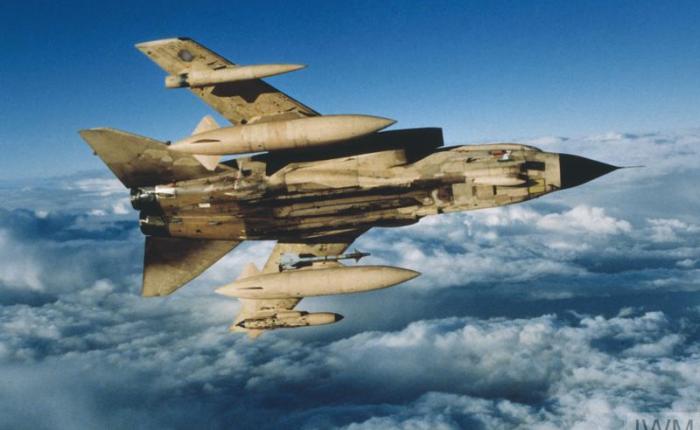
Header Image: A Tornado GR.1 in flight banks away from the camera and displays its underwing stores during the First Gulf War. Top to bottom the stores are a BOZ 107 chaff/flare dispenser, 500 gal fuel tanks, AIM-9 Sidewinder air-to-air missile and Marconi Sky Shadow ECM pod. (Source: © Crown copyright. IWM (GLF 707))

#AirWarBooks – Dr Brian Laslie

#AirWarBooks – Dr Brian Laslie

By Dr Brian Laslie

Editorial Note: In the first of a new series, Dr Brian Laslie, author of The Air Force Way of War, discusses the ten books that have influenced and shaped his writing as an air power historian.

The Editor of From Balloons to Drones, Dr Ross Mahoney, has been pestering those of us who contribute to this blog to put together a list of the most influential books we have read on the study of air power. I have always been of the opinion that I only have so many words I am capable of writing in a single day and have thus, avoided acquiescing to Ross’s request. Seriously, I am never going to get these two manuscripts done at this rate, but I finally decided that Ross is right (we were on a break) and that it is high time those of us who study air power history discuss the most influential books we’ve read on the history/study of air power (two words not one). So here is my top ten:

Bert Frandsen, Hat in the Ring: The Birth of American Air Power in the Great War (Washington D.C.: Smithsonian Institution Press, 2003). I read this book shortly before leaving active duty and heading to Kansas State for grad school, and it had a profound impact on what I wanted to study. Frandsen weaves together history, technology, and narrative into one of the finest works on the creation of America’s air service and air power.

Alexander P. de Seversky, Victory through Air Power (New York, NY: Simon & Schuster, 1942). Let us get something out of the way. Seversky and Hap Arnold hated each other, and I am not being hyperbolic. The two could not stand to be in the same room with each other, and when they were, it usually ended in a shouting match. Seversky’s book was Second World War aerial propaganda, but when Walt Disney read the book and decided to produce it as a feature film, Arnold was forced to stay mute on the subject. Seversky went on to write other air power books, but none as influential and long-lasting as this one.

Thomas E. Griffith, Jr, MacArthur’s Airman: General George C. Kenney and the War in the Southwest Pacific (Lawrence, KS: University Press of Kansas, 1998). In the age of the bomber mafia, Kenny marched to the tune of his own drum. Surely as Quesada and Chennault followed pursuit aviation, Kenny favoured attack. He was, perhaps, the most innovative airman of his generation and Griffith’s book demonstrates just how important Kenney was to MacArthur.

Thomas A. Hughes, Over Lord: General Pete Quesada and the Triumph of Tactical Air Power in World War II (New York, NY: The Free Press, 1995). I really have no doubt, and I doubt many would argue with me, that strategic bombardment garnered the lion’s share of attention both during and after the war. It would take Tactical Air Command until after the Vietnam war to rise to prominence over Strategic Air Command, but those seeds were planted in the Second World War by Pete Quesada and his tactical airmen in the European theatre.

Mark Clodfelter, The Limits of Air Power: The American Bombing of North Vietnam (New York, NY: The Free Press, 1989). The single most important book on air power to be published in the post-Vietnam era. It defined air power historians of a generation. More than a critique of strategic bombardment in Vietnam, it is a book that teaches you how to think about air power, what it can and what it cannot do.

Donald Miller, Masters of the Air: America’s Bomber Boys who Fought the Air War against Nazi Germany (New York, NY: Simon & Schuster, 2006). It is rare that I cannot put a book down, but the was the case with Miller’s work. The narrative is exceptional, the research superb, and the flow masterful. I consider it the single best book on air power in the Second World War.

Donald J. Mrozek, Air Power and the Ground War in Vietnam: Ideas and Actions (Maxwell, AL: Air University Press, 1988) and idem, The US Air Force after Vietnam: Postwar Challenges and Potential for Responses (Maxwell, AL: Air University Press, 1988). Yes, I am cheating by putting two books here, but they deserve to be here. Mrozek is an air power historian, but also a cultural and intellectual historian as well. He is difficult to read, but only because every sentence is crafted beautifully and is important. Mrozek conveys in a sentence, what others struggle to get out in several pages, myself included.

Steve Davies, Red Eagles: America’s Secret MiGs (Oxford: Osprey Publishing, 2008). A popular history, but this book is flat-out fun. Secret units, secret locations, and American fighter pilots learning how to outperform their Soviet counterparts in their own aircraft.

John Andreas Olsen (ed.), A History of Air Warfare (Dulles, VA: Potomac Books, 2010). Actually any of Olsen’s work could make this list; however, if you were going to use one book in the classroom to discuss the history of power, then this is the one. There is a reason; the Air Force Academy has every freshman read in their introduction to military history. From the First World War to the present and large scale combat to air power in smaller conflicts, Olsen’s edited work covers it all.

Diane Putney, Airpower Advantage: Planning the Gulf War Air Campaign (Washington D.C.: Air Force History and Museums Program, 2004). This book is what made me decide to write about Desert Storm. This book taught me that air power is so much richer than 1 v. 1 dogfights, that true command of the air comes from logistics, planning and execution.

To this list of ten, I could add hundreds more, but as I looked at my bookshelf these jumped out at me as having the most impact on my thinking during my time in grad school or shortly thereafter and helped solidify my thinking on what air power is and what it does (spoiler alert: it’s the ability to do something in the air. Thanks, Billy Mitchell!)

By the way, several of these books you can order or download for free from either the Air University Press of the Air Force Historical Studies Office. FREE BOOKS: http://www.au.af.mil/au/aupress/ and http://www.afhistory.af.mil/Books/Titles/

Dr Brian Laslie is an Air Force Historian and currently the Deputy Command Historian at North American Aerospace Defense Command (NORAD) and United States Northern Command (USNORTHCOM). A 2001 graduate of The Citadel and a historian of air power studies, he received his Masters’ from Auburn University Montgomery in 2006 and his PhD from Kansas State University in 2013. His first book The Air Force Way of War (2015) was selected for the Chief of Staff of the Air Force’s 2016 professional reading list. He lives in Colorado Springs. He can be found on Twitter at @BrianLaslie.

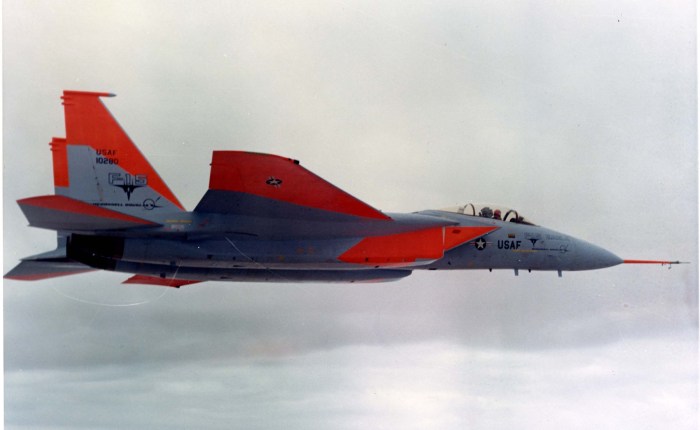
Header Image: McDonnell Douglas F-15A (S/N 71-0280, the first F-15A prototype). Note the square wingtips and unnotched stabilator. (Source: Wikimedia)

#BookReview – Flying to Victory: Raymond Collishaw and the Western Desert Campaign, 1940-1941

#BookReview – Flying to Victory: Raymond Collishaw and the Western Desert Campaign, 1940-1941

By Alexander Fitzgerald-Black

Mike Bechthold, Flying to Victory: Raymond Collishaw and the Western Desert Campaign, 1940-1941. Norman, OK: University of Oklahoma Press, 2017. Illustrations. Maps. Notes. Bibliography. Hbk. 296 pp.

51hiab19kxl-_sx329_bo1204203200_

The Second World War saw the formation of many famous Allied air forces. The Flying Tigers, the Cactus Air Force, The Mighty Eighth, RAF Bomber Command, and RAF Fighter Command are among the best known. In the Mediterranean, perhaps none was more famous than the Western Desert Air Force (WDAF). This is the tactical air force that helped Lieutenant-General Bernard Montgomery’s British Eighth Army defeat Field Marshal Erwin Rommel at El Alamein in 1942. The victory was the result of an effective combination of air and land power according to an air support doctrine developed by Air Vice-Marshal Arthur Coningham.

Coningham owes more to his predecessor, Air Vice-Marshal Raymond Collishaw than historians have realised. Collishaw commanded No. 202 Group – and later No. 204 Group, which would later become the WDAF – between the opening of the war in the desert and November 1941. In that time, Collishaw’s command achieved much success, demonstrating the features of tactical air doctrine later associated with his successor. Mike Bechthold’s new monograph, Flying to Victory, offers us a new layer for understanding the development of Allied air support during the Second World War.

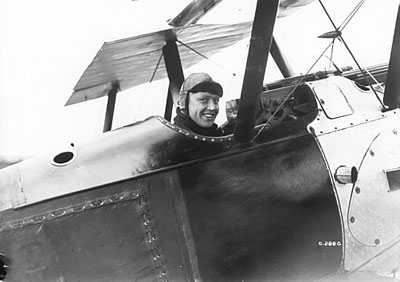
Raymond Collishaw was a native of Nanaimo, British Columbia, Canada. During the First World War, Collishaw became one of the Empire’s leading flying aces, destroying 61 enemy aircraft and eight observation balloons with Royal Naval Air Service and Royal Air Force squadrons. Authors often celebrate his air-fighting prowess. In fact, some historians have gone as far as to say that his aggressive spirit made him ill-suited for commanding air forces at the end of tenuous supply lines. In Flying to Victory, Bechthold defuses these arguments.

colishaw
Squadron Commander Raymond Collishaw in Sopwith F1 Camel aircraft, Allonville, France, 1918. (Source: Wikimedia)

Collishaw’s experience with close army support missions during the 100 Days campaign at the end of the First World War taught him how wasteful these operations could be. He came out of the war believing that only emergencies – such as the Kaiser’s spring offensive in 1918 – warranted a heavy close air support focus. This and his experiences commanding various air units during Britain’s interwar conflicts served to prepare Collishaw for command in the Western Desert. He was well-suited to command operations at the end of a tenuous supply line while working jointly with army and naval commanders.

Collishaw first demonstrated the difference that an effective air support doctrine could make during early fighting in the desert and Operation COMPASS. In 1940-41, No. 202 Group faced an Italian Royal Air Force (IRAF) with superior numbers and quality of aircraft. Collishaw’s command achieved air superiority despite these disadvantages. While the IRAF squandered its superior resources by focusing on providing defensive screens for the Italian Army, Collishaw directed his forces to focus on disrupting and destroying IRAF aircraft and infrastructure. With air superiority secured, Collishaw’s forces focused on impeding the Italian logistical network and applying close-support attacks at the army’s request in special circumstances. Alongside Lieutenant-General Richard O’Conner’s Western Desert Force, the British offensive drove the Italians out of Egypt and Cyrenaica, completely destroying the Italian Tenth Army in the process.

large_0000003
Air Commodore Raymond Collishaw, the Air Officer Commanding No. 202 Group, surveys the ruined buildings on the airfield at El Adem, Libya, following its capture on 5 January 1941 during the advance on Tobruk. (Source: © IWM (CM 399))

Although Operation COMPASS was a model of cooperation between the army and air force, this model would soon be forgotten amid British retreats in the Western Desert, Greece, and Crete in spring 1941. The Germans had joined their Italian allies in the Mediterranean war. During Operation BREVITY, an attempt to relieve the besieged garrison at Tobruk, Collishaw commanded No. 204 Group (which had absorbed No. 202 Group in April 1941). He once again proved the usefulness of interdiction operations, though army commanders were disappointed that the RAF considered attacks on tanks on the battlefield to be impracticable. His forces immobilised counterattacking German units at critical junctures that saved army units, though the overall operation failed to relieve Tobruk.

The overall failures of BREVITY and Crete put the air force in a tough position. The Royal Navy had lost many ships to Axis air attacks during the evacuation of Crete. During Operation BATTLEAXE, another attempt to relieve Tobruk, the army demanded that the RAF establish an air umbrella over the battlefield. Air Marshal Arthur Tedder, Collishaw’s immediate superior, made a calculated move. With Air Chief Marshal Charles Portal’s blessing, he ordered Collishaw to accede to the army’s requests. This way, the RAF could avoid blame for failing to cooperate with the army even though this was a misemployment of resources that ultimately contributed to BATTLEAXE’s failure.

BATTLEAXE effectively settled the debate over tactical air power raging between the RAF and army early in the war. Before BATTLEAXE, Prime Minister Winston Churchill endorsed the army’s view of air support. After BATTLEAXE, he fully endorsed the RAF’s view. Churchill accepted that attacks on enemy airbases, ports, and lines of communication were more effective even though the army would not be afforded the comforting sight of friendly aircraft overhead. The result was “The Middle East (Army and RAF) Directive on Direct Air Support”, a document that marked the beginning of designing the war-winning air support system the Allies would continue to develop in 1942. This document reflected the operations and exercises that Raymond Collishaw commanded. Tedder and Coningham went on to refine and improve this system.

Air Marshal Tedder, the conduit for Collishaw’s early application of winning air support doctrine to Portal and Churchill, replaced Collishaw with Coningham in November 1941. Promoted from air commodore to air vice-marshal, Collishaw commanded No. 14 Group defending Scapa Flow, Scotland until July 1943, when the RAF involuntarily retired him. Bechthold’s evidence suggests that Tedder held a bias against Collishaw. Largely ignoring the results he achieved in the desert, Tedder and historians since have assessed Collishaw as incapable of running a larger command organisation and delegating responsibility to his staff. Bechthold encourages us to avoid this speculative analysis of potential and instead focus on his war record. The result is an excellent profile of a man and – as it turns out – a largely misunderstood air campaign in the first year of warfare in the Western Desert.

This post first appeared at Fighter-Bomber’s Blog.

Alexander Fitzgerald-Black completed his MA thesis, ‘Eagles over Husky: The Allied Air Forces and the Sicilian Campaign, 14 May to 17 August 1943,’ with The Gregg Centre for the Study of War and Society, University of New Brunswick in 2014. He is in the process of turning this work into a manuscript for publication with Helion & Company. Alex lives with his wife in Moncton, Canada. He operates his own blog at alexfitzblack.wordpress.com and can be reached on Twitter @AlexFitzBlack.

Header Image: Pilots of No. 3 Squadron RAAF study a map on the tailplane of one of their Gloster Gladiators at their landing ground near Sollum, Egypt, before an operation over Bardia during the closing stages of Operation COMPASS. Left to right: Flying Officers J.R. Perrin, J. McD Davidson (squatting), W.S. Arthur and P. St G. Turnbull, Flight Lieutenants G.H. Steege and A.C. Rawlinson, Flying Officer V. East, (unknown), Squadron Leader I.D. McLachlan (Commanding Officer) and Flying Officer A.H. Boyd. (Source: © IWM (CM 355))

#BookReview – Air and Sea Power in World War I: Combat and Experience in the Royal Flying Corps and the Royal Navy

#BookReview – Air and Sea Power in World War I: Combat and Experience in the Royal Flying Corps and the Royal Navy

By Dr Ross Mahoney

Maryam Philpott, Air and Sea Power in World War I: Combat and Experience in the Royal Flying Corps and the Royal Navy. London: I.B. Tauris, 2013. Notes. Bibliography. Index. Hbk. 258 pp.

air-and-sea-power

This book is something of a curate’s egg. Overlooked in favour of the experience of the British Army, Philpott suggested that the contributions of the Royal Navy and Royal Flying Corps (RFC) ‘have never been explored.’ (p. 1) However, while containing a grain of truth, this hyperbolic overstatement illustrates the first of several issues extent in this work. Primarily, these problems are its methodology and historiographical underpinnings. Furthermore, split into chapters examining training, motivation, technology, the home front, and representations of war, this book attempts too much in the space provided.

First, the comparative approach utilised has led to a light touch on both organisations considered and this choice is questionable itself. Philpott compared one service, the Royal Navy, to a branch of another, the RFC of the British Army. Technology is utilised to justify their selection; however, this alone does not provide an adequate framework for understanding experience within these organisations. While technology certainly provided an important context for their operations, they were not the sole basis of their respective cultures and any acceptance of this represents a deterministic understanding of history. Further exacerbated by the fact that Philpott attempted to compare two different organisations, the key problem here is one of cultural understanding. Philpott never really understood the cultures underpinning the organisations she is examined. The Royal Navy had a distinct culture with norms quite separate from that of the British Army. Conversely, though Philpott dismissed the importance of this (p. 2), the RFC was, to borrow a phrase from cultural analysis, a sub-culture of its larger parent organisation, the British Army. A reading of David French’s excellent study, Military Identities (2005) would have enlightened Philpott as to the British Army’s cultural idiosyncrasies. While there certainly was an attempt by RFC officers to create an organisational identity, it still owed much to its parent organisation, as does the Royal Air Force, which was a complex cultural amalgam of both the British Army and Royal Navy.

large_000000
Officers and S.E.5a Scouts of No. 1 Squadron, RAF at Clairmarais aerodrome near Ypres. (Source: © IWM (Q 12063))

Second, at a historiographical level, Philpott did not adequately recognise the differences generated by the above distortion and made mistakes that illustrate a lack of understanding of the literature surrounding the Royal Navy and RFC. For example, Philpott described Arthur Marder as the Royal Navy’s official historian (p. 48). While the later Royal Navy may have liked to have Marder as their official historian – though he is not active until at least a decade after the production of the official history – the authors of the Service’s official history of the First World War were Sir Julian Corbett and Sir Henry Newbolt. Similarly, Philpott described the RAF’s official history as written by ‘veteran pilots’ (p. 14). While H.A. Jones served during the war and received the Military Cross, this oversimplification ignored the complicated selection process involved in choosing an official historian. Never a pilot, Sir Walter Raleigh, the RAF’s first official historian, was selected based on his literary ability and after his death, there was a long drawn out selection process to find his replacement, Jones. Philpott also ignored much of the literature concerning the Royal Navy and RFC. For example, the chapter on training as it pertains to the RFC (pp. 27-40) would have benefitted from a reading of David Jordan’s 1997 University of Birmingham PhD thesis that contained a useful section on this very subject. This spills over into the archival evidence deployed to support Philpott’s analysis. While drawing on some useful contemporary material, Philpott ignored an often overlooked source, reflective essay’s written by former RFC officers who attended the RAF Staff College at Andover during the inter-war period. These are an underused source written by the professional officers who stayed in the post-war RAF, served during the First World War, and were an attempt to by the service to develop a body of reflective knowledge concerning relevant personal experiences in numerous areas. Utilising this source would have enriched this work.

large_0000002
The Royal Navy battleship HMS Queen Elizabeth of the 5th Battle Squadron of the Grand Fleet. (Source: © IWM (Q 68600))

These are just some of the challenges that distort what should have been a useful addition to the growing historiography of both the Royal Navy and RFC in the First World War. Grounded in a socio-cultural framework inspired by Joanna Bourke’s An Intimate History of Killing (1999), who supervised the thesis that this book is based on, Philpott did at times offers some interesting insights. For example, the chapter on the home front (pp. 134-162) illustrated the shared experience of service personnel and civilians. However, again, in this chapter, Philpott introduced the Royal Naval Air Service (RNAS) to the story that adds a further complication regarding the comparative approach utilised. Perhaps, the comparison utilised should have been one between the RFC and the RNAS. Alternatively, while elements of the discussion provided may be useful to readers, this work might have benefitted from focussing on just one of the services considered. Moreover, if Philpott’s assertion quoted at the start of this review is correct, then it begs the question of why this was not undertaken. A gap remains for a study of either the Royal Navy or RFC from the perspective of experience and motivation that would add much to our understanding of the First World War. Once these are undertaken, a more thorough comparative approach can then be considered. This gap remains to be filled.

Dr Ross Mahoney is an independent historian and defence specialist based in Australia. Between 2013 and 2017, he was the resident Historian at the Royal Air Force Museum, and he is a graduate of the University of Birmingham (MPhil and PhD) and the University of Wolverhampton (PGCE and BA). His research interests include the history of war in the twentieth and twenty-first centuries, air power and the history of air warfare, and the social and cultural history of armed forces. To date, he has published several chapters and articles, edited two books, and delivered papers on three continents. He is a member of the Royal Historical Society and is an Assistant Director of the Second World War Research Group. He is a member of the Royal Historical Society and an Assistant Director of the Second World War Research Group. He blogs at Thoughts on Military History, and can be found on Twitter at @airpowerhistory.

Headers Image: Group of pilots of No. 32 Squadron RFC, Beauval, 1916 (Fourth Army aircraft park). Behind them is an Airco DH.2 (De Havilland Scout) biplane with Monosoupape Rotary Engine. (Source: © IWM (Q 11874))