#highintensitywar and the Realistic Training Paradigm: Red Flag and Aerial Warfare

#highintensitywar and the Realistic Training Paradigm: Red Flag and Aerial Warfare

By Dr Brian D. Laslie

Editorial Note: Between February and April 2018, The Central Blue and From Balloons to Drones, will be publishing a series of articles that examine the requirements of high-intensity warfare in the 21st Century. These articles provide the intellectual underpinnings to a seminar on high-intensity warfare being held on 22 March by the Williams Foundation in Canberra, Australia. In this article, Dr Brian Laslie discusses the introduction of Exercise Red Flag by the United States Air Force (USAF) as a response to the Service’s experience of high-intensity warfare during the Vietnam War. This article illustrates the importance of realistic training scenarios as a critical tool in honing the preparation of air forces for the challenges they might meet in the future.

In November 1975, the USAF began an exercise designed to prepare its pilots to face the realities of combat in a simulated, and yet very realistic, training exercise.

Since that first exercise, the USAF has continued to train its pilots for air combat under the Red Flag banner. I recently travelled to discuss the exercise’s origins with a squadron preparing to head to the Nellis ranges in early 2018. The unit wanted me to discuss how Red Flag got started, but perhaps more importantly, why the exercise is the single most important military training event for USAF aircrews, sister service air components, and allied air forces, today.

20180123raaf8165233_073
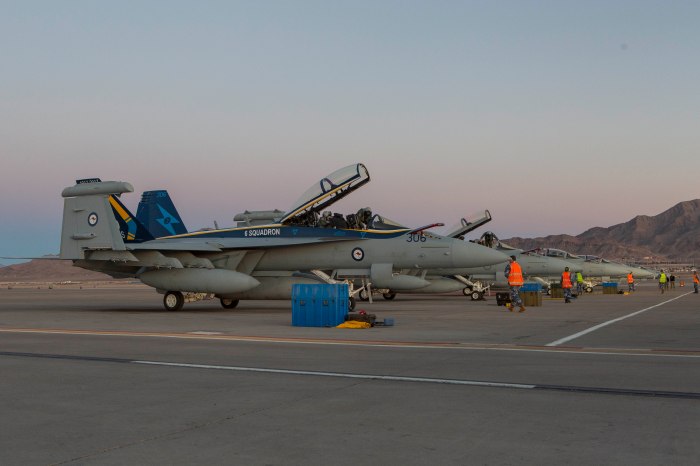
An RAAF EA-18G Growler at Red Flag 18-1. (Source: Australian Department of Defense)

No matter what statistical, empirical, or subjective measurement you use, the American experience in the Vietnam War was not a good one. This was no less true for the USAF than the other branches of the US military. Pilots and senior leaders were less than impressed with their results during combat. The most significant critique came from the line pilots who felt they went into combat ill-prepared to face the enemy. Issues such as how to attack surface-to-air missile (SAM) sites, what an incoming MiG might look like, how to fight that MiG once it was identified, and the proper altitude to get through anti-aircraft artillery (AAA) were not priorities for pilot preparation before the war. In addition to these threats, pilots had to contend with working with complex and sometimes unreliable radar and missile systems all while engaged in high-intensity, manoeuvring aerial combat. In short, American pilots were not properly trained for combat. After the Vietnam War ended, the USAF set about righting these problems through a massive overhaul of existing training paradigms. The changes made in the wake of the Vietnam War fundamentally altered the USAF’s way of war.

As the conflict in Vietnam progressed, the USAF commissioned a series of reports to study every aerial engagement with an enemy aircraft. The so-called Red Baron reports captured the problems in painful detail. Fighter aircraft had to contest with densely-packed SAM sites, enemy MiGs, and a very potent AAA threat. Although AAA was by far the most common cause of aircraft damage and loss, dealing with the SAMs and MiGs was perhaps more stressful as the latter, in particular, would seemingly come out of nowhere. One of the major findings from the reports was that American pilots often did not know enemy MiG aircraft were present until they fired. According to a later RAND study, MiGs were 100 times more likely to close to dogfighting proximity than initially anticipated. To deal with this MiG threat, US fighter pilots had only two options: engage or attempt to escape. If the American pilot did enter into a dogfight, odds were this was the first time he had ever fought against a dissimilar aircraft. An F-4 pilot, for example, might have trained against other F-4s, but he had never practised combat against anything resembling an enemy aircraft.

Since North Vietnamese pilots were known to fly using Soviet tactics, the USAF was forced to reconsider its approach. If USAF pilots fared so poorly against Soviet-trained pilots, how would they fare against the Soviets themselves? In 1972, the USAF took a step towards crafting a better answer to that question by creating dedicated Aggressor Squadrons, pilots trained specifically to emulate the Soviet style of aerial warfare. The mission of the newly created 64th and 65th Aggressor squadrons was to be a ‘professional adversary force conducting a program of intense dissimilar air combat training’ to teach Air Force pilots how to engage and destroy Soviet fighters. One fighter pilot said:

In 1972, when the Aggressors were formed, and DACT [Dissimilar Air Combat Training] became a word you could say openly the biggest deficiency we had in air-to-air capability was human performance. Our tactical BFM [Basic Fighter Maneuvers] skills were weak…by 1975 DACT and four Aggressor squadrons equipped with new F-5Es were the hottest game in town. Moreover, what did those Aggressors do? They taught BFM […] Even as Soviet tactics simulation quickly grew as an Aggressor mission, BFM was still the heart of every debriefing.

The Aggressor squadrons travelled from base to base and introduced fighter squadrons to combat with the Soviet Air Force. Aggressor pilots were often hand-picked for a specific skill set. After arriving at Nellis, they underwent an indoctrination process into the history, culture, and training of the Soviet fighter pilot. They also had the opportunity to get hands-on with Soviet equipment. When flying, Aggressors used Soviet tactics to an extent, typically to ‘the merge’ or the point where the fighters became locked in a visual, turning dogfight. At that point, the ‘gloves came off.’ The creation of the Aggressor squadrons was a significant step forward for American pilots, but it still was not enough. Since a USAF pilot in Vietnam had an exponentially better survival rate after completing ten combat missions, Pentagon planners needed a way to expose junior pilots to those first ten missions under safer conditions. Red Flag was the answer.

Red Flag 16-3 hits full throttle
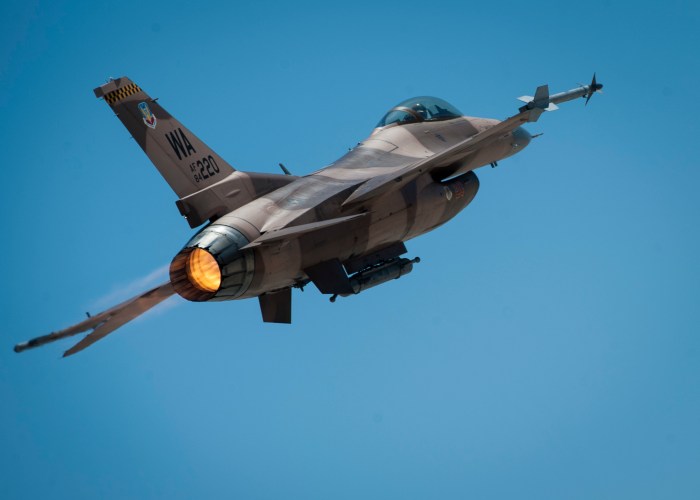
An F-16C Fighting Falcon from the 64th Aggressors Squadron banks off toward the Nevada Test and Training Range to participate in a training sortie during Red Flag 16-3, 19 July 2016. (Source: United States Air Force)

Red Flag was the creation of Lieutenant Colonel Richard ‘Moody’ Suter.[1] Although the ‘iron majors’ provided Red Flag with its intellectual underpinnings and conducted the brunt of the leg-work necessary to get the exercise started. Suter and the other action officers enjoyed great support from Tactical Air Command (TAC) and senior USAF leaders in the Pentagon. When Suter pitched Red Flag to TAC Commander General Robert Dixon, the General loved the idea at once and set about making it a reality. This was no small feat considering Dixon’s reputation for being tough on staff officers and his reputation as the ‘Tidewater Alligator.’ General George Brown, the Chief of Staff of the USAF (CSAF), enthusiastically supported the exercise as well and told Dixon to get it going. The following CSAF, General David Jones also supported the exercise. The Air Staff’s intelligence directorate created a new intelligence unit solely to support Red Flag and began work to move Soviet equipment, including MiG fighters, to Nellis to provide a ‘hands on’ approach to fighting Soviet machinery. Overall, this lightning-quick response led to the first Red Flag taking place only four months after Suter’s initial pitch to TAC.

Red Flag was designed to combine ‘good basic fighter skills’ with ‘realistic threat employment’ to enhance pilot proficiency and readiness for future combat operations. Red Flag I began in November 1975. The primary unit was the 49th Tactical Fighter Wing flying F-4s. Support elements included OV-10s, F-105s, and CH-53s. Red Flag II in early 1976 had increased support elements, and Red Flag III was larger still, seeing the first participation of the new F-15 and the first-night operations as participants flew nearly 1,000 sorties. These early Red Flags drew tremendous praise from participants and requests for more aggressors and more threats, so subsequent exercises increased in size and scope. By the late 1970s, units from the US Pacific Air Forces and the USAF in Europe were travelling to Nellis to take part.

Throughout the 1980s Red Flags became increasingly realistic and, by extension, more difficult for the participating aircrews. As technology advanced, so did the exercise. Gone were the days of tape-recording a mission, and in were the days of the Red Flag Mission Debriefing System, Air Combat Maneuvering Instrumentation, and Nellis Air Combat Training System. Allied nations began taking part as well, and by the end of the 1980s, more than 30 countries had flown in or observed a Red Flag, meaning foreign aircraft were just as likely to be seen in the skies over southern Nevada as American ones. Red Flag expansion continued through the during the 1980s. The April 86 Tactical Analysis Bulletin focused on improvement to existing training methods:

Acknowledging and defining the increased capabilities and advances in Soviet technology is the first step in improving our own training programs.

Even today, a typical Red Flag runs for two weeks with two ‘goes’ each day. Individual squadron briefs follow a mass brief before aircrew step to their aircraft. As the exercise goes on, the missions get progressively harder, forcing pilots and mission planners to work together to accomplish their objectives. Each Red Flag has a mix of fighter and bomber aircraft along with supporting electronic attack, aerial refuelling, airborne battle management, surveillance, and cargo aircraft. Sister service and foreign participation also occur on a regular basis, letting all experience the realities of air-to-air and air-to-ground combat across the joint and combined force. They learn the ‘golden rules’ of BFM lost before Vietnam: ‘lose sight, lose fight,’ manoeuvring in relation to the adversary, and nose position of their aircraft versus energy. They learn:

BFM is used by the pilot to place himself in a piece of sky from which he can launch lethal ordnance, or to keep from becoming a star on the side of somebody else’s jet.

From start to finish, Red Flag prepares pilots to conduct air operations as part of a larger force.

Sukhoi2
An Indian Air Force Sukhoi SU-30 during Red Flag 08-4 in 2008. (Source: Wikimedia)

Saddam Hussein’s invasion of Kuwait offered the perfect opportunity for USAF operators to employ the tactics and doctrine they had been perfecting for the previous decade and a half. Red Flag, Prized Eagle, and numerous other large force employment exercises had prepared American airmen well for the enemy they were going to face in combat, primarily on night one, of Operation Desert Storm. While technological marvels such as the F-117 had a direct impact on combat operations and an even larger one on the American media and public, it was the pilots in the multi-role fighters, bombers, and special operations aircraft who ensured air superiority and thus unhindered freedom of manoeuvre for the land component forces.

With an estimated 44 kills during Desert Storm, American pilots demonstrated they were unmatched when it came to aerial combat. The training changes employed by the USAF after Vietnam went a long way in allowing American pilots to engage and destroy the enemy even when their technology came up short or rules of engagement prohibited them from employing their weapons beyond visual range. As one American fighter pilot said of his time in Desert Storm,‘[T]he Red Flag experience prepared me for combat operations.’

Two dogfights, one from Vietnam and one from Desert Storm, capture the impact of Red Flag. In April 1965, a two-ship of F-4s engaged 4 MiG-17s in a protracted dogfight that ended in a ‘probable kill’ of one MiG-17. In total the F-4s attempted to fire six missiles: two did not guide, three motors did not fire, one hung on the rails, and a MiG successfully evaded the one missile that both fired and tracked. In a similar case, on 19 January 1991, two F-15s engaged two MiG-25s. One F-15 fired two AIM-7s and two AIM-9s, the other fired one AIM-9 and one AIM-7 for a total of six missiles, but, in this case, two confirmed kills. These two air engagements indicate that if technology and weapons were similar, then there must be another explanatory factor in success during Desert Storm. That factor was the training revolution. The link between training exercises and real-world events can be somewhat subjective, but numerous pilots interviewed said their participation at Red Flag was of fundamental importance as they entered combat. One MiG-killer of Desert Storm went so far as to say that the primary difference between himself and his opponent was that he had been in hundreds of dogfights at Red Flag.

USAF success continued throughout the 1990s in the skies over the Balkans where American pilots continued to show just how well their training prepared them to face the enemy. Even as this article is published, Red Flag 18-1 has recently finished. Beyond that, those trained at numerous Red Flag exercises are, even now, plying their trade in the skies over Syria and Iraq, performing close air support, combat air patrols, and interdiction missions. These men and women have a distinct training advantage not only over their current enemy but against any aerial or ground opponent they might face. Although created forty years ago this year, Red Flag remains enormously crucial in training aircrews for combat. Red Flag and the Aggressors still provide a realistic threat environment, and the exercise continues to expand with the inclusion of non-kinetic, cyber, and other threat replications. The most recent Red Flag went ‘virtual’ to increase the size and complexity of the threats faced by the flyers. Red Flag remains the single most complex and comprehensive training exercise in the world, and it provides a combat edge to participants that other countries simply cannot or do not replicate.

Dr Brian Laslie is a US Air Force Historian and currently the Deputy Command Historian at North American Aerospace Defense Command (NORAD) and United States Northern Command (USNORTHCOM). He is also an Assistant Editor of From Balloons to Drones. A 2001 graduate of The Citadel and a historian of air power studies, he received his Masters’ from Auburn University Montgomery in 2006 and his PhD from Kansas State University in 2013. He is the author of Architect of Air Power: General Laurence S. Kuter and the Birth of the US Air Force (2017) and The Air Force Way of War (2015). The latter book was selected for the Chief of Staff of the Air Force’s 2016 professional reading list and the 2017 RAF Chief of the Air Staff’s reading list. He can be found on Twitter at @BrianLaslie.

Header Image: An F-15C Eagle assigned to the Oregon Air National Guard’s 123rd Fighter Squadron approaches an in-flight refueling boom during Red Flag 18-1, 7 February 2018. Units from across the US along with members from the Royal Air Force and Royal Australian Air Force participated as Blue Forces in this year’s first Red Flag exercise.

[1] On the development of Red Flag, see: Brian D. Laslie, The Air Force Way of War: U.S. Tactics and Training after Vietnam (Lexington, KT: The University Press of Kentucky, 2015).

#highintensitywar and the Enduring Legacy of Operation Bolo

#highintensitywar and the Enduring Legacy of Operation Bolo

By Lieutenant Colonel Tyson Wetzel

Editorial Note: Between February and April 2018, The Central Blue and From Balloons to Drones, will be publishing a series of articles that examine the requirements of high-intensity warfare in the 21st Century. These articles provide the intellectual underpinnings to a seminar on high-intensity warfare being held on 22 March by the Williams Foundation in Canberra, Australia. In this article, Lieutenant Colonel Tyson Wetzel examines the enduring legacy of Operation Bolo, an operation during the Vietnam War that was designed as a response to the increasing loses being incurred on the United States Air Force (USAF) in the mid-1960s.

Deliberately planned fighter sweep went just as we hoped. The MiGs came up; the MiGs were aggressive. We tangled. They lost.[1]

Colonel Robin Olds, 3 January 1967

By the end of 1966, USAF fighter pilots were incredibly frustrated by rising aircraft and aircrew losses, restrictive rules of engagement (ROE) and North Vietnam People’s Air Force’s (NPAF) ‘hit-and-run’ tactics. The pilots were looking for an opportunity to seize the initiative and strike the premier NPAF fighter, the MiG-21. The NPAF was extremely careful with their limited number of MiG-21s, launching them only when their air defence network determined slow and non-manoeuvrable fighter-bombers were conducting unescorted strikes in North Vietnam.[2] Colonel Robin Olds, Commander of the 8th Tactical Fighter Wing ‘Wolfpack,’ at Ubon Royal Thai Air Force Base, devised a plan to dupe the NPAF into believing his F-4 Phantom IIs were a large formation of unescorted F-105 Thunderchiefs, which he believed would draw out the MiG-21s. On 2 January 1967, Olds and his Wolfpack executed Operation Bolo and destroyed seven NPAF MiG-21s with no friendly losses. The plan was elaborate, and successful execution relied on deception, predictive and actionable intelligence, and a well-integrated force package. These factors ensured Bolo was a triumphant success and have enduring applicability for air power theorists and air campaign planners preparing for future high-intensity conflict.

AR.2010.007
Colonel Robin Olds with his F-4C ‘SCAT XXVII’, which is on display at the National Museum of the United States Air Force. Olds named all his aircraft after his West Point roommate Scat Davis, who could not become a military pilot due to poor eyesight. (Source: National Museum of the United States Air Force)

The Strategic Environment before Bolo

Two significant factors shaped the American prosecution of the air war over Vietnam in 1966. First, to reduce the risk of escalation, US ROEs at the time of Bolo did not allow strikes on critical North Vietnamese airfields. The result was that MiGs could not be destroyed on the ground; they had to be destroyed in the air.[3] The second factor was the rapidly improving North Vietnamese air defence system, which included air defence artillery, surface-to-air missiles (SAMs), and MiG-17 and MiG-21 fighter aircraft. The combination of surface and airborne threats was taking a heavy toll on US aircraft. By the end of 1966, 455 US aircraft had been lost to enemy action, and USAF leaders wanted to take action to address the losses.[4]

The airborne threat to US aircraft increased dramatically when the NPAF began receiving the MiG-21 in 1965. The MiG-21 retained the manoeuvrability of its predecessors the MiG-15/-17/-19, but it was capable of supersonic flight and was the first Soviet aircraft capable of carrying an infrared-guided air-to-air missile, the K-13 (NATO Designator: AA-2 ATOLL). Intelligence estimates at the time of Bolo put the NPAF MiG-21 inventory at only 16 airframes. To preserve these precious assets, the North Vietnamese only scrambled these aircraft to attack bomb-laden fighter-bombers such as the F-105. According to Walter Boyne, the MiG-21 tactics were very effective:

The MiG-21s’ rear attacks with Atoll missiles were achieving North Vietnamese goals by causing the F-105 formations to jettison their bombs before reaching their targets.[5]

MiG-21 attacks on F-105s resulted in failed missions causing multiple strike packages to be sent to re-attack high-priority targets in a dense threat environment.

Olds was increasingly concerned with the MiG-21 attacks on the fighter-bombers, and the inability of the F-4 escorts to find and kill the MiG-21s in the air:

As we entered the winter of 1966, the MiGs began increased efforts to harass U.S. strike forces […] It became imperative for U.S. forces to bring counteraction to bear on the MiG fighter threat.[6]

Unfortunately, Olds did not see any plan to deal with the threat at the tactical, individual fighter wings, or operational level, 7th Air Force. Olds expressed his frustration with the inaction in an oral history interview two years after the mission: ‘There was no concerted effort really to do anything about the MiGs.’[7] Olds decided to take the lead in developing a plan to take the fight to the MiG-21s.

The Mission

Olds is often given credit as the sole mastermind behind Bolo, but others deserve credit for playing critical roles in the development and refinement of the plan. In early December 1966, Olds began discussing the MiG-21 problem with one of his most gifted fighter pilots, Captain J.B. Stone. Stone laid out the foundation for the plan that would eventually be adopted; using a ruse to make the North Vietnamese launch their MiG-21s against what they believed were fighter-bombers.

Olds enthusiastically embraced the plan and decided to take the plan to his boss, Lieutenant General William Momyer, Commander of 7th Air Force. Momyer also enthusiastically supported the plan and identified his Operations Officer, Brigadier General Don Smith, as his dedicated liaison for the plan. Momyer and Smith shepherded the plan from the start to ensure Olds and his planners were given all available resources and support.[8] According to Olds, Bolo ‘wouldn’t have been possible’ without ‘Momyer’s courage in doing this, probably in spite of a lot of opposition.’[9] Olds is rightly given credit for a bold and brilliantly designed and executed plan, but the success of the mission would not have been possible without significant support from his subordinates and superiors.

On 2 January 1967, 56 F-4s launched in waves of eight aircraft into Northern Vietnam to execute Bolo. The mission worked as it was designed, despite heavy cloud cover in the target area that threatened to keep the MiGs on the ground. Believing they were engaging F-105s, the MiG-21s took the bait; the results were disastrous for them.

According to USAF records, Olds and his Wolfpack destroyed seven MiG-21s in less than 15 minutes with no damage to any US aircraft.[10] Though the seven kills may not seem a significant number, it was nearly half of the NPAF inventory. Four days later, two more MiG-21s were destroyed when they attacked what they believed were unarmed reconnaissance aircraft, but in actuality were more of Olds’ F-4 pilots.[11] The devastation wrought by Bolo, combined with two additional aircraft lost on 6 January led the NPAF to remove the MiG-21 from combat while they re-equipped, and evaluated the causes and their response to recent aircraft losses.[12] Bolo played a significant role in the US re-acquiring air superiority during the beginning of 1967.

The Role of Deception in Bolo

Deception was central to the successful execution of the Bolo plan. The F-4s had to disguise themselves as lumbering F-105s to bait the MiG-21s into an aerial engagement. According to J. Alfred Phelps, the purpose of the deception plan was to create beneficial conditions for an aerial engagement:

The ultimate objective was to deceive and lure the MiG air defense force into a reactive posture and, once they were airborne, seek them out, engage, pursue, and destroy them.[13]

To trick the North Vietnamese air defence system, the F-4s used F-105 callsigns, formations, speed, aerial refuelling tracks, mission routing, and electronic countermeasure (jamming) pods. The deception caused mass confusion among the NPAF MiG-21 pilots. Terry Mays explained the success of the ploy:

The North Vietnamese fell for the ruse and launched MiG-21 fighters to intercept what they thought were F-105s streaking along ‘Thud Ridge’ […] As the MiG-21 pilots maneuvered through the clouds and entered the open sky, expecting to attack F-105s, they found themselves in the midst of F-4s.[14]

MiG-21 pilots had avoided the US’ premier air-to-air fighter, the F-4, so seeing a wall of Phantoms was a shock to the NPAF pilots and ground controllers.

Airborne intelligence collectors were able to capture the shock of the NPAF air defence force. In 2014, Joseph Trevithick analysed recently declassified intercepts from the mission, which showed the near-panic of North Vietnamese pilots upon realising they had been duped:

When Olds’ strike team started its attack, the C-130s picked up enemy pilots shocked to find that ‘the sky is full of F-4s,’ according to the declassified report. ‘Where are the F-105s? You briefed us to expect F-105s!’ ‘I’d like to come down now,’ another Vietnamese pilot reportedly declared.[15]

The North Vietnamese were not prepared to face the F-4s, nor able to quickly react to the changing operational environment in time to save many of their MiG-21s.

The expert application of deception is one of the most important lessons to be learned from Bolo; aerial combat is not merely about the fastest jet, the missile with the longest range, or the best pilot. The use of deception can mitigate a tactical disadvantage or maximise a tactical advantage in the air. The use of deception is rarely a critical aspect of modern aerial combat plans, as US air planners often rely on overwhelming numerical or technological superiority. However, as nations like Russia and China develop and deploy large numbers of advanced fighters and air defence systems, the US cannot continue to rely on numerical or technological advantages. The use of a well-developed deception plan can once again tip the balance in aerial combat, as Olds and his Wolfpack proved in Bolo.

Mikoyan-Gurevich MiG-21PF
A Mikoyan-Gurevich MiG-21PF ‘Fishbed’ in North Vietnamese colours at the National Museum of the United States Air Force. (Source: Wikimedia)

The Role of Intelligence in Planning and Execution of Bolo

Intelligence played a crucial role in both the planning and execution of Bolo. Olds knew that to develop a complete plan for the operation, he needed an accurate intelligence assessment of how the enemy would react to the ruse. According to Olds, ‘it was crucial to accurately predict the capabilities and possible reaction of the MiGs.’[16] The support of Momyer and Smith opened the doors to closely guarded intelligence, including signals intelligence (SIGINT) intercepts of NPAF fighter missions. This intelligence shaped the predictive assessment the intelligence analysts provided to Olds. He continued:

Intelligence gave us some highly probable MiG tactics. The MiGs were usually in the air anytime strike aircraft were in the area. Typically, they were airborne approximately ten to fifteen minutes prior to the strike, about the time the Thuds crossed the Black River.[17]

Olds and Stone used the predictive assessments to determine the number and time spacing of the F-4 formations.

The mission also relied on timely and accurate intelligence during execution. Olds believed real-time relay of SIGINT collection was vital to the mission’s success:

Most critical to the success of BOLO, we had to have clear, real-time intelligence from USAF monitoring stations listening in to VPAF transmissions—no more of the bullshit of keeping essential knowledge secret from the strike force. VPAF transmissions had been monitored and translated but never shared down the line. It was sensitive, but it was imperative to have this intel for BOLO.[18]

Olds and Stone ensured airborne and ground-based SIGINT collectors were included and integrated into the mission so that the force package would receive real-time intelligence updates. Trevithick used declassified Bolo reports to illuminate how important real-time SIGINT collection was to the mission:

Another key—and previously unknown—element of the top secret plan involved deploying signal-snooping aircraft to keep track of the MiGs. The special C-130B-IIs would listen in on enemy radio chatter and feed information straight to American pilots throughout the mission.[19]

Two of these specially modified C-130s, known as SILVER DAWN aircraft, were airborne during the mission providing real-time collection to the force package. The use of predictive intelligence to help refine the plan and the use of real-time intelligence collect was nearly revolutionary because of the classification walls that prevented much intelligence, specifically SIGINT, from being shared with tactical operators. Such barriers have come down in the decades since Bolo, but air planners still struggle with the integration of intelligence into mission planning and execution.

The Role of Force Packaging in Bolo

Bolo included detailed planning and integration among a host of platforms, both airborne and on the ground. Each had a critical role to play to ensure the maximum lethality and survivability of the force. 48 F-4Cs were designated to conduct the aerial sweep mission to find and kill enemy MiGs. They were supported by 24 F-105F IRON HAND aircraft designed to suppress enemy air defences to protect the force package from SAMs. Eight F-104Cs were tasked with the protection of the fighters as they egressed the sweep area. Twenty-five KC-135 aerial refuelling tankers were needed to support the huge strike package. Combat support aircraft including the RC-121 BIG EYE battle management aircraft, EB-66 jamming aircraft, C-130 airborne command post and SILVER DAWN SIGINT platforms, combat search and rescue aircraft, ground control intercept sites, and the ground-based SIGINT stations all participated in the mission.[20] Planning to integrate each of the platforms and its capabilities was complex, and Olds spent days travelling the theatre briefing operators on the plan.

The Bolo package foreshadowed the massive force packages that would become prevalent in Operation Desert Storm and all other air campaigns since. In addition to multiple fighter types executing various mission sets, combat support aircraft provided the updated air picture, collected real-time intelligence, executed command and control, jamming, and aerial refuelling. These aircraft were force multipliers in the mission, and the roles and importance of similar platforms have continued to expand over the past five decades. Bolo was an early and clear example of the effectiveness of a complete and fully integrated force package. This is one of the lessons of Bolo that air planners have absorbed, and force packaging is now a daily part of air operations.

AR.2010.021
An F-4C of the 497th Tactical Fighter Squadron, 8th Tactical Fighter Wing, rolls out on takeoff. It is configured for the MiGCAP escort role with Sparrow air-to-air missiles under the fuselage, and Sidewinder air-to-air missiles and extra fuel tanks under the wings. (Source: National Museum of the Unites States Air Force)

Conclusion

Bolo was not only the highlight of the larger Rolling Thunder air campaign; it was the most successful US fighter operation of the war.[21] Despite the mission being executed more than fifty years ago, there are critical lessons about mission planning and execution that can be used in the development of aerial missions and air campaigns today. Historian Jon Latimer summed up the primary takeaway from Bolo:

U.S. Air Force pilots demonstrated over Hanoi in 1967 that lure tactics can also work well in the higher reaches of technology. So it was that Operation BOLO, a small but unusually successful part of the ROLLING THUNDER bombing program, succeeded in claiming seven North Vietnamese MiGs within 15 minutes, without losing a single American aircraft.[22]

The shrewd use of deception allowed the US fighters to engage their adversary at the time, place, and in the manner of their choosing.

Additionally, the use of intelligence before and during the mission was vital to the success of the operation. The utilisation of predictive intelligence in mission planning allowed the Bolo planners to optimise the F-4’s survivability and lethality against the MiG-21. The timely dissemination of SIGINT was unheard of at the time, but Bolo showed the importance of real-time intelligence updates to the operational environment. Finally, the integration and coordination of airborne and ground-based elements in a massive and diverse force package was a significant contributor to the overall success of the mission. Bolo made better use of deception, intelligence, both predictive and real-time updates, and force packaging than any air operation of the Vietnam War up to that point.

In this era of ‘near-peer’ threats, including the development and deployment of fifth-Generation aircraft, modern long-range SAMs, and advanced electronic warfare, the US and its allies cannot rely solely on numerical or even technological superiority to win future air conflicts. Air power theorists and operators need to think through problems, evaluating the operational environment and the adversary and build plans that leverage and maximise their comparative advantages while mitigating risk and minimising the adversary’s comparative advantages. Air planners and tacticians should study these aspects of Bolo and consider incorporating tactics similar to those of Olds and his Wolfpack in the planning and development of future air operations in a high-intensity conflict.

Tyson Wetzel is a Lieutenant Colonel in the United States Air Force, an intelligence officer, a graduate of the United States Air Force Weapons School where he was also an instructor, and the US Marine Corps Command and Staff College. Tyson has deployed multiple times in support of Operations IRAQI FREEDOM, ENDURING FREEDOM, NEW DAWN, and NOBLE EAGLE. He is currently assigned to the Joint Staff at the Pentagon. He tweets @gorillawetzel.

Header Image: Pictured here are revetments and F-4s of the 8th TFW at Ubon, Thailand. (Source: National Museum of the Unites States Air Force)

[1] Robin Olds, interview with Armed Forces Network, 3 January 1967. Clip shown on Dogfights: Air Ambush. History Channel, 10 November 2006.

[2] Walter J. Boyne, Beyond the Wild Blue: A History of the U.S. Air Force (New York: St. Martin’s Griffin, 2010), pp. 162.

[3] Jon Latimer, ‘Operation Bolo: Phantom ambush over North Vietnam,’ Vietnam, 15:3 (2002), pp. 38.

[4] Latimer, ‘Operation Bolo,’ pp. 37.

[5] Boyne, Beyond the Wild Blue, pp. 162.

[6] Robin Olds, Christina Olds and Ed Rasimus, Fighter Pilot: The Memoirs of Legendary Ace Robin Olds (New York: St. Martin’s Press, 2010), pp. 262-3.

[7] Robin Olds, U.S. Air Force Oral History. Project Corona Harvest Collection. Operation Bolo Briefing (listed as Interview #222). Maxwell AFB: Office of Air Force History, 29 Sep 1967, pp. 8.

[8] Olds, Fighter Pilot, pp. 269-71.

[9] Olds, Project Corona Harvest. Operation Bolo Briefing, pp. 68

[10] Frank F. Futrell, William H. Greenhalgh, Carl Grubb, Gerard E. Hasselwander, Robert F. Jakob, and Charles A. Ravenstein. Aces and Aerial Victories: The United States Air Force in Southeast Asia, 1965-1973 (Washington, DC: Office of Air Force History, Headquarters US Air Force, 1976), p. 21.

[11] Olds, Project Corona Harvest. Operation Bolo Briefing, pp. 65.

[12] Terry M. Mays, ‘Gunfighting Over North Vietnam,’ Vietnam, 20:6 (2008), p. 47.

[13] J. Alfred Phelps, Chappie: America’s First Black Four-Star General: The Life and Times of Daniel James, Jr (Novato, CA: Presidio Press, 1992), pp. 225.

[14] Mays, ‘Gunfighting Over North Vietnam,’ p. 47.

[15] Joseph Trevithick, ‘Spies Helped the USAF Shoot Down a Third of North Vietnam’s MiG-21s,’ WarIsBoring.com, 30 Dec 2014.

[16] Olds, Fighter Pilot, pp. 273.

[17] Ibid, pp. 272.

[18] Ibid, pp. 275-6.

[19] Trevithick, ‘Spies Helped the USAF Shoot Down a Third of North Vietnam’s MiG-21s.’

[20] Multiple sources were used to determine all the components of the force package: Olds, Fighter Pilot, pp. 274-6; Latimer, ‘Operation Bolo,’ pp. 38-39; Boyne, Beyond the Wild Blue, pp. 163.

[21] Phelps, Chappie, pp. 229.

[22] Latimer, ‘Operation Bolo,’ pp. 35.

Attrition in Fifth-Generation Air Forces during #highintensitywar

Attrition in Fifth-Generation Air Forces during #highintensitywar

By Rex Harrison

Editorial Note: From February to April 2018, The Central Blue and From Balloons to Drones, will be publishing a series of articles that examine the requirements of high-intensity warfare in the 21st Century. These articles provide the intellectual underpinnings to a seminar on high-intensity warfare being held on 22 March by the Williams Foundation in Canberra, Australia. In this article, Rex Harrison discusses the challenge of attrition during high-intensity conflicts and its implications for fifth-generation air forces.

Technology has continued to advance in both disruptive and surprising ways. It is consequently difficult to forecast the exact way fifth-generation air power will be applied in 2035, nor the precise character of future high-intensity conflict. With the benefit of hindsight, however, history proposes broad themes and continuities in the nature of war. One such example is the persistence of attrition of the force once committed to battle.

While Western air forces have been able to somewhat control their level of exposure to adversary action since the 1991 Gulf war, this may not always be the case. This level of control has been achieved through conducting operations beyond the engagement range of adversaries and behind a shield of (generally unchallenged) air defences. This technique has enabled air power to inflict significant losses without absorbing such losses themselves.

This happy circumstance has been the exception rather than the rule in human history. This is particularly the case when considering the history of air power, where few combatants have had the luxury of picking and choosing the intensity and duration of the conflict. No matter how successful fifth-generation air power is in enhancing its lethality and minimising risk to the force, it is doubtful that a combat exchange in high-intensity combat will result in a ‘0’ in the ledger of either side.

This being the case, I believe that success in high-intensity conflict will require a fifth-generation air force to ensure it can absorb and recover from the attrition of its forces. While it will be difficult to predict the outcomes of future air combat or the mix of technology and tactics that will provide the necessary advantage, history does provide a guide that may better inform our preparations for the future.

Historical Examples

Yom_Kipur_war
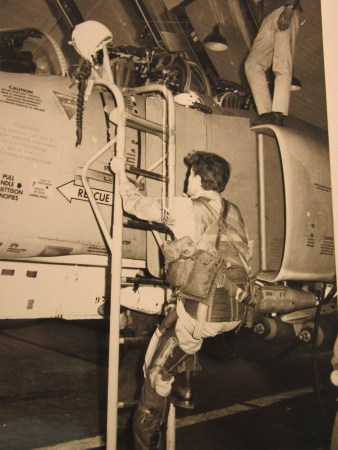
An Israeli pilot, Shimshon Rozen, climbing into a McDonnell Douglas F-4E Phantom II during the Yom Kippur War, c. 1973. (Source: Wikimedia)

The significant impact of attrition is demonstrated by the experiences of the Israeli Air Force (IAF) in the Yom Kippur War of October 1973. In this example, Israel was surprised by the new-found technical prowess of the Arab armies led by Egypt and Syria. The IAF was required to expend a sizable portion of its fighting strength to provide time for mobilisation. Surprised by the technical mastery of their opponents, in a matter of days, 102 aircraft were lost (roughly 25% of available combat aircraft), along with 53 aircrew. The crisis was only resolved by the rapid shipment of replacement aircraft from the US inventory under Operation Nickel Grass.

While certainly an example of high-intensity conflict, the requirement for Australia to fight for its existence as Israel did is unlikely or would be, at the very least, preceded by warnings such that the nation could be mobilised and prepared for such a conflict. It is partially through Australia’s preferred method of warfare, the controlled commitment of forces in expeditionary wars, that such attrition has been avoided.

A more pertinent example for Australian forces is the experience of No. 77 Squadron during the Korean War (a perhaps timely example given ongoing tensions on the Peninsula). The deployment of a single fighter squadron in June 1950 would seem at face value to match the characteristics of more recent Royal Australian Air Force (RAAF) commitments; the level of attrition, however, was not comparable. Over a three-year commitment, 41 pilots died, and six were captured. At the peak of fighting the squadron replaced 25% the pilot force over an eighteen-month period. Finding the Second World War era North American P-51 Mustang to be outmatched after losing 13 aircraft, No. 77 Squadron was re-equipped in May 1951 with the Gloster Meteor. Of the 94 Meteors acquired by Australia, 30 were subsequently lost to enemy action, delivering a significant portion of the 54-aircraft lost in total over Korea and Japan.[1] The consequence of this action was that No. 77 Squadron, in effect, replaced all of its aircraft at least once, and in a handful of years, expending the bulk of the entire RAAF fleet.

JK0901A
Squadron Leader Ross Glassop and Flight Lieutenant Sainer Rees, pilots, serving with No. 77 Squadron RAAF chat with the crew of No. 36 Squadron RAAF which had flown from Japan with supplies of rockets and aircraft spares. (Source: Australian War Memorial)

One should hope that future deployments would avoid committing forces in obsolete aircraft. However, it should be noted that the Australian government maintained the force commitment in Korea despite these and other subsequent losses.

What Does This Mean?

In preparing for future conflict, any fifth-generation air force must ensure access to both the physical (hardware) and human resources required to replace those lost.

The procurement of aircraft and their associated supporting hardware may be the most straightforward requirement to meet, assuming access to global markets. While contemporary production rates are much lower than those of the Second World War, they are still significant for those aircraft in full production. While the Israeli losses in 1973 were substantial, production of the McDonnell Douglas F-4 Phantom II, the mainstay multi-role aircraft of the period, averaged 19 aircraft per month, over the life of production.  Israel’s losses of this aircraft type (32 of the 102 total), while critical to the IAF, were only the equivalent of less than two months production out of the Fort Worth factory.

The replacement of human resources, specifically aircrew, will be determined by a combination of the resources allocated to training (rather than fighting), and the desired quality of the resulting product. Given our resource-constrained environment, it may well be that ‘great’ is the enemy of ‘good enough’. In this context, a fifth-generation air force will need to accept that its workforce may not have not quite mastered the full spectrum of fifth-generation fighting techniques; however, it will need to employ them regardless.

A fifth-generation air force will also need to incorporate these replacements within the chosen operational approach. Concerning hardware, it will be rare that the exact aircraft lost from the inventory will be in production. With platforms potentially being fielded for decades, it is to be expected that subsequent variants will be produced, or entirely new platforms created in the decades following acquisitions. As such, while a replacement platform may be found, the capabilities are unlikely to be identical to that it replaces.

More critically to the networked fifth-generation force, it is unlikely that replacement assets will be fitted with the exquisitely detailed set of combat data and information exchange systems specified as part of the fifth-generation force structure. This will particularly be the case if the preferred supplier of our platforms is otherwise occupied. Returning to the example of No. 77 Squadron, when the Mustang was determined to be unsuitable for the Korean conflict, the RAAF initially sought the North American F-86 Sabre from the United States, however, as production was already committed to US customers, the British Meteor was chosen instead. While this aircraft was first flown in 1944 and was far from the cutting edge of technology, the war marched on, and Australia could not wait until it was ready to fight on its terms.[2]

Conclusion

While the aim of the technologically and professionally-advanced fifth-generation force is admirable, planning and foresight cannot overcome the uncertain nature of war, precisely the inevitability of loss. At its heart, a fifth-generation force requires flexibility to adapt to any environment. In this context, the squadron must become less of an exquisite implementation tool, and more a delivery mechanism through which aircraft and aircrew are ground against the enemy at the point of friction. In such a situation, ‘good enough’ may quickly become the new normal.

Rex Harrison is an Air Combat Officer in Royal Australian Air Force officer. He can be found on Twitter at @spacecadetrex. The views expressed are the author’s and do not reflect the official position of the Royal Australian Air Force, the Australian Department of Defence, or the Australian Government.

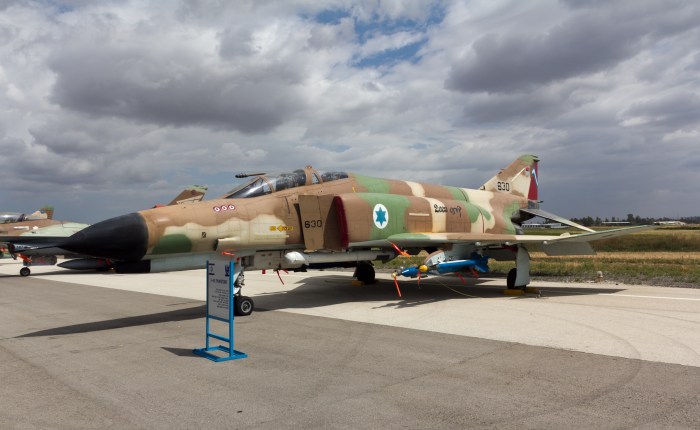
Header Image: An Israeli Air Force F-4E Phantom II at Tel Nof, c. 2013. This type of aircraft was used by the IAF during the Yom Kippur War. (Source: Wikimedia)

[1] Alan Stephens, Going Solo: The Royal Australian Air Force, 1946-1971 (Canberra: AGPS Press, 1995), p. 241.

[2] Ibid, p. 240.

#BookReview – Architect of Air Power: General Laurence S. Kuter and the Birth of the US Air Force

#BookReview – Architect of Air Power: General Laurence S. Kuter and the Birth of the US Air Force

By Alexander Fitzgerald-Black

Brian D. Laslie, Architect of Air Power: General Laurence S. Kuter and the Birth of the US Air Force. Lexington, KT: The University Press of Kentucky, 2017. Notes. Bibliography. Index. 21 b/w Photos. Hbk. 236 pp.

Architect of Air Power Cover

With Architect of Air Power Brian D. Laslie, Deputy Command Historian at NORAD and US Northern Command and an Adjunct Professor at the US Air Force Academy had two mutually supporting goals. The first is to offer readers a biography of General Laurence S. Kuter, one of the select few US Air Force (USAF) officers to serve the majority of his 35-year career as a general officer (the others were Generals Curtis LeMay, Lauris Norstad, and Hoyt Vandenberg). The second is to acknowledge that Kuter’s

[c]areer dovetailed with the rise of an adolescent air power and ended with a fully grown and mature air force capable of global monitoring and response. (p. xi)

In other words, Kuter was an architect of the USAF. Many of the modern USAF’s principles and methods owe their origins to his work.

The biography is organised chronologically, beginning with Kuter’s adolescence and time at West Point and ending with his service as a four-star general commanding the Pacific Air Forces (PACAF) and North American Air Defense Command (NORAD), retirement, and passing. Laslie has assembled an impressive array of sources to discuss Kuter’s life and career. He draws on Kuter’s incomplete autobiography, collections at the USAF Academy library (including Kuter’s papers and those of several his contemporaries), oral histories, diaries, and letters. One highlight of the book is how Laslie captures Kuter’s relationship with his high school sweetheart and wife, Ethel Kuter (née Lyddon). Ethel’s diary was slowly overtaken by references to Kuter beginning in 1922, and the pair wrote over 1,000 letters to each other during his time at West Point.

Laslie takes his readers on a mission to understand why so little has been written about Kuter. One reason is that Kuter did not make a name for himself with flying exploits or by leading air formations into battle. Kuter did not join the US Army Air Corps because of romantic visions of flight. Instead, he joined to be a better artillery officer. Only later did he become fully immersed in exploring a new kind of warfare – mainly at the operational rather than tactical level. In August 1941, Kuter became one of the authors of AWPD-1, the first comprehensive plan for winning the war against Germany through aerial bombardment. In the early months of America’s Second World War, Brigadier General Kuter (one of the youngest general officers in the US Army) was a go-between for General George C. Marshall and Lieutenant General Henry H. Arnold. He also had a significant hand in setting up the latter’s Air Staff as the US Army Air Forces achieved autonomy. Kuter made a name for himself with his organisational skills rather than his combat command ability.

Recognising this, Arnold sent Kuter to Europe in late 1942 to gather command experience. Kuter commanded the Eighth Air Force’s 1st Bombardment Wing under Brigadier General Ira Eaker. One of Eaker’s assistants, James Parton, later claimed that Eaker had fired Kuter for declining to fly on combat missions. Laslie has proven these accusations to be unquestionably false. In fact, while Eaker gave Kuter the worst performance reviews of his career, he also tried to retain Kuter’s services. Laslie believes Eaker did this to provide Kuter with more time to prove himself; he had served under Eaker for only five weeks.

© IWM (CNA 408)
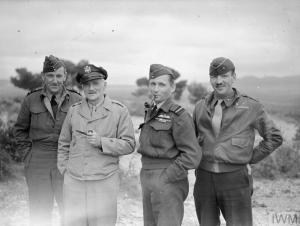
Senior Allied Air Commanders gathered at the Headquarters of the North African Tactical Air Force, Ain Beida, Algeria. Left to right: Air Marshal Sir Arthur “Mary” Coningham, Air Office Commanding, NATAF, Major General C A Spaatz, Commanding General, North-west African Air Forces, Air Chief Marshal Sir Arthur Tedder, Air Officer Commanding-in-Chief, Mediterranean Air Command, and Brigadier General L S Kuter, Deputy Commander, NATAF. (Source: © IWM (CNA 408))

This is another of the reasons for the lack of attention afforded Kuter. He never stayed in one place long enough to make a name for himself. Kuter’s next stop was North Africa. He would serve as the deputy to Air Marshal Sir Arthur Coningham, commander of the Northwest African Tactical Air Force. He served in this position for only four months, but he still made immense contributions to the war effort and the future of the US air power. Kuter’s brainchild was FLAX, a well-planned and executed operation to destroy the Axis air bridge between Sicily and Tunisia. He also learned how to implement a proper ground support system in the field. When he returned to Washington to work under Arnold his experiences in North Africa were codified in Field Manual 100-20. This document is considered both the air force’s ‘declaration of independence’ and the basis for the USAF’s tactical air power concepts to this day.

Kuter’s next command opportunity overseas was in the Pacific. Now a Major General, Kuter was quickly replaced in a reshuffling of officers following the defeat of Nazi Germany in May 1945. He then moved to Air Transport Command, where he supported General Douglas MacArthur’s buildup in Japan following the island nation’s surrender. After less than a month, Kuter once again returned to Washington. As Laslie notes, ‘as soon as [Kuter] established and organized the flow of men and material, he was pulled from the theater.’ (p. 122)

Another reason Laslie offers us for Kuter’s relative obscurity is the man’s level-headedness. People want to write about innovators and controversial figures, not respectable architects. Laslie makes this observation early in the book: ‘If the famous early aviators – men like Curtis LeMay and Jimmy Doolittle – were cowboys, then Kuter represented the first-generation lawman who came to town to impose order.’ (p. 18) One of the arduous tasks Kuter had to handle while working under Arnold in 1942 were the requests from various theatre commanders for more and better aircraft and properly trained crews. At the time, there just were not enough aircraft to train crews in the United States and supply US Army Air Forces in Europe, North Africa, and the Pacific. President Roosevelt had also promised the Royal Air Force a share of American aircraft production. This added strain was worth it since many British Commonwealth pilots already had combat experience. Although the theatre commanders could be quite forceful in their requests, Kuter never let it get the better of him, and his level-headedness set him apart from many of his contemporaries. Perhaps, therefore, when Arnold could not attend the Yalta Conference in February 1945, Kuter attended in his place. In doing so, Kuter jumped the queue in front of three-star generals.

Continental_Defense_Warning_Systems
Continental defense warning systems of the North America. (Source: Wikimedia)

Kuter’s Cold War career is equally fascinating. He never held or coveted the positions of Chief of Staff or Vice Chief of Staff of the USAF (perhaps another factor in his relative obscurity). His work establishing the USAF Academy and achieving accreditation for the Air University were architectural moves that produce new generations of air force officers that continue to mould the modern USAF. As a four-star general, Kuter commanded America’s aviation in the Pacific theatre, consolidating these forces under one command: PACAF. He also oversaw NORAD as it dealt with growing Soviet missile offensive capability in the late 1950s and early 1960s.

In his preface, Laslie notes the difficulty associated with writing biography suggesting that:

Historians must tread the perilous course of being objective while at the same time proclaiming why subject needs individual attention in the first place. (p. xi)

Laslie has played this balancing act marvellously. He pulls no punches, willingly calling out Kuter when his ideas or actions were wrong, especially his belief in strategic air bombardment as a war-winning approach. Laslie carefully provides the reader with enough context so that he or she may understand why Kuter made these errors. In fact, it is these very moments, so well captured by Laslie, that make Kuter and the history of the USAF such a fascinating subject.

Alexander Fitzgerald-Black has a Master of Arts in Military History from the University of New Brunswick and is a Master of Arts in Public History candidate at the University of Western Ontario. Alex’s first book, Eagles over Husky: The Allied Air Forces and the Sicilian Campaign, 14 May to 17 August 1943, will be published in early 2018. His research interests include air power in the Second World War, with a particular focus on the Mediterranean, and Canadian military history. He operates his blog at alexfitzblack.wordpress.com and can be reached on Twitter @AlexFitzBlack.

Header Image: Republic of Korea Air Force Lieutenant General Cho Won Kun flies with the 35th Fighter Squadron out of Kunsan Air Base, c. 2009. The 35th Fighter Squadron forms part of the 8th Operations Group of the 8th Fighter Wing. The 8th Fighter Wing is assigned to the Seventh Air Force, which reports to PACAF. (Source: Wikimedia)

#BookReview – Tiger Check: Automating the US Air Force Fighter Pilot in Air-to-Air Combat, 1950-1980

#BookReview – Tiger Check: Automating the US Air Force Fighter Pilot in Air-to-Air Combat, 1950-1980

By Mike Hankins

Steven A. Fino, Tiger Check: Automating the US Air Force Fighter Pilot in Air-to-Air Combat, 1950-1980. Baltimore, MD: Johns Hopkins University Press, 2017. Notes. Works Cited. Index. Hbk. 435 pp. 

51nxvKRLhkL._SX329_BO1,204,203,200_

Works dealing with the history of military technology tend to fall into a few camps. Some will praise a single ‘genius inventor,’ some will chronicle a teleological, linear path of ‘advancement,’ some are content to merely unpack the ‘black boxes’ and describe a piece of technology in detail for its own sake. Rare is the work that discusses the social and cultural interchange between people and machines, digs deep in technical details, while at the same time being a well-written, gripping narrative history sure to excite any enthusiast. Steven Fino’s Tiger Check is all those things at their finest.

Fino examines the American fighter pilot experience in three specific aircraft: The F-86 Sabre, the F-4 Phantom II, and the F-15 Eagle. Each plane featured new technology that seemed to threaten the existing ‘knights of the air’ culture of fighter pilots. Fino argues that despite this series of cultural threats, that culture adapted. The image of pilots as ‘flying knights’ never changed, although they did have to modify themselves into ‘flying scientists.’ This did not replace the previous culture of fighter pilots but merely broadened and democratised it.

Fino begins the book by briefly exploring the ‘knights of the air’ mythology that dates to air-to-air combat in the First World War. As he defines it, the fighter pilot myth has three elements. First, air-to-air engagements as a form of honourable combat among gentleman warriors. Second, that success in air combat is due to the unique skill of the individual pilot. Finally, that the measure of greatness is the kill count—the number of enemy aircraft downed by a single pilot. It could be argued that there are more elements to this myth, and in his attempt to define these cultural factors as steady between the two World Wars, Fino glosses over the emphasis on bombing doctrine in the Second World War, and the battles between fighter culture and bomber culture during those years. That is a minor nitpick, however, as he does a wonderful job of defining the terms of his argument and how he intends to explore the evolution of the fighter pilot myth in the Cold War era.

The rest of the book is organised into three long chapters, each devoted to a particular aircraft. These chapters all follow a similar formula. First, Fino looks at how the pilots of a specific era still maintained and celebrated the three main elements of the ‘flying knights’ mythology. Fino then gives a detailed look at the new cockpit technologies of that era and how they seemed to threaten that myth. Finally, Fino chronicles how pilots adapted, slightly modifying their culture and practices in a way that allowed them to both masters the new technology while keeping the ‘knights of the air’ myth intact.

050811-F-1234P-014
Captain Joseph McConnell Jr. in the cockpit of his F-86, which shows his 16 kills as red stars. ‘Beauteous Butch’ referred to his nickname for his wife, Pearl. (Source: National Museum of the United States Air Force)

This pattern starts with the F-86 Sabre and the massive air-to-air battles over ‘MiG Alley’ during the Korean War. The main new piece of technology in the fighter cockpit was the A-1C(M) gunsight, relying on radar to help pilots aim their guns against the new generation of fast, agile jet fighters. The new gunsights, which required more technical knowledge and at least some understanding of radar theory, threatened the image of the lone fighter pilot using his skills, rather than relying on machines. Many pilots resisted the new gunsights and lobbied for their removal. Indeed, the first generation of sights was notoriously unreliable. However, after mid-1952, newer versions of the gunsight increased its reliability, and a younger generation of pilots adapted their culture to emphasise the combination of man and machine, rather than the earlier conception of man or machine. As Fino concludes:

Pilots had to move beyond the decades-old stereotype that had defined their profession. Detailed knowledge of their aircraft and its weapons systems wouldn’t necessarily dilute their tiger spirit […] It might actually render their tiger-like instincts that much more lethal for their opponent. (p. 109)

AR.2010.007
Early F-4s in Southeast Asia were painted gray, but by 1966, they were camouflaged like the Phantom at the bottom of the photograph. (Source: National Museum of the United States Air Force)

The next section jumps to the Vietnam War and examines the next biggest ‘threat’ to the fighter pilot mythology: The F-4 Phantom. The threat came not only from a reliance on guided missiles rather than guns (as the Phantom did not carry a gun at all until the later ‘E’ model) but more so from the fact that the F-4 was a two-seater. No longer was the fighter pilot a lone wolf, but he had to work in tandem with a radar cooperator in the back seat (colloquially called the ‘GIB’ for ‘guy in back’) to help identify and track enemy aircraft as well as obtain weapons locks. It was no longer enough to use one’s skill to maneuver a fighter into position and pull the trigger aggressively—now a pilot needed to understand the intricacies of how their large radar worked, and how to operate a large array of knobs, buttons, and switches to find and track targets. These tasks, split between two people, seemed to destroy social conventions among fighter pilots. Most importantly, who got credit for a kill? Most pilots bristled at these changes, as Fino notes:

Many of those sitting in either seat in the Phantom would have preferred instead to be flying a single-seat fighter, even if it was an older, less sophisticated, more vulnerable aircraft. (p. 196)

Even this radical of a shift did not destroy the image of pilots as ‘flying knights.’ The definition of what a pilot was shifted, emphasising coordination between men and machines. As Fino surmises, the Phantom’s advanced technology:

[m]ight have been designed to simplify and democratize fighter aviation so that the nation would no longer have to rely solely on the skills of carefully screened and combat-seasoned ‘birdmen,’ but it quickly became apparent in the skies over Vietnam that skilled pilots were still needed, and that those necessary skills could often be developed only in combat. (p. 197)

The final shift in this narrative came with the arrival of the F-15 Eagle—which promised to be a return to ‘traditional’ fighter pilot conceptions, optimised for air-to-air combat as a true ‘fighter pilot’s fighter plane.’ Although the Eagle had a single-seat, it was also larger and much more complicated than the Phantom. Its radar and long-range missiles still required extensive knowledge and skill to operate, although a computer now performed most of the tasks formerly handled by the GIB. Still, Eagle pilots had to be, to some degree, ‘flying scientists,’ who could perform delicate, precise movements on their joysticks to manipulate their radars and make the most of their weapons systems.

NATO Operation Allied Force
An F-15C Eagle breaks away from a KC-135R Stratotanker after in-flight refueling during Operation ALLIED FORCE on 4 April 1999. (Source: Wikimedia)

Fino does not examine the Eagle’s performance in actual warfare as much as simulated combat, specifically the AIMVAL/ACEVAL tests of 1976-1977. During and after these tests, F-15 pilots developed new tactics, including changing their formations, but more importantly developing the practice of ‘sorting’ targets. Fino examines this shift from a cultural perspective—lone fighter pilots duelling in the skies indeed became a thing of the past. Skilled individuals were still key, but now, pilots had to work together and pick targets, maximising the advantages of their weapons, ideally to end air-to-air engagements before they became dogfights. This seemed to threaten the ‘knights of the air’ image at first, but ultimately upheld it. Although the necessary skill set to be an effective Eagle pilot had drastically changed since the Korean War, pilot skill, aggression, and individual prowess were still crucial factors.

When describing the technical aspects of these systems, Fino goes into incredible detail. A close reading of this book would give the reader a thorough knowledge of the science behind radar technology and comes close to approaching an instruction manual for all three aircraft. These technical descriptions are never boring and never devolve to a case of opening ‘black boxes’ for their own sake. Fino continually ties the technical issues back to larger questions of cultural identity with an engaging style of writing. His sources are deep, and his notes thorough, proving ample opportunity for further research. If there is any flaw in the work, it tends to assume pilots are inherently antagonistic to engineers and aircraft designers. Many pilots likely shared this view. However, it might have been interesting to examine the culture and perspective of those designing and building this technology and how they viewed themselves as aiding pilots rather than threatening their culture. However, that would require another book’s worth of research and is not the type of work Fino set out to create here.

Ultimately, this work is one of the best works of air power (and technology) history that this reviewer has read in quite some time, and will likely become a standard of the field. It certainly sets a very high bar for other historians. For those interested in pilot culture and/or aircraft technology, this is required reading, while still pointing towards directions for future scholarship.

Mike Hankins is a doctoral candidate at Kansas State University, where he teaches World History, the History of Airpower, and the History of Comic Books, and he is currently working on his dissertation, ‘Sources of Innovation: The Cultural and Technological Origins of Fourth Generation Fighter Aircraft, 1964-1991.’ He completed his master’s thesis at the University of North Texas in 2013, titled ‘The Phantom Menace: The F-4 in Air-to-Air Combat in the Vietnam War. He has a web page and can be found on Twitter at @hankinstien.

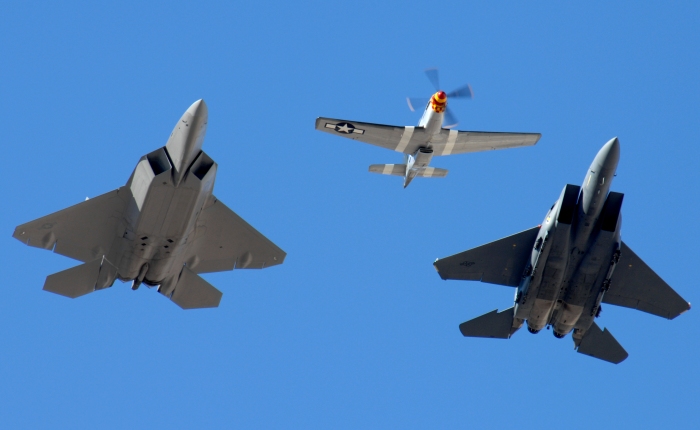
Header Image: An F-22 Raptor, P-51 Mustang and F-15E Strike Eagle perform the historic heritage flight during an air show at Nellis Air Force Base, Nevada, 8 November 2008. (Source: Wikimedia)

Call for Contributions – High-Intensity Warfare in the 21st Century

Call for Contributions – High-Intensity Warfare in the 21st Century

Since the end of the Cold War, the West’s militaries have been engaged in a series of protracted and persistent low-intensity counterinsurgency campaigns. For air forces, this has broadly meant involvement in campaigns where there have been few serious challenges to control of the air and air dominance was assumed. However, as we move further into the twenty-first century, that scenario is likely to change with the likelihood of peer-on-peer high-intensity conflict increasing. In such conflicts, air dominance will have to be fought for, and maintained, to utilise the full spectrum of capabilities afforded by the exploitation of the air domain.

Aim

The Central Blue and From Balloons to Drones seeks to commission a series of articles that examine critical themes related to the challenge of preparing modern air forces for the possibility of high-intensity conflict as they transform into 5th generation forces. As well as informing broader discussions on the future of conflict, these articles will provide the intellectual underpinnings for a Williams Foundation seminar on the subject of the requirement of high-intensity conflict to be held in Canberra, Australia in March 2018.

Themes

The editors seek contributions that provide a variety of perspectives on the following key themes:

Strategy and Theory | Future Roles | Emerging Threats | Air Force Culture

Force Structure | Technology and Capabilities | Ethical and Moral Challenges

Doctrinal Trends | Education | Training

Articles can range from historical discussions of the above themes through to contemporary perspectives. Perspectives can also come from a number of related disciplines including history, strategic studies, international relations, law, and ethics.

Submission Guidelines

Articles framed around one of the above themes should be c. 2,000 words. Submissions should be submitted in Word format and emailed to the addresses below with ‘SUBMISSION – HIGH-INTENSITY WARFARE’ in the subject line. Also, please include a 50-100-word biography with your submission. Please be careful to explain any jargon. Publication will be entirely at the discretion of the editors. These articles will appear on the websites of The Central Blue and From Balloons to Drones simultaneously. We will be publishing articles from the middle of February 2018 onwards.

Keen to write but need some guidance? Email us, and we can link you up with a mentor-editor who can assist you before formal submission.

Contact Information

For more information, please contact Wing Commander Travis Hallen (Co-editor, The Central Bluecentralblue@williamsfoundation.org.au) or Dr Ross Mahoney (Editor, From Balloons to Dronesairpowerstudies@gmail.com).

Header Image: An RAF Harrier waits in a hangar at Kandahar, Afghanistan prior to departure, c. June 2009. (Source: Defence Imagery MoD)

#ResearchNote – RAF Centre for Air Power Studies Interviews

#ResearchNote – RAF Centre for Air Power Studies Interviews

By Dr Ross Mahoney

Oral history is challenging. It is challenging to conduct and to use as a source. It takes a skilled oral historian, such as Peter Hart, to conduct an interview that brings the best out of an interviewee. Much of this has to do with the ability of the interviewer to put the interviewee at ease to allow them to discuss their experiences as openly as possible as well as having an understanding and empathy for the subject matter. As a source, arguably, the principal criticism of oral history remains the charge of viewing the past through ‘rose-tinted glasses.’ In short, the passage of time can distort the remembrance of the past; however, as someone with an interest in military culture, this is also a strength. Culture has as much to do with perception as it does with the archival record of the time so how people remember and reflect on their service is just as important as what happened at the time.

As such, it is great to see that the RAF Centre for Air Power Studies is currently making available a number of interviews that were conducted from the 1970s onwards. The first two were conducted at the RAF Staff College at Bracknell in the early 1990s. It was not unusual to have after-dinner speakers at Bracknell, and it formed part of the pedagogical process at the Staff College. In these cases, the interviewees were Group Captain Sir Hugh Dundas and Wing Commander Roland Beamont. The final interview was conducted in 1978 by the RAF’s first Director of Defence Studies Group Captain Tony Mason. The interviewee was Group Captain Leonard Cheshire, and this talk formed part of a series conducted by Mason, which included an interview with Marshal of the Royal Air Force Sir Arthur Harris. The unifying theme of the videos is leadership through the participants experience of their service in the RAF.

Here are the videos with their respective descriptions:

In this interview, Wing Commander Roland Prosper “Bee” Beamont, CBE, DSO*, DFC* talks about his experiences during the Second World War with Group Captain (Retd) J P (Phil) Dacre MBE DL RAF at the RAF Staff College, Bracknell (April 1991). Wing Commander Beamont served as a fighter pilot with Fighter Command from the start of the War until he was shot down and captured in October 1944 on his 492nd operational mission. After the War, Wing Commander Beamont went on to become a leading test pilot on aircraft such as the Meteor, Vampire, Canberra and Lightning as well as writing several books.

In the second of the RAF Centre for Air Power Studies rarely-seen before historic ‘leadership’ themed videos, Battle of Britain legend Group Captain Sir Hugh ‘Cocky’ Dundas CBE DSO* DFC presents his thoughts on ‘Leadership in War’ followed by an informal question and answer session at an after-dinner speech given circa 1991 at the RAF Staff College, Bracknell. Group Captain Sir Hugh Dundas joined the Auxiliary Air Force as an acting pilot officer in 1938 before being called up to active service early in the war. Initially, he served on 616 Squadron flying Spitfires during the Battle of Britain fighting ‘hard and fiercely’ throughout. He went on to serve as a squadron commander and then subsequently as wing leader and had, by 1944, become one of the youngest Group Captains the RAF at the age of just 24. He left the RAF in 1947 to pursue a successful career in the media. His autobiography, Flying Start: A Fighter Pilot’s War Years, describes his wartime experiences in more detail.

In the third of the RAF Centre for Air Power Studies rarely-seen before historic ‘leadership’ themed videos, inspirational wartime leader and world-renowned humanitarian, Group Captain Leonard Cheshire, Baron Cheshire VC OM DSO** DFC is interviewed by Group Captain (later Air Vice-Marshal) Tony Mason CB CBE DL at the RAF Staff College, Bracknell, February 1978. During the interview Group Captain Cheshire discusses his now legendary record of achievements throughout his service during WWII.

Group Captain Cheshire received a commission as a pilot officer in the Royal Air Force Volunteer Reserve on 16 November 1937. Although he demonstrated considerable prowess in training as a single seat pilot, by a vagary of the system he was destined to be posted to Bomber Command. During the War, his command appointments included 76 Squadron, 617 Squadron, and RAF Marston Moor and he was, at one time, the youngest group captain in the RAF. By July 1944 he had completed a total of 102 missions, for which he was awarded the Victoria Cross. His citation simply states: ‘Cheshire displayed the courage and determination of an exceptional leader’. After the war, Cheshire founded the charity Leonard Cheshire Disability and devoted the remainder of his life to pursuing humanitarian ideals. His obituary in the Independent (1992) declares that ‘LEONARD CHESHIRE was one of the most remarkable men of his generation, perhaps the most remarkable’.

Dr Ross Mahoney is an independent historian and defence specialist based in Australia. Between 2013 and 2017, he was the resident Historian at the Royal Air Force Museum, and he is a graduate of the University of Birmingham (MPhil and PhD) and the University of Wolverhampton (PGCE and BA). His research interests include the history of war in the twentieth and twenty-first centuries, air power and the history of air warfare, and the social and cultural history of armed forces. To date, he has published several chapters and articles, edited two books, and delivered papers on three continents. He is a member of the Royal Historical Society and is an Assistant Director of the Second World War Research Group. He is a member of the Royal Historical Society and an Assistant Director of the Second World War Research Group. He blogs at Thoughts on Military History, and can be found on Twitter at @airpowerhistory.

Header Image: Flying Officer Leonard Cheshire, while serving his second tour of operations with No. 35 Squadron RAF, stands with his air and ground crews in front of a Handley Page Halifax at Linton-on-Ouse, Yorkshire. (Source: © IWM (CH 6373))

#AirWarBooks – Dr Michael Molkentin

#AirWarBooks – Dr Michael Molkentin

By Dr Michael Molkentin

Editorial Note: In the third instalment of ‘Air War Books,’ Dr Michael Molkentin discusses the ten books that have influenced and shaped his writing as an air power historian. If you are interested in contributing to this series or From Balloons to Drones more generally, find out how here.

After I wrote to Dr Ross Mahoney enthusiastically agreeing with several of his choices (always a bad idea!) and suggesting a few others, he promptly invited me to contribute my own ‘Top 10’. I had been saying I would write something for Balloons to Drones for a while and so now he had me cornered. What follows is a list of titles that have had a significant impact on the way I research and write aviation and air power history. As these titles clearly indicate, my area of interest primarily concerns the pre-Second World War period (military and civil) and the people and ideas, rather than the technology, of aviation. 

Denis Winter, The First of the Few: Fighter Pilots of the First World War (London: Allen Lane, 1982). Denis, unfortunately, went on to write a scandalously bad book on Haig that damaged his reputation as a historian. But before that, he produced a couple of genuinely very good ‘face of battle’ type histories of British servicemen in the Great War (the other being Death’s Men). I found The First of the Few in my high school library and later used it as a model for writing my honours thesis on Australian airmen in the Great War. It is a bit dated, relies almost entirely on published accounts and some of Winter’s statistics do not stand up to scrutiny. But it is what got me interested in the subject and stands as the best personal experience study of British airmen in the Great War. I had the pleasure of meeting Denis in Canberra in 2004. He was a kind and gracious man and, when I showed him my work, he encouraged me to keep writing.

Richard P. Hallion, Taking Flight: Inventing the Aerial Age, from Antiquity Through the First World War (New York: Oxford University Press, 2003). I might have included any of Richard’s numerous books on air power (Strike from the Sky, his history of ground attack is a close second) but this has probably been most useful and influential in my work. It is a model of highly readable, yet meticulously researched history. It is international in scope and provides some valuable analysis of the complex ways in which aviation emerged as a practical reality, in various parts of the world, before 1914.

S.F. Wise, The Official History of the Royal Canadian Air Force, Volume 1: Canadian Airmen and the First World War (Toronto: University of Toronto Press, 1980). Wise’s first volume of the Royal Canadian Air Force’s official history is, in my view, the best single volume history of British air power in the Great War. The ubiquity of Canadians in the British flying services (over 20,000 served) means that Wise needed to cover all aspects of air power in the conflict – maritime aviation, strategic bombing and home defence, army cooperation and even some brief surveys of the RFC/RAF in secondary theatres. While some of his conclusions about the conduct of the war on the Western Front have dated, in the main his conclusions stand and are thoroughly grounded in archival sources. My PhD thesis and the book that followed it used Wise’s book as a model to examine Australia’s part in the air war from political, strategic, operational and tactical perspectives.

E.R. Hooton, War over the Trenches: Air Power and the Western Front Campaigns 1916-1918 (Hersham: Midland Publishing, 2010). I have mixed feelings about his book. On the one hand, it makes a significant contribution to our understanding of air power on the Western Front by conducting a multi-force (French, German and British) analysis at the operational level- something nobody had previously attempted. Whereas previous studies of the subject have focused on the tactical level, Hooton uses a mass of statistical data (sorties flown, ordnance expended, losses, serviceability, etc.) to provide a much broader picture of how air power influenced the conflict and how its use evolved between 1916 and 1918. Unfortunately, the book is poorly written and (in the first edition at least) so badly type set that some of the data tables are almost unreadable. It is such an important contribution to the field: I only hope the publisher has the good sense to reissue a revised edition or that an aspiring PhD candidate will take his approach further.

John Buckley, Air Power in the Age of Total War (London: UCL Press, 1999). I am going to go with Ross here and say that, among the many air power surveys out there, this one is the best. It is clear, concise and, essentially for a book like this, gets the balance right between ideas and details. Giving his narrative cohesion is a compelling, convincing and delightfully ironic thesis: that total war first enabled air power but then, following the onset of the nuclear age, limited its functions.

Philip S. Meilinger, The Paths of Heaven: The Evolution of Airpower Theory (Maxwell AFB, AL: Air University Press, 1977). Besides Buckley, the other book I recommend students starting out in the field is Meilinger’s survey of air power thinking. It is a straightforward, textbook approach devoting a chapter to each of the twentieth century’s most influential air power theorists. It is not exactly a page turner but is absolutely essential reading for students of air power and a useful reference work to have within arm’s reach when writing.

Malcolm Cooper, The Birth of Independent Air Power: British Air Policy in the First World War (London: Allen and Unwin, 1986). Malcolm was one of the first scholars to use the Air Ministry’s declassified files after their transfer to the British National Archives (then the PRO) during his PhD candidature during the 1970s. Whereas accounts of British air power’s early days had, until then, been overwhelmingly focused at the tactical level (individual pilots, squadrons, Biggles, etc.), The Birth of Independent Air Power focuses on the topic at the political and policy-making levels. I do not agree with Malcolm’s conclusion that the Army’s use of air power was wasteful and unimaginative (neither does James Pugh in his excellent new book which provides a good update on aspects of Cooper) but much of what he says was vital in adding political context to the operational history of British air power from 1914 to 1918.

Alfred Gollin, The Impact of Air Power on the British People and their Government (Stanford, CA: Stanford University Press, 1989). I would give this to students not even interested in air power as a somewhat rare example of an academic historian writing in a clear, engaging style. Honestly, it reads like a novel but still manages to seamlessly incorporate excellent analysis. Gollin was an enormously talented historian and a shining example to those of us who actually want our work to have a readership beyond the academy and services.

John A. Lynn, Battle: A History of Combat and Culture (Boulder, CO: Westview Press, 2003). Lynn does not really deal with aviation or air power explicitly, but his approach to explaining warfare through the prism of culture is both novel and enlightening. In case study chapters ranging from Ancient Greek warfare to modern Islamic terrorism, Lynn demonstrates convincingly that we cannot properly understand military operations without considering the cultures that conceive and wage them.

Ian Mackersey, Smithy: The Life of Sir Charles Kingsford Smith (London: Little Brown, 1998). This is not only the best of the many biographies of Kingsford Smith; it is the best example of historical biography I have come across. Through impressively dogged detective work, Mackersey managed to track down a number of people who had known Kingsford Smith before his death six decades earlier. From them, he got oral history and private papers that shed light on hitherto unknown or mythologised aspects of his subject’s life. Ian wrote a page turner too: it is engaging, absorbing history. Ian, who sadly died a couple of years ago, was also a gentleman. When I was writing my book on the 1928 trans-Pacific flight, he generously shared manuscript material he had gathered from private collections in the US when researching his book.

Dr Michael Molkentin is an adjunct lecturer at the University of New South Wales and a teacher at Shellharbour Anglican College. He has a first-class Honours degree from the University of Wollongong and a PhD in History from the University of New South Wales. In 2014, the Australian War Memorial awarded Michael’s doctoral research the Bryan Gandevia Prize for Australian Military History. He specialises in the history of armed conflict with an emphasis on warfare in the British world and the development of air power. Michael has written three books, the most recent being Australia and the War in the Air (OUP, 2014).

Header Image: An RE8 of No 69 (later No 3) Squadron, Australian Flying Corps preparing to set out on a night bombing operation from Savy near Arras, 22 October 1917. (Source: © IWM (E(AUS) 1178))

#BookReview – Air Power in UN Operations: Wings for Peace

#BookReview – Air Power in UN Operations: Wings for Peace

By Dr Ross Mahoney

A. Walter Dorn (ed.), Air Power in UN Operations: Wings for Peace. Farnham: Ashgate, 2014. Figures. Tables. Notes. Index. Pbk. xxxv + 350 pp.

air-power-in-un-operations_cover_dorn_300x448_65k

The use of air power as a tool by state actors is a regular theme examined by historians and policy specialists alike. However, the use of air power by non-state actors, in particular, intergovernmental organisations, is a different matter, though depending on one’s perspective, the United Nations (UN) – the subject of this volume – can be viewed as either a state or non-state actor. In this volume, A. Walter Dorn, Professor of Defence Studies at the Royal Military College of Canada, has brought together an impressive line-up of scholars and practitioners to consider how the UN has used both kinetic and non-kinetic air power as a tool for peacekeeping operations. Indeed, the narrative of UN peacekeeping operations generates images of soldiers in blue helmets on the ground. However, as this book ably demonstrates, air power has been a vital element of UN operations since the creation of its first ‘Air Force’ in 1960.

First Phase Digital
A partial view of Luluabourg airport, showing some of the Swedish Saab J-29 jet planes which were placed at the disposition of the UN Force in the Congo (ONUC), c. 1961. Called ‘flying barrels’, the jets were manned by members of the Swedish Air Force, numbering some 40 pilots and maintenance officers.(Source: United Nations)

The book examines the use of air power by the UN since 1960 through to Operation UNIFIED PROTECTOR – the air operations over Libya by NATO in 2011, which enforced UN Security Council Resolutions 1970 and 1973. The book consists of 17 chapters split over six thematic areas: The UN’s First ‘Air Force’; Airlift; Aerial Surveillance; No-Fly Zones; Combat and evolving capabilities. The latter aspect looks at some of the challenges for the UN in the future. Indeed, by splitting the analysis into the themes mentioned above, Dorn et al. illustrate that UN air operations cover the broad spectrum of roles readily identifiable in modern air power doctrine: control of the air; attack; situational awareness and air mobility. It also ably illustrates the challenges and potential contradictions of ‘Ends’, ‘Ways’ and ‘Means’ in UN strategy and peacekeeping operations. As Dorn notes in his preface, ‘While peacekeeping is meant to de-escalate violence, it is sometimes necessary to use force to stop force.’ (p. xxvi). As such, to meet the ends desired by the UN – the cessation of violence between, states, groups or organisations – it is often necessary to utilise air power’s various capabilities to moderate and influence the behaviour of the parties involved. Therefore, air power offers a toolkit to try to support the enforcement of UN Resolutions. Indeed, as Robert C. Owen’s chapter on Operation DELIBERATE FORCE in 1995 (pp. 231-40) and Christian Anrig’s piece of Libya in 2011 (pp. 255-82) illustrate air power can be a useful tool in shaping behaviour. DELIBERATE FORCE ensured that the Bosnian Serbs complied with UN Resolutions and put the UN in a position to shape the Dayton Accords (p. 236). However, this, in itself, was only possible due to the technological changes, such as the emergence of Precision Guided Munitions, which allowed the multinational air forces involved in DELIBERATE FORCE to conduct a humanitarian war. Had the air forces involved been equipped with ‘dumb’ weapons then the diplomatic fallout from collateral damage would have, potentially, hindered the ends sought by the UN. Similarly, in 2011, air power offered the UN the means to apply military force to level ‘the playing field’ (p. 280) in defence of civilians during the Libyan Civil War. Furthermore, unlike in DELIBERATE FORCE, air power – as the means of applying military force – was the essential tool for both the UN and NATO because UN Security Council Resolution 1973 forbade the use of occupying forces in Libya. However, it should also be remembered that air power was not used in isolation and that it worked with naval forces and special operations teams to achieve the ends desired by the UN.

Importantly, this volume does not avoid discussing some of the challenges inherent in the application of air power by the UN. As with any forces it deploys, the UN is reliant on the support of its member nations to provide the ways and means to achieve its ends. At the time of publication (2014), the UN deployed around 200 to 300 aircraft to provide air support for peacekeeping missions (p. 283). Not only is relying on member states to willingly supply forces a risky strategy – but states tend only to support those missions viewed to be in its own interest – it is also costly as the UN pays for the use of lease of both military and civilian aviation assets to achieve its ends. Some of these challenges are considered in the final section of the book on ‘Evolving Capabilities’ (pp. 283-316).

drone in Bunia.jpeg
A United Nations unmanned aerial vehicle (UAV) at Bunia airport in the Democratic Republic of Congo. UAVs are used for surveillance purposes by the United Nations Organization Stabilization Mission in the Democratic Republic of the Congo. (Source: United Nations)

This fascinating book highlights the many challenges concerning the application of air power in the context of peacekeeping operations. It considers both some of the practical challenges of deploying air power into the theatre to the many diplomatic considerations that affect the use of air power as a policy tool for the UN. Clearly, air power is not always the answer; however, as part of a toolbox of political, diplomatic, economic and military means, air power can provide the ways to achieve the ends sought by the UN if applied correctly. Finally, it is worth reflecting that many of the lessons found in this book should not be considered as unique to the UN, but can also be applied to peace support operations undertaken by individual sovereign nations. Indeed, David Neil’s chapter of Unmanned Aerial Vehicles (pp. 147-64) highlights some of the regulatory challenges concerning their use, which are just as important to national air forces as they are for the UN.

This post first appeared at Thoughts on Military History.

Dr Ross Mahoney is an independent historian and defence specialist based in Australia. Between 2013 and 2017, he was the resident Historian at the Royal Air Force Museum, and he is a graduate of the University of Birmingham (MPhil and PhD) and the University of Wolverhampton (PGCE and BA). His research interests include the history of war in the twentieth and twenty-first centuries, air power and the history of air warfare, and the social and cultural history of armed forces. To date, he has published several chapters and articles, edited two books, and delivered papers on three continents. He is a member of the Royal Historical Society and is an Assistant Director of the Second World War Research Group. He is a member of the Royal Historical Society and an Assistant Director of the Second World War Research Group. He blogs at Thoughts on Military History, and can be found on Twitter at @airpowerhistory.

Header Image: A Mil Mi-8 helicopter of the United Nations Mission in South Sudan in Juba, c. 2013. (Source: United Nations)

From Balloons to Drones – One Year On

From Balloons to Drones – One Year On

By Dr Ross Mahoney

It has just been over a year since From Balloons to Drones was established as a platform for the discussion of air power broadly defined. Since our first post, we have published 40 pieces on a variety of subjects ranging from the historical to the contemporary. We have had articles dealing with issues related to the efficacy of air power, the topic of military education and the future of air power. We have also recently started a new series, Air War Books, that explores the books that have influenced air power writers. Contributors have come from around the globe including contributions from Finland and Australia. I am grateful to those who have contributed to the site. Without them, there would not be much here. However, most of all, we have received regular traffic from people interested in reading what we have written, and for that we are grateful.

Just as a bit of fun, here are the top five posts by views:

  1. ‘Changing the USAF’s Aerial ‘Kill’ Criteria’ by Major Tyson Wetzel;
  2. ‘Arrows from the Ground – Or how an incident on 17 March 2017 may change the relationship between ground and air forces’ by Dr Jacob Stoil and Lieutenant Colonel Kyle C. Burley;
  3. ‘Commentary – The RAF and the F-117’ by Dr Ross Mahoney;
  4. ‘Supporting the Secret War: T-28s over Laos, 1964-1973 – Part 1: Training’ by Jeff Schultz;
  5. ‘‘Integrating’ the Italian Air Force after the Armistice’ by Dr Ross Mahoney.

These are just a selection of the articles that have appeared over the past year, and we look forward to adding regular content as we continue to develop. To do this, we need to expand our list of contributors continually and if you are interested in writing about air power issues – both historical and contemporary – then you can find out how here. If you have any questions, then please leave a comment here or emails us at airpowerstudies@gmail.com.

Header Image: English Electric Lightnings of No. 56 Squadron RAF during an Armament Practice Camp at Akrotiri, c.1963. In the foreground, a technician is preparing a Firestreak missile for loading. (Source: Defence Imagery MoD)