Christmas #Airpower Reading List

Christmas #Airpower Reading List

By the From Balloons to Drones team

Merry Christmas and Happy Holidays from the team at From Balloons to Drones. It has been an excellent year for the advancement and study of air power, and it has been a remarkable year for the website as well. We added three co-editors to the site and surpassed our 50,000-hit mark!

As we enter the holiday season, we know that our readers either have some time off coming up or are looking for some recommendations to add to their holiday shopping lists. So, we thought it would be a good idea to have our editors put together a short list of their favourite books from our year of reading and reviewing. However, before we get onto the list here are the top five articles published by From Balloons to Drones during 2018:

  1. Michael Hankins, ‘Inventing the Enemy: Colonel Toon and the Memory of Fighter Combat in Vietnam’;
  2. Wing Commander André Adamson and Colonel Matthew Snyder, ‘The Challenges of Fifth-Generation Transformation’;
  3. Michael Hankins, ‘A Discourse on John Boyd: A Brief Summary of the US Air Force’s Most Controversial Pilot and Thinker’;
  4. Lieutenant Colonel Tyson Wetzel, ‘#HistoricBookReview – Sierra Hotel: Flying Fighters in the Decade After Vietnam’;
  5. Thomas Withington, ‘Bringing It All Back Home: How one sortie by the No. 1474 Flight RAF in December 1942 helped save the lives of countless aircrew.’

Now onto our Christmas air power reading list…

Dr Ross Mahoney

41IVdzZMc4L._SX331_BO1,204,203,200_

James Pugh, The Royal Flying Corps, the Western Front and the Control of the Air, 1914-1918 (Abingdon: Routledge, 2017). I must admit it has been a slow year for me reading wise and the titles here will be reviewed in the new year. However, onto my list and first up we have James Pugh’s excellent study of the Royal Flying Corps in the First World War and its understanding of the concept of control of the air. Control of the air remains a central tenant of modern air power thinking; however, the ideas surrounding this concept go back much further. In this study, Pugh provides an excellent analysis of the development of British thinking about control of the air with specific reference to the RFC and the war over the Western Front. It is a much-needed addition to the literature and worth a read.

Broken Wings

Stephen Renner, Broken Wings: The Hungarian Air Force, 1918-45 (Bloomington, IN: Indiana University Press, 2016). Ok, this one dates to 2016, but I have only just finished it after reading it on an off since it came out. However, this is an essential study for two reasons. First, small air forces tend to be overlooked in the literature concerning the early development of air power and secondly, there is little in English on-air forces from central and eastern Europe. As such, even for just these reasons, Renner’s book is a welcome addition to the literature. Furthermore, however, Renner provides an excellent study into the challenges faced by the Hungarians in this period, which makes for fascinating reading.

fearless_cvr4

Adam Claasen, Fearless: The Extraordinary Untold Story of New Zealand’s Great War Airmen (Auckland: Massey University Press, 2017). The First World War centenary has seen many books published of which some are good and some not so good. Many of the works on air power have remained firmly camped in the ‘Knights of the Air’ trope that has become so common. Thankfully, however, we have also seen works such as Claasen’s work on New Zealand airmen appear. In this book, Claasen’s firmly places the experience of the around 850 New Zealanders who served in Britain’s air services within their imperial context. In this respect, Claasen’s follows on from the work of S.F. Wise on the Canadians and Michael Molkentin’s more recent work on Australia and is a welcome addition to our understanding of the imperial composition of Britain’s air services in the early twentieth century.

Runner-up:
Hanbook of Air Power

John Andreas Olsen (ed.), Routledge Handbook of Air Power (Abingdon: Routledge, 2018).  I reviewed this one here, so I shall not say too much more apart from to reiterate that if you are looking for a good introductory overview about air power, then this is an excellent addition to the library. Olsen has, as usual, brought together an outstanding line-up of scholars to consider critical issues related to air power.

Alexander Fitzgerald-Black

One in a thousand

Graham Broad, One in A Thousand: The Life and Death of Captain Eddie McKay, Royal Flying Corps (Toronto: University of Toronto Press, 2017). The First World War centenary is behind us, but it has left great historiographical additions for us to pour over. Graham Broad’s excellent microhistory of one of Canada’s first aces is three books in one. It is also a how-to book of best practices for historical research and analysis as well as an insightful commentary on the philosophy of history. You will enjoy the author’s engaging narrative as he traces Captain McKay’s life from the rugby pitch to the Wright Brothers School of Aviation, to his fleeting fame and eventual death in the contested and deadly skies above the Western Front. History teachers, especially at the senior undergraduate and graduate level, will also find the book an exceptional resource for training the minds of budding historians.
Beyond

Stephen Bourque, Beyond the Beach: The Allied War Against France (Annapolis, MD: Naval Institute Press, 2018). I picked up this book for two reasons. First, I was recently hired at the Juno Beach Centre, Canada’s Second World War Museum on the D-Day beaches. Second, with the upcoming 75th anniversary of the invasion of Normandy, it was about time that we had a detailed English-language study of the cost suffered by the French people in that great invasion. Readers will appreciate Bourque’s approach in dealing with General Dwight Eisenhower and his air commanders’ lines of action (effort). These targets included everything from airfields and ports to French towns or cities and the bridges, marshalling yards, and factories therein. As we move into this anniversary, it is important to remember that while the Allies were on the right side of history, 60,000 French civilians paid a dear price for their country’s freedom.
Gooderson

Ian Gooderson, Air Power at the Battlefront: Allied Close Air Support in Europe, 1943-1945 (London: Frank Cass, 1998). This one is not recent, but I was thrilled to discover that my university library owns a copy. I was struck by just how comprehensive Gooderson’s analysis is, and I found some of his evidence and conclusions comfortably surprising. For instance, although the Allied air forces assumed armed reconnaissance to be safer than close air support, the opposite was true. At the same time, air support was probably of greater value beyond the battlefront (greater opportunity comes with greater danger). The book also impressed upon me the importance of timing air strikes carefully and air power’s psychological effects, for better or worse.

Runner-up:

Why Air Forces Fail

Robin Higham and Stephen J. Harris (eds.), Why Air Forces Fail: The Anatomy of Defeat, Revised and Expanded Edition (Lexington, KT: University Press of Kentucky, 2016). This was one of the first scholarly history books I ever read as a high school student. Its engaging chapters about how various air forces across the decades have failed to meet their objectives offer complex answers to a simple question: why did they fail? Although, as Randall Wakelam noted, he had hoped for more from the new edition, though newcomers will find the book a valuable addition to any aviation history library.

Dr Mike Hankins

AlwaysMelvin Deaile, Always at War: Organizational Culture in Strategic Air Command, 1946-62 (Annapolis, MD: Naval Institute Press, 2018). This book is not only an excellent summary of the formative years of Strategic Air Command during the early Cold War, but Deaile gives us a close look at what it felt like to be there. What was the culture like? What was the daily life like for these pilots? What made SAC so unique and such a key component of American defence during the Cold War? Moreover, why is General Curtis LeMay such a big deal? This book gives excellent, substantive answers to all these questions.

Problem

Timothy P. Schultz, The Problem with Pilots: How Physicians, Engineers, and Airpower Enthusiasts Redefined Flight (Baltimore, MD: Johns Hopkins University Press, 2018). Flying is hard–much harder than we give it credit for today. The capabilities of modern aircraft all came with difficult times of dangerous experimentation in the fields of medicine, engineering, and technology. The human body was not made to fly, and the limiting factor on advanced aircraft designs has always been humans. How we solved those problems and made complicated, advanced aircraft possible is the fascinating story of this book about integrating man and machine in increasingly sophisticated ways.

51nxvKRLhkL._SX329_BO1,204,203,200_

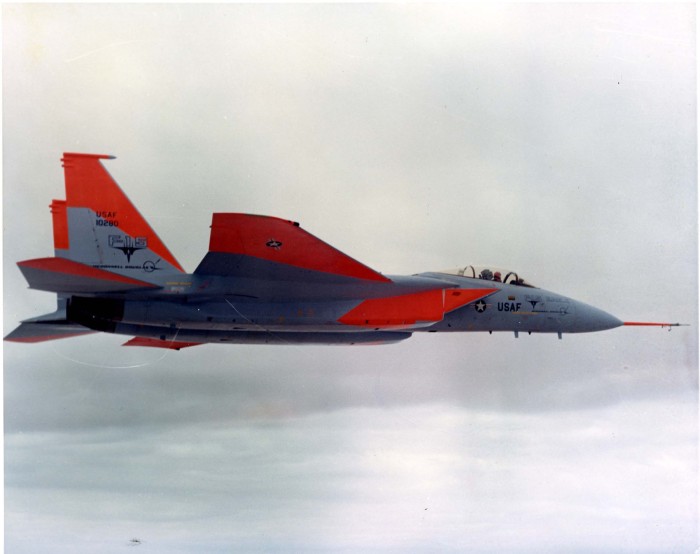
Steven A. Fino, Tiger Check: Automating the US Air Force Fighter Pilot in Air-To-Air Combat, 1950-1980 (Baltimore, MD: John Hopkins University Press, 2017). Fighter pilots are a strange breed–they have a unique culture all their own. However, how does that culture evolve when it is faced with new technologies that threaten to automate tasks that fighter pilots hold dear? Former F-15 pilot Steve Fino explores just that in this incredible book. Examining the F-86 Sabre, the F-4 Phantom II, and the F-15 Eagle, Fino explores the evolving relationship between man and machine in the cockpit of jet-age fighter planes. You can find my review of this book here.

Runner-up:

Bloody

Peter Fey, Bloody Sixteen: The USS Oriskany and Air Wing 16 during the Vietnam War (Lincoln, NE: Potomac Books, 2018). The USS Oriskany had the highest loss rates of any navy air unit in the Vietnam War. In addition to two massive fires, it was the boat from which Jim Stockdale and John McCain (among many others) became POWs for years. Peter Fey’s accessible, exciting narrative traces the Oriskany throughout its multiple tours and gives a palpable sense of what it was like to be on board and in the cockpit of the A-4 Skyhawks, F-8 Crusaders, and other planes the ship carried. The book is not perfect, but it is an engaging read especially aimed at a general audience.

Dr Brian Laslie
Origins of American Strategic Bombing Theory

Craig Morris, The Origins of American Strategic Bombing Theory (Annapolis, MD: Naval Institute Press, 2017). This book is ‘a twisting tale of individual efforts, organizational infighting, political priorities, and technological integration.’ It is also a book that places the development of American bombing theory firmly in the context of its time and rightly puts individuals into their proper place. Gone is the Billy Mitchell-centric view of air power development to be (rightly) replaced with an emphasis on Benjamin Foulois, Mason Patrick, William Sherman, Lord Tiverton, and others who worked tirelessly on the theories and doctrines of air power. In my opinion, the single best volume on American air power in the inter-war years.
aerial

Frank Ledwidge, Aerial Warfare: The Battle for the Skies (Oxford: Oxford University Press, 2018). I wrote about this book earlier in the year for The Strategy Bridge and called it ‘the single finest primer on air power covering every aspect from if you’ll excuse me, balloons to drones.’ I stand by that statement. This is the perfect primer for the history of air power. I cannot imagine someone interested in our profession not owning this book. I wish I had copies to serve as stocking stuffers…

Phantom

David R. Honodel, The Phantom Vietnam War: An F-4 Pilot’s Combat over Laos (Denton, TX: University of North Texas Press, 2018). This is a ‘there I was’ and ‘shoot the watch’ book, but it is also an amazingly poignant and honest look about learning to survive in a war the American people were unaware was occurring. It is in the best of its class at conveying the transformation a person can take in the crucible of a forgotten war over the skies of Laos. ‘Buff’ Honodel passed away earlier this year, and as I count my blessings this year, one of them will be for a man like Buff.

Runner-up:
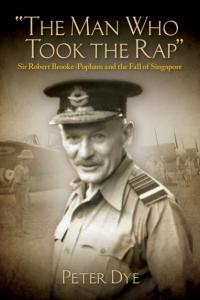
Brooke-Popham

Peter Dye, “The Man Who Took the Rap”: Sir Robert Brooke-Popham and the Fall of Singapore (Annapolis, MD: Naval Institute Press, 2018). This one landed on my desk rather late in the year but intrigued me almost immediately. As someone who has recently written a biography of a relatively unknown figure myself, I was excited to dive into this one, and it does not disappoint. As air power scholarship continues to expand, it has become an enjoyable pastime of mine to read about lesser-known, but equally important contributors to air power development. This book also fills a void for me in expanding my knowledge and understanding of other nation’s air power efforts.

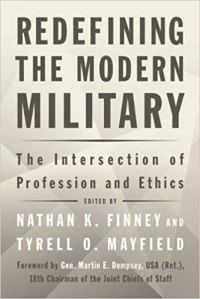
As well as providing you with our Christmas reading list, we would like to recognise the various presses and our social media friends who have been hard at work this year publishing the books above and some not strictly related to air power, but would make great gifts such as Redefining the Modern Military, edited by Tyrell Mayfield and Nathan Finney, and The Colour of Time: A New History of the World, 1850-1960 by Marina Amaral.

Our favourite military and air power related presses include Naval Institute Press and University Press of Kentucky who keeps on adding some excellent titles to their lists. Keep a lookout to the site in 2019 as we embark on expanding our writing on space power and space exploration a lot of which will be coming from the NASA Office of History and the University Press of Florida.

Finally, we would like to thank our contributors and readers. Without them, this site would not exist so thank you. If you want to write for us, then find out how to contribute here.

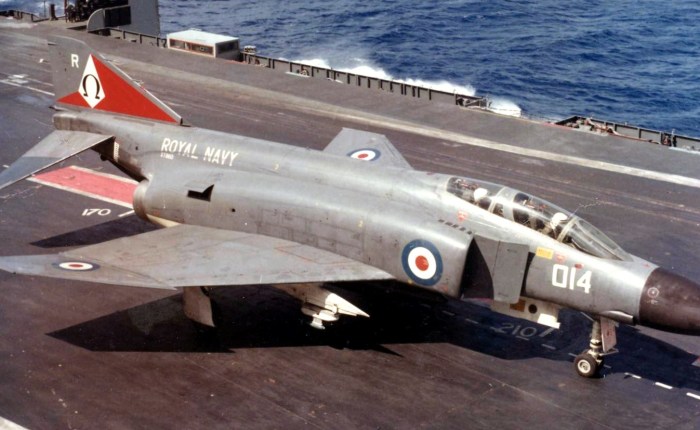
Header Image: A Royal Navy McDonnell Douglas Phantom FG.1 from 892 Naval Air Squadron aboard the aircraft carrier HMS Ark Royal (R09). (Source: Wikimedia)
#BookReview – Why Air Forces Fail: The Anatomy of Defeat

#BookReview – Why Air Forces Fail: The Anatomy of Defeat

By Dr Randall Wakelam

Robin Higham and Stephen J. Harris (eds.), Why Air Forces Fail: The Anatomy of Defeat, Revised and Expanded Edition. Lexington, KT: University Press of Kentucky, 2016. Images. Footnotes. Bibliography. Index. 454 pp.

Why Air Forces Fail

Editorial Note: In 2006, University Press of Kentucky published an edited volume that sought to examine the question of why air forces fail. Edited by the late Robin Higham and Stephen J. Harris, Why Air Forces Fail has become an essential volume as air power specialists seek to understand the reasons why some air forces are more successful than others. As one reviewer noted in the Journal of Military History regarding the first edition of this work, ‘one of the more interesting and better books on military aviation to appear in the last few years.’[1] As such, does this new edition add anything to the original volume?

When the first edition of Why Air Forces Fail was published in 2006, it immediately caught my attention. The title itself was intriguing for here was a work that was going to look not at why, or how, air forces succeed, but why air power at certain times and in certain places and circumstances has failed to deliver victory. Robin Higham was a greatly respected air power historian and had flown in the Royal Canadian Air Force (RCAF) in the Second World War, and Stephen Harris was and is the Director of History and Heritage for the Canadian Forces and had authored the Bomber Command section of the official history of the RCAF. It seemed that there were many good reasons in this Canadian reviewer’s mind for looking at the collection they had assembled.

PL 8096
A shot down Dornier ‘flying pencil.’ Two members of the German crew were killed, and two others were taken, prisoner. (Source: © IWM (PL 8096))

Higham’s introduction was particularly thought-provoking. He (1st Ed., p. 1) posited that ‘other things being equal’ it seemed that the best technology generally won. These other things included a series of complex factors which could however greatly impact the effectiveness of air power. Higham looked at and where necessary modified all of the factors upon which A.T. Mahan had conducted his analysis of sea power: national borders, a nation’s physical conformation, aircraft industry, size of the population, characteristics of the population, and nature of government. To these, he added:  location and sufficiency of air bases, the terrain being overflown during operations, capabilities of the aircraft and air weapons, and management of war decisions – ends, ways and means. Once these factors were explained to readers, Higham (1st Ed., p. 5) asked two central questions:

Did the loss of air superiority, if it ever existed, cause the collapse of the nation’s defenses?  And was that the sole cause [of the nation’s defeat]?

Higham drew his introduction to a close with an attempt to identify lessons or trends but did not attempt to present precise deductions. One had to turn to the conclusion of the collection for a summation of the editors’ thinking. There Higham and Harris posited that the simple presence of air assets does not, in fact, guarantee a victory. The last sentence (1st Ed., p. 354) of the book seems both appropriate and applicable to all nations and military services:

These [observations] suggest that the fall of an air force is the result of long-term failings, not an immediate failure ‘on the day’ by an air arm that is essentially ready for its allotted role.

Such was the first edition but what of this volume? Harris has related to me that Higham had negotiated the second edition, but that much of what he intended passed with him and as such there is little for those returning to the work to note that differs from the original. What the returning reader will find is two additional chapters, one by Harris dealing with RAF Bomber Command’s strategic operations against Germany. Harris focuses on the electronic warfare campaigns, including electronic countermeasures and electronic counter-countermeasures, waged by Bomber Command and by the Luftwaffe’s air defenders. This chapter shows that the RAF could not produce enough technicians to offset German capabilities. The second new chapter by Kenneth Werrell deals with the US services application of air power in the Vietnam conflict and how a range of factors prevented the American flying services from achieving the results sought by military and civilian leaders, particularly in the face of effective opposition. Other than these there is nothing new in the second edition other than two short commentaries on Harris’ and Werrell’s chapters. These remarks are added to the original conclusion along with two additional paragraphs commenting on the growing complexity of aircraft design and procurement in one case and the other the implicit failure of those involved in air power decisions to learn from history. Also, there is a very short, easily missed, dedication to Higham in the front piece of the volume. Why the publishers have taken this very understated approach to acknowledge Higham on the one hand, and the changes to the new edition on the other is baffling.

All this to say, I had hoped for more in this new edition. However, for those who have not read the first edition, this expanded version remains a valuable study of air power and of how and why it cannot guarantee success in conflict.

Dr Randall Wakelam teaches military and air power history at the Royal Military College of Canada. After graduating from RMC in 1975 he flew helicopters for the Army, becoming CO of 408 Tactical Helicopter Squadron in 1991. Along the way, he also had staff appointments in aircraft procurement and language training policy. Since 1993 he has been an educator, first in uniform at the Canadian Forces College in Toronto and now at RMC. His research and publishing focus on air power and military education.

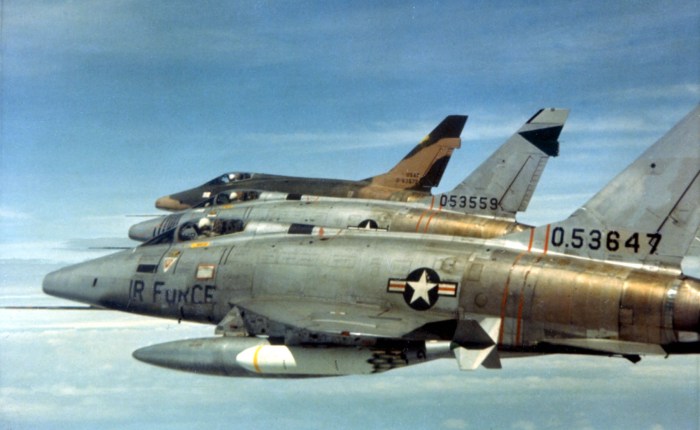
Header Image: F-100Ds of the 481st Tactical Fighter Squadron over South Vietnam in February 1966. Early F-100s were unpainted when they arrived in Southeast Asia like the foreground aircraft, but all eventually received camouflage paint like the aircraft in the back. (Source: National Museum of the US Air Force)

[1] Kenneth P. Werrell, ‘Book Review – Why Air Forces Fail,’ The Journal of Military History, 70:3 (2006), pp. 887-8.

#BookReview – Routledge Handbook of Air Power

#BookReview – Routledge Handbook of Air Power

By Dr Ross Mahoney

John Andreas Olsen (ed.), Routledge Handbook of Air Power. Abingdon: Routledge, 2018. References. Index. xix + 405 pp. Hbk.

Hanbook of Air Power

It is often challenging to name a single person who is a critical figure within any discipline. As I reflected here, this is also the case with air power studies if such a discipline exists. One individual who has made an indelible impact on air power studies over the past couple of decades is Colonel Professor John Andreas Olsen. As well as publishing several studies on Operation DESERT STORM and Colonel John Warden III, Olsen has successfully published a series of edited works that have focused on several aspects of air power. The importance of these works is that Olsen has been able to bring together leading scholars to write about critical themes concerning the use and development of air power. In this latest edited volume, Olsen has, once again, brought together a line-up of prominent scholars and military practitioners who are at the forefront of researching air power.

This book seeks to ‘improve knowledge of and insight into the phenomena of aerospace power.’ (p. 8) Indeed, as Olsen reflects, air power is more than just ‘aircraft, weapons systems and bombing.’ (p. 5) Recognising this, Olsen further notes that any analysis of air power must also encompass, though not limited to, issues such as ‘training, education, values, rules of engagement, leadership, adaptability, boldness in execution, and a range of other factors, tangible and non-tangible, that influence a military operation.’ (p. 5) It is around this broad definition that this book is designed. The book’s design reflects Sir Michael Howard’s sage words that military history, and by default military affairs in general, should be studied in breadth, depth, and context. As such, the book is split into five sections that in turn, deal with themes related to Howard’s advice. In providing a coherent pedagogical purpose to the book, Olsen has at least tried to provide some form and flow to the volume, which can often be a challenging prospect with any edited book.

The first section deals with the essence of air power and provides the breadth aspect for this volume. The section consists of six chapters dealing with air power anatomy, theory, history, high command, science and technology and ethics and international law. Each author is well placed to write their respective chapters, and each provides a useful overview of his subject. For example, Peter Gray provides an excellent strategic overview of the critical trajectory of air power history (pp. 70-80) while Philip Meilinger (pp. 35-45) discusses some of the essential themes evident in one hundred years or so of air power theory.

The second and third sections provide depth to this volume by exploring critical aspects related to the delivery and application of air power. It is in these sections where we see the greatest mix between academics and military practitioners in the volume. Of the 12 contributors to these sections, seven are currently serving officers ranging from a two-star officer, Air Vice-Marshal Richard Knighton of the Royal Air Force (RAF) through to two Wing Commanders from the Royal Australian Air Force, Travis Hallen and Chris McInnes.  The first section on delivering air power focuses on issues such as control of the air, command and control and logistics. It is good to see the latter included as it is clear, as Knighton concludes, that the logistical requirements of air power are not ‘well understood.’ (p. 151) The section on applying air power deals with the integration of air power with the other domains including space and cyber and each provides a good overview of the issues related to these topics.

Exercise Pitch Black 18
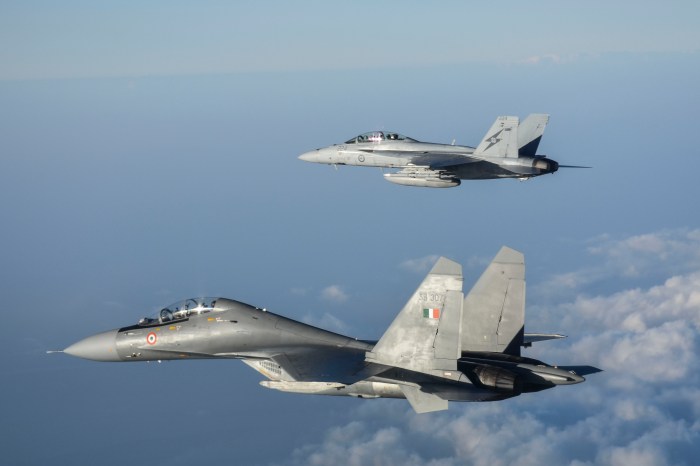
A Royal Australian Air Force F/A-18F Super Hornet from No. 1 Squadron (top) in formation with a SU-30MKI Flanker aircraft from the Indian Air Force during Exercise Pitch Black 18.(Source: Australian Department of Defence)

The final two sections provide the context to this volume by exploring issues related to the political-social-economic environment in which air power operates and a section on national case studies. The latter section includes some interesting selections including chapters on Indian, Pakistani, Brazilian and Japanese air power. Some might argue that chapters should have been included that dealt with, for example, the US, UK, and other European nations. However, this book needs to be read in conjunction with other edited volumes by Olsen, such as Global Air Power (2011) and European Air Power (2014) where you will find chapters dealing with these nations. As such, it makes a refreshing change to see other examples included in this volume. The section on the political-social-economic environment includes some exciting chapters dealing with the political effect of air power and coercive diplomacy. As Michael Clarke (p. 237) argues, air power is a potent weapon but needs to be used carefully to help achieve a political effect. Karl Mueller mirrored this view, who notes that ‘aerial bombing was not a panacea for preventing wars.’ (p. 252) Indeed, perhaps the critical criticism of air power thinkers has been their overestimation of the capability available to them as well as the place of military aviation within the toolbox of national power.

While there is much to praise in this work, there are no doubt some gaps that require some reflection. The first is a comment on authors, and this is not so much a direct criticism of the book but rather a comment on the state of the discipline at this moment in time. The book has been authored entirely by male academics or serving officers who, as already noted, are eminently qualified to write their various contributions. However, the lack of female contributors is disappointing especially as there are female academics and serving personnel writing about air power. Indeed, the issue of male dominance of the discipline is one we are well aware of here at From Balloons to Drones – all the editors and assistant editors are men. Indeed, at From Balloons to Drones we hope to continue to offer opportunities for all to contribute to the discussion about air power. Building on the above reflection is also the fact that each of the authors in this volume has some form of relationship with the military. They are either serving or retired officers, teaching or teaching within the professional military education (PME) ecosystem, or working for a think-tank associated with the military, such as RAND. If this sample of authors in this volume is indicative of the discipline, then the study of air power still struggles from the problem identified 20 years ago by John Ferris, who wrote that:

[those studying air power are either] the children of airmen, have been military personnel themselves, and have been employed at a historical office or service school in Canada, Germany, the United Kingdom, or the United States.[1]

If this remains the case, there remains an open question as to how we broaden out the discipline to avoid accusations such as the weaponisation of the past. Linked to this, of course, is the question of what a broader and more diverse perspective on air power would bring to the discipline.

Regarding content, several areas could have further strengthened this volume. For example, it is curious that Olsen’s view concerning what encompasses the study of air power begins with training and education; however, neither subject is present in this volume. Concerning education, its omission is even more curious given the focus on the so-called conceptual component in programmes such as the RAF’s Thinking to Win, Plan Jericho in Australia, and the Royal Canadian Air Force’s Airpower in Formation. Interestingly, and perhaps indicative of the perceived importance of this volume, there is a paperback version of this book that has been produced in conjunction with the RAF’s Centre for Air and Space Power Studies and includes the Thinking to Win logo. However, as Meilinger reflected in his chapter, ‘[N]eeded are airmen well grounded in all aspects of air warfare, including the theoretical.’ (p. 44) If this is the case, then it follows that the provision of high-quality air power education is critical, and a chapter on this subject would have been valuable. Other chapters that could have been included include the culture of air forces and leadership instead of Stephens’ (pp. 24-34) focus on high command. Indeed, it is often remarked that air forces are somehow different to army and navies in their outlook. If this is the case, then an examination of the culture of air forces and issues such as leadership would have further enriched this volume.

Overall, despite my criticisms above, this is an excellent and essential contribution to our understanding of air power. As noted, the pedagogic layout of the book helps give the volume purpose that leads the reader through many critical issues related to air power. As such, while the book’s primary market will undoubtedly be serving air force personnel involved in PME and training activities, there is enough in this volume that other interested readers will gain much from this collection.

[1] John R. Ferris, ‘Review Article – The Air Force Brats’ View of History: Recent Writing and the Royal Air Force, 1918–1960,’ The International History Review, 20:1 (1998), p. 119

Dr Ross Mahoney is the Editor of From Balloons to Drones and is an independent historian and defence specialist based in Australia. Between 2013 and 2017, he was the resident Historian at the Royal Air Force Museum, and he is a graduate of the University of Birmingham (MPhil and PhD) and the University of Wolverhampton (PGCE and BA). His research interests include the history of war in the twentieth and twenty-first centuries, air power and the history of air warfare, and armed forces’ social and cultural history. To date, he has published several chapters and articles, edited two books, and delivered papers on three continents. He is a member of the Royal Historical Society and an Assistant Director of the Second World War Research Group. He can be found on Twitter at @airpowerhistory.

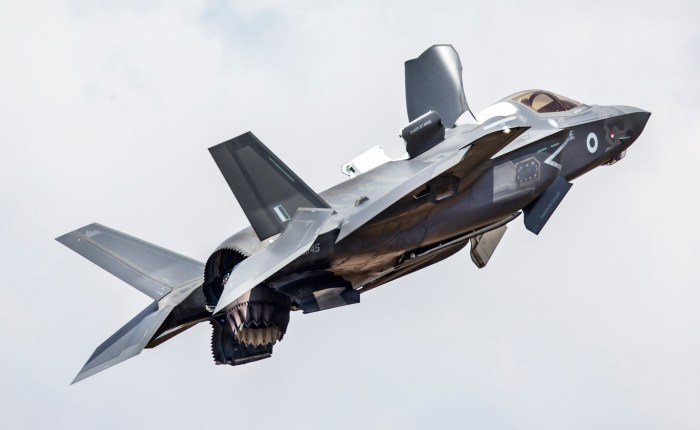
Header Image: An RAF F-35B Lightning from No. 617 Squadron stationed at RAF Marham. This aircraft is performing a hover manoeuvre during the Royal International Air Tattoo in 2018. (Source: UK MoD Defence Imagery)

#ResearchNote – Redefining the Modern Military: An Airman’s Perspective

#ResearchNote – Redefining the Modern Military: An Airman’s Perspective

By Dr Brian D. Laslie

Editorial Note: In this Research Note, Assistant Editor, Dr Brian Laslie reflects on his contribution to a new volume about military professionalism entitled Redefining the Modern Military: The Intersection of Profession and Ethics that has been edited by Ty Mayfield and Nathan Finney and published by Naval Institute Press.

In the Summer of 2015, I packed up some clothes and (a lot of) books and moved down to Montgomery, Alabama to attend the United States Air Force’s (USAF) Air Command and Staff College (ACSC). I had been selected along with about a dozen other civilians to attend the 10-month course. I looked upon those ten months in front of me as something of a sabbatical and a chance to research and write.

Redefining

On the back end of my time at ACSC, I received a call from Ty Mayfield, of The Strategy Bridge, about a book project he and a team of authors were working on. This forthcoming project, Redefining the Modern Military: The Intersection of Profession and Ethics, published by the phenomenal people at Naval Institute Press, was an effort by the team at The Strategy Bridge to push the ball forward on the discussion of professionalism, ethics, civil-military relations, and professional education in the modern U.S. military. Following in the footstep of Samuel Huntington, Ty and co-editor Nate Finney collected chapters from a group including international and American officers as well as six academics holding both college and professional military education (PME) positions. It was a robust group, especially considering that most of the chapter authors only knew each other through Twitter. It turns out, Ty and Nate had covered all of their bases except one. In the end, they had no one writing about the USAF, the air domain, or the Airmen’s perspective. Thus, the phone call to me.

It turns out Ty and Nate decided to reach out to me at a somewhat fortuitous time. Ty asked me if I had any thoughts about professionalism and the USAF. As a current student at a PME institution who had spent the better part of seven months pouring over USAF history, I had plenty to say. I titled my chapter, ‘Born of Insubordination: Culture, Professionalism, and Identity in the Air Arm,’ and I am somewhat taciturn that my chapter contribution turned into something of “Oh and ANOTHER THING!” ranting about problems of USAF PME and the Air Force writ large. Ty and Nate did not see it that way.

What I produced, at least the way Ty and Nate ended up describing it was a chapter about the:

particularities inherent in the air arm of the U.S. military. Born from a culture of insubordination, Laslie describes three case studies that display how the positive aspects of this trait, one he titles “pragmatic professionalism”, has shaped – and will continue to shape – the Air Force. Using a historical lens to show the USAF’s unique history, identity, and culture Laslie uses these contemporary case studies to demonstrate that while the Air Force has long suffered with an internal identity crisis amongst its officer corps, the “stovepipes” that developed over the course of the past 70 years are actually conduits for professional advancement in different career fields and not something that needs to torn down.

My chapter on the USAF is but one of twelve. Other chapters include: ‘Questioning Military Professionalism,’ by Pauline Shanks-Kaurin, ‘Professionals Know When to Break the Rules,’ by H.M. ‘Mike’ Denny, ‘Ethical Requirements of the Profession: Obligations of the Profession, the Professional, and the Client,’ by Rebecca Johnson, plus eight others as well as an introduction and conclusion from the editors.

The book proper opens with:

[t]he challenging task of self-assessment for the military profession going into the twenty-first century. Crafted by military officers with recent experience in modern wars, academics who have trained and educated this generation of combatants, and lawyers and civilians who serve side by side with the defense enterprise at all levels, this volume seeks to begin the process of reevaluation for the 21st century.’

While discussing professionalism is not our usual milieu here at From Balloons to Drones, we have been known to stray into the realm from time to time; for example, see our recent post on John Boyd. Indeed, we believe that self-examination in any organisation is an essential part of development and Mayfield, and Finney should be commended for seeing this project through to publication. (We would encourage anyone interested in writing about issues related to professionalism within the context of air arms – air force, naval or army – to get in contact. Ed.)

In the age of social media, we have an entire generation of company and field grade officers who are taking their professional military education into their own hands. Through mediums like The Strategy Bridge, the Military Writer’s Guild and From Balloons to Drones, younger officers are studying and communicating about their profession in new ways. Ty and Nate seized on this moment to produce, what I hope, is a book that will generate discussion across the services and the military establishment at large. My contribution is modest, but this book surely has something for everyone.  From company grade officers to flag and general officers, I hope it will do what it sets out to do, which is nothing less than ‘Redefine’ the modern military.

Dr Brian Laslie is a US Air Force Historian and currently the Deputy Command Historian at North American Aerospace Defense Command (NORAD) and United States Northern Command (USNORTHCOM). He is an Assistant Editor at From Balloons to Drones and a 2001 graduate of The Citadel and a historian of air power studies. He received his Masters’ from Auburn University Montgomery in 2006 and his PhD from Kansas State University in 2013. He is the author of Architect of Air Power: General Laurence S. Kuter and the Birth of the US Air Force (2017) and The Air Force Way of War (2015). The latter book was selected for the Chief of Staff of the Air Force’s 2016 professional reading list and the 2017 RAF Chief of the Air Staff’s reading list. He can be found on Twitter at @BrianLaslie.

Header Image: A flight of Aggressor F-15 Eagles and F-16 Fighting Falcons fly in formation, 5 June 2008, over the Nevada Test and Training Ranges. The jets are assigned to the 64th and 65th Aggressor Squadrons at Nellis Air Force Base. (Source: US Department of Defense)

The Role of History in Educating Air Power Strategists

The Role of History in Educating Air Power Strategists

By Dr Ross Mahoney

Editorial Note: On 19 September 2018, our editor, Dr Ross Mahoney delivered a paper on the subject of ‘The Role of History in Educating Air Power Strategists’ at a seminar organised by the Royal Australian Air Force’s (RAAF) Air Power Development Centre in Canberra. A precis of this paper was published in the Pathfinder bulletin issued by APDC, which can be found here. The Pathfinder series covers a range of issue from strategy, historical analyses, operations, administration, logistics, education and training, people, command and control, technology to name a few. Irrespective of the subject though, Pathfinders will always be focused on the relevance to air power; they are not intended to be just a narrative but deliver a measure of analysis. Apart from the addition of some minor changes to make this precis applicable to From Balloons to Drones as well as the inclusion of footnotes and further reading suggestions, this article appears as published in Pathfinder. We are grateful to APDC for permission to re-publish the piece, and the views in this article and the associated Pathfinder are not necessarily those of the RAAF.

‘[t]he study of military history lies at the foundation of all sound military conclusions and practice.’

Rear-Admiral A.T. Mahan, ‘The Naval War College,’ The North American Review, (1912)[1]

‘The word history carries two meanings […] It refers both to what actually happened in the past and to the representation of that past in the work of historians.’

John Tosh, The Pursuit of History, Third Edition, (1999)[2]

What is history? What is its relevance to an air power strategist? These are important questions; however, as Richard Muller, a senior member of the faculty at the US Air Force’s School of Advanced Air and Space Studies, reflected in 2016, ‘as a rule air forces have not embraced historical study to the same extent as have their army or navy counterparts.’[3] Nevertheless, in 1912, a year after an Italian aeroplane dropped the first ‘bomb’ over Libya, noted US naval historian and strategist Alfred Thayer Mahan reflected on the link between military history and ‘sound military conclusions.’ However, history does not provide clear lessons. Nevertheless, the study of the past does offer a lens through which to analyse, understand and reflect on the challenges currently faced by modern air forces.

Air Corps Tactical School
The Air Corps Tactical School (created as the Air Service Field Officers School in 1920) went beyond its mandate of training officers to also become an engine for air power theory development in the interwar period. (Source: US Air Force Air University)

This article considers some of the issues related to applied military history beginning with an outline of the purpose of history and the challenges of applying the past to the present. It also considers how air forces have used the study of the past as a tool for education while concluding with some tentative thoughts on how history can be used to educate strategists in the continuing challenge to achieve professional mastery.[4]

To start with, the term ‘education’ is used in this narrative in a broad context and incorporates both formal and informal learning. Similarly, the term ‘strategist’ is used in a collegiate manner and assumes that modern air forces seek personnel who are professional masters, well-versed in the core knowledge that underpins the application of air power.

As the British historian John Tosh reflected, the term history is ambiguous at best. Is history a collection of facts related to what has happened or is it the scholarly discussion and representation of the past? If the latter statement is accepted as being correct, then it can also be assumed that the interpretation of the past is an argument without an end. While a hackneyed observation, history is a dynamic field of study, one where historians continually re-examine evidence and reinterpret the past. Linked to this is the extent of historical information available to historians and, by default, strategists who seek to apply lessons from the past to the present. The archival records and evidence that underpin the interpretation of the past are normally incomplete. For example, the National Archives of Australia only preserves a small amount of the material generated by the Australian Government.

Moving beyond the above understanding of history, the field of military history can be split into three subfields: popular, academic, and applied history.[5] There is a degree of overlap between the latter two. The main criticism of applied military history is that it is a form of weaponising the past to cater for the present.[6] Underpinning this criticism is a view that those writing such history do so without sufficient understanding of the context in seeking to deduce lessons learnt. Unfortunately, this criticism is currently directed at academics working at institutions delivering professional military education. These institutions use history to illuminate and provide context to the ambiguous challenges that officers attending them are likely to confront in the future.

Historically, the criticism of weaponising the past does carry some weight, and therefore air power strategists could be criticised for the poor use of history to support their arguments. Indeed, as Sir Michael Howard, a distinguished military historian, noted in his 1961 lecture on ‘The Use and Abuse of Military History’:

[W]hen great [interwar] pioneers of air war…advocated striking at the homeland and at the morale of the enemy people…they were basing their conclusions on their interpretation of past wars’. (emphasis added)[7]

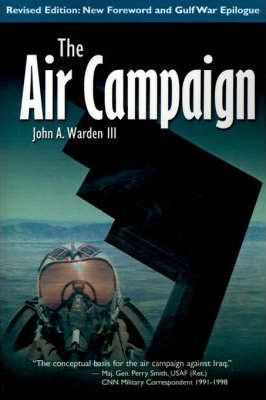
Warden

More recently, Colonel (retired) John Warden III’s book, The Air Campaign, has been criticised for his use of a selective reading of history to fit the theory being propounded in it.[8] Admittedly, Warden is not a historian. However, such selective use of history becomes problematic to the broader task of delivering professional education when such texts appear in, for example, Staff College reading lists where they can reinforce a narrow, and at times wrong, understanding of some of the officers they are meant to educate. Despite this criticism, it is clear that many air power thinkers have recognised the value of a broad reading of history. For example, in a 1921 article on ‘Strategy and Air Strategy,’ Group Captain John Chamier of the Royal Air Force reflected on the challenge of deducing appropriate principles for the use of air power given the brief history of air warfare till then. Nevertheless, Chamier recognised that ‘strategic principles are derived from the study of history’, and he recognised that examples from ‘naval and military strategy’ could provide the necessary framework for a discussion of ‘air strategy.’[9]

While history and the application of its lessons by air forces is fraught with challenges, its importance as a didactic tool for the military cannot be underestimated. Indeed, the study of history has been, and remains, an element of the curricula at educational establishments of most air forces. However, considered in a broad manner, the study of history has been unbalanced. For example, in the late-1940s and 1950s, history and related subjects featured little on the curriculum at the RAAF College. As Alan Stephens has noted, the RAAF of this period identified itself as a ‘narrow technocracy’ with knowledge of the Air Force’s core business to be deduced from its ‘technical components’ rather than a ‘study of its history and ideas.’[10]

To conclude, there are several areas where the contemporary study of history plays a key role in the education of air power theorists and strategists. Perhaps most important is that a deep and contextual study of history provides an important understanding for military personnel seeking to gain professional mastery of the profession of arms. Indeed, if it is accepted that the aim of learning is to develop the cognitive ability to understand and deal with ambiguity, rather than to provide clear-cut answers to current problems, then the study of history has a role to play.

The skills associated with historical analysis refines human cognitive areas such as the ability to make considered judgements. An important contributor to the effectiveness of this learning process has been the increasing civilianisation of the academic delivery at institutions catering to professional military education. At a practical level, the use of Staff Rides as a learning tool could also ensure that history could be used as a means to explore ideas outside of the confines of the traditional education environment. However, this process also has its own challenges.[11] In the final analysis, Lieutenant General Sir John Kiszely’s remark that the study of history needs to form an essential part of a ‘balanced diet’ of education for the military professional in order for them to develop the knowledge to be effective, rings completely true.[12]

Key Points

  1. Even though history may not provide clear lessons, the study of the past offers a lens through which to analyse, understand and reflect on the challenges currently faced by modern air forces;
  2. History could be considered a rather dynamic field of study, one where historians continually re-examine evidence and re-interpret the past;
  3. It is recognised that ‘strategic principles are derived from the study of history.’

Further Reading

  • Gray, Peter, ‘Why Study Military History?,’ Defence Studies, 5:1 (2005), pp. 151-64.
  • Muller, Richard R., ‘The Airpower Historian and the Education of Strategists’ in Bailey Jr., Richard J., Forsyth Jr., James W., and Yeisley, Mark O., (eds.), Strategy: Context and Adaptation from Archidamus to Airpower (Annapolis, MD: Naval Institute Press, 2016).
  • Murray, Williamson, and Sinnreich, Richard Hart (eds.), The Past as Prologue: The Importance of History to the Military Profession (Cambridge: Cambridge University Press, 2006).

Dr Ross Mahoney is the editor and owner of From Balloons to Drones as well as being an independent historian and defence specialist based in Australia. He is a graduate of the University of Birmingham (MPhil and PhD) and the University of Wolverhampton (PGCE and BA). His research interests include the history of war in the twentieth and twenty-first centuries, air power and the history of air warfare, and the social and cultural history of armed forces. To date, he has published several chapters and articles, edited two books, and delivered papers on three continents. He is an Assistant Director of the Second World War Research Group. He can be found on Twitter at @airpowerhistory.

Header Image: An Architect’s perspective drawing of the proposed RAF (Cadet) College at Cranwell. (Source: © IWM ((MOW) C 1081))

[1] Rear-Admiral A.T. Mahan, ‘The Naval War College,’ The North American Review, 196:680 (1912), p. 78.

[2] John Tosh, The Pursuit of History: Aims, Methods and New Directions in the Study of Modern History, Third Edition (Harlow: Pearson Education, 1999), p. viii.

[3] Richard R. Muller, ‘The Airpower Historian and the Education of Strategists’ in Richard J. Bailey Jr., James W. Forsyth Jr., and Mark O. Yeisley (eds.), Strategy: Context and Adaptation from Archidamus to Airpower (Annapolis, MD: Naval Institute Press, 2016), p. 113.

[4] On professional mastery in air forces, see: Sanu Kainikara, ‘Professional Mastery and Air Power Education,’ Working Paper, 33 (Canberra: RAAF Air Power Development Centre, 2011).

[5] John A. Lynn III, ‘Breaching the Walls of Academe: The Purposes, Problems, and Prospects of Military History,’ Academic Questions, 21:1 (2008), p. 20.

[6] Kim Wagner, ‘Seeing Like a Soldier: The Amritsar Massacre and the Politics of Military History,’ in Martin Thomas and Gareth Curless (eds), Decolonization and Conflict: Colonial Comparisons and Conflicts (Bloomsbury Academic, 2017), pp. 25-7.

[7] Michael Howard, ‘The Use and Abuse of Military History (lecture),’ Journal of the Royal United Service Institution, 107:625 (1962), p. 10.

[8] John Andreas Olsen, John Warden and the Renaissance of American Air Power (Washington DC: Potomac Books, 2007), pp. 78-9. Like Warden, Colonel John Boyd’s work ‘cherry-picked’ history ‘to provide illustrations and empirical validation for patterns he observed in combat.’ However, it should be recognised that Boyd was an airman who was a general strategist rather than an air power thinker per se, though his ideas do have applicability to the air domain. See: Frans Osinga, ‘The Enemy as a Complex Adaptive System: John Boyd and Airpower in the Postmodern Era’ in John Andreas Olsen (ed.), Airpower Reborn: The Strategic Concepts of John Warden and John Boyd (Annapolis, MD: Naval Institute Press, 2015), pp. 53-4.

[9] Group Captain J.A. Chamier, ‘Strategy and Air Strategy,’ Journal of the Royal United Service Institution, 66 (1921), p. 641.

[10] Alan Stephens, The Australian Centenary History of Defence: Volume II – The Royal Australian Air Force (Melbourne: Cambridge University Press, 2001), p. 188.

[11] On the challenges associated with staff rides, see: Brigadier R.A.M.S. Melvin British Army, ‘Contemporary Battlefield Tours and Staff Rides: A Military Practitioner’s View,’ Defence Studies, 5:1 (2005), pp. 59-80; Nick Lloyd, ‘Battlefield Tours and Staff Rides: A Useful Learning Experience?,’ Teaching in Higher Education, 14:2 (2009), pp. 175-84.

[12] John P. Kiszely, ‘The Relevance of History to the Military Profession: A British View’ in Williamson Murray and Richard Hart Sinnreich (eds.), The Past as Prologue: The Importance of History to the Military Profession (Cambridge: Cambridge University Press, 2006), p. 32.

#BookReview – Eagles Over Husky: The Allied Air Forces in the Sicilian Campaign, 14 May to 17 August 1943

#BookReview – Eagles Over Husky: The Allied Air Forces in the Sicilian Campaign, 14 May to 17 August 1943

By Dr Brian Laslie

Alexander Fitzgerald-Black, Eagles Over Husky: The Allied Air Forces in the Sicilian Campaign, 14 May to 17 August 1943. Solihull: Helion & Company, 2018. Images. Maps. Tables. Notes. Bibliography. Hbk. 192 pp.

Eagles

The Allied invasion of Sicily, Operation HUSKY, is often viewed as a logical progression from the North Africa campaign (TORCH) through Sicily and on into Italy. It is one of the ‘Big Four’ operations in the European and Mediterranean theatres of operations, which culminated in the invasion of Normandy. Sicily has often been either overlooked entirely or seen through a more ground-centric lens (think of the movie Patton). That being said, there has been some excellent historical work in recent years on the invasion and even some very good historical-fiction by, for example, Jeff Sharra. Perhaps overlooked is too strong a word. Overshadowed is perhaps apter and nowhere is the invasion of Sicily more overshadowed than in the realm of air power. True, there is Robert S. Ehlers excellent work The Mediterranean Air War (2015), which covers the entirety of the theatre, but a singular focus on the air war exclusively over Sicily has been missing.

Alexander Fitzgerald-Black seeks not only to bring HUSKY back into focus but seeks to delve into the often-overlooked role of air power in the Mediterranean theatre, particularly over the skies of Sicily and does so by linking the tactical to the strategic. Fitzgerald-Black (p. xxii) states that:

This work reconnects the role of the Allied air forces in the Battle for Sicily to the wider narrative of the air war and to the crucial Allied strategy for engaging Axis forces in the Mediterranean Theater during the Summer of 1943.

Air power itself has been viewed through various lenses, but the most notable narrative through HUSKY was that Allied air power did not live up to the promises it made – Fitzgerald-Black singles out Carlo D’Este for holding this interpretation. The author seeks to turn this traditional narrative on its head, and Fitzgerald-Black argues persuasively that some authors have focused too myopically on the tactical missteps and therefore, missed the greater strategic narrative. Fitzgerald-Black (p. xxiii) argues that ‘Allied strategic success in Sicily and the Mediterranean in mid-1943 mattered far more than the failure to prevent German forces on the island from escaping.’ Allied air power forced the Luftwaffe to pay a heavy toll for defending not an only island but the theatre writ large. Also, attacks against the Italian mainland helped drive Italy from the war entirely.

CNA 1352
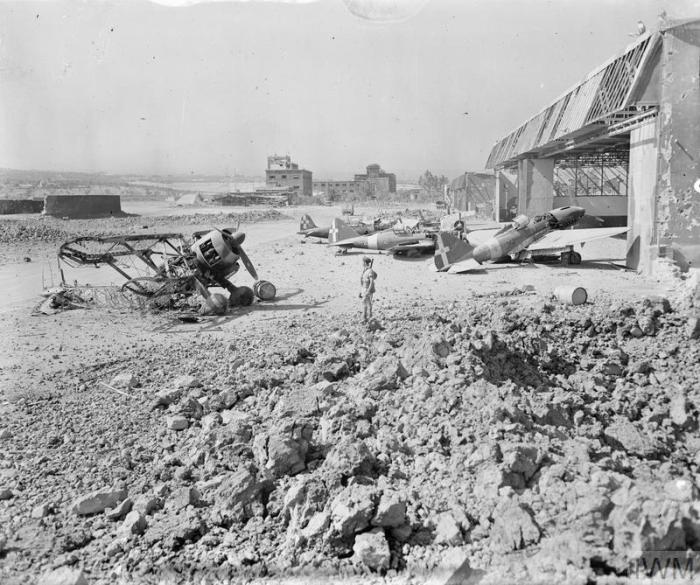
Wrecked and damaged Italian fighters outside bomb-shattered hangars at Catania, Sicily, under the scrutiny of an airman, shortly after the occupation of the airfield by the RAF. (Source: © IWM (CNA 1352))

In the buildup to the landings, German and Italian air power was systematically, but not entirely, destroyed. Some authors have pointed this out as a failure of air power showing their preference for a Clausewitzian decisive battle that rarely appears. The Luftwaffe, under the direction Wolfram von Richthofen removed their bombers to the Italian mainland, believing Sicily to be untenable. Attacks on German and Italian bases gained enough air superiority that the invasion took place without prohibitive interference from the Luftwaffe or Regia Aeronautica. The simple fact was that Allied air power forced the Luftwaffe and Regia Aeronautica to react in ways it did not want to. Some might say Allied leaders had got inside their enemy’s OODA loop (p. 54, 63).

Again, there exist critiques of Allied air power on the day of the landings, but as Fitzgerald-Black demonstrates, the Germans and the Italians seemed to be to some degree husbanding their resources. Even in doing so, it was difficult for the Luftwaffe to contest control of the skies seriously. Where engagements did occur, the author shows that ‘[E]ffectiveness cannot only be measured by casualties inflicted upon Axis aircraft.’ There were occasions (p. 83) where ‘USAAF and RAF fighters broke up enemy formations and/or forced the bombers to jettison their payloads prematurely […].’ Fitzgerald-Black does an excellent job of interweaving his analysis and engaging prose with numerous first-person accounts from both sides of the conflict. His use of Johannes Steinhoff’s remembrances adds a level of balance to the work, wherein the points and actions of both sides are brought forth. Looking at the battle in retrospect, ‘The success of the German tactical withdrawal pales in comparison to the strategic victory the Allies won in Sicily during the Summer of 1943.’ Italy was knocked out of the war and Germany was now forced to defend Europe on two fronts that soon turned into three with the invasion of Normandy in June of 1944 (p. 159).

CM 5290
A line of Martin Baltimore Mark IVs of No. 223 Squadron RAF at Luqa, Malta, being refuelled and loaded with bombs for a raid on enemy positions around Catania, Sicily. (Source: © IWM (CM 5290))

One final point worth mentioning, and this is more a press decision than a note on the author’s work, but the use footnotes versus endnotes is a welcome change making it significantly easier to check the author’s sources at a quick glance. In the end, Fitzgerald-Black has done an outstanding job of refocusing attention on the air war over Sicily and has contributed to the study of air power history. His work resides alongside Chris Rein and Robert Ehlers in broadening our understanding of the Mediterranean theatre during the Second World War. His expert linking of tactical, operational, and strategic in a clear narrative allows all readers to understand that while one area of a campaign might be deemed a tactical misstep, the overarching importance of the strategic victory cannot be taken for granted.

Dr Brian Laslie is an Air Force Historian and currently the Deputy Command Historian at North American Aerospace Defense Command (NORAD) and United States Northern Command (USNORTHCOM). He is also an Assistant Editor at From Balloons to Drones. A 2001 graduate of The Citadel and a historian of air power studies, he received his PhD from Kansas State University in 2013. His first book The Air Force Way of War (2015) was selected for the Chief of Staff of the Air Force’s and the Royal Air Force’s Chief of the Air Staff professional reading lists. His recently published Architect of Air Power: General Laurence S. Kuter and the Birth of the US Air Force. He lives in Colorado Springs. He can be found on Twitter at @BrianLaslie.

Header Image: The first RAF Supermarine Spitfire lands at an airfield in Sicily during the drive on Messina. The airfield was converted from a wheat field and is watched by Sicilian farmers who are working on the harvested wheat. (Source: © IWM (CNA 1098))

Call for Contributors – From Balloons to Drones

Call for Contributors – From Balloons to Drones

Established in 2016, From Balloons to Drones is a scholarly online platform that provides analysis and debate about air power history, theory, and contemporary operations in their broadest sense including space and cyber power. Air power is to be understood broadly, encompassing not only the history of air warfare, including social and cultural aspects but also related fields such as archaeology, international relations, strategic studies, law and ethics.

Since its emergence, air power has increasingly become the preferred form of military power for many governments. However, the application and development of air power is controversial and often misunderstood. To remedy this, From Balloons to Drones seeks to provide analysis and debate about air power through the publication of articles, research notes, commentary, book reviews, and historic book reviews.

From Balloons to Drones welcomes and encourages potential submissions from postgraduates, academics, and practitioners involved in researching the subject of air power.

Submissions can take the following forms:

  • ArticlesFrom Balloons to Drones publishes informative articles on air power that range from historical pieces to the analysis of contemporary challenges. These well-researched articles should attempt to bridge a gap between the specialist and the non-specialist They should be around c.2,000 words, though From Balloons to Drones will accept larger pieces and we reserve the right to publish them in parts.
  • Air War BooksFrom Balloons to Drones publishes a series of review articles that examine the top ten books that have influenced writers on air power.
  • CommentariesFrom Balloons to Drones publishes opinion pieces on up-to-date news on either contemporary or historical subjects. These should be no longer than c.1,000 words.
  • Research NotesFrom Balloons to Drones publishes research notes related to contributor’s current research projects. These take the form of more informal pieces and can be a discussion of a source or a note on a recent research theme. These should be c.500 to 1,000 words.
  • Book ReviewsFrom Balloons to Drones publishes occasional book reviews that aim to be an accessible collection of appraisals of recent publications about air power.
  • Historic Book Reviews From Balloons to Drones publishes occasional historic book reviews that aim to be an accessible collection of open access appraisals of critical historic publications about air power history, theory, and practice.

Submissions should be submitted in Word format and emailed to the address below with ‘SUBMISSION’ in the subject line. Also, please include a 50-100-word biography with your submission. References can be used, and please be careful to explain any jargon. However, if you are not sure if your idea fits our requirements, then please email us with ‘POTENTIAL SUBMISSION’ in the subject line to discuss.

If you are interested in contributing, please email our editor, Dr Ross Mahoney, at airpowerstudies@gmail.com or visit our webpage here:- https://balloonstodrones.com/

Bringing It All Back Home: How one sortie by the No. 1474 Flight RAF in December 1942 helped save the lives of countless aircrew

Bringing It All Back Home: How one sortie by the No. 1474 Flight RAF in December 1942 helped save the lives of countless aircrew

By Dr Thomas Withington

The weather was mild for early December as scattered showers, and high winds continued to visit RAF Gransden Lodge near Cambridge.[1] It was a shade after 02:00 on the morning of 2 December 1942 when Flight Sergeant Edwin Paulton (Royal Canadian Air Force/RCAF) gently rotated the yoke causing the Vickers Wellington Mk1C of the Royal Air Force’s (RAF) No. 1474 (Special Duties) Flight to unstick from the runway and climb into the East Anglian night.[2] Paulton’s sortie that autumnal evening was part of the RAF’s response to the growing intensity of the Luftwaffe’s defensive effort against Bomber Command’s attacks on targets in Germany.

Emil-Emil

With most of Western Europe’s occupation now complete, and the invasion of the UK postponed indefinitely by Adolf Hitler in September 1940 following the Battle of Britain, the German high command turned its attention towards bolstering the country’s defences against RAF Bomber Command.[3] Even with the commencement of the Axis invasion of the Soviet Union on 22 June 1941, which involved a significant effort by the Luftwaffe, this did not deprive Germany of fighter defences to resist the Command’s efforts.[4] These fighters were able to exact heavy losses and between July 1942 when the RAF commenced recording aircraft loss and damage to separate causes, and December 1942 Bomber Command lost 305 aircraft to fighters during the day and night operations; 2.3 per cent of all sorties despatched.[5]

C 5477
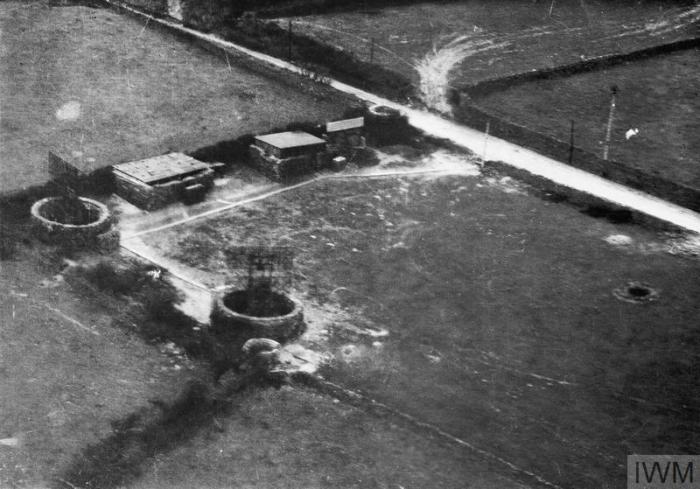
A low-level aerial reconnaissance photograph of the ‘Freya’ radar installations at Auderville, taken using an F.24 side-facing oblique aerial camera. (Source: © IWM (C 5477))

It was imperative for Bomber Command to staunch the bleeding. By late August 1942 Bomber Command understood the workings of the Luftwaffe’s integrated air defence system. The initial detection of incoming bombers was performed by a chain of FuMG-80 Freya ground-based air surveillance radars. A defensive ‘belt’ known as the Kammhuber Line, named after Generalleutnant Josef Kammhuber, the head of the Luftwaffe’s XII Fliegerkorps, stretched from Kiel in northern Germany southwest past Luxembourg. Behind this line lay all of Germany’s major cities and industrial centres including Cologne, Düsseldorf, Frankfurt, Hamburg, Hanover, and Stuttgart. Quite simply it was almost impossible for bombers to approach their targets without crossing this line. The line was subdivided into separate ‘boxes’ each covering 247 square miles (640 square kilometres). Within each box were two FuMG-62D Würzburg ground-controlled interception radars. One of these radars would hold the fighter in its gaze while another would search the box for a bomber. A ground controller would coordinate the interception seeing the position of the fighter and bomber on his radar screens. He would then bring these two together. Once the fighter was just short of one nautical mile/nm (1.8 kilometres/km) from the bomber, the ground controller would hand over the interception to the fighter. The crew would activate their Lichtenstein-BC airborne interception radar to locate the bomber and then press home their attack. All the while the fighter and the ground controller would remain in radio contact.[6]

The British Air Ministry issued a report in July 1942 which stated that Signals Intelligence (SIGINT) had revealed that from early 1942 the Luftwaffe’s night fighters had been using a device codenamed ‘Emil-Emil’. Little was known about this beyond the fact that it seemed to assist interceptions and may have used either radar or infrared technology to do so. Initially, this equipment appeared to be used exclusively by night fighters near Vlissingen on the Netherlands’ west coast. Further investigations revealed that by October 1942 Emil-Emil appeared to be in widespread service elsewhere in the night fighter force. Such was the discipline of Luftwaffe fighter crews and their ground controllers that the purpose of Emil-Emil was not betrayed in radio chatter.[7]

Experts from the Telecommunications Research Establishment (TRE), tasked with developing and producing electronic countermeasures for the British armed forces, collected radio signals on the East Coast which revealed transmissions on a 491 megahertz/MHz frequency strongly suspected of being transmitted by Emil-Emil.[8] This information was a breakthrough, but the relationship of these transmissions to Emil-Emil had to be confirmed. The only way to do so would be to fly one of the RAF’s SIGINT gathering aircraft from No. 1474 Flight into hostile airspace where there was a high chance that enemy fighters would be encountered. The rationale was to use the aircraft for two interrelated tasks. First, entice a night fighter into an attack and then record the characteristics of any hostile radio signals it transmitted. By doing this, it would be possible to determine whether Emil-Emil was an airborne interception radar. As always in electronic warfare, once it was discerned that the enemy was using a particular type of radar in a particular way, it would be possible to devise means to jam it.

Paulton and his crew were tasked with collecting SIGINT across an area stretching from the French north coast to Frankfurt in central Germany.[9] The specifics of the mission called for the Wellington, which was equipped with a radio receiver, to lure a fighter into an interception. The aircraft would then record the radio signals transmitted by the fighter. So far No. 1474 Flight had performed 17 sorties, but none resulted in the desired interception. Finally, on the night of 2 December, the Luftwaffe would cooperate, although this would almost cost the Wellington’s crew their lives.

Against All Odds

At 04:31, two-and-a-half hours into the flight, the aircraft was northeast of the Luftwaffe airfield at Pferdsfeld in southeast Germany. Paulton set a course to fly north. As he turned Pilot Officer Harold Jordan, the aircraft’s ‘Special Operator’ tasked with the SIGINT collection, began receiving signals which seemed to match those the crew were tasked to investigate. As the Wellington flew north, the signals became stronger. Jordan warned the crew that a fighter attack was likely. As Jordan received signals, he was passing this information to wireless operator Flight Sergeant Bill Bigoray (RCAF) who coded and transmitted them back to the UK. Ten minutes later the aircraft turned west to head for home while the signals received by Jordan were getting stronger still. At that moment cannon fire from a Junkers Ju-88 fighter slammed into the Wellington. Paulton immediately put the aircraft into a violent corkscrew turn in a bid to shake off the fighter. Jordan was hit in the arm but realised that the signals he was receiving were correct with Bigoray relaying this information back to base. Despite Jordan’s injuries he continued to record the transmissions while Bigoray continued to send coded messages, having received no ‘R’ transmission from base to indicate their reception. Unbeknownst to Bigoray, they had been received at 05.05. Flight Sergeant Everitt Vachon (RCAF), the Wellington’s rear gunner, managed to fire almost 1000 rounds at the Ju-88 but his turret was hit and rendered unserviceable, with Vachon wounded in the shoulder.[10]

The Ju-88 manoeuvred for another attack. This hit Jordan in the jaw but did not stop him operating his equipment and telling Paulton from which side the next attack would occur. Along with Jordan Flight Sergeant Grant, the front turret gunner was hit, as was Bigoray who was injured in both legs as he tried to free Grant from the turret. Grant was eventually being extricated by the navigator Pilot Officer Alexander Barry (RCAF). The third attack hit Jordan again, this time in the eye. Try as he might, he could no longer operate his radio receiver. Instead, he struggled forward to find Barry to show him how to operate the receiver so that the signals collection could continue. Nonetheless, now almost blinded this proved an impossible task.[11]

While Jordan had been trying in vain to instruct Barry Vachon had managed to free himself from the rear turret. He went into the aircraft’s Astrodome to provide a running commentary on the Ju-88’s position. Vachon was hit once again, this time in the hand, and Barry took over. Throughout the engagement, those in the aircraft had been thrown around like ragdolls as Paulton’s evasive actions saw the aircraft descend from 14,000ft to a mere 500ft. The Wellington suffered twelve attacks in total; six of which may have been successful. The damage to the aircraft was extensive: The port and starboard engine throttles were jammed. The front and rear turrets were unserviceable along with the starboard ailerons and trim tabs. The starboard fuel tank was holed and the hydraulics useless, causing both engines to run erratically. The aircraft’s pitot heads were also damaged preventing the airspeed indicator showing the plane’s velocity.[12]

Despite the Wellington’s near-mortal damage Paulton managed to reach 5,000ft altitude and crossed the coast ten miles northeast of Dunkirk at 06:45. Being mistaken for a hostile aircraft was an ever-present danger when RAF planes were returning from operations over the continent. Bigoray switched the aircraft’s IFF (Identification Friend or Foe) Mk.3 transmitter to squawk that the plane was friendly and sent out a mayday message. Deciding to ditch in daylight after realising that the Wellington’s landing light was insufficient to perform a safe water landing, Paulton asked the crew if anyone wanted to bail out. Bigoray asked to do so concerned that his leg would stiffen up so much that he would be unable to leave the aircraft once it was in the water. As he was about to jump, he realised he had not secured the transmission key of his radio to prevent it accidentally retransmitting. Moving back into the fuselage and in much pain, he secured the key and jumped landing near Ramsgate on the Kent coast. Paulton finally ditched the Wellington in the channel near Walmer beach, south of Deal. Even the aircraft’s dingy, packed for such eventualities, was a casualty and despite a valiant attempt by Jordan to plug some of the holes, it was unusable. Instead, the crew climbed on top of the Wellington, being rescued by a small boat some moments later.[13]

Results

The intelligence Paulton and his crew gathered on that fateful December night had implications for the rest of the war. Their actions enabled the TRE ‘boffins’ to not only confirm that the Emil-Emil device was the Lichtenstein-BC radar but also to divine the radar’s characteristics. Once these were known it was possible to develop an Electronic Countermeasure (ECM) in the form of the Ground Grocer jammer. This was installed at Dunwich on the Suffolk coast commencing operations on 26 April 1943.[14] The jammer would blast electronic noise at the Lichtenstein-BC across a waveband of 486MHz to 501MHz. Even for Luftwaffe fighters flying 120nm (222 kilometres) distant from the transmitter could have their radar ranges reduced to 1500ft (457 metres) from their usual range of four nautical miles (eight kilometres). This forced the fighter to come closer to the bomber to detect it in darkness; greatly increasing the chances of the bomber crew hitting the fighter as it commenced its attack.[15] Nonetheless, Ground Grocer was not bereft of imperfections: It tended to work best when a fighter was flying towards the transmitter and was generally used to protect bombers on their outward and return journeys. The official record notes that by the end of June 1943 Ground Grocer had caused six of the seven cases of radar interference reported by Luftwaffe fighter crews to their ground controllers.[16]

C 5635
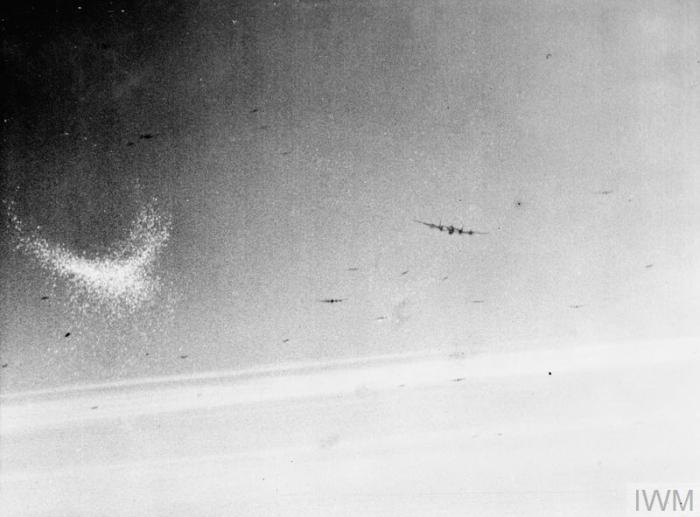
A Royal Air Force Avro Lancaster bomber over Essen dropping WINDOW to interfere with ground gunners during a 1000 bomber raid on the city. (Source: © IWM (C 5635))

Ground Grocer was not the only ECM developed because of the intelligence obtained by the Wellington. By gathering details on the Lichtenstein-BC’s characteristics, the TRE was able to develop several versions of Window, arguably the most famous countermeasure of the Second World War, capable of jamming this radar. Window consisted of millions of metal foil strips cut to precisely half the wavelength of the radar they were intended to jam. The TRE also developed a system known as Serrate based on the same intelligence. This was one of the RAF’s most successful electronic systems of the war. Serrate was installed on De Havilland Mosquito fighters, entering service in September 1943. It detected transmissions from the Lichtenstein-BC allowing Serrate-equipped aircraft to find and attack fighters using the radar. Serrate was employed extensively over enemy territory contributing to the 242 Luftwaffe fighters that the Mosquitoes of Bomber Command’s No. 100 Group shot down following its introduction.[17] Moreover Ground Grocer, Window and Serrate may have hastened the withdrawal of the Lichtenstein-BC which was all but phased out of service by April 1944 in favour of new radars with improved resistance to such countermeasures.[18]

The Legacy

The endeavours of Paulton and his crew were relayed to the Chief of the Air Staff, Air Chief Marshal Sir Charles Portal who told them: ‘I have just read report of your investigation flight […] and should like to congratulate you all on a splendid performance.’[19] Their deeds were recognised with the award of a Distinguished Flying Cross for Barry and Paulton, Distinguished Service Order for Jordan and Distinguished Flying Medals for Bigoray and Vachon. It is miraculous that the Wellington returned to the UK yet the actions of Paulton and his crew helped pave the way for the development of ECMs which undoubtedly saved Bomber Command lives. Their legacy can still be seen today. Radar jammers are now standard equipment on most military aircraft venturing in harm’s way, illustrating how one sortie on a cold December night would have implications for airpower which are still felt today.

Dr Thomas Withington specialises in contemporary and historical electronic warfare, radar, and military communications, and has written numerous articles on these subjects for a range of general and specialist publications. He holds a PhD from the University of Birmingham.

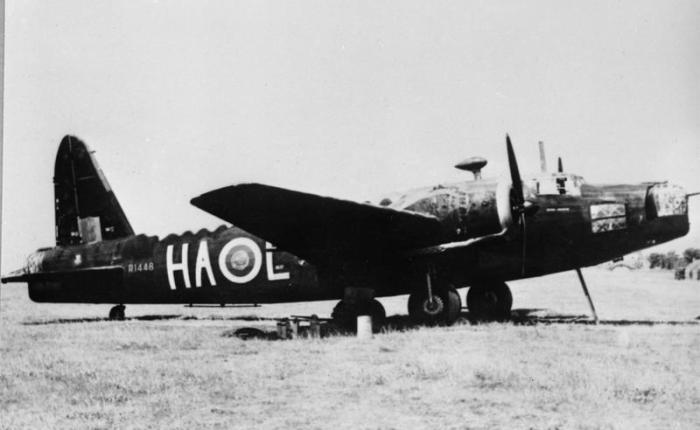
Header Image: A Vickers Wellington Mark IC (R1448) of No. 218 Squadron RAF on the ground at RAF Marham, Norfolk. R1448 was presented to the RAF by the Gold Coast Fund. This was the mark of Wellington flown by No. 1474 Flight during the operation described in this article. (Source: © IWM (CH 3477))

If you would like to contribute to From Balloons to Drones, then visit our submissions page here to find out how.

[1] Monthly Weather Report of the Meteorological Office, December 1942.

[2] The National Archives (TNA), AIR 50/503, No. 1474 Flight, December 1942.

[3] TNA, AIR 20/8962, War in the Ether: Europe 1939 to 1945: Radio Countermeasures in Bomber Command: An Historical Note (High Wycombe: Signals Branch, Headquarters Bomber Command, October 1945), p. 6.

[4] Ibid.

[5] Charles Webster and Noble Frankland, The Strategic Air Offensive Against Germany 1939-1945: Volume IV, Annexes and Appendices (Uckfield: Naval and Military Press, 2006), pp. 429-39.

[6] TNA, AIR 20/8962, War in the Ether, p. 9.

[7] Air Historical Branch, The Second World War 1939-1945 – Royal Air Force Signals, Volume VII: Radio Countermeasures (London: Air Ministry, 1950), p. 151.

[8] Ibid.

[9] TNA, AIR 27/1156, No.1474 Flight Operations Record Book.

[10] Ibid.

[11] Ibid.

[12] Ibid.

[13] Ibid.

[14] Air Historical Branch, The Second World War 1939-1945, p. 153.

[15] TNA, AIR 20/8070, Glossary of Code Names and Other Terms Used in Connection with RCM; AIR 20/8070, Ground Grocer.

[16] Air Historical Branch, The Second World War 1939-1945, p. 154.

[17] M.W. Bowman and T. Cushing, Confounding the Reich: The RAF’s Secret War of Electronic Countermeasures in World War Two (Barnsley: Pen and Sword, 2004), pp. 235-42.

[18] Air Historical Branch, The Second World War 1939-1945, p.154.

[19] TNA, AIR 27/1156, No. 1474 Flight ORB.

#BookReview – Sovereignty and Command in Canada-US Continental Air Defence, 1940-1957

#BookReview – Sovereignty and Command in Canada-US Continental Air Defence, 1940-1957

By Dr Brian Laslie

Richard Goette, Sovereignty and Command in Canada-US Continental Air Defence, 1940-1957. Vancouver, BC: University of British Columbia Press, 2018. Illustrations. Appendices. Notes. Bibliography. Hbk. xvii + 295 pp.

Soverignty

In case you missed it, the North American Aerospace Defense Command (NORAD) turned 60 this year. It was an easy thing to overlook. Most of the time when I mention that I work at NORAD, the first thing that comes to most people’s mind is that it is the organisation responsible for tracking Santa (and that is a job taken very seriously). However, the day to day focus on the command remains on the defence of the North American continent. It does so through three mission areas: aerospace warning, aerospace control and maritime warning. The most important concept to remember when discussing the history and operations of NORAD is that it is a binational command with shared responsibility between the United States and Canada.

Sixty years of shared defence

For more than sixty years now, Americans and Canadians have bi-nationally agreed to place the defence of the homeland in each other’s hands and entrust officers from both countries with commanding, directing, and controlling forces. To that end, Richard Goette’s new work Sovereignty and Command in Canada-US Continental Air Defence, 1940-1957, looks at the development of these relationships leading up to the creation of NORAD in September of 1957. Goette is an air power academic and Canadian air force historian as well as an Associate Professor in the Department of Defense Studies at the Canadian Forces College in Toronto, where he is Deputy Chair of the Department of Military Planning and Operations.

Looking back retrospectively, it is easy to believe that a close relationship between the two nations was a foregone conclusion; it seems difficult to imagine a world in which Canada and the US would not cooperate on matters of national defence. This was indeed not the case immediately following the First World War. One of the demonstrative statements in the book comes at the beginning of Chapter Three where Goette states that ‘[I]t was by no means preordained that Canada and the US would cooperate in the defense of North America.’ Both countries had active war plans for conflict with each other. As Goette shows, ‘[C]anadian military officials continued to consider the US a potential adversary and planned accordingly.’ Likewise, America’s war plan crimson dealt with a conflict against Canada as part of a likely larger fight against Great Britain (War Plan Red) (p. 71).

Slemon
Air Marshal Charles Roy Slemon, Chief of the Air Staff , RCAF, 1953-1957, and the first Deputy Commander-in-Chief of NORAD.(Source: Candian Department of Defence)

Throughout the 1940s and 1950s, this planning against the border nations morphed into cooperation between the two nations and eventually into a unique agreement where the defence of the two nations was shared. Goette (p. 23) aims to demonstrate ‘how Canadian and American officers debated and negotiated doctrinal definitions of command and control as the basis of the Canada-US continental air defence relationship from 1940-1957.’ Thus, Goette’s work pairs nicely with Joseph T. Jockel’s Canada in NORAD 1957-2007: A History. The author’s thesis (p. 5) is that the struggle from the Canadian perspective ‘was not control but command: command over Canadian air defense forces was the actual “acid test of Canadian sovereignty.”’

Sovereignty

Goette’s work is about sovereignty, particularly the sovereignty of Canada. ‘Sovereignty is a complex and contested concept without a universally accepted definition.’ (p. 27) Both countries had to find common ground and move from common conceptions of defence (working within services) towards bilateral (and later binational) defence. Nineteen-forty saw the earliest discussions held between the two nations with the US seeking both ‘strategic direction’ and ‘command,’ over Canadian forces, a clear problem for Canadian sovereignty and command of their forces. The calculus changed by the summer of 1941 and the new cooperative plan (ABC-22) saw that ‘each nation would retain strategic direction and command of its forces, which effectively recognized national sovereignty.’ More importantly, the groundwork was accomplished allowing the two nations to begin effectively working together with the goal of continental defence in mind (p. 81, 83).

The Second World War found the two nations working effectively together, and establishing relationships and procedures used during the war bore fruit in its aftermath. The post-war Basic Security Plan (BSP) was a combined effort aimed at continental defence that Goette (p. 116) shows ‘was a watershed in the Canada-US defence relationship.’ Between the acceptance of the BSP in 1946 and 1953, other plans and agreements between the two nations, particularly as they concerned cross-border intercepts strengthened the relationship between the two governments, but more importantly between the militaries. As the Cold War progressed, it became increasingly evident that the solution would be in a combined headquarters where US and Canadian personnel could work alongside each other. The problem, especially from the Canadian perspective, remained the spectre of American officers commanding Canadian forces. Interestingly, the ‘solution was avoiding the term “command” and using the principle of operational control.’ Thus, in 1957 the North American Air Defense Command (NORAD) began operations. Headed by an American four-star with a Canadian three-star deputy, each officer held ‘operational control.’ Day-to-day operations and ‘operational control’ were held by the American Commander-in-Chief NORAD, but in his absence, the Canadian Lieutenant General held control over the American officers. Administrative matters, punishment, and other matters of command remained sovereign, i.e. national and service responsibilities. This unique command structure remains in place today (p. 177).

e010858630-v8
The SAGE ‘Blue Room’ at the NORAD Underground Complex at Canadian Forces Base North Bay, Ontario, c. 1972. (Source: Library and Archives Canada)

There is really nothing to critique here, Goette has successfully produced a deeply researched work that is the first significant study of the development of Canadian-US continental defense in the post-Second World War era and, as such, it will remain the go-to book for those looking to understand the origins of this unique relationship for the foreseeable future. Sovereignty and Command will quickly find a following in the fields of history and air power studies but will also find a wide readership in the fields of political science, civil-military relations, and international relations. If you have an interest in how the homeland is defended this is a must-read and demonstrates the unique Canadian-US relationship that has stood the test of time for more than 60 years and looks to easily double that as the unique, nay special, binational relationship continues to evolve into the future.

Dr Brian Laslie is an Air Force Historian and currently the Deputy Command Historian at North American Aerospace Defense Command (NORAD) and United States Northern Command (USNORTHCOM). He is also an Assistant Editor at From Balloons to Drones. A 2001 graduate of The Citadel and a historian of air power studies, he received his PhD from Kansas State University in 2013. His first book The Air Force Way of War (2015) was selected for the Chief of Staff of the Air Force’s and the Royal Air Force’s Chief of the Air Staff professional reading lists. His recently published Architect of Air Power: General Laurence S. Kuter and the Birth of the US Air Force.  He lives in Colorado Springs. He can be found on Twitter at @BrianLaslie.

Header Image: A Royal Canadian Air Force Avro Canada CF-100 Canuck in flight with a Convair F-102 Delta Dagger, c. 1950s (Source: Royal Canadian Air Force)

If you would like to contribute to From Balloons to Drones, then visit our submissions page here to find out how.

A Discourse on John Boyd: A Brief Summary of the US Air Force’s Most Controversial Pilot and Thinker

A Discourse on John Boyd: A Brief Summary of the US Air Force’s Most Controversial Pilot and Thinker

By Dr Michael Hankins

In March 2018, Air University Press released a new edition of Colonel John Boyd’s A Discourse on Winning and Losing with a new introduction by Grant Hammond. On top of his heavy influence in designing the F-15 and F-16 fighters, Boyd was one of the most influential and often cited officers in the history of the US Air Force (USAF), but unlike most famous strategic thinkers, he published almost nothing. Thus, this new edition promises to be possibly the most widely disseminated and studied edition of Boyd’s intellectual output.

JohnBoyd_Pilot
John Boyd during his service in Korea. (Source: Wikimedia)

Boyd is, however, a controversial figure. Among USAF officers, Boyd is either loved or hated. Hammond’s introduction refers to him as ‘legendary,’ ‘a great original thinker,’ and ‘a paragon of virtue – loved by many […] for his character and integrity.’[1] On the other hand, former fighter pilot and USAF Chief of Staff General Merrill McPeak summarised the opposing view: ‘Boyd is highly overrated […] In many respects he was a failed officer and even a failed human being.’[2] Boyd was the type of person who challenged authority and fought for what he believed. He was also the kind of person that was so profoundly insecure that he stalked food courts to hunt down and physically assault people whom he perceived had not shown him proper respect.[3] However, many younger officers have never even heard of Boyd nor are they familiar with his ideas or character. With the recent release of the new edition of his work, it is worth taking time to briefly summarise Boyd’s significant contributions and provide some context as to why he is both so praised and so controversial.

First, we must deal with the notion of Boyd as – according to Hammond – ‘a premier fighter pilot.’ Some have referred to Boyd as the greatest fighter pilot who ever lived, and many press outlets mistakenly refer to him as an ace. Although Boyd did fly F-86 Sabres during a brief tour in the Korean War, he does not have a single air-to-air kill to his credit. He never fired his gun in a combat situation. This is not necessarily an indictment of his skills. The reason is that in those years, the USAF tended to fly in formations in which only the lead element was cleared to fire, while the wingmen provided protection. Boyd only ever flew in a wingman position, and never got in an opportunity to fire at enemy MiG-15s. Later, Boyd became a flight instructor at the USAF Fighter Weapons School, and he wrote a manual on dogfighting tactics. His reputation as a fighter pilot was built on his time as an instructor, during which he displayed a penchant for defeating incoming students in simulated dogfights (developing his claim that he could always do so within forty seconds). Fans of Boyd laud him for this, although his detractors often wonder why an instructor defeating his students using an oft-repeated manoeuvre is noteworthy, much less a point worth bragging about.

Boyd’s first significant contribution to USAF thinking was ‘Energy Maneuverability Theory’ (EMT) in the early-to-mid 1960s. This was an application of the principles of thermodynamics to aircraft metrics. Up until that point, the most important metrics for evaluating fighter planes tended to be wing loading ratios, top speed, and acceleration. Many fighter pilots tried to argue that agility and manoeuvrability were more important in a dogfight, but although wing loading could provide a rough idea of how well a craft could turn, it fell far short of an accurate description of a plane’s manoeuvrability. Boyd’s EMT instead analysed how well an aircraft could change energy states – involving speed, acceleration, kinetic and potential energy – essentially giving a numerical value to how well a plane could manoeuvre under various conditions. Charting this value on a graph corresponding to speed and altitude will give a curve of the aircraft’s manoeuvring capability. This method gave fighter pilots a way to talk to engineers in their ‘language,’ and describe dogfighting in mathematical terms, which had a significant influence on aircraft design. Beginning in the late 1960s, EMT became a significant factor in designing and evaluating American aircraft.

EMT.jpg
This chart, a typical example of the types of charts Boyd produced, compares the agility of an F-4 Phantom II and a MiG-21, but specifically under conditions of a 5g turn. (Source: USAF Academy Department of Aeronautics)

Although Boyd appears to have come up with these ideas independently, he was not the first to do so. A decade earlier, in 1954, an aerodynamics engineer working for Douglas named Edward Rutowski had the same concept. Rutowski’s work did not apply to dogfighting, but to calculating fuel ranges of various types of aircraft.[4] However, the equations – and the charts – are almost the same as Boyd’s, who later admitted to copying the charts after denying it for years.[5] One element that Boyd did add, however, was overlaying the EMT curve for one aircraft on top of another, to show where one aircraft had an advantage in manoeuvrability. These comparisons, first done in the late 1960s, showed that Soviet aircraft of that time might have a distinct advantage in dogfighting compared to the American fighters of the day (which, in that period, were mostly interceptors, not traditional fighters). Thus, while not necessarily completely original, Boyd did more to popularise the EMT concept and apply it to fighter design and tactics training, which then became part of a push within the USAF to design aircraft that were more specialised for air-to-air combat.

Boyd had a hand in the design of those planes. The first major USAF project to design a dedicated air superiority fighter was the F-X program, which eventually resulted in the F-15 Eagle. Boyd was brought in partway through this project and attempted to influence the design toward being more dedicated for dogfighting. To Boyd, this meant making it as small as possible and gutting it of sophisticated technologies, especially radar. The more massive the radar dome in a fighter’s nose, the larger the entire plane needed to be. Making the radar as small as possible (or, as Boyd advocated, eliminating it), could make the plane smaller and lighter. Boyd managed to have a significant influence on the design of the F-15, but he did not get everything he wanted. The plane was significantly more extensive and more sophisticated than he advocated, so in disgust, he turned to another project.[6]

f-15a_first_prototype_1
McDonnell Douglas F-15A (S/N 71-0280, the first F-15A prototype). Note the square wingtips and unnotched stabilator. (Source: Wikimedia)
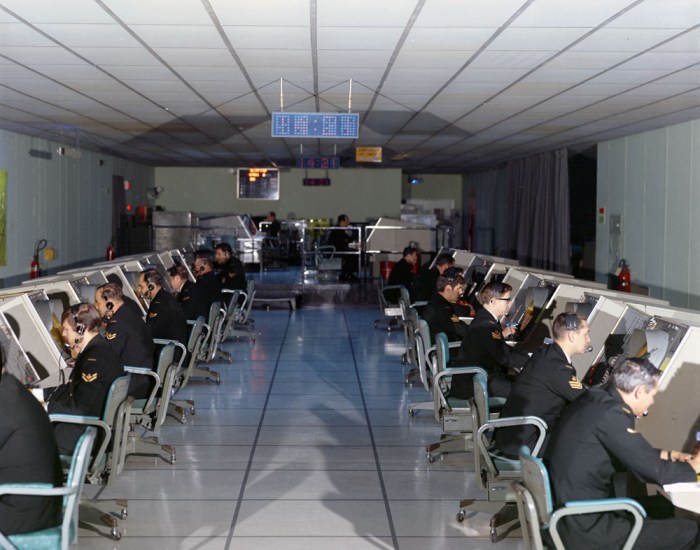
Using a combination of subterfuge, connections with high-level decision-makers, stealing unauthorised time on USAF computers, and meeting with aircraft manufacturers in secret using coded language, Boyd pressured the Air Force to procure a smaller lightweight fighter. Boyd wrote the requirements for that plane, which happened to match almost identically the characteristics of a plane he had been secretly designing with General Dynamics’ Chief of Preliminary Design, Harry Hillaker. That plane eventually became the F-16 Fighting Falcon—his ideal true dedicated air-to-air dogfighter. However, Boyd was also disappointed by the modifications made to that aircraft. The USAF made it heavier and more sophisticated than he wanted, and so Boyd denounced it in disgust.[7] Indeed, although his vision for the F-16 was a pure dogfighter, the plane has rarely been used in air superiority missions by the USAF and has achieved zero air-to-air kills for the US.

YF-16_and_YF-17_in_flight
An air-to-air right side view of a YF-16 aircraft and a YF-17 aircraft, side-by-side, armed with AIM-9 Sidewinder missiles, c.1972. (Source: Wikimedia)

After his retirement in 1975, Boyd went back to work in the Pentagon as an analyst, and it was during this time that he completed most of the intellectual output in the recently released new volume. This began with a short essay entitled ‘Destruction and Creation,’ which argued that societies and systems only really change when they are destroyed and recreated, rather than reformed from within. In 1976, Boyd received a NASA grant to study the differences in pilot behaviour between simulators and reality. Instead of focusing on that, Boyd produced a study titled ‘Fast Transients Brief,’ which consisted of carefully picked historical examples with which Boyd argued that victory in war was the result of being quick, unpredictable, and agile, with the goal of producing confusing in the enemy. This brief was essentially the first draft of what became a larger briefing called ‘Patterns of Conflict,’ which Boyd continually expanded to include more historical examples of his point. This briefing continued to grow, including more examples, until it became the final form under the new title ‘A Discourse on Winning and Losing.’ In this form, it was a fourteen-hour briefing split into two days. Boyd refused to shorten his briefings or to distribute summaries or slides to those who did not attend, insisting on being given the full amount of time, or nothing.[8]

Also embedded in these briefings was his evolving idea of the OODA loop, which stands for ‘observe, orient, decide, act.’ This was Boyd’s description of the process by which decisions are made at all levels from the tactical to the strategic. Boyd argued that all combatants in a conflict are going through that cycle, and whoever can complete repetitive OODA cycles more quickly will always be the victor. Fans of this theory tend to argue that this insight is revolutionary and secures Boyd’s place alongside thinkers such as Clausewitz or Sun Tzu. Others claim that this idea is very simplistic and offers very little in the way of insight or practical application. Interpreting and applying Boyd’s theory to subjects ranging from warfare to business has become something of a cottage industry. The OODA loop is still taught at US professional military education institutions. Love him, hate him, or merely indifferent, one cannot deny that Boyd has left a legacy and influence.

One final component of Boyd’s life that one must be aware of is his involvement in ‘The Reform Movement.’ During his time in the USAF, he and his followers who pushed for lightweight, dedicated air-to-air combat planes began referring to themselves as the ‘Fighter Mafia,’ and saw themselves at odds with the US government – to the point of depicting themselves as participating in a guerilla war against a government that they deemed as corrupt and ineffective. After Boyd’s retirement, this group morphed into what became known as ‘The Reform Movement’ and moved away from just fighter planes to becoming politically active on broader defence issues. This effort included a litany of journalists, military officers, and politicians who went as far as to form their congressional caucus, as well as non-governmental organisations with the goal of lobbying for particular policies.

The group wanted all US military hardware to be cheap and ‘simple.’ Simple in this context meant technologically unsophisticated relative to the mid-1970s. They argued for cancelling expensive ‘complex’ weapons such as the F-15 and the M-1 Abrams tank and replacing them with cheaper, ‘simple’ alternatives, such as relying on the older M-60 Patton tank or replacing F-15s and F-16s with swarms of F-5 Tigers. ‘The Reform Movement’ was more political than the ‘Fighter Mafia,’ and although the movement attracted some moderates and left-leaning individuals such as James Fallows (journalist for The Atlantic) and Senator Gary Hart (D-CO), it tended to skew conservative. Over time, it grew more conservative with the addition of politicians such as Nancy Kassebaum (R-KS), Newt Gingrich (R-GA), Dick Cheney (R-WY), and possibly its most prominent and active member (who coined the term ‘the Reformers’): self-proclaimed monarchist and white supremacist William Lind.[9] For this group, Boyd was seen as a messiah, and he was often discussed in religious terminology as a saviour preaching a new gospel.

Although this movement had an influential voice in the early 1980s, it had begun to stagnate by the end of that decade, and the 1991 Gulf War discredited many of their arguments.[10] However, despite that war demonstrating the effectiveness of all the weapons systems that the Reformers (and Boyd) had argued against, Boyd himself took sole credit for the success of that war. Boyd claimed he had been the actual author of the ground attack plan, which was not true, and that it would have been even more successful if his ideas had been implemented further.

Boyd is a complex figure, and his influence on the US military, especially the USAF, is impossible to deny. Although the bulk of his work has been floating around the internet for years, having a new edition of his work in an easily accessible and well-produced print edition is extremely useful and quite welcome.

Bibliographical Note

For more information on Boyd, the best place to start is most likely John Andreas Olsen’s 2016 article, ‘Boyd Revisited: A Great Mind with a Touch of Madness’ in Air Power History while the best examination of Boyd’s intellectual output is Frans Osinga’s Science, Strategy and War: The Strategic Theory of John Boyd (2007). Several authors further explore Boyd in Olsen’s edited work Airpower Reborn: The Strategic Concepts of John Warden and John Boyd (2015). A genuinely scholarly biography on Boyd’s life has yet to be written. Hammond’s brief biography, The Mind of War: John Boyd and American Security (2012) is a useful starting point but leans into praise for Boyd to a level that some readers might be uncomfortable with. Robert Coram’s popular biography Boyd: The Fighter Pilot Who Changed the Art of War (2002) has its uses but is little more than hagiography and should be read with a sceptical eye.

Dr Michael Hankins is Professor of Strategy at the USAF Air Command and Staff College eSchool, and and Assistant Editor at From Balloons to Drones. He is also a former Instructor of Military History at the US Air Force Academy. He earned his PhD from Kansas State University in 2018 with his dissertation, ‘The Cult of the Lightweight Fighter: Culture and Technology in the U.S. Air Force, 1964-1991.’ He completed his master’s thesis at the University of North Texas in 2013, titled “The Phantom Menace: The F-4 in Air-to-Air Combat in the Vietnam War.” He has a web page here and can be found on Twitter at @hankinstien.

Header Image: A USAF F-16 Fighting Falcon Block 40 aircraft after receiving fuel from a KC-135 Stratotanker aircraft during a mission over Iraq on 10 June 2008.  (Source: Wikimedia)

If you would like to contribute to From Balloons to Drones, then visit our submissions page here to find out how.

[1] Grant Hammond, ‘Introduction to “A Discourse on Winning and Losing” in Colonel John Boyd, A Discourse on Winning and Losing, edited and compiled by Grant Hammond (Maxwell AFB, AL: Air University Press, 2018), pp. 1-2.

[2] Carl Prine, ‘Q & A with Merrill ‘Tony’ McPeak,’ San Diego Union Tribune, 23 November 2017.

[3] See, for example, a story of Boyd seeking out a former colleague who had expressed doubt in Boyd’s ideas years before. Boyd put out his cigar on the man’s clothing, then began shoving him and shouting obscenities at him, all in public. Told in more detail in Robert Coram, Boyd: The Fighter Pilot Who Changed the Art of War (New York: Little, Brown, and Company, 2002), pp. 179-80.

[4] Edward S. Rutowski, ‘Energy Approach to the General Aircraft Performance Problem,’ Journal of the Aeronautical Sciences, 21 (1954), pp. 187-95.

[5] USAF Historical Research Agency, K239.0512-1066, John Boyd, Corona Ace Oral History Interview, 22 January 1977.

[6] For details on the development of the F-15, see Jacob Neufeld, The F-15 Eagle: Origins and Development, 1964-1972 (Washington DC: Office of Air Force History, 1974).

[7] On this issue, see: Grant Hammond, The Mind of War: John Boyd and American Security (Washington DC: Smithsonian Books, 2012).

[8] These briefings are most thoroughly explored in Frans Osinga, Science, Strategy and War: The Strategic Theory of John Boyd (New York: Routledge, 2007).

[9] For a brief summary of Lind’s extremism (he was known for keeping a portrait of fascist dictator Benito Mussolini in his office), see Bill Berkowitz, “Cultural Marxism’ Catching On,’ Southern Poverty Law Center, 15 August 15, 2003. Lind’s radical right-wing viewpoints are evident from his voluminous writing as the former Director of the Center for Cultural Conservatism, and his many columns in a variety of conservative websites and magazines. His 2014 novel Victoria not only celebrates a violent militia movement overthrowing the American government but glorifies deportations and executions of non-whites and other minorities he deems undesirable, including Jews, Muslims, the LGBTQ community, and it favorably depicts the use of nuclear weapons against African-American populations.

[10] For a summary of ‘The Reform Movement,’ see: John Correll, ‘The Reformers,’ Air Force Magazine (February 2008), pp. 40-4. To see them discuss their ideas in their own words, see: James Fallows, National Defense (New York: Vintage, 1984) and James Burton, The Pentagon Wars: Reformers Challenge the Old Guard (Annapolis, MD: Naval Institute Press, 1993).