By Lieutenant General David A. Deptula, USAF (Ret.)
Editorial Note: 2021 marks the 30th anniversary of Operation DESERT STORM. To mark this anniversary, during 2021, From Balloons to Drones will be publishing a series of articles that examine various aspects of DESERT STORM’s air campaign. We will be publishing pieces throughout 2021, and if you would like to contribute to the series, please contact our Editor-in-Chief, Dr Ross Mahoney, at airpowerstudies@gmail.com or via our contact page here. The official call for submissions can be found here.
Over the coming weeks, From Balloons to Drones is pleased to be working in conjunction with the Mitchell Institute for Aerospace Studies to publish a series of articles on various aspects of the DESERT STORM air campaign. These articles were initially published as part of a Mitchell Institute of Aerospace Studies special report, Desert Storm: 30 Years Later – Lessons from the 1991 Air Campaign in the Persian Gulf War. You can download the report here.
In this latest instalment, we are pleased to present a piece by Lieutenant General David A. Deptula, USAF (Ret.) on the planning and execution of the DESERT STORM air campaign. Deptula was the principal attack planner for the air campaign, and in this article, he provides valuable insights into some of the issues and challenges that affected the conduct of the air campaign.
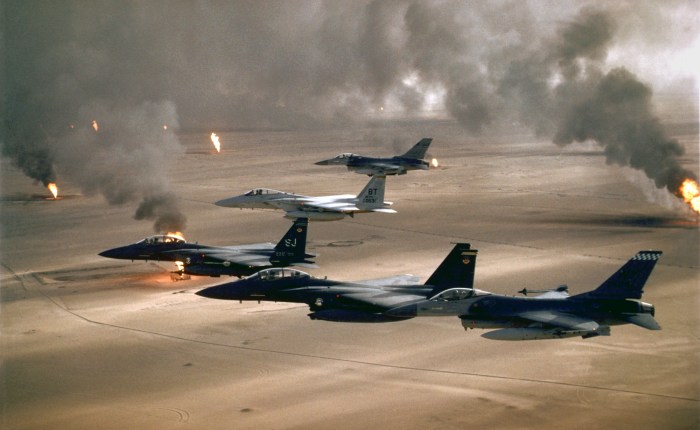
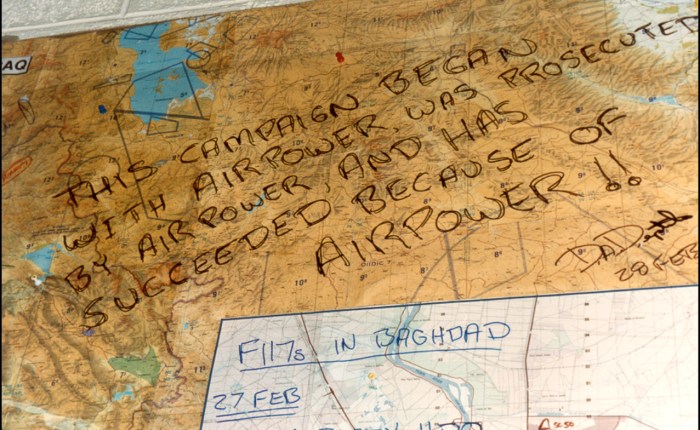
January 17, 2016, at 0239 Baghdad time marked the 25th anniversary of the start of Operation Desert Storm. Desert Storm was a turning point in the conduct of warfare as it set the conditions for modern warfare in five major ways: 1) it set expectations for low casualties – on both sides of the conflict; 2) it presaged precision in the application of force for all future conflicts; 3) it introduced prosecution of a combined/joint air campaign integrating all coalition/service air operations under the functional command of an airman, 4) it established desired effects as the focus of strategy and in the planning and conduct of operations, and 5) for the first time in history, airpower was used as the key force – or centerpiece – in the strategy and execution of a war.
Desert Storm was a 43-day war – airpower operated throughout the conflict from start to finish; ground forces acted as a blocking force for almost the entire war as airpower destroyed enemy forces and achieved desired effects against key systems from above. Only in the final days of the conflict were ground forces committed to combat and used to re-occupy Kuwait. In this respect, Desert Storm saw an inversion in the paradigm of traditional force application. Long-time military expert Dr Ben Lambeth has observed that today:
[t]he classic roles of airpower and land power have changed places in major combat […] Fixed-wing air power has, by now, proven itself to be far more effective than ground combat capabilities in creating the necessary conditions for rapid offensive success.
The opening attacks of Desert Storm signaled a radical departure in the conduct of war. Over 150 discrete targets – in addition to regular Iraqi Army forces and surface-to-air missile (SAM) sites – made up the master attack plan for the opening 24 hours. The war began with more targets attacked in one day than the total number of targets hit by all of the Eighth Air Force in 1942 and 1943 combined – that’s more separate targets attacked in less time than ever before in history.
Twenty-five years ago, those involved in the Desert Storm air campaign applied force not only across the entire breadth and depth of the country geographically, but also across all the key strategic and operational level centers of gravity. How was that accomplished? And what was different from previous conflicts?
Advances in technology, in conjunction with an effects-based approach to planning and execution, allowed us to institute a new concept of operations that has been described as ‘parallel’ war: the simultaneous application of force across the totality of the enemy system.
While simultaneous attack has always been a desired element of offensive warfare, it had never evolved into the parallel war demonstrated in Desert Storm for three reasons: one, the requirement for mass to compensate for a lack of precise weapons delivery; two, the large number of resources required to suppress enemy air defenses; and three, the absence of a focus on effects rather than destruction to achieve control over an opponent.
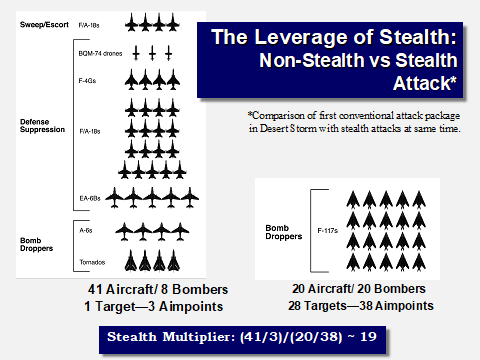
The first two challenges required technological solutions, and were simply not mature before the mid-1980s. Those two solutions were stealth and precision. To provide insight into the significance of those two elements, in the first 24 hours of Desert Storm stealth, precision, and effects-based planning allowed targeting 36 stealth aircraft armed with precision-guided munitions against more separate targets than the complete non-stealth/non-precision air and missile force launched from the entire complement of six aircraft carriers and all the other ships in the theater combined. The stealthy F-117 force flew less than 2 percent of the combat sorties, but struck over 40 percent of the fixed targets.
The leverage that stealth demonstrated in the first Gulf War is further illustrated by the following example that involves the first non-stealthy attack on one target with three aimpoints in the Basrah area – Shaiba Airfield to be exact. The attack package consisted of 4 US Navy A-6s dropping bombs, along with 4 Saudi Tornado bomb droppers: 5 US Marine EA-6Bs jamming acquisition radars; 4 US Air Force F-4Gs taking out one type of surface to air missile system; 17 US Navy F-18s taking out another; 4 F/A-18s as escort; and three drones to cause the enemy radars to radiate. That is a total of 41 aircraft – 8 dropping bombs, on 3 aimpoints, on one target.
At approximately the same time we had 20 F-117s all dropping bombs on 38 aim points on 28 separate targets. That is less than half the aircraft hitting over 12 times the number of aim points.
Stealth and precision facilitated the actualization of the third and perhaps most important component of that conflict: a concept of operations designed to achieve control over an enemy’s essential systems. This methodology recognizes that negating an adversary’s ability to operate as desired is ultimately as important – or even more so – than the destruction of the forces it relies on for conquest.
We built the air attack strategy of Desert Storm by treating Iraq and the Saddam regime as a system of systems, and designed the operation to achieve paralysis of Saddam’s strategic centers of gravity: leadership; key essential systems; infrastructure; information; and fielded military forces. The campaign had five key objectives in this regard:
Gain/Maintain Air Supremacy to Permit Unhindered Air Operations
Isolate and Incapacitate Hussein Regime
Destroy Iraqi Nuclear, Biological, and Chemical Warfare Capability
Eliminate Iraq’s Offensive Military Capability
Render the Iraqi Army in Kuwait Ineffective, Causing Its Collapse
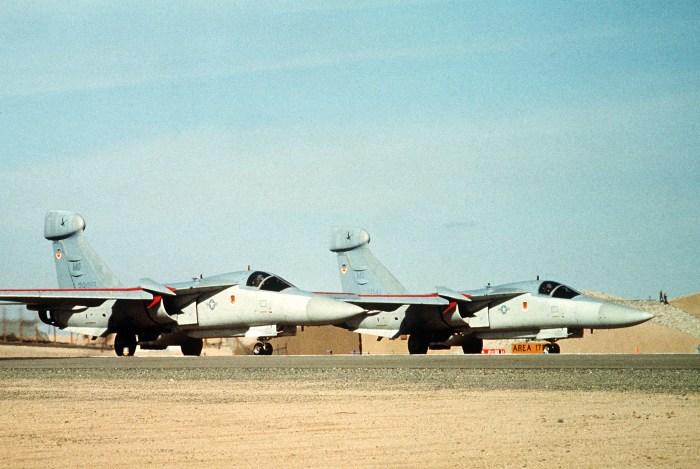
EF-111A Raven aircraft prepare to take off on a mission during Operation Desert Shield. (Source: Wikimedia)
These objectives were all achieved – rapidly, and decisively. The tenets that made Desert Storm such a success were:
Strong political will – a President who stated on 5 August 1990, ‘This will not stand’ in response to the invasion of Kuwait. President George H. W. Bush and his military commanders built a strategy; formed a coalition; deployed the forces required to execute that strategy; garnered United Nations backing; executed the strategy; and accomplished its declared objectives by February 28, 1991 – seven months from start to finish.
A comprehensive, coherent campaign plan that focused on dismantling the key centers of gravity – leadership; key essential systems; infrastructure; population perceptions; and military forces – that paralyzed Iraq as a state along with its military regime;
Putting a combined/joint force air component commander in charge of the air campaign, and treating each aircraft, missile, and air defense element according to the capability it brought to the campaign plan, regardless of which service or country from where it came;
Reversing the errors of Vietnam by replacing the gradualism of the ‘Rolling Thunder’ air campaign with the ‘Instant Thunder’ of the Desert Storm air campaign; and
Adopting a true combined/joint approach to the effort using the right force at the right place at the right time – not a traditional land-centric plan that singularly focused on fielded military forces.
Today, against the Islamic State, targets selected and ordnance employed go through a lengthy vetting process, and are approved or disapproved by ground commanders. According to a reported Air Force source on 26 August 2016 it, ‘take[s] an average of between 45 to 60 days before [targets] are vetted and approved.’ That is longer than the duration of Operation Desert Storm in its entirety. The excessive time factor in Operation Inherent Resolve target development due to of concern of unintended civilian casualties, allows critical Islamic State functions to continue to operate. By not rapidly striking them actually countenances the Islamic State to perpetuate its terror, atrocities, and murder.
What is the morality of a policy that restricts the use of airpower to avoid the possibility of collateral damage while allowing the certainty of the Islamic State’s crimes against humanity? Members of today’s coalition should enter into their casualty avoidance calculus how many of the Islamic State’s intentional murders of innocents would be avoided by rapidly collapsing the organizational elements that allow the Islamic State to function.
The current approach to the Islamic State is gradualist – over two years to date, and the prospect of years of continuance; it is an anemic approach – an average of only 6 US strike sorties a day over the first two years of operations; and it is without definition – no comprehensive and focused strategy has been identified to achieve the stated objectives of degrading and destroying the Islamic State. The result is an approach that is fragmented, less than optimal, and yields the advantage of time to the adversary resulting in expansion and export of its deleterious effects. The enemy, over time, learns how to deal effectively with the gradual use of airpower and grows stronger, while our allies and our citizens lose interest, and our military forces – our brave airmen, soldiers, sailors, and marines – tire of the endless rotations into and out of the fight. Our present is our past: not the swift, decisive past of Desert Storm but rather the quagmire that was Vietnam.
Today’s generation of airmen must renew the spirit of innovation and creativity enabled by exploiting the virtues of operating in air and space, as did the founders of our Air Force. Those characteristics delivered success in Desert Storm, and can do so again in the future. The innovative application of the tenets of aerospace power is what made Desert Storm such a success, and can be applied to the challenge of the Islamic State. Replace the current desert ‘drizzle’ with a ‘thunderstorm’ aimed not just at the hands and feet of the Islamic State but at its head and heart as well. It is the duty of every Air Force member to understand airpower, advocate and articulate its characteristics and capabilities, and educate those who do not understand. For if they don’t, no one else will. The Nation deserves to hear the options allowed by airpower, and will benefit from their proper application.
Lieutenant General David A. Deptula, USAF (Ret.) is the Dean of the Mitchell Institute for Aerospace Studies. He is a world-recognized leader and pioneer in conceptualizing, planning, and executing national security operations from humanitarian relief to major combat. He was the principal attack planner for the Operation Desert Storm air campaign; commander of no-fly-zone operations over Iraq in the late 1990s; director of the air campaign over Afghanistan in 2001; twice a joint task force commander; and was the air commander for the 2005 South Asia tsunami relief operations. He served on two congressional commissions charged with outlining America’s future defence posture. He is a fighter pilot with more than 3,000 flying hours – 400 in combat – Including multiple command assignments in the F-15. His last assignment was as the Air Force’s first deputy chief of staff for intelligence, surveillance, and reconnaissance (ISR), where he transformed America’s military ISR and drone enterprises—orchestrating the largest increase in drone operations in Air Force history. He retired from the Air Force in 2010 after more than 34 years of distinguished service. He has BA and ME degrees from the University of Virginia and a MS degree from National War College. In addition to his duties as Dean of the Mitchell Institute, he is the RisnerSenior Military Scholar at the US Air Force Academy; a board member at a variety of organizations; an independent consultant; and sought after commentator around the world as a thought leader on defence, strategy, and ISR.
Editorial Note: 2021 marks the 30th anniversary of Operation DESERT STORM. To mark this anniversary, during 2021, From Balloons to Drones will be publishing a series of articles that examine various aspects of DESERT STORM’s air campaign. We will be publishing pieces throughout 2021, and if you would like to contribute to the series, please contact our Editor-in-Chief, Dr Ross Mahoney, at airpowerstudies@gmail.com or via our contact page here. The official call for submissions can be found here.
In this first instalment, Dr Brain Laslie provides a review of one of the first memoirs to emerge after the end of the First Gulf War; She Went to War: The Rhonda Cornum Story. Rhonda Cornum’s story is interesting for several reasons. First, it provides an army view of the air war rather than the more common air force view. Second, much of its focus relates to the latter part of the conflict, and finally, and most importantly, the book provides an insight into the experience of female prisoners of war (POW) in wartime.
Rhonda Cornum with Peter Copeland, She Went to War: The Rhonda Cornum Story (30th Anniversary Edition). Cardiff, CA: Waterside Productions, 2020. Pbk. 240pp.
Reviewed by Dr Brian Laslie
This was it. This was life as a POW. This was my life for the near future. This room, those walls, that ceiling. My reality. (p. 168).
Major Rhonda Cornum was a member of the US Army’s 2-229th Attack Helicopter Battalion attached to the 101st Airborne Division (Air Assault) during Operation DESERT STORM. As a medical doctor, her job was to fly as a member of a UH-60 crew behind attacking AH-64 Apaches and provide medical support to any downed aircrew. On 27 February 1991 – the fourth day of the ground war – Cornum and the other members of her UH-60 crew diverted to become a search and rescue aircraft sent to pick up a downed F-16 pilot, Captain William F. Andrews. During the rescue mission, the UH-60 she was riding was shot down. Her subsequent ordeal is detailed in the book She Went to War: The Rhonda Cornum Story (with her co-author Peter Copeland). Originally published in 1992, Cornum’s book was one of the early personal reflections of service during DESERT STORM. The book has now been re-released as part of the 30th anniversary of DESERT STORM.
The crash resulted in the loss of Chief Warrant Officer Four Philip Garvey, Chief Warrant Officer Three Robert Godfrey, Sergeant 1st Class William Butts, Staff Sergeant Patbouvier Ortiz, and Sergeant Roger Brelinski. Only three crew members survived: Cornum, Staff Sergeant Daniel Stamaris, and Specialist Four Troy Dunlap. The three survivors were rapidly captured by the Iraqi military (pp. 12-3). Among the trio of survivors, Cornum was the most seriously injured. Her injuries sustained in the crash included ‘two broken arms, both at odd angels; a smashed finger […] a blown out knee and various lacerations and bruises’ (p. 79-80) and – as she later discovered – a bullet wound in her back (pp. 97-8).
Captured almost immediately Cornum was taken to a series of bunkers and one gets the sense that the Iraqi military was not entirely prepared to deal with her and other captured Americans preferring to shuttle them up the chain of command. This description harkens back to Everett Alvarez’s early days of captivity after he became the first POW during the Vietnam war and detailed in his autobiography Chained Eagle (1989).
Cornum, suffering from her severe wounds, also learned to deal with a myriad of other problems. These problems included boredom and the indeterminable waiting for something to happen (p.39, 41), a sexual assault at the hands of one of the guards, and the complete inability to do anything on her own from dressing to going to the bathroom. Cornum was forced to rely on her captors or a fellow POW to help her with her dressings and personal hygiene.
She Went to War certainly deserves to be included under the rubric of air power books coming out of DESERT STORM, but this particular book is essential for another reason as it is one of the few works that explore the experience of female POWs. Cornum and US Army Specialist Melissa Rathbun-Nealy were the only two female POWs taken prisoner during DESERT STORM. As such, Cornum’s insightful work adds something unique to the historiography of DESERT STORM; a female perspective. Indeed, arguably the critical work on POWs’ experience during DESERT STORM remains Tornado Down (1992), the account of Britain’s Flight Lieutenants John Peters and John Nichol who were shot down on the first day of the air campaign. As we enter into a period of historical reflection thirty years later, Cornum and Copeland’s book should enter the conversation as one of the great memoirs to come from DESERT STORM.
With Selling Schweinfurt Brian D. Vlaun, a Colonel and command pilot in the United States Air Force offers readers a history of air intelligence development of the United States Army Air Force (USAAF) with two mutually supporting goals. First, the American conception of a strategically-minded independent air power arm that ‘was well suited to the limitations of the political will, manpower pool, and military-industrial complex of the United States’ (pp. 5-6) required unquestionable battlefield impacts from bombing offensives to be politically viable. Second, providing such indisputable effects required an intellectual cadre (p. 6) of ‘academics, industrialists, lawyers, and wartime-civilian-turned-military officers who shaped the targeting decisions and air campaign assessments.’ Vlaun centres his analysis around Major General Ira C. Eaker’s US Eighth Air Force and the 1943 Allied Combined Bomber Offensive (CBO) that was intended to cripple German industrial and economic systems and establish air superiority over Europe. Leveraging thousands of declassified American and British documents, Vlaun draws upon nearly forty primary and over one hundred secondary sources to present a well-researched and highly accessible work. Vlaun pulls back the curtain on how doctrine writers or a commander’s staff profoundly impact the conception of problems and possible solutions available to a commander – especially when those organisations are vying for influence.
Selling Schweinfurt is organised chronologically along five chapters. Chapter one focuses on the development of strategic air power doctrine and requirements in the interwar years. Here, Vlaun provides the backstory on how and why US air intelligence (A2) and doctrine developed organically before sending liaisons to Britain in 1941 to observe and shape American efforts to establish a robust and capable air intelligence capacity. With the realisation that the USAAF was the most mobilised portion of the American Army, and with aviation’s ability to operate from friendly territory while actively contributing to the war in Europe, the chapter concludes with the establishment of the Eighth Air Force and the initial combat development of ‘effective’ American bombing.
Chapter two begins with acknowledging USAAF leaders that the A2 enterprise they created was too young to provide the type of in-depth strategic analysis required to ensure that the bombing efforts of the Eighth Air Force were contributing effectively to the demise of the German war-industry. In Washington and Britain, USAAF leaders turned to lawyers, bankers, economists, and industrialists to serve as a bulwark for their intelligence gaps. However, as these groups worked independently of one another and mainly without oversight, their analysis focused on gaining influence in targeting decisions and building analyses that dovetailed the specific leaders’ perspective for whom they were working. While civilian analysts argued for industrial targets, the USAAF continued to bombard U-boat pens and provide coastal patrols in what would prove to be a very futile effort to stave off German anti-shipping capacity. The chapter concludes with the January 1943 Casablanca conference that maintained a parallel but independent USAAF command and shifted more responsibility for targeting decisions onto American A2.
A formation of Boeing B-17Fs over Schweinfurt, Germany, on 17 August 1943. (Source: National Museum of the USAF)
Chapter three examines the targeting choices and the Eighth Air Forces’ demonstrated results supporting Operation POINTBLANK – the Allied campaign against the German industrial base – during the first trimester of 1943. Arguably, this period was essential to the foundational honing of aircrew skillsets; however, the period uncovered USAAF leaders’ inability to quantify results in attacking industrial targets in Germany. By the May 1943 Trident Conference, the CBO’s limited successes were doubled down upon by the Allied leadership as military and civil leaders concurred that Western European ‘air superiority was to be a joint problem and a necessary precondition for success.’ (p. 103) Trident approved a reallocation of the CBO towards German war-industries with a secondary focus on single-engine aircraft production. Air superiority was a way of preparing Western Europe for the upcoming OVERLORD invasion and pulling German air power away from the Eastern front to ease pressure on the Soviets.
Chapter four addresses the understanding that both the Americans and Germans were realising the limitations of manpower in their ability to mobilise continually, train, and deploy forces while maintaining industrial capacity. By mid-August 1943, the Americans had successfully targeted ball-bearing factories in Schweinfurt and V-weapons at Peenemünde. Despite the successful raid into Schweinfurt, scientists and political entities shifted Allied CBO priorities towards a continued focus on V-Weapons. Despite their distributed nature that limited their susceptibility to aerial bombardment, the ‘political objectives, public outrage, intelligence prestige, and strategic interaction’ colluded to darken ‘Allied airman’s hopes for victory through airpower alone.’ (p. 162)
Chapter five focuses on the successful recognition of an air-minded specialist intelligence organisation within the American War Department. While industrial raids such as Schweinfurt had proven the need for an independent A2 and G2, the Eighth Air Force’s lack of demonstratable progress led to questioning the capability of the commander of the Eighth. While the Allied CBO losses had proven the necessity of fighter escorts to the most devout adherents of the bomber’s supremacy, the intelligence analysts pinned their hopes to continued pressure on the German industry regardless of the operational realities of the CBO. In assessing the outcomes of 1943, the USAAF’s leadership chose to articulate the failure of the Eighth Air Force commander’s ‘lack of creativity and flexibility as he had underutilised and underperformed the forces he commanded’ (p. 198) instead of accepting an under-resourced and doctrinally unsound conception of the CBO from the outset.
Vlaun concludes with a compelling argument that ‘the growth of airpower cannot be thoroughly comprehended without an understanding of the maturation of its air intelligence component.’ (p. 207) While it is clear that air power proponents doggedly pursued a course to demonstrate the suasive power of strategic bombing, it is also clear that no conclusive evidence exists in the post-war analysis that industrial attacks created or exacerbated materiel bottlenecks. This is not to say that air power is without operative function.
As just one element of military power, airpower offers a means to fight at a lower cost to friendly forces along with potential for less political entanglement [however] the promise of airpower brings along with it a robust air intelligence requirement – one that starts well before bombing and continues after hostilities cease. (p. 210)
Vlaun cautions the reader against assuming that modernisation or technology is a panacea to creating an intelligence capacity for identifying the ‘perfect target.’ If Selling Schweinfurt has anything to convey, decisions are influenced by organisational determination of which data to impart. Vlaun is clear that commanders must retain perspective in targeting decisions and align intelligence roles and responsibilities with operational and strategic imperatives.
If Vlaun’s effort is to be found wanting, it is only that the narrative does not extend into the Allied CBO’s successes and the maturation of the A2 in 1944 and 1945. Selling Schweinfurt is the very best effort this reader has found to insight the staff work required of any useful command. Selling Schweinfurt’s truly accessible presentation alone is worthy of inclusion in every air power enthusiast’s bookshelf. While certainly not a biography, Vlaun presents a critique of key leaders in American air power development that fills a critical gap in the existing historiography. Specialists will particularly welcome Vlaun’s depiction of Eighth Air Force raids to Ploesti, Hüls, St. Nazaire, Regensburg, and Schweinfurt for their operational and tactical significance to the development of strategic air power. Generalist readers will appreciate Vlaun’s easy tone and accessible style in presenting the development of doctrine and intelligence organisation as the USAAF struggled to define itself as a critical element of American military power. However, Vlaun’s study’s real power is in the representation of the importance of a staff in the decision-making process of every commander. As Vlaun concludes:
It is clearly possible to launch aircraft and bomb something without solid intelligence, but without a refined sense of what to target or how to measure bombing effectiveness, airpower will be inefficient if not all together ineffective. (p. 208)
As such, Selling Schweinfurt is highly deserving of inclusion in the discussion of air power during the Second World War and beyond by specialists and generalists alike.
Bryant Macfarlane served in the United States Army from 1997 to 2019 and is a PhD student at Kansas State University studying the technological momentum of vertical flight and its effect on military culture. He can be found on Twitter @rotary_research.
Header image: On 13 May 1943, the B-17F ‘Hell’s Angels’ of the 303rd Bomb Group became the first heavy bomber to complete 25 combat missions over Europe, four days before the crew of the ‘Memphis Belle’s’. After flying 48 combat missions, ‘Hells Angels’ returned to the US for a war bond tour in 1944. (Source: National Museum of the USAF)
Armageddon and OKRA is the first in a planned series about the Royal Australian Air Force’s (RAAF) air campaigns being compiled as part of the RAAF’s 100th-anniversary celebrations. The RAAF’s Chief of Air Force (CAF) intends for the series’ works to be ‘readable, well-illustrated, educative and enduring’ (p. 3). In the main, Armageddon and OKRA ably meets these ambitions.
The book though carries additional burdens in aiming not just to market the RAAF to the Australian public but also to contribute to the Air Force’s professional military education and be of interest to serious academic researchers. It would be difficult for any work to satisfy such a diverse audience completely. Given this split, this review discusses Armageddon and OKRA from both a reader’s viewpoint and a military organisational perspective.
Armageddon and OKRA is split into two main parts. Part one examines Australian air power during the First World War in the Middle East between 1915 and 1919. The principal focus is on the operations of No.1 Squadron of the Australian Flying Corps (AFC) during the British capture of Palestine and Syria from the Ottoman Turks in 1917-1918. ‘Armageddon’ in the title refers to the Battle of Megiddo in late September 1918 in which the No. 1 Squadron fought. This English language word comes from the Ancient Greek name for Mount Megiddo, subsequently used in the Christian Bible’s Old Testament.
Part two then moves forward a hundred years to 2014-2018 and the US-led coalition operations to support the Iraqi Government to defeat Islamic State (ISIS). Part two’s principal focus is the small RAAF Air Task Group deployed for this task as part of the larger Australian Defence Force’s Operation OKRA, and which involved (amongst others) No.1 Squadron again. This is a rather elegant symmetry that perhaps was not made as much use of as could have been.
The involvement of the RAAF and its predecessor, the AFC in these two periods was at the tactical level of war and accordingly, the book’s main focus centres around squadron operations. Part one provides a comprehensive overview that nicely relates the tactical to the strategic level, the air activities undertaken, the various aircraft Australian’s were trained on and flew in operations, maintenance aspects and the air-to-air and air-to-ground weapons used. In this part, No.1 Squadron’s use of the Bristol F.2b Fighter in 1918 features prominently, including the destruction of a large Turkish ground force that the unit trapped in the Wadi Fara gorge. Also notable is the attention paid to including the opposing German squadrons, particularly FA300, and how they impacted No.1 Squadron. Wars involve two sides, however; many histories overlook this interdependence.
No. 1 Squadron, Australian Flying Corps next to their Bristol FB1 fighters, at Mejdel. The officer in the foreground (with stick) is Lieutenant-Colonel R. Williams, D.S.O., commanding. (Source: Australian War Memorial)
Part two is somewhat different. Early on, there is a detailed examination of the command-and-control arrangements for OKRA. The naming protocols are quite arcane for the casual reader, not unsurprisingly as their origin lies in the demands of automated messaging systems not in easy human comprehension. This then moves into several short chapters that discuss the daily air operations as seen at the squadron-level by OKRA’s deployed air units. These units flew the F/A-18 ‘Classic’ Hornet fighter/bomber, the F/A-18F Super Hornet fighter/bomber, the E-7A Wedgetail airborne warning and control aircraft and the KC-30A air-to-air refuelling tanker.
By the time the reader reaches these final chapters, it is apparent that CAF’s aims to be ‘readable, well-illustrated, educative and enduring’ has been achieved. In Australia, the book is keenly priced while its excellent line drawings of aircraft and numerous photographs add to the overall appeal. Some may argue over ‘enduring,’ however, the second part of the book offers a level of detail of the RAAF’s part in OKRA that is presently unequalled. In particular, future historians of these air operations will value this book because it gives the reader an insight into the rhythm and grind of daily squadron life during operations.
On the other hand, in meeting CAF’s other dictum, the book falls a bit short for the professional or academic reader. It is not – nor was intended to be – a critical analysis of the RAAF’s air operations in these two periods. The book dwells on the positives and only rarely and rather briefly notes any possible negatives. There are also reoccurring lapses into hagiography. Of the two parts of the book, the second is the most impacted. There is room left for a definitive, comprehensive history of the RAAF during OKRA.
In thinking about future works, the elegant symmetry of parts one and two was noted earlier. In reading the book, the more critical reader might like to assess the similarities and differences between No.1 Squadron operating as part of the British Empire and then 100 years operating as part of the American ‘empire’. In the First World War, No. 1 Squadron and Australians were more broadly considered part of the British Empire; they were simply English people born offshore. It is unsurprising the future Air Marshal Sir Richard Williams, later the ‘father of the RAAF,’ ended the war commanding in battle the Royal Air Force’s 40 Wing, which was overwhelming a British entity.
During OKRA, there is a much greater separation between the Americans and their foreign air force partners; the later provide tactical level forces to use as the US determines. However, through its astute alliance management process, the American empire has shaped foreign air forces to be fully and immediately interoperable with US forces regarding doctrine, equipment, support, and training. In contrast, in the British Empire’s war, Australia provided people to Britain who needed to be trained, equipped and, later in battle, logistically supported. For Australian’s, the British Empire was more collegiate, but the modern-day American one is arguably shrewder. Armageddon and Okra’s author, Lewis Frederickson, has written a fine, relevant analysis on Australia’s First World War experience for those wishing to explore such issues further.[1]
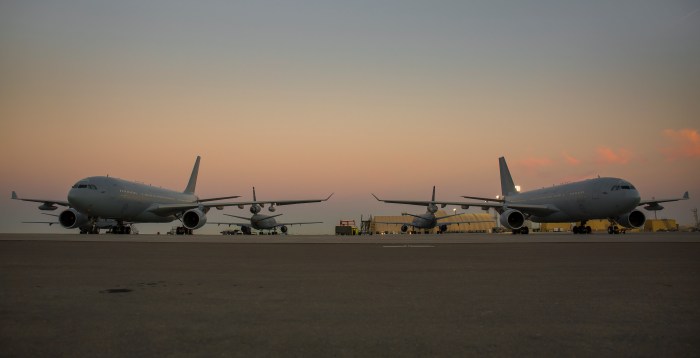
Two KC-30A Multi Role Tanker Transport aircraft sit together at the main air operating base in the Middle East Region on Operation OKRA. (Source: ADF)
Finally, it is worth discussing the book from a military organisational perspective. The book’s forward sets out CAF’s intentions for the series. These are not just laudable but noteworthy in breaking from the last 20 years of RAAF development. In these earlier periods, RAAF and other Australian Service chiefs stressed teamwork, and especially loyalty, over critical thinking.[2] This is a recognised problem for small professional military forces which lack the scale to be able to be ‘broad churches’ that can include disruptors.[3] In this series, and in his new Air Force Strategy, CAF now appears interested in setting off down this path.[4] If so, later books will need to be more analytical, including engaging in constructive criticism. It is uncertain if this will be possible or acceptable.
Armageddon and Okra is an excellent value read that makes a useful contribution to RAAF history. It is particularly important and valuable in breaking new ground on the RAAF’s participation in OKRA against ISIS. Overall Armageddon and Okra will be of interest to the general public, military enthusiasts and undergraduates undertaking strategic studies courses.
Dr Peter Layton is a Visiting Fellow at the Griffith Asia Institute, Griffith University and a RUSI (UK) Associate Fellow. His PhD is in grand strategy, and he has taught on this at the US National Defense University. Author of the book Grand Strategy, his posts, articles and papers may be read here. He was also once a navigator on No.1 Squadron RAAF flying F-111Cs.
Header Image: Centenary tail art on a F/A-18F Super Hornet of No. 1 Squadron RAAF at the main air operating base in the Middle East Region during Operatyion OKRA. (Source: ADF)
[1] Lewis Frederickson, ‘The Development of Australian Infantry on the Western Front 1916-1918: An Imperial model of training, tactics and technology’ (PhD Thesis, UNSW Canberra, 2015)
Editorial Note: From Balloons to Drones is pleased to announce our new podcast series. Led by our Editor Dr Mike Hankins, the series builds on the success of From Balloons to Drones, and provides an outlet for the presentation and evaluation of air power scholarship, the exploration of historical topics and ideas, and provides a way to reach out to both new scholars and the general public. You can find our Soundcloud channel here.
Eileen A. Bjorkman is a former flight test engineer in the USAF with more than thirty-five years of experience and over 700 hours in the cockpits of F-4s, F-16s, C-130s, and C-141s. She is the author of The Propeller under the Bed: A Personal History of Homebuilt Aircraft and has published articles in the Smithsonian’s Air & Space Magazine, Aviation History, Sport Aviation, the Everett Daily Herald, and the Herald Business Journal.
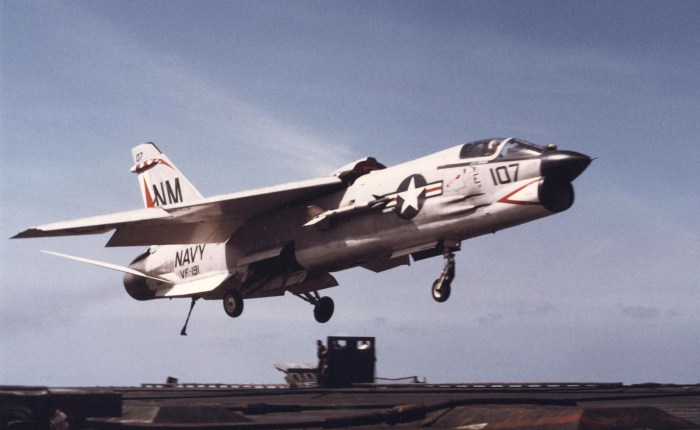
Header Image: A US Navy Vought F-8J Crusader of VF-191 is recovered aboard the attack aircraft carrier USS Oriskany (CVA-34) in November 1970. (Source: Wikimedia)
Editorial Note: From Balloons to Drones is pleased to announce our new podcast series. Led by our Editor Dr Mike Hankins, the series builds on the success of From Balloons to Drones, and provides an outlet for the presentation and evaluation of air power scholarship, the exploration of historical topics and ideas, and provides a way to reach out to both new scholars and the general public. You can find our Soundcloud channel here.
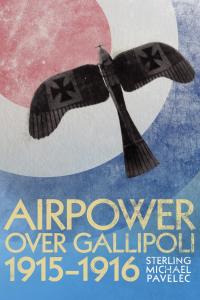
In this episode, we interview Dr Sterling Michael Pavelec of the USAF Air Command and Staff College. We discuss Pavelec’s new book Airpower Over Gallipoliand ask the question of whether the Gallipoli Campaign should be connected with the pioneering use of air power.
Dr Sterling Michael Pavelec is a Professor of Airpower History at the USAF Air Command and Staff College, Maxwell AFB, Alabama. He is the author of four previous books and a number of articles and book chapters on airpower, technology, space, and cyber warfare.
Editorial Note: From Balloons to Drones is pleased to announce our new podcast series. Led by our Editor Dr Mike Hankins, the series builds on the success of From Balloons to Drones, and provides an outlet for the presentation and evaluation of air power scholarship, the exploration of historical topics and ideas, and provides a way to reach out to both new scholars and the general public. You can find our Soundcloud channel here.
In this episode, we interview Katherine Sharp Landdeck, who is here to tell us all about the WASPs, the Women Airforce Service Pilots in the United States during the Second World War. She is the author of The Women with Silver Wings: The Inspiring True Story of the Women Airforce Service Pilots of World War II. She goes beyond some of the familiar figures like Jackie Cochran and Nancy Love to tell us about other, lesser-known women in the program. Furthermore, of course, we will talk about Walt Disney because Brian Laslie always finds a way!
Dr Katherine Sharp Landdeck is an associate professor of history at Texas Woman’s University, the home of the WASP archives. A Guggenheim Fellow at the Smithsonian National Air and Space Museum and a graduate of the University of Tennessee, where she earned her PhD, Landdeck has received numerous awards for her work on the WASP and has appeared as an expert on NPR’s Morning Edition, PBS, and the History channel. Her work has been published in The Washington Post, The Atlantic, and HuffPost, as well as in numerous academic and aviation publications. Landdeck is a licensed pilot who flies whenever she can.
Header Image: WASPs on the flight line at Laredo AAF, Texas, 22 January 1944. (Source: Wikimedia)
In 2021, From Balloons to Drones will run a series that examines the use of air power during Operation DESERT STORM in 1991.
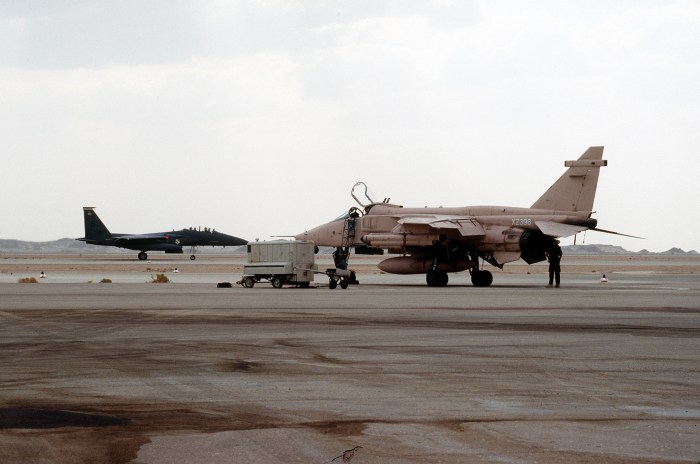
A Royal Air Force Jaguar aircraft is serviced on the flight line as a US Air Force F-15E Eagle aircraft taxis in the background during Operation Desert Shield. (Source: Wikimedia)
2021 is the 30th anniversary of Operation DESERT STORM, which sought to liberate Kuwait from Iraqi occupation. DESERT STORM has long been considered a significant turning point in the use of air power. As Richard Hallion reflected the 1990s, ‘[s]o profound [was] the change in warfare exemplified by what occurred in Desert Storm, that, for the United States, aerospace power [was] now de facto accepted as the natural and logical form of crisis intervention.’ In many respects, much of the rhetoric that had characterised air power thinking during the 20th century arguably coalesced in 1991. Nevertheless, the use and impact of air power both during the conflict and in the years afterwards, has remained controversial. As such, From Balloons to Drones is seeking submissions for a series of articles that examine the varied use of air power during DESERT STORM as well its impact on the conduct of military operations since 1991. Themes to be explored might include, but are not limited to:
Strategy, Theory and Doctrine| Organisation and Policy | Roles
Operations – Kinetic and Non-Kinetic | Tactics, Training and Procedures
Strategic and Operational Effect | Technological Developments
Ethical and Moral Issues | National, International and Transnational Experiences | Personal Experiences
We are looking for articles of between 500 to 4,000 words, though we will accept larger pieces and we reserve the right to publish them in parts. To understand the types of articles published by From Balloons to Drones, please visit our submissions page. As well as scholarly articles, we are keen to publish personal reflections on the use of air power by those who served during DESERT STORM. We would also be interested in potentially conducting interviews with veterans.
We plan to begin running the series in January 2021, and it will continue for as long as we receive potential contributions. We will also be looking at publishing extended versions of selected articles in an edited volume. We welcome and encourage submissions from academics, policymakers, service personnel, and relevant professionals. We also welcome submissions written from diverse academic disciplines.
Submissions should be submitted in Word format and emailed to the address below with ‘SUBMISSION – DESERT STORM Revisited’ in the subject line. Also, please include a 50-100-word biography with your submission. Footnotes can be used, and please be careful to explain any jargon. If you are not sure if your idea fits our requirements, then please email us with ‘POTENTIAL SUBMISSION – DESERT STORM Revisited’ in the subject line to discuss.
If you are interested in contributing, please email our Editor-in-Chief, Dr Ross Mahoney, at airpowerstudies@gmail.com or contact us via our contact page here.
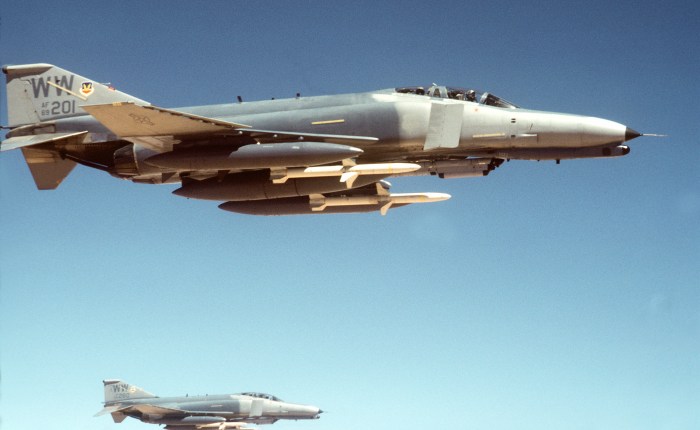
Header Image: Two US Air Force McDonnell Douglas F-4G Phantom II aircraft of the 35th Tactical Fighter Wing pass over the Saudi desert while on a training flight during Operation Desert Shield on 11 January 1991. The aircraft are carrying external fuel tanks on their outboard wing pylons and AGM-88 HARM high-speed anti-radiation missiles on their inboard wing pylons. (Source: Wikimedia)
Editorial Note: From Balloons to Drones is pleased to announce our new podcast series. Led by our Editor Dr Mike Hankins, the series builds on the success of From Balloons to Drones, and provides an outlet for the presentation and evaluation of air power scholarship, the exploration of historical topics and ideas, and provides a way to reach out to both new scholars and the general public. You can find our Soundcloud channel here.
In this episode, we interview Dr Peter Westwick, Director of the Huntington-USC Aerospace History Project, about his new book Stealth: The Secret Contest to Invent Invisible Aircraft. We talk about the design process of stealth planes like the F-117 and B-2 at Lockheed and Northrop and answer the tough questions, like why did stealth research seem to be focused on California? What role did Russian research play in stealth development? And of course, how is Disney connected to all this?
Dr Peter Westwick is a research professor of history at the University of Southern California and Director of the Aerospace History Project at the Huntington-USC Institute on California and the West. He is the author or editor of several books, including Into the Black: JPL and the American SpaceProgram, 1976-2004, which won book prizes from the American Institute of Aeronautics and Astronautics and the American Astronautical Society.
Header Image: The Lockheed F-117 Nighthawk stealth fighter flying over Nellis Air Force Base in 2002. (Source: US Air Force)
The 30th of May 1999 is an important date in the history of the Royal Danish Air Force (RDAF). On this day, Danish General Dynamics F-16s dropped bombs against a hostile target for the first time in its history. The target was in Serbia; a country located more than 1,500 kilometres from Denmark, and with which Denmark was not legally at war. Instead, what the RDAF participated in was a ‘humanitarian intervention’ that was supposed to stop a potential Serbian genocide in the province of Kosovo.
RDAF participation in the intervention against Serbia in 1999 was the end of a period fundamental transformations of the Air Force after the end of the Cold War. In this period, almost every aspect of the RDAF began to change – its doctrine, technology, and central mission. This article explores those changes by looking at the role of the RDAF during the post-Cold War conflicts in Yugoslavia between 1992-1995 and Serbia in 1999.[1]
In 1989, the RDAF was small but versatile. It consisted of more than 100 aircraft, a force of ground-based air defence centred around eight mobile missile batteries (I-HAWKs), seven large airbases, and a well-developed command-and-control-system that maintained a constant aerial picture of Denmark and the surrounding area. Its peacetime force was approximately 8,200 personnel, which could be increased to 17,500 in wartime. The RDAF was well integrated into NATO, and its main task was the defence of the western part of the Baltic Sea in case of an attack from the Warsaw Pact.[2] This was a role the RDAF undertook in conjunction with other NATO partners.
From ‘Peace-dividends’ to the Civil War in Yugoslavia
The fall of the Berlin Wall in November 1989 was one of the most momentous events in the modern history of the Danish defence policy. It prompted a shift away from the low-profile approach that had been the cornerstone of Danish policy since the end of the Second World War. In September 1990 the Danish government deployed the corvette, Olfert Fischer, as part of Operation DESERT SHIELD, the United Nations (UN) sanctioned military operation against Iraq, following the occupation of Kuwait. This deployment illustrated to Danish politicians that there was political capital to be gained from participating in such operations, far from Danish shores. At the same time, the Danish Defence Command, which coordinated and controlled the Danish military, realised that operations far from Denmark were a way to stay relevant and to avoid the hard cuts to the defence budget that some Danish politicians wanted, now that the enemy – the Warsaw Pact – had disappeared.
In 1992, the UN set up a peacekeeping force for the civil war in the former Yugoslavia. The Danish government decided to participate with approximately 940 soldiers – a large contingent by Danish standards. Initial problems with recruiting the needed number of soldiers resulted in a change in Danish military law that now stipulated that members of the Danish military were required to accept participating in missions outside Denmark’s borders. Approximately five per cent of the men and women employed by the Royal Danish Army, the Royal Danish Navy and RDAF chose not to accept this and left the military.[3]
In 1993, the Danish government strengthened the Danish contribution to the UN operation in Yugoslavia by deploying ten main battle tanks. Denmark thus became the first country to deploy such heavy weapons in a UN operation. When Danish politicians voiced concern that the deployment of the Danish tanks would be perceived as a dramatic escalation of UN involvement in the civil war in Yugoslavia, the Danish Armed Forces decided that the tanks should be painted white, giving them the nickname ‘The Snow Leopards.’
The deployment of Danish Leopard 1 tanks to the Former Yugoslavia in 1992 marked an important turning point in Denmark’s defence policy. (Source: Author)
Pressure from International Organisations
The RDAF was initially not deployed on the international stage, other than a single Lockheed C-130 Hercules, which in 1992 flew ten trips as part of the emergency assistance provided to the Yugoslav city of Sarajevo.[4] The pressure to change the RDAF contribution came from NATO, which had begun its transformation towards a smaller, but more flexible organisation, capable of faster response times. This process had already begun before the fall of the Berlin Wall, but it gained further momentum in the 1990s.
In 1991, NATO created two new forces: the Immediate Reaction Forces (IRF), capable of deploying within a few days, and the Rapid Reaction Forces (RRF) with a deployment time of a few weeks. Here the Danish government decided that that the RDAF’s Squadron 730 should be Denmark’s contribution to the IRF.[5]
The contribution of Squadron 730 to NATO’s IRF marked a shift in focus for the RDAF. During the Cold War era, NATO-planning envisaged that British and American squadrons would reinforce the RDAF.[6] NATO had planned to reinforce the RDAF with one Royal Air Force squadron of Hawker Harriers and two squadrons of SEPECAT Jaguars. United States Air Force (USAF) reinforcements were to consist of one squadron of McDonnel-Douglas F-15s, three F-16 squadrons, and one squadron of Republic A-10 Thunderbolts.
The 1990s, however, saw the RDAF shift to an expeditionary role whereby it contributed to the safety of others outside of Denmark’s borders. As such, the importance of making Squadron 730 available for NATO’s IRF cannot be overstated. Squadron 730 became the ‘flagship’ unit of the RDAF.
NATO’s involvement in the Civil War in Yugoslavia
In parallel with the above developments, during the first years of the 1990s, NATO became increasingly involved in the civil war in Yugoslavia. A UN ordered No Fly Zone had to be enforced by NATO, and in February 1994, this led to aircraft from the Alliance coming into action for the first time when US aircraft downed four Bosnian-Serbian fighter jets over Bosnia-Herzegovina.
A Royal Danish Air Force F-35 Drakken aircraft taxis into takeoff position during Exercise OKSBOEL ’86. (Source: Wikimedia)
On several occasions, the Danish government considered contributing Danish aircraft to NATO operations over Yugoslavia. Such a move was, however, hampered by Danish politicians, who in 1991 had decided to scrap all of the RDAF’s Saab Draken aircraft. This meant that the Air Force’s ability to perform close air support had been downgraded to the degree that meant that Danish aircraft was unfit to perform their intended tasks over Yugoslavia. Therefore, despite pressure from NATO, the Danish government had to decline NATO’s request to deploy Danish aircraft over Yugoslavia. This was embarrassing for the Danish government and meant an increased focus on the close air support task. This meant procuring new equipment, such as the Low Altitude Navigation Targeting Infrared for Night laser targeting pods (LANTIRN) that would eventually enable the RDAF’s F-16s to use precision-guided munitions (PGM). However, the acquisition and introduction of such equipment was a long process, and the LANTIRNs were not operational until 2001.
In the Line of Fire – Yugoslavia
On 29 April 1994, while the debate over a possible deployment of RDAF F-16s was ongoing, a Danish tank force became involved in combat operations against Serbian forces near Tuzla in Bosnia and Herzegovina. The Danish tanks were ambushed, resulting in a firefight lasting approximately 45 minutes. The episode was the first time since 1943 that troops under the Danish flag had fought in battle. While the Danes did not suffer any losses, the Bosnian Serbs subsequently acknowledged that they had nine killed and 15 wounded. The battle, known under the name Operation Bøllebank (Operation Hooligan Bashing), became just as important to the Danish military as the deployment of the Olfert Fischer four years earlier. It showed that Danish soldiers were ready to put military power behind international engagement and were able to fight.
Bøllebank also showed the soldiers, airmen and sailors in the Danish military that post-Cold War UN-operations were fundamentally different from the peaceful UN-missions that Denmark had participated in before 1989. It became clear to the Danish military that personnel deployed on such a mission could be called on to undertake combat operations. Finally, Bøllebank also illustrated a high degree of political and popular support for the Danish participation in the UN-operations, which subsequently helped to expand the Armed Forces’ maneuvering room in connection with these operations.[7]
RDAF Pressure for Change
During the 1990s the RDAF tried on numerous occasions to convince Danish politicians to deploy Danish planes to the civil war in Yugoslavia. This was driven by a fear that the RDAF’s lack of an international profile would make it difficult to secure funding for new equipment. The various professional heads of the RDAF in this period all wanted to make the entire Air Force deployable, including such elements as the Hawk missile system and radars. Following recommendations from the Danish Defence Command, Danish politicians decided to invest much money in new and more mobile equipment, and the RDAF’s Hercules and Gulfstream transport aircraft were equipped with, among other things, missile warning equipment to enable them to operate in dangerous areas.[8]
The RDAF also devoted resources to developing a Danish doctrine for the operational use of air power. The RDAF was inspired by USAF Colonel John Warden’s theories regarding the strategic use of air power, especially his 5-ring model of the enemy as a system. These ideas were used to set the direction for the development of the RDAF and to provide inspiration for how Danish aircraft could be used in the event of a conflict.[9]
From Operation DELIBERATE FORCE to Operation ALLIED FORCE
Following Operation DELIBERATE FORCE, the NATO air campaign over Bosnia and Herzegovina between 30 August and 20 September 1995, the civil war in Bosnia was stopped with the so-called Dayton Agreement. This peace deal ended a civil war that had cost more than 100,000 lives and driven more than four million people from their homes. Thanks to the deployment of a UN peacekeeping force of 60,000 personnel, Bosnia and Croatia have since been mostly peaceful.[10]
In the shadow of the civil war, however, another conflict lurked. Within the Federal Republic of Yugoslavia, which after 1995 consisted of Serbia and Montenegro, a significant minority of ethnic Albanians constituted much of the population of the southern Serbian province of Kosovo. The conflict between the ethnic Serbs minority and the ethnic-Albanian majority in Kosovo dated back hundreds of years but escalated in 1989 when Yugoslav President Slobodan Milosevic deprived Kosovo of the expanded autonomy enjoyed by the region since 1974.
During the 1990s, the political environment in Kosovo gradually grew worse, and by 1998 large parts of the province were no longer under Serbian control. The Serbian military and police, therefore, initiated a particularly hard-fought effort in Kosovo to restore control of the province – preferably by cleansing the province of ethnic Albanians.[11]
Among other things, because of the experience of the Srebrenica massacre in 1995, the world community could not let the Serbs pursue a campaign of ethnic cleansing in Albania. An American-led attempt to find a peaceful solution was therefore made, and the American diplomat Richard Holbrooke was given the task of trying to negotiate a solution.
Operation DETERMINED FALCON
To put pressure on the Serbian president, on 14 June 1998, NATO gathered a force of approximately 80 fighter jets from 12 countries. In Operation DETERMINED FALCON, these aircraft flew along the Serbian border and illustrated to the Serbian President that NATO was ready to use military power if the Serbs did not halt the ethnic cleansing in Kosovo.
For this operation, Denmark provided three F-16 aircraft (two plus one in reserve) at just two days’ notice. At 17:30 on 15 June 1998, Danish F-16s, together with a C-130 Hercules carrying support personnel and ammunition, flew to the Italian airbase at Villafranca. The next morning two Danish F-16s took part in the operation along the southern Serbian border to Macedonia and Albania. After a successful operation, the Danish aircraft returned to Denmark.[12]
During the summer of 1998, Richard Holbrooke managed to reach an agreement including the withdrawal of some Serbian forces from Kosovo. Whether DETERMINED FALCON played a role in that agreement or not is unclear.[13] However, the agreement did not last, and in September 1998, up to 300,000 Kosovo Albanians were once again on the run in Kosovo. These refugees threatened to destabilise the entire region and create a flow of refugees in Europe, such as those the world had witnessed during the 1997 collapse of Albania. The European authorities were very aware of this, and the European Union put much effort into stopping the Serbian cleansing of the ethnic Albanian population of Kosovo.
Towards Operation ALLIED FORCE
Concurrent with this process, NATO began planning a military operation. On the 8 October 1998, the Danish government made available six F-16s (four operational plus two reserve aircraft) and support personnel, totalling 120 men, for a NATO operation named OPLAN 10601 ALLIED FORCE. This operation was designed to compel the Serbs to return to the negotiating table and ensure that the Serbian forces left Kosovo by the 16 October.
One of the six RDAF F-16s deployed as part of Operation ALLIED FORCE in 1999. (Source: Author)
The Danish F-16s and most of the personnel initially came from Squadron 730. At the time, however, the RDAF had only 36 pilots with current operational experience on the F-16 aircraft. This figure included pilots serving at the RDAF headquarters as staff officers. The Danish contribution to ALLIED FORCE required six pilots in Italy, six on standby in Denmark and six for other operations, including those on leave at home in Denmark. The deployment thus required half of the RDAF’s available F-16 pilots. This problem was further exacerbated by the fact that all the deployed pilots had to be certified for the weapons systems that were expected to be used during the operation.
ALLIED FORCE, therefore, put much pressure on the entire fighter structure and operations of the RDAF. This pressure meant that all tasks that did not directly relate to air policing the skies over Denmark or ALLIED FORCE were discontinued. For example, among other things, Squadron 727 suspended the training of new pilots, while most of its pilots were deployed to Italy. In the long run, this would ultimately have an impact on the RDAF’s ability to meet its readiness level.[14]
Thanks to political and military pressure, in February 1999, it proved possible to persuade both representatives of the Kosovar rebel movement Kosovo Liberation Army and the Serbian government to initiate negotiations about the future of Kosovo. These took place at the French president’s summer residence at Chateau de Rambouillet, southwest of Paris. On the 18 March, however, it became clear that the negotiations would not lead to a deal, and with the negotiation options exhausted, NATO Secretary-General Javier Solana had no other options than on the 23 March to initiate Operation Allied Force. At 19:00 the following night, NATO began launching airstrikes against Serbian targets in Kosovo and Serbia.
The Danish Experience
RDAF F-16s participated in ALLIED FORCE from day one; however, the operation came at an unfortunate time. In addition to the aforementioned pilot issue, the RDAF was in the middle of a midlife update of its F-16s, and the number of operational aircraft was significantly reduced. Initially, the RDAF only had 14 F-16s capable of participating in the air campaign. This meant that the aircraft deployed during the air campaign worked up so many flight hours that had they operated in peacetime they would have had to be sent home to Denmark for inspection. To alleviate this issue, the RDAF’s Tactical Command issued exemptions from the rules to keep the aircraft flying.
For most of the air campaign, Danish F-16s operated in the defensive role. This was a necessary part of ALLIED FORCE. The Air Force of Yugoslavia – even though most of its fighter jets were of an older design – posed a potential threat to NATO had they chosen to resist the Alliance’s attack. However, after having lost four jets during the first days, the Air Force of Yugoslavia chose to keep most of its aircraft on the ground. Nevertheless, political demands from NATO-member states meant that approximately 33 per cent of Alliance aircraft were devoted to the air defence role against potential attacks by the Air Force of Yugoslavia.[15]
On these combat air patrols, Danish F-16s operated in pairs. Initially, their patrol zones were located over the Adriatic Sea, where the essential air tankers operated. As NATO became more confident that Serbian forces would not try to counter NATO operations, the patrol zones moved to the area over Albania and Macedonia and later also Hungary. This allowed the American jets, which had until then patrolled these areas, to be transferred to offensive operations.
Since Danish F-16 pilots were not equipped with night-vision-goggles, they were used in daylight operations. During one patrol over Kosovo, a Danish F-16 was fired at by a Serbian ground-to-air missile, which did not, however, successfully hit its intended target.[16]
Danish Offensive Air Power
While Danish F-16s primarily focused on the air defence role, in the final days of the air campaign, the RDAF aircraft became involved in offensive operations against Serbian targets.
The first Danish bombs were dropped on the 30 May. The details of the attack are still classified, but what is known is that the target was a radio mast in northern Kosovo and that the two F-16s each dropped six MK-82 bombs. From an altitude of 11,000 feet, the pilots visually observed the bombs hitting the target area. For the attack, the Danish planes used ‘dumb’ bombs. The primary reason for this was that it was not necessary to use a more expensive laser-guided bomb (LGB) on the target. Secondly, an attack with an LGB would have required ‘buddy’ lasing. This technique involved one aircraft illuminating the target with a laser and guiding the LGB, dropped from a second aircraft, towards the target. As well as the above, there was also uncertainty about which pilot was responsible for the bomb if it caused collateral damage. The RDAF, therefore, chose to use dumb bombs where there was no doubt that the Danish F-16s were fully responsible for weapons released.
According to one of the pilots involved in the 30 May attack, the target area had visible bomb damage before the Danish attack. The Danish bombs hit close to the target, but due to the uncertainty about the target’s condition before the attack, the military value of the attack was uncertain. For the RDAF, however, the attack was a significant event as it was the first time Danish aircraft had dropped bombs on an adversary.[17]
For the RDAF, its participation in ALLIED FORCE was a test of whether the Air Force had achieved the transformation that the leaders of the Air Force had wanted. The RDAF’s goal in the 1990s had been to create an air force capable of participating in an air campaign alongside its NATO-allies as well as executing the same type of missions as the USAF or the RAF. The RDAF’s conclusion following ALLIED FORCE was that this goal had not been met.
While participation in ALLIED FORCE was historic, with Danish aircraft bombing hostile targets for the first time in its history, the air campaign showed that the RDAF had fallen behind technologically when compared with Denmark’s NATO allies and especially the United States. The RDAF therefore, subsequently initiated a process to catch up with these technological deficiencies. Thus, ALLIED FORCE accelerated the RDAF’s transformation into an ‘expeditionary air force’ tailored for international operations.
A critical element of this transformation was a focus on precision-guided munitions to avoid collateral damage. The effect of participation in ALLIED FORCE was the acceleration in the acquisition of new equipment, such as LANTIRN, and ammunition for the Danish F-16s. When the RDAF deployed in support of US forces in Afghanistan following the terrorist attacks on the 11 September 2001, the Air Force’s technology level had been significantly improved.
Conclusion – From Defense of the Baltic to Global Reach
The transformation described in this article meant that the RDAF in 2000, compared with 1989, had been reduced by the following: a 50 per cent reduction in air stations; a 50 per cent reduction in fighter pilots; the number of Hawk squadrons had been reduced by 25 per cent; and the number of fighter aircraft in the RDAF inventory had reduced by 35 per cent. Similarly, the peacetime force had been reduced by 17 per cent to approximately 7,900, while the wartime force had been reduced by 26 per cent to 14,800. These cuts had not only hit the RDAF, but the overall number of personnel in the Danish armed forces had been reduced from 39,000 to 33,200, while the wartime force had fallen from 103,000 to 81,200.
The RDAF had, however, at the same time managed to survive the loss of the Warsaw Pact as its enemy, and had shown Danish politicians that improvements in the RDAF’s capabilities allowed it to participate in international operations far from Denmark. The lack of success in the skies above Kosovo in 1999 was therefore not seen as a failure for the RDAF but as evidence that the Danish politicians needed to spend more money on the Air Force in order to reap the benefits of participating in international operations. This policy eventually showed its merit during the air war over Libya in 2011-2012, where Danish F-16s dropped 923 bombs on Gadhafi’s military forces and showed that they were able to work closely together with the USAF and other allies – a prerequisite today for being on the front line during international missions.
Dr Søren Nørby is a researcher and lecturer at the Royal Danish Defense College in Copenhagen. He earned his PhD from Syddansk Universitet in 2018. He specialises in naval history and is the author of 25 books and more than 50 articles. For more information see www.noerby.net.
Header Image: Based on the experience of the operations over the former Yugoslavia during the 1990s, the RDAF underwent a number of critical transformations. One of these transformations was the introduction of new technologies to improve capabilities, such as the LANTIRN pod for use of on the F-16 that came into service in 2001. (Source: Author)
[1] This article is based on the author’s book Når Fjenden Forsvinder. Det danske flyvevåbens udvikling 1989 – 1999 (When the enemy disappears. The transformation of the Danish Air Force 1989-1999) (Odense, 2019).
[3] Forsvarskommandoen, Ved Forenede Kræfter (Vedbæk, 2000), p. 210; H. Hækkerup, På Skansen. Dansk forsvarspolitik fra Murens fald til Kosovo (København 2002), p.. 103.
[4] ’Rapport fra Udvalget vedrørende forsvarets materiel’, København 1998, p. 164.
[5] Ringsmose, Danmarks NATO-omdømme. Fra Prügelknabe til duks (Dansk Institut for Militære Studier 2007), p. 19; ‘Årlig Redegørelse 2004’, København 2005, pp. 34-5.
[7] L. Møller, Det danske Pearl Harbor. Forsvaret på randen af sammenbrud (København, 2008), p. 57; R. Petersen, ’Den bedste ambassadør – civil-militære relationer og demokratisk kontrol i Danmark 1991-2011’ (Phd Thesis, Roskilde Universitet, 2012), p. 207ff; R. Petersen, ’Danske sneleoparder i Bosnien,’ Militært Tidsskrift, 2010; P.V. Jakobsen, Fra ferie til flagskib. Forsvaret og de internationale operationer (København, 2009), p. 9; P.V. Jakobsen, ’The Danish Libya campaign: Out in front in pursuit of pride, praise and position,’ Upubliceret artikel, 2016, p. 195; K.S. Kristensen, Danmark i krig: Demokrati, politik og strategi i den militære aktivisme (København, 2013), p. 38; L. From, ’Da et kampvognsslag ændrede danskernes syn på krig,’ Jyllands-Posten, 3 May 2015; ’Balkan har reddet det danske forsvar,’ FOV Nyhedsbrev 7/2002.
[8] S. Hartov and J.E. Larsen, Forsvarets fly efter 1945 (Flyvevåbnets Specialskole, 1995), p. 36ff.
[9] John Warden III, The Air Campaign. Planning for Combat (Washington 1988).
[10] M.O. Beale, ‘Bombs over Bosnia. The role of airpower in Bosnia-Herzegovina’ (Thesis, USAF School of Advanced Airpower Studies, 1997), pp. 33-4; Christian Anrig, The quest for relevant air power: continental European Responses to the air power challenges of the post-cold war era (Maxwell, AL, 2011), p.. 32, 179; M. Juul and S.W. Nielsen, 12 år på Balkan (København 2004), p. 46; John Olsen (ed.), Air Commanders (Dulles, VA, 2013), p. 356ff; C. Axboe, Vi troede ikke, det kunne ske her – Jugoslaviens sammenbrud 1991-1999 (København, 2018), p. 227-53.
[12] I. Daalder and M. O’Hanlon, Winning Ugly. NATO’s War to Save Kosovo (Brookings Institution Press, 2001), pp. 32-3; G. Schaub, Learning from the F-16 (København, 2015), p. 19ff.; M. Vilhelmsen, ’Operation Allied Force (AOF): Da Flyvevåbnet med voksent,’ Upubliceret. Vojens, 2010, p.. 2; ’Rapport vedr. dansk flyvevåben deltagelse i Operation Allied Force,’ 12 november 1999, B2-B3; Årlig Redegørelse 1998, pp.. 33-6.
[14]Hammerkasterne: Historien om Eskadrille 727 gennem 50 Ar (Skrydstrup, 2005), p. 162-3; ’Flugten er stoppet – men stadig mangel på F-16 piloter,’ Berlingske Tidende, 7 May 1999; ’Rapport vedr. dansk flyvevåben deltagelse i Operation Allied Force,’ 12 November 1999, p.. B-11 og D-10. TTJ og ’F-16 planlægningsmøde vedr. evt. overgang til anvendelse af F-16 MLU i f.m. Flyvevåbnets deltagelse i Operation Allied Force,’ 8 March 1999.