I am an independent scholar specialising in the history of war. I have nearly 20 years of experience within the education, museum and heritage sectors in Australia and the United Kingdom. I am currently the Senior Historian at Brisbane City Council in Australia. I am also the editor-in-chief and owner of 'From Balloons to Drones.' My research interests focus on the history of air power and air warfare, military leadership and command, military culture, and the history and development of professional military education. I also maintain an interest in transport history. To date, I have published numerous articles, chapters and encyclopedia entries, edited two books, and delivered papers on three continents to various civilian and military audiences.
Bruce McCandless III, Wonders All Around: The Incredible True Story of Astronaut Bruce McCandless II and the First Untethered Flight in Space. Austin, TX: Greenleaf Book Group Press, 2021. Illustrations. Notes. ARC. 247 pp.
Reviewed by Dr Brian Laslie
It is a picture that seems to hang somewhere in every elementary school and library in America. For that late Gen-X group born in the last half of the 1970s, it hung on the walls of our bedrooms next to baseball heroes Dale Murphy and Mike Schmidt. Space Historian Emily Carney has dubbed it simply ‘the poster.’ The image is so ubiquitous as to be almost forgettable, not because it is forgettable but because you see it everywhere: from museum walls to commercials. It is inescapable. It is easily as memorable as any photograph that came out of America’s early space program, and it remains one of NASA’s most requested pictures. The image is of an untethered astronaut floating alone in the blackness of space, feet dangling above a blue and white Earth. Even as I write this review, a version of the famed photo hangs in my office, a hand-painted copy by my oldest daughter, herself a budding STEM and space lover.
The astronaut in the photograph is Bruce McCandless II, hardly a household name; but you have heard his voice, and you have seen his face in the old B-rolls of the floor of mission control where he served as a CAPCOM (capsule communicator) on the Apollo 10, 11 and 14 missions. McCandless served as CAPCOM for the first lunar extravehicular activity (EVA), and said “Okay, Neil, we can see you coming down the ladder now.”
Hardly a household name, yet he was at the epicentre for two seismic events in the history of crewed spaceflight: the first steps on the moon and the man behind the mask in the first untethered EVA. That untethered EVA and his first ride into space was a long time in coming. Half of his astronaut class flew to the moon, including Jack Swigert, Al Worden, Stu Roosa, Ron Evans, and Ken Mattingly as Command Module Pilots, while classmates Edgar Mitchell and Charlie Duke walked on the surface of the moon. Fred Haise served as the Lunar Module Pilot for the ill-fated Apollo 13 mission, another of McCandless’s astronaut class. Much of his class served on Skylab, the Apollo-Soyuz Test Project, and the early shuttle flights.
Bruce McCandless II, c. 1971. (Source: Wikimedia)
McCandless, and classmate Don Lind, was considered more a scientist than a pilot in his astronaut class. This undoubtedly hurt him in crew rotation and mission assignments. One need look no further than Astronaut Walter Cunningham’s book, The All-American Boys, to know that Deke Slayton did not look favourably on anyone who was not a test pilot. Cunningham aptly noted:
If an astronaut had been in space, he was a star. If he was on a crew, he was a prospect. If he was not yet in line, he was simply a suspect. He hadn’t really made the team. (Cunningham, p. 84).
Cunningham also noted that amongst all astronauts, ‘At the very bottom of the pile were the hyphenated astronauts, the scientists’ (Cunningham, p. 87). McCandless II almost became the astronaut the world forgot despite his presence in the famous photo.
In his new book Wonders All Around: The Incredible True Story of Astronaut Bruce McCandless II and the First Untethered Flight in Space, this omission is being corrected by his son, Bruce McCandless III. This book focuses on the astronauts of the Apollo era who doggedly hung on at NASA through the early Space Shuttle program. Also unusual is that Wonders all Around is the third book to either be authored or co-authored by a son or daughter of the Mercury, Gemini, and Apollo Astronauts, the others being Rosemary Roosa’s To the Moon: An Autobiography of an Apollo Astronaut’s Daughter, and Kris Stover’s For Spacious Skies, written with her father Scott Carpenter. All three bring a different perspective to the golden age of spaceflight.
The author traces the early journeys of his father but does not fall into the trap of taking too long to tell it. For Bruce McCandless, ‘the real joys of his life: reading, thinking, and engineering.’ This demonstrates that McCandless II was a man at home inside the cockpit and a textbook (p. 40). McCandless’ selection to NASA might not have come with a rapid assignment to a flight, but it did place him in the middle of the action, most notably with his selection serving as a CAPCOM. The author notes this assignment came with a bit of a letdown when he states:
It’s like being the backup quarterback who relays plays from the sidelines; you’re part of the action, but no one’s going to remember you after the game. (p. 62).
Nevertheless, McCandless II soldiered on through Apollo, Skylab, and Apollo-Soyuz, all without a flight assignment and grimly hung on through the intervening years waiting for the shuttle to come online. McCandless endured, and he could be seen ‘wandering the halls of Building 4, haunted by the ghosts of cancelled Apollo missions,’ even as newer generations of astronauts began to take their place in line for shuttle assignments (p. 134).
McCandless III sets about telling his father’s story and the societal, political, and cultural events that occurred along the way. He also delves into the family life of McCandless II at home, and, in this case, ‘dad’ comes across as a work-at-home, distant, slightly standoffish figure, that many in my generation can identify with.
Wonders all Around is the perfect transition book for those looking into the late-1970s lean years as NASA moved from the Saturn V to the Space Transport System. McCandless III notes that his dad was part of the transition from the all-male, test pilot atmosphere to the shuttle era’s more inclusive and scientific period. McCandless was there to see it all, still hoping for his first rocket launch and all along the way continuing his work on the piece of machinery that would solidify his place in the history of photography: the Manned Maneuvering Unit (MMU).
Of course, the book inevitably leads to McCandless’ first flight, his piloting of the MMU up to 300+ feet from the Space Shuttle Challenger in 1984, and ‘Hoot’ Gibson taking the now-iconic photo, but neither of the McCandless’s story ends there. Instead, McCandless II continued to stick it out at Houston and flew one more time on a possibly more famous mission, STS-31, which deployed the Hubble Space Telescope (I would be remiss here if I did not recommend Astronaut Kathryn Sullivan’s magnificent biography Handprints on Hubble).
Astronaut Bruce McCandless II, mission specialist, participates in a extra-vehicular activity (EVA), a few meters away from the cabin of Space Shuttle Challenger. He is using a nitrogen-propelled hand-controlled Manned Maneuvering Unit (MMU). He is performing this EVA without being tethered to the shuttle. The picture shows a cloud view of the Earth in the background. (Source: Wikimedia)
As new and forthcoming astronaut biographies continue to be published each year, our understanding of NASA as an organization continues to grow as well. McCandless III’s biography of his father adds to our understanding. McCandless II clearly had the ‘Right Stuff,’ but he had more than enough of the ‘Scientific Stuff’ to make him a legendary astronaut, and this biography cements the name of McCandless alongside Shepard, Armstrong, and Ride.
McCandless II said of that famous photo that “I have the sun visor down, so you can’t see my face, and that means it could be anybody in there. It’s sort of a representation not of Bruce McCandless, but mankind.”[1] That may be true, but the author has lifted that visor and allowed the sun to shine on the face of his father at last. Wonders All Around is a powerful biography, history, and love letter to an organization, an event, a photograph, and an individual.
Dr Brian Laslie is a US Air Force Historian and currently the Deputy Command Historian at North American Aerospace Defense Command (NORAD) and United States Northern Command (USNORTHCOM). He is also the Book Reviews Editor here at From Balloons to Drones. A 2001 graduate of The Citadel and a historian of air power studies, he received his Masters’ from Auburn University Montgomery in 2006 and his PhD from Kansas State University in 2013. He is the author of Architect of Air Power: General Laurence S. Kuter and the Birth of the US Air Force (2017) and The Air Force Way of War (2015). The latter book was selected for the Chief of Staff of the Air Force’s 2016 professional reading list and the 2017 RAF Chief of the Air Staff’s reading list. He can be found on Twitter at @BrianLaslie.
Header image: Astronaut Bruce McCandless, II tests a the manned maneuvering unit during a test involving the trunion pin attachment device he carries and the shuttle pallet satellite (SPAS-01A), partially visible at bottom of the frame. The space shuttle Challenger was flying with its aft end aimed toward the Earth. (Source: Wikimedia)
[1] Anne Broache, ‘Footloose,’Smithsonian Magazine, August 2005.
Frank A. Blazich Jr. An Honorable Place in American Air Power: Civil Air Patrol Coastal Operations, 1942-1943. Maxwell Air Force Base, AL: Air University Press, 2020. Illustrations. Notes. Bibliography. Index. Pbk. xvi + 239 pp.
Reviewed by Bryant Macfarlane
As a much younger man, I participated in the United States Air Force’s Civil Air Patrol (CAP) cadet program like many other young Americans. Along with emergency services and aerospace education, the CAP cadet program teaches valuable life skills and cementing a nascent airmindedness into its members. Given the important role, the publication of Frank A. Blazich, Jr.’s An Honorable Place in American Air Power: Civil Air Patrol Coastal Operations, 1942-1943 is an important addition to the literature on the role of American air-power during the Second World War.
Blazich, Curator of Modern Military History at the Smithsonian Institution’s National Museum of American History and Director of the Colonel Louisa S. Morse Center for Civil Air Patrol History, is uniquely suited to the task of writing the history of CAP’s important role at the height of the Battle of the Atlantic. An Honorable Place in American Air Power recounts the exploits of volunteer American civil airmen combating U-boats off the Atlantic and Gulf Coasts and patrolling the American-Mexico border in the critical opening months of American involvement in the Second World War. Though not the first to tackle the subject, Blazich’s effort is undoubtedly the most complete accounting of how American – air-minded civilians found a way to help their nation in a time of dire need. Blazich challenges the hagiographic treatment of William Mellor, Andrew Ten Eyck, and Robert E. Neprud by arguing that the CAP had significant safety, organisational, and funding issues until Congress created federal legislation in 1948. While most works produced since the 1950s have been tertiary works, Blazich supports Clair Blair’s conclusion in Hitler’s U-Boat War (1998). Blair and Blazich argue that U-boats were not a decisive weapon of war in the Atlantic but did significantly delay the total mobilisation of American assets towards operations in Africa. Blazich’s original research builds upon the archival work of Michael Gannon and the capture of oral history by Louis Keefer to fully explore the historiographical gap left in the official histories of the US Army and US Navy.
While the work is aimed at incorporation into professional military education venues, Blazich’s writing is very accessible to general readers and military professionals while retaining academic rigour. Blazich’s presentation and enthusiasm allow the narrative to unfold cleanly across the page while easily allowing the interested reader to understand his methodology and sources in endnotes and appendices. Researchers and academics are rewarded by including deep endnotes and rich appendices that provide a wealth of resources for further work on the CAP and interested in exploring aspects of the Second World War, air power, civil-military relations, security studies, and general American aviation history. In so doing, Blazich definitively puts to rest the myth of CAP aircraft destroying or damaging enemy submarines and clarifies the challenges surrounding the CAP and its participation in the American anti-submarine campaign from March 1942 to August 1943.
Blazich effectively demonstrates how, with tentative agreement from the US Navy and US Army Air Forces, an organisation of volunteer private pilots, mechanics, radio operators, and administrators freed military personnel and equipment for operations outside of the continental United States. Using professionalism, dedication, resourcefulness, and small civil aircraft, the CAP surmounted formidable geographic, legal, and logistical obstacles in establishing a series of 21 air bases from the Maine-Canadian border to the Texas-Mexico border. This was conducted through volunteer efforts with minimal state or federal support. Further, Blazich demonstrates that, despite support from the Office of Civil Defense (OCD), many military officials were sceptical of the potential for effective inclusion of the CAP into their national defence responsibilities. Nevertheless, despite the reorganisation of military commands and interservice squabbles over responsibilities, the CAP proved to be an effective and timely solution to the nation’s needs in securing the American eastern sea frontier and freeing uniformed forces for operations in Africa and the Pacific.
Presented in five chronologically focused chapters, with an introduction and concluding chapter on how volunteer civil-auxiliary assets can be exploited for future needs, An Honorable Place in American Air Power is a highly accessible and vital work. Some may take historical umbrage with Blazich’s argument (p. 1) that within the context of the era, ‘CAP members became the first American civilians to actively engage with enemy forces in defense of the United States.’ However, as Blazich (p. 1) clearly outlines across the five chapters that make up the core of this book that for approximately 18 months, the volunteer civilian airmen of the CAP became a de jure ‘fourth arm of the nation’s defense.’ While volunteering for CAP missions did not preclude Selective Service selection, and members had to provide their uniforms, aircraft, equipment, and facilities, it offered the only path for a private citizen to maintain the ability to ‘own, operate and service any aircraft and radio equipment.’ (p. 89)
While Blazich rightly argues that the formation of the CAP was a synchronicity of people and events that was put into motion in the late 1930s, what is unquestionably clear is that the organisation would not have been taken as seriously by the War Department had it not been for the positive relationships air-minded leaders. These included people such as Fiorello LaGuardia, of the OCD, shared with well-placed Army officials, like Chief of the Army Air Forces ‘Hap’ Arnold, in the War Department. Arnold, like Giulio Douhet, understood the need to educate political leaders on the critical link between military and civilian aviation. Arnold also understood that America was soon to be desperately needed a ready supply of skilled pilots and maintainers. Because of this, argues Blazich, Arnold became ‘one of the CAP’s biggest supporters’ from within the War Department. (p. 150) While Blazich clarifies that CAP operations occurred concurrently with the increased convoy and military force projection that had effectively created wide-area security for American sea frontiers, the argument is clear that the CAP provided an evident success in effectively adopting civilian volunteers and equipment into the National Defense Strategy.
The front cover of Blazich’s book is based on this 1943 recruitment poster for the Civil Air Patrol that was designed by Clayton Kenney. (Source: NARA)
A prime example of synchronicity was the November 1941 decision of the OCD to place Army Major General John F. Curry, a retired Commandant of the Air Corps Tactical School, as the CAP National Commander. Thus, building trust between the fledgling CAP and the War Department as unarmed CAP patrols began in January 1942. Blazich (p. 56) argues that despite the early support by the War Department, by March 1942, the US Navy felt the CAP would ‘serve no useful purpose except to give merchant ships the illusion that an adequate air patrol is being maintained.’ However, this did not go far in impressing Admiral Ernest King, who opined (p. 57) that CAP aircraft ‘would not be productive in sufficient degree to compensate for the operational difficulties to be encountered in coordinating and controlling the flying involved by inexperienced personnel.’ Despite these expressed feelings by the US Navy, civil leaders expressed further trust in the CAP’s ability, under the operational jurisdiction of Naval sea frontier commands to extend the safety of merchant shipping through the American littorals and beyond from U-boats operating along American waters.
On 29 April 1943, President Franklin Roosevelt issued Executive Order 9339, which transferred the CAP from the OCD to the War Department. By the summer of 1943, trust in the CAP as an asset to the nation’s defence in freeing military human resources for combat and providing overflight services had measured a success. The CAP bought time for the Navy to build force capacity to conduct land-based, long-range offensive operations across the American sea frontier. Admiral King registered accolades as the CAP stood down its continuous volunteer air services to America’s eastern sea frontiers. According to Blazich (p. 150), ‘King, never one to offer accolades except when appropriate, his praise represented the highest compliments’ to the demonstrated professionalism, bravery, and sacrifice of the volunteer members of the CAP.
The final chapter of An Honorable Place in American Air Power argues that the retention of the CAP after the national defence emergency demonstrates that innovative solutions to strategic problems can be found when Americans work collaboratively. Here, Blazich urges key leaders to use the legal and social foundations laid by the CAP to be extended into more routine use in an emergency, or civil relief situations. Blazich, arguing that the CAP has expanded to include cyber and small unmanned aerial system operations, sees an underutilised functional capacity in the CAP. ‘For a future conflict with an unknown enemy, [and] the improbability of a conventional enemy land force invading the continental United States,’ argues Blazich (p. 175), ‘physical CAP assets will assist the Air Force along the nation’s borders, in cyberspace, and throughout the interior.’
In conclusion, An Honorable Place in American Air Power is a tremendously important work that expands our understanding of the American home front in the opening months of the Second World War. While, as Blazich argues (p. 164), ‘deterrence is a nebulous matter to objectify into metrics,’ An Honorable Place in American Air Power conclusively demonstrates the effectiveness of the CAP through the actions of the brave men and women of the coastal patrol stations that motivated legislative designation of the CAP as the auxiliary of the United States Air Force. Moreover, the CAP is ‘available for noncombat programs and missions with taxpayer funding and resources’ (p. 170) to continue providing education, emergency rescue, and other support to continually build strength for a capable air presence for the American people.
Bryant Macfarlane served in the United States Army from 1997 to 2019 and is a PhD student at Kansas State University studying vertical flight and its effect on military culture. He can be found on Twitter @rotary_research.
Header Image: A variety of Civil Air Patrol-operated aircraft, including a Sikorsky S-39 in center frame, parked at Coastal Patrol Base 17 between July 1942 and August 1943. The base would eventually become Francis S. Gabreski Airport in New York State. (Source: Wikimedia)
Editorial Note: Led by our Editor Dr Mike Hankins, From Balloons to Drones produces a monthly podcast that provides an outlet for the presentation and evaluation of air power scholarship, the exploration of historical topics and ideas, and provides a way to reach out to both new scholars and the general public. You can find our Soundcloud channel here. You can also find our podcast on Apple Podcasts and Google Podcasts.
2022 will mark the 50th anniversary of the LINEBACKER campaigns – the last major bombing campaigns of the Vietnam War. As such, in our latest podcast, we interview Dr Brian Laslie about his latest book, Air Power’s Lost Cause: The American Air Wars of Vietnam and his evaluation of the legacy of air power’s contribution to the Vietnam War.
Dr Brian Laslie is a US Air Force Historian and currently the Deputy Command Historian at North American Aerospace Defense Command (NORAD) and United States Northern Command (USNORTHCOM). He is also the Book Reviews Editor at From Balloons to Drones. A 2001 graduate of The Citadel and a historian of air power studies, he received his Masters’ from Auburn University Montgomery in 2006 and his PhD from Kansas State University in 2013. He is the author of Architect of Air Power: General Laurence S. Kuter and the Birth of the US Air Force (2017) and The Air Force Way of War (2015). The latter book was selected for the Chief of Staff of the Air Force’s 2016 professional reading list and the 2017 RAF Chief of the Air Staff’s reading list. He can be found on Twitter at @BrianLaslie.
Header Image: 3/4 front view of a US Air Force RC-130A of the 1st Aerial Cartographic and Geodetic Squadron parked on aluminium matting at Tuy Hoa Airbase in South Vietnam in 1970. (Source: NARA)
Editorial note: In this series, From Balloons to Drones highlights research resources available to researchers. Contributions range from discussions of research at various archival repositories to highlighting new publications. As part of this series, we are bringing you a monthly precis of recent articles and books published in air power history. This precis will not be exhaustive but will highlight new works published in the preceding month. Publication dates may vary around the globe and are based on those provided on the publisher’s websites. If you would like to contribute to the series, please contact our Editor-in-Chief, Dr Ross Mahoney, at airpowerstudies@gmail.com or via our contact page here.
Articles
David Stubbs, ‘The Direction, Planning, and Implementation of the Operation Iraqi Freedom Air Campaign, 19 March–2 May 2003,’ War in History (2021), doi:10.1177/09683445211034535.
America’s leaders, who anticipated that Operation Iraqi Freedom would end Saddam Hussein’s Ba’athist regime, wanted to leverage technological advances to wage a ‘light-footprint’ ground war. This expectation obliged air, land, and naval planners to balance their strategic and tactical targeting options and to concentrate their activities on tactical support to ground forces, delivered at a speed designed to undermine the ability of the Iraqi forces to offer a coherent defence. The air campaign plan that emerged has often been misunderstood and misinterpreted as a blunt instrument, but it was actually underpinned by the desire to minimise civilian casualties.
Chapters
D. Blinder, ‘Falklands/Malvinas’ Air Warfare and Its Consequences: A Critical Geopolitical Approach’ in E.E. Duarte (ed.), The Falklands/Malvinas War in the South Atlantic (Basingstoke: Palgrave Macmillan, 2021).
This chapter investigates the aerial dimension of the Falklands/Malvinas warfare and the post-war condition of technological restrictions imposed upon Argentina. The analysis proceeds from a critical geopolitical perspective to conceptualize the geopolitical drivers of diffusion and the manufacture of military industry and technology. It assesses the British official documentation on export licenses to Argentina between 1997 and 2018 and the corresponding Argentine measures to deal with those restrictions from Alfonsín to Macri’s presidential administrations. I argue the UK controlled the exports of military technology or dual-use technology to Argentina, developing a “web of technological limitation,” which extended from British defense and trade governmental apparatuses to international institutions.
Books
Lee Cook, Dirty Eddie’s War: Based on the World War II Diary of Harry “Dirty Eddie” March, Jr,. Pacific Fighter Ace (Denton, TX: University of North Texas Press, 2021).
Dirty Eddie’s War is the true account of the war-time experiences of Harry Andrew March, Jr., captured by way of diary entries addressed to his beloved wife, Elsa. Nicknamed “Dirty Eddie” by his comrades, he served as a member of four squadrons operating in the South Pacific, frequently under difficult and perilous conditions. Flying initially from aircraft carriers covering the landings at Guadalcanal in August 1942, he was one of the first pilots in the air over the island and then later based at Henderson Field with the “Cactus Air Force.” When he returned to combat at Bougainville and the “Hot Box” of Rabaul, the exploits of the new Corsair squadron “Fighting Seventeen” became legendary.
Disregarding official regulations, March kept an unauthorized diary recording life onboard aircraft carriers, the brutal campaign and primitive living conditions on Guadalcanal, and the shattering loss of close friends and comrades. He captures the intensity of combat operations over Rabaul and the stresses of overwhelming enemy aerial opposition.
Lee Cook presents Dirty Eddie’s story through genuine extracts from his diary supplemented with contextual narrative on the war effort. It reveals the personal account of a pilot’s innermost thoughts: the action he saw, the effects of his harrowing experiences, and his longing to be reunited with the love of his life back home.
Tom Cooper and David Nicolle, MiGs in the Middle East – Volume 2: Soviet-designed Combat Aircraft in Egypt and Syria 1963-1967 (Warwick: Helion and Company, 2021)
Hundreds of fighter-bombers of Soviet design and manufacture served in the air forces of multiple frontline Arab states during the first half of the 1960s. Not only older Mikoyan i Gurevich MiG-15s and MiG-17s, but also newer types such as the MiG-19 and MiG-21 were acquired in continuously increasing numbers, concurrently with Ilyushin Il-28- and Tupolev Tu-16 bombers, transport types such as the Antonov An-12 and Ilyushin Il-14, and trainers designed by Yakovlev. Nowhere else did they – and their pilots – play as important a role for the future of the local air forces – or entire nations – as in Egypt and Syria from 1963 until 1967. Whilst the period in question is still frequently described as a ‘peaceful decade’ in Israel and the West, they saw almost uninterrupted action: in Egypt, in Syria, as well as in Yemen, and especially in continuous incidents with Israel.
Based on official documentation and extensive interviews with dozens of veterans, and richly illustrated with exclusive photography and colour profiles, MiGs in the Middle East Volume 2 is a uniquely compact yet comprehensive guide to the build-up and operational history of Soviet-made aircraft in Egypt and Syria during this period. Prepared by authors that have established themselves as top authorities on the Arab air forces, and supported by custom-drawn colour profiles and detailed maps, it provides an exclusive, in-depth study and a single point of reference for the operational history of the Egyptian and Syrian air forces, their organisation and markings of the mid-1960s.
John Dillon, Bombers at Suez:The RAF Bombing Campaign during the Suez War, 1956 (Warwick: Helion and Company, 2021).
In October 1956 the British government, together with the French and Israelis, launched an attack on Egypt in response to President Nasser’s nationalization of the Suez Canal. The agreement between these three governments, the Sèvres Protocol, was a low point in British diplomacy and a factor in the ending of Prime Minister Eden’s political career. The military commanders had to plan for and launch Operation Musketeer, some 2,000 miles from the UK, while their political masters gave them only limited information on the arrangement made with France and Israel.
The RAF squadrons allocated to the operation came from the UK and Germany where their jet bombers, Canberras and Valiants, were intended for nuclear war against the Warsaw Pact countries rather than conventional war with Second World War bombs in a desert environment.
When Anthony Eden took the decision to launch Operation Musketeer the RAF did not have the forces required in the Mediterranean. At short notice, squadrons had to train for high level, visual bombing using techniques that would have been familiar to Lancaster crews in the Second World War. Also, the navigation aids fitted in the bombers were those required for the European theatre, not the Egyptian desert.
This account uses Cabinet Minutes, Squadron Operation Record Books, reports written by the Commander-in-Chief and personal accounts by aircrew who flew over Egypt, to detail the involvement of the RAF and is richly illustrated with photographs from the conflict and original colour artworks.
Editorial Note: In the conclusion of a two-part series on the contribution of US air power to the conduct of the Second Iași-Chișinău Offensive, Dr Luke Truxal examines the role of the US Fifteenth Air Force in the destruction of Luftflotte IV in the lead up to the launch of the Second Iași-Chișinău Offensive by the Red Army in August 1944. You can read the first part of this article here.
On 6 June 1944, the same day that the Allies landed in Normandy to begin the liberation of western Europe, the US Fifteenth Air Force attacked Galati airfields. This represented a new phase of the air war over Romania, one where Luftflotte IV came under direct attack because of an American air superiority campaign. This article will contend that the American attacks against Luftflotte IV, at the request of the Soviets, contributed to the success of the Second Iași-Chișinău Offensive.
When American bombers flew from Soviet bases against Axis forces in Romania on 6 June 1944, it marked the first time in the war that they took off from behind Soviet lines to attack Axis targets. This mission was a part of Operation FRANTIC I, the first shuttle bombing missions from western Allied bases to Soviet bases. After leaving their bases in Ukraine, American bombers struck the primary Axis airfield in Romania at Galati. One hundred and four American B-17s and 42 P-51s of the Fifteenth Air Force attacked the German and Romanian air facilities at Galati. Fourteen Axis fighters along with another 25 spotted near the airfield engaged the strike force. During the ensuing air battle, American fighters accounted for six Axis fighters at the loss of two American fighters. The 104 B-17s dropped 155.3 tons of explosive bombs and 51.3 tons of incendiary bombs on the airfield and its facilities. Much of the buildings, hangers, and facilities at Galati were destroyed or damaged during the bombing. Of the 40 aircraft still on the ground during the attack, the Fifteenth Air Force destroyed eight and damaged 11.[1] FRANTIC I’s final mission was an attack on the Focsani airfield on 11 June and a return to the American airfields in Italy. Flying from the Soviet bases, 121 B-17s dropped 223.9 tons of bombs on the Focsani airfield escorted by 52 P-51s. The bombers struck the barracks and workshops along with additional facilities. The attacking force engaged 15 to 20 ME 109s and FW 190s over Focsani.[2]
A P-51 Mustang nicknamed ‘Tempus Fugit’ of the 31st Fighter Group, Fifteenth Air Force in 1944. (Source: IWM (FRE 8681))
In another attempt to weaken Axis air power over Romania, the Americans executed Operation FRANTIC III, the first fighter sweep shuttle mission to the Soviet Union. According to the FRANTIC III plan on 11 July 1944, the purpose of the mission was to send 72 P-38s and 48 P-51s from the 306th Fighter Wing of the Fifteenth Air Force to execute counter-air operations from the American airfields located behind the Soviet lines in Ukraine. The three tactical objectives of FRANTIC III included: strafing of aircraft at Mielec, Poland; strafing of aircraft airfield and dive-bombing of the facilities at Lviv; strafing of targets that are identified through photo reconnaissance while in the Soviet Union.[3] At 7:45 AM on 22 July 1944, the 82nd and 31st Fighter Groups of the 306th Fighter Wing took off from their bases in Italy to attack the Romanian airfields near Zilistea and Buzau. When approaching the target, the American fighters dropped to an altitude of 5,000 feet. When they reached 4,000 feet, they passed several Axis aircraft flying near the airfield. The 82nd Fighter Group bypassed them to attack the airfields, while the 31st Fighter Group provided air cover. Once below 4,000 feet, Romanian anti-aircraft fire engaged the formations. The city of Ploesti began to deploy a smokescreen as they noticed the incoming American fighters. The 82nd Fighter Group attacked five airfields: Zilistea, Buzau, and three satellite fields. The 82nd Fighter Group destroyed 41 aeroplanes on the ground. Both the 82nd Fighter Group and 31st Fighter Group destroyed another 15 aeroplanes in the air at the loss of five P-38s. After the attack, the two groups reassembled and proceeded to their airbases located in Ukraine at Piryatin, Poltava, and Mirgorod.[4]
The next day the 306th Fighter Wing received orders to attack the German airfield at Mielec. One problem that the 306th Fighter Wing ran into was the fact that the Soviet offensive against German Army Group Center, codenamed Operation BAGRATION, had driven within 88 miles of the airfield, and there was concern that the Americans might accidentally strafe a Soviet ground formation. Additionally, poor weather delayed the attack until 25 July. By that time, the Soviet advance was 48 miles away from the airfield.[5] On 25 July, 36 P-38s and 36 P-51s of the 306th Fighter Wing attacked the airfield at Mielec, destroying anywhere from nine to 16 German aircraft on the ground. South of Mielec the fighters spotted a train and column of trucks which were also attacked destroying four locomotives and 14 trucks. On their way back to their bases in Ukraine, the fighter formation stumbled across a German bomber formation of 36 German JU-87 bombers without an escort. The American fighters engaged and destroyed 29 of the bombers. By the end of the day, the American fighters returned to their bases without suffering a loss.[6] The 26 July mission was a low-level fighter sweep of Ploesti and Bucharest and then a return to the Fifteenth Air Force bases in Italy. Poor weather forced the formation to divert to the Galati and Zilestea area. This led to an engagement with German fighters that resulted in 20 German fighters being shot down at the loss of two P-38s. [7]
The Red Army requested more follow up counter-air operations on the eve of the Second Iași-Chișinău Offensive. The Red Army General Staff sent a request to Deane’s counterpart in Moscow, Major General Robert L. Walsh, who oversaw all American air operations on the Eastern Front. Walsh sent an urgent message to the commander of the United States Strategic Air Forces in Europe, Lieutenant General Carl Spaatz, on 2 August. He wrote, ‘The Soviets requested that we concentrate our attacks on the following: enemy airdromes just south of the Iasi-Akkerman front.’ This included at least twelve airfields near the front lines. The Soviets provided a list, which Walsh transmitted directly to Spaatz. [8] The Americans had already carried out three fighter-bomber missions against German airfields in July.[9]
Russian officers chat with Colonel Barton, Commanding Officer of the 483rd Bomb Group, and Colonel Rice of the 2nd Bomb Group at Mirgorod. The girl in the center is an interpreter. (Source: National Museum of the USAF)
This request led to FRANTIC IV, the second all fighter shuttle mission of the war conducted by the 306th Fighter Wing. On 4 August, 45 P-38s of the 82nd Fighter Group took off to strafe the airfields around Focsani, while 45 P-51s of the 52nd Fighter Group provided air cover. The attack destroyed four Axis aircraft, three locomotives, and one tank car. Additionally, the P-38s strafed the hangers, buildings, and troop trains. Afterwards, the 306th Fighter Wing proceeded to Poltava. On 6 August, 30 P-51s and 30 P-38s of the 306th Fighter Wing took off from Poltava for the return fighter sweep. The 306th Fighter Wing destroyed 30 railway cars, 11 locomotives, four tank cars, and one aircraft at Cariova and Ploesti.[10]
After 2 June, the Luftwaffe’s sorties declined to 1,347 sorties.[11] This data is also backed up by Fifteenth Air Force studies done after the fall of Romania of the air defences in the Ploesti and Bucharest area. The study estimated that in April 1944, Axis aircraft deployed around Bucharest and Ploesti numbered 200 to 255. Those numbers declined after the counter-air operations began. By May 1944, the number of Axis aircraft deployed to the area was anywhere between 125 to 145. In June, the numbers further decreased to 95 to 110 aircraft located in that same area. By August, Axis air power had declined in the Bucharest-Ploesti area to approximately 40 to 45 aircraft.[12] According to an American assessment of the decline, the Fifteenth Air Force concluded that the decline resulted from American counter-air operations and a redeployment of Luftwaffe forces to other theatres.[13] American counter-air operations and additional attacks against vital parts of Romania, significantly reduced Axis air power in the country during the summer of 1944. This, in part, explains part of the reason for the success of the Second Iași-Chișinău Offensive. Axis air power in the region had been, for the most part, eliminated.
In conclusion, the successful air superiority campaign against Axis air in Romania reveals a lot about the Allied offensives in Romania. First, the American Fifteenth Air Force played a pivotal role in the Second Iași-Chișinău Offensive by clearing the skies of Axis air power. Next, this is an excellent example of successful joint operations. The Fifteenth Air Force worked in conjunction with the Red Army to attack targets of importance to the Soviet ground war in a timely fashion. Finally, from a historiography standpoint, more needs to be written about this subject. Preliminary research into these air operations indicates that American air operations in the Balkans were not confined strictly to attacking targets related to oil production.
Dr Luke Truxal is an adjunct at Columbia State Community College in Tennessee. He completed his PhD in 2018 from the University of North Texas with his dissertation ‘Command Unity and the Air War Against Germany.’ His previous publications include ‘Bombing the Romanian Rail Network,’ in the Spring 2018 issue of Air Power History. He has also written ‘The Politics of Operational Planning: Ira Eaker and the Combined Bomber Offensive in 1943’ in the Journal of Military Aviation History. Truxal is currently researching the effectiveness of joint air operations between the Allied air forces in the Second World War. He can be reached on Twitter at: @Luke_Truxal.
Header Image: American and Russian soldiers in 1944 during Operation FRANTIC. In the background is a B-17 Flying Fortress bomber and a C-47 Dakota transport aircraft. (Source: Wikimedia)
[1] United States Air Force Historical Research Agency (USAFHRA), Montgomery, AL, Call 622.430-6, Headquarters Eastern Air Command, ‘Eastern Command Narrative of Operations: 2nd Italy-Russia Shuttle Operation – 2 June 1944.’
Editorial note: On 20 August 1944, the Soviet Union launched two army group sized formations, the Second and Third Ukrainian Fronts, against Axis Army Group South Ukraine. Army Group South Ukraine had been tasked with defending Romania. During this offensive, known as the Second Iași-Chișinău Offensive, the Soviets routed the Third and Fourth Romanian Armies and destroyed the German Sixth Army. By the end of the offensive on 29 August, the Romanian fascist government under Prime Minister Ion Antonescu was overthrown, and Romania defected to the Allies. In the first of a two-part series on the contribution of US air power to the conduct of the Second Iași-Chișinău Offensive, Dr Luke Truxal examines some of the lessons and issues that emerged from the First Iași-Chișinău Offensive between April and June 1944.
Few historians have delved deeply into the history of the Second Iași-Chișinău Offensive. Those who have written about the campaign typically only analyse the ground war. The foremost authority on the ground war on the Eastern Front, David Glantz, has covered the fighting in Romania in two of his books. In Red Storm Over the Balkans, Glantz analyses the First Iași-Chișinău Offensive. He also writes about the Second Iași-Chișinău Offensive in his overview of the fighting on the Eastern Front. Neither work referred to the air war that influenced the outcome of the fighting on the ground. Rob Citino, in his analysis of the fighting in Romania, excludes the air war.[1] Likewise, much of the historiography of the air war has overlooked the role of American air support provided to the Soviets during the invasion of Romania and focused more on the attacks against the Romanian oil industry. James Lea Cate and Wesley Frank Craven, in the official history of the United States Army Air Forces in the Second World War, focus strictly on the bombing of Romanian oil at the exclusion of the interdiction and air superiority campaigns. As a result, their narrative remained unchallenged for years.[2] In the 1990s, historians began to examine other aspects of the air war over Romania, including attacks against Romanian civilians and an air interdiction campaign.[3]
Personnel of the 96th Bomb Group and the 452nd Bomb Group receive briefing against the wall of a bombed-out railway building in Poltava, Russia during Operation FRANTIC in summer 1944. (Source: IWM (FRE 860))
This first article examines the lessons learned from the First Iași-Chișinău Offensive and the Soviet-American planning that led to an aggressive air suppression campaign against Axis air forces in Romania. As a result of this work, the US Fifteenth Air Force, under the command of Major General Nathan Twining, was able to execute a successful air superiority campaign that aided the Soviet advance into Romania in August 1944 during the Second Iași-Chișinău Offensive from 20 to 29 August 1944. The success of this air campaign was due to the considerable level of coordination between the Fifteenth Air Force and the Red Army before launching the offensive against the Luftwaffe. The architect of this coordination was none other than the commander of the United States Strategic Air Forces in Europe (USSTAF), Lieutenant General Carl Spaatz. In establishing air superiority over Romania, the Fifteenth Air Force ground down German and Romanian air assets from as high as 255 aircraft deployed in the Bucharest area in April 1944 to as low as 40 aircraft in that same area by August 1944.[4]
The unsuccessful first attempt to seize Romania came during the First Iași-Chișinău Offensive between 8 April to 6 June 1944. The Second and Third Ukrainian Fronts aggressively pressed forward after their success in Ukraine. Despite initial breakthroughs, the German and Romanian forces counter-attacked and held the frontier, then known as Bessarabia. Soviet forces suffered setbacks both on land and in the air.
Perhaps the only positive to come from the First Iași-Chișinău Offensive for the Allies was the establishment of a system to coordinate the operations of the Fifteenth Air Force with Soviet ground forces. The system, established over the course of March and April 1944, coordinated Fifteenth Air Force air operations through the Red Army General Staff in Moscow. This laid the groundwork for future coordination when the Soviets resumed their invasion of Romania. United States Army representative in Moscow, Major General John R. Deane, worked tirelessly during March and April to establish a system to coordinate Fifteenth Air Force operations with the Red Army. Ultimately, the Soviets only agreed to an indirect communication system through Moscow to the Second and Third Ukrainian Fronts. On 20 April, General Aleksei Antonov, Deputy Chief of Staff of the Soviet Armed Forces, made it clear to Deane that any such coordination had to be done through Moscow. Antonov went on to say that his superior, Field Marshal Aleksandr Vasilievsky, Chief of Staff of the Soviet Armed Forces, did not believe that the Soviet forces advancing into Romania needed an air liaison officer.[5] This created a slow process when it came to coordinating air attacks with Soviet forces. According to Deane, without the liaison officers, coordination passed from Spaatz to Deane. Afterwards, Deane scheduled a meeting with his counterpart, Major General N. V. Slavin, who then sought approval of the air attacks from his superior Antonov. Antoniv communicated with Soviet field commanders to determine if the American missions interfered with their operations. Antonov then relayed everything back through the same chain. This was not the ideal means of coordinating air missions with the Red Army.[6] Nevertheless, while deeply flawed, the system did allow for the Soviets and Americans to coordinate a bombing campaign in Romania.
Starting in June 1944, the Fifteenth Air Force began to carry out air support operations once again for the Red Army in Romania at the direction of Spaatz. The first area of focus was the Luftwaffe in Romania. One of the critical factors for German success in the First Iași-Chișinău Offensive was that German air power had checked the Red Air Force. From May to June 1944, the Luftwaffe regained a level of air superiority in the skies over northern Romania. A series of intense air battles took place over the town of Iași between German and Soviet airmen for control of the skies. In Red Phoenix Rising, Von Hardesty and Ilya Grinberg state that the air battles over Iași were some of the most intense of the air war on the Eastern Front. Due to the strategic importance of the Romanian oil refineries, the Luftwaffe transferred some of their most experienced air units to aid in defence of Iași. On 28 April alone the Luftwaffe flew 807 sorties over Iași. The following day the Germans flew another 1,181 sorties against the Soviets. During the entire week, the Germans launched 4,000 sorties against Soviet troops located in the Iași sector. By comparison, the Soviets only carried out 1,970 sorties of their own during that same period.[7]
The Soviet Fifth Air Army tried to enlarge its own air operations to counter the Germans throughout May. Starting on 28 May, forward units of the Soviet Fifth Air Army attempted to reverse the gains made by the Luftwaffe. They attacked German and Romanian airfields located at Roman and Khushi. The goal was to destroy 200 Axis aircraft located at these two locations. Romanian and German forces located the attacking force. The raid only destroyed 35 German and Romanian aircraft. The Germans responded on 30 May. The Luftwaffe flew 2,082 sorties against the Second Ukrainian Front, countered by only 703 sorties flown by the Soviet Fifth Air Army. Throughout the fighting over Iasi, German fighters continued not only to carry out close air support missions of their own but also disrupted those of the Soviet Fifth Air Army.[8]
A Badly damaged US B-17 bomber and Russian soldiers in Poltava, Russia, on 22 June 1944 during Operation FRANTIC. (Source: National Museum of the USAF)
As this was happening, the Soviets relayed their struggles against Luftflotte IV to the Americans. On 13 May, the head of USSTAF intelligence, Colonel L.P. Weicker, and Red Air Force General D.D. Grendal met as a part of a conference between the USSTAF air staff and the Red Army to discuss the air war on the Eastern Front. The Soviets provided the Americans with their analysis of the deployment of the Luftwaffe on the Eastern Front. According to Soviet air intelligence, the Germans had concentrated 500 of their 900 bombers on the Eastern Front in the south-facing the Second and Third Ukrainian Front. Additionally, the Luftwaffe deployed 240 of its 650 fighters on the Eastern Front in the south. At the same time, approximately half of the German aerial reconnaissance aircraft were also deployed on the Soviet Southwest Front. In total, 970 of the 2,090 aircraft deployed on the Eastern Front were arrayed against the Soviet Second and Third Ukrainian Front.[9] During the same meeting, Grendal informed the Americans that many German aircraft began operating from Romania after they retreated from the Ukraine. Those at the meeting recalled: ‘The Soviets estimate that at present the Germans have in excess of 1,000 aircraft on the Roumanian territory.’[10] With this information, the Soviets and Americans were now able to eliminate the threat that Luftflotte IV presented to ground operations.
One means of providing more direct aid to the Soviet advance was through shuttle bombing missions, codenamed Operation FRANTIC. During these missions, American bombers from bases either in the United Kingdom or Italy would fly attack a German target on the Eastern Front, then continue east and land at Soviet airfields. FRANTIC I’s planning and execution was designed to aid the Soviet air power in the Iasi-Chișinău sector. In the 22 May draft of FRANTIC I, the Americans contemplated ‘an operation from Foggia against airfields in the Galatz area, followed by 3 operations from Russian bases against targets selected by the Russians.’[11] The Americans believed that attacking Axis airfields in Romania could alleviate the pressure on the Second and Third Ukrainian Fronts. On 27 May, the commander of the Mediterranean Allied Air Force (MAAF), Lieutenant General Ira Eaker, laid out the proposed plan to Twining. He wrote: ‘Fifteenth Air Force will conduct its first FRANTIC bombing operation on the first day weather permits after June first. Force will consist of 130 B-17s and 70 P-51s.’ Eaker then briefed Twining on the preferred targets that the USSTAF wanted to strike, which included the Galatz airfields, an aircraft factory at Mieléc, and an aircraft factory at Riga.[12] While the factories at Mieléc and Riga were on the list, the Galatz airfields had a more immediate effect on air operations in Romania. According to a briefing memo dated 28 May 1944 for the Fifteenth Air Force: ‘The German Air Force in the Southeast, Luftflotte IV, has been forced to withdraw its aircraft to a small number of fields in the Foscani-Galatz area. While recent coverage of this area is not complete, latest photography indicates over 550 aircraft (principally fighters, ground support and bombers) on five fields in the area, of which 450 are on the two Foscani landing grounds and Zilistea.’[13] The primary objective of FRANTIC I was the destruction of these airfields.
On 2 June 1944, the Fifteenth Air Force carried out FRANTIC I. The 2nd, 97th, 99th, and 483rd Bomb Groups, struck the Debreczen marshalling yards before continuing to the Russian airfields located at Poltava in modern-day Ukraine. This had been a last-minute request by the Soviets. Therefore, the Americans added to their first mission as a part of FRANTIC I.[14] With the first leg complete, the Fifteenth Air Force then prepared to strike at the target that American and Soviet planners wanted to get in Romania, Axis air power.
Russian pilots and ground crew stand in front of a Petlyakov Pe-2 at Poltava, Russia, during Operation FRANTIC in June 1944. The American is Technical Sergeant Bernard J. McGuire of the 348th Bomb Squadron, 99th Bomb Group. (Source: National Museum of the USAF)
We can take two lessons away from the failures of the First Iași-Chișinău and the period afterwards. First, the Allies recognised the reasons for the shortcomings of the offensive in the air and on the ground. Remarkably, they were able to figure out what went wrong with the offensive in a matter of days and weeks. As a result, the Allies spent the following month, May 1944, working to fix the problem. That problem, the threat posed by Luftflotte IV, became the main topic of discussion when planning the FRANTIC shuttle missions between the Americans and the Soviets. At the end of these planning sessions, both sides agreed that the Fifteenth Air Force needed to pour more resources into defeating Luftflotte IV before the next major ground offensive. This set the stage for the air superiority campaign that would begin on 2 June 1944.
Dr Luke Truxal is an adjunct at Columbia State Community College in Tennessee. He completed his PhD in 2018 from the University of North Texas with his dissertation ‘Command Unity and the Air War Against Germany.’ His previous publications include ‘Bombing the Romanian Rail Network,’ in the Spring 2018 issue of Air Power History. He has also written ‘The Politics of Operational Planning: Ira Eaker and the Combined Bomber Offensive in 1943’ in the Journal of Military Aviation History. Truxal is currently researching the effectiveness of joint air operations between the Allied air forces in the Second World War. He can be reached on Twitter at: @Luke_Truxal.
Header Image: American and Russian soldiers in 1944 during Operation FRANTIC. In the background is a B-17 Flying Fortress bomber and a C-47 Dakota transport aircraft. (Source: Wikimedia)
[1] For a comprehensive history of the First Iasi-Chișinău Offensive, see David Glantz, Red Storm Over the Balkans: The Failed Soviet Invasion Spring 1944 (Lawrence, KS: University Press of Kansas, 2006), pp. 60-70, 76-100. Glantz is the first historian provide a detailed analysis of the Red Army’s failed first attempt to take Romania. He argues that the history of the campaign was forgotten because of its shortcomings. Glantz also covers the Second Iasi-Chișinău Offensive in David Glantz and Jonathan House, When Titans Clashed: How the Red Army Stopped Hitler (Lawrence, KS: University Press of Kansas, 1995), pp. 218-21. See also Rob Citino, The Wehrmacht’s Last Stand: The German Campaigns of 1944-1945 (Lawrence, KS: University Press of Kansas, 2017), pp. 307-12.
[2] Wesley F. Craven and James L. Cate (eds.), The Army Air Forces in World War II, Volume 6: Europe, Argument to VE Day, January 1944 to May 1945 (Chicago, IL: The University Press of Chicago, 1951), pp. 280-7. Examples of other historians who have also focused only on the oil bombing in Romania include Donald Miller, Masters of the Air: America’s Bomber Boys Who Fought the Air War Against Nazi Germany (New York: Simon and Schuster, 2006), pp. 312-21. While Miller is a popular historian, the influence of his book on the public at large has influenced how many outside the academic community view the air war against Romania. Tami Davis Biddle, Rhetoric and Reality in Air Warfare: The Evolution of British and American Ideas About Strategic Bombing, 1914-1945 (Princeton, NJ: Princeton University Press, 2002), pp. 236-43.
[3] For more scholarship that covers the bombing of Romania outside the spectrum of oil see Mark Conversino, Fighting with the Soviets: The Failure of Operation FRANTIC, 1944-1945 (Lawrence, KS: University Press of Kansas, 1997). For an analysis of the Mediterranean Allied Air Forces’ attacks against Romanian rail targets and the mining of the Danube see Robert S. Ehlers Jr., The Mediterranean Air War: Air Power and Allied Victory in World War II (Lawrence, KS: University Press of Kansas, 2009), p. 364 and pp. 373-7; Conrad Crane, Bombs, Cities, and Civilians: American Air Power Strategy in World War II (Lawrence, KS: University Press of Kansas, 1993), pp. 95-8. To date, the best analysis of the attacks against Romanian civilians is Richard Overy, Bombers and the Bombed: Allied Air War Over Europe, 1940-1945 (New York: Penguin Books, 2004), p. 8, 404, and 413. For further analysis of attacks against the Romanian infrastructure see Luke Truxal, ‘Bombing the Romanian Rail Network,’ Air Power History 65, no. 1 (2018). For a short summary of American and Soviet coordination during the Second Jassy-Chișinău Offensive see Luke Truxal, ‘Forgotten Fights: The Second Jassy-Chișinău Offensive and the Destruction of German Sixth Army,’ National World War II Museum, 14 September 2020.
[5] US Library of Congress, Personal Papers of General Carl Spaatz, 30 Mission Moscow to AFHQ, Combined Chiefs of Staff, and British Chiefs of Staff, 20 April 1944. See also Truxal, ‘Bombing the Romanian Rail Network,’ pp. 17-8.
[6] John R. Deane, The Strange Alliance (London: John Murray, 1947), pp. 127-8. See also Truxal, ‘Bombing the Romanian Rail Network,’ p. 18.
[7] Von Hardesty and Ilya Grinberg, Red Phoenix Rising: The Soviet Air Force in World War II (Lawrence, KS: University of Kansas Press, 2012), pp. 286-7.
[8] Hardesty and Grinberg, Red Phoenix Rising, pp. 287-9.
[9] United States Air Force Historical Research Agency (USAFHRA), Call 622.430-6, Fred Anderson to Carl Spaatz, ‘Report on visit to Russia by Mission of USSTAF Officers,’ Exhibit D. Williamson Murray places Luftflotte IV’s numbers at 390 ground attack aircraft, 160 single-engine fighters, and 45 twin-engine fighters. William Murray, Strategy for Defeat: The Luftwaffe, 1933-1945, (Montgomery, AL: Air University Press, 1983), p. 285.
[10] USAFHRA, Anderson to Spaatz, ‘Report on visit to Russia by Mission of USSTAF Officers,’ Exhibit B.
[11] USAFHRA, Call 622.430-6, To Spaatz, ‘Plan for Operation “Frantic,”’ 22 May 1944.
[12] USAFHRA, Call 622.430-6, Ira Eaker to Nathan Twining, 27 May 1944.
[13] USAFHRA, Call 622.430-6, 1. Headquarters Fifteenth Air Force, ‘Annex No. I Combat Operation Enroute Fifteenth Air Force Plan for Operation ‘Frantic Joe’ Part One,’ 28 May 1944.
[14] USAFHRA, Call 622.430-6, ‘Debreczen-Damage Assessment’; USAFHRA, Call 622.430-6, Headquarters Eastern Air Command, ‘Eastern Command Narrative of Operations: 1st Italy-Russia Shuttle Operation-2 June 1944.’
Editorial Note: In the next instalment of our Air War Books series, Ashleigh Brown discusses the ten books that have influenced and shaped her writing as an air power historian.
Our Editor-in-Chief, Dr Ross Mahoney asked me to contribute my top ten air war books – those that have influenced and shaped my own approach to the topic. Catching me in the midst of PhD research, this list clearly shows that my interest primarily centres on the First World War.
Michael Molkentin, Fire in the Sky: The Australian Flying Corps in the First World War (Crows Nest: Allen & Unwin, 2010). Michael Molkentin’s Fire in the Sky was the first military aviation book I ever read. In many ways, this book is responsible for moving my interest from the ground war to the air war, which ultimately led to my PhD research. In the first effort to revise Cutlack’s official history volume on the AFC, Molkentin presents a thoroughly researched and highly readable account of the efforts of Australians in the air during the First World War. Importantly, in doing so, Molkentin places the AFC in its rightful context within wider British air operations. This book, along with his centenary history volume, Australia and the War in the Air, is the authoritative account of the AFC
James Streckfuss, Eyes All Over: Aerial Reconnaissance in the First World War (Oxford: Casemate Publishers, 2016). Before the outbreak of the First World War, the predicted purpose of military aviation was reconnaissance. Accordingly, the focus in the opening years of war was reconnaissance, aerial combat being seen as necessary to ensure that this could be carried out uninhibited. Even with the creation of dedicated fighter squadrons, reconnaissance remained a core task for the air services throughout the war. James Streckfuss captures the importance of reconnaissance and details its progression by explaining early developments in Britain and the American perspective. This book expertly describes the intricacies and difficulties of carrying out aerial reconnaissance.
James Pugh, The Royal Flying Corps, the Western Front and the Control of the Air, 1914-1918 (New York: Routledge, 2017). The advantage found in having control of the air was recognised early in the First World War. The primary purpose of the RFC was to support ground forces through reconnaissance, photography, bombing missions, and artillery assistance; achieving superiority in the air was considered necessary to provide this support. James Pugh’s authoritative work discusses the development and application of air power over the Western Front, demonstrating the approach to obtaining and retaining aerial superiority (or control of the air). In doing so, Pugh rationally and expertly analyses the offensive policy (too often attributed solely to Hugh Trenchard), explaining how it was devised in conjunction with the French air services.
Malcolm Cooper, The Birth of Independent Air Power: British Air Policy in the First World War (London: Allen & Unwin, 1986). The high command of the RFC and RAF, and the political context of the air war, is complex, to say the least. Malcolm Cooper explains the various changes that took place at this level and details the development of the air war from this perspective. Cooper provides important context for understanding the execution of the air war, importantly contributing to the historiographical movement away from the view of First World War air power being exclusively a tactical concern.
Dennis Haslop, Early Naval Air Power: British and German Approaches (New York: Routledge, 2018). Dennis Haslop presents a comparative study of the Royal Naval Air Service and the Imperial German Naval Air Service, highlighting many striking similarities in the experiences of the two. This includes discussions of inter-service rivalry experienced by both the British and German air services and movements towards unification to create a single air service in each military. In other instances, discussions about the creation of the RAF from a naval perspective tend to present it as a hostile takeover of the RNAS rather than the amalgamation and unification of the two air services. Haslop avoids this, instead he presents a measured and factual account of this important part of Britain’s air power history. (N.B. You can read Ashleigh’s review of Haslop’s book here)
Richard Overy, RAF: The Birth of the World’s First Air Force (New York: Norton & Company, 2018). Richard Overy’s RAF provides an overview of Britain’s air war leading up to 1918, the events that led to the creation of the RAF, the process of achieving this, and the post-war struggle to keep it as a separate service. Although Overy does not engage with all the complexities of the air war in this relatively short book, he presents an excellent overview in the form of a very readable narrative.
Arthur Henry ‘Harry’ Cobby, High Adventure (Melbourne: Robertson & Mullens, 1943). In the years following the First World War, many pilots wrote memoirs detailing their war experience. Among those to do so was Australian pilot Arthur Henry – or Harry – Cobby. Cobby was the leading fighter ace of the AFC, boasting 29 victories during his time with No. 4 Squadron. In High Adventure, he presents a captivating account of his war in the air that I would recommend to anyone interested in how the AFC’s pilots fought the air war on a day-to-day basis.
Charles Rumney Samson, Fights and Flights: A Memoir of the Royal Naval Air Service in World War I (Nashville: The Battery Press, 1990). Continuing with the theme of memoirs, Air Commodore Charles Rumney Samson’s Fights and Flights details his experiences in positions of command in the RNAS. Among these was his involvement in the Gallipoli campaign, in which he led No. 3 Squadron RNAS which was responsible for reconnaissance over the Gallipoli peninsula and Dardanelles straits. Samson’s squadron operated over Gallipoli in the months leading up to the landing of ground forces, remained in support of the land campaign, and supported the eventual evacuation. Although only a portion of the book, this is an important account of the Gallipoli campaign from the air and captures the early contribution of the RNAS in the First World War.
Frederick Sykes, Aviation in Peace and War (London: E. Arnold & Co., 1922). Aviation in Peace and War details Frederick Sykes’ thoughts on the development and use of air power before, during, and after the First World War. Sykes discusses his pre-war thoughts on the potential use of aviation, the Military and Naval Wings of the RFC, technology and tactics, the offensive policy, and how he saw air power progressing after the war. Sykes is somewhat of a controversial character in the wartime RFC, particularly due to his strained relationship with David Henderson and Hugh Trenchard, and this book provides a valuable insight into his involvement in early British air power.
Peter Dye, The Bridge to Airpower: Logistic Support for Royal Flying Corps Operations on the Western Front, 1914-18 (Annapolis: Naval Institute Press, 2015). Peter Dye’s The Bridge to Airpower considers the evolution of First World War air power through a study of logistics on the Western Front. This thoroughly researched account allows for a greater understanding of the difficulties encountered in waging the air war, specifically due to problems sourcing airframes and aero-engines, both in sufficient amounts and of a high quality. Dye also discusses the changing logistic requirements in line with the changing nature of the air war and presents an impressive collection of statistics to show the evolution of British air power during the war.
Ashleigh Brown is the Social Media Editor at From Balloons to Drones and a PhD candidate at the University of New South Wales, Canberra. Her thesis focuses on aviation command in the British air arms during the First World War. It considers developments across the tactical, operational, and strategic levels of command, extending the learning curve theory to the air war. Ashleigh is a researcher for the Official History of Australian Operations in Iraq & Afghanistan and Australian Peacekeeping Operations in East Timor, where her focus is Australia’s commitment to Afghanistan between 2005 and 2010. Her research interests include the First World War, recent conflicts, air power, and military command. Ashleigh can be found on Twitter at: @ash__brown.
Header image: A group of pilots of No. 32 Squadron RFC at Beauval in 1916. Behind them is an Airco DH.2 biplane. (Source: Wikimedia)
Editorial note: In this series, From Balloons to Drones highlights research resources available to researchers. Contributions range from discussions of research at various archival repositories to highlighting new publications. As part of this series, we are bringing you a monthly precis of recent articles and books published in air power history. This precis will not be exhaustive but will highlight new works published in the preceding month. Publication dates may vary around the globe and are based on those provided on the publisher’s websites. If you would like to contribute to the series, please contact our Editor-in-Chief, Dr Ross Mahoney, at airpowerstudies@gmail.com or via our contact page here.
Articles
Phil Haun, ‘Winged Victory: How the Great War Ended: The Evolution of Giulio Douhet’s Theory of Strategic Bombing,’ War in History (2021). doi:10.1177/09683445211027596.
A war’s conclusion can impact strategic thinking even when the outcome is misinterpreted or an outlier. For a century, Giulio Douhet in Command of the Air, 1921 and a 1926 revision, has been the prophet for the utilitarian morality of bombing cities to gain decisive victory. His earlier work, Winged Victory: How the Great War Ended, written in 1918, has been ignored where he argued for the interdiction of enemy lines of communication. His theory changes by how the Great War ends with the collapse of the German population’s will. Had it ended differently, he could have reached a different conclusion that could have impacted the development of air power theory in the twentieth century.
Colin Tucker, ‘The Effect of Aerial Bombardment on Insurgent Civilian Victimization,’ Security Studies (2021), DOI: 10.1080/09636412.2021.1951834
Little is known about how air strikes influence insurgent behavior toward civilians. This study provides evidence that air strikes against the Islamic State of Iraq and Syria (ISIS) by counterinsurgency forces were a contributing factor in its civilian victimization. I theorize that air strikes expanded the distribution of insurgent fatalities to include higher-echelon membership and, at the same time, imposed psychological impairments on its fighters. As a consequence, these changes relaxed restraints on civilian abuse at the organizational and individual levels. This theory is informed by interviews of ISIS defectors and translations of ISIS documents and tested through a statistical analysis of granular-level data on air strikes and one-sided violence during ISIS’s insurgency. These findings contribute to our knowledge of insurgent behavior and provide important policy implications in the use of air strikes as a counterinsurgency (COIN) tool.
Books
James Corum, Norway 1940: The Luftwaffe’s Scandinavian Blitzkrieg (Oxford: Osprey Publishing, 2021).
The Campaign for Norway in 1940 was a pivotal moment in modern warfare. It was the first modern joint campaign that featured not only ground and naval operations, but also airpower as an equal element of all operations. Indeed, Norway was the first campaign in history where air superiority, possessed by the Germans, was able to overcome the overwhelming naval superiority, possessed by the British. German success in Norway was not pre-ordained. At several times in the opening weeks of the campaign the Norwegian and Allied forces could have inflicted a major defeat on the Germans if their operations had been effectively supported. It was, in fact, the superior German use of their air force that gave the Germans the decisive margin of victory and ensured the failure of the Allied counteroffensive in central Norway in April and May of 1940.
The Norwegian campaign featured some firsts in the use of airpower including the first use of paratroops to seize key objectives and the first sinking of a major warship by dive bombers. All aspects of airpower played important roles in the campaign, from air reconnaissance to strategic bombing and ground-based air defenses. The British employed their Bomber Command in long-distance strikes to disrupt the German air and naval bases and the Germans used their bomber force to carry out long-range support of their ground forces. The German ability to transport large numbers of troops by air and the ability to supply their ground and air forces over great distances gave the Germans their first major campaign victory over the Western Allies.
Covering the first true joint campaign in warfare, this book provides a complete view of a compelling turning point in World War II. Featuring an analysis of the cooperation of ground, naval and air forces, this book is intended to appeal to a broad range of readers interested in World War II, and specifically to those interested in the role airpower played in the strategic and operational planning of the Campaign for Norway.
Bill Norton, 75 Years of the Isreali Air Force – Volume 3: Training, Combat Support, Special Operations, Naval Operations, and Air Defences, 1948-2023 (Warwick: Helion and Company, 2021).
The Israeli Air Force grew from humble beginnings to one of the largest and most experienced air combat teams in the world. This came through several major and minor wars with its Arab neighbors, almost continuous military actions short of war, and preparation for power-projection operations unusual for so small a nation. The 75-year history of the Israeli Air Force is, then, a fascinating study of a relatively small military organization working to meet shifting obligations under multiple impediments while being repeatedly tested in combat. Many factors over the decades shaped the air fighting capability, not the least being the demands of the evolving battlefield, uncertain funding, available weapons, and quality of personnel. Tactics and doctrine were, in turn, shaped by government policies, international pressures, and confronting adversaries likewise evolving. When the trials in war or combat short of war came, success was a measure in relevance of the service’s weapons, adequacy of training, and experience of personnel.
As a companion to Volumes 1 and 2 giving the chronological history of the Israeli Air Force, this third volume details special topics underscoring the service’s capability growth. These richly illustrated topics are flight training, photo reconnaissance, aerial refueling, electronic warfare, support of Special Forces, support of the Navy, and the Air Defence Forces. A summary of aircraft that served with the Israeli Air Force is provided, with a photograph of each type and major models. A summary of all IAF air-to-air “kills” is also included.
Written at a time of historical changes for the air force, and the Israel Defense Forces as a whole, this volume informs understanding of the service emerging and operating in future years. Backed by official and unofficial histories published in the last 20 years, and the unprecedented openness in the past few decades, the author has worked to make this account more accurate and complete than those of the past. It also stands apart from many other books in performing this examination in a more dispassionate and critical manner, without the common hyperbole.
Harry Raffal, Air Power and the Evacuation of Dunkirk: The RAF and Luftwaffe During Operation Dynamo, 26 May – 4 June 1940 (Bloomsbury Publishing: London, 2021).
The evacuation of Dunkirk has been immortalised in books, prints and films, narrated as a story of an outnumbered, inexperienced RAF defeating the battle-hardened Luftwaffe and protecting the evacuation. This book revives the historiography by analysing the air operations during the evacuation. Raffal draws from German and English sources, many for the first time in the context of Operation DYNAMO, to argue that both sides suffered a defeat over Dunkirk.
This work examines the resources and tactics of both sides during DYNAMO and challenges the traditional view that the Luftwaffe held the advantage. The success that the Luftwaffe achieved during DYNAMO, including halting daylight evacuations on 1 June, is evaluated and the supporting role of RAF Bomber and Coastal Command is explored in detail for the first time. Concluding that the RAF was not responsible for the Luftwaffe’s failure to prevent the evacuation, Raffal demonstrates that the reasons lay elsewhere.
Editorial Note: Led by our Editor Dr Mike Hankins, From Balloons to Drones produces a monthly podcast that provides an outlet for the presentation and evaluation of air power scholarship, the exploration of historical topics and ideas, and provides a way to reach out to both new scholars and the general public. You can find our Soundcloud channel here. You can also find our podcast on Apple Podcasts and Google Podcasts.
In our latest podcast, we interview Daniel Jackson about his latest book Fallen Tigers: The Fate of America’s Missing Airmen in China during World War II (2021). In this episode, Jackson discusses those American airmen who flew key missions in the China, Burma, India theatre during the Second World War. While discussing the exciting stories of these airmen and the various people who helped them on the ground, we reveal why a vastly higher percentage of them were able to survive and return home after being shot down, compared to other theatres.
Daniel Jackson is an active duty pilot in the United States Air Force. He graduated from the US Air Force Academy in 2009 with a Bachelor’s Degree in Military History and a minor in Chinese Language. He earned his wings at Sheppard Air Force Base in February 2011 and completed a Master’s Degree in History from Sam Houston State University in 2017. He is the author of three books, including Fallen Tigers: The Fate of America’s Missing Airmen in China during World War II (2021). You can also see more of his work, including a database of downed air crews, oral histories, and more, at: www.forgottensquadron.com/
Header image: Hell’s Angels, the 3rd Squadron of the 1st American Volunteer Group “Flying Tigers” (Source: Wikimedia)
Benjamin S. Lambeth, Airpower in the War against ISIS. Annapolis, MD: Naval Institute Press, 2021. Maps. Tables. Images. Notes. Bibliography. Hbk. 305 pp.
Reviewed by Richard Shimooka
In the study of contemporary air power operations, Benjamin Lambeth has primarily led the field for over 40 years. A long-time RAND Corporation political scientist and now a non-resident fellow at the Center for Strategic and Budgetary Assessments, Lambeth has written numerous books that have provided deep insight into modern operations and issues. A key example of Lambeth’s work was his in-depth dissection of the 1999 effort to liberate Kosovo from Serbian control, NATO’s Air War for Kosovo (2001).
Continuing in the comprehensive manner of his previous work, in Airpower in the War against ISIS, Lambeth reflects on the five-year campaign against Daesh in Syria and Western Iraq between 2014 and 2019. This book joins recent works that have examined this subject area, including the recent RAND study The Air War Against the Islamic State: The Role of Airpower in Operation Inherent Resolve (2021). Although Lambeth covers the same subject matter, he provides a more argumentative perspective on the conduct of the air war against ISIS. In addition, Lambeth’s book includes a deep level of detail surrounding the issues faced by the allied planners and practitioners, based on interviews with many personnel directly responsible for the strategy, planning and execution of the campaign. However, while Lambeth uses these interviews in conjunction with a variety of published works, the analysis in this book, which is derived from the aforementioned sources, fails to live up to the standards of his previous work. Indeed, blurs the debate on this topic rather than illuminate it.
Lambeth’s scope complicates the book’s analysis. He frequently questions the political and strategic decision-making emanating from the White House, Pentagon and U.S. Central Command (CENTCOM). Lambeth then draws a straight line from these strategic decisions to air power practitioners’ operational and tactical issues in the field. A core theme, for example, is that President Barack Obama was too hesitant to intervene in the initial phase of ISIS’s growth. In Lambeth’s view early intervention could have forestalled the growth of the nascent movement. He identifies this ‘unproductive gradualism’ as a misuse of air power that greatly hindered its use and utility until the late stages of the campaign. In making this argument, Lambeth compares the application of air power in the war against ISIS to the equally unsuccessful Rolling Thunder campaign during the Vietnam War in the 1960s (p. 11). Moreover, Lambeth argues that the U.S. administration’s approach to military operations was too restrictive in its employment of air power and too beholden to the requirement to prevent civilian casualties, so much so that military operations became paralysed.
Two F-22 Raptors fly in formation behind a KC-135 Stratotanker from the 340th Expeditionary Air Refuelling Squadron during a Combined Joint Task Force-Operation Inherent Resolve mission over Iraq, 11 April 2017. (Source: Wikimedia)
The persuasiveness of Lambeth’s argument is weakened, however, by the book’s superficial treatment of the political and strategic decision-making process. Rather than considering how and why U.S. leaders made their decisions, Lambeth depicts them as simple orders, without examining the trade-offs inherent in the policy-making process that guide their creation. As a result, the book is more comfortable critiquing the policy without examining its connection to the broader grand strategy objectives of the United States. This is unfortunate, as there is no shortage of material available on the Obama administration’s political decision-making surrounding ISIS. That administration did not believe that ISIS was an existential threat, and the White House sought to limit the U.S.’ involvement in the conflict. The book could have benefitted from a richer discussion about managing engagement in this case as part of a proper critique of Obama’s grand strategy approach, thereby providing a better understanding of the strengths and shortcomings of limited engagement in a conflict.
A key component of Lambeth’s argument concerns the proper role of air power in modern conflicts. Chapter Two presents a review of air power’s employment and theory in the post-Cold War period, critically analysing the operational usage and broader political and strategic dynamics. This is one of the book’s best sections, and a useful reference work on modern air power thinking. Based on this chapter, Lambeth advises against the subordination of air power to ground forces when it comes to counterinsurgency operations, arguing that such an approach corroded the institutional knowledge and capacity to fully exploit the capabilities of air power between 2001 and 2011 (p. 39). Moreover, the book emphasises how institutional set-up and broader policy decisions made by then U.S. Secretary of Defense Robert Gates diminished the U.S. Air Force’s stature and influence in military operations over Syria and Iraq (p. 32).
These observations tie into a broader critique of the flawed initial perceptions of ISIS as primarily a counterinsurgency threat rather than an embryonic state entity. This improper framing of the organisation, according to Lambeth, contributed to a far less effective employment of air power against the Islamic State (p. 199). This is an interesting observation made by several interviewees within the book, which can be viewed as part of the ongoing debate concerning whether air power has unique capabilities and how to utilise it in a battlefield properly. While Lambeth does not directly engage in this area of theoretical discussion, the book’s essential thrust suggests that air power’s unique characteristics have been constantly misapplied over the past two decades. This argument may have increasing relevance as the United States disengages from stability operations in the Middle East and Afghanistan to counter near-peer threats such as China and Russia.
It is within this context that Lambeth provides detailed critiques regarding excessive civilian casualties. For example, at one point Lambeth quotes an article by David French in support of his views. An Iraq War veteran and practising attorney, French details what he believes are the consequences of the civilian casualties:
It’s time to consider the true cost of America’s self-imposed constraints [American combatants] don’t just comply with the law of war. They go beyond the requirement of the LOAC [Law of Armed Combat] to impose additional and legally unnecessary restrictions on the use of military force. Rules of engagement [in their most suffocating form] represent true war-by-wonk, in which a deadly brew of lawyers, politicians, soldiers, and social scientists endeavor to fine-tune the use of military force to somehow kill the enemy while ‘winning over’ the local population, even as the local population is in the direct line of fire. (p. 190)
This quote lays bare the disconnect between Lambeth’s analysis and the Obama administration’s perspectives, the latter of whom were focused on winning over the population and preserving domestic support. Consequently, Lambeth presents a caricature of their views and arguments to push forward his preferred approach that would loosen up the rules of engagement to permit greater civilian casualties. Ironically, this resembles the type of military thinking of which the Obama administration seemed most wary of when responding to the challenge of ISIS and led them to seek an alternative strategy.
A Sukhoi Su-24 of the Russian Air Force taking off from Khmeimim air base in Syria during Russia’s intervention in the Syrian Civil War. (Source: Ministry of Defence of the Russian Federation)
Nowhere are the book’s contradictions more evident than in its treatment of Russia’s role in the conflict. Moscow’s 2015 intervention was one of the turning points in the war and helped to reverse the declining fortunes of Syria’s Bashar Al-Assad government in its fight against ISIS. Russia’s application of air power played a critical role in halting ISIS’s advances into government-held terrain, and then supported a counter push that crippled the nascent state’s war-making capability. Yet, at the same time, the effort was highly controversial in its use of indiscriminate aerial bombing over civilian targets.
Despite its important role in bringing the conflict to its conclusion, Lambeth’s book is largely devoid of any discussion of Moscow’s actual contribution to the outcome. Instead, it offers a highly questionable account of its motivations for intervening:
Eyeing the lucrative opportunity that must have seemed all but irresistible for such a brazen move enabled by President Obama’s failure to honor his ostentatiously declared “red line” after Assad ignored it and used chemical weapons against his own people, Russia’s President Putin no doubt saw a ripe occasion for the first time since 1972 to establish a new, and this time potentially enduring, Russian foothold in the Middle East after the Soviet Union had been rudely ejected from the region by a brilliant stroke of diplomatic force majeure orchestrated behind the scenes by Secretary of State Henry Kissinger and executed by Egypt’s president, Anwar Sadat. (p.151)
This account is inaccurate, and Lambeth even cites sources that refute it, such as Sanu Kainikara’s excellent overview, In the Bear’s Shadow: Russian Intervention in Syria (2018). Syria has remained Moscow’s closest Arab state since the 1970s, as evidenced by the large Russian naval base at Tartus on its northern coast. Moreover, ISIS and its affiliates also posed a direct terrorist threat towards Russian security, such as in the Caucasus region, which provided additional motivation for an intervention. The rest of the chapter includes almost no mention of Russia’s actual military role in the conflict but rather is devoted to detailing its indiscriminate attacks that caused civilian casualties and how Russia’s presence was a nuisance for the Allied prosecution of the conflict. The chapter reinforces the overall problem of the book’s one-sided portrayal of the political and military strategy surrounding the effort, which brings into question many of the book’s other observations and conclusions.
Overall, Airpower against ISIS is a mixed effort. It offers an extremely detailed portrait of the operational and tactical issues surrounding contemporary western air power operations. It provides critical insight into the challenges of undertaking a campaign of this type, that should be read by anyone with a professional or private interest in the field. However, its flawed treatment of the political and strategic considerations limits its value overall and thus needs to be read critically and in conjunction with other works to extract its full value.
Richard Shimooka is a Senior Fellow at the Macdonald-Laurier Institute in Ottawa, Canada. He was a Senior Fellow at the Defence Management Studies Programme at Queen’s University from 2007–2012, and a Research Fellow at the Conference of Defence Associations Institute from 2012-2017. Richard works’ cover a diverse array of topics, including Canadian and American foreign and defence policy, modern air power and defence procurement.
Header image: Two United States Navy F/A-18 Super Hornet aircraft fly over Iraq, 3 March 2016 as part of Operation INHERENT RESOLVE. (Source: Wikimedia)




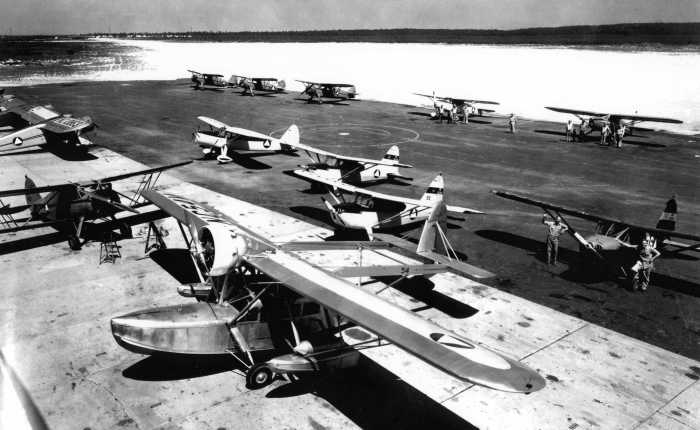

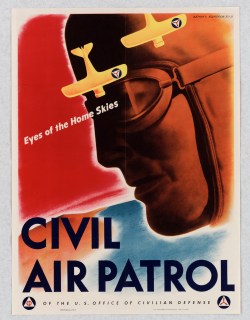


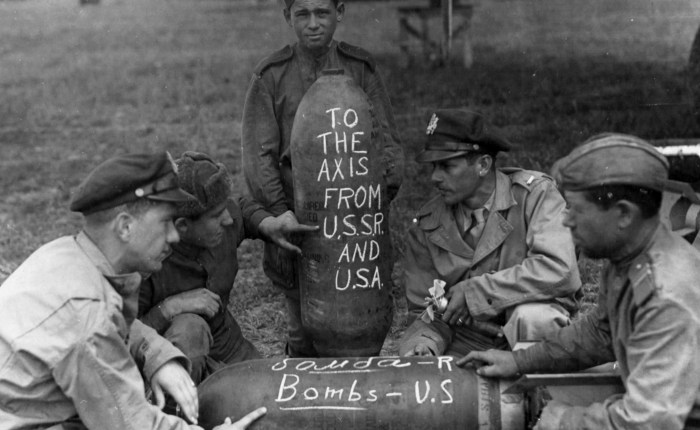
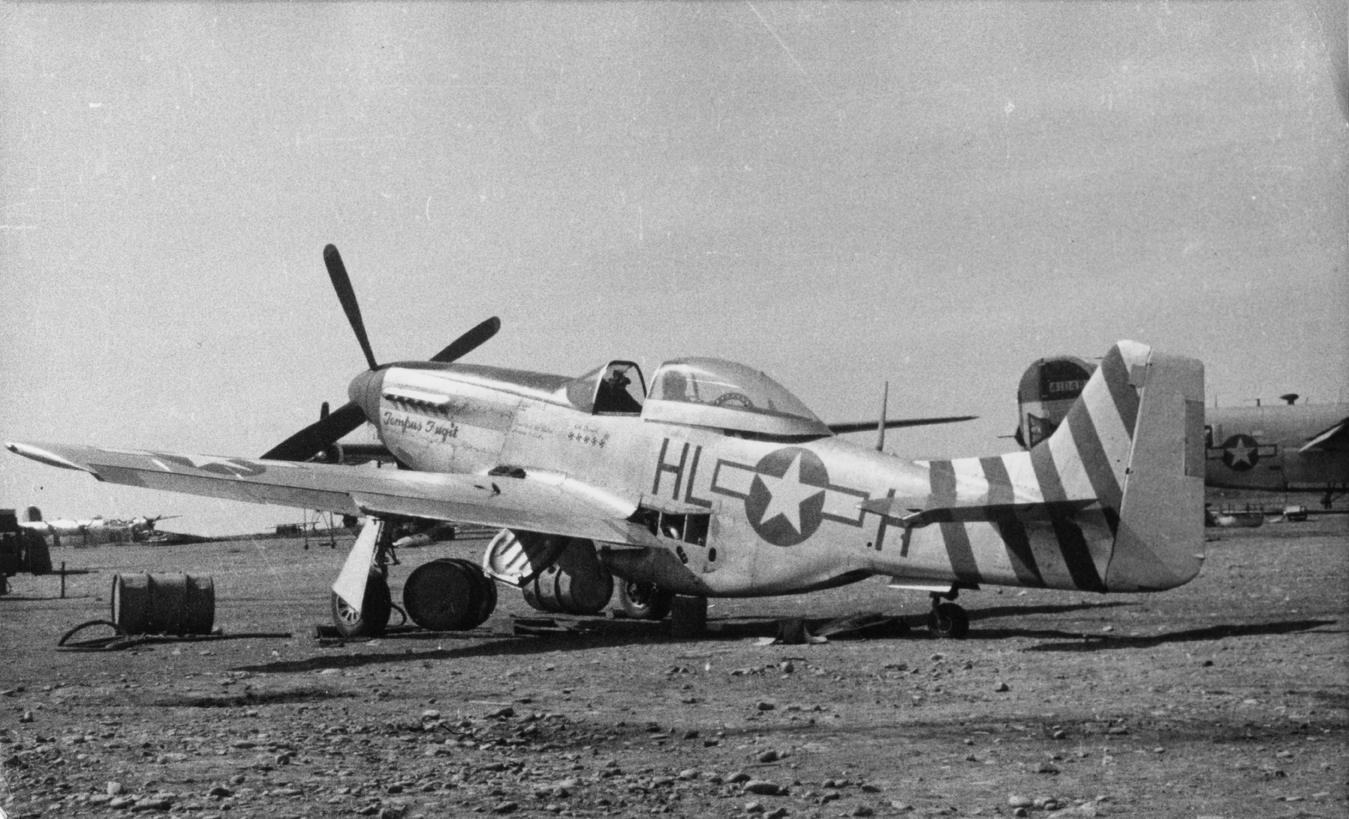


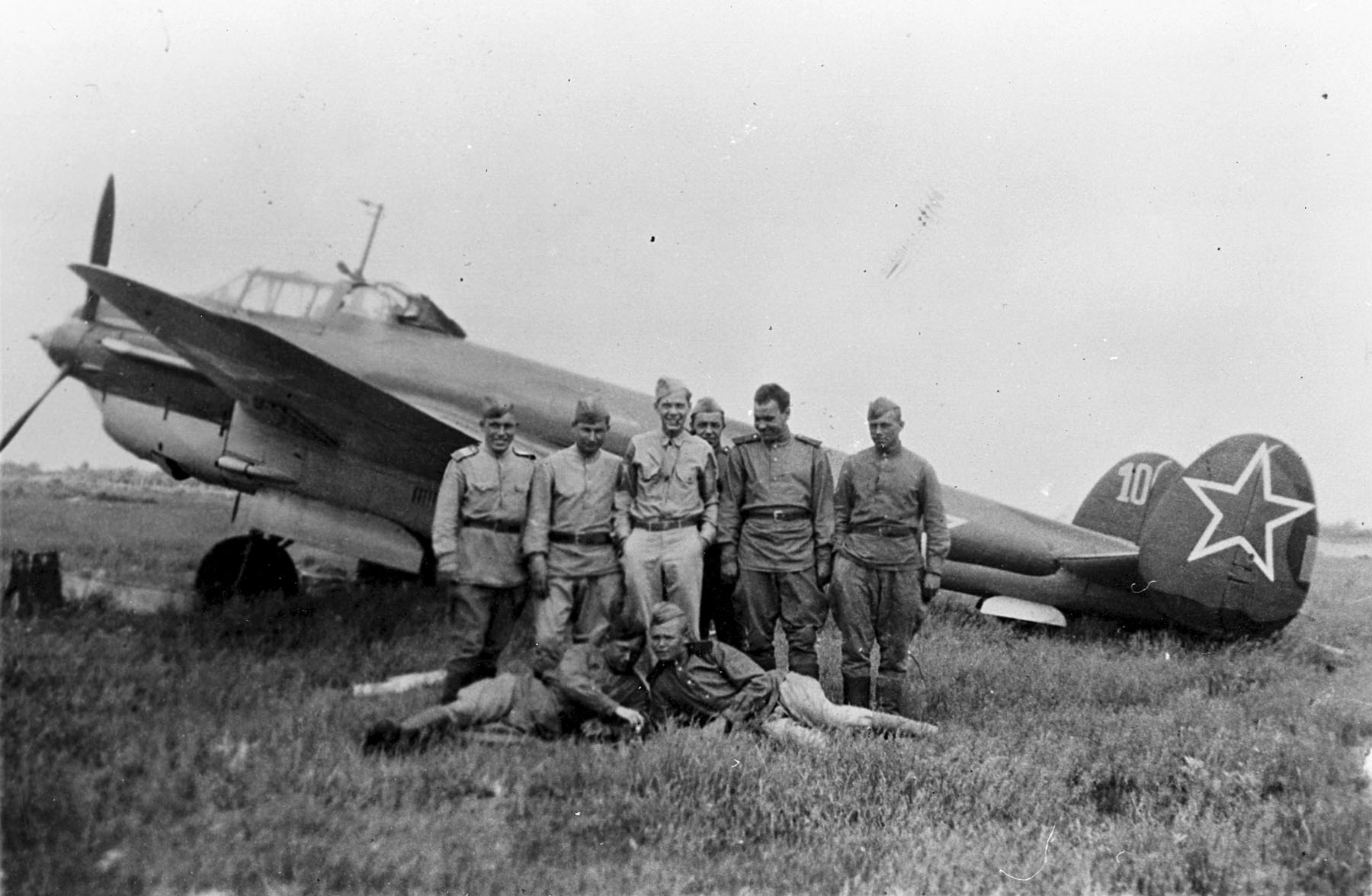
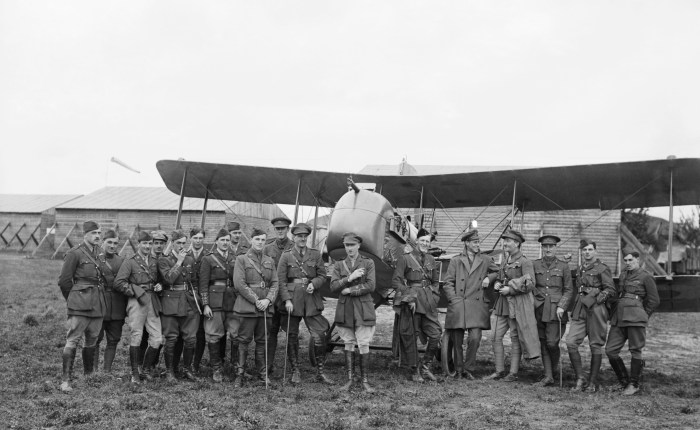


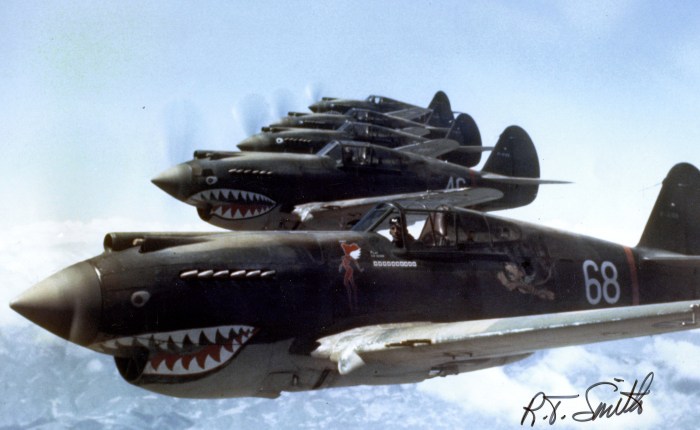
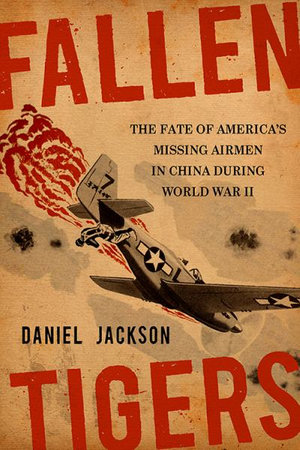


 From Balloons to Drones