Attrition in Fifth-Generation Air Forces during #highintensitywar

Attrition in Fifth-Generation Air Forces during #highintensitywar

By Rex Harrison

Editorial Note: From February to April 2018, The Central Blue and From Balloons to Drones, will be publishing a series of articles that examine the requirements of high-intensity warfare in the 21st Century. These articles provide the intellectual underpinnings to a seminar on high-intensity warfare being held on 22 March by the Williams Foundation in Canberra, Australia. In this article, Rex Harrison discusses the challenge of attrition during high-intensity conflicts and its implications for fifth-generation air forces.

Technology has continued to advance in both disruptive and surprising ways. It is consequently difficult to forecast the exact way fifth-generation air power will be applied in 2035, nor the precise character of future high-intensity conflict. With the benefit of hindsight, however, history proposes broad themes and continuities in the nature of war. One such example is the persistence of attrition of the force once committed to battle.

While Western air forces have been able to somewhat control their level of exposure to adversary action since the 1991 Gulf war, this may not always be the case. This level of control has been achieved through conducting operations beyond the engagement range of adversaries and behind a shield of (generally unchallenged) air defences. This technique has enabled air power to inflict significant losses without absorbing such losses themselves.

This happy circumstance has been the exception rather than the rule in human history. This is particularly the case when considering the history of air power, where few combatants have had the luxury of picking and choosing the intensity and duration of the conflict. No matter how successful fifth-generation air power is in enhancing its lethality and minimising risk to the force, it is doubtful that a combat exchange in high-intensity combat will result in a ‘0’ in the ledger of either side.

This being the case, I believe that success in high-intensity conflict will require a fifth-generation air force to ensure it can absorb and recover from the attrition of its forces. While it will be difficult to predict the outcomes of future air combat or the mix of technology and tactics that will provide the necessary advantage, history does provide a guide that may better inform our preparations for the future.

Historical Examples
Yom_Kipur_war
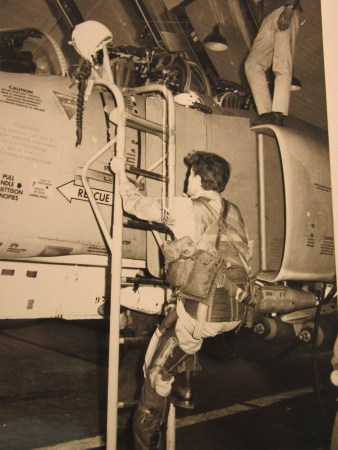
An Israeli pilot, Shimshon Rozen, climbing into a McDonnell Douglas F-4E Phantom II during the Yom Kippur War, c. 1973. (Source: Wikimedia)

The significant impact of attrition is demonstrated by the experiences of the Israeli Air Force (IAF) in the Yom Kippur War of October 1973. In this example, Israel was surprised by the new-found technical prowess of the Arab armies led by Egypt and Syria. The IAF was required to expend a sizable portion of its fighting strength to provide time for mobilisation. Surprised by the technical mastery of their opponents, in a matter of days, 102 aircraft were lost (roughly 25% of available combat aircraft), along with 53 aircrew. The crisis was only resolved by the rapid shipment of replacement aircraft from the US inventory under Operation Nickel Grass.

While certainly an example of high-intensity conflict, the requirement for Australia to fight for its existence as Israel did is unlikely or would be, at the very least, preceded by warnings such that the nation could be mobilised and prepared for such a conflict. It is partially through Australia’s preferred method of warfare, the controlled commitment of forces in expeditionary wars, that such attrition has been avoided.

A more pertinent example for Australian forces is the experience of No. 77 Squadron during the Korean War (a perhaps timely example given ongoing tensions on the Peninsula). The deployment of a single fighter squadron in June 1950 would seem at face value to match the characteristics of more recent Royal Australian Air Force (RAAF) commitments; the level of attrition, however, was not comparable. Over a three-year commitment, 41 pilots died, and six were captured. At the peak of fighting the squadron replaced 25% the pilot force over an eighteen-month period. Finding the Second World War era North American P-51 Mustang to be outmatched after losing 13 aircraft, No. 77 Squadron was re-equipped in May 1951 with the Gloster Meteor. Of the 94 Meteors acquired by Australia, 30 were subsequently lost to enemy action, delivering a significant portion of the 54-aircraft lost in total over Korea and Japan.[1] The consequence of this action was that No. 77 Squadron, in effect, replaced all of its aircraft at least once, and in a handful of years, expending the bulk of the entire RAAF fleet.

JK0901A
Squadron Leader Ross Glassop and Flight Lieutenant Sainer Rees, pilots, serving with No. 77 Squadron RAAF chat with the crew of No. 36 Squadron RAAF which had flown from Japan with supplies of rockets and aircraft spares. (Source: Australian War Memorial)

One should hope that future deployments would avoid committing forces in obsolete aircraft. However, it should be noted that the Australian government maintained the force commitment in Korea despite these and other subsequent losses.

What Does This Mean?

In preparing for future conflict, any fifth-generation air force must ensure access to both the physical (hardware) and human resources required to replace those lost.

The procurement of aircraft and their associated supporting hardware may be the most straightforward requirement to meet, assuming access to global markets. While contemporary production rates are much lower than those of the Second World War, they are still significant for those aircraft in full production. While the Israeli losses in 1973 were substantial, production of the McDonnell Douglas F-4 Phantom II, the mainstay multi-role aircraft of the period, averaged 19 aircraft per month, over the life of production.  Israel’s losses of this aircraft type (32 of the 102 total), while critical to the IAF, were only the equivalent of less than two months production out of the Fort Worth factory.

The replacement of human resources, specifically aircrew, will be determined by a combination of the resources allocated to training (rather than fighting), and the desired quality of the resulting product. Given our resource-constrained environment, it may well be that ‘great’ is the enemy of ‘good enough’. In this context, a fifth-generation air force will need to accept that its workforce may not have not quite mastered the full spectrum of fifth-generation fighting techniques; however, it will need to employ them regardless.

A fifth-generation air force will also need to incorporate these replacements within the chosen operational approach. Concerning hardware, it will be rare that the exact aircraft lost from the inventory will be in production. With platforms potentially being fielded for decades, it is to be expected that subsequent variants will be produced, or entirely new platforms created in the decades following acquisitions. As such, while a replacement platform may be found, the capabilities are unlikely to be identical to that it replaces.

More critically to the networked fifth-generation force, it is unlikely that replacement assets will be fitted with the exquisitely detailed set of combat data and information exchange systems specified as part of the fifth-generation force structure. This will particularly be the case if the preferred supplier of our platforms is otherwise occupied. Returning to the example of No. 77 Squadron, when the Mustang was determined to be unsuitable for the Korean conflict, the RAAF initially sought the North American F-86 Sabre from the United States, however, as production was already committed to US customers, the British Meteor was chosen instead. While this aircraft was first flown in 1944 and was far from the cutting edge of technology, the war marched on, and Australia could not wait until it was ready to fight on its terms.[2]

Conclusion

While the aim of the technologically and professionally-advanced fifth-generation force is admirable, planning and foresight cannot overcome the uncertain nature of war, precisely the inevitability of loss. At its heart, a fifth-generation force requires flexibility to adapt to any environment. In this context, the squadron must become less of an exquisite implementation tool, and more a delivery mechanism through which aircraft and aircrew are ground against the enemy at the point of friction. In such a situation, ‘good enough’ may quickly become the new normal.

Rex Harrison is an Air Combat Officer in Royal Australian Air Force officer. He can be found on Twitter at @spacecadetrex. The views expressed are the author’s and do not reflect the official position of the Royal Australian Air Force, the Australian Department of Defence, or the Australian Government.

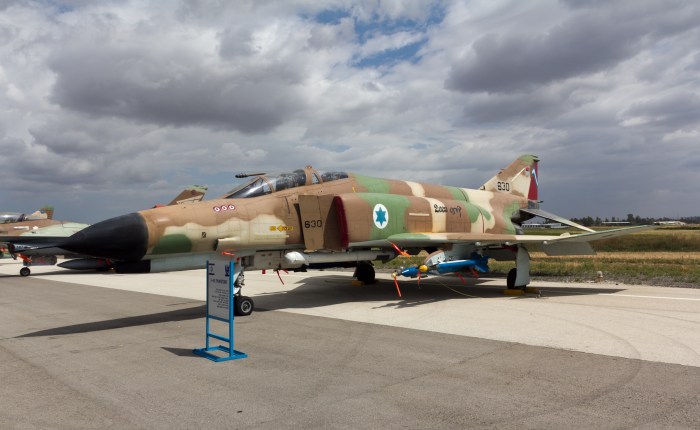
Header Image: An Israeli Air Force F-4E Phantom II at Tel Nof, c. 2013. This type of aircraft was used by the IAF during the Yom Kippur War. (Source: Wikimedia)

[1] Alan Stephens, Going Solo: The Royal Australian Air Force, 1946-1971 (Canberra: AGPS Press, 1995), p. 241.

[2] Ibid, p. 240.
#highintensitywar – A Series Introduction

#highintensitywar – A Series Introduction

By the editors of The Central Blue and From Balloons to Drones

During 2017, a major war on the Korean Peninsula became a distinct possibility. As the rhetoric over North Korea’s nuclear program heated up, the preparedness of Western militaries to engage in a major war, and the likely cost of such a conflict became regular features in the news cycle. This has had the effect of transforming discussions of a major state-on-state war in Asia away from abstract, Thucydides-inspired notions of a China-United States conflict, to the uncomfortably realistic prospect of a preventative strike against North Korea precipitating full-scale war.

The discussion and analysis that has occurred in the media in light of these growing tensions have raised public awareness of the potential costs of a modern state-on-state conflict. The West’s experience of conflict since the end of the Cold War has created unrealistic expectations within the general population as to the realities of modern conventional high-intensity warfare. This is not to trivialise the deaths that have occurred in these low-intensity conflicts, every death in war is a tragedy; however, the level of attrition that the West should expect from a modern state-on-state conflict in Europe, the Middle East, or Asia will likely be on a scale unseen since the Second World War. Concerning the prospect of war on the Korean peninsula, General Joseph Dunford, Chairman of the US Joint Chiefs of Staff, has remarked that:

Many people have talked about military options with words like ‘unimaginable’ […] I would probably shift that slightly and say it would be horrific, and it would be a loss of life unlike any we have experienced in our lifetimes, and I mean anyone who’s been alive since World War II has never seen the loss of life that could occur if there’s a conflict on the Korean Peninsula.

The requirements for engaging in a high-intensity conflict against a capable and committed state actor will challenge Western militaries. For airmen, in particular, assuring the use of the air domain – an air force’s prime responsibility – has not been seriously challenged since the Vietnam War. However, there is a realisation that circumstances are changing, and, as Air Chief Marshal Sir Stephen Hillier, Chief of the Air Staff of the Royal Air Force, pointed out in 2017:

[t]he long-expected – by airmen at least – challenge has arrived to the air power supremacy we have enjoyed for the last couple of decades. We will now have to fight – and fight hard – to achieve and maintain control of the air and space.

The need for airmen to re-engage conceptually with the possibilities and requirements of high-intensity warfare has led the Sir Richard Williams Foundation to run a seminar on ‘The Requirements for High-Intensity Warfare’ on 22 March 2018 in Canberra, Australia. The seminar will draw together senior officers from around the world, as well as leading academics, to discuss the past, present, and future of high-intensity warfare. Although it is likely the presenters will raise more questions than they will answer, the presence of so many senior leaders at the podium and in the audience will hopefully give impetus to the intellectual, conceptual, and organisational changes that the possibility of high-intensity warfare requires.

Unfortunately, not everyone will be able to attend the seminar, and summaries can never fully capture the presentations or the follow-up discussions that occur during the breaks. Moreover, not every topic of interest can be covered in a single day. Accordingly, in the lead-up to the seminar, The Central Blue and From Balloons to Drones are publishing a series of articles that will bring the discussion of the requirements of high-intensity warfare to a broader audience. By running this as a collaborative series, we hope to engage a broader audience in this debate that must be had. However, more importantly, this collaboration has allowed us to diversify the perspectives that can be brought to bear on the issue. This diversity of perspective has been made possible by contributors from around the world and from different backgrounds putting pen to paper (or fingers to keyboards) to provide their views. Moreover, these views matter.

Although the seminar will bring together a number of high power individuals, they do not have the monopoly on ideas. High-intensity warfare is a complex challenge for militaries irrespective of their size and operational experience. By contributing to the discussions, the contributors to this series are an essential addition to the seminar.

Twice a week over the next six weeks (possibly more as more potential contributors become engaged in the discussion) The Central Blue and From Balloons to Drones will simultaneously run posts that explore different aspects of the topic of high-intensity warfare. Topics will include:

  • Historical examples of high-intensity air warfare
  • The future of war
  • Training and education for a changing paradigm
  • Cultural change in light of a changing operational focus
  • Organisational requirements for high-intensity operations
  • Logistics support to high-intensity operations
  • Use of fiction to frame the future battlespace

As with the seminar itself, we expect that our contributors will raise more questions than they answer. However, unlike the seminar, it is the nature of our articles to encourage ongoing debate and discussion. As such, we ask our readers to be engaged, challenge our contributors, test their assumptions and take their arguments further. Through comments and additional contributions (see here on how to contribute) it is the hope of the editors of both The Central Blue and From Balloons to Drones that this series will support and encourage a deeper and more nuanced understanding of what high-intensity warfare will mean for modern military forces and how we can best prepare for its challenges.

To reinforce the relevance of the topic to which we now shift our focus, it is worth quoting from a recent (27 January 2018) special report from The Economist:

[p]owerful, long-term shifts in geopolitics and the proliferation of new technologies are eroding the extraordinary military dominance that America and its allies have enjoyed. Conflict on a scale and intensity not seen since the second world war is once again plausible. The world is not prepared.

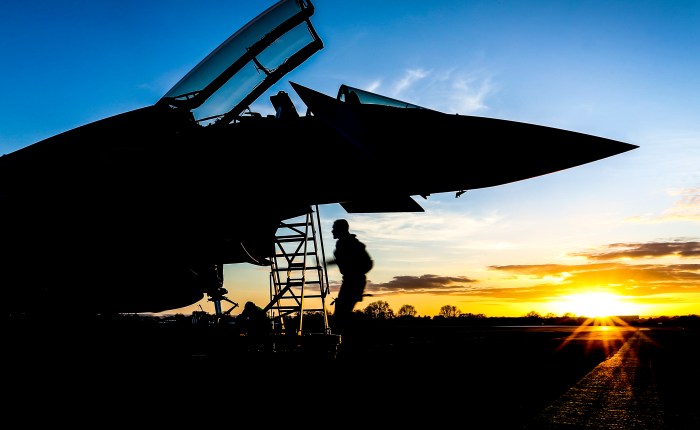
Header Image: An RAF Eurofighter Typhoon FGR4 during Exercise GRIFFIN STRIKE, c. 2016. (Source: UK MoD Defence Imagery)

Contested Skies: Australia’s Uncertain Air Superiority Future

Contested Skies: Australia’s Uncertain Air Superiority Future

By Dr Peter Layton

In war, there’s a constant to and fro. At times defence dominates, at other times offence. Technologies arise and fall. Disruption rules. This is noticeably so in today’s arcane world of air superiority. While much investment has gone into the ADF’s air superiority capabilities—with more coming with the F-35 Joint Strike Fighter—the operational environment is not standing still.

KC-30 Tanker Test fuel transfer to F-35A
An RAAF KC-30A Multi-Role Tanker Transport conducted refuelling trials with a US Air Force F-35A Joint Strike Fighter at Edwards Air Force Base in California. (Source: Department of Defence, Australian Government)

The skies are increasingly contested. Emerging threats are making Australia’s tanker, and AEW&C (airborne early warning and control) aircraft more vulnerable and advanced surface-to-air missiles, stealth-fighter technology, long-range ballistic and cruise missiles and even hobbyist drones are proliferating. The US Air Force (USAF) recently studied what all this means in practice and determined that its ‘projected force structure in 2030 is not capable of fighting and winning against [the expected] array of potential adversary capabilities’. If the USAF’s force structure is becoming stretched so, surely, is ours.

Some warn that the 2030 date may mislead, asserting that ‘Integrated Air Defence Systems covering areas in the Western Pacific … may now be able to deny access to all but the stealthiest of aircraft’. The ‘stealthiest of aircraft’ refers to the flying wing B-2 Spirit stealth bombers and forthcoming B-21 Raiders. It seems that F-35s with their vertical tails have some vulnerabilities to emerging multiband digital radars. A RAND study echoes these concerns about current and growing air-superiority shortcomings.

Even so, 2030 isn’t far away in defence terms. It is only seven years after Australia’s F-35 fleet will have—hopefully—reached final (or full) operational status. That is not long in the planned 25- to 30-year life of the aircraft.

Australia has committed to its major air superiority investments, which makes them a good starting point to discuss the strategic impacts of known and emerging changes in the air superiority operational environment. In my new paper published by ASPI titled Contested Skies, I use current air superiority force structure plans to develop three practical strategic options to address these changes.

Two of these options require modifying the current plans. That may worry some, but strategic ‘ends’ can’t be determined independently of the capability ‘means’. The two are interdependent. When the means are fixed, it makes sense to discuss alternative ‘ways’ that might reasonably bring strategic ends into alignment.

The three options are:

  • Continuing present plans. Maintaining our current operational plans and future equipment programmes means lowering our national ambitions to simply the defence of Australia. This ‘back to the future’ approach implies abandoning Southeast Asian nations to do the best they can as China rises and its sphere of influence expands. Strategically, this shifts the burden of conducting offensive air operations onto our American ally. While we could contribute by providing a safe base area in any conflict in which the skies were seriously contested, this level of involvement would not give us much influence on overall allied strategy or in any war-termination negotiations. Our current air superiority plans doom us to being a bit player.
  • Going ‘air defence heavy’. This option changes our current capability development plans to stress air defence. A start would include acquiring significant numbers of advanced SAMs and sensors for integrated air and missile defence, changing present F-35 upgrade plans and focussing on making airbases more resilient. Strategically, the ‘air defence heavy’ approach would allow Australia to remain deeply engaged in Southeast Asia and make a meaningful—perhaps decisive—contribution in times of serious conflict. Because this approach is less reliant on US support, it would allow us to mount independent operations in an area critical to our future. This has some echoes with the Pacific War’s later stages, when the US relied on Australian forces to conduct operations in Borneo while it focused on the Philippines and beyond.
  • Rebuilding our strike capability. This option entails adjusting our current plans to focus on reconfiguring our strike capability to be effective in contested airspace beyond 2030. We would also need to make a limited investment in integrated air and missile defence. The USAF study mentioned earlier foresees the F-35 losing its strike role at the end of the next decade and then becoming an air defence fighter—taking the ‘strike’ out of ‘Joint Strike Fighter’. This applies to all of the elements that comprise the ADF’s strike capabilities, not just to the F-35. If we want to maintain a genuine strike capability into the future, we need to take positive steps to do so. However, this will not be easy or low cost—or maybe even doable.
20170221raaf8207218_002
Two F-35A Lightning II Joint Strike Fighters conduct the first ever trans-Pacific flight from the US to RAAF Base Amberley, Australia to be displayed for the first time at the Australian International Air Show at Avalon, Victoria.(Source: Department of Defence, Australian Government)

In broad terms, the status quo ‘defence of Australia’ option implies burden-shifting onto the US, the ‘air defence heavy’ approach implies a reduced dependency on the US—perhaps lessening America’s burdens—while the rebuilding of our strike capability implies continuing to share the burden with the US in major ‘must-win’ wars past 2030.

Air superiority may seem narrowly technical, but it can have a significant impact on the range of strategies that can realistically be considered. It is time for a big air-superiority rethink.

This post was originally published by The Strategist, the commentary and analysis site of the Australian Strategic Policy Institute, an independent, non-partisan think tank based in Canberra.

Dr Peter Layton is a Visiting Fellow at the Griffith Asia Institute, Griffith University. He has extensive defence experience including teaching grand strategy at the Eisenhower College, US National Defence University. He has a doctorate from the University of New South Wales on the subject of grand strategy and undertook a Fellowship at the European University Institute. His research interests include grand strategy, national security policies particularly relating to middle powers, defence force structure concepts, and armed non-state actors.

Header Image: On 29 September 2014, an Australian F-35A Lightning II aircraft took off from Fort Worth, Texas, USA. It was the maiden flight for the Australian F-35A, which was flown by Alan Norman of Lockheed Martin, lasting approximately two hours. (Source: Department of Defence, Australian Government)

#ResearchNote – An Isomorphic Culture: The RAF and the RAAF

#ResearchNote – An Isomorphic Culture: The RAF and the RAAF

By Dr Ross Mahoney

As I have mentioned here, my current research is focused on the culture of the Royal Australian Air Force (RAAF) and how this has affected the Service’s effectiveness, ability to adapt to changing geostrategic challenges and its place within Australia’s broader strategic culture and national security framework. As such, this research has implications for discussions bridging several disciplines, including history, military sociology, and strategic studies. One of the critical research questions I am examining is what have been the key influences on the developing culture of the RAAF. While one source of RAAF culture is the values and beliefs that service members bring to the organisation, another is the Air Force’s relationship with other air forces. This importance of such relationships is especially significant for small air forces, such as the RAAF, who maintain close relationships with larger air forces, such as the RAF. Indeed, if we think about the organisations that have influenced the culture of the RAAF, key within Australia is, of course, the Australian Army and Royal Australian Navy. The former is especially important because of the experience of the Australian Flying Corps (AFC) during the First World War. However, further afield significant influences have been the RAF, the United States Air Force, and the US Navy. The latter two are important because they represent the shift in Australia’s geostrategic relationships after 1942. Their significance is best represented in the platform choices the RAAF has made since the 1960s. Broadly speaking, the RAAF shifted from British designs to US ones, though there was also the Dassault Mirage IIIO. The relationship between technology and culture is a post for another time.

Longmore
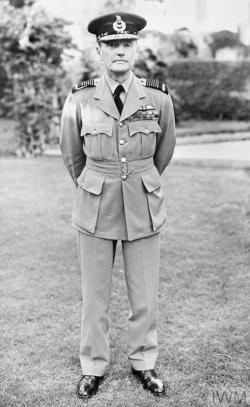
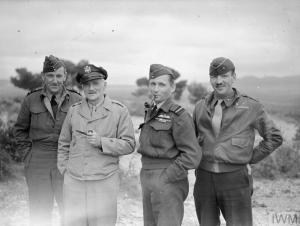
Air Chief Marshal Sir Arthur Longmore, Air Officer Commanding-in-Chief Middle East Command, standing in the gardens of Air Headquarters, Middle East Command, in Cairo. (Source: © IWM (CM 515))

In terms of air forces, it is the RAF that has influenced the RAAF the most. Even to this day, the materialist influence of the RAF can be seen in cultural artefacts such as ranks. As such, the emergence of a distinct culture for the RAF in the inter-war period had implications for that service and those that emerged in the Dominions. Indeed, at the 1923 Imperial Conference, it was expected that ‘the development of Air Forces in several countries of the Empire’ would be along the lines of uniform training and doctrine, which essentially meant those of the RAF.[1] This illustrates both an imperial and transnational dimension to the impact of the RAF’s cultural practises that require greater exploration. Indeed, the RAF itself remained imperial in composition in the inter-war period with officers from the Dominions, such as the future Air Marshal Sir Arthur Longmore, serving in the Air Force. Moreover, while the RAAF had the example of the AFC on which to build an identity, it still looked to the RAF for guidance both for ideas about the employment of air power and character. AP1300, the RAF’s War Manual, would eventually be adopted as the RAAF’s formal doctrine in the 1950s despite the unsuitability of certain sections of this publication for the Australian context, especially the fourth edition’s discussion of nuclear weapons.[2] Indeed, Alan Stephens’ work on RAAF doctrine, Power Plus Attitude, is perhaps the closest we have come to a history of RAAF culture. This is because doctrine points to key values and beliefs of an organisation and its views about the employment of force. Regarding cultural artefacts, the diffusion of RAF culture along imperial lines is evident in areas such as ranks and mottos. Moreover, King George V acquiesced to the title ‘Royal’ being conferred on the Australian Air Force when it was formed.[3] Furthermore, several officers who would go on to senior roles in the RAAF during the Second World War were educated at the RAF Staff College at Andover, where they were immersed in the ideas and culture of the RAF, including British doctrine, AP1300. Finally, RAF officers were regularly sent to Australia to advise on air matters, though, as in the case of the visit of Marshal of the RAF Sir Edward Ellington in 1938, this could create friction.[4]

This latter issue raises questions that help us open up the black box of culture. Principally, was the culture and ethos of the RAF a pervasive influence on the RAAF? Did it help or hinder the development of the RAAF? Were there better options? As the power of RAF culture has reduced, what has taken its place and has this affected how the RAAF views itself and behaves?

Dr Ross Mahoney is an independent historian and defence specialist based in Australia. He is the Editor of From Balloons to Drones. Between 2013 and 2017, he was the resident Historian at the Royal Air Force Museum, and he is a graduate of the University of Birmingham (MPhil and PhD) and the University of Wolverhampton (PGCE and BA). His research interests include the history of war in the twentieth and twenty-first centuries, air power and the history of air warfare, and the social and cultural history of armed forces. He has published several chapters and articles, edited two books, and delivered papers on three continents. He is a member of the Royal Historical Society and is an Assistant Director of the Second World War Research Group. He is a member of the Royal Historical Society and an Assistant Director of the Second World War Research Group. He blogs at Thoughts on Military History, and can be found on Twitter at @airpowerhistory.

Header Image: From left – a RAAF C-130J Hercules lands at Nellis Air Force Base during Exercise Red Flag 17-1. Visible in the background are a pair of USAF B-1B Lancer bombers; an RAF Sentinel R.1 surveillance aircraft; and an RAF C-130J Hercules transport aircraft. (Source: Australian Department of Defence)

[1] TNA, AIR 8/69, Cmd 1987, Imperial Conference, 1923: Summary of Proceedings (1923), pp. 16-7.

[2] Alan Stephens, Power Plus Attitude: Ideas, Strategy and Doctrine in the Royal Australian Air Force, 1921-1991 (Canberra: Australian Government Publishing Service, 1992), pp. 136-8.

[3] NAA, A705, 4/10/30, Australian Air Force – establishment and development and the title “Royal” for AAF, 1921-22.

[4] C.D. Coulthard-Clark, ‘“A Damnable Thing”: The 1938 Ellington Report and the Sacking of Australia’s Chief of the Air Staff,’ The Journal of Military History, 54:3 (1990), pp. 307-23.

#BookReview – Bailout Over Normandy: A Flyboy’s Adventures with the French Resistance and Other Escapades in Occupied France

#BookReview – Bailout Over Normandy: A Flyboy’s Adventures with the French Resistance and Other Escapades in Occupied France

By Luke Truxal

Ted Fahrenwald, Bailout Over Normandy: A Flyboy’s Adventures with the French Resistance and Other Escapades in Occupied France. Philadelphia, PA: Casemate, 2012. Pbk. Editor’s Note. 288 pp.

Fahrenweld

The Second World War is littered with stories of downed airmen and their experiences behind enemy lines. Throughout the European air war, thousands of Americans found themselves on the run in German-occupied territory. Each of their experiences provides an opportunity to analyse these cross-cultural interactions. Ted Fahrenwald’s account as a downed American fighter pilot in occupied France gives historians an insight into many of the experiences of an American airman on the run. Fahrenwald, who was shot down and later rescued by the French resistance, or the Maquis. Later, German soldiers captured Fahrenwald as he tried to make his way back to the American lines. Before being sent to a prison camp, the downed fighter pilot escaped and once again found himself on the run. Eventually, American troops of the US Third Army found Fahrenwald after he had taken up residence in the home of a French family.

Readers are introduced to Fahrenwald as a fighter pilot. He jumps right into the action and describes the daily grind of flying missions as a part of the US Eighth Air Force. Each of his daily briefings takes place long before sunrise. Fahrenwald is frank in his descriptions of his combat experience shortly before he was shot down. The author describes himself as a pilot who had been exhausted by the greater demands of supporting the Normandy landings on 6 June 1944.  Before one take off, his ‘fingers had developed a tremor.’ (p. 13) The wear and tear of his previous ninety-nine missions are prevalent throughout the first pages of the book.

FRE_000333
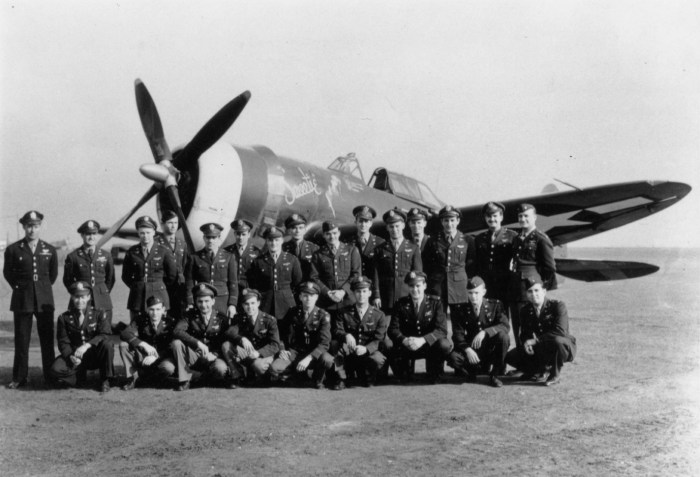
Pilots of the 486th Fighter Squadron, 352nd Fighter Group, in front of a P-47 Thunderbolt named “Sweetie” at Bodney air base in March 1944. Left to right, top row: Lieutenant Woodrow W. Anderson, Lieutenant Stanley G. Miles, Lieutenant Frank A. Cutler, Lieutenant Martin E. Corcoran, Lieutenant Donald Y. Whinnem. Left to right, middle row: Lieutenant-Colonel Luther H. Richmond, Captain Stephen W. Andrew, Lieutenant Thomas W. Colby, Lieutenant Henry J. Miklajyck, Captain Edward J. Gignac, Lieutenant Alfred L. Marshall, Lieutenant Alton J. Wallace, Lieutenant Robert C. Frascotti, Lieutenant Donald H. Higgins, Major Willie O. Jackson. Left to right, front row: Lieutenant Lloyd A. Rauk, Lieutenant Warren H. Brashear, Captain Franklyn N. Green, Lieutenant Donald W. McKibben, Lieutenant Theodore P. Fahrenwald, Lieutenant Robert C. MacKean, Lieutenant Edwin L. Heller, Lieutenant Joseph L. Gerst. (Source: (c) IWM (FRE 333))

Throughout the text, we see Fahrenwald rapidly adapt to his surroundings. Fahrenwald’s relationship with the Maquis evolves from that of a foreigner to a full-fledged member of the group. After he bailed out a family took Fahrenwald in and gave him clothes. He admits during this time that he spoke little French and had difficulty understanding those who were helping him (p. 25). After he was sent to the Maquis, he began to assimilate. Weeks later when American soldiers discovered Fahrenwald at the home of another family, the soldiers mistook him for a French citizen. Fahrenwald spoke, dressed, and acted French. After several minutes he informed the American soldiers who he was in English. Still not convinced, he was interrogated by a ‘Captain Ford’ of the 90th Infantry Division. After successfully answering several questions to prove he was not a spy, Ford sent Fahrenwald back to the American camp (p.258-60). In a matter of weeks, Fahrenwald had successfully adapted to his new environment.

Fahrenwald also noted the distrust of outsiders amongst the Maquis. Despite aiding him, there are several points at which his loyalties are questioned. In one instance Fahrenwald stated that one Frenchman, Canoe, believed Fahrenwald to be a German in disguise. He said that Fahrenwald ‘was too thin and too blond’ to be an American (p. 35). Over time members of the Maquis began to trust Fahrenwald. Once other downed pilots joined his group, the relationship soured. He wrote, ‘[N]ow, instead of being one of them as of old, I was one of a tight little clique of English-speaking fliers’ (p. 73). After his escape from a German prisoner camp, he hid with a family that had ties to the Maquis. One of the members, Robert, yelled at Fahrenwald about a failed supply drop that cost him most of the members of his group (p. 229). While willing to help, French fighters preferred to keep their distance from Fahrenwald and other outsiders.

media-14325
P-51 Mustangs of the 486th Fighter Squadron, 352nd Fighter Group, come to Debden to fly with the 4th fighter Group the following day on the first 8th Air Force ‘Frantic’ mission – England to Russia, and return via Italy. 20 June 1944. (Source: (c) IWM (UPL 14325))

While Fahrenwald provided a detailed account of his time in France, these memoirs are incomplete. The author writes very little about his missions before when he was shot down. This book begins with Fahrenwald’s final missions as a fighter pilot. He left out his training and months of flying as a fighter escort prior. Readers and historians alike miss out on valuable information such as the learning curve from training into combat. Readers are also left to speculate as to Fahrenwald’s interactions with civilians in the United Kingdom. As a fighter pilot based in the United Kingdom, he spent more time interacting with British civilians than time with the French. This likely had some effect on his experiences while he was on the run in France. By jumping right into the action, the author left out elements that detract from the book and leave the reader wondering.

Historians will find this text useful as a primary source. Fahrenwald examined his time with the Maquis as a foreigner. Those writing about the Maquis during Operation OVERLORD should examine this book. The author records both the actions and the thoughts of the Maquis well during this period. Fahrenwald’s account also adds to the history of the air war. He provides an excellent first-hand account of his time escaping and invading capture.  Historians will find Fahrenwald’s account useful as a primary source.

Luke Truxal is a doctoral candidate at the University of North Texas. He is currently writing his dissertation ‘Command Unity and the Air War Against Germany.’ Truxal completed his master’s thesis at the University of North Texas titled ‘The Failed Bomber Offensive: A Reexamination of the Combined Bomber Offensive in 1943’ in 2011. His current research focuses on the command relationships between the British and Americans during the air war in Europe from 1942 to 1944. Truxal is currently teaching at Columbia State Community College in Columbia, TN. He can be reached on Twitter at @Luke_Truxal.

Header Image: Ground crew stand beside a P-47 Thunderbolt named “Sneezy”. This aircraft was flown by Lieutenant Donald McKibben of the 486th Fighter Squadron, 352nd Fighter Group. Source: (c) IWM (FRE 327))

#BookReview – The Origins of American Strategic Bombing Theory

#BookReview – The Origins of American Strategic Bombing Theory

By Eamon Hamilton

Craig F. Morris, The Origins of American Strategic Bombing Theory. Annapolis, MD: Naval Institute Press, 2017. Notes. Bibliography. Index. 272 pp.

Origins of American Strategic Bombing Theory

The strategic bomber has stood as one pillar of American military strength since the Second World War, and even today, the deployment of B-1s, B-2s and B-52s to forward bases across the globe sends a strong message to potential adversaries. Serving as a true ‘Book of Genesis’ chapter to this capability, The Origins of American Strategic Bombing Theory by Craig F. Morris covers the period of 1916 to 1942 and explores the growth of an idea within the United States Army, rather than deal primarily in technology or personalities. By recounting how air power theory matured (and was withheld) within the United States Army, he also delivers an excellent case study on how an organisation reacts to disruptive technology.

There is a stark comparison in air power capability that comes early from Morris. The book’s introduction begins with the arrival of United States Army Air Force B-17s in England in 1942. Operationally untested, their existence still spoke of the maturity of America’s investment in technology, organisation, and air power doctrine during the interwar period. Contrast that scene with the experience of the United States Army’s 1st Aero Squadron in Mexico in 1916, which Morris covers in his first chapter. There is obviously no suggestion that the 1st Aero Squadron’s Curtis JN-3 biplanes were to be used as bombers against Mexican revolutionary Pancho Villa; what Morris does is illustrate the lack of intellectual depth the United States Army had with its heavier-than-air aviation capability. While the technology was relatively new, that lack of innovation remains surprising considering how the First World War had quickly illustrated the utility of aviation.

The Mexican adventure serves another purpose – it introduces several personalities from the 1st Aero Squadron who were sent to Europe when the United States entered the First World War. The most significant focus of The Origins of American Strategic Bombing Theory falls on 1917 to 1919, which stands to reason – it is here that the Aviation Section of the American Expeditionary Force (AEF) first encountered the idea of strategic bombing from the Allied (and Central) powers. This transfer of ideas is explored mainly through the experiences of Edgar S. Gorrell, a veteran of the 1st Aero Squadron in Mexico who was sent to Europe to study how the United States would grow its aviation forces in the First World War. The AEF ground commanders wanted aviation to provide the battlefield reconnaissance and air defence, but Gorrell’s exposure to Allied air power theory led him to become a proponent of using bombers to open a ‘new front’ on an enemy’s warfighting infrastructure, effectively bypassing the war in the trenches on the Western Front.

Gorrell-Edgar-S (Harris & Ewing)
Lieutenant Edgar S. Gorrell studied aeronautical engineering at MIT following the Mexican campaign of 1916. (Source: US Air Force Historical Research Agency)

Gorrell is the personality most consistently covered in The Origins of American Strategic Bombing Theory, which is arguably a testament to the aviator’s recordkeeping and his early advocacy of strategic bombing. The First World War ended before Gorrell could successfully argue the case for an American strategic bomber force, but the Armistice allowed him to leave two critical legacies to the future of air power development. Gorrell was tasked with organising the official history of the AEF, an assignment which allowed him to draw together air power lessons from the AEF and Allied into an official post-War record. On top of this, he drove a post-war bombing survey that examined what impact Allied bombing made on Germany’s warfighting effort.

When dealing with the events of 1919 to 1942, The Origins of American Strategic Bombing Theory does not enjoy the singular narrative focus that Gorrell’s experiences during the First World War afforded it (Gorrell left the military as a Colonel in 1920 at the age of 28, worked in the motoring industry, and died in March 1945). In Morris’ defence, strategic bombing theory in the interwar period was driven by complex variables, from personalities such as Billy Mitchell and rapidly growing aviation technology; through to economic resources (like the Great Depression), along with shifting strategic and foreign policy. The main conflict affecting strategic bombing theory (and the introduction of a supporting capability) was between the US Army’s General Staff, and aviation proponents within the Air Corps, as the Air Service had become in 1926. As aviation technology grew and the Air Corps Tactical School developed its ideas for air power, the Army General Staff were justifiably worried that a strategic bombing capability would lead to an independent Air Force, and a competitor for government funding.

Air Corps Tactical School
The Air Corps Tactical School (created as the Air Service Field Officers School in 1920) went beyond its mandate of training officers to also become an engine for air power theory development in the interwar period. (Source: US Air Force Air University)

The examination of this conflict makes The Origins of American Strategic Bombing Theory an excellent study in how organisations react to disruptive technology (both positively and negatively). The parallels to modern disruptive technologies (for example, autonomous systems, or space-based systems) do not feel completely analogous, given the purely historical lens of this book. That being said, it gives numerous examples of both innovative and misguided thinking at different levels within the United States Army in dealing with aviation. While history arguably vindicated the strategic bomber concept, Morris does well explain Army’s reservations with this new field.

One of the most significant qualities of The Origins of American Strategic Bombing Theory is also the chief criticism – by covering 25 years in 207 pages, it is very concise. The narrative is clear, comprehensive, and does not feel like any essential facts have been left out. However, the quality of Morris’ writing would comfortably permit this to be a longer work, and the narrative could afford to provide further exposition to selected events, technologies and personalities (beyond Gorrell), that shaped and developed air power theory. On several occasions, this reviewer found himself looking for other resources to further his appreciation of the events in this book – especially about the limited performance of bomber aircraft during the First World War.

While remaining engaging to read, Morris’ work is academically well-presented. It both recounts history as well as briefly discussing the views of academics and historians on the subject matter where relevant. There is considerable inertia when it comes to people’s understanding of events from a century ago, and Morris is clear when he debates, debunks or reaffirms the established narratives of other authors. The introduction specifically accounts for early air power studies into strategic bombing by historians/academics including Mark Clodfelter, Stephen McFarland, I.B. Holley, and Maurer Maurer.

Martin_B-10B_during_exercises (National Museum of USAF)
First flown in 1932, the Martin B-10 was a revolutionary bomber not only for the United States Army Air Corps, but for the world. Design features such as all-metal construction, enclosed cockpit with rotating gun turrets, full engine cowlings and retractable landing gear would be standard design features for bombers over the next decade.  (Source: National Museum of United States Air Force)

Overall, The Origins of American Strategic Bombing Theory is clear and well-sourced and can be easily approached by anyone with no depth of knowledge of the central subject matter. This reader found it to be enjoyable and informative, providing a good account of early strategic bombing theory and American air power development. While being a self-contained work, it is likely to whet the reader’s appetite for reading works covering related subject matters.

Eamon Hamilton graduated from the University of Western Sydney with a Bachelor of Communications (Journalism). He works as a Public Affairs Officer for the Royal Australian Air Force. He lives in Sydney. He runs the Rubber-Band Powered Blog and can be found on Twitter @eamonhamilton.

Header Image: A Boeing Y1B-17 in flight. This aircraft would eventually be developed B-17 Flying Fortress. (Source: Wikimedia)

From Balloons to Drones – Editorial Changes and Future Developments

From Balloons to Drones – Editorial Changes and Future Developments

Twenty eighteen marks the start of the second full year of operations for From Balloons to Drones. With this, we are pleased to announce a significant change in our editorial line-up. Dr Brian Laslie, Mike Hankins and Alex Fitzgerald-Black have all agreed to become Assistant Editors of From Balloons to Drones. Brian, Mike, and Alex have been keen supporters of From Balloons to Drones since day one, and we are grateful to them for coming on board to add some depth to our operations. You can read their biographies here.

What does this mean for From Balloons to Drones? In short, it means we can come up with more ideas on how we might take the website forward. At the moment we are discussing several ideas which will hopefully see the light of day. One idea being discussed is a series of historic book reviews of crucial air power titles that will sit alongside our already established series of book reviews. We are coming up with a list of titles but if you think of a volume that is deserving of being reviewed then let us know.

Another project that we are currently working on is a collaborative series with The Central Blue, which is the blog of the Sir Richard Williams Foundation in Australia. This set of posts will focus on some of the challenges related to high-intensity warfare in the 21st century, and they will provide the intellectual underpinnings for a seminar being held in Canberra in March on this topic. Posts will start appearing in February and will be posted here and at The Central Blue simultaneously. If you are interested in contributing to this series, then get in contact.

Finally, we are always on the lookout for new contributors to the site as well as ideas for future articles. We encourage potential submissions from postgraduates, academics, policymakers, service personnel and relevant professionals involved in researching the subject of air power. More details can be found here. Also, do not forget that we can also be found on Facebook and Twitter.

Header Image: A French Air Force Mirage 2000C drops away from a United States Air Force KC-135R Stratotanker after refuelling during a combat air patrol mission while participating in Operation ALLIED FORCE, c. 1999. (Source: Wikimedia)

#BookReview – Architect of Air Power: General Laurence S. Kuter and the Birth of the US Air Force

#BookReview – Architect of Air Power: General Laurence S. Kuter and the Birth of the US Air Force

By Alexander Fitzgerald-Black

Brian D. Laslie, Architect of Air Power: General Laurence S. Kuter and the Birth of the US Air Force. Lexington, KT: The University Press of Kentucky, 2017. Notes. Bibliography. Index. 21 b/w Photos. Hbk. 236 pp.

Architect of Air Power Cover

With Architect of Air Power Brian D. Laslie, Deputy Command Historian at NORAD and US Northern Command and an Adjunct Professor at the US Air Force Academy had two mutually supporting goals. The first is to offer readers a biography of General Laurence S. Kuter, one of the select few US Air Force (USAF) officers to serve the majority of his 35-year career as a general officer (the others were Generals Curtis LeMay, Lauris Norstad, and Hoyt Vandenberg). The second is to acknowledge that Kuter’s

[c]areer dovetailed with the rise of an adolescent air power and ended with a fully grown and mature air force capable of global monitoring and response. (p. xi)

In other words, Kuter was an architect of the USAF. Many of the modern USAF’s principles and methods owe their origins to his work.

The biography is organised chronologically, beginning with Kuter’s adolescence and time at West Point and ending with his service as a four-star general commanding the Pacific Air Forces (PACAF) and North American Air Defense Command (NORAD), retirement, and passing. Laslie has assembled an impressive array of sources to discuss Kuter’s life and career. He draws on Kuter’s incomplete autobiography, collections at the USAF Academy library (including Kuter’s papers and those of several his contemporaries), oral histories, diaries, and letters. One highlight of the book is how Laslie captures Kuter’s relationship with his high school sweetheart and wife, Ethel Kuter (née Lyddon). Ethel’s diary was slowly overtaken by references to Kuter beginning in 1922, and the pair wrote over 1,000 letters to each other during his time at West Point.

Laslie takes his readers on a mission to understand why so little has been written about Kuter. One reason is that Kuter did not make a name for himself with flying exploits or by leading air formations into battle. Kuter did not join the US Army Air Corps because of romantic visions of flight. Instead, he joined to be a better artillery officer. Only later did he become fully immersed in exploring a new kind of warfare – mainly at the operational rather than tactical level. In August 1941, Kuter became one of the authors of AWPD-1, the first comprehensive plan for winning the war against Germany through aerial bombardment. In the early months of America’s Second World War, Brigadier General Kuter (one of the youngest general officers in the US Army) was a go-between for General George C. Marshall and Lieutenant General Henry H. Arnold. He also had a significant hand in setting up the latter’s Air Staff as the US Army Air Forces achieved autonomy. Kuter made a name for himself with his organisational skills rather than his combat command ability.

Recognising this, Arnold sent Kuter to Europe in late 1942 to gather command experience. Kuter commanded the Eighth Air Force’s 1st Bombardment Wing under Brigadier General Ira Eaker. One of Eaker’s assistants, James Parton, later claimed that Eaker had fired Kuter for declining to fly on combat missions. Laslie has proven these accusations to be unquestionably false. In fact, while Eaker gave Kuter the worst performance reviews of his career, he also tried to retain Kuter’s services. Laslie believes Eaker did this to provide Kuter with more time to prove himself; he had served under Eaker for only five weeks.

© IWM (CNA 408)
Senior Allied Air Commanders gathered at the Headquarters of the North African Tactical Air Force, Ain Beida, Algeria. Left to right: Air Marshal Sir Arthur “Mary” Coningham, Air Office Commanding, NATAF, Major General C A Spaatz, Commanding General, North-west African Air Forces, Air Chief Marshal Sir Arthur Tedder, Air Officer Commanding-in-Chief, Mediterranean Air Command, and Brigadier General L S Kuter, Deputy Commander, NATAF. (Source: © IWM (CNA 408))

This is another of the reasons for the lack of attention afforded Kuter. He never stayed in one place long enough to make a name for himself. Kuter’s next stop was North Africa. He would serve as the deputy to Air Marshal Sir Arthur Coningham, commander of the Northwest African Tactical Air Force. He served in this position for only four months, but he still made immense contributions to the war effort and the future of the US air power. Kuter’s brainchild was FLAX, a well-planned and executed operation to destroy the Axis air bridge between Sicily and Tunisia. He also learned how to implement a proper ground support system in the field. When he returned to Washington to work under Arnold his experiences in North Africa were codified in Field Manual 100-20. This document is considered both the air force’s ‘declaration of independence’ and the basis for the USAF’s tactical air power concepts to this day.

Kuter’s next command opportunity overseas was in the Pacific. Now a Major General, Kuter was quickly replaced in a reshuffling of officers following the defeat of Nazi Germany in May 1945. He then moved to Air Transport Command, where he supported General Douglas MacArthur’s buildup in Japan following the island nation’s surrender. After less than a month, Kuter once again returned to Washington. As Laslie notes, ‘as soon as [Kuter] established and organized the flow of men and material, he was pulled from the theater.’ (p. 122)

Another reason Laslie offers us for Kuter’s relative obscurity is the man’s level-headedness. People want to write about innovators and controversial figures, not respectable architects. Laslie makes this observation early in the book: ‘If the famous early aviators – men like Curtis LeMay and Jimmy Doolittle – were cowboys, then Kuter represented the first-generation lawman who came to town to impose order.’ (p. 18) One of the arduous tasks Kuter had to handle while working under Arnold in 1942 were the requests from various theatre commanders for more and better aircraft and properly trained crews. At the time, there just were not enough aircraft to train crews in the United States and supply US Army Air Forces in Europe, North Africa, and the Pacific. President Roosevelt had also promised the Royal Air Force a share of American aircraft production. This added strain was worth it since many British Commonwealth pilots already had combat experience. Although the theatre commanders could be quite forceful in their requests, Kuter never let it get the better of him, and his level-headedness set him apart from many of his contemporaries. Perhaps, therefore, when Arnold could not attend the Yalta Conference in February 1945, Kuter attended in his place. In doing so, Kuter jumped the queue in front of three-star generals.

Continental_Defense_Warning_Systems
Continental defense warning systems of the North America. (Source: Wikimedia)

Kuter’s Cold War career is equally fascinating. He never held or coveted the positions of Chief of Staff or Vice Chief of Staff of the USAF (perhaps another factor in his relative obscurity). His work establishing the USAF Academy and achieving accreditation for the Air University were architectural moves that produce new generations of air force officers that continue to mould the modern USAF. As a four-star general, Kuter commanded America’s aviation in the Pacific theatre, consolidating these forces under one command: PACAF. He also oversaw NORAD as it dealt with growing Soviet missile offensive capability in the late 1950s and early 1960s.

In his preface, Laslie notes the difficulty associated with writing biography suggesting that:

Historians must tread the perilous course of being objective while at the same time proclaiming why subject needs individual attention in the first place. (p. xi)

Laslie has played this balancing act marvellously. He pulls no punches, willingly calling out Kuter when his ideas or actions were wrong, especially his belief in strategic air bombardment as a war-winning approach. Laslie carefully provides the reader with enough context so that he or she may understand why Kuter made these errors. In fact, it is these very moments, so well captured by Laslie, that make Kuter and the history of the USAF such a fascinating subject.

Alexander Fitzgerald-Black has a Master of Arts in Military History from the University of New Brunswick and is a Master of Arts in Public History candidate at the University of Western Ontario. Alex’s first book, Eagles over Husky: The Allied Air Forces and the Sicilian Campaign, 14 May to 17 August 1943, will be published in early 2018. His research interests include air power in the Second World War, with a particular focus on the Mediterranean, and Canadian military history. He operates his blog at alexfitzblack.wordpress.com and can be reached on Twitter @AlexFitzBlack.

Header Image: Republic of Korea Air Force Lieutenant General Cho Won Kun flies with the 35th Fighter Squadron out of Kunsan Air Base, c. 2009. The 35th Fighter Squadron forms part of the 8th Operations Group of the 8th Fighter Wing. The 8th Fighter Wing is assigned to the Seventh Air Force, which reports to PACAF. (Source: Wikimedia)

#BookReview – Tiger Check: Automating the US Air Force Fighter Pilot in Air-to-Air Combat, 1950-1980

#BookReview – Tiger Check: Automating the US Air Force Fighter Pilot in Air-to-Air Combat, 1950-1980

By Mike Hankins

Steven A. Fino, Tiger Check: Automating the US Air Force Fighter Pilot in Air-to-Air Combat, 1950-1980. Baltimore, MD: Johns Hopkins University Press, 2017. Notes. Works Cited. Index. Hbk. 435 pp. 

51nxvKRLhkL._SX329_BO1,204,203,200_

Works dealing with the history of military technology tend to fall into a few camps. Some will praise a single ‘genius inventor,’ some will chronicle a teleological, linear path of ‘advancement,’ some are content to merely unpack the ‘black boxes’ and describe a piece of technology in detail for its own sake. Rare is the work that discusses the social and cultural interchange between people and machines, digs deep in technical details, while at the same time being a well-written, gripping narrative history sure to excite any enthusiast. Steven Fino’s Tiger Check is all those things at their finest.

Fino examines the American fighter pilot experience in three specific aircraft: The F-86 Sabre, the F-4 Phantom II, and the F-15 Eagle. Each plane featured new technology that seemed to threaten the existing ‘knights of the air’ culture of fighter pilots. Fino argues that despite this series of cultural threats, that culture adapted. The image of pilots as ‘flying knights’ never changed, although they did have to modify themselves into ‘flying scientists.’ This did not replace the previous culture of fighter pilots but merely broadened and democratised it.

Fino begins the book by briefly exploring the ‘knights of the air’ mythology that dates to air-to-air combat in the First World War. As he defines it, the fighter pilot myth has three elements. First, air-to-air engagements as a form of honourable combat among gentleman warriors. Second, that success in air combat is due to the unique skill of the individual pilot. Finally, that the measure of greatness is the kill count—the number of enemy aircraft downed by a single pilot. It could be argued that there are more elements to this myth, and in his attempt to define these cultural factors as steady between the two World Wars, Fino glosses over the emphasis on bombing doctrine in the Second World War, and the battles between fighter culture and bomber culture during those years. That is a minor nitpick, however, as he does a wonderful job of defining the terms of his argument and how he intends to explore the evolution of the fighter pilot myth in the Cold War era.

The rest of the book is organised into three long chapters, each devoted to a particular aircraft. These chapters all follow a similar formula. First, Fino looks at how the pilots of a specific era still maintained and celebrated the three main elements of the ‘flying knights’ mythology. Fino then gives a detailed look at the new cockpit technologies of that era and how they seemed to threaten that myth. Finally, Fino chronicles how pilots adapted, slightly modifying their culture and practices in a way that allowed them to both masters the new technology while keeping the ‘knights of the air’ myth intact.

050811-F-1234P-014
Captain Joseph McConnell Jr. in the cockpit of his F-86, which shows his 16 kills as red stars. ‘Beauteous Butch’ referred to his nickname for his wife, Pearl. (Source: National Museum of the United States Air Force)

This pattern starts with the F-86 Sabre and the massive air-to-air battles over ‘MiG Alley’ during the Korean War. The main new piece of technology in the fighter cockpit was the A-1C(M) gunsight, relying on radar to help pilots aim their guns against the new generation of fast, agile jet fighters. The new gunsights, which required more technical knowledge and at least some understanding of radar theory, threatened the image of the lone fighter pilot using his skills, rather than relying on machines. Many pilots resisted the new gunsights and lobbied for their removal. Indeed, the first generation of sights was notoriously unreliable. However, after mid-1952, newer versions of the gunsight increased its reliability, and a younger generation of pilots adapted their culture to emphasise the combination of man and machine, rather than the earlier conception of man or machine. As Fino concludes:

Pilots had to move beyond the decades-old stereotype that had defined their profession. Detailed knowledge of their aircraft and its weapons systems wouldn’t necessarily dilute their tiger spirit […] It might actually render their tiger-like instincts that much more lethal for their opponent. (p. 109)

AR.2010.007
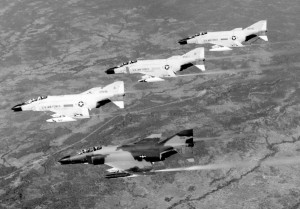
Early F-4s in Southeast Asia were painted gray, but by 1966, they were camouflaged like the Phantom at the bottom of the photograph. (Source: National Museum of the United States Air Force)

The next section jumps to the Vietnam War and examines the next biggest ‘threat’ to the fighter pilot mythology: The F-4 Phantom. The threat came not only from a reliance on guided missiles rather than guns (as the Phantom did not carry a gun at all until the later ‘E’ model) but more so from the fact that the F-4 was a two-seater. No longer was the fighter pilot a lone wolf, but he had to work in tandem with a radar cooperator in the back seat (colloquially called the ‘GIB’ for ‘guy in back’) to help identify and track enemy aircraft as well as obtain weapons locks. It was no longer enough to use one’s skill to maneuver a fighter into position and pull the trigger aggressively—now a pilot needed to understand the intricacies of how their large radar worked, and how to operate a large array of knobs, buttons, and switches to find and track targets. These tasks, split between two people, seemed to destroy social conventions among fighter pilots. Most importantly, who got credit for a kill? Most pilots bristled at these changes, as Fino notes:

Many of those sitting in either seat in the Phantom would have preferred instead to be flying a single-seat fighter, even if it was an older, less sophisticated, more vulnerable aircraft. (p. 196)

Even this radical of a shift did not destroy the image of pilots as ‘flying knights.’ The definition of what a pilot was shifted, emphasising coordination between men and machines. As Fino surmises, the Phantom’s advanced technology:

[m]ight have been designed to simplify and democratize fighter aviation so that the nation would no longer have to rely solely on the skills of carefully screened and combat-seasoned ‘birdmen,’ but it quickly became apparent in the skies over Vietnam that skilled pilots were still needed, and that those necessary skills could often be developed only in combat. (p. 197)

The final shift in this narrative came with the arrival of the F-15 Eagle—which promised to be a return to ‘traditional’ fighter pilot conceptions, optimised for air-to-air combat as a true ‘fighter pilot’s fighter plane.’ Although the Eagle had a single-seat, it was also larger and much more complicated than the Phantom. Its radar and long-range missiles still required extensive knowledge and skill to operate, although a computer now performed most of the tasks formerly handled by the GIB. Still, Eagle pilots had to be, to some degree, ‘flying scientists,’ who could perform delicate, precise movements on their joysticks to manipulate their radars and make the most of their weapons systems.

NATO Operation Allied Force
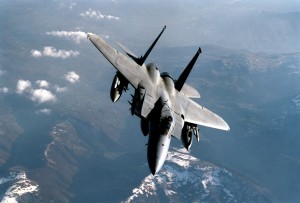
An F-15C Eagle breaks away from a KC-135R Stratotanker after in-flight refueling during Operation ALLIED FORCE on 4 April 1999. (Source: Wikimedia)

Fino does not examine the Eagle’s performance in actual warfare as much as simulated combat, specifically the AIMVAL/ACEVAL tests of 1976-1977. During and after these tests, F-15 pilots developed new tactics, including changing their formations, but more importantly developing the practice of ‘sorting’ targets. Fino examines this shift from a cultural perspective—lone fighter pilots duelling in the skies indeed became a thing of the past. Skilled individuals were still key, but now, pilots had to work together and pick targets, maximising the advantages of their weapons, ideally to end air-to-air engagements before they became dogfights. This seemed to threaten the ‘knights of the air’ image at first, but ultimately upheld it. Although the necessary skill set to be an effective Eagle pilot had drastically changed since the Korean War, pilot skill, aggression, and individual prowess were still crucial factors.

When describing the technical aspects of these systems, Fino goes into incredible detail. A close reading of this book would give the reader a thorough knowledge of the science behind radar technology and comes close to approaching an instruction manual for all three aircraft. These technical descriptions are never boring and never devolve to a case of opening ‘black boxes’ for their own sake. Fino continually ties the technical issues back to larger questions of cultural identity with an engaging style of writing. His sources are deep, and his notes thorough, proving ample opportunity for further research. If there is any flaw in the work, it tends to assume pilots are inherently antagonistic to engineers and aircraft designers. Many pilots likely shared this view. However, it might have been interesting to examine the culture and perspective of those designing and building this technology and how they viewed themselves as aiding pilots rather than threatening their culture. However, that would require another book’s worth of research and is not the type of work Fino set out to create here.

Ultimately, this work is one of the best works of air power (and technology) history that this reviewer has read in quite some time, and will likely become a standard of the field. It certainly sets a very high bar for other historians. For those interested in pilot culture and/or aircraft technology, this is required reading, while still pointing towards directions for future scholarship.

Mike Hankins is a doctoral candidate at Kansas State University, where he teaches World History, the History of Airpower, and the History of Comic Books, and he is currently working on his dissertation, ‘Sources of Innovation: The Cultural and Technological Origins of Fourth Generation Fighter Aircraft, 1964-1991.’ He completed his master’s thesis at the University of North Texas in 2013, titled ‘The Phantom Menace: The F-4 in Air-to-Air Combat in the Vietnam War. He has a web page and can be found on Twitter at @hankinstien.

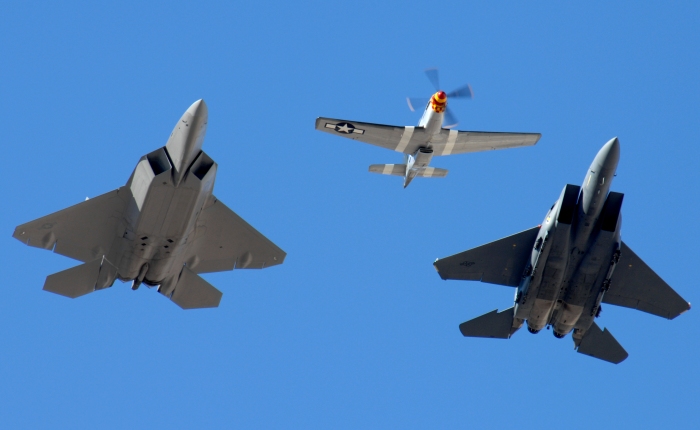
Header Image: An F-22 Raptor, P-51 Mustang and F-15E Strike Eagle perform the historic heritage flight during an air show at Nellis Air Force Base, Nevada, 8 November 2008. (Source: Wikimedia)

Call for Contributions – High-Intensity Warfare in the 21st Century

Call for Contributions – High-Intensity Warfare in the 21st Century

Since the end of the Cold War, the West’s militaries have been engaged in a series of protracted and persistent low-intensity counterinsurgency campaigns. For air forces, this has broadly meant involvement in campaigns where there have been few serious challenges to control of the air and air dominance was assumed. However, as we move further into the twenty-first century, that scenario is likely to change with the likelihood of peer-on-peer high-intensity conflict increasing. In such conflicts, air dominance will have to be fought for, and maintained, to utilise the full spectrum of capabilities afforded by the exploitation of the air domain.

Aim

The Central Blue and From Balloons to Drones seeks to commission a series of articles that examine critical themes related to the challenge of preparing modern air forces for the possibility of high-intensity conflict as they transform into 5th generation forces. As well as informing broader discussions on the future of conflict, these articles will provide the intellectual underpinnings for a Williams Foundation seminar on the subject of the requirement of high-intensity conflict to be held in Canberra, Australia in March 2018.

Themes

The editors seek contributions that provide a variety of perspectives on the following key themes:

Strategy and Theory | Future Roles | Emerging Threats | Air Force Culture

Force Structure | Technology and Capabilities | Ethical and Moral Challenges

Doctrinal Trends | Education | Training

Articles can range from historical discussions of the above themes through to contemporary perspectives. Perspectives can also come from a number of related disciplines including history, strategic studies, international relations, law, and ethics.

Submission Guidelines

Articles framed around one of the above themes should be c. 2,000 words. Submissions should be submitted in Word format and emailed to the addresses below with ‘SUBMISSION – HIGH-INTENSITY WARFARE’ in the subject line. Also, please include a 50-100-word biography with your submission. Please be careful to explain any jargon. Publication will be entirely at the discretion of the editors. These articles will appear on the websites of The Central Blue and From Balloons to Drones simultaneously. We will be publishing articles from the middle of February 2018 onwards.

Keen to write but need some guidance? Email us, and we can link you up with a mentor-editor who can assist you before formal submission.

Contact Information

For more information, please contact Wing Commander Travis Hallen (Co-editor, The Central Bluecentralblue@williamsfoundation.org.au) or Dr Ross Mahoney (Editor, From Balloons to Dronesairpowerstudies@gmail.com).

Header Image: An RAF Harrier waits in a hangar at Kandahar, Afghanistan prior to departure, c. June 2009. (Source: Defence Imagery MoD)