By Mike Hankins
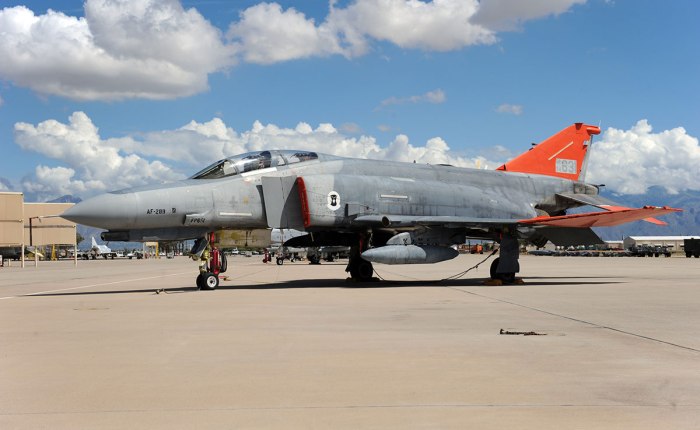
A few weeks ago, on August 17, 2016, the QF-4 Phantom flew its final unmanned mission for the United States Air Force (USAF). Although the Phantom was officially retired from combat use in 1996, USAF has been using unmanned, remote-controlled versions of the F-4 as target drones in training exercises. As the QF-4 completes its final flight, it feels like the end of an era. With over 5,000 built, the F-4 was one of (if not the) most ubiquitous aircraft of the Vietnam War and formed the backbone of the USAF in that period.
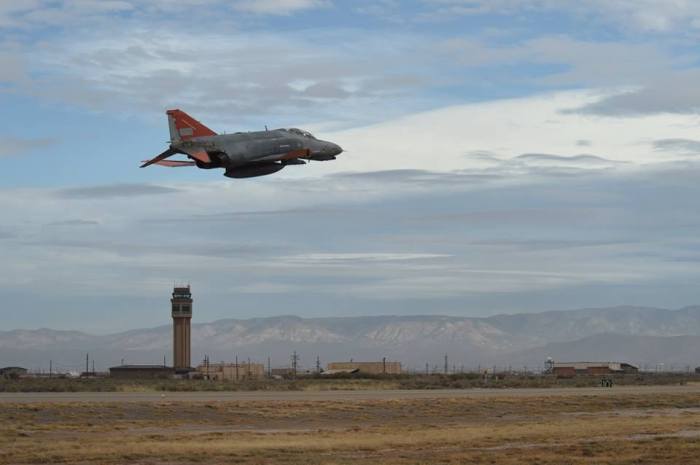
In many ways, the F-4 was the last representative of an earlier era in USAF thinking — its design (emphasising speed, interception, and multi-role capability) reflected the doctrines and assumptions of the early Cold War. During the Vietnam War, those assumptions began to be overturned, and the Air Force eventually turned to a new generation of fighters in planes like the F-15 Eagle and F-16 Falcon. As the Phantom has now officially passed out of use in the US, it is worth taking some time to look back at the Phantom’s design, what that tells us about previous modes of thinking in the Air Force, and what that might mean for the future.
After World War II, USAF, and indeed the entire US military was dominated by Strategic Air Command (SAC), which maintained a fleet of nuclear bombers. The assumption was that a potential “next war” would involve the US and the Soviet Union launching atomic bombs at each other. Thus, national security rested on the idea of being able to drop nukes on Soviet vital centres, while also being able to intercept any Soviet bombers that attempted to do the same.</p
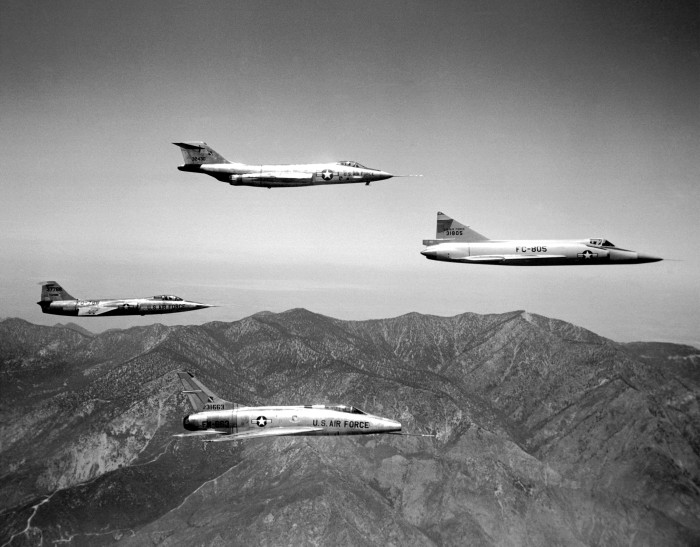
Other tactical missions like air superiority, ground support, or supply interdiction, became irrelevant. The age of fighter escorts, dogfights, and close air support against fielded enemy ground forces was over. In those early years of the Cold War, despite a few small voices of criticism, the USAF devoted less than 6 percent of its research and development resources into tactical and fighter roles. As a result, several tactical fighter wings disappeared in the late 1950s. Tactical Air Command was responsible for these functions and quickly found that the best way to retain relevance (and budget dollars) was to make a case that they too could contribute to SAC’s nuclear mission. They thus focused on developing fighter/bombers and interceptors that emphasised speed (at the expense of manoeuvrability) to either quickly deliver a nuclear warhead, or to intercept an enemy bomber and shoot it down in one pass – not with guns, but with guided missiles. This approach was exemplified in their ‘Century Series’ of interceptors. [1]
The US Navy also came to the same conclusion – that maintaining their budget and relevance necessitated that they participate in the nuclear mission, especially once atomic warheads became small enough to mount to carrier-based aircraft. New US Navy aeroplane designs focused on delivery of tactical nukes and interception of enemy bombers, and although the US Navy did not abandon air superiority to the degree that USAF did, the role of US Navy fighters certainly diminished in the post-war period. For example, the Fleet Air Gunner Unit, which trained weapons officers on US Navy planes, closed in 1960 and new training syllabi excised air-to-air combat.[2]
These assumptions and trends are key to understanding the development of the F-4 Phantom, but one the other main factor was the system of the ‘Military-Industrial Complex.’ Few defence contractors existed in the early Cold War, and the vast sums involved in contract awards and losses could make or break companies quickly. To keep options open, the military had a strong incentive to maintain their contractors afloat, sometimes making purchases regardless of actual needs. The military also encouraged these companies to push the envelope of cutting-edge technology, at times guided by strict mission parameters, on other occasions without many guidelines at all. Thus, a strong paternal bond developed between the military and its industrial suppliers, creating an environment that encouraged companies to experiment and take risks without fear of a total company failure.[3]
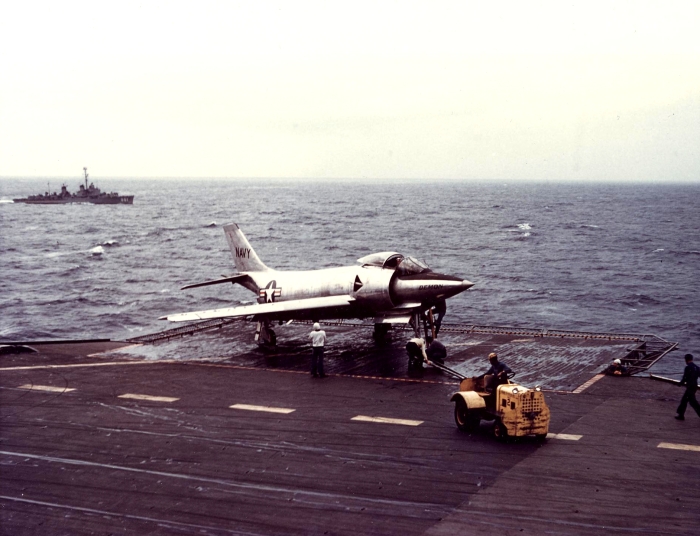
This bond came into play in September 1952, when the US Navy Bureau of Aeronautics invited proposals for a new fighter plane dedicated to the (redefined) air superiority and interception missions. The US Navy eventually awarded this contract to McDonnell’s rival firm Chance-Vought, whose entry became the F-8U Crusader. McDonnell’s losing design in this competition was a version of the F3H Demon upgraded with a dual-engine and a missile armament. In 1954, the losses from this project nearly destroyed McDonnell. The US Navy had much to lose if its weapons manufacturers closed and viewed these defence contractors as too big to fail.[4]
Next time, we will look at McDonnell’s response to this loss, and how it led to one of the most ubiquitous aircraft of all time.
Part Two of this article can be found here.
Mike Hankins is a doctoral candidate at Kansas State University, where he teaches World History, the History of Airpower, and the History of Comic Books, and he is currently working on his dissertation, ‘Sources of Innovation: The Cultural and Technological Origins of Fourth Generation Fighter Aircraft, 1964-1991.’ He completed his master’s thesis at the University of North Texas in 2013, titled ‘The Phantom Menace: The F-4 in Air-to-Air Combat in the Vietnam War. He has a web page and can be found on Twitter at @hankinstien.
Header Image: The unmanned QF-4 target drone (Source: http://www.military.com/equipment/qf-4-aerial-target)
[1] Earl H.Tilford, Crosswinds: The Air Force’s Setup in Vietnam (College Station: Texas A&M University Press, 1993), pp. 20-22; Craig C. Hannah, Striving for Air Superiority (College Station: Texas A&M University Press, 2002), p. 28; Caroline F. Ziemke, ‘In The Shadow of the Giant: USAF Tactical Air Command in the Era of Strategic Bombing, 1945-1955’ (PhD Thesis, The Ohio State University, 1989), p. 7.
[2] George W. Baer, One Hundred Years of Sea Power: The U. S. Navy, 1890-1990 (Stanford: Stanford University Press, 1994), P. 334.; Robert W. Love, Jr., History of the United States Navy, Vol. 2 (Harrisburg: Stackpole Books, 1992), pp. 375-6.
[3] Glenn E. Bugos, Engineering the F-4 Phantom II: Parts Into Systems (Annapolis: Naval Institute Press, 1996), p. 23.
[4] Bugos, Engineering the F-4, pp. 15-17.

 From Balloons to Drones
_in_1953.jpg)