Unseating the Lancer: North Korean Challenges in Intercepting a B-1B

Unseating the Lancer: North Korean Challenges in Intercepting a B-1B

By Andy Zhao and Justin Pyke

Introduction

When North Korea threatened to shoot down a B-1B Lancer in response to a September 23rd flight operating off its east coast, a reasonable amount of discussion centred around if the North Koreans have the capability to carry out their threat.[1] This article outlines some of the challenges faced by North Korea if it attempts to shoot down a B-1B operating off the coast in international airspace. Any scenario where United States (US) or South Korean aircraft attempt to penetrate the airspace of North Korea is outside the scope of this discussion.

North Korean Equipment
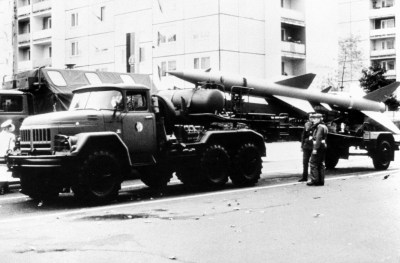
DN-SN-83-06768
An East German SA-2 ‘Guideline’ similar to that currently operated by the KPAF. (Source: Wikimedia)

The Korean People’s Army Air Force (KPAF) provides North Korea’s primary air defence. It operates a wide assortment of Soviet/Russian and Chinese equipment, consisting of everything from Chinese J-5s (a MiG-17 ‘Fresco’ derived aircraft) to the Russian MiG-29 9.13s ‘Fulcrum.’ Due to the secretive nature of the KPAF, it is hard to determine the true readiness of these aircraft in inventory. Many KPAF aircraft originate from the 1960s and are likely reaching their maximum airframe flight hours and/or are suffering from a lack of spare parts as indicated by the decreasing numbers of operational aircraft visible on airfields. This appears to be a major concern of the KPAF as in 2013 they attempted to import equipment and spare parts from Cuba. Numerous other problems plague the KPAF, from poor pilot training to the possibility of a largely expired inventory of air-to-air (A2A) missiles (i.e. R-60MKs (AA-8 ‘Aphid’) and R-27Rs (AA-10 ‘Alamo’) were received in 1987).

The KPAF also operates larger ground-based air defence platforms, such as:

North Korea also possesses a formidable array of short-range air defence systems. These are not relevant to the discussion as their range is too limited to pose a threat to a B-1B operating in international airspace.

Understanding the Kill Chain[4]

The process required to intercept an aircraft can be broken down into various steps:

  1. Detect and identify the target;
  2. Acquire the target with fire control;
  3. Identify range and the target direction/angles, paint/illuminate (literally lit up with radar waves) the target for the missile;
  4. Launch the missile;
  5. Guide the missile onto the target;
  6. The missile detonates/impacts near the target;
  7. Observe the target, repeat chain if necessary.

For the target to be intercepted, every aspect of the chain must be followed and must be successful. It is a delicate process, and if any step is interrupted, the target is unlikely to be successfully engaged. The kill chain will be similar regardless of the method used to conduct the interception.

Intercepting the B-1B using S-200 Angara (SA-5 ‘Gammon’) for Interception

S-200 Battery
North Korean S-200 Battery (Onggodok) located on the East Coast [39°19’03” N , 127°20’04” E] – Dated May 25, 2015

We will now take a closer look at the possible engagement of a B-1B by an S-200 surface-to-air missile (SAM) battery. This was the only SAM system likely to be in range of the B-1B flight on September 23rd, though even that is in doubt. For the sake of argument, we will assume a B-1B and its fighter escort stray into this outer layer of North Korea’s air defence. Firing an S-200 would be North Korea’s best shot at a successful engagement against a B-1B, as fighter interception would take more time and have to contend with a US and/or South Korean fighter escort of vastly superior quality. An S-200 SAM battery consists of several components:

An S-200 SAM battery consists of several components:

  • 5N62 (‘Square Pair’) Engagement Radar;
  • SM-106 5P73 Launchers;
  • V-601P 5V28 (S-200) Surface-to-Air Missile.

However, this is not an exhaustive list as the S-200 can also draw on higher assets, such as early warning/intercept radars (ex. P-14 ‘Tall King’ or ST-68 ‘Tin Shield’), or share information along with an integrated air defence network. It must be noted that the S-200 was developed in the 1950s through 1960s with the intention of engaging high-altitude bombers like the B-52 Stratofortress. The heavy missile is not ideal for engaging smaller and more manoeuvrable targets, particularly near its maximum range. The S-200 battery requires a constant feed of range and azimuth data to guide the missile onto the target and uses the 5N62 Engagement Radar to accomplish this task. Once the B-1B has been painted, the SAM battery can attempt to engage it.[5]

US aircraft are equipped with radar warning receivers (RWR), such as the ALQ-161A on the B-1B, that can detect radar emissions and alert the pilot. The pilot can then perform various actions (‘defending’) to attempt to break the lock. The most obvious of these is taking evasive action, but countermeasures such as chaff (small pieces of plastic and fibre with a conductive coating), jamming (providing false signals at the specific frequency used by the radar), and towed decoys (mimics the appearance of the parent aircraft) can also be employed.

Additionally, the S-200 has a poor record of target interceptions. On March 24th, 1986, Libya fired at least four S-200 missiles against two F-14 Tomcats when they were 40km off the Libyan coast. All of them missed their targets, and the engagement radar was destroyed by an AGM-88A High-Speed Anti-Radiation Missile, rendering the S-200 battery inoperable. In March 2017, Israeli aircraft launched airstrikes in Syria and were targeted by an S-200 battery, escaping unscathed.[6] In fact, the authors were unable to find a single example of a successful S-200 interception in a combat environment. In summary, the chance of an S-200 successfully downing a B-1B or its fighter escort is very low. The system was simply never designed to engage these types of aircraft effectively.

On September 23rd, the kill chain did not proceed past the first stage. According to Yonhap, the South Korean National Intelligence Service claimed that ‘North Korea did not take any immediate action in response to US’s strategic bombers’ flight.’ A member of the US intelligence community (IC) reached out to the authors and stated that the North Koreans picked up the flight on their early warning radars, but not engagement radars and that seemingly no alerts were sent to any airfields or SAM batteries. The source was unsure of the reason why the North Koreans did not send out alerts, and suggested possibilities varying from confusion/incompetence to a willful decision not to notify air defence assets. Ultimately, the North Koreans were either unable to acquire the B-1B flight with their engagement radars, or decided not to escalate the situation further by doing so.

As an aside, it is worth noting that the eastern S-200 battery’s (Onggodok) engagement radar was no longer present on the newest Google Earth imagery (October 19th, 2015), and was still missing as of May 5th, 2017. The US IC source stated it was likely just routine relocation training, and that there is another S-200 battery located on the east coast. Unfortunately, the authors could not confirm if the new site has the engagement radar, or if the battery was even operational during the September 23rd flight.

Intercepting the B1B using MiG-29 9.13s ‘Fulcrum’ for Interception

KPAF Mig-29
A KPAF MiG-29 unit being visited by Kim Jong-Un. (Source: Unknown)

The same Yonhap article notes that North Korea has moved additional aircraft to the coast, and CNN claims that they are MiG-29s. A ‘best case’ example of MiG-29 9.13s equipped with R-60MKs and R-27Rs will be used as this is the most capable A2A combat system in the KPAF inventory. North Korea only has around six of these MiG-29 models.[7] If the MiG-29s are fully combat loaded, they only have a 180km combat radius. This can be extended to ~276km with the use of a drop tank. Additional drop tanks can be fitted, but the MiG-29 9.13s would have to forgo the R-27R medium-range A2A missiles that would be critical to a successful interception.[8] Given the locations of North Korean airfields in the eastern part of the country, the MiG-29s would have only slightly more reach than the S-200 battery at best, and would just have one brief shot at the interception before needing to return to base. Additionally, the intercepting MiG-29s would likely not have time to engage with the US and/or South Korean fighter escort. For the sake of argument, the assumption will again be made that a B-1B flight comes within range of fighter interception.

Using aircraft to intercept the B-1B would follow the same general kill chain as mentioned for the S-200. First, the B-1B would need to be detected. This could be done with early warning radar before scrambling the MiG-29s to intercept. KPAF fighters could also be assigned to patrol the airspace around-the-clock, with ground radar assisting the aircraft in attempting to detect the B-1B. The latter is an unlikely option given the limited range of the MiG-29 and is demanding on the aircraft as well as the pilots. There may also be a significant delay between detection of the B-1B and the scrambling of aircraft. The MiG-29s would likely be detected by US or South Korean early warning assets in the region, which would communicate an advanced warning to the B-1B. It could use this time to leave the area, putting an end to the interception. However, if the B-1B is identified and does not leave the area, the MiG-29s still need to acquire it visually to engage with infrared missiles (R-60MKs) or on the radar to engage with radar-guided missiles (R-27Rs). Once again, countermeasures could be deployed, and evasive manoeuvres could be taken to defeat the missiles.

landscape-1504206649-36755613416-05fc74a29d-k
US Marine Corps F-35B Lightning II stealth fighters assigned to the Marine Corps Air Station Iwakuni, Japan, fly alongside 2 US Air Force B-1B Lancers assigned to the 37th Expeditionary Bomb Squadron, deployed from Ellsworth Air Force Base, South Dakota, over waters near Kyushu, Japan, Aug. 30, 2017, and 2 Koku Jieitai (Japan Air Self-Defense Force) F-15J fighters. Source: US Pacific Command)

If fighters are escorting the B-1B, as was the case on September 23rd, they could intercept the MiG-29s. This would put the escorting fighters at risk. However, it must be made clear that even if the interception were conducted by the best KPAF fighters available (MiG-29 9.13s) using the best KPAF A2A missiles available (R-60MKs and R-27Rs), they would still be at a large disadvantage against US and South Korean aircraft. The countermeasures and missiles are both inferior at the least. For example, the R-27R relies on semi-active guidance, meaning the parent aircraft must keep its nose pointed at the target and maintain a lock with the onboard radar until impact.[9] By contrast, the AIM-120 AMRAAM used by US and South Korean fighters can be fired at an extended range, and course corrected using data from the parent aircraft without the need to keep the MiG-29 painted with radar. The pilot of the MiG-29 would not be alerted by their RWR that a missile was inbound until the AIM-120 reaches its terminal phase, providing little warning of its approach. This gives the US, or South Korean pilots added tactical flexibility over their North Korean counterparts. Any lesser aircraft in the KPAF inventory, such as MiG-23MLs ‘Flogger,’ would be even further disadvantaged.

Conclusion

The possibility of a successful interception of a B-1B operating in international airspace off the coast of North Korea cannot be disregarded entirely. However, the limited reach of North Korea’s air defence, the advanced age and limited capabilities of the systems theoretically in range, and the array of defensive options available to the air forces of the US and South Korea would pose a nearly insurmountable challenge. The high chance of failure (and by extension embarrassment), the possibility of instigating a regime-ending war, and negligible benefits of successfully downing a B-1B leads to the conclusion that North Korea is unlikely to carry out this threat. This is particularly true when North Korea has much more reliable and effective means of provocation, such as continued ballistic missile and nuclear tests.

Justin Pyke obtained his MA in Military and Intelligence History from the University of Calgary in 2016. His main research interests include the Asia-Pacific War, military and politics of Imperial Japan, and the development of air and naval power in the inter-war period. He can be found on Twitter at @CBI_PTO_History.

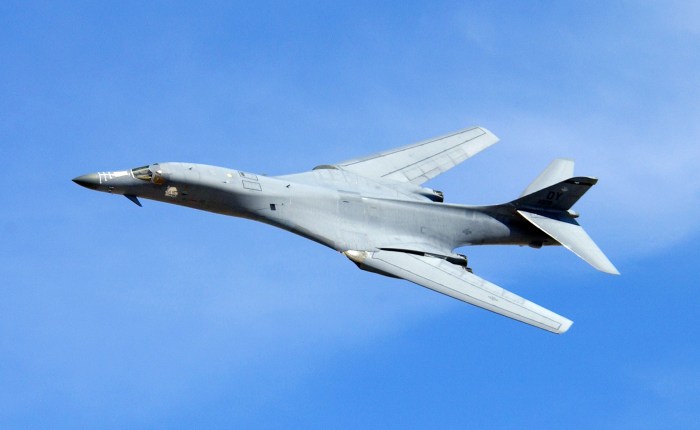
Header Image: A B-1 Lancer performing a fly-by during a firepower demonstration, c. 2004. (Source: Wikimedia)

[1] Special thanks to Samuel Stadem, air power enthusiast and current chemistry graduate student at the University of Minnesota Duluth, for providing assistance with the finer points of modern military aviation.

[2] Tony Cullen and Christopher Foss (ed.), Jane’s Land-based Air Defence, 5th ed. (Surrey: Jane’s Information Group, 1992), pp. 261-62, 264.

[3] Richard D. Fisher Jr., ‘North Korean KN-06 Test Confirms Similarity to Chinese and Russian Fourth-Generation SAMs,’ IHS Jane’s Defence Weekly, 53:22 (2016).

[4] Robert H.M. Macfadzean, Surface-Based Air Defense System Analysis (Norwood: Artech House, 1992), pp. 39-63.

[5] Cullen and Foss, Jane’s Land-based Air Defence, pp. 263-64.

[6] The Syrians claimed that they shot down one aircraft and damaged another. However, no evidence has been presented and the burden of proof lies with Syria.

[7] Yefim Gordon and Dmitriy Komissarov, Soviet and Russian Military Aircraft in Asia (Manchester: Hikoki Publications, 2014), pp. 265-89.

[8] Yefim Gordon, Mikoyan MiG-29, trans. Dmitriy Komissarov (Hinckley: Midland Publishing, 2006), pp. 341, 377. The drop tank combat radius was extrapolated from the given range and combat radius values. The internal fuel capacity gives a 900km range and 180km combat radius, providing a ratio of 5. The given range on one drop tank is 1,380km. Dividing this by 5 results in a 276km combat radius.

[9] Gordon, Mikoyan MiG-29, pp. 364-65, 487-88.

Changing the USAF’s Aerial ‘Kill’ Criteria

Changing the USAF’s Aerial ‘Kill’ Criteria

By Major Tyson Wetzel

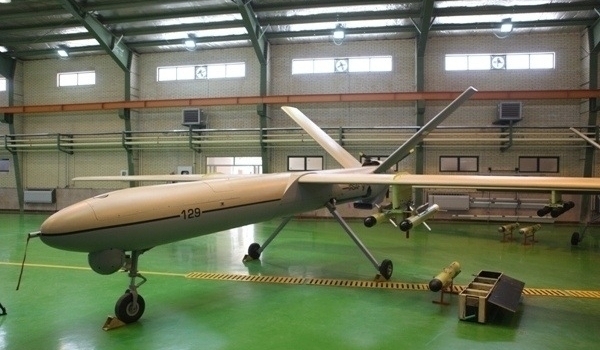
On 8 June 2017, a United States Air Force (USAF) F-15E Strike Eagle shot down an Iranian-produced Shahed 129 unmanned aerial vehicle (UAV) over Syria, followed just twelve days later by a second identical event. Earlier this year an Israeli fighter aircraft shot down a Hamas drone, just the most recent of at least half a dozen Israeli UAV kills occurring since October 2012. The face of aerial combat has changed in this era of UAVs, or ‘drones’ as they are commonly called. Aircrew are now more likely to engage UAVs than manned fighters in current and future aerial combat.

13941115000415_photoi
A Shahad-129 UAV.

The question of whether UAV kills should be counted as official aerial victories is unresolved and has recently been hotly debated on social media. In a small sampling of air power enthusiasts conducted by the author on Twitter, just 58% of respondents were in favour of counting UAVs as official kills that count towards ‘ace’ status (five aerial victories). Current USAF policy does not recognise UAV shoot downs as ‘kills,’ but it should. Aircrew should receive proper recognition for the destruction of an adversary’s air assets.

Based on the author’s discussion with current USAF pilots, operators, and air power historians and theorists, there are at least four clear arguments against counting UAV kills as official aerial victories that count towards ace status. First, shooting down a UAV does not require the skill associated with shooting down a manned aircraft. Second, UAVs cannot shoot back. Thus there is a limited risk in this type of engagement, a critical component of aerial combat. Third, and perhaps most importantly, there is not another pilot in the UAV, meaning the UAV cannot respond to adversary actions. Thus there is no ‘sport’ in the shoot down. Finally, there is a risk that allowing unmanned aircraft to count as official kills will open the floodgates to allow the destruction of all airborne objects to count as official aerial victories. I will provide counter-arguments to each of these points as part of my advocacy for modifying current USAF aerial victory criteria to include some classes of UAVs.

While UAVs may be relatively low and slow targets, shooting them down still requires skill and precise aerial employment. Detecting and engaging a UAV is not easy, its low altitude and speed can potentially cause problems for fighter pulsed-Doppler radars. The reduced radar cross section (RCS) of some UAVs also increases the difficulty of engagement. Shooting down a UAV requires detecting a small size and small RCS aircraft, positively identifying that aircraft (often difficult with small systems that do not emit many of the detectable signatures US aircraft typically use to identify adversary aircraft electronically), and guiding a weapon to kill the UAV. These functions; detecting, tracking, identifying, and guiding a weapon to the target are the same functions a fighter pilot would need to shoot down a MiG-29 FULCRUM or a Su-27 FLANKER. Based on my experience, most fighter pilots who have tried to engage a UAV in training or the real-world would agree that a significant amount of skill and tactical acumen is required to complete such a kill.

Airstrikes in Syria
A USAF F-15E Strike Eagle receives fuel from a KC-135 Stratotanker over northern Iraq after conducting airstrikes in Syria, 23 September 2014. These aircraft were part of a large coalition strike package that was the first to strike ISIL targets in Syria. (Source: Wikimedia)

The second argument is based on the fact that most currently fielded UAVs are incapable of firing back at an adversary. Multiple arguments counter this point. First, an aircraft need not be able to return fire to be officially counted as an air-to-air kill. In Operation DESERT STORM, USAF F-15C pilot Greg ‘Dutch’ Masters was given credit for a kill on an Iraqi Air Force (IAF) IL-76 CANDID cargo aircraft. Second, most UAVs do have propelled munitions that could provide a limited ability to respond to an aerial attack. In 2002, a USAF MQ-1 PREDATOR fired an AGM-114 HELLFIRE air-to-ground missile (AGM) against an IAF MiG-25 FOXBAT, though the FOXBAT successfully shot down the PREDATOR. The Shahed 129s that were recently shot down were reportedly equipped with similar AGMs that could conceivably be used to fire on an adversary fighter aircraft. Lightly armed air-to-ground aircraft have always been counted towards official kill counts. In DESERT STORM, US aircraft shot down six helicopters and one aircraft armed with only limited air-to-ground munitions, and no dedicated air-to-air capability (three Mi-8 HIPs, one Mi-24 HIND, one Bo-105, and one Hughes 500 helicopters, and a PC-9 light attack aircraft).

The third argument is that UAVs do not have a pilot in the cockpit, and thus should not be counted as an aerial victory. Virtually all UAVs, even micro UAVs and drones, have an operator who is controlling the system; few UAVs simply fly a pre-programmed route without operator input. Most UAVs, especially the larger and more capable systems, also include a crew on the ground, typically a pilot and a sensor operator, who can build situational awareness of the operational environment, react to, avoid, and attempt to counter adversary attempts to shoot it down. Additionally, this argument ignores the changing face of aerial combat. The preponderance of air assets in future conflicts are likely to be unmanned in the future.

The final argument is that inclusion of UAVs into official kill criteria will risk widening the aperture of official aerial victories to include any airborne objects. Taken to its extreme, one could imagine the destruction of a mini drone or quadcopter being counted as an official kill. The simple solution to this problem is to specifically delineate the types of UAVs that will be considered official kills.

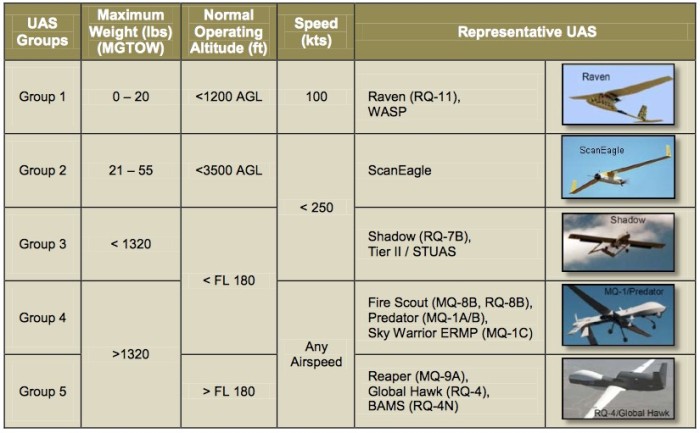
Not all UAV or drone kills should count as official air-to-air kills; the USAF should modify its existing kill criteria to include some classes of UAVs based on size and function of the system. The Department of Defense (DOD) has defined Unmanned Aircraft System (UAS) groups in their 2011 UAS Airspace Integration Plan. These groups are used to distinguish US classes of UAS’, but they also provide a useful method to make a distinction between adversary systems that should officially count as an air-to-air kill.

UAS Table
Department of Defense Unmanned Aircraft Systems Group Descriptions. (Source: 2011 Department of Defense Unmanned Aircraft Systems Airspace Integration Plan)

UAS Groups 1-3 are small airframes, have no or very limited ordnance, and are hand or catapult launched. These ‘micro UAVs’ and ‘drones’ should not officially count as a kill because of their limited ability to react or counter adversary actions, and to avoid the precedence of allowing all airborne assets to count for a kill (think about the ridiculousness of a silhouette of a remote-controlled quadcopter on the side of an F-15). UAS Groups 4 and 5, however, are UAVs that are typically operated by a pilot, are capable of medium-to-high altitude flight, longer range and endurance, beyond line-of-sight operations, and frequently carry propelled munitions that can conceivably be used for self-protection (as a frame of reference, the Shahed 129 would be classified as a Group 4 UAS). These capabilities mirror previous non-fighter aircraft which have been counted as official kills, such as heavily-armed but non-maneuverable balloons in World War I (5 of American ‘Ace of Aces’, Eddie Rickenbacker’s 26 WWI kills were balloons), cargo aircraft (IL-76 in DESERT STORM), and lightly armed helicopters (Bo-105 and Hughes 500 helicopters in DESERT STORM).

The US went 18 years between manned aircraft shoot downs, from the last MiG-29 kill of Operation ALLIED FORCE in 1999 to last week’s Su-22 FITTER kill. However, during this period UAVs have expanded exponentially in number and type, and recently have been targets for US aircrew flying over Syria defending coalition forces. It is time for the USAF, and DOD writ large, to recognise the changing character of aerial combat and designate kills on particular types of UAVs as official aerial victories. Such a decision would legitimately recognise tactical excellence in air combat and bring official aerial victory criteria up to date with changing character of 21st Century warfare.

Tyson Wetzel is a Major in the United States Air Force intelligence officer, a graduate of the United States Air Force Weapons School where he was also an instructor, and the US Marine Corps Command and Staff College. Tyson has deployed multiple times in support of Operations IRAQI FREEDOM, ENDURING FREEDOM, NEW DAWN, and NOBLE EAGLE. He is currently assigned to the Joint Staff at the Pentagon. He tweets @GetterWetzel.

Header Image: A pair of USAF F-15E Strike Eagles fly over northern Iraq early in the morning of 23 September 2014, after conducting airstrikes in Syria. These aircraft were part of a large coalition strike package that was the first to strike ISIL targets in Syria. (Source: Wikimedia)

It is Time to Demystify the Effects of ‘Strategic Western Air Power’ – Part 2

It is Time to Demystify the Effects of ‘Strategic Western Air Power’ – Part 2

By Lieutenant-Colonel Dr Jyri Raitasalo

Editor’s Note: In this two-part article, Dr Jyri Raitasalo considers what he argues are the two fundamental fallacies concerning the application of strategic air power by Western states in the modern era. In the first part, he examined the challenge of the use of military forces as a tool for solving political problems. In this second part, he examines the issue of ‘no casualty warfare.’

Fallacy 2: No casualty warfare

The second fallacy in Western air power paradigm touches on the notion of precision engagement with almost zero civilian casualties and no collateral damage. This narrative was formed in the aftermath of the 1991 Gulf War and has been maturing and strengthening ever since.  Precision engagement has indeed become one of the game changers in warfare lately, but the Western narrative on pinpoint accuracy in warfare has become a strategic level hindrance to effective military operations.

The notion of no or little collateral damage developed into the Western air power paradigm little by little as political leaders since the early 1990s continuously decided to use military force actively for humanitarian purposes. It was a prerequisite that Western military operations do not cause civilian suffering or produce collateral damage in military operations (read: war) that are eventually humanitarian in nature. Focusing on the precise application of large-scale violence was thus a must for political purposes. It was needed for the legitimacy of these operations and to ‘sell’ these operations to domestic audiences within the Western world and internationally.

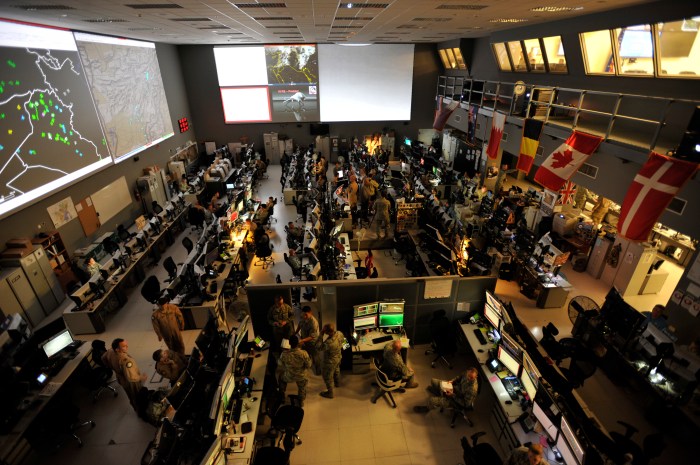
Combined Air and Space Operations Center
Combined Air and Space Operations Center at Al Udeid Air Base, Qatar, provides command and control of air power throughout Iraq, Syria, Afghanistan, and 17 other nations. The CAOC is comprised of a joint and Coalition team that executes day-to-day combined air and space operations and provides rapid reaction, positive control, coordination, and de-confliction of weapon systems. (Source: US Department of Defense via Wikimedia)

Also, as these humanitarian military missions had almost nothing to do with Western national interests or threats to Western states, it has been crystal clear from the start that force protection has been essential in these operations. Over time this has developed into a tradition of casualty-aversiveness, making Western soldiers ‘strategic assets’. Air power has facilitated safe military operations as practically all opponents during the post-Cold War era have had no functioning air forces of capable air defences. Relying on air power to fight humanitarian wars has been practically the only way that these operations have become possible in the first place. As President Bill Clinton explained: ‘I do not intend to put our troops in Kosovo to fight a war’. For the US the post-9/11 Global War on Terror changed this aversiveness to send troops to battle for a while.

What started as a way to ‘market’ humanitarian missions to voters and the general population has turned into a Western narrative on war, which accentuates the ability to strictly control the ‘dosing’ of violence in wars and being able to fight without civilian casualties and collateral damage. During the post-Cold War era, this guiding political principle and a semi-binding Western norm on warfare have led to Western militaries developing extremely expensive military systems to fight this ‘frictionless precision warfare’. This trend has been tremendously problematic for European states, as they in most cases do not have sufficient economic resources to develop their armed forces into credible military actors with even a modest number of usable high-tech military systems. When combining this trend with the post-Cold War era professionalisation of European militaries, most states in Europe today possess ‘Lilliputian militaries’ with little warfighting capability for large-scale conventional war against advanced state adversaries.

Final thoughts

Air power is important in warfare. Moreover, modern high-tech air forces can produce a decisive effect on the battlefield when used properly. ‘Unfortunately’ for some Western (mostly European) militaries, the post-Cold War era did not for more than 20 years pose any real military challenges that would have required sober analysis on what kind of missions the armed forces should be preparing against. Moreover, more importantly, as the existential threat evaporated quickly in the early 1990s, many Western political leaders filled the vacuum of security threats by turning their eyes towards out-of-area conflicts and stability throughout the globalising world.

In a cumulative 20-year long emergent process, Western states have become more and more interested in and reliant on applying air power actively in expeditionary operations because using military force throughout the international system has become possible. Political leader’s ‘trigger happiness’ in the West has increased during the post-Cold War era. On the tactical and operational levels of war, air power offers ‘easy solutions’ when there is the need to do something quickly and visibly – for example during large-scale atrocities committed by authoritarian leaders towards their citizen. On the strategic level, though, the results have been much more modest. Modern air power has not lifted the ‘fog of war’, nor has it produced many positive strategic results. Air power does not provide Western states with a ‘silver bullet’, nor has it changed the nature of war:  war is still a duel of wills, which means that adaptive enemies will do their utmost to destabilise Western strengths and lead in military capability development. This can be done at the tactical, operational or strategic levels.

990328-F-4728F-009
A USAF F-15E Strike Eagle takes off from Aviano Air Base, Italy, for an air strike mission in support of NATO Operation ALLIED FORCE on March 28, 1999. (Source: US Department of Defense via Wikimedia)

The use of large-scale military violence – waging war – needs to be taken seriously. Even if it is possible to cause pinpoint destruction and make targeted killings, one should remember that political problems can rarely be solved by killing all the opponents (from afar) or by punishing them severely. The active use of Western air power during the last 20 years has resulted in the lowering the threshold on the use of military force in the world. This could backfire in the future as China and Russia are increasing their military capabilities and great-power statuses.

Dr Jyri Raitasalo is a Lieutenant-Colonel in the Finnish military and a Senior Staff Officer at the Planning Unit (strategic planning) of the Finnish Ministry of Defence. He holds the title of Docent of strategy and security policy at the Finnish National Defence University.  During his latest assignments, he has served as the Commanding Officer of the Helsinki Air Defence Regiment (Armoured Brigade), Head Lecturer of Strategy at the Finnish National Defence University, ADC to the Chief of Defence and Staff Officer (strategic planning) in the Finnish Defence Command (J5). Jyri Raitasalo is a called member of the Royal Swedish Academy of War Sciences.

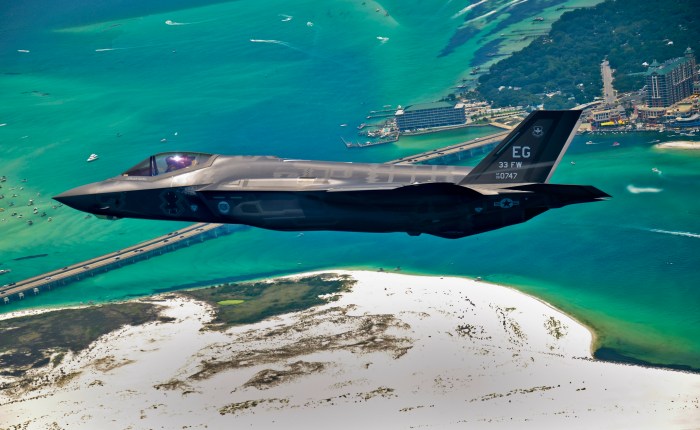
Header Image: The Department of Defense’s first U.S. Air Force F-35 Lightning II joint strike fighter (JSF) aircraft soars over Destin, before landing at its new home at Eglin Air Force Base, July 14, 2011. (Source: US Department of Defense via Wikimedia)

It is Time to Demystify the Effects of ‘Strategic Western Air Power’ – Part 1

It is Time to Demystify the Effects of ‘Strategic Western Air Power’ – Part 1

By Lieutenant-Colonel Dr Jyri Raitasalo

Editor’s Note: In this two-part article, Dr Jyri Raitasalo considers what he argues are the two fundamental fallacies concerning the application of strategic air power by Western states in the modern era. In this first part, he considers the challenge of the use of military forces as a tool for solving political problems. The second part of this article can be found here.

Ever since the 1991 Gulf War, the Western strategic discourse on air power has accentuated the role of high-tech precision-guided weapons together with good situational awareness and reliable command and control systems in solving modern conflicts. After the lessons learned from Operation DESERT STORM were drawn, one of the main tenets of western strategic thinking has been the (over-)reliance on the possibilities to solve political conflicts with modern weaponry – from the air. This notion did not emerge out of thin air. It was one answer to the many demands that Western statesmen – first and foremost among them the President of the United States – made immediately after the Cold War had ended. Since the early 1990s, the international security environment developed positively – at least from the western states’ perspective. However, the world was still infected with many low-level threats that rose in significance simultaneously as the Soviet threat evaporated.

The so-called Revolution in Military Affairs (RMA) has been expected to deliver positive outcomes to political crises with little risk to Western soldiers or national interests – whether in Bosnia (1995), Kosovo (1999), Afghanistan (2001), Iraq (2003) or Libya (2011). Many western ‘wars of choice’ – under the headings of ‘humanitarian interventions’, ‘military crisis management operations’ or ‘expeditionary missions’ have been made possible – and in some cases necessary – by the demands of the contemporary 24/7 media, high-tech ‘revolutionary’ warfighting capabilities and the fading of the existential threat posed by the Soviet Union.

Display of might
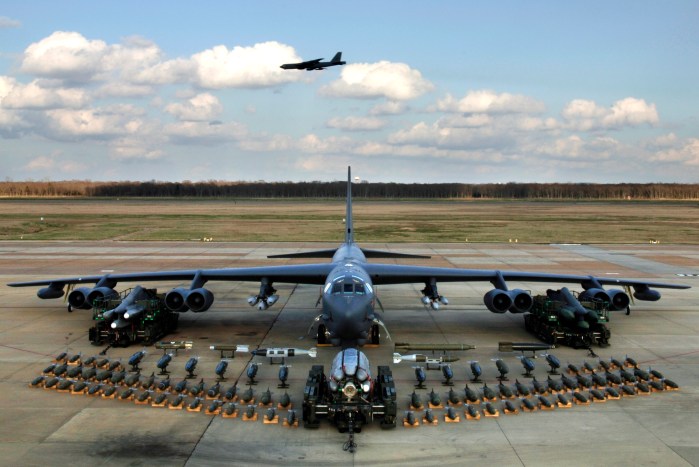
A US Air Force Boeing B-52H Stratofortress of the 2d Bomb Wing static display with weapons, at Barksdale Air Force Base, Louisiana, in 2006. (Source: Wikimedia)

During the 25 years of the post-Cold War era, Western air power ‘theory’ – based on the expectations of Western political leaders – has entertained the notion of strategic success in war just by deploying air assets against chosen adversaries. During this time we have witnessed the mystification of air power – the new ‘silver bullet’ – to epic proportions in a way that practical results from recent wars lend little support. Analysing recent western air wars from Bosnia (1995) to Libya (2011) one can easily detect that none of them has proved to be strategic successes for the west. Thus the ‘brand’ of contemporary Western air power is better than its actual track record. None of the often mentioned ‘successes’ have facilitated long-term positive outcomes.

The contemporary Western air war paradigm is based on two fallacies: the idea that high-tech military capabilities facilitate easy solving of political problems and the notion of almost casualty-free warfighting. Both of these should be subjected to strict scrutiny. It should be noted that it is not the militaries’ fault that political leaders have expressed repeated demands to the use of military force that are beyond the boundaries that existing military capabilities can deliver. However, to facilitate better strategies in the future, these fallacies will be elaborated next.

Fallacy 1: The use of military force is an effective tool to solve political problems

It is good to acknowledge that the number of armed conflicts – and the average number of people killed in these conflicts – has decreased during the post-Cold War era. As the Human Security Report Project noted in 2014, we have witnessed:

the rapid decline in international wars (anti-colonial wars are included in this category) over the past 60 odd years. The average number of international wars being fought every year per decade shrinks dramatically – from over six in the 1950s to less than one in the 2000s. […] From the early 1990s to the present day, overall conflict numbers have dropped by some 40 percent, while the deadliest conflicts, those that kill at least 1,000 people a year, have declined by more than half.

Despite the positive trend in warfare since the end of the Cold War, there have been many brutal cases where large-scale human suffering and damaged infrastructure have caused concern within the western security community. First of these instances was ‘born’ out of the result of the 1991 Gulf War: the predicament that the Kurds (in the north) and the Shia population (in the south) faced after Saddam Hussein was defeated – but remained in power. Moreover, many others have followed: from Somalia to Haiti, and from Timor-Leste to Kosovo.

The humanitarian suffering brought to our living rooms by the 24/7 media – and later by social media, smartphones and tablets – has become a new factor influencing western decisions in the use of military force in the world. Although most of the (air) wars that the West has waged during the post-Cold War era have almost nothing to do with Western national security directly, there has been the need to do something to ease humanitarian conditions and suffering around the world in the many crises that have been ongoing – from Iraq to Somalia and Haiti to Libya. Thus, the western approach to ‘humanitarian interventions’ and the ‘Responsibility to Protect’ (R2P) emerged to fill in the void that the end of the Cold War caused within the western threat perceptions.

Facing no existential threats, for the past 25 years, Western states have had the luxury of focusing on crises around the world where large masses of people have been violently oppressed. Moreover, the tools of the ongoing RMA – precision air strikes as the forerunner – seemed to propose a possibility to manage these humanitarian crises with little cost – in either blood or treasure. As was noted after the Gulf War:

A significant part of that edge [US’s edge versus Iraq] can be attributed to the revolutionary new military technology used by U.S. forces for the first time in Gulf War.

In other words, the lessons learned from the Gulf War – where Saddam Hussein’s big Army was easily defeated on the battlefield – have influenced the way that Western political leaders have been trying to solve violent political crises out-of-area.

However, the problem lies exactly here: the complex, violent crises around the world cannot be solved by precision bombing or by killing the ‘bad guys’. The politicisation of ethnicity and religion, the criminal elements involved and the contradictory political goals of multiple adversaries in most of the contemporary violent crises mean that externally imposed military solutions will not work. As has been noted in connection with the 2001 US-launched Global War on Terror, it is hard to kill enough terrorists without at the same time facilitating additional terrorist recruiting and providing additional PR for the terrorist cause.

It is understandable that political leaders resort to the use of military force relying on advanced weaponry to solve nasty crises around the world. The humane instincts of Western strategic decision-makers are understandable and praiseworthy. However, the sad part is that strategically, the use of military force has not been able to bring about political reconciliation or stability into ongoing conflict zones. On the contrary, the first ‘RMA air-war’ in history – the 1991 Gulf War – produced a political stalemate that resulted in a war of attrition against Iraq between 1991-2003. This attrition warfare manifested itself through the enforcement of no-fly zones and punitive air strikes against Iraq every time Saddam’s troops violated the rules imposed on them.

Even though the first Gulf War did not bring a politically favourable outcome vis-à-vis Iraq, the lessons drawn from that campaign at the operational level influenced how air power was used in Bosnia and Kosovo during the 1990s. The two air wars in Europe – in Bosnia 1995 and over Serbia in 1999 – have not till today produced lasting strategic outcomes that would be favourable to western states. Both are practically failed states, which can take a turn for the worse at any time. Also, in today’s tense international environment, the very unstable situation in Bosnia and Kosovo provide ample opportunities for Russia to manipulate the West.

It is noteworthy that immediately after the Kosovo air war, the US Secretary of Defense William Cohen noted that:

[…] what we were able to achieve through this [Kosovo] campaign reminds all of us that the revolution in military affairs is fundamentally changing the way in which we fight. […] In Operation Desert Storm, […], there were only a handful of sophisticated aircraft that could carry precision-guided munitions, […] In Kosovo, nearly all of our fighters could deliver these devastating weapons.

Cohen’s remarks are spot on when looked from tactical or operational perspectives. On the strategic level, however, the effects of “devastating weapons” do not automatically turn into political objectives.

To be fair, it must be noted that air power was eventually able to stop ethnic violence in the former Yugoslavia, but whether the level of violence increased because of the air wars or not, is still debatable. In any case, both Bosnia and Kosovo have shed light also on the negative impact of western air power:  the mere existence of highly capable western (read: US) Air Forces – together with the global 24/7 media – facilitated the increase of violence both in Bosnia and Kosovo as the West was lured into these crises by attacks on the ground that aimed to escalate the conflict – not to end it. The Western humanitarian intervention approach was in its formative years, and the belligerents on the ground in Bosnia and Kosovo knew how to take advantage of it. After the terrible case of the Rwandan genocide in 1994, it was easy to exploit the willingness of the West to do more – even by escalating ethnic cleansing to draw the West into the conflict.

The second round of large-scale air warfare against Iraq took place through a campaign of ‘shock and awe’ in 2003. It was accompanied and followed by mechanised thrusts to destroy Saddam’s Army, a task that the United States and its allies succeeded to do. However, this operational success was not followed by the fulfilment of strategic goals. Air power was not able to solve the post-Saddam political crisis in Iraq – a fate also shared by the Army and the Marine Corps throughout the subsequent counter-insurgency (CI) operation, which resulted in the withdrawal of US troops after years of fighting and thousands of casualties. The breaking up of Iraq’s state structures, administrative routines and security forces also facilitated the birth of ISIL and the increase of violence and instability in the region. In all, the 2003 war in Iraq – and the chaos that has followed – has proved to be a strategic mistake of massive scale. The possibilities of quick high-tech warfare against much weaker traditional conventional army lured the US into a process that eventually became uncontrollable. This is the true essence of war – that competitive advantage in one sphere of war-fighting (e.g. technology) can be mitigated or even nullified by another (e.g. tactical asymmetry). There are no ‘silver bullets’ – at least not for long.

RAF Tornado GR4 Aircarft During Operation Ellamy
Two fully armed RAF Tornados from RAF Marham transit the Mediterranean Sea en-route to Libya as part of the UK’s Operation ELLAMY to enforce the UN no-fly zone in March 2011. (Source: Defence Imagery, MoD)

Finally, the air war against Muammar Gaddafi’s Libya in 2011 – NATO operation Unified Protector – helped to set in motion a crisis that will influence European security for years to come – negatively, not to mention the additional suffering to ordinary Libyans. Today Libya is a failed state with multiple armed forces fighting over power and economic benefits. Also, Libya has become one of the bases for extremist terrorism. Operation Unified Protector showed the might of advanced air power by destroying the Gaddafi regime, but the strategic consequences of the operation will haunt the West – and Europe particularly – for years to come.

Dr Jyri Raitasalo is a Lieutenant-Colonel in the Finnish military and a Senior Staff Officer at the Planning Unit (strategic planning) of the Finnish Ministry of Defence. He holds the title of Docent of strategy and security policy at the Finnish National Defence University.  During his latest assignments, he has served as the Commanding Officer of the Helsinki Air Defence Regiment (Armoured Brigade), Head Lecturer of Strategy at the Finnish National Defence University, ADC to the Chief of Defence and Staff Officer (strategic planning) in the Finnish Defence Command (J5). Jyri Raitasalo is a called member of the Royal Swedish Academy of War Sciences.

Header Image: An F/A-18 Hornet of VFA-94 carrying out operations in support of Operation Enduring Freedom in 2001. Visible on the wing are two 500-pound Laser Guided Bomb Units (GBU-12) (left), and an AIM-9 Sidewinder air-to-air missile. (Source: Wikimedia)

#Commentary – The RAF and the F-117

#Commentary – The RAF and the F-117

By Dr Ross Mahoney

In the past couple of days, several sources have reported on the fact that in 1986, the US President, Ronald Reagan, offered Britain the opportunity to co-operate on stealth technology and purchase the Lockheed F-117 Nighthawk. Details of the project, codenamed MOONFLOWER, have become known through the recent release of files by the British National Archives. This release is part of the material coming out of the Prime Minister’s files for the 1980s and the specific reference for MOONFLOWER is PREM 19/1844. An important issue to note with these files is that they have not been digitised and were opened just before the New Year. This is an important consideration when reading many of the reports on the internet as it is probable that the one in The Guardian – from which most derive – has only cited certain parts of the file. Indeed, I have not read the file yet.

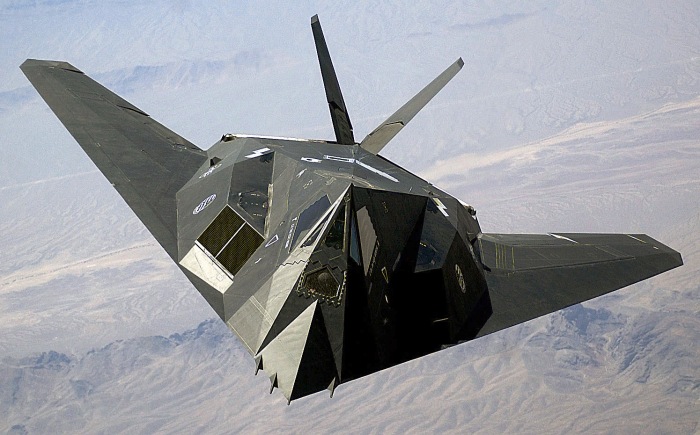
The F-117 remains one of the most iconic aircraft of the latter part of the Cold War. Publically announced in 1988, the F-117 emerged from Lockheed’s Have Blue project and was developed by the company’s Skunk Works division. The F-117 was first operationally used in the US invasion of Panama in 1989, but it was during Operation DESERT STORM that it rose to prominence. During the 1990s and 2000s, the F-117 was used in other conflicts, and one was shot down in 1999 during Operation ALLIED FORCE, and it was eventually retired in 2008.

020806-F-7823A-004
A USAF F-117A Nighthawk flies over Nellis Air Force Base during the joint service experimentation process dubbed Millennium Challenge 2002. (Source: Wikimedia)

What appears to have got people talking is the fact that Britain was offered the F-117 at a time when it was still officially a ‘black’ project i.e. before it existence was officially acknowledged. Moreover, according to the various reports, the key reason that Britain did not pursue purchasing the F-117 was for this very reason. However, while this may be one reason for rejecting the F-117, it should be noted that while the release of British files is interesting, this is not strictly a new story, though it is potentially a new dimension. Several histories of the F-117 cite the fact that in 1986, several Royal Air Force (RAF) test pilots were sent to fly the aircraft. For example, Paul Crickmore reflected that the RAF ‘had its chance to evaluate the F-117’ as a thank you for British support of Operation EL DORADO CANYON.[1] However, what these secondary sources lack is the archival evidence to understand why the evaluation took place. It is probably – though I would not like to say for certain until I see the file – that this assessment formed part of this project.

As already noted, the reason cited in the reports for the RAF not purchasing the F-117 was the ‘black’ character of the project; however, I have to wonder how well this aircraft would have fitted into the Service’s force structure and concept of operations in the 1980s. Moreover, it will be interesting to see if anything more is mentioned in the file as to why the F-117 was not purchased. Nevertheless, a few issues come to mind that may have been challenges. First, the RAF operated at low-level in small packages, and I am unclear how the F-117 would have fitted into this concept of operations. Second, by 1986, the RAF was in the middle of purchasing the Panavia Tornado that had been designed for the low-level role, as such; again, what additional capability the purchase of the F-117 would have added to the RAF at this point remains unclear. Finally, there is the issue of numbers. The F-117 was never built in significant numbers, and it seems unlikely that the RAF would have bought more than the United States Air Force, as such, again, what additional capability would the addition of a highly complex piece of equipment have added to the RAF? Yes, it would have added a stealth capability but this needs to match a concept of operations, and in my mind, this remains a murky area. As such, this is more an interesting example of the so-called ‘special relationship’ rather than a significant ‘What-If’ for the RAF.

e78e2037_5056_a318_a89209e9ab776da0
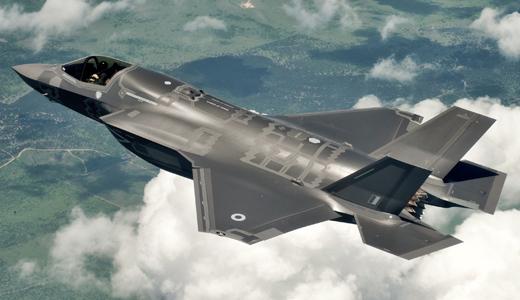
An F-35B in RAF Markings. (Source: Royal Air Force)

This is not, however, where the story ends as in 1995, Lockheed once again tried to sell the RAF an improved F-117 that included locally produced content, such as GEC-Marconi supplied avionics.[2] This approach was in response to the RAF’s Staff Target (Air) 425 that had began the process of looking at replacing the GR4 variant of the Tornado, which became known as the Future Offensive Air System (FOAS). FOAS closed down in 2005 and aspects were rolled into Future Joint Combat Aircraft project that has seen the purchase of the Lockheed Martin F-35 Lightning II – an aircraft with a stealth capability.[3]

Dr Ross Mahoney is an independent historian and defence specialist based in Australia. Between 2013 and 2017, he was the resident Historian at the Royal Air Force Museum, and he is a graduate of the University of Birmingham (MPhil and PhD) and the University of Wolverhampton (PGCE and BA). His research interests include the history of war in the twentieth and twenty-first centuries, air power and the history of air warfare, and the social and cultural history of armed forces. To date, he has published several chapters and articles, edited two books, and delivered papers on three continents. He is a member of the Royal Historical Society and is an Assistant Director of the Second World War Research Group. He is a member of the Royal Historical Society and an Assistant Director of the Second World War Research Group. He can be found on Twitter at @airpowerhistory.

Header Image: A pair of specially painted F-117 Nighthawks fly off from their last refueling by the Ohio National Guard’s 121st Air Refueling Wing, c. 2008. (Source: Wikimedia)

[1] Paul F. Crickmore, Lockheed F-117 Nighthawk Stealth Fighter (Oxford: Osprey Publishing, 2014), p. 26.

[2] Guy Norris, ‘Lockheed Martin targets RAF and USAN for F-117,’ Flight International, (28 June to 4 July 1995), p. 4.

[3] Louisa Brooke-Holland, ‘The UK’s F-25 Lightning II Joint Strike Fighter,’ Standard Note (SN06278) UK House of Commons Library, (6 February 2015), pp. 5-6.

Supporting the Secret War: T-28s over Laos, 1964-1973 – Part 2: Attack Role

Supporting the Secret War: T-28s over Laos, 1964-1973 – Part 2: Attack Role

By Jeff Schultz

Editor’s Note: In the second of a three-part series, Jeff Schultz examines the use of the North American T-28 Trojan during the so-called Secret War in Laos during the Vietnam War. In this part, Schultz examines the aircraft’s attack role. Part One can be found here.

Perhaps the most important mission performed by T-28s was in the attack role, dropping ordnance and strafing ground targets, which was the most commonly performed mission in Laos by T-28s. The armed trainers were flown by some different operators carrying a broad range of ordnance on multiple bomb racks such as .50cal gun pods, unguided bombs and rockets, napalm and/or cluster bomb units.[1] The cluster bomblets would fall in a series and per a former pilot could be devastating to troops in the open.[2]

In 1963, former Thai pilot Chert Saibory, now flying for the RLAF, defected to North Vietnam, his T-28 later returned to service for the VPAF as its first fighter plane, which per one source, nearly shot down a Nationalist Chinese C-123 during a night attack mission in 1965.[3] An early example of the attack role of T-28s came from June 1964, when the first US Navy aviator was shot down over Laos. Lieutenant Charles Klusmann was on a ‘Yankee Team’ RF-8 reconnaissance mission when Pathet Lao ground fire hit his plane.[4] During nearly three months of captivity, while being transported at one point to Vientiane via truck, the column was ‘halted by intense air raids by jet aircraft and T-28s,’ per his POW debriefing.[5] T-28s also flew in support of search attempts following Klusmann’s shoot down.[6]

In 1964 not only Air America pilots (forming the so-called ‘A-Team’), but also Thai volunteer pilots flew T-28s (as ‘B-Team’) and the Laotians as ‘C-Team’ which, would be much easier to explain than downed Americans.[7] The Thai ‘B-Team’ pilots flew missions under the call sign ‘Firefly’ and conducted attacks on the crucial Plain of Jars (French: Plaine des Jarres) region in north central Laos, knocking out two enemy trucks in one particular mission.[8] In June 1964 the CIA evaluated the T-28s as probably having more effect on enemy morale than otherwise, owing to the lack of RLG (Royal Lao Government) forces supporting them.[9] RLAF T-28s also flew the first missions against the Ho Chi Minh Trail in October 1964, which acted as the unofficial beginning of the later American attacks against the Ho Chi Minh Trail in December, known as BARREL ROLL.[10] Laos often featured very heavy AAA, another hazard to the T-28s, as Ted Maudlin, a former Air America pilot, related in an interview.[11] From 1964 to 1969 the RLAF flew occasional missions against targets in the Laotian panhandle, but eventually AAA became too heavy for daylight attacks.[12]

As a witness to T-28 missions in Laos, Reginald Hathorn flew with the American 23rd Tactical Air Support Squadron out of Nakhon Phanom, Thailand and coordinated air strikes in Laos as a Forward Air Controller (FAC). He provided an account of the role of RLAF T-28s in a strike mission in support of a Laotian Army base then under mortar fire from the Pathet Lao in 1968. After Hathorn had marked the intended target with unguided white phosphorus rockets, the accompanying T-28s dropped their ordnance accurately. He pointed out he could never be sure who was flying the RLAF T-28s they worked with, until this time an American voice came over the radio in contrast to the Lao or Thai pilots.[13]

Captain George Marrett, who flew USAF A-1 Skyraiders from 1968-69, summarised the war in Laos as follows:

All the ground fighting – and dying – was done by a group of mountain people known as the Hmong. Early in the war, they provided much of their air support, flying mission after mission until they died.[14]

Among the T-28 pilots produced in the American-led Water Pump training course at Udorn, Thailand were several standouts: Ly Lue and Vang Sue. According to one source, Ly Lue could be called the ‘Hans-Ulrich Rudel of the Laotian war’ about his effective bombing exploits, flying over 5,000 missions.[15] At his funeral in Long Tieng in July 1969, a Distinguished Flying Cross was placed on his casket by Colonel Tyrrell, the USAF Air Attaché for his incredible feats.[16] Vang Sue flew at least 3,000 combat missions in four years.[17] Both of these men went on to great success but like all the Hmong fliers they lived with the unfortunate reminder as fellow pilot Vang Bee recalled, ‘Hmong pilot have no limit to missions, they fly until they die.’[18] Depending on the source consulted, about 20 of the 37 total Hmong pilots survived the fighting.[19] An American who served with the Hmong called them, ‘some of the finest pilots in this world.’[20]

In 1969, during the early days of Vietnamization, Kissinger sent a memo to President Nixon advocating, among other things, more T-28s for the RLAF since he intended for them to be supported but without being able to send more evident help in the form of Thai ground units or B-52 strikes. The reliable T-28 remained the simplest way to support our ally given the existing rules of engagement.[21] In 1969, RLAF T-28s knocked out a former ad hoc guerrilla weather station captured by the enemy using bombs and napalm.[22] As an indication of the T-28 contribution in the attack role, from November to December 1969 alone Thai, Lao and Hmong pilots flew an impressive 4,629 sorties with an average of only twenty-eight T-28s available on a given day.[23]

By 1970 the Thai T-28 ‘B-Team’ pilots became redundant and were phased out since enough RLAF pilots existed for the task.[24] In 1971, an article in the Milwaukee Sentinel discussed the grim situation in Laos and ominously mentioned the likelihood that the Nixon Doctrine would not protect the small country from North Vietnam with or without more aid, with only two new ‘T-28 propeller driven bombers’ provided to the RLAF per month as replacements.[25]

Eventually, the Plain of Jars suffered so much from air attacks that it became, according to one source, ‘the most intensely bombarded place on the face of the planet’ while Laos itself was eventually hit by 2 million tonnes of bombs.[26] In 1970, John Halliday, an American C-123 “Candlestick” flare-ship pilot, described the situation supporting friendly forces at night near the Plain of Jars region:

Our flares light the area below for…our Laotian allies fighting the Pathet Lao bad guys. The light we provide…is their only security against being overrun in the dark by overwhelming enemy forces.[27]

 The situation in Laos declined during Nixon’s Vietnamization, and as a 1970 Life magazine article pointed out, ‘In the last two years the pendulum of war in Laos has been swinging harder and wider, and each wet-season dry-season offensive has mounted a little higher than before.’[28] In 1971, the NVA attacked Long Tieng and forced the T-28s based there to withdraw, while others arrived to strike at the attackers.[29] In 1972 when USAF General John Vogt, commander of Seventh Air Force, visited the base at Long Tieng he was impressed by the Hmong pilots and ‘awed.’[30] A CIA officer working with the Hmong, James Parker, Jr., described the role of Vang Pao’s pilots in 1972 as follows:

There was no politics involved, no sterile high-tech environment where the converted T-28 trainers from the Second World War were parked. It was honest warring, primitive, a throwback to combat flying in the First World War. The Hmong flyers strapped as many bombs and bullets as they could get on their planes and went out and found North Vietnamese to attack – flight after flight, hour after hour, day after day […] the major part of our close fire support was left to the T-28s.[31]

The steady attrition of Vang Pao’s CIA-backed Hmong army and the slow drawdown of American financial and material support until the 1973 ceasefire, all contributed to the sense that things looked much worse. Since the Pathet Lao and NVA had won in Laos, it was simply a matter of time until the final defeat. In 1973, in one of the coup attempts involving T-28s, after years in exile in Thailand, Laotian General Thao Ma attacked Wattay, near Vientiane, along with other loyal RLAF personnel. Shot down while landing; General Ma was soon after that executed for his part in the coup attempt.[32] Also in 1973, the USAF Ravens withdrew from Laos, which forced Vang Pao to provide his FAC ability via what T-28s were available.[33] By 1974, the CIA withdrew all support, and by 1975, Laos was overrun. Per one source, Vang Pao sent RLAF T-28s on one last attack against a Pathet Lao column even as late as April 1975, just before the collapse.[34] Further south in 1975, the Cambodian Khmer Air Force T-28s flew support for the American withdrawal from Phnom Penh, Operation EAGLE PULL, when only weeks remained for Cambodia.[35]

Jeff Schultz teaches history and political science at Luzerne County Community College in Pennsylvania. He has an MA in History from Central Michigan University. His research deals with a broad range of historical periods such as the American Civil War, World War II, and Vietnam-era.

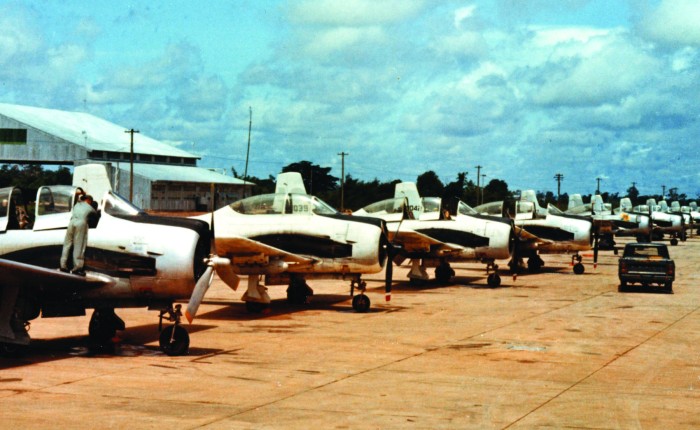
Header Image: A row of T-28s in Laos. (Source: USAF)

[1] Chinnery, Air Commando, p.73; Ginter, North American T-28 Trojan, pp.54-6.

[2] Interview Notes – Unknown Source – re: Joe Holden, Missions in Vietnam and Laos, ca. October 1998, Folder 01, Box 03, Jan Churchill Collection, The Vietnam Center and Archive, Texas Tech University, p.8.

[3] Conboy and Morrison, Shadow War, p.103.

[4] Anthony and Sexton, War in Northern Laos, 1954-1973, pp.109-10.

[5] Initial Debriefing of Klusmann, 02 September 1964, Folder 16, Box 13, George J. Veith Collection, The Vietnam Center and Archive, Texas Tech University, p.2.

[6] CHECO Report: U.S. Air Force Search and Rescue in Southeast Asia (1961-1966), 24 October 1966, Folder 09, Box 05, Allen Cates Collection, The Vietnam Center and Archive, Texas Tech University, p.34.

[7] Leeker, Royal Lao Air Force / Raven: North American T-28s, p.1.

[8] Conboy and Morrison, Shadow War, p.110.

[9] Current Intelligence Memorandum: Effectiveness of T-28 Strikes in Laos, 26 June 1964, Folder 14, Box 03, Douglas Pike Collection: Unit 01 – Assessment and Strategy, The Vietnam Center and Archive, Texas Tech University, pp.1-2.

[10] Conboy and Morrison, Shadow War: The CIA’s Secret War in Laos, p.121.

[11] Interview with Ted Mauldin, Undated, Ted Mauldin Collection, The Vietnam Center and Archive, Texas Tech University, pp.69-70.

[12] CHECO Reports: RLG Military Operations and Activities in the Laotian Panhandle, 01 January 1981, Folder 24, Box 01, Contemporary Historical Examination of Current Operations (CHECO) Reports of Southeast Asia (1961-1975), The Vietnam Center and Archive, Texas Tech University, p.27.

[13] Reginald Hathorn, Here There are Tigers: The Secret Air War in Laos, 1968-69 (Mechanicsburg, PA: Stackpole Books, 2008), pp.45-55.

[14] George J. Marrett, Cheating Death: Combat Air Rescues in Vietnam and Laos (New York: Harper Collins, 2006), p.25.

[15] Boyne, ‘The Plain of Jars,’ p.78; Chinnery, Air Commando, p.201.

[16] Jane Hamilton-Merritt, Tragic Mountains: The Hmong, the Americans, and the Secret Wars for Laos, 1942-1992 (Bloomington: Indiana University Press, 1999), pp.213-5.

[17] News article – ‘Meo Pilots: Flights Against the Odds,’ No Date, Folder 01, Box 01, Tom Matthews Collection, The Vietnam Center and Archive, Texas Tech University.

[18] Interview with Vang Bee, No Date, Vang Bee Collection, The Vietnam Center and Archive, Texas Tech University, p.11.

[19] Danya Hernandez, ‘Hmong Pilots Saluted in Maplewood,’ TwinCities.com Pioneer Press, June 15, 2012.

[20] Interview with Ronald Happersette Lutz, Jr., 05 November 2002, Ronald Happersette (Hap) Lutz, Jr. Collection, The Vietnam Center and Archive, Texas Tech University, p.49.

[21]Document 112 – Memorandum from the President’s Assistant for National Security Affairs (Kissinger) to President Nixon, Sep 2, 1969,’ in Edward C. Keefer and Carolyn Yee (eds.), Foreign Relations of the United States, 1969–1976, Volume VI, Vietnam, January 1969–July 1970 (Washington, D.C.: United States Government Printing Office, 2006).

[22] Bernard C. Nalty, The War against Trucks: Aerial Interdiction in Southern Laos 1968-1972, (Washington D.C.: Air Force History and Museums Program, 2005), p.32.

[23] Anthony and Sexton, War in Northern Laos, 1954-1973, p.322.

[24] Conboy and Morrison, Shadow War: The CIA’s Secret War in Laos, p.264.

[25] Rowland Evans and Robert Novak, ‘US Aid Cut, Laos at Hanoi’s Mercy,’ Milwaukee Sentinel, September 29, 1971.

[26] Kenton Clymer, ‘The War Outside Vietnam: Cambodia and Laos,’ in Andrew Wiest (ed.), Rolling Thunder in a Gentle Land: The Vietnam War Revisited (New York: Osprey Publishing, 2006), p.106; George Herring, American’s Longest War: The United States and Vietnam, 1950-1975, (New York: McGraw-Hill Education, 2014), p.353.

[27] John T. Halliday, Flying Through Midnight (New York: St. Martin’s Paperbacks, 2005), p.62.

[28] Greenway, ‘The pendulum of war swings wider in Laos,’ pp.32-3.

[29] News Article – ‘Reds Shell Laotian Outpost,’ 17 February 1971, Folder 01, Box 01, Tom Matthews Collection, The Vietnam Center and Archive, Texas Tech University.

[30] Parker, Codename Mule, p.129.

[31] Ibid.

[32] Conboy and Morrison, Shadow War, pp.406-7.

[33] Dommen, The Indochinese Experience of the French and Americans, p.932.

[34] Conboy and Morrison, Shadow War, p.415.

[35] Albert Grandolini, Tom Cooper, and Troung, ‘Cambodia 1954-1999; Part 2.’ ACIG.org.

#ResearchNote – Air Power and the Challenge of Professional Military Education

#ResearchNote – Air Power and the Challenge of Professional Military Education

By Dr Ross Mahoney

I have just come back from a conference at the Royal Military College of Canada on the theme of the ‘Education of an Air Force’ that was well worth the visit. I am sure most readers will agree that the subject of education is of vital importance and this is something that has been increasingly realised in recent years as modern air forces seek to grapple with the challenges that confront them in the operational sphere.

Ideas such as conceptual innovation have become catchphrases for efforts such as the Royal Air Force’s (RAF) Thinking to Win programme, the Royal Australian Air Force’s (RAAF) Plan JERICHO and the Royal Canadian Air Force’s (RCAF) AIRpower in Formation process. Underpinning these, to a greater or lesser degree, is the importance of air power education. Indeed, as Lieutenant-General Michael Hood, Commander of RCAF, recently noted in the introduction to an article in the Royal Canadian Air Force Journal on air power education and professional air power mastery:

There is also a requirement to continually review the training and education we give to all ranks to ensure that it is configured to deliver what we need within the contemporary environment.[1]

Nevertheless, phrases like the one above can often be a case of rhetoric versus reality, though having heard General Hood speak at the opening of the conference; I do believe he means what he says about the importance of education. The conference was historically focussed, but by observing the past, as historians, we can identify areas that can be points of friction and that need to be considered when attempting to introduce reform in the education process. What follows are just a few key areas I pondered during the conference.

Training or Education?

Perhaps the first thing that came to mind was what were we considering? The conference included the word education in the title but was this the case? Indeed, one key question that needs to be asked is whether those we study understand the distinction we make today between training and education. For me, at the most simplistic of levels, training is about skills development while education is about knowledge, understanding and critical thinking. Is this what was expected by those responsible for creating the institutions that delivered programmes related to professional development such as staff colleges. I suspect the answer is yes but the vernacular used in different eras leads to confusion. For example, Air Chief Marshal Sir Robert Brooke-Popham, first Commandant of the RAF Staff College, was clear that one issue he needed to deal with was anti-intellectualism and this is a matter of education though the term was infrequently used in the 1920s. By the 1960s, the RAF had begun, as it created a ‘progressive’ system of staff education, to differentiate between the two subjects. Nevertheless, we must be clear about what we are talking about if reform is to be achieved.

Culture

Military organisations are conservative in character. This is not to suggest that they are not innovative but rather to reflect that they are predominantly reactive rather than revolutionary. Thus, change, unless triggered by defeat, public opinion or budgetary cuts, can be difficult and challenging. This is ultimately a cultural issue and one that needs to be considered when introducing change. Leaders need to bring people along with them on the journey they seek to engender rather than just demanding that it happens. This applies to education as well. If education is to be improved, the organisation’s employees need to understand the need for this process. They need to be shown its value, and this has to be enunciated in a clear and meaningful manner. Indeed, in the modern era where most air forces have been in continuous operations for at least the past decade and a half, it needs to be illustrated why education is of value for those with operational experience. This comes back to the first point above, for example, we train an officer to fly rather than educate them.

The Role of Senior Leadership

eisenhower_visits_air_university
From left, General Dwight Eisenhower, US Army Chief of Staff; Major General Muir Fairchild, Air University commander; and Major General David Schlatter, the Air University deputy commanding general (education), review an Air University organizational chart during Eisenhower’s visit to Maxwell on 9 April 1947. (Source: Wikimedia)

This brings me to the next important issue; the role of senior leaders. These are the people who lead change. Indeed, at the conference, when I made a comment about the culture of military organisations, Harold Winton, Professor Emeritus at the United States Air Force’s (USAF) School of Advanced Air and Space Studies (SAASS), quite rightly made the impassioned argument that when a leader who believes in education comes along, perhaps once every 15 to 20 years, then we should take advantage of that person. I completely agree, a champion who can provide top cover is essential, and it appears that RCAF have that in Hood while in the 1970s, the RAF had Marshal of the RAF Lord Cameron, who supported the creation of the position of Director of Defence Studies. Furthermore, support from senior leaders can help shape the culture and values of the organisation by providing an example to subordinates.

Non-Standard Education

What I mean here is the use of non-staff college education for officers, mainly higher research degrees such as MPhils and PhDs. In modern militaries, it is usual that officers going through the staff college system receive some form of credits towards a postgraduate degree, typically an MA. For example, British officers can work towards an MA in Defence Studies that builds on the Advanced Command and Staff Course at the Joint Services Command and Staff College. However, this is a relatively standard route and one that has been developed within the Staff College environment. What appears to be less typical, though needs to more readily embraced, is the encouragement of nurtured personal to undertake further research in the form of MPhils and PhDs. USAF do a good job of this through SAASS, and the RAF has a good fellowship scheme that not only encourages Masters work but also supports PhDs through the Portal Fellowship. This need to be promoted as higher research encourages critical thinking and air forces need such people to help develop their conceptual understanding of air power in the defence sphere. Nevertheless, air forces also need to encourage and reward personnel for taking ownership of their education irrelevant of whether the service sponsors it or not. Personnel need to be shown that in developing their critical thinking skills these are as valued as their operational ones. Also, where applicable, personnel should be encouraged to write in various forums from websites, such as this one, The Central Blue, War on the Rocks and The Strategy Bridge, to professional journals. However, this requires encouragement and critical mass and it is interesting to reflect that the RAF, RCAF and USAF all have journals but the RAAF does not, though the latter’s Air Power Development Centre does produce useful material. Overall, by encouraging ‘non-standard education’, air forces have the opportunity to develop knowledge and encourage informed discussion about air power in the public and policy sphere rather than what often currently occurs.

Officers or NCOs? Alternatively, Both?

An interesting point that came up in one discussion phase of the conference was the question of NCOs. All of the papers dealt with officer education with most focussed on the staff college scenario. However, what of NCOs and their education? We often hear phrases such as ‘whole force’ used to describe the personnel of an air force. As such, should we not be educating the NCO corps? Another challenge is that the current NCO corps is becoming better educated; it not unusual to find airmen and women entering service with degrees. If we are to develop the ‘whole force’ then similar opportunities afforded to the officer corps should be made available to NCOs especially as they are promoted and take on senior leadership roles. This is probably a conference of its own but a subject area that deserves consideration both in a contemporary as well as historical sense.

What I have written here is by no means the panacea for professional military education, and indeed much of this is axiomatic of any analysis of the field. Indeed, most of these challenges are just as applicable to each of the services; however, I would suggest that these difficulties need to be overcome and also understood in the context of air forces seeking to improve education provision. Nevertheless, the conference provided plenty of food for thought on the subject of the education of air forces as modern services strive to deal with operational and personnel challenges that they currently confront and will continue to do so into the 21st century. Another key positive of this conference was the involvement of the RCAF both regarding the opportunity to visit the Canadian Aerospace Warfare Centre but also to hear how they are dealing with current challenges.

This post also appears at The Central Blue.

Dr Ross Mahoney is an independent historian and defence specialist based in Australia. Between 2013 and 2017, he was the resident Historian at the Royal Air Force Museum, and he is a graduate of the University of Birmingham (MPhil and PhD) and the University of Wolverhampton (PGCE and BA). His research interests include the history of war in the twentieth and twenty-first centuries, air power and the history of air warfare, and the social and cultural history of armed forces. To date, he has published several chapters and articles, edited two books, and delivered papers on three continents. He is a member of the Royal Historical Society and is an Assistant Director of the Second World War Research Group. He is a member of the Royal Historical Society and an Assistant Director of the Second World War Research Group. He blogs at Thoughts on Military History, and can be found on Twitter at @airpowerhistory.

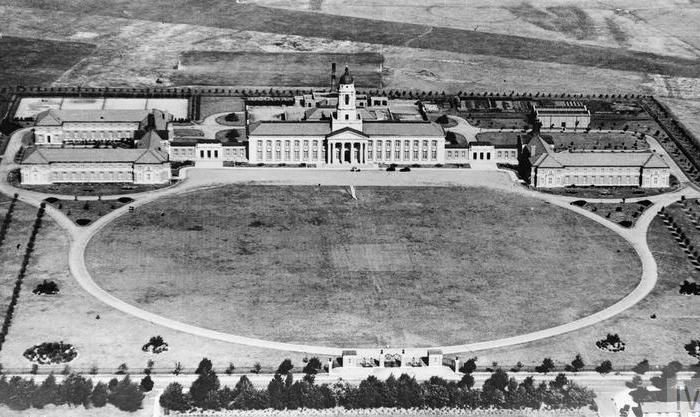
Header Image: Aerial view of the completed RAF College at Cranwell in the 1930s. (Source: © IWM ((MOW) C 4070))

[1] Lieutenant-General Michael Hood, ‘Introduction’ to Brad Gladman, Richard Goette, Richard Mayne, Shayne Elder, Kelvin Truss, Pux Barnes, and Bill March, ‘Professional Airpower Mastery and the Royal Canadian Air Force: Rethinking Airpower Education and Professional Development,’ Royal Canadian Air Force Journal, 5(1) (2016), p. 9.

#ResearchNote – The Forgotten Command: Air Defense Command and the Defense of North America

#ResearchNote – The Forgotten Command: Air Defense Command and the Defense of North America

By Dr Brian D. Laslie

I was recently perusing an article by Robert Farley, author of Grounded: The Case for Abolishing the United States Air Force when I came across something that made me stop and pause. Now, before we go any further, I want to note that I consider Farley a colleague and friend of mine. We may disagree on certain roles and missions of air power, but we get along swimmingly, right Rob? Anyway, on to my pause. In his recent article ‘The Worst Fighter Aircraft of all time’ published on War is Boring, Farley stated that:

Tactical Air Command tried to resolve this problem by making itself as “strategic” as possible, focusing on interceptors that could catch and kill Soviet bombers, and also on fighters heavy enough to deliver nuclear weapons.

Farley is not entirely wrong, but he does miss one key – some might say pedantic – piece. Tactical Air Command (TAC) did build itself as a mini-Strategic Air Command (SAC), something I mentioned in my book, but it was the responsibility of Air Defense Command (ADC) to intercept Soviet bombers as they came across the North Pole.

It seems that this was more omission than a mistake, because ADC has, in a way, become the forgotten command. When Cold War air power in the United States is discussed, it focuses almost exclusively on TAC and SAC (what we might call Air Combat Command and Global Strike Command today, but that is a different argument).[1] When the Cold War kicked off, or gradually escalated as the case may be, the American military, and the newly minted United States Air Force (USAF), in particular, started planning for and developing a ‘defensive air shield,’ to be used to locate, track, target, and destroy the incoming Soviet bombers.[2] When USAF celebrated its Independence Day in September 1947, as a separate service, it was understood that the new service would take the lead in defending the homeland from aerial bombardment.

Thus enters ADC; its history predates USAF. The command was established in 1946, and it became a wholly separate and equal Major Command in 1951 at Ent Air Force Base, Colorado. Subordinate USAF units were divided into different regions, each with a section of the United States to protect.[3] In 1954, the other military services were brought into the fold, and a new a multi-service unified command was created: the Continental Air Defense Command (CONAD), but ADC continued to act as the Air Force arm of this new joint command, or what is known in 2016 as a Geographic Combatant Command (GCC). Included in the CONAD mix were Army Anti-Aircraft Command, and Naval Forces CONAD. The late 1950s also saw the United States and Canada working closely together in the realm of air defence of North America leading to the creation of the North American Air Defense Command (NORAD) in 1958. The two countries, united by the NORAD agreement, integrated their headquarters and operated together but both CONAD in the United States and the Royal Canadian Air Force Air Defense Command remained independent commands. The Commander-in-Chief of NORAD (CINCNORAD) was also the commander of CONAD.

71st-fighter-interceptor-squadron-scramble-before-1971
Scramble by the 71st Fighter Interceptor Squadron c. 1960s (Source: United States Air Force)

USAF leaders, most notably Generals Benjamin Chidlaw and Earle Partridge, guided the planning and programs during the mid-1950s and were largely responsible for how the ADC operated. USAF provided the interceptor aircraft and planned the upgrades needed over the years. USAF also developed and operated the extensive early warning radar sites and systems which acted as ‘tripwire’ against air attack. In addition to the radar sites in Canada, the US Navy element, now Naval Forces NORAD, operated radars and picket ships on both the East and West coast. The complexity of the NORAD mission would eventually be controlled from inside the Cheyenne Mountain Air Force Station. In a theoretical scenario, Soviet bombers would be detected by one of the early warning lines or picket ships and the interceptors launched.

norad-map-1960s
Map illustrating the coverage provided by NORAD in the 1960s (Source: United States Air Force)

These aircraft came in many forms, most notably the famed (infamous) Century Series: North American F-100 Super Sabre (more commonly called the Hun), Mcdonnell F-101 Voodoo, Convair F-102 Delta Dagger, Lockheed F-104 Starfighter, Republic F-105 Thunderchief (the Thud), and the Convair F-106 Delta Dart. This entire series of aircraft were a mix of Fighter-Bomber and interceptors. TAC used these aircraft (mainly in Europe) as nuclear delivery vehicles: the F-100, F-101, F-105, but it was ADC that used the F-101, F-102, F-104, and F-106 as interceptors to stop the Soviet bombers. They were designed to take-off and be guided by ground control to Soviet bombers, which they would engage and destroy by air-to-air missile or the air-to-air Genie nuclear missile to take out entire bomber streams.

Of course, no series of fighter intercepts was going to be perfect and the interceptor force was back dropped by a heavy integrated air defense system (IADS) from both USAF Bomarc missiles (fired in advance of the interceptors) and the re-designated Army Air Defense Command of Nike and Zeus surface-to-air missiles surrounding government and military sites throughout the United States. While we normally attribute IADS as a Soviet way of defence, it was used extensively throughout the United States in the 1950s and 1960s.

It is not surprising that on Farley’s list of best and worst aircraft, none of these interceptors (F-101, 102, 104, 106) is to be found; they are not really fighters and were never meant to dogfight. It is almost as if an entire generation of aircraft and a whole command have been relegated to the trivial pursuit section of history. If this interests you and you have got thirty minutes to waste, enjoy this Army Air Defense Command (ARADCOM) instructional video from 1961 and if you have not had your fill of Air Defense and Freedom, there is also 1963’s The Shield of Freedom. ADC, by then the Aerospace Defense Command, finally inactivated on March 31, 1980.[4]

Dr Brian Laslie is an Air Force Historian and currently the Deputy Command Historian at North American Aerospace Defense Command (NORAD) and United States Northern Command (USNORTHCOM). A 2001 graduate of The Citadel and a historian of air power studies, he received his Masters’ from Auburn University Montgomery in 2006 and his PhD from Kansas State University in 2013. His first book The Air Force Way of War (2015) was selected for the Chief of Staff of the Air Force’s 2016 professional reading list. He lives in Colorado Springs. He can be found on Twitter at @BrianLaslie.

Header Image: Convair F-106A Delta Dart firing a Douglas AIR-2 Genie missile (Source: United States Air Force)

[1] According to the Air Force Historical Research Agency, the USAF currently has 14 inactivated major commands, http://www.afhra.af.mil/Information/Organizational-Records/Major-Commands/

[2] NORAD and US Northern Command Office of History, ‘A Brief History of NORAD,’ p. 4

[3] Lineage and honours of ADC can be found at the AFHRA: http://www.afhra.af.mil/About-Us/Fact-Sheets/Display/Article/433912/air-defense-command/

[4] The USAF does not ‘deactivate’ commands, rather they are ‘inactivated’ should the need ever arise for them to be reactivated.

Remembering The F-4 Phantom – Part 2: Orchestrated Confusion

Remembering The F-4 Phantom – Part 2: Orchestrated Confusion

By Mike Hankins

Previously, we looked at how McDonnell lost a significant contract with the US Navy after their upgraded F3H Demon failed a fly off competition against their competitor, Chance-Vought’s entry which became the F-8U Crusader.

1280px-mcdonnell_f3h-g_mockup_in_1954
An early mockup of a modified F3H which is beginning to show some familiar visual characteristics of the F-4. (Source: US Navy National Museum of Naval Aviation)

McDonnell engineer Herman Barkley took the Demon’s rejection as a personal challenge and immediately began designing an unsolicited new aircraft initially without military funding.[1] Original sketches for the new craft consisted of yet another version of the Demon, similar to the design that had already failed against Vought’s F-8U. The US Navy had a vested interest in allowing McDonnell to experiment with the design. It could keep McDonnell afloat, enabling it to remain a valuable supplier, and perhaps reap some return on the initial investment they had both placed in the failed F3H. Upon review of these sketches, The US Navy did support the project, but gave no stated mission requirements for the plane, encouraging McDonnell to experiment on the drawing board. According to J. S. McDonnell himself:

All we had to work with in the beginning [of F-4 Phantom II Development] was a gleam in the customer’s eye […] What followed was two years […] of orchestrated confusion.

The US Navy, because of their doctrinal assumptions, wanted to focus on high-speed interceptors but was purposefully vague about communicating this, hoping McDonnell would reach in new and unexpected directions. This lack of specificity and a desire to maximise profits by designing a versatile plane that functioned in many contexts led McDonnell to develop a multi-role aircraft not optimised for the air-to-air mission.[2]

The confusion continued until Spring of 1955 when Commander Francis X. Timmes (newly in charge of the project) emphasised the high-speed interceptor role and stressed adaptability. Those concepts required that the plane to have two seats, two engines, and an armament of only missiles. The plane thus featured eleven hardpoints for carrying bombs or missiles, the most ever designed on an airframe at that time. The homogenous armament and dual-pilot setup both theoretically enhanced adaptability, since dogfighting was (allegedly) unnecessary, the lack of guns made the plane lighter (thus faster), and pilot duties could be split between two people. In July 1955, the US Navy rewarded McDonnell’s efforts with a contract for the production of seven prototypes.

The Phantom’s unique look was the result of over 5,300 hours of wind tunnel tests, which revealed a significant problem in supersonic flight. The plane was susceptible to ‘roll coupling,’ which is a technical way of saying the plane became uncontrollable – a condition from which pilots were trained to eject immediately. The angled wingtips and tail decreased the chances of this occurring. To add to stability concerns without sacrificing speed, the Phantom was given the ‘Stab Aug’ system that could sense unstable flight paths and automatically correct for them quicker than a pilot could manually. Computer controlled intake ramps to control air flow into the engines also increased the plane’s top speed. Another computerised system, ‘Boundary Layer Control,’ sent excess air from the engines over the wings to generate more lift and increase speed and acceleration. [3]

f4h-1_leadership
Herman Barkley (left) with test pilot Robert Little(center) and fellow engineer David Lewis (right) in front of a prototype of the F-4. (Source: Wikimedia)

Though the bond between the US Navy and its developers was strong, the military was loathed to place all its eggs in one basket. Timmes solicited other designs to fit the same roles as the Phantom in August 1955. The company that stepped up to the plate was none other than McDonnell’s old nemesis: Chance-Vought. Vought had developed an upgraded version of their successful F-8U Crusader, the very plane that had beaten McDonnell’s F3H Demon. Both new designs were set to compete in an unofficial fly off beginning on 15 September 1958. The tests emphasised the assumptions of the time, focusing on maximum speed and climbing rates. The assessments did not include manoeuvrability, gunnery, or other metrics pertinent to air-to-air combat.

In every tested category, the F8U-3 Crusader proved superior. It even had better fuel mileage. Its only drawbacks were a lower payload and time-consuming maintenance requirements. Despite this, George Spandenberg, then the director of Bureau of Aeronautics’ Evaluation Division, thought that single-seat, single-engine planes were inherently unreliable and argued that a two-seat plane would boost morale. Thus he boldly asserted, ‘The single-seat fighter era is dead.’ Advocates of the F-4 often claim the Phantom ‘won’ the contest (since it did win the US Navy contract after all), although a close look at the fly off reveals the upgraded Crusader had clear performance advantages in every category.[4]

Despite the Phantom’s lacklustre performance at the fly off, it was still an impressive aircraft in many respects. Between December 1959 and April 1962, the F-4 set over a dozen world records, the most coveted (and revealing of the plane’s doctrinal design focus) of which was that of absolute top speed: 1,606.3 miles per hour.[5] The F-4 also possessed many problems that came back to haunt the military over the jungles of Vietnam, and that appear almost negligent in retrospect. Aside from the stability issue (which caused ‘departure’ or ‘the adverse yaw effect,’ terms for when the plane loses control during maneuvers), the almost non-existent rear-visibility was a problem, as were the giant plumes of black smoke produced by the engines that gave away the location and heading of every Phantom. The plane was also quite vulnerable to ground fire because its hydraulic lines were delicate and devoid of redundancy. Indeed, ground fire downed more F-4s in Vietnam than any other single threat. Across US Air Force (USAF), the US Navy and the US Marine Corps combined, from January 1962 to January 1973, 930 planes were lost to small arms ground fire, or, 45% of losses by known causes. AAA claimed 632; SAMs shot down 191; MiGs destroyed 79, and friendly fire claimed 25.

The USAF observed these record-setting demonstrations and grew interested in the plane’s usefulness as a strategic bomber and interceptor.[6] After a series of tests, USAF eventually ordered more than triple the number of Phantoms as the Navy. McDonnell finally created four new models of the Phantom to USAF specifications, the first and most significant of which was the F-4C.[7]

U.S._Air_Force_McDonnell_F-4C_Phantom_II_fighters_refuel
A flight of US Air Force McDonnell F-4C Phantom II fighters refuel from a Boeing KC-135A Stratotanker aircraft before making a strike against targets in North Vietnam. The Phantoms are loaded with six 750 pound general purpose bombs, four AIM-7 Sparrow air to air missles, and 370 gallon external fuel tanks on the outboard pylons. (Source: Wikimedia)

Although the Phantom would undoubtedly have performed extremely well in its designed role of intercepting enemy bombers, it ironically never had to. Instead of saving the world from nuclear Armageddon in the hypothetical World War III, the F-4 instead flew in a limited war over the jungles of a tiny third world country that many Americans had trouble locating on a map. The enemies it faced were not large lumbering bombers threatening nuclear annihilation, but missiles, ground fire, and manoeuvrable MiG fighters much more adept at air combat. Statistically, the deadliest enemy for the Phantom, one of the most powerful and expensive planes in US history to that point, was an individual on the ground with a machine gun. Similar to the doctrine that spawned it, the F-4 was the right plane for the wrong war.

The F-4 Phantom II was a fighter plane possessing few characteristics of traditional fighters. It was large, cumbersome, and built around the concept of long range attacks, sacrificing the agility and armament necessary of true air superiority craft. Originally conceived as an interceptor and soon burdened by ‘mission creep’ that insisted it handle multiple roles, the plane was the poster child for pre-Vietnam USAF doctrine, namely, the quasi-religious devotion to strategic bombing that minimised all other roles of air power.

Part One of this article can be found here.

Mike Hankins is a doctoral candidate at Kansas State University, where he teaches World History, the History of Airpower, and the History of Comic Books, and he is currently working on his dissertation, ‘Sources of Innovation: The Cultural and Technological Origins of Fourth Generation Fighter Aircraft, 1964-1991.’ He completed his master’s thesis at the University of North Texas in 2013, titled ‘The Phantom Menace: The F-4 in Air-to-Air Combat in the Vietnam War. He has a web page and can be found on Twitter at @hankinstien.

Header Image: A USAF McDonnell Douglas F-4E Phantom II from the 81st Tactical Fighter Squadron, 52nd Tactical Wing, releasing 18 Mark 82 227 kg bombs over the Bardenas Reales Gunnery Range, Spain, 25 March 1986. (Source: Wikimedia)

[1] Enzo Angelucci and Peter Bowers, The American Fighter (New York: Orion, 1987), p. 451, 310. Larry Davis, F-4 Phantom II in Action (Carrollton, TX: Squadron/Signal Publications, 1984), p 4.

[2] Glenn E. Bugos, Engineering the F-4 Phantom II: Parts Into Systems (Annapolis: Naval Institute Press, 1996)p.  23, 9, pp. 13-14.

[3] Ibid, p. 20, pp. 25-28, 37-40, 51-2.

[4] Peter E. Davies,  USN F-4 Phantom II vs VPAF MiG 17/19: Vietnam 1965-73 (Oxford: Osprey Publishing, 2011), p. 16; Lou Drendel, F-4 Phantom II in Action (Warren, MI: Squadron/Signal Publications, 1972), p. 6; Bugos, Engineering the F-4, pp. 95-9.

[5] Mick Spick, All-Weather Warriors: The Search for the Ultimate Fighter Aircraft (London: Arms and Armour Press, 1994), p. 131; Enzo Angelucci with Peter Bowers, The American Fighter: The Definitive Guide to American Fighter Aircraft from 1917 to the Present (London: G.T. Foulis, 1987), pp. 310-1.

[6] Bugos, Engineering the F-4, p. 104.

[7] Anthony M. Thornborough, USAF Phantoms: Tactics, Training, and Weapons (New York: Arms & Armour Press, 1988), pp. 11-12; Bugos, Engineering the F-4, p. 115.

Remembering the F-4 Phantom – Part 1: A Product of Its Time

Remembering the F-4 Phantom – Part 1: A Product of Its Time

By Mike Hankins

A few weeks ago, on August 17, 2016, the QF-4 Phantom flew its final unmanned mission for the United States Air Force (USAF). Although the Phantom was officially retired from combat use in 1996, USAF has been using unmanned, remote-controlled versions of the F-4 as target drones in training exercises. As the QF-4 completes its final flight, it feels like the end of an era. With over 5,000 built, the F-4 was one of (if not the) most ubiquitous aircraft of the Vietnam War and formed the backbone of the USAF in that period.

Final flight farewells Phantom
Airmen from the 82nd Aerial Target Squadron, Det. 1 at Holloman Air Force Base hosted the final manned flight of the QF-4 Phantom as part of the Phinal Phlight Ceremony on 21 December 2016. The ceremony commemorated and retired the QF-4 Phantom after 53 years of service in the US  Air Force.  Over its many years at Holloman, the QF-4 flew 145 unmanned missions and 70 aircraft were destroyed in service. It flew its last unmanned mission in August 2016 and was replaced by the QF-16 in 2017. (Source: Wikimedia)

In many ways, the F-4 was the last representative of an earlier era in USAF thinking — its design (emphasising speed, interception, and multi-role capability) reflected the doctrines and assumptions of the early Cold War. During the Vietnam War, those assumptions began to be overturned, and the Air Force eventually turned to a new generation of fighters in planes like the F-15 Eagle and F-16 Falcon. As the Phantom has now officially passed out of use in the US, it is worth taking some time to look back at the Phantom’s design, what that tells us about previous modes of thinking in the Air Force, and what that might mean for the future.

After World War II, USAF, and indeed the entire US military was dominated by Strategic Air Command (SAC), which maintained a fleet of nuclear bombers. The assumption was that a potential “next war” would involve the US and the Soviet Union launching atomic bombs at each other. Thus, national security rested on the idea of being able to drop nukes on Soviet vital centres, while also being able to intercept any Soviet bombers that attempted to do the same.</p

Century_series_fighters_NACA_1957
Four US Air Force Century-series fighters in flight in 1957. These supersonic fighters were tested by the NACA Dryden Flight Research Center at Edwards Air Force Base. The aircraft visible are: McDonnell F-101A-5-MC Voodoo (top), Lockheed XF-104A Starfighter )left). This latter aircraft crashed on 11 July 1957 due to an uncontrollable tail flutter. The pilot, Bill Park, ejected safely. A Convair F-102A-20-CO Delta Dagger (right), North American F-100A-20-NA Super Sabre (bottom). (Source: Wikimedia)

Other tactical missions like air superiority, ground support, or supply interdiction, became irrelevant. The age of fighter escorts, dogfights, and close air support against fielded enemy ground forces was over. In those early years of the Cold War, despite a few small voices of criticism, the USAF devoted less than 6 percent of its research and development resources into tactical and fighter roles. As a result, several tactical fighter wings disappeared in the late 1950s. Tactical Air Command was responsible for these functions and quickly found that the best way to retain relevance (and budget dollars) was to make a case that they too could contribute to SAC’s nuclear mission. They thus focused on developing fighter/bombers and interceptors that emphasised speed (at the expense of manoeuvrability) to either quickly deliver a nuclear warhead, or to intercept an enemy bomber and shoot it down in one pass – not with guns, but with guided missiles. This approach was exemplified in their ‘Century Series’ of interceptors. [1]

The US Navy also came to the same conclusion – that maintaining their budget and relevance necessitated that they participate in the nuclear mission, especially once atomic warheads became small enough to mount to carrier-based aircraft. New US Navy aeroplane designs focused on delivery of tactical nukes and interception of enemy bombers, and although the US Navy did not abandon air superiority to the degree that USAF did, the role of US Navy fighters certainly diminished in the post-war period. For example, the Fleet Air Gunner Unit, which trained weapons officers on US Navy planes, closed in 1960 and new training syllabi excised air-to-air combat.[2]

These assumptions and trends are key to understanding the development of the F-4 Phantom, but one the other main factor was the system of the ‘Military-Industrial Complex.’ Few defence contractors existed in the early Cold War, and the vast sums involved in contract awards and losses could make or break companies quickly. To keep options open, the military had a strong incentive to maintain their contractors afloat, sometimes making purchases regardless of actual needs. The military also encouraged these companies to push the envelope of cutting-edge technology, at times guided by strict mission parameters, on other occasions without many guidelines at all. Thus, a strong paternal bond developed between the military and its industrial suppliers, creating an environment that encouraged companies to experiment and take risks without fear of a total company failure.[3]

xf3h_demon_on_uss_coral_sea_28cva-4329_in_1953
A US Navy McDonnell XF3H-1N Demon on the elevator of the aircraft carrier USS Coral Sea, in 1953. (Source: Wikimedia)

This bond came into play in September 1952, when the US Navy Bureau of Aeronautics invited proposals for a new fighter plane dedicated to the (redefined) air superiority and interception missions. The US Navy eventually awarded this contract to McDonnell’s rival firm Chance-Vought, whose entry became the F-8U Crusader. McDonnell’s losing design in this competition was a version of the F3H Demon upgraded with a dual-engine and a missile armament. In 1954, the losses from this project nearly destroyed McDonnell. The US Navy had much to lose if its weapons manufacturers closed and viewed these defence contractors as too big to fail.[4]

Next time, we will look at McDonnell’s response to this loss, and how it led to one of the most ubiquitous aircraft of all time.

Part Two of this article can be found here.

Mike Hankins is a doctoral candidate at Kansas State University, where he teaches World History, the History of Airpower, and the History of Comic Books, and he is currently working on his dissertation, ‘Sources of Innovation: The Cultural and Technological Origins of Fourth Generation Fighter Aircraft, 1964-1991.’ He completed his master’s thesis at the University of North Texas in 2013, titled ‘The Phantom Menace: The F-4 in Air-to-Air Combat in the Vietnam War. He has a web page and can be found on Twitter at @hankinstien.

Header Image: The unmanned QF-4 target drone (Source: http://www.military.com/equipment/qf-4-aerial-target)

[1] Earl H.Tilford, Crosswinds: The Air Force’s Setup in Vietnam (College Station: Texas A&M University Press, 1993), pp. 20-22; Craig C. Hannah, Striving for Air Superiority (College Station: Texas A&M University Press, 2002), p. 28; Caroline F. Ziemke, ‘In The Shadow of the Giant: USAF Tactical Air Command in the Era of Strategic Bombing, 1945-1955’ (PhD Thesis, The Ohio State University, 1989), p. 7.

[2] George W. Baer, One Hundred Years of Sea Power: The U. S. Navy, 1890-1990 (Stanford: Stanford University Press, 1994), P. 334.; Robert W. Love, Jr., History of the United States Navy, Vol. 2 (Harrisburg: Stackpole Books, 1992), pp. 375-6.

[3] Glenn E. Bugos, Engineering the F-4 Phantom II: Parts Into Systems (Annapolis: Naval Institute Press, 1996), p. 23.

[4] Bugos, Engineering the F-4, pp. 15-17.