Editorial Note: Led by Editor Dr Mike Hankins, From Balloons to Drones, produces a monthly podcast that provides an outlet for the presentation and evaluation of air power scholarship, the exploration of historical topics and ideas, and provides a way to reach out to both new scholars and the general public. You can find our Soundcloud channel here. You can also find our podcast on Apple Podcasts and Google Podcasts.
In our latest podcast, we interview Colonel Kim ‘Killer Chick’ Campbell, an A-10 Thunderbolt II pilot with over 100 combat missions. On one of her early missions, ground fire heavily damaged her plane. She tells us the harrowing story and how her flying experiences apply to other areas of life. For more detail, she has a new book: Flying in the Face of Fear: A Fighter Pilot’s Lessons on Leading with Courage, from Wiley Press.
Kim Campbell is a retired United States Air Force Colonel who served for over 24 years as a fighter pilot and senior military leader. She served as a group commander, responsible for 1,000 military and civilian personnel. She finished her career as the Director of the Center for Character and Leadership Development at the Air Force Academy. She flew over 100 combat missions and was awarded the Distinguished Flying Cross for Heroism after successfully recovering her battle-damaged aeroplane from an intense close air support mission. Since retiring from the Air Force, Kim has shared her inspirational story and lessons on leading with courage with business and corporate audiences worldwide as an executive coach and keynote speaker.
Header image: An aircraft maintenance crew of the Indiana Air National Guard perform a post-flight inspection on an A-10C Thunderbolt II during exercise Guardian Blitz at MacDill Air Force Base, 2 February 2023. (Source: Wikimedia)
In 1970, the United States Air Force’s (USAF) Contemporary Historical Examination of Current Operations (CHECO) project, which produced around 250 volumes on various subjects, published a volume on the air operations of the RAAF over Vietnam.[1] The volume on the RAAF was one of several that examined non-US subjects; other air forces analysed included the Republic of Vietnam Air Force, the Royal Thai Air Force, and the Republic of Korea Air Force. Notably, the report on the RAAF, authored by James T. Bear, described the Australian effort over Southeast Asia as producing a ‘fruitful association’ with the USAF.[2] However, while the Americans, through the extensive distribution of this report to various commands, were aware of the views espoused by Project CHECO, the RAAF was not, as they were not included on the distribution list. As a result, this issue is often ignored by those using this source when writing on Australian air operations over Vietnam. For example, in a recent 2019 article in Sabretache, the journal of the Military Historical Society of Australia, Justin Chadwick made much of Bear’s report by describing its contents. However, Chadwick failed to address the distribution issue or whether the RAAF was aware of the report’s contents.[3] Nonetheless, Bear’s report, and others covering subjects pertinent to Australian air operations over Vietnam, were used by Chris Coulthard-Clark when researching and writing his volume on the RAAF in Vietnam as part of ‘The Official History of Australia’s Involvement in Southeast Asian Conflicts, 1948-1975.’ Moreover, the report is a valuable starting point for any discussion about Australia’s place in the air wars over Vietnam and the impact of the conflict on the RAAF.
More recently, however, air power historians have begun to discuss the air war over Vietnam more nuancedly. For example, in his 2021 history of the air war over Vietnam, Air Power’s Lost Cause, Brian Laslie, building on the work of scholars such as Mark Clodfelter, argued that the US fought six separate air wars during the conflict.[4] These campaigns included the strategic air campaign against North Vietnam; the battle for air superiority over North Vietnam; the USAF’s air war over South Vietnam; the US Navy’s air war over North and South Vietnam; air operations over Laos and Cambodia; and the US Army’s air mobility operations. However, while this classification helps describe US air operations over Vietnam, in excluding the experience of other nations involved in these ‘air wars,’ historians fail to tell a cohesive story about the use of air power over Vietnam.
Rations and supplies are unloaded from a UH-1B Iroquois helicopter of No. 9 Squadron RAAF, by troops of 7th Battalion, The Royal Australian Regiment, near the village of Long Dien during Operation Ulmarra, August 1967. (Source: Wikimedia)
Two reasons explain why historians fail to tell a cohesive story of air operations over Vietnam. First, from an American perspective, Vietnam is viewed as an inherently US war, especially regarding military operations. As Andrew Weist has remarked, ‘[r]emainders of the Vietnam War litter the cultural landscape of the United States.’[5] These reminders and the associated issues of ownership over the experience of the Vietnam War are often reinforced by popular accounts of the war, such as Ken Burns and Lynn Novick’s 2017 documentary The Vietnam War and debates related to America supposedly repeating the mistakes of Vietnam in its recent operations in Iraq and Afghanistan.[6] This has led historians to focus solely on the American experience and not to fully incorporate the story of those other nations that fought in the Vietnam War. Where they are included, their experience is often viewed as a sideshow to the main American effort. Indeed, as Bear’s CHECO report on the Australians noted, in the view of the USAF, ‘only Australia played a significant role in the air war.’[7]
The second reason concerns how the history of the RAAF in Vietnam has been written. This relates to the state of Australian military historiography and, from the perspective of the RAAF, how the Air Force’s narrative has shaped the latter’s account.[8] Apart from Coulthard-Clark’s 1995 official history, The RAAF in Vietnam: Australian Air Involvement in the Vietnam War 1962-1975, the literature on the RAAF’s service in Vietnam has primarily been the preserve of either the Air Force’s official histories or popular accounts, including veterans’ memoirs.[9] This situation mirrors concerns highlighted by John Ferris in 1998 when he reflected that most writers on air power history more broadly tend to be:
[t]he children of airmen, have been military personnel themselves, and have been employed at a historical office or service school in Canada, Germany, the United Kingdom, or the United States.[10]
This is undoubtedly the case with the history of the RAAF over Vietnam. Indeed, the RAAF has shaped the narrative surrounding the Air Force’s operations over Vietnam in two ways. First, the RAAF has published two official histories that span the Vietnam War period. The first, Going Solo, covered the period from 1945 to 1972 and was written by Alan Stephens, the former RAAF Historian. The second volume, Taking the Lead, written by Mark Lax, a RAAF Air Commodore, covers the period from 1972 to 1996. Neither book focuses singularly on Australian air operations over Vietnam. However, given the importance of the conflict to the RAAF, the war is integral to their analysis, particularly in Stephens’ volume. While both Stephens and Lax served in the RAAF and were academically trained historians, they were well placed to write these histories, thereby enhancing the value of these books. Nonetheless, as official histories, these works are often regarded as providing a definitive account of their subject. However, official histories are often the first rather than the last word on their topic.
The second way the RAAF has influenced the narrative of its operation over Vietnam is that the first book on Australian air operations during the conflict, Mission Vietnam, was commissioned by the Air Force. Research for Mission Vietnam, written by George Odgers, the Director of Public Relations in the Department of Air, began in 1971 before Australian air operations in Vietnam ended in 1972.[11] The book appeared in 1974, the year before the RAAF deployed Detachment ‘S’. As such, it does not comprehensively capture all RAAF operations associated with the Vietnam War. On publication, the RAAF News was convinced that Odgers’ volume would have ‘widespread appeal’ while one 1974 review in The Canberra Times described it as ‘essential reading.’[12] Illustrative of its importance in shaping the narrative, Mission Vietnam will be republished by the RAAF’s History and Heritage branch.
Beyond these volumes, discussions of RAAF operations over Vietnam have typically been left to popular accounts or memoirs, including those published under the auspicious of the Air Force’s Air and Space Power Centre and the History and Heritage Branch.[13] For example, Jeff Pedrina’s account Wallaby Airlines was initially published in 2006 by the Air Power Development Centre (as ASPC was then known). It was recently reissued in 2023 as part of the Australian Air Campaign Series (AACS) produced by the History and Heritage Branch.[14] Similarly, as part of the AACS, in 2022, the History and Heritage Branch published an abridged version of Air Vice-Marshal Reed’s autobiography, Invited to a War.[15] Reed had served in Vietnam, flying Phantoms on exchange with the USAF. Many of these works represent what has invariably been described as Australia’s ‘democratic’ approach to military history, which focuses on the experiences of veterans.[16] In this sense, every participant’s views and recollections are equal and should be heard. There are, however, exceptions to this democratic approach. For example, Steven Paget’s recent examination of the operations of No. 2 Squadron over Vietnam usefully places the challenges the RAAF faced in achieving interoperability with the USAF into context.[17]
Aerial view of the aircraft revetments at Phan Rang airbase in July 1967. No. 2 Squadron RAAF Canberra bombers are parked in the bays located in the immediate foreground. (Source: Australian War Memorial)
Given much of the above, how would a more integrated and cohesive account of Vietnam’s air wars look? First, from an Australian perspective, we need to move away from focusing solely on the Australian experience of the Vietnam War. As Thomas Richardson argued, such perspectives distort our view of Australia’s ‘success or failure’ in Vietnam.[18] This applies equally to the RAAF and the Australian Army. Second, with regard to the broader picture of air operations over Vietnam, consideration of the experience of non-US units would help inform wider discussions on the character and challenges of coalition air operations in this period by considering issues such as cooperation and friction. While official and authorised accounts address some of these challenges, their aim of foregrounding the Australian experience through a functional approach to history, based on the RAAF’s roles, limits how far they can analyse these issues.[19]
Some indication of how to produce such a history can be gleaned from Paget’s work on No. 2 Squadron operations. Paget rightly noted that the experience of No. 2 Squadron highlighted issues in command and control, standardisation, tactics, training and procedures, and the sustainment of operations. However, these themes can be further analysed through additional examples of Australia’s experience in Vietnam. For example, the experience of RAAF officers on secondment as airborne Forward Air Controllers offers a valuable opportunity to understand how lessons are learnt and shared between air forces. Similarly, before the deployment of No. 2 Squadron, No. 35 Squadron was already fully integrated into the USAF command-and-control apparatus. Moreover, unlike No. 2 Squadron, No. 35 Squadron operated an aircraft type that the US would not deploy to South Vietnam until later in the war. However, it appears that the USAF did not take the opportunity to study the RAAF’s use of the Caribou, which raises questions about why this might have been.[20] As such, understanding the experience of No. 35 Squadron would further enrich our understanding of the air wars over Vietnam by exploring cultural issues that either help or retard the lessons learnt process. Finally, we must consider what the deployment of RAAF air assets to Vietnam contributed to the overall war effort, given that, for example, during February 1968, at the height of the Tet Offensive, the Air Force accounted for only around one per cent of all attack sorties flown.[21] This was undoubtedly a significant effort for the RAAF. Still, it highlights the problem of deploying only single unit types rather than a cohesive operational package comprising several squadrons of the same type. As such, within the context of wider coalition operations, we must further question why the RAAF deployed the force it did and how it sought to influence and shape ongoing operations.
Dr Ross Mahoney is the Editor-in-Chief of From Balloons to Drones. He is an independent scholar specialising in the history of war with particular reference to the use of air power and the history of air warfare. He is currently the Senior Historian within the City Architecture and Heritage Team at Brisbane City Council in Australia. He has nearly 20 years of experience in the education, museum and heritage sectors in Australia and the United Kingdom. Between 2013 and 2017, he was the inaugural Historian at the Royal Air Force Museum in the UK. In Australia, he has worked as a Historian for the Department of Veterans’ Affairs and taught at the Strategic and Defence Studies Centre at The Australian National University based at the Australian War College. His research interests are focused on the history of war, specifically on the history of air power and air warfare, military leadership and command, military culture, and the history and development of professional military education. He also maintains an interest in transport history. He has published numerous articles, chapters and encyclopedia entries, edited two books, and delivered papers on three continents. His website is here, and he can be found on Twitter at @airpowerhistory.
Header image: DHC-4 Caribous of the RAAF Transport Flight arrived in South Vietnam in 1964 to work with the South Vietnamese and U.S. Air Forces to transport soldiers and supplies to combat areas in South Vietnam. (Source: Wikimedia)
[1] James T. Bear, ‘The RAAF in SEA’ (CHECO Division, 1970); Warren A. Trest, ‘Projects CHECO and Corona Harvest: Keys to the Air Force’s Southeast Asia Memory Bank,’ Aerospace Historian 33, no. 2 (1986), pp. 114-20; Major Daniel Hoadley, ‘What Just Happened? A Historical Evaluation of Project CHECO’ (MA Thesis, USAF School of Advanced Air and Space Studies, 2013).
[2] Bear, ‘The RAAF in SEA,’ p. 1. During the Vietnam War, the RAAF contributed significantly to the Australian effort in the conflict. While some flights had taken place in South Vietnam by a Dakota of No. 2 Squadron’s transport flight in 1963, the first significant deployment of RAAF assets took place in 1964 when six DHC-4 Caribous of the recently formed RAAF Transport Flight Vietnam – later renumbered as No. 35 Squadron in 1966 – were deployed as part of Australia’s early efforts in supporting the war. After the deployment of No. 35 Squadron, the RAAF’s primary involvement took the form of No. 9 Squadron equipped with Bell UH-1B Iroquois helicopters and No. 2 Squadron with GAF Canberra bombers. Notably, 36 fighter pilots served as airborne Forward Air Controllers with the USAF’s 19th and 20th Tactical Air Support Squadrons flying Cessna O-1 Bird Dogs, Cessna O-2 Skymasters, and Rockwell OV-10 Broncos. Additionally, six RAAF pilots flew USAF McDonnell F-4 Phantoms during the war as part of the 12th Tactical Fighter Wing. There were also those units – Nos. 36 and 37 Squadron – who maintained a strategic air bridge between Australia and Vietnam, including aeromedical evacuation. Lockheed Neptune maritime patrol aircraft regularly patrolled the sea lines of communication between Australia and Vietnam, such as during Operation Trimdon in 1965. In addition to the deployed squadrons, various elements of the RAAF provided valuable ground support, including airfield construction, air defence guards, and medical personnel. Officially, RAAF operations over Vietnam ended in February 1972 when the last Caribous of No. 35 Squadron left the country. However, in 1975, as South Vietnam finally fell, the RAAF deployed Detachment ‘S’ to Vietnam to withdraw Australian national and embassy staff and distribute Red Cross aid.
[3] Justin Chadwick, “Nothing to diminish their glamour’: Project CHECO and the RAAF,’ Sabretache 60, no. 4 (2019), pp. 23-34.
[4] Brian Laslie, Air Power’s Lost Cause: The American Air Wars of Vietnam (Lanham, MD: Roman and Littlefield, 2021), p. 2; Mark Clodfelter, ‘The Limits of Airpower or the Limits of Strategy: The Air Wars in Vietnam and Their Legacies,’ Joint Forces Quarterly 78 (2015), pp. 111-24.
[5] Andrew Weist, ‘Introduction’ in Andrew Weist (ed.), Rolling Thunder in a Gentle Land: The Vietnam War Revisited (Oxford: Osprey Publishing, 200), p. 16.
[6] Andrew Gawthorpe, ‘Ken Burns, the Vietnam War, and the Purpose of History,’ Journal of Strategic Studies 43, no. 1 (2020), pp. 154-69.
[8] Jeffrey Grey, ‘Cuckoo in the Nest? Australian Military Historiography: The State of the Field,’ History Compass 6, no. 2 (2008), pp. 455-68.
[9] Chris Coulthard-Clark, The RAAF in Vietnam: Australian Air Involvement in the Vietnam War, 1962-1975 (Sydney, NSW: Allen & Unwin in association with the Australian War Memorial, 1995). For the RAAF’s official histories, see: Alan Stephens, Going Solo: The Royal Australian Air Force, 1946-1971 (Canberra, ACT: AGPS Press, 1995); Lax, Taking the Lead. For memoirs and autobiographies, for example, see: Gary Cooper and Robert Hillier, Sock it to ‘em Baby: Forward Air Controller in Vietnam (Crows Nest, NSW: Allen and Unwin, 2006); David Evans, Down to Earth: The Autobiography of Air Marshal David Evans, AC, DSO, AFC (Canberra, ACT: Air Power Development Centre, 2011).
[10] John R. Ferris, ‘Review Article – The Air Force Brats’ View of History: Recent Writing and the Royal Air Force, 1918–1960,’ The International History Review 20, no. 1 (1998), p. 119.
[11] George Odgers, Mission Vietnam: Royal Australian Air Force Operations, 1964-1972 (Canberra, ACT: Australian Government Publishing Service, 1974); ‘History of War,’ The Canberra Times, 18 June 1971, p. 1.
[12] ‘“Mission Vietnam” sure to have widespread appeal,’ RAAF News, 1 August 1974, p. 3; “Written the Way it Was in Vietnam Air War,’ The Canberra Times, 16 August 1974, p. 9.
[13] Examples of books published under the auspicious of the RAAF’s Air and Space Power Centre that discuss Vietnam include: John Bennett, Highest Traditions: The History of No. 2 Squadron RAAF (Canberra, ACT: Australian Government Publishing Service, 1995); Graham O’Brien, Always There: A History of Air Force Combat Support (Canberra, ACT: Air Power Development Centre, 2009); Chris Clark, The RAAF at Long Tan (Canberra, ACT: 2010); Evans, Down to Earth; Bob Howe, Dreadful Lady over the Mekong Delta: An Analysis of RAAF Canberra Operations in the Vietnam War (Canberra, ACT: Air Power Development Centre, 2016). For an example of a book produced in conjunction with the History and Heritage Branch, see: Bob Grandin, Answering the Call: Life of a Helicopter Pilot in Vietnam and Beyond (Newport, NSW: Big Sky Publishing, 2019).
[14] Jeff Pedrina, Wallaby Airlines: Twelve Months Caribou Flying in Vietnam (Tuggeranong, ACT: Air Power Development Centre, 2006). Pedrina, Wallaby Airlines: Twelve Months flying the Caribou in Vietnam (Newport, NSW: Big Sky Publishing, 2022).
[15] Air Vice Marshal Alan Reed, Invited to a War (Newport, NSW: Big Sky Publishing, 2002).
[16] Thomas Richardson, Destroy and Build: Pacification in Phuc Tuy, 1966-72 (Melbourne, VIC: Cambridge University Press, 2017), p. 5.
[17] Steven Paget, ‘Magpies and Eagles: Number 2 Squadron, Royal Australian Air Force, and the Experience of Coalition Warfare in Vietnam’ in Steven Paget (ed.), Allies in Air Power: A History of Multinational Air Operations (Lexington, KT: The University Press of Kentucky, 2021), pp. 142-67.
For almost a decade, the US Air Force (USAF) has recognised the need for remotely piloted aircraft (RPA) aircrew to conduct ‘dwell.’ [1] Dwell is the Department of Defense (DoD) term for the time between deployments, typically used to restore unit cohesion, conduct training, and support servicemembers’ requirements. Operational experience and research showed that RPA squadrons, despite not physically leaving their home station during combat, also required time in dwell. However, the studies advocating RPA dwell focused on the benefits of time spent out of combat, with few authors studying combat performance. As a result, the studies missed a key point: continual combat operations, even with brief respites, force RPA squadrons and aircrew to divide their attention between traditional peacetime and wartime duties.
An unfocused squadron cannot mission plan with partners, fly operational missions, or conduct high-end training or rehearsals, leaving RPA squadrons persistently underperforming in combat. While RPA aircrew may reap some peacetime benefits from short dwell cycles, the RPA enterprise will only improve operations by adopting the same dwell model as the rest of the USAF.
A Brief History of RPA and Dwell
In 2015, the USAF conducted a wide-ranging study into the morale and retention problems in the RPA community, focusing on aircrew flying the MQ-1 Predator and MQ-9 Reaper. Known as the Culture and Process Improvement Program (CPIP), the study revealed that RPA morale was most affected by continuous combat operations, preventing time away for personal and professional reasons. Unbounded combat operations and the associated rotating work and sleep schedules damaged the health of RPA aircrew, dramatically increasing fatigue, alcohol usage, and medication compared to other USAF career fields.[2] Accepting the CPIP results, the USAF agreed to implement a combat-to-dwell cycle by 2024 for its RPA aircrew.[3]
The study’s mandate to focus on morale biased its recommendations. CPIP recommendations focused on improving aircrew welfare instead of operational performance, a conclusion that also affected follow-on civilian research. For example, a recent Government Accountability Office report on RPA staffing and dwell cited 21 articles; 17 were related to psychological health or well-being, while only one focused on operational effectiveness.[4] In both military and research circles, a consensus developed that aircrew needed a ‘break,’ causing leaders to eschew traditional dwell models and leave RPA aircrew with far too little time out of combat.
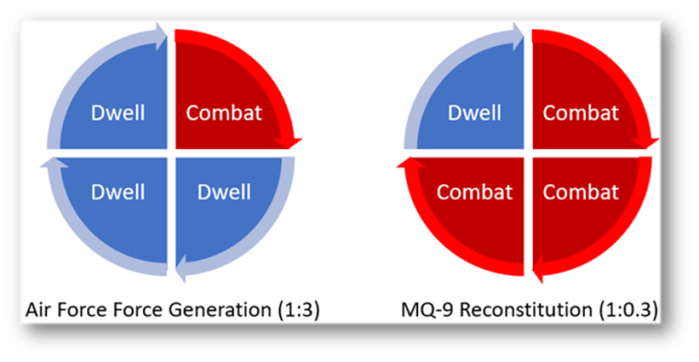
Traditional platforms have an established dwell model based on when a unit deploys. DoD policy sets a goal of a 1:3 deploy-to-dwell ratio; in other words, for every month a unit spends deployed, it should spend at least three months in dwell. The USAF expanded on DoD guidance with its Force Generation Model, which formalised a 24-month model with a maximum of 6 months in combat. RPA aircrew, who conduct combat missions from their home stations, fell into a grey area in both policies. The lack of specific guidance presented a problem in managing combat deployments for RPA aircrew.
An MQ-9 Reaper sits on the 361st Expeditionary Attack Squadron flightline at an undisclosed location, 6 August 2022. The 361st Expeditionary Attack Squadron operates the aircraft in support of Operation INHERENT RESOLVE. (Source: Wikimedia)
Initial Implementation
On 1 October 2020, the 20th Attack Squadron at Whiteman Air Force Base entered a 60-day reconstitution period, the first-ever protected dwell time for an RPA unit. Colonel Timothy Monroe, the 25th Attack Group commander, wrote that dedicated time out of combat was a ‘paradigm shift’ that would ‘have a significant impact to an adversary’s calculus.’ He was quickly proven correct when the hard work of squadrons in reconstitution set up equally unprecedented MQ-9 deployments in Romania and Japan over the next three years. Even with a short amount of time in dwell, MQ-9 units executed a paradigm shift from counterterrorism in the Middle East and Africa to strategic competition in Europe and the Pacific.
While the first MQ-9 dwell programs have shown impressive results, they have limited goals – rotating four squadrons implies a deploy-to-dwell ratio of 1:0.3, well below the DoD and USAF deploy-to-dwell goal of 1:3. A lower ratio means less training. Before a 6-month deployment, a fighter squadron receives a minimum of 18 months of training. An MQ-9 squadron starting the same 6-month deployment gets only two months of training – about one-tenth the time to complete similar training requirements. The unusually short training period also created new challenges and amplified existing structural problems in the RPA community.
Before initial dwell implementation, MQ-9 pilots and sensor operators completed mission qualification training and did not train again until they became instructors – one of the most underappreciated facts about RPA aircrew. Additionally, most mobility and big-wing aircraft have an aircraft commander that can debrief co-pilots, and most fighter aircraft has a flight lead that can debrief wingmen; MQ-9 aircrew have neither. When entering dwell, the lack of training experience and a senior/junior crew model forces squadrons to task their instructors to oversee every dwell sortie. As a result, MQ-9 instructor pilots and sensor operators are severely overtasked during dwell, leading to burnout, low morale, and poor training quality.
Depiction of deploy-to-dwell ratios (Source: Author)
Finding the Right Ratio
One barrier to decreasing MQ-9 deploy-to-dwell ratios is that dwell is normally justified in keeping US military members at home. DoD dwell policy explains a 1:3 deploy-to-dwell goal in part to ensure that servicemembers ‘do not spend extended periods of time away from their homeport, station, or base.’ MQ-9 aircrew never leave their base and return to their homes after each day of flying. Further, other communities (such as special operations forces) are chronically over-deployed. Even if studies continually demonstrate the need for RPA dwell, the lack of a physical departure from home stations challenges improved deploy-to-dwell ratios.
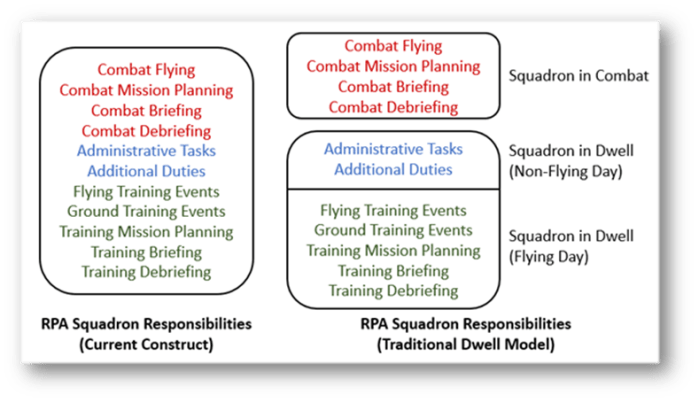
The requirement for traditional deploy-to-dwell ratios is evident in a day in the life of RPA aircrew. Today, pilots and sensor operators show up to work with many responsibilities. First, they fly for at least some portion of the day, conducting operational and combat missions globally. Second, they fulfil administrative responsibilities; all but the most junior aircrew have additional duties, from supervising airmen to administering annual evaluations to planning the squadron holiday party. Third, the aircrew accomplishes their training requirements. Because squadrons spend almost all their time in active operations, they must conduct basic combat training, training to make new instructors, and training on emerging tactics and technology while in combat. Fourth, the aircrew participates in mission planning, briefs, and debriefs internally and with outside agencies. To be clear, when RPA aircrew are flying, they do not do other work. Nevertheless, as soon as they leave the cockpit, their attention is pulled in three different directions.
Extensive research demonstrates the challenges of this type of multitasking. On the individual level, multitasking increases stress, decreases productivity, and increases the number of errors in completed work; one study demonstrated that multitasking functionally lowered workers’ IQ by ten percentage points.[5] Organisational multitasking, in which an organisation’s focus is split between multiple critical tasks, has similar effects. Research demonstrates that multitasking organisations deliver results slower, less consistently, and of lower quality than their focused counterparts.[6] The structure of RPA squadrons makes this problem more challenging; with a 24/7 mission, most of the squadron is divided into three shifts and rotating workweeks that prevent clear delineation of administrative, training, and combat duties. As a result, RPA squadron constructs that attempt to do all things at once are structured to underperform continually. Studies even demonstrate that RPA aircrew weigh their ‘deployed in-garrison status’ and ‘extra duties/administrative tasks’ (i.e., multitasking peacetime and wartime responsibilities) as higher operational stressors than combat and weapons employment.[7]
To return a squadron’s attention to its combat or operational mission, future RPA dwell programs must provide enough time out of combat to accomplish peacetime responsibilities. Before a manned squadron deploys, its members take the time to complete most training, administrative responsibilities, and professional requirements. RPA aircrew must do the same before beginning a ” deployment into operational flying. There is no data on how long this would take RPA aircrew, but it is reasonable to assume that it will be roughly the same as their manned counterparts.
With non-flying responsibilities accomplished outside combat missions, RPA squadrons could re-focus on combat operations. That same RPA pilot or sensor operator with four responsibilities in the legacy model would now have two: mission planning or execution. No key squadron personnel would conduct offsite development during high-priority operations. No pilots would be worrying about getting off shift in time to catch a flight to their wedding in four days.[8] In short, the RPA enterprise would flip its most important script: while combat operations are normal and training is abnormal today, the future must make training normal and combat a critical exception.
Depiction of RPA squadron responsibilities (Source: Author)
Conclusion – The Way Forward
Integrating RPA into a 1:3 deploy-to-dwell cycle faces serious but surmountable challenges. There are only three ways to improve a deploy-to-dwell cycle: create more squadrons, increasing the number of personnel out of combat; re-task (i.e., ‘redeploy’) some MQ-9 units from combat to training; or restructure squadrons to reduce overhead and free up personnel for training. Each of these three approaches poses its own challenges, as resources are limited, demand for MQ-9s is already more than the USAF can produce, and adjusting well-established personnel constructs carries risk. However, the idea that ‘risk is rarely mitigated, just transferred’ applies here. The RPA enterprise transfers risk to combat missions by not accepting risk in resourcing dwell.
Increasing time in dwell also increases the demand for training resources. More time in training means more flying hours at home, which requires more aircraft, cockpits, and (most importantly) maintainers. Even relatively banal problems like a chronic lack of desks and computers become acute when aircrew are in cockpits less and in offices more. The USAF is looking to save money in the MQ-9 program, but the relatively small costs of properly equipping its aircrew will pay returns in the long run.
Innovative solutions to resourcing dwell could be an entire article; the more critical starting point for the discussion is setting a requirement. As long as RPA aircrew are attempting to conduct missions while distracted by administrative responsibilities, if they are hampered by missing key personnel, and as long as they attempt to execute two important tasks simultaneously, they will not perform at the level expected of USAF aviators. The RPA enterprise must make another paradigm shift by integrating into the USAF dwell model, focusing on combat, and improving its performance just as the United States has faced its greatest strategic challenge since the end of the Cold War.
Major James ‘Hot’ Schmitt is a senior remote pilot in the United States Air Force with more than 2,500 combat and combat support hours in the MQ-1 and MQ-9. He has supported operations in Iraq, Syria, Afghanistan, and elsewhere, including a recent deployment as the Chief of Weapons and Tactics for Air Forces Central at Al Udeid Air Base, Qatar. He is a graduate of the US Air Force Weapons School and currently works on the Deputy Chief of Staff for Operations staff at Headquarters Air Force.
Header image: An General Atomics MQ-9 Reaper unmanned aerial vehicle flies a combat mission over southern Afghanistan. (Source: Wikimedia)
[1] RPA is the USAF term for large, medium-altitude uncrewed aerial systems, sometimes also referred to as UAS or drones, to emphasise the role of the remote crew flying the aircraft.
[5] Molly Russ and Derek Crews, ‘A Survey of Multitasking Behaviors in Organizations,’ International Journal of Human Resource Studies 4, no. 1 (2014), p. 139.
[6] Janice Alquizar, ‘Multitasking of Teachers in the Contemporary Settings: Boon or Bane?” (Dec 2018), p. 35.
[7] Wayne Chappelle et al., ‘Symptoms of Psychological Distress and Post-Traumatic Stress Disorder in United States Air Force “Drone” Operators,’ Military Medicine 179, no. 8 (2014), p. 67.
Brian D. Laslie, Air Power’s Lost Cause: The American Air Wars of Vietnam. London: Rowman and Littlefield, 2021. Notes. Appendices. Bibliography. Hbk. xiii + 272 pp.
Reviewed by Dr Maria E. Burczynska
The Vietnam War, also known as the Second Indochina War, or as referred to in Vietnam – the American War is a topic widely covered in academic and popular literature. Among the various publications, Brian D. Laslie provides a unique perspective on the American air campaign in Vietnam. Published as a part of the War and Society series by Rowman and Littlefield, Laslie’s work is an attempt to produce a comprehensive and critical overview of the air war over Vietnam, Laos and Cambodia. To achieve that, Laslie posits three questions: was the disjointed and ineffective use of air power in Vietnam preventable? What should control of the air looked like? Finally, would a different command and control structure have made any difference to the potential outcome of the conflict? (p. 3)
The title, Air Power’s Lost Cause, already gives away the book’s leading theme. The concept of a ‘lost cause’ is most widely associated with the American Civil War of 1861 to 1865, regarding the Confederacy fighting a heroic and noble battle against all the odds, effectively losing the war. The creation and evolution of that myth as well as its influence on the American memory of the Civil War, has been widely discussed in the literature, for example, by Gary Gallagher and Alan T. Nolan in The Myth of the Lost Cause and Civil War History, or William C. Davis in The Cause Lost: Myths and Realities of the Confederacy. However, in a wider context, ‘lost cause’ is used to describe a pseudohistorical narrative justifying one’s loss on a battlefield and often leading to a belief that a conflict was doomed to failure, despite all the best, full of self-sacrifice efforts of those who fought for the cause.
Laslie invites the reader to explore the ‘lost cause’ concept in the context of the Vietnam War. What one could expect from such an invitation is, therefore, a typical ‘lost cause’ narrative: the United States fought a heroic, full of sacrifice-fight against communism but eventually lost due to several strategic and/or political mistakes which, if rectified, would have brought an opposite outcome to the conflict. When speaking of the American air power in Vietnam, the ‘lost cause’ narrative focuses predominantly on the persistent belief that more intense bombing earlier in the conflict, instead of the gradual escalation that characterised Operation Rolling Thunder, could have a decisive effect and change the outcome of the war and that the Operation Linebacker II (with the heavy bombing attacks it brought) was successful in bringing the North Vietnamese Government to the negotiating table and ended the conflict. Laslie debunks those myths. Conducting a detailed and comprehensive analysis of the various actions undertaken by US air power as well as discussing its limitations such as, for example, the difficulty in effectively countering guerrilla tactics, he provides a compelling argument that even with the technological superiority the air campaign in Vietnam was unable to impact the outcome of the war significantly.
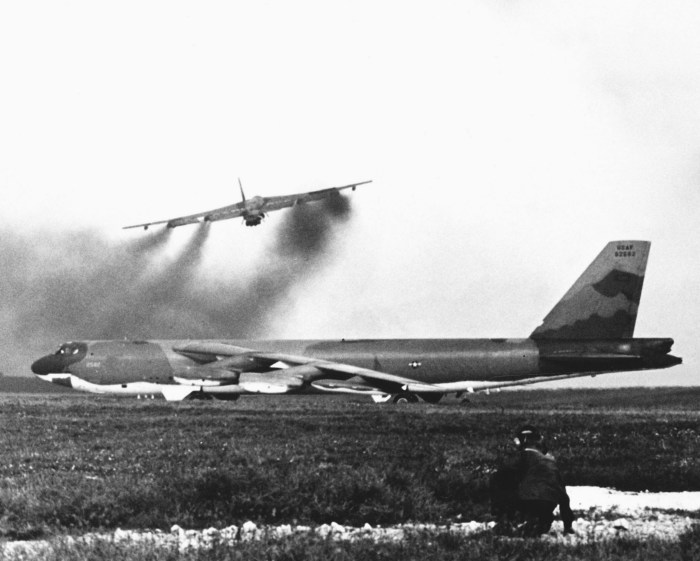
A US Air Force Boeing B-52G Stratofortress from the 72nd Strategic Wing (Provisional) waits beside the runway at Andersen Air Force Base, Guam, as another B-52 takes off for a bombing mission over North Vietnam during Operation Linebacker II on 15 December 1972. (Source: Wikimedia)
While the ‘lost cause’ concept is the leading theme for the discussion, the book is structured to reflect Laslie’s other argument – the disjointed character of what is known, especially in Western literature, as the Vietnam War. The War is often perceived as one large conflict, whereas there was no overarching campaign (not to mention an overarching strategy) during the American involvement. Laslie steps back from this holistic approach and offers a different perspective suggesting that several air wars took place at the time over Vietnam, Laos and Cambodia. Therefore, in his book, he identifies and discusses the following ‘wars’: the air-to-ground war in North Vietnam, the air-to-air war in North Vietnam, the air-to-ground war in South Vietnam, the US Navy air-to-air and air-to-ground war in North and South Vietnam, and the secret air war over Laos and Cambodia and against the Ho ChiMinh Trail. By looking at several air wars rather than one, the reader is confronted with an incredibly detailed picture of the situation at the strategic, operational and tactical levels of war.
But looking at the individual air wars is not the only way Laslie is trying to offer a comprehensive view of American involvement in Southeast Asia’s air campaigns. He also successfully combines US Air Force and US Navy perspectives, often treated separately in the literature. Discussing the participation of different services implies that a recurring point in Laslie’s analysis is the interservice rivalry and the complete lack of cohesive command and control between the Army, Navy and Air Force or even within them. These are not novel ideas as these issues are well-known and well-researched in the broader literature on the war in Vietnam. However, Laslie analyses American involvement as a series of separate air wars with their distinctive circumstances and obstacles. This allows him to discuss how these hurdles dictated each campaign’s outcomes.. Changing the perspective and critically analysing the context, objectives and limitations of each of those separate air wars illustrates the level of complexity of the conflict in Vietnam. It also supports Laslie’s main argument on the US air power’s ‘lost cause’, meticulously explaining why the popular myth of heavier bombings being potentially more effective is simply not true.
With his background as the Command Historian at the United States Air Force Academy and drawing on an impressive range of primary and secondary sources, Laslie provides a well-researched piece on a subject that one would have thought nothing new could be added. It is undoubtedly a result of extensive archival research and the inclusion of the Contemporary Historical Examination of Current Operations Reports of Southeast Asia (1961–1975) (an impressive list of which has been included as Appendix B). As an American scholar, Laslie is well aware of the potential bias his project may be susceptible to. To avoid that, he is trying to provide a balanced approach by including the perspective of the North Vietnamese Air Force in the discussion. However, that has been possible to achieve only partially due to the limited number of Vietnamese sources available to non-Vietnamese scholars. Nevertheless, Laslie highlights an existing gap in the Western understanding of air campaigns during the Vietnam War and opens an important discussion on the need to investigate the North Vietnamese experience. Whereas it demonstrates the potential for further research, one should ask how feasible it is for an American scholar to access North Vietnamese archives and look at the official sources held there.
Laslie posits that ‘the point of this book is to add something new to the discussion of air power and the war in Southeast Asia’ (p. 4). He succeeded in achieving that goal. Air Power’s Lost Cause will certainly be of interest to military professionals and academics as well as members of a wider audience seeking to improve their understanding, firstly, of the history of the US involvement in Vietnam and, secondly, the complexity of air campaigns in that conflict.
Dr Maria E. Burczynska is a Lecturer in Air Power Studies at the Department of History, Politics and War Studies, University of Wolverhampton. She is involved in designing and delivering an online MA course on Air Power, Space Power and Cyber Warfare. She obtained her PhD from the University of Nottingham, where she worked on a project focused on European air power and its involvement in different forms of multinational cooperation. Her thesis, titled ‘The potential and limits of air power in contemporary multinational operations: the case of the UK, Polish and Swedish air forces,’ is making an essential contribution to the field of air power studies, which remains primarily dominated by the US case. The Royal Air Force Museum recognised her research’s significance, awarding her the Museum’s RAF Centenary PhD Bursary in Air Power Studies in April 2019. Maria’s research interests are in military and security studies in national and international dimensions. She is particularly interested in contemporary European air forces and their participation in multinational operations and initiatives and the influence of national culture on the military culture of individual air forces. She can be found on Twitter at @BurczynskaMaria.
Header image: A US Air Force North American F-100D Super Sabre fires a salvo of 2.75-inch rockets against an enemy position in South Vietnam in 1967. (Source: Wikimedia)
Editorial Note: Led by Editor Dr Mike Hankins, From Balloons to Drones produces a monthly podcast that provides an outlet for the presentation and evaluation of air power scholarship, the exploration of historical topics and ideas, and provides a way to reach out to both new scholars and the general public. You can find our Soundcloud channel here. You can also find our podcast on Apple Podcasts and Google Podcasts.
Amidst the news of classified intelligence leaks, it’s a great time to look back at the US Air Force (USAF) Security Service – the USAF’s own intelligence agency that gathered critical intelligence throughout the Cold War. From using surveillance aircraft to spy on potential threats to helping fighter pilots shoot down MiGs over the skies of Vietnam, Philip Shackelford takes us through the story of this mysterious organization, as he details in his new book: Rise of the Mavericks from Naval Institute Press.
Philip C. Shackelford is the library director at South Arkansas Community College in El Dorado, Arkansas. He has served as President of the Arkansas Library Association and was named an Emerging Leader by the American Library Association in 2019. Shackelford’s academic focus is on communications intelligence in the U.S. Air Force. He is also interested in national security, strategy, intelligence, and organizational culture.
Header image: A Boeing RB-29 of the 31st Reconnaissance Squadron, somewhere over Korea, c. 1952. (Source: Wikimedia).
Editorial Note: Led by Editor Dr Mike Hankins, From Balloons to Drones produces a monthly podcast that provides an outlet for the presentation and evaluation of air power scholarship, the exploration of historical topics and ideas, and provides a way to reach out to both new scholars and the general public. You can find our Soundcloud channel here. You can also find our podcast on Apple Podcasts and Google Podcasts.
Our latest episode concerns the Grumann F-14 Tomcat and the McDonnell Douglas F-15 Eagle, two popular and historically significant aeroplanes. We arere joined by Dr Tal Tovy, senior lecturer at Bar-Ilan University in Israel and author of Tomcats and Eagles: The Development of the F-14 and F-15 in the Cold War (2022) from Naval Institute Press. Tovy gives us an up-close look at the motivation behind designing these aircraft and speaks to how the Israeli Air Force experience had a particular influence.
Dr Tal Tovy is a Senior Lecturer at Bar-Ilan University in Israel. He holds a PhD in history from the University of Haifa. A veteran of the Israel Defense Forces, Tovy has published extensively on various military history topics, including the influence of counterinsurgency theory upon American combat operations. His other fields of interest include Western military thought and U.S. military history. Tovy is the author of two previous books: The Changing Nature of Geostrategy 1900-2000: The Evolution of a New Paradigm and The Gulf of Tonkin: The United States and the Escalation in the Vietnam War.
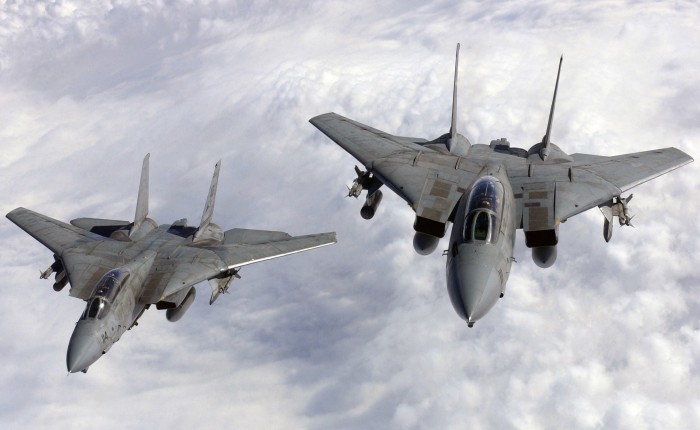
Header image: A pair of US Navy Grumman F-14A Tomcats from VF-211 in flight over Iraq in December 2003. VF-211 was assigned to Carrier Air Wing 1 aboard the aircraft carrier USS Enterprise for a deployment to the Mediterranean Sea and the Indian Ocean from 28 August 2003 to 29 February 2004. (Source: Wikimedia)
Editorial Note: Led by Editor Dr Mike Hankins, From Balloons to Drones produces a monthly podcast that provides an outlet for the presentation and evaluation of air power scholarship, the exploration of historical topics and ideas, and provides a way to reach out to both new scholars and the general public. You can find our Soundcloud channel here. You can also find our podcast on Apple Podcasts and Google Podcasts.
50 years ago, in January 1973, the Paris Peace Accords were signed. This ended major U.S. combat operations in the Vietnam War. To look back on the air campaigns that were so crucial to that war, we talk with Dr Michael Weaver, assistant professor at the US Air Force’s Air Command and Staff College and author of The Air War in Vietnam from Texas Tech University Press. Join us as we look at the use of air power in Southeast Asia and talk about some of the legacies it leaves behind.
Dr Michael E. Weaver is an Associate Professor of History at the USAF Air Command and Staff College. He has authored five air power articles and a book on the 28th Infantry Division. His second book, The Air War in Vietnam, was published in 2022. Weaver received his doctorate from Temple University in 2002, where he studied under Russell Weigley.
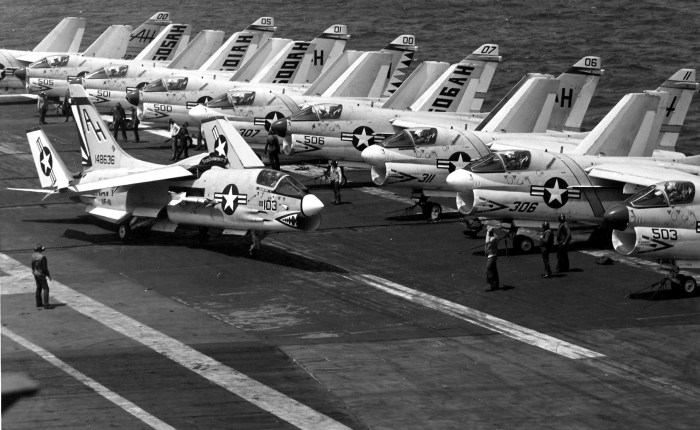
Header image: View of the flight deck of the USS Ticonderoga (CVA-14) during her last deployment to Vietnam as an attack carrier between 1 February and 18 September 1969. Various aircraft of Carrier Air Wing 16 are visible on deck: a Vought F-8H Crusader of VF-111 ‘Sundowners,’ four LTV A-7B Corsair II of VA-87 ‘Golden Warriors,’ and five A-7Bs of VA-25 ‘Fist of the Fleet.’ (Source: Wikimedia)
Editorial Note: Led by our Editor Dr Mike Hankins, From Balloons to Drones produces a monthly podcast that provides an outlet for the presentation and evaluation of air power scholarship, the exploration of historical topics and ideas, and provides a way to reach out to both new scholars and the general public. You can find our Soundcloud channel here. You can also find our podcast on Apple Podcasts and Google Podcasts.
With the threat of nuclear war rising once again as tension among global powers increases, in our latest podcast, we talk to Professor Sean M. Maloney of the Royal Military College of Canada to look at what the nuclear war plans of the U.S. were during the early Cold War. We also discuss what a nuclear war might have looked like, and how it would have potentially been waged.
Dr Sean M. Maloney is a Professor of History at the Royal Military College and served as the Historical Advisor to the Chief of the Land Staff during the war in Afghanistan. He previously served as the historian for 4 Canadian Mechanized Brigade, the Canadian Army’s primary Cold War NATO commitment after the reunification of Germany and at the start of Canada’s long involvement in the Balkans. He is the author of numerous works, and his latest book is Emergency War Plan: The American Doomsday Machine, 1945–1960 (2021).
Header image: A Boeing B-47B undertaking a rocket-assisted take-off. The black smoke from engines indicates that water-methanol injection is in use. (Source: Wikimedia)
Iraqi forces stormed into Kuwait on 2 August 1990 and, after a seven-month occupation of its southern neighbour, was defeated by the United States-led coalition forces consisting of troops from 39 countries. A five-week air offensive preceded the ground offensive on 24 February 1991 to put down the Iraqi air defences and prepare the battlefield for a ground offensive. The air war during DESERT STORM is generally considered a resounding success, with the Iraqi air defences failing to offer any significant opposition. Thomas Withington’s recent insightful article ‘Electric Avenue: Electronic Warfare and the battle against Iraq’s air defences during Operation Desert Storm’ is similar but misses out on some crucial aspects.
This article aims to offer a counter view to Withington’s and put the performance of Iraqi air defences in perspective. It also must be noted that Iraq had the sixth largest air force globally, with about 915 aircraft.[1] However, it put up only minimal opposition, and only the ground-based air defences (GBAD) offered any real resistance to the coalition air forces. This article thus focuses mainly on GBAD and discusses three fundamental issues. First, were Iraqi air defences as lethal and effective as projected before the war? Second, how effective were the suppression of enemy air defences (SEAD) operations conducted by the coalition air forces and did they achieve the stated goal(s)? Finally, how did the Iraqi air defences perform during the war?
The commonly held view is that the Iraqi air defences were lethal and ‘potentially ferocious.’[2] This was echoed in Withington’s article, who quoted the following from an official report by the US Department of Defence on DESERT STORM:
The multi-layered, redundant, computer-controlled air defence network around Baghdad was denser than that surrounding most Eastern European cities during the Cold War, and several orders of magnitude greater than that which had defended Hanoi during the later stages of the Vietnam War.
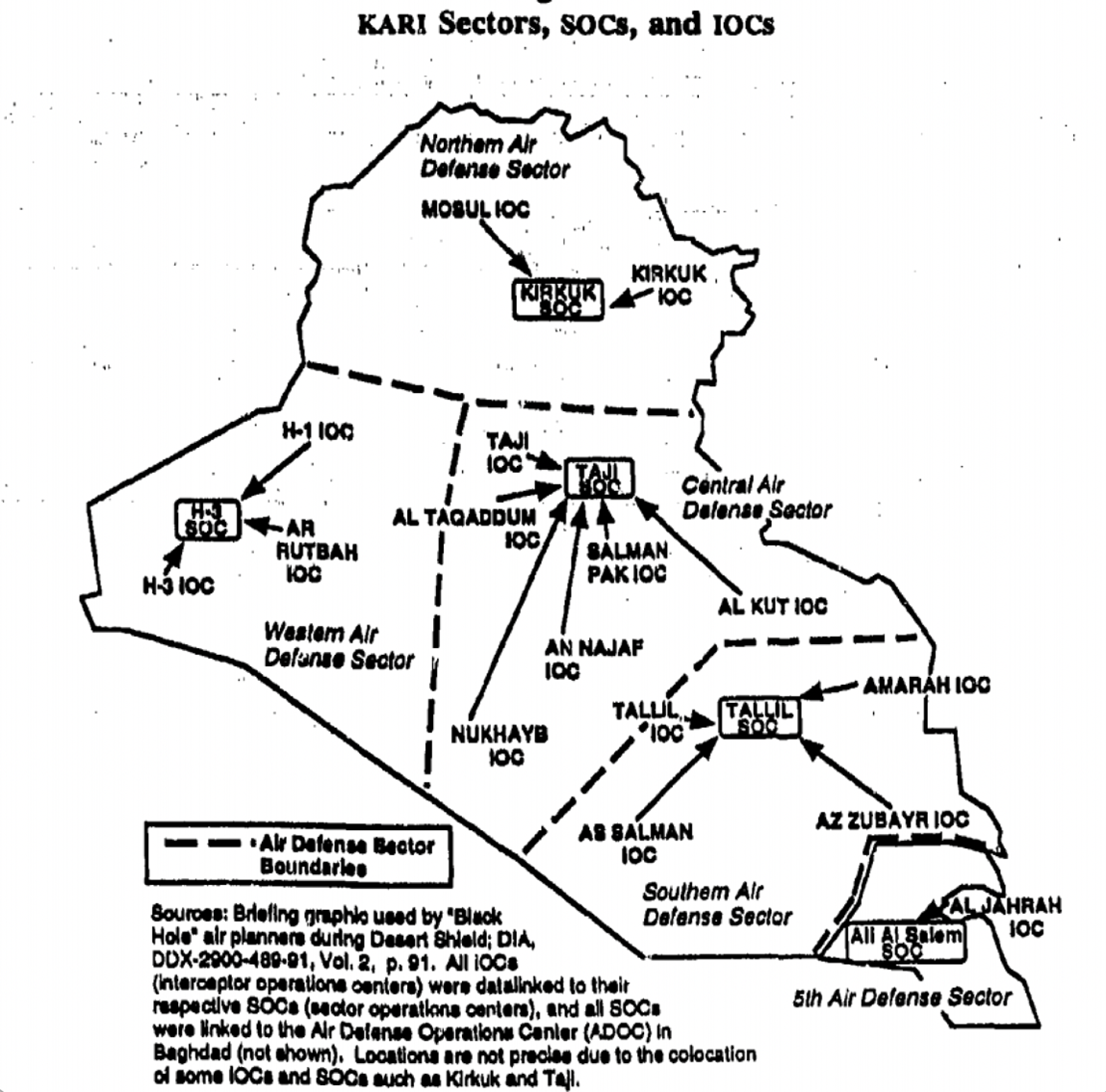
This claim about the lethality and ferocity of Iraqi air defences needs to be analysed to see if it has any merit. The Iraqi integrated air defence system (IADS) comprised a mix of Soviet and Western air defence systems. While the surface-to-air missiles (SAMs) were predominantly of Soviet origin, the heart of the IADS, called KARI, was built by the French defence contractor, Thomson-CSF. It was designed primarily to provide air defence against Israel and Iran and had a severe limitation: it could only manage 20 to 40 hostile aircraft. Iraq had over 500 radars located at about 100 sites, but the radar layout did not afford comprehensive coverage with a bias toward east and west. Most radars could not detect stealth aircraft barring the limited capability of the P-12 and P-18 radars and the six Chinese (Nanjing) low-frequency radars.[3]
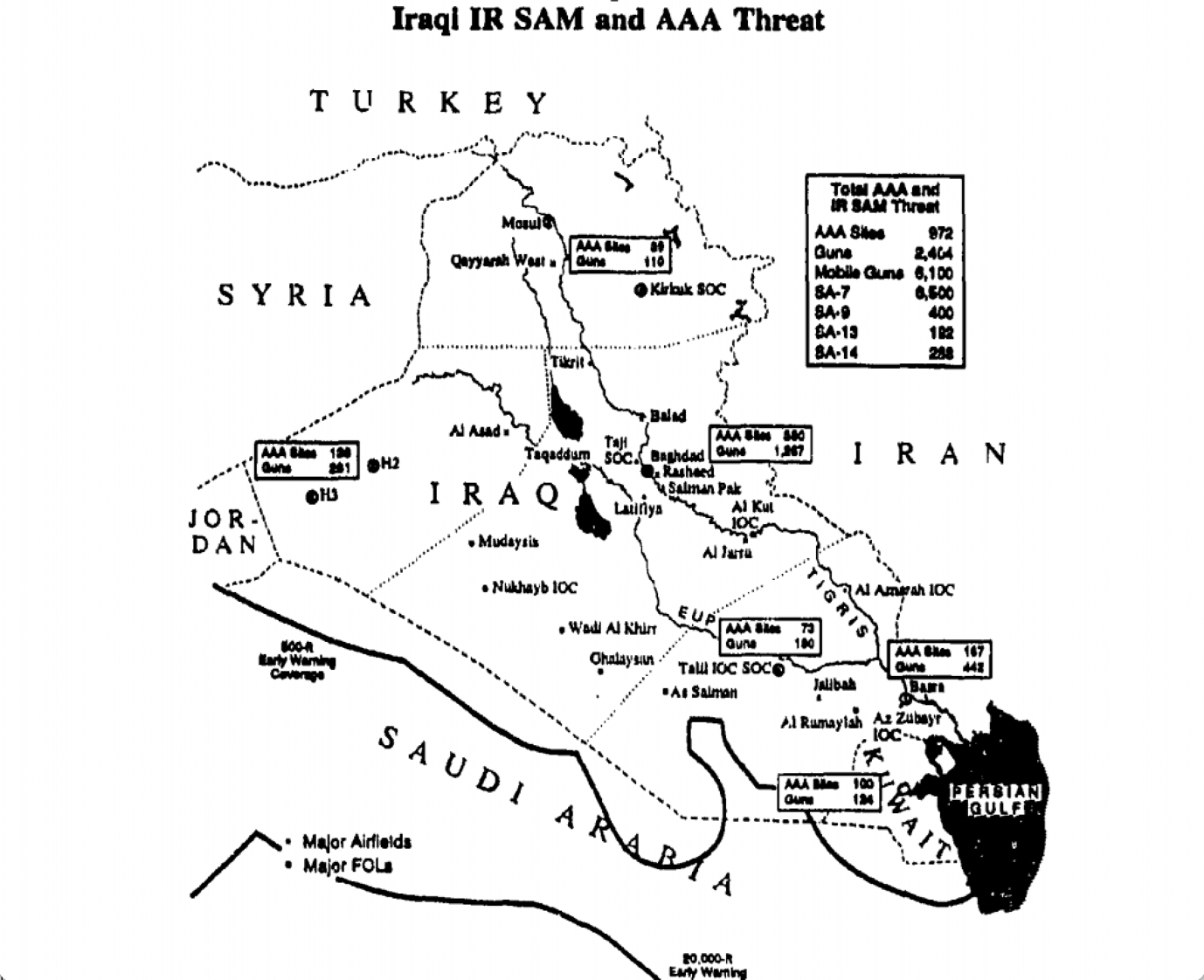
Iraqi GBAD included SAM and anti-aircraft artillery (AAA) guns. The missiles included the Soviet SA-2, SA-3, SA-6 and SA-8 and the Franco-German Roland I/II missiles. With a range limitation of about 40km, even SA-2s and SA-3s cannot be considered strategic air defence systems, while the SA-8s and the Rolands were purely tactical SAM systems. The SA-6 was used for the tactical role and to fill gaps in the strategic SAM layout. The 58 SAM batteries notwithstanding, Iraq had no strategic SAM system, and with the available SAM batteries, it was capable of limited and thin air defence cover over its strategic targets.
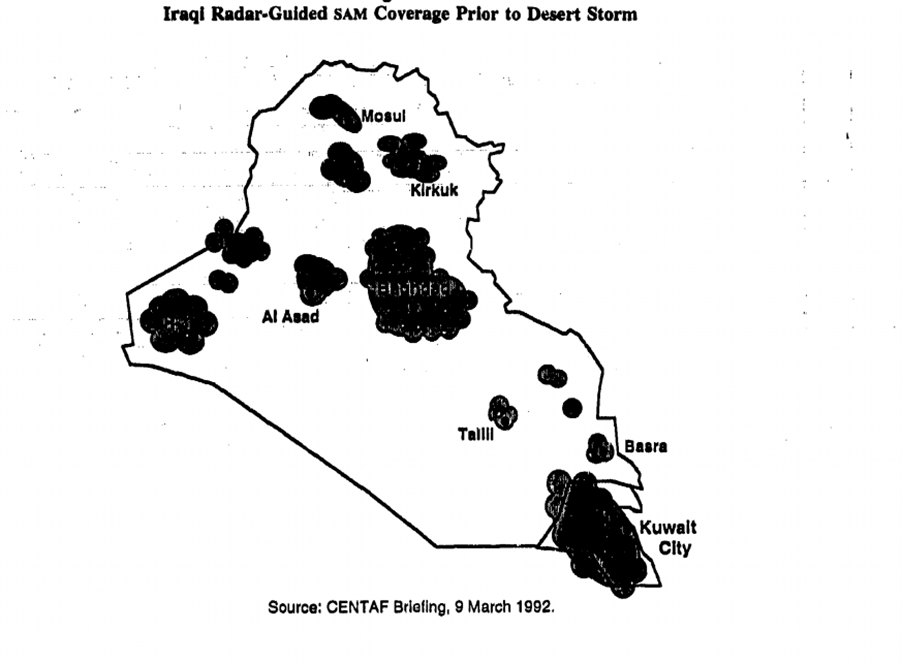
(Source: Barry Watts and Thomas Keaney ‘Effects and Effectiveness in Gulf War Air Power Survey – Volume II: Operations and Effects and Effectiveness (Washington DC: Department of the Air Force, 1993), p. 134.)
With the country’s material assets widely dispersed; no attempt was made to defend all of them. Instead, the SAMs and AAA were concentrated on defending selected areas or sectors like Baghdad, Basra, the Scud-launching sites in western Iraq, and the northern oil fields only, with the defence of the capital given the foremost priority. With a concentration of the SAMs and AAA in select areas, Iraq had adopted a point defence system.
Fifty-eight SAM batteries, almost half the total 120 batteries, were deployed to defend Baghdad alone and 1,300 AA guns. The other areas with these missile systems were Basra with fifteen and Mosul/Kirkuk with sixteen batteries. In addition, the airfield complex of H-2/H-3 had 13 SAM batteries, and the Talil/Jalibah complex had three.[4]
Location
SA-2
SA-3
SA-6
SA-8
Roland
Total
Mosul/Kirkuk
1
12
0
1
2
16
H-2/H-3
1
0
6
0
6
13
Talil/Jalibah
1
0
0
0
2
3
Basrah
2
0
8
0
5
15
Baghdad
10
16
8
15
9
58
(Source: Williamson Murray, ‘Operations’ in Gulf War Air Power Survey – Volume II: Operations and Effects and Effectiveness (Washington DC: Department of the Air Force, 1993), p. 82.)
Even in Baghdad, the defence systems did not necessarily protect downtown Baghdad at a higher threat level than the rest of the overall metropolitan area, as the SAM sites were dispersed throughout the Baghdad area. The United States Air Force (USAF)’s claim that downtown Baghdad was where air defences are uniquely dense or severe was thus without merit.[5]
The SA-2s and SA-3s, being vintage missiles, were supplemented by the newer SA-6s with a battery deployed at essential sites. Although the presence of SA-6s at selected locations beefed up the air defences, it had an unintended effect that with the SA-6s moving back from the front-line units, the forward army units were left devoid of the most effective SAM in the inventory. The Iraqis captured several examples of the US HAWK missile system when they invaded Kuwait. The HAWK missile, with a comparable range, would have been an effective deterrent, but as the Iraqis did not have the technical expertise to operate it, it was never not used.[6] Another drawback of the Iraqi IADS was that the 8,000 or so anti-aircraft guns were reportedly not integrated with the overall air defence system and were designed to operate independently.[7]
(Source: Barry Watts and Thomas Keaney ‘Effects and Effectiveness’ in Gulf War Air Power Survey – Volume II: Operations and Effects and Effectiveness (Washington DC: Department of the Air Force, 1993), p. 132.)
The air defence network was thus far from lethal and was not designed to work against a massive air assault as it was subjected to during DESERT STORM. Instead, it had limited capabilities and was optimised only to take on threats from two axes. These were from Iran to the east or from Israel to the west and did not cater for any significant threat from the south or the north. Notably, only the overall assessment of the Iraqi IADS by the US Navy’s Strike Projection Evaluation and Anti-Air Research (SPEAR) Department was more realistic than other claims as it stated that:
[t]he command elements of the Iraqi air defence organisation (the interceptor force, the IADF [Iraqi Air defence Force], as well as Army air defence) are unlikely to function well under the stress of a concerted air campaign.[8]
The coalition forces launched DESERT STORM at 2:38 on 17 January 1991 when Task Force Normandy struck the two Iraqi radars codenamed Nebraska and Oklahoma, firing 27 Hellfire missiles, 100 rockets and 4,000 rounds of 30mm ammunition. A corridor 30 kilometres wide was now available for the follow-on missions. Next were the eight USAF F-15E Strike Eagles that targeted the local air defence command and control centre, further degrading the network and facilitating the strike by the F-117s preceded by three EF-111 Ravens. Seventeen F-117s were tasked to deliver 27 laser-guided bombs on 15 Iraqi air defence system-related targets. Contrary to initial claims related to the effectiveness of the F-117, only nine of the 15 targets were hit, and eight remained operational even after the air strikes.[9] One of the main targets, Baghdad’s central air defence operations centre was not damaged and remained operational.[10] The F/A-18 Hornets armed with AGM-88 high-speed anti-radar missiles (HARMs) fared not much better as about half of the 75 HARMs fired hit their targets.[11]
The performance of Iraq’s air defence system was effective on Day 1 as they shot down six aircraft: all except one by GBAD. The AAA shot down two aircraft (one F-15 and a Royal Air Force (RAF) Tornado GR.1) while the SAMs claimed three. An Iraqi MiG-25 shot down one F/A-18.[12] GBAD damaged a dozen more aircraft.
The Coalition air forces lost three aircraft to ground fire over 2,250 sorties on Day 2 as one aircraft each was claimed by AAA (a US Navy A-6) and SAM (a US Marine Corps OV-10), while the cause of loss of an Italian Tornado GR.1 could not be ascertained.[13] The next day, several missions were called off due to bad weather though the strikes against Scud launchers continued during the day. The Iraqi SAMs shot down two United States F-16s over Baghdad and another F-15. The RAF and Royal Saudi Air Force each lost two Tornadoes, while a USAF F-4 crashed after being hit by AAA. The air operations on 20 January were scaled down due to continued bad weather, and with losses mounting, especially to AAA, the USAF imposed a minimum altitude to reduce attrition. The Iraqi air defences, for their part, shot down two Coalition aircraft; a United States Navy F-14, downed by an SA-2 and an RAF Tornado, besides damaging three more. The RAF lost a Tornado to ground fire, with a USAF F-15 also being hit by a SAM.
On 23 January, coalition air forces claimed to have destroyed 19 Iraqi aircraft thus far and achieved air superiority over Iraq. The losses to Iraqi air defences were 15 aircraft, and AAA and hand-held SAMs’ unexpected intensity of ground fire forced Coalition aircraft to adopt higher-altitude delivery tactics. During the second week, the Iraqi air defences could not put up any concerted opposition. It was not until 28 January that they claimed their next kill when a SAM shot down a US Marine Corps AV-8B, although several Coalition aircraft was hit by AAA fire. KARI was badly fragmented by the end of week two, and only three of 16 Intercept Operations Centres (IOCs) were reported to be fully operational. Coalition losses during week three were again relatively low, with only three aircraft (an A-10, an AC-130 and an A-6E) lost to Iraqi air defences. The following week, Iraqi air defences shot down only three Coalition aircraft – two AV-8Bs and a Saudi F-5E.
The radar-guided SAMs had been targeted repeatedly, but the Iraqis sparingly continued to launch them. In one such instance, an SA-3 shot down an RAF Tornado GR.1 on 14 February. The Iraqis managed to shoot down five aircraft during week five, including two A-10s on the same day (15 February) by SA-13s. This forced the restricted use of A-10s in high-threat areas. As the war entered its final phase with the Coalition aircraft attacking from lower altitudes, the losses went up with Iraqi air defences shooting down eight aircraft during this last week of the war: three AV-8Bs, one OV-10, one OA-10, one A-10, and two F-16s.[14] This marked the second-highest weekly loss rate since the beginning of the war.
During the ground offensive, Iraqi air defences did not fight as they folded up tamely against the coalition air forces. During the whole campaign, a total of 38 coalition aircraft were lost to Iraqi air defences. At the same time, a further 48 aircraft were damaged in combat, totalling 86 combat casualties. Most losses were to infra-red guided SAMs, which claimed 13 aircraft and damaged 15 more, while the radar-guided SAMs shot down ten aircraft and damaged four. AAA caused the lowest losses at nine aircraft, although it damaged 24 more. The remaining losses were to accidents or technical reasons, including, for example, electrical malfunction. Considering the ‘lost’ and ‘damaged’ aircraft, the maximum casualties were due to AAA as it claimed 33 aircraft (38 per cent of the total losses), with the infra-red guided SAMs accounting for 28 aircraft (31 per cent). Only 16 per cent of the casualties were attributed to radar-guided SAMs.
The low kill rate by the radar SAMs is attributable to several factors, the primary one being the SEAD missions conducted by Coalition air forces which forced the radar SAMs to shut down most of the operations. In addition, all the radar SAMs held by Iraq were vintage Soviet-era missiles that had been used in combat earlier – there were no new weapons, like the SA-6s in the Yom Kippur War, which could have posed difficulties for the Coalition air forces.
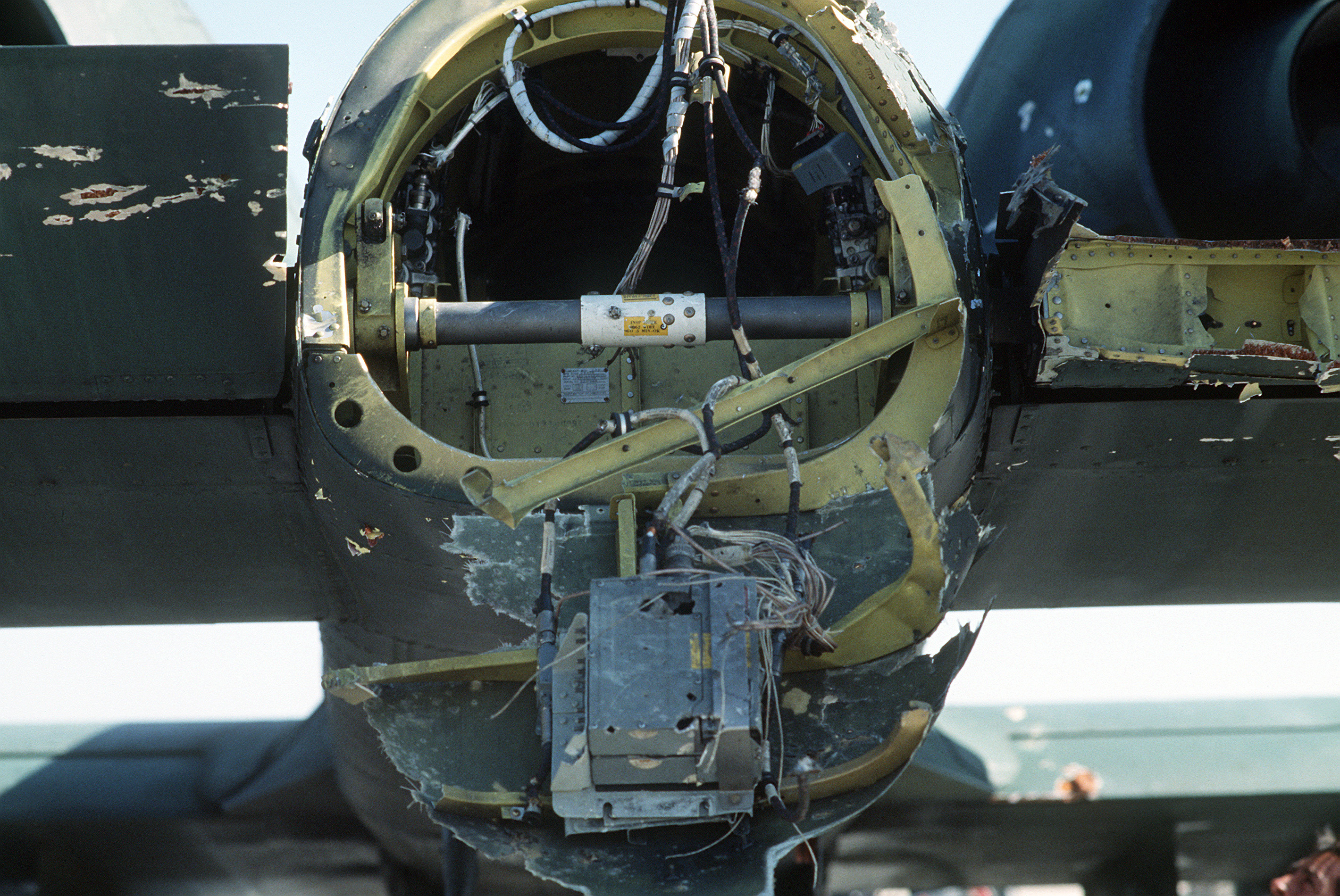
A close-up view of a damaged section of an A-10A Thunderbolt II of the 23rd Tactical Fighter Wing. The aircraft sustained damaged when an SA-16 missile exploded near it during Operation DESERT STORM, 15 February 1991. (Sorce: Wikimedia)
There was a significantly higher daily casualty rate in the first five days of the war, during which 31 aircraft casualties occurred (36 per cent of the total and an average of 6.2 per day), compared to the following 38 days, with a total of 55 more casualties (an average of 1.45 per day). Losses to radar-guided SAMs fell to nearly zero after day five, accounting for 29 per cent (nine out of 31) of total casualties by then. They accounted for just nine per cent (five out of 55) of all aircraft casualties in the remainder of the war. It is apparent, therefore, that by the end of day five of the air campaign, radar SAMs had mainly been eliminated as an effective threat to coalition aircraft. Moreover, in the first three days of the war, some aircraft (B-52s, A-6Es, GR-1s, and F-111Fs) attacked at very low altitudes, where they were more vulnerable to low-altitude defences. After the imposition of a minimum attack level of about 12,000 feet, the losses reduced, resulting in much less accuracy with unguided weapons.
Iraq managed to maintain a fair degree of air defence capability throughout the war. The primary reason for this was KARI, which expanded the responsibilities of various nodes and developed local back-up air-defence networks using different communication networks over combat phone lines and wire between multiple stations. These back-up networks could control local air defences, even when the communication to the central network was down. These back-up systems used ground observers passing information over voice and data channels for information on Coalition aircraft. Radars associated with the Roland or SA-8 would be used to gain information about the altitude of inbound aircraft. The radars would be brought online for short 15-second bursts to ensure survivability in a hostile environment. The SAMs were sometimes fired without using the target-tracking radars to prevent being targeted by the anti-radar missiles. Optical tracking mode was also used while firing the SAMs.
At the war’s end, Iraq’s air defence was far from finished. According to Anthony Cordesman of Washington’s Center for Strategic and International Studies, Iraq retained at least 380 Soviet-made surface-to-air missile launchers, about 80 French-made Roland units and ‘large numbers’ of portable Soviet-made anti-aircraft systems, not counting the hundreds of AA guns.[15] After initially claiming almost the complete destruction of the Iraqi air defence network, the claims were revised as the operations progressed. As USAF Colonel David Deptula, one of the architects of the air campaign, put it in 1996, ‘We didn’t go in there to eviscerate the whole network. The aim was to suppress their defences.’[16]
The Soviet reaction to the Gulf War was significant as the entire Iraqi IADS consisted of Soviet SAMs. In an understatement, Marshal Dmitri Yazov, the Soviet Minister of Defence, admitted that Iraq’s air defences ‘failed in most cases.’[17] Commenting on the initial attack on the IADS, Lieutenant General V. Gorbachev, Dean of the faculty at the General Staff Academy, opined that:
‘The Iraqi air defence system was paralysed by powerful electronic warfare devices. Command and control of troops was overwhelmed in the first few minutes.’[18]
Gorbachev also added:
[a]s far as Soviet equipment is concerned, it is not so much a problem, I think, as the people operating it. Iraqi military professionalism is not, as we can see, up to the mark.’[19]
Reinforcing this view, the Soviets believed that, as the air defence systems employed by the Iraqis were able to down most types of Coalition aircraft used, it suggested that the problem was more one of staffing than technology. It also reinforced an emerging view that modern wars demand well-trained professional soldiers to man and maintain it, not a large conscript army.[20]
After DESERT STORM, Iraq’s air defence system continued to harass the Coalition aircraft, defying the restrictions imposed by the no-fly zone. During Operation DESERT FOX, Iraq engaged Coalition aircraft more than 1,000 times over three years and fired nearly 60 SAMs.[21] The Iraqis even fired unguided rockets at the aircraft to harass them. The Iraqi IADS remained operational throughout and was never ‘put down.’
The Iraqi IADS had limited capabilities and was not as lethal or effective as initially projected; however, its capabilities had been exaggerated in most of the assessments conducted before DESERT STORM. Considering its limited capabilities against a modern air force, aggravated by poor training standards, it performed reasonably well and inflicted a fair amount of attrition. On the other hand, the SEAD operations by coalition air forces were not as effective as claimed during the operations. Even as the surveillance network and radar-guided SAMs were suppressed, the Iraqi IADS continued to function, albeit with reduced efficiency and continued to attrite. It must be remembered that GBAD cannot be suppressed entirely and will continue to inflict losses. It was so during DESERT STORM and will remain so in future conflicts.
Colonel Mandeep Singh, a veteran air defence gunner, has a Masters in Defence and Strategic Studies. He has contributed several articles on air power and air defence for specialist journals. His books include Air Defence Artillery in Combat, 1972 to the Present: The Age of the Surface-to-Air Missiles (2020) published by Air World.
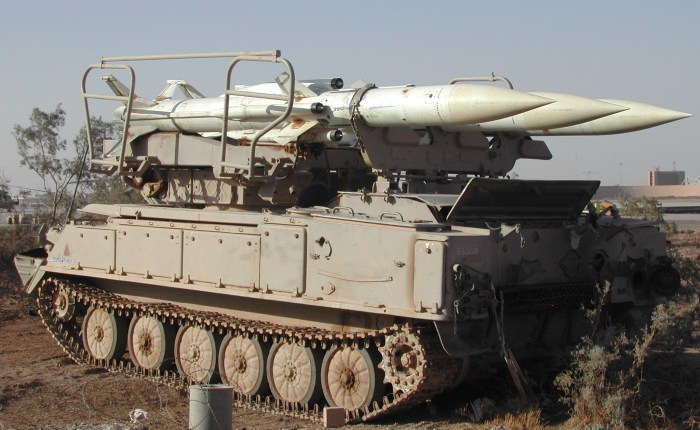
Header image: An Iraqi SA-6 Gainful low-to-medium altitude surface-to-air-missiles on its transporter-erector-launcher. This system was captured by US forces in 2006; however, during the first Gulf War, Iraq operated a number of these systems. (Source: Wikimedia)
[1] The Iraqi Air Force had a mix of combat aircraft, ranging from 190 advanced Mirages, MiG-25s, MiG-29s, and Su-24s to about 300 moderate-quality MiG-23s, Su-7s, Su-25s, Tu-16s and Tu-22s. Most of the air force however comprised of older aircraft like the MiG-17s and MiG-21s.
[2] ‘Conduct of the Persian Gulf War,’ Final Report to the Congress (Washington, DC : Dept. of Defense, 1992), p. 15.
[3] The P-18 radar, which uses metre-length waves in the Very High Frequency (VHF) bandwidth, can detect targets at a greater range than centimetre or millimetre wave radar which stealth aircraft are optimised against. It was a P-18 radar of the Yugoslav Army that detected an F-117 Nighthawk during the Kosovo air war, which led to its shooting down by an SA-3 missile. Similarly, P-12 radar also operates in VHF and can detect stealth aircraft. Kenneth Werrell, in his book Archie to SAM, mentions that Iraq had low-frequency radars though this is not mentioned by any other source. See, Kenneth Werrell, Archie to SAM: A Short Operational History of Ground-Based Air Defense, second edition (Maxwell, AL: Air University Press, 2005), p. 218. Michael Gordon and Bernard Trainor, The Generals’ War: The Inside Story of the Conflict in the Gulf (New York: Little Brown, 1995), p. 105; Williamson Murray, ‘Operations’ in Gulf War Air Power Survey – Volume II: Operations and Effects and Effectiveness (Washington DC: Department of the Air Force, 1993), pp. 77-82.
[4] Iraq had 7,000 SAM and 6,000 AA Guns with the Republican Guard had its own air defence System with about 3,000 AA Guns and 60 SAM Batteries. See: Anthony Tucker-Jones, The Gulf War: Operation Desert Storm 1990-1991 (Barnsley: Pen & Sword Books, 2014), p. 40.
[5] United States Air Force, ‘Reaching Globally, Reaching Powerfully: The United States Air Forces in the Gulf War’ (United States Air Force, 1991), p. 5.
[6] Richard Blanchfield et al, Part I – Weapons, Tactics, and Training’ in Gulf War Air Power Survey – Volume IV: Weapons, Tactics, and Training and Space Operations, directed by Eliot Cohen (Washington DC: Department of the Air Force, 1993), p. 15.
[16] Graham, ‘Gulf War left Iraqi Air Defence Beaten, Not Bowed.’
[17] Quoted in ‘Outgunned Weaponry is Under Fire in Kremlin,’ The Irish Independent, 2 March 1991, p. 6. See also Alexander Velovich, ‘USSR Demands Post-Gulf Air Defense Review,’ Flight International, 13-19 March 1991, p. 5.
[18] Benjamin S. Lambeth, ‘Desert Storm and Its Meaning: The View from Moscow,’ A RAND Report (Santa Monica, CA: RAND Corporation, 1992), p. 23.
[19] Lambeth, ‘Desert Storm and Its Meaning,’ pp. 23-4, fn. 10.
[20] Daniel Sneider, ‘Soviets Assess Their Arsenal After Iraq’s Defeat in Gulf,’ The Christian Science Monitor, 8 March, 1991, p. 1.
Editorial Note: Led by our Editor Dr Mike Hankins, From Balloons to Drones produces a monthly podcast that provides an outlet for the presentation and evaluation of air power scholarship, the exploration of historical topics and ideas, and provides a way to reach out to both new scholars and the general public. You can find our Soundcloud channel here. You can also find our podcast on Apple Podcasts and Google Podcasts.
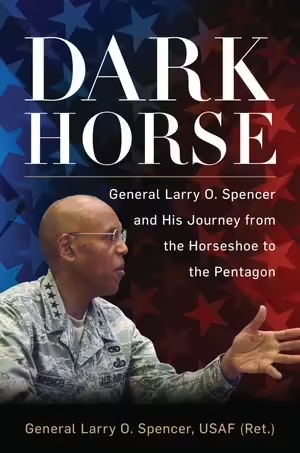
In our latest podcast, we are joined by General Larry O. Spencer, former Vice Chief of Staff of the U. S. Air Force. He recounts his journey from being raised in Southeast Washington, D. C. to enlisting in the U. S. Air Force and eventually rising through the ranks to become one of only nine African Americans to wear four stars. General Spencer’s background as a support officer in an organization that tends to favour pilots and aircrews brings a different lens through which to look at the USAF and the use of air power.
General (ret’d) Larry O. Spencer served as Vice Chief of Staff of the U.S. Air Force until his retirement in 2015. As VCSAF, he presided over the Air Staff and served as a member of the Joint Chiefs of Staff Requirements Oversight Council and Deputy Advisory Working Group. He assisted the Chief of Staff with organising, training, and equipping 664,000 active-duty, Guard, Reserve, and civilian forces serving in the United States and overseas. Spencer was born in Washington, D.C. He received his Bachelor of Science degree in industrial engineering technology from Southern Illinois University, Carbondale, and was commissioned through Officer Training School in 1980 as a distinguished graduate. Spencer has commanded a squadron, group and wing and was Vice Commander of the Oklahoma City Air Logistics Center. He was also the first Air Force officer to serve as Assistant Chief of Staff in the White House Military Office. In addition, he served as the Comptroller and then Director of Mission Support (A7) at a major command; and held positions within the Air Staff and Secretary of the Air Force. Before becoming VCSAF, Spencer was Director, Force Structure, Resources and Assessment, Joint Staff, the Pentagon, Washington, D.C.
Header image: General Larry O Spencer outside his family home in Washington DC, 30 July 2015 (Source: United States Air Force)







 Dr Michael E. Weaver is an Associate Professor of History at the USAF Air Command and Staff College. He has authored five air power articles and a book on the 28th Infantry Division. His second book, The Air War in Vietnam, was published in 2022. Weaver received his doctorate from Temple University in 2002, where he studied under Russell Weigley.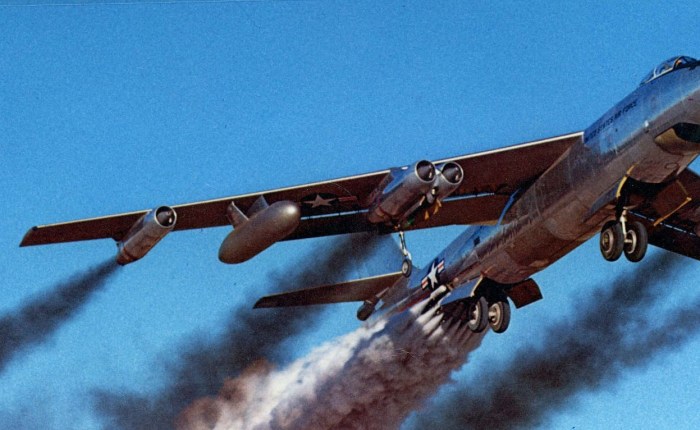


 From Balloons to Drones