As I have mentioned here, my current research is focused on the culture of the Royal Australian Air Force (RAAF) and how this has affected the Service’s effectiveness, ability to adapt to changing geostrategic challenges and its place within Australia’s broader strategic culture and national security framework. As such, this research has implications for discussions bridging several disciplines, including history, military sociology, and strategic studies. One of the critical research questions I am examining is what have been the key influences on the developing culture of the RAAF. While one source of RAAF culture is the values and beliefs that service members bring to the organisation, another is the Air Force’s relationship with other air forces. This importance of such relationships is especially significant for small air forces, such as the RAAF, who maintain close relationships with larger air forces, such as the RAF. Indeed, if we think about the organisations that have influenced the culture of the RAAF, key within Australia is, of course, the Australian Army and Royal Australian Navy. The former is especially important because of the experience of the Australian Flying Corps (AFC) during the First World War. However, further afield significant influences have been the RAF, the United States Air Force, and the US Navy. The latter two are important because they represent the shift in Australia’s geostrategic relationships after 1942. Their significance is best represented in the platform choices the RAAF has made since the 1960s. Broadly speaking, the RAAF shifted from British designs to US ones, though there was also the Dassault Mirage IIIO. The relationship between technology and culture is a post for another time.
In terms of air forces, it is the RAF that has influenced the RAAF the most. Even to this day, the materialist influence of the RAF can be seen in cultural artefacts such as ranks. As such, the emergence of a distinct culture for the RAF in the inter-war period had implications for that service and those that emerged in the Dominions. Indeed, at the 1923 Imperial Conference, it was expected that ‘the development of Air Forces in several countries of the Empire’ would be along the lines of uniform training and doctrine, which essentially meant those of the RAF.[1] This illustrates both an imperial and transnational dimension to the impact of the RAF’s cultural practises that require greater exploration. Indeed, the RAF itself remained imperial in composition in the inter-war period with officers from the Dominions, such as the future Air Marshal Sir Arthur Longmore, serving in the Air Force. Moreover, while the RAAF had the example of the AFC on which to build an identity, it still looked to the RAF for guidance both for ideas about the employment of air power and character. AP1300, the RAF’s War Manual, would eventually be adopted as the RAAF’s formal doctrine in the 1950s despite the unsuitability of certain sections of this publication for the Australian context, especially the fourth edition’s discussion of nuclear weapons.[2] Indeed, Alan Stephens’ work on RAAF doctrine, Power Plus Attitude, is perhaps the closest we have come to a history of RAAF culture. This is because doctrine points to key values and beliefs of an organisation and its views about the employment of force. Regarding cultural artefacts, the diffusion of RAF culture along imperial lines is evident in areas such as ranks and mottos. Moreover, King George V acquiesced to the title ‘Royal’ being conferred on the Australian Air Force when it was formed.[3] Furthermore, several officers who would go on to senior roles in the RAAF during the Second World War were educated at the RAF Staff College at Andover, where they were immersed in the ideas and culture of the RAF, including British doctrine, AP1300. Finally, RAF officers were regularly sent to Australia to advise on air matters, though, as in the case of the visit of Marshal of the RAF Sir Edward Ellington in 1938, this could create friction.[4]
This latter issue raises questions that help us open up the black box of culture. Principally, was the culture and ethos of the RAF a pervasive influence on the RAAF? Did it help or hinder the development of the RAAF? Were there better options? As the power of RAF culture has reduced, what has taken its place and has this affected how the RAAF views itself and behaves?
Dr Ross Mahoney is an independent historian and defence specialist based in Australia. He is the Editor of From Balloons to Drones. Between 2013 and 2017, he was the resident Historian at the Royal Air Force Museum, and he is a graduate of the University of Birmingham (MPhil and PhD) and the University of Wolverhampton (PGCE and BA). His research interests include the history of war in the twentieth and twenty-first centuries, air power and the history of air warfare, and the social and cultural history of armed forces. He has published several chapters and articles, edited two books, and delivered papers on three continents. He is a member of the Royal Historical Society and is an Assistant Director of the Second World War Research Group. He is a member of the Royal Historical Society and an Assistant Director of the Second World War Research Group. He blogs at Thoughts on Military History, and can be found on Twitter at @airpowerhistory.
Header Image: From left – a RAAF C-130J Hercules lands at Nellis Air Force Base during Exercise Red Flag 17-1. Visible in the background are a pair of USAF B-1B Lancer bombers; an RAF Sentinel R.1 surveillance aircraft; and an RAF C-130J Hercules transport aircraft. (Source: Australian Department of Defence)
[1] TNA, AIR 8/69, Cmd 1987, Imperial Conference, 1923: Summary of Proceedings (1923), pp. 16-7.
[2] Alan Stephens, Power Plus Attitude: Ideas, Strategy and Doctrine in the Royal Australian Air Force, 1921-1991 (Canberra: Australian Government Publishing Service, 1992), pp. 136-8.
[3] NAA, A705, 4/10/30, Australian Air Force – establishment and development and the title “Royal” for AAF, 1921-22.
[4] C.D. Coulthard-Clark, ‘“A Damnable Thing”: The 1938 Ellington Report and the Sacking of Australia’s Chief of the Air Staff,’ The Journal of Military History, 54:3 (1990), pp. 307-23.
Jonathan Bailey wrote that the First World War was the time of a true revolution in military affairs about the development of artillery firing.[2] One of the first significant developments that took place was the creation and refinement of the ‘clock code’ system.[3] Using this system, a pilot of the Royal Flying Corps, the forerunner to the Royal Air Force (RAF), was able to correct the fall of shot of the artillery by passing to the artillery battery commander details of how far from the target the guns were. The pilot would correct the shooting of the artillery by pointing out how far away and in what direction the shells of the guns had landed. The distance would be passed on using numbers and the direction using the picture of a clock face. The target was placed in the middle of the clock face and shells that fell beyond the target and on a straight line to the target would be corrected with a call of twelve, if it fell short on the same line the call would be six, at ninety degrees left of the target nine and ninety degrees right three. Any other direction would be corrected by using the hour on the clock with which it corresponded. This system would prove to function perfectly well throughout the whole of the First World War and was the system with which the RAF went to war in 1939.
The system of correcting artillery fire remained unchanged until 1938. The Air Council were against making alterations to the clock code system as they felt that it was adequate to meet the needs that the army would face in future conflicts. They felt that light aircraft could not be kept in action close to artillery units, as had been the case in the First World War.[4] The Air Council were also fearful of introducing a new, untried, and unfamiliar system with the growing tensions in Europe at this time. The War Office was unimpressed with the Air Councils attitude and pushed for more to be done. The Air Ministry agreed to trials between the Air Officer Commanding No. 22 (Army Co-operation) Group and the Commandant of the School of Artillery in December 1938.[5] The results of these trials and further trials conducted to test aircraft as well as procedure. The results were that light aircraft over the battlefield could observe fire with the ‘clock code’ system.[6] Spitfires conducted mock attacks on the aircraft and the Taylorcraft light aircraft observing the artillery fire had a good chance of dodging the fire of a modern fighter.[7] There was, however, no training for pilots in registering targets for the artillery. If an artillery officer required an appraisal of a prospective target, the request would have to be sent along the command chain via an air liaison officer. When the artillery battery received the information, it was usually out of date.[8] There was also pressure from within the War Office to establish a Flying Observation Post (Flying OP) and to begin plans to train Gunner Officers to fly. A Flying OP was to work in conjunction with Ground Observation Post (Ground OP) in establishing targets to be engaged and operating deep behind their lines to be afforded the protection of friendly anti-aircraft guns.
The first of these Flying OPs was established in February 1940.[9] This force was established to:
[d]etermine in the light of practical experience obtained under war conditions the possibilities and limitations of the Flying OP, the most suitable type of aircraft and the most suitable organization [sic].[10]
The tests were to be conducted in three parts. The first was an initial training period. The second a practical training with the French, and a final test in the French Army area in conditions of actual warfare including shoots against German targets it was at this time that the term Air Observation Post (Air OP) was adopted.[11] The flight was sent to France on 19 April 1940.[12] The first of the three tests were conducted after the flight had moved to the continent. The final of the three tests was due to be carried out in early May, and the forces were established ready to conduct the tests on 9 May 1940.[13] The following day the Germans began to implement Fall Gelb (Case Yellow): the invasion of France and the Low Countries.[14] The artillery designated for the tests were forced to move back to their formations leaving the Air OP Flight (D Flight) waiting for the campaign to stabilise when it was clear that this would not happen D Flight was recalled to England.[15]
One of the first official moves at changing artillery co-operation policy was a letter regarding the subject sent from the Director of Military Co-operation Air Commodore Victor Goddard to Barratt at Army Co-operation Command. In this letter, Goddard states that the Air Staff were against the formation of:
[s]pecial air units for artillery observation or reconnaissance, unless it can be clearly shown that there is an urgent requirement for such units which cannot be met by Army Co-operations squadrons.[16]
The School of Artillery recommended that a certain number of aircraft should specialise in artillery work and should be trained by the School of Artillery so that they had the same tactical knowledge and the same the understanding of gunnery as an artillery officer.[17] This was just one aspect of an idea by the School of Artillery to allow aircraft to have tactical control over the fire of artillery batteries. To facilitate this, the school further recommended that a multi-seater aircraft should be employed in this work to allow an artillery officer to conduct the shoot according to artillery methods without the need for the artillery officer learning to fly. Artillery officers were also to be seconded to army co-operation squadrons specifically for artillery work.[18] The co-operation between the School of Artillery and Army Co-operation Command is evident and is surprising given the general relations that existed between the army and RAF in the wake of the Battle of France and the fall out that it had caused between the two services.[19]
Barratt, in a letter to the Under-Secretary of State for Air, wrote that:
I consider that in order to get a true and undistorted picture of this problem, it is first desirable to set out the problem as the Army [sic] sees it, and to show in this picture what they conceive to be their requirements.[20]
Again the desire to see the problem from a view that would almost certainly be contradictory to the RAF shows that Barratt and his command were willing to adopt a different approach and attitude in co-operating with at least one part of the army. Barratt also voiced his concerns regarding the ability of the Air OP to operate in the face of enemy action. It was felt that ‘the Air OP must be entirely vulnerable to any enemy fighters which cares to shoot it down’.[21] Barratt’s concern over the safety of his pilots who may be conducting shoots using the Air OP system was to be a recurring issue in the development of artillery reconnaissance.
Barratt’s response to the trials was one of scepticism, and he considered ‘that body of experience gained in the late war and since has all pointed to the advantages of the ‘Clock Code’ system’.[22] Barratt’s belief in the ‘clock code’ system stemmed more from the fear of false conclusions being drawn from brief experiments than from any sense of conservatism about changing the system used for artillery reconnaissance.[23] This became a realisation when Barratt was forced to explain to the Under Secretary of State for Air about the lack of efficiency regarding artillery co-operation in Army Co-operation Squadrons. Barratt wrote that:
I feel that much of the falling off in efficiency in this part of the Army Co-operation Squadron task has been due to the propagation of rumour as to other and better methods than those shown in AP 1176.[24]
Further trials were conducted using the artillery method during April 1941, and the conclusions reached were similar to those seen previously. These were that the artillery methods of ranging by corrections to line and range are simpler, quicker, and more efficient than any method based on the ‘clock code’.
The failures of the ‘clock code’ system in France combined with further problems faced in the fighting in Libya led to a loss of confidence in the system in the army.[25] Barratt responded that the ‘clock code’ system was not at fault in these operations but that the aircraft employed in it were operating in the face of intense enemy opposition. He was concerned that the trials had been too few and were skewed in favour of a positive result by the School of Artillery.[26] While these concerns may be interpreted as merely blocking a new development that had been shown to work to preserve the autonomy of the RAF while conducting army co-operation work. The evidence of co-operation between Army Co-operation Command and the School of Artillery, shown above, leads more to the conclusion that Barratt felt that the procedure could not be successfully carried out, and wished to see more trials conducted before it would receive his approval.
The procedure for artillery reconnaissance first developed during the First World War was only suitable for the conditions of that war. The lack of fluidity and almost stable front lines allowed a system to develop, quickly, this system, however, was only suited to those conditions. This was very quickly discovered during the first major test of this procedure against the quicker and more mobile warfare of the German Wehrmacht in 1940. The attitudes of both the British Army and the RAF to co-operation during the inter-war period, in Britain at least, did little to improve the situation before the British Expeditionary Force was stationed in France. This left those charged with the responsibility of modifying the existing procedure with only the experience of the First World War to guide them and on which to base their expectations. Much co-operation between the School of Artillery and Nos. 70 and 71 Groups of Army Co-operation Command occurred, despite the general feeling of animosity still felt by both services in Britain.[27] This co-operation was the most that had been seen between the army and RAF since the formation of the RAF as an independent force in 1918. Barratt’s move to block the adoption of the new procedure that was being trialled during 1941 can be interpreted in several ways. His reasoning for doing so, however, appears to be that of confirming the results already achieved through more rigorous and testing trials to confirm the results. Through further testing at a higher level the procedure, as well as those responsible for carrying it out, would be exposed to more stress and so a greater degree of authenticity could be achieved. Trials of this nature would also confirm if the procedure could be implemented with ease by the majority of pilots whose responsibility would be increased from observing the fall of shot to conducting shoots, potentially in the face of enemy opposition. Barratt’s major concern with the new system appears to be its increased complexity, and he was rightly concerned after his experiences in France that pilots would be unable to conduct the shoot if they had to keep a lookout for enemy fighter activity continually.
Dr Matthew Powell is a Teaching Fellow at Portsmouth Business School at the Royal Air Force College, Cranwell. He holds a PhD in Modern History from the University of Birmingham. His thesis investigated the development of tactical air power in Britain during the Second World War through a study of the RAF’s Army Co-operation Command. His first book, based on the PhD, The Development of British Tactical Air Power, 1940-1943: A History of Army Co-operation Command was published in 2016 by Palgrave Macmillan. He has also published in Canadian Military History, Air Power Review and the British Journal for Military History. He is currently researching the relationship between the British aviation industry and the Air Ministry during the inter-war period. He can be found on Twitter at @tac_air_power.
[1] A longer version of this article can be found in Canadian Military History, 23:1 (2014), pp. 71-88.
[2] Jonathan Bailey, ‘Deep Battle 1914-1941: The Birth of the Modern Style of War,’ Field Artillery Journal, (1998), pp. 21-7.
[3] Ralph Barker, A Brief History of the Royal Flying Corps in World War I (London: Constable & Co., 2002), p. 63.
[4] H.J. Parham and E.M.G. Belfield, Unarmed into Battle: The Story of the Air Observation Post, Second Edition (Chippenham: Picton Publishing, 1986), p.14.
[8] Darrell Knight, Artillery Flyers at War: A History of the 664, 665, and 666 ‘Air Observation Post’ Squadrons of the Royal Canadian Air Force (Bennington, VT: Merriam Press, 2010), p. 27.
[9] Parham and Belfield, Unarmed into Battle, p.15.
[14] Karl-Heinz Freiser, The Blitzkrieg Legend: The 1940 Campaign in the West (Annapolis, MD: Naval Institute Press, 2005), p. 79.
[15] Parham and Belfield, Unarmed into Battle, 16.
[16] The National Archives (TNA), AIR 39/47, Letter from Air Commodore Goddard, Director of Military Co-operation to Barratt regarding Artillery Co-operation Policy, 8 December 1940.
[24]Ibid., Letter from Barratt to Under Secretary of State for Air, 14 April 1941.
[25]Ibid., Letter from CGS on Artillery Reconnaissance, 5 May 1941.
[26]Ibid., Letter from Barratt to Major-General Otto Lund, GHQ Home Forces, in response from letter from CGS on Artillery Reconnaissance, 10 May 1941.
[27] For example, see: David Ian Hall, Strategy for Victory: The Development of British Tactical Air Power, 1919-1943 (Westport, CT: Praeger, 2008), pp. 89-103.
In the most recent work to focus exclusively on air power combat operations, Colonel John Andreas Olsen of the Royal Norwegian Air Force and a visiting professor at the Swedish Defence University in Stockholm, presents a thoroughly researched, persuasive, and insightful work on the study of air power that ranges from large-scale state-on-state actions to the more abundant (some might say most likely) asymmetric fights of the late Twentieth and early Twenty-First Century. Olsen’s name should be more than familiar to anyone with a passing interest in the history of air power. He is the author/editor of numerous works including John Warden and the Renaissance of American Air Power, A History of Air Warfare, Airpower Reborn, Air Commanders, European Air Power, and Global Air Power. Aside from his prolific output, Olsen also has the ability to bring together the most respected names in air power studies to provide chapters in his edited works. The same is true for his latest book, Airpower Applied: U.S., NATO, and Israeli Combat Experience. The purpose of the book, as the title suggests, is to provide a valuation of the American, NATO, and Israeli combat experience from World War II to present campaigns. It is broken into five chapters that cover a total of twenty-nine separate air campaigns or operations. Olsen’s thesis is that ‘knowledge of operational history helps political leaders and military professionals to make better-informed decisions about the use of force.’ Thus, this work is not about ‘lessons learned’ as much as it is a learning tool used to provoke thought and create questions amongst professionals.
Richard Hallion provides the first chapter on ‘America as a Military Aerospace Nation: From Pearl Harbor to Desert Storm.’ Hallion admits that much of America’s advancement during the Cold War was owed to ‘emulation and innovation [rather] than to invention.’ That being said, American air power has moved to the forefront of technology, invention, innovation, and execution in the post-Vietnam era leading up to the dramatic successes of air power during the First Gulf War. Before this Hallion covers many previous aerial campaigns, whose success and failures led to the triumph of Operation DESERT STORM: The Second World War, the Berlin Airlift, Korea, Vietnam, ELDORADO CANYON and JUST CAUSE. Hallion’s contribution here is the best single chapter on the history of American air power from the Second World War to DESERT STORM. However, he, unfortunately, omits any discussion of the failings of Operation EAGLE CLAW, missing an opportunity to discuss the genesis of true air power jointness; this might be forgiven considering that most consider EAGLE CLAW a Special Forces operation with little to do with actual air power. Hallion also misses the mark on his discussion about the use of the F-117 in its combat debut during the operation in Panama. Hallion states ‘The F-117 strike at Rio Hato […] succeeded in stunning the PDF [Panamanian Defense Forces] defenders.’ This, however, is disputed by the Joint History Office’s report on operation JUST CAUSE which stated that ‘[D]espite radio broadcasts and the use of F-117As and other weapons to stun and intimidate them, most PDF units fought harder than expected before surrendering or fleeing.’[1]
Hallion’s belief in the efficacy of air power is apparent when he states that ‘In the gulf it took one bomb or one missile’ to destroy a target (p. 93). This is an oversimplification and poses a danger to those who would believe it. This view of air power as scalpel needs to be tempered. Bombs and missiles miss and many targets in Iraq had to be repeatedly attacked. There is an oft-repeated axiom that they are called missiles and not hittles for a reason. That being said, Hallion’s chapter represents a concise and persuasive argument detailing just why America has become the eminent air power nation in the Twentieth and Twenty-First Centuries and transitions nicely into the next chapter on air power since DESERT STORM.
A US Air Force B-2 Spirit stealth bomber refuels from a KC-135 Stratotanker on April 6, 1999, during an air strike mission in support of NATO Operation ALLIED FORCE. (Source: Wikimedia)
Benjamin Lambeth provides the second chapter on ‘American and NATO Airpower Applied: From Deny Flight to Inherent Resolve.’ Lambeth demonstrates that air power in ALLIED FORCE was a ‘textbook illustration of airpower in action not to “win a war” but rather to achieve a discrete and important campaign goal short of full-fledged war’ (p. 133). However, when looked at through Hallion’s view of ROLLING THUNDER as a ‘naïve intent,’ there arises an internal inconsistency in the application of air power to achieve limited ends, something that all scholars of air power still struggle to contend with (p. 53). It seems that when air power is used for a limited goal and ‘works,’ air power scholars tend to use it as a good example and when it is used towards a limited end and fails, i.e. ROLLING THUNDER, we use that as an example of why air power should not be used towards limited ends.
Lambeth goes one bridge too far in his admittedly unfinished assessment, of the role of air power in attacking ISIS in Operation INHERENT RESOLVE. Readers in 2017 have something Lambeth did not have when he penned his chapter in 2014/2015, namely three more years of data, which seem to finally indicate that the tide against ISIS has turned and that coalition air power with the support of Iraqi and other forces on the ground have driven ISIS out of the sanctuary cities of Raqqa, Sirte, and Mosul. These campaigns, as part of the most precise air campaign in history, and while limiting civilian casualties, took time. Ironically, nearly precisely the amount of time called for by government officials in 2014 that Lambeth decried in his chapter.
The book shifts its focus here away from the NATO and American experience to two chapters on Israeli Air Force (IAF) combat operations. First, Alan Stephens writes ‘Modeling Airpower: The Arab-Israeli Wars of the Twentieth Century’ detailing the First Arab-Israeli War to the First Lebanon War in 1982. Stephens provides balance by indicating upfront that these conflicts were not only about survival for the country of Israel but the displaced Palestinians as well. Focusing more on the air power side of the conflict, Stephens asks upfront, ‘Why were the Israelis so good and the Arabs so bad?’ The answer soon becomes clear, ‘airpower is very expensive’ (p. 274). Israel exploited an ‘educated workforce, rigorous standards, advanced technology and […] exemplary training’ (p. 276). Arab air forces did not, as history, economics, and culture hindered them.
Raphael Rudnik’s and Ephraim Segoli’s next chapter, ‘The Israeli Air Force and Asymmetric Conflicts, 1982-2014,’ looks at the myriad of smaller conflicts Israel has fought since 1982. The chapter also provides linkages to conflicts Lambeth discussed, thus linking the American, NATO, and Israeli conflicts into an overarching air power learning environment. In other words, those who execute air power struggle with the same problems. Namely, as Rudnik and Segoli stated when discussing Israeli air strikes against Hezbollah, ‘[T]he large gap between its [the IAF] improved assault capabilities and its ability to identify viable targets’ in conflicts where an expressed desire of governments is minimising civilian casualties against increasingly urban enemies (p. 294). This highlights the difficulties faced by the IAF and the USAF, namely the need to prepare for ‘traditional’ air force missions versus the asymmetric conflicts of the 21st Century.
A pair of U.S. Marine Corps AV-8B Harriers fly over Iraq at sunset during a mission in support of Operation IRAQ FREEDOM, c. 2004. (Source: Wikimedia)
Colonel John Warden provides a final chapter that looks at ‘The Airpower Profession.’ From a certain point of view, Warden still seems to be litigating his arguments from the First Gulf War by focusing not on fielded forces, but rather on parallel warfare against the five rings, which can also be found in his work, The Air Campaign. Warden also decries the ‘cult of jointness’ (p. 343) and believes that ‘surface officers have far less motivation to concern themselves with direct strategic effects than do air professionals’ (p. 346). Warden’s real value is added when he describes the many areas needed to be understood truly by air power professionals, but more importantly, the attendant ability to articulate the importance of air power. So, what does the education of an air power professional look like? Warden casts a wide net of topics worthy of study including classical and modern military history and strategy but also includes more nuanced fields including economics, secular and religious philosophy, fiction, marketing, and advertising.
Any disagreements this author might have over omissions or discrepancies with this work are relatively minor to the overall importance and continued relevance of this well-written, eloquently argued, and nuanced study of air power operations. If one aspect of air power becomes clear, it is that the U.S., NATO, and Israel have proven their ability in large-scale state-on-state conflict, but the ability to use air power in the asymmetric fight is still being argued, some might say conceived. What is needed is more discussion and a better understanding by those in the military and national security communities on the merits and limits of air power operations in what will only become a more contested environment in the future. From the integration of unmanned aerial vehicles to peer-on-peer conflict, aerial operations will only increase, and a deep understanding of what air power can and cannot provide can only be accomplished through continued works like Airpower Applied.
Dr Brian Laslie is an Air Force Historian and currently the Deputy Command Historian at North American Aerospace Defense Command (NORAD) and United States Northern Command (USNORTHCOM). A 2001 graduate of The Citadel and a historian of air power studies, he received his Masters’ from Auburn University Montgomery in 2006 and his PhD from Kansas State University in 2013. His first book The Air Force Way of War (2015) was selected for the Chief of Staff of the Air Force’s 2016 professional reading list. He lives in Colorado Springs. He can be found on Twitter at @BrianLaslie.
Header Image: A two-ship of Israeli Air Force F-16s from Ramon Air Base, Israel, head out to the Nevada Test and Training Range, July 17 during Red Flag Exercise 09-4, c. 2009. (Source: Wikimedia)
[1] Ronald H. Cole, Operation Just Cause: The Planning and Execution of Joint Operations in Panama, February 1988-January 1990 (Joint History Office, Office of the Chairman of the Joint Chiefs of Staff: Washington, D.C., 1995), p. 41
President Trump’s recent move to elevate the United States Cyber Command (CYBERCOM) to full ‘combatant’ status has given us in the United Kingdom an opportunity to refresh and revitalise our own cyber fielded forces. In the official statement launching CYBERCOM, Trump said:
[this] elevation will also help streamline command and control of time-sensitive cyberspace operations by consolidating them under a single commander.
At the moment UK cyber forces are not organised in a manner that enables us similar streamlined command and control and effective deployment of our cyber assets. Not helping the discussion is the lack of transparency around UK cyber capabilities. Former Defence Secretary Phillip Hammond made international headlines in 2013 by announcing that the UK was developing an offensive cyber capability. Other than this declaration, there is minimal public scrutiny or even awareness of our capabilities. The fact that this announcement was so note-worthy also highlights the dearth of public discussion on cyber warfare.
The UK Ministry of Defence (MoD) has released a Joint Doctrine Publication known as the Cyber Primer, which provides an excellent high-level overview of cyber opportunities and vulnerabilities in the military context but no real substance as to the order of battle of UK forces. With the recognition of cyber as a separate but underpinning domain of warfare as shown in this excellent article, perhaps it is time to re-organise the UK’s forces in a similar way to our US allies. Taking a step further to create a ‘purple’ force of offensive and defensive specialists along with a re- invigorated electronic warfare cadre would demonstrate real innovation in an arena where competition is fierce, rules are unclear and technology advances at a breath taking pace.
Why do we need a separate cyber force? Modern platforms such as Typhoon, A400M, AJAX and the Queen Elizabeth Class aircraft carriers are highly dependent on the cyber domain to fulfil their basic functionalities as well as gain a technological edge on our adversaries. Where the air force provides control of the air and the navy provides control of the sea, so too we must have ‘cyber control’ delivered by a force of experts and specialists. The Cyber Primer states that we must be able to operate as freely in this domain as we do in the other physical ones; therefore we need to create a separate branch of the armed forces with the innate “cyber-mindedness” to exploit this new battlespace. For someone with Royal Air Force leadership experience, this feels like 1916-18 all over again. Back then we had discovered another new realm of warfare, the air, and argument was fierce as to who would be responsible for aerial battle.
The UK led the world in the creation of an independent air arm. Now, 100 years on, we are presented with another opportunity to lead and innovate.
What would an integrated Cyber Force look like? Currently, the bulk of UK Cyber capabilities fall under Joint Force Command, similar to how US cyber forces used to fall under Strategic Command. There are also discrete units within each of the single services, such as No. 591 Signals Unit, the Fleet Electronic Warfare Group and 14 Signals Regiment. We could break out these units as well as the Joint CEMA Group, the operators, and Information Systems and Services, responsible for enabling those capabilities, into a separate ‘Royal Cyber Force’ commanded by a 3 or 4 Star officer.
The challenges of this radical change would be significant. Trades with these specialisations are under manned and in high demand from civilian industry. Institutional inertia and the ‘old guard’ would be hard to win over. However, there exists a motivated and committed cadre of personnel with the UK MoD who, given this challenge, could and would rise to the occasion. In conclusion, our allies and adversaries are innovating at pace in the cyber domain. In order to keep up, the UK must make a significant change to the way it conducts cyber operations. A Royal Cyber Force would be a substantial first step.
Editorial Note: In the third instalment of ‘Air War Books,’ Dr Michael Molkentin discusses the ten books that have influenced and shaped his writing as an air power historian. If you are interested in contributing to this series or From Balloons to Drones more generally, find out how here.
After I wrote to Dr Ross Mahoney enthusiastically agreeing with several of his choices (always a bad idea!) and suggesting a few others, he promptly invited me to contribute my own ‘Top 10’. I had been saying I would write something for Balloons to Drones for a while and so now he had me cornered. What follows is a list of titles that have had a significant impact on the way I research and write aviation and air power history. As these titles clearly indicate, my area of interest primarily concerns the pre-Second World War period (military and civil) and the people and ideas, rather than the technology, of aviation.
Denis Winter, The First of the Few: Fighter Pilots of the First World War(London: Allen Lane, 1982). Denis, unfortunately, went on to write a scandalously bad book on Haig that damaged his reputation as a historian. But before that, he produced a couple of genuinely very good ‘face of battle’ type histories of British servicemen in the Great War (the other being Death’s Men). I found The First of the Few in my high school library and later used it as a model for writing my honours thesis on Australian airmen in the Great War. It is a bit dated, relies almost entirely on published accounts and some of Winter’s statistics do not stand up to scrutiny. But it is what got me interested in the subject and stands as the best personal experience study of British airmen in the Great War. I had the pleasure of meeting Denis in Canberra in 2004. He was a kind and gracious man and, when I showed him my work, he encouraged me to keep writing.
Richard P. Hallion, Taking Flight: Inventing the Aerial Age, from Antiquity Through the First World War (New York: Oxford University Press, 2003). I might have included any of Richard’s numerous books on air power (Strike from the Sky, his history of ground attack is a close second) but this has probably been most useful and influential in my work. It is a model of highly readable, yet meticulously researched history. It is international in scope and provides some valuable analysis of the complex ways in which aviation emerged as a practical reality, in various parts of the world, before 1914.
S.F. Wise, The Official History of the Royal Canadian Air Force, Volume 1: Canadian Airmen and the First World War(Toronto: University of Toronto Press, 1980). Wise’s first volume of the Royal Canadian Air Force’s official history is, in my view, the best single volume history of British air power in the Great War. The ubiquity of Canadians in the British flying services (over 20,000 served) means that Wise needed to cover all aspects of air power in the conflict – maritime aviation, strategic bombing and home defence, army cooperation and even some brief surveys of the RFC/RAF in secondary theatres. While some of his conclusions about the conduct of the war on the Western Front have dated, in the main his conclusions stand and are thoroughly grounded in archival sources. My PhD thesis and the book that followed it used Wise’s book as a model to examine Australia’s part in the air war from political, strategic, operational and tactical perspectives.
E.R. Hooton, War over the Trenches: Air Power and the Western Front Campaigns 1916-1918 (Hersham: Midland Publishing, 2010). I have mixed feelings about his book. On the one hand, it makes a significant contribution to our understanding of air power on the Western Front by conducting a multi-force (French, German and British) analysis at the operational level- something nobody had previously attempted. Whereas previous studies of the subject have focused on the tactical level, Hooton uses a mass of statistical data (sorties flown, ordnance expended, losses, serviceability, etc.) to provide a much broader picture of how air power influenced the conflict and how its use evolved between 1916 and 1918. Unfortunately, the book is poorly written and (in the first edition at least) so badly type set that some of the data tables are almost unreadable. It is such an important contribution to the field: I only hope the publisher has the good sense to reissue a revised edition or that an aspiring PhD candidate will take his approach further.
John Buckley, Air Power in the Age of Total War(London: UCL Press, 1999). I am going to go with Ross here and say that, among the many air power surveys out there, this one is the best. It is clear, concise and, essentially for a book like this, gets the balance right between ideas and details. Giving his narrative cohesion is a compelling, convincing and delightfully ironic thesis: that total war first enabled air power but then, following the onset of the nuclear age, limited its functions.
Philip S. Meilinger, The Paths of Heaven: The Evolution of Airpower Theory(Maxwell AFB, AL: Air University Press, 1977). Besides Buckley, the other book I recommend students starting out in the field is Meilinger’s survey of air power thinking. It is a straightforward, textbook approach devoting a chapter to each of the twentieth century’s most influential air power theorists. It is not exactly a page turner but is absolutely essential reading for students of air power and a useful reference work to have within arm’s reach when writing.
Malcolm Cooper, The Birth of Independent Air Power: British Air Policy in the First World War (London: Allen and Unwin, 1986). Malcolm was one of the first scholars to use the Air Ministry’s declassified files after their transfer to the British National Archives (then the PRO) during his PhD candidature during the 1970s. Whereas accounts of British air power’s early days had, until then, been overwhelmingly focused at the tactical level (individual pilots, squadrons, Biggles, etc.), The Birth of Independent Air Power focuses on the topic at the political and policy-making levels. I do not agree with Malcolm’s conclusion that the Army’s use of air power was wasteful and unimaginative (neither does James Pugh in his excellent new book which provides a good update on aspects of Cooper) but much of what he says was vital in adding political context to the operational history of British air power from 1914 to 1918.
Alfred Gollin, The Impact of Air Power on the British People and their Government (Stanford, CA: Stanford University Press, 1989). I would give this to students not even interested in air power as a somewhat rare example of an academic historian writing in a clear, engaging style. Honestly, it reads like a novel but still manages to seamlessly incorporate excellent analysis. Gollin was an enormously talented historian and a shining example to those of us who actually want our work to have a readership beyond the academy and services.
John A. Lynn, Battle: A History of Combat and Culture (Boulder, CO: Westview Press, 2003). Lynn does not really deal with aviation or air power explicitly, but his approach to explaining warfare through the prism of culture is both novel and enlightening. In case study chapters ranging from Ancient Greek warfare to modern Islamic terrorism, Lynn demonstrates convincingly that we cannot properly understand military operations without considering the cultures that conceive and wage them.
Ian Mackersey, Smithy: The Life of Sir Charles Kingsford Smith (London: Little Brown, 1998). This is not only the best of the many biographies of Kingsford Smith; it is the best example of historical biography I have come across. Through impressively dogged detective work, Mackersey managed to track down a number of people who had known Kingsford Smith before his death six decades earlier. From them, he got oral history and private papers that shed light on hitherto unknown or mythologised aspects of his subject’s life. Ian wrote a page turner too: it is engaging, absorbing history. Ian, who sadly died a couple of years ago, was also a gentleman. When I was writing my book on the 1928 trans-Pacific flight, he generously shared manuscript material he had gathered from private collections in the US when researching his book.
Dr Michael Molkentin is an adjunct lecturer at the University of New South Wales and a teacher at Shellharbour Anglican College. He has a first-class Honours degree from the University of Wollongong and a PhD in History from the University of New South Wales. In 2014, the Australian War Memorial awarded Michael’s doctoral research the Bryan Gandevia Prize for Australian Military History. He specialises in the history of armed conflict with an emphasis on warfare in the British world and the development of air power. Michael has written three books, the most recent being Australia and the War in the Air(OUP, 2014).
Editor’s Note: In this two-part article, Dr Jyri Raitasalo considers what he argues are the two fundamental fallacies concerning the application of strategic air power by Western states in the modern era. In the first part, he examined the challenge of the use of military forces as a tool for solving political problems. In this second part, he examines the issue of ‘no casualty warfare.’
Fallacy 2: No casualty warfare
The second fallacy in Western air power paradigm touches on the notion of precision engagement with almost zero civilian casualties and no collateral damage. This narrative was formed in the aftermath of the 1991 Gulf War and has been maturing and strengthening ever since. Precision engagement has indeed become one of the game changers in warfare lately, but the Western narrative on pinpoint accuracy in warfare has become a strategic level hindrance to effective military operations.
The notion of no or little collateral damage developed into the Western air power paradigm little by little as political leaders since the early 1990s continuously decided to use military force actively for humanitarian purposes. It was a prerequisite that Western military operations do not cause civilian suffering or produce collateral damage in military operations (read: war) that are eventually humanitarian in nature. Focusing on the precise application of large-scale violence was thus a must for political purposes. It was needed for the legitimacy of these operations and to ‘sell’ these operations to domestic audiences within the Western world and internationally.
Combined Air and Space Operations Center at Al Udeid Air Base, Qatar, provides command and control of air power throughout Iraq, Syria, Afghanistan, and 17 other nations. The CAOC is comprised of a joint and Coalition team that executes day-to-day combined air and space operations and provides rapid reaction, positive control, coordination, and de-confliction of weapon systems. (Source: US Department of Defense via Wikimedia)
Also, as these humanitarian military missions had almost nothing to do with Western national interests or threats to Western states, it has been crystal clear from the start that force protection has been essential in these operations. Over time this has developed into a tradition of casualty-aversiveness, making Western soldiers ‘strategic assets’. Air power has facilitated safe military operations as practically all opponents during the post-Cold War era have had no functioning air forces of capable air defences. Relying on air power to fight humanitarian wars has been practically the only way that these operations have become possible in the first place. As President Bill Clinton explained: ‘I do not intend to put our troops in Kosovo to fight a war’. For the US the post-9/11 Global War on Terror changed this aversiveness to send troops to battle for a while.
What started as a way to ‘market’ humanitarian missions to voters and the general population has turned into a Western narrative on war, which accentuates the ability to strictly control the ‘dosing’ of violence in wars and being able to fight without civilian casualties and collateral damage. During the post-Cold War era, this guiding political principle and a semi-binding Western norm on warfare have led to Western militaries developing extremely expensive military systems to fight this ‘frictionless precision warfare’. This trend has been tremendously problematic for European states, as they in most cases do not have sufficient economic resources to develop their armed forces into credible military actors with even a modest number of usable high-tech military systems. When combining this trend with the post-Cold War era professionalisation of European militaries, most states in Europe today possess ‘Lilliputian militaries’ with little warfighting capability for large-scale conventional war against advanced state adversaries.
Final thoughts
Air power is important in warfare. Moreover, modern high-tech air forces can produce a decisive effect on the battlefield when used properly. ‘Unfortunately’ for some Western (mostly European) militaries, the post-Cold War era did not for more than 20 years pose any real military challenges that would have required sober analysis on what kind of missions the armed forces should be preparing against. Moreover, more importantly, as the existential threat evaporated quickly in the early 1990s, many Western political leaders filled the vacuum of security threats by turning their eyes towards out-of-area conflicts and stability throughout the globalising world.
In a cumulative 20-year long emergent process, Western states have become more and more interested in and reliant on applying air power actively in expeditionary operations because using military force throughout the international system has become possible. Political leader’s ‘trigger happiness’ in the West has increased during the post-Cold War era. On the tactical and operational levels of war, air power offers ‘easy solutions’ when there is the need to do something quickly and visibly – for example during large-scale atrocities committed by authoritarian leaders towards their citizen. On the strategic level, though, the results have been much more modest. Modern air power has not lifted the ‘fog of war’, nor has it produced many positive strategic results. Air power does not provide Western states with a ‘silver bullet’, nor has it changed the nature of war: war is still a duel of wills, which means that adaptive enemies will do their utmost to destabilise Western strengths and lead in military capability development. This can be done at the tactical, operational or strategic levels.
A USAF F-15E Strike Eagle takes off from Aviano Air Base, Italy, for an air strike mission in support of NATO Operation ALLIED FORCE on March 28, 1999. (Source: US Department of Defense via Wikimedia)
The use of large-scale military violence – waging war – needs to be taken seriously. Even if it is possible to cause pinpoint destruction and make targeted killings, one should remember that political problems can rarely be solved by killing all the opponents (from afar) or by punishing them severely. The active use of Western air power during the last 20 years has resulted in the lowering the threshold on the use of military force in the world. This could backfire in the future as China and Russia are increasing their military capabilities and great-power statuses.
Dr Jyri Raitasalo is a Lieutenant-Colonel in the Finnish military and a Senior Staff Officer at the Planning Unit (strategic planning) of the Finnish Ministry of Defence. He holds the title of Docent of strategy and security policy at the Finnish National Defence University. During his latest assignments, he has served as the Commanding Officer of the Helsinki Air Defence Regiment (Armoured Brigade), Head Lecturer of Strategy at the Finnish National Defence University, ADC to the Chief of Defence and Staff Officer (strategic planning) in the Finnish Defence Command (J5). Jyri Raitasalo is a called member of the Royal Swedish Academy of War Sciences.
Header Image: The Department of Defense’s first U.S. Air Force F-35 Lightning II joint strike fighter (JSF) aircraft soars over Destin, before landing at its new home at Eglin Air Force Base, July 14, 2011. (Source: US Department of Defense via Wikimedia)
Editor’s Note: In this two-part article, Dr Jyri Raitasalo considers what he argues are the two fundamental fallacies concerning the application of strategic air power by Western states in the modern era. In this first part, he considers the challenge of the use of military forces as a tool for solving political problems. The second part of this article can be found here.
Ever since the 1991 Gulf War, the Western strategic discourse on air power has accentuated the role of high-tech precision-guided weapons together with good situational awareness and reliable command and control systems in solving modern conflicts. After the lessons learned from Operation DESERT STORM were drawn, one of the main tenets of western strategic thinking has been the (over-)reliance on the possibilities to solve political conflicts with modern weaponry – from the air. This notion did not emerge out of thin air. It was one answer to the many demands that Western statesmen – first and foremost among them the President of the United States – made immediately after the Cold War had ended. Since the early 1990s, the international security environment developed positively – at least from the western states’ perspective. However, the world was still infected with many low-level threats that rose in significance simultaneously as the Soviet threat evaporated.
The so-called Revolution in Military Affairs (RMA) has been expected to deliver positive outcomes to political crises with little risk to Western soldiers or national interests – whether in Bosnia (1995), Kosovo (1999), Afghanistan (2001), Iraq (2003) or Libya (2011). Many western ‘wars of choice’ – under the headings of ‘humanitarian interventions’, ‘military crisis management operations’ or ‘expeditionary missions’ have been made possible – and in some cases necessary – by the demands of the contemporary 24/7 media, high-tech ‘revolutionary’ warfighting capabilities and the fading of the existential threat posed by the Soviet Union.
A US Air Force Boeing B-52H Stratofortress of the 2d Bomb Wing static display with weapons, at Barksdale Air Force Base, Louisiana, in 2006. (Source: Wikimedia)
During the 25 years of the post-Cold War era, Western air power ‘theory’ – based on the expectations of Western political leaders – has entertained the notion of strategic success in war just by deploying air assets against chosen adversaries. During this time we have witnessed the mystification of air power – the new ‘silver bullet’ – to epic proportions in a way that practical results from recent wars lend little support. Analysing recent western air wars from Bosnia (1995) to Libya (2011) one can easily detect that none of them has proved to be strategic successes for the west. Thus the ‘brand’ of contemporary Western air power is better than its actual track record. None of the often mentioned ‘successes’ have facilitated long-term positive outcomes.
The contemporary Western air war paradigm is based on two fallacies: the idea that high-tech military capabilities facilitate easy solving of political problems and the notion of almost casualty-free warfighting. Both of these should be subjected to strict scrutiny. It should be noted that it is not the militaries’ fault that political leaders have expressed repeated demands to the use of military force that are beyond the boundaries that existing military capabilities can deliver. However, to facilitate better strategies in the future, these fallacies will be elaborated next.
Fallacy 1: The use of military force is an effective tool to solve political problems
It is good to acknowledge that the number of armed conflicts – and the average number of people killed in these conflicts – has decreased during the post-Cold War era. As the Human Security Report Project noted in 2014, we have witnessed:
the rapid decline in international wars (anti-colonial wars are included in this category) over the past 60 odd years. The average number of international wars being fought every year per decade shrinks dramatically – from over six in the 1950s to less than one in the 2000s. […] From the early 1990s to the present day, overall conflict numbers have dropped by some 40 percent, while the deadliest conflicts, those that kill at least 1,000 people a year, have declined by more than half.
Despite the positive trend in warfare since the end of the Cold War, there have been many brutal cases where large-scale human suffering and damaged infrastructure have caused concern within the western security community. First of these instances was ‘born’ out of the result of the 1991 Gulf War: the predicament that the Kurds (in the north) and the Shia population (in the south) faced after Saddam Hussein was defeated – but remained in power. Moreover, many others have followed: from Somalia to Haiti, and from Timor-Leste to Kosovo.
The humanitarian suffering brought to our living rooms by the 24/7 media – and later by social media, smartphones and tablets – has become a new factor influencing western decisions in the use of military force in the world. Although most of the (air) wars that the West has waged during the post-Cold War era have almost nothing to do with Western national security directly, there has been the need to do something to ease humanitarian conditions and suffering around the world in the many crises that have been ongoing – from Iraq to Somalia and Haiti to Libya. Thus, the western approach to ‘humanitarian interventions’ and the ‘Responsibility to Protect’ (R2P) emerged to fill in the void that the end of the Cold War caused within the western threat perceptions.
Facing no existential threats, for the past 25 years, Western states have had the luxury of focusing on crises around the world where large masses of people have been violently oppressed. Moreover, the tools of the ongoing RMA – precision air strikes as the forerunner – seemed to propose a possibility to manage these humanitarian crises with little cost – in either blood or treasure. As was noted after the Gulf War:
A significant part of that edge [US’s edge versus Iraq] can be attributed to the revolutionary new military technology used by U.S. forces for the first time in Gulf War.
In other words, the lessons learned from the Gulf War – where Saddam Hussein’s big Army was easily defeated on the battlefield – have influenced the way that Western political leaders have been trying to solve violent political crises out-of-area.
However, the problem lies exactly here: the complex, violent crises around the world cannot be solved by precision bombing or by killing the ‘bad guys’. The politicisation of ethnicity and religion, the criminal elements involved and the contradictory political goals of multiple adversaries in most of the contemporary violent crises mean that externally imposed military solutions will not work. As has been noted in connection with the 2001 US-launched Global War on Terror, it is hard to kill enough terrorists without at the same time facilitating additional terrorist recruiting and providing additional PR for the terrorist cause.
It is understandable that political leaders resort to the use of military force relying on advanced weaponry to solve nasty crises around the world. The humane instincts of Western strategic decision-makers are understandable and praiseworthy. However, the sad part is that strategically, the use of military force has not been able to bring about political reconciliation or stability into ongoing conflict zones. On the contrary, the first ‘RMA air-war’ in history – the 1991 Gulf War – produced a political stalemate that resulted in a war of attrition against Iraq between 1991-2003. This attrition warfare manifested itself through the enforcement of no-fly zones and punitive air strikes against Iraq every time Saddam’s troops violated the rules imposed on them.
Even though the first Gulf War did not bring a politically favourable outcome vis-à-vis Iraq, the lessons drawn from that campaign at the operational level influenced how air power was used in Bosnia and Kosovo during the 1990s. The two air wars in Europe – in Bosnia 1995 and over Serbia in 1999 – have not till today produced lasting strategic outcomes that would be favourable to western states. Both are practically failed states, which can take a turn for the worse at any time. Also, in today’s tense international environment, the very unstable situation in Bosnia and Kosovo provide ample opportunities for Russia to manipulate the West.
It is noteworthy that immediately after the Kosovo air war, the US Secretary of Defense William Cohen noted that:
[…] what we were able to achieve through this [Kosovo] campaign reminds all of us that the revolution in military affairs is fundamentally changing the way in which we fight. […] In Operation Desert Storm, […], there were only a handful of sophisticated aircraft that could carry precision-guided munitions, […] In Kosovo, nearly all of our fighters could deliver these devastating weapons.
Cohen’s remarks are spot on when looked from tactical or operational perspectives. On the strategic level, however, the effects of “devastating weapons” do not automatically turn into political objectives.
To be fair, it must be noted that air power was eventually able to stop ethnic violence in the former Yugoslavia, but whether the level of violence increased because of the air wars or not, is still debatable. In any case, both Bosnia and Kosovo have shed light also on the negative impact of western air power: the mere existence of highly capable western (read: US) Air Forces – together with the global 24/7 media – facilitated the increase of violence both in Bosnia and Kosovo as the West was lured into these crises by attacks on the ground that aimed to escalate the conflict – not to end it. The Western humanitarian intervention approach was in its formative years, and the belligerents on the ground in Bosnia and Kosovo knew how to take advantage of it. After the terrible case of the Rwandan genocide in 1994, it was easy to exploit the willingness of the West to do more – even by escalating ethnic cleansing to draw the West into the conflict.
The second round of large-scale air warfare against Iraq took place through a campaign of ‘shock and awe’ in 2003. It was accompanied and followed by mechanised thrusts to destroy Saddam’s Army, a task that the United States and its allies succeeded to do. However, this operational success was not followed by the fulfilment of strategic goals. Air power was not able to solve the post-Saddam political crisis in Iraq – a fate also shared by the Army and the Marine Corps throughout the subsequent counter-insurgency (CI) operation, which resulted in the withdrawal of US troops after years of fighting and thousands of casualties. The breaking up of Iraq’s state structures, administrative routines and security forces also facilitated the birth of ISIL and the increase of violence and instability in the region. In all, the 2003 war in Iraq – and the chaos that has followed – has proved to be a strategic mistake of massive scale. The possibilities of quick high-tech warfare against much weaker traditional conventional army lured the US into a process that eventually became uncontrollable. This is the true essence of war – that competitive advantage in one sphere of war-fighting (e.g. technology) can be mitigated or even nullified by another (e.g. tactical asymmetry). There are no ‘silver bullets’ – at least not for long.
Two fully armed RAF Tornados from RAF Marham transit the Mediterranean Sea en-route to Libya as part of the UK’s Operation ELLAMY to enforce the UN no-fly zone in March 2011. (Source: Defence Imagery, MoD)
Finally, the air war against Muammar Gaddafi’s Libya in 2011 – NATO operation Unified Protector – helped to set in motion a crisis that will influence European security for years to come – negatively, not to mention the additional suffering to ordinary Libyans. Today Libya is a failed state with multiple armed forces fighting over power and economic benefits. Also, Libya has become one of the bases for extremist terrorism. Operation Unified Protector showed the might of advanced air power by destroying the Gaddafi regime, but the strategic consequences of the operation will haunt the West – and Europe particularly – for years to come.
Dr Jyri Raitasalo is a Lieutenant-Colonel in the Finnish military and a Senior Staff Officer at the Planning Unit (strategic planning) of the Finnish Ministry of Defence. He holds the title of Docent of strategy and security policy at the Finnish National Defence University. During his latest assignments, he has served as the Commanding Officer of the Helsinki Air Defence Regiment (Armoured Brigade), Head Lecturer of Strategy at the Finnish National Defence University, ADC to the Chief of Defence and Staff Officer (strategic planning) in the Finnish Defence Command (J5). Jyri Raitasalo is a called member of the Royal Swedish Academy of War Sciences.
Header Image: An F/A-18 Hornet of VFA-94 carrying out operations in support of Operation Enduring Freedom in 2001. Visible on the wing are two 500-pound Laser Guided Bomb Units (GBU-12) (left), and an AIM-9 Sidewinder air-to-air missile. (Source: Wikimedia)
The Second World War saw the formation of many famous Allied air forces. The Flying Tigers, the Cactus Air Force, The Mighty Eighth, RAF Bomber Command, and RAF Fighter Command are among the best known. In the Mediterranean, perhaps none was more famous than the Western Desert Air Force (WDAF). This is the tactical air force that helped Lieutenant-General Bernard Montgomery’s British Eighth Army defeat Field Marshal Erwin Rommel at El Alamein in 1942. The victory was the result of an effective combination of air and land power according to an air support doctrine developed by Air Vice-Marshal Arthur Coningham.
Coningham owes more to his predecessor, Air Vice-Marshal Raymond Collishaw than historians have realised. Collishaw commanded No. 202 Group – and later No. 204 Group, which would later become the WDAF – between the opening of the war in the desert and November 1941. In that time, Collishaw’s command achieved much success, demonstrating the features of tactical air doctrine later associated with his successor. Mike Bechthold’s new monograph, Flying to Victory, offers us a new layer for understanding the development of Allied air support during the Second World War.
Raymond Collishaw was a native of Nanaimo, British Columbia, Canada. During the First World War, Collishaw became one of the Empire’s leading flying aces, destroying 61 enemy aircraft and eight observation balloons with Royal Naval Air Service and Royal Air Force squadrons. Authors often celebrate his air-fighting prowess. In fact, some historians have gone as far as to say that his aggressive spirit made him ill-suited for commanding air forces at the end of tenuous supply lines. In Flying to Victory, Bechthold defuses these arguments.
Squadron Commander Raymond Collishaw in Sopwith F1 Camel aircraft, Allonville, France, 1918. (Source: Wikimedia)
Collishaw’s experience with close army support missions during the 100 Days campaign at the end of the First World War taught him how wasteful these operations could be. He came out of the war believing that only emergencies – such as the Kaiser’s spring offensive in 1918 – warranted a heavy close air support focus. This and his experiences commanding various air units during Britain’s interwar conflicts served to prepare Collishaw for command in the Western Desert. He was well-suited to command operations at the end of a tenuous supply line while working jointly with army and naval commanders.
Collishaw first demonstrated the difference that an effective air support doctrine could make during early fighting in the desert and Operation COMPASS. In 1940-41, No. 202 Group faced an Italian Royal Air Force (IRAF) with superior numbers and quality of aircraft. Collishaw’s command achieved air superiority despite these disadvantages. While the IRAF squandered its superior resources by focusing on providing defensive screens for the Italian Army, Collishaw directed his forces to focus on disrupting and destroying IRAF aircraft and infrastructure. With air superiority secured, Collishaw’s forces focused on impeding the Italian logistical network and applying close-support attacks at the army’s request in special circumstances. Alongside Lieutenant-General Richard O’Conner’s Western Desert Force, the British offensive drove the Italians out of Egypt and Cyrenaica, completely destroying the Italian Tenth Army in the process.
Although Operation COMPASS was a model of cooperation between the army and air force, this model would soon be forgotten amid British retreats in the Western Desert, Greece, and Crete in spring 1941. The Germans had joined their Italian allies in the Mediterranean war. During Operation BREVITY, an attempt to relieve the besieged garrison at Tobruk, Collishaw commanded No. 204 Group (which had absorbed No. 202 Group in April 1941). He once again proved the usefulness of interdiction operations, though army commanders were disappointed that the RAF considered attacks on tanks on the battlefield to be impracticable. His forces immobilised counterattacking German units at critical junctures that saved army units, though the overall operation failed to relieve Tobruk.
The overall failures of BREVITY and Crete put the air force in a tough position. The Royal Navy had lost many ships to Axis air attacks during the evacuation of Crete. During Operation BATTLEAXE, another attempt to relieve Tobruk, the army demanded that the RAF establish an air umbrella over the battlefield. Air Marshal Arthur Tedder, Collishaw’s immediate superior, made a calculated move. With Air Chief Marshal Charles Portal’s blessing, he ordered Collishaw to accede to the army’s requests. This way, the RAF could avoid blame for failing to cooperate with the army even though this was a misemployment of resources that ultimately contributed to BATTLEAXE’s failure.
BATTLEAXE effectively settled the debate over tactical air power raging between the RAF and army early in the war. Before BATTLEAXE, Prime Minister Winston Churchill endorsed the army’s view of air support. After BATTLEAXE, he fully endorsed the RAF’s view. Churchill accepted that attacks on enemy airbases, ports, and lines of communication were more effective even though the army would not be afforded the comforting sight of friendly aircraft overhead. The result was “The Middle East (Army and RAF) Directive on Direct Air Support”, a document that marked the beginning of designing the war-winning air support system the Allies would continue to develop in 1942. This document reflected the operations and exercises that Raymond Collishaw commanded. Tedder and Coningham went on to refine and improve this system.
Air Marshal Tedder, the conduit for Collishaw’s early application of winning air support doctrine to Portal and Churchill, replaced Collishaw with Coningham in November 1941. Promoted from air commodore to air vice-marshal, Collishaw commanded No. 14 Group defending Scapa Flow, Scotland until July 1943, when the RAF involuntarily retired him. Bechthold’s evidence suggests that Tedder held a bias against Collishaw. Largely ignoring the results he achieved in the desert, Tedder and historians since have assessed Collishaw as incapable of running a larger command organisation and delegating responsibility to his staff. Bechthold encourages us to avoid this speculative analysis of potential and instead focus on his war record. The result is an excellent profile of a man and – as it turns out – a largely misunderstood air campaign in the first year of warfare in the Western Desert.
Alexander Fitzgerald-Black completed his MA thesis, ‘Eagles over Husky: The Allied Air Forces and the Sicilian Campaign, 14 May to 17 August 1943,’ with The Gregg Centre for the Study of War and Society, University of New Brunswick in 2014. He is in the process of turning this work into a manuscript for publication with Helion & Company. Alex lives with his wife in Moncton, Canada. He operates his own blog at alexfitzblack.wordpress.com and can be reached on Twitter @AlexFitzBlack.
If there is one description of the multi-national and cosmopolitan composition of Allied forces in the Mediterranean theatre during the Second World War, it is ‘complex.’ This comment may seem obvious at first; however, were there not only British and American troops in the theatre but also forces from the Commonwealth and Empire and ‘free’ forces such as those from France and Poland. Also, in the aftermath of the Italian surrender in September 1943, there were also those of the former regime.
By the terms of the instrument of surrender, units of the Italian navy and air force were to be transferred to the control of Allied forces. Once the Italian government under Marshal Badoglio moved to Brindisi, and the long terms of surrender were signed, the Allies set up a Control Commission to enforce the surrender terms. However, even before the Control Commission was established, General Eisenhower had dispatched a Military Mission to Brindisi to transmit military instructions to Badoglio, collect intelligence, and most importantly, coordinate the use of Italian armed forces in the war against German.[1]
It is clear that the use of Italian forces was designed, where possible, to complement Allied combat power in the Mediterranean theatre; however, this came up against some challenges that highlight the problem of integrating former enemies into the Allied force structure. Furthermore, as Marshal of the Royal Air Force Lord Tedder, who at the time was in charge of the Mediterranean Air Command, reflected in his wartime memoirs that, while he was keen to support the use of the Italian air force, that Services needs came secondary to the Allied war effort.[2] Challenges for re-building the Italian air force included administrative, logistical, resource and personnel issue as well as cultural and language difficulties.
The head of the air section of the Military Mission was one Air Commodore Foster, later Air Chief Marshal Sir Robert Foster who later commanded the Desert Air Force and the 2nd Tactical Air Force in Germany in the early 1950s. In Foster’s personal papers, held by the Royal Air Force Museum in London, is a fascinating record of his service with the Military Mission between September 1943 and March 1944.[3] In this recollection, which is what it is as it is clearly entitled the ‘Personal Record of ACM Sir Robert Foster’ and as such probably written after his retirement in the 1950s, Foster details the work he undertook.
The first challenge recalled by Foster was that of morale and linked to that the issue of attitude. Italian forces had by the time of surrender been fighting on multiple fronts and, for a variety of reasons, suffered significant defeats. Added to this, as Foster recollected, was the fact that the Italian’s were being asked to fight with their former enemies against their former allies. Furthermore, motivation was considered to be challenging because of conditions in Italy for the civilian population and the separation of personnel from their families. This was an outcome of the character of the Italian campaign and German failure to withdraw from the peninsula. That Foster identified this as his first requirement was hardly out of character. It was recognised by British forces that the generation of combat power was related to good leadership, command and morale. As such, managing issues such as attitude, culture, identity and loyalties were essential to ensure the provision of an effective force. As Foster wrote:
It was perfectly clear […] that the first step must be to establish a sense of purpose and to find officers with sound qualities of leadership, with good operational experience, and with the basic enthusiasm which would make their Air Force and efficient and useful addition to the allied war effort.[4]
Foster was aided in attempting to implement his first step by recognising the need to gain support from Badoglio’s government and to help with that he appointed Squadron Leader Roger Francis whom both spoke Italian and was a ‘firm Italophile.’
Importantly, it was agreed that Italian units would be grouped to maintain identity, though the Allies would provide stores and logistical support and eventually re-equipment of units. Linked to this were administrative challenges concerning issues such as an operational headquarters to control units that not only served the purpose of Italians but also fitted with existing Allied arrangements. Added to this was the need to communicate to Allied air commanders that the addition of Italian units would be of benefit to the war effort. Foster recollected the ‘excellent service’ of his Italian staff officers fondly, and that ‘at heart, the Italian Air Force air crew were not dissimilar to ours.’[5]
An Italian Macchi C.205 Veltro aircraft found on Catania airfield, Sicily by personnel of No. 450 Squadron RAAF and subsequently serviced by the squadron’s fitters. (Source: Wikimedia)
Ultimately, without further research, it is difficult to assess the effectiveness of Foster’s effort to rebuild the Italian air force on the Allied war effort. At a simple level, were the outcomes achieved greater than the effort expended? One thing is sure, while an attempt was made to utilise the Italian air force it was hampered by the fact that the Allies secured only some 300 aircraft and that many continued to be used by forces that remained loyal to the regime in Northern Italy. This led to Italian units being used by the Balkan Air Force and re-equipped with Allied types. Nevertheless, perhaps the critical outcome of this effort was that it laid the foundation for the post-Second World War Italian air force, as such, while the Service might not have been militarily effective in reinforcing Allied combat power, it served a political purpose in the longer term.
This is by no means an exhaustive discussion of the effort to rebuild and utilise Italian forces after the 1943 surrender; however, while it is dangerous to draw historical parallels, the experience of Italian forces after 1943 begs the question of the purpose of rebuilding forces of defeated enemies and the challenges inherent in that process. It is evident from Foster’s recollection that while there were technical and logistical challenges, the key to his ‘success’ was the need to recognise the problem of working with the Italians to ensure that they felt part of the Allied team. A need to maintain some form of identity was paramount to Foster’s work and the subsequent integration of Italian forces who subsequently felt valued as they were able to ‘prove [their] worth under the new circumstances.’[6]
Dr Ross Mahoney is an independent historian and defence specialist based in Australia. Between 2013 and 2017, he was the resident Historian at the Royal Air Force Museum, and he is a graduate of the University of Birmingham (MPhil and PhD) and the University of Wolverhampton (PGCE and BA). His research interests include the history of war in the twentieth and twenty-first centuries, air power and the history of air warfare, and the social and cultural history of armed forces. To date, he has published several chapters and articles, edited two books, and delivered papers on three continents. He is a member of the Royal Historical Society and is an Assistant Director of the Second World War Research Group. He is a member of the Royal Historical Society and an Assistant Director of the Second World War Research Group. He blogs at Thoughts on Military History and can be found on Twitter at @airpowerhistory.
Header Image: A formation of Macchi C.200 of the Regia Aeronautica, c. 1941 (Source: Wikimedia)
[1] On the development of the Allied Control Commission, see: C.R.S. Harris, Allied Military Administration of Italy, 1943-1945 (London: HMSO, 1957), pp.105-28.
[2] Marshal of the Royal Air Force Lord Tedder, With Prejudice (London: Cassell, 1966), p. 469.
[3] Royal Air Force Museum, Personal Papers of Air Chief Marshal Sir Robert Foster, AC75/34/8/23, Personal Record of A.C.M. Sir Robert Foster of Service with the Italian Air Force, September 1943-March 1944, N.D.
In the past couple of days, several sources have reported on the fact that in 1986, the US President, Ronald Reagan, offered Britain the opportunity to co-operate on stealth technology and purchase the Lockheed F-117 Nighthawk. Details of the project, codenamed MOONFLOWER, have become known through the recent release of files by the British National Archives. This release is part of the material coming out of the Prime Minister’s files for the 1980s and the specific reference for MOONFLOWER is PREM 19/1844. An important issue to note with these files is that they have not been digitised and were opened just before the New Year. This is an important consideration when reading many of the reports on the internet as it is probable that the one in The Guardian – from which most derive – has only cited certain parts of the file. Indeed, I have not read the file yet.
The F-117 remains one of the most iconic aircraft of the latter part of the Cold War. Publically announced in 1988, the F-117 emerged from Lockheed’s Have Blue project and was developed by the company’s Skunk Works division. The F-117 was first operationally used in the US invasion of Panama in 1989, but it was during Operation DESERT STORM that it rose to prominence. During the 1990s and 2000s, the F-117 was used in other conflicts, and one was shot down in 1999 during Operation ALLIED FORCE, and it was eventually retired in 2008.
A USAF F-117A Nighthawk flies over Nellis Air Force Base during the joint service experimentation process dubbed Millennium Challenge 2002. (Source: Wikimedia)
What appears to have got people talking is the fact that Britain was offered the F-117 at a time when it was still officially a ‘black’ project i.e. before it existence was officially acknowledged. Moreover, according to the various reports, the key reason that Britain did not pursue purchasing the F-117 was for this very reason. However, while this may be one reason for rejecting the F-117, it should be noted that while the release of British files is interesting, this is not strictly a new story, though it is potentially a new dimension. Several histories of the F-117 cite the fact that in 1986, several Royal Air Force (RAF) test pilots were sent to fly the aircraft. For example, Paul Crickmore reflected that the RAF ‘had its chance to evaluate the F-117’ as a thank you for British support of Operation EL DORADO CANYON.[1] However, what these secondary sources lack is the archival evidence to understand why the evaluation took place. It is probably – though I would not like to say for certain until I see the file – that this assessment formed part of this project.
As already noted, the reason cited in the reports for the RAF not purchasing the F-117 was the ‘black’ character of the project; however, I have to wonder how well this aircraft would have fitted into the Service’s force structure and concept of operations in the 1980s. Moreover, it will be interesting to see if anything more is mentioned in the file as to why the F-117 was not purchased. Nevertheless, a few issues come to mind that may have been challenges. First, the RAF operated at low-level in small packages, and I am unclear how the F-117 would have fitted into this concept of operations. Second, by 1986, the RAF was in the middle of purchasing the Panavia Tornado that had been designed for the low-level role, as such; again, what additional capability the purchase of the F-117 would have added to the RAF at this point remains unclear. Finally, there is the issue of numbers. The F-117 was never built in significant numbers, and it seems unlikely that the RAF would have bought more than the United States Air Force, as such, again, what additional capability would the addition of a highly complex piece of equipment have added to the RAF? Yes, it would have added a stealth capability but this needs to match a concept of operations, and in my mind, this remains a murky area. As such, this is more an interesting example of the so-called ‘special relationship’ rather than a significant ‘What-If’ for the RAF.
This is not, however, where the story ends as in 1995, Lockheed once again tried to sell the RAF an improved F-117 that included locally produced content, such as GEC-Marconi supplied avionics.[2] This approach was in response to the RAF’s Staff Target (Air) 425 that had began the process of looking at replacing the GR4 variant of the Tornado, which became known as the Future Offensive Air System (FOAS). FOAS closed down in 2005 and aspects were rolled into Future Joint Combat Aircraft project that has seen the purchase of the Lockheed Martin F-35 Lightning II – an aircraft with a stealth capability.[3]
Dr Ross Mahoney is an independent historian and defence specialist based in Australia. Between 2013 and 2017, he was the resident Historian at the Royal Air Force Museum, and he is a graduate of the University of Birmingham (MPhil and PhD) and the University of Wolverhampton (PGCE and BA). His research interests include the history of war in the twentieth and twenty-first centuries, air power and the history of air warfare, and the social and cultural history of armed forces. To date, he has published several chapters and articles, edited two books, and delivered papers on three continents. He is a member of the Royal Historical Society and is an Assistant Director of the Second World War Research Group. He is a member of the Royal Historical Society and an Assistant Director of the Second World War Research Group. He can be found on Twitter at @airpowerhistory.
Header Image: A pair of specially painted F-117 Nighthawks fly off from their last refueling by the Ohio National Guard’s 121st Air Refueling Wing, c. 2008. (Source: Wikimedia)
[1] Paul F. Crickmore, Lockheed F-117 Nighthawk Stealth Fighter (Oxford: Osprey Publishing, 2014), p. 26.
[2] Guy Norris, ‘Lockheed Martin targets RAF and USAN for F-117,’ Flight International, (28 June to 4 July 1995), p. 4.
[3] Louisa Brooke-Holland, ‘The UK’s F-25 Lightning II Joint Strike Fighter,’ Standard Note (SN06278) UK House of Commons Library, (6 February 2015), pp. 5-6.

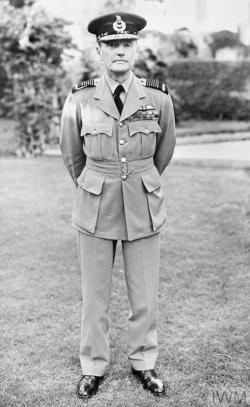
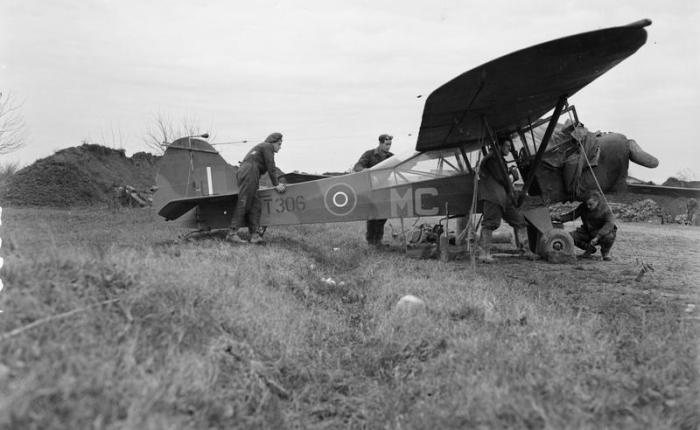


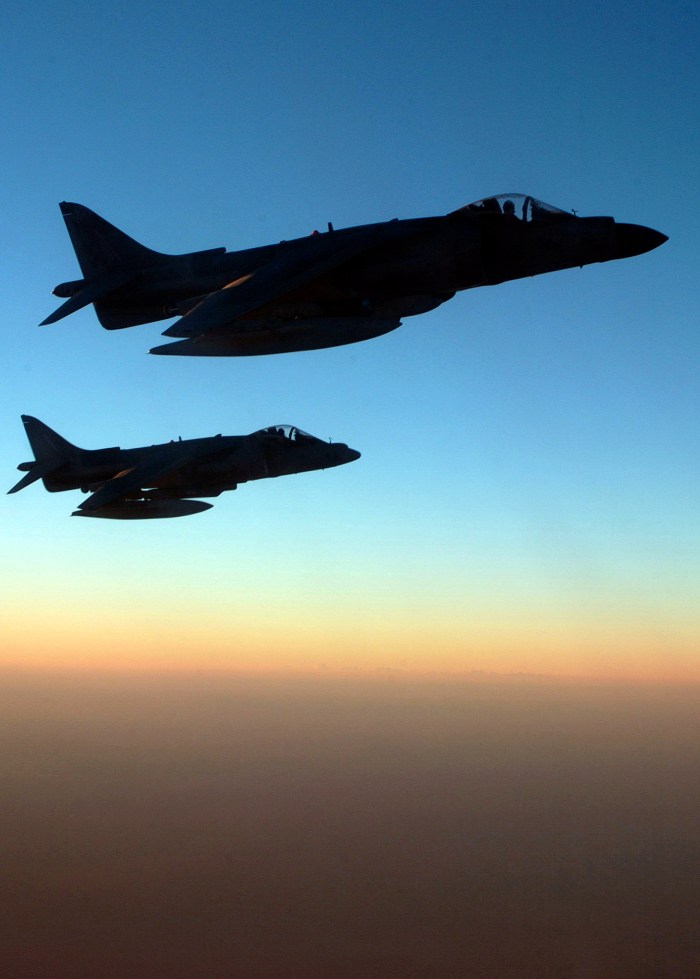


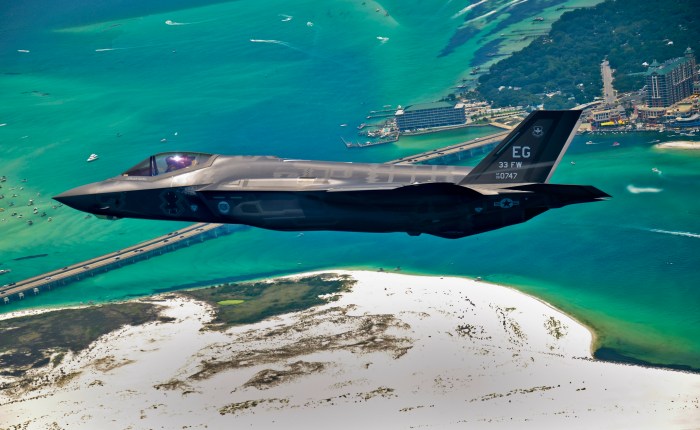
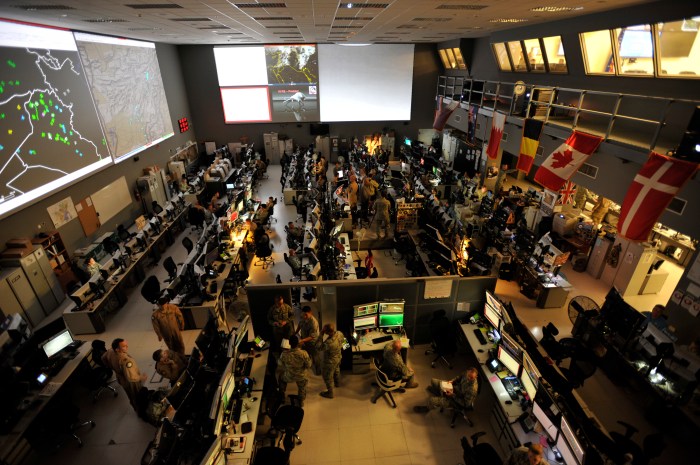
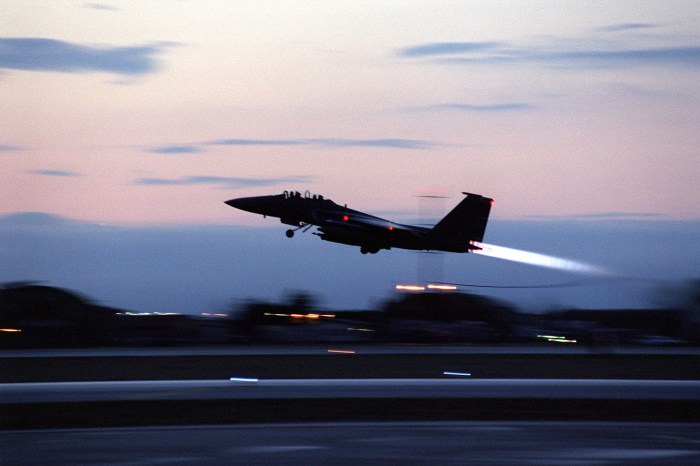
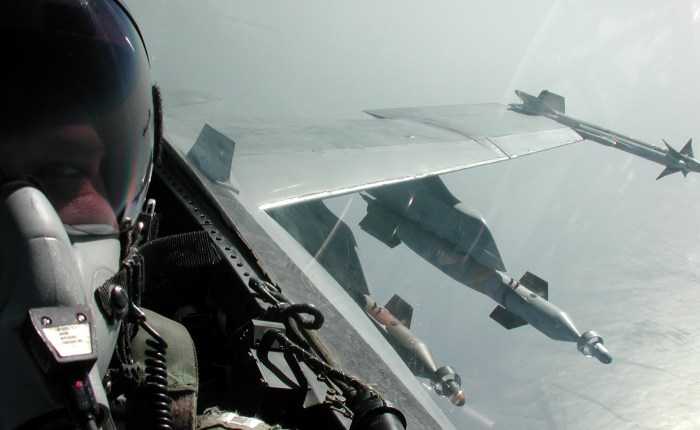
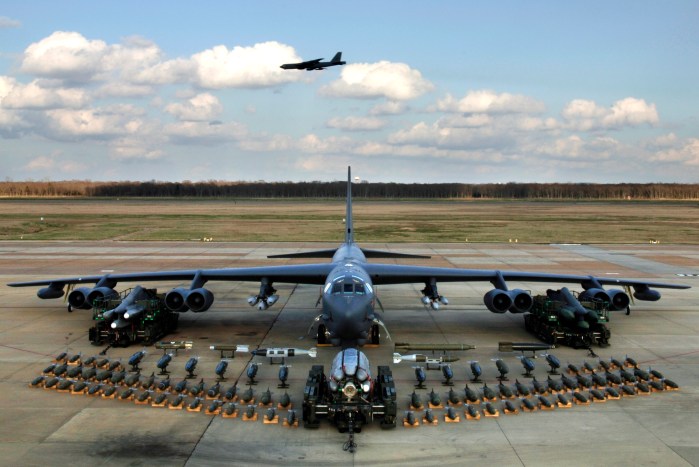

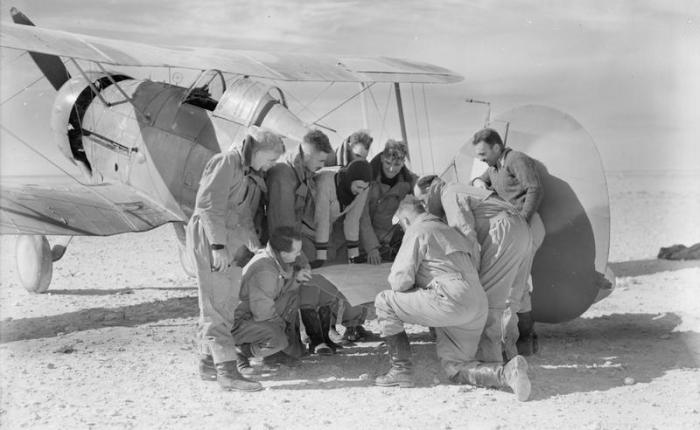
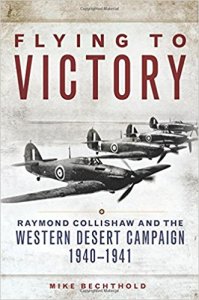
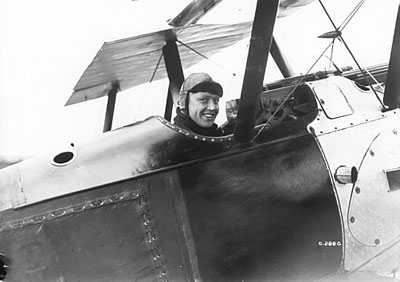


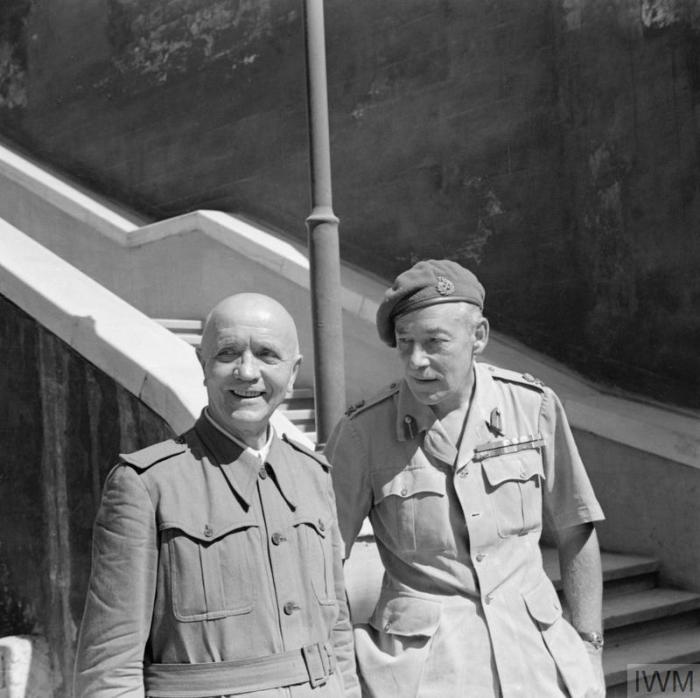
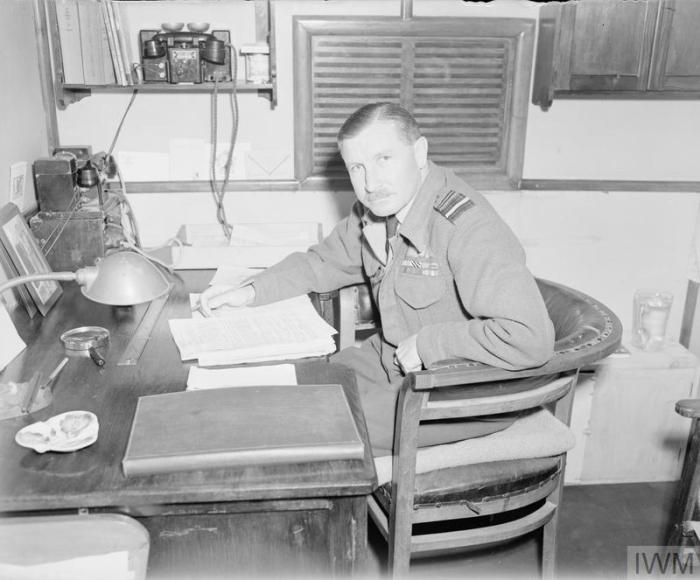

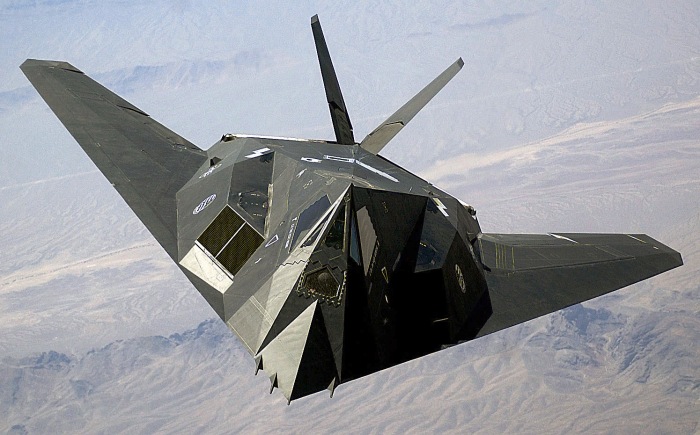
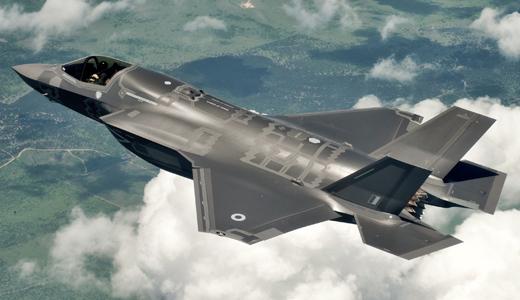
 From Balloons to Drones


.jpg)


