Editorial Note: From Balloons to Drones is pleased to announce our new podcast series. Led by Assistant Editor Dr Mike Hankins, this series aims to build on the success of From Balloons to Drones and provide an outlet for the presentation and evaluation of air power scholarship, the exploration of historical topics and ideas, and a way to reach out to both new scholars and the general public. You can find our Soundcloud channel here.
In our latest podcast, we interview Dr Roger Launius about the history, legacy, and memory of the Apollo program and the moon landing, at the 50th anniversary of Armstrong’s famous steps for all mankind. Looking back after all this time, what does the Apollo program mean for us today?
Dr Roger Launius retired from the Smithsonian National Air and Space Museum in 2016 as Associate Director for Collections and Curatorial Affairs having previously served in several other positions. Before that, he had been Chief Historian for NASA. As well as being a specialist in the history of air and space power, he has also written on 19th century American history. You can find his website here.
Header Image: A photograph of the Apollo 11 crew just after they had been selected for the mission. Left to right, are Edwin E. Aldrin Jr., the lunar module pilot; Neil A. Armstrong, commander; and Michael Collins, command module pilot. They were photographed in front of a lunar module mock-up beside Building 1 following a press conference in the MSC Auditorium, c. January 1969. (Source: NASA)
In recent months, From Balloons to Drones has highlighted and reviewed numerous books, both old and new, that deal with the Space Race, the moon landings, and the Apollo Program writ large. As the proliferation of printed materials continues to grow – not only as the moon landings themselves recede into memory but as there is an increase of ‘Apollo at 50’ printed materials – it becomes necessary to ask the question, what makes any new work different? What does a particular book tell us about the Apollo program or early space exploration that we do not already know? The answer, in this case, is a surprising amount and denotes that there are still new areas to research and historical stories to be told when dealing with early space exploration.
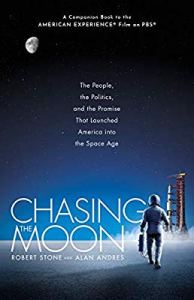
Chasing the Moon: The People, the Politics, and the Promise That Launched America into the Space Age is equal parts social history, cultural history, Cold War history, and political history. The authors state that the journey to the moon (p. x) ‘was a story of courage, adventure, and scientific exploration as well as an exercise in geopolitics.’ This is the long view of reaching the moon. Although the book is billed as ‘a companion to the American Experience film on PBS,’ it is also about the Russian, German, and British experience in the long narrative of the journey to the moon. This is one of the aspects that makes this book unique; it is not viewed either as a singular American accomplishment or as a struggle between the United States and the Soviet Union. While the entire space race could rightly be said to be both of those things, it is not only those things. Chasing the Moon brilliantly and adroitly links the global history of reaching for the stars, or – from the first rockets to the first footprints on Luna.
On 19 December 1972, the Apollo 17 crew returned to Earth following a successful 12-day mission. Apollo 17 marked the final crewed lunar landing mission. Here, Apollo 17 commander Eugene Cernan approaches the parked Lunar Roving Vehicle. NASA’s Marshall Space Flight Center designed, developed and managed the production of the Lunar Roving Vehicle that astronauts used to explore the Moon. (Source: NASA)
Within these pages are the origins stories and names that are familiar to the early days of rocketry: Konstantin Tsiolkovsky, Robert Goddard, and Hermann Oberth, but other familiar names have a role as well. The legendary Arthur C. Clarke’s appearance in these pages is a welcome addition and demonstrates how the melding of pure science and science-fiction enabled the latter to become science-fact, and how both helped advance the cause of the other. Fact and fiction advanced together thanks to their symbiotic relationship, which also helped in America’s understanding of space exploration at large.
Short of a full biography, Chasing the Moon does an admirable job of telling the good and the bad of ‘The Man Who Sold the Moon,’ Werner von Braun. Von Braun’s importance to the development of rocketry is intertwined with his Nazi past; neither is ignored here. His celebrity nearly eclipsed that of the ‘original 7.’ This was of course helped by his appearance on Walt Disney’s television show Disneyland, which helped promote not only Disney’s ‘Tomorrowland,’ but also the concepts and ideas of rocketry and space that von Braun was so passionate about (pp. 58-9). It was von Braun’s association with Disney (p. 60) that ‘bestowed an imprimatur of American Respectability on the former official of the Third Reich.
While the astronauts do not play second fiddle in this work, this is really the story of those actors who have not traditionally garnered as much attention as the Apollo crews themselves. Obviously the first several classes of NASA’s ‘exemplars of American masculinity, courage, resourcefulness, and intelligence’ appear here, but this work gives agency and voice to the ‘others’ who get their (over)due attention here. These include Julian Scheer, James Webb, and Frances ‘Poppy’ Northcutt, and it is their stories that make Chasing the Moon such a worthwhile endeavour (p. 77).
If there is a downside to this work, it is that several of the Apollo missions, including 7, 9, and 14-17, are mentioned only in passing, but the authors can be forgiven as this is not the story of the Apollo program or of moon exploration, which has more than been adequately covered elsewhere. This is the story of humanity’s journey to the moon. The authors state in the closing pages that ‘[T]he enduring meaning of the space race remains elusive half a century after it came to its end,’ but this work helps give meaning to the space race itself as both a jobs program and an imprimatur of achievement in the twentieth century (p. 301).
This book will appeal to anyone interested in humanity’s journey to the moon, but especially those who are looking for the longer view of that journey: one that traces the voyage from the dawn of rocketry to that small step for a man. This excellent works stands on its own and is destined to become a classic in its own right. Stone and Andres will surely join the likes of Andrew Chaikin, Alan Shepard, Deke Slayton, Jay Barbree, Charles Murray, and Catherine Cox.
Dr Brian Laslie is an Air Force Historian and currently the Deputy Command Historian at North American Aerospace Defense Command (NORAD) and United States Northern Command (USNORTHCOM). A 2001 graduate of The Citadel and a historian of air power studies, he received his PhD from Kansas State University in 2013. His first book The Air Force Way of War (2015) was selected for the Chief of Staff of the Air Force’s and the Royal Air Force’s Chief of the Air Staff professional reading lists. He is also the author of Architect of Air Power: General Laurence S. Kuter and the Birth of the US Air Force. He lives in Colorado Springs. He can be found on Twitter at @BrianLaslie.
Header Image: Fifty years ago on 20 July 1969, humanity stepped foot on another celestial body and into history. (Source: NASA)
This review follows on the heels of my review of In the Shadow of the Moon: A Challenging Journey to Tranquility, 1965-1969 and is about a book which itself is a follow-on to that work. Whether the press intended it, one might consider Into That Silent Sea: Trailblazers of the Space Era, 1961-1965, In the Shadow of the Moon: A Challenging Journey to Tranquility, 1965-1969, and Footprints in the Dust: The Epic Voyages of Apollo, 1969-1975 a three-volume set within the overarching series. You could also add in Bison Books’ great work Homesteading Space about the three Skylab missions, which always seem to be separated from their Apollo brethren.
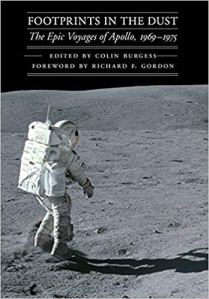
Footprints in the Dust begins with a forward from the astronaut and Gemini 11/Apollo 12 member Richard Gordon. In it, he states that the Apollo Program was ‘a true epoch of the Space Age, a golden era of scientific endeavour, advancement, and incredible discovery’ (p. xxi). Interest in the past Apollo Program and the future of human-crewed spaceflight is undoubtedly on the rise in 2019 with the anniversaries of Apollos 9, 10, 11, and 12 all occurring this year and with NASA vowing a return to the moon in the (hopefully) not too distant future. Past is prologue as we look to the future and Footprints in the Dust is an excellent work to pick up this #Apollo50.
If Chaikin’s A Man on the Moon is the primus inter pares, in the Apollo history catalogue, then there must be a reason why Footprints in the Dust stands out, and indeed, this work goes beyond Chaikin’s 1967-1972 focus. It brings into more explicit context the Skylab and Apollo-Soyuz Test Project (ASTP) and it also (rightly) places these under the rubric of the Apollo program. The contributors are a diverse group of space enthusiasts and aficionados.
A drawing of a Soviet LK lander illustrating its components: 1) passive plate of the docking system, 2) attitude control nozzles, 3) orbital rendezvous window, 4) landing window (in a concave recess), 5) high-gain antennas, 6) solid-fuel “nesting” engines, 7) footpads, 8) omnidirectional antenna, 9) rendezvous radar, A) pressurized compartment, B) equipment compartment, C) hatch, D) batteries, E) engine and fuel tanks, G) ladder. (Source: Wikimedia)
There are some excellent highlights. The ability to put the Soviet space program in context with its American counterparts is something this book (and the entire Outward Odyssey series in general) does uniquely well. These ‘Soviet chapters’ demonstrate how the Soviet Union’s manned program continued to keep moving forward despite the dawning realisation they would never reach the lunar surface. Dominic Phelan’s ‘The Eagle and the Bear’ about exactly how the Soviets planned to pull off a lunar landing is especially illuminating. As is Colin Burgess’ ‘A Whole New Focus’ which presents the tragedy of the Soyuz II mission
On the American side, the Apollo 12 seems eternally wedged – and not just numerically – between Apollo 11 and 13. This chapter written by John Youskauskas is simply terrific. Philip Bakers’ ‘Science and a Little Golf’ about Alan Shepard’s triumphant return to space, Edgar Mitchell’s ESP attempts, and Stu Roosa’s struggles with his Hycon camera are all highlights. All members of Apollo 14 have departed this planet for the final time, and this chapter does each of them a great service. Although those familiar with Apollo 14’s moon EVAs will know this bit of information, will still find themselves hoping Mitchell and Shepard reach cone crater at last. Finally, Collin Burgess’ chapter ‘Beyond the Moon’ about Skylab and the cancelled Apollo 18-20 missions demonstrate what was gained through Skylab but lost on the lunar service, not just for science but for the crews who were never afforded their opportunity to put their footprints in the dust.
Two Apollo 17 crewmen ready a Lunar Roving Vehicle trainer following its deployment from a Lunar Module trainer in the Flight Crew Training Building at the Kennedy Space Center, Florida, c. September 1972. Taking part in the Apollo 17 training exercise were astronauts Eugene A. Cernan (right), commander; and Harrison H. ‘Jack’ Schmitt, lunar module pilot. (Source: NASA)
All that being said, some of the chapters suffer, not from anything the authors did wrong, but simply from coverage in other books and media, namely the Apollo 11 and Apollo 13 missions. In the books already written, it becomes increasingly difficult to separate the stories of Apollo 11,13, and to a lesser extent the later well-documented moon missions 15-17 into something genuinely new, but the authors in this book put in the effort to do so.
Readers of From Balloons to Drones will by now be familiar with the fabulous work of both the University Press of Florida and, in this case, the University Press of Nebraska’s great works on space exploration. In this, the 50th anniversary of the first moon landings, it is a fitting time to reflect on what was gained, and perhaps just as important, what was lost in the race to the moon and Footprints in the Dust: The Epic Voyages of Apollo, 1969-1975 does both exceedingly well. This is a superb work and well worth your time.
Dr Brian Laslie is an Air Force Historian and currently the Deputy Command Historian at North American Aerospace Defense Command (NORAD) and United States Northern Command (USNORTHCOM). A 2001 graduate of The Citadel and a historian of air power studies, he received his PhD from Kansas State University in 2013. His first book The Air Force Way of War (2015) was selected for the Chief of Staff of the Air Force’s and the Royal Air Force’s Chief of the Air Staff professional reading lists. His recently published Architect of Air Power: General Laurence S. Kuter and the Birth of the US Air Force. He lives in Colorado Springs. He can be found on Twitter at @BrianLaslie.
Header Image: Sitting in the life raft, during the Apollo 12 Pacific recovery, are the three mission astronauts; Alan L. Bean, pilot of the Lunar Module (LM), Intrepid; Richard Gordon, pilot of the Command Module (CM), Yankee Clipper; and Spacecraft Commander Charles Conrad. The second manned lunar landing mission, Apollo 12 launched from launch pad 39-A at Kennedy Space Center in Florida on 14 November 1969 via a Saturn V launch vehicle. The LM, Intrepid, landed astronauts Conrad and Bean on the lunar surface in what’s known as the Ocean of Storms, while astronaut Richard Gordon piloted the CM, Yankee Clipper, in a parking orbit around the Moon. Lunar soil activities included the deployment of the Apollo Lunar Surface Experiments Package, finding the unmanned Surveyor 3 that landed on the Moon on 19 April 19, 1967, and collecting 75 pounds (34 kilograms) of rock samples. Apollo 12 safely returned to Earth on November 24, 1969. (Source: NASA)
J.L. Pickering and John Bisney, Picturing Apollo 11: Rare Views and Undiscovered Moments. Gainesville, FL: University Press of Florida, 2019. Hbk. 264 pp.
A different type of book necessitates a different type of book review. Herein you will not find an author’s argument or a critique thereof since the book being discussed today is a collection of photographs and an excellent one at that. J.L. Pickering and John Bisney have brought us Picturing Apollo 11: Rare Views and Undiscovered Moments. As we approach the 50th anniversary of the first moon landing, there is sure to be a proliferation of all sorts of materials, merchandise, and collectables celebrating one of, if not the defining moment of the 20th Century and in what will undoubtedly be a crowded field, it will be difficult for printed works to stand out. Pickering and Bisney have accomplished just that, a unique look at the Apollo 11 mission through photographs: both official and candid – many of which have never been published before.
It is common practice for me that when a book arrives in my mailbox, I will take a few minutes and flip through it. It should be noted that when Picturing Apollo 11 arrived on my doorstep, I stopped what I was doing, sat down, and read the entire book (insert joke here about my ‘reading’ a picture book). However, this extremely well-done book did what few other works can do, it stopped me in my tracks. Divided into nine chapters, the book covers everything from the assembly of their Saturn V, training for the mission, all the way through the triumphant return home. Rather than review the book as you might typically find on the site, I have decided to highlight some of my favourite photographs from the book.
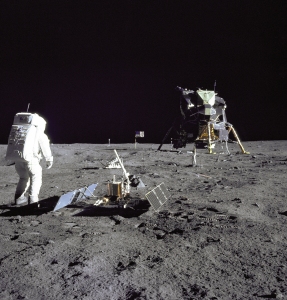
Astronaut and Lunar Module pilot Buzz Aldrin is pictured during the Apollo 11 extravehicular activity on the moon. He had just deployed the Early Apollo Scientific Experiments Package. In the foreground is the Passive Seismic Experiment Package; beyond it is the Laser Ranging Retro-Reflector (LR-3). (Source: NASA)
Any of the shots of the Saturn V rocket, Service Module, Command Module, or Lunar Module arriving at the Cape and being ‘processed’ and stacked are compelling. However, I found myself especially drawn to photos of the Command Module (CM) wrapped in the protective blue plastic covering (p. 51) – this was how Apollo Nine’s CM came to be known as ‘Gumdrop.’ If you have ever viewed one of the Apollo CMs in a museum setting – I am currently trying to see them all – you have only ever seen the scorched and burned relic after its re-entry. There is something inexplicably ‘technological’ when you view the CM as it was before being mounted on the Service Module; the newness and perfection of the CM in its original state are fascinating. It is also especially entertaining to see the many ‘Remove Before Flight’ banners hanging about the CM as if it has been decorated with red sprinkles in addition to its blue wrapping.
I also enjoyed many of the candid shots of Armstrong, Aldrin, and Collins during training (pp. 71-80) or visiting (pp. 82-8) the Apollo support sites around the country. Sixties fashion is on full display in these pages and as representative of the times as the astronaut’s moon suits! In this vein, there is an excellent shot of a group of the Apollo Astronauts at the US Navy Diving School in Key West, Florida; love the paisley shirt, Neil!
Military pilots love the T-38, and NASA used the versatile training aircraft to keep up the astronaut’s proficiencies, but also as a way for the astronauts to travel rapidly across the country from Texas to Florida, California, and Missouri. Here, there is an excellent shot of Armstrong and NASA’s Flight Crew Operations Director Deke Slayton (p. 95) strolling away from their parked T-38; while Armstrong looks conservative in his blue flight suit, Slayton looks every bit the fighter pilot and a bit more devil-may-care. Their personalities come forth in the photograph: Armstrong the Engineer, Slayton, the tough-as-nails director.
The pictures from all the moon landings are amazing, but as better equipment was sent up on later missions, those shots became increasingly more precise and crisper. Armstrong and Aldrin suffered from being the first in this regard, but modern photographic enhancement has brought the Apollo 11 shots into better relief. In this regard, my favourite photograph in the book is a shot of Aldrin and the American Flag (p. 193), where if you look close enough, you can clearly see Aldrin’s face inside the suit looking towards Armstrong. As you may know the pictures of Armstrong on the lunar surface are limited, but a great photograph of a relaxed looking Armstrong back inside the Eagle smiling after the EVA was completed sums up his feelings after landing and walking on the moon.
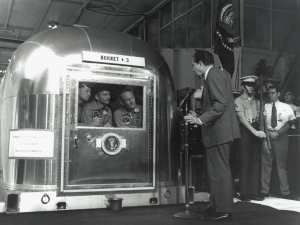
The Apollo 11 astronauts, left to right, Commander Neil A. Armstrong, Command Module Pilot Michael Collins and Lunar Module Pilot Edwin E. ‘Buzz’ Aldrin Jr., inside the Mobile Quarantine Facility aboard the USS Hornet, listen to President Richard M. Nixon on 24 July 1969 as he welcomes them back to Earth and congratulates them. (Source: NASA)
Picturing Apollo 11 is nothing short of a masterpiece. It is a truly unique work and a compelling collection of photographs that is sure to fire the imagination of those who remember the mission and those looking retrospectively at an event they were not around to see. As I closed the book, I again wondered, when will we return?
After you have ordered Picturing Apollo 11, I also highly encourage you to pick up a copy of Apollo VII-XVII a photographic journey through all the Apollo missions.
Dr Brian Laslie is an Air Force Historian and currently the Deputy Command Historian at North American Aerospace Defense Command (NORAD) and United States Northern Command (USNORTHCOM). A 2001 graduate of The Citadel and a historian of air power studies, he received his PhD from Kansas State University in 2013. His first book The Air Force Way of War (2015) was selected for the Chief of Staff of the Air Force’s and the Royal Air Force’s Chief of the Air Staff professional reading lists. His recently published Architect of Air Power: General Laurence S. Kuter and the Birth of the US Air Force. He lives in Colorado Springs. He can be found on Twitter at @BrianLaslie.
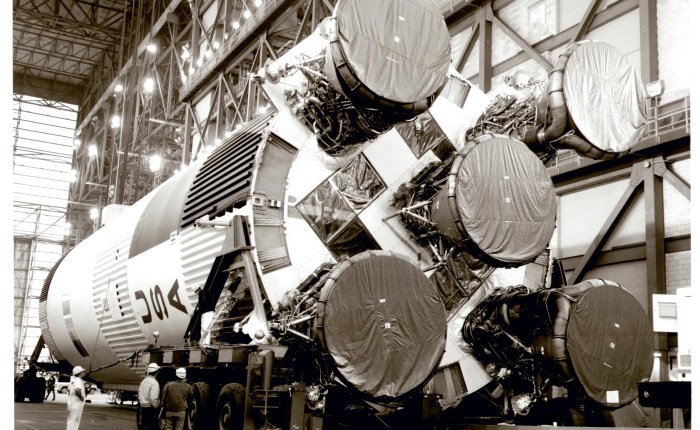
Header Image: On 1 March 1968, the Saturn S-IC-6 arrived at the Mississippi Test Facility – today’s NASA Stennis Space Center – from the Michoud Assembly Facility. The was the first stage section of the Saturn V rocket the took Apollo 11 into space. (Source: NASA)
Francis French and Colin Burgess, In the Shadow of the Moon: A Challenging Journey to Tranquility, 1965-1969. Lincoln, NE: University of Nebraska Press, 2007. References. Pbk. 435 pp.
One great thing about making a mistake is that you sometimes discover an entirely unexplored avenue for examination. We recently posted our space reading list. After publication, I discovered I had inadvertently left out an entire series of books devoted to space exploration. This was the University of Nebraska Press’ series ‘Outward Odyssey: A People’s History of Spaceflight.’ You can check out all of their titles here.
To that end, herein lies a book review, but also an overview of Nebraska Press’s ‘Outward Odyssey’ series. The overall series:
[p]rovides a popular history of spaceflight from the rocket scientists of the 1930s to today, focusing on the lives of astronauts, cosmonauts, technicians, scientists, and their families. These books place equal emphasis on the Soviets and the Americans and give priority to people over technology and nationalism.
Thus far every book in this series I have had the pleasure of reading is clear and accessible. Those who have studied space exploration for years and those approaching the topic for the first time will find much in these pages. While I believe academic presses are sometimes viewed as the publishing houses where academics publish their ‘esoteric’ studies, nothing could be further from the truth, especially concerning the ‘Outward Odyssey’ series. The entire assemblage of books is well worth your time and, as a collection, some of the best works written on spaceflight. Included in this series is one of my personal favourite of all astronaut biographies: Apollo Pilot: The Memoir of Astronaut Donn Eisele. These works also include exploration of space history not commonly covered including Skylab and the creation of the Payload Specialist Program for the Space Shuttle. Of the 19 books in the series, three merits special attention: Into that Silent Sea: Trailblazers of the Space Era, 1961-1965 (2007); In the Shadow of the Moon: A Challenging Journey to Tranquility, 1965-1969 (2007); Footprints in the Dust: The Epic Voyages of Apollo, 1969-1975 (2010). Today the focus is on the second book.
This photograph of the Lunar Module at Tranquility Base was taken by Neil Armstrong during the Apollo 11 mission, from the rim of Little West Crater on the lunar surface. Armstrong’s shadow and the shadow of the camera are visible in the foreground. This is the furthest distance from the lunar module traveled by either astronaut while on the moon. (Source: NASA)
In the Shadow of the Moon begins with an introduction from astronaut and Apollo 7 member Walt Cunningham. In it, he states (p. xii) that the space race was ‘a clash of cultures, systems of government, and a challenge to our way of life.’ However, this book is a much more personal account, eschewing the ideological backdrop, for a much more intimate portrait of Project Gemini and the early Apollo missions as well as the Soviet Vostok, Soyuz, and Voshkhod program and the men (and in the case of Valentina Tereshkova, woman) who flew them. This work takes the reader from the first Gemini mission through Apollo 11, the first (successful) lunar landing attempt. There are three aspects to this book that allows it stand out: the early focus on Gemini, its attention to the Russian space program, and finally its emphasis on the early Apollo the missions that tend to be overlooked in other works.
The attention on the Gemini missions opens the book up, and Gemini was fundamentally different from its Mercury predecessor. As an air power historian with a growing interest in space exploration, Gemini truly represents air power. Although astronautics and not aeronautics, the Gemini ships it can be justly said, could be flown. As Gus Grissom stated (p. 14) about the program Gemini, ‘was a machine I could maneuver.’ The personal accounts of the Gemini crew members, their struggles with rendezvous and docking, and EVAs are masterfully told. All the necessary building blocks needed to be able to conduct the Apollo missions were accomplished during this program, and French and Burgess tell the story well. As the authors’ note (p. 169) ‘the entire Gemini program of ten flights would be conducted before any Russian cosmonauts once again soared into the skies.’
Thus, it was something of a jolt when the focus moves from the American space program to the activities of the Soviet cosmonauts, but this is keeping in line with the overall purpose of the series, it reminds the reader of the two competing programs – and their ideologies – as they both progressed towards ‘winning’ the space race. This work, much like David Scott’s and Alexy Leonov’s Two Sides of the Moon brings into contrast and comparison the Soviet space program and the human side and losses that took place behind the iron curtain; it would be later that the astronauts and cosmonauts came to realize how similar they were and how much they shared in common.
Finally, the book turns towards the Apollo program and in-depth attention is given to Apollos 7, 8, 9, 10 and 11, essentially the ‘first half’ of the Apollo missions. While the moon landings probably have a more enduring place in American memory, none of that would be possible without the early Apollo flights. Especially appreciated here is the deeper dives into the virtually ignored Apollos 7 and 9. While other books are dealing with these missions (Cunningham and Eisele both have biographies or memoirs, and Cunningham’s routinely tops the list in this regard), In the Shadow of the Moon contextually links these missions together while at the same time allowing each to stand on its accomplishments. While even the Apollo 9 astronauts themselves recognise theirs (p. 329) was a ‘historically lesser known mission,’ this work does a magnificent job of being deeply personal while conveying just how vital these lesser-known Apollos were at putting the footprints in the dust on the moon, but that is a different review.
French and Burgess’s frequent use of long quotes derived from their interviews astronauts is really a high point of this work, and it is clear the astronauts know the authors are true professionals. If there is a (relatively) minor drawback to the book is its lack of source notes. While it reads smoothly, among the best of the books on NASA and space exploration, it does not provide an avenue from where any particular quote comes from. As a historian who routinely flips to the back of the book looking for source documentation, this was a bit of a distraction, but as a popular history, this really should not be held against French and Burgess. In the end, this is an extremely fine addition to the histories of manned exploration of space. Highly enjoyable, immensely readable, this work, while never eschewing the technological side of the Gemini and Apollo programs, is an extraordinarily intimate and personal history of the astronauts, cosmonauts and their families and it belongs on the shelves of anyone looking for the very finest scholarship on the first age of space exploration.
Dr Brian Laslie is an Air Force Historian and currently the Deputy Command Historian at North American Aerospace Defense Command (NORAD) and the United States Northern Command. A 2001 graduate of The Citadel and a historian of air power studies, he received his PhD from Kansas State University in 2013. His first book The Air Force Way of War (2015) was selected for the Chief of Staff of the Air Force’s and the Royal Air Force’s Chief of the Air Staff professional reading lists. His recently published Architect of Air Power: General Laurence S. Kuter and the Birth of the US Air Force. He lives in Colorado Springs. He can be found on Twitter at @BrianLaslie.
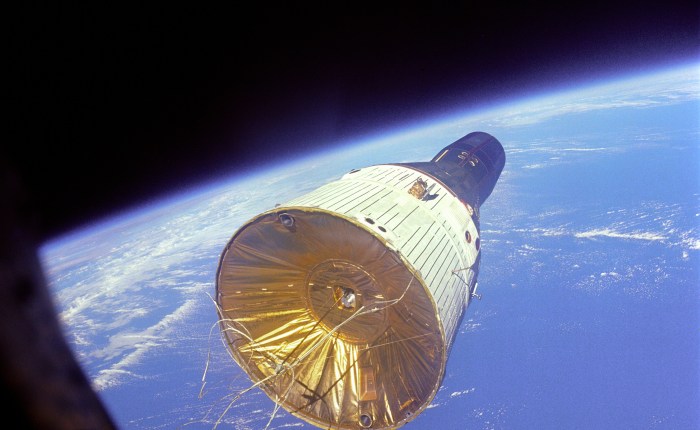
Header Image: On 4 December 1965, NASA launched Gemini VII. With this mission, NASA successfully completed its first rendezvous of two spacecraft. This photograph, taken by Gemini VII crewmembers Jim Lovell and Frank Borman, shows Gemini VI in orbit 160 miles (257 km) above Earth. (Source: NASA)
In the first of our space-related book reviews, Stages to Saturn, I discussed a book about a technology and a ‘thing,’ that thing being the family of Saturn rockets. This next review is a book about people or rather, a single person: Jack Clemons.
Author Jack Clemons is one of the 400,000 (or so) people who worked on Project Apollo. You should quickly surmise that 399,999 other stories could be told about NASA and space exploration, but this is Jack’s story. This is the story of one person’s efforts to help put Armstrong’s (and eleven others) boot prints on the moon, but at least as far as Clemons was concerned bringing him, as well as and Aldrin and Collins back to Earth. Clemons, employed by TRW Corporation and working for the Apollo program as a re-entry specialist, presents himself as part of the group of ‘Americans who embraced the study of engineering and the sciences’ (p. 3) and who joined President Kennedy’s call for landing a man on the moon, and the oft-overlooked second part of that sentence, returning him safely to Earth. The call for Clemons (p. 21) was so great that ‘I stayed in Houston for sixteen years for one reason, because that’s where NASA was.’
The prime crew of the Apollo 12 lunar landing mission is photographed during spacecraft checkout activity at North American Rockwell Space Division at Downey, California. Left to right, are astronauts Charles Conrad Jr., commander; Richard F. Gordon Jr., command module pilot; and Alan L. Bean, lunar module pilot. (Source: NASA)
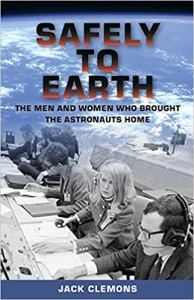
HBO’s TV series From the Earth to the Moon based on the book A Man on the Moon: The Voyages of the Apollo Astronauts by Andrew Chaikin introduced viewers to stories of the Mercury, Gemini, and Apollo astronauts. In one episode, the launch of Apollo 12 is shown to be struck by lightning, and the crew is informed they must ‘switch SCE to AUX’ to start restoring power to the crippled command module. This is also where Jack Clemons book Safely to Earth: The Men and Women who brought the Astronauts Home begins as well when flight controller John Aaron makes the call to have the crew switch Signal Conditioning Electronics to Auxiliary. This is what separates Clemons work from all that has come before it – and becomes the real strength of the work; this is not a book about the astronauts themselves, but about the unnamed masses of the support team.
This is not a purely academic work, and Clemons is clearly not speaking to an exclusive audience. Instead, he brings forth in a very accessible manner what it was like to be ‘in the trenches.’ Clemons also provides a certain levity in his book. He often ‘breaks the plane’ by talking directly to the reader, a massive ‘no-no’ in most professional writing, but it works and much to Clemons credit, I found myself smirking.
The book is essentially divided into two parts: his work on the Apollo Program and his later work in the Space Shuttle program. During Apollo and found many times throughout the pages of Safely to Earth, the role of technology is clearly on display. In the modern world where our phones hold more computing power than some of the early computers, it is nearly overwhelming to remember a time where so much of a computer processing ability first had to be input by hand. In one example, Clemons notes (p. 41) that the process of entering information into the IBM mainframes and waiting for results: ‘was a tedious and labor-intensive way to grind out data, but at the time it was cutting edge, high art, and great fun.’ Clemons primary work was on reentry data (p. 70), ‘[S]ince every Apollo mission was unique, reentry procedures had to developed and tested for each one.’
During the 1980s, Clemons moved over to IBM where he worked on the Space Shuttle’s computer programs and flight software, and this work provides a good history of the development and operation of the Shuttle. During these years, Clemons, responsible for the displays and controls of the Orbiter, worked closely with the early shuttle astronauts, including Bob Crippen and Dick Truly. Ostensibly, Clemons seeks here (p. 122) to ‘to convey here a sense of the scope of this singular effort, and an appreciation for some of the unheralded people behind the scenes’ and this occurs not only in the latter half of the book but throughout the entire text. The reader gets a sense of how many people at so many levels worked towards the singular goal of space exploration.
This is a welcome addition and is truly a unique work that contributes something new to an already overcrowded field of books about manned spaceflight. Clemons brings into focus what it was like to be one of the 400,000 who contributed to getting man to the moon and in doing so broadens our understanding of getting into space in general. While those aviation, history of technology, and space readers and historians will find much to enjoy here; those interested in race and gender issues, particularly as they apply to employment in STEM career fields, will also find enjoyment in the marked switch that occurred between Apollo and the Space Transportation System programs; Clemons covers this transition particularly well. The ultimate question posed by Clemons (p. 190), and so many others in recent years, and one for which we do not have a definitive answer for is, ‘[S]o where does human spaceflight go from here?’
Dr Brian Laslie is an Air Force Historian and currently the Deputy Command Historian at North American Aerospace Defense Command (NORAD) and United States Northern Command (USNORTHCOM). A 2001 graduate of The Citadel and a historian of air power studies, he received his PhD from Kansas State University in 2013. His first book The Air Force Way of War (2015) was selected for the Chief of Staff of the Air Force’s and the Royal Air Force’s Chief of the Air Staff professional reading lists. His recently published Architect of Air Power: General Laurence S. Kuter and the Birth of the US Air Force. He lives in Colorado Springs. He can be found on Twitter at @BrianLaslie.
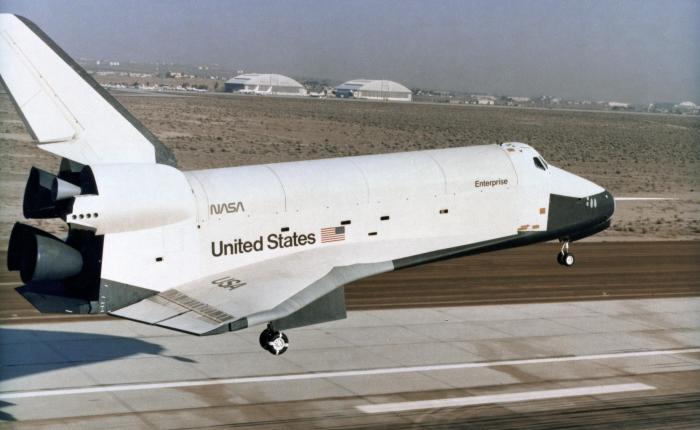
Header Image: The last of 13 captive and free-flight tests on 26 October 1977 with the space shuttle prototype Enterprise during the Approach and Landing Tests, validating the shuttle’s glide and landing characteristics. Launched from the modified Boeing 747 Shuttle Carrier Aircraft, the Enterprise’s final flight was piloted by Fred Haise and Gordon Fullerton to a landing on the main concrete runway at Edwards Air Force Base before a host of VIPs and media personnel. (Source: NASA)
This entry in our continuing series of book reviews might strike you as something a bit different from what we usually publish in several respects. First, this is an older work and originally published as part of the ‘official histories’ by NASA. Initially published in 1979 by the NASA history office, this 2003 updated version published by the University Press of Florida, was written, at its creation, primarily for an internal audience. Second, and as promised, this is the first book review in a series on Space exploration and space power. Finally, this review is inherently about a thing, and a means rather than an event or person. It is a review of technological history.
Even with fifty years of retrospective, the images of the gigantic Saturn V rocket with the Command and Service Module (CSM) and Lunar Module (LM) perched atop the three-stage rocket remains impressive. Histories of NASA and the Apollo Program tend to focus on the Saturn as a completed unit, stacked and rolled out of the Vehicle Assembly Building (VAB) ready for transportation to the launch pad and final countdown and liftoff of the series of Apollo missions. The University of Florida Press’s and author Roger E. Bilstein’s Stages to Saturn: A Technological History of the Apollo/Saturn Launch Vehicles plays this familiar tale in reverse. The book begins with the launch of Apollo 11 and the ‘fiery holocaust lasting only 2.5 minutes’ of the first stage (S1-C) five F-1 engines that included the combination of 203,000 gallons of RP-1 kerosene and 331,000 gallons of liquid oxygen.
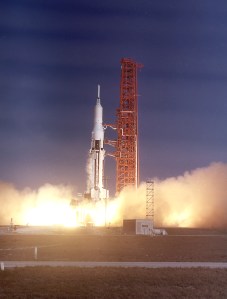
SA-9, the eighth Saturn I flight, lifted off on 16 February 1965. This was the first Saturn with an operational payload, the Pegasus I meteoroid detection satellite. (Source: Wikimedia)
Bilstein then roles the tape back to the earliest days of rocketry before moving into the primary purpose of the book, the development of the Saturn family of rockets. This is the history of an object albeit, one of the largest moving objects ever created. Stages to Saturn is the story of the development of the launch vehicles that took man into deep space for the first time. There are hundreds of books (see our reading list) about the Mercury, Gemini, and Apollo programs, but this book is fundamentally different in that it focuses on the creation of the means it took the latter program to get into space.
A note of warning for the prospective reader up front, this is not a book for the layman reader, and in all fairness, it is hardly a book for the professional historian. It is an extraordinarily technical history, what might be most justly described as a ‘dense’ read. If there is a drawback to this work, it is that one might enjoy the book more if one were an expert mechanic or an aircraft engineer, someone who fundamentally understands the way machines work. It is also as much an organisational and logistical history as it is a technological history. All, this should not indicate that the book comes across as is inaccessible; it does not. Still the reader should be prepared for some overly technical discussions of thrust chambers and cryogenic propellants.
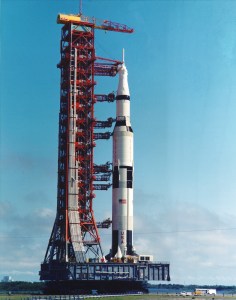
Rollout of the Apollo 11 Saturn V rocket from the Vehicle Assembly Building to the launch pad, 20 May 1969. (Source: Wikimedia)
The book is built, not chronologically, but rather by component pieces of the rocket itself, each earning a detailed developmental history. This includes a ‘building blocks’ section which is a short history of rocketry but, thankfully, not a history of everything. From there the book details the development of the engines (RL-10, J-2, H-1, and F-1), before moving into the building of the various Saturn stages (S-IB, S-IVB for the Saturn IB and S-IC, S-II, S-IVB for the Saturn V) and finally on the management and logistics. While the development and building of the massive Saturn systems are fascinating enough in their own right, the logistical undertaking, which required ships and the development of special aircraft just to move the various stages and components to Cape Kennedy is a worthy addition to understanding of the continental network required simply to have the rocket components arrive at their destination. Bilstein ends his book with a disposition of the remaining Saturn systems (most on Static display now), but also a retrospective legacy section. It should also be noted that Bilstein includes a series of appendices covering everything from a detailed schematic of the Saturn V to the Saturn V launch sequence (beginning at nine hours and 30 minutes before liftoff) as well as R&D funding. While ‘richly detailed’ or ‘meticulously researched’ are overused in reviews, a trait myself am guilty of; they aptly apply to Stages to Saturn.
In the end, this is the story of the Apollo and Saturn programs that needed to be told. All the histories and biographies of the ‘Space Race,’ fail to rise to the level of detail and the important contribution of Stages to Saturn. It is a first-class organisational and technological history, and it stands alone as, perhaps the very best of the overall government ‘official histories.’ Historians of air and space power studies will find much to enjoy here, but also aerospace engineers. It is often said that 400,000 people helped get the United States the moon. This is the history of that rocket, but it is equally the history of those 400,000.
Dr Brian Laslie is an Air Force Historian and currently the Deputy Command Historian at North American Aerospace Defense Command (NORAD) and United States Northern Command (USNORTHCOM). A 2001 graduate of The Citadel and a historian of air power studies, he received his PhD from Kansas State University in 2013. His first book The Air Force Way of War (2015) was selected for the Chief of Staff of the Air Force’s and the Royal Air Force’s Chief of the Air Staff professional reading lists. His recently published Architect of Air Power: General Laurence S. Kuter and the Birth of the US Air Force. He lives in Colorado Springs. He can be found on Twitter at @BrianLaslie.
Header Image: Apollo 6 interstage falling away. The engine exhaust from the S-II stage glows as it impacts the interstage. (Source: Wikimdeia)
As the combatant command of the ‘newly re-established’ United States Space Command inches closer to being stood up (or reincarnated we are really not sure), we at From Balloons to Drones thought now would be an opportune time to publish articles, book reviews, and reading lists on the very best of space scholarship.[1] The simple fact is that here at the site we have focused almost exclusively on air power. We just have not gone high enough. Therefore, to make a mid-course correction, we are looking to expand into air and space power. The first step is this reading list. Hopefully to be followed by book reviews and original articles like this one here that we have previously published.
Our Assistant Editor, Brian Laslie, has chosen to divide this reading list up: Primer texts, NASA and civilian histories, and finally a list of biographies, memoirs and autobiographies.
Much of what you will find below was done in coordination with historians at the United States Air Force Academy, Air Command and Staff College, and the School of Advanced Air and Space Studies. We reached out to some of their senior scholars for their list of ‘must reads’ plus what they assign to students. We also reached out to several academic presses who specialise in space scholarship. Here you will find some of the usual suspects (University Press of Kentucky, MIT, Johns Hopkins), but also some really impressive works out of the University Press of Florida, look for book reviews of some of these titles below coming shortly. This is by no means a comprehensive list, but we believe that if you are interested in expanding your space knowledge, professionally or for fun, this list is a great place to start.
Primer Texts:
Ted Spitzmiller, The History of Human Space Flight (Gainesville, FL: University Press of Florida, 2017);
Michael J. Neufeld, Spaceflight: A Concise History (Cambridge, MA: The MIT Press, 2018);
Walter A. McDougall, The Heavens and the Earth: A Political History of the Space Age (New York, NY: Basic Books, 1985);
William F. Burrows, This New Ocean: The Story of the First Space Age (New York, NY: Random House, 1998);
A. Heppenheimer, Countdown: A History of Spaceflight (New York, NY: Wiley, 1997);
Everett C. Dolman, Astropolitik: Classical Geopolitics in the Space Age (London: Frank Cass, 2002);
Joan Johnson-Freese, Space as a StrategicAsset (New York, NY: Columbia University Press, 2007);
Matthew Brezezinski, Red Moon Rising: Sputnik and the Hidden Rivalries that Ignited the Space Age (New York, NY: Times Books, 2007);
John Klein, Space Warfare: Strategy, Principles and Policy (Abingdon: Routledge, 2006);
David Spires, Beyond Horizons: A Half Century of Air Force Space Leadership, Revised Edition (Maxwell, AL: Air Force Space Command in association with Air University Press, 1998);
Bruce DeBlois (ed.), Beyond the Paths of Heaven: The Emergence of Space PowerThought (Maxwell, AL: Air University Press, 1999).
The NASA History Office runs arguably the single best history program in the entirety of the United States Government. With dozens of publications (and most available to download for free here, this is the first place you should stop for the history of space flight in the United States. More recently some of their titles have been re-published with the University of Florida Press.
So much of the literature of the space race focused exclusively on the American perspective. Even the Soviet ‘firsts’ are often viewed through the lens of how other Americans reacted. If you are interested in the development of the Soviet space programs there is Challenge to Apollo: The Soviet Union and the Space Race (2000) by Asif A. Siddiqi and the four-volume set by Boris Chertok Rockets and People (2005 to 2012) which provides ‘direct first-hand accounts of the men and women who were behind the many Russian accomplishments in exploring space.’
If the early American experience in spaceflight interests you then download: Where no Man has Gone Before: A History of the Apollo Lunar Exploration Missions (1989) by William David Compton, Project Apollo: The Tough Decisions (2007) by Robert C. Seamans, Jr., On the Shoulders of Titans: A History of Project Gemini (2010) by Barton C. Hacker and James M. Grimwood, and “Before this Decade is Out” Personal Reflections of the Apollo Program (1999) edited by Glen. E. Swanson
Under the UPF bin there is Pat Duggins, The Final Countdown: NASA and the End of the Space Shuttle Program (2008) which seems a bit dated in 2019 (there is a reference to a pre-iPad that might perplex readers) but provides an excellent treatment of the history of the Shuttle Program as well as NASA’s uncertain future.
The Final Mission:Preserving NASA’s Apollo Sites (2018) by Lisa Westwood, Beth O’Leary, and Milford W. Donaldson details the importance preserving sites related to the Project Apollo and moon missions both here on Earth and the lunar surface.
Other works by NASA or UPF that are well worth your time include: Safely to Earth: The Men and Women who Brought the Astronauts Home (2018) by Jack Clemons, and Spies and Shuttles: NASA’s Secret Relationships with the DOD and CIA (2015) by James David. If you are an engineer by trade or just interested in highly technical work, there is Stages to Saturn: A Technological History of the Apollo/Saturn Launch Vehicles (1999) by Roger Bilstein
Memoirs and Biographies:
There are dozens of books in this genre from the ‘Golden Age of Manned Spaceflight.’ Many of the Mercury, Gemini, and particularly the Apollo astronauts either wrote a memoir or have had a biography published. We cannot list them all here, but we agree the following rate among the very best: First Man: The Life of Neil Armstrong (2018) by James R. Hansen, Carrying the Fire: An Astronauts Journey (2001) by Michael Collins, The Last Man on the Moon: Astronaut Eugene Cernan and America’s Race in Space (1999) by Eugene Cernan, Apollo Pilot: The Memoir of Astronaut Donn Eisele (2017) by Don Eisele, and Calculated RiskThe Supersonic Life and Times of Gus Grissom (2016) by George Leopold.
More recent works by the space shuttle and ISS astronauts include Scott Kelly’s Endurance about his year in space. As space flight becomes increasingly commercialised, the recently published The Space Barons: Elon Musk, Jeff Bezos, and the Quest to Colonize the Cosmos (2018) by Christian Davenport were also showing up from many of the academic institutions with whom we spoke.
Finally, in a departure from the readings above, we recommend the YouTube channel of Amy Shira Teitel. Amy is a ‘spaceflight historian, author, YouTuber, and popular space personality,’ who does a great job in her web series Vintage Space.
Again, this is not a comprehensive list, but rather a starting point. As interest increases and we enter what may very well be a second golden age of space exploration, these are the titles that provide the background and history of working with, in, and through the space domain. If you have suggestions, leave them in the comments.
Dr Brian Laslie is an Air Force Historian and currently the Deputy Command Historian at North American Aerospace Defense Command (NORAD) and United States Northern Command (USNORTHCOM). A 2001 graduate of The Citadel and a historian of air power studies, he received his PhD from Kansas State University in 2013. His first book The Air Force Way of War (2015) was selected for the Chief of Staff of the Air Force’s and the Royal Air Force’s Chief of the Air Staff professional reading lists. His recently published Architect of Air Power: General Laurence S. Kuter and the Birth of the US Air Force. He lives in Colorado Springs. He can be found on Twitter at @BrianLaslie.
Header Image: The US Air Force launches the ninth Boeing-built Wideband Global SATCOM satellite at Cape Canaveral Air Force Station, Florida., 18 March 2017. Such satellites play an integral part in the strategic and tactical coordination of military operations. (Source: US Department of Defense)
[1] There continues to be debate about whether the U.S. Space Command is being re-established from its predecessor or if this truly a new combatant command
These spacecraft are able to gather remote sensing information with radios and cameras, and are the sort of innovative space capability that can help meet many ground-based needs in ways that make sense for Australia. Because they have re-programmable software defined radios on board, we can change their purpose on the fly during the mission, which greatly improves the spacecraft’s functional capabilities for multiple use by Defence.[1]
Professor R Boyce, Chair for Space Engineering, UNSW Canberra (2017)
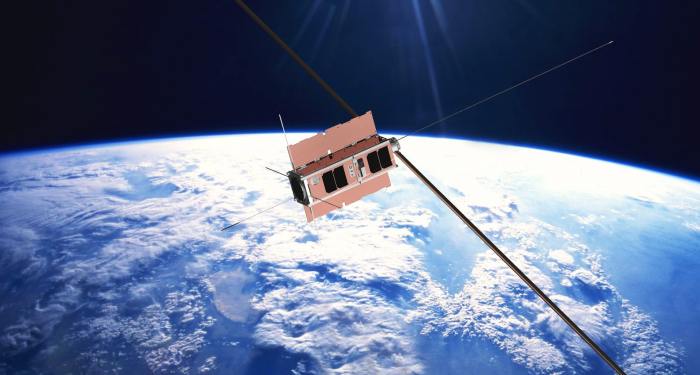
The Royal Australian Air Force (RAAF) and Defence Science Technology Group (DST) of the Australian Department of Defence have separately established partnerships with University of New South Wales (UNSW) Canberra which has resulted in a space program with one DST space mission already in orbit, one RAAF mission about to be launched. Additional follow-on missions are planned for each of RAAF and DST for launch in the near future. A combination of disruption in space technology, associated with ‘Space 2.0’ that makes space more accessible, and a commitment by UNSW Canberra to develop a space program, has delivered M1 as the first Australian space mission for the RAAF. These small satellite missions will provide research that will give a better understanding, for the current and future Defence workforce, of the potential opportunities for exploiting the space domain using Space 2.0 technology. As such, this article explores the move away from Space 1.0 to Space 2.0. While discussed in more detail below, broadly speaking, Space 2.0 relates to the reduced costs of accessing space and conducting space missions with commercial-off-the-shelf satellite components for lower-cost small satellites and mission payloads.
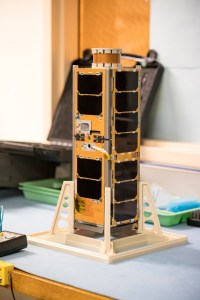
A lunch-box sized satellites (CubeSats) for the Buccaneer and Biarri space missions. (Source: Australian Department of Defence)
The objective of the ADF’s employment of the space domain is to support a better military situation for the joint force in operations planned and conducted in the air, sea, ground, and information domains. Currently, ADF joint warfighting operations are critically dependent on large and expensive satellites that are owned and operated by commercial and allied service providers. As such, a Defence-sponsored university program is currently underway to explore the potential benefits of employing microsatellites as a lower-costing option to augment the capabilities traditionally fulfilled by the large-sized satellites. Furthermore, orbiting space-based sensors can view much larger areas of the Earth in a single scan than are possible with airborne sensors. Thus, a space-supported force element can observe, communicate, and coordinate multiple force elements dispersed over large areas in multiple theatres of operations. Finally, the transmission of signals above the atmosphere enables better communications between satellites, performed over long distances over the horizon without atmospheric attenuation effects, to enable better inter-theatre and global communications.
In the twentieth century, space missions were only affordable through government-funded projects. Government sponsored organisations and missions continued to grow in size and their capabilities. In retrospect, government agencies and space industry now refer to these large-sized, expensive, and complex mission systems as ‘Space 1.0’ technology.[2] As national space agendas drove the development of bigger space launch vehicles able to carry and launch larger payloads with one or more large satellites, changes in government funding priorities away from space lift services began to stifle innovation in space technology which remained as high-end and expensive technology. Recently, in the twenty-first century, the large government agencies looked to commercial industries to find ways to innovate and develop cheaper alternatives for launching and operating space missions. This resulted in the commercialisation of affordable access to space, now commonly referred to as Space 2.0; an industry-led evolution that is generating more affordable commercial alternatives for space launch services and operations management, reusable space launch vehicles and, significantly, miniaturised satellite technology.[3] For example, in 1999, California Polytechnic State University, San Luis Obispo, and Stanford University’s Space Systems Development Lab developed the CubeSat standard, prescribed for the pico- and nanosatellite classes of microsatellites.[4] The CubeSat initiative was initially pursued to enable affordable access to reduce the barriers for university students to access space. CubeSat was initially designed to offer a small, inexpensive, and standardised satellite system to support university student experiments.
CubeSat modules are based on building up a satellite with a single or a multiple number of the smallest unitary 10cm cube module, referred to as a ‘1U’ CubeSat, i.e. a picosatellite.[5] This basic building block approach has enabled a standardisation in satellite designs and launchers. Each 1U can weigh up to 1.5 kg[6]; a ‘6U’ CubeSat, i.e. a nanosatellite, measures 30cm x 20cm x 10cm, six times a 1U and weighs up to twelve kilograms[7]. Microsatellites are typically comprised of a standardised satellite chassis and bus loaded with an onboard computer, ‘star tracker’ subsystem to measure satellite orientation, hardware to control satellite attitude and antenna pointing in orbit, solar power subsystem, communications subsystem, a deployable mechanism actuator for unfolding the solar panels and antennas, and the mission payload, i.e. mission-related sensors, cameras, radio transmitter/receiver and the suchlike.
Microsatellite projects exploit commonly available Commercial-Off-The-Shelf (COTS) technology to reduce costs and development schedules, even in military mission systems. The use of COTS technology enables a simplified plug-and-play approach to microsatellite engineering and design. By having pre-made, interchangeable and standardised components, microsatellite designs can be rapidly assembled, tested, evaluated, and modified until an acceptable solution is realised. Agile manufacturing methods such as 3D printing can further reduce the time taken to engineer and manufacture a viable operational microsatellite design.[8]
The Buccaneer miniature satellite CubeSat at the UNSW Canberra satellite research laboratory at the Australian Defence Force Academy in Canberra on 17 October, 2016.(Source: Australian Department of Defence)
The CubeSat model has become a commonly accepted standard for low-cost, low-altitude orbit, and short duration space missions. Microsatellites are relatively cheaper, more flexible in mission designs, and can be built more rapidly when compared to larger satellites, and can be replaced on-orbit more frequently, thereby taking advantage of recent technological innovation. Their small size can also exploit spare spaces in the payload section of the launch vehicles that are scheduled and funded mainly for larger satellites. This is commonly referred to as a ‘rideshare’ or ‘piggyback.’ The challenge for the designers of such ‘piggyback’ missions is to find a suitable launch event with a date and planned orbit that matches the readiness and mission of the microsatellite.
Space 2.0 evolution has realised commercial alternatives to the traditional space mission designs that used heavy satellites launched from heavy rockets. These smaller and cheaper rockets have been specifically designed to launch lighter payloads of microsatellites. In 2017, an Indian Polar Satellite Launch Vehicle using a PSLV-C37 heavy-lift rocket set a world record in lifting 104 small satellites into orbit in a single space launch event. As the Times of India reported:
India scripted a new chapter in the history of space exploration with the successful launch of a record 104 satellites by ISRO’s [Indian Space Research Organisation] Polar Satellite Launch Vehicle in a single mission. Out of the total 104 satellites placed in orbit, 101 satellites belonged to six foreign countries. They included 96 from the US and one each from Israel, the UAE, the Netherlands, Switzerland and Kazakhstan.[9]
The growing maturity and expanding capabilities of CubeSat systems have seen a growing acceptance beyond university users. For example, DST and UNSW Canberra are designing, building, and testing microsatellite designs for space missions to meet Defence needs in Australia.
Space 2.0 standards and microsatellites are not intended to replace the traditional large satellites deployed into higher altitude orbit missions. Large and small-sized satellites each offer different benefits and limitations. Large satellites can collect information with higher fidelity when configured with bigger optical and radiofrequency apertures, with room available for better pointing control subsystem, larger and more powerful on-board computing systems, and multiple mission, all needing a larger power subsystem. Alternatively, disaggregating space missions across different small satellites, deployed into a large constellation, may be more survivable to environmental hazards and resilient to interference in a contested environment.
Small satellite missions can now fulfil the potential mission needs of military, commercial operators, scientists and university students. Microsatellites have already been employed for communications, signals intelligence, environmental monitoring, geo-positioning, observation and targeting. They can perform similar functions as larger satellites, albeit with a much smaller power source and reduced effective ranges for transmitters and electro-optical devices. They are easier and cheaper to make and launch for a short-term, low-Earth orbit mission. This is ideal for employing space missions to improve ADF capabilities on the ground.
Defence has partnered with UNSW Canberra, including ‘UNSW Canberra Space’ – a team of space academics and professionals – to collaborate in space research, engineering, and mission support services with Space 2.0 satellite technology in space missions for DST and RAAF. When combined with new and agile manufacturing techniques, these microsatellite missions provide the ADF with opportunities to test and evaluate potential options for operationally responsive space capabilities.
UNSW Canberra has already built the ‘Buccaneer Risk Mitigation Mission’ (BRMM) as its inaugural microsatellite space mission, in partnership with DST.[10] In November 2017, NASA successfully launched BRMM from Vandenberg Air Force Base in California. BRMM is a collaboration, in both the project engineering project and space mission management, between DST and UNSW Canberra to jointly fly and operate the first Australian developed and operated defence-science mission. BRMM is currently operational in low-Earth orbit, at a height above the ionosphere which is a dynamic phenomenon that changes with space weather effects and the Sun’s position.
The importance of this orbit is that the RAAF is dependent on the ionosphere to enable functioning of its Jindalee Operational Radar Network (JORN) systems, which is a crucial component of a national layered surveillance network that provides coverage of Australia’s northern approaches.[11] The JORN coverage and system performance are critically dependent on the ionosphere. The BRMM satellite is configured with a high-frequency receiver to measure the JORN signal that passes through the ionosphere. These signal measurements allow DST scientists and engineers to study the quality of JORN’s transmitted beam and signal, and the propagation of High Frequency (HF) radio waves that pass skywards through the ionosphere. BRMM was planned with a one-year mission-life but could stay in orbit for up to five years, depending on space weather effects and atmospheric drag.[12] BRMM is also a risk reduction activity for the ‘Buccaneer Main Mission’ (BMM) as a follow-on space mission.[13] BRMM will provide space data on how spacecraft interact with the orbital environment, to improve the satellite design for BMM, and also provide mission experience that can be used to improve the operation of the BMM. The BMM will also be used to calibrate the JORN high-frequency signals but will use an improved payload design, based on a heritage of BRMM. BMM is planned for a launch event in 2020.
This space odyssey pursued by UNSW Canberra is also bringing direct benefits to RAAF. The UNSW Canberra space program includes parallel efforts to develop three CubeSats, funded by RAAF, for two separate missions in separate events. These space missions will support academic research into the utility of microsatellites, configured with a small-sized sensor payload, for a maritime surveillance role. The first mission, ‘M1,’ will deploy a single CubeSat, currently scheduled to share a ride with a US launch services provider in mid-November 2018.[14] UNSW Canberra will continue the program and develop a second mission, ‘M2,’ which is planned to deploy two formation-flying, with inter-satellite communications, in a single space mission in 2019. The M1 and M2 missions will support research and education for space experts in Defence, and UNSW Canberra, to further explore and realise new possibilities with Space 2.0 technologies.
To conclude, the advent of Space 2.0 has reduced cost barriers and complexity to make access to space missions and space lift more affordable for more widespread uses. The increased affordability of space technology has helped to demystify mission systems and increase the interests and understanding of the potential opportunities for Space 2.0 missions as alternatives to more expensive and more complex space missions. Additionally, Space 2.0 enables agility in the design phase for the rapid development of new and viable concepts for space missions hitherto not possible with Space 1.0 technology. Space 2.0 evolution makes it possible for ADF to consider affordable space options; UNSW Canberra’s knowledge and technical achievements in space engineering and operations, with DST for Buccaneer and RAAF for M1 and M2, will provide critical research for considering the potential for new space missions for Australia.
Squadron Leader Michael Spencer is an Officer Aviation (Maritime Patrol & Response), currently serving in the RAAF Air Power Development Centre, analysing potential risks and opportunities posed by technology change drivers and disruptions to the future employment of air and space power. His Air Force career has provided operational experiences in long-range maritime patrol, aircrew training, and weaponeering, and management experiences in international relations, project management in air and space systems acquisitions, space concepts development, and joint force capability integration. He is an Australian Institute of Project Management certified project manager and also an Associate Fellow of the American Institute of Aeronautics & Astronautics.
Disclaimer: The views expressed in this document are those of the author and do not necessarily reflect the official policy or position of the Department of Defence, Royal Australian Air Force, or the Government of Australia. The Commonwealth of Australia will not be legally responsible in contract, tort or otherwise, for any statements made in this document.
Header Image: Lunch-box sized satellites (CubeSats) used for the Buccaneer and Biarri space missions. (Source: Australian Department of Defence)
On 18 June 2018, President Donald J. Trump announced his intention to create a new branch of the United States armed forces. This new branch, the US Space Force, would be charged with controlling the nation’s military activities in space. The fact that the US would be involved in military activities in space in the first place should not be taken for granted. The US’ first military space policy was based on the principle that space ought to remain a ‘sanctuary’ from the sort of martial competition that was taking place on earth’s surface. Despite these peaceful beginnings, nearly every successive president has established a military space policy more aggressive than the last. The proposed establishment of the Space Force as a new branch of the US military represents the apex of this decades-long trend toward increased militarisation of space.[1]
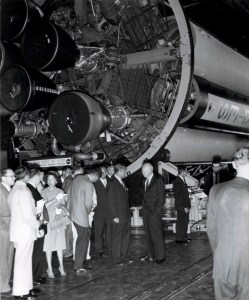
President Eisenhower visiting the George C. Marshall Space Flight Centre in Huntsville, Alabama, 8 September 1960. (Source: NASA)
The US government’s first space policy was established during the presidency of Dwight Eisenhower. Eisenhower and the military saw the nation’s developing satellite program as a valuable tool in monitoring Soviet military concentrations and looked forward to developing the critical capacity of detecting hostile missile launches from space. The president’s views differed with military leaders in significant ways. While the military advocated the development of anti-satellite (ASAT) missile technology and other generally hostile technologies for use in space, Eisenhower was more interested in the scientific possibilities of the space program. Eisenhower established the National Aeronautics and Space Administration (NASA) on 29 July 1958, as a separate entity from the Department of Defense – one with a purely peaceful civilian mandate. Though he did green-light some early research into ASAT technology, the US never developed a functional ASAT capability during Eisenhower’s presidency.[2]
John F. Kennedy took the first steps toward a more militarised space policy by approving the full-scale development of the anti-satellite and anti-ballistic missile technologies first considered during Eisenhower’s tenure. Kennedy was concerned with the nuclear ‘missile gap’ that was said to be developing between the US and the Soviet Union and was alarmed by reports that the Soviets were seeking a capacity to place nuclear weapons in earth’s orbit. Ultimately, however, Kennedy chose not to increase tensions between the superpowers through military competition with the Soviets in space, but rather to seek a diplomatic agreement limiting or banning such hostile actions. Kennedy’s successor, Lyndon B. Johnson, brought about the successful culmination of these efforts with the signing of the United Nations’ Outer Space Treaty by the US and the Soviet Union in 1967. The terms of this treaty forbade the testing or positioning of nuclear weapons and other types of weapons of mass destruction in space, prohibited the construction of military installations or fortifications on the moon, and banned any military manoeuvres in earth’s orbit. The terms of the treaty stipulated that space would only be used for peaceful, scientific purposes.[3]
Richard Nixon’s presidency was not marked by significant changes in the US’ military space policy. Gerald Ford, however, set the US on a drastically new, and far more aggressive, course. During Ford’s presidency, a series of internal government review boards reported to the president that the US’ existing space policies were woefully insufficient to protect the nation’s important space assets from the threat of Soviet attack. Experts warned that deterrence was not enough. The US, they said, would need to develop not only substantial defences in space but would need to obtain potent offensive firepower as well. Ford acted on this advice by drafting a new military space policy. This policy declared that ‘the Soviets should not be allowed an exclusive sanctuary in space for critical military supporting satellites.’ The employment of non-nuclear anti-satellite technology, Ford declared, would enable the US to ‘selectively nullify certain militarily important Soviet space systems, should that become necessary.’ By the end of his presidency, Ford had put in place the US’ first outwardly aggressive military space policy, mandating that the nation obtain both offensive and defensive capabilities in space.[4]
Jimmy Carter followed in Ford’s footsteps by officially rescinding the US’ self-imposed prohibition on testing anti-satellite weaponry in space. In 1978 Carter promulgated a new space policy which affirmed the right of the US to ‘pursue activities in space in support of its right of self-defense.’ Regarding anti-satellite capability, Carter declared that the US would continue to seek a ‘verifiable ban’ on such technology but would continue its research and development ‘as a hedge against Soviet breakout.’ In other words, the Carter administration sought to obtain a ban on ASAT technology but was unwilling to let the US fall behind if the Soviets refused to cooperate or broke the terms of any prospective treaty.[5]
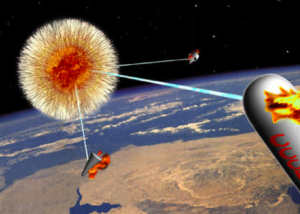
Project Excalibur was a proposed x-ray laser based anti-missile technology. It used a nuclear warhead surrounded by a number of metal rods that acted to focus the output of the explosion into narrow beams that would be aimed at nuclear missiles and their warheads. (Source: Wikimedia)
When Ronald Reagan assumed the presidency in 1981 the US upped-the-ante yet again. One of the most notable products of Reagan’s whole presidency was his famous Strategic Defense Initiative (SDI), known popularly as the ‘Star Wars’ program. The nature of SDI changed significantly over time but was a program designed to give the US the capacity to intercept and destroy a massive Soviet missile barrage en-route to the US or its allies using space-based weapons platforms. Though regarded by most now and many in his own time as wildly unrealistic given the technology of the day, Reagan’s intention of stationing military weapons in space capable of defeating Soviet attacks on earth was far beyond anything the US had been willing to attempt before. This technological program was coupled with Reagan’s stated unwillingness to continue negotiating with the Soviet Union over any form of disarmament which he believed would interfere with American prerogatives or American interests.[6]
Following the breakup of the Soviet Union in 1991 the ambitious nature of Reagan’s SDI program was scaled back under George H.W. Bush from a massive global missile shield to a smaller, regional defensive program capable of interdicting missiles in smaller numbers but with higher accuracy, reflecting the new realities of a post-Cold War world. Both H.W. Bush and Bill Clinton maintained the US’ stated willingness to both attack and defend military assets in outer space, but the post-Cold War world saw a marked decrease in the perceived importance of military space readiness. Bill Clinton was notable for his administration’s desire to open up the US’ space technology for the benefit of civil and commercial interests around the world. GPS, the global positioning system which serves as the basis of modern satellite-directed navigation, was initially a military asset unavailable to the public until Clinton opened access to the program in the 1990s.[7]
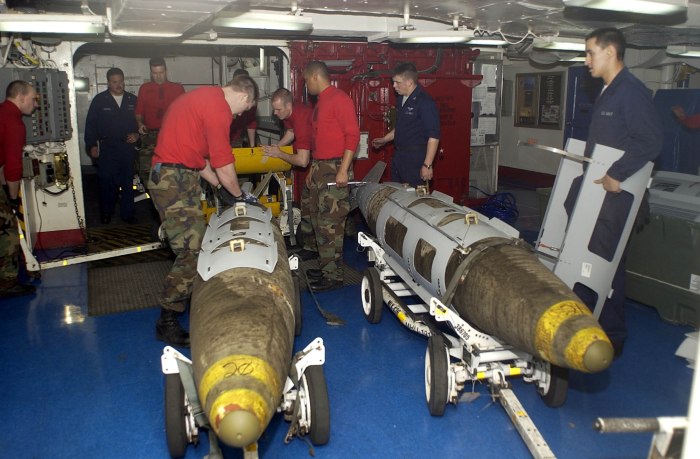
US Navy Ordnance handlers assemble Joint Direct Attack Munition (JDAM) bombs in the forward mess decks before putting them on elevators headed for aircraft on the flight deck aboard USS Constellation, c. 2003. JDAM’s are guidance kits that convert existing unguided bombs into precision-guided ‘smart’ munitions. The tail section contains an inertial navigational system and a global positioning system. JDAM improves the accuracy of unguided bombs in any weather condition. (Source: Wikimedia)
The advent of the Global War on Terror and the protracted conflicts in the Middle East has reinvigorated the government’s concern with space policy in recent years. George W. Bush took steps to limit the free access to GPS established by Bill Clinton claiming the nation’s enemies – whether conventional military, insurgent groups or terrorist organisations – could use GPS as a useful tool against US interests. Perhaps the most notable use of military satellite technology, however, has been the drone program. Satellite-enabled drone reconnaissance and bombing missions have been central to US military operations around the world since the 1990s and have only grown in importance. George W. Bush and Barack Obama each found space assets to be indispensable in the conduct of their military missions abroad and have each affirmed the importance of space in their iterations of national space policy.[8]
In his 2006 exposition of US space policy, George W. Bush declared:
In this new century, those who effectively utilize space will enjoy added prosperity and security and will hold a substantial advantage over those who do not. Freedom of action in space is as important to the United States as air power and sea power. In order to increase knowledge, discovery, economic prosperity, and to enhance the national security, the United States must have robust, effective, and efficient space capabilities.[9]
By declaring that space is just as crucial to the modern military as air power and sea power Bush seems to have prefigured the seminal development in US space policy that incumbent President Trump announced in 2018: the planned establishment of the US Space Force.
In the six decades between Eisenhower’s first military space policy and the space policy of Trump, the US has gone from a purely peaceful conception of space to a grudging acceptance of defensive militarisation to a modern policy in which an aggressive militarisation of space is regarded as essential to national defence. The elevation of space activities from auxiliary status to an independent branch of the armed forces not only solidifies the importance of space in the modern US military but represents the next logical step in a pattern of increasingly aggressive military space policy established since the earliest days of the US space program.
Bradley Galka obtained his Master of Arts degree in history from Kansas State University in 2017. He is currently pursuing a PhD at Kansas State. His research focuses on the relationship between politics and the military in the United States, particularly regarding fascism and the U.S. military during the inter-war period.
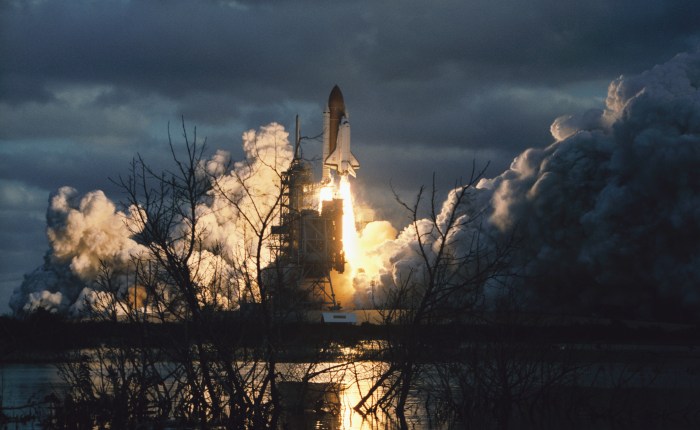
Header Image: The launch of the STS-74 mission aboard the space shuttle Atlantis from NASA’s Kennedy Space Center. (Source: NASA)
[2] Nelson Rockefeller, National Security Council, ‘US Scientific Satellite Program,’ NSC-5520, 20 May 1955; Dwight D. Eisenhower Presidential Library and Museum, Abilene, KS, S. DDE’s Papers as President, NSC Series, Box 9, 357th Meeting of the NSC, NAID#: 12093099, Everett Gleason, National Security Council, ‘US Objectives in Space Exploration and Science,’ March 1958; Eisenhower Presidential Library, DDE’s Papers as President, NSC Series, Box 9, 339th Meeting of the NSC, NAID#: 12093096, S. Everett Gleason, National Security Council, ‘Implications of Soviet Earth Satellite for US Security,’ 10 October 1957.
[3] George C. Marshall Institute, Presidential Decisions: NSC Documents from the Kennedy Administration National Security Council, ‘Certain Aspects of Missile and Space Programs,’ NSC-6108, 18 January 1961; George C. Marshall Institute, Presidential Decisions: NSC Documents from the Johnson Administration, Lyndon B. Johnson, ‘Cooperation with the USSR on Outer Space,’ NSAM-285, 3 March 1964; United Nations General Assembly, ‘Treaty on Principles Governing the Activities of States in the Exploration and Use of Outer Space, Including the Moon and Other Celestial Bodies, 27 January 27, 1967.
[4] George C. Marshall Institute, Presidential Decisions: NSC Documents from the Ford Administration, Brent Scowcroft, National Security Council, ‘Enhanced Survivability of Critical US Military and Intelligence Space Systems,’ National Security Decision Memorandum 333, 7 July 1976; George C. Marshall Institute, Presidential Decisions: NSC Documents from the Ford Administration, Brent Scowcroft, National Security Council, ‘US Anti-Satellite Capabilities,’ National Security Decision Memorandum 345, 18 January 1977.
[5] George C. Marshall Institute, Presidential Decisions: NSC Documents from the Carter Administration, Jimmy Carter, Presidential Review Memorandum – NSC 23, ‘A Coherent US Space Policy,’ 28 March 1977; George C. Marshall Institute, Presidential Decisions: NSC Documents from the Carter Administration, Jimmy Carter, Presidential Directive/NSC 33, ‘Arms Control for Anti-Satellite (ASAT) Systems,’ 10 March 1978; The Jimmy Carter Presidential Library and Museum, Atlanta, GA, Presidential Directives, Jimmy Carter, Presidential Directive/NSC-37, ‘National Space Policy,’ 11 May 1978, pp. 1-2.
[6] George C. Marshall Institute, Presidential Decisions: NSC Documents from the Reagan Administration, Ronald Reagan, National Security Decision Directive Number 42, ‘National Space Policy,’ 4 July 1982.
[8] George C. Marshall Institute, Presidential Decisions: NSC Documents from the George W. Bush Administration, George W. Bush, ‘US National Space Policy,’ 31 August 2006; George C. Marshall Institute, Presidential Decisions: NSC Documents from the Obama Administration, Barack Obama, ‘National Space Policy of the United States of America,’ 28 June 2010.
[9] George W. Bush, ‘US National Space Policy,’ 31 August 2006.













 From Balloons to Drones