By Ian Shields
Editorial Note: Between February and April 2018, The Central Blue and From Balloons to Drones, will be publishing a series of articles that examine the requirements of high-intensity warfare in the 21st Century. These articles provide the intellectual underpinnings to a seminar on high-intensity warfare being held on 22 March by the Williams Foundation in Canberra, Australia. In this article, Ian Shields explores the implications of the concepts of time and space for airmen. Using these concepts, Ian explores the differences between the services concerning culture, technology, and decision-making. Understanding these differences is essential if we are to leverage the advantages of each of the domains in high-intensity warfare.
Introduction:
Time and Space bound all military operations. We are used to the idea of trading time for space, although that is primarily applicable to the land campaign. If we think about the time/space relationship in two campaigns separated by a significant amount of history associated concepts show a great deal of change:
- The Peloponnesian wars – campaign duration, the speed of manoeuvre, communication, size of battlefield/weapon ranges.
- The First Gulf War – campaign duration, the speed of manoeuvre, communication, size of battlefield/weapon ranges.
It can be argued that time and space constrains airmen; however, we have a different perception and are better able to exploit both time and space.
Nevertheless, before going any further, what do airmen do? In 2010, Colonel Tim Schultz, the then Commandant of the USAF School of Advanced Air and Space Power Studies suggested that airmen ‘project innovative forms of power across traditional boundaries.’ Again, with emphasis, airmen ‘project innovative forms of power beyond traditional barriers.’ The key words here are, ‘project,’ ‘innovative’ and ‘power’ and these are the key to why airmen are different. Given this, this article focusses on four areas: the impact of air power; our cultural differences as airmen compared with soldiers and sailors; the impact of technology; and decision-making before concluding.
The Impact of Air Power
Looking at the world at the beginning of the Twentieth Century, it was well-ordered, firmly based on the idea of the nation-state that was built on Treaty of Westphalia and the Congress of Vienna. Europe was, by historical standards, relatively peaceful with well-defined and respected boundaries.
To alter the balance of power required armies crossing these boundaries which, as we saw in 1914, could have disastrous results. Navies could control trade, impose blockades, and prevent armies moving over stretches of open water but they are themselves constrained by the availability of water; water covers only 70% of the surface of the earth.
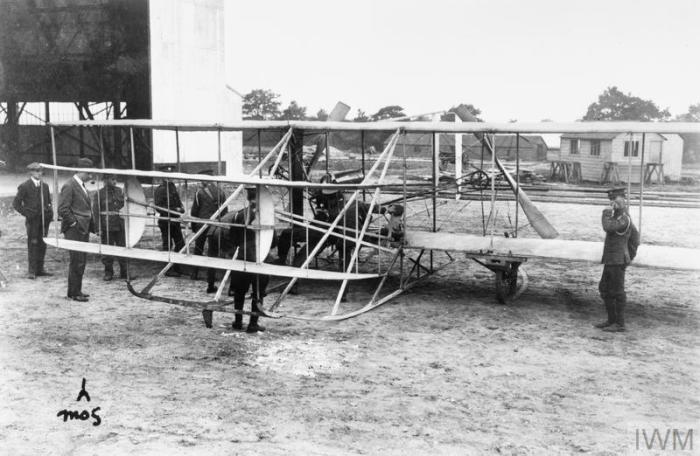
The events of 17 December 1903 changed all that, although it was not appreciated in those terms at the time (or, arguably, ever since): with 100% of the earth covered by air, boundaries drawn on maps and the constraints of the ocean became far less relevant. Again, airmen project beyond traditional boundaries.
While technology did not allow air power to be fully exploited in the First World War, the omens were there. Yes, there was an over-reaction in the 1920s and 1930s with, for example, Stanley Baldwin’s pronouncement that ‘the bomber will always get through,’ but the seeds for air power to exploit time and space in innovative ways began to be appreciated.
Cultural Differences
When exploring the question of what time and space mean for airmen, it is worth also reflecting what they mean for the soldier and the sailor. Time and space considerations bound both far more than airmen.
Take the soldier. Their horizon is limited in both spatial and temporal terms: soldiers may be interested in what is going on over the next hill, but rarely will he or she have to think much further. The modern-day artilleryman may point out the range of his or her weapon systems but compared with the airman they are limited. All too often the soldier’s view is limited to the range of their vision, which is perhaps why he or she may not understand that air power can protect him or her without necessarily being always in sight – or under command.
The sailor, by contrast, is far more used to the open horizons of the blue ocean. His or her vision is bounded not by the trench system but by the curvature of the earth. Away from the shore the sailor enjoys a sense of freedom more familiar to the airman and is used to thinking in large distances. Culturally, airmen have more in common with the sailor than the soldier, and it is perhaps not surprising that we have adapted the nautical methods of navigation – speed in knots, distances in nautical miles, latitude and longitude as our geographic reference system rather than units more familiar to a soldier. The sailor, though, is also more bounded than the airman. Not only does the sailor’s domain stop at the shoreline or the river’s edge, but his or her speed across the oceans is, by our standards, slow while, with obvious acknowledgements to submariners, like the soldier he or she is largely constrained to operating in just two dimensions.
There is a further cultural divide, which is the way the pace of technology has shaped airmen. For the sailor, he or she has progressed from the sail, through steam to nuclear propulsion over many centuries. For the soldier, the path from bows and arrows, via the musket to today’s weapon systems has been a journey of some half a millennium. In contrast, airmen have moved from the Wright brothers through the jet engine to Sputnik and then on to the Space Shuttle in a short space of time. So, our perception of time, driven by the technology that permits us to operate in the third dimension, is fundamentally different.
Airmen even refer to it in our poetry – the definitive High Flight talking of slipping the surly bonds of earth, of wheeling, soaring and swinging high in the sunlit silence and, finally, of reaching out and touching the face of God – sentiments that speak loudly to we who exploit the third dimension and are less constrained by the fourth – time – than our earth- and water-bound brothers.
Less I am accused of too many flights of fancy, let me continue with something altogether more concrete, the impact of technology.
Impact of Technology
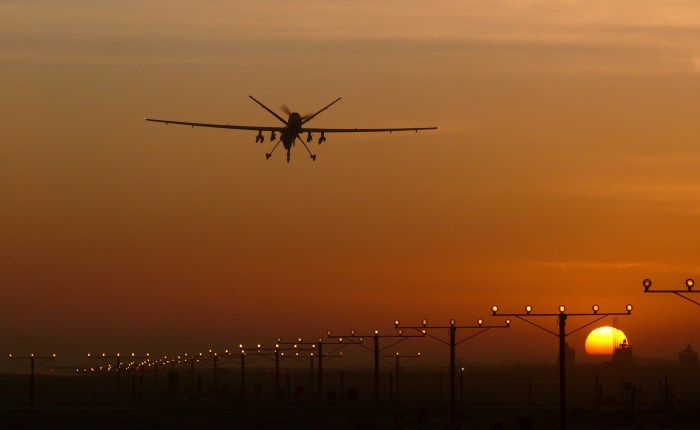
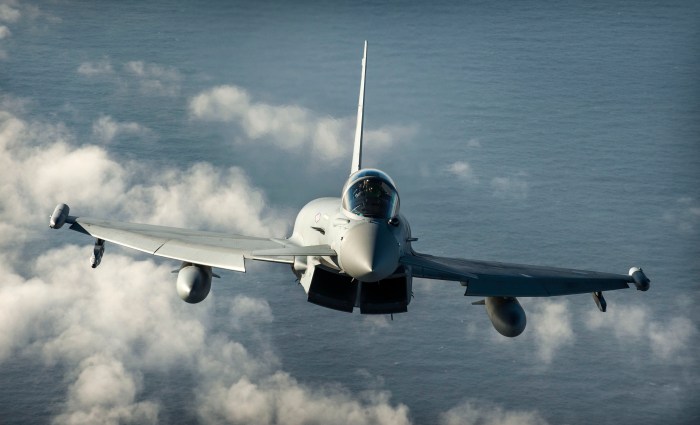
Technology allows us to fly and we are inexorably wedded to it as a result. We are at home not just with the advances, but the speed of change: we are adaptable. Technology allows us to challenge the constraints of time and space constantly. We go ever faster, ever further, ever higher to the extent that now it is the human in the cockpit, or in the loop, that becomes the limiting factor with the demands on the human body regarding g-force and life support becoming critical in aircraft such as the Eurofighter Typhoon. The very speed at which our platforms can operate bring new pressures on command, control, and communications, and on the decision-making cycle. So, we can shrink time and exploit it to an ever-greater extent but are we reaching a new plateau with the human body the limiting factor? If so, we turn again to technology and remove the human from the cockpit – the Remotely Piloted Aerial System (RPAS) – or help with decision-making by more automation.

However, is this shrinking or expanding of time? It is both, depending on your viewpoint: it is shrinking because we need less time to undertake actions, or it is expanding because we can achieve more in the same period.
Regarding space, we see a similar dichotomy, the shrinking and expanding of the concept of space. As we move further up – and even out of – the atmosphere, we seemingly shrink space – we have access everywhere from our lofty vantage point in orbit, and it is less and less possible to hide from our gaze. At the same time, we are shrinking space as our targeting becomes ever more precise and our discrimination better.
Decision Making
Perhaps nowhere is our different approach to time and space more starkly illustrated than in the realm of decision-making. It was, after all, John Boyd, an airman – and a fighter pilot to boot – who came up with the OODA loop – a means of getting inside the enemy’s decision-making cycle – that is of exploiting time.
While air power offers the politician some advantages – being able to posture from afar, being able to deploy rapidly a potent force but one with only a small footprint – the speed and reach of air power (or, to put it another way, our use and exploitation of time and space) offers him or her specific challenges too; the perils of the hasty decision or the too-long delayed choice. For example, if there is verified intelligence of a hijacked Boeing 747 heading for Canary Wharf but presently over central France, when do you intercept it?
These challenges extend ever further down the decision-making process to the commander and, increasingly, to the man or woman in the cockpit: that split-second decision facing the Harrier pilot, Tornado crew or RPAS operator – to drop or not to drop ordnance?
However, perhaps the ultimate tyranny (so far in human history at least) of decision-making regarding time and space has been the advent of nuclear weapons. The initial employment of these weapons of mass destruction in 1945 came about because of long and careful decision-making, but with the range of ICBMs and the proliferation of weapons, both time and space have been shrunk as the decision-making cycle becomes ever more compressed with no chance of correcting mistakes. Moreover, remember that for the first 40 years of the nuclear weapon age, it was airmen alone who were responsible for their delivery.
Conclusion
In this brief article, I have sought to illustrate that we can use time and space – and the relationship between the two – as tools with which to explore air power in a unique way. We can use it to identify differences and similarities with the other domains, and it offers a different means of analysing what it means to be an airman.
Time itself has constrained this article to no more than a cornucopia of ideas, and I have explored neither space (as in outer space) nor cyberspace, both domains of increasing importance.
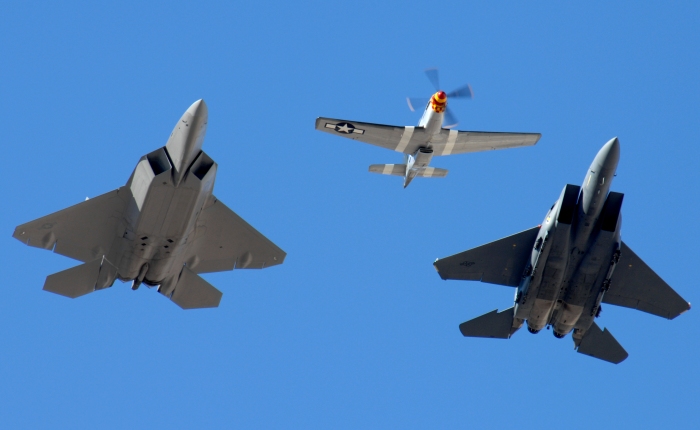
Let me offer you three conclusions. First, as airmen, we are more constrained by time and space as we lack permanence and rely on technology to fly at all. Second, as airmen, we are less constrained by time and space because we operate at high-speed, have great reach, are inherently responsive, and have a cultural appreciation of time and space that is unique. Third, new and emerging technologies, as exemplified by fifth-generation air power, will continue to challenge our present perceptions of time, space, and its relationship; the exploitation of both outer space and cyberspace are excellent illustrations of both. To conclude, Francis Fukuyama famously talked about the ‘End of History,’ but perhaps what we are seeing is more an end of TIME and, if not an end then certainly a new appreciation of space.
Ian Shields is a retired, senior Royal Air Force officer who has a wealth of experience as an operator, commander, and analyst. After a 32-year career that saw him command a front-line squadron and reach the rank of group captain, he has more recently established himself as a highly respected commentator on defence and security issues, specialising on aerospace matters. Ian holds post-graduate degrees from King’s College, London, and the University of Cambridge. He currently an Associate Lecturer at the University of Cambridge and writes for several academic and journalistic publications on current issues within defence and international relations.
Header Image: A Reaper Remotely Piloted Air System comes into land at Kandahar Airbase in Helmand, Afghanistan, c. 2011. (Source: UK MoD Defence Imagery)


 From Balloons to Drones