The Air Defence of the UK: Defence on a Shoestring in an Age of Uncertainty

The Air Defence of the UK: Defence on a Shoestring in an Age of Uncertainty

By Dr Kenton White

Editorial Note: Between February and April 2018, The Central Blue and From Balloons to Drones, will be publishing a series of articles that examine the requirements of high-intensity warfare in the 21st Century. These articles provide the intellectual underpinnings to a seminar on high-intensity warfare being held on 22 March by the Williams Foundation in Canberra, Australia. In this article, Dr Kenton White examines Britain’s defence policy with regards to the air defence of the United Kingdom. He compares Britain’s commitment to air defence during the Cold War period with that of the present. With regards to the present, White concludes that given certain factors, the Royal Air Force (RAF) will struggle to regenerate if faced with a high-intensity conflict with a near-peer enemy.

Preamble

This article talks broadly about strategy, planning and its practice. It uses examples from Britain’s defence policy, and hard numbers from the Cold War experience, to illustrate some of the problems the RAF faces today. It looks at Britain’s commitment to the air defence of its islands during the Cold War – an age of certainty – and compares it directly to the current defence policy and practice in the age of uncertainty.

A historically pessimistic view of international relations and strategy is taken. The reason for this pessimism is based on historical precedent. In 1914, Europe went from peace to war in less than two months. In the 1930s Britain’s rearmament began in mid-decade to replace bi-planes and other equipment, but the RAF still went to war in 1939 with obsolescent, vulnerable equipment, and suffered severe losses of personnel and machinery.
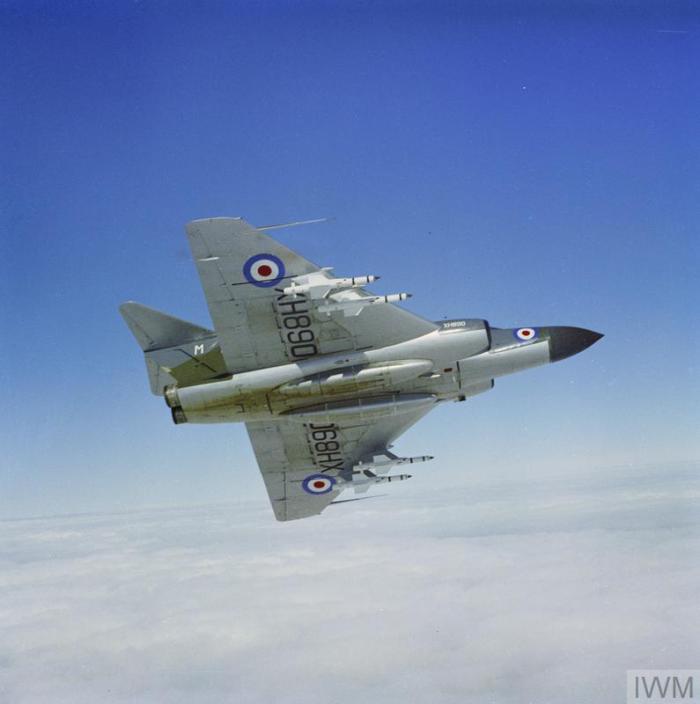
RAF-T 2151
A Gloster Javelin FAW.9R of No, 23 Squadron banking away from the camera clearly showing the missile complement of De Havilland Firestreak infra-red homing air-to-air missiles. (Source: © IWM (RAF-T 2151))

Introduction

I take it someone has worked out whether we can defend ourselves.

Jim Callaghan, Labour Prime Minister, 1978

This comment is written on the front page of a Joint Intelligence Committee report on the ability of the Soviet air force to attack targets in Britain.[1] The report showed Britain was poorly prepared to defend itself in times of war, despite the apparent threat from the Soviet Union and Warsaw Pact.

Questions relating to Britain’s air defence capability are as relevant now as they were then; however, the circumstances are very different. The familiar bipolarity of the Cold War is missing, and the range of threats to the UK is much broader, including both state and non-state actors.

Deterrence

A vital role of the RAF is to deter attack, and ultimately the defence of UK airspace if that deterrent fails. Deterrent plans are aimed at a perceived threat: planning for the manifestation of that threat. These plans relate intimately to national strategy. The nation must appear to have a capable air force if it is to act as a deterrent. However, deterrence also requires the ability to sustain operations. Britain’s air defences protect around 1 million square miles of airspace, reaching out into the North Atlantic. This indicates how vital airborne maritime reconnaissance is in defence of the islands.

The 2015 Strategic Defence and Security Review read:

The Government’s most important duty is the defence of the UK and Overseas Territories, and protection of our people and sovereignty.[2]

In written testimony to the House of Commons Defence Committee (HCDC) in 2013, Lord Hennessy of Nympsfield told the committee that, in an ideal world, air defence of the UK should be the priority of UK defence policy.[3] The 2015 SDSR states ‘[T]he Royal Air Force protects our airspace and is ready at all times to intercept rogue aircraft.’[4] Concerted attack from the air by a peer adversary is not perceived as an imminent threat.

Threat Analysis

The conventional threat during the period of ‘Flexible Response,’ as the NATO Cold War strategy was called, was clear – direct attack from bombers equipped with gravity bombs or stand-off missiles aimed at denying the vital infrastructure needed for the reinforcement of Europe by UK and US forces. The UK was responsible for the air defence of the Eastern Atlantic and the UK itself, and the airspace over the UK was an Air Defence Region in its own right. However, the defensive response to the threat was never completely put into place, leaving UK airspace extremely vulnerable, and Britain’s ability to continue a fight very doubtful.

What is the threat analysis today? The HCDC identified several distant threats to the national interest, and while qualifying the analysis heavily, identified the Russian/Middle Eastern threat as being the greatest to the UK itself.[5] In 2015, the HCDC commented that:

[t]he resurgence of an expansionist Russia represents a significant change in the threat picture […] and has implications not only for the UK but also for our allies as well.[6]

The ability of the Russians to interfere with the sea and air communications into the UK is seen as a considerable problem, and the capability to use cyber-attacks to cripple the country has been recently in the news thanks to the Defence Secretary Gavin Williamson.[7] Unofficially at least in public, there is also the fear of the break-up of NATO, and the need for Britain to be able to defend itself alone, as in 1940.

What is being defended?

For us to understand the demands of the air defence of the UK, we must understand what is being defended. The knee-jerk response to this may be that the population is being defended. However, the official documents indicate otherwise. During the early Cold War, the first thing being defended against attack in the UK was the nuclear deterrent. Other targets such as other military installations, ports and airports were next on the list for air defence, with civilian installations such as power generating stations as poor runners-up.
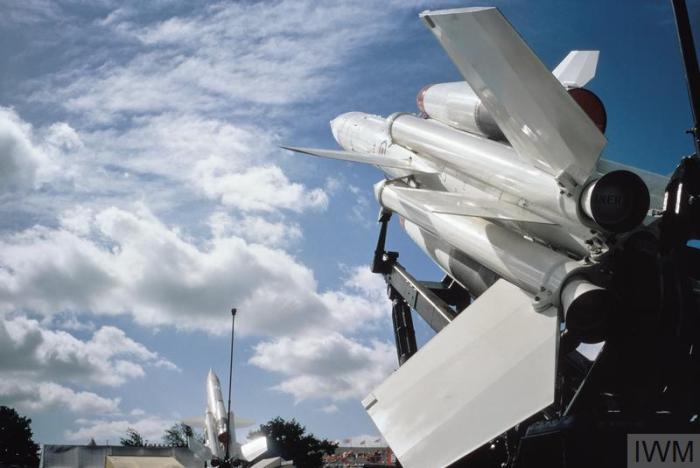
TR 27162
A Royal Air Force Bristol Bloodhound Mark II surface to air guided missile. The missile was used as Britain’s main air defence weapon from 1958 – 1991. It initally protected Britain’s V bomber force but was later deployed in Germany and at RAF Seletar, Singapore. The Bloodhound Mk II was introduced in 1964. It used continuous wave radar guidance and had a capability against aircraft flying at normal operational heights. (Source: © Crown copyright: IWM (TR 27162))

Once the nuclear deterrent took to sea in submarine-launched missiles, the priority of defence changed. There is no longer the clear military imperative to defend the nuclear deterrent if it functions correctly with one boat always at sea, but neither is there the capability, nor the political will, to defend the vital military and civil installations in the country from attack from the air. Security documents speak in vague terms about ‘defence of the UK’.[8]

Self-defence of the RAF, in other words maintaining the RAF air defence and surveillance capability, seems the obvious next choice given that the resources available to the RAF are insufficient to defend the national infrastructure.

What are the vulnerabilities?

Internal Vulnerability

The ‘internal’ vulnerability comes from Government cuts and a drive for greater ‘efficiency’. This results in a lack of equipment, weapons, supplies and trained personnel. There are many examples of short-sighted ‘cost-savings’ which resulted in reduced air defence capability.[9] To many in the RAF and the other armed services, the greatest enemy is the Treasury.

Air defence of the UK suffered considerably during the early Cold War. Because the expectation was that any war would turn nuclear very quickly, the provision of expensive air defence systems was considered unnecessary.[10] The RAF finds itself in a comparable situation now, following a period of cuts, ‘refocusing’ or simple indifference by the government.

National air defence should be flexible and capable of responding to a multitude of threats. However, the historical lesson is that even in a period of certainty, the resources were not made available to the RAF to provide what it saw as the minimum level of defence for UK airspace. Flexibility comes at a cost. It relies on balance within the forces, and sufficient numbers to respond to different scenarios.[11]

There is a lack of a layered surface to air defence system. Other services rely on layered defence, while the RAF has been forced into a two-stage defence: overhead and arm’s length. Without the numbers, achieving flexibility becomes problematic. However, not all aircraft will be available all the time, so a simple count up of aircraft in service is misleading – battle damage, faults and maintenance will reduce the numbers available.

The armed forces are increasingly run by governments of all colours in the fashion of a business, with ‘outputs’ and ‘levels of cost-effectiveness’. The only real measure of an armed force is how it operates in its true environment, which is war. Which brings us to the second vulnerability.

Self-Delusion

This is primarily political self-delusion, but also some self-delusion within the Service. A strategic vulnerability has developed out of the policies which attributed success to the NATO strategies. However, lack of failure does not equal success.

This vision of success contributes to the self-delusion. According to the politicians of successive Governments, aircraft numbers could be cut, pilot training be restricted, and obsolete weapons retained, but the overall strategy was still successful. Behind this apparent success, the UK air defence capability had effectively been eviscerated.

This same self-delusion of success led to the cuts under the ‘Peace Dividend’ and led to very quickly forgetting how to face an adversary that has capable Air Power regarding credibility and numbers. To reinforce this misplaced belief, most recent RAF operations have been fought in more-or-less permissive air environments. They have not had to deter nor fight a peer state.

The political class, public, and even the other armed services have lost sight of the fact that ‘air superiority’ is not a given.  The memory of what it is like to have to operate against an adversary which has credible and numerically similar air power has been lost.  This extends to the protection of the supporting infrastructure, which in recent deployments has remained free from attack. The ground facilities suffer from vulnerability to air attack to blind the surveillance systems, which is why maritime reconnaissance, air surveillance and control systems and airborne warning and control systems are so very important. Indeed, a lack of maritime patrol aircraft has been an embarrassment to the British Government in the recent past.

Existential vulnerability

The third vulnerability is the physical existence of the RAF if it is faced with a peer enemy.

This vulnerability, a result of the combination of the first and second threats, is particularly applicable to Britain’s armed forces. If a relatively small force accomplishes military excellence, the effect of combat losses will be disproportionately devastating.[12] The RAF may be genuinely excellent, capable and agile in all its operations, but because of its reduced size, any combat losses, should it come to a peer-to-peer war, will be truly ruinous.

Difficulties, if not disasters, in the early stages of war, and the need for time to recover and re-arm, have been vital for the UK.  The British Expeditionary Force experienced this in the First World War, and nearly by the RAF in the Second World War. Had Air Chief Marshal Sir Hugh Dowding not refused to send more fighters to defend France it was likely that the air defence of the home islands would not have been sufficient to survive the impending attack.

An ex-RAF officer commented that:

This threat poses the problem the RAF has faced for decades: condemning themselves to low capabilities for a while, and eventually getting better if they last long enough.

Conclusion

In this age of uncertainty, flexibility is the key to respond to threats from different areas. However, the RAF, along with the other armed forces, have been starved of the necessary resources for even the basic defence of the home nation.

It would appear that many of the limitations placed on UK air defence during a period of strategic certainty have continued into the current age of uncertainty.

Following the apparent success of the Cold War strategies, the idea the ‘teeth’ could be sharpened at the expense of the ‘tail’ persisted and has now grown to dangerous proportions. Pursuing the business model of ‘efficiency’, the Armed Forces have been cut to very low levels yet asked to do more. Moreover, with the increasing tensions in Eastern Europe, the Middle East and the Pacific, the number of possible threats is increasing.

CT 68
The crew of a McDonnell Douglas Phantom FRG2 aircraft of No. 111 Squadron with their aircraft and weapons load at RAF Coningsby in 1975. The aircraft is fitted with tanks and Sidewinder heat-seeking missiles. Lying in front are four Sparrow radar guided missiles and a Gatling Pod. (Source: © Crown copyright. IWM (CT 68))

The overwhelming problem with a denuded air force is the time it will take to recover its capability if, and when, it is needed. Modern equipment is complicated to manufacture, and aircraft cannot be built in the numbers previously seen. Nor, frankly, is there the will to provide such facilities during peacetime for use in the event of war.

War has a habit of appearing without much announcement, and the diminished resources of the RAF would take years to bring up to the necessary levels to defend the UK against a determined enemy, and defending these islands is precisely what the RAF may be called upon to do, before too long.

Dr Kenton White is a Sessional Lecturer in Politics, International Relations and Strategic Studies at the University of Reading. He also works as a part-time Lecturer in Strategic Studies at Cranwell with the RAF. He has a PhD in Strategic Studies, researching British defence policy and practice during and after the Cold War. He studies military history and defence policy from the Napoleonic Wars to today. Before entering academia, he was the Managing Director of a computer animation company.

Header Image: A Russian Bear aircraft is escorted by a Royal Air Force Quick Reaction Alert (QRA) Typhoon during an intercept in September 2014. (Source: MoD Defence Imagery)

[1] The National Archives, PREM 16/1563, JIC (77)10, The Soviet Capability to Attack targets in the United Kingdom Base, 26th October 1977, ‘Defence against the Soviet Threat to the United Kingdom’, n.d.

[2] Cmd 9161, ‘National Security Strategy and Strategic Defence and Security Review 2015: A Secure and Prosperous United Kingdom’ (The Cabinet Office, November 2015), chap. 4. Hereafter, SDSR 2015

[3] HC 197, ‘Towards the next Defence and Security Review: Part One’, (House of Commons, 7 January 2014), p. 58.

[4] ‘SDSR 2015’.

[5] ‘Memorandum submitted by the Strategy and Security Institute, University of Exeter,’ 7 October 2015.

[6] HC 493, ‘Flexible Response? An SDSR Checklist of Potential Threats and Vulnerabilities’ (House of Commons Defence Committee, 17 November 2015), para. 58.

[7] HC493, para. 50; Ben Farmer, ‘Russia says Britain’s Defence Secretary’s claim of attack threat ‘like something from Monty Python,” The Daily Telegraph, 26 January 2018.

[8] ‘SDSR 2015’, chap. 4.

[9] Kenton White, ‘“Effing” the Military: A Political Misunderstanding of Management’, Defence Studies, 17:4 (2017), pp. 346-58.

[10] A07783, Defence of the United Kingdom, DOP (78)12, Memorandum to the Prime Minister from John Hunt, 1st August 1978, ‘Defence against the Soviet Threat to the United Kingdom’, 2.

[11] Group Captain Paul O’Neill, ‘Developing a Flexible Royal Air Force for an Age of Uncertainty’, RAF Air Power Review, 18:1 (2015), pp. 46-65.

[12] Colin S. Gray, War, Peace, and Victory: Strategy and Statecraft for the Next Century (New York: Simon and Schuster, 1990), p. 171.

The Champion Team to Fight and Win #highintensitywar: The Case for Australian Expeditionary Air Wings

The Champion Team to Fight and Win #highintensitywar: The Case for Australian Expeditionary Air Wings

By Wing Commander Chris McInnes

Editorial Note: Between February and April 2018, The Central Blue and From Balloons to Drones, will be publishing a series of articles that examine the requirements of high-intensity warfare in the 21st Century. These articles provide the intellectual underpinnings to a seminar on high-intensity warfare being held on 22 March by the Williams Foundation in Canberra, Australia. In this article, Chris McInnes examines the case for the Royal Australian Air Force (RAAF) to develop a fully integrated expeditionary air wing capability to deal with the challenges offered by high-intensity warfare.

In introducing Plan Jericho to the world in 2015, then Chief of the RAAF Air Marshal Geoff Brown argued that the Royal Australian Air Force:

[n]eed[s] to evolve our techniques, tactics and procedures to work as a champion team, not a team of champions.[1]

Brown’s distinction between a champion team and team of champions is a particularly important one for small air forces to consider as they ponder the requirements of high-intensity operations in a changing world. The tempo, complexity, and costs of high-intensity operations will sunder the seams of a team of champions.

Small air forces have had mercifully limited experience of this pressure because larger forces, generally the United States Air Force (USAF), have absorbed much of it. For the RAAF, a lacklustre command experience in the Second World War has been followed by niche contributions that operated as part of US-led combat air operations but in isolation from each other in Korea, Vietnam, Iraq, and Afghanistan.[2] Australian officers have led these contributions and regional coalition operations, such as East Timor in 1999, and gained valuable knowledge as embeds in larger US headquarters. However, as a collective, Australia’s airmen have had little exposure to building a champion team to withstand the pressures of high-intensity warfare.

This is why Operation Okra’s air task group is so important. The dispatch of a self-deploying, self-sustaining air task group to the Middle East in September 2014 marked a departure from Australia’s experience of combat air operations. For the first time since the Second World War, Australian air power– the E-7A airborne early warning and control aircraft, KC-30A tankers, F/A-18F fighters, C-130J transports, air base, and enabling elements – contributed to the wider US-led operation as a coherent Australian team.

Operation OKRA
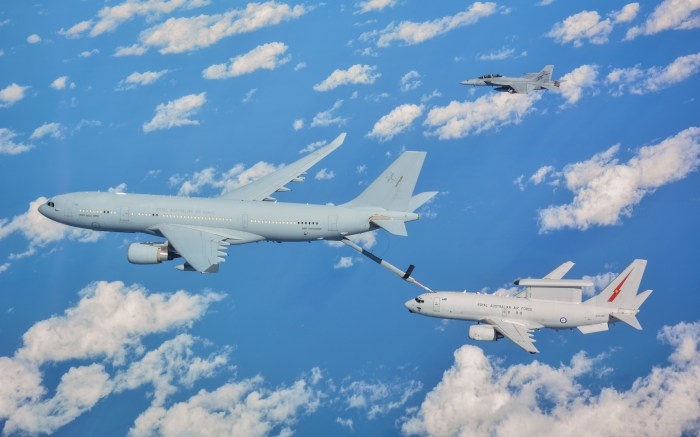
An RAAF KC-30A Multi Role Tanker Transport, E-7A Wedgetail and an F/A-18F Super Hornet fly in formation as they transit to the airspace as part of Operation Okra. (Source: Australian Department of Defence)

This team came together despite the lack of a common organisational concept or a well-prepared headquarters to facilitate their integration as an Australian champion team. The aircraft and air bases mentioned above reported to three separate chains of command: Air Task Group 630 commanded the E-7A, KC-30A, and F/A-18 elements while Joint Task Force 633 retained command, as separate units, of the C-130J aircraft and the air base elements in the Middle East. This organisational fragmentation was not helped by the fact that, according to the commander of the initial air task group and now Air Commander Australia Air Vice-Marshal Steve Roberton, the principal headquarters element responsible for integrating the separate capabilities ‘formed over there; [it] was not stood up before we deployed. In fact, people hadn’t even met.’

The friction-induced by the ad-hoc organisation and an under-prepared headquarters in September 2014 was overcome through the cooperation of quality personnel in stressful but controlled circumstances. These favourable conditions are unlikely to be present in high-intensity operations, and self-inflicted friction will only exacerbate uncontrollable external challenges, delaying and potentially preventing an Australian team of champions becoming a champion team when it matters most.

This article argues that invigorating and embedding the concepts and capabilities needed to operate as an expeditionary air wing is critical if Australian air power is to meet Brown’s challenge when it matters most. The article will argue that the wing is the critical expeditionary echelon for small air forces like the RAAF in high-intensity operations, outline why building expeditionary air wings may be difficult for the RAAF and draw upon British and Canadian experiences over the past decade to suggest some ways forward as a means of stimulating broader discussion.

First, ‘wing’ in this post means the lowest air power command echelon with the necessary resources – command, flying, maintenance, base services, and other enablers – to generate, apply, and sustain air power autonomously. The core concept of a wing is that it is the collective of multiple capabilities under a single commander that generates air power, not a specific number of aircraft, squadrons, or personnel. This historically-proven concept of a wing is flexible, scalable, and modular; not all wings need the full suite of enabling services, and it is entirely possible to have a wing with no permanent flying units. Importantly, wings can be defined by function or by geography depending on the circumstances – the Australian Air Component in the Middle East formed in 2009 was, in essence, a reorganisation of existing independent units to form a wing. Army personnel would recognise the concept of a wing as a combined arms formation, similar to a brigade.

Expeditionary Air Wing
A generic expeditionary air wing organisational structure. (Source: Author)

The wing is the critical echelon for small air forces precisely because it is the lowest echelon capable of autonomous operations and command, either as part of a coalition force or independently. Even when an air and space operations centre (AOC) is available, the wing is where indispensable but often overlooked tactical planning, integration, and assessment occur to turn the AOC’s higher direction into executable plans. Much of the planning on operations and exercises, such as Red Flag and Diamond Storm – the RAAF Air Warfare Instructor Course’s (AWIC) final exercise – happens at the wing level because it is focused on integrating multiple capabilities to achieve a mission. In operations led by a larger partner, such as Okra, a wing enables a small air force to present a coherent, readily identifiable, force package that reduces integration costs on both sides. In more modest operations in which a small air force may lead a joint or combined force a wing headquarters can provide the command and control core, potentially obviating the need for a separate AOC. This latter point is especially crucial for small air forces whose expeditionary resources may mean a separate AOC is unaffordable and unnecessary, particularly in high-intensity operations that generate substantial homeland defence tasking and thereby limit the assets available for expeditionary operations.

High-intensity warfare reinforces the criticality of the wing for small forces because of the need for flexibility, agility, and resilience. When then-Commander US Pacific Air Forces, General Hawk Carlisle, argued for greater distribution of command and control functions that would see ‘the AOR [area of responsibility] […] become a CAOC,’ part of his vision, according to Lieutenant General David Deptula (ret’d) , was that wings would play a ‘role much more integral to a distributed [command and control] system than simply their historical force-provider role.’ Resilience is boosted by reducing air power’s dependence on a single node and allowing operations to continue despite degraded communications. Enhancing command and control capabilities at multiple points increases flexibility because each node is better able to integrate different forces or adapt to new missions. Agility is fostered by supporting concurrent and locally-focused activity across many organisations; USAF exercises indicate this distributed planning model can significantly accelerate the air operations planning process.

These rationales are apparent in Britain and Canada who have developed expeditionary air wings since 2006. The two countries have taken different paths, but both have made wings the foundations of their expeditionary forces, with required capabilities plugging into the wing framework as required. Britain has multiple standing expeditionary air wings drawn directly from Royal Air Force (RAF) stations, while Canada maintains two expeditionary wings at any given time. The Royal Canadian Air Force (RCAF) has a permanent high-readiness expeditionary wing for contingency operations drawn from 2 Wing and one focused on longer-term operations that are drawn from the Air Force’s remaining wings on a rotating basis. An RAF colleague at the Australian Command and Staff College viewed the wing framework as so fundamental to expeditionary air operations that, after a presentation on the initial Okra deployment highlighted that capabilities were deployed without such a framework, he opined that “you Aussies do this air power thing upside down. Is that because you’re from the southern hemisphere?”

Australia’s apparently inverted approach to expeditionary air operations stems from a structure that is optimised for managing discrete capabilities rather than producing integrated air power packages. As Air Vice-Marshal (ret’d) Brian Weston has pointed out, the force element group (FEG) construct has many positives, and FEG played a crucial role in ensuring that the team of champions were ready for Operation Okra. However, the capability-defined FEG and their similarly defined subordinate wings mean that no two FEG or wings are alike and no FEG or wing is structured for, or practised in, leading an integrated expeditionary team in combat. The rise of FEG-aligned control centres and divisions in Australia’s standing AOC reinforces this separation because it drives cross-FEG integration up to the AOC (at least in a formal sense).  These structural barriers to integration are reinforced by a cultural one that arises because personnel tend to ‘grow up’ through their own FEG and could reach very senior ranks with limited exposure to ‘other FEG.’ The lack of a ready and rehearsed wing headquarters for Operation Okra stemmed directly from a disaggregated organisation that is optimised for generating individual champions.

So how then to build the champion team necessary for high-intensity warfare? As Okra and other operations have demonstrated, almost all the pieces of an Australian expeditionary air wing already exist. The establishment of the Air Warfare Centre (AWC) to champion integration and develop the techniques and procedures for integrated tactics is an important step forward. Much work is already underway through Plan Jericho initiatives, the establishment of an Air Warfare School and AWIC, and integration-focused exercises such as the Diamond series and Northern Shield.

Integrated tactics and training courses, however, will count for little in high-intensity operations if they are executed by ad hoc organisations using personnel that have not met and whose usual focus is on managing the routine activities of individual capabilities. The RAAF’s positive steps towards integration must be complemented by efforts to build a collective organisational framework for expeditionary air power and the command and control capabilities at the core of that framework. An expeditionary operating concept and expeditionary headquarters focused on generating, applying, and sustaining integrated air power – a champion team – are essential to complement the disaggregated FEG construct that is so adept at building individual champions.

The articulation of a clear expeditionary operations concept with the expeditionary air wing at its heart would appear to be a relatively simple task. In 2016 the RCAF included a chapter in its capstone doctrine articulating how it delivers air power to joint or coalition commanders and in domestic or expeditionary settings. This chapter, which was not present in the 2010 edition, includes an air task force concept with an expeditionary air wing as its central operational element and discusses how these frameworks can be tailored to suit specific circumstances. Publicly available articles build on the doctrine chapter to explain the RCAF’s concept and rationale. The RAF explains expeditionary air wings on its public website and emphasises their central role in projecting British air power around the globe. The RAF declares that:

[t]he aim of [expeditionary air wings] is to […] generate a readily identifiable structure that is better able to deploy discrete units of agile, scalable, interoperable and capable air power.

Because of this investment in expeditionary air wings, British air power is expected to:

  • To achieve greater operational synergy, delivering focused operational effects from the outset of a deployment;
  • To generate a more cohesive trained audience;
  • To engender more widely a greater understanding of the capability of air power;
  • To achieve a more inclusive formation identity.

By contrast, Australian air power doctrine, including a 2009 publication focused on command and control, devotes more attention to the workings of the RAAF’s garrison structure than operational considerations and tends to description rather than explication. There is no distinction between expeditionary and domestic organisational considerations; ‘expeditionary’ appears only six times scattered across the 245 pages of the RAAF’s Air Power Manual, usually to describe units or capabilities. Discussion on air power command and control is confined to stating a preference for a senior airman to command air power and describing operational-level headquarters. The reader is left with a sense that the RAAF either does not have a clear idea of how it wants to organise integrated air power for a joint or coalition commander or is reluctant to express a view. This is undoubtedly implicit knowledge for many, but high-intensity warfare is not the time to discover that your implicit knowledge differs from the person next to you.

The RAAF should explicitly articulate its force presentation and organisation preferences, similar to the Canadian example. An outline of how future air task groups – centred on expeditionary air wings – would function and be organised, the available options, and the considerations that influence choices is necessary. Expressing a clear view on how to best organise and present an integrated air power team for operations in domestic and expeditionary settings is professional, not parochial. This conceptual framework should be widely accessible, preferably in a public document, to maximise the spread of this concept to Australian airmen and colleagues from other Services, agencies, and countries. A clear, and readily accessible, organisational concept underpins the ability of Australian air power to build a champion team quickly, particularly in the face of the pressure and friction of high-intensity operations.

The final element needed to rapidly form a champion team from the RAAF’s tactical champions is the commander and, crucially, staff. Commanding an expeditionary air wing is a problematic and vitally important challenge – particularly in high-intensity operations – that must be addressed by a coherent command crew that is trained and exercised to high levels of proficiency. Developing outstanding individuals to serve as commanders is vital but insufficient; they must be supported by adept staff to enable and execute their command responsibilities. Britain and Canada conduct training and exercises to build the expeditionary air wing headquarters team and equip the personnel in that team with the necessary skills and experience. They do so in a coherent and structured fashion to build teams that endure and are available to form the core of a headquarters for expeditionary operations. As a result, the RAF and RCAF are unlikely to confront the situation encountered by Australia’s air task group in 2014.

Generating these headquarters elements is likely to pose the greatest challenge for the RAAF to realise a coherent expeditionary air wing capability. The RAF and RCAF approaches will not transfer easily across because the personnel and capabilities needed to lead an expeditionary air wing must be drawn from multiple FEG, and no current RAAF headquarters aside from the AOC focuses on cross-FEG operational coordination. Current Australian practice for expeditionary air operations – the practice used for Operation Okra – is to nominate a commander for deploying forces, build a headquarters structure, and then endeavour to fill the identified positions with personnel on an individual basis. This ad-hoc approach to structures, processes, and staffing for expeditionary headquarters is how Roberton came to be equipped with a headquarters ‘that formed over there […] [with] people that hadn’t even met.’

There are many options to meet this requirement that require evaluation, but all will come at a cost. If dedicated organisations are not feasible, one approach that may minimise cost is to generate a standardised expeditionary headquarters staff structure and then fill the positions on a contingency basis with personnel from a single RAAF base. Each major base – Amberley, Williamtown, and Edinburgh – has the necessary personnel to form a viable headquarters element and aligning them by base would facilitate team building while reducing the impact on in-garrison duties. Rotating the responsibility around bases would spread the burden further. A standardised construct would enable training to be baselined and increase redundancy by enabling personnel from other bases to more readily supplement deploying teams. A permanent high-readiness wing, similar to the RCAF, could be considered to address short-notice contingencies and build expeditionary command and control expertise. RAAF Base Amberley’s resident air mobility and air base elements provide a sound basis for this high-readiness element.

20170713raaf8485160_0077
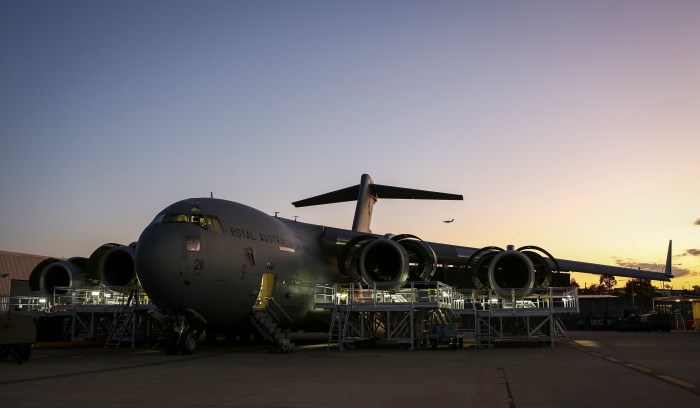
A C-17 Globemaster III with engine maintenance stands in place and all engines open on sunset at No. 36 Squadron, RAAF Base Amberley, c. 2017 (Source: Australian Department of Defence).

However, the personnel needed belong to multiple FEG and have day jobs. Explicit direction from very senior levels would be necessary to ensure these cross-FEG teams can be formed, trained, exercised, and maintained in the face of competing priorities. These teams could be trained and given experience through a structured series of exercises and activities similar to the RAF and RCAF. They could also be given responsibilities for leading major exercises, such as the Diamond series, Pitch Black, and Talisman Sabre as certification activities. The force generation cycles of key expeditionary air wing elements – such as the headquarters, air base, and communications elements – could be aligned to maximise an expeditionary wing’s coherence upon deployment. This building block approach is similar to the Australian Army’s combat brigade force generation cycle, providing an opportunity to align force generation cycles and enhance readiness across the joint force.

Invigorating and embedding expeditionary air wing concepts and headquarters capabilities in Australian air power are essential for the RAAF to turn its team of champions into a champion team. An ability to deploy and fight as an expeditionary air wing from day one is vital for small air forces in high-intensity operations because combat effectiveness, resilience, and flexibility across multi-national forces must be optimised while national control and identity are assured. The RAAF’s history, structure, and culture presents challenges to this task, but there are ways forward, with much good work already underway. Clearly articulating how the RAAF intends to organise expeditionary air elements and building expeditionary leadership teams are the next steps needed to ensure the RAAF’s fifth-generation champions can fight and win as a champion team when it matters most.

Wing Commander Chris ‘Guiness’ McInnes is an officer in the Royal Australian Air Force and an editor of the Central Blue. The opinions expressed are his alone and do not reflect those of the Royal Australian Air Force, the Australian Defence Force, or the Australian Government.

Header Image: An RAAF E-7A Wedgetail is silhouetted by the setting sun at the main logistics base in the Middle East during Operation Okra. (Source: Australian Department of Defence)

[1] Air Marshal Geoffrey Brown in Royal Australian Air Force, Plan Jericho: Connected – Integrated, (Canberra: Royal Australian Air Force, 2015), p. 1.

[2] Alan Stephens described the RAAF’s command and organisational experience in Europe during the Second World War as ‘an institutional disaster’ while he devoted an entire chapter (out of 16 in the book) to ‘The RAAF Command Scandal’ in the South West Pacific, see: Alan Stephens, The Australian Centenary History of Defence – Volume II: The Royal Australian Air Force (Melbourne: Oxford University Press, 2001), p. 98, pp. 109-25. Further detail on the RAAF’s command performance in the South West Pacific is available in Norman Ashworth’s fittingly titled two-volume account: Norman Ashworth, How Not to Run an Air Force! The Higher Command of the Royal Australian Air Force during the Second World War – Volume 1 and Narrative (Canberra: Air Power Studies Centre, 2000).

Security Forces in #highintensitywar: A Look Back at Airfield Defence for a Future Consideration of the Royal Australian Air Force

Security Forces in #highintensitywar: A Look Back at Airfield Defence for a Future Consideration of the Royal Australian Air Force

By Sean Carwardine

Editorial Note: Between February and April 2018, The Central Blue and From Balloons to Drones, will be publishing a series of articles that examine the requirements of high-intensity warfare in the 21st Century. These articles provide the intellectual underpinnings to a seminar on high-intensity warfare being held on 22 March by the Williams Foundation in Canberra, Australia. In this article, Sean Carwardine describes the development of Royal Australian Air Force (RAAF) airfield defence policy and questions the adequacy of current policy in preparing the Air Force to defend its bases in a #highintensitywar situation.

Air power is generated from air bases. Therefore, in a high-intensity conflict, air forces should expect that their adversary will target their bases. Unfortunately, airfield protection in a high-intensity conventional conflict has attracted little attention in the development of the RAAF’s fifth-generation force. This article looks at the history of RAAF airfield defence, and in consideration of lessons learned, will propose critical questions for future tasking, capabilities, equipment, command and control, training, planning, scale, interoperability, and security force influence on the air domain.

Since 1929, the RAAF has had a single-service policy towards airfield defence, involving airmen providing low-level anti-aircraft and machine gun ground defence. Past RAAF airfield defence policy worked on the assumption of RAAF involvement in small localised, asymmetric or low-intensity warfare in a joint environment. The policy has developed in the context of operations involving rapidly deployed aircraft operating from forward bases secured by allied nations supplying the bulk of force protection. These bases have been in relatively secure rear-areas of sanctuary, with security focusing only on countering the threat of small incursions. In a modern high-intensity war situation, these sanctuaries may no longer provide a guarantee of safety or security. Accordingly, the RAAF and its airfield defence policy must evolve. RAAF airfield defence policy must consider force protection in a high-threat environment, and possibly without significant assistance from major allies.

The RAAF has never been in a position, apart from five months in the Second World War, to provide full airfield defence for its bases in a high-intensity war situation; it has been partly or wholly reliant on allied forces.

P02875.148
Three Aerodrome Defence personnel of No. 79 (Spitfire) Squadron RAAF digging gun pits for their tripod mounted .303 Vickers machine guns for firing at low flying Japanese attackers on Vivigani airfield. Boxes of ammunition for the guns can be seen on the right and in the background. (Source: Australian War Memorial)

During the Second World War, RAAF policy focused on the Australian Army providing low to high-level anti-aircraft defence and ground defence outside the wire. Within the wartime RAAF, there was a clear divide between RAAF Headquarters (the RAAF’s administrative command) and RAAF Command (the RAAF’s operational command) as to the workforce and organisation of airfield defence in the RAAF. The former believed small sections of Guards (20-30) could protect RAAF assets with technical airmen acting in the role as a secondary duty (a reactive defence). For RAAF Headquarters there was no requirement for a specific organisation to provide airfield defence. RAAF Command was against this ‘penny pinching’ policy and promoted a ‘RAAF Regiment’ of guards so that specialists focused on protection, and technical airmen focused on keeping aircraft in the air.

By 1945, the RAAF had the equivalent of five squadrons worth of guards (1,042 guards) in No. 2 Airfield Defence Squadron of the First Tactical Air Force (First TAF), five squadrons worth in the Northern Command (723 guards), four squadrons worth in Security Guard Unit/No. 1 Airfield Defence Squadron (570 guards) in the North-Western Area Command. Approximately, 1,900 guards (some cross-trained as war dog handlers and guard gunners) were also allocated to every aerodrome, inland fuel storage, radar/radio station, wharf/dock, RAAF chemical warfare storage, bomb and ammunition storage, civilian aerodromes and squadron in southern Australia. In addition to the guards, the Service Police had small units in every capital and small numbers on stations and in some squadrons. These forces provided the full scope of air base defence requirements for the RAAF.

At the end of the Second World War, the Chief of the Air Staff (CAS) removed airfield defence from the RAAF, six months before the official disbandment dates. RAAF Service Police strength was also reduced to fewer than 100 airmen across the nation. CAS stated, ‘I am not prepared to agree to any more of these specialised units.’[1] However, senior airmen argued against this. In 1945/46 senior officers such as Air Commodore Frank Bladin (Deputy Chief of the Air Staff), Air Commodore Frederick Scherger (Commander of First TAF), Air Vice-Marshal William Bostock (Air Officer Commanding RAAF Command) and Air Commodore John McCauley supported a proposal for a new airfield defence policy and the formation of an RAAF Regiment as put forward by Wing Commander George Mocatta.

Mocatta was Operation Staff Officer – Defence for the RAAF Command Headquarters Allied Air Force, a post which he held since 1942. He was a graduate of the Royal Air Force’s (RAF) Defence Officer course, and in 1944/45 Mocatta had studied the ground defence of airfields by the RAF Regiment in Europe and the Far East.

Mocatta’s proposal argued that the formation of a RAAF Regiment would see a reduction to around 2,000 guards and 300 police but would provide a full-time airfield defence force that included a ground fighting force, low level anti-aircraft force, airfield engineers, explosive ordnance disposal, mortars and armoured vehicles. Mocatta’s proposal was not progressed; it stayed in RAAF Headquarters un-actioned until the file was closed in 1949.

During the 1950’s, under the National Service Scheme, two aerodrome defence squadrons were formed to train reserve airmen as Ground Gunners. Early in the 1950’s a total of four Aerodrome Defence Officers, 25 Guards and a small number of Service Police were sent to Japan and Korea to provide squadron guard duty and security. Although low-level ground base air defence was considered a RAAF responsibility, the RAAF provided no ground-based air defence of any type on operations in Korea.

Between 1952 and 1955, the Air Staff Policy Memorandum No. 15 RAAF Ground Defence Policy (ASPM 15) highlighted the possibility of a conflict on a global scale against Communist forces. This possibility of high-intensity war would force the RAAF to establish its light anti-aircraft (LAA) defence units, thus releasing the Australian Army from this duty. The policy also raised the possibility of an attack by Communist ground forces, in either large-scale commando style or clandestine attacks. Under ASPM 15 active and passive defence of RAAF assets would be undertaken by six Rifle Squadrons, one Armoured Squadron and three LAA Squadrons of Guards or Ground Gunner reservists.

The 1950s saw another push for the formation of a single permanent Airfield Defence Squadron. The idea this time was similar to Mocatta’s 1945 proposal; however, this time the proposal focused on a single peacetime squadron as a nucleus for a war-time RAAF Regiment. Then in the late 1950’s, the RAAF Ground Defence Policy Chapter of Air Staff Doctrine listed no requirement for ground defence units and highlighted only the need for a few Ground Defence Officer’s, Aerodrome Defence Instructor’s and Guards, with National Service airmen training as Ground Gunners in the reserve.

By 1957, the policy of RAAF airfield defence changed in response to the evolving strategic situation. No major global war was foreseen. Therefore, there was no need for RAAF ground defence forces. The policy was that under an inter-service agreement, the Australian Army would provide all active and passive defence for RAAF assets. The only time the RAAF would require its active defence was when units were overseas, operationally deployed away from land forces or in an emergency. Also, RAAF commanders would initiate their ground defence force from airmen within their unit.

In the early 1960’s the RAAF trained Aircraft Hand/General Duty airmen and RAAF Service Police in infantry tactics to perform airfield defence for duty in Thailand. By 1965 the RAAF created a new mustering for airfield defence and guard duty; the Airfield Defence Guards (ADGs) were formed. Again, the idea of a RAAF Defence Squadron equipped with low-level air defence capability emerged, resulting in the acquisition of eight 40mm Bofors Anti-Aircraft Guns and 140 Oerlikon 20mm cannons for the proposed formation of a peace-time airfield defence squadron.  Interestingly, in the files, a staff officer queried this policy asking, ‘who are we going to shoot them at?’[2] The Bofors ultimately went to the Australian Army, and the Oerlikons stayed in storage.[3] The RAAF then introduced the Bloodhound missile defence program, by 1968 the system was outdated, and the project ended.

Throughout the 1960’s and 1970’s, RAAF policy on ground defence focused on limited war. Unsurprisingly, the ground defence policy for Vietnam focused on low-intensity warfare with an allocation of a 30-man flight of ADGs. At the time, RAAF Ground Defence policy (AAP 938) highlighted the RAAF’s responsibility to provide its own ground-based air defence units using equipment such as 20mm cannons and surface-to-air missile systems. One paragraph in AAP 938 indicates the RAAF did not have any of these systems and would have to acquire them from Britain, ‘when the war starts’.[4] This raises the concern that in a high-intensity conflict, waiting for equipment would be too late. By 1973, the RAAF officially removed anti-aircraft defence from RAAF capabilities, instead relying on the Australian Army’s ground-based air defence (GBAD) systems or aircraft to provide air defence.

The 1980’s and 1990’s saw separate Rifle Flights of ADGs around the country, undertaking guard duty and exercises. During this period, however, the reformation of No. 2 Airfield Defence Squadron and eventually combined all Rifle Flights into one squadron in one location. Operation Warden, the Australian-led intervention in East Timor, in 1999 highlighted the capabilities and the benefits of having a dedicated, air-minded, air force security force in a low-intensity environment. However, having one full time and one partly-staffed reserve unit (No. 1 Airfield Defence Squadron), demonstrated the need for a force protection restructure.

In the subsequent shift to the asymmetric conflicts of Iraq and Afghanistan, RAAF security forces have integrated with Australian Army units and law enforcement agencies to protect aircraft in Aircraft Security Operations, protect air force detachments and take responsibility for the defence of international airfield defence duties. This is the basis of airfield defence policy that still defines RAAF Security Force approach.

Group Captain Jeremy Parkinson, an RAF officer from NATO’s Joint Air Power Competence Centre stated ‘Firstly, because of a lack of understanding of how [Force Protection] is provided, it is all too often seen in capitals and headquarters as little more than a static guarding task and as such is not perceived as contributing to the actual delivery of the mission’.[5] He also stated, commanders, have a lack of understanding of how complex and resource intensive force protection is, and one should not assume that ‘the host nation will provide’ airfield protection for deployed forces.[6] Considering Parkinson’s statement, it is fair to ask: does the current RAAF Security Force structure cater for all air base defence requirements, does it have an absolute, definite intent of potential operational tasking?

In a high-intensity conflict in the future, it is likely the Australian Army would deploy a brigade, which would likely include GBAD for the field force. The RAAF would deploy an Air Task Group to operate from a coalition airfield. What is unclear is if deploying as part of a coalition force, and with US or NATO units in place, would Australia be required to supply a Security Force Squadron? Would Australian GBAD systems automatically attach to the forward air base as stated in the 2016 White Paper? What capability does a current RAAF Security Force bring to the table?

I believe that the RAAF has been guilty of turning a ‘Nelsonian blind eye’ to the need for its own air base defence capability. History shows the RAAF has a lack of understanding of the specialist nature of all air base protection as it has developed a reliance on others, an aversion to committing fully to the airfield defence role and does not appropriately resource airfield defence. Are we learning from history, or following it?

Some questions need to be asked if the RAAF is to prepare to defend its operating bases in a high-intensity conflict. Does the RAAF insist Australian Army GBAD systems be permanently on every air base or will they be allocated to the RAAF after the start of combat operations? Does the RAAF have dispersed hardened or underground shelters, its own air-minded specialist protection force, or does current policy remain extant and we will rely on allies or host nations for our protection?

Analysts will discuss the pros and cons of the Australian Defence Force being a versatile and flexible force that can fight in low and high-intensity conflicts. However, the current legacy RAAF Security Force Squadrons remain established as a ‘small-war’ force, ill-equipped and lacking ground intelligence capabilities to protect air bases, overseas and at home, in a future high-intensity war?

Australia needs a RAAF specialist security protection force that is equipped and trained to respond across the spectrum of future conflict scenarios. A fifth-generation air force must be able to defend the bases that generate its air power.

Sean Carwardine joined the RAAF in 1986 as an Airfield Defence Guard and retired in 2007. Sean served at No. 2 Airfield Defence Squadron, No. 1 Central Ammunition Depot, RAAF Base Richmond, Australian Defence Force Academy, RAAF Base Amberley, Headquarters Airfield Defence Wing. Sean also served on operations in Indonesia 1992, Timor 1999/2000, Afghanistan 2002 and Iraq 2003/04. Sean has completed a Bachelor of Education (University of Southern Queensland), Master of History (Airfield Defence) and is the final year of a PhD – History and Analysis of Airfield Defence Policy in the RAAF (University of New England). Sean has published two articles on RAAF airfield defence, lectured at RAAF Security and Fire School, Security Forces Squadrons (SECFOR) and SECFOR Conference.

Header Image: Leading Aircraftman Joel Sitkiewicz from No. 1 Security Force and Military Working Dog ‘Lucky’, patrol the F/A-18F Super Hornet flight line during Exercise Aces North 2015. (Source: Australian Department of Defence)

[1] National Archives of Australia (NAA), A1196, 15/501/258 PART 2.

[2] NAA, A703, 564/8/36 PART 1.

[3] NAA, A703, 564/8/2/PART 7.

[4] Ibid.

[5] Jeremy Parkinson, ‘Developing Future Force Protection Capability (Part 1),’ Transforming Joint Air Power: The Journal of the JAPCC, 18 (2013), pp. 69-73; Idem, ‘Developing Future Force Protection Capability (Part 2),’ Transforming Joint Air Power: The Journal of the JAPCC, 19 (2014), pp. 67-72.

[6] Parkinson, ‘Developing Future Force Protection Capability (Part 1),’ p. 72.

2017 – A Year in Review

2017 – A Year in Review

As we come to the end of 2017, we also come to the end of the first full-year of operations for From Balloons to Drones. Established in the middle of 2016, From Balloons to Drones was created with the aim of providing a platform for the discussion of the air power history, theory, and contemporary operations in its broadest sense. In seeking to achieve this aim, in 2017, we have published around 30 articles ranging from a discussion of the contemporary challenges related the development of Ground-Based Air Defence and Integrated Air Defence Systems through to an analysis of the experience of aircrew as Prisoners of War during the Second World War. We are grateful to our group of contributors who have taken the time to write and publish via From Balloons to Drones.

The website has been visited around 18,000 times by 10,000 different visitors. While visitors from the US, UK, Canada, and Australia predominate, we have also had readers from around the globe including, for example, from South Korea, China and at least one from Tajikistan. We are grateful to those who take the time to read the articles and comment on them.

The ten most popular articles by visits for 2017 were:

  1. Changing the USAF’s Aerial ‘Kill’ Criteria;
  2. Blinded by the Rising Sun? American Intelligence Assessments of Japanese Air Power, 1920-41: Part 1 – The 1920s;
  3. Arrows from the Ground – Or how an incident on 17 March 2017 may change the relationship between ground and air forces;
  4. Commentary – The RAF and the F-117;
  5. Blinded by the Rising Sun? American Intelligence Assessments of Japanese Air Power, 1920-41: Part 2 – 1930-1937;
  6. Air War Books – Dr Brian Laslie;
  7. Blinded by the Rising Sun? American Intelligence Assessments of Japanese Air Power, 1920-41: Part 3 – 1937-41;
  8. Unseating the Lancer: North Korean Challenges in Intercepting a B-1B;
  9. ‘Integrating’ the Italian Air Force after the Armistice;
  10. It is Time to Demystify the Effects of ‘Strategic Western Air Power’ – Part 1.

Two honourable mentions must also go to Dr Matthew Powell’s article ‘A Forgotten Revolution? RAF Army Co-operation Command and Artillery Co-operation’ and Kristen Alexander’s ‘“For you the war is (not) over”: Active Disruption in the Barbed Wire Battleground.’ Both articles were published in December, and I suspect that had they appeared earlier in the year then they would have been in the top ten.

We have some new and exciting plans for 2018 including a series of articles to be published simultaneously and in conjunction with The Central Blue. We will also be publishing more book reviews while a steady stream of new articles, commentaries and research notes will appear over the year. Remember we can also be found on Facebook and Twitter.

Finally, From Balloons to Drones is always seeking to publish new and exciting perspectives on the subject of air power and we encourage contributions from academics, postgraduate students, policymakers, service personnel and relevant professionals. To find out how to contribute then please visit this page.

Header Image: A8-126 performs the last dump and burn in history on the final day of flying the F-111 by the Royal Australian Air Force. (Source: Australian Government)

“For you the war is (not) over”: Active Disruption in the Barbed Wire Battleground

“For you the war is (not) over”: Active Disruption in the Barbed Wire Battleground

By Kristen Alexander[1]

The popular perception of the prisoner of war is that, once captured, he was out of the battle. Rather than compliantly accepting a status of hors de combat, however, many captive allied airmen in Europe during the Second World War continued to be potent military operatives in a new theatre of conflict—the barbed wire battleground. Indeed, the airmen adopted a stance as prison camp combatants. To facilitate this, they actively managed their lives to demonstrate individual and collective agency. They strenuously mitigated the ill-effects of their circumstances by embarking on a program of active disruption. Importantly, they did not give in to, what at least one man termed, ‘the futility of existence’.[2]

Drawing on personal records in private and public collections, as well as official reports, this article provides a brief overview of some of the ways in which Australians and their fellow prisoners in Stalag Luft III, a Luftwaffe prisoner of war camp, established, maintained and promoted themselves as active airmen, on duty, in the barbed wire battleground.

1
‘Vacation at Stalag’, Cyril Borsht’s wartime log book, courtesy of the late Cyril Borsht (Source: Private Collection)

Many downed airmen spoke of the ‘shock’ of captivity and the shame they felt on capture.[3] These feelings were a common response to being taken from battle.[4] The airmen’s sense of disgrace was exacerbated when they heard the ‘usual taunt’, ‘für sie der Krieg is beendet’—‘for you the war is over’.[5] The realisation after their unwilling departure from the aerial arena that they had become prisoners of war was a serious blow to self-esteem and service pride.[6] However, rather than accept a situation defined by passivity and docility, they rejected it.[7] The war was not over for them. Moreover, so, they remained on active service as prison camp combatants.

2
‘I wanted wings’, Ronald Baines’ wartime log book, courtesy of the Baines family (Source: Private Collection)

However, before they re-attained operational readiness, they had to regain their fighting spirit. Humour was a significant means to that end as well as an almost universal morale booster.[8] Many, for instance, depicted their new accommodation as a holiday camp or sanatorium,[9] and tongues were firmly in cheek when they poked fun of the ignominious exits that landed them there.[10] Many illustrated themselves as Donald Duck behind bars.[11] ‘Winglessness’, like that of ‘Downed Donald’, was a shared state and the men gained strength through ridiculing their common plight.[12]

The armed forces have a long tradition of using language to distance themselves from the emotions associated with military action and death in service.[13] The men of Stalag Luft III were no different, and so, they too gained strength through language. While they were initially bemused at being called Terrorflieger, Luftgangster, and Terrorbomber, many filled their wartime logbooks with clippings from German newspapers that promoted Allied airmen as the Second World War version of terrorists.[14] In doing so, the downed airmen recognised that the propagandised terms highlighted their success. Consequently, they ignored the intended insults and willingly accepted—as tributes to their military prowess—their new designations.[15]

3
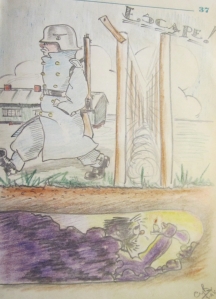
‘Escape’, Cyril Borsht’s wartime log book, courtesy of the late Cyril Borsht. (Source: Private Collection)

The airmen were not, however, so keen to be known as Kriegsgefangener—war prisonerbecause of the negative and shameful connotations surrounding the word ‘prisoner’ and its associated trappings, such as POW number, fingerprinting, and identification discs.[16] Accordingly, they spurned ‘prisoner of war’. In a canny example of linguistic reframing, they adopted the easier-to-pronounce and linguistically distancing abbreviation of ‘kriegie’—even those who were captured in the later months of the war.[17] Derived from the first syllable—the German word for ‘war’—it subconsciously indicated that they were still men of war with a fine fighting spirit and distanced them from the stigma of captivity. ‘Kriegie’ removed the sense of derogation surrounding captivity and turned an affront—and assault to their dignity—into a linguistic badge of inclusiveness and pride. ‘Kriegie’ declared that they were still men of war on operational service. It also became ‘a fun word’ to describe them.[18] Ultimately, their prison camp patois—terrorflieger, Luftgangster, kriegie and so on—became a language of agency and defiance.

4
‘Cutting from a Reich paper of a ‘typical’ ‘terrorflieger’ or ‘luftgangster”, Cyril Borsht’s wartime log book, courtesy of the late Cyril Borsht. (Source: Private Collection).

With self-esteem restored, confidence reasserted, and fighting spirit reinvigorated, the airmen turned to discipline and their strong sense of service duty to help negotiate captivity. Demonstrating collective agency, the kriegies institutionalised air force discipline in the camp.[19] They acknowledged that running Stalag Luft III along RAF station lines was best for the community—for the camp commonweal—and it was generally agreed that the senior officers ‘did an excellent job’.[20] As well as maintaining ‘a high degree of morale and discipline’,[21] there was much security in adhering to the familiar aspects of their former service lives.[22] Moreover, it afforded the airmen the support they needed to wage war as prison camp combatants.

One aspect of that war was the duty of active resistance. All new arrivals were interviewed by the Senior British Officer or, in the NCO compound, the Man of Confidence, who reminded the kriegie new boys of their continuing obligations as servicemen.[23] Importantly, they warned them not to comply with any German order ‘beyond what was necessary’.[24] The airmen welcomed their new responsibility of active resistance and defiance. Exemplifying personal and group agency they were deliberately disruptive.[25] They misbehaved during roll call.[26] They purloined German supplies.[27] They bribed guards.[28] Their favourite sport became goon-baiting.[29] Many embarked on covert operations. Some became code writers and sent secret messages to MI-9.[30] A major aspect of active resistance was escape, and the airmen embraced their moral right[31] and duty[32] to break out of the prison camp. If they were not on the exit list for a particular attempt, or not personally eager—or even physically or psychologically capable—they supported those who were by participating in the communal effort.

5

Active resistance, disruption, defiance, and escape work epitomised individual and collective agency. Significantly, they reinforced the airmen’s continuing identity as combatants. For many, such concerted agency ameliorated the mortification of becoming prisoners of war. Moreover, so, the escape or ‘X’ organisation became the overriding feature of life in Stalag Luft III.[33]

Each compound had its version of the ‘X’ organisation and Australians participated in almost every aspect of its work. ‘X’ rosters were drawn up disguised as participant lists for sports days, and sporty types created diversions.[34] The carpentry department commandeered bed boards to shore up the tunnels and other purposes and built cabinets and hidey holes to stow secret equipment.[35] Some men did metal work, made dummy rifles, and meticulously constructed compasses.[36] Scroungers obtained ink, radio parts and essential supplies.[37] Photographers took passport photographs.[38] Forgers replicated passes and identification papers.[39] Tunnellers dug, others carted dirt away, and gardeners disposed of it. Meanwhile, the majority joined the army of ‘watchers’ known as ‘stooges’, who kept a lookout for any sign of the Germans. So industrious were the tunnellers that, in East Compound alone, between 60 and 70 tunnels were started during the first six months.[40]

Despite such diligent ‘X’ work and prolific excavation, East Compound’s only successful getaway was that of October 1943—dubbed ‘the Wooden Horse’—where three men made a ‘home run’. The culmination of North Compound’s ‘X’ work was the mass breakout of March 1944. While seventy-six succeeded in fleeing the camp, only three made it home. Seventy-three were recaptured. Fifty were executed, five of whom were Australian.

The men regretted the tragic outcome, but not their part in it. Nor their determined demonstration of collective agency as prison camp combatants. They believed their large-scale resistance work had been worthwhile, not just because of the sustaining effect on morale, but because of the cost to the Germans in tying up resources during the ensuing Großfahndung which they considered ‘biggest manhunt of the war’.[41]

6

After the war, Paul Brickhill, an Australian journalist and former Stalag Luft III kriegie, was invited to write a book about the March 1944 escape.[42] That book proved influential in how captivity in Stalag Luft III has been portrayed. The mass breakout, for example, was not known as the ‘Great Escape’ until the publication of Brickhill’s The Great Escape in 1951.[43] From that time, the book’s title entered the lexicon as participants, bystanders and the public all appropriated it to describe an event that still resonates. So powerful is the book’s theme of triumph over the enemy through a communal agency, so exciting is the narrative, that most commercially published accounts of life in Second World War German POW camps—and Stalag Luft III in particular—feature the exciting high adventure and derring-do of major escapes.

7

While many of the former airmen were impressed with Brickhill’s book, many were not overly pleased with John Sturges’ 1963 film. They begrudge it the Americans, the motorbike, a truly appalling Australian accent, and other factual inaccuracies inserted in the interests of ‘good cinema’.[44] Despite their distaste, the film, along with Brickhill’s book, has left a substantial legacy which they, their descendants and popular culture have embraced.

They frame captivity in Stalag Luft III as an action-packed success story. They reinforce the kriegies’ personal and collective agency as active airmen, on operational service, in the barbed wire battleground. They deny any perception of passive, docile, humiliated prisoners of war. Just as the airmen themselves had done when they refused to accept that the war, for them, was over.

Kristen Alexander is a PhD candidate at the University of New South Wales, Canberra, researching the responses to captivity of Australian airmen prisoners of Stalag Luft III and their families. Specialising in Australian aviation history, she is published in Australia, Great Britain and Japan. She won the non-fiction category of the 2015 ACT Writing and Publishing Award and was highly commended in the 2014 and 2017 awards. Her books were included on the RAAF Chief of Air Force’s 2010 and 2015 reading lists. Her military essays won the Military Historical Society of Australia’s 2012 and 2013 Sabretache Writers Prizes. Her website can be found here and she is on Twitter as @kristenauthor.

Header Image: Australians of North Compound, 25 April 1943, courtesy of Ian Fraser. (Source: Private Collection)

[1] This article is based on a paper presented at the Don’t Drown Post Graduate Conference, UNSW Canberra, 4 October 2017, which was a shorter version of that given at Aviation Cultures Mark III Conference, University of Sydney, 27–29 April 2017.

[2] Shrine of Remembrance, James Catanach Collection, 2013. CAT050: Catanach, letter to William Alan Catanach, 28 March 1943.

[3] Private collection: Bruce Lumsden, letter, 24 June 1986, ‘The Complete Tour: Letters of Jaime Bradbeer and Bruce Lumsden, April 1985–October 1990’, unpublished manuscript; Calton Younger, No Flight From the Cage: The Compelling Memoir of a Bomber Command Prisoner of War during the Second World War ([No place]: Fighting High, 2013), p. 40; Rex Austin, Australians at War Film Archive (AAWFA) interview No. 0382, 5 June 2003; Alec Arnel, author’s interview, 29 October 2015.

[4] Aaron Pegram, ‘Bold Bids for Freedom: Escape and Australian Prisoners of Germany, 1916–18’ in Joan Beaumont, Lachlan Grant, and Aaron Pegram (eds.), Beyond Surrender: Australian Prisoners of War in the Twentieth Century (Carlton: Melbourne University Press, 2015), p. 25; Kate Ariotti, ‘Coping with Captivity: Australian POWs of the Turks and the Impact of Imprisonment during the First World War’ (PhD Thesis, The University of Queensland, 2014), pp. 55–57; Karl James, ‘“I hope you are not too ashamed of me”: Prisoners in the siege of Tobruk’, in Beaumont, Grant, and Pegram (eds.), Beyond Surrender, pp. 101–102; Adrian Gilbert, POW: Allied Prisoners in Europe 1939–1945 (London: John Murray, 2007), p. 41.

[5] ‘Usual taunt’, Private collection: Bruce Lumsden, letter, 24 June 1986, ‘The Complete Tour’, unpublished manuscript. Midge Gillies noted that it was a phrase the Germans favoured. Midge Gillies, The Barbed-Wire University: The Real Lives of Allied Prisoners of War in the Second World War (London: Aurum Press, 2011), p. 13. Examples of those who heard the phrase: Private collection: Ronald Baines, wartime log book, p. 8; Younger, No Flight From the Cage, p. 37; Geoffrey Cornish, AAWFA interview No. 1388, 2 July 2004; Kenneth Gaulton, AAWFA interview No. 1276, 3 February 2004; Private collection: Bruce Lumsden, letter, 24 June 1986, ‘The Complete Tour’ unpublished manuscript; Cyril Borsht, ‘A Life Well Lived. A Memoir’, unpublished manuscript, p. 18; Irwin John Dack, So you Wanted Wings, Hey!: An Autobiography – Part One (Moorabbin: the author, 1993), p. 74; ‘Tom Wood Diary’, unpublished manuscript, p. 26; Les Harvey, ‘Over, Down and Out: Recollections of an Airman Captured by the Germans in 1942’, unpublished manuscript, p. 6; Charles R. Lark, A Lark on the Wing: Memoirs World War II and 460 Squadron [No publication details], p. 64. Non-Australians also recorded the phrase. For example, B.A. (Jimmy) James, Moonless Night: The World War Two Escape Epic (Barnsley: Pen & Sword Military), 2008, p. 17; Jack Rae, Kiwi Spitfire Ace: A Gripping World War II Story of Action, Captivity and Freedom (London: Grub Street, 2001), p. 116; Ken Rees, (with Arrandale, Karen), Lie in the Dark and Listen: The Remarkable Exploits of a WWII Bomber Pilot and Great Escaper (London: Grub Street, 2006), p. 111. Rees entitled the chapter dealing with his earliest captivity experiences, ‘“For you the war is over”’.

[6] Private collection: Bruce Lumsden, letter, 24 June 1986, ‘The Complete Tour’, unpublished manuscript.

[7] Stephen Garton, The Cost of War: Australians Return (Oxford: Oxford University Press, 1996), p. 211.

[8] Eric Stephenson, ‘Experiences of a Prisoner of a War: World War 2 in Germany’, Journal of Military and Veterans’ Health, 18:2 (2010), p. 34 (reprinted from Australian Military Medicine, 9:1 (2000), pp. 42–50); Karen Horn, ‘“Stalag Happy”: South African Prisoners of War during World War Two (1939–1945) and their Experiences and Use of Humour’, South African Historical Journal, 63:4 (2011), p. 537.

[9] Australian War Memorial (AWM) PR03211: Peter Kingsford-Smith, wartime log book, pp. 37, 54–55; Andrew R.B. Simpson research collection: Arthur Schrock, wartime log book, p. 1; private collection, Horace ‘Bill’ Fordyce, wartime log book, unpaginated section; private collection: Cyril Borsht, wartime log book, p. 5

[10] AWM PR03211: Peter Kingsford-Smith, wartime logbook, pp. 43 and 37; AWM PR88/160: James McCleery, wartime logbook, unpaginated particulars page (name/POW number/camp/compound) and p. 1.

[11] <https://australiansinsliii.blogspot.com.au/2017/12/i-wanted-wings-donald-duck-prisoner-of.html&gt; (accessed 14 December 2017); <http://www.usmilitariaforum.com/forums/index.php?/topic/6728-stalag-luft-iii-i-wanted-wings/&gt;; Art and Lee Beltrone, A Wartime Log. (Charlottesville: Howell Press, 1994), pp. 60–61; <http://www.usmilitariaforum.com/forums/index.php?/topic/6728-stalag-luft-iii-i-wanted-wings/>(accessed 14 December 2017); <http://blog.modernmechanix.com/wwii-pows-get-a-disney-designed-logo/&gt; (accessed 14 December 2017); AWM PR88/160: James McCleery, wartime log book, p. 58; AWM PR03211: Peter Kingsford-Smith, wartime log book, p. 25; AWM PR00506: John Morschel, wartime log book, unpaginated; private collection: Cyril Borsht, wartime log book, p. 3; private collection: Eric Johnston, wartime log book, p. 1; private collection: Ronald Baines, wartime log book, p. 93; Andrew R.B. Simpson research collection: Arthur Schrock, wartime log book, p. 11; Dack, So you Wanted Wings, Hey!, p. i; Rae, Kiwi Spitfire Ace, unpaginated photo block.

[12] Alexander Watson, Enduring the Great War. Combat, Morale and Collapse in the German and British Armies, 1914–1918 (Cambridge: Cambridge University Press, 2009), p. 90.

[13] Eric Partridge, A Dictionary of RAF Slang (London: Michael Joseph, 1945), pp. 25, 10, 25, and 52; Joanna Bourke, An Intimate History of Killing: Face-to-face Killing in Twentieth Century Warfare (London: Granta Books, 1999), pp. 231–232.

[14] AWM PR90/035: Torres Ferres, wartime log book, p. 41; AWM PR03211: Peter Kingsford-Smith, wartime log book, pp. 46–47; private collection: Cyril Borsht, wartime log book, pp. 55 and 68; Cyril Borsht, author’s interview, 28 January 2016; private collection: Horace ‘Bill’ Fordyce, wartime log book, pp. 100–101; private collection: William Kenneth Todd, wartime log book, unpaginated section; Richard Winn, AAWFA interview No. 1508, 4 March 2004.

[15] Cyril Borsht, author’s interview, 28 January 2016.

[16] Kate Ariotti, ‘Coping with Captivity’, p. 56; Annette Becker, ‘Art, Material Life, and Disaster: Civilian and Military Prisoners of War,’ in Nicholas J. Saunders (ed.), Matters of Conflict: Material Culture, Memory, and the First World War (Abingdon: Routledge, 2004), p. 28, 88; Joan Beaumont, Gull Force: Survival and Leadership in Captivity, 1941–1945 (Sydney: Allen & Unwin, 1988), p. 2.

[17] AWM PR05675: Guy Grey-Smith, diary, 26 January 1942; H.R. Train, ‘A Barbed-Wire World. The Diary of a Prisoner of War in Germany 1942–1945’, unpublished manuscript, 17 June 1942, pp. 9, 12; Colin Burgess research collection: Robert Mills, wartime log book, p. 31; H. Homer Ashmann, ‘Kriegie Talk’, American Speech, 23:3/4 (1948), pp. 218–219; Paul Brickhill and Conrad Norton, Escape to Danger (London: Faber and Faber, 1954).

[18] Alec Arnel, author’s interview, 29 January 2015.

[19] Ronald Baines, AWM 54, 779/3/129 Parts 1–30: [Prisoners of War and Internees—Examinations and Interrogations:] Statements by repatriated or released Prisoners of War (RAAF) taken at No 11 PDRC, Brighton, England, 1945; Robert Nightingale, AWM 54, 779/3/129; Alan Righetti, AAWFA interview No. 0984, 16 September 2003.

[20] Robert Nightingale, AWM 54, 779/3/129.

[21] Ibid.

[22] Walter A. Lunden, ‘Captivity Psychoses Among Prisoners of War’, Journal of Criminal Law and Criminology, 39:6 (1949), p. 722.

[23] Private collection: William Kenneth Todd, wartime log book, p.11; AWM PR90/035, Ferres, ‘A POW in Germany’: Beecroft Probus talk, 3 February 1989; Private collection: Bruce Lumsden, letter, 8 April 1988, ‘The Complete Tour’, unpublished manuscript; Andrew R.B. Simpson, ‘OPS’ Victory at all Costs: On Operations over Hitler’s Reich with the Crews of Bomber Command. Their War – Their Words (Pulborough: Tattered Flag Press, 2012), p. 342.

[24] Private collection: Bruce Lumsden, letter, 8 April 1988, ‘The Complete Tour’, unpublished manuscript.

[25] Alec Arnel, author’s interview, 9 October 2014.

[26] Calton ‘Cal’ Younger, Imperial War Museum Sound Archive (IWMSA) interview, No. 23329, [no day] November 2002.

[27] Richard Winn, AAWFA interview No. 1508, 4 March 2004; Younger, IWMSA interview, No. 23329, [no day] November 2002; National Library of Australia (NLA) Justin O’Byrne, John Meredith folklore collection, 31 October 1986.

[28] Justin O’Byrne, ‘Mercury Radio Roundsman’ segment, Radio 7LA, Launceston, undated, [c. July 1947]; Horace ‘Bill’ Fordyce, AAWFA interview No. 0523, 19 June 2003; Geoffrey Cornish, AAWFA No. 1388, 2 July 2004; Royle, IWMSA interview, No. 26605, 2 December 2012.

[29] NLA Justin O’Byrne, John Meredith folklore collection, 31 October 1986.

[30] The National Archives (TNA) (UK), WO 208/3283: Camp History of Stalag Luft III (Sagan) Air Force Personnel, April 1942–January 1945, Part I East (Officers) Compound, pp. 67, 69.

[31] John Herington, Australia in the War of 1939–1945. Series Three. Air. Volume IV: Air Power Over Europe, 1944–1945 (Canberra: Australian War Memorial, 1963), p. 485.

[32] Air Publication 1548, Instructions and Guide to All Officers and Airmen of the Royal Air Force regarding Precautions to be Taken in the Event of Falling into the Hands of an Enemy, ([no publication details], 2nd Edition, June 1941). The duty was rescinded after the Great Escape but was still implied. Air Publication 1548, The Responsibilities of a Prisoner of War, (3rd Edition, April 1944), <http://www.ibiblio.org/hyperwar/UN/UK/RAF/POW-RAF/&gt; (accessed 14 December 2017). British and Australian soldiers had a similar, formal, obligation to escape. James, ‘“I hope you are not too ashamed of me” in Beaumont, Grant, and Pegram (eds.), Beyond Surrender, p. 110.

[33] NLA Justin O’Byrne, John Meredith folklore collection, 31 October 1986.

[34] Justin O’Byrne, ‘Mercury Radio Roundsman’, [c. July 1947]; Robert J. Laplander, The True Story of the Wooden Horse (Barnsley: Pen & Sword, 2014).

[35] Private collection: Horace ‘Bill’ Fordyce, wartime log book, p. 140; TNA, WO 208/3283: Camp History of Stalag Luft III (Sagan) Air Force Personnel, March 1943–January 1945, Part III North (Officers) Compound, pp. 9, 25, 31; AWM ART34781.019: Albert Comber, drawing, ‘Flight Lieutenants (Mac) Jones and (Rusty) Kierath, RAAF at work, Stalag Luft III, Germany’; Justin O’Byrne, ‘Mercury Radio Roundsman’, [c. July 1947]; H.P. Clark, Wirebound World: Stalag Luft III (London: Alfred H. Cooper & Sons Ltd, 1946), p. 8; private collection: Bruce Lumsden, letter, 10 June 1988, ‘The Complete Tour’, unpublished manuscript.

[36] Stalag Luft III: An Official History of the ‘Great Escape’ POW Camp (Barnsley: Frontline Books, 2016), pp. 30–32; <https://australiansinsliii.blogspot.com.au/2016/08/australian-compass-makers.html&gt; (accessed 14 December 2017).

[37] TNA, WO 208/3283: Camp History of Stalag Luft III (Sagan) Air Force Personnel, March 1943–January 1945, Part III North (Officers) Compound, pp. 23–24, 36; Geoffrey Cornish, AAWFA interview No. 1388, 2 July 2004.

[38] Geoffrey Cornish, AAWFA interview No. 1388, 2 July 2004.

[39] Ibid; Justin O’Byrne, ‘Mercury Radio Roundsman’, [c. July 1947].

[40] TNA, WO 208/3283: Camp History of Stalag Luft III (Sagan) Air Force Personnel, April 1942–January 1945, Part 1 East (Officers) Compound, p. 36; private collection: George Archer, 1942 Diary, 5, 21 and 24 August 1942.

[41] Justin O’Byrne, ‘Mercury Radio Roundsman’, [c. July 1947].

[42] Paul Brickhill, The Great Escape (London: Faber and Faber, 1951). A section on the mass escape was included in the earlier publication, Brickhill and Norton, Escape to Danger.

[43] Stephen Dando-Collins, The Hero Maker: A Biography of Paul Brickhill (North Sydney: Penguin Random House Australia, 2016), p. 198.

[44] Cath McNamara, author’s interview, 18 July 2016; NLA ‘Reminiscential conversations between the Hon. Justin O’Byrne and the Hon. Clyde Cameron’, 29 August 1983–28 July 1984; Alan Righetti, AAWFA No. 0984, 16 September 2003.

A Forgotten Revolution? RAF Army Co-operation Command and Artillery Co-operation

A Forgotten Revolution? RAF Army Co-operation Command and Artillery Co-operation

By Dr Matthew Powell[1]

Jonathan Bailey wrote that the First World War was the time of a true revolution in military affairs about the development of artillery firing.[2] One of the first significant developments that took place was the creation and refinement of the ‘clock code’ system.[3] Using this system, a pilot of the Royal Flying Corps, the forerunner to the Royal Air Force (RAF), was able to correct the fall of shot of the artillery by passing to the artillery battery commander details of how far from the target the guns were. The pilot would correct the shooting of the artillery by pointing out how far away and in what direction the shells of the guns had landed. The distance would be passed on using numbers and the direction using the picture of a clock face. The target was placed in the middle of the clock face and shells that fell beyond the target and on a straight line to the target would be corrected with a call of twelve, if it fell short on the same line the call would be six, at ninety degrees left of the target nine and ninety degrees right three. Any other direction would be corrected by using the hour on the clock with which it corresponded. This system would prove to function perfectly well throughout the whole of the First World War and was the system with which the RAF went to war in 1939.

The system of correcting artillery fire remained unchanged until 1938. The Air Council were against making alterations to the clock code system as they felt that it was adequate to meet the needs that the army would face in future conflicts. They felt that light aircraft could not be kept in action close to artillery units, as had been the case in the First World War.[4] The Air Council were also fearful of introducing a new, untried, and unfamiliar system with the growing tensions in Europe at this time. The War Office was unimpressed with the Air Councils attitude and pushed for more to be done. The Air Ministry agreed to trials between the Air Officer Commanding No. 22 (Army Co-operation) Group and the Commandant of the School of Artillery in December 1938.[5] The results of these trials and further trials conducted to test aircraft as well as procedure. The results were that light aircraft over the battlefield could observe fire with the ‘clock code’ system.[6] Spitfires conducted mock attacks on the aircraft and the Taylorcraft light aircraft observing the artillery fire had a good chance of dodging the fire of a modern fighter.[7] There was, however, no training for pilots in registering targets for the artillery. If an artillery officer required an appraisal of a prospective target, the request would have to be sent along the command chain via an air liaison officer. When the artillery battery received the information, it was usually out of date.[8] There was also pressure from within the War Office to establish a Flying Observation Post (Flying OP) and to begin plans to train Gunner Officers to fly. A Flying OP was to work in conjunction with Ground Observation Post (Ground OP) in establishing targets to be engaged and operating deep behind their lines to be afforded the protection of friendly anti-aircraft guns.

H 27983
A Taylorcraft Auster Mark III of No. 655 Squadron dropping a message bag to a Royal Artillery wireless truck on the airfield at Fowlmere, Cambridgeshire, during Exercise SPARTAN. (Source:  © IWM (H 27983))

The first of these Flying OPs was established in February 1940.[9] This force was established to:

[d]etermine in the light of practical experience obtained under war conditions the possibilities and limitations of the Flying OP, the most suitable type of aircraft and the most suitable organization [sic].[10]

The tests were to be conducted in three parts. The first was an initial training period. The second a practical training with the French, and a final test in the French Army area in conditions of actual warfare including shoots against German targets it was at this time that the term Air Observation Post (Air OP) was adopted.[11] The flight was sent to France on 19 April 1940.[12] The first of the three tests were conducted after the flight had moved to the continent. The final of the three tests was due to be carried out in early May, and the forces were established ready to conduct the tests on 9 May 1940.[13] The following day the Germans began to implement Fall Gelb (Case Yellow): the invasion of France and the Low Countries.[14] The artillery designated for the tests were forced to move back to their formations leaving the Air OP Flight (D Flight) waiting for the campaign to stabilise when it was clear that this would not happen D Flight was recalled to England.[15]

One of the first official moves at changing artillery co-operation policy was a letter regarding the subject sent from the Director of Military Co-operation Air Commodore Victor Goddard to Barratt at Army Co-operation Command. In this letter, Goddard states that the Air Staff were against the formation of:

[s]pecial air units for artillery observation or reconnaissance, unless it can be clearly shown that there is an urgent requirement for such units which cannot be met by Army Co-operations squadrons.[16]

The School of Artillery recommended that a certain number of aircraft should specialise in artillery work and should be trained by the School of Artillery so that they had the same tactical knowledge and the same the understanding of gunnery as an artillery officer.[17] This was just one aspect of an idea by the School of Artillery to allow aircraft to have tactical control over the fire of artillery batteries. To facilitate this, the school further recommended that a multi-seater aircraft should be employed in this work to allow an artillery officer to conduct the shoot according to artillery methods without the need for the artillery officer learning to fly. Artillery officers were also to be seconded to army co-operation squadrons specifically for artillery work.[18] The co-operation between the School of Artillery and Army Co-operation Command is evident and is surprising given the general relations that existed between the army and RAF in the wake of the Battle of France and the fall out that it had caused between the two services.[19]

Barratt, in a letter to the Under-Secretary of State for Air, wrote that:

I consider that in order to get a true and undistorted picture of this problem, it is first desirable to set out the problem as the Army [sic] sees it, and to show in this picture what they conceive to be their requirements.[20]

Again the desire to see the problem from a view that would almost certainly be contradictory to the RAF shows that Barratt and his command were willing to adopt a different approach and attitude in co-operating with at least one part of the army. Barratt also voiced his concerns regarding the ability of the Air OP to operate in the face of enemy action. It was felt that ‘the Air OP must be entirely vulnerable to any enemy fighters which cares to shoot it down’.[21] Barratt’s concern over the safety of his pilots who may be conducting shoots using the Air OP system was to be a recurring issue in the development of artillery reconnaissance.

TR 242
Air Marshal Sir Arthur Barratt in battledress and flying gear beside a Hawker Hurricane. He often flew this aircraft when visiting airfields of RAF Army Co-operation Command, which he commanded at the time of this picture. (Source: © IWM (TR 242))

Barratt’s response to the trials was one of scepticism, and he considered ‘that body of experience gained in the late war and since has all pointed to the advantages of the ‘Clock Code’ system’.[22] Barratt’s belief in the ‘clock code’ system stemmed more from the fear of false conclusions being drawn from brief experiments than from any sense of conservatism about changing the system used for artillery reconnaissance.[23] This became a realisation when Barratt was forced to explain to the Under Secretary of State for Air about the lack of efficiency regarding artillery co-operation in Army Co-operation Squadrons. Barratt wrote that:

I feel that much of the falling off in efficiency in this part of the Army Co-operation Squadron task has been due to the propagation of rumour as to other and better methods than those shown in AP 1176.[24]

Further trials were conducted using the artillery method during April 1941, and the conclusions reached were similar to those seen previously. These were that the artillery methods of ranging by corrections to line and range are simpler, quicker, and more efficient than any method based on the ‘clock code’.

The failures of the ‘clock code’ system in France combined with further problems faced in the fighting in Libya led to a loss of confidence in the system in the army.[25] Barratt responded that the ‘clock code’ system was not at fault in these operations but that the aircraft employed in it were operating in the face of intense enemy opposition. He was concerned that the trials had been too few and were skewed in favour of a positive result by the School of Artillery.[26] While these concerns may be interpreted as merely blocking a new development that had been shown to work to preserve the autonomy of the RAF while conducting army co-operation work. The evidence of co-operation between Army Co-operation Command and the School of Artillery, shown above, leads more to the conclusion that Barratt felt that the procedure could not be successfully carried out, and wished to see more trials conducted before it would receive his approval.

The procedure for artillery reconnaissance first developed during the First World War was only suitable for the conditions of that war. The lack of fluidity and almost stable front lines allowed a system to develop, quickly, this system, however, was only suited to those conditions. This was very quickly discovered during the first major test of this procedure against the quicker and more mobile warfare of the German Wehrmacht in 1940. The attitudes of both the British Army and the RAF to co-operation during the inter-war period, in Britain at least, did little to improve the situation before the British Expeditionary Force was stationed in France. This left those charged with the responsibility of modifying the existing procedure with only the experience of the First World War to guide them and on which to base their expectations. Much co-operation between the School of Artillery and Nos. 70 and 71 Groups of Army Co-operation Command occurred, despite the general feeling of animosity still felt by both services in Britain.[27] This co-operation was the most that had been seen between the army and RAF since the formation of the RAF as an independent force in 1918. Barratt’s move to block the adoption of the new procedure that was being trialled during 1941 can be interpreted in several ways. His reasoning for doing so, however, appears to be that of confirming the results already achieved through more rigorous and testing trials to confirm the results. Through further testing at a higher level the procedure, as well as those responsible for carrying it out, would be exposed to more stress and so a greater degree of authenticity could be achieved. Trials of this nature would also confirm if the procedure could be implemented with ease by the majority of pilots whose responsibility would be increased from observing the fall of shot to conducting shoots, potentially in the face of enemy opposition. Barratt’s major concern with the new system appears to be its increased complexity, and he was rightly concerned after his experiences in France that pilots would be unable to conduct the shoot if they had to keep a lookout for enemy fighter activity continually.

Dr Matthew Powell is a Teaching Fellow at Portsmouth Business School at the Royal Air Force College, Cranwell. He holds a PhD in Modern History from the University of Birmingham. His thesis investigated the development of tactical air power in Britain during the Second World War through a study of the RAF’s Army Co-operation Command. His first book, based on the PhD, The Development of British Tactical Air Power, 1940-1943: A History of Army Co-operation Command was published in 2016 by Palgrave Macmillan. He has also published in Canadian Military History, Air Power Review and the British Journal for Military History. He is currently researching the relationship between the British aviation industry and the Air Ministry during the inter-war period. He can be found on Twitter at @tac_air_power.

Header Image: An Auster Mark IV of an Air Observation Post squadron undergoes servicing at its base after being damaged by anti-aircraft fire while flying over the 8th Army Front in northern Italy. (Source: © IWM (CNA 3341))

[1] A longer version of this article can be found in Canadian Military History, 23:1 (2014), pp. 71-88.

[2] Jonathan Bailey, ‘Deep Battle 1914-1941: The Birth of the Modern Style of War,’ Field Artillery Journal, (1998), pp. 21-7.

[3] Ralph Barker, A Brief History of the Royal Flying Corps in World War I (London: Constable & Co., 2002), p. 63.

[4] H.J. Parham and E.M.G. Belfield, Unarmed into Battle: The Story of the Air Observation Post, Second Edition (Chippenham: Picton Publishing, 1986), p.14.

[5] Ibid.

[6] Ibid.

[7] Ibid

[8] Darrell Knight, Artillery Flyers at War: A History of the 664, 665, and 666 ‘Air Observation Post’ Squadrons of the Royal Canadian Air Force (Bennington, VT: Merriam Press, 2010), p. 27.

[9] Parham and Belfield, Unarmed into Battle, p.15.

[10] Ibid.

[11] Ibid.

[12] Ibid., p.16.

[13] Ibid.

[14] Karl-Heinz Freiser, The Blitzkrieg Legend: The 1940 Campaign in the West (Annapolis, MD: Naval Institute Press, 2005), p. 79.

[15] Parham and Belfield, Unarmed into Battle, 16.

[16] The National Archives (TNA), AIR 39/47, Letter from Air Commodore Goddard, Director of Military Co-operation to Barratt regarding Artillery Co-operation Policy, 8 December 1940.

[17] Ibid.

[18] Ibid.

[19] For more information on the army’s reaction to the Battle of France, see: TNA, CAB 106/220, Bartholomew Committee Final Report.

[20] TNA, AIR 39/47, Letter from Barratt to Under-Secretary of State for Air regarding co-operation with the Royal Artillery, 29 January 1941.

[21] Ibid., Appendix A, 29 January 1941.

[22] Ibid., Letter from Headquarters Army Co-operation Command to Headquarters No. 70 Group, Artillery Reconnaissance Trials, 12 April 1941.

[23] Ibid.

[24] Ibid., Letter from Barratt to Under Secretary of State for Air, 14 April 1941.

[25] Ibid., Letter from CGS on Artillery Reconnaissance, 5 May 1941.

[26] Ibid., Letter from Barratt to Major-General Otto Lund, GHQ Home Forces, in response from letter from CGS on Artillery Reconnaissance, 10 May 1941.

[27] For example, see: David Ian Hall, Strategy for Victory: The Development of British Tactical Air Power, 1919-1943 (Westport, CT: Praeger, 2008), pp. 89-103.

The Kh-101 and Syria: Maturing the Long-Range Precision-Strike Capabilities of Russia’s Aerospace Forces

The Kh-101 and Syria: Maturing the Long-Range Precision-Strike Capabilities of Russia’s Aerospace Forces

By Guy Plopsky

On September 26, 2017, modernised Tupolev Tu-95MS bombers of the Russian Aerospace Forces (VKS) Long-Range Aviation Command executed another strike with Kh-101 air-launched cruise missiles (ALCMs) against targets in Syria. According to Russia’s Defense Ministry, the missiles targeted ISIS and Jabhat al-Nusra ‘command posts, hardware and manpower concentration areas as well as ammunition depot.’[1] As with previous Russian ALCM strikes during the conflict, the heavily publicised September 2017 strike was intended to serve yet another reminder to the United States and NATO (as well as to other potential adversaries) of the Russian Aerospace Forces’ growing long-range precision-strike capabilities.

Lineup_of_Tu-95_at_Engels_Air_Base
A lineup of Tupolev Tu-95MS’ at Engels Air Base c. 2005 (Source: Wikimedia)

Designed by MKB Raduga, the Kh-101 is an advanced conventionally-armed cruise missile with low observable characteristics. The missile has a reported operational range of 4,500km (2,800 miles),[2] and features a guidance package that includes an inertial navigation system (INS), a terrain contour matching (TERCOM) system, a digital scene-matching area correlation (DSMAC) system, and a GPS/GLONASS receiver.[3] Compared with the older, conventionally-armed Kh-555 ALCM, the Kh-101 features significantly improved accuracy and a larger payload, making it suitable for use against hardened targets.[4] Drone footage of Kh-101 strikes from Syria, including the September 2017 strike, appears to attest to the missile’s high-accuracy (though the impact of only several missiles is shown).[5]

Russian bombers first utilised Kh-101s in combat on 17 November 2015, when Tu-160 bombers delivered the new cruise missiles against targets in Syria.[6] The strike, which also included Tu-95MS bombers armed with older Kh-555 ALCMs, marked the combat debut of both the Kh-555 and Kh-101 as well as the Tu-160 and Tu-95MS. Exactly one year later, on November 17, 2016, modernised Tu-95MS bombers executed their first strike with Kh-101 cruise missiles.[7] Before the integration of the Kh-555 and Kh-101 on the Tu-95MS and the Tu-160, and their subsequent employment in Syria, the two bombers were utilised solely for the nuclear deterrence role and did not participate in conventional conflicts.

The only Russian bomber currently in service with the Long-Range Aviation Command to have seen combat before Syria is the Tu-22M3, which flew sorties in the Soviet-Afghan War, the First Chechen War and, more recently, the 2008 Five Day War with Georgia. In all three conflicts, the Tu-22M3 was used exclusively for delivering unguided (or ‘dumb’) bombs – a mission which it continues to fulfil in Syria.[8] Given that bombers delivering unguided munitions are likely to find themselves within range of enemy fighter aircraft and surface-to-air missiles (SAMs), such an approach is only viable for low-intensity conflicts in which the adversary lacks credible air defences. Even then, multiple sorties against a single target may be required, and excessive collateral damage may be caused due to the poor accuracy of unguided bombs. Russia witnessed the difficulty of operating its bombers in a contested airspace first hand in August 2008, when one of its Tu-22M3s was shot down by a Georgian SAM during a strike sortie against a Georgian military base.[9]

The introduction of the Kh-555 and Kh-101, therefore, represents a crucial new capability for Russia’s Long-Range Aviation Command, one which allows it to partially compensate for the lack of a long-range very low observable platform. Unlike the USAF, which operates the B-2A stealth bomber, the VKS does not currently field a long-range very low observable platform capable of penetrating modern integrated air defence systems (IADS) and won’t be fielding one until at least the end of the next decade.[10] Hence, to avoid being targeted by adversary fighter aircraft and ground-based air defences in the event of a conflict, Russian bombers will need to launch long-range conventionally-armed ALCMs from stand-off ranges. This is particularly true for the cumbersome turboprop-powered Tu-95MS – the backbone of Russia’s Long-Range Aviation Command, – which, unlike the Tu-160 and Tu-22M3, is not capable of operating at supersonic speeds.

SU-30SM_escortant_un_Tu-160_qui_lance_un_missile_de_croisière
A Tupolev Tu-160 launching an Kh-101 against a target in Syria, c. 20 November 2015 (Source: Wikimedia)

In this regard, the integration of the Kh-101 on the Tu-95MS dramatically expands the legacy bomber’s conventional strike capability, which until recently, was limited to dropping unguided bombs, transforming it into a formidable long-range precision-strike platform capable of accurately engaging hardened targets in heavily defended areas. At present, Russia is also outfitting its Tu-95MS bombers with SVP systems (developed by ZAO Gefest i T), which will enable Russian bomber crews to retarget their missiles before launch.[11] This will further enhance mission flexibility, allowing modernised Tu-95MS bombers to strike not only fixed but also relocatable targets. The ability of the Kh-101 to cover very large distances also reduces the Tu-95MS (and Tu-160’s) need to rely on in-flight refuelling for long distance missions. This, as several analysts have noted, makes the Kh-101 a particularly valuable asset given Russia’s relatively small fleet of aerial-refuelling tankers and limited overseas basing options.[12] A modernised Tu-95MS can carry up to eight Kh-101 ALCMs on four externally-mounted two-station pylons, while a Tu-160 can carry up to 12 such missiles on two internally-mounted six-station rotary launchers.

Considering that neither ISIS, nor the other factions with whom Russia is presently engaged in active combat with field capable air defenses, the Long-Range Aviation Command’s use of modernized Tu-95MS and Tu-160 bombers with Kh-101 ALCMs in Syria stems from Moscow’s desire to test both the reliability of its new air-launched weapon and its carrier platforms as well as the proficiency of Russian bomber crews under real combat conditions. As with the occasional use of conventionally-armed Kalibr sea-launched cruise missiles (SLCMs) in the Syrian conflict, the employment of Kh-101s is likewise intended to convey a strong signal to Russia’s potential adversaries and reflects Moscow’s desire to place greater emphasis on conventional deterrence. The need to expand precision-strike capabilities and increase reliance on conventional weapons for deterrence has been highlighted in Russia’s 2014 Military Doctrine and has been voiced by Russian military officials.[13] As Russian Defense Minister, Sergei Shoigu, noted in February 2017, though:

[t]he development of strategic nuclear forces remains an absolute priority for us […] the role of nuclear weapons in deterring a potential aggressor will decrease first of all due to development of high-precision weapons.’[14]

For the United States and NATO, Russia’s growing emphasis on conventional long-range precision-strike weapons such as the Kh-101 represents an increasingly pressing need to bolster missile defences.

Guy Plopsky holds an MA in International Affairs and Strategic Studies from Tamkang University, Taiwan. He specialises in air power, Russian military affairs and Asia-Pacific security. You can follow him on Twitter.

Header Image: A Russian Tupolev Tu-160 ‘Blackjack’ in flight over Russia. (Source: Wikimedia)

[1] For a description, see: Russian Ministry of Defense, ‘Нанесение авиаударов Ту-95МС крылатыми ракетами Х-101 по объектам ИГИЛ в Сирии [Tu-95MS Airstrikes with Kh-101 Cruise Missiles Against ISIS Objects in Syria],’ YouTube video, 3:01. Posted September 2017. https://www.youtube.com/watch?v=NaI0QuvgKJA.

[2] ‘Министр обороны России генерал армии Сергей Шойгу провел военно-техническую конференцию [Russian Defense Minister Army General Sergei Shoigu held a Military-technical Conference],’ Russian Ministry of Defense, October 6, 2016

[3] Piotr Butowski, ‘All missiles great and small: Russia seeks out every niche,’ Jane’s International Defense Review, October 2014, pp. 48-9.

[4] Anton Lavrov, ‘Russia’s GLONASS Satellite Constellation,’ Moscow Defense Brief, 60:4 (2017).

[5] For example, see the video footage from September 2017 strike in fn1.

[6] David Cenciotti, ‘Russian MoD Video Shows Tu-160, Tu-95 and Tu-22 Bombers (with Su-27 Escort) Bomb ISIS in Syria,’ The Aviationist, November 17, 2015.

[7] ‘РФ впервые применила в Сирии новые ракетоносцы Ту-95МСМ с крылатыми ракетами Х-101 [Russian Federation Employed new Tu-95MSM Missile Carrier with Kh-101 Missiles in Syria for the First Time],’ TASS, November 17, 2016.

[8] For example, see: Russian Ministry of Defense, ‘Боевой вылет дальних бомбардировщиков Ту-22М3 с территории РФ по объектам террористов в Сирии [Combat Sortie of Long-range Tu-22M3 Bombers from the Territory of the Russian Federation Against Terrorist Targets in Syria],’ YouTube video, 2:10. Posted January 25, 2016. https://www.youtube.com/watch?v=55ni9KbpSv4.

[9] Anton Lavrov, ‘Russian Air Losses in the Five-Day War Against Georgia,’ in Ruslan Pskov (ed.), The Tanks of August (Moscow: Center for Analysis of Strategies and Technologies, 2010), p. 100.

[10] ‘PAK DA: Russian Defense Ministry Reveals When New Bomber Will Fly,’ Sputnik, April 27, 2017.

[11] Dave Majumdar, ‘One of Russia’s Most Deadly Bombers Now Has a Scary New Capability,’ The National Interest, July 5, 2017.

[12] For example, see: James Bosbotinis, ‘Russian Long-Range Aviation and Conventional Strategic Strike,’ Defense IQ, March 5, 2015.

[13] For an English translation of Russia’s 2014 Military Doctrine see https://www.offiziere.ch/wp-content/uploads-001/2015/08/Russia-s-2014-Military-Doctrine.pdf.

[14] ‘Russian Shield: Nukes Priority, but High-Precision Weapons to Play Greater Role,’ Sputnik, February 21, 2017.

Blinded by the Rising Sun? American Intelligence Assessments of Japanese Air Power, 1920-41: Part 3 – 1937-41

Blinded by the Rising Sun? American Intelligence Assessments of Japanese Air Power, 1920-41: Part 3 – 1937-41

By Justin Pyke

Editorial Note: In the final part of a three-part article, Justin Pyke examines American intelligence assessments of Japanese air power during the inter-war years. This final part examines issues between 1937 and the outbreak of war between America and Japan in 1941. Part one and two of this article can be found here and here.

Japan’s air services had successfully weaned themselves off of their foreign dependence by 1937. American intelligence assessments continued to identify the strategic and industrial weaknesses of Japanese air power accurately but became poor concerning technology and tactics. Japanese information security was tighter than it had ever been. Hence, American observers formed their conclusions through open sources and preconceived notions. When evidence emerged contradicting the prevailing view of Japan’s lack of technological innovation, they were ignored or explained away. Assessments of Japanese personnel began to swing toward a consistently negative view. These failures in assessing Japanese technology, tactics, and personnel from 1937-41 contributed to the defeats at the outset of the Pacific War.

Zero
A captured Mitsubishi ARM ‘Zero’ in flight, c. 1944 (Source: National Naval Aviation Museum)

The Americans had relied on access to Japanese air stations and factories to gain their information until the early 1930s. This avenue was closed with the start of the war in China. In place of the old sources, American observers came to rely extensively on open sources, like official Japanese press releases, supplemented with the precious little information that could be drawn from chance sightings of Japanese aircraft by Westerners.[1] A meaningful assessment of Japanese air power’s performance in China, or detailed technical information of a specific aircraft, would surface on occasion. The information gained from open sources at best-reiterated views that had been in place for almost two decades and at worst became more critical and inaccurate about Japanese capabilities.

American assessments of the Japanese aviation industry remained accurate, despite Japan’s turn towards tight information security. However, the preconception that Japan could not innovate technologically remained pervasive. A July 1937 report was typical. It acknowledged the advances made by the Japanese aviation industry, accurately identified the numerous weaknesses present, and stated that a ‘dearth of local inventive ability’ was a critical failure.[2] Another report referred to the numerous industrial weaknesses as a ‘cancer,’ and went on to claim that Japan continued to rely on copies of foreign aircraft, acquired either through production licenses or ‘outright mimicry.’[3] American assessments combined recognition of the real weaknesses of Japan’s aviation industry with the fiction that it still relied on the copying of foreign aircraft designs.

The American emphasis on Japanese industrial weakness was warranted. The continued shortage of machine tools, skilled labour, heavy equipment, and modern industrial techniques contributed to Japan’s lack of an aircraft reserve, slower rates of production, poor quality and quantity of spare parts, and the numerous other issues that undermined Japanese air power.[4] Greg Kennedy has emphasised this point when he stated that to view:

[tactical] success as demonstrative of the overall ability of Japan to manifest effective, modern air power is to misunderstand fundamentally the core attributes of air power.[5]

Ultimately, the weaknesses of Japanese industry identified by the Americans before the war worked to cripple the offensive capabilities of the Imperial Japanese Army Air Service (IJAAS) and Imperial Japanese Naval Air Service (IJNAS) during it.

Ki-61_at_Fukuoka_in_1945
A Kawasaki Ki-61 ‘Tony’ of the 149th Shimbu Unit at Ashiya airfield in Fukuoka, Japan, c. 1945 (Source: Wikimedia)

The most egregious error in American reporting from mid-1937 onward concerned the preconception that Japan was incapable of designing its own aircraft. Exceptions to this trend did exist, but they were easily drowned out by the overwhelming number of reports that reiterated the same trope of Japanese unoriginality.[6] Fictional aircraft were given corresponding European designs that the Japanese supposedly had copied.[7] When the Americans received hard evidence of Japanese technological innovation, these indicators were ignored or misunderstood. Excellent American intelligence on the B5N Carrier Attack Bomber (‘Kate’) was not used as evidence that Japan had moved away from copying foreign designs.[8] The G3M was immediately assumed to be a copy of the German Junkers Ju-86, while another report stressed the bomber was a Heinkel design with Junkers’ ailerons. In fact, the superlative bomber was indigenous in origin.[9] Even when American observers disagreed on what the aircraft was a copy of, there was no doubt that it had to be a copy of something.

These preconceptions were all the more dangerous as Japan introduced new aircraft that it would use against the West in 1941. The most famous of these was the A6M Carrier Fighter (‘Zero’/‘Zeke’). Despite some accurate reporting on the aircraft, it remained largely unknown in Western aviation circles.[10] In one instance, the testimony of a captured Japanese bomber pilot caused confusion when he explained that the A6M was designed to dive on the enemy, then zoom upwards and prepare for another dive, but not to engage in extensive combat aerobatics. This reflected IJNAS fighter doctrine, which was similar to that of the Americans, rather than the true capabilities of the A6M. The Americans interpreted the testimony to mean the new fighter lacked manoeuvrability.[11] The underestimation of the A6M seems like a minor error when viewed in isolation. Indeed, American pilots quickly gained an understanding of the fighter from their first combat encounters.[12] However, it was only a symptom of a much broader issue. Evidence that the Japanese had achieved rough technological parity with the United States was belittled or ignored. Individual Japanese aircraft may have been better or worse than foreign counterparts for their intended roles, but American assessments assumed a clear and decisive technological advantage where none existed. Nor did Japanese technological innovation stop with the attack on Pearl Harbor. Both air services introduced aircraft, such as the Nakajima Ki-84 Fighter (Hayate/‘Frank’), that matched some of the best American designs throughout the war.[13] The problem was not that leading-edge Japanese aircraft designs were worse than their American counterparts, but that they never were able to replace their ageing predecessors in sufficient numbers to matter.

The Americans dismissed not just Japanese innovation, but its personnel and tactics. American views of Japanese personnel became increasingly negative after the start of the war in China. Assessments of Japanese factory workers and mechanics significantly reduced in frequency and classified reporting on aircrews indicated that they were of poor to mediocre quality.[14] American observers also continued to emphasize Japan’s lack of pilot reserves and training facilities.[15] Popular literature took a firm stand on Japanese personnel and often relied heavily on racism and national characteristics. One such work listed a number of Japanese racial defects, and summarised them as ‘daring but incompetent aviators.’[16] Classified sources never degraded into this kind of drivel, despite American intelligence shortcomings concerning Japanese tactics and technology.

Captured_Aichi_B7A2_on_ground
A captured Imperial Japanese Navy Aichi B7A2 ‘Grace’, c. 1945. This was one of many capable indigenous aircraft introduced by the Japanese air services during the Pacific War. (Source: Wikimedia)

Surprisingly little reporting discussed Japanese aerial performance in China, and reports that did provide a more balanced, and accurate, assessment of Japanese capabilities.[17] Occasionally, Chinese pilots were interviewed on their combat experience against the Japanese. One report from September 1940 concluded that dive bombing by the IJAAS and IJNAS was ‘very poor,’ while horizontal bombing had ‘improved tremendously.’ Discipline among IJNAS twin-engine bombers was rated ‘excellent,’ and the carrier air groups were given particularly high praise. The most important piece of information provided by Chinese pilots was that the Japanese sent fighter escorts with their bombers whenever possible.[18] However, given the mixed quality of the Republic of China Air Force, their views concerning Japanese capabilities were easily dismissed.[19]

The American underestimation of the Japanese air services’ personnel, tactics, and technology from 1937-41 contributed to, though by no means caused, the early defeats in the Pacific War. However, Japan’s inability to rectify the fundamental problems within its air services and aviation industry crippled its air power as the war progressed, just as American observers had predicted. The accurate assessment that Japan could not win a prolonged war of attrition in the air against the United States was what mattered most. However, the errors in assessing Japanese tactics and technology caused serious problems over the short term. In their haste to predict the setting of the Sun, the Americans failed to appreciate the danger of its rise.

Justin Pyke obtained his MA in Military and Intelligence History from the University of Calgary in 2016. His main research interests include the Asia-Pacific War, military and politics of Imperial Japan, and the development of air and naval power in the inter-war period. He can be found on Twitter at @CBI_PTO_History.

Header Image: A Mitsubishi A6M2 ‘Zero’/‘Zeke’ at the US National Advisory Committee for Aeronautics Langley Research Center, Virginia on 8 March 1943. On 4 June 1942, a Japanese task force launched a strike against Dutch Harbor, Alaska from the aircraft carriers Ryujo and Junyo. Petty Officer Tadayoshi Koga was flying an A6M2 from the Ryujo. On the way back to his carrier, he discovered of bullets had pierced his fuel tanks and he headed for an emergency landing on Akutan Island. However, the plane flipped over on its back during the landing, and Koga was killed. The A6M itself was only slightly damaged. A Japanese submarine failed to locate Koga or his plane, but five weeks later an American naval scouting party found the Japanese fighter. The A6M2 was salvaged and shipped back to the USA where it was repaired, and went through an exhaustive series of tests in order to gain information about its strengths and weaknesses. (Source: Wikimedia)

[1] A-1-m 15776, Dive Bombing in the Japanese Aviation, July 27, 1938, Naval Attaché Reports, 1886-1939, Box 68, RG 38, NA; Japanese Naval Activities in China, July 29, 1940, Naval Attaché Records, 1939-1941, 1940 File 59-124, RG 38, NA; Comments on Naval Aviation by Japanese Naval Aviators, August 23, 1941, Naval Attaché Records, 1939-1941, 1941 File 62, RG 38, NA.

[2] Expansion of Aircraft Manufacturing Industry, July 21, 1937, Selected Naval Attaché Reports Relating to the World Crisis, 1937-1943, Roll 2, RG 38, NA, p. 1.

[3] The Aircraft Industry in Japan, August 5, 1939, Naval Attaché Records, 1939-1941, 1939 File 165-233, RG 38, NA, pp. 1-2.

[4] Mark R. Peattie, Sunburst: The Rise of Japanese Naval Air Power, 1909-1941 (Annapolis: Naval Institute Press, 2001), p. 100; Erich Pauer, ‘Japan’s technical mobilization in the Second World War,’ in Erich Pauer (ed.), Japan’s War Economy (New York, NY: Routledge, 1999), pp. 54-5; Hagiwara Mitsuru, ‘The Japanese Air Campaigns in China, 1937-1945,’ in Mark Peattie, Edward Drea, and Hans Van de Ven (eds.), The Battle for China: Essays on the Military History of the Sino-Japanese War of 1937-1945 (Stanford, CA: Stanford University Press, 2011), p. 243; Jonathan B. Parshall and Anthony P. Tully, Shattered Sword: The Untold Story of the Battle of Midway (Washington D.C.: Potomac Books, 2005), p. 89; Eric M. Bergerud, Fire in the Sky: The Air War in the South Pacific (New York: Basic Books, 2009), p. 21, 46; Sakai Saburo, Martin Caidin, and Fred Saito, Samurai! (Annapolis: Naval Institute Press, 1991), p. 242.

[5] Greg Kennedy, ‘Anglo-American Strategic Relations and Intelligence Assessments of Japanese Air Power, 1934-1941,’ The Journal of Military History, 74:3 (2010), p. 772.

[6] William M. Leary, ‘Assessing the Japanese Threat: Air Intelligence Prior to Pearl Harbor,’ Aerospace Historian, 34:4 (1987), p. 274; 2085-947, The Capabilities of Japan in Military Aviation, June 23, 1939, US Military Intelligence Reports, Japan, 1918-1941, Reel 31, University Press of America, p. 1.

[7] Airplane Characteristics – Mitsubishi Type Zero Fighter, November 9, 1940, Naval Attaché Records, 1939-1941, 1940 File 125-202, RG 38, NA; New Dive Bomber in Production, August 2, 1940, Naval Attaché Records, 1939-1941, 1940 File 59-124, RG 38, NA.

[8] New Types of Aircraft, July 17, 1939, Naval Attaché Records, 1939-1941, 1939 File 89-164, RG 38, NA; Type 97 Torpedo-Bomber, November 16, 1939, Naval Attaché Records, 1939-1941, 1939 File 234-281, RG 38, NA; Specifications of Japanese Naval Bomber, Model 97, June 4, 1940, Naval Attaché Records, 1939-1941, 1940 File 59-124, RG 38, NA.

[9] Richard M. Bueschel, Mitsubishi/Nakajima G3M1/2/3 96 Rikko L3Y1/2 In Japanese Naval Air Service (Atglen: Schiffer Publishing, 1997), p. 20; Description of Navy Heavy Bomber, Type 96, July 26, 1939, Naval Attaché Records, 1939-1941, 1939 File 165-233, RG 38, NA; René J. Francillon, Japanese Aircraft of the Pacific War, Second Edition (London: Putnam Aeronautical Books, 1979), p. 350.

[10] Thomas G. Mahnken, Uncovering Ways of War: U.S. Intelligence and Foreign Military Innovation, 1918-1941 (Ithaca: Cornell University Press, 2002), pp. 79-80; Horikoshi Jiro, Eagles of Mitsubishi: The Story of the Zero Fighter, trans. Shojiro Shindo and Harold N. Wantiez (Seattle: University of Washington Press, 1981), p. 107.

[11] Leary, ‘Assessing the Japanese Threat,’ pp. 275-76; Horikoshi, Eagles of Mitsubishi, p. 85; John B. Lundstrom, The First Team: Pacific Naval Air Combat from Pearl Harbor to Midway (Annapolis: Naval Institute Press, 2005), p. 486; Roger Letourneau and Dennis Letourneau, Operation KE: The Cactus Air Force and the Japanese Withdrawal from Guadalcanal (Annapolis: Naval Institute Press, 2012), p. 13; Sakai et.al., Samurai, p. 83.

[12] John B. Lundstrom, The First Team and the Guadalcanal Campaign: Naval Fighter Combat from August to November 1942 (Annapolis: Naval Institute Press, 2005), pp. 535-36.

[13] See: Francillon, Japanese Aircraft of the Pacific War; Richard M. Bueschel, Nakajima Ki.84a/b Hayate in Japanese Army Air Force Service (Canterbury: Osprey Publishing, 1971).

[14] Notes on Japanese Naval Aviation, August 4, 1939, Naval Attaché Records, 1939-1941, 1939 File 165-233, RG 38, NA; Dropping of Aircraft Torpedoes by Japanese Naval Aircraft, September 26, 1939, Naval Attaché Records, 1939-1941, 1939 File 165-233, RG 38, NA; A-1-m 15776, Aerial Operations, August 2, 1940, Naval Attaché Reports, 1886-1939, Box 68, RG 38, NA; 2085-956, Handbook on the Air Services of Japan, September 27, 1940, US Military Intelligence Reports, Japan, 1918-1941, Reel 31, University Press of America, p. 36, 79.

[15] 2085-908, Military Aviation – General, July 29, 1937, US Military Intelligence Reports, Japan, 1918-1941, Reel 30, University Press of America, p. 3; W.D. Puleston, The Armed Forces of the Pacific: A Comparison of the Military and Naval Power of the United States and Japan (New Haven: Yale University Press, 1941), p. 231.

[16] Fletcher Pratt, Sea Power and Today’s War (New York: Harrison-Hilton Books, 1939), pp. 177-78.

[17] 2085-947, The Capabilities of Japan in Military Aviation, pp. 1-3.

[18] Comment on Japanese Air Force by Chinese Aviators, September 17, 1940, Naval Attaché Records, 1939-1941, 1940 File 125-202, RG 38, NA; Peattie, Sunburst, p. 110, 123.

[19] Peter Harmsen, Shanghai 1937: Stalingrad on the Yangtze (Havertown: Casemate Publishers, 2013), p. 30.

Blinded by the Rising Sun? American Intelligence Assessments of Japanese Air Power, 1920-41: Part 2 – 1930-1937

Blinded by the Rising Sun? American Intelligence Assessments of Japanese Air Power, 1920-41: Part 2 – 1930-1937

By Justin Pyke

Editorial Note: In the second part of a three-part article, Justin Pyke examines American intelligence assessments of Japanese air power during the inter-war years. This second part examines issues between 1930 and 1937. Part one of this article can be found here.

The early and mid-1930s brought with them a fundamental change in the trajectory of the Japanese air services. Their dependence on foreign technology and assistance began to decrease at the same time American intelligence assessments began to drop noticeably in overall quality. This decline stemmed partly from the dramatic improvement of Japanese information security and the increasing influence of preconceived notions of Japanese unoriginality. Observations concerning the Japanese aviation industry and the broad strategic value of air power remained consistent and accurate, while opinions of Japanese personnel became increasingly contradictory.

Nakajima_Ki-27_at_Hamamatsu
A Nakajima Ki-27 ‘Nate’ fighter aircraft. (Source: Wikimedia)

Western observers were forced to rely increasingly on open sources in place of the informative avenues that they had used previously. The Japanese press reported generally on the air services, and the frequency of reports that paraphrased such news stories gradually increased and replaced the detailed assessments derived from other sources.[1] The amount of information gathered through tours of air stations declined dramatically from 1930-37.[2] Additionally, Western aviation experts and military officers were treated increasingly like spies.[3] The Americans still were able to gather much intelligence regarding strategic and industrial issues, but nothing provided the kind of detailed tactical and technical information that they had grown accustomed to having during the 1920s.

The assessments that came out of Japan from 1930 to mid-1937 continued to accurately track the rapid expansion of the air services, along with the problems that constantly plagued the aviation industry. A June 1930 report contained comprehensive details concerning aircraft production across the dozens of factories that had sprung up in the country. For example, the Kawasaki Dockyard Company in Kobe possessed approximately 200 machine tools in its aircraft and engine factory, almost all of American manufacture.[4] The Japanese had relied heavily on the importation of foreign machine tools during the 1920s and did so even more as the industry expanded. Despite the continuing weakness of the Japanese aviation industry, the author of another report was surprised at the ‘remarkable strides’ that the Japanese Army (IJA) and Navy (IJN) had taken during the previous year, both in quality and quantity of production.[5] Strategy drove these strides. The IJN wished to use air power to overcome the disadvantage in the surface fleet institutionalised by the Washington and London naval arms limitation treaties, and the Imperial Japanese Army Air Service would undergo a similar expansion following the annexation of Manchuria and the 1932 Shanghai Incident.[6]

Foreign observers closely followed Japan’s increased efforts to expand the air services. In 1934, the Soviet State Military Publishing Bureau published a book on the Japanese air services written by D. Streshnevsky.[7] His views on the quality of Japanese industry roughly coincided with those of the Americans. The book listed all the aviation-related factories in Japan and noted that almost every single one had been enlarged, reconstructed, or both. Despite these strides, the aviation industry still depended on imports. Fuel was the most critical shortage, due to Japan’s complete lack of indigenous sources.[8] Such discussions of strategic resources and industrial capability were a staple of intelligence assessments of Japanese aviation, justifiably.[9] In 1936, the American military attaché provided an excellent summary of the strategic and industrial elements of Japanese air power. He noted aircraft manufacturing, which already struggled with a lack of skilled workers, would be hindered even more after the outbreak of hostilities due to the need for expanded production while making use of the same limited pool of the workforce. Additionally, factories could easily be deprived of the raw materials needed to manufacture aircraft of quality and quantity.[10] Another report noted the slow rate of aircraft production meant that Japan was unable to maintain a sufficient aircraft reserve:

planes designated as ‘reserve planes’ are used as much as those in service, and the number may vary from none at all to a disproportionate percentage, especially where units are being equipped with new models.[11]

Overall, reports stressed that Japanese industrial practices were rapidly improving, but still struggled with many inherent weaknesses, such as a reliance on foreign techniques and a shortage of skilled labour, raw resources, and machine tools.

G3M_Type_96_Attack_Bomber_Nell_G3M-24s
An Imperial Japanese Navy’s G3M from Kisarazu Air Group over Sun Yat-sen Mausoleum, Nanking, 1938. This bomber entered service in 1936. (Source: Wikimedia)

Appraisals of Japanese technological progress began to slip in quality during the early and mid-1930s. The preconception that the Japanese were incapable of extensive technical innovation in aviation, which had been true during the 1920s, began to mask the Japanese progress in the area from the early 1930s. It is telling that the translation of Streshnevsky’s work was the only report from the American naval attaché’s office that emphasised Japan’s growing inventive capabilities.[12] Mr Parker of the Bristol Company expressed the typical Western view when he described the Japanese as ‘notorious copyists.’[13] Instead, by 1930 the Japanese were modifying foreign designs to fit their own needs rather than simply copying them wholesale, and an increasing number of designs were entirely of Japanese origin. Several capable indigenous aircraft were designed or entered service from 1933-37, such as the G3M Land-Based Attack Aircraft (‘Nell’), and combined to bring the Japanese air services up to rough technological parity with the West by the late 1930s.[14] By the outbreak of the Second Sino-Japanese War in July 1937, the Japanese had achieved independence in the field of aviation design and manufacturing, something that went unnoticed by American observers.

American assessments of the quality of Japanese pilots, mechanics, and workers were increasingly varied and contradictory. Philip G. Lucas of the Hawker Company stated that the Japanese were ‘competent’ pilots who should not be underrated, implying that the common views held in the United States and Great Britain were inaccurate.[15] Parker and Mr Burgoine of the Bristol Company both agreed that the Japanese were ‘excellent’ fliers, but exhibited a lack of initiative and originality in their flights.[16] Two foreign air force pilots, one British and one German, were given increasingly rare opportunities to witness Japanese pilots in flight while they toured IJA and IJN air stations in early 1935. They both concluded the Japanese were ‘good’ pilots, but the Englishman noted that the Japanese were more ‘conservative’ in their manoeuvring.[17] Streshnevsky’s analysis of Japanese air performance over Shanghai in 1932 left a poor impression. Japanese bombing was ineffectual because of poorly trained pilots and insufficient bomb loads.[18] While reports on aircrew quality were contradictory, American observers continued to accurately note that Japan lacked the depth of aircrew reserves to keep up with the rate of attrition in a high-intensity air war.[19]

Americans assessed Japanese mechanics and workers much as they did their flying compatriots. Mr R. Moffett of the Wright Aeronautical Corporation condemned all the Japanese engineers, mechanics, and workers with whom he worked. Engine mechanics, ‘lamentably poor’ when tasked with correcting minor difficulties with auxiliary equipment, had to be shown the exact detailed procedure to follow. Enlisted men appeared ‘stupid.’ Moffett concluded that the Japanese ‘are striving far beyond their capabilities in the engine field.’[20] Other Western aviation representatives had kinder words for Japanese personnel. Lucas described the Japanese mechanics whom he met as ‘extremely intelligent’ and rated the overall quality of Imperial Japanese Navy Air Service maintenance personnel as ‘very high.’[21] Burgoine and Parker believed that the Japanese could learn rapidly through experience, and thought the mechanics in the aviation industry well-trained and ‘excellent,’ but lacking experience with machine tools.[22]

The American intelligence assessments of Japanese air power from 1930 to mid-1937 remained excellent regarding industrial and strategic issues but were noticeably less accurate regarding technology and tactics. Japanese military aviation had been an open door for intelligence gathering in the 1920s, but the opening gradually narrowed through the early 1930s and slammed shut with the start of the war in China in 1937. The preconception of Japanese unoriginality, particularly regarding aircraft design, became increasingly influential during the 1930s at a time when Japan was moving away from its foreign dependence. Meanwhile, the opinions concerning the quality of Japanese air and ground crews were diverse, varying wildly from praise to derision and everything in between. The lack of a clear and consistent snapshot of Japanese personnel became a major problem in the late 1930s, as did the assumption that the Japanese could not innovate in the aviation sphere.

Justin Pyke obtained his MA in Military and Intelligence History from the University of Calgary in 2016. His main research interests include the Asia-Pacific War, military and politics of Imperial Japan, and the development of air and naval power in the inter-war period. He can be found on Twitter at @CBI_PTO_History.

Header Image: Nakajima Ki-27 at Nomonhan during the Battle of Khalkhin Gol, c. 1939. This indigenous IJAAS fighter entered service in 1937. (Source: Wikimedia)

[1] E-8-a 21984, Japanese Army desires for Unification of Army-Navy Air Service Opposed by Navy, March 20, 1936, Naval Attaché Reports, 1886-1939, Box 732, RG 38, NA.

[2] A-1-l 19973, Tateyama Naval Air Station, December 4 1930, Naval Attaché Reports, 1886-1939, Box 64, RG 38, NA; A-1-l 19973, Tateyama Naval Air Station, January 30 1932, Naval Attaché Reports, 1886-1939, Box 64, RG 38, NA; A-1-l 19973, Tateyama Naval Air Station, December 4 1933, Naval Attaché Reports, 1886-1939, Box 64, RG 38, NA; A-1-l 19973, Tateyama Naval Air Station, December 31 1935, Naval Attaché Reports, 1886-1939, Box 64, RG 38, NA; A-1-l 19973, Tateyama Naval Air Station, December 24 1936, Naval Attaché Reports, 1886-1939, Box 64, RG 38, NA.

[3] 2085-810, Military Aviation – General: Attachment of British Officer to the 4th Air Regt., February 10 1937, US Military Intelligence Reports, Japan, 1918-1941, Reel 29, University Press of America, p. 2, 15; A-1-a 21684, British Estimate of Japanese Aviation, Continued, May 1 1935, Naval Attaché Reports, 1886-1939, Box 10, RG 38, NA, 1; A-1-a 21684, British Estimate of Japanese Aviation, February 11 1935, Naval Attaché Reports, 1886-1939, Box 10, RG 38, NA, p. 2; A-1-a 21684,Visit to Japan of Mr Victor E. Bertrandias of the Douglas Aircraft Company, February 16 1937, Naval Attaché Reports, 1886-1939, Box 10, RG 38, NA, pp. 1-2.

[4] 2085-680, Aircraft Factories, June 8, 1930, US Military Intelligence Reports, Japan, 1918-1941, Reel 28, University Press of America, p. 4.

[5] 2085-844, Aircraft Building of the Army & Navy during 1931, March 6, 1932, US Military Intelligence Reports, Japan, 1918-1941, Reel 29, University Press of America, p. 1.

[6] Mark R. Peattie, Sunburst: The Rise of Japanese Naval Air Power, 1909-1941 (Annapolis: Naval Institute Press, 2001), p. 27; Yoichi Hirama, ‘Japanese Naval Preparations for World War II,’ Naval War College Review, 44:2 (1991), p. 69; René J. Francillon, Japanese Aircraft of the Pacific War, Second Edition (London: Putnam Aeronautical Books, 1979), p. 31. For further details on the interwar naval arms limitation treaties, see: Erik Goldstein and John H. Maurer (eds.), The Washington Naval Conference, 1921-22: Naval Rivalry, East Asian Stability and the Road to Pearl Harbor (London: Frank Cass, 1994); John H. Maurer and Christopher M. Bell (eds.), At the Crossroads between Peace and War: The London Naval Conference of 1930 (Annapolis: Naval Institute Press, 2014).

[7] A-1-a 21973, Development of the Japanese Air Fleet, March 5, 1936, Naval Attaché Reports, 1886-1939, Box 10, RG 38, NA; A-1-a 21973, Japanese Naval Aviation, June 1, 1936, Naval Attaché Reports, 1886-1939, Box 10, RG 38, NA.

[8] A-1-a 21973, Development of the Japanese Air Fleet, 6-12.

[9] A-1-a 21684, British Estimate of Japanese Aviation; A-1-a 21684, British Estimate of Japanese Aviation, Continued; 2085-812, Aircraft Production – Non-Governmental. Mitsubishi Heavy Industries Company, Ltd. Nagoya Aircraft Works, June 7, 1937, US Military Intelligence Reports, Japan, 1918-1941, Reel 29, University Press of America; 2085-885, Air Information, April 28, 1934, US Military Intelligence Reports, Japan, 1918-1941, Reel 29, University Press of America; 2085-687, Reply to Evaluation of Reports, October 23, 1936, US Military Intelligence Reports, Japan, 1918-1941, Reel 28, University Press of America.

[10] 2085-687, Reply to Evaluation of Reports, October 23, 1936, US Military Intelligence Reports, Japan, 1918-1941, Reel 28, University Press of America, p. 1.

[11] 2085-810, Military Aviation – General, p. 1.

[12] A-1-a 21973, Japanese Naval Aviation, p. 5.

[13] A-1-a 21684, British Estimate of Japanese Aviation, p. 4.

[14] Mikesh and Abe, Japanese Aircraft, p. 45; Peattie, Sunburst, p. 86, 89. Also see: Francillon, Japanese Aircraft of the Pacific War.

[15] A-1-a 21684, British Estimate of Japanese Aviation, Continued, p. 2.

[16] A-1-a 21684, British Estimate of Japanese Aviation, p. 4.

[17] A-1-a 21684, Foreign Opinions Regarding Japanese Naval and Military Aviation, February 21, 1935, Naval Attaché Reports, 1886-1939, Box 10, RG 38, NA.

[18] A-1-m 15776, Fighting Experience of the Japanese Military Air Forces, March 17, 1936, Naval Attaché Reports, 1886-1939, Box 68, RG 38, NA, 6.

[19] 2085-687, Reply to Evaluation of Reports, p. 2.

[20] A-1-a 21684, Visit to Japan of American Aircraft Representative, p. 1.

[21] A-1-a 21684, British Estimate of Japanese Aviation, Continued, pp. 1-2.

[22] A-1-a 21684, British Estimate of Japanese Aviation, p. 4.

Blinded by the Rising Sun? American Intelligence Assessments of Japanese Air Power, 1920-41: Part 1 – The 1920s

Blinded by the Rising Sun? American Intelligence Assessments of Japanese Air Power, 1920-41: Part 1 – The 1920s

By Justin Pyke

Editorial Note: In the first of a three-part article, Justin Pyke examines American intelligence assessments of Japanese air power during the inter-war years. This first part examines issues in the 1920s.

In December 1941 Japan launched a campaign of rapid conquest against British, American, and Dutch possessions throughout the Asia-Pacific region. The Imperial Japanese Army Air Service (IJAAS) and Imperial Japanese Navy Air Service (IJNAS) proved critical to the success of these early campaigns. Although American authorities identified Japan as a primary rival after 1918 and focused most of their intelligence gathering efforts on the East Asian nation, they failed to appreciate the threat posed by Japanese air power in 1941. This failure was not as simplistic as the old historiography portrays.[1] Instead, intelligence assessments of Japanese air power passed through three distinct phases. During the 1920s, American observers maintained an accurate picture of Japanese capabilities. Japan was largely an open society, and its air services depended on Western assistance, meaning the Americans were able to track major developments. The early and mid-1930s was a transition period from the openness of the 1920s to the extreme secrecy that characterised the period from 1937 onward. With the start of the war in China, the Americans were almost completely in the dark regarding assessments of the Japanese air services’ technology, tactics, and personnel. One thing that remained consistent from 1920-41 was American observers accurately assessed the strategic and industrial limits of Japan’s air power. Success with these higher level assessments ultimately mattered more than the mistakes made assessing technology and tactics.

SempillMission
Captain Sempill showing a Gloster Sparrowhawk to Admiral Tōgō Heihachiro, 1921. (Source: Wikimedia)

Throughout the 1920s, Japan worked rapidly to catch up with the developments of Western powers in the field of military aviation. During this period, American intelligence assessments remained accurate at all levels, from personnel, tactics, and technology to industry and the scarcity of raw resources. American observers quickly identified Japan’s heavy reliance on foreign assistance and the weakness of its aviation industry, while the quality and quantity of Japanese aviation personnel and aircraft were carefully tracked. As throughout the entire inter-war period, the assessments primarily addressed Japan’s ability to wage a protracted war of attrition in the air, rather than to focus on tactical and technical capability.

The accuracy of American assessments in the 1920s was due in large part to openness within Japan. Letters were constantly exchanged between the American naval attaché and the Japanese Navy Ministry. The letters requested information about the IJNAS, such as its organisation, the numbers of available aircraft, and the number of existing and planned naval air stations. The Navy Ministry answered these letters in full.[2] The ease with which the naval attaché obtained large amounts of information through direct communication with the Navy Ministry was remarkable, but the openness of the Japanese was not limited to such communication. Tours of aircraft manufacturing facilities and air stations were also open and casual. The Americans were not rushed through important areas. The level of detail in an extensive report on Japanese aircraft factories from 1925 was typical and revealed lax Japanese information security. Minor technical details and factory layouts were abundantly described throughout the report, revealing the high level of access Americans had at the facilities. Japanese workmen and designers were extremely forthcoming when asked direct questions about their work.[3]

Japan’s reliance on foreign assistance allowed the Americans to keep pace with its technological and industrial advances. A report in 1924 stated that Japan always sought out the best foreign designed aircraft that it could purchase, and copied these models, along with the means to produce them. The air services were also modelled after what the Japanese thought was the most advanced foreign air forces.[4] For example, the IJNAS relied on British assistance regarding industrial practices, aviation technology, personnel training, and tactics.[5] The American naval attaché constantly emphasised the Japanese inability to design and build aircraft without extensive foreign aid. After inspecting the aircraft factories, he concluded that they had yet to produce any indigenously designed aircraft or engines ‘of any value whatsoever.’[6] A general summary from 1927 noted that all Japanese aircraft were of foreign design and that these aircraft were underpowered and inferior to contemporary American designs.[7] This claim was an overstatement, but the number of indigenous Japanese military designs remained very small throughout the 1920s.[8] The motif of Japanese unoriginality would persist through to the beginning of the Pacific War, long after it had ceased to be true. In the 1920s, however, Japan did seek to develop its air power by following in the footsteps of the world leaders.

The inferior production methods of Japan’s major aircraft manufacturers were also highlighted. One such report noted that most of the machine tools in the factories were of American manufacture and the machine shops themselves were crowded, which led to inefficiency within the production process. Production was prolonged, particularly when a factory was ordered to manufacture new types of aircraft. During this process, foreign workmen were always employed to ensure a smoother transition.[9] The Japanese aviation industry’s inability to rapidly turn existing factories over to produce new models of aircraft persisted into the Pacific War. It undermined Japan’s ability to keep pace both qualitatively and quantitatively with their Western foes. For example, the J2M Navy Interceptor Fighter (Raiden/‘Jack’) first flew nearly three months ahead of the F6F Hellcat prototype’s first flight. Despite this, the first production Hellcat was completed in the same month that the J2M had only just been accepted for serial production. Six months later only 14 J2Ms had been delivered at a time when Hellcats leapt off the American production lines.[10]

The opinion of Japanese personnel was generally low but remained balanced. A 1926 memorandum held Japanese airmen and officers in high regard, referring to them as ‘well disciplined.’ Most pilots were described as ‘good,’ while the work of the mechanics was deemed ‘most praiseworthy.’[11] The naval attaché’s assessments of Japanese pilots were more critical. One report concluded that the Japanese have a ‘fair ability’ as pilots, but rated them poorly in all around efficiency.[12] The British aviators who had trained the IJNAS in the early 1920s informed the Americans of their low opinion of Japanese personnel, and this view was shared by Colonel Jacques-Paul Faure, head of the French Military Aviation Mission to Japan that had trained the IJAAS’ pilots.[13] A major 1928 report on Japanese aviation viewed mechanics within the Japanese air services as poor, although civilians brought in to help the military were good.[14] Conspicuous by its absence was any notion of the inferiority of the Japanese race despite the criticism levelled against Japanese personnel.

FrenchMilitaryMissionToJapan
The French Military Mission to Japan, 1918-1919 (Source: Wikimedia)

A handful of reports did, however, attribute personnel deficiencies to the national characteristics, or national stereotypes, of the Japanese people. One assessment stated that:

[t]he Japanese is not a natural flyer and rarely loves flying for its own sake. Neither is he a natural mechanic, nor has he any tradition of trained mechanics behind him.[15]

While it is easy to dismiss this statement as racist or irrational, it did contain some truth. The Japanese air services had a chronic shortage of trained mechanics, partly because Japan was not a fully industrialised nation like the United States or Great Britain. The Japanese economy, despite massive leaps since the Meiji Restoration, continued to operate ‘with one foot in the nineteenth century.’[16] Once again, the quality of Japanese pilots was called into question, but the report concluded that if American pilots were considered ‘very good,’ the Japanese were rated ‘good.’[17] This statement made it clear that the Japanese were inferior to their western counterparts, but it was hardly irrational or unfair.

The most noteworthy weaknesses that the Americans identified regarding Japanese aviation personnel were the lack of pilot training and reserves. In an information bulletin detailing the Japanese Diet’s 1924 budget for naval aviation, the naval attaché noted that the IJNAS had no reserve personnel at all.[18] Another report stated that ‘there are three schools of aviation, but only one [sic] army flying training school,’ and went on to detail the number of pilots available to Japan.[19] The 1927 general summary of the Japanese air services questioned the flying experience of the officers, and described the flying seen in Japan as ‘characterized by timidity and one could not help but feel that dash and spirit were lacking.’ The report concluded that the IJAAS and IJNAS were at:

[a]n elementary stage of development. None of them are capable of combat with well developed aviation, considering factors other than equipment.[20]

Taken as a whole, American intelligence assessments of Japanese air power during the 1920s were highly accurate from the strategic and industrial spheres down to the tactical and technological level. Lax information security measures within Japan provided American observers with a remarkable level of freedom. American reports assessed the ability of Japan to fight a protracted war in the air, where aircraft production figures, industrial efficiency, innovative aircraft design, strong pilot training programs, and sizeable pilot reserves were critical to achieving success. The correct conclusion was Japan did not yet possess air power that could seriously threaten the Western powers, but this would begin to change in the 1930s.

Justin Pyke obtained his MA in Military and Intelligence History from the University of Calgary in 2016. His main research interests include the Asia-Pacific War, military and politics of Imperial Japan, and the development of air and naval power in the inter-war period. He can be found on Twitter at @CBI_PTO_History.

Header Image: A Nakajima A2N carrier borne fighter that first flew at the end of the 1920s. (Source: Wikimedia)

[1] For examples of the old view regarding American intelligence assessments of Japan, see: John W. Dower, War without Mercy: Race and Power in the Pacific War (New York: Pantheon Books, 1986); David Kahn, ‘United States Views of Germany and Japan in 1941,’ in Ernest R. May (ed.), Knowing One’s Enemies: Intelligence Assessment before the Two World Wars (Princeton: Princeton University Press, 1986).

[2] A-1-u 17242, Letter to Captain K. Terashima, I.J.N., January 27 1925, Naval Attaché Reports, 1886-1939, Box 142, Record Group [RG] 38, National Archives and Records Administration [NA], Washington, D.C.; A-1-u 17242, Information on Air Services, March 5 1926, Naval Attaché Reports, 1886-1939, Box 142, RG 38, NA; A-1-u 17242, Letter to Mr McClaran, February 10 1925, Naval Attaché Reports, 1886-1939, Box 142, RG 38, NA.

[3] A-1-u 17242, Visit to Aircraft Factories, May 15, 1925, Naval Attaché Reports, 1886-1939, Box 142, RG 38, NA.

[4] 2085-630, Extracts from Report of Inspection of United States Possessions in the Pacific and Java, Singapore, India, Siam, China, & Japan, October 24, 1924, US Military Intelligence Reports, Japan, 1918-1941, Reel 28, University Press of America, 1.

[5] Mark R. Peattie, Sunburst: The Rise of Japanese Naval Air Power, 1909-1941 (Annapolis: Naval Institute Press, 2001), pp. 17-20; Jonathan Parkinson, ‘HIJMS Wakamiya and the Early Development of Japanese Naval Air Power,’ The Mariner’s Mirror, 99:3 (2013), pp. 318-321. Also see: John Ferris, ‘A British ‘Unofficial’ Aviation Mission and Japanese Naval Developments, 1919-1929,’ Journal of Strategic Studies, 5:3 (1982), pp. 416-39.

[6] A-1-u 17242, Japanese Air Strength, May 5, 1925, Naval Attaché Reports, 1886-1939, Box 142, RG 38, NA, 3.

[7] 2085-663, General Summary Japanese Air Service, June 1, 1927, US Military Intelligence Reports, Japan, 1918-1941, Reel 28, University Press of America, 8.

[8] See: Robert C. Mikesh and Shorzoe Abe, Japanese Aircraft, 1910-1941 (Annapolis: Naval Institute Press, 1990).

[9] A-1-u 17242, Visit to Aircraft Factories, 1, 8.

[10] Fighter Combat Comparisons No. 1: Grumman F6F-5 Hellcat vs. Mitsubishi J2M3 Model 21 Raiden (‘Jack’) (Teaneck: Tacitus Publications, 1989), p. 13.

[11] 2085-647, Memorandum for Major Baldwin, September 30, 1926, US Military Intelligence Reports, Japan, 1918-1941, Reel 28, University Press of America, 3, 6.

[12] A-1-u 17242, Japanese Air Strength, 3.

[13] Thomas G. Mahnken, Uncovering Ways of War: U.S. Intelligence and Foreign Military Innovation, 1918-1941 (Ithaca: Cornell University Press, 2002), p. 73; A-1-u 17242, Aviation, July 21, 1925, Naval Attaché Reports, 1886-1939, Box 142, RG 38, NA, 3.

[14] 2085-784, Report of Major W. B. Duty, September 20, 1928, US Military Intelligence Reports, Japan, 1918-1941, Reel 29, University Press of America, 83.

[15] 2085-748, Japanese Aviation: Army, Navy, Civil, July 20, 1927, US Military Intelligence Reports, Japan, 1918-1941, Reel 29, University Press of America, 2.

[16] Eric M. Bergerud, Fire in the Sky: The Air War in the South Pacific (New York: Basic Books, 2009), p. 17.

[17] 2085-748, Japanese Aviation: Army, Navy, Civil, 2.

[18] A-1-u 17242, Data for Congressional Hearing; Additional Detailed Information on Air Services, February 9, 1925, Naval Attaché Reports, 1886-1939, Box 142, RG 38, NA, 2.

[19] 2085-719, Information as to Japanese Aviation, February 9, 1927, US Military Intelligence Reports, Japan, 1918-1941, Reel 28, University Press of America.

[20] 2085-663, General Summary Japanese Air Service, 3, 7.