#AirWarBooks – Dr Brian Laslie

#AirWarBooks – Dr Brian Laslie

By Dr Brian Laslie

Editorial Note: In the first of a new series, Dr Brian Laslie, author of The Air Force Way of War, discusses the ten books that have influenced and shaped his writing as an air power historian.

The Editor of From Balloons to Drones, Dr Ross Mahoney, has been pestering those of us who contribute to this blog to put together a list of the most influential books we have read on the study of air power. I have always been of the opinion that I only have so many words I am capable of writing in a single day and have thus, avoided acquiescing to Ross’s request. Seriously, I am never going to get these two manuscripts done at this rate, but I finally decided that Ross is right (we were on a break) and that it is high time those of us who study air power history discuss the most influential books we’ve read on the history/study of air power (two words not one). So here is my top ten:

Bert Frandsen, Hat in the Ring: The Birth of American Air Power in the Great War (Washington D.C.: Smithsonian Institution Press, 2003). I read this book shortly before leaving active duty and heading to Kansas State for grad school, and it had a profound impact on what I wanted to study. Frandsen weaves together history, technology, and narrative into one of the finest works on the creation of America’s air service and air power.

Alexander P. de Seversky, Victory through Air Power (New York, NY: Simon & Schuster, 1942). Let us get something out of the way. Seversky and Hap Arnold hated each other, and I am not being hyperbolic. The two could not stand to be in the same room with each other, and when they were, it usually ended in a shouting match. Seversky’s book was Second World War aerial propaganda, but when Walt Disney read the book and decided to produce it as a feature film, Arnold was forced to stay mute on the subject. Seversky went on to write other air power books, but none as influential and long-lasting as this one.

Thomas E. Griffith, Jr, MacArthur’s Airman: General George C. Kenney and the War in the Southwest Pacific (Lawrence, KS: University Press of Kansas, 1998). In the age of the bomber mafia, Kenny marched to the tune of his own drum. Surely as Quesada and Chennault followed pursuit aviation, Kenny favoured attack. He was, perhaps, the most innovative airman of his generation and Griffith’s book demonstrates just how important Kenney was to MacArthur.

Thomas A. Hughes, Over Lord: General Pete Quesada and the Triumph of Tactical Air Power in World War II (New York, NY: The Free Press, 1995). I really have no doubt, and I doubt many would argue with me, that strategic bombardment garnered the lion’s share of attention both during and after the war. It would take Tactical Air Command until after the Vietnam war to rise to prominence over Strategic Air Command, but those seeds were planted in the Second World War by Pete Quesada and his tactical airmen in the European theatre.

Mark Clodfelter, The Limits of Air Power: The American Bombing of North Vietnam (New York, NY: The Free Press, 1989). The single most important book on air power to be published in the post-Vietnam era. It defined air power historians of a generation. More than a critique of strategic bombardment in Vietnam, it is a book that teaches you how to think about air power, what it can and what it cannot do.

Donald Miller, Masters of the Air: America’s Bomber Boys who Fought the Air War against Nazi Germany (New York, NY: Simon & Schuster, 2006). It is rare that I cannot put a book down, but the was the case with Miller’s work. The narrative is exceptional, the research superb, and the flow masterful. I consider it the single best book on air power in the Second World War.

Donald J. Mrozek, Air Power and the Ground War in Vietnam: Ideas and Actions (Maxwell, AL: Air University Press, 1988) and idem, The US Air Force after Vietnam: Postwar Challenges and Potential for Responses (Maxwell, AL: Air University Press, 1988). Yes, I am cheating by putting two books here, but they deserve to be here. Mrozek is an air power historian, but also a cultural and intellectual historian as well. He is difficult to read, but only because every sentence is crafted beautifully and is important. Mrozek conveys in a sentence, what others struggle to get out in several pages, myself included.

Steve Davies, Red Eagles: America’s Secret MiGs (Oxford: Osprey Publishing, 2008). A popular history, but this book is flat-out fun. Secret units, secret locations, and American fighter pilots learning how to outperform their Soviet counterparts in their own aircraft.

John Andreas Olsen (ed.), A History of Air Warfare (Dulles, VA: Potomac Books, 2010). Actually any of Olsen’s work could make this list; however, if you were going to use one book in the classroom to discuss the history of power, then this is the one. There is a reason; the Air Force Academy has every freshman read in their introduction to military history. From the First World War to the present and large scale combat to air power in smaller conflicts, Olsen’s edited work covers it all.

Diane Putney, Airpower Advantage: Planning the Gulf War Air Campaign (Washington D.C.: Air Force History and Museums Program, 2004). This book is what made me decide to write about Desert Storm. This book taught me that air power is so much richer than 1 v. 1 dogfights, that true command of the air comes from logistics, planning and execution.

To this list of ten, I could add hundreds more, but as I looked at my bookshelf these jumped out at me as having the most impact on my thinking during my time in grad school or shortly thereafter and helped solidify my thinking on what air power is and what it does (spoiler alert: it’s the ability to do something in the air. Thanks, Billy Mitchell!)

By the way, several of these books you can order or download for free from either the Air University Press of the Air Force Historical Studies Office. FREE BOOKS: http://www.au.af.mil/au/aupress/ and http://www.afhistory.af.mil/Books/Titles/

Dr Brian Laslie is an Air Force Historian and currently the Deputy Command Historian at North American Aerospace Defense Command (NORAD) and United States Northern Command (USNORTHCOM). A 2001 graduate of The Citadel and a historian of air power studies, he received his Masters’ from Auburn University Montgomery in 2006 and his PhD from Kansas State University in 2013. His first book The Air Force Way of War (2015) was selected for the Chief of Staff of the Air Force’s 2016 professional reading list. He lives in Colorado Springs. He can be found on Twitter at @BrianLaslie.

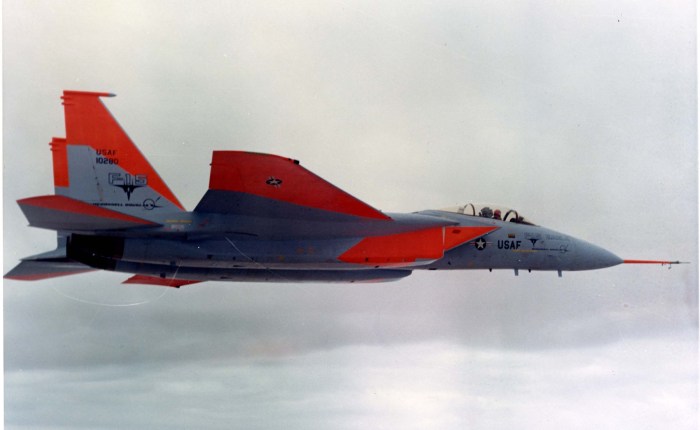
Header Image: McDonnell Douglas F-15A (S/N 71-0280, the first F-15A prototype). Note the square wingtips and unnotched stabilator. (Source: Wikimedia)
#BookReview – Flying to Victory: Raymond Collishaw and the Western Desert Campaign, 1940-1941

#BookReview – Flying to Victory: Raymond Collishaw and the Western Desert Campaign, 1940-1941

By Alexander Fitzgerald-Black

Mike Bechthold, Flying to Victory: Raymond Collishaw and the Western Desert Campaign, 1940-1941. Norman, OK: University of Oklahoma Press, 2017. Illustrations. Maps. Notes. Bibliography. Hbk. 296 pp.

51hiab19kxl-_sx329_bo1204203200_

The Second World War saw the formation of many famous Allied air forces. The Flying Tigers, the Cactus Air Force, The Mighty Eighth, RAF Bomber Command, and RAF Fighter Command are among the best known. In the Mediterranean, perhaps none was more famous than the Western Desert Air Force (WDAF). This is the tactical air force that helped Lieutenant-General Bernard Montgomery’s British Eighth Army defeat Field Marshal Erwin Rommel at El Alamein in 1942. The victory was the result of an effective combination of air and land power according to an air support doctrine developed by Air Vice-Marshal Arthur Coningham.

Coningham owes more to his predecessor, Air Vice-Marshal Raymond Collishaw than historians have realised. Collishaw commanded No. 202 Group – and later No. 204 Group, which would later become the WDAF – between the opening of the war in the desert and November 1941. In that time, Collishaw’s command achieved much success, demonstrating the features of tactical air doctrine later associated with his successor. Mike Bechthold’s new monograph, Flying to Victory, offers us a new layer for understanding the development of Allied air support during the Second World War.

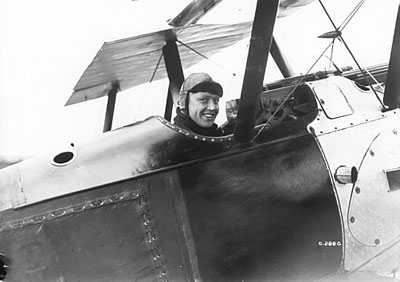
Raymond Collishaw was a native of Nanaimo, British Columbia, Canada. During the First World War, Collishaw became one of the Empire’s leading flying aces, destroying 61 enemy aircraft and eight observation balloons with Royal Naval Air Service and Royal Air Force squadrons. Authors often celebrate his air-fighting prowess. In fact, some historians have gone as far as to say that his aggressive spirit made him ill-suited for commanding air forces at the end of tenuous supply lines. In Flying to Victory, Bechthold defuses these arguments.

colishaw
Squadron Commander Raymond Collishaw in Sopwith F1 Camel aircraft, Allonville, France, 1918. (Source: Wikimedia)

Collishaw’s experience with close army support missions during the 100 Days campaign at the end of the First World War taught him how wasteful these operations could be. He came out of the war believing that only emergencies – such as the Kaiser’s spring offensive in 1918 – warranted a heavy close air support focus. This and his experiences commanding various air units during Britain’s interwar conflicts served to prepare Collishaw for command in the Western Desert. He was well-suited to command operations at the end of a tenuous supply line while working jointly with army and naval commanders.

Collishaw first demonstrated the difference that an effective air support doctrine could make during early fighting in the desert and Operation COMPASS. In 1940-41, No. 202 Group faced an Italian Royal Air Force (IRAF) with superior numbers and quality of aircraft. Collishaw’s command achieved air superiority despite these disadvantages. While the IRAF squandered its superior resources by focusing on providing defensive screens for the Italian Army, Collishaw directed his forces to focus on disrupting and destroying IRAF aircraft and infrastructure. With air superiority secured, Collishaw’s forces focused on impeding the Italian logistical network and applying close-support attacks at the army’s request in special circumstances. Alongside Lieutenant-General Richard O’Conner’s Western Desert Force, the British offensive drove the Italians out of Egypt and Cyrenaica, completely destroying the Italian Tenth Army in the process.

large_0000003
Air Commodore Raymond Collishaw, the Air Officer Commanding No. 202 Group, surveys the ruined buildings on the airfield at El Adem, Libya, following its capture on 5 January 1941 during the advance on Tobruk. (Source: © IWM (CM 399))

Although Operation COMPASS was a model of cooperation between the army and air force, this model would soon be forgotten amid British retreats in the Western Desert, Greece, and Crete in spring 1941. The Germans had joined their Italian allies in the Mediterranean war. During Operation BREVITY, an attempt to relieve the besieged garrison at Tobruk, Collishaw commanded No. 204 Group (which had absorbed No. 202 Group in April 1941). He once again proved the usefulness of interdiction operations, though army commanders were disappointed that the RAF considered attacks on tanks on the battlefield to be impracticable. His forces immobilised counterattacking German units at critical junctures that saved army units, though the overall operation failed to relieve Tobruk.

The overall failures of BREVITY and Crete put the air force in a tough position. The Royal Navy had lost many ships to Axis air attacks during the evacuation of Crete. During Operation BATTLEAXE, another attempt to relieve Tobruk, the army demanded that the RAF establish an air umbrella over the battlefield. Air Marshal Arthur Tedder, Collishaw’s immediate superior, made a calculated move. With Air Chief Marshal Charles Portal’s blessing, he ordered Collishaw to accede to the army’s requests. This way, the RAF could avoid blame for failing to cooperate with the army even though this was a misemployment of resources that ultimately contributed to BATTLEAXE’s failure.

BATTLEAXE effectively settled the debate over tactical air power raging between the RAF and army early in the war. Before BATTLEAXE, Prime Minister Winston Churchill endorsed the army’s view of air support. After BATTLEAXE, he fully endorsed the RAF’s view. Churchill accepted that attacks on enemy airbases, ports, and lines of communication were more effective even though the army would not be afforded the comforting sight of friendly aircraft overhead. The result was “The Middle East (Army and RAF) Directive on Direct Air Support”, a document that marked the beginning of designing the war-winning air support system the Allies would continue to develop in 1942. This document reflected the operations and exercises that Raymond Collishaw commanded. Tedder and Coningham went on to refine and improve this system.

Air Marshal Tedder, the conduit for Collishaw’s early application of winning air support doctrine to Portal and Churchill, replaced Collishaw with Coningham in November 1941. Promoted from air commodore to air vice-marshal, Collishaw commanded No. 14 Group defending Scapa Flow, Scotland until July 1943, when the RAF involuntarily retired him. Bechthold’s evidence suggests that Tedder held a bias against Collishaw. Largely ignoring the results he achieved in the desert, Tedder and historians since have assessed Collishaw as incapable of running a larger command organisation and delegating responsibility to his staff. Bechthold encourages us to avoid this speculative analysis of potential and instead focus on his war record. The result is an excellent profile of a man and – as it turns out – a largely misunderstood air campaign in the first year of warfare in the Western Desert.

This post first appeared at Fighter-Bomber’s Blog.

Alexander Fitzgerald-Black completed his MA thesis, ‘Eagles over Husky: The Allied Air Forces and the Sicilian Campaign, 14 May to 17 August 1943,’ with The Gregg Centre for the Study of War and Society, University of New Brunswick in 2014. He is in the process of turning this work into a manuscript for publication with Helion & Company. Alex lives with his wife in Moncton, Canada. He operates his own blog at alexfitzblack.wordpress.com and can be reached on Twitter @AlexFitzBlack.

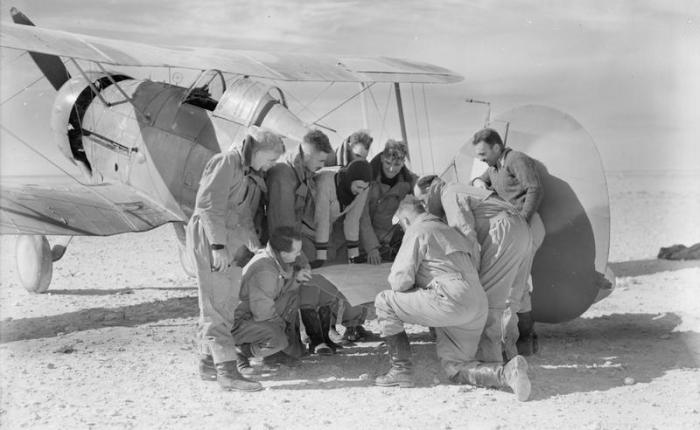
Header Image: Pilots of No. 3 Squadron RAAF study a map on the tailplane of one of their Gloster Gladiators at their landing ground near Sollum, Egypt, before an operation over Bardia during the closing stages of Operation COMPASS. Left to right: Flying Officers J.R. Perrin, J. McD Davidson (squatting), W.S. Arthur and P. St G. Turnbull, Flight Lieutenants G.H. Steege and A.C. Rawlinson, Flying Officer V. East, (unknown), Squadron Leader I.D. McLachlan (Commanding Officer) and Flying Officer A.H. Boyd. (Source: © IWM (CM 355))

#ResearchNote – A Different Kind of Shooting: A Photo-Recon Pilot’s Life in 1944

#ResearchNote – A Different Kind of Shooting: A Photo-Recon Pilot’s Life in 1944

By Mike Hankins

One of the lesser known large contributors to Allied victory in World War II was the role of aerial photographic reconnaissance. The allies relied on up-to-date photographs from the air. Flying these photo ‘recce’ missions could be every bit as harrowing as combat sorties. Recce planes flew over enemy territory with their guns removed and replaced with cameras. If they were attacked, pilots had no choice but to try and escape using only speed and manoeuvring, hoping to hide inside cloud cover or just to outrun the enemy. Up until the D-Day invasion, many of these missions were flown at extremely high speed and low altitude, as low as five to fifteen feet over the beaches of Normandy. Pilots likened these missions to throwing dice across a gambling table and called them ‘dicing’ missions. To get an in-the-cockpit view of what flying recce missions could be like, I am going to outline a brief period in the career of First Lieutenant George Adams, Jr., who joined the 30th Photographic Reconnaissance Squadron (PRS) in Toussus le Noble, France at the end of July 1944.

Adams flew the F-5, which was a Lockheed P-38 Lightning modified to take photos. The P-38 was not an uncontroversial plane, drawing mixed reviews from those that flew it. Ace fighter pilot Captain Jack Ilffey called it ‘a beautiful monster.’[1] Famed pilot Brigadier General Robin Olds, later noted for his contributions to air combat in the Vietnam War, first earned ace status in a P-38 in World War II. As he recalled,

I loved the P-38 but I got those kills in spite of the airplane, not because of it. […] The P-38 Lightning was too much airplane for a new kid and a full-time job for even a mature and experienced fighter pilot. Our enemies had difficulty defeating the P-38 but, as much as we gloried in it, we were defeating ourselves with this airplane.[2]

Although, from an air combat perspective, the P-38 was not nearly as effective as other fighter types, such as the North American P-51 Mustang, the Lightning’s high speed, long range, and sheer toughness allowed it to excel in the role of photo reconnaissance. Allied forces had learned early on that a group of F-5s together was easily spotted, so to reduce the likelihood of being seen, photo reconnaissance missions were often flown by single planes, unescorted and completely alone, usually deep over enemy territory.

2-Adams after landing in Mussidan, France
Adams after landing in Mussidan, France. (Source: Morse Special Collections, Kansas State University, Personal Papers of George Adams, Box 3)

Adams happened to arrive at a time when the 30th PRS was busier than it ever had been. The official unit history referred to August of 1944 as the ‘month of months.’ Ten August 1944 saw more missions take to the air than on D-Day itself. [3] For Adams, however, that month witnessed one of the defining moments of his career and very nearly cost him his life.

3-Adams welcomed in Mussidan
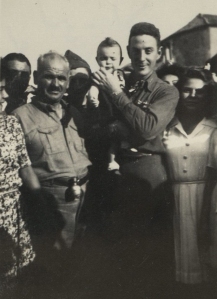
Adams welcomed in Mussidan. (Source: Morse Special Collections, Kansas State University, Personal Papers of George Adams, Box 3)

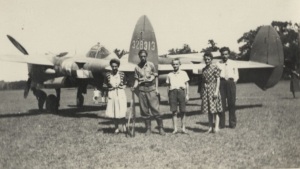
On 3 September, Adams was flying a reconnaissance mission over Belgium, when the weather took a turn for the worse. Due to extremely limited visibility, Adams flew far off course. With his fuel tanks almost empty, he had no choice but to land in the town of Mussidan in southwestern France. Luckily, just over one week previously on 25 August, the town had been liberated by the French Forces of the Interior (FFI). The townspeople welcomed him as a hero and gave him a place to stay at a nearby hotel for three days. The French resistance was able to purchase some German gasoline, and at the first sign of clear weather, on 6 September, Adams took off. After signalling his thanks by flying a few victory laps around the town, he headed back to Toussus le Noble.[4]

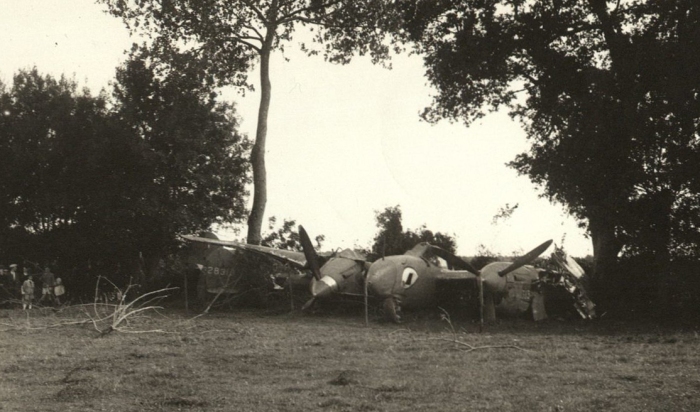
Adams’ ordeal was not over. The weather, which the 30th PRS unit historian called, ‘the airman’s most relentless foe,’ again proved troublesome for Adams on his flight back to base. After becoming lost in rough weather and losing all radio contact with his commanding officer, Major William Mitchell (not to be confused with the other Billy Mitchell, author of Winged Defense), Adams attempted to land in a field near Morannes and slammed his P-38 into a grove of trees. Adams himself was unharmed, but the aircraft was disabled. There was a military group at Morannes, and Adams stayed with them before travelling to an airstrip at Le Mans, about thirty miles away. Cooperating with intelligence services at Le Mans and the FFI, Adams tried to contact Major Mitchell but was unable to do so. The officials at Le Mans eventually brought Adams to Versailles on 8 September, where he was able to reconnect with the 30th PRS, and he returned to flying duty the next day.[5]

4-The wreckage of Adams' P-38 near Morannes
The wreckage of Adams’ P-38 near Morannes. (Source: Morse Special Collections, Kansas State University, Personal Papers of George Adams, Box 3)

Typically, the weather of the winter months limits photo recce missions. However, that was the least of the allies’ problems in December of 1944 as eight panzer divisions tore their way through the Ardennes forest, beginning what became known as the Battle of the Bulge. The 30th PRS joined the battle, providing valuable photographs to aid ground units. However, the weather again reared its head. Only five days before the end of the year were suitable for taking photos. The 30th managed to squeeze out 96 missions in those five days. Adams and his fellow pilots flew as much as possible, including flying multiple missions on Christmas Eve, Christmas day, and New Year’s Eve. The squadron set a record for a number of photographs processed: nine miles of film, consisting of 44,306 negatives that produced 153,579 prints.[6]

On New Year’s Day, 1945, ground forces requested an urgent, secretive mission to be flown over a particularly well-defended area of the German lines during the Battle of the Bulge. The nature of the photographs needed required a low-altitude approach of 2,000 feet, rendering the reconnaissance planes especially vulnerable to ground defences. Adams and six other pilots volunteered for the job. Four of them, including Adams, flew out twice. Despite the heavy risk and the intrusion of adverse weather conditions, the mission was a success, providing valuable intelligence to the front lines. The secretive nature of the mission prevented much discussion of it at the time, however, several months later, on 21 July 1945, Adams was awarded the Distinguished Flying Cross for flying his ‘unarmed photographic aircraft under circumstances entailing utmost courage and skill.’[7]

In the popular memory of World War II, we often tend to celebrate or romanticise the fighter pilots or bomber crews that engaged in seemingly heroic combat actions. However, Adams and his fellow recon pilots should not be forgotten. They took serious risks and made key contributions to the Allied victory in World War II.

Mike Hankins is a doctoral candidate at Kansas State University, where he teaches World History, the History of Airpower, and the History of Comic Books, and he is currently working on his dissertation, ‘Sources of Innovation: The Cultural and Technological Origins of Fourth Generation Fighter Aircraft, 1964-1991.’ He completed his master’s thesis at the University of North Texas in 2013, titled ‘The Phantom Menace: The F-4 in Air-to-Air Combat in the Vietnam War. He has a web page and can be found on Twitter at @hankinstien.

Header Image: Ground personnel of the 7th Photographic Reconnaissance Group fit cameras into a Lockheed F-5 Lightning before a long-range mission. Image by Staff Sergeant Robert Astrella, 7th Photographic Reconnaissance Group. (Source: ©IWM (FRE 5390))

[1]    Robert F. Dorr, ‘Why the P-38 Flunked in Europe,’ Aviation History 24 (May 2014), 22.

[2]    Ibid.

[3]    US Air Force Historical Research Agency (AFHRA), Maxwell AFB, 30th Photo Reconnaissance Squadron Unit History for the Month of August, 1944; Morse Special Collections, Kansas State University, Personal Papers of George Adams, Box 3, George Adams Pilot Information File, August 1944. Hereafter, the Adams Papers.

[4]    AFHRA, 30th Photo Reconnaissance Squadron Unit History for the Month of September, 1944; Testimony of Labattu de Montpon, as related in email from Mayor Stephane Triquart to Bruce Adams, 21 January 2016.

[5]    AFHRA, 30th Photo Reconnaissance Squadron Unit History for the Month of September, 1944.

[6]    Ibid.

[7]    AFHRA, Recflash, Vol. 2 No. 1, Highlight Missions, 2, attached to Historical Records and History of Headquarters 67th Tactical Reconnaissance Group, Month of January 1945; Morse Special Collections, Kansas State University, Adams Papers, Box 3, Quote from Distinguished Flying Cross award citation, General Orders 116, 27 June 1945.

‘Integrating’ the Italian Air Force after the Armistice

‘Integrating’ the Italian Air Force after the Armistice

By Dr Ross Mahoney

If there is one description of the multi-national and cosmopolitan composition of Allied forces in the Mediterranean theatre during the Second World War, it is ‘complex.’ This comment may seem obvious at first; however, were there not only British and American troops in the theatre but also forces from the Commonwealth and Empire and ‘free’ forces such as those from France and Poland. Also, in the aftermath of the Italian surrender in September 1943, there were also those of the former regime.

large_0000001
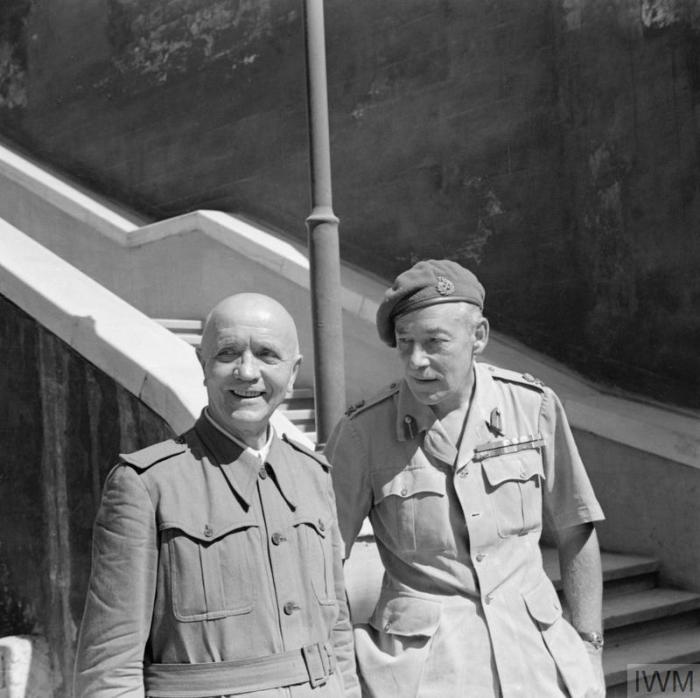
The first Prime Minister of Italy after the fall of Mussolini, Field Marshal Pietro Badoglio with the Head of the Military Mission in Brindisi, Lieutenant General Sir Noel Mason-MacFarlane. Photograph taken at the Italian Naval Headquarters at the Castle, Brindisi. (Source: © IWM (NA 7029))

By the terms of the instrument of surrender, units of the Italian navy and air force were to be transferred to the control of Allied forces. Once the Italian government under Marshal Badoglio moved to Brindisi, and the long terms of surrender were signed, the Allies set up a Control Commission to enforce the surrender terms. However, even before the Control Commission was established, General Eisenhower had dispatched a Military Mission to Brindisi to transmit military instructions to Badoglio, collect intelligence, and most importantly, coordinate the use of Italian armed forces in the war against German.[1]

It is clear that the use of Italian forces was designed, where possible, to complement Allied combat power in the Mediterranean theatre; however, this came up against some challenges that highlight the problem of integrating former enemies into the Allied force structure. Furthermore, as Marshal of the Royal Air Force Lord Tedder, who at the time was in charge of the Mediterranean Air Command, reflected in his wartime memoirs that, while he was keen to support the use of the Italian air force, that Services needs came secondary to the Allied war effort.[2] Challenges for re-building the Italian air force included administrative, logistical, resource and personnel issue as well as cultural and language difficulties.

large_000000
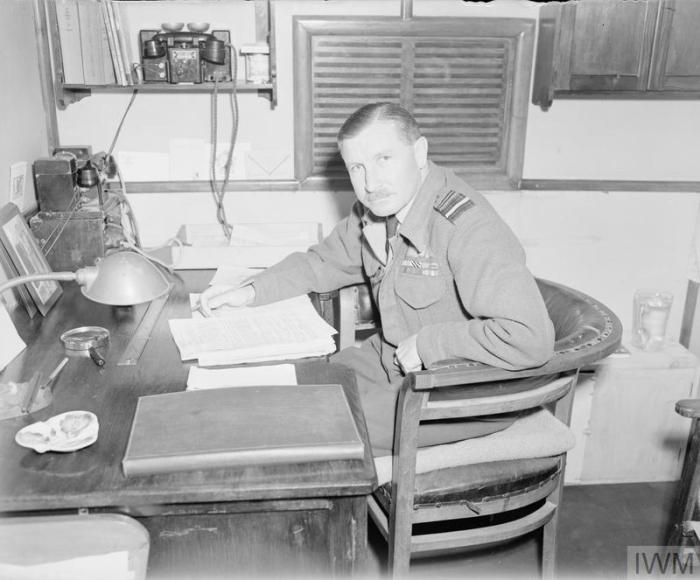
Air Vice-Marshal Robert Foster, Air Officer Commanding the Desert Air Force, sitting in his office trailer at DAF Advanced Headquarters at Cesena, Italy. (Source: © IWM (CNA 3338))

The head of the air section of the Military Mission was one Air Commodore Foster, later Air Chief Marshal Sir Robert Foster who later commanded the Desert Air Force and the 2nd Tactical Air Force in Germany in the early 1950s. In Foster’s personal papers, held by the Royal Air Force Museum in London, is a fascinating record of his service with the Military Mission between September 1943 and March 1944.[3] In this recollection, which is what it is as it is clearly entitled the ‘Personal Record of ACM Sir Robert Foster’ and as such probably written after his retirement in the 1950s, Foster details the work he undertook.

The first challenge recalled by Foster was that of morale and linked to that the issue of attitude. Italian forces had by the time of surrender been fighting on multiple fronts and, for a variety of reasons, suffered significant defeats. Added to this, as Foster recollected, was the fact that the Italian’s were being asked to fight with their former enemies against their former allies. Furthermore, motivation was considered to be challenging because of conditions in Italy for the civilian population and the separation of personnel from their families. This was an outcome of the character of the Italian campaign and German failure to withdraw from the peninsula. That Foster identified this as his first requirement was hardly out of character. It was recognised by British forces that the generation of combat power was related to good leadership, command and morale. As such, managing issues such as attitude, culture, identity and loyalties were essential to ensure the provision of an effective force. As Foster wrote:

It was perfectly clear […] that the first step must be to establish a sense of purpose and to find officers with sound qualities of leadership, with good operational experience, and with the basic enthusiasm which would make their Air Force and efficient and useful addition to the allied war effort.[4]

Foster was aided in attempting to implement his first step by recognising the need to gain support from Badoglio’s government and to help with that he appointed Squadron Leader Roger Francis whom both spoke Italian and was a ‘firm Italophile.’

Importantly, it was agreed that Italian units would be grouped to maintain identity, though the Allies would provide stores and logistical support and eventually re-equipment of units. Linked to this were administrative challenges concerning issues such as an operational headquarters to control units that not only served the purpose of Italians but also fitted with existing Allied arrangements. Added to this was the need to communicate to Allied air commanders that the addition of Italian units would be of benefit to the war effort. Foster recollected the ‘excellent service’ of his Italian staff officers fondly, and that ‘at heart, the Italian Air Force air crew were not dissimilar to ours.’[5]

captured_macchi_mc-205_at_catania_1943
An Italian Macchi C.205 Veltro aircraft found on Catania airfield, Sicily by personnel of No. 450 Squadron RAAF and subsequently serviced by the squadron’s fitters. (Source: Wikimedia)

Ultimately, without further research, it is difficult to assess the effectiveness of Foster’s effort to rebuild the Italian air force on the Allied war effort. At a simple level, were the outcomes achieved greater than the effort expended? One thing is sure, while an attempt was made to utilise the Italian air force it was hampered by the fact that the Allies secured only some 300 aircraft and that many continued to be used by forces that remained loyal to the regime in Northern Italy. This led to Italian units being used by the Balkan Air Force and re-equipped with Allied types. Nevertheless, perhaps the critical outcome of this effort was that it laid the foundation for the post-Second World War Italian air force, as such, while the Service might not have been militarily effective in reinforcing Allied combat power, it served a political purpose in the longer term.

This is by no means an exhaustive discussion of the effort to rebuild and utilise Italian forces after the 1943 surrender; however, while it is dangerous to draw historical parallels, the experience of Italian forces after 1943 begs the question of the purpose of rebuilding forces of defeated enemies and the challenges inherent in that process. It is evident from Foster’s recollection that while there were technical and logistical challenges, the key to his ‘success’ was the need to recognise the problem of working with the Italians to ensure that they felt part of the Allied team. A need to maintain some form of identity was paramount to Foster’s work and the subsequent integration of Italian forces who subsequently felt valued as they were able to ‘prove [their] worth under the new circumstances.’[6]

Dr Ross Mahoney is an independent historian and defence specialist based in Australia. Between 2013 and 2017, he was the resident Historian at the Royal Air Force Museum, and he is a graduate of the University of Birmingham (MPhil and PhD) and the University of Wolverhampton (PGCE and BA). His research interests include the history of war in the twentieth and twenty-first centuries, air power and the history of air warfare, and the social and cultural history of armed forces. To date, he has published several chapters and articles, edited two books, and delivered papers on three continents. He is a member of the Royal Historical Society and is an Assistant Director of the Second World War Research Group. He is a member of the Royal Historical Society and an Assistant Director of the Second World War Research Group. He blogs at Thoughts on Military History and can be found on Twitter at @airpowerhistory.

Header Image: A formation of Macchi C.200 of the Regia Aeronautica, c. 1941 (Source: Wikimedia)

[1] On the development of the Allied Control Commission, see: C.R.S. Harris, Allied Military Administration of Italy, 1943-1945 (London: HMSO, 1957), pp.105-28.

[2] Marshal of the Royal Air Force Lord Tedder, With Prejudice (London: Cassell, 1966), p. 469.

[3] Royal Air Force Museum, Personal Papers of Air Chief Marshal Sir Robert Foster, AC75/34/8/23, Personal Record of A.C.M. Sir Robert Foster of Service with the Italian Air Force, September 1943-March 1944, N.D.

[4] Ibid, p. 2.

[5] Ibid, p. 5.

[6] Ibid, p. 6.

From Balloons to Drones – Top Posts of 2016

From Balloons to Drones – Top Posts of 2016

By Ross Mahoney

Happy New Year!

Now we have reached 2017, and that From Balloons to Drones has been up and running for around six months, it thought it would be worth posting our top five posts of 2016 based on views.

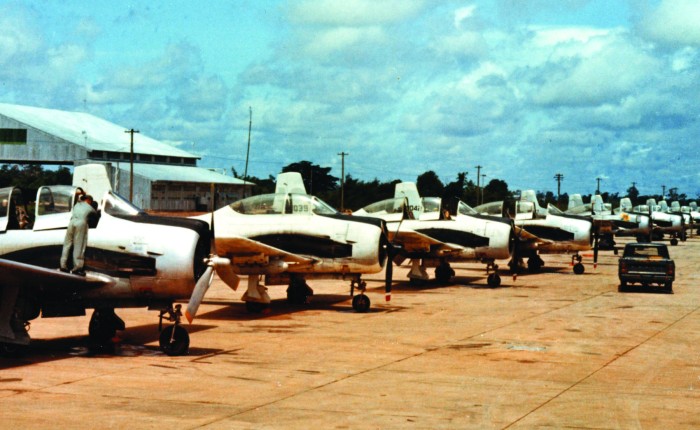
  1. At the head of the list is ‘Supporting the Secret War: T-28s over Laos, 1964-1973 – Part 1: Training.’ This is the first of a three-part article by Jeff Schultz that examines the use of the North American T-28 during the war in Laos in the 1970s. Parts two and three can be found here and here.
  2. In second place is my research note on ‘Air Power and the Challenge of Professional Military Education’ that was based on my thoughts on an excellent conference at the Royal Military College of Canada in November. An important subject that I hope to return to in 2017.
  3. In third is Brian Laslie’s commentary, ‘TheF-35 is here!’, which deals with some of the issues surrounding this program and the important role that training will play in developing the aircraft’s use.
  4. In fourth, and timed in conjunction with the types eventually retirement for the United States Air Force, Mike Hankins provided a timely discussion of the development of the McDonnell F-4 Phantom II in his piece ‘Remembering the F-4 Phantom – Part 1: A Product of Its Time.’ The second part of this article can be found here.
  5. Finally, but no means last, Alex Fitzgerald-Black’s research note ‘Operation HUSKY’s Air Battle by the Numbers’ provided a useful discussion of the importance of the air battles fought during the invasion of Sicily in 1943.

These are just a selection of the highlights of our half year in existence. We are keen to expand our list of contributors and if you are interested in writing about air power issues – both historical and contemporary – then you can find out how here. If you have any questions then please leave a comments here or emails us at airpowerstudies@gmail.com.

Header Image: A row of T-28s in Laos. (Source: USAF)

#BookReview – A Thunder Bird in Bomber Command

#BookReview – A Thunder Bird in Bomber Command

By Dr Ross Mahoney

Sean Feast, A Thunder Bird in Bomber Command: The Wartime Letters and Story of Lionel Anderson, the Man who Inspired a Legend. London: Fighting High Publishing, 2015. Foreword. Appendices. Sources. Index. Hbk. xiii + 169 pp.

lionel-book

Thunderbirds are go! It is not often that you get to write those immortal words at the start of a review to do with a book on Bomber Command; however, this is no ordinary book. Indeed, it is a book that will be of interest to two distinct groups of people. First, there are those with an interest in the experience of Bomber Command operations during the Second World War. Second, there are those with a passion for the 1960s TV show Thunderbirds and other production that came from Gerry Anderson’s fertile imagination. This, of course, begs the question of how these two seemingly disparate interests are linked. Well, as Shane Rimmer, who provided the voice to Scott Tracey, recollected in the foreword to the book, the inspiration was ‘direct and personal – from his elder brother Lionel who had given up his life as a pilot during the Second World War’ (p.ix).

This biography, therefore, tells the story of Lionel Anderson, Gerry Anderson’s older brother through the letters that he sent home while also considering the impact of his death on his younger brother. The book details Lionel Anderson’s early interest in flying and his decision to volunteer as aircrew in the RAF (p.3). The book then follows a chronological order following Lionel Anderson’s experience of flying training to through to undertaking operations as part of No. 515 Squadron, which formed part of Bomber Command’s No. 100 (Bomber Support) Group. The unit had been established in October 1942 from the so-called Defiant Flight at RAF Northolt and at that time formed part of Fighter Command. The unit was then equipped with the Bristol Beaufighter and then the de Havilland Mosquito. Lionel Anderson joined No. 515 Squadron in early 1943 (p.77). The squadron was involved in operating Moonshine, Mandrel, and Serrate electronic warfare systems that had emerged as part of the pantheon of homing and jamming systems that developed during the Second World War. These were designed to provide support in an ongoing battle to defeat German equipment, such as the Freya radar net as well as defeat German night fighters. In this, Sean Feast provides a good overview of No. 515 Squadron’s role in this area.

large_0000001
Hawker Hurricane Mark X, AG111 ‘HK-G’, of No. 59 Operational Training Unit, on the ground at Milfield, Northumberland. Although bearing the unit codes of the Fighter Leaders School (based at Charmy Down, Wiltshire), AG111 does not appear to have been officially transferred to them. It was passed later to No. 57 OTU at Eshott, Northumberland, and crashed after colliding with a Supermarine Spitfire over Wooler on 5 May 1943. (Source: © IWM (CH 9222))

The section dealing with Lionel Anderson’s time with No. 59 Operational Training Unit is, however, problematic. Feast suggests that in late 1942, Anderson’s course transferred to Brunton, which was No. 59 OTU’s satellite airfield and that while there they became known as No. 559 Squadron.  Additionally, Feast suggests that, as No. 559 Squadron, the unit could be called on to intercept incoming aircraft as part of ‘Saracen scheme’ (p.76). This is where it becomes murky as there does not appear to be a No. 559 Squadron. There is no Operations Record Book for No. 559 Squadron and C.G. Jefford’s work on RAF squadrons does not list the unit.[1] However, No. 559 Squadron was a numberplate reserved for No. 59 OTU if activated as part of Plan BANQUET. Additionally, Ray Sturtivant’s work on flying training units does suggest that, in March 1943, the squadron number above was used.[2] So what is to be made of this? First, Plan BANQUET, which originated in 1940, had been revised in May 1942. Part A of the Fighter Command element of the revised plan – BANQUET FIGHTER – called for aircraft and crews from OTUs to form squadrons as reinforcements, as such; they would have received a numberplate. This process was activated by a codeword ‘APPLE’.[3] Nevertheless, as Jefford noted, the squadron numberplates allocated to fighter OTUs were not used as the units were not mobilised.[4] Second, it is reasonable that crews at OTU’s were aware of this plan, and their designation if activated. It is probably this that is being recollected rather than an official designation. This of course raises the question of whether matters, which is clearly subjective. I would suggest that the pilots being trained by No. 59 OTU were aware of their reserve role and the details of the unit’s designation. It highlights the tension between the operational record and memory and how it can be distorted.

The earlier sections of the book that detail Lionel Anderson’s decision to volunteer, his training in America and time at an Advanced Flying Unit are, for me, the real gem of this book as it is here where the letters home find their place. Indeed, the reason for this appears to be that the last letter kept by Lionel Anderson’s mother, Deborah comes from this period. As Feast explains, Deborah Anderson had reproduced the letters into a pair of hard-backed exercise books, and this is all that was left of Lionel Anderson’s correspondence (pp.69-70). This helps explain why the book’s subtitle is ‘The Wartime Letters and Story’ as the latter period has been reconstructed from other sources. Nevertheless, the use of letters in the earlier part of the book help us explore what it was like to serve in the RAF during the war and the experience of training in America. In one letter, Lionel Anderson described the planned graduation dance they held at the end of his training in America. ‘We invite our instructors and friends we have made during our stay here and, of course, we have plenty of girls.’ This recollection (p.55) both highlights the friendly relations between American and Britain but also one recurring theme in the letters, girls.

Overall, as with many books of this type, this is a fascinating insight into life in the RAF. It is made all the more interesting given the links between Lionel Anderson and his younger brother’s later work.

This book review originally appeared at Thoughts on Military History.

Dr Ross Mahoney is an independent historian and defence specialist based in Australia. Between 2013 and 2017, he was the resident Historian at the Royal Air Force Museum, and he is a graduate of the University of Birmingham (MPhil and PhD) and the University of Wolverhampton (PGCE and BA). His research interests include the history of war in the twentieth and twenty-first centuries, air power and the history of air warfare, and the social and cultural history of armed forces. To date, he has published several chapters and articles, edited two books, and delivered papers on three continents. He is a member of the Royal Historical Society and is an Assistant Director of the Second World War Research Group. He is a member of the Royal Historical Society and an Assistant Director of the Second World War Research Group. He blogs at Thoughts on Military History, and can be found on Twitter at @airpowerhistory.

Header Image: The prototype Boulton Paul Defiant fighter, which first flew in August 1937. This aircraft type equipped the so-called Defiant Flight at RAF Northolt, which eventually became No. 515 Squadron. (Source: © IWM (MH 5507))

[1] Wing Commander C.G. Jefford, RAF Squadrons: A Comprehensive Record of the Movement and Equipment of all RAF Squadrons and their Antecedents since 1912, 2nd Edition, (Shrewsbury: Airlife, 2001).

[2] Ray Sturtivant, Flying Training and Support Units since 1912 (Staplefield: Air-Britain, 2007), p.242.

[3] Anon, The Air Defence of Great Britain – Volume V: The Struggle for Air Supremacy, January 1942-May 1945, (Air Historical Branch Narrative), pp.10-1.

[4] Jefford, RAF Squadrons, p.188.

A Case of Mistaken Identity: Colonel Edgar Stanley Gorrell – Part 3: Postscript

A Case of Mistaken Identity: Colonel Edgar Stanley Gorrell – Part 3: Postscript

By Johannes Allert

The lingering question remains as to why Edgar Gorrell is repeatedly misidentified as a stalwart advocate for strategic bombing. One clue, in particular, involves his analytical work compiled in the First World War entitled ‘The Future Role of American Bombardment Aviation.’ The plan above called for a robust air campaign aimed at German industry designed to break both German production and morale; however, the plan was shelved once Armistice was declared.[1] Withdrawing from the world’s stage, America quickly re-embraced isolationism. Yet, air strategists in their stubborn willfulness remained convinced that subsequent wars required sufficient strategies and weapons designed to mitigate problems associated with trench warfare.[2] Then, in 1935, technology and theory merged with the development of the Boeing B-17 Flying Fortress and the coincidental discovery of Gorrell’s of plans by a fervent disciple of “Billy” Mitchell – Lieutenant Laurence S. Kuter, later a General. This serendipitous moment reinforced his existing argument for strategic bombing in lectures he conducted at Maxwell Army Air Base. Believing strategy and technology could transition from theory to reality, the impressionable young Lieutenant arranged a meeting with its author to verify the data. Upon arrival, Kuter was surprised to discover Gorrell invited former members of his staff to corroborate the information. To a man, each concurred that the Lieutenant’s lecture matched the original plans. Vindicated, Kuter departed for Maxwell confidently stating:

We may return to our steel desks considerably refreshed by the knowledge that our school plans and our theories are not only supported by, but [are] identical with the plans of the level headed commanders in the field when the grim realities of actual war demanded effective employment.[3]

raid_by_the_8th_air_force
A Boeing B-17 Flying Fortress during the raid on the Focke Wulf plant at Marienburg, 9 October 1943. (Source: NARA)

Overlooked in the young Lieutenant’s statement, was the slight detail involving ‘employment of effective plans’ that, in reality never occurred. Furthermore, aircrews did not fly steel desks and the advent of the Second World War revealed a savage reality of aerial combat consisting of unexpected headwinds, radio interference, dispersed targets obscured by cloud cover, and skies filled with flak and fighters. Only the arrival in late 1944 of long range Allied fighter escort in substantial numbers alleviated the bomber’s plight. Kuter simply made a mistake common to us all – he saw what he wanted to see. Gorrell and his staff merely reinforced it.

Thus, the combination of events served as the catalyst for initiating a narrow and ideologically driven agenda. History, however, reveals Gorrell’s penchant for tackling any project assigned to him by meticulous analysis and hard work. Consequently, his recognition of aviation’s vast potential resulted in expansion and development of airlift capability that far surpassed his ‘significant achievement’ of 1918. It is also interesting to note that while analysis of his bombing study receives frequent coverage, his ‘Gorrell Histories’ remains virtually untouched. This is ironic given the fact that its intended purpose was to ‘assist in establishing Army aeronautics on a sound basis for the future.’[4] Furthermore, the manner that Gorrell’s obituary was written indicates Kuter, another West Point alum, as partly responsible for crafting the legacy of the late air executive to reinforce the ‘bomber mafia’ narrative. Gorrell’s ‘mistaken identity’ simply coincided with the leading aviation proponents’ narrative. Consequently, his death combined with strategic bombing’s overwhelming consensus sufficiently prohibited others from offering a counter-narrative.

Yet, it is the development and expansion of air transportation that endures. The ability to transport and sustain forces globally on a consistent basis in peace and war for over seventy years remains an underappreciated, yet unique and critical feature of the modern U.S. Military arsenal. Whether it is airlift’s support in battle or providing humanitarian aid in peacetime, success simply cannot occur without it. Gorrell recognised this early on and, in keeping with his philosophy of constant analysis, laboured ceaselessly to improve and expand it.

Similarly, it is the task of the historian to revive and revise Gorrell’s story and contribution. Unlike proponents of strategic precision bombing, historians must instead consider the broader actions and provide a greater contextual understanding of events and individuals of human history.

Part One and Two of this article can be found here and here.

Johannes Allert holds an MA in Military History from Norwich University and has served as an adjunct for Minnesota State University – Moorhead and Rogers State University (Oklahoma). His thesis concerning Lieutenant General Frank M. Andrews appeared in Air & Space Power Journal. He assisted in editing Naval Press Institute’s The Secret War for the Middle East – The Influence of Axis and Allied Intelligence Operations in WW II. His other articles concerning aviation appear in Minnesota History Magazine. He has also written for North Dakota History Magazine. Currently, he is a Legacy Research Fellow for the Minnesota State Historical Society and is working on a larger book project entitled Discovering Minnesota’s Lost Generation – Reflections and Remembrances of the Great War. His other ongoing book projects include Marshall’s Great Captain – The Life of Lieutenant General Frank Maxwell Andrews and Citizen-Soldier: Major General George Leach.

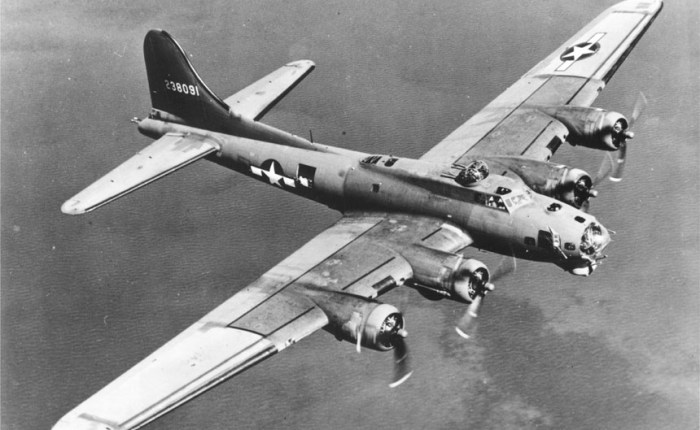
Header Image: A Boeing B-17G Flying Fortress (Source: Wikimedia)
[1] Mark Clodfelter, Beneficial Bombing: The Progressive Foundations of American Air Power, 1917-1945 (Lincoln, NE: University of Nebraska Press, 2010), pp.22-9.

[2] James P. Tate, The Army and its Air Corps: Army Policy toward Aviation: 1919-1941 (Maxwell AFB, AL: Air University Press, 1998), pp.166-7.

[3] Clodfelter, Beneficial Bombing, pp.58-9.

[4] Edgar S. Gorrell, Gorrell’s History of the American Expeditionary Forces Air Service, 1917-19 Record Group 120 (National Archives, Washington, D.C. 1923), pp.1-4.

A Case of Mistaken Identity: Colonel Edgar Stanley Gorrell – Part 2: The Emerging Role of Civil Aviation in Air Transport

A Case of Mistaken Identity: Colonel Edgar Stanley Gorrell – Part 2: The Emerging Role of Civil Aviation in Air Transport

By Johannes Allert

Having achieved the rank of full colonel at age twenty-eight, Gorrell, for reasons unknown, resigned from the Army in 1920 and briefly pursued a career in the automotive industry. By 1934, however, he returned to aviation and served alongside his former Army comrades George C. Marshall and Harold ‘Hap’ Arnold as a member of the newly formed committee known as the Baker Board. Their assignment involved reviewing events surrounding President Franklin Roosevelt’s ill-advised and hasty decision to cancel commercial airmail contracts (a system allegedly deemed rife with corruption), temporarily replacing them with Army aviators ill-equipped and unaccustomed to performing night navigation in inclement weather. The unintended consequence of this action resulted in sixty-six accidents and twelve fatalities.[1] A month-long session of testimony and reports exposed America’s scant support for adequately funding the nation’s fledgeling Army Air Service and revealed the enormous gap existing between military and civil aviation. The stark contrast showed that even at the height of The Great Depression, civil aviation’s assets in equipment, organisation, and talent dwarfed that of the U.S. Army Air Service. Consequently, the board recommended, with Gorrell’s insistence, that future construction of civil airliners include structural modifications for adaptation in military use should the need arise.[2]

In January of 1936, Gorrell was selected as head of the Chicago-based organisation known as the Air Transportation Association of America (ATA). As president, he viewed his mission as twofold. Firstly, to avoid a repeat of the boom and bust cycle experienced by America’s railroad industry of the previous century, Gorrell advocated for the establishment of reasonable and modest regulations compatible with commercial aviation’s development.[3] Secondly, and of equal importance was the grafting of civil aviation with the needs of national defence in times of crisis. He categorically stated that:

Beyond doubt, the scheduled air transport industry has influenced and stimulated many of our other national industries. Our military air force is as dependent on commercial aeronautics as our Navy is upon our Merchant Marine.[4]

This statement more closely aligns with Alfred Thayer Mahan’s concept of naval strategy than anything related to William “Billy” Mitchell’s thoughts involving strategic bombing. Furthermore, unlike Mitchell’s acerbic personality, Gorrell maintained cordial relations with leaders in governmental agencies and commercial industry alike. Affability combined with credibility and insight made him the perfect catalyst for advancing aviation technology.[5] This was evident in his adept response to a proposal from Senator Royal S. Copeland (D-NY) to mobilise the airlines for a two-day exercise during the military’s 1937 summer manoeuvres. The mobilisation plan, based on a preliminary study from 1922 was, in Gorrell’s estimation, an outdated, vague, and ham-fisted approach. Having carefully studied the plans as they related to the exercise, he calmly concluded that should they proceed with the plan in its current form; the cumulative effect would result in a seven-day disruption of the entire airline system and cost the taxpayer approximately $5,000,000. Wisely, the War Department accepted his sage advice and rescinded the order without further argument from the Senator.[6]

C-54
A Douglas C-54 Skymaster of the Military Air Transport Service. Air Transport Command was a precursor to this organisation. (Source: Wikimedia)
Over the next three years, Gorrell assisted by his staff laboured to enhance civil aviation to include navigation aids, aircraft modification, mapping of routes, development of runway aids, and weather stations across the globe for the immediate benefit of commercial aviation and for military use in a war he considered as inevitable.[7]  By the time Germany invaded Poland in the fall of 1939, Gorrell confidently assured General Marshall, now head of the U.S. Army, that the airline industry was readily available to support any contingency.[8] Following the Japanese attack on Pearl Harbor, Gorrell spelt out in a memo circulated to all airlines dated 20 January 1942 reviewing wartime control, industry coordination, and requests from the military and stressed the need for cooperation.[9] Still, relations between civil aviation and the military were not without incident and in 1943 when it appeared progress was stalled; President Franklin Roosevelt briefly contemplated nationalising the airlines. Fearing the possibility of a permanent government takeover of the industry Gorrell, with the support from the Army’s Chief of the Air Corps General Arnold, met privately with Roosevelt and expressed opposition to nationalising America’s commercial airlines. The two men eventually persuaded the President to maintain the current relationship between civil and military authorities whereby the later enlisted rather than commandeered commercial aviation’s support and as history demonstrates, this proved the better choice.[10]

liberator_express_consolidated_c-87_41-11706_281552059443329
Consolidated C-87 Liberator Express (Source: Wikimedia)

Gorrell realised that necessary ingredient for achieving Allied victory in World War II required logistics that, in turn, required expansion of air transportation on a global scale. This was the very thing the U.S. Army Air Corps lacked. The existing bomber bias so pervasive within its pre-war ranks was nowhere more evident than in the inventory of aircraft that, in 1939 amounted to 1,700 – of these, only seventy-five were designated as transport.[11] Without civil aviation’s support encompassing its equipment, expertise, and facilities, expansion of the United States Army Air Force’s transport system was, at best, problematic. During the early stages of the war, the Army relied almost exclusively upon civil aviation’s assistance in transporting men and equipment to Alaska to blunt the Japanese offensive in the Aleutians.[12] Civilian transport also played a crucial role in assisting with securing vital assets in Latin America deemed necessary for the war effort.[13]  With civil aviation’s assistance, the U.S. military went so far as to commandeer civil aircraft used by Axis powers and press them into military service.[14] By 1945, the Army’s Air Transport Command, with Gorrell’s expertise and support, grew to operate 3,386 aircraft consisting of 41,520 officers, 166,026 enlisted, and further backed up by 23,735 civilian technicians.[15] This organisation was a one of a kind operation that successfully performed global missions utilising civil aircraft modified for military use – namely Consolidated’s C-87 (modified from the B-24 bomber), the Lockheed Constellation (designated C-69) and Douglas DC-4 (designated C-54).[16] By war’s end, strategists recognised the value of airlift operations and therefore incorporated this significant component into all future planning and logistics.[17] Another overlooked feature of Gorrell’s contributions to the growth of American air power was the modification centre concept. The management of ‘Mod Centers’ by various airlines across the United States enabled aircraft manufacturers to concentrate on production without stopping to refit for improvements.[18] Overall, Mod Centers were responsible for readying half of all U.S. military aircraft produced for combat during World War II.[19]  Gorrell’s foresight and hard work culminated in not only the expansion and development of aviation technology but forged a successful partnership between civil and military aviation on a global scale. Unfortunately, Edgar Staley Gorrell did not live to see the fruits of his labour. Without warning, he suffered a heart attack and died in the spring of 1945 at age fifty-four. In accordance with his wishes, his remains were cremated and scattered across the parade ground of his alma mater, West Point.[20]

Part One and Three of this article can be found here and here.

Johannes Allert holds an MA in Military History from Norwich University and has served as an adjunct for Minnesota State University – Moorhead and Rogers State University (Oklahoma). His thesis concerning Lieutenant General Frank M. Andrews appeared in Air & Space Power Journal. He assisted in editing Naval Press Institute’s The Secret War for the Middle East – The Influence of Axis and Allied Intelligence Operations in WW II. His other articles concerning aviation appear in Minnesota History Magazine. He has also written for North Dakota History Magazine. Currently, he is a Legacy Research Fellow for the Minnesota State Historical Society and is working on a larger book project entitled Discovering Minnesota’s Lost Generation – Reflections and Remembrances of the Great War. His other ongoing book projects include Marshall’s Great Captain – The Life of Lieutenant General Frank Maxwell Andrews and Citizen-Soldier: Major General George Leach.

Header Image: Newly delivered USAAF Consolidated C-87-CF Liberator Express transport planes at the Consolidated Aircraft Corporation, Fort Worth, Texas, in October 1942. (Source: Wikimedia)

[1] E.R. Johnson, American Military Transport Aircraft Since 1925, (Jefferson, NC: McFarland & Co. 2012), p.3.

[2] Theodore J. Crackle, ‘Roots of the Civil Reserve Air Fleet,’ Air Power History, 45(4) (1998), p.30.

[3] ‘Notable, of course, is the fact that the new (Civil Aeronautics) Act imposes a comprehensive system of economic regulations of air carriers, heretofore lacking, which is, as the Interstate Commerce Commission has said, if anything more comprehensive than that applying to railroads.’ Address delivered by Col. Edgar Gorrell entitled ‘Progress Ratified: Lethargy Rejected’ delivered at ATA’s Experimental Station located in Indianapolis, IN on 29 May 1939. Courtesy of Norwich University Archives & Special Collections  http://library2.norwich.edu/catablog/aviation/gorrell-edgar-s-1891-1945

[4] Edgar Gorrell’s address to the Boston’s Chamber of Conference on Transportation 14 January 1937. Archives & Special Collections  http://library2.norwich.edu/catablog/aviation/gorrell-edgar-s-1891-1945

[5] Crackle, ‘Roots of the civil reserve air fleet,’ p.32.

[6] Ibid. 33-4.

[7] Roger Bilstein, Airlift and Airborne Operations in World War II (Washington DC: Air Force History and Museum Program, 1998), pp.10-1.

[8] Reginald M. Cleveland, Air Transport At War (New York, NY: Harper & Bros. Publishing), pp.17-9.

[9] Ibid, p.19.

[10] Ibid, pp. 1-2.

[11] Bilstein, Airlift and Airborne Operations in World War II, p .3.

[12] Jack El-Hai, Non-Stop: A Turbulent History of Northwest Airlines (Minneapolis, MN: University of Minnesota Press, 2013), pp.91-2.

[13] Crackle, ‘Roots of the Civil Reserve Air Fleet,’ pp.40-1.

[14] Dan Hagedorn, Alae Supra Canalem – Wings Over the Canal: The Sixth Air Force and the Antilles Air Command (Paducah, KY: Turner Publishing, 1995), pp.105-7.

[15] Johnson, American Military Transport Aircraft since 1925, p.7.

[16] Ibid, pp.145-46, 113-14, and 95-7.

[17] Bilstein, Airlift and Airborne Operations in World War II, pp.14-5.

[18] Cleveland, Air Transport at War, pp. 282-83.

[19] Ibid, pp. 282-309.

[20] Mark Clodfelter, Beneficial Bombing: The Progressive Foundations of American Air Power, 1917-1945 (Lincoln, NE: University of Nebraska Press, 2010), p.34.

#ResearchNote – Operation HUSKY’s Air Battle by the Numbers

#ResearchNote – Operation HUSKY’s Air Battle by the Numbers

By Alexander Fitzgerald-Black

In 1991, Samuel W. Mitcham Jr. and Fredrich von Stauffenberg published The Battle of Sicily: How the Allies Lost Their Chance for Total Victory. In it, they offered a scathing review of the performance of the Allied militaries in Operation HUSKY, the 1943 invasion of Sicily. Theirs is the standard interpretation about the battle for Sicily: the Allies bungled total victory through national squabbles which allowed the Germans to mount a skilful withdrawal even against complete Allied air and naval supremacy while outnumbered by Allied armies by factors of up to 8:1.[1]

Part of their critique is the effectiveness of the Allied air forces. They called into question claims Allied commanders made at finding 1,100 Axis aircraft littering aerodromes and landing grounds across the island. According to Colonel Lioy of the Italian Air Force historical division, Allied claims vastly overstated the reality as the island had long harboured aircraft cemeteries from previous battles. He believed that the Allied bomber offensive only accounted for 100. Lioy pegged total Axis aircraft losses from 3 July to 17 August at not over 200. Finally, Mitcham and von Stauffenberg noted that Axis statistics they consulted show that the Germans and Italians lost 225 and 95 aircraft respectively to all causes between 1 July and 5 September 1943.[2]

large1
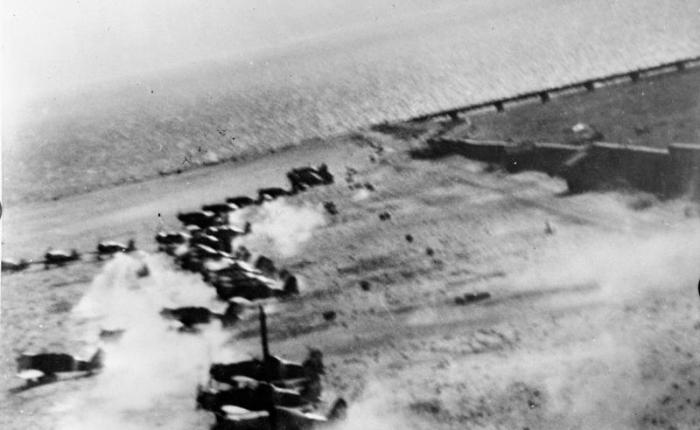
Vertical aerial reconnaissance view of Castelvetrano airfield, Sicily, the day before a successful attack was made on it by Malta-based Bristol Blenheims of Nos. 18 and 107 Squadrons RAF. A number of Junkers Ju 52 and Savoia Marchetti SM 82 transport aircraft, many of which were destroyed during the raid, can be seen parked around the airfield perimeter. (Source: © IWM (C 4183))

These figures do not stand up to the scrutiny of other sources. First, Williamson Murray’s excellent study of the Luftwaffe: Strategy for Defeat, cited reliable quartermaster general figures for German losses throughout the war. German losses in the May to August period in the Mediterranean Theatre stood at 1,600, matching those of the other major fronts. This number included 711 German aircraft lost in July 1943 alone, a figure 27 percent higher than that of the 558 German aircraft lost on the Eastern Front during the massive battles of Kursk-Orel in July.[3]

Second, Adolf Hitler’s own figures are at variance with Mitcham and von Stauffenberg’s statistics. Hitler was particularly displeased with the ground organisation in Sicily and southern Italy. On 13 July, he sent a message to Benito Mussolini complaining of ‘more than 320 fighters destroyed on the ground as the result of Allied aerial attack in the last three weeks.’ When the two dictators met at Feltre on 19 July, Hitler further noted that between 300 and 400 aircraft out of 500 to 600 were destroyed on the ground in the recent Allied air offensive.[4]

Perhaps Hitler was particularly upset with a 15 July raid on Vibo Valentia, where the bulk of the remainder of the German fighter force had settled after withdrawing from Sicily. A force of 117 B-25 Mitchells and B-26 Marauders apparently caught Jagdgruppe Vibo on the ground. Lieutenant Köhler, a German ace with over 20 victories to his credit, wrote:

Toward noon 105 [sic] bombers came and destroyed the Jagdgruppe Vibo Valentia, which had about 80 aircraft. Not a machine was left intact, not even the [Junkers] which had just landed. Fuel trucks, hangars, aircraft, autos, everything was burning. The German fighters in Italy have been wiped out.[5]

Specifically, the raid eliminated Steinhoff’s JG 77, I/JG 53 (which lost 20 aircraft), and much of II/JG 27. After the raid, only survivors of II and III/JG 27 remained operational in southern Italy.

large2
Wrecked and damaged Italian fighters outside bomb-shattered hangars at Catania, Sicily, under the scrutiny of an airman, shortly after the occupation of the airfield by the RAF. (Source: © IWM (CNA 1352)

The weight of evidence seems to go against Mitcham and von Stauffenberg’s conclusions. Furthermore, while it is true that many of the 1,100 aircraft abandoned on Sicily were from previous battles, the Allies still denied their use to Axis salvage details. Italian losses during the campaign are less easy to come by. However, one source noted that they may have been as high as 800 aircraft over two months – although the same source lowballs the German figure at 586.[6]

The Mediterranean was a meat grinder of Axis aviation. For the war, Axis aircraft losses in the Mediterranean stand at 17,750, much higher than the 11,000 on the Eastern Front, and closer to the 20,419 on the Western Front than one might assume.[7] The air superiority battles around and above Operation HUSKY in the summer of 1943 were a significant milestone in the air war against the European Axis. Indeed, Murray described Sicily as ‘the greatest air battle of the Mediterranean war’ based on the scale of German losses.[8] This result was achieved by an efficient Allied air force that has often been denied the credit it so rightfully earned.

large3
Supermarine Spitfire Mark Vs of No. 243 Squadron RAF undergo maintenance at Comiso, Sicily. Photographed over the tail section of an abandoned Messerschmitt Bf 109G of 6/JG53. (Source: © IWM (CNA 1029))

Alexander Fitzgerald-Black completed his MA thesis, ‘Eagles over Husky: The Allied Air Forces and the Sicilian Campaign, 14 May to 17 August 1943,’ with The Gregg Centre for the Study of War and Society, University of New Brunswick in 2014. He is in the process of turning this work into a manuscript for publication with Helion & Company. Alex lives with his wife in Moncton, Canada. He operates his own blog at alexfitzblack.wordpress.com and can be reached on Twitter @AlexFitzBlack.

Header Image: A line of Macchi MC200 fighters on Reggio di Calabria airfield under attack by cannon fire from two Bristol Beaufighter Mark ICs of No. 272 Squadron RAF Detachment flying from Luqa, Malta. (Source: © IWM (CM 1298))

[1] See Lee Windsor, “The Eyes of All Fixed on Sicily’: Canada’s Unexpected Victory, 1943,’ Canadian Military History, 22:3 (2013), pp. 6-7 for a summary of this literature. General Max Ulrich, commander of the 29th Panzer Grenadier Division offered the 8:1 ratio when comparing the odds his forces faced.

[2] Samuel W. Mitcham Jr. and Fredrich von Stauffenberg, The Battle of Sicily: How the Allies Lost Their Chance for Total Victory (Mechanicsburg, PA: Stackpole Books, 2007 [1991]), p. 305.

[3] Williamson Murray, Strategy for Defeat: The Luftwaffe, 1933-1945 (Maxwell AFB, Alabama: Air University Press, 1983), “Table XXX”, p. 148.

[4] Albert N. Garland and Howard M. Smyth, The United States Army in World War II, The Mediterranean Theatre of Operations: Sicily and the Surrender of Italy (Washington, D.C.: US Army Centre of Military History, 1993[1965]), p. 240 and p. 243.

[5] Brian Cull with Nicola Malizia and Frederick Galea, Spitfires over Sicily: The Crucial Role of the Malta Spitfires in the Battle of Sicily, January – August 1943 (London: Grub Street, 2000), p. 166.

[6] Hans Werner Neulen, In the Skies of Europe: Air forces allied to the Luftwaffe, 1939-1945 (Ramsbury, Marlborough: The Crowood Press Ltd., 2005), p. 72.

[7] Robert S. Ehlers, The Mediterranean Air War: Airpower and Allied Victory in World War II (Lawrence, KS: University Press of Kansas, 2015), 403.

[8] Murray, Strategy for Defeat, p. 164.

Hammer and Anvil: Catching the Axis in a Catch-22

Hammer and Anvil: Catching the Axis in a Catch-22

By Alexander Fitzgerald-Black

“That’s some catch, that Catch-22.”

USAAF Captain John Yossarian, fictional protagonist, Catch-22 by Joseph Heller

Political Scientist Robert A. Pape published Bombing to Win in 1996.[1] In that work, Pape argued that air power be of limited effectiveness when attacking purely strategic targets such as the enemy’s morale, leadership, or communications. Instead, the most effective use of air power is alongside ground forces in a ‘hammer and anvil’ approach.

large3
Four Curtiss Kittyhawk Mark IIIs of No. 112 Squadron RAF based at Agnone, Sicily, in stepped line-astern formation, flying south along the Gulf of Catania. (Source: © IWM (CNA 1136))

The air force acts as the hammer while the field force serves as the anvil. Theoretically, any army confronted by an air force with air superiority and an opposing army is in a predicament. The commander can choose to concentrate his forces, leaving them open to the hammer – tactical air power. Alternatively, he can disperse his troops, at which point the anvil – the opposing army – can isolate and destroy these smaller units in a piecemeal fashion.[2] This is what makes air superiority so tantalising in modern warfare. It forces one side into a catch-22. The fundamental principle is that air superiority denies the opposing force freedom of movement. It does not always work out as cleanly as the hammer and anvil concept suggests (and as the below examples illustrate), but removing the opposing force’s freedom of movement is a sure way to win a battle or, perhaps, a war.

The Allies caught the Axis armies in a hammer and anvil catch-22 in Sicily in 1943. The successful Allied landings in Operation HUSKY and the ensuring air battles won the Allies air superiority over the island. Heavy losses in the invasion’s first days and the threat the well-positioned landings posed to their airfields forced the German and Italian air forces to withdraw from the island days into the battle. Field Marshal Albert Kesselring had to rely on ground troops to hold the island and keep Italy in the war as long as possible. To achieve their aim, the Allies needed to secure the island and use it as an advanced staging ground to force Italy from the war.

Some of the heaviest fighting occurred in the island’s centre, on the inland hinge of the Etna Line. Kesselring hoped to hold the Allies at bay using a mountainous ring around Sicily’s active volcano, Mount Etna. 1st Canadian Division, undergoing its baptism of fire in this war, drew the task of punching a hole in the Axis line alongside their counterparts in 1st US Division, the Big Red One.

large1
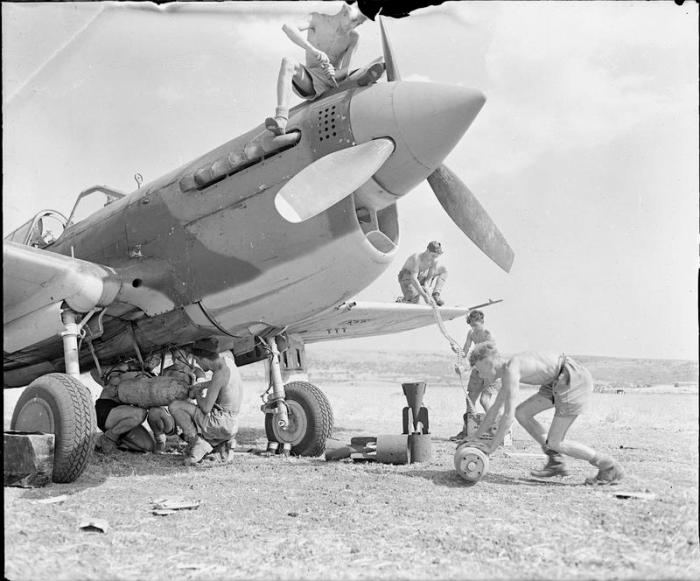
Armourers load a Curtiss Kittyhawk Mark III of No. 239 Wing RAF with 250-lb GP bombs and re-arm the machine guns in the wings, at Agnone, Sicily, for a forthcoming sortie against enemy positions in the foothills of Mount Etna. (Source: © IWM (CNA 1134))

As the Americans engaged in heavy fighting near Troina to the north, the Canadians advanced on Regalbuto to the south. In this attack, the Canadians leant heavily on artillery and air support. Air power was to focus primarily on reaching beyond the range of artillery where Allied intelligence expected much enemy traffic movement:

[i]t was believed that the enemy would withdraw when the assault developed, and it was hoped that the air attack would pin him down to the ground and prevent this operation.[3]

Allied intelligence also believed that the Germans were using the town as a motor pool for their vehicles and guns.

The Canadian anvil struck as the hammer waited overhead. Allied fighter-bombers claimed over 40 enemy motor vehicles destroyed on 2 August between Regalbuto and Adrano.[4] Between the fighting in and around Regalbuto and losses sustained during their withdrawal on Highway 121, the Hermann Göring Division’s panzer engineer battalion was effectively ‘eliminated as a combat force.’[5] The Allies successfully flushed the Germans from their positions after a gruelling attritional struggle. They forced the Germans to use the roads in large numbers, increasing already heavy casualties.

large2
A German Mk III tank knocked out during the fierce street fighting in Centuripe during the drive on Messina. (Source: © IWM (NA 5389))

A similar situation developed in the Battle of Troina. This time, however, the Germans made a much longer stand. Between 31 July and 6 August 1943, 15th Panzer Grenadier Division lost 1,600 men; 10 percent of the division’s strength or 40 percent of the fighting troops. The German commander, General Eberhard Rodt, later noted that losses from heavy artillery fire and massive carpet bombings on the hills and firing positions around the town were very high.[6] Allied aircraft caught a large amount of Axis motor transport on Highway 120 between Troina and Randazzo. Fighter-bombers claimed 50 vehicles strafed and bombed near Cesaro on 2 August.[7] It is possible that this was a reinforcement or supply column for the Troina garrison. Finally, Rodt notes that while his men were able to break contact with the Americans, they were often attacked and suffered losses from low-level aircraft while moving from Troina towards Bronte and Randazzo. Again, the Allies forced an Axis withdrawal to occur in daylight, adding to losses from the earlier attritional struggle.[8]

The German Army was just starting to get used to fighting with minimal support from the Luftwaffe. Air superiority over Sicily enabled the Allies to make use of this hammer and anvil to significant effect. Although elements of four German divisions escaped across the Strait of Messina in mid-August, those units were hollow shells of their former selves.[9] Air power and the catch-22 Allied air superiority forced the Axis into played a significant role in this outcome. The loss of Sicily opened the Mediterranean to Allied shipping, supported the Russians on the Eastern Front, and drove Italy ever closer to surrender.

large4
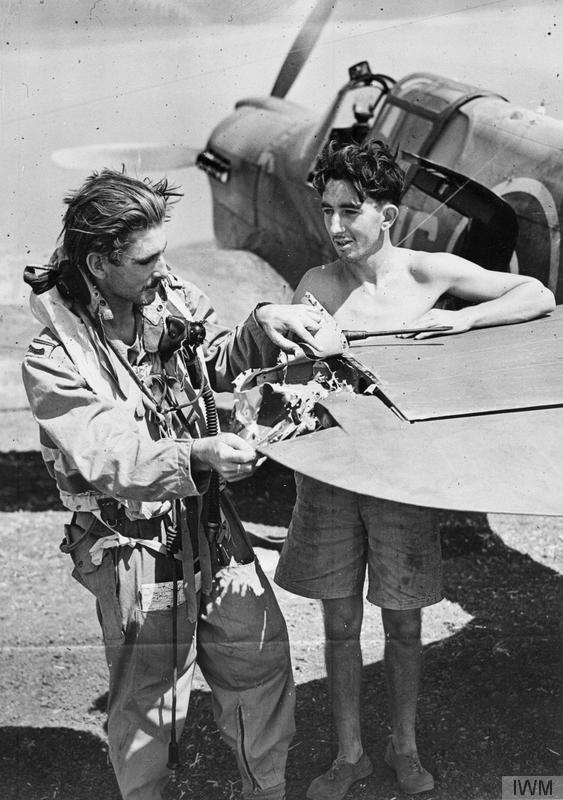
Flying Officer Colin Edmends from Australia and his fitter, D. McMinnemy, inspect the tail of his Curtiss Kittyhawk after it was damaged during a sortie over Catania. (Source: © IWM (CNA 1139))

Robert Pape’s writing on air power remains fairly controversial. Other air power theorists argue that the opposing force’s command and control, specifically regarding leadership and communications, are ideal targets. Foremost among these advocates is Colonel (Ret.) John Warden III, who wrote The Air Campaign, while he was at the National War College in the mid-1980s. However, in the estimation of this author, due to the case study examined above, Pape’s hammer and anvil approach have merit. As Philips Payson O’Brien notes in How the War Was Won, ‘except for killing every one of the combatants fighting against you, the only way to “win” a war is to stop your enemy from moving.’[10] Both theories advocate a solution to this problem. The difference is that one gives air power a complimentary role while the other affords it the leading role. In the Second World War, the debate was between the theatre air power school and the victory through air power school. The RAF and USAAF each had advocates for both of these approaches. This debate continues to this day.

Alexander Fitzgerald-Black completed his MA thesis, ‘Eagles over Husky: The Allied Air Forces and the Sicilian Campaign, 14 May to 17 August 1943,’ with The Gregg Centre for the Study of War and Society, University of New Brunswick in 2014. He is in the process of turning this work into a manuscript for publication with Helion & Company. Alex lives with his wife in Moncton, Canada. He operates his own blog at alexfitzblack.wordpress.com and can be reached on Twitter @AlexFitzBlack.

Header Image: A Martin Baltimore of the Tactical Bomber Force of the North West African Air Forces, flying over its target by a road in Sicily, while bombing retreating German forces heading for Messina, August 1943. (Source: © IWM (C 3772))

[1] Robert A. Pape, Bombing to Win: Air Power and Coercion in War (Ithaca, NY: Cornell University Press, 1996).

[2] Robert A. Pape, ‘The True Worth of Air Power,’ Foreign Affairs, 83:2 (2004), p. 119.

[3] Directorate of History and Heritage [DHH], Canadian Military Headquarters [CMHQ] Report No. 135, ‘Canadian Operations in Sicily, Part II Section 2, The Pursuit of the Germans from Vizzini to Adrano, 15 July to 6 August,’ p. 92.

[4] DHH, CMHQ Report No. 135, p. 92.

[5] Samuel W. Mitcham Jr. and Friedrich von Stauffenberg, The Battle of Sicily: How the Allies Lost Their Chance for Total Victory (Mechanicsburg, PA: Stackpole Books, 2007), p. 254.

[6] US Army Military History Institute, D.739.F6713, Foreign Military Studies [FMS] C-077, ‘15th Panzer Grenadier Division in Sicily,’ report by Eberhard Rodt and staff, 18 June 1951, p. 25.

[7] DHH, CMHQ Report No. 135, p. 92.

[8] Rodt FMS C-077, p.26.

[9] Lee Windsor, “The Eyes of All Fixed on Sicily’: Canada’s Unexpected Victory, 1943,’ Canadian Military History, 22:3 (Summer 2013), p. 31.

[10] Philips Payson O’Brien, How the War Was Won: Air-Sea Power and Allied Victory in World War II (Cambridge: Cambridge University Press, 2015), pp. 487-488.