#Podcast – “The airplane just blew up into several pieces!”: An Interview with Lee Ellis

#Podcast – “The airplane just blew up into several pieces!”: An Interview with Lee Ellis

Editorial Note: Led by Editor Dr Mike Hankins, From Balloons to Drones, produces a monthly podcast that provides an outlet for the presentation and evaluation of air power scholarship, the exploration of historical topics and ideas, and provides a way to reach out to both new scholars and the general public. You can find our Soundcloud channel here. You can also find our podcast on Apple Podcasts and Google Podcasts.

In our latest interview, we talk to  former United States Air Force F-4 Phantom pilot Lee Ellis who was a prisoner of war in the ‘Hanoi Hilton’ in Vietnam for over five years. However, in the time since, he noticed that he and many other POWs had gone on to experience dramatic love lives. Ellis joins us to discuss his new book, Captured By Love: Inspiring True Romance Stories from Vietnam POWs.

<div style=”font-size: 10px; color: #cccccc;line-break: anywhere;word-break: normal;overflow: hidden;white-space: nowrap;text-overflow: ellipsis; font-family: Interstate,Lucida Grande,Lucida Sans Unicode,Lucida Sans,Garuda,Verdana,Tahoma,sans-serif;font-weight: 100;”>

61gdD3VMsEL._AC_UF894,1000_QL80_

Lee Ellis is the Founder and President of Leadership Freedom® LLC and FreedomStar Media®. He is an award-winning author, leadership coach, and expert presenter in the areas of leadership, teambuilding, and human performance. Early in his career, Lee was a United States Air Force fighter pilot flying fifty-three combat missions over North Vietnam. In 1967, he was shot down and held as a POW for over five years in Hanoi and surrounding camps. For his wartime service, he was awarded two Silver Stars, the Legion of Merit, the Bronze Star with Valor device, the Purple Heart, and POW Medal. Lee resumed his Air Force career, serving in leadership roles of increasing responsibility, including command of a flying squadron and leadership development organizations, before retiring as a colonel. Lee has a BA in History and a MS in Counseling and Human Development. He is a graduate of the Armed Forces Staff College and the Air War College. He has authored or co-authored five books on leadership and career development.

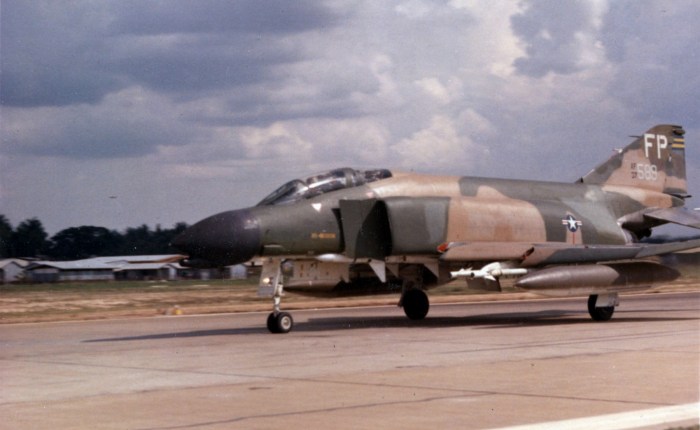
Header image: A US Air Force McDonnell F-4C Phantom II from the 497th Tactical Fighter Squadron, 8th Tactical Fighter Wing, rolls out on takeoff from Ubon Royal Thai Air Force Base, circa 1967. It is configured for the MiGCAP escort role with AIM-7 Sparrow air-to-air missiles under the fuselage, and AIM-9B Sidewinder air-to-air missiles and extra fuel tanks under the wings. (Source: Wikimedia)

#Podcast – “Check Six” – Historian Questions and Answers: An Interview with Dr Mike Hankins and Dr Brian Laslie

#Podcast – “Check Six” – Historian Questions and Answers: An Interview with Dr Mike Hankins and Dr Brian Laslie

Editorial Note: Led by Editor Dr Mike Hankins, From Balloons to Drones, produces a monthly podcast that provides an outlet for the presentation and evaluation of air power scholarship, the exploration of historical topics and ideas, and provides a way to reach out to both new scholars and the general public. You can find our Soundcloud channel here. You can also find our podcast on Apple Podcasts and Google Podcasts.

In our latest podcast episode, our Podcast Editor, Dr Mike Hankins, and Assistant Editor, Dr Brian Laslie, have each come up with questions to ask each other about what it’s like to be a historian and pick on some of their favourite topics about air power and aviation history.

Dr Michael Hankins is the Curator for US Air Force, Navy, and Marine Corps post-World War II Aviation at the Smithsonian National Air and Space Museum and the author of Flying Camelot: The F-15, the F-16, and the Weaponization of Fighter Pilot Nostalgia (2021). In addition, he is a former Professor of Strategy at the USAF Air Command and Staff College eSchool, and a former Instructor of Military History at the US Air Force Academy. He earned his PhD in history from Kansas State University in 2018 and his master’s in history from the University of North Texas in 2013. He has a web page here.

Dr Brian Laslie is a US Air Force Historian and Command Historian at the United States Air Force Academy. Formerly he was the Deputy Command Historian at North American Aerospace Defense Command (NORAD) and United States Northern Command (USNORTHCOM). A 2001 graduate of The Citadel and a historian of air power studies, he received his Masters’ from Auburn University Montgomery in 2006 and his PhD from Kansas State University in 2013. He is the author of Air Power’s Lost Cause: The American Air Wars of Vietnam (2021),  Architect of Air Power: General Laurence S. Kuter and the Birth of the US Air Force (2017) and The Air Force Way of War (2015). The latter book was selected for the Chief of Staff of the Air Force’s 2016 professional reading list and the 2017 RAF Chief of the Air Staff’s reading list. He can be found on Twitter at @BrianLaslie.

Header image: Four Republic F-84F Thunderstreak from the US Air Force Thunderbirds aerobatics team flying in formation in c. 1955. (Source: Wikimedia)

#Podcast – “My Airplane is Plunging to the Ground!”: An Interview with Colonel Kim Campbell

#Podcast – “My Airplane is Plunging to the Ground!”: An Interview with Colonel Kim Campbell

Editorial Note: Led by Editor Dr Mike Hankins, From Balloons to Drones, produces a monthly podcast that provides an outlet for the presentation and evaluation of air power scholarship, the exploration of historical topics and ideas, and provides a way to reach out to both new scholars and the general public. You can find our Soundcloud channel here. You can also find our podcast on Apple Podcasts and Google Podcasts.

In our latest podcast, we interview Colonel Kim ‘Killer Chick’ Campbell, an A-10 Thunderbolt II pilot with over 100 combat missions. On one of her early missions, ground fire heavily damaged her plane. She tells us the harrowing story and how her flying experiences apply to other areas of life. For more detail, she has a new book: Flying in the Face of Fear: A Fighter Pilot’s Lessons on Leading with Courage, from Wiley Press.

71HHzu-N0TL._AC_UF894,1000_QL80_

Kim Campbell is a retired United States Air Force Colonel who served for over 24 years as a fighter pilot and senior military leader. She served as a group commander, responsible for 1,000 military and civilian personnel. She finished her career as the Director of the Center for Character and Leadership Development at the Air Force Academy. She flew over 100 combat missions and was awarded the Distinguished Flying Cross for Heroism after successfully recovering her battle-damaged aeroplane from an intense close air support mission. Since retiring from the Air Force, Kim has shared her inspirational story and lessons on leading with courage with business and corporate audiences worldwide as an executive coach and keynote speaker.

Header image: An aircraft maintenance crew of the Indiana Air National Guard perform a post-flight inspection on an A-10C Thunderbolt II during exercise Guardian Blitz at MacDill Air Force Base, 2 February 2023. (Source: Wikimedia)

#Podcast – “This Cannot Go On”: The ‘Race Riot’ on the USS Kitty Hawk: An Interview with Marv Truhe

#Podcast – “This Cannot Go On”: The ‘Race Riot’ on the USS Kitty Hawk: An Interview with Marv Truhe

Editorial Note: Led by Editor Dr Mike Hankins, From Balloons to Drones, produces a monthly podcast that provides an outlet for the presentation and evaluation of air power scholarship, the exploration of historical topics and ideas, and provides a way to reach out to both new scholars and the general public. You can find our Soundcloud channel here. You can also find our podcast on Apple Podcasts and Google Podcasts.

In 1972, the USS Kitty Hawk was conducting bombing raids against North Vietnam when violence broke out on the ship itself. Long-building racial tensions exploded into a series of assaults quickly labelled a race riot. Marv Truhe was one of the JAG lawyers assigned to defend the African American sailors charged in the incident. He tells the story of a series of racial injustices in his shocking new book, Against All Tides: The Untold Story of the USS Kitty Hawk Race Riot (2022). He joins us on the podcast to discuss the incident and its legacy for changes in race relations in the US Navy and the military.

9781641607841

Marv Truhe served as a Navy JAG lawyer and military judge during the Vietnam War. Following his military service, he was an Assistant Attorney General for South Dakota before entering private practice. He defended six of the Black sailors charged with rioting and assaults in the USS Kitty Hawk incident.

Header image: A US Navy McDdonnell F-4B Phantom II  of VF-114  traps on board the aircraft carrier USS Kitty Hawk underway in the Western Pacific off the coast of North Vietnam in March 1969. Also visible on the flight deck is another F-4B  of VF-114 as well as one from VF-213, a North American RA-5C Vigilante of RVAH-11, and an LTV A-7A Corsair II  of VA-105. (Source: Wikimedia)

#Podcast – “Your grandfather was a spy!” – The USAF Security Service: An Interview with Philip Shackelford

#Podcast – “Your grandfather was a spy!” – The USAF Security Service: An Interview with Philip Shackelford

Editorial Note: Led by Editor Dr Mike Hankins, From Balloons to Drones produces a monthly podcast that provides an outlet for the presentation and evaluation of air power scholarship, the exploration of historical topics and ideas, and provides a way to reach out to both new scholars and the general public. You can find our Soundcloud channel here. You can also find our podcast on Apple Podcasts and Google Podcasts.

Amidst the news of classified intelligence leaks, it’s a great time to look back at the US Air Force (USAF) Security Service – the USAF’s own intelligence agency that gathered critical intelligence throughout the Cold War. From using surveillance aircraft to spy on potential threats to helping fighter pilots shoot down MiGs over the skies of Vietnam, Philip Shackelford takes us through the story of this mysterious organization, as he details in his new book: Rise of the Mavericks from Naval Institute Press.

9781682478820_low+res+cover_Shackelford

Philip C. Shackelford is the library director at South Arkansas Community College in El Dorado, Arkansas. He has served as President of the Arkansas Library Association and was named an Emerging Leader by the American Library Association in 2019. Shackelford’s academic focus is on communications intelligence in the U.S. Air Force. He is also interested in national security, strategy, intelligence, and organizational culture.

Header image: A Boeing RB-29 of the 31st Reconnaissance Squadron, somewhere over Korea, c. 1952. (Source: Wikimedia).

#Podcast – Origins of the F-14 Tomcat and F-15 Eagle: An Interview with Dr Tal Tovy

#Podcast – Origins of the F-14 Tomcat and F-15 Eagle: An Interview with Dr Tal Tovy

Editorial Note: Led by Editor Dr Mike Hankins, From Balloons to Drones produces a monthly podcast that provides an outlet for the presentation and evaluation of air power scholarship, the exploration of historical topics and ideas, and provides a way to reach out to both new scholars and the general public. You can find our Soundcloud channel here. You can also find our podcast on Apple Podcasts and Google Podcasts.

Our latest episode concerns the Grumann F-14 Tomcat and the McDonnell Douglas F-15 Eagle, two popular and historically significant aeroplanes. We arere joined by Dr Tal Tovy, senior lecturer at Bar-Ilan University in Israel and author of Tomcats and Eagles: The Development of the F-14 and F-15 in the Cold War (2022) from Naval Institute Press. Tovy gives us an up-close look at the motivation behind designing these aircraft and speaks to how the Israeli Air Force experience had a particular influence.

9781612519104

Dr Tal Tovy is a Senior Lecturer at Bar-Ilan University in Israel. He holds a PhD in history from the University of Haifa. A veteran of the Israel Defense Forces, Tovy has published extensively on various military history topics, including the influence of counterinsurgency theory upon American combat operations. His other fields of interest include Western military thought and U.S. military history. Tovy is the author of two previous books: The Changing Nature of Geostrategy 1900-2000: The Evolution of a New Paradigm and The Gulf of Tonkin: The United States and the Escalation in the Vietnam War. 

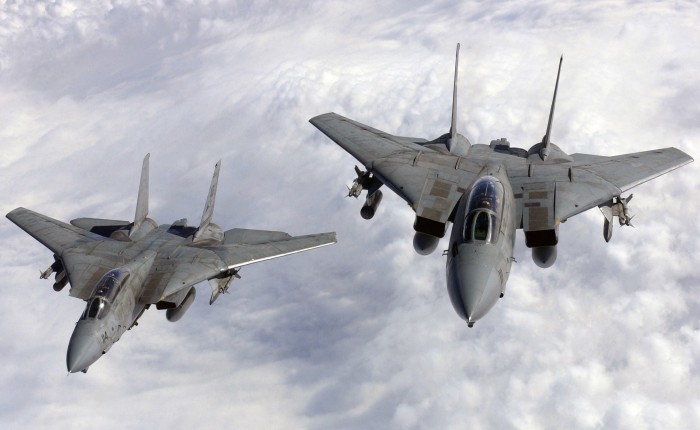
Header image: A pair of US Navy Grumman F-14A Tomcats from  VF-211  in flight over Iraq in December 2003. VF-211 was assigned to Carrier Air Wing 1 aboard the aircraft carrier USS Enterprise for a deployment to the Mediterranean Sea and the Indian Ocean from 28 August 2003 to 29 February 2004. (Source: Wikimedia)

#Podcast – The Vietnam War 50 Years Later: An Interview with Dr Michael E. Weaver

#Podcast – The Vietnam War 50 Years Later: An Interview with Dr Michael E. Weaver

Editorial Note: Led by Editor Dr Mike Hankins, From Balloons to Drones produces a monthly podcast that provides an outlet for the presentation and evaluation of air power scholarship, the exploration of historical topics and ideas, and provides a way to reach out to both new scholars and the general public. You can find our Soundcloud channel here. You can also find our podcast on Apple Podcasts and Google Podcasts.

50 years ago, in January 1973, the Paris Peace Accords were signed. This ended major U.S. combat operations in the Vietnam War. To look back on the air campaigns that were so crucial to that war, we talk with Dr Michael Weaver, assistant professor at the US Air Force’s Air Command and Staff College and author of The Air War in Vietnam from Texas Tech University Press. Join us as we look at the use of air power in Southeast Asia and talk about some of the legacies it leaves behind.

41bAUBRryqL._AC_SY580_Dr Michael E. Weaver is an Associate Professor of History at the USAF Air Command and Staff College. He has authored five air power articles and a book on the 28th Infantry Division. His second book, The Air War in Vietnam, was published in 2022. Weaver received his doctorate from Temple University in 2002, where he studied under Russell Weigley.

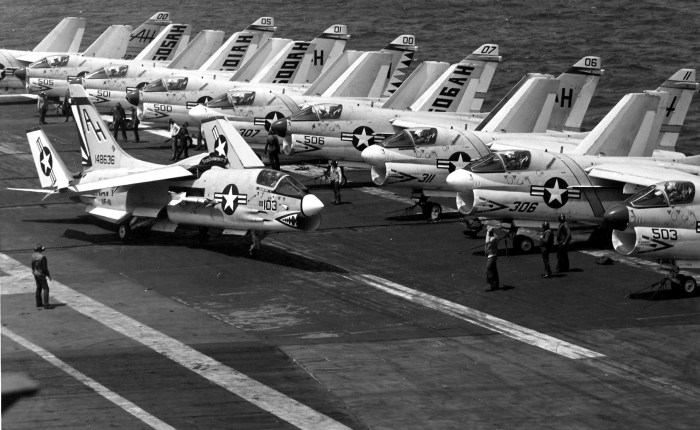
Header image: View of the flight deck of the USS Ticonderoga (CVA-14) during her last deployment to Vietnam as an attack carrier between 1 February and 18 September 1969. Various aircraft of Carrier Air Wing 16 are visible on deck: a Vought F-8H Crusader of VF-111 ‘Sundowners,’ four LTV A-7B Corsair II of  VA-87 ‘Golden Warriors,’ and five A-7Bs of VA-25 ‘Fist of the Fleet.’ (Source: Wikimedia)

#Podcast – Best Aviation and Air Power Books of 2022: An Interview with Dr Ross Mahoney

#Podcast – Best Aviation and Air Power Books of 2022: An Interview with Dr Ross Mahoney

Editorial Note: Led by Editor Dr Mike Hankins, From Balloons to Drones produces a monthly podcast that provides an outlet for the presentation and evaluation of air power scholarship, the exploration of historical topics and ideas, and provides a way to reach out to both new scholars and the general public. You can find our Soundcloud channel here. You can also find our podcast on Apple Podcasts and Google Podcasts.

Our latest podcast discusses our favourite books of the year with Dr Ross Mahoney, Editor-in-Chief of From Balloons to Drones. Each of us discusses our top three reads of 2022, and we take a look forward at some topics we would really like to hear more about in the future.

The books discussed:

  1. Malayan Emergency and Indonesian Confrontation, 1950-1966 by Mark Lax
  2. Air Power in the Falklands Conflict: An Operational Level Insight into Air Warfare in the South Atlantic by John Shields
  3. Air Power Supremo: A Biography of Marshal of the Royal Air Force Sir John Slessor by William Pyke
  4. Black Snow: Curtis LeMay, the Firebombing of Tokyo, and the Road to the Atomic Bomb by James Scott – reviewed here.
  5. A Long Voyage to the Moon: The Life of Naval Aviator and Apollo 17 Astronaut Ron Evans by Geoffrey Bowman – reviewed here.
  6. Dark Horse: General Larry O. Spencer and His Journey from the Horseshoe to the Pentagon by General Larry O. Spencer, USAF (Ret.) – interviewed here.
  7. Wings of Gold: The Story of the First Women Naval Aviators by Beverly Weintraub – interviewed here.
  8. Tomcats and Eagles: The Development of the F-14 and F-15 in the Cold War by Tal Tovy
  9. Because Our Fathers Lied: A Memoir of Truth and Family, from Vietnam to Today by Craig McNamara.

Dr Ross Mahoney is an independent scholar specialising in the history of war, particularly concerning the use of air power and the history of air warfare. He is currently the Senior Historian within the City Architecture and Heritage Team at Brisbane City Council in Australia. He has over 15 years of experience in the heritage and education sectors in Australia and the United Kingdom. Between 2013 and 2017, he was the inaugural Historian at the Royal Air Force Museum in the UK. In Australia, he has worked as a Historian for the Department of Veterans’ Affairs and taught at the Strategic and Defence Studies Centre at The Australian National University based at the Australian War College. His research interests are focused on the history of war, specifically the history of air warfare, transport history, and urban history. To date, he has published several chapters and articles, edited two books, and delivered papers on three continents. He has a book review website here and can be found on Twitter at @airpowerhistory.

Header image: One of six FMA IA 58 Pucará’s destroyed on 15 May 1982 after a raid by the Special Air Service on Pebble Island during the Falklands War. (Source: Wikimedia) 

#Podcast – The Origins of Air Power in the US: An Interview with Dr Laurence Burke II

#Podcast – The Origins of Air Power in the US: An Interview with Dr Laurence Burke II

Editorial Note: Led by Editor Dr Mike Hankins, From Balloons to Drones produces a monthly podcast that provides an outlet for the presentation and evaluation of air power scholarship, the exploration of historical topics and ideas, and provides a way to reach out to both new scholars and the general public. You can find our Soundcloud channel here. You can also find our podcast on Apple Podcasts and Google Podcasts.

In our latest podcast, we interview Dr Laurence Burke II, the Aviation Curator at the National Museum of the Marine Corps. We ask how did the US get from the first flight of an aeroplane in 1903 to full-fledged military-capable aeroplanes in only short few years? Burke takes us through the people that made that journey happen. He explores the different approaches to the airplane made by the US Army, Navy, and Marines Corps, and why each of them went about exploring military aviation in a unique way.

9781682477298

Dr Laurence Burke is the Aviation Curator at the National Museum of the Marine Corps. He earned an undergraduate degree from Rensselaer Polytechnic Institute, a master’s in Museum Studies from George Washington University, and, in 2014, a PhD in History and Public Policy from Carnegie Mellon University. Since then, he has taught history at the United States Naval Academy as a post-doc and then was Curator of U.S. Naval Aviation at the National Air and Space Museum for several years before starting the job at Quantico.

Header image: A Wight Model A arrives at Fort Myer, Virginia aboard a wagon for testing by the US Army, attracting the attention of children and adults, 1 September 1908. (Source: Wikimedia)

#Podcast – What Nuclear War Looks Like: An Interview with Professor Sean M. Maloney

#Podcast – What Nuclear War Looks Like: An Interview with Professor Sean M. Maloney

Editorial Note: Led by our Editor Dr Mike Hankins, From Balloons to Drones produces a monthly podcast that provides an outlet for the presentation and evaluation of air power scholarship, the exploration of historical topics and ideas, and provides a way to reach out to both new scholars and the general public. You can find our Soundcloud channel here. You can also find our podcast on Apple Podcasts and Google Podcasts.

With the threat of nuclear war rising once again as tension among global powers increases, in our latest podcast, we talk to Professor Sean M. Maloney of the Royal Military College of Canada to look at what the nuclear war plans of the U.S. were during the early Cold War. We also discuss what a nuclear war might have looked like, and how it would have potentially been waged. 

41yDwnMGQkS._AC_SY580_

Dr Sean M. Maloney is a Professor of History at the Royal Military College and served as the Historical Advisor to the Chief of the Land Staff during the war in Afghanistan. He previously served as the historian for 4 Canadian Mechanized Brigade, the Canadian Army’s primary Cold War NATO commitment after the reunification of Germany and at the start of Canada’s long involvement in the Balkans. He is the author of numerous works, and his latest book is Emergency War Plan: The American Doomsday Machine, 1945–1960 (2021).

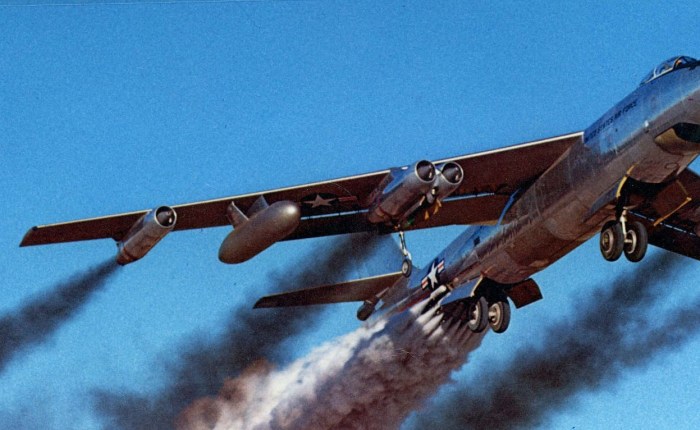
Header image: A Boeing B-47B undertaking a rocket-assisted take-off. The black smoke from engines indicates that water-methanol injection is in use. (Source: Wikimedia)