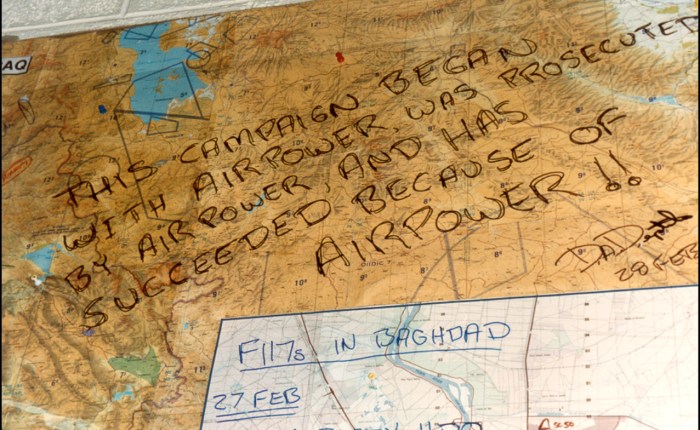
#DesertStorm30 – Leading with Airpower

#DesertStorm30 – Leading with Airpower

By General John Michael Loh, USAF (Ret.)

Editorial Note: 2021 marks the 30th anniversary of Operation DESERT STORM. To mark this anniversary, during 2021, From Balloons to Drones will be publishing a series of articles that examine various aspects of DESERT STORM’s air campaign. We will be publishing pieces throughout 2021, and if you would like to contribute to the series, please contact our Editor-in-Chief, Dr Ross Mahoney, at airpowerstudies@gmail.com or via our contact page here. The official call for submissions can be found here.

Over the coming weeks, From Balloons to Drones is pleased to be working in conjunction with the Mitchell Institute for Aerospace Studies to publish a series of articles on various aspects of the DESERT STORM air campaign. These articles were initially published as part of a Mitchell Institute of Aerospace Studies special report, Desert Storm: 30 Years Later – Lessons from the 1991 Air Campaign in the Persian Gulf War. You can download the report here.

In this latest instalment, we are pleased to present a piece by General John Michael Loh, USAF (Ret.). In this article, General Loh discusses some of the debates and decisions that took place in Washington in the months leading up to the start of the DESERT STORM air campaign as well as some of what he viewed as the lessons learnt from the campaign.

Desert Storm was the only major war since World War II that ended in victory, with all objectives met; a war dominated by airpower and remarkable for its brief duration—only 43 days. Airpower played the dominant role in Desert Storm. But Desert Storm did not start with airpower in the lead. The air campaign plan had many detractors. The decision to lead with airpower, before and independent of a ground invasion, was a war in itself. I am going to take you through the debates and decisions in Washington that put and kept airpower in the lead in the five months preceding the start of the war, and give you my version of lessons learned from Desert Storm.

The War of the Pentagon

Four battles characterized what I call ‘The War of the Pentagon.’

The first was a phone call from General Norman Schwarzkopf, the commander of U.S. Central Command and the Joint Force Commander for Desert Storm, to me on Wednesday, August 8, asking for help in expanding the existing war plan for a Middle East regional war.

The second was the meeting of our Air Staff team, called Checkmate, with General Powell and the Joint staff that Saturday, seeking the Chairman’s agreement to proceed with our air campaign planning activity.

The third were the frequent skirmishes in the Tank between me and the other three service chiefs who wanted their service to take the lead and be the dominant player in Desert Storm. I called them the counterattacks.

And the fourth was the meeting at the White House on October 11 with President George H. W. Bush, the Commander in Chief, seeking his approval to proceed with the air campaign plan.

I will briefly describe each of those four ‘battles’ in the ‘war of the Pentagon.’

Request from General Schwarzkopf

I received a call from General Schwarzkopf on the morning of August 8. It surprised me because I only knew Schwarzkopf professionally, but not personally. Here’s what he said:

Mike, I need your help in expanding our war plan to include a more robust air campaign that includes strikes against strategic targets as well as tactical targets. The air operations plans here are traditional air/land battle scenarios in collaboration with, and tethered to, ground forces, but very little independent air operations that destroy strategic targets around Baghdad and other parts of the country.

I could hardly believe what I was hearing. Here was an Army commander talking like an airpower advocate. General Schwarzkopf was an airpower champion in a green suit.

Fortunately, our Checkmate planning cell on the air staff was already putting together a strategic-level air campaign concept. Checkmate was formed to think ahead about the application of airpower in several scenarios. Checkmate’s leader was Colonel John Warden, a bright conceptual thinker, who was already designing an air campaign for the Iraq war.

I told General Schwarzkopf:

We have the concept of the air campaign you want. I will take the lead in fleshing it out as best we can and bring it to you ASAP. I need a day or two to make sure it works your problem, and I will bring it to you ASAP. “He said, “Thanks. Please hurry!

I then called our Ops Deputy, and told him to get John Warden and his Checkmate team here immediately. I gave Warden strong marching orders and told him:

Get with Intel, turn your generic plan into one that begins to address the strategic target set in Iraq, and be prepared to brief General Powell later this week.

I also called General Bob Russ, commander of Tactical Air Command, and General Jack Chain, commander of Strategic Air Command, telling them of Schwarzkopf’s call and asking them to send a few of their air planners to the Pentagon to assist Checkmate. They did.

Briefing to General Powell

The second battle was our meeting with General Powell and the Joint Staff directors on that Saturday, three days after the call from Schwarzkopf. The Joint Staff was dominated by Army officers, not just Powell, but particularly the influence of the J-3, an Army general steeped in land warfare and dismissive of airpower.

A stormy session ensued. Colonel Warden briefed and I chimed in from time to time for reinforcement. We emphasized the independent application of airpower against the Iraqi centers of gravity, and our confidence in waging both an air campaign in the greater Baghdad Theater and also tactical-level attacks in the Kuwaiti Theater.

General Powell listened for the most part, but let his J-3 argue against a pre-invasion air campaign. His arguments centered on his experiences in Vietnam, and those of others present. They claimed that airpower could not defeat an enemy and could not even interdict effectively. He even cited the World War II air armadas against Germany, claiming they were ineffective. And on and on. Others piled on.

I listened patiently for a while, but after listening to these false claims, I spoke up forcefully with logical arguments countering accusations about airpower, but, mostly, I argued about the renaissance in airpower in the 20 years since Vietnam. I gave a full-throated defense of our plan based on this rebirth of airpower in the Air Force. I challenged them with information of which they were unaware regarding a new generation of combat aircraft and weapons and training since Vietnam that changed the nature of air warfare, which made possible the innovative plan for Desert Storm. Stealth, precision weapons with lasers, night attack with FLIRs and Red Flag force-on-force training, the real 2nd offset strategy in my opinion, gave us confidence for a dominant air campaign plan.
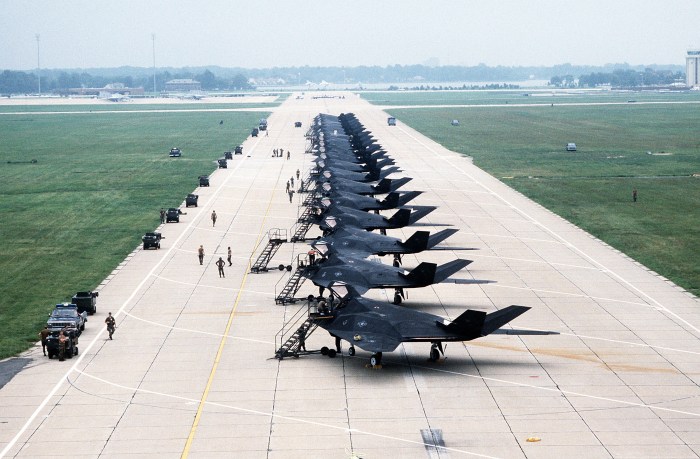
Ground crews service F-117A aircraft of the 37th Tactical Fighter Wing on the flight line in 1990 as the Wingprepared to deploy to Saudi Arabia for Operation Desert Shield. (Source: USAF)

At the end of this meeting, General Colin Powell, under great pressure from SecDef Cheney and President Bush to devise a winning plan quickly, agreed to let us continue our planning as we briefed it. His only objection was not to the two-theater air campaign and its strategic nature, but that he wanted us to destroy the Republican Guard Armies as part of the strategic plan. And he insisted we make it a joint campaign, not just Air Force. So, I agreed to include Navy and Marine air where it fit. General Powell said he would tell General Schwarzkopf that he approved.

We briefed Schwarzkopf. He approved and told the team to take it to General Chuck Horner and the operational air planners in Riyadh.

Skirmishes in the Tank

The third battle was a series of skirmishes in the Tank, the room where the Joint Chiefs of Staff meet in the Pentagon. While Air Force planners—Lt. General Chuck Horner, Brig. General Buster Glosson, and the Checkmate guys, Colonel John Warden and Lt. Colonel Dave Deptula—went to Riyadh to plan the specifics of the air campaign, I continued to fight for, and defend, the air campaign as the leading edge of the upcoming war.

The Pentagon is the temple of parochialism. Now don’t get me wrong. We fight as a joint team. Jointness works beautifully on the battlefield. But it doesn’t work as well in the wars of the Pentagon where each service wants to show how vital it is, and, therefore, how it must be in the vanguard of any major military action, particularly a major regional war.

I vigorously defended our leadership role in the Tank during September and October when the other chiefs realized the Air Force was dominating the plan. Each of the other service chiefs—Army, Navy, and Marine—had his own ideas for taking the lead.

The Navy wanted to divide the airspace into route packages the way it was done in Vietnam, which, incidentally, was not an efficient way to allocate airpower. The Navy wanted to control all air action in the east from carriers in the Persian Gulf, and in the west from carriers in the Red Sea. The Navy’s plan would leave only the middle for the Air force working with Army forces. We won those skirmishes handily.

The Marine Commandant argued forcibly that the Marines take the lead with an amphibious landing from the Persian Gulf and then attack through Kuwait. After all, amphibious operations are the Marines’ primary competence. But his proposal was shot down over time.

Now, the Army Chief did not like the idea of the Air Force operating independently. The Army preferred a simultaneous, dual invasion, with the bulk of air sorties tethered to the Army supporting the ground war. Their chief had two motives: position the Army, not the Air Force, as the leading force in the war, and keep most of the air sorties under the air/land scenario doing close air support and shallow interdiction.

In the end, General Powell sided with our air campaign plan because it made good sense.

President Bush Gives his Approval

The final battle was the meeting with President Bush on October 11. General Schwarzkopf sent Brigadier General Buster Glosson to brief President Bush on the air campaign plan. The evening before, Secretary Cheney, General Powell, and the Joint Chiefs previewed both the air and ground plans in the Pentagon. Glosson gave a powerful briefing with detailed information about the air campaign and his confidence in its successful execution. On the other hand, the Army general presented a ground campaign that was unimaginative, lacked detail, and was not a confidence-builder. General Powell was displeased with the Army plan, but also wary of the confidence Glosson displayed in his briefing.

After the meeting, General Powell stopped Glosson after I had already departed for my office. He told Glosson to tone down his confidence level, that the briefing and the air campaign were too optimistic. Glosson hastened to my office and asked what to do. I told him to not change anything in his briefing, but to invoke General Schwarzkopf’s name several times during the briefing.

Buster, remember this is not your plan, it is not General Horner’s plan, it is not an Air Force plan, it is the Joint Force Commander’s air plan. So, let the President and all present know you are speaking for General Schwarzkopf and he has approved the essence of the air campaign plan.

General Glosson gave his briefing superbly. President Bush, to his credit, knew the value of airpower and was excited about our plan. After hearing the briefing by Buster Glosson, he wanted to begin the war right then. But General Powell dissuaded him arguing that ground operations were necessary to ensure victory. He wanted to deploy the VII Corps from Germany to Saudi. President Bush approved. That took more than two months. We won that battle and the air campaign concept spawned in the Pentagon became the vanguard force in Desert Storm.

Then the war began on the morning of January 17 with a massive air attack against strategic targets around Baghdad led by the stealthy F-117, and continued for the next 42 days, followed by a 4-day ground invasion before the Iraqis surrendered. We won Desert Storm quickly, decisively, with overwhelming force and few casualties, leading with airpower.

Airpower lessons learned

So, what are the lessons learned? There are many. Let me give you three macro, ‘big picture’ lessons that I took from Desert Storm and are still applicable today. One: airpower is consistently underestimated and not well understood, even in the Air Force. Two: computer models and ‘experts’ always over-estimate air attrition. And three: strong, decisive leadership and trust from the top down are essential for success.

Let’s look at each one more closely.
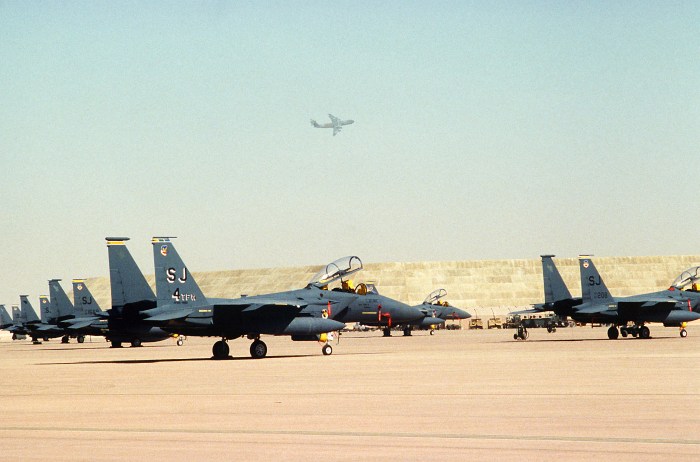
F-15E Eagle fighter aircraft from the 4th Tactical Fighter Wing is parked on a desert airfield during Operation Desert Shield. (Source: USAF)

Airpower disparaged

Recognize that others do not share your enthusiasm about the effectiveness of airpower. Just before Desert Storm the other military services did not recognize the ‘Rebirth of Airpower’ from 1970 to 1990 in the Air Force. In my opinion, the 2nd offset strategy for the Air Force was the investment in three technologies: stealth, precision weapons, and forward looking infrared (FLIR) sensors to take away the sanctuary of night the enemy had enjoyed in Vietnam. We fielded systems that exploited all three technologies: the stealthy F-117 Nighthawk with its FLIR and laser designator; the laser-guided bombs employed by many fighters, and laser designators on the F-11F and F-15E, and going from flares to FLIRs to attack at night. These systems were ready for Desert Storm but most war planners did not appreciate their significance.

Currently, the Army’s zeal to get ‘boots on the ground’ in the war against ISIS has had the unintended effect of disparaging airpower as ineffective in that fight, giving airpower an undeserved bad reputation. The real problem with air attacks against ISIS is the misapplication of airpower, dribbling it out piecemeal, six sorties per day (in Syria, the locus of ISIS) rather than over a thousand strikes a day as in Desert Storm.

In the recent past, our Air Force leaders, seeking to be team players in the joint arena, have promoted airpower tethered to the ground battle rather than having a component of the air campaign in which airpower is employed independent of the ground battle. They have forgotten this valuable lesson of Desert Storm.

And, some seek to promote their own service at the expense of the contribution of air. The Army teaches and preaches Desert Storm as the ‘100-Hour War.’ They deliberately forget that it took only 100 hours to ‘mop up’ after 1000 hours of airpower put Iraq in shambles and rendered the Iraqi army virtually ineffective as a fighting force.

So, we need to continually learn, then educate. Now, don’t get me wrong: airpower can’t do everything. We must have ‘boots on the ground’ to force total victory and surrender. But the right formula should be the Desert Storm formula: lead with relentless, overwhelming airpower, then follow with a massive ground invasion.

Models overestimate air attrition

Computer models and ‘experts’ always over-predict air attrition. Historically, a mismatch exists between the forecasts versus actual attrition experienced in air campaigns. Models have always erred on the pessimistic side. They predict higher loss rates. This was true for Desert Storm and other major air campaigns.

Why is this so? Well, models cannot replicate the complexity of large-scale air battles. Models are good for evaluating the relative impact of changing one or two parameters of threats or air defense systems, but not for predicting the absolute outcomes of large air battles. Modelers also invariably assume the adversary is ‘ten feet tall,’ with systems working at peak performance and 100 percent reliability.

A brief look at past air campaigns, including Desert Storm, will prove my point and warn you to be wary of attrition analysts.

In December 1972, in operation Linebacker II, B-52 raids over heavily defended Hanoi, Vietnam, were successful in destroying the state-of-the art IADS and other military targets in North Vietnam. This led to the successful negotiation of our exit from Vietnam and the return of our prisoners of war.

Analysts and ‘experts’ predicted we would lose one B-52 out of every three B-52 sorties flown. In the 11-day operation, we lost 15 B-52s in 729 B-52 sorties flown into the teeth of the air defense system—an attrition rate of 2%, not 33%.

In the June 1982 Bekaa Valley campaign, the Israeli Air Force mounted a mass operation against a modern Soviet-supplied air defense system fielded by Syria in Lebanon. Analysts predicted an attrition rate of 15%. In 1,100 fighter sorties, the IAF lost no aircraft—zero percent attrition, not 15%.

How about Desert Storm? In the first five days, the experts, even Air Force leaders, predicted a loss of 70 or so aircraft before total air dominance was achieved. Analysts’ models predicted much higher attrition. After all, the IADS around Baghdad was the state-of-the-art French Kari system. Coalition forces flew more than 5,000 combat sorties in those five days and lost 27 fixed-wing aircraft, an attrition rate of less than 0.4%—less than half of Air Force estimates, and way below analysts’ predictions.

Why are forecasts of air attrition consistently higher than actual results, and why is this important today? Models lose their fidelity when they try to simulate large-scale air campaigns like Desert Storm because they cannot faithfully replicate their enormous complexity. They just cannot account for the countermeasures, both electronic and kinematic, the decoys, on-scene decisions by pilots, changes of tactics as the campaign progresses, or the sheer quantity and swarming tactics air battles. Many models merely extrapolate from a one-versus-one single-engagement to many-versus-many scenarios.

That is grossly faulty modeling.

Why is this mismatch important today? Well, today we again hear the predictions of the analysts that manned aircraft cannot penetrate modern ‘anti-access/area denial’ systems in development by Russia, China, and Iran. They tout results of their models to show that air losses would be unacceptable. I have been hearing that argument for more than 50 years! Manned fighters and bombers can negate sophisticated air defense systems and successfully attack heavily defended targets with the same success enjoyed in these three campaigns with a combination of standoff and penetrating aircraft, decoys, drones, and smart tactics.

The lesson is to challenge assumptions of the models, examine the algorithms critically, and use models only where they apply: for limited, relative changes, not absolute outcomes in large air campaigns. Be skeptical and critical of attrition models.

Leadership from the top down

The third lesson: Strong, decisive leadership from the top is necessary for success. President Bush 41 provided that leadership. He set clear military objectives and let his military leaders plan the campaign without interference from the White House. He gained the support of both the Congress and the U.N. for the war. He skillfully knitted together a large coalition of international partners in the Middle East, Europe, and Asia from Congress and the U.N. He placed heavy demands on General Colin Powell to put together a winning war plan with force sufficient to win quickly. He recognized the problems of a long war without an exit strategy. In short, he wanted to get in, win, and get out after meeting his military objectives.

President Bush 41 was under enormous pressure politically and from the whole U.S. population to not invade. Instead, political leaders of both parties advised him strongly to allow economic sanctions to continue for another year, hoping that would force Saddam Hussein to withdraw his forces from Kuwait. The pressure against the war was intense. Various studies concluded upwards of 10,000 American lives would be lost. The airwaves and newspapers were replete with comments like “8,000 body bags are being shipped to Saudi.” One hundred forty-eight American lives were lost in Desert Storm—148 lives, not eight or ten thousand.

Eight of the nine living former chairmen of the Joint Chiefs of Staff, including one Air Force chairman, wrote a letter and testified before Congress that we should not go to war, but rather let sanctions continue. Senator Sam Nunn, the chairman of the Senate Armed Services Committee, argued and voted against the war. This doomed his plans to run for president in the 1992 election. The fierce opposition underscored the lack of understanding of the impact of airpower in 1990, and the advances in airpower since Vietnam.

But, throughout it all, President Bush was steadfast and resolute. He displayed undaunted courage, and he placed unprecedented trust in his military leaders. That trust pervaded all the way down the chain of command to the troops engaged in Desert Storm. Trust was the coin of the realm at every level of command from the commander-in-chief to the aircrews and troops on the ground. And trust went both ways: down the chain and back up the chain. The pilots and troops trusted their leaders. They knew their leaders had their back and that confidence allowed them to perform knowing their leaders would support them even if they made an occasional honest mistake in the heat of battle.

Desert Storm compared to the War against ISIS

 The contrast between Desert Storm and the current war against ISIS could not be sharper. President Bush 41 gave the military clear objectives, gained approval of Congress and the U.N., formed a strong coalition that participated willingly and actively, and won quickly and decisively with few casualties on both sides. None of these principles defining a justified war are present against the Islamic State.

The trust, so prevalent in Desert Storm, is weak in the ISIS war. Rules of engagement for pilots are so restrictive that the pilots are fearful of retribution and thus too risk averse in combat. Instead of clear military objectives and a defined end state for combat action, attrition of ISIS members appears to be the measure of success. Vietnam taught us the folly of using body count as a measure of success. How soon we forget.

Since Desert Storm, airpower seems to have stepped backward. Current conflicts do not unleash airpower like Desert Storm. Today, critics disparage airpower, but only because it is misapplied against ISIS. That must change.

Closing Observations and lessons

At the start of Desert Storm, airpower was not the leading force. Airpower had to fight its way to take the lead. We had to convince our critics that a rebirth of airpower took place after Vietnam, emphasizing the asymmetric application of stealth, precision weapons, and night attacks. That took away the sanctuary of night the enemy enjoyed previously. The battles in the Pentagon were waged and won that positioned airpower as the dominant force with compelling arguments and forceful logic.

President Bush 41 let the military plan both the air and ground campaigns without interference, approved the air campaign plan, and never wavered from his support.

The air campaign became the vanguard force in Desert Storm. Generals Horner and Glosson broadened the conceptual work done in the Pentagon, put together detailed force packages to take down the air defenses, and matched air forces against targets in both the Baghdad and Kuwait theaters. The six-week air campaign allowed the ground forces to complete the victory in just four days.

Three broad lessons emerged. First, we have already forgotten the lesson of Desert Storm that airpower can be applied independent of a ground campaign and in close support of ground forces at the same time. Airpower continues to be misunderstood and misapplied in the War against ISIS.

Second, air attrition is always over-predicted because computer models and ‘experts’ do not understand how airpower is applied in an overwhelming way. The examples of Desert Storm, Linebacker II, and the Bekaa Valley campaign prove the point. Modelers do not understand and account for the many complex variables in air campaigns that allow for changes in tactics and on-scene decisions. Over-predicting air attrition is happening in models today to declare that manned fighters and bombers cannot penetrate A2AD air defense systems of Russia, China, and Iran. Airpower advocates need to challenge the assumptions and methodology of air attrition models.

And third, President Bush 41 placed enormous trust in his military leaders to plan and wage a decisive two-theater campaign that allowed the coalition to win, quickly, decisively, with overwhelming force, and few casualties. That trust flowed down to the pilots and troops in the cockpits and on the ground. In turn, the pilots and troops trusted that their commanders would support them in the heat of the battle. That mutual trust is not as strong today as it was in Desert Storm.

The lessons of Desert Storm, from inception of the air campaign through its execution that led to victory, must not be forgotten. Rather, as we look forward to future enforcement of deterrence and plans for wars across the spectrum of conflict, airpower should be the leading force, the vanguard to pave the way for the successful conduct of campaigns and victory.

General John Michael Loh, USAF (Ret.) graduated from the USAF Academy in 1960. His final command was as Commander, Air Combat Command from June 1992 to July 1995. During Operation DESERT STORM he served was the Vice Chief of Staff of the Air Force. He served as Commander, Tactical Air Command from March 1991 to June 1992. Loh has a master’s degree in aeronautical engineering from Massachusetts Institute of Technology. He commanded the Aeronautical Systems Division, Air Force Systems Command. He was a command pilot with more than 4,300 flying hours, primarily in fighter aircraft, and flew 204 combat missions in Vietnam. Loh retired from the USAF in 1995.
#DesertStorm30 – The First Gulf War – Future Lessons

#DesertStorm30 – The First Gulf War – Future Lessons

By Colonel John Warden, USAF (Ret.)

Editorial Note: 2021 marks the 30th anniversary of Operation DESERT STORM. To mark this anniversary, during 2021, From Balloons to Drones will be publishing a series of articles that examine various aspects of DESERT STORM’s air campaign. We will be publishing pieces throughout 2021, and if you would like to contribute to the series, please contact our Editor-in-Chief, Dr Ross Mahoney, at airpowerstudies@gmail.com or via our contact page here. The official call for submissions can be found here.

Over the coming weeks, From Balloons to Drones is pleased to be working in conjunction with the Mitchell Institute for Aerospace Studies to publish a series of articles on various aspects of the DESERT STORM air campaign. These articles were initially published as part of a Mitchell Institute of Aerospace Studies special report, Desert Storm: 30 Years Later – Lessons from the 1991 Air Campaign in the Persian Gulf War. You can download the report here.

In this latest instalment, we are pleased to present a piece by Colonel John Warden, USAF (Ret.) on the lessons learnt from the conduct of the air campaign during DESERT STORM. Warden is widely acknowledged as the main architect of the theory that underpinned the planning and conduct of the DESERT STORM air campaign.

The first Gulf War, also known as Desert Storm, reversed the successful Iraqi invasion of Kuwait, left Iraq functional but incapable of invading any of its neighbors, lasted 43 days, of which 38 were almost exclusively air operations, saw fewer than 150 American die of which about a half were as a result of enemy action, and cost the US taxpayer about 80 billion dollars. Other American wars since 1950 have been dramatically less satisfactory from the standpoint of results, time, and costs.

For many years prior to the Iraqi invasion of Kuwait on 2 August 1990, Central Command and its air component, 9th Air Force, had been developing plans and logistical capability for a contingency in the Persian Gulf area. As a result, by 1990 the United States had a network of air bases and logistics available in the region. The planning to this point, however, had assumed that the enemy would be the Soviets or perhaps the Iranians and the combat plans were almost entirely designed as defensive reactions to stop an incursion. Immediately after the Iraqi attack, however, President Bush declared, “This invasion will not stand.” The problem then became one of offense, as a successful defense of Saudi Arabia would not have fulfilled the President’s declaration.

On the 6th of August 1990, a small group of Air Staff officers assembled in the ‘Checkmate’ offices in the basement of the Pentagon to develop a plan to win a likely war against Iraq, which would ensure that ‘the aggression would not stand.’ The intention was to use airpower to achieve war success. Two days later, General Schwarzkopf telephoned the Air Force Vice Chief of Staff, General Mike Loh, to ask for help in building what he called a ‘strategic air campaign.’ The Vice Chief told him work was already underway and that the planners would visit him two days later to present the concept. General Schwarzkopf told the planners on 10 August that he was most pleased with the plan and that they should take it to the Chairman of the Joint Chiefs the following day, which they did. General Powell was generally supportive but directed that the other services be brought into the planning. That afternoon, Navy and Marine aviators came to Checkmate where they worked with Air Force officers to develop a full air campaign plan, which was to be presented to General Schwarzkopf the following Friday. After the Friday presentation, General Schwarzkopf asked the planners to take the plan to General Horner, who was the Joint Force Air Component Commander in Riyadh, Saudi Arabia. The plan delivered to General Horner became the basis of subsequent air operations and the underlying architecture for the war itself, to include the very brief ground attack at the end of the conflict. To the best of our knowledge, this became the first example of a war built around an air campaign as opposed to one built around a land or sea campaign.

The first Gulf War was successful by almost every measure and thus is worth emulating. To do so, however, planners, commanders, and political leaders should consider the lessons of this war for application to those of the future.

F-15E Strike Eagles from the 4th Tactical Fighter Wing are parked on a desert airfield during Operation DESERT SHIELD. (Source: Wikimedia)

Recognize what can and cannot be achieved with military force. President Bush said, “This aggression will not stand,” which framed the problem in a way suitable for military force. Military force can prevent an opponent from doing something such as invading, occupying, governing, or even surviving, but it cannot change fundamental philosophical, religious, or political views. In the case of the Gulf War, the objectives suggested to Generals Schwarzkopf and Powell and shortly thereafter presented to the President were straightforward and susceptible to achievement with military force: Iraq out of Kuwait; Iraq weapons of mass destruction programs broken; Iraq incapable of another strategic invasion for the foreseeable future, Iraq capable of defending itself against its neighbor, and Iraq not a basket case. Fortunately, the President did not allow these objectives to morph into political conversions, nation building, or any of the other non-military objectives that are difficult or impossible to realize.

Think about war as against an enemy as a system, not as a clash of military forces. In the weeks—and months—after the Iraqi invasion of Kuwait, many in the United States argued that the effort should be against the Iraqi army in Kuwait and that there should be no attack on Iraq itself. Doubtless, we could have defeated and perhaps even destroyed the army in Iraq without crossing into Iraq, but the cost would have been dramatically higher, and at the conclusion we would still have faced a potent and dangerous Iraq that could have quickly rebuilt its lost army. As it was, by attacking Iraq as a system to include attacks on its strategic centers of gravity, we were able to achieve long-lasting objectives at a very low cost. A force-on-force war in the Clausewitzian tradition would have been pointless.

Keep wars short. Many years ago, Sun Tzu wrote that ‘no country has ever benefitted from prolonged warfare’ and his words remain true today. The longer a war, the more expensive it is in terms of blood and treasure—for all the participants. In addition, the longer a war lasts, the more opportunity there is for things to go awry: enemies find new allies; enemies develop new weapons or tactics; domestic and world opinion shifts; and political support fades. In a 43-day war, there is little opportunity for adverse events. Wars can and must be planned to be short.

Attack the enemy in parallel. To keep wars short, it is almost imperative to attack relevant centers of gravity in parallel, which simply means bringing key parts of the enemy system under attack in very compressed time frames. A parallel attack that leads to strategic paralysis—and to operational paralysis—as it did in the Gulf War is almost impossible to withstand and precludes effective reaction. The idea is not to deal with a ‘thinking, reactive’ enemy, but to put the enemy into a position where reaction is simply not possible.

Develop coherent war options. In today’s American military world, planning is done by a joint committee composed of people from all the services with a mélange of experiences, biases, and agendas. One might think this was good, but it almost certainly precludes the examination of plans based on a unique set of capabilities. In the Gulf War, the architecture of the war flowed from a plan developed by airmen with the express idea that it was possible and desirable to fight and win the war with airpower. The theater commander had the opportunity to see an uncontaminated option that he could accept, reject, or modify. In this case, he chose to make minor modifications. With the current practice, however, he would never have heard the unadulterated option.

Identify the key force. Related to the idea of developing coherent war options is the concept of the ‘key force.’ In very broad terms, a war can be fought with air, land, or sea forces or some combination thereof. In a particular situation, however, it is quite likely that one of these forces will either be able to do the job on its own, or will be the most important force. It is also possible that each one will have a dominant role in a phase of the war or, in some cases, there will be separate air, land, and sea wars going on simultaneously in different geographic areas or realms. It is important to think carefully about the key force question and avoid the ‘jointness’ trap of thinking that all components must share equally in planning or participation.

Involve many people from across the government in the planning and in the execution. Starting immediately after General Schwarzkopf’s call to General Loh, there were far more people involved in the planning than would normally have been the case. It started with many Air Force people, expanded rapidly to include Navy, Marine, CIA, and DIA officers, and later included people from the White House, the Office of the Secretary of Defense, the State Department, most of the other national defense agencies, and civilian contractors. Having all of these agencies and people visiting Checkmate and participating at various points helped ensure that everyone knew what was going on and it also helped to avoid mistakes. As an example, Ambassador April Glaspie on a fall visit to Checkmate was able to tell us that a key Iraqi agency had recently changed locations—something that was not part of any database. Too often, we allow an obsession with security to interfere with smart planning. If our planning is not smart because we have prevented participation by the right people, security leaks become the least of our concerns.

Redesign the relations between the President and the Chiefs of Staff. Before the advent of the Goldwater–Nichols Defense Reorganization Act of 1986, all of the Chiefs of Staff were considered to be military advisors to the President and had access to him. In World War II, four senior officers had direct access to the President and gave him distinct options based on their expertise. The President then made the decisions that were his responsibility under the Constitution. Following Goldwater–Nichols, the Chairman became the chief advisor who was supposed to represent the views of the other Chiefs. Although this is theoretically possible, in reality it becomes extremely unlikely that a Chairman will adequately represent the views of a Chief he doesn’t like or with whom he disagrees. In the fall before the Gulf War, the President learned that there was disagreement among the Chiefs so he called a special meeting at Camp David to hear directly from each. This kind of a meeting should not depend on happenstance but should be institutionalized.

Technology is the real asymmetric advantage of the United States. Our ability to control the 3rd dimension and to do so with relative invulnerability allows us to control almost any opponent to an adequate degree. In the first Gulf War, our technological advantages in this realm were so overwhelming that they helped us to win quickly and inexpensively and without destroying Iraq in the process. Although we still have an advantage, it has eroded over the last quarter-century and no longer gives us the margin we previously enjoyed. Reversing this trend should have the highest national priority.

Plan to win. Planning to win means having a very clear, desirable objective that is attainable through military operations at an acceptable cost in an appropriately brief time period. It does not permit engaging in desultory operations that have little chance of being decisive or ending satisfactorily. A clear plan to win should be part of every war decision. Without such a plan, there should be no war.

In the first Gulf War, we were able to use lessons from the previous half-century of air warfare and to take advantage of technology translated into raw capability in that same time period. Using a new approach and new weapons, we won convincingly. For a variety of reasons, however, in most of our subsequent wars, we reverted to models that had failed us in Korea and in Vietnam. It is time to rethink and to put us back on the right strategic course.

Colonel John Warden, USAF (Ret.) is widely acknowledged as the main architect of the theory that underpinned the air campaign’s conduct during DESERT STORM. Warden graduated from the USAF Academy in 1965 with a BSc in National Security. He subsequently served as a pilot during the Vietnam War where he flew 266 combat missions. Warden graduated from Texas Tech University in 1975 with an MA in Political Science. Between 1985 and 1986, Warden attended the US National War College where he wrote The Air Campaign, which has been translated into at least seven languages. His command appointments included time as both Vice Commander and Commander, 36th Tactical Fighter Wing in Germany during the 1980s. After Bitburg, and at the time of DESERT STORM, Warden served as Deputy Director for Strategy, Doctrine, and Warfighting, Headquarters USAF. Warden retired from the USAF in 1995 after serving as Commandant of the Air Command and Staff College from 1992 to his retirement.  Since retirement, he has been Chairman and Chief Executive Officer of Venturist, Inc.

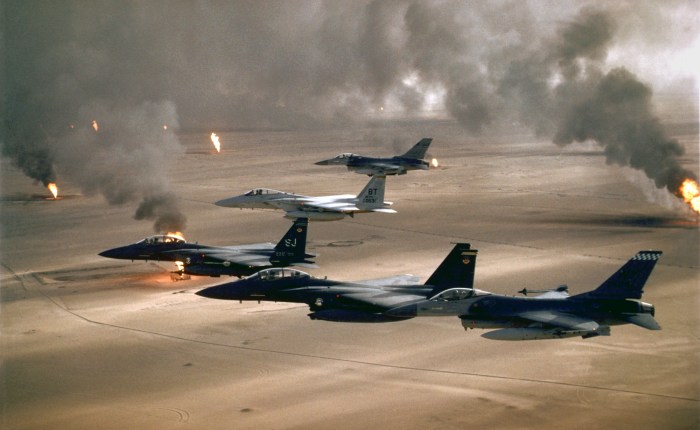
Header Image: USAF F-16A, F-15C, F-15E aircraft flying over burning oil wells during DESERT STORM in 1991. (Source: Wikimedia)

#DesertStorm30 – Planning and Executing the Air Campaign

#DesertStorm30 – Planning and Executing the Air Campaign

By Lieutenant General David A. Deptula, USAF (Ret.)

Editorial Note: 2021 marks the 30th anniversary of Operation DESERT STORM. To mark this anniversary, during 2021, From Balloons to Drones will be publishing a series of articles that examine various aspects of DESERT STORM’s air campaign. We will be publishing pieces throughout 2021, and if you would like to contribute to the series, please contact our Editor-in-Chief, Dr Ross Mahoney, at airpowerstudies@gmail.com or via our contact page here. The official call for submissions can be found here.

Over the coming weeks, From Balloons to Drones is pleased to be working in conjunction with the Mitchell Institute for Aerospace Studies to publish a series of articles on various aspects of the DESERT STORM air campaign. These articles were initially published as part of a Mitchell Institute of Aerospace Studies special report, Desert Storm: 30 Years Later – Lessons from the 1991 Air Campaign in the Persian Gulf War. You can download the report here.

In this latest instalment, we are pleased to present a piece by Lieutenant General David A. Deptula, USAF (Ret.) on the planning and execution of the DESERT STORM air campaign. Deptula was the principal attack planner for the air campaign, and in this article, he provides valuable insights into some of the issues and challenges that affected the conduct of the air campaign.

January 17, 2016, at 0239 Baghdad time marked the 25th anniversary of the start of Operation Desert Storm. Desert Storm was a turning point in the conduct of warfare as it set the conditions for modern warfare in five major ways: 1) it set expectations for low casualties – on both sides of the conflict; 2) it presaged precision in the application of force for all future conflicts; 3) it introduced prosecution of a combined/joint air campaign integrating all coalition/service air operations under the functional command of an airman, 4) it established desired effects as the focus of strategy and in the planning and conduct of operations, and 5) for the first time in history, airpower was used as the key force – or centerpiece – in the strategy and execution of a war.

Desert Storm was a 43-day war – airpower operated throughout the conflict from start to finish; ground forces acted as a blocking force for almost the entire war as airpower destroyed enemy forces and achieved desired effects against key systems from above. Only in the final days of the conflict were ground forces committed to combat and used to re-occupy Kuwait. In this respect, Desert Storm saw an inversion in the paradigm of traditional force application. Long-time military expert Dr Ben Lambeth has observed that today:

[t]he classic roles of airpower and land power have changed places in major combat […] Fixed-wing air power has, by now, proven itself to be far more effective than ground combat capabilities in creating the necessary conditions for rapid offensive success.

The opening attacks of Desert Storm signaled a radical departure in the conduct of war. Over 150 discrete targets – in addition to regular Iraqi Army forces and surface-to-air missile (SAM) sites – made up the master attack plan for the opening 24 hours. The war began with more targets attacked in one day than the total number of targets hit by all of the Eighth Air Force in 1942 and 1943 combined – that’s more separate targets attacked in less time than ever before in history.

Twenty-five years ago, those involved in the Desert Storm air campaign applied force not only across the entire breadth and depth of the country geographically, but also across all the key strategic and operational level centers of gravity. How was that accomplished? And what was different from previous conflicts?

Advances in technology, in conjunction with an effects-based approach to planning and execution, allowed us to institute a new concept of operations that has been described as ‘parallel’ war: the simultaneous application of force across the totality of the enemy system.

While simultaneous attack has always been a desired element of offensive warfare, it had never evolved into the parallel war demonstrated in Desert Storm for three reasons: one, the requirement for mass to compensate for a lack of precise weapons delivery; two, the large number of resources required to suppress enemy air defenses; and three, the absence of a focus on effects rather than destruction to achieve control over an opponent.

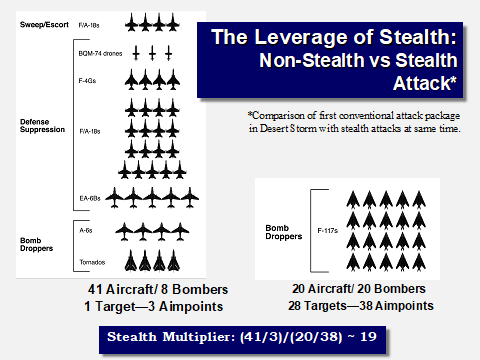
The first two challenges required technological solutions, and were simply not mature before the mid-1980s. Those two solutions were stealth and precision. To provide insight into the significance of those two elements, in the first 24 hours of Desert Storm stealth, precision, and effects-based planning allowed targeting 36 stealth aircraft armed with precision-guided munitions against more separate targets than the complete non-stealth/non-precision air and missile force launched from the entire complement of six aircraft carriers and all the other ships in the theater combined. The stealthy F-117 force flew less than 2 percent of the combat sorties, but struck over 40 percent of the fixed targets.

The leverage that stealth demonstrated in the first Gulf War is further illustrated by the following example that involves the first non-stealthy attack on one target with three aimpoints in the Basrah area – Shaiba Airfield to be exact. The attack package consisted of 4 US Navy A-6s dropping bombs, along with 4 Saudi Tornado bomb droppers: 5 US Marine EA-6Bs jamming acquisition radars; 4 US Air Force F-4Gs taking out one type of surface to air missile system; 17 US Navy F-18s taking out another; 4 F/A-18s as escort; and three drones to cause the enemy radars to radiate. That is a total of 41 aircraft – 8 dropping bombs, on 3 aimpoints, on one target.

At approximately the same time we had 20 F-117s all dropping bombs on 38 aim points on 28 separate targets. That is less than half the aircraft hitting over 12 times the number of aim points.

Stealth and precision facilitated the actualization of the third and perhaps most important component of that conflict: a concept of operations designed to achieve control over an enemy’s essential systems. This methodology recognizes that negating an adversary’s ability to operate as desired is ultimately as important – or even more so – than the destruction of the forces it relies on for conquest.

We built the air attack strategy of Desert Storm by treating Iraq and the Saddam regime as a system of systems, and designed the operation to achieve paralysis of Saddam’s strategic centers of gravity: leadership; key essential systems; infrastructure; information; and fielded military forces. The campaign had five key objectives in this regard:

    1. Gain/Maintain Air Supremacy to Permit Unhindered Air Operations
    2. Isolate and Incapacitate Hussein Regime
    3. Destroy Iraqi Nuclear, Biological, and Chemical Warfare Capability
    4. Eliminate Iraq’s Offensive Military Capability
    5. Render the Iraqi Army in Kuwait Ineffective, Causing Its Collapse
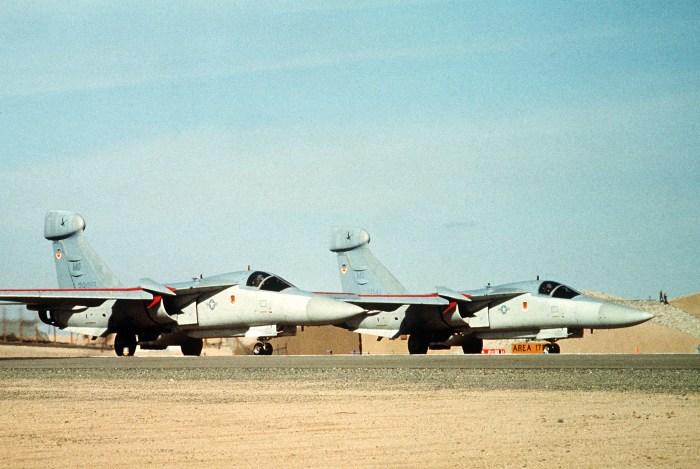
EF-111A Raven aircraft prepare to take off on a mission during Operation Desert Shield. (Source: Wikimedia)

These objectives were all achieved – rapidly, and decisively.  The tenets that made Desert Storm such a success were:

    1. Strong political will – a President who stated on 5 August 1990, ‘This will not stand’ in response to the invasion of Kuwait. President George H. W. Bush and his military commanders built a strategy; formed a coalition; deployed the forces required to execute that strategy; garnered United Nations backing; executed the strategy; and accomplished its declared objectives by February 28, 1991 – seven months from start to finish.
    2. A comprehensive, coherent campaign plan that focused on dismantling the key centers of gravity – leadership; key essential systems; infrastructure; population perceptions; and military forces – that paralyzed Iraq as a state along with its military regime;
    3. Putting a combined/joint force air component commander in charge of the air campaign, and treating each aircraft, missile, and air defense element according to the capability it brought to the campaign plan, regardless of which service or country from where it came;
    4. Reversing the errors of Vietnam by replacing the gradualism of the ‘Rolling Thunder’ air campaign with the ‘Instant Thunder’ of the Desert Storm air campaign; and
    5. Adopting a true combined/joint approach to the effort using the right force at the right place at the right time – not a traditional land-centric plan that singularly focused on fielded military forces.

Today, against the Islamic State, targets selected and ordnance employed go through a lengthy vetting process, and are approved or disapproved by ground commanders. According to a reported Air Force source on 26 August 2016 it, ‘take[s] an average of between 45 to 60 days before [targets] are vetted and approved.’ That is longer than the duration of Operation Desert Storm in its entirety.  The excessive time factor in Operation Inherent Resolve target development due to of concern of unintended civilian casualties, allows critical Islamic State functions to continue to operate.  By not rapidly striking them actually countenances the Islamic State to perpetuate its terror, atrocities, and murder.

What is the morality of a policy that restricts the use of airpower to avoid the possibility of collateral damage while allowing the certainty of the Islamic State’s crimes against humanity? Members of today’s coalition should enter into their casualty avoidance calculus how many of the Islamic State’s intentional murders of innocents would be avoided by rapidly collapsing the organizational elements that allow the Islamic State to function.

The current approach to the Islamic State is gradualist – over two years to date, and the prospect of years of continuance; it is an anemic approach – an average of only 6 US strike sorties a day over the first two years of operations; and it is without definition – no comprehensive and focused strategy has been identified to achieve the stated objectives of degrading and destroying the Islamic State. The result is an approach that is fragmented, less than optimal, and yields the advantage of time to the adversary resulting in expansion and export of its deleterious effects. The enemy, over time, learns how to deal effectively with the gradual use of airpower and grows stronger, while our allies and our citizens lose interest, and our military forces – our brave airmen, soldiers, sailors, and marines – tire of the endless rotations into and out of the fight. Our present is our past: not the swift, decisive past of Desert Storm but rather the quagmire that was Vietnam.

Today’s generation of airmen must renew the spirit of innovation and creativity enabled by exploiting the virtues of operating in air and space, as did the founders of our Air Force. Those characteristics delivered success in Desert Storm, and can do so again in the future. The innovative application of the tenets of aerospace power is what made Desert Storm such a success, and can be applied to the challenge of the Islamic State. Replace the current desert ‘drizzle’ with a ‘thunderstorm’ aimed not just at the hands and feet of the Islamic State but at its head and heart as well.  It is the duty of every Air Force member to understand airpower, advocate and articulate its characteristics and capabilities, and educate those who do not understand.  For if they don’t, no one else will. The Nation deserves to hear the options allowed by airpower, and will benefit from their proper application.

Lieutenant General David A. Deptula, USAF (Ret.) is the Dean of the Mitchell Institute for Aerospace Studies. He is a world-recognized leader and pioneer in conceptualizing, planning, and executing national security operations from humanitarian relief to major combat. He was the principal attack planner for the Operation Desert Storm air campaign; commander of no-fly-zone operations over Iraq in the late 1990s; director of the air campaign over Afghanistan in 2001; twice a joint task force commander; and was the air commander for the 2005 South Asia tsunami relief operations. He served on two congressional commissions charged with outlining America’s future defence posture. He is a fighter pilot with more than 3,000 flying hours – 400 in combat – Including multiple command assignments in the F-15. His last assignment was as the Air Force’s first deputy chief of staff for intelligence, surveillance, and reconnaissance (ISR), where he transformed America’s military ISR and drone enterprises—orchestrating the largest increase in drone operations in Air Force history. He retired from the Air Force in 2010 after more than 34 years of distinguished service. He has BA and ME degrees from the University of Virginia and a MS degree from National War College. In addition to his duties as Dean of the Mitchell Institute, he is the RisnerSenior Military Scholar at the US Air Force Academy; a board member at a variety of organizations; an independent consultant; and sought after commentator around the world as a thought leader on defence, strategy, and ISR.

#DesertStorm30 #BookReview – She Went to War: The Rhonda Cornum Story

#DesertStorm30 #BookReview – She Went to War: The Rhonda Cornum Story

Editorial Note: 2021 marks the 30th anniversary of Operation DESERT STORM. To mark this anniversary, during 2021, From Balloons to Drones will be publishing a series of articles that examine various aspects of DESERT STORM’s air campaign. We will be publishing pieces throughout 2021, and if you would like to contribute to the series, please contact our Editor-in-Chief, Dr Ross Mahoney, at airpowerstudies@gmail.com or via our contact page here. The official call for submissions can be found here.

In this first instalment, Dr Brain Laslie provides a review of one of the first memoirs to emerge after the end of the First Gulf War; She Went to War: The Rhonda Cornum Story. Rhonda Cornum’s story is interesting for several reasons. First, it provides an army view of the air war rather than the more common air force view. Second, much of its focus relates to the latter part of the conflict, and finally, and most importantly, the book provides an insight into the experience of female prisoners of war (POW) in wartime.

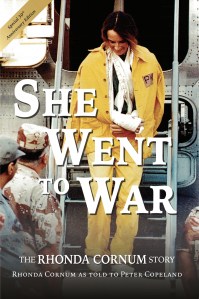
Rhonda Cornum with Peter Copeland, She Went to War: The Rhonda Cornum Story (30th Anniversary Edition). Cardiff, CA: Waterside Productions, 2020. Pbk. 240pp.

Reviewed by Dr Brian Laslie

This was it. This was life as a POW. This was my life for the near future. This room, those walls, that ceiling. My reality. (p. 168).

Major Rhonda Cornum was a member of the US Army’s 2-229th Attack Helicopter Battalion attached to the 101st Airborne Division (Air Assault) during Operation DESERT STORM. As a medical doctor, her job was to fly as a member of a UH-60 crew behind attacking AH-64 Apaches and provide medical support to any downed aircrew. On 27 February 1991 – the fourth day of the ground war – Cornum and the other members of her UH-60 crew diverted to become a search and rescue aircraft sent to pick up a downed F-16 pilot, Captain William F. Andrews. During the rescue mission, the UH-60 she was riding was shot down. Her subsequent ordeal is detailed in the book She Went to War: The Rhonda Cornum Story (with her co-author Peter Copeland). Originally published in 1992, Cornum’s book was one of the early personal reflections of service during DESERT STORM. The book has now been re-released as part of the 30th anniversary of DESERT STORM.

The crash resulted in the loss of Chief Warrant Officer Four Philip Garvey, Chief Warrant Officer Three Robert Godfrey, Sergeant 1st Class William Butts, Staff Sergeant Patbouvier Ortiz, and Sergeant Roger Brelinski. Only three crew members survived: Cornum, Staff Sergeant Daniel Stamaris, and Specialist Four Troy Dunlap. The three survivors were rapidly captured by the Iraqi military (pp. 12-3). Among the trio of survivors, Cornum was the most seriously injured. Her injuries sustained in the crash included ‘two broken arms, both at odd angels; a smashed finger […] a blown out knee and various lacerations and bruises’ (p. 79-80) and – as she later discovered – a bullet wound in her back (pp. 97-8).

Captured almost immediately Cornum was taken to a series of bunkers and one gets the sense that the Iraqi military was not entirely prepared to deal with her and other captured Americans preferring to shuttle them up the chain of command. This description harkens back to Everett Alvarez’s early days of captivity after he became the first POW during the Vietnam war and detailed in his autobiography Chained Eagle (1989).

Cornum, suffering from her severe wounds, also learned to deal with a myriad of other problems. These problems included boredom and the indeterminable waiting for something to happen (p.39, 41), a sexual assault at the hands of one of the guards, and the complete inability to do anything on her own from dressing to going to the bathroom. Cornum was forced to rely on her captors or a fellow POW to help her with her dressings and personal hygiene.

She Went to War certainly deserves to be included under the rubric of air power books coming out of DESERT STORM, but this particular book is essential for another reason as it is one of the few works that explore the experience of female POWs. Cornum and US Army Specialist Melissa Rathbun-Nealy were the only two female POWs taken prisoner during DESERT STORM. As such, Cornum’s insightful work adds something unique to the historiography of DESERT STORM; a female perspective. Indeed, arguably the critical work on POWs’ experience during DESERT STORM remains Tornado Down (1992), the account of Britain’s Flight Lieutenants John Peters and John Nichol who were shot down on the first day of the air campaign. As we enter into a period of historical reflection thirty years later, Cornum and Copeland’s book should enter the conversation as one of the great memoirs to come from DESERT STORM.

Dr Brian Laslie is an Editor at From Balloons to Drones and a US Air Force Historian and currently the Deputy Command Historian at North American Aerospace Defense Command and the United States Northern Command. A 2001 graduate of The Citadel and a historian of air power studies, he received his PhD from Kansas State University in 2013. He is the author of three books: The Air Force Way of War (2015) was selected for the Chief of Staff of the Air Force’s and the Royal Air Force’s Chief of the Air Staff professional reading lists, Architect of Air Power: General Laurence S. Kuter and the Birth of the US Air Force and the forthcoming Air Power’s Lost Cause: The American Air Wars of Vietnam. He can be found on Twitter at @BrianLaslie and at www.brianlaslie.com.

Header image: A left front view of a US Army UH-60 Blackhawk helicopter in flight during Operation DESERT SHIELD. (Source: US Department of Defense)

#DesertStorm30 – Call for Submissions: DESERT STORM Revisited

#DesertStorm30 – Call for Submissions: DESERT STORM Revisited

In 2021, From Balloons to Drones will run a series that examines the use of air power during Operation DESERT STORM in 1991.

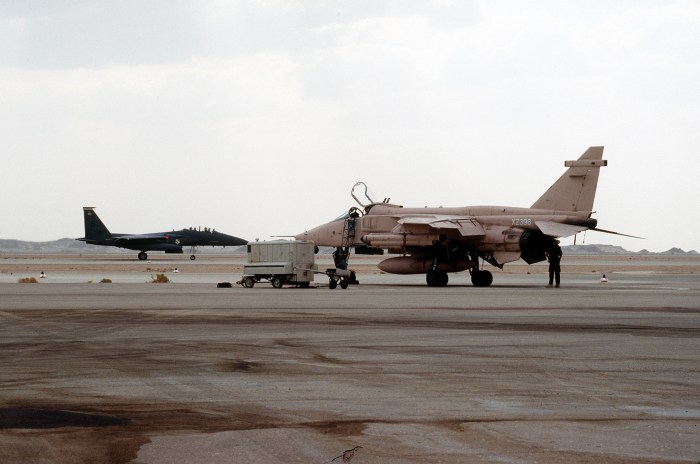
A Royal Air Force Jaguar aircraft is serviced on the flight line as a US Air Force F-15E Eagle aircraft taxis in the background during Operation Desert Shield. (Source: Wikimedia)

2021 is the 30th anniversary of Operation DESERT STORM, which sought to liberate Kuwait from Iraqi occupation. DESERT STORM has long been considered a significant turning point in the use of air power. As Richard Hallion reflected the 1990s, ‘[s]o profound [was] the change in warfare exemplified by what occurred in Desert Storm, that, for the United States, aerospace power [was] now de facto accepted as the natural and logical form of crisis intervention.’ In many respects, much of the rhetoric that had characterised air power thinking during the 20th century arguably coalesced in 1991. Nevertheless, the use and impact of air power both during the conflict and in the years afterwards, has remained controversial. As such, From Balloons to Drones is seeking submissions for a series of articles that examine the varied use of air power during DESERT STORM as well its impact on the conduct of military operations since 1991. Themes to be explored might include, but are not limited to:

Strategy, Theory and Doctrine | Organisation and Policy | Roles

Operations – Kinetic and Non-Kinetic | Tactics, Training and Procedures

Strategic and Operational Effect | Technological Developments

Ethical and Moral Issues | National, International and Transnational Experiences | Personal Experiences

We are looking for articles of between 500 to 4,000 words, though we will accept larger pieces and we reserve the right to publish them in parts. To understand the types of articles published by From Balloons to Drones, please visit our submissions page. As well as scholarly articles, we are keen to publish personal reflections on the use of air power by those who served during DESERT STORM. We would also be interested in potentially conducting interviews with veterans.

We plan to begin running the series in January 2021, and it will continue for as long as we receive potential contributions. We will also be looking at publishing extended versions of selected articles in an edited volume. We welcome and encourage submissions from academics, policymakers, service personnel, and relevant professionals. We also welcome submissions written from diverse academic disciplines.

Submissions should be submitted in Word format and emailed to the address below with ‘SUBMISSION – DESERT STORM Revisited’ in the subject line. Also, please include a 50-100-word biography with your submission. Footnotes can be used, and please be careful to explain any jargon. If you are not sure if your idea fits our requirements, then please email us with ‘POTENTIAL SUBMISSION – DESERT STORM Revisited’ in the subject line to discuss.

If you are interested in contributing, please email our Editor-in-Chief, Dr Ross Mahoney, at airpowerstudies@gmail.com or contact us via our contact page here.

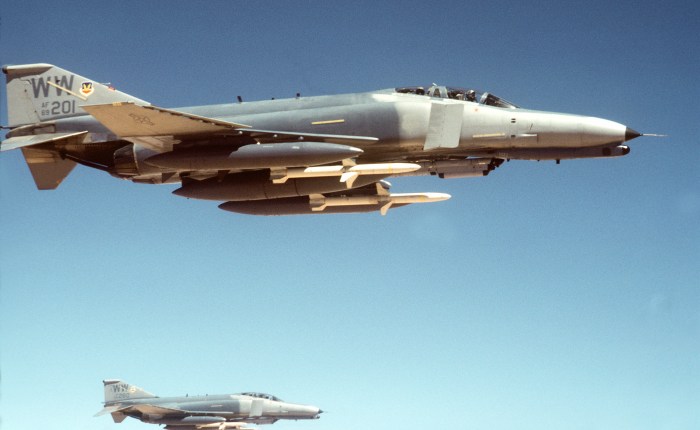
Header Image: Two US Air Force McDonnell Douglas F-4G Phantom II aircraft of the 35th Tactical Fighter Wing pass over the Saudi desert while on a training flight during Operation Desert Shield on 11 January 1991. The aircraft are carrying external fuel tanks on their outboard wing pylons and AGM-88 HARM high-speed anti-radiation missiles on their inboard wing pylons. (Source: Wikimedia)