By Lieutenant General David A. Deptula, USAF (Ret.)
Editorial Note: 2021 marks the 30th anniversary of Operation DESERT STORM. To mark this anniversary, during 2021, From Balloons to Drones will be publishing a series of articles that examine various aspects of DESERT STORM’s air campaign. We will be publishing pieces throughout 2021, and if you would like to contribute to the series, please contact our Editor-in-Chief, Dr Ross Mahoney, at airpowerstudies@gmail.com or via our contact page here. The official call for submissions can be found here.
Over the coming weeks, From Balloons to Drones is pleased to be working in conjunction with the Mitchell Institute for Aerospace Studies to publish a series of articles on various aspects of the DESERT STORM air campaign. These articles were initially published as part of a Mitchell Institute of Aerospace Studies special report, Desert Storm: 30 Years Later – Lessons from the 1991 Air Campaign in the Persian Gulf War. You can download the report here.
In this latest instalment, we are pleased to present a piece by Lieutenant General David A. Deptula, USAF (Ret.) on the planning and execution of the DESERT STORM air campaign. Deptula was the principal attack planner for the air campaign, and in this article, he provides valuable insights into some of the issues and challenges that affected the conduct of the air campaign.
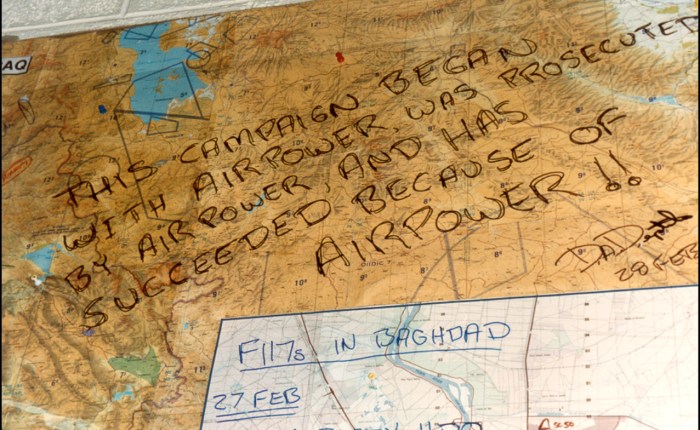
January 17, 2016, at 0239 Baghdad time marked the 25th anniversary of the start of Operation Desert Storm. Desert Storm was a turning point in the conduct of warfare as it set the conditions for modern warfare in five major ways: 1) it set expectations for low casualties – on both sides of the conflict; 2) it presaged precision in the application of force for all future conflicts; 3) it introduced prosecution of a combined/joint air campaign integrating all coalition/service air operations under the functional command of an airman, 4) it established desired effects as the focus of strategy and in the planning and conduct of operations, and 5) for the first time in history, airpower was used as the key force – or centerpiece – in the strategy and execution of a war.
Desert Storm was a 43-day war – airpower operated throughout the conflict from start to finish; ground forces acted as a blocking force for almost the entire war as airpower destroyed enemy forces and achieved desired effects against key systems from above. Only in the final days of the conflict were ground forces committed to combat and used to re-occupy Kuwait. In this respect, Desert Storm saw an inversion in the paradigm of traditional force application. Long-time military expert Dr Ben Lambeth has observed that today:
[t]he classic roles of airpower and land power have changed places in major combat […] Fixed-wing air power has, by now, proven itself to be far more effective than ground combat capabilities in creating the necessary conditions for rapid offensive success.
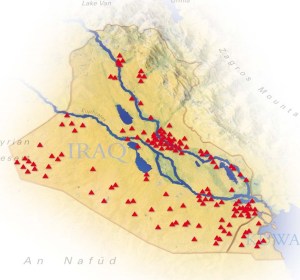
The opening attacks of Desert Storm signaled a radical departure in the conduct of war. Over 150 discrete targets – in addition to regular Iraqi Army forces and surface-to-air missile (SAM) sites – made up the master attack plan for the opening 24 hours. The war began with more targets attacked in one day than the total number of targets hit by all of the Eighth Air Force in 1942 and 1943 combined – that’s more separate targets attacked in less time than ever before in history.
Twenty-five years ago, those involved in the Desert Storm air campaign applied force not only across the entire breadth and depth of the country geographically, but also across all the key strategic and operational level centers of gravity. How was that accomplished? And what was different from previous conflicts?
Advances in technology, in conjunction with an effects-based approach to planning and execution, allowed us to institute a new concept of operations that has been described as ‘parallel’ war: the simultaneous application of force across the totality of the enemy system.
While simultaneous attack has always been a desired element of offensive warfare, it had never evolved into the parallel war demonstrated in Desert Storm for three reasons: one, the requirement for mass to compensate for a lack of precise weapons delivery; two, the large number of resources required to suppress enemy air defenses; and three, the absence of a focus on effects rather than destruction to achieve control over an opponent.
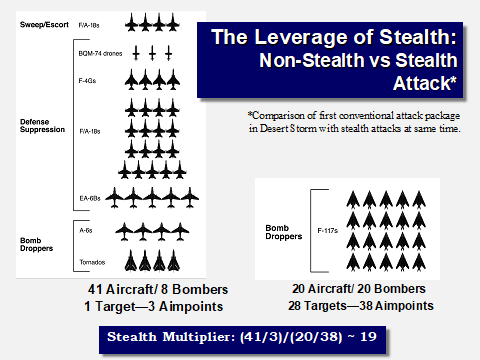
The first two challenges required technological solutions, and were simply not mature before the mid-1980s. Those two solutions were stealth and precision. To provide insight into the significance of those two elements, in the first 24 hours of Desert Storm stealth, precision, and effects-based planning allowed targeting 36 stealth aircraft armed with precision-guided munitions against more separate targets than the complete non-stealth/non-precision air and missile force launched from the entire complement of six aircraft carriers and all the other ships in the theater combined. The stealthy F-117 force flew less than 2 percent of the combat sorties, but struck over 40 percent of the fixed targets.
The leverage that stealth demonstrated in the first Gulf War is further illustrated by the following example that involves the first non-stealthy attack on one target with three aimpoints in the Basrah area – Shaiba Airfield to be exact. The attack package consisted of 4 US Navy A-6s dropping bombs, along with 4 Saudi Tornado bomb droppers: 5 US Marine EA-6Bs jamming acquisition radars; 4 US Air Force F-4Gs taking out one type of surface to air missile system; 17 US Navy F-18s taking out another; 4 F/A-18s as escort; and three drones to cause the enemy radars to radiate. That is a total of 41 aircraft – 8 dropping bombs, on 3 aimpoints, on one target.
At approximately the same time we had 20 F-117s all dropping bombs on 38 aim points on 28 separate targets. That is less than half the aircraft hitting over 12 times the number of aim points.
Stealth and precision facilitated the actualization of the third and perhaps most important component of that conflict: a concept of operations designed to achieve control over an enemy’s essential systems. This methodology recognizes that negating an adversary’s ability to operate as desired is ultimately as important – or even more so – than the destruction of the forces it relies on for conquest.
We built the air attack strategy of Desert Storm by treating Iraq and the Saddam regime as a system of systems, and designed the operation to achieve paralysis of Saddam’s strategic centers of gravity: leadership; key essential systems; infrastructure; information; and fielded military forces. The campaign had five key objectives in this regard:
Gain/Maintain Air Supremacy to Permit Unhindered Air Operations
Isolate and Incapacitate Hussein Regime
Destroy Iraqi Nuclear, Biological, and Chemical Warfare Capability
Eliminate Iraq’s Offensive Military Capability
Render the Iraqi Army in Kuwait Ineffective, Causing Its Collapse
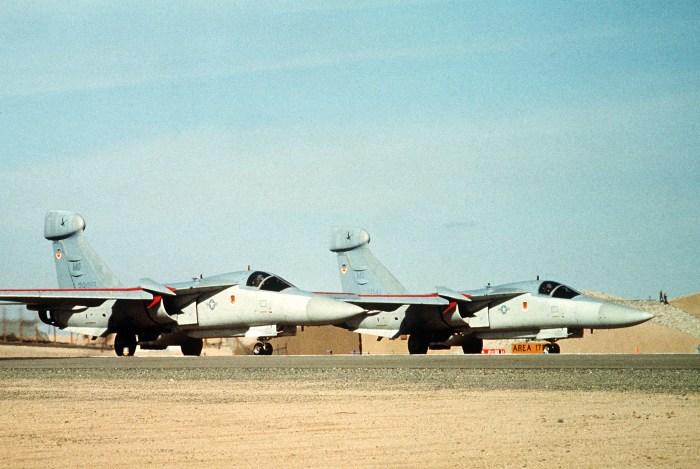
EF-111A Raven aircraft prepare to take off on a mission during Operation Desert Shield. (Source: Wikimedia)
These objectives were all achieved – rapidly, and decisively. The tenets that made Desert Storm such a success were:
Strong political will – a President who stated on 5 August 1990, ‘This will not stand’ in response to the invasion of Kuwait. President George H. W. Bush and his military commanders built a strategy; formed a coalition; deployed the forces required to execute that strategy; garnered United Nations backing; executed the strategy; and accomplished its declared objectives by February 28, 1991 – seven months from start to finish.
A comprehensive, coherent campaign plan that focused on dismantling the key centers of gravity – leadership; key essential systems; infrastructure; population perceptions; and military forces – that paralyzed Iraq as a state along with its military regime;
Putting a combined/joint force air component commander in charge of the air campaign, and treating each aircraft, missile, and air defense element according to the capability it brought to the campaign plan, regardless of which service or country from where it came;
Reversing the errors of Vietnam by replacing the gradualism of the ‘Rolling Thunder’ air campaign with the ‘Instant Thunder’ of the Desert Storm air campaign; and
Adopting a true combined/joint approach to the effort using the right force at the right place at the right time – not a traditional land-centric plan that singularly focused on fielded military forces.
Today, against the Islamic State, targets selected and ordnance employed go through a lengthy vetting process, and are approved or disapproved by ground commanders. According to a reported Air Force source on 26 August 2016 it, ‘take[s] an average of between 45 to 60 days before [targets] are vetted and approved.’ That is longer than the duration of Operation Desert Storm in its entirety. The excessive time factor in Operation Inherent Resolve target development due to of concern of unintended civilian casualties, allows critical Islamic State functions to continue to operate. By not rapidly striking them actually countenances the Islamic State to perpetuate its terror, atrocities, and murder.
What is the morality of a policy that restricts the use of airpower to avoid the possibility of collateral damage while allowing the certainty of the Islamic State’s crimes against humanity? Members of today’s coalition should enter into their casualty avoidance calculus how many of the Islamic State’s intentional murders of innocents would be avoided by rapidly collapsing the organizational elements that allow the Islamic State to function.
The current approach to the Islamic State is gradualist – over two years to date, and the prospect of years of continuance; it is an anemic approach – an average of only 6 US strike sorties a day over the first two years of operations; and it is without definition – no comprehensive and focused strategy has been identified to achieve the stated objectives of degrading and destroying the Islamic State. The result is an approach that is fragmented, less than optimal, and yields the advantage of time to the adversary resulting in expansion and export of its deleterious effects. The enemy, over time, learns how to deal effectively with the gradual use of airpower and grows stronger, while our allies and our citizens lose interest, and our military forces – our brave airmen, soldiers, sailors, and marines – tire of the endless rotations into and out of the fight. Our present is our past: not the swift, decisive past of Desert Storm but rather the quagmire that was Vietnam.
Today’s generation of airmen must renew the spirit of innovation and creativity enabled by exploiting the virtues of operating in air and space, as did the founders of our Air Force. Those characteristics delivered success in Desert Storm, and can do so again in the future. The innovative application of the tenets of aerospace power is what made Desert Storm such a success, and can be applied to the challenge of the Islamic State. Replace the current desert ‘drizzle’ with a ‘thunderstorm’ aimed not just at the hands and feet of the Islamic State but at its head and heart as well. It is the duty of every Air Force member to understand airpower, advocate and articulate its characteristics and capabilities, and educate those who do not understand. For if they don’t, no one else will. The Nation deserves to hear the options allowed by airpower, and will benefit from their proper application.
Lieutenant General David A. Deptula, USAF (Ret.) is the Dean of the Mitchell Institute for Aerospace Studies. He is a world-recognized leader and pioneer in conceptualizing, planning, and executing national security operations from humanitarian relief to major combat. He was the principal attack planner for the Operation Desert Storm air campaign; commander of no-fly-zone operations over Iraq in the late 1990s; director of the air campaign over Afghanistan in 2001; twice a joint task force commander; and was the air commander for the 2005 South Asia tsunami relief operations. He served on two congressional commissions charged with outlining America’s future defence posture. He is a fighter pilot with more than 3,000 flying hours – 400 in combat – Including multiple command assignments in the F-15. His last assignment was as the Air Force’s first deputy chief of staff for intelligence, surveillance, and reconnaissance (ISR), where he transformed America’s military ISR and drone enterprises—orchestrating the largest increase in drone operations in Air Force history. He retired from the Air Force in 2010 after more than 34 years of distinguished service. He has BA and ME degrees from the University of Virginia and a MS degree from National War College. In addition to his duties as Dean of the Mitchell Institute, he is the RisnerSenior Military Scholar at the US Air Force Academy; a board member at a variety of organizations; an independent consultant; and sought after commentator around the world as a thought leader on defence, strategy, and ISR.
Editorial Note: 2021 marks the 30th anniversary of Operation DESERT STORM. To mark this anniversary, during 2021, From Balloons to Drones will be publishing a series of articles that examine various aspects of DESERT STORM’s air campaign. We will be publishing pieces throughout 2021, and if you would like to contribute to the series, please contact our Editor-in-Chief, Dr Ross Mahoney, at airpowerstudies@gmail.com or via our contact page here. The official call for submissions can be found here.
In this first instalment, Dr Brain Laslie provides a review of one of the first memoirs to emerge after the end of the First Gulf War; She Went to War: The Rhonda Cornum Story. Rhonda Cornum’s story is interesting for several reasons. First, it provides an army view of the air war rather than the more common air force view. Second, much of its focus relates to the latter part of the conflict, and finally, and most importantly, the book provides an insight into the experience of female prisoners of war (POW) in wartime.
Rhonda Cornum with Peter Copeland, She Went to War: The Rhonda Cornum Story (30th Anniversary Edition). Cardiff, CA: Waterside Productions, 2020. Pbk. 240pp.
Reviewed by Dr Brian Laslie
This was it. This was life as a POW. This was my life for the near future. This room, those walls, that ceiling. My reality. (p. 168).
Major Rhonda Cornum was a member of the US Army’s 2-229th Attack Helicopter Battalion attached to the 101st Airborne Division (Air Assault) during Operation DESERT STORM. As a medical doctor, her job was to fly as a member of a UH-60 crew behind attacking AH-64 Apaches and provide medical support to any downed aircrew. On 27 February 1991 – the fourth day of the ground war – Cornum and the other members of her UH-60 crew diverted to become a search and rescue aircraft sent to pick up a downed F-16 pilot, Captain William F. Andrews. During the rescue mission, the UH-60 she was riding was shot down. Her subsequent ordeal is detailed in the book She Went to War: The Rhonda Cornum Story (with her co-author Peter Copeland). Originally published in 1992, Cornum’s book was one of the early personal reflections of service during DESERT STORM. The book has now been re-released as part of the 30th anniversary of DESERT STORM.
The crash resulted in the loss of Chief Warrant Officer Four Philip Garvey, Chief Warrant Officer Three Robert Godfrey, Sergeant 1st Class William Butts, Staff Sergeant Patbouvier Ortiz, and Sergeant Roger Brelinski. Only three crew members survived: Cornum, Staff Sergeant Daniel Stamaris, and Specialist Four Troy Dunlap. The three survivors were rapidly captured by the Iraqi military (pp. 12-3). Among the trio of survivors, Cornum was the most seriously injured. Her injuries sustained in the crash included ‘two broken arms, both at odd angels; a smashed finger […] a blown out knee and various lacerations and bruises’ (p. 79-80) and – as she later discovered – a bullet wound in her back (pp. 97-8).
Captured almost immediately Cornum was taken to a series of bunkers and one gets the sense that the Iraqi military was not entirely prepared to deal with her and other captured Americans preferring to shuttle them up the chain of command. This description harkens back to Everett Alvarez’s early days of captivity after he became the first POW during the Vietnam war and detailed in his autobiography Chained Eagle (1989).
Cornum, suffering from her severe wounds, also learned to deal with a myriad of other problems. These problems included boredom and the indeterminable waiting for something to happen (p.39, 41), a sexual assault at the hands of one of the guards, and the complete inability to do anything on her own from dressing to going to the bathroom. Cornum was forced to rely on her captors or a fellow POW to help her with her dressings and personal hygiene.
She Went to War certainly deserves to be included under the rubric of air power books coming out of DESERT STORM, but this particular book is essential for another reason as it is one of the few works that explore the experience of female POWs. Cornum and US Army Specialist Melissa Rathbun-Nealy were the only two female POWs taken prisoner during DESERT STORM. As such, Cornum’s insightful work adds something unique to the historiography of DESERT STORM; a female perspective. Indeed, arguably the critical work on POWs’ experience during DESERT STORM remains Tornado Down (1992), the account of Britain’s Flight Lieutenants John Peters and John Nichol who were shot down on the first day of the air campaign. As we enter into a period of historical reflection thirty years later, Cornum and Copeland’s book should enter the conversation as one of the great memoirs to come from DESERT STORM.
Editorial Note: From Balloons to Drones is pleased to announce our new podcast series. Led by our Editor Dr Mike Hankins, the series builds on the success of From Balloons to Drones, and provides an outlet for the presentation and evaluation of air power scholarship, the exploration of historical topics and ideas, and provides a way to reach out to both new scholars and the general public. You can find our Soundcloud channel here.
Eileen A. Bjorkman is a former flight test engineer in the USAF with more than thirty-five years of experience and over 700 hours in the cockpits of F-4s, F-16s, C-130s, and C-141s. She is the author of The Propeller under the Bed: A Personal History of Homebuilt Aircraft and has published articles in the Smithsonian’s Air & Space Magazine, Aviation History, Sport Aviation, the Everett Daily Herald, and the Herald Business Journal.
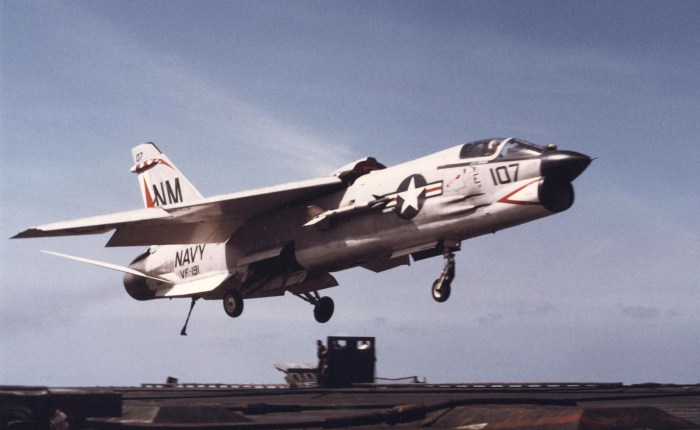
Header Image: A US Navy Vought F-8J Crusader of VF-191 is recovered aboard the attack aircraft carrier USS Oriskany (CVA-34) in November 1970. (Source: Wikimedia)
In 2021, From Balloons to Drones will run a series that examines the use of air power during Operation DESERT STORM in 1991.
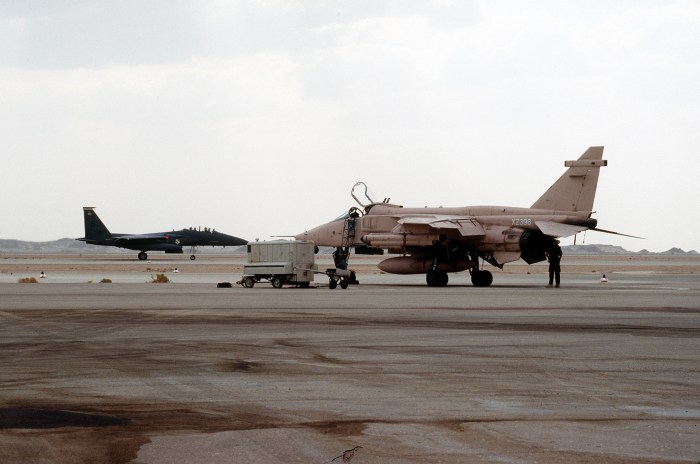
A Royal Air Force Jaguar aircraft is serviced on the flight line as a US Air Force F-15E Eagle aircraft taxis in the background during Operation Desert Shield. (Source: Wikimedia)
2021 is the 30th anniversary of Operation DESERT STORM, which sought to liberate Kuwait from Iraqi occupation. DESERT STORM has long been considered a significant turning point in the use of air power. As Richard Hallion reflected the 1990s, ‘[s]o profound [was] the change in warfare exemplified by what occurred in Desert Storm, that, for the United States, aerospace power [was] now de facto accepted as the natural and logical form of crisis intervention.’ In many respects, much of the rhetoric that had characterised air power thinking during the 20th century arguably coalesced in 1991. Nevertheless, the use and impact of air power both during the conflict and in the years afterwards, has remained controversial. As such, From Balloons to Drones is seeking submissions for a series of articles that examine the varied use of air power during DESERT STORM as well its impact on the conduct of military operations since 1991. Themes to be explored might include, but are not limited to:
Strategy, Theory and Doctrine| Organisation and Policy | Roles
Operations – Kinetic and Non-Kinetic | Tactics, Training and Procedures
Strategic and Operational Effect | Technological Developments
Ethical and Moral Issues | National, International and Transnational Experiences | Personal Experiences
We are looking for articles of between 500 to 4,000 words, though we will accept larger pieces and we reserve the right to publish them in parts. To understand the types of articles published by From Balloons to Drones, please visit our submissions page. As well as scholarly articles, we are keen to publish personal reflections on the use of air power by those who served during DESERT STORM. We would also be interested in potentially conducting interviews with veterans.
We plan to begin running the series in January 2021, and it will continue for as long as we receive potential contributions. We will also be looking at publishing extended versions of selected articles in an edited volume. We welcome and encourage submissions from academics, policymakers, service personnel, and relevant professionals. We also welcome submissions written from diverse academic disciplines.
Submissions should be submitted in Word format and emailed to the address below with ‘SUBMISSION – DESERT STORM Revisited’ in the subject line. Also, please include a 50-100-word biography with your submission. Footnotes can be used, and please be careful to explain any jargon. If you are not sure if your idea fits our requirements, then please email us with ‘POTENTIAL SUBMISSION – DESERT STORM Revisited’ in the subject line to discuss.
If you are interested in contributing, please email our Editor-in-Chief, Dr Ross Mahoney, at airpowerstudies@gmail.com or contact us via our contact page here.
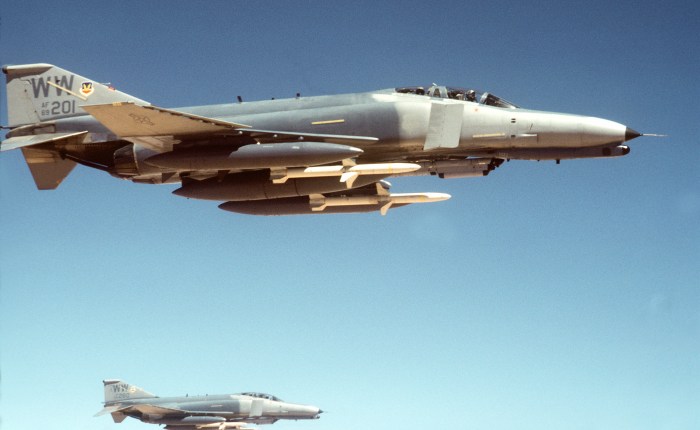
Header Image: Two US Air Force McDonnell Douglas F-4G Phantom II aircraft of the 35th Tactical Fighter Wing pass over the Saudi desert while on a training flight during Operation Desert Shield on 11 January 1991. The aircraft are carrying external fuel tanks on their outboard wing pylons and AGM-88 HARM high-speed anti-radiation missiles on their inboard wing pylons. (Source: Wikimedia)
Editorial Note: From Balloons to Drones is pleased to announce our new podcast series. Led by our Editor Dr Mike Hankins, the series builds on the success of From Balloons to Drones, and provides an outlet for the presentation and evaluation of air power scholarship, the exploration of historical topics and ideas, and provides a way to reach out to both new scholars and the general public. You can find our Soundcloud channel here.
In this episode, we interview Dr Peter Westwick, Director of the Huntington-USC Aerospace History Project, about his new book Stealth: The Secret Contest to Invent Invisible Aircraft. We talk about the design process of stealth planes like the F-117 and B-2 at Lockheed and Northrop and answer the tough questions, like why did stealth research seem to be focused on California? What role did Russian research play in stealth development? And of course, how is Disney connected to all this?
Dr Peter Westwick is a research professor of history at the University of Southern California and Director of the Aerospace History Project at the Huntington-USC Institute on California and the West. He is the author or editor of several books, including Into the Black: JPL and the American SpaceProgram, 1976-2004, which won book prizes from the American Institute of Aeronautics and Astronautics and the American Astronautical Society.
Header Image: The Lockheed F-117 Nighthawk stealth fighter flying over Nellis Air Force Base in 2002. (Source: US Air Force)
The 30th of May 1999 is an important date in the history of the Royal Danish Air Force (RDAF). On this day, Danish General Dynamics F-16s dropped bombs against a hostile target for the first time in its history. The target was in Serbia; a country located more than 1,500 kilometres from Denmark, and with which Denmark was not legally at war. Instead, what the RDAF participated in was a ‘humanitarian intervention’ that was supposed to stop a potential Serbian genocide in the province of Kosovo.
RDAF participation in the intervention against Serbia in 1999 was the end of a period fundamental transformations of the Air Force after the end of the Cold War. In this period, almost every aspect of the RDAF began to change – its doctrine, technology, and central mission. This article explores those changes by looking at the role of the RDAF during the post-Cold War conflicts in Yugoslavia between 1992-1995 and Serbia in 1999.[1]
In 1989, the RDAF was small but versatile. It consisted of more than 100 aircraft, a force of ground-based air defence centred around eight mobile missile batteries (I-HAWKs), seven large airbases, and a well-developed command-and-control-system that maintained a constant aerial picture of Denmark and the surrounding area. Its peacetime force was approximately 8,200 personnel, which could be increased to 17,500 in wartime. The RDAF was well integrated into NATO, and its main task was the defence of the western part of the Baltic Sea in case of an attack from the Warsaw Pact.[2] This was a role the RDAF undertook in conjunction with other NATO partners.
From ‘Peace-dividends’ to the Civil War in Yugoslavia
The fall of the Berlin Wall in November 1989 was one of the most momentous events in the modern history of the Danish defence policy. It prompted a shift away from the low-profile approach that had been the cornerstone of Danish policy since the end of the Second World War. In September 1990 the Danish government deployed the corvette, Olfert Fischer, as part of Operation DESERT SHIELD, the United Nations (UN) sanctioned military operation against Iraq, following the occupation of Kuwait. This deployment illustrated to Danish politicians that there was political capital to be gained from participating in such operations, far from Danish shores. At the same time, the Danish Defence Command, which coordinated and controlled the Danish military, realised that operations far from Denmark were a way to stay relevant and to avoid the hard cuts to the defence budget that some Danish politicians wanted, now that the enemy – the Warsaw Pact – had disappeared.
In 1992, the UN set up a peacekeeping force for the civil war in the former Yugoslavia. The Danish government decided to participate with approximately 940 soldiers – a large contingent by Danish standards. Initial problems with recruiting the needed number of soldiers resulted in a change in Danish military law that now stipulated that members of the Danish military were required to accept participating in missions outside Denmark’s borders. Approximately five per cent of the men and women employed by the Royal Danish Army, the Royal Danish Navy and RDAF chose not to accept this and left the military.[3]
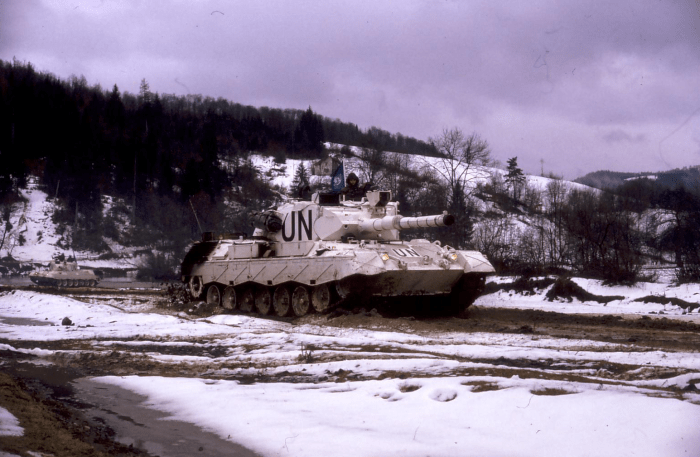
In 1993, the Danish government strengthened the Danish contribution to the UN operation in Yugoslavia by deploying ten main battle tanks. Denmark thus became the first country to deploy such heavy weapons in a UN operation. When Danish politicians voiced concern that the deployment of the Danish tanks would be perceived as a dramatic escalation of UN involvement in the civil war in Yugoslavia, the Danish Armed Forces decided that the tanks should be painted white, giving them the nickname ‘The Snow Leopards.’
The deployment of Danish Leopard 1 tanks to the Former Yugoslavia in 1992 marked an important turning point in Denmark’s defence policy. (Source: Author)
Pressure from International Organisations
The RDAF was initially not deployed on the international stage, other than a single Lockheed C-130 Hercules, which in 1992 flew ten trips as part of the emergency assistance provided to the Yugoslav city of Sarajevo.[4] The pressure to change the RDAF contribution came from NATO, which had begun its transformation towards a smaller, but more flexible organisation, capable of faster response times. This process had already begun before the fall of the Berlin Wall, but it gained further momentum in the 1990s.
In 1991, NATO created two new forces: the Immediate Reaction Forces (IRF), capable of deploying within a few days, and the Rapid Reaction Forces (RRF) with a deployment time of a few weeks. Here the Danish government decided that that the RDAF’s Squadron 730 should be Denmark’s contribution to the IRF.[5]
The contribution of Squadron 730 to NATO’s IRF marked a shift in focus for the RDAF. During the Cold War era, NATO-planning envisaged that British and American squadrons would reinforce the RDAF.[6] NATO had planned to reinforce the RDAF with one Royal Air Force squadron of Hawker Harriers and two squadrons of SEPECAT Jaguars. United States Air Force (USAF) reinforcements were to consist of one squadron of McDonnel-Douglas F-15s, three F-16 squadrons, and one squadron of Republic A-10 Thunderbolts.
The 1990s, however, saw the RDAF shift to an expeditionary role whereby it contributed to the safety of others outside of Denmark’s borders. As such, the importance of making Squadron 730 available for NATO’s IRF cannot be overstated. Squadron 730 became the ‘flagship’ unit of the RDAF.
NATO’s involvement in the Civil War in Yugoslavia
In parallel with the above developments, during the first years of the 1990s, NATO became increasingly involved in the civil war in Yugoslavia. A UN ordered No Fly Zone had to be enforced by NATO, and in February 1994, this led to aircraft from the Alliance coming into action for the first time when US aircraft downed four Bosnian-Serbian fighter jets over Bosnia-Herzegovina.
A Royal Danish Air Force F-35 Drakken aircraft taxis into takeoff position during Exercise OKSBOEL ’86. (Source: Wikimedia)
On several occasions, the Danish government considered contributing Danish aircraft to NATO operations over Yugoslavia. Such a move was, however, hampered by Danish politicians, who in 1991 had decided to scrap all of the RDAF’s Saab Draken aircraft. This meant that the Air Force’s ability to perform close air support had been downgraded to the degree that meant that Danish aircraft was unfit to perform their intended tasks over Yugoslavia. Therefore, despite pressure from NATO, the Danish government had to decline NATO’s request to deploy Danish aircraft over Yugoslavia. This was embarrassing for the Danish government and meant an increased focus on the close air support task. This meant procuring new equipment, such as the Low Altitude Navigation Targeting Infrared for Night laser targeting pods (LANTIRN) that would eventually enable the RDAF’s F-16s to use precision-guided munitions (PGM). However, the acquisition and introduction of such equipment was a long process, and the LANTIRNs were not operational until 2001.
In the Line of Fire – Yugoslavia
On 29 April 1994, while the debate over a possible deployment of RDAF F-16s was ongoing, a Danish tank force became involved in combat operations against Serbian forces near Tuzla in Bosnia and Herzegovina. The Danish tanks were ambushed, resulting in a firefight lasting approximately 45 minutes. The episode was the first time since 1943 that troops under the Danish flag had fought in battle. While the Danes did not suffer any losses, the Bosnian Serbs subsequently acknowledged that they had nine killed and 15 wounded. The battle, known under the name Operation Bøllebank (Operation Hooligan Bashing), became just as important to the Danish military as the deployment of the Olfert Fischer four years earlier. It showed that Danish soldiers were ready to put military power behind international engagement and were able to fight.
Bøllebank also showed the soldiers, airmen and sailors in the Danish military that post-Cold War UN-operations were fundamentally different from the peaceful UN-missions that Denmark had participated in before 1989. It became clear to the Danish military that personnel deployed on such a mission could be called on to undertake combat operations. Finally, Bøllebank also illustrated a high degree of political and popular support for the Danish participation in the UN-operations, which subsequently helped to expand the Armed Forces’ maneuvering room in connection with these operations.[7]
RDAF Pressure for Change
During the 1990s the RDAF tried on numerous occasions to convince Danish politicians to deploy Danish planes to the civil war in Yugoslavia. This was driven by a fear that the RDAF’s lack of an international profile would make it difficult to secure funding for new equipment. The various professional heads of the RDAF in this period all wanted to make the entire Air Force deployable, including such elements as the Hawk missile system and radars. Following recommendations from the Danish Defence Command, Danish politicians decided to invest much money in new and more mobile equipment, and the RDAF’s Hercules and Gulfstream transport aircraft were equipped with, among other things, missile warning equipment to enable them to operate in dangerous areas.[8]
The RDAF also devoted resources to developing a Danish doctrine for the operational use of air power. The RDAF was inspired by USAF Colonel John Warden’s theories regarding the strategic use of air power, especially his 5-ring model of the enemy as a system. These ideas were used to set the direction for the development of the RDAF and to provide inspiration for how Danish aircraft could be used in the event of a conflict.[9]
From Operation DELIBERATE FORCE to Operation ALLIED FORCE
Following Operation DELIBERATE FORCE, the NATO air campaign over Bosnia and Herzegovina between 30 August and 20 September 1995, the civil war in Bosnia was stopped with the so-called Dayton Agreement. This peace deal ended a civil war that had cost more than 100,000 lives and driven more than four million people from their homes. Thanks to the deployment of a UN peacekeeping force of 60,000 personnel, Bosnia and Croatia have since been mostly peaceful.[10]
In the shadow of the civil war, however, another conflict lurked. Within the Federal Republic of Yugoslavia, which after 1995 consisted of Serbia and Montenegro, a significant minority of ethnic Albanians constituted much of the population of the southern Serbian province of Kosovo. The conflict between the ethnic Serbs minority and the ethnic-Albanian majority in Kosovo dated back hundreds of years but escalated in 1989 when Yugoslav President Slobodan Milosevic deprived Kosovo of the expanded autonomy enjoyed by the region since 1974.
During the 1990s, the political environment in Kosovo gradually grew worse, and by 1998 large parts of the province were no longer under Serbian control. The Serbian military and police, therefore, initiated a particularly hard-fought effort in Kosovo to restore control of the province – preferably by cleansing the province of ethnic Albanians.[11]
Among other things, because of the experience of the Srebrenica massacre in 1995, the world community could not let the Serbs pursue a campaign of ethnic cleansing in Albania. An American-led attempt to find a peaceful solution was therefore made, and the American diplomat Richard Holbrooke was given the task of trying to negotiate a solution.
Operation DETERMINED FALCON
To put pressure on the Serbian president, on 14 June 1998, NATO gathered a force of approximately 80 fighter jets from 12 countries. In Operation DETERMINED FALCON, these aircraft flew along the Serbian border and illustrated to the Serbian President that NATO was ready to use military power if the Serbs did not halt the ethnic cleansing in Kosovo.
For this operation, Denmark provided three F-16 aircraft (two plus one in reserve) at just two days’ notice. At 17:30 on 15 June 1998, Danish F-16s, together with a C-130 Hercules carrying support personnel and ammunition, flew to the Italian airbase at Villafranca. The next morning two Danish F-16s took part in the operation along the southern Serbian border to Macedonia and Albania. After a successful operation, the Danish aircraft returned to Denmark.[12]
During the summer of 1998, Richard Holbrooke managed to reach an agreement including the withdrawal of some Serbian forces from Kosovo. Whether DETERMINED FALCON played a role in that agreement or not is unclear.[13] However, the agreement did not last, and in September 1998, up to 300,000 Kosovo Albanians were once again on the run in Kosovo. These refugees threatened to destabilise the entire region and create a flow of refugees in Europe, such as those the world had witnessed during the 1997 collapse of Albania. The European authorities were very aware of this, and the European Union put much effort into stopping the Serbian cleansing of the ethnic Albanian population of Kosovo.
Towards Operation ALLIED FORCE
Concurrent with this process, NATO began planning a military operation. On the 8 October 1998, the Danish government made available six F-16s (four operational plus two reserve aircraft) and support personnel, totalling 120 men, for a NATO operation named OPLAN 10601 ALLIED FORCE. This operation was designed to compel the Serbs to return to the negotiating table and ensure that the Serbian forces left Kosovo by the 16 October.
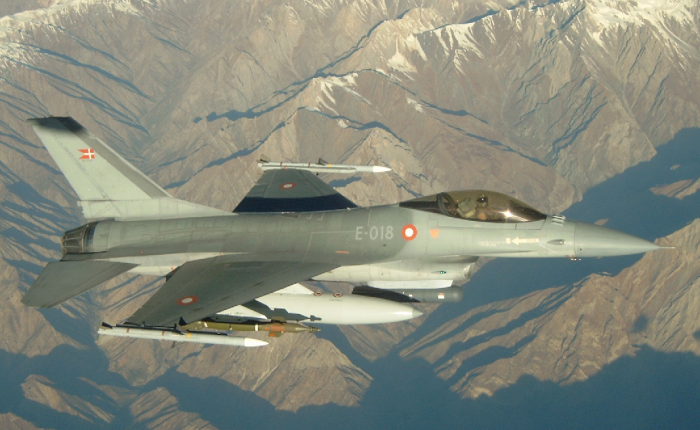
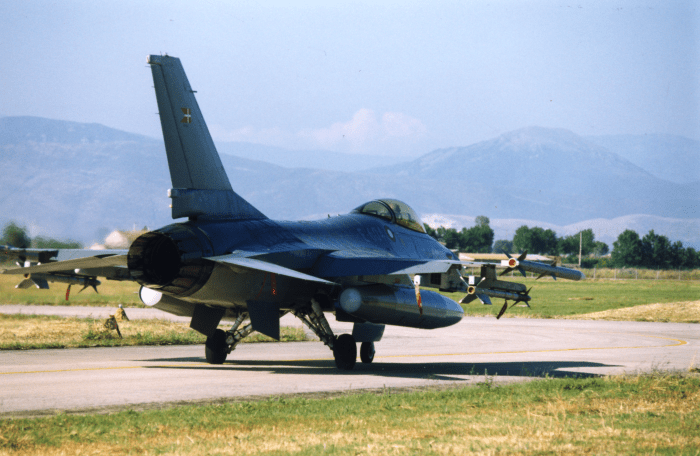
One of the six RDAF F-16s deployed as part of Operation ALLIED FORCE in 1999. (Source: Author)
The Danish F-16s and most of the personnel initially came from Squadron 730. At the time, however, the RDAF had only 36 pilots with current operational experience on the F-16 aircraft. This figure included pilots serving at the RDAF headquarters as staff officers. The Danish contribution to ALLIED FORCE required six pilots in Italy, six on standby in Denmark and six for other operations, including those on leave at home in Denmark. The deployment thus required half of the RDAF’s available F-16 pilots. This problem was further exacerbated by the fact that all the deployed pilots had to be certified for the weapons systems that were expected to be used during the operation.
ALLIED FORCE, therefore, put much pressure on the entire fighter structure and operations of the RDAF. This pressure meant that all tasks that did not directly relate to air policing the skies over Denmark or ALLIED FORCE were discontinued. For example, among other things, Squadron 727 suspended the training of new pilots, while most of its pilots were deployed to Italy. In the long run, this would ultimately have an impact on the RDAF’s ability to meet its readiness level.[14]
Thanks to political and military pressure, in February 1999, it proved possible to persuade both representatives of the Kosovar rebel movement Kosovo Liberation Army and the Serbian government to initiate negotiations about the future of Kosovo. These took place at the French president’s summer residence at Chateau de Rambouillet, southwest of Paris. On the 18 March, however, it became clear that the negotiations would not lead to a deal, and with the negotiation options exhausted, NATO Secretary-General Javier Solana had no other options than on the 23 March to initiate Operation Allied Force. At 19:00 the following night, NATO began launching airstrikes against Serbian targets in Kosovo and Serbia.
The Danish Experience
RDAF F-16s participated in ALLIED FORCE from day one; however, the operation came at an unfortunate time. In addition to the aforementioned pilot issue, the RDAF was in the middle of a midlife update of its F-16s, and the number of operational aircraft was significantly reduced. Initially, the RDAF only had 14 F-16s capable of participating in the air campaign. This meant that the aircraft deployed during the air campaign worked up so many flight hours that had they operated in peacetime they would have had to be sent home to Denmark for inspection. To alleviate this issue, the RDAF’s Tactical Command issued exemptions from the rules to keep the aircraft flying.
For most of the air campaign, Danish F-16s operated in the defensive role. This was a necessary part of ALLIED FORCE. The Air Force of Yugoslavia – even though most of its fighter jets were of an older design – posed a potential threat to NATO had they chosen to resist the Alliance’s attack. However, after having lost four jets during the first days, the Air Force of Yugoslavia chose to keep most of its aircraft on the ground. Nevertheless, political demands from NATO-member states meant that approximately 33 per cent of Alliance aircraft were devoted to the air defence role against potential attacks by the Air Force of Yugoslavia.[15]
On these combat air patrols, Danish F-16s operated in pairs. Initially, their patrol zones were located over the Adriatic Sea, where the essential air tankers operated. As NATO became more confident that Serbian forces would not try to counter NATO operations, the patrol zones moved to the area over Albania and Macedonia and later also Hungary. This allowed the American jets, which had until then patrolled these areas, to be transferred to offensive operations.
Since Danish F-16 pilots were not equipped with night-vision-goggles, they were used in daylight operations. During one patrol over Kosovo, a Danish F-16 was fired at by a Serbian ground-to-air missile, which did not, however, successfully hit its intended target.[16]
Danish Offensive Air Power
While Danish F-16s primarily focused on the air defence role, in the final days of the air campaign, the RDAF aircraft became involved in offensive operations against Serbian targets.
The first Danish bombs were dropped on the 30 May. The details of the attack are still classified, but what is known is that the target was a radio mast in northern Kosovo and that the two F-16s each dropped six MK-82 bombs. From an altitude of 11,000 feet, the pilots visually observed the bombs hitting the target area. For the attack, the Danish planes used ‘dumb’ bombs. The primary reason for this was that it was not necessary to use a more expensive laser-guided bomb (LGB) on the target. Secondly, an attack with an LGB would have required ‘buddy’ lasing. This technique involved one aircraft illuminating the target with a laser and guiding the LGB, dropped from a second aircraft, towards the target. As well as the above, there was also uncertainty about which pilot was responsible for the bomb if it caused collateral damage. The RDAF, therefore, chose to use dumb bombs where there was no doubt that the Danish F-16s were fully responsible for weapons released.
According to one of the pilots involved in the 30 May attack, the target area had visible bomb damage before the Danish attack. The Danish bombs hit close to the target, but due to the uncertainty about the target’s condition before the attack, the military value of the attack was uncertain. For the RDAF, however, the attack was a significant event as it was the first time Danish aircraft had dropped bombs on an adversary.[17]
For the RDAF, its participation in ALLIED FORCE was a test of whether the Air Force had achieved the transformation that the leaders of the Air Force had wanted. The RDAF’s goal in the 1990s had been to create an air force capable of participating in an air campaign alongside its NATO-allies as well as executing the same type of missions as the USAF or the RAF. The RDAF’s conclusion following ALLIED FORCE was that this goal had not been met.
While participation in ALLIED FORCE was historic, with Danish aircraft bombing hostile targets for the first time in its history, the air campaign showed that the RDAF had fallen behind technologically when compared with Denmark’s NATO allies and especially the United States. The RDAF therefore, subsequently initiated a process to catch up with these technological deficiencies. Thus, ALLIED FORCE accelerated the RDAF’s transformation into an ‘expeditionary air force’ tailored for international operations.
A critical element of this transformation was a focus on precision-guided munitions to avoid collateral damage. The effect of participation in ALLIED FORCE was the acceleration in the acquisition of new equipment, such as LANTIRN, and ammunition for the Danish F-16s. When the RDAF deployed in support of US forces in Afghanistan following the terrorist attacks on the 11 September 2001, the Air Force’s technology level had been significantly improved.
Conclusion – From Defense of the Baltic to Global Reach
The transformation described in this article meant that the RDAF in 2000, compared with 1989, had been reduced by the following: a 50 per cent reduction in air stations; a 50 per cent reduction in fighter pilots; the number of Hawk squadrons had been reduced by 25 per cent; and the number of fighter aircraft in the RDAF inventory had reduced by 35 per cent. Similarly, the peacetime force had been reduced by 17 per cent to approximately 7,900, while the wartime force had been reduced by 26 per cent to 14,800. These cuts had not only hit the RDAF, but the overall number of personnel in the Danish armed forces had been reduced from 39,000 to 33,200, while the wartime force had fallen from 103,000 to 81,200.
The RDAF had, however, at the same time managed to survive the loss of the Warsaw Pact as its enemy, and had shown Danish politicians that improvements in the RDAF’s capabilities allowed it to participate in international operations far from Denmark. The lack of success in the skies above Kosovo in 1999 was therefore not seen as a failure for the RDAF but as evidence that the Danish politicians needed to spend more money on the Air Force in order to reap the benefits of participating in international operations. This policy eventually showed its merit during the air war over Libya in 2011-2012, where Danish F-16s dropped 923 bombs on Gadhafi’s military forces and showed that they were able to work closely together with the USAF and other allies – a prerequisite today for being on the front line during international missions.
Dr Søren Nørby is a researcher and lecturer at the Royal Danish Defense College in Copenhagen. He earned his PhD from Syddansk Universitet in 2018. He specialises in naval history and is the author of 25 books and more than 50 articles. For more information see www.noerby.net.
Header Image: Based on the experience of the operations over the former Yugoslavia during the 1990s, the RDAF underwent a number of critical transformations. One of these transformations was the introduction of new technologies to improve capabilities, such as the LANTIRN pod for use of on the F-16 that came into service in 2001. (Source: Author)
[1] This article is based on the author’s book Når Fjenden Forsvinder. Det danske flyvevåbens udvikling 1989 – 1999 (When the enemy disappears. The transformation of the Danish Air Force 1989-1999) (Odense, 2019).
[3] Forsvarskommandoen, Ved Forenede Kræfter (Vedbæk, 2000), p. 210; H. Hækkerup, På Skansen. Dansk forsvarspolitik fra Murens fald til Kosovo (København 2002), p.. 103.
[4] ’Rapport fra Udvalget vedrørende forsvarets materiel’, København 1998, p. 164.
[5] Ringsmose, Danmarks NATO-omdømme. Fra Prügelknabe til duks (Dansk Institut for Militære Studier 2007), p. 19; ‘Årlig Redegørelse 2004’, København 2005, pp. 34-5.
[7] L. Møller, Det danske Pearl Harbor. Forsvaret på randen af sammenbrud (København, 2008), p. 57; R. Petersen, ’Den bedste ambassadør – civil-militære relationer og demokratisk kontrol i Danmark 1991-2011’ (Phd Thesis, Roskilde Universitet, 2012), p. 207ff; R. Petersen, ’Danske sneleoparder i Bosnien,’ Militært Tidsskrift, 2010; P.V. Jakobsen, Fra ferie til flagskib. Forsvaret og de internationale operationer (København, 2009), p. 9; P.V. Jakobsen, ’The Danish Libya campaign: Out in front in pursuit of pride, praise and position,’ Upubliceret artikel, 2016, p. 195; K.S. Kristensen, Danmark i krig: Demokrati, politik og strategi i den militære aktivisme (København, 2013), p. 38; L. From, ’Da et kampvognsslag ændrede danskernes syn på krig,’ Jyllands-Posten, 3 May 2015; ’Balkan har reddet det danske forsvar,’ FOV Nyhedsbrev 7/2002.
[8] S. Hartov and J.E. Larsen, Forsvarets fly efter 1945 (Flyvevåbnets Specialskole, 1995), p. 36ff.
[9] John Warden III, The Air Campaign. Planning for Combat (Washington 1988).
[10] M.O. Beale, ‘Bombs over Bosnia. The role of airpower in Bosnia-Herzegovina’ (Thesis, USAF School of Advanced Airpower Studies, 1997), pp. 33-4; Christian Anrig, The quest for relevant air power: continental European Responses to the air power challenges of the post-cold war era (Maxwell, AL, 2011), p.. 32, 179; M. Juul and S.W. Nielsen, 12 år på Balkan (København 2004), p. 46; John Olsen (ed.), Air Commanders (Dulles, VA, 2013), p. 356ff; C. Axboe, Vi troede ikke, det kunne ske her – Jugoslaviens sammenbrud 1991-1999 (København, 2018), p. 227-53.
[12] I. Daalder and M. O’Hanlon, Winning Ugly. NATO’s War to Save Kosovo (Brookings Institution Press, 2001), pp. 32-3; G. Schaub, Learning from the F-16 (København, 2015), p. 19ff.; M. Vilhelmsen, ’Operation Allied Force (AOF): Da Flyvevåbnet med voksent,’ Upubliceret. Vojens, 2010, p.. 2; ’Rapport vedr. dansk flyvevåben deltagelse i Operation Allied Force,’ 12 november 1999, B2-B3; Årlig Redegørelse 1998, pp.. 33-6.
[14]Hammerkasterne: Historien om Eskadrille 727 gennem 50 Ar (Skrydstrup, 2005), p. 162-3; ’Flugten er stoppet – men stadig mangel på F-16 piloter,’ Berlingske Tidende, 7 May 1999; ’Rapport vedr. dansk flyvevåben deltagelse i Operation Allied Force,’ 12 November 1999, p.. B-11 og D-10. TTJ og ’F-16 planlægningsmøde vedr. evt. overgang til anvendelse af F-16 MLU i f.m. Flyvevåbnets deltagelse i Operation Allied Force,’ 8 March 1999.
The advent of stealth technology – making aircraft nearly invisible to radar detection – in the 1970s was one of those rare moments in the history of military aircraft technology that seemed to shape much of the development that followed it. Over 40 years later, most new aircraft designed around the world incorporate stealth characteristics in some way or another. Taking a sweeping look at the advent and early development of stealth aircraft within a broad context is the aim of Stealth: The Secret Contest to Invent Invisible Aircraft by Peter Westwick, director of the University of Southern California’s Aerospace History Project. The book is a fascinating look at two companies, Lockheed, and Northrop, that continually competed for stealth projects – each coming at the technology from very different perspectives and methodologies. With this comparative lens, Westwick explores the ways that culture shaped each company’s differing solutions to similar technological problems.
The most significant limitation for any book about stealth is the lack of unclassified sources, and this book is no exception. While much of the material here will be familiar to stealth aficionados, Westwick has conducted a large number of new interviews that shed new light on some familiar events, and reveal new, fresh stories, many that speak to the unique personal experiences of those involved in stealth development.
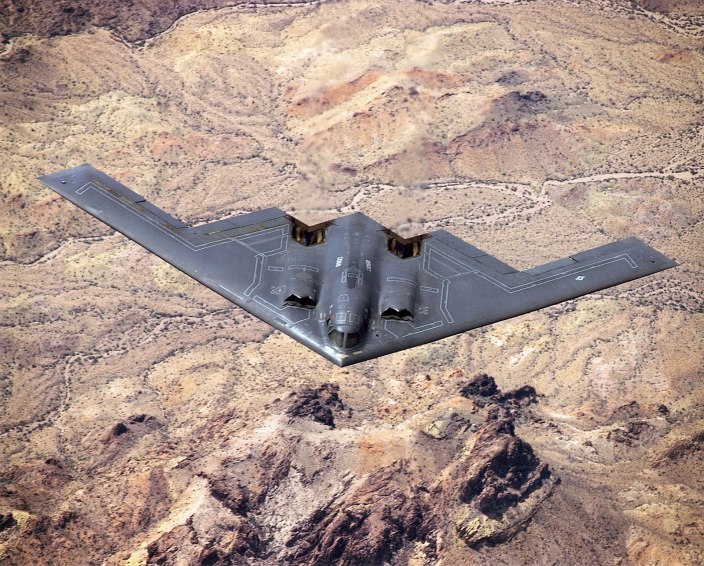
The Northrop B-2 Spirit stealth bomber on its first flight in 1989. (Source: US Air Force)
Westwick emphasises that Lockheed’s approach to stealth relied extensively on computer modelling, which was a significant shift for the firm at the time. For decades, successful designs from Lockheed, including the A-12 and SR-71 Blackbird, which each incorporated stealth characteristics, had been grounded in Chief Executive Officer, Clarence ‘Kelly’ Johnson’s adage that planes that look beautiful fly beautiful. When Johnson retired, his replacement Ben Rich allowed radar experts to have a more significant say in the design process. Their creation of powerful computer programs that could calculate radar returns from a variety of shapes fueled their design process. Nevertheless, the limitations of the program influenced the team to rely on flat, faceted surfaces – an approach that was quite successful, winning the company that contract for the aircraft that became the F-117 Nighthawk.
Lockheed’s programs made use of Soviet research that, ironically, had been requested for translation by engineers at Northrop. Although Northrop also incorporated this research and made similar computer modelling programs, their engineers combined them with a more intuitive approach. Northrop designers used their extensive knowledge of radar theory in a more hands-on way, often literally through iterative modelling and moulding. One of the more dramatic moments of Westwick’s narrative involves Northrop engineer Fred Oshiro visiting Disneyland and sitting outside the Tea Cup ride playing with a lump of modelling clay – a common practice at Northrop – until he intuitively developed the idea of using complex curves to minimize radar returns. The Tea Party ride had been designed by Lockheed engineer and stealth pioneer Richard Sherrer.
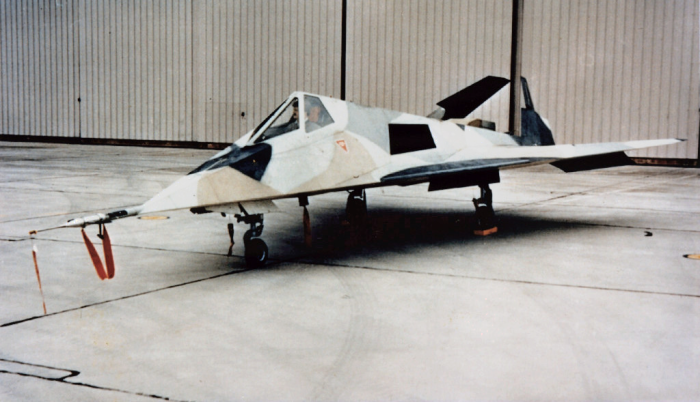
The Lockheed Have Blue prototype that eventually led to the F-117 Nighthawk stealth fighter. (Source: US Air Force)
This tale of two engineering houses, each with different cultural approaches to designing stealth, forms the backbone of the story, which traces the development of the Have Blue, F-117, Tacit Blue, and B-2 programs. Along the way, Westwick dispels some prevalent misconceptions that frequently crop up in discussions of stealth. For example, some readers might assume that Northrop’s B-2 design was a ‘flying wing’ conception because the company was founded by Jack Northrop, who was obsessed with flying wings and designed several himself. However, Westwick reveals the company had completely abandoned the idea for decades, and only adopted it after Lockheed had submitted their flying wing bomber concept. Another of the more dramatic moments in the book involves the aging Jack Northrop’s heartwarming response to seeing the B-2 designs, which I will not spoil in this review.
Westwick goes beyond the analysis of these companies and attempts to place the development of stealth in a larger context in terms of culture, strategy, and Cold War geopolitics. This includes implying that the inherent creativity around the ‘[i]magineering’ culture of Disney that pervaded California in the 1960s and 70s was a contributing factor to stealth development. On a broader scale, Westwick goes as far as to say that stealth provided an alternative to nuclear deterrence, in some ways making nuclear weapons obsolete. He argues that stealth delivered what President Ronald Reagan’s fanciful Strategic Defense Initiative could only promise. With the ability to essentially defeat the Soviet Union’s massive investment into radar-based air defence networks, stealth broke the foundation of Cold War deterrence theory, and, according to Westwick, pressed the Soviet Union into an unsustainable increase in defence spending that contributed to the nation’s collapse. These ideas are interesting and worthy of consideration, but Westwick’s presentation of them is far too brief; these ideas are not nearly as fully developed as they could be. That does not take anything away from the book as it is. To really make these larger points hit home would probably require a different type of book with a different focus. However, this type of overarching analysis is welcome and thought-provoking, perhaps pointing to further research directions on how stealth technology contributed to the end of the Cold War in specific ways.
Overall, the book is an excellent addition to any air power or history bookshelf. This book manages to be the best starting point for those new to the topic of stealth while also providing new insights and details for the already initiated. Even more impressive, Westwick delivers these contributions while writing in an engaging and personal style that is great to read and sure to be enjoyed by scholars and still easily accessible for enthusiasts and general readers.
Dr Michael Hankins is the Curator of US Air Force History at the Smithsonian National Air and Space Museum. He is a former Professor of Strategy at the USAF Air Command and Staff College eSchool, and former Instructor of Military History at the U.S. Air Force Academy. He earned his PhD from Kansas State University in 2018 with his dissertation, ‘The Cult of the Lightweight Fighter: Culture and Technology in the U.S. Air Force, 1964-1991.’ He completed his master’s thesis at the University of North Texas in 2013, titled ‘The Phantom Menace: The F-4 in Air-to-Air Combat in the Vietnam War.’ He has a web page here and can be found on Twitter at @hankinstien.
Header Image: The Lockheed F-117 Nighthawk stealth fighter flying over Nellis Air Force Base in 2002. (Source: US Air Force)
Birds and aircraft have a fundamental problem: their range and endurance are limited. To remain aloft requires the expenditure of energy. Eventually, birds must land and rest, and aircraft must refuel. The invention of nuclear power in the 1940s appeared to offer a way to cut this Gordian knot. A nuclear-powered aircraft could, it seemed, provide dramatically improved range and endurance compared to chemically fuelled powered aircraft.
Such ambitions were strengthened as the Cold War between the US and the USSR worsened. The Cold War released immense funding for military purposes while providing an operational rationale: a requirement for very long-range bombers able to strike military-industrial complexes deep in the Soviet heartland. The generous funding now available meant numerous new high technology possibilities could be considered, built, trialled and if successful enter mass production. An obvious candidate to research and investigate seemed nuclear-powered aircraft.
The original ideas about using nuclear power for aircraft propulsion had appeared around 1944. These led to a minor research program, the Nuclear Energy for the Propulsion of Aircraft study, beginning in mid-1946. Undertaken by Fairchild, this examined reactor technologies and engine transfer systems. These studies proved encouraging and so in 1951, with the Cold War deepening, the United States Air Force (USAF) proposed to begin actively developing manned aircraft nuclear propulsion. Contracts were let for three main elements: two X-6 prototype test aircraft, a nuclear propulsion system (reactor and turbojets) and an NB-36H reactor flight-test aircraft.
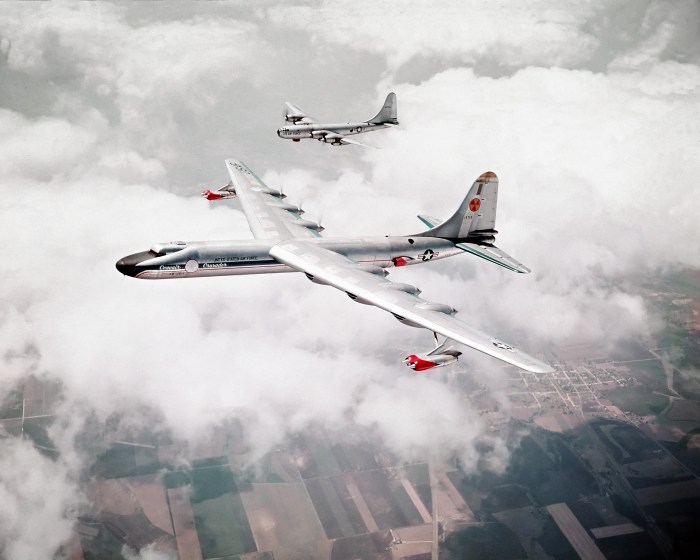
An air-to-air view of the Convair NB-36H Peacemaker experimental aircraft and a Boeing B-50 Superfortress chase plane during research and development taking place at the Convair plant at Forth Worth, Texas. This plane was called the Nuclear Test Aircraft (NTA) and was redesignated XB-36H, then NB-36H. The NTA completed 47 test flights and 215 hours of flight time (during 89 of which the reactor was operated) between July 1955 and March 1957 over New Mexico and Texas. (Source: Wikimedia)
Convair received the X-6 contract. The aircraft was envisaged as being of comparable size to the company’s B-36 Peacemaker bomber with a length of 50m, a wingspan of 70m and an empty weight of some 100 tonnes. The X-6 was planned to have 12 turbojets; eight conventionally fuelled used for take-off and landing, and four nuclear-powered used during in-flight trials. This was an ambitious but expensive test program and was cancelled by the incoming Eisenhower administration in 1953 on budgetary grounds. However, the other two elements continued.[2]
General Electric was awarded the propulsion contract, progressively developing across 1955-1961 three direct-cycle nuclear power plants under the ground-based Heat Transfer Reactor Experiment (HTRE) test-rig program. The final HTRE-3 propulsion system featured a solid moderator using lightweight hybrided (sic) zirconium instead of water, a horizontal reactor to meet aircraft carriage requirements and produced sufficient heat to power two X-39-5 (modified J-47) turbojets simultaneously. HTRE-3 had several firsts including demonstrating an all-nuclear turbojet start, having a primary shield able to handle radiation levels expected in flight and in being designed for in-flight stresses, air pressures, temperatures, and G loadings.[3]
The third element was to flight test a reactor. In mid-1952, Convair was contracted to modify two B-36 aircraft: one for a ground test, the other for flight test and designated as the NB-36H. The major modifications involved firstly, the crew compartment and avionic cabin being replaced by an 11-tonne nose section lined with lead and rubber to protect against reactor radiation and secondly, the rear internal bomb bay being altered to allow fitment of the 16-tonne reactor. Less apparent were the cockpit glass transparencies being some 30cm thick and nine water-filled shield tanks in the fuselage to absorb any escaping radiation.[4]
In the meantime, the USAF was firming up its requirements. In March 1955, General Operational Requirement (GOR) No. 81 was issued seeking a nuclear-powered weapon system, WS-125A. Aspirations included a range of about 10,000nm, an operating altitude of 60,000-75,000ft and an endurance of perhaps more than a week airborne.[5] WS-125A was to have a cruise speed of at least Mach 0.9, desirably offer supersonic dash in the target area and enter service with operational units in 1963.[6] Realising such high ambitions was to prove problematic.
In July 1955, the NB-36H began flight test with the reactor going critical in flight for the first time in September. The reactor did not power the aircraft, instead of being tested to verify the feasibility of a safe, sustained nuclear reaction on a moving platform. For each NB-36 flight, the one-megawatt reactor was winched up into the bomb bay at a dedicated pit at Convair’s Fort Worth plant and then removed again after landing.[7] When in flight, the aircraft was accompanied by a radiation-monitoring B-50 (a slightly updated B-29) and a C-119 transport aircraft carrying paratroopers able to be dropped to secure any crash site and limit bystander exposure to radiation.[8] In total, the NB-36H made 47 flights, ceasing flying in March 1957.
The results of the nuclear propulsion tests and the NB-36H were mixed. HTRE-3 had proven nuclear-power turbojet feasible and that a flyable propulsion unit could be built albeit technical challenges remained. The major problem was that it was hard to build a nuclear reactor small enough to fit into aircraft, but which produced the operationally significant energy output required. It seemed that using contemporary technology would mean nuclear-powered aircraft were relatively slow. For a time, concepts of ‘nuclear cruise, chemical dash’ were investigated; supplemental aviation fuel would allow supersonic dash in the target area.[9]
Moreover, the NB-36H flight programme highlighted the hazards associated with operating such nuclear-powered aircraft. While well-shielded aircraft would not normally pose radiation dangers to air or ground crew, there were worries that accidents and crashes might release fission products from the reactors, and about the dosage from prolonged human exposure to leakage radioactivity.[10] In this, the test flights mainly served to draw attention to the real difficulties that would arise in working with nuclear fuel in operational service conditions.[11]
WS-125A was accordingly cancelled in early 1957. However, there remained occasional flickers of renewed interest in nuclear-powered aircraft into the early 1960s. The Continuously Airborne Missile Air Launcher (CAMAL) concept called for a nuclear-powered strike aircraft able to stay aloft on airborne alert for 2-5 days. This led into Dromedary, a turboprop design capable of an airborne alert for 70-100 hours and able to stand-off outside hostile territory and launch the 600-1000nm Skybolt ballistic missile.[12] These ideas meant research into aircraft nuclear propulsion continued although in only a fairly desultory fashion. This finally ended in 1961 when the new Kennedy administration reallocated funding.
The US Navy had also occasionally expressed interest in nuclear-powered turboprop flying boats. In April 1955, Operational Requirement CA-01503 sought a nuclear-powered seaplane capable of high subsonic speeds primarily for the attack of ports and warships using conventional and nuclear weapons with the secondary roles of mining and reconnaissance. The USN desired to have a prototype available for its evaluation no later than 1961. By mid-1956 the Navy had decided a solely-USN power plant was unjustifiable and that the Navy’s aircraft would use the USAF’s WS-125A power plant. The cancellation of the WS-125A thus terminated the USN’s plans as well.[13] At one stage, it seemed the UK might sell three mothballed Princess-class flying boats to the USN for nuclear-power trials, but funding oscillated and eventually was not forthcoming.[14]
Further afield, the USSR was also busy. In the late 1950s Tupolev designed but did not build two nuclear-powered bombers: the subsonic Tu-119 and supersonic Tu-120. The Soviet leadership thought the projected payloads and speed were inadequate for the costs involved. Tupolev was though authorised to continue research on nuclear aircraft.[15] Accordingly, a Tu-95 turboprop bomber was modified at a nuclear complex near Semipalatinsk in Kazakhstan to allow flying a nuclear reactor, becoming the Tu-95LAL (Letayushchaya atomnaya laboratorya – flying atomic laboratory).[16] Mirroring the NB-36H trails, some 34 Tu-95LAL flights were undertaken in 1961 with the reactor on board but without providing propulsion. The tests similarly revealed that a nuclear-powered aircraft was impractical with the technology of the time. The gain in performance from not carrying chemical fuel was consumed by the heavy reactor and shields and so Soviet interest in nuclear-powered aircraft declined.[17]
The Tu-95LAL test aircraft. The bulge in the fuselage aft of the wing covers the reactor.(Source: Wikimedia)
In the end, a better technological solution won out. For both the US and the USSR, the ICBM fitted with lightweight thermonuclear warheads offered a much better answer to the problem of a long-range, highly survivable nuclear strike. The considerable effort and funds expended in investigating nuclear-powered manned aircraft yielded much technical information and engineering expertise but ultimately little else. This was not for lack of interest in the defence aerospace industry. At the time, Kelly Johnson of Lockheed’s Skunk Works fame wrote:
After a half century of striving to make aircraft carry reasonable loads farther and farther, the advent of a [nuclear] power plant that will solve the range problem is of the utmost importance […] this unique characteristic is one to be greeted enthusiastically.[18]
Dr Peter Layton is a Visiting Fellow at the Griffith Asia Institute, Griffith University. His PhD is in grand strategy, and he has taught on this at the US National Defense University. He is the author of the book Grand Strategy.
Header Image: An NB-36H producing contrails in flight. (Source: Wikimedia)
[1] This post partly draws on the author’s Chapter in Michael Spencer (ed.), Nuclear Engine Air Power (Canberra: Air Power Development Centre, 2019). This book discusses contemporary nuclear-powered propulsion systems for aircraft and missiles.
[2]. Jay Miller, The X-Planes: X-1 to X-31 (Arlington: Aerofax, 1988), pp. 69-73.
[3]. F.C. Linn, Heat Transfer Reactor Experiment No.3: Comprehensive Technical report, General Electric Direct-Air Cycle Aircraft Nuclear Propulsion Program (Cincinnati: General Electric Company, 1962), pp. 15-18.
[5]. Theo Farrell, ‘Waste in weapons acquisition: How the Americans do it all wrong,’ Contemporary Security Policy, 16:2 (1995), p. 194; ‘Thoughts on WS-110A,’ Flight, 10 January 1958, p. 44.
[6]. Comptroller General of the United States, Review of the Manned Aircraft Nuclear Propulsion Program of the Atomic Energy Commission and the Department of Defense, B-146749, 28 February 1963, p. 133
[11]. Bruce Astridge, ‘Propulsion,’ in Phillip Jarrett (ed.), Faster, further, higher: leading-edge aviation technology since 194 (London: Putnam, 2002), p. 134.
[12]. Peter J. Roman, ‘Strategic bombers over the missile horizon, 1957–1963,’ Journal of Strategic Studies, 18:1 (1995), pp. 208-13.
[13]. Comptroller General, Review of the Manned Aircraft Nuclear Propulsion Program, pp. 134-40.
[14]. Raymond L. Garthoff, ‘The Swallow and Caspian Sea Monster vs. the Princess and the Camel: The Cold War Contest for a Nuclear-Powered Aircraft,’ Studies in Intelligence, 60:2 (2016), p. 3.
[15]. Arthur J. Alexander, ‘Decision-Making in Soviet Weapons Procurement,’ Adelphi Papers, 18:147-148, (1978), p.32.
[16]. Garthoff, ‘The Swallow and Caspian Sea Monster vs. the Princess and the Camel,’ p. 2.
[17]. Piotr Butowski, ‘Steps Towards Blackjack,’ Air Enthusiast, 73 (1998), p. 40.
[18]. F.A. Cleveland and Clarence L. Johnson, ‘Design of Air Frames for Nuclear Power’, quoted in Bikowicz, Decay.
There has been no cooling in the publication of space-related material in the aftermath of the Apollo 11 50th Anniversary. Partially in response to NASA’s returning astronauts to space from American soil this year and partially in response to an undeniable zeitgeist, NASA is enjoying renewed popular support. This provides an excellent opportunity for the publication of further scholarship about the history of the organisation. Academic presses (Florida, Nebraska, and Purdue) have been working hard to expand, and further our understanding of not only crewed exploration of the cosmos, but also the choices made in advance of rockets leaving the launch pad. To that end, Purdue University has recently published John Houbolt: The Unsung Hero of the Apollo Moon Landings by William F. Causey. Causey’s Houbolt examines NASA’s decision-making process through the lens of an individual. This approach places emphasis on the members of NASA–this is their story and not the story of the astronauts riding rockets. That being said, Causey’s book is no less amazing than the stories of the astronauts themselves and by pulling back the curtain, Causey deftly reveals the backstory and offers a fresh look at how NASA ultimately decided the method that would lead to footprints on the moon.
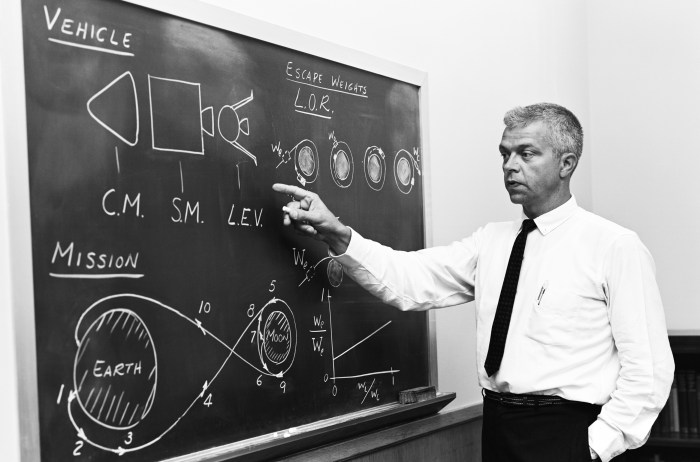
My introduction to the mind of John Houbolt, and I would wager some our readers as well, came in the form of the HBO mini-series From the Earth to the Moon (based in part off the book A Man on the Moon: The Voyages of the Apollo Astronauts by Andrew Chaikin). In the episode ‘Spider,’ Houbolt is shown as the ‘voice in the wilderness’ who bravely stood against senior NASA leaders to preach the gospel of Lunar Orbit Rendezvous (LOR) as the preferred method of sending astronauts to the moon.
Causey’s work demonstrates that the history of LOR is richer than just Houbolt’s contributions and the entire work is as much a history of NASA’s early years and its decision-making process as it is about Houbolt himself. This is a book about how we got to the moon, or rather, about how NASA decided how we would get to the moon. Causey’s work covers the period from roughly 1957 to 1963 and represents a comprehensive and readable history of NASA’s early years, but one that still brings a fresh and nuanced perspective to a familiar story.
On 24 July 1962, Dr John Houbolt explained his lunar orbit rendezvous concept for landing on the Moon. His approach called for a separate lander which saved weight from the ‘direct ascent’ design in which the entire spacecraft landed on the lunar surface. (Source: NASA)
This is a vital book as it refocuses attention on the thousands of people who aided our ascension to deep space for the first time. While the written record has generally favoured the importance of the astronauts themselves in numerous books, biographies, and autobiographies, the recent trend in focus on the individuals behind the scenes has improved our understanding of the golden age of NASA and crewed spaceflight. Causey’s biography of Houbolt now sits alongside other recent publications including Sonny Tsiao’s Piercing the Horizon: The Story of Visionary NASA Chief Tom Paine, Richard Jurek’s The Ultimate Engineer: The Remarkable Life of NASA’s Visionary Leader George M. Low and Rick Houston and Milt Heflin’s Go, Flight! The Unsung Heroes of Mission Control, 1965-1992. This is important for several reasons, but perhaps most of all because these books continue to expand our understanding of NASA as an organisation composed of thousands and not as one whose principal employees are those at the end of propellant-fueled rockets.
Causey writes with a deftness and a flair that keeps the narrative moving forward even when the subject matter is the Space Task Group, the Goett Committee, the New Projects Panel or any number of other bureaucratic organisations in the NASA hierarchy. This work never feels like you are reading the history of an organisational board meeting, but adroitly describes how the workers at the various levels of NASA made the important decisions necessary that made the entire Apollo program possible. If you are picking up this work, there stands a good chance you have more than a passing understanding of NASA’s history and organisation, and while you might be familiar with the LOR story, Causey’s telling through the lens of Houbolt is worth a read even if you think you have read it all already and neither the scholar nor the buff will be disappointed. This is an essential and much-needed addition to the history of the Apollo Program. Causey’s John Houbolt: The Unsung Hero of the Apollo Moon Landings is a critical and stimulating look at the individual of John Houbolt, but also at NASA writ large.
Dr Brian Laslie is a US Air Force Historian and currently the Deputy Command Historian at North American Aerospace Defense Command (NORAD) and United States Northern Command (USNORTHCOM). A 2001 graduate of The Citadel and a historian of air power studies, he received his PhD from Kansas State University in 2013. His first book The Air Force Way of War (2015) was selected for the Chief of Staff of the Air Force’s and the Royal Air Force’s Chief of the Air Staff professional reading lists. He is also the author of Architect of Air Power: General Laurence S. Kuter and the Birth of the US Air Force. He lives in Colorado Springs. He can be found online at www.BrianLaslie.com
Header Image: A view of the Apollo 11 lunar module Eagle as it returned from the surface of the moon to dock with the command module Columbia. A smooth mare area is visible on the Moon below and a half-illuminated Earth hangs over the horizon. The lunar module ascent stage was about 4 meters across. (Source: NASA)
Editorial Note: From Balloons to Drones is pleased to announce our new podcast series. Led by Assistant Editor Dr Mike Hankins, the series builds on the success of From Balloons to Drones, and it provides an outlet for the presentation and evaluation of air power scholarship, the exploration of historical topics and ideas, and provides a way to reach out to both new scholars and the general public. You can find our Soundcloud channel here.
In our latest podcast, we interview Dr Tyler Morton to discuss his new book From Kites to Cold War: The Evolution of Manned Airborne Reconnaissance. Not only do we get some incredible stories about aerial surveillance (especially from the WW2-era), but we have a blast talking about our biggest “nerd moments” from the archives, and why that type of work is so powerful and exciting!
Dr Tyler Morton is currently a fellow at the Woodrow Wilson International Center for Scholars in Washington, DC. He is an active duty US Air Force officer who holds a PhD in Military Strategy from the Air University. He is the author of From Kites to Cold War: The Evolution of Manned Airborne Reconnaissance(2019). He can be found on Twitter at @ty_morto.
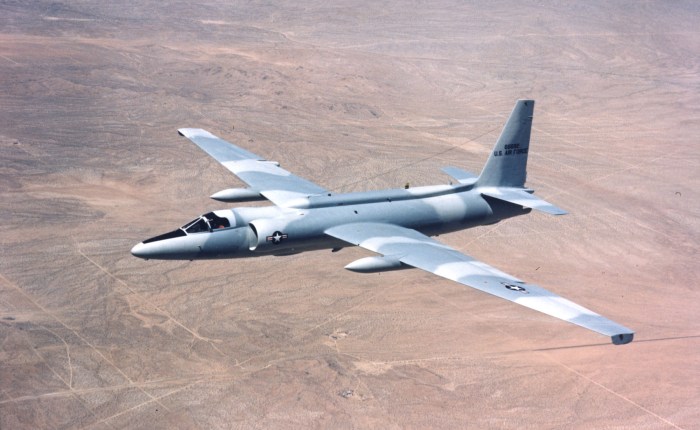
Header Image: A U-2C painted in a gray camouflage pattern called the ‘Sabre’ scheme in 1975. The camouflage replaced the usual black finish to ease British concerns about ‘spy planes’ operating from the UK. In Europe, this U-2 tested equipment to locate and suppress enemy surface-to-air missiles. (Source: National Museum of the United States Air Force)









 Dr Tyler Morton is currently a fellow at the Woodrow Wilson International Center for Scholars in Washington, DC. He is an active duty US Air Force officer who holds a PhD in Military Strategy from the Air University. He is the author of
  From Balloons to Drones