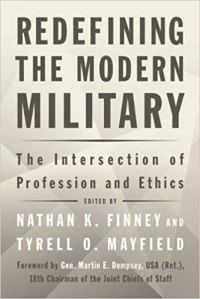
Editorial Note: In this Research Note, Assistant Editor, Dr Brian Laslie reflects on his contribution to a new volume about military professionalism entitled Redefining the Modern Military: The Intersection of Profession and Ethics that has been edited by Ty Mayfield and Nathan Finney and published by Naval Institute Press.
In the Summer of 2015, I packed up some clothes and (a lot of) books and moved down to Montgomery, Alabama to attend the United States Air Force’s (USAF) Air Command and Staff College (ACSC). I had been selected along with about a dozen other civilians to attend the 10-month course. I looked upon those ten months in front of me as something of a sabbatical and a chance to research and write.
On the back end of my time at ACSC, I received a call from Ty Mayfield, of The Strategy Bridge, about a book project he and a team of authors were working on. This forthcoming project, Redefining the Modern Military: The Intersection of Profession and Ethics, published by the phenomenal people at Naval Institute Press, was an effort by the team at The Strategy Bridge to push the ball forward on the discussion of professionalism, ethics, civil-military relations, and professional education in the modern U.S. military. Following in the footstep of Samuel Huntington, Ty and co-editor Nate Finney collected chapters from a group including international and American officers as well as six academics holding both college and professional military education (PME) positions. It was a robust group, especially considering that most of the chapter authors only knew each other through Twitter. It turns out, Ty and Nate had covered all of their bases except one. In the end, they had no one writing about the USAF, the air domain, or the Airmen’s perspective. Thus, the phone call to me.
It turns out Ty and Nate decided to reach out to me at a somewhat fortuitous time. Ty asked me if I had any thoughts about professionalism and the USAF. As a current student at a PME institution who had spent the better part of seven months pouring over USAF history, I had plenty to say. I titled my chapter, ‘Born of Insubordination: Culture, Professionalism, and Identity in the Air Arm,’ and I am somewhat taciturn that my chapter contribution turned into something of “Oh and ANOTHER THING!” ranting about problems of USAF PME and the Air Force writ large. Ty and Nate did not see it that way.
What I produced, at least the way Ty and Nate ended up describing it was a chapter about the:
particularities inherent in the air arm of the U.S. military. Born from a culture of insubordination, Laslie describes three case studies that display how the positive aspects of this trait, one he titles “pragmatic professionalism”, has shaped – and will continue to shape – the Air Force. Using a historical lens to show the USAF’s unique history, identity, and culture Laslie uses these contemporary case studies to demonstrate that while the Air Force has long suffered with an internal identity crisis amongst its officer corps, the “stovepipes” that developed over the course of the past 70 years are actually conduits for professional advancement in different career fields and not something that needs to torn down.
My chapter on the USAF is but one of twelve. Other chapters include: ‘Questioning Military Professionalism,’ by Pauline Shanks-Kaurin, ‘Professionals Know When to Break the Rules,’ by H.M. ‘Mike’ Denny, ‘Ethical Requirements of the Profession: Obligations of the Profession, the Professional, and the Client,’ by Rebecca Johnson, plus eight others as well as an introduction and conclusion from the editors.
The book proper opens with:
[t]he challenging task of self-assessment for the military profession going into the twenty-first century. Crafted by military officers with recent experience in modern wars, academics who have trained and educated this generation of combatants, and lawyers and civilians who serve side by side with the defense enterprise at all levels, this volume seeks to begin the process of reevaluation for the 21st century.’
While discussing professionalism is not our usual milieu here at From Balloons to Drones, we have been known to stray into the realm from time to time; for example, see our recent post on John Boyd. Indeed, we believe that self-examination in any organisation is an essential part of development and Mayfield, and Finney should be commended for seeing this project through to publication. (We would encourage anyone interested in writing about issues related to professionalism within the context of air arms – air force, naval or army – to get in contact. Ed.)
In the age of social media, we have an entire generation of company and field grade officers who are taking their professional military education into their own hands. Through mediums like The Strategy Bridge, the Military Writer’s Guild and From Balloons to Drones, younger officers are studying and communicating about their profession in new ways. Ty and Nate seized on this moment to produce, what I hope, is a book that will generate discussion across the services and the military establishment at large. My contribution is modest, but this book surely has something for everyone. From company grade officers to flag and general officers, I hope it will do what it sets out to do, which is nothing less than ‘Redefine’ the modern military.
Dr Brian Laslie is a US Air Force Historian and currently the Deputy Command Historian at North American Aerospace Defense Command (NORAD) and United States Northern Command (USNORTHCOM). He is an Assistant Editor at From Balloons to Drones and a 2001 graduate of The Citadel and a historian of air power studies. He received his Masters’ from Auburn University Montgomery in 2006 and his PhD from Kansas State University in 2013. He is the author of Architect of Air Power: General Laurence S. Kuter and the Birth of the US Air Force (2017) and The Air Force Way of War (2015). The latter book was selected for the Chief of Staff of the Air Force’s 2016 professional reading list and the 2017 RAF Chief of the Air Staff’s reading list. He can be found on Twitter at @BrianLaslie.
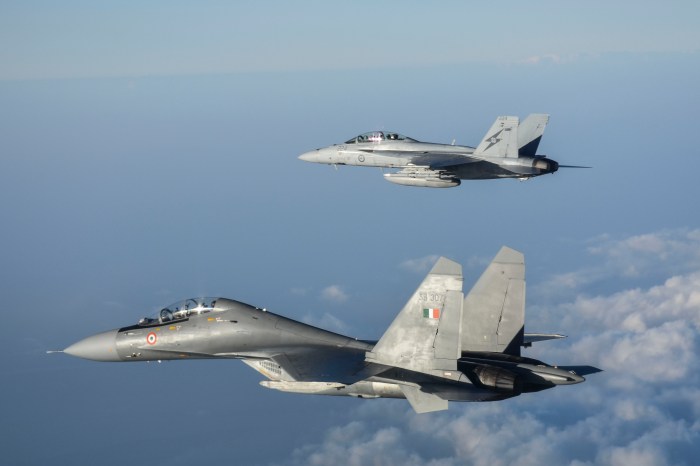
Header Image: A flight of Aggressor F-15 Eagles and F-16 Fighting Falcons fly in formation, 5 June 2008, over the Nevada Test and Training Ranges. The jets are assigned to the 64th and 65th Aggressor Squadrons at Nellis Air Force Base. (Source: US Department of Defense)
Editorial Note: On 19 September 2018, our editor, Dr Ross Mahoney delivered a paper on the subject of ‘The Role of History in Educating Air Power Strategists’ at a seminar organised by the Royal Australian Air Force’s (RAAF) Air Power Development Centre in Canberra. A precis of this paper was published in the Pathfinder bulletin issued by APDC, which can be found here. The Pathfinder series covers a range of issue from strategy, historical analyses, operations, administration, logistics, education and training, people, command and control, technology to name a few. Irrespective of the subject though, Pathfinders will always be focused on the relevance to air power; they are not intended to be just a narrative but deliver a measure of analysis. Apart from the addition of some minor changes to make this precis applicable to From Balloons to Drones as well as the inclusion of footnotes and further reading suggestions, this article appears as published in Pathfinder. We are grateful to APDC for permission to re-publish the piece, and the views in this article and the associated Pathfinder are not necessarily those of the RAAF.
‘[t]he study of military history lies at the foundation of all sound military conclusions and practice.’
Rear-Admiral A.T. Mahan, ‘The Naval War College,’ The North American Review, (1912)[1]
‘The word history carries two meanings […] It refers both to what actually happened in the past and to the representation of that past in the work of historians.’
John Tosh, The Pursuit of History, Third Edition, (1999)[2]
What is history? What is its relevance to an air power strategist? These are important questions; however, as Richard Muller, a senior member of the faculty at the US Air Force’s School of Advanced Air and Space Studies, reflected in 2016, ‘as a rule air forces have not embraced historical study to the same extent as have their army or navy counterparts.’[3] Nevertheless, in 1912, a year after an Italian aeroplane dropped the first ‘bomb’ over Libya, noted US naval historian and strategist Alfred Thayer Mahan reflected on the link between military history and ‘sound military conclusions.’ However, history does not provide clear lessons. Nevertheless, the study of the past does offer a lens through which to analyse, understand and reflect on the challenges currently faced by modern air forces.
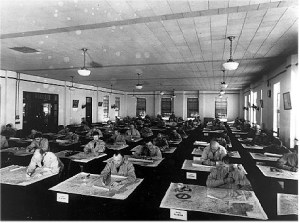
The Air Corps Tactical School (created as the Air Service Field Officers School in 1920) went beyond its mandate of training officers to also become an engine for air power theory development in the interwar period. (Source: US Air Force Air University)
This article considers some of the issues related to applied military history beginning with an outline of the purpose of history and the challenges of applying the past to the present. It also considers how air forces have used the study of the past as a tool for education while concluding with some tentative thoughts on how history can be used to educate strategists in the continuing challenge to achieve professional mastery.[4]
To start with, the term ‘education’ is used in this narrative in a broad context and incorporates both formal and informal learning. Similarly, the term ‘strategist’ is used in a collegiate manner and assumes that modern air forces seek personnel who are professional masters, well-versed in the core knowledge that underpins the application of air power.
As the British historian John Tosh reflected, the term history is ambiguous at best. Is history a collection of facts related to what has happened or is it the scholarly discussion and representation of the past? If the latter statement is accepted as being correct, then it can also be assumed that the interpretation of the past is an argument without an end. While a hackneyed observation, history is a dynamic field of study, one where historians continually re-examine evidence and reinterpret the past. Linked to this is the extent of historical information available to historians and, by default, strategists who seek to apply lessons from the past to the present. The archival records and evidence that underpin the interpretation of the past are normally incomplete. For example, the National Archives of Australia only preserves a small amount of the material generated by the Australian Government.
Moving beyond the above understanding of history, the field of military history can be split into three subfields: popular, academic, and applied history.[5] There is a degree of overlap between the latter two. The main criticism of applied military history is that it is a form of weaponising the past to cater for the present.[6] Underpinning this criticism is a view that those writing such history do so without sufficient understanding of the context in seeking to deduce lessons learnt. Unfortunately, this criticism is currently directed at academics working at institutions delivering professional military education. These institutions use history to illuminate and provide context to the ambiguous challenges that officers attending them are likely to confront in the future.
Historically, the criticism of weaponising the past does carry some weight, and therefore air power strategists could be criticised for the poor use of history to support their arguments. Indeed, as Sir Michael Howard, a distinguished military historian, noted in his 1961 lecture on ‘The Use and Abuse of Military History’:
[W]hen great [interwar] pioneers of air war…advocated striking at the homeland and at the morale of the enemy people…they were basing their conclusions on their interpretation of past wars’. (emphasis added)[7]
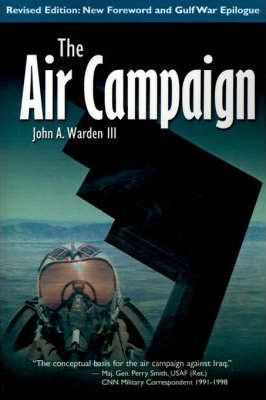
More recently, Colonel (retired) John Warden III’s book, The Air Campaign, has been criticised for his use of a selective reading of history to fit the theory being propounded in it.[8] Admittedly, Warden is not a historian. However, such selective use of history becomes problematic to the broader task of delivering professional education when such texts appear in, for example, Staff College reading lists where they can reinforce a narrow, and at times wrong, understanding of some of the officers they are meant to educate. Despite this criticism, it is clear that many air power thinkers have recognised the value of a broad reading of history. For example, in a 1921 article on ‘Strategy and Air Strategy,’ Group Captain John Chamier of the Royal Air Force reflected on the challenge of deducing appropriate principles for the use of air power given the brief history of air warfare till then. Nevertheless, Chamier recognised that ‘strategic principles are derived from the study of history’, and he recognised that examples from ‘naval and military strategy’ could provide the necessary framework for a discussion of ‘air strategy.’[9]
While history and the application of its lessons by air forces is fraught with challenges, its importance as a didactic tool for the military cannot be underestimated. Indeed, the study of history has been, and remains, an element of the curricula at educational establishments of most air forces. However, considered in a broad manner, the study of history has been unbalanced. For example, in the late-1940s and 1950s, history and related subjects featured little on the curriculum at the RAAF College. As Alan Stephens has noted, the RAAF of this period identified itself as a ‘narrow technocracy’ with knowledge of the Air Force’s core business to be deduced from its ‘technical components’ rather than a ‘study of its history and ideas.’[10]
To conclude, there are several areas where the contemporary study of history plays a key role in the education of air power theorists and strategists. Perhaps most important is that a deep and contextual study of history provides an important understanding for military personnel seeking to gain professional mastery of the profession of arms. Indeed, if it is accepted that the aim of learning is to develop the cognitive ability to understand and deal with ambiguity, rather than to provide clear-cut answers to current problems, then the study of history has a role to play.
The skills associated with historical analysis refines human cognitive areas such as the ability to make considered judgements. An important contributor to the effectiveness of this learning process has been the increasing civilianisation of the academic delivery at institutions catering to professional military education. At a practical level, the use of Staff Rides as a learning tool could also ensure that history could be used as a means to explore ideas outside of the confines of the traditional education environment. However, this process also has its own challenges.[11] In the final analysis, Lieutenant General Sir John Kiszely’s remark that the study of history needs to form an essential part of a ‘balanced diet’ of education for the military professional in order for them to develop the knowledge to be effective, rings completely true.[12]
Key Points
Even though history may not provide clear lessons, the study of the past offers a lens through which to analyse, understand and reflect on the challenges currently faced by modern air forces;
History could be considered a rather dynamic field of study, one where historians continually re-examine evidence and re-interpret the past;
It is recognised that ‘strategic principles are derived from the study of history.’
Further Reading
Gray, Peter, ‘Why Study Military History?,’ Defence Studies, 5:1 (2005), pp. 151-64.
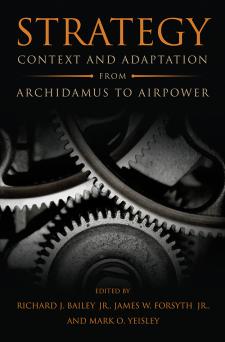
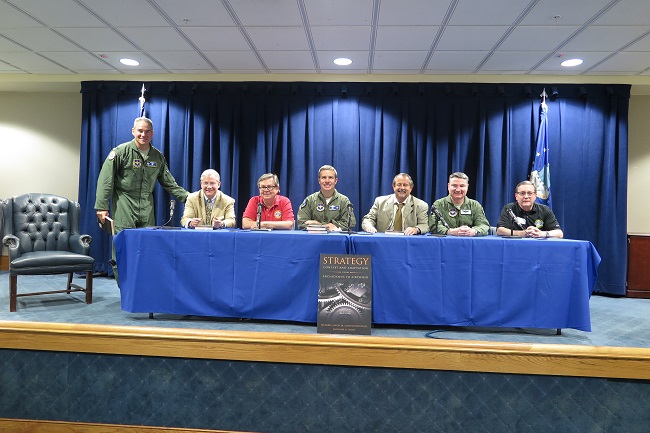
Muller, Richard R., ‘The Airpower Historian and the Education of Strategists’ in Bailey Jr., Richard J., Forsyth Jr., James W., and Yeisley, Mark O., (eds.), Strategy: Context and Adaptation from Archidamus to Airpower(Annapolis, MD: Naval Institute Press, 2016).
Murray, Williamson, and Sinnreich, Richard Hart (eds.), The Past as Prologue: The Importance of History to the Military Profession (Cambridge: Cambridge University Press, 2006).
Dr Ross Mahoney is the editor and owner of From Balloons to Drones as well as being an independent historian and defence specialist based in Australia. He is a graduate of the University of Birmingham (MPhil and PhD) and the University of Wolverhampton (PGCE and BA). His research interests include the history of war in the twentieth and twenty-first centuries, air power and the history of air warfare, and the social and cultural history of armed forces. To date, he has published several chapters and articles, edited two books, and delivered papers on three continents. He is an Assistant Director of the Second World War Research Group. He can be found on Twitter at @airpowerhistory.
[1] Rear-Admiral A.T. Mahan, ‘The Naval War College,’ The North American Review, 196:680 (1912), p. 78.
[2] John Tosh, The Pursuit of History: Aims, Methods and New Directions in the Study of Modern History, Third Edition (Harlow: Pearson Education, 1999), p. viii.
[3] Richard R. Muller, ‘The Airpower Historian and the Education of Strategists’ in Richard J. Bailey Jr., James W. Forsyth Jr., and Mark O. Yeisley (eds.), Strategy: Context and Adaptation from Archidamus to Airpower (Annapolis, MD: Naval Institute Press, 2016), p. 113.
[4] On professional mastery in air forces, see: Sanu Kainikara, ‘Professional Mastery and Air Power Education,’ Working Paper, 33 (Canberra: RAAF Air Power Development Centre, 2011).
[5] John A. Lynn III, ‘Breaching the Walls of Academe: The Purposes, Problems, and Prospects of Military History,’ Academic Questions, 21:1 (2008), p. 20.
[6] Kim Wagner, ‘Seeing Like a Soldier: The Amritsar Massacre and the Politics of Military History,’ in Martin Thomas and Gareth Curless (eds), Decolonization and Conflict: Colonial Comparisons and Conflicts (Bloomsbury Academic, 2017), pp. 25-7.
[7] Michael Howard, ‘The Use and Abuse of Military History (lecture),’ Journal of the Royal United Service Institution, 107:625 (1962), p. 10.
[8] John Andreas Olsen, John Warden and the Renaissance of American Air Power (Washington DC: Potomac Books, 2007), pp. 78-9. Like Warden, Colonel John Boyd’s work ‘cherry-picked’ history ‘to provide illustrations and empirical validation for patterns he observed in combat.’ However, it should be recognised that Boyd was an airman who was a general strategist rather than an air power thinker per se, though his ideas do have applicability to the air domain. See: Frans Osinga, ‘The Enemy as a Complex Adaptive System: John Boyd and Airpower in the Postmodern Era’ in John Andreas Olsen (ed.), Airpower Reborn: The Strategic Concepts of John Warden and John Boyd (Annapolis, MD: Naval Institute Press, 2015), pp. 53-4.
[9] Group Captain J.A. Chamier, ‘Strategy and Air Strategy,’ Journal of the Royal United Service Institution, 66 (1921), p. 641.
[10] Alan Stephens, The Australian Centenary History of Defence: Volume II – The Royal Australian Air Force (Melbourne: Cambridge University Press, 2001), p. 188.
[11] On the challenges associated with staff rides, see: Brigadier R.A.M.S. Melvin British Army, ‘Contemporary Battlefield Tours and Staff Rides: A Military Practitioner’s View,’ Defence Studies, 5:1 (2005), pp. 59-80; Nick Lloyd, ‘Battlefield Tours and Staff Rides: A Useful Learning Experience?,’ Teaching in Higher Education, 14:2 (2009), pp. 175-84.
[12] John P. Kiszely, ‘The Relevance of History to the Military Profession: A British View’ in Williamson Murray and Richard Hart Sinnreich (eds.), The Past as Prologue: The Importance of History to the Military Profession (Cambridge: Cambridge University Press, 2006), p. 32.
One cannot venture very far in the field of contemporary air power studies without encountering remotely piloted air systems, which have become a central feature of western military operations. Their use has raised many questions regarding their ethical status, and the effects they may have both on the battlefield and in the control cabin. Kyle Grayson, Senior Lecturer in International Politics at Newcastle University, has taken a slightly different approach in this volume, looking more widely at the interaction between culture, technology, the economy, government, and geostrategic elements. The book is part of the ‘Interventions’ series, which aims to examine international issues through a range of disciplines including critical, post-structural, and postcolonial approaches; this is not simply a primer on the rights and wrongs of conducting war with remotely piloted aerial systems (RPAS) – or drones. Grayson’s focus is on what he describes as ‘targeted killing’, which he sees as a form of modern-day assassination from the air, an activity which has often been debated on the fringes of the western ethical tradition (p. 4). In writing the volume, he seeks to demonstrate how modern liberal societies have come to terms with targeted killing through culture, emphasising ‘the incorporation of disparate elements including the non-human, power-relations, plasticity and the importance of discourse’ (p. 199).
In his first chapter, Grayson’s approach is to examine the use of RPAS for targeted killing as primarily a cultural phenomenon, trying to understand how culture interacts with such practices in such a way that they can become ‘part of the common sense of security thinking’ (p. 200). His second chapter looks at the legal frameworks which maintain a distinction between assassination and targeted killing while expanding the legal scope of such operations. Chapter three looks at the ‘moral problematics and gender relations’ of assassination and targeted killing, arguing that the use of RPAS systems can help overcome some of the ‘narrative ambivalence’ that these relations involve (p. 201). Chapter four examines how technology alone does not explain the increased usage of RPAS. Rather, a much broader scope of ‘chaoplexic thinking, network centric imaginaries, and preferences for speed, maximising information flows, flexibility, delayered organisational forms, and automation’ help explain current trends to use such systems (p. 201). The fifth chapter focuses on what Grayson describes as the ‘aesthetic’ of killing, examining how those who authorise and those who participate in RPAS warfare experience what is taking place on their screens. In the last chapter, the author emphasises the effect that missile strikes have on the homes of those targeted, arguing that this ‘colonises places and seeks to disrupt their temporalities’ (p. 202).
Grayson concludes his work by elucidating six factors that arise from liberal political culture; issues involving the legitimacy of assassination/targeted killing, the influence of modern camera technology, the role of information technology networks, politics of gender, the use of the law, and representation of the other (pp. 202-6). In his final comments, he urges the need for modern liberal societies to continually evaluate their relationship with RPAS usage, and to critically reflect upon their political culture.
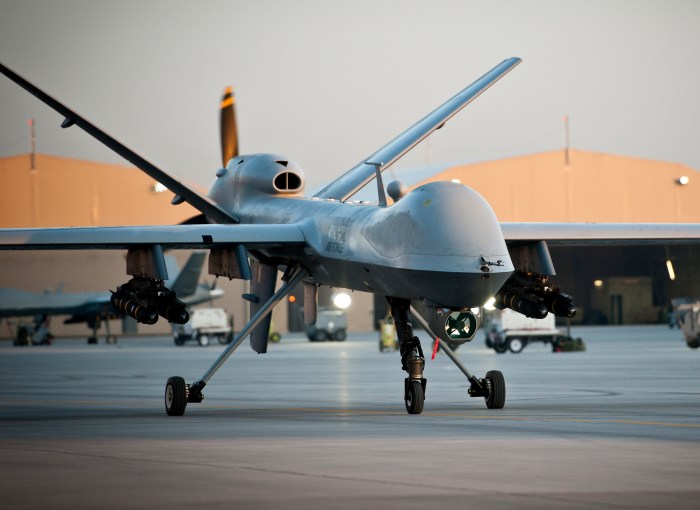
A Royal Air Force Reaper RPAS at Kandahar Airfield in Afghanistan, c. 2014. (Source: Defence Imagery, UK Ministry of Defence)
There is much in this book that is of great interest. For instance, Grayson very helpfully notices the importance of the contemporary market economy in world affairs, emphasising how much the private sector engages with defence. In Grayson’s analysis, ‘the continuing growth of the RPA industry is benefiting from a favourable constellation of politico-economic elements’ (p. 125). Alternatively, to put it another way, the unmanned aerial vehicle is an ideal fit for the current economic climate and the political ecosystem. It would have been fascinating to see even more of an interaction with current thinking on neoliberalism, such as the writing of Wendy Brown, on how the market economy has effects far beyond the market. Grayson’s observations on the ‘complex social assemblage of war’ are thought-provoking and could arguably have been pressed even further, on such subjects such as deskilling and delayering of the economy. Similarly, Grayson’s interaction with Guy Debord and the role of spectacle in society merited further attention (pp. 93-135).
Grayson’s book has the potential to ask real and meaningful questions about the use of RPAS in contemporary warfare. By offering an approach that goes beyond a basic ethical analysis, considering the wider role of culture and warfare, his work could offer real insights into the interface of weapons and worldviews. Thus, for example, his comment that ‘a disproportionate amount of applied innovation in forms of governmentality under liberalism has been directed at the margins within territory, or oriented towards its periphery […] [liberalism] has shown great brutality to those it identifies as being beyond reclamation’ (p. 206). Such considerations are worthy of serious debate and analysis, whether one agrees with Grayson’s premises or not. Many commentators such as Nicholas Carr and Neil Postman have commented on the highly visual nature of contemporary culture – Grayson’s focus on the ‘aesthetics’ of RPAS warfare has the potential to offer real insights in this field. However, a great deal of his writing is delivered in a style which, in generous terms, one would describe as technical. The general reader who wishes to avail of Grayson’s insights is obliged to hack, word by word, through a lexical jungle overgrown with the bon mots of social theory. Many of the terms such as ‘problematisation’ and ‘biopolitics’ are inadequately defined for the non-specialist, which means that reading the book can be a profoundly frustrating experience. This is unfortunate, as Grayson shows an ability to express himself clearly in portions of the book where social theory assumes a lesser role, such as when describing the interaction between the global market and the armed forces of western nations. In short, Grayson raises many useful questions, but this is a book for only the most determined reader.
The Reverend Dr (Wing Commander) David Richardson is a chaplain in the Royal Air Force, initially ordained into the Church of Ireland. A graduate of the universities of Edinburgh, Dublin, Belfast, and King’s College London, he has served on a variety of RAF stations. His operational experience includes tours across Afghanistan and Iraq.
Header Image: A Royal Air Force Reaper RPAS at Kandahar Airfield in Afghanistan, c. 2014. (Source: Defence Imagery, UK Ministry of Defence)
If you would like to contribute to From Balloons to Drones, then visit our submissions page here to find out how.
Established in 2016, From Balloons to Drones is a scholarly online platform that provides analysis and debate about air power history, theory, and contemporary operations in their broadest sense including space and cyber power. Air power is to be understood broadly, encompassing not only the history of air warfare, including social and cultural aspects but also related fields such as archaeology, international relations, strategic studies, law and ethics.
Since its emergence, air power has increasingly become the preferred form of military power for many governments. However, the application and development of air power is controversial and often misunderstood. To remedy this, From Balloons to Drones seeks to provide analysis and debate about air power through the publication of articles, research notes, commentary, book reviews, and historic book reviews.
From Balloons to Drones welcomes and encourages potential submissions from postgraduates, academics, and practitioners involved in researching the subject of air power.
Submissions can take the following forms:
Articles – From Balloons to Drones publishes informative articles on air power that range from historical pieces to the analysis of contemporary challenges. These well-researched articles should attempt to bridge a gap between the specialist and the non-specialist They should be around c.2,000 words, though From Balloons to Drones will accept larger pieces and we reserve the right to publish them in parts.
Air War Books – From Balloons to Drones publishes a series of review articles that examine the top ten books that have influenced writers on air power.
Commentaries – From Balloons to Drones publishes opinion pieces on up-to-date news on either contemporary or historical subjects. These should be no longer than c.1,000 words.
Research Notes – From Balloons to Drones publishes research notes related to contributor’s current research projects. These take the form of more informal pieces and can be a discussion of a source or a note on a recent research theme. These should be c.500 to 1,000 words.
Book Reviews – From Balloons to Drones publishes occasional book reviews that aim to be an accessible collection of appraisals of recent publications about air power.
Historic Book Reviews – From Balloons to Drones publishes occasional historic book reviews that aim to be an accessible collection of open access appraisals of critical historic publications about air power history, theory, and practice.
Submissions should be submitted in Word format and emailed to the address below with ‘SUBMISSION’ in the subject line. Also, please include a 50-100-word biography with your submission. References can be used, and please be careful to explain any jargon. However, if you are not sure if your idea fits our requirements, then please email us with ‘POTENTIAL SUBMISSION’ in the subject line to discuss.
In March 2018, Air University Press released a new edition of Colonel John Boyd’s A Discourse on Winning and Losing with a new introduction by Grant Hammond. On top of his heavy influence in designing the F-15 and F-16 fighters, Boyd was one of the most influential and often cited officers in the history of the US Air Force (USAF), but unlike most famous strategic thinkers, he published almost nothing. Thus, this new edition promises to be possibly the most widely disseminated and studied edition of Boyd’s intellectual output.
John Boyd during his service in Korea. (Source: Wikimedia)
Boyd is, however, a controversial figure. Among USAF officers, Boyd is either loved or hated. Hammond’s introduction refers to him as ‘legendary,’ ‘a great original thinker,’ and ‘a paragon of virtue – loved by many […] for his character and integrity.’[1] On the other hand, former fighter pilot and USAF Chief of Staff General Merrill McPeak summarised the opposing view: ‘Boyd is highly overrated […] In many respects he was a failed officer and even a failed human being.’[2] Boyd was the type of person who challenged authority and fought for what he believed. He was also the kind of person that was so profoundly insecure that he stalked food courts to hunt down and physically assault people whom he perceived had not shown him proper respect.[3] However, many younger officers have never even heard of Boyd nor are they familiar with his ideas or character. With the recent release of the new edition of his work, it is worth taking time to briefly summarise Boyd’s significant contributions and provide some context as to why he is both so praised and so controversial.
First, we must deal with the notion of Boyd as – according to Hammond – ‘a premier fighter pilot.’ Some have referred to Boyd as the greatest fighter pilot who ever lived, and many press outlets mistakenly refer to him as an ace. Although Boyd did fly F-86 Sabres during a brief tour in the Korean War, he does not have a single air-to-air kill to his credit. He never fired his gun in a combat situation. This is not necessarily an indictment of his skills. The reason is that in those years, the USAF tended to fly in formations in which only the lead element was cleared to fire, while the wingmen provided protection. Boyd only ever flew in a wingman position, and never got in an opportunity to fire at enemy MiG-15s. Later, Boyd became a flight instructor at the USAF Fighter Weapons School, and he wrote a manual on dogfighting tactics. His reputation as a fighter pilot was built on his time as an instructor, during which he displayed a penchant for defeating incoming students in simulated dogfights (developing his claim that he could always do so within forty seconds). Fans of Boyd laud him for this, although his detractors often wonder why an instructor defeating his students using an oft-repeated manoeuvre is noteworthy, much less a point worth bragging about.
Boyd’s first significant contribution to USAF thinking was ‘Energy Maneuverability Theory’ (EMT) in the early-to-mid 1960s. This was an application of the principles of thermodynamics to aircraft metrics. Up until that point, the most important metrics for evaluating fighter planes tended to be wing loading ratios, top speed, and acceleration. Many fighter pilots tried to argue that agility and manoeuvrability were more important in a dogfight, but although wing loading could provide a rough idea of how well a craft could turn, it fell far short of an accurate description of a plane’s manoeuvrability. Boyd’s EMT instead analysed how well an aircraft could change energy states – involving speed, acceleration, kinetic and potential energy – essentially giving a numerical value to how well a plane could manoeuvre under various conditions. Charting this value on a graph corresponding to speed and altitude will give a curve of the aircraft’s manoeuvring capability. This method gave fighter pilots a way to talk to engineers in their ‘language,’ and describe dogfighting in mathematical terms, which had a significant influence on aircraft design. Beginning in the late 1960s, EMT became a significant factor in designing and evaluating American aircraft.
This chart, a typical example of the types of charts Boyd produced, compares the agility of an F-4 Phantom II and a MiG-21, but specifically under conditions of a 5g turn. (Source: USAF Academy Department of Aeronautics)
Although Boyd appears to have come up with these ideas independently, he was not the first to do so. A decade earlier, in 1954, an aerodynamics engineer working for Douglas named Edward Rutowski had the same concept. Rutowski’s work did not apply to dogfighting, but to calculating fuel ranges of various types of aircraft.[4] However, the equations – and the charts – are almost the same as Boyd’s, who later admitted to copying the charts after denying it for years.[5] One element that Boyd did add, however, was overlaying the EMT curve for one aircraft on top of another, to show where one aircraft had an advantage in manoeuvrability. These comparisons, first done in the late 1960s, showed that Soviet aircraft of that time might have a distinct advantage in dogfighting compared to the American fighters of the day (which, in that period, were mostly interceptors, not traditional fighters). Thus, while not necessarily completely original, Boyd did more to popularise the EMT concept and apply it to fighter design and tactics training, which then became part of a push within the USAF to design aircraft that were more specialised for air-to-air combat.
Boyd had a hand in the design of those planes. The first major USAF project to design a dedicated air superiority fighter was the F-X program, which eventually resulted in the F-15 Eagle. Boyd was brought in partway through this project and attempted to influence the design toward being more dedicated for dogfighting. To Boyd, this meant making it as small as possible and gutting it of sophisticated technologies, especially radar. The more massive the radar dome in a fighter’s nose, the larger the entire plane needed to be. Making the radar as small as possible (or, as Boyd advocated, eliminating it), could make the plane smaller and lighter. Boyd managed to have a significant influence on the design of the F-15, but he did not get everything he wanted. The plane was significantly more extensive and more sophisticated than he advocated, so in disgust, he turned to another project.[6]
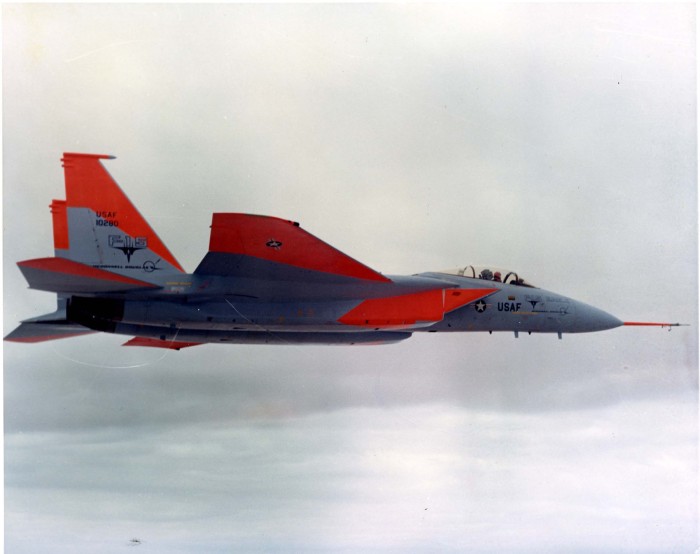
McDonnell Douglas F-15A (S/N 71-0280, the first F-15A prototype). Note the square wingtips and unnotched stabilator. (Source: Wikimedia)
Using a combination of subterfuge, connections with high-level decision-makers, stealing unauthorised time on USAF computers, and meeting with aircraft manufacturers in secret using coded language, Boyd pressured the Air Force to procure a smaller lightweight fighter. Boyd wrote the requirements for that plane, which happened to match almost identically the characteristics of a plane he had been secretly designing with General Dynamics’ Chief of Preliminary Design, Harry Hillaker. That plane eventually became the F-16 Fighting Falcon—his ideal true dedicated air-to-air dogfighter. However, Boyd was also disappointed by the modifications made to that aircraft. The USAF made it heavier and more sophisticated than he wanted, and so Boyd denounced it in disgust.[7] Indeed, although his vision for the F-16 was a pure dogfighter, the plane has rarely been used in air superiority missions by the USAF and has achieved zero air-to-air kills for the US.
An air-to-air right side view of a YF-16 aircraft and a YF-17 aircraft, side-by-side, armed with AIM-9 Sidewinder missiles, c.1972. (Source: Wikimedia)
After his retirement in 1975, Boyd went back to work in the Pentagon as an analyst, and it was during this time that he completed most of the intellectual output in the recently released new volume. This began with a short essay entitled ‘Destruction and Creation,’ which argued that societies and systems only really change when they are destroyed and recreated, rather than reformed from within. In 1976, Boyd received a NASA grant to study the differences in pilot behaviour between simulators and reality. Instead of focusing on that, Boyd produced a study titled ‘Fast Transients Brief,’ which consisted of carefully picked historical examples with which Boyd argued that victory in war was the result of being quick, unpredictable, and agile, with the goal of producing confusing in the enemy. This brief was essentially the first draft of what became a larger briefing called ‘Patterns of Conflict,’ which Boyd continually expanded to include more historical examples of his point. This briefing continued to grow, including more examples, until it became the final form under the new title ‘A Discourse on Winning and Losing.’ In this form, it was a fourteen-hour briefing split into two days. Boyd refused to shorten his briefings or to distribute summaries or slides to those who did not attend, insisting on being given the full amount of time, or nothing.[8]
Also embedded in these briefings was his evolving idea of the OODA loop, which stands for ‘observe, orient, decide, act.’ This was Boyd’s description of the process by which decisions are made at all levels from the tactical to the strategic. Boyd argued that all combatants in a conflict are going through that cycle, and whoever can complete repetitive OODA cycles more quickly will always be the victor. Fans of this theory tend to argue that this insight is revolutionary and secures Boyd’s place alongside thinkers such as Clausewitz or Sun Tzu. Others claim that this idea is very simplistic and offers very little in the way of insight or practical application. Interpreting and applying Boyd’s theory to subjects ranging from warfare to business has become something of a cottage industry. The OODA loop is still taught at US professional military education institutions. Love him, hate him, or merely indifferent, one cannot deny that Boyd has left a legacy and influence.
One final component of Boyd’s life that one must be aware of is his involvement in ‘The Reform Movement.’ During his time in the USAF, he and his followers who pushed for lightweight, dedicated air-to-air combat planes began referring to themselves as the ‘Fighter Mafia,’ and saw themselves at odds with the US government – to the point of depicting themselves as participating in a guerilla war against a government that they deemed as corrupt and ineffective. After Boyd’s retirement, this group morphed into what became known as ‘The Reform Movement’ and moved away from just fighter planes to becoming politically active on broader defence issues. This effort included a litany of journalists, military officers, and politicians who went as far as to form their congressional caucus, as well as non-governmental organisations with the goal of lobbying for particular policies.
The group wanted all US military hardware to be cheap and ‘simple.’ Simple in this context meant technologically unsophisticated relative to the mid-1970s. They argued for cancelling expensive ‘complex’ weapons such as the F-15 and the M-1 Abrams tank and replacing them with cheaper, ‘simple’ alternatives, such as relying on the older M-60 Patton tank or replacing F-15s and F-16s with swarms of F-5 Tigers. ‘The Reform Movement’ was more political than the ‘Fighter Mafia,’ and although the movement attracted some moderates and left-leaning individuals such as James Fallows (journalist for The Atlantic) and Senator Gary Hart (D-CO), it tended to skew conservative. Over time, it grew more conservative with the addition of politicians such as Nancy Kassebaum (R-KS), Newt Gingrich (R-GA), Dick Cheney (R-WY), and possibly its most prominent and active member (who coined the term ‘the Reformers’): self-proclaimed monarchist and white supremacist William Lind.[9] For this group, Boyd was seen as a messiah, and he was often discussed in religious terminology as a saviour preaching a new gospel.
Although this movement had an influential voice in the early 1980s, it had begun to stagnate by the end of that decade, and the 1991 Gulf War discredited many of their arguments.[10] However, despite that war demonstrating the effectiveness of all the weapons systems that the Reformers (and Boyd) had argued against, Boyd himself took sole credit for the success of that war. Boyd claimed he had been the actual author of the ground attack plan, which was not true, and that it would have been even more successful if his ideas had been implemented further.
Boyd is a complex figure, and his influence on the US military, especially the USAF, is impossible to deny. Although the bulk of his work has been floating around the internet for years, having a new edition of his work in an easily accessible and well-produced print edition is extremely useful and quite welcome.
Bibliographical Note
For more information on Boyd, the best place to start is most likely John Andreas Olsen’s 2016 article, ‘Boyd Revisited: A Great Mind with a Touch of Madness’ in Air Power History while the best examination of Boyd’s intellectual output is Frans Osinga’s Science, Strategy and War: The Strategic Theory of John Boyd (2007). Several authors further explore Boyd in Olsen’s edited work Airpower Reborn: The Strategic Concepts of John Warden and John Boyd (2015). A genuinely scholarly biography on Boyd’s life has yet to be written. Hammond’s brief biography, The Mind of War: John Boyd and American Security (2012) is a useful starting point but leans into praise for Boyd to a level that some readers might be uncomfortable with. Robert Coram’s popular biography Boyd: The Fighter Pilot Who Changed the Art of War (2002) has its uses but is little more than hagiography and should be read with a sceptical eye.
Dr Michael Hankins is Professor of Strategy at the USAF Air Command and Staff College eSchool, and and Assistant Editor at From Balloons to Drones. He is also a former Instructor of Military History at the US Air Force Academy. He earned his PhD from Kansas State University in 2018 with his dissertation, ‘The Cult of the Lightweight Fighter: Culture and Technology in the U.S. Air Force, 1964-1991.’ He completed his master’s thesis at the University of North Texas in 2013, titled “The Phantom Menace: The F-4 in Air-to-Air Combat in the Vietnam War.” He has a web page here and can be found on Twitter at @hankinstien.
Header Image: A USAF F-16 Fighting Falcon Block 40 aircraft after receiving fuel from a KC-135 Stratotanker aircraft during a mission over Iraq on 10 June 2008. (Source: Wikimedia)
If you would like to contribute to From Balloons to Drones, then visit our submissions page here to find out how.
[1] Grant Hammond, ‘Introduction to “A Discourse on Winning and Losing” in Colonel John Boyd, A Discourse on Winning and Losing, edited and compiled by Grant Hammond (Maxwell AFB, AL: Air University Press, 2018), pp. 1-2.
[3] See, for example, a story of Boyd seeking out a former colleague who had expressed doubt in Boyd’s ideas years before. Boyd put out his cigar on the man’s clothing, then began shoving him and shouting obscenities at him, all in public. Told in more detail in Robert Coram, Boyd: The Fighter Pilot Who Changed the Art of War (New York: Little, Brown, and Company, 2002), pp. 179-80.
[4] Edward S. Rutowski, ‘Energy Approach to the General Aircraft Performance Problem,’ Journal of the Aeronautical Sciences, 21 (1954), pp. 187-95.
[5] USAF Historical Research Agency, K239.0512-1066, John Boyd, Corona Ace Oral History Interview, 22 January 1977.
[6] For details on the development of the F-15, see Jacob Neufeld, The F-15 Eagle: Origins and Development, 1964-1972 (Washington DC: Office of Air Force History, 1974).
[7] On this issue, see: Grant Hammond, The Mind of War: John Boyd and American Security (Washington DC: Smithsonian Books, 2012).
[8] These briefings are most thoroughly explored in Frans Osinga, Science, Strategy and War: The Strategic Theory of John Boyd (New York: Routledge, 2007).
[9] For a brief summary of Lind’s extremism (he was known for keeping a portrait of fascist dictator Benito Mussolini in his office), see Bill Berkowitz, “Cultural Marxism’ Catching On,’Southern Poverty Law Center, 15 August 15, 2003. Lind’s radical right-wing viewpoints are evident from his voluminous writing as the former Director of the Center for Cultural Conservatism, and his many columns in a variety of conservative websites and magazines. His 2014 novel Victoria not only celebrates a violent militia movement overthrowing the American government but glorifies deportations and executions of non-whites and other minorities he deems undesirable, including Jews, Muslims, the LGBTQ community, and it favorably depicts the use of nuclear weapons against African-American populations.
[10] For a summary of ‘The Reform Movement,’ see: John Correll, ‘The Reformers,’ Air Force Magazine (February 2008), pp. 40-4. To see them discuss their ideas in their own words, see: James Fallows, National Defense (New York: Vintage, 1984) and James Burton, The Pentagon Wars: Reformers Challenge the Old Guard (Annapolis, MD: Naval Institute Press, 1993).
Last week, From Balloons to Droneslaunched its own air power reading list. Many of the world’s air forces release an annual reading list that contains crucial volumes that those services believe its members should read as part of their professional development. Indeed, as the Royal Air Force’s Chief of the Air Staff, Air Chief Marshal Sir Stephen Hillier noted in the RAF’s recently launched 2018 reading list; ‘[R]eading, study and debate form a fundamental component of developing our collective intellectual capital.’[1]
However, the list we have published reflects the original aims of From Balloons to Drones. From Balloons to Drones was established as an online platform that seeks to provide analysis and debate about air power history, theory, and contemporary operations in their broadest sense including space and cyber power. While From Balloons to Drones has a place within the online ecosphere of the profession of arms network, this is not the websites primary purpose. From Balloons to Drones has always aspired to bridge the gap between several interested audiences ranging from civilian academics, interested lay readers as well the military. Given this broader aim, the reading list we published is representative of that goal.
Crucially, this curated bibliography is by no means comprehensive, and it is essential to make clear that this has been done on purpose. This is for two reasons. First, it is expected that the reading list will be organic and grow over time. This links to the second reason, which is the source of the titles on the list. The list has been curated from our ‘Air War Books’ series and published book reviews. As such, the list is representative of the choices made by those air power historians who have contributed to our ‘Air War Books’ series to date. Indeed, as several people noted on our Twitter feed, there is a lack of books on naval or maritime air power, and this obviously reflects the interests of the contributors who have so far contributed to the aforementioned series. Therefore, as more contributions are added to the ‘Air War Books’ series, then more titles will be added to the list where applicable. In a similar vein, as we publish more book reviews on essential new and historic air power titles, we will add these to the list.
At some point, we may cull the list, but for now, we hope that you enjoy the list and get something useful out of it.
Header Image: Forward air controllers in PC-9 aircraft fly in support of Exercise PITCH BLACK 2018. These aircraft are operated by the Royal Australian Air Force’s No. 4 Squadron. (Source: Australian Department of Defence)
[1] Air Chief Marshal Sir Stephen Hiller, ‘Foreword’ in CAS’ Reading List 2018 (Shrivenham: RAF Centre for Air Power Studies, 2018).
Editorial Note: In the fourth instalment of ‘Air War Books,’ Dr Randall Wakelam discusses the ten books that have influenced and shaped his writing as an air power historian. If you are interested in contributing to this series or From Balloons to Drones more generally, find out how here.
Since joining the Air Force more than 45 years ago, I have found that professional education for those working with air power has not been a forte of Canada’s Air Force. Much of what I have learned, I have done so out of curiosity and by selecting graduate courses and by doing graduate research that allowed me to satisfy my curiosity and develop a better understanding of air power. While I am critical of this circumstance in Canada I do not think it is unique; there are too many editorials, op-eds and notes from chiefs of service that attempt to get aviators to read if not write.
Having taught air power at the Canadian Forces College and now at an undergraduate and graduate level to officer cadets and civilian students, I continue to learn. In this teaching, I think I am comfortable with the notion that air power concepts introduced a century ago have now reached maturity regarding what air power effects can be applied and how. What is constantly in flux is the larger Geopolitical context of why and when one wants to apply air power effects.
The one other factor that I would want to bring into the formulation of this list is my desire to get inside the thinking processes of those who have developed air power concepts and then applied them. Thus, several the titles that you will see below are either biographies or studies of the human condition. In the case of biographies, I fully recognise that looking at the life stories of some of these actors comes with risks. Case studies of human and personnel questions are perhaps less risky but not without risk.
And now to the list, which is most certainly too short to do justice to the many other works that I have found important to me.
Philip Meilinger (ed.), The Paths of Heaven: The Evolution of Airpower Theory (Maxwell AFB, AL: Air University Press, 1997). This volume is without question the one work that I keep going back to. Admittedly written from a United States Air Force (USAF) perspective I have found the work balanced and useful in seeing the ‘long duree’ of air power thought and its application. I first read the book just after it came out but even now, twenty years later, do not find it particularly dated. Of great value is I.B. Holley’s summary and commentary. His criticism that the work ignores naval aviation serves as a caution to readers that while highly valuable the volume does have its limitations.
John Andreas Olsen (ed.), A History of Air Warfare (Washington D.C.: Potomac, 2010). This work fills the void of the last two decades since Paths of Heaven was published and provides readers with a different treatment of many of the same ideas and events presented in the former. For that reason, I think it provides a solid bookend to balance the USAF compendium. Also, the reader gets a good dose, perhaps too good of the air campaigns of the post-Cold War decades and three useful studies of current and future themes, most importantly small wars and space. The penultimate chapter, by Martin van Creveld, balances Holley’s commentary and leaves the reader with the ultimate question: has the age of air power come and gone?
Allan D. English, Understanding Military Culture: A Canadian Perspective (Montreal: McGill-Queen’s University Press, 2004). When I reviewed English’s book about a decade ago, I wrote that it was, for me at least, a volume that captured essential ideas about military culture, ideas that I might have benefited from even from my first days in uniform. In a relatively short but well-focused study, English laid out the elements of culture, looked at them through the lens of the USAF and then from the perspective of the Canadian air arm. At that time there was no the Royal Canadian Air Force (RCAF), as there had been up to the 1960s and as there is again today. The absences of that organisational title and the emotional trappings of an independent air service were all the more reason to read English’s book at the time. The comings and goings of organisations, from squadron to air forces that continue in all nations made and makes this work incredibly insightful.
Henry Probert, Bomber Harris: His Life & Times (Aylesbury: Greenhill Books, 2001). For a long time, I wanted to attempt to understand the thinking of Marshal of the Royal Air Force Sir Arthur Harris. Was he the wanton killer of German civilians that he was accused of being? How did he apparently hold the loyalty of his aviators? Probert’s study of the man gave me the answers that others did not. Bullheaded to the point of obstinacy – certainly more than not – but he did set out to apply the concepts and technology available to him to accomplish the task set for Bomber Command. Moreover, in this, we see not bombast alone but also a sharp intellect and a degree of flexibility and accommodation (that I would not have expected) and above all a desire to save the lives of his crews, or at least make their sacrifices count. Probert showed me Harris’ strengths and weaknesses, giving me a good picture of what any operational level leader might look like, warts and all.
Denis Richards, Portal of Hungerford (Tintern, MON: William Heinemann, 1977). If Harris is a good case study in operational level leadership, then Denis Richards biography of Marshal of the Royal Air Force Viscount Portal makes a good companion. Few of us will ever get to work at or even observe the work of senior air force leaders or to have exposure to the sorts of institutional level challenges they face, both within their service and across governments and coalitions. This book gives us that access, and it allows us to put the better-known struggles of the Royal Air Force (RAF) in its formative years into a more personal context where, as in the case of Harris, personal strengths and weaknesses – the human factor – contribute to success or precipitates failure.
Dewitt S. Copp, A Few Great Captains: The Men and Events That Shaped the Development of U.S. Air Power (McLean, VA: EPM Publications, 1989). This work has been my only deep dive into the USAF, and as I began to think more about culture, doctrines and effects, it seemed to be important to study not just one man or a few, but rather the birth and evolution of an air power community. I believe I found that in this work. It looks at the people and their professional growth, ideas, experiences, small ‘P’ politics and larger organisational conflicts.
John J. Zentner, The Art of Wing Leadership and Aircrew Morale in Combat, CADRE Paper no. 11 (Maxwell AFB, AL: Air University Press, 2001). This set of case studies looks at leadership in a flying organisation, arguably one of the hardest notions to explain to army and naval officers who generally lead within plain sight of their followers. Moreover, to be honest, how one leads in the air is often hard to describe, or at least it was before the recent decades of air operations, to aviators. Effective leadership should promote high morale, and Zentner posited that that strong morale is linked to aircrew control over the tactics they are to use in the air. During a period of relative global calm, he set out to test his concept in three case studies. He looked at two fighter leaders, one German and one American in the Second World War, and for a third case flows the leadership of a B-52 Wing Commander during the Vietnam War.
Allan D. English, The Cream of the Crop: Canadian Aircrew, 1939-1945 (Montreal: McGill Queen’s University Press, 1996). This work is focused on the personnel issues of the RAF and the RCAF, and thus we find an investigation into an aspect of air warfare every bit as important as technologies. English sets out to explore and comment on the impact of what today we recognise as post-traumatic stress disorder on Bomber Command aircrew. To do this he looks at the Royal Flying Corps experiences of recruiting and training during the First World War and how these, and societal cultural norms were adopted by the RAF and to a lesser extent the RCAF in the Second World War. He shows the significant difference in the policy adopted by the RCAF and how rehabilitation of stress casualties rather than their banishment could safeguard critical human resources.
Robin Higham and Steven J. Harris (eds.), Why Air Forces Fail: The Anatomy of Defeat (Lexington, KT: The University Press of Kentucky, 2006). Not every air campaign is a success and not every air service ensures the security of its home nation. In studying failures Higham and Harris edited volume expose us to valuable experiences of things gone wrong. More important than the various well researched and presented case studies is the introduction where the editors lay down a simple truth: ‘other things being equal’ the better air power ‘should’ prevail. They then go on to look at the range of ‘other things’ and here is the true value of the collection: the reader soon realises, or should, that there are almost countless factors in play that can cripple an air force, often long before a conflict begins. To codify these factors, Higham adapts Mahan’s characteristics of a maritime nation to identify where and how air power nations can and have failed.
Robert Grattan, The Origins of Air War: The Development of Military Air Strategy in World War I (London: IB Tauris, 2009). Grattan, an RAF navigator, turned business professor in his later years, presents a study of air arms in the First World War. He argues that the leaders, flyers and even politicians and industrialists had nothing to go on and so national air arms were sort of a ‘design build’ enterprise with rapid advancement through trial and error. He looks at aircraft, weapons, personnel and tactics studying the advancements of each in relation to the others. The use of the word ‘strategy’ in his title is a bit misleading; ‘air power concepts’ would more accurately describe his focus in my view.
Dr Randall Wakelam teaches military and air power history at the Royal Military College of Canada. After graduating from RMC in 1975 he flew helicopters for the Army, becoming CO of 408 Tactical Helicopter Squadron in 1991. Along the way, he also had staff appointments in aircraft procurement and language training policy. Since 1993 he has been an educator, first in uniform at the Canadian Forces College in Toronto and now at RMC. His research and publishing focus on air power and military education.
It may seem somewhat odd to be reviewing a book about thinking strategically on a website concerning air power and history. But not so. This book is written by past and present faculty members of the US Air Force’s (USAF) School of Advanced Air and Space Studies (SAASS) located within the Air University at Maxwell AFB, Alabama. Air power thus permeates the book, running in parallel with the notion that history is a particularly useful discipline when educating future strategists.
For From Balloons and Drones readers though there is a deeper interest. With all the hubris of a fast jet aviator Richard Bailey tells us that SAASS is the ‘premier strategy school in the US Department of Defense (if not the country at large)’ (p. 1).[1] Arguably, make that ‘the world at large’, at least regarding influence on air power thinking. The USAF dominates modern air power theory and practice. This book nicely illuminates the culture that underpins such dominance.
Strategy: Context and Adaptation comprises 11 main chapters each written by a different faculty member. Academics are notoriously averse to standardisation, delighting in holding differing opinions and employing diverse writing techniques. This book accepts this and seeks to make it a virtue, with each chapter entirely different regarding structure, content, style, and tone. Coherence and unity of purpose are then meant to be achieved not at the chapter level but in the book overall. The book’s design is meant to take the reader along an ‘optimal arc’ so that they complete ‘an intentional full circle academic journey’ (p. 3). Does it work? For me, not quite. The book seems more a compilation of disparate articles – all insightful, many outstanding, most cutting-edge – that is somewhat less than the sum of its parts.
The book’s subtitle is ‘context and adaptation,’ both good threads to discuss its contents. There is much made of the need for individual strategies to be developed appropriate to the context within which they are to be implemented. Understanding context, getting ‘to know the key actors, relationships, factors and challenges’ is seen as the first step in ‘doing strategy’ (p. 241).
The argument is though considerably more sophisticated than it may first appear. The notion is developed that strategy and context interact, continually changing each other and simultaneously evolving together. Everett Dolman writes ‘so now we are all constructivists, of course’ (p. 33). A somewhat surprising statement given that the American armed forces strategic culture overall is often seen as being realist, so privileging relative material power rather than ideas.
For air power thinkers and historians there is some importance to this reflectivist notion as made clear in Jeffrey Smith’s excellent chapter. Smith develops the idea that the USAF has generally been tardy in adapting its strategy, force structure and training in the context of the times.
The Air Corps Tactical School (created as the Air Service Field Officers School in 1920) went beyond its mandate of training officers to also become an engine for air power theory development in the interwar period. (Source: US Air Force Air University)
The interwar Air Corps Tactical School (ACTS) devised the strategy of precision daylight bombing of vital industrial targets, but this was found wanting when employed in the context of a capable air defence system and needed adaptation. In the nuclear age post-Second World War, the strategy of large-scale nuclear strikes using long-range bombers dominated but was again found wanting in the context of the Vietnam conflict, a limited war fought with conventional munitions. In the post-9/11 era of small wars and insurgencies, the strategy of short-range fighters delivering precision-guided weapons was again found wanting in a context where population security was deemed key and the enemy elusive. Smith argues that in each case ‘translating the theory into a feasible strategy [was] flawed because it failed to consider, understand, or incorporate the full context in which it would be applied’ (p. 139). Adaptation then became necessary to achieve success, but this was often too slow, proving costly in blood and treasure.
Smith then extends this insight from history to the future of air power. He argues that contemporary air power theories, strategies, force structures and training may prove inadequate in the future context in which they are applied. It seems adaptation will be required again albeit with nuance.
Dolman considers (p. 32) that it is not perfect adaptation to the context that is key but rather having a diverse range of force capabilities available that become progressively useful however the context changes. As Smith notes, fast jets were perfect for 1991’s Desert Storm but inadequate for the different operational contexts later encountered. The importance of Dolman’s conceptual call for diversity is nicely illustrated by Smith’s outline of post 9/11 air operations that required ‘tactical airlift, special operations, ISR [intelligence, surveillance and reconnaissance], close air support and tightly integrated action with ground forces’ (p. 145) not high-flying strike packages comprising mainly supersonic fighters.
This step from historical analysis to tomorrow’s battles reflects the SAASS motto of From the Past, the Future (p. 129). When one considers that the ACTS’ motto of the 1920s was Proficimus More Irretenti (We Progress Unhindered by Tradition) (p. 115) you can get a sense of how modern USAF strategic education has evolved, or as airmen might say, of its current vector.
Richard Muller’s chapter on using history to educate strategists explores this aspect further. The USAF, born after the Second World War straight into the revolutionary new nuclear age determined that military history be mostly irrelevant; technology studies and current affairs accordingly dominated the Air University’s curricula. In the wake of the Vietnam War though doubts arose and the study of history crept in. After some travails, this inclination became institutionalised following some vigorous prodding from the US Congress and the activism of the remarkable Ike Skelton (D-MO). SAASS was one of the results albeit it should be highlighted that the use of history at this school has a decidedly utilitarian flavour.
When this book was written in 2015, only two out of 11 SAASS courses were ‘explicitly historical in orientation’ (p. 129) with emphasis placed instead on the curriculum being interdisciplinary. Muller usefully sets out four ways history should be used to educate airmen (pp. 123-5). Firstly ‘to instil corporate spirit and foster awareness of airpower’s rich heritage’; secondly ‘to illustrate or even legitimise current doctrine, operational concepts, organisational reforms or weapon systems’; thirdly as part of the ‘systematic attempt to extract useful insights from a thorough examination of previous wars, campaigns or other historical events’; and lastly ‘to inculcate the ability to think in terms of cause and effect or to work through complex interactions of personalities, contextual factors, friction and so on’. As Muller himself notes, professional historians would be aghast about the first two somewhat proselytising functions.
The last function, however, that of developing critical thinking skills, is particularly noteworthy given that air forces are culturally inherently technocratic organisations. This essential characteristic needs some balancing when conflict erupts and the need for successful strategising arises. Steven Wright (pp. 234-6) considers most air force personnel are linear thinkers that excel at getting things done correctly but that this is not enough. Air forces also need abstract thinkers that excel at understanding what the correct things are that need to be done. Studying history can help improve people’s abstract thinking skills by giving them an understanding of how to think about context and its relationship to strategy. History then helps people understand what the correct things are to be doing and is accordingly an indispensable element in a strategist’s education.
Strategy: Context and Adaptation from Archidamus to Airpower is a snapshot of SAASS at a specific time in history, after the 9/11 wars and before the emerging era of contested skies. The book is excellent in guiding the reader to think more thoughtfully about strategy, what it is and how it should be made while providing an interesting window into contemporary USAF senior staff college education. Eclectic by design, the book offers much for military professionals, academics and all concerned with deeply understanding the business of strategising and its teaching.
Dr Peter Layton is a Visiting Fellow at the Griffith Asia Institute, Griffith University. His PhD is in grand strategy, and he has taught on this at the US National Defense University. He is the author of the book ‘Grand Strategy’.
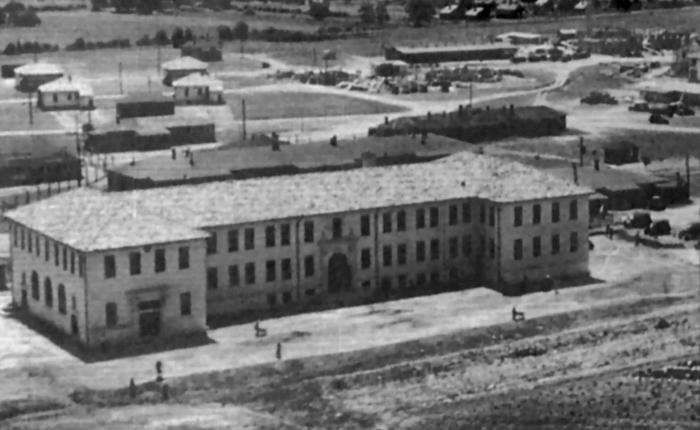
Header Image: Austin Hall at Maxwell AFB. Austin Hall was the home of the Air Corps Tactical School before the Second World War. (Source: Wikimedia)
If you would like to contribute to From Balloons to Drones, then visit our submissions page here to find out how.
[1] While Bailey is not a fast-jet aviator, this reviewer used to be one and so feels able to use such an analogy shamelessly.
From the British conception of air policing to the myriad of coalition air assets deployed as part Operation Inherent Resolve, counterinsurgents have enjoyed their ability to be the sole force in skies and the plethora of benefits that brings. Throughout late 20th and early 21st century, there have been rare instances where insurgents have tried to either contest this or at the very least exploit the air domain for their operations. These include the development and deployment of the ‘Air Tigers’ of the Liberation Tigers of Tamil and Eelam (LTTE) and the more recent use of small unmanned aerial vehicles (UAVs) and unmanned combat aerial vehicles (UCAVs) by a host of actors including ISIS and Hezbollah. LTTE’s attempts were largely ineffective, and ISIS’s small UAVs have been only deployed for tactical effects. Assumedly developing a counter to this ISIS threat will be part of the broader effort to deal with the UAV threat writ large. In Gaza, Hamas has developed something different and is going back in time technologically to exploit the hybrid space and launch an air campaign.
In late May 2018 Israeli security forces identified an explosive-laden UAV launched by one of the militant groups from the Gaza strip. In the same month, the Israeli Air Force (IAF) destroyed a Hamas base containing unmanned underwater vehicles. Both these capabilities while impressive represent an evolution of what combatants have already observed the world over. Militant groups increasingly have the capabilities to employ low-cost unmanned systems in a variety of domains. The interesting evolution out of Gaza strip is not the use of advanced technology by militant groups but a return to simple and cheap solutions.
Over the past month, militants in Gaza have launched numerous strikes using incendiary devices attached to kites and balloons. These devices come in several forms; some are kites released on to the wind current carrying flaming material and accelerant dangling from a rope. Others are helium balloons (or helium-filled condoms) with trailing flaming materials and accelerant. Although there are variations most of these carry metallic mesh pouches contacting burning oil-soaked rags or coal. These take advantage of the dry summer conditions in Southern Israel to spark fires out of proportion to the amount of accelerant. In addition to these, there are varieties with small impact based explosive devices attached and more recently explosive devices designed to litter the ground.
This is the past returning. During the Second World War, the Japanese military was unable to bomb the mainland US and turned to balloons with incendiary devices as an attempt at a solution. By 20 June 2018, 75 days of balloon and kite attacks had seen over 700 attacks which burned over 6,100 acres of primarily agricultural land causing millions of dollars of damage. For Israel damage to its agricultural sector presents a serious threat given the relatively small amount of arable and pasturable land.
An Iron Dome battery at Ashkelon, c. 2011 (Source: Wikimedia)
The balloon and kite launched devices present significant challenges to the Israeli military (IDF). Due to their low signature, they are harder to detect than UCAVs. Unlike rockets and mortars, they do not follow a set trajectory making counter battery fire more difficult. They are cheap and therefore employing short-range air defence such as Iron Dome makes little sense. The helium-filled condoms which trail burning liquids or rags may only cost as much as the helium (condoms are distributed in Gaza by the Palestinian Authority and international NGOs) while Iron Dome costs near $100,000 per launch. Other forms of Counter Rocket Artillery and Mortar systems rely on a more prominent radar profile and are designed for point defence not protecting a whole broader.
The biggest challenge they pose may result from their place in the narrative domain. Often launched by teams including children, balloons and kites do not seem as threatening as other, more significant, more conventional types of attacks. Targeting those who launch them with lethal force would likely play poorly in the media and the international community overall. Unlike rockets and mortars, kites, and balloons – no matter the threat they may pose – are not often thought of within the panoply of tools of war. In this way, they are emblematic of an entire strategy – namely causing as much strategic threat as possible while remaining below the threshold of escalation. In his 1991 book The Transformation of War, Martin van Creveld identified the challenge this strategy poses to conventional state militaries stating: ‘Since fighting the weak is sordid by definition, over time the effect of such a struggle is to put the strong into an intolerable position.’[1] The kite and balloon attacks represent a new form of air power for insurgent groups which takes advantage of exactly this dynamic. As of now these attacks also provide a narrative victory to the militant groups allowing them to showcase in video and photo their ability to reach out and attack Israel. If the success of the balloon and kite attacks continues, we can safely assume they will spread. The more they are featured in regional media and militant media the more likely this is to happen.
So what options exist to counter this counter this new aerial threat? Thus far the IDF has looked to technological solutions deploying cheap commercial UAVs to bring down the kites and the balloons through physical contact. The Israeli public broadcaster Kan reported that this has had mixed results. The IDF has recently deployed a new system called Sky Spotter. The IDF employs this electro-optical system, to identify and provide an alert of incoming attacks mitigating the damage caused. Sky Spotter also serves to guide defenders to the incoming targets. There are plans to equip Sky Spotter with a laser system or to the ability to autonomously vector mini-UAVs. In the meantime, with an increase in the threat, some Israeli officials have suggested targeting those launching the attacks, and the IAF has begun firing warning strikes near those launching the attacks. As previously noted this tactic is rife with problems.
Another possible solution might be retaliating against targets and in doing so establishing deterrence. Although this might work in the unique operating environment of Gaza it is doubtful it would be as possible if another insurgency adopts this new use of air power globally. Just as lookouts may be more useful for identifying incoming attacks from balloons and kites than more high-tech radar, so too might defeating the threat requiring an examination of the past for inspiration. In the past, the best air defence consisted of layers of surface to air missiles (SAMs) and gun systems. These balloon and kite attacks exploit the intellectual and perhaps, even technical space, below the threshold for the employment of SAMs. Kites and balloons are vulnerable to gunfire and integrating rapid firing weapons aimed and operated by humans might provide a solution to this threat. Even this is not without problems as it potentially risks causing inadvertent casualties due to inaccuracy. Regardless, until a solution is found, it is likely insurgents will continue to exploit the air domain not only by developing drones but by evolving from drones to balloons.
Dr Jacob Stoil is an Assistant Professor of Military History at the US Army School of Advanced Military Studies where he serves as the author for the course ‘Anticipating the Future’. He is the Deputy Director of the Second World War Research Group for North America. Stoil holds a PhD from the University of Oxford, and an MA and BA from the Department of War Studies at King’s College London. He has research experience carrying out fieldwork in both Israel and the Horn of Africa. His most recent publications include ‘Command and Irregular Indigenous Combat Forces in the Middle East and Africa’ in the Marine Corps University Journal, and ‘Martial Race and Indigenous Forces’ in Rob Johnson (ed.), The British Indian Army: Virtue and Necessity (2014). Additionally, he has authored analysis of contemporary operations and policy for the Journal of Military Operations, War on the Rocks, and From Balloons to Drones. Most recently he published an article on the spread of vehicle ramming attacks through West Point’s Modern War Institute and has a forthcoming in Le Vingtième Siècle article on indigenous forces in Palestine Mandate.
Header Image: A missile from an Israeli Iron Dome, launched during the Operation Pillar of Defense to intercept a missile coming from the Gaza strip, c. 2012. (Source: Wikimedia)
Disclaimer: The views presented here do not represent those of any contributors employer, funder, or government body.
If you would like to contribute to From Balloons to Drones, then visit our submissions page here to find out how.
[1] Martin van Creveld, The Transformation of War (New York: The Free Press, 1991), p. 176.
The other week I mentioned on Twitter that it had been two years since I had touted the idea of creating a group website dedicated to air power history, theory, and practice. While we might quibble about From Balloons to Dronesdate of birth, it was on 15 June 2016 that the first post announcing the creation of the site and calling for contributions was published. As such, it seems apropos to reflect on the past two years.
From Balloons to Drones started out with me as the only editor and we had a couple of dedicated contributors. I am pleased to say that three of those early dedicated contributors, Dr Brian Laslie, Dr Mike Hankins, and Alexander Fitzgerald-Black, have now come onboard as Assistant Editors. All our effort is, of course, done in addition to our other work away from the site. For example, recently, I moved to Australia from the UK and co-edited a special edition of the British Journal for Military History while Brian published his much-awaited book on General Laurence Kuter. Similarly, Alex published his first book on the air war over Sicily in 1943 while Mike completed his PhD on culture and technology in the United States Air Force (USAF) and has now moved to take up a position at the USAF Air Command and Staff College. Nonetheless, despite all these significant personnel and professional achievements, and with my Assistant Editors support, we continue to plan for the future and examine how we might grow the air power core community of interest.
As well as adding Brian, Mike, and Alex to the editorial team, From Balloons to Drones continues to grow regarding the number of contributors to the site; however, we are always looking to add new writers to the team. As such, if you are a postgraduate, academic, policymaker, member of the armed forces or a relevant professional involved in researching the subject of air power then take a moment and look at our submissions page to find out how you can get involved with the conversation.
What about statistics? Well, this is our ninety-fifth post, which, of course, means we are just five away from the magic century. Those 95 posts have consisted of articles, research notes, book reviews, commentaries, and the occasional editorial. We also started a new series of historic books reviews with the first one published here. All told, these posts, excluding this one, have totalled some 157,000 words, or roughly the equivalent of two monographs! We have published a wide variety of articles that have covered both historical and contemporary issues. The top five posts are:
We also worked on a great joint series of articles with our partners at The Central Blue. These articles supported a seminar that the Williams Foundation held in Canberra, Australia that looked at the requirements of high-intensity warfare in the 21st century. This was a great partnership and something we are happy to explore again in the future.
The Future
Speaking of the future, there is, of course, the question of what comes next. Well, hopefully, more of the same. We are keen to build on the high-standards we believe that we have set for ourselves. However, we can only do that with your help. So, get in touch and contribute!
As noted, we have started a new series of historic book reviews, and this is an area that we are keen to develop. The series aims to be an accessible collection of appraisals of critical historic publications about air power history, theory, and practice. Many books hold a specific place in the study of air power because of the ideas they introduced or the insights they provided about the institutions responsible for delivering air power capabilities. The reviews will cover several different types of texts from those works that developed air power ideas to crucial memoirs.
Our essential development for the near future is that we are launching a series of podcasts with authors of new air power related titles. This is a project that Mike is working on for us, and we are excited about the prospect of offering something stimulating and hearing from those working in the field of air power studies. We will be realising more information about these podcasts once we have more details.
Concluding Thoughts
Overall, myself, Brian, Mike, and Alex have made a concerted effort to develop closer ties not just between ourselves but between those interested in the subject of air power. We think we have done that, but we are always happy to hear any ideas that our readers might have for future developments. Finally, it is to you, our readers, and our contributors that we owe our greatest thanks. Without you, we would not exist. If you do not come and read the material that we publish, then there is little point in this endeavour. That you do come and read our ramblings is appreciated, and we hope you continue to do so for many years to come.
Dr Ross Mahoney is the Editor of From Balloons to Drones. He is an independent historian and defence specialist based in Australia. Between 2013 and 2017, he was the resident Historian at the Royal Air Force Museum, and he is a graduate of the University of Birmingham (MPhil and PhD) and the University of Wolverhampton (PGCE and BA). His research interests include the history of war in the twentieth and twenty-first centuries, air power and the history of air warfare, and the social and cultural history of armed forces. To date, he has published several chapters and articles, edited two books, and delivered papers on three continents. He is a member of the Royal Historical Society and an Assistant Director of the Second World War Research Group. He blogs at Thoughts on Military History, and can be found on Twitter at @airpowerhistory.