Editorial Note: Led by Editor Dr Mike Hankins, From Balloons to Drones, produces a monthly podcast that provides an outlet for the presentation and evaluation of air power scholarship, the exploration of historical topics and ideas, and provides a way to reach out to both new scholars and the general public. You can find our Soundcloud channel here. You can also find our podcast on Apple Podcasts and Google Podcasts.
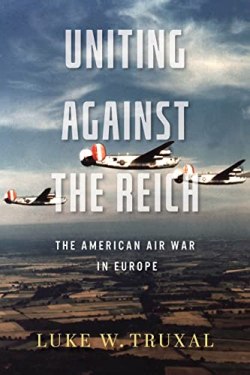
Dr Luke Truxal is the author of the new book Uniting Against the Reich: The American Air War in Europe from the University Press of Kentucky. In it, he traces how the structure of command over air forces in the Second World War created a mess of problems. Only late in 1943 and into 1944 did these command structures change, enabling air power to become more effective. In this interview, Truxal takes us into the dramatic relationships between leaders like Dwight Eisenhower, Carl Spaatz, and more, showing why, in positions of leadership, personality matters.
Dr Luke Truxal is an adjunct at Columbia State Community College in Tennessee. He completed his PhD in 2018 from the University of North Texas with his dissertation ‘Command Unity and the Air War Against Germany.’ His previous publications include ‘Bombing the Romanian Rail Network’ in the Spring 2018 issue of Air Power History. He also wrote ‘The Politics of Operational Planning: Ira Eaker and the Combined Bomber Offensive in 1943’ in the Journal of Military Aviation History. In addition, Truxal is researching the effectiveness of joint air operations between the Allied air forces in the Second World War. He can be reached on Twitter at @Luke_Truxal.
Header image: A formation of Boeing B-17F Flying Fortresses over Schweinfurt, Germany, on 17 August 1943. (Source: National Museum of the United States Air Force)
Editorial Note: Led by Editor Dr Mike Hankins, From Balloons to Drones, produces a monthly podcast that provides an outlet for the presentation and evaluation of air power scholarship, the exploration of historical topics and ideas, and provides a way to reach out to both new scholars and the general public. You can find our Soundcloud channel here. You can also find our podcast on Apple Podcasts and Google Podcasts.
2023 marks the 30th anniversary of the announcement of the first female American combat fighter pilots. How did the US go from women not being allowed in military aeroplanes to having women combat pilots? Eileen Bjorkman (Colonel, USAF, ret’d) joins us to discuss these momentous changes. She is a former flight test engineer who has flown in aircraft like the F-4 Phantom and the F-16 Fighting Falcon, and she is the author of Fly Girls Revolt: The Story of the Women who Kicked Open the Door to Fly in Combat (2023), from Knox Press.
Eileen Bjorkman is a retired US Air Force Colonel. She was a flight test engineer during her USAF career, flying more than 700 hours in twenty-five different types of military aircraft, including fighters such as the F-4 and F-16. She is also a civilian pilot and author of The Propeller Under the Bed (2017) and Unforgotten in the Gulf of Tonkin (2020).
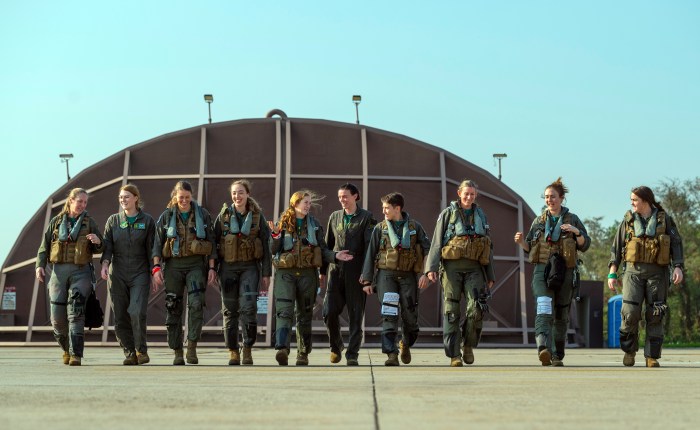
Header image: Female fighter pilots assigned to the 36th and 25th Fighter Squadrons join together before flying a historic all-female flight at Osan Air Base, South Korea, on 25 October 2021. The flight is the first time 10 female Airmen have planned, led and flown in a formation together while assigned to Osan AB. Eight pilots are A-10 Thunderbolt II pilots, and two are F-16 Fighting Falcon pilots. (Source: US Air Force)
In 2024, From Balloons to Drones will run a series of articles that examines the role of air power during the defining year of the Second World War – 1944.
The year 1944 was the defining year of the Second World War. Events such as the fall of Rome, the invasion of France and the destruction of Germany’s Army Group Centre on the Eastern Front defined the war in Europe. In the Pacific and Southeast Asia, events such as the Battles of Imphal and Kohima and the Battle of the Philippine Sea marked important points in the war. In the strategic air war, the Combined Bomber Offensive in Europe peaked. At the same time, the Boeing B-29 Superfortress was introduced in the Far East and Pacific as the US increased its strategic air operations in this theatre of operations.
2024 marks the 80th Anniversary of the critical events of 1944. At all levels of war, air power played an essential role in the various battles and campaigns of 1944. As such, From Balloons to Drones is seeking submissions for articles examining the varied use of air power in 1944. Articles might, for example, explore the strategic air campaigns of 1944, the use of tactical air power, or the use of carrier-based air power. Possible themes to be explored might include, but are not limited to:
Strategy, Theory and Doctrine | Organisation and Policy | Roles Operations – Kinetic and Non-Kinetic | Tactics, Training and Procedures Strategic and Operational Effect | Technological Developments | Ethical and Moral Issues National, International and Transnational Experiences | Personal Experiences Memory and Memorialisation
We are looking for articles of between 500 to 4,000 words, but we will accept larger pieces and reserve the right to publish them in parts. Please visit our submissions page for more information on the types of articles published by From Balloons to Drones.
We plan to begin running the series in March 2024, and it will continue for as long as we receive potential contributions. We welcome and encourage submissions from academics, policymakers, service personnel, and relevant professionals.
Submissions should be submitted in Word format and emailed to the email address below with ‘SUBMISSION – Air Power and 1944 Revisited’ in the subject line. Also, please include a 50-100-word biography with your submission. Footnotes can be used, and please be careful to explain any jargon. If you are unsure if your idea fits our requirements, please email us with ‘POTENTIAL SUBMISSION – Air Power and 1944 Revisited’ in the subject line to discuss.
If you are interested in contributing, please email our Editor-in-Chief, Dr Ross Mahoney, at airpowerstudies@gmail.com or contact us via our contact page here.
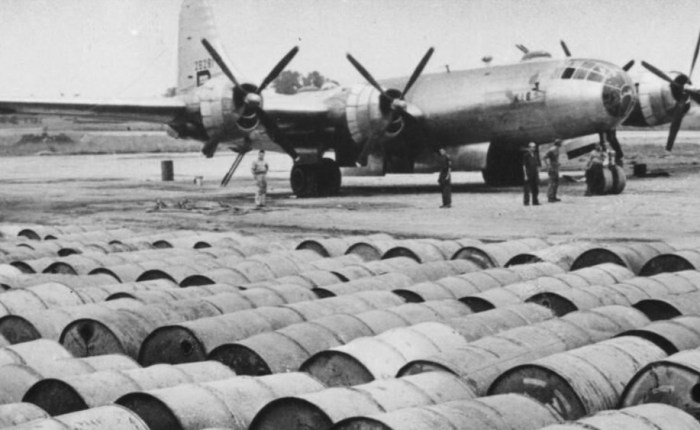
Header image: Rows of fuel tanks in front of a B-29 Superfortress of the 40th Bombardment Group assigned to the US Twentieth Air Force in China, c. 1944. (Source: Wikimedia)
Greek military and naval aviation development would have been delayed if Eleftherios Venizelos had not become Prime Minister of Greece in 1910. Venizelos’ rise to power resulted from Greece’s failures in several areas. Greece, in 1909, was facing several issues, including financial problems, continuous military failures, especially the humiliating defeat in the Greco-Turkish War of 1897and the incapability of the political elite to respond to the masses’ demands, including better preparation of the armed forces, reduction of taxes, and financial stabilisation. Also, in the early 20th Century, Greece remained concerned about the intentions of the Ottoman Empire, especially after the reforms introduced in the wake of the Young Turk Revolution of 1908. These events provided the context and motivation for the early development of Greek air power.
The Goudi Coup and Eleftherios Venizelos
In October 1908, junior Greek Army officers who felt disappointed in the military policy of the Greek government, especially the lack of preparation that had led to defeat in the Greco-Turkish War of 1897, formed the Military League. Their key demand was an increased military budget and modernisation of the Greek Army. Rapidly, the organisation became very powerful, largely due to frustrations within the Greek Army and society. Despite the lack of overt political ambition and a desire to focus on military affairs, the young officers gained the support of the people of Athens. So, on 15 August 1909, the Military League organised a coup that began in Goudi barracks. Prime Minister Dimitrios Rallis resigned on the same day, and his successor, Kyriakoulis Mavromichal, began negotiating with the rebels. Despite the success of the coup, the country’s social problems remained unsolved.[1]
The months after the coup passed without any progress. On the one hand, while the Military League was powerful, it did not wish to create a military junta. However, the government had minimal freedom to act. Also, social problems, such as poverty, lack of education, and social inequalities, presented substantial obstacles, and few politicians could handle them. One who could handle them was Venizelos, a little-known lawyer who lived in Crete, then an autonomous region under the authority of the Sultan of the Ottoman Empire. The revolutionary officers – several of whom were Cretans – called him in Athens on 28 December 1909. There, Venizelos crafted a compromise between the Military League and the politicians to create a prudent political program for his regime. After that, on 15 March 1910, the Military League dissolved itself, expressing the opinion that there was no longer a need to exist. Some months after that, on 6 October 1910, Venizelos was elected Prime Minister.[2] Venizelos dominated Greek politics, serving as Prime Minister seven times before he died in exile in 1936.
Soon after his election, Venizelos, viewed as a man of action rather than an intellectual, aimed to transform Greece into a modern European state.[3] The new parliament passed several laws to improve education, protect individual freedoms, secure civil rights, and boost the economy. Also, realising that a new conflict against the Ottoman Empire was approaching, Venizelos sought to reorganise the Greek military. He held the portfolios of the Military and Naval Ministries. One of his first decisions was to invite a French delegation under General Joseph-Paul Eydoux and a British one under Rear-Admiral Lionel Grant Tufnell. Eydoux led the French Military Mission that arrived in Greece in January 1911 to oversee changes in the Greek Army, including improvements in organisation and tactics, training, and procedures. Grant led the British Naval Mission, which undertook similar work with the Greek Navy. Furthermore, in February 1912, the Greek parliament approved a new bill that divided Greece into four military regions. Each region could generate two divisions in wartime.[4]
The First Greek Pilots
As early as 1909, Russian aviator Simon Utoskin appeared in Greece and flew with his Farman aircraft in the Palaio Faliro region. However, this effort had no connection to official Greek policy.[5] The first flight in Greece was carried out by businessman Emmanouil Argyropoulos, who arrived in Athens with a Nieuport IV.G plane in January 1912. On 8 February, he took off from Rouf aerodrome in the presence of King George I and Venizelos. The Prime Minister followed Argiropoulos on his second flight and baptised his plane, Alkyon).
The arrival of the French Military Mission in 1911 was the key driver in establishing military aviation in Greece. Eydoux, a École Supérieure de Guerre graduate, was a passionate man with progressive ideas about how to modernise the Greek Army. In cooperation with Venizelos, Eydoux examined the possibility of establishing a Hellenic Air Service for the Greek Army that followed the standards of the French Army, which had formed its air service in 1909. Venizelos supported the idea and permitted the young officers to go to France for flying training. First Lieutenant Dimitrios Kamperos, First Lieutenant Michail Moutousis, and Second Lieutenant Christos Adamidis arrived there in the last months of 1911. They formed the nucleus of the Hellenic Air Service established in 1911, and they were trained at Henri Farman’s flying school at the Etampes aerodrome. At the same time, the Greek government ordered some of its first MF.7 Longhorns, which arrived in Athens some months later.[6]
The MF.7, a two-seater aeroplane, was designed and built by Maurice Farman in 1910. It was almost 12 meters long, with a wingspan of 15 meters. It used a 70hp Renault 8C V-8 air-cooled piston engine and could reach a speed of 95 kilometres per hour. Its service ceiling was 4,000 meters. Farman used the prototypes initially for training purposes in his flying school. Furthermore, he and other experienced pilots like Maurice Tabateau, Eugène Renaux, and Farman won several Michelin Prizes flying this aircraft type. France, Greece, Great Britain, Australia, Italy, Spain, Mexico, Belgium, Norway, Japan, Denmark, and Russia operated them during the First World War.[7]
First Lieutenant Dimitrios Kamperos, the first military aviator in Greek history, c. 1912. (Wikimedia)
Kamperos was the first military aviator to return to Greece after the first phase of his training in France. On 13 May 1912, he performed his first flight in Greece during the military exercises before the First Balkan War broke out. Two days later, he flew at a height of approximately 1,000 meters, performing reconnaissance missions in nearby lands of Attica region. Both Eydoux and Venizelos watched his landing. The latter constantly expressed a great interest in the Hellenic Air Service, communicating personally with the pilots and trying to cover their training demands. On 27 May, Venizelos baptised the first four planes that arrived in Greece, giving them the names Dedalus, Aetos (Eagle), Gyps (Vulture), and Ierax (Hawk). The public celebrated the ritual, and several wealthy businesspeople were willing to purchase planes.[8]
Kamperos stayed in Athens for three months; in August, he had to return to France for the second training phase. That period was enough for him to perform several daring flights. Also, in June 1912, he modified a Farman plane into a seaplane and landed it without difficulties in front of Venizelos and other officials. Simultaneously, Kamperos’ colleagues continued their training in France. The detachment numbered six pilots: Moutousis, Second Lieutenant Panoutsos Notaras, Adamidis, First Lieutenant Loukas Papaloukas, First Lieutenant Markos Drakos, and Kamperos. The process was interrupted in September because Greece entered the First Balkan War, and the aviators were obligated to return to their motherland.
Greek Military Aviation and The Balkan Wars
In 2011, historian Marc Biondich described the diplomatic and military history of the Balkans as a product of:
The complex multicultural and ethnolinguistic mosaic, which was produced over the centuries by a combination of geography and political history, has come under astonishing duress over the past two hundred years. Indeed, the Balkans as a term and spatial category were born in the modern era, conceived in the nineteenth century as a post-imperial space and legacy of Ottoman decline emerging from the confluence of revolution, war, and Great Power fiat.[9]
During the 19th Century, several national movements developed in the Balkans to challenge the domination of the Ottoman Empire. The creation of small nation-states in the region did not appease their ambitious leaders, including Eleftherios Venizelos, who desired to expand their countries’ borders. This ambition led to the Balkan Wars of 1912-1913, a series of conflicts that significantly reshaped the map of the region. During the Balkan Wars, Greek pilots had the opportunity to gain experience and show their skills.
In September 1912, the four Greek pilots who remained in France were ordered to return to Greece. They formed the nucleus of the recently established Aviation Company based in Larissa. This unit reported to the Hellenic Air Service. Having initially only four Henry Farman aircraft, the Aviation Company conducted mainly reconnaissance missions. In one of them, Kamperos threw hand grenades at his enemies, although he did not manage to cause any casualty. At the same time, new personnel arrived in Larissa because the government allowed civilians with a pilot diploma to enlist in the Aviation Company. The most significant was Argyropoulos, one of Greece’s few experienced aviators. The government also ordered new Maurice Farman aircraft from France. These decisions helped increase the efficiency of the Aviation Company.
The Greek Army occupied Macedonia’s most significant city, Thessaloniki, on 26 October 1912. That caused the pause of the air operations. However, the Aviation Company moved to Epirus in December to participate in the siege of Ioannina. There, the Greek pilots did not limit their action to reconnaissance missions; they also bombed the Turkish positions and provided supplies to their isolated fellow soldiers. After the liberation of Ioannina, Adamidis landed inside the city, highlighting the successful service of the Aviation Company.[10]
The Greek Destroyer Velos collects the Henry Farman aircraft of First Lieutenant Michael Moutoussis and Lieutenant Aristeidis Moraitinis after the first air-naval operation, c. 1913. (Source: Wikimedia)
Overall, the Balkan Wars significantly impacted Greek military policy regarding aviation. Notably, after the signing of the Treaty of Bucharest in 1913, which ended the Balkan Wars, the efforts to reinforce Greek military aviation continued. Venizelos and the other leading members of his government took the opportunity to understand better the potential of a well-organised Hellenic Air Service with modern aircraft and experienced pilots. It is also noteworthy that Venizelos did not lose his heart when Argyropoulos died in a crash in the Lagadas region on 4 April 1913. This was the Aviation Company’s first loss. Finally, at the beginning of 1913, Moutousis moved to Limnos, where, with Lieutenant Aristides Moraitinis, he organised and experimented with a recently purchased French seaplane for several missions.
Greek Military and Naval Aviation in the First World War
When the First World War began, Greece was politically divided. On the one hand, Venizelos believed the country should be allied with Britain and France because it would allow it to expand Greece’s borders further. On the other side, King Constantine I expressed the opinion that Greece should be neutral, securing whatever it had gained after the recent Balkan Wars. This dispute led to a ‘quiet’ civil war that ended with the deposition of King Constantine I in 1917. After that, Venizelos, supported by Britain and France, declared war on the Central Powers.[11]Meanwhile, Kamperos continued his hard work. He led the Hellenic Air Service, which managed the logistics of military aviation, including the financial administration and the training of the pilots. Also, operationally, an Aviation Company and squadron based in Palaio Faliro, near Athens, reported to the Hellenic Air Service. However, both operational units lacked personnel, aircraft, and fuel. The same thing happened at the Hellenic Naval Air Service until 1917.
In Thessaloniki, where he had organised a rebel government in 1916-1917, Venizelos attempted to merge the air services of the Greek Army and Greek Navy; however, he was unable to achieve his aims due to the backlash of many officers who were afraid that they would lose their autonomy. Nevertheless, Venizelos reorganised the Hellenic Air Service. In September 1917, a specific department was established within the Army Ministry to improve the efficiency of the Hellenic Air Service by undertaking the bureaucratic tasks previously undertaken by the later. There, experienced French personnel supported the Greeks in developing the Greek Army’s aviation capabilities, while an aircraft manufactory was also created. From December 1917 to June 1918, three squadrons were established.[12] These were 531, 532 and 533 Squadron. The former was a fighter unit equipped with Nieuport 24bis and Spad VII/XIIIBreguet 14A2/Β2, while the latter two were bomber-reconnaissance units equipped with Breguet 14A2/Β2.
The Hellenic Air Service participated in several confrontations during the First World War. At the Battle of Skra in 1918, Greek pilots located Bulgarian artillery batteries and guided Greek artillery fire, including counter-battery operations. Additionally, the 531 Squadron, equipped with Spad VII/XIII aircraft, participated in several dogfights against the more experienced Germans to battle for control of the air. However, the most significant role of the army’s squadrons was its participation in fruitful reconnaissance missions and the escort of Entente’s (mainly British) bombers that operated against the Ottoman coasts.[13]
Between 1917 and 1918, the Hellenic Naval Air Service, which had been established in 1915, developed rapidly under the command of Moraitinis, a pro-Venizelist officer who had not hesitated to offer his service to the British in 1916, long before King Constantine I was deposed. The Hellenic Naval Air Service simultaneously trained and took part in several missions, something beneficial for its pilots. One of the most notable moments of the Hellenic Naval Air Service came on 21 March 1917, when Moraitinis bombed the German airdrome of Drama. Moraitinis impressed even his opponents, who witnessed his tremendous action. Moraitinis and his peers also bombed Bulgarian logistical hubs storing food several times and conducted numerous reconnaissance missions. Notably, most of those activities were executed at night under challenging circumstances.
In 1918, the Hellenic Naval Air Service cooperated several times with the British Royal Navy, escorting the latter’s ships operating in the region. One of those missions was the last for Sublieutenant Spyridon Hampas, who had the misfortune of facing the German ace Lieutenant Emil Meinecke. Meinecke had at least seven aerial victories while also training the Turkish pilots. The Germans buried his victim, Hampas, with military honours at the British Chanak Consular Cemetery. He was one of the 18 members of the Corps who lost their lives during the conflict.[14]
At the end of the First World War, four Hellenic Naval Air Service planes flew into Istanbul on 4 November 1918 under the command of Moraitinis. It was a great honour for the Greek airmen because the city was centuries ago the capital city of the Byzantine Empire. After landing at Saint Stefanos’s airdrome, they continued their flight, demonstrating a Greek flag. Unfortunately, that was one of Moraitinis’ last missions as on 22 December 1918, the Breguet 14 he was piloting crashed accidentally near Mount Olympus. He was only 27 years old.[15]
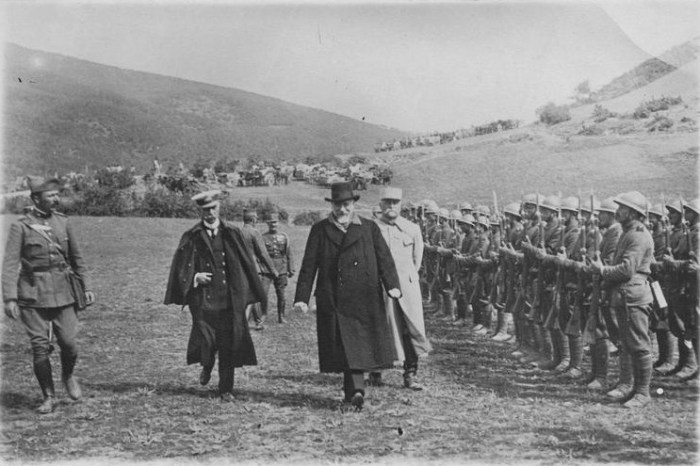
Venizelos reviews a section of the Greek army on the Macedonian front during the First World War in 1918. He is accompanied by Admiral Pavlos Koundouriotis (left) and French General Maurice Sarrail (right). (Wikimedia)
Conclusion
Moraitinis and, before him, Argyropoulos were two of the most notable Greek airmen who died during their service. However, these losses did not stop the evolution of Greek military and naval aviation. All Greek politicians, including Venizelos, envisioned that their country should dominate in the air. Greek pilots had proved their merit during and before the First World War, operating under difficult circumstances. For example, Greek military and naval aviators operated under challenging operational and organisational circumstances, faced more experienced German aviators and executed dangerous missions. Fortunately, some aviators, such as Kamperos and Moutousis, remained in the Hellenic Air Service and Hellenic Naval Air Service, training their successors.
The question remains, however, as to why Greek military and naval aviation succeeded. First, there was the charisma of the Hellenic Air Service and Hellenic Naval Air Service personnel. Men like Kamperos were both soldiers and leaders who loved danger. So, the other pilots admired them and were ready to obey their orders. More importantly, however, Greek politicians, especially Venizelos, showed an early interest in developing Greek military and naval aviation – Venizelos could be considered the real ‘father’ of Greek military aviation. Notably, Venizelos’ decision to request French and British military advisors was an essential step in developing Greek military aviation. Finally, through Greece’s participation in various wars of the 1910s, Greek pilots learned how to fly and manage an air service under wartime conditions: the theatres of the Balkan Wars and the First World War could be considered the real training schools for them.
Emmanouil (Manolis) Peponas is a PhD candidate at the Department of History and Archaeology, National and Kapodistrian University of Athens. He completed his BA and MA studies with honours at the University of Ioannina. As an experienced freelancer, he has worked for remarkable institutions and publishing companies. He is the author of seven books and several articles. His research interests focus on the contemporary military, social and diplomatic history of the Balkans.
Header image: Greek aviators of the Hellenic Naval Air Service at San Stefano aerodrome after the capitulation of the Ottoman Empire, 1918. (Source: Wikimedia)
[1] Mark Mazower, ‘The Messiah and the Bourgeoisie: Venizelos and Politics in Greece, 1909–1912,’ The Historical Journal 35, no.4) (1992), pp. 885-904.
[3] Mazower, ‘The Messiah and the Bourgeoisie,’ p. 904.
[4] Thanos Veremis, Military Interventions in Greek Politics, 1916-1936 [Οι επεμβάσεις του στρατού στην ελληνική εξωτερική πολιτική 1916-1936] (Athens: Alexandria, 2018), p. 39.
[6] Konstantinos Topalidis, ‘The History of the Air Force in Greece, 1919-1940’ [‘Η ιστορία της Πολεμικής Αεροπορίας στην Ελλάδα, 1919-1940’] (MA thesis, University of Macedonia, 2016), p. 14.
[7] ‘The Maurice Farman Biplane.’ Flight IV, no. 27 (6 July 1912), pp. 603-6.
[8] Topalidis, ‘The History of the Air Force in Greece,’ p. 15.
[9] Mark Biondich, The Balkans: Revolution, War, and Political Violence since 1878 (Oxford: Oxford University Press, 2011), p. 1.
[10] Topalidis, ‘The History of the Air Force in Greece,’ pp. 16-20.
[11] George Kaloudis, ‘Greece and The Road to World War I: To What End?,’ International Journal on World Peace 31, no. 4 (2014), pp. 9-47.
[12] Topalidis, ‘The History of the Air Force in Greece,’ pp. 28-29.
[13] Douglas Dakin, The Unification of Greece 1770-1923 (London: Ernest Benn, 1972), p. 218.
[14] Topalidis, ‘The History of the Air Force in Greece,’ pp. 30-2.
Editorial Note: Led by Editor Dr Mike Hankins, From Balloons to Drones, produces a monthly podcast that provides an outlet for the presentation and evaluation of air power scholarship, the exploration of historical topics and ideas, and provides a way to reach out to both new scholars and the general public. You can find our Soundcloud channel here. You can also find our podcast on Apple Podcasts and Google Podcasts.
In our latest interview, we talk to former United States Air Force F-4 Phantom pilot Lee Ellis who was a prisoner of war in the ‘Hanoi Hilton’ in Vietnam for over five years. However, in the time since, he noticed that he and many other POWs had gone on to experience dramatic love lives. Ellis joins us to discuss his new book, Captured By Love: Inspiring True Romance Stories from Vietnam POWs.
Lee Ellisis the Founder and President of Leadership Freedom® LLC and FreedomStar Media®. He is an award-winning author, leadership coach, and expert presenter in the areas of leadership, teambuilding, and human performance. Early in his career, Lee was a United States Air Force fighter pilot flying fifty-three combat missions over North Vietnam. In 1967, he was shot down and held as a POW for over five years in Hanoi and surrounding camps. For his wartime service, he was awarded two Silver Stars, the Legion of Merit, the Bronze Star with Valor device, the Purple Heart, and POW Medal. Lee resumed his Air Force career, serving in leadership roles of increasing responsibility, including command of a flying squadron and leadership development organizations, before retiring as a colonel. Lee has a BA in History and a MS in Counseling and Human Development. He is a graduate of the Armed Forces Staff College and the Air War College. He has authored or co-authored five books on leadership and career development.
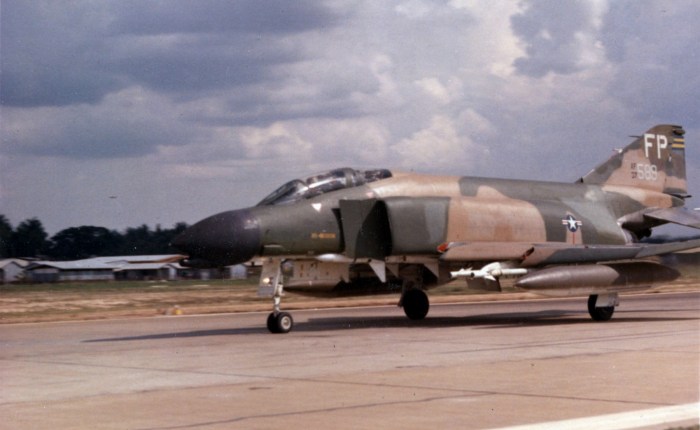
Header image: A US Air Force McDonnell F-4C Phantom II from the 497th Tactical Fighter Squadron, 8th Tactical Fighter Wing, rolls out on takeoff from Ubon Royal Thai Air Force Base, circa 1967. It is configured for the MiGCAP escort role with AIM-7 Sparrow air-to-air missiles under the fuselage, and AIM-9B Sidewinder air-to-air missiles and extra fuel tanks under the wings. (Source: Wikimedia)
I am fascinated by aircraft designs that ‘could have been.’ Maybe it’s just my nostalgia for childhood drawings of imaginary aeroplanes, but I love looking at the concept for the out-of-the-box ideas that never made it off the drawing board. Recently, I was researching at the beautiful Huntington Library archives, combing through the papers of Ben Rich, who ran Lockheed’s Advanced Development Projects division, ‘Skunk Works,’ between 1975 and 1990. ‘Skunk Works’ handled Lockheed’s top-secret programs, such as the U-2. I came across his files on the CL-400, also known as Project Suntan.[1] This had nothing to do with the project I was working on, but I found the files fascinating and wanted to share some of what I found here on From Balloons to Drones.
In 1955, most people dancing to Bill Haley’s new hit song ‘Rock Around the Clock’ had little idea that the Central Intelligence Agency and US Air Force had partnered with Lockheed to design a secret spy plane to fly 70,000 feet above the Soviet Union, the U-2. However, even as the U-2 began flying, Clarence ‘Kelly’ Johnson, then chief engineer at Lockheed’s Burbank, California plant, suspected that the U-2 would not last long – it was an effective aeroplane but vulnerable. Johnson wanted a follow-on to the U-2 that could fly even higher, further, and faster.
Lockheed turned to the advantages of high-energy fuels, specifically liquid hydrogen (LH). With a much greater energy density, hydrogen was more powerful (and hazardous). On paper, it seemed like an LH-powered aircraft could have everything Johnson needed: very long range, very high altitude, and supersonic speed. Rich led the project, working under Johnson at the ‘Skunk Works.’
Rich recalled, ‘between 1955-1958, [Lockheed] developed and built all the components and systems necessary for a liquid hydrogen-fueled airplane.’ Designing aircraft to use this unique fuel source presented major challenges. As Rich noted: ‘The hydrogen fueled airplane has very little flexibility in design configuration […] since fuel requirements dictate a long fuselage with attendant balancing and C.G. [center of gravity] travel limitations.’
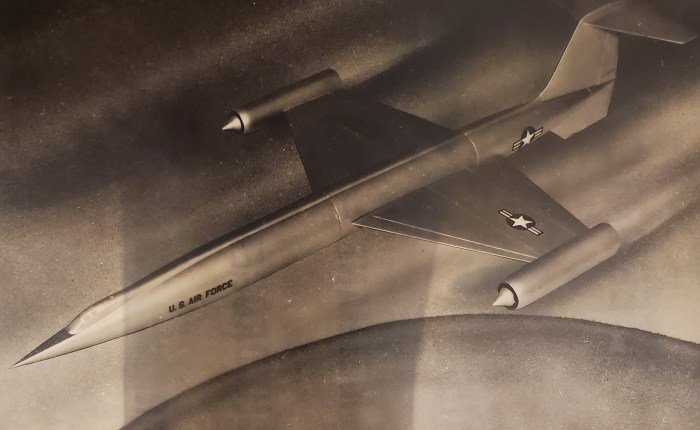
Nevertheless, the concept went through a series of iterations. The original CL-400 was a two-seat reconnaissance plane, 160 feet long with a 10-foot diameter. The wings resembled Lockheed’s F-104 Starfighter, and the plane’s vertical fin was retractable. It was designed to cruise at 99,500 feet, going Mach 2.5, for a maximum range of 2,200 nautical miles.
An illustration showing the relative size comparison of the C-400-14 with a Boeing B-52 Stratofortress and a Lockheed Constellation (Source: The Huntington Library, California, Ben Rich Papers, Box 3, Folder 1, Projects – Engineering – CL-400)
That was just the beginning. Variant designs on the CL-400, Rich says, ‘were studied from the standpoint of achieving maximum range rather than maximum altitude.’ As evident from the accompanying series of plan drawings, the original CL-400 was near the size of the massive Boeing B-52 Stratofortress bomber, but increasing its range meant increasing the fuel capacity. So, the designs got bigger. Much, much bigger.
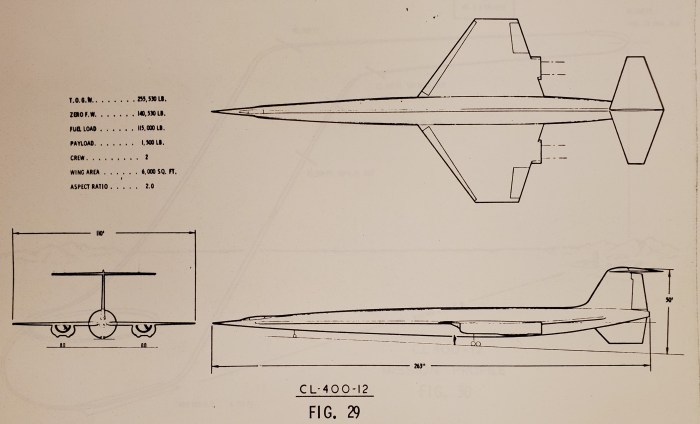
Drawing of the CL-400-12. (Source: An illustration showing the relative size comparison of the C-400-14 with a Boeing B-52 Stratofortress and a Lockheed Constellation (Source: The Huntington Library, California, Ben Rich Papers, Box 3, Folder 1, Projects – Engineering – CL-400)
The CL-400-12 was more than double the size of a B-52 and designed for a 4,720 nautical mile range with four engines blasting it to Mach 2.5. Rich’s notes simply stated that ‘the aircraft size is quite large.’
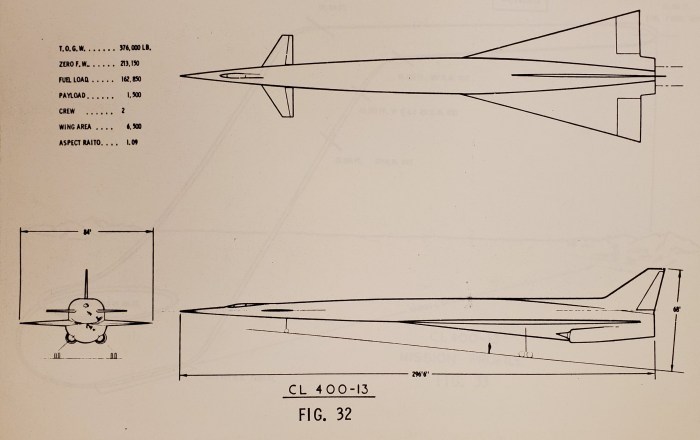
Drawing of the CL-400-13. (Source: Drawing of the CL-400-12. (Source: An illustration showing the relative size comparison of the C-400-14 with a Boeing B-52 Stratofortress and a Lockheed Constellation (Source: The Huntington Library, California, Ben Rich Papers, Box 3, Folder 1, Projects – Engineering – CL-400)
The CL-400-13 took the idea even further with a cone-delta design and forward canards. The aeroplane was almost the length of one football field, with a gross take-off weight of 376,000 pounds. Nevertheless, it could cruise at Mach 4 for a total range of 9,000 nautical miles. The CL-400-14 was similar in size to the -13 but used four smaller engines instead of two big ones.
Drawing of the CL-400-14 (Source: Drawing of the CL-400-13. (Source: Drawing of the CL-400-12. (Source: An illustration showing the relative size comparison of the C-400-14 with a Boeing B-52 Stratofortress and a Lockheed Constellation (Source: The Huntington Library, California, Ben Rich Papers, Box 3, Folder 1, Projects – Engineering – CL-400)
Hydrogen, as readers familiar with the Hindenburg disaster will attest, is also very dangerous. Lockheed had an approach to address the danger: try to cause a series of hydrogen explosions. Rich’s notes explained that ‘Numerous hydrogen ignition tests were made so as to get a feel for the damage potential in such an explosion, and it was found that the danger was not nearly as great as expected. Explosions were generally mild, and hydrogen fireball radiation was much less than that from a comparable kerosene fire.’ They tried to create an explosion 61 times, and only twice (when purposefully mixed with oxygen and ignited) did it cause ‘a bona fide explosion.’ Lockheed engineers were convinced LH could be handled safely – even more critically since the top-secret nature of the program meant that if there were an uncontrollable fire, they would not be able to call the fire department.[2]
Lockheed built a massive facility to test methods to produce, store, and transport the large quantities of liquid hydrogen necessary to operate a fleet of huge, LH-guzzling aeroplanes a few hundred yards away from the Burbank Municipal Airport. Dr Russell Scott, a leading expert on liquid hydrogen from the U.S. Bureau of Standards, visited the facility and said, ‘My God in heaven, you’re gonna to blow up Burbank.’[3] Ultimately, the logistical challenges of operating a fleet of LH aircraft proved insurmountable at the time. After examining the international basing requirements for the necessary fuel, Johnson gave up on the project. He called the Secretary of the Air Force, James Douglas, and said, ‘I’m afraid I’m building you a dog. My recommendation is that we cancel Suntan.’[4] Today, U-2s are still flying, and the Burbank site, which was once the home for testing and production of classic Lockheed aircraft, has been turned into a giant shopping complex featuring a Best Buy and Wal-Mart. In a way, maybe Burbank did blow up.
It is tempting to write off this story as a historical footnote, but the story of Suntan has three important takeaways: First, failure is important. Just because the project never went to production does not mean it was insignificant. With the aerospace industry currently looking into the potential use of hydrogen fuel, projects like this are still relevant. Second, failed designs still have a strong influence on those that succeed. Going through the process of designing these aircraft and thinking through potential solutions taught these engineers a lot. Many of the design elements first experimented with on the CL-400 went on to have a strong influence on the design of later aircraft – especially the A-12, the forerunner of the SR-71 Blackbird.
Finally, the CL-400 shows the importance and power of imagination. These planes might seem wild, but the effort shows that engineers could push themselves to think outside the box. This reveals the mindset underneath American Cold War aviation design – that it often gravitated to the massive or even outlandish, but it is also inspiring. I am not an aircraft designer, but I hope that in my own life and work, I am pushing myself to think beyond the boundaries of what I think might be possible, explore new ideas and see where they lead.
Dr Michael Hankins is the Curator for US Air Force, Navy, and Marine Corps post-World War II Aviation at the Smithsonian National Air and Space Museum and the author of Flying Camelot: The F-15, the F-16, and the Weaponization of Fighter Pilot Nostalgia (2021). In addition, he is a former Professor of Strategy at the USAF Air Command and Staff College eSchool, and a former Instructor of Military History at the US Air Force Academy. He earned his PhD in history from Kansas State University in 2018, and his master’s in history from the University of North Texas in 2013.
Header image: An artist’s impression of the CL-400 in flight. (Source: The Huntington Library, California, Ben Rich Papers, Box 3, Folder 1, Projects – Engineering – CL-400)
[1] Unless otherwise noted, all information, quotations, and images in this article are taken from: The Huntington Library, California, Ben Rich Papers, Box 3, Folder 1, Projects – Engineering – CL-400.
[2] John L. Sloop, Liquid Hydrogen as a Propulsion Fuel, 1945-1959 (Washington, DC: National Aeronautics and Space Administration, 1978), p. 149.
[3] Ben Rich and Leo Janos, Skunk Works: A Personal Memoir of My Years at Lockheed (New York: Little, Brown and Company, 1994), p. 173.
Editorial Note: Led by Editor Dr Mike Hankins, From Balloons to Drones, produces a monthly podcast that provides an outlet for the presentation and evaluation of air power scholarship, the exploration of historical topics and ideas, and provides a way to reach out to both new scholars and the general public. You can find our Soundcloud channel here. You can also find our podcast on Apple Podcasts and Google Podcasts.
In our latest podcast episode, our Podcast Editor, Dr Mike Hankins, and Assistant Editor, Dr Brian Laslie, have each come up with questions to ask each other about what it’s like to be a historian and pick on some of their favourite topics about air power and aviation history.
Dr Michael Hankins is the Curator for US Air Force, Navy, and Marine Corps post-World War II Aviation at the Smithsonian National Air and Space Museum and the author of Flying Camelot: The F-15, the F-16, and the Weaponization of Fighter Pilot Nostalgia (2021). In addition, he is a former Professor of Strategy at the USAF Air Command and Staff College eSchool, and a former Instructor of Military History at the US Air Force Academy. He earned his PhD in history from Kansas State University in 2018 and his master’s in history from the University of North Texas in 2013. He has a web page here.
Dr Brian Laslie is a US Air Force Historian and Command Historian at the United States Air Force Academy. Formerly he was the Deputy Command Historian at North American Aerospace Defense Command (NORAD) and United States Northern Command (USNORTHCOM). A 2001 graduate of The Citadel and a historian of air power studies, he received his Masters’ from Auburn University Montgomery in 2006 and his PhD from Kansas State University in 2013. He is the author of Air Power’s Lost Cause: The American Air Wars of Vietnam (2021), Architect of Air Power: General Laurence S. Kuter and the Birth of the US Air Force (2017) and The Air Force Way of War (2015). The latter book was selected for the Chief of Staff of the Air Force’s 2016 professional reading list and the 2017 RAF Chief of the Air Staff’s reading list. He can be found on Twitter at @BrianLaslie.
Header image: Four Republic F-84F Thunderstreak from the US Air Force Thunderbirds aerobatics team flying in formation in c. 1955. (Source: Wikimedia)
In the past few weeks, From Balloons to Drones launched a group ‘Air and Space Power Bibliography’ using the open-source reference management software Zotero. The bibliography aims to (slowly) catalogue works related to air power history, theory, and current operations in their broadest sense, including space power. The bibliography is hoped to be helpful to academics, students, and practitioners alike. Types of works included in the bibliography range from journal articles and books to scholarly online articles such as those published here at From Balloons to Drones. So far, we have added 250 titles, with more being added weekly.
As well as the central catalogue into which every resource is documented, the bibliography is split into 40 sub-catalogues. These sub-catalogues either relate to a time frame, country, or theme. After each work is added to the main catalogue, they are included in one of the 40 sub-catalogues that best represent the subject of that work. For example, Peter Gray’s The Leadership, Direction and Legitimacy of the RAF Bomber Offensive from Inception to 1945(2012) is catalogued in the following sub-catalogues: ‘Interwar’ and ‘Second World War’ as its main chronological focus is those periods; ‘Air Power Leadership and Culture’ and ‘Legal and Ethical Aspects of Air Power’ as this is the main thematic focus of the book, and finally, ‘British Air Power’ as the book is focused on the Royal Air Force.
You can request to become a member of the group bibliography or follow it using an RSS feed.
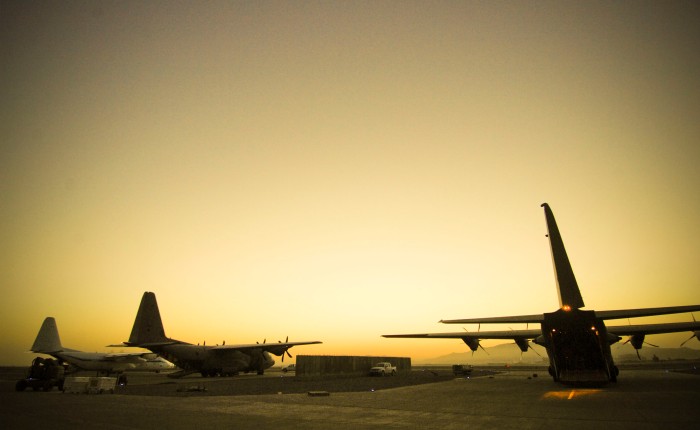
Header image: Royal Air Force C-130J Hercules transport aircraft wait to airlift British soldiers from Kandahar Airfield, Afghanistan, 19 June 2009. (Source: Wikimedia)
Editorial Note: Led by Editor Dr Mike Hankins, From Balloons to Drones, produces a monthly podcast that provides an outlet for the presentation and evaluation of air power scholarship, the exploration of historical topics and ideas, and provides a way to reach out to both new scholars and the general public. You can find our Soundcloud channel here. You can also find our podcast on Apple Podcasts and Google Podcasts.
In our latest podcast, we interview Colonel Kim ‘Killer Chick’ Campbell, an A-10 Thunderbolt II pilot with over 100 combat missions. On one of her early missions, ground fire heavily damaged her plane. She tells us the harrowing story and how her flying experiences apply to other areas of life. For more detail, she has a new book: Flying in the Face of Fear: A Fighter Pilot’s Lessons on Leading with Courage, from Wiley Press.
Kim Campbell is a retired United States Air Force Colonel who served for over 24 years as a fighter pilot and senior military leader. She served as a group commander, responsible for 1,000 military and civilian personnel. She finished her career as the Director of the Center for Character and Leadership Development at the Air Force Academy. She flew over 100 combat missions and was awarded the Distinguished Flying Cross for Heroism after successfully recovering her battle-damaged aeroplane from an intense close air support mission. Since retiring from the Air Force, Kim has shared her inspirational story and lessons on leading with courage with business and corporate audiences worldwide as an executive coach and keynote speaker.
Header image: An aircraft maintenance crew of the Indiana Air National Guard perform a post-flight inspection on an A-10C Thunderbolt II during exercise Guardian Blitz at MacDill Air Force Base, 2 February 2023. (Source: Wikimedia)
In 1970, the United States Air Force’s (USAF) Contemporary Historical Examination of Current Operations (CHECO) project, which produced around 250 volumes on various subjects, published a volume on the air operations of the RAAF over Vietnam.[1] The volume on the RAAF was one of several that examined non-US subjects; other air forces analysed included the Republic of Vietnam Air Force, the Royal Thai Air Force, and the Republic of Korea Air Force. Notably, the report on the RAAF, authored by James T. Bear, described the Australian effort over Southeast Asia as producing a ‘fruitful association’ with the USAF.[2] However, while the Americans, through the extensive distribution of this report to various commands, were aware of the views espoused by Project CHECO, the RAAF was not, as they were not included on the distribution list. As a result, this issue is often ignored by those using this source when writing on Australian air operations over Vietnam. For example, in a recent 2019 article in Sabretache, the journal of the Military Historical Society of Australia, Justin Chadwick made much of Bear’s report by describing its contents. However, Chadwick failed to address the distribution issue or whether the RAAF was aware of the report’s contents.[3] Nonetheless, Bear’s report, and others covering subjects pertinent to Australian air operations over Vietnam, were used by Chris Coulthard-Clark when researching and writing his volume on the RAAF in Vietnam as part of ‘The Official History of Australia’s Involvement in Southeast Asian Conflicts, 1948-1975.’ Moreover, the report is a valuable starting point for any discussion about Australia’s place in the air wars over Vietnam and the impact of the conflict on the RAAF.
More recently, however, air power historians have begun to discuss the air war over Vietnam more nuancedly. For example, in his 2021 history of the air war over Vietnam, Air Power’s Lost Cause, Brian Laslie, building on the work of scholars such as Mark Clodfelter, argued that the US fought six separate air wars during the conflict.[4] These campaigns included the strategic air campaign against North Vietnam; the battle for air superiority over North Vietnam; the USAF’s air war over South Vietnam; the US Navy’s air war over North and South Vietnam; air operations over Laos and Cambodia; and the US Army’s air mobility operations. However, while this classification helps describe US air operations over Vietnam, in excluding the experience of other nations involved in these ‘air wars,’ historians fail to tell a cohesive story about the use of air power over Vietnam.
Rations and supplies are unloaded from a UH-1B Iroquois helicopter of No. 9 Squadron RAAF, by troops of 7th Battalion, The Royal Australian Regiment, near the village of Long Dien during Operation Ulmarra, August 1967. (Source: Wikimedia)
Two reasons explain why historians fail to tell a cohesive story of air operations over Vietnam. First, from an American perspective, Vietnam is viewed as an inherently US war, especially regarding military operations. As Andrew Weist has remarked, ‘[r]emainders of the Vietnam War litter the cultural landscape of the United States.’[5] These reminders and the associated issues of ownership over the experience of the Vietnam War are often reinforced by popular accounts of the war, such as Ken Burns and Lynn Novick’s 2017 documentary The Vietnam War and debates related to America supposedly repeating the mistakes of Vietnam in its recent operations in Iraq and Afghanistan.[6] This has led historians to focus solely on the American experience and not to fully incorporate the story of those other nations that fought in the Vietnam War. Where they are included, their experience is often viewed as a sideshow to the main American effort. Indeed, as Bear’s CHECO report on the Australians noted, in the view of the USAF, ‘only Australia played a significant role in the air war.’[7]
The second reason concerns how the history of the RAAF in Vietnam has been written. This relates to the state of Australian military historiography and, from the perspective of the RAAF, how the Air Force’s narrative has shaped the latter’s account.[8] Apart from Coulthard-Clark’s 1995 official history, The RAAF in Vietnam: Australian Air Involvement in the Vietnam War 1962-1975, the literature on the RAAF’s service in Vietnam has primarily been the preserve of either the Air Force’s official histories or popular accounts, including veterans’ memoirs.[9] This situation mirrors concerns highlighted by John Ferris in 1998 when he reflected that most writers on air power history more broadly tend to be:
[t]he children of airmen, have been military personnel themselves, and have been employed at a historical office or service school in Canada, Germany, the United Kingdom, or the United States.[10]
This is undoubtedly the case with the history of the RAAF over Vietnam. Indeed, the RAAF has shaped the narrative surrounding the Air Force’s operations over Vietnam in two ways. First, the RAAF has published two official histories that span the Vietnam War period. The first, Going Solo, covered the period from 1945 to 1972 and was written by Alan Stephens, the former RAAF Historian. The second volume, Taking the Lead, written by Mark Lax, a RAAF Air Commodore, covers the period from 1972 to 1996. Neither book focuses singularly on Australian air operations over Vietnam. However, given the importance of the conflict to the RAAF, the war is integral to their analysis, particularly in Stephens’ volume. While both Stephens and Lax served in the RAAF and were academically trained historians, they were well placed to write these histories, thereby enhancing the value of these books. Nonetheless, as official histories, these works are often regarded as providing a definitive account of their subject. However, official histories are often the first rather than the last word on their topic.
The second way the RAAF has influenced the narrative of its operation over Vietnam is that the first book on Australian air operations during the conflict, Mission Vietnam, was commissioned by the Air Force. Research for Mission Vietnam, written by George Odgers, the Director of Public Relations in the Department of Air, began in 1971 before Australian air operations in Vietnam ended in 1972.[11] The book appeared in 1974, the year before the RAAF deployed Detachment ‘S’. As such, it does not comprehensively capture all RAAF operations associated with the Vietnam War. On publication, the RAAF News was convinced that Odgers’ volume would have ‘widespread appeal’ while one 1974 review in The Canberra Times described it as ‘essential reading.’[12] Illustrative of its importance in shaping the narrative, Mission Vietnam will be republished by the RAAF’s History and Heritage branch.
Beyond these volumes, discussions of RAAF operations over Vietnam have typically been left to popular accounts or memoirs, including those published under the auspicious of the Air Force’s Air and Space Power Centre and the History and Heritage Branch.[13] For example, Jeff Pedrina’s account Wallaby Airlines was initially published in 2006 by the Air Power Development Centre (as ASPC was then known). It was recently reissued in 2023 as part of the Australian Air Campaign Series (AACS) produced by the History and Heritage Branch.[14] Similarly, as part of the AACS, in 2022, the History and Heritage Branch published an abridged version of Air Vice-Marshal Reed’s autobiography, Invited to a War.[15] Reed had served in Vietnam, flying Phantoms on exchange with the USAF. Many of these works represent what has invariably been described as Australia’s ‘democratic’ approach to military history, which focuses on the experiences of veterans.[16] In this sense, every participant’s views and recollections are equal and should be heard. There are, however, exceptions to this democratic approach. For example, Steven Paget’s recent examination of the operations of No. 2 Squadron over Vietnam usefully places the challenges the RAAF faced in achieving interoperability with the USAF into context.[17]
Aerial view of the aircraft revetments at Phan Rang airbase in July 1967. No. 2 Squadron RAAF Canberra bombers are parked in the bays located in the immediate foreground. (Source: Australian War Memorial)
Given much of the above, how would a more integrated and cohesive account of Vietnam’s air wars look? First, from an Australian perspective, we need to move away from focusing solely on the Australian experience of the Vietnam War. As Thomas Richardson argued, such perspectives distort our view of Australia’s ‘success or failure’ in Vietnam.[18] This applies equally to the RAAF and the Australian Army. Second, with regard to the broader picture of air operations over Vietnam, consideration of the experience of non-US units would help inform wider discussions on the character and challenges of coalition air operations in this period by considering issues such as cooperation and friction. While official and authorised accounts address some of these challenges, their aim of foregrounding the Australian experience through a functional approach to history, based on the RAAF’s roles, limits how far they can analyse these issues.[19]
Some indication of how to produce such a history can be gleaned from Paget’s work on No. 2 Squadron operations. Paget rightly noted that the experience of No. 2 Squadron highlighted issues in command and control, standardisation, tactics, training and procedures, and the sustainment of operations. However, these themes can be further analysed through additional examples of Australia’s experience in Vietnam. For example, the experience of RAAF officers on secondment as airborne Forward Air Controllers offers a valuable opportunity to understand how lessons are learnt and shared between air forces. Similarly, before the deployment of No. 2 Squadron, No. 35 Squadron was already fully integrated into the USAF command-and-control apparatus. Moreover, unlike No. 2 Squadron, No. 35 Squadron operated an aircraft type that the US would not deploy to South Vietnam until later in the war. However, it appears that the USAF did not take the opportunity to study the RAAF’s use of the Caribou, which raises questions about why this might have been.[20] As such, understanding the experience of No. 35 Squadron would further enrich our understanding of the air wars over Vietnam by exploring cultural issues that either help or retard the lessons learnt process. Finally, we must consider what the deployment of RAAF air assets to Vietnam contributed to the overall war effort, given that, for example, during February 1968, at the height of the Tet Offensive, the Air Force accounted for only around one per cent of all attack sorties flown.[21] This was undoubtedly a significant effort for the RAAF. Still, it highlights the problem of deploying only single unit types rather than a cohesive operational package comprising several squadrons of the same type. As such, within the context of wider coalition operations, we must further question why the RAAF deployed the force it did and how it sought to influence and shape ongoing operations.
Dr Ross Mahoney is the Editor-in-Chief of From Balloons to Drones. He is an independent scholar specialising in the history of war with particular reference to the use of air power and the history of air warfare. He is currently the Senior Historian within the City Architecture and Heritage Team at Brisbane City Council in Australia. He has nearly 20 years of experience in the education, museum and heritage sectors in Australia and the United Kingdom. Between 2013 and 2017, he was the inaugural Historian at the Royal Air Force Museum in the UK. In Australia, he has worked as a Historian for the Department of Veterans’ Affairs and taught at the Strategic and Defence Studies Centre at The Australian National University based at the Australian War College. His research interests are focused on the history of war, specifically on the history of air power and air warfare, military leadership and command, military culture, and the history and development of professional military education. He also maintains an interest in transport history. He has published numerous articles, chapters and encyclopedia entries, edited two books, and delivered papers on three continents. His website is here, and he can be found on Twitter at @airpowerhistory.
Header image: DHC-4 Caribous of the RAAF Transport Flight arrived in South Vietnam in 1964 to work with the South Vietnamese and U.S. Air Forces to transport soldiers and supplies to combat areas in South Vietnam. (Source: Wikimedia)
[1] James T. Bear, ‘The RAAF in SEA’ (CHECO Division, 1970); Warren A. Trest, ‘Projects CHECO and Corona Harvest: Keys to the Air Force’s Southeast Asia Memory Bank,’ Aerospace Historian 33, no. 2 (1986), pp. 114-20; Major Daniel Hoadley, ‘What Just Happened? A Historical Evaluation of Project CHECO’ (MA Thesis, USAF School of Advanced Air and Space Studies, 2013).
[2] Bear, ‘The RAAF in SEA,’ p. 1. During the Vietnam War, the RAAF contributed significantly to the Australian effort in the conflict. While some flights had taken place in South Vietnam by a Dakota of No. 2 Squadron’s transport flight in 1963, the first significant deployment of RAAF assets took place in 1964 when six DHC-4 Caribous of the recently formed RAAF Transport Flight Vietnam – later renumbered as No. 35 Squadron in 1966 – were deployed as part of Australia’s early efforts in supporting the war. After the deployment of No. 35 Squadron, the RAAF’s primary involvement took the form of No. 9 Squadron equipped with Bell UH-1B Iroquois helicopters and No. 2 Squadron with GAF Canberra bombers. Notably, 36 fighter pilots served as airborne Forward Air Controllers with the USAF’s 19th and 20th Tactical Air Support Squadrons flying Cessna O-1 Bird Dogs, Cessna O-2 Skymasters, and Rockwell OV-10 Broncos. Additionally, six RAAF pilots flew USAF McDonnell F-4 Phantoms during the war as part of the 12th Tactical Fighter Wing. There were also those units – Nos. 36 and 37 Squadron – who maintained a strategic air bridge between Australia and Vietnam, including aeromedical evacuation. Lockheed Neptune maritime patrol aircraft regularly patrolled the sea lines of communication between Australia and Vietnam, such as during Operation Trimdon in 1965. In addition to the deployed squadrons, various elements of the RAAF provided valuable ground support, including airfield construction, air defence guards, and medical personnel. Officially, RAAF operations over Vietnam ended in February 1972 when the last Caribous of No. 35 Squadron left the country. However, in 1975, as South Vietnam finally fell, the RAAF deployed Detachment ‘S’ to Vietnam to withdraw Australian national and embassy staff and distribute Red Cross aid.
[3] Justin Chadwick, “Nothing to diminish their glamour’: Project CHECO and the RAAF,’ Sabretache 60, no. 4 (2019), pp. 23-34.
[4] Brian Laslie, Air Power’s Lost Cause: The American Air Wars of Vietnam (Lanham, MD: Roman and Littlefield, 2021), p. 2; Mark Clodfelter, ‘The Limits of Airpower or the Limits of Strategy: The Air Wars in Vietnam and Their Legacies,’ Joint Forces Quarterly 78 (2015), pp. 111-24.
[5] Andrew Weist, ‘Introduction’ in Andrew Weist (ed.), Rolling Thunder in a Gentle Land: The Vietnam War Revisited (Oxford: Osprey Publishing, 200), p. 16.
[6] Andrew Gawthorpe, ‘Ken Burns, the Vietnam War, and the Purpose of History,’ Journal of Strategic Studies 43, no. 1 (2020), pp. 154-69.
[8] Jeffrey Grey, ‘Cuckoo in the Nest? Australian Military Historiography: The State of the Field,’ History Compass 6, no. 2 (2008), pp. 455-68.
[9] Chris Coulthard-Clark, The RAAF in Vietnam: Australian Air Involvement in the Vietnam War, 1962-1975 (Sydney, NSW: Allen & Unwin in association with the Australian War Memorial, 1995). For the RAAF’s official histories, see: Alan Stephens, Going Solo: The Royal Australian Air Force, 1946-1971 (Canberra, ACT: AGPS Press, 1995); Lax, Taking the Lead. For memoirs and autobiographies, for example, see: Gary Cooper and Robert Hillier, Sock it to ‘em Baby: Forward Air Controller in Vietnam (Crows Nest, NSW: Allen and Unwin, 2006); David Evans, Down to Earth: The Autobiography of Air Marshal David Evans, AC, DSO, AFC (Canberra, ACT: Air Power Development Centre, 2011).
[10] John R. Ferris, ‘Review Article – The Air Force Brats’ View of History: Recent Writing and the Royal Air Force, 1918–1960,’ The International History Review 20, no. 1 (1998), p. 119.
[11] George Odgers, Mission Vietnam: Royal Australian Air Force Operations, 1964-1972 (Canberra, ACT: Australian Government Publishing Service, 1974); ‘History of War,’ The Canberra Times, 18 June 1971, p. 1.
[12] ‘“Mission Vietnam” sure to have widespread appeal,’ RAAF News, 1 August 1974, p. 3; “Written the Way it Was in Vietnam Air War,’ The Canberra Times, 16 August 1974, p. 9.
[13] Examples of books published under the auspicious of the RAAF’s Air and Space Power Centre that discuss Vietnam include: John Bennett, Highest Traditions: The History of No. 2 Squadron RAAF (Canberra, ACT: Australian Government Publishing Service, 1995); Graham O’Brien, Always There: A History of Air Force Combat Support (Canberra, ACT: Air Power Development Centre, 2009); Chris Clark, The RAAF at Long Tan (Canberra, ACT: 2010); Evans, Down to Earth; Bob Howe, Dreadful Lady over the Mekong Delta: An Analysis of RAAF Canberra Operations in the Vietnam War (Canberra, ACT: Air Power Development Centre, 2016). For an example of a book produced in conjunction with the History and Heritage Branch, see: Bob Grandin, Answering the Call: Life of a Helicopter Pilot in Vietnam and Beyond (Newport, NSW: Big Sky Publishing, 2019).
[14] Jeff Pedrina, Wallaby Airlines: Twelve Months Caribou Flying in Vietnam (Tuggeranong, ACT: Air Power Development Centre, 2006). Pedrina, Wallaby Airlines: Twelve Months flying the Caribou in Vietnam (Newport, NSW: Big Sky Publishing, 2022).
[15] Air Vice Marshal Alan Reed, Invited to a War (Newport, NSW: Big Sky Publishing, 2002).
[16] Thomas Richardson, Destroy and Build: Pacification in Phuc Tuy, 1966-72 (Melbourne, VIC: Cambridge University Press, 2017), p. 5.
[17] Steven Paget, ‘Magpies and Eagles: Number 2 Squadron, Royal Australian Air Force, and the Experience of Coalition Warfare in Vietnam’ in Steven Paget (ed.), Allies in Air Power: A History of Multinational Air Operations (Lexington, KT: The University Press of Kentucky, 2021), pp. 142-67.










 From Balloons to Drones