The Air Defence of the UK: Defence on a Shoestring in an Age of Uncertainty

The Air Defence of the UK: Defence on a Shoestring in an Age of Uncertainty

By Dr Kenton White

Editorial Note: Between February and April 2018, The Central Blue and From Balloons to Drones, will be publishing a series of articles that examine the requirements of high-intensity warfare in the 21st Century. These articles provide the intellectual underpinnings to a seminar on high-intensity warfare being held on 22 March by the Williams Foundation in Canberra, Australia. In this article, Dr Kenton White examines Britain’s defence policy with regards to the air defence of the United Kingdom. He compares Britain’s commitment to air defence during the Cold War period with that of the present. With regards to the present, White concludes that given certain factors, the Royal Air Force (RAF) will struggle to regenerate if faced with a high-intensity conflict with a near-peer enemy.

Preamble

This article talks broadly about strategy, planning and its practice. It uses examples from Britain’s defence policy, and hard numbers from the Cold War experience, to illustrate some of the problems the RAF faces today. It looks at Britain’s commitment to the air defence of its islands during the Cold War – an age of certainty – and compares it directly to the current defence policy and practice in the age of uncertainty.

A historically pessimistic view of international relations and strategy is taken. The reason for this pessimism is based on historical precedent. In 1914, Europe went from peace to war in less than two months. In the 1930s Britain’s rearmament began in mid-decade to replace bi-planes and other equipment, but the RAF still went to war in 1939 with obsolescent, vulnerable equipment, and suffered severe losses of personnel and machinery.
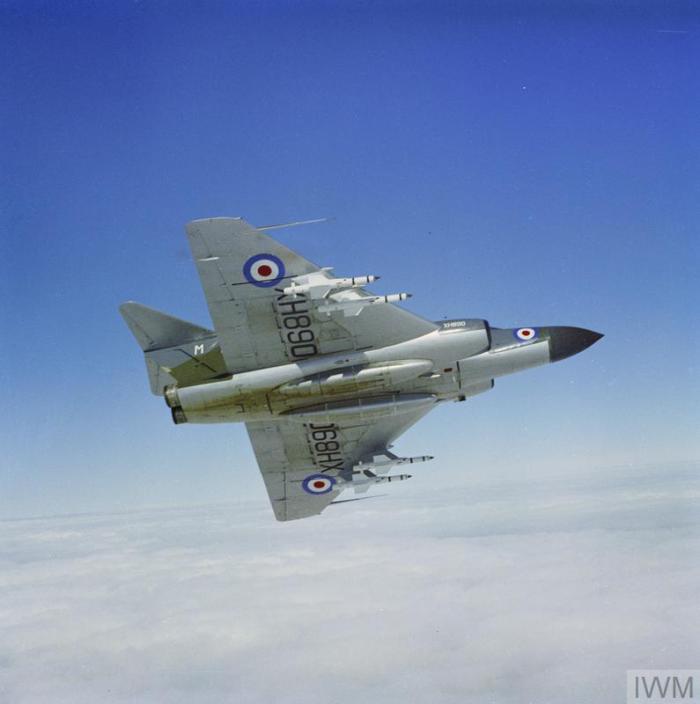
RAF-T 2151
A Gloster Javelin FAW.9R of No, 23 Squadron banking away from the camera clearly showing the missile complement of De Havilland Firestreak infra-red homing air-to-air missiles. (Source: © IWM (RAF-T 2151))

Introduction

I take it someone has worked out whether we can defend ourselves.

Jim Callaghan, Labour Prime Minister, 1978

This comment is written on the front page of a Joint Intelligence Committee report on the ability of the Soviet air force to attack targets in Britain.[1] The report showed Britain was poorly prepared to defend itself in times of war, despite the apparent threat from the Soviet Union and Warsaw Pact.

Questions relating to Britain’s air defence capability are as relevant now as they were then; however, the circumstances are very different. The familiar bipolarity of the Cold War is missing, and the range of threats to the UK is much broader, including both state and non-state actors.

Deterrence

A vital role of the RAF is to deter attack, and ultimately the defence of UK airspace if that deterrent fails. Deterrent plans are aimed at a perceived threat: planning for the manifestation of that threat. These plans relate intimately to national strategy. The nation must appear to have a capable air force if it is to act as a deterrent. However, deterrence also requires the ability to sustain operations. Britain’s air defences protect around 1 million square miles of airspace, reaching out into the North Atlantic. This indicates how vital airborne maritime reconnaissance is in defence of the islands.

The 2015 Strategic Defence and Security Review read:

The Government’s most important duty is the defence of the UK and Overseas Territories, and protection of our people and sovereignty.[2]

In written testimony to the House of Commons Defence Committee (HCDC) in 2013, Lord Hennessy of Nympsfield told the committee that, in an ideal world, air defence of the UK should be the priority of UK defence policy.[3] The 2015 SDSR states ‘[T]he Royal Air Force protects our airspace and is ready at all times to intercept rogue aircraft.’[4] Concerted attack from the air by a peer adversary is not perceived as an imminent threat.

Threat Analysis

The conventional threat during the period of ‘Flexible Response,’ as the NATO Cold War strategy was called, was clear – direct attack from bombers equipped with gravity bombs or stand-off missiles aimed at denying the vital infrastructure needed for the reinforcement of Europe by UK and US forces. The UK was responsible for the air defence of the Eastern Atlantic and the UK itself, and the airspace over the UK was an Air Defence Region in its own right. However, the defensive response to the threat was never completely put into place, leaving UK airspace extremely vulnerable, and Britain’s ability to continue a fight very doubtful.

What is the threat analysis today? The HCDC identified several distant threats to the national interest, and while qualifying the analysis heavily, identified the Russian/Middle Eastern threat as being the greatest to the UK itself.[5] In 2015, the HCDC commented that:

[t]he resurgence of an expansionist Russia represents a significant change in the threat picture […] and has implications not only for the UK but also for our allies as well.[6]

The ability of the Russians to interfere with the sea and air communications into the UK is seen as a considerable problem, and the capability to use cyber-attacks to cripple the country has been recently in the news thanks to the Defence Secretary Gavin Williamson.[7] Unofficially at least in public, there is also the fear of the break-up of NATO, and the need for Britain to be able to defend itself alone, as in 1940.

What is being defended?

For us to understand the demands of the air defence of the UK, we must understand what is being defended. The knee-jerk response to this may be that the population is being defended. However, the official documents indicate otherwise. During the early Cold War, the first thing being defended against attack in the UK was the nuclear deterrent. Other targets such as other military installations, ports and airports were next on the list for air defence, with civilian installations such as power generating stations as poor runners-up.
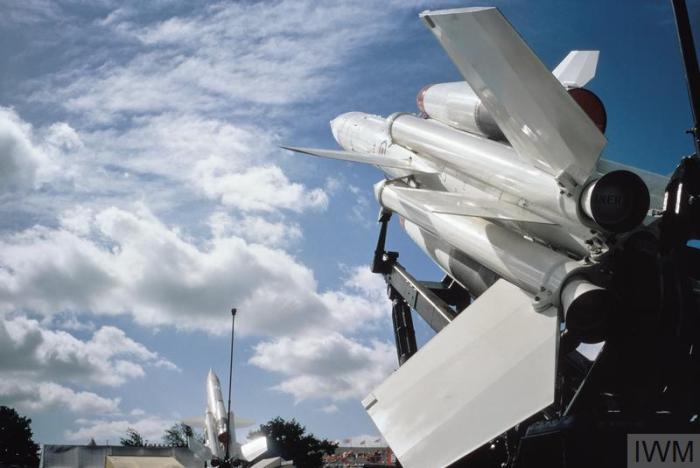
TR 27162
A Royal Air Force Bristol Bloodhound Mark II surface to air guided missile. The missile was used as Britain’s main air defence weapon from 1958 – 1991. It initally protected Britain’s V bomber force but was later deployed in Germany and at RAF Seletar, Singapore. The Bloodhound Mk II was introduced in 1964. It used continuous wave radar guidance and had a capability against aircraft flying at normal operational heights. (Source: © Crown copyright: IWM (TR 27162))

Once the nuclear deterrent took to sea in submarine-launched missiles, the priority of defence changed. There is no longer the clear military imperative to defend the nuclear deterrent if it functions correctly with one boat always at sea, but neither is there the capability, nor the political will, to defend the vital military and civil installations in the country from attack from the air. Security documents speak in vague terms about ‘defence of the UK’.[8]

Self-defence of the RAF, in other words maintaining the RAF air defence and surveillance capability, seems the obvious next choice given that the resources available to the RAF are insufficient to defend the national infrastructure.

What are the vulnerabilities?

Internal Vulnerability

The ‘internal’ vulnerability comes from Government cuts and a drive for greater ‘efficiency’. This results in a lack of equipment, weapons, supplies and trained personnel. There are many examples of short-sighted ‘cost-savings’ which resulted in reduced air defence capability.[9] To many in the RAF and the other armed services, the greatest enemy is the Treasury.

Air defence of the UK suffered considerably during the early Cold War. Because the expectation was that any war would turn nuclear very quickly, the provision of expensive air defence systems was considered unnecessary.[10] The RAF finds itself in a comparable situation now, following a period of cuts, ‘refocusing’ or simple indifference by the government.

National air defence should be flexible and capable of responding to a multitude of threats. However, the historical lesson is that even in a period of certainty, the resources were not made available to the RAF to provide what it saw as the minimum level of defence for UK airspace. Flexibility comes at a cost. It relies on balance within the forces, and sufficient numbers to respond to different scenarios.[11]

There is a lack of a layered surface to air defence system. Other services rely on layered defence, while the RAF has been forced into a two-stage defence: overhead and arm’s length. Without the numbers, achieving flexibility becomes problematic. However, not all aircraft will be available all the time, so a simple count up of aircraft in service is misleading – battle damage, faults and maintenance will reduce the numbers available.

The armed forces are increasingly run by governments of all colours in the fashion of a business, with ‘outputs’ and ‘levels of cost-effectiveness’. The only real measure of an armed force is how it operates in its true environment, which is war. Which brings us to the second vulnerability.

Self-Delusion

This is primarily political self-delusion, but also some self-delusion within the Service. A strategic vulnerability has developed out of the policies which attributed success to the NATO strategies. However, lack of failure does not equal success.

This vision of success contributes to the self-delusion. According to the politicians of successive Governments, aircraft numbers could be cut, pilot training be restricted, and obsolete weapons retained, but the overall strategy was still successful. Behind this apparent success, the UK air defence capability had effectively been eviscerated.

This same self-delusion of success led to the cuts under the ‘Peace Dividend’ and led to very quickly forgetting how to face an adversary that has capable Air Power regarding credibility and numbers. To reinforce this misplaced belief, most recent RAF operations have been fought in more-or-less permissive air environments. They have not had to deter nor fight a peer state.

The political class, public, and even the other armed services have lost sight of the fact that ‘air superiority’ is not a given.  The memory of what it is like to have to operate against an adversary which has credible and numerically similar air power has been lost.  This extends to the protection of the supporting infrastructure, which in recent deployments has remained free from attack. The ground facilities suffer from vulnerability to air attack to blind the surveillance systems, which is why maritime reconnaissance, air surveillance and control systems and airborne warning and control systems are so very important. Indeed, a lack of maritime patrol aircraft has been an embarrassment to the British Government in the recent past.

Existential vulnerability

The third vulnerability is the physical existence of the RAF if it is faced with a peer enemy.

This vulnerability, a result of the combination of the first and second threats, is particularly applicable to Britain’s armed forces. If a relatively small force accomplishes military excellence, the effect of combat losses will be disproportionately devastating.[12] The RAF may be genuinely excellent, capable and agile in all its operations, but because of its reduced size, any combat losses, should it come to a peer-to-peer war, will be truly ruinous.

Difficulties, if not disasters, in the early stages of war, and the need for time to recover and re-arm, have been vital for the UK.  The British Expeditionary Force experienced this in the First World War, and nearly by the RAF in the Second World War. Had Air Chief Marshal Sir Hugh Dowding not refused to send more fighters to defend France it was likely that the air defence of the home islands would not have been sufficient to survive the impending attack.

An ex-RAF officer commented that:

This threat poses the problem the RAF has faced for decades: condemning themselves to low capabilities for a while, and eventually getting better if they last long enough.

Conclusion

In this age of uncertainty, flexibility is the key to respond to threats from different areas. However, the RAF, along with the other armed forces, have been starved of the necessary resources for even the basic defence of the home nation.

It would appear that many of the limitations placed on UK air defence during a period of strategic certainty have continued into the current age of uncertainty.

Following the apparent success of the Cold War strategies, the idea the ‘teeth’ could be sharpened at the expense of the ‘tail’ persisted and has now grown to dangerous proportions. Pursuing the business model of ‘efficiency’, the Armed Forces have been cut to very low levels yet asked to do more. Moreover, with the increasing tensions in Eastern Europe, the Middle East and the Pacific, the number of possible threats is increasing.

CT 68
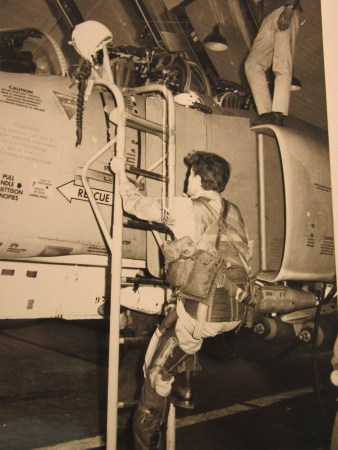
The crew of a McDonnell Douglas Phantom FRG2 aircraft of No. 111 Squadron with their aircraft and weapons load at RAF Coningsby in 1975. The aircraft is fitted with tanks and Sidewinder heat-seeking missiles. Lying in front are four Sparrow radar guided missiles and a Gatling Pod. (Source: © Crown copyright. IWM (CT 68))

The overwhelming problem with a denuded air force is the time it will take to recover its capability if, and when, it is needed. Modern equipment is complicated to manufacture, and aircraft cannot be built in the numbers previously seen. Nor, frankly, is there the will to provide such facilities during peacetime for use in the event of war.

War has a habit of appearing without much announcement, and the diminished resources of the RAF would take years to bring up to the necessary levels to defend the UK against a determined enemy, and defending these islands is precisely what the RAF may be called upon to do, before too long.

Dr Kenton White is a Sessional Lecturer in Politics, International Relations and Strategic Studies at the University of Reading. He also works as a part-time Lecturer in Strategic Studies at Cranwell with the RAF. He has a PhD in Strategic Studies, researching British defence policy and practice during and after the Cold War. He studies military history and defence policy from the Napoleonic Wars to today. Before entering academia, he was the Managing Director of a computer animation company.

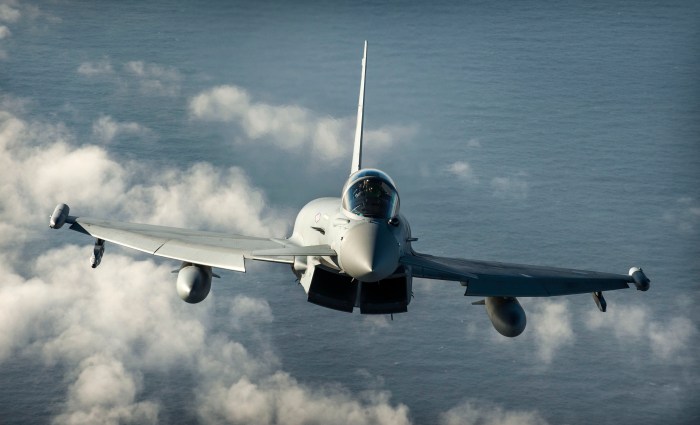
Header Image: A Russian Bear aircraft is escorted by a Royal Air Force Quick Reaction Alert (QRA) Typhoon during an intercept in September 2014. (Source: MoD Defence Imagery)

[1] The National Archives, PREM 16/1563, JIC (77)10, The Soviet Capability to Attack targets in the United Kingdom Base, 26th October 1977, ‘Defence against the Soviet Threat to the United Kingdom’, n.d.

[2] Cmd 9161, ‘National Security Strategy and Strategic Defence and Security Review 2015: A Secure and Prosperous United Kingdom’ (The Cabinet Office, November 2015), chap. 4. Hereafter, SDSR 2015

[3] HC 197, ‘Towards the next Defence and Security Review: Part One’, (House of Commons, 7 January 2014), p. 58.

[4] ‘SDSR 2015’.

[5] ‘Memorandum submitted by the Strategy and Security Institute, University of Exeter,’ 7 October 2015.

[6] HC 493, ‘Flexible Response? An SDSR Checklist of Potential Threats and Vulnerabilities’ (House of Commons Defence Committee, 17 November 2015), para. 58.

[7] HC493, para. 50; Ben Farmer, ‘Russia says Britain’s Defence Secretary’s claim of attack threat ‘like something from Monty Python,” The Daily Telegraph, 26 January 2018.

[8] ‘SDSR 2015’, chap. 4.

[9] Kenton White, ‘“Effing” the Military: A Political Misunderstanding of Management’, Defence Studies, 17:4 (2017), pp. 346-58.

[10] A07783, Defence of the United Kingdom, DOP (78)12, Memorandum to the Prime Minister from John Hunt, 1st August 1978, ‘Defence against the Soviet Threat to the United Kingdom’, 2.

[11] Group Captain Paul O’Neill, ‘Developing a Flexible Royal Air Force for an Age of Uncertainty’, RAF Air Power Review, 18:1 (2015), pp. 46-65.

[12] Colin S. Gray, War, Peace, and Victory: Strategy and Statecraft for the Next Century (New York: Simon and Schuster, 1990), p. 171.
What does Time and Space mean for the Airman?

What does Time and Space mean for the Airman?

By Ian Shields

Editorial Note: Between February and April 2018, The Central Blue and From Balloons to Drones, will be publishing a series of articles that examine the requirements of high-intensity warfare in the 21st Century. These articles provide the intellectual underpinnings to a seminar on high-intensity warfare being held on 22 March by the Williams Foundation in Canberra, Australia. In this article, Ian Shields explores the implications of the concepts of time and space for airmen. Using these concepts, Ian explores the differences between the services concerning culture, technology, and decision-making. Understanding these differences is essential if we are to leverage the advantages of each of the domains in high-intensity warfare.

Introduction:

Time and Space bound all military operations. We are used to the idea of trading time for space, although that is primarily applicable to the land campaign. If we think about the time/space relationship in two campaigns separated by a significant amount of history associated concepts show a great deal of change:

  • The Peloponnesian wars – campaign duration, the speed of manoeuvre, communication, size of battlefield/weapon ranges.
  • The First Gulf War – campaign duration, the speed of manoeuvre, communication, size of battlefield/weapon ranges.

It can be argued that time and space constrains airmen; however, we have a different perception and are better able to exploit both time and space.

Nevertheless, before going any further, what do airmen do? In 2010, Colonel Tim Schultz, the then Commandant of the USAF School of Advanced Air and Space Power Studies suggested that airmen ‘project innovative forms of power across traditional boundaries.’ Again, with emphasis, airmen ‘project innovative forms of power beyond traditional barriers.’ The key words here are, ‘project,’ ‘innovative’ and ‘power’ and these are the key to why airmen are different. Given this, this article focusses on four areas: the impact of air power; our cultural differences as airmen compared with soldiers and sailors; the impact of technology; and decision-making before concluding.

The Impact of Air Power

Looking at the world at the beginning of the Twentieth Century, it was well-ordered, firmly based on the idea of the nation-state that was built on Treaty of Westphalia and the Congress of Vienna. Europe was, by historical standards, relatively peaceful with well-defined and respected boundaries.

To alter the balance of power required armies crossing these boundaries which, as we saw in 1914, could have disastrous results. Navies could control trade, impose blockades, and prevent armies moving over stretches of open water but they are themselves constrained by the availability of water; water covers only 70% of the surface of the earth.

large_0000002
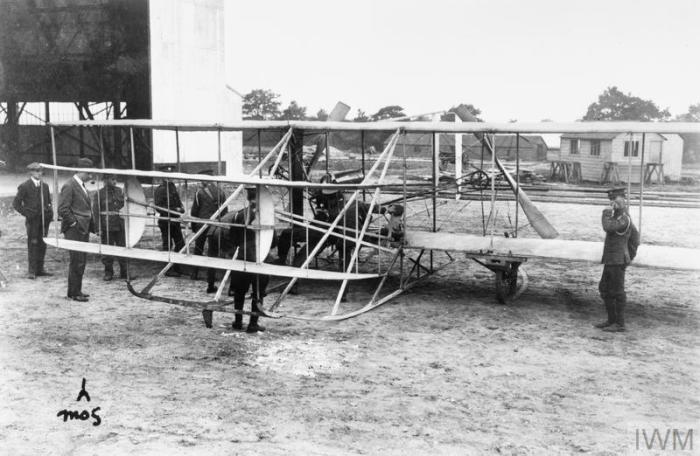
The Wright brothers aircraft at Farnborough being inspected by a small group of soldiers, c. 1910. (Source: © IWM (RAE-O 615))

The events of 17 December 1903 changed all that, although it was not appreciated in those terms at the time (or, arguably, ever since): with 100% of the earth covered by air, boundaries drawn on maps and the constraints of the ocean became far less relevant. Again, airmen project beyond traditional boundaries.

While technology did not allow air power to be fully exploited in the First World War, the omens were there. Yes, there was an over-reaction in the 1920s and 1930s with, for example, Stanley Baldwin’s pronouncement that ‘the bomber will always get through,’ but the seeds for air power to exploit time and space in innovative ways began to be appreciated.

Cultural Differences

When exploring the question of what time and space mean for airmen, it is worth also reflecting what they mean for the soldier and the sailor. Time and space considerations bound both far more than airmen.

Take the soldier. Their horizon is limited in both spatial and temporal terms: soldiers may be interested in what is going on over the next hill, but rarely will he or she have to think much further. The modern-day artilleryman may point out the range of his or her weapon systems but compared with the airman they are limited. All too often the soldier’s view is limited to the range of their vision, which is perhaps why he or she may not understand that air power can protect him or her without necessarily being always in sight – or under command.

The sailor, by contrast, is far more used to the open horizons of the blue ocean. His or her vision is bounded not by the trench system but by the curvature of the earth. Away from the shore the sailor enjoys a sense of freedom more familiar to the airman and is used to thinking in large distances. Culturally, airmen have more in common with the sailor than the soldier, and it is perhaps not surprising that we have adapted the nautical methods of navigation – speed in knots, distances in nautical miles, latitude and longitude as our geographic reference system rather than units more familiar to a soldier. The sailor, though, is also more bounded than the airman. Not only does the sailor’s domain stop at the shoreline or the river’s edge, but his or her speed across the oceans is, by our standards, slow while, with obvious acknowledgements to submariners, like the soldier he or she is largely constrained to operating in just two dimensions.

There is a further cultural divide, which is the way the pace of technology has shaped airmen. For the sailor, he or she has progressed from the sail, through steam to nuclear propulsion over many centuries. For the soldier, the path from bows and arrows, via the musket to today’s weapon systems has been a journey of some half a millennium. In contrast, airmen have moved from the Wright brothers through the jet engine to Sputnik and then on to the Space Shuttle in a short space of time. So, our perception of time, driven by the technology that permits us to operate in the third dimension, is fundamentally different.

Airmen even refer to it in our poetry – the definitive High Flight talking of slipping the surly bonds of earth, of wheeling, soaring and swinging high in the sunlit silence and, finally, of reaching out and touching the face of God – sentiments that speak loudly to we who exploit the third dimension and are less constrained by the fourth – time – than our earth- and water-bound brothers.

Less I am accused of too many flights of fancy, let me continue with something altogether more concrete, the impact of technology.

Impact of Technology

Technology allows us to fly and we are inexorably wedded to it as a result. We are at home not just with the advances, but the speed of change: we are adaptable. Technology allows us to challenge the constraints of time and space constantly. We go ever faster, ever further, ever higher to the extent that now it is the human in the cockpit, or in the loop, that becomes the limiting factor with the demands on the human body regarding g-force and life support becoming critical in aircraft such as the Eurofighter Typhoon. The very speed at which our platforms can operate bring new pressures on command, control, and communications, and on the decision-making cycle. So, we can shrink time and exploit it to an ever-greater extent but are we reaching a new plateau with the human body the limiting factor?  If so, we turn again to technology and remove the human from the cockpit – the Remotely Piloted Aerial System (RPAS) – or help with decision-making by more automation.

Remotely Piloted Air System RAF Pilot Badges
RAF Remotely Piloted Air System ‘Wings’, which differ from the current RAF pilot badge by having blue laurel leaves to identify the specialisation. (Source: UK MoD Defence Imagery)

However, is this shrinking or expanding of time? It is both, depending on your viewpoint: it is shrinking because we need less time to undertake actions, or it is expanding because we can achieve more in the same period.

Regarding space, we see a similar dichotomy, the shrinking and expanding of the concept of space. As we move further up – and even out of – the atmosphere, we seemingly shrink space – we have access everywhere from our lofty vantage point in orbit, and it is less and less possible to hide from our gaze. At the same time, we are shrinking space as our targeting becomes ever more precise and our discrimination better. 

Decision Making

Perhaps nowhere is our different approach to time and space more starkly illustrated than in the realm of decision-making. It was, after all, John Boyd, an airman – and a fighter pilot to boot – who came up with the OODA loop – a means of getting inside the enemy’s decision-making cycle – that is of exploiting time.

While air power offers the politician some advantages – being able to posture from afar, being able to deploy rapidly a potent force but one with only a small footprint – the speed and reach of air power (or, to put it another way, our use and exploitation of time and space) offers him or her specific challenges too; the perils of the hasty decision or the too-long delayed choice. For example, if there is verified intelligence of a hijacked Boeing 747 heading for Canary Wharf but presently over central France, when do you intercept it?

These challenges extend ever further down the decision-making process to the commander and, increasingly, to the man or woman in the cockpit: that split-second decision facing the Harrier pilot, Tornado crew or RPAS operator – to drop or not to drop ordnance?

However, perhaps the ultimate tyranny (so far in human history at least) of decision-making regarding time and space has been the advent of nuclear weapons. The initial employment of these weapons of mass destruction in 1945 came about because of long and careful decision-making, but with the range of ICBMs and the proliferation of weapons, both time and space have been shrunk as the decision-making cycle becomes ever more compressed with no chance of correcting mistakes. Moreover, remember that for the first 40 years of the nuclear weapon age, it was airmen alone who were responsible for their delivery.

Conclusion

In this brief article, I have sought to illustrate that we can use time and space – and the relationship between the two – as tools with which to explore air power in a unique way. We can use it to identify differences and similarities with the other domains, and it offers a different means of analysing what it means to be an airman.

Time itself has constrained this article to no more than a cornucopia of ideas, and I have explored neither space (as in outer space) nor cyberspace, both domains of increasing importance.

RAF Typhoon Aircraft During Exercise Capable Eagle
A Royal Air Force Typhoon of No. 1(F) Squadron during Exercise Capable Eagle, c. 2013. (Source: UK MoD Defence Imagery)

Let me offer you three conclusions. First, as airmen, we are more constrained by time and space as we lack permanence and rely on technology to fly at all. Second, as airmen, we are less constrained by time and space because we operate at high-speed, have great reach, are inherently responsive, and have a cultural appreciation of time and space that is unique. Third, new and emerging technologies, as exemplified by fifth-generation air power, will continue to challenge our present perceptions of time, space, and its relationship; the exploitation of both outer space and cyberspace are excellent illustrations of both. To conclude, Francis Fukuyama famously talked about the ‘End of History,’ but perhaps what we are seeing is more an end of TIME and, if not an end then certainly a new appreciation of space.

Ian Shields is a retired, senior Royal Air Force officer who has a wealth of experience as an operator, commander, and analyst. After a 32-year career that saw him command a front-line squadron and reach the rank of group captain, he has more recently established himself as a highly respected commentator on defence and security issues, specialising on aerospace matters. Ian holds post-graduate degrees from King’s College, London, and the University of Cambridge. He currently an Associate Lecturer at the University of Cambridge and writes for several academic and journalistic publications on current issues within defence and international relations.

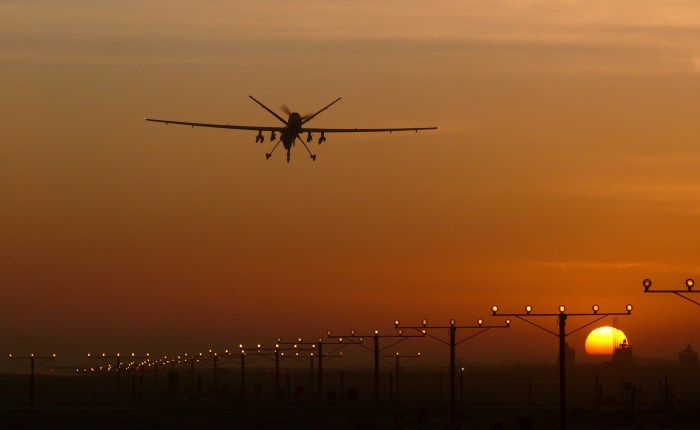
Header Image: A Reaper Remotely Piloted Air System comes into land at Kandahar Airbase in Helmand, Afghanistan, c. 2011. (Source: UK MoD Defence Imagery)

The Champion Team to Fight and Win #highintensitywar: The Case for Australian Expeditionary Air Wings

The Champion Team to Fight and Win #highintensitywar: The Case for Australian Expeditionary Air Wings

By Wing Commander Chris McInnes

Editorial Note: Between February and April 2018, The Central Blue and From Balloons to Drones, will be publishing a series of articles that examine the requirements of high-intensity warfare in the 21st Century. These articles provide the intellectual underpinnings to a seminar on high-intensity warfare being held on 22 March by the Williams Foundation in Canberra, Australia. In this article, Chris McInnes examines the case for the Royal Australian Air Force (RAAF) to develop a fully integrated expeditionary air wing capability to deal with the challenges offered by high-intensity warfare.

In introducing Plan Jericho to the world in 2015, then Chief of the RAAF Air Marshal Geoff Brown argued that the Royal Australian Air Force:

[n]eed[s] to evolve our techniques, tactics and procedures to work as a champion team, not a team of champions.[1]

Brown’s distinction between a champion team and team of champions is a particularly important one for small air forces to consider as they ponder the requirements of high-intensity operations in a changing world. The tempo, complexity, and costs of high-intensity operations will sunder the seams of a team of champions.

Small air forces have had mercifully limited experience of this pressure because larger forces, generally the United States Air Force (USAF), have absorbed much of it. For the RAAF, a lacklustre command experience in the Second World War has been followed by niche contributions that operated as part of US-led combat air operations but in isolation from each other in Korea, Vietnam, Iraq, and Afghanistan.[2] Australian officers have led these contributions and regional coalition operations, such as East Timor in 1999, and gained valuable knowledge as embeds in larger US headquarters. However, as a collective, Australia’s airmen have had little exposure to building a champion team to withstand the pressures of high-intensity warfare.

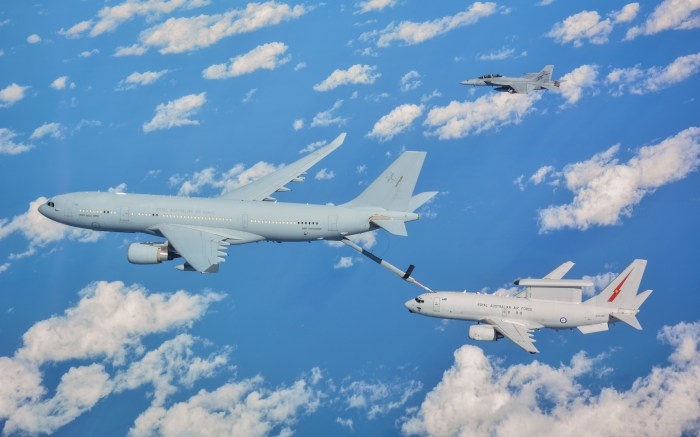
This is why Operation Okra’s air task group is so important. The dispatch of a self-deploying, self-sustaining air task group to the Middle East in September 2014 marked a departure from Australia’s experience of combat air operations. For the first time since the Second World War, Australian air power– the E-7A airborne early warning and control aircraft, KC-30A tankers, F/A-18F fighters, C-130J transports, air base, and enabling elements – contributed to the wider US-led operation as a coherent Australian team.

Operation OKRA
An RAAF KC-30A Multi Role Tanker Transport, E-7A Wedgetail and an F/A-18F Super Hornet fly in formation as they transit to the airspace as part of Operation Okra. (Source: Australian Department of Defence)

This team came together despite the lack of a common organisational concept or a well-prepared headquarters to facilitate their integration as an Australian champion team. The aircraft and air bases mentioned above reported to three separate chains of command: Air Task Group 630 commanded the E-7A, KC-30A, and F/A-18 elements while Joint Task Force 633 retained command, as separate units, of the C-130J aircraft and the air base elements in the Middle East. This organisational fragmentation was not helped by the fact that, according to the commander of the initial air task group and now Air Commander Australia Air Vice-Marshal Steve Roberton, the principal headquarters element responsible for integrating the separate capabilities ‘formed over there; [it] was not stood up before we deployed. In fact, people hadn’t even met.’

The friction-induced by the ad-hoc organisation and an under-prepared headquarters in September 2014 was overcome through the cooperation of quality personnel in stressful but controlled circumstances. These favourable conditions are unlikely to be present in high-intensity operations, and self-inflicted friction will only exacerbate uncontrollable external challenges, delaying and potentially preventing an Australian team of champions becoming a champion team when it matters most.

This article argues that invigorating and embedding the concepts and capabilities needed to operate as an expeditionary air wing is critical if Australian air power is to meet Brown’s challenge when it matters most. The article will argue that the wing is the critical expeditionary echelon for small air forces like the RAAF in high-intensity operations, outline why building expeditionary air wings may be difficult for the RAAF and draw upon British and Canadian experiences over the past decade to suggest some ways forward as a means of stimulating broader discussion.

First, ‘wing’ in this post means the lowest air power command echelon with the necessary resources – command, flying, maintenance, base services, and other enablers – to generate, apply, and sustain air power autonomously. The core concept of a wing is that it is the collective of multiple capabilities under a single commander that generates air power, not a specific number of aircraft, squadrons, or personnel. This historically-proven concept of a wing is flexible, scalable, and modular; not all wings need the full suite of enabling services, and it is entirely possible to have a wing with no permanent flying units. Importantly, wings can be defined by function or by geography depending on the circumstances – the Australian Air Component in the Middle East formed in 2009 was, in essence, a reorganisation of existing independent units to form a wing. Army personnel would recognise the concept of a wing as a combined arms formation, similar to a brigade.

Expeditionary Air Wing
A generic expeditionary air wing organisational structure. (Source: Author)

The wing is the critical echelon for small air forces precisely because it is the lowest echelon capable of autonomous operations and command, either as part of a coalition force or independently. Even when an air and space operations centre (AOC) is available, the wing is where indispensable but often overlooked tactical planning, integration, and assessment occur to turn the AOC’s higher direction into executable plans. Much of the planning on operations and exercises, such as Red Flag and Diamond Storm – the RAAF Air Warfare Instructor Course’s (AWIC) final exercise – happens at the wing level because it is focused on integrating multiple capabilities to achieve a mission. In operations led by a larger partner, such as Okra, a wing enables a small air force to present a coherent, readily identifiable, force package that reduces integration costs on both sides. In more modest operations in which a small air force may lead a joint or combined force a wing headquarters can provide the command and control core, potentially obviating the need for a separate AOC. This latter point is especially crucial for small air forces whose expeditionary resources may mean a separate AOC is unaffordable and unnecessary, particularly in high-intensity operations that generate substantial homeland defence tasking and thereby limit the assets available for expeditionary operations.

High-intensity warfare reinforces the criticality of the wing for small forces because of the need for flexibility, agility, and resilience. When then-Commander US Pacific Air Forces, General Hawk Carlisle, argued for greater distribution of command and control functions that would see ‘the AOR [area of responsibility] […] become a CAOC,’ part of his vision, according to Lieutenant General David Deptula (ret’d) , was that wings would play a ‘role much more integral to a distributed [command and control] system than simply their historical force-provider role.’ Resilience is boosted by reducing air power’s dependence on a single node and allowing operations to continue despite degraded communications. Enhancing command and control capabilities at multiple points increases flexibility because each node is better able to integrate different forces or adapt to new missions. Agility is fostered by supporting concurrent and locally-focused activity across many organisations; USAF exercises indicate this distributed planning model can significantly accelerate the air operations planning process.

These rationales are apparent in Britain and Canada who have developed expeditionary air wings since 2006. The two countries have taken different paths, but both have made wings the foundations of their expeditionary forces, with required capabilities plugging into the wing framework as required. Britain has multiple standing expeditionary air wings drawn directly from Royal Air Force (RAF) stations, while Canada maintains two expeditionary wings at any given time. The Royal Canadian Air Force (RCAF) has a permanent high-readiness expeditionary wing for contingency operations drawn from 2 Wing and one focused on longer-term operations that are drawn from the Air Force’s remaining wings on a rotating basis. An RAF colleague at the Australian Command and Staff College viewed the wing framework as so fundamental to expeditionary air operations that, after a presentation on the initial Okra deployment highlighted that capabilities were deployed without such a framework, he opined that “you Aussies do this air power thing upside down. Is that because you’re from the southern hemisphere?”

Australia’s apparently inverted approach to expeditionary air operations stems from a structure that is optimised for managing discrete capabilities rather than producing integrated air power packages. As Air Vice-Marshal (ret’d) Brian Weston has pointed out, the force element group (FEG) construct has many positives, and FEG played a crucial role in ensuring that the team of champions were ready for Operation Okra. However, the capability-defined FEG and their similarly defined subordinate wings mean that no two FEG or wings are alike and no FEG or wing is structured for, or practised in, leading an integrated expeditionary team in combat. The rise of FEG-aligned control centres and divisions in Australia’s standing AOC reinforces this separation because it drives cross-FEG integration up to the AOC (at least in a formal sense).  These structural barriers to integration are reinforced by a cultural one that arises because personnel tend to ‘grow up’ through their own FEG and could reach very senior ranks with limited exposure to ‘other FEG.’ The lack of a ready and rehearsed wing headquarters for Operation Okra stemmed directly from a disaggregated organisation that is optimised for generating individual champions.

So how then to build the champion team necessary for high-intensity warfare? As Okra and other operations have demonstrated, almost all the pieces of an Australian expeditionary air wing already exist. The establishment of the Air Warfare Centre (AWC) to champion integration and develop the techniques and procedures for integrated tactics is an important step forward. Much work is already underway through Plan Jericho initiatives, the establishment of an Air Warfare School and AWIC, and integration-focused exercises such as the Diamond series and Northern Shield.

Integrated tactics and training courses, however, will count for little in high-intensity operations if they are executed by ad hoc organisations using personnel that have not met and whose usual focus is on managing the routine activities of individual capabilities. The RAAF’s positive steps towards integration must be complemented by efforts to build a collective organisational framework for expeditionary air power and the command and control capabilities at the core of that framework. An expeditionary operating concept and expeditionary headquarters focused on generating, applying, and sustaining integrated air power – a champion team – are essential to complement the disaggregated FEG construct that is so adept at building individual champions.

The articulation of a clear expeditionary operations concept with the expeditionary air wing at its heart would appear to be a relatively simple task. In 2016 the RCAF included a chapter in its capstone doctrine articulating how it delivers air power to joint or coalition commanders and in domestic or expeditionary settings. This chapter, which was not present in the 2010 edition, includes an air task force concept with an expeditionary air wing as its central operational element and discusses how these frameworks can be tailored to suit specific circumstances. Publicly available articles build on the doctrine chapter to explain the RCAF’s concept and rationale. The RAF explains expeditionary air wings on its public website and emphasises their central role in projecting British air power around the globe. The RAF declares that:

[t]he aim of [expeditionary air wings] is to […] generate a readily identifiable structure that is better able to deploy discrete units of agile, scalable, interoperable and capable air power.

Because of this investment in expeditionary air wings, British air power is expected to:

  • To achieve greater operational synergy, delivering focused operational effects from the outset of a deployment;
  • To generate a more cohesive trained audience;
  • To engender more widely a greater understanding of the capability of air power;
  • To achieve a more inclusive formation identity.

By contrast, Australian air power doctrine, including a 2009 publication focused on command and control, devotes more attention to the workings of the RAAF’s garrison structure than operational considerations and tends to description rather than explication. There is no distinction between expeditionary and domestic organisational considerations; ‘expeditionary’ appears only six times scattered across the 245 pages of the RAAF’s Air Power Manual, usually to describe units or capabilities. Discussion on air power command and control is confined to stating a preference for a senior airman to command air power and describing operational-level headquarters. The reader is left with a sense that the RAAF either does not have a clear idea of how it wants to organise integrated air power for a joint or coalition commander or is reluctant to express a view. This is undoubtedly implicit knowledge for many, but high-intensity warfare is not the time to discover that your implicit knowledge differs from the person next to you.

The RAAF should explicitly articulate its force presentation and organisation preferences, similar to the Canadian example. An outline of how future air task groups – centred on expeditionary air wings – would function and be organised, the available options, and the considerations that influence choices is necessary. Expressing a clear view on how to best organise and present an integrated air power team for operations in domestic and expeditionary settings is professional, not parochial. This conceptual framework should be widely accessible, preferably in a public document, to maximise the spread of this concept to Australian airmen and colleagues from other Services, agencies, and countries. A clear, and readily accessible, organisational concept underpins the ability of Australian air power to build a champion team quickly, particularly in the face of the pressure and friction of high-intensity operations.

The final element needed to rapidly form a champion team from the RAAF’s tactical champions is the commander and, crucially, staff. Commanding an expeditionary air wing is a problematic and vitally important challenge – particularly in high-intensity operations – that must be addressed by a coherent command crew that is trained and exercised to high levels of proficiency. Developing outstanding individuals to serve as commanders is vital but insufficient; they must be supported by adept staff to enable and execute their command responsibilities. Britain and Canada conduct training and exercises to build the expeditionary air wing headquarters team and equip the personnel in that team with the necessary skills and experience. They do so in a coherent and structured fashion to build teams that endure and are available to form the core of a headquarters for expeditionary operations. As a result, the RAF and RCAF are unlikely to confront the situation encountered by Australia’s air task group in 2014.

Generating these headquarters elements is likely to pose the greatest challenge for the RAAF to realise a coherent expeditionary air wing capability. The RAF and RCAF approaches will not transfer easily across because the personnel and capabilities needed to lead an expeditionary air wing must be drawn from multiple FEG, and no current RAAF headquarters aside from the AOC focuses on cross-FEG operational coordination. Current Australian practice for expeditionary air operations – the practice used for Operation Okra – is to nominate a commander for deploying forces, build a headquarters structure, and then endeavour to fill the identified positions with personnel on an individual basis. This ad-hoc approach to structures, processes, and staffing for expeditionary headquarters is how Roberton came to be equipped with a headquarters ‘that formed over there […] [with] people that hadn’t even met.’

There are many options to meet this requirement that require evaluation, but all will come at a cost. If dedicated organisations are not feasible, one approach that may minimise cost is to generate a standardised expeditionary headquarters staff structure and then fill the positions on a contingency basis with personnel from a single RAAF base. Each major base – Amberley, Williamtown, and Edinburgh – has the necessary personnel to form a viable headquarters element and aligning them by base would facilitate team building while reducing the impact on in-garrison duties. Rotating the responsibility around bases would spread the burden further. A standardised construct would enable training to be baselined and increase redundancy by enabling personnel from other bases to more readily supplement deploying teams. A permanent high-readiness wing, similar to the RCAF, could be considered to address short-notice contingencies and build expeditionary command and control expertise. RAAF Base Amberley’s resident air mobility and air base elements provide a sound basis for this high-readiness element.

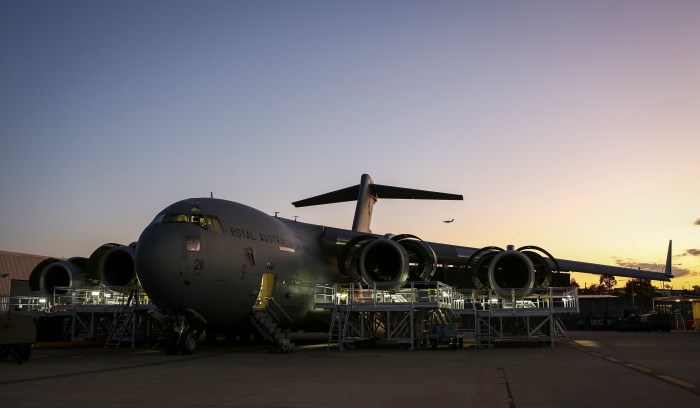
20170713raaf8485160_0077
A C-17 Globemaster III with engine maintenance stands in place and all engines open on sunset at No. 36 Squadron, RAAF Base Amberley, c. 2017 (Source: Australian Department of Defence).

However, the personnel needed belong to multiple FEG and have day jobs. Explicit direction from very senior levels would be necessary to ensure these cross-FEG teams can be formed, trained, exercised, and maintained in the face of competing priorities. These teams could be trained and given experience through a structured series of exercises and activities similar to the RAF and RCAF. They could also be given responsibilities for leading major exercises, such as the Diamond series, Pitch Black, and Talisman Sabre as certification activities. The force generation cycles of key expeditionary air wing elements – such as the headquarters, air base, and communications elements – could be aligned to maximise an expeditionary wing’s coherence upon deployment. This building block approach is similar to the Australian Army’s combat brigade force generation cycle, providing an opportunity to align force generation cycles and enhance readiness across the joint force.

Invigorating and embedding expeditionary air wing concepts and headquarters capabilities in Australian air power are essential for the RAAF to turn its team of champions into a champion team. An ability to deploy and fight as an expeditionary air wing from day one is vital for small air forces in high-intensity operations because combat effectiveness, resilience, and flexibility across multi-national forces must be optimised while national control and identity are assured. The RAAF’s history, structure, and culture presents challenges to this task, but there are ways forward, with much good work already underway. Clearly articulating how the RAAF intends to organise expeditionary air elements and building expeditionary leadership teams are the next steps needed to ensure the RAAF’s fifth-generation champions can fight and win as a champion team when it matters most.

Wing Commander Chris ‘Guiness’ McInnes is an officer in the Royal Australian Air Force and an editor of the Central Blue. The opinions expressed are his alone and do not reflect those of the Royal Australian Air Force, the Australian Defence Force, or the Australian Government.

Header Image: An RAAF E-7A Wedgetail is silhouetted by the setting sun at the main logistics base in the Middle East during Operation Okra. (Source: Australian Department of Defence)

[1] Air Marshal Geoffrey Brown in Royal Australian Air Force, Plan Jericho: Connected – Integrated, (Canberra: Royal Australian Air Force, 2015), p. 1.

[2] Alan Stephens described the RAAF’s command and organisational experience in Europe during the Second World War as ‘an institutional disaster’ while he devoted an entire chapter (out of 16 in the book) to ‘The RAAF Command Scandal’ in the South West Pacific, see: Alan Stephens, The Australian Centenary History of Defence – Volume II: The Royal Australian Air Force (Melbourne: Oxford University Press, 2001), p. 98, pp. 109-25. Further detail on the RAAF’s command performance in the South West Pacific is available in Norman Ashworth’s fittingly titled two-volume account: Norman Ashworth, How Not to Run an Air Force! The Higher Command of the Royal Australian Air Force during the Second World War – Volume 1 and Narrative (Canberra: Air Power Studies Centre, 2000).

Security Forces in #highintensitywar: A Look Back at Airfield Defence for a Future Consideration of the Royal Australian Air Force

Security Forces in #highintensitywar: A Look Back at Airfield Defence for a Future Consideration of the Royal Australian Air Force

By Sean Carwardine

Editorial Note: Between February and April 2018, The Central Blue and From Balloons to Drones, will be publishing a series of articles that examine the requirements of high-intensity warfare in the 21st Century. These articles provide the intellectual underpinnings to a seminar on high-intensity warfare being held on 22 March by the Williams Foundation in Canberra, Australia. In this article, Sean Carwardine describes the development of Royal Australian Air Force (RAAF) airfield defence policy and questions the adequacy of current policy in preparing the Air Force to defend its bases in a #highintensitywar situation.

Air power is generated from air bases. Therefore, in a high-intensity conflict, air forces should expect that their adversary will target their bases. Unfortunately, airfield protection in a high-intensity conventional conflict has attracted little attention in the development of the RAAF’s fifth-generation force. This article looks at the history of RAAF airfield defence, and in consideration of lessons learned, will propose critical questions for future tasking, capabilities, equipment, command and control, training, planning, scale, interoperability, and security force influence on the air domain.

Since 1929, the RAAF has had a single-service policy towards airfield defence, involving airmen providing low-level anti-aircraft and machine gun ground defence. Past RAAF airfield defence policy worked on the assumption of RAAF involvement in small localised, asymmetric or low-intensity warfare in a joint environment. The policy has developed in the context of operations involving rapidly deployed aircraft operating from forward bases secured by allied nations supplying the bulk of force protection. These bases have been in relatively secure rear-areas of sanctuary, with security focusing only on countering the threat of small incursions. In a modern high-intensity war situation, these sanctuaries may no longer provide a guarantee of safety or security. Accordingly, the RAAF and its airfield defence policy must evolve. RAAF airfield defence policy must consider force protection in a high-threat environment, and possibly without significant assistance from major allies.

The RAAF has never been in a position, apart from five months in the Second World War, to provide full airfield defence for its bases in a high-intensity war situation; it has been partly or wholly reliant on allied forces.

P02875.148
Three Aerodrome Defence personnel of No. 79 (Spitfire) Squadron RAAF digging gun pits for their tripod mounted .303 Vickers machine guns for firing at low flying Japanese attackers on Vivigani airfield. Boxes of ammunition for the guns can be seen on the right and in the background. (Source: Australian War Memorial)

During the Second World War, RAAF policy focused on the Australian Army providing low to high-level anti-aircraft defence and ground defence outside the wire. Within the wartime RAAF, there was a clear divide between RAAF Headquarters (the RAAF’s administrative command) and RAAF Command (the RAAF’s operational command) as to the workforce and organisation of airfield defence in the RAAF. The former believed small sections of Guards (20-30) could protect RAAF assets with technical airmen acting in the role as a secondary duty (a reactive defence). For RAAF Headquarters there was no requirement for a specific organisation to provide airfield defence. RAAF Command was against this ‘penny pinching’ policy and promoted a ‘RAAF Regiment’ of guards so that specialists focused on protection, and technical airmen focused on keeping aircraft in the air.

By 1945, the RAAF had the equivalent of five squadrons worth of guards (1,042 guards) in No. 2 Airfield Defence Squadron of the First Tactical Air Force (First TAF), five squadrons worth in the Northern Command (723 guards), four squadrons worth in Security Guard Unit/No. 1 Airfield Defence Squadron (570 guards) in the North-Western Area Command. Approximately, 1,900 guards (some cross-trained as war dog handlers and guard gunners) were also allocated to every aerodrome, inland fuel storage, radar/radio station, wharf/dock, RAAF chemical warfare storage, bomb and ammunition storage, civilian aerodromes and squadron in southern Australia. In addition to the guards, the Service Police had small units in every capital and small numbers on stations and in some squadrons. These forces provided the full scope of air base defence requirements for the RAAF.

At the end of the Second World War, the Chief of the Air Staff (CAS) removed airfield defence from the RAAF, six months before the official disbandment dates. RAAF Service Police strength was also reduced to fewer than 100 airmen across the nation. CAS stated, ‘I am not prepared to agree to any more of these specialised units.’[1] However, senior airmen argued against this. In 1945/46 senior officers such as Air Commodore Frank Bladin (Deputy Chief of the Air Staff), Air Commodore Frederick Scherger (Commander of First TAF), Air Vice-Marshal William Bostock (Air Officer Commanding RAAF Command) and Air Commodore John McCauley supported a proposal for a new airfield defence policy and the formation of an RAAF Regiment as put forward by Wing Commander George Mocatta.

Mocatta was Operation Staff Officer – Defence for the RAAF Command Headquarters Allied Air Force, a post which he held since 1942. He was a graduate of the Royal Air Force’s (RAF) Defence Officer course, and in 1944/45 Mocatta had studied the ground defence of airfields by the RAF Regiment in Europe and the Far East.

Mocatta’s proposal argued that the formation of a RAAF Regiment would see a reduction to around 2,000 guards and 300 police but would provide a full-time airfield defence force that included a ground fighting force, low level anti-aircraft force, airfield engineers, explosive ordnance disposal, mortars and armoured vehicles. Mocatta’s proposal was not progressed; it stayed in RAAF Headquarters un-actioned until the file was closed in 1949.

During the 1950’s, under the National Service Scheme, two aerodrome defence squadrons were formed to train reserve airmen as Ground Gunners. Early in the 1950’s a total of four Aerodrome Defence Officers, 25 Guards and a small number of Service Police were sent to Japan and Korea to provide squadron guard duty and security. Although low-level ground base air defence was considered a RAAF responsibility, the RAAF provided no ground-based air defence of any type on operations in Korea.

Between 1952 and 1955, the Air Staff Policy Memorandum No. 15 RAAF Ground Defence Policy (ASPM 15) highlighted the possibility of a conflict on a global scale against Communist forces. This possibility of high-intensity war would force the RAAF to establish its light anti-aircraft (LAA) defence units, thus releasing the Australian Army from this duty. The policy also raised the possibility of an attack by Communist ground forces, in either large-scale commando style or clandestine attacks. Under ASPM 15 active and passive defence of RAAF assets would be undertaken by six Rifle Squadrons, one Armoured Squadron and three LAA Squadrons of Guards or Ground Gunner reservists.

The 1950s saw another push for the formation of a single permanent Airfield Defence Squadron. The idea this time was similar to Mocatta’s 1945 proposal; however, this time the proposal focused on a single peacetime squadron as a nucleus for a war-time RAAF Regiment. Then in the late 1950’s, the RAAF Ground Defence Policy Chapter of Air Staff Doctrine listed no requirement for ground defence units and highlighted only the need for a few Ground Defence Officer’s, Aerodrome Defence Instructor’s and Guards, with National Service airmen training as Ground Gunners in the reserve.

By 1957, the policy of RAAF airfield defence changed in response to the evolving strategic situation. No major global war was foreseen. Therefore, there was no need for RAAF ground defence forces. The policy was that under an inter-service agreement, the Australian Army would provide all active and passive defence for RAAF assets. The only time the RAAF would require its active defence was when units were overseas, operationally deployed away from land forces or in an emergency. Also, RAAF commanders would initiate their ground defence force from airmen within their unit.

In the early 1960’s the RAAF trained Aircraft Hand/General Duty airmen and RAAF Service Police in infantry tactics to perform airfield defence for duty in Thailand. By 1965 the RAAF created a new mustering for airfield defence and guard duty; the Airfield Defence Guards (ADGs) were formed. Again, the idea of a RAAF Defence Squadron equipped with low-level air defence capability emerged, resulting in the acquisition of eight 40mm Bofors Anti-Aircraft Guns and 140 Oerlikon 20mm cannons for the proposed formation of a peace-time airfield defence squadron.  Interestingly, in the files, a staff officer queried this policy asking, ‘who are we going to shoot them at?’[2] The Bofors ultimately went to the Australian Army, and the Oerlikons stayed in storage.[3] The RAAF then introduced the Bloodhound missile defence program, by 1968 the system was outdated, and the project ended.

Throughout the 1960’s and 1970’s, RAAF policy on ground defence focused on limited war. Unsurprisingly, the ground defence policy for Vietnam focused on low-intensity warfare with an allocation of a 30-man flight of ADGs. At the time, RAAF Ground Defence policy (AAP 938) highlighted the RAAF’s responsibility to provide its own ground-based air defence units using equipment such as 20mm cannons and surface-to-air missile systems. One paragraph in AAP 938 indicates the RAAF did not have any of these systems and would have to acquire them from Britain, ‘when the war starts’.[4] This raises the concern that in a high-intensity conflict, waiting for equipment would be too late. By 1973, the RAAF officially removed anti-aircraft defence from RAAF capabilities, instead relying on the Australian Army’s ground-based air defence (GBAD) systems or aircraft to provide air defence.

The 1980’s and 1990’s saw separate Rifle Flights of ADGs around the country, undertaking guard duty and exercises. During this period, however, the reformation of No. 2 Airfield Defence Squadron and eventually combined all Rifle Flights into one squadron in one location. Operation Warden, the Australian-led intervention in East Timor, in 1999 highlighted the capabilities and the benefits of having a dedicated, air-minded, air force security force in a low-intensity environment. However, having one full time and one partly-staffed reserve unit (No. 1 Airfield Defence Squadron), demonstrated the need for a force protection restructure.

In the subsequent shift to the asymmetric conflicts of Iraq and Afghanistan, RAAF security forces have integrated with Australian Army units and law enforcement agencies to protect aircraft in Aircraft Security Operations, protect air force detachments and take responsibility for the defence of international airfield defence duties. This is the basis of airfield defence policy that still defines RAAF Security Force approach.

Group Captain Jeremy Parkinson, an RAF officer from NATO’s Joint Air Power Competence Centre stated ‘Firstly, because of a lack of understanding of how [Force Protection] is provided, it is all too often seen in capitals and headquarters as little more than a static guarding task and as such is not perceived as contributing to the actual delivery of the mission’.[5] He also stated, commanders, have a lack of understanding of how complex and resource intensive force protection is, and one should not assume that ‘the host nation will provide’ airfield protection for deployed forces.[6] Considering Parkinson’s statement, it is fair to ask: does the current RAAF Security Force structure cater for all air base defence requirements, does it have an absolute, definite intent of potential operational tasking?

In a high-intensity conflict in the future, it is likely the Australian Army would deploy a brigade, which would likely include GBAD for the field force. The RAAF would deploy an Air Task Group to operate from a coalition airfield. What is unclear is if deploying as part of a coalition force, and with US or NATO units in place, would Australia be required to supply a Security Force Squadron? Would Australian GBAD systems automatically attach to the forward air base as stated in the 2016 White Paper? What capability does a current RAAF Security Force bring to the table?

I believe that the RAAF has been guilty of turning a ‘Nelsonian blind eye’ to the need for its own air base defence capability. History shows the RAAF has a lack of understanding of the specialist nature of all air base protection as it has developed a reliance on others, an aversion to committing fully to the airfield defence role and does not appropriately resource airfield defence. Are we learning from history, or following it?

Some questions need to be asked if the RAAF is to prepare to defend its operating bases in a high-intensity conflict. Does the RAAF insist Australian Army GBAD systems be permanently on every air base or will they be allocated to the RAAF after the start of combat operations? Does the RAAF have dispersed hardened or underground shelters, its own air-minded specialist protection force, or does current policy remain extant and we will rely on allies or host nations for our protection?

Analysts will discuss the pros and cons of the Australian Defence Force being a versatile and flexible force that can fight in low and high-intensity conflicts. However, the current legacy RAAF Security Force Squadrons remain established as a ‘small-war’ force, ill-equipped and lacking ground intelligence capabilities to protect air bases, overseas and at home, in a future high-intensity war?

Australia needs a RAAF specialist security protection force that is equipped and trained to respond across the spectrum of future conflict scenarios. A fifth-generation air force must be able to defend the bases that generate its air power.

Sean Carwardine joined the RAAF in 1986 as an Airfield Defence Guard and retired in 2007. Sean served at No. 2 Airfield Defence Squadron, No. 1 Central Ammunition Depot, RAAF Base Richmond, Australian Defence Force Academy, RAAF Base Amberley, Headquarters Airfield Defence Wing. Sean also served on operations in Indonesia 1992, Timor 1999/2000, Afghanistan 2002 and Iraq 2003/04. Sean has completed a Bachelor of Education (University of Southern Queensland), Master of History (Airfield Defence) and is the final year of a PhD – History and Analysis of Airfield Defence Policy in the RAAF (University of New England). Sean has published two articles on RAAF airfield defence, lectured at RAAF Security and Fire School, Security Forces Squadrons (SECFOR) and SECFOR Conference.

Header Image: Leading Aircraftman Joel Sitkiewicz from No. 1 Security Force and Military Working Dog ‘Lucky’, patrol the F/A-18F Super Hornet flight line during Exercise Aces North 2015. (Source: Australian Department of Defence)

[1] National Archives of Australia (NAA), A1196, 15/501/258 PART 2.

[2] NAA, A703, 564/8/36 PART 1.

[3] NAA, A703, 564/8/2/PART 7.

[4] Ibid.

[5] Jeremy Parkinson, ‘Developing Future Force Protection Capability (Part 1),’ Transforming Joint Air Power: The Journal of the JAPCC, 18 (2013), pp. 69-73; Idem, ‘Developing Future Force Protection Capability (Part 2),’ Transforming Joint Air Power: The Journal of the JAPCC, 19 (2014), pp. 67-72.

[6] Parkinson, ‘Developing Future Force Protection Capability (Part 1),’ p. 72.

#highintensitywar and the Realistic Training Paradigm: Red Flag and Aerial Warfare

#highintensitywar and the Realistic Training Paradigm: Red Flag and Aerial Warfare

By Dr Brian D. Laslie

Editorial Note: Between February and April 2018, The Central Blue and From Balloons to Drones, will be publishing a series of articles that examine the requirements of high-intensity warfare in the 21st Century. These articles provide the intellectual underpinnings to a seminar on high-intensity warfare being held on 22 March by the Williams Foundation in Canberra, Australia. In this article, Dr Brian Laslie discusses the introduction of Exercise Red Flag by the United States Air Force (USAF) as a response to the Service’s experience of high-intensity warfare during the Vietnam War. This article illustrates the importance of realistic training scenarios as a critical tool in honing the preparation of air forces for the challenges they might meet in the future.

In November 1975, the USAF began an exercise designed to prepare its pilots to face the realities of combat in a simulated, and yet very realistic, training exercise.

Since that first exercise, the USAF has continued to train its pilots for air combat under the Red Flag banner. I recently travelled to discuss the exercise’s origins with a squadron preparing to head to the Nellis ranges in early 2018. The unit wanted me to discuss how Red Flag got started, but perhaps more importantly, why the exercise is the single most important military training event for USAF aircrews, sister service air components, and allied air forces, today.

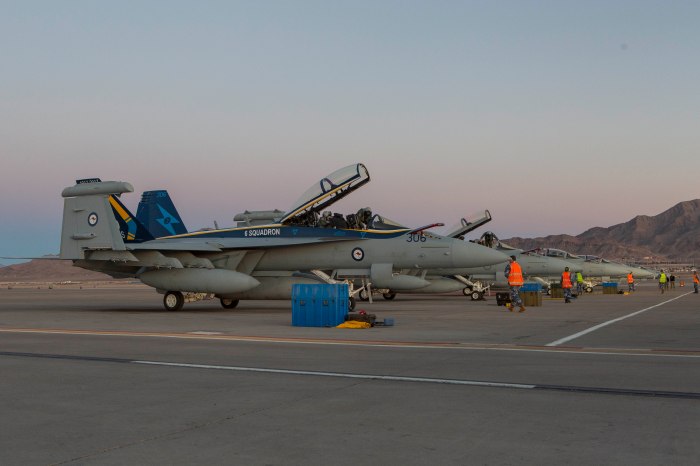
20180123raaf8165233_073
An RAAF EA-18G Growler at Red Flag 18-1. (Source: Australian Department of Defense)

No matter what statistical, empirical, or subjective measurement you use, the American experience in the Vietnam War was not a good one. This was no less true for the USAF than the other branches of the US military. Pilots and senior leaders were less than impressed with their results during combat. The most significant critique came from the line pilots who felt they went into combat ill-prepared to face the enemy. Issues such as how to attack surface-to-air missile (SAM) sites, what an incoming MiG might look like, how to fight that MiG once it was identified, and the proper altitude to get through anti-aircraft artillery (AAA) were not priorities for pilot preparation before the war. In addition to these threats, pilots had to contend with working with complex and sometimes unreliable radar and missile systems all while engaged in high-intensity, manoeuvring aerial combat. In short, American pilots were not properly trained for combat. After the Vietnam War ended, the USAF set about righting these problems through a massive overhaul of existing training paradigms. The changes made in the wake of the Vietnam War fundamentally altered the USAF’s way of war.

As the conflict in Vietnam progressed, the USAF commissioned a series of reports to study every aerial engagement with an enemy aircraft. The so-called Red Baron reports captured the problems in painful detail. Fighter aircraft had to contest with densely-packed SAM sites, enemy MiGs, and a very potent AAA threat. Although AAA was by far the most common cause of aircraft damage and loss, dealing with the SAMs and MiGs was perhaps more stressful as the latter, in particular, would seemingly come out of nowhere. One of the major findings from the reports was that American pilots often did not know enemy MiG aircraft were present until they fired. According to a later RAND study, MiGs were 100 times more likely to close to dogfighting proximity than initially anticipated. To deal with this MiG threat, US fighter pilots had only two options: engage or attempt to escape. If the American pilot did enter into a dogfight, odds were this was the first time he had ever fought against a dissimilar aircraft. An F-4 pilot, for example, might have trained against other F-4s, but he had never practised combat against anything resembling an enemy aircraft.

Since North Vietnamese pilots were known to fly using Soviet tactics, the USAF was forced to reconsider its approach. If USAF pilots fared so poorly against Soviet-trained pilots, how would they fare against the Soviets themselves? In 1972, the USAF took a step towards crafting a better answer to that question by creating dedicated Aggressor Squadrons, pilots trained specifically to emulate the Soviet style of aerial warfare. The mission of the newly created 64th and 65th Aggressor squadrons was to be a ‘professional adversary force conducting a program of intense dissimilar air combat training’ to teach Air Force pilots how to engage and destroy Soviet fighters. One fighter pilot said:

In 1972, when the Aggressors were formed, and DACT [Dissimilar Air Combat Training] became a word you could say openly the biggest deficiency we had in air-to-air capability was human performance. Our tactical BFM [Basic Fighter Maneuvers] skills were weak…by 1975 DACT and four Aggressor squadrons equipped with new F-5Es were the hottest game in town. Moreover, what did those Aggressors do? They taught BFM […] Even as Soviet tactics simulation quickly grew as an Aggressor mission, BFM was still the heart of every debriefing.

The Aggressor squadrons travelled from base to base and introduced fighter squadrons to combat with the Soviet Air Force. Aggressor pilots were often hand-picked for a specific skill set. After arriving at Nellis, they underwent an indoctrination process into the history, culture, and training of the Soviet fighter pilot. They also had the opportunity to get hands-on with Soviet equipment. When flying, Aggressors used Soviet tactics to an extent, typically to ‘the merge’ or the point where the fighters became locked in a visual, turning dogfight. At that point, the ‘gloves came off.’ The creation of the Aggressor squadrons was a significant step forward for American pilots, but it still was not enough. Since a USAF pilot in Vietnam had an exponentially better survival rate after completing ten combat missions, Pentagon planners needed a way to expose junior pilots to those first ten missions under safer conditions. Red Flag was the answer.

Red Flag 16-3 hits full throttle
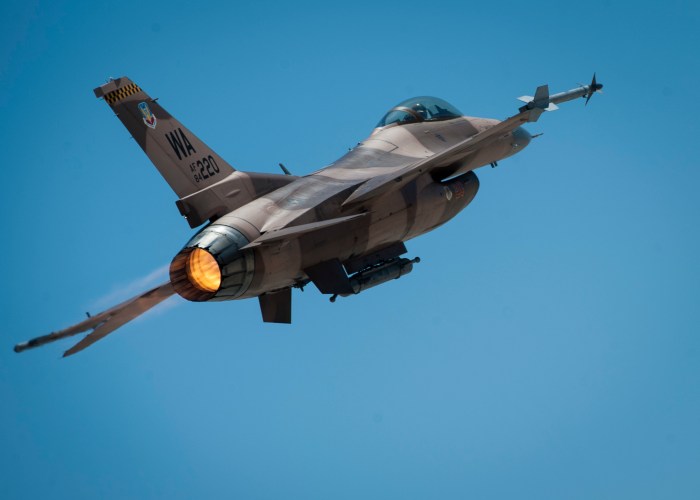
An F-16C Fighting Falcon from the 64th Aggressors Squadron banks off toward the Nevada Test and Training Range to participate in a training sortie during Red Flag 16-3, 19 July 2016. (Source: United States Air Force)

Red Flag was the creation of Lieutenant Colonel Richard ‘Moody’ Suter.[1] Although the ‘iron majors’ provided Red Flag with its intellectual underpinnings and conducted the brunt of the leg-work necessary to get the exercise started. Suter and the other action officers enjoyed great support from Tactical Air Command (TAC) and senior USAF leaders in the Pentagon. When Suter pitched Red Flag to TAC Commander General Robert Dixon, the General loved the idea at once and set about making it a reality. This was no small feat considering Dixon’s reputation for being tough on staff officers and his reputation as the ‘Tidewater Alligator.’ General George Brown, the Chief of Staff of the USAF (CSAF), enthusiastically supported the exercise as well and told Dixon to get it going. The following CSAF, General David Jones also supported the exercise. The Air Staff’s intelligence directorate created a new intelligence unit solely to support Red Flag and began work to move Soviet equipment, including MiG fighters, to Nellis to provide a ‘hands on’ approach to fighting Soviet machinery. Overall, this lightning-quick response led to the first Red Flag taking place only four months after Suter’s initial pitch to TAC.

Red Flag was designed to combine ‘good basic fighter skills’ with ‘realistic threat employment’ to enhance pilot proficiency and readiness for future combat operations. Red Flag I began in November 1975. The primary unit was the 49th Tactical Fighter Wing flying F-4s. Support elements included OV-10s, F-105s, and CH-53s. Red Flag II in early 1976 had increased support elements, and Red Flag III was larger still, seeing the first participation of the new F-15 and the first-night operations as participants flew nearly 1,000 sorties. These early Red Flags drew tremendous praise from participants and requests for more aggressors and more threats, so subsequent exercises increased in size and scope. By the late 1970s, units from the US Pacific Air Forces and the USAF in Europe were travelling to Nellis to take part.

Throughout the 1980s Red Flags became increasingly realistic and, by extension, more difficult for the participating aircrews. As technology advanced, so did the exercise. Gone were the days of tape-recording a mission, and in were the days of the Red Flag Mission Debriefing System, Air Combat Maneuvering Instrumentation, and Nellis Air Combat Training System. Allied nations began taking part as well, and by the end of the 1980s, more than 30 countries had flown in or observed a Red Flag, meaning foreign aircraft were just as likely to be seen in the skies over southern Nevada as American ones. Red Flag expansion continued through the during the 1980s. The April 86 Tactical Analysis Bulletin focused on improvement to existing training methods:

Acknowledging and defining the increased capabilities and advances in Soviet technology is the first step in improving our own training programs.

Even today, a typical Red Flag runs for two weeks with two ‘goes’ each day. Individual squadron briefs follow a mass brief before aircrew step to their aircraft. As the exercise goes on, the missions get progressively harder, forcing pilots and mission planners to work together to accomplish their objectives. Each Red Flag has a mix of fighter and bomber aircraft along with supporting electronic attack, aerial refuelling, airborne battle management, surveillance, and cargo aircraft. Sister service and foreign participation also occur on a regular basis, letting all experience the realities of air-to-air and air-to-ground combat across the joint and combined force. They learn the ‘golden rules’ of BFM lost before Vietnam: ‘lose sight, lose fight,’ manoeuvring in relation to the adversary, and nose position of their aircraft versus energy. They learn:

BFM is used by the pilot to place himself in a piece of sky from which he can launch lethal ordnance, or to keep from becoming a star on the side of somebody else’s jet.

From start to finish, Red Flag prepares pilots to conduct air operations as part of a larger force.

Sukhoi2
An Indian Air Force Sukhoi SU-30 during Red Flag 08-4 in 2008. (Source: Wikimedia)

Saddam Hussein’s invasion of Kuwait offered the perfect opportunity for USAF operators to employ the tactics and doctrine they had been perfecting for the previous decade and a half. Red Flag, Prized Eagle, and numerous other large force employment exercises had prepared American airmen well for the enemy they were going to face in combat, primarily on night one, of Operation Desert Storm. While technological marvels such as the F-117 had a direct impact on combat operations and an even larger one on the American media and public, it was the pilots in the multi-role fighters, bombers, and special operations aircraft who ensured air superiority and thus unhindered freedom of manoeuvre for the land component forces.

With an estimated 44 kills during Desert Storm, American pilots demonstrated they were unmatched when it came to aerial combat. The training changes employed by the USAF after Vietnam went a long way in allowing American pilots to engage and destroy the enemy even when their technology came up short or rules of engagement prohibited them from employing their weapons beyond visual range. As one American fighter pilot said of his time in Desert Storm,‘[T]he Red Flag experience prepared me for combat operations.’

Two dogfights, one from Vietnam and one from Desert Storm, capture the impact of Red Flag. In April 1965, a two-ship of F-4s engaged 4 MiG-17s in a protracted dogfight that ended in a ‘probable kill’ of one MiG-17. In total the F-4s attempted to fire six missiles: two did not guide, three motors did not fire, one hung on the rails, and a MiG successfully evaded the one missile that both fired and tracked. In a similar case, on 19 January 1991, two F-15s engaged two MiG-25s. One F-15 fired two AIM-7s and two AIM-9s, the other fired one AIM-9 and one AIM-7 for a total of six missiles, but, in this case, two confirmed kills. These two air engagements indicate that if technology and weapons were similar, then there must be another explanatory factor in success during Desert Storm. That factor was the training revolution. The link between training exercises and real-world events can be somewhat subjective, but numerous pilots interviewed said their participation at Red Flag was of fundamental importance as they entered combat. One MiG-killer of Desert Storm went so far as to say that the primary difference between himself and his opponent was that he had been in hundreds of dogfights at Red Flag.

USAF success continued throughout the 1990s in the skies over the Balkans where American pilots continued to show just how well their training prepared them to face the enemy. Even as this article is published, Red Flag 18-1 has recently finished. Beyond that, those trained at numerous Red Flag exercises are, even now, plying their trade in the skies over Syria and Iraq, performing close air support, combat air patrols, and interdiction missions. These men and women have a distinct training advantage not only over their current enemy but against any aerial or ground opponent they might face. Although created forty years ago this year, Red Flag remains enormously crucial in training aircrews for combat. Red Flag and the Aggressors still provide a realistic threat environment, and the exercise continues to expand with the inclusion of non-kinetic, cyber, and other threat replications. The most recent Red Flag went ‘virtual’ to increase the size and complexity of the threats faced by the flyers. Red Flag remains the single most complex and comprehensive training exercise in the world, and it provides a combat edge to participants that other countries simply cannot or do not replicate.

Dr Brian Laslie is a US Air Force Historian and currently the Deputy Command Historian at North American Aerospace Defense Command (NORAD) and United States Northern Command (USNORTHCOM). He is also an Assistant Editor of From Balloons to Drones. A 2001 graduate of The Citadel and a historian of air power studies, he received his Masters’ from Auburn University Montgomery in 2006 and his PhD from Kansas State University in 2013. He is the author of Architect of Air Power: General Laurence S. Kuter and the Birth of the US Air Force (2017) and The Air Force Way of War (2015). The latter book was selected for the Chief of Staff of the Air Force’s 2016 professional reading list and the 2017 RAF Chief of the Air Staff’s reading list. He can be found on Twitter at @BrianLaslie.

Header Image: An F-15C Eagle assigned to the Oregon Air National Guard’s 123rd Fighter Squadron approaches an in-flight refueling boom during Red Flag 18-1, 7 February 2018. Units from across the US along with members from the Royal Air Force and Royal Australian Air Force participated as Blue Forces in this year’s first Red Flag exercise.

[1] On the development of Red Flag, see: Brian D. Laslie, The Air Force Way of War: U.S. Tactics and Training after Vietnam (Lexington, KT: The University Press of Kentucky, 2015).

#highintensitywar and the Enduring Legacy of Operation Bolo

#highintensitywar and the Enduring Legacy of Operation Bolo

By Lieutenant Colonel Tyson Wetzel

Editorial Note: Between February and April 2018, The Central Blue and From Balloons to Drones, will be publishing a series of articles that examine the requirements of high-intensity warfare in the 21st Century. These articles provide the intellectual underpinnings to a seminar on high-intensity warfare being held on 22 March by the Williams Foundation in Canberra, Australia. In this article, Lieutenant Colonel Tyson Wetzel examines the enduring legacy of Operation Bolo, an operation during the Vietnam War that was designed as a response to the increasing loses being incurred on the United States Air Force (USAF) in the mid-1960s.

Deliberately planned fighter sweep went just as we hoped. The MiGs came up; the MiGs were aggressive. We tangled. They lost.[1]

Colonel Robin Olds, 3 January 1967

By the end of 1966, USAF fighter pilots were incredibly frustrated by rising aircraft and aircrew losses, restrictive rules of engagement (ROE) and North Vietnam People’s Air Force’s (NPAF) ‘hit-and-run’ tactics. The pilots were looking for an opportunity to seize the initiative and strike the premier NPAF fighter, the MiG-21. The NPAF was extremely careful with their limited number of MiG-21s, launching them only when their air defence network determined slow and non-manoeuvrable fighter-bombers were conducting unescorted strikes in North Vietnam.[2] Colonel Robin Olds, Commander of the 8th Tactical Fighter Wing ‘Wolfpack,’ at Ubon Royal Thai Air Force Base, devised a plan to dupe the NPAF into believing his F-4 Phantom IIs were a large formation of unescorted F-105 Thunderchiefs, which he believed would draw out the MiG-21s. On 2 January 1967, Olds and his Wolfpack executed Operation Bolo and destroyed seven NPAF MiG-21s with no friendly losses. The plan was elaborate, and successful execution relied on deception, predictive and actionable intelligence, and a well-integrated force package. These factors ensured Bolo was a triumphant success and have enduring applicability for air power theorists and air campaign planners preparing for future high-intensity conflict.

AR.2010.007
Colonel Robin Olds with his F-4C ‘SCAT XXVII’, which is on display at the National Museum of the United States Air Force. Olds named all his aircraft after his West Point roommate Scat Davis, who could not become a military pilot due to poor eyesight. (Source: National Museum of the United States Air Force)

The Strategic Environment before Bolo

Two significant factors shaped the American prosecution of the air war over Vietnam in 1966. First, to reduce the risk of escalation, US ROEs at the time of Bolo did not allow strikes on critical North Vietnamese airfields. The result was that MiGs could not be destroyed on the ground; they had to be destroyed in the air.[3] The second factor was the rapidly improving North Vietnamese air defence system, which included air defence artillery, surface-to-air missiles (SAMs), and MiG-17 and MiG-21 fighter aircraft. The combination of surface and airborne threats was taking a heavy toll on US aircraft. By the end of 1966, 455 US aircraft had been lost to enemy action, and USAF leaders wanted to take action to address the losses.[4]

The airborne threat to US aircraft increased dramatically when the NPAF began receiving the MiG-21 in 1965. The MiG-21 retained the manoeuvrability of its predecessors the MiG-15/-17/-19, but it was capable of supersonic flight and was the first Soviet aircraft capable of carrying an infrared-guided air-to-air missile, the K-13 (NATO Designator: AA-2 ATOLL). Intelligence estimates at the time of Bolo put the NPAF MiG-21 inventory at only 16 airframes. To preserve these precious assets, the North Vietnamese only scrambled these aircraft to attack bomb-laden fighter-bombers such as the F-105. According to Walter Boyne, the MiG-21 tactics were very effective:

The MiG-21s’ rear attacks with Atoll missiles were achieving North Vietnamese goals by causing the F-105 formations to jettison their bombs before reaching their targets.[5]

MiG-21 attacks on F-105s resulted in failed missions causing multiple strike packages to be sent to re-attack high-priority targets in a dense threat environment.

Olds was increasingly concerned with the MiG-21 attacks on the fighter-bombers, and the inability of the F-4 escorts to find and kill the MiG-21s in the air:

As we entered the winter of 1966, the MiGs began increased efforts to harass U.S. strike forces […] It became imperative for U.S. forces to bring counteraction to bear on the MiG fighter threat.[6]

Unfortunately, Olds did not see any plan to deal with the threat at the tactical, individual fighter wings, or operational level, 7th Air Force. Olds expressed his frustration with the inaction in an oral history interview two years after the mission: ‘There was no concerted effort really to do anything about the MiGs.’[7] Olds decided to take the lead in developing a plan to take the fight to the MiG-21s.

The Mission

Olds is often given credit as the sole mastermind behind Bolo, but others deserve credit for playing critical roles in the development and refinement of the plan. In early December 1966, Olds began discussing the MiG-21 problem with one of his most gifted fighter pilots, Captain J.B. Stone. Stone laid out the foundation for the plan that would eventually be adopted; using a ruse to make the North Vietnamese launch their MiG-21s against what they believed were fighter-bombers.

Olds enthusiastically embraced the plan and decided to take the plan to his boss, Lieutenant General William Momyer, Commander of 7th Air Force. Momyer also enthusiastically supported the plan and identified his Operations Officer, Brigadier General Don Smith, as his dedicated liaison for the plan. Momyer and Smith shepherded the plan from the start to ensure Olds and his planners were given all available resources and support.[8] According to Olds, Bolo ‘wouldn’t have been possible’ without ‘Momyer’s courage in doing this, probably in spite of a lot of opposition.’[9] Olds is rightly given credit for a bold and brilliantly designed and executed plan, but the success of the mission would not have been possible without significant support from his subordinates and superiors.

On 2 January 1967, 56 F-4s launched in waves of eight aircraft into Northern Vietnam to execute Bolo. The mission worked as it was designed, despite heavy cloud cover in the target area that threatened to keep the MiGs on the ground. Believing they were engaging F-105s, the MiG-21s took the bait; the results were disastrous for them.

According to USAF records, Olds and his Wolfpack destroyed seven MiG-21s in less than 15 minutes with no damage to any US aircraft.[10] Though the seven kills may not seem a significant number, it was nearly half of the NPAF inventory. Four days later, two more MiG-21s were destroyed when they attacked what they believed were unarmed reconnaissance aircraft, but in actuality were more of Olds’ F-4 pilots.[11] The devastation wrought by Bolo, combined with two additional aircraft lost on 6 January led the NPAF to remove the MiG-21 from combat while they re-equipped, and evaluated the causes and their response to recent aircraft losses.[12] Bolo played a significant role in the US re-acquiring air superiority during the beginning of 1967.

The Role of Deception in Bolo

Deception was central to the successful execution of the Bolo plan. The F-4s had to disguise themselves as lumbering F-105s to bait the MiG-21s into an aerial engagement. According to J. Alfred Phelps, the purpose of the deception plan was to create beneficial conditions for an aerial engagement:

The ultimate objective was to deceive and lure the MiG air defense force into a reactive posture and, once they were airborne, seek them out, engage, pursue, and destroy them.[13]

To trick the North Vietnamese air defence system, the F-4s used F-105 callsigns, formations, speed, aerial refuelling tracks, mission routing, and electronic countermeasure (jamming) pods. The deception caused mass confusion among the NPAF MiG-21 pilots. Terry Mays explained the success of the ploy:

The North Vietnamese fell for the ruse and launched MiG-21 fighters to intercept what they thought were F-105s streaking along ‘Thud Ridge’ […] As the MiG-21 pilots maneuvered through the clouds and entered the open sky, expecting to attack F-105s, they found themselves in the midst of F-4s.[14]

MiG-21 pilots had avoided the US’ premier air-to-air fighter, the F-4, so seeing a wall of Phantoms was a shock to the NPAF pilots and ground controllers.

Airborne intelligence collectors were able to capture the shock of the NPAF air defence force. In 2014, Joseph Trevithick analysed recently declassified intercepts from the mission, which showed the near-panic of North Vietnamese pilots upon realising they had been duped:

When Olds’ strike team started its attack, the C-130s picked up enemy pilots shocked to find that ‘the sky is full of F-4s,’ according to the declassified report. ‘Where are the F-105s? You briefed us to expect F-105s!’ ‘I’d like to come down now,’ another Vietnamese pilot reportedly declared.[15]

The North Vietnamese were not prepared to face the F-4s, nor able to quickly react to the changing operational environment in time to save many of their MiG-21s.

The expert application of deception is one of the most important lessons to be learned from Bolo; aerial combat is not merely about the fastest jet, the missile with the longest range, or the best pilot. The use of deception can mitigate a tactical disadvantage or maximise a tactical advantage in the air. The use of deception is rarely a critical aspect of modern aerial combat plans, as US air planners often rely on overwhelming numerical or technological superiority. However, as nations like Russia and China develop and deploy large numbers of advanced fighters and air defence systems, the US cannot continue to rely on numerical or technological advantages. The use of a well-developed deception plan can once again tip the balance in aerial combat, as Olds and his Wolfpack proved in Bolo.

Mikoyan-Gurevich MiG-21PF
A Mikoyan-Gurevich MiG-21PF ‘Fishbed’ in North Vietnamese colours at the National Museum of the United States Air Force. (Source: Wikimedia)

The Role of Intelligence in Planning and Execution of Bolo

Intelligence played a crucial role in both the planning and execution of Bolo. Olds knew that to develop a complete plan for the operation, he needed an accurate intelligence assessment of how the enemy would react to the ruse. According to Olds, ‘it was crucial to accurately predict the capabilities and possible reaction of the MiGs.’[16] The support of Momyer and Smith opened the doors to closely guarded intelligence, including signals intelligence (SIGINT) intercepts of NPAF fighter missions. This intelligence shaped the predictive assessment the intelligence analysts provided to Olds. He continued:

Intelligence gave us some highly probable MiG tactics. The MiGs were usually in the air anytime strike aircraft were in the area. Typically, they were airborne approximately ten to fifteen minutes prior to the strike, about the time the Thuds crossed the Black River.[17]

Olds and Stone used the predictive assessments to determine the number and time spacing of the F-4 formations.

The mission also relied on timely and accurate intelligence during execution. Olds believed real-time relay of SIGINT collection was vital to the mission’s success:

Most critical to the success of BOLO, we had to have clear, real-time intelligence from USAF monitoring stations listening in to VPAF transmissions—no more of the bullshit of keeping essential knowledge secret from the strike force. VPAF transmissions had been monitored and translated but never shared down the line. It was sensitive, but it was imperative to have this intel for BOLO.[18]

Olds and Stone ensured airborne and ground-based SIGINT collectors were included and integrated into the mission so that the force package would receive real-time intelligence updates. Trevithick used declassified Bolo reports to illuminate how important real-time SIGINT collection was to the mission:

Another key—and previously unknown—element of the top secret plan involved deploying signal-snooping aircraft to keep track of the MiGs. The special C-130B-IIs would listen in on enemy radio chatter and feed information straight to American pilots throughout the mission.[19]

Two of these specially modified C-130s, known as SILVER DAWN aircraft, were airborne during the mission providing real-time collection to the force package. The use of predictive intelligence to help refine the plan and the use of real-time intelligence collect was nearly revolutionary because of the classification walls that prevented much intelligence, specifically SIGINT, from being shared with tactical operators. Such barriers have come down in the decades since Bolo, but air planners still struggle with the integration of intelligence into mission planning and execution.

The Role of Force Packaging in Bolo

Bolo included detailed planning and integration among a host of platforms, both airborne and on the ground. Each had a critical role to play to ensure the maximum lethality and survivability of the force. 48 F-4Cs were designated to conduct the aerial sweep mission to find and kill enemy MiGs. They were supported by 24 F-105F IRON HAND aircraft designed to suppress enemy air defences to protect the force package from SAMs. Eight F-104Cs were tasked with the protection of the fighters as they egressed the sweep area. Twenty-five KC-135 aerial refuelling tankers were needed to support the huge strike package. Combat support aircraft including the RC-121 BIG EYE battle management aircraft, EB-66 jamming aircraft, C-130 airborne command post and SILVER DAWN SIGINT platforms, combat search and rescue aircraft, ground control intercept sites, and the ground-based SIGINT stations all participated in the mission.[20] Planning to integrate each of the platforms and its capabilities was complex, and Olds spent days travelling the theatre briefing operators on the plan.

The Bolo package foreshadowed the massive force packages that would become prevalent in Operation Desert Storm and all other air campaigns since. In addition to multiple fighter types executing various mission sets, combat support aircraft provided the updated air picture, collected real-time intelligence, executed command and control, jamming, and aerial refuelling. These aircraft were force multipliers in the mission, and the roles and importance of similar platforms have continued to expand over the past five decades. Bolo was an early and clear example of the effectiveness of a complete and fully integrated force package. This is one of the lessons of Bolo that air planners have absorbed, and force packaging is now a daily part of air operations.

AR.2010.021
An F-4C of the 497th Tactical Fighter Squadron, 8th Tactical Fighter Wing, rolls out on takeoff. It is configured for the MiGCAP escort role with Sparrow air-to-air missiles under the fuselage, and Sidewinder air-to-air missiles and extra fuel tanks under the wings. (Source: National Museum of the Unites States Air Force)

Conclusion

Bolo was not only the highlight of the larger Rolling Thunder air campaign; it was the most successful US fighter operation of the war.[21] Despite the mission being executed more than fifty years ago, there are critical lessons about mission planning and execution that can be used in the development of aerial missions and air campaigns today. Historian Jon Latimer summed up the primary takeaway from Bolo:

U.S. Air Force pilots demonstrated over Hanoi in 1967 that lure tactics can also work well in the higher reaches of technology. So it was that Operation BOLO, a small but unusually successful part of the ROLLING THUNDER bombing program, succeeded in claiming seven North Vietnamese MiGs within 15 minutes, without losing a single American aircraft.[22]

The shrewd use of deception allowed the US fighters to engage their adversary at the time, place, and in the manner of their choosing.

Additionally, the use of intelligence before and during the mission was vital to the success of the operation. The utilisation of predictive intelligence in mission planning allowed the Bolo planners to optimise the F-4’s survivability and lethality against the MiG-21. The timely dissemination of SIGINT was unheard of at the time, but Bolo showed the importance of real-time intelligence updates to the operational environment. Finally, the integration and coordination of airborne and ground-based elements in a massive and diverse force package was a significant contributor to the overall success of the mission. Bolo made better use of deception, intelligence, both predictive and real-time updates, and force packaging than any air operation of the Vietnam War up to that point.

In this era of ‘near-peer’ threats, including the development and deployment of fifth-Generation aircraft, modern long-range SAMs, and advanced electronic warfare, the US and its allies cannot rely solely on numerical or even technological superiority to win future air conflicts. Air power theorists and operators need to think through problems, evaluating the operational environment and the adversary and build plans that leverage and maximise their comparative advantages while mitigating risk and minimising the adversary’s comparative advantages. Air planners and tacticians should study these aspects of Bolo and consider incorporating tactics similar to those of Olds and his Wolfpack in the planning and development of future air operations in a high-intensity conflict.

Tyson Wetzel is a Lieutenant Colonel in the United States Air Force, an intelligence officer, a graduate of the United States Air Force Weapons School where he was also an instructor, and the US Marine Corps Command and Staff College. Tyson has deployed multiple times in support of Operations IRAQI FREEDOM, ENDURING FREEDOM, NEW DAWN, and NOBLE EAGLE. He is currently assigned to the Joint Staff at the Pentagon. He tweets @gorillawetzel.

Header Image: Pictured here are revetments and F-4s of the 8th TFW at Ubon, Thailand. (Source: National Museum of the Unites States Air Force)

[1] Robin Olds, interview with Armed Forces Network, 3 January 1967. Clip shown on Dogfights: Air Ambush. History Channel, 10 November 2006.

[2] Walter J. Boyne, Beyond the Wild Blue: A History of the U.S. Air Force (New York: St. Martin’s Griffin, 2010), pp. 162.

[3] Jon Latimer, ‘Operation Bolo: Phantom ambush over North Vietnam,’ Vietnam, 15:3 (2002), pp. 38.

[4] Latimer, ‘Operation Bolo,’ pp. 37.

[5] Boyne, Beyond the Wild Blue, pp. 162.

[6] Robin Olds, Christina Olds and Ed Rasimus, Fighter Pilot: The Memoirs of Legendary Ace Robin Olds (New York: St. Martin’s Press, 2010), pp. 262-3.

[7] Robin Olds, U.S. Air Force Oral History. Project Corona Harvest Collection. Operation Bolo Briefing (listed as Interview #222). Maxwell AFB: Office of Air Force History, 29 Sep 1967, pp. 8.

[8] Olds, Fighter Pilot, pp. 269-71.

[9] Olds, Project Corona Harvest. Operation Bolo Briefing, pp. 68

[10] Frank F. Futrell, William H. Greenhalgh, Carl Grubb, Gerard E. Hasselwander, Robert F. Jakob, and Charles A. Ravenstein. Aces and Aerial Victories: The United States Air Force in Southeast Asia, 1965-1973 (Washington, DC: Office of Air Force History, Headquarters US Air Force, 1976), p. 21.

[11] Olds, Project Corona Harvest. Operation Bolo Briefing, pp. 65.

[12] Terry M. Mays, ‘Gunfighting Over North Vietnam,’ Vietnam, 20:6 (2008), p. 47.

[13] J. Alfred Phelps, Chappie: America’s First Black Four-Star General: The Life and Times of Daniel James, Jr (Novato, CA: Presidio Press, 1992), pp. 225.

[14] Mays, ‘Gunfighting Over North Vietnam,’ p. 47.

[15] Joseph Trevithick, ‘Spies Helped the USAF Shoot Down a Third of North Vietnam’s MiG-21s,’ WarIsBoring.com, 30 Dec 2014.

[16] Olds, Fighter Pilot, pp. 273.

[17] Ibid, pp. 272.

[18] Ibid, pp. 275-6.

[19] Trevithick, ‘Spies Helped the USAF Shoot Down a Third of North Vietnam’s MiG-21s.’

[20] Multiple sources were used to determine all the components of the force package: Olds, Fighter Pilot, pp. 274-6; Latimer, ‘Operation Bolo,’ pp. 38-39; Boyne, Beyond the Wild Blue, pp. 163.

[21] Phelps, Chappie, pp. 229.

[22] Latimer, ‘Operation Bolo,’ pp. 35.

Attrition in Fifth-Generation Air Forces during #highintensitywar

Attrition in Fifth-Generation Air Forces during #highintensitywar

By Rex Harrison

Editorial Note: From February to April 2018, The Central Blue and From Balloons to Drones, will be publishing a series of articles that examine the requirements of high-intensity warfare in the 21st Century. These articles provide the intellectual underpinnings to a seminar on high-intensity warfare being held on 22 March by the Williams Foundation in Canberra, Australia. In this article, Rex Harrison discusses the challenge of attrition during high-intensity conflicts and its implications for fifth-generation air forces.

Technology has continued to advance in both disruptive and surprising ways. It is consequently difficult to forecast the exact way fifth-generation air power will be applied in 2035, nor the precise character of future high-intensity conflict. With the benefit of hindsight, however, history proposes broad themes and continuities in the nature of war. One such example is the persistence of attrition of the force once committed to battle.

While Western air forces have been able to somewhat control their level of exposure to adversary action since the 1991 Gulf war, this may not always be the case. This level of control has been achieved through conducting operations beyond the engagement range of adversaries and behind a shield of (generally unchallenged) air defences. This technique has enabled air power to inflict significant losses without absorbing such losses themselves.

This happy circumstance has been the exception rather than the rule in human history. This is particularly the case when considering the history of air power, where few combatants have had the luxury of picking and choosing the intensity and duration of the conflict. No matter how successful fifth-generation air power is in enhancing its lethality and minimising risk to the force, it is doubtful that a combat exchange in high-intensity combat will result in a ‘0’ in the ledger of either side.

This being the case, I believe that success in high-intensity conflict will require a fifth-generation air force to ensure it can absorb and recover from the attrition of its forces. While it will be difficult to predict the outcomes of future air combat or the mix of technology and tactics that will provide the necessary advantage, history does provide a guide that may better inform our preparations for the future.

Historical Examples

Yom_Kipur_war
An Israeli pilot, Shimshon Rozen, climbing into a McDonnell Douglas F-4E Phantom II during the Yom Kippur War, c. 1973. (Source: Wikimedia)

The significant impact of attrition is demonstrated by the experiences of the Israeli Air Force (IAF) in the Yom Kippur War of October 1973. In this example, Israel was surprised by the new-found technical prowess of the Arab armies led by Egypt and Syria. The IAF was required to expend a sizable portion of its fighting strength to provide time for mobilisation. Surprised by the technical mastery of their opponents, in a matter of days, 102 aircraft were lost (roughly 25% of available combat aircraft), along with 53 aircrew. The crisis was only resolved by the rapid shipment of replacement aircraft from the US inventory under Operation Nickel Grass.

While certainly an example of high-intensity conflict, the requirement for Australia to fight for its existence as Israel did is unlikely or would be, at the very least, preceded by warnings such that the nation could be mobilised and prepared for such a conflict. It is partially through Australia’s preferred method of warfare, the controlled commitment of forces in expeditionary wars, that such attrition has been avoided.

A more pertinent example for Australian forces is the experience of No. 77 Squadron during the Korean War (a perhaps timely example given ongoing tensions on the Peninsula). The deployment of a single fighter squadron in June 1950 would seem at face value to match the characteristics of more recent Royal Australian Air Force (RAAF) commitments; the level of attrition, however, was not comparable. Over a three-year commitment, 41 pilots died, and six were captured. At the peak of fighting the squadron replaced 25% the pilot force over an eighteen-month period. Finding the Second World War era North American P-51 Mustang to be outmatched after losing 13 aircraft, No. 77 Squadron was re-equipped in May 1951 with the Gloster Meteor. Of the 94 Meteors acquired by Australia, 30 were subsequently lost to enemy action, delivering a significant portion of the 54-aircraft lost in total over Korea and Japan.[1] The consequence of this action was that No. 77 Squadron, in effect, replaced all of its aircraft at least once, and in a handful of years, expending the bulk of the entire RAAF fleet.

JK0901A
Squadron Leader Ross Glassop and Flight Lieutenant Sainer Rees, pilots, serving with No. 77 Squadron RAAF chat with the crew of No. 36 Squadron RAAF which had flown from Japan with supplies of rockets and aircraft spares. (Source: Australian War Memorial)

One should hope that future deployments would avoid committing forces in obsolete aircraft. However, it should be noted that the Australian government maintained the force commitment in Korea despite these and other subsequent losses.

What Does This Mean?

In preparing for future conflict, any fifth-generation air force must ensure access to both the physical (hardware) and human resources required to replace those lost.

The procurement of aircraft and their associated supporting hardware may be the most straightforward requirement to meet, assuming access to global markets. While contemporary production rates are much lower than those of the Second World War, they are still significant for those aircraft in full production. While the Israeli losses in 1973 were substantial, production of the McDonnell Douglas F-4 Phantom II, the mainstay multi-role aircraft of the period, averaged 19 aircraft per month, over the life of production.  Israel’s losses of this aircraft type (32 of the 102 total), while critical to the IAF, were only the equivalent of less than two months production out of the Fort Worth factory.

The replacement of human resources, specifically aircrew, will be determined by a combination of the resources allocated to training (rather than fighting), and the desired quality of the resulting product. Given our resource-constrained environment, it may well be that ‘great’ is the enemy of ‘good enough’. In this context, a fifth-generation air force will need to accept that its workforce may not have not quite mastered the full spectrum of fifth-generation fighting techniques; however, it will need to employ them regardless.

A fifth-generation air force will also need to incorporate these replacements within the chosen operational approach. Concerning hardware, it will be rare that the exact aircraft lost from the inventory will be in production. With platforms potentially being fielded for decades, it is to be expected that subsequent variants will be produced, or entirely new platforms created in the decades following acquisitions. As such, while a replacement platform may be found, the capabilities are unlikely to be identical to that it replaces.

More critically to the networked fifth-generation force, it is unlikely that replacement assets will be fitted with the exquisitely detailed set of combat data and information exchange systems specified as part of the fifth-generation force structure. This will particularly be the case if the preferred supplier of our platforms is otherwise occupied. Returning to the example of No. 77 Squadron, when the Mustang was determined to be unsuitable for the Korean conflict, the RAAF initially sought the North American F-86 Sabre from the United States, however, as production was already committed to US customers, the British Meteor was chosen instead. While this aircraft was first flown in 1944 and was far from the cutting edge of technology, the war marched on, and Australia could not wait until it was ready to fight on its terms.[2]

Conclusion

While the aim of the technologically and professionally-advanced fifth-generation force is admirable, planning and foresight cannot overcome the uncertain nature of war, precisely the inevitability of loss. At its heart, a fifth-generation force requires flexibility to adapt to any environment. In this context, the squadron must become less of an exquisite implementation tool, and more a delivery mechanism through which aircraft and aircrew are ground against the enemy at the point of friction. In such a situation, ‘good enough’ may quickly become the new normal.

Rex Harrison is an Air Combat Officer in Royal Australian Air Force officer. He can be found on Twitter at @spacecadetrex. The views expressed are the author’s and do not reflect the official position of the Royal Australian Air Force, the Australian Department of Defence, or the Australian Government.

Header Image: An Israeli Air Force F-4E Phantom II at Tel Nof, c. 2013. This type of aircraft was used by the IAF during the Yom Kippur War. (Source: Wikimedia)

[1] Alan Stephens, Going Solo: The Royal Australian Air Force, 1946-1971 (Canberra: AGPS Press, 1995), p. 241.

[2] Ibid, p. 240.

#highintensitywar – A Series Introduction

#highintensitywar – A Series Introduction

By the editors of The Central Blue and From Balloons to Drones

During 2017, a major war on the Korean Peninsula became a distinct possibility. As the rhetoric over North Korea’s nuclear program heated up, the preparedness of Western militaries to engage in a major war, and the likely cost of such a conflict became regular features in the news cycle. This has had the effect of transforming discussions of a major state-on-state war in Asia away from abstract, Thucydides-inspired notions of a China-United States conflict, to the uncomfortably realistic prospect of a preventative strike against North Korea precipitating full-scale war.

The discussion and analysis that has occurred in the media in light of these growing tensions have raised public awareness of the potential costs of a modern state-on-state conflict. The West’s experience of conflict since the end of the Cold War has created unrealistic expectations within the general population as to the realities of modern conventional high-intensity warfare. This is not to trivialise the deaths that have occurred in these low-intensity conflicts, every death in war is a tragedy; however, the level of attrition that the West should expect from a modern state-on-state conflict in Europe, the Middle East, or Asia will likely be on a scale unseen since the Second World War. Concerning the prospect of war on the Korean peninsula, General Joseph Dunford, Chairman of the US Joint Chiefs of Staff, has remarked that:

Many people have talked about military options with words like ‘unimaginable’ […] I would probably shift that slightly and say it would be horrific, and it would be a loss of life unlike any we have experienced in our lifetimes, and I mean anyone who’s been alive since World War II has never seen the loss of life that could occur if there’s a conflict on the Korean Peninsula.

The requirements for engaging in a high-intensity conflict against a capable and committed state actor will challenge Western militaries. For airmen, in particular, assuring the use of the air domain – an air force’s prime responsibility – has not been seriously challenged since the Vietnam War. However, there is a realisation that circumstances are changing, and, as Air Chief Marshal Sir Stephen Hillier, Chief of the Air Staff of the Royal Air Force, pointed out in 2017:

[t]he long-expected – by airmen at least – challenge has arrived to the air power supremacy we have enjoyed for the last couple of decades. We will now have to fight – and fight hard – to achieve and maintain control of the air and space.

The need for airmen to re-engage conceptually with the possibilities and requirements of high-intensity warfare has led the Sir Richard Williams Foundation to run a seminar on ‘The Requirements for High-Intensity Warfare’ on 22 March 2018 in Canberra, Australia. The seminar will draw together senior officers from around the world, as well as leading academics, to discuss the past, present, and future of high-intensity warfare. Although it is likely the presenters will raise more questions than they will answer, the presence of so many senior leaders at the podium and in the audience will hopefully give impetus to the intellectual, conceptual, and organisational changes that the possibility of high-intensity warfare requires.

Unfortunately, not everyone will be able to attend the seminar, and summaries can never fully capture the presentations or the follow-up discussions that occur during the breaks. Moreover, not every topic of interest can be covered in a single day. Accordingly, in the lead-up to the seminar, The Central Blue and From Balloons to Drones are publishing a series of articles that will bring the discussion of the requirements of high-intensity warfare to a broader audience. By running this as a collaborative series, we hope to engage a broader audience in this debate that must be had. However, more importantly, this collaboration has allowed us to diversify the perspectives that can be brought to bear on the issue. This diversity of perspective has been made possible by contributors from around the world and from different backgrounds putting pen to paper (or fingers to keyboards) to provide their views. Moreover, these views matter.

Although the seminar will bring together a number of high power individuals, they do not have the monopoly on ideas. High-intensity warfare is a complex challenge for militaries irrespective of their size and operational experience. By contributing to the discussions, the contributors to this series are an essential addition to the seminar.

Twice a week over the next six weeks (possibly more as more potential contributors become engaged in the discussion) The Central Blue and From Balloons to Drones will simultaneously run posts that explore different aspects of the topic of high-intensity warfare. Topics will include:

  • Historical examples of high-intensity air warfare
  • The future of war
  • Training and education for a changing paradigm
  • Cultural change in light of a changing operational focus
  • Organisational requirements for high-intensity operations
  • Logistics support to high-intensity operations
  • Use of fiction to frame the future battlespace

As with the seminar itself, we expect that our contributors will raise more questions than they answer. However, unlike the seminar, it is the nature of our articles to encourage ongoing debate and discussion. As such, we ask our readers to be engaged, challenge our contributors, test their assumptions and take their arguments further. Through comments and additional contributions (see here on how to contribute) it is the hope of the editors of both The Central Blue and From Balloons to Drones that this series will support and encourage a deeper and more nuanced understanding of what high-intensity warfare will mean for modern military forces and how we can best prepare for its challenges.

To reinforce the relevance of the topic to which we now shift our focus, it is worth quoting from a recent (27 January 2018) special report from The Economist:

[p]owerful, long-term shifts in geopolitics and the proliferation of new technologies are eroding the extraordinary military dominance that America and its allies have enjoyed. Conflict on a scale and intensity not seen since the second world war is once again plausible. The world is not prepared.

Header Image: An RAF Eurofighter Typhoon FGR4 during Exercise GRIFFIN STRIKE, c. 2016. (Source: UK MoD Defence Imagery)

#ResearchNote – An Isomorphic Culture: The RAF and the RAAF

#ResearchNote – An Isomorphic Culture: The RAF and the RAAF

By Dr Ross Mahoney

As I have mentioned here, my current research is focused on the culture of the Royal Australian Air Force (RAAF) and how this has affected the Service’s effectiveness, ability to adapt to changing geostrategic challenges and its place within Australia’s broader strategic culture and national security framework. As such, this research has implications for discussions bridging several disciplines, including history, military sociology, and strategic studies. One of the critical research questions I am examining is what have been the key influences on the developing culture of the RAAF. While one source of RAAF culture is the values and beliefs that service members bring to the organisation, another is the Air Force’s relationship with other air forces. This importance of such relationships is especially significant for small air forces, such as the RAAF, who maintain close relationships with larger air forces, such as the RAF. Indeed, if we think about the organisations that have influenced the culture of the RAAF, key within Australia is, of course, the Australian Army and Royal Australian Navy. The former is especially important because of the experience of the Australian Flying Corps (AFC) during the First World War. However, further afield significant influences have been the RAF, the United States Air Force, and the US Navy. The latter two are important because they represent the shift in Australia’s geostrategic relationships after 1942. Their significance is best represented in the platform choices the RAAF has made since the 1960s. Broadly speaking, the RAAF shifted from British designs to US ones, though there was also the Dassault Mirage IIIO. The relationship between technology and culture is a post for another time.

Longmore
Air Chief Marshal Sir Arthur Longmore, Air Officer Commanding-in-Chief Middle East Command, standing in the gardens of Air Headquarters, Middle East Command, in Cairo. (Source: © IWM (CM 515))

In terms of air forces, it is the RAF that has influenced the RAAF the most. Even to this day, the materialist influence of the RAF can be seen in cultural artefacts such as ranks. As such, the emergence of a distinct culture for the RAF in the inter-war period had implications for that service and those that emerged in the Dominions. Indeed, at the 1923 Imperial Conference, it was expected that ‘the development of Air Forces in several countries of the Empire’ would be along the lines of uniform training and doctrine, which essentially meant those of the RAF.[1] This illustrates both an imperial and transnational dimension to the impact of the RAF’s cultural practises that require greater exploration. Indeed, the RAF itself remained imperial in composition in the inter-war period with officers from the Dominions, such as the future Air Marshal Sir Arthur Longmore, serving in the Air Force. Moreover, while the RAAF had the example of the AFC on which to build an identity, it still looked to the RAF for guidance both for ideas about the employment of air power and character. AP1300, the RAF’s War Manual, would eventually be adopted as the RAAF’s formal doctrine in the 1950s despite the unsuitability of certain sections of this publication for the Australian context, especially the fourth edition’s discussion of nuclear weapons.[2] Indeed, Alan Stephens’ work on RAAF doctrine, Power Plus Attitude, is perhaps the closest we have come to a history of RAAF culture. This is because doctrine points to key values and beliefs of an organisation and its views about the employment of force. Regarding cultural artefacts, the diffusion of RAF culture along imperial lines is evident in areas such as ranks and mottos. Moreover, King George V acquiesced to the title ‘Royal’ being conferred on the Australian Air Force when it was formed.[3] Furthermore, several officers who would go on to senior roles in the RAAF during the Second World War were educated at the RAF Staff College at Andover, where they were immersed in the ideas and culture of the RAF, including British doctrine, AP1300. Finally, RAF officers were regularly sent to Australia to advise on air matters, though, as in the case of the visit of Marshal of the RAF Sir Edward Ellington in 1938, this could create friction.[4]

This latter issue raises questions that help us open up the black box of culture. Principally, was the culture and ethos of the RAF a pervasive influence on the RAAF? Did it help or hinder the development of the RAAF? Were there better options? As the power of RAF culture has reduced, what has taken its place and has this affected how the RAAF views itself and behaves?

Dr Ross Mahoney is an independent historian and defence specialist based in Australia. He is the Editor of From Balloons to Drones. Between 2013 and 2017, he was the resident Historian at the Royal Air Force Museum, and he is a graduate of the University of Birmingham (MPhil and PhD) and the University of Wolverhampton (PGCE and BA). His research interests include the history of war in the twentieth and twenty-first centuries, air power and the history of air warfare, and the social and cultural history of armed forces. He has published several chapters and articles, edited two books, and delivered papers on three continents. He is a member of the Royal Historical Society and is an Assistant Director of the Second World War Research Group. He is a member of the Royal Historical Society and an Assistant Director of the Second World War Research Group. He blogs at Thoughts on Military History, and can be found on Twitter at @airpowerhistory.

Header Image: From left – a RAAF C-130J Hercules lands at Nellis Air Force Base during Exercise Red Flag 17-1. Visible in the background are a pair of USAF B-1B Lancer bombers; an RAF Sentinel R.1 surveillance aircraft; and an RAF C-130J Hercules transport aircraft. (Source: Australian Department of Defence)

[1] TNA, AIR 8/69, Cmd 1987, Imperial Conference, 1923: Summary of Proceedings (1923), pp. 16-7.

[2] Alan Stephens, Power Plus Attitude: Ideas, Strategy and Doctrine in the Royal Australian Air Force, 1921-1991 (Canberra: Australian Government Publishing Service, 1992), pp. 136-8.

[3] NAA, A705, 4/10/30, Australian Air Force – establishment and development and the title “Royal” for AAF, 1921-22.

[4] C.D. Coulthard-Clark, ‘“A Damnable Thing”: The 1938 Ellington Report and the Sacking of Australia’s Chief of the Air Staff,’ The Journal of Military History, 54:3 (1990), pp. 307-23.

#BookReview – Bailout Over Normandy: A Flyboy’s Adventures with the French Resistance and Other Escapades in Occupied France

#BookReview – Bailout Over Normandy: A Flyboy’s Adventures with the French Resistance and Other Escapades in Occupied France

By Luke Truxal

Ted Fahrenwald, Bailout Over Normandy: A Flyboy’s Adventures with the French Resistance and Other Escapades in Occupied France. Philadelphia, PA: Casemate, 2012. Pbk. Editor’s Note. 288 pp.

Fahrenweld

The Second World War is littered with stories of downed airmen and their experiences behind enemy lines. Throughout the European air war, thousands of Americans found themselves on the run in German-occupied territory. Each of their experiences provides an opportunity to analyse these cross-cultural interactions. Ted Fahrenwald’s account as a downed American fighter pilot in occupied France gives historians an insight into many of the experiences of an American airman on the run. Fahrenwald, who was shot down and later rescued by the French resistance, or the Maquis. Later, German soldiers captured Fahrenwald as he tried to make his way back to the American lines. Before being sent to a prison camp, the downed fighter pilot escaped and once again found himself on the run. Eventually, American troops of the US Third Army found Fahrenwald after he had taken up residence in the home of a French family.

Readers are introduced to Fahrenwald as a fighter pilot. He jumps right into the action and describes the daily grind of flying missions as a part of the US Eighth Air Force. Each of his daily briefings takes place long before sunrise. Fahrenwald is frank in his descriptions of his combat experience shortly before he was shot down. The author describes himself as a pilot who had been exhausted by the greater demands of supporting the Normandy landings on 6 June 1944.  Before one take off, his ‘fingers had developed a tremor.’ (p. 13) The wear and tear of his previous ninety-nine missions are prevalent throughout the first pages of the book.

FRE_000333
Pilots of the 486th Fighter Squadron, 352nd Fighter Group, in front of a P-47 Thunderbolt named “Sweetie” at Bodney air base in March 1944. Left to right, top row: Lieutenant Woodrow W. Anderson, Lieutenant Stanley G. Miles, Lieutenant Frank A. Cutler, Lieutenant Martin E. Corcoran, Lieutenant Donald Y. Whinnem. Left to right, middle row: Lieutenant-Colonel Luther H. Richmond, Captain Stephen W. Andrew, Lieutenant Thomas W. Colby, Lieutenant Henry J. Miklajyck, Captain Edward J. Gignac, Lieutenant Alfred L. Marshall, Lieutenant Alton J. Wallace, Lieutenant Robert C. Frascotti, Lieutenant Donald H. Higgins, Major Willie O. Jackson. Left to right, front row: Lieutenant Lloyd A. Rauk, Lieutenant Warren H. Brashear, Captain Franklyn N. Green, Lieutenant Donald W. McKibben, Lieutenant Theodore P. Fahrenwald, Lieutenant Robert C. MacKean, Lieutenant Edwin L. Heller, Lieutenant Joseph L. Gerst. (Source: (c) IWM (FRE 333))

Throughout the text, we see Fahrenwald rapidly adapt to his surroundings. Fahrenwald’s relationship with the Maquis evolves from that of a foreigner to a full-fledged member of the group. After he bailed out a family took Fahrenwald in and gave him clothes. He admits during this time that he spoke little French and had difficulty understanding those who were helping him (p. 25). After he was sent to the Maquis, he began to assimilate. Weeks later when American soldiers discovered Fahrenwald at the home of another family, the soldiers mistook him for a French citizen. Fahrenwald spoke, dressed, and acted French. After several minutes he informed the American soldiers who he was in English. Still not convinced, he was interrogated by a ‘Captain Ford’ of the 90th Infantry Division. After successfully answering several questions to prove he was not a spy, Ford sent Fahrenwald back to the American camp (p.258-60). In a matter of weeks, Fahrenwald had successfully adapted to his new environment.

Fahrenwald also noted the distrust of outsiders amongst the Maquis. Despite aiding him, there are several points at which his loyalties are questioned. In one instance Fahrenwald stated that one Frenchman, Canoe, believed Fahrenwald to be a German in disguise. He said that Fahrenwald ‘was too thin and too blond’ to be an American (p. 35). Over time members of the Maquis began to trust Fahrenwald. Once other downed pilots joined his group, the relationship soured. He wrote, ‘[N]ow, instead of being one of them as of old, I was one of a tight little clique of English-speaking fliers’ (p. 73). After his escape from a German prisoner camp, he hid with a family that had ties to the Maquis. One of the members, Robert, yelled at Fahrenwald about a failed supply drop that cost him most of the members of his group (p. 229). While willing to help, French fighters preferred to keep their distance from Fahrenwald and other outsiders.

media-14325
P-51 Mustangs of the 486th Fighter Squadron, 352nd Fighter Group, come to Debden to fly with the 4th fighter Group the following day on the first 8th Air Force ‘Frantic’ mission – England to Russia, and return via Italy. 20 June 1944. (Source: (c) IWM (UPL 14325))

While Fahrenwald provided a detailed account of his time in France, these memoirs are incomplete. The author writes very little about his missions before when he was shot down. This book begins with Fahrenwald’s final missions as a fighter pilot. He left out his training and months of flying as a fighter escort prior. Readers and historians alike miss out on valuable information such as the learning curve from training into combat. Readers are also left to speculate as to Fahrenwald’s interactions with civilians in the United Kingdom. As a fighter pilot based in the United Kingdom, he spent more time interacting with British civilians than time with the French. This likely had some effect on his experiences while he was on the run in France. By jumping right into the action, the author left out elements that detract from the book and leave the reader wondering.

Historians will find this text useful as a primary source. Fahrenwald examined his time with the Maquis as a foreigner. Those writing about the Maquis during Operation OVERLORD should examine this book. The author records both the actions and the thoughts of the Maquis well during this period. Fahrenwald’s account also adds to the history of the air war. He provides an excellent first-hand account of his time escaping and invading capture.  Historians will find Fahrenwald’s account useful as a primary source.

Luke Truxal is a doctoral candidate at the University of North Texas. He is currently writing his dissertation ‘Command Unity and the Air War Against Germany.’ Truxal completed his master’s thesis at the University of North Texas titled ‘The Failed Bomber Offensive: A Reexamination of the Combined Bomber Offensive in 1943’ in 2011. His current research focuses on the command relationships between the British and Americans during the air war in Europe from 1942 to 1944. Truxal is currently teaching at Columbia State Community College in Columbia, TN. He can be reached on Twitter at @Luke_Truxal.

Header Image: Ground crew stand beside a P-47 Thunderbolt named “Sneezy”. This aircraft was flown by Lieutenant Donald McKibben of the 486th Fighter Squadron, 352nd Fighter Group. Source: (c) IWM (FRE 327))