I am an independent scholar specialising in the history of war. I have nearly 20 years of experience within the education, museum and heritage sectors in Australia and the United Kingdom. I am currently the Senior Historian at Brisbane City Council in Australia. I am also the editor-in-chief and owner of 'From Balloons to Drones.' My research interests focus on the history of air power and air warfare, military leadership and command, military culture, and the history and development of professional military education. I also maintain an interest in transport history. To date, I have published numerous articles, chapters and encyclopedia entries, edited two books, and delivered papers on three continents to various civilian and military audiences.
Editorial Note: Led by Editor Dr Mike Hankins, From Balloons to Drones, produces a monthly podcast that provides an outlet for the presentation and evaluation of air power scholarship, the exploration of historical topics and ideas, and provides a way to reach out to both new scholars and the general public. You can find our Soundcloud channel here. You can also find our podcast on Apple Podcasts and Google Podcasts.
The American spaceflight program is a popular, inspirational story that many of us are familiar with, but what about the Soviet Union’s space program? To explore it, we’re joined by Dr Cathleen Lewis, Curator of International Space Programs and Spacesuits at the Smithsonian’s National Air and Space Museum and author of Cosmonaut: A Cultural History (2023) from the University of Florida Press. She tells us not only about how the Soviet space program worked but its cultural effect on the people of the Soviet Union and how it has been remembered since then.
We apologize for an audio problem with one of our microphones that we were unaware of until editing, when it was too late to fix.
Dr Cathleen S. Lewis is the Curator of International Space Programs and Spacesuits at the Smithsonian Institution’s National Air and Space Museum, specializing in Soviet and Russian history. She co-edited Spaceflight: A Smithsonian Guide and Air and Space History: An Annotated Bibliography.
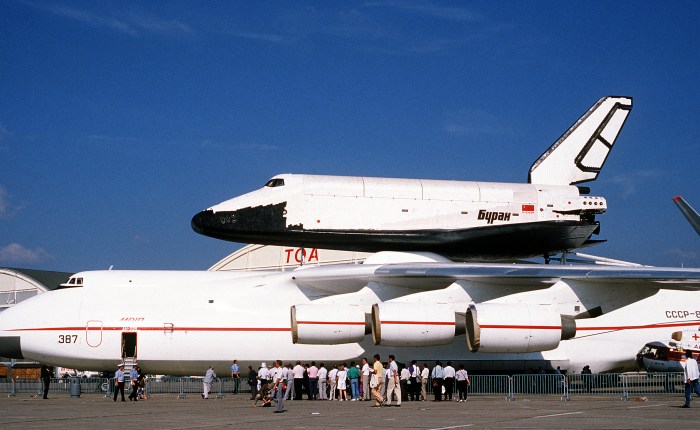
Header image: Visitors at the 38th Paris International Air and Space Shown at Le Bourget Airfield line up to tour a Soviet An-225 Mriya aircraft with the Space Shuttle Buran on its back. (Source: Wikimedia)
Editorial Note: Led by Editor Dr Mike Hankins, From Balloons to Drones, produces a monthly podcast that provides an outlet for the presentation and evaluation of air power scholarship, the exploration of historical topics and ideas, and provides a way to reach out to both new scholars and the general public. You can find our Soundcloud channel here. You can also find our podcast on Apple Podcasts and Google Podcasts.
In our latest interview, we talk to former United States Air Force F-4 Phantom pilot Lee Ellis who was a prisoner of war in the ‘Hanoi Hilton’ in Vietnam for over five years. However, in the time since, he noticed that he and many other POWs had gone on to experience dramatic love lives. Ellis joins us to discuss his new book, Captured By Love: Inspiring True Romance Stories from Vietnam POWs.
Lee Ellisis the Founder and President of Leadership Freedom® LLC and FreedomStar Media®. He is an award-winning author, leadership coach, and expert presenter in the areas of leadership, teambuilding, and human performance. Early in his career, Lee was a United States Air Force fighter pilot flying fifty-three combat missions over North Vietnam. In 1967, he was shot down and held as a POW for over five years in Hanoi and surrounding camps. For his wartime service, he was awarded two Silver Stars, the Legion of Merit, the Bronze Star with Valor device, the Purple Heart, and POW Medal. Lee resumed his Air Force career, serving in leadership roles of increasing responsibility, including command of a flying squadron and leadership development organizations, before retiring as a colonel. Lee has a BA in History and a MS in Counseling and Human Development. He is a graduate of the Armed Forces Staff College and the Air War College. He has authored or co-authored five books on leadership and career development.
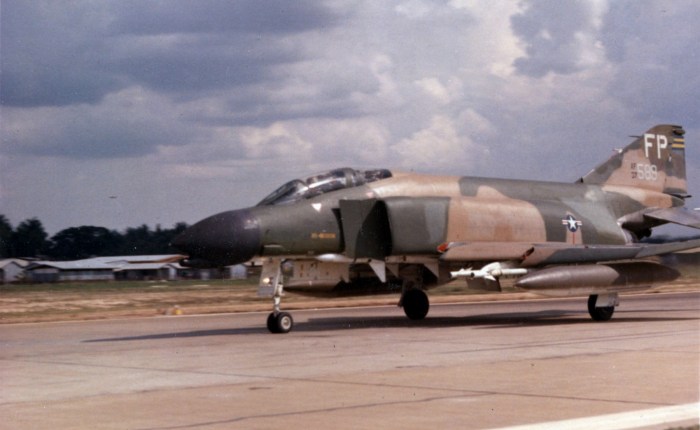
Header image: A US Air Force McDonnell F-4C Phantom II from the 497th Tactical Fighter Squadron, 8th Tactical Fighter Wing, rolls out on takeoff from Ubon Royal Thai Air Force Base, circa 1967. It is configured for the MiGCAP escort role with AIM-7 Sparrow air-to-air missiles under the fuselage, and AIM-9B Sidewinder air-to-air missiles and extra fuel tanks under the wings. (Source: Wikimedia)
I am fascinated by aircraft designs that ‘could have been.’ Maybe it’s just my nostalgia for childhood drawings of imaginary aeroplanes, but I love looking at the concept for the out-of-the-box ideas that never made it off the drawing board. Recently, I was researching at the beautiful Huntington Library archives, combing through the papers of Ben Rich, who ran Lockheed’s Advanced Development Projects division, ‘Skunk Works,’ between 1975 and 1990. ‘Skunk Works’ handled Lockheed’s top-secret programs, such as the U-2. I came across his files on the CL-400, also known as Project Suntan.[1] This had nothing to do with the project I was working on, but I found the files fascinating and wanted to share some of what I found here on From Balloons to Drones.
In 1955, most people dancing to Bill Haley’s new hit song ‘Rock Around the Clock’ had little idea that the Central Intelligence Agency and US Air Force had partnered with Lockheed to design a secret spy plane to fly 70,000 feet above the Soviet Union, the U-2. However, even as the U-2 began flying, Clarence ‘Kelly’ Johnson, then chief engineer at Lockheed’s Burbank, California plant, suspected that the U-2 would not last long – it was an effective aeroplane but vulnerable. Johnson wanted a follow-on to the U-2 that could fly even higher, further, and faster.
Lockheed turned to the advantages of high-energy fuels, specifically liquid hydrogen (LH). With a much greater energy density, hydrogen was more powerful (and hazardous). On paper, it seemed like an LH-powered aircraft could have everything Johnson needed: very long range, very high altitude, and supersonic speed. Rich led the project, working under Johnson at the ‘Skunk Works.’
Rich recalled, ‘between 1955-1958, [Lockheed] developed and built all the components and systems necessary for a liquid hydrogen-fueled airplane.’ Designing aircraft to use this unique fuel source presented major challenges. As Rich noted: ‘The hydrogen fueled airplane has very little flexibility in design configuration […] since fuel requirements dictate a long fuselage with attendant balancing and C.G. [center of gravity] travel limitations.’
Nevertheless, the concept went through a series of iterations. The original CL-400 was a two-seat reconnaissance plane, 160 feet long with a 10-foot diameter. The wings resembled Lockheed’s F-104 Starfighter, and the plane’s vertical fin was retractable. It was designed to cruise at 99,500 feet, going Mach 2.5, for a maximum range of 2,200 nautical miles.
An illustration showing the relative size comparison of the C-400-14 with a Boeing B-52 Stratofortress and a Lockheed Constellation (Source: The Huntington Library, California, Ben Rich Papers, Box 3, Folder 1, Projects – Engineering – CL-400)
That was just the beginning. Variant designs on the CL-400, Rich says, ‘were studied from the standpoint of achieving maximum range rather than maximum altitude.’ As evident from the accompanying series of plan drawings, the original CL-400 was near the size of the massive Boeing B-52 Stratofortress bomber, but increasing its range meant increasing the fuel capacity. So, the designs got bigger. Much, much bigger.
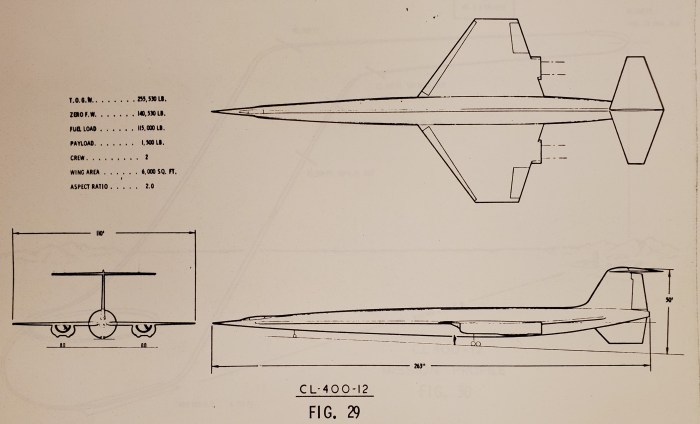
Drawing of the CL-400-12. (Source: An illustration showing the relative size comparison of the C-400-14 with a Boeing B-52 Stratofortress and a Lockheed Constellation (Source: The Huntington Library, California, Ben Rich Papers, Box 3, Folder 1, Projects – Engineering – CL-400)
The CL-400-12 was more than double the size of a B-52 and designed for a 4,720 nautical mile range with four engines blasting it to Mach 2.5. Rich’s notes simply stated that ‘the aircraft size is quite large.’
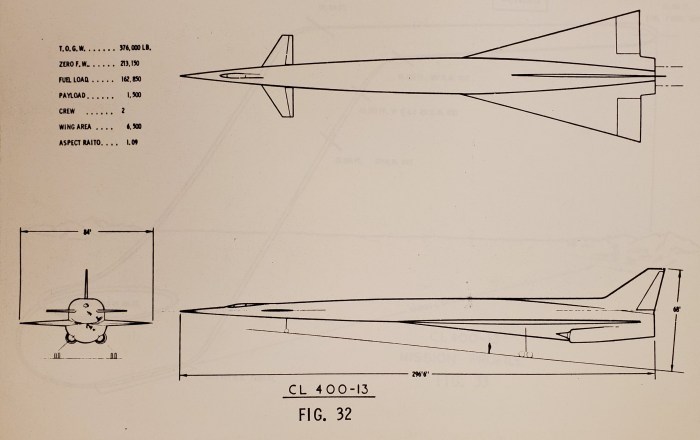
Drawing of the CL-400-13. (Source: Drawing of the CL-400-12. (Source: An illustration showing the relative size comparison of the C-400-14 with a Boeing B-52 Stratofortress and a Lockheed Constellation (Source: The Huntington Library, California, Ben Rich Papers, Box 3, Folder 1, Projects – Engineering – CL-400)
The CL-400-13 took the idea even further with a cone-delta design and forward canards. The aeroplane was almost the length of one football field, with a gross take-off weight of 376,000 pounds. Nevertheless, it could cruise at Mach 4 for a total range of 9,000 nautical miles. The CL-400-14 was similar in size to the -13 but used four smaller engines instead of two big ones.
Drawing of the CL-400-14 (Source: Drawing of the CL-400-13. (Source: Drawing of the CL-400-12. (Source: An illustration showing the relative size comparison of the C-400-14 with a Boeing B-52 Stratofortress and a Lockheed Constellation (Source: The Huntington Library, California, Ben Rich Papers, Box 3, Folder 1, Projects – Engineering – CL-400)
Hydrogen, as readers familiar with the Hindenburg disaster will attest, is also very dangerous. Lockheed had an approach to address the danger: try to cause a series of hydrogen explosions. Rich’s notes explained that ‘Numerous hydrogen ignition tests were made so as to get a feel for the damage potential in such an explosion, and it was found that the danger was not nearly as great as expected. Explosions were generally mild, and hydrogen fireball radiation was much less than that from a comparable kerosene fire.’ They tried to create an explosion 61 times, and only twice (when purposefully mixed with oxygen and ignited) did it cause ‘a bona fide explosion.’ Lockheed engineers were convinced LH could be handled safely – even more critically since the top-secret nature of the program meant that if there were an uncontrollable fire, they would not be able to call the fire department.[2]
Lockheed built a massive facility to test methods to produce, store, and transport the large quantities of liquid hydrogen necessary to operate a fleet of huge, LH-guzzling aeroplanes a few hundred yards away from the Burbank Municipal Airport. Dr Russell Scott, a leading expert on liquid hydrogen from the U.S. Bureau of Standards, visited the facility and said, ‘My God in heaven, you’re gonna to blow up Burbank.’[3] Ultimately, the logistical challenges of operating a fleet of LH aircraft proved insurmountable at the time. After examining the international basing requirements for the necessary fuel, Johnson gave up on the project. He called the Secretary of the Air Force, James Douglas, and said, ‘I’m afraid I’m building you a dog. My recommendation is that we cancel Suntan.’[4] Today, U-2s are still flying, and the Burbank site, which was once the home for testing and production of classic Lockheed aircraft, has been turned into a giant shopping complex featuring a Best Buy and Wal-Mart. In a way, maybe Burbank did blow up.
It is tempting to write off this story as a historical footnote, but the story of Suntan has three important takeaways: First, failure is important. Just because the project never went to production does not mean it was insignificant. With the aerospace industry currently looking into the potential use of hydrogen fuel, projects like this are still relevant. Second, failed designs still have a strong influence on those that succeed. Going through the process of designing these aircraft and thinking through potential solutions taught these engineers a lot. Many of the design elements first experimented with on the CL-400 went on to have a strong influence on the design of later aircraft – especially the A-12, the forerunner of the SR-71 Blackbird.
Finally, the CL-400 shows the importance and power of imagination. These planes might seem wild, but the effort shows that engineers could push themselves to think outside the box. This reveals the mindset underneath American Cold War aviation design – that it often gravitated to the massive or even outlandish, but it is also inspiring. I am not an aircraft designer, but I hope that in my own life and work, I am pushing myself to think beyond the boundaries of what I think might be possible, explore new ideas and see where they lead.
Dr Michael Hankins is the Curator for US Air Force, Navy, and Marine Corps post-World War II Aviation at the Smithsonian National Air and Space Museum and the author of Flying Camelot: The F-15, the F-16, and the Weaponization of Fighter Pilot Nostalgia (2021). In addition, he is a former Professor of Strategy at the USAF Air Command and Staff College eSchool, and a former Instructor of Military History at the US Air Force Academy. He earned his PhD in history from Kansas State University in 2018, and his master’s in history from the University of North Texas in 2013.
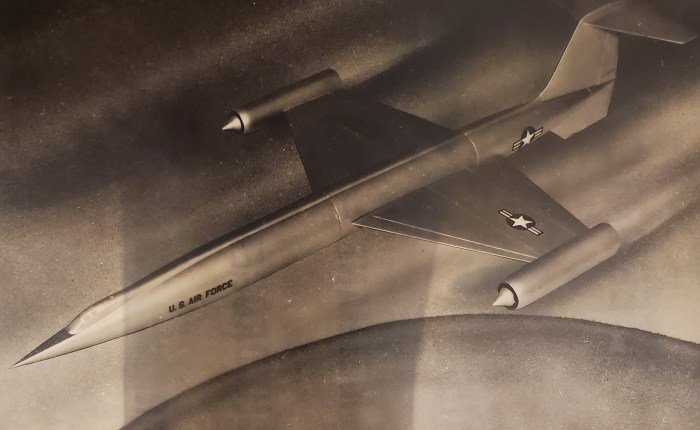
Header image: An artist’s impression of the CL-400 in flight. (Source: The Huntington Library, California, Ben Rich Papers, Box 3, Folder 1, Projects – Engineering – CL-400)
[1] Unless otherwise noted, all information, quotations, and images in this article are taken from: The Huntington Library, California, Ben Rich Papers, Box 3, Folder 1, Projects – Engineering – CL-400.
[2] John L. Sloop, Liquid Hydrogen as a Propulsion Fuel, 1945-1959 (Washington, DC: National Aeronautics and Space Administration, 1978), p. 149.
[3] Ben Rich and Leo Janos, Skunk Works: A Personal Memoir of My Years at Lockheed (New York: Little, Brown and Company, 1994), p. 173.
Editorial Note: Led by Editor Dr Mike Hankins, From Balloons to Drones, produces a monthly podcast that provides an outlet for the presentation and evaluation of air power scholarship, the exploration of historical topics and ideas, and provides a way to reach out to both new scholars and the general public. You can find our Soundcloud channel here. You can also find our podcast on Apple Podcasts and Google Podcasts.
In our latest podcast episode, our Podcast Editor, Dr Mike Hankins, and Assistant Editor, Dr Brian Laslie, have each come up with questions to ask each other about what it’s like to be a historian and pick on some of their favourite topics about air power and aviation history.
Dr Michael Hankins is the Curator for US Air Force, Navy, and Marine Corps post-World War II Aviation at the Smithsonian National Air and Space Museum and the author of Flying Camelot: The F-15, the F-16, and the Weaponization of Fighter Pilot Nostalgia (2021). In addition, he is a former Professor of Strategy at the USAF Air Command and Staff College eSchool, and a former Instructor of Military History at the US Air Force Academy. He earned his PhD in history from Kansas State University in 2018 and his master’s in history from the University of North Texas in 2013. He has a web page here.
Dr Brian Laslie is a US Air Force Historian and Command Historian at the United States Air Force Academy. Formerly he was the Deputy Command Historian at North American Aerospace Defense Command (NORAD) and United States Northern Command (USNORTHCOM). A 2001 graduate of The Citadel and a historian of air power studies, he received his Masters’ from Auburn University Montgomery in 2006 and his PhD from Kansas State University in 2013. He is the author of Air Power’s Lost Cause: The American Air Wars of Vietnam (2021), Architect of Air Power: General Laurence S. Kuter and the Birth of the US Air Force (2017) and The Air Force Way of War (2015). The latter book was selected for the Chief of Staff of the Air Force’s 2016 professional reading list and the 2017 RAF Chief of the Air Staff’s reading list. He can be found on Twitter at @BrianLaslie.
Header image: Four Republic F-84F Thunderstreak from the US Air Force Thunderbirds aerobatics team flying in formation in c. 1955. (Source: Wikimedia)
In the past few weeks, From Balloons to Drones launched a group ‘Air and Space Power Bibliography’ using the open-source reference management software Zotero. The bibliography aims to (slowly) catalogue works related to air power history, theory, and current operations in their broadest sense, including space power. The bibliography is hoped to be helpful to academics, students, and practitioners alike. Types of works included in the bibliography range from journal articles and books to scholarly online articles such as those published here at From Balloons to Drones. So far, we have added 250 titles, with more being added weekly.
As well as the central catalogue into which every resource is documented, the bibliography is split into 40 sub-catalogues. These sub-catalogues either relate to a time frame, country, or theme. After each work is added to the main catalogue, they are included in one of the 40 sub-catalogues that best represent the subject of that work. For example, Peter Gray’s The Leadership, Direction and Legitimacy of the RAF Bomber Offensive from Inception to 1945(2012) is catalogued in the following sub-catalogues: ‘Interwar’ and ‘Second World War’ as its main chronological focus is those periods; ‘Air Power Leadership and Culture’ and ‘Legal and Ethical Aspects of Air Power’ as this is the main thematic focus of the book, and finally, ‘British Air Power’ as the book is focused on the Royal Air Force.
You can request to become a member of the group bibliography or follow it using an RSS feed.
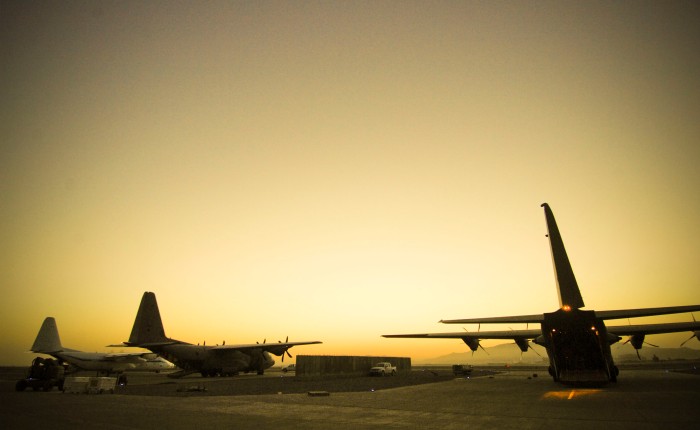
Header image: Royal Air Force C-130J Hercules transport aircraft wait to airlift British soldiers from Kandahar Airfield, Afghanistan, 19 June 2009. (Source: Wikimedia)
Editorial Note: Led by Editor Dr Mike Hankins, From Balloons to Drones, produces a monthly podcast that provides an outlet for the presentation and evaluation of air power scholarship, the exploration of historical topics and ideas, and provides a way to reach out to both new scholars and the general public. You can find our Soundcloud channel here. You can also find our podcast on Apple Podcasts and Google Podcasts.
In our latest podcast, we interview Colonel Kim ‘Killer Chick’ Campbell, an A-10 Thunderbolt II pilot with over 100 combat missions. On one of her early missions, ground fire heavily damaged her plane. She tells us the harrowing story and how her flying experiences apply to other areas of life. For more detail, she has a new book: Flying in the Face of Fear: A Fighter Pilot’s Lessons on Leading with Courage, from Wiley Press.
Kim Campbell is a retired United States Air Force Colonel who served for over 24 years as a fighter pilot and senior military leader. She served as a group commander, responsible for 1,000 military and civilian personnel. She finished her career as the Director of the Center for Character and Leadership Development at the Air Force Academy. She flew over 100 combat missions and was awarded the Distinguished Flying Cross for Heroism after successfully recovering her battle-damaged aeroplane from an intense close air support mission. Since retiring from the Air Force, Kim has shared her inspirational story and lessons on leading with courage with business and corporate audiences worldwide as an executive coach and keynote speaker.
Header image: An aircraft maintenance crew of the Indiana Air National Guard perform a post-flight inspection on an A-10C Thunderbolt II during exercise Guardian Blitz at MacDill Air Force Base, 2 February 2023. (Source: Wikimedia)
In 1970, the United States Air Force’s (USAF) Contemporary Historical Examination of Current Operations (CHECO) project, which produced around 250 volumes on various subjects, published a volume on the air operations of the RAAF over Vietnam.[1] The volume on the RAAF was one of several that examined non-US subjects; other air forces analysed included the Republic of Vietnam Air Force, the Royal Thai Air Force, and the Republic of Korea Air Force. Notably, the report on the RAAF, authored by James T. Bear, described the Australian effort over Southeast Asia as producing a ‘fruitful association’ with the USAF.[2] However, while the Americans, through the extensive distribution of this report to various commands, were aware of the views espoused by Project CHECO, the RAAF was not, as they were not included on the distribution list. As a result, this issue is often ignored by those using this source when writing on Australian air operations over Vietnam. For example, in a recent 2019 article in Sabretache, the journal of the Military Historical Society of Australia, Justin Chadwick made much of Bear’s report by describing its contents. However, Chadwick failed to address the distribution issue or whether the RAAF was aware of the report’s contents.[3] Nonetheless, Bear’s report, and others covering subjects pertinent to Australian air operations over Vietnam, were used by Chris Coulthard-Clark when researching and writing his volume on the RAAF in Vietnam as part of ‘The Official History of Australia’s Involvement in Southeast Asian Conflicts, 1948-1975.’ Moreover, the report is a valuable starting point for any discussion about Australia’s place in the air wars over Vietnam and the impact of the conflict on the RAAF.
More recently, however, air power historians have begun to discuss the air war over Vietnam more nuancedly. For example, in his 2021 history of the air war over Vietnam, Air Power’s Lost Cause, Brian Laslie, building on the work of scholars such as Mark Clodfelter, argued that the US fought six separate air wars during the conflict.[4] These campaigns included the strategic air campaign against North Vietnam; the battle for air superiority over North Vietnam; the USAF’s air war over South Vietnam; the US Navy’s air war over North and South Vietnam; air operations over Laos and Cambodia; and the US Army’s air mobility operations. However, while this classification helps describe US air operations over Vietnam, in excluding the experience of other nations involved in these ‘air wars,’ historians fail to tell a cohesive story about the use of air power over Vietnam.
Rations and supplies are unloaded from a UH-1B Iroquois helicopter of No. 9 Squadron RAAF, by troops of 7th Battalion, The Royal Australian Regiment, near the village of Long Dien during Operation Ulmarra, August 1967. (Source: Wikimedia)
Two reasons explain why historians fail to tell a cohesive story of air operations over Vietnam. First, from an American perspective, Vietnam is viewed as an inherently US war, especially regarding military operations. As Andrew Weist has remarked, ‘[r]emainders of the Vietnam War litter the cultural landscape of the United States.’[5] These reminders and the associated issues of ownership over the experience of the Vietnam War are often reinforced by popular accounts of the war, such as Ken Burns and Lynn Novick’s 2017 documentary The Vietnam War and debates related to America supposedly repeating the mistakes of Vietnam in its recent operations in Iraq and Afghanistan.[6] This has led historians to focus solely on the American experience and not to fully incorporate the story of those other nations that fought in the Vietnam War. Where they are included, their experience is often viewed as a sideshow to the main American effort. Indeed, as Bear’s CHECO report on the Australians noted, in the view of the USAF, ‘only Australia played a significant role in the air war.’[7]
The second reason concerns how the history of the RAAF in Vietnam has been written. This relates to the state of Australian military historiography and, from the perspective of the RAAF, how the Air Force’s narrative has shaped the latter’s account.[8] Apart from Coulthard-Clark’s 1995 official history, The RAAF in Vietnam: Australian Air Involvement in the Vietnam War 1962-1975, the literature on the RAAF’s service in Vietnam has primarily been the preserve of either the Air Force’s official histories or popular accounts, including veterans’ memoirs.[9] This situation mirrors concerns highlighted by John Ferris in 1998 when he reflected that most writers on air power history more broadly tend to be:
[t]he children of airmen, have been military personnel themselves, and have been employed at a historical office or service school in Canada, Germany, the United Kingdom, or the United States.[10]
This is undoubtedly the case with the history of the RAAF over Vietnam. Indeed, the RAAF has shaped the narrative surrounding the Air Force’s operations over Vietnam in two ways. First, the RAAF has published two official histories that span the Vietnam War period. The first, Going Solo, covered the period from 1945 to 1972 and was written by Alan Stephens, the former RAAF Historian. The second volume, Taking the Lead, written by Mark Lax, a RAAF Air Commodore, covers the period from 1972 to 1996. Neither book focuses singularly on Australian air operations over Vietnam. However, given the importance of the conflict to the RAAF, the war is integral to their analysis, particularly in Stephens’ volume. While both Stephens and Lax served in the RAAF and were academically trained historians, they were well placed to write these histories, thereby enhancing the value of these books. Nonetheless, as official histories, these works are often regarded as providing a definitive account of their subject. However, official histories are often the first rather than the last word on their topic.
The second way the RAAF has influenced the narrative of its operation over Vietnam is that the first book on Australian air operations during the conflict, Mission Vietnam, was commissioned by the Air Force. Research for Mission Vietnam, written by George Odgers, the Director of Public Relations in the Department of Air, began in 1971 before Australian air operations in Vietnam ended in 1972.[11] The book appeared in 1974, the year before the RAAF deployed Detachment ‘S’. As such, it does not comprehensively capture all RAAF operations associated with the Vietnam War. On publication, the RAAF News was convinced that Odgers’ volume would have ‘widespread appeal’ while one 1974 review in The Canberra Times described it as ‘essential reading.’[12] Illustrative of its importance in shaping the narrative, Mission Vietnam will be republished by the RAAF’s History and Heritage branch.
Beyond these volumes, discussions of RAAF operations over Vietnam have typically been left to popular accounts or memoirs, including those published under the auspicious of the Air Force’s Air and Space Power Centre and the History and Heritage Branch.[13] For example, Jeff Pedrina’s account Wallaby Airlines was initially published in 2006 by the Air Power Development Centre (as ASPC was then known). It was recently reissued in 2023 as part of the Australian Air Campaign Series (AACS) produced by the History and Heritage Branch.[14] Similarly, as part of the AACS, in 2022, the History and Heritage Branch published an abridged version of Air Vice-Marshal Reed’s autobiography, Invited to a War.[15] Reed had served in Vietnam, flying Phantoms on exchange with the USAF. Many of these works represent what has invariably been described as Australia’s ‘democratic’ approach to military history, which focuses on the experiences of veterans.[16] In this sense, every participant’s views and recollections are equal and should be heard. There are, however, exceptions to this democratic approach. For example, Steven Paget’s recent examination of the operations of No. 2 Squadron over Vietnam usefully places the challenges the RAAF faced in achieving interoperability with the USAF into context.[17]
Aerial view of the aircraft revetments at Phan Rang airbase in July 1967. No. 2 Squadron RAAF Canberra bombers are parked in the bays located in the immediate foreground. (Source: Australian War Memorial)
Given much of the above, how would a more integrated and cohesive account of Vietnam’s air wars look? First, from an Australian perspective, we need to move away from focusing solely on the Australian experience of the Vietnam War. As Thomas Richardson argued, such perspectives distort our view of Australia’s ‘success or failure’ in Vietnam.[18] This applies equally to the RAAF and the Australian Army. Second, with regard to the broader picture of air operations over Vietnam, consideration of the experience of non-US units would help inform wider discussions on the character and challenges of coalition air operations in this period by considering issues such as cooperation and friction. While official and authorised accounts address some of these challenges, their aim of foregrounding the Australian experience through a functional approach to history, based on the RAAF’s roles, limits how far they can analyse these issues.[19]
Some indication of how to produce such a history can be gleaned from Paget’s work on No. 2 Squadron operations. Paget rightly noted that the experience of No. 2 Squadron highlighted issues in command and control, standardisation, tactics, training and procedures, and the sustainment of operations. However, these themes can be further analysed through additional examples of Australia’s experience in Vietnam. For example, the experience of RAAF officers on secondment as airborne Forward Air Controllers offers a valuable opportunity to understand how lessons are learnt and shared between air forces. Similarly, before the deployment of No. 2 Squadron, No. 35 Squadron was already fully integrated into the USAF command-and-control apparatus. Moreover, unlike No. 2 Squadron, No. 35 Squadron operated an aircraft type that the US would not deploy to South Vietnam until later in the war. However, it appears that the USAF did not take the opportunity to study the RAAF’s use of the Caribou, which raises questions about why this might have been.[20] As such, understanding the experience of No. 35 Squadron would further enrich our understanding of the air wars over Vietnam by exploring cultural issues that either help or retard the lessons learnt process. Finally, we must consider what the deployment of RAAF air assets to Vietnam contributed to the overall war effort, given that, for example, during February 1968, at the height of the Tet Offensive, the Air Force accounted for only around one per cent of all attack sorties flown.[21] This was undoubtedly a significant effort for the RAAF. Still, it highlights the problem of deploying only single unit types rather than a cohesive operational package comprising several squadrons of the same type. As such, within the context of wider coalition operations, we must further question why the RAAF deployed the force it did and how it sought to influence and shape ongoing operations.
Dr Ross Mahoney is the Editor-in-Chief of From Balloons to Drones. He is an independent scholar specialising in the history of war with particular reference to the use of air power and the history of air warfare. He is currently the Senior Historian within the City Architecture and Heritage Team at Brisbane City Council in Australia. He has nearly 20 years of experience in the education, museum and heritage sectors in Australia and the United Kingdom. Between 2013 and 2017, he was the inaugural Historian at the Royal Air Force Museum in the UK. In Australia, he has worked as a Historian for the Department of Veterans’ Affairs and taught at the Strategic and Defence Studies Centre at The Australian National University based at the Australian War College. His research interests are focused on the history of war, specifically on the history of air power and air warfare, military leadership and command, military culture, and the history and development of professional military education. He also maintains an interest in transport history. He has published numerous articles, chapters and encyclopedia entries, edited two books, and delivered papers on three continents. His website is here, and he can be found on Twitter at @airpowerhistory.
Header image: DHC-4 Caribous of the RAAF Transport Flight arrived in South Vietnam in 1964 to work with the South Vietnamese and U.S. Air Forces to transport soldiers and supplies to combat areas in South Vietnam. (Source: Wikimedia)
[1] James T. Bear, ‘The RAAF in SEA’ (CHECO Division, 1970); Warren A. Trest, ‘Projects CHECO and Corona Harvest: Keys to the Air Force’s Southeast Asia Memory Bank,’ Aerospace Historian 33, no. 2 (1986), pp. 114-20; Major Daniel Hoadley, ‘What Just Happened? A Historical Evaluation of Project CHECO’ (MA Thesis, USAF School of Advanced Air and Space Studies, 2013).
[2] Bear, ‘The RAAF in SEA,’ p. 1. During the Vietnam War, the RAAF contributed significantly to the Australian effort in the conflict. While some flights had taken place in South Vietnam by a Dakota of No. 2 Squadron’s transport flight in 1963, the first significant deployment of RAAF assets took place in 1964 when six DHC-4 Caribous of the recently formed RAAF Transport Flight Vietnam – later renumbered as No. 35 Squadron in 1966 – were deployed as part of Australia’s early efforts in supporting the war. After the deployment of No. 35 Squadron, the RAAF’s primary involvement took the form of No. 9 Squadron equipped with Bell UH-1B Iroquois helicopters and No. 2 Squadron with GAF Canberra bombers. Notably, 36 fighter pilots served as airborne Forward Air Controllers with the USAF’s 19th and 20th Tactical Air Support Squadrons flying Cessna O-1 Bird Dogs, Cessna O-2 Skymasters, and Rockwell OV-10 Broncos. Additionally, six RAAF pilots flew USAF McDonnell F-4 Phantoms during the war as part of the 12th Tactical Fighter Wing. There were also those units – Nos. 36 and 37 Squadron – who maintained a strategic air bridge between Australia and Vietnam, including aeromedical evacuation. Lockheed Neptune maritime patrol aircraft regularly patrolled the sea lines of communication between Australia and Vietnam, such as during Operation Trimdon in 1965. In addition to the deployed squadrons, various elements of the RAAF provided valuable ground support, including airfield construction, air defence guards, and medical personnel. Officially, RAAF operations over Vietnam ended in February 1972 when the last Caribous of No. 35 Squadron left the country. However, in 1975, as South Vietnam finally fell, the RAAF deployed Detachment ‘S’ to Vietnam to withdraw Australian national and embassy staff and distribute Red Cross aid.
[3] Justin Chadwick, “Nothing to diminish their glamour’: Project CHECO and the RAAF,’ Sabretache 60, no. 4 (2019), pp. 23-34.
[4] Brian Laslie, Air Power’s Lost Cause: The American Air Wars of Vietnam (Lanham, MD: Roman and Littlefield, 2021), p. 2; Mark Clodfelter, ‘The Limits of Airpower or the Limits of Strategy: The Air Wars in Vietnam and Their Legacies,’ Joint Forces Quarterly 78 (2015), pp. 111-24.
[5] Andrew Weist, ‘Introduction’ in Andrew Weist (ed.), Rolling Thunder in a Gentle Land: The Vietnam War Revisited (Oxford: Osprey Publishing, 200), p. 16.
[6] Andrew Gawthorpe, ‘Ken Burns, the Vietnam War, and the Purpose of History,’ Journal of Strategic Studies 43, no. 1 (2020), pp. 154-69.
[8] Jeffrey Grey, ‘Cuckoo in the Nest? Australian Military Historiography: The State of the Field,’ History Compass 6, no. 2 (2008), pp. 455-68.
[9] Chris Coulthard-Clark, The RAAF in Vietnam: Australian Air Involvement in the Vietnam War, 1962-1975 (Sydney, NSW: Allen & Unwin in association with the Australian War Memorial, 1995). For the RAAF’s official histories, see: Alan Stephens, Going Solo: The Royal Australian Air Force, 1946-1971 (Canberra, ACT: AGPS Press, 1995); Lax, Taking the Lead. For memoirs and autobiographies, for example, see: Gary Cooper and Robert Hillier, Sock it to ‘em Baby: Forward Air Controller in Vietnam (Crows Nest, NSW: Allen and Unwin, 2006); David Evans, Down to Earth: The Autobiography of Air Marshal David Evans, AC, DSO, AFC (Canberra, ACT: Air Power Development Centre, 2011).
[10] John R. Ferris, ‘Review Article – The Air Force Brats’ View of History: Recent Writing and the Royal Air Force, 1918–1960,’ The International History Review 20, no. 1 (1998), p. 119.
[11] George Odgers, Mission Vietnam: Royal Australian Air Force Operations, 1964-1972 (Canberra, ACT: Australian Government Publishing Service, 1974); ‘History of War,’ The Canberra Times, 18 June 1971, p. 1.
[12] ‘“Mission Vietnam” sure to have widespread appeal,’ RAAF News, 1 August 1974, p. 3; “Written the Way it Was in Vietnam Air War,’ The Canberra Times, 16 August 1974, p. 9.
[13] Examples of books published under the auspicious of the RAAF’s Air and Space Power Centre that discuss Vietnam include: John Bennett, Highest Traditions: The History of No. 2 Squadron RAAF (Canberra, ACT: Australian Government Publishing Service, 1995); Graham O’Brien, Always There: A History of Air Force Combat Support (Canberra, ACT: Air Power Development Centre, 2009); Chris Clark, The RAAF at Long Tan (Canberra, ACT: 2010); Evans, Down to Earth; Bob Howe, Dreadful Lady over the Mekong Delta: An Analysis of RAAF Canberra Operations in the Vietnam War (Canberra, ACT: Air Power Development Centre, 2016). For an example of a book produced in conjunction with the History and Heritage Branch, see: Bob Grandin, Answering the Call: Life of a Helicopter Pilot in Vietnam and Beyond (Newport, NSW: Big Sky Publishing, 2019).
[14] Jeff Pedrina, Wallaby Airlines: Twelve Months Caribou Flying in Vietnam (Tuggeranong, ACT: Air Power Development Centre, 2006). Pedrina, Wallaby Airlines: Twelve Months flying the Caribou in Vietnam (Newport, NSW: Big Sky Publishing, 2022).
[15] Air Vice Marshal Alan Reed, Invited to a War (Newport, NSW: Big Sky Publishing, 2002).
[16] Thomas Richardson, Destroy and Build: Pacification in Phuc Tuy, 1966-72 (Melbourne, VIC: Cambridge University Press, 2017), p. 5.
[17] Steven Paget, ‘Magpies and Eagles: Number 2 Squadron, Royal Australian Air Force, and the Experience of Coalition Warfare in Vietnam’ in Steven Paget (ed.), Allies in Air Power: A History of Multinational Air Operations (Lexington, KT: The University Press of Kentucky, 2021), pp. 142-67.
For almost a decade, the US Air Force (USAF) has recognised the need for remotely piloted aircraft (RPA) aircrew to conduct ‘dwell.’ [1] Dwell is the Department of Defense (DoD) term for the time between deployments, typically used to restore unit cohesion, conduct training, and support servicemembers’ requirements. Operational experience and research showed that RPA squadrons, despite not physically leaving their home station during combat, also required time in dwell. However, the studies advocating RPA dwell focused on the benefits of time spent out of combat, with few authors studying combat performance. As a result, the studies missed a key point: continual combat operations, even with brief respites, force RPA squadrons and aircrew to divide their attention between traditional peacetime and wartime duties.
An unfocused squadron cannot mission plan with partners, fly operational missions, or conduct high-end training or rehearsals, leaving RPA squadrons persistently underperforming in combat. While RPA aircrew may reap some peacetime benefits from short dwell cycles, the RPA enterprise will only improve operations by adopting the same dwell model as the rest of the USAF.
A Brief History of RPA and Dwell
In 2015, the USAF conducted a wide-ranging study into the morale and retention problems in the RPA community, focusing on aircrew flying the MQ-1 Predator and MQ-9 Reaper. Known as the Culture and Process Improvement Program (CPIP), the study revealed that RPA morale was most affected by continuous combat operations, preventing time away for personal and professional reasons. Unbounded combat operations and the associated rotating work and sleep schedules damaged the health of RPA aircrew, dramatically increasing fatigue, alcohol usage, and medication compared to other USAF career fields.[2] Accepting the CPIP results, the USAF agreed to implement a combat-to-dwell cycle by 2024 for its RPA aircrew.[3]
The study’s mandate to focus on morale biased its recommendations. CPIP recommendations focused on improving aircrew welfare instead of operational performance, a conclusion that also affected follow-on civilian research. For example, a recent Government Accountability Office report on RPA staffing and dwell cited 21 articles; 17 were related to psychological health or well-being, while only one focused on operational effectiveness.[4] In both military and research circles, a consensus developed that aircrew needed a ‘break,’ causing leaders to eschew traditional dwell models and leave RPA aircrew with far too little time out of combat.
Traditional platforms have an established dwell model based on when a unit deploys. DoD policy sets a goal of a 1:3 deploy-to-dwell ratio; in other words, for every month a unit spends deployed, it should spend at least three months in dwell. The USAF expanded on DoD guidance with its Force Generation Model, which formalised a 24-month model with a maximum of 6 months in combat. RPA aircrew, who conduct combat missions from their home stations, fell into a grey area in both policies. The lack of specific guidance presented a problem in managing combat deployments for RPA aircrew.
An MQ-9 Reaper sits on the 361st Expeditionary Attack Squadron flightline at an undisclosed location, 6 August 2022. The 361st Expeditionary Attack Squadron operates the aircraft in support of Operation INHERENT RESOLVE. (Source: Wikimedia)
Initial Implementation
On 1 October 2020, the 20th Attack Squadron at Whiteman Air Force Base entered a 60-day reconstitution period, the first-ever protected dwell time for an RPA unit. Colonel Timothy Monroe, the 25th Attack Group commander, wrote that dedicated time out of combat was a ‘paradigm shift’ that would ‘have a significant impact to an adversary’s calculus.’ He was quickly proven correct when the hard work of squadrons in reconstitution set up equally unprecedented MQ-9 deployments in Romania and Japan over the next three years. Even with a short amount of time in dwell, MQ-9 units executed a paradigm shift from counterterrorism in the Middle East and Africa to strategic competition in Europe and the Pacific.
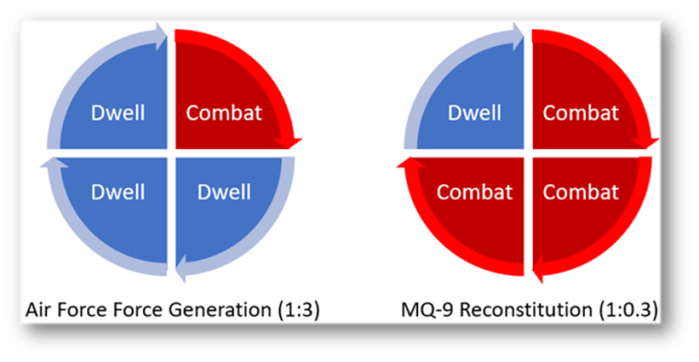
While the first MQ-9 dwell programs have shown impressive results, they have limited goals – rotating four squadrons implies a deploy-to-dwell ratio of 1:0.3, well below the DoD and USAF deploy-to-dwell goal of 1:3. A lower ratio means less training. Before a 6-month deployment, a fighter squadron receives a minimum of 18 months of training. An MQ-9 squadron starting the same 6-month deployment gets only two months of training – about one-tenth the time to complete similar training requirements. The unusually short training period also created new challenges and amplified existing structural problems in the RPA community.
Before initial dwell implementation, MQ-9 pilots and sensor operators completed mission qualification training and did not train again until they became instructors – one of the most underappreciated facts about RPA aircrew. Additionally, most mobility and big-wing aircraft have an aircraft commander that can debrief co-pilots, and most fighter aircraft has a flight lead that can debrief wingmen; MQ-9 aircrew have neither. When entering dwell, the lack of training experience and a senior/junior crew model forces squadrons to task their instructors to oversee every dwell sortie. As a result, MQ-9 instructor pilots and sensor operators are severely overtasked during dwell, leading to burnout, low morale, and poor training quality.
Depiction of deploy-to-dwell ratios (Source: Author)
Finding the Right Ratio
One barrier to decreasing MQ-9 deploy-to-dwell ratios is that dwell is normally justified in keeping US military members at home. DoD dwell policy explains a 1:3 deploy-to-dwell goal in part to ensure that servicemembers ‘do not spend extended periods of time away from their homeport, station, or base.’ MQ-9 aircrew never leave their base and return to their homes after each day of flying. Further, other communities (such as special operations forces) are chronically over-deployed. Even if studies continually demonstrate the need for RPA dwell, the lack of a physical departure from home stations challenges improved deploy-to-dwell ratios.
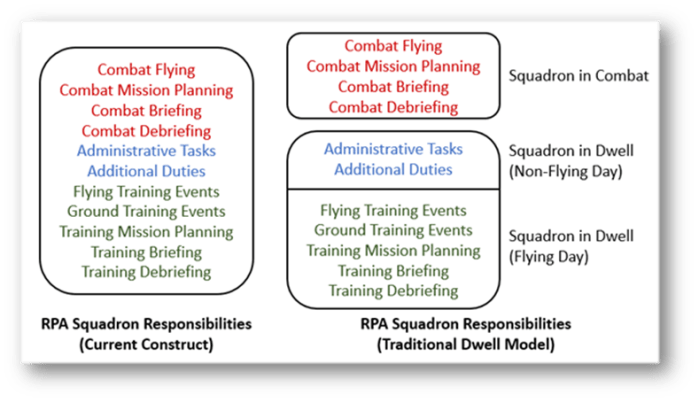
The requirement for traditional deploy-to-dwell ratios is evident in a day in the life of RPA aircrew. Today, pilots and sensor operators show up to work with many responsibilities. First, they fly for at least some portion of the day, conducting operational and combat missions globally. Second, they fulfil administrative responsibilities; all but the most junior aircrew have additional duties, from supervising airmen to administering annual evaluations to planning the squadron holiday party. Third, the aircrew accomplishes their training requirements. Because squadrons spend almost all their time in active operations, they must conduct basic combat training, training to make new instructors, and training on emerging tactics and technology while in combat. Fourth, the aircrew participates in mission planning, briefs, and debriefs internally and with outside agencies. To be clear, when RPA aircrew are flying, they do not do other work. Nevertheless, as soon as they leave the cockpit, their attention is pulled in three different directions.
Extensive research demonstrates the challenges of this type of multitasking. On the individual level, multitasking increases stress, decreases productivity, and increases the number of errors in completed work; one study demonstrated that multitasking functionally lowered workers’ IQ by ten percentage points.[5] Organisational multitasking, in which an organisation’s focus is split between multiple critical tasks, has similar effects. Research demonstrates that multitasking organisations deliver results slower, less consistently, and of lower quality than their focused counterparts.[6] The structure of RPA squadrons makes this problem more challenging; with a 24/7 mission, most of the squadron is divided into three shifts and rotating workweeks that prevent clear delineation of administrative, training, and combat duties. As a result, RPA squadron constructs that attempt to do all things at once are structured to underperform continually. Studies even demonstrate that RPA aircrew weigh their ‘deployed in-garrison status’ and ‘extra duties/administrative tasks’ (i.e., multitasking peacetime and wartime responsibilities) as higher operational stressors than combat and weapons employment.[7]
To return a squadron’s attention to its combat or operational mission, future RPA dwell programs must provide enough time out of combat to accomplish peacetime responsibilities. Before a manned squadron deploys, its members take the time to complete most training, administrative responsibilities, and professional requirements. RPA aircrew must do the same before beginning a ” deployment into operational flying. There is no data on how long this would take RPA aircrew, but it is reasonable to assume that it will be roughly the same as their manned counterparts.
With non-flying responsibilities accomplished outside combat missions, RPA squadrons could re-focus on combat operations. That same RPA pilot or sensor operator with four responsibilities in the legacy model would now have two: mission planning or execution. No key squadron personnel would conduct offsite development during high-priority operations. No pilots would be worrying about getting off shift in time to catch a flight to their wedding in four days.[8] In short, the RPA enterprise would flip its most important script: while combat operations are normal and training is abnormal today, the future must make training normal and combat a critical exception.
Depiction of RPA squadron responsibilities (Source: Author)
Conclusion – The Way Forward
Integrating RPA into a 1:3 deploy-to-dwell cycle faces serious but surmountable challenges. There are only three ways to improve a deploy-to-dwell cycle: create more squadrons, increasing the number of personnel out of combat; re-task (i.e., ‘redeploy’) some MQ-9 units from combat to training; or restructure squadrons to reduce overhead and free up personnel for training. Each of these three approaches poses its own challenges, as resources are limited, demand for MQ-9s is already more than the USAF can produce, and adjusting well-established personnel constructs carries risk. However, the idea that ‘risk is rarely mitigated, just transferred’ applies here. The RPA enterprise transfers risk to combat missions by not accepting risk in resourcing dwell.
Increasing time in dwell also increases the demand for training resources. More time in training means more flying hours at home, which requires more aircraft, cockpits, and (most importantly) maintainers. Even relatively banal problems like a chronic lack of desks and computers become acute when aircrew are in cockpits less and in offices more. The USAF is looking to save money in the MQ-9 program, but the relatively small costs of properly equipping its aircrew will pay returns in the long run.
Innovative solutions to resourcing dwell could be an entire article; the more critical starting point for the discussion is setting a requirement. As long as RPA aircrew are attempting to conduct missions while distracted by administrative responsibilities, if they are hampered by missing key personnel, and as long as they attempt to execute two important tasks simultaneously, they will not perform at the level expected of USAF aviators. The RPA enterprise must make another paradigm shift by integrating into the USAF dwell model, focusing on combat, and improving its performance just as the United States has faced its greatest strategic challenge since the end of the Cold War.
Major James ‘Hot’ Schmitt is a senior remote pilot in the United States Air Force with more than 2,500 combat and combat support hours in the MQ-1 and MQ-9. He has supported operations in Iraq, Syria, Afghanistan, and elsewhere, including a recent deployment as the Chief of Weapons and Tactics for Air Forces Central at Al Udeid Air Base, Qatar. He is a graduate of the US Air Force Weapons School and currently works on the Deputy Chief of Staff for Operations staff at Headquarters Air Force.
Header image: An General Atomics MQ-9 Reaper unmanned aerial vehicle flies a combat mission over southern Afghanistan. (Source: Wikimedia)
[1] RPA is the USAF term for large, medium-altitude uncrewed aerial systems, sometimes also referred to as UAS or drones, to emphasise the role of the remote crew flying the aircraft.
[5] Molly Russ and Derek Crews, ‘A Survey of Multitasking Behaviors in Organizations,’ International Journal of Human Resource Studies 4, no. 1 (2014), p. 139.
[6] Janice Alquizar, ‘Multitasking of Teachers in the Contemporary Settings: Boon or Bane?” (Dec 2018), p. 35.
[7] Wayne Chappelle et al., ‘Symptoms of Psychological Distress and Post-Traumatic Stress Disorder in United States Air Force “Drone” Operators,’ Military Medicine 179, no. 8 (2014), p. 67.
Established in 2016, From Balloons to Drones has successfully developed into a well-regarded online scholarly platform dedicated to analysing and debating air power history, theory, and contemporary operations in their broadest sense, including space and cyber power. Our outputs include articles ranging from scholarly pieces to book reviews and a successful podcast series.
The role
To help us develop further, From Balloons to Drones is looking to recruit an emerging and passionate air power specialist to join our editorial team. This voluntary role’s primary purpose is to manage our social media presence on Twitter, Facebook, and LinkedIn. You will also be involved with the peer review of submissions and supporting the aims and objectives of From Balloons to Drones in other areas. Please note that this is an unpaid role.
What do we offer?
The From Balloons to Drones team comprises experienced and knowledgeable air power scholars and editors who will mentor, advise, and assist the successful applicant. In addition, this role will allow you to develop your editing skills and experience of engaging with the broader air power studies community. You can learn more about the From Balloons to Drones editorial team here.
Who are we looking for?
Are you passionate about the study of air power? Do you have experience in managing social media accounts? Are you interested in the contest of ideas? Do you want to be involved in publishing new and exciting research? Then this role is for you.
From Balloons to Drones welcomes and encourages applications for this new role from applicants working in a wide range of fields, including but not limited to military history, international relations, strategic studies, law, and archaeology. The role is open to postgraduates, academics, policymakers, service personnel and relevant professionals involved in researching the subject of air power.
From Balloons to Drones actively encourages and promotes diversity within the field of air power studies. We particularly encourage applications from those underrepresented within the air power studies community.
Job functions
Contribute to managing our social media presence on Twitter, Facebook and LinkedIn.
Contribute to the peer review of submissions.
Contribute to building a core community of interest using social media that furthers the aims and objectives of From Balloons to Drones.
Contribute to content creation for From Balloons to Drones across all platforms.
Professionally represent From Balloons to Drones at conferences and other events.
Undertake additional duties as required by the Editor-in-Chief.
Applications
To apply, contact Dr Ross Mahoney (airpowerstudies@gmail.com) with a copy of your CV and a brief cover letter (c. 500 words) explaining why you wish to join the team.
Closing date: 1 July 2023
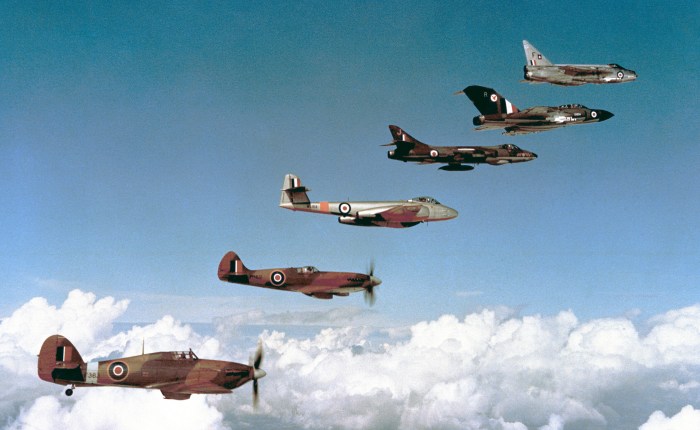
Header image:Pictured for the 20th Anniversary of the Battle of Britain in 1960 is a unique line-up of RAF fighters from the Battle of Britain to 1960. From bottom to top: Hawker Hurricane IIc, Supermarine Spitfire PR.XIX, Gloster Meteor F.8, Hawker Hunter FGA.9, Gloster Javelin FAW.9R and an English Electric Lightning F.1. (Source: Wikimedia)
Editorial Note: Led by Editor Dr Mike Hankins, From Balloons to Drones, produces a monthly podcast that provides an outlet for the presentation and evaluation of air power scholarship, the exploration of historical topics and ideas, and provides a way to reach out to both new scholars and the general public. You can find our Soundcloud channel here. You can also find our podcast on Apple Podcasts and Google Podcasts.
In 1972, the USS Kitty Hawk was conducting bombing raids against North Vietnam when violence broke out on the ship itself. Long-building racial tensions exploded into a series of assaults quickly labelled a race riot. Marv Truhe was one of the JAG lawyers assigned to defend the African American sailors charged in the incident. He tells the story of a series of racial injustices in his shocking new book, Against All Tides: The Untold Story of the USS Kitty Hawk Race Riot (2022). He joins us on the podcast to discuss the incident and its legacy for changes in race relations in the US Navy and the military.
Marv Truhe served as a Navy JAG lawyer and military judge during the Vietnam War. Following his military service, he was an Assistant Attorney General for South Dakota before entering private practice. He defended six of the Black sailors charged with rioting and assaults in the USS Kitty Hawk incident.
Header image: A US Navy McDdonnell F-4B Phantom II of VF-114 traps on board the aircraft carrier USS Kitty Hawk underway in the Western Pacific off the coast of North Vietnam in March 1969. Also visible on the flight deck is another F-4B of VF-114 as well as one from VF-213, a North American RA-5C Vigilante of RVAH-11, and an LTV A-7A Corsair II of VA-105. (Source: Wikimedia)









 From Balloons to Drones