Smashing the Axis: How the Allied Air Forces Supported the Purpose behind Operation HUSKY

Smashing the Axis: How the Allied Air Forces Supported the Purpose behind Operation HUSKY

By Alexander Fitzgerald-Black

In June 1943 a staff officer with 1st Canadian Infantry Division examined planning documents for Operation Husky, the invasion of Sicily. The operation to begin the Allied assault on Festung Europa’s soft underbelly was just weeks away. During his preparations, the officer came across an air staff memorandum. It read:

Owing to the small size of Malta which limits the number of fighter squadrons which can be based there, and the distance from the beaches, it will not be possible to maintain standing patrols over the assault areas except for the first few hours after the battle starts.

The large number of Air Forces taking part in the operation […] will be employed in bombing and “sweeping” enemy airfields and communications in order to gain air supremacy and prevent Axis aircraft from interfering with our assault forces. It is probable, therefore, that few friendly aircraft will be seen by our forces on the beaches after the first few hours and the reason for this should be carefully explained to assaulting troops […] it should be made clear that, although few Allied aircraft are visible immediately over their heads, considerable air forces are, in fact, operating continually in support of them.[1]

The Canadian division was entering combat for the first time. However, it was to fight as part of British Eighth Army, famous for its victory at El Alamein under Lieutenant-General Bernard Montgomery. Years of fighting the Germans and Italians in the desert had allowed the Royal Air Force (RAF) to hone its support for land campaigns. Air Commodore Raymond Collishaw and Air Vice-Marshal Arthur Coningham put into practice an air support doctrine that privileged concentration of force.[2] The priority for an air force supporting the army (or navy) was to secure air superiority. The second was to disrupt the enemy movement of reinforcements and supplies behind the lines. Close air support of ground troops in combat with the enemy was third, much to many army commanders’ dismay.

3 - Italy roads and airfields (rails) FINAL
Italy’s Aerodromes and Railways (Source: Dr Mike Bechthold)

Many (but not all) British Army commanders felt that this order was incorrect. Instead, they desired control of their own air force in support of ground operations and an air umbrella that would protect their advancing forces. The British Army had tried this approach and failed in the Western Desert. During the attempt to relieve Tobruk in Operation BATTLEAXE the British Army demanded that the RAF establish an air umbrella over the battlefield. Under Air Marshal Arthur Tedder, the RAF caved to the British Army’s requests, even though they believed this to be a highly inefficient use of resources. This decision ultimately contributed to BATTLEAXE’s failure.[3]

From then on, the RAF in the Mediterranean guarded against the tendency of army commanders to request for what senior airmen called ‘penny packets,’ smaller groups of aircraft assigned to a ground commander. They also endeavoured to convince their army counterparts that the RAF’s optimal use in support of ground forces was as long-range artillery. This explains why the Air Staff memorandum included in planning documents issued to the assault forces. Aircraft should be concentrated against Axis airfields, ports, transportation networks, or shipping beyond the reach of land or sea forces to stop or limit the enemy’s ability to interfere with the land operation. During Operation HUSKY, Air Chief Marshal Sir Arthur Tedder, commander of all Allied air forces, used his air forces effectively according to the priorities set out above.

20 Naples 1
This photograph provides an excellent visualisation of concentrated targets in Naples, Italy. Numbers 1 to 5, 7, and 8 indicate wrecked or damaged vessels at the docks, while numbers 6 and 9 indicate a grain elevator and airframe works respectively. The railway yard is immediately above the airframe works (Source: US Air Force photo 27493 AC)

I have discussed the air superiority and close air support functions in previous posts. The remainder of this article will focus on the role of interdiction strikes in support of the army and its purpose in Sicily.

Why were the Allies landing in Sicily? At the Casablanca Conference in early 1943 superior British staff work and arguments led to the decision to invade Sicily once the Allies secured North Africa. General George C. Marshall, America’s top soldier, argued for Operation ROUNDUP, a cross-Channel invasion from the United Kingdom in spring 1943. He felt that this was the best way to ease pressure on the Soviets in the east. Marshall’s British counterpart, General Sir Alan Brooke, had a different assessment. There were 42 German divisions in France, more than enough to contain whatever force the Anglo-Americans could get across the Channel in 1943.[4] The Eastern Front would benefit little from Marshall’s plan. However, what if the Allies knocked Italy out of the war in 1943? The Italians had some 54 divisions, 2,000 aircraft, and the still-formidable Italian navy.[5] If Italy surrendered, it was logical to expect that the Germans would replace these losses with their forces. Nazi Germany had already shown a willingness to send forces to the Mediterranean in a crisis. They had done it in the Balkans and the Western Desert in 1941 and Tunisia in late 1942. Forces defending southern Europe could not support operations on the Eastern Front. Nor could they stand watch on or behind the Atlantic Wall waiting for the inevitable cross-Channel invasion. This was the plan the Allied air forces supported.

As news filtered in about the success of Allied landings in Sicily (under temporary air umbrellas established by fighters based in Malta, Gozo, Pantelleria, and even Tunisia), Tedder was already looking ahead to future operations in support of the Allied strategy. He wrote to his superiors in London:

Should the next week’s operations go well, I have been considering possibility of staging really heavy blows at, say, three vital centres in Italy. The whole of the Liberator force on Naples before it has to stand off to train for Tidalwave, the whole B.17 force on Rome, and if possible Harris’s Lanchester force on another shuttle service attack on suitable targets in N. Italy. All attacks simultaneous. Feel moral effect of such operations might be vital, especially if attack by shuttle service included [sic].[6]

With the landing force firmly ensconced in Sicily, Tedder unleashed his strategic bombers in another round of attacks. He hoped that Italy – tired of three years of war, having suffered massive casualties at Stalingrad and Tunis, and with Allied forces on their doorstep – was ripe for capitulation. Allied bombers in North Africa targeted Naples and Rome in particular. Both were significant as transport hubs, but Rome had the added prestige of being an Axis capital.

The Allied air forces had already paralysed the Sicilian railway system; now their focus shifted to the mainland. Naples was southern Italy’s most important railway junction. From 15 to 18 July 1943 the city suffered bombardments from United States Army Air Force B-17s, B-25s, and B-26s by day and RAF Wellingtons by night. Some RAF Boston light bombers even acted as pathfinders for a force of American B-25s, operating at night. The raids targeted the city’s marshalling yards, war industries, and nearby aerodromes.[7] According to a report by Solly Zuckerman’s Bombing Survey Unit using evidence assembled after the Allies took the city in October, ‘Naples was wiped out as a railway centre after the July attacks.’[8]

On 19 July the skies darkened over Rome as a combined force of nearly 600 medium and heavy bombers struck railway yards, war industry, and aerodromes within or near the city. Realizing the enormous political ramifications of this raid, the American aircrews were thoroughly briefed. They were to avoid targeting the Vatican, and the raid was preceded by dropping leaflets to warn the local population of the pending attack. Despite these and other efforts to prevent civilian casualties the bombers still killed between 1,700 and 2,000 people.[9] The raids effected a 200-mile gap in the railway system from Rome to Naples for 48 hours and contributed to the wider campaign of paralysing the Italian railway system by destroying rolling stock, locomotives, and their repair facilities. The trains were no longer running on time in Italy.[10]

24. Littorio 2
Wrecked rolling stock at the Littorio Rail Yards near Rome, Italy (Source: US Air Force photo B-62176 AC)

More importantly, the raid on Rome helped to drive the Italians out of the war. At the time of the raid, Benito Mussolini was meeting Adolf Hitler at Feltre in northern Italy. Mussolini’s task for this meeting was to secure his country’s removal from the war. He failed as an irate Hitler shouted him down, complaining about the failure of the Italians to provide adequate bases for the Luftwaffe and the resulting heavy losses the Germans had suffered defending Sicily.[11] Mussolini returned to Rome when he heard about the raid and less than a week later King Victor Emmanuel III replaced him with Marshal Pietro Badoglio. The new government set about contacting the Allies to sign a separate armistice, which they did on 3 September 1943.

Popular accounts feature Hitler’s response in the form of the operation to rescue Mussolini. What is more critical is Operation Achse. This was a plan for German forces to disarm Italian forces in Italy, the Balkans, and southern France in the event of an Italian defection or surrender. In addition to the four German divisions fighting in Sicily, a further ten were already on their way to Italy or had just arrived.[12] The German force in Italy would grow to nearly 25 divisions at the time of the invasion of Normandy.[13] Even without counting the German forces arrayed in southern France and against Tito’s Partisans in the Balkans, the Allied strategy set out at Casablanca had worked.

The Allied aims for Operation HUSKY were to open the central Mediterranean to Allied shipping, topple Italian fascism, force the Nazi high command to defend southern Europe on its own, and secure bases from which to continue the war in Italy. The American, British, and Canadian armies fighting in Sicily played their role in this mission with the support of the Northwest African Tactical Air Force, capturing the island by 17 August 1943. However, so too did the Strategic Air Force. Their raids on mainland Italian railway transport made Axis resupply efforts difficult and forced the enemy to use other less efficient methods to move their forces and supplies. This approach would later become the basis for the Transport Plan in support of Operation OVERLORD in 1944.[14] These same raids brought pressure on the Italian state to shed Fascism and change sides in the war. In this way, the strategic mission of the Allied soldiers and the Allied airmen (even those flying missions hundreds of miles away from the front) were one in the same.

Author’s note: As an aside, while the Allied air forces managed to paralyse the Sicilian and southern Italian railway systems in mid-1943, they were also unable to stop the Axis evacuation of Sicily in August. Should air commanders be held to account for failing to prevent the successful Axis evacuations across the Strait? I will save this topic for a future post, but you can always read Eagles over Husky to examine my answer.

Alexander Fitzgerald-Black is an Assistant Editor at From Balloons to Drones. He has a Master of Arts in Military History from the University of New Brunswick and is a Master of Arts in Public History candidate at the University of Western Ontario. Alex’s first book, Eagles over Husky: The Allied Air Forces and the Sicilian Campaign, 14 May to 17 August 1943, was published in early 2018. His research interests include air power in the Second World War, with a particular focus on the Mediterranean, and Canadian military history. He operates a blog at alexfitzblack.wordpress.com and can be reached on Twitter @AlexFitzBlack.

Header Image: Armourers are fuzing a 4,000-lb HC ‘Cookie’ bomb at Kairouan West, Tunisia, before loading it into a Vickers Wellington MkX of No. 205 Group RAF, during preparations for a night bombing raid on Salerno, Italy, before Operation AVALANCHE in September 1943. Another airman carries winches aft of the bomb-bay to manoeuvre the bomb underneath the aircraft. (Source: © IWM (CNA 4071))

If you would like to contribute to From Balloons to Drones, then visit our submissions page here to find out how.

[1] Library and Archives Canada, R112-104-3 Kardex System, Vol. 10868, War Diaries Canadian Planning Staff Files, March to June 1943, Air Staff Memorandum.

[2] For a new interpretation that gives Collishaw proper credit for these developments, see: Mike Bechthold, Flying to Victory: Raymond Collishaw and the Western Desert Campaign, 1940-1941 (Norman, OK: University of Oklahoma Press, 2017), p. 4.

[3] Ibid.

[4] Mike Peters, Glider Pilots in Sicily (Barnsley: Pen & Sword Books, 2012), p. 3.

[5] Douglas Porch, The Path to Victory: The Mediterranean Theater in World War II (New York, NY: Farrar, Straux and Giroux, 2004), p. 417.

[6] The National Archives (TNA), Kew, UK, AIR 20/3372, Cypher telegram from Air Chief Marshal Sir Arthur Tedder to Air Chief Marshal Sir Charles Portal, 10 July 1943. There had been earlier shuttle runs using Avro Manchester and Lancaster bomber aircraft. These runs were deemed logistically unsound and Bomber Command settled for attacking the industrial cities of northern Italy from bases in the United Kingdom.

[7] TNA, AIR 23/6325, Northwest African Air Force operation ‘Husky’ report, Part A: The Invasion and Conquest of Sicily, pp. 9-10.

[8] The Solly Zuckerman Archive, University of East Anglia, Bombing Survey Unit/6/7, Air Attacks on Raid and Road Communications, Appendix II, Part 3.1: Naples pp.98-99.

[9] Richard Overy, The Bombing War: Europe 1939-1945 (London: Penguin Books, 2014), p. 524.

[10] Alexander Fitzgerald-Black, Eagles over Husky: The Allied Air Forces and the Sicilian Campaign, 14 May to 17 August 1943 (Solihull: Helion & Company, 2018) pp. 112-6.

[11] Albert N. Garland & Howard McGraw Smyth, The United States Army in World War II: The Mediterranean Theater of Operations: Sicily and the Surrender of Italy (Washington, DC: Office of the Chief of Military History, 1965) p. 243.

[12] List compiled from Ibid., P. 248 and 293, and Helmut Heiber & David M. Glantz (eds.), Hitler and His Generals: Military Conferences 1942-1945 (New York, NY: Enigma Books, 2004).

[13] Porch, The Path to Victory, p.656.

[14] Stephen Bourque, Beyond the Beach: The Allied War Against France (Annapolis, MD: Naval Institute Press, 2018), p. 152.

The Downfall of the Red Baron: Lessons Learned from the First World War ‘Ace of Aces’

The Downfall of the Red Baron: Lessons Learned from the First World War ‘Ace of Aces’

By Squadron Leader Michael Spencer

Baron Manfred von Richthofen was killed in air combat on 21 April 1918. He was unequalled in having shot down 80 enemy aircraft in aerial combat during the First World War to become the most famous ‘Ace of Aces’ in the early history of air combat. He was the pride of the German Imperial Army and respected by military aviation historians as the ‘Red Baron.’ A study of Richthofen’s aerial victories highlights the importance of critical thinking to identify and repeat the rules for success in aerial dogfighting. Evidence-based analyses of his behaviours and medical forensics in the months before his death indicate how the war may have been exacting an increasing toll on his judgement and decision-making abilities. The combination of seemingly discrete events that occurred during on 21 April triggered his abnormal behaviours and poor decisions, which had an accumulative effect that led to his ultimate downfall.

4108464
Flying officers attached to Rittmeister Manfred Freiherr Von Richthofen’s squadron, Jasta 11, c. April 1917. Richthofen himself is seated in the Albatros D.III. aircraft. From left to right: standing: unidentified (possibly Leutnant Karl Allmenroeder); Hans Hintsch; Vizfeldwebel Sebastian Festner; Leutnant Karl Emil Schaefer; Oberleutnant Kurt Wolff; Georg Simon; Leutnant Otto Brauneck. Sitting: Esser; Krefft; Leutnant Lothar von Richthofen, younger brother of Manfred. (Source: Australian War Memorial)

Manfred von Richthofen and Learning Lessons

The British called him the ‘Red Baron’, the French scorned him as the ‘le diable rouge’ (Red Devil) while his 1917 autobiography was called Der Rote Kampfflieger, which broadly translates as the ‘Red Battle Flyer.’[1] F.M. Cutlack, the official historian of the Australian Flying Corps (AFC), described him as the ‘star of stars in the German Air Force.’[2] On 21 April 1918, Richthofen pursued a Royal Flying Corps Sopwith Camel low over enemy-controlled territory, breaking one of his fundamental air combat maxims, and was fatally wounded. Until then, Richthofen had strictly followed Dicta Boelcke and his critical-thinking of air combat to be scorned, feared, and respected as the highest scoring air ace of the First World War.[3]

The quality of the box matters little. Success depends upon the man who sits in it.

Manfred von Richthofen, ‘The Red Battle Flyer,’ para. 182.

One of the reasons behind his significant success in air combat was his adherence to doctrinal maxims that guided his judgements in deciding when and how he would enter an action in the battlespace and engage a target. The Dicta Boelcke was named after their developer: Oswald Boelcke, Germany’s first air ace, with a total of forty victories. While early aircraft commanders were still seeking to understand roles for aircraft as the newest war machines to enter the battlespace, Boelcke is recognised as being one of the first fighter aces to apply critical thinking to air combat. Boelcke drew on his observations in air combat, reviewed his successes and failures, and critically analysed them to identify the critical decision points, ethical behaviours, and practical tactics that he considered would lead to repeated successes in the air. Boelcke tested and evaluated his air combat rules before recommending them as ‘rules for success’ that should be applied by other German pilots when flying into air combat as individuals or as a group in a squadron.

Boelcke promoted his lessons-learned as dicta to increase the chance of success in air combat by the pilots under his command, especially those who were new and inexperienced. His aerial warfighting principles were endorsed by the German Army to all its airmen, as Dicta Boelcke. After Richthofen was assigned to serve in Boelke’s squadron, Boelke became Richthofen’s mentor, instructor, squadron commander, and close friend. Richthofen became a keen practitioner of Dicta Boelcke.

We were all beginners. None of us had had a success so far. Consequently, everything that Boelcke told us, was to us, gospel truth.

Manfred von Richthofen, ‘The Red Battle Flyer,’ para. 109.

Richthofen fully embraced Dicta Boelcke and, after gaining his own experiences in aerial combat, he learned to apply his critical-thinking to identify his maxims to improve and complement his list of successful air combat tactics doctrine. One of his doctrinal maxims to complement Dicta Boelcke was to ‘never obstinately stay with an opponent’ or, having initiated a dogfight in favourable circumstances, know when to break off the attack when the situation has changed and is no longer favourable. He did not adhere to this principle, later, in his final mission.

3988465
General von Falkenhayn and Richthofen inspecting a Fokker triplane. Mr A.H.G. Fokker is seated in the cockpit and General von Falkenhayn is on his right. (Source: Australian War Memorial)

Richthofen’s Final Mission

On 21 April 1918, Richthofen pursued a British Sopwith Camel piloted by novice Canadian pilot, Lieutenant Wilfrid May of No. 209 Squadron. May had just fired on the Richthofen’s cousin, Lieutenant Wolfram von Richthofen. On seeing his cousin being attacked, Richthofen flew to aid his cousin and engaged May, causing the latter to disengage from his dogfight with Wolfram. In turn, Richthofen was attacked by another Sopwith Camel piloted by Canadian Captain Arthur ‘Roy’ Brown. Richthofen successfully evaded his attacker and, even though his Spandau machine guns had now jammed and could only be fired manually, resulting in single shots, he decided to resume his pursuit of May.

Richthofen was known to be very calculating in his observations of air battles before deciding when and whom to engage. Engagement only occurred when circumstances were likely to result in a favourable outcome. On this day, Richthofen’s judgment might have been affected by wanting to pursue the attacker who threatened his cousin, despite the circumstances – going against the aforementioned dicta that he considered critical for air combat success. Additionally, Richthofen had a reputation of being a skilled hunter on the ground with a single-shot rifle, and he may have decided that a victory with a single-shot Spandau machine gun be well within his capabilities and would significantly enhance his reputation and the morale of his flying Jasta.

May sought to escape Richthofen by rapidly descending to fly low across the front line into Allied-held territory. May later explained that his aircraft guns had jammed while being pursued and unable to out-manoeuvre Richthofen, he decided to fly low across the ridge into friendly territory, to ‘make a dash for a landing as his only hope.’[4] Eyewitness accounts reported seeing the Richthofen pursue May down to rooftop heights over the nearby village, which had a church with a bell-tower, and hearing the repeated cracking sounds of single gunshots coming from the aerial pursuit as the aircraft passed.

Richthofen appeared to decide to break one of his fundamental rules that he had previously applied so consistently in air combat by persisting in chasing May without regard for the new dangers arising around him. Richthofen was now flying low over Allied-held territory, with a strong easterly wind causing his aircraft to drift further behind enemy lines, and he was now flying low enough to be within the range of the Australian machine-gunners watching from the trenches. Richthofen seemed to have lost his situational awareness in focusing on May. Richthofen was then observed by the gunners in the trenches to fly up suddenly as if suddenly recognising the new dangers around him and only then decided to break off his pursuit of May – but it was too late. While pulling-up to ascend to a higher altitude above the trenches and ground troops, Richthofen was fatally struck by a single .303 round

He who gets excited in fighting is sure to make mistakes. He will never get his enemy down.

Manfred von Richthofen, ‘The Red Battle Flyer,’ para. 137.

Mortally wounded, Richthofen managed to execute a controlled crash landing, on the Australian-held battleground, before dying in the cockpit. Australian soldiers were quick to attend the crash site and seek to recover Richthofen.

Medical forensic analysis has indicated that Richthofen seemed to suffer from an uncharacteristic episode of ‘target fixation’, breaking his own rule to ‘never obstinately stay with an opponent.’ Medical researchers considered that this uncharacteristic error in judgement might be attributed to a persistent head injury from a head wound caused by a machine gun projectile ricocheting from his head during a dogfight that occurred nine months earlier.[5]

There has been controversy over multiple claims as to who was responsible for the fatal shot that brought down Richthofen; was it fired from a pursuing aircraft or one of the machine-gunners in the trenches? Although Brown was initially credited with the victory, medical forensic analyses of the wound ballistics, conducted in detail in later years, have indicated that Richthofen was struck in the chest by groundfire and not from an airborne shooter. Australia’s Official Historian, C.E.W. Bean, gathered eyewitness accounts from the battlefield that indicate it was most probable that Sergeant Cedric Popkin, an Australian Vickers machine gunner in the trenches, had fired the fatal shot that brought down Richthofen.[6]

Members of No. 3 Squadron, AFC, assumed responsibility for Richthofen’s remains as it was the Allied air unit that was located nearest to the crash site. Richthofen was buried in a military cemetery in France, with full military honours, by members of No 3 Squadron. A British pilot flew solo over the German air base of Jasta 11 to airdrop a message to respectfully inform them of the death of their celebrated commander, Baron Manfred von Richthofen on 21 April 1918.

6220692
The funeral cortege of Baron Manfred von Richtofen moving along to the cemetery at Bertangles, 22 April 1918. (Source: Australian War Memorial)

Enduring Lessons for Modern-Day Aerospace Professionals

While accepting the challenges associated with extrapolating lessons from a historical example, Richthofen’s development and experience as a fighter pilot in the First World War does, however, highlight several enduring lessons for those flying in today’s operating environment. A key lesson is the need to develop critical thinking amongst military professionals who can effectively analyse their operating environment and develop solutions to challenges.

Boelcke was one of the first air aces to apply critical thinking to air combat and draw out best-practices as a way to increase the probability of success for other pilots, especially new and inexperienced ones. This was something that Richthofen built on, and he recognised the need for what in the modern vernacular might be referred to as a system-of-interest whereby in the operation of aerospace systems, the air vehicle, operator, and operating procedures and tactics need to work effectively in combination to achieve success. However, the recognition that a weapon, such as an aeroplane, was only as good as the person who operated it, and the training, tactics and procedures used by that individual, was only one part of the critical thinking process.

It was also necessary for the likes of Richthofen to capture lessons learned in the combat environment and regularly test and evaluate critical systems to improve performance. This also required pilots such as Richthofen to learn from personal mistakes and those of critical peers through ongoing discourse with both subordinates and superiors. The next step in this process was the ability to apply them in operation. Nevertheless, these lessons learned processes were all for nothing if not usefully applied as evidenced by Richthofen’s final flight where we see the significance of high-consequence decision-making and the failure to reduce risk.

The accumulation of seemingly small discrete decisions made by Richthofen on his last flight, where each decision had a seemingly minor consequence when reviewed in isolation, resulted in an accumulative effect that ultimately resulted in catastrophe. As such, it is essential that organisations need to develop the right culture, management systems, and training programs to reduce catastrophic risks to a minimum. Indeed, in Richthofen’s case, arguably, someone should have ensured that he did not fly on that fateful day as he was neither in the right physical or mental condition to fly effectively. Pilots and aircrew are expensive assets to train and maintain, and unnecessary losses such as Richthofen’s impact on operational effectiveness. Richthofen’s state on 21 April 1918 affected his judgement as he ignored one of his critical dicta – to never obstinately stay with an opponent.

Finally, it is worth reflecting that innovation and inventiveness never rest. Sometimes it is beneficial to study the past before looking to the future and look for opportunities to build on the experiences and inventiveness of others rather than starting at an experience level of zero. As Richthofen himself reflected:

Besides giant planes and little chaser-planes, there are innumerable other types of flying machines and they are of all sizes. Inventiveness has not yet come to an end. Who can tell what machine we shall employ a year hence in order to perforate the atmosphere?

Manfred von Richthofen, ‘The Red Battle Flyer,’ para. 222.

Squadron Leader Michael Spencer is currently serving in the Royal Australian Air Force at the Air Power Development Centre in Canberra, analysing potential risks and opportunities posed by technology change drivers and disruptions to the future applications air and space power. His Air Force career has provided operational experiences in long-range maritime patrol, aircrew training, and weaponeering, and management experiences in international relations, project management in air and space systems acquisitions, space concepts development, and joint force capability integration. He is an Australian Institute of Project Management certified project manager and also an Associate Fellow of the American Institute of Aeronautics & Astronautics. The opinions expressed in this article are the author’s own and do not necessarily reflect the views of the Royal Australian Air Force or the Australian Government.

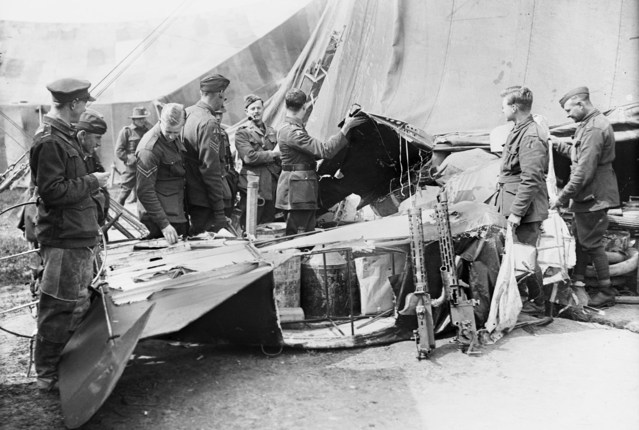
Header Image: The remains of Baron Manfred von Richthofen’s plane and the two machine guns. Most of these officers and men are members of No. 3 Squadron Australian Flying Corps. (Source: Australian War Memorial)

If you would like to contribute to From Balloons to Drones, then visit our submissions page here to find out how.

[1] Der Rote Kampfflieger was first published in 1918. The quotes in this article are taken from the 1918 translation by T. Ellis Barker, with a preface and notes by C.G. Grey, editor of The Aeroplane. This edition published by Robert M. McBride & Co. can be found on the Gutenberg.org site.

[2] F.M. Cutlack, The Official History of Australia in the War of 1914-1918 – Volume VIII: The Australian Flying Corps in the Western and Eastern Theatres of War, 1914-1918, 11th Edition (Sydney, NSW: Angus and Robertson, 1941), p. 215.

[3] R.G. Head, Oswald Boelcke: Germany’s First Fighter Ace and Father of Air Combat (London: Grub Street, 2016), pp. 97-8.

[4] Cutlack, The Australian Flying Corps, p. 251.

[5] P. Koul, et al, ‘Famous head injuries of the first aerial war: deaths of the “Knights of the Air”,’ Neurosurgical Focus, 39:1 E5 (2015).

[6] ‘Appendix 4 – The Death of Richthofen’ in C.E.W. Bean, The Official History of Australia in the War of 1914-1918 – Volume V: The Australian Imperial Force in France during the Main German Offensive, 1918, 8th Edition (Sydney, NSW: Angus and Robertson, 1941), pp. 693-701.

Air Power and the Battle of Hamel

Air Power and the Battle of Hamel

By Dr Michael Molkentin

Editorial Note: The 4th of July 2018 represented that 100th Anniversary of the Battle of Le Hamel. While Hamel was important, its place as a model on which subsequent operations were based has been overplayed. Furthermore, notable popular Australian historians have also distorted the significance of the battle. Nevertheless, as Dr Michael Molkentin highlights in this article, Hamel was valuable in highlighting the evolution of, and the diverse roles played by, air power in support of land battles during the First World War.

In the historiography of the First World War, the Battle of Hamel (4 July 1918) has frequently been cited as an example of significant tactical innovation and a ‘model’ on which subsequent British offensive operations were planned. While neither interpretation bears up to scrutiny when the battle is viewed within the broader context of British Army operations on the Western Front, relative to its size the Australian Corps’ capture of Hamel integrated air power to a hitherto unprecedented extent and, in hindsight, provides a revealing case study of the varied, distinct and specialist air power roles that had evolved during the conflict.

The Australian Corps’ headquarters, commanded by the recently appointed Lieutenant-General Sir John Monash, planned the capture of the village of Hamel (located south of the Somme) as a line-straightening operation. Besides the troops of his own corps’ 4th Division, Monash had ten infantry companies from the US 33rd Division, 60 tanks from the British 5th Tank Brigade (including the new Mark V tank) and 639 artillery pieces. Monash planned to launch a surprise assault behind a creeping barrage and tank screen (much like British Third Army had done at Cambrai the previous November); he anticipated that his infantry could secure their objectives – two kilometres deep on a seven-kilometre wide front – within an hour and a half.

4083779
A unique photo of a disabled British RE8 aircraft diving towards earth during the 4th Australian Infantry Brigade attack at Vaire Wood in the Battle of Hamel. It was subsequently discovered that the machine had been hit by a presumably faulty shell. (Source: Australian War Memorial)

Monash’s staff also worked with the Royal Air Force’s (RAF) V Brigade to organise substantial and multi-layered air support for the operation. The Australian Corps’ corps squadron, No. 3 Squadron Australian Flying Corps (AFC), would conduct the ‘majority of the tactical work’ during the battle. Its airmen would maintain a continuous presence over and directly beyond the battlefield to follow the progress of the Australian infantry (contact patrols), watch for enemy counter-attacks (counter-attack patrols), identify and direct artillery fire onto active German batteries (artillery patrols) and to photograph the new front line once it had been secured. New maps would then be produced and issued to troops in the front line within a matter of hours.[1] Assisting No. 3 Squadron with providing tactical air support, the RAF’s No. 8 Squadron would co-operate with the tanks while No. 9 Squadron parachuted ammunition to troops at their objectives. The night-bombers of No. 101 Squadron flew above the staging area on the night before the battle to mask the noise of the tanks as they moved up to their starting line.

The squadrons of 22nd (Army) Wing were also assigned to support the land battle: three of its four fighter squadrons would fly ground-attack sorties while its Bristol Fighter unit watched roads, railways and debussing points as far east as Proyart (10 kilometres east of Hamel). The army wing’s two bomber squadrons would meanwhile raid known German bivouacs. This aspect of the air plan reflected the RAF’s preference for interdiction over ‘trench strafing’ – the belief being that it was better to harass German troops and artillery behind rather than on the battlefield itself.[2] GHQ allocated three additional fighter squadrons from, IX Brigade, the RAF’s strategic reserve, to provide air superiority and the neighbouring Third Army’s fighters extended their offensive patrols south to cover the rest of Fourth Army’s front.[3]

Probably no other division-sized operation of the war enjoyed the combined support of aircraft from three wings, that is, 13 squadrons, or 230-odd aircraft. As well as the multi-faceted and highly integrated function that air power had assumed by this stage, the air plan, devised by the Australian Corps’ BGGS in collaboration with V Brigade illustrates the British Army’s growing reliance on machinery and firepower to reduce casualties and compensate for dwindling manpower.[4]

As the plan dispensed with a preliminary bombardment, No. 3 Squadron’s artillery spotting began at zero hour. For the first few hours, airmen reported batteries neutralised by the barrage so that artillery commanders could switch their guns onto active targets. The plan also allocated five heavy batteries to answer zone calls, airmen being briefed on where the Germans might move batteries once the battle started.[5] No. 3 Squadron issued 80 zone calls and co-operated in the neutralisation of at least 17 batteries (‘in many cases’ airmen did not see the artillery’s response to zone calls).[6] Although not entirely preventing it, the Australian Corps counter-battery arrangements suppressed the German artillery’s response adequately during the advance and consolidation.[7]

Counter-attack patrols flew beyond the German lines to ‘an unheard of distance’ with instructions to transmit zone calls on concentrations of German troops and engage them with bombs and machine guns.[8] One crew reported a concentration of enemy infantry just before 0700 but otherwise, seeing no enemy counter-attacks the airmen, as Lieutenant Arthur Barrett put it, ‘bombed and machine gunned everything we saw.’ Crossing the line just after zero hour he and his pilot halted a train, silenced several machine gun positions and strafed a pair of limbered guns, overturning one. Descending below 300 feet, Barrett’s eyes ran from gas in the barrage.[9] 3rd Squadron’s airmen dropped 138 bombs and fired 9,500 rounds on 4 July 1918.[10] Combined with the record 54,000 rounds and 850 bombs expended by 22nd Wing’s fighter pilots, this had a considerable impact on such a narrow battlefront.[11] ‘Several’ prisoners attested to the ‘moral effect’ of air attacks and noted how:

[t]hey prevent men getting machine guns into action almost as effectively as a barrage […] it was almost impossible to look over the top without getting machine gunned from the air.[12]

Corroborating this is German Second Army orders that noted ‘heavy casualties caused by machine gun fire from low-flying enemy machines’ at Hamel and issued instructions for dealing with British aircraft.[13]

Although Australian infantry had been signalling to aircraft since operations at Poziéres in 1916, contact patrols represented a new role for 3rd Squadron at Hamel. Despite difficulties experienced during the 1916-17 campaigns, the general staff recognised that aircraft provided the shortest possible passage of information from the battlefield to corps (and, atypically at Hamel, divisional) headquarters.[14] Dropped by airmen returning from the line, contact patrol reports reached headquarters staff in 24 minutes on average – up to half the time taken by a wireless message and a third of that usually taken by carrier pigeon.[15] Experience indicated that staff needed to synchronise contact patrols with the infantry’s timetable carefully. At Hamel, No. 3 Squadron had instructions to call for flares on the objective at 90 minutes after zero.[16] No. 8 Squadron followed the tanks across the battlefield and ‘in one or two cases were able to give information as to those which had been put out of action.’[17] The infantry’s clockwork progress and minimal resistance at the objective allowed the infantry and tanks to respond ‘well’ when contact patrol pilots sounded their klaxon horns; the airmen delivered ‘exceedingly accurate’ reports.[18] It remained to be seen, however, how the system would cope during running battles and exploitation operations when it would be arguably more crucial for staff to keep track of their troops.

4090362
A parachute, used as an ammunition carrier, caught in the trees at Vaire Wood, during the Battle of Hamel on 4 July 1918, when the supply of ammunition to the infantry by means of parachutes was a feature of aircraft cooperation. The picture was taken the day following, during shelling by the enemy of newly won Australian positions. (Source: Australian War Memorial)

For the first time, at Hamel, the RAF organised battlefield resupply using equipment designed and built at No. 3 Squadron’s aerodrome under the direction of ‘B’ Flight’s commander, Captain Lawrence Wackett. The idea apparently came from the Luftstreitkräfte’s (German Air Service) attempts at dropping ammunition to troops on the battlefield during the spring offensives.[19] At Hamel a detachment from No. 9 Squadron carried out the work, dropping 111,600 rounds to Australian troops at their objectives and at dropping stations close behind the line.[20] Endorsing Wackett’s claim for a £1,000 inventor’s fee from the British government (he received £350), Monash declared the scheme ‘an unqualified success’, noting how it permitted the rapid resupply of troops in ‘isolated and exposed positions’ and saved casualties among carrying parties.[21] His subordinates, though more prosaic, also indicated the trial’s success. 4th Australian Infantry Brigade’s CO described it as working ‘satisfactorily’ while 6th Brigade’s commander noted how the scheme ‘worked very well,’ delivering ammunition within 10 yards of one machine gun position.[22] Though faster, aircraft lacked the carrying capacity of other transportation available to the Australian Corps: a single tank could deliver four times as much ammunition as each of No. 9 Squadron’s aircraft, plus 300 grenades, 450 litres of water and a vast quantity of food and other trench stores.[23] Employed in all subsequent British offensives (the RAF delivered 30-60,000 rounds each day during the Amiens offensive), ammunition drops by corps squadrons thus remained an ‘emergency’ adjunct to other forms of battlefield logistics.[24]

The RAF’s tactical support was enabled, to a substantial extent, by the air superiority that British airmen exercised over the battlefield. Throughout the day, the fighter squadrons of 22nd (Army) Wing and three additional fighter squadrons attached from IX Brigade, ranged east of the battlefield to intercept any German aircraft that attempted to interfere. It was RAF policy to employ air superiority patrols offensively, east of the lines, rather than as a protective screen or close escorts. The airmen of the Luftstreitkräfte made no sorties over the Hamel battlefield until 9.30am – some five hours after the Australian infantry had secured their objective line. German fighters after that became ‘fairly active’ over the area, and there were ten air-to-air combats. In the largest of these, the SE5as of No. 24 Squadron engaged a mixed formation of 20 Fokker DVIIs, Pfalz scouts and Albatros DVs over Cerisy, six kilometres east of Hamel. The British pilots claimed three enemy aircraft and lost none themselves.[25] It is noteworthy that No. 24 Squadron was one of the 22nd (Army) Wing fighter units allocated to bomb and strafe targets on the ground behind German lines – its involvement in this dogfight illustrates the integration of air superiority and interdiction roles that British airmen had begun to undertake at Third Ypres the previous year.

Altogether, of the hundreds of sorties flown by the RAF in support of the Hamel operation, only three resulted in the loss of an aircraft to air combat– and only one of these involved one of the aircraft involved in direct tactical support over the battlefield. All other British losses resulted from ground fire, to which the pilots of low-altitude contact patrols and ammunition drops, were considered vulnerable.[26] The RAF’s efforts to maintain air superiority, therefore, appear to have been overwhelmingly successful – although the woeful deficiencies in material (especially fuel) that the Luftstreitkräfte faced in the summer of 1918 need to be recognised when evaluating the success of the British air plan.

4093525
The remains of RE8 C4580, which was shot down at Hamel Wood, by the enemy, after it had succeeded in dropping ammunition to the forward troops by means of parachutes. This aircraft was flown by No. 9 Squadron RAF during the Battle of Hamel and used for ammunition drops to the forward troops. (Source: Australian War Memorial)

The Battle of Hamel, therefore, indicates the extent and sophistication to which the application of British air power in support of surface operations had evolved during the First World War. The efforts of British airmen to support of Monash’s troops were not only extensive but organised carefully, through a variety of distinct air power roles, to provide a range of tactical and operational-level services that, considering the aircrafts’ technical limitations, functioned effectively. Indeed, the operation represented the high-water mark of efficacy in air-ground cooperation in the British Expeditionary Force during the First World War. As a limited, set-piece battle, Hamel drew on structures, procedures and technologies that had evolved during four years of trench warfare. Subsequent British operations during the ‘Hundred Days’, in which exploitation and pursuit replaced carefully planned set pieces, would test this system of integrating air power with surface forces and in some respects undermine the efficacy of British close air support. The war’s final battles would, in some respects, force airmen to begin their ‘learning curve’ all over again.[27]

Dr Michael Molkentin is a head teacher at Shellharbour Anglican College and an adjunct lecturer at the University of New South Wales Canberra. He has a PhD in History from the University of New South Wales and is the author of three books, including Australia and the War in the Air (OUP, 2014). His next book, a biographical history of Sir Ross Macpherson Smith and the 1919 England to Australia air race will be published in 2019.

Header Image: An R.E.8 aircraft, serial number A3662, ‘J’, presented to the Australian Flying Corps by Mr H. Teesdale Smith of Adelaide, South Australia. This was the type of aircraft used by No. 3 Squadron AFC at the Battle of Hamel. (Source: Australian War Memorial)

If you would like to contribute to From Balloons to Drones, then visit our submissions page here to find out how.

[1] Australian War Memorial (AWM), Canberra, AWM4 8/6/19 Part 1, 3rd Squadron War Diary, 4 July 1918.

[2] For a clear expression of this idea, see the Royal Flying Corps’ plans for defence in the German spring offensives: H.A. Jones, The War in the Air: Being the Story of the Part played in the Great War by the Royal Air Force, Vol. IV, (Oxford: The Clarendon Press, 1934), p. 445.

[3] The National Archives (TNA), London, AIR1/677/21/13/1887, Air Historical Branch, The Western Front Air Operations, May-November 1918, pp. 54-5.

[4] TNA, AIR1/1592/204/83/17, Brigadier-General Thomas Blamey, BGGS Australian Corps to GOC 4th Australian Division and GOC V Brigade RAF, 29 June 1918; Gary Sheffield, Forgotten Victory: The First World War – Myths and Realities (London: Review, 2002), p. 236.

[5] AWM, AWM26 364/12, Counter-battery Australian Corps HA Operation Order No. 7, 1 July 1918.

[6] AWM, AWM4 8/6/19 Part 1, 3rd Squadron war diary, 4 July 1918; TNA, AIR1/1009/204/5/1289, RAF Headquarters, Notes on corps squadrons work on the First and Third Army fronts during recent operations, 14 September 1918.

[7] AWM, AWM4 1/48/28 Part 1, 4th Division general staff war diary, 4 July 1918. The divisional staff noted that enemy artillery was ‘not very active’ and that retaliation against the Australian barrage was ‘weak’.

[8] AWM, AWM 2DRL/0053, Lieutenant Arthur Barrett to mother, 30 August 1918.

[9] AWM, AWM 2DRL/0053, Barrett to mother, 30 August 1918.

[10] AWM, AWM4 8/6/19 Part 1, 3rd Squadron war diary, 4 July 1918.

[11] TNA, AIR1/1592/204/83/17, CO 22nd Wing RAF, ‘Summary of Operations’, 11 July 1918.

[12] TNA, AIR1/2124/207/74/3, Summary of air intelligence, 18 July 1918; AWM, AWM4 8/14/2, RAF Communiqué No. 15, 17 July 1918.

[13] TNA, AIR1/2124/207/74/3, Summary of air intelligence, 18 August 1918.

[14] General Staff, SS 205 – Notes on Observation from Aeroplanes (France: Army Printing and Stationary Services, February 1918), p. 10; AWM, AWM4 8/6/18, Captain Errol Knox, recording officer, 3rd Squadron to 3rd Squadron flight commanders, 3 July 1918.

[15] Jonathan Boff, ‘Air/land integration in the 100 Days: the case of Third Army’, RAF Air Power Review, 12:3 (2009), p. 82.

[16] AWM, AWM4 8/6/18, Knox to 3rd Squadron flight commanders, 3 July 1918.

[17] TNA, AIR1/677/21/13/1887, Air Historical Branch, Western Front air operations May-November 1918.

[18] AWM, AWM4 8/6/19 Part 1, 3rd Squadron war diary, 4 July 1918.

[19] F.M. Cutlack, Official History of Australia in the War of 1914-1918: Volume VIII – The Australian Flying Corps in the Western and Eastern Theatres of War, 1914-1918 (Sydney, NSW: Angus and Robertson, 1939 [1923], p. 272; EML Gorrell papers, Series M, Item 14, GHQ AEF, Summary of Air Information, No. 29, 19.6.18.

[20] AWM, AWM4 8/6/19 Part 1, 3rd Squadron war diary, 4 July 1918.

[21] AWM, AWM10 43/13, Lieutenant-General John Monash, GOC Australian Corps to The Royal Commission on Awards to Inventors, 13 May 1919.

[22] AWM, AWM4 23/4/34 Part 1, Fourth Australian Infantry Brigade Intelligence Summary, 6am 3.7.1918 to 6am 4.7.1918; AWM4 23/6/35 Part 1, Brigadier-General J. Paton, CO 6th Australian Infantry Brigade, Preliminary Report on Operations of 6th AI Brigade on 4-7-1918.

[23] AWM, AWM4 1/48/29 Part 3, Fourth Australian Division Report on Operations- August 7th to August 10th 1918.

[24] Jones, The War in the Air, Vol. VI (1937), p. 484; TNA, AIR1/1009/204/5/1289, RAF Headquarters, Notes on corps squadrons work on the First and Third Army fronts during recent operations, 14 September 1918; TNA, AIR1/1591/204/83/8, 15th Wing Operation Order No. 112, 17 September 1918.

[25] AWM, AWM4 8/14/2, Royal Air Force Communique No. 14, 10 July 1918.

[26] Trevor Henshaw, The Sky their Battlefield II: Air Fighting and Air Casualties of the Great War, (London: Fetubi Books, 2014), p. 187.

[27] This argument is expanded in Michael Molkentin, Australia and the War in the Air (Melbourne: Oxford University Press, 2014), pp. 196-206.

#BookReview – Flying Against Fate: Superstition and Allied Aircrews in World War II

#BookReview – Flying Against Fate: Superstition and Allied Aircrews in World War II

By Dr Brian Laslie

S.P. MacKenzie, Flying Against Fate: Superstition and Allied Aircrews in World War II. Lawrence, KS: University Press of Kansas, 2017. Appendices. Notes. Bibliography. Index. Hbk. viii + 256 pp.

9780700624690

I do not consider myself superstitious. Being a Historian is not a career field where one feels the need to be ‘lucky.’ That being said, I will admit to having more than a few sports shirts and hats that I consider lucky. I also admit to wearing a ‘rally cap’ from time to time, you know when I need the baseball gods to allow a game-winning hit. These instances, in reality, do not matter. I do not (nor should I) consider them life and death issues. However, I can think of instances where being superstitious seems completely warranted. S.P. MacKenzie’s new work Flying Against Fate: Superstition and Allied Aircrews in World War II is a concise and laser-focused study that delves into the steps taken by allied aircrews (British and American) to ensure their survival using methods that MacKenzie calls ‘magical thinking,’ what is recognised universally as superstition.

MacKenzie breaks his examination of aircrew superstition into asking for miracles (religion), Talismans and Mascots, Incantations and rituals, Jinxes and Jonahs, and Numbers and symbols. MacKenzie’s work goes a step further than many other works that look at the motivations of soldiers, sailors, airmen or marines. It is often said, aircrews and soldiers on the ground fought for each other, but what motivated them as individuals? What made them capable of climbing into their aircraft despite the overwhelming sense of fear or dread and the knowledge that the chance of death was weighted heavily against their survival? MacKenzie points to the belief that a ritual, charm, or item protected them from harm.

MacKenzie shows that between training accidents, accidents in theatre, and actual combat the chances for survival among allied aircrews was low.

In practice this meant tours in which statistically speaking, the chances of being killed, wounded, or taken prisoner usually exceeded those of emerging unscathed. (p. 6)

Over the course of hours flown or combat missions completed, ‘only 25 percent of heavy-bomber crewmen were emerging unscathed from their twenty-five mission combat tours.’ (p. 7) Though the number of tours increased throughout the war and with death so nearby, it was no wonder these men turned towards a power beyond their control. The logical fallacy of Post hoc ergo propter hoc (after this, therefore because of this) often played into the beginnings or creation of superstitious aspects of flying during the war. Perhaps a coin or photograph discovered in a pocket after a particularly harrowing mission or a gift of a lucky rabbit’s foot by a friend. It seems almost anything could take on special meaning to a flyer.

FRE_002761
Major J.A. Goodson, the so-called ‘King of the Strafers,’ never flew without a signet ring talisman. (Source: © IWM FRE 2761)

On the importance of religion, MacKenzie demonstrates that American crew members were more likely to attend either a service or speak with a religious figure than their British colleagues. Church attendance declined in England in the first half of the century (perhaps because of the impact of First World War) while it increased in America, but religious aspect aside both nation’s aircrews put plenty of stock in other aspects of ritual and talisman to ensure their safety. If not religion, then aircrews turned to items or rituals, anything they believed gave them against the death that was surely coming for them. Magical thinking was not limited to junior officers or line pilots. Towards the end of his work, MacKenzie also lists several very senior air commanders who each held their own superstitions. It seems rank or position provided no hindrance to the necessity of using magical thinking to protect one’s place on the Earth during the Second World War.

While MacKenzie adds that this magical thinking was not universal, it did play a role in many of the aircrew’s lives throughout the war. In the closing pages of Flying Against Fate, Mackenzie states:

The place of magical thinking in other professions where skill cannot fully substitute for luck – notably sports – continues to be subject to academic research and interpretation’ (p. 103).

Indeed, if there is a critique of this work, it is that the link between superstition and high-performance activities, war and sports should have been made earlier and with more emphasis. MacKenzie’s study partners well with Mark Wells’ Courage and Air Warfare.[1] MacKenzie also admits to looking only at British and American aircrews and a study that the role of magical thinking and superstition played in the Axis powers, or other allied nations would undoubtedly bring further clarity to the roles and actions of airmen during the Second World War writ large.

Although a relatively short work, MacKenzie has created an indispensable book for those interested in the motivations of allied aircrews who looked for any means necessary to ensure their survival. The author mastered telling his story in a concise and yet heavily researched material that prevents both sources and a heavy dose of first-person accounts. This appeals not only to those interested in aviation history or air power in the Second World War but those interested in the mechanisms used to cope through Total War. As such historians and those interested in the psychology of the military and professionalism in the force will find much to consider.

Dr Brian Laslie is an Assistant Editor at From Balloons to Drones. He is also a US Air Force Historian and currently the Deputy Command Historian at North American Aerospace Defense Command (NORAD) and United States Northern Command (USNORTHCOM). A 2001 graduate of The Citadel and a historian of air power studies, he received his Masters’ from Auburn University Montgomery in 2006 and his PhD from Kansas State University in 2013. He is the author of Architect of Air Power: General Laurence S. Kuter and the Birth of the US Air Force (2017) and The Air Force Way of War (2015). The latter book was selected for the Chief of Staff of the Air Force’s 2016 professional reading list and the 2017 RAF Chief of the Air Staff’s reading list. He can be found on Twitter at @BrianLaslie.

Header Image: Squadron Leader T. Sweeney, the Roman Catholic chaplain of an RAF wing operating in Central Burma, conducting Mass in a wooden pagoda which has been made into a chapel. (Source: © IWM (CF 394))

If you would like to contribute to From Balloons to Drones, then visit our submissions page here to find out how.
[1] Mark K. Wells, Courage and Air Warfare: The Allied Aircrew Experience in the Second World War (London: Frank Cass, 1995).

The Challenges of Fifth-Generation Transformation

The Challenges of Fifth-Generation Transformation

By Wing Commander André Adamson and Colonel Matthew Snyder

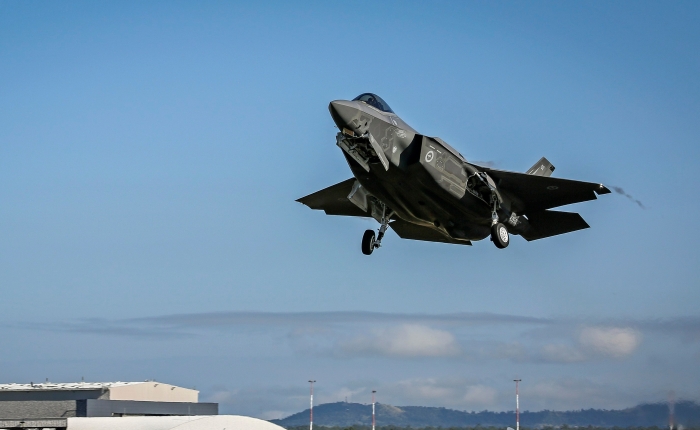
Plan Jericho, published in 2015, outlined a strategy that would transform the Royal Australian Air Force (RAAF) into a fifth-generation air force by 2025 which, if delivered on schedule, would make it the world’s first. This transformation is not based on merely the possession of the next generation of aircraft technology including the F-35A, P-8 Poseidon, EA-18G Growler and E-7A Wedgetail, but on a reconceptualisation of the RAAF as an integrated, networked force. Significantly, this new operating concept is based on working in a highly collaborative manner with the Australian Army, Royal Australian Navy, industry, and allies – especially partners in the F-35 programme – to achieve the full potential of the new technologies, and to ensure that the networked force can work effectively with them.

The Australian plan has given many air forces pause for thought. That an air force comprising fewer than 15,000 regular personnel is seeking to transition to an entirely fifth-generation air force within the next decade to meet its strategic and security objectives demonstrates an undertaking to conduct future air operations in a conceptually different way. The commitment to a similar transformation among other F-35 partners is firmly underway – both the US Air Force (USAF) and Royal Air Force (RAF) have pledged to transition to fifth-generation air forces.[1] In contrast, for air forces that are not committed to a fifth-generation programme, or the transformational concepts that underpin it, the time is rapidly approaching where a hard-nosed evaluation and decision will need to be made on where they want to be as an air force in the next 10-15 years. The choice is tactical, strategic, and political.

20180126raaf8165233_022
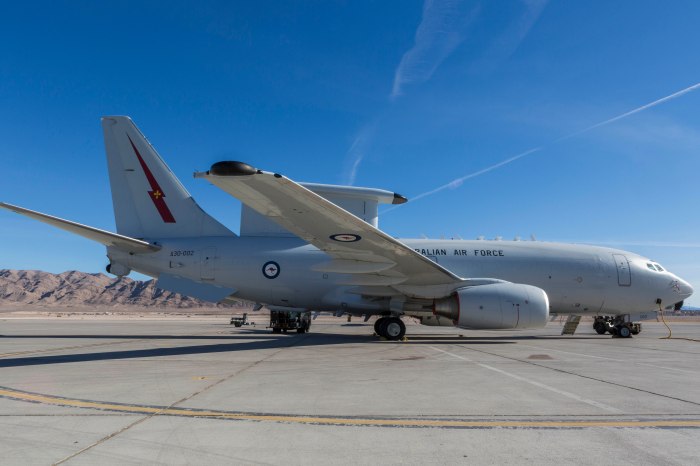
An E-7A Wedgetail from No. 2 Squadron RAAF sits on the tarmac at Nellis Air Force Base, Nevada, during Exercise Red Flag 18-1. (Source: Australian Department of Defence)

Since the inception of the Joint Strike Fighter (JSF) precursor of the F-35 in the mid-1990s, there has been a broad, often polarised, and inevitably highly charged debate surrounding the programme. Over the past decade, as the first prototypes took to the air, this debate focused on cost – perhaps unavoidably given that it is the most expensive military project in history. As the aircraft subsequently moved into its production phase, attention shifted to technical problems with engines, software, and its data fusion capabilities. More recently, however, supporters of the F-35, not least the international partners themselves, have highlighted successes that indicate that the programme may have now turned a corner. These successes include the declaration of initial operating capability (IOC) by the US Marine Corps and USAF, production rates steadily increasing, encouraging feedback from the increasing number of F-35 pilots, and an impressive performance in exercises.

Although these positive developments may not entirely amount to a ‘game changer’, they arguably represent significant steps forward in the delivery of the fifth-generation capability. It is, therefore, useful to frame the debate regarding a new template: that of a capability that is, if not yet fully validated, nonetheless in the process of being delivered to partners, tested in increasingly challenging scenarios, and moving towards full operational capability (FOC). This article analyses some of the stakes involved as this capability increasingly acts as a driver for fifth-generation transformation, and to consider some of the implications for air forces that have committed to fifth-generation programmes and, perhaps more significantly, for those that have not.

Defining Fifth Generation

Most people are now familiar with the term fifth-generation as the naming convention most often used when discussing this next generation of fighter aircraft. Although there is no specific or formal definition of what constitutes a fifth-generation fighter, it is routinely accepted that those aircraft that are designed and capable of operating in highly contested operational environments. To be able to do so it is accepted that the platforms must have not only low-observable features inherent in the design of the aircraft but also onboard radar and sensor features that include low-probability of intercept and low-probability of detection. They also must possess highly sophisticated self-protection and jamming systems combined with advanced avionics and powerful computers. This integration has allowed the evolution of a capability to fuse both onboard and off-board data without the involvement of the pilot. These aircraft are, therefore, able to feed real-time information autonomously into the joint operational network, significantly increasing the awareness and reducing the decision time of commanders. It is, therefore, essential to define a fifth-generation system not just as a fighter but as a system able to operate in a networked and integrated manner. Fifth-generation systems fundamentally revolve around powerful fusion capabilities which enable fusion of data to create a highly accurate picture of the battlespace independently of an operator.

These new systems present clear operational advantages over older platforms. In the ever-increasing high-threat environment characterised by modern integrated air-defence systems (IADS), fifth-generation platforms can operate where non-fifth-generation platforms cannot. Their ability to work cooperatively and talk with other platforms in the battlespace transforms even a limited number of assets into significant force multipliers and force enablers. Thus, the F-35 is not only an air asset; it is also a collection platform which can interact with, and provide data to, both ground and maritime forces. However, possession of such an advanced platform comes at a considerable price. It is complicated to take a non-stealth platform and make it stealthy. Therefore, not only does a country need to sign up to make a significant financial commitment to purchase a fifth-generation platform such as the F-35, but significant investment is required elsewhere, such as in new maintenance facilities and the robust data networks that are necessary to exploit its full capabilities. It is worth briefly reviewing the reasons for the decision to commit to the F-35 programme for those states that have joined.

The Partners and Why they Joined the F-35 Programme

Nine countries originally signed up as partners to the JSF programme, the precursor to the F-35: the US; the UK; Australia; Canada; Italy; The Netherlands; Norway; Turkey; and Denmark. Three others committed through Foreign Military Sales: Israel; Japan; and South Korea. As the most expensive military development and procurement plan in history, the F-35 has attracted a great deal of controversy since the development contract was signed in November 1996. From its conception, the JSF was to be an international co-development programme, a decision that was driven by several factors. All the partners were either NATO countries and/or close US allies, and there was, from the outset, a clear imperative for interoperability and interconnectivity in coalition-based air operations. The partners had been operating a range of different platforms of varying levels of capability, and the F-35 enabled them to operate the same aircraft with all the evident advantages that it brings regarding interoperability, training, logistics, among others. Furthermore, the partners were all involved, to varying degrees, in the design, building and testing of the aircraft. This was a unique element of the programme that helped maintain domestic hi-tech military industries. The UK, for example, was the only Tier 1 partner and is responsible for 15 percent of the aircraft, worth an estimated £30 billion over the lifetime of the programme sustaining 24,000 jobs. The European F-35 production facility in Cameri, Italy, is projected to bring $15.8 billion of economic benefit to the Italian economy.[2]

The F-35 programme and the cooperative and industrial advantages it confers are, however, as described above, more than the next-generation platform conceived at the outset of the JSF programme. The F-35 represents a commitment by the partner air forces to exploiting a range of new, highly advanced capabilities that constitute a step change in the gathering, processing, and sharing of information, particularly in contested environments. Indeed, it is the recalibration of strategic and operational thinking that has been driven by the requirement to operate in those increasingly contested environments, and against near-peer adversaries, which has proved so persuasive in winning the argument for the fifth-generation partners. It has required a shift in thinking and a reconceptualisation of the conduct of air operations in the joint and combined environment through the significantly enhanced surveillance, command and control, and information sharing that fifth-generation capabilities provide. It also compels fifth-generation air forces to integrate and network with land and maritime forces in an unprecedented way – next-generation air forces will require next-generation joint forces.

F-35 sortie
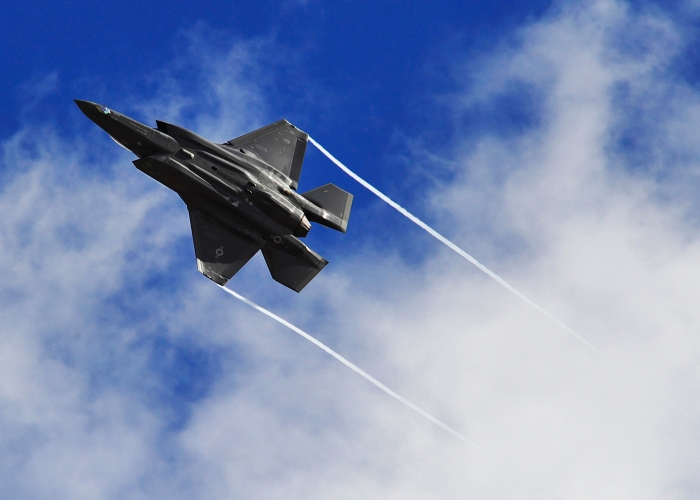
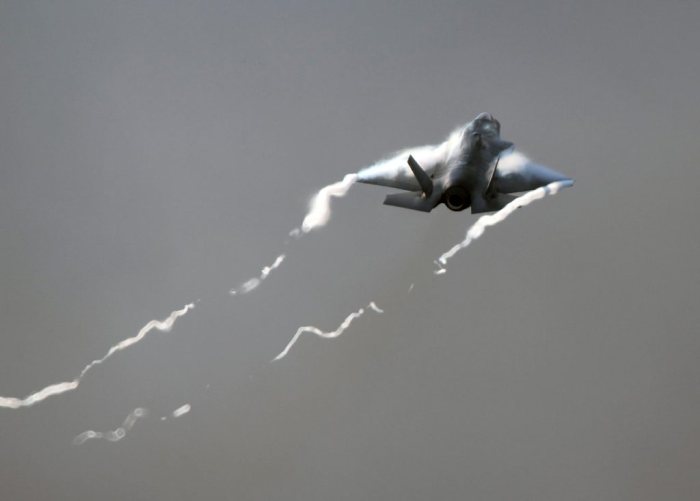
An F-35 Lightning II performs a maneuvre on 12 September 2016 over Luke Air Force Base. This sortie marked the 10,000th flying hour for the F-35 program at Luke. (Source: US Department of Defense)

The countries that committed to the F-35 programme did so over 15 years ago following the first flight of the prototype X-35B. As described above, motivations at the time were primarily centred on the requirement of those air forces to replace their legacy fleets, or to run those fleets alongside platforms that exploited the latest technological developments, including stealth. The potential of those technologies has evolved significantly over the subsequent years, often beyond the original expectations and understanding, and those air forces which are part of the programme are now beginning to take delivery of a capability that represents a genuine generational change. The geopolitical context has also evolved over that period and, following 15 years of assumed air superiority in Iraq and Afghanistan and the counterinsurgency operations that followed, the air forces that will be using the F-35 are discovering that they have a capability that is credible in contested environments. However, most of those air forces have equally begun to realise that having a fifth-generation aircraft does not merely equate to having a fifth-generation capability as defined above. Although the US Marine Corps declared IOC in 2015 and the USAF in August 2016, there are still significant challenges to be addressed, both technically and conceptually, before the declaration of a genuinely fifth-generation FOC. Furthermore, there are undoubtedly continuous and continuing problems in the development of the F-35 itself, as might be expected in a programme of such size and complexity and the programme is, by some order of magnitude, the costliest in the Department of Defense’s history.[3]

Implications for F-35 Partners of Integrating Fourth- and Fifth-Generation Fighters

F-35 deliveries are now firmly underway with over 200 jets flying, most of the partners operating their aircraft and production rates scheduled to exceed 60 per year soon. This puts considerable pressure on those partner countries and Foreign Military Sales customers to prioritise the elements that will allow them to realise the full force-multiplier potential of the aircraft. This includes the enhanced data management, connectivity and bandwidth upgrades required to operationalise and fully exploit the capability that fifth-generation aircraft offers for information-centric warfare and cross-platform connectivity.

In this regard, the F-35 has a ‘forcing function’ for militaries looking to adopt a fifth-generation standard. Naval and ground forces stand to benefit significantly from the network-centric, cross-platform, multiple-shooter concept of operations of which the F-35 will form such a significant element. As Justin Bronk suggested, given the almost unlimited scope of connecting the F-35 to every system in the battlespace, joint force commands will be compelled to invest in the connectivity and bandwidth for the platforms that stand to provide the most significant increase in combat power and flexibility.[4] This will drive the development of fifth-generation joint forces, a concept that has significant potential, particularly in contested environments. It also is a critical element of underpinning programmes such as Plan Jericho – the transformation to an integrated networked joint force that has combat power much more significant than the sum of its parts.

Whereas the RAAF is looking to upgrade its entire legacy fleet over the next decade, most of the F-35 partners, including the USAF, will need to run their legacy fleets alongside their fifth-generation platforms for some years beyond that. The RAF and Italian Air Force, for example, possess the highly capable Typhoon, a fourth-generation aircraft with high performance, an active scan radar, Link 16, and a comprehensive air-to-air and air-to-ground weapons suite. As Bronk pointed out, in such cases investment in the F-35 and Typhoon should not be seen as a binary choice as ‘each aircraft offer strengths to complement the other’s capabilities. The combination of F-35 and Typhoon can be far more potent than a force composed entirely of either type in many operational scenarios’.[5]

As a US-led, but highly collaborative, programme, development of the F-35 has drawn the partners together. The sharing of technologies, concepts, tactics, training, maintenance, logistics, and procedures represent a significant opportunity for fifth-generation air forces. With the F-35 being operated by so many states there are also substantial prospects for tactical, technical, and conceptual innovation which will allow the aircraft to be highly ‘future-proof’ without compromising issues such as sovereignty, national defence industries or strategic autonomy. All these elements contribute to powerful forces drawing the F-35 partners into what might be described as a fifth-generation ‘club’. The level of international cooperation is unprecedented, with pilots training together at the F-35 multinational pilot training centre at Luke Air Force Base in Arizona, maintenance facilities being developed in Italy, Turkey, Norway and The Netherlands, and a global logistics supply chain. The result is a deepening of cooperation between the partner air forces, many of whom already possess a strong ability to do so through links forged over the years through NATO and operating in coalitions since the end of the Cold War.

Implications of Integrated Fourth- and Fifth-Generation Air Forces for Countries that are not F-35 Partners

Air forces that have not yet committed, or do not have current plans to transition to fifth-generation systems, will need to consider the operational and strategic implications of such decisions. Four areas should be considered considering future military operations: the ability to engage near-peer adversaries in a high-intensity environment; the military status and political parity with allied countries; the integration and collaboration capabilities with partner forces; and the potential limitation of the depth and breadth of defence technological innovation.

45157751
One of the UK’s first F-35B Lightning II aircraft takes off from Eglin Air Force Base, c. 2014. (Source: UK Ministry of Defence)

As previously discussed, fifth-generation systems are not merely about employing stealth attributes, but rather about harnessing the substantial advancements in processing ability and data fusion capabilities inherent in such systems. Tellingly, the aim is to create and operate a networked environment where the lines are seamless between sensors, shooters, and operators. As a result, air forces that do not possess these capabilities are likely to find themselves increasingly relegated to a supporting rather than a leading role in planning for, and executing, future contingency operations. Countries that are not able to contribute and operate effectively in high-threat environments will potentially find themselves not on an equal footing with their coalition partners, a position that may compromise their role in military operations and, increasingly, political decision-making. Except for Australia, all the original nine partner countries are NATO members, allowing the smaller air forces of the Alliance – such as Spain and Belgium – to mitigate the limitations of their continued reliance on fourth-generation assets by optimising the capabilities of the F-35 with their legacy platforms in a NATO context. For larger Western countries not in the F-35 programme – such as France and Germany – there will be pressure to prioritise the optimisation of their existing platforms with the capabilities of the F-35. France faces the challenge of preserving its much-valued strategic autonomy, continued global aspirations and protection of its defence industrial base in the context of fifth-generation transformation. In his evidence to French MPs last year the Chief of the French Air Force, General Lanata, warned that, in less than five years, the F-35 would become the standard for operating in the most demanding operational scenarios, and that it would bring to a head the decision as to whether an air force can engage in those scenarios in the future.[6]  In short, without fifth-generation aircraft, an air force risks being in a supporting role in a coalition air environment and will require a fifth-generation partner to provide mission success against a near-peer adversary.

Finally, the benefits of privileged access to the highest level of military technology enjoyed by the F-35 are substantial. The highly collaborative nature of the programme ensures that technology transfer occurs at an unprecedented scale and provides a wealth of opportunities for hi-tech defence industries across the partner countries. The fact that so many states will operate the F-35 will also boost the opportunities for innovation in disciplines such as engineering and avionics, as well as tactics and concepts. For air forces outside of the programme, technological advances can, of course, be pursued at the national level but they will not benefit from the exchange of ideas, concepts and innovation that are generated by this collaborative programme.

Conclusion

This article has articulated some of the critical implications for air forces committed to a fifth-generation programme centred on the F-35 and for those that have not. After a decade and a half of delays, setbacks, and bad press, the F-35 programme and the technological advancements linked to it are gathering momentum. The programme is driving the partner states not just to unprecedented levels of military cooperation and convergence but also developing the networked joint forces necessary to operate in an increasingly contested environment. For states that have chosen to not participate in the fifth-generation programme, the challenges will be tactical, strategic, and political.

At a tactical level, operators of legacy fleets will struggle to interoperate effectively with the F-35 and other fifth-generation assets and indeed may degrade the effectiveness of coalition operations centred on fifth-generation systems. Furthermore, they may well be restricted to operating only in semi-permissive environments with a low IADS threat. At a strategic level, air forces that do not operate fifth-generation platforms may face the challenge of not being considered on an equal footing with the F-35 partners who, within a decade, are likely to have developed means to fuse, process, distribute and exploit data that will out-pace anything that even updated legacy fleets can match. At a political level, the range of credible options available to a national executive in the context of a highly contested environment against a peer competitor risk being limited. There will, therefore, be an increasing onus on air forces not operating fifth-generation platforms to articulate a credible and conceptually coherent ‘offer’, what they can contribute to a fifth-generation-led coalition, for example, to justify their status at each level. This will be a point that will not be lost on many who look to avoid the risk of fourth-generation air forces being restricted to a supporting role in the air environment against a near-peer.

Furthermore, partners in fifth-generation system development are pushing the boundaries of collaborative networked systems and transforming military operations. The ‘forcing function’ – the incentives generated by the F-35 for further technological developments and integration – provides a potent impetus for change and innovation among the fifth-generation partners. Conversely, countries not actively involved in fifth-generation transformation are starting to face a capability gap that will only continue to widen over the next decade. Other means – political, financial, or industrial – will be needed to drive the change necessary to mitigate the divergence or offset its effects. Set against these challenges, these air forces might argue that their national security priorities over the next 10-15 years are perfectly well met by remaining outside the F-35 programme and the fifth-generation capabilities of which it is a core element. An approach such as this relies on updating fourth-generation assets in the short term and developing other solutions either nationally or in collaboration with other partners for deployment beyond the 2035 timeframe. They might also credibly contend that legacy assets are inherently less vulnerable to disruption of the networks on which fifth-generation platforms rely and that the significant costs associated with the programme could be more effectively apportioned elsewhere to meet those national priorities.

The arguments presented in this article suggest, however, that the implications of this approach in the longer-term are potentially severe and that there will be, eventually, a cost regarding capability, operational effectiveness, technological superiority, and status. Writing in 1989, William Lind et al. wrote that ‘whoever is first to recognize, understand, and implement a generational change can gain a decisive advantage. Conversely, a nation that is slow to adapt to generational change opens itself to catastrophic defeat.’[7] Although he was writing in the context of the end of the Cold War, Lind’s observation remains apposite and is at the core of the conceptual leap being undertaken by Australia, the US, the UK and the other F-35 partners. These are increasingly clear strategic choices that will have implications for all air forces, and they will soon discover whether the price will have been worth paying.

N.B. This article is derived from the author’s work as published in The RUSI Journal. See: André Adamson and Matthew Snyder, ‘The Challenges of Fifth-Generation Transformation,’ The RUSI Journal, 164:4 (2017), pp. 60-6.

Wing Commander André Adamson is an officer in the RAF and was until recently liaison officer for the Plans Bureau with the French Air Staff in Paris. Colonel Matthew Snyder is an officer in the USAF and strategic partnership exchange officer for the Plans Bureau with the French Air Staff in Paris. The views and opinions expressed in this article are those of the authors and do not represent the official position of their respective organisations.

Header Image: An F-35 Lightning II departs RAAF Base Amberley for the Avalon Air Show, c. 2017. (Source: Australian Department of Defence)

If you would like to contribute to From Balloons to Drones, then visit our submissions page here to find out how.

[1]  The RAF has decided to refer to a ‘next generation’ air force in its recently published strategy to emphasise the concept of integration and to reduce the risk of the strategy being seen to be platform based. See RAF, Royal Air Force Strategy: Delivering a World-Class Air Force, (London: Royal Air Force, 2017).

[2] PWC, ‘Italian F-35 Lightning II Program: Economic Impact Assessment,’ February 2014.

[3] By way of comparison, the estimated cost of the US Navy’s first four new Gerald R Ford-class nuclear-powered aircraft carriers will cost approximately $50 billion and the costs for modernising all three components of US nuclear forces will cost approximately $350 billion over the next decade. See, Congressional Budget Office, ‘Projected Costs of U.S. Nuclear Forces, 2017 to 2026,’ February 2017.

[4] Justin Bronk, ‘Maximum Value from the F-35: Harnessing Transformational Fifth-Generation Capabilities for the UK Military,’ RUSI Whitehall Reports, 1-16 (February 2016), p. viii.

[5] Ibid.

[6] Franck Delétraz, ‘Le cri d’alerte du général Lanata,’ Présent, 8 August 2017.

[7] William S. Lind, Colonel Keith Nightengale (USA), Captain John F. Schmitt (USMC), Colonel Joseph W. Sutton (USA), and Lieutenant Colonel Gary I. Wilson (USMCR), ‘The Changing Face of War: Into the Fourth Generation,’ Marine Corps Gazette, (October 1989), p. 22.

Unpacking the Black Box: Air Force Culture and #HighIntensityWar

Unpacking the Black Box: Air Force Culture and #HighIntensityWar

By Dr Ross Mahoney

Editorial Note: Between February and April 2018, The Central Blue and From Balloons to Drones, will be publishing a series of articles that examine the requirements of high-intensity warfare in the 21st Century. These articles provide the intellectual underpinnings to a seminar on high-intensity warfare held on 22 March by the Williams Foundation in Canberra, Australia. In this last article in the series, Dr Ross Mahoney, editor of From Balloons to Drones, considers the need to understand the culture of air forces as a starting point for analysing the challenges they face in preparing for future warfare.

To say that ‘culture eats strategy for breakfast’ is a hackneyed quote is an understatement. Indeed, the critical problem here is that the phrase is used so often that it has increasingly lost any meaning to be useful as a lens through which to analyse organisational behaviour. What do we mean by culture? Why does it eat strategy for breakfast? What is the relevance of culture to air forces and how can we conceptualise its meaning for a force structure seeking to grapple with the challenge of high-intensity warfare.

Broadly speaking culture is the values, beliefs and assumptions that shape the behaviour of a group. Culture exists at several levels and finds its outgrowth in both ideational and materialist areas. Regarding levels of culture, authors often discuss strategic, organisational, sub- and countercultures as critical areas of analysis, though not often together. However, while understanding the culture of an organisation is useful for conceptualising the ideas that underpin the behaviour of a group, the term is not without its challenges. Primarily, the issue of definition remains contested, and the term culture has become malleable and nebulous. Added to this is the unwillingness of some to engage deeply with the anthropological origins of culture.  Nonetheless, several of the articles in this joint high-intensity war series run by From Balloons to Drones and The Central Blue have alluded to the importance of establishing the ‘right’ culture in an organisation. As such, this article, which forms part of a larger project by the author on the culture of small air forces, seeks to offer some thoughts on the meaning of culture and unpack its ‘black box’ of tricks.[1]

Sources of Culture

Broadly, military culture is derived from two sources. ‘First, culture is derived from what individuals bring to the military from broader society and second, it is a consequence of military experience and training.’[2] Concerning the former; social, educational, and economic backgrounds are essential frames of reference. For example, due to the social background of its officer class, many of the ideas underpinning early Royal Air Force (RAF) culture, such as honour, strength of character, sympathy, resolution, energy, and self-confidence found parallels with those present in public schools of the period. This was because it was from this source that the RAF sought its preferred recruits. The latter issue of operational experience is especially critical for small air forces, such as the Royal Australian Air Force (RAAF), as they typically operate in a coalition context. As such, it is axiomatic that large air forces with whom small air forces operate will have influenced their cultural evolution. Indeed, in the RAAF, and other Commonwealth air forces, we see a degree of mimetic isomorphism in their evolution at both the ideational and materialist levels with regards to the influence of the RAF. However, in more recent years, the US military has become a more pervasive influence, and this is especially noticeable in areas such as the such as operating American military hardware.

2005-S0347_04
F-111s from No. 6 Squadron, RAAF Base Amberley, arrive over Melbourne on the eve of the Australian International Airshow at Avalon, c. 2005. (Source: Australian Department of Defence)

As well as societal factors and experience, broader environmental considerations also influence culture. Specifically, the environment in which air forces operate has helped shaped their culture. As Ian Shields reflected, the conception of time and space by air force personnel is different from those of the other services, in part, because of the nature of the air domain. Characteristics such as speed, reach and height are seen as defining the use of the air domain, and factors such as the large area of operations, flexibility, tempo, and the number of personnel directly involved in the delivery of air power continue to shape the culture of many air forces.[3] While it is possible to suggest that this is a parochial single service observation, it is worth considering that this is not limited to air force personnel. For example, Roger Barnett, a retired US Navy Captain, has suggested that the US Navy thinks different to its sister services, in part, because of its maritime context.[4] However, while differences do exist, there are often shared aspects of culture between the services, which have been underexamined.

A Transnational Air Force Culture?

National air forces have, like any other organisation, their own inherent culture and ethos. The ideas underpinning air force culture frames the way in which air forces view their role in a countries national security structures. It is the values and ethics of these organisations that make them distinct. These values are often derived from a countries national character and influenced by sources such as social background. For example, in 1919, Air Marshal Sir Hugh Trenchard espoused the RAF’s values as that of the ‘Air Force spirit.’[5] Underpinning this value was a recognition that for the RAF to develop and survive, there was a need to generate a culture commiserate with the organisation’s defence mission. For Trenchard, central to this process was the development of the RAF’s social capital through the ‘Extreme Importance of Training.’

While national character and environmental factors have influenced the values of air forces, it is possible to suggest that there are several broad ideas that can be seen to transcend national barriers when it comes to discussing the culture of air forces. Specifically, the belief in command of the air and assumption of independence pervades the structure of air forces to a greater or lesser degree depending on national proclivities. Command of the air stems from the belief that to enable the effective use of the battlespace requires control of the air. This view is as much cultural as it is conceptual as it resonates with the idea that to command air power efficiently requires a force well versed in the employment of aviation at the strategic level. However, this is an idea that increasingly became associated with strategic bombing rather than a broader conception of the strategic use of the air domain to achieve effect. This is unfortunate as while bombing may have for a time been seen as the means through which to employ air power it ignores broader thinking on its application often evident in doctrine. Indeed, if doctrine is not only a guide on how to apply military force but also an illustration of how military organisations think, then a careful analysis of these critical ‘stories’ illustrates a more nuanced way of thinking than often suggested. For example, AP1300, the RAF’s capstone doctrine of the interwar years, dealt with more than just bombing. Moreover, while written in the context of a period when the RAF provided Britain’s strategic nuclear deterrent, the fourth edition of AP1300, published in 1957, recognised the need for a balanced air force to deal with different contingencies.[6]

The assumption of independence has become the cornerstone of most air forces and has been a contentious area for debate amongst the services and external parties. Indeed, some have viewed the emergence of independent air forces as an impediment to national security. For example, as Robert Farley has written, ‘The United States needs air power, but not an air force.’[7] While it is true that the emergence of a third service in many countries has generated tension between the services, it is overstating the argument to lay much of this blame at the door of air forces. For example, many of the interwar debates between the RAF and its sister services can be seen as an issue of control and the desire of the British Army and Royal Navy to see returned what they perceived as their air arms. However, if military aviation is to be efficiently utilised in any future conflict, then there is a need to have personnel well versed and educated in the strategic application of air power who can sell its relevance and use in the joint sphere to both the other services and policymakers. Indeed, in many respects, it is this idea that underpins recent developments in the Royal Canadian Air Force (RCAF). It can be argued that since unification in 1968, while Canada had military aviation, it did not do air power thinking at the strategic level.[8] This has begun to change.

The Need for Strategic Builders

CH 10979
Marshal of the Royal Air Force Lord Trenchard visiting Royal Canadian Air Force Fighter squadrons at their airfields in the UK, c. 1943. Left to right – Group captain D.M Smith, Squadron Leader R.A Dick Ellis, Wing Commander E.H Moncrieff, Trenchard, Air Vice-Marshal W.F Dickson, Squadron Leader H.P ‘Herbie’ Peters. (Source: © IWM (CH 10979))

While the ideas underpinning the culture of an air force has many sources, senior leaders are central to driving the development of the organisation. A crucial role of the senior leader is that of the strategic builder, in that they set the vision and pace for an organisation’s development. Senior leaders provide the necessary architecture that ensures an organisation moves in a consistent direction and is fit for purpose.[9] The clearest example of a strategic builder in the development of an air force’s culture comes from the experience of Marshal of the Royal Air Force Viscount Trenchard. When Trenchard returned as the RAF’s Chief of the Air Staff (CAS) in 1919, he had to deal with several crucial strategic challenges as the Service transitioned from wartime to peace. First, Trenchard had to deal with demobilisation, which linked to the second challenge of establishing the permanency of the RAF. This, of course, was also linked to the final issue of finding a peacetime role for the RAF. Trenchard quickly recognised the utility of aerial policing in the British Empire as a means of ensuring the final challenge. However, to ensure the longevity of the RAF, Trenchard espoused the value of the ‘Air Force spirit,’ which focused and the development of the Service’s personnel. Central to this was the establishment of three key institutions that helped transfer the RAF’s culture and ethos. These were the RAF (Cadet) College at Cranwell, the RAF Staff College and the apprentice scheme at RAF Halton. Through these institutions and other schemes such as Short Service Commissions, Trenchard ensured the RAF’s independence. As the RAF noted in 1926 a ‘spirit of pride in [the RAF] and its efficiency permeates all ranks.’[10] However, this was not without its problems.

Modern air forces also face numerous challenges in a disruptive world ranging from issues of retention to dealing with the changing geostrategic environment while still operating in persistent counterinsurgency operations. To deal with these challenges, air forces such as the RAF, RCAF, and the RAAF have launched several initiatives to reinvigorate themselves and promote cultural change in their organisations. For example, the RAAF’s Plan Jericho, launched in 2015, seeks to:

[t]ransform [the RAAF] into a fifth-generation enabled force that is capable of fighting and winning in 2025; a modern, fully integrated combat force that can deliver air and space power effects in the information age.[11]

Such a forward-looking aim will not only need to see a change in the way the RAAF works and operates but also supportive strategic builders who will provide the support and architecture that will lead the project to fruition and success. Indeed, Trenchard’s advantage over his modern-day counterparts is that he served as CAS for just over a decade and was able to leave the RAF when he felt it was safe to do so. In the modern era, no air force chief serves for such a tenure. As such, it will be necessary for the successive chiefs to buy into the vision created by their predecessors to ensure cultural change is not only generated but becomes established in the way air forces think and operate. For example, the ideas promulgated this series on the need for Australian expeditionary air wings and exploitation of the electromagnetic spectrum will require the support of senior leaders who not only support such ideas but can communicate their effectiveness to the other service and government departments. This, as Randall Wakelam suggested, will need air force officers who emerge into senior leadership positions to be well educated in the profession of arms and air power.

Power and Consent

The maintenance of a culture that allows air forces to fulfil their stated defence mission requires not only strategic builders but also the development of a power and consent relationship between the many ‘tribes’ that make up these organisations. Air forces consist of several different subcultures, or tribes, such as pilots, aircrew, and ground crew. The emergence of such cultures can potentially affect the performance of air forces. As such, it is a crucial role of strategic builders to ensure that the challenges created by the existence of these different ‘tribes’ in air forces are managed to ensure the organisation is fit for purpose. All personnel need to feel as if they are members of the same organisation seeking to achieve shared goals. It is arguably for this reason why we have seen the emergence of management phrases such as the ‘Whole Force’ in modern air forces such as the RAF. However, such constructs are made challenging by the dominance of pilots who only make up a small proportion of air force personnel but dominate senior leadership positions. As Air Marshal Sir John Curtiss reflected, ‘It’s a pilots air force,’ and ‘pilots have always been more equal than others.’[12] Curtiss was the Air Commander during the Falklands War and a navigator in RAF Bomber Command during the Second World War. Curtiss’ reflection neatly sums up the ethos of the RAF and many other air forces with their focus on pilots and flying. For the RAF, this ethos was codified by the emergence of the General Duties Branch in the interwar years and that, apart from professional branches, officers had to be pilots and then specialise.[13] While this model became increasingly untenable and a bifurcation of the RAF branch system emerged, pilots remain the Service’s preferred senior leaders. This remains true of many air forces. For example, while the RAAF have had an engineer as their CAS, Air Marshal Sir James Rowland was required to transfer to the General Duties (aircrew) Branch to take up his position thus illustrating the power of this construct.[14] Rowland had also served as a pilot during the Second World War. The United States Air Force has taken this model even further with senior leaders being broadly split between the so-called ‘Bomber Barons’ during the Service’s early years and then the emergence of the ‘Fighter Generals’ after the Vietnam War.

CF 248
Pilots of No. 67 Squadron RAF sitting in a jeep in front of ‘Mary Ann,’ the commanding officer’s Supermarine Spitfire Mark VIII, at Akyab, Burma, on the day after a section led by the OC shot down five Nakajima Ki 43s from a force of Japanese aircraft which attacked the port following its reoccupation. (Source: © IWM (CF 248))

There are undeniable examples, such as in the early years of the RAF, where the development of an ethos framed around pilots and flying was essential both for the maintenance of independence and for maintaining the focus of air forces on the delivery of air power. However, a critical question that needs to be asked by modern air forces is whether this ethos needs to change so that they remain effective in the twenty-first century. While having an aviator as the professional head of an air force makes a degree of sense, that person need not necessarily be a pilot. They need to have experience in the delivery of air power and have professional mastery of the subject but does the number of hours flown make them well suited for senior positions? Also, are aviators, in general, the right people to run, for example, the personnel department of an air force? Indeed, there is a need to change the organisational models used by air forces to broaden the base of power and consent and diversify the opportunities for all tribes by efficiently managing talent. This will require a change in culture to ensure air forces remain effective.

Summary – Why does this Matter?

Culture remains a complex and contested area of study, and some might argue whether it matters in the modern world. However, in a disruptive world where military forces are called on to operate in increasingly complex environments, having the right culture is paramount. Moreover, while this series of articles have focused on the requirements of so-called high-intensity warfare, the reality is that while future warfare is likely to be a case of Another Bloody Century, conflicts will be conducted in and across all domains utilising both conventional and unconventional means. Additionally, as the UK Ministry of Defence’s Future Air and Space Operating Concept noted in 2012, the ‘future operating environment is likely to be congested, cluttered, contested, connected and constrained.’[15] As such, air forces will need to adapt to the changing character of warfare and ask some complicated questions about both their culture and organisation to be effective and fit for purpose. For example, should air forces be the controlling agencies for the overall management of the space and cyber domains? Alternatively, does the management of these domains by air forces move them away from their primary task of generating air power? To answer these questions, it is imperative that air forces understand their culture and from whence it comes as it shapes how they confront and adapt to emerging challenges. This is not something that air forces, and the military more broadly, has been good at and that needs to change.

Dr Ross Mahoney is an independent historian specialising air power and the history of air warfare. He is the editor of From Balloons to Drones, an online platform that seeks to provide analysis and debate about air power history, theory, and contemporary operations. Between 2013 and 2017, he was the resident Historian at the Royal Air Force Museum in the United Kingdom, and he is a graduate of the University of Birmingham (MPhil and PhD) and the University of Wolverhampton (BA (Hons) and PGCE). To date, he has published several chapters and articles, edited two books, and delivered papers on three continents. In 2016, he was elected as a member of the Royal Historical Society, and in 2011 he was a West Point Fellow in Military History at the United States Military Academy as part of their Summer Seminar in Military History programme. He is an Assistant Director of the Second World War Research Group

Header Image: RAF Remotely Piloted Air System ‘Wings’, which differ from the current RAF pilot badge by having blue laurel leaves to identify the specialisation. (Source: UK MoD Defence Imagery)

[1] For this author’s discussion of early RAF culture, see: Ross Mahoney, ‘Trenchard’s Doctrine: Organisational Culture, the ‘Air Force spirit’ and the Foundation of the Royal Air Force in the Interwar Years,’ British Journal for Military History, 4:2 (2018), pp. 143-77.

[2]Ibid, p. 146.

[3] Ole Jørgen Maaø, ‘Leadership in Air Operations – In Search of Air Power Leadership,’ RAF Air Power Review, 11:3 (2008), pp.39-50.

[4] Roger Barnett, Navy Strategic Culture: Why the Navy Thinks Differently (Annapolis, MD: Naval Institute Press, 2009).

[5] The National Archives, UK (TNA), AIR 8/12, [Cmd. 467], Permanent Organization of the Royal Air Force, A Note by the Secretary of State for Air on a Scheme Outlined by the Chief of the Air Staff, 11 December 1919, p. 4.

[6] AP1300 – Royal Air Force Manual: Operations, Fourth Edition (London: Air Ministry, 1957), p. 24.

[7] Robert Farley, Grounded: The Case for Abolishing the United States Air Force (Lexington, KT: University Press of Kentucky, 2014), p. 1.

[8] Brad Gladman et al, ‘Professional Airpower Mastery and the Royal Canadian Air Force: Rethinking Airpower Education and Professional Development,’ Royal Canadian Air Force Journal, 5:1 (2016), p. 10.

[9] David Connery, ‘Introduction’ in David Connery (ed.), The Battles Before: Case Studies of Australian Army Leadership after the Vietnam War (Newport, NSW: Big Sky Publishing, 2016), pp. x-xi.

[10] TNA, AIR 8/97, The Organisation of the Royal Air Force, 1919-1926, p. 5.

[11] Anon, Jericho: Connected, Integrated (Canberra, ACT: Royal Australian Air Force, 2015), p. 3.

[12] Air Marshal Sir John Curtiss, ‘Foreword to the First Edition’ in Wing Commander (ret’d) C.G. Jefford, Observers and Navigators: And Other Non-Pilot Aircrew in the RFC, RNAS and RFC, Updated and Expanded Edition (London: Grub Street, 2014), p. vii.

[13] The RAF did at one point have airman pilots in the interwar years and during the Second World War.

[14] Alan Stephens, The Australian Centenary History of Defence: Volume II – The Royal Australian Air Force (Melbourne, VIC: Oxford University Press, 2001), p. 296.

[15] Development, Concept and Doctrine Centre, Joint Concept Note 3/12 – Future Air and Space Operating Concept (London: Ministry of Defence, 2012), para. 202.

Society and #highintensitywar

Society and #highintensitywar

By the Reverend Dr (Wing Commander) David Richardson

Editorial Note: Between February and April 2018, The Central Blue and From Balloons to Drones, will be publishing a series of articles that examine the requirements of high-intensity warfare in the 21st Century. These articles provide the intellectual underpinnings to a seminar on high-intensity warfare held on 22 March by the Williams Foundation in Canberra, Australia. In this article, the Reverend Dr (Wing Commander) David Richardson discusses the relationship between society, political culture, and military sacrifice.

In his thoughtful account of the closing days of the Second World War, Max Hastings argues that the character of the conflict in western Europe was determined by the character of the western democracies themselves. The armies of Britain, America and their associates, he suggests, may have lacked the ruthless military prowess and determination of the German and Soviet forces, but ‘fought as bravely and well as any democracy could ask, if the values of civilisation were to be retained in their ranks’[1]. When Churchill and Roosevelt invoked ‘Christian Civilization’ as the grand cause worthy of sacrifice, they were not so much making a religious statement as appealing to a shared sense of identity which they expected their listeners to understand and relate to.  Seventy-five years later, it is by no means evident that this shared identity still holds. In this series articles published by From Balloons to Drones and The Central Blue considering the possibility of high-intensity war in the future, it is worth pausing to reflect on this relationship between political culture and military sacrifice, and some of its implications.

A 14063
Prime Minister Winston Churchill and President Franklin Roosevelt at the Casablanca Conference, c. January 1943. (Source: © IWM (A 14063))

As peace returned to the shattered remains of Europe in 1945, some positive developments followed in its wake. West of the Oder, at least, liberal democracy seemed to strike deeper roots than ever before, going hand in hand with a prosperity that followed a solid upward trajectory. Across the Atlantic, America abandoned isolationism and committed itself to be both the guardian and bankroller of freedom. The only primary rival in town, Marxist-Leninism, was seen off the stage after 1990 – it seemed as if the liberal democratic steamroller would flatten a global path for economic and personal freedom. However, all was not quite as it seemed.

Before considering just how the course of history unravelled after the fall of the Berlin Wall, it is useful to lay out – with a very broad brush – some of the presuppositions that had driven western society up to this point. From the Fall of Rome until the Enlightenment, religious horizons essentially bounded the world, symbolised most powerfully by the Holy Roman Emperor kneeling in the snow at Canossa. Architecture, art, and music all reflected this human concern about relating to the divine. Come the Enlightenment; the focus changed to working out what kind of world humans could create for themselves, relying on their unfettered reason and empirical discoveries. This was the age of science and developing democracy, which held out a dream of unending human progress. The waves of devastation which swept across Europe twice in the first half of the twentieth century cruelly mocked any such hopes. The last spasms of Enlightenment optimism at least gave birth to the liberal democratic project which seemed to triumph – and had been worth making sacrifices for.

However, the liberal democratic project rested on increasingly shaky foundations. Premodern people could find their certainties in religious truth. Enthusiasts for the Enlightenment could base their philosophy on a confidence that the truth was out there for any rational person to discover. Although these two views were divergent in almost every respect, they had this in common – a belief in a transcendent universe which provided a framework for understanding the place of human beings in the world.[2] As James Davison Hunter expresses it, there was a ‘common grammar for recognising the natural affections and moral sentiments shared by all humanity…the seeds of social solidarity could be found in human sentiments, the public good within private interests, the universal within the individual’[3]. This is precisely the transcendent worldview assumed by Churchill and Roosevelt in 1945. One of the tragic ironies of recent history is that, just as the liberal democratic project appeared to triumph, its internal coherence began to dissolve.

To put it crudely, liberal democracy bifurcated into liberal and democratic elements. Regarding liberalism, this was not the classic liberalism that Adam Smith would have recognised. Instead, it is something new – neoliberalism. The underlying assumption behind this concept is that the market is sovereign – and not merely over economic issues. Based on the theory of Friedrich Hayek, nothing has a given and immutable value – even those aspects of human significance and meaning that previous generations would have treated as normative. Objective truth is no longer ‘out there’ to be revealed or reasoned out but is determined by what the market will bear. As Stephen Metcalf points out, the old political processes of public reason – debate and thoughtful argument –  are incongruent with this process, as in market terms they are simply opinions. What happens instead is that the public square ‘ceases to be a space for deliberation, and becomes a market in clicks, likes and retweets’[4]. There is no longer a shared, transcendent mise en scène for human existence. Virtues have transformed into values – individually held and formulated – but of no binding or enduring significance.

Regarding democracy, the individual now has an unprecedented status. Once seen in relation to divinity or wider society, human beings are now increasingly regarded as sovereign agents. As the public sphere has become eviscerated of a shared cultural story, the individual is now free to decide his or her path through life.  Alternatively, so the theory goes. Jackson Lears expresses it like this – ‘redefined as human capital, each person becomes a little firm with assets, debts, and a credit score anxiously scrutinised for signs of success or failure’[5]. The individual may be freer to choose than ever before, but also carries an increasingly heavy burden for their destiny. Lacking the safeguards of a benevolent Providence – or a paternalistic society – the individual must shift for themselves. The mantra that every schoolchild knows so well – ‘follow your dreams and you can achieve whatever you want’ has a darker side that few if any primary school assemblies ever spell out. Failure to achieve those dreams or ambitions will be your responsibility alone. In such a culture, the individual faces an unrelenting pressure to boost their own image and status above all else. For example, an intriguing textual analysis of Norway’s main national newspaper between 1984 and 2005 revealed that as the occurrence of self-referencing words such as ‘I’ and ‘my’ increased, instances of other-focused concepts such as ‘duty’ and ‘obligation’ declined[6].

What, if anything, does all this have to do with high-intensity warfare in the twenty-first century? Going back to where we began, the armies which liberated western Europe in 1945 did so against a broadly shared cultural outlook. Britannia, Marianne, and Columbia are hardly identical sisters, but bequeathed a remarkably similar legacy of shared understanding to their descendants – and the freedoms for which they gave their lives had a transcendent quality. This situation, it may be argued, no longer obtains. Evidence for this can be seen in a wide variety of forms, from Allan Bloom’s analysis of education to Robert Putnam’s influential work on the decline of social cohesion in late twentieth century America[7].  As the Canadian philosopher Charles Taylor observes, ‘the individual has been taken out of a rich community life and now enters instead into a series of mobile, changing, revocable associations’[8]. With his or her small stock of human capital, each person makes their way through life via a series of short-term contracts, which run the gamut of human existence from car insurance to employment. What matters most is the utilitarian and the instrumental – an epistemic ecology where traditional concepts such as humility, duty and sacrifice seem anachronistic surds. Moreover, as analysts of our neoliberal world have suggested, the promised blessings of prosperity and success have not trickled down universally, leading to a considerable degree of cynicism about public life – from fake news to the political establishment. This is not a development which augurs well for a strong common existence. If citizens withdraw from political and civic engagement into a private sphere of personal fulfilment, as Larry Siedentop remarks, liberal freedoms are at risk[9].

PUMA SQUADRON MARKS 100 YEARS
An RAF Puma deploying flares whilst on Operation TORAL in Afghanistan, c. 2016. (Source: MoD Defence Imagery)

One of the founding principles of modern democracy is that the individual citizen surrenders certain freedoms and benefits to the state in exchange for protection and stability. This relationship is perhaps seen in its starkest form when a nation sends its citizens to war. In the post-2001 operations, when the legitimacy of the campaigns was subject to intense public scrutiny, this affected the commemoration of those citizens who had given their lives. As Sandra Walklate, K.N. Jenkings and others have observed, repatriation ceremonies became ‘deeply political acts’ protesting against military action, where those who died were remembered as victims of government policy[10]. Anthony King, in his analysis of the obituaries of British service personnel, comments that the death of soldiers is not seen so much as an act of service for the nation as ‘the meaningful expression of a man who defined himself by his profession’[11]. If the individual is indeed a small firm with a limited stock of human capital, a strong relationship of trust between citizen and society is vital should the citizen be required to sacrifice that capital for a bigger purpose.

Moreover, this is the nub of the argument. As Alexis de Tocqueville saw some two centuries ago, a society which favours atomism and instrumentalism undermines the very freedoms which it cherishes.[12] Since the fall of the Berlin Wall, the freedoms that the western world enjoys have primarily been sustained without significant periods of high-intensity conflict – and the associated heavy demands of blood and treasure. Future military operations may not follow this pattern, and free nations may have to pay a large price for such nebulous terms as liberty and democracy. A worldview furnished from the moral stockroom of utilitarian instrumentalism will offer little strength in such circumstances. To quote Taylor again, ‘high standards need strong sources’ – a stripped down public square does not provide the wherewithal to sustain a deep understanding of human meaning and purpose.[13] Churchill and Roosevelt saw the battle that they were engaged in as something more than a struggle over resources and the possession of territory.

Alternatively, in other words, they understood the need for spiritual resilience – an awareness that human existence cannot be reduced to a profit and loss transaction. The free society which values the individual did not arise from an instrumentalist worldview – indeed Siedentop has recently published a fascinating volume which explicitly traces the development of modern liberal equality right back to Christian thinkers in the middle ages.[14] One does not need to share the faith of these scholars to appreciate their insights. Perhaps it is time to pause in our pursuit of relentless individualism to consider the bigger truths of the world to which we belong. Davison Hunter remarks that our current cultural trajectory is likely set to bend us away from the very concepts of justice, freedom, and tolerance that we treasure. Before we are called upon to defend these convictions in intensive conflict, it is undoubtedly worth reflecting on why they are worth defending in the first place.

The Reverend Dr (Wing Commander) David Richardson is a chaplain in the Royal Air Force, initially ordained into the Church of Ireland. A graduate of the universities of Edinburgh, Dublin, Belfast, and King’s College London, he has served on a variety of RAF stations. His operational experience includes tours across Afghanistan and Iraq.

Header Image: Stretcher bearers of the Red Crescent evacuate a civilian casualty in Basra during Operation TELIC. (Source: © Crown copyright. IWM (OP-TELIC 03-010-37-091))

[1] Max Hastings, Armageddon: The Battle for Germany, 1944-45 (London: Macmillan, 2004) p. 588.

[2] James Davison Hunter, ‘Liberal Democracy and the Unravelling of the Enlightenment Project,’ The Hedgehog Review, 19:3 (2017).

[3] Ibid.

[4] Stephen Metcalf, ‘Neoliberalism – the idea that swallowed the world,’ The Guardian, 18 August 2017.

[5] Jackson Lears, ‘The long con of Neoliberalism,’ The Hedgehog Review, 19:3 (2017).

[6] Jean Twenge and Keith Campbell, The Narcissism Epidemic (New York, NY: Free Press, 2010), p. 264.

[7] Allan Bloom, The Closing of the American Mind (London: Penguin, 1987); Robert Putnam, Bowling Alone (New York, NY: Touchstone, 2000).

[8] Charles Taylor, Sources of the Self (Cambridge: Cambridge University Press, 1992), p. 502.

[9] Larry Siedentop, Inventing the Individual (London: Penguin, 2014), p. 363.

[10] Sandra Walklate, Gabe Mythen and Ross McGarry, ‘Witnessing Wootton Bassett; An Exploration in Cultural Victimology,’ Crime, Media and Culture, 7:2 (2011), pp. 149-65. K.N. Jenkings, N. Megoran, R. Woodward and D. Bos, ‘Wootton Bassett and the political spaces of remembrance and mourning,’ Area, 44:3 (2012), pp. 356-63.

[11] Anthony King, ‘The Afghan War and ‘postmodern’ memory: commemoration and the dead of Helmand’, The British Journal of Sociology, 61:1 (2010), pp. 1-25.

[12] Quoted in Taylor, Sources of the Self, p. 502.

[13] Ibid., p. 516.

[14] Siedentop, Inventing the Individual.

The Air Defence of the UK: Defence on a Shoestring in an Age of Uncertainty

The Air Defence of the UK: Defence on a Shoestring in an Age of Uncertainty

By Dr Kenton White

Editorial Note: Between February and April 2018, The Central Blue and From Balloons to Drones, will be publishing a series of articles that examine the requirements of high-intensity warfare in the 21st Century. These articles provide the intellectual underpinnings to a seminar on high-intensity warfare being held on 22 March by the Williams Foundation in Canberra, Australia. In this article, Dr Kenton White examines Britain’s defence policy with regards to the air defence of the United Kingdom. He compares Britain’s commitment to air defence during the Cold War period with that of the present. With regards to the present, White concludes that given certain factors, the Royal Air Force (RAF) will struggle to regenerate if faced with a high-intensity conflict with a near-peer enemy.

Preamble

This article talks broadly about strategy, planning and its practice. It uses examples from Britain’s defence policy, and hard numbers from the Cold War experience, to illustrate some of the problems the RAF faces today. It looks at Britain’s commitment to the air defence of its islands during the Cold War – an age of certainty – and compares it directly to the current defence policy and practice in the age of uncertainty.

A historically pessimistic view of international relations and strategy is taken. The reason for this pessimism is based on historical precedent. In 1914, Europe went from peace to war in less than two months. In the 1930s Britain’s rearmament began in mid-decade to replace bi-planes and other equipment, but the RAF still went to war in 1939 with obsolescent, vulnerable equipment, and suffered severe losses of personnel and machinery.

RAF-T 2151
A Gloster Javelin FAW.9R of No, 23 Squadron banking away from the camera clearly showing the missile complement of De Havilland Firestreak infra-red homing air-to-air missiles. (Source: © IWM (RAF-T 2151))

Introduction

I take it someone has worked out whether we can defend ourselves.

Jim Callaghan, Labour Prime Minister, 1978

This comment is written on the front page of a Joint Intelligence Committee report on the ability of the Soviet air force to attack targets in Britain.[1] The report showed Britain was poorly prepared to defend itself in times of war, despite the apparent threat from the Soviet Union and Warsaw Pact.

Questions relating to Britain’s air defence capability are as relevant now as they were then; however, the circumstances are very different. The familiar bipolarity of the Cold War is missing, and the range of threats to the UK is much broader, including both state and non-state actors.

Deterrence

A vital role of the RAF is to deter attack, and ultimately the defence of UK airspace if that deterrent fails. Deterrent plans are aimed at a perceived threat: planning for the manifestation of that threat. These plans relate intimately to national strategy. The nation must appear to have a capable air force if it is to act as a deterrent. However, deterrence also requires the ability to sustain operations. Britain’s air defences protect around 1 million square miles of airspace, reaching out into the North Atlantic. This indicates how vital airborne maritime reconnaissance is in defence of the islands.

The 2015 Strategic Defence and Security Review read:

The Government’s most important duty is the defence of the UK and Overseas Territories, and protection of our people and sovereignty.[2]

In written testimony to the House of Commons Defence Committee (HCDC) in 2013, Lord Hennessy of Nympsfield told the committee that, in an ideal world, air defence of the UK should be the priority of UK defence policy.[3] The 2015 SDSR states ‘[T]he Royal Air Force protects our airspace and is ready at all times to intercept rogue aircraft.’[4] Concerted attack from the air by a peer adversary is not perceived as an imminent threat.

Threat Analysis

The conventional threat during the period of ‘Flexible Response,’ as the NATO Cold War strategy was called, was clear – direct attack from bombers equipped with gravity bombs or stand-off missiles aimed at denying the vital infrastructure needed for the reinforcement of Europe by UK and US forces. The UK was responsible for the air defence of the Eastern Atlantic and the UK itself, and the airspace over the UK was an Air Defence Region in its own right. However, the defensive response to the threat was never completely put into place, leaving UK airspace extremely vulnerable, and Britain’s ability to continue a fight very doubtful.

What is the threat analysis today? The HCDC identified several distant threats to the national interest, and while qualifying the analysis heavily, identified the Russian/Middle Eastern threat as being the greatest to the UK itself.[5] In 2015, the HCDC commented that:

[t]he resurgence of an expansionist Russia represents a significant change in the threat picture […] and has implications not only for the UK but also for our allies as well.[6]

The ability of the Russians to interfere with the sea and air communications into the UK is seen as a considerable problem, and the capability to use cyber-attacks to cripple the country has been recently in the news thanks to the Defence Secretary Gavin Williamson.[7] Unofficially at least in public, there is also the fear of the break-up of NATO, and the need for Britain to be able to defend itself alone, as in 1940.

What is being defended?

For us to understand the demands of the air defence of the UK, we must understand what is being defended. The knee-jerk response to this may be that the population is being defended. However, the official documents indicate otherwise. During the early Cold War, the first thing being defended against attack in the UK was the nuclear deterrent. Other targets such as other military installations, ports and airports were next on the list for air defence, with civilian installations such as power generating stations as poor runners-up.

TR 27162
A Royal Air Force Bristol Bloodhound Mark II surface to air guided missile. The missile was used as Britain’s main air defence weapon from 1958 – 1991. It initally protected Britain’s V bomber force but was later deployed in Germany and at RAF Seletar, Singapore. The Bloodhound Mk II was introduced in 1964. It used continuous wave radar guidance and had a capability against aircraft flying at normal operational heights. (Source: © Crown copyright: IWM (TR 27162))

Once the nuclear deterrent took to sea in submarine-launched missiles, the priority of defence changed. There is no longer the clear military imperative to defend the nuclear deterrent if it functions correctly with one boat always at sea, but neither is there the capability, nor the political will, to defend the vital military and civil installations in the country from attack from the air. Security documents speak in vague terms about ‘defence of the UK’.[8]

Self-defence of the RAF, in other words maintaining the RAF air defence and surveillance capability, seems the obvious next choice given that the resources available to the RAF are insufficient to defend the national infrastructure.

What are the vulnerabilities?

Internal Vulnerability

The ‘internal’ vulnerability comes from Government cuts and a drive for greater ‘efficiency’. This results in a lack of equipment, weapons, supplies and trained personnel. There are many examples of short-sighted ‘cost-savings’ which resulted in reduced air defence capability.[9] To many in the RAF and the other armed services, the greatest enemy is the Treasury.

Air defence of the UK suffered considerably during the early Cold War. Because the expectation was that any war would turn nuclear very quickly, the provision of expensive air defence systems was considered unnecessary.[10] The RAF finds itself in a comparable situation now, following a period of cuts, ‘refocusing’ or simple indifference by the government.

National air defence should be flexible and capable of responding to a multitude of threats. However, the historical lesson is that even in a period of certainty, the resources were not made available to the RAF to provide what it saw as the minimum level of defence for UK airspace. Flexibility comes at a cost. It relies on balance within the forces, and sufficient numbers to respond to different scenarios.[11]

There is a lack of a layered surface to air defence system. Other services rely on layered defence, while the RAF has been forced into a two-stage defence: overhead and arm’s length. Without the numbers, achieving flexibility becomes problematic. However, not all aircraft will be available all the time, so a simple count up of aircraft in service is misleading – battle damage, faults and maintenance will reduce the numbers available.

The armed forces are increasingly run by governments of all colours in the fashion of a business, with ‘outputs’ and ‘levels of cost-effectiveness’. The only real measure of an armed force is how it operates in its true environment, which is war. Which brings us to the second vulnerability.

Self-Delusion

This is primarily political self-delusion, but also some self-delusion within the Service. A strategic vulnerability has developed out of the policies which attributed success to the NATO strategies. However, lack of failure does not equal success.

This vision of success contributes to the self-delusion. According to the politicians of successive Governments, aircraft numbers could be cut, pilot training be restricted, and obsolete weapons retained, but the overall strategy was still successful. Behind this apparent success, the UK air defence capability had effectively been eviscerated.

This same self-delusion of success led to the cuts under the ‘Peace Dividend’ and led to very quickly forgetting how to face an adversary that has capable Air Power regarding credibility and numbers. To reinforce this misplaced belief, most recent RAF operations have been fought in more-or-less permissive air environments. They have not had to deter nor fight a peer state.

The political class, public, and even the other armed services have lost sight of the fact that ‘air superiority’ is not a given.  The memory of what it is like to have to operate against an adversary which has credible and numerically similar air power has been lost.  This extends to the protection of the supporting infrastructure, which in recent deployments has remained free from attack. The ground facilities suffer from vulnerability to air attack to blind the surveillance systems, which is why maritime reconnaissance, air surveillance and control systems and airborne warning and control systems are so very important. Indeed, a lack of maritime patrol aircraft has been an embarrassment to the British Government in the recent past.

Existential vulnerability

The third vulnerability is the physical existence of the RAF if it is faced with a peer enemy.

This vulnerability, a result of the combination of the first and second threats, is particularly applicable to Britain’s armed forces. If a relatively small force accomplishes military excellence, the effect of combat losses will be disproportionately devastating.[12] The RAF may be genuinely excellent, capable and agile in all its operations, but because of its reduced size, any combat losses, should it come to a peer-to-peer war, will be truly ruinous.

Difficulties, if not disasters, in the early stages of war, and the need for time to recover and re-arm, have been vital for the UK.  The British Expeditionary Force experienced this in the First World War, and nearly by the RAF in the Second World War. Had Air Chief Marshal Sir Hugh Dowding not refused to send more fighters to defend France it was likely that the air defence of the home islands would not have been sufficient to survive the impending attack.

An ex-RAF officer commented that:

This threat poses the problem the RAF has faced for decades: condemning themselves to low capabilities for a while, and eventually getting better if they last long enough.

Conclusion

In this age of uncertainty, flexibility is the key to respond to threats from different areas. However, the RAF, along with the other armed forces, have been starved of the necessary resources for even the basic defence of the home nation.

It would appear that many of the limitations placed on UK air defence during a period of strategic certainty have continued into the current age of uncertainty.

Following the apparent success of the Cold War strategies, the idea the ‘teeth’ could be sharpened at the expense of the ‘tail’ persisted and has now grown to dangerous proportions. Pursuing the business model of ‘efficiency’, the Armed Forces have been cut to very low levels yet asked to do more. Moreover, with the increasing tensions in Eastern Europe, the Middle East and the Pacific, the number of possible threats is increasing.

CT 68
The crew of a McDonnell Douglas Phantom FRG2 aircraft of No. 111 Squadron with their aircraft and weapons load at RAF Coningsby in 1975. The aircraft is fitted with tanks and Sidewinder heat-seeking missiles. Lying in front are four Sparrow radar guided missiles and a Gatling Pod. (Source: © Crown copyright. IWM (CT 68))

The overwhelming problem with a denuded air force is the time it will take to recover its capability if, and when, it is needed. Modern equipment is complicated to manufacture, and aircraft cannot be built in the numbers previously seen. Nor, frankly, is there the will to provide such facilities during peacetime for use in the event of war.

War has a habit of appearing without much announcement, and the diminished resources of the RAF would take years to bring up to the necessary levels to defend the UK against a determined enemy, and defending these islands is precisely what the RAF may be called upon to do, before too long.

Dr Kenton White is a Sessional Lecturer in Politics, International Relations and Strategic Studies at the University of Reading. He also works as a part-time Lecturer in Strategic Studies at Cranwell with the RAF. He has a PhD in Strategic Studies, researching British defence policy and practice during and after the Cold War. He studies military history and defence policy from the Napoleonic Wars to today. Before entering academia, he was the Managing Director of a computer animation company.

Header Image: A Russian Bear aircraft is escorted by a Royal Air Force Quick Reaction Alert (QRA) Typhoon during an intercept in September 2014. (Source: MoD Defence Imagery)

[1] The National Archives, PREM 16/1563, JIC (77)10, The Soviet Capability to Attack targets in the United Kingdom Base, 26th October 1977, ‘Defence against the Soviet Threat to the United Kingdom’, n.d.

[2] Cmd 9161, ‘National Security Strategy and Strategic Defence and Security Review 2015: A Secure and Prosperous United Kingdom’ (The Cabinet Office, November 2015), chap. 4. Hereafter, SDSR 2015

[3] HC 197, ‘Towards the next Defence and Security Review: Part One’, (House of Commons, 7 January 2014), p. 58.

[4] ‘SDSR 2015’.

[5] ‘Memorandum submitted by the Strategy and Security Institute, University of Exeter,’ 7 October 2015.

[6] HC 493, ‘Flexible Response? An SDSR Checklist of Potential Threats and Vulnerabilities’ (House of Commons Defence Committee, 17 November 2015), para. 58.

[7] HC493, para. 50; Ben Farmer, ‘Russia says Britain’s Defence Secretary’s claim of attack threat ‘like something from Monty Python,” The Daily Telegraph, 26 January 2018.

[8] ‘SDSR 2015’, chap. 4.

[9] Kenton White, ‘“Effing” the Military: A Political Misunderstanding of Management’, Defence Studies, 17:4 (2017), pp. 346-58.

[10] A07783, Defence of the United Kingdom, DOP (78)12, Memorandum to the Prime Minister from John Hunt, 1st August 1978, ‘Defence against the Soviet Threat to the United Kingdom’, 2.

[11] Group Captain Paul O’Neill, ‘Developing a Flexible Royal Air Force for an Age of Uncertainty’, RAF Air Power Review, 18:1 (2015), pp. 46-65.

[12] Colin S. Gray, War, Peace, and Victory: Strategy and Statecraft for the Next Century (New York: Simon and Schuster, 1990), p. 171.

The Champion Team to Fight and Win #highintensitywar: The Case for Australian Expeditionary Air Wings

The Champion Team to Fight and Win #highintensitywar: The Case for Australian Expeditionary Air Wings

By Wing Commander Chris McInnes

Editorial Note: Between February and April 2018, The Central Blue and From Balloons to Drones, will be publishing a series of articles that examine the requirements of high-intensity warfare in the 21st Century. These articles provide the intellectual underpinnings to a seminar on high-intensity warfare being held on 22 March by the Williams Foundation in Canberra, Australia. In this article, Chris McInnes examines the case for the Royal Australian Air Force (RAAF) to develop a fully integrated expeditionary air wing capability to deal with the challenges offered by high-intensity warfare.

In introducing Plan Jericho to the world in 2015, then Chief of the RAAF Air Marshal Geoff Brown argued that the Royal Australian Air Force:

[n]eed[s] to evolve our techniques, tactics and procedures to work as a champion team, not a team of champions.[1]

Brown’s distinction between a champion team and team of champions is a particularly important one for small air forces to consider as they ponder the requirements of high-intensity operations in a changing world. The tempo, complexity, and costs of high-intensity operations will sunder the seams of a team of champions.

Small air forces have had mercifully limited experience of this pressure because larger forces, generally the United States Air Force (USAF), have absorbed much of it. For the RAAF, a lacklustre command experience in the Second World War has been followed by niche contributions that operated as part of US-led combat air operations but in isolation from each other in Korea, Vietnam, Iraq, and Afghanistan.[2] Australian officers have led these contributions and regional coalition operations, such as East Timor in 1999, and gained valuable knowledge as embeds in larger US headquarters. However, as a collective, Australia’s airmen have had little exposure to building a champion team to withstand the pressures of high-intensity warfare.

This is why Operation Okra’s air task group is so important. The dispatch of a self-deploying, self-sustaining air task group to the Middle East in September 2014 marked a departure from Australia’s experience of combat air operations. For the first time since the Second World War, Australian air power– the E-7A airborne early warning and control aircraft, KC-30A tankers, F/A-18F fighters, C-130J transports, air base, and enabling elements – contributed to the wider US-led operation as a coherent Australian team.

Operation OKRA
An RAAF KC-30A Multi Role Tanker Transport, E-7A Wedgetail and an F/A-18F Super Hornet fly in formation as they transit to the airspace as part of Operation Okra. (Source: Australian Department of Defence)

This team came together despite the lack of a common organisational concept or a well-prepared headquarters to facilitate their integration as an Australian champion team. The aircraft and air bases mentioned above reported to three separate chains of command: Air Task Group 630 commanded the E-7A, KC-30A, and F/A-18 elements while Joint Task Force 633 retained command, as separate units, of the C-130J aircraft and the air base elements in the Middle East. This organisational fragmentation was not helped by the fact that, according to the commander of the initial air task group and now Air Commander Australia Air Vice-Marshal Steve Roberton, the principal headquarters element responsible for integrating the separate capabilities ‘formed over there; [it] was not stood up before we deployed. In fact, people hadn’t even met.’

The friction-induced by the ad-hoc organisation and an under-prepared headquarters in September 2014 was overcome through the cooperation of quality personnel in stressful but controlled circumstances. These favourable conditions are unlikely to be present in high-intensity operations, and self-inflicted friction will only exacerbate uncontrollable external challenges, delaying and potentially preventing an Australian team of champions becoming a champion team when it matters most.

This article argues that invigorating and embedding the concepts and capabilities needed to operate as an expeditionary air wing is critical if Australian air power is to meet Brown’s challenge when it matters most. The article will argue that the wing is the critical expeditionary echelon for small air forces like the RAAF in high-intensity operations, outline why building expeditionary air wings may be difficult for the RAAF and draw upon British and Canadian experiences over the past decade to suggest some ways forward as a means of stimulating broader discussion.

First, ‘wing’ in this post means the lowest air power command echelon with the necessary resources – command, flying, maintenance, base services, and other enablers – to generate, apply, and sustain air power autonomously. The core concept of a wing is that it is the collective of multiple capabilities under a single commander that generates air power, not a specific number of aircraft, squadrons, or personnel. This historically-proven concept of a wing is flexible, scalable, and modular; not all wings need the full suite of enabling services, and it is entirely possible to have a wing with no permanent flying units. Importantly, wings can be defined by function or by geography depending on the circumstances – the Australian Air Component in the Middle East formed in 2009 was, in essence, a reorganisation of existing independent units to form a wing. Army personnel would recognise the concept of a wing as a combined arms formation, similar to a brigade.

Expeditionary Air Wing
A generic expeditionary air wing organisational structure. (Source: Author)

The wing is the critical echelon for small air forces precisely because it is the lowest echelon capable of autonomous operations and command, either as part of a coalition force or independently. Even when an air and space operations centre (AOC) is available, the wing is where indispensable but often overlooked tactical planning, integration, and assessment occur to turn the AOC’s higher direction into executable plans. Much of the planning on operations and exercises, such as Red Flag and Diamond Storm – the RAAF Air Warfare Instructor Course’s (AWIC) final exercise – happens at the wing level because it is focused on integrating multiple capabilities to achieve a mission. In operations led by a larger partner, such as Okra, a wing enables a small air force to present a coherent, readily identifiable, force package that reduces integration costs on both sides. In more modest operations in which a small air force may lead a joint or combined force a wing headquarters can provide the command and control core, potentially obviating the need for a separate AOC. This latter point is especially crucial for small air forces whose expeditionary resources may mean a separate AOC is unaffordable and unnecessary, particularly in high-intensity operations that generate substantial homeland defence tasking and thereby limit the assets available for expeditionary operations.

High-intensity warfare reinforces the criticality of the wing for small forces because of the need for flexibility, agility, and resilience. When then-Commander US Pacific Air Forces, General Hawk Carlisle, argued for greater distribution of command and control functions that would see ‘the AOR [area of responsibility] […] become a CAOC,’ part of his vision, according to Lieutenant General David Deptula (ret’d) , was that wings would play a ‘role much more integral to a distributed [command and control] system than simply their historical force-provider role.’ Resilience is boosted by reducing air power’s dependence on a single node and allowing operations to continue despite degraded communications. Enhancing command and control capabilities at multiple points increases flexibility because each node is better able to integrate different forces or adapt to new missions. Agility is fostered by supporting concurrent and locally-focused activity across many organisations; USAF exercises indicate this distributed planning model can significantly accelerate the air operations planning process.

These rationales are apparent in Britain and Canada who have developed expeditionary air wings since 2006. The two countries have taken different paths, but both have made wings the foundations of their expeditionary forces, with required capabilities plugging into the wing framework as required. Britain has multiple standing expeditionary air wings drawn directly from Royal Air Force (RAF) stations, while Canada maintains two expeditionary wings at any given time. The Royal Canadian Air Force (RCAF) has a permanent high-readiness expeditionary wing for contingency operations drawn from 2 Wing and one focused on longer-term operations that are drawn from the Air Force’s remaining wings on a rotating basis. An RAF colleague at the Australian Command and Staff College viewed the wing framework as so fundamental to expeditionary air operations that, after a presentation on the initial Okra deployment highlighted that capabilities were deployed without such a framework, he opined that “you Aussies do this air power thing upside down. Is that because you’re from the southern hemisphere?”

Australia’s apparently inverted approach to expeditionary air operations stems from a structure that is optimised for managing discrete capabilities rather than producing integrated air power packages. As Air Vice-Marshal (ret’d) Brian Weston has pointed out, the force element group (FEG) construct has many positives, and FEG played a crucial role in ensuring that the team of champions were ready for Operation Okra. However, the capability-defined FEG and their similarly defined subordinate wings mean that no two FEG or wings are alike and no FEG or wing is structured for, or practised in, leading an integrated expeditionary team in combat. The rise of FEG-aligned control centres and divisions in Australia’s standing AOC reinforces this separation because it drives cross-FEG integration up to the AOC (at least in a formal sense).  These structural barriers to integration are reinforced by a cultural one that arises because personnel tend to ‘grow up’ through their own FEG and could reach very senior ranks with limited exposure to ‘other FEG.’ The lack of a ready and rehearsed wing headquarters for Operation Okra stemmed directly from a disaggregated organisation that is optimised for generating individual champions.

So how then to build the champion team necessary for high-intensity warfare? As Okra and other operations have demonstrated, almost all the pieces of an Australian expeditionary air wing already exist. The establishment of the Air Warfare Centre (AWC) to champion integration and develop the techniques and procedures for integrated tactics is an important step forward. Much work is already underway through Plan Jericho initiatives, the establishment of an Air Warfare School and AWIC, and integration-focused exercises such as the Diamond series and Northern Shield.

Integrated tactics and training courses, however, will count for little in high-intensity operations if they are executed by ad hoc organisations using personnel that have not met and whose usual focus is on managing the routine activities of individual capabilities. The RAAF’s positive steps towards integration must be complemented by efforts to build a collective organisational framework for expeditionary air power and the command and control capabilities at the core of that framework. An expeditionary operating concept and expeditionary headquarters focused on generating, applying, and sustaining integrated air power – a champion team – are essential to complement the disaggregated FEG construct that is so adept at building individual champions.

The articulation of a clear expeditionary operations concept with the expeditionary air wing at its heart would appear to be a relatively simple task. In 2016 the RCAF included a chapter in its capstone doctrine articulating how it delivers air power to joint or coalition commanders and in domestic or expeditionary settings. This chapter, which was not present in the 2010 edition, includes an air task force concept with an expeditionary air wing as its central operational element and discusses how these frameworks can be tailored to suit specific circumstances. Publicly available articles build on the doctrine chapter to explain the RCAF’s concept and rationale. The RAF explains expeditionary air wings on its public website and emphasises their central role in projecting British air power around the globe. The RAF declares that:

[t]he aim of [expeditionary air wings] is to […] generate a readily identifiable structure that is better able to deploy discrete units of agile, scalable, interoperable and capable air power.

Because of this investment in expeditionary air wings, British air power is expected to:

  • To achieve greater operational synergy, delivering focused operational effects from the outset of a deployment;
  • To generate a more cohesive trained audience;
  • To engender more widely a greater understanding of the capability of air power;
  • To achieve a more inclusive formation identity.

By contrast, Australian air power doctrine, including a 2009 publication focused on command and control, devotes more attention to the workings of the RAAF’s garrison structure than operational considerations and tends to description rather than explication. There is no distinction between expeditionary and domestic organisational considerations; ‘expeditionary’ appears only six times scattered across the 245 pages of the RAAF’s Air Power Manual, usually to describe units or capabilities. Discussion on air power command and control is confined to stating a preference for a senior airman to command air power and describing operational-level headquarters. The reader is left with a sense that the RAAF either does not have a clear idea of how it wants to organise integrated air power for a joint or coalition commander or is reluctant to express a view. This is undoubtedly implicit knowledge for many, but high-intensity warfare is not the time to discover that your implicit knowledge differs from the person next to you.

The RAAF should explicitly articulate its force presentation and organisation preferences, similar to the Canadian example. An outline of how future air task groups – centred on expeditionary air wings – would function and be organised, the available options, and the considerations that influence choices is necessary. Expressing a clear view on how to best organise and present an integrated air power team for operations in domestic and expeditionary settings is professional, not parochial. This conceptual framework should be widely accessible, preferably in a public document, to maximise the spread of this concept to Australian airmen and colleagues from other Services, agencies, and countries. A clear, and readily accessible, organisational concept underpins the ability of Australian air power to build a champion team quickly, particularly in the face of the pressure and friction of high-intensity operations.

The final element needed to rapidly form a champion team from the RAAF’s tactical champions is the commander and, crucially, staff. Commanding an expeditionary air wing is a problematic and vitally important challenge – particularly in high-intensity operations – that must be addressed by a coherent command crew that is trained and exercised to high levels of proficiency. Developing outstanding individuals to serve as commanders is vital but insufficient; they must be supported by adept staff to enable and execute their command responsibilities. Britain and Canada conduct training and exercises to build the expeditionary air wing headquarters team and equip the personnel in that team with the necessary skills and experience. They do so in a coherent and structured fashion to build teams that endure and are available to form the core of a headquarters for expeditionary operations. As a result, the RAF and RCAF are unlikely to confront the situation encountered by Australia’s air task group in 2014.

Generating these headquarters elements is likely to pose the greatest challenge for the RAAF to realise a coherent expeditionary air wing capability. The RAF and RCAF approaches will not transfer easily across because the personnel and capabilities needed to lead an expeditionary air wing must be drawn from multiple FEG, and no current RAAF headquarters aside from the AOC focuses on cross-FEG operational coordination. Current Australian practice for expeditionary air operations – the practice used for Operation Okra – is to nominate a commander for deploying forces, build a headquarters structure, and then endeavour to fill the identified positions with personnel on an individual basis. This ad-hoc approach to structures, processes, and staffing for expeditionary headquarters is how Roberton came to be equipped with a headquarters ‘that formed over there […] [with] people that hadn’t even met.’

There are many options to meet this requirement that require evaluation, but all will come at a cost. If dedicated organisations are not feasible, one approach that may minimise cost is to generate a standardised expeditionary headquarters staff structure and then fill the positions on a contingency basis with personnel from a single RAAF base. Each major base – Amberley, Williamtown, and Edinburgh – has the necessary personnel to form a viable headquarters element and aligning them by base would facilitate team building while reducing the impact on in-garrison duties. Rotating the responsibility around bases would spread the burden further. A standardised construct would enable training to be baselined and increase redundancy by enabling personnel from other bases to more readily supplement deploying teams. A permanent high-readiness wing, similar to the RCAF, could be considered to address short-notice contingencies and build expeditionary command and control expertise. RAAF Base Amberley’s resident air mobility and air base elements provide a sound basis for this high-readiness element.

20170713raaf8485160_0077
A C-17 Globemaster III with engine maintenance stands in place and all engines open on sunset at No. 36 Squadron, RAAF Base Amberley, c. 2017 (Source: Australian Department of Defence).

However, the personnel needed belong to multiple FEG and have day jobs. Explicit direction from very senior levels would be necessary to ensure these cross-FEG teams can be formed, trained, exercised, and maintained in the face of competing priorities. These teams could be trained and given experience through a structured series of exercises and activities similar to the RAF and RCAF. They could also be given responsibilities for leading major exercises, such as the Diamond series, Pitch Black, and Talisman Sabre as certification activities. The force generation cycles of key expeditionary air wing elements – such as the headquarters, air base, and communications elements – could be aligned to maximise an expeditionary wing’s coherence upon deployment. This building block approach is similar to the Australian Army’s combat brigade force generation cycle, providing an opportunity to align force generation cycles and enhance readiness across the joint force.

Invigorating and embedding expeditionary air wing concepts and headquarters capabilities in Australian air power are essential for the RAAF to turn its team of champions into a champion team. An ability to deploy and fight as an expeditionary air wing from day one is vital for small air forces in high-intensity operations because combat effectiveness, resilience, and flexibility across multi-national forces must be optimised while national control and identity are assured. The RAAF’s history, structure, and culture presents challenges to this task, but there are ways forward, with much good work already underway. Clearly articulating how the RAAF intends to organise expeditionary air elements and building expeditionary leadership teams are the next steps needed to ensure the RAAF’s fifth-generation champions can fight and win as a champion team when it matters most.

Wing Commander Chris ‘Guiness’ McInnes is an officer in the Royal Australian Air Force and an editor of the Central Blue. The opinions expressed are his alone and do not reflect those of the Royal Australian Air Force, the Australian Defence Force, or the Australian Government.

Header Image: An RAAF E-7A Wedgetail is silhouetted by the setting sun at the main logistics base in the Middle East during Operation Okra. (Source: Australian Department of Defence)

[1] Air Marshal Geoffrey Brown in Royal Australian Air Force, Plan Jericho: Connected – Integrated, (Canberra: Royal Australian Air Force, 2015), p. 1.

[2] Alan Stephens described the RAAF’s command and organisational experience in Europe during the Second World War as ‘an institutional disaster’ while he devoted an entire chapter (out of 16 in the book) to ‘The RAAF Command Scandal’ in the South West Pacific, see: Alan Stephens, The Australian Centenary History of Defence – Volume II: The Royal Australian Air Force (Melbourne: Oxford University Press, 2001), p. 98, pp. 109-25. Further detail on the RAAF’s command performance in the South West Pacific is available in Norman Ashworth’s fittingly titled two-volume account: Norman Ashworth, How Not to Run an Air Force! The Higher Command of the Royal Australian Air Force during the Second World War – Volume 1 and Narrative (Canberra: Air Power Studies Centre, 2000).

#ResearchNote – An Isomorphic Culture: The RAF and the RAAF

#ResearchNote – An Isomorphic Culture: The RAF and the RAAF

By Dr Ross Mahoney

As I have mentioned here, my current research is focused on the culture of the Royal Australian Air Force (RAAF) and how this has affected the Service’s effectiveness, ability to adapt to changing geostrategic challenges and its place within Australia’s broader strategic culture and national security framework. As such, this research has implications for discussions bridging several disciplines, including history, military sociology, and strategic studies. One of the critical research questions I am examining is what have been the key influences on the developing culture of the RAAF. While one source of RAAF culture is the values and beliefs that service members bring to the organisation, another is the Air Force’s relationship with other air forces. This importance of such relationships is especially significant for small air forces, such as the RAAF, who maintain close relationships with larger air forces, such as the RAF. Indeed, if we think about the organisations that have influenced the culture of the RAAF, key within Australia is, of course, the Australian Army and Royal Australian Navy. The former is especially important because of the experience of the Australian Flying Corps (AFC) during the First World War. However, further afield significant influences have been the RAF, the United States Air Force, and the US Navy. The latter two are important because they represent the shift in Australia’s geostrategic relationships after 1942. Their significance is best represented in the platform choices the RAAF has made since the 1960s. Broadly speaking, the RAAF shifted from British designs to US ones, though there was also the Dassault Mirage IIIO. The relationship between technology and culture is a post for another time.

Longmore
Air Chief Marshal Sir Arthur Longmore, Air Officer Commanding-in-Chief Middle East Command, standing in the gardens of Air Headquarters, Middle East Command, in Cairo. (Source: © IWM (CM 515))

In terms of air forces, it is the RAF that has influenced the RAAF the most. Even to this day, the materialist influence of the RAF can be seen in cultural artefacts such as ranks. As such, the emergence of a distinct culture for the RAF in the inter-war period had implications for that service and those that emerged in the Dominions. Indeed, at the 1923 Imperial Conference, it was expected that ‘the development of Air Forces in several countries of the Empire’ would be along the lines of uniform training and doctrine, which essentially meant those of the RAF.[1] This illustrates both an imperial and transnational dimension to the impact of the RAF’s cultural practises that require greater exploration. Indeed, the RAF itself remained imperial in composition in the inter-war period with officers from the Dominions, such as the future Air Marshal Sir Arthur Longmore, serving in the Air Force. Moreover, while the RAAF had the example of the AFC on which to build an identity, it still looked to the RAF for guidance both for ideas about the employment of air power and character. AP1300, the RAF’s War Manual, would eventually be adopted as the RAAF’s formal doctrine in the 1950s despite the unsuitability of certain sections of this publication for the Australian context, especially the fourth edition’s discussion of nuclear weapons.[2] Indeed, Alan Stephens’ work on RAAF doctrine, Power Plus Attitude, is perhaps the closest we have come to a history of RAAF culture. This is because doctrine points to key values and beliefs of an organisation and its views about the employment of force. Regarding cultural artefacts, the diffusion of RAF culture along imperial lines is evident in areas such as ranks and mottos. Moreover, King George V acquiesced to the title ‘Royal’ being conferred on the Australian Air Force when it was formed.[3] Furthermore, several officers who would go on to senior roles in the RAAF during the Second World War were educated at the RAF Staff College at Andover, where they were immersed in the ideas and culture of the RAF, including British doctrine, AP1300. Finally, RAF officers were regularly sent to Australia to advise on air matters, though, as in the case of the visit of Marshal of the RAF Sir Edward Ellington in 1938, this could create friction.[4]

This latter issue raises questions that help us open up the black box of culture. Principally, was the culture and ethos of the RAF a pervasive influence on the RAAF? Did it help or hinder the development of the RAAF? Were there better options? As the power of RAF culture has reduced, what has taken its place and has this affected how the RAAF views itself and behaves?

Dr Ross Mahoney is an independent historian and defence specialist based in Australia. He is the Editor of From Balloons to Drones. Between 2013 and 2017, he was the resident Historian at the Royal Air Force Museum, and he is a graduate of the University of Birmingham (MPhil and PhD) and the University of Wolverhampton (PGCE and BA). His research interests include the history of war in the twentieth and twenty-first centuries, air power and the history of air warfare, and the social and cultural history of armed forces. He has published several chapters and articles, edited two books, and delivered papers on three continents. He is a member of the Royal Historical Society and is an Assistant Director of the Second World War Research Group. He is a member of the Royal Historical Society and an Assistant Director of the Second World War Research Group. He blogs at Thoughts on Military History, and can be found on Twitter at @airpowerhistory.

Header Image: From left – a RAAF C-130J Hercules lands at Nellis Air Force Base during Exercise Red Flag 17-1. Visible in the background are a pair of USAF B-1B Lancer bombers; an RAF Sentinel R.1 surveillance aircraft; and an RAF C-130J Hercules transport aircraft. (Source: Australian Department of Defence)

[1] TNA, AIR 8/69, Cmd 1987, Imperial Conference, 1923: Summary of Proceedings (1923), pp. 16-7.

[2] Alan Stephens, Power Plus Attitude: Ideas, Strategy and Doctrine in the Royal Australian Air Force, 1921-1991 (Canberra: Australian Government Publishing Service, 1992), pp. 136-8.

[3] NAA, A705, 4/10/30, Australian Air Force – establishment and development and the title “Royal” for AAF, 1921-22.

[4] C.D. Coulthard-Clark, ‘“A Damnable Thing”: The 1938 Ellington Report and the Sacking of Australia’s Chief of the Air Staff,’ The Journal of Military History, 54:3 (1990), pp. 307-23.