#ResearchNote – Top 10 Air Power History Books of this Generation

#ResearchNote – Top 10 Air Power History Books of this Generation

By Dr Ross Mahoney

Editorial note: This post was originally posted on my website and has been cross-posted here to generate further discussion. Minor editorial changes have been made to the post.

Ok, this post stems from a question I asked on BlueSky: ‘Who is the most significant air power historian of our generation? Discuss #airpowerhistory.’ The question stemmed from the call for contributors I posted last week and is related to my ongoing research into writing about air power. For the purpose here, ‘generation’ is to be considered to have been in the past 20-30 years. As such, the books listed here have been published since 1990.

In response, one poster asked me to list the top ten books I consider the most significant. I did a similar exercise for From Balloons to Drones back in 2017. The difference between the two lists is that the list produced in 2017 reflected those books that influenced and shaped my writing as an air power historian. In contrast, this list is more focused on those that I consider significant for their impact, though the list is still biased as I selected books from my library, and as such, they reflect my own research interests to some extent. I have also excluded edited books except for John Andreas Olsen and Philip Meilinger’s work for reasons I hope will be apparent. Other works, such as Tami Davis Biddle’s Rhetoric and Reality in Air Warfare (2002), would have made an expanded list. For an Air Power Reading list, visit the one from From Balloons to Drones.

Here is the list…

Tony Mason, Air Power: A Centennial Appraisal (London: Brassey’s, 1994). As I wrote here, Mason was one of the doyens of air power studies and undoubtedly crucial in developing the field in the UK. This work represented the culmination of his thinking, even though he would continue to write after its publication. He used history as a tool to explore the development of air power, and it is a significant volume and still requires reading to this day.

Philip Meilinger (ed.), The Paths of Heaven: The Evolution of Airpower Theory (Maxwell AFB, AL: Air University Press, 1997). One of the two edited works in this list. Written as a primer by the United States Air Force’s School of Advanced Airpower Studies faculty, this charts the evolution of air power theory and doctrine and is a necessary starting point for anyone researching the subject.

John Buckley, Air Power in the Age of Total War (London: UCL Press, 1999). Despite its age, this remains an excellent examination of the rise of air power in the first half of the 20th Century, and it is vital reading for anyone wanting an introduction to the subject.

Richard Hallion, Taking Flight: Inventing the Aerial Age from Antiquity through the First World War (Oxford: Oxford University Press, 2003). I could have selected any of Hallion’s work, for he is probably the United States’ preeminent air power historian. However, this book offers an excellent history of air power before the First World War.

John Andreas Olsen (ed.), A History of Air Warfare (Washington DC: Potomac Books, 2010). This edited book is listed for two reasons. One, Olsen is adept at bringing together leading air power scholars and any of his edited or single-authored books should be on your bookshelf. Second, the book is an excellent introduction to the use of air power in the major conflicts of the 20th and early 21st Centuries, written by leading experts such as Tony Mason, Richard Hallion, Richard Overy, John Morrow Jr, Alan Stephens, Benjamin Lambeth and Williamson Murray.

Richard Overy, The Bombing War: Europe, 1939-1945 (London: Allen Lane, 2013). The result of Overy’s voluminous research, this volume is required reading for anyone looking to understand the strategic bombing campaigns of the Second World War.

Thomas Hippler, Bombing the People: Giulio Douhet and the Foundations of Air-Power Strategy, 1884-1939 (Cambridge: Cambridge University Press, 2013). If one name is associated with the early development of air power thinking, it is the Italian Giulio Douhet. In this volume, Hippler does a thorough job of examining the evolution of Dohet’s strategic thought. It is necessary reading for anyone looking at the evolution of air power theory.

Peter Dye, The Bridge to Airpower: Logistics Support for the Royal Flying Corps on the Western Front, 1914-18 (Annapolis, MD: Naval Institute Press, 2015). This excellent work shows that air power history is not just about aeroplanes. Dye does a superb job of showing how logistics shaped the character of the air war over the Western Front and how the RFC/RAF’s system helped it prevail in 1918.

Phillips Payson O’Brien, How the War Was Won: Air-Sea Power and Allied Victory in World War II (Cambridge: Cambridge University Press, 2015). While not solely focused on air power, O’Brien’s work is essential in examining the role played by air power in conjunction with sea power in the Allied victory of the Second World War. The work challenges many preconceptions and should be required reading for anyone interested in the Second World War.

Peter Gray, Air Warfare: History, Theory and Practice (London: Bloomsbury, 2016). This book was the outgrowth of the old MA in Air Power run by Gray at the University of Birmingham. Gray gives an excellent overview of critical issues related to air power and is a necessary reading for those just getting into the subject.

What would you include? What would you remove?

Dr Ross Mahoney is an independent scholar specialising in the history of war with particular reference to the use of air power and the history of air warfare. He is currently the Senior Historian within the Heritage Policy team at Brisbane City Council in Australia. He has nearly 20 years of experience in the education, museum and heritage sectors in Australia and the United Kingdom. Between 2013 and 2017, he was the inaugural Historian at the Royal Air Force Museum in the UK. In Australia, he has worked as a Historian for the Department of Veterans’ Affairs and taught at the Strategic and Defence Studies Centre at The Australian National University based at the Australian War College. His research interests are focused on the history of war, specifically on the history of air power and air warfare, military leadership and command, military culture, and the history and development of professional military education. He also maintains an interest in transport history. He has published numerous articles, chapters and encyclopedia entries, edited two books, and delivered papers on three continents. His website is here, and he can be found on Twitter at @airpowerhistory.

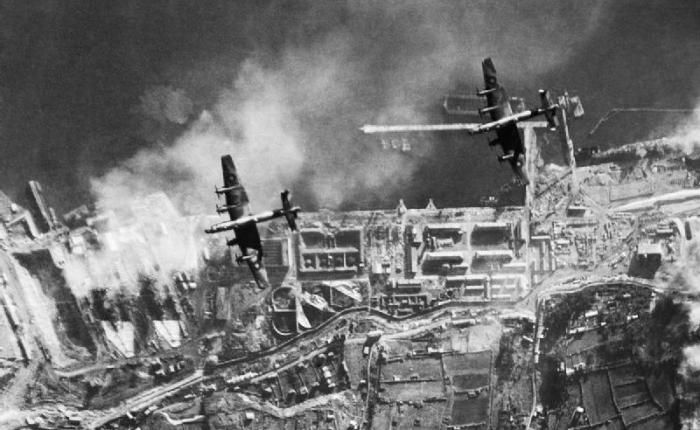
Header image: Vertical aerial photograph taken during a daylight attack on German warships docked at Brest, France. Two Handley Page Halifaxes of No. 35 Squadron RAF fly towards the dry docks in which the battlecruisers Scharnhorst and Gneisenau are berthed (right), and over which a smoke screen is rapidly spreading. (Source: Imperial War Museum)

#ResearchResources – Recent Articles and Books (February 2022)

#ResearchResources – Recent Articles and Books (February 2022)

Editorial note: In this series, From Balloons to Drones highlights research resources available to researchers. Contributions range from discussions of research at various archival repositories to highlighting new publications. As part of this series, we are bringing you a monthly precis of recent articles and books published in air power history. This precis will not be exhaustive but will highlight new works published in the preceding month. Publication dates may vary around the globe and are based on those provided on the publisher’s websites. If you would like to contribute to the series, please contact our Editor-in-Chief, Dr Ross Mahoney, at airpowerstudies@gmail.com or via our contact page here.

Books

Douglas C. Dildy, “Big Week” 1944: Operation ARGUMENT and the Breaking of the Jagdwaffe (Oxford: Osprey Publishing, 2022).

A rigorous new analysis of America’s legendary ‘Big Week’ air campaign which enabled the Allies to gain air superiority before D-Day.

The USAAF’s mighty World War II bomber forces were designed for unescorted, precision daylight bombing, but no-one foresaw the devastation that German radar-directed interceptors would inflict on them. Following the failures of 1943’s Schweinfurt-Regensburg raids, and with D-Day looming, the Allies urgently needed to crush the Luftwaffe’s ability to oppose the landings.

In February 1944, the Allies conceived and fought history’s first-ever successful offensive counter­air (OCA) campaign, Operation Argument or “Big Week.” Attacking German aircraft factories with hundreds of heavy bombers, escorted by the new long-range P-51 Mustang, it aimed both to slash aircraft production and force the Luftwaffe into combat, allowing the new Mustangs to take their toll on the German interceptors. This expertly written, illustration-packed account explains how the Allies finally began to win air superiority over Europe, and how Operation Argument marked the beginning of the Luftwaffe’s fall.

Richard Hallion, Desert Storm 1991: The Most Shattering Air Campaign in History (Oxford: Oxford University Press, 2022).

An expertly written, illustrated new analysis of the Desert Storm air campaign fought against Saddam Hussein’s Iraq, which shattered the world’s fourth-largest army and sixth-largest air force in just 39 days, and revolutionized the world’s ideas about modern air power.

Operation Desert Storm took just over six weeks to destroy Saddam Hussein’s war machine: a 39-day air campaign followed by a four-day ground assault. It shattered what had been the world’s fourth-largest army and sixth-largest air force, and overturned conventional military assumptions about the effectiveness and value of air power.

In this book, Richard P. Hallion, one of the world’s foremost experts on air warfare, explains why Desert Storm was a revolutionary victory, a war won with no single climatic battle. Instead, victory came thanks largely to a rigorously planned air campaign. It began with an opening night that smashed Iraq’s advanced air defense system, and allowed systematic follow-on strikes to savage its military infrastructure and field capabilities. When the Coalition tanks finally rolled into Iraq, it was less an assault than an occupation.

The rapid victory in Desert Storm, which surprised many observers, led to widespread military reform as the world saw the new capabilities of precision air power, and it ushered in today’s era of high-tech air warfare.

David Hobbs, The Fleet Air Arm and the War in Europe, 1939–1945 (Barnsley: Seaforth Publishing, 2022).

For the first time, this book tells the story of how naval air operations evolved into a vital element of the Royal Navy’s ability to fight a three-dimensional war against both the Kriegsmarine and Luftwaffe. An integral part of RN, the Fleet Air Arm was not a large organisation, with only 406 pilots and 232 front-line aircraft available for operations in September 1939. Nevertheless, its impact far outweighed its numbers – it was an RN fighter that shot down the first enemy aircraft of the war, and an RN pilot was the first British fighter ‘ace’ with 5 or more kills. The Fleet Air Arm’s rollcall of achievements in northern waters went on to include the Norwegian Campaign, the crippling of Bismarck, the gallant sortie against Scharnhorst and Gneisenau as they passed through the Channel, air attacks on enemy E-boats in the narrow seas, air cover for the Russian convoys, air attacks that disabled Tirpitz, and strikes and minelaying operations against German shipping in the Norwegian littoral that continued until May 1945. By the end of the war in Europe the FAA had grown to 3243 pilots and 1336 aircraft.

This book sets all these varied actions within their proper naval context and both technical and tactical aspects are explained with ‘thumb-nail’ descriptions of aircraft, their weapons and avionics. Cross reference with the Fleet Air Arm Roll of Honour has been made for the first time to put names to those aircrew killed in action wherever possible as a mark of respect for their determination against enemy forces on, above and below the sea surface which more often than not outnumbered them.

The Fleet Air Arm and the War in Europe completes David Hobbs’ much-praised six-volume series chronicling the operational history of British naval aviation from the earliest days to the present.

Milos Sipos and Tom Cooper, Wings of Iraq: Volume 2 – The Iraqi Air Force, 1970-1980 (Warwick: Helion and Company, 2022).

Officially established on 22 April 1931, around a core of 5 pilots and 32 aircraft mechanics, the Royal Iraqi Air Force was the first military flying service in any Arab country.

Wings of Iraq, Volume 2 tells the story of the Iraqi Air Force between 1970 and 1980. In doing so it examines the air force’s involvement in the October 1973 Arab-Israeli War, and then the showdown with the Iranian-supported Kurdish insurgency in northern Iraq in 1974-1975. These two affairs taught the Iraqis that numbers alone did not make an air force. Correspondingly, during the second half of the 1970s, Baghdad embarked on a project based on full technology transfer from France, which was intended to result in preparing the IrAF for the twenty-first century.

This process hardly began when the new ruler in Baghdad, Saddam Hussein at-Tikriti, led his country into an invasion of neighbouring Iran, embroiling it in a ruinous, eight-year-long war. This volume details the events leading up to the beginning of that war and its opening moves in the air.

Although virtually ‘born in battle’, collecting precious combat experience and playing an important role in so many internal and external conflicts, the Iraqi Air Force remains one of the least known and most misinterpreted military services in the Middle East. Richly illustrated, Wings of Iraq, Volume 2, provides a uniquely compact yet comprehensive guide to its operational history, its crucial officers and aircraft, and its major operations between 1970 and 1980.

#AirWarBooks – Dr Michael Molkentin

#AirWarBooks – Dr Michael Molkentin

By Dr Michael Molkentin

Editorial Note: In the third instalment of ‘Air War Books,’ Dr Michael Molkentin discusses the ten books that have influenced and shaped his writing as an air power historian. If you are interested in contributing to this series or From Balloons to Drones more generally, find out how here.

After I wrote to Dr Ross Mahoney enthusiastically agreeing with several of his choices (always a bad idea!) and suggesting a few others, he promptly invited me to contribute my own ‘Top 10’. I had been saying I would write something for Balloons to Drones for a while and so now he had me cornered. What follows is a list of titles that have had a significant impact on the way I research and write aviation and air power history. As these titles clearly indicate, my area of interest primarily concerns the pre-Second World War period (military and civil) and the people and ideas, rather than the technology, of aviation. 

Denis Winter, The First of the Few: Fighter Pilots of the First World War (London: Allen Lane, 1982). Denis, unfortunately, went on to write a scandalously bad book on Haig that damaged his reputation as a historian. But before that, he produced a couple of genuinely very good ‘face of battle’ type histories of British servicemen in the Great War (the other being Death’s Men). I found The First of the Few in my high school library and later used it as a model for writing my honours thesis on Australian airmen in the Great War. It is a bit dated, relies almost entirely on published accounts and some of Winter’s statistics do not stand up to scrutiny. But it is what got me interested in the subject and stands as the best personal experience study of British airmen in the Great War. I had the pleasure of meeting Denis in Canberra in 2004. He was a kind and gracious man and, when I showed him my work, he encouraged me to keep writing.

Richard P. Hallion, Taking Flight: Inventing the Aerial Age, from Antiquity Through the First World War (New York: Oxford University Press, 2003). I might have included any of Richard’s numerous books on air power (Strike from the Sky, his history of ground attack is a close second) but this has probably been most useful and influential in my work. It is a model of highly readable, yet meticulously researched history. It is international in scope and provides some valuable analysis of the complex ways in which aviation emerged as a practical reality, in various parts of the world, before 1914.

S.F. Wise, The Official History of the Royal Canadian Air Force, Volume 1: Canadian Airmen and the First World War (Toronto: University of Toronto Press, 1980). Wise’s first volume of the Royal Canadian Air Force’s official history is, in my view, the best single volume history of British air power in the Great War. The ubiquity of Canadians in the British flying services (over 20,000 served) means that Wise needed to cover all aspects of air power in the conflict – maritime aviation, strategic bombing and home defence, army cooperation and even some brief surveys of the RFC/RAF in secondary theatres. While some of his conclusions about the conduct of the war on the Western Front have dated, in the main his conclusions stand and are thoroughly grounded in archival sources. My PhD thesis and the book that followed it used Wise’s book as a model to examine Australia’s part in the air war from political, strategic, operational and tactical perspectives.

E.R. Hooton, War over the Trenches: Air Power and the Western Front Campaigns 1916-1918 (Hersham: Midland Publishing, 2010). I have mixed feelings about his book. On the one hand, it makes a significant contribution to our understanding of air power on the Western Front by conducting a multi-force (French, German and British) analysis at the operational level- something nobody had previously attempted. Whereas previous studies of the subject have focused on the tactical level, Hooton uses a mass of statistical data (sorties flown, ordnance expended, losses, serviceability, etc.) to provide a much broader picture of how air power influenced the conflict and how its use evolved between 1916 and 1918. Unfortunately, the book is poorly written and (in the first edition at least) so badly type set that some of the data tables are almost unreadable. It is such an important contribution to the field: I only hope the publisher has the good sense to reissue a revised edition or that an aspiring PhD candidate will take his approach further.

John Buckley, Air Power in the Age of Total War (London: UCL Press, 1999). I am going to go with Ross here and say that, among the many air power surveys out there, this one is the best. It is clear, concise and, essentially for a book like this, gets the balance right between ideas and details. Giving his narrative cohesion is a compelling, convincing and delightfully ironic thesis: that total war first enabled air power but then, following the onset of the nuclear age, limited its functions.

Philip S. Meilinger, The Paths of Heaven: The Evolution of Airpower Theory (Maxwell AFB, AL: Air University Press, 1977). Besides Buckley, the other book I recommend students starting out in the field is Meilinger’s survey of air power thinking. It is a straightforward, textbook approach devoting a chapter to each of the twentieth century’s most influential air power theorists. It is not exactly a page turner but is absolutely essential reading for students of air power and a useful reference work to have within arm’s reach when writing.

Malcolm Cooper, The Birth of Independent Air Power: British Air Policy in the First World War (London: Allen and Unwin, 1986). Malcolm was one of the first scholars to use the Air Ministry’s declassified files after their transfer to the British National Archives (then the PRO) during his PhD candidature during the 1970s. Whereas accounts of British air power’s early days had, until then, been overwhelmingly focused at the tactical level (individual pilots, squadrons, Biggles, etc.), The Birth of Independent Air Power focuses on the topic at the political and policy-making levels. I do not agree with Malcolm’s conclusion that the Army’s use of air power was wasteful and unimaginative (neither does James Pugh in his excellent new book which provides a good update on aspects of Cooper) but much of what he says was vital in adding political context to the operational history of British air power from 1914 to 1918.

Alfred Gollin, The Impact of Air Power on the British People and their Government (Stanford, CA: Stanford University Press, 1989). I would give this to students not even interested in air power as a somewhat rare example of an academic historian writing in a clear, engaging style. Honestly, it reads like a novel but still manages to seamlessly incorporate excellent analysis. Gollin was an enormously talented historian and a shining example to those of us who actually want our work to have a readership beyond the academy and services.

John A. Lynn, Battle: A History of Combat and Culture (Boulder, CO: Westview Press, 2003). Lynn does not really deal with aviation or air power explicitly, but his approach to explaining warfare through the prism of culture is both novel and enlightening. In case study chapters ranging from Ancient Greek warfare to modern Islamic terrorism, Lynn demonstrates convincingly that we cannot properly understand military operations without considering the cultures that conceive and wage them.

Ian Mackersey, Smithy: The Life of Sir Charles Kingsford Smith (London: Little Brown, 1998). This is not only the best of the many biographies of Kingsford Smith; it is the best example of historical biography I have come across. Through impressively dogged detective work, Mackersey managed to track down a number of people who had known Kingsford Smith before his death six decades earlier. From them, he got oral history and private papers that shed light on hitherto unknown or mythologised aspects of his subject’s life. Ian wrote a page turner too: it is engaging, absorbing history. Ian, who sadly died a couple of years ago, was also a gentleman. When I was writing my book on the 1928 trans-Pacific flight, he generously shared manuscript material he had gathered from private collections in the US when researching his book.

Dr Michael Molkentin is an adjunct lecturer at the University of New South Wales and a teacher at Shellharbour Anglican College. He has a first-class Honours degree from the University of Wollongong and a PhD in History from the University of New South Wales. In 2014, the Australian War Memorial awarded Michael’s doctoral research the Bryan Gandevia Prize for Australian Military History. He specialises in the history of armed conflict with an emphasis on warfare in the British world and the development of air power. Michael has written three books, the most recent being Australia and the War in the Air (OUP, 2014).

Header Image: An RE8 of No 69 (later No 3) Squadron, Australian Flying Corps preparing to set out on a night bombing operation from Savy near Arras, 22 October 1917. (Source: © IWM (E(AUS) 1178))