Air Vice-Marshal Professor R.A. ‘Tony’ Mason – A Reflection

Air Vice-Marshal Professor R.A. ‘Tony’ Mason – A Reflection

By Dr Ross Mahoney

Editorial note: This piece was originally drafted not long after the passing of Air Vice-Marshal Mason. However, several personal reasons led to a delay in its publication. 

On 12 November 2023, Air Vice-Marshal Professor R.A. Mason, one of the doyens of air power studies, sadly passed away. Known as Tony by most who knew him personally and professionally, Mason can be considered one of the fathers of air power studies in the UK. As I have argued elsewhere, Mason was arguably the critical British air power thinker of the late 20th Century. From being the Royal Air Force’s (RAF) first Director of Defence Studies (DDefS) to his writing and commentary work, Mason was consistently at the forefront of the field until the 2010s. Indeed, his consistent commitment to the field and the length of his career made him stand out. He was also generous with his time and knowledge and always happy to share material with those who shared his interests.

Mason joined the RAF in 1956 and entered the Education Branch. He gradually rose through the ranks in his branch and undertook various assignments, including attending King’s College London, the United States Air War College and the RAF Staff College. Eventually, in 1976, Mason was informed that he would be the RAF’s first DDefS. Mason took up the role at the start of 1977. The position of DDefS was established due to the perceived state of thinking on air power within the RAF and public awareness of the Service’s role. In a letter to Air Officer Commanding-in-Chief Support Command, Air Marshal Sir Reginald Harland, Chief of the Air Staff, Air Chief Marshal Sir Neil Cameron noted that the position was being established ‘to help provide a new stimulus to air power thinking’ throughout the RAF.[1] This point was also emphasised in the terms of reference for the DDefS post, as there was a need to ‘write on air power and defence issues,’ which was to be encouraged.[2]

The establishment of the post of DDefS at the RAF Staff College at Bracknell and Mason’s perceived suitability for the role caused some debate. While this is not the place to consider that debate, the view of Mason’s successor, Group Captain Timothy Garden, is worth noting. Garden, a pilot and later Air Marshal Baron Garden, noted in 1982 in Air Clues that a colleague had questioned why he would want to take over what was perceived by 1982 as an ‘admin branch’ role. Garden reflected that the most appropriately qualified person should essentially hold the post to achieve its aims and that it ‘should not be the prerogative of any branch.’[3] That Garden, as a pilot, viewed the post in such a way was as much down to Mason’s hard work in the role as it was to the importance of the RAF’s intellectual development.
0001

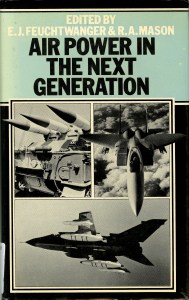
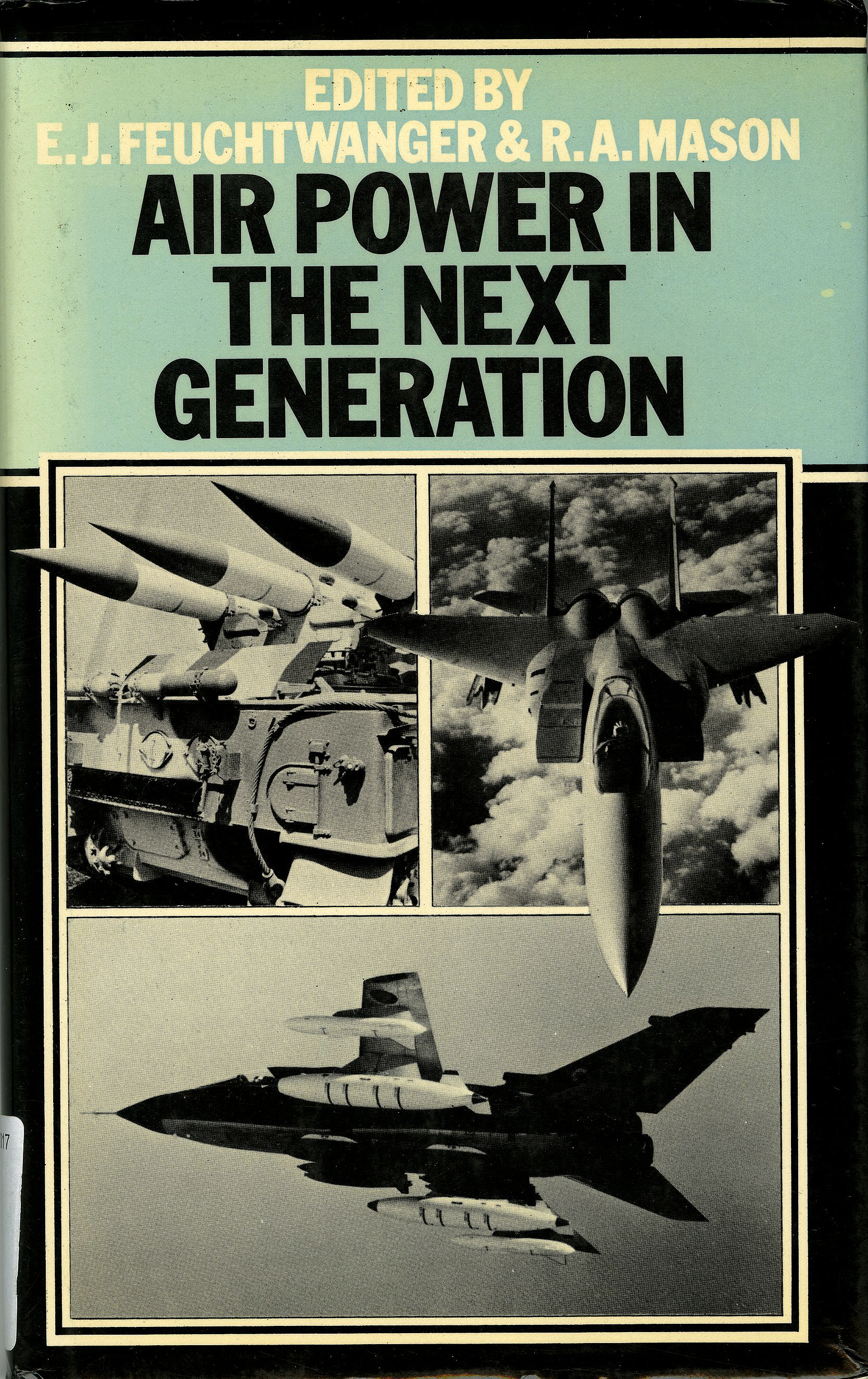
Mason nonetheless quickly sought to encourage discussion and debate and discussion about the role of air power within the service on taking up the role of DDefS. Despite the demise of the RAF Quarterly in 1977, Mason regularly contributed to Air Clues, which, up to the 1970s, had primarily been a technical publication for the RAF. In 1980, he established the Air Power Supplement to Air Clues, the spiritual ancestor to the RAF’s current professional flagship journal, Air and Space Power Review.[4] He also regularly contributed to other publications, such as The RUSI Journal. Perhaps his critical success in this period was organising an academic symposium in his first year in post. This symposium was entitled ‘Air Power in the Next Generation.’ It was well attended and laid the basis for similar endeavours by his successors. It was also published as Air Power in the Next Generation, co-edited with Edgar Feuchtwanger and published by The Macmillan Press in 1979. The book included contributions from the senior USAF, Luftwaffe, and Israeli officers, as well as civilian academics such as John Erickson. Much of Mason’s work started a process whereby his successors have continued to contribute to the collegiate intellectual development of the RAF through various schemes such as publications, conferences, and the management of defence fellowships.[5] Many former post-holders, such as Air Commodore (ret’d) Professor Peter Gray, are also notable for their contribution to developing British air power thinking through their engagement with academia after leaving the post of DDefS and the RAF.
978-1-349-17964-0

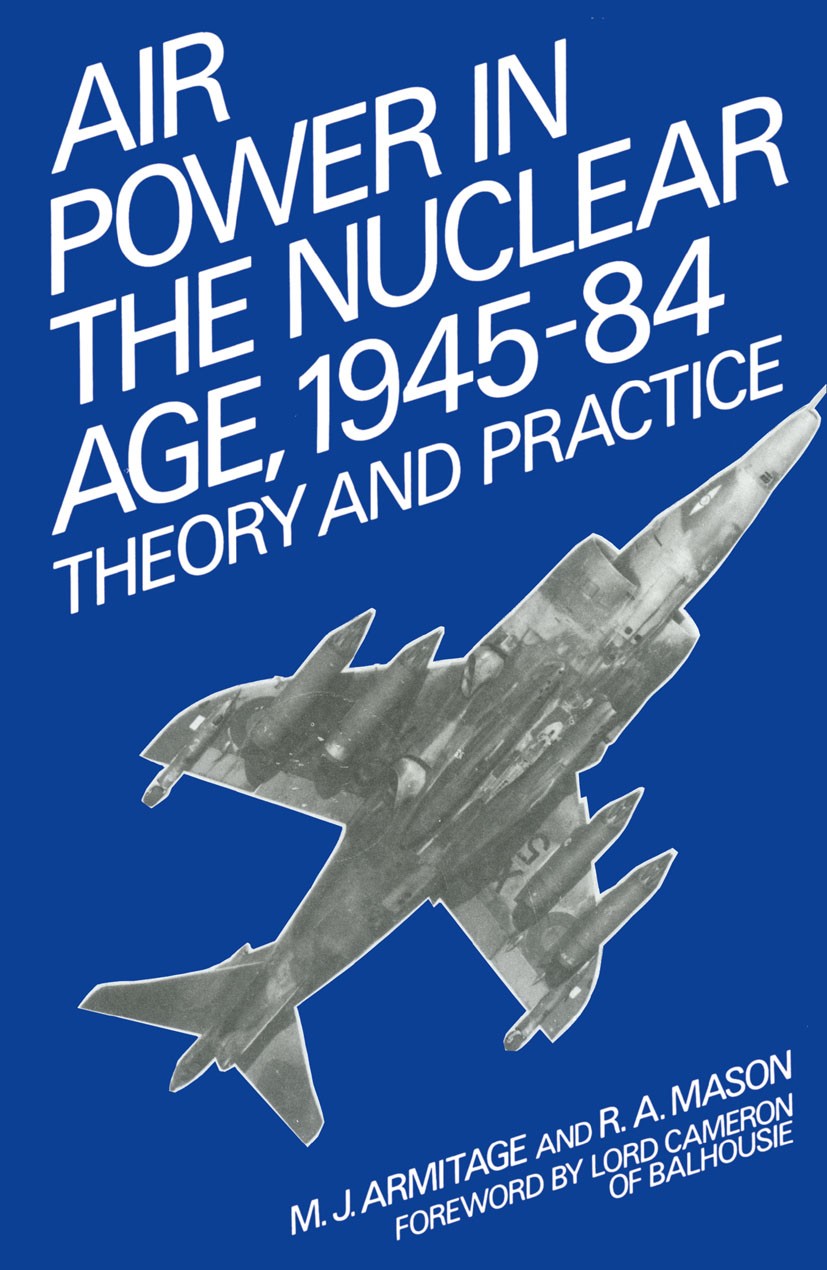
Mason’s contributions to air power studies continued after moving on from the DDefS role. In 1983, Mason published Air Power in the Nuclear Age in conjunction with Air Marshal Michael Armitage. This publication helped cement Mason’s position as a leading air power thinker. As Marshal of the Royal Air Force Lord Cameron noted in the foreword to the book, ‘[t]he joint authors of this book are advanced and enlightened thinkers about the doctrine of air power as a vital and perhaps the most important element of modern and future warfare.’[6] This view was not hyperbole. For example, in his 1984 overview of air power literature, historian Richard Hallion described the book as an ‘excellent survey’ of the development of air power during the Cold War.[7] The book was updated as a second edition in 1985. Mason’s other notable works in this period were the edited book War in the Third Dimension and the establishment of the Brassey’s Air Power: Aircraft, Weapons Systems and Technology Series. This latter series was interesting because it was explicitly directed at developing an awareness of air power amongst junior military personnel.

After retiring from the RAF in 1989, Mason moved into academia. He became the Leverhulme Air Power Research Director for the Foundation for International Security and took up a post as a Senior Research Fellow at the Centre for Studies in Security and Diplomacy at the University of Birmingham, where he was director. In 1996, he was made an Honorary Professor of Aerospace Policy at the University of Birmingham.
414K44MP5EL._AC_UF894,1000_QL80_

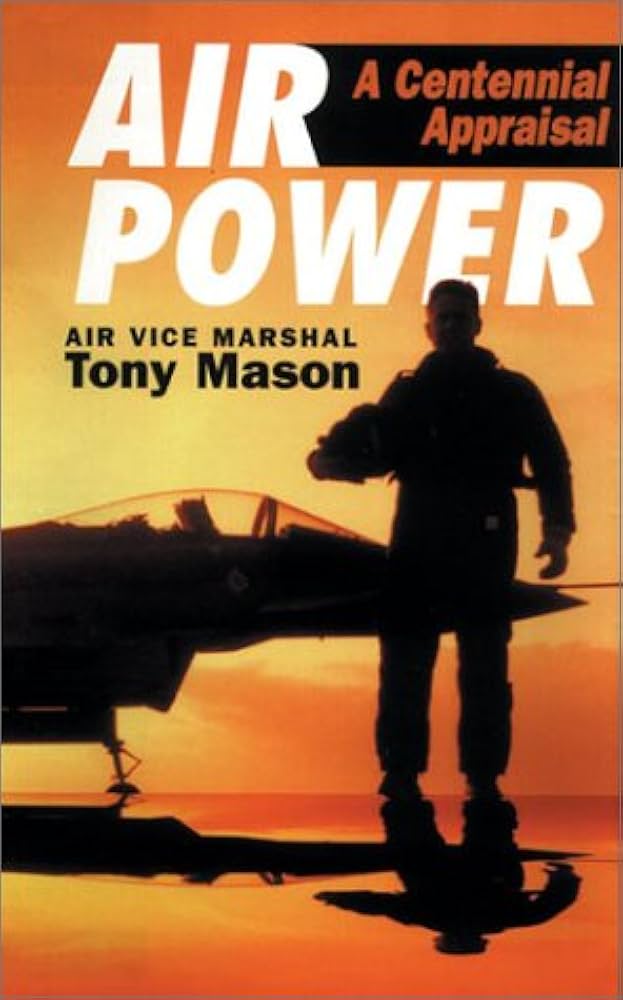
In 1994, Mason published what might be considered his magnum opus, Air Power: A Centennial Appraisal. This book confirmed Mason’s place as one of Britain’s leading air power thinkers. In this book, Mason examined the development of air power between 1989 and 1994. In doing so, he took a historical approach to examine how air power developed in the years up to this period. Mason then conceptualised the period 1989 to 1994, focusing on several key themes, such as the place of air power in arms control. Notably, he sought to contextualise much of the then-contemporary debate about the role of air power in the First Gulf War. Perhaps the most significant aspect of the book lay in Mason’s conceptualisation of what he called ‘differential air power.’[8] In short, Mason argued that while many nations shared ideas around the implementation of air power, only one in 1994 might be able to fully apply the advantages afforded by air power – the US. Using the idea of differential air power, Mason explored why the US stood out as a unique user of air power capabilities. These were important views for the time; however, while the book remains a significant contribution to air power studies, given factors such as the rise of China in the 21st Century and the distributed use of off-the-shelf technology such as drones, it remains to be seen whether his view remains applicable. Nevertheless, Mason concluded that:

One enduring concept underlay all air power thinking and all operations from the first day of the century to the last, and will continue to do so. Any nation intent on going to war to pursue an interest or defend a principle must first secure the air above it.[9]

Mason’s book was well received at publication and has become a commonly cited work. In his 1995 review in The RUSI Journal, Garden described the book as ‘excellent [and] thought-provoking.’[10] Thomas Keaney, who had worked on the Gulf War Air Power Survey, noted that the book made an ‘important contribution to any discussion on the future of airpower in the United States or elsewhere’ in a 1996 review for the US Joint Forces Quarterly.[11] However, historian Philip Sabin, reviewing the book in the Journal of Strategic Studies in 1995, offered a more tempered view. While recognising that the book had certain strengths, particularly Mason’s ‘balanced insights into many of the controversial issues regarding air power,’ Sabin also highlighted the challenge of reading a book that was ‘dense and difficult to follow without careful reading.’[12]

After the publication of Air Power, Mason continued to contribute to both the public’s and the RAF’s understanding of air power through his continued contribution to publications.[13] He also served as an expert member of the House of Commons Defence Committee in the early 2000s and helped inform British defence policy. He was also an inveterate media commentator and was often called to provide expert opinion. Mason’s contribution to air power studies was wide-ranging. While he had retired several years before his passing, his expertise will undoubtedly be sorely missed by many air power scholars for decades to come.

Dr Ross Mahoney is an independent scholar specialising in the history of war with particular reference to the use of air power and the history of air warfare. He is currently the Senior Historian within the Heritage Policy team at Brisbane City Council in Australia. He has nearly 20 years of experience in the education, museum and heritage sectors in Australia and the United Kingdom. Between 2013 and 2017, he was the inaugural Historian at the Royal Air Force Museum in the UK. In Australia, he has worked as a Historian for the Department of Veterans’ Affairs and taught at the Strategic and Defence Studies Centre at The Australian National University based at the Australian War College. His research interests are focused on the history of war, specifically on the history of air power and air warfare, military leadership and command, military culture, and the history and development of professional military education. He also maintains an interest in transport history. He has published numerous articles, chapters and encyclopedia entries, edited two books, and delivered papers on three continents. His website is here, and he can be found on Twitter at @airpowerhistory.

Header image: Ramslade House, the home of the RAF Staff College in Bracknell when Mason took up the role of Director of Defence Studies. (Source: Wikimedia)

[1] Author’s Personal Collection, Letter from the Chief of the Air Staff to AOC-in-C Support Command, 2 November 1976. I am grateful to the late Air Vice-Marshal Professor R.A. Mason for a copy of this and other documents linked to the establishment of the DDefS post.

[2] Author’s Personal Collection, Terms of Reference for Director of Defence Studies appended to a Letter from the Chief of the Air Staff to AOC-in-C Support Command, 2 November 1976, p. 1.

[3] Group Captain Timothy Garden, ‘Why don’t we forget Defence Studies and get on with the job?’ Air Clues 36, no 10 (1982), p. 364.

[4] Air Vice-Marshal Tony Mason, ‘Air Power Review’s Place in RAF History,’ Air Power Review 21, no. 1 (2018), p. 10.

[5] For a variety of publications produced under the guidance of DDefS, see: Andrew Lambert and Arthur C. Williamson (eds.), The Dynamics of Air Power (London: HMSO, 1996); Stuart Peach (ed.), Perspectives on Air Power: Air Power in its Wider Context (London: The Stationary Office: 1998); Peter W. Gray (ed.), Air Power 21: Challenges for the New Century (London: The Stationary Office, 2000); Peter W. Gray and Sebastian Cox (eds.), Air Power Leadership: Theory and Practice (London: The Stationary Office, 2002).

[6] Marshal of the Royal Air Force Lord Cameron, ‘Foreword’ in M’J’ Armitage and R.A. Mason, Air Power in the Nuclear Age: Theory and Practice, Second Edition (Basingstoke: The Macmillan Press, 1985), p. vii.

[7] Richard Hallion, The Literature of Aeronautics, Astronautics, and Air Power (Washington DC: Office of Air Force History, 1984), p. 36.

[8] Tony Mason, Air Power: A Centennial Appraisal (London: Brassey’s, 1994), pp. 235-278.

[9] Mason, Air Power, p. 278.

[10] Timothy Garden, ‘Book Reviews – Air Power: A Centennial Appraisal,’ The RUSI Journal 140, no. 3 (1995), p. 60.

[11] Thomas Keaney, ‘A Jubilee for Airmen: A Book Review,’ Joint Forces Quarterly 11 (1996), p. 134

[12] Philip Sabin, ‘Book Review – Air Power: A Centennial Appraisal,’ Journal of Strategic Studies 18, no. 4 (1995), pp. 141-2.

[13] For example, see: Tony Mason, ‘British Air Power’ in John Andreas Olsen (ed.), Global Air Power (Dulles, VA: Potomac Books, 2011), 7-62; R.A. Mason, ‘The Response to Uncertainty’ in John Andreas Olsen (ed.), European Air Power: Challenges and Opportunities (Dulles, VA: Potomac Books, 2014), pp. 215-30; Mason, ‘Air Power Review’s Place in RAF History,’ pp. 10-1.
#ResearchNote – Brassey’s Air Power: Aircraft, Weapons Systems and Technology Series

#ResearchNote – Brassey’s Air Power: Aircraft, Weapons Systems and Technology Series

By Dr Ross Mahoney

20230513_115224-01

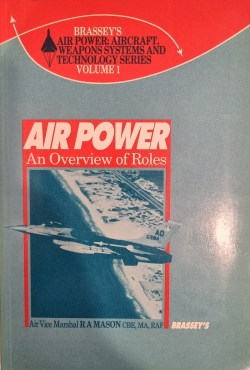
With an abiding interest in how air power has been presented and written about, I, like many others, am an inveterate buyer of second-hand books. I recently added to my library a volume entitled Air Power: An Overview of Roles by R.A. ‘Tony’ Mason, published in 1987. Mason is arguably the key British air power thinker of the late-20th Century. He was appointed the Royal Air Force’s (RAF) first Director of Defence Studies (DDefS) in 1977. Since then, he has widely commented on, lectured, and written about air power. When he wrote this book, Mason, an Air Vice-Marshal, served as Air Secretary.

The book formed part of a series published by Brassey’s Defence Publishers, consisting of 11 titles – see the list below. I have read several of these during my career, including Mason’s title. However, I had not realised several interesting aspects of this series until now. Namely, these volumes were written for a specific audience and authored by serving RAF officers.

Dealing with the first issue, the series outline in the book’s frontmatter noted that ‘[t]his new series […] is aimed at the international officer cadet or junior officer level.’ Thus, the series had a specific pedagogical aim in mind. The series was designed to provide the knowledge that new officers joining an air force needed regarding the use and development of air power. In the case of the RAF, it was clearly aimed at those attending the RAF College at Cranwell and junior officers undertaking staff education. It would be interesting to find out whether the books ended up on the reading lists for these institutions and whether they were used as part of the curriculum. More research…

This leads to the second interesting aspect of this series, namely that they were all written by serving RAF officers. Indeed, many, such as Mason, Armitage, Knight, and Walker, were officers holding Air Rank. As noted, Mason was an Air Vice-Marshal when writing this book – he retired at this rank. Sir Michael Armitage was an Air Chief Marshal, and at the time his book was published, he had been appointed Commandant of the Royal College of Defence Studies. Knight was an Air Chief Marshal at the time of publication, while John Walker was an Air Vice-Marshal – he retired as an Air Marshal. Moreover, many of these officers were regular writers on air power at the time. Aside from Mason’s own outputs, which included editing Air Power in the Next Generation (1979) and War in the Third Dimension (1986), Armitage had, by this time, co-written Air Power in the Nuclear Age (1983) with Mason. Similarly, Walker had edited a collection for the Royal United Services Institute entitled The Future of Air Power (1986), to which Armitage also contributed.

What is interesting about the choice of officers is that the views presented in these books constitute an RAF view of air power and its employment in the late-1980s and early-1990s despite the series being ostensibly aimed at an international market. More interesting is that, taken as a whole, these books can be considered a source of informal or implicit doctrine. In essence, this is a form of doctrine not codified in formal manuals and helps explore the changing debates surrounding the use of military force, in this case, air power. This is especially important given that when the first volumes of this series were published, the RAF did not have its own formal, explicit environmental capstone doctrine – it was using NATO doctrine to guide operations. Furthermore, the final edition of AP1300 was declared obsolete in the 1970s, and the first edition of AP3000 would not be published until 1990. As such, this series should not be separated from the broader context of the RAF’s re-engagement with formal doctrine.

Finally, the publication of this series, through its choice of authors, shows that despite operating in a doctrinal lacuna, the RAF of the 1980s was still a thinking organisation that thought about the role of air power in war. Critical in that process was the establishment of the DDefS position in 1977. Mason, both as DDefS and in subsequent roles, published works on air power that can be seen as informal doctrine. This started with Air Power and the Next Generation and continued through the 1980s and 1990s. Moreover, this form of publishing informal doctrine would be formalised in the 1990s when the Chief of the Air Staff, Air Chief Marshal Sir Michael Graydon, established the CAS Air Power Workshop, led by DDefS. Over time, the Air Power Workshop has published several significant edited volumes on air power that can be viewed as informal doctrine. The first publication from the Air Power Workshop was The Dynamics of Air Power (1996), edited by DDefS, Group Captain Andrew Lambert and Arthur Williamson. These publications were an essential adjunct to the RAF’s formal doctrine, AP3000. Indeed, the volumes published in the late-1990s under the auspicious of the Air Power Workshop were significant because of the time taken to publish the various editions of AP3000. Put simply, informal doctrine could discuss and debate issues that took time to filter into formal codified doctrine.

Given this, the various DDefS’ have invariably played an essential role in developing British air power thinking, both formal and informal, since the establishment of the post. Moreover, the personalities who have held this role have been influential in that process. While Mason is a prominent name to cite to highlight the role’s importance, it is possible to note several other officers who held the post of DDefS and have played a role in developing British air power thinking inside the RAF and externally within academia and the broader public. These have included Air Marshal (ret’d) Timothy Garden, Air Vice-Marshal (ret’d) Andrew Vallance, Air Commodore (ret’d) Andrew Lambert, Air Chief Marshal Sir Stuart Peach, Air Commodore (ret’d) Professor Peter Gray and Air Commodore (ret’d) Dr Neville Parton.

Brassey’s Air Power: Aircraft, Weapons Systems and Technology Series

  1. Mason, R.A., Air Power: An Overview of Roles (London: Brassey’s Defence Publishers, 1987).
  2. Walker, J.R., Air-to-ground Operations (London: Brassey’s Defence Publishers, 1987).
  3. Armitage, M.J., Unmanned Aircraft (London: Brassey’s Defence Publishers, 1988).
  4. Browne, J.P.R, and Thurbon, M. T., Electronic Warfare (London: Brassey’s Defence Publishers, 1998).
  5. Walker, J.R., Air Superiority Operations (London: Brassey’s Defence Publishers, 1989).
  6. Chapman, K., Military Air Transport Operations (London: Brassey’s Defence Publishers, 1989).
  7. Elsam, M.B., Air Defence (London: Brassey’s Defence Publishers, 1989).
  8. Knight, M., Strategic Offensive Air Operations (London: Brassey’s Defence Publishers, 1989).
  9. Oxlee, G.J., Aerospace Reconnaissance (London: Brassey’s, 1997).
  10. Dutton, L. et al., Military Space (London: Brassey’s Defence Publishers, 1990).
  11. Laite, B.C., Maritime Air Operations (London: Brassey’s Defence Publishers, 1991).

Dr Ross Mahoney is an independent scholar specialising in the history of war with particular reference to the use of air power and the history of air warfare. He is currently the Senior Historian within the City Architecture and Heritage Team at Brisbane City Council in Australia. He has over 15 years of experience in the heritage and education sectors in Australia and the United Kingdom. Between 2013 and 2017, he was the inaugural Historian at the Royal Air Force Museum in the UK. In Australia, he has worked as a Historian for the Department of Veterans’ Affairs and taught at the Strategic and Defence Studies Centre at The Australian National University based at the Australian War College. His research interests are focused on the history of war, specifically on the history of air warfare, transport history, and urban history. He has published several chapters and articles, edited two books, and delivered papers on three continents. His website is here, and he can be found on Twitter at @airpowerhistory.

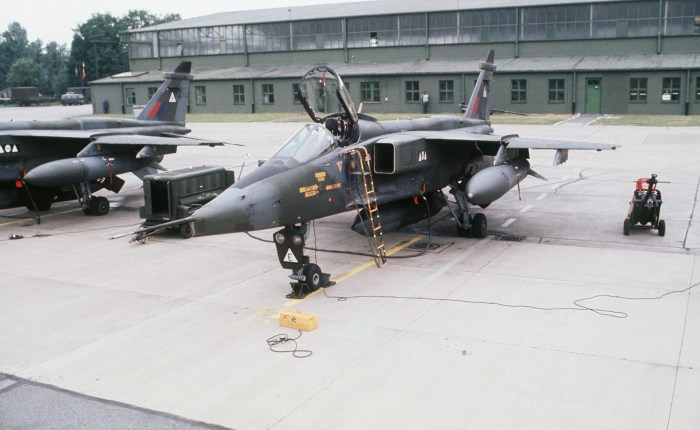
Header image: A Royal Air Force SEPECAT Jaguar GR1 of No. 2 Squadron RAF parked on the flight line during Tactical Air Meet ’78 at RAF Wildenrath, 15 May 1978. (Source: Wikimedia)

#ResearchNote – Air Power in the Next Generation

#ResearchNote – Air Power in the Next Generation

By Dr Ross Mahoney

0001

In 1979, The Macmillan Press published Air Power in the Next Generation that E.J. Feuchtwanger and Group Captain R.A. Mason edited. For me, and my current research trajectory on command and staff training in the RAF, what is remarkable about this book is that it was the first significant output from a newly established post for the Service, that of Director of Defence Studies (DDefS).

In 1977, Mason, who retired as an Air Vice-Marshal and was a professor at the University of Birmingham, became the first incumbent to the DDefS post at the RAF Staff College at Bracknell. The position of DDefS was established due to the perceived state of thinking on air power within the RAF as well as public awareness of the Service’s role. In a letter to AOC-in-C Support Command, Air Marshal Sir Reginald Harland, CAS, Air Chief Marshal Sir Neil Cameron, noted that the position was being established ‘to help provide a new stimulus to air power thinking’ throughout the RAF.[1] This point was also emphasised in the terms of reference for the DDefS post as was the need to ‘write on air power and defence issues,’ which was to be encouraged.[2]

While there was some controversy over the establishment of the DDefS position, Mason was well qualified for the job, and despite an initial lack of resources, he quickly got to work. In April 1977, a symposium was held at the University of Southampton, which formed the basis for Air Power in the Next Generation. Mason was undoubtedly supported in his early efforts by the degree of top cover he was afforded by CAS and other officers interested in the discussion of air power, such as the Director-General of Training, Air Vice-Marshal Frederick Sowrey.[3] Indeed, Cameron long had an interest in the study of air power and, as Group Captain J.A.G. Slessor, son of the former CAS, reflected, he was the only Chief to come to discuss the subject with his father.[4]

What of the book? It consists of 10 chapters based on the presentations delivered at the symposium. The opening chapter builds on Cameron’s opening presentation and reinforces the importance of protection by senior leaders. Had Cameron not been interested in both the subject matter and the importance of establishing a post to advocate for thinking about air power, it is hard to imagine that the position would have been created. Even if it had, it probably would have taken a very distinct direction to the one that it has. Other contributions came from a number senior serving or retired officers from not just the RAF but also the USAF, Luftwaffe and the Isreali Air Force. There were also contributions from academics such as John Erickson, who covered the expansion of Soviet Air Power. The conclusion from Major-General Lloyd R. Leavitt Jr. of the USAF on the ‘Lessons from South East Asia’ is particularly apropos for the current era as well as the 1970s. Leavitt, who retired as a Lieutenant-General, concluded that there was a need to enunciate and educate the body politic about the relevance of the system they were investing in noting that:

[…] in order to achieve the understanding and support of the people who have to pay the bills, the taxpayers and their elected representatives, we must go to the people and go through the press to the people with logical clear explanations about the involvements of air power – why the air force needs things, why this system is needed, and why that system is needed.[5]

Apart from the contents of the book, what is the significance of the establishment of the DDefS post? It is hard to assess, and hopefully, more answers will emerge as I continue to research the subject. However, a few tentative thoughts are warranted. First, the RAF at least recognised the challenge of its predicament in the 1970s and established a post to try and encourage the Service to discuss taxing questions over its role and employment. This was essential in the decade after the RAF handed over the strategic nuclear deterrent to the Royal Navy. This had been the RAF’s focal point during the early Cold War, and the Service needed to try and enunciate its relevance in a changing defence landscape. Whether it was successful in doing that is not to be discussed here. However, the post has offered a focal point for thinking about the RAF’s role, and individual DDefS’ have made a contribution to British air power thinking with publications similar to Air Power in the Next Generation being produced on important themes as well as the postholders numerous individual contributions on the subject of air power. These have become essential sources of informal doctrine, but they have, by dint of circumstances, varied regarding when they were produced and what they covered. Indeed, at the moment, I am trying to map the various outputs generated by DDefS’ both during their time in post and after to seek to contextualise what they wrote, when they wrote it and their impact. Some DDefS’ have produced more than others, in part, due to operational circumstances though there may be other factors at play. This latter aspect will be difficult to measure, but one thing that is already clear is that context is critical.

This post first appeared at Thoughts on Military History.

Dr Ross Mahoney is an independent historian and defence specialist based in Australia. Between 2013 and 2017, he was the resident Historian at the Royal Air Force Museum, and he is a graduate of the University of Birmingham (MPhil and PhD) and the University of Wolverhampton (PGCE and BA). His research interests include the history of war in the twentieth and twenty-first centuries, air power and the history of air warfare, and the social and cultural history of armed forces. To date, he has published several chapters and articles, edited two books, and delivered papers on three continents. He is a member of the Royal Historical Society and is an Assistant Director of the Second World War Research Group. He is a member of the Royal Historical Society and an Assistant Director of the Second World War Research Group. He blogs at Thoughts on Military History, and can be found on Twitter at @airpowerhistory.

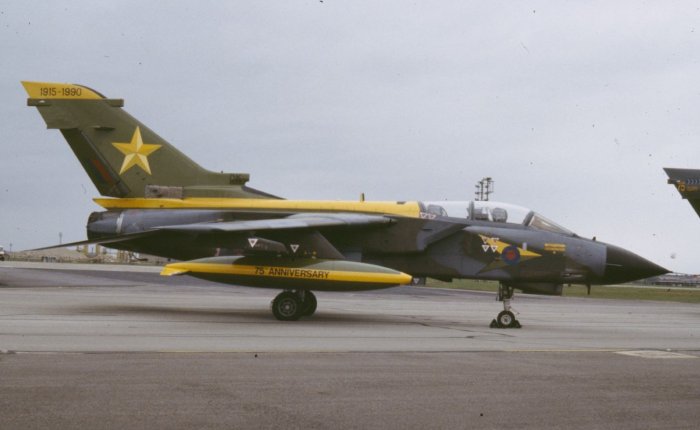
Header Image: Panavia Tornado GR1 of No. 31 Squadron at RAF Fairford, c. 1990 (Source: Wikimedia Commons)

[1] Author’s Personal Collection, Letter from the Chief of the Air Staff to AOC-in-C Support Command, 2 November 1976. I am grateful to Air Vice-Marshal Professor R.A. Mason for a copy of this and other documents linked to the establishment of the DDefS post.

[2] Author’s Personal Collection, Terms of Reference for Director of Defence Studies appended to a Letter from the Chief of the Air Staff to AOC-in-C Support Command, 2 November 1976, p. 1.

[3] Graham Pitchfork, The Sowreys: A Unique and Remarkable Record of One Family’s Sixty-Five Years of Distinguished RAF Service (London: Grub Street, 2012), p. 216.

[4] Marshal of the Royal Air Force Lord Cameron of Balhousie, In the Midst of Things (London: Hodder and Stoughton, 1986), pp. 106-8, 194-5, p. 200, fn9.

[5] Major-General Lloyd R. Leavitt Jr., ‘Lessons from South East Asia,’ in E.J. Feuchtwanger and Group Captain R.A. Mason (eds.), Air Power in the Next Generation (London: The Macmillan Press, 1979), p. 85.