The Korean War and the OODA Loop: What Happened to the Kill Ratio?

The Korean War and the OODA Loop: What Happened to the Kill Ratio?

By Stephen Robinson

The United States Air Force (USAF) Colonel John R. Boyd’s most enduring idea is his Observation-Orientation-Decision-Action (OODA) loop theory. For example, Antulio J. Echevarria concluded that it ‘became the most memorable aspect of Boyd’s legacy.’[1] The basic idea is to move faster than the enemy through a four-stage cycle.[2] With a relative speed advantage, the victor seizes the initiative while the loser becomes paralysed by disorientation and panic.[3] The winner gets inside their adversary’s OODA loop, and, as Martin van Creveld explained, the loser is in a situation ‘comparable to that of a chess player who is allowed to make only one move for every two made by his opponent.’[4] Towards the end of his life, Boyd refined the OODA loop into a vastly more complex idea involving multiple feedback loops and different pathways between the four stages.[5] While the final version has had little influence, the same cannot be said of the earlier concept.

The OODA loop is applicable outside the military; as Frans P. B. Osinga explained, it ‘has spread like a meme beyond military organizations, infecting business consultants, psychiatrists, pedagogues, and sports instructors.’[6] Why did the OODA loop spread like a meme? What convinced so many that the idea had merit? As Michael W. Hankins explained, ‘something about Boyd’s expression of the OODA loop resonated with a certain audience in a powerful way.’[7] There is one prominent example that may explain this trend. In the early days of his Patterns of Conflict briefing, Boyd used his emerging, but not fully formed, OODA loop idea to explain the remarkable kill ratio F-86 Sabres achieved against MiG-15s during the Korean War (usually given as 10:1).

The example of Sabre versus MiG-15 combat in Korea was a decisive factor in the OODA loop spreading like a meme because it is usually the most prominent and compelling evidence provided in literature advocating the theory. The Korean War air combat example also benefitted from a certain mystique as it touched upon Boyd’s personal experience as an F-86 pilot during that conflict.

In my book The Blind Strategist: John Boyd and the American Art of War (2021), I claimed the OODA loop explained the remarkable 10:1 kill ratio and the air war in Korea.[8] However, I thank Hankins for correcting my error since ‘this “famous” ratio is almost certainly wrong’ and it ‘was more likely much lower, although still in the US’s favor.’[9] I did not realise that the 10:1 kill ratio had been convincingly debunked. Therefore, the relationship between air combat in Korea and the OODA loop must be reconsidered.

The Anomaly

The final Far East Air Forces report from the Korean War stated that ‘it is believed the ten to one victory ratio of the F-86 over the MiG-15 was gained by superior tactics, well-trained, experienced and aggressive pilots, and a superior armament and fire-control system.’[10] Nevertheless, that result seemed odd since both aircraft were roughly equal from a technical perspective and even when acknowledging superior American skill, the level of Sabre success seemed strangely high.
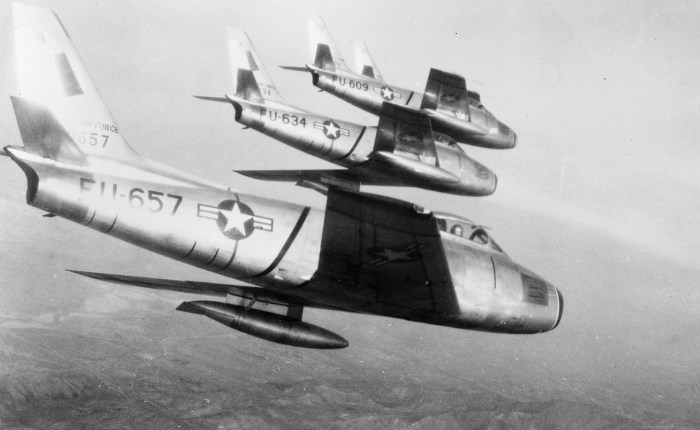
Three US Air Force North American F-86F Sabre fighters of the 51st Fighter Interceptor Wing over Korea, c. 1953. (Source: Wikimedia)

To Boyd, the 10:1 kill ratio was an intriguing anomaly since MiG-15s were faster and could operate at a higher ceiling and make tighter turns.[11] ‘The MiG,’ as he explained, ‘could out-climb, out-accelerate the F-86, throughout the entire envelope, accelerate quite a bit better. Its sustained turn was better, its instantaneous turn in some areas it was better, in other areas it wasn’t as good.’[12] Boyd also noted that the Sabre’s bubble canopy offered pilots superior observation while its hydraulic flight controls made it more responsive ‘just like power steering in a car’.[13] When all those factors were considered, both planes were roughly equal on paper, and a more even result should have occurred.[14] Although American pilots were generally better trained and had greater experience, Boyd did not consider that sufficient to explain the kill ratio.[15] According to Robert Coram in Boyd: The Fighter Pilot Who Changed the Art of War, ‘Boyd made a list of attributes of the MiG and the F-86. For days he went into frequent trances as he groped for the answer.’[16]

Boyd concluded that the F-86’s bubble canopy gave American pilots superior ‘observation’ and ‘orientation’. At the same time, its hydraulic flight controls allowed rapid transition from one manoeuvre to another, making it easier to translate a ‘decision’ into an ‘action’.[17] Therefore, Boyd concluded that American pilots completed OODA loops faster than communist pilots, who accordingly became disoriented and paralysed as they could not keep up. Before this insight, Sabre pilots knew that its bubble canopy and hydraulic flight controls gave them advantages.[18] However, Boyd uniquely explained that these advantages allowed F-86 pilots to achieve OODA loop domination. Superior observation resulted in faster orientation, and hydraulic flight controls resulted in quicker actions that collectively meant faster American OODA loops. In this way, Boyd explained the curious anomaly – or so it seemed at the time. However, with the benefit of hindsight, the anomaly is more convincingly resolved by lowering the inflated kill ratio.

The OODA Loop and the Kill Ratio

In 1977, in the USAF oral history, Boyd stated: ‘We had [an] 11 to 1 exchange rate of 86 over MiG-15; somewhere between 10 and 14 to one rounded off to 11 to 1 – very high.’[19] One year later, during a Patterns of Conflict briefing, he stated that the kill ratio was ‘11 to 1 or somewhere between 10 to 14.’[20] During that briefing, Boyd’s most prominent example of the effectiveness of the ‘observation-decision-action loop’ was Korean War air combat as he explained ‘observation’ concerning the Sabre’s bubble canopy and ‘decision-action’ through its hydraulic flight controls.[21] Therefore, the F-86 versus MiG-15 combat example would have influenced the audience’s mind.

James Fallows’ article ‘The Muscle-Bound Super Power’, published in Atlantic Monthly in 1979, argued that Boyd’s ‘observation-decision-action cycles’ explained why ‘F-86s had consistently gunned down Russian MiG-15s, even though the MiGs were “better” planes.’[22] That example of air combat was his article’s most prominent example of the OODA loop’s effectiveness. Two years later, in National Defense, Fallows insisted that ‘F-86s consistently destroyed the MiGs.’[23] No kill ratios were given in both cases, but his words ‘consistently gunned down’ and ‘consistently destroyed’ indicated a large margin of success.

Rodger Spiller from the United States Army’s Command and Staff College questioned Boyd’s analysis of the Korean air war in an unpublished critique in the early 1980s and sent a copy to Boyd. After Spiller explained that the ‘foundation of the OODA loop is to be found in the aerial combat of the Korean War between the MIG-15 and the F-86,’ he concluded:

The basic data that gave rise to the OODA loop hypothesis has never been openly challenged; however, there apparently is classified information that may call these conclusions to question. During our conversation, Boyd indicated that he was aware of this information, and he discounted the possibility of its adverse impact on his view.[24]

In response, Boyd commented, ‘No – OODA loop came from work and anomalies associated with evolution and flight tests of YF-16/17 [prototypes].’[25] Nevertheless, Boyd knew that people with access to classified information were questioning his ‘basic data’ regarding F-86 versus MiG-15 combat. By ‘basic data’ Spiller may have meant the kill ratio. Boyd did not challenge Spiller’s assessment concerning the ‘basic data,’ and he noted: ‘Information I was referring to were the U[niversity] of Chicago[’s] work on the Korean War.’[26]

Boyd may have meant a report written by John Wester titled ‘Effectiveness of the Gunsight,’ published by the University of Chicago’s Institute for Air Weapons Research in 1954.[27] The F-86E and F-86F variants included new radar-ranging A-1C(M) gunsights, and during the last six months of the war, many Sabre pilots credited the device with helping them shoot down MiG-15s. However, many other pilots considered the gunsight too complex and unreliable to be practical while adding useless extra weight. As Steven A. Fino explained, ‘we see clearly two narratives emerging: one of a “great machine” that incorporates cosmic technologies to simplify pilots’ tasks; the other of a “great pilot” who somehow triumphs in spite of the new and poorly designed machinery.’[28] As Boyd did not praise the gunsight in his briefing and since his Fighter Mafia and Reformers movements preferred simplicity over complex gadgets that reduced manoeuvrability, he almost certainly was in the latter category of sceptical pilots.[29]

Furthermore, Brigadier General Benjamin N. Bellis, head of the F-X project, Boyd ‘hated the complexity and sophistication of an on-board fire control system (radar)’ in the F-15 Eagle.[30] Therefore, it is likely that Boyd also opposed the A-1C(M) gunsight in Sabres. Although the gunsight was not fully automated, pilots who carefully studied its manual and took the time to learn how to incorporate it into their manual processes improved their efficiency in what Fino referred to as ‘a more effective human-machine system.’[31]

Boyd and Spiller may also have discussed Dennis Strawbridge and Nannette Kahn’s ‘Fighter Pilot Performance in Korea’ published in 1955 by the University of Chicago’s Institute for Air Weapons Research. Although this report noted the 10:1 kill ratio, it stressed that many MiG-15 kills were attributed to Sabre pilots who never opened fire, as enemy pilots had lost control and either crashed or bailed out.[32] Therefore, Boyd and Spiller may have discussed the pros and cons of the A-1C(M) gunsight or MiG-15 losses not involving Sabres opening fire. In any case, Boyd knew that Spiller was scrutinising his claims regarding air combat during the Korean War.

In 1985, Lieutenant Colonel Walter Kross, a USAF officer, challenged the kill ratio in Military Reform: The High-Tech Debate in Tactical Air Forces:

The F-86’s 10-to-1 kill ratio also should be examined more closely, say TACAIR [Tactical Air] Planners. In the first part of the war (June 1950–December 1952), when Russian “Honchos” flew with the North Korean MiGs, the kill ratio was only 4.9-to-1 in favour of the F-86. When the Russian pilots were pulled out in January 1953, the kill ratio soared to 20-to-1 in the last six months of the war.[33]

As Kross was a high-profile critic, Boyd probably knew that Kross and TACAIR were questioning the kill ratio. Nevertheless, they were voices in the wilderness, and commentators advocating the OODA loop theory continued to use the 10:1 kill ratio.

Boyd’s acolyte William S. Lind, in his 1985 Maneuver Warfare Handbook, gave the kill ratio as 10:1.[34] Lind repeated that figure a year later in America Can Win: The Case for Military Reform, a book he wrote with Senator Gary Hart.[35] In both books, just before the OODA loop is introduced, the air war in Korea is the most prominent example used to explain Boyd’s conflict theory, as expressed in Patterns of Conflict.

During the 1980s, Boyd stopped citing a kill ratio. For example, in a Patterns of Conflict briefing from the early-to-mid 1980s, he stated:

Now typically today many people or until very recently, people thought the MiG-15 was a more manoeuvrable airplane than the -86 […] I will dispel that myth. I will show you why and make it very compelling and convincing. For one thing we have a new frame of reference with which we can compare those aircraft. We have the OODA loop.[36]

Although Boyd did not cite a kill ratio, he implied that the Sabres achieved remarkable success against MiG-15s.[37] He similarly stated in a 1989 briefing that ‘in a sense the -86 was a better airplane, particularly if you examine them through the OODA loop.’[38] Boyd again implied that Sabres achieved an undefined high level of success without mentioning a kill ratio.[39] Boyd may have been aware that the 10:1 kill ratio was inaccurate. In any case, with the information available in his lifetime, he could not possibly have guessed how far the kill ratio would eventually decline. But before that correction occurred, the 10:1 kill ratio or words indicating remarkable success, continued to be used by others promoting the OODA loop.

In 1994, in The Art of Maneuver: Maneuver Warfare Theory and AirLand Battle, Robert Leonard stated that Boyd ‘had been investigating why American fighter pilots had been consistently able to best enemy pilots in dogfights [in Korea].’[40] F-86 versus MiG-15 combat is the only example he used when explaining the ‘Boyd cycle’.[41] After Boyd died in 1997, the close acolyte of Boyd and defence analyst Franklin C. Spinney, in his tribute ‘Genghis John’, cited the 10:1 kill ratio and air combat in Korea as the most prominent example supporting the ‘observation-decision-action cycle’.[42] In 2001, in The Mind of War: John Boyd and American Security, Grant Hammond similarly gave the kill ratio as 10:1, but it did fluctuate ‘wildly (from 4.9:1 when Russian pilots flew the MiGs to 20:1 in the last six months of the war after the Russian pilots were pulled out in January 1953).’[43]

Although Coram in Boyd questioned the 10:1 kill ratio, he had no basis to challenge it as ‘the ten to one kill ratio remains the number published in histories of Korea.’[44] In Certain to Win: The Strategy of John Boyd, Applied to Business, Chet Richards stated that the ‘Americans won ten air battles for every one they lost’ during the Korean War.[45] Osinga, in Science, Strategy and War: The Strategic Theory of John Boyd, agreed that ‘the kill ratio was 10:1 in favor of the F-86 during the Korean War.’[46] More recently, in 2018, Ian T. Brown noted in A New Conception of War: John Boyd, the U.S. Marines, and Maneuver Warfare that the ‘F-86 had regularly outperformed its MiG-15 counterpart.’[47] Although Brown did not cite a kill ratio, his words indicated an impressive margin of success. Brown also stressed the importance of Boyd’s F-86 versus MiG-15 combat analysis to his theory of conflict because ‘the contrast in performance between Soviet and American fighter aircraft resonated with him, and he would revisit it later as he developed his warfighting theory.’[48]

The kill ratio was also an essential consideration in Colin S. Gray’s endorsement of the OODA loop as a strategic concept in Modern Strategy:

As a fighter pilot and subsequent investigator of the reasons why USAF F-86 Sabre jets achieved such remarkably favourable kill ratios in combat against MiG-15s over North Korea (10 to 1), Boyd found in the OODA loop the essential logic of success in battle […] The OODA loop may appear too humble to merit categorization as grand theory, but that is what it is. It has an elegant simplicity, an extensive domain of applicability, and contains a high quality of insight about strategic essentials, such that its author merits honourable mention as an outstanding general theorist of strategy.[49]

Despite such statements, the famous kill ratio would dramatically deflate.

What was the actual Kill Ratio?

In Red Devils over the Yalu: A Chronicle of Soviet Aerial Operations in the Korean War 1950‑53, the Russian historian Igor Seidov disputed the 10:1 kill ratio. He noted the official USAF claim that of the 224 Sabres lost, only 110 were caused by enemy action before concluding: ‘Isn’t the figure for non-combat losses suspiciously high?’[50] Stuart Britton supported Seidov’s argument, explaining that ‘since the war, the number of USAF MiG-15 claims has been steadily revised downwards, while its admitted losses of F-86s have slowly increased.’[51] Similarly, in Red Wings Over the Yalu: China, the Soviet Union, and the Air War in Korea, the Chinese historian Xiaoming Zhang questioned the ‘astonishing 7:1 kill ratio’ and concluded that American histories tend to ignore or dismiss Chinese sources ‘because American analysts have a tendency to view the other side’s story through their own myths and values.’[52] In Sabres Over MiG Alley: The F-86 and the Battle for Air Superiority in Korea, Kenneth P. Werrell reduced the kill ratio to 8.2:1 but noted that in 1953, it was 13:1.[53]
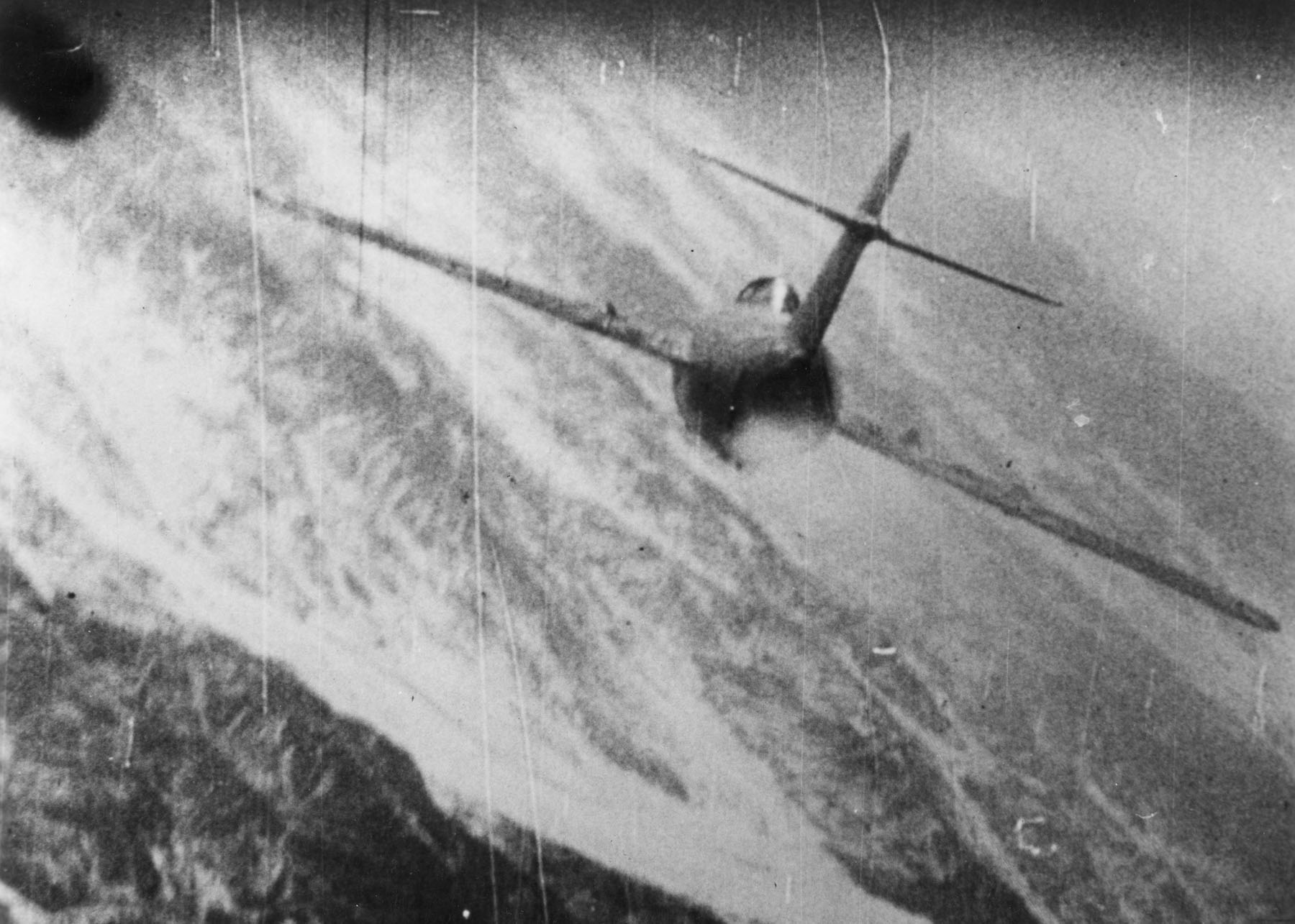
Gun camera photo of a Mikoyan Gurevich MiG-15 being attacked by US Air Force North American F-86 Sabre over Korea in 1952-53, piloted by Captain Manuel ‘Pete’ Fernandez, 334th Fighter-Interceptor Squadron, 4th Fighter-Interceptor Wing. (Source: Wikimedia)

In F-86 Sabre vs MiG-15: Korea 1950-53, Douglas C. Dildy and Warren Thompson concluded that kills tend to be awarded based on political and propaganda needs, while logistics records tend to be more accurate given the necessity of documenting equipment losses.[54] They estimated ‘an overall “kill ratio” of 5.835 MiG-15s destroyed for each Sabre lost.’[55] However, they noted that the F-86s only achieved a 1.4:1 kill ratio against the elite Soviet 303rd and 324th Fighter Aviation Divisions. However, against other Soviet, Chinese, and North Korean MiG-15s, the Sabres achieved a 9.07:1 kill ratio – highlighting the importance of training and experience.[56]

Colonel Walter J. Boyne, a former USAF pilot and historian, frankly stated in his foreword to Thomas McKelvey Cleaver’s MiG Alley: The US Air Force in Korea, 1950-53: ‘Much of what has been recorded as “official history” of the Air Force in the Korean War is little more than recycled wartime propaganda.’[57] Cleaver agreed that the 10:1 kill ratio was ‘propaganda’ and concluded: ‘The “MiG kill” number became the measure of success for commanders of the USAF fighter units in Korea, like the “body count” in Vietnam. As a result, the numbers were increased by lowering the standards for measuring success.’[58] For example, he explained that ‘since any airplane that returned to base, no matter how badly damaged in combat and no matter that it never flew again, was not recorded as a “combat loss”.’[59] He added: ‘By 1952, gun camera film of aircraft not seen to go down, explode, disintegrate, or where the pilot ejected, was accepted as evidence of a “kill” regardless.’[60] Cleaver concluded that the overall kill ratio the Sabres achieved was somewhere between 1.1:1 and 1.5:1.[61] In Korean Air War: Sabres, MiGs and Meteors, 1950-53, Michael Napier agreed that the 10:1 kill ratio ‘does not stand up to scrutiny.’[62] The more recent scholarship cited above demonstrates that Sabre versus MiG-15 combat was attritional, with Sabre pilots achieving a slightly better overall result. However, the OODA loop model does not address many factors contributing to instances of Sabre success.

Beyond OODA Loops

At times, MiG-15s experienced instability at extremely high speeds that the Russians called valezhka, during which the aircraft would flip and go into a dangerous spin. Some Sabre pilots shooting at MiG-15s, experiencing valezhka, likely assumed that their bullets were responsible for the enemy’s demise.[63] The valezhka phenomenon probably explains many of the cases that Strawbridge and Kahn noted of Sabre kills not involving American pilots opening fire. In any case, MiG-15 losses caused by valezhka had nothing to do with OODA loops because they resulted from a design flaw, not communist pilots becoming disoriented or paralysed.

According to Seidov, almost half the MiG-15 losses experienced by the 97th and 190th Fighter Aviation Divisions occurred between January and August 1952 while the aircraft took off or landed.[64] Zhang also made a similar claim regarding MiG-15s taking off and landing, concluding: ‘Many Soviet pilots died before they had a real opportunity to engage their opponents.’[65] Although F-86 pilots could enter Chinese airspace during pursuits in 1952, many pilots exceeded the rules by ‘hawking’ the skies above airfields to swoop down and ambush vulnerable enemy aircraft during takeoffs and landings.[66] The Soviets even withdrew two MiG-15 regiments to rear airfields to provide combat air patrols over the forward airfields as protection against ‘hawking’.[67] As Napier explained, ‘hawking’ increased Sabre success, but ‘it is hardly indicative of the relative performance of aircraft and pilots in air combat.’[68] Therefore, ‘hawking’ had nothing to do with the moves and countermoves of OODA loop-like dogfights, with the loser experiencing psychological defeat.[69]

American pilots were generally more experienced than MiG-15 pilots.[70] However, another factor was Russian unit rotation rather than individual pilot rotation. In early 1952, the elite 324th and 303rd Fighter Aviation Divisions were replaced by the inexperienced 97th and 190th Divisions. The new pilots had to learn the hard way without the benefit of experienced veterans, dramatically reducing combat effectiveness.[71] Werrell also concluded that superior American equipment, such as the A-1C(M) gunsight, flight helmets and “g” suits, contributed to Sabre’s success.[72]

The secrecy of Soviet participation in the conflict prevented their pilots from crossing the coastline or approaching too close to the frontline due to the risk of capture.[73] Therefore, Russian pilots could not chase Sabres over the sea or too far south. ‘A great number of damaged US aircraft,’ Seidov explained, ‘taking advantage of this circumstance, escaped MiG pursuit by crossing the coastline out to sea, and if this restriction hadn’t been in place, then I’m sure the American combat losses would have increased sharply.’[74]

Boyd arrived in Korea on 27 March 1953, four months before the end of the war. Therefore, he had a personal experience that was quite different from earlier F-86 pilots who experienced a far deadlier attritional struggle, such as Captain Dick Becker in 1951:

There was no 14-to-1 kill ratio when I was there. The guys we flew against were good, and they were as committed as we were. Every fight that I was in was decided by the guy in the cockpit who was better able to take advantage of the moments presented by luck. The MiG-15 was a dangerous opponent. We were very evenly matched and I am certain that overall in that first year, we fought them to a draw.[75]

In March 1952, James Jabara, the highest-scoring Sabre ace, stated in a lecture to the Royal Air Force that, on average, one American jet was lost for every MiG-15 shot down.[76] Just before Boyd arrived, F-86 numbers dramatically increased, which helped the pilots gain air superiority.[77] Russian pilots had also become far less aggressive. Following Stalin’s death on 5 March 1953, ceasefire negotiations reopened, and the Soviets began withdrawing MiG-15s. According to MiG-15 ace Nikolay Ivanov, this resulted in the remaining pilots tending ‘to be evasive in their encounters with enemy airplanes to avoid casualties’ as ‘no one wanted to be the last to be killed in action.’[78] Boyd completed 29 missions, roughly one-third of the typical experience of 100 missions. Therefore, given his more limited exposure during a time of Sabre numerical superiority and low communist aggression, his subjective experience did not cause him to question the 10:1 kill ratio. If Boyd had flown 100 missions earlier with Becker or Jabara, he probably would have realised the kill ratio was propaganda. Consequently, he would have had no reason to investigate or explain an intriguing anomaly.

A Wider Lens

Although Napier rejected the 10:1 kill ratio, he decided against offering a corrected figure because doing so would perpetuate a distorted view of the air war as ‘a direct comparison between MiG-15 and F-86 is akin to comparing apples to pears.’[79] Therefore, he looked for a more holistic answer: ‘While the F-86 exclusively fought against the MiG-15, the MiG‑15 fought against the F-51, F-80, F-84, F-86, F-94, Corsair, Banshee, Panther, Skyknight, B-26 and B-29, thus any comparison of air-to-air kills must include these types.’[80] After evaluating the entire air war, Napier concluded ‘almost parity’ existed between United Nations Command and Soviet fighters, while success was greater against Chinese pilots.[81]

Boyd never truly placed himself in the minds of MiG-15 pilots. Therefore, he never considered what they were trying to achieve. Their mission was to defend airspace against air-to-ground strikes by intercepting bombers.[82] Hence, seeking combat with Sabres was not a priority; they could achieve their mission while avoiding Sabres. As Fino explained, ‘Despite the abundance of MiGs in the sky and their occasional bouts of aggressive, offensive action, most days the MiGs chose not to battle the Sabres.’[83]

The Korean War ended in a stalemate, and both sides can claim victory in the air based upon different criteria.[84] The Americans can insist that their pilots achieved air superiority and enemy aircraft, as Werrell pointed out, ‘did not venture far south of the Yalu River.’[85] On the other hand, MiG-15s disrupted bombing operations, as Cleaver concluded: ‘The Soviets sent their units to Manchuria for air defence, and their goal was to deny to the enemy the ability to bomb at will throughout North Korea, as had been the situation for the first nine months of the war. In this, they were successful.’[86]

Mao’s strategy in sending MiG-15s to Korea was not just to affect the outcome of the war – it was also a means of building the People’s Liberation Army Air Force (PLAAF) that would ‘gain live combat experience’ while noting that ‘there will be some losses in combat’.[87] In that way, the Chinese leadership, as Napier explained, ‘sacrificed short-term tactical success for longer-term strategic gain: by rotating all the MiG-15 units through the combat zone, they exposed the maximum number of pilots to combat flying.’[88] That policy allowed the PLAAF to grow from a small force of trainees in 1949 to a large jet-equipped force within four years.[89] Therefore, even when Chinese pilots lost tactically against the Sabres, they were winning strategically.

Conclusion

As is evident in key Boyd-related literature previously mentioned, belief in outstanding Sabre success against MiG-15s, usually quantified as the 10:1 kill ratio, was likely a critical factor in establishing the credibility of OODA loop theory in the minds of prominent commentators. Given the OODA loop’s influence in military and non-military contexts, the perception of outstanding Sabre success was probably a paramount factor in the theory spreading like a meme. However, the 10:1 kill ratio originated from wartime propaganda that was just as dubious as the infamous Vietnam War body count – a metric that Boyd despised.[90]

The myth of the 10:1 kill ratio did have an unintended positive benefit because it was used as a measure to assess air-to-air performance in the Vietnam War. For example, Hammond contrasted the kill ratios of Korea and Vietnam:

The loss ratios against both North Vietnamese and Soviet pilots were not good. In fact, they began at 1:1 in 1965 and overall were far less than the 10:1 ratio in Korea. From 1 April 1965 to 1 March 1968, despite some interludes of great success, the United States had an exchange ratio in air-to-air combat of 2.4:1. Why were U.S. planes and pilots performing so poorly?[91]

Osinga declared: ‘While loss ratios over Korea were 10:1, in the skies over Vietnam F-100, F-105 and F-4 aircraft scored dismal ratios of 1:1, sometimes peaking at 2.4:1.’[92] Of course, we now know that the Korea and Vietnam kill ratios were quite similar. However, the belief that American air-to-air performance had drastically declined resulted in active measures designed to improve performance to restore what was perceived to be lost. The USAF’s Red Flag exercises and the United States Navy’s Top Gun program improved pilot training and combat performance in this context. The post-Vietnam generation fighters – the F-15 Eagle, F-16 Falcon, F-14 Tomcat and F-18 Hornet – have all achieved outstanding success, gaining air superiority with genuinely lopsided kill ratios.[93]

The collapse of the 10:1 kill ratio’s credibility has implications for the OODA loop theory. If the model genuinely reflects the reality of air combat, why did Sabre pilots not achieve ‘decision cycle’ superiority and a lopsided kill ratio in Korea? Why did the F-86’s bubble canopy and hydraulic flight controls not translate into American pilots achieving decisively faster OODA loops? It is important to note that in the more recent histories, Werrell, Dildy, Thompson, Cleaver and Napier do not mention the OODA loop in their detailed studies of Sabre versus MiG-15 combat, which indicates the theory lacks utility in that context. Although the OODA loop is not an adequate model to explain F-86 versus MiG-15 air combat outcomes, it is nevertheless valuable despite its flaws. As Hankins explained: ‘Many fighter pilots, among others, continue to use the OODA loop as a useful tool.’[94] Therefore, as we reevaluate the OODA loop, we should not throw the baby out with the bathwater. However, we need a much wider analytical lens to ensure victory in the air.

Stephen Robinson is an officer in the Australian Army Reserve, currently serving in the Australian Army History Unit. He is the author of False Flags: Disguised German Raiders of World War II (2016), Panzer Commander Hermann Balck: Germany’s Master Tactician (2019), The Blind Strategist: John Boyd and the American Art of War (2021) and Eight Hundred Heroes: China’s Lost Battalion and the Fall of Shanghai (2022).

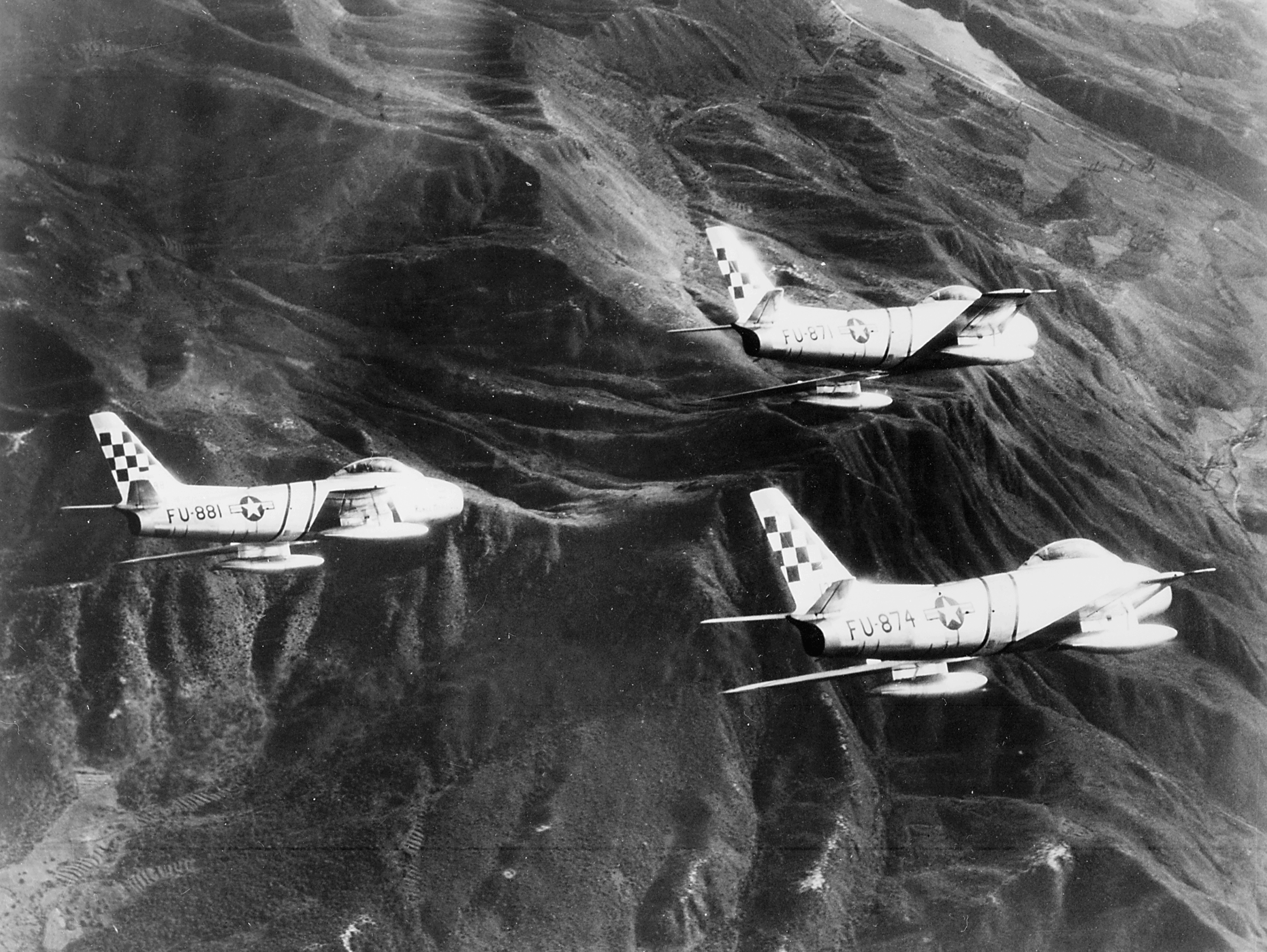
Header image: Four U.S. Air Force North American F-86E Sabre fighters over Korea in November 1952. Note that the first plane carries only a single drop tank. (Source: Wikimedia)

[1] Antulio J. Echevarria, War’s Logic: Strategic Thought and the American Way of War (Cambridge: Cambridge University Press, 2021), p. 177.

[2] Franklin C. Spinney, ‘Genghis John,’ Proceedings, Vol. 123 (1997).

[3] John R. Boyd, ‘Organic Design for Command and Control’ and ‘The Strategic Game of ? and ?,’ in Grant T. Hammond (ed.), A Discourse on Winning and Losing (Maxwell AFB: Air University Press, 2018), pp. 224 and 302.

[4] Martin van Creveld, Air Power and Maneuver Warfare (Maxwell AFB: Air University Press, 1994), p. 3.

[5] Grant T. Hammond, ‘Appendix – The OODA Loop,’ in A Discourse on Winning and Losing, pp. 383-5.

[6]  Frans P. B. Osinga, ‘The Enemy as a Complex Adaptive System: John Boyd and Airpower in the Postmodern Era’ in John Andreas Olsen (ed.), Airpower Reborn: The Strategic Concepts of John Warden and John Boyd (Annapolis, MD: Naval Institute Press, 2015), p. 50.

[7] Michael W. Hankins, Flying Camelot: The F-15, the F-16, and the Weaponization of Fighter Pilot Nostalgia (Ithaca, NY: Cornell University Press, 2021), p. 229.

[8] Stephen Robinson, The Blind Strategist: John Boyd and the American Art of War (Dunedin: Exisle Publishing, 2021), pp. 11 and 30.

[9] Email to author from Michael W. Hankins, 26 July 2023. Hankins also recommended that I read Xiaoming Zhang’s Red Wings over the Yalu: China, the Soviet Union, and the Air War in Korea (College Station, TX: Texas A&M University Press, 2002). I am incredibly grateful for this advice as it was the catalyst for this article. For further consideration regarding the kill ratio, the essential books to read also include Douglas C. Dildy and Warren Thompson’s F-86 Sabre vs MiG-15: Korea 1950-53 (Oxford: Osprey Publishing, 2012), Thomas McKelvey Cleaver’s MiG Alley: The US Air Force in Korea, 1950-53 (Oxford: Osprey Publishing, 2019) and Michael Napier’s Korean Air War: Sabres, MiGs and Meteors, 1950-53 (Oxford: Osprey Publishing, 2021).

[10] Quoted in Kenneth P. Werrell, ‘Aces and -86s: The Fight for Air Superiority during the Korean War,’ in Jacob Neufeld and George M. Watson, Jr. (eds.), Coalition Air Warfare in the Korean War 1950-1953 (Washington DC: US Air Force History and Museums Program, 2005), p. 62.

[11] Grant T. Hammond, The Mind of War: John Boyd and American Security (Washington DC: Smithsonian Books, 2001), pp. 65-6 and Frans P.B. Osinga, Science, Strategy and War: The Strategic Theory of John Boyd (Abingdon: Taylor and Francis, 2006), p. 21. Notably, the F-86F Sabre variant had considerable flight capability improvements over the earlier variants. Therefore, generalising Sabre flight characteristics without reference to specific variants is problematic. Dildy and Thompson, F-86 Sabre vs MiG-15, pp. 140-3.

[12] John R. Boyd, ‘Patterns of Conflict (Transcript),’ in Discourse on Winning and Losing, Marine Corps University, Quantico, 25 April/2 May/3 May 1989, p. 13.

[13] Boyd, ‘Patterns of Conflict (Transcript),’ p. 13.

[14] Hammond, The Mind of War, pp. 65-6.

[15] United States Air Force Historical Research Center, US Air Force Oral History Interview, K239.0512-1066, Colonel John R. Boyd, Corona Ace, 28 January 1977, p. 143.

[16] Robert Coram, Boyd: The Fighter Pilot Who Changed the Art of War (New York: Hachette, 2002), p. 255.

[17] John R. Boyd, ‘Patterns of Conflict (Delivered on 26 May 1978)’, in Proceedings of Seminar on Air Antitank Warfare, Battelle Columbus Laboratories, Columbus, 1978, pp. 7-8; Boyd, ‘Patterns of Conflict (Transcript) ’, pp. 13-4.

[18] The F-86E and F-86F variants had a new flight control system and hydraulics system without a manual backup, which made these models more responsive than the earlier and more common F-86A variant. Therefore, generalising Sabre agility is problematic as different Sabre variants had different hydraulic flight controls. Steven A. Fino, Tiger Check: Automating the US Air Force Fighter Pilot in Air-To-Air Combat, 1950-1980 (Baltimore, MD: Johns Hopkins University Press, 2017), pp. 84-5 and 533-4; Dildy and Thompson, F-86 Sabre vs MiG-15, pp. 35-6.

[19] U.S. Air Force Oral History Interview, p. 141.

[20] Boyd, ‘Patterns of Conflict (Delivered on 26 May 1978),’ p. 8.

[21] Boyd, ‘Patterns of Conflict (Delivered on 26 May 1978),’ pp. 6-8.

[22] James Fallows, ‘Muscle-Bound Superpower: The State of America’s Defense,’ The Atlantic (October 1979).

[23] James Fallows, National Defense (New York: Random House, 1981), p. 28.

[24] Quoted in Ian T. Brown, A New Conception of War: John Boyd, the U.S. Marines, and Maneuver Warfare (Quantico: Marine Corps University Press, 2018), p. 283.

[25] Quoted in Brown, A New Conception of War, p. 283.

[26] Quoted in Brown, A New Conception of War, p. 283.

[27] Werrell, ‘Aces and -86s,’ pp. 57 and 65.

[28] Fino, Tiger Check, p. 88.

[29] Hankins in Flying Camelot provided a comprehensive overview of the Fighter Mafia and Reformers movements and their opposition to ‘an overreliance on complex, expensive weapons.’ Hankins, Flying Camelot, p. 24.

[30] Quoted in Hankins, Flying Camelot, p. 142.

[31] Fino, Tiger Check, pp. 88 and 199.

[32] Michael W. Ford, Air-to-Air Combat Effectiveness of Single-Role and Multi-Role Fighter Forces (MA Thesis, US Army Command and General Staff College, 1984), pp. 51-2 and 121.

[33] Walter Kross, Military Reform: The High-Tech Debate in Tactical Air Forces (Washington DC: National Defence University Press, 1985), p. 97.

[34] William S. Lind, Maneuver Warfare Handbook (Boulder, CO: Westview Press, 1985), p. 4.

[35] Gary Hart and William S. Lind, America Can Win: The Case for Military Reform (Maryland: Adler and Adler, 1986), pp. 5-6.

[36] John R. Boyd, Patterns of Conflict Part 2. Ian Brown concluded that this version of ‘Patterns of Conflict’ available on YouTube dated from the early to mid-1980s: ‘Based on the sign in the background, this version of the brief dates to early-mid 1980s, when Rep. Jim Lightfoot would have been in office.’ Ian Brown, The John Boyd Primer, 25 September 2021.

[37] Boyd, Patterns of Conflict Part 2.

[38] Boyd, ‘Patterns of Conflict (Transcript), p. 13.

[39] Boyd, ‘Patterns of Conflict (Transcript), pp. 13-4.

[40] Robert Leonhard, The Art of Maneuver: Maneuver Warfare Theory and Airland Battle (New York: Random House Publishing Group, 1991), p. 51.

[41] Leonhard, The Art of Maneuver, p. 51.

[42] Spinney, ‘Genghis John.’

[43] Hammond, The Mind of War, p. 66.

[44] Coram, Boyd, p. 55.

[45] Chet Richards, Certain to Win: The Strategy of John Boyd, Applied to Business (Xlibris US 2004), p. 64.

[46] Osinga, Science, Strategy and War, p. 22.

[47] Brown, A New Conception of War, pp. 96-7.

[48] Brown, A New Conception of War, p. 11.

[49] Colin S. Gray, Modern Strategy (Oxford: Oxford University Press, 1999), p. 91.

[50] Igor Seidov, Red Devils over the Yalu: A Chronicle of Soviet Aerial Operations in the Korean War 1950-53 (Solihull: Helion and Company, 2014), pp. 27-8.

[51] Stuart Britton, ‘Editor’s Note,’ in Seidov, Red Devils over the Yalu, p. 20.

[52] Zhang, Red Wings over the Yalu, pp. 70-85.

[53] Kenneth P. Werrell, Sabres Over MiG Alley: The F-86 and the Battle for Air Superiority in Korea (Annapolis, MD: Naval Institute Press, 2005), p. 92.

[54] Dildy and Thompson, F-86 Sabre vs MiG-15, p .148.

[55] Dildy and Thompson, F-86 Sabre vs MiG-15, p. 152.

[56] Dildy and Thompson, F-86 Sabre vs MiG-15, p. 152.

[57] Walter J. Boyne, ‘Foreword,’ in Cleaver, MiG Alley, p. 8.

[58] Cleaver, MiG Alley, pp. 13-4.

[59] Cleaver, MiG Alley, p. 14.

[60] Cleaver, MiG Alley, p. 230.

[61] Cleaver concluded: ‘The USAF policy of “fudging the figures” regarding combat losses makes it difficult to come to a firm number of actual victories versus losses. In fact, for the entire war, researchers now believe that the “victory total” favors the USAF by something between 1.3 and 1.5 to one.’ Cleaver, MiG Alley, p. 14. Cleaver also stated: ‘While the majority of MiG pilots who opposed the Sabres were less-experienced Chinese, a victory/loss ratio of 10:1 as claimed after the war by the US Air Force, which was uncontradicted by information from the other side for 40 years, is not realistic. Researchers believe the figure was between 1.1:1–1.3:1 in favor of the Sabres’. Cleaver, MiG Alley, p. 230.

[62] Napier, Korean Air War, p. 419.

[63] Britton, ‘Editor’s Note,’ in Seidov, Red Devils over the Yalu, p. 21.

[64] Seidov, Red Devils over the Yalu, p. 1046.

[65] Zhang, Red Wings over the Yalu, p. 1878/4020.

[66] Dildy and Thompson, F-86 Sabre vs MiG-15, pp. 134-5

[67] Dildy and Thompson, F-86 Sabre vs MiG-15, pp. 134-5.

[68] Napier, Korean Air War, p. 420.

[69] Osinga explained that Boyd perceived ‘air combat as a contest of moves and countermoves in time, a contest in which a repertoire of moves and the agility to transition from one to another quickly and accurately in regard [to] the opponent’s options was essential.’ Osinga, Science, Strategy and War, p. 28.

[70] Werrell, Sabres Over MiG Alley, p. 221.

[71] Napier, Korean Air War, p. 205-7.

[72] Werrell, Sabres Over MiG Alley, p. 26.

[73] Seidov, Red Devils over the Yalu, p. 1050.

[74] Seidov, Red Devils over the Yalu, p. 1050.

[75] Quoted in Boyne, ‘Foreword,’ in Cleaver, MiG Alley, p. 8.

[76] Napier, Korean Air War, pp. 418-20.

[77] Dildy and Thompson, F-86 Sabre vs MiG-15, pp. 144-5.

[78] Quoted in Dildy and Thompson, F-86 Sabre vs MiG-15, p. 138.

[79] Napier, Korean Air War, p. 419.

[80] Napier, Korean Air War, p. 419.

[81] Napier, Korean Air War, p. 420.

[82] Napier, Korean Air War, p. 420.

[83] Fino, Tiger Check, p. 137.

[84] Cleaver, MiG Alley, p. 230.

[85] Werrell, Sabres Over MiG Alley, p. 219.

[86] Cleaver, MiG Alley, p. 230.

[87] Quoted in Dildy and Thompson, F-86 Sabre vs MiG-15, p. 139.

[88] Napier, Korean Air War, p. 410.

[89] Napier, Korean Air War, p. 410.

[90] Boyd condemned the Vietnam War ‘body count’: ‘They were thinking body count, attrition. That’s what they were thinking. I know exactly what they were thinking.’ Boyd, ‘Patterns of Conflict (Transcript),’ p. 43.

[91] Hammond, The Mind of War, p. 116.

[92] Osinga, Science, Strategy and War, p. 24.

[93] F-15 Eagles have been credited with 104 ‘kills’ without suffering any aerial combat losses. John T. Correll, ‘The Reformers,’ Air Force Magazine (2008), p. 44. F-16 Falcons have tallied 72 ‘kills’ without any air-to-air losses. Michael Sanibel and Dick Smith, ‘Quest to Build a Better Fighter,’ Aviation History, Vol. 21 no. 3 (2011), pp. 48-53.

[94] Hankins, Flying Camelot, p. 319.
OODA Loop or Coffee Break? Erich Hartmann and the Forgotten German ‘Decision Cycle’

OODA Loop or Coffee Break? Erich Hartmann and the Forgotten German ‘Decision Cycle’

By Stephen Robinson

There was not too much dogfighting for us. It requires a large area and is absolutely defensive.[1]

Erich Hartmann

Colonel John R. Boyd flew F-86 Sabres during the Korean War and later theorised the Observation-Orientation-Decision-Action (OODA) loop, initially focused on air-to-air combat. At first, Boyd considered the tactical requirements of test flight dogfights between the YF-16 and YF-17 prototypes in 1974 before analysing Sabre and MiG-15 combat in Korea. He expressed the basic idea of the OODA loop in a United States Air Force (USAF) oral history in 1977, although it was not fully formed with its familiar four stages.[2] However, it is not commonly known that another F-86 pilot had theorised a four-stage air-to-air combat ‘decision cycle’ in the 1940s – Luftwaffe pilot Erich Hartmann.

FRE_015069
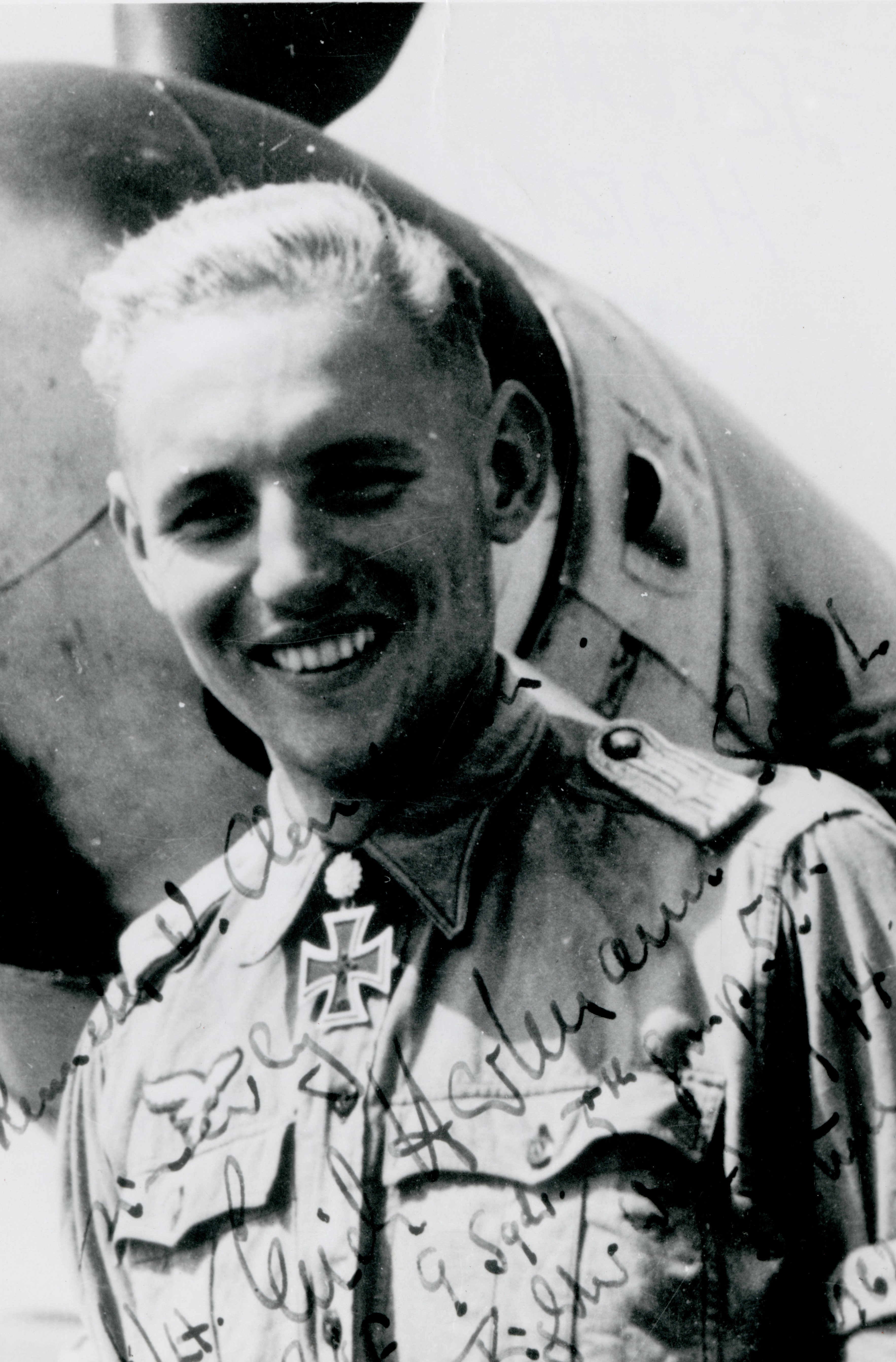
A signed copy of a photo of Erich Hartmann during the Second World War. (Source: Imperial War Museum)

During the Second World War, Hartmann flew 1,404 combat missions, participated in 825 air-to-air engagements and became history’s highest-scoring ace with 352 official kills, mainly over the Eastern Front.[3] During the Cold War, he later commanded West Germany’s first Sabre wing Jagdgeschwader 71 ‘Richthofen.’[4] Hartmann theorised the ‘Coffee Break’ concept, abbreviated as See-Decide-Attack-Break (SDAB). Writets Trevor J. Constable and Raymond F. Toliver articulated the idea in their bestseller The Blond Knight of Germany (1970), the first Hartmann biography, almost half a decade before the OODA loop emerged. Although their book romanticises the German military and fails to address Hartmann’s relationship with National Socialism adequately, it accurately depicts air combat tactics. In contrast, historian Erik Schmidt’s Black Tulip: The Life and Myth of Erich Hartmann, the World’s Top Fighter Ace (2020) thoroughly examines Hartmann’s role in the Third Reich and his fighter pilot career, which makes his book essential reading.

Hartmann and Boyd, in addition to flying Sabres and developing ‘decision cycles’, had much else in common. They were both aggressive fighter pilots with maverick independent streaks who declared war on their hierarchy late in their careers. Hartmann rebelled by opposing the F-104 Starfighter, which he considered unsafe, while Boyd went outside his chain of command to develop the unwanted Lightweight Fighter project.[5] Both men also retired as colonels in the 1970s.

At first glance, the SDAB cycle and the OODA loop are hard to distinguish. As John Stillion expressed: ‘Hartmann’s air combat procedure is strikingly similar to USAF Colonel John Boyd’s famous Observe, Orient, Decide, Act, or “OODA” loop.’[6] However, there is a critical difference. In an air combat context, the OODA loop is about winning dogfights, while the SDAB cycle is all about avoiding them. Additionally, Boyd’s OODA loop theory evolved from air combat to include land combat and then conflict in general before becoming a cognitive model explaining the mind’s relationship with reality. Hartmann’s method, as Schmidt concluded, is not ‘really a dogfighting strategy per se. It was more of an anti-dogfighting strategy.’[7]

Take a Coffee Break

Hartmann enlisted in the Luftwaffe in 1940 and joined Jagdgeschwader 52 in October 1942, flying Messerschmitt Bf 109 fighters. He initially became a wingman for Edmund Rossmann, who mentored the novice pilot. Rossmann had already been credited with over 80 kills, giving his advice considerable merit.[8] Hartmann learned that Rossmann had a wounded arm that prevented him from flying highly manoeuvrable dogfights, but he compensated for this injury by developing a specific tactic. After spotting the enemy, Rossmann patiently assessed the situation before deciding whether to attack. If he decided that surprise could be achieved, he would attack, which differed from the standard practice of immediately attacking a seen enemy.[9] Hartmann later reflected that Rossmann ‘taught me the basic technique of the surprise attack, without which I am convinced I would have become just another dogfighter.’[10] What Rossmann did out of necessity, Hartmann would soon do out of choice.

Hartmann scored his first aerial victory on 5 November 1942 by shooting down an Il-2 Sturmovik. However, shrapnel from the kill damaged his engine, forcing him to crash. While recovering in the hospital, Hartmann began to formulate his conception of air combat after reflecting that he should have approached closer before opening fire and disengaged quicker to prevent shrapnel from hitting his engine. Hartmann later recalled: ‘I learned two things that day: Get in close and shoot, and break away immediately after scoring the kill.’[11] Hartmann later formulated his trademark method, as Constable and Raymond explained:

The magical four steps were: “See – Decide – Attack – Reverse, or ‘Coffee Break’.” In lay terms, spot the enemy, decide if he can be attacked and surprised, attack him and break away immediately after striking; or if he spots you before you strike, take a “coffee break” – wait – pull off the enemy and don’t get into a turning battle with a foe who knows you are there.[12]

In a USAF interview in 1985, Hartmann was asked, “How did you develop your tactics of See, Decide, Attack, Reverse, or Coffee Break?” He answered:

I developed my tactics by watching my leader. My first leader, MSgt Eduard Rossmann, was always cautious. He said he didn’t like to pull a lot of Gs because of a bad shrapnel wound in his arm. He would look over each fight and decide if he would enter. When he did enter, it was always straight through – no turns – and he usually came home with a kill. My next leader, Sgt Hans Dammers, liked to turn and fly in the circus. The next man, 1st Lt Josef Swernemann was somewhere in between the two. He would be patient for a while, but then would get into a turning fight when he got frustrated. This is when I realized you must fight with your head, not your muscle.[13]

Hartmann rejected dogfighting as he considered it pointless and risky: ‘I also decided against aerial acrobatics, against what traditional pilots would call dog-fighting […] Acrobatics are a waste of time and therefore dangerous.’[14] Hartmann would always try to break contact after a pass before deciding if another pass was warranted and, as Constable and Raymond explained, ‘[e]ach pass was a repetition of the “See – Decide – Attack – Break” cycle.’[15]

Hartmann’s method was essentially hit-and-run tactics. As social scientists C. Hind and A. Nicolaides explained: ‘Hartmann became the ultimate and leading exponent of the stalk-and-ambush tactics, and he favoured the tactic of ambushing enemy aircraft and firing at them from very close range, about 20 m, rather than becoming involved in challenging and unnecessary dogfights.’[16]

The SDAB cycle is usually only mentioned in popular military aviation histories and is rarely referred to in scholarship. Edward E. Eddowes, who worked at the Air Force Human Resources Laboratory, submitted a paper to the First Symposium on Aviation Psychology in 1981. He declared: ‘Each engagement involves repetitions of the see, decide, attack, break discrimination-decision sequence. Like many of his predatory predecessors, Hartmann found turning contests hazardous and avoided them.’[17]

In another example, Captain James H. Patton, Jr., a retired naval officer, in his article ‘Stealth is a Zero-Sum Game: A Submariner’s View of the Advanced Tactical Fighter’ considered the SDAB cycle in 1991:

Top Gun instructors interpreted that terse guidance – based on interviews with Hartmann – to mean that a pilot should attempt to detect without being detected, judge whether he can attack covertly, close to a point that would almost assure a kill, and then disengage rapidly to repeat the process, rather than hang around in what submariners call a melee, and fighter pilots term the visual fur ball.[18]

Mikel D. Petty and Salvador E. Barbosa conducted an interesting air simulation experiment. They noted that USAF instructors supervise trainees undergoing virtual simulation-based training.[19] However, given the limited availability of instructors, they devised a means of testing a self-study-based training approach through simulation by following the progress of one test subject over eight years. The virtual pilot flew 2,950 missions in 138 campaigns using seven types of aircraft set in Europe in 1943-45 using Microsoft Combat Flight Simulator 3 (CFS3). The experiment required the subject to read air combat literature before applying the described tactics in the simulation. The study material included The Blond Knight of Germany, which outlined the SDAB cycle.[20] Petty and Barbosa confirmed the effectiveness of the SDAB cycle as ‘maneuvers and tactics described as effective in WWII air combat in the literature, e.g., those in Franks (1998) and Toliver and Constable (1970), were found by the subject to be very effective in CFS3 as well, if performed correctly.’[21]

The SDAB cycle has limitations, and Schmidt correctly concluded that it was well-suited to the Eastern Front but had less utility in Western Europe: ‘Hartmann’s Soviet enemies were, generally, less capable than the British and American pilots on the Western Front, which meant not only that they were easier to shoot down, but also that they were easier to evade and disengage from if the odds weren’t right.’[22] Therefore, applying SDAB cycles consistently in practice is impossible, and some dogfighting is inevitable, making the OODA loop relevant.

The OODA Loop

Boyd was familiar with Hartmann and mentioned him once in the 1977 USAF oral history stating that ‘[A]nd so, in that sense, a guy like Hartmann or a guy like Bong [Maj Richard I.] and some of these other good American aces – I could name others from other countries – they kind of knew they were going to win anyway. Maybe not in the beginning, but they built up that certain confidence and they had the desire.’[23] However, it is unclear if he read The Blond Knight of Germany or other references to the SDAB cycle, so we do not know if Hartmann influenced the OODA loop.[24] In any case, both models are opposites, so there is no suggestion of plagiarism. The basic idea of the OODA loop is to move faster than the enemy through a four-stage cycle, as military analyst Franklin C. Spinney, a close acolyte of Boyd, explained:

He [Boyd] thought that any conflict could be viewed as a duel wherein each adversary observes (O) his opponent’s actions, orients (O) himself to the unfolding situation, decides (D) on the most appropriate response or countermove, then acts (A). The competitor who moves through this OODA-loop cycle the fastest gains an inestimable advantage by disrupting his enemy’s ability to respond effectively.[25]

The victor, moving faster, seizes the initiative while the loser becomes paralysed by disorientation and panic.[26] The winner gets inside the loser’s OODA loop, which allows the pilot to manoeuvre into a winning firing position during a dogfight.[27] The OODA loop requires both pilots to dogfight long enough and complete enough loops for the winner to gain a relative speed advantage, which begins to sow disorientation and panic in the loser’s mind. More specifically, the pilots must complete enough OODA loops for the winner’s relative speed advantage to result in an action that changes the overall situation.[28] When this occurs, the loser’s actions, based upon the superseded earlier situation, fail to achieve the intended result, and they become confused as negative feedback overloads their brain. A pilot simply shooting down an enemy Hartmann-style before a clash of opposing OODA loops can occur is not applying Boyd’s model. If the OODA loop involved surprise and winning before the opponent reacts, there would be nothing original about the idea or way to distinguish it from the earlier SDAB cycle meaningfully.

The key difference between Hartmann and Boyd is that the SDAB cycle avoids dogfighting while the OODA loop requires dogfighting. Boyd was fixated on dogfighting as Frans P.B. Osinga explained: ‘[H]e [Boyd] developed the ability to see air combat as a contest of moves and countermoves in time, a contest in which a repertoire of moves and the agility to transition from one to another quickly and accurately in regard [to] the opponent’s options was essential.’[29]

Boyd’s manual Aerial Attack Study (1964), first published in 1960, explained all possible dogfighting manoeuvres without prescribed solutions.[30] Osinga concluded that Boyd ‘wanted to show people various moves and countermoves, and the logic of its dynamic.’[31] Aerial Attack Study reads like a chess strategy book. It is undoubtedly valuable, as Grant Hammond explained: ‘[M]any a fighter pilot, whether he knows it or not, owes his life to Boyd and the development of the tactics and manoeuvres explained in that manual.’[32] Former students who fought in Vietnam credit Boyd’s teaching for getting them out of danger. For example, on 4 April 1965, Major Vernon M. Kulla engaged North Vietnamese MiG-17s while flying an F-105 Thunderchief. Before the MiG-17 could open fire, Kulla successfully conducted a snap roll that he learned from Boyd, forcing the communist pilot to overshoot.[33] Therefore, Boyd certainly taught useful air-to-air tactical skills.

Despite Boyd’s obsession with dogfighting, it is rarer than many assume. Historically speaking, in most cases, victory goes to the pilot, who spots the enemy first and wins before the opponent can react. As Barry D. Watts explained:

To start with historical combat data, combat experience going at least back to World War II suggests that surprise in the form of the unseen attacker has been pivotal in three-quarters or more of the kills. For example, P-38 pilot Lieutenant Colonel Mark Hubbard stressed that, in his experience over northern Europe with the U.S. Eighth Air Force, “90% of all fighters shot down never saw the guy who hit them.” Similarly, the German Me-109 pilot Erich Hartmann […] has stated that he was “sure that eighty percent” of his kills “never knew he was there before he opened fire.”[34]

This trend continued during the Vietnam War from April 1965 to January 1973, as approximately 80 per cent of personnel shot down from both sides never saw the other aircraft or had insufficient time to make a countermove.[35] Accordingly, Watts concluded: ‘[W]hat historical air combat experience reveals, therefore, is that upwards of 80 per cent of the time, those shot down were unaware that they were under attack until they either were hit or did not have time to react.’[36]

Most air-to-air kills did not involve dogfighting and, consequently, clashes of opposing OODA loops involving sequences of moves and countermoves. Most air-to-air engagements end before the loser has time to act. Even when dogfighting occurs, it can be over in seconds, as Schmidt explained:

Amazingly, the whole dance of a dogfight could take place over the course of just a few seconds. The famed American pilot Robin Olds, who flew P-38s and P-51s in World War II and F-4 Phantoms in Vietnam, said: “Usually in the first five seconds of a dogfight, somebody dies. Somebody goes down. You want to make sure it’s the other guy.”[37]

Therefore, the OODA loop is not always applicable in dogfights because other factors often decide the outcome before the winner’s faster speed can generate negative feedback in the loser’s mind, which is a more gradual process involving moves and countermoves.

Boyd, without intending to, contradicted the essence of the OODA loop by expressing a sentiment identical to the SDAB cycle:

So that’s why he [the fighter pilot] wants to pick and choose engagement opportunities. He wants to get in, get out, get in, and get out. Why does he want to do that? Because it’s not just one-to-one air-to-air combat up here. It’s what the pilots like to say, many-upon-many. In other words, if you’re working over one guy, somebody else is going come in and blindside you. So you want to spend as little time with a guy as possible. You need to get in, gun him, and get the hell out.[38]

Ironically, Boyd preferred the hit-and-run essence of the SDAB cycle, as picking and choosing engagement opportunities and cycles of getting in and out to avoid danger sounds just like Hartmann. Therefore, engaging in an elongated OODA loop duel with another pilot is inherently risky due to the possible presence of other enemy fighters. However, there is still a critical difference as Boyd believed that the best way to break contact was by conducting a ‘fast transient’ – a rapid transition from one manoeuvre to another that allows a pilot to kill before quickly disengaging.[39] However, a pilot can only conduct a ‘fast transient’ if they are already in a dogfight. Hartmann instead preferred to dive at an unsuspecting enemy using superior speed in a single pass and then to use the momentum gained to break contact without any acrobatics, dogfighting or ‘fast transients’.

Boyd also stressed: ‘[T]hink of it in space and time. In space, you’re trying to stay inside his manoeuvre; in time, you want to do it over a very short period of time, otherwise you’re going to become vulnerable to somebody else.’[40] Therefore, Boyd advocated elongated OODA loop duels to gradually generate negative feedback while inconsistently wanting to restrict engagements to minimal periods due to the risk of other enemy fighters. Ultimately, Boyd failed to reconcile the need to rapidly break contact after an attack to avoid danger with the time required for enough OODA loop cycles to generate disorientation and panic in the loser’s mind.

Aces and Iteration

The key advantage of the SDAB cycle is that it minimises risk. However, a pilot intending a surgical hit-and-run strike may inadvertently find themselves in a dogfight, and then the logic of the OODA loop might become paramount. Nevertheless, engaging in an OODA loop contest inherently makes one vulnerable. As Jim Storr explained: ‘[T]here is considerable advantage in reacting faster than one’s opponent, but the OODA Loop does not adequately describe the process. It places undue emphasis on iteration instead of tactically decisive action.’[41] After attacking, Hartmann would break contact to prevent iteration and only committed to further passes in favourable conditions. The avoidance of iteration is also evident in the tactical methods of other aces, and Storr stressed that ‘biographies of aces […] show almost no trace of iterative behaviour in combat.’[42] Hartmann’s tactics worked because he avoided dogfighting. As Storr similarly expressed:

Critically, aces scarcely ever dogfight. They usually destroy enemy aircraft with a single pass, and expend very little ammunition per aircraft shot down. Their effectiveness centres on rapid, decisive decision and action. It is based on superlative, largely intuitive, situational awareness. Aces do display some significant characteristics – their eyesight is usually exceptional and their shooting phenomenal. They also have catlike reactions. However, expert fighter combat is fundamentally not iterative. It is sudden, dramatic and decisive.[43]

Boyd valued manoeuvrability over speed, while Hartmann preferred speed over manoeuvrability. Neither is right or wrong, and there is undoubtedly a degree of pilot preference. Hartmann’s approach was only made possible by exceptional eyesight, which allowed him to apply successful SDAB cycles consistently. Understandably, pilots with poorer eyesight might prefer manoeuvrability. After all, most pilots never become aces, so there is value in applying lessons from both Hartmann and Boyd’s approaches.

Conclusion

Boyd advocated getting inside the enemy’s OODA loop to disrupt their decision-making process and force them to make defeat-inducing inappropriate actions. In contrast, Hartmann had no intention of getting inside the enemy’s ‘decision cycle’. He usually won before the enemy knew of his presence or had time to act. There is no need to disrupt the enemy’s decision-making process if they have no time or opportunity to make decisions, and in such circumstances, the OODA loop is redundant. As such, Boyd neglected the importance of who spots who first and the corresponding likelihood that most engagements will be decided before sequences of moves and countermoves can occur.

Of course, manoeuvrable dogfighting cannot always be avoided, so the OODA loop certainly has merit. For example, an F-35 Lightning II would ideally only shoot down unsuspecting enemy fighters with long-range missiles beyond visual range. However, it is armed with 25mm cannons just in case dogfighting occurs. Nevertheless, air-to-air engagements have declined since the Vietnam War, while situational awareness has dramatically increased due to improved radar and airborne early warning and control (AEW&C) platforms. Therefore, the ratio of air-to-air kills occurring beyond visual range will likely continue to increase. Consequently, the future of OODA loop-style dogfighting is uncertain but becoming increasingly rare. At the same time, the core of Hartmann’s method remains valid. Pilots can now ‘see’ at great range with radar and ‘decide’ whether to ‘attack’ with the assistance of AEW&C. However, there may be no need for a clean ‘break’ since pilots no longer must get close thanks to long-range missiles.

The OODA loop depicts air-to-air combat as a duel between two minds going through cycles in which both pilots have a ‘sporting chance’, which reflects the ‘Knights of the Air’ myth from the First World War.[44] In contrast, Hartmann was like a sniper, describing his preferred tactic as ‘[C]oming out of the sun and getting close; dog-fighting was a waste of time. The hit and run with the element of surprise served me well, as with most of the high scoring pilots.’[45] Boyd, in contrast, is like a chess enthusiast who loves the moves and countermoves of the game. However, OODA loop-like dogfights only occur in a minority of air-to-air encounters. Therefore, Boyd’s model only has limited utility in air combat.

The SDAB cycle demonstrates that the OODA loop is not the only ‘decision cycle’. Despite its impeccable origins in combat experience, Hartmann’s tactical method is not well-known today partly because he never transformed the SDAB cycle into a general theory of conflict. In contrast, Boyd considered the more abstract OODA loop to be a universal guide to military success, applicable beyond the air domain at all levels of conflict. Boyd also believed that the OODA loop explained any competitive endeavour – such as politics, business, and sports – as well as human cognitive processes and behaviour in general. As Osinga explained concerning Boyd’s final version of the OODA loop: ‘[I]t is a model of individual and organizational-level learning and adaptation processes, or – to use Boyd’s own terms – a meta-paradigm of mind and universe, a dialectic engine, an inductive-deductive engine of progress, a paradigm for survival and growth, and a theory of intellectual evolution.’[46] Hartmann never transformed his straightforward air-to-air tactic into something grander. Another reason the SDAB cycle is not well-known is that Hartmann did not devote his retirement to promoting the concept: ‘I instructed and flew at a few air clubs, and flew in an aerobatics team with Dolfo Galland. Later I just decided to relax and enjoy life.’[47] In contrast, Boyd spent much of his retirement expanding, refining and disseminating his theories, including the OODA loop.

Boyd considered the OODA loop a universal and unchangeable fact of life – we have OODA loops whether we like it or not, and that is the model that best explains our relationship with reality.[48] Therefore, Boyd became imprisoned by totalising thinking while Hartmann didn’t, primarily because he never overanalysed his model. The SDAB cycle was an artificial way of thinking based on experience and circumstance. Hartmann demonstrates that we can manufacture our own ‘decision cycles’ through trial and error, tailoring them to meet specific needs and requirements. He also reminds us that ‘decision cycles’ do not have to be grand cognitive models. Above all, we are free to choose and experiment as Hartmann did. Numerous ‘decision cycles’ can coexist with different strengths and weaknesses. Therefore, it makes no sense to select one model for every situation.

Although the OODA loop (dogfighting) and the SDAB cycle (anti-dogfighting) are opposites, they can be complementary when synthesized. The OODA loop and the SDAB cycle become the opposite ends of a broad spectrum of options between those extremes. Most pilots probably operate somewhere between those two poles, taking their talents, aircraft characteristics, and specific circumstances into account. Boyd would favour synthesising the OODA loop and the SDAB cycle because doing so precisely aligns with the dialectical logic he expressed in his enlightening article Destruction and Creation (1976).[49] He also championed synthesis through his snowmobile allegory in his remarkable briefing, The Strategic Game of ? and ?.[50] The allegory is a thought experiment involving the image of a skier, a motorboat, a bicycle and a toy tractor. All these concepts can be broken down into sub-components through a destructive process, resulting in skis, motorboat engines, bicycle handlebars and rubber treads. These useful sub-components from different origins can then be reassembled into something new through a creative process, resulting in a new concept – a snowmobile. Boyd never stated that his ideas are exempt from the dialectical logic of destruction and creation. Therefore, subjecting the OODA loop to destruction and creation is inherently positive and can offer new insights into air combat.

Stephen Robinson is an officer in the Australian Army Reserve currently serving in the Australian Army History Unit. He is the author of False Flags: Disguised German Raiders of World War II (2016), Panzer Commander Hermann Balck: Germany’s Master Tactician (2019), The Blind Strategist: John Boyd and the American Art of War (2021) and Eight Hundred Heroes: China’s Lost Battalion and the Fall of Shanghai (2022).

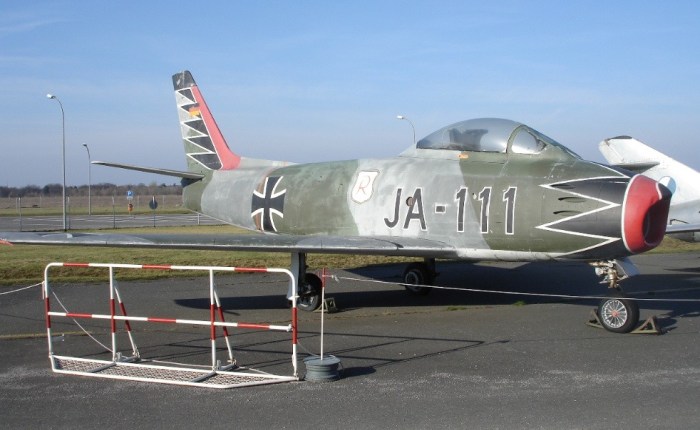
Header image: A Canadair Sabre at the Militärhistorisches Museum der Bundeswehr – Flugplatz Berlin-Gatow in Hartmann markings from when he commanded JG71, c. 2007 (Source: Wikimedia)

[1] Quoted in Edward H. Sims, Fighter Tactics and Strategy 1914-1970 (New York: Harper and Row, 1972), p. 208.

[2] Boyd referred to the ‘observation-decision-action time scale’ in the interview, which is not yet the familiar OODA loop since it lacks the orientation stage. United States Air Force Historical Research Center, U.S. Air Force Oral History Interview, K239.0512-1066, Colonel John R. Boyd, Corona Ace, 28 January 1977, p. 132.

[3] Erik Schmidt, Black Tulip: The Life and Myth of Erich Hartmann, the World’s Top Fighter Ace (Philadelphia, PA: Casemate Publishers, 2020), p. xiii.

[4] Schmidt, Black Tulip, p. 130.

[5] Schmidt, Black Tulip, p. 134; Robert Coram, Boyd: The Fighter Pilot Who Changed the Art of War (New York: Hachette Book Group, 2002), p. 244.

[6] John Stillion, Trends in Air-to-Air Combat: Implications for Future Air Superiority (Washington DC: Center for Strategic and Budgetary Assessments, 2015), p. 6.

[7] Schmidt, Black Tulip, p. 64.

[8] Philip Kaplan, Fighter Aces of the Luftwaffe in World War II (Barnsley: Pen and Sword Books, 2007), p. 192.

[9] Trevor J. Constable and Raymond F. Toliver, The Blond Knight of Germany (New York: Ballantine Books, New York, 1970), pp. 43-4.

[10] Quoted in Kaplan, Fighter Aces of the Luftwaffe in World War II, p. 195.

[11] Colin D. Heaton, ‘Final Thoughts of the Blond Knight,’ World War II 17, no. 3 (2002), p. 33.

[12] Constable and Toliver, The Blond Knight of Germany, p. 55.

[13] Rich Martindell and Bill Mims, ‘An Interview with Erich Hartmann, the Ace of Aces,’ in Tac Attack (Washington DC: Department of the Air Force, 1985), p. 23.

[14] Quoted in William Tuohy, ‘German Pilot Reported 352 Kills Hope of Top WWII Flier: No Need for New Air Aces,’ Los Angeles Times, 3 January 1986.

[15] Constable and Toliver, The Blond Knight of Germany, p. 86.

[16] C. Hind and A. Nicolaides, ‘Ace of Aces: Erich Hartmann the Blond Knight of Germany,’ Open Journal of Social Sciences 8 (2020), pp. 388-9.

[17] Edward E. Eddowes, ‘Measuring Pilot Air Combat Maneuvering Performance’ in First Symposium on Aviation Psychology (The Ohio State University Columbus: The Aviation Psychology Laboratory, 1981), p. 340.

[18] James H. Patton, Jr., ‘Stealth is a Zero-Sum Game: A Submariner’s View of the Advanced Tactical Fighter,’ Airpower Journal 5, no. 1 (1991), p. 7.

[19] Mikel D. Petty and Salvador E. Barbosa, ‘Improving Air Combat Maneuvering Skills Through Self-Study and Simulation-Based Practice,’ Simulation & Gaming 47, no. 1 (2016), p. 105.

[20] Petty and Barbosa, ‘Improving Air Combat Maneuvering Skills,’ p. 111.

[21] Petty and Barbosa, ‘Improving Air Combat Maneuvering Skills,’ p. 123.

[22] Schmidt, Black Tulip, p. 64.

[23] U.S. Air Force Oral History Interview, p. 240.

[24] In addition to The Blond Knight of Germany, Boyd may have read Edward H. Sims’ Fighter Tactics and Strategy 1940-1970 (1972), which also explained the SDAB cycle before the OODA loop emerged. Sims, Fighter Tactics and Strategy, 204-5

[25] Franklin C. Spinney, ‘Genghis John,’ Proceedings 123 (1997).

[26] Boyd advised in ‘Organic Design for Command and Control’ to operate inside enemy OODA loops ‘to enmesh adversary in a world of uncertainty, doubt, mistrust, confusion, disorder, fear, panic chaos.” Boyd also added in ‘The Strategic Game of ? and ?’: “Operating inside their OODA loops will accomplish just this by disorienting or twisting their mental images so that they can neither appreciate nor cope with what’s really going on.’ John R. Boyd, ‘Organic Design for Command and Control’ and ‘The Strategic Game of ? and ?,’ in Grant T. Hammond (ed), A Discourse on Winning and Losing (Maxwell AFB: Air University Press, 2018), p. 224 and 302.

[27] Boyd, towards the end of his life, refined the OODA loop into a vastly more complex idea involving multiple feedback loops and different relationships and pathways between the four stages. However, the idea of getting inside the enemy’s OODA loop and gaining a relative speed advance is evident in the earlier basic OODA loop and the final complex OODA loop. This key idea remained constant during the OODA loop’s evolution. Therefore, when referring to the OODA loop in this article, all versions of the OODA loop are referred to unless otherwise specified.

[28] U.S. Air Force Oral History Interview, p. 134.

[29] Frans P.B. Osinga, Science, Strategy and War: The Strategic Theory of John Boyd (New York: Routledge, 2006), p. 28.

[30] John R. Boyd, Aerial Attack Study, 50-10-6C, 1964.

[31] Osinga, Science, Strategy and War, p. 22.

[32] Grant Hammond, The Mind of War: John Boyd and American Security (Washington DC: Smithsonian Books, 2001), p. 80.

[33] Thomas McKelvey Cleaver, Going Downtown: The US Air Force over Vietnam, Laos and Cambodia, 1961-75 (Oxford: Osprey Publishing, 2022), p. 102.

[34] Barry D. Watts, Doctrine, Technology, and War, Air & Space Doctrinal Symposium Maxwell AFB, Montgomery, Alabama 30 April-1 May 1996.

[35] Watts, Doctrine, Technology, and War.

[36] Watts, Doctrine, Technology, and War.

[37] Schmidt, Black Tulip, p. 69.

[38] John R. Boyd, ‘Patterns of Conflict (Transcript),’ in Discourse on Winning and Losing, Marine Corps University, Quantico, 25 April, 2 May, 3 May 1989, p. 10.

[39] Boyd, ‘Patterns of Conflict (Transcript),’ p. 10.

[40] Boyd, ‘Patterns of Conflict (Transcript),’ p. 10.

[41] Jim Storr, The Human Face of War (London: Bloomsbury Publishing 2009), p. 13.

[42] Storr, The Human Face of War, p. 13.

[43] Storr, The Human Face of War, p. 13.

[44] For a comprehensive analysis of Boyd’s relationship with the ‘Knights of the Air’ myth, see Michael W. Hankins, Flying Camelot: The F-15, the F-16, and the Weaponization of Fighter Pilot Nostalgia (Ithaca, NY: Cornell University Press, 2021).

[45] Heaton, ‘Final Thoughts of the Blond Knight,’ p. 33.

[46] Frans P. B. Osinga, ‘The Enemy as a Complex Adaptive System: John Boyd and Airpower in the Postmodern Era,’ in John Andreas Olsen (ed.), Airpower Reborn: The Strategic Concepts of John Warden and John Boyd (Annapolis, MD: Naval Institute Press, 2015), p. 74.

[47] Heaton, ‘Final Thoughts of the Blond Knight,’ p. 85.

[48] Boyd explained in Patterns of Conflict: ‘It doesn’t make any difference whether you’re a Russian, you’re an Englishman, an American, Chinese or what. You have to observe what the hell’s going on here. Then you have to, as a result of that, looking at the world, you generate images, views, and impressions in your mind. That’s what you call orientation. Then as a result of those images, views, and impressions, you’re going have to make a selection, what you’re going to do or what you’re going to do, that’s a decision. And then you’re going to have to implement or take the action.’ Boyd, ‘Patterns of Conflict (Transcript),’ p. 11.

[49] John R. Boyd, Destruction and Creation (Paper), 3 September 1976, pp. 2-3.

[50] Boyd, ‘The Strategic Game of ? And ?,’ pp. 261-5.

#Podcast – The F-15 and F-16: Fighter Pilot Culture and Technology: An Interview with Dr Michael Hankins

#Podcast – The F-15 and F-16: Fighter Pilot Culture and Technology: An Interview with Dr Michael Hankins

Editorial Note: Led by our Editor Dr Mike Hankins, From Balloons to Drones produces a monthly podcast that provides an outlet for the presentation and evaluation of air power scholarship, the exploration of historical topics and ideas, and provides a way to reach out to both new scholars and the general public. You can find our Soundcloud channel here. You can also find our podcast on Apple Podcasts and Google Podcasts.

Our own co-host Michael Hankins discusses his new book, Flying Camelot: The F-15, the F-16, and the Weaponization of Fighter Pilot Nostalgia, from Cornell University Press. We look at the development process of the F-15 Eagle and the F-16 Fighting Falcon, talk about the elements of fighter pilot culture, and the ever-controversial Colonel John Boyd.

41jlB582OhL

Dr Michael Hankins is the Curator for US Air Force, Navy, and Marine Corps post-World War II Aviation at the Smithsonian National Air and Space Museum and the author of Flying Camelot: The F-15, the F-16, and the Weaponization of Fighter Pilot Nostalgia (2021). He is the Podcast Editor at From Balloons to Drones, a former Professor of Strategy at the USAF Air Command and Staff College eSchool, and former Instructor of Military History at the US Air Force Academy. He earned his PhD in history from Kansas State University in 2018 and his master’s in history from the University of North Texas in 2013. He has a web page here and can be found on Twitter at @hankinstien.

Header image: This cartoon from a 1977 General Dynamics briefing depicts the ‘myth’ that the F-16 production model had inferior performance to the original YF-16 prototype (Source: Lockheed Martin photo via Smithsonian National Air and Space Museum).

Who Ruined the F-16? The Fighter Mafia’s Battle against the United States Air Force

Who Ruined the F-16? The Fighter Mafia’s Battle against the United States Air Force

By Dr Michael W. Hankins

Editorial note: This article is adapted from an excerpt from Flying Camelot: The F-15, the F16, and the Weaponization of Fighter Pilot Nostalgia, by Michael W. Hankins. Copyright (c) 2021 by Michael Wayne Hankins and Smithsonian Institution. Used by permission of the publisher, Cornell University Press.

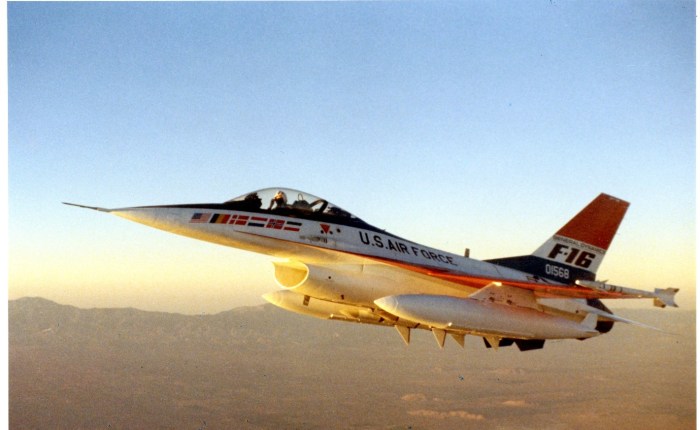
On January 20, 1974, test pilot Phil Oestricher began a high-speed taxi test of the General Dynamics YF-16 prototype. When the plane went into an oscillating roll that slammed the left-wing into the ground, he decided it was safer to just take off for what became the aircraft’s first flight. The YF-16 was a passion project for many people across the aerospace defense community, especially a group known as the ‘Fighter Mafia,’ led by US Air Force (USAF) Colonel John Boyd. The group also included General Dynamics engineer Harry Hillaker, analyst Pierre Sprey, fighter pilot Everest Riccioni, analyst Thomas Christie, among many others. The YF-16 was the realization of their dream of a lightweight, ultra-specialized dogfighter – what Oestricher called ‘a pure air-to-air fighter airplane […] the Camelot of aeronautical engineering.’[1]

Yet, when USAF began the process of turning the YF-16 into the production model F-16A Fighting Falcon, the Fighter Mafia became bitterly opposed to the process. Their extreme frustration with the changes to the airplane set the stage for later debates as the group expanded and morphed into the Defense Reform Movement.

YF-16_and_YF-17_in_flight
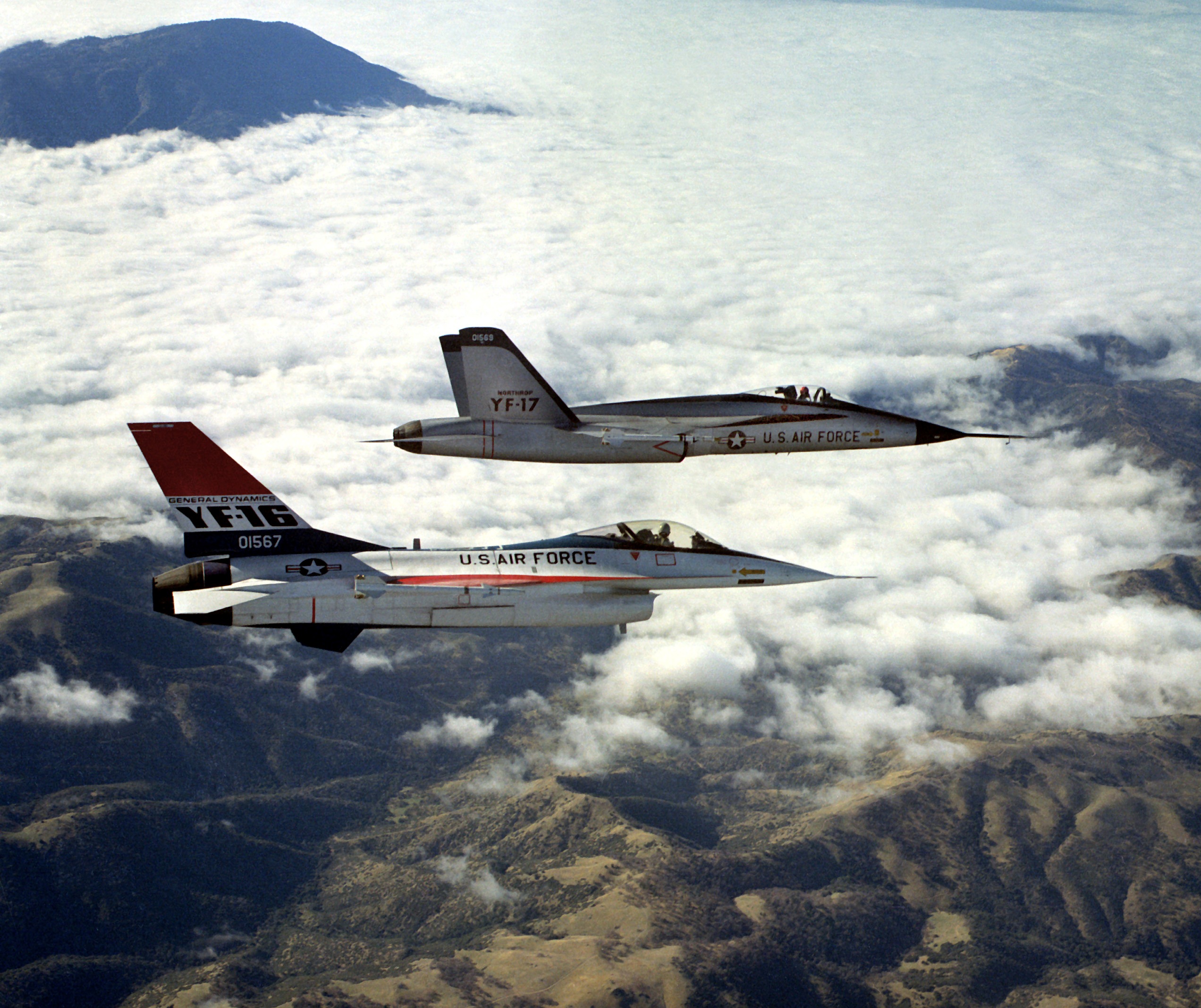
An air-to-air right side view of a YF-16 aircraft and a YF-17 aircraft, side-by-side, armed with AIM-9 Sidewinder missiles. (Source: Wikimedia)

After winning a flyoff competition in January 1975 against Northrop’s YF-17 Cobra, the F-16 design went to the Configuration Control Committee, headed by former fighter pilot General Alton Slay, to produce an operational version of the plane. The Fighter Mafia nicknamed this group the ‘Add-On Committee,’ assuming Slay’s role was to exact the Air Force’s revenge by making sure the F-16 did not threaten the F-15 Eagle program. That meant turning the Fighting Falcon into a multi-role craft emphasizing ground attack.[2]

Christie, and his subordinate Robert J. Croteau, tried to stop this process before it started with a memo to Leonard Sullivan, Jr., the Director of Defense Program Analysis and Evaluation. They warned that moving away from the focus on air superiority would ‘subvert the purpose of the entire LWF/ACF [Lightweight fighter/Air Combat Fighter] program.’ The radar was the largest point of contention. They argued that a small radar such as the APQ-153 used in the F-5 was plenty. They wanted a configuration ‘based on primary commitment of the ACF to intense high frequency dogfights.’[3]

Instead, the production version of the F-16 put on almost 1,000 pounds. The landing gear was strengthened, the fuselage, wings, and tail area grew, and a tailhook was added. Chaff and flare systems and improved avionics also appeared. The production model added more pylons for ground-attack ordnance, with the existing pylons strengthened for heavier weapons. The loading capacity almost doubled, from 7,700 pounds to 15,200. Although the acceleration and agility of the operational F-16 was slightly less than the prototype YF-16, the production model did have increased range, thrust, and load factor, able to pull 9 Gs.[4]

The Air Force added a ground-looking, all-weather, night-capable, medium-range radar to the F-16, the Westinghouse AN/APG-66. The company maintained that this system was ‘The Fighter Pilot’s Radar,’ that would ‘allow the pilot to keep his head up and his hands on the throttle and stick throughout a dogfight engagement.’ With the flick of a switch, the radar provided ground mapping, improved with a Doppler beam, for both navigation and weapons delivery.[5] The avionics systems incorporated Boyd’s ‘Energy Maneuverability Theory’ into the cockpit via an ‘Energy-Maneuverability Display’ that gave pilots visual cues to indicate their current available energy, how to maximize their turn rates, the level of G-forces available, altitude and airspeed limits, and how to gain maneuvering energy quickly.[6]

Picture3
The YF-16 displayed alongside the ground attack armament it can carry, Edwards AFB, California, 12 February 1975 (Source: US Air Force)

Slay thought that the F-16 could complement the F-15 best if it was a multi-role aircraft. As he told the Senate in 1976:

The F-16 has a capability that the F-15 does not have, deliberately so. We did not choose to burden the F-15 radar with a significant air-to-ground capability. We have engineered the F-16 radar to have very good ground mapping [and] to do an extremely good job of air-to-ground missions.[7]

Slay appreciated the F-16’s maneuverability, noting ‘I almost had a heart attack watching the F-16 do a split ‘S’ from 2,700 feet. It was fantastic as far as maneuverability is concerned.’ He argued this made it useful in roles beyond dogfighting:

[t]he things that made [the F-16] good in an air-to-air role […] were extremely good in [an] air-to-ground context […] We got more than we paid for in having a multipurpose capable airplane.[8]

Boyd was unhappy with these changes and wrote to Slay several times in the opening months of 1975, arguing that ‘F-16 maneuvering performance has diminished significantly because of engineering necessity and conscious decisions that resulted in a substantial weight increase.’ Boyd said that the wing area, which had already been increased from 280 to 300 square feet, must be increased further to 320 to preserve the plane’s agility. This plan was rejected due to increased cost and a perception of increased risk with a larger wing.[9]

Boyd remained cordial in his correspondence with Slay, but privately, he and the rest of the Fighter Mafia seethed. Major Ray Leopold, Boyd’s assistant and mentee, described the group as worried that the F-16 would be ‘a disastrous compromise’ and ‘fall prey to the same vagrancies of the bureaucracy’ that the F-15 had. Leopold recalled Boyd complaining about the addition of armor plating, arguing that ‘it was mor[e] important to be maneuverable and less likely to get hit in the first place.’ He railed against the increase in bombing capacity, claiming that ‘the original concept of designing for energy maneuverability was compromised.’ Sprey was frustrated as well, claiming that the Air Force ‘degraded’ the F-16 more than they had the F-15 by increasing its size and adding equipment, most of all the radar.[10]

Hillaker, however, was not against some of the changes. Although he said that Boyd and Sprey’s frustration was reasonable, he recognized that the mafia’s original design was perhaps too limited: ‘If we had stayed with the original lightweight fighter concept,’ he explained, ‘that is, a simple day fighter, we would have produced only 300 F-16s.’[11]

On February 4, 1975, Croteau and Christie wrote to Sullivan, arguing that the changes to the F-16 were ‘unacceptable.’ They believed that the aircraft should have ‘a minimum of sophistication,’ that the additional avionics and radar capabilities were too complex and expensive, and that the added weight reduced performance in air combat. They charged: ‘Extensive air-to-ground capability of [the] proposed configuration compromises air-to-air capability.’ Croteau’s memo did present a potential design that offered the compromise of accepting some avionics, a radar, and limited ground-attack capability, but not including all the Air Force’s changes.[12] This model was not adopted.

By February 21, test pilot Chuck Myers sent a memo to Defense Secretary James Schlesinger’s special assistant, Martin Hoffman, arguing that the changes made to the plane made it ‘a far cry from the austere FIGHTER’ that the Fighter Mafia had envisioned, and that USAF needed to ‘restore the character of the airplane.’[13] He gave instructions for fixing the plane, titled ‘F-16 (LWF/ACF) PROGRAM RESTORATION.’ It excoriated the inclusion of ground attack and radar capability, then charged: ‘The expansion of mission spectrum is accomplished with an associated increases [sic] in weight, complexity, support burden and a loss of air combat maneuvering capability, the one mission for which the original design had been optimized.’ The paper concluded: ‘This mutilation of the character of the LWF through the ACF missionization process is a management travesty which cannot go unchallenged.’[14]

Members of the Fighter Mafia tended to assume that the changes made to the F-16 were retaliation for their challenges to the Air Staff. However, the Air Force had understandable reasons for adding additional capabilities to the F-16. The Air Staff argued that if the F-16 had no ground attack capability, then it could not truly replace the F-4 Phantom, which USAF wanted to phase out while preserving mission capabilities. If the F-16 conformed to the Fighter Mafia’s vision, then 30 percent of the Air Force inventory would be incapable of attacking ground targets. The Air Staff found that unacceptable. Although the F-16 could achieve air superiority, the aircraft would be useless once that superiority had been achieved in a conflict. By adding ground-attack functions, the Air Staff argued, the F-16 could be used in a ‘swing role’ to attack ground targets after air superiority had been won.[15]

An austere F-16 likely would have faced challenges without substantial radar capability. The inability to operate at night or in low-visibility weather conditions would render the aircraft problematic at best. Given that US planners expected a potential Soviet mass attack to occur in Europe, known for its often-cloudy weather conditions, deploying large numbers of such a clear sky, day-only fighter in that scenario would leave US forces particularly vulnerable. No amount of maneuverability could overcome the inability to see through clouds or in the dark against other aircraft that could. It is possible that some Air Force officials could have sought some sort of retaliation against the Fighter Mafia’s pet project, but the case for multi-role requirements had logical arguments behind it and came from a wide group.

Picture1
This cartoon from a 1977 General Dynamics briefing depicts the ‘myth’ that the F-16 production model had inferior performance to the original YF-16 prototype (Source: Lockheed Martin photo via Smithsonian National Air and Space Museum).

The F-16 modifications were a breaking point for Boyd and the Fighter Mafia. During the late 1970s, Boyd frequently gathered with his acolytes, complaining that the Air Force’s ‘goldplating’ was destroying the ‘pure’ fighter he had designed. After this point, Boyd focused entirely on his intellectual activities. He and others set their sights on different issues, sometimes regarding military hardware, but also doctrine, education, and procurement. These efforts expanded his movement. The Fighter Mafia soon took their arguments beyond the halls of the Pentagon and directly to the public.

Dr Michael Hankins is the Curator for US Air Force, Navy, and Marine Corps post-World War II Aviation at the Smithsonian National Air and Space Museum and the author of Flying Camelot: The F-15, the F-16, and the Weaponization of Fighter Pilot Nostalgia (2021). He is a former Professor of Strategy at the USAF Air Command and Staff College eSchool, and former Instructor of Military History at the US Air Force Academy. He earned his PhD in history from Kansas State University in 2018 and his master’s in history from the University of North Texas in 2013. He has a web page here and can be found on Twitter at @hankinstien.

[1] Quoted in Wade Scrogham, Combat Relevant Task: The Test & Evaluation of the Lightweight Fighter Prototypes (Edwards AFB: Air Force Test Center History Office, 2014), p. 67.

[2] James Fallows, National Defense (New York: Vintage, 1982), p 105; Grant Hammond, Mind of War: John Boyd and American Security (Washington, Smithsonian Books, 2001), p. 97.

[3] US Marine Corps Archives and Records Division, Quantico, VA, Robert Coram Personal Papers, Box 3 Folder 13, Robert J. Croteau, Memorandum for Mr. Sullivan, through Mr. Christie, ‘F-16 Air Combat Fighter DSARC II,’ January 27, 1975.

[4] Smithsonian National Air and Space Museum (NASM) Archives, General Dynamics F-16 Fighting Falcon Series, Briefing Packets, AG-033100-03. General Dynamics, ‘F-16 Program Summary,’ August 15, 1977, ASD 771456.

[5] NASM Archives, General Dynamics F-16 Fighting Falcon Series, Avionics Systems, AG-033100-02, Westinghouse Pamphlet, ‘AN/APG-68, The New Standard for Fighter Radar,’ no date; NASM Archives, General Dynamics F-16 Fighting Falcon Series, Avionics Systems, AG-033100-02, Westinghouse Public Relations Release, ‘Westinghouse Starts Full-Scale Development of the F-16 Radar,’ no date.

[6] NASM Archives, General Dynamics F-16 Fighting Falcon Series, Briefing Packets, AG-033100-02, General Dynamics, ‘F-16 Energy Management Displays,’ pamphlet, no date.

[7] Hearings before the Committee on Armed Services, United States Senate, 94th Congress, 2nd Session, S.2965, Part 6: Research and Development, February 25-26, March 2, 4, 9, 1976, 3739-3740.

[8] Ibid, Part 9: Tactical Airpower, March 8-12, 1976, 4896.

[9] US Marine Corps Archives and Records Division, John Boyd Personal Papers, Box 13 Folder 1, John Boyd, Memorandum for General Slay, ‘F-16 Wing Area Selection,’ March 31, 1975; US Marine Corps Archives and Records Division, Boyd Papers, Box 13 Folder 1, John Boyd, Memorandum for Maj Gen Slay, ‘F-16 Wing Area,’ March 4, 1975; US Marine Corps Archives and Records Division, Boyd Papers, Box 13 Folder 1, John Boyd, Memo to Major General Slay, ‘ACF Wing Area,’ January 23, 1975.

[10] US Marine Corps Archives and Records Division, Coram Papers, Box 6 Folder 7, Email, Thomas Christie to Robert Coram, February 5, 2001; US Marine Corps Archives and Records Division, Coram Papers, Box 6 Folder 7, Email, Ray Leopold to Robert Coram, January 31, 2001; US Marine Corps Archives and Records Division, Coram Papers, Box 5 Folder 1, Sprey Interview notes, August 2000.

[11] ‘Interview Part II: Harry Hillaker: Father of the F-16,’ Code One (July 1991), p. 9.

[12] President Gerald Ford Presidential Library, Martin R. Hoffman Papers, Box 21, folder ‘Lightweight Fighters (Navy & Air Force), 1974-75 (5),’ Memo, Robert J. Croteau, to Mr. Sullivan, through Mr. Christie, ‘F-16 DSARC II Position Recommendation,’ February 4, 1975, p. 1, 3.

[13] President Gerald Ford Presidential Library, Hoffman Papers, Box 21, folder ‘Lightweight Fighters (Navy & Air Force), 1974-75 (4),’ Chuck Myers, Memo to Hoffman, 21 February 1975.

[14] President Gerald Ford Presidential Library, Hoffman Papers, Box 21, folder ‘Lightweight Fighters (Navy & Air Force), 1974-75 (4),’ ‘F-16 (LWF/ACF) PROGRAM RESTORATION,’ Myers Memo to Hoffman, 21 February 1975, pp. 2-3.

[15] President Gerald Ford Presidential Library, Hoffman Papers, Box 21, folder ‘Lightweight Fighters (Navy & Air Force), 1974-75 (5),’ ‘Air Combat Fighter DSARC-II, General Counsel,’ 11 March 1975, ‘Air Force Response to the OSD List of Questions on ACF (F-16).’

#DesertStorm30 – The Ghosts of Vietnam: Building Air Superiority for Operation DESERT STORM

#DesertStorm30 – The Ghosts of Vietnam: Building Air Superiority for Operation DESERT STORM

By Dr Michael Hankins

Editorial Note: 2021 marks the 30th anniversary of Operation DESERT STORM. To mark this anniversary, during 2021, From Balloons to Drones will be publishing a series of articles that examine various aspects of DESERT STORM’s air campaign. We will be publishing pieces throughout 2021, and if you would like to contribute to the series, please contact our Editor-in-Chief, Dr Ross Mahoney, at airpowerstudies@gmail.com or via our contact page here. The official call for submissions can be found here.

I think to understand the success of Desert Storm, you have to study Vietnam.

Lieutenant General Chuck Horner, Joint Force Air Component Commander during Operation DESERT STORM[1]

This reflection applies to many aspects of the 1991 Gulf War, undeniably so in the realm of air-to-air combat. As in most wars, air-to-air combat played a relatively small role, certainly not a decisive one. However, the differences between air combat during the Vietnam War and DESERT STORM are stark. In the skies above Southeast Asia between 1965 and 1973, the United States shot down approximately 200 enemy aircraft while North Vietnamese MiGs claimed about 80 US fighters.[2] During DESERT STORM, coalition pilots shot down 42 Iraqi aircraft and only lost one to a MiG.[3] There is no single reason why air-to-air efforts were so much more successful in DESERT STORM than in Vietnam. However, several factors synergistically combined to contribute to a considerable shift in air superiority efforts: training, situational awareness, technology, and the nature of the enemy being faced. These factors were interconnected. Technologies that had first appeared in Vietnam had matured and became more reliable. These technologies were also more interwoven with training and doctrine, drastically increasing their effectiveness in situations like those faced in the Gulf in 1991.

What went wrong in Vietnam

The 1970s and 1980s constitute a second interwar period. As with the period between the First and Second World War, the years between the Vietnam War and DESERT STORM was a time of massive technological, doctrinal, and organisational change within the US military. It was also a time of competing theories and visions regarding what the future of warfare might look like. These debates centred on the idea of fixing the perceived problems of Vietnam. However, there was little agreement over what exactly the problems were and even less about how to fix them.

Regarding the air-to-air realm, clearly, there had been problems in Southeast Asia. To avoid fratricide, restrictive rules of engagement prevented most missiles from being fired in the conditions for which they were designed. At the same time, the jungle environment compounded issues from transport and maintenance that frequently damaged delicate sensor equipment. North Vietnamese MiGs often did not stick around to fight. However, their agility was effective against the larger, heavier American interceptors when they did. US pilots often had little – if any – air combat training and rarely (if ever) against aircraft that mimicked the MiGs capabilities and tactics.

An F-4C Phantom II of the 559th Tactical Fighter Squadron at Tan Son Nhut Air Base, South Vietnam, September 1967. Front to back: Captain John P. Flannery, 1st Lieutenant Lewis M. Hauser. (Source: US Air Force)

To fix these problems, two main camps emerged: the self-described ‘Fighter Mafia’ that later evolved into the larger Defense Reform Movement (Reformers) was led by former fighter pilots, analysts, engineers, and journalists linked to Colonel John Boyd.[4] They argued in favour of new aircraft that they were simple and cheap. The poor performance of missiles in Vietnam frustrated the ‘Fighter Mafia,’ who argued that the key to winning air battles required small, lightweight aircraft that emphasised maneuverability and gunnery. In their argument, aircraft did not need to be burdened with long-range radars. Countering these views was the defence establishment – the service leaders in the Pentagon, the USAF Air Staff, and other analysts, including the commander of Tactical Air Command, General Wilbur ‘Bill’ Creech. This group argued that a high-tech approach was necessary to counter the Soviet threat. They argued that although weapons may be expensive, they were not only effective but could protect more American lives and reduce casualties.[5]

These debates occurred in a context of larger doctrinal changes within all the US military services during a second interwar period of heavy debate and significant technological changes. Nonetheless, the Reformers had a large influence on the direction of air war planning in those years. However, ultimately, few of their proposed reforms truly took hold as the defence establishment had the advantage of being established and in power. However, in having to defend themselves against the Reformers’ frequent critiques, the defence establishment was forced to confront important issues, particularly regarding readiness and weapons testing procedures.

Train How We Fight

Even the most significant changes in technology would be of limited use without equal changes in training. This was something even the revered ace pilot Brigadier General Robin Olds realised. Speaking of his experience flying F-4 Phantoms in Vietnam, Olds lamented, ‘If only I’d had a gun!’ However, Olds opposed adding a gun pod to the F-4s in his unit because, as he recalled:

[o]ut of all my fighter guys, only a precious few have ever fired a gun at an aerial target, let alone learned how to dogfight with guns. Hell, they’d pile into a bunch of MiGs with their hair on fire and be eaten alive.[6]

Some US Navy officers realised the importance of air combat training, instituting the Navy Fighter Weapons School, also called TOPGUN, specifically to train F-4 and F-8 pilots how to defeat MiGs in air-to-air encounters. The school’s graduates began having success in the air battles of 1972. The US Air Force (USAF) was slower to institute similar training but did create the Red Flag exercises in 1975. The key to both programs was ‘dissimilar air combat training’ (DACT): training in mock combat against different aircraft types than one’s own. Said another way, DACT means to train how you fight.[7]

That meant that F-8, F-4, and F-105 pilots needed to square off against smaller, nimbler planes that could simulate the MiGs. T-38s, F-5s and F-86s were perfect for that. Pilots flying as these pretend adversaries became known as ‘aggressor’ squadrons. Eventually, captured MiG fighters of the 4477th Test and Evaluation Squadron (nicknamed the ‘Red Eagles’) could give coalition pilots mock combat experience against actual MiGs.[8]

We Have the Technology

The new DACT training programs were not all about maneuvers and volleyball. The programs incorporated a wide array of new tactics emerging from rapid evolution in new technologies both in new airframes and the new generations of missiles that were far more capable than their Vietnam-era ancestors. These included new fighters like USAF’s F-15 Eagle and F-16 Fighting Falcon, and the US Navy’s F-14 Tomcat and F/A-18 Hornet. A far cry from the interceptors designed in the early Cold War, these new generations of planes emphasised air combat capability as their first priority, with multi-role functions like ground attack as an add-on. In other words, these planes were agile, born to mix it up in dogfights, but could still perform the vital missions of strategic and tactical bombing, close air support, and interdiction. Like the F-16’s fly-by-wire controls, their new control systems maximised the pilot’s command over their aeroplanes. At the same time, head’s up displays enabled pilots to see vital information and keep their eyes on the skies instead of looking down at their instruments and switches.[9]

The prototypes of the YF-16 Fighting Falcon (left) were smaller, lighter, and held less electronics, optimized for the day fighter role. The production model F-16A (right) was larger to incorporate all-weather and ground attack capabilities, among other modifications. (Source: US Air Force)

One of the most significant upgrades was a new model of the heat-seeking Sidewinder missile, the AIM-9L. Unlike previous versions, the ‘L’ (nicknamed ‘Lima’) could be fired from any direction. No longer did pilots need to maneuver behind an enemy after the ‘merge’ (in which two fighters flying head-on zoom past each other before beginning a maneuvering dogfight). This new weapon complimented the new AIM-7F Sparrow missile – a radar-guided missile with improved range and look-down capability. These missiles, combined with the Hughes AN/APG-63 radar housed in the F-15 Eagle’s nose, allowed the new generation of fighters to identify their targets from far beyond what the human eye could see. It also meant they could coordinate with other coalition pilots and “sort” their targets. Maneuvering was still crucial, but as former F-15 pilot Colonel C.R. Anderegg noted:

The cycle of counter vs. counter vs. counter continued, but the fight did not start at 1,000 feet range as in the days of ’40 second Boyd.’ The struggle was starting while the adversaries were thirty miles apart, and the F-15 pilots were seriously intent on killing every adversary pre-merge.[10]

Pilots in previous decades had often decried the lack of a gun on the F-4 and were sceptical of claims that missiles were the way of the future. Missiles were problematic in Vietnam, but in the Gulf War, they dominated. Of the 42 official coalition aerial victories, three were due to ground impact. The only gun kills were two A-10 Thunderbolt IIs that shredded Iraqi helicopters with their infamous GAU-8 cannon. In one case, an F-15E Strike Eagle dropped a laser-guided GBU-10 bomb onto a helicopter and received an aerial victory credit. The remaining 36 – almost 86 per cent – were the result of a guided missile. Of the AIM-7 kills, 16 (44 per cent of the total number of missile kills) were beyond visual range attacks.[11]

Even the best-trained and equipped pilots in the world cannot use their advantages if they are unaware of the threats around them. Effective situational awareness and early warning have proven crucial to air combat success. Throughout Vietnam, several long-range radars provided this capability. Airborne radar and surveillance programs like College Eye and Rivet Top and US Navy ship-based radar-like Red Crown became invaluable to pilots during Vietnam. Bringing the variety of systems together into Project Teaball in the summer of 1972 provided an even more powerful aid to pilots aiming to take out MiGs. Nevertheless, these systems (and the many other similar efforts) had limitations. The invention of pulse-Doppler radar systems enabled a reliable way of distinguishing airborne threats from ground clutter when looking down. This innovation led to the USAF’s E-3 Sentry Airborne Warning and Control System (AWACS). The Navy used a similar concept in their E-2 Hawkeye. These systems gave operators a view of aircraft operating in the entire airspace, allowing them to pass on the word to coalition fighter pilots where the MiGs were from very long ranges. Almost every single aerial encounter during the Gulf War began with a call from AWACS or an E-2.[12]

Know Your Enemy

The US and its allies prepared for a conventional war against the Soviet-style threat that Iraq seemed to be. As the saying goes, the enemy always gets a vote. In the Gulf War case, as one General Accounting Office report put it: ‘the Iraqi air force essentially chose not to challenge the coalition.’[13] Of course, that is not entirely true, as some intense air battles did occur, and a few Iraqi pilots proved quite adept. Nevertheless, overall, the Iraqi Air Force had not invested in air-to-air combat preparedness. There was no Iraqi equivalent of Top Gun or Red Flag, and air-to-air training was lacking. One US Navy Intelligence report stated: ‘Intercept tactics and training [were] still predominantly conservative, elementary, and generally not up to western standards.’ Culturally, while US fighter pilots tended to prize aerial combat, the Iraqi Air Force culture did not, viewing ground attack as a more desirable assignment. As historian Williamson Murray argued, Iraqi pilots ‘did not possess the basic flying skills to exploit fully the capabilities of their aircraft.’[14]

F-15C Eagles of the 58th Tactical Fighter Squadron takeoff on deployment to Saudi Arabia during Operation DESERT SHIELD. (Source: US Air Force)

As F-15s flew combat air patrol missions during the opening strikes, searching for possible MiG threats, infrared cameras revealed one MiG-29 crashing into the ground. At the same time, another launched a missile that destroyed a friendly MiG-23 crossing ahead of it. In some cases, when coalition pilots obtained radar locks, Iraqi pilots made little to no attempt to maneuver before missiles destroyed their planes. When coalition planners began targeting the hardened shelters protecting Iraqi aircraft, many pilots attempted to flee to Iran. Reiterating the Iraqi fighter pilot force’s lack of competence, many of them did not have enough fuel for the trip and crashed. Coalition pilots seized the opportunity to destroy the enemy in the air as they fled.[15]

Conclusion

The lives lost in air combat during the Vietnam War are tragic. Many aircrew members died, others became prisoners, and many suffered lifelong psychological trauma. Every single loss affected the families and loved ones of those crews, creating ripple effects lasting generations. If some strands of hope can be pulled from those tragedies, one of them is that allied airmen’s struggles in the Vietnam War planted the seeds of change that led to the massive increase in air-to-air combat effectiveness in Operation Desert Storm. Technologies, training methods, and tactics first introduced in Southeast Asia continued to mature throughout the 1970s and 1980s, strengthened further by the heat of intellectual debate during those years. The coalition’s effectiveness in air-to-air combat alone did not win the Gulf War, of course. However, it did undoubtedly save many lives and contributed to the US achieving its objectives.

As Horner recalled: ‘Vietnam was a ghost we carried with us.’ One way to exorcise that ghost was by gaining control of the air in Iraq from the outset, which had not happened in Vietnam. It worked. As Horner recalled:

[e]very time the Iraqi interceptor planes, their best defences, took off, it was take off, gear up, blow up, because we had two F-15s sitting on every airfield, overhead every airfield, and so we never gave them a chance.[16]

Dr Michael Hankins is the Curator of US Air Force History at the Smithsonian National Air and Space Museum and is an Editor at From Balloons to Drones. He is a former Professor of Strategy at the USAF Air Command and Staff College eSchool, and former Instructor of Military History at the US Air Force Academy. He earned his PhD from Kansas State University in 2018, and a master’s from the University of North Texas in 2013, He has a web page here and can be found on Twitter at @hankinstien.

Header image: An F-15C Eagle of the 1st Tactical Fighter Wing during Exercise Gallant Eagle, 1986. (Source: US Air Force)

[1] ‘Oral History: Charles Horner,’ Frontline, 9 January 1996.

[2] Sources differ on exact numbers. The best work on the air-to-air aspect of Vietnam to date is Marshal Michel, Clashes: Air Combat over North Vietnam, 1965-1972 (Annapolis, MD: Naval Institute Press, 1997).

[3] Lewis D. Hill et al, Gulf War Air Power Survey: Volume V: A Statistical Compendium and Chronology (Washington D.C.; US Department of Defense, 1993), p. 637, 641, pp. 653-4; hereafter cited as GWAPS. The one loss was US Navy Lieutenant Commander Michael Scott Speicher. Information about that event can be found here: CIA, FOIA Electronic Reading Room, ‘Intelligence Community Assessment of the Lieutenant Commander Speicher Case,’ 27 March 2001.

[4] For a precis of Boyd’s career, see: Michael Hankins, ‘A Discourse on John Boyd: A Brief Summary of the US Air Force’s Most Controversial Pilot and Thinker,’ From Balloons to Drones, 22 August 2018.

[5] For a pro-reform view, see Grant Hammond, The Mind of War: John Boyd and American Security (Washington D.C.: Smithsonian Institution Press, 2001); and James Burton, The Pentagon Wars: Reformers Challenge the Old Guard (Annapolis, MD, Naval Institute Press, 1993). The defense establishment view is best represented by Walter Kross, Military Reform: The High-Tech Debate in Tactical Air Forces (Fort McNair: National Defense University Press, 1985); and James C. Slife, Creech Blue: Gen Bill Creech and the Reformation of the Tactical Air Forces, 1978-1984 (Maxwell AFB: Air University Press, 2004).

[6] Robin Olds, with Christina Olds and Ed Rasimus, Fighter Pilot: The Memoirs of Legendary Ace Robin Olds (New York: St. Martin’s Press, 2010), p. 304, 317.

[7] The best overview of the origins of the Red Flag program is Brian Laslie’s The Air Force Way of War: U.S. Tactics and Training after Vietnam (Lexington, KT: University Press of Kentucky, 2015).

[8] Gaillard R. Peck, Jr., America’s Secret MiG Squadron: The Red Eagles of Project Constant Peg (Oxford: Osprey Publishing, 2012)

[9] For a history of the development of both aircraft, see Steven A. Fino, Tiger Check: Automating the US Air Force Fighter Pilot in Air-to-Air Combat, 1950-1980 (Baltimore, MD: Johns Hopkins University Press, 2017); and Michael Hankins, ‘The Cult of the Lightweight Fighter: Culture and Technology in the U.S. Air Force, 1964-1991’ (PhD thesis, Kansas State University, 2018).

[10] C.R. Anderegg, Sierra Hotel: Flying Air Force Fighters in The Decade After Vietnam (Washington D.C.: Air Force History and Museums Program, 2001), p. 163.

[11] GWAPS Summary Report, p. 60; GWAPS V5, pp. 653-4; Daniel Haulman, ‘No Contest: Aerial Combat in the 1990s,’ Presentation, Society for Military History annual meeting, May 2001, 6; Craig Brown, Debrief: A Complete History of U.S. Aerial Engagements, 1981 to the Present (Atglen, PA: Schiffer Military History, 2007), pp. 23-149.

[12] Kenneth P. Werrell, Chasing the Silver Bullet: U.S. Air Force Weapons Development from Vietnam to Desert Storm (Washington D.C.: Smithsonian Books, 2003), pp. 187-205; Michael Hankins, ‘The Teaball Solution: The Evolution of Air Combat Technology in Vietnam, 1968-1972,’ Air Power History 63 (2016), pp. 7-24; Michael Hankins, ‘#AirWarVietnam – Making a MiG-Killer: Technology and Signals Intelligence for Air-to-Air Combat in Vietnam,’ From Balloons to Drones, 15 August 2019. For details of individual encounters, see Brown, Debrief.

[13] GAO/NSIAD-97-134, ‘Operation Desert Storm: Evaluation of the Air Campaign,’ United States General Accounting Office Report to the Ranking Minority Member, Committee on Commerce, House of Representatives, June 1997, p. 66.

[14] Williamson Murray, with Wayne M. Thompson, Air War in the Persian Gulf (Baltimore, MD: The Nautical & Aviation Publishing Company of America, 1995), 67, 92.

[15] Brown, Debrief, pp. 51-73; Murray, Air War, pp. 110-1, p. 162, 180.

[16] ‘Oral History: Charles Horner,’ Frontline, 9 January 1996.

The Role of History in Educating Air Power Strategists

The Role of History in Educating Air Power Strategists

By Dr Ross Mahoney

Editorial Note: On 19 September 2018, our editor, Dr Ross Mahoney delivered a paper on the subject of ‘The Role of History in Educating Air Power Strategists’ at a seminar organised by the Royal Australian Air Force’s (RAAF) Air Power Development Centre in Canberra. A precis of this paper was published in the Pathfinder bulletin issued by APDC, which can be found here. The Pathfinder series covers a range of issue from strategy, historical analyses, operations, administration, logistics, education and training, people, command and control, technology to name a few. Irrespective of the subject though, Pathfinders will always be focused on the relevance to air power; they are not intended to be just a narrative but deliver a measure of analysis. Apart from the addition of some minor changes to make this precis applicable to From Balloons to Drones as well as the inclusion of footnotes and further reading suggestions, this article appears as published in Pathfinder. We are grateful to APDC for permission to re-publish the piece, and the views in this article and the associated Pathfinder are not necessarily those of the RAAF.

‘[t]he study of military history lies at the foundation of all sound military conclusions and practice.’

Rear-Admiral A.T. Mahan, ‘The Naval War College,’ The North American Review, (1912)[1]

‘The word history carries two meanings […] It refers both to what actually happened in the past and to the representation of that past in the work of historians.’

John Tosh, The Pursuit of History, Third Edition, (1999)[2]

What is history? What is its relevance to an air power strategist? These are important questions; however, as Richard Muller, a senior member of the faculty at the US Air Force’s School of Advanced Air and Space Studies, reflected in 2016, ‘as a rule air forces have not embraced historical study to the same extent as have their army or navy counterparts.’[3] Nevertheless, in 1912, a year after an Italian aeroplane dropped the first ‘bomb’ over Libya, noted US naval historian and strategist Alfred Thayer Mahan reflected on the link between military history and ‘sound military conclusions.’ However, history does not provide clear lessons. Nevertheless, the study of the past does offer a lens through which to analyse, understand and reflect on the challenges currently faced by modern air forces.

Air Corps Tactical School
The Air Corps Tactical School (created as the Air Service Field Officers School in 1920) went beyond its mandate of training officers to also become an engine for air power theory development in the interwar period. (Source: US Air Force Air University)

This article considers some of the issues related to applied military history beginning with an outline of the purpose of history and the challenges of applying the past to the present. It also considers how air forces have used the study of the past as a tool for education while concluding with some tentative thoughts on how history can be used to educate strategists in the continuing challenge to achieve professional mastery.[4]

To start with, the term ‘education’ is used in this narrative in a broad context and incorporates both formal and informal learning. Similarly, the term ‘strategist’ is used in a collegiate manner and assumes that modern air forces seek personnel who are professional masters, well-versed in the core knowledge that underpins the application of air power.

As the British historian John Tosh reflected, the term history is ambiguous at best. Is history a collection of facts related to what has happened or is it the scholarly discussion and representation of the past? If the latter statement is accepted as being correct, then it can also be assumed that the interpretation of the past is an argument without an end. While a hackneyed observation, history is a dynamic field of study, one where historians continually re-examine evidence and reinterpret the past. Linked to this is the extent of historical information available to historians and, by default, strategists who seek to apply lessons from the past to the present. The archival records and evidence that underpin the interpretation of the past are normally incomplete. For example, the National Archives of Australia only preserves a small amount of the material generated by the Australian Government.

Moving beyond the above understanding of history, the field of military history can be split into three subfields: popular, academic, and applied history.[5] There is a degree of overlap between the latter two. The main criticism of applied military history is that it is a form of weaponising the past to cater for the present.[6] Underpinning this criticism is a view that those writing such history do so without sufficient understanding of the context in seeking to deduce lessons learnt. Unfortunately, this criticism is currently directed at academics working at institutions delivering professional military education. These institutions use history to illuminate and provide context to the ambiguous challenges that officers attending them are likely to confront in the future.

Historically, the criticism of weaponising the past does carry some weight, and therefore air power strategists could be criticised for the poor use of history to support their arguments. Indeed, as Sir Michael Howard, a distinguished military historian, noted in his 1961 lecture on ‘The Use and Abuse of Military History’:

[W]hen great [interwar] pioneers of air war…advocated striking at the homeland and at the morale of the enemy people…they were basing their conclusions on their interpretation of past wars’. (emphasis added)[7]

Warden

More recently, Colonel (retired) John Warden III’s book, The Air Campaign, has been criticised for his use of a selective reading of history to fit the theory being propounded in it.[8] Admittedly, Warden is not a historian. However, such selective use of history becomes problematic to the broader task of delivering professional education when such texts appear in, for example, Staff College reading lists where they can reinforce a narrow, and at times wrong, understanding of some of the officers they are meant to educate. Despite this criticism, it is clear that many air power thinkers have recognised the value of a broad reading of history. For example, in a 1921 article on ‘Strategy and Air Strategy,’ Group Captain John Chamier of the Royal Air Force reflected on the challenge of deducing appropriate principles for the use of air power given the brief history of air warfare till then. Nevertheless, Chamier recognised that ‘strategic principles are derived from the study of history’, and he recognised that examples from ‘naval and military strategy’ could provide the necessary framework for a discussion of ‘air strategy.’[9]

While history and the application of its lessons by air forces is fraught with challenges, its importance as a didactic tool for the military cannot be underestimated. Indeed, the study of history has been, and remains, an element of the curricula at educational establishments of most air forces. However, considered in a broad manner, the study of history has been unbalanced. For example, in the late-1940s and 1950s, history and related subjects featured little on the curriculum at the RAAF College. As Alan Stephens has noted, the RAAF of this period identified itself as a ‘narrow technocracy’ with knowledge of the Air Force’s core business to be deduced from its ‘technical components’ rather than a ‘study of its history and ideas.’[10]

To conclude, there are several areas where the contemporary study of history plays a key role in the education of air power theorists and strategists. Perhaps most important is that a deep and contextual study of history provides an important understanding for military personnel seeking to gain professional mastery of the profession of arms. Indeed, if it is accepted that the aim of learning is to develop the cognitive ability to understand and deal with ambiguity, rather than to provide clear-cut answers to current problems, then the study of history has a role to play.

The skills associated with historical analysis refines human cognitive areas such as the ability to make considered judgements. An important contributor to the effectiveness of this learning process has been the increasing civilianisation of the academic delivery at institutions catering to professional military education. At a practical level, the use of Staff Rides as a learning tool could also ensure that history could be used as a means to explore ideas outside of the confines of the traditional education environment. However, this process also has its own challenges.[11] In the final analysis, Lieutenant General Sir John Kiszely’s remark that the study of history needs to form an essential part of a ‘balanced diet’ of education for the military professional in order for them to develop the knowledge to be effective, rings completely true.[12]

Key Points

  1. Even though history may not provide clear lessons, the study of the past offers a lens through which to analyse, understand and reflect on the challenges currently faced by modern air forces;
  2. History could be considered a rather dynamic field of study, one where historians continually re-examine evidence and re-interpret the past;
  3. It is recognised that ‘strategic principles are derived from the study of history.’

Further Reading

  • Gray, Peter, ‘Why Study Military History?,’ Defence Studies, 5:1 (2005), pp. 151-64.
  • Muller, Richard R., ‘The Airpower Historian and the Education of Strategists’ in Bailey Jr., Richard J., Forsyth Jr., James W., and Yeisley, Mark O., (eds.), Strategy: Context and Adaptation from Archidamus to Airpower (Annapolis, MD: Naval Institute Press, 2016).
  • Murray, Williamson, and Sinnreich, Richard Hart (eds.), The Past as Prologue: The Importance of History to the Military Profession (Cambridge: Cambridge University Press, 2006).

Dr Ross Mahoney is the editor and owner of From Balloons to Drones as well as being an independent historian and defence specialist based in Australia. He is a graduate of the University of Birmingham (MPhil and PhD) and the University of Wolverhampton (PGCE and BA). His research interests include the history of war in the twentieth and twenty-first centuries, air power and the history of air warfare, and the social and cultural history of armed forces. To date, he has published several chapters and articles, edited two books, and delivered papers on three continents. He is an Assistant Director of the Second World War Research Group. He can be found on Twitter at @airpowerhistory.

Header Image: An Architect’s perspective drawing of the proposed RAF (Cadet) College at Cranwell. (Source: © IWM ((MOW) C 1081))

[1] Rear-Admiral A.T. Mahan, ‘The Naval War College,’ The North American Review, 196:680 (1912), p. 78.

[2] John Tosh, The Pursuit of History: Aims, Methods and New Directions in the Study of Modern History, Third Edition (Harlow: Pearson Education, 1999), p. viii.

[3] Richard R. Muller, ‘The Airpower Historian and the Education of Strategists’ in Richard J. Bailey Jr., James W. Forsyth Jr., and Mark O. Yeisley (eds.), Strategy: Context and Adaptation from Archidamus to Airpower (Annapolis, MD: Naval Institute Press, 2016), p. 113.

[4] On professional mastery in air forces, see: Sanu Kainikara, ‘Professional Mastery and Air Power Education,’ Working Paper, 33 (Canberra: RAAF Air Power Development Centre, 2011).

[5] John A. Lynn III, ‘Breaching the Walls of Academe: The Purposes, Problems, and Prospects of Military History,’ Academic Questions, 21:1 (2008), p. 20.

[6] Kim Wagner, ‘Seeing Like a Soldier: The Amritsar Massacre and the Politics of Military History,’ in Martin Thomas and Gareth Curless (eds), Decolonization and Conflict: Colonial Comparisons and Conflicts (Bloomsbury Academic, 2017), pp. 25-7.

[7] Michael Howard, ‘The Use and Abuse of Military History (lecture),’ Journal of the Royal United Service Institution, 107:625 (1962), p. 10.

[8] John Andreas Olsen, John Warden and the Renaissance of American Air Power (Washington DC: Potomac Books, 2007), pp. 78-9. Like Warden, Colonel John Boyd’s work ‘cherry-picked’ history ‘to provide illustrations and empirical validation for patterns he observed in combat.’ However, it should be recognised that Boyd was an airman who was a general strategist rather than an air power thinker per se, though his ideas do have applicability to the air domain. See: Frans Osinga, ‘The Enemy as a Complex Adaptive System: John Boyd and Airpower in the Postmodern Era’ in John Andreas Olsen (ed.), Airpower Reborn: The Strategic Concepts of John Warden and John Boyd (Annapolis, MD: Naval Institute Press, 2015), pp. 53-4.

[9] Group Captain J.A. Chamier, ‘Strategy and Air Strategy,’ Journal of the Royal United Service Institution, 66 (1921), p. 641.

[10] Alan Stephens, The Australian Centenary History of Defence: Volume II – The Royal Australian Air Force (Melbourne: Cambridge University Press, 2001), p. 188.

[11] On the challenges associated with staff rides, see: Brigadier R.A.M.S. Melvin British Army, ‘Contemporary Battlefield Tours and Staff Rides: A Military Practitioner’s View,’ Defence Studies, 5:1 (2005), pp. 59-80; Nick Lloyd, ‘Battlefield Tours and Staff Rides: A Useful Learning Experience?,’ Teaching in Higher Education, 14:2 (2009), pp. 175-84.

[12] John P. Kiszely, ‘The Relevance of History to the Military Profession: A British View’ in Williamson Murray and Richard Hart Sinnreich (eds.), The Past as Prologue: The Importance of History to the Military Profession (Cambridge: Cambridge University Press, 2006), p. 32.

A Discourse on John Boyd: A Brief Summary of the US Air Force’s Most Controversial Pilot and Thinker

A Discourse on John Boyd: A Brief Summary of the US Air Force’s Most Controversial Pilot and Thinker

By Dr Michael Hankins

In March 2018, Air University Press released a new edition of Colonel John Boyd’s A Discourse on Winning and Losing with a new introduction by Grant Hammond. On top of his heavy influence in designing the F-15 and F-16 fighters, Boyd was one of the most influential and often cited officers in the history of the US Air Force (USAF), but unlike most famous strategic thinkers, he published almost nothing. Thus, this new edition promises to be possibly the most widely disseminated and studied edition of Boyd’s intellectual output.

JohnBoyd_Pilot
John Boyd during his service in Korea. (Source: Wikimedia)

Boyd is, however, a controversial figure. Among USAF officers, Boyd is either loved or hated. Hammond’s introduction refers to him as ‘legendary,’ ‘a great original thinker,’ and ‘a paragon of virtue – loved by many […] for his character and integrity.’[1] On the other hand, former fighter pilot and USAF Chief of Staff General Merrill McPeak summarised the opposing view: ‘Boyd is highly overrated […] In many respects he was a failed officer and even a failed human being.’[2] Boyd was the type of person who challenged authority and fought for what he believed. He was also the kind of person that was so profoundly insecure that he stalked food courts to hunt down and physically assault people whom he perceived had not shown him proper respect.[3] However, many younger officers have never even heard of Boyd nor are they familiar with his ideas or character. With the recent release of the new edition of his work, it is worth taking time to briefly summarise Boyd’s significant contributions and provide some context as to why he is both so praised and so controversial.

First, we must deal with the notion of Boyd as – according to Hammond – ‘a premier fighter pilot.’ Some have referred to Boyd as the greatest fighter pilot who ever lived, and many press outlets mistakenly refer to him as an ace. Although Boyd did fly F-86 Sabres during a brief tour in the Korean War, he does not have a single air-to-air kill to his credit. He never fired his gun in a combat situation. This is not necessarily an indictment of his skills. The reason is that in those years, the USAF tended to fly in formations in which only the lead element was cleared to fire, while the wingmen provided protection. Boyd only ever flew in a wingman position, and never got in an opportunity to fire at enemy MiG-15s. Later, Boyd became a flight instructor at the USAF Fighter Weapons School, and he wrote a manual on dogfighting tactics. His reputation as a fighter pilot was built on his time as an instructor, during which he displayed a penchant for defeating incoming students in simulated dogfights (developing his claim that he could always do so within forty seconds). Fans of Boyd laud him for this, although his detractors often wonder why an instructor defeating his students using an oft-repeated manoeuvre is noteworthy, much less a point worth bragging about.

Boyd’s first significant contribution to USAF thinking was ‘Energy Maneuverability Theory’ (EMT) in the early-to-mid 1960s. This was an application of the principles of thermodynamics to aircraft metrics. Up until that point, the most important metrics for evaluating fighter planes tended to be wing loading ratios, top speed, and acceleration. Many fighter pilots tried to argue that agility and manoeuvrability were more important in a dogfight, but although wing loading could provide a rough idea of how well a craft could turn, it fell far short of an accurate description of a plane’s manoeuvrability. Boyd’s EMT instead analysed how well an aircraft could change energy states – involving speed, acceleration, kinetic and potential energy – essentially giving a numerical value to how well a plane could manoeuvre under various conditions. Charting this value on a graph corresponding to speed and altitude will give a curve of the aircraft’s manoeuvring capability. This method gave fighter pilots a way to talk to engineers in their ‘language,’ and describe dogfighting in mathematical terms, which had a significant influence on aircraft design. Beginning in the late 1960s, EMT became a significant factor in designing and evaluating American aircraft.

EMT.jpg
This chart, a typical example of the types of charts Boyd produced, compares the agility of an F-4 Phantom II and a MiG-21, but specifically under conditions of a 5g turn. (Source: USAF Academy Department of Aeronautics)

Although Boyd appears to have come up with these ideas independently, he was not the first to do so. A decade earlier, in 1954, an aerodynamics engineer working for Douglas named Edward Rutowski had the same concept. Rutowski’s work did not apply to dogfighting, but to calculating fuel ranges of various types of aircraft.[4] However, the equations – and the charts – are almost the same as Boyd’s, who later admitted to copying the charts after denying it for years.[5] One element that Boyd did add, however, was overlaying the EMT curve for one aircraft on top of another, to show where one aircraft had an advantage in manoeuvrability. These comparisons, first done in the late 1960s, showed that Soviet aircraft of that time might have a distinct advantage in dogfighting compared to the American fighters of the day (which, in that period, were mostly interceptors, not traditional fighters). Thus, while not necessarily completely original, Boyd did more to popularise the EMT concept and apply it to fighter design and tactics training, which then became part of a push within the USAF to design aircraft that were more specialised for air-to-air combat.

Boyd had a hand in the design of those planes. The first major USAF project to design a dedicated air superiority fighter was the F-X program, which eventually resulted in the F-15 Eagle. Boyd was brought in partway through this project and attempted to influence the design toward being more dedicated for dogfighting. To Boyd, this meant making it as small as possible and gutting it of sophisticated technologies, especially radar. The more massive the radar dome in a fighter’s nose, the larger the entire plane needed to be. Making the radar as small as possible (or, as Boyd advocated, eliminating it), could make the plane smaller and lighter. Boyd managed to have a significant influence on the design of the F-15, but he did not get everything he wanted. The plane was significantly more extensive and more sophisticated than he advocated, so in disgust, he turned to another project.[6]

f-15a_first_prototype_1
McDonnell Douglas F-15A (S/N 71-0280, the first F-15A prototype). Note the square wingtips and unnotched stabilator. (Source: Wikimedia)

Using a combination of subterfuge, connections with high-level decision-makers, stealing unauthorised time on USAF computers, and meeting with aircraft manufacturers in secret using coded language, Boyd pressured the Air Force to procure a smaller lightweight fighter. Boyd wrote the requirements for that plane, which happened to match almost identically the characteristics of a plane he had been secretly designing with General Dynamics’ Chief of Preliminary Design, Harry Hillaker. That plane eventually became the F-16 Fighting Falcon—his ideal true dedicated air-to-air dogfighter. However, Boyd was also disappointed by the modifications made to that aircraft. The USAF made it heavier and more sophisticated than he wanted, and so Boyd denounced it in disgust.[7] Indeed, although his vision for the F-16 was a pure dogfighter, the plane has rarely been used in air superiority missions by the USAF and has achieved zero air-to-air kills for the US.

YF-16_and_YF-17_in_flight
An air-to-air right side view of a YF-16 aircraft and a YF-17 aircraft, side-by-side, armed with AIM-9 Sidewinder missiles, c.1972. (Source: Wikimedia)

After his retirement in 1975, Boyd went back to work in the Pentagon as an analyst, and it was during this time that he completed most of the intellectual output in the recently released new volume. This began with a short essay entitled ‘Destruction and Creation,’ which argued that societies and systems only really change when they are destroyed and recreated, rather than reformed from within. In 1976, Boyd received a NASA grant to study the differences in pilot behaviour between simulators and reality. Instead of focusing on that, Boyd produced a study titled ‘Fast Transients Brief,’ which consisted of carefully picked historical examples with which Boyd argued that victory in war was the result of being quick, unpredictable, and agile, with the goal of producing confusing in the enemy. This brief was essentially the first draft of what became a larger briefing called ‘Patterns of Conflict,’ which Boyd continually expanded to include more historical examples of his point. This briefing continued to grow, including more examples, until it became the final form under the new title ‘A Discourse on Winning and Losing.’ In this form, it was a fourteen-hour briefing split into two days. Boyd refused to shorten his briefings or to distribute summaries or slides to those who did not attend, insisting on being given the full amount of time, or nothing.[8]

Also embedded in these briefings was his evolving idea of the OODA loop, which stands for ‘observe, orient, decide, act.’ This was Boyd’s description of the process by which decisions are made at all levels from the tactical to the strategic. Boyd argued that all combatants in a conflict are going through that cycle, and whoever can complete repetitive OODA cycles more quickly will always be the victor. Fans of this theory tend to argue that this insight is revolutionary and secures Boyd’s place alongside thinkers such as Clausewitz or Sun Tzu. Others claim that this idea is very simplistic and offers very little in the way of insight or practical application. Interpreting and applying Boyd’s theory to subjects ranging from warfare to business has become something of a cottage industry. The OODA loop is still taught at US professional military education institutions. Love him, hate him, or merely indifferent, one cannot deny that Boyd has left a legacy and influence.

One final component of Boyd’s life that one must be aware of is his involvement in ‘The Reform Movement.’ During his time in the USAF, he and his followers who pushed for lightweight, dedicated air-to-air combat planes began referring to themselves as the ‘Fighter Mafia,’ and saw themselves at odds with the US government – to the point of depicting themselves as participating in a guerilla war against a government that they deemed as corrupt and ineffective. After Boyd’s retirement, this group morphed into what became known as ‘The Reform Movement’ and moved away from just fighter planes to becoming politically active on broader defence issues. This effort included a litany of journalists, military officers, and politicians who went as far as to form their congressional caucus, as well as non-governmental organisations with the goal of lobbying for particular policies.

The group wanted all US military hardware to be cheap and ‘simple.’ Simple in this context meant technologically unsophisticated relative to the mid-1970s. They argued for cancelling expensive ‘complex’ weapons such as the F-15 and the M-1 Abrams tank and replacing them with cheaper, ‘simple’ alternatives, such as relying on the older M-60 Patton tank or replacing F-15s and F-16s with swarms of F-5 Tigers. ‘The Reform Movement’ was more political than the ‘Fighter Mafia,’ and although the movement attracted some moderates and left-leaning individuals such as James Fallows (journalist for The Atlantic) and Senator Gary Hart (D-CO), it tended to skew conservative. Over time, it grew more conservative with the addition of politicians such as Nancy Kassebaum (R-KS), Newt Gingrich (R-GA), Dick Cheney (R-WY), and possibly its most prominent and active member (who coined the term ‘the Reformers’): self-proclaimed monarchist and white supremacist William Lind.[9] For this group, Boyd was seen as a messiah, and he was often discussed in religious terminology as a saviour preaching a new gospel.

Although this movement had an influential voice in the early 1980s, it had begun to stagnate by the end of that decade, and the 1991 Gulf War discredited many of their arguments.[10] However, despite that war demonstrating the effectiveness of all the weapons systems that the Reformers (and Boyd) had argued against, Boyd himself took sole credit for the success of that war. Boyd claimed he had been the actual author of the ground attack plan, which was not true, and that it would have been even more successful if his ideas had been implemented further.

Boyd is a complex figure, and his influence on the US military, especially the USAF, is impossible to deny. Although the bulk of his work has been floating around the internet for years, having a new edition of his work in an easily accessible and well-produced print edition is extremely useful and quite welcome.

Bibliographical Note

For more information on Boyd, the best place to start is most likely John Andreas Olsen’s 2016 article, ‘Boyd Revisited: A Great Mind with a Touch of Madness’ in Air Power History while the best examination of Boyd’s intellectual output is Frans Osinga’s Science, Strategy and War: The Strategic Theory of John Boyd (2007). Several authors further explore Boyd in Olsen’s edited work Airpower Reborn: The Strategic Concepts of John Warden and John Boyd (2015). A genuinely scholarly biography on Boyd’s life has yet to be written. Hammond’s brief biography, The Mind of War: John Boyd and American Security (2012) is a useful starting point but leans into praise for Boyd to a level that some readers might be uncomfortable with. Robert Coram’s popular biography Boyd: The Fighter Pilot Who Changed the Art of War (2002) has its uses but is little more than hagiography and should be read with a sceptical eye.

Dr Michael Hankins is Professor of Strategy at the USAF Air Command and Staff College eSchool, and and Assistant Editor at From Balloons to Drones. He is also a former Instructor of Military History at the US Air Force Academy. He earned his PhD from Kansas State University in 2018 with his dissertation, ‘The Cult of the Lightweight Fighter: Culture and Technology in the U.S. Air Force, 1964-1991.’ He completed his master’s thesis at the University of North Texas in 2013, titled “The Phantom Menace: The F-4 in Air-to-Air Combat in the Vietnam War.” He has a web page here and can be found on Twitter at @hankinstien.

Header Image: A USAF F-16 Fighting Falcon Block 40 aircraft after receiving fuel from a KC-135 Stratotanker aircraft during a mission over Iraq on 10 June 2008.  (Source: Wikimedia)

If you would like to contribute to From Balloons to Drones, then visit our submissions page here to find out how.

[1] Grant Hammond, ‘Introduction to “A Discourse on Winning and Losing” in Colonel John Boyd, A Discourse on Winning and Losing, edited and compiled by Grant Hammond (Maxwell AFB, AL: Air University Press, 2018), pp. 1-2.

[2] Carl Prine, ‘Q & A with Merrill ‘Tony’ McPeak,’ San Diego Union Tribune, 23 November 2017.

[3] See, for example, a story of Boyd seeking out a former colleague who had expressed doubt in Boyd’s ideas years before. Boyd put out his cigar on the man’s clothing, then began shoving him and shouting obscenities at him, all in public. Told in more detail in Robert Coram, Boyd: The Fighter Pilot Who Changed the Art of War (New York: Little, Brown, and Company, 2002), pp. 179-80.

[4] Edward S. Rutowski, ‘Energy Approach to the General Aircraft Performance Problem,’ Journal of the Aeronautical Sciences, 21 (1954), pp. 187-95.

[5] USAF Historical Research Agency, K239.0512-1066, John Boyd, Corona Ace Oral History Interview, 22 January 1977.

[6] For details on the development of the F-15, see Jacob Neufeld, The F-15 Eagle: Origins and Development, 1964-1972 (Washington DC: Office of Air Force History, 1974).

[7] On this issue, see: Grant Hammond, The Mind of War: John Boyd and American Security (Washington DC: Smithsonian Books, 2012).

[8] These briefings are most thoroughly explored in Frans Osinga, Science, Strategy and War: The Strategic Theory of John Boyd (New York: Routledge, 2007).

[9] For a brief summary of Lind’s extremism (he was known for keeping a portrait of fascist dictator Benito Mussolini in his office), see Bill Berkowitz, “Cultural Marxism’ Catching On,’ Southern Poverty Law Center, 15 August 15, 2003. Lind’s radical right-wing viewpoints are evident from his voluminous writing as the former Director of the Center for Cultural Conservatism, and his many columns in a variety of conservative websites and magazines. His 2014 novel Victoria not only celebrates a violent militia movement overthrowing the American government but glorifies deportations and executions of non-whites and other minorities he deems undesirable, including Jews, Muslims, the LGBTQ community, and it favorably depicts the use of nuclear weapons against African-American populations.

[10] For a summary of ‘The Reform Movement,’ see: John Correll, ‘The Reformers,’ Air Force Magazine (February 2008), pp. 40-4. To see them discuss their ideas in their own words, see: James Fallows, National Defense (New York: Vintage, 1984) and James Burton, The Pentagon Wars: Reformers Challenge the Old Guard (Annapolis, MD: Naval Institute Press, 1993).

What does Time and Space mean for the Airman?

What does Time and Space mean for the Airman?

By Ian Shields

Editorial Note: Between February and April 2018, The Central Blue and From Balloons to Drones, will be publishing a series of articles that examine the requirements of high-intensity warfare in the 21st Century. These articles provide the intellectual underpinnings to a seminar on high-intensity warfare being held on 22 March by the Williams Foundation in Canberra, Australia. In this article, Ian Shields explores the implications of the concepts of time and space for airmen. Using these concepts, Ian explores the differences between the services concerning culture, technology, and decision-making. Understanding these differences is essential if we are to leverage the advantages of each of the domains in high-intensity warfare.

Introduction:

Time and Space bound all military operations. We are used to the idea of trading time for space, although that is primarily applicable to the land campaign. If we think about the time/space relationship in two campaigns separated by a significant amount of history associated concepts show a great deal of change:

  • The Peloponnesian wars – campaign duration, the speed of manoeuvre, communication, size of battlefield/weapon ranges.
  • The First Gulf War – campaign duration, the speed of manoeuvre, communication, size of battlefield/weapon ranges.

It can be argued that time and space constrains airmen; however, we have a different perception and are better able to exploit both time and space.

Nevertheless, before going any further, what do airmen do? In 2010, Colonel Tim Schultz, the then Commandant of the USAF School of Advanced Air and Space Power Studies suggested that airmen ‘project innovative forms of power across traditional boundaries.’ Again, with emphasis, airmen ‘project innovative forms of power beyond traditional barriers.’ The key words here are, ‘project,’ ‘innovative’ and ‘power’ and these are the key to why airmen are different. Given this, this article focusses on four areas: the impact of air power; our cultural differences as airmen compared with soldiers and sailors; the impact of technology; and decision-making before concluding.

The Impact of Air Power

Looking at the world at the beginning of the Twentieth Century, it was well-ordered, firmly based on the idea of the nation-state that was built on Treaty of Westphalia and the Congress of Vienna. Europe was, by historical standards, relatively peaceful with well-defined and respected boundaries.

To alter the balance of power required armies crossing these boundaries which, as we saw in 1914, could have disastrous results. Navies could control trade, impose blockades, and prevent armies moving over stretches of open water but they are themselves constrained by the availability of water; water covers only 70% of the surface of the earth.

large_0000002
The Wright brothers aircraft at Farnborough being inspected by a small group of soldiers, c. 1910. (Source: © IWM (RAE-O 615))

The events of 17 December 1903 changed all that, although it was not appreciated in those terms at the time (or, arguably, ever since): with 100% of the earth covered by air, boundaries drawn on maps and the constraints of the ocean became far less relevant. Again, airmen project beyond traditional boundaries.

While technology did not allow air power to be fully exploited in the First World War, the omens were there. Yes, there was an over-reaction in the 1920s and 1930s with, for example, Stanley Baldwin’s pronouncement that ‘the bomber will always get through,’ but the seeds for air power to exploit time and space in innovative ways began to be appreciated.

Cultural Differences

When exploring the question of what time and space mean for airmen, it is worth also reflecting what they mean for the soldier and the sailor. Time and space considerations bound both far more than airmen.

Take the soldier. Their horizon is limited in both spatial and temporal terms: soldiers may be interested in what is going on over the next hill, but rarely will he or she have to think much further. The modern-day artilleryman may point out the range of his or her weapon systems but compared with the airman they are limited. All too often the soldier’s view is limited to the range of their vision, which is perhaps why he or she may not understand that air power can protect him or her without necessarily being always in sight – or under command.

The sailor, by contrast, is far more used to the open horizons of the blue ocean. His or her vision is bounded not by the trench system but by the curvature of the earth. Away from the shore the sailor enjoys a sense of freedom more familiar to the airman and is used to thinking in large distances. Culturally, airmen have more in common with the sailor than the soldier, and it is perhaps not surprising that we have adapted the nautical methods of navigation – speed in knots, distances in nautical miles, latitude and longitude as our geographic reference system rather than units more familiar to a soldier. The sailor, though, is also more bounded than the airman. Not only does the sailor’s domain stop at the shoreline or the river’s edge, but his or her speed across the oceans is, by our standards, slow while, with obvious acknowledgements to submariners, like the soldier he or she is largely constrained to operating in just two dimensions.

There is a further cultural divide, which is the way the pace of technology has shaped airmen. For the sailor, he or she has progressed from the sail, through steam to nuclear propulsion over many centuries. For the soldier, the path from bows and arrows, via the musket to today’s weapon systems has been a journey of some half a millennium. In contrast, airmen have moved from the Wright brothers through the jet engine to Sputnik and then on to the Space Shuttle in a short space of time. So, our perception of time, driven by the technology that permits us to operate in the third dimension, is fundamentally different.

Airmen even refer to it in our poetry – the definitive High Flight talking of slipping the surly bonds of earth, of wheeling, soaring and swinging high in the sunlit silence and, finally, of reaching out and touching the face of God – sentiments that speak loudly to we who exploit the third dimension and are less constrained by the fourth – time – than our earth- and water-bound brothers.

Less I am accused of too many flights of fancy, let me continue with something altogether more concrete, the impact of technology.

Impact of Technology

Technology allows us to fly and we are inexorably wedded to it as a result. We are at home not just with the advances, but the speed of change: we are adaptable. Technology allows us to challenge the constraints of time and space constantly. We go ever faster, ever further, ever higher to the extent that now it is the human in the cockpit, or in the loop, that becomes the limiting factor with the demands on the human body regarding g-force and life support becoming critical in aircraft such as the Eurofighter Typhoon. The very speed at which our platforms can operate bring new pressures on command, control, and communications, and on the decision-making cycle. So, we can shrink time and exploit it to an ever-greater extent but are we reaching a new plateau with the human body the limiting factor?  If so, we turn again to technology and remove the human from the cockpit – the Remotely Piloted Aerial System (RPAS) – or help with decision-making by more automation.

Remotely Piloted Air System RAF Pilot Badges
RAF Remotely Piloted Air System ‘Wings’, which differ from the current RAF pilot badge by having blue laurel leaves to identify the specialisation. (Source: UK MoD Defence Imagery)

However, is this shrinking or expanding of time? It is both, depending on your viewpoint: it is shrinking because we need less time to undertake actions, or it is expanding because we can achieve more in the same period.

Regarding space, we see a similar dichotomy, the shrinking and expanding of the concept of space. As we move further up – and even out of – the atmosphere, we seemingly shrink space – we have access everywhere from our lofty vantage point in orbit, and it is less and less possible to hide from our gaze. At the same time, we are shrinking space as our targeting becomes ever more precise and our discrimination better. 

Decision Making

Perhaps nowhere is our different approach to time and space more starkly illustrated than in the realm of decision-making. It was, after all, John Boyd, an airman – and a fighter pilot to boot – who came up with the OODA loop – a means of getting inside the enemy’s decision-making cycle – that is of exploiting time.

While air power offers the politician some advantages – being able to posture from afar, being able to deploy rapidly a potent force but one with only a small footprint – the speed and reach of air power (or, to put it another way, our use and exploitation of time and space) offers him or her specific challenges too; the perils of the hasty decision or the too-long delayed choice. For example, if there is verified intelligence of a hijacked Boeing 747 heading for Canary Wharf but presently over central France, when do you intercept it?

These challenges extend ever further down the decision-making process to the commander and, increasingly, to the man or woman in the cockpit: that split-second decision facing the Harrier pilot, Tornado crew or RPAS operator – to drop or not to drop ordnance?

However, perhaps the ultimate tyranny (so far in human history at least) of decision-making regarding time and space has been the advent of nuclear weapons. The initial employment of these weapons of mass destruction in 1945 came about because of long and careful decision-making, but with the range of ICBMs and the proliferation of weapons, both time and space have been shrunk as the decision-making cycle becomes ever more compressed with no chance of correcting mistakes. Moreover, remember that for the first 40 years of the nuclear weapon age, it was airmen alone who were responsible for their delivery.

Conclusion

In this brief article, I have sought to illustrate that we can use time and space – and the relationship between the two – as tools with which to explore air power in a unique way. We can use it to identify differences and similarities with the other domains, and it offers a different means of analysing what it means to be an airman.

Time itself has constrained this article to no more than a cornucopia of ideas, and I have explored neither space (as in outer space) nor cyberspace, both domains of increasing importance.

RAF Typhoon Aircraft During Exercise Capable Eagle
A Royal Air Force Typhoon of No. 1(F) Squadron during Exercise Capable Eagle, c. 2013. (Source: UK MoD Defence Imagery)

Let me offer you three conclusions. First, as airmen, we are more constrained by time and space as we lack permanence and rely on technology to fly at all. Second, as airmen, we are less constrained by time and space because we operate at high-speed, have great reach, are inherently responsive, and have a cultural appreciation of time and space that is unique. Third, new and emerging technologies, as exemplified by fifth-generation air power, will continue to challenge our present perceptions of time, space, and its relationship; the exploitation of both outer space and cyberspace are excellent illustrations of both. To conclude, Francis Fukuyama famously talked about the ‘End of History,’ but perhaps what we are seeing is more an end of TIME and, if not an end then certainly a new appreciation of space.

Ian Shields is a retired, senior Royal Air Force officer who has a wealth of experience as an operator, commander, and analyst. After a 32-year career that saw him command a front-line squadron and reach the rank of group captain, he has more recently established himself as a highly respected commentator on defence and security issues, specialising on aerospace matters. Ian holds post-graduate degrees from King’s College, London, and the University of Cambridge. He currently an Associate Lecturer at the University of Cambridge and writes for several academic and journalistic publications on current issues within defence and international relations.

Header Image: A Reaper Remotely Piloted Air System comes into land at Kandahar Airbase in Helmand, Afghanistan, c. 2011. (Source: UK MoD Defence Imagery)