#Commentary – Protecting Airfields from Drones and Infiltration

#Commentary – Protecting Airfields from Drones and Infiltration

By Dr Jacob Stoil

From the F-35 Lightning II to the F-15E Strike Eagles, even the most advanced aircraft are sitting ducks while they are on the ground. It should come as no surprise that the best way to defeat aircraft is to attack them when they cannot evade, fight back, or use any of their defensive measure – in other words, while they are not flying. This has been a truism throughout much of the history of air power. It led to the Japanese attacks on Hickam Field as part of the Pearl Harbor attack, the British Special Air Service (SAS) raid on Haggag el Qasaba, the Luftwaffe’s Operation Bodenplatte, and the Israeli success against the Egyptian Air Force in the 1967 War, among many others. In recent decades, the uncontested nature of US and Allied basing has allowed air forces to operate freely, launching sorties without significant risk to their home base and achieving dominance in the skies. Recent events have provided a stark reminder that, if the era of safe basing has not ended, it is rapidly drawing to a close.
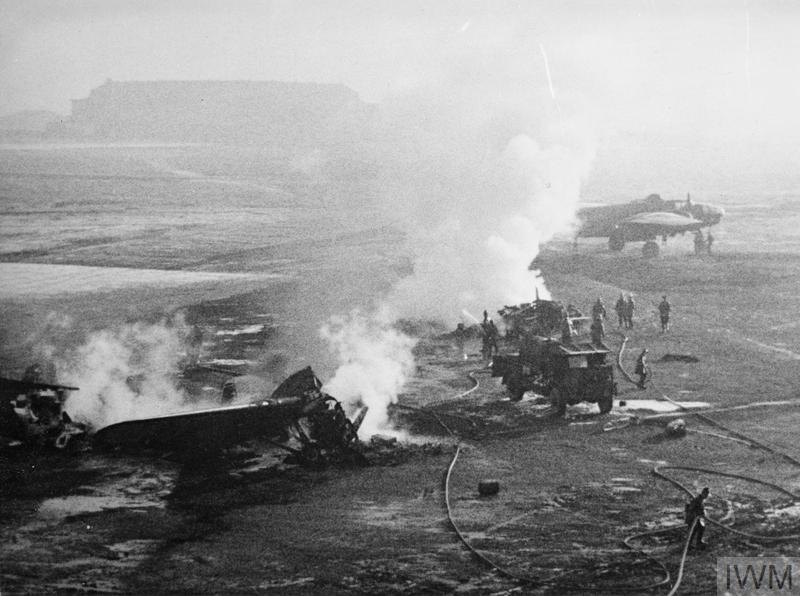
Fire crews attempt to extinguish the last fires among burnt-out North American Mitchells of No. 139 Wing RAF at B58/Melsbroek, Belgium, after the major daylight attack on the airfield by Luftwaffe fighter-bombers (Operation BODENPLATTE). (Source: IWM (CL 1806))

The most important protection that the US and Allied bases have had was distance. Since the Second World War, air assets based in Western Europe and North America did not need to worry about aerial threats from adversaries in anything short of a great power (likely nuclear) war. In the post-Cold War world, this experience was further reinforced as the US and NATO adversaries of the period, such as Iraq and Serbia, lacked any real possibility of reaching homeland-based aircraft. While in Iraq and Afghanistan, air assets were forward deployed, the most rare and critical assets in the US inventory – many of which are no longer in production and would be exceedingly difficult to replace – including B-2s, B-1s, and RC-130s, stayed out of the enemy’s reach.

Individual terrorists might have been able to reach a base in the US or Europe, but robust homeland security infrastructure limited the extent to which these could have been coordinated. In addition, most domestically radicalised terrorists acted as lone wolves and, therefore, lacked the capability to cause significant damage to infrastructure and multiple platforms simultaneously. The lack of a real threat to home-based aircraft has been one of the unspoken advantages that uscore the US and NATO’s ability to achieve air superiority and global reach without incurring the expense of protecting their aircraft or critical aircraft infrastructure at home.

Three events from the last six months should serve as a stark wake-up call that the era of distance being the primary protection for critical assets may be coming to an end. In Operation Spider’s Web, the Ukrainian Security Service smuggled containers filled with short-range attack drones into Russia through commercial channels. They employed Russian civilian drivers who knew nothing of the nature of the cargo they carried to bring the containers to launch locations near Russian air bases, and Ukraine employed remote instructions to launch the attack.

The drone strikes caught the Russian airbases completely off guard, allowing Ukraine to target critical Russian assets in unprotected positions. The attack damaged or destroyed as many as 40 aircraft, including strategic bombers that formed part of Russia’s nuclear triad. Russia’s assumption that distance from the front and national air defence protected these assets was painfully shattered in the course of a single day.
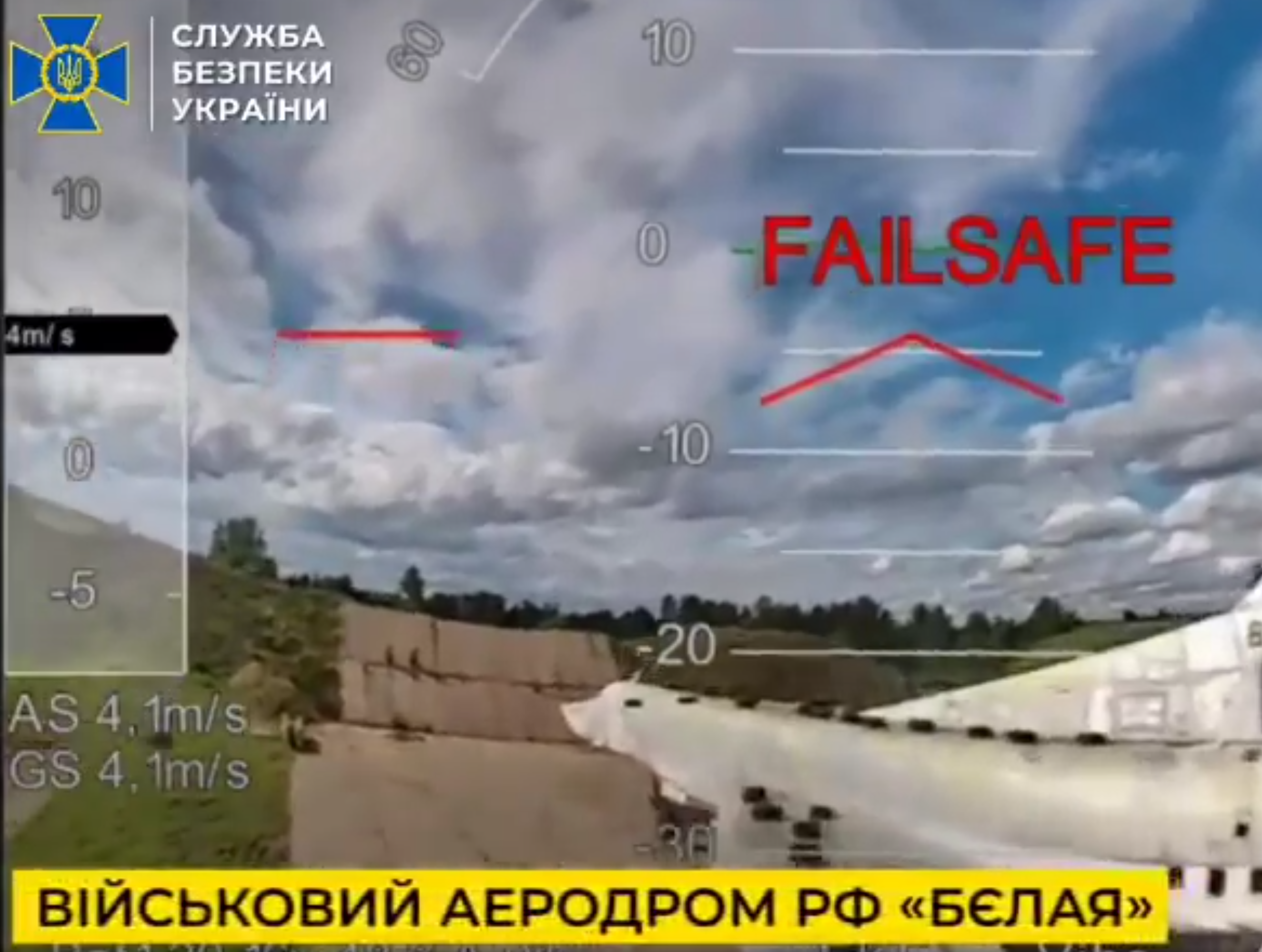
During Operation Spider’s Web, an FPV drone targets a Tu-22 bomber at Belaya air base, 4 June 2025. (Source: Wikimedia)

This has not been the only instance of launching short-range attack drones at distant targets. As part of Operation ‘Am Kalavi,’ Israel smuggled precision-guided munitions (PGMs) into Iran and established both a small factory to build attack drones and a base from which to operate inside the country. This meant that in advance of the Israel Air Force (IAF) strikes in Iran, Israeli intelligence and special operations personnel on the ground could launch drones and PGMs to confuse and reduce Iran’s air defences, ballistic missiles, and command and control capabilities.

This Israeli operation differed from the Ukrainian one in both its methods of delivering weapons and the types of targets selected, yet the lesson is similar. The most critical assets required for the defence of the nation can now be targeted by air, regardless of their range, and national-level air defences are insufficient to keep a determined adversary at bay. It is easy to imagine the damage an adversary could inflict on the US force posture through attacks similar to those in Russia or Iran, targeting B-2s, B-52s, or even high-value, low-density assets like the RC-135 or the-be-deployed E-130J TACAMO fleet.

The presence of new aerial threats to aircraft based in the homeland does not negate new ways in which traditional threats might manifest. In June 2025, Palestine Action, at the time of writing, a proscribed terrorist group in the UK, infiltrated RAF Brize Norton and sabotaged two parked RAF Voyager Aircraft, the RAF’s sole type of tanker aircraft, which has been extensively supporting NATO’s Eastern Flank missions. The apparent targeting of the attack was based on misinformation or disinformation – that the Voyager Aircraft were being used in direct support of the Israeli military in its war with Iran.

There is no apparent evidence that this attack was organised or supported by a foreign adversary. Still, there is ample evidence that foreign adversaries have used social media to contact, organise, and perhaps even direct the actions of groups and individuals far from their borders in ways that were not available in previous decades. Adversaries will likely note the potential efficacy of using social media to spur domestic groups in the US or NATO countries to attack important air assets.

So, the threat landscape has changed. Distance is not the defence it once was. Now, aircraft at home – especially those that play singularly important strategic or operational roles now require a level of protection unseen in the US since the Second World War. There are two primary ways to achieve this: active protection measures and passive measures. Active measures include air and missile defences such as Centurion C-RAM and counter-drone electronic warfare or directed energy systems, which, to provide protection from surprise, must always be active as well as air patrols. This may potentially pose a particular challenge for basing in areas with congested civilian airspace.

The status and the quality of the active system are important, but so too is the density. There must be sufficient defensive systems at each airfield (and especially those with low-density assets) to prevent being overwhelmed in a strike or destroyed. There must also be enough to allow for maintenance without a serious reduction in defensive capability.  Active defensive systems may also be vulnerable to electronic warfare and cyberattacks. These systems would also provide little aid in the case of a Brize Norton-style infiltration. This means that the active defences against aerial threats must be combined with robust ground security and patrols.

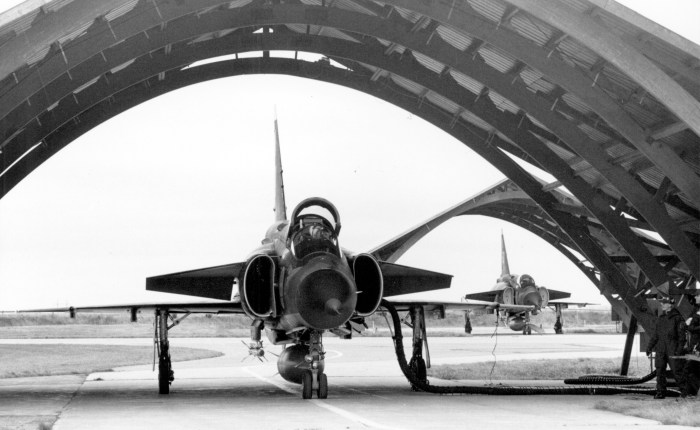
Passive defence measures mitigate the damage that either aerial attacks or infiltration can cause. The cornerstone of passive defence for airframes is hardening. While some NATO countries still have limited hardened shelters in the US and elsewhere, hardening would require not only a change in construction but a change in practice. Building hardened hangers (including top protection and/or perimeter and top netting) for critical assets would greatly complicate attacks by small, short-range UAVs by requiring them to carry a far larger explosive to breach the aircraft shelter. Such hangers, if locked down, would also raise the challenge for would-be infiltrators and give security forces greater time to respond. At the same time, their protection would only apply when aircraft are in shelters and not parked on outdoor ramps, as is often the case. 

Alone, passive protection can do what active protection cannot. It provides protection twenty-four hours a day, seven days a week, from both air attacks and ground infiltration. Unlike active protection, many forms of passive protection are immune to electronic warfare and cyber-attacks. Passive protection does not interfere with any other airspace activities and, once completed, is less susceptible to degradation in capability caused by personnel shortages.

The advantages of hardening are why Norway has reopened its deeply buried aircraft facilities, and Switzerland never abandoned its facilities. The US and other NATO countries have built hardened aircraft shelters with top protection in the past, but ceased building them because the threat did not justify the cost of construction and challenges to aircraft maintenance in more confined spaces. As the operations in Iran and Russia, as well as the sabotage at RAF Brize Norton, make clear, the threat has changed.

In an ideal world, the US and NATO could still rely on the protection afforded by distance, but that is not the world of today. Failing that, the best possible way forward would be to combine active and passive defences to protect all critical assets, but this may prove unfeasible. While the solutions to the challenges posed may appear tactical, the implications of failing to implement new protection could be strategically catastrophic.

Whether the US and its Allies choose passive or active protection or a combination of both, the time has come to protect critical aircraft while they are on the ground so the Joint Force can count on them to be in the air. The US and its allies should take the opportunity to learn from the attacks on Iran and Russia and develop protection for their critical aircraft today or risk becoming a case study of regret in the future.

Dr Jacob Stoil is a military historian who is the US Army’s Research Professor of Middle East Security at the US Army Strategic Studies Institute. In this capacity, he advises the US Army and other organisations on Middle East policy, strategy, and lessons learned. Dr Stoil also serves as Chair of Applied History at the West Point Modern War Institute, Assistant Director of the Second World War Research Group (North America) and Trustee of the U.S. Commission on Military History. Jacob was a Senior Fellow of the 40th Infantry Urban Warfare Center and a co-founder of the International Working Group on Subterranean Warfare as well as an Associate Professor of Military History at the US Army School of Advanced Military Studies (SAMS). He has published multiple policy and academic articles, which can be found in publications such as the International Journal of Military History, Wavell Room, and Modern War Institute. He can be followed on X as @JacobStoil

Header image: Preparation of two Saab JA 37 Viggen under Töreboda arches as part of the Bas 60 (Flygbassystem 60), which was an air base system developed and used by the Swedish Air Force during the Cold War. (Source: Wikimedia)

Security Forces in #highintensitywar: A Look Back at Airfield Defence for a Future Consideration of the Royal Australian Air Force

Security Forces in #highintensitywar: A Look Back at Airfield Defence for a Future Consideration of the Royal Australian Air Force

By Sean Carwardine

Editorial Note: Between February and April 2018, The Central Blue and From Balloons to Drones, will be publishing a series of articles that examine the requirements of high-intensity warfare in the 21st Century. These articles provide the intellectual underpinnings to a seminar on high-intensity warfare being held on 22 March by the Williams Foundation in Canberra, Australia. In this article, Sean Carwardine describes the development of Royal Australian Air Force (RAAF) airfield defence policy and questions the adequacy of current policy in preparing the Air Force to defend its bases in a #highintensitywar situation.

Air power is generated from air bases. Therefore, in a high-intensity conflict, air forces should expect that their adversary will target their bases. Unfortunately, airfield protection in a high-intensity conventional conflict has attracted little attention in the development of the RAAF’s fifth-generation force. This article looks at the history of RAAF airfield defence, and in consideration of lessons learned, will propose critical questions for future tasking, capabilities, equipment, command and control, training, planning, scale, interoperability, and security force influence on the air domain.

Since 1929, the RAAF has had a single-service policy towards airfield defence, involving airmen providing low-level anti-aircraft and machine gun ground defence. Past RAAF airfield defence policy worked on the assumption of RAAF involvement in small localised, asymmetric or low-intensity warfare in a joint environment. The policy has developed in the context of operations involving rapidly deployed aircraft operating from forward bases secured by allied nations supplying the bulk of force protection. These bases have been in relatively secure rear-areas of sanctuary, with security focusing only on countering the threat of small incursions. In a modern high-intensity war situation, these sanctuaries may no longer provide a guarantee of safety or security. Accordingly, the RAAF and its airfield defence policy must evolve. RAAF airfield defence policy must consider force protection in a high-threat environment, and possibly without significant assistance from major allies.

The RAAF has never been in a position, apart from five months in the Second World War, to provide full airfield defence for its bases in a high-intensity war situation; it has been partly or wholly reliant on allied forces.

P02875.148
Three Aerodrome Defence personnel of No. 79 (Spitfire) Squadron RAAF digging gun pits for their tripod mounted .303 Vickers machine guns for firing at low flying Japanese attackers on Vivigani airfield. Boxes of ammunition for the guns can be seen on the right and in the background. (Source: Australian War Memorial)

During the Second World War, RAAF policy focused on the Australian Army providing low to high-level anti-aircraft defence and ground defence outside the wire. Within the wartime RAAF, there was a clear divide between RAAF Headquarters (the RAAF’s administrative command) and RAAF Command (the RAAF’s operational command) as to the workforce and organisation of airfield defence in the RAAF. The former believed small sections of Guards (20-30) could protect RAAF assets with technical airmen acting in the role as a secondary duty (a reactive defence). For RAAF Headquarters there was no requirement for a specific organisation to provide airfield defence. RAAF Command was against this ‘penny pinching’ policy and promoted a ‘RAAF Regiment’ of guards so that specialists focused on protection, and technical airmen focused on keeping aircraft in the air.

By 1945, the RAAF had the equivalent of five squadrons worth of guards (1,042 guards) in No. 2 Airfield Defence Squadron of the First Tactical Air Force (First TAF), five squadrons worth in the Northern Command (723 guards), four squadrons worth in Security Guard Unit/No. 1 Airfield Defence Squadron (570 guards) in the North-Western Area Command. Approximately, 1,900 guards (some cross-trained as war dog handlers and guard gunners) were also allocated to every aerodrome, inland fuel storage, radar/radio station, wharf/dock, RAAF chemical warfare storage, bomb and ammunition storage, civilian aerodromes and squadron in southern Australia. In addition to the guards, the Service Police had small units in every capital and small numbers on stations and in some squadrons. These forces provided the full scope of air base defence requirements for the RAAF.

At the end of the Second World War, the Chief of the Air Staff (CAS) removed airfield defence from the RAAF, six months before the official disbandment dates. RAAF Service Police strength was also reduced to fewer than 100 airmen across the nation. CAS stated, ‘I am not prepared to agree to any more of these specialised units.’[1] However, senior airmen argued against this. In 1945/46 senior officers such as Air Commodore Frank Bladin (Deputy Chief of the Air Staff), Air Commodore Frederick Scherger (Commander of First TAF), Air Vice-Marshal William Bostock (Air Officer Commanding RAAF Command) and Air Commodore John McCauley supported a proposal for a new airfield defence policy and the formation of an RAAF Regiment as put forward by Wing Commander George Mocatta.

Mocatta was Operation Staff Officer – Defence for the RAAF Command Headquarters Allied Air Force, a post which he held since 1942. He was a graduate of the Royal Air Force’s (RAF) Defence Officer course, and in 1944/45 Mocatta had studied the ground defence of airfields by the RAF Regiment in Europe and the Far East.

Mocatta’s proposal argued that the formation of a RAAF Regiment would see a reduction to around 2,000 guards and 300 police but would provide a full-time airfield defence force that included a ground fighting force, low level anti-aircraft force, airfield engineers, explosive ordnance disposal, mortars and armoured vehicles. Mocatta’s proposal was not progressed; it stayed in RAAF Headquarters un-actioned until the file was closed in 1949.

During the 1950’s, under the National Service Scheme, two aerodrome defence squadrons were formed to train reserve airmen as Ground Gunners. Early in the 1950’s a total of four Aerodrome Defence Officers, 25 Guards and a small number of Service Police were sent to Japan and Korea to provide squadron guard duty and security. Although low-level ground base air defence was considered a RAAF responsibility, the RAAF provided no ground-based air defence of any type on operations in Korea.

Between 1952 and 1955, the Air Staff Policy Memorandum No. 15 RAAF Ground Defence Policy (ASPM 15) highlighted the possibility of a conflict on a global scale against Communist forces. This possibility of high-intensity war would force the RAAF to establish its light anti-aircraft (LAA) defence units, thus releasing the Australian Army from this duty. The policy also raised the possibility of an attack by Communist ground forces, in either large-scale commando style or clandestine attacks. Under ASPM 15 active and passive defence of RAAF assets would be undertaken by six Rifle Squadrons, one Armoured Squadron and three LAA Squadrons of Guards or Ground Gunner reservists.

The 1950s saw another push for the formation of a single permanent Airfield Defence Squadron. The idea this time was similar to Mocatta’s 1945 proposal; however, this time the proposal focused on a single peacetime squadron as a nucleus for a war-time RAAF Regiment. Then in the late 1950’s, the RAAF Ground Defence Policy Chapter of Air Staff Doctrine listed no requirement for ground defence units and highlighted only the need for a few Ground Defence Officer’s, Aerodrome Defence Instructor’s and Guards, with National Service airmen training as Ground Gunners in the reserve.

By 1957, the policy of RAAF airfield defence changed in response to the evolving strategic situation. No major global war was foreseen. Therefore, there was no need for RAAF ground defence forces. The policy was that under an inter-service agreement, the Australian Army would provide all active and passive defence for RAAF assets. The only time the RAAF would require its active defence was when units were overseas, operationally deployed away from land forces or in an emergency. Also, RAAF commanders would initiate their ground defence force from airmen within their unit.

In the early 1960’s the RAAF trained Aircraft Hand/General Duty airmen and RAAF Service Police in infantry tactics to perform airfield defence for duty in Thailand. By 1965 the RAAF created a new mustering for airfield defence and guard duty; the Airfield Defence Guards (ADGs) were formed. Again, the idea of a RAAF Defence Squadron equipped with low-level air defence capability emerged, resulting in the acquisition of eight 40mm Bofors Anti-Aircraft Guns and 140 Oerlikon 20mm cannons for the proposed formation of a peace-time airfield defence squadron.  Interestingly, in the files, a staff officer queried this policy asking, ‘who are we going to shoot them at?’[2] The Bofors ultimately went to the Australian Army, and the Oerlikons stayed in storage.[3] The RAAF then introduced the Bloodhound missile defence program, by 1968 the system was outdated, and the project ended.

Throughout the 1960’s and 1970’s, RAAF policy on ground defence focused on limited war. Unsurprisingly, the ground defence policy for Vietnam focused on low-intensity warfare with an allocation of a 30-man flight of ADGs. At the time, RAAF Ground Defence policy (AAP 938) highlighted the RAAF’s responsibility to provide its own ground-based air defence units using equipment such as 20mm cannons and surface-to-air missile systems. One paragraph in AAP 938 indicates the RAAF did not have any of these systems and would have to acquire them from Britain, ‘when the war starts’.[4] This raises the concern that in a high-intensity conflict, waiting for equipment would be too late. By 1973, the RAAF officially removed anti-aircraft defence from RAAF capabilities, instead relying on the Australian Army’s ground-based air defence (GBAD) systems or aircraft to provide air defence.

The 1980’s and 1990’s saw separate Rifle Flights of ADGs around the country, undertaking guard duty and exercises. During this period, however, the reformation of No. 2 Airfield Defence Squadron and eventually combined all Rifle Flights into one squadron in one location. Operation Warden, the Australian-led intervention in East Timor, in 1999 highlighted the capabilities and the benefits of having a dedicated, air-minded, air force security force in a low-intensity environment. However, having one full time and one partly-staffed reserve unit (No. 1 Airfield Defence Squadron), demonstrated the need for a force protection restructure.

In the subsequent shift to the asymmetric conflicts of Iraq and Afghanistan, RAAF security forces have integrated with Australian Army units and law enforcement agencies to protect aircraft in Aircraft Security Operations, protect air force detachments and take responsibility for the defence of international airfield defence duties. This is the basis of airfield defence policy that still defines RAAF Security Force approach.

Group Captain Jeremy Parkinson, an RAF officer from NATO’s Joint Air Power Competence Centre stated ‘Firstly, because of a lack of understanding of how [Force Protection] is provided, it is all too often seen in capitals and headquarters as little more than a static guarding task and as such is not perceived as contributing to the actual delivery of the mission’.[5] He also stated, commanders, have a lack of understanding of how complex and resource intensive force protection is, and one should not assume that ‘the host nation will provide’ airfield protection for deployed forces.[6] Considering Parkinson’s statement, it is fair to ask: does the current RAAF Security Force structure cater for all air base defence requirements, does it have an absolute, definite intent of potential operational tasking?

In a high-intensity conflict in the future, it is likely the Australian Army would deploy a brigade, which would likely include GBAD for the field force. The RAAF would deploy an Air Task Group to operate from a coalition airfield. What is unclear is if deploying as part of a coalition force, and with US or NATO units in place, would Australia be required to supply a Security Force Squadron? Would Australian GBAD systems automatically attach to the forward air base as stated in the 2016 White Paper? What capability does a current RAAF Security Force bring to the table?

I believe that the RAAF has been guilty of turning a ‘Nelsonian blind eye’ to the need for its own air base defence capability. History shows the RAAF has a lack of understanding of the specialist nature of all air base protection as it has developed a reliance on others, an aversion to committing fully to the airfield defence role and does not appropriately resource airfield defence. Are we learning from history, or following it?

Some questions need to be asked if the RAAF is to prepare to defend its operating bases in a high-intensity conflict. Does the RAAF insist Australian Army GBAD systems be permanently on every air base or will they be allocated to the RAAF after the start of combat operations? Does the RAAF have dispersed hardened or underground shelters, its own air-minded specialist protection force, or does current policy remain extant and we will rely on allies or host nations for our protection?

Analysts will discuss the pros and cons of the Australian Defence Force being a versatile and flexible force that can fight in low and high-intensity conflicts. However, the current legacy RAAF Security Force Squadrons remain established as a ‘small-war’ force, ill-equipped and lacking ground intelligence capabilities to protect air bases, overseas and at home, in a future high-intensity war?

Australia needs a RAAF specialist security protection force that is equipped and trained to respond across the spectrum of future conflict scenarios. A fifth-generation air force must be able to defend the bases that generate its air power.

Sean Carwardine joined the RAAF in 1986 as an Airfield Defence Guard and retired in 2007. Sean served at No. 2 Airfield Defence Squadron, No. 1 Central Ammunition Depot, RAAF Base Richmond, Australian Defence Force Academy, RAAF Base Amberley, Headquarters Airfield Defence Wing. Sean also served on operations in Indonesia 1992, Timor 1999/2000, Afghanistan 2002 and Iraq 2003/04. Sean has completed a Bachelor of Education (University of Southern Queensland), Master of History (Airfield Defence) and is the final year of a PhD – History and Analysis of Airfield Defence Policy in the RAAF (University of New England). Sean has published two articles on RAAF airfield defence, lectured at RAAF Security and Fire School, Security Forces Squadrons (SECFOR) and SECFOR Conference.

Header Image: Leading Aircraftman Joel Sitkiewicz from No. 1 Security Force and Military Working Dog ‘Lucky’, patrol the F/A-18F Super Hornet flight line during Exercise Aces North 2015. (Source: Australian Department of Defence)

[1] National Archives of Australia (NAA), A1196, 15/501/258 PART 2.

[2] NAA, A703, 564/8/36 PART 1.

[3] NAA, A703, 564/8/2/PART 7.

[4] Ibid.

[5] Jeremy Parkinson, ‘Developing Future Force Protection Capability (Part 1),’ Transforming Joint Air Power: The Journal of the JAPCC, 18 (2013), pp. 69-73; Idem, ‘Developing Future Force Protection Capability (Part 2),’ Transforming Joint Air Power: The Journal of the JAPCC, 19 (2014), pp. 67-72.

[6] Parkinson, ‘Developing Future Force Protection Capability (Part 1),’ p. 72.