It is Time to Demystify the Effects of ‘Strategic Western Air Power’ – Part 1

It is Time to Demystify the Effects of ‘Strategic Western Air Power’ – Part 1

By Lieutenant-Colonel Dr Jyri Raitasalo

Editor’s Note: In this two-part article, Dr Jyri Raitasalo considers what he argues are the two fundamental fallacies concerning the application of strategic air power by Western states in the modern era. In this first part, he considers the challenge of the use of military forces as a tool for solving political problems. The second part of this article can be found here.

Ever since the 1991 Gulf War, the Western strategic discourse on air power has accentuated the role of high-tech precision-guided weapons together with good situational awareness and reliable command and control systems in solving modern conflicts. After the lessons learned from Operation DESERT STORM were drawn, one of the main tenets of western strategic thinking has been the (over-)reliance on the possibilities to solve political conflicts with modern weaponry – from the air. This notion did not emerge out of thin air. It was one answer to the many demands that Western statesmen – first and foremost among them the President of the United States – made immediately after the Cold War had ended. Since the early 1990s, the international security environment developed positively – at least from the western states’ perspective. However, the world was still infected with many low-level threats that rose in significance simultaneously as the Soviet threat evaporated.

The so-called Revolution in Military Affairs (RMA) has been expected to deliver positive outcomes to political crises with little risk to Western soldiers or national interests – whether in Bosnia (1995), Kosovo (1999), Afghanistan (2001), Iraq (2003) or Libya (2011). Many western ‘wars of choice’ – under the headings of ‘humanitarian interventions’, ‘military crisis management operations’ or ‘expeditionary missions’ have been made possible – and in some cases necessary – by the demands of the contemporary 24/7 media, high-tech ‘revolutionary’ warfighting capabilities and the fading of the existential threat posed by the Soviet Union.
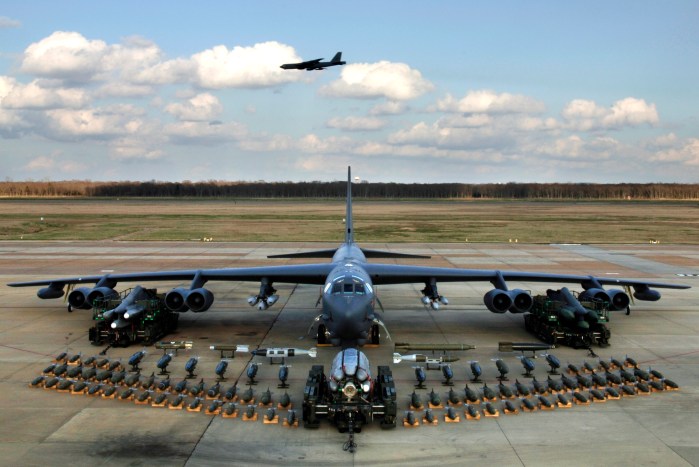
Display of might
A US Air Force Boeing B-52H Stratofortress of the 2d Bomb Wing static display with weapons, at Barksdale Air Force Base, Louisiana, in 2006. (Source: Wikimedia)

During the 25 years of the post-Cold War era, Western air power ‘theory’ – based on the expectations of Western political leaders – has entertained the notion of strategic success in war just by deploying air assets against chosen adversaries. During this time we have witnessed the mystification of air power – the new ‘silver bullet’ – to epic proportions in a way that practical results from recent wars lend little support. Analysing recent western air wars from Bosnia (1995) to Libya (2011) one can easily detect that none of them has proved to be strategic successes for the west. Thus the ‘brand’ of contemporary Western air power is better than its actual track record. None of the often mentioned ‘successes’ have facilitated long-term positive outcomes.

The contemporary Western air war paradigm is based on two fallacies: the idea that high-tech military capabilities facilitate easy solving of political problems and the notion of almost casualty-free warfighting. Both of these should be subjected to strict scrutiny. It should be noted that it is not the militaries’ fault that political leaders have expressed repeated demands to the use of military force that are beyond the boundaries that existing military capabilities can deliver. However, to facilitate better strategies in the future, these fallacies will be elaborated next.

Fallacy 1: The use of military force is an effective tool to solve political problems

It is good to acknowledge that the number of armed conflicts – and the average number of people killed in these conflicts – has decreased during the post-Cold War era. As the Human Security Report Project noted in 2014, we have witnessed:

the rapid decline in international wars (anti-colonial wars are included in this category) over the past 60 odd years. The average number of international wars being fought every year per decade shrinks dramatically – from over six in the 1950s to less than one in the 2000s. […] From the early 1990s to the present day, overall conflict numbers have dropped by some 40 percent, while the deadliest conflicts, those that kill at least 1,000 people a year, have declined by more than half.

Despite the positive trend in warfare since the end of the Cold War, there have been many brutal cases where large-scale human suffering and damaged infrastructure have caused concern within the western security community. First of these instances was ‘born’ out of the result of the 1991 Gulf War: the predicament that the Kurds (in the north) and the Shia population (in the south) faced after Saddam Hussein was defeated – but remained in power. Moreover, many others have followed: from Somalia to Haiti, and from Timor-Leste to Kosovo.

The humanitarian suffering brought to our living rooms by the 24/7 media – and later by social media, smartphones and tablets – has become a new factor influencing western decisions in the use of military force in the world. Although most of the (air) wars that the West has waged during the post-Cold War era have almost nothing to do with Western national security directly, there has been the need to do something to ease humanitarian conditions and suffering around the world in the many crises that have been ongoing – from Iraq to Somalia and Haiti to Libya. Thus, the western approach to ‘humanitarian interventions’ and the ‘Responsibility to Protect’ (R2P) emerged to fill in the void that the end of the Cold War caused within the western threat perceptions.

Facing no existential threats, for the past 25 years, Western states have had the luxury of focusing on crises around the world where large masses of people have been violently oppressed. Moreover, the tools of the ongoing RMA – precision air strikes as the forerunner – seemed to propose a possibility to manage these humanitarian crises with little cost – in either blood or treasure. As was noted after the Gulf War:

A significant part of that edge [US’s edge versus Iraq] can be attributed to the revolutionary new military technology used by U.S. forces for the first time in Gulf War.

In other words, the lessons learned from the Gulf War – where Saddam Hussein’s big Army was easily defeated on the battlefield – have influenced the way that Western political leaders have been trying to solve violent political crises out-of-area.

However, the problem lies exactly here: the complex, violent crises around the world cannot be solved by precision bombing or by killing the ‘bad guys’. The politicisation of ethnicity and religion, the criminal elements involved and the contradictory political goals of multiple adversaries in most of the contemporary violent crises mean that externally imposed military solutions will not work. As has been noted in connection with the 2001 US-launched Global War on Terror, it is hard to kill enough terrorists without at the same time facilitating additional terrorist recruiting and providing additional PR for the terrorist cause.

It is understandable that political leaders resort to the use of military force relying on advanced weaponry to solve nasty crises around the world. The humane instincts of Western strategic decision-makers are understandable and praiseworthy. However, the sad part is that strategically, the use of military force has not been able to bring about political reconciliation or stability into ongoing conflict zones. On the contrary, the first ‘RMA air-war’ in history – the 1991 Gulf War – produced a political stalemate that resulted in a war of attrition against Iraq between 1991-2003. This attrition warfare manifested itself through the enforcement of no-fly zones and punitive air strikes against Iraq every time Saddam’s troops violated the rules imposed on them.

Even though the first Gulf War did not bring a politically favourable outcome vis-à-vis Iraq, the lessons drawn from that campaign at the operational level influenced how air power was used in Bosnia and Kosovo during the 1990s. The two air wars in Europe – in Bosnia 1995 and over Serbia in 1999 – have not till today produced lasting strategic outcomes that would be favourable to western states. Both are practically failed states, which can take a turn for the worse at any time. Also, in today’s tense international environment, the very unstable situation in Bosnia and Kosovo provide ample opportunities for Russia to manipulate the West.

It is noteworthy that immediately after the Kosovo air war, the US Secretary of Defense William Cohen noted that:

[…] what we were able to achieve through this [Kosovo] campaign reminds all of us that the revolution in military affairs is fundamentally changing the way in which we fight. […] In Operation Desert Storm, […], there were only a handful of sophisticated aircraft that could carry precision-guided munitions, […] In Kosovo, nearly all of our fighters could deliver these devastating weapons.

Cohen’s remarks are spot on when looked from tactical or operational perspectives. On the strategic level, however, the effects of “devastating weapons” do not automatically turn into political objectives.

To be fair, it must be noted that air power was eventually able to stop ethnic violence in the former Yugoslavia, but whether the level of violence increased because of the air wars or not, is still debatable. In any case, both Bosnia and Kosovo have shed light also on the negative impact of western air power:  the mere existence of highly capable western (read: US) Air Forces – together with the global 24/7 media – facilitated the increase of violence both in Bosnia and Kosovo as the West was lured into these crises by attacks on the ground that aimed to escalate the conflict – not to end it. The Western humanitarian intervention approach was in its formative years, and the belligerents on the ground in Bosnia and Kosovo knew how to take advantage of it. After the terrible case of the Rwandan genocide in 1994, it was easy to exploit the willingness of the West to do more – even by escalating ethnic cleansing to draw the West into the conflict.

The second round of large-scale air warfare against Iraq took place through a campaign of ‘shock and awe’ in 2003. It was accompanied and followed by mechanised thrusts to destroy Saddam’s Army, a task that the United States and its allies succeeded to do. However, this operational success was not followed by the fulfilment of strategic goals. Air power was not able to solve the post-Saddam political crisis in Iraq – a fate also shared by the Army and the Marine Corps throughout the subsequent counter-insurgency (CI) operation, which resulted in the withdrawal of US troops after years of fighting and thousands of casualties. The breaking up of Iraq’s state structures, administrative routines and security forces also facilitated the birth of ISIL and the increase of violence and instability in the region. In all, the 2003 war in Iraq – and the chaos that has followed – has proved to be a strategic mistake of massive scale. The possibilities of quick high-tech warfare against much weaker traditional conventional army lured the US into a process that eventually became uncontrollable. This is the true essence of war – that competitive advantage in one sphere of war-fighting (e.g. technology) can be mitigated or even nullified by another (e.g. tactical asymmetry). There are no ‘silver bullets’ – at least not for long.

RAF Tornado GR4 Aircarft During Operation Ellamy
Two fully armed RAF Tornados from RAF Marham transit the Mediterranean Sea en-route to Libya as part of the UK’s Operation ELLAMY to enforce the UN no-fly zone in March 2011. (Source: Defence Imagery, MoD)

Finally, the air war against Muammar Gaddafi’s Libya in 2011 – NATO operation Unified Protector – helped to set in motion a crisis that will influence European security for years to come – negatively, not to mention the additional suffering to ordinary Libyans. Today Libya is a failed state with multiple armed forces fighting over power and economic benefits. Also, Libya has become one of the bases for extremist terrorism. Operation Unified Protector showed the might of advanced air power by destroying the Gaddafi regime, but the strategic consequences of the operation will haunt the West – and Europe particularly – for years to come.

Dr Jyri Raitasalo is a Lieutenant-Colonel in the Finnish military and a Senior Staff Officer at the Planning Unit (strategic planning) of the Finnish Ministry of Defence. He holds the title of Docent of strategy and security policy at the Finnish National Defence University.  During his latest assignments, he has served as the Commanding Officer of the Helsinki Air Defence Regiment (Armoured Brigade), Head Lecturer of Strategy at the Finnish National Defence University, ADC to the Chief of Defence and Staff Officer (strategic planning) in the Finnish Defence Command (J5). Jyri Raitasalo is a called member of the Royal Swedish Academy of War Sciences.

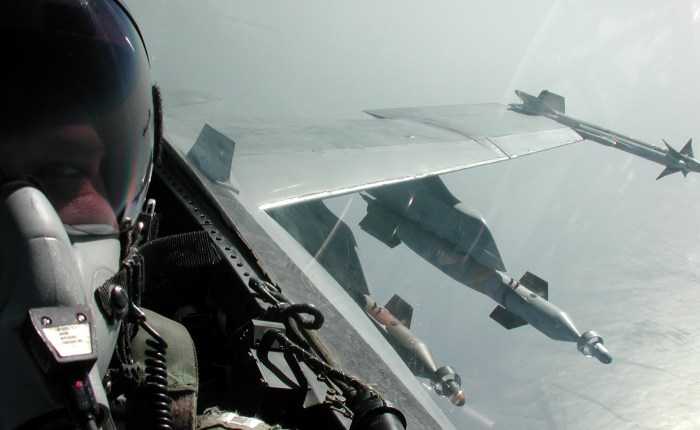
Header Image: An F/A-18 Hornet of VFA-94 carrying out operations in support of Operation Enduring Freedom in 2001. Visible on the wing are two 500-pound Laser Guided Bomb Units (GBU-12) (left), and an AIM-9 Sidewinder air-to-air missile. (Source: Wikimedia)
Call for Submissions – From Balloons to Drones

Call for Submissions – From Balloons to Drones

Over the past two decades, airpower has become the “Western way of war” […] because it offers the prospect of military victory without large-scale destruction and loss of life. Airpower, however, cannot be decisive or even effective under all circumstances […] The utility of airpower is highly situational (emphasis added).

John Andreas Olsen[1]

From Balloons to Drones is an online platform that seeks to provide analysis and debate about air power history, theory, and contemporary operations in their broadest sense including space and cyber power.

Since its emergence during the First World War, air power has increasingly become the preferred form of military power for many governments. However, the application and development of air power are controversial and misunderstood. To remedy this, From Balloons to Drones is an online platform that seeks to provide analysis and debate about air power through the publication of articles, research notes, commentary and book reviews. From Balloons to Drones welcomes and encourages potential submissions from postgraduates, academics, and practitioners involved in researching the subject of air power.

Submissions can take the following forms:

  • ArticlesFrom Balloons to Drones publishes informative articles on air power that range from historical pieces to the analysis of contemporary challenges. These well-researched articles should attempt to bridge a gap between the specialist and non-specialist reader. They should be around c. 1,000 to 1,500 words, though From Balloons to Drones will accept larger pieces though we reserve the right to publish them in parts. References can be via footnotes and hyperlinks.
  • Air War BooksFrom Balloons to Drones publishes a series of review articles that examine the top ten books that have influenced writers on air power.
  • CommentariesFrom Balloons to Drones publishes opinion pieces on recent on a recent piece of news, either on a contemporary or historical subject. These are to be responses to such piece and should be no longer than c. 1,000 words.
  • Research NotesFrom Balloons to Drones publishes research notes related to contributor’s currents research projects. These take the form of more informal pieces and can be a discussion of a source or a note on a recent research theme. Unlike other pieces published by From Balloons to Drones, they can be written in the first person, though they can include references. These should be c. 500 to 1,000 words.
  • Book ReviewsFrom Balloons to Drones publishes occasional book reviews that aim to be an accessible collection of appraisals of recent publications about air power. If publishers are interested in having a publication reviewed then, please contact us via the email address below.

Submissions should be submitted in Word format. Also, please include a 50-100 word biography with your submission. However, if you are not sure if your piece fits our requirements, then please email us with the POTENTIAL SUBMISSION in the subject line. References can be used, and, given the readership of this site, please be careful to explain any jargon used.

If you are interested in contributing, please email us at airpowerstudies@gmail.com or use our contact page here.

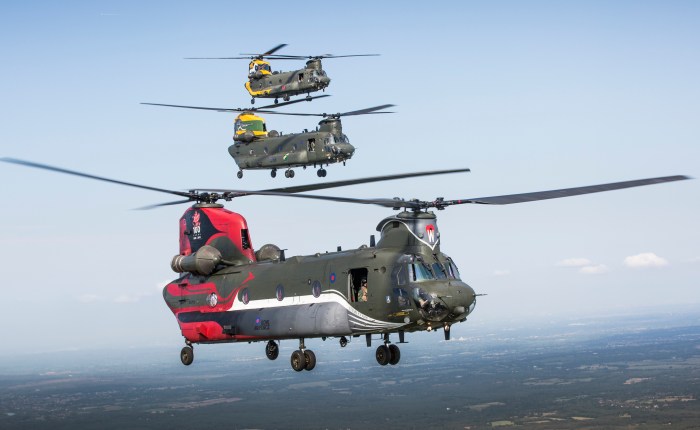
Header Image: Chinooks celebrate the 100th anniversaries of Nos. 18(B) and 27 Squadron from RAF Odiham and 28 Squadron from RAF Benson. (Source: Defence Imagery, Mod)

[1] John Andreas Olsen, ‘Introduction – Airpower and Strategy’ in John Andreas Olsen (ed.), Airpower Reborn: The Strategic Concepts of John Warden and John Boyd (Annapolis, MD: Naval Institute Press, 2015), p. 2.

From Balloons to Drones – Top Posts of 2016

From Balloons to Drones – Top Posts of 2016

By Ross Mahoney

Happy New Year!

Now we have reached 2017, and that From Balloons to Drones has been up and running for around six months, it thought it would be worth posting our top five posts of 2016 based on views.

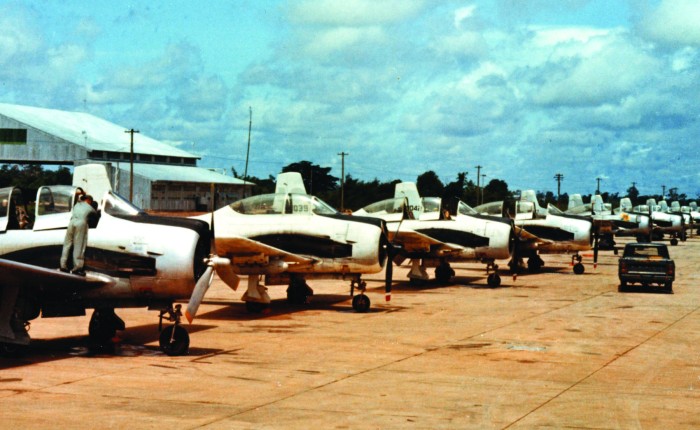
  1. At the head of the list is ‘Supporting the Secret War: T-28s over Laos, 1964-1973 – Part 1: Training.’ This is the first of a three-part article by Jeff Schultz that examines the use of the North American T-28 during the war in Laos in the 1970s. Parts two and three can be found here and here.
  2. In second place is my research note on ‘Air Power and the Challenge of Professional Military Education’ that was based on my thoughts on an excellent conference at the Royal Military College of Canada in November. An important subject that I hope to return to in 2017.
  3. In third is Brian Laslie’s commentary, ‘TheF-35 is here!’, which deals with some of the issues surrounding this program and the important role that training will play in developing the aircraft’s use.
  4. In fourth, and timed in conjunction with the types eventually retirement for the United States Air Force, Mike Hankins provided a timely discussion of the development of the McDonnell F-4 Phantom II in his piece ‘Remembering the F-4 Phantom – Part 1: A Product of Its Time.’ The second part of this article can be found here.
  5. Finally, but no means last, Alex Fitzgerald-Black’s research note ‘Operation HUSKY’s Air Battle by the Numbers’ provided a useful discussion of the importance of the air battles fought during the invasion of Sicily in 1943.

These are just a selection of the highlights of our half year in existence. We are keen to expand our list of contributors and if you are interested in writing about air power issues – both historical and contemporary – then you can find out how here. If you have any questions then please leave a comments here or emails us at airpowerstudies@gmail.com.

Header Image: A row of T-28s in Laos. (Source: USAF)

From Balloons to Drones: Contributors Wanted – We Want You!

From Balloons to Drones: Contributors Wanted – We Want You!

Since its launch in June 2016, From Balloons to Drones has published a variety of articles, commentaries, research notes, and book reviews dealing with issues related to air power history, theory and practice. However, to continue to develop and regularly publish material we need new contributors keen to publish on the subject of air power. As such, we need you!

From Balloons to Drones welcomes and encourages potential submissions from postgraduates, academics, and practitioners involved in researching the subject of air power. We seek to publish articles, commentaries, research notes, and book reviews that encourage a healthy discussion about air power from historical themes through to commentary on contemporary operations and challenges.

Air power is treated in its broadest sense and includes cyber and space power, and we are happy to discuss the suitability of any proposal for the site. We also encourage contribution from people working in the fields of strategic studies, law, politics, ethics, international relations, archaeology, and museology.

Submissions can take the following form:

  • ArticlesFrom Balloons to Drones seeks to publish informative articles on air power that range from historical pieces to the analysis of contemporary challenges. These well-researched articles should attempt to bridge a gap between the specialist and non-specialist reader. They should be around c. 1,000 to 1,500 words, though From Balloons to Drones will accept larger pieces though we reserve the right to publish them in parts. References can be via footnotes and hyperlinks.
  • CommentariesFrom Balloons to Drones seeks to publish opinion pieces on recent on a recent piece of news, either on a contemporary or historical subject. These are to be responses to such piece and should be no longer than c. 1,000 words.
  • Research NotesFrom Balloons to Drones seeks to publish research notes related to contributor’s currents research projects. These take the form of more informal pieces and can be a discussion of a source or a note on a recent research theme. Unlike other pieces published by From Balloons to Drones, they can be written in the first person, though they can include references. These should be c. 500 to 1,000 words.
  • Book ReviewsFrom Balloons to Drones publishes occasional book reviews that aim to be an accessible collection of appraisals of recent publications on the subject of air power. If publishers are interested in having a publication reviewed then, please contact us via the email address below.

Submissions should be submitted in Word format. Also, please include a 50-100 word biography with your submission. However, if you are not sure if your piece fits our requirements, then please email us with the POTENTIAL SUBMISSION in the subject line. References can be used, and, given the readership of this site, please be careful to explain any jargon used.

If you are interested in contributing, please email us at airpowerstudies@gmail.com

Header Image: A B-1B Lancer drops back after air refueling training, 30 September 2005. This B-1B, from the 28th Bomb Wing, deployed to Andersen Air Force Base, Guam, as part of the Pacific Command’s continuous bomber presence in the Asia-Pacific region. (Source: Wikimedia)

#Commentary – A Rose by Any Other Name…

#Commentary – A Rose by Any Other Name…

By Dr Ross Mahoney

In a recent piece for The Central Blue, the blog of the Sir Richard Williams Foundation in Australia, Robbin Laird has suggested that rather than describing the F-35 Lightning II as a 5th Generation aircraft, we must think of it as ‘a first generation information and decision making superiority “flying combat system”.’[1] (Emphasis in original)

Arguably, this is an important shift in how we think about the capabilities of this new platform and the implications this has regarding how we think about air power. However, this labelling of platforms and capabilities raises several interesting observations and what follows are some personal opinions on the issue of ‘labels.’

First, and while we should always be careful of generating faulty parallels, as a historian, I am quite certain I have heard similar phrases before namely Giulio Douhet’s ‘battleplane’ concept. In short, in the second edition of his seminal work Command of the Air, written in 1926, Douhet argued that the roles of combat and bombing should be combined with a single type of aircraft, the ‘battleplane.’ This was a move away from his thinking outlined in the 1921 edition of Command of the Air, but as Thomas Hippler has noted, at a conceptual level, the ‘battleplane’ was important because it allowed Douhet to reconcile the ideas of war in the air and war from the air.[2] For Douhet, both were synonymous and one, though whether this proposed platform would have solved that challenge remains debatable. This was clearly a lesson derived from Douhet’s views of the First World War. Nevertheless, the problem with the ‘battleplane’ idea is that it was a solution to one set of circumstances and would not have applied to all situations where the use of air power might have been called upon. Could we end up in the same situation if we think of the F-35 in a similar vein?

Second, a broader issue with Laird’s description is that of buzzwords or phrases. Buzzwords tend to be created to support someone’s vision of the future, and they are unhelpful if not grounded in some form of intellectual rigour. Indeed, buzzwords and phrases are certainly not something limited to air forces but pervade the military more broadly. For example, in the last few days, it has been reported that the US Navy’s Chief of Naval Operations has decided to shelve the use of Anti-Access/Area-Denial as a ‘stand-alone acronym’ primarily because it ‘can mean all things to all people or anything to anyone.’[3] This is an important point, and the same can be said of effects-based operations, which was fashionable in the late 1990s and early 2000s.[4] Both of these strategies are ideas that have history, and we should be careful about trying to re-invent the wheel. As I recently heard from one colleague, if you want a new idea, read an old book. As such, is the description being applied to the F-35 helpful when thinking about the application of air power? It is indeed being linked to the idea of 5th generation strategy, but we must continually ask the question within the question and seek to understand what is underpinning such statements. For example, is the platform important or the ideas about their use? Also, should we be careful about linking platforms to strategy?

Nevertheless, while I would advocate the need to critique statements, such as Laird’s, there is certainly always a case to build new language and ideas to explain future challenges. This is particularly important for air power because, since the end of the Cold War, it has become, arguably, the West’s preferred way of war.[5] Nevertheless, as Tony Mason reflected, ‘while our technology is lifting us into the 21st century, our formative concepts remain rooted in a bygone age.[6] This comment remains as relevant today as it did in 1998. While today’s core air power roles can be identified in the activities of the First World War, it is perhaps an axiom that as with any field of human endeavour, the language and ideas about the use of military aviation should and must evolve as time goes by and situations change.

This, however, raises my third point of how we improve and encourage the conceptual thinking that underpins many of the statements made by commentators and practitioners. It is ok to have opinions and advocate them; however, they must be derived from the intellectual study of the field. Indeed, while advocacy can create friction, that friction, in turn, can generate innovation, which is important if organisations are to adapt to changing strategic, operational and organisational shifts. However, it should also be recognised and understood that such friction needs to be managed so that it does not become divisive as it arguably did at the strategic level between the RAF and Royal Navy in the inter-service debates of the 1920s. This is clearly an issue of education, and how that process is utilised and retained by air forces. This is difficult for western air forces primarily because they have been involved in sustained operations for at least the past decade. This has not given air forces significant time to think and reflect on their craft as their focus has been elsewhere. Nevertheless, air forces have, where possible promoted thinking. For example, the modern RAF runs a fellowship to encourage study and expand the Service’s ‘intellectual capacity.’[7] However, this intellectualising of air power needs to filter back into the development of thinking, policy and doctrine and refresh the lexicon while providing the necessary foundations to attempts to redraw conceptual boundaries.

Just to conclude, this is clearly a thought piece and does not propose any solutions to the challenges of today; however, we should be very careful about the labels we apply to platforms, capabilities and concepts. Terminology, as the discussion section of Laird’s piece, illustrated, matters and has a tendency to carry cultural baggage. In developing effective thinking about the application of air power as part of the solution to strategic challenges, air forces need to think about their place in the pantheon of options open to policy makers. I would argue that in an age of austerity and uncertainty, this requires air forces an investment in the organisation’s human element to generate the capacity to think effectively about the conceptual component.

This post can also be found at The Central Blue.

Dr Ross Mahoney is an independent historian and defence specialist based in Australia. Between 2013 and 2017, he was the resident Historian at the Royal Air Force Museum, and he is a graduate of the University of Birmingham (MPhil and PhD) and the University of Wolverhampton (PGCE and BA). His research interests include the history of war in the twentieth and twenty-first centuries, air power and the history of air warfare, and the social and cultural history of armed forces. To date, he has published several chapters and articles, edited two books, and delivered papers on three continents. He is a member of the Royal Historical Society and is an Assistant Director of the Second World War Research Group. He is a member of the Royal Historical Society and an Assistant Director of the Second World War Research Group. He blogs at Thoughts on Military History, and can be found on Twitter at @airpowerhistory.

Header Image: An F-35 Lightning II Joint Strike Fighter test aircraft banks over the flight line at Eglin Air Force Base, 23 April 2009. (Source: Wikimedia)

[1] Robin Laird, ‘The F-35 and the Transformation of Power Projection Forces,’ The Central Blue, 19 September 2016.

[2] Thomas Hippler, Bombing the People: Giulio Douhet and the Foundation of Air-Power Strategy, 1884-1939 (Cambridge: Cambridge University Press, 2013), p. 147. There is a question over the correct date for Douhet’s second edition. Hippler consistently refers to it being produced in 1926 while the most recent imprint of Dino Ferrari’s 1942 translation describes it as the 1927 edition, see: Hippler, Bombing the People, p. 144; Thomas Hippler, ‘Democracy and War in the Strategic Thought of Guilio Douhet’ in Hew Strachan and Sibylle Scheipers (eds.),  The Changing Character of War (Oxford: Oxford University Press, 2011), p. 181, fn. 13; Guilio Douhet, Command of the Air, translated by Dino Ferrari (Washington DC: Air Force History and Museums Program, 1998), p. x. It is clear, however, from the original Italian that while published in 1927, the second edition was written in 1926.

[3] Sam LaGrone, ‘CNO Richardson: Navy Shelving A2/AD Acronym,’ USNI News, 3 October 2016. Also, see: B.J. Armstrong, ‘The Shadow of Air-Sea Battle and the Sinking of A2AD,’ War on the Rocks, 5 October 2016.

[4] For a useful discussion of effects-based warfare that takes account of historical and contemporary views as well as a multi-domain approach, see: Christopher Finn (ed.) Effects Based Warfare (London: The Stationary Office, 2002).

[5] For useful views on future air power thinking, see: John Andreas Olsen (ed.), Airpower Reborn: The Strategic Concepts of John Warden and John Boyd (Annapolis, MD: Naval Institute Press, 2015).

[6] Air Vice-Marshal Professor Tony Mason, ‘The Future of Air Power,’ RAF Air Power Review, 1(1) (1998), p. 42.

[7] CAS Fellowships – http://www.raf.mod.uk/raflearningforces/usefulinfo/casfellowships.cfm

#Commentary – The F-35 is here!

#Commentary – The F-35 is here!

By Dr Brian D. Laslie

Ten years after its first flight and nine years after Detective John McClane brought one down in Live Free or Die Hard, it seems the Lockheed Martin F-35 Lightning II is finally here. Well, at least the U.S. Air Force and Marine Corps versions. Love it or hate it, it is here to stay. I do not want to get off into the discussion of what the F-35 can or cannot do, and we all know it is being asked to do a lot. Per Lockheed Martin’s website the F-35 is supposed to provide: ‘electronic attack, Air-to-Surface, Air-to-Air, Intelligence, Surveillance, and Reconnaissance (ISR), Stealth, Interoperability, and Full Mission Systems Coverage’ (whatever that last one is).  That is many missions to cram into one airframe. We are all familiar with the Close Air Support (CAS) debates on the F-35 versus the A-10, and we have all followed the slow, arduous, and downright sloth-like advancement of the F-35 until this point. I have been known to walk both sides of the argument with the F-35.

Operations continue at Red Flag 16-3
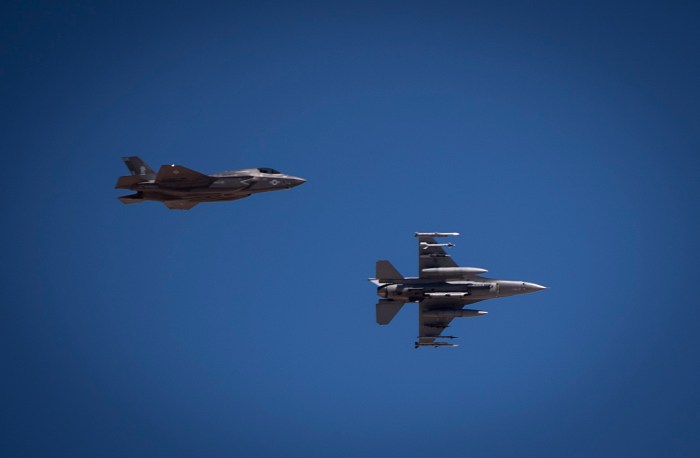
A F-35B, assigned to the Marine Fighter Attack Squadron 121 out of Marine Corps Air Station Yuma, Arizona, flies level as a F-16 Fighting Falcon from the 177th Fighter Squadron from the New Jersey Air National Guard, banks hard during approach July 15, 2016 at Nellis Air Force Base, Nevada (Source: US Air Force)

I get it, it is behind schedule, and it is over budget, but so are all of my home improvement projects. I am not sold that it can effectively do everything it is billed to do, but I am also willing to give it a fighting chance in the coming years. For those that have followed the military aircraft industry for a few decades, you will know that every airframe has had its initial struggles: the F-22, F-16, F-15, each and every one of them were plagued by issues. The F-35 is no different with perhaps the one exception that we can all take to Twitter to complain about it. I would rather focus on something entirely different.

All, the F-35 is conducting missions. No, it is not dropping bombs on IS (yet), nor is it providing CAS sorties in Afghanistan. No, it is not even deployed overseas in-theater, but that will come with time as well. However, it is creeping ever closer. Last week, USMC F-35s of VMFA-121 participated in the USAF’s Red Flag exercise. This is a big deal. If you have followed me for more than a hot minute, you know that Red Flag is near and dear to my heart. I have written extensively about, most notably here.

Participating at Red Flag is a major step forward for the entire F-35 program. You can think of Red Flag in some different ways. First, it helps to ‘season’ inexperienced pilots. USAF created Red Flag in 1975 to give its fighter pilots exposure to their first ten ‘combat’ missions. The entire purpose of the exercise was to simulate combat in a realistic training environment. Reports after Vietnam, most notably the Red Baron Reports, indicated that a pilot’s chance for survival increased exponentially after the first ten missions. Second, it exposes units and aircrew to other units and aircrews. Across the spectrum of aerial operations units have to integrate and work together to accomplish the mission. An F-22 pilot of the 1st Fighter Wing at Langley Air Force Base, VA., does not have the opportunity to fly against US Navy, USMC, and other USAF fighters on a daily basis; Red Flag provides that opportunity. The participation of VMFA-121 is as important for the F-35 and its flyers as it is for every other participant in the exercise. This is the first chance for many of these aircrews to see what the F-35 is capable of during mission parameters. This particular Red Flag exercise will see the F-35 integrate with F-22s, F-16s, F-18s and other support aircraft. Finally, Red Flag has traditionally been an exercise used to integrate new aircraft and capabilities with existing missions and platforms. This was true of the F-15 in the 1970s and the F-22 in the 2000s, and it remains true for the F-35 in 2016.

Weapons schools will continue to push the bounds of what the F-35 can do, and we can continue to argue over that, but exercising the F-35 at Red Flag allows other members of the armed forces to see what the F-35 does do.

Dr Brian Laslie is an Air Force Historian and currently the Deputy Command Historian at North American Aerospace Defense Command (NORAD) and United States Northern Command (USNORTHCOM). A 2001 graduate of The Citadel and a historian of air power studies, he received his Masters’ from Auburn University Montgomery in 2006 and his PhD from Kansas State University in 2013. His first book The Air Force Way of War (2015) was selected for the Chief of Staff of the Air Force’s 2016 professional reading list. He lives in Colorado Springs. He can be found on Twitter at @BrianLaslie.

Header Image: F-35Bs, assigned to the 3rd Marine Aircraft Wing, Marine Corps Air Station Yuma, Az., sit on the flight line during Red Flag 16-3 at Nellis Air Force Base, Nev on July 12, 2016. (Source: US Air Force Photo)

From Balloons to Drones – Air Power Throughout the Ages

From Balloons to Drones – Air Power Throughout the Ages

From balloons to drones, exploring the development of air power from the earliest days of flight to now and the future.

Over the past two decades, airpower has become the “Western way of war” […] because it offers the prospect of military victory without large-scale destruction and loss of life. Airpower, however, cannot be decisive or even effective under all circumstances […] The utility of airpower is highly situational (emphasis added).

John Andreas Olsen[1]

Air power remains the preferred weapon of choice for many governments. However, the application and development of air power, and the associated forces that are responsible for its use, are controversial and misunderstood. Indeed, as Olsen noted above, the use of air power is situational and contextual. The efficient use of military force, which lies at the heart of air power thinking, is dependent on understanding the ends, ways, and means of strategy and the relationship between objectives and capabilities.

This can only be achieved by understanding the development of air power and the forces that use this form of military capability as well as its relationship with broader areas, such as politics and society. To provide this, From Balloons to Drones is an online platform that seeks to provide analysis and debate about air power history, theory, and contemporary operations in its broadest sense including space and cyber power.

From Balloons to Drones seeks to publish articles, commentaries, research notes, and book reviews that encourage debate about air power.

We welcome and encourage potential submissions from postgraduates, academics, and practitioners involved in researching the subject of air power.

Submissions can take the following form:

  • ArticlesBalloons to Drones seeks to publish informative articles on air power that range from historical pieces to the analysis of contemporary challenges. These well-researched articles should attempt to bridge a gap between the specialist and non-specialist reader. They should be around c. 1,000 to 1,500 words, though Balloons to Drones will accept larger pieces though we reserve the right to publish them in parts. References can be via footnotes and hyperlinks.
  • CommentariesBalloons to Drones seeks to publish opinion pieces on recent on a recent piece of news, either on a contemporary or historical subject. These are to be responses to such piece and should be no longer than c. 1,000 words.
  • Research NotesBalloons to Drones seeks to publish research notes related to contributors currents research projects. These take the form of more informal pieces and can be a discussion of a source or a note on a recent research theme. Unlike other pieces published by Balloons to Drones, they can be written in the first person, though they can include references. These should be c. 500 to 1,000 words.
  • Book ReviewsBalloons to Drones publishes occasional book reviews that aim to be an accessible collection of appraisals of recent publications on the subject of air power. If publishers are interested in having a publication reviewed then, please contact via the email address below.

Submissions should be submitted in Word format. Also, please include a 50-100 word biography with your submission. However, if you are not sure if your piece fits our requirements, then please email us with the POTENTIAL SUBMISSION in the subject line. References can be used, and, given the readership of this site, please be careful to explain any jargon used.

If you are interested in contributing, please email us at airpowerstudies@gmail.com

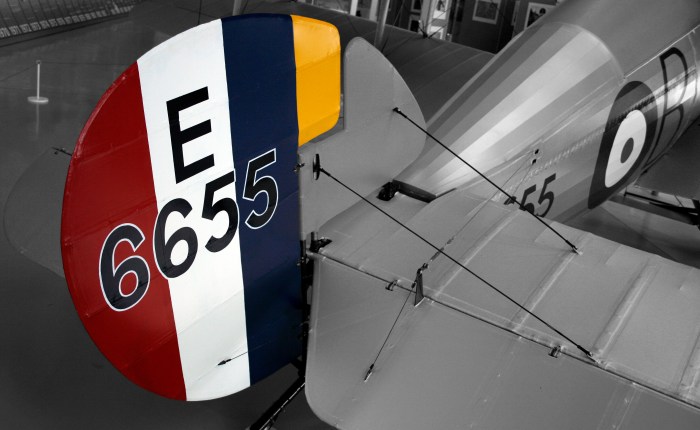
Header Image: Sopwith Snipe at the RAF Museum London (Source: Author’s Collection)

[1] John Andreas Olsen, ‘Introduction – Airpower and Strategy’ in John Andreas Olsen (ed.), Airpower Reborn: The Strategic Concepts of John Warden and John Boyd (Annapolis, MD: Naval Institute Press, 2015), p. 2.