Small Air Forces and #HighIntensityWar: Multinational Cooperation as an Opportunity to Build and Strengthen their Capabilities

Small Air Forces and #HighIntensityWar: Multinational Cooperation as an Opportunity to Build and Strengthen their Capabilities

By Maria E. Burczynska

The introduction to the recent #highintensitywar series run by From Balloons to Drones and The Central Blue suggested that the character of military conflict is changing due to the increased possibility of high-intensity war, which, in turn, will present significant challenges to Western militaries. While the series introduction suggested that post-Cold War conflicts presented few challenges for air forces seeking to maintain control of the air the increasing likelihood of a high-intensity war may well change that scenario. In such a case, not only will the ability to achieve air dominance be challenging but also, if that is not achieved then the ability to perform the full spectrum of air power roles and using all capabilities available may be restricted too. Such a situation may prove especially difficult for small air forces which often lack specific capabilities in the first place.

This article focuses predominantly on small European air forces with Poland and Sweden as case studies. It discusses the situation in which these two air forces find themselves after the end of the Cold War and the changes they have undergone. In doing so, this article also briefly introduces some of the general trends and challenges that took place during the post-Cold War years in Europe such as decreasing defence budgets and the downsizing of armed forces. The article identifies principal areas where small European air forces suffer from capability shortcomings and then moves on to discuss the role of multinational cooperation as a means to make up for these gaps.

What is a Small Air Force?

When speaking of a small air force, one could think of it looking at its actual size, its number of the aircraft and its number of personnel. However, this article defines a small air force according to its capabilities. This follows the definition provided by Sanu Kainikara who recognised four categories of air forces; the US Air Force, large air forces, small air forces and niche air forces. These differ from each other regarding the scope of their capabilities, their ability to pursue operations independently as well as the presence of an indigenous industry supporting the air force’s needs at the national level.[1] According to this classification, small air forces can perform the four fundamental roles of air power; control of the air, intelligence, surveillance and reconnaissance (ISR), attack and air mobility. On the other hand, small air forces do not have the resources necessary to undertake such roles to a considerable extent and over a prolonged period. Therefore, small air forces would not be able to conduct independent large air operations. However, they are often the desired ally that can efficiently work within a coalition.

Both the Polish and Swedish Air Forces (AF) comfortably fit into the category of a small air force. They have necessary resources to perform the full spectrum of capabilities within the already mentioned air power roles. However, their resources are insufficient, sometimes falling to single numbers of an aircraft of specific types. That makes them unable to perform independent large-scale military operations. Finally, both countries have some industrial capacity to support national air power capabilities, such as PZL Mielec and PZL Świdnik, now part of respectively Sikorsky Aircraft Corporation and Leonardo-Finmeccanica’s Helicopter Division in Poland, or Saab in Sweden.

European Air Power after 1991

In the post-Cold War years European air forces and militaries, in general, underwent certain transformations. Primarily, military expenditure by European states has dropped noticeably. In Poland, defence expenditure has decreased from 2.6% of the GDP in 1990 to 2.0% in 2016 while in Sweden it has dropped from 2.6% to 1.0% in the same period.[2] In line with decreasing defence budgets was the gradual downsizing of air forces and the armed forces in general. For example, in Poland, the number of active personnel has dropped from 86,200 men in 1990 to 16,600 in 2015.[3] At the same time, the number of officers serving in the Swedish AF fell from 8,000 to 3,300.[4] Moreover, it was not only manpower that dropped in numbers but also available equipment. The Polish AF reduced from 800 aircraft in 1990 to 300 in 1998 with the target of 100 to be reached in 2002.[5] A similar process also took place in the Swedish AF, but, in this case, it was initiated as early as the 1960s when the number of combat aircraft started to drop from 800 and reached 400 in the 1990s.[6]

The above situation led to specific organisational and structural changes within both the Polish and Swedish AFs. In case of the Polish AF, these transformations started at the very top when the Air Force (Wojska Lotnicze) and the Country Air Defence Force (Wojska Obrony Powietrznej Kraju) merged to form the Air Force and the Counter-Air Defence Forces (Wojska Lotnicze i Obrony Powietrznej). In 2004, the latter formation was finally re-named as the Polish Air Force (Siły Powietrzne). Also, the building blocks of the Polish AF was changed by replacing two of its existing squadrons with regiments.[7] Similar re-organisation took place within the Swedish AF when out of its 12 Wings, and the main air bases, only four remained operational while the other eight were closed.[8]

The transformation of the two air forces also involved modernisation of their already reduced fleets. In Sweden, that process focused on three areas. First, the Swedish AF replaced its AJ/JA-37 Viggen aircraft with JAS-39 Gripen. Second, it introduced more advanced types of munitions and then finally it has sought to upgrade its command, control, communications, and intelligence system.[9] For Poland, the air force modernisation was challenging because the overwhelming majority of the country’s aircraft was built either in the Soviet Union or under licence from them. In the post-Cold War years, these aircraft delivered little modern combat capability. As such, in the process of modernisation, the Polish AF replaced its MiG-21 and MiG-23 fighters with 22 MiG-29s bought from Germany in 2003 and 48 F-16s delivered in years 2006–2008 from the US. They also acquired 17 CASA C-295M transportation aircraft.[10] Finally, on the 1 January 2016, Poland opened the twelfth unmanned aerial vehicle (UAV) base that was the first of its kind in the country.
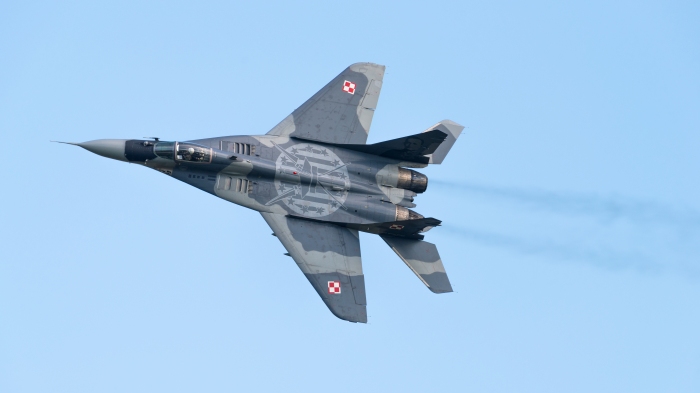
105 Polish Air Force MiG-29A Fulcrum ILA Berlin 2016
A Polish Air Force Mikoyan-Gurevich MiG-29A Fulcrum at the ILA Berlin Air Show 2016. (Source: Wikimedia)

Limitations of European Air Power

Despite all the organisational and structural transformations, and fleet modernisation that has taken place over the last 30 years, the Polish and Swedish AFs remain small air forces and, as such, somewhat limited in their capabilities. Principally, their fleets are relatively small; the Polish AF possesses 283 aircraft in total while the Swedish AF numbers 231 airframes including the inventory of the Armed Forces Helicopter Wing.[11] However, the Polish and Swedish AFs are also limited in areas that are representative of the significant shortcomings of European air power in general, namely air transport (AT), ISR and air-to-air refuelling (AAR). Significant gaps in these three areas were identified as early as the conflicts in Bosnia and Kosovo in the 1990s. However, these capability gaps have become even more evident after the involvement of European air forces in operations over Libya in 2011. Operations over Libya revealed not only the low capacity of European air forces in the areas of AT, ISR, and AAR resources but also their heavy reliance on the US for those capabilities.[12]

Both Poland and Sweden continue to experience significant shortcomings in these three areas. For example, the Polish AF has only 45 transport aircraft while for Sweden that number drops to barely eight.[13] The differences are even more significant when it comes to ISR and AAR. In case of AAR, the Swedish AF has one tanker aircraft.[14] Poland, on the other hand, does not possess any aircraft of that type. However, in 2014, together with Norway and the Netherlands, Poland decided to acquire a fleet of Airbus A330 multi-role tanker transports.[15] The situation is similar in the realm of ISR. Sweden has five ISR aircraft while the Polish have none.[16]

Examples of Multinational Cooperation Initiatives

Multinational cooperation is one way to make up for such shortcomings in small air forces where resources are limited. It is also the cost-effective option. This cooperation takes different forms, from pooling and sharing resources to training programmes but they are always collective initiatives. As such, these initiatives require participating states to be willing to share the costs of running the project in areas such as the acquisition and maintenance of platforms. As a result, multinational cooperation can significantly reduce the financial burden that would be placed on a small air force if it were to develop such capabilities from scratch. Such pooling and sharing of capabilities also present a viable interim solution in the case where a country is already working towards developing a particular capability that has not yet become fully operational. An example of such an initiative is Poland’s involvement in the Alliance Ground Surveillance (AGS) programme whereby 15 NATO members are acquiring a system consisting of five RQ-4 Global Hawk UAVs and advanced radar systems, which altogether will allow for providing persistent surveillance from high-altitudes.[17] This initiative presented a viable interim solution for Poland which does not possess any air surveillance capability. While Poland is currently developing a UAV fleet which could provide that capability, until it becomes fully operational, AGS can fill that gap. Poland had been a member of the AGS programme until 1 April 2009 when the country withdrew due to financial reasons. Poland later re-joined the programme in April 2014.[18] Another way to make up for the lack of national ISR capability is participation in the NATO Airborne Early Warning (NAEW) system. The initiative started in 1982 and, as such, is one of the oldest and the most successful cooperative initiatives in NATO and Europe. Poland joined NAEW in 2006.[19]

An exciting initiative addressing both the lack of AT and AAR capability, but pursued outside of NATO and EU frameworks, is the Air Transport, Air-to-Air Refuelling, and other Exchange of Services (ATARES) programme developed by the Movement Coordination Centre Europe (MCCE). This project promotes the exchange of services – AAR for AT calculated using Equivalent Flying Hour (EFH).[20] For example, Poland does not have an AAR capability. Therefore, Poland uses ATARES to give aircrews an opportunity to train on those particular platforms and, in return, offers AT capabilities.[21] Interestingly that capability does not have to be provided to that particular country from which AAR was used in the first place. The agreed number of EFH need only to be returned to the initiative and therefore may be used by any one of its members. Sweden offers its AAR services within ATARES even though there is only one tanker in the Swedish AF. For example, in 2017, MCCE provided refuelling support during the Arctic Challenge Exercise, and that support involved the Swedish aircraft.[22]

Other examples of multinational initiatives addressing limitations in national AT capabilities are the Strategic Airlift Interim Solution (SALIS), and the Strategic Airlift Capability (SAC) started in 2005 and 2008 respectively. These are pooling and sharing projects whereby participating states maintain a certain number of aircraft and use these according to their needs. For example, SALIS was created to transport heavy cargo and Poland used the programme to transport helicopters and armoured vehicles to Afghanistan.[23] SAC was designed to support the participating states in their defence or logistical needs at the national and international level. It operates through the Heavy Airlift Wing (HAW) located in Papa Air Base in Hungary. The Polish AF used SAC’s C-17s to transport the bodies of the victims of the Presidential Tupolev crash in Smolensk in April 2010.[24] Sweden, on the other hand, used SAC for a very different purpose – to deliver cargo from Karlsborg Air Base to Mazar-e-Sharif in Afghanistan in September 2009.[25] This was HAW’s first mission done in support of ISAF. Swedish and Polish officers were also among the crew members during the first HAW mission performed in support of ISAF but without any Americans on board.[26]

Of course, none of the members in initiatives such as these has unlimited access to all the available resources. The share they get is usually proportional to their involvement. For example, the annual total of flying hours available under SAC is 3,165, which is divided among the 12-member nations. Both Poland and Sweden have entirely different shares equalling, respectively, 4.7% and 17.6%.[27] That gives 148.8 flying hours to be used by the Polish AF and 550.7 by the Swedish.
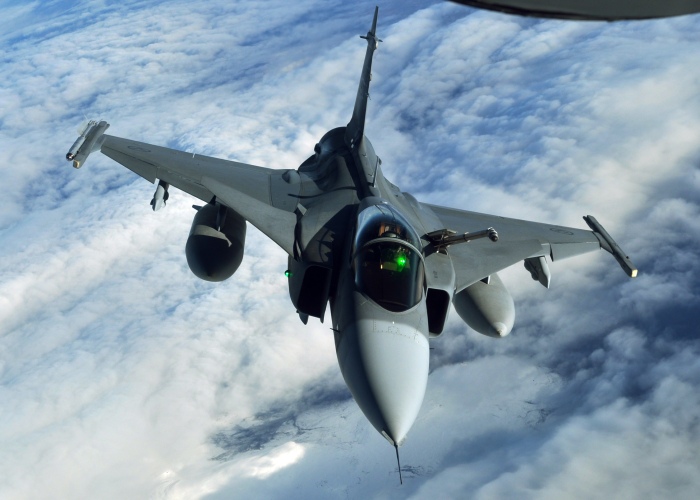
Red versus Blue
A Swedish JAS-39 Gripen returns to the play areas of the Arctic Challenge exercise over Norway, after taking on fuel from a U.S. Air Force KC-135R Stratotanker on 24 September 2013. (Source: Wikimedia)

Conclusion

This article has discussed some of the challenges confronting small air forces and whether multinational initiatives can increase their capabilities with specific reference to the Polish and Swedish AFs. The answer is yes. First, the examples discussed show that these projects are successful tools in building and strengthening capabilities such as AT, ISR and AAR. For small air forces, multinational cooperation gives an opportunity to develop these three areas to the extent that could not be afforded otherwise, or that would incur much higher costs.

Second, it is not only the pooled and shared fleets that the participating air forces can benefit from, but also training. The aircrews delegated to take part in any multinational initiatives return home with the experience they would often not have had a chance to develop otherwise. Here, it is also worth mentioning, that, along with pooling and sharing arrangements there are also programmes designed specifically for training purposes. These programmes present an excellent opportunity for air forces, especially the small ones, to exercise together towards capabilities that, in their home country are not available at all, or that are available but on an insufficient scale. Examples of such initiatives are the European Air Transport Training (EATT), and the European Advanced Airlift Tactics Training Course (EAATTC) started in 2012 and 2014 under the umbrella of the European Air Transport Fleet programme. The Polish AF has participated in both training initiatives in 2016 and 2017 while in 2015 it held observer status in EATT. Sweden also took part in EATT in 2013 and 2015 and was an observer nation in 2014. Another prominent example of a training arrangement involving the Swedish AF is the Cross-Border Training programme established in 2009. This project brings together Sweden, Norway and Finland and enables their air forces to use each other’s airspace to train together on a weekly basis.

Third, involvement at the multinational level in different forms of cooperation – pooling and sharing arrangements, expeditionary missions, air policing, and exercises, gives credibility to small air forces. The more often they work together with other nations, the more they will be perceived as a valuable and reliable potential partner. At the same time, such involvement requires certain work to be done, for example, making sure that one’s air force and its procedures, equipment, personnel’s knowledge, and abilities, are interoperable with potential partners in a coalition. This may incur additional costs, which may be challenging for small air forces.

Finally, while they appear very appealing, it must be remembered that multinational initiatives are not the panacea for capability gaps. For example, in many cases, a country only receives in return what is proportional to one’s contribution. Therefore, the multinational projects allow for the new capabilities to be built but on a limited scale and according to one’s financial input. As a result, collective capability development should not replace national ones. All European air forces, including the small ones, still need to develop their national capabilities. Multinational, collective arrangements may complement them, but they should never replace them altogether.

Maria Ewa Burczynska is a PhD candidate in the School of Politics and International Relations at the University of Nottingham where she is affiliated with the Centre for Conflict, Security and Terrorism. Her primary area of interest is European air forces and their participation in multinational operations and initiatives. She is also interested in the subject of disaster management as another dimension of national security.

If you would like to contribute to From Balloons to Drones, then visit our submissions page here to find out how.

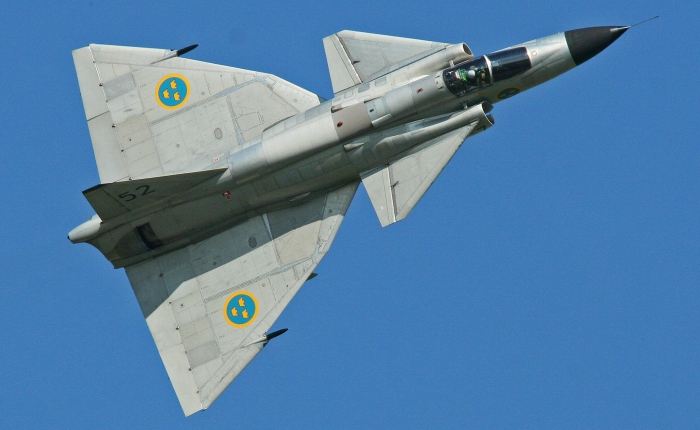
Header Image: A Saab AJS-37 Viggen of the Swedish Air Force Heritage Flight on display at the RAF Waddington air show in 2013. (Source: Wikimedia)

[1] See, Sanu Kainikara, At the Critical Juncture. The Predicament of Small Air Force (Canberra: RAAF Air Power Development Centre, 2011).

[2] SIPRI Military Expenditure Database 2017.

[3] ‘Europe’ in The Military Balance, 115:1 (2015), pp. 57-158; ‘The Alliances and Europe’ in The Military Balance, 90:1 (1990), pp. 44-96.

[4] Ibid.

[5] Barre R. Seguin, Why did Poland choose the F-16?, The Marshall Center Occasional Paper Series (Garmisch-Partenkirchen: The George C. Marshall European Center for Security Studies, 2007), p. 6.

[6] Richard A. Bitzinger, Facing the Future. The Swedish Air Force, 1990-2005 (Santa Monica, CA: RAND, 1991), pp. 13-5.

[7] Rafał Ciastoń et al, Siły Zbrojne RP – stan, perspektywy i wyzwania modernizacyjne (Warszawa: Fundacja im. Kazimierza Pułaskiego, 2014), p. 54.

[8] Bitzinger, Facing the Future., pp. 11-4; Försvarsmakten, Flygvapnet.

[9] Bitzinger, Facing the Future., pp. 37-45.

[10] Zbigniew Średnicki, ‘Modernizacja techniczna sił powietrznych,’ Przegląd Sił Zbrojnych, 3 (2015), pp. 8-15.

[11] ‘Europe’ in The Military Balance, 118:1 (2018), pp. 65-168.

[12] Elizabeth Quintana, Henrik Heidenkamp and Michael Codner, Europe’s Air Transport and Air-to-Air Refuelling Capability: Examining the Collaborative Imperative, RUSI Occasional Paper (August 2014), p. 6.

[13] ‘Europe’ in The Military Balance, 118:1 (2018), pp. 65-168.

[14] Ibid.

[15]European multirole tanker transport fleet takes shape,’ European Defence Agency, 19 December 2014.

[16] ‘Europe’ in The Military Balance, 118:1 (2018), pp. 65-168.

[17]Alliance Ground Surveillance (AGS),’ North Atlantic Treaty Organisation, updated 6 June 2017.

[18] Grzegorz Hołdanowicz, ‘Nieprimaaprilisowe pożegnanie z AGS,’ Raport – Wojsko Technika Obronność, May 2009.

[19] Tadeusz Wróbel, ‘Tysiąc lotów AWACS-a nad Polską,’ Polska Zbrojna, 13 October 2016.

[20] Quintana et al, Europe’s Air Transport and Air-to-Air Refuelling Capability, p. 11.

[21] Colonel in the Polish Air Force and a scholar at the National Defence University in Warsaw, interview conducted by the Author on 30 June 2016.

[22]MCCE support to Arctic Challenge 2017,’ Movement Coordination Centre Europe, 29 May 2017.

[23] Juliusz Sabak, ‘Rosyjskie An-124 nadal wożą sprzęt NATO,’ Defence 24, 13 January 2017.

[24] Colonel in the Polish Air Force and a scholar at the National Defence University in Warsaw, interview conducted by the Author on 22 June 2016.

[25]SAC Milestones 2006 –,’ Strategic Airlift Capability.

[26] Ibid.

[27]The Strategic Airlift Capability (SAC),’ Strategic Airlift Capability.

Education for 21st Century Aviators

Education for 21st Century Aviators

By Colonel (ret’d) Dr Randall Wakelam[1]

Editorial Note: Between February and April 2018, The Central Blue and From Balloons to Drones, will be publishing a series of articles that examine the requirements of high-intensity warfare in the 21st Century. These articles provide the intellectual underpinnings to a seminar on high-intensity warfare being held on 22 March by the Williams Foundation in Canberra, Australia. In this article, Dr Randall Wakelam examines the importance of education for aviators in the 21st Century. While drawing on the experience of the Royal Canadian Air Force, Wakelam argues that while the value of education is often hard to quantify, it is nonetheless an essential aspect in the development of airman who needs to master the profession of arms and the challenges associated with that idea. His argument transcends national boundaries and applies to any large, medium, or small air force seeking to prepare for the challenges posed by the future operating environment.

I have a prejudice: My prejudice is that airmen do not like thinking: Airmen are obsessed with bombs, fuses, cockpits and screens and are actually rather uncomfortable exploring the underpinning logic and doctrine: So producing a thinking air force is a strategic requirement.

Air Chief Marshal Sir Brian Burridge, RAF Air Power Review, 2004

In Burridge’s statement from the early years of this century, one can readily see that education for air power professionals has been and will continue to be important for the successful management of air forces both regarding national and international processes like procurement and collation operations and the day to day conduct of air operations. However, the caution that he offers about discomfort for education is equally important, and his concern is not new. Indeed one of the central themes of Carl Builder’s study of the USAF – The Icarus Syndrome – was that leaders had too often shifted their focus from the tough questions of running the institution to a more limited attention to technologies and air vehicles.[2] Moreover, we see a similar tendency to eschew non-technical aspects of air power in the early days of the Royal Australian Air Force (RAAF) College where of a 5,500-hour, four-year syllabus, fully 1,955 hours were spent on the sciences, while only 230 were dedicated to history, war studies, and imperial defence issues. There was no non-technical course on air power theory. In the view of former RAAF historian Alan Stephens, ‘the Air Force [was] very plainly identifying itself as a technocracy.’[3]

Building on these examples and concerns I want to argue that education is good for the RCAF, both for individuals and for the institution. A recent RCAF Journal article ‘Professional Airpower Mastery and the RCAF’ also makes the point, stating that Canada’s air force is very good tactically, but that beyond this it lacks the ability to be as effective as it might at higher levels of warfighting or in the broad domain of national and international security.[4] At those levels, we, again both individually and institutionally, tend to muddle through problems – sometimes successfully, sometimes less so. To put that article in context for an Australian audience, it should be noted that one of the many sources used by those authors was Sanu Kainikara’s 2011 work At the Critical Juncture: The Predicament of Small Air Forces.[5]

Returning to a Canadian context, a late 1960s study, The Report of the Officer Development Board (ODB), posited that all officers move away from hands-on tactical and technical expertise fairly early in their careers, replacing those technical and tactical ‘occupational skills’ with broader pan-service and then pan-Canadian Forces/whole of government ‘military expertise’ competencies.[6] This progression is as true of the RCAF as it is of the Royal Canadian Navy or the Canadian Army. More to the point of this article, the ODB also stated that officers needed to start their service with a strong intellectual ability and then have to grow that as the challenges they confront become less predictable. The ODB made this point in the context of a world which was dominated by tense geopolitical circumstances, burgeoning technological advances and security challenges that ranged from superpower standoff to asymmetric conflict to the full range of peace support operations.[7]

Things are not much different today. We are called upon to deal with the often abstract and chaotic problems of the 21st century using what the ODB labelled called ‘executive and military executive abilities’. Major-General David Fraser, then just returned from commanding Regional Command South in Kandahar, made a similar observation in a 2006 lecture at the Canadian Forces College, pointing out that at the tactical level leaders need to have the intellectual agility, and associated confidence to be able to deviate from a plan when circumstances dictate.[8] However, he went on to argue that while at the tactical level circumstances can be complicated, at the operational and strategic levels of war decision makers often face complexity, overlaid with ambiguity and chaos – what is often called the wicked problem.

Wakelam

We learn technical and tactical skills through training for the most part, but the broader competencies are more generally the product of education. Training allows for standardised responses to predictable circumstances whereas education permits reasoned responses to unpredictable circumstances.[9] Training can be relatively well measured as we can see in the course training standards and training and education plans that form the basis of hundreds of qualifications. From Robert Smith-Barry’s reforms to pilot training that he implemented a century ago today we implicitly understand the value of standardised training for aircrew and more broadly for all air force hands-on competencies. Knowing that your winger knows what she or he is doing; knowing that the techs have done their snag rectification by the book and that battle managers understand clearly what they can do to assist in the fight allows each of us to perform confidently. Moreover, all these skills and knowledge are based on a validated training system which ensures technical and tactical competence.

Education, and its value is, on the other hand, a bit less quantifiable: does a Bachelor’s in aeronautical engineering equate to an effective aircraft designer or a skilled technical authority? Does a Master’s in International Relations make for an effective commanding officer (CO) when deployed on coalition operations or an astute policy analyst proposing changes to air force roles and structures? In these examples, the answers are probably yes, but there is no easily applied ‘training standard’ to tell us so. The ODB said that the undergraduate degree provided a necessary ‘training of the mind’ and a graduate degree in areas related to the profession of arms was a useful and necessary enrichment both in knowledge and intellectual capacity.[10]

Those thoughts from 50 years ago are all well and good, but those who do not have a degree, or an advanced degree often seem to do ‘just fine’.  However, what does just fine mean? It may mean that success has not come from an optimal application of thinking power – allowing a logical, viable solution. Rather, it may mean that a solution is derived from a limited perspective based on the individual’s limited or skewed sense of the issues. Education is not a guaranteed antidote to the latter problems, but it frequently offers the learner new ways of considering evidence and weighing alternatives. Indeed, this was the implicit message in the RCAF’s curriculum of the RCAF War Staff Course. Air Commodore George Wait, the Staff College’s first commandant, had an opportunity to offer his thoughts on the content and conduct of the syllabus and by extension the notion of a professional development philosophy that combined training and education. He wrote:

[t]he backbone of the course consists of a series of lectures on staff duties given by the Directing Staff, which leads students through service writing, precis writing, appreciations and orders and instructions.  The students then put their knowledge to work by doing a series of practical problems on the employment of air power.[11]

However, to give this routine staff training some added richness the programme of studies also included lectures given by well-qualified visiting speakers, both officers and civilian officials, on a variety of topics, including other services, allied and enemy forces, matters of the strategic direction of the war, and war production. ‘Only by such a means,’ Wait had said in earlier correspondence with Air Force Headquarters, ‘can the students be given the broader and more authoritative outlook that they will require in staff positions.’[12]

The same notion of broad education was stated more explicitly in the late 1950s in the RCAF Staff College’s syllabus:

The RCAF Staff College makes no attempt to graduate experts in a particular field, nor does it expound any easy universally applicable doctrines. Rather by providing its graduates with an education of the broadest scope and by developing habits of clear thinking, it attempts to provide them with the breadth of interest, openness of mind, reasoning ability, and a broad view of their Service and profession, which will enable them to master the specific tasks of any appointment and to make sound decisions in any situation. (emphasis added)[13]

Much of my original paper had been drafted before the 7 June 2017 release of Canada’s new defence policy ‘Strong, Secure, Engaged’. Reading through it and ‘blue sky’ imagining the work needed to implement the policy one cannot but think that it will require big and imaginative minds to deal with how we make good on the vision and indeed there are repeated references to flexibility of mind and the utility of education. Tactical excellence alone, one can surmise, will not guarantee success.

Practically, how do we do develop a learning strategy that ensures policy ends? The recently restructured and re-energised RCAF officer professional development system offers a flight plan towards realising this goal. First, we have confirmed the need for all officers to achieve, or in certain special cases to be on the path to achieving, an undergraduate degree before commissioning. As of 2016, in Canada, we now have a course – the Air Power Operations Course (APOC), that looks remarkably similar to the War Staff Course, albeit only 60 percent as long. Finally, there is a vision, yet to be defined and approved, for expanded senior officer education, this to be achieved through focused workshops of several days or a few weeks duration depending on the topic.

The APOC has six ‘performance objectives’, the first being a learning outcome to develop the air-mindedness of students, who are drawn from all RCAF occupations, so that they can work collaboratively with officers across all flying and technical communities within the RCAF and can explain and represent the air power concepts and practices to officers in joint headquarters and other services. The second objective is to develop staff officer competencies in clear and logical thinking and communications. The remaining objectives – planning of operations in deployed and coalition situations – build on the first two and expose students to the complexity of modern air operations, and this in a service where tactical and maritime helicopters (and everything else that flies) are air force resources.

What the more senior follow-on courses might look like is still very much undefined, but the wisdom of the 1959 syllabus would suggest that a tactically oriented curriculum will not do. What senior air force leaders need is something more. This same idea was much in evidence in a recent Australian Defence Force study. The following are extracts from ‘The Chiefs: A Study of Strategic Leadership.’[14]

The report reaches three major conclusions, relating respectively to individual development, organisational development and leadership style. These conclusions are that:

  • for the ambitious officer, “what got you here won’t get you there”;
  • for the military institution, “what got us here won’t get us there”; and
  • the principle that “leadership is a team sport” is just as valid at the senior level as it is lower in the organisation.[15]

It is recommended that:

  • the core JPME [Joint Professional Military Education] effort (or at least that from mid-career onwards) be oriented around the four strategic leadership roles of Strategic Leader, Strategic Builder, Strategic Director and Steward of the Profession.
  • such JPME be focused on preparing officers for future roles in both leadership and support for senior leaders.
  • officers from mid-career onwards periodically be exposed to and engage with contemporary and evolving issues at the strategic level, with exercises that require them to examine the responsibilities and skills needed for the Director-Leader-Manager-Steward forms within their own current and immediate-future career roles. (For example, as part of preparation for ship/unit command, O4 and O5 could examine the application of these four roles to that level of command and the level of command immediately above it.)
  • such engagement use active rather than passive modes of learner behaviour.
  • each Service continue with the current encouraging trend of introducing career models that enable selected officers to develop in-depth specialisations within relevant fields – not just within “personnel management” and “project management/technology” but also within economics, politics and military sociology.[16]

We can see that technical and tactical competencies are no guarantee to success at higher levels of command and leadership and that organisations that are similarly successful like likely need to approach institutional and national/international challenges with ways and means (intellectually and practically) that differ from what works in tactical situations.

20141208adf8588365_003
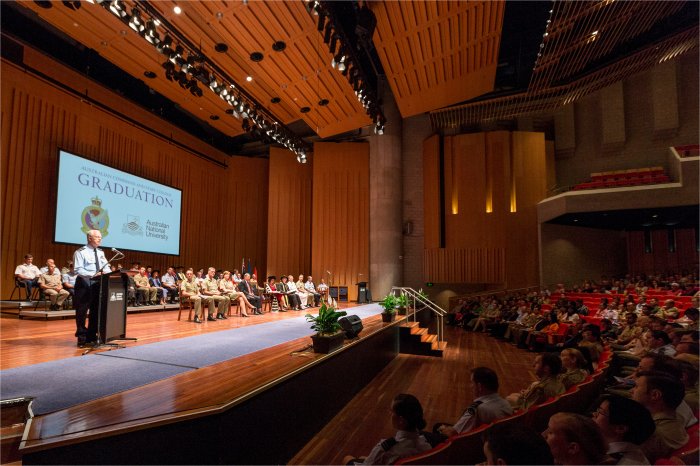
Chief of the Defence Force Air Chief Marshal Mark Binskin AC, speaking at the 2014 Australian Command and Staff Course – Joint Graduation ceremony held at Llewellyn Hall, Australian National University, Canberra, c. 2014. (Source: Australian Department of Defence)

Some, if not all the Australian Defence Force’s recommendations for learning could be implemented within the RCAF’s professional education programme, but there is much to be gained from learning environments outside the air force. The recent introduction of sponsored assignments to complete a Masters in War Studies at the Royal Military College (with a focus on air power topics) is one such avenue. Similarly, a new internship programme, with placements in think tanks, industry and government will expose air force officers to different ways of thinking, planning and operating.

Where does this leave us as we advance through the new century? As suggested at the outset a narrow focus on technical and tactical proficiency, while necessary, cannot be the nexus of professional education. Many observers and practitioners have noted this. A broad blend of intellectual dexterity coupled with both hands-on skills and broad knowledge would seem to have been and remains today the essence of professional effectiveness and thus the desired outcome of an aviator’s education.

Dr Randall Wakelam teaches military and air power history at the Royal Military College of Canada.  After graduating from RMC in 1975 he flew helicopters for the Army, becoming CO of 408 Tactical Helicopter Squadron in 1991. Along the way, he also had staff appointments in aircraft procurement and language training policy. Since 1993 he has been an educator, first in uniform at the Canadian Forces College in Toronto and now at RMC. His research and publishing focus on air power and military education.

Header Image: A memorial to the establishment of the RCAF Staff College, which is now the Canadian Forces College. This establishment started life as the RCAF War Staff Course. (Source: Wikimedia)

[1] A shorter version of this paper was first drafted for the Royal Canadian Air Force (RCAF) in the Fall of 2017, but both it and this version are the products of about 30 years of thinking about how military professionals can best educate themselves. Where the examples used are largely specific to historical and contemporary Canadian experience there is, I believe, much that is common to most, if not all, modern air forces.

[2] Carl Builder, The Icarus Syndrome: Air Power Theory and the Evolution of the Air Force (New Brunswick, NJ: Transaction Press, 1998).

[3] Alan Stephens, Power Plus Attitude: Ideas, Strategy and Doctrine in the Royal Australian Air Force 1921-1991 (Canberra: Australian Government Publishing Service, 1992), pp. 109–11.

[4] Brad Gladman et al, ‘Professional Airpower Mastery and the RCAF,’ RCAF Journal, 5:1 (2016), pp. 8-23.

[5] Sanu Kainikara, At the Critical Juncture: The Predicament of Small Air Forces (Canberra: Air Power Development Centre, 2011).

[6] Randall Wakelam and Howard Coombs (eds.) The Report of the Officer Development Board: Major-General Roger Rowley and the Education of the Canadian Forces (Waterloo: Wilfrid Laurier University Press, 2010), p. 46. The same issue applies to senior warrant officers as they reach formation (wing, air group, etc.) and national level senior appointments where they must be able to understand the sorts of challenges their commanders face.

[7] Ibid, pp. 26-31.

[8] Major-General David Fraser, Lecture to the Advanced Military Studies Course, Canadian Forces College Toronto, October 2006.

[9] Ronald Haycock, ‘Historical and Contemporary Aspects of Canadian Military Education’ in Greg Kennedy and Keith Neilson (eds.) Military Education:  Past, Present, and Future (Westport, CT.: Praeger, 2002), p. 171.

[10] Wakelam and Coombs, Officer Development Board, p. 40.

[11] William R. Shields and Dace Sefers, Canadian Forces Command and Staff College: A History 1797-1946 (Toronto: Canadian Forces College History Project, Canadian Forces College, 1987), pp. 4-15.

[12] Ibid, pp. 4-16.

[13] R.C.A.F. Staff College Calendar Course 23 (1958-9), “Conclusion.”

[14] Nicholas Jans, Stephen Mugford, James Cullens and Judy Fraser-Jans, ‘The Chiefs:  A Study of Strategic Leadership’ (Canberra:  Australian Defence College, 2013).

[15] Ibid, p. 111.

[16] Ibid, p. 113.

What does Time and Space mean for the Airman?

What does Time and Space mean for the Airman?

By Ian Shields

Editorial Note: Between February and April 2018, The Central Blue and From Balloons to Drones, will be publishing a series of articles that examine the requirements of high-intensity warfare in the 21st Century. These articles provide the intellectual underpinnings to a seminar on high-intensity warfare being held on 22 March by the Williams Foundation in Canberra, Australia. In this article, Ian Shields explores the implications of the concepts of time and space for airmen. Using these concepts, Ian explores the differences between the services concerning culture, technology, and decision-making. Understanding these differences is essential if we are to leverage the advantages of each of the domains in high-intensity warfare.

Introduction:

Time and Space bound all military operations. We are used to the idea of trading time for space, although that is primarily applicable to the land campaign. If we think about the time/space relationship in two campaigns separated by a significant amount of history associated concepts show a great deal of change:

  • The Peloponnesian wars – campaign duration, the speed of manoeuvre, communication, size of battlefield/weapon ranges.
  • The First Gulf War – campaign duration, the speed of manoeuvre, communication, size of battlefield/weapon ranges.

It can be argued that time and space constrains airmen; however, we have a different perception and are better able to exploit both time and space.

Nevertheless, before going any further, what do airmen do? In 2010, Colonel Tim Schultz, the then Commandant of the USAF School of Advanced Air and Space Power Studies suggested that airmen ‘project innovative forms of power across traditional boundaries.’ Again, with emphasis, airmen ‘project innovative forms of power beyond traditional barriers.’ The key words here are, ‘project,’ ‘innovative’ and ‘power’ and these are the key to why airmen are different. Given this, this article focusses on four areas: the impact of air power; our cultural differences as airmen compared with soldiers and sailors; the impact of technology; and decision-making before concluding.

The Impact of Air Power

Looking at the world at the beginning of the Twentieth Century, it was well-ordered, firmly based on the idea of the nation-state that was built on Treaty of Westphalia and the Congress of Vienna. Europe was, by historical standards, relatively peaceful with well-defined and respected boundaries.

To alter the balance of power required armies crossing these boundaries which, as we saw in 1914, could have disastrous results. Navies could control trade, impose blockades, and prevent armies moving over stretches of open water but they are themselves constrained by the availability of water; water covers only 70% of the surface of the earth.

large_0000002
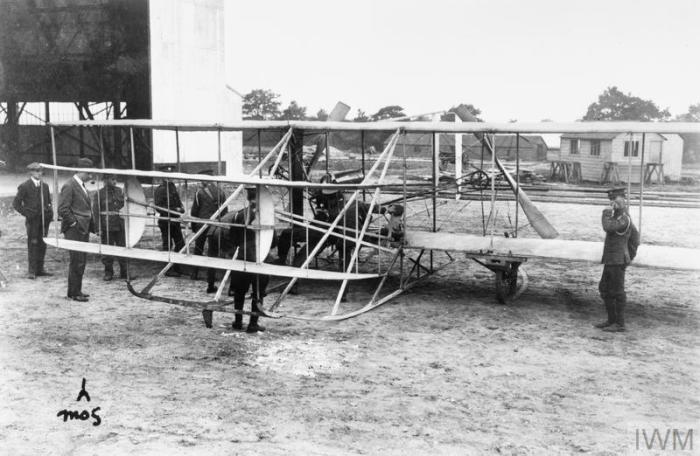
The Wright brothers aircraft at Farnborough being inspected by a small group of soldiers, c. 1910. (Source: © IWM (RAE-O 615))

The events of 17 December 1903 changed all that, although it was not appreciated in those terms at the time (or, arguably, ever since): with 100% of the earth covered by air, boundaries drawn on maps and the constraints of the ocean became far less relevant. Again, airmen project beyond traditional boundaries.

While technology did not allow air power to be fully exploited in the First World War, the omens were there. Yes, there was an over-reaction in the 1920s and 1930s with, for example, Stanley Baldwin’s pronouncement that ‘the bomber will always get through,’ but the seeds for air power to exploit time and space in innovative ways began to be appreciated.

Cultural Differences

When exploring the question of what time and space mean for airmen, it is worth also reflecting what they mean for the soldier and the sailor. Time and space considerations bound both far more than airmen.

Take the soldier. Their horizon is limited in both spatial and temporal terms: soldiers may be interested in what is going on over the next hill, but rarely will he or she have to think much further. The modern-day artilleryman may point out the range of his or her weapon systems but compared with the airman they are limited. All too often the soldier’s view is limited to the range of their vision, which is perhaps why he or she may not understand that air power can protect him or her without necessarily being always in sight – or under command.

The sailor, by contrast, is far more used to the open horizons of the blue ocean. His or her vision is bounded not by the trench system but by the curvature of the earth. Away from the shore the sailor enjoys a sense of freedom more familiar to the airman and is used to thinking in large distances. Culturally, airmen have more in common with the sailor than the soldier, and it is perhaps not surprising that we have adapted the nautical methods of navigation – speed in knots, distances in nautical miles, latitude and longitude as our geographic reference system rather than units more familiar to a soldier. The sailor, though, is also more bounded than the airman. Not only does the sailor’s domain stop at the shoreline or the river’s edge, but his or her speed across the oceans is, by our standards, slow while, with obvious acknowledgements to submariners, like the soldier he or she is largely constrained to operating in just two dimensions.

There is a further cultural divide, which is the way the pace of technology has shaped airmen. For the sailor, he or she has progressed from the sail, through steam to nuclear propulsion over many centuries. For the soldier, the path from bows and arrows, via the musket to today’s weapon systems has been a journey of some half a millennium. In contrast, airmen have moved from the Wright brothers through the jet engine to Sputnik and then on to the Space Shuttle in a short space of time. So, our perception of time, driven by the technology that permits us to operate in the third dimension, is fundamentally different.

Airmen even refer to it in our poetry – the definitive High Flight talking of slipping the surly bonds of earth, of wheeling, soaring and swinging high in the sunlit silence and, finally, of reaching out and touching the face of God – sentiments that speak loudly to we who exploit the third dimension and are less constrained by the fourth – time – than our earth- and water-bound brothers.

Less I am accused of too many flights of fancy, let me continue with something altogether more concrete, the impact of technology.

Impact of Technology

Technology allows us to fly and we are inexorably wedded to it as a result. We are at home not just with the advances, but the speed of change: we are adaptable. Technology allows us to challenge the constraints of time and space constantly. We go ever faster, ever further, ever higher to the extent that now it is the human in the cockpit, or in the loop, that becomes the limiting factor with the demands on the human body regarding g-force and life support becoming critical in aircraft such as the Eurofighter Typhoon. The very speed at which our platforms can operate bring new pressures on command, control, and communications, and on the decision-making cycle. So, we can shrink time and exploit it to an ever-greater extent but are we reaching a new plateau with the human body the limiting factor?  If so, we turn again to technology and remove the human from the cockpit – the Remotely Piloted Aerial System (RPAS) – or help with decision-making by more automation.

Remotely Piloted Air System RAF Pilot Badges
RAF Remotely Piloted Air System ‘Wings’, which differ from the current RAF pilot badge by having blue laurel leaves to identify the specialisation. (Source: UK MoD Defence Imagery)

However, is this shrinking or expanding of time? It is both, depending on your viewpoint: it is shrinking because we need less time to undertake actions, or it is expanding because we can achieve more in the same period.

Regarding space, we see a similar dichotomy, the shrinking and expanding of the concept of space. As we move further up – and even out of – the atmosphere, we seemingly shrink space – we have access everywhere from our lofty vantage point in orbit, and it is less and less possible to hide from our gaze. At the same time, we are shrinking space as our targeting becomes ever more precise and our discrimination better. 

Decision Making

Perhaps nowhere is our different approach to time and space more starkly illustrated than in the realm of decision-making. It was, after all, John Boyd, an airman – and a fighter pilot to boot – who came up with the OODA loop – a means of getting inside the enemy’s decision-making cycle – that is of exploiting time.

While air power offers the politician some advantages – being able to posture from afar, being able to deploy rapidly a potent force but one with only a small footprint – the speed and reach of air power (or, to put it another way, our use and exploitation of time and space) offers him or her specific challenges too; the perils of the hasty decision or the too-long delayed choice. For example, if there is verified intelligence of a hijacked Boeing 747 heading for Canary Wharf but presently over central France, when do you intercept it?

These challenges extend ever further down the decision-making process to the commander and, increasingly, to the man or woman in the cockpit: that split-second decision facing the Harrier pilot, Tornado crew or RPAS operator – to drop or not to drop ordnance?

However, perhaps the ultimate tyranny (so far in human history at least) of decision-making regarding time and space has been the advent of nuclear weapons. The initial employment of these weapons of mass destruction in 1945 came about because of long and careful decision-making, but with the range of ICBMs and the proliferation of weapons, both time and space have been shrunk as the decision-making cycle becomes ever more compressed with no chance of correcting mistakes. Moreover, remember that for the first 40 years of the nuclear weapon age, it was airmen alone who were responsible for their delivery.

Conclusion

In this brief article, I have sought to illustrate that we can use time and space – and the relationship between the two – as tools with which to explore air power in a unique way. We can use it to identify differences and similarities with the other domains, and it offers a different means of analysing what it means to be an airman.

Time itself has constrained this article to no more than a cornucopia of ideas, and I have explored neither space (as in outer space) nor cyberspace, both domains of increasing importance.

RAF Typhoon Aircraft During Exercise Capable Eagle
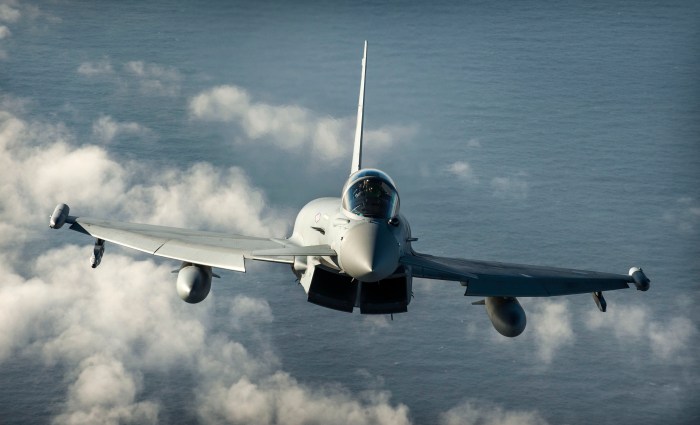
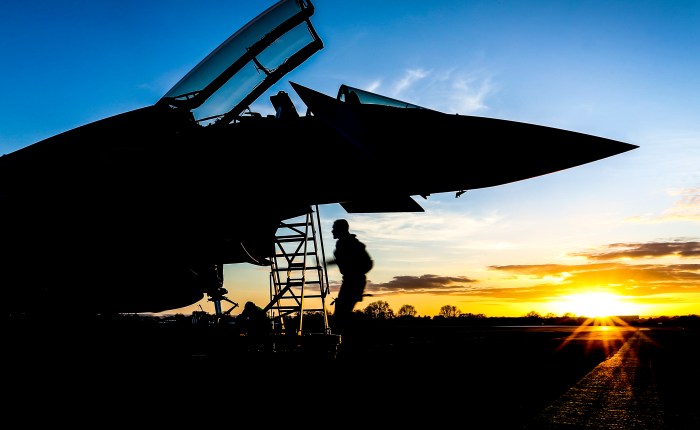
A Royal Air Force Typhoon of No. 1(F) Squadron during Exercise Capable Eagle, c. 2013. (Source: UK MoD Defence Imagery)

Let me offer you three conclusions. First, as airmen, we are more constrained by time and space as we lack permanence and rely on technology to fly at all. Second, as airmen, we are less constrained by time and space because we operate at high-speed, have great reach, are inherently responsive, and have a cultural appreciation of time and space that is unique. Third, new and emerging technologies, as exemplified by fifth-generation air power, will continue to challenge our present perceptions of time, space, and its relationship; the exploitation of both outer space and cyberspace are excellent illustrations of both. To conclude, Francis Fukuyama famously talked about the ‘End of History,’ but perhaps what we are seeing is more an end of TIME and, if not an end then certainly a new appreciation of space.

Ian Shields is a retired, senior Royal Air Force officer who has a wealth of experience as an operator, commander, and analyst. After a 32-year career that saw him command a front-line squadron and reach the rank of group captain, he has more recently established himself as a highly respected commentator on defence and security issues, specialising on aerospace matters. Ian holds post-graduate degrees from King’s College, London, and the University of Cambridge. He currently an Associate Lecturer at the University of Cambridge and writes for several academic and journalistic publications on current issues within defence and international relations.

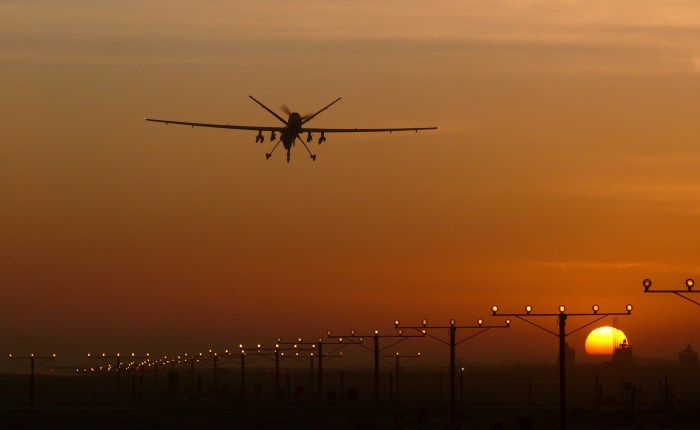
Header Image: A Reaper Remotely Piloted Air System comes into land at Kandahar Airbase in Helmand, Afghanistan, c. 2011. (Source: UK MoD Defence Imagery)

Attrition in Fifth-Generation Air Forces during #highintensitywar

Attrition in Fifth-Generation Air Forces during #highintensitywar

By Rex Harrison

Editorial Note: From February to April 2018, The Central Blue and From Balloons to Drones, will be publishing a series of articles that examine the requirements of high-intensity warfare in the 21st Century. These articles provide the intellectual underpinnings to a seminar on high-intensity warfare being held on 22 March by the Williams Foundation in Canberra, Australia. In this article, Rex Harrison discusses the challenge of attrition during high-intensity conflicts and its implications for fifth-generation air forces.

Technology has continued to advance in both disruptive and surprising ways. It is consequently difficult to forecast the exact way fifth-generation air power will be applied in 2035, nor the precise character of future high-intensity conflict. With the benefit of hindsight, however, history proposes broad themes and continuities in the nature of war. One such example is the persistence of attrition of the force once committed to battle.

While Western air forces have been able to somewhat control their level of exposure to adversary action since the 1991 Gulf war, this may not always be the case. This level of control has been achieved through conducting operations beyond the engagement range of adversaries and behind a shield of (generally unchallenged) air defences. This technique has enabled air power to inflict significant losses without absorbing such losses themselves.

This happy circumstance has been the exception rather than the rule in human history. This is particularly the case when considering the history of air power, where few combatants have had the luxury of picking and choosing the intensity and duration of the conflict. No matter how successful fifth-generation air power is in enhancing its lethality and minimising risk to the force, it is doubtful that a combat exchange in high-intensity combat will result in a ‘0’ in the ledger of either side.

This being the case, I believe that success in high-intensity conflict will require a fifth-generation air force to ensure it can absorb and recover from the attrition of its forces. While it will be difficult to predict the outcomes of future air combat or the mix of technology and tactics that will provide the necessary advantage, history does provide a guide that may better inform our preparations for the future.

Historical Examples

Yom_Kipur_war
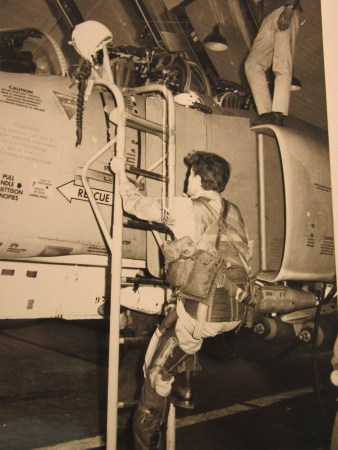
An Israeli pilot, Shimshon Rozen, climbing into a McDonnell Douglas F-4E Phantom II during the Yom Kippur War, c. 1973. (Source: Wikimedia)

The significant impact of attrition is demonstrated by the experiences of the Israeli Air Force (IAF) in the Yom Kippur War of October 1973. In this example, Israel was surprised by the new-found technical prowess of the Arab armies led by Egypt and Syria. The IAF was required to expend a sizable portion of its fighting strength to provide time for mobilisation. Surprised by the technical mastery of their opponents, in a matter of days, 102 aircraft were lost (roughly 25% of available combat aircraft), along with 53 aircrew. The crisis was only resolved by the rapid shipment of replacement aircraft from the US inventory under Operation Nickel Grass.

While certainly an example of high-intensity conflict, the requirement for Australia to fight for its existence as Israel did is unlikely or would be, at the very least, preceded by warnings such that the nation could be mobilised and prepared for such a conflict. It is partially through Australia’s preferred method of warfare, the controlled commitment of forces in expeditionary wars, that such attrition has been avoided.

A more pertinent example for Australian forces is the experience of No. 77 Squadron during the Korean War (a perhaps timely example given ongoing tensions on the Peninsula). The deployment of a single fighter squadron in June 1950 would seem at face value to match the characteristics of more recent Royal Australian Air Force (RAAF) commitments; the level of attrition, however, was not comparable. Over a three-year commitment, 41 pilots died, and six were captured. At the peak of fighting the squadron replaced 25% the pilot force over an eighteen-month period. Finding the Second World War era North American P-51 Mustang to be outmatched after losing 13 aircraft, No. 77 Squadron was re-equipped in May 1951 with the Gloster Meteor. Of the 94 Meteors acquired by Australia, 30 were subsequently lost to enemy action, delivering a significant portion of the 54-aircraft lost in total over Korea and Japan.[1] The consequence of this action was that No. 77 Squadron, in effect, replaced all of its aircraft at least once, and in a handful of years, expending the bulk of the entire RAAF fleet.

JK0901A
Squadron Leader Ross Glassop and Flight Lieutenant Sainer Rees, pilots, serving with No. 77 Squadron RAAF chat with the crew of No. 36 Squadron RAAF which had flown from Japan with supplies of rockets and aircraft spares. (Source: Australian War Memorial)

One should hope that future deployments would avoid committing forces in obsolete aircraft. However, it should be noted that the Australian government maintained the force commitment in Korea despite these and other subsequent losses.

What Does This Mean?

In preparing for future conflict, any fifth-generation air force must ensure access to both the physical (hardware) and human resources required to replace those lost.

The procurement of aircraft and their associated supporting hardware may be the most straightforward requirement to meet, assuming access to global markets. While contemporary production rates are much lower than those of the Second World War, they are still significant for those aircraft in full production. While the Israeli losses in 1973 were substantial, production of the McDonnell Douglas F-4 Phantom II, the mainstay multi-role aircraft of the period, averaged 19 aircraft per month, over the life of production.  Israel’s losses of this aircraft type (32 of the 102 total), while critical to the IAF, were only the equivalent of less than two months production out of the Fort Worth factory.

The replacement of human resources, specifically aircrew, will be determined by a combination of the resources allocated to training (rather than fighting), and the desired quality of the resulting product. Given our resource-constrained environment, it may well be that ‘great’ is the enemy of ‘good enough’. In this context, a fifth-generation air force will need to accept that its workforce may not have not quite mastered the full spectrum of fifth-generation fighting techniques; however, it will need to employ them regardless.

A fifth-generation air force will also need to incorporate these replacements within the chosen operational approach. Concerning hardware, it will be rare that the exact aircraft lost from the inventory will be in production. With platforms potentially being fielded for decades, it is to be expected that subsequent variants will be produced, or entirely new platforms created in the decades following acquisitions. As such, while a replacement platform may be found, the capabilities are unlikely to be identical to that it replaces.

More critically to the networked fifth-generation force, it is unlikely that replacement assets will be fitted with the exquisitely detailed set of combat data and information exchange systems specified as part of the fifth-generation force structure. This will particularly be the case if the preferred supplier of our platforms is otherwise occupied. Returning to the example of No. 77 Squadron, when the Mustang was determined to be unsuitable for the Korean conflict, the RAAF initially sought the North American F-86 Sabre from the United States, however, as production was already committed to US customers, the British Meteor was chosen instead. While this aircraft was first flown in 1944 and was far from the cutting edge of technology, the war marched on, and Australia could not wait until it was ready to fight on its terms.[2]

Conclusion

While the aim of the technologically and professionally-advanced fifth-generation force is admirable, planning and foresight cannot overcome the uncertain nature of war, precisely the inevitability of loss. At its heart, a fifth-generation force requires flexibility to adapt to any environment. In this context, the squadron must become less of an exquisite implementation tool, and more a delivery mechanism through which aircraft and aircrew are ground against the enemy at the point of friction. In such a situation, ‘good enough’ may quickly become the new normal.

Rex Harrison is an Air Combat Officer in Royal Australian Air Force officer. He can be found on Twitter at @spacecadetrex. The views expressed are the author’s and do not reflect the official position of the Royal Australian Air Force, the Australian Department of Defence, or the Australian Government.

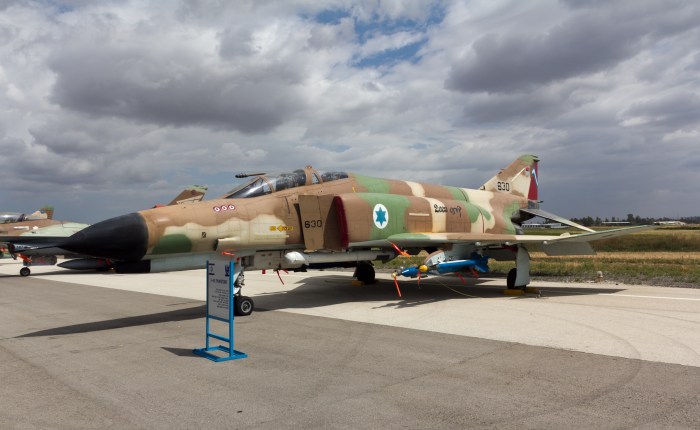
Header Image: An Israeli Air Force F-4E Phantom II at Tel Nof, c. 2013. This type of aircraft was used by the IAF during the Yom Kippur War. (Source: Wikimedia)

[1] Alan Stephens, Going Solo: The Royal Australian Air Force, 1946-1971 (Canberra: AGPS Press, 1995), p. 241.

[2] Ibid, p. 240.

#highintensitywar – A Series Introduction

#highintensitywar – A Series Introduction

By the editors of The Central Blue and From Balloons to Drones

During 2017, a major war on the Korean Peninsula became a distinct possibility. As the rhetoric over North Korea’s nuclear program heated up, the preparedness of Western militaries to engage in a major war, and the likely cost of such a conflict became regular features in the news cycle. This has had the effect of transforming discussions of a major state-on-state war in Asia away from abstract, Thucydides-inspired notions of a China-United States conflict, to the uncomfortably realistic prospect of a preventative strike against North Korea precipitating full-scale war.

The discussion and analysis that has occurred in the media in light of these growing tensions have raised public awareness of the potential costs of a modern state-on-state conflict. The West’s experience of conflict since the end of the Cold War has created unrealistic expectations within the general population as to the realities of modern conventional high-intensity warfare. This is not to trivialise the deaths that have occurred in these low-intensity conflicts, every death in war is a tragedy; however, the level of attrition that the West should expect from a modern state-on-state conflict in Europe, the Middle East, or Asia will likely be on a scale unseen since the Second World War. Concerning the prospect of war on the Korean peninsula, General Joseph Dunford, Chairman of the US Joint Chiefs of Staff, has remarked that:

Many people have talked about military options with words like ‘unimaginable’ […] I would probably shift that slightly and say it would be horrific, and it would be a loss of life unlike any we have experienced in our lifetimes, and I mean anyone who’s been alive since World War II has never seen the loss of life that could occur if there’s a conflict on the Korean Peninsula.

The requirements for engaging in a high-intensity conflict against a capable and committed state actor will challenge Western militaries. For airmen, in particular, assuring the use of the air domain – an air force’s prime responsibility – has not been seriously challenged since the Vietnam War. However, there is a realisation that circumstances are changing, and, as Air Chief Marshal Sir Stephen Hillier, Chief of the Air Staff of the Royal Air Force, pointed out in 2017:

[t]he long-expected – by airmen at least – challenge has arrived to the air power supremacy we have enjoyed for the last couple of decades. We will now have to fight – and fight hard – to achieve and maintain control of the air and space.

The need for airmen to re-engage conceptually with the possibilities and requirements of high-intensity warfare has led the Sir Richard Williams Foundation to run a seminar on ‘The Requirements for High-Intensity Warfare’ on 22 March 2018 in Canberra, Australia. The seminar will draw together senior officers from around the world, as well as leading academics, to discuss the past, present, and future of high-intensity warfare. Although it is likely the presenters will raise more questions than they will answer, the presence of so many senior leaders at the podium and in the audience will hopefully give impetus to the intellectual, conceptual, and organisational changes that the possibility of high-intensity warfare requires.

Unfortunately, not everyone will be able to attend the seminar, and summaries can never fully capture the presentations or the follow-up discussions that occur during the breaks. Moreover, not every topic of interest can be covered in a single day. Accordingly, in the lead-up to the seminar, The Central Blue and From Balloons to Drones are publishing a series of articles that will bring the discussion of the requirements of high-intensity warfare to a broader audience. By running this as a collaborative series, we hope to engage a broader audience in this debate that must be had. However, more importantly, this collaboration has allowed us to diversify the perspectives that can be brought to bear on the issue. This diversity of perspective has been made possible by contributors from around the world and from different backgrounds putting pen to paper (or fingers to keyboards) to provide their views. Moreover, these views matter.

Although the seminar will bring together a number of high power individuals, they do not have the monopoly on ideas. High-intensity warfare is a complex challenge for militaries irrespective of their size and operational experience. By contributing to the discussions, the contributors to this series are an essential addition to the seminar.

Twice a week over the next six weeks (possibly more as more potential contributors become engaged in the discussion) The Central Blue and From Balloons to Drones will simultaneously run posts that explore different aspects of the topic of high-intensity warfare. Topics will include:

  • Historical examples of high-intensity air warfare
  • The future of war
  • Training and education for a changing paradigm
  • Cultural change in light of a changing operational focus
  • Organisational requirements for high-intensity operations
  • Logistics support to high-intensity operations
  • Use of fiction to frame the future battlespace

As with the seminar itself, we expect that our contributors will raise more questions than they answer. However, unlike the seminar, it is the nature of our articles to encourage ongoing debate and discussion. As such, we ask our readers to be engaged, challenge our contributors, test their assumptions and take their arguments further. Through comments and additional contributions (see here on how to contribute) it is the hope of the editors of both The Central Blue and From Balloons to Drones that this series will support and encourage a deeper and more nuanced understanding of what high-intensity warfare will mean for modern military forces and how we can best prepare for its challenges.

To reinforce the relevance of the topic to which we now shift our focus, it is worth quoting from a recent (27 January 2018) special report from The Economist:

[p]owerful, long-term shifts in geopolitics and the proliferation of new technologies are eroding the extraordinary military dominance that America and its allies have enjoyed. Conflict on a scale and intensity not seen since the second world war is once again plausible. The world is not prepared.

Header Image: An RAF Eurofighter Typhoon FGR4 during Exercise GRIFFIN STRIKE, c. 2016. (Source: UK MoD Defence Imagery)

From Balloons to Drones – Editorial Changes and Future Developments

From Balloons to Drones – Editorial Changes and Future Developments

Twenty eighteen marks the start of the second full year of operations for From Balloons to Drones. With this, we are pleased to announce a significant change in our editorial line-up. Dr Brian Laslie, Mike Hankins and Alex Fitzgerald-Black have all agreed to become Assistant Editors of From Balloons to Drones. Brian, Mike, and Alex have been keen supporters of From Balloons to Drones since day one, and we are grateful to them for coming on board to add some depth to our operations. You can read their biographies here.

What does this mean for From Balloons to Drones? In short, it means we can come up with more ideas on how we might take the website forward. At the moment we are discussing several ideas which will hopefully see the light of day. One idea being discussed is a series of historic book reviews of crucial air power titles that will sit alongside our already established series of book reviews. We are coming up with a list of titles but if you think of a volume that is deserving of being reviewed then let us know.

Another project that we are currently working on is a collaborative series with The Central Blue, which is the blog of the Sir Richard Williams Foundation in Australia. This set of posts will focus on some of the challenges related to high-intensity warfare in the 21st century, and they will provide the intellectual underpinnings for a seminar being held in Canberra in March on this topic. Posts will start appearing in February and will be posted here and at The Central Blue simultaneously. If you are interested in contributing to this series, then get in contact.

Finally, we are always on the lookout for new contributors to the site as well as ideas for future articles. We encourage potential submissions from postgraduates, academics, policymakers, service personnel and relevant professionals involved in researching the subject of air power. More details can be found here. Also, do not forget that we can also be found on Facebook and Twitter.

Header Image: A French Air Force Mirage 2000C drops away from a United States Air Force KC-135R Stratotanker after refuelling during a combat air patrol mission while participating in Operation ALLIED FORCE, c. 1999. (Source: Wikimedia)

#BookReview – Tiger Check: Automating the US Air Force Fighter Pilot in Air-to-Air Combat, 1950-1980

#BookReview – Tiger Check: Automating the US Air Force Fighter Pilot in Air-to-Air Combat, 1950-1980

By Mike Hankins

Steven A. Fino, Tiger Check: Automating the US Air Force Fighter Pilot in Air-to-Air Combat, 1950-1980. Baltimore, MD: Johns Hopkins University Press, 2017. Notes. Works Cited. Index. Hbk. 435 pp. 

51nxvKRLhkL._SX329_BO1,204,203,200_

Works dealing with the history of military technology tend to fall into a few camps. Some will praise a single ‘genius inventor,’ some will chronicle a teleological, linear path of ‘advancement,’ some are content to merely unpack the ‘black boxes’ and describe a piece of technology in detail for its own sake. Rare is the work that discusses the social and cultural interchange between people and machines, digs deep in technical details, while at the same time being a well-written, gripping narrative history sure to excite any enthusiast. Steven Fino’s Tiger Check is all those things at their finest.

Fino examines the American fighter pilot experience in three specific aircraft: The F-86 Sabre, the F-4 Phantom II, and the F-15 Eagle. Each plane featured new technology that seemed to threaten the existing ‘knights of the air’ culture of fighter pilots. Fino argues that despite this series of cultural threats, that culture adapted. The image of pilots as ‘flying knights’ never changed, although they did have to modify themselves into ‘flying scientists.’ This did not replace the previous culture of fighter pilots but merely broadened and democratised it.

Fino begins the book by briefly exploring the ‘knights of the air’ mythology that dates to air-to-air combat in the First World War. As he defines it, the fighter pilot myth has three elements. First, air-to-air engagements as a form of honourable combat among gentleman warriors. Second, that success in air combat is due to the unique skill of the individual pilot. Finally, that the measure of greatness is the kill count—the number of enemy aircraft downed by a single pilot. It could be argued that there are more elements to this myth, and in his attempt to define these cultural factors as steady between the two World Wars, Fino glosses over the emphasis on bombing doctrine in the Second World War, and the battles between fighter culture and bomber culture during those years. That is a minor nitpick, however, as he does a wonderful job of defining the terms of his argument and how he intends to explore the evolution of the fighter pilot myth in the Cold War era.

The rest of the book is organised into three long chapters, each devoted to a particular aircraft. These chapters all follow a similar formula. First, Fino looks at how the pilots of a specific era still maintained and celebrated the three main elements of the ‘flying knights’ mythology. Fino then gives a detailed look at the new cockpit technologies of that era and how they seemed to threaten that myth. Finally, Fino chronicles how pilots adapted, slightly modifying their culture and practices in a way that allowed them to both masters the new technology while keeping the ‘knights of the air’ myth intact.

050811-F-1234P-014
Captain Joseph McConnell Jr. in the cockpit of his F-86, which shows his 16 kills as red stars. ‘Beauteous Butch’ referred to his nickname for his wife, Pearl. (Source: National Museum of the United States Air Force)

This pattern starts with the F-86 Sabre and the massive air-to-air battles over ‘MiG Alley’ during the Korean War. The main new piece of technology in the fighter cockpit was the A-1C(M) gunsight, relying on radar to help pilots aim their guns against the new generation of fast, agile jet fighters. The new gunsights, which required more technical knowledge and at least some understanding of radar theory, threatened the image of the lone fighter pilot using his skills, rather than relying on machines. Many pilots resisted the new gunsights and lobbied for their removal. Indeed, the first generation of sights was notoriously unreliable. However, after mid-1952, newer versions of the gunsight increased its reliability, and a younger generation of pilots adapted their culture to emphasise the combination of man and machine, rather than the earlier conception of man or machine. As Fino concludes:

Pilots had to move beyond the decades-old stereotype that had defined their profession. Detailed knowledge of their aircraft and its weapons systems wouldn’t necessarily dilute their tiger spirit […] It might actually render their tiger-like instincts that much more lethal for their opponent. (p. 109)

AR.2010.007
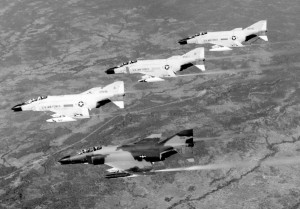
Early F-4s in Southeast Asia were painted gray, but by 1966, they were camouflaged like the Phantom at the bottom of the photograph. (Source: National Museum of the United States Air Force)

The next section jumps to the Vietnam War and examines the next biggest ‘threat’ to the fighter pilot mythology: The F-4 Phantom. The threat came not only from a reliance on guided missiles rather than guns (as the Phantom did not carry a gun at all until the later ‘E’ model) but more so from the fact that the F-4 was a two-seater. No longer was the fighter pilot a lone wolf, but he had to work in tandem with a radar cooperator in the back seat (colloquially called the ‘GIB’ for ‘guy in back’) to help identify and track enemy aircraft as well as obtain weapons locks. It was no longer enough to use one’s skill to maneuver a fighter into position and pull the trigger aggressively—now a pilot needed to understand the intricacies of how their large radar worked, and how to operate a large array of knobs, buttons, and switches to find and track targets. These tasks, split between two people, seemed to destroy social conventions among fighter pilots. Most importantly, who got credit for a kill? Most pilots bristled at these changes, as Fino notes:

Many of those sitting in either seat in the Phantom would have preferred instead to be flying a single-seat fighter, even if it was an older, less sophisticated, more vulnerable aircraft. (p. 196)

Even this radical of a shift did not destroy the image of pilots as ‘flying knights.’ The definition of what a pilot was shifted, emphasising coordination between men and machines. As Fino surmises, the Phantom’s advanced technology:

[m]ight have been designed to simplify and democratize fighter aviation so that the nation would no longer have to rely solely on the skills of carefully screened and combat-seasoned ‘birdmen,’ but it quickly became apparent in the skies over Vietnam that skilled pilots were still needed, and that those necessary skills could often be developed only in combat. (p. 197)

The final shift in this narrative came with the arrival of the F-15 Eagle—which promised to be a return to ‘traditional’ fighter pilot conceptions, optimised for air-to-air combat as a true ‘fighter pilot’s fighter plane.’ Although the Eagle had a single-seat, it was also larger and much more complicated than the Phantom. Its radar and long-range missiles still required extensive knowledge and skill to operate, although a computer now performed most of the tasks formerly handled by the GIB. Still, Eagle pilots had to be, to some degree, ‘flying scientists,’ who could perform delicate, precise movements on their joysticks to manipulate their radars and make the most of their weapons systems.

NATO Operation Allied Force
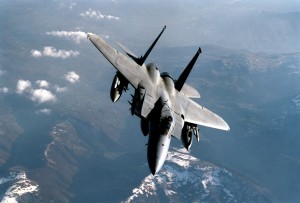
An F-15C Eagle breaks away from a KC-135R Stratotanker after in-flight refueling during Operation ALLIED FORCE on 4 April 1999. (Source: Wikimedia)

Fino does not examine the Eagle’s performance in actual warfare as much as simulated combat, specifically the AIMVAL/ACEVAL tests of 1976-1977. During and after these tests, F-15 pilots developed new tactics, including changing their formations, but more importantly developing the practice of ‘sorting’ targets. Fino examines this shift from a cultural perspective—lone fighter pilots duelling in the skies indeed became a thing of the past. Skilled individuals were still key, but now, pilots had to work together and pick targets, maximising the advantages of their weapons, ideally to end air-to-air engagements before they became dogfights. This seemed to threaten the ‘knights of the air’ image at first, but ultimately upheld it. Although the necessary skill set to be an effective Eagle pilot had drastically changed since the Korean War, pilot skill, aggression, and individual prowess were still crucial factors.

When describing the technical aspects of these systems, Fino goes into incredible detail. A close reading of this book would give the reader a thorough knowledge of the science behind radar technology and comes close to approaching an instruction manual for all three aircraft. These technical descriptions are never boring and never devolve to a case of opening ‘black boxes’ for their own sake. Fino continually ties the technical issues back to larger questions of cultural identity with an engaging style of writing. His sources are deep, and his notes thorough, proving ample opportunity for further research. If there is any flaw in the work, it tends to assume pilots are inherently antagonistic to engineers and aircraft designers. Many pilots likely shared this view. However, it might have been interesting to examine the culture and perspective of those designing and building this technology and how they viewed themselves as aiding pilots rather than threatening their culture. However, that would require another book’s worth of research and is not the type of work Fino set out to create here.

Ultimately, this work is one of the best works of air power (and technology) history that this reviewer has read in quite some time, and will likely become a standard of the field. It certainly sets a very high bar for other historians. For those interested in pilot culture and/or aircraft technology, this is required reading, while still pointing towards directions for future scholarship.

Mike Hankins is a doctoral candidate at Kansas State University, where he teaches World History, the History of Airpower, and the History of Comic Books, and he is currently working on his dissertation, ‘Sources of Innovation: The Cultural and Technological Origins of Fourth Generation Fighter Aircraft, 1964-1991.’ He completed his master’s thesis at the University of North Texas in 2013, titled ‘The Phantom Menace: The F-4 in Air-to-Air Combat in the Vietnam War. He has a web page and can be found on Twitter at @hankinstien.

Header Image: An F-22 Raptor, P-51 Mustang and F-15E Strike Eagle perform the historic heritage flight during an air show at Nellis Air Force Base, Nevada, 8 November 2008. (Source: Wikimedia)

2017 – A Year in Review

2017 – A Year in Review

As we come to the end of 2017, we also come to the end of the first full-year of operations for From Balloons to Drones. Established in the middle of 2016, From Balloons to Drones was created with the aim of providing a platform for the discussion of the air power history, theory, and contemporary operations in its broadest sense. In seeking to achieve this aim, in 2017, we have published around 30 articles ranging from a discussion of the contemporary challenges related the development of Ground-Based Air Defence and Integrated Air Defence Systems through to an analysis of the experience of aircrew as Prisoners of War during the Second World War. We are grateful to our group of contributors who have taken the time to write and publish via From Balloons to Drones.

The website has been visited around 18,000 times by 10,000 different visitors. While visitors from the US, UK, Canada, and Australia predominate, we have also had readers from around the globe including, for example, from South Korea, China and at least one from Tajikistan. We are grateful to those who take the time to read the articles and comment on them.

The ten most popular articles by visits for 2017 were:

  1. Changing the USAF’s Aerial ‘Kill’ Criteria;
  2. Blinded by the Rising Sun? American Intelligence Assessments of Japanese Air Power, 1920-41: Part 1 – The 1920s;
  3. Arrows from the Ground – Or how an incident on 17 March 2017 may change the relationship between ground and air forces;
  4. Commentary – The RAF and the F-117;
  5. Blinded by the Rising Sun? American Intelligence Assessments of Japanese Air Power, 1920-41: Part 2 – 1930-1937;
  6. Air War Books – Dr Brian Laslie;
  7. Blinded by the Rising Sun? American Intelligence Assessments of Japanese Air Power, 1920-41: Part 3 – 1937-41;
  8. Unseating the Lancer: North Korean Challenges in Intercepting a B-1B;
  9. ‘Integrating’ the Italian Air Force after the Armistice;
  10. It is Time to Demystify the Effects of ‘Strategic Western Air Power’ – Part 1.

Two honourable mentions must also go to Dr Matthew Powell’s article ‘A Forgotten Revolution? RAF Army Co-operation Command and Artillery Co-operation’ and Kristen Alexander’s ‘“For you the war is (not) over”: Active Disruption in the Barbed Wire Battleground.’ Both articles were published in December, and I suspect that had they appeared earlier in the year then they would have been in the top ten.

We have some new and exciting plans for 2018 including a series of articles to be published simultaneously and in conjunction with The Central Blue. We will also be publishing more book reviews while a steady stream of new articles, commentaries and research notes will appear over the year. Remember we can also be found on Facebook and Twitter.

Finally, From Balloons to Drones is always seeking to publish new and exciting perspectives on the subject of air power and we encourage contributions from academics, postgraduate students, policymakers, service personnel and relevant professionals. To find out how to contribute then please visit this page.

Header Image: A8-126 performs the last dump and burn in history on the final day of flying the F-111 by the Royal Australian Air Force. (Source: Australian Government)

“For you the war is (not) over”: Active Disruption in the Barbed Wire Battleground

“For you the war is (not) over”: Active Disruption in the Barbed Wire Battleground

By Kristen Alexander[1]

The popular perception of the prisoner of war is that, once captured, he was out of the battle. Rather than compliantly accepting a status of hors de combat, however, many captive allied airmen in Europe during the Second World War continued to be potent military operatives in a new theatre of conflict—the barbed wire battleground. Indeed, the airmen adopted a stance as prison camp combatants. To facilitate this, they actively managed their lives to demonstrate individual and collective agency. They strenuously mitigated the ill-effects of their circumstances by embarking on a program of active disruption. Importantly, they did not give in to, what at least one man termed, ‘the futility of existence’.[2]

Drawing on personal records in private and public collections, as well as official reports, this article provides a brief overview of some of the ways in which Australians and their fellow prisoners in Stalag Luft III, a Luftwaffe prisoner of war camp, established, maintained and promoted themselves as active airmen, on duty, in the barbed wire battleground.

1
‘Vacation at Stalag’, Cyril Borsht’s wartime log book, courtesy of the late Cyril Borsht (Source: Private Collection)

Many downed airmen spoke of the ‘shock’ of captivity and the shame they felt on capture.[3] These feelings were a common response to being taken from battle.[4] The airmen’s sense of disgrace was exacerbated when they heard the ‘usual taunt’, ‘für sie der Krieg is beendet’—‘for you the war is over’.[5] The realisation after their unwilling departure from the aerial arena that they had become prisoners of war was a serious blow to self-esteem and service pride.[6] However, rather than accept a situation defined by passivity and docility, they rejected it.[7] The war was not over for them. Moreover, so, they remained on active service as prison camp combatants.

2
‘I wanted wings’, Ronald Baines’ wartime log book, courtesy of the Baines family (Source: Private Collection)

However, before they re-attained operational readiness, they had to regain their fighting spirit. Humour was a significant means to that end as well as an almost universal morale booster.[8] Many, for instance, depicted their new accommodation as a holiday camp or sanatorium,[9] and tongues were firmly in cheek when they poked fun of the ignominious exits that landed them there.[10] Many illustrated themselves as Donald Duck behind bars.[11] ‘Winglessness’, like that of ‘Downed Donald’, was a shared state and the men gained strength through ridiculing their common plight.[12]

The armed forces have a long tradition of using language to distance themselves from the emotions associated with military action and death in service.[13] The men of Stalag Luft III were no different, and so, they too gained strength through language. While they were initially bemused at being called Terrorflieger, Luftgangster, and Terrorbomber, many filled their wartime logbooks with clippings from German newspapers that promoted Allied airmen as the Second World War version of terrorists.[14] In doing so, the downed airmen recognised that the propagandised terms highlighted their success. Consequently, they ignored the intended insults and willingly accepted—as tributes to their military prowess—their new designations.[15]

3
‘Escape’, Cyril Borsht’s wartime log book, courtesy of the late Cyril Borsht. (Source: Private Collection)

The airmen were not, however, so keen to be known as Kriegsgefangener—war prisonerbecause of the negative and shameful connotations surrounding the word ‘prisoner’ and its associated trappings, such as POW number, fingerprinting, and identification discs.[16] Accordingly, they spurned ‘prisoner of war’. In a canny example of linguistic reframing, they adopted the easier-to-pronounce and linguistically distancing abbreviation of ‘kriegie’—even those who were captured in the later months of the war.[17] Derived from the first syllable—the German word for ‘war’—it subconsciously indicated that they were still men of war with a fine fighting spirit and distanced them from the stigma of captivity. ‘Kriegie’ removed the sense of derogation surrounding captivity and turned an affront—and assault to their dignity—into a linguistic badge of inclusiveness and pride. ‘Kriegie’ declared that they were still men of war on operational service. It also became ‘a fun word’ to describe them.[18] Ultimately, their prison camp patois—terrorflieger, Luftgangster, kriegie and so on—became a language of agency and defiance.

4
‘Cutting from a Reich paper of a ‘typical’ ‘terrorflieger’ or ‘luftgangster”, Cyril Borsht’s wartime log book, courtesy of the late Cyril Borsht. (Source: Private Collection).

With self-esteem restored, confidence reasserted, and fighting spirit reinvigorated, the airmen turned to discipline and their strong sense of service duty to help negotiate captivity. Demonstrating collective agency, the kriegies institutionalised air force discipline in the camp.[19] They acknowledged that running Stalag Luft III along RAF station lines was best for the community—for the camp commonweal—and it was generally agreed that the senior officers ‘did an excellent job’.[20] As well as maintaining ‘a high degree of morale and discipline’,[21] there was much security in adhering to the familiar aspects of their former service lives.[22] Moreover, it afforded the airmen the support they needed to wage war as prison camp combatants.

One aspect of that war was the duty of active resistance. All new arrivals were interviewed by the Senior British Officer or, in the NCO compound, the Man of Confidence, who reminded the kriegie new boys of their continuing obligations as servicemen.[23] Importantly, they warned them not to comply with any German order ‘beyond what was necessary’.[24] The airmen welcomed their new responsibility of active resistance and defiance. Exemplifying personal and group agency they were deliberately disruptive.[25] They misbehaved during roll call.[26] They purloined German supplies.[27] They bribed guards.[28] Their favourite sport became goon-baiting.[29] Many embarked on covert operations. Some became code writers and sent secret messages to MI-9.[30] A major aspect of active resistance was escape, and the airmen embraced their moral right[31] and duty[32] to break out of the prison camp. If they were not on the exit list for a particular attempt, or not personally eager—or even physically or psychologically capable—they supported those who were by participating in the communal effort.

5

Active resistance, disruption, defiance, and escape work epitomised individual and collective agency. Significantly, they reinforced the airmen’s continuing identity as combatants. For many, such concerted agency ameliorated the mortification of becoming prisoners of war. Moreover, so, the escape or ‘X’ organisation became the overriding feature of life in Stalag Luft III.[33]

Each compound had its version of the ‘X’ organisation and Australians participated in almost every aspect of its work. ‘X’ rosters were drawn up disguised as participant lists for sports days, and sporty types created diversions.[34] The carpentry department commandeered bed boards to shore up the tunnels and other purposes and built cabinets and hidey holes to stow secret equipment.[35] Some men did metal work, made dummy rifles, and meticulously constructed compasses.[36] Scroungers obtained ink, radio parts and essential supplies.[37] Photographers took passport photographs.[38] Forgers replicated passes and identification papers.[39] Tunnellers dug, others carted dirt away, and gardeners disposed of it. Meanwhile, the majority joined the army of ‘watchers’ known as ‘stooges’, who kept a lookout for any sign of the Germans. So industrious were the tunnellers that, in East Compound alone, between 60 and 70 tunnels were started during the first six months.[40]

Despite such diligent ‘X’ work and prolific excavation, East Compound’s only successful getaway was that of October 1943—dubbed ‘the Wooden Horse’—where three men made a ‘home run’. The culmination of North Compound’s ‘X’ work was the mass breakout of March 1944. While seventy-six succeeded in fleeing the camp, only three made it home. Seventy-three were recaptured. Fifty were executed, five of whom were Australian.

The men regretted the tragic outcome, but not their part in it. Nor their determined demonstration of collective agency as prison camp combatants. They believed their large-scale resistance work had been worthwhile, not just because of the sustaining effect on morale, but because of the cost to the Germans in tying up resources during the ensuing Großfahndung which they considered ‘biggest manhunt of the war’.[41]

6

After the war, Paul Brickhill, an Australian journalist and former Stalag Luft III kriegie, was invited to write a book about the March 1944 escape.[42] That book proved influential in how captivity in Stalag Luft III has been portrayed. The mass breakout, for example, was not known as the ‘Great Escape’ until the publication of Brickhill’s The Great Escape in 1951.[43] From that time, the book’s title entered the lexicon as participants, bystanders and the public all appropriated it to describe an event that still resonates. So powerful is the book’s theme of triumph over the enemy through a communal agency, so exciting is the narrative, that most commercially published accounts of life in Second World War German POW camps—and Stalag Luft III in particular—feature the exciting high adventure and derring-do of major escapes.

7

While many of the former airmen were impressed with Brickhill’s book, many were not overly pleased with John Sturges’ 1963 film. They begrudge it the Americans, the motorbike, a truly appalling Australian accent, and other factual inaccuracies inserted in the interests of ‘good cinema’.[44] Despite their distaste, the film, along with Brickhill’s book, has left a substantial legacy which they, their descendants and popular culture have embraced.

They frame captivity in Stalag Luft III as an action-packed success story. They reinforce the kriegies’ personal and collective agency as active airmen, on operational service, in the barbed wire battleground. They deny any perception of passive, docile, humiliated prisoners of war. Just as the airmen themselves had done when they refused to accept that the war, for them, was over.

Kristen Alexander is a PhD candidate at the University of New South Wales, Canberra, researching the responses to captivity of Australian airmen prisoners of Stalag Luft III and their families. Specialising in Australian aviation history, she is published in Australia, Great Britain and Japan. She won the non-fiction category of the 2015 ACT Writing and Publishing Award and was highly commended in the 2014 and 2017 awards. Her books were included on the RAAF Chief of Air Force’s 2010 and 2015 reading lists. Her military essays won the Military Historical Society of Australia’s 2012 and 2013 Sabretache Writers Prizes. Her website can be found here and she is on Twitter as @kristenauthor.

Header Image: Australians of North Compound, 25 April 1943, courtesy of Ian Fraser. (Source: Private Collection)

[1] This article is based on a paper presented at the Don’t Drown Post Graduate Conference, UNSW Canberra, 4 October 2017, which was a shorter version of that given at Aviation Cultures Mark III Conference, University of Sydney, 27–29 April 2017.

[2] Shrine of Remembrance, James Catanach Collection, 2013. CAT050: Catanach, letter to William Alan Catanach, 28 March 1943.

[3] Private collection: Bruce Lumsden, letter, 24 June 1986, ‘The Complete Tour: Letters of Jaime Bradbeer and Bruce Lumsden, April 1985–October 1990’, unpublished manuscript; Calton Younger, No Flight From the Cage: The Compelling Memoir of a Bomber Command Prisoner of War during the Second World War ([No place]: Fighting High, 2013), p. 40; Rex Austin, Australians at War Film Archive (AAWFA) interview No. 0382, 5 June 2003; Alec Arnel, author’s interview, 29 October 2015.

[4] Aaron Pegram, ‘Bold Bids for Freedom: Escape and Australian Prisoners of Germany, 1916–18’ in Joan Beaumont, Lachlan Grant, and Aaron Pegram (eds.), Beyond Surrender: Australian Prisoners of War in the Twentieth Century (Carlton: Melbourne University Press, 2015), p. 25; Kate Ariotti, ‘Coping with Captivity: Australian POWs of the Turks and the Impact of Imprisonment during the First World War’ (PhD Thesis, The University of Queensland, 2014), pp. 55–57; Karl James, ‘“I hope you are not too ashamed of me”: Prisoners in the siege of Tobruk’, in Beaumont, Grant, and Pegram (eds.), Beyond Surrender, pp. 101–102; Adrian Gilbert, POW: Allied Prisoners in Europe 1939–1945 (London: John Murray, 2007), p. 41.

[5] ‘Usual taunt’, Private collection: Bruce Lumsden, letter, 24 June 1986, ‘The Complete Tour’, unpublished manuscript. Midge Gillies noted that it was a phrase the Germans favoured. Midge Gillies, The Barbed-Wire University: The Real Lives of Allied Prisoners of War in the Second World War (London: Aurum Press, 2011), p. 13. Examples of those who heard the phrase: Private collection: Ronald Baines, wartime log book, p. 8; Younger, No Flight From the Cage, p. 37; Geoffrey Cornish, AAWFA interview No. 1388, 2 July 2004; Kenneth Gaulton, AAWFA interview No. 1276, 3 February 2004; Private collection: Bruce Lumsden, letter, 24 June 1986, ‘The Complete Tour’ unpublished manuscript; Cyril Borsht, ‘A Life Well Lived. A Memoir’, unpublished manuscript, p. 18; Irwin John Dack, So you Wanted Wings, Hey!: An Autobiography – Part One (Moorabbin: the author, 1993), p. 74; ‘Tom Wood Diary’, unpublished manuscript, p. 26; Les Harvey, ‘Over, Down and Out: Recollections of an Airman Captured by the Germans in 1942’, unpublished manuscript, p. 6; Charles R. Lark, A Lark on the Wing: Memoirs World War II and 460 Squadron [No publication details], p. 64. Non-Australians also recorded the phrase. For example, B.A. (Jimmy) James, Moonless Night: The World War Two Escape Epic (Barnsley: Pen & Sword Military), 2008, p. 17; Jack Rae, Kiwi Spitfire Ace: A Gripping World War II Story of Action, Captivity and Freedom (London: Grub Street, 2001), p. 116; Ken Rees, (with Arrandale, Karen), Lie in the Dark and Listen: The Remarkable Exploits of a WWII Bomber Pilot and Great Escaper (London: Grub Street, 2006), p. 111. Rees entitled the chapter dealing with his earliest captivity experiences, ‘“For you the war is over”’.

[6] Private collection: Bruce Lumsden, letter, 24 June 1986, ‘The Complete Tour’, unpublished manuscript.

[7] Stephen Garton, The Cost of War: Australians Return (Oxford: Oxford University Press, 1996), p. 211.

[8] Eric Stephenson, ‘Experiences of a Prisoner of a War: World War 2 in Germany’, Journal of Military and Veterans’ Health, 18:2 (2010), p. 34 (reprinted from Australian Military Medicine, 9:1 (2000), pp. 42–50); Karen Horn, ‘“Stalag Happy”: South African Prisoners of War during World War Two (1939–1945) and their Experiences and Use of Humour’, South African Historical Journal, 63:4 (2011), p. 537.

[9] Australian War Memorial (AWM) PR03211: Peter Kingsford-Smith, wartime log book, pp. 37, 54–55; Andrew R.B. Simpson research collection: Arthur Schrock, wartime log book, p. 1; private collection, Horace ‘Bill’ Fordyce, wartime log book, unpaginated section; private collection: Cyril Borsht, wartime log book, p. 5

[10] AWM PR03211: Peter Kingsford-Smith, wartime logbook, pp. 43 and 37; AWM PR88/160: James McCleery, wartime logbook, unpaginated particulars page (name/POW number/camp/compound) and p. 1.

[11] <https://australiansinsliii.blogspot.com.au/2017/12/i-wanted-wings-donald-duck-prisoner-of.html&gt; (accessed 14 December 2017); <http://www.usmilitariaforum.com/forums/index.php?/topic/6728-stalag-luft-iii-i-wanted-wings/&gt;; Art and Lee Beltrone, A Wartime Log. (Charlottesville: Howell Press, 1994), pp. 60–61; <http://www.usmilitariaforum.com/forums/index.php?/topic/6728-stalag-luft-iii-i-wanted-wings/>(accessed 14 December 2017); <http://blog.modernmechanix.com/wwii-pows-get-a-disney-designed-logo/&gt; (accessed 14 December 2017); AWM PR88/160: James McCleery, wartime log book, p. 58; AWM PR03211: Peter Kingsford-Smith, wartime log book, p. 25; AWM PR00506: John Morschel, wartime log book, unpaginated; private collection: Cyril Borsht, wartime log book, p. 3; private collection: Eric Johnston, wartime log book, p. 1; private collection: Ronald Baines, wartime log book, p. 93; Andrew R.B. Simpson research collection: Arthur Schrock, wartime log book, p. 11; Dack, So you Wanted Wings, Hey!, p. i; Rae, Kiwi Spitfire Ace, unpaginated photo block.

[12] Alexander Watson, Enduring the Great War. Combat, Morale and Collapse in the German and British Armies, 1914–1918 (Cambridge: Cambridge University Press, 2009), p. 90.

[13] Eric Partridge, A Dictionary of RAF Slang (London: Michael Joseph, 1945), pp. 25, 10, 25, and 52; Joanna Bourke, An Intimate History of Killing: Face-to-face Killing in Twentieth Century Warfare (London: Granta Books, 1999), pp. 231–232.

[14] AWM PR90/035: Torres Ferres, wartime log book, p. 41; AWM PR03211: Peter Kingsford-Smith, wartime log book, pp. 46–47; private collection: Cyril Borsht, wartime log book, pp. 55 and 68; Cyril Borsht, author’s interview, 28 January 2016; private collection: Horace ‘Bill’ Fordyce, wartime log book, pp. 100–101; private collection: William Kenneth Todd, wartime log book, unpaginated section; Richard Winn, AAWFA interview No. 1508, 4 March 2004.

[15] Cyril Borsht, author’s interview, 28 January 2016.

[16] Kate Ariotti, ‘Coping with Captivity’, p. 56; Annette Becker, ‘Art, Material Life, and Disaster: Civilian and Military Prisoners of War,’ in Nicholas J. Saunders (ed.), Matters of Conflict: Material Culture, Memory, and the First World War (Abingdon: Routledge, 2004), p. 28, 88; Joan Beaumont, Gull Force: Survival and Leadership in Captivity, 1941–1945 (Sydney: Allen & Unwin, 1988), p. 2.

[17] AWM PR05675: Guy Grey-Smith, diary, 26 January 1942; H.R. Train, ‘A Barbed-Wire World. The Diary of a Prisoner of War in Germany 1942–1945’, unpublished manuscript, 17 June 1942, pp. 9, 12; Colin Burgess research collection: Robert Mills, wartime log book, p. 31; H. Homer Ashmann, ‘Kriegie Talk’, American Speech, 23:3/4 (1948), pp. 218–219; Paul Brickhill and Conrad Norton, Escape to Danger (London: Faber and Faber, 1954).

[18] Alec Arnel, author’s interview, 29 January 2015.

[19] Ronald Baines, AWM 54, 779/3/129 Parts 1–30: [Prisoners of War and Internees—Examinations and Interrogations:] Statements by repatriated or released Prisoners of War (RAAF) taken at No 11 PDRC, Brighton, England, 1945; Robert Nightingale, AWM 54, 779/3/129; Alan Righetti, AAWFA interview No. 0984, 16 September 2003.

[20] Robert Nightingale, AWM 54, 779/3/129.

[21] Ibid.

[22] Walter A. Lunden, ‘Captivity Psychoses Among Prisoners of War’, Journal of Criminal Law and Criminology, 39:6 (1949), p. 722.

[23] Private collection: William Kenneth Todd, wartime log book, p.11; AWM PR90/035, Ferres, ‘A POW in Germany’: Beecroft Probus talk, 3 February 1989; Private collection: Bruce Lumsden, letter, 8 April 1988, ‘The Complete Tour’, unpublished manuscript; Andrew R.B. Simpson, ‘OPS’ Victory at all Costs: On Operations over Hitler’s Reich with the Crews of Bomber Command. Their War – Their Words (Pulborough: Tattered Flag Press, 2012), p. 342.

[24] Private collection: Bruce Lumsden, letter, 8 April 1988, ‘The Complete Tour’, unpublished manuscript.

[25] Alec Arnel, author’s interview, 9 October 2014.

[26] Calton ‘Cal’ Younger, Imperial War Museum Sound Archive (IWMSA) interview, No. 23329, [no day] November 2002.

[27] Richard Winn, AAWFA interview No. 1508, 4 March 2004; Younger, IWMSA interview, No. 23329, [no day] November 2002; National Library of Australia (NLA) Justin O’Byrne, John Meredith folklore collection, 31 October 1986.

[28] Justin O’Byrne, ‘Mercury Radio Roundsman’ segment, Radio 7LA, Launceston, undated, [c. July 1947]; Horace ‘Bill’ Fordyce, AAWFA interview No. 0523, 19 June 2003; Geoffrey Cornish, AAWFA No. 1388, 2 July 2004; Royle, IWMSA interview, No. 26605, 2 December 2012.

[29] NLA Justin O’Byrne, John Meredith folklore collection, 31 October 1986.

[30] The National Archives (TNA) (UK), WO 208/3283: Camp History of Stalag Luft III (Sagan) Air Force Personnel, April 1942–January 1945, Part I East (Officers) Compound, pp. 67, 69.

[31] John Herington, Australia in the War of 1939–1945. Series Three. Air. Volume IV: Air Power Over Europe, 1944–1945 (Canberra: Australian War Memorial, 1963), p. 485.

[32] Air Publication 1548, Instructions and Guide to All Officers and Airmen of the Royal Air Force regarding Precautions to be Taken in the Event of Falling into the Hands of an Enemy, ([no publication details], 2nd Edition, June 1941). The duty was rescinded after the Great Escape but was still implied. Air Publication 1548, The Responsibilities of a Prisoner of War, (3rd Edition, April 1944), <http://www.ibiblio.org/hyperwar/UN/UK/RAF/POW-RAF/&gt; (accessed 14 December 2017). British and Australian soldiers had a similar, formal, obligation to escape. James, ‘“I hope you are not too ashamed of me” in Beaumont, Grant, and Pegram (eds.), Beyond Surrender, p. 110.

[33] NLA Justin O’Byrne, John Meredith folklore collection, 31 October 1986.

[34] Justin O’Byrne, ‘Mercury Radio Roundsman’, [c. July 1947]; Robert J. Laplander, The True Story of the Wooden Horse (Barnsley: Pen & Sword, 2014).

[35] Private collection: Horace ‘Bill’ Fordyce, wartime log book, p. 140; TNA, WO 208/3283: Camp History of Stalag Luft III (Sagan) Air Force Personnel, March 1943–January 1945, Part III North (Officers) Compound, pp. 9, 25, 31; AWM ART34781.019: Albert Comber, drawing, ‘Flight Lieutenants (Mac) Jones and (Rusty) Kierath, RAAF at work, Stalag Luft III, Germany’; Justin O’Byrne, ‘Mercury Radio Roundsman’, [c. July 1947]; H.P. Clark, Wirebound World: Stalag Luft III (London: Alfred H. Cooper & Sons Ltd, 1946), p. 8; private collection: Bruce Lumsden, letter, 10 June 1988, ‘The Complete Tour’, unpublished manuscript.

[36] Stalag Luft III: An Official History of the ‘Great Escape’ POW Camp (Barnsley: Frontline Books, 2016), pp. 30–32; <https://australiansinsliii.blogspot.com.au/2016/08/australian-compass-makers.html&gt; (accessed 14 December 2017).

[37] TNA, WO 208/3283: Camp History of Stalag Luft III (Sagan) Air Force Personnel, March 1943–January 1945, Part III North (Officers) Compound, pp. 23–24, 36; Geoffrey Cornish, AAWFA interview No. 1388, 2 July 2004.

[38] Geoffrey Cornish, AAWFA interview No. 1388, 2 July 2004.

[39] Ibid; Justin O’Byrne, ‘Mercury Radio Roundsman’, [c. July 1947].

[40] TNA, WO 208/3283: Camp History of Stalag Luft III (Sagan) Air Force Personnel, April 1942–January 1945, Part 1 East (Officers) Compound, p. 36; private collection: George Archer, 1942 Diary, 5, 21 and 24 August 1942.

[41] Justin O’Byrne, ‘Mercury Radio Roundsman’, [c. July 1947].

[42] Paul Brickhill, The Great Escape (London: Faber and Faber, 1951). A section on the mass escape was included in the earlier publication, Brickhill and Norton, Escape to Danger.

[43] Stephen Dando-Collins, The Hero Maker: A Biography of Paul Brickhill (North Sydney: Penguin Random House Australia, 2016), p. 198.

[44] Cath McNamara, author’s interview, 18 July 2016; NLA ‘Reminiscential conversations between the Hon. Justin O’Byrne and the Hon. Clyde Cameron’, 29 August 1983–28 July 1984; Alan Righetti, AAWFA No. 0984, 16 September 2003.

#BookReview – Airpower Applied: U.S., NATO, and Israeli Combat Experience

#BookReview – Airpower Applied: U.S., NATO, and Israeli Combat Experience

By Dr Brian Laslie

John Andreas Olsen (ed.), Airpower Applied: U.S., NATO, and Israeli Combat Experience. Annapolis, MD: Naval Institute Press, 2017. Notes. Bibliography. Index. Hbk. 432 pp.

airpower applied

In the most recent work to focus exclusively on air power combat operations, Colonel John Andreas Olsen of the Royal Norwegian Air Force and a visiting professor at the Swedish Defence University in Stockholm, presents a thoroughly researched, persuasive, and insightful work on the study of air power that ranges from large-scale state-on-state actions to the more abundant (some might say most likely) asymmetric fights of the late Twentieth and early Twenty-First Century. Olsen’s name should be more than familiar to anyone with a passing interest in the history of air power. He is the author/editor of numerous works including John Warden and the Renaissance of American Air Power, A History of Air Warfare, Airpower Reborn, Air Commanders, European Air Power, and Global Air Power. Aside from his prolific output, Olsen also has the ability to bring together the most respected names in air power studies to provide chapters in his edited works. The same is true for his latest book, Airpower Applied: U.S., NATO, and Israeli Combat Experience. The purpose of the book, as the title suggests, is to provide a valuation of the American, NATO, and Israeli combat experience from World War II to present campaigns. It is broken into five chapters that cover a total of twenty-nine separate air campaigns or operations. Olsen’s thesis is that ‘knowledge of operational history helps political leaders and military professionals to make better-informed decisions about the use of force.’ Thus, this work is not about ‘lessons learned’ as much as it is a learning tool used to provoke thought and create questions amongst professionals.

Richard Hallion provides the first chapter on ‘America as a Military Aerospace Nation: From Pearl Harbor to Desert Storm.’ Hallion admits that much of America’s advancement during the Cold War was owed to ‘emulation and innovation [rather] than to invention.’ That being said, American air power has moved to the forefront of technology, invention, innovation, and execution in the post-Vietnam era leading up to the dramatic successes of air power during the First Gulf War. Before this Hallion covers many previous aerial campaigns, whose success and failures led to the triumph of Operation DESERT STORM: The Second World War, the Berlin Airlift, Korea, Vietnam, ELDORADO CANYON and JUST CAUSE. Hallion’s contribution here is the best single chapter on the history of American air power from the Second World War to DESERT STORM. However, he, unfortunately, omits any discussion of the failings of Operation EAGLE CLAW, missing an opportunity to discuss the genesis of true air power jointness; this might be forgiven considering that most consider EAGLE CLAW a Special Forces operation with little to do with actual air power. Hallion also misses the mark on his discussion about the use of the F-117 in its combat debut during the operation in Panama. Hallion states ‘The F-117 strike at Rio Hato […] succeeded in stunning the PDF [Panamanian Defense Forces] defenders.’  This, however, is disputed by the Joint History Office’s report on operation JUST CAUSE which stated that ‘[D]espite radio broadcasts and the use of F-117As and other weapons to stun and intimidate them, most PDF units fought harder than expected before surrendering or fleeing.’[1]

Hallion’s belief in the efficacy of air power is apparent when he states that ‘In the gulf it took one bomb or one missile’ to destroy a target (p. 93). This is an oversimplification and poses a danger to those who would believe it. This view of air power as scalpel needs to be tempered. Bombs and missiles miss and many targets in Iraq had to be repeatedly attacked. There is an oft-repeated axiom that they are called missiles and not hittles for a reason. That being said, Hallion’s chapter represents a concise and persuasive argument detailing just why America has become the eminent air power nation in the Twentieth and Twenty-First Centuries and transitions nicely into the next chapter on air power since DESERT STORM.

Allied Force
A US Air Force B-2 Spirit stealth bomber refuels from a KC-135 Stratotanker on April 6, 1999, during an air strike mission in support of NATO Operation ALLIED FORCE. (Source: Wikimedia)

Benjamin Lambeth provides the second chapter on ‘American and NATO Airpower Applied: From Deny Flight to Inherent Resolve.’ Lambeth demonstrates that air power in ALLIED FORCE was a ‘textbook illustration of airpower in action not to “win a war” but rather to achieve a discrete and important campaign goal short of full-fledged war’ (p. 133). However, when looked at through Hallion’s view of ROLLING THUNDER as a ‘naïve intent,’ there arises an internal inconsistency in the application of air power to achieve limited ends, something that all scholars of air power still struggle to contend with (p. 53). It seems that when air power is used for a limited goal and ‘works,’ air power scholars tend to use it as a good example and when it is used towards a limited end and fails, i.e. ROLLING THUNDER, we use that as an example of why air power should not be used towards limited ends.

Lambeth goes one bridge too far in his admittedly unfinished assessment, of the role of air power in attacking ISIS in Operation INHERENT RESOLVE. Readers in 2017 have something Lambeth did not have when he penned his chapter in 2014/2015, namely three more years of data, which seem to finally indicate that the tide against ISIS has turned and that coalition air power with the support of Iraqi and other forces on the ground have driven ISIS out of the sanctuary cities of Raqqa, Sirte, and Mosul. These campaigns, as part of the most precise air campaign in history, and while limiting civilian casualties, took time. Ironically, nearly precisely the amount of time called for by government officials in 2014 that Lambeth decried in his chapter.

The book shifts its focus here away from the NATO and American experience to two chapters on Israeli Air Force (IAF) combat operations. First, Alan Stephens writes ‘Modeling Airpower: The Arab-Israeli Wars of the Twentieth Century’ detailing the First Arab-Israeli War to the First Lebanon War in 1982. Stephens provides balance by indicating upfront that these conflicts were not only about survival for the country of Israel but the displaced Palestinians as well. Focusing more on the air power side of the conflict, Stephens asks upfront, ‘Why were the Israelis so good and the Arabs so bad?’ The answer soon becomes clear, ‘airpower is very expensive’ (p. 274). Israel exploited an ‘educated workforce, rigorous standards, advanced technology and […] exemplary training’ (p. 276). Arab air forces did not, as history, economics, and culture hindered them.

Raphael Rudnik’s and Ephraim Segoli’s next chapter, ‘The Israeli Air Force and Asymmetric Conflicts, 1982-2014,’ looks at the myriad of smaller conflicts Israel has fought since 1982. The chapter also provides linkages to conflicts Lambeth discussed, thus linking the American, NATO, and Israeli conflicts into an overarching air power learning environment. In other words, those who execute air power struggle with the same problems. Namely, as Rudnik and Segoli stated when discussing Israeli air strikes against Hezbollah, ‘[T]he large gap between its [the IAF] improved assault capabilities and its ability to identify viable targets’ in conflicts where an expressed desire of governments is minimising civilian casualties against increasingly urban enemies (p. 294). This highlights the difficulties faced by the IAF and the USAF, namely the need to prepare for ‘traditional’ air force missions versus the asymmetric conflicts of the 21st Century.

041003-F-3188G-247
A pair of U.S. Marine Corps AV-8B Harriers fly over Iraq at sunset during a mission in support of Operation IRAQ FREEDOM, c. 2004. (Source: Wikimedia)

Colonel John Warden provides a final chapter that looks at ‘The Airpower Profession.’ From a certain point of view, Warden still seems to be litigating his arguments from the First Gulf War by focusing not on fielded forces, but rather on parallel warfare against the five rings, which can also be found in his work, The Air Campaign. Warden also decries the ‘cult of jointness’ (p. 343) and believes that ‘surface officers have far less motivation to concern themselves with direct strategic effects than do air professionals’ (p. 346). Warden’s real value is added when he describes the many areas needed to be understood truly by air power professionals, but more importantly, the attendant ability to articulate the importance of air power. So, what does the education of an air power professional look like? Warden casts a wide net of topics worthy of study including classical and modern military history and strategy but also includes more nuanced fields including economics, secular and religious philosophy, fiction, marketing, and advertising.

Any disagreements this author might have over omissions or discrepancies with this work are relatively minor to the overall importance and continued relevance of this well-written, eloquently argued, and nuanced study of air power operations. If one aspect of air power becomes clear, it is that the U.S., NATO, and Israel have proven their ability in large-scale state-on-state conflict, but the ability to use air power in the asymmetric fight is still being argued, some might say conceived. What is needed is more discussion and a better understanding by those in the military and national security communities on the merits and limits of air power operations in what will only become a more contested environment in the future. From the integration of unmanned aerial vehicles to peer-on-peer conflict, aerial operations will only increase, and a deep understanding of what air power can and cannot provide can only be accomplished through continued works like Airpower Applied.

Dr Brian Laslie is an Air Force Historian and currently the Deputy Command Historian at North American Aerospace Defense Command (NORAD) and United States Northern Command (USNORTHCOM). A 2001 graduate of The Citadel and a historian of air power studies, he received his Masters’ from Auburn University Montgomery in 2006 and his PhD from Kansas State University in 2013. His first book The Air Force Way of War (2015) was selected for the Chief of Staff of the Air Force’s 2016 professional reading list. He lives in Colorado Springs. He can be found on Twitter at @BrianLaslie.

Header Image: A two-ship of Israeli Air Force F-16s from Ramon Air Base, Israel, head out to the Nevada Test and Training Range, July 17 during Red Flag Exercise 09-4, c. 2009. (Source: Wikimedia)

[1] Ronald H. Cole, Operation Just Cause: The Planning and Execution of Joint Operations in Panama, February 1988-January 1990 (Joint History Office, Office of the Chairman of the Joint Chiefs of Staff: Washington, D.C., 1995), p. 41