Remembering the F-4 Phantom – Part 1: A Product of Its Time

Remembering the F-4 Phantom – Part 1: A Product of Its Time

By Mike Hankins

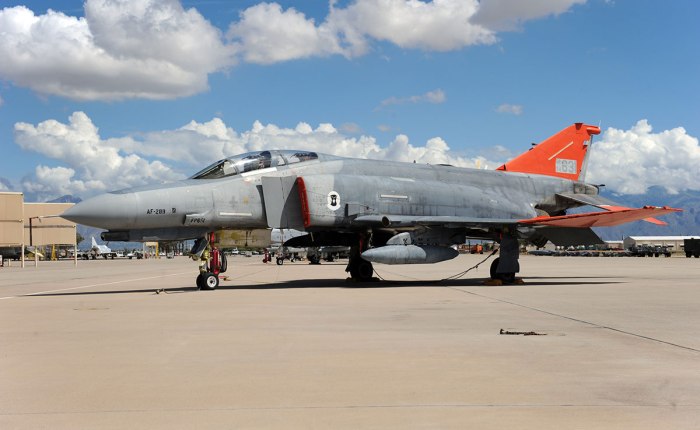
A few weeks ago, on August 17, 2016, the QF-4 Phantom flew its final unmanned mission for the United States Air Force (USAF). Although the Phantom was officially retired from combat use in 1996, USAF has been using unmanned, remote-controlled versions of the F-4 as target drones in training exercises. As the QF-4 completes its final flight, it feels like the end of an era. With over 5,000 built, the F-4 was one of (if not the) most ubiquitous aircraft of the Vietnam War and formed the backbone of the USAF in that period.
Final flight farewells Phantom
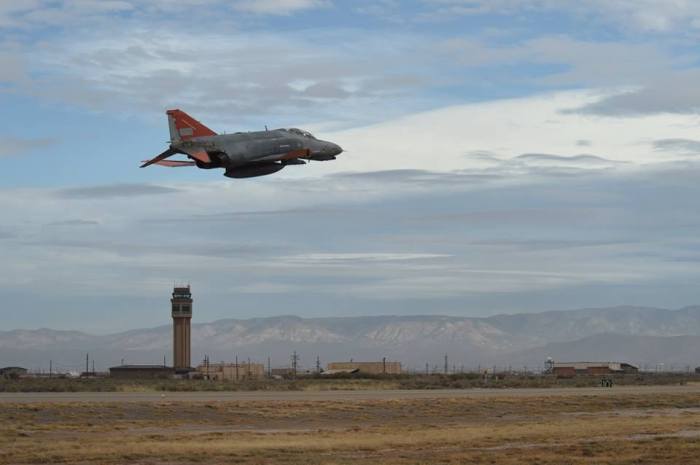
Airmen from the 82nd Aerial Target Squadron, Det. 1 at Holloman Air Force Base hosted the final manned flight of the QF-4 Phantom as part of the Phinal Phlight Ceremony on 21 December 2016. The ceremony commemorated and retired the QF-4 Phantom after 53 years of service in the US  Air Force.  Over its many years at Holloman, the QF-4 flew 145 unmanned missions and 70 aircraft were destroyed in service. It flew its last unmanned mission in August 2016 and was replaced by the QF-16 in 2017. (Source: Wikimedia)

In many ways, the F-4 was the last representative of an earlier era in USAF thinking — its design (emphasising speed, interception, and multi-role capability) reflected the doctrines and assumptions of the early Cold War. During the Vietnam War, those assumptions began to be overturned, and the Air Force eventually turned to a new generation of fighters in planes like the F-15 Eagle and F-16 Falcon. As the Phantom has now officially passed out of use in the US, it is worth taking some time to look back at the Phantom’s design, what that tells us about previous modes of thinking in the Air Force, and what that might mean for the future.

After World War II, USAF, and indeed the entire US military was dominated by Strategic Air Command (SAC), which maintained a fleet of nuclear bombers. The assumption was that a potential “next war” would involve the US and the Soviet Union launching atomic bombs at each other. Thus, national security rested on the idea of being able to drop nukes on Soviet vital centres, while also being able to intercept any Soviet bombers that attempted to do the same.</p
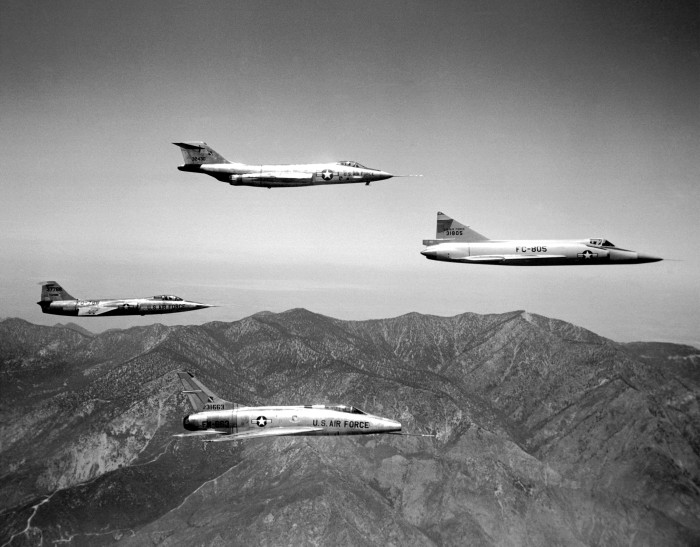
Century_series_fighters_NACA_1957
Four US Air Force Century-series fighters in flight in 1957. These supersonic fighters were tested by the NACA Dryden Flight Research Center at Edwards Air Force Base. The aircraft visible are: McDonnell F-101A-5-MC Voodoo (top), Lockheed XF-104A Starfighter )left). This latter aircraft crashed on 11 July 1957 due to an uncontrollable tail flutter. The pilot, Bill Park, ejected safely. A Convair F-102A-20-CO Delta Dagger (right), North American F-100A-20-NA Super Sabre (bottom). (Source: Wikimedia)

Other tactical missions like air superiority, ground support, or supply interdiction, became irrelevant. The age of fighter escorts, dogfights, and close air support against fielded enemy ground forces was over. In those early years of the Cold War, despite a few small voices of criticism, the USAF devoted less than 6 percent of its research and development resources into tactical and fighter roles. As a result, several tactical fighter wings disappeared in the late 1950s. Tactical Air Command was responsible for these functions and quickly found that the best way to retain relevance (and budget dollars) was to make a case that they too could contribute to SAC’s nuclear mission. They thus focused on developing fighter/bombers and interceptors that emphasised speed (at the expense of manoeuvrability) to either quickly deliver a nuclear warhead, or to intercept an enemy bomber and shoot it down in one pass – not with guns, but with guided missiles. This approach was exemplified in their ‘Century Series’ of interceptors. [1]

The US Navy also came to the same conclusion – that maintaining their budget and relevance necessitated that they participate in the nuclear mission, especially once atomic warheads became small enough to mount to carrier-based aircraft. New US Navy aeroplane designs focused on delivery of tactical nukes and interception of enemy bombers, and although the US Navy did not abandon air superiority to the degree that USAF did, the role of US Navy fighters certainly diminished in the post-war period. For example, the Fleet Air Gunner Unit, which trained weapons officers on US Navy planes, closed in 1960 and new training syllabi excised air-to-air combat.[2]

These assumptions and trends are key to understanding the development of the F-4 Phantom, but one the other main factor was the system of the ‘Military-Industrial Complex.’ Few defence contractors existed in the early Cold War, and the vast sums involved in contract awards and losses could make or break companies quickly. To keep options open, the military had a strong incentive to maintain their contractors afloat, sometimes making purchases regardless of actual needs. The military also encouraged these companies to push the envelope of cutting-edge technology, at times guided by strict mission parameters, on other occasions without many guidelines at all. Thus, a strong paternal bond developed between the military and its industrial suppliers, creating an environment that encouraged companies to experiment and take risks without fear of a total company failure.[3]
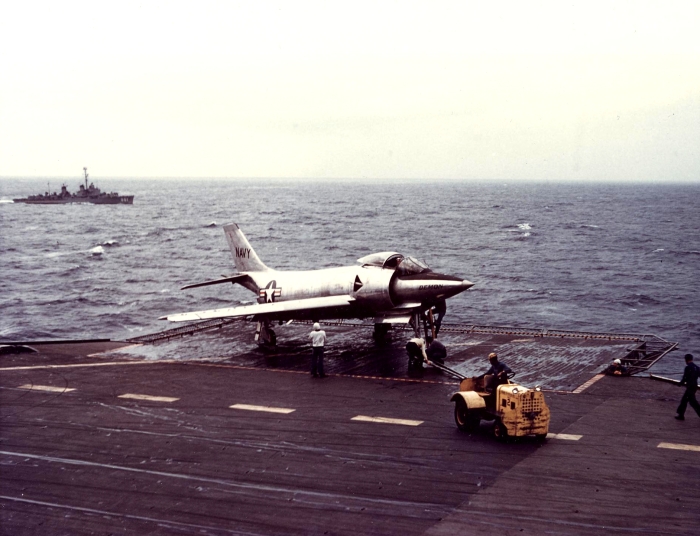
xf3h_demon_on_uss_coral_sea_28cva-4329_in_1953
A US Navy McDonnell XF3H-1N Demon on the elevator of the aircraft carrier USS Coral Sea, in 1953. (Source: Wikimedia)

This bond came into play in September 1952, when the US Navy Bureau of Aeronautics invited proposals for a new fighter plane dedicated to the (redefined) air superiority and interception missions. The US Navy eventually awarded this contract to McDonnell’s rival firm Chance-Vought, whose entry became the F-8U Crusader. McDonnell’s losing design in this competition was a version of the F3H Demon upgraded with a dual-engine and a missile armament. In 1954, the losses from this project nearly destroyed McDonnell. The US Navy had much to lose if its weapons manufacturers closed and viewed these defence contractors as too big to fail.[4]

Next time, we will look at McDonnell’s response to this loss, and how it led to one of the most ubiquitous aircraft of all time.

Part Two of this article can be found here.

Mike Hankins is a doctoral candidate at Kansas State University, where he teaches World History, the History of Airpower, and the History of Comic Books, and he is currently working on his dissertation, ‘Sources of Innovation: The Cultural and Technological Origins of Fourth Generation Fighter Aircraft, 1964-1991.’ He completed his master’s thesis at the University of North Texas in 2013, titled ‘The Phantom Menace: The F-4 in Air-to-Air Combat in the Vietnam War. He has a web page and can be found on Twitter at @hankinstien.

Header Image: The unmanned QF-4 target drone (Source: http://www.military.com/equipment/qf-4-aerial-target)

[1] Earl H.Tilford, Crosswinds: The Air Force’s Setup in Vietnam (College Station: Texas A&M University Press, 1993), pp. 20-22; Craig C. Hannah, Striving for Air Superiority (College Station: Texas A&M University Press, 2002), p. 28; Caroline F. Ziemke, ‘In The Shadow of the Giant: USAF Tactical Air Command in the Era of Strategic Bombing, 1945-1955’ (PhD Thesis, The Ohio State University, 1989), p. 7.

[2] George W. Baer, One Hundred Years of Sea Power: The U. S. Navy, 1890-1990 (Stanford: Stanford University Press, 1994), P. 334.; Robert W. Love, Jr., History of the United States Navy, Vol. 2 (Harrisburg: Stackpole Books, 1992), pp. 375-6.

[3] Glenn E. Bugos, Engineering the F-4 Phantom II: Parts Into Systems (Annapolis: Naval Institute Press, 1996), p. 23.

[4] Bugos, Engineering the F-4, pp. 15-17.

#ResearchNote – J.M. Spaight after the Second World War

#ResearchNote – J.M. Spaight after the Second World War

By Dr Ross Mahoney

In 2004, War in History published an article by Alaric Searle that posed the question ‘Was there a ‘Boney’ Fuller after the Second World War?’.[1] In short, Searle concluded that Major-General J.F.C. Fuller’s theoretical writing continued after 1945 alongside his historical writing and was not simply a ‘footnote to [his] biography.’[2] Searle’s question is an interesting one and could easily be applied to James Malony Spaight. In the inter-war years, Spaight, who was a trained jurist and, as a civilian, served in the Air Ministry, produced several notable volumes on air warfare with particular reference to issues such as its legality. As Robin Higham reflected:

No survey of British airpower theorists in the interwar years would be complete without mention of […] Spaight.[3]

Furthermore, Peter Gray noted that Spaight’s influence, due to his work within the Air Ministry, went further than just being ‘Trenchard’s good friend,’ as Higham suggested.[4] As Gray noted:

Spaight’s work was a readily available source of legal advice for his colleagues in the Air Ministry, and those who were likely to become staff officers having attended the Staff College at Andover.[5]

Before the Second World War, Spaight was clearly a critical influence on the development of air power thinking in Britain.

Despite his pre-war influence, what happened after the Second World War? Spaight retired from the Air Ministry in 1937, but continued writing during the Second World War, for example, in 1944 he published Bombing Vindicated in which he argued ‘that the line between military and civilian objectives’ was blurred.[6] Higham and Philip Meilinger in his Oxford Dictionary of National Biography entry noted the important books that he published after the Second World War.[7] Specifically, these were the third edition of Air Power and War Rights (1947), The Atomic Problem (1948) and Air Power Can Disarm (1948).

However, what else was written? Before the Second World War, Spaight had contributed to journals such as The Royal Air Force Quarterly and the Journal of the Royal United Services Institution. Both are important sources as they were read by officers who emerged into senior positions and thus they would, possibly, have been one influence on their thinking and leadership development. Simply put, after the Second World War, Spaight continued publishing in these journals. This reinforces the idea that Spaight’s writings were not only important in a general sense that he was still writing but, given where these articles were published, they, potentially, helped shape the discourse of air power in the early-Cold War years. However, while Spaight published, what is needed is an examination of the content of these articles so that we can bridge the narrative between his pre-Second World War writings and those produced after. Only by doing this can we consider how, or if, Spaight’s views changed. Broadly speaking the post-war articles are a cross-section of comments on the role of air power in the Second World War, air power’s future role in the nuclear age and the international affairs.

So far I have identified the following articles:

  1. ‘The Covenant of 1919 and the Charter of 1945,’ The Royal Air Force Quarterly, 17 (1945-46);
  2. ‘Strategic Air Bombardment, 1943-45,’ The Royal Air Force Quarterly and Empire Air Force Journal, 18 (3) (1947);
  3. ‘Strategic Air Bombardment (continued),’ The Royal Air Force Quarterly and Empire Air Force Journal, 18 (4) (1947);
  4. ‘Strategic Air Bombardment (continued),’ The Royal Air Force Quarterly and Empire Air Force Journal, 19 (1) (1948);
  5. ‘The Rio and Brussels Treaties,’ Journal of the Royal United Services Institution, 93 (570) (1948);
  6. ‘Sea and Air Power,’ Journal of the Royal United Services Institution, 93 (572) (1948);
  7. ‘That Next War,’ The RAF Quarterly and Commonwealth Air Forces Journal, 1 (1) (1949);
  8. ‘Target for To-morrow,’ Journal of the Royal United Services Institution, 94 (576) (1949);
  9. ‘The Ghost of Douhet,’ The RAF Quarterly and Commonwealth Air Forces Journal, 2 (2) (1950);
  10. ‘Trans-Polar War,’ The RAF Quarterly and Commonwealth Air Forces Journal, 2 (3) (1950);
  11. ‘Korea and Aggression,’ The RAF Quarterly and Commonwealth Air Forces Journal, 2 (4) (1950);
  12. ‘Korea and the Atom Bomb,’ Journal of the Royal United Services Institution, (95) (580) (1950);
  13. ‘The End of a Dream,’ The RAF Quarterly and Commonwealth Air Forces Journal, 3 (2) (1951);
  14. ‘Morale as Objective,’ The RAF Quarterly and Commonwealth Air Forces Journal, 3 (4) (1951);
  15. ‘Pax Atlantica,’ Journal of the Royal United Services Institution, 96 (583) (1951);
  16. ‘Limited and Unlimted War,’ The RAF Quarterly and Commonwealth Air Forces Journal, 4 (1) (1952)
  17. ‘Why Stalin Waits,’ The RAF Quarterly and Commonwealth Air Forces Journal, 4 (3) (1952);
  18. ‘Napalm,’ Journal of the Royal United Services Institution, 98 (589) (1953);
  19. ‘Weapons of Mass Destruction,’ Journal of the Royal United Services Institution, 99 (593) (1954);
  20. ‘Cities as Battlefields,’ Air Power: Incorporating The RAF Quarterly and Commonwealth Air Forces Journal, 2 (3) (1955).

I would be keen to know of anymore articles by Spaight in this period.

This post first appeared at Thoughts on Military History.

Dr Ross Mahoney is an independent historian and defence specialist based in Australia. Between 2013 and 2017, he was the resident Historian at the Royal Air Force Museum, and he is a graduate of the University of Birmingham (MPhil and PhD) and the University of Wolverhampton (PGCE and BA). His research interests include the history of war in the twentieth and twenty-first centuries, air power and the history of air warfare, and the social and cultural history of armed forces. To date, he has published several chapters and articles, edited two books, and delivered papers on three continents. He is a member of the Royal Historical Society and is an Assistant Director of the Second World War Research Group. He is a member of the Royal Historical Society and an Assistant Director of the Second World War Research Group. He blogs at Thoughts on Military History, and can be found on Twitter at @airpowerhistory.

Header Image: The aftermath of the dropping of the atomic bomb on Hiroshima. (Source: © IWM (MH 29447))

[1] Alaric Searle, ‘Was there a ‘Boney’ Fuller after the Second World War? Major-General J.F.C. Fuller as Military Theorist and Commentator, 1945-1966’, War in History, 11 (3) (2004), pp. 327-57.

[2] Ibid, p. 357.

[3] Robin Higham, The Military Intellectuals in Britain, 1918-1939 (New Brunswick, NJ: Rutgers University Press, 1966), p. 230.

[4] Ibid; Peter Gray, The Leadership, Direction and Legitimacy of the RAF Bomber Offensive from Inception to 1945 (London: Continuum, 2012), pp. 54-7.

[5] Gray, Leadership, p. 56.

[6] Phillip S. Meilinger, ‘Spaight, James Molony (1877–1968)’, Oxford Dictionary of National Biography, Oxford University Press, 2004 [http://www.oxforddnb.com/view/article/58055, accessed 5 Jan 2016].

[7] Ibid; Higham, Military Intellectuals, p. 233.

#ResearchNote – Air Power in the Next Generation

#ResearchNote – Air Power in the Next Generation

By Dr Ross Mahoney

0001

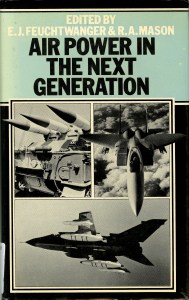
In 1979, The Macmillan Press published Air Power in the Next Generation that E.J. Feuchtwanger and Group Captain R.A. Mason edited. For me, and my current research trajectory on command and staff training in the RAF, what is remarkable about this book is that it was the first significant output from a newly established post for the Service, that of Director of Defence Studies (DDefS).

In 1977, Mason, who retired as an Air Vice-Marshal and was a professor at the University of Birmingham, became the first incumbent to the DDefS post at the RAF Staff College at Bracknell. The position of DDefS was established due to the perceived state of thinking on air power within the RAF as well as public awareness of the Service’s role. In a letter to AOC-in-C Support Command, Air Marshal Sir Reginald Harland, CAS, Air Chief Marshal Sir Neil Cameron, noted that the position was being established ‘to help provide a new stimulus to air power thinking’ throughout the RAF.[1] This point was also emphasised in the terms of reference for the DDefS post as was the need to ‘write on air power and defence issues,’ which was to be encouraged.[2]

While there was some controversy over the establishment of the DDefS position, Mason was well qualified for the job, and despite an initial lack of resources, he quickly got to work. In April 1977, a symposium was held at the University of Southampton, which formed the basis for Air Power in the Next Generation. Mason was undoubtedly supported in his early efforts by the degree of top cover he was afforded by CAS and other officers interested in the discussion of air power, such as the Director-General of Training, Air Vice-Marshal Frederick Sowrey.[3] Indeed, Cameron long had an interest in the study of air power and, as Group Captain J.A.G. Slessor, son of the former CAS, reflected, he was the only Chief to come to discuss the subject with his father.[4]

What of the book? It consists of 10 chapters based on the presentations delivered at the symposium. The opening chapter builds on Cameron’s opening presentation and reinforces the importance of protection by senior leaders. Had Cameron not been interested in both the subject matter and the importance of establishing a post to advocate for thinking about air power, it is hard to imagine that the position would have been created. Even if it had, it probably would have taken a very distinct direction to the one that it has. Other contributions came from a number senior serving or retired officers from not just the RAF but also the USAF, Luftwaffe and the Isreali Air Force. There were also contributions from academics such as John Erickson, who covered the expansion of Soviet Air Power. The conclusion from Major-General Lloyd R. Leavitt Jr. of the USAF on the ‘Lessons from South East Asia’ is particularly apropos for the current era as well as the 1970s. Leavitt, who retired as a Lieutenant-General, concluded that there was a need to enunciate and educate the body politic about the relevance of the system they were investing in noting that:

[…] in order to achieve the understanding and support of the people who have to pay the bills, the taxpayers and their elected representatives, we must go to the people and go through the press to the people with logical clear explanations about the involvements of air power – why the air force needs things, why this system is needed, and why that system is needed.[5]

Apart from the contents of the book, what is the significance of the establishment of the DDefS post? It is hard to assess, and hopefully, more answers will emerge as I continue to research the subject. However, a few tentative thoughts are warranted. First, the RAF at least recognised the challenge of its predicament in the 1970s and established a post to try and encourage the Service to discuss taxing questions over its role and employment. This was essential in the decade after the RAF handed over the strategic nuclear deterrent to the Royal Navy. This had been the RAF’s focal point during the early Cold War, and the Service needed to try and enunciate its relevance in a changing defence landscape. Whether it was successful in doing that is not to be discussed here. However, the post has offered a focal point for thinking about the RAF’s role, and individual DDefS’ have made a contribution to British air power thinking with publications similar to Air Power in the Next Generation being produced on important themes as well as the postholders numerous individual contributions on the subject of air power. These have become essential sources of informal doctrine, but they have, by dint of circumstances, varied regarding when they were produced and what they covered. Indeed, at the moment, I am trying to map the various outputs generated by DDefS’ both during their time in post and after to seek to contextualise what they wrote, when they wrote it and their impact. Some DDefS’ have produced more than others, in part, due to operational circumstances though there may be other factors at play. This latter aspect will be difficult to measure, but one thing that is already clear is that context is critical.

This post first appeared at Thoughts on Military History.

Dr Ross Mahoney is an independent historian and defence specialist based in Australia. Between 2013 and 2017, he was the resident Historian at the Royal Air Force Museum, and he is a graduate of the University of Birmingham (MPhil and PhD) and the University of Wolverhampton (PGCE and BA). His research interests include the history of war in the twentieth and twenty-first centuries, air power and the history of air warfare, and the social and cultural history of armed forces. To date, he has published several chapters and articles, edited two books, and delivered papers on three continents. He is a member of the Royal Historical Society and is an Assistant Director of the Second World War Research Group. He is a member of the Royal Historical Society and an Assistant Director of the Second World War Research Group. He blogs at Thoughts on Military History, and can be found on Twitter at @airpowerhistory.

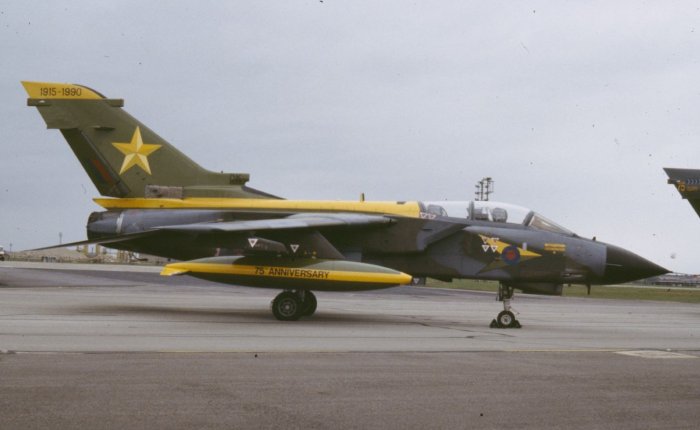
Header Image: Panavia Tornado GR1 of No. 31 Squadron at RAF Fairford, c. 1990 (Source: Wikimedia Commons)

[1] Author’s Personal Collection, Letter from the Chief of the Air Staff to AOC-in-C Support Command, 2 November 1976. I am grateful to Air Vice-Marshal Professor R.A. Mason for a copy of this and other documents linked to the establishment of the DDefS post.

[2] Author’s Personal Collection, Terms of Reference for Director of Defence Studies appended to a Letter from the Chief of the Air Staff to AOC-in-C Support Command, 2 November 1976, p. 1.

[3] Graham Pitchfork, The Sowreys: A Unique and Remarkable Record of One Family’s Sixty-Five Years of Distinguished RAF Service (London: Grub Street, 2012), p. 216.

[4] Marshal of the Royal Air Force Lord Cameron of Balhousie, In the Midst of Things (London: Hodder and Stoughton, 1986), pp. 106-8, 194-5, p. 200, fn9.

[5] Major-General Lloyd R. Leavitt Jr., ‘Lessons from South East Asia,’ in E.J. Feuchtwanger and Group Captain R.A. Mason (eds.), Air Power in the Next Generation (London: The Macmillan Press, 1979), p. 85.