#highintensitywar – From ‘Bats to MAVs’: The Concept is Clear, ‘Small’ is the Future of Aerial Warfare

#highintensitywar – From ‘Bats to MAVs’: The Concept is Clear, ‘Small’ is the Future of Aerial Warfare

By Sergeant Lee Tomàs

Editorial Note: Between February and April 2018, The Central Blue and From Balloons to Drones, will be publishing a series of articles that examine the requirements of high-intensity warfare in the 21st Century. These articles provide the intellectual underpinnings to a seminar on high-intensity warfare held on 22 March by the Williams Foundation in Canberra, Australia. In this article, Sergeant Lee Tomàs of the Royal Air Force (RAF) examines the implications of Micro Air Vehicles (MAVs) for future conflicts.

In 1941, a Pennsylvania dentist named Lytle S. Adams was on vacation in the South-West of America within the famous Carlsbad Caverns. While exploring Carlsbad’s vast expanse, he observed it hosted thousands of indigenous Bats. Adams was monumentally impressed by what he saw and then just as history has often taught us previously, the most remarkable ideas often derive from the strangest of places, at a random moment, when separate paths conjoin. Much like Sir Isaac Newton when the Apple hit his head, thus propelling him in founding the theory of gravity.[1] Adams’ similar ‘eureka’ moment did not derive from when he observed the Bats in Carlsbad’s deep and damp expanse; it was when he turned on his car radio when departing, which amplified that the Imperial Japanese Navy had devastatingly attacked Pearl Harbor. Adams at that precise moment began plotting an unorthodox plan of revenge against America’s new enemy; the Japanese, using what he had seen previously that day; the Bats.[2]

The idea that developed from Adams’ eureka moment was to attach incendiary material onto swarms of collected Bats, who previously (through the research and development stages of the idea) were trained to hibernate in large storage refrigerators. The final phase of Adams’ plan was for these Bats to be dropped from an aircraft in a bomb casing encompassing similar properties to the aforementioned refrigerators. These would then open mid-air, dispersing the Bats outwards onto Japanese cities below to seek warmth and sanctuary within enemy building structures, inside eaves and roofs, which during that period in Japan were made of highly flammable material. The Bats would then go kinetic, catch fire, and subsequently demolish their host building target.[3] Adams’ own words would describe the predicted results of the later titled Project X-Ray. ‘Think of thousands of fires breaking out simultaneously over a circle of forty miles in diameter for every bomb dropped.’ He later recalled that ‘Japan could have been devastated, yet with a small loss of life.’[4]

Adams’ creation of Project X-Ray could be perceived as pure lunacy to the untrained eye, however, with the present-day parameters of modern warfare constantly evolving, sometimes a little bit of lunacy can be effective in achieving the desired strategic aim. Adams’ premise of causing considerable amounts of effective damage upon one’s enemy, with the least amount of innocent lives taken, through the hostile deployment of these mini-warfare-vessels might, in the future, be a viable solution. Project X-Ray’s legacy, concept and its underpinning tactical peripherals of swarm-based aerial strategies will be forwarded within this narrative as still being relevant and possible within the delivery of modern warfare. This will be proven by substituting the Bats for the new technological assets: MAVs, which when deployed would give a modern force, like the RAF, a viable tactical equaliser and advantage within wider strategic operations.

Project X-ray principles of tactical swarm-based aerial attack have possible relevance within historic, present-day, and future western military operations due to two distinct and transcending reasons. The first is the current evolving development and procurement of military platforms and assets, which are now gravitating towards small, smart, and cheap technology that encompasses the ability to deploy in swarm formations. This ability includes overpowering your enemy within all areas through greater aerial deployments while retaining a cheaper overall financial outlay. The second reason is the potential future opportunity to reduce the amount of military and civilian deaths caused by historic and currently deployed air operations. Below we will explore these two reasons in depth while answering if aspects of Adams’ idea could be implemented within future UK warfare scenarios by using the vast range of MAV technology available and placing them in historical conflict case studies, which will position how they will affect future air-centric operations globally.

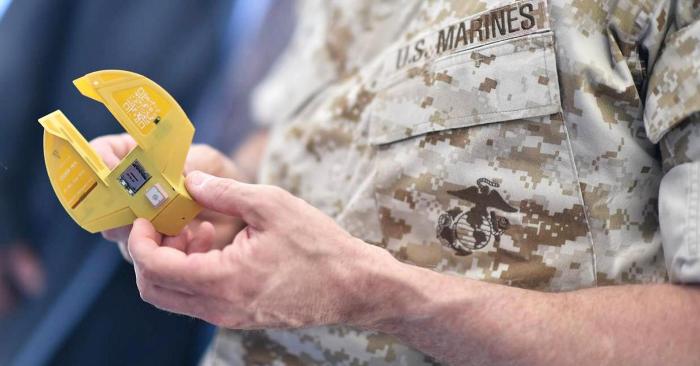
As a platform, MAVs are a small remotely, or autonomous air-asset. Typically, they exist in three size classifications; small, medium, and large. This article focusses on small and medium-sized MAVs. Small MAVs, which the US Department of Defense defines as being 20lbs or lighter, are typically hand sized, like the U.S ‘Cicada,’ which is a Covert Autonomous Disposable Aircraft used for carrying out undetected missions in remote battlefields.[5] Medium MAVs are typically ‘dinner-plate’ sized like the ‘Quad,’ ‘Hexa’ or ‘Octo’ copters, currently used by UK police forces for surveillance operations within the airspace of airports like the ‘Aeryon-Skyranger’ drone.[6] There are also large MAVs like the ‘Harpey’ Drone, which is currently used by the Chinese military and has a nine-foot wingspan and 32 Kilogram warhead payload that is guided by radar, can loiter in the air and can deploy with 17 others systems from a single five-ton truck.[7]
102691538-Unknown.1910x1000
The US Navy’s “CICADA” drone program is producing lightweight disposable glider drones for field missions. (Source: US Naval Research Laboratory)

This article will start where the Bats ended. Although the aforementioned ‘Project X-Ray’ was not implemented operationally during the Second World War, its premise – to inflict regional mass damage to Japanese cities without mass fatalities – is a tactic that is still desired today by the majority western militaries and governments. The Cicada as an individual platform has the same tactical properties and potential as Adams’ Bats in that they can be deployed en-masse, equipped with small thermobaric NANO munitions, which could easily perform the small kinetic solution positioned during the Project’s design stage, and are also more importantly incredibly small. The potential capability of this MAV within a swarm configuration has already been adopted again by the US Air Force (USAF) when it deployed ‘Tempest’ tactical balloons at high altitude. These then released medium Tempest MAVs who during mid-flight then distributed smaller Cicadas MAVs en-masse (again all at high altitude) to collect environmental data.[8] A more warfare centric illustration of Cicada’s possible capability was demonstrated during the recent deployment of 103 ‘Perdix’ MAVs from an American F/A-18 fighter jet, which once deployed (mid-air) flew to three different target locations and simulated a swarm attack scenario on each designated enemy position. A Chinese civilian corporation who specialises in MAV development had also illustrated this possible small-MAV swarm scenario when it deployed 67 MAV’s simultaneously which performed a ‘saturation’ attack on an enemy anti-aircraft battery, subsequently neutralising the anti-air threat. The U.S Navy has also recently reinforced the effectiveness of mass MAV strategy when it deployed 8 LOCUST (medium) MAVs simultaneously towards one Aegis-class destroyer warship (the most effective global air-defence system currently available).[9] This exercise resulted in 2.8 of the 8 MAVs penetrating the ships defence system, causing subsequent damage and the conclusion that if this deployment were increased by 10 or a 100, the consequences would be more devastating, proving that smaller, smarter and more lethal technologies are the future of air-centric warfare.

The potential benefits of these attacks can be dissected further. The Bat inspired slow-burn-combustion Cicada MAV attack would, as Adams conceived initially, cause the necessary damage to enemy territory, buildings, and infrastructure while reducing the human-centric ‘collateral damage.’ This reduction in lives taken by this type of operation (if appropriately deployed) would achieve its aim by allowing the residing population the choice to flee their residencies and disperse the area, therefore allowing a secondary larger tactical air-strike to occur on key infrastructure targets like nuclear reactors, power stations and government/military buildings. If civilian dispersal was not forthcoming then maybe using MAVs to deploy dispersal gas, or even recorded PA warnings played through speakers on the MAV’s could be utilised. The former ability already exists and was demonstrated by the Skunk MAV, which were bought by a South African Mining company which deployed 25 of these (medium) multi-rotor MAVs to quell potential protester uprisings. Skunks have four barrels which fire pepper-spray or paintball rounds at protesters. Less potent aerosols could potentially be designed to encourage the necessary civilian movement and dispersal passively.

This above mentioned strategy would in the first instance reduce the mass-death scenario created from current air-strike strategies, and also decrease the erosion of a state’s global-moral currency, a process which was demonstrated when the US disclosed 116 innocent civilians were killed through its UAV centred strategy in Afghanistan in 2016, and in response culminated in extensive global condemnation.[10] The erosion of a state’s moral-currency is not outwardly/globally post-strike, it is also internally eroding within the conflict itself as air-strikes can have an extensive degrading effect on the local population, which has historically been the catalyst for the worlds emerging and multiplying insurgencies in Middle Eastern conflicts.[11]

It Always Comes Down to Money!

From a fiscal perspective using small MAVs as weapons could also be highly beneficial in future tactical strikes. MAVs as a platform can now be designed and created using additive 3-D printing. Within the West geographically, 3D printing has already transcended into the world of MAVs through pioneers such as Andy Keane and Jim Scanlan from the University of Southampton University, who, through 3-D printing, produced a drone with a five-foot wingspan. This process has further expanded globally through the online ‘Maker movement’ which shares 3D drone designs and do-it-yourself guides for anybody who wishes to construct a Drone. Ang Cui, a Columbia University PhD, also has a ‘Drones at home’ blog with step-by-step instructions for would-be drone makers to follow. The first commercial and military MAV produced at scale through 3D printing was the small ‘Razor’ drone, which is not only highly effective but can be printed in one day in the US for $550 there are also cheaper variants which cost $9 per unit.[12]

The Razor’s wingspan of forty inches, cruise potential of 45mph and a flight capability of forty minutes comes in complete form for $2,000, and its production company MITRE believe future projects will arrive under $1,000, or cheaper as the MAV market expands.[13] Further evolutions include Voxel8 a 3D electronic printing company whose $8,999 3-D printer can print an operational drone with electronics and engine included.[14]

Commercial American companies have also illustrated the MAV mass production potential of 3D technology, such as United Postal Service (UPS) who have established a factory with 100 3-D printers, which accepts orders, prints them, allocates a price, and then ships them the same day. Furthermore, UPS plan to increase its plant size to 1000 printers to support major production runs.[15] China has also recognised the benefits of embracing civilian technological advancement to improve military procurement. The expansion of 3D printing within China’s commercial sector has recently empowered its military to evolve its procurement of warfare assets and platforms effectively. This was demonstrated to observing media by the Chinese Army who repaired a broken military class oil-truck in an austere battlefield environment using only a single 3D additive manufacturing machine. This process allowed the crew to replicate and replace the unserviceable components both on-site and within a short period.[16] Furthermore, this demonstration revealed the ease, skill, convenience and reliance China places on 3D printing, which in this instance prevented them experiencing routine operational issues like losing their re-fuelling capability, the requirement for a truck recovery team to deploy and the need to wait for an expensive part from a geographically distant manufacturer to arrive. A final and more strategic advantage this 3-D process has provided is removing China’s potential reliance on global commercial industry to provide these technical parts en-masse as the US does within its own present-day military procurement cycles.

Not only does 3D printing provide numerous tactical and speed efficiencies, but it could also, if correctly exploited, arrive at an incredibly cheaper cost financially. Using the Razor as an example, it currently costs $2000 per individual platform (complete). Therefore, a smaller Cicada MAV would arrive if produced within the same process at $250 or cheaper due to its smaller size, reduction of material required and after necessary production efficiency has been achieved.[17] Once assembled, if a small incendiary were then attached at an estimated cost of $200, it would make the platform an incredibly cheap and deadly weapon. This overall manufacture-to-deployment financial pathway compares favourably to the recently released UK Ministry of Defence figures that an average Tornado aircraft operational flight costs £35,000-per hour. This figure, when plugged into an operational scenario, creates the following financial outlay; two Tornados performing a six-hour (one stop) strike operation carrying four Paveway bombs (£22,000) and two Brimstone missiles (£105,000) would cost on average £1 Million. If the Paveway munitions were later exchanged for the Storm-Shadow munition variant (£800,000), the cost would increase exponentially.[18] This price, even without the latter munition, would allow you to purchase 2,000 Cicada’s with the ability to be dropped from a more fiscal efficient platform and would then as a swarm fly straight to the target area with a potential kill radius of 2 metres per MAV depending on incendiary attached. This type of attack would reduce the possibility of human collateral damage, firstly from a surface-to-air threat to the pilot and innocents on the ground exposed to the aerial kill-chain, while giving the swarm operator the ability to increase or decrease the swarm size depending on the amount of damage desired or required. The financial benefits continue to expand in favour of small MAVs when they are compared to rival high-technology air platforms like the fifth generation F-35. Using the previous larger Razor MAV as an example; it costs $2,000 per fully functioning drone, which when compared to the cost of 16 F-35s would allow you to purchase for the same price one million Razors. If the F-35s and these Razors were then deployed against each other in active hostile deployments, the Razors would retain the tactical potential if designed correctly to swarm the 16 F-35s, destroying them, even without incendiaries, through intended foreign object debris damage. Therefore, eradicating the superiority that the F-35 previously held. Of course, scenarios, testing and system advancement would dictate these hypothetical scenarios, however as all the scenarios suggest there is a new dimension in modern warfare and it is the MAV.

Sergeant Lee Tomàs is a Senior Non-Commissioned Officer in the Royal Air Force. In a 13-year career in the RAF, he has deployed to the Falkland Islands, Afghanistan, Cyprus, Oman, and Cyprus. He holds a Post Graduate Certificate from Brighton University, an MA from Staffordshire University, and an MA from Kings College London. He runs a political online blog and lecture series at RAF stations which tries to develop junior Ranks knowledge of current affairs. In 2017, he won the prestigious CAS ‘Fellow of the Year’ award.

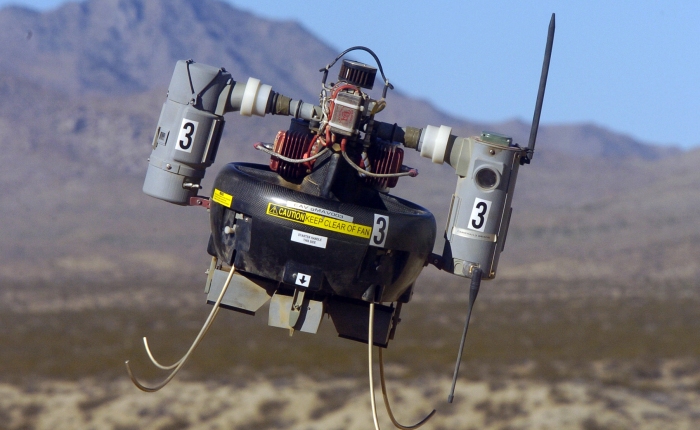
Header Image: A Honeywell RQ-16 T-Hawk Micro Air Vehicle flies over a simulated combat area during an operational test flight, c. 2006.

[1] Steve Connor, ‘The Core of truth behind Sir Isaac Newton’s Apple,’ The Independent, 18 January 2010.

[2] Alexis C. Madrigal, ‘Old, Weird Tech: The Bat Bombs of World War II,’ The Atlantic, 14 April 2011.

[3] David Hambling, Swarm Troopers: How Small Drones Will Conquer the World (London: Archangel Ink, 2015).

[4] Madrigal, ‘Old, Weird Tech: The Bat Bombs of World War II.’

[5]  Sarah Kreps, Drones: What Everyone Needs to Know (Oxford University Press, 2016); Anon, ‘U.S. military hopes to enlist tiny, durable Cicada mini-drone,’ The Japan Times.

[6]  Anon, ‘UK Police ‘Skyranger’ Drones to patrol skies above Gatwick airport after major disasters,’ The Huffington Post, 13 March 2014.

[7] John Kaag and Sarah Kreps, Drone Warfare (London: Polity Press, 2014), p. 49.

[8]  Ibid, pp. 8-9.

[9] David Hambling, ‘U.S. Navy Plans to Fly First Drone Swarm This Summer’, Military.com, 4 January 2016.

[10] Spencer Ackerman, ‘Obama claims US drone strikes have killed up to 116 civilians,’ The Guardian, 2 July 2016.

[11] Jason Berry, ‘Inside Americas Drone War, a moral Black Box,’ PRI, 26 September 2012.

[12] T.X. Hammes, ‘The Future of Warfare: Small, Many, Smart vs. Few & Exquisite?,’ War on the Rocks, 16 July 2014.

[13] Hambling, Swarm Troopers, pp. 109-10.

[14] Dario Borghino, ‘Voxel8 paves the way for 3D-printed Electronics,’ New Atlas, 14 January 2015.

[15] Eddie Krassenstein, ‘Cloud-DDM-factory with 100 (eventually 1000) 3D printers & just 3 employees’ open’s at UPS’s Worldwide Hub,’ 3DPrint.com, 4 May 2015.

[16] Simon, ‘Chinese military begins using part production library for 3D printing replacement parts in the field,’ 3ders.org, 12 August 2015.

[17] Mariella Moon, ‘Watch how the Navy plans to deploy its tiny Cicada drones,’ Engadget, 22 May 2015.

[18] Alistair Bunkall, ‘How Much Will Airstrikes on IS Cost Taxpayer?,’ SKY News, 26 September 2014.
Tactical Reconnaissance Redux? The Requirement for Airborne Tactical Reconnaissance in #HighIntensityWar

Tactical Reconnaissance Redux? The Requirement for Airborne Tactical Reconnaissance in #HighIntensityWar

By Squadron Leader Rodney Barton

Editorial Note: Between February and April 2018, The Central Blue and From Balloons to Drones, will be publishing a series of articles that examine the requirements of high-intensity warfare in the 21st Century. These articles provide the intellectual underpinnings to a seminar on high-intensity warfare held on 22 March by the Williams Foundation in Canberra, Australia. In this article, Squadron Leader Rodney Barton examines and discusses the importance of tactical level reconnaissance in support of operations in a contested environment. In examining the importance of such a capability, Barton makes a case for the Royal Australian Air Force (RAAF) to reacquire the ability to undertake such missions.

The Australian Defence Force (ADF) has not maintained an airborne tactical reconnaissance capability since the retirement of the reconnaissance variant of the F-111 in 2010. Instead, the ADF has shifted focus to ‘traditional’ intelligence, surveillance, and reconnaissance (ISR) platforms such as the P-8 Poseidon and G550 Gulfstream aircraft, with unmanned ISR capabilities soon to follow. These platforms are not designed to operate in a contested environment; a degree of air superiority is required to ensure optimised collection. The ADF has been comfortably reliant on satellites to penetrate denied areas that require imagery collection, but the emergence of counter-space capabilities now puts this access at risk. This article will discuss the role of airborne tactical reconnaissance, why it still exists, why the ADF needs a tactical reconnaissance capability and the innovative methods of applying tactical reconnaissance in small air forces like the RAAF.

For as long as airframes have existed – the airborne reconnaissance role has existed. From the very first balloons in the nineteenth century through to the modern age, aircraft have flown in the vicinity of the adversary to understand their posture and intentions. Tactical reconnaissance aircraft have developed gradually with speed and altitude to penetrate defended airspace and gain access to sensitive areas. These aircraft were typically unarmed to maximise their operating speed, height, range and most importantly, survivability. At times during the Second World War, a lack of dedicated tactical reconnaissance assets necessitated modifications to existing fighter aircraft to meet the collection requirement. This specific mission was known as ‘dicing’ – short for ‘dicing with death’ – due to the risk the aircraft faced while conducting the mission, particularly the post-strike bomb assessment. During the Cold War, the tactical reconnaissance mission took on a strategic reconnaissance focus epitomised in the US by the U-2 Dragonlady and SR-71 Blackbird respectively. The advent of a satellite imagery capability led to less reliance on these platforms for strategic collection – although the U-2 remains in service and high demand, albeit in permissive airspace.

HU 92977
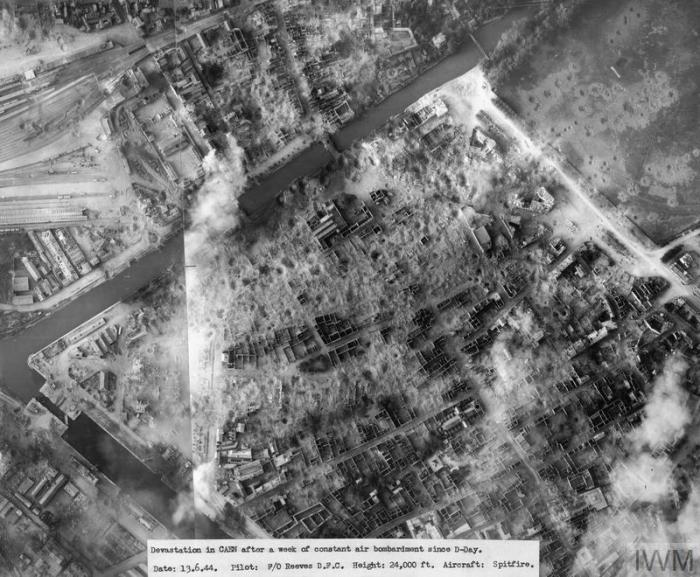
A vertical serial reconnaissance photograph, taken from 24,000 feet, showing the St Jean district of Caen, France. This area was destroyed by two heavy raids on the city by aircraft of No. 5 Group, RAF Bomber Command, on the nights of 6/7 and 12/13 June 1944. The Bassin Saint-Pierre is at bottom left and the River Orne flows from upper right to middle left. The church of St Jean, damaged but still standing, is visible towards the middle of the lower-right quarter of the photograph. Another badly damaged area can be seen across the river in the Vaucelles district, to the right of the main railway station (top left). (Source: © IWM (HU 92977))

Despite the developments of space-based imagery and high-altitude collection platforms, the requirement for tactical reconnaissance in the US remained evident during the Vietnam War and the First Gulf War. The US Air Force (USAF) operated several modified fighter aircraft (RF-101 Voodoo and RF-4C Phantom) and aircraft-launched drones during the Vietnam War, particularly for the collection of target intelligence and post-strike assessment. RF-4C Phantom aircraft continued to serve through the First Gulf War providing vital intelligence on Republican Guard movements and Iraqi Air Force disposition. They were also misused to a certain degree, in the bid to find and fix Iraqi mobile missile launchers. The inability to view or disseminate the imagery real-time from the venerable Phantoms no doubt compounded this issue. The USAF retired the RF-4C in 1995 and has not sought a replacement since – most likely due to the emergence of unmanned ISR platforms and reliance on space-based assets.

Advances and growth in satellite imagery collection, along with the increasing sophistication of ground-based air defences, have challenged the utility of tactical reconnaissance. Not only do imagery satellites collect more persistently against denied areas, but they are not subject to air defence systems which increasingly have greater reach and lethality. The shoot-down of a Turkish RF-4E in Syrian airspace in 2012 highlights the threat that air defence systems pose. Despite these factors, countries with small air forces still invest and implement airborne tactical reconnaissance capabilities. Why? The simple answer is cost, access and availability. Not every country has access to satellite imagery. Even when they do, the imagery may not be available when it is required due to weather, communications, or other priorities. Given satellite’s strategic nature and scarcity, a local commander’s tactical requirements may be lost amongst national strategic priorities. Tactical reconnaissance missions can be employed locally and responsively to support immediate requirements.

Local control and accessibility are two key reasons why the US Navy (USN) still operates a tactical reconnaissance capability through the Shared Reconnaissance Pod (SHARP) carried on the F/A-18F Super Hornet aircraft. For a deployed carrier battle group operating in a potentially contested environment, satellite imagery will not be on tap for perusal. Many European and Middle-Eastern nations have also invested in tactical reconnaissance capabilities due to their low cost and accessibility of the imagery collected. Podded electro-optical/infra-red sensors such as the DB-110 (a tactical derivative of the U-2 sensor) have proven popular in these countries due to their platform agnostic versatility with carriage options on the F-16 Fighting Falcon, GR-4 Tornado, or F-15 Eagle. The DB-110 can collect almost 26,000 square kilometres of imagery per hour from a stand-off range of 150 kilometres. Low cost, seamless pod integration onto fighter platforms and flexibility of use provide significant benefits to small air forces that cannot afford to invest heavily in ISR space or air-breathing assets.

030113-N-2385R-008
A Shared Reconnaissance Pod (SHARP), installed on the bottom of an F/A-18F Super Hornet assigned VFA-41, is positioned on the USS Nimitz’s flight deck waiting to be launched during the next cycle of flight operations, c. 2003. SHARP is a multi-functioned reconnaissance pod, adaptable to several airborne platforms for tactical manned airborne reconnaissance. It is capable of simultaneous airborne and ground screening capabilities and was designed to replace the US Navy’s Tactical Airborne Reconnaissance Pod System. (Source: Wikimedia)

Further advances in tactical reconnaissance sensor capability also provide value for money. Take for example the development of multi-spectral sensors for detection of camouflaged and concealed targets at longer stand-off ranges. Additionally, tactical reconnaissance sensors now have datalink connectivity resulting in an ability to pass image chips forward via airborne assets for early exploitation and analysis. Tactical reconnaissance vendors are also promoting requirements for expeditionary processing, exploitation, and dissemination (PED) cabin for deployed operations. Expeditionary PED is critical to the tactical reconnaissance mission, particularly if it is likely that communications bearers are at risk. Furthermore, the transmission of terabytes of imagery through a communications bearer for analysis may not be viable due to bandwidth constraints on protected networks.  The significant volume of imagery data collected from tactical reconnaissance pods will necessitate a form of ‘triage’ of the imagery to focus analytical efforts on priority information requirements. Therefore, sending analysts closer to the fight may be required to overcome the effects of a contested communications environment.

In a future high-intensity war, ADF will not have the unfettered use of space and Electromagnetic Spectrum (EMS) to which it has become accustomed. Near-peer adversaries such as China and Russia have made their intentions clear regarding the denial of space and communications bearers for the US and its allies during any potential conflict. Therefore, the ability to carry an imagery collection sensor on an aircraft that can penetrate and survive in contested airspace, conduct a tactical reconnaissance mission, and return the imagery for exploitation is vitally important. Early phases of a high-intensity war against a sophisticated integrated air defence system (IADS) will see our traditional ISR assets operating at significant stand-off ranges that will degrade their operational utility. The F-35 can penetrate IADS; however, the sensor suite is not optimised for long-range, wide field-of-view imagery collection. The high-end battle may require traditional reconnaissance methods to get the job done. This is particularly important for targeting intelligence and post-strike assessment – to ensure the commander apportions the right platforms and weapons against the right target sets to achieve the desired effects at the lowest risk available.

For a small but technically advanced air force like the RAAF, the acquisition of imagery sensors that can be carried in a fast jet-configured pod would provide a low-cost capability for imagery collection for use during high-intensity war, complementing available satellite and larger airborne imagery collection systems. The tactical reconnaissance pods can also be utilised in permissive environments when tasked and could be considered for use to support the full spectrum of operations. The most likely candidate platform for the ADF tactical reconnaissance capability would be the F/A-18F Super Hornet, given the already demonstrated role with the USN and SHARP. The flexibility of a podded sensor allows the fighter aircraft only to carry the pod when required vice having a permanently fixed sensor with inherent penalties of sensor carriage. An airborne tactical reconnaissance capability could provide responsive, survivable, and high-quality imagery to the joint force a range of scenarios.

Imagery collection capabilities are facing increasingly sophisticated threats across the air, electromagnetic, space and cyber domains. The development of an ADF airborne tactical reconnaissance capability would add another layer to Australia’s tactical imagery collection requirements while also enhances its self-reliant military capability and its value as a contributor to coalition ISR operations. Tactical reconnaissance provides necessary redundancy, survivability, and responsiveness required when the high-intensity war means commanders cannot access strategic collection capabilities – due to access or priorities – and reduces the information gush to a trickle. In high-intensity war and pulling the digital ‘wet-film’ imagery from a pod-equipped fighter jet may be the only viable reconnaissance method available to reveal adversary posture and intent.

Squadron Leader Rodney ‘Neville’ Barton is an officer in the Royal Australian Air Force. The opinions expressed are his alone and do not reflect those of the Royal Australian Air Force, the Australian Defence Force, or the Australian Government.

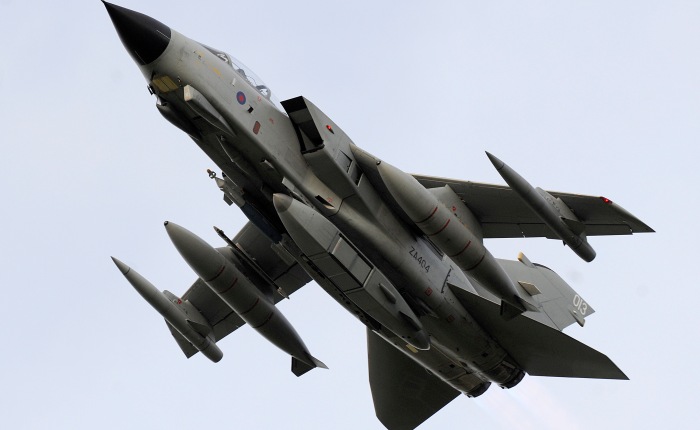
Header Image: An RAF Tornado GR4 from RAF Marham in Norfolk with a RAPTOR airborne reconnaissance pod fitted beneath the fuselage, c. 2009. The images received by the pod can be transmitted via a real-time data-link system to image analysts at a ground station or can be displayed in the cockpit during flight. The imagery can also be recorded for post-flight analysis. The RAPTOR system can create images of hundreds of separate targets in one sortie; it is capable of autonomous operation against preplanned targets, or it can be re-tasked manually for targets of opportunity or to select a different route to the target. The stand-off range of the sensors allows the aircraft to remain outside heavily-defended areas, to minimise the aircraft’s exposure to enemy air-defence systems. (Source: UK Ministry of Defence)

#highintensitywar and Alliances

#highintensitywar and Alliances

By Dr Alan Stephens

Editorial Note: Between February and April 2018, The Central Blue and From Balloons to Drones, will be publishing a series of articles that examine the requirements of high-intensity warfare in the 21st Century. These articles provide the intellectual underpinnings to a seminar on high-intensity warfare held on 22 March by the Williams Foundation in Canberra, Australia. In this article, Dr Alan Stephens considers the importance of alliances in supporting smaller powers involved in high-intensity conflicts.

It was the 19th century British Prime Minister, Lord Palmerston who famously remarked that in international relations there are ‘no eternal allies […] only interests.’

Palmerston’s hard-headed worldview has particular relevance for small- and medium-nations that find themselves drawn into high-intensity warfare. The October 1973 war in the Middle East and the 1982 war in the Falklands illustrate the point.

The 1973 war began on 6 October when Egypt and Syria launched a sudden attack against Israel. Over-confident Israeli commanders were shocked when their previously dominant air force found itself unprepared for the quality and tactical disposition of the Arabs’ ground-based air defence system. The Israeli Air Force (IAF) started the war with about 290 frontline F-4 and A-4 strike/fighters, and within days some fifty had been shot-down. It was an unsustainable loss rate.

McDonnell_Douglas_A-4F_Skyhawk_Ayit_F_(468970264)
A Douglas A-4F Skyhawk of the Israali Air Force. (Source: Wikimedia)

A week later, as the war in the air began to turn and the Israelis started to assert their expected dominance, it was the Arabs’ turn to experience unsustainable losses.

Now, both protagonists faced the same urgent problem: neither had the reserves nor the local capacity to rapidly reinforce their fighting units.

There is a limit to how much a nation can spend on otherwise non-productive war industries and stockpiles. Governments have to make fine judgments regarding how many weapons – which represent stranded assets until they are used – they can afford to have parked on ramps or stored in warehouses against the possibility of a contingency that might never arise.

That economic imperative is especially pronounced in the war in the air, in which platforms and weapons are exceedingly expensive. Moreover, in high-intensity fighting, extreme loss and usage rates accompany extreme unit costs. Thus, during the nineteen days of the October War, the Israelis lost 102 strike/fighters and the Arabs 433, and the Arabs fired 9,000 surface-to-air missiles. Those numbers alone amounted to thirty aircraft and $560 million per day.

What that meant was that neither the Israelis nor the Arabs were capable of fighting a high-intensity air war for more than about a week without direct assistance from their American and Soviet sponsors. Moreover, that is precisely what happened. On 9 October, the Soviets started a massive airlift to resupply the Egyptians and Syrians with missiles, ammunition, SAM components, radars, and much more; shortly afterwards, the US did the same for Israel. The US also made good the IAF’s aircraft losses by flying-in about 100 F-4s, A-4s and C-130s, some of which arrived still carrying United States Air Force markings.

Without that resupply, Israel and the Arab states could not have sustained such a high-intensity conflict.

This point bears emphasis. Israel was far superior militarily to the Arab states, and its excellent indigenous industry enabled it to develop essential capabilities (such as electronic warfare counter-measures) during the conflict. Nevertheless, it is not unreasonable to suggest that, had Egypt and Syria been resupplied and Israel had not, the war would have ended differently.

Sustainment in the form of aid from an external source was again crucial during the 1982 Falklands War between the United Kingdom and Argentina.

FKD 2100
A formation of Royal Navy FRS1 Sea Harriers from three of the Fleet Air Arm Squadrons that served in the Falklands War. Viewed from front to back are aircraft of No. 800 Naval Air Squadron, No. 801 Naval Air Squadron and No. 899 Naval Air Squadron. The aircraft at the front is equipped with a Sidewinder missile. (Source: © Crown copyright. IWM (FKD 2100))

The UK’s armed forces are among the world’s very best, and the nation is one of the world’s wealthiest and most powerful. Argentina in 1982 was a dysfunctional, second-world nation led by an incompetent cabal of military dictators. According to both the key foreign affairs advisor to Prime Minister Margaret Thatcher, Lord Charles Powell, and the US Assistant Secretary of Defense, Richard Perle, ‘Britain probably would have lost the war without American assistance.’ That assistance extended to providing vital intelligence, and to ‘stripping part of the frontline US air forces’ of the latest version of the Sidewinder air-to-air missile.

Argentina, by contrast, found itself the dismayed subject of Lord Palmerston’s unsentimental characterisation of alliances, when it was abandoned by two nations which, until the day the shooting started, it had believed were its friends. The first, the US, cut-off intelligence and diplomatic assistance; and the second, France, which had sold the Argentine Navy Super-Etendard strike fighters and Exocet missiles, withdrew the technical support needed to make that capability fully effective.

In the event, the Argentines managed to fire five Exocets, sinking two ships from the British war convoy and severely damaging a third. It is feasible that, with better targeting information and only a half-dozen more operational missiles, the Argentines might have inflicted sufficient damage on the convoy to have compelled it to turn back before it got within 100 kilometres of the Falklands.

Should Australia become involved in a high-intensity conflict in the next ten years, we can confidently expect that our air power would be well-trained and well-equipped. Those attributes would be insufficient in themselves, however, if they were not underwritten by a strong and reliable alliance.

N.B. This article was first published in the April 2018 issue of Australian Aviation.

Dr Alan Stephens is a Fellow of the Sir Richard Williams Foundation. He has been a senior lecturer at UNSW Canberra; a visiting fellow at ANU; a visiting fellow at UNSW Canberra; the RAAF historian; an advisor in federal parliament on foreign affairs and defence; and a pilot in the RAAF, where his experience included the command of an operational squadron and a tour in Vietnam. He has lectured internationally, and his publications have been translated into some twenty languages. He is a graduate of the University of New South Wales, the Australian National University, and the University of New England. Stephens was awarded an OAM in 2008 for his contribution to Australian military history.

Header Image: Flight deck operations on board HMS Hermes during the Falklands War, c. 1982. A Sea Harrier takes off from the ski-jump while various missiles, helicopters and vehicles crowd the flight deck of the carrier. The arms front to back include 1000lb GP bombs with type 114 ‘Slick’ tails, 1000lb GP Bombs with Type 117 parachute ‘retarded’ tails, Sidewinder air-to-air missiles and Sea Skua air-to-surface missiles. (Source: © Crown copyright. IWM (FKD 127))

#HighIntensityWar – Air Operations at the Level of Boots on the Ground

#HighIntensityWar – Air Operations at the Level of Boots on the Ground

By Sean Welsh

Editorial Note: Between February and April 2018, The Central Blue and From Balloons to Drones, will be publishing a series of articles that examine the requirements of high-intensity warfare in the 21st Century. These articles provide the intellectual underpinnings to a seminar on high-intensity warfare held on 22 March by the Williams Foundation in Canberra, Australia. In this article, Sean Walsh considers some of the issues surrounding the use of Uninhibited Aerial Vehicles with a particular focus the on the implications for ground units who may increasingly come to rely on such platforms that operate at ultra-low-levels.

Slaughterbots

In the near future air operations will happen at altitudes as low as the heel of a soldier’s boot as aircraft capable of offensive and defensive operations reduce in size and increase in range.

That this is likely is demonstrated by the slaughterbots video that went viral in November 2017. The slaughterbots are autonomous offensive drones that can fit in the palm of a human hand. Fitted with explosive warheads designed to impale human skulls, these very low altitude drones were depicted in the video as having the ability to autonomously select and engage targets based on age, sex, fitness, uniform and/or ethnicity.

The video ended with one such robot killing an unarmed student lying under a desk in a lecture theatre (a clear-cut war crime). Legitimate militaries have no interest in perpetrating genocide, but the prospect of autonomous drones attacking human combatants with explosives and projectiles is very real. 

Very Low Altitude Drones

Future weaponised micro-aircraft will be capable of operations at very low altitudes – just millimetres above the ground. Indeed, some aircraft may become hoppers having the ability to fly through the air and drive on the ground.

This descent to ankle altitude of air power will fundamentally change the nature of army operations. Increasingly, they will come to resemble air force operations. Effective air power is now small enough to fit in a backpack or armoured personnel carrier. This low-altitude air power is mostly used for reconnaissance enabling an infantry unit to have an eye in the sky; however, these systems are starting to become weaponised.

In future high-intensity war, infantry units will need to be familiar with air force logistics and tactics. Future ground troops may need to be airmen as well as soldiers in that they will need to understand low altitude air war in addition to land war. Alternatively, combat airmen may need to be embedded in infantry units. One might argue this is the continuation of a process that started when the cavalry switched to helicopters from horses. Regardless of the institutional arrangements, ground units will need defensive drones, portable anti-aircraft weapons they can carry themselves, or both.

Tiers of Air Superiority

In the near future, it may be there are tiers of air superiority. At low altitudes, the air will be dominated by large numbers of relatively small and cheap aircraft flying at low speed and having relatively low range. At higher altitudes, existing air force concepts of air superiority will continue to apply. There will still relatively small numbers of expensive supersonic fighters clearing the skies of enemy aircraft but F-35s burning through the sky at high speed will be of limited use against swarms of slaughterbots flying less than 10 feet above the ground at relatively low-speed attacking infantry and other ground-based targets.

Indeed, already we have seen how such cheap low altitude drones can be used to attack expensive hi-tech aircraft sitting on the ground. In Syria, in January 2018, a low-tech attack by Syrian rebels was made on hi-tech Russia on its airbase at Hemimim and its naval station at Tartus. Militaries will find it irresistible to develop weapons costing a few hundred dollars that could destroy supersonic aircraft worth tens of millions on the ground. Naturally, countermeasures to guard against such threats have already been developed. The Russians were able to see off the attack.

As an aside, this gives the lie to the claim made in the slaughterbots video that ‘humans will have no defence’ against such attacks. In the history of war, the measure has always led to the development of counter-measures. The spear led to the shield. The submarine led to the depth charge. Barbed wire and machine guns led to tanks. The slaughterbot will lead to counter-measures just like every other technological innovation in military history.

Traditional High-Altitude Air War Will Still Be Critical

Even given the new low-altitude threats, F-35s and other fighter aircraft will still be able to target the transport planes and vans delivering the low altitude ‘slaughterbots’ to a range close enough for them to attack in a conventional war. Destruction of enemy logistics will still be a key to victory as it was in the Battle of Midway and many other historic engagements. However, given suitable terrain, it is conceivable that one belligerent in a future high-intensity war might have air superiority at altitude while the other has air superiority close to the ground.

Increasing Autonomy

Even in an asymmetric war, a plucky low-tech belligerent might find a way through the emerging countermeasures and achieve low-altitude air superiority with devastating effect to a high-tech foe. We can expect those who perpetrated the failed attack on the Russians in Syria to go back to the drawing board and try again, this time targeting the low altitude air defence systems first (perhaps with a suicidal or stealthy ground attack) before unleashing the drones on the high-value targets in the hangers.

Increasingly these low altitude aircraft will be autonomous in their combat functions. This is because such craft is far too small for an onboard human pilot. Also, in the near future, a fight between a human-telepiloted Uninhabited Air Vehicles (UAV) and an autonomous UAV will be as fair a fight as Kasparov vs Deep Blue or Sedol vs AlphaGo. There will come a time where the AI has advanced to a point where humans cannot defeat it. A further reason is that existing drone counter-measures use techniques such as jamming GPS and telepiloting frequencies. To counter the counter-measures, drone-makers could resort to dead-reckoning or visual navigation to avoid the GPS vulnerability. To avoid the telepiloting vulnerability, they could disconnect the network card and develop onboard autonomy.

U.S. Marines with 3rd Battalion, 4th Marines and Afghan National Security Forces conduct a joint checkpoint
US Marine Corps Corporal Andrew Margis of the 3rd Battalion, 4th Marines, Regimental Combat Team 7 prepares a micro unmanned aerial vehicle for flight at a joint vehicle checkpoint with Afghan soldiers and Afghan civil order police in the Now Zad district of Afghanistan’s Helmand province, 21 May 2013. (Source: US Department of Defense)

Moral Arguments regarding Lethal Autonomy

There is, of course, a moral argument here in addition to the technical ones regarding lethal offensive autonomy. It is foreseeable that there will be a ban on autonomous weapons but terrorist and criminal groups (narcoterrorists) will readily adopt such low altitude air power because of its low cost and easy availability. Indeed, they already have. ISIS weaponised telepiloted hobby drones in 2016. Drones are now being used to smuggle drugs across borders. It is only a matter of time before cartels use them to assassinate police, judges, and ministers. This will force democratic nations to adopt counter-measures. To be effective, such counter-measures, like existing close-in weapons systems such as Phalanx, will need a high degree of targeting autonomy. Historically, military necessity has trumped moral objections to many new weapons because belligerents will do whatever it takes to win.

Jefferson Davis objected to ‘torpedoes’ (mines) as ‘cowardly’ weapons, but when the Confederacy got desperate, he acquiesced to their use. Submarines and bombers were similarly objected to on moral grounds yet because they were militarily effective and could be used in compliance with principles of discrimination and proportionality, they survived. Military norms changed to accommodate them. The Campaign to Stop Killer Robots may get a ban on autonomous weapons, but these efforts may not bear fruit.

Already, the Russian military has prototyped an autonomous tank, the Neretha, which was reported to have outperformed human tank crews in recent trials. A US team of researchers have already built an air combat AI that defeated a retired Air Force colonel in a tactical simulation.

Autonomous Swarms

It is likely autonomous low altitude aircraft will function in swarms and be teamed with humans who will increasingly focus on defining military goals at a high level rather than figuring out how to achieve them in detail.

A human officer might say to a swarm of robots, ‘clear that house’ and the robots will autonomously work together to search for threats and clear it. Swarm robotics is a rapidly progressing area of research. If the swarm of robots needs to shoot enemy combatants therein (be they human or robotic) they will do so within the scope the human order “clear that house” gives them.

Similarly, having disposed of the low altitude air defence, a commander could say to his swarm ‘search for and destroy all Sukhois on this airfield’, and the robots would do this. If they needed to shoot airmen trying to defend their craft, they would do so within the scope of their human order and the normative constraints of targeting law.

At present, such human-robot teaming is not practical, but it is a defined research goal. Most drones remain telepiloted; however, voice-controlled robots that are intelligent enough to respond to simple tactical instructions are not far away, and autonomous robots intelligent enough to comply with targeting law are not so far away either.

Such airborne robots would integrate with ground-based robots. Ground-based robots will be primarily logistical with strike ability mostly airborne except for some very particular tasks, such as sneaking up like snakes on enemy low altitude air defence posts. Command and control will be distributed and redundant. Cybersecurity will be critical.

Much research and development will be needed to ensure these drones operate in accordance with targeting law. However, such research is being funded. In the absence of a policy prohibition, the advanced powers will succeed in developing normatively compliant autonomous weaponry. In a climate where major powers do not trust each other, each will keep their guard up.

Increasingly, given the advances in AI and robotics, the front line of combat will be a combination of Uninhabited Ground Vehicles and UAVs on land and Uninhabited Sea Vehicles, Uninhabited Underwater Vehicles and UAVs at sea.

Future War May Be Predominantly Robotic in the Front Line

Future war may well evolve into robot vs robot at the front line. Human resistance against robots may become futile. Should such conditions evolve in war, it may be conventions evolve to take human surrenders in such hopeless circumstances.

Indeed, future war might become as ‘civilized’ as the wars of the Italian condottieri in the Renaissance. Machiavelli wrote of the Battle of Zagonara in 1424 that it was a ‘great defeat, famous throughout all Italy’ and yet ‘no death occurred except those of Lodovico degli Obizi and two of his men, who having fallen from their horses were drowned in the mud.’[1]

Historians doubt the body count in Machiavelli’s report as he had it in for the lack of warfighting prowess of the condottieri, but even so, just as the wars of the condottieri were more about manoeuvre and posture than actual hard fighting, future war might become a matter of destroying material rather than people.

Some would argue war has been as much as about destroying material rather than people since the Second World War as evidenced by the raids on Schweinfurt and Bologna and the U-Boat campaigns in the North Atlantic. Once the opposing robots are destroyed, the humans may surrender as the ability of humans to defeat robots in combat might no longer exist. Resistance without robots may turn out to be as futile as trying to beat Deep Blue at chess without a computer.

In a future high-intensity war, it might be written:

[u]sing a new technological invention, the Red robots wiped out the Blue robots in the first days of the war, compelling the Blue humans to surrender. Some Blue humans tried to fight on, but the Red robots disarmed them, laughing at their slowness. The videos taken by the Red robots went viral.

Sean Welsh (@sean_welsh77) is the author of Ethics and Security Automata: Policy and Technical Challenges of the Robotic Use of Force and a postgraduate student in Philosophy at the University of Canterbury. Prior to embarking on his PhD, he wrote software for British Telecom, Telstra Australia, Fitch Ratings, James Cook University and Lumata.

Header Image: Pictured is a Royal Marine controlling a Black Hornet 2 Remotely Piloted Aircraft System (RPAS). This pocket sized and hand launched RPAS uses micro thermal cameras, visible spectrum cameras and proprietary software for flight control, stabilization, and communications. Weighing 18 grams, the Black Hornet helicopter can fly for up to 25 minutes at line-of-sight distances of up to one mile at speeds of 18 km/h. It uses GPS navigation or visual navigation via video and can fly pre-planned routes via its autopilot. The Black Hornet was developed in 2007 and been used by NATO forces in Afghanistan from 2011, with the United Kingdom the first to acquire the type and use it operationally. (Source: MoD Defence Imagery)

[1] Niccolo Macchiavelli, History of Florence, Book IV, Chapter I.

Society and #highintensitywar

Society and #highintensitywar

By the Reverend Dr (Wing Commander) David Richardson

Editorial Note: Between February and April 2018, The Central Blue and From Balloons to Drones, will be publishing a series of articles that examine the requirements of high-intensity warfare in the 21st Century. These articles provide the intellectual underpinnings to a seminar on high-intensity warfare held on 22 March by the Williams Foundation in Canberra, Australia. In this article, the Reverend Dr (Wing Commander) David Richardson discusses the relationship between society, political culture, and military sacrifice.

In his thoughtful account of the closing days of the Second World War, Max Hastings argues that the character of the conflict in western Europe was determined by the character of the western democracies themselves. The armies of Britain, America and their associates, he suggests, may have lacked the ruthless military prowess and determination of the German and Soviet forces, but ‘fought as bravely and well as any democracy could ask, if the values of civilisation were to be retained in their ranks’[1]. When Churchill and Roosevelt invoked ‘Christian Civilization’ as the grand cause worthy of sacrifice, they were not so much making a religious statement as appealing to a shared sense of identity which they expected their listeners to understand and relate to.  Seventy-five years later, it is by no means evident that this shared identity still holds. In this series articles published by From Balloons to Drones and The Central Blue considering the possibility of high-intensity war in the future, it is worth pausing to reflect on this relationship between political culture and military sacrifice, and some of its implications.

A 14063
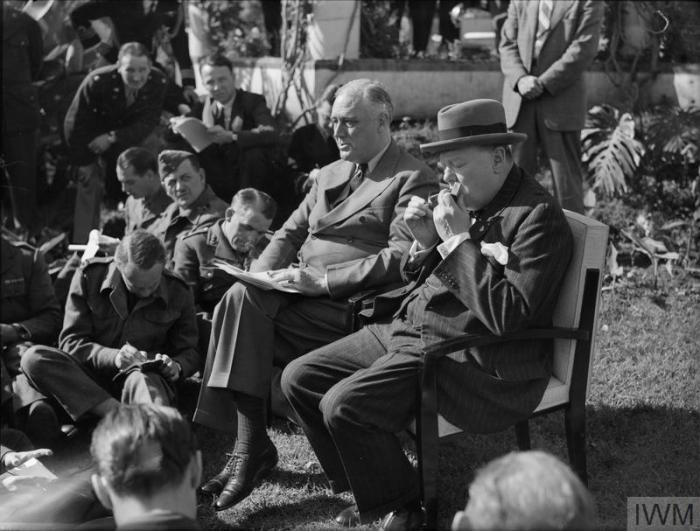
Prime Minister Winston Churchill and President Franklin Roosevelt at the Casablanca Conference, c. January 1943. (Source: © IWM (A 14063))

As peace returned to the shattered remains of Europe in 1945, some positive developments followed in its wake. West of the Oder, at least, liberal democracy seemed to strike deeper roots than ever before, going hand in hand with a prosperity that followed a solid upward trajectory. Across the Atlantic, America abandoned isolationism and committed itself to be both the guardian and bankroller of freedom. The only primary rival in town, Marxist-Leninism, was seen off the stage after 1990 – it seemed as if the liberal democratic steamroller would flatten a global path for economic and personal freedom. However, all was not quite as it seemed.

Before considering just how the course of history unravelled after the fall of the Berlin Wall, it is useful to lay out – with a very broad brush – some of the presuppositions that had driven western society up to this point. From the Fall of Rome until the Enlightenment, religious horizons essentially bounded the world, symbolised most powerfully by the Holy Roman Emperor kneeling in the snow at Canossa. Architecture, art, and music all reflected this human concern about relating to the divine. Come the Enlightenment; the focus changed to working out what kind of world humans could create for themselves, relying on their unfettered reason and empirical discoveries. This was the age of science and developing democracy, which held out a dream of unending human progress. The waves of devastation which swept across Europe twice in the first half of the twentieth century cruelly mocked any such hopes. The last spasms of Enlightenment optimism at least gave birth to the liberal democratic project which seemed to triumph – and had been worth making sacrifices for.

However, the liberal democratic project rested on increasingly shaky foundations. Premodern people could find their certainties in religious truth. Enthusiasts for the Enlightenment could base their philosophy on a confidence that the truth was out there for any rational person to discover. Although these two views were divergent in almost every respect, they had this in common – a belief in a transcendent universe which provided a framework for understanding the place of human beings in the world.[2] As James Davison Hunter expresses it, there was a ‘common grammar for recognising the natural affections and moral sentiments shared by all humanity…the seeds of social solidarity could be found in human sentiments, the public good within private interests, the universal within the individual’[3]. This is precisely the transcendent worldview assumed by Churchill and Roosevelt in 1945. One of the tragic ironies of recent history is that, just as the liberal democratic project appeared to triumph, its internal coherence began to dissolve.

To put it crudely, liberal democracy bifurcated into liberal and democratic elements. Regarding liberalism, this was not the classic liberalism that Adam Smith would have recognised. Instead, it is something new – neoliberalism. The underlying assumption behind this concept is that the market is sovereign – and not merely over economic issues. Based on the theory of Friedrich Hayek, nothing has a given and immutable value – even those aspects of human significance and meaning that previous generations would have treated as normative. Objective truth is no longer ‘out there’ to be revealed or reasoned out but is determined by what the market will bear. As Stephen Metcalf points out, the old political processes of public reason – debate and thoughtful argument –  are incongruent with this process, as in market terms they are simply opinions. What happens instead is that the public square ‘ceases to be a space for deliberation, and becomes a market in clicks, likes and retweets’[4]. There is no longer a shared, transcendent mise en scène for human existence. Virtues have transformed into values – individually held and formulated – but of no binding or enduring significance.

Regarding democracy, the individual now has an unprecedented status. Once seen in relation to divinity or wider society, human beings are now increasingly regarded as sovereign agents. As the public sphere has become eviscerated of a shared cultural story, the individual is now free to decide his or her path through life.  Alternatively, so the theory goes. Jackson Lears expresses it like this – ‘redefined as human capital, each person becomes a little firm with assets, debts, and a credit score anxiously scrutinised for signs of success or failure’[5]. The individual may be freer to choose than ever before, but also carries an increasingly heavy burden for their destiny. Lacking the safeguards of a benevolent Providence – or a paternalistic society – the individual must shift for themselves. The mantra that every schoolchild knows so well – ‘follow your dreams and you can achieve whatever you want’ has a darker side that few if any primary school assemblies ever spell out. Failure to achieve those dreams or ambitions will be your responsibility alone. In such a culture, the individual faces an unrelenting pressure to boost their own image and status above all else. For example, an intriguing textual analysis of Norway’s main national newspaper between 1984 and 2005 revealed that as the occurrence of self-referencing words such as ‘I’ and ‘my’ increased, instances of other-focused concepts such as ‘duty’ and ‘obligation’ declined[6].

What, if anything, does all this have to do with high-intensity warfare in the twenty-first century? Going back to where we began, the armies which liberated western Europe in 1945 did so against a broadly shared cultural outlook. Britannia, Marianne, and Columbia are hardly identical sisters, but bequeathed a remarkably similar legacy of shared understanding to their descendants – and the freedoms for which they gave their lives had a transcendent quality. This situation, it may be argued, no longer obtains. Evidence for this can be seen in a wide variety of forms, from Allan Bloom’s analysis of education to Robert Putnam’s influential work on the decline of social cohesion in late twentieth century America[7].  As the Canadian philosopher Charles Taylor observes, ‘the individual has been taken out of a rich community life and now enters instead into a series of mobile, changing, revocable associations’[8]. With his or her small stock of human capital, each person makes their way through life via a series of short-term contracts, which run the gamut of human existence from car insurance to employment. What matters most is the utilitarian and the instrumental – an epistemic ecology where traditional concepts such as humility, duty and sacrifice seem anachronistic surds. Moreover, as analysts of our neoliberal world have suggested, the promised blessings of prosperity and success have not trickled down universally, leading to a considerable degree of cynicism about public life – from fake news to the political establishment. This is not a development which augurs well for a strong common existence. If citizens withdraw from political and civic engagement into a private sphere of personal fulfilment, as Larry Siedentop remarks, liberal freedoms are at risk[9].

PUMA SQUADRON MARKS 100 YEARS
An RAF Puma deploying flares whilst on Operation TORAL in Afghanistan, c. 2016. (Source: MoD Defence Imagery)

One of the founding principles of modern democracy is that the individual citizen surrenders certain freedoms and benefits to the state in exchange for protection and stability. This relationship is perhaps seen in its starkest form when a nation sends its citizens to war. In the post-2001 operations, when the legitimacy of the campaigns was subject to intense public scrutiny, this affected the commemoration of those citizens who had given their lives. As Sandra Walklate, K.N. Jenkings and others have observed, repatriation ceremonies became ‘deeply political acts’ protesting against military action, where those who died were remembered as victims of government policy[10]. Anthony King, in his analysis of the obituaries of British service personnel, comments that the death of soldiers is not seen so much as an act of service for the nation as ‘the meaningful expression of a man who defined himself by his profession’[11]. If the individual is indeed a small firm with a limited stock of human capital, a strong relationship of trust between citizen and society is vital should the citizen be required to sacrifice that capital for a bigger purpose.

Moreover, this is the nub of the argument. As Alexis de Tocqueville saw some two centuries ago, a society which favours atomism and instrumentalism undermines the very freedoms which it cherishes.[12] Since the fall of the Berlin Wall, the freedoms that the western world enjoys have primarily been sustained without significant periods of high-intensity conflict – and the associated heavy demands of blood and treasure. Future military operations may not follow this pattern, and free nations may have to pay a large price for such nebulous terms as liberty and democracy. A worldview furnished from the moral stockroom of utilitarian instrumentalism will offer little strength in such circumstances. To quote Taylor again, ‘high standards need strong sources’ – a stripped down public square does not provide the wherewithal to sustain a deep understanding of human meaning and purpose.[13] Churchill and Roosevelt saw the battle that they were engaged in as something more than a struggle over resources and the possession of territory.

Alternatively, in other words, they understood the need for spiritual resilience – an awareness that human existence cannot be reduced to a profit and loss transaction. The free society which values the individual did not arise from an instrumentalist worldview – indeed Siedentop has recently published a fascinating volume which explicitly traces the development of modern liberal equality right back to Christian thinkers in the middle ages.[14] One does not need to share the faith of these scholars to appreciate their insights. Perhaps it is time to pause in our pursuit of relentless individualism to consider the bigger truths of the world to which we belong. Davison Hunter remarks that our current cultural trajectory is likely set to bend us away from the very concepts of justice, freedom, and tolerance that we treasure. Before we are called upon to defend these convictions in intensive conflict, it is undoubtedly worth reflecting on why they are worth defending in the first place.

The Reverend Dr (Wing Commander) David Richardson is a chaplain in the Royal Air Force, initially ordained into the Church of Ireland. A graduate of the universities of Edinburgh, Dublin, Belfast, and King’s College London, he has served on a variety of RAF stations. His operational experience includes tours across Afghanistan and Iraq.

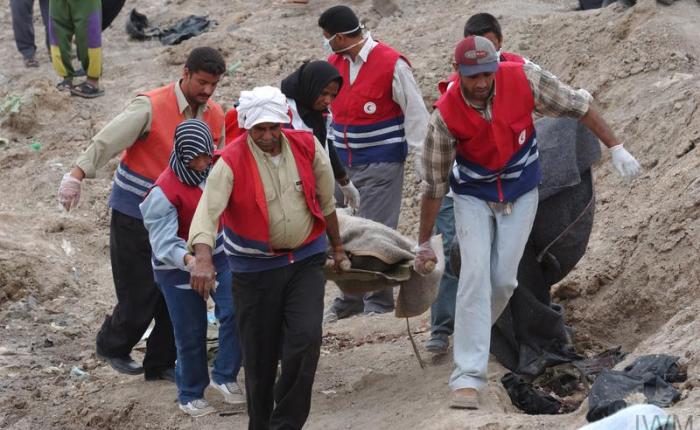
Header Image: Stretcher bearers of the Red Crescent evacuate a civilian casualty in Basra during Operation TELIC. (Source: © Crown copyright. IWM (OP-TELIC 03-010-37-091))

[1] Max Hastings, Armageddon: The Battle for Germany, 1944-45 (London: Macmillan, 2004) p. 588.

[2] James Davison Hunter, ‘Liberal Democracy and the Unravelling of the Enlightenment Project,’ The Hedgehog Review, 19:3 (2017).

[3] Ibid.

[4] Stephen Metcalf, ‘Neoliberalism – the idea that swallowed the world,’ The Guardian, 18 August 2017.

[5] Jackson Lears, ‘The long con of Neoliberalism,’ The Hedgehog Review, 19:3 (2017).

[6] Jean Twenge and Keith Campbell, The Narcissism Epidemic (New York, NY: Free Press, 2010), p. 264.

[7] Allan Bloom, The Closing of the American Mind (London: Penguin, 1987); Robert Putnam, Bowling Alone (New York, NY: Touchstone, 2000).

[8] Charles Taylor, Sources of the Self (Cambridge: Cambridge University Press, 1992), p. 502.

[9] Larry Siedentop, Inventing the Individual (London: Penguin, 2014), p. 363.

[10] Sandra Walklate, Gabe Mythen and Ross McGarry, ‘Witnessing Wootton Bassett; An Exploration in Cultural Victimology,’ Crime, Media and Culture, 7:2 (2011), pp. 149-65. K.N. Jenkings, N. Megoran, R. Woodward and D. Bos, ‘Wootton Bassett and the political spaces of remembrance and mourning,’ Area, 44:3 (2012), pp. 356-63.

[11] Anthony King, ‘The Afghan War and ‘postmodern’ memory: commemoration and the dead of Helmand’, The British Journal of Sociology, 61:1 (2010), pp. 1-25.

[12] Quoted in Taylor, Sources of the Self, p. 502.

[13] Ibid., p. 516.

[14] Siedentop, Inventing the Individual.

Education for 21st Century Aviators

Education for 21st Century Aviators

By Colonel (ret’d) Dr Randall Wakelam[1]

Editorial Note: Between February and April 2018, The Central Blue and From Balloons to Drones, will be publishing a series of articles that examine the requirements of high-intensity warfare in the 21st Century. These articles provide the intellectual underpinnings to a seminar on high-intensity warfare being held on 22 March by the Williams Foundation in Canberra, Australia. In this article, Dr Randall Wakelam examines the importance of education for aviators in the 21st Century. While drawing on the experience of the Royal Canadian Air Force, Wakelam argues that while the value of education is often hard to quantify, it is nonetheless an essential aspect in the development of airman who needs to master the profession of arms and the challenges associated with that idea. His argument transcends national boundaries and applies to any large, medium, or small air force seeking to prepare for the challenges posed by the future operating environment.

I have a prejudice: My prejudice is that airmen do not like thinking: Airmen are obsessed with bombs, fuses, cockpits and screens and are actually rather uncomfortable exploring the underpinning logic and doctrine: So producing a thinking air force is a strategic requirement.

Air Chief Marshal Sir Brian Burridge, RAF Air Power Review, 2004

In Burridge’s statement from the early years of this century, one can readily see that education for air power professionals has been and will continue to be important for the successful management of air forces both regarding national and international processes like procurement and collation operations and the day to day conduct of air operations. However, the caution that he offers about discomfort for education is equally important, and his concern is not new. Indeed one of the central themes of Carl Builder’s study of the USAF – The Icarus Syndrome – was that leaders had too often shifted their focus from the tough questions of running the institution to a more limited attention to technologies and air vehicles.[2] Moreover, we see a similar tendency to eschew non-technical aspects of air power in the early days of the Royal Australian Air Force (RAAF) College where of a 5,500-hour, four-year syllabus, fully 1,955 hours were spent on the sciences, while only 230 were dedicated to history, war studies, and imperial defence issues. There was no non-technical course on air power theory. In the view of former RAAF historian Alan Stephens, ‘the Air Force [was] very plainly identifying itself as a technocracy.’[3]

Building on these examples and concerns I want to argue that education is good for the RCAF, both for individuals and for the institution. A recent RCAF Journal article ‘Professional Airpower Mastery and the RCAF’ also makes the point, stating that Canada’s air force is very good tactically, but that beyond this it lacks the ability to be as effective as it might at higher levels of warfighting or in the broad domain of national and international security.[4] At those levels, we, again both individually and institutionally, tend to muddle through problems – sometimes successfully, sometimes less so. To put that article in context for an Australian audience, it should be noted that one of the many sources used by those authors was Sanu Kainikara’s 2011 work At the Critical Juncture: The Predicament of Small Air Forces.[5]

Returning to a Canadian context, a late 1960s study, The Report of the Officer Development Board (ODB), posited that all officers move away from hands-on tactical and technical expertise fairly early in their careers, replacing those technical and tactical ‘occupational skills’ with broader pan-service and then pan-Canadian Forces/whole of government ‘military expertise’ competencies.[6] This progression is as true of the RCAF as it is of the Royal Canadian Navy or the Canadian Army. More to the point of this article, the ODB also stated that officers needed to start their service with a strong intellectual ability and then have to grow that as the challenges they confront become less predictable. The ODB made this point in the context of a world which was dominated by tense geopolitical circumstances, burgeoning technological advances and security challenges that ranged from superpower standoff to asymmetric conflict to the full range of peace support operations.[7]

Things are not much different today. We are called upon to deal with the often abstract and chaotic problems of the 21st century using what the ODB labelled called ‘executive and military executive abilities’. Major-General David Fraser, then just returned from commanding Regional Command South in Kandahar, made a similar observation in a 2006 lecture at the Canadian Forces College, pointing out that at the tactical level leaders need to have the intellectual agility, and associated confidence to be able to deviate from a plan when circumstances dictate.[8] However, he went on to argue that while at the tactical level circumstances can be complicated, at the operational and strategic levels of war decision makers often face complexity, overlaid with ambiguity and chaos – what is often called the wicked problem.

Wakelam

We learn technical and tactical skills through training for the most part, but the broader competencies are more generally the product of education. Training allows for standardised responses to predictable circumstances whereas education permits reasoned responses to unpredictable circumstances.[9] Training can be relatively well measured as we can see in the course training standards and training and education plans that form the basis of hundreds of qualifications. From Robert Smith-Barry’s reforms to pilot training that he implemented a century ago today we implicitly understand the value of standardised training for aircrew and more broadly for all air force hands-on competencies. Knowing that your winger knows what she or he is doing; knowing that the techs have done their snag rectification by the book and that battle managers understand clearly what they can do to assist in the fight allows each of us to perform confidently. Moreover, all these skills and knowledge are based on a validated training system which ensures technical and tactical competence.

Education, and its value is, on the other hand, a bit less quantifiable: does a Bachelor’s in aeronautical engineering equate to an effective aircraft designer or a skilled technical authority? Does a Master’s in International Relations make for an effective commanding officer (CO) when deployed on coalition operations or an astute policy analyst proposing changes to air force roles and structures? In these examples, the answers are probably yes, but there is no easily applied ‘training standard’ to tell us so. The ODB said that the undergraduate degree provided a necessary ‘training of the mind’ and a graduate degree in areas related to the profession of arms was a useful and necessary enrichment both in knowledge and intellectual capacity.[10]

Those thoughts from 50 years ago are all well and good, but those who do not have a degree, or an advanced degree often seem to do ‘just fine’.  However, what does just fine mean? It may mean that success has not come from an optimal application of thinking power – allowing a logical, viable solution. Rather, it may mean that a solution is derived from a limited perspective based on the individual’s limited or skewed sense of the issues. Education is not a guaranteed antidote to the latter problems, but it frequently offers the learner new ways of considering evidence and weighing alternatives. Indeed, this was the implicit message in the RCAF’s curriculum of the RCAF War Staff Course. Air Commodore George Wait, the Staff College’s first commandant, had an opportunity to offer his thoughts on the content and conduct of the syllabus and by extension the notion of a professional development philosophy that combined training and education. He wrote:

[t]he backbone of the course consists of a series of lectures on staff duties given by the Directing Staff, which leads students through service writing, precis writing, appreciations and orders and instructions.  The students then put their knowledge to work by doing a series of practical problems on the employment of air power.[11]

However, to give this routine staff training some added richness the programme of studies also included lectures given by well-qualified visiting speakers, both officers and civilian officials, on a variety of topics, including other services, allied and enemy forces, matters of the strategic direction of the war, and war production. ‘Only by such a means,’ Wait had said in earlier correspondence with Air Force Headquarters, ‘can the students be given the broader and more authoritative outlook that they will require in staff positions.’[12]

The same notion of broad education was stated more explicitly in the late 1950s in the RCAF Staff College’s syllabus:

The RCAF Staff College makes no attempt to graduate experts in a particular field, nor does it expound any easy universally applicable doctrines. Rather by providing its graduates with an education of the broadest scope and by developing habits of clear thinking, it attempts to provide them with the breadth of interest, openness of mind, reasoning ability, and a broad view of their Service and profession, which will enable them to master the specific tasks of any appointment and to make sound decisions in any situation. (emphasis added)[13]

Much of my original paper had been drafted before the 7 June 2017 release of Canada’s new defence policy ‘Strong, Secure, Engaged’. Reading through it and ‘blue sky’ imagining the work needed to implement the policy one cannot but think that it will require big and imaginative minds to deal with how we make good on the vision and indeed there are repeated references to flexibility of mind and the utility of education. Tactical excellence alone, one can surmise, will not guarantee success.

Practically, how do we do develop a learning strategy that ensures policy ends? The recently restructured and re-energised RCAF officer professional development system offers a flight plan towards realising this goal. First, we have confirmed the need for all officers to achieve, or in certain special cases to be on the path to achieving, an undergraduate degree before commissioning. As of 2016, in Canada, we now have a course – the Air Power Operations Course (APOC), that looks remarkably similar to the War Staff Course, albeit only 60 percent as long. Finally, there is a vision, yet to be defined and approved, for expanded senior officer education, this to be achieved through focused workshops of several days or a few weeks duration depending on the topic.

The APOC has six ‘performance objectives’, the first being a learning outcome to develop the air-mindedness of students, who are drawn from all RCAF occupations, so that they can work collaboratively with officers across all flying and technical communities within the RCAF and can explain and represent the air power concepts and practices to officers in joint headquarters and other services. The second objective is to develop staff officer competencies in clear and logical thinking and communications. The remaining objectives – planning of operations in deployed and coalition situations – build on the first two and expose students to the complexity of modern air operations, and this in a service where tactical and maritime helicopters (and everything else that flies) are air force resources.

What the more senior follow-on courses might look like is still very much undefined, but the wisdom of the 1959 syllabus would suggest that a tactically oriented curriculum will not do. What senior air force leaders need is something more. This same idea was much in evidence in a recent Australian Defence Force study. The following are extracts from ‘The Chiefs: A Study of Strategic Leadership.’[14]

The report reaches three major conclusions, relating respectively to individual development, organisational development and leadership style. These conclusions are that:

  • for the ambitious officer, “what got you here won’t get you there”;
  • for the military institution, “what got us here won’t get us there”; and
  • the principle that “leadership is a team sport” is just as valid at the senior level as it is lower in the organisation.[15]

It is recommended that:

  • the core JPME [Joint Professional Military Education] effort (or at least that from mid-career onwards) be oriented around the four strategic leadership roles of Strategic Leader, Strategic Builder, Strategic Director and Steward of the Profession.
  • such JPME be focused on preparing officers for future roles in both leadership and support for senior leaders.
  • officers from mid-career onwards periodically be exposed to and engage with contemporary and evolving issues at the strategic level, with exercises that require them to examine the responsibilities and skills needed for the Director-Leader-Manager-Steward forms within their own current and immediate-future career roles. (For example, as part of preparation for ship/unit command, O4 and O5 could examine the application of these four roles to that level of command and the level of command immediately above it.)
  • such engagement use active rather than passive modes of learner behaviour.
  • each Service continue with the current encouraging trend of introducing career models that enable selected officers to develop in-depth specialisations within relevant fields – not just within “personnel management” and “project management/technology” but also within economics, politics and military sociology.[16]

We can see that technical and tactical competencies are no guarantee to success at higher levels of command and leadership and that organisations that are similarly successful like likely need to approach institutional and national/international challenges with ways and means (intellectually and practically) that differ from what works in tactical situations.

20141208adf8588365_003
Chief of the Defence Force Air Chief Marshal Mark Binskin AC, speaking at the 2014 Australian Command and Staff Course – Joint Graduation ceremony held at Llewellyn Hall, Australian National University, Canberra, c. 2014. (Source: Australian Department of Defence)

Some, if not all the Australian Defence Force’s recommendations for learning could be implemented within the RCAF’s professional education programme, but there is much to be gained from learning environments outside the air force. The recent introduction of sponsored assignments to complete a Masters in War Studies at the Royal Military College (with a focus on air power topics) is one such avenue. Similarly, a new internship programme, with placements in think tanks, industry and government will expose air force officers to different ways of thinking, planning and operating.

Where does this leave us as we advance through the new century? As suggested at the outset a narrow focus on technical and tactical proficiency, while necessary, cannot be the nexus of professional education. Many observers and practitioners have noted this. A broad blend of intellectual dexterity coupled with both hands-on skills and broad knowledge would seem to have been and remains today the essence of professional effectiveness and thus the desired outcome of an aviator’s education.

Dr Randall Wakelam teaches military and air power history at the Royal Military College of Canada.  After graduating from RMC in 1975 he flew helicopters for the Army, becoming CO of 408 Tactical Helicopter Squadron in 1991. Along the way, he also had staff appointments in aircraft procurement and language training policy. Since 1993 he has been an educator, first in uniform at the Canadian Forces College in Toronto and now at RMC. His research and publishing focus on air power and military education.

Header Image: A memorial to the establishment of the RCAF Staff College, which is now the Canadian Forces College. This establishment started life as the RCAF War Staff Course. (Source: Wikimedia)

[1] A shorter version of this paper was first drafted for the Royal Canadian Air Force (RCAF) in the Fall of 2017, but both it and this version are the products of about 30 years of thinking about how military professionals can best educate themselves. Where the examples used are largely specific to historical and contemporary Canadian experience there is, I believe, much that is common to most, if not all, modern air forces.

[2] Carl Builder, The Icarus Syndrome: Air Power Theory and the Evolution of the Air Force (New Brunswick, NJ: Transaction Press, 1998).

[3] Alan Stephens, Power Plus Attitude: Ideas, Strategy and Doctrine in the Royal Australian Air Force 1921-1991 (Canberra: Australian Government Publishing Service, 1992), pp. 109–11.

[4] Brad Gladman et al, ‘Professional Airpower Mastery and the RCAF,’ RCAF Journal, 5:1 (2016), pp. 8-23.

[5] Sanu Kainikara, At the Critical Juncture: The Predicament of Small Air Forces (Canberra: Air Power Development Centre, 2011).

[6] Randall Wakelam and Howard Coombs (eds.) The Report of the Officer Development Board: Major-General Roger Rowley and the Education of the Canadian Forces (Waterloo: Wilfrid Laurier University Press, 2010), p. 46. The same issue applies to senior warrant officers as they reach formation (wing, air group, etc.) and national level senior appointments where they must be able to understand the sorts of challenges their commanders face.

[7] Ibid, pp. 26-31.

[8] Major-General David Fraser, Lecture to the Advanced Military Studies Course, Canadian Forces College Toronto, October 2006.

[9] Ronald Haycock, ‘Historical and Contemporary Aspects of Canadian Military Education’ in Greg Kennedy and Keith Neilson (eds.) Military Education:  Past, Present, and Future (Westport, CT.: Praeger, 2002), p. 171.

[10] Wakelam and Coombs, Officer Development Board, p. 40.

[11] William R. Shields and Dace Sefers, Canadian Forces Command and Staff College: A History 1797-1946 (Toronto: Canadian Forces College History Project, Canadian Forces College, 1987), pp. 4-15.

[12] Ibid, pp. 4-16.

[13] R.C.A.F. Staff College Calendar Course 23 (1958-9), “Conclusion.”

[14] Nicholas Jans, Stephen Mugford, James Cullens and Judy Fraser-Jans, ‘The Chiefs:  A Study of Strategic Leadership’ (Canberra:  Australian Defence College, 2013).

[15] Ibid, p. 111.

[16] Ibid, p. 113.

Observations on the Character of Future #highintensitywar

Observations on the Character of Future #highintensitywar

By Squadron Leader Jenna Higgins

Editorial Note: Between February and April 2018, The Central Blue and From Balloons to Drones, will be publishing a series of articles that examine the requirements of high-intensity warfare in the 21st Century. These articles provide the intellectual underpinnings to a seminar on high-intensity warfare being held on 22 March by the Williams Foundation in Canberra, Australia. In this article, Squadron Leader Jenna Higgins examines some of the possible characteristics that may define high-intensity warfare in the future.

High-intensity war is often equated with conventional or regular war, as after the Middle Ages, this was the ‘usual’ type of war. However, high-intensity war has somewhat fallen from the regular discourse. Being replaced by what is ironically known as irregular war. However, as was highlighted in the opening post to this series, this is starting to change. High-intensity war has become a distinct possibility in the near future, so we must prepare for and try an understand what that means for us. This article aims to explore the possible characteristics of future high-intensity war as a crucial step in preparing ourselves for it.

An attempt to control a domain typifies high-intensity warfare.[1] In recent decades, the requirement and ability to control the air domain has been somewhat of a non-issue. Recent conflicts have instead been labelled irregular or low intensity, and seeks to hurt, harass or demoralise the enemy; there is less of an intent, or perhaps a requirement, to control a domain. In looking to the future, we need to consider the context in which control of a domain, which in the case of this article is air, is required before any further action.

The ability to forecast when and where this high-intensity war will occur with any accuracy is challenging to say the least. However, with that said, why should we have to predict such an occurrence? If western air forces were able to maintain a seamless mastery of the full spectrum of operations, then the finer detail such as whether it was to be high or low intensity, would not matter. We would be prepared regardless. However, as Austin Long, an Associate Professor at Columbia University asserted ‘no military has been able to achieve this goal.’[2] In preparing for high-intensity warfare, the best we can do is outline potential realities with the aspiration that they will, in some way, prepare us through the generation of discussion and preparedness of the mind.

One. Displacement, trauma and bloodshed are unavoidable. According to The Economist, in:

[2040] two-thirds of the world’s population will be living in cities. The number of megacities with populations of more than 10 million has doubled to 29 in the past year, and each year nearly 80 million people are moving from rural to urban areas.[3]

So, while the exact location of future conflict is unknown, it is safe to assume, high-intensity war will be fought in an urban environment.  More significantly, these urban areas will be more densely populated than any time in history. High-intensity warfare in such an environment will be confronting to the moral sensibilities of a western society conditioned to small-scale conflict in less populated areas. This will be further compounded as scenes of mass destruction are broadcast over media networks worldwide. One needs only to recall the recent global outcry over the Syrian civil war as an illustration. The humanitarian disaster that unfolded in the wake of the Syrian civil war would be nothing compared to high-intensity conflict in a modern mega city. Syria had a pre-civil war population of 22 million, but only two cities with a population more than one million. One can only imagine the implications of a war in a city with a population ten times that of a Syrian city.

Destroyed_neighborhood_in_Raqqa
The city of Raqqa after fighting in the city during 2017. (Source: Wikimedia)

Civilian death, displacement and trauma are not the aims of modern democratic governments, noting that there have been some historical exceptions, but are unfortunately unavoidable. Combine a high-intensity conflict and a significant population centre, and the scale of destruction is exponentially increased from anything witnessed in recent history. The effect of a large-scale humanitarian catastrophe will be two-fold. There will be a requirement to prevent the overflow of conflict and refugees into surrounding nations and potentially cause further unrest. However, secondly, as these images are broadcast into our living room, it will be the responsibility of the government to maintain a supportive domestic base in the face of such horrific scenes. The morality of this scenario is complex and must be considered prior to its eventuality.

Two. Competition with near-peers will challenge our resilience and capacity. For the first time in 10 years, the United States has released a new National Defence Strategy in which it outlines strategic competition to be the ‘central challenge to US prosperity and security as Russian and Chinese military capabilities expand’. This document highlights that great power competition is now the focus. Given the accelerating regional military modernisation that is occurring in the Asia Pacific region, Australia too must focus resources on overcoming the challenges that the growing confidence of China or Indonesia poses. The fight against a near-peer offers several challenges not experienced in the preceding decades. One such example is the effect of a significant loss of platforms, refer to Rex Harrison’s post on attrition. There are assets in the Australian order of battle that will not be able to enter a contested environment without a high probability of loss, and to do so would deplete capability at an untenable rate.

Should we lose aircraft at an untenable rate, we also face the prospect of losing our highly specialised aircrew. With such a small air force relative to our potential adversaries, we lack the capacity and redundancy offered by larger forces. To win the high-intensity war, an organisation needs enough people who are willing to commit their lives to the higher objective. Unfortunately, due to the small population of our nation, we lack the recruitment pool to both enlist personnel at a high rate in the case of war or prepare adequately through the employment of additional personnel in times of peace for redundancy.

Three. High-intensity war will be fought through a multi-domain construct. One hundred years ago there was debate as to the utility of an independent air force. With the acceptance that land and maritime control could not exist without control of the air; an independent, specialised air force was born.  In 2018, the same argument must be made for the cyber and space domains. Without control of the cyber and space domains, we do not control the air domain. Greater knowledge of the benefits and limitations of these domains must be established and socialised within the broader warfighting community if success in a high-intently war is to be achieved. In fighting a high-intensity war, warfighters cannot continue to think from a domain-first perspective. Success in high-intensity war will need to:

[f]eature militaries capable of complex combined arms operations, as well as lethal offensive threats. These conflicts will engage US allies and disrupt the ability of the future joint force to move within operational reach of the adversary.[4]

In analysing the ‘Context of Future Conflict and War,’ Jeffrey Becker explained that:

[t]hreats will transcend tidy categories, cutting across land, sea, air, space, and cyberspace, while being distributed across military domains and/or reaching across broader geographic range and scope.[5]

It is not only Western militaries that are faced with this realisation. Chinese military publications also indicate that war is no longer a contest between units or specific services. The Peoples Liberation Army (PLA) refer to this concept at systems confrontation [体系对抗]. Systems confrontation is:

[w]aged not only in the traditional physical domains of land, sea, and air, but also in outer space, nonphysical cyberspace, electromagnetic, and even psychological domains. Whereas achieving dominance in one or a few of the physical domains was sufficient for war fighting success in the past systems confrontation requires that “comprehensive dominance” be achieved in all domains or battlefields.[6]

This inevitably leads to the question as to the suitability of the current organisational structure, and if we are truly ready to fight the joint fight. However, that is a whole other post.

20161128raaf8185068_0567
The Royal Australian Air Force’s first P-8A Poseidon flies down the St Vincent Gulf coastline near Adelaide in South Australia, c. 2016. (Source: Australian Department of Defence)

Four. Implications for capability transition. From an Australian air power perspective, we are both blessed and disadvantaged by the new capabilities entering service. In the coming five years, the RAAF will see several new platforms enter service. Platforms such as the F-35 Lightning, EA-18G Growler and P-8 Poseidon enable greater integration with coalition forces, while also enhancing connectivity with command. However, while the RAAF may have exceptional new, high-end capability, if these assets cannot fully integrate into the joint fight, or, if the wider warfighting community does not fully understand their capabilities, then their effectiveness is partially lost. With capability transition must come education. Air power practitioner’s need to emphasise the effects of their platforms rather than just assume the joint force knows what each platform brings to the fight. High-intensity warfighting must emphasise effects-based operations.

Five. We cannot rely purely on advanced technology to win; we need a contest of ideas.  Given the intricacies of the new, high-end capabilities as well as a large number of unknowns within the new domains, it will take everyone, from airmen and women to the Chief of Defence Force to achieve success in an effects-based operation. No one person, organisation or government holds the panacea to predicting and defeating an adversary in a high-intensity war. It is vital members at all levels are engaged and given the freedom to voice their ideas and concerns. It is through the contest of ideas that innovation is realised. This concept was aptly summarised by Air Marshal Leo Davies, Chief of Air Force, when he states that:

It is far, far better that we should respectfully engage in that contest than to hide our thoughts, only to find them wanting when it matters most.[7]

It is only through engagement and conversation that we become truly prepared for the future.

The five observations mentioned above about the character of future high-intensity warfare are in no way to be considered an exhaustive list. However, a common thread can be identified. Education and discussion into the broader warfighting community are vital. Future high-intensity war cannot be considered from a single-domain perspective, and consequently, a greater knowledge of all domains and capabilities is required.

Squadron Leader Jenna Higgins is an Air Combat Officer in the Royal Australian Air Force and editor at The Central Blue. She can be found on Twitter @jenna_ellen_ The opinions expressed are hers alone and do not reflect those of the Royal Australian Air Force, the Australian Defence Force, or the Australian Government.

Header Image: A Royal Australian Air Force F-35A flies in formation with a US Air Force F-35 during trial flights from Luke Air Force Base in Phoenix Arizona, c. 2016. (Source: Australian Department of Defence)

[1] Michael Muehlbauer and David Ulbrich, Ways of War: American Military History from the Colonial Era to the Twenty-First Century (New York: Routledge, 2014), p. 3.

[2] Austin Long, ‘Doctrine of Eternal Recurrence – The U.S. Military and Counterinsurgency Doctrine, 1960-1970 and 2003-2006,’ RAND Counterinsurgency Study – Paper 6 (Santa Monica, CA: RAND Corporation, 2008), p. 28.

[3] Matthew Symonds, ‘The Future of war – The new battleground,’ The Economist, 25 January 2018.

[4] Jeffrey Becker, ‘Contexts of Future Conflict and War,’ Joint Forces Quarterly, 74 (2014), p. 18.

[5] Ibid.

[6] Jeffrey Engstrom, Systems Confrontation and System Destruction Warfare: How the Chinese People’s Liberation Army Seeks to Wage Modern Warfare (Santa Monica, CA: RAND Corporation, 2018)

[7] Editorial, ‘A Central Blue debrief with Air Marshal Leo Davies, AO, CSC – Chief of Air Force,’ The Central Blue: The Blog of the Sir Richard Williams Foundation, 20 August 2017.

The Air Defence of the UK: Defence on a Shoestring in an Age of Uncertainty

The Air Defence of the UK: Defence on a Shoestring in an Age of Uncertainty

By Dr Kenton White

Editorial Note: Between February and April 2018, The Central Blue and From Balloons to Drones, will be publishing a series of articles that examine the requirements of high-intensity warfare in the 21st Century. These articles provide the intellectual underpinnings to a seminar on high-intensity warfare being held on 22 March by the Williams Foundation in Canberra, Australia. In this article, Dr Kenton White examines Britain’s defence policy with regards to the air defence of the United Kingdom. He compares Britain’s commitment to air defence during the Cold War period with that of the present. With regards to the present, White concludes that given certain factors, the Royal Air Force (RAF) will struggle to regenerate if faced with a high-intensity conflict with a near-peer enemy.

Preamble

This article talks broadly about strategy, planning and its practice. It uses examples from Britain’s defence policy, and hard numbers from the Cold War experience, to illustrate some of the problems the RAF faces today. It looks at Britain’s commitment to the air defence of its islands during the Cold War – an age of certainty – and compares it directly to the current defence policy and practice in the age of uncertainty.

A historically pessimistic view of international relations and strategy is taken. The reason for this pessimism is based on historical precedent. In 1914, Europe went from peace to war in less than two months. In the 1930s Britain’s rearmament began in mid-decade to replace bi-planes and other equipment, but the RAF still went to war in 1939 with obsolescent, vulnerable equipment, and suffered severe losses of personnel and machinery.

RAF-T 2151
A Gloster Javelin FAW.9R of No, 23 Squadron banking away from the camera clearly showing the missile complement of De Havilland Firestreak infra-red homing air-to-air missiles. (Source: © IWM (RAF-T 2151))

Introduction

I take it someone has worked out whether we can defend ourselves.

Jim Callaghan, Labour Prime Minister, 1978

This comment is written on the front page of a Joint Intelligence Committee report on the ability of the Soviet air force to attack targets in Britain.[1] The report showed Britain was poorly prepared to defend itself in times of war, despite the apparent threat from the Soviet Union and Warsaw Pact.

Questions relating to Britain’s air defence capability are as relevant now as they were then; however, the circumstances are very different. The familiar bipolarity of the Cold War is missing, and the range of threats to the UK is much broader, including both state and non-state actors.

Deterrence

A vital role of the RAF is to deter attack, and ultimately the defence of UK airspace if that deterrent fails. Deterrent plans are aimed at a perceived threat: planning for the manifestation of that threat. These plans relate intimately to national strategy. The nation must appear to have a capable air force if it is to act as a deterrent. However, deterrence also requires the ability to sustain operations. Britain’s air defences protect around 1 million square miles of airspace, reaching out into the North Atlantic. This indicates how vital airborne maritime reconnaissance is in defence of the islands.

The 2015 Strategic Defence and Security Review read:

The Government’s most important duty is the defence of the UK and Overseas Territories, and protection of our people and sovereignty.[2]

In written testimony to the House of Commons Defence Committee (HCDC) in 2013, Lord Hennessy of Nympsfield told the committee that, in an ideal world, air defence of the UK should be the priority of UK defence policy.[3] The 2015 SDSR states ‘[T]he Royal Air Force protects our airspace and is ready at all times to intercept rogue aircraft.’[4] Concerted attack from the air by a peer adversary is not perceived as an imminent threat.

Threat Analysis

The conventional threat during the period of ‘Flexible Response,’ as the NATO Cold War strategy was called, was clear – direct attack from bombers equipped with gravity bombs or stand-off missiles aimed at denying the vital infrastructure needed for the reinforcement of Europe by UK and US forces. The UK was responsible for the air defence of the Eastern Atlantic and the UK itself, and the airspace over the UK was an Air Defence Region in its own right. However, the defensive response to the threat was never completely put into place, leaving UK airspace extremely vulnerable, and Britain’s ability to continue a fight very doubtful.

What is the threat analysis today? The HCDC identified several distant threats to the national interest, and while qualifying the analysis heavily, identified the Russian/Middle Eastern threat as being the greatest to the UK itself.[5] In 2015, the HCDC commented that:

[t]he resurgence of an expansionist Russia represents a significant change in the threat picture […] and has implications not only for the UK but also for our allies as well.[6]

The ability of the Russians to interfere with the sea and air communications into the UK is seen as a considerable problem, and the capability to use cyber-attacks to cripple the country has been recently in the news thanks to the Defence Secretary Gavin Williamson.[7] Unofficially at least in public, there is also the fear of the break-up of NATO, and the need for Britain to be able to defend itself alone, as in 1940.

What is being defended?

For us to understand the demands of the air defence of the UK, we must understand what is being defended. The knee-jerk response to this may be that the population is being defended. However, the official documents indicate otherwise. During the early Cold War, the first thing being defended against attack in the UK was the nuclear deterrent. Other targets such as other military installations, ports and airports were next on the list for air defence, with civilian installations such as power generating stations as poor runners-up.

TR 27162
A Royal Air Force Bristol Bloodhound Mark II surface to air guided missile. The missile was used as Britain’s main air defence weapon from 1958 – 1991. It initally protected Britain’s V bomber force but was later deployed in Germany and at RAF Seletar, Singapore. The Bloodhound Mk II was introduced in 1964. It used continuous wave radar guidance and had a capability against aircraft flying at normal operational heights. (Source: © Crown copyright: IWM (TR 27162))

Once the nuclear deterrent took to sea in submarine-launched missiles, the priority of defence changed. There is no longer the clear military imperative to defend the nuclear deterrent if it functions correctly with one boat always at sea, but neither is there the capability, nor the political will, to defend the vital military and civil installations in the country from attack from the air. Security documents speak in vague terms about ‘defence of the UK’.[8]

Self-defence of the RAF, in other words maintaining the RAF air defence and surveillance capability, seems the obvious next choice given that the resources available to the RAF are insufficient to defend the national infrastructure.

What are the vulnerabilities?

Internal Vulnerability

The ‘internal’ vulnerability comes from Government cuts and a drive for greater ‘efficiency’. This results in a lack of equipment, weapons, supplies and trained personnel. There are many examples of short-sighted ‘cost-savings’ which resulted in reduced air defence capability.[9] To many in the RAF and the other armed services, the greatest enemy is the Treasury.

Air defence of the UK suffered considerably during the early Cold War. Because the expectation was that any war would turn nuclear very quickly, the provision of expensive air defence systems was considered unnecessary.[10] The RAF finds itself in a comparable situation now, following a period of cuts, ‘refocusing’ or simple indifference by the government.

National air defence should be flexible and capable of responding to a multitude of threats. However, the historical lesson is that even in a period of certainty, the resources were not made available to the RAF to provide what it saw as the minimum level of defence for UK airspace. Flexibility comes at a cost. It relies on balance within the forces, and sufficient numbers to respond to different scenarios.[11]

There is a lack of a layered surface to air defence system. Other services rely on layered defence, while the RAF has been forced into a two-stage defence: overhead and arm’s length. Without the numbers, achieving flexibility becomes problematic. However, not all aircraft will be available all the time, so a simple count up of aircraft in service is misleading – battle damage, faults and maintenance will reduce the numbers available.

The armed forces are increasingly run by governments of all colours in the fashion of a business, with ‘outputs’ and ‘levels of cost-effectiveness’. The only real measure of an armed force is how it operates in its true environment, which is war. Which brings us to the second vulnerability.

Self-Delusion

This is primarily political self-delusion, but also some self-delusion within the Service. A strategic vulnerability has developed out of the policies which attributed success to the NATO strategies. However, lack of failure does not equal success.

This vision of success contributes to the self-delusion. According to the politicians of successive Governments, aircraft numbers could be cut, pilot training be restricted, and obsolete weapons retained, but the overall strategy was still successful. Behind this apparent success, the UK air defence capability had effectively been eviscerated.

This same self-delusion of success led to the cuts under the ‘Peace Dividend’ and led to very quickly forgetting how to face an adversary that has capable Air Power regarding credibility and numbers. To reinforce this misplaced belief, most recent RAF operations have been fought in more-or-less permissive air environments. They have not had to deter nor fight a peer state.

The political class, public, and even the other armed services have lost sight of the fact that ‘air superiority’ is not a given.  The memory of what it is like to have to operate against an adversary which has credible and numerically similar air power has been lost.  This extends to the protection of the supporting infrastructure, which in recent deployments has remained free from attack. The ground facilities suffer from vulnerability to air attack to blind the surveillance systems, which is why maritime reconnaissance, air surveillance and control systems and airborne warning and control systems are so very important. Indeed, a lack of maritime patrol aircraft has been an embarrassment to the British Government in the recent past.

Existential vulnerability

The third vulnerability is the physical existence of the RAF if it is faced with a peer enemy.

This vulnerability, a result of the combination of the first and second threats, is particularly applicable to Britain’s armed forces. If a relatively small force accomplishes military excellence, the effect of combat losses will be disproportionately devastating.[12] The RAF may be genuinely excellent, capable and agile in all its operations, but because of its reduced size, any combat losses, should it come to a peer-to-peer war, will be truly ruinous.

Difficulties, if not disasters, in the early stages of war, and the need for time to recover and re-arm, have been vital for the UK.  The British Expeditionary Force experienced this in the First World War, and nearly by the RAF in the Second World War. Had Air Chief Marshal Sir Hugh Dowding not refused to send more fighters to defend France it was likely that the air defence of the home islands would not have been sufficient to survive the impending attack.

An ex-RAF officer commented that:

This threat poses the problem the RAF has faced for decades: condemning themselves to low capabilities for a while, and eventually getting better if they last long enough.

Conclusion

In this age of uncertainty, flexibility is the key to respond to threats from different areas. However, the RAF, along with the other armed forces, have been starved of the necessary resources for even the basic defence of the home nation.

It would appear that many of the limitations placed on UK air defence during a period of strategic certainty have continued into the current age of uncertainty.

Following the apparent success of the Cold War strategies, the idea the ‘teeth’ could be sharpened at the expense of the ‘tail’ persisted and has now grown to dangerous proportions. Pursuing the business model of ‘efficiency’, the Armed Forces have been cut to very low levels yet asked to do more. Moreover, with the increasing tensions in Eastern Europe, the Middle East and the Pacific, the number of possible threats is increasing.

CT 68
The crew of a McDonnell Douglas Phantom FRG2 aircraft of No. 111 Squadron with their aircraft and weapons load at RAF Coningsby in 1975. The aircraft is fitted with tanks and Sidewinder heat-seeking missiles. Lying in front are four Sparrow radar guided missiles and a Gatling Pod. (Source: © Crown copyright. IWM (CT 68))

The overwhelming problem with a denuded air force is the time it will take to recover its capability if, and when, it is needed. Modern equipment is complicated to manufacture, and aircraft cannot be built in the numbers previously seen. Nor, frankly, is there the will to provide such facilities during peacetime for use in the event of war.

War has a habit of appearing without much announcement, and the diminished resources of the RAF would take years to bring up to the necessary levels to defend the UK against a determined enemy, and defending these islands is precisely what the RAF may be called upon to do, before too long.

Dr Kenton White is a Sessional Lecturer in Politics, International Relations and Strategic Studies at the University of Reading. He also works as a part-time Lecturer in Strategic Studies at Cranwell with the RAF. He has a PhD in Strategic Studies, researching British defence policy and practice during and after the Cold War. He studies military history and defence policy from the Napoleonic Wars to today. Before entering academia, he was the Managing Director of a computer animation company.

Header Image: A Russian Bear aircraft is escorted by a Royal Air Force Quick Reaction Alert (QRA) Typhoon during an intercept in September 2014. (Source: MoD Defence Imagery)
[1] The National Archives, PREM 16/1563, JIC (77)10, The Soviet Capability to Attack targets in the United Kingdom Base, 26th October 1977, ‘Defence against the Soviet Threat to the United Kingdom’, n.d.

[2] Cmd 9161, ‘National Security Strategy and Strategic Defence and Security Review 2015: A Secure and Prosperous United Kingdom’ (The Cabinet Office, November 2015), chap. 4. Hereafter, SDSR 2015

[3] HC 197, ‘Towards the next Defence and Security Review: Part One’, (House of Commons, 7 January 2014), p. 58.

[4] ‘SDSR 2015’.

[5] ‘Memorandum submitted by the Strategy and Security Institute, University of Exeter,’ 7 October 2015.

[6] HC 493, ‘Flexible Response? An SDSR Checklist of Potential Threats and Vulnerabilities’ (House of Commons Defence Committee, 17 November 2015), para. 58.

[7] HC493, para. 50; Ben Farmer, ‘Russia says Britain’s Defence Secretary’s claim of attack threat ‘like something from Monty Python,” The Daily Telegraph, 26 January 2018.

[8] ‘SDSR 2015’, chap. 4.

[9] Kenton White, ‘“Effing” the Military: A Political Misunderstanding of Management’, Defence Studies, 17:4 (2017), pp. 346-58.

[10] A07783, Defence of the United Kingdom, DOP (78)12, Memorandum to the Prime Minister from John Hunt, 1st August 1978, ‘Defence against the Soviet Threat to the United Kingdom’, 2.

[11] Group Captain Paul O’Neill, ‘Developing a Flexible Royal Air Force for an Age of Uncertainty’, RAF Air Power Review, 18:1 (2015), pp. 46-65.

[12] Colin S. Gray, War, Peace, and Victory: Strategy and Statecraft for the Next Century (New York: Simon and Schuster, 1990), p. 171.

Fearing a Space Pearl Harbor: Space Warfare, #highintensitywar, and Air Power

Fearing a Space Pearl Harbor: Space Warfare, #highintensitywar, and Air Power

By Dr Bleddyn E. Bowen[1]

Editorial Note: Between February and April 2018, The Central Blue and From Balloons to Drones, will be publishing a series of articles that examine the requirements of high-intensity warfare in the 21st Century. These articles provide the intellectual underpinnings to a seminar on high-intensity warfare being held on 22 March by the Williams Foundation in Canberra, Australia. In this article, Dr Bleddyn Bowen examines the place of space power in modern high-intensity warfare. In doing so, he discusses two competing astro-strategies and their applicability to air forces and the use of air power.

Introduction

Modern air forces cannot conduct precise and highly coordinated operations without the navigation and communications services provided by satellites. Proven in 1991, America’s space power-enabled military forces decimated Iraq’s massed conventional forces and turned a defeat into a rout as Iraqi troops abandoned their heavy weapons and dispersed. Other military forces have now emulated precision bombing and networked air interception capabilities. Space power integration within the military forces of China and Russia proceeds apace with their precision strike and sophisticated standoff area denial weapons.

It is inevitable that space power’s influence on the battlefield, as well as attempts to disrupt or disable satellite operations, will be a significant feature of high-intensity warfare. Deterrence failure would open up space to the trials of space warfare for the first time.[2] Satellite communications, intelligence, and navigation services are essential to the operation of modern warfare in all terrestrial environments, and in particular, enable the combat and logistical effectiveness of fifth-generation air forces. Air power in future wars will be increasingly shaped by the influence of space power upon terrestrial warfare.

Two astro-strategies encapsulate competing visions of space warfare: a Space Pearl Harbor and a Reserve strategy. Both centre upon when and where each side wants to unleash a precision-guided munitions (PGM) salvo from and against air and maritime forces as well as fixed bases. Such a PGM salvo is the tip of the spear that a fifth-generation air force provides.[3] Space warfare threatens to blunt or parry this tip that modern military forces have come to rely upon. This article examines these two astro-strategies that influence the employment of airpower. While both astro-strategies centre upon when and where either side wishes to exploit and deny the dispersing effects of space power on the battlefield, modern air forces have a crucial role to play in imposing and denying those dispersing effects of space power and have a critical dependency on space power themselves to function.

The Influence of Space Power

Space power enables aggressive air forces to reliably shoot what they see promptly and increases the efficiency at which they can operate. This imposes dispersing pressures on the opposing force because of the reliability of precision-strike weapons.[4] Unless the PGM can be intercepted, its launcher destroyed, or its space-based navigation crippled, the targets must hide or scatter. As well as imposing a dispersing influence on enemy forces, dispersion through space services allows friendly deployed forces to remain physically dispersed while retaining a networked ability to concentrate firepower in time and place. The exploitation, denial, and negation of the dispersing effects of space power is a critical operational dynamic for future high-intensity warfare.

The hard edge of Western military forces – deep and precise airstrikes conducted at long distances from home – cannot function without space power. Fifth-generation aircraft and the emergence of ever-more autonomous and remotely piloted aircraft increases the reliance of modern air forces on the communications, navigation, and intelligence provided by satellites. In future high-intensity warfare, the practice of air power seems to grow acutely dependent on possessing a command of space.[5] Naturally, then, satellites are logical targets in any future high-intensity conflict as part of a range of options to degrade a PGM salvo capability. Air forces can be a direct counter-space or anti-satellite capable service with the employment of air-launched suborbital-capable missiles and electronic warfare suites.

Without space systems, the modernised military forces that have dispersed lose their connectivity and become less effective and vulnerable to any massing and concentration of the opposing force. Early warning of enemy movements and a return to ‘dumb’ weapons make massing against a fifth-generation air force and modern ground forces no longer a suicidal option. This is the reason that space infrastructure is a lucrative target in modern warfare: space power makes vulnerable opponents scatter and hide while allowing smaller forces to stand up to larger massed conventional forces. Attacking the space power that supports this military advantage improves the odds against fifth-generation aircraft and their joint methods of warfare.

How and when should an opponent’s space infrastructure be attacked, then? Fears and confidence in the success of a first strike in space warfare, or a ‘Space Pearl Harbor’ may be over-blown but timing a coordinated space warfare campaign with operations on Earth and holding counter-space operations in reserve may be more difficult than anticipated. These opposing views of space warfare in a future great power clash dominate operational-level thought about space warfare.

Space Pearl Harbor Strategy

The phrase ‘Space Pearl Harbor’ gained traction following the publication of Donald Rumsfeld’s 2001 Space Commission Report. The Commission noted a potential threat to U.S. space systems in the form of a debilitating first strike from a near-peer adversary against its space systems. Striking space systems first is an attractive strategy from China’s point of view because it undermines America’s dependencies in long-range precision-strike capabilities. Reducing the speed and flexibility at which fifth-generation aircraft can be tasked, reducing their weapons accuracies, decreasing the ranges at which they can fire-and-forget, as well as hampering battle damage assessment, can improve the odds of strategic success for the People’s Liberation Army. The incentive to strike American space systems and risking a like-for-like retaliation may seem like a possibly acceptable cost given China’s disproportionately reduced dependence on space power for a Taiwan scenario.

Not only has China developed a credible suite of anti-satellite capabilities, but China has also begun to resemble the early stages of the space power-enabled military machine the United States had in 1991. A massed military force is slowly transitioning to a lighter and more lethal-per-platform professional force. Today, both China and America are developing longer-range precision strike and uncrewed weapons to counter increasingly sophisticated air defence and maritime denial systems. These increase the dependency on space power and its dispersing effects on oneself and the enemy.

In future high-intensity warfare fifth-generation air forces must consider their dependencies on space systems for various degrees of operational capability as area-denial, and anti-access (A2AD) capabilities increasingly seek to disable and disrupt space communications. A Space Pearl Harbor strategy is increasingly appealing for the United States – not only its potential adversaries. China’s Qu Dian system – its satellite communications, command and control, and intelligence-gathering capabilities – is a potential target for America. China and America may become the first two military powers with competing systems-of-systems and fifth-generation aircraft to fight each other, with space systems providing the backbone for all long-range military capabilities. Both military powers possess reconnaissance-strike complexes, have provided ample targets for each other in orbit and on Earth.

U.S. Navy intercepts malfunctioning intellegence satellite
Launch of the SM-3 missile that intercepted USA-193. (Source: Wikipedia)

A key calculation in the strategies of China and the US with their opposing precision strike complexes is how long naval and airborne forces could operate within one another’s A2AD zones to fire their PGM salvos and retreat to safety. Successful counter space operations – whether through soft kill jamming or hard-kill destruction of satellites – may provide more time for aircraft in an anti-access region as dismantling the space component of A2AD weapons reduces the effectiveness and reliability of a precision-strike complex. However, the United States is also thinking and acting along these lines. China’s ever-increasing space infrastructure provides more targets worth hitting for US and allied ASAT programs, especially as China itself intends to project the dispersing influence of space power-enabled terrestrial strike weapons across the Pacific.

There is a strong incentive therefore to an early strike against space systems for both sides to prevent fifth-generation aircraft from being able to reliably intercept enemy fighters and bombard targets on Earth’s surface. Doing so would undermine the opponent’s ability to launch a fully capable PGM salvo which requires reliable celestial lines of communication. Part of China’s A2AD plan for a war in the Pacific may require the targeting of US bases in Guam, the Philippines, and Japan, and is developing longer-range air-launched PGM capabilities to do so. Such deep PGM strikes resemble what Clausewitz called an attack on the enemy’s army in its quarters, which prevents the enemy from assembling at its preferred location and buys significant time for the assailant as the victim spends days assembling at a more rearward, safer, position.

Space power’s influence on fifth-generation air forces partly increases the value of the first strike against space systems, especially if it is to prevent an expeditionary force from arriving in theatre before other hostilities begin. A fifth-generation aircraft’s utility in future high-intensity warfare may be determined by what happens in orbit to a degree only glimpsed by fourth-generation aircraft. Losing a space warfare campaign may seriously undermine the long-range strike options available for fifth-generation air forces, as without some space systems aircraft could not even leave an airfield, let alone navigate to a specific target and reliably hit it with one-shot-one-kill reliability. In close combat operations, impaired space support may disable reliable close air support that small and dispersed land units have come to rely upon in Western armed forces.

However, this does not mean that a U.S.-China war will inevitably begin in space. For strategists, the discussion of when and how which satellites may be targeted in war is particularly thorny, and has no obvious answer, despite the benefits of striking space systems. Space power is pervasive and diverse in its functions and influences, and space infrastructure may be more resilient or redundant than a first strike strategy may anticipate. Surprise attacks may not produce the strategic results desired, and forces will be needed in reserve. Betting everything on a surprise attack and a debilitating first strike is the other aspect of the Pearl Harbor analogy that seems under-emphasised in such discussion. A surprise attack has no guarantee of success, and there are good reasons why strategists tend not to commit their entire force and war plan to the success of the opening shots. The Space Pearl Harbor strategy has its merits, but it is only one possible astro-strategy. The defender is not always so helpless, and not necessarily so strategically vulnerable to such attacks.

Reserve Strategy

Beijing must assault Washington’s celestial lines of communication that support the maritime and air forces that Washington must dispatch to aid Taiwan. The consequences of doing so, or failing to do so, results in the dispersing influence of space power being brought to bear on the side that manages to keep using space power and commanding space to a good enough degree.

A strike against space systems at the outset of hostilities or manoeuvres may not be necessary or inevitable because of the needs and conditions of the terrestrial campaign. If a terrestrial campaign requires complete surprise, an attack on space systems may give away the terrestrial attack and reduce its effect. Expecting space superiority for an air strike may tempt the opposing force to conduct an opening airstrike without space superiority – much like how Egypt’s land offensive in the 1973 Yom Kippur War took Israel by surprise because they did so without air superiority.

A simple incentive to use a reserve strategy is that its timing can be used to increase the terrestrial consequences of the loss of space support at a crucial time. America would have more incentive to wait until its forces are converging on Taiwan when China needs to gather more data from sensors ashore to increase its anti-ship missile hit probabilities – making this the opportune time to disable the Qu Dian system and launch a concerted American space offensive. This is seemingly risky, but if timed well, can create the crucial opening for amphibious reinforcements of the Taiwanese resistance by the US Navy and Air Force. If the Qu Dian system is neutralised too early, workarounds may have been deployed by the time American expeditionary forces arrive in-theatre.

The reserve strategy may be useful to as a responsive posture based on when the adversary is about to launch a PGM salvo, and that salvo in itself may be used only when enemy terrestrial forces have concentrated on Earth around a geographical point, such as Taiwan and its surrounding waters. Counterspace operations and point-defence systems can parry the blow of a PGM salvo, or at least deny the one-shot-one-kill potential feared in Chinese A2AD systems. Indeed, the best time to deny Chinese A2AD systems is when the Chinese are counting on them to work at a crucial time of their choosing. This approach, however, may require a risk appetite that is now alien to the leaders of Western air and maritime forces.

WGS9 LAUNCH
The US Air Force launches the ninth Boeing-built Wideband Global SATCOM satellite at Cape Canaveral Air Force Station, Fla., March 18, 2017. Such satellites play an integral part in the strategic and tactical coordination of military operations. (Source: US Department fo Defense)

Space power and air power are not immune to strategic logic. The abstract and absolutist nature of a Space Pearl Harbor assault on space systems is feared and has triggered thought and planning on mitigating the damages of such an attack on both sides. Mitigating the risks of a decisive blow from above in space follows a classic logic of strategy. Space systems may be more resilient than some assume. Terrestrial mitigation measures to parry the blow of a PGM salvo may decrease the need for excessive and pre-emptive counter-space operations. Fifth-generation aircraft may have a significant role as interceptors of long-range A2AD platforms and projectiles to protect the heavy-hitting destroyers and carriers as they approach a point of geographic interest and increase their risks of taking on damage. There may be an incentive not to shoot at or disrupt satellites first if one side thinks they can weather successive rounds of PGM salvos and exhaust the enemy’s supply of PGMs while retaining the ability to meet the objectives of the campaign in the aftermath. Space warfare and astro-strategy in a Taiwan scenario should – in part – be subordinated to the needs of a terrestrial salvo competition, which is itself partly subordinated to the needs of the amphibious Taiwan campaign and its political objectives.

Conclusion

The proliferation of space power increases its usefulness in warfare. Therefore the payoff of counter-space operations also increases. This proliferation, however, does not necessarily result in reduced strategic stability, as the ‘use-it-or-lose-it’ mentality encouraged by the Space Pearl Harbor astro-strategy is not without its inherent strategic flaws as a surprise attack. Space weapons and anti-satellite operations may be held in reserve to coincide with a critical moment on Earth: joint operations must include space power, but space operations must also embrace the needs of terrestrial warfare. With the advent of fifth-generation air forces and the emergence of remotely piloted or autonomous reconnaissance and combat aircraft, the reliance of air power on space power will only increase. Future high-intensity warfare will witness competing systems-of-systems, and space warfare will play a frontline role as a method of parrying and blunting each side’s precise airborne spear tips as two high technology militaries exploit and impose the dispersing effects of space power.

Dr Bleddyn E. Bowen is a Lecturer in International Relations at the School of History, Politics, and International Relations, University of Leicester. Previously, he lectured at King’s College London and Aberystwyth University. Bleddyn is a specialist in space power theory, astro-politics, and space security, and has published in The Journal of Strategic Studies, The British Journal of International Relations, and Astropolitics, frequently contributes to blogs on space warfare, and has featured in the podcasts The Space Show and The Dead Prussian. Amongst other things, Bleddyn is currently working on his research monograph on space power theory and convenes the Astropolitics Collective.

Header Image: An Atlas V rocket carrying a Space Based Infrared System Geosynchronous Earth Orbit satellite for a US Air Force mission lifts off from Cape Canaveral Air Force Station, Florida, 19 January 2018. (Source: US Department of Defense)

[1] This article is based on research presented at the International Studies Association 2017 Annual Convention and will feature in a forthcoming monograph. Bleddyn E. Bowen. ‘Down to Earth: The Influence of Spacepower Upon Future History’, paper presented at ISA Annual Convention, Baltimore, February 2017.

[2] Bleddyn E. Bowen, ‘The Art of Space Deterrence’, European Leadership Network, 20 February 2018, https://www.europeanleadershipnetwork.org/commentary/the-art-of-space-deterrence/

[3] Mark Gunzinger and Bryan Clark, Winning the Salvo Competition: Rebalancing America’s Air and Missile Defenses (Washington, D.C.: CBSA, 2016)

[4] John B. Sheldon, Reasoning by Strategic Analogy: Classical Strategic Thought and the Foundations of a Theory of Space Power (PhD Thesis, University of Reading, 2005)

[5] Bleddyn E. Bowen, ‘From the sea to outer space: The command of space as the foundation of spacepower theory’, Journal of Strategic Studies, First Online, 2017 https://doi.org/10.1080/01402390.2017.1293531

What does Time and Space mean for the Airman?

What does Time and Space mean for the Airman?

By Ian Shields

Editorial Note: Between February and April 2018, The Central Blue and From Balloons to Drones, will be publishing a series of articles that examine the requirements of high-intensity warfare in the 21st Century. These articles provide the intellectual underpinnings to a seminar on high-intensity warfare being held on 22 March by the Williams Foundation in Canberra, Australia. In this article, Ian Shields explores the implications of the concepts of time and space for airmen. Using these concepts, Ian explores the differences between the services concerning culture, technology, and decision-making. Understanding these differences is essential if we are to leverage the advantages of each of the domains in high-intensity warfare.

Introduction:

Time and Space bound all military operations. We are used to the idea of trading time for space, although that is primarily applicable to the land campaign. If we think about the time/space relationship in two campaigns separated by a significant amount of history associated concepts show a great deal of change:

  • The Peloponnesian wars – campaign duration, the speed of manoeuvre, communication, size of battlefield/weapon ranges.
  • The First Gulf War – campaign duration, the speed of manoeuvre, communication, size of battlefield/weapon ranges.

It can be argued that time and space constrains airmen; however, we have a different perception and are better able to exploit both time and space.

Nevertheless, before going any further, what do airmen do? In 2010, Colonel Tim Schultz, the then Commandant of the USAF School of Advanced Air and Space Power Studies suggested that airmen ‘project innovative forms of power across traditional boundaries.’ Again, with emphasis, airmen ‘project innovative forms of power beyond traditional barriers.’ The key words here are, ‘project,’ ‘innovative’ and ‘power’ and these are the key to why airmen are different. Given this, this article focusses on four areas: the impact of air power; our cultural differences as airmen compared with soldiers and sailors; the impact of technology; and decision-making before concluding.

The Impact of Air Power

Looking at the world at the beginning of the Twentieth Century, it was well-ordered, firmly based on the idea of the nation-state that was built on Treaty of Westphalia and the Congress of Vienna. Europe was, by historical standards, relatively peaceful with well-defined and respected boundaries.

To alter the balance of power required armies crossing these boundaries which, as we saw in 1914, could have disastrous results. Navies could control trade, impose blockades, and prevent armies moving over stretches of open water but they are themselves constrained by the availability of water; water covers only 70% of the surface of the earth.

large_0000002
The Wright brothers aircraft at Farnborough being inspected by a small group of soldiers, c. 1910. (Source: © IWM (RAE-O 615))

The events of 17 December 1903 changed all that, although it was not appreciated in those terms at the time (or, arguably, ever since): with 100% of the earth covered by air, boundaries drawn on maps and the constraints of the ocean became far less relevant. Again, airmen project beyond traditional boundaries.

While technology did not allow air power to be fully exploited in the First World War, the omens were there. Yes, there was an over-reaction in the 1920s and 1930s with, for example, Stanley Baldwin’s pronouncement that ‘the bomber will always get through,’ but the seeds for air power to exploit time and space in innovative ways began to be appreciated.

Cultural Differences

When exploring the question of what time and space mean for airmen, it is worth also reflecting what they mean for the soldier and the sailor. Time and space considerations bound both far more than airmen.

Take the soldier. Their horizon is limited in both spatial and temporal terms: soldiers may be interested in what is going on over the next hill, but rarely will he or she have to think much further. The modern-day artilleryman may point out the range of his or her weapon systems but compared with the airman they are limited. All too often the soldier’s view is limited to the range of their vision, which is perhaps why he or she may not understand that air power can protect him or her without necessarily being always in sight – or under command.

The sailor, by contrast, is far more used to the open horizons of the blue ocean. His or her vision is bounded not by the trench system but by the curvature of the earth. Away from the shore the sailor enjoys a sense of freedom more familiar to the airman and is used to thinking in large distances. Culturally, airmen have more in common with the sailor than the soldier, and it is perhaps not surprising that we have adapted the nautical methods of navigation – speed in knots, distances in nautical miles, latitude and longitude as our geographic reference system rather than units more familiar to a soldier. The sailor, though, is also more bounded than the airman. Not only does the sailor’s domain stop at the shoreline or the river’s edge, but his or her speed across the oceans is, by our standards, slow while, with obvious acknowledgements to submariners, like the soldier he or she is largely constrained to operating in just two dimensions.

There is a further cultural divide, which is the way the pace of technology has shaped airmen. For the sailor, he or she has progressed from the sail, through steam to nuclear propulsion over many centuries. For the soldier, the path from bows and arrows, via the musket to today’s weapon systems has been a journey of some half a millennium. In contrast, airmen have moved from the Wright brothers through the jet engine to Sputnik and then on to the Space Shuttle in a short space of time. So, our perception of time, driven by the technology that permits us to operate in the third dimension, is fundamentally different.

Airmen even refer to it in our poetry – the definitive High Flight talking of slipping the surly bonds of earth, of wheeling, soaring and swinging high in the sunlit silence and, finally, of reaching out and touching the face of God – sentiments that speak loudly to we who exploit the third dimension and are less constrained by the fourth – time – than our earth- and water-bound brothers.

Less I am accused of too many flights of fancy, let me continue with something altogether more concrete, the impact of technology.

Impact of Technology

Technology allows us to fly and we are inexorably wedded to it as a result. We are at home not just with the advances, but the speed of change: we are adaptable. Technology allows us to challenge the constraints of time and space constantly. We go ever faster, ever further, ever higher to the extent that now it is the human in the cockpit, or in the loop, that becomes the limiting factor with the demands on the human body regarding g-force and life support becoming critical in aircraft such as the Eurofighter Typhoon. The very speed at which our platforms can operate bring new pressures on command, control, and communications, and on the decision-making cycle. So, we can shrink time and exploit it to an ever-greater extent but are we reaching a new plateau with the human body the limiting factor?  If so, we turn again to technology and remove the human from the cockpit – the Remotely Piloted Aerial System (RPAS) – or help with decision-making by more automation.

Remotely Piloted Air System RAF Pilot Badges
RAF Remotely Piloted Air System ‘Wings’, which differ from the current RAF pilot badge by having blue laurel leaves to identify the specialisation. (Source: UK MoD Defence Imagery)

However, is this shrinking or expanding of time? It is both, depending on your viewpoint: it is shrinking because we need less time to undertake actions, or it is expanding because we can achieve more in the same period.

Regarding space, we see a similar dichotomy, the shrinking and expanding of the concept of space. As we move further up – and even out of – the atmosphere, we seemingly shrink space – we have access everywhere from our lofty vantage point in orbit, and it is less and less possible to hide from our gaze. At the same time, we are shrinking space as our targeting becomes ever more precise and our discrimination better. 

Decision Making

Perhaps nowhere is our different approach to time and space more starkly illustrated than in the realm of decision-making. It was, after all, John Boyd, an airman – and a fighter pilot to boot – who came up with the OODA loop – a means of getting inside the enemy’s decision-making cycle – that is of exploiting time.

While air power offers the politician some advantages – being able to posture from afar, being able to deploy rapidly a potent force but one with only a small footprint – the speed and reach of air power (or, to put it another way, our use and exploitation of time and space) offers him or her specific challenges too; the perils of the hasty decision or the too-long delayed choice. For example, if there is verified intelligence of a hijacked Boeing 747 heading for Canary Wharf but presently over central France, when do you intercept it?

These challenges extend ever further down the decision-making process to the commander and, increasingly, to the man or woman in the cockpit: that split-second decision facing the Harrier pilot, Tornado crew or RPAS operator – to drop or not to drop ordnance?

However, perhaps the ultimate tyranny (so far in human history at least) of decision-making regarding time and space has been the advent of nuclear weapons. The initial employment of these weapons of mass destruction in 1945 came about because of long and careful decision-making, but with the range of ICBMs and the proliferation of weapons, both time and space have been shrunk as the decision-making cycle becomes ever more compressed with no chance of correcting mistakes. Moreover, remember that for the first 40 years of the nuclear weapon age, it was airmen alone who were responsible for their delivery.

Conclusion

In this brief article, I have sought to illustrate that we can use time and space – and the relationship between the two – as tools with which to explore air power in a unique way. We can use it to identify differences and similarities with the other domains, and it offers a different means of analysing what it means to be an airman.

Time itself has constrained this article to no more than a cornucopia of ideas, and I have explored neither space (as in outer space) nor cyberspace, both domains of increasing importance.

RAF Typhoon Aircraft During Exercise Capable Eagle
A Royal Air Force Typhoon of No. 1(F) Squadron during Exercise Capable Eagle, c. 2013. (Source: UK MoD Defence Imagery)

Let me offer you three conclusions. First, as airmen, we are more constrained by time and space as we lack permanence and rely on technology to fly at all. Second, as airmen, we are less constrained by time and space because we operate at high-speed, have great reach, are inherently responsive, and have a cultural appreciation of time and space that is unique. Third, new and emerging technologies, as exemplified by fifth-generation air power, will continue to challenge our present perceptions of time, space, and its relationship; the exploitation of both outer space and cyberspace are excellent illustrations of both. To conclude, Francis Fukuyama famously talked about the ‘End of History,’ but perhaps what we are seeing is more an end of TIME and, if not an end then certainly a new appreciation of space.

Ian Shields is a retired, senior Royal Air Force officer who has a wealth of experience as an operator, commander, and analyst. After a 32-year career that saw him command a front-line squadron and reach the rank of group captain, he has more recently established himself as a highly respected commentator on defence and security issues, specialising on aerospace matters. Ian holds post-graduate degrees from King’s College, London, and the University of Cambridge. He currently an Associate Lecturer at the University of Cambridge and writes for several academic and journalistic publications on current issues within defence and international relations.

Header Image: A Reaper Remotely Piloted Air System comes into land at Kandahar Airbase in Helmand, Afghanistan, c. 2011. (Source: UK MoD Defence Imagery)